The Advocate
Thursday, September 9, 1909
Charleston, West Virginia

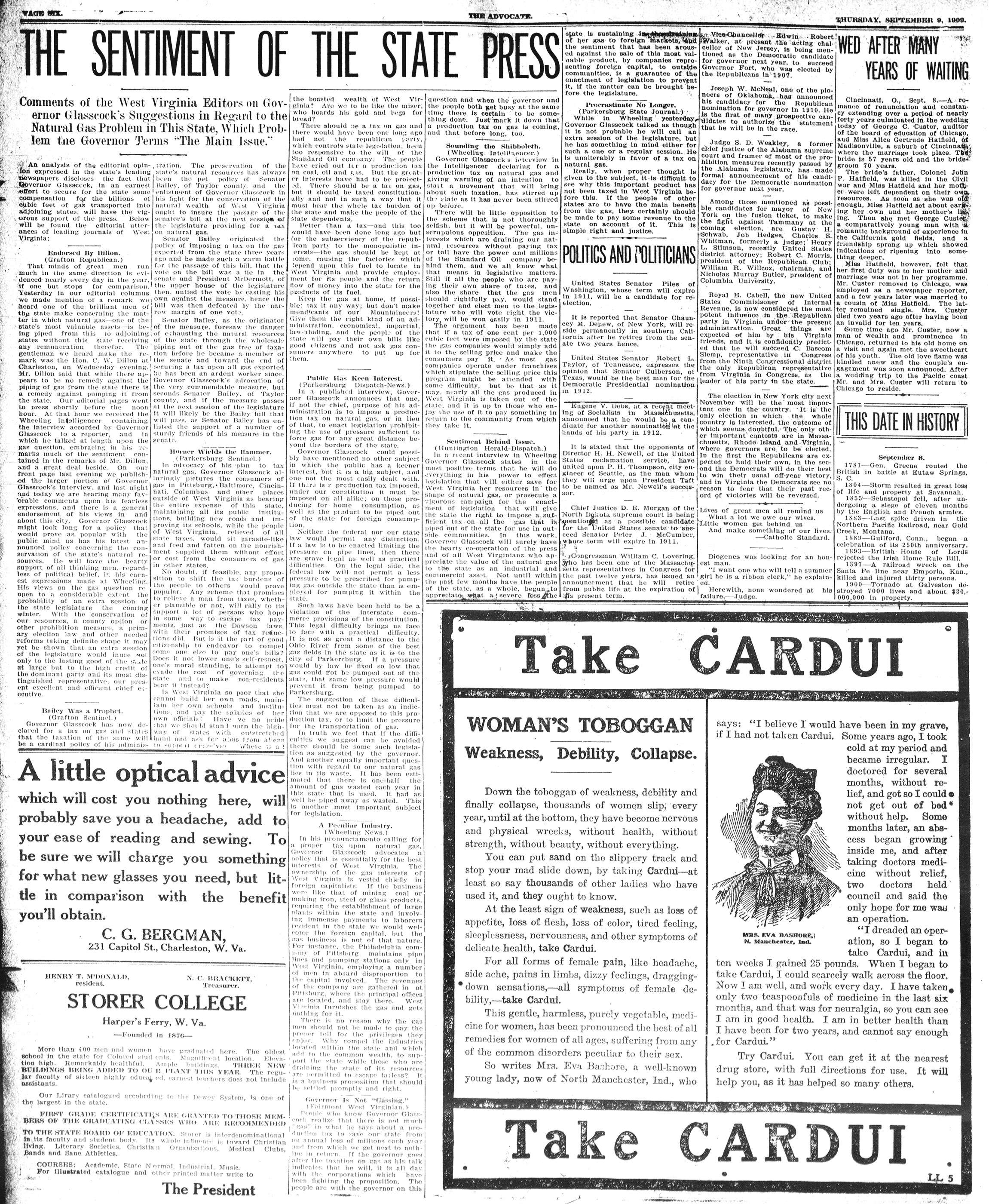
Page text (machine-generated)
THE ADVOCATM
WE CHISEFULLY PUBLISH ALL
JRISP NEWSY NOTES FROM ALL
SECTIONS
MORE ECHOES OF NATIONAL
ENDS OF FACTS AND ADDITIONAL INCIDENTS CONNECTED WITH AT LOUISVILLE AUGUST 1
Emmett J. Scott, Charles Banks, Caryney Plitman and "Some Others" in the Constructive Drama on the
MORE ECHOES OF NATIONAL NEGRO BUSINES LEAGUE
ENDS OF FACTS AND ADDITIONAL PEN PICTURES OF MEN AND INCIDENTS CONNECTED WITH THE GREAT MEETING AT LOUISVILLE AUGUST 18, 19 AND 20.
Emmett J. Scott, Charles Banks, Cary B. Lewis, W. T. Andrews, W. Sidney Pittman and "Some Others" Who Played Conspicuous Parts in the Constructive Drama on the Banks of the Majestic Ohio.
(By R. W. Thompson.)
Dr. George W. Pennyman, of Boston, representing the International Sunday-School movement, came to the convention at the request of Mr. Hartshorn, the head of that worldwide enterprise, which embraces 150,000 Sunday-schools and 14,700,000 members. It is proposed to hold a great mass meeting of the world's christian workers in Edinburgh, where the Negro's bright side will be placed before the assembled multitudes. A comprehensive program is to be adopted in this country, having for its object the creation of a kindlil sentiment toward the Negro by having his progress and creditable achievements recorded in the press, rather than his crimes and misdemeanors, as is too prevalent at this time. Dr. Pennyman was enthusiastically received, and fervent "amens" greeted his demand for a fairer hearing through the white press of the land.
Dr. Washington shut off much of the oratory that the disciples of Demosthenes had prepared for the occasion. He remarked that elaborate introductions had better be cut out entirely by the speakers—that minor details could be taken for granted. As it appeared that in many instances that the best thoughts and most important facts were reserved for the last page of the manuscript, he brought down the house by suggesting that the last page be read first.
The only changes made in the executive committee was the substitution of J. C. Thomas, the New York undertaker, for N. T. Velar, of greater Pittsburgh. Mr. Thomas has done a great work for the League in the nation's metropolis and may have the pleasure of entertaining the League at his home next August.
The Louisville Herald, of August 19, carried on its first page a handsomely ornamented, double-column cut, showing Governor A. E. Willson and Dr. Booker T. Washington in a characteristic attitude. The publication of such a picture in a leading, daily in a city in the border south was the talk of the town. Kentucky holds first place on the liberality of the color question, and recognition of worth regardless of race.
The editorial comments on the League and the work of Booker T. Washington in the Louisville dailies were "Cracker-Jacks."
No politicians were endorsed or denounced. The business men came to do business exclusively, and when their business was at an end, they adjourned in good order and went home.
Among the olties yet to be considered as a convention seat are Philadelphia, St. Louis, Cleveland, and Pittsburg. Where are the business Negroes of these great centers.
The photographers did their duty in metropolitan style and the home of every delegate will be ornamented with a group of the League's greatest convention.
It may be New York for next year.
Cary B. Lewis, a born newspaper man, who has revolutionized journalistic methods in and about the Falls Cities, covered the convention in admirable fashion for the Courier-Journal and Evening Times, two of the strongest dailies in Kentucky, breaking all records for accuracy of his "story" and completeness of the service. Mr. Lewis is on the regular staff of these papers and is deservedly popular with his employers by reason of getting the freshest and most reliable news and the disposition to accord a square deal to all concerned. The Courier and the Times are the most widely read papers in the state by Negroes, by reason of their liberality in giving such an exemplary young man a dignified position and an opportunity to record the creditable doings of his race. The convention, the city of Louisville and the nation are under everlasting obligations to Mr. Lewis and the very generous management of the Courier-Journal and Times.
Hon. C. C. Stoll, member of the Louisville Board of Public Works, said to the body that "Business is a purveyor of morality—it is at the root of all things that uplift and strengthen mankind. The essentials of business are energy, honesty and capability. The business man who succeeds in the long run is he who most rigidly lives up to the Golden Rule. The Negro needs business
VOLUME IX.
training to enable him to compete with the world's greatest workers, and this League is on the right track when it emphasizes the value of such training."
Bush's band from Arkansas was a "peach."
It is to be hoped that the belles, who got together their "gladest rags," and put on their sweetest smiles with the view of capturing a wealthy husband, succeeded to their heart's content. Our girls deserves better husbands than some of them are getting.
Commissioner Emmett J. Scott's address was full of interesting facts concerning Liberia and its people. He spoke particularly of the high regard the natives have for Sunday—they do no work and cannot be induced to do anything to mar the sacred observance of the day. They are credulous in the extreme—ready to believe the most impossible things if told by someone in whom they have confidence. "Liberia," says Mr. Scott, "has 13,000 square miles of territory, and is the richest spot on the continent of Africa, capable of yielding millions of dollars annually for investors who will develop its resources. There are 60,000 civilized inhabitants and about 2,000,000 natives in their aboriginal state. The future will determine whether these people are competent for self-government. It is the last opportunity on the Dark Continent for such a trial, as there is but one other Negro government in the hands of the blacks
Abyssinia, where King Menelik holds the reins of power. Mr. Scott is of the opinion that with sympathy, help and encouragement of a substantial kind, the people of Liberia will make phenomenal progress and justify all that this and other nations may do for them. The report of the Liberian Commission will be made public early in September.
Harry T. Pratt, editor of the new and sprightly Baltimore Times, made an efficient registrar, in the unavoidable absence of Frank H. Gilbert, and George F. Collins, of Washington, lent valuable assistance.
S. H. Vick, postmaster at Wilson, N. C. for many years, and whose case attracted national attention when his post was taken from him, was among the trong.
Charles Banks, of whom much was written during the League period, because of his wonderful powers as a leader of men, delivered one of the most practical speeches of his life in responding to the address of welcome on opening day. He said, among other things: "The Business League is the only agency that is convincing our friends and enemies alike of the sincerity of our purpose and the earnestness of our work. We are buying land, building homes, operating stores and factories and rearing our families to be good citizens, and it is ours to go forward in faith and hope for the good of our race." Mr. Banks is the cashier of the strong savings bank at Mound Bayou, Miss., chief promoter of the cotton seed oil mill there, owns a big tract of the richest land in the vicinity, and believes that real racial strength comes in getting hold of the things that count in the market of the nation, rather than indulging in flamboyant oratory or the jeremiads of complaint. Mr. Banks is president of the Mississippi State Negro Business League, brought the largest delegation to the Louisville convention, was a supervisor of census in 1900, and was a member of the committee designated by the Chicago republican convention to notify Hon. J. S. Sherman of his nomination as vice president of the United States. Mr. Banks, last spring, headed a delegation of Mississippiians who went to Washington in a Pullman palace car paying all expenses out of their own pockets, to assure President Taft of the loyalty of the Negroes of his state and of their earnest desire to cooperate with him in carrying out a policy that would guarantee justice to all and bring about friendly relations between the races.
If Governor Willison is "an excuse for a Governor"—as he modestly hints—the Negroes af Kentucky and nation are saying: "Give us some more 'excuses' like him."
Without counting the receipts of the present meeting, the report of the treasurer, Gilbert C. Harris, of Boston, showed that there was on hand the snug sum of $2,402.58.
THE ADVOCATE.
Adding the $889 taken in at Louisville, the total ran up to $3,291.58. The regular dues are devoted to the legitimate expenses of the League, while that received from life memberships is held on interest and will be profitably invested when it reaches a certain amount.
Dr. W. W. Russell, who goes to Washington to teach poultry raising in Miss Nannie H. Burrough's National Training School for girls, stirred up a big excitement among the preachers by his expert knowledge of the festive chicken.
CONFERENCE
OF CHURCH WORKERS AMONG COLORED PEOPLE
Holds Its First Meeting South in Ten Years and Years Report of Marvelous Progress Along Religious Lines.
Lawrenceville, Va., Sept. 6.—The Conference of Church Workers concern our well being as this great country. Then on the State of the Church forth this public address and prayer.
In looking over the wha Jabor in our Church, we are fully impressed with the able growth and development work under so many emblems and limitations. From a the field come most encounters of steady and perseverance along mission many new missions have and the number of workers.
The list of officers should have carried the names of Scipio A. Jones, of Arkansas, as fourth vice-president and W. C. Gordon, of St. Louis, Mo., as fifth vice-president. They are excellent men and richly merit the honor that has been conferred upon them.
The Louisvill folks thought they might have been given a little vice-presidency as a compliment to their labors, but did not pout over their disappointment. Prof. W. H. Steward served since last December as fifth vice-president. J. C. Jackson, of Lexington, Ky., is a member of the executive committee—so Kentucky has not been overlooked by any means.
The local committee came out ahead in finances—showing they know something about the executive side of handling a convention.
A convincing statement of the plans and purposes of the Lincoln Memorial Building Association was made on Friday by Mr. F. Clay Harley, of Washington, D. C. This company is made up of a number of the most substantial business men of Washington and elsewhere, and it is their purpose to erect in the heart of the commercial centre of the nation's capitol a mammoth office building and theatre, the investment representing $400,000. Shares are selling rapidly at $10 each, and money is being received daily by the treasurer from nearly every state in the Union. The investment is pronounced absolutely safe by experts in finance, and as the 40,000 shares will soon be placed, it is expected that work will begin on the new structure within a few months at the fartherost. Plans have already been drawn by W. Sidney Pittman and the front elevation of the building which was on exhibition at the church and at the Y. M. C. A., shows that it will compare favorably with any structure of its character in the city of Washington. It will have 60 offices, several store rooms and a theatre seating 2,500. Fittingly, President Pittman and Mr. Harley have designated the Lincoln Memorial Building "a national monument to the thrift, industry and enterprise of the Negro race."
W. T. Andrews, editor of the Defender at Sumpter, S. C., and a prosperous dealer in real estate, took a prominent part in the precedings of the main convention and in the organization of the press convention. To the intelligently directed efforts of Mr. Andrews the triumphant success of the recent South Carolina tour of Booker T. Washington was, in the largest measure, due. Mr. Andrews is modest and unassuming, but is an indeftigable worker, a polished gentleman, and enjoys the fullest confidence of both races of his native state. His strength at home is shown in the fact that, all things considered, Sumpter gave the Washington party a most lavish and whole-souled entertainment that was extended during their ten days' itinerary through the Palmetto state.
Mr. J. C. Napier, of Nashville, Tenn., chairman of the executive committee, and right-hand man to Dr. Washington, was, as usual, the Chesterfield of the convention. He knows how to do the right thing at the right time, never loses his mental equilibrium under any circumstances, and is always ready with a helpful suggestion when a tangle seems imminent. As a banker and as a lawyer, Mr. Napier stands in the first rank in his state and is a believer in the future of the south—contends that it is the section in which the working and ambitious Negro really finds his best opportunity for uplifting service. It is an open secret that when the national administration gets around to the distribution of the Federal plums, Mr. Napier is booked for the very biggest at President Taft's disposal. No one thing will so commend Mr. Taft to the good graces of the colored people of this country as the recognition of Mr. Napier in a fashion commensurate with his character ability and faithful party service.
The movement for an exposition in 1913, demonstrative of the progress of the Negro during his half-century of freedom, was warmly supported by Prof. E. L. Blackshear, of Prarie View College, Waco, Texas, and Dr. R. E. Jones, editor of the Southwestern Christian Advocate, New Orleans, La. It will be a 'go.'
CONFERENCE
OF CHURCH WORKERS AMONG
COLORED PEOPLE
Holds Its First Meeting South in Ten Years and Hearts Report of Marvelous Progress Along Religious Lines.
---
Lawrenceville, Va., Sept. 6.—The Conference of Church Workers among colored people held in St. Pauls Memorial Chapel, closed Friday night last after a three days' session of what was universally conceded to have been the best attended and most successful conference in every respect ever held. The Conference of Church Workers is a voluntary body without legislative or judicial functions. Its sole object is to increase and stimulate the work of the church among colored people. The Conference numbers about 200 earned, thoughtful, Christian men and women.
The Conference was organized 25 years ago by Dr. Alexander Crummel. It has had annual sessions since, but mostly in the North. The officers of the Conference are: President, Rev. H. L. Phillips, D. D. Philadelphia, Pa.; Vice-President, the Von E. Robert Bennett, Archdeacon elect of Florida; Secretary the Rev. Geo. F. Bragg, Jr., D. D., Baltimore, Md.; Treasurer, Prof. Edward Ellis, Jr., Richmond Va.; Assistant Secretary, the Rev. J. K. Satterwhite, Winston-Salem, N. C.; Necrologist, Rev. E. E. Miller, Petersburg, Va.
The features of the Conference were the admirably prepared papers, addresses and sermons, the address of the Church, and the conservatism of loftiness of the deliberations. The Conference appropriated $25 each to Bishops Ferguson and Holly for their missionary work. Honorary presidents were ordered to be appointed for each diocese. The general Church was represented on the program by Rt. Rev. Robert Strange Bishop of East Carolina; the Rev. C. B. Bryan. D. D., Petersburg, Va., principal Bishop Payne Divinity School; and the Rev. Samuel H. Bishop, A. M., General Agent of the American Church Institute for Negroes. All of the gentlemen made addresses remarkable for their hopefulness, broad Christianity and catholic spirit, as well as for scholarlyness. The addresses of the Revs. Scott Wood and Geo. P. Bragg, on the need of a Field Secretary, dealt with vital question in the Church. The feeling of the Conference crystallized in the following resolution:
Whereas the urgent and immediate needs of the work among the colored people demand the presence and personality of a capable and efficient Negro priest, who can and will visit the workers in the field, helping them in their various problems, inspiring confidence and enthusiasm in the members of our various congregations, representing the interests of the missionary cause, visiting Negro colleges and high schools, and strengthening the youth of the Church in such institutions, and, in general, operating as a vital connecting link of the race and the Afro-American membership with the larger life of the Church at large, now, therefore, be it
Resolved. That this Conference of Church Workers among Colored People has heard with keen regret the inability of the Board of Missions to accede to our request in the appointment of a Field Secretary. And that we re-affirm our request made to them last year with respect to this matter.
The women of the Church were represented by Woman's Day, which was Friday. The papers and discussions were highly creditable and their deliberations took a practical turn. The officers of the Woman's organization are: President, Mrs. M. M. Brokenborough, Richmond, Va.; Vice-president, Miss E. V. Smith Anaostia, D. C.; Secretary, Mrs. B. W. Paxton, Newark, N. J.; Corresponding Secretary, Mrs. Susie V. Pollard, Petersburg, Va.; Treasurer, Mrs. Nellie C. Jones, Edenton, N. C.
The session closed Friday night with a procession of the clergy and solemn TeDeum. Afterwards a delightful reception was tendered the Conference by the principal and faculty of St. Paul School, and friends in the community.
The address to the Church at large was a thoughtful and conservative document. The address reads:
"We the members of the twenty-fifth annual Conference of Church Workers among Colored People, are grateful to Almighty God, our heavenly Father, that under his wise and gracious providence, we have been spared through many vicissitudes and changes, after ten years, to again hold our Conference upon the soil of the Old Dominion, to prayerfully and carefully deliberate upon the questions which most vitally
concern our well being as a race in this great country. The Committee on the State of the Church do set forth this public address, declaration and prayer.
In looking over the whole field of Jabor in our Church, we are wonderfully impressed with the remarkable growth and development of the work under so many embarassments and limitations. From all parts of the field come most encouraging reports of steady and permanent advancement along missionary lines; many new missions have been started, the number of workers has been increased; here and there church edifices have been erected, the people contributing largely. We are also glad to note that there is a growing tendency towards self-support. We are indeed grateful for the liberal and kind sentiment manifested towards us in our efforts to build up and sustain our educational institutions, theological, industrial and classical, for the moral and spiritual uplift of the race. Thus far much good has been accomplished through the agency of St. Augustine's School, St. Paul's School, the Bishop Payne Divinity School, and our other industrial and parochial schools.
These institutions have prepared a great number of young men and young women for usefulness in their homes, in their communities and in the Church. There is no Church work in the Southland, and very little elsewhere in the country, where the influence of these schools has not been felt. While they have done so much to ameliorate the conditions of home and Church life sending forth the light of religion and education to our people in all walks of life, in the towns and in the rural districts; they have accomplished it all without adequate support from the Church. Nevertheless we are very grateful for what has been done and pray that the general Church may learn more of the great work these schools are doing and assist in enlarging and increasing their equipment, that they may stand as a mighty bulwark of the moral, intellectual and Christian development of the colored people. On account of the continued growth and expansion of the Church among colored people, we feel that the appointment of a Field Secretary would, greatly, tend, to, bring about what we believe all true and fair-minded Church men earnestly desire for our welfare and for the extension of the Church. We therefore most respectfully ask that such an agent, chosen from our own race be appointed.
We are indeed grateful that, notwithstanding the spirit of unrest and strife in some parts of our country, our people, for the most part, have stood for peace and the supremacy of the law, and we urge them everywhere to strive to be peaceable, quiet, industrious, honest and law-abiding, trusting in God to do all things well.
This is the second session of the Conference held in the South and the first time its Northern members ever had a chance to experience real old fashioned hospitality dispensed as only your Virginian knows how to hand it out. The Conference was delighted with its reception, and every member went away loud in praise of the generous welcome accorded them by both white and black. The Conference was especially grateful to the Virginian dailies, The Times-Dispatch, News-Leader, Index-Apeal, and Landmark, the Philadelphia Press and the New York World, for copies free distribution during the sessions of the Conference. The next Conference will meet in Cleveland, Ohio.
RESOLUTIONS OF CONDOLENCE
Hall of Washington Lodge No. 6, A. F. and A. M.
Charleston, W. Va., Aug. 27, '09. Whereas, In His infinite wisdom, it has pleased the Grand Master of the Universe to call from the scenes of his earthly labors our brother, our Grand Master, Rosser D. Robinson; and, Whereas, We, as men and as Masons, are deeply sensible of the loss which we, as individuals, have, and the Masonic fraternity, as a whole, has sustained in the loss of one who was an honored and valuable member of our Order, a sincerely subscriber to its tenets, whose faith was unquestioned, whose hope was well founded, and whose charity was circumscripted only by the opportunities for its exercise;
Therefore, Be it resolved, That Washington Lodge No. 6, A. F. & A. M. hereby extend to the members of his family their tenderest sympathy and the strong assurance of the deep respect in which his memory shall be held by the Order, that our sympathies as a whole and individually extend to our Grand Quary, ever revering his memory and lamenting his untimely demise.
Be it further resolved, That a copy of these resolutions be inscribed upon the records of this lodge, a copy
RIGHTS OF PEDESTRIANS PUT IN JEOPARDY BY FAST DRIVING
Numerous complaints have been made to the Mail by some of the leading citizens of Charleston of the laxity of the city officials in enforcing the laws relating to the speed of vehicles and the obstruction* of the city's highways.
Automobiles, motor cycles, buggies and other vehicles are allowed to exceed the speed limit without interference on a number of streets in the city, while the streets and sidewalks are blockaded in the vicinity of new buildings under the process of construction.
Another objectionable nuisance in Charleston, which is seen in but few cities, is the riding of bicycles on the sidewalks of the city by numerous people without being molested by the officers who are supposed to enforce the law. The rights of pedestrians in Charleston have been safeguarded by law but the officers are not prone to enforce these ordinances.
In some of the residence sections of the city drivers of vehicles are also annoyed by children, in a spirit of hurry and daring, running out in front of an amusing vehicle, then jumping away in time to escape injury. This is a matter that should be promptly attended to by the parent, and without any delay.
TRAIN CREWS ON THE N. & W. INCREASED
TRAIN CREWS ON THE N. & W. INCREASED
Bluefield, W. Va., Sept. 8. —Owing to the increase in the coal and coke business on the Norfolk & Western in the Pocahontas field the railroad company has found it necessary to very materially increase its train crews. When the panic period prevailed, many men were cut from the crews. Conductors went back to brakemen and flagmen, and engineers took up their old tasks of shoveling coal into fire boxes, while brakes and firemen were temporarily retrained. The advent of better things in the coal mill called for a big increase in operating crews. Numerous promotions have taken place, men have been reinstated, and it is estimated that within the past few weeks from fifty to seventy-five men have been added to the working train force on this division.
Williamson is the muzzle of the Pocahontas coal fields so far as this division is concerned, and the delly eries for western consignment are made to the Scioto division at that point. The intermediate tributary fields of course must be taken into consideration, but the Scioto division takes the entire haulage for the west from the adjoining fields. It is stated that thirty-eight extra crews have been added on the Scioto division, and that it is possible the extra crews will run up to fifty within the next few days if business continues to increase.
The increase on this division has not amounted to so much for the reason that a crew's efficiency amounts to a great deal more from here to Williamson than it does from Williamson west, since the haul is down grade. One crew here represents much higher handling results since gravity aids very materially in the movement.
The Norfolk & Western officials here say that the employment of trainmen and the haulage on this division is now up to the standard of the best times. And even at this the business is rapidly increasing, particularly the western movement. While the eastern loading is good and is showing substantial improvement, it is not quite keeping pace with the western.
POSTMASTERS IN SESSION
MARKS IN SESSION
Galnesville, Ga., Sept. 8. —Postmasters from many parts of the country assembled here today as guests of the citizens of Galnesville in general and of Mrs. Helen D. Longstreet, widow of the celebrated Confederate general, in particular. Mrs. Longstreet is postmaster of Galnesville and through her eloquence and persuasion brought to this city the annual convention of the National Association of Second and Third Class Postmasters. The convention, which is the largest in point of attendance ever held by the association, will remain in session three days. A feature of the programme will be addresses by several prominent representatives of the Postoffice Department at Washington. Dallas, Texas, has sent an invitation to the association to meet in that city next year.
be sent to the McDowell Times, one to the Pioneer Press, and one to The Advocate for publication, and a copy of the same be forwarded to his family by a committee appointed by our Master for the purpose.
NUMBER LXXXVII
London, Aug. 19, 1907, return is expected short expedition which left England September, 1907, for the Free State, with the object of constructing a scientific inquiry and culture of certain native tribes south of latitude 2 S., between the Kwilu and Lomami rivers. At the present moment when so much interest is taken in questions of primitive culture and such enigmatic practices as that of totemism, it may be of interest to give a brief account of what the expedition has done and is doing among tribes little visited or unknown from this aspect. The expedition was organized by Mr. M. E. Torday, who has resided for more than seven years in different parts of the state, after consultation with Mr. C. H. Read, of the Ethnographical Department of the Department of the British Museum.
Remarkable Tribe
Of the tribes visited by far the most important and interesting are the Bushongo, the western tribes of whom were discovered in 1884 by Wissmann's expedition. Little, however, has hitherto been recorded of them except their skill in handicrafts. The information now collected proves them to be one of the most remarkable tribes in Africa.
In the first place they have preserved a great deal of their tribal history, and a list of no fewer than 123 great chiefs was obtained; numerous connections with the reigns of certain of these rulers relate the migration of the people, their wars with neighboring tribes and the introduction or invention of various useful arts.
The tribal organization is elaborate; the head chief is supported by a very large number of officers, each with a definite function; and not only are the subtrtbes represented at court by officers who fulfill the function of agents-general, but each handcraft possesses a court representative.
Skill in Handicraft.
The skill of the Bushongo in weaving and woodcarving was known before, but some of the specimens collected far surpass anything which has yet been seen; in particular, certain portrait statues of ancient kings are most remarkable works of art and are evidence of a skill in portraiture hitherto unknown in Africa, outside ancient Egypt.
Their embroidered cloths, manufactured entirely from palm-leaf fibre exhibit the most intricate patterns, bearing a distinct resemblance, in the case of the older and finer examples, to Celtic art; the carved designs on their wooden cups and caskets are somewhat similar.
The information concerning the social organization of the people proves the existence among them of a decayed form of totemism; but the elaborate initiation ceremonies which were performed within the memory of the older natives, from whom details were fortunately secured, have now for the most part been abandoned.
Shy and Hostile.
Concerning the tribes to the north of the Sankuru, the Basaonge Meno, Akela, Bankutu and northern Bateela, less information could be obtained, owing to their extreme shyness and even veiled hostility; they stand, however, on a far lower plane of culture.
The first two have, like the Bushongo, migrated to their present territory from the north, and seem connected by blood with the last-named people; the other two are much addicted to canibalism, a practice which in their case is based on a sincere liking for human flesh.
The Southern Batetella have now been compelled to abandon the habit. More is known concerning this tribe; they served as troops on both sides during the wars with the Arabs, and later figured as the leaders in a serious revolt. They have adopted certain Arab customs, but their elaborate system of conveying messages by means of gong beats, which has been reported by former travellers, is purely indigenous.
WEDDING IN ARMY CIRCLES
New York, Sept. 8.—St. John's church, at Fisher's island, was the scene of a wedding of interest in army circles today, when Miss Mara Roanah Ferguson, daughter of Mrs. Edmund Morewood Ferguson, of Pittsburg, became the bride of Lieutenant Alexander Garland Pendleton, of the coast artillery, U. S. A. Following the ceremony a large reception was held at Miramar, the summer home of the bride's mother,
CORRESPONDENCE
MONTGOMERY.
Misses Lola M. Lavender and Nelle M. Lewis will leave Friday for Bluefield to resume their duties in the school.
Miss Othenia Morgan, of Pocahontas, was the guest of Miss Wysor Watson last week.
Mrs. C. U. Watson, Messrs, I. S. White and L. B. Morgan attended the funeral of Mrs. James Willis at Paint Creek Monday.
Mrs. James Ellis, of Rush Run, is here the guest of her parents, Mr. and Mrs. Henry Brown.
Rev. Warner Brown is a business visitor to points in Virginia this week.
Miss Lolo M. Lavender entertained with a card party, Thursday evening, complimentary to Mrs. Annette Bord of Bristol, Tenn.
Joe Buster has returned from Cincinnati where he has been for treatment in the hospital for the last two months.
Miss Bessie Payne, of Charleston, is here the guest of relatives.
Miss Annette Boyd and Samuel Childs were guests of friends at Powellton Friday.
George Hughes, of Huntington, was here on business Saturday.
R. W. White, of Washington, D. C., was a business visitor here Saturday.
Mrs. Nellie Freeman, of Covington, Va., was the guest of Mrs. B. F. White last week.
Miss Henrietta James of Red Star, was the last week guest of Mrs. I. S. White.
Mrs. F. Donnally Railey will begin school at Donwood, Monday.
Mrs. Eva Brown Pack will open school at Smithers Monday.
Miss Alpha Brooks will begin school at Handley, Monday.
Mrs. Ruth Fields and children, of Charleston, are here the guests of Mr. and Mrs. Nelson Locke.
Howard H. Railey went to Mount Hope Wednesday to assist in holding teachers' examination.
Emmanuel Woods, of Charleston, is here the guest of Mr. and Mrs. George Gough.
M. D. Buster entertained a few friends Saturday evening with a smoker at his home in Buster block.
Mrs. Eunice B. White will open school Monday, at Hansford.
Mr. and Mrs. C. R. Pack, of Sylvia, were guests of relatives here this weak.
Rev. Albost Harris, of Sylvia, preached morning and evening at the First Baptist church.
RED SULPHUR SPRINGS.
There was preaching Sunday by Rev. O. T. Harris.
Charles Branch, was the guest of Miss Ocea Williams.
Miss Jeannette Williams has returned home.
Prof. W. W. Williams has returned home from a short trip to Bluefield.
A delightful reception was given at the home of Mrs. Wirt Williams in honor of Mrs. Gardner. The other guests were Miss Jeannette Williams, Miss Bessie Payne, Mrs. Bullock and Ocea Williams. Ice cream and cake were served by the hostess. All present enjoyed a pleasant afternoon.
Miss Cermilla Curry is the guest of Miss Mabel Johnson.
Miss Neal Williams is at home for a few days.
Lewis Walker has returned home from Lerry.
Mrs. Wilson Nickles has returned from a short trip to Princeton.
Bob Nickles, of Ohio, is here visiting relatives.
Elizabeth Miles was the guest of Mrs. Connor Friday.
G. R. Crawford has returned home from Lewisburg.
J. G. Hill is at home.
R. O. Cary spent several days in Fayetteville, this week.
Miss Annie Turner, of Fayetteville, spent Saturday here the guest of Mrs. Fanny Cary.
Hen Turner, of Fayetteville, was here on business.
Miss W. A. Freeland returned from Sylvia, Friday, after spending a week the guest of Dr. and Mrs. H. C. Hargrove.
Lindsay Toney, of Huntington, spent Tuesday here the guest of Madison Jones.
Mrs. Nellie Vanhook, of Page, is hake spending the week with her parents, Mr. and Mrs. A. J. Cary.
Eddy and Sandy Goode, of Clifton Fargo, Va., are here the guests of their brothers, George and John Goode.
Miss Fanny Cary spent from Friday until Tuesday in Fayetteville, the guest of the Misses Rotan Turner, and Minor.
Misses Fanny Cary, and Lelia Clarke were business visitors to Thurmond Saturday.
Mr. and Mrs. Harvey Fountain, went to Fayette, Sunday to see Mrs. Alberta, Johnson.
C. H. Saunders and C. Miss Lucy Hesbinson of Red Star, spent Monday here with Mrs. Mattle Johnson.
Madison Jones is an out of town visitor.
L. C. Clayton, of Fayetteville, is here spending a few days.
W. A. Allen spent Sunday at Cliff Top.
Born—to Mr. and Mrs. Jack Scruggs, Sunday, a boy.
Lewis Bibb, W. L. Waddy, and P. B. Jasper, of Penbrook, were seen on our streets Monday.
The people of Sewell, are proud to hear that G. L. Jackson, who has been crippled for over a year has laid his cruethes aside, and is able to walk with a cane.
BANCROFT.
Jas. Lawson was called to Middleport, O., Tuesday, Aug. 30, on account of the death of his mother at that place. H. A. Jones spent a few days in Gallipolis last week. While there he visited the Point Pleasant fair. Mrs. Hale Dickerson and son, Edgar, spent a few days with friends at Raymond City last week. Mrs. M. F. Sinclair and little son Terry were guests of her mother at Raymond City Friday and Saturday. John Cyrus is somewhat indisposed at this writing. The Missionary Society met with Mr. and Mrs. Mickens at Plymouth Monday afternoon. After the business was over they were served with a delightful repast consisting of ice cream, cake and watermelon.
George Brooks, of Plymouth, visited friends at Raymond City Monday.
Mr. and Mrs. John Ross' little daughter Helen, who was sick at our last writing is much better.
Mrs. Oscie Sawyers, of Black Betsy, spent Labor Day at Raymond City visiting friends.
Chas. Harris of Black Betsy, spent Labor Day at Plymouth the guest of friends.
CARBON
Miss Nannie Wilson, who has been very sick the last six months is improving nicely.
T. G. Agnew arrived Wednesday from Guyandotte, his old home, where he has been the last seven months having his eyes treated.
C. H. Moseby, of Holly, was calling on friends and relatives here Thursday.
Mr. and Mrs. George Redman and Mrs. Fannie Agnew left Friday to visit relatives and friends in Huntington and vicinity.
Misses Mamie and Margaret Hughes, of Lamont, was calling on relatives and friends here Saturday and Sunday.
Mrs. George Williams, of Paint Branch, was visiting relatives here Saturday and Sunday.
Rev, A. D. Lockett, of Brown, was with us Sunday night and preached an able sermon. Mr. and Mrs. T. W. Williams and Mrs. L. Alston were visiting on Keeny's Mountain Saturday and Sunday.
CLARKSBURG
The Misses Lowry entertained Friday evening at the Smith pavilion in honor of their guest, Miss Lewellyn Spriggs. The evening was delightfully spent.
F. D. Cambric has returned after attending the biennial meeting of the Knights of Pythias at Kansas City, Mo., and the teachers institute at Onarleston.
R. P. Sims, principal of the Bluefield Institute is here attending a meeting of the normal school principals, preliminary to the meeting of the state board of regents.
Dr. E. L. Young left Thursday for Philadelphia and other eastern cities.
Mrs. Page, of Uniontown, Pa., attended the funeral of her little nephew, Lewis Kyle. She returned home Thursday.
The ball given by W. S. Kearney Court, at the Academy of Music Wednesday night was well attended. C. W. Florence, of Brownsville, Pa., spent Saturday and Sunday here calling on friends. While here he was the guest of James West. James Gray is on the sick list. The public schools will open Sept. 13th. Rev. W. F. Kenney, of Emmerson, O., has accepted the call to the pastorate of Mt. Zion Baptist Church. Miss Lewellyn Spriggs left Saturday morning for her home. On Sunday night an excellent Labor Day Sermon was preached by Rev. West at the A. M. E. Church. Next Sunday is the grand rally which will be followed by a week's entertainment celebrating the church's fortieth anniversary.
On Thursday evening a program will be rendered at Trinity M. E. Church.
Tuesday and Friday nights are booked for entertainments at the A. M. E. Church.
Several of our young people are preparing to go away to school.
Mrs. M. A. Rone has returned from Atlantic City and other eastern points and reports a delightful time
HUNTINGTON.
Mr. and Mrs. Walter Smith, of Wilberforce, O., terminated a very pleasant visit with the former's parents, Monday.
Miss Clara Steward is attending the Institute here this week before resuming her school work at Princeton.
Mrs. George Winston entertained a number of friends Monday compi-
mentary to Mr. and Mrs. Walter Smith at six o'clock dinner.
L. O. Wilson, Grand Chancellor of the K. of P.'s of this state was a business visitor here last week.
Mr. and Mrs. Andrew Baker left for Richmond Friday, to visit relatives for about ten days.
Mrs. T. B. Smith received the sad intelligence of the death of her father Mr. Hance, at their home, Winchester Va., last Tuesday.
Mrs. Myrtle Terry entertained a number of friends last Tuesday evening, complimentary to Misses Glover and Pritchett.
Miss Nora Dickerson, who has been quite ill at her home on 7th Avenue, is somewhat improved at this writing.
Mrs. G. H. Barnett entertained a number of friends at 6 o'clock dinner Wednesday, complimentary to her cousin, Mrs. Trosseau James, of Thomasville, Ga., and Mr. and Mrs. Walter Smith.
Mrs. Estella Scott, who has been quite ill is much improved at this writing.
Mrs. Jennie Pogue entertained the Mite Mission Society in a most charming manner last Thursday evening.
Miss Carrie Simmons entertained a number of ladies Tuesday afternoon in honor of her guests, Misses Glover and Pritchett.
Rev. S. O. Lewis returned from Pittsburg last Monday and spent several days last week with his parents and friends.
Mr. and Mrs. Traveller Smith were host and hostess last Wednesday evening at their home on 9th Avenue in honor of their son, Walter and his wife. After an evening spent in music and conversation dalnty refreshments were served.
Mrs. Bessie Johnson, who was quite ill last week is improving.
Mr. and Mrs. T. B. Smith entertained Rev. Carter at Dinner Sunday.
Mrs. A. D. Lewis returned last week from a pleasant visit to points in Virginia.
Miss Katie Cunningham left for Richmond Friday to spend some time with her mother before resuming her studies in Douglass High School.
Prof. J. W. Scott returned home Wednesday, much benefitted by a ten days' sojourn at Buckroe Beach.
Miss Mary Dill arrived Sunday to attend the teacher's institute in session here this week.
Mrs. C. H. McGee and daughter returned last Sunday from a very pleasant visit to various points in Virginia.
Little Mary Elizabeth, daughter of Mrs. Sue Smith, is quite ill at her home on 10 th Street.
Mrs. E. R. Harvey is spending this week with Charleston friends.
Samuel Patton, who has been ill for the past six weeks, is able to be about the house a little.
Misses Georgia Glover and Odessa Pritchett of Zanesville, O., will leave for their home this week, after an extended visit to friends here.
Miss Emma Norman, of Washington, D. C., is here attending the institute and will remain to begin her work as a teacher in the Douglass school.
Miss Dora Johnson was the guest of her aunt, Amanda Bell, Sunday.
ST. ALBANS.
Mrs. Benjamin Brooks and little daughter, Eva, spent several days with her daughter, Mrs. Emma Taylor, last week.
Misses Rhoda Wilson, Mabel Scott, Rubie Carr and LeRoy Hall attended the Kanawha county teacher's institute last week at Charleston.
Rev. H. C. Jones, of Wilmington, Del., preached for Rev. J. W. Robinson Sunday morning.
Prof. L. R. Jordan, of Institute, was here on business last week.
The many friends of Mrs. Lydia A. Trent will be sorry to hear of her death which occurred Thursday, September 2. Mrs. Trent was born a slave in Putnam county, April, 1848. She joined the Baptist church in Ohio at fourteen, where she lived but a few years. Moving to West Virginia she connected herself with the New Hope Baptist church of Sissonville, where she remained a constant member for thirty years. At the time of her death she was a member of the St. Paul Baptist church, at St. Albans. She lived a devoted christian, always willing to help the cause of Christ. The last place she was ever able to go was to the church just ten days before her death. Mrs. Trent was the mother of fourteen children of which only six are living. The funeral was preached by Rev. W. W. Scott who gave a very excellent detail of her life. The relatives have the sympathy of the entire community.
BARBOURSVILLE
Isaac Newton and Lee Monroe, of Huntington were business visitors here last week.
Misses Bessie, Allie and Hattie Hicks returned home Tuesday after two weeks visit in Charleston and St. Albans.
Miss Minnie Martin visited friends in Guyandotte Sunday and Monday.
A number from here attended the circus at Huntington Friday.
Mrs. Irving, of Holden, is visiting friends here this week.
Luke and Moses Hicks, Harry and George Hill, Frank Massey and Frank Williams, of Huntington were visitors Sunday.
G. W. Hamler, of Hot Springs, arrived Saturday to spend some time with his friends here.
South Charleston
PEOPLE IN SOUTH CHARLESTON NOW
5
ACTORIES EMPLOYE
Glass Co.
Kanawha Chemjca
Steel Co.
s and other buil
chool House, Com
construction, Na
now completed a
ore the prices go
cars g
1-10 cash, balance i
Discount f
awha
om 501 Charleston
FACTORIES EMPLOYING OVER 400 MEN Dunkirk Window Glass Co. Banner Window Glass Co. Kanawha Chemjcal Engine Mfg. Co.
Terms: 1-10 cash, balance in monthly payments to suit. Discount for all cash. Kanawha Land Co. Room 501 Charleston National Bank Building Bell Phone 750; Home Phon: 1214
and relatives at Manchester and Richmond, Va.
Miss Edith Wood, who has been indisposed for a few days is able to be out again.
Mrs. Randall Brown, of Weston, was the guest of Mrs. Wm. Barber Sunday.
Rev. Henry Jones was the weekend guest of Prof. and Mrs. Byrd Priierman.
Dr. R. L. Jones made a professional trip to Institute Saturday.
Mrs. F. D. Page and Miss Mary Page, of Kanawha City were Institute callers Tuesday.
Miss Emma Meadows left for Winifrede, where she will teach school this year.
Miss Hattie Peters spent a few days with her Institute relatives.
Miss Alieen Harper was called to Institute because of the illness of her sister, Mrs. R. L. Brown.
R. W. White paid Institute a business call Friday.
Mrs. S. H. Guss left for Columbus, O., Tuesday.
Mrs. Eva Brown Pack is visiting her parents, Mr. and Mrs. Z. Taylor Brown.
Mrs. L. N. Brown, who has been quite ill is improving very rapidly at this writing.
Miss Marie Woolfolk was the guest of Miss Ethel Spriggs Monday.
RAYMOND CITY.
Rev. P. P. Hoiland filled his pulpit here Sunday. He preached two able sermons.
An interesting baseball game was played here Labor Day between the Raymond City Tigers and the Midway team. (White.) They played nine innings, the score being twenty-six to one in favor of the Tigers.
Mrs. Emma Dickerson and son, of Bancroft were business visitors here last week.
Mrs. Victoria Duck is on the sick list this week.
Miss Nola Walker is somewhat indisposed at this writing.
Miss Ossie Sawyers, of Bancroft, spent Monday here.
John Lee and family left Tuesday for Carbondale.
N. G. Hunter and Rev. J. W. Crosby were indisposed last week.
Scott Brown of Institute spent Sunday here, the guest of his daughter, Mrs. Jennie Williams.
Misses Hassie Brown and Page, of Institute are spending a few days here.
Mrs. Ida Coleman entertained a few friends at her home Saturday, evening at a birthday social. An enjoyable evening was spent.
Mrs. Charlie Whorton was called to Columbus, O., last week by the serious illness of her mother.
Mr. and Mrs. Kilgore and daughter, Minnie, attended the funeral of Mrs. Sam Reynolds at Kelley, Tuesday.
Miss Mary Hicks received the sad news of the death of her mother, who was quite advanced in age. She resided in Bastrop, La.
Rev. R. D. W. Meadows preached here Wednesday evening.
Mrs. Mary Floyd and daughter, of Lebanon, Va., arrived Sunday to make this their home.
Tyler Peyton, of Clifton Forge, is home for a few weeks' vacation.
Miss Harriett Johnson, of Kenova, was the guest of her mother, Mrs. Peyton Monday.
The Sunday School will hold their annual picnic Friday the 10th. The school children are awaiting the date with much anxiety as chicken and watermelon will be galore.
RONCEVERTE
Rev. Charles Lewis returned home from Sylvia Friday, where he attended the state council of Red Men.
Austin Crawford, George Carter, Jas. and Wm. Hill, Arthur Trice and others, of Alderson, were up to the carnival last week.
Miss Rosa McVey, of Lewisburg, who has been the guest of Mrs. Susie Morton, returned home Saturday.
Mrs. D. R. Hickman, who represented Epworth League at M. E. Conference returned from Martinsburg Friday.
Mrs. Owen Price was a visitor here last week.
Mrs. Alberta Bush, of Lewisburg, was the guest of her sister, Miss Nannie V. Allen, last week.
Miss Catherine Johnson of Berwyn, who was a visitor of Mrs. D. R. Hickman for a few days left for Staunton, Va., Monday.
Miss Hattie Micken, of Hinton, who has been spending the summer with friends here, returned home Saturday.
Willie Smith of Hinton, was with us last week.
Rev. W. E. Jefferson is back from the conference. He preached to a large congregation Sunday morning and at night held communion services.
Miss Susie Burton, who was the guest of Mrs. Chas. Perkins, returned to her home at Claremont last week.
Miss Bettie Williams returned home last week after visiting friends
COLLEGE
6th St. and Penn Ave.
PITTSBURGH
Preparatory, Commercial Stenography
Telegraphy, Electricity, Engineering, Drifting
Mathematics, Languages and Civil Service, Day
and evening services
Good Equipment, Best Location, Excellent Light, Able Faculty, Strong Courses of Struly, CATALOG FREE.
MARTIN JENNINGS CATALOG L. L. B. Pros.
25 THERE APRIL 1, 1907
5
MIES EMPLOYING OVER
Co. B
wha Chemjcal Engine M
other buildings in S
House, Concrete Sir
truction, Natural Gas
completed and soon t
e prices go up. Th
cars go in.
ash, balance in monthly p
Discount for all cash.
wha La
Charleston National Bank
INSTITUTE
BAYMOND CITY.
Beef, Veal, Mutton, Pork, Fresh Pork Sausage OUR OWN MAKE.
OYSTERS, FISH, POULTRY
The best qualities in all the popular kinds of
We want your patronage for we have complete stock in our lines and you can get it when you want it most.
Hemlock Lumber Co.
South Charleston.
e Walk, Sewers,
Everything.
the trollly cars.
they go up when the
payments to suit.
and Co.
k Building
BAUER MEAT
FISH COMPANY
D 30 CAPITOL ST
Veal, Mutton, Pork
h Pork Sausage
OUR OWN MAKE.
our machine sliced
s and Bacon
RS, FISH, POULTRY
qualities in all the popular
kinds of
Cheese
your patronage for we have stock in our lines and you when you want it most
DEATH KNELL OF LEVIES SOUNDED LAST EVENING
When Chamber of Commerce Characterized the 19 and 20 Cent Special Levies As Extravagant and Exorbitant---Wants City Run on More Economical Basis.
THURSDAY, SEPTEMBER 9, 1909.
By a decisive vote the Charleston Chamber of Commerce, at a special meeting held Tuesday night, rang the alarm against the extravagant expenditure of city funds, went on record as being opposed to the ratification of either the 19 or 20 cent levy at the coming special election, and in the event of the defeat of the levies gave assurance of its assistance in meeting the deficit which the city faces through the failure of the city council to issue retail liquor licenses.
Exorbitant Levies Proposed.
In a report made by the special committee appointed some time ago by President Capito, and which report was endorsed last night by the largest commercial organization within the city, it was held that the extra levies submitted to the people on September 14 for their rejection or notification, were exorbitant and unnecessary for the economical administration of the municipal government.
15-Cent Levy Sufficient.
While the committee reported that the failure of the city to issue license to retail liquor saloons had curtailed the revenues of the city to such an extent that an additional levy was needed, in the opinion of the special committee, this special levy should not exceed 15 cents and if the 19, and 20 cent levies are defeated on September 14, the Chamber of Commerce will assist in devising means to meet the deficit. For this purpose the special committee was continued at the meeting of the chamber of commerce last night.
"Get back into reasonable limits and run the city on a more economical basis," was the advice given by F. M. Staunton, the well known local banker, who has taken an active part in civic problems. Mr. Staunton, who is a member of the special committee which made the report last night asking for the defeat of both levies, in supplementing the remarks of Chairman Schwabe in the introduction of the report, stated that the city government had been extravagantly run for the past four or five years; that salaries had been boosted and that places had been created for payment of political obligation. The city, he contended, should pay, no more for the services of its employees than private persons, firms or corporations.
Danger of the 19-Cent Levy.
To ratify at the polls the 19-cent levy to pay the interest and sinking fund on the bonded indebtedness would mean, said Mr. Staunton, that this levy would run during the life of the bonds now outstanding, some of which run for more than thirty years and any levying body hereafter could lay this levy during the life of the bonds. Between the 19-cent and the 20-cent levies, the latter was the best, thought Mr. Staunton, but a question of principle was involved and the committee was of the opinion that with the present valuation placed on property the levy should not be allowed to exceed 50 cents.
At this time, said Mr. Staunton, in the present temper of the people, he did not believe any additional levy could be carried, certainly not the 19 or 20-cent levies.
Quorum Absent.
Chairman Schwab in presenting the report of the committee stated that a conference had been held with the Board of Affairs and the finance committee of the city council, but there was not a quorum of either of the municipal bodies present. The Board of Affairs had partly agreed with the special committee, he said, upon reductions in the maintenance of the city government and there was only a difference of some $5,000 or $6,000 between their figures.
City Attorney Higginbotham was present and stated that he was unable to understand how a 15-cent levy would be sufficient to meet the deficit if only $48,000 had been deducted from the published estimates by the special committee from the chamber of commerce.
Grosscup Opposes Reduction.
Councilman Fred Paul Grosscup called attention to the fact that the council and Board of Affairs had passed an ordinance fixing the number and salary of the policemen and even if it could be accomplished he was opposed to any reduction in the salary of city employees, whom, he thought, should receive more than in other cities because of the high cost of living in Charleston compared with other cities.
Report of Special Committee.
The following is the report of the special committee, asking for the defeat of the additional 19 and 20 cent levies, endorsed by the Chamber of Commerce;
To the Charleston Chamber of Commerce;
Gentlemen:
Your committee appointed to investigate the necessity of the proposed extra levies, in addition to the report already filed, beg to report the following:
We are of the opinion that the extra levies asked for are exorbitant and unnecessary for the economical administration of the city's affairs, and deem it expedient for the best interests of the tax-payers of the city, that both levies should be defeated. We, however, find that the refusal to grant license for the sale of liquors, the proceeds of which formed a substantial part of the city's revenues of the past, make it
STORIES OF MANHATTAN ISLE
necessary to provide certain additional revenue in order to meet the requirements of the city. We are of the opinion that an additional levy for the current year of 15c or a total levy of 50c, will meet the necessary requirements of the city's affairs, if economically administered. We have conferred with members of the Board of Affairs and council, as instructed, and find that in the main they are in accord with the recommendations made by this committee. There could, however, be no official approval obtained as there was not a majority of the Board of Affairs present, and only a small committee from council. We respectfully suggest that if the proposed special levy to be voted on, on the 14th, is defeated, that in that event the Chamber of Commerce should appoint a committee to devise a means to meet the shortage.
Respectfully submitted,
(Signed) I. SCHWABE, (Chairman)
I. SCHWABE, (Chairman)
F. M. STAUNTON,
E. A. BARNES,
CHAS. K. PAYNE,
JOHN L. DICKINSON,
ISAAC LOEWENSTEIN,
The Committee
WITH THE WEST VIRGINIA EDITORS
A Land of Opportunity. (From M.
(From Morgantown New Dominion.) In a recent personal letter to a friend in Morgantown Governor Glasscock uses this expression: "I had a fine time out west and came back a better West Virginian than when I went away. I think we have the greatest state in the union." The governor is right. There is more opportunity to the square foot in West Virginia than in any other part of the country, east or west, north or south. The door of golden opportunity stands wide open to every man, young or old, who is able to contribute to the industrial development of our vast natural resources.
Rich rewards await the legitimate investment of capital in hundreds of West Virginia enterprises. The man who has not capital but has the brain and energy to prosecute such enterprises to a successful issue can fine here a most attractive field for the exercise of his gifts. The man who has nothing to offer except the efficient service of a pair of strong hands and a worthy character can find steady employment and a chance to boost himself into a more advantageous position in the economic scale.
West Virginia is a land of promise and a land of opportunity and in no part of West Virginia are conditions more favorable for rapid industrial and economic progress than in this country of Monongalia. The Deckers creek development are a mere indication of what is in store for this rich county. The West Side
PATENTS
promptly obtained in all countries OR NO FEE.
TRADE-MARKS, Caveats and Copyrights regi-
nated,单独拍摄. Mail or photo. for
FREE REPORT on patentability. Patient prac-
tice exclusively. BANK REFERENCES.
Send copies of stamps for invaluable book
on HOW TO OBTAIN and SELL PATENTS.
Which ones will pay. How to get a partner,
patent law and other valuable information.
D. SWIFT & CO.
PATENT LAWYERS,
303 Seventh St., Washington, D. C.
SPECIAL TO THE MAIL.
New York, Sept. 8.—Besieged by ing tourists and autumn excursionists, this city is today crowded and whirling with more life than any September has seen in all its history. Hotels, shops, shows and streets from end to end of Broadway are overrun with crowds that figure up almost to the record rush of the Christmas holidays. Fifth avenue and the parks and boulevards have already begun to fill with the smart traps and cars of the swell set, while rows of lately deserted brown stone mansions have suddenly been unboarded and thrown open. New York has always counted September an added month of the sluggish summer season; but today the town is as wide awake and bustling as it is usually by Thanksgiving. While no one can exactly account for this remarkable rush back to Gotham, the return of real times in business and the impending Hudson-Fulton celebration are believed to be largely responsible for it.
That a small army of high grade medical specialists are today retained to wait upon the failing physiques of the magnates of the market down on Wall street, has been revealed in the present hunt for the details of the attendance upon the little Mr. Harriman up on his big mountain in Arden. Scores of the leading men of the profession in this city have been discovered to limit their practices largely to the stomach, liver, lungs and heart heats
If you haven't a regular, healthy movement of the
body, keep your bowels open, and be well. Force, in the
violent physic or pill poison, is dangerous. The
bowels clear and clean is to take of keeping
the bowels clear and clean is to take
CANDY
CATHARTIO
Carcarets
THEY WORK WHILE YOU SLEEP
EAT 'EM LIKE CANDY
Pleasant, Palatable, Potent, Taste Good, Do Great Paper Slicen, Weaken or Gripe; 10, 25 and 50 cents per book. Write for free sample, and booklet on health. Address
Sterling Remedy Company. Chicago or New York.
KEEP YOUR BLOOD CLEAN
is an unopened mine of wealth. From the river to the far western boundary of Battelle potential riches are strewn every rod of the distance. The realization of these riches only awaits the construction of suitable means of transportation, and there are many indications that the speedy arrival of means of transportation is at hand. Great is the future that lies just before Morgantown and Monongalia county. There is no excuse for any Morgantowner to be anything other than a magnificent booster.
The Atlantic City Mayor.
(From the Wheeling News.)
According to dispatches from the seat of war the saloonkeepers of Atlantic City will come to the rescue of their mayor by obligingly keeping their places of business closed next Sunday. Should they persist in Sunday selling the mayor is liable to arrest by the state officials for refusal to obey their orders to enforce the state laws. Under the laws of New Jersey a local officer who refuses to enforce a state law on demand of a state officer is liable to arrest. The Atlantic City executive is vehement in his declaration for home rule and stubborn in his refusal to heed the state officers, but his liquor-selling friends like him and would feel real mean if he were jugged on their account.
From all points of view the situation of the Atlantic City mayor looks bad. The present agitation is the result of the efforts to put the lid on the great resort and in his refusal to submit to the lid the mayor undoubtedly has the unanimous support of the business interests of his city. He also has the sympathy of all those who believe in a large measure of home rule for large civic communities that have problems and conditions peculiar to themselves. But that is not the main point involved in his controversy. The real issue is the fact that the laws of New Jersey command the mayor of Atlantic City to yield obedience to his superior state officers, whose orders in turn are backed by other state laws. It is, therefore, simply a question of law enforcement and obedience, and no matter how much the material interests of Atlantic City may be hurt it is the duty of the mayor to do what is required of him. Disregard of law in high places, no matter how justifiable, is dangerous.
Paris, Sept. 8.—The wedding today of Miss Florence Louise Breckenbridge and Mr. Thomas F. Hasketh attracted many, leading members of the English and American colonies to the British Embassy church, where the ceremony was performed. Both bride and bridegroom are socially prominent in Paris. The former is the daughter of Mrs. Frederick W. Sharon, of San Francisco and New York, and granddaughter of the late Gen. John C. Breckenbridge, of Kentucky. The bridegroom is the son and heir of Sir Thomas Fermor-Hasketh, Bart.
AUTO CARNIVAL IN SEATTLE
Seattle, Wash., Sept. 8.—What promises to be the biggest automobile carnival ever held in the northwest opened in this city today under the auspices of the Seattle Automobile association. The program covers four days and provides for a number of speed trials, parades and hill climbing contests.
of some one or two of the kings of finance who practically engage them exclusively to mend and maintain bodies that limp behind their overdriven brains. The pace is hot in the modern mill that has ground Harriman so fine, and hundreds of corporation heads, with the big bankers and brokers, are constantly risking bodily break down to push through their gigantic deals. Medical authorities declare that few sound stomachs or sets of nerves survive the strain of high finance, and many of the pick of the profession are setting about the lucrative job of patching them up.
Boss Broken
Boss rule has received a sad blow today in upper New York, where for many years Louis Haffen's word was law—in the utter overthrow of its former monarch, following his removal from office by Governor Hughes. Harlem has been Haffen's toy and Haffen Harlem's boss since before the days when this local pilot essayed to guide Tammany Hall as a member of its famous triumvirate. Though Big Bill Devery surnamed Haffen "Joke" in his rule of triumvir with Murphy and McMahon, this bearded boss managed to keep his hold on Harlem even after Murphy absorbed all of the Tammany leadership. Today this same Haffen is thrown out of the breastworks of his own machine and Tammany Hall, as well as out of his fat job of borough president, according to all indications, and his influence is little
TELEGRAM FROM MEMBER OF THE PEARY PARTY WITH MORE DETAILS
Tells of Dr. Cook's Leaving Etah on His Return Trip to Copenhagen and Meeting the Jeanie.
Peary's Reference to Dr. Cock Followed Inquiry Addressed to Him on the Wireless, Increasing Skepticism in Europe Over the Claim of Dr. Cook---Interest in Both Continents is Now Intense and Lively Controversy is Possible.
COMMANDER PEARY'S DESPATCH TODAY FROM INDIAN HARBOR TO THE ASSOCIATED PRESS GIVES HIS FIRST EXPRESSION CONCERNING THE CLAIM OF DR. COOK THAT HE REACHED THE NORTH POLE ALMOST A YEAR PRIOR TO PEARY, OR ON APRIL 21, 1908.
PEARY'S LATEST TELEGRAM IS NOTABLE, AS IT GIVES CONCRETE FORM TO THE ISSUES ALREADY VAGUELY OUTLINED IN SCIENTIFIC QUARTERS ON THE AUTHENTICITY OF DR. COOK'S ANNOUNCEMENT AND THE QUESTION OF PRIORITY IN REACHING THE POLE. AT THE SAME TIME IT IS THE FIRST EXPRESSION OF OPINION FROM ANY ONE IN POSITION TO KNOW FACTS OF THE ARCTIC REGION ON WHICH DR COOK'S CLAIMS ARE BASED. IT CONTAINS THE DIRECT INTIMATION THAT DR. COOK NEVER REACHED THE POLE AT ALL. THE DESPATCH FROM PEARY WAS RESPONSIVE TO AN INQUIRY SENT BY THE WIRELESS TELEGRAPH TO HIM AT INDIAN HARBOR IMMEDIATELY FOLLOWING HIS FIRST ANNOUNCEMENT. HE WAS ASKED FOR ADDITIONAL PARTICULARS AND CORROBORATIVE DETAILS AND HE WAS INFORMED THAT "DR. COOK ARRIVED AT COPENHAGEN SEPT. 4, CLAIMING TO HAVE REACHED THE POLE APRIL 24, 1908." THIS IS EVIDENTLY THE FIRST WORD THE EXPLORER RECEIVED ON COMING WITMIN THE RANGE OF CIVILIZATION THAT DR. COOK HAD ALREADY SET UP THE CLAIM OF BEING THE FIRST DISCOVERER OF THE NORTH POLE. THE PEARY RESPONSE, THEREFORE, EMBODES HIS VIEWS ON FIRST HEARING THE NEWS THAT HIS ANNOUNCEMENT OF THE DISCOVERY OF THE POLE WAS DISPUTED BY DR. COOK.
THE ATTENTION OF EUROPE AND AMERICA CONTINUES TO BE CENTERED ON THE ANNOUNCEMENT OF THE TWO NORTH POLE EXPLORERS. INCREASING SKEPTICISM IS REPORTED FROM FOREIGN CAPITALS AS TO THE CLAIM THAT DR. COOK DISCOVERED THE POLE.
New York, September 8. A dispatch from Commander Peary which was received from Herbert Bridgman in Brooklyn today, gave more details of the explorer's return from Etah, and told of the movements of Harry Whitney, an Arctic hunter of New Haven, Conn., and mentioned Dr. Cook. The message follows;
"Indian Harbor, via Cape Ray, Sept. 8.—H. L. Bridgman, Brooklyn: I took Whitney on board at Etah; Cook has gone to Copenhagen; met Jeniec off Saunders Island August 23; coaled at North Star Bay; Whitney went on board the Jeniec, and parted company after the 24th." The Jeniec is the Peary relief steamer which sailed from New York this summer to search for the explorer and bring him back to New York, if the steamer Roosevelt had been disabled in the ice.
South Harpswell, Maine, Sept. 8.-Mrs. Peary received a second message today from Commander Peary stating that he was delayed at Indian Harbor and that she need not worry about Dr. Cook.
EXECUTIVE CLEMENCY IS EXERCISED BY GOVERNOR
BY ASSOCIATED PRESS.
"Indian Harbor, via Cape Railyn: I took Whitney on board at met Jeanie off Saunders Island Au Whitney went on board the Jeanie.
The Jeanie is the Peary relief York this summer to search for the New York, if the steamer Roosevelt.
South Harpswell, Maine, Sept
message today from Commander I
Indian Harbor and that she need
EXECUTIVE CLEAR
EXERCISED
Executive clemency has been extended by Governor Glasscock upon the recommendation of Pardon Attorney H. Roy Waugh to Livy Barrick, an inmate of the penitentiary, in the form of a conditional pardon. Barrick was convicted in 1905, in Wetzel county, of an assault upon Martha Horbert, a woman of an unviable reputation, and was probably unjustly confined in the penitentiary.
With several others he was charged with assault upon the woman with whom he had maintained illicit relations. At the time of his conviction he was 21 years of age and was a mechanic. The other persons indicted with him were never convicted.
The application of Grover Creameans, of Mason county, for clemency was rejected. Creameans killed John Smith and was convicted of more than that of a newsboy on the street. Despotism in politics is apparently becoming dangerous here.Fake Factories.
Hundreds of such "Silly Sanctums" as that which now shelters Mine, Ann O'Della Diss Debar are today reported by the police to be dispensing mysticism for money throughout this city. While curious detectives are each day prying for real evidence concerning the affairs of the gorgeously furnished temple of the Mahatma Institute, where Diss Debar is now holding forth, the town is being searched for every other cult factory in which the poor and superstitious may be swindled. Over in the tenement quarters of the East Side many scores of goofsayers and priestesses of lesser degree have for
second degree. The supreme court reversed the lower court and he was convicted of voluntary manslaughter. He asked that the 40 months he spent in the Mason county jail be deducted from his sentence. The governor refused to interfere, the record being against Cremeans. Evidence Against Him.
Lee Tabor, convicted in Mercer county, of voluntary manslaughter for the murder of J. J. Francisco and for maliciously wounding of T. L. Hunt, and sentenced to six years imprisonment for both crimes, desired a pardon, claiming self defense in one case and innocence in the other. The evidence was against him and there was no interference with the law.
Margaret Harris, sentenced to nine months in jail in Lewis county for maintaining a house of ill fame, was relieved of the balance of her sentence. She has been confined in the jail since March.
years posed to garner in the small change of their creedulous neighbors, and no locality has been found to be altogether free from designing fakirs who will play upon easy emotions for gold.
Opera Open
Months before the usual opening of the opera houses here, grand opera is today being performed for a long preliminary season. Never in the history of New York have the operatic song birds arrived so early on these shores and seldom has any attempt been made to have them trill before frost set in. Whether the people really crave nine months of heavy music in this town will be finally proven by the success of this venture, which cannot depend upon the absent smart set for its support
YOUR FORTUNE IS ASSURED
If you establish the HABIT OF SAVING in youth.
$1.00 or more used in opening a Savings Account for a child may mean a comfortable old age for the parent.
A right start is generally assurance of a good finish.
"The Bank That You Can Depend Upon" pays you compound semi-annual interest on savings deposits.
OUR DISPLAY OF
Ladies' Misses' and Children
Wear garments, Millinery and
Is the largest in the City and our Prices as usual
can be made up-to-date Merchandise.
GIVE US
A CALL
The People's Store
JOS EPH SCHWAB, P
602 Kanawha, cor. Alderson St., CHARL
DON'T NEGLE
YOUR EYE
The bright rays of the Summer's Sun is trying
slight defects of vision will grow rapidly worse.
You cannot afford to neglect so important and
You can get along very well with a wooden leg or
there is no substitute for the natural eye.
Especially should the eyes of the young be
fully. It costs nothing to have the eye examined.
Trust none but the most CAREFUL and SK
Traveling spectacle vendors not only will p
you, but will probably do you harm.
ERNST
Cor. Virginia
CHARLES
Healthful Milk
HEALTHFUL MILK is as ess
fresh air in every household. Y
every assurance that you get pure, c
wholesome milk when you buy Every D
Evaporated Milk.
Every Day Milk is milk which
produced by herds of cows which are
der our strict supervision in regard to the
Misses' and Children's Ready
Parments, Millinery and Dress F
y and our Prices as usual the lower
Merchandise.
People's Store "That Pop
Trading H
M SCHWAB, Prop.
Person St., CHARLESTON, W.
NEGLECT
UR EYES
The Summer's Sun is trying to the eye
will grow rapidly worse.
It neglect so important an organ as the
well with a wooden leg or false teeth
at the natural eye.
The eyes of the young be looked after
to have the eye examined by us.
Most CAREFUL and SKILLFUL op-
penders not only will probably not
you harm.
Jeweler and Mfg. Opti
Cor. Virginia St. and A
CHARLESTON, W...
Funful Milk
MILK is as essential as
every household. You have
at you get pure, clean, and
when you buy Every Day Brand
Milk is milk which has been
of cows which are kept un-
sion in regard to their health,
Ladies' Misses' and Children's Ready-to-Wear garments, Millinery and Dress Fabrics Is the largest in the City and our Prices as usual the lowest that can be made up-to-date Merchandise.
DON'T NEGLECT YOUR EYES
The bright rays of the Summer's Sun is trying to the eye and slight defects of vision will grow rapidly worse.
You cannot afford to neglect so important an organ as the eye. You can get along very well with a wooden leg or false teeth, but there is no substitute for the natural eye.
Especially should the eyes of the young be looked after carefully. It costs nothing to have the eye examined by us. Trust none but the most CAREFUL and SKILLFUL, optician. Traveling spectacle venderss not only will probably not help you, but will probably do you harm.
ERNST --- Jeweler and Mfg. Optician,
Cor. Virginia St. and Arcade,
CHARLESTON, W. VA.
K.G.
Healthful Milk
HEALTHFUL MILK is as essential as fresh air in every household. You have every assurance that you get pure, clean, and wholesome milk when you buy Every Day Brand Evaporated Milk.
Every Day Milk is milk which has been produced by herds of cows which are kept under our strict supervision in regard to their health
feeding, and keeping. Absolute cleanliness in milking and handling the milk, as well as careful and scientific treatment of the fluid, are enforced in order to obtain milk in sweet and tainted condition at our plant, which is a model from a sanitary
standpoint. At the plant this clean evaporated to a cream-like consistency, to spotlessly clean cans of our own make and sterilized. Every Day Milk is therefore clean free milk in a concentrated and impo form.
he plant this clean milk is firm-like consistency, filled inns of our own make, sealed milk is therefore clean, germ-centrated and imperishable
standpoint. At the plant this clean milk is evaporated to a cream-like consistency, filled into spotlessly clean cans of our own make, sealed and sterilized.
Every Day Milk is therefore clean, germ-free milk in a concentrated and imperishable form.
Don't you think it is worth a trial?
Sold by grocers
THE JOHN WILDI EVAPORATED MILK CO.
HIGHLAND, ILLINOIS
EVAPORATED MILK CO. LAND, ILLINOIS
THE JOHN WILDI EVAPORATED MILK CO. HIGHLAND, ILLINOIS
EVERY DAY
BRAND
PURE MILK
MORE TEMPERED
STERILIZED
EVAPORATED MILK
PUBLISHED EVERY THURSDAY THE ADVOCATE PUBLISHINGOO.
The Advocate is entered in the Post-office at Charleston, W. Va., as second class matter.
THURSDAY, SEPTEMBER 9, 1909
The all but unanimous endorsement by the state press of Governor Glassecock's announcement of his intention to take steps to limit as far as possible the piping of natural gas from the state is conclusive evidence, if any is needed, that he will have the support of the people in his laudable endeavor.
The question of the conservation of our supply of natural gas is of special interest to the small consumer, to the householder to whom cheap fuel is a blessing in these days of high-priced necessities of life. To one who, with natural gas, can light and heat his home at about one-third the cost of coal and oil, to say nothing of the convenience of gas, it is a matter of deep concern whether or not Cincinnati, Columbus, Cleveland, Pittsburg and other cities outside the state shall be allowed to run their industries to his ultimate detriment. The same small consumer has also asked himself the question if the unrestricted piping of gas from the state has not already affected him, in that industries, which might have been compelled to locate here, under present conditions, parasite like, make no returns to those upon whom they exist.
Governor Glasscock purposes to correct this evil by imposing a production tax or by limiting the pressure on pipe lines. In neither method, it is held, will either state or national laws allow any discrimination in favor of home consumption; the federal law will not permit greater persure on the pipes supplying home markets than those running outside th state. Nor can there legally be, the wisees say, any favorites in levying a production tax, both foreign and home consumers must share alike.
The people of the state are not so particular as to the method, so long as the gas is kept at home. They want to see the factories, which depend upon this fuel, locate in West Virginia and provide employment for them, or else pay an amount into the coffers of the state commensurate with the benefits which they now enjoy without cost.
A BOOST FOR GOOD ROADS.
If the Chamber of Commerce and the Judges of the County Court have their way, Kanawah County will give a decided boost to the good roads movement, and thereby give a yearround outlet to the two districts, which are virtually cut off from the world about six months every year
The plan as devised by the county court, and endorsed by the Charleston Chamber of Commerce, is to build a good, substantial road from this city to Sissonville, a distance of eighteen miles. As is right and proper, Charleston district will be called upon to bear the greater portion of the burden of $180,000; to be exact, Poca district, if the bond issue is ratified by three-fifths of the voters in each of the districts affected, will be assessed $15,000; Union, $30,000, and Charleston $135,000, the bonds to bear interest at 4 1-2 per cent. Charleston district would, therefore, be called upon to pay $6,000, Union $1,000 and Poca $500 annually as interest, which all are easily able to do; and even if they were not, they could ill afford not to assume the burden when each will be so largely bene fitted.
The roads of West Virginia have long been a disgrace to the state. Especially is this true of that portion of them which lies in Kanawha county. From November till mid-June and sometimes later, it is almost an impossibility to drive five miles beyond the city limits. In the past ten years the loss to the farmers in horse-flesh and inability to reach the market, and the additional loss to the city occasioned by the closing of its markets to the outlying districts have more than equaled the amount now called for. These facts being borne in mind, there are no grounds for doubt that the voters of these three districts will do their part in forwarding the project.
In this connection it might be well to call the attention of the authorities to the labor supply which could be used to the financial advantage of the county in building the road. Why not put the female inmates of the jail to work. Under conditions which now obtain, they are simply burdens to the tax payers, eating their heads
off, as it were, and living lives of comparative ease. The physically fit under the law may be required to do county work, and they should be used in road building or some other capacity.
There threatens to arise a controversy over the question of priority of the discovery of the North Pole as as long and bitter as that seeking to establish the identity of the scoundrel who struck Billy Patterson, or as fruitless as the dispute on the authorship of Shakespeare's works.
"Among those present" at the discovery of the Pole, the world will please take notice was a Negro, Mat Henson. The race is lacking only in the ownership or navigator of an airship by one of its members to get right in the push.
"Texas cotton crop in a bad state," says an exchange. Sure! Could not be in a worse state than Texas.
Since the gun that reloads itself has been invented, Charleston is hoping for a bottle that refills itself.
It is again being said that the Democratic party stands for nothing. "Taint so. It stands for Bryan with heroic patience.
Those flying machine fellows are as jealous of one another as vaudeville actresses.
The Atlantic City lid doesn't seem to fit.
MORE ECHOES
fearless and outspoken champions in Miss Nannie H. Burroughs, of the Baptist Womans' convention, Louisville, Ky., Miss Irene L. Moorman, of the Metropolitan Mercantile and Realty Company, Brooklyn, New York, Mrs. Lavina B. Sneed, instructor in the New Albany public schools, and Miss Alice P. Kelly, of the Eckstein Norton University, Cane Spring, Ky.
Richmond, Va., where the Negroes have more business to the square inch than any other place on earth, was represented by those giants of commerce and industry, Dr. W. L. Taylor, president of the True Reformers' bank, and A. D. Price, owner of the finest undertaking and livery establishment in the capitol of the Old Dominion.
Says Mayor Grimstead in his admirable address of welcome: "The city of Louisville and the state of Kentucky are in 'elbow touch' with the colored citizens within their borders and will remain so.. The country has nowhere a more prosperous, thrifty or industrious body of colored people than we have right here. Louisville is especially indebted to her honest and straightforward and public-spirited Negroes who have dared to stand up for the right—for law and order, for a clean city, for an efficient administration of the city government. We are to be congratulated that there is such a reliable and worthy element in our citizenry as these colored people have shown themselves to be, and we are here to tell the world that we are proud of them."
The Louisville Choral Society, numbering 100 voices, organized and directed by Prof. N. R. Harper, rendered excellent music at all of the sessions. Prof. Harper is the first colored man to be admitted to the bar in Kentucky, having been so honored in 1872, and has been actively instructing in music for forty years. The song "Hail to the Business League," sung by the society at the opening session, Led by Mrs. M. L. Meade, was Prof. Harper's own composition, written especially for this convention and dedicated to Dr. Washington. Prof. Harper conferred a favor upon Louisville and the League in getting up his admirable choral society and securing the services of so magnetic a star as Mrs. Martha Broadus Anderson.
Prof. N. R. Harper, director of the thoroughly schooled Louisville Chorale Society, was not a little worried when some wag started the rumor that the pickaninny singers and dancers at White City were the stars of his "swell" aggregation of classic musicians.
Bishop Cottrell's timely observations on the dangers to which colored servant girls are subjected by white men who prefer to pay high wages for immoral practices to allowing living wages to those who are willing to give only honest labor. The good Bishop pointed out in forcible language that it was the white men, not the Negroes, who were promoting the so-called "social equality." Bishop Cottrell certainly gave the convention something to think about when he urged that white men be made to let Negro women alone.
Albert S. White for president of the National Negro Bar Association was an admirable selection.
A real, live banker. In bronze, was a novelty. Mr. Jesse Binga caused many a neck to crane when he was recognized by the chair. He
Copyright 1909 by Rev. T. S. Linscott, D. D.
September 12th, 1909.
Close of Paul's Third Missionary Journey.—Acts 21:1-17.
Golden Text—The will of the Lord be done. Acts 21:14.
Verses 1-3—Where was Paul bound for?
Had Paul clearly received Divine instructions to go to Jerusalem or was he simply gratifying his own desires?—(See Acts 20:16, 22-23.)
If a devoted man has a longing to go to a place, or to do a thing, is it safe for him to conclude that the longing is of God?
Because there is danger involved in a journey, or an enterprise, in connection with our religion, should we allow our chivalry alone to be the incentive for us to undertake it?
Is there any ground for the opinion that good man have sometimes rushed unnecessarily into danger.
If these disciples were told "through the Spirit" that Paul should not go up to Jerusalem why did he not heed them?
If there is no record that Paul had a direct call from God to go up to Jerusalem; would that, taken in connection with what these disciples said, indicate that Paul was doing wrong in going?
Is there danger that good men may be led by pious impulses, to do unwise things, which they could be saved from if they waited to cool off, and to get the mind of God? (This question must be answered in writing by members of the club.)
If it should prove that Paul was wrong in going to Jerusalem, which finally led to his martyrdom, would that in any way lessen our respect for him, or lessen his influence upon the world?
is a financier of recognized standing, and is rated A No. 1 in Dun's or Bradstreet's.
S. Laing Williams can always make a rattling good speech on any kind of a subject, but his response to the address of welcome is regarded by his friends as the best they ever heard him deliver.. Mr. Williams lays his eloquence to the inspiration furnished by the whole-souled welcome extended by Governor Willson, Mayor Grinstead, Lawyer White, Prof. Meyzeek, Dr. Parish, President Knight, Dr. Jordan and others.
Miss Jessie T. Smith of Chicago, sang sweetly just before adjournment on Friday.
Edward Willis, superintendent of the Patchen Wilkes Stock Farm at Lexington, Ky., was a visitor. This famous farm comprises 600 acres of Kentucky's finest land and among the horses cared for by Mr. Willis are the blood stock of the well-known turfman, W. E. D. Stokes.
---
W. Sidney Pittman, president of the Lincoln Memorial Company, who happens to be the son-in-law of Booker T. Washington, but has a reputation of his own making, was an interesting figure at the convention. Mr. Pittman has arisen to the front rank among American architects by push, energy and unflagging faith in the possibilities of his profession. He was born of former slaves in Montgomery, Ala., and received his early education in the public schools of that city. Later he worked his way through Tuskegee Institute, and for five years was its professor of architecture. After graduating with high honors from Drexel Institute, in Philadelphia, Mr. Pittman had the distinction of being one of the first architects of his race to go in business for himself, and by dint of persistent effort has achieved a success little short of marvelous. He has designed many notable buildings in various parts of the country, among them the Huntington Memorial and Willbank Agricultural Buildings at Tuskegee Institute; the Negro building at the Jamestown exposition, the Garfield public school building at Washington and the Y. M. C. A. building at the same place. He is now putting up two big structures at the Kentucky State Normal School at Frakfort, Ky., and is engaged on the plans for the eight story Lincoln Memorial building and theatre, at Washington, which is to be one of the very finest structures of its kind in the national capitol.
Prof. Joseph S. Cotter, author of "Caleb, the Degenerate," "Links of Friendship," and "A White Song and a Black One," circulated at a lively rate among his friends and admirers. His new book—the last named—was examined by the delegates and pronounced a Literary gem, many taking one home for their Library. The Louisville Herald devoted over a column to a review of Mr. Cotter's "A Black Song and a White One," and the critic on the Times extolled it as the best production along the line of Negro dialect and plantation philosophy, as well as a true song of Negro aspiration and estheticism that has appeared since the passing of Dunbar.
ADVOCATE
ways be taken to church and to all religious gatherings?
Should a company of Christians, when bidding good bye to one another on the wharf, or at the railway station, feel as free to get down on their knees and pray, as they are to stand and shake hands?
Why is it that Christians are not as willing to be seen talking to God, or praying on the street, as they are to be seen talking to their fellows?
Verses 8-9—Who was Philip, and for what one thing is he distinguished in this gospel story?
Should Christian parents train their children from infancy to know God, to be skillful in prayer, in faith and in good works?
Is there not a way for parents to train their children, so that the promise can be realized with absolute certainty in Joel 2:28 "Your sons and your daughters shall prophesy?" Which is the more desirable, to have a son, or a daughter, noted for spirituality and soul saving, or for money making?
Verses 11-12—Did this noted prophet Agabus (See Acts 11:28) join with the rest of the saints in saying, that the Holy Spirit told them, that Paul ought not to go to Jerusalem? Is there any way to consistently suppose that both parties to this loving controversy were right?
Suppose Agabus and the others were right in persuading Paul not to go to Jerusalem, but that Paul still thought he ought to go, what would be Paul's duty in the circumstances?
If a good man says he has a message from God for us, are we under obligation to obey whether our judgment may concur or not?
Verses 13-17—Can you recall in all history a greater example of fortitude and bravery than here displayed by Paul?
Lesson for Sunday, Sept. 19th, 1909 Review.
Friday, October 1, 1909.
I am convinced that the work of our schools is seriously discounted by the bad physical condition in and around school houses. It is a lamentable fact that an ideal school house and grounds are really hard to find. An inartistic building, dirty and uncomfortable, with an inadequate and neglected yard as a rule. It is a small comfort to argue that other states are no better off in this respect than we are. The tfme is at hand when it will be our shame if we allow these conditions to continue: Shall we not have a concerted effort among all the people of the state towards cleaning up and beautifying West Virginia, our home, a land bountifully blessed by nature but devasted by man?
To this end I have designated Friday, October 1, 1909, as
Clean up and Beautify Day to be observed in all the schools of West Virginia and by every civic federation, improvement league, woman's club or other society that will join us in such a beneficient and patriotic movement. This exercise will take the place of the fall arbor day and while the folks in the country are scrubbing windows and floors, cleaning away debris, planting vines, building walks, erecting flag poles or putting up pictures, the folks in town may be washing walls and desks planting shrubs or trees, or organizing crusades against filthy alleys and back yards, unsanitary cars and indecent bill boards, noxious shows and vulgar language on the streets. We live in the school house, the car and on the street. These places should then be as clean, wholesome, attractive and beautiful as we can make them. How shall we go at all this? Any way so we go at it in earnest.
A young girl reporting her improvement work two years ago, said: "The stick weeds on one lot were so big that to cut them off would leave stubs to mangle the children's feet at play, so I got the larger pupils to help and we pulled them up by the roots with our hands." The same teacher went to the road overseer and by her entreaty compelled him to remove the public road out from the front of her door steps. This shows what can be done where there is a will.
If you live in the city have the mayor issue a "clean up" proclamation for October 1. Enlist the activities of every child by the use of a badge or button or other means. The press will lend you great assistance if you tell them about the movement. Have the ministers preach a sermon on the subject on the Sunday preceding. Join in with every possible civic improvement club and do as many of the hundreds of the needed things as you can do.
If you are in the country get the boys and girls, their fathers and mothers, the trustees and boards of education, the ministers, everybody else, and go to work, first on the school house and grounds, then on the roads and fence rows, then the springs and streams, then the churches and cemeteries.
All this can be done by will and work and little expense. Is it not abundantly worth while and shall we
not join In the movement with spirit and thus bless the goodly country we call our home?
Respectfully,
M. P. Shawkey,
State Superintendent.
(From Washington. Times.)
Is the North Pole worth the price which has been paid in human life? What will its discovery by Dr. Cook add to the world's knowledge, for certainly the finding of it is of no practical economic value, although it has been the goal of ambitious and adventurous men for centuries?
Indescribable hardship or lonely death in the ice-bound North has been the fate of many luckless explorers. In the persistent search for this tip of the earth's axis, 750 persons lost their lives since 1553, the year when Sir Hugh Willoughby was lured northward. That is the price paid for the information, according to Dr. Cook's accounts, that the region of the North Pole is a "trackless field of purple ice, devoid of any forms of life."
In the early days of polar expeditions, the desire was for a northwest passage to the western ocean, but this object was superseded long ago by mere ambition to find the pole. The value of Dr. Cook's discovery depends mainly upon the scientific results, which will be beneficial to geographers. It has been a costly adventure, this search for the North Pole.
Keep Them in School.
(From Cleveland Plain Dealer.) Shall the children remain in school or go to work? The old question arises in thousands of homes this week. Each case must, of course, be settled upon its own merits. Parents and children in family conference have the decision. The same general principle, however, is of universal application. Keep the children in school. Even at the cost of household economy, even if some pleasures must be curtailed and some personal comforts foregone in order to keep the son and daughter at their studies, do not hesitate for a moment at the sacrifice. The gain is worth the effort.
Look over the statistics showing the relative efficiency in the game of life of the young man who leaves school, let us say, at 14, and of the one who stays until he is 18. Even estimating one's worth by the number of dollars he can earn each year—a paltry method, indeed—it pays to stay at one's studies.
This is a specialized age. The world wants men and women who can do some particular thing better than anyone else can do it. The demand is for strong minds, strong bodies, wills to do, determination to push forward. Many of the world's leaders have been men and women of little scholastic training, but they succeeded not because, but in spite of the fact that their education was limited. The risk is too great for the boy and girl of today to take unnecessarily.
The Postoffice Defict
(From New York World.)
A prospective postoffice deficit of $20,000,000, the largest in the history of the department, may well engage the serious attention of the postmaster general. A drain of this magnitude by a department which in Great Britain, France and Germany under more economical management is made to contribute materially to government revenue, reveals conditions of extravagance or inefficiency urgently in need of correction.
It has taken a fight of 40 years to rescue the postoffice from party politics, and even yet the victory is by no means complete. It remains still to effect a reform of methods of administration which in the light of the annually increasing deficit are discreditable to a business nation. The amount required to make ends meet has not even the excuse of a general superiority in our postal service over that of other nations.
Mr. Hitchcock is to be commended for his efforts to modernize the department, evidence of which is seen in the thorough examination of the registry division now under way. Its complete reorganization on business lines would redound to his credit. Such a reform is obviously neglected and is apparently possible of accomplishment without impairing a service which the antiquated methods now in use serve only to hinder.
Evidence of Sound Conditions.
(Early Presidency, Annals)
(From Providence Journal.)
Last spring when there was talk of an outbreak in the anthracite region the country wondered what the bother was all about. So manifestly satisfactory had been the working of the three-year agreement which brought the last great strike to a close that it seemed that only a vicious purpose to kick up a row could explain any new controversy. It appeared that the main pretext for contention was a demand that a one-year agreement be substituted for the longer contract; the material provisions were little complained of. President Lewis, of the miners' union, had difficulty in restraining his followers, but so obviously was public sentiment unfavorable to their attitude that the expiring agreement was finally re-adopted.
Now there comes to hand the triennial report of the anthracite conciliation board to justify the impression that the contract works well. Between April, 1906, and April, 1909, the board was called upon to consider only 23 complaints; all except three of which were conciliated without the necessity of reference to an umpire appointed by the court, as provided in case the board is divided.
(MRS. RUSSELL SAGE).
Mrs. Russell Sage, who is engaged in distributing for the benefit of mankind the colossal fortune left by her
NOTICE TO SUBSCRIBERS
We repeat for the benefit of our subscribers the law of the Post Office Department in regard to the payment of subscriptions. This notice giving these provisions was published about the first of Jan., 1908, when this law went into effect and most of our subscribers responded in compliance with the law and many who failed to do so were dropped from the list. As time has gone on it seems that this ruling of the department has been overlooked and some of our subscribers are getting delinquent beyond the time allowed by law and this is again to call their attention to the matter.
"Ordered, That the postal law and regulations be amended, effective January 1, 1908, as indicated below:
"Amend Section 434, paragraph 5, postal laws and regulations to read as follows:
"A reasonable time will be allowed the publishers to secure renewals of subscription, but unless subscriptions are expressly renewed after the term for which they are paid, within the following periods:
"They shall not be counted in the legitimate list of subscribers, and copies mailed on account thereof shall not be accepted for mailing at the second class postage rate of one cent a pound, but may be mailed at the transient second-class postage rate of one cent for each four offices or fraction thereof, prepaid by stamps affixed. The right of a publisher to extend credit for subscriptions to his publication is not denied or questioned, but his compliance or non-compliance with this regulation will be taken in consideration in determining whether the publication is entitled to transmission at the second class postage rates."
The New York Sun, alluding to this subject, says:
"Hereafter, under the rulings of the department, publishers of weekly newspapers cannot carry subscribers in arrears more than one year, semi-weeklies more than six months, and dailies longer than three months. For each violation of this regulation publishers will be fined one cent for each four ounces."
ANOTHER REASON FOR COLLECTING SUBSCRIPTIONS THAT ARE DUE.
There are other reasons why every paper is compelled to collect, from its subscribers if it expects to continue its publication. The cost of publishing a paper is CASH to the publisher. The labor which is the principal cost that goes into the Advocate is paid each Saturday night. White paper which is now possibly as high in price as it was ever known before, is a staple product and commands cash in the markets. Postage is another item that has been increased by the Post Office Department requiring postage to be paid on all papers delivered over the rural routes which formerly circulated free in the county of publication, is, as everybody knows, cash with strict regularity.
Nearly Half a Million Dollars
is the amount of Capital and Surplus back of every SAVINGS DEPOSIT in the
KANAWHA BANKING & TRUST COMPANY
Charleston, W. Va.
Savings Deposits here draw Compound Semi-Annual Interest.
What a combination
SECURITY & PROFIT.
It means something to have your money in "The Bank That You Can Depend Upon."
$250,000 Capital.
Surplus, $175,000.
About two hundred Boys' Suits comprise the entire assortment which have been reduced to Half their actual value.
late husband, was born September 8, 1828, in Syracuse, N. Y. Her father was a merchant in that city, and she was educated in Miss Emma Willard's seminary in Troy. After graduating from that institution she taught school for several years. She was married to Mr. Sage in 1869, two years after the death of his first wife. In the three years that have passed since the death of the great financier Mrs. Sage has spent more than $25,000,000 for philanthropic purposes. This vast sum has been distributed in aid of the causes of education and religion and for the amelioration of human misery. To educational institutions Mrs. Sage has recently given nearly $5,000,000 to religious work something like $2,500,000, to the Sage Foundation $10,000,000, while the remainder has gone to work of semi-religious and educational character.
"Dailies, within three months.
"Tri-weeklies, within six months.
"Semi-weeklies, within one year.
THURSDAY, SEPTEMBER 9, 1969
THE HISTORY OF THE MUSEUM
Are You Working for Money? Or is Your Money Working for You?
If you are working and saving your money and putting it in a bank where you get no interest, keeping it at home or hiding it somewhere about your house—You Are Working For Money. If you are working for money,
If you are working and saving your money and investing it in a safe way, where it will be working day and night whether you are working or not, and making you at least six per cent. interest—Your Money is working For You.
The Pythian Mutual Investment Association was organized in order to give us an opportunity to put the money we could save together and then put it to work. The above is a picture of our building on the Capitol Square in Charleston. We have just purchased a splendid three story block building on one of the main business streets in the city of Huntington. The first floor is occupied by the Huntington Herald, the largest daily newspaper published in that section of the state, the second floor is used for office rooms, while the htird floor is a large assembly and lodge hall. This building is sure to pay us well. After the Charleston building had been occupied only eight months our stockholders were paid a dividend of six per cent.
Stock is still on sale at $10.00 per share, either paid up or on the installment plan. Ask your agent in your locality about it or write to this office.
Let Your Money Work For You
Invesmfent Association.
WestVa.Colored Institute
INSTITUTE, : : : : WEST VA. The only Industrial Institute for colored Students in the State.
Regular Normal, Academic and Commercial Courses, also Regular Courses in Agriculture, Carpentery and House Building, Steam Fitting,Smithing,Cabinet Making, Painting and Glazing, Dressmaking, Laundering, Printing. A complete course in Military Training to Cadets. Rooms, Books, Fuel and Lights Free to Normal Students; and in addition Uniforms for State Students. We have a faculty of Twenty-two Teachers Board only Eight Dollars per Month.
WINIFREDE
Miss Cassle Allen, of St. Albans, spent a few weeks here visiting her uncle.
B. B. Allen returned home Saturday, accompanied by her grandfather H. Allen.
Mr. and Mrs. G. W. Perkins, Miss G. E.Wiseman and Mr. and Mrs. David Smith were week-end visitors to Charleston.
J. D. Wiseman and Ed Tyson were business visitors to Montgomery Saturday.
H. P. Day spent a few days out of town last week on business.
Jas. I. Thomas spent Saturday and Sunday here visiting friends.
C. A. Allen, who have been spending a few months on Cabin Creek, has moved his family here again.
H. E. Harris and wife are spending a few days here visiting relatives.
R. H. Allen spent Saturday and Sunday in St. Albans visiting his family.
Miss Nannie Robinson spent Wednesday out of town.
W. W. Lewis and T. R. Johnson spent Saturday and Sunday at their home at Kanawha City.
W. E. Cary is here for the winter
after spending a few months on Cabin Creek where he had employment.
Miss Emma Meadows, the teacher for this term arrived Monday and began school Tuesday morning.
Homes and Investments
FOR SALE- 1,000 properties in this city and nearby states. Free Sales List to buyers
A.C.O. CITY
CITY OF
1994
Homes and Investments
FOR SALE - 2,000 properties in this city and states. Free Sales List to buyers and sellers. Additional properties wanted for new Sales List. 125 pages, 125 pictures-public men, buildings, views, etc. Ten cents for postage. See our Special Agent in your town or for full information address
CHARLESTON
Principal R. P. Simms, of the Bluefield Colored Institute, spent Wednesday here on his return from Clarksburg where he attended the meeting of the principals of the state normal schools.
Miss Mable Brady and Miss Robinson, teachers at the Bluefield Colored Institute, were guests of Miss Fannie Cobb this week. Both ladies were returning to Bluefield to resume their work.
Miss Pidgle, Whitaker entertained at dinner Tuesday evening, Misses Brady, Robinson and Cobb.
J. M. Hazelwood was at Huntington yesterday on business connected with the Pythian Mutual Investment Association, of which he is treasurer.
Grand Chancellor L. O. Wilson returned to Weston Sunday, to which place he had previously moved the books, records, etc., of the Grand Chancellor's office.
Mrs. Annie F. Davis has been authorized by Mrs. Wm. M. O. Dawson, president of the anti-tuberculosis league, to organize clubs and leagues among the colored people.
Walter Williams has returned from a trip to Detroit.
Miss Le Roy Wilson and Miss Lillian Daniels entertained a few friends at the former's home on Lee street Tuesday evening.
Mrs. Chas. Stephenson met with a painful accident last week, by getting her foot severely scalded.
Harry P. Steward is ill at his room at Hotel Brown.
Gilbert Beane was called to his home at Roanoke, Va., Monday by the serious illness of his mother.
A. G. Brown, instructor in drawing at Institute, passed through the city Tuesday, returning from Saginaw, Mich.; where he spent the summer.
Rev. Seames has returned from a visit to relatives at Buchanan, Va. He was accompanied by Rev. Booze
Harry Caul, of Goshen, Va., is visiting his uncle, J. P. Caul, of North Rand Street. Mrs. Sarah Gallion is visiting relatives at Buchanan, Va. Rev. and Mrs. R. W. Christian, of Akron, O., are visiting their cousin, Miss Eva Gallion, West Charleston.
Miss Viola Dorsey, of Columbus, O., has gone to Stuart to take charge of a school.
Miss Clara Jarrett and little grandson left Monday for a few weeks' stay at Lewisburg.
We fill all orders for hair goods. Mrs. Brown, 500 Capitol Street.
Miss Alpha Brooks leaves Saturday to take charge of her school at Handley.
Mrs. Mary Dawson and daughter have returned from a trip to Pittsburg.
Mrs. Short after spending several weeks here the guest of her sister, Mrs. S. D. Cowser, has returned to her home at Rock Hill, S. C.
Miss Nannie Crump leaves next week for Columbus, O., to take a course in hair-dressing and chiropody.
Mrs. Millard Ulens is visiting relatives in Detroit, Mich.
Mrs. Ida Tinsley died Friday after two days' illness. The funeral services were held Sunday afternoon at Simpson M. E. church.
Miss Carrie B. DeHaven left last Wednesday for Wilberforce, O., where she will attend school.
In honor of Miss Dorsey, of Columbus, O., a hay ride was given Thursday evening by a party of young people. The party consisted of the following: Misses Ora Warren, Dorsey, Lillian Taylor, Bessie Taylor, Lucinda Williams and Mary Preston. Messrs. Jas. Preston, Henry Smith, Noble Mitchell, Truman Randolph and Randolph Irving, Mr. and Mrs. Henry Burke, Mr. and Mrs. Charles Preston and Mr. and Mrs. Russell Fourney.
Edward James has returned from a visit to Columbus, O.
Misses Ruth Rice and Nettie Elliot are spending some weeks in Chicago, Ill.
Miss Mattie Hackley is visiting friends in Columbus, O.
Mrs. Sarah Johnson is Ill at her home on Washington Court.
Mr. and Mrs. Henry Burke have as their guest Mrs. F. James of Georgia.
Miss Ida King has returned home from a visit to relatives in Pittsburg, Pa.
Mrs. F. C. DeHonny returned Monday from Cincinnati, O., where she has been pursuing an advanced course in manicuring, chiropody, hair-dressing, etc.
The matinee dance given Monday, afternoon was a success.
Mrs. Bettie Hall returned Sunday from a short visit to Mrs. Anna Hunter, in Fayetteville.
Miss Marie Woolfolk and Messrs. J. B. Brown and J. A. Jackson spent Monday at Institute.
Gurnett E. Furgerson spent Monday in Montgomery.
Adolphus Brown has returned from a visit to Virginia.
The Ladies' Aid of St. Paul A. M. E. Church will meet at the parsonage, 804 Donnally St., tonight and will be entertained by Mrs. Sophie Spencer and Miss C. E. Hairston.
Mr. George Slaughter and Miss Mary Robinson were united in wedlock by Rev. W. E. Walker at the parsonage Friday afternoon.
Rev. W. E. Walker will preach a special sermon Sunday morning and
evening services at A. M. E. Church. The evening service will begin at 7:30 p. m., instead of 8 p. m. The trustees and stewards of St. Paul A. M. E. Church will hold a fall rally on the first Sunday in October. Rev. W. H. Thomas, P. E., of the Wheeling District of the A. M. E. Church will hold his fourth quarterly conference at St. Paul A. M. E. Church on September 19.
Last Sunday was Aid Rally Day at Simpson M. E. Church. At the morning hour the pastor, Rev. J. W. Waters, preached an excellent sermon, taking for his text "Where hast thou gleaned today?" Ruth 2:16. At night the Aid's rendered a very pleasant program. Addresses appropriate for the occasion were delivered by Misses Virgie Burns and Cordella Wanzer and Mesdames Mollie Parker and Mattle Smith. Miss Amelia Wilcher read a very interesting paper on the life work of Phyllis Wrealtey. The music by the choir was quite inspiring.
The financial report was as follows:
Thursday night Aid ..... $30.00
Friday night Aid ..... 20.00
Willing Workers ..... 9.00
The Lifters ..... 8.00
Public Collection ..... 9.00
Mrs. J. W. Waters, in her characteristic style, had charge of the ceremonies.
Mrs. Carrie Harvey and little daughter, Mamie, are spending a few days with Mrs. J. W. Waters, Brooks street.
The Epworth League of Simpson M. E. Church met Tuesday night and elected the following officers:
President, Gilbert Beane; first vice-president, I. C. Cabell; second vice-president, Ora Franklin; third vice-president, Mrs. J., W. Waters; fourth vice-president, Ollie Hamilton; secretary, J. W. Essex; treasurer, Nannie Merritt.
The officers will be installed Thursday night in next week at which time a very helpful program will be rendered.
ANSTED.
Miss Matilda Smith, of Talecott, is the guest of Mrs. Bettie Clayton, her aunt.
Mrs. Nannie Bell Reynolds was visiting friends in Page and also shopping in Charleston last week.
Mrs. Rosa Forte, of Talecott, is here visiting her husband and friends.
Dr. Moore and wife are stopping at Mrs. Manqinn's.
Mrs. Rebecca Green, of Huntington, is the guest of Mrs. Laura Taylor, of Hawk's Nest.
Mrs. Bettie Clayton entertained a few friends in honor of her niece, Friday.
Robert Wooldridge arrived from Richmond this morning. He and wife will now reside here.
James Pogue, of Lynchburg, made a brief visit to see her sister, Mrs. Annie Dues.
James Hendricks, who has been indisposed a week, the result of having her hand hurt, was able to go to work to-day.
The Sunday School gave a grand picnic Labor Day. Many were present and report a grand time. Toasts were delivered by Dr. Moore and Abert Dues for the occasion.
Miss Lethlan Brown is visiting her brother, Charley Brown.
Charles Brown gave a supper Monday night. All present report a pleasant time.
All of us mourn the death of Aunt Nellie Daniels, one of the oldest citizens of Hawk's Nest.
Miss Julia Eddleton was called to Meadow Creek to wait on her sick sister.
Harry Banks was appointed trustee of the Colored School for the ensuing year.
Miss Mattie and Ora Freeman returned to Ansted after a pleasant trip to Mt. Hope, Monday. Miss Ora will leave for Marshes, Friday, where she will begin her school work for the year.
Our "help," she keeps a watchful eye
Upon the pantry shelf:
More Money For Colored People
This is one of the objects of the official and Protective organization. The I-L-U Grand Lodge aims to improve the condition, in a financial way, as well as morally and spiritually, of the members as white. Hiahor Wages, Shorts, Rouse, Equal Opportunities, Self Bettermement, with this common benefit, among the things for which our members work. In an international Chartered Co-operative Society in every sense of the term. No matter where you live, or what your occupation, be you may or single, employee or employer, you greatly benefit your advantage to join the I-L-U Grand Lodge. Members aid their unemployed brothers and sisters to secure work and help them to be or disabled, and where death occurs in the family.
Big Cash Benefits
At death of member, $100 cash to be paid to beneficiary, who will be the person who secures $20. At death of member's child, $10, or of baby, $3. There are many other benefits not allowed by other organizations. These include sexes, including boys and girls over 15 years old. No discrimination as to nationality, color, politics or religion. I will not join. I already joined our ranks, having found this the greatest and most uplifting Beneficial Protective Agency of the United States. To join, Send be for copy of official paper to the U.S. Joining Journal. "circular matter and full particulars." If you join promptly, we will give you your benefits. You can devote your spare hours to securing members, for which we will pay you liberally. We will give you a free time to give them our spare hours to this work good pay, including traveling expenses. Write at once!
The I-L-L Grand Indigo
LEWISBURG
Mrs. Fidella Perkins and son, who have been visiting relatives here, returned to Washington, D. C., Wednesday.
Miss Rosa McVey, who has been visiting Mrs. Susie Morton at Ronceverte, returned home Saturday night.
E. A. Bolling, Jr., was in Beckley City Tuesday and Wednesday on business.
William Freigland has returned from the Conference held at Martinsburg, August 25-30.
Dr. S. F. Clay was in Hinton Friday on business.
The Single People's Club gave a Dunce Cap party Tuesday evening, at the residence of Mrs. Jannie Woodson.
John Crutchfield, of Covington, Va., is here visiting friends.
Rev. Jackson filled his pulpit Sunday at the Tabor Baptist Church.
Misses Bertha Gardner and Annie Hamilton, who have been visiting friends and relatives in Roncoverte, returned home Saturday.
Mrs. Brunette Chambers gave a dinner Wednesday in the honor of Mrs. Fidella Perkins.
The Lewishburg Clippers walked over the White Sulphur team 19 to 6.
The M. E. Church held their picnic at the Fairview church, Friday. All who went spent a delightful time.
BUCKHANNON.
Mrs. James Wade and little daughter, Helen, were at Clarksburg Wednesday.
Miss Antoinette McGee, of Cannonburg, Pa., is the guest of Mr. and Mrs. Jas. L. Davis.
Mr. Ennis, of Baltimore, is the guest of his brother, Will Ennis.
Mr. and Mrs. A. L. Jackson and little daughter, Austinia, who have been visiting relatives here for several weeks, returned to their home at Wheeling Wednesday.
Dave Martin and son, of Weston, are guests of Mrs. Estun Martin this week.
Mrs. George Williams spent several days in Clarksburg last week the guest of her brother.
At the home of Mr. and Mrs. Scott Magee on Saturday evening, August 21, at 8 o'clock, occurred the marriage of Miss Bessie McNeal to Mr. Cephus Green, the Rev. O. T. Davis officiating in the presence of relatives and friends.
Mrs. Joe Stewart, of Coal Center, Pa., is visiting her father, Daniel Hall.
Mrs. Dan Hall and children, of Elking are in the city, guests of her father, Lilburn Carter.
Rev. O. T. Davis, assisted by Rev. Bush, held a basket meeting at Jackson's Grove Sunday.
Mr. and Mrs. Silas Murphy are on the sick list.
Rev. Hogan was unable to fill his pulpit last Sunday morning but he is able to be out again.
Mrs. Samuel Evans, of Alliance, and two daughters, who have been visiting Mr. and Mrs. E. R. Brown, of Oak Avenue have returned home.
Clyde Johnson of Cleveland, is the guest of his mother, Mrs. E. R. Brown. The little daughter of Mr. Johnson, who accompanied him, has been quite ill for several days.
Mrs. Eva Jones was hostess to the Silver Leaf Club Tuesday evening.
Mrs. Mary Jones entertained the Mite Missionary society Tuesday afternoon.
D. J. Williams and family have moved here from Hookstown, Pa., and are stopping with Mrs. Henderson on Fifth street.
MT. CARBON.
Rev. S. E. Williams filled his regular appointment here Sunday.
Mrs. Mittie Gilmore, of Longacre, was the guest of Mrs. R. B. Johnson Sunday.
Work has begun to boom again. So the boys were glad to welcome Labor Day for a rest.
J. L. Williams has returned from attending the Grand Council of the Red Men and reports a pleasant sitting.
Mrs. Mary Seale, Mrs Samuel Hale, and Mrs. Ida Scott, all of Charleston, were the guests of Mrs. Coleman and family Labor Day.
Mrs. Crawford—You say it is impossible to get any money out of your husband. Have you gone about it the right way?
Mrs. Crabshaw—I've tried everything, my dear, except sending him a Black Hand letter.—Brooklyn Life.
"I think my boy may turn out to be a champion pugilist."
"Scrappy, is he?"
"Just the contrary. He palavers a good bit, but no kid on the block has been able to talk him into an actual combat as yet."—Louisville Courier-Journal.
A tourist while travelling in the north of Scotland, far away from anywhere, exclaimed to one of the natives, "Why, what do you do when any of you are ill? You can never get a doctor."
"Nae, sir," replied Sandy. "We've just to dee a natural death."—London Opinion.
She—You are always talking about fashions. Now, honestly, do you think you would know the latest fashion in hats if you were to enter a milliner's?
He—Certainly.
She—How?
He (truefully)—By looking at the prices.—Detroit News.
Visitor—And so you're leaving Paris. Of course you've been to the Louvre?
Moore's
118 Capitol Street, 118
West Virginia's Oldest
and Largest
Book Store
We can supply at Lowest
Prices
Any Book Published
SOLE AGENTS FOR
BROWNIES
The low-priced but high quality cameras that have put amateur photography within the reach of everyone. Prices from $1.00 to $12.00
LET US SHOW YOU
Charleston Souvenirs 1c to $1.00
Moore's
118 CAPITOL ST. 118
Catalog of Kodaks and Brownie Cameras Free.
We have
a new line of
GAS
STAND
LAMPS
Come in and
look them
over
COFFEY
Plumbing Co.
Quarrier St., near Capitol
Fair American—Yes, I bought this collarette there.
Visitor—Ah, no. I mean' the pictures, 'y know.
Fair American—Therea, mommer!
I said there was a gallery by that name!—Detroit News.
When making up your list of star pitchers of the season don't overlook "Vic" Willis, of the Pirates.
The Detroit Tigers made a great record on the home grounds in the recent series against the Eastern teams.
New Orleans is to have a Brottenstein day in honor of the famous player once known as the "Ten Thousand Dollar Beauty."
Cincinnati is having tough luck in the catching department! Both Me. Lean and Roth are temporarily out of the game.
The White Sox are making a hot fight to end the season in the first division and may yet pass Cleveland in the race. New bleachers with a seating capacity of 4,000 have been erected in center field of the Boston American League park.
THE SENTIMENT OF THE STATE PRESS
Comments of the West Virginia Editors on Governor Glasscock's Suggestions in Regard to the Natural Gas Problem in This State, Which Problem the Governor Terms "The Main Issue."
An analysis of the editorial opinion expressed in the state's leading newspapers discloses the fact that Governor Glasscock, in an earnest effort to secure for the state some compensation for the billions of cubic feet of gas transported into adjoining states, will have the vigorous support of the press. Below will be found the editorial utterances of leading journals of West Virginia:
The preservation of the state's natural resources has always been the pet policy of Senator Bailey, of Taylor county, and the enlistment of Governor Glasscock in his fight for the conservation of the natural wealth of West Virginia ought to insure the passage of the senator's bill at the next session of the legislature providing for a tax on natural gas.
Senator Bailey originated the
Endorsed By Dillon.
(Grafton Republican.)
That minds of great men run in the same direction is evidenced nearly every day in the year; if one but stops for comparison Yesterday in our editorial columns we made mention of a remark we heard one of the brilliant men of the state make concerning the matter in which natural gas—one of the state's most valuable assets—is being piped from this to adjoining states without this state receiving any remuneration therefor. The gentleman we heard make the remark was the Hon. C. W. Dillon at Charleston, on Wednesday evening. Mr. Dillon said that while there appears to be no remedy against the piping of gas from the state there is a remedy against pumping it from the state. Our editorial pages went to press shortly before the noon hour. At that hour we received the Wheeling Intelligencer containing the interview accorded by Governor Glasscock to a reporter, and in which he talked at length upon the gas question, embracing in his remarks much of the sentiment contained in the remarks of Mr. Dillon, and a great deal beside. On our front page last evening we published the larger portion of Governor Glasscock's interview, and last night and today we are hearing many favorable comments upon his fearless expressions, and there is a general endorsement of his views in and about this city. Governor Glasscock might look long for a policy that would prove as popular with the public mind as has his latest announced policy concerning the conservation of the state's natural resources. He will have the hearty support of all thinking men, regardless of political belief, in his earnest expressions made at Wheeling. His views on the gas question reopen to a considerable extent the probability of an extra session of the state legislature the coming winter. With the conservation of our resources, a county option or other prohibition measure, a primary election law and other needed reforms taking definite shape it may yet be shown that an extra session of the legislature would inure not only to the lasting good of the state at large but to the high credit of the dominant party and its most distinguished representative, our present excellent and efficient chief executive.
Bailey Was a Prophet. (Grafton Sentinel.)
Governor Glasscock has now declared for a tax on gas and states that the taxation of the same will be a cardinal policy of his adminis-
A little opt which will cost you probably save you a your ease of reading be sure we will chat for what new glasses tle in comparison you'll obtain.
which will cost you nothing here, will probably save you a headache, add to your ease of reading and sewing. To be sure we will charge you something for what new glasses you need, but little in comparison with the benefit you'll obtain.
C. G. BERGMAN,
231 Capitol St., Charleston, W. Va.
HENRY T. M'DONALD,
resident.
STORER COLLEGE
Harper's Ferry, W. Va.
More than 400 men and women school in the state for Colored stu tion high. Remarkably healthful. BUILDINGS BEING ADDED TO OUR lar faculty of sixteen highly educa assistants.
Our Libary catalogued accohrd the largest in the state.
FIRST GRADE CERTIFICATE BERS OF THE GRADUATING CLU TO THE STATE BOARD OF EDUC in its faculty and student body. I living. Literary Societies, Christi Bands and Sane Athletics.
More than 400 men and women have graduated here. The oldest school in the state for Colored stud ents. Magnificent location. Elevation high. Remarkably healthful. Ample buildings. THREE NEW BUILDINGS BEING ADDED TO OUR PLANT THIS YEAR. The regular faculty of sixteen highly educated, earnest teachers does not include assistants.
Our Library catalogued according to the Dewey System, is one of the largest in the state.
FIRST GRADE CERTIFICATES ARE GRANTED TO THOSE MEMBERS OF THE GRADUATING CLASSES WHO ARE RECOMMENDED TO THE STATE BOARD OF EDUCATION. Storer is interdenominational in its faculty and student body. Its whole influence is toward Christian living. Literary Societies, Christian Organizations, Medical Clubs, Bands and Sane Athletics.
COURSES: Academic, State Normal, Industrial, Music.
For illustrated catalogue and other printed matter write to
tration. The preservation of the state's natural resources has always been the pet policy of Senator Bailey, of Taylor county, and the entitlement of Governor Glasscoe in his fight for the conservation of the natural wealth of West Virginia ought to insure the passage of the senator's bill at the next session of the legislature providing for a tax on natural gas.
Senator Bailey originated the policy of imposing a tax on the gas exported from the state three years ago and he made such a warm battle for the passage of this bill, that the vote on the bill was a tie in the senate and President McDermott, of the upper house of the legislature then, untied the vote by casting his own against the measure, hence the bill was then defecated by the narrow margin of one vote.
Senator Bailey, as the originator of the measure, foresaw the danger of exhausting the natural resources of the state through the wholesale piping out of the gas free of taxation before he became a member of the senate and toward the end of securing a tax upon all gas exported he has been an ardent worker since. Governor Glasscock's advocacy of the very commendable measure, but seconds Senator Bailey, of Taylor county, and if the measure passes at the next session of the legislature it will likely be the Bailey bill that will pass, as Senator Bailey has enlisted the support of a number of sturdy friends of his measure in the senate.
Horner Wields the Hammer,
(Parkersburg Sentinel.)
(Farbersburg Seminel.) In advocacy of his plan to tax natural gas, Governor Glasscock alaringly pictures the consumers of gas in Pittsburgh, Baltimore, Cincinnati, Columbus and other places outside of West Virginia as bearing the entire expense of this state, maintaining all its public institutions, building new roads and improving its schools, while the people of West Virginia, relieved of all state taxes, would sit parasite-like and feed and fatten on the nourishment supplied them without effort or cost from the consumers of gas in other states.
No doubt, if feasible, any proposition to shift the tax burdens of the people to others would prove popular. Any scheme that promises to relieve a man from taxes, whether plausible or not, will rally to its support a lot of persons who hope in some way to escape tax payments, just as the Dawson laws, with their promises of tax reductions did. But is it the part of good citizenship to endeavor to compel some one else to pay one's bills? Does it not lower one's self-respect, one's moral standing, to attempt to evade the cost of governing the state and to make non-residents bear it instead?
Is West Virginia so poor that she cannot build her own roads, maintain her own schools and institutions, and pay the salaries of her own officials.' Have we no pride that we should stand I upon the highway of states with outstretched hand and ask for alms from alces to support career's whete is a!
tical advice
nothing here, will
a headache, add to
ing and sewing. To
urge you something
uses you need, but lit-
with the benefit
N. C. BRACKETT,
Treasurer.
o have graduated here. The oldest
ents. Magnificent location. Eleva-
ample buildings. THREE NEW
FOR PLANT THIS YEAR. The regu-
led, earnest teachers does not include
ing to the Dewey System, is one of
ES ARE GRANTED TO THOSE MEM-
MASSES WHO ARE RECOMMENDED
ATION. Storer is interdenominational
s whole influence is toward Christian
an Organizations, Medical Clubs,
Formal, Industrial, Music
the bonsted wealth of West Virginia? Are we to be like the miser, who hoards his gold and begs for bread?
There should be a tax on gas and there would have been one long ago had not the republican party, which controls state legislation, been too responsive to the will of the Standard Oil company. The people have cried out for a production tax on coal, oil and gas. But the greater interests have had to be protected. There should be a tax on gas, but it should be taxed constitutionally and not in such a way that it must bear the whole tax burden of the state and make the people of the state dependents.
Better than a tax—and this too would have been done long ago but for the subserviency of the republican party to the monopolistic interests—the gas should be kept at home, causing the factories which depend upon this fuel to locate in West Virginia and provide employment for its people and the return flow of money into the state for the products of its fuel.
Keep the gas at home, if possible: tax it any way; but don't make mendicants of our Mountaineers! Give them the right kind of an administration, economical, impartial, law-abiding, and the people of the state will pay their own bills like good citizens and not ask gas consumers anywhere to put up for them.
Public Has Keen Interest.
Derkshire. Biographical News.
[Parkersburg Dispatch News.]
In a published interview, Governor Glasscock announces that one, if not the chief, purpose of his administration is to impose a production tax on natural gas, or in lieu of that, to enact legislation prohibiting the use of pressure sufficient to force gas for any great distance beyond the borders of the state.
Governor Glasscock could possibly have mentioned no other subject in which the public has a keener interest, but it is a big subject, and one not the most easily dealt with. If there is a production tax imposed, under our constitution it must be imposed on all alike; on those producing for home consumption, as well as the product to be piped out of the state for foreign consumption.
Neither the federal nor our state law would permit any distinction. If a law is to be enacted limiting the pressure on pipe lines, then there are grave legal as well as practical difficulties. On the legal side, the federal law will not permit a less pressure to be prescribed for pumping gas outside the state than is employed for pumping it within the state.
Such laws have been held to be a violation of the interstate commerce provisions of the constitution. This legal difficulty brings us face to face with a practical difficulty. It is not as great a distance to the Ohio River from some of the best gas fields in the state as it is to the city of Parkersburg. If a pressure would by law be fixed so low that gas could not be pumped out of the state, that same low pressure would prevent it from being pumped to Parkersburg.
The suggestion of these difficulties must not be taken as an indiction that we are opposed to this production tax, or to limit the pressure for the transportation of gas.
In truth we feel that if the difficulties we suggest can be avoided there should be some such legislation as suggested by the governor. And another equally important question with regard to our natural gas lies in its waste. It has been estimated that there is one-half the amount of gas wasted each year in this state that is used. It had as well be piped away as wasted. This is another most important subject for legislation.
A Peculiar Industry. (Woolling News)
In his pronunciation calling for a proper tax upon natural gas, Governor Glasscock advocates a policy that is essentially for the best interests of West Virginia. The ownership of the gas interests of West Virginia is vested chiefly in foreign capitalists. If the business were like that of mining coal or making iron, steel or glass products, requiring the establishment of large plants within the state and involving immense payments to laborers resident in the state we would welcome the foreign capital, but the gas business is not of that nature. For instance, the Philadelphia company of Pittsburg maintains pipe lines and pumping stations only in West Virginia, employing a number of men in absurd disproportion to the capital involved. The revenues of the company are gathered in at Pittsburg, where the principal offices are located, and stay there. West Virginia furnishes the gas and gets nothing for it.
There is no reason why the gas men should not be made to pay the proper toll for the privileges they enjoy. Why compel the industries located within the state and which add to the common wealth, to support the state while those who are draining the state of its resources are permitted to escape taceless? It is a business proposition that should be settled promptly and right.
Governor Is Not "Gassing."
(Fairmont, West Virginia.)
People who know Governor Glasscoe realize that there is not much "gas" in what he says about a production tax to save our state from an annual loss of millions each year and from which we get next to nothing in return. If the governor goes after the taxation on gas as his talk indicates that he will, it is all day with the corporations which have been fighting the proposition. The people are with the governor on this
Take CARDUI
Down the toboggan of weakness, debility and finally collapse, thousands of women slip; every year, until at the bottom, they have become nervous and physical wrecks, without health, without strength, without beauty, without everything.
You can put sand on the slippery track and stop your mad slide down, by taking Cardui—at least so say thousands of other ladies who have used it, and they ought to know.
At the least sign of weakness, such as loss of appetite, loss of flesh, loss of color, tired feeling, sleeplessness, nervousness, and other symptoms of delicate health, take Cardui.
For all forms of female pain, like headache, side ache, pains in limbs, dizzy feelings, draggingdown sensations,all symptoms of female debility, take Cardui. This gentle, harmless, purely vegetable, medicine for women, has been pronounced the best of all remedies for women of all ages, suffering from any of the common disorders peculiar to their sex. So writes Mrs. Eva Bashore, a well-known young lady, now of North Manchester, Ind., who
Take CARDUI LL5
THE ADVOCATE.
ATE PRESS
question and when the governor and the people both get busy at the same time there is certain to be something done. Just mark it down that a production tax on gas is coming, and that before long, too.
Sounding the Shibboloth.
(Whoolling, J. Illustr.)
Governor Glasscock's interview in the Intelligencer declaring for a production tax on natural gas and giving warning of an intention to start a movement that will bring about such taxation, has stirred up the state as it has never been stirred up before.
There will be little opposition to the scheme that is not thoroughly selfish, but it will be powerful, unscrupulous opposition. The gas interests which are draining our natural resources without paying tax or toll have the power and millions of the Standard Oil company behind them, and we all know what that means in legislative matters. Still if all the people who are paying their own share of taxes, and also the share that the gas men should rightfully pay, would stand together and elect men to the legislature who will vote right the victory, will be won easily in 1911.
The argument has been made that if a tax of one cent per 1,000 cubic feet were imposed by the state the gas companies would simply add it to the selling price and make the consumers pay it. As most gas companies operate under franchises which stipulate the selling price this program might be attended with some difficulty, but be that as it may, nearly all the gas produced in West Virginia is taken out of the state, and it is up to those who enjoy the use of it to pay something in return to the community from which they take it.
Sentiment Behind Issue.
(Huntington Horald-Dispatch.)
In a recent interview in Wheeling Governor Glasscock states in the most positive terms that he will do everything in his power to effect legislation that will either save for West Virginia her resources in the shape of natural gas, or prosecute a vigorous campaign for the enactment of legislation that will give the state the right to impose a sufficient tax on all the gas that is piped out of the state for use in outside communities. In this work, Governor Glasscock will surely have the hearty co-operation of the press and of all West Virginians who appreciate the value of the natural gas to the state as an industrial and commercial asset. Not until within the past few months have the people of the state, as a whole, begun to appreciate what a severe loss the
T
state is sustaining the maximum of her gas to foreign markets, and the sentiment that has been aroused against the sale of this most valuable product, by companies representing foreign capital, to outside communities, is a guarantee of the enactment of legislation to prevent it, if the matter can be brought before the legislature.
Procrastinate No Longer.
(Parkersburg State Journal.) While in Wheeling yesterday, Governor Glasscock talked as though it is not probable he will call an extra session of the legislature, but he has something in mind either for such a one or a regular session. He is unalterably in favor of a tax on natural gas. Really, when proper thought is given to the subject, it is difficult to see why this important product has not been taxed in West Virginia before this. If the people of other states are to have the main benefit from the gas, they certainly should be made to pay some revenue to the state on account of it. This is simple right and justice.
POLITICS AND POLITICIANS
POLITICS AND POLITICIANS
United States Senator Piles of Washington, whose term will expire in 1911, will be a candidate for reelection.
It is reported that Senator Chaucey M. Depew, of New York, will reside permanently in southern California after he retires from the senate two years hence.
United States Senator Robert L. Taylor, of Tennessee, expresses the opinion that Senator Culberson, of Texas, would be the best man for the Democratic Presidential nomination in 1912.
Eugene V. Debs, at a recent meeting of Socialists in Massachusetts, announced that he would be a candidate for another nomination at the hands of his party in 1912.
It is stated that the opponents of Director H. H. Newell, of the United States reclamation service, have united upon P. H. Thompson, city engineer of Seattle, as the man whom they will urge upon President Taft to be named as Mr. Newell's successor.
Chief Justice D. E. Morgan of the North Dakota supreme court is being mentioned as a possible candidate for the United States senate to succeed Senator Peter J. McCumber, whose term will expire in 1911.
Congressman William C. Lovering, who has been one of the Massachusetts representatives in Congress for the past twelve years, has issued an announcement that he will retire from public life at the expiration of his present term.
says: "I believe I would have been in my grave, if I had not taken Cardui. Some years ago, I took
ten weeks I gained 25 pounds. When I began to take Cardui, I could scarcely walk across the floor. Now I am well, and work every day. I have taken only two teaspoonfuls of medicine in the last six months, and that was for neuralgia, so you can see I am in good health. I am in better health than I have been for two years, and cannot say enough for Cardui." Try Cardui. You can get it at the nearest drug store, with full directions for use. It will help you, as it has helped so many others.
Vice Chancellor Edwin Robert Walker, at present the acting chancellor of New Jersey, is being mentioned as the Democratic candidate for governor next year, to succeed Governor Fort, who was elected by the Republicans in 1907.
Joseph W. McNeal, one of the pioneers of Oklahoma, has announced his candidacy for the Republican nomination for governor in 1910. He is the first of many prospective candidates to authorize the statement that he will be in the race.
Judge S. D. Weakley, a former chief justice of the Alabama supreme court and framer of most of the prohibition measures recently passed by the Alabama legislature, has made formal announcement of his candidacy for the Democratic nomination for governor next year.
Among those mentioned as possible candidates for mayor of New York on the fusion ticket, to make the fight against Tammany at the coming election, are Gustav H. Schabw, Job Hedges, Charles S. Whitman, formerly a judge; Henry L. Stimson, recently United States district attorney; Robert C. Morris, president of the RepubCcan Club; William R. Willecox, chairman, and Nicholas Murray Butler, president of Columbia University.
Royal E. Cabell, the new United States Commisisoner of Internal Revenue, is now considered the most potent influence in the Republican party in Virginia under the present administration. Great things are expected of him by his Virginia friends, and it is confidently predicted that he will succeed C. Bascom Slemp, representative in Congress from the Ninth Congressional district the only Republican representative from Virginia in Congress, as the leader of his party in the state.
The election in New York city next November will be the most important one in the country. It is the only election in which the whole country is interested, the outcome of which seems doubtful. The only other important contests are in Massachusetts, Rhode Island and Virginia, where governors are, to be elected. In the first the Republicans are expected to hold their own, in the second the Democrats will do their best to win their usual off-year victory and in Virginia the Democrats see no reason to fear that their past record of victories will be reversed.
Lives of great men all remind us
What a lot we owe our wives.
Little women get behind us
And make something of our lives
—Catholic Standard.
Diogenes was looking for an honest man.
"I want one who will tell a summer girl he is a ribbon clerk," he explained.
Herewith, none wondered at his failure,—Judge.
CARD says: "I believe I would if I had not taken Cardui.
A. B.
ten weeks I gained 25 poul
take Cardui, I could scarce
Now I am well, and work e
only two teaspoonfuls of m
months, and that was for n
I am in good health. I am
I have been for two years,
for Cardui."
Try Cardui. You can
THURSDAY, SEPTEMBER 9, 1900.
WED AFTER MANY YEARS OF WAITING
Cincinnati, O., Sept. 8.—A romance of renunciation and constancy extending over a period of nearly forty years culminated in the wedding today of George C. Custer, auditor of the board of education of Chicago, and Miss Alice Gertrude Hatfield, of Madisonville, a suburb of Cincinnati, where the marriage took place. The bride is 57 years old and the bridegroom 70 years.
The bride's father, Colonel John P. Hatfield, was killed in the Civil war and Miss Hatfield and her mother were left dependent on their own resources. As soon as she was old enough, Miss Hatfield set about earning her own and her mother's living. Then she met George Custer, a comparatively young man with a romantic background of experience in the California gold fields, and a friendship sprang up which showed indications of ripening into something deeper.
Miss Hatfield, however, felt that her first duty was to her mother and marriage was not in her programme. Mr. Custer removed to Chicago, was employed as a newspaper reporter, and a few years later was married to a cousin of Miss Hatfield. The latter remained single. Mrs. Custer died two years ago after having been an invalid for ten years. Some time ago Mr. Custer, now a man of wealth and prominence in Chicago, returned to his old home on a visit and again met the sweetheart of his youth. The old love flame was kindled anew and the couple's engagement was soon announced. After a wedding trip to the Pacific coast Mr. and Mrs. Custer will return to Chicago to reside.
THIS DATE IN HISTORY
September 8.
1781—Gen. Greene routed the British in battle at Eutaw Springs, S. C.
1804—Storm resulted in great loss of life and property at Savannah.
1855—Sebastopol fell, after undergoing a siege of eleven months by the English and French armies.
1883—Last splike driven in the Northern Pacific Railroad, near Gold Creek, Montana.
1889—Gulford, Conn., began a celebration of its 250th anniversary.
1893—British House of Lords rejected the Irish Home Rule Bill.
1897—A railroad wreck on the Santa Fe line near Emporia, Kan., killed and injured thirty persons.
1900—Tornado at Galveston destroyed 7000 lives and about $30,000,000 in property.
UI have been in my grave, Some years ago, I took
cold at my period and became irregular. I doctored for several months, without relief, and got so I could not get out of bed without help. Some months later, an abscess began growing inside me, and after taking doctors medicine without relief, two doctors held council and said the only hope for me was an operation.
"I dreaded an operation, so I began to take Cardui, and in bounds. When I began to freely walk across the floor every day. I have taken medicine in the last six neuralgia, so you can see am in better health than, and cannot say enough can get it at the nearest sections for use. It will so many others.