The Advocate
Thursday, June 9, 1910
Charleston, West Virginia
Page text (machine-generated)
THE ADVOCA
WE CHEERFULLY PUALISH ALL
CRISP NEWS NOTES FROM ALL
SECTIONS.
VOLUME IX.
Garnett Graduates
SIX IN NUMBER. GET DIPLOMAS
AFTER INTERESTING EXERCISES TUESDAY.
Well Filled House
Greets the young people and hears much wholesome advice from the dean of Howard University's Teachers' College, who delivered main address.
The assembly hall of Garnett High School building was filled Tuesday night by those interested in the education of Negro youth to witness the exercises attendant upon the graduation of two young men and four young women.
After a very pretty selection by Crump's orchestra, the blessings of the Great Teacher were invoked by the Rev. J. S. Carroll, pastor of Simpson Methodist Episcopal church. A chorus of students then sang "Eventide" under the direction of Miss Nina H. Clinton, music teacher, and acquitted themselves in this selection-as in the others in a very creditable manner.
"Our duty" was the subject of a practical and well-delivered oration by Miss Mamie J. Hopkins, the salutatorian, who sought to impress upon her class mates and the under graduates the place they should occupy in the community. It was her opinion that they should interest themselves in every movement looking to the advancement of the race religiously, educationally and physically; that the superior advantages accepted by them at the public expense made it incumbent upon them to give value received in any manner that would attain the object desired.
G. Guzzens Wilcher, the vatedictorian, prefaced his farewell to Garnett with some interesting information on "West Virginia", pointing out the beauties of her scenery, her mineral and agricultural resources and the many opportunities open to those who would better their condition. His speech was frequently punctuated by marks of approval on the part of the audience which readily responded to his effort to enlighten them.
Prof. Lewis B. Moore, D. D., Ph. D., dean of Teachers' College, Howard University, Washington, D. C. in his address to the graduates, easily sustained his reputation as being one of the best educated men of the race. He anounced as his subject, "Some New Conceptions of Education", and delivered a message which furnished food for thought not only to the young men and women composing the class but his older hearers as well.
After tracing education through its many conceptions from the Greeks down, he pointed out wherein present methods surpass those of the ancients in that they do not confine themselves to the head, as was true for so many centuries, but now concerns themselves with the head, the hand and the heart. He said that e was best equipped to face the stern realities of life who was developed in all these respects. He urged upon the young people a life of service, advising them to consecrate themselves to a life whose aim is to better all with which it comes in contact. A closer acquaintance with the Bible and bank book was advised, these being held as indispensables in any scheme of life successful in the highest terms.
The program in detail was:
Orchestra.
Invocation....Rev. J. S. Carroll Chorus—"Eventide"....Theo. Marzilas
Salutatory—"Our Duty".....Mamle
J. Hopkins.
Chorus—"Springtime".....Alfred
Wooler.
High School.
Valedictory—"West Virginia".....G.
Cuzzens Wilcher.
Orchestra.
Address—Prof. Lewis B. Moore, D.
D., Ph. D., Dean of Teachers' College
Department, Howard University,
Washington, D. C.
Orchestra.
Presentation of Diplomas.
Chorus—"Pond Lillies".....R. R.
Forman.
After the exercises the junior class held a reception complimentary to the graduates in one of the class rooms. There were several felicitous addresses made and a light collation served.
The graduates were: G. Cuzzens Wilcher, Mamie J. Hopkins, Edward O. Fulks, Rebecca E. Green, Maggie E. Willis, and Mary L. McGhee.
The class poem, written by E. O. Fulks, received much favorable comment and is herewith reproduced:
Oh, honored and loyal Class of '10
Our initial work is done.
We'll meet life's stern realities, for
Life's race is just begun.
In after years, when from her we've
gone,
Our thoughts will often stray
To the morn when we first saw the
dawn
Of our glad Commencement Day
It will give us pleasure to recall
Those comradeship days of yore
And the frolics in old Garnett's hall
The spot that we adore.
The time has come when we must
part—
'Tis one of joy and sorrow—
But with tender, kind and loving
hearts
We'll face the dawning morrow.
Colored
Operatives
WILL BE EMPLOYED IN FACTORY BY CLOTHING MANUFACTURING FIRM
Old Folks Dined
One hundred listen to sermon and are afterward served with dinner.—Gallilean Fishermen. Decorate graves of deceased members.—Knights of Pythias hear annual sermon.
Baltimore, Md., June 8.—One of the leading clothing manufacturing firms in the country, located in this city, will shortly open a factory in this city with colored workers exclusively.
The venture will begin with 100 colored men and women, more being added as conditions warrant.
Over 100 old men and women were guests of Sharp Street Memorial M. E. Church at special services Sunday. Following a sermon by Rev. W. A. C. Hughes, pastor of the church, the old folks were given a dinner.
The twelfth annual meeting of the Colored Baptist Convention of Maryland began to-day at Mt. Zion Baptist Church and will continue until Friday evening.
A house warming was held at the new quarters of the Methodist Episcopal Home for the Aged, 1622 Druld Hill Avenue, last night.
Headed by State Ruler Columbus Gordon, members of local lodges of Gallilean Fishermen laid wreaths on the graves of Hensley Nichols, founder of the order on Decoration Day.
Levi S. Moore and T. D. Butler received the degree of bachelor of arts at the commencement of Morgan College Thursday night. Rev. Dr. J. O. Spencer, president of the College, announced that the $50,000 necessary to secure a like sum from Andrew Carnegie had been raised.
Bishop Levi J. Coppin is in the city arranging to pay the second installment of $20,000 on the property of St. Peters Episcopal church recently purchased for $90,000 by the congregation of Bethel A. M. E. Church.
Members of local lodges of the Knights of Pythias filled every available space in Bethel church Sunday night, when the annual memorial services were held. Dr. L. E. Maloney, of Cambridge, Md., was the speaker of the evening. Grand Chancellor George A. Watty presided.
Rev. Joseph L. Butler, past grand ruler of Monumental Lodge of Elks and past grand lecturer of the Maryland Grand Lodge of Knights of Pythias, has gone to Indiana to accept a pastorate in the A. M. E. Zion church.
Rev. C. C. Boone, who is studying medicine at Shaw University, Raleigh, N. C., preparatory to returning to the Congo as a medical missionary, was in the city a few days ago.
What Our Sages Are Saying
What Our Sages Are Saying
LET EACH MAN GO HIS WAY IN PEACE.
It is unfortunate for the people that designing persons should seek to place Dr. Booker T. Washington and Dr. DuBois in opposition. Each is doing good service for the race and the country. — The Georgia Broad Axe, Macon, Ka.
NEGROES TOOK CENSUS.
Washington, June 8—Of the 55,000 enumerators employed in gathering population statistics for the thirteenth census, 1,605 were Negroes. Of these 1,295 were in the Southern States. Secretary Nagel said to-day he had not heard a complaint about their work. They were all appointed after examinations and thus, he said, a good class of men was obtained.
In South Carolina alone the number of Negro enumerators this year was 131, whereas 10 years ago all were whites.
THE ADVOCATE.
CHARLESTON, WEST VIRGINIA, THURSDAY, JUNE 7, 1910.
Committee Nominations
AND MACHINE DOMINATION JEO
PARDIZE REPUBLICAN SUC
CESS AT THE POLLS.
Strife Within Ranks
Makes the outlook bright for the Democrats, declares former Auditor Scherer who has just finished tour of the state.—Many districts are torn by discords and strife.
Writing on the political situation in this state, the local correspondent of the Cincinnati Enquirer professes to see an excellent opportunity for the Democrats in the November elections, unless the Republicans settle their differences and get together. He bases his assertions upon a recent interview of former State Auditor Arnold C. Scherer and the opposition arising in the ranks of the party to machine domination and committee nominations.
Machine domination and committee nomination must cease in West Virginia if the Republican party is to continue to be the dominant party in the politics of this state, is the expression of ex-State Auditor Arnold C. Scherr, one of the Republican candidates for Governor in 1908, who has just returned from a trip through the northern and eastern sections of the state.
The former Auditor has been a stanch supporter of Congressman William P. Hubbard in his contest for the United States Senate and says that he is of the opinion that Hubbard has a good chance to win at the next sessios of the State Legislature. However, ex-Auditor Scherr says that before any Republican can be successful in the senatorial contest it is going to take the greatest energy on behalf of the Republican leaders in the state to elect a Republican Legislature.
Discord and strife are prevalent in the dominant party in some of the larger counties of the state. In Ohio County, where Senator Scott and Congressman Hubbard reside, fully 1,000 Republicans remained away from the polls on the day primaries were held in that county to determine the choice of the voters between Scott and Hubbard.
Two years ago the county gave a large majority against Governor Glascock, who was successful in binding the factions in other sections of the state. This year conditions are favorable to the four members of the Legislature and the State Senator from Ohio County, being men of Democratic tendencies.
In Marlon County, which has three members of the lower House of the Legislature, a similar condition exists, augmented by the action of the Republican State Committee in declaring regular a county committee headed by Postmaster A. Howard Fleming, of Fairmont, who fought the party at the polls at the last general election.
Democrats Have Good Chance. Wood county, the capital of which is Parkersburg, furnishes another instance where the Republican majority is in a cramped and dangerous position and the evidence accumulating that the members of the Legislature from this important citadel will be Democratic unless the olive branch is wielded. The county went Democratic two years ago, although it is strongly Republican, and this time the loss of the legislative ticket is expected.
In a recent primary held in Wood County Senator Scott and R. L. Gregory, the latter a candidate for the State Senate, polled 119 votes in a Parkersburg precinct where there are only 122 votes, and where Taft received 58 votes for President two years ago.
Gregory was nominated on the face of the returns by 24 votes, and E. R. Kingsley, the defeated opponent, has demanded a recount. Friends of Kingsley insisted that he allow Gregory to have the nomination rather than jeopardize Republican success, but others warned him that unless the wrong practices were exposed the party would be unsuccessful. Kingsley chose the recount
Warning From Governor.
In many other counties where committees have held full sway there is trouble of the gravest sort in store for the Republicans in the fall election, and while the state has always been considered an annex to Pennsylvania, the conditions are not such as to make the party leaders optimistic.
The warning issued by Governor Glasscock some days ago to the warring Republicans to get together is going to have some effect, and is regarded as an utterance from a man who is recognizing neither faction, but who wants a united party to assist him in the next Legislature.
Second only to the senatorial contest between Congressman Hubbard and Senator Scott is the contest for
the congressional seat in the Third District between Congressman Joseph H. Gaines, the West Virginia member of the Ways and Means Committee, and Coptian S. B. Avis, the Kanawha Prosecuting Attorney, which will be determined at a primary to be held in the district on July 23. Upshaw County, because of previous arrangements, will vote on June 9 and Pocahontas County on June 24.
Gaines.
To give him an equal chance with Captain Avis, Congressman Gaines was forced to call a district-wide primary. Under the old method of calling a congressional convention and allowing the counties of the district to select and bend delegates to the same, it was admitted that the present Congressman would have been defeated, and his friends on the Congressional Committee believed that his only chance for renomination was to call a district primary, and this action, was taken at Montgomery yesterday.
The meeting was anything but harmonious, and the supporters of the two candidates showed much feeling. The committee itself was evidently divided, and the deciding vote was cast by Chairman Uphur Higginbotham, the former private secretary of Congressman Gaines.
For 10 years Gaines has been nominated for Congress by the convention method, and a convention would probably have been called this year but for the opposition which threatened the present Congressman for his seat in the House of Representatives.
In seeking a district primary Congressman Gaines was forced to explain his position in going into primaries in Upshur and Pocahontas Counties, in which the candidate receiving the greater number of votes was to choose the delegates to the congressional convention. As a result the Congressional Committee had to legalize the Upshur and Pocahontas County primaries or nullify the action of the local County Committees, and they chose the former method rather than, incur the displeasure of the County Committees.
Octoroon Is a Negro
SO DECIDES THE COURT OF THE DISTRICT OF COLUMBIA IN SCHOOL CASE.
Decision settles far-reaching for it establishes a precedent by which may be determined important question of how much Negro blood makes Negro.
Washington, June 7.—One-eighth to one-sixteenth of Negro blood makes a child a Negro in the District of Columbia.
Because Justice D. Thew Wright, formerly of Cincinnati, and now of the District Supreme Court, so decided this morning, Isabel I. Wall, the seven-year-old daughter of Stephen Wall, proprietor of a poolroom, will not be allowed to enter the white schools of the District. Wall will appeal from the decision. The decision is even more far-reaching than in its effect on the settlement of the question of the Wall child's admission to the schools, for it establishes a precedent by which may be determined the more important question of what proportion of Negro blood makes a Negro in Washington. In handing down his opinion Justice Wright said:
"It is to be concluded that the child is of Negro blood of one-eighth or one-sixteenth; that her racial status is that of a Negro. She is therefore colored, according to the common meaning of the term, and the application for a writ of mandamus against the Board of Education must be denied.
"There is no physical characteristic of the child which afforded ocular evidence suggestive of aught but Caucasian race. Her father, while of light complexion, presents to the eye racial characteristics which identify him as of Negro blood; her mother, formerly wife of a Mongolian, is taken to be white.
"The child's proportion of Negro blood is one-eighth or one-sixteenth, the latter conceded, the former claimed with support of evidence in the judgment of the Court the difference can have no effect in the outcome of this proceeding. Graduations of shading toward black or graduations of shading toward fairness are of very insignificant concern in determining whether one is colored.
"The child at bar has clearly no racial status personal to itself; its status of necessity is that of its father; his and that of his paternal ancestry has and is conceded to have always been that of a Negro."
280TH ANNIVERSARY
Boston, June 8.-Dorchester, the third oldest settlement in New England, today celebrated the 280th anniversary of the landing of 140 passengers of the little craft Mary and John and the founding of the town.
THAT HE ENTERED INTO AGREE MENT TO NULLIFY CHANCES FOR NOMINATION.
Ellis Was Surprised
At the poor showing he made, but others think he was double-crossed by the leaders and threatened to show their resentment of the means by which his defeat was accomplished.
The United States District Court in session here this week was responsible for the assembling in this city of the three most influential and prominent Negroes in Republican circles in Fayette county. They were J. M. Ellis, member of the House of Delegates; J. S. Noel, member of the State Central committee; and Anderson Roten, member of the Third District Congressional committee and custodian of the Fayette county court house.
When approached on the subject of the threatened insurgency of the Negroes of their county all were extremely reluctant, with the exception of Mr. Ellis who, when directly questioned as to the primary in which he is reported to have received the double cross, expressed himself only to the extent that he had entered into no arrangement to abrogate the agreement by which it has been possible heretofore for a Negro to be on the Republican ticket in Fayette as a candidate for the House or Delegates.
Mr. Ellis most emphatically denies that he was a party to any such agreement and, says that he has ample evidence to prove that the contrary is the fact, but he did say that he entered the race only at the solicitation of the party leaders and was considerably surprised that he did not make a better showing.
From other sources, however, though not quite as prominent as the gentlemen above named yet equally as reliable, it was learned that the sentiment among the men of color in Fayette is that Mr. Ellis did not get a square deal. It is generally believed. The advocate reporter was informed, that a job was put up on Ellis and that the party leaders are now trying to square themselves with the Negro voters by saying that Ellis agreed to take chances with all legislative candidates, white and black. It is said that, contrary to the report that the Negroes did not show up at the polls, the normal vote was cast but not counted according to the wish expressed by the voters. In substantiation of this assertion it is cited that at Rendville where twenty-six Negroes are willing to make affidavit that they voted for Ellis, he received, or rather had counted for him, only six. At Boomer where there are over a hundred Negro voters reported to be ready and anxious to take oath to their support of the "gentlemen from Fayette". Mr. Ellis, according to the returns, did not get a baker's dozen. From all over the county, it is said, come reports which would convince any fair minded man that the cards were marked in the primary game a few weeks ago and that they were not dealt to Ellis.
Just why the party leaders marked Ellis for slaughter was not clear to the gentleman giving the information, but he surmised that it was in furtherance of opinion which has been steadily growing among the whites that Fayette should have an all-white representation at the state capitol. The statement of members of the primary committee that the failure to state as has been the custom in the call that the Negro receiving the highest number of votes at the primary should be among the nominees was an oversight, is scoffed at by hundreds, who supported Ellis. They claim to have information that Mr. Ellis was approached before the meeting of the primary committee and the suggestion made to him that he enter the race without handicapping the whites. This, they say, looks as if some one was figuring on forgetting to make the call as if it had been made since the county convention at Thurmond in 1902, when Ellis was first nominated.
Asked if the meeting of the Negro leaders at Montgomery on the 15th inst. will amount to anything, The Advocate's informant answered in the affirmative. He said the feeling in Fayette among the Negroes is that since there has been a breach of established custom on the part of the whites, they no longer feel obligated to support the ticket, but will exercise their judgment as to the selection of men to fill the offices from that of congressman to constable. Many who hitherto have been staunch supporters of Mr. Gaines will, on account of the failure of Mr. Elijah to receive the nomination, work tooth and toe nail to advance the candidacy of Avis. They are influenced in this by the fact that
it was Mr. Gaines' friends who threw the hooks into hills.
"You may take it as the gospel truth", concluded your informant, "that never in the political history of Fayette has there been so much dissatisfaction among the Negroes who constitute one third the Republican strength. Without the Negro vote the Republicans can not be successful at the polls and the indications just now are, that unless they placate our people, somebody is going to think, the morning after election, that the comet struck them."
Minister To Liberia
Washington, D. C., June 8—President Taft to today nominated Wm. D. Crum, of South Carolina, to ope Minister Resident and Consul General at Monrovia, Liberia. Crum is the Negro whose appointment by Mr. Roosevelt as Collector of the post at Charleston, S. C., raised such a storm of protest in the South.
Resolutions on the Death of F. Potterfield
Resolutions on the death of Fleet Porterfield.
Wheeling, June 13—At the memorial services recently held resolutions upon the loss of Grand Treasurer Fleet Porterfield, of Charleston, were passed by King Solomon Lodge No. 7, A. F., and A. M, as follows:
"Again, it has pleased the alwise and omnipotent father to send the grim messenger, death against whose entrance, to our mystic circle the barred doors and tiler's weapon offer no resistance, and claimed the spirit of our trusted Grand Treasurer and beloved brother Fleet Porterfield, whose body, on the 16th day of March 1910, was confined to the narrow limits appointed for all living. When the spirit petitioned the Grand Lodge above, clothed with the pass of a righteous life and spotless character, it was admitted by the Tiler of the General Assembly of the first born and took its seat in the Grand Temple not made with hands. Here, no slackness, sorrow, pain or death can enter; but peace pleasure and happiness reign forever and ever."
"In the death of our beloved brother, be it resolved that the Fraternity has lost a faithful and trusted member, the family a devoted and loving companion, the community, an honest and worthy citizen.
Be it further resolved that a copy of these resolutions be spread in the records of this lodge, a copy sent to the family and one published in each of Charlestons colored papers.
Committee
J. W. Hughes, Chairman.
Dr. E. S. Kennedy,
Ernest Berry.
J. E. Jones, Secretary.
W. D. Gray, Phar. D.
Sewell, June 7—Morning Star Lodge No. 35, A. F, and A. M. held services in memory of the late Grand Treasurer Fleet Porterfield and rendered the following program: Hymn; Scripture lesson, Rev. A. C. Waddy; Hymn; scripture discourse Rev. A. C. Wilson; prayer, J. H. Scott; Hymn, "Asleep in Jesus"; Reading 6th chapter First King's, J. G. Allen; Enlogies, R. L. Waddy, J. H. Scott, and W. S. Hancock. The resolutions below submitted by the committee composed of P. B. Jasper, chairman, J. G. Allen and Brooks Henrick, were then read and adopted: Whereas, It has been the pleasure of the great creator to call from mortality to immortality our beloved brother, Fleet Porterfield; and, Whereas, In his passing to the great beyond Washington Lodge No. 6, lost a good member and the Grand Lodge a useful officer;
Therefore be it resolved that while humbly submitting to this visitation which God sends for our good and while accepting it in a spirit of Christian meekness, we yet deplore our loss; and
Resolved, That we commend his relatives to God who doth all things well, binding up the broken heart and healing all grief; and
Resolved, That a copy of these resolutions be filed in the archives of the lodge and copies be sent to the family of the deceased and the Advocate.
"A precious one from us has gone,
A voice we loved is stillled.
A place is vacant in our home
Which never can be filled
God in his wisdom has recalled
The boon his love had given.
And though the body slumbers here,
The soul is safe in heaven.
EDUCATION A FOE TO CRIME.
That was a proud boast which Booker T. Washington makes when he says you cannot find a single prisoner in any jail who holds a degree from Tuskegee Institute. Education does not increase crime. Jersey City Journal.
The following letter from Rev. R. R. Downs, pastor of St. Paul African Methodist Episcopal church, this city, which appeared last week in the New York Age will excite more than passing interest in this locality:
No one is in better position to testify as to the tyranny of the Bishops of his church than is Rev. Downs. Begore coming to Charleston he pastored in turn the St. Paul church in Columbus, Allen's Temple at Cincinnati, at Washington, Pa., and Wheeling.
It was while at Cincinnati that Rev. Downs incurred the displeasure of his superiors by questioning their methods. He was gradually reduced from best salaried churches in the diocese to the charge here where on a salary less than twenty-five dollars a month, he is hard put to make both ends meet.
"After preaching in a continuous pastorate since 1873, in the most prominent charges of the church, I am honored with a small mission of a membership of thirty. The case of Rev. Morgan, who was ex-pelled for preferring charges against Bishop Gaines, is not unusual. "He has simply met the fate that any minister who is so reckless as to question the acts of a bishop is sure to meet—either 'tied out in the woods and left to die' or an ecclesiastical death."
Mays Bishop Games is Not Alone. "Bishop Galenis is not alone. There are others more heartless, domineering, arrogant and relentless. Our church papers are forbidden to publish any opportune matters againstrants. No man can hope for a fair, just, impartial hearing against a bishop. It is an unpardonable sin to seriously question the infallibility of the bishops for "the General Conference has never made a mistake in the election of bishops." How can any church send forth manly leaders, inspire the young and preach the gospel with boldness when they can be subjected, made to crouch and cringe, humiliated and lynched by such instrumental characters as A. L. Murry?"
"In my opinion, that man is capable of doing anything, from the raping of a baby to the scutelling of a ship. The 'graft business' is old. It is no new thing. It is now an almost perfected science, engineered by plant, Judas-like presiding elders."
"I wrote an article on the subject, published in The Southern Christian Recorder, prior to the last session of our Norfolk General Conference. I am truly glad to see that the conscience of the colored press has been touched and aroused. I am glad to know that a voice is to be heard 'crying in the wilderness.'"
LOVES A. M. E. CHURCH.
"I love the A. M. E. Church. It is my church—the church of my choice. I am too far gone now to think of changing my sphere of ministerial activity. But I do want to see the return to the old generation, stimulative and men-developing principles of Payne, Campbell, Shorter, Ward and others of twenty-five years ago. I want to see the present mandestroying machine annihilated! This inferior, contemptible counterfeit of Nerosis crushed. There are some, who, by their conduct and covetous practices declare that the church exists for the bishops, instead of the bishops existing for the church. The church must be for the people and not the people for the church."
"What do some of the bishops care for law. Are they not safe? Have they not gathered close at their feet, a lot of cringing, crouching slaves to do their majestic bidding! They send forth their flat marked, in flaming red, hold-faced type, 'Imperative.'"
I want to say with you that the Negro church is a necessity for the Negro race; and, the African Methodist Episcopal Church is too great, too useful an institution to be degraded and foiled in its high purpose by a few men whose egotism and moral sparseness have led them into nothing else but criminal practices to swell a private bank account; to satisfy their lust for greed!" "To The New York Age I say: Go on with your ministry! You are doing commendable work and do not spare for their crying!"
WHY?
President Taft says you must see Mr. Hitchcock—Baltimore Times.
CORRESPONDENCE
PAGE TWO
Richard Spitth and son Clarence of Plymouth, spent Tuesday with his sister in-law, Mrs. T. W. Holmes.
Robert Eubank, of Hugheston, was in our town Saturday, bidding his friends good by, as he was leaving for Des Moines, Iowa.
Miss Edith A. Thompson went to Hampford on business Wednesday, and was pleasantly entertained by Mrs. Lewis Green. Mrs. Green and Miss Martha Billups accompanied her home in the evening.
Mrs. Mack McClure has been quite ill, but is now canalescent.
Mrs. Austin, of Mammoth, was here on business Friday.
Mr. and Mrs. T. W. Holmes, had as their Sunday callers, Fred Foreman, Oscar Holmes, Kenny Brooks, Camp Hill and John Brookins, of Handley, and Miss Julia Francis and Jae West.
Brian Brookins, who is employed in Montgomery, was visiting his wife Saturday.
Mrs. Lou Anderson, of Hugheston, was a business visitor here Thursday.
Mack McClure spent Sunday with his wife.
Miss Edith A. Thompson had as her guest Sunday, Cal Sanders, of Hugheston.
GRAFTON.
Mr. and Mrs. Holland, of Clarksburg, who were guests of her mother and sister, Mrs. Anderson and Mrs. Battie Carter, left for home Saturday.
John Ross was visiting in Fairmont the last of the week.
Rev. M. D. Willis was visiting in Fairmont Friday.
Miss Gertrude Miner, of Charleston, was visiting relatives in town Thursday and Friday.
Wm. Johnson, of Fairmont, was in town Friday.
Mrs. Hannah C. Harris entertained the Ladies Aid Society, Thursday evening, at the M. E. Parsonage.
Wm. Miner, of Fairmont, was in town Friday on business.
Grafton and Newburg crossed bats Thursday. The boys played good ball, but were defeated. Score 1 to 0, in favor of Newburg.
Miss Heath, the teacher at Buckhannon, passed through the city last week enroute to Washington, D. C.
Missgae Ada and Nannie Stout who were visiting relatives in Fairmont returned Sunday.
Mrs. Randolph, of Bellaire, is visiting her brother and family, Wm. Craig, of Thayer St.
Wm. Jennings, who has been South for several weeks, returned last week.
Mrs. Amelia Wilkes, of Clarkswag, visiting her niece, Mrs. Arthur Anderson, Sunday.
Chas. Miles left for Fairmont Monday.
Mrs. Bertie Carter is suffering with a very severe mashed finger.
THOMAS.
The Baptist Christian Union of the Tygart Valley District met at the First Baptist Church last Friday, Saturday and Sunday and in addition to the very excellent sermons preached by the Revs. M. V. Turner, of Grafton, J. C. Bush, of Roncevert, L. A. Manifee, of Grafton, and M. D. Willis, Davis. The following program was rendered: Paper, Miss Blanche Lee, of Davis; Solo, Miss Mary E. Milburn, of Grafton; Paper Mrs. Ed Jones, "The Ideal Christian" Paper, Mrs. J. L. Davis, "The Relation of the Sunday School to the Church", Paper, Miss Mary E. Milburn, "The Prime Need of the Negro Race".
Among those who called on us and paid their subscription to the Advocate are D. Aycox, J. W. Wade, and Lindsey Hill.
Miss Mary Thompson was shopping in Hendricks this week.
Mrs. J. H. Clifferd and family left Monday for Irvin, Pa., where they will make their home.
Mr. and Mrs. Samuel Kelly are visiting their daughter, Mrs. Daugherly, at Frostburg, Md.
Mrs. Morgan left Monday for her home at Winchester, Va.
PT. PLEASANT
Mrs. Chas. Hamilton, of Fairmont, is in town the guest of her parents, Mr. and Mrs. George Jordan.
Fred Payne, of Gallipolis, was in town a few hours Monday.
George Jordan and niece, Miss Mosella H. Colston, attended the funeral of Harry Morton at Pomeroy Sunday of last week. Miss Colston remained at Middleport until Monday the guest of Miss Jegs Hale.
Miss Grace and Leola Kelley spent Sunday in Gallipolis guests of Miss Nina Palmer.
The Lawn supper given by The Teddy Bear Base Ball Club was a success.
Ray. and Mrs. Terrell have been in our city a few days, Rev. Terrell preaching two very able sermons at the First Baptist church Sunday. They left Monday for Huntington.
Wm. Isham, of Huntington, spent Sunday in town the guest of Mrs. and Mrs. Elem Bates.
Mrs. Edith Jackson and daughter of Zanesville, are here the guests of her parents, Mr. and Mrs. Andy Smith.
Miss Agatha Alexander left for W. V. C. I. Monday to attend the graduation of her sisters, Mrs. R. W. White and Miss Ida.
Miss Jessie M. Hale, of Middleport, will spend this week in town the guest of her uncle, Charles Bell, and Miss Moselle H. Colston. Mr. and Mrs. Grant Bowyer, of Mason, are in town on business. Mr. and Mrs. Chas. Thomas, of Morgantown, have moved to our city. Mr. Thomas has secured a position here. Richard Anderson, of Gallipollis, spent a few hours in town Tuesday the guest of Miss Grace Kelley. Pearl and Robert Johnson left Wednesday for Jackson to be present at the graduation of their cousin, Miss Hazel Williams. Mrs. Fred Roberts was called to Winfield Saturday on account of the illness of Mrs. John Buckenham.
RAYMOND CITY.
Sunday was a busy day at the Mt. Iperon church, Sunday School at 9:30 o'clock, preaching at 11 o'clock; Memorial services were held at 2:30 o'clock. Interesting addresses were delivered by Revs. P. P. Holland, H. B. Good, A. Dickerson, A. Massey, J. W. Crosby and Mr. A. J. Pierson. Eulogies were read by 1 C. McKinney, Mrs. Victoria Duckwiler and Mrs. M. C. Wilson. Rev. A. Massey at 7:30 p.m., preached an interesting sermon.
Mrs. Stella Robinson, of Charleston, spent several days here last week visiting her friend, Mrs. Adzonia Cary.
Miss Gretta Roberts, of Bancroft, spent Sunday here.
Mrs. Ada Price is visiting relatives and friends at Montgomery.
Mrs. Julia Agee, of Charleston, spent several days here last week the guest of Mrs. Cora Sims.
Dr. T. H. Bryant was a business visitor to Charleston Saturday.
Mrs. Ida Williams, is contemplating a trip to Winston Salem, N. C., to visit her sister and daughter.
Mrs. Martha Dickerson made a trip to Charleston Monday.
A. D. Williams accompanied his wife to Institute Friday.
J. D. Turner, A. J. Pierson and C. E. Saunders spent Saturday night in Charleston, returning Sunday.
Johnnie Price was at Institute Saturday.
Mrs. Adzonia Cary entertained Rev. P. P. Holland at dinner Saturday evening.
Miss Anna Wymock and sister Lue, of Spring Hill, spent Sunday here.
J. W. Smith, who was hurt in the mines several weeks ago, is convalescing.
Ernestine Coles is reported very ill.
E. Gatewood is still unable to be out.
CLARKSBURG.
On Sunday, May 29th, Mrs. Minerva Ashby entertained at breakfast, Mrs. M. W. Gfayson, Mrs. B. B. Turner, Misses Lily Allen and Willa Lee. Mrs Ashby proved herself a very gracious hostess and the guests were not lacking in appreciation as the consumption of the dainty viands prepared, attested. Rev. S. P. West left Friday morning for Scranton and other points in Pennsylvania. Rev. A. M. Gooden, of Sutton, filled his pituit Sunday. Despite the inclement weather, the missionary tea given at Mrs. Sophia Lee's, Monday evening, was a success. Miss Lily Allen left Saturday for Fairchance, Pa., to spend her vacation with her parents. Mrs. George Biglow and daughter Alice, returned Saturday from Cannonsburg, Pa.
Mrs. Mabel Brunswick, of Wheeling, was the guest of the Misses Lacey, the past week.
S. P. Lacey is on a fair road to receive from a serious attack of lumnago.
Allen Lassiter has returned from Harpers Ferry, where he attended Storer College.
E. W. Jones, principal of the Buckhannon school, passed through the city Friday en route to his home at Belpre, O.
Alonzo Jones, who attended school here, returned to his home at Elkins Sunday.
Miss Marguerite West entertained at dinner Sunday complimentary to Alonzo Jones, a school-mate.
Those partaking of Miss West's hospitality were Misses Jane Morris and Alma Clark and Messrs. Alonzo Jones and Oliver Rucker.
Robt. Sebon has returned to his home at Minneapolis, Minn.
Mrs. Philip Denny will leave this week for Cleveland, O., her home.
M. M. Miles, who has employment at Mannington, spent a few days here with his family last week.
On Tuesday evening a social will be held at Mrs. P. H. Lowry's residence and on Thursday evening a lawn fete will be held at Mrs. Howard's. Both under auspices of local lodges.
PRINCETON.
Rev. W. H. Thomas, Presiding Elder of the A. M. E. church W. Va. Conference, made a hurried visit here Thursday, looking after his work. While here, he was the pleasant guest of Mr. and Mrs. W. M. Callender, leaving Friday morning over the Virginian to points on the C. & O.
The Sanctified visited here Sunday holding services in N. H. Hill's Store. Owing to the incendieqy of the weather, their audience was small.
W. B. Page, Chorister of the M. B. Chung, left for his home at Pulaski, Va., Monday, for a short visit to relatives and from there to spend the summer at Sassin, Va., the Pulaski Alum Sorlings. He will be greatly missed socially.
Albert Scott reports a delightful visit to old friends at Montgomery, Charleston, Nuttall, and Cabin Creek.
J. E. Meadows went to Bluefield Monday on business.
Mrs. Harriet Lewis and Mrs. Fannie Barnum went to Eckman Saturday last.
Mrs. Ida J. Conner went to Bluefield to canvas last week.
Charles Bane made a business trip to Bluefield and Giatto.
Thomas Berger, of Tigoma, was here recently looking after his property. While here he was the guest of his brother, Rev. W. R. Berger.
J. H. Cragget, of Keystone, visited the Odd Fellows lodge Friday night.
PARKERSBURG.
The pupils of the Summer School held an interesting entertainment Tuesday, May 31, in the auditorium of the city building. The prize for the best essay was awarded to Miss Almeda Brown. Her subject was "The Companionship of Books." There were three orations and the first prize went to Chas. Carr, whose subject was "Development of Heroism." George Washington had as his subject, "The Present Value of Time." Edgar Carter, "The Progress of the American Negro." In the debate between Misses Rhone and Walker, of Clarkburg, and Misses Lewis and Grant, of Parkersburg, on the subject, "Resolved, That Immigration Should be Restricted," Parkersburg won by percentage points, 184 to 180.
Miss Almeda Brown left Monday for Charleston to visit Miss Nannie McGhee.
H D. Hazlewood, assistant principal of 'Summer School, left Monday for his home in Cambridge, Ohio.
Misses Helen Peters and Elizabeth Fitzgerald spent Sunday in Marietta Ohio.
The Children's Union Mission will give a play at Zion Baptist church, corner Clay and 5th St., entitled "Joseph and His Eleven Brothers," Thursday evening, June 9.
Miss Bernadine Peyton left Saturday morning for Harpers Ferry to attend the closing exercises of Storer College. While there will be guest of her sister, Miss Mary Peyton, who is one of the teachers at Storer.
Eugene Jones, after teaching a successful term of school at Buckhannon, has returned to his home in Belpore, Ohio.
Miss Leodia Giles left Tuesday for Pittburg, Pa., where she will spend some time with her sister, Mrs. Chas. Woods.
Mrs. Harrison Dickerson entertained the teachers of Sumner School at her country home all day Saturday.
Mrs. Clora Williams left Saturday for Wheeling to visit her husband, who is employed there.
Wirt Jones, commercial teacher of Sumner School, left Saturday for his home at Institute.
Mrs. Anthony Willis is ill at her home on Green street.
Mrs. Colston left Sunday for Zanesville, Ohio, for a short visit.
Miss Rosa Lewis gave a birthday party at the home of her parents on 12th street, Friday evening.
Mrs. Chas. Slack left Sunday for her home in Huntington after a pleasant visit with relatives.
Mrs. Isaac Cunis left Monday for Middleport, Ohio, to visit relatives.
Mrs. Emma Wilson, of Stewardsville, Va., arrived in the city Thursday, called here on account of the illness of her sister, Mrs. William McChung.
LANARK.
There was a rally at the Mt. Vernon Baptist church Sunday. Rev. T. E. Smith, the pastor, delivered two excellent sermons. Owing to the inclemency of the weather the attendance was small. The proceeds of the day were $92.51. At 2:30 p. m. a program was rendered by L. O. R. M., after which an excellent sermon was preached by Rev. Smith in the absence of Rev. D. E. Hunter, Great Sachem, who was expected.
Although very rainy and the roads rough the Red Men marched from the council hall to the church under James Cousin, first S. P., and W. R. Cite, second S. P.
The playmates of Little Ethel Peters, daughter of Mr. and Mrs. R. E. Peters, are glad to welcome her among them again, after an illness of two months.
Mozeli Stone. of Prudence, has cast his lot with the youths of our town. Miss Hester Ferguson is home from school at Hill Top Seminary.
Mrs. M. Wilburn, Messrs. W. K. Crite, R. E. Peters, Thomas Peck, James Cousin and Ben Cary were business visitors in Beckley Saturday.
Mrs. A. L. Peck is sick.
Miss Lelia Thomas, of Virginia, is stopping with her brother, Mrs. H. Thomas.
Mr. and Mrs. Ed. Watkins, and Mr. and Mrs. John Allen, Mrs. Jasper, Miss Jennie Patterson, John Fountain and Willis Waddy attended the Twenty-four Anniversary of Odd Fellows at Nuttallburg on the fourth.
Mr. and Mrs. Cary, of Sewell, and R. O. Cary and Miss Bertie Turner, of Fayetteville, attended the birthday dinner of Z. G. Allen Monday. The other guests were Mr. and Mrs. P. B. Casper, Mr. and Mrs. R. L. Waddy. Dinner was served at half past two o'clock. After dinner punch and cake were served by Areatha Jasper and Gracie Allen.
Miss Jannie Robinson, of Macdonald, and Miss Bertha and Miss Clara Ellis, of Fire Creek, were guest of Miss Jannie Patterson on the fifth.
HUNTINGTON.
W. H. Harris was at home last week to attend the graduating exercises of his daughter, Miss Delva Friday evening.
Mrs. Sarah Hill, of Sixteenth St., charmingly entertained the graduating class and teachers of Douglass School, Thursday evening.
Rev. R. D. Broadus, of Maysville, Ky., was here this week visiting friends. He preached at the A. M. E. church Sunday morning and at the Ebenezer M. E. church in the evening. Both sermons were excellent and highly appreciated.
Miss Dixie Williams, while enroute to her home in Nashville, Tenn., from Hartshorn College where she is employed as a teacher, was the guest of Mrs. Anna B. Hughes a few days.
The commencement exercises of Douglass High School took place at the Huntington Theatre Friday evening. The audience was unusually large and manifested great interest throughout the whole program. A very beautiful scene was presented when the curtain rose showing elegant taste and arrangement. The center of the stage was graced by a large portrait of Frederick Douglass which was drapped with the class colors, old gold and black, with potted palms extending across the entire front of the stage.
A chorus of 75 trained voices rendered the lovely music which, delighted the audience, including a difficult piano duet by Misses Lula James and Luvinia Norman. After invocation by Rev. S. A. Thurston the following orations were delivered by the class.
Negro Genius.....Albert Lewis.
American Public School.....Belva
L. Harris.
Character the grandest thing in
the world.....Edna Price.
The call of the Farm.....Susie
E. Scott.
Diving for Pearlau.....Nora G. Dickerson.
Each of these orations showed careful preparation on the part of these young people and were delivered in a very pleasing manner.
Prof. Scott, then introduced the speaker of the evening, Dr. W. S. Ellington, Editorial Secretary of the National Baptist Publishing Board, Nashville, Teen. His subject, "Man and the Dignity of Human Life."
We cannot do justice in our attempt to speak of this address, which was freighted with wholsome advice and encouragement.
Superintendent Foulk presented the diplomas to the class with appropriate remarks.
The prize of a gold ring for the girl and a suit of clothes for the boy receiving the best average in attendance, punctuality and deportment were awarded to Miss Sadie Sprow and John Spencer respectively with the singing of Doxology and Benediction by Dr. Elington, thus ended the fourteenth commencement of Douglass High School.
The Teachers of Douglass school gave a reception immediately after the commencement exercises Friday evening at the residence of Rev. A. D. Lewis, in honor of Dr. Ellington. A very delightful social hour was spent with the distinguished visitor. Miss Irene Trigg, who has been the guest of Mrs. Cynthia Dickerson, of Seventh Avenue, a few days, has returned to her home near Tug River. Rev. S. A. Thurston, preached at Institute Sunday.
Saturday afternoon a very interesting bail game was played out on Twelfth Avenue and Tenth Street between the Y. M. C. A. team and that of Wilberforce. University. Our team played well considering the little practice they have had. The score was 9 to 5 in favor of Wilberforce.
Miss Jessie Lindsay, of Wayne, was in our city Monday evening.
John Lightfoot, of New York, is the guest of his sister, Mrs. Hannah Lewis, of Artisan Avenue.
Fred Woodfine, of Ironton, was calling on friends here Sunday.
Rev. Terrell and wife of Kentucky, are in the city on a visit.
Several friends from Ironton, Ashland, Guyandotte and Barboursville, attended the commencement Friday evening.
The class of 1910 was tendered a delightful reception Monday evening at the home of Migs Nelie Radford in Collage Grove, by the members of the Sophmore and Junior classes. The house was beautifully decorated with the class colors and flowers. After the time spent in the usual manner the guests were invited into the dining room, where a three course luncheon was daintily served. Much credit is due the committee for their excellent
manner of arrangement. The guest of this happy event, highly appreciated the evengings entertainment.
Mrs. Stuart, of Circularville, O., left for Gallipolls, O., Monday, having been the guest of her daughter, Miss Clarp, for a week.
CHDLICROTHK. 0.
Rev. W. B. Walker of Quinn Chapel A. M. E. Church has been ill, but it is able to be on again. Miss Geneva Ross will graduate from the Chillicothe High school on Thursday, also Ralph Cunningham. The city school will close on Friday. The Board of Education met Thursday night and appointed the following teachers for the Southern Building: Mrs. A. A. J. Iyayas principal; Misses Ella Dawley, Hellen E. Marshall, Cora B. Medlay and F. D. Williams. Several new cases of small pox have developed in the city.
have developed in the city.
Misses Mac Medley and Christine Williams will leave Monday morning for Wilberforce, O., to attend the commencement.
Rev. W. E. Walker will presen in Circleville Sunday afternoon for Dr. White of the A. M. E. Church.
The Masons and Knights of Pythias have been invited to lay the corner stone of Quinn Chapel on the 3rd Sunday in, Jane, At which time Bishop W. B. Derrek and Rev. C. S. Gee are expected to be present. Quinn Chapel when completed will be one of the most beautiful churches in Ohio.
Dr. S. S. Jordan and wife will leave Thursday morning for Springfield, O., to attend the State Medical Association. Dr. S. S. Jordan will read a paper before the association on "The Duty of Physicians to the Public".
Mrs. Ollie Gattiff will leave Thursday for Columbus, O., and other points in the West.
Mr. and Mrs. Stephen Bates, of South Walnut St., will leave Thursday for Springfield, O.
John Gattiff and mother have moved to Toledo, Ohio.
Mrs. Laura Tyler, who was shot in the abdomen last week by one of her loaders by the name of Smith, still remains about the same according to reports from her physician, Dr. S. S. Jordan. She refused to submit to an operation, and prefere to take changes.
Mrs. Charlie Beard is still suffering with a severe case of rheumatism.
The first rally at Quinn Chapel was a success Sunday.
Childrens Day exercises will be held on Sunday by the Sunday School and Choir of Quinn Chapel.
Mrs. Kate Gray will hold a chicken supper at her home on High St., Friday night June 17th, for the building fund of the A. M. E. church
The contractors removed the old corner stone of the A. M. E. church last week and found in it a Bible, a Hymn Book and a one cent piece dated 1853 the time the foundation was laid. William Hill one of the Trustees of the church at that time says he put the one cent in the stone and helped build the church and now he is helping to tear it down.
'Rev. J. W. Carter after a pleasant three weeks trip through Ya. and W. Va., is home again.
Mrs. John Henry has returned to her home in Columbus, O.
Mrs. Anna Reed who spent the winter in Columbus, has returned to this city.
Dr. Hawkins, of Xenia, was in our city Friday.
Mr. Ford, of Wilberforce, O., was a week-end visitor at the home of Dr. Peters.
Jackson Orchestra, of Columbus, O., passed through here Wednesday; on their way home from Frankfort, Ohio.
Mr. and Mrs. Joseph Oliver, of Buckeye Lake, and Mrs. Sarah Guy, of Cleveland, were called to Chillicothe, on account of the death of Mrs. Ogilvie.
Rev. Alexander from Ill., preached at the First Baptist Church, Wednesday night.
A number of persons went to Plug Run Sunday on account of the Baptizing.
Miss Etta Preston has returned home from Columbus, O.
Miss Kate Preston spent ten days at Storms Station, O.
Mrs. Sarah Evans has gone to Columbus, O., to visit her children.
Ralph Cunningham attended the commencement exercises at Kenton, Ohio.
Mrs. Mary Peterson, of Washington, C. H. O., inspected the ladies court last week.
Mrs. Maria Redman, of Pittsburg, Pa., is visiting at the home of Mrs. Milan Bates.
Rev. W. E. Walker preached the funeral of Mrs. Sarah A. Winfield Friday morning at 1030 at Hopetown. The remains were brought to the Greenlawn cemetery Friday afternoon. She leaves seven children and a husband. She was a member of the A. M. E. Church.
Mrs. Amanda E. Ogilvie was born in Lynchburg, Va., April 22nd, 1833. Her maiden name was Amanda Y. Mosly. She became the wife of Joseph Ogilvie in the 21st, year of her age. Of this union were born ten children. Of that number four survive. She early embraced a hope in Christ, and has ever maintained a noble, loving, gentle, meek Christian character. Her heart was filled with tender kindness, with outstretched hand she was ever ready to administer to any one who came to her in need. Thus, with an abiding faith, in her
We Have a Shoe Made Especially For
C. D. Co.
The Charleston Shoe
27 Capitol Street
Savior, she would share with the needy her last crust of bread. Her's was a noble Christian character, that others may do well to emulate. During her last illness for the past 6 months, her gentleness and patience was exemplified through all her suffering. Mr. and Mrs. Ogilvie were former citizens of this city, and in the death of mother Ogilvie her children mourn a devoted mother, the church a faithful member, the city a worthy citizen. The children who survive her are Mrs. Sarah Gay of Cleveland, O., Mrs. Susie Randolph, of Chicago, Ill., Mrs. Ola Davis, of 'Philadelphia, and Mrs. Oetavia M. Starr, of this city.
Miss Cora Brown has gone to Red Sulpher, on a visit.
Miss Susie Crawford returned Wednesday, from Lewisburg.
Miss Rosie Swope is able to be up.
Herbert Brown is convalescing.
Mrs. Perkins, of Huntington visited her sister Sunday.
House Hold of Ruth, No. 1062, decorated their deceased members graves Decoration Day.
The Church Aid Society was entertained by Mr. and Mrs. Jessie Smith Thursday. Delicious refreshments were served.
Mr. and Mrs. Lacy Robinson have moved to Bundy Town, one mile from Alderson.
Mrs. Ella Crawford is very ill at this writing.
John Freeland and daughter Miss Fidela were in town Wednesday visiting his niece.
Floyd Hopkins has opened a cafe Washington Sts.
THE BAUER MEAT
& FISH COMPATY
28 AND 30 CAPITOL ST.
Beef, Veal, Mutton, Pork,
Fresh Pork Sausage
OUR OWN MAKE.
Try our m chine sli ed
Hams and Bacon
OYSTERS, FISH, POULTRY
The best qualities in all the popular
kinds of
Cheese
We want your patronage for we have
complete stock in our lines and you
We want your patronage for we have complete stock in our lines and you can get it when you want it most
ALDERSON.
THURSDAY, JUNE 9, 1910.
Made Especially For Foot
You may think you are hard to fit, that you have a peculiarly shaped foot, and that almost any shoe will hurt your foot, but we have a pair of shoes made especially for you. Come in and let us show you some of our hand flexible shoes; they are as comfortable as an old shoe, the day you put them on your foot, and yet they have the style, and wear. Don't fall to ask to see our hand flexible shoes in both men's and women's Oxfords and High Cuts.
"GET YOUR MONEY'S WORTH"
Mts. Geo, Crawford made a flying visit to Clifton Forge, light weeks.
visit to Clifton Forge, last week.
A large crowd attended the Odd
Fellows' sermon Sunday at Rouse-
verte.
Taylor Crawford has been confined
to his room with Rheumatism this
week.
DO YOU want to learn to resilier
old mirrors and make new
ones? Pleaseasant easy work. Profit
five dollars a day. Sample and
particulars free. THE CROWN CO.
1432 S St., Washington, D. C.
1-27-3 m.
For Sale Houses and Lots Water, Shade Trees on residence lots.
For Terms Address J. E. Adams Princeton. W. Va.
THE HISTORY OF THE MUSEUM
Are You Working for Money? Or is Your Money Working for You?
If you are working and saving your money and putting it in a bank where you get no interest, keep ing it in trunk or hiding it somewhere about your house—You Are Working For Moncy.
If you are working and saving your money and investing it in a safe way, where it will be working day and night whether you are working or not, and making you at least six per cent, interest—Your Money is working For You.
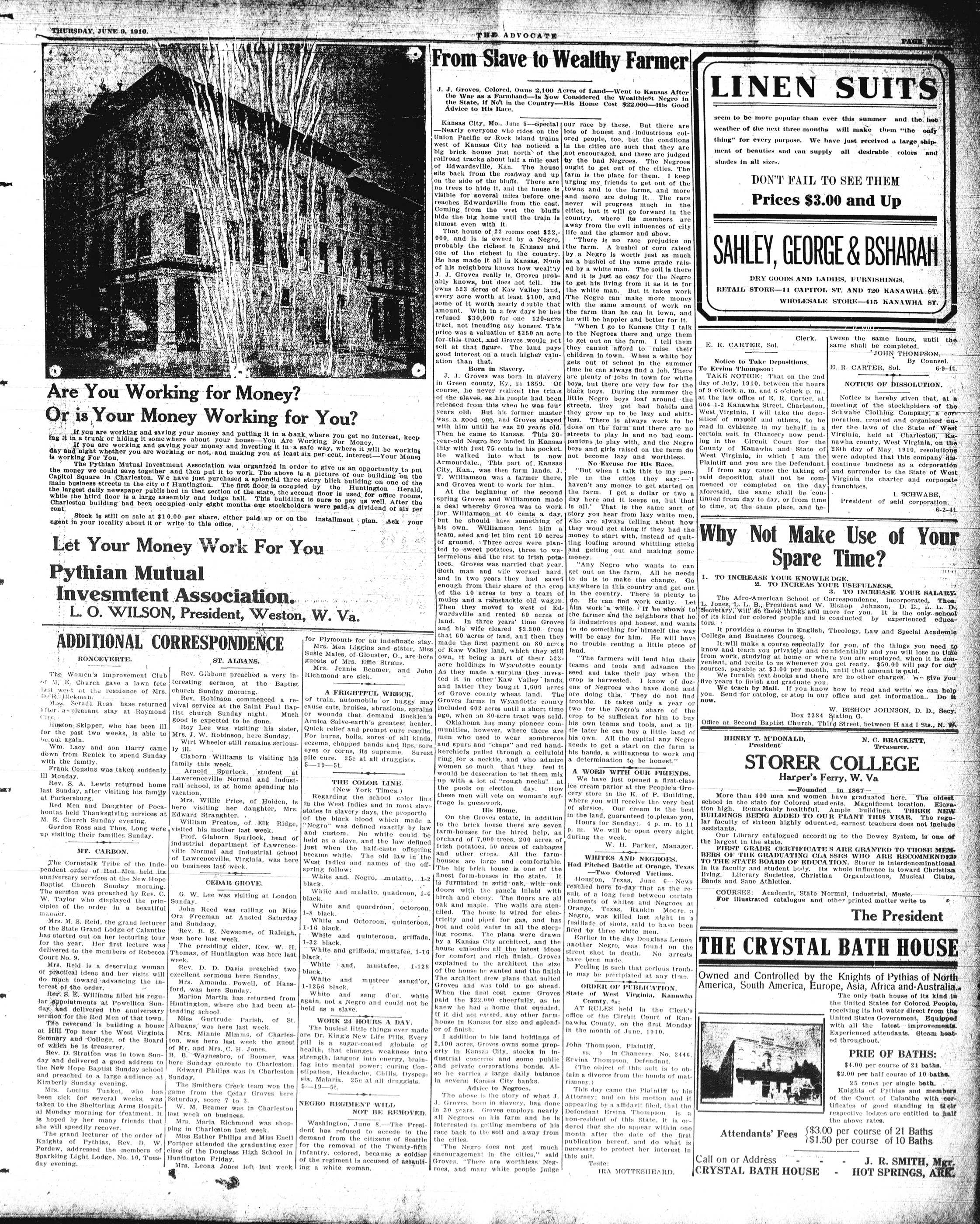
The Pythian Mutual Investment Association was organized in order to give us an opportunity to put the money we could save together and then put it to work. The above is a picture of our building on the Capitol Square in Charleston. We have just purchased a splendid three story block building on one of the main business streets in the city of Huntington. The first floor is occupied by the Huntington Herald, the largest daily newspaper publshed in that section of the state, the second floor is used for office rooms, while the hirtd floor is a large assembly and lodge hall. This building is sure to pay us well. After the Charleston building had been occupied only eight months our stockholders were paid a dividend of six per cent.
Stock is still on sale at $1 0.00 per share, either paid up or on the installment plan. Ask your agent in your locality about it or write to this office.
Let Your Money Work For You Pythian Mutual Invesmtent Association. L. O. WILSON, President, Weston, W. Va.
ADDITIONAL CORRESPONDENCE
THURSDAY, JUNE 9, 1910.
Are You Work Or is Your Money?
If you are working and saving it in a trunk or hiding it some day and night whether you are working For You.
The Pythian Mutual Invest the money we could save together Capitol Square in Charleston. W main business streets in the city of the largest daily newspaper publish while the htird floor is a large as Charleston building had been occ cent.
Stock is still on sale at $1 agent in your locality about it or
Let Your Money
Pythian Mut Invesmtent
L. O. WILSON
ADDITIONAL CO
RONCEVERTE.
The Women's Improvement Club of M. E. Church gave a lawn fete last week at the residence of Mrs. D/R. Hickman.
Miss Serada Ross has returned after a pleasant stay at Raymond City.
Huston Skipper, who has been ill for the past two weeks, is able to be out again.
Wm. Lacy and son Harry came down from Renick to spend Sunday with the family.
Frank Cousins was taken suddenly ill Monday.
Rev. S. A. Lewis returned home last Sunday, after visiting his family at Parkersburg.
Red Men and Daughter of Pocahontas held Thanksgiving services at M. E. Church Sunday evening.
Gordon Ross and Thos. Long were up visiting their families Sunday.
MT. CARBON.
The Cornstalk Tribe of the Independent order of Red Men held its anniversary services at the New Hope Baptist Church Sunday morning. The sermon was preached by Rev. C. W. Taylor who displayed the principles of the order in a beautiful manner.
Mrs. M. S. Reid, the grand lecturer of the State Grand Lodge of Calanthe has started out on her lecturing tour for the year. Her first lecture was delivered to the members of Rebecca Court No. 9.
Mrs. Reid is a deserving woman of practical ideas and her visits will do much toward advancing the interest of the order.
Rev. S. E. Williams filled his regular appointments at Powellton Sunday and delivered the anniversary sermon for the Red Men of that town
The reverend is building a house at Hill Top near the West Virginia Seminary and College, of the Board of which he is treasurer.
Rev. D. Stratton was in town Sunday and delivered a good address to the New Hope Baptist Sunday school and preached to a large audience at Kimberly Sunday evening.
Mrs. Lucius Tunket, who has been sick for several weeks, was taken to the Sheltering Arms Hospital Monday morning for treatment. It is hoped by her many friends that she will speedily recover.
The grand lecturer of the order of Knights of Pythias, Rev. D. W. Perdew, addressed the members of Sparkling Light Lodge, No. 10, Tuesday evening.
---
ST. ALBANS.
Rev, Gibbons preached a very interesting sermon, at the Baptist church Sunday morning.
Rev, Robinson commenced a revival service at the Saint Paul Baptist church Sunday night. Much good is expected to be done.
Roy Lee was visiting his sister, Mrs. J. W. Robinson, here Sunday. Wirt Wheeler still remains seriously ill.
Claborn Williams is visiting his family this week.
Arnold Spurlock, student at Lawrenceville Normal and Industrial school, is at home spending his vacation.
William Preston, of Elk Ridge, visited his mother last week. Prof. Glaborn Spurlock, head of industrial department of Lawrenceville Normal and Industrial school of Lawrenceville, Virginia, was here on business last week.
CEDAR GROVE.
G. W. Lee was visiting at London Sunday.
John Reed was calling on Miss Ora Freeman at Ansted Saturday and Sunday.
Rev. B. E. Newsome, of Raleigh, was here last week.
The presiding elder, Rev. W. H. Thomas, of Huntington was here last week.
Rev. D. D. Davis preached two excellent sermons here Sunday.
Mrs. Amanda Powell, of Hansford, was here Sunday.
Miss Gurtrude Parish, of St Albaans, was here last week.
Mrs. Minnie Mimmus, of Charleston, was here last week the guest of Mr. and Mrs. C. H. Jones.
B. B. Waynesbro, of Boomer, was here Sunday enroute to Charleston.
Edward Philips was in Charleston Sunday.
The Smithers Creek team won the game from the Cedar Groves here Saturday, score 7 to 3.
W. M. Beamer was in Charleston last week on business.
Mrs. Maria Richmond was shopping in Charleston last week.
Miss Esther Phillips and Miss Encil Fortner attended the graduating excerises of the Douglass High School in Huntington Friday.
Mrs. Leona Jones left last week
---
for Plymouth for an indefinite stay.
Mrs. Mea Liggins and sister, Miss Susie Males, of Glouster, O., are here guests of Mrs. Effie Straus.
Mrs. Jennie Beamer, and John Richmond are sick.
A FRIGHTFUL WRECK
of train, automobile or buggy may cause cuts, bruises, abrasions, sprains or wounds that demand Bucklen's Arnica Salve-earth's greatest healer. Quick relief and prompt cure results. For burns, boils, sores of all kinds, eczema, chapped hands and lips, sore eyes or corns, its supreme. Surest pile cure. 25c at all druggists. 5—19—5t.
THE COLOR LINE
(New York Times)
Regarding the school color line in the West Indies and in most slave states in slavery days, the proportion of the black blood which made a "Negro" was defined exactly by law and custom. No white could be held as a slave, and the law defined just when the half-caste offspring became white. The old law in the West Indies and names of the offspring follow:
White and Negro, mulatto, 1-2 black.
White and mulatto, quadroon, 1-4 black.
White and guardroon, octoroon, 1-8 black.
White and Octoroon, quinteroon, 1-16 black.
White and quinteroon, griffada, 1-32 black.
White and griffada, mustafee, 1-16 black.
White and, mustafec, 1-128 black.
White and musteer sangd'or, 1-1256 black.
White and sang d'or, white again, not a Negro and could not be held as a slave.
WORK 24 HOURS A DAY.
The busiest little things ever made are Dr. King's New Life Pills. Every pill is a sugar-coated globule of health, that changes weakness into strength, languor into energy, brain-fag into mental power; curing Constipation, Headache, Chills, Dyspepsia, Malaria. 25e at all druggists.
5—19—5t.
NEGRO REGIMENT WILL
Washington, June 8. The President has refused to accede to the demand from the citizens of Seattle for the removal of the Twenty-fifth infantry, colored, because a goldier of the regiment is accused of assaulting a white woman.
From Slave to Wealthy Farmer
J. J. Groves, Colored, Owens 2,100 Acres of Land—Went to Kansas After the War as a Farmhand—Is Now Considered the Wealthiest Negro in the State, if Not in the Country—His Home Cost $22,000—His Good Advice to His Race.
Kansas City, Mo., June 5—Special—Nearly everyone who rides on the Union Pacific or Rock island trains west of Kansas City has noticed a big brick house just north of the railroad tracks about half a mile east of Edwardsville, Kan. The house sits back from the roadway and up on the side of the bluffs. There are no trees to hide it, and the house is visible for several miles before one reaches Edwardsville from the east. Coming from the west the bluffs hide the big home until the train is almost even with it.
our race by these. But there are lots of honest and industrious colored people, too, but the conditions in the cities are such that they are not encouraged, and these are judged by the bad Negroes. The Negroes ought to get out of the cities. The farm is the place for them. I keep urging my friends to get out of the towns and to the farms, and more and more are doing it. The race never will progress much in the cities, but it will go forward in the country, where its members are away from the evil influences of city
That house of 22 rooms cost $22,000, and is is owned by a Negro, probably the richest in Kansas and one of the richest in the country. He has made it all in Kansas. None of his neighbors knows how wealthy J. J. Groves really is, Groves probably knows, but does not tell. He owns 523 acres of Kaw Valley land, every acre worth at least $100, and some of it worth nearly double that amount. With in a few days he has refused $30,000 for one 120-acre tract, not including any house. This price was a valuation of $250 an acre for this tract, and Groves would not sell at that figure. The land pays good interest on a much higher valuation than that.
Born in Slavery.
Born in slavery.
J. J. Groves was born in slavery in Green county, Ky., in 1859. Of course, he never realized the trias of the slaves, as his people had been released from this when he was four years old. But his former master was a good one, and Groves stayed with him until he was 20 years old. Then he came to Kansas. This 20-year-old Negro boy landed in Kansas City with just 75 cents in his pocket. He walked into what is now Armourdale. This part of. Kansas City, Kan., was then farm lands. J. T. Williamson was a farmer there, and Groves went to work for him.
At the beginning of the second spring Groves and Williamson made a deal whereby Groves was to work for Williamson at 40 cents a day, but he should have something of his own. Williamson lent him a team, seed and let him rent 10 acres of ground. Three acres were planted to sweet potatoes, three to watermelons and the rest to Irish potatoes. Groves was married that year. Both man and wife worked hard, and in two years they had saved enough from their share of the crop of the 10 acres to buy a team of mules and a rainhackle old wagon. Then they moved to west of Edwardsville and rented 60 acres of land. In three years' time Groves and his wife cleared $2,200 from that 60 acres of land, an 1 then they made the first payment on 80 acres of Kaw Valley land, which they still own, it being a part of their 523-acre holdings in Wyandotte county. As they made a surprise they invested it in other Kaw Valley lands and latter they bought at 1,600 acres of Grove county wheat land. The Groves farms in Wyandotte county included 602 acres until a short time ago, when an 80-acre tract was sold.
Oklahoma has many pioneer communities, however, where there are men who used to wear sombreros and spurs and "chaps" and red handkerchiefs pulled through a celluloid ring, for a necktie, and who admire women so much that they feel it would be desecration to let them mix up with a lot of "rough necks" at the pools on election day. How these men will vote on woman's suffrage is guesswork.
His Home.
On the Groves estate, in addition to the brick house there are seven farm-houses for the hired help, an orchard of 7,000 trees, 200 acres of Irish potatoes, 50 acres of cabbages and other crops. All the farm-houses are large and comfortable. The big brick house is one of the finest farm-houses in the state. It is furnished in solid oak, with oak doors with the panels inlaid with birch and ebony. The floors are all oak and maple. The walls are sten-cilled. The house is wired for electricity and piped for gas, and has hot and cold water in all the sleeping rooms. The plans were drawn by a Kansas City architect, and the house embodies all the latest ideas for comfort and rich finish. Groves explained to the architect the size of the house he wanted and the finish. The architect drew plans that suited Groves and was told to go ahead. When the final cost came Groves paid the $22,000 cheerfully, as he knew he had a house that equaled, if it did not exceed, any other farm-house in Kansas for size and splendor of finish.
I addition to his land holdings of 2,100 acres, Groves owns some property in Kansas City, stocks in industrial concerns and some public and private corporations bonds. Also he carries a large daily balance in several Kansas City banks. Advice to Negroes.
The above is the story of what J. J. Groves, born in slavery, has done in 30 years. Groves employs nearly all Negroes on his farm and he is interested in getting members of his race back to the soil and away from the cities.
"The Negro does not get much encouragement in the cities," said Groves. "There are worthless Negroes, and many white people judge
our race by these. But there are lots of honest and industrious colored people, too, but the conditions in the cities are such that they are not encouraged, and these are judged by the bad Negroes. The Negroes ought to get out of the cities. The farm is the place for them. I keep urging my friends to get out of the towns and to the farms, and more and more are doing it. The race never will progress much in the cities, but it will go forward in the country, where its members are away from the evil influences of city life and the glamor and show.
"There is no race prejudice on the farm. A bushel of corn raised by a Negro is worth just as much as a bushel of the same grade raised by a white man. The soil is there and it is just as easy for the Negro to get his living from it as it is for the white man. But it takes work The Negro can make more money with the same amount of work on the farm than he can in town, and he will be happier and better for it.
"When I go to Kansas City I talk to the Negroes there and urge them to get out on the farm. I tell them they cannot afford to raise their children in town. When a white boy gets out of school in the summer time he can always find a job. There are plenty of jobs in town for white boys, but there are very few for the black boys. During the summer the little Negro boys loaf around the streets, they get bad habits and they grow up to be lazy and shiftless. There is always work to be done on the farm and there are no streets to play in and no bad companions to play with, and the Negro boys and girls raised on the farm do not become lazy and worthless.
No Excuse for His Race.
"But when I talk this to my people in the cities they say:—I haven't any money to get started on the farm. I get a dollar or two a day here and it keeps us, but that is all." That is the same sort of story you hear from lazy white men, who are always telling about how they woud get along if they had the money to start with, instead of quilting loafing around whitling sticks and getting out and making some money.
"Any Negro who wants to can get out on the farm. All he needs to do is to make the change. Go anywhere in this country and get out in the country. There is plenty to do. He can find work easily. Let him work a while. If he shows to the farmer and the neighbors that he is industrious and honest, and wants to do something for himself the way will be easy for him. He will have no trouble renting a little piece of land.
"The farmers will lend him their teams and tools and advance the seed and take their pay when the crop is harvested. I know of dozens of Negroes who have done and are doing this. They do not find trouble. It takes only a year or two for the Negro's share of the crop to be sufficient for him to buy his own teams and tools, and a little later he can buy a little land of his own. All the capital any Negro needs to get a start on the farm is his hands, a willingness to work and a determination to be honest."
A WORD WITH OUR FRIENDS
A WORD WITH OUR FRIENDS.
We have just opened a first-class ice cream parlor at the People's Grocery store in the K. of P. Building, where you will receive the very best of service. Our cream is the best in the land, guaranteed to please you. Hours for Sunday: 4 p. m. to 11 p. m. We will be open every night during the week.
W. H. Parker, Manager.
WHITES AND NEGROES.
Had Pitched Battle at Orange, Texas
—Two Colored Victims.
Houston, Texas, June 6—News reached here to-day that as the result of a long feud between certain elements of whites and Negroes at Orange, Texas, Rankin Mocre, a Negro, was killed last night in a fusillade of shots, said to have been fired by three white men.
Earlier in the day Douglas Lemon another Negro, was found on the street shot to death. No arrests have been made.
Feeling is such that serious trouble may be precipitated at any time.
ORDER OF PUBLICATION.
State of West Virginia, Kanawha
County, 8s:
AT RULES held in the Clerk's
office of the Circuit Court of Kana-
waha County, on the first Monday
in the month of June, 1910.
John Thompson, Plaintiff,
vs. ) In Chancery. No. 2446,
Ervina Thompson, Defendant.
(The object of this suit is to
obtain a divorce from the bonds of matri-
mony.)
This day came the Plaintiff by his
Attorney; and on his motion and it
appearing by a affidavit filed, that the
Defendant Ervina Thompson is a
non-resident of this State, it is
ordered that she do appear within one
month after the date of the first
publication hereof, and do what is
necessary to protect her interest in
this suit.
IRA MOTTESHEARD.
LINEN SUITS
seem to be more popular than ever this summer and the hot weather of the next three months will make them "the only thing" for every purpose. We have just received a large shipment of beauties and can supply all desirable colors and shades in all sizes.
SAHLEY, GEORGE & BSHARAH
DRY GOODS AND LADIES, FURNISHINGS.
RETAIL STORE—11 CAPTOL ST. AND 720 KANAWHA ST.
WHOLESALE STORE—415 KANAWHA ST.
Notice to Take Depositions.
To Ervina Thompson:
TAKE NOTICE: That on the 2nd day of July, 1910, between the hours of 9 o'clock a. m. and 6 o'clock p. m., at the law office of E. R. Carter, at 604 1-2 Kanawha Street, Charleston, West Virginia, I will take the deposition of myself and others, to be read in evidence in my behalf in a certain suit in Chancery now pending in the Circuit Court for the County of Kanawha and State of West Virginia, in which I am the Plaintiff and you are the Defendant.
If from any cause the taking of said deposition shall not be commenced or completed on the day aforesaid, the same shall be continued from day to day, or from time to time, at the same place, and he-
Why Not Make Spare
1. TO INCREASE YOUR KNOWLEDGE
2. TO INCREASE YOUR
The Afro-American School of O. L. Jones, L. L. B., President and W. Secretary, will do these things and make of its kind for colored people and its staff.
It provides a course in English, College and Business Course.
It will make a course especially for know and teach you privately and come from work, studying at home or when venient, and recite to us whenever you courses, payable at $3.00 per month.
We furnish text books and there five years to finish and graduate you.
We teach by Mail. If you know you. Send for catalog, or stop in our now.
Box 2384
Office at Second Baptist Church, The
I Make Use
to spare Time.
MR KNOWLE DGE.
INCREAS YOUR USEFUL
3. TO IN
School of Correspondent and W. Bishop Jo-
things and more for you
people and is conducted
in English, Theology, L
urses.
o especially for you, o
cately and confidentially
or where you are
whenever you get ready
per month, until that
ands there are no oth
graduate you.
If you know how to re-
stop in our office and
W. BISHOP
Box 2384 Station G.
Church, Third Street, t
WALD,
N
ER COL
Harper's Ferry, W.
Why Not Make Use of Your Spare Time?
1. TO INCREASE YOUR KNOWLEDGE.
2. TO INCREASE YOUR USEFULNESS.
3. TO INCREASE YOUR SALARY.
The Afro-American School of Correspondence, Incorporated. Thomas L. Jones, L. L. B., President and W. Bishop Johnson, D. D., D. L. L. D. Secretary, will do these things and more for you. It is the only school of its kind for colored people and is conducted by experienced educators.
It provides a course in English, Theology, Law and Special Academic College and Business Courses.
It will make a course especially for you, of the things you need to know and teach you privately and confidentially and you will lose no time from work, studying at home or where you are employed, when it is convenient, and recite to us whenever you get ready. $50.00 will pay for our courses, payable at $3.00 per month, until that amount is paid.
We furnish text books and there are no other charges. We give you five years to finish and graduate you.
We teach by Mail. If you know how to read and write we can help you. Send for catalog, or stop in our office and get information.. Do it now.
W. BISHOP JOHNSON, D. D., Secy.
Box 2384 Station G.
Office at Second Baptist Church, Third Street, between H and I Sts., N. W.
HENRY T. M'DONALD,
President
N. C. BRACKETT,
Treasurer.
STORER COLLEGE
Harper's Ferry, W. Va
STORER COLLEGE Harper's Ferry, W. Va
Founded in 1867
More than 400 men and women have graduated here. The oldest school in the state for Colored students. Magnificent location. Elevation high. Remarkably healthful. Ample buildings. THREE NEW BUILDINGS BEING ADDED TO OUR PLANT THIS YEAR. The regular faculty of sixteen highly educated, earnest teachers does not include assistants.
More than 400 men and women
school in the state for Colored stud
tion high. Remarkably healthful,
BUILDINGS BEING ADDED TO OUR
lar faculty of sixteen highly educa
assistants.
Our Library catalogued accordi
the largest in the state.
FIRST GRADE CERTIFICATE
BERS OF THE GRADUATING CLAS
TO THE STATE BOARD OF EDUCA
in its faculty and student body. Its
living. Literary Societies, Christia
Bands and Sane Athletics.
COURSES: Academic, State N
For illustrated catalogue and
THE CRYSTAL
Owned and Controlled by the
America, South America, Eur
and women have grad-
colored students. Map
healthful. Ample bu-
lDED TO OUR PLANT
highly educated, earnest
uled according to the
TERTIFICATE S ARE GR
RATING CLASSES WHICH
OF EDUCATION. Stor-
t body. Its whole infi-
ces, Christian Organi-
s. State Normal, Indu-
cation and other prints.
STAL BAY
led by the Knight
America, Europe, Asia,
Our Library catalogued according to the Dewey System, is one of the largest in the state.
FIRST GRADE CERTIFICATE S ARE GRANTED TO THOSE MEMBERS OF THE GRADUATING CLA SSES WHO ARE RECOMMENDED TO THE STATE BOARD OF EDUCATION. Storer is interdenominational in its faculty and student body. Its whole influence is toward Christian living. Literary Societies, Christian Organizational, Musical Clubs, Bands and Sane Athletics.
COURSES: Academic, State Normal, Industrial, Music.
For illustrated catalogue and other printed matter write to
THE CRYSTAL BATH HOUSE
Owned and Controlled by the Knights of Pythias of North America, South America, Europe, Asia, Africa and Australia.
THE MUSEUM
Attendants' Fees $3.00 $1.50
Call on or Address
CRYSTAL BATH HOUSE
ees $3.00 per cou
$1.50 per cou
HOUSE - HO
Attendants' Fees $3.00 per course of 21 Baths $1.50 per course of 10 Baths Call on or Address J. R. SMITH, Mgr CRYSTAL BATH HOUSE HOT SPRINGS, ARK
tween the same hours, until the same shall be completed.
JOHN THOMPSON
By Counsel.
E. R. CARTER, Sol. 6-9-4t.
NOTICE OF DISSOLUTION.
Notice is hereby given that, at a meeting of the stockholders of the Schwabe Clothing Company, a corporation, created and organized under the laws of the State of West Virginia, held at Charleston, Kanawha county, West Virginia, on the 28th day of May, 1910, resolutions were adopted that this company discontinue business as a corporation and surrender to the State of West Virginia its charter and corporate franchises.
1. SCHWABE,
President of said corporation.
6+2-4t
Use of Your Time?
EDGE.
YOUR USEFULNESS.
3. TO INCREASE YOUR SALARY.
Correspondence, Incorporated, Thomas Bishop Johnson, D. D., D. L. D., more for you. It is the only school conducted by experienced educa-
Theology, Law and Special Academic
for you, of the things you need to confidentially and you will lose no time here you are employed, when it is con- you get ready. $50.00 will pay for our, until that amount is paid.
are no other charges. We give you how to read and write we can help office and get information.. Do it
W. BISHOP JOHNSON, D. D., Secy. Station G.
Third Street, between H and I Sts., N. W.
COLLEGE
Berry, W. Va.
in 1867—
have graduated here. The oldest
ents. Magnificent location. Eleva-
ample buildings. THREE NEW
PLANT THIS YEAR. The regu-
ed, earnest teachers does not include
ing to the Dewey System, is one of
S ARE GRANTED TO THOSE MEM-
SES WHO ARE RECOMMENDED
TION. Storer is interdenominational
whole influence is toward Christian
on Organizations, Musical Clubs,
formal, Industrial, Music.
other printed matter write to
The President
BATH HOUSE
The Knights of Pythias of North
Ope, Asia, Africa and Australia.
The only bath house of its kind in
the United States for Colored People,
receiving its hot water direct from the
United States Government. Equipped
with all the latest improvements.
Experienced attendants. Steam heated
throughout.
PRIE OF BATHS:
$4.00 per course of 21 baths.
$2.00 per half course of 10 baths.
25 cents per single bath.
Knights of Pythias and members
of the Court of Calanthe with certi-
cates of good standing in their
respective lodges are entitled to half
the above rates.
0 per course of 21 Baths
0 per course of 10 Baths
- J. R. SMITH, Mgr.
- HOT SPRINGS, ARK.
N. C. BRACKETT, Treasurer.
PUBLISHED EVERY THURSDAY BY THE ADVOCATE PUB. CO.
The Advocate is entered in the Post-office at Charleston, W. Va., as second class matter.
WHAT IS A NEGRO?
If there are many more decisions on the subject of what is a Negro, we shall soon be at loss to determine our rapid identity. Down in Louisiana the supreme court holds that a quadroon is not a Negro. In the District of Columbia an octoroon, having only half the Negro blood of the quadroon, is under the ban, being classed with those who can show no infusion whatever of the blood of those who make and interpret the definition.
Now, will some Solomon tell us just where in the dickens we are. Not that there would be any doubt whatever in the mind of either couras to the racial status of the writer, but for the sake of our lighter-hued brethren, it would be pleasing to have a nation-wide and nation-binding decision on the question as to which of us are flesh and which are fish.
To aid in arriving at a conclusion we would advise the universal acceptance of a standard based on color, ranging from mahogany to marble, each of us being catalogued on the card nearest our color. For instance there would be blacks, near blacks browns, near browns, yellows, near yellows and so on up the line to where the line of demarcation into white would be imperceptible. Those below the half-way line would be classed as Negroes. All others, white, Negroes, or those who are regarded in their communities as Negroes, do not give a a—continental what arbitrary classification is adopted so long as they are left in the enjoyment of life, liberty and the pursuits of happiness, but being naturally inclined to take the line of least resistance, they would accept such a classification, if it would bring peace to those responsible for these gradations in color.
The proposition herein advanced is neither patented nor copyrighted and may be acted upon with impunity by any one so inclined.
OUR GRADUATES
There is doubtless much pleasure to you in seeing your son receive a diploma from a high or normal school, but have you seriously considered what the future holds for him?
You, perhaps, have made s one sacrifices that this auspicious occasion might be possible; you have very likely denied yourself of life's necessities that you might see your son or daughter's name among those who-graduated, but have you given any thought to what use this boy can make of his education, what returns he will get from your sacrifices?
Under present conditions, the Negro girl must take up teaching or seek a job as nurse girl or cook, competing with her sister who has not had or has not accepted her educational advantages. The boy goes into the school room as a teacher or he drives a delivery wagon for the simple reason that his race has not provided any avenues in which he may exercise his trained abilities.
There is in this city but little or no encouragement for the Negro boy or girl to complete the high school course, unless there are prospects of professional training. The whites will not employ them in any but mental capacities, the Negroes can not. The latter could, if they would but support the enterprises established by the more venturesome of the race, provide for the support of each and every graduate from our high school. But they prefer to deal with those from whom they can get only that for which they pay. So long as this notion prevails the outlook will be anything but bright for the average Negro graduate.
CRUM'S APPOINTMENT
Not, long-suffering reader, with any idea that our protest will affect either one way or the other the confirmation of Dr. Crum, do we take our pen in hand to write these few lines, but just to be consistent.
As in the appointment of Henry Lincoln Johnson to the Recordership of Deeds we registered a protest, not, mind you, against Mr. Johnson personally, but against his Democratic state, in the same spirit we object to
Dr. Crum. Even Minister Lyon, who has served a little over the four-year term, has greater claims than Dr. Crum. True, Dr. Crum gracefully stepped aside and saved the Taft administration considerable embarrassment in its young days, but South Carolina, Dr. Crum's state, has done nothing for Mr. Taft nor Mr. Taft's party since the days of reconstruction. On the other hand Maryland, Mr. Lyon's state, does now and then split its electoral vote. No Negro north will object to, but rather, would hail with pleasure the appointment of one of the race at the South to a Federal position in his state, but all are as one against giving the best appointments to those who come from states always on the other side of the fence.
It was bad enough in all conscience to make Mr. Henry Lincoln Johnson Register of Deeds for the District of Columbia, but this last appointment shows conclusively that the Washington administration thinks considerable more of votes at the national convention than it does of those at the polls.
It would appear on the surface that Mr. Gaines is not quite so certain of a renomination at this time as he was when Mr. Edwards opposed him. At that time he was willing to leave with the several county committees the decision as to how the delegates to the convention should be chosen. Now, he is for a primary to cover the whole district. Can it be that he reads the handwriting on the wall and is attempting to postpone the day of reckoning?
Just to show how times have changed and great men with them, President Taft invited William Allen White, the foremost insurgent editor of Kansas, to the White House and fed him, instead of invigiling him into the cellar and chopping his head off.
Napier, of Tennessee, refused the ministership to Liberia and it was then offered to and accepted by Crum, of South Carolina. McLaurin and Tillman, bourbons of the first water, it would appear, have greater influence at the White House than two Republican senators.
People who believe that Lorimer will resign his place have another guess coming. A man doesn't expend money for a thing he likes just to let go of it when some one discovers that he is like others who have the same thing.
We can hardly believe that Mr. Bryan prefers to have the Democracy beaten with him than successful without him, but except on supposition, it is difficult to understand his present position.
The idea that the employer should be loyal to the government that pays him rather than to the officer who can fire him seems to strike the practical statesmen as dangerously revolutionary.
Someone has been trying to figure out the "ages when widows prefer to wed". Widows have preferred to wed in all ages, if we know anything about them.
Halley's comet has disappeared into the distance; thank fortune, we shall have peace from the conflicting expert opinion for seventy-four years and six months.
Now that shop-girls are recruited as sluggers, department store grand opera may soon be expected at $1.49, reduced from $5.06.
As keepers of campaign promises we hereby firmly but sorrowfully thrust the astronomers into the political class.
Anyway it will be a long time before a Secretary of the Interior is as well known as Ballinger.
No court in Europe has as many ladies-in-waiting as the divorce court of Reno, Nevada.
Whoever would have thought that a Crum could kill a Lyon.
With 200 new engines the B. & O. will have quite a pull.
NAPOLEON'S GRIT.
was one of the unconquerable, never-say die kind, the kind that you need most when you have a bad cold cough or lung disease. Suppose troches, cough syrups, cod liver oil or doctors have all failed, don't lose heart or hope. Take Dr. King's New Discovery. Satisfaction is guaranteed when used for any throat or lung trouble. It has saved thousands of hopeless sufferers. It masters stubborn colds, obstinate coughs, hemorrhages, la grippe, croup, asthma, hay fever and whooping cough and is the most safe and certain remedy for all bronchial affections 50c, $1.00. Trial bottle free at all druggists.
Mrs. Phil Waters was called to Ann Arbor, Mich., Monday by the illness of her daughter Phyllis, who is attending school there.
Rev. Vachel Harriday, pastor of the M. E. Church at Montgomery, was here the first of the week.
Dr. and Mrs. B. P. Brownley, who have been, since their marriage, guests of Mr. and Mrs. W. O. Terry, have moved into their new house on Bradford street, where they will be pleased to receive their friends.
The juvenile band of the Orphans' Home and Industrial School, near huntington, which has just returned from an extensive southern tour, is here playing on the streets with the purpose of raising funds for the institution.
Matthew Obie, of Fairmont, is here to spend a few days with friends.
to spend a few days with friends. Adolphus Woods, a miner in the mines at Boomer, who, while at work in the mine one day last week was crushed by a fall of slate in the room where he was and was immediately brought to the Charleston General Hospital for treatment, died last night about 11:30 in the hospital. It seemed that the accident affected his spine, for he was paralyzed from his shoulders down, and during the time he was at the hospital he was lingering between life and death and last evening succumbed to the latter. He has no relatives in or around this city. The funeral will be tomorrow afternoon at 2:00 o'clock all of the services being at the Domnally grave yard, a small distance up the river.
Mrs. Eliza Stevenson, of Middleport, O., attended the commencement exercises at Institute this week, spending the evenings here as the guest of Mrs. Amanda Cooper, Brooks street.
The Carnation Social Club was entertained at the home of Mrs. Nancy Brown Thursday evening of last week.
Dr. Orlando Hodge, of Montgomery, w as a business visitor here Monday.
G. E. Smith is able to be out after a few weeks' illness.
Mrs. Theresa Crozier and daughter, Martha, of Louisville, Ky., are visiting the former's son George Crozier, Second Ave., West Side.
John Neubolt, who has been working at Indianapolis, Ind., has resumed his former place at the Kelly Axe factory.
Mrs. J. M. Lankin, Mrs. H. L. Lord and Mrs. G. M. Marshall, all of Keystone, registered at Hotel Brown last week.
Miss Neva Parker is seriously ill at the home of her parents on Wall street.
The Loyal Union will meet Monday with Mrs. Lillie Davis, Welch street.
Mrs. Annie Collins is reported ill. Mrs. Collins resides on Wall street.
The final game between Wilberforce University and the Clippers, Friday of last week, ended in a wrangle, the school boys claiming unfairness on the part of the umpire. Thursday's game resulted in a victory for the Clippers, the score be-
Edward Conaway is ill at his home on Hansford street.
The Kanawhas, made up of employees of Hotel Kanawha, defeated the Clippers yesterday afternoon in a baseball game at Wehrle park by a score of 6 to 5.
Miss Mary McGhee has as her guest. Miss Almeda Brown, of Parkersburg.
The Saturday Bridge Club met with Miss Lillian Taylor on Washington street. Miss Virginia Gilmer will entertain the club next week at the home of Mrs. Anna Fulks-Davis on Jacob street.
Mrs. Mary Dillard is at Institute taking treatment under Dr. J. R. Whipper.
Miss Alma Booker has returned to the city for his vacation from Lawrenceville, Va., where she has a position as sewing teacher.
Miss Moss Clay spent the latter part of last week at the Institute, where she was the guest of Mrs. S. H. Guss.
Mrs. Lucy Lowry spent the week at the Institute the guest of her mother.
Miss Ethel B. Spriggs will pass through the city Thursday en route to Institute from Nashville, Tenn., where she attends Fisk University.
E. C. Berry, of Athenis, O., was the guest of Mrs. Lillian Starks Wednesday.
Miss Eva Brown, of Morgantown was the guest of Mrs. Mary Holmes, Jackson street, the first of the week.
Miss Florence Williams, who attends Mergan College at Baltimore, Md., is in the city for her vacation.
TEACHING NEGRO COMMON- SENSE.
The best friend the Negro race is not the man who prates abstractly about prejudices and social equality, but the man who presents a constructive plan for the individual and social evolution of the race that through toil and tribulations is coming "Up From Slavery," and in spite of lapses and discouraging set-backs is steadily achieving higher standards of morality, economy and intelligence. Booker Washington at Tuskegee Institute is not satisfied merely to inculcate the theory of "virtuous energizing." He has his thousands of students learned to do something practical, something that has a market value, because it is useful to the world at large. Philadelphia Ledger.
E ADVOCATE
ROOSEVELT AND PLATT.
The thing in the history of New York most readily suggested by Governor Hughes' transfer to the Supreme Court was the nomination of Mr. Roosevelt for the Vice-Presidency ten years ago. He also was in the thick of a reform movement, and he expected a second term as Governor, with a prospect of being nominated for the Presidency in 1904. The work of Senator Platt, Senator Quay, and other politicians of New York and Pennsylvania in trying to force the convention to put Roosevelt on the ticket with McKinley was for the frankly avowed purpose of getting him out of New York politics. Corporation interests demanded his "shelvings." The Vice-Presidency was an office which had previously been regarded as terminating an incumbent's active career. An unforeseen tragedy made Mr. Roosevelt President, and the machinations of his enemies were turned against them. In the current number McClure's there is an article purporting to be posthumous autobiography by the late Mr. Platt. It tells with much frankness—though with an incompleteness that might tempt those who know all the facts to round the story out—how Mr. Platt in his own opinion made and unmade Roosevelt as Governor, and how he made him Vice-President, Mr. Platt could never understand that great trend of public opinion which Mr. Roosevelt always knew how to reckon with, and which, also, some of those whom Mr. Platt was wont to designate as Roosevelt's "self-constituted friends," were in a position to understand and to measure with some accuracy.
Mr. Roosevelt was never a puppet in Mr. Platt's hands. Platt had very reluctantly accepted him for Governor, because the State was about to go Democratic, the public was demanding Roosevelt, and the independents had already obtained from him what they regarded as a qualified consent to run at the head of their separate ticket. While it is true that the traction companies—because Governor Roosevelt had signed the Ford franchise tax bill—had ordered the political bosses to take Roosevelt out of State politics, he could nevertheless have won his renomination and re-election as Governor, in spite of Mr. Platt. Nothing would have been so easy as an exposure of the origin of the conspiracy against Roosevelt at that time, and a mere setting torth of undisputed facts have resulted in Mr. Roosevelt's renomination and re-election as Governor. Thus the attempt on Mr. Platt's part to make it appear that Roosevelt was soft clay in the hands of a great boss is not only mistaken but ridiculous. Furthermore, although Platt and Quay started the Roosevelt boom at the Philadelphia convention, their motives were perfectly understood and were not in the least the factor that turned the situation in the end.
Mr. Roosevelt, four months in advance, had given to the press a formal statement to the effect that under no circumstances would he accept a nomination for the Vice-Presidency. In the great campaign of 1896 many of the Western States had been carried by the Populists. The Western Republicans, wishing to make sure of their local situations, demanded Roosevelt for the strengthening of the ticket in 1900. They declared that the party needed him and must have him on the ticket and in the campaign; and they freely pledged themselves that under any circumstances they would make him President in 1904. It was not Mr. Platt's intrigues and his alleged award of the Governorship to Odell that led Roosevelt to sacrifice his own wishes at Philadelphia. It was rather his feeling that he must respond to that larger call from the whole country, which had become irresistible thro' the lack of any other well-presented candidacy for the second place on the ticket. Mr. Roosevelt has long been in the game of party politics; but he was never in the game in that craven abject fashion set forth in these Platt reminiscences. Seldom has anything ever been printed in the field of politics which so illustrates the blindness of a certain type of so-called Leader. At Albany this winter we have been reaping the aftermath of the sort of political and legislative life that was built up under the boss-ship of Mr. Platt, the gradual disintegration of which dates from the Governorship of Mr. Roosevelt. Public opinion sometimes arouses itself tardily, but in the end it prevails over the intrigues and starchamber methods of the bosses and spoilsmen.—From "The Progress of the World," in the American Review of June.
KELLY WILDER THE RACES DRAMA
MATIST OF THE FUTURE.
The Dallas Express thinks that Kelley Miller is the man to write the great drama of the Negro race. A better selection could not be made. He has already written much that has opened the eyes of the world to the true status of the race in America and elsewhere.—The Journal and Guide, Norfolk, Va.
The second uniform examination for the teacher's in Kanawha county will be held at Charleston, June 16th and 17th.
Teachers are expected to come to the county superintendent's office on the 15th of June and attend to the matters of registration.
J. L. GILLISPIE.
County Superintendent
BLUEFIELD COLORED INSTITUTE
SITUATED AT BLUEFIELD, WEST VIRGINIA
On the main line of the N. & W. R. R., and easy of access from all points of the Virginian Healthful location, the very best of school comforts, and excellent advantages in the way of Library, Laboratories, Student Societies and a strong earnest Faculty. Regular Normal and Academic Courses, also courses in Music, Sewing, Cooking and Laundering.
FREE BOOKS TO NORMAL STUDENTS BOARD, FUEL, LIGHT AND FURNISHED ROOMS $8.00 PER MONTH.
A Model Graded School in which Normal Graduates are given the necessary experience in teaching before beginning their regular work.
WEST VA. COLORED INSTITUTE
INSTITUTE, WEST VIRGINIA The only Industrial Institute for colored students in the taf e
Regular Normal, Academic and Commercial Courses, also Regular Courses in Agriculture, Carpentry and House Building, Steam Fitting, Smithing, Cabinet Making, Painting and Glazing, Dressmaking, Laundering, Printing. A Complete Course in Military Training to Cadets Rooms, Books, Fuel and Lights Free to Normal Students: and in addition Uniforms for State Students. We have a faculty of Twenty-two Teachers. Board only Eight Dollar a month.
Byrd Prillerman, A. M. President
WHEN "TEDDY" COMES MARCHING HOME.
The Taft administration at the present rate will soon settle the Negro's independence in politics. No preceding administration since the emanacipation has treated the Negro with such political indifference as has President Taft. Roosevelt at last is an angel. Wait for the Congressional elections and wait for the Ex-President's return. We may teach the President a lesson.—Rev. I. H. McMullen in the Star of Zion.
GETTING READY FOR THE EXPOSITION.
It is indeed gratifying to note how rapidly public sentiment is being formed in favor of the celebration of the fiftieth anniversary of the emancipation of the slaves in this country, and how the different elements are being united and harmonized in a movement which means so much for the future of the race. The fact that there is to be no contention as to either men or measures in accomplishing this great undertaking assures the prompt passage of the bill in Congress to appoint a Commission to make the necessary investigations as to the propriety, wisdom and scope of such a celebration. Suggestions have been made as to
the members of the commission and as to the Director-General of the Exposition, which in the main have been accepted with favor; but there will be time enough to arrange all these details in their order when the Exposition has been decided upon and organization becomes necessary. There is a unanimity of sentiment and a kindly feeling evinced that is to be commended and encouraged, so that the time comes every one will be ready to act.—American Baptist.
Notice to take I To Reuben Wormley Take Notice: The day of July, 1910, best of 8 o'clock a. m. and at the law office of I 604 1-2 Kanawha St West Virginia, I will sition of myself and read in evidence in a certain suit in chance in the Circuit Court of Kanawha and Sta
ORDER OF PUBLICATION.
State of West Virginia, Kanawha
County, ss.
At rules held in the Clerk's Office
of the Circuit Court of Kanawha
County, on the first Monday in the
month of June 1910, Cora Wormley
Plaintiff, vs. Reuben Wormley, in
Chancery, No. 2447.
(The object of this suit is to ob-
tain a divorce from the bonds of
matrimony).
This day came, the Plaintiff by her
Attorney; and on his motion, and it
appearing by affidavit filed, that the
Defendant Reuben Wormley is a non-
resident of this State, it is ordered
that he do appear within one month
after the date of the first publication
hereof, and do what is necessary to
protect his interest in this suit.
Teste: fra W. Motteshead, Clerk
E. R. Carter, Sol.
Notice to take Depositions.
To Reuben Wormley
Take Notice: That on the 2nd
day of July, 1910, between the hours
of 8 o'clock a. m. and 6 o'clock p. m.,
at the law office of E. R. Carter at
604 1-2 Kanawha Street, Charleston,
West Virginia, I will take the deposition
of myself and others, to be
read in evidence in my behalf in a
certain suit in chancery now pending
in the Circuit Court for the County
of Kanawha and State of West Virginia,
in which I am the Plaintiff,
and you are the Defendant.
If from any cause the taking of said depositions shall not be commenced or completed on the day aforesaid, the same shall be continued from day to day, or from time to time, at the same place, and between the same hours, until the same shall be completed.
Cora Wormley,
By Counsel.
E. R. Carter, Sol. 6-9-41.
Having recently embarked in the dairy business, I am prepared to furnish fresh milk, cream and country butter.
All orders given prompt attention.
G. L. JACKSON,
Kanawha City, W. Va.
5-26-5t.
HOWARD UNIVERSITY SENDS FORTH 110 GRADUATES.
DR. UNIH
Diplomas Granted in Medical, Law, Classical, Scientific, Teachers and Theological Departments—Registrar Team in Supervice Compliance Address, urged efficiency and Creation force as the Watchwords of Progress—President Thickfield reports, "hills unprecedented Development, solid achievement, hardship and a spirit of earnestness through out the University—Four-fifths of students self-supporting—President Laft elected trustee of Howard University—A masterstroke for Dr. Thickfield and his advisers—Dr. M. F. Wheatland also comes to the board."
THURSDAY, JUNE 9, 1910.
Thompson's National News Bureau,
Washington, D. C., June 4—A
tremendous crowds, gathered from
every section of the country, witness-
ed the commencement exercises of
Howard University on Wednesday
afternoon in the spaces auditorium
of the Metropolitan A. M. E. Church
on M street northwest. The original
plan of holding the affair in the
origin air amphitheatre on the Uni-
versity campus had to be abandoned
on account of the threatening weather.
There were 110 graduates, repre-
senting the various departments of
the University-medical, theological,
law, classical, commercial, scientific
and teachers.
Register Vernon's Brilliant Address.
Dr. W. T. Vernon. Register of the United States Treasury, delivered the address to the graduating classes, and it is admitted on all sides to have been a masterpiece of brilliant oratory, sound logic, polished dictation, practical advice on the art of living and doing, and breathing throughout the lottest sentiment. Dr. Vernon has made many speeches in this city, all of them worthy of the various occasions which brought them forth, but there is a feeling that this Howard University effort outranked them all, and stands as a fitting climax of eloquent and thought-compelling forensic triumphs that have been won by this acknowledged leader of his people. The hour was a grand one and the speaker fully measured up to its exacting requirements.
Dr. Vernon said, in part:
"It gives me pleasure to speak to the candidates, for graduation from this historic institution, noble in tradition—so valuable in its contribution to the great work of uplift and humanity's betterment. The day is inspiring because of the presence of those of influence and character who are giving the best in their lives to foster this work. Gen. O. O. Howard, valiant in war for right and militant in peace for the cause of the oppressed, left here his monument until remotest time. Howard University is rich in achievement, rich in tradition and brilliant with illimitable possibilities for the future. Like a city set upon a hill it can never be hid.
"It is a great thing to be young and strong; to stand at the threshold of a career; to realize that the struggles of school-days are over, and that you stand ready to enter the battle of life. With high hopes and lofty aspirations; with sympathizing teachers and friends; with those who have known and cared for you, hoping for the best in your career; with the records of the lives of the great men and women of all ages,
Colored Men and
Women, LISTEN--
If You've Got a Job
You've Got a Chance!
And the better the job, the better is your chance of improving your condition, and getting ahead. The
International
Liberty Union
of the World
THE
ILU
International
Liberty Union
of the World
THE
I
LU
will help you got a job if you
haven't it one, and will help you
to a better job if you have one.
whether you want what the I-L-U members are working for and getting.
Big Cash Benefits
Family Protection
Self Education
Co-operative Buying
Cooperative Selling
Mutual Uplift
This opportunity is open to every one without regard to sex, color or nationality, between the ages of fifteen and sixty years.
Send ten cents for three months' subscription, to our official magazine.
THE UNION JOURNAL and circulars and full particulars of our offer will be sent you. Write Us Today
who have done things in life worth while, to aspire you—how important to you must be this time, this day.
"Efficiency" The Supreme Test.
"If I were called upon at the outset to give you in a word the necessary requirement for a successful life, I would say efficiency. It is the watchword of our day and generation. Never before in the history of the world has it been required in such superlative degree in all departments of activity."
Counselling the young people to be creative, resourceful and constructive, Dr. Vernon warned them of the danger that lay in the temptation to use God-given powers to destroy the work of others who may seem to have been more fortunate in grasping the bauble called success. "Be not simply an image-breaker," he said, "tearring down house who have succeeded. Avoid the pitfalls of prejudice and jealousy. There is no spectacle more disappointing than the trained man who sees nothing of merit in his professional rivals, and who has a mistaken idea that he can best succeed by seeking to be little them.
Concluding with a magnificent word-picture of the future that awaits the faithful, efficient and patient, Dr. Vernon said:
"It is my earnest hope that your training will not make you seek the retreat of cloistered walls of cultivate-reserve which keeps you from direct contact with your fellow-men. Learn to live as much as possible in God's out-of-doors. Commune with nature; keep in touch with living things. Carry your most beneficial gifts to humanity. Consecrate your lives to genuine, result producing service.
"Your place in this fight must be in the van. The command 'Forward' must find you far in the front, fighting for those ideals of thought and conduct taught with souls vigor and success by Howard University."
President W. P. Thirkeld's annual report was a notable feature of the occasion. It scintillated with bright points, admirably presented the faces and figures indicating the remarkable development of the institution, and set forth its achievements, resources and needs in such an interesting and lively fashion that the vast audience was literally carried off its feet with enthusiasm, forgetting that the energetic and magnetic president was merely making a report. It was a message of hope and cheer and had the effect of a revival in arousing his hearers to the true value of the work that is being carried on for the uplift of the race at Howard University.
and self-reliant men and women who will go forth as examples and an inspiration to the people among whom they will labor as the teachers, teachers, doctors, and individual civil leaders or, a mere, the attended
attendance of the year has passed all previous records. While feeding abundantly, rewarded for his unimproving efforts toward the betterment of the school's condition, Dr. Thirkield felt more impressed with the enlivening of the University spirit among the students, faculty and citizens generally than in the mere fact that new buildings had been erected on the campus and new equipment had been added. "Brick and mortar, appliances and material count for much in the making of an institution," remarked the genial president, but they are as cobble-stones without the infusion of the great spirit of moral force and enthusiasm for ideals that give soul and character and purpose to an institution. "Given this, all the rest comes as a natural result of consecrated labor." Dr. Thirkield received an ovation as he took his seat.
110 graduates Receive Diplomas.
110 graduates in the various departments received diplomas, as follows:
Bachelor of Arts—Charles W. Barnett, Joanna M. Berry, Norma E. Boyd, Jonathan S. Butts, William C. Chase, Jr., Josla W. Clifford, James F. Dagler, Ethel H. Jones, Leroy E. Jones, Julius H. Love, William A. Love, Reginald L. Lynch, Sarah N. Meriwether, Frederick D. Morris, George W. F. Oldham, Ernest M. Polland, John C. Ridont Carrie E. Showden, Howard H. Summers, Harriet J. Perry, Welford R. Wilson.
Bachelor of Arts and Teachers' Diploma—Henley L. Cox, Sadie B. Davis, Bertha Hanson, Rufus J. Haawkins, Halie P. Murray, Phoebe E. Perry.
Bachelor of Pedagogy—William R. Williams, A. B.
Bachelor of Divinity—Anthony Deans, John C. Diamond, John T. Jackson, Lloyd A. Perkins.
Doctor of Medicine—Charles A. Allen, John Harold W. Ayers, Joliet C. Bagley, A. B., William Henry A. Barrett, Henry C. Bemhoy, A. B., Edward Elacar Best, Harold M. Haithwaite, Clarence E. Brent, Chas S. Brooks, A. B.; William A. Coleman, Michael M. Edwards, John C. Ellis, Attted W. Harris, Jr., William J. Harvey, Jr., George H. Haskins, A. B.; William F. Holmes, LLB, Walter M. Lovy, Thomas L. Lowrie, Robert A. McDaniel, E. S. Mason, Clemente B. Mercado, Henry C. Muchardoy, John W. Plerce, A. B.; Christopher, M. Rohliac, Walter L. Scott, Raphael Stella, Roscoe C. Vaughan and George N. Woodard, B. S.
Doctor of Dental Surgery—James H. Brown, Joseph B. Cherry, Conrad F. Clarke, Carey V. Freeman, William D. Giles, William D. Godfrey, Gene B. Goggins, Adolph L. Mans, Andrew L. Jackson, Isaac M. Lawrence, A. B.; George F. Lumsden Phar, D.; Moses A. Morrison, B. S.; Egerton L. H. Rance, Park Tancil. Anthony V. Washington, Linford D. Willis.
Doctor of Pharmacy—James H. Bynum, Reginald Q. Campfield, Sherwood L. Catlett, Enoch W. Dickerson, Robert E. Giles, Arthur S. Gray, LL. B.; James L. Hathway, Nathan G. Minton, Frank H. Weaver.
Bachelor of Laws—J. Fenwick Bush, George W. Blackwell, William R. Blackwell, James E. Floyd, Elijah J. Graham, Jr., Robert L. Harvey, Tommie L. Higgins, John G. Hodges, A. B.; Joseph H. M. Johnson, Isaac C. Mason, Jossie H. Mitchell, Brown W. Payne, A. B.; Charles W. Sexton, Wilfred F. Shellman, Jerome R. Smith, Clifford H. Taverliner, Walter R. Taylor, A. B., A. M.; John W. A. Thomas, John B. Thorne, Andrew D. Washington, John W. White, Ralph W. White, A. B., A. M.
President Taft Elected Trustee of Howard.
A distinct triumph for Dr. Thirkield was recorded in the election of President William Howard Taft as a trustee of the institution, to succeed the late Gen. O. O. Howard, the founder of Howard University. The President has shown a deep interest in the welfare of the school for a number of years and since he became the head of the nation he has laid the corner-stone of the Carnegie Library and assisted in its dedication, making two visits to the school within a year. His friendship has taken various or actual forms and this last great mark of favor, while the subject of jubilation, is not altogether a surprise. The action was taken at a special session of the Board of Trustees. The Presiden was notified of his election by special messenger and he cheerfully accepted. At the regular session of the Board, Dr. Marcus E. Wheatland of Providence, R. L. an alumnus of the University, was elected a trustee, to succeed the late John F. Cook. The degree of Doctor of Divinity was conferred upon Rev. George V. Clark, of Cleveland, Ohio, class of 1881, School of Theology; the Rev. Matthew W. Clair, pastor of Ashbury M. E. Church, and Rev. Walter H. Brooks, pastor of the 19th Street Baptist Church, of this city.
During the week the Alumni Association held an interesting reunion and banquets, inspiring addresses, renewals of old friendships made the occasion memorable. President Thirkield has been the recipient of numerous congratulations from all sections of the country. His administration has brought forth rich fruit and the outlook for How-
B. Brown's Selling Out
Memorial to "Bill" Nye In the Old North State
The Maidstone-Drexel Wedding in London
[1] Wrightsville Beach, N. C., June 8.
One of the features of the opening session of the annual convention of the North Carolina Press Association, which convened at the Hotel Carrymore this morning, was the launch of a movement to elect a substantial nominee to the late "Bill" Nye, the humorist, whose death occurred at his home in this state in 1890; and whose unmarked grave in Henderson county, is the mecca for many tourists. The movement, which was introduced in the course of an essay on journalistic problems by R. W. Vincent, of the charlotte Observer, was eloquently supported by James H. Gaine, of the Asheville Citizen in an enthusiastic speech.
In proposing the memorial project Mr. Vincent said, in part:
"Up yonder in the mountain fastnesses of Henderson, in a long grave unmarked save by a rough stone boulder, uninscribed, which by his wish is the only monument he desired, lies all that is mortal of an adopted son whose memory this state has neglected to honor—one we are proud to claim as of our craft—the Invented 'Bill Nye. It was his mis-specimen not to have been born in North Carolina, Maine claims that distinction—but the best years of his life were spent at beautiful Rip Shoals and the best work of his career done there. It was in the Carolina foothills that he gave up the unequal struggle, and it is there that he is buried.
"We cannot more ornately mark his last resting place if we respect his wishes, but we can erect, in Hendersonville, or Asheville, or, if you will, in the shadow of the capitol at Raleigh, a suitable and substantial memorial to show to the world that we know our duty and have performed it. If among us has not delighted his soul with the Boomerang stories or dropped a tear over the pathos of "The Pass that Came too Late?" The good that he did in making the world brighter by the music of his mirth cannot be measured in words, and he left us things upon which to
London, June S.—Another American heiress joined the British peerage this afternoon through the marriage of Miss Margaretta Drexel, daughter of Mr. and Mrs. Anthony Drexel, of Philadelphia and London, to Viscount Maidstone, heir of the Earl of Winchelsea.
The ceremony took place at St. Margaret's church, Westminster, which has been the scene of numerous other Anglo-American weddings of note. The historical old church was prettily decorated with flowers for this, the most notable of recent weddings in London. A great crowd assembled in the vicinity to watch the ceremony in the party and the distinguished guests, whom were Mr. and Mrs. George Gould, the Misses Edith, Gloria and Vivien Gould, Mr. and Mrs. Anthony Drexel, Jr. Mrs. Malwyn Drummond, formerly Mrs. Marshall Field; the Countess Sigray, who was Miss Harriet Daly, and a number of other well known Americans.
As is customary in the Church of England service, the officiating clergyman, accompanied by a surplaced choir, met the bridal procession at the door and preceded it up the aisle, the choir singing a bridal hymn. The Bishop of London performed the wedding ceremony, assisted by several other clergymen. The bride's gown was of white satin, smothered in antique family lace, with a court train of gold and white brocade. Over a wreath of orange blossoms follain antique veil, which was so arranged as not to obscure the features. The only jewels worn by the bride were a few pearls. She looked charmingly beautiful as she walked up the aisle of the old church on the arm of her father.
Miss Drexel was attended by ten bridesmaids—Lady Gladys Finch-Hatton, sister of the bridegroom; his two cousins, Lady Constance Combe, Miss Mildred Carter, daughter of J. Ridgely Carter, the American minister to the halls; Miss Edith Wayne, of Philadelphia; the Hon. Miss Rhoda Astley, daughter of Lord Hastings; Lady "Letty" Manners, daughter of the Duke of Rutland; Miss Helen Post and the Hon. Miss Sybil Fellows. The bridesmaids wore dainty gowns of soft white muslin and each art University is of the brightest character. For the race's greatest institution for the higher education a new are of prosperity has dawned.
reflect and thoughts upon which to build, for ourselves a future, that, let us hope, may be, rewarded by those who Hive after us, better than we have rewarded those who have gone before."
In seconding the movement to erect a memorial to Bill Nye, James H. Cafine, of the Asheville Citizen, said: "In endorsing the Nye monument movement, I believe I voice the sentiment, not only of the press fraternity of Western North Carolina, but of the great majority of the 'citizenship' of that section, who hold in loving memory the name of the man whose body now rests under the shadade of their mountains. While the present press found its inception within the banks of our state press association some years ago, there has long existed a feeling in the western section, and espetially in that community where the illustrious Nye lived and moved, that something more than a numeless stone should keep in mind the genial spirit whose gospel was sunshine and whose creed was good cheer.
"True, the block of granite which now does sentinel duty over Nye's grave in the lonely country churchyard at Arden mutely expresses the dying wishes of the great humist, but we would not be disregarding those wishes were we to erect, by marble of popular subscription, a marble of popular subscription, a measure express the weight and veneration we feel for the man with whom all of us laughed and wept by turns.
"It is fitting and proper that the movement to perpetrate the memory of Nye should find its reincarnation here, for he was one of us. The struggling vicissitudes of his early journalistic days could not dim the light of genius which shone so brightly in later years. We should go to go on to come here and now, repressed by the North Press Association, as setting on foot a movement to erect at our stat capital a fitting monument to one of the greatest and most gifted humorists the world has ever known."
carried a bunch of daisies. Their tuile veils were confined in quaint head dresses of dainty trellis work. Altogether they made as pretty a troop as ever followed a bride to the altar.
Charles Mills, oldest son of Lord Hillingdon, supported Visecount Malstond, and among the ushers were some of the best known young men in London society.
Among those invited to the ceremony at St. Margarets and to the reception that followed at the magi-nificent home of the bride's parents in Grosvenor Square were Mr. and Mrs. Theodore Roosevelt, Mrs. Nicholas—Longworth, Ambassador and Mrs. Whitelaw Reid, the Right Hon. H. H. Asquith, Prime Minister, and Mrs. Asquith; Mr. A. J. Balfour, ex-president; Mr. J. Pierpont Morgan; the Hon. John Hubert Ward and Mrs. Ward, the Earl and Countess of Dudley, Mr. and Mrs. Lewis Harcourt, Lord and Lady Lausdowne, Mrs. Ogden Mills, Lady Paget, and Mr. and Mrs. Cavendish-Bentinck.
Seldom has a bride been the recipient of a greater or more beautiful lot of wedding presents. There were many handhome and costly pieces of jewelry, bric-a-brac and hundreds of other articles. Notable amongst the great collection were: An exquisite plaque-set of diamonds on a long pearl rope and a high pearl dog collar with diamond clasps from the bride's father; a string of magnificent pearls from Mrs. Drexel; a huge pierced gold fruit dish, Mrs. Maldwyn Drummond; jewelled hatpins, from Lady Paget and Mr. and Mrs. Lewis Harcourt; antique mirror framed in gold, the Countess Sirgay; bonbon box set in diamonds, Mrs. Payne Thompson; velvet neckband set with diamond slides, Dr. Leslie Ward; shagreen and silver casket, Mr. and Mrs. Spencer Clay; sapphire ring, Mr. and Mrs. George Drexel; sapphire and ruby ring, Mrs. Paul Mills; set of old French solid, gold handless cups, Mrs. George Cayendish Penthick; four handsome Biddle family of Philadelphia, the Biddle family of Philadelphia, magnificent writing set of pale blue leather and gold, Major and Mrs. Bruce, of Washington; a boucher book with scarlet and gold cover filled with rare miniatures, Mrs. Joseph Drexel, of Philadelphia, and a costly antique fan from the bride's cousin, the Duchess of Vizeu, wife of Dom Miguel de Braffanza.
One of Mr. Dréxel's presents to his daughter was a $25,000 motor car, which will take the bridal couple for their honeymoon on the continent, the Italian lakes being their ultimate destination.
WE ARE NEVER SATISFIED UNTIL OUR CUSTOMERS ARE
Sandusky, O., June S.—A monument to the memory of Confederate officers and soldiers buried on Johnson's island, Sandusky Bay, Lake Erie, was dedicated today. The movement to erect the statue originated with the Robert Patton Chapter of the United Daughters of the Confederacy, of Cincinnati, Ohio. The chapter purchased the cemetery in 1908 when it was found that the spot around which so many historic memories clustered, was being neglected and practically abandoned, its only visitors were the veterans of a Grand Army post who every Decoration Day held memorial services for their former foos.
Prior to this; however, one effort had been made to save the cemetery from the neglect into which it had fallen. In 1889 a party of editors and officials of the State of Georgia visited the island. They saw many broken fences and weed grown mounds. Stirred by the sight, they returned home and raised a fund provided headstones of Georgia marble for the graves. It was then found that 54 of them must remain nameless, for the memory of the buried had vanished.
Lieutenant Colonel William Hoffman, federal commissary general of prisoners, leased forty acres of land on Johnson's island in the fall of 1861 from L. B. Johnson. The intention was to use this land solely for the accommodation of Confederate officers and although during the subsequent years of the war small private vehicles were from time to time sent to the island, usually through error and they were invariably promptly drafted to other prisons. The island lies in Sandusky Bay, about three miles from the town of Sandusky and the post was known officially as "Depot-Prisoners of War, Johnson's Island, near Sandusky, Ohio." The greatest number of prisoners confined on the island at any one time was about 3,000. This was just prior to the close of the war, soldiers were about 100 officers and soldiers were imprisoned there and 220 deaths were recorded. Fourteen of the dead were buried on the mainland.
Remember Fallen Foes.
Remember Fatten Foes.
When the first prisoners died Mr. Johnson gave his consent to their burial in the island and to the cemetery was laid out on the island's direction. No lease on the land was ever executed and no compensation given for its use. Subsequently, at the close of the war, Mr. Johnson, at his own expense, built a wire fence around the plot and kept it in repair for several years. Later on an officer from the Columbus federal barracks visited the island and had the original fence removed and a more substantial one erected in its stead. For many years afterwards the cemetery was allowed to fall into decay until, in 1881 the veterans of McMeen's Post, Grand Army of the Republic, of Sandusky, Ohio, paid a reward to the men who had fought against them. The cemetery weeded and cared for and on the Memorial Day following held services there similar to those held over the Union dend in Oakland cemetery, Sandusky.
Every succeeding Memorial Day up to three years ago they carried out similar services. As the veterans were all men in advanced years they were forced in 1907 to discontinue their trips to the island. They decided also that in view of the fact that up to that time practically no interest had been shown in the Continent, they either the relatives or friends of those buried there there was no demand on them to continue the services.
This action by the Grand Army post became widely known and drew the attention of the various Confederate organizations throughout the country to the neglected condition of one of the most memorable landmarks of the great struggle. The Daughters of the Confederacy became interested. The campaign was benefited by the Robert Patton post which paid the fund for the purchase of the cemetery for them, sued another appeal for a fund to provide a suitable monument to the dead.
Money was liberally contributed throughout the South and a substan-
$1.00 to $150.00.
All standard makes from our
own guaranteed "dollar watch"
to the famous HOWARD. We
can please you in style and
satisfy you in price.
tial amount was also raised in the North. The commission for the monument was given to Sir Mases Begakiel who executed the statue in Baskin in Rome and shipped it here a town square ago. The that photographs of it will be by the Daughters of the Confederacy and sold, the proceeds to be added to the monument fund.
The historic value of Johnson's island lies not merely in the number of famous soldiers who were confined there during the war but also in the many stories of attempted daring rescues which cluster about it. For three years plot after plot was laid to free the thousands who lay in captivity on the island. Every attempt, however, failed. The main guard of the island was the gunbottle Michigan, now the Wolverine, which frustrated more than one sensational effort at rescue. The Wolverine, which is still doing duty in the United States service, was the first steel vessel ever built on the Great Lakes.
The Statue.
The statue occupies a position on the shore of Sandusky bay near the entrance of the island cemetery and faces to the South. It represents a Confederate soldier in uniform. The right hand clutches a musket, the stock of which rests on the ground. The left hand is raised to the forehead, shading eyes, and the figure seems to be peering out the far distance toward the southeast. The statue rests on a pedestal constructed of South Carolina marble, upon which is engraved in large letters "Erected by the Robert Patterson Chapter, United Daughters of the Confederacy, of Cincinnati, Q. in memory of the Southern soldiers who died in the federal prison on this island during the war between States. Dead, but seepered swordmen who rule us from the dust." On the base is this inscription: "The stone upon this was inscribed and placed by the Grand Lodge of Mississippi in remembrance of the Masons who sleep here."
On the ends of the base stone are the
Soldiers. Subordinate Soldiers.
They were Mason's.
TO MAKE PARTIES SERVE
NEGRO RACE.
The time is fast approaching when the Negro may be able to come in to his own politically in this country. Both of the old parties are growing, into distaster and party lines are constantly being disregarded. If the Negro will take advantage of the stifation and qualify himself, he may be able to regain all that he has lost and more besides. No man or set of men can be kept down, who will contend manfully for their rights. It is our duty to be ready at all times to strike the blow for our enfranchisement from a political thraldom—The Star, Newport News, Virginia.
THOSE PIES OF BOYHOOD
How delicious were the pies of boyhood. No pies now ever taste so good, what's changed? the pies? No its. you. You've lost the strong healthy stomach, the vigorous liver, the active kidneys, the regular bowels of boyhood. Your digestion is poor and you blame the food. What's needed? A complete toning up by Electric Bitters of all organs of digestion—Stomach, Liver, Kidneys, Bowels—Try them. They'll restore your boyhood appetite and appreciation of food and fairly saturate your body with new health, strength and vigor, 50e at all druggists.
THE SUNDAY SCHOOL CONVENTION SLAPS NEGROPHOBIA CLEVERLY.
It was a graceful thing on the part of the World's Sunday School Convention to make Mr. Washington a life member, thereby placing him in the same class as President Taft, Mr. Roosevelt, Mr. Bryan and others. It was a quiet, but forceful, slap at the local prejudiced white Washingtonians.—Baitimore Afro-American Ledger.
We can save you money on Diamonda, Diamond Rings and Diamond Jewelry. Our stock is large, quality high and price based on cost to us before the recent rise.
SHELF CLEARING SALE
WHENEVER YOU BUY WELL AND GET A BARGAIN, YOU ALWAYS LIKE TO GO BACK. NOTHING COULD EVER COMPENSATE US FOR THE LOSS OF YOUR GOOD WILL AND FRIENDSHIP, AND WE MUST TREAT YOU THE BEST WE KNOW HOW. TRUE, WE ARE IN THE MERCHANDISE BUSINESS FOR EVERYTHING BUT OUR HEALTH. WE WANT THIS BUSINESS TO GROW AND BUILD FASTER. IT IS DOING IT NOW. WE DON'T WANT IT TO STOP COMING, AND WE ARE GOING TO SEE THAT YOU DO NOT. WE ARE GOING TO MAKE YOU SO WELCOME THAT YOU WILL WANT TO COME. WE ARE HOLDING OUT ECONOMY EVERY DAY TO OUR CUSTOMERS. SAVING MONEY ON NECESSARY PURCHASES IS ECONOMY. BUYING GOODS THAT WEAR AND LOOK WELL IS ECONOMY. TRADING AT A STORE THAT ENABLES YOU TO DO THESE THINGS IS ECONOMY. THAT'S WE. HENCE THIS SALE TO PROVE TO YOU WE CAN SAVE YOU MONEY ON YOUR EVERY DAY WANTS. THE THIRTIY HOUSEWIFE CAN HERE MAKE HER DOLLARS DO DOUBLE EARNING. IN FACT, THE WHOLE FAMILY CAN SAVE MONEY BY ATTENDING THIS SALE, SO COME EARLY AND GET THE GOOD THINGS. JUST GLANCE OVER THE FOLLOWING PRICES AND SEE FOR YOURSELF WHAT GREAT VALUES ARE GIVEN. IF YOU DOUBT OUR ANNOUNCEMENT, BRING THIS ADVERTISement ALONG WITH YOU. WE ARE HERE TO MAKE GOOD, AND STAND BACK OF ALL OUR ASSERTIONS.
Sale Begins Friday, June 10, Lasts 8 Days Only
The Independent A STAUNCH FRIEND OF THE NEGRO
THE INDEPENDENT was founded in 1838 as a Weekly Magazine to secure the freedom of American slaves. In the sixty-two years that have followed, it has always been the friend and champion of the Negro Race. We have printed frequent articles from prominent Negroes and have closely followed their activities and successes. This attitude has cost us many thousand subscribers, but we have the courage of our own convictions. We feel we are publishing a Magazine that every Negro should read.
SEND $1.00 FOR SIX MONTHS
To acquaint you with the character and policy of THE INDEPENDENT, we shall be glad to accept a six months subscription for one dollar. Our regular price is $3 a year. We believe that by reading THE INDEPENDENT you will realize our fair attitude and position. Remember, THE INDEPENDENT is an Illustrated Weekly Magazine, and that you will therefore receive 26 copies for about four cents each. Use this blank
Enclosed find One Dollar for which please send me THE INDEPENDENT every week for Six Months
---
7 1-2c APRON GINGHAM 5c
IN ASSORTED COLORS AND
CHECKS, FAST COLORS.
SHELF-CLEARING SALE PRICE
5c
CHILDREN'S 50c ROMPERS
GO AT 37c.
SOLID COLORS OR SMALL
PLAADS, SIZES 2 TO 6.
SHELF-CLEARING SALE PRICE
37c
36 INCH PERCALE
IN BLACK AND WHITE.
12 1-2c VALUE.
SHELF-CLEARING SALE PRICE
8 1-2c
25c and 35c HAIR RIBBONS
IN COLORS—BLUE, BLACK,
PINK AND RED,
SHELF-CLEARING SALE PRICE
19c
15c LONGCLOTH, 8 1-2c YD.
36-INCH LONGCLOTH, SUITABLE
FOR FINE UNDERWEAR.
SHELF-CLEARING SALE PRICE
8 1-2c
230 CAPITOL ST.
---
From Baker Boy to Become Congressman, An Interesting Story
· The general secretary of the Washington Y. M. C. A. was recently surprised by a call from Congressman Otto G. Foelker, who asked him if he recognized in him a German boy who was a member of the Association of which he then served as general secretary in Brooklyn fifteen years before. This brought to light the story of the study and development of a study German baker boy who started on his upward climb with $1.10 in his pocket and was helped by the friendship of this secretary and the educational classes to a career. The gambles will not forget that it was Senator Foelker's vote that blocked the race track bills in the famous contest in 1908 in the Senate of the State of New York, although he had to be carried to the Senate chamber on a cot to cast his vote.
The Indep
12 12-2c DRESS GINGHAM 8 12-2c
A BEAUTIFUL SELECTION OF
DRESS GINGHAMS, IN PLAIDS,
AND STRIPES, FAST COLORS,
12 12-2c and 15c VALUES,
SHELF-CLEARING SALE PRICE
AMERICAN PRINTS 5c.
ALL COLORS—BLACK, WHITE,
GREY, BLUE AND RED—FAST
COLORS.
SHELF-CLEARING SALE PRICE
•
5c
$4.50 SOILED WAISTS, 69c.
WE HAVE A FEW HUNDRED
SLIGHTLY SOILED WAISTS, trim-
med in LACE or EMBROIDERY,
FINE MATERIAL.
SHELF-CLEARING SALE PRICE
75c FOULARD SILKS, 19c
FOULARD SILKS ARE IN A VERY
GREAT DEMAND THIS YEAR.
COME IN ASSORTED EVENING
SHADES.
SHELF-CLEARING SALE PRICE
49c
OLO
ST. SO
steady employment in the German Legal Aid Society in the early part of 1896, and that is what led me into the law, into the legislature, and into public life."
"A pretty poor building they had in those days, Mr. Foelkner?" I ventured. "What was it that attracted, that held you, as a member of the Young Men's Christian Association there?" "It was the secretary's 'glad hand' and warm heart, and the friendly atmosphere of home away from home which the old building of Eastern District offered. I started to study stenography and typewriting, but I soon found my German accent would greatly handicap me; so I gave up stenography, but stuck to English!
"I spent my evenings at the Association, made my friends there—and my friends have made me. And I know it is by reason of such friends that many young men have been able to find themselves, to get a grip on things, and are given the encouragement which afterwards has made for them careers. Next to your own home, your whole future is in the hands of the kind of friends you surround yourself with. A useful career may well be begun in the Young Men's Christian Association.
ependent
BAND OF THE NEGRO
ed in 1848 as a Weekly Maga-
American slaves. In the sixty-two
has always been the friend and
We have printed frequent articles
have closely followed their activi-
ude has cost us many thousand
courage of our own convictions.
magazine that every Negro should
FOR SIX MONTHS
character and policy of THE INDE-
cept a six months subscription
price is $3 a year. We believe
NENT you will realize our fair
her. THE INDEPENDENT is an Illus-
that you will therefore receive
each. Use this blank.
round you may wipe
Men's Christ.
"Those dollars a
a boy who schooling.
gone on was the
Young Me
that gave needed. I
with people who spoke
the atmos
homes to thru-
citation that
ish I cover.
"I studi
office and
Legal Aid
in a Troy
only a small
After ma-
tary训
ciation se
a good do
in 1902
Law Scho-
mitted to
cured
m through
the study."
In 1904
to the New
early train
Christian
tion of fri-
training f
Mr. Foelk
hated
"Those were hard days. Five dollars a week didn't mean much for a boy who was anxious to get more schooling. Many is the day I have gone on a five-cent breakfast. It was the social atmosphere of the Young Men's Christian Association that gave me the bringing-out I needed. There I came in contact with people—good people—people who spoke good English—and it was the atmosphere of the Christian homes to which I was introduced through the church and the Association that gave me some of the polish I coveted.
"I studied law at nights in a law office and got my first start in the Legal Aid Society. I had one year in a Troy business school, but it was only a small part of my real training. After making up all of the elementary training I needed in the Association school, and having mastered a good deal of the secondary work, in 1902 I attended the New York Law School, and in 1908 I was admitted to the bar, after having secured my academic certificate through the years of supplementary study."
In 1904 Mr. Foelker was elected to the New York State Assembly. His early training in the Young Men's Christian Association in the formation of friendships, he says, gave him training for that first election. Soon Mr. Foelker became the most bitterly hated man in the entire state of New York—in certain quarters, and he was not better loved by the race track gamblers for risking his life in casting the vote against them.
for which please send me THE
Six Months.
___
___
___
The notary commissions issued by the secretary of state today are as follows: C. B. Conner, Hurricane; T. B. Underwood, Joseph's Mills. The commission of Charles Hill, of Fayette, was renewed.
81-2c
A representative of the press heard of the call and asked Senator Foelker for his life story, and these are some of the interesting facts he revealed which should give encouragement to the boy who has to fight his way:
"Those were eventful days for me. I landed in Brooklyn with $1.19 in my pocket and without a friend or acquaintance so far as I knew within three hundred miles. I had struck out for myself and in the great city of New York I thought I would find my best opportunity. Sunday was a lonesome day for me until I happened into the Calvary Episcopal church, where the good rector, Doctor Twing, at once commanded my esteem and afterward became my friend. He took me to the Young Men's Christian Association and the general secretary, William Knowles Cooper, won me by his friendly interest and his sturdy, friendly hand was a positive help in keeping me at it in those days of poverty and of struggle.
"I pumped the organ on Sundays and lived in a lodging house at ten cents a night. I worked at my trade part of the time. Finally, I got
Regular Subscription Price
$3.00 a Year
$1.00 HEATHERBLOOM SKIRTS,
RUSTLE LIKE SILK, LOOK LIKE
IT, WEAR BETTER,
SHELF-CLEARING SALE, PRICE
BEAUTIFUL WAISTINGS, IN FIFTEEN DIFFERENT PATTERNS,
REGULAR 25c VALUES,
SHELF-CLEARING SALE PRICE
12 1-2c
ALL CALICOES, 5c
DRESS GINGHAMS, 5c
10 YARDS HOPE MUSLAN, 75c
30C SHEETING. 9-1 SIZE.
75c SHEETS, 47c.
72x90.
SHEETS FULLY WORTH 75c.
SHELF-CLEARING SALE PRICE
47c
$4.50 MESSALINE SILK, 98c.
ALL EVENING SHADES, BEAUTIFUL COLORS. 36 INCHES WIDE.
SHELF-CLEARING SALE PRICE
98c Yard
NEW NOTARIES NAMED
Surface Water Supply of Ohio River Basin
A special feature of Water-Supply Paper 243 is a table giving a summary of mean monthly discharge in second-feet per square mile for streams in the Ohio River basin for 1907 and 1908. This table affords a means of making comparisons of relative rates of run-off for different areas in the basin. These comparisons show, in a general way, the seasonal distribution of run-off and the effect of snow, ground, surface, and artificial storage. The almost entire lack of uniformity or agreement between any two stations indicates that the discharge of each stream is a law unto itself and that the safe and economical development of any project that is dependent on stream flow must be based on long records collected with great care as near the location of the project under consideration as possible.
In order to study more completely the run-off in a definite area, to the end that the information collected may permit more intelligent interpretation of results in other localities, an intensive study of run-off was begun in 1908 in the basin of Knawha River, a tributary of the Ohio. The drainage area of the Knawha at its mouth is about 12,000 square miles. During 1908 twenty-five gaging stations were maintained in this basin, an average of one station to each 49 square miles of drainage. It is of to note that nearly all European countries carry on hydrographic work in this way and in some areas maintain one station for each 20 square miles or even for a smaller area. It is proposed, to maintain these stations for several years, but owing to the small number of measurements that could be procured during 1908 it is not yet possible to give final estimates of discharge for any but three or four stations. The Knawha River drainage basin contains abundant water wowers and also great resources of good coal and if hydraulic power can compete with power developed from steam in this area it will be possible for it to compete with steam in almost any
59c
$1.50 BLACK TAFFETA, 88c.
WE TAKE SPECIAL PRIDE IN
COMMENDING THIS QUALITY OF
SILK. POSITIVELY WORTH $1.50.
SHELF-CLEARING SALE PRICE
75c BOYS' ROMPERS, 43c
GINGHAM ROMPERS. IN CHECK,
PINK, LIGHT BLUE AND TAN,
FAST COLORS.
SHELF-CLEARING SALE PRICE
43c
15c MADRAS, 9c.
BLACK AND WHITE STRIPE ALSO
BLUE AND TAN, FOR SHIRT
WAISTS OR DRESSES, SOFT
MATERIAL.
SHELF-CLEARING SALE PRICE
25c NAINSOOK, 16c.
42-INCH HIGHLY MERCERIZED
NAINSOOK, A VERY DESIRABLE
MATERIAL FOR GRADUATING
DRESSES.
SHELF-CLEARING SALE PRICE
16c Yard
BRO
Co-operation in the Survey's work in the Ohio River basin was rendered by the United States Corps of Engineers, the United States Weather Bureau, the Water Supply Commission of Pennsylvania, the Internal Improvement Commission of Illinois, and the North Carolina and Alabama geological surveys. Water-Supply Paper 243 can be obtained without charge by applying to the Director of the United States Geological Survey at Washington.
On Edge of Precipice In An Automobile
Washington, June 8.—Just returned to his home in Racine, Wis., after a record-breaking motoring trip to Europe and a stay in London to attend the funeral of King Edward, Capt. William Mitchell Lewis, president of the Mitchell-Lewis Motor Company, is convinced that the continent furnishes a maximum of every form of sensation in automobiling—from the charm of speeding day after day through picturesque and thrifty hamlets, provinces, and Alpine districts, to battling with snows in the mountains or touring amid topographical settings on the Mediterranean Sea, that almost tempt the chauffeur to try his hand at poetry.
"It is given to few motorists in the Alps to have such a providential escape from a terrible death as our party had in Province Hautes-Alps, not far from the Gap," said Mr. Lewis. "But for the coolness of Driver Zirbes and the nerve that enabled him to steer the automobile into a clay bank—the only clay bank in that country of sheer preciples and roads cut from the living rock, that he was able to note—death must have been the penalty we paid for essaying a night trip around the numerous hairpin turns on the Cotienne Alps, where we were eager to take advantage of the clearness of the sky to view Halley's comet.
"While creeping around the turns and practically hanging over the dge of terrible precipices that looked bottomless from our position, and after passing through the appropriately named villages of La Mort and Corps, we were nearing the Gap when the yells of soldiers of the Seventeenth infantry on the march startled the echoes of the mountains as well as the members of our expedition. A runaway automobile was bearing down upon us, threatening to overtake us at 'Death Curve,' the fifth turn in the descent of 1,200 feet.
"Zirbes had to think quickly. He pressed on the accelerator and the big car responded instantly. It was a case of putting on the brakes every moment as we struck the curves. Petard got out on the footboard to help Zirbes, and seeing the only clay bank we had encountered, gave the driver the order to ditch our car. He obeyed, and the run-
---
83c
50c PLAIN COLORED SILK.
KEEPS ITS LUSTRE AFTER
WASH. COME IN ASSORTED
EVENING SHADES.
SHELF-CLEARING SALE PRICE
12 1-2c LINEN CRASH. 8 1-2c.
LINEN CRASH TOWELING.
STEPHENS MAKE, CLOSE WEAVE,
VERY DURABLE.
SHELF-CLEARING SALE PRICE
8 1-2c
$1.00 LACE CURTAINS, 60c.
ONE LOT OF ODDS AND ENDS IN
LACE CURTAINS 3 TO 3 1-2 YDS.
LONG.
SHELF-CLEARING SALE PRICE
69c
25c NAINSOOK, 16 1-2c YD.
40-IN. NAINSOOK, JUST THE
THING FOR YOUR SUMMER
DRESSES AND WAISTS.
25c VALUES.
SHELF-CLEARING SALE PRICE
16 1-2c
OS. CH
LITTLE SAFE As a convenience and as an
LITTLE SAFES TO LOAN
As a convenience and as an incentive to save, we offer HOME BANKS FOR SAVINGS DEPOSITORS.
"The Bank That You Can Depend Upon" pays Compound Semi-Annual Interest on Savings Deposits.
"The Bank That You Can Depend Upon."
Capital $250,000 Charleson, W. Va. Surplus $185,000
25c Per Yard
away limousine dashed past us, to be wrecked fifty yards beyond. Our glass windshield was dashed into blits, but Zirbes was not injured. Our machinelician was hurled fully twenty feet, but landed on his feet. I crouched in the tonneau and escaped in jury. As for Petard, he was hurled a considerable distance, landing on his head.
"The wrecked machine belonged to M. Louis Campagnon, of Paris. M. Campagnon and his wife were in the limousine when it was wrecked, but the physicians said neither was badly injured. The chauffeur had a dislocated shoulder. After leaving Corps the chauffeur learned that the differential had been ripped, and shutting off his engine he tried to coast down to Gap. Before reaching the third sharp turn the momentum of the big car was too much for his brakes, and the latter went out of commission. Not having the engine to jockey the car he was in danger of dashing over any of the precipices.
"No one can make me think that there is not some strange destiny shaping our ends after that accident. The corner of one our trucks struck the radiator of the limousine as it flew past our six cylinder car, acting as a brake just long enough to enable the chauffeur to follow Zirbos lead and ditch the machine. But for that—well, the abyss and a sarching party for the remains."
School Is Out.
At last school is out and early this morning all the boys congregated on vacant lots and enjoyed baseball playing. The teachers in the different schools are hard at work grading papers, getting out cards and other innumerable duties. When this work is completed those living
$1.00 BLACK TAFFETA, 49c.
36-IN. BLACK TAFFETA, A VERY
GOOD QUALITY, AND USUALLY
SOLD FOR $1.00 PER YARD.
SHELF-CLEARING SALE PRICE
69c Yard
25c KIMONAS, 10c.
BUTTERFLY EFFECTS,
WELL MADE, NICE QUALITY
LAWN.
SHELF-CLEARING SALE PRICE
10c
75c MUSLIN GOWNS, 49c.
A FINE QUALITY OF MUSLIN,
SOFT FINISH, TRIMMED IN LACE
AND EMBROIDERY. FULL WIDTH.
25c POPLINS AT 14c.
JANET POPLINS, HIGHLY MERCERIZER, ASSORTED COLORS.
35c PURE IRISH LINEN, 21c
EVERY THREAD GUARANTEED
LINEN, IN A VERY FINE WEAVE.
SQUELF-CLEARING SALE PRICE
21c Yard
CHARLESTON
out of the city will leave for their homes and will not be back, with the exception of those coming here for a few days attending the educational convention to be held for three days commencing June 20.
FASHIONABLE WEDDING
New York, June 8.—Fashionable society filled the Church of the Incarnation today at the wedding of Miss Alice Borland, daughter of Mr. and Mrs. J. Nelson Borland, and Mr. N. Orme Wilson, Jr. Both bride and bridegroom are prominent in New York society, the latter being closely related to the Aster, Vanderbilt and Goelet families.
THE POLICE COURT
In this morning's police court Ed Reveal, one of the men who is said to have threatened Conductor Vandine, of the Kanawha Valley Traction company, Sunday evening, using bad language, was fined $10 and costs.
John Sadd and Ben Sparks had a mixup on Charleston street yesterday and as a result Sadd was fined $10. Sparks was dismissed.
COMMENCEMENT AT KANSAS "U"
Lawrence, Kans., June 8.—The annual commencement exercises of the University of Kansas were held in the Robinson gymnasium this morning. The address to the graduates was delivered by Professor Josiah Royce of Harvard University.
OFF FOR BLUEFIELD
Chief John Laing, of the department of mines, left today for Bluefield where he will attend the meeting of the State Mining Institute in session there. He will address the Institute on important subjects, having prepared a paper which covers a wide scope.
FES TO LOAN
an incentive to save, we offer HOME