The Advocate
Thursday, January 12, 1911
Charleston, West Virginia
Page text (machine-generated)
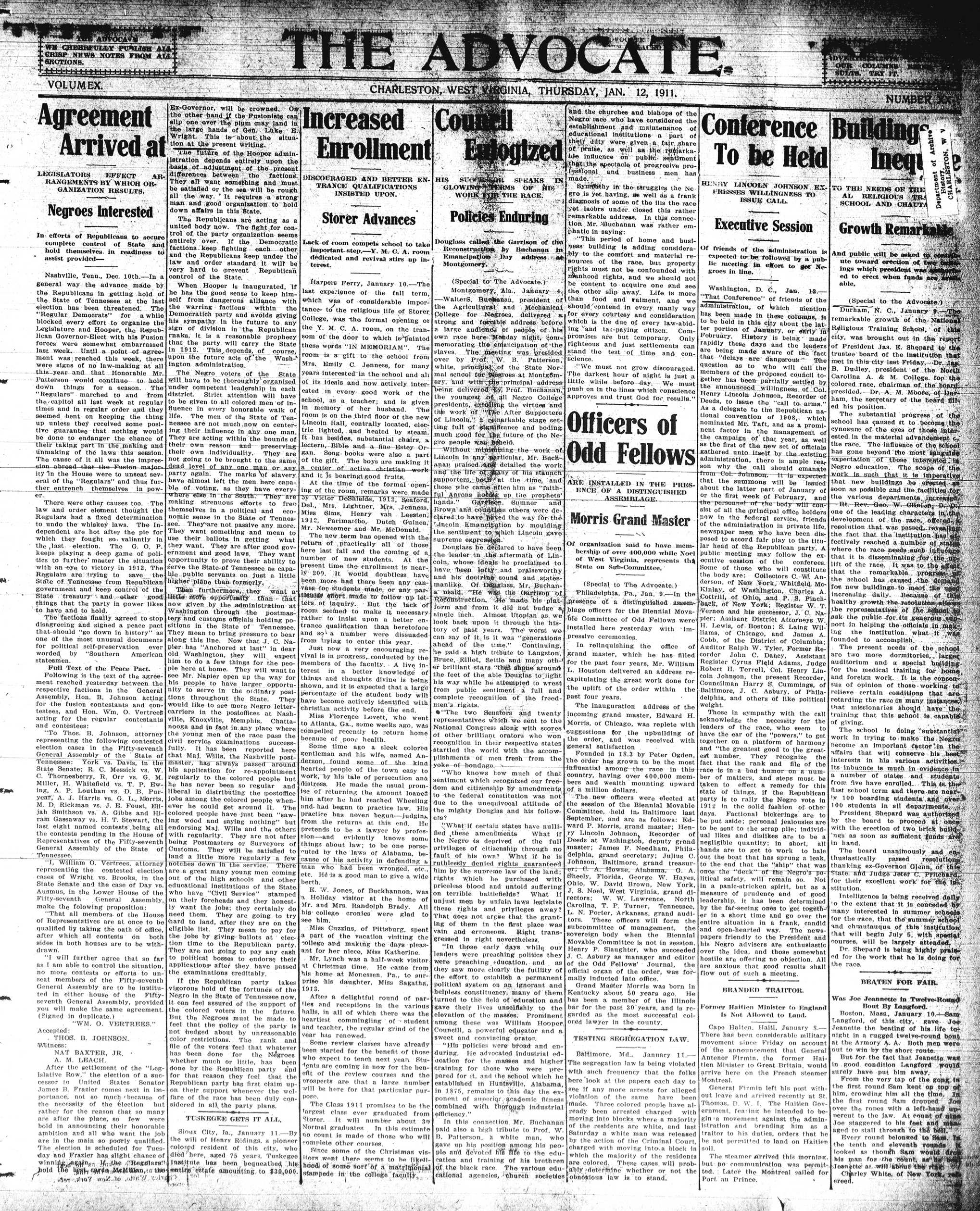
Agreement Arrived at
LEGISLATORS EFFECT AR RANGEMENTS BY WHICH OR GANIZATION RESULTS.
Negroes Interested
In efforts of Republicans to secure complete control of State and hold themselves, in readiness to assist provided—
Nashville, Tenn., Dec. 10th.—In a general way the advance made by the Republicans in getting hold of the State of Tennessee at the last election has been threatened. The "Regular Democrats" for a while blocked every effort to organize the Legislature and Hooper, the Republican Governor-Elect with his Fusion forces were somewhat embarrassed last week. Until a point of agreement was reached this week, there were signs of no law-making at all this year and that Honorable Mr. Patterson would continue to hold down things for a season. The "Regulars" marched to and from the capitol all last week at regular times and in regular order and they seemed bent on keeping the thing up unless they received some positive guarantee that nothing would be done to endanger the chance of their taking part in the making and unmaking of the laws this session. The cause of it all was the impression abroad that the Fusion majority in the House were to unseat several of the "Regulars" and thus further entrench themselves in power.
There were other causes too. The law and order element thought the Regulars had a fixed determination to undo the whiskey laws. The Independent are hot after the ple for which they fought so valiantly in the last election. The G. O. P. keeps playing a deep game of politics to further master the situation with an eye to victory in 1912. The Regulars are trying to save the State of Tennessee from Republican government and keep control of the State treasury and other good things that the party in power likes to have and to hold.
The factions finally agreed to stop disagreeing and signed a peace pact that should "go down in history" as one of the most unusual documents for political self-preservation ever worded by "Southern American statesmen.
Full Text of the Peace Pact.
FoHowing is the text of the agreement reached yesterday between the respective factions in the General Assembly, Hon. B. Johnson acting for the fusion contestants and contestees, and Hon. W. O. Vertes acting for the regular contestants and contestees:
"To Thos. B. Johnson, attorney representing the following contested election cases in the Fifty-seventh General Assembly of the State of Tennessee: York vs. Davis, in the State Senate; R. C. Mossick vs. W. C. Thornesberry, R. Orr vs. G. M. Miller, H. Whitefield vs. T. P. Ewing, A. P. Louthan vs. D. B. Purery, A. J. Harris vs. G. L., Morris, M. D. Rickman vs. J. E. Foust, Elijah Smithson vs. A. Gibbs and Hiram Gassaway vs. H. T. Stewart, the last eight named contests, being all the contests pending in the House of Representatives of the Fifty-seventh General Assembly of the State of Tennessee.
"I, William O. Vertrees, attorney representing the contested election cases of Wright vs. Brooks, in the State Senate and the case of Day vs. Ausmus, in the Lower House of the Fifty-seventh General Assembly, make the following proposition:
"That all members of the House of Representatives are at once to be qualified by taking the oath of office, after which all contests on both sides in both houses are to be withdrawn.
"I will further agree that so far as I am able to control the situation, no more contests or efforts to unscat members of the Fifty-seventh General Assembly are to be instituted in either house of the Fifty-seventh General Assembly, provided you will make the same agreement. (Signed in duplicate.)
"WM. O. VERTREES."
Accepted:
THOS. B. JOHNSON.
Witness:
NAT BAXTER, JR.
After the settlement of the "Legislative Row," the election of a successor to United States Senator James B. Frazier comes next in importance, not so much because of the necessity of the election but rather for the reason that so many are after the place, so few were hold in announcing their honorable ambition and all who want the job are in the main so poorly qualified. The election is scheduled for Tuesday and Frazier has slight chance of winning, although the "legislators" hold the light cards, McMullen, is so
Ex-Governor, will be crowned. On the other hand if the Fusionists can slip one over the plum may land in the large hands of Gen. Luke E Wright. This is about the situation at the present writing.
The future of the Hooper administration depends entirely upon the basis of adjustment of the present differences between the factions. They all want something and must be satisfied or the sea will be rough all the way. It requires a strong man and good organization to hold down affairs in this State.
The Republicans are acting as a united body now. The fight for control of the party organization seems entirely over. If the Democratic factions keep fighting each other and the Republicans keep under the law and order standard it will be very hard to prevent Republican control of the State.
When Hooper is inaugurated, if he has the good sense to keep himself from dangerous alliance with the warring factions within the Democrat party and avoids giving his sympathy in the future to any sign of division in the Republican rnaks, it is a reasonable prophecy that the party will carry the State in 1912. This depends, of course, upon the future acts of the Washington administration.
The Negro voters of the State will have to be thoroughly organized under competent leadership in each district. Strict attention will have to be given to all colored men of influence in every honorable walk of life. The men of the State of Tennessee are not much now on centering their influence in any one man. They are acting within the bounds of their own reason and preserving their own individuality. They are not going to be brought to the same dead level of any one man or any party again. The marks of slavery have almost left the men here capable of voting, as they have everywhere else in the South. They are making strenuous efforts to free themselves in a political and economic sense in the State of Tennessee. They are not passive any more. They want something and mean to use their ballots in getting what they want. They are after good government and good laws. They want opportunity to prove their ability to serve the State of Tennessee as capable public servants on just a little higher plane than formerly.
now given by the administration at Washington through the postmastery and customs officials holding positions in the State of Tennessee. They mean to bring pressure to bear along this line. Now that J. C. Napier has "Anchored at last" in dear old Washington, they will expect him to do a few things for the people here at home. They will want to see Mr. Napier open up the way for his people to have larger opportunity to serve in the ordinary positions throughout the State. They would like to see more Negro lettercarriers in the postoffices at Nashville, Knoxville, Memphis, Chattanooga and in fact in any place where the young men of the race pass the civil service examinations successfully. It has been reported here that Maj. Wills, the Nashville postmaster, has always passed around his application for re-appointment regularly to the colored people but he has never been so regular and liberal in distributing the postoffice jobs among the colored people whenever he could get around it. The colored people have just been "awning wood and saying nothing" but endorsing Maj. Wills and the others with regularity. They are not after being Postmasters or Surveyors of Customs. They will be satisfied to land a little more regularly a few notches down in the service. There are a great many young men coming out of the high schools and other educational institutions of the State who have "Civil Service" stamped on their foreheads and they honestly want the jobs; they certainly do need them. They are going to try hard to land, after they are on the eligible list. They mean to pay for the jobs by giving ballots at election time to the Republican party. They are not going to pay any cash to political bosses to endorse their applications after they have passed the examinations creditably.
If the Republican party takes vigorous hold of the fortunes of the Negro in the State of Tennessee now, it can feel assured of the support of the colored voters in the future. But the Negroes must be made to feel that the policy of the party is not hedged about by unreasonable color restrictions. The rank and file of the voters feel that whatever has been done for the Negroes whether much or little, has been done by the Republican party and for that reason they feel that the Republican party has first claim upon their support whenever the welfare of the race has been duly considered in all the party plans.
TUSKEGEE GETS IT ALL
Sloux City, Ia., January 11.—By the will of Henry Ridings, a pioneer colored resident of this city, who died here, aged 75 years, Tuskegee Institute has been begathed his estate amounting to $30,000.
CHARLESTON, WEST VIRGINIA, THURSDAY, JAN. 12, 1911.
Increased Enrollment
DISCOURAGED AND BETTER ENTRANCE QUALIFICATIONS INSISTED UPON.
Storer Advances
Lack of room compels school to take important step.-Y. M. C. A. room dedicated and revival stirs up interest.
Harpers Ferry, January 10.—The last experience of the fall term, which was of considerable importance to the religious life of Storer College, was the formal opening on the Y. M. C. A. room, on the transom of the door to which is painted these words "IN MEMORIAM". The room is a gift to the school from Mrs. Emily C. Jenness, for many years interested in the school and all of its ideals and now actively interested in every good work of the school, as a teacher; and is given in memory of her husband. The room is on the third floor of the new Lincoln Hall, centrally located, electric lighted, and heated by steam. It has besides, substantial chairs, a lectern, Bible and a fine Estey Organ. Song books were also a part of the gift. The boys are making it a center of active Christian work and it is bearing good fruits.
At the time of the formal opening of the room, remarks were made by Victor DeShields, 1912, Seaford, Del., Mrs. Lightner, Mrs. Jenness, Miss Sims, Henry van Leesten, 1912, Parimarbo, Dutch Guinea, Mr. Neweomer and Mr. McDonald. The new term has opened with the return of practically all of those here last fall and the coming of a number of new students. At the present time the enrollment is nearly 200. It would doubtless have been more had there been any canvass for students made, or any particularly effort made to follow up letters of inquiry. But the lack of room seemed to make it necessary rather to insist upon a better entrance qualification than heretofore and so a number were dissuaded from trying to enter this year.
Just now a very encouraging revival is in progress, conducted by the members of the faculty. A live interest in a better knowledge of things and thoughts divine is being shown, and it is expected that a large percentage of the student body will have become actively identified with christian activity before the end. Miss Florence Lovett, who went to Atlanta, Ga., some weeks ago, was compelled recently to return home because of poor health.
Some time ago a sleek colored gentleman and his wife, named Anderson, found some of the kind hearted people of the town easy to work, by his tale of persecution and distress. He made the usual promise of returning the amount loaned him after he had reached Wheeling and had begun to practice law. His practice has never begun—judging from the returns at this end. He pretends to be a lawyer by profession—and evidently knows some things about law; to be one persecuted by the laws of Alabama, because of his activity in defending a man who had been wronged, etc., etc. He is a good man to give a wide berth.
E. W. Jones, of Buckhannon, was a Holiday visitor at the home of Mr. and Mrs. Randolph Brady. All his college cronies were glad to see him.
Miss Cuzzins, of Pittsburg, spent a part of the vacation visiting the college and making the days pleasant for her niece, Miss Katherine.
Mr. Lynch was a half-week visitor at Christmas time. He came from his home at Monessen, Pa., to surprise his daughter, Miss Sagatha, 1913.
After a delightful round of parties and receptions in the various halls, in all of which there was the heartiest commingling of student and teacher, the regular grind of the year has renewed.
Some review classes have already been started for the benefit of those who expect to teach next year. Students are coming in now for the benefit of the review courses and the prospects are that a large number will be here for that particular purpose.
The Class 1911 promises to be the largest class ever graduated from Storer. It will number about 39 Normal graduates. In this estimate no count is made of those who will complete other courses. Since some of the Christmas visitors went there seems to be likelihood of some sort of a matrional stampede in the college faculty.
Council Enlogized
Douglass called the Garrison of the Reconstruction by Buchanan in Emanclapation Day address at Montgomery.
Montgomery, Ala., January 4.
—Walter S. Buchanan, president of the Agricultural and Mechanical College for Negroes, delivered a strong and forcible address before a large audience of people of his own race here Monday night, commemorating the emancipation of the slaves. The meeting was presided over by Prof. W. B. Patterson, white, principal of the State Normal school for Negroes at Montgomery, and with the principal address being delivered by Prof. Buchanan, the youngest of all Negro College presidents, expelling the virtues and the work of "The After Supporters of Lincoln," a remarkable stage setting full of significance and boding much good for the future of the Negro people was held.
Without minimizing the work of Lincoln in any particular, Mr. Buckanan praised and detailed the work and the life of many of his staunch supporters, both at the time, and those who came often him as "faithful Aarons holding up the prophets' hands." Garriison, Sumner and Brown and countless others were declared to have paved the way for the Lincoln Emancipation by moulding the sentiment to which Lincoln gave supreme expression.
Douglas he declared to have been the leader in the aftermath of Lincoln, whose ideals he proclaimed to have been lofty and praiseworthy and his doctrine sound and statesmanlike. Of Douglass, Mr. Buchanan, "He was the Garrison of Reconstruction. He made his platform and from it did not budge a single inch. Almost Utopian as we look back upon it through the history of past years. The worst we can say of it, it is was "generations ahead of the time." Continuing, he paid a high tribute to Langston, Bruce, Elliot, Settle and many other brilliant stars "that shine around the feet of the able Douglas to light his way while he attempted to wrest from public sentiment a full and complete recognition of the freedmen's rights.
"The two Senators and twenty representatives which we sent to the National Congress along with scores of other brilliant orators who won recognition in their respective states started the world with the accomplishments of men fresh from the yoke of bondage.
"Who knows how much of that sentiment which recognized our freedom and citizenship by amendments to the federal constitution was not due to the unequivocal attitude of the mighty Douglas and his followers?"
"What if certain states have nullified these amendments. What if the Negro is deprived of the full privileges of citizenship through no fault of his own? What if he is ruthlessly denied rights guaranteed him by the supreme law of the land; rights which he purchased with priceless blood and untold suffering on terrible battlefields? What if unjust men by unfain laws legislate these rights and prilleges away? That does not argue that the granting of them in the first place was vain and erroneous. Right transgressed in right nevertheless.
"In those early days while our leaders were preaching politics they were preaching education, and as they saw more clearly the futility of the effort to establish a permanent political system on an ignorant and helpless constituency, many of them turned to the field of education and gave their lives unselfishly to the elevation of the masses. Prominent among these was William Hooper Council, a powerful educator and a sweet and convincing orator.
"His policies were broad and enduring. He advocated industrial education for the masses and higher training for those who were prepared for it, and the school which he established in Huntsville, Alabama, in 1875, remains to this day the exponent of superior academic fitness combined with thorough industrial efficiency."
In this connection Mr. Buchanan paid also a high tribute to Prof. W. B. Patterson, a white man, who gave up his position among his people and devoted his life to the education and training of his brethren of the black race. The various educational agencies, church societies
and the churches and bishops of the Negro race who have considered the establishment and maintenance of educational institutions a part of their duty were given a fair share of praise, as well as the remarkable influence on public sentiment that the spectacle of progressive professional and business men has made.
Sympathy in the struggles the Negro is yet having, as well as a frank diagnosis of some of the ills the race yet laubs under closed this rather remarkable address. In this connection Mr. Buchanan was rather emphatic in saying:
"This period of home and business building is adding considerably to the comfort and material resources of the race, but property rights must not be confounded with manhood rights, and we should not be content to acquire one and see the other slip away. Life is more than food and ralment, and we should contend in every manly way for every courtesy and consideration which is the due of every law-abiding and tar-paying citizen. Compromises are but temporary. Only righteous and just settlements can stand the test of time and conscience.
"We must not grow discouraged. The darkest hour of night is just a little while before day. We must push on in the lines which conscience approves and trust God for result."
Officers of Odd Fellows
ARE INSTALLED IN THE PRESENCE OF A DISTINGUISHED ASSEMBLAGE.
Morris Grand Master
Of organization said to have membership of over 400,000 while Noct of West Virginia, represents the State on Sub-Committee.
Philadelphia, Pa., Jan. 9. In the presence of a distinguished assemblage officers for the Biennial Movable Committee of Odd Fellows were installed here yesterday with impressive ceremonies.
In relinquishing the office of grand master, which he has filled for the past four years, Mr. William L. Houston delivered an address recapitulating the great work done for the uplift of the order within the past four years.
The inauguration address of the incoming grand master, Edward H. Morris, of Chicago, was replete with suggestions for the upbuilding of the order, and was received with general satisfaction
Founded in 18.3 by Peter Ogden, the order has grown to be the most influential among the race in this country, having over 400,000 members and wealth mounting upward of a million dollars.
The new officers were elected at the session of the Biennial Movable Committee, held in Baltimore last September, and are as follows: Edward P. Morris, grand master; Henry Lincoln Johnson, Recorder of Deeds at Washington, deputy grand master; James F. Needham, Philadelphia, grand secretary; Julius C. Johnson, Baltimore, grand treasurer; C. A. Howze, Ababama, G. A. Sheely, Florida, George W. Hayes, Ohio, W. David Brown, New York, J. S. Noel, West Virginia, grand directors; W. W. Lawrence, North Carolina, T. P. Turner, Tennessee, L. N. Porter, Arkansas, grand auditors. These officers will form the subcommittee of management, the sovereign body when the Biennial Movable Committee is not in session. Henry P. Slaughter, who succeeded J. C. Asbury as manager and editor of the Odd Fellows' Journal, the official organ of the order, was formally inducted into office.
Grand Master Morris was born in Kentucky about 50 years ago. He has been a member of the Illinois bar for the past 30 years, and is regarded as the most successful colored lawyer in the county.
TESTING SEGREGATION LAW.
Baltimore, Md., January 11. The segregation law is being violated with such frequency that the folks here look at the papers each day to see if any more arrests for alleged violation of the same have been made. Three colored people have already been arrested charged with moving into blocks where a majority of the residents are white, and last Saturday a white man was released by the action of the Criminal Court, charged with moving into a block in which the majority of the residents are colored. These cases will probably determine whether or not the obnoxious law is to stand.
Conference To be Held
HENRY LINCOLN JOHNSON EXPRESSSES WILLINGNESS TO ISSUE CALL
Executive Session
Of friends of the administration is expected to be followed by a public meeting in effort to get Negroes in line.
Washington, D. C., Jan. 12. "That Conference" of friends of the administration, of which mention has been made in these columns, is to be held in this city about the latter portion of January, or early in February. History is being made rapidly these days and the leaders are being made aware of the fact that "delays are dangerous." The question as to who will call the members of the proposed council together has been partially settled by the announced willingness of Col. Henry Lincoln Johnson, Recorder of Deeds, to issue the "call to arms." As a delegate to the Republican national convention of 1908, which nominated Mr. Taft, and as a prominent factor in the management of the campaign of that year, as well as the first of the new set of officials gathered unto itself by the existing administration, there is ample reason why the call should emanate from Col. Johnson. It is expected that the summons will be issued about the latter part of February, and the personnel of the body will consist of all the principal office holders now in the federal service, friends of the administration in private life, newspaper men who have been disposed to accord fair play to the titular head of the Republican party. A public meeting may follow the executive session of the conferees. Some of those who will constitute the body are: Collectors C. W. Anderson, of New York, Whitfield McKinlay, of Washington, Charles A. Cottrill, of Ohio, and P. S. Pinchback, of New York; Register W. T. Vernon and his successor, J. C. Napier; Assistant District Attorneys W. H. Lewis, of Boston; S. Laing Williams, of Chicago, and James A. Cobb, of the district of Columbia; Auditor Ralph W. Tyler, Former Recorder John C. Dancy, Assistant Register Cyrus Field Adams, Judge Robert H. Terrell, Col. Henry Lincoln Johnson, the present Recorder, Councilman Harry S. Cummings, of Baltimore, J. C. Asbury, of Philadelphia, and others of like political weight.
Those in sympathy with the call acknowledge the necessity for the leaders of the race, who seem to have the ear of the "powers," to get together on a platform of harmony and "the greatest good to the greatest number. They recognize the fact that the rank and file of the race is in a bad humor on a number of matters, and steps must be taken to effect a remedy for this state of things, if the Republican party is to rally the Negro vote in 1912 in the solid fashion of other days. Factual bickerings are to be put aside; personal jealousies are to be sent to the scrap pile; individual likes and dislikes are to be a negligible quantity; in short, all hands are to get to work to bale out the boat that has sprung a leak, to the end that the "ship" that was once the "deck" of the Negro's political safety, will remain so. Not in a panic-stricken spirit, but as a measure of prudence and of good leadership, it has been determined by the far-scene ones to get together in a short time and go over the entire situation in a frank, candid and open-hearted way. The newspapers friendly to the President and his Negro advisers are enthusiastic over the idea, and those somewhat hostile are offering no objection. All are anxious that good results shall flow out of such a meeting.
BRANDED TRAHTOR.
Former Haitian Minister to England Is Not Allowed to Land.
Cape Haiten, Haiti, January 8. There has been considerable military movement since Friday on account of the announcement that General Antenor Firmin, the former Haitien Minister to Great Britain, would arrive here on the French steamer Montreal. General Firmin left his post without leave and arrived recently at St. Thomas, D. W. I. The Haitien Government, fearing he intended to begin a movement against the administration and branding him as a traitor to his duties, orders that he be not permitted to land on Haitien soil. The steamer arrived this morning, but no communication was permitted. Later the Montreal sailed for Port au Prince.
TO THE NEEDS OF THE
AL RELIGIOUS ARA
SCHOOL AND CHAUTA
And public will be asked to contiuate toward erection of two buildings which president was appointed to erect when funds are available.
(Special to the Advocate.)
Durham, N. C., January 9.—The remarkable growth of the National Religious Training School, of this city, was brought out in the report of President Jas. E. Shepard to the trustee board of the institution that met in this city last Friday. Dr. Jag. B. Dudley, president of the North Carolina A. & M. College, for the colored race, chairman of the board, presided. Dr. A. M. Moore, of Durham, the secretary of the board filled his position.
The substantial progress of the school has caused it to become the cynosure of the eyes of those interested in the material advancement c. the race. The influence of the school has gone beyond the most sanguine expectation of those interested in Negro education. The scope of the work is such that it is imperative that new buildings be erected as soon as possible and the facilities for the various departments increase. Rt. Rev. Geo. W. Clinton, D. Dr. one of the leading characters in the development of the race, offered a resolution that was passed, revealing the fact that the institution has effectively reached a number of stakes where the race needs such influence that it is disseminating for the uplift of the race. It was to the effect that the remarkable progress of the school has caused the demand for new buildings to meet the need increasing daily. Because of this healthy growth the resolution allows the representatives of the school to ask the public for its generous support in helping the officials in making the institution what it was founded to accomplish.
The present needs of the school are two more dormitories, larger auditorium and a special building for the medical training for home and foreign work. It is the consensus of opinion of those working to relieve certain conditions that are retarding the race in many instances that missionaries should have the training that this school is capable of giving.
The school is doing substantial work in trying to make the Negro become an important factor in the affairs that will conserve his best interests in his various activities. Its inbuence is much in evidence in a number of states and students from five have enrolled. This is the first school term and there are nearly 100 boarding students and over 100 students in all departments. President Shepard was authorized by the board to proceed at once with the erection of two brick buildings as soon as sufficient funds are in hand. The board unanimously and enthusiastically passed resolutions thanking ex-Governor Glenn, of this state and Judge Jeter C. Pritchard, for their excellent work for the institution.
Intelligence is being received daily to the extent that it is conceded by many interested in summer schools for the race, that the summer school and chauauqua of this institution that will begin July 5, with special courses, will be largely attended. Dr. Shepard is being highly praised for the work that he is doing for the race.
BEATEN FOR FAIR.
Bout By Langford.
Boston, Mass., January 10—Sam Langford, of this city, gave. Joe Jeanette the beating of his life tonight in a rugged twelve-round bout at the Armory A, A. Both men were out to win by the short route.
But for the fact that Jeanette was in good condition Langford would surely have put him away.
From the very tap of the gong in the first round Sam Kent on top of him, crowding him all the time. In the first round Sam dropped Joe over the ropes with a left-hand upward to the jaw. At count of nine Joe staggered to his feet and managed to站 through to the bell.
Every round belonged to Sam. In the tenth and eleventh rounds it looked as though Sam would drop his man for the count, as his boy Jeanette at will about the riddle.
Charley White, of New York, re-creed.
a Mt _ Re SE eR tS RRR DPS Ponies in een Cat Ra ol a ce Pp F
a —~— A Pa Ry RE —— Re oS NE OE CAPD NOR gS Te AS are
a r 7 = SERENE NOV ETO tn MN GURNEE oeces. Sake cs so eS Ue MRC ON Can ears Tar Reema Las See ee
aa ys peer - eet Le * Fon ae ee wa EE Pg RE ented het en Lg ae |
Te eri eiiniintimiciemtis= occ secitthngicnepe ee ee oo agri av VO ahh pe
———— S| Boek ate Tigo) Ge SS er ee eee ARE TROL
Te seaderson; et —Hugheston | oe Sees Sat SS iinnee Mes SaaS are ar ee 2 :
CORRESPOND was Sindy ment of Tw. Homes|” CLAIFC SION ee ee acl ins ss naar cong
t 2 | chas. Rollins niade a business Petes ee SEU Kennith Hale}. Mateo" Flanititon, * Sr Wises 5 as ae
PACH Tt We Roa4
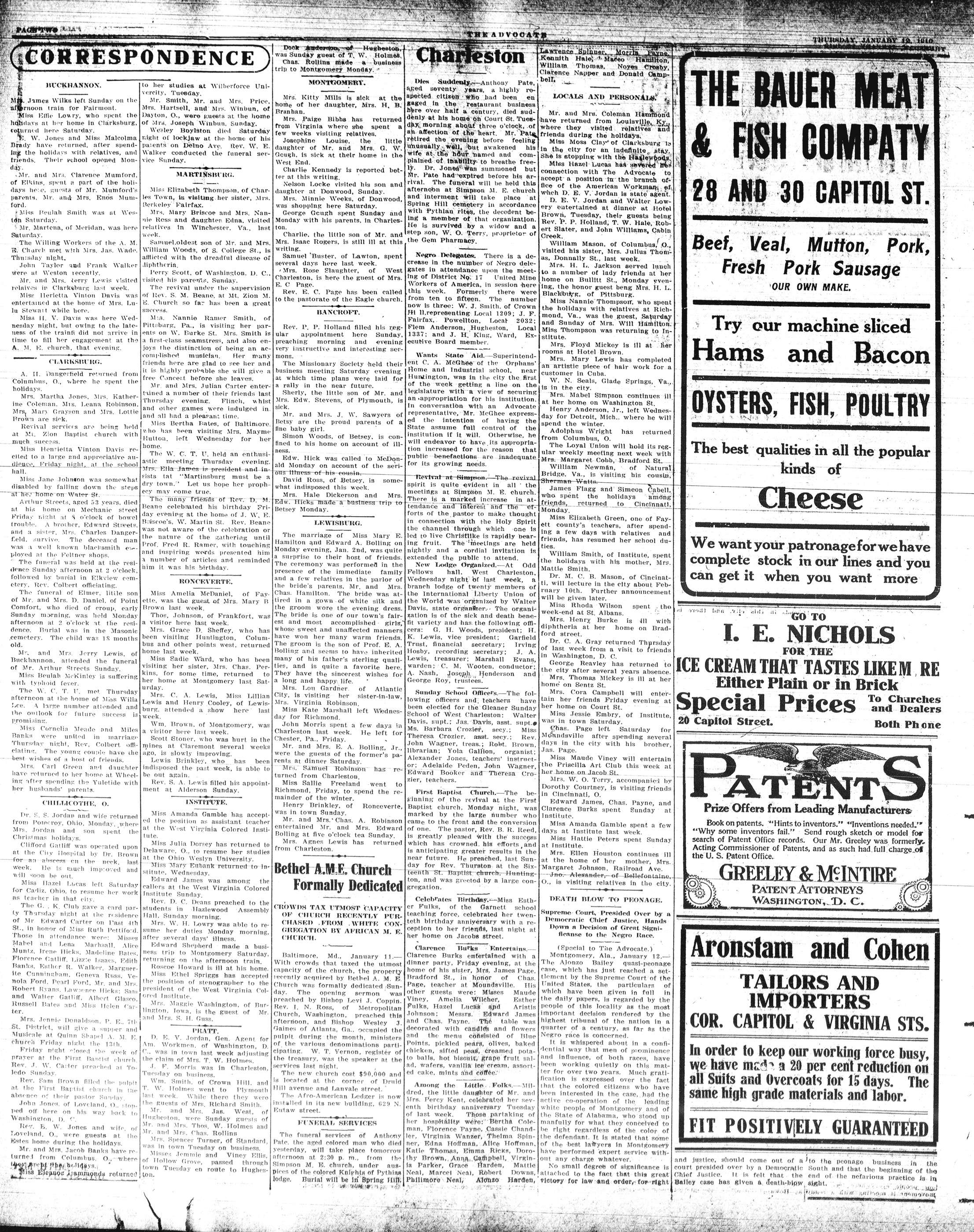
HUCKRANNON.
Mi. James Wilks left Sunday on the
affernoon train for Fairmont.
‘Miss Eime Lowry, who spent the
NdNdays at her home in Chirksburg,
goptrned here Saturday,
tS W. Jones and Miss Malcolma
Brady have returned, after spend-
Ing the holidays with relatives, and
friends, ‘Their echool opened Mon-
day.
<Mr. and Mrs. Clarence Mumford
of Elkins, spent a part of the holi-
days hese, gussts of Mr. Mumford’s
parents, Mr, and Mrs. Enos Mune
ford.
FMiss Iteulah Smith was at Wes
tdn Saturday.
“Mr, Martena, of Meridan, was here
Suturday.
‘The Willing Workers of the A.M.
B. Chareh met wih Mrs, Jas. Wade
‘Thusday night.
John ‘Taylor and Prank Walker
were ut Weston recently,
Mr, and Mrs. derry Lewis visited
relaives in Clarksburg last week
Miss Herfetta Vinton Davis wa:
entertamed at the home of Mrs, Lu
In Stewart while here,
Miss 11. V. Davis was here Wed-
nesday night, but owing to the late-
ness of the trainfi did not arrive ir
time to fill her engagement at th:
A. M. i. chureh, that evening.
CLARKSRURG,
A. IL. Dangerfield returned from
Columbus, O., where he spent the
holidays,
Mrs, Martha Jones, Mrs, Kather.
Ine Coleman, Mis. Leana Robinson
Mrs, Mary Grayson and Mys. Lottie
Frown are sick.
Revival servicers are being held
at Mi, Zion Baptist church with
much success.
Miss Henrietta Vinton Davis re-
eiled to a large end appreciative au-
_dience, Friday night, at the school
hall.
Miss Jane Johnson was somewhat
disabled by falling down the steps
“al hes nome on Water St.
Arthur Streets, aged 53 years, died
at his home on Mechanic street
Friday night at § o'clock of bowel
trouble, A brother, Edward Streets,
and a sister, Mrs, Charles Danger-
feld, survive, The deceased man
was a well known blacksmith e--
ployed at the Feltner shops.
The funeral was held at the resi-
dence Sunday afternoon at 2 o'clock,
followed by bunial in Etkview com-
eters, Rev, Colbert officiating,
Tho funeral of Elmer, little son
of Mr, and Mrs, D. Daniel, of Point
Comfort, who died of croup, early
Sunday morning, was held Monday
afternoon al 2 o'clock at the resi-
dence. Burial was in the Masonic
cemetery. ‘The child was 1§ months
old.
My and Mrs. Jerry Lewis, of
Buckhannon, attended the funeral
of Mr. Arthur Streets Sunday,
Miss Beulah MeWinley is suffering
with typhoid fever.
The W. CT. UV) met Thursday
afternoon at the home of Miss Willa
hee. A large number attended and
the ontlook for future success is
promisine,
Miss Cornelia Meade and Miles
Ranks were untted in marriage
‘Thursday night, Rey, Colbert. off
clatine, ‘The young couple have che
best wishes of a host of friends,
Mrs. Carl Groen and danehter
have returned to her home at Wheel-
ing after spending the Yuletide with
her husbands’ parents.
CHILLICOTHE, 0.
Pros. S. Jordan and wite returned
from Pomeroy, Ohio, Monday, where
Mrs. Jordan and son spent the
Christmas: holidays.
Clifford Gatlitt was operated upon
at the Ciy Hospital by Dr. Brown
for an abscess cn the neck, last
week. Ue is much imp:oved and
will Soon be out
Miss Mazel Lucas left Saturday
for Carliz, Ohio. to resume her work
as teacher in that city
The G. .K, Club gave a card pare
fy Tharsday night at the residence
of Mr bBdward Carter on Past 4th
St.. in honor of Miss Ruth Pottiford.
‘Those in attendance were: Misses
Mabel and Lena Marhsall, Alice
Muntz, Irene Hicks, Madeline Rates.
Florence Gatlif, Linzie Isaacs, Faith
Banks, Esther &. Walker, Margner-
flo Cunningham, Geneva Russ. Ve-
nola Ford, Pearl Ford, My, and Mrs
Robert Ryans. awnence Hicks: San
and Walter Gatliff, Athort Glasco.
Russell Hates and Miss telen Car.
ter,
Mrs. Jennie Donaldson, P. B., 7ti
St. District, will give a supper and
Musicale at Quinn Shape! \. M&K,
churca Friday might the tain
Friday nicht rtosed the week of
prayer at the First Bantist church
Rev. FW. Carter preached at ‘To.
ledo Sunday
Rev, Sam Brown filed the pulpit
at the Tirst Baptist eharch in the
absenen of their pastor Sanday
Jobo Jones. of Loveland, 0. ston.
Ved off here on his way hack to
Washington, p, ©
Rey. Bo W. Jones and wife, of
Toveland, ©., were guests at the
wstes home during the holidays.
Mr. and Mrs. Jacob Banks have ro
lurnet from Coiumbus, 0.,--where
i FAN RE Hb beNgeys. .
is8 Efegnou JJammonds returned
to her studies at Wilberforce Uni-
vereity, Tuesday,
Mr. Smith, Mr. and Mrs, Price,
Mrs, Hartsell, and Mrs. Winbun, of
Dayton, O., were guests at the home
of ars, Joseph Winbun, Sunday,
| Wesley Boylston died Saturday
night of lockjaw at the home of his
‘pavents on Detno Ave, Rey, W. E.
Walker conducted the funeral ser-
vice Sunday,
a
MARTINSBURG,
Miss Elizabeth Thompson, of Char-
les Town, is visiting her sister, Mrs,
Rerkeley Fairfax,
Mrs, Mary Briscoe and Mrs, Nan-
nie Ross and daughten Edna, visited
relatives In Winchester, Va., Inst
week,
Samueloldest son of Mr. and Mrs.
William Woods, of S. College St., Is
aflicted with the dreadful disease of
diphtheria
Verry Scott, of Washington, D. C.,
visited his parems, Sunday.
‘The revival under the supervision
of Rev. S. M. Beane, at Mt, Zion M.
, Church so faz has been a great
saecess,
Mis, Nannie Ramer Smith, of
Pittsburg, Pa., is visiting her par-
ents on W. Burke St. Mrs. Smith is
a first-class seamstress, and also en-
joys the distinction of being an ac-
complished musiclan, — Her many
friends here are glad to see her and
it is highly provable she will give a
free Concert before she leaves,
Mr and Mrs, Julian Carter enter-
tained a number of their friends last
Thursday evening, Flineh, whist
and other games were indulged in
and all had a pleasant time.
[ Miss Bertha Fates, of Baltimore.
jhe has been visiting Mes. Mayme
Hutton, ieft Wednesday for her
home.
The W. C. T. U, held an enthusi-
astic meeting ‘Thursday evening.
Mrs> Ela-James-is-president-and_in-
sists tat “Martinsburg must be a
ary town." Let us hope her proph
ecy may come true,
‘The thany friends of Rev. D. M.
Beane celebmted his birthday Pri-
day evening at the home of J. W, E.
Boiscoe’s, W. Martin St. Rev. Beane
was not aware of the celebration or
the nature of the gathering until
Prof. Fred R. Ramer, with touching
and inspiring words presented him
A number of articles and reminded
him it was his birthday.
RONCEVERTE,
Miss Amelia MeDaniel, of Fay-
etic, was the guest of Mrs. Mary B
Brown last week,
Thos, Johnson, of Frankfort, was
a visitor here last week.
Mrs. Grace D. Sheffey, who has
been visiting Huntington, Colum.
bus and other points west, returned
home last week,
Miss Sadie Ward, who has been
visiting her sister, Mrs. Chas. Per-
Kins, for some time, returned — to
her home at Montgomery last Sat-
urday,
Mrs. ©. A. Lewis, Miss Lillian
Lewis and Henry Cooley, of Lewis-
burg. attended a show here last
week
Wm, Brown, of Montgomery, was
a visitor here last week.
Scott Stoner, who was hurt in the
mines at Claremont several weeks
ago, is slowly improving.
Lewis Brinkley, who. has — been
indisposed the past week, is able to
be out again,
Rev. S. A. Lewis filled his appoint-
ment at Alderson Sunday.
INSTITUTE.
Miss Amanda Gamble has accept-
ed (he position as assistant teacher
at the West Virginia Colored Insti-
tute.
Miss Julia Dorsey has returned to
Delaware, O., to resume her studies
at the Ohio Weslyn University.
Miss Mary Eubank returned to-In-
stitute, Wednesday.
Edward James was among the
callers at the West Virginia Colored
Institute Sunday,
Rev. D.C. Deans preached to the
students in Hazlewood Assembly
Hall, Sunday morning.
Mrs, W. HL. Lowry was able to re-
sume her duties Monday morning,
after several days’ illness.
Edward Shepherd made a busi-
ness trip to Montgomery Saturday,
returning on the afternoon train,
Roscoe Howard is ill at his home.
Miss Ethel Spriggs has accepted
the position of stenographer to the
president of the West Virginia Col-
ored Institute,
Mrs, Maggie Washington, of Ture
lington, fowa, is the guest of Mr,
and Mrs. $. H. Guss,
PRATT.
DE. V. Jordan, Gen. Agent for
Am. Workmen, of Washington, D.
C.. was in town last week adjusting
the claim of Mrs. ‘T. W. Holmes.
J. F. Morris was in Charleston,
Tuesday on business,
Wm. Smith. of Crown Hill, and
T. W. Holmes went to Plymouth
last week. While there they were
the guests of Mrs, Richard Smith.
Mr. and Mrs. Jas. West, of
Mugheston, were Sunday guesis of
Mr. and Mrs. Thos, W. Holmes and
Mr. and Mre, Chas. Rollins
Mrs. Spencer Turner, of Standard,
was in town Tnesday on business,
Misses Jemmie and Viney Ellis,
of Hollow Grove, passed through
town Tuesday en rowte to Hughes:
ton.
Door emtoretony ak — Hugbestod,
was Sunday guest of TW. Holmés,
Chas. Rolling miéde a - business
trip to Montgomery Monday. *
—<—<———_——
MONTGOMERY.
Mrs. Kitty Mills is sick at the
home of her daughter, Mrs. H, B
‘Branhan.
Mrs, Paige Bibbs has returned
from Virginia where ghe spent a
few weeks visiting relatives,
Josephine Louise, the little
daughter of Mr. and Mrs. GQ. W.
Gough, ts sick at their home in the
West End.
Charlie Kennedy is reported bet-
ter at this writing,
Nelson Locke visited his son and
daughter at Donwood, Sunday.
Mrs. Minnie Weeks, of Donwood,
was shopping here Saturday.
George Gcugh spent Sunday and
Monday with his parents, in Charles-
ton.
Charlie, the little son of Mr. and
Mrs. Isaac Rogers, is still iN at this
writing.
Samuel ‘Buster, of Lawton, spent
several days here last week,
«Mrs, Rose Slaughter, of West
Charleston, is here the guest of Mrs.
B.C Page.
Rev, E. C. Page has been called
to the pastorate of the Eagle church.
BANCROFT. .
Rey. P, P. Holland filled his reg:
ular appointment here Sunday.
preaching morning and evening
very instructive and interesting ser-
mons.
The Missionary Society neld theit
business meeting Saturday evening
at which time plans were laid for
a rally in the near future.
Sherly, the little son of Mr. and
Mrs, Edw. Stevens, of Plymouth, is
sick
Mr. and Mrs. J, W. Sawyers of
Retsy are the proud parents of a
fine baby girl. .
Simon Woods, of Betsey, is con-
fined to his home on account of ill-
ness.
Bdw. Hick was called to MeDon-
ald Monday on account of the seri-
ous itiress—of—His-eousin,———_
David Ross, of Betsey, is some-
what indisposed this week.
Mrs. Hale Dickerson and Mrs.
Edw. Hicks Madea dustness trip to
Betsey Monday.
—_—+__
LEWISBURG.
The marriage of Miss Mary E.
Hamilton and Edward A. Bolling on
Monday evening, Jan, 2nd, was quite
a surprise to their host of friends.
The ceremony was performed in the
presence of the immediate family
and a few relatives in the parlor of
the bride’s parents, Mr, and Mrs.
Chas. Hamilton, ‘The bride was at-
tired in a gown of white silk and
the groom wore the evening dress.
The bride is one of our town's fair-
est and most accomplished girls,
whose sweet and unaffected manners
have won her many warm friends.
The groom is the son of Prof. EB. A.
Bolling and seems to have inherited
many of his father's sterling quali-
ties, and is quite a favorite here.
They have the sincerest wishes for
a long and happy life. *
Mrs. Lou Gardner of Atlantic
City, Is visiting her sister-in-law,
Mrs. Virginia Robinson,
Miss Kate Marshall left Wiednes-
day for Richmond.
John Morris spent a few days in
Charleston last week. He left for
Chester, Pa., Friday. *
Mr. and Mrs. E. A. Bolling, Jr.,
were the guests of the former's pa-
rents at dinner Saturday.
Mrs. Samuel Robinson” has — re-
turned from Charleston,
Miss Sallie Freeland went to
Richmond, Friday, to spend the re-
mainder of the winter.
Henry Brinkley, of Ronceverte,
was in town Sunday.
Mr, and Mrs.*Chas. A. Robinson
entertained Mr. and Mrs, Edward
Bolling at five o'clock tea Sunday,
Mrs. Agnes Lewis has returned
from Charleston.
ent AME, Chureh
Formally Dedicated
CROWDS TAX UTMOST CAPACITY
OF CHURCH RECENTLY PUR-
— CHASED .FROM . WHITE CON-
GREGATION BY AFRICAN M, KE.
CHOERCH.
Baltimore, Md., January 11,—
With crowds that taxed the utmost
capacity of the chureh, the property
recently acquired by Bethel A. M. EB.
Church was formally dedicated Sun-
day. The opening sermon was
preached by Bishop Levi J. Coppin.
Rev. I. N. Ross, of Metropolitan
Church, Washington, preached this
aftertioon, and Bishop Wesley J.
Gaines of Atlanta, Ga.. occupied the
pulpit during the month, ministers
of the various denominations parti-
cipating. W. T. Yernon, registér of
the treasury, was the speaker at the
services last night, ‘
The new church cost $90,000 and
is located at the corner of Druld
Hill avenue and Lanvale street
The Afro-American Ledger is now
installed in its new building, 629 N
FUNERAL SERVICES
The funeral services of Anthony
Pate, the aged colored man who died
yesterday, will take place tomorrow
afternoon at 2:30 p. m., from the
Simpson M. B. church, under aus-
ices of the colored Knights of Pythias
Jodge, Burlal will be in Spring Hifi
OLAS OD wee einesas 4 oe ote
“Charleston -
SSE eRe
Dies Suddenly.—Anthony Pate,
aged seventy ypars, a highly re-
pected citizen who had been en
gaged in the restaurant business
Bpre over half a century, died sud-
denly at his homé-gh Court St. Tues-
dR, Morning about three o'clock, .of
an affection of the: heart, Mr.’ Patg
retired the. eveting vetore feeling
Unusually We, ‘but awakened his
wife atthe néut named and com-
plained ot inatifllty: to breathe free-
ly. Dr. Jones“ Was summoned but
Mr, Pate hadexptred before his ar-
rival. The funeral will be held this
afternobn at Simpson M. &. chuteh
and interment will take place al
Spring Hill cemetery in accordance
with Pythian rites, the decedent be-
ing a member of that organization
He is survived by a widow and a
step son, W. 0. Terry, proprietor o}
‘the Gem Pharmacy,
With Fythlan rites, the decedent be-
ing a member of that organization,
He is survived by a widow and a
step son, W. O. Terry, proprietor of
the Gem Pharmacy,
Negro Delegates, ‘There is a de-
crease in the number of Negro dele-
gates in attendance upon the meet-
Ing of District No. 17 United Mine
Workers of America, in session here
this week. Formerly there were
from ten to fifteen, The number
now is three: W. J. Smith, of Crown
HH Mrepresenting Local 1209; J. F.
Fairfax,. Powellton, Locat 2082;
Flem Anderson, Hugheston, Local
1387; and J. H King, Ward, Ex-
ecutive Board member.
Wants State Aid.—Superintend-
ent C, A. McGhee of the Orphans’
Home and Industrial school, near
Huntington, was in the city the first
of the weck getting a line on the
legislature with-a view of securing:
ansappropriation for his institution.
In conversation with an Advocate
representative, Mr. McGhee express-
ed the intention of having the
State assume full control of the
institution If it will, Otherwise, he
will endeavor to have its appropria-
tion increased for the reason that
public benefactions are inadequate.
for its growing needs.
~Revivat-at-Simpson.—The_revi
spirit is quite evident in all * the
meetings at Simpson M. B. church.
‘There is a marked increase in at-
tendance and” titerest® and the —et=
forts of the, pastor to make thought
in connection with the Holy Spirit
the channel through which one ts
led to live Christitke is rapidly pear-
ing fruit. The ‘iteetings are held
nightly and a cordial invitation is
extended the public to attend
New Lodge Organized—at Odd
Fellows hal, West Charleston,
Wednesday night bf last week, a
branch lodge of twenty members of
the International Liberty Union of
the World -was ‘orgmnized by Walter
Davis, state organfeer.- The organi:
zation is of the sick and death bene-
fit variety and has. the following offi-
cers: G. H. Woods, president; H.
K. Lewis, vice president; Garfield
Trust, financial secretary; Irving
Hosby, recording secretary; J. A.
Lewis, treasurer; Marshall Evans,
warden; C. M. Wooten, conductor;
A. Nash, Joseph, Henderson and
George Roy, trustees.
Sunday School Officers.—The fol-
lowing officers and, teachers have
been elected for the Gleaner Sunday
School of West Charleston: Walter
Davis, supt.; Jas. Davis, asst. supt.e
Ms, Barbara Crozief, secy.; Miss
‘Theresa Crozier, asst. secy.; Rev.
John Wagner, treas.; Robt. Trown,
lbrarian; Yola Gallion, organist:
Alexander Jones, teachers’ instrnet-
or; Adelaide Peden, John Wagner,
Edward Booker and Theresa Cro-
zier, teachers.
First Baptist Chureh.—The _ be-
¥inning of tho revival at the First
Baptist chureh, Monday night, was
marked by the large number who
came to the front and the conversion
of one. ‘The pastor, Rev. B. R. Reed,
is greatly pleased with the succges
which has crowned. his efforts ,and
is anticipating greater results in the
near future. He preached, last Sun-
day for Rev. Thurston. at the Six-
teenth St. Baptist churehHunting-
ton, and was greoted by a large con-
gregation.
Celebrates Birthday.~-Mies Esth-
er Fulks, of the Garnett school
teaching force, celebrated her twen-
teth birthday anniversary with a re-
ception to her friends, last night at
her home on Jacobs street.
Clarence “Thutks — Entertains,
Clarence Burks entertained with a
dinner party, Friday evening, at the
home of his sister, Mrs, James Page
Bradford St., in honor of Chas.
Page, teacher at Moundaville. His
other guests were: Misses Maude
Viney, Amelia Wileher, — Esther
Pulks, Hazel Lnea apd — Aristis
Johnson; Messrs. Wdward James
and Chas. Payne, Thé table was
decorated with candids and flowers
and the memi cofsisted of Blue
Points, pickled pears, olives, baked
chicken, siffed poag, éreamed pota-
to balls, hot biscuity grape frult sal-
ad, wafers, vanitia fee cream. assort-
ed cake, mints and céffée.
Among the Little... Fotks.—Mil-
dred, the litte daughter of Mr. and
Mrs. Percy Kent, celebrated her sey
enth birthday anniversary Tuesday
of last week, Thos@ partaking of
Lawrence Splaner, Mortis
eine Hale} Snes
Willlam ‘Thomas, Noyes Crosby,
Clatence Navper and Donald Gamp-
del ve ae
BAIN AES ND PERSONALS, | te
Mr. and Mrs. Coleman Hietaaa
have returned from Louisville, Ky,
where they visited relatives” and
friends during the holtdays,
Miss Moss Clay of Clarksburg ‘1s
in the city for an Indefinite. stay,
She fs stopping with the Miley
/ Miss Hazel: Lucas had: seve ”
connection with The Advocate to
accept’ a position tm the branch of
ce of the American Workman. eh
whch D. B, V. Jordan is state agent.
D. E. V. Jordan aud Walter Low-
ery oatertained at dinnot at Hotel
Brown, Tuesday, thelr guests being
Rey. P. P. Holland, T. W. Hale, Rob-
ert Slater, and John Willams, Cabin
Creek, f f
William Mason, of Columbus, a,
visited his sister, Mrs, Jullus Thom
as, Donnally St., last week.
Mrs. H. L. Jackson served Inneh
to a number of lady friends at her
home on Bullitt St, Monday even-
ing, the honor guest beng Mrs. H. L.
Blacks, of Pittsburg.
Miss Nannie Thompsor, who spent
the holidays with relatives at Rich-
mond, Va., was the guest, Sapirday
and Sunday of Mrs. Will Hamilton.
Miss Thompson was returning to In-
stitute. was
Mrs. Floyd Mickoy Is iN at” Ner
rooms at Hotel Brown,
Mrs. Mary Lewis has completed
an artistic piece of hair work for a
customer in Cuba.
W. N. Seals, Glade Springs, Va.,
is in the city.
| Mrs. Mabel Simpson continues ill
at her home on Washington St.
Henry Anderson, Jr., left Wednes-
day for Detroit, Mich.. where he will
spend the winter.
Adolphus Wright has returned
from Columbus, 0.
The Loyal Union will hold its reg-
ular weekly meeting next week with
Mrs. Margaret Cobb, Bradford St.
William Newman, — of Natural
Bridge, Va., is visiting his cousin,
Fret
James Flagg and’ Simeon Cabell,
who spént the holidays among
friends, returned to _ Cinesnnatl,
Monday,
Miss Elizabeth Green, one of Fay-
ett county's teachers, after spend-
ing a few days with relatives and
friends, has resumed her school du-
ties.
William Smith, of Institute, spent
the holidays with his mother, Mrs.
Mattie Smith,
Dr. M. C. B, Mason, of Cincinat-
ti, will lecture in the elty about Feb-
ruary 10th. Further announcement
will be given later,
Miss Rhoda Wilson spent . the
week-end at St, Albans. ‘
Mrs. Henry Burke is ‘I with
diphtheria at her home on Brad-
ford street.
Dr. C. A. Gray returned Th rsday
of last week from a visit to teienas
in Washington, D. C.
George Reavley has returned to
the city after several years absence.
Mrs, Thomas Mickey is ill at her
home on Sentz St.
Mrs. Cora Campbell will enter-
tain her friends Friday evening at
her home on Court St.
Miss Jessie Embry, of Institute,
was in town Saturday.
@has. Page left Saturday for
Motndsville after spending several
days in the city with his brother,
Jas. Page.
Miss Maude Viney will entertain
[the Priscilla Art Club this week at
her home on Jacob St.
Mrs. W. O. Terry, accompanied by
Dorothy Courtney, is visiting friends
in Cincinnati, 0,
Edward James, Chas, Payne, and
Clarence Burks spent Sunday at
Institute.
Miss Amanda Gamble spent a few
days at Institute last week.
Miss Hattie Peters spent Sunday
at Institute.
Mrs. Ellen Houston continues ill
at the home of her mother, Mrs.
Margaret Johnson, Railroad Ave.
—Hro--Atexander,— of Bellefontaine,
©O., is visiting relatives in the eltv.
DEATH BLOW TO PHONAGE.
Supremo: Court, Presided Over by a
Democratic Chief Justice, Hands
Down a Decision of Great Signi-
fleanse to the Negro Race.
Met, Me ernie Seetraeren es
Montgomery, Ala,, January 12.—
The Alonzo Bailey quasi-peonage
case, which has just reached a set-
tlement by the Supreme Court of the
United States, the particulars — of
which have been given in full in
the daily papers, is regarded by the
People of this locality as the most
important decision rendered by the
highest tribunal of the nation in a
quarter of a century, as far as the
Negro race is concerned.
It is whispered about in a confi-
‘ential way that men of prominence
and Influence, of both races, have
heen working quietly on this mat-
ter for over two years, Much grati-
fication is expressed over the fact
that the colored citizens who have
been interested in the case, had the
active co-operation of the leading
white people of Montgomery and of
the State of Alabama, who stood up
mantully for what they conceived to
be right regardless of the color of
the defendant. It is stated that some
of the beat laivyers in Montgomery
have performed expert service with-
out any charge whatever.
No small degree of significance is
attached to the faet that this great
victory for law and orders tororight
28 AND 30 CAPITOL ST.
Beef, Veal, Mutton, Pork,
Fresh Pork Sausage
, ‘OUR OWN MAKE.
a ree cee ee)
> Try our machine sliced
Hams and Bacon
SENET SAT
OYSTERS, FISH, POULTRY
LS
The best qualities in all the popular
kinds of
| Cheese
TS
We want your patronagefor wehave
complete stock in our lines and you
can get it when you want more
fe ET DR TE EE at cain gy eS
I. E. NICHOLS
FOR THE
{CE CREAM THAT TASTES LIKEM RE
Either Plain or in Brick
Special Prices 00m
20 Capitol Street. : Both Phone
AT BE! T ‘
Prize Offers from Leading Manufacturers:
Book on patents. “‘Hints to inventors.”” “Inventions needed.”
“Why some inventors fail.” Send rough sketch or model for
search of Patent Office records. Our Mr. Greeley was, formerly.
Acting Commissioner of Patents, and as such had. full charge.of
the U. S. Patent Office.
ELEY & M&I
}sy-<, GREELEY & MCINTIRE _.
> Vi PATENT ATTORNEYS ce
soy WASHINGTON, D. C. fe
Aronstam and Cohen
TAILORS AND |
IMPORTERS
‘COR. CAPITOL & VIRGINIA STS.
In order to keep our working force busy,
e have me*> a 20 per cent reduction on
all Suits and Overcoats for 15 days. The
same high grade materials and labor.
FIT POSITIVELY GUARANTEED
and justice, should come out of a
court presided over by a Demogratic
Chief Justice. It is felt that. the
Bailey case has given 4, death-bipw
‘to the peonage business in the
South and that the beginning of tha
end of the nefarious practice is. in
SRNL, 5 . 1 oli ote aged
Het Rive Wien al cAnemovout
BLUEFIELD COLORED INSTITUTE
BLUEFIELD, WEST VIRGINIA
On the main line of the N. & W. R. R., and easy of access from all points of the Virginian
FREE BOOKS TO NORMAL STUDENTS BOARD, FUEL, LIGHT AND FURNISHED ROOMS $8.00 PER MONTH.
A Model Graded School in which Normal Graduates are given the necessary experience in teaching before beginning their regular work.
For Further Information Address the Principal
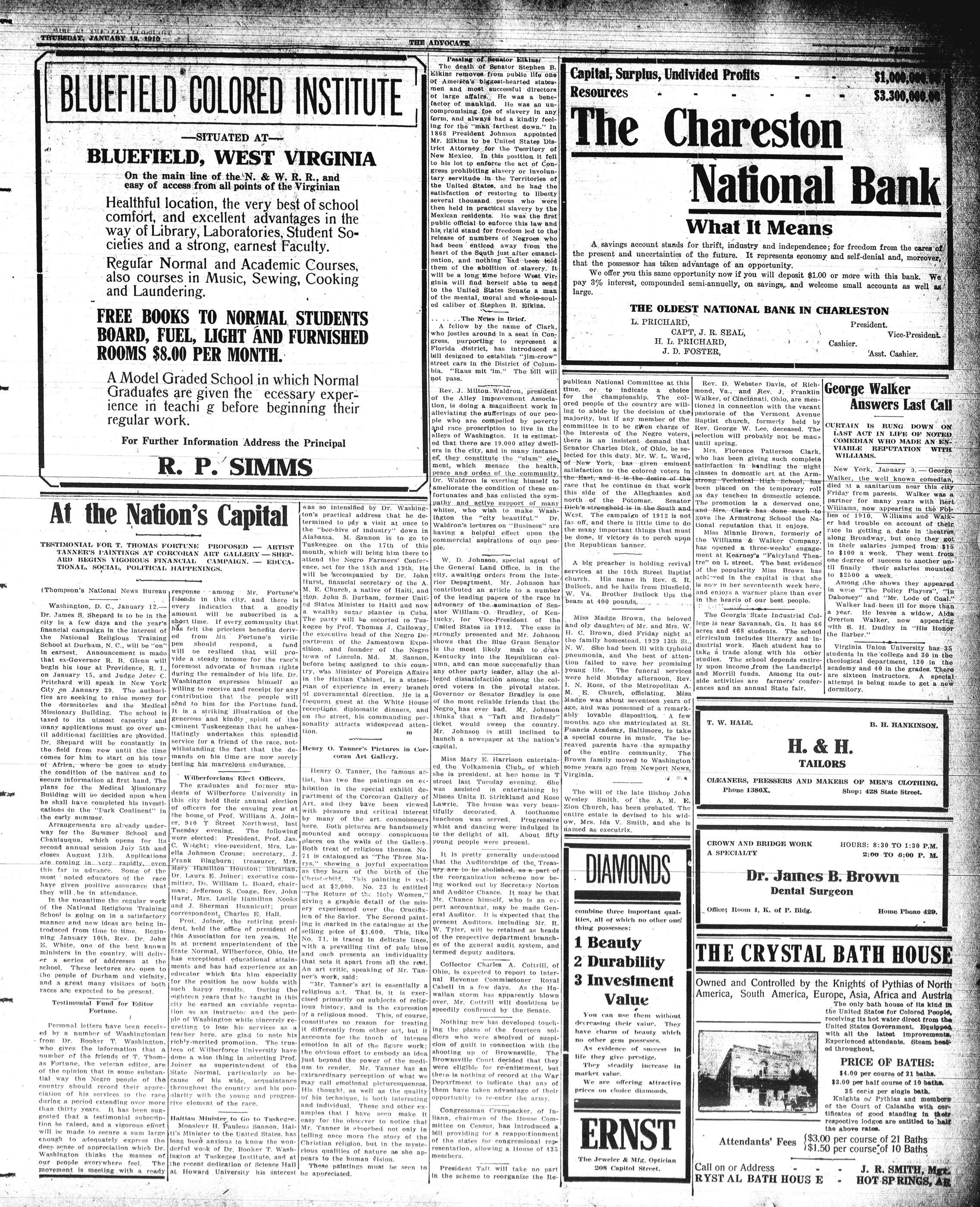
At the Nation's Capital
TESTIMONIAL FOR T. THOMAS FORTUNE PROPOSED — ARTIST
TANNER'S PAINTINGS AT CORCORAN ART GALLERY — SHEP-
ARD BEGINS VIGOROUS FINANCIAL CAMPAIGN. — EDUCATIONAL, SOCIAL, POLITICAL HAPPENINGS.
Washington, D. C., January 12. Dr. James S. Shepard is to be in the city in a few days and the year's financial campaign in the interest of the National Religious Training School at Durham, N. C., will be "on" in earnest. Announcement is made that ex-Governor R. B. Glenn will begin his tour at Providence, R. I., on January 15, and Judge Jeter C. Pritchard will speak in New York City on January 29. The authorities are seeking to raise money for the dormitories and the Medical Missionary Building. The school is taxed to its utmost capacity and many applications must go over until additional facilities are provided. Dr. Shepard will be constantly in the field from now until the time comes for him to start on his tour of Africa, where he goes to study the condition of the natives and to secure information at first hand. The plans for the Medical Missionary Building will be decided upon when he shall have completed his investigations in the "Dark Continent" in the early summer.
Arrangements are already underway for the Summer School and Chautauqua, which opens for its second annual session July 5th and closes August 13th. Applications are coming in very rapidly, even this far in advance. Some of the most noted educators of the race have given positive assurance that they will be in attendance.
In the meantime the regular work of the National Religious Training School is going on in a satisfactory manner and new ideas are being introduced from time to time. Beginning January 10th, Rev. Dr. John E. White, one of the best known ministers in the country, will deliver a series of addresses at the school. These lectures are open to the people of Durham and vicinity, and a great many visitors of both races are expected to be present.
Testimonial Fund for Editor
Fortune.
Personal letters have been received by a number of Washingtonian from Dr. Booker T. Washington, who gives the information that a number of the friends of T. Thomas Fortune, the veteran editor, are of the opinion that in some substantial way the Negro people of the country should record their appreciation of his services to the race during a period extending over more than thirty years. It has been suggested that a testimonial subscription be raised, and a vigorous effort will be made to secure a sum large enough to adequately express the deep sense of appreciation which Dr. Washington thinks the masses of our people everywhere feel. The movement is meeting with a ready
tion's Capital
S FORTUNE PROPOSED — ARTIST
CORCORAN ART GALLERY — SHEP-
FINANCIAL CAMPAIGN. — EDUCA-
CAL HAPPENINGS.
response among Mr. Fortune's friends in this city, and there is every indication that a goodly amount will be subscribed in a short time. If every community that has felt the priceless benefits derived from Mr. Fortune's virile pen should respond, a fund will be realized that will provide a steady income for the race's foremost advocate of human rights during the remainder of his life. Dr. Washington expresses himself as willing to receive and receipt for any contribution that the people will send to him for the Fortune fund. It is a striking illustration of the generous and kindly spirit of the eminent Tuskegeean that he unhesitatingly undertakes this splendid service for a friend of the race, notwithstanding the fact that the demands on his time are now sorely testing his marvelous endurance.
Wilberforcians Elect Officers
The graduates and former students of Wilberforce University in this city held their annual election of officers for the ensuing year at the home of Prof. William A. Joiner, 910 T Street Northwest, last Tuesday evening. The following were elected: President, Prof. Jas. C. Weight; vice-president, Mrs. Luella Johnson Crouse; secretary, J. Frank Blagburn; treasurer, Mrs. Mary Hamilton Houston; librarian, Dr. Laura E. Joiner; executive committee, Dr. William L. Board, chairman; Jefferson S. Coage, Rev. John Hurst, Mrs. Luelle Hamilton Nooks and J. Sherman Hunnicutt; press correspondent, Charles E. Hall
Prof. Joiner, the retiring president, held the office of president of this Association for ten years. He is at present superintendent of the State Normal, Wilberforce, Ohio. He has exceptional educational attainments and has had experience as an educator which fits him especially for the position he now holds with such happy results. During the eighteen years that he taught in this city he earned an enviable reputation as an instructor and the people of Washington while sincerely regretting to lose his services as a teacher here, are glad to note his richly-merited promotion. The trustees of Wilberforce University have done a wise thing in selecting Prof. Joiner as superintendent of the State Normal, particularly so because of his wide, acquaintance throughout the country and his popularity with the young and progressive element of the race.
Haitian Minister to Go to Tuskegee. Monsieur H. Pauleus Sannon, Haiti's Minister to the United States, has long been anxious to know the wonderful work of Dr. Booker T. Washington at Tuskegee Institute, and at the recent dedication of Science Hall at Howard University his interest
was so intensified by Dr. Washington's practical address that he determined to pay a visit at once to the "bee-hive of industry" down in Alabama, M. Sannon is to go to Tuskeegee on the 17th of this month, which will bring him there to attend the Negro Farmers' Conference, set for the 18th and 19th. He will be 'accompanied by Dr. John Hurst, financial secretary of the A. M. E. Church, a native of Haiti, and Hon. John S. Durham, former United States Minister to Haiti and now a wealthy sugar planter in Cuba. The party will be escorted to Tuskeegee by Prof. Thomas J. Calloway, the executive head of the Negro Department of the Jamestown Exposition, and founder of the Negro town of Lincoln, Md. M. Sannon, before being assigned to this country, was Minister of Foreign Affairs in the Haitian Cabinet, is a statesman of experience in every branch of governmental direction. He is a frequent guest at the White House receptions, diplomatic dinners, and on the street, his commanding personality attracts widespread attention.
Henry O. Tanner's Pictures in Corcoran Art Gallery.
Henry O. Tanner, the famous artist, has two fine paintings on exhibition in the special exhibit department of the Corcoran Gallery of Art, and they have been viewed with pleasure and critical interest by many of the art. connoisseurs here. Both pictures are handsomely mounted and occupy conspicuous places on the walls of the Gallery. Both treat of religious themes. No. 71 is catalogued as "The Three Marys," showing a joyful expectation as they learn of the birth of the Christ-child. This painting is valued at $2,000. No. 23 is entitled "The Return of the Holy Women," giving a graphic detail of the misery experienced over the Crucifixion of the Savior. The Second painting is marked in the catalogue at the selling price of $1,600. This, like No. 71, is traced in delicate lines, with a prevailing tint of pale blue and each presents an individuality that sets it apart from all the rest. An art critic, speaking of Mr. Tanner's work, said:
"Mr. Tanner's art is essentially a religious art. That is, it is exercised primarily on subjects of religious history, and is the expression of a religious mood. This, of course, constitutes no reason for treating it differently from other art, but it accounts for the touch of intense emotion in all of the figure work; the obvious effort to embody an idea just beyond the power of the medium to render. Mr. Tanner has an extraordinary perception of what we may call emotional picturesqueness. His thought, as well as the quality of his technique, is both interesting and individual. These and other examples that I have seen make it easy for the observer to notice that Mr. Tanner is absorbed not only in telling once more the story of the Christian religion, but in the mysterious qualities of nature as she appears to the human vision.
Passing of Senator Elkins/
The death of Senator Stephen B. Elkins removes from public life one of America's biggest-hearted statesmen and most successful directors of large affairs. He was a benefactor of mankind. He was an uncompromising foe of slavery in any form, and always had a kindly feeling for the "man farthest down." In 1868 President Johnson appointed Mr. Elkins to be United States District Attorney for the Territory of New Mexico. In this position it fell to his lot to enforce the act of Congress prohibiting slavery or involuntary servitude in the Territories of the United States, and he had the satisfaction of restoring to liberty several thousand peons who were then held in practical slavery by the Mexican residents. He was the first public official to enforce this law and his rigid stand for freedom led to the release of numbers of Negroes who had been enticed away from the heart of the South just after emancipation, and nothing had been told them of the abolition of slavery. It will be a long time before West Virginia will find herself able to send to the United States Senate a man of the mental, moral and whole-souled caliber of Stephen B. Elkins.
The News in Brief.
A fellow by the name of Clark, who jostles around in a seat in Congress, purporting to represent a Florida district, has introduced a bill designed to establish "jim-crow" street cars in the District of Columbia. "Raus mit 'im." The bill will not pass.
Rev. J. Milton Waldron, president of the Alley Improvement Association, is doing a magnificent work in alleviating the sufferings of our people who are compelled by poverty and race proscription to live in the alleys of Washington. It is estimated that there are 19,000 alley dwellers in the city, and in many instances, they constitute the "slum" element, which menace the health, peace and order of the community. Dr. Waldron is exerting himself to ameliorate the condition of these unfortunates and has enlisted the sympathy and active support of many whites, who wish to make Washington the "city beautiful." Dr Waldron's lectures on "Business" are having a helpful effect upon the commercial aspirations of our people.
W. D. Johnson, special agent of the General Land Office, is in the city, awaiting orders from the Interior Department. Mr. Johnson has contributed an article to a number of the leading papers of the race in advocacy of the nomination of Senator William O. Bradley, of Kentucky, for Vice-President of the United States in 1912. The case is strongly presented and Mr. Johnson shows that the Blue Grass Senator is the most likely man to draw Kentucky into the Republican column, and can move successfully than any other party leader, allay the alleged dissatisfaction among the colored voters in the pivotal states. Governor or Senator Bradley is one of the most reliable friends that the Negro has ever had. Mr. Johnson thinks that a "Taft and Bradely" ticket would sweep the country. Mr. Johnson is still inclined to launch a newspaper at the nation's capital.
Miss Mary E. Harrison entertained the Volkamenia Club of which she is president, at hen home in T street last Tuesday evening. She was assisted in entertaining by Misses Unita B. Strickland and Rosse Lawrie. The house was very beautifully decorated. A toothsome luncheon was served. Progressive whist and dancing were indulged in to the delight of all. About fifty young people were present.
It is pretty generally understood that the Auditorships of the Treasury are to be abolished, as a part of the reorganization scheme now being worked out by Secretary Norton and Auditor Chance. It may be that Mr. Chance himself, who is an expert accountant, may be made General Auditor. It is expected that the present Auditors, including Mr. R. W. Tyler, will be retained as heads of the respective department branches of the general audit system, and termed deputy auditors.
Collector Charles A. Cottrill, of Ohio, is expected to report to Internal Revenue Commissioner Royal Cabell in a few days. As the Hawaiian storm has apparently blown over, Mr. Cottrill will doubtless be speedily confirmed by the Senate.
Nothing new has developed touching the plans of the fourteen soldiers who were absolved of suspicion of guilt in connection with the shooting up of Brownsville. The Brownsville Court decided that they were eligible for re-enlistment, but there is nothing of record at the War Department to indicate that any of them have taken advantage of their opportunity to re-enter the army.
Congressman Crumpacker, of Indiana, chairman of the House Committee on Census, has introduced a bill providing for a reapportionment of the states for congressional representation, allowing a House of 435 members.
President Taft will take no part in the scheme to reorganize the Re-
The Chareston National Bank
A savings account stands for thrift, industry and independence; for freedom from the cares of the present and uncertainties of the future. It represents economy and self-denial and, moreover, that the possessor has taken advantage of an opportunity.
We offer you this same opportunity now if you will deposit $1.00 or more with this bank. We pay 3% interest, compounded semi-annually, on savings, and welcome small accounts as well as large.
publican National Committee at this time, or to indicate a choice for the championship. The colored people of the country are willing to abide by the decision of the majority, but if any member of the committee is to be given charge of the interests of the Negro voters, there is an insistent demand that Senator Charles Dick, of Ohio, be selected for this duty. Mr. W. L. Ward, of New York, has given eminent satisfaction to the colored voters in the East, and it is the desire of the race that he continue in that work this side of the Alleghanies and north of the Potomac. Senator Dick's stronghold is in the South and West. The campaign of 1912 is not far off, and there is jittle time to do the many important things that must be done, if victory is to perch upon the Republican banner.
---
A big preacher is holding revival services at the 10th Street Baptist church. His name is th Rev. S. R Bullock, and he hails from Bluefield. W. Va. Brother Bullock tips the beam at 400 pounds.
Miss Madge Brown, the beloved and oly daughter of Mr. and Mrs. W. H. C. Brown, died Friday night at the family homestead, 1929 13th St. N. W. She had been ill with typhoid pneumonia, and the best of attention failed to save her promising young life. The funeral services were held Monday afternoon, Rev. I. N. Ross, of the Metropolitan A. M. E. Church, officiating. Miss Madge was about seventeen years of age, and was possessed of a remarkably lovable disposition. A few months ago she matriculated at St. Francis Academy, Baltimore, to take a special course in music. The bereaved parents have the sympathy of the entire community. The Brown family moved to Washington some years ago from Newport News, Virginia.
The will of the late Bishop John Wesley Smith, of the A. M. E. Zion Church, has been probated. The entire estate is devised to his widow, Mrs. Ida V. Smith, and she is named as executrix.
DIAMONDS
combine three important qualities, all of which no other one thing possesses:
1 Beauty
2 Durability
3 Investment Value
You can use them without decreasing their value. They have charm of beauty which no other gem possesses.
As evidence of success in life they give prestige.
They steadily increase in market value.
We are offering attractive prices on choice diamonds.
ERNST
The Jeweler & Mfg. Optician
208 Capitol Street.
CLEANERS, PRESSERS AND MAKERS OF MEN'S CLOTHING. Phone 1386X. Shop: 428 State Street.
THE CRYSTAL BATH HOUSE
Owned and Controlled by the Knights of Pythias of North America, South America, Europe, Asia, Africa and Austria
Rev. D. Webster Davis, of Richmond, Va., and Rev. J. Franklin Walker, of Cincinnati, Ohio, are mentioned in connection with the vacant pastorate of the Vermont Avenue Baptist church, formerly held by Rev. George W. Lee, deceased. The selection will probably not be made until spring.
Mrs. Florence Patterson Clark, who has been giving such complete satisfaction in handling the night classes in domestic art at the Armstrong Technical High School, has been placed on the temporary roll as day teacher in domestic science. The promotion is a deserved one, and Mrs. Clark has done much to gove the Armstrong School the National reputation that it enjoys.
Miss Minnie Brown, formerly of the Williams & Walker Company, has opened a three-weeks' engagement at Kearney's "Fairyland Theatre" on I street. The best evidence of the popularity Miss Brown has achieved in the capital is that she is now in her seventeenth week here, and enjoys a warmer place than ever in the hearts of our best people.
The Georgia State Industrial College is near Savannah, Ga. It has 86 acres and 468 students. The school curriculum includes literary and industrial work. Each student has to take a trade along with his other studies. The school depends entirely upon income from the Landscript and Morrill funds. Among its outside activities are farmers' conferences and an annual State fair.
T. W. HALE.
H. &
TAIL
CLEANERS, PRESSERS AND M
Phone 1386X.
CROWN AND BRIDGE WORK
A SPECIALTY
Dr. James
Dental Su
Office; Room 1, K. of P. Bldg.
THE CRYSTAL
Owned and Controlled by the
America, South America, E
Attendants' Fees $3.00 $1.50
Call on or Address
RYST AL BATH HOUS E
George Walker Answers Last Call
CURTAIN IS RUNG DOWN ON LAST ACT IN LIFE OF NOTED COMEDIAN WHO MADE AN ENVIABLE REPUTATION WITH WILLIAMS.
New York, January 9. — George Walker, the well known comedian, died at a sanitarium near this city Friday from paresis. Walker was a partner for many years with Bert Williams, now appearing in the Follies of 1910. Williams and Walker had trouble on account of their race in getting a date in the theatres along Broadway, but once they got in their salaries jumped from $15 to $100 a week. They went from one degree of success to another until finally their salaries mounted to $2500 a week.
Among the shows they appeared in were "The Policy Players", "In Dahoney" and "Mr. Lode of Coal." Walker had been ill for more than a year. He leaves a widow, Alda Overton Walker, now appearing with S. H. Dudley in "His Honor the Barber."
Virginia Union University has 35 students in the college and 30 in the theological department, 120 in the academy and 40 in the grades. There are sixteen instructors. A special attempt is being made to get a new dormitory.
B. H. HANKINSON.
H. & H.
DETAILORS
AND MAKERS OF MEN'S CLOTHING.
Shop: 428 State Street.
RK
HOURS: 8:30 TO 1:30 P.M.
2:00 TO 6:00 P. M.
James B. Brown
Surgeon
dg. Home Phone 429.
AL BATH HOUSE
by the Knights of Pythias of North
a, Europe, Asia, Africa and Austria
The only bath house of its kind in the United States for Colored People, receiving its hot water direct from the United States Government. Equipped with all the latest improvements. Experienced attendants. Steam heated throughout.
PRICE OF BATHS:
$4.00 per course of 21 baths.
$2.00 per half course of 10 baths.
25 cents per single bath.
Knights of Pythias and members
of the Court of Calanthe with certi-
tificates of good standing in their
respective lodges are entitled to half
the above rates.
$3.00 per course of 21 Baths
$1.50 per course of 10 Baths
J. R. SMITH, Mgr.
JS E
HOT SPRINGS, AR
THURSDAY, JANUARY 12, 1910
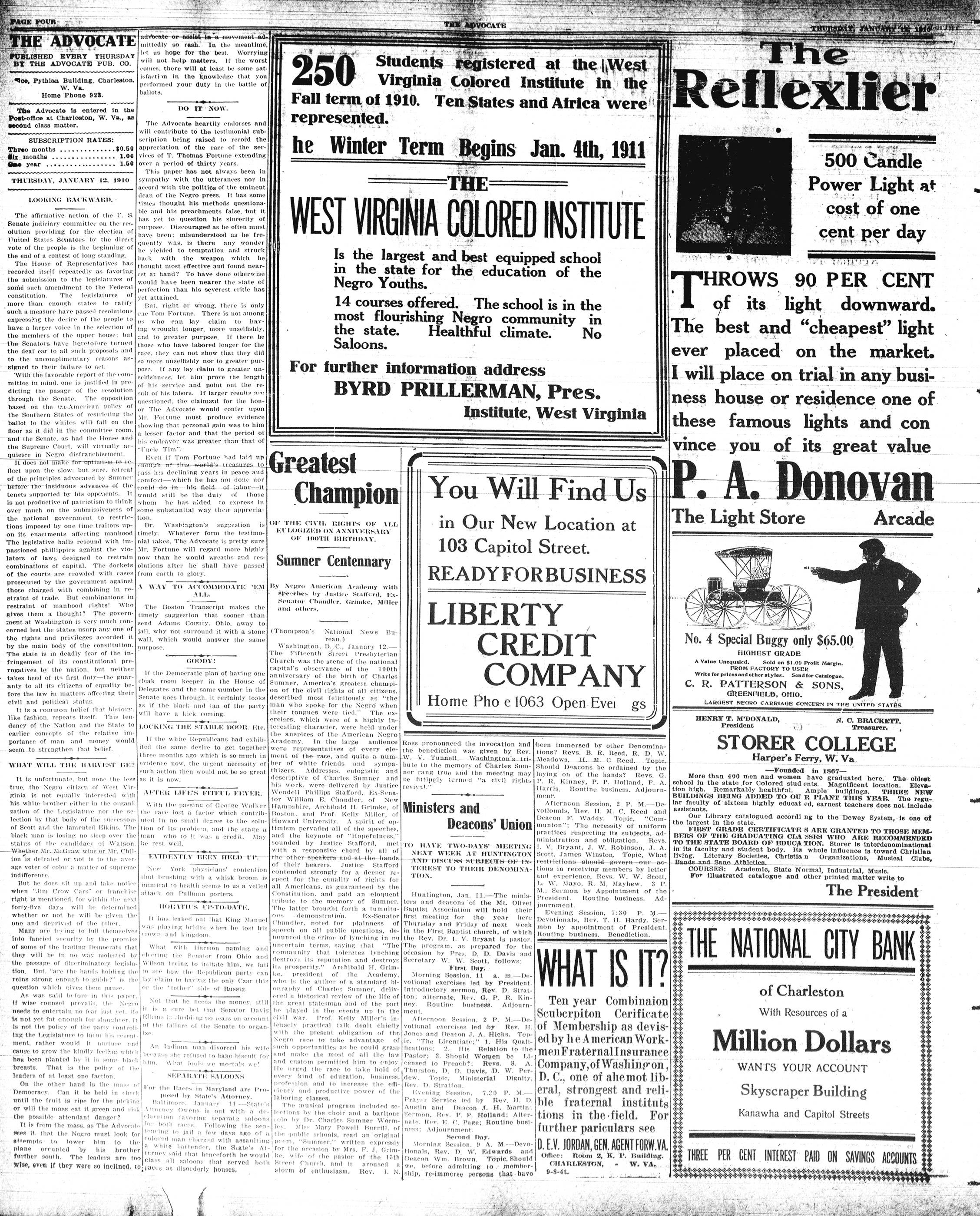
LOOKING BACKWARD.
The affirmative action of the U. S. Senate judiciary committee on the resolution providing for the election of United States Senators by the direct vote of the people is the beginning of the end of a contest of long standing. The House of Representatives has recorded itself repeatedly as favoring the submission to the legislatures of some such amendment to the Federal constitution. The legislatures of more than enough states to ratify such a measure have passed resolutions expressing the desire of the people to have a larger voice in the selection of the members of the upper house; but the Senators have heretofore turned the deaf ear to all such proposals and to the uncomplimentary reasons assigned to their failure to act.
With the favorable report of the committee in mind, one is justified in predicting the passage of the resolution through the Senate. The opposition based on the ux-American policy of the Southern States of restricting the ballot to the whites will fail on the floor as it did in the committee room, and the Senate, as had the House and the Supreme Court, will virtually acquiesce in Negro disfranchisement.
It does not make for optimism to reflect upon the slow, but sure, retreat of the principles advocated by Summer before the insidious advances of the tenets supported by his opponents. It is not productive of patriotism to think over much on the submissiveness of the national government to restrictions imposed by one time traitors upon its enactments affecting manhood. The legislative halls resound with impassioned phillippies against the violators of laws designed to restrain combinations of capital. The dockets of the courts are crowded with cases prosecuted by the government against those charged with combining in restraint of trade. But combinations in restraint of manhood rights! Who gives them a thought? The government at Washington is very much concerned lest the states usurp any one of the rights and privileges accorded it by the main body of the constitution. The state is in deadly fear of the infringement of its constitutional prerogatives by the nation, but neither takes heed of its first duty—the guaranty to all its citizens of equality before the law in matters affecting their civil and political status.
It is a common belief that history, like fashion, repeats itself. This tendency of the Nation and the State to earlier concepts of the relative importance of man and money would seem to strengthen that belief.
WHAT WILL THE HARVEST BE?
It is unfortunate, but none the less true, the Negro citizen of West Virginia is not equally interested with his white brother either in the organization of the Legislature nor the selection by that body of the successors of Scott and the lamented Elkins. The black man is losing no sleep over the status of the candidacy of Watson. Whether Mr. McGraw wins or Mr. Chilton is defeated or not is to the average voter of color a matter of supreme indifference.
But he does sit up and take notice when "Jim Crow Cars" or franchise right is mentioned, for within the next forty-five days will be determined whether or not he will be given the one and deprived of the other.
Many are trying to hull themselves into fancied security by the promise of some of the leading Democrats that they will be in no way molested by the passage of discriminatory legislation. But, "are the bands holding the reins strong enough to guide?" is the question which gives them pause.
As was said before in this paper, if wise counsel prevails, the Negro needs to entertain no fear just yet. He is not yet fat enough for slaughter. It is not the policy of the party controlling the Legislature to incur his resentment, rather would it nurture and cause to grow the kindly feeling which has been planted by it in some black breasts. That is the policy of the leaders of at least one faction.
On the other hand is the mass of Democracy. Can it be held in check until the fruit is ripe for the picking or will the mass eat it green and risk the possible attendant danger?
It is from the mass, as The Advocate sees it, that the Negro must look for attempts to lower him to the plane occupied by his brother further south. The leaders are too wise, even if they were so inclined, to
advocate or assist in a movement admittedly so rash. In the meantime, let us hope for the best. Worrying will not help matters. If the worst comes, there will at least be some satisfaction in the knowledge that you performed your duty in the battle of ballots.
The Advocate heartily endorses and will contribute to the testimonial subscription being raised to record the appreciation of the race of the services of T. Thomas Fortune extending over a period of thirty years.
This paper has not always been in sympathy with the utterances nor in accord with the politics of the eminent dean of the Negro press. It has some times thought his methods questionable and his preachments false, but it has yet to question his sincerity of purpose. Discouraged as he often must have been; misunderstood as he frequently was, is there any wonder he yielded to temptation and struck back with the weapon which he thought most effective and found nearest at hand? To have done otherwise would have been nearer the state of perfection than his severest critic has yet attained.
But, right or wrong, there is only one Tom Fortune. There is not among us who can lay claim to having wrought longer, more unselfishly, and to greater purpose. If there be those who have labored longer for the race, they can not show that they did so more unselfishly nor to greater purpose. If any lay claim to greater unselfishness, let him prove the length of his service and point out the result of his labors. If larger results are questioned, the claimant for the honor The Advocate would confer upon Mr. Fortune must produce evidence showing that personal gain was to him a lesser factor and that the period of his endeavor was greater than that of "Uncle Tim".
Even if Tom Fortune had laid up enough of this world's treasures to pass his declining years in peace and comfort—which he has not done nor could do in his field of labor—it would still be the duty of those whom he has added to express in some substantial way their appreciation.
Dr. Washington's suggestion is timely. Whatever form the testimonial takes. The Advocate is pretty sure Mr. Fortune will regard more highly now than he would wreaths and resolutions after he shall have passed from earth to glory.
A WAY TO ACCOMMODATE TEM ALL.
The Boston Transcript makes the timely suggestion that sooner than send Adams County. Ohio, away to jail, why not surround it with a stone wall, which would answer the same purpose.
GOODY
If the Democratic plan of having one cloak room keeper in the House of Delegates and the same number in the Senate goes through, it certainly looks as if the black and tan of the party will have a kick coming.
If the white Republicans had exhibited the same desire to get together three months ago which is so much in evidence now, the urgent necessity of such action then would not be so great as it is now.
AFTER LIFE'S FITFUL FEVER.
With the passing of George Walker the race lost a factor which contributed in no small degree to the solution of its problem, and the stage a man who to it was a credit. May he rest well.
New York physicians' contention that brushing with a whisk broom is inimical to health seems to us a veiled attack on Pullman porters.
HORATIUS UP-TO-DATE.
It has leaked out that King Manuel was playing bridge when he lost his crown and kingdom.
What with Harmon naming and cheating the Senator from Ohio and Wilson trying to imitate him, we fail to see how the Republican party can lay claim to having the only Czar this or the "tother" side of Russia.
Not that he needs the money, still it is a sure bet that Senator Davis Elkins is shedding no tears on account of the failure of the Senate to organize.
For the Bases in Maryland are Proposed by State's Attorney.
Baltimore, January 11 — State's Attorney Owens is out with a declaration favoring separate saloons for both races. Following the sentencing to jail a few days ago of a colored man charged with assaulting a white bartender, the State's Attorney said that henceforth he would class all saloons that served both traces as disorderly houses.
250 Students registered at the West Virginia Colored Institute in the Fall term of 1910. Ten States and Africa were represented.
Is the largest and best equipped school in the state for the education of the Negro Youths. 14 courses offered. The school is in the most flourishing Negro community in the state. Healthful climate. No Saloons.
OF THE CIVIL RIGHTS OF ALL
EULOGIZED ON ANNIVERSARY
OF 100TH BIRTHDAY.
Sumner Centennary
By Negro American Academy with speeches by Justice Stafford, Ex-Senator Chandler, Grimke, Miller and others.
Washington, D. C., January 12. The Fifteenth Street Presbyterian Church was the scene of the national capital's observance of the 100th anniversary of the birth of Charles Sumner, America's greatest champion of the civil rights of all citizens, described most felicitously as "the man who spoke for the Negro when their tongues were tied." The exercises, which were of a highly interesting character, were held under the auspices of the American Negro Academy. In the large audience were representatives of every element of the race, and quite a number of white friends and sympathizers. Addresses, eulogistic and descriptive of Charles Sumner and his work, were delivered by Justice Wendell Phillips Stafford, Ex-Senator William E. Chandler, of New Hampshire, Archibald H. Grimke, of Boston, and Prof. Kelly Miller, of Howard University. A spirit of optimism pervaded all of the speeches, and the keynote of "Hopefulness," sounded by Justice Stafford, met with a responsive chord by all of the other speakers and at the hands of their hearers. Justice Stafford contended strongly for a deeper respect for the equality of rights for all Americans, as guaranteed by the Constitution, and paid an eloquent tribute to the memory of Sumner. The latter brought forth a tumultuous demonstration. Ex-Senator Chandler, noted for plainness of speech on all public questions, denounced the crime of lynching in no uncertain terms, saying that "The community that tolerates lynching destroys its reputation and destroys its prosperity." Archibald H. Grimke, president of the Academy, who is the author of a standard biography of Charles Sumner, delivered a historical review of the life of the great statesman and of the part he played in the events up to the civil war. Prof. Kelly Miller's intensely practical talk dealt chiefly with the present obligation of the Negro race to take advantage of such opportunities as he could grasp and make the most of all the law and custom permitted him to enjoy. He urged the race to take hold of every kind of education, business, profession and to increase the efficiency and productive power of the laboring classes.
The musical program included selections by the choir and a baritone solo by Dr. Charles Sumner Wormley. Miss Mary Powell Burrill, of the public schools, read an original poem, "Summer," written expressly for the occasion by Mrs. F. J. Grimke, wife of the pastor of the 15th Street Church, and it aroused a storm of enthusiasm, Rev. J. N.
Institute, West Virginia
in Our New Location at 103 Capitol Street. READYFORBUSINESS
LIBERTY CREDIT COMPANY
Ross pronounced the invocation and the benediction was given by Rev. W. V. Tunnell, Washington's tribute to the memory of Charles Sumner rang true and the meeting may be hikiply termed "a civil rights revival."
Ministers and Deacons' Union
TO HAVE TWO-DAYS' MEETING NEXT WEEK AT HUNTINGTON AND DISCUSS SUBJECTS OF INTEREST TO THEIR DENOMINATION.
Huntington, Jan. 11.—The ministers and deacons of the Mt. Olivet Baptist Association will hold their first meeting for the year here Thursday and Friday of next week in the First Baptist church, of which the Rev. Dr. L. V. Bryant is pastor. The program, as prepared for the occasion by Pres. D. D. Davis and Secretary W. W. Scott, follows:
First Day.
Morning Session, 11 a. m.—Devotional exercises led by President. Introductory sermon, Rev. D. Stratton; alternate, Rev. G, P. R. Kinney. Routine business. Adjournment.
Afternoon Session, 2 P. M.—Devotional exercises led by Rev. H. Jones and Deacon J. A. Hicks. Topic: "The Licentiate?" 1. His Qualifications; 2. His Relation to the Pastor; 3. Should Women be Licensed to Preach? Revs. S. A. Thurston, D. D. Davis, D. W. Perdew. Topic, Ministerial Dignity, Rev. D. Stratton.
Evening Session, 7.20 P. M.—Prayer Service led by Rev. H. D. Austin and Deacon J. H. Martin; Sermon, Rev. P. P. Holland; Alternate, Rev. E. C. Page; Routine business; Adjournment.
Second Day.
Morning Session. 9 A. M.—Devotionals, Rev. D. W. Edwards and Deacon Wm. Brown. Topic. Should we, before admitting to membership, re-immerse pergons that have
been immersed by other Denominations? Revs. B. R. Reed, R. D. W. Meadows, H. M. C Reed. Topic. Should Deacons be ordained by the laying on of the hands? Revs. G. P. R. Kinney, P. P. Holland, P. A. Harris. Routine business. Adjournment: Afternoon Session, 2 P. M.—Devotionals, Rev. H. M. C. Reed and Deacon F. Waddy. Topic, "Communion"; The necessity of uniform practices respecting its subjects, administration and obligation. Revs. I. V. Bryant, J. W. Robinson, J. A. Scott, James Winston. Topic. What restrictions should govern our actions in receiving members by letter and experience, Revs. W. W. Scott, L. W. Mayo, R. M. Mayhew. 3 P. M., Sermon by Appointment of the President. Routine business. Adjournment.
Evening Session, 7:30 P. M. Devotionals, Rev. T. H. Hardy. Sermon by appointment of President. Routine business. Benediction.
WHAT IS IT?
Ten year Combinaion Scubcrpiton Certificate of Membership as devised by the American WorkmenFraternalInsurance Company,of Washington, D.C., one of ahemot liberal, strongest and reliable fraternal instituts in the field. For further pariculars see D. E.V. JORDAN, GEN. AGENT FORW.VA. Office: Room 2, K. P. Building. CHARLESTON, W. VA. 9-841
Reflexlier
```markdown
```
THROWS
of its li
The best and
ever placed
I will place on
ness house or
these famous
vince you of
P. A. D
The Light Store
No. 4 Special Buggy Co.
HIGHEST GRAD
A Value Unequated. Sold on $1.25
FROM FACTORY TO U.
Write for prices and other styles.
C. R. PATTERSON
GREENFIELD, OHIO
LARGEST NEGRO CARRIAGE
WS 90 PER
its light do
and "cheap
ced on the
ce on trial in
se or resident
mous lights
u of its gre
. Don
t Store
Buggy only $65.00
HEST GRADE
Sold on $1.00 Profit Margin.
FACTORY TO USER
other styles. Send for Catalogue.
ERSON & SONS,
FIELD, OHIO.
RO CARRIAGE CONCERN IN THE U
ONALD,
N. C.
ORER COLL
THROWS 90 PER CENT of its light downward. The best and "cheapest" light ever placed on the market. I will place on trial in any business house or residence one of these famous lights and convince you of its great value
P. A. Donovan
No. 4 Special Buggy only $65.00
HIGHEST GRADE
A Value Unequaled. Sold on $1.00 Profit Margin.
FROM FACTORY TO USER
Write for prices and other styles. Send for Catalogue.
C. R. PATTERSON & SONS,
GREENFIELD, OHIO.
LARGEST NEIGRO CARRIAGE CONCERN IN THE UNITED STATES
HENRY T. M'DONALD,
President
Harper's Ferry, W. Va
Found
More than 400 men and women
school in the state for Colored
student high. Remarkably healthful.
BUILDINGS BEING ADDED TO O
car faculty of sixteen highly edu
assistants.
Our Library catalogued accord
the largest in the state.
FIRST GRADE CERTIFICAT
BERS OF THE GRADUATING C
TO THE STATE BOARD OF EDUC
in its faculty and student body.
Living, Literary Societies, Christ
Founded in 1867
men and women have graduated
or Colored students. Magnific
ly healthful. Ample builf
DED TO OUR PLANT THE
highly educat ed, earnest teach
logged accordi ng to the Dew
e.
CERTIFICATE S ARE GRANT
SUATING CLASSES WHO A
ORD OF EDUCATION. Storer is
ident body. Its whole influenc
ties. Christia n. Organizati
More than 400 men and women have graduated here. The oldest school in the state for Colored students. Magnificent location. Elevation high. Remarkably healthful. Ample buildings. THREE NEW BUILDINGS BEING ADDED TO OUR PLANT THIS YEAR. The regular faculty of sixteen highly educated, earnest teachers does not include assistants.
Our Library catalogued according to the Dewey System, is one of the largest in the state.
FIRST GRade CERTIFICATE S ARE GRANTED TO THOSE MEMBERS OF THE GRADUATING CLASSES WHO ARE RECOMMENDED TO THE STATE BOARD OF EDUCATION. Storer is intordenominational in its faculty and student body. Its whole influence is toward Christian living. Literary Societies, Christia n Organizations, Musical Clubs, Bands and Sane Athletics.
COURSES: Academic, State Normal, Industrial, Music.
For illustrated catalogue and other printed matter write to
THE NATIONAL CITY BANK
of Charleston
With Resources of a
Million Dollars
WANTS YOUR ACCOUNT
Skyscraper Building
Kanawha and Capitol Streets
THREE PER CENT INTEREST PAID ON SAVINGS ACCOUNTS
500 Candle Power Light at cost of one cent per day
0 PER CENT light downward. 'cheapest" light in the market. trial in any busi esidence one of lights and con its great value onovan
ly $65.00
Profit Margin.
for Catalogue.
SONS,
CERN IN THE UNITED STATES
N. C. BRACKETT.
Treasurer.
in 1867—
have graduated here. The oldest
ents. Magnificent location. Eleva-
ample buildings. THREE NEW
ER PLANT THIS YEAR. The regu-
red, earnest teachers does not include
ing to the Dewey System, is one of
AS ARE GRANTED TO THOSE MEM-
SES WHO ARE RECOMMENDED
NION. Storer is interdenominational
whole influence is toward Christian
a Organizations, Musical Clubs,
formal, Industrial, Music.
other printed matter write to
The President
CITY BANK
leston
Arcade
Senator Elkins is no more. He has gone from the throng of the living to mingle with the millions that have gone before. When a king is dethroned his subjects rejoice, but when a great man dies the people mourn. A tall cedar has fallen, and gloom pervades not only the State of West Virginia but the Nation as well, because his fame was nationwide. His sun went down soon after it reached the horizon and began receding toward the west. When it settled beyond our visions, darkness fell upon thousands of devoted and admiring friends. It was God's will, not ours, that his sun should set before due evening-tide had come. He could not prevent its setting, nor could his friends prevent it. All we could do was to stand and watch and wait. We stood until the light went out, while he met the issue as only the strong and brave and great could do. We believe a new and brighter sun arose beyond the setting of his earthly life. We believe that death does not end all.
Some men flower early—others late. Senator Elkins was a noted man in early life, and was scarcely at his best when the final summons came. He was just in the early afternoon of life and was best qualified to grapple with its sternest problems and be the most useful to his fellow men. Man proposes, but God disposes. We make our plans, but they are not always for the best, and a wise Providence often overrules them. We may wonder why, but that is not for us to know. It is enough for us to know that there is a God supreme, and that all of us should bow submissively to His will. The way is often dark. It is dark today to some of us. The pall hangs heavily over the dead statesman's household, but God willed it thus, and all should bow reverently to His decree. When the golden bowl is broken and the silver cord is loosened, we pause, we wonder and we weep. We drop our tears. We pour out our sympathies. But tears and sympathies only aggravate the wounds, unless out of the surrounding darkness we can be faith in the unscened believe that God's sunshine will some day drive away these clouds.
Just how much life means words refuse to tell, because they can not. The doorway of life is hung about with flowery emblems to indicate that it is for a purpose in the great Creator's plans for the government of His subjects. Life may be grand. God intended it to be glorious. So He paved its course with diamonds, fringed its banks with flowers and overarched it with stars. Around it he spread the physical universe—suns, moons, worlds, constellations, sublime in magnitude and grand in order and obedience. In this strange, this wonderful thing called life, every man, every woman, has his and her place. Some lay their life work down early, others later; but sooner or later all must surrender their trusts to God, the Creator of us all.
I have long been persuaded that nothing abides save God and the soul. There is nothing enduring in this world except the Creator and His laws. The stars that shone upon our cradles will shine upon our graves. Darkness is closing over the careers of Solon and Lycurgus. The hills that once echoed the eloquence of Pericles are now unknown. The groves in which Plato and Socrates prepared their philosophies have been razed to earth. The ancient, grand temples that were intended to immortalize the names of their builders have nearly all been gnawed asunder by the tooth of time; but God and His laws yet remain and are taking a stronger and still greater grip upon the nations as the years roll on.
This is the lesson that comes to us by the passing of the patriot and statesman whose life I am now briefly reviewing. What is life? Tell us, friends, from the high abode of death, what is life? We ask this question and no answer comes as we watch and wait. But if life on the earth contributes to the life of the soul, we have the comforting assurance that all is well. If the soul fills well the place assigned to it on the earth, discharges its duties faithfully, obeys the commands of its Creator, and helps others on in life, that one is a true child of the King. To one like this, death however sudden, however shocking in its conditions and surroundings, can bring no fear, no sorrowful forehodings.
I believe firmly that death does not end all. The first and foremost poet of the Bible, if not indeed the foremost poet of all the centuries, when his heart was bleeding as ours are today, by inspiration wrote for all the ages and for the consolation of the nations, that when a man dies he shall live again. Senator Elkins often told me he accepted this great truth, and reiterently believed it. Here, then, we find a balm for these bleeding wounds, and that earth hath no sorrow that heaven cannot heal.
When we buried Senator Elkins at the place of his choosing it was, as I have already said, a sad day for the State of West Virginia; but there was never a cloud so black that it did not have a silver lining. Our
friend and brother whose remains we have covered with "the clods of the valley," was a man of faith in his Creator which was sufficiently abiding to illumine his soul when he reached the river which all of us must some day cross. Not given to loud professions or vain boastings of religious experience, yet deep down in his heart was a well of love and trust which was constant in its flow toward the Savior of mankind. During all his life he exemplified the human side of religion by doing what he believed to be right. In this respect his faith was fixed. His purposes were strong. His devotion to duty and to the unseen was as unfaltering as the stars. There is nothing more to be admired in this life than a manly man. His constant purpose was to life all persons with whom he associated to higher conceptions of life and duty. He was a brave man also. He had the courage of his convictions. He was a dangerous antagonist, not only because of his vast intellectual attainments, but because he could not be induced to compromise his principles or his convictions of duty. He always went straight forward. There were no zigzags, no ins and outs in his public or his private acts. His personal character was as spotless as a malden's and as unsuilled as a ray of light. He was never on both sides of a proposition at the same time. His makeup was too pronounced for anything like that. Living, he asked no compromise with those who opposed him; dead, there will be no utterances of him except those that are good. Such men always leave their impress upon the times in which they live. Such men will be missed because their places will be difficult to fill.
Senator Elkins is entitled to more credit than most men who achieve distinction in life, because he was self-made. He was the sole architect of his great career. He had the sticktoitiveness to work his way through the University of Missouri, because he, although then a mere youth, saw the necessity of a college education if he hoped to reach distinction among his fellows. Next he served his country as a soldier in the war of the rebellion; then he became a lawyer and located in the then Territory of New Mexico for the practice of his profession. Shortly thereafter he became its attorney-general; then its United States attorney, and next for the term of four years its representative in Congress. In all of these positions he displayed unusual ability which led him on to still greater achievements. In his early manhood he came to West Virginia and engaged in vast business enterprises which in two or three decades made him, perhaps, the wealthiest man in the State. He, in connection with his honored father-in-law, the Hon. Henry G. Davis, constructed railroads, opened coal mines, built saw mills, established banking institutions, founded towns and cities, and have made the then new commonwealth now literally blossom as the rose. Largely because of their enterprise and foresight West Virginia is now the second State in the Union in the production of both coal and coke. Senator Elkins and ex-Senators H. G. Davis and J. N. Camden must always be recognized as West Virginia's greatest developers.
Although Senator Elkins served honorably as secretary of war in the Cabinet of President Harrison, and although he succeeded phenomenally in business and indeed in everything he touched, his enduring fame will rest mainly upon his record as a Senator in the Congress of the United States. Throughout the whole of his sixteen years' service in that distinguished body, his footprints can be traced in most of the important laws that were passed. Others outranked him in flowery utterances on the floor of that deliberativeness assembly, but few, if any, were superior to him in debate, and none were more effective in securing important legislation. He was big in body and brain, and was the friend of all his associates and the enemy of none. He was respected by all who knew him and was loved by all. Charming in his ways and manners, every acquaintance became a friend, and every friend deplores his death. He was also a devoted husband and a loving father, and his seeming untimely departure has left "an aching void" which can only be filled by the, Scriptural promise, "My presence shall go with thee and I will give thee rest."
His funeral was held in the city of Elkins, which was named in his honor. All business of every kind was suspended. The citizens turned out en masse, and his numerous friends and neighbors threw upon his bier flowers of gratitude and love.
So the watching is ended at home; Yet a whisper of peace Bids the flowing tears cease, For to wait and to toil—yea, to toll and to wait, Is Earth's passport to Rest within Heaven's fair Gate.
The sun of this great citizen has forever set behind the horizon of our view, but the memory of his just, virtuous and upright life will linger as a beautiful twilight in the memories of all who knew him. "Peace to his ashes, rest to his soul."
WETZELL SPEAKER
For Speaker of the House—C. M.
Wertzell, of Jefferson county.
For Clerk of the House—M. M.
Neeley, of Marlon county.
For Sergeant-at-Arms—Gen. F. L.
Wood, of Kanawha county.
For Doorkeeper of the House—
James Lemon, of Raleigh county.
The above are the officers of the House of Delegates for the 1911 session of the legislature, as named by the Democratic caucus held in the house last evening, and as formally elected today upon the assemblies of the body at the noon hour. The time fixed for the caucus of the majority members last evening was 8 o'clock, but it was 8:30 before the gathering was called to order by Mr. Kilkison, of Hampshire county, who called C. M. Seibert, of Martinsburg, to the chair. Fred Carr, of Charleston, was named as secretary. Upon this organization being effected, Senator MacCorkle secured the floor and asked permission to place before the caucus a resolution that had been adopted by the Democratic senators, in caucus assembled, looking to a wholesale reduction in the appointment of attachees for the two houses. Senator MacCorkle stated that the Democracy, to attain full power two years hence would be obliged to do away with a great deal of bad legislation and decrease the expenses of the present legislature. "If this is not an economical legislature," declared the ex-Governor, "the Democrats cannot come back into power." The resolution, besides greatly reducing the number of attachees employed at the last session, also reduces salaries of attachees along all lines. On motion, the resolution of the senator's was ordered received, and the bill that will follow the resolution will in all probability be passed by the house. Following this a motion—several motion—were made for providing a "committee on committees," the object being to give to the speaker a committee to assist him in naming the standing committees. After a whole lot of discussion, the most of it useless, and during which time the chairman found it necessary to name a sergeant-at-arms to preserve order among the caucus members, a vote was taken, and the motion was lost by a tie vote—31 to 31.
Nominations Made
Nominations Made.
Nominations being called for speaker of the house, Alderson, or Nicholas county, placed in nomination the Lion. C. M. Wetzell, of Jefferson county. Cilkeson, of Hampshire county, placed in nomination the Hon. Septimius Hall, of Wetzell county. Mars, of Gilmer county, nominated the Hon. G. Warren Hayes, of Calhoun county. After seconding speeches the vote was taken, resulting: Wetzell, 48; Hall, 12; Hayes, 2. On motion, the election of Mr. Wetzell was made unanimous. In response to calls, Mr. Wetzell made a short speech, saying that if he had not earned the honor that had been conferred upon him, after ten consecutive years' service in the house, he would be convinced that he had failed in his duty to his constituency. His speech was well received.
Nominations for clerk of the house being called for, Ice, of Marion county, placed in nomination Mr. M. M. Neeley, of Fairmont; Campbell, of Cabel, nominated T. A. Null, of Hunsington; Lacy, of Ritchie, nominated Will A. Strickler, of Ellenboro; vote: Neeley, 38; Null, 10; Strickler, 13. On motion, the election of Neeley was made unanimous. The successful candidate was a spectator from the gallery and when called for appeared on the floor of the house, and in a few well chosen and happily-thought sentences thanked the assemblage for the honor that had been conferred upon him. Mr. Neeley is a bright young lawyer of Fairmont, and that he will prove a live wire on the job that has been given him could not be doubted by all who heard him last evening.
The Other Officers.
Fon sergeant-at-arms six were nominated: James F. Partridge, of Wood county; Dr. J. D. Sumifers, of Roane county; Alger Franzhelm, of Ohio county; Gen. Neil Wood, of Kanawha county; B. K. Litzinger, of Summers county, and William F. Garvey, of Marshall county. No selection was made on the first ballot, but on the second Mr. Wood was chosen. Then followed the election of Mr. James Lemon, of Raleigh county, an ec-Confederate soldier, as doorkeeper. Aside from the breezy occurrence at the opening of the caucus, when
Commencing Tuesday, January 10th., Ending Tuesday, January 31st. We offer our entire stock of new, up-to-date and reliable Footwear at a great sacrifice. Nothing will be reserved; all must be turned into cash.
Extra Special: We Have lumped together about 300 pairs of discontinued lines, all good, reliable shoes, which will be offered at one-half their regular price.
THIS IS A BONA FIDE SHOE SALE FOR CASH ONLY No Goods Sent on Approval or Exchanged at Cut Prices
BELL SHOE COMPANY
1
it became necessary to appoint a sergeant-at-arms to quell obstresperous delegates, the caucus was without interest, the contests all lacking spirit and having the appearance of being cut and dried long before the majority members went into session. The floor of the house had been cleared, rendering the confusion minimum, and the delegates all appeared to take their time in what they were about to do. There was no enthusiasm at all in the gathering, and at no time did a speaker elicit anything like enthusiastic applause during the evening. The closest the caucus came to applauding anyone was when Clerk Neeley delivered his brief address.
Supreme Court Grants Writ of Mandamus in Binding Contract
An alternative writ of mandamus, returnable at ten o'clock Thursday morning, was awarded this afternoon by the Supreme Court of Appeals on the petition of S. C. Butler, of the Tribune Printing Company, against Wade H. Guthrie, of the Union Printing Company, state printer.
The petition was presented this morning by Atty. Geo. E. Price, and the claim made was that the petitioner had not got satisfaction from the state printing commission with reference to an appeal taken before that body pointing out errors in the contract let by the state to Mr. Guthrie, for binding state documents, etc.
The commission reported to Mr. Price last night that it had decided not revoke the contract let to Mr. Guthrie and the proceeding in the
GREAT CUT PRICE SHOE SALE
708 KANAWHA STREET
supreme court was the consequence. It was shown in the specifications of Mr. Guthrie that his bid, had the totails been correctly carried out would not have been the lowest responsible bidder, but that the bid of Mr. Butler would have been the lowest.
The commission held that fnasmuch as the contract had been approved by the commission and duly signed by the governor, it could not be revoked notwithstanding the fact the errors are acknowledged and are shown on the face of the specifications.
Notaries Named.
Notary commissions have been issued to J. D. Hatfield, Minden, Fayette county; J. W. Braggs, of Beckley, and Harvey M. Scott, of Charleston.
Pardon Is Refused.
Pardon has been refused by the pardon attorney to Columbus Coburn, a 60-year-old convict sentenced by the criminal court of Monongahela county to serve one year in jail for malicious wounding. The petition was refused because nothing was shown to indicate that any developments have arisen since the sentence was imposed to entitle Coburn to clemency. He claims to have aimed to only scare his victim and not to infiltr any serious injury.
Mine Workers Listen to Addresses Today; Elect Officers, Too
In the Odd Fellows hall, with a large attendance, the eleventh annual meeting of District No. 17, United Mine Workers of America, is in session. The greater part of the
morning was taken up with the reports of the committees and with other matters necessary to getting in readiness for the transaction of important business.
On motion of Secretary Benj. S. Morrilla the following telegram was sent to President, T. L. Lewis and Secretary Edwin Perry at Indianapolis:
"Our annual convention extends greetings and best wishes for your success."
President W. F. Welch of the State Federation of Labor, was called on to make an address, which he did in an able manner. Congressman-elect Adam B. Littlepage also addressed the convention on matters connected with the organization, and short talks were delivered by Frank W. Snyder of this city, secretary of the State Federation. At this afternoon's session the election of officers will be held.
Senatorial Contests Lose the Spotlight; State Senate Succeeds
The senatorial contests lost the spotlight last night to the subject of organizing the legislature. Public interest was transferred to the party caucuses and to the matter of organizing the upper branch. However, the situation affecting the two senatorships is little, if any changed, from what it was yesterday.
The senate atl matter did not enter into consideration at the Democratic caucuses, which was a disap
1
Tuesday, January 31st.
able Footwear at a
turned into cash.
s' Shoes
$3.95
3.50
2.95
2.75
2.35
1.95
s Shoes
$2.35
1.95
1.50
s
.60
.35
.15
es, all good, reliable shoes, which
unt
OR CASH ONLY
nt Prices
IPANY
pointment to many who hoped to see a test of strength made. Very wisely, the various gentlemen who are toga chasing decided to keep our of the business of making up the official roster of both houses. All sides got into the harmony band wagon, and on the surface of things all was sweet and in perfect accord. Kidd for president and Wetzell for speaker, had practically no opposition. They were accepted without a murmur of protest by the Watson, Chilton and McGraw factions. Not-withstanding the fact that Wetzell is a McGraw supporter and Kidd has announced himself for McGraw and Chilton, the Watson contingent stood right up in meeting and declared themselves satisfied with these two men.
DOG THEFT CHARGED
C. E. Hudson appeared in Squire Atkinson's court this afternoon and swore out a warrant for the arrest of Hubert Todd, alleging that he had stolen from him a Gordon setter dog valued at $100. Todd was arrested and in default of $500 bond was remanded to jail.
POMERONE IS SENATOR BY UNANIMOUS VOTE
By Associated Press.
Columbus, Jan. 11.—Lieutenant Governor Atlee Pomerene was elected today United States senator to succeed Senator Dick. All the Democrats in the legislature voted for him.
PAGE 97
elevated to the responsible position of Dean of the Institution, which position he held for four years, resigning over the protest of the school authorities at Frankfort to accept the similar position at the Agricultural and Mechanical College at Normal.
In this connection it might be stated that Mr. Clarke had repeatedly been offered very flattering positions at Normal during the life and presidency of the late President William H. Council, and also from the College of Liberia, at Monrovia and from the Tuskegee Institute. President Walter S. Buchanan, who has succeeded the late President Council at Normal, has not only found in Mr. Clarke a man of fine education and training but indispensable in the work of making the Agricultural and Mechanical-school at Normal a great educational training school for Negro youth in the South Mr. Clarke numbers among his accomplishments the ability to speak with ease, grace, commanding respect from any audience. He is also a writer of merit and author of several valuable contributions to the literature of the American Negro.
"Neither my sister nor myself might be living today, if it had not been for Dr. King's New Discovery" writes A. D. R. McDonald of Fayetteville, N. C. R. F. D. No. S, "for we both had frightful coughs that no other remedy could help. We were told my sister had consumption. She was very weak and had night sweats but your wonderful medicine completely cured us both. It's the best I ever used or heard of." For sore lungs, coughs, colds, hemorrhage, lagripe, asthma hay fever, group, whooping cough,—all bronchial troubles,—its supreme. Trial bottle free. 50c and $1.00 guarantee by all drugists. 1-5-4t.
The Cedar Grove Improvement Company, a Corporation created and organized under the laws of the State of West Virginia, will on the 24th day of January, 1911, between the hours of 7 and 9 o'clock P. M., hold their annual meeting at their Hall at Cedar Grove, Kanawha County, West Virginia, for the election of officers and the transaction of any and all business that may come before this meeting.
B. B. WAYNESBORO, President,
T. W. MARTIN, Secretary.
1-5-3t
Howard University at Washington, D. C., has this year 192 students. The college students number 347, of whom 167 are freshmen. Requirements have been raised both for admission to the college and medical college and medical school. The faculties include 110 professors, instructors and officers. The endowment amounts to $218,000. The medical school has received $55,000 in cash for tuition fees during the last two years. A new Carnegie library and hall of applied science have recently been added to the plant and also a steam-heating plant.
Lincoln University, Chester County, Pa. has 136 students in the college and 50 in the theological seminary; all of these are taught by twelve professors and three instructors. The grounds and buildings are worth $250,000, and the endowment is a little over $600,000. Lately an electric plant has been added, and a new pipe organ.
Wilberforce University has issued a statement which says:
"Though our existence was threatened in the past by poverty, war and fire, yet we have passed from a school with 52 acres of land, one building, a few small cottages, a primary department of instruction, two teachers and a handful of students, to three large united schools in operation today, aside from the military department. These are the college, the theological, and the normal and industrial schools, instructing in the following courses of study: Classical, scientific, academic, theological, music, English preparatory, military, art, business, sewing, carpentry, printing, cooking, shoemaking, blacksmithing, wheelwrighting, brickmaking and bricklaying, plumbing, tailoring, and applied mechanics and millinery. It has 250 acres of the best land in Ohio. It has now ten brick buildings, including four large halls, a $60,000 trades building, and a library costing $18,000, the gift of Mr. Anderew Carnegie. The value of the entire plant, with equipment is quite $350,000. There are 32 teachers and an average of 400 students, and we could have over one thousand if we had accommodations for them."
Mr. W. A. Joiner, formerly of Howard University, is superintendent of the State Department at Wilberforce.
Atlanta University has 400 students enrolled. Fifty of these are in the college course, with 30 teachers and officers. There are 653 normal and college graduates. The plant consists of seven brick buildings, including a library worth about $300,000; the endowment is $75,000, and a special effort is being made to raise $60,000 this year.
Franchise of Negroes
WAS STUMBLING BLOCK IN CON SIDERATION OF DIRECT ELECTION OF SENATORS.
Depew Stood Pat
Insisting upon provision requiring same qualifications in all states for electors of Senators and Representatives.
---
Washington, January 9. By a vote of 10 to 2 the Senate Committee on Judiciary this afternoon reported favorably without amendment the resolution agreed to by a subcommittee providing for the election of United States Senators by direct vote of the people. The resolution is identical with the one passed by the House nearly 20 years ago. It was taken up by the committee as a substitute for a resolution to the same effect introduced by Senator Bristow for the reason that it provided the method of electing Senators more explicitly than the one presented by the Kansan.
The committee wrangled over the subject all day and voted down various amendments which were offered by those who sought to defeat the proposition. On the final vote there were only two members who opposed reporting the measure favorably, namely, Senator Dewpew of New York, and Senator Dillingham, of Vermont. Those who voted for it were Clark of Wyoming, Nelson, Sutherland, Warner and Borah, Republicans, and Culbertson, Clarke, of Arkansas, Overman, Rayner and Paynter Democrats. Repeated efforts were made to load down the resolution with a provision requiring that the qualifications for an elector to vote for a United States Senator or a member of the House should be the same in all states.
This was bitterly opposed by the Democrats, who recognized that under such conditions it meant free Negro suffrage. Senator Depew proposed the amendment to this effect originally and contended for it to the last. When it was not incorporated in the resolution he refused to vote for it.
Amendments having the same purpose but differing somewhat in language, were offered, several of them by Senator Nelson, of Minnesota, but enough Republicans joined with the Democrats to lay all of them on the table. When the movement to enforce Federal restrictions upon the states as to the qualification of electors was defeated Senator Nelson joined the others in supporting the amendment as originally reported to the full committee.
Advocates of the popular election of Senators anticipate a renewal of the fight in some form of the Depew amendment on the floor of the Senate when the matter is called up there, and are prepared to meet it. Senator Raynor, of Maryland, who has been chiefly responsible for the effort which has succeeded in getting the resolution out of the committee, believes the friends of the measure have sufficient strength to put it through the Senate, despite the fact that a two-thirds majority is required. There will be no opposition to the proposition in the House, which has repeatedly passed such an amendment unanimously only to have it die of inaction in the Senate.
Clark Addition to Normal's Faculty
ALABAMA INSTITUTION IS SAID TO HAVE STRUCK IT RICH WHEN IT SECURED SERVICES OF FORMER KENTUCKY EDUCATOR.
Huntsville, Ala., Jan. 10.—In securing the services of Prof. William H. Clarke, a well known educator and a man of much force and character as Dean of the Academic Department, the management of the Agricultural and Mechanical College located here has secured quite a prize, and thereby has increased its literary efficiency a hundred fold. Mr. Clarke is a graduate from the classical and Theological Department of Lincoln University, Pennsylvania, and has done considerable post graduate work in Mathematics and the Sciences in the University of New York.
He gave up the ministry for the teaching profession, and for several years has been identified with many of the better schools for the training of Negro youth. In all of them his work has been of a very high character. Besides his work at Normal, his most notable engagement was at the Kentucky Normal and Industrial Institute, Frankfort, where he held for some time, the chair of natural Sciences — chemistry and physics — and is a man of broad training and rare ability. He likewise is a specialist in the difficult subject of mathematics. Two years after accepting the natural science post, Prof. Clarke was
SAVES TWO LIVES
NOTICE.
Colored Colleges
From The Crisis.
Shaw University, Raleigh, N. C., has over 500 students enrolled, and applicants have been turned away. There are preparatory, normal and college departments, and classes in theology, medicine and law. Attention is also given to music and industries. The Leonard medical building has been enlarged and a hospital is being built; shower baths have been put into the gymnasium and other buildings enlarged. President Meserve is just completing his seventeenth year of service.
Medley of Good Things at the Hipp in Week's Bill
There is a medley of good things this week at the Hipp and people in Charleston as well as many of those who came to attend the legislature and look for jobs there, looked at the performance with pleasure and some of the visiting patrons even marveled at the fact that the owners could afford such a good show for such a small price.
One of the numbers on the bill this week is one that made a hit in England, and was introduced in this country only three months ago by Martin Beck, who, every once in a while sends a good thing to this side to make room for something new he brings into notice in his London and other show houses on that side of the ocean. It is not often that the Golden Sisters are duplicated in any respect in any of the popular-priced places of amusement, and no one who saw the show yesterday afternoon or last night says Mr. and Mrs. Arthur Davis cannot present an act that would do credit to a higher price business. They are the ones who put on the clever act, "A Mix-Up in Widows." It is a fine skit and it takes with everyone who expects what he gets.
The comedy sketch artist whose name looks and sounds like a "pie line" in the parlance of print shops has a good turn and execute it well and the "World's Greatest Comique Clog Artist" takes up more time by having his name spelled than he does in going through with a very good turn. He spells his name "Zouboulakis" and would have made it longer had it not been for the scarcity of letters in the "H" box.
Literary Notes
LIPPINCOTT AND THE NEW YEAR
Lippincott's Magazine wastes no time in beginning to fulfill its promises of good things to come during 1911. The January issue opens with a thoroughly delightful complete novelette entitled "Lista," by Zena Gale, famous for "The Loves of Peleas and Etarre," "Friendship Village Love Stories," and other worthful books. "Lista" is a tale of rural Wisconsin, a section hitherto virtually unexploited in fiction. The heroine is a farmer's daughter, who has some surprising experiences, in which are also concerned a man (of course), 'Lista's little sister, no less a personage than the Mayor of the town, the Mayor's daughter, and some city folk.
There are a number of unusual short stories in the number, including a newspaper yarn called "The Pledge That Stuck," by George L. Knapp, whose recent novel, "The Scales of Justice" has made something of a hit. "The Bravery of Jules Lasalle," by Nevil G. Henshaw, author of "Aline of the Grand Woods," is a Louisiana story of queer but interesting people. "The Bond," by Charles Harvey Raymond, is a striking story of the Philippines in time of peace. Charlton Lawrence Edholm's offering is a humorous story called "The Missionary Hens." "Mr. Williams of the Parks," by Thomas Chesworth, is a cleverly told tale with an unexpected denouement. "Billy's Incantation" is a Southern sketch of rare charm.
All who think our Congressmen's lot comparable to a bed of roses should read Willarl E. Eakin's article, "The Temple of Trouble." Mr. Eakins is the private secretary of one of our representatives, so he knows what he is writing about. Noteworthy papers to be found in the department "Ways of the Hour" are "Stomachitis," by Edwin L. Sabin; "Criticism," by Ralph W. Bergengren; "Earn Your Child's Friendship," by Jane Belfield; and "Do Men Lack Culture?" by Joseph M. Rogers.
The freshest characteristic humor of the American fun-maker is found in the department "Walnuts and Wine." There are also poems of power by Ethel Colson, W. Dayton Wegefarth, Charles C. Jones, Walter S. Trumbull, and Shaemas O-Sheel.
REAL ESTATE TRANSFERS
Emanuel Oppenheimer to Alice Oppenheimer, tract Ualon District, $1.00 et als.
W. Russell McDaniel and wife to Samuel Glover and T. G. Berry, lot city, $5.00 et als.
Jesse Coffey to D. M. and Parthena Jarrett, 2 lots Kanawha City, $900.00.
Clearing House Bank For Farmers, Idea Broached in the West
SPECIAL TO THE MAIL.
Chicago, Jan. 11.—The clearing house system for farmers is proposed as a practical solution of the cooperation recommended by Secretary Wilson and others, the idea being that of a Chicago man, Seth Farnsworth. He contends that it will supplement the postal savings bank facilities for saving which at last, and with decided success, have been inaugurated in 60 towns and cities under the bill passed by the last Congress. "Let the farmers of the county, or many of them, organize a farmers' clearing house association, choose one bank in the county to act as their clearing house, and give that bank an assignment from each member of all of the products of his farm, this to be sold by the bank and the proceeds held to the credit of the farmer," said Mr. Farnsworth. "Let each sign an agreement not to purchase anything, food, clothing, machinery, automobiles, or stock, except through the clearing house bank and let the arrangement be that member can withdraw cash except at stated intervals. By this plan, if a member wants to sell direct to local dealers, let him have the right to do so, but receive the money in a credit check on the bank, that check to be deposited with the clearing house bank. Provision should be made that if any member's crops are unequal in any year to pay for his and his family's necessities, he may temporarily draw from the funds of the association held by the bank, and work his crops under direction of government experts until he repays the advance. This clearing house plan is practical and will solve the ever-present trouble, the need of a circulating medium, money, when credits for crops should answer equally well. When a man has money in his pocket he is likely to spend it. If it is a credit with the clearing house bank he will have no difficulty in purchasing everything he needed, including luxuries, and he and his fellow members will be able to buy everything at much better prices. Any bank would be glad to enter into such an arrangement and perform the work on 5 percent margin, and it would increase enormously and almost instantly the bank's deposits and resources."
Reducing by one-half the appalling and growing loss of life in railroad operations in the United States by adoption in every state of England's ban against the use of railroad rights of way as public thoroughfares, and also by the compulsory safeguarding of tracks by modern signal apparatus is declared possible in bulletins of the League for Public Safety from headquarters in Chicago. In many states laws to prohibit trespassing upon rights of way and to provide means for enforcement of those laws have been proposed and in Wisconsin and Indiana are urged with particular emphasis b y the railroad commissions. Approximately one-half of the victims of casualties resulting from railroad operations are "trespassers" who use the rights of way as thoroughfares, including the tramps who risk their lives on railroad trains. Both Indiana and Wisconsin have established "safety departments" and the plan is under consideration in many other states. In Wisconsin the result has been the discovery that railroads lose an enormous amount of traffic by their failure to expedite the movement of trains by means of up-to-date signal apparatus. Figures compiled by the League for Public Safety show that those railroads which have been most progressive in providing safeguards for travelers and employees by intelling the best signal apparatus yet available are the ones which show the largest earnings and the smallest losses in wrecks. The estimated loss of $250,000,000 annually in the railroads' wreck waste does not take into consideration the loss of revenues due to the impeded traffic when, for lack of signal equipment, trains can be moved only at a very slow speed even in good weather. The figures do not take into consideration either the losses charged into various accounts as result of interrupted traffic when wrecks occur. The five American railroads which had a clean record in 1909 of not a fatality in train accidents out of their millions of passengers were ones which have the best signaling safeguards. The Burlington system has 8781 miles of block signals out of a total mileage of 9092, which approximates the protection on railroads of England, every mile of which has block signal safeguards. Of the other roads on the roll of honor the Eric has protection on 78 per cent., and the Pennsylvania on 80 per cent of its mileage. As a contrast to this, the Pere Marquette which has had some disastrous wrecks, is reported to have only 2 per cent of its mileage safeguarded.
Mrs. D. Gates, while driving her auto around the corner of Capitol and Quarrier streets yesterday evening, had a narrow escape from serious injury. She attempted to jump from the car as a Washinyton street car was approaching and with which she expected to collide. As she jumped her skirts caught in some of the rigging of the car and threw her violently to the pavement. She was not seriously hurt but was severely bruised.
ARE YOU WORKING FOR MONEY? OR IS YOUR MONEY WORKING FOR YOU?
If you are working and saving your money and putting it in a bank where you get no interest, keeping it in a trunk or hiding it some where about your house—You Are Working for Money.
If you are working and saving your money and investing it in a safe way, where it will be working day and night whether you are working or not, and making you at least six per cent. interest—Your Money is Working For You.
The Pythian Mutual Investment Association was organized in order to give us an opportunity to put the money we could save together and then put it to work. The above is a picture of our building on the Capitol Square in Charleston. We have just purchased a splendid three story brick building on one of the main business streets in the city of Huntington. The first floor is occupied by the Huntington Herald, the largest daily newspaper published in that section of the state, the second floor is used for office rooms, while the third floor is a large assembly and lodge hall. This building is sure to pay us well. After the Charleston building had been occupied only eight months our stockholders were paid a dividend or six per cent.
Stock is still on sale at $10.00 per share, either paid up or on the installment plan. Ask your agent in your locality about it or write to this office.
LET YOUR MONEY WORK FOR YOU PYTHIAN MUTUAL INVESTMENT ASSOCIATION L. O. WILSON, PRESIDENT WESTON, W. VA.
Names Delegates to the Southern Commercial Congress
To fill an engagement made some time ago with Governor Glasscock, Dr. C. J. Owens was here yesterday afternoon from Washington as commissioner of agriculture and immigration of the Southern Commercial Congress. The purpose of his visit was to further the interest in his organization by West Virginians, and to have the governor appoint delegates to the annual meeting of the congress which is to be held in Atlanta, Ga., March 8-10.
Dr. Owens conferred with the governor for some time during the afternoon and explained the work that is being done by the congress in behalf of the industrial interests of the South. After the conference the governor announced the selection of the following delegates:
Hon. Charles Burdette Hart, of Wheeling; Hon. George E. Breece, Charleston; Hon. M. Z. White, Williamson; Hon. W. A. MacCoike, Charleston; Hon. J. M. Jacobs, Fairmont; Hon. Z. T. Vinson, Huntington; Hon. John T. McGraw, Grafton; Hon. E. L. Long, Charleston, Hon. O. G. Beans, Wheeling; Hon. Joseph Spidel, Wheeling; Hon. C. L. McIntosh, Ravenswood; Hon. W. C. McConnoughey, Parkersburg; Dr. I. C. White, Morgantown; Hon. Richard T. Lowndes, Clarksburg; Hon. Lewis Bennett, Weston.
The State Board of Trade will act in conjunction with the committee appointed and Secretary R. B. Naylor, of Wheeling, will be the secretary of the committee on publicity
The congress takes in sixteen States, of which West Virginia is one. It has permanent headquarters and is continuously working to better the industrial and business conditions in the southern States. Governor Glasscock expects to attend the annual meeting this year and he will introduce Hon. W. P. Hubbard, who is the representative of West Virginia. President Taft will be there and so will Col. Roosevelt.
ANNUAL REPORT OF
MUNICIPAL AFFAIRS
Would it not be well to require each of our municipalities to make an annual report to the board of control showing receipts from all sources, and also all expenditures under the heads of police, fire, streets, health, etc.?
This would not only secure publicity, but in one form the best features of each. Haverhill, Mass., in its first year under commission form of government, saved $97,900; Des Moines, Iowa, in its first year under commission, saved $184,000; Leavenworth, Kas., has reduced her bonded indebtedness to $112,950; $200,000 was spent the first year in special improvements as against $25,000 per year for the previous ten years, without the $80,000 per year previously exacted from the
HATS AT HALF PRICE
HATS AT HALF PRICE
Our policy of disposing of every trimmed hat in stock each season compels us to make this sacrifice.
We have a few remaining Pattern and Trimmed Hats which we will close out quickly
AT 50C ON THE DOLLAR
Come while selection is good. Every hat in our stock included.
DRY GOODS AND LADIES' FURNISHINGS. ENTRANCES: 11 CAPITOL ST. AND 702 KANAWHA ST.
STATE
SUMMER SCHOOL
FOR TEACHERS
At the West Virginia Colored Institute
JUNE 10TH, 1911
and Lasts Six Weeks
For Further Information Address
Hon. M. P. Shawkey
Charleston, W. Va.
or
Prof. Byrd Prillerman
Institute, W. Va.
speakeasies which had been allowed to operate by paying fines, while Charleston gets more and more behind. Is it in the form of government or in those in control?
Kansas City, Jan. 11. —Stella F.
James was granted a divorce from
THURSDAY, JANUARY 10, 2010
HALF PRICE
every trimmed hat in stock each
acrifice.
Pattern and Trimmed Hats which
THE DOLLAR
every hat in our stock included.
GE & BSHARAH
DIES' FURNISHINGS.
ST. AND 702 KANAWHA ST.
ATE
SCHOOL
TEACHERS
Aria Colored Institute
OCTH, 1911
Six Weeks
Information Address
P. Shawkey
n, W. Va.
or
Prillerman
e, W. Va.
Jesse E. James, son of Jesse James, the bandit, here last night.
Chicago, Jan. 11.—A dynamite bomb was found this morning in the vestibule of the home of County Judge John E. Owens, who was recently elected on the Democratic ticket. Its fuse appeared to have been fired but had burned out.