The Advocate
Thursday, September 14, 1911
Charleston, West Virginia
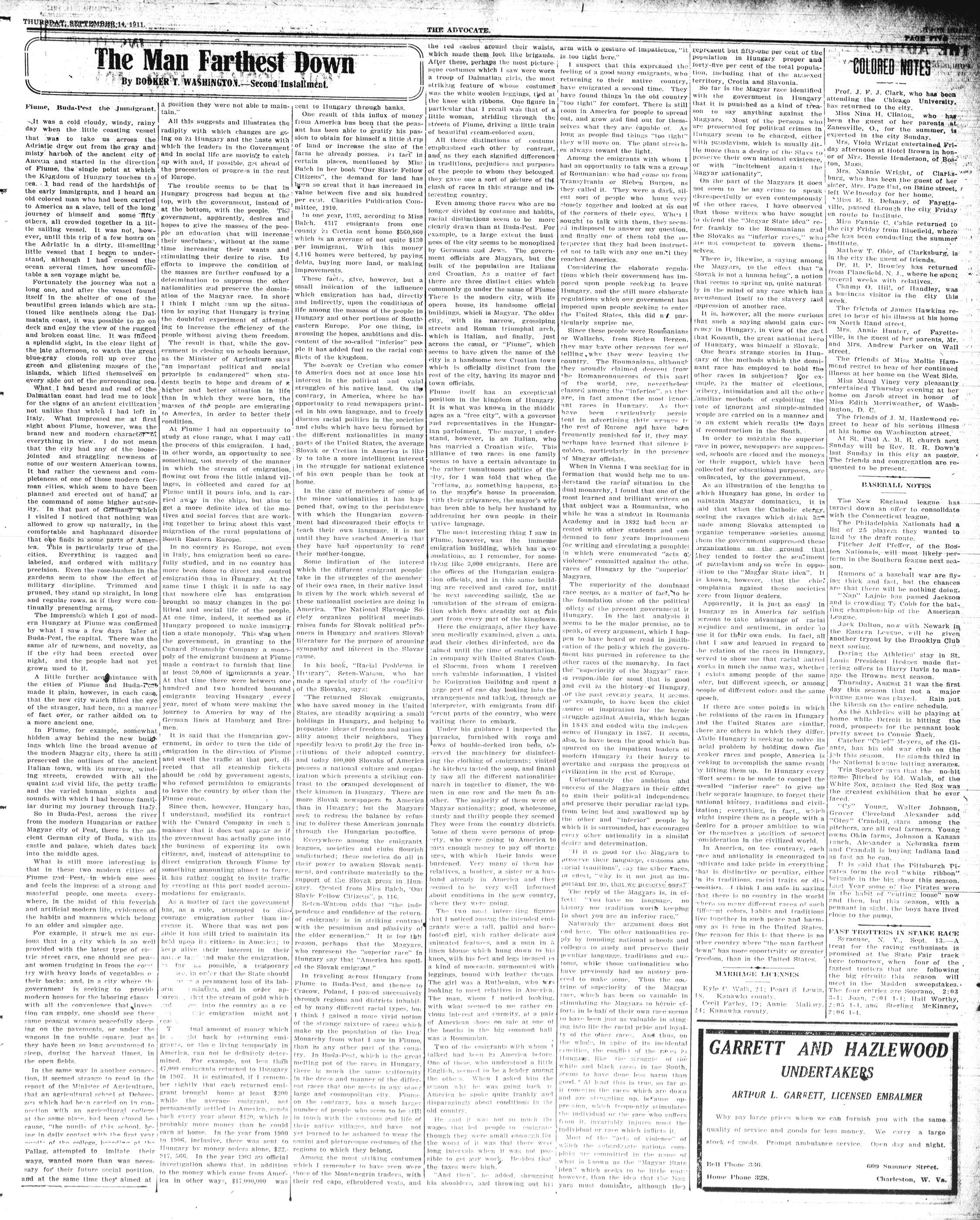

Page text (machine-generated)
TRE ADVOCA
WE CHEERFULLY PUBLISH ALL
CRISP NEWS NOTES FROM ALL
SECTIONS.
VOLUME XI.
Sen. Scott's Declaration
THAT HE WILL NOT BE A CANDIDATE INTENDED TO BRING HARMONY
Favors Judge Goff
As Man for Senator from this State to Succeed Watson, but the Judge Has not Yet Committed Himself—State to Have a Congressman at Large.
---
Nathan Bay Scott, former United States Senator, will not again be a candidate for the Senate. Neither has he any ambition to be the Re-Publican candidate for Governor in 1912. Honored by his party with two terms in the United States Senate, the old veteran announced this week that he had had enough and was willing to make the fight from the ranks says The Enquirer.
At the same time when Senator Scott publicly proclaimed that he had no ambition to go to the Senate again he announced his preference for Judge Nathan Goff, of Clarksburg, for that position, stating that in his judgment the Federal jurist was the best candidate upon whom the Republicans could unite and that he hoped to see the former leader again step into the breach and make an aggressive campaign.
Judge Goff, according to the opinion expressed by the former United States Senator, would eliminate the factional rows in the Republican party and would draw every Republican in the state into line. As for the Governorship, Senator Scott stated his ambition did not tend in that direction. He advised his Republican brethren not to commit themselves too early on the gubernatorial plum, for it would mean a hard fight for the nomination and he predicted that the nominee would have a hard task ahead of him.
Commenting upon the national situation Senator Scott argued that President Taft, by reason of his vigorous attitude in the closing days of Congress, had rallied his friends and had drawn the business interests of the country to his support. A drastic tariff reduction, Senator Scott contends, would mean disaster to business and especially to the industries of West Virginia. Admitting there may be abuse of the tariff the former Senator is insistent that the protective tariff must not be wholly destroyed
The Republican leaders generally regard the announcement of Senator Scott that he would not again be a candidate for the United States Senate as a step toward harmony. The acrimonious conflict last year between the Scott and Hubbard forces is ended by this announcement and will not be renewed this year. The statement of Scott is taken to mean that Judge Goff will have no opposition for the United States Senate if he will become a candidate, as former Senator Davis Elkins, who early in the year had under way a rather formidable organization in the northern section of the state, announced some time ago that he was for Judge Goff if the Clarksburg jurist could be induced to make the race.
Publicly Judge Goff has refrained from committing himself. He returned to his native State last week from abroad. According to private advice he has told some of his personal friends that he would be a candidate. President Taft is one of those whom it is claimed insisted that Judge Goff should make the race.
Pocahontas County, down on the southeast border of the state, is the first of the 55 West Virginia counties to hold a convention, and it has taken the lead with a declaration for the renomination of President Taft. The Republican's of that county assembled this week for the purpose of effecting a reorganization of the party machinery. A new county committee was chosen and the ship put in trim for the 1912 campaign.
After indorsing the national and state administrations, the resolutions specifically demand the resignation of all the state and federal office holders on the Republican State Central Committee, and further ask that such a rule be adopted as will not permit the election of officeholders on the State Committee. The Pocahontas Republicans also indorsed the direct primary plan for the nomination of candidates for state offices and the election of delegates to the next state convention.
West Virginia, having been presented with a new Congressman by the reapportionment bill passed at the extra session of the Federal Congress, will have two additional delegates at the Republican and Democratic National Conventions held next year. As the last session of the State Legislature did not redistrict the state the election of the two additional delegates
THE
gates to the national convention is a problem for the party committees, and it is very probably that instead of four delegates-at-large being sent to these conventions the number will be increased to six. The Republican State Committee, meeting next month, will take up this question and provide for the election of two additional delegates. The Democratic State Committee has not indicated that a meeting will be held in the near future.
Senator William E. Chilton is not bothering about another term in the United States Senate. That is what he told a mammoth gathering of the toilers at Charleston on Labor Day. That he had a set project for the present term, which he hoped to see accomplished before the six years rolled around, he admitted. It is to enlist the Federal Government in the undertaking of constructing a national highway from the birthplace of Abraham Lincoln in old Kentucky, through West Virginia, to the capital at Washington. Frequently there have been suggestions of the construction of monuments and highways to the memory of the gigantic figure of 60 years ago, but the suggestion of the West Virginia Senator is an original one and he is inclined to believe that the Federal Congress will approve of the plan. Senator Chilton believes that it would not only be a monument to the memory of the martyred President, but would be of material benefit to West Virginia and Kentucky.
Some eminent statesmen have their eyes turned toward the Fifth Congressional District, the sole West Virginia district having a Republican representative at Washington for there be many who believe that James Anthony Hughes, not so vigorous physically as he was a few years ago, may not again be a candidate for Congress. Naturally, Abraham Armistead Lilly, of Raleigh County, who trotted a dead heat with Hughes in the primaries a year ago, is anxious to be the successor of the Huntington man. Lilly is a scraper and a power on the stump. Then over in McDowell county Circuit Clerk Burbridge Payne will get into the fight if Dr. H. D. Hatfield finally refuses to become a candidate and Dr. Hatfield is not enamored of the job. Likely the contest will be between Lilly and Payne, with the possibility of a live Indian in the person of the United States Marshal. Frank Tyree, of Huntington, jumping into the fray if there is any likelihood of a serious disagreement between the Raleigh and McDowell candidates.
LEWIS AND COBR.
Visit Wilmington. — Presbyterian Pastor Resigns to Accept Call at Chicago.
Wilmington, Del., September 13. Rev. C. L. Jefferson, who has been pastor of the Gilbert Presbyterian Church for the past eighteen years has accepted a call to the Hope Presbyterian Church, Chicago. He is an alumnus of Lincoln University. Dr. Conwell Banton has recovered from a month's illness. William H. Lewis, Assistant Attorney General of the United States, and James A. Cobb, of Washington, arrived in the city Monday.
Governor Desired Action on Lynching
PENNSYLVANIA EXECUTIVE INSTRUCTIONS ATTORNEY GENERAL TO BRING THE COATSVILLE MOB MEMBERS TO JUSTICE.
Philadelphia, Sept. 12—Governor John K. Tener held a conference at the Bellevue-Stratford Hotel today with Attorney General John C. Bell regarding the Coatesville lynching. When asked the reason of the Governor's visit to the city Mr. Bell said:
"The Governor wants every power of this Commonwealth employed to bring the perpetrators of the Coatesville outrage to justice at once, and I will carry out his instructions."
He did not express any opinion that the county will "lie down," but did remark with emphata that the State is going to sift the affair thoroughly, regardless of time and money.
Harrisburg, Sept. 12—Deputy Attorney General J. E. B. Cunningham, who is representing the Attorney General's department in the inpuiry into the Coatesville lynching, issued a statement today in which he said: "The whole Commonwealth has a right to be proud of the courts and the District Attorney of Chester Co." Mr. Cunningham says the attitude of District Attorney Gawthrop and Judge Butler is beyond Gawthrop and they have done their duty nobly. Whatever obstacle has been thrown in the way of the investigation have come, he says, from other citizens of Chester County.
CHICAGO GRAIN MARKET
Chicago, Sept. 11. —Wheat closed
at 92 1-4, corn 66 5-8, oats 43 5-8.
---
Pirates Defeated By a colored club
CORSAIRS RUN UP AGAINST A SNAG IN WEST BADEN CLUB OF WAITERS, COOKS AND BELL BOYS WHO KNOW THE GAME.
West Baden, Ind., Sept. 11—Thirty-four million and seventy-six glooms are parading the atrium of the West Baden Springs Hotel tonight.
Cause: Pitsburg Pirate Yanigans 1; West Baden Sprudels 2!
The Sprudels are Negroes employed at the hotel. Some of them are waiters, some cooks; there is a porter or two, and maybe a bellboy. They don't often get a chance to go against a big league team—a team that is bidding for a National League penant—so today they put in their best licks and copped.
The shock was terrific! The best shock-absorber on the market would have been found unavailing, even had the fellows possessed a gross of them, Satisfied that they were going against a set of "marks," the Yanigans entered the array smiling—smiling over what they were going to do to the Sprudels.
The ebony giant sent to the kopje by the hotel employes is known as Dismukes. He had speed to give away; also a varied assortment of curves. Time after time the Corsairs swung with all their might only to find the elusive pill wasn't where they thought it was. Inning after Inning passed and still the foxy Mr. Dismukes refused to be chased
Then the situation grew serious.
The large crowd which gathered on
the ball grounds began poking fun at
the major leaguers and the latter became desperate—all to no purpose.
Hank Gardner, the Pacific Coast blacksmith, performed for the Pirates.
He pitched good ball, too, but in view of
the fact his pals couldn't hit behind
him his efforts went for naught.
The score:
Sprudels .....0 0 0 0 0 0 0 2 *—2
Pittsburg .....0 0 0 0 1 0 0 0 0—1
Batteries—Sprudels, Dismukes and Watts; Pittsburg, Gardner and Simon.
Hawkins Re-elected Supreme Chancellor
KNIGHTS OF PYTHIAS OF THE EASTERN AND WESTERN KEMISPHERES ELECT OFFICERS AND NAME PHILADELPHIA AS NEXT MEETING PLACE.
Asbury Park, N. J., Sept. 12—The twelfth biennial session of the Supreme Lodge and the Supreme Court of Calanthe, Knights of Pythias, Eastern and Western Hemispheres, adjourned last Friday night to meet in Philadelphia in 1913.
The Supreme Lodge elected the following officers: Joseph Doake, Charleston, S. C., Past Supreme Chancellor; W. Ashble Hawkins, Baltimore, Supreme Chancellor; W. H. Willis, New York, Associate Supreme Chancellor; W. A. Heatherman, Providence, R. I., Supreme Master of Exchequer; William E. Grandson, Cambridge, Mass., Supreme Keeper of Records and Seal; George E. Gordon, Chelsea, Mass., Assistant Supreme Keeper of Records and Seal; J. R. Farrar, Bridgeport, Conn., Supreme Master at Arms; Rev. J. U. Kling, St. Michaels, Md., Supreme Prelate; Rev. W. S. Carpenter, Philadelphia, Pa., Supreme Organizer; W. W. Burton, New Beron, N. C., Supreme Inner Guard and B. P. Martin, Missouri, Supreme Outer Guard.
Mrs. Ella Trice of New York was elected head of the Court of Calanthe to succeed Mrs. Hettie Nix of Kansas City. The other officers include Mrs. Jennie Ross, Associate Supreme Councilor; Mrs. W. Wl Lawrull, New Bea, N. C., Supreme Receiver of Accounts; Mrs. Julia Hatch, Philadelphia, Supreme Receiver of Deposits; Mrs. Cornelia S. Smith, Baltimore, Supreme Register of Deeds; and Mrs. Ida R Cummings, Baltimore, Supreme Juvenile Protector.
NEGROES ARE LEAVING.
Alexandria, La., Because of Trouble Over Killing of a Student.
Alexandria, La., September 12. As the result of the wounding of two Negroes by a posse hunting for a black who killed W. W. Ellis, a college student, Sunday night, and general threats against the Negroes, many of that race are leaving this section of the country. Since the killing of Ellis a large number of men, heavily armed, have been scouring the country for the murderer, and the result of their efforts, though neither is suspected of killing Ellis. One of the blacks was shot through the arm and the other has a wound in his leg. It is said there was no provocation for the killing of Ellis, who was shot down in the streets. It is certain if the murderer is caught he will be summarily dealt with.
---
ADVOCATE.
Simons Leaves The New York Age
WILL GO SOUTH TO TACKLE A NEW VENTURE IN JOURNALISM. — DELEGATE TO RACES CONGRESS IS TENDERED A RECEPTION.
Roscoe Conkling Simmons has resigned his position as an editorial writer on The Age. He expects to go South to tackle a new venture, in journalism. As a writer and lecturer Mr. Simmons has made hosts of friends here, all of whom express their deepest regret at his going.
New York, Sept. 14—Mrs. S. J. C. Garnett, who has just returned from Europe where she attended the Universal Races Congress, was tendered a reception by the Equal Suffrage League last Friday night at $48 Hancock street, Brooklyn. Dr. W. E. B. Dubois gave an illuminating talk on the Races Congress and D. Macon Webster delivered an address Mrs. Garnett was accompanied to Europe by her sister, Mrs. S. Maria Steward, of Wilberforce, O., the latter being one of the speakers at the Congress. Mrs. Garnett is 79 years of age. She was principal of School 81 for a number of years. She is the widow of the late Henry Highland Garnett.
INAUGURATION OF
PRESIDENT HODGES
At a meeting of the committee in charge of the exercises attendant upon the inauguration of President-elect Thomas E. Hodges, LL. D. of West Virginia University, a program for three days, November 2, 3, and 4, was outlined. The exercises will begin with a meeting presided over by Hon. M. P. Shawkey, State Superintendent of Free Schools and President of the Board of Regents. There will be addresses by at least two educators of national reputation.
The program of the second meeting will consist of addresses in the form of greetings from the presidents of neighboring institutions of learning. The regular inaugural ceremonies will take place on Friday, November 3, at 2 p. m., beginning with an academic procession which will, of course make an imposing appearance. Gov. Glasscock will preside at this meeting and addresses will be delivered by distinguished visiting educators. The inaugural address of President Hodges will close the exercises. On Friday evening there will be a large Pan-Hellenic meeting and procession, after which the various fraternities will hold reunions and, banquets. This feature itself is expected to bring together large numbers of the University Alumni and old students.
Saturday, November 4, will be (West Virginia Day. At a meeting in the forenoon there will be addresses by Alumni and other friends of the University. In the forenoon there will be the great game of football between the old-time rivals, West Virginia and Washington and Jefferson. The detailed program will appear later.
NEGRO BELLBOY.
In Cleveland Canned by South Carolina Governor for Shouting "Gangway."
Cleveland, Ohio, September 12. Governor Cole J. Blease, of South Carolina, who is willing to succeed Senator Tillman in the Senate if that gentleman is ready to quit, is attending the National Convention of the Independent Order of Railway Mechanics here. The Governor was at the Hollenden Hotel with a number of other distinguished men when a Negro bell boy attempted to push his way through the crowd. The boy yelled "Gangway." Mr. Blease raised hbs cane and delivered a husky swat on the bell boy's back and then made a grab for him to chastise him some more. "Down South, sah, they hang 'om for insulting white people in that way," explained the irate Governor.
SALVATION ARMY LEADER
London, Sept. 14.—"General" William Booth was the central figure at a great public reception given in London today to mark the termination of his evangelistic tour of the United Kingdom. The tour was made in a motor car and occupied twenty-six days. Notwithstanding his eighty-two years the venerable founder and head of the Salvation Army is looking forward with eager interest to his coming visit to America.
Detroit, Mich., Sept. 14.—The National Association of Probate Judges convened in annual session in this city today to discuss a wide variety of subjects pertaining to the work of the probate courts and the duties of the presiding judges. The officers in charge of the meeting are: President, J. O. Talmadge, of Catskill, N. Y.; vice president, Frank B. Ross, of Indianapolis; secretary, Frank H. Williams, Allegan, Mich.
Passing of the Negro Jockey.
Colored Rider is as Rare on the Race Tracks of To-Day as is a Gray Horse.
The death, in impoverished circumstances, of "Soup" Perkins at the Hamilton (Ont.) Jockey Club courts recently emphasizes the practical extinction of the Negro as a race rider. Three decades ago the Negro was in his zenith as a jockey. At that time the majority of owners of thoroughbred horses were in the South, and the Negro was the natural attendant of the horses. Gradually, with the coming of the sport to the North, the Negro jockey lost his ascendance. The white boy became the preferred one, and today a colored race rider is as rare on the tracks as is a great horse.
Of the great Negro jockeys Isaac Murphy was the peer in conduct and in judgment of any white rider. "Lonny" Clayton and his brother both were well behaved, well dressed and competent jockeys. "Pike," Barnes rode himself into the list of immortals by winning the first Futurity with Proctor Knott, beating the great Salvator; While Simms achieved success both in this country and in England: then there were "Coley" Stone and Tony Hamilton, "Soup" Perkins, who later made his debut in the East with Henry of Navarre, and Joe Harris, who was the star rider in California in 1907.
The majority of these riders are dead. The others are poor. Those who are not dead have passed away from the turf. Isaac Murphy the dean and the idol of the black race, as he was the pride of all horsemen, died in Louisville practically penniless. He was crushed by the accusation that he was drunk when Tea Tray in the midsummer of 1890 defeated the great Firenze. He was suspended for 30 days by the stewards of the meeting—a most inadequate sentence if he was intoxicated and an unjust verdict, if he had been drugged, as was generally understood. Perhaps the association did not care to have its great new park saddled with what promised to be the gravest scandal on the American turf.
! That practically ended the turf career of Murphy. He was tubercular, and in addition developed stomach trouble from his efforts to keep down to weight. This latter alliment was added to by his fondness for champagne. It was, he contended, the only liquor he could take that would strengthen without fattening him, often said his champagne bills were equal to all his other living expenses, and he lived well. He spent about $12,000 a year for 10 years, for he had a number of camp followers.
"Pike" Barnes for a time promised to maintain a high place in the jockey ranks, but a foundness for night life dulled his judgment. An accident, too, brought on a timidity that he could not seem to be able to shake off. He was riding in Chicago in a race in which a boy named Abbas fell. "Pike's" horse strode on the boy and literally crushed the life out of him. Barnes's nerve was gone forever after. He rode one or two good races subsequently—notably his victory on Tenny in the Brooklyn Handicap—but practically his career ended with the accident. It was said he could not be induced to sleep in the night time, sitting up until daylight, then to fall asleep until it would be time for him to go to the races.
Of course, such life meant ruin. Barnes had the good sense not to dally about the tracks and become a wreck. He took with him what was left of his savings and started a saloon in Chicago. He lasted only half dozen seasons. None of his race has since attained the eminence he achieved.
Some may question this latter statement and point to Willie Simms, but Simms was a consistent jockey rather than a sensational one. He earned large fees when he rode for Michael F. Dwyer and Richard Croker. But money seemed to flow from him. He had at one time or it was so reported, a bank account of generous proportions and some land on Ocean Parkway, Brooklyn, but it has gone. The trip which he took to England in the ill-starred Dwyer and Croker invasion of 1895, it was said, was responsible for the bulk of his losses, and it probably was. He aad Mr. Dwyer, it was believed, "stood a tap" on Harry Reed in the Stewards' Cup when that fast horse was left at the post. Be that as it may, Simms has passed from the saddle and has ta' with him nothing of the fortune t once was his.
Tony Hamilton was another of the great black riders. Friends rescued his body from a pauper's grave and gave it decent burial. He must have earned at least $100,000 in 10 years. He had no particularly large vices, but he never had the slightest appreciation of the value of money. He was without education, and, except when in the saddle, was perhaps the most stupid and uninteresting person
that ever passed through the gate of a race course. He could neither read nor write, and it was difficult to understand what he said. No trainer ever was certain Tony understood what was said to him.
He was, however, a natural horseman, alent at the post, a fair judge of pace and a powerful finisher. Most jockeys nave a habit of talking to their mounts when on the way to the post but Hamilton kept on a constant kind of gibber that was always a source of amusement. Most of the money he earned he gave away. He had a sort of mushroom growth, springing in a short time from an undersized exercise boy with a cot in a stall to where he could earn hundreds of dollars in a day. Perhaps it is little wonder, under the circumstances, that he didn't appreciate money's value. Champagne and diamonds were his weaknesses. The $1,000 diamond that he would wear today would be the property of his valet or his favorite tomorow. A "bank roll" to him was merely a bank roll. It might be of $1 notes or of $50 or of $100 notes. It was good just, for so long as it lasted.
If it were of $1 notes it probably lasted him as long as would one composed entirely $100 notes.
It was pathetic at times to see the way in which the black boy was parting with his money, but he apparently did not realize it and it was not until his money was all gone and necessity for bread and shelter and medicine passed him that it came to him how valuable a little saving might have been.
The Claytons—Lonny particularly—lasted perhaps better than any of the other boys riding, for the reason that they took good care of themselves, but the white boys, outstripped them, and they had sense enough to retire while they still had some of the money they had earned. One of their contemporaries was Thompson, who rode many a "good thing" for Jack McDonald and the coterie of smart horsemen who made money in the days of Clifton and of Gutenburg. He was a strong finisher, but his career was short. He could not stand the climate or the reducing necessary, and passed away, with no one of his color at these tracks to succeed him, if Harry Jones be excepted.
But Jones lacked brain. He was just as illiterate as Hamilton, and his season was a brief one. He was not treated generously, and he became sour and heavy, and finally met a deserved discipline for some suspicious work. He had no ambition afterward, and drifted into the submerged. Penn shone for a time with the stable of A. H. & D. H. Morris, but he rapidly went the way of the others.
Joe Harris, who was better known in the West than in the East, having ridden for Richard F. Carman in the season of 1907, when he was the premier jockey at Ascot Park, was the best of the late colored riders. He was killed In Texas two years ago. He called on a young woman in his native town and took her for a drive. A rival warned him not to do it again. He not only did not heed the warning, but went to the stable where his rival kept a horse, told the livermans he had been sent for the horse, got it, took the woman out and, after returning her to her home, took the horse back to the stable. The rival with an automatic pistol killed him before Harris could reach for his gun.
FREE METHODISTS IN CONFERENCE
Plymouth, Ia., Sept. 14.—The northern Iowa and southern Minnesota conference of the Free Methodist Church began its annual meeting here today with Bishop Wilson T. Hogue, of Evanston, Ill., presiding. The sessions of the conference will continue through an entire week.
NATHAN STRAUS AT
Berlin, Sept. 11.—Nathan Straus, of New York, whose work in establishing and maintaining pasteurized milk depots for the benefit of the poor of the large cities has placed him in the front rank of practical philanthropists, is in Berlin as the official representative of the United States at the third International Congress for the Protection of Infants. The congress, which had its formal opening today, is attended by delegates from many countries. The sessions will continue an entire week and will be devoted to the consideration of the problem of infant feeding in all its phases.
THE ADVOCATE ADVERTISMENTS FLAGRED IN OUR COLUMNS BRING RESULTS. TRY IT.
Reformers' Expenses
WILL BE REDUCED TWENTY
SEVEN THOUSAND DOLLARS
YEAR BY NEW REGIME.
Creditors Hold Off
And Payment of Death Claims will be Begun Shortly if Members Rally and Keep up their Class Dues, as Requested by Officials.
Richmond, Va. Sept. 9—The new management of the Grand Fountain, United Order of True Reformers is about as hopeful a lot of officials as have been seen in this city for a long time says the current Richmond Planet. Around there on Second street the look of dejection which has been in evidence for so long a time is gone. The cause of this condition of affairs is due to the fact that the Bureau of Insurance of this State seems determined to give the present officials a fair trial and to see if they can improve upon existing conditions. It is also evident, too, that the large attendance at the recent session of the Grand Fountain has given additional cause for hope.
The creditors are holding off so to speak, realizing that to attempt to force payments at this time would cause a collapse of the whole superstructure, with the result that no one would get any money upon any of the claims. A campaign is being inaugurated in various sections of the country, and the North Carolina problem is being subjected to treatment. There is a general demand for Grand Worthy Master W. R. Griffin, and it is evident that that "anger" face and that pleading convincing voice will be in evidence in many parts of the country. Mr. Griffin is now where those whom he has criticized have been.
He must carry out the promises made and he has certainly started about doing it. It is announced by him and his associates that the expenses of the Grand Fountain have been reduced to the amount of $2,250.00 per month, or $27,000.00 per year. The payment of death claims will begin shortly. Pledges from all over the field are coming in, and the money is steadily increasing. Grand Worthy Master W. R. Griffin spoke at Newport News, Va., last Thursday night, and at Washington, D. C., last night. He will speak at Roxonoke next Monday night, and at Lynchburg next Tuesday night.
The officials are asking all members to remain loyal, pay up class dues promptly and do all they can to promote the welfare of the Order. They declare that they will soon maintain the excellent record made under the leadership of the lamented chieftain, and founder, Rev. Wm. W. Browne. The management declares that but a short time will be needed to demonstrate the capabilities of those in charge. The suits against those deemed responsible for the loss of much money to the Order have not as yet been instituted. It begins to look that a special fund will be required for this purpose in order to secure the proper legal asistance in this matter.
Attorney J. Thomas Newsome is being kept very busy, much to his embarrassment, due to the stagnation of his practice in his home city. Still, he is struggling on.
REAL STAR-SPANGLED BANNER
Baltimore, Md., Sept. 12. Old Defenders' Day, the anniversary of the battle of North Point, where the Marylanders made a successful resistance to the British invasion in 1814, was observed as a legal holiday in Baltimore today in accordance with custom. It was the battle of North Point that inspired Francis Scott Key to write "The Star Spangled Fanner," and one of the interesting features in connection with today's celebration was the unfurling of the original flag that inspired Key to write the national hymn over the ramparts of historic Fort McHenry.
Chicago, IL., Sept. 14.—Chicago will next week throw open her gates to the world's college of cities and representatives of the larger cities of the world will gather here to teach the citizens of the smaller towns the art of municipal administration. The occasion will be the International Municipal Congress and Exposition, plans for which have been going forward for nearly a year. Delegations from cities throughout the world are assured. Among the notable speakers at the congress will be Ambassadore Bryce, Governor Dix of New York and Senator La Follette of Wisconsin.
CORRESPONDENCE
PAGE TWO
BUCKHANNON.
Miss Cora Taylor, who spent the summer in Morgantown, has returned home.
Mrs. Vernie Martin and children, of Parkersburg, are guests of Mr. and Mrs. Isom Tylor.
Rev. C. H. Sheen, of Parkersburg, was the guest of Rev. A. J. Smoot the latter part of last week.
Miss Adelle Wilkerson and brother, of Parkersburg, returned to their home Tuesday, after a visit with relatives near town.
Mrs. H. D. Hazelwood has returned to her home in Parkersburg. She was accompanied as far as Clarksbury by Ler nudge, little Miss Mercedes Davis.
Miss Lottie Smith is sick with Asthma.
Miss Minnie Smith, of Parkersburg, is the guest of Miss Harriet Walker Waldo Smith is sick.
Miss Clara Wilkerson, who spent the summer at her home near town, has returned to resume her work at Victoria School. The ball given at Pifer's Hall Thursday evening, Sept. 7th, under the management of Chas, Davis and Ed Hunter, was a successful, and an enjoyable affair. A number of persons from Elkins, Clarksburg and Weslon were in attendance. Mrs. Butler, of Elkins, is the guest of Miss Nettie Madison.
INSTITUTE
J. B. Bragg, instructor in blacksmithing at the West Virginia Colored Institute, has resigned and accepted the position of superintendent of Industries in the Jackson Miss.. Industrial school.
Pres. and Mrs. Byrd Prillerman and Miss Mary Delany left for Pittsburg. Tuesday morning to attend the National Baptist Convention.
Miss Julia Dorsey, has returned home for a few days. She will leave in the near future to be the secretary to the president of Walden University in Nashville, Tenn.
Mrs. Viola Hardy is visiting friends at Institute.
Rev. E. C. Page preached at the Baptist Church Sunday morning.
M. T. Obie, of Fairmont, and Miss Amelia Wilcher of Charleston visited Institute Friday.
Dr. R. L. Jones made a business trip to Institute Tuesday. Miss Lou Ellen Springs is visiting friends in Springfield, O.
S. H. Guss delivered an address at the Simpson M. E. Church in Charleston Sunday evening.
The Sunday School Picnic was well attended Thursday.
C. E. Jones is teaching a few days at St. Albans, for Rev. J. W. Robinson.
MONTGOMERY.
Mrs. Lizzie Perry Callender, was a business visitor to Fayetteville, Wednesday.
Rev. Warner Brown, is spending his month's vacation in Pittsburg, and other points in Pa.
The superintendent, teachers, parents and children of the First Baptist church Sunday school had their annual picnic in Donwood Grove Saturday.
John S. Page, visited relatives at Kanawha City Sunday.
Miss Ella Slack, of Charleston, was the week-end guest of her sister, Mrs. Thomas Johnson.
Mr. and Mrs. Hylton Woody, of Bluefield, were here last week to see Samuel Buster, who is sick
J. S. Caulis, of Winona, Dr. C. B. Anderson and A. T. Calloway, of Slyvia, Dr. B. F. White, of Huntington, Rev. D. C. Deans, R. L. Geter and H. H. Railey of this town, Finance Committee of the Great Council of Red Men met Monday in R. L. Gerrers office to transact business for that order.
W. A. Brown and E. H. Howard completed the building contracted by L. N. Brown, for Mr. Mairs and returned to their home at Institute Sunday.
ELKHORN.
The Elkhorn graded school began Tuesday morning with an enrollment of 131 and the following persons as teachers: E. M. Craig head principal Misses Lola M. Lavender, Mary L. Adams, Memphis T. Carter and S. Z. Jones assistants.
Mr. Wills, principal at Powhatan, was at Crosier Saturday.
Rev. F. C. Patterson filled his regular appointment here Sunday morning, leaving on the afternoon train for Pittsburg, Pa., where he will attend the National Baptist Convention.
Simon Wagstaff has returned from a visit to his home in South Boston, Virginia.
Mrs. R. H. Purdue returned Friday evening from a trip to Martinsville Roanoke, and other eastern states.
Misses Mary E. Brown, Ollie Gilbert and Samuel Perkins left, this morning for Bluefield where they will attend the Bluefield Colored Institute this term.
Mr. Craghead received the sad intelligence of the death of his mother-in-law Tuesday morning.
The B. Y. P. U. organized under the auspices of Crozier Church held its first meeting Sunday afternoon. The following are the officers: President, Miss Memphis Carter; Vice President
H. M. Fortner; Secretary, Miss Laven-
Ellen Marshall; Treasurer, Rev. F. C.
Price.
Mrs. Anthony, one of the oldest
members of Crozier Church, is very
ill at her home at Ennis.
Miss Somerville Jones was a business
visitor to Northfolk last week.
Miss Mary Williams was visiting
friends at Elkhorn and Maybeurry
Saturday and Sunday.
POWELLTON
Miss Ethel Brown, of Montgomery was calling on friends here Friday.
was calling on friends here Friday.
Mrs. J. M. Arter, of Hill Top, was the weekend guest of Mrs. S. J. Mills. While here Mrs. Arter gave a heart to heart talk to the missionary society, Sunday morning and evening. The gift of Mrs. Arter's talk was what good Christian women can do. The speaker gave many helpful suggestions which were highly appreciated by all.
Mrs. R. J. Harvey is somewhat indisposed.
The Ladies Aid will meet at the residence of Mrs. S. J. Mills, Thursday evening.
Mrs. Nannie Henderson has returned from Richmond, Va., where she was sent as delegate to the grand council I. O. of St. Lukes. While in Virginia Mrs. Henderson visited many relatives and friends whom she had not seen for quite awhile.
Horace Carter left town Saturday on a business trip to Charlottsville, Virginia.
Mrs. Gussie Skeaton, of Columbus, O., who has been spending some time with Mrs. R. J. Harvey, has returned home.
Harvey Burks, was in town Saturday.
The Powellton schools will begin September 18.
RONCEVERTE
The annual convention of the Greenbrier County Sunday School was held last week at the Baptist church. It attracted a large and representative assemblage. The association embraces the protestant schools of all denominations which work in harmony. An addresses were made by Miss Graham, of Wheeling, Rev. Hiatt and other members of the convention. Encouraging reports were received from all the schools.
Mrs. Thos. Johnson and son, Hilard were here visiting relatives last week.
Mrs. Julia Jackson and little daughter, Vera, of Charleston, passed through here last week enroute to Frankford.
John Ward and Chas. Perkins left last week for Bluefield.
Little Roger Slaughter, who has been sick with fever for the past six weeks is out again. Mrs. Harvey McVey, of Lewisburg, was the guest of Mrs. D. R. Hickman Sunday.
```markdown
```
CEDAR GROVE
Madams T. W. Holmes, Eunice Rolins, of Pratt, and Mary McClure, of Huntington, were guests of Mr. and Mrs. Charles Watkins, of Monaarch, last week.
Mr. and Mrs. C. H. Jones were visiting relatives in Charleston last week. Mr. and Mrs. J. W. Anderson, were visiting relatives at South Ruffner, last week.
Mrs. Mamie Cottella, of Charleston, is here visiting her mother, Mrs. Phoebe Wilson.
The following families enjoyed a picnic at Gauley Bridge last week. W. F. Martin and family, Joel Walker and family, and J. D. Vaughn and family.
J. W. Richmond, of Cleveland, O., was here last week visiting his mother, Mrs. Maria Crawford.
Mrs. Amanda Slater and Miss Minie Peters, of Charleston, were here Sunday guests of Mr. and Mrs. C. H. Jones? Mrs. George Lewis, of Longacre, was here Friday.
Mrs. Alexandria Shaver, of London, was visiting Mrs. G. W. Lee last week, Elmer Anderson, of Charleston, is here visiting his father, J. W. Anderson.
Public school opened here on the 11th and the community is looking for ward to a successful school term under the instructions of Miss Emma L. Meadows, principal and Miss Maude E. Robinson primary teacher, both of Institute.
John H. Dingess was united in marriage to Miss Mattie Freeman, of Anstead, on Monday September 4th. Miss Freeman is an accomplished and successful school teacher. After their marriage they left over the C. & O. for Cincinnati to enjoy their honey moon.
Mrs. Lula Bruce left for Burnwell to resume the duties as teacher at that place.
Mrs. Jennie Beamer was visiting relatives at Hansford last week.
Noah Haston, of Leewood, was last week enroute to Montgomery to meet his wife who has been visiting relatives in Washington, D. C.
Mrs. L. W. Reed is
RED STAR
A pleasant time was had when the Woman's Improvement League celebrated its 6th anniversary, Sept. 3rd and 4th. Prof. Byrd Prillerman President of the W. V. Colored Institute, delivered a splendid address Sunday afternoon to an attentive aud
lence at the Hill Top Baptist church.
The address was plain, practical and instructive.
The entertainment on Monday night was a success. There was a declamatory contest and Miss Pearlie Stone won first prize; Miss Edna Taleb second; Misses Fannie C. Cobb and E. B. Delaney gave instructive addresses.
Prof. Byrd Prillerman was the guest of Dr. and Mrs. S. A. Washington while here.
Mrs. J. M. Arter entertained at supper Saturday. Prof Byrd Prillerman, Misses Fannie C. Cobb, E. B. Delaney and Alma Patterson.
Mrs. E. B. Delaney, who has been the guest of Mrs. J. M. Arter for some time, left for Charleston Friday.
Miss Fannie C. Cobb, who has been the guest of Dr. and Mrs. S. A. Washington for a week, left for her home at Charleston, Friday.
Hon. and Mrs. J. M. Ellis entertained at dinner Wednesday the 6th Mesdames M. A. W. Thompson, J. M. Arter and H. C. A. Washington, Misses Fannie C. Cobb and E. B. Delaney and Dr. S. A. Washington.
Miss Mabel Goff, who has been visiting her mother, Mrs. A. M. Banks, left for her home at Christiansburg, Monday. She was accompanied by Miss Cortey James and niece, Alto Davis.
Dr. R. L. Gordon, of Thurmond, was calling on Miss Patterson, Sunday.
Rev. D. C. Hunter filled his regular appointment on Sunday.
The children and teachers enjoyed their annual picnic Saturday.
Misses Fannie C, Cobb and E. B. Delaney were entertained at dinner Monday by Mrs. J. W. Price at tea by Mrs. L. O. McIver's.
Mrs. J. M. Arter and Miss Fannie C, Cobb, were at Mrs. Amelia Knight's for dinner Thursday.
Tom Taylor and Mr. Freeman, of Turkey Knob; Miss Lillian Carrington, of Stone Cliff and several other students of West Virginia Colored Institute were here to the lecture given by Prof B. Prillerman.
Dr. S. Washington was at Montgomery Friday on business.
Mrs. J. M. Arter spent a few days at Winona last week.
CLARKSBURG
Miss Lily Henshaw, of Morgantown, was the Sunday guest of Mrs. Geo. Biglow.
Ashby Grayson, who has been traveling with the Wild West Show, spent Sunday here with his parents, Mr. and Mrs. M. W. Grayson.
William, the infant of Mr. and Mrs. Wm. B. Ruffin, died Thursday of cholera infantum and was buried Saturday morning.
Much interest is being manifested in the quarterly revival at Mr. Zion Baptist church.
Mrs. W. T. Kenney has returned from Chase City, Va.
Nelson J. Miles, of Pittsburg is visiting his sister, Mrs. Mary Bowyer, on Monticello Avenue. This is Mr. Miles first visit to his old home in twenty-eight years and his many friends are glad to welcome him back.
Miss Lilly Allen, of Fairchance, arrived Friday night to take up her work as teacher of 7th and 8th grades in the Water street school.
Misses Hannah Davison, Augusta Cooper and Messrs Michael and Turner, of Shinnston, were visitors here Sunday.
Mrs. Robert Sedwick and children returned Saturday from McKeesport, Pa., where they visited her mother, Mrs. Maria Ogden Jones.
Mrs. Madison, of Parkersburg, is the guest of her sister, Mrs. Walter Sedwick.
Miss Margaret West left Monday morning for Brownsville, Pa.
Miss Mary Gordon, of Fairchance, Pa., passed thro' Friday eroute to Venetta, to teach school.
Clarksburg school opened Monday with a large enrollment.
D. H. Kyle was a business visitor in Uniontown last week.
Miss Angeline Ogden has returned from Mt. Lake Parke where she spent the summer.
BLUEFIELD
Bluefield Colored Institute opened Tuesday morning with an enrollment of 95 students for the first day.
H. L. Dickason and Langston Brown left Monday for Columbus where they will begin work as students in the Ohio State University. Mr. Brown enters the department of Pharmacy.
Dr. H. E. Kingslow, Mr. and Mrs. R. A. Shell, and Miss Kittie Warren left Monday morning for Tennessee. Miss Warren goes to Morrstown Normal School and the others to Meharry.
Mrs. Wade and children returned Tuesday, Sept. 5th, from their trip through Virginia, visiting relatives friends.
F. F. Coleman filled the pulpit at 6:30 a.m. street Methodist Church C. night.
W. W. Hicks and others left night for Pittsburgh to at convention. will be an entertainment and even at the Y. M. C. A. for edit of the same.
Secretary N. M. Martin filled the Raleigh Street Mthodist pulpit Sunday morning. Rev. S. R. Bullock preached an able sermon Sunday morning on "True Riches."
Mrs. Orange L. Page, who has been visiting her parents, Mr. and Mrs. Henry Lemons, left Sunday for Mt. Airy, N. C., where she will visit relatives and friends for several days, after which she will return to Rey West, Florida to resume her position as cashier in the Seashore Pharmacy. Miss Lillian Cosby, and Mr. Roy Reed were united in marriage last week by Rev. H. Williams at Booner, Mrs. Eva B. Russ left Monday for Pittsburg to visit relatives and to attend the National Baptist Convention. Emmet and Sandy Saunders were visiting in Montgomery Sunday.
Mrs. Jennie Johnson attended preachig in Montgomery Sunday. L. Richards and children attended preaching at Mt. Carbon last Sunday. Mrs. L. D. Hodge and Mr. Isalah Dyson of Montgomery were the Sunday afternoon guests of Mr. and Mrs. James Russ. Mrs. M. V. Saunders was visiting relatives at Longaere last Saturday. M. S. Malone, editor of the Sentinel was here on business Saturday.
ELKINS.
Mr. and Mrs. Taylor Daugherty left for their home in Virginia, Monday.
Mrs. Walton Butler is spending two weeks in Buchannon on a vacation.
Rev. F. H. Alleyne preached at Thomas, Friday. A good work is being carried on there. The people always welcome his coming.
Misses Grace and Mabelle Greene will leave for Institute, Sunday, where they will become students.
Clarence Miller and Arbaith Lewis were united in marriage Wednesday evening at the residence of Rev. Davis.
Miss Estelle Greene spent a week here visiting friends and left Sunday for Charleston to begin her school work.
At the A. M. JE. Church, Sunday, the 17th, will be "Educational Day" for Wilberforce and Payne Theological Seminary. A special program will be rendered.
Charleston
To Banquet Terrell.—Arrangements are being made for a subscription "stag" banquet complimentary to Judge Robt. ii. Terrell on the evening of the 21st, the day prior to his delivering the Emancipation Day address at Edgewood Park. The affair is being gotten up by J. C. Gilmer who has sent out invitations to a number of the leading citizens.
Rotan Goes for "Fugative." Anderson Rotan, of Fayetteville, was here Saturday getting requisition papers for the return of William Moore, alias "Big Six", who escaped from the jail of Fayette county and has since been confined in the Indiana penitentiary. At the time of his escape from the Fayette bastile Moore was under sentence to serve seven years in the prison at Moundsville.
Officers Elected.—The missionary society held a very interesting meeting at the First Baptist church, Friday evening of last week. Mrs. Mattie Jackson and Mrs. Bettie Hall delegates to the Woman's Baptist State convention, and Mrs. Frank Henly, a visitor, made very encouraging reports of the Hinton meeting. The officers elected by the local society are: Mrs. Mattie Jackson, Pres.; Miss Fannie Girty, Vice Pres.; Mrs. Bettie Hall See'y.; Miss Virginia Rayford, Asst. See'y.; R. C Melver, Chaplain and Mrs. Sallie Mickey, Treasurer. The next meeting will be held with Mrs. Henloy, 606 Pendleton Ave., Friday evening when the plans to broaden the scope when the plans to broaden the scope Maude Wanzer entertained a num-Maude Wanzer entertained a number of friends at cards at her home on Donnally St. Monday evening Present were: Misses Alexander Princess Stuart, Beatrice Calhoun, Maurice Brown, Mamie Hopkins, Ardonia Price, Fannie Davis, Gertrudu Elliott, Bessie Jackson, Rebecca Green, Emmaline Epperson, Irend Jackson, Dorcas Wanzer; Messrs Charles Payne, William Goins, Edward Fulks, Elmer Anderson, Wilson Davis, Engene Moss, Robert Slaytor, Roy Edwards, Norman Bailey, Robert Edwards, Clifford Bailey, Garence Hardy, Andrew Williams Ordine Tolliver, Albert Wright, Edward Howard, Lowell Cuzzens, Andrew Wick, Walter Lowery.
Guests at Hotel Brown—There were registered at Hotel Brown, this week: Mrs. Ella Robinson, Thacker; Mrs. Lizzie Robinson, Bluefield; C. C. Coleman, Berwind; C. Hicks, Princeton; A. Smith, Roanoke, Va.; R. A. Redd, Montgomery; John Williams, Bidwell, O.; J. Johnson, Glenville; George Hare, Thos. Hubbard, Frank Minters, Winfield; E. L. Morton, Fairmont; Mr. and Mrs. J. Russell, Cabin Creek; G. Raglin, Winfrede; Mr. and Mrs. L. Miller, Dickerson; Mr. and Mrs. Robert Herbert, Warm Springs, Va.; W. C. Chapman, Bluefield; B. P. Price, Fayetteville; B. R. Marks, F. D. Barnett, Cedarville; Rev. V. S. Smith, Paducah, Ky.; Miss Bessie Smith, Rocky Mount, Va.; Mrs. M. L. Willis, Fay-
etteville; Mrs. M. E. Bauks, Covington, Va.; John Viars and daughter, Fayetteville; Miss Othello Pettigrew, White Sulphur Springs; Jas. R. McKenzie, Richmond, Va.; L. Belton, Glouster, O.; Russell Scott, Clarksburg.
Served Six Course Dinner.—Mrs. Adolphus Wright entertained at dinner at Hotel Brown, Wednesday evening of last week, the honor guests being Mrs. Alex Henderson, of Boston, Mass., Mrs. Jas. McKenzie, Richmond, Va., and Mrs. Ida Lovelace, Danville, Va. Covers were laid for eight and six courses were served.
Miss Davis Entertains. — Miss Cornelin Davis entertained Friday afternoon from four to six in honor of Mrs. M. P. Burke. In the receiving line Were Miss Davis and Mrs Burke. Mrs. L. G. Davis received the guest, Mrs. J. H. Page introduced. Those assisting in the dining room were Mrs. C. C. Campbell, Mrs. Elridge, Misses Mary Burke, Mary Preston, and Sallie Taylor. Mrs. C. H. Stephenson presided at the punch bowl. In the evening a number of friends were entertained at cards. Those present were Mr. and Mrs. C. C. Campbell, Russell Forney, Chas. Preston, Alphus Lydr and Mason Burke. Mesdames C. H. Stephenson, C. H, James, J. H. Page, J. W. Viney, Robt. Hamlin, L. G. Davis, of Columbus, O. Misses Mary Burke, Sallie Taylor, Foster, Mary Preston, Maude Viney, Stella James, Aristes Johnson, Hazel Lucas, Agnes Merriweather, Lucinda Williams, Messrs. Joe Burke, W. H. Walker, W. H. Wright, T. G. Nutter, Oscar and Charlie Davis, T. W. Hale, Sam Jenniags, Henry Burke, Edward James, Chas. Payne, Drs. J. B. Brown and J. C. Ellis.
PERSONALS AND LOCALS
Mrs. L. G. Davis, who spent the summer here with her parents and sisters, returned Saturday, to her home at Columbus, O.
Mrs. Peter Nelson entertained a few friends at whist Wednesday evening of last week at her home on Palms St.
Mrs. Abbie Campbell is visiting friends att Cleveland, O.
Little Martha Belle Jennison celebrated her seventh birthday anniversary, Thursday, at the home of her parents on Washington St. A number of her juvenile friends helped to make the occasion a pleasant one.
F. C. Brown returned Saturday from New York. While in the East Mr. Brown visited Philadelphia, Atlantic City and Washington.
Mrs. Daisy Nelson had as her guests at the home of Mrs. Kent, Baines St., Thursday evening, Mrs. Alex Henderson, Mrs. Laura Turner, Covington, Va., and Mr. and Mrs. Jas, McKenzie
Mrs.Lucy Jones is ill at her home on McCormick St.
Miss Ida Lovelace is spending this week at Lawton visiting her sister.
Rev. B. R. Reed, pastor of the First Baptist Church, is at Pittsburg, Pa., in attendance upon the National Baptist Convention.
Mrs. Jas. Williams, of McDonald, was the guest of Mrs. H. B. Rice several days last week.
J. M. Hazelwood, whose illness was reported in these columns last week, continues to improve slowly James Wooding, of Winifrede, was here Wednesday consulting an oculist. He has been taking treatment a month and a decided improvement is noted. Miss Alice Tuning left Tuesday for Gamoca to see her sister who is reported very ill. Mrs. R. C. Lewis, of Glen Jean, passed through the city Wednesday enroute to Cincinnati, O. Miss Moss Clay has returned from Clarksburg where she spent several weeks visiting her mother and friends.
H. B. Hundley, Grand Master of the Masons, stopped over last night on his way to his home at Macdonald Edward Manley, who is preparing to embark in the undertaking business at Montgomery, was here Monday on business.
Miss Frances Starks returned home Monday from a pleasant visit to relatives in Chicago, Ill.
Miss Ethel Spriggs, of Institute, was a business visitor in town Wednesday.
Miss Ida Montgomery, was the guest of Miss Sallie Hale, of Southside, the first of the week.
Mrs. Florence Jones left Tuesday for her home in Dayton O. after spending several days in the city visiting relatives.
C. C. Lewis and R. L. Garrett were business visitors to Cincinnati last week.
Miss Nina H. Clinton arrived in the city Saturday from her home in Zanesville, O., where she spent her vacation.
Frank Marshall, of Institute, passed through the city Wednesday, enroute to Webster Springs, where he was called by the death of a brother. Mrs. Lee Wells, of Hinton, passed through the city Monday enroute to Baptist Convention. Miss Aristea Johnson spent the weekend at Institute. Miss Helen Trutton, of Baltimore, Md., arrived in the city Saturday to assume her duties as supervisor or
THE BAUER MEAT & FISH CO.
28 AND 30 CAPITOL ST.
Beef, Veal, Mutton, Pork, Fresh Pork Sausage OUR OWN MAKE
Try our machine sliced Hams and Bacon
OYSTERS, FISH, POULTRY
The best qualities in all the popular kinds of
We want your patronage for we have complete stock in our lines and you an get it when you want more.
Domestic Science in the public school.
Ernest Hale is spending a few days in Cincinnati O. this week.
M. T. Obie, of Fairmont, left Tuesday after spending a week in the city visiting friends.
Miss Edith Merriweather left Wednesday for her home in Washington D. C., after a pleasant visit to her sister, Mrs. B. P. Brownley.
Mrs. Cora L. Terry is visiting friends in Atlantic City, N. J.
WEST SIDE.
Mrs. Mollie Hammond's condition was slightly improved by the arrival of her daughter from Cuba, Monday Morning.
Alex Jones is sick this week.
Miss Theresa Crozier, who has been dangerously ill for the past two weeks, is much better.
William Harris who has been off duty for about ten days on account of a badly burned hand, has returned to work at the ax factory.
TAILOR WANTED.
A man to work in tailor shop, one who has had some experience in the business. For further information write to N. B. Brookman, merchant tailor. Mt. Hope, W. Va. 8-31-4t.
ANOTHER BEQUEST
Tuskegee, Ala., Sept. 12—By the will of the late Miss Georgiana Harper, a colored woman, of Sandusky, Ohio, the Tuskegee Institute receives a bequest of between three and four thousand dollars.
WHAT IS IT?
WHAT IS IT?
Ten and twenty year combination distribution certificate of membership as devised by the American Workmen Fraternal Insurance Company, of Washington, D. C., one of the most liberal, strongest and reliable fraternal institutions in the field. For further particulars see
D. E. V. JORDAN
General Agent for West Va.
Office: Room 2, K. of P. Bldg.
Charleston, W. Va.
100 AGENTS WANTED.
THURSDAY, SEPTEMBER 14, 1911.
ER MEAT
H CO.
CAPITOL ST.
Mutton, Pork,
k Sausage
N MAKE.
machine sliced
and Bacon
SH, POULTRY
in all the popular
s of
eese
ronage for we have
our lines and you
you want more.
REDUCED RATES TO PITTSBURG
ON ACCOUNT OF NATIONAL
BAPISTIST CONVENTION.
The fare to Pittsburg, Pa., on account of the National Baptist Convention, September 13, 1941, by way of the C. & O. and the B. & O. Railways is one and one third (1 1:3) regular fare—being eleven dollars and sixty-five cents ($11.65) from Charleston for the round trip. Tickets will be on sale September 10 and 11.
The General Passenger Agent of the B. & O. Railway has promised to attach a special coach for the benefit of delegates leaving Huntington at 5:40 p. m. the same day.
If any delegate on the C. & O. Railway cannot secure a round-trip ticket from his station, he should require the agent to give him a certificate or receipt that he has paid first class fare one way to Pittsburg by way of Huntington.
SHIRLEY
PRESIDENT
SUSPENDERS
The kind that most men wear. Notice the cord back and the front ends. They slide in frictionless tubes and move as you move. You will quickly see why Shirley President Suspenders are comfortable and economical for the working man or business man.
Light, Medium or Extra Heavy Weights
—Extra Lengths for Tall Men.
Price 50 Cents from your local dealer or by mail from the factory.
Signed Guarantee on every pair
THE C. A. EDGARTON MFG. CO.
333 MAIN*STREET, SHIRLEY, MASS.
THURSDAY, SEPTEMBER 14, 1811.
IMPRESSIONS LEFT BY VIRGINIA DRAMA
One of those gripping tragedies in which life as it really is makes its stagecraft counterfeit seem impotent and pale has reached a culmination. Under the eager scrutiny of an avid public the crimson record has unfolded to the final page. It has focalized national interest to the exclusion of those resounding issues which the moot court of statesman ship calls paramount. It has caught the eye and kindled the imagination and stirred the heart after that eternal fashion with which blood has appealed to blood since Cain, with the mark of murder on his brow, took sanctuary in the land of Nod.
It would be hasty to call this a morbid interest. These human documents, these transcripts from life itself, are part and parcel of those soothing activities which make up the sum of human experience. The man in the street who would take but a langud glance at the work of Terence still translates into his daily life and thought the pulsing Roman's worthy boast: "I am a man; and nothing which concerns humanity can fall to concern me."
It is from these compelling tragedies, written large in the daily report—it is from the bubbling cauldrons in which have just been melted smiles and tears, crime and punishment, virtue and shame—that a residium stands forth for the profit of mankind. Where sermons with their obvious moral tag fall trite and ineffectual, events like these which penetrate every cranny of the social structure carry with them a lesson so intimately interwoven with their very texture that it sinks insenably into the mind and heart. Even the daily night shade has its perfume
To the normal mind it is well nigh inconceivable that a young man to the full enjoyment of health and worldly competency, with a wife and child as hostages to fortune, should coldly and cruelly break into the bloody house of life, violate the sacred instincts which the beasts of the field hold dear, and, expfating his wanton blood lust,
Leave a name at which the world turns pale,
To point a moral or adorn a tale.
And yet the very beginnings of society are but the safeguards in which man takes refuge from his brother, and the hearthstone has been stained with every crime. In the case at bar the body of the crime has been established and it remains for the twelve arbiters of life and death to say whether it has been brought home to the defendant's door.
It would seem puny to the point of mockery to dwell upon the agony which must sear the very soul of Henry Beatie if he be guilty, as charged. The hideous hours must come when assurance and bravado have died within him, and he stands alone with a conscience which lashes him with a scourge of scorpions. The heart knoweth its own bitterness, and we can but dimly guess what his feelings must be as he realizes that the life he has led has at least given color to the fearful indictment drawn against him.
That no hue should be wanting to this tangled skein of tragedy, his father seems to have been a type of high integrity. The obligations which the young husband assumes when he establishes that unit of citizenship, the home, found frequent expression in the disapproval with which the elder Beattie looked upon the dericctions of his son. And yet it was in a measure due to his own
B. NUFORM CORSETS THE Nuform is a popular priced corset, modeled on lines that per-
W.B. NUFORM CORSETS
fect your figure. It defines graceful bust, waist and hip lines and fits at the back.
The range of shapes is so varied, every figure can be fitted with charming result.
All Nuform Corsets are made of serviceable fabrics—both heavy and light weight—daintily trimmed and well tailored.
Your dealer will supply you with the model best suited to your figure.
Nuform, Style 478. (As pictured). For average figures. Medium low bust, extra skirt length over abdomen and hips. Made of durable coutil and light weight batiste. Hose supporters. Sizes 18 to 30. Price, $1.00.
Nuform, Style 485. For average and well developed figures. Medium bust, extra length over hips, back and abdomen. Coutil and batiste. Hose supporters. Sizes 18 to 30. Price, $1.50.
Nuform, Style 488. For average and well developed figure coat construction over hips, back and abdomen, comfort with modish lines. Made of excellent coutilse supporters. Sizes 19 to 30. Price, $2.00.
Sold At All Stores
H BROS., Makers, 34th St. & Broadway, New York
Nuform,Style 488. For average and well developed figures. Unique coat construction over hips, back and abdomen, insuring comfort with modish lines. Made of excellent cowl and batiste. Hose supporters. Sizes 19 to 30. Price, $2.00. Sold At All Stores
Nu
ures. U
insuring co
and batiste. H
WEINGARTI
indulgence, to the too fond affection for the flesh of his flesh, that the tragedy has come about.
The French gave us the catch word of crime: Look for the woman! She was not far to seek in the sordid drama which has just unfolded itself in the legal procedure at Chesterfield. The woman? The child! And therein lies the pitiful aspect of it all. There must be a queer slant to the moral nature of anyone who can look with anything but the deepest commiseration upon the short life history of this soiled fledgling. At a time which should have been her doll-baby days she had trod the hot plowshares of motherhood, with none of the sanctity which glorifies a mother's name. She had grown up in moral miasma. That which should have been the asylum of innocence was the nursery of shame. If only negatively, if only by the lack of that restraint so essential to the unfolding of the flower of womanhood, her childish steps were set in a quagmile of vice. With all the potentialities of an exalted womanhood she found herself, from her home environment, foredoomed to the fate she met. The budding mignonette in the kitchen window box would have had more care; the sweetpeas over the doorway would have been trained toward the sun.
It is not the mark of the fatalist to believe that all these things work out for noble ends in the sum of human experience, and the Binford story will not have been lived and flashed abroad in vain if it brings home to mothers everywhere the tremendous responsibility which rests upon them. The best of mothers may look with many a doubt and fear as she
Sees her infant bud put worth its leaves;
What may the fruit be yet? We know not; Cain was Eye's.
Since we gather no figs from thistles, there could be but one result of a tutelage and environment such as fell to the lot of this light-hearted and lighter-headed nymph du pave.
And yet benevolent Lady Sheepshanks still potters away to send cotton shirts to the heathens of the Congo! The Pharisees who had lifted no finger to stay the weakling's fall hiss her forth into the world to capitalize her tawdry rame.
Passing over the graver issue which has brought him face to face with death, the undisputed crime of which young Beattie has been guilty was his treason to the domestic circle where he should have been that "house-bond" from which our Saxon ancestors derived the "husband's" name and office. When flappant Lotharios and phony philosophers have had their say in support of their system of elective affinities, the simple fact remains that the hearthstone is the cornerstone of the social fabric. There may be times when its embers are haunted by lost illusions; in its transition from rosy romance to rude reality the dream of love may be
Sharpened from its high celestial flavor
Down to a very homely household savor.
And yet the welfare of the social order, the highest happiness of the individual, demand that the responsibilities of husband and father must be met and the solemn compact
of the altar, though viewed merely as a civil compact, must be kept. The obligations cannot be shifted or ignored. Least of all can they be drowned in the lascivious rhapsodies of Aholibah, "whose house is the way to hell, going down to the chambers of death."
UNITED BRETHREN MEETING
Kokomo, Ind., Sept. 13.—Delegates representing a large section of Indiana assembled here today for the annual meeting of the St. Joseph conference of the United Brethren church. The sessions will continue five days, with Bishop Matthews of Chicago presiding.
AT BUFFALO
Buffalo, N. Y., Sept. 13.—Some of the speediest motor boats in the country are here in readiness to take part in the international interlake regatta, which is to open tomorrow and continue through the remainder of the week. The regatta will take place on the Niagara River and will be conducted under the auspices of the Motor Boat Club of Buffalo. The program provides for three big races in addition to several minor events. The chief prize is the E. R. Thomas trophy, worth $2,500. Among the crack speed boats entered in the regatta are Dixie IV., of New York; Eph IX., of Indianapalos; Red Top II., of Dubuque, la.; Kittie Hawk II., of Detroit; Reliance, of Algonac Mich., and Wasp, of Clayton, N. Y.
ILLINOIS M. E. CONFERENCE
Champaign, Ill., Sept. 13.—The annual session of the Central Illinois M. E. Conference met here today, with Bishop Moore of Cincinnati presiding. The conference appointments will be announced early next week. An unusually large number of ministerial changes is anticipated.
EMPLOYERS' LIABILITY
Spring Lake, N. J., Sept. 13. The entire sessions of this, the second day of the annual conference of governors, were devoted to the discussion of employers' liability and workingmen's compensation. The opening address this morning was delivered by Governor Eugene N. Foss of Massachusetts.
TO STOP JEWEL ROBBERIES
New York, Sept. 13.—Representatives of eight jewelers' societies of the United States and Canada met in this city today to devise plans for the better protection of those engaged in selling jewelry and precious stones. The jewelers have been aroused to action by unprecedented number of assaults and robberies reported by the trade during the past year. It is expected a large reward will be offered for the capture of Adolph Stern, the clerk who was killed in the daylight raid on a Sixth avenue jewelry store some months ago.
STATIONARY ENGINEERS
Cincinnati, Ohio, Sept. 11. Three thousand delegates and visitors from all sections of the country are attending the annual convention of the National Association of Stationary Engineers, which began its sessions today in Music Hall.
LARGEST VAEDEVILLE THE
LARGEST VAUDEVILLE THEATER
New York, Sept. 11.—In the new Bushwick Theatre, which was opened with a matinee performance today, Brooklyn lays claim to having the largest theatre in the country devoted exclusively to vaudeville. The new playhouse cost $250,000 and has a seating capacity of 2,500. In its interior furnishings and equipment it compares favorably with the finest of the modern theatre. The house is to be identified with the Percy G. Williams circuit.
EXPOSITION OF INVENTIONS
St. Louis, Mo., Sept. 11.—An international Exposition of Inventions, the first exhibition of its kind in America, opened in the Coliseum in this city today and will continue through the week. Railroad devices form the most important part of the exhibition.
REAL ESTATE TRANSFERS ...
W. R. Sweeney and wife to J. T. Jackson and wife, mineral rights, tract Big Sandy district, $100 et als.
Eli Rosee to United Fuel Gas Co., tract Big Sandy district, $150.
Sarah J. Rose and others to Eli Rose, tract Elk River, $1 et als.
Mary E. Orth and husband to C. I. Hubbard and G. D. Acree, 2 lots city, $1 et al.s.
Mathias Orth and wife to C. I. Hubbard and C. D. Acree, lot city, $1 et al.s.
G. D. Acree and C. I. Hubbard, to Mathias Orth and wife, lot city, $1 et al.s.
D. G. Courtney to James L. Stover, part lot Davis Creek, $335.
G. D. Acree and C. I. Hubbard to Mathias Orth and wife, lot Elk river, $1 et al.s.
THE LIGHTS WENT OUT
An accident of unusual nature occurred this morning which affected a large number of the passengers on C. & O. passenger train No. 4. The Pintsch lights on one of the cars which was crowded ran out of supply and the car, from Leon to this city was left in darkness. The passengers were numerous and it was with difficulty that the conductor completed his work. It was only due to the good humor of the passengers and the fact that none of them were drunk that the trip was successfully made.
Livingston, Mont., Sept. 11.—The superintendents of the various national parks, with Secretary Fisher, Assistant Secretary Tohmpson and other officials of the Department of the Interior, have assembled in the Yellowstone National Park for a six days' conference that is expected to result in important changes in the methods of administration of the national parks. The conference will be devoted to a thorough discussion of Secretary Fisher's plan to place the reservations in charge of a separate bureau, with a commissioner at its head.
EX-SENATOR BUFFER
EX-SENATOR PPEFFER IS 80
Topeka, Kas., Sept. 9.—Former
Senator William A. Pfeffer, who
represented Kansas in the United States
sonate from 1891 to 1897, and who
was one of its most picturesque
members, will celebrate his eighth
birthday anniversary. For nearly
a decade after leaving the senate Mr.
Pfeffer continued to reside in Washington, but last spring he returned to Topeka to spend the remaining days of his life.
It is with a sense of the utmost satisfaction that the former senator reverts to the part he has played in public affairs. In the current trend of the people's will he sees a vindication of his theories and, in part, at least, a fulfillment of what as a senator he demanded. In a recent interview he said: "The country now hotly demands legislation it abused me for advocating. I anticipated the evils against which it now cries out."
REVENUE OFFICERS TO CONFER
Detroit, Mich., Sept. 13.—Between 200 and 300 internal revenue officers of the United States will meet in this city next week to discuss plans for the betterment of the service. The conference will be the first of its kind ever held, with the exception of a preliminary meeting held in Washington last year for organization purposes.
INHUMAN NEGLECT
Oakland, Cal., Sept. 13.—Refusal to call a physician for his six-year-old son who, being burned from his waist to his head, was allowed to writhe in agony for 24 hours without medical attention, was the charge upon which Thomas J. Dooley was held to answer to the court today. If convicted the alleged inhuman father may be sent to prison for two years under the California law.
MEXICAN VETERANS TO DISBAND Chicago, Sept. 13.—Two aged survivors of the Mexican war, Francis Benton and Thomas H. Wood, will disband the Western Association of Mexican-War Veterans at its last camp fire and reunion in this city tomorrow. At the same meeting the Western Association of California Pioneers will be disbanded.
REAR ADMIRAL HARRIS RETIRES
Washington, D. C., Sept. 14—By operation of law Rear Admiral Uriah R. Harris, Governor of the Naval Home at Philadelphia, was placed on the retired list today on account of age. He is succeeded at Philadelphia by Rear Admiral Reynolds, Rear Admiral Harris is a native of Indiana and was appointed to the naval academy from that State in 1865. He reached the grade of a rear admiral on January 7, 1909.
COLORADO ELKS IN SESSION
Ouray, Colo., Sept. 14.—Gaily decorated with flags and bunting, this famous mining camp and mountain town gave a hearty welcome today to the visiting Elks assembled from all parts of Colorado for their annual State reunion. The convention headquarters are at the Elks home here. The gathering will last three days, during which time the visitors will be handsomely entertained by the local lodge of the order.
IRON BRIGADE REUNION
Syracuse, N. Y., Sept. 14.—Civil war veterans from far and near attended a reunion of the First Iron Brigade, which was held at the State Fair grounds here today in commemoration of the 50th anniversary of the beginning the war. The brigade comprised the Second Bordan Sharpshooters (Red Regs), 22nd, 24th, 30th Infantry, 2nd New York Cavalry, and Battery B, 4th U. S. Light Artillery. It earned its title April 18, 1862, in the march from Catlett's station to Falmouth, Va.
LABOR CONGRESS MEETS
Calgary, Alta., Sept. 11. Questions of vital interest to organized labor throughout America are to be considered and acted upon at the twenty-seventh annual session of the Trades and Labor Congress of Canada, which assembled in Calgary today with an attendance of delegates representing the labor bodies throughout the Dominion. The immigration laws, the eight-hour bill, the abolition of the Chinese tax, the non-observance of municipal fair wage clauses and the proposed imperial labor exchanges are among the matters to receive attention. The judgment of the United States supreme court in the Gompers case and the approaching trial of the labor leaders in Los Angeles will also be discussed.
OPENING OF NEW IDAHO TRACK
Coeur d'Alene, Idaho, Sept. 11. The biggest event of the year in Western turf circles took place today, when the new $75,000 plant of the Coeur d'Alene Fair and Racing Association was opened for a thirty-six days' meeting. The track is located near the town of Post Falls and is within easy access of Coeur d'Alene and of Spokane. The program of the inaugural meeting calls for seven big feature races, in which upwards of 250 stake horses are entered.
The Hague, Sept. 11.—Noted physicians, scientists, jurists and various other representatives of the leading countries of the world were present today at the opening of the Thirteenth International Congress Against Alcoholism, the sessions of which are to continue for one week. The gathering promises to be the most interesting of the kind ever held. The addresses and discussions will deal with the educational, scientific, social, economic and remedial phases of the alcohol question. Among the delegates from the United States are Mrs. Edith Smith Davis of Wisconsin, Judge William J. Pollard, of St. Louis, E. N. Sherrington of Ohio, Prof. Charles Scanlan of Pittsburgh, Prof. P. J. Lennox, D. C., and Rev. Peter J. O'Callaghan, of Chicago, president of the Catholic Total Abstinence Union.
KENTUCKY STATE FAIR
Louisville, Ky., Sept. 11. The management of the Kentucky State Fair, which had its opening today, has every reason to be proud of the success of its efforts to make this the banner exhibition in the history of the association. Every department is filled to overflowing with choice exhibits, while the racing programme and the amusement features are of an unusually high class. The attendance of visitors already yields fair to establish a new record.
FREE CATHOLIC HIGH SCHOOL
New York, Sept. 11.—The first free Catholic high school in the Brooklyn diocese was opened to students today. Heretofore pupils graduating from parochial schools could obtain a high school training under Catholic Church auspices at one of the Catholic colleges or convents of the diocese, but as the expense associated with this was in most cases prohibitive the young folks had to choose between going into business or entering a public school. The new institution is under the direction of Very Rev. Gabriel Messmer, a brother of Archbishop Messmer of Milwaukee.
OREGON FAIR OPENS AT SALEM
Salem, Ore., Sept. 11. The marvelous products of the Oregon farm and orchard are displayed in dazzling profusion at the Oregon State Fair, which opened today under most auspicious conditions. Every department of the exhibition is well filled. The speed program was inaugurated this afternoon and will continue entil the fair closes Saturday.
APPALACHIAN EXPOSITION OPEN
Knoxville, Sept. 11.—The Appalachian Exposition, devoted to a display of the resources and industries of the entire Appalachian region, was opened in Knoxville today, to continue until the end of September. The opening was attended by Governor Hooper and his staff. President Taft, Governor Harmon of Ohio, William J. Bryan and Champ Clark are scheduled to speak at the exposition later in the month.
DIAMONDS
combine three important qualities, all of which no other one thing possesses:
1 Beauty
2 Durability
3 Investment Value
You can use them without decreasing their value. They have charm of beauty which no other gem possesses.
As evidence of success in life they give prestige.
They steadily increase in market value.
We are offering attractive prices on choice diamonds.
ERNST
The Jeweler & Mfg. Ophelan
208 Capitol Street.
---
No. 4 Special Buggy only $65.00
HIGHEST GRADE
A Value Unsquashed. Sold on $1.00 Profit Margin.
FROM FACTORY TO USER
Write for prices and other styles. Send for Catalogue.
C. R. PATTERSON & SONS,
GREENFIELD, OHIO.
LARGEST NEGRO CARRIAGE CONCERN IN THE UNITED STATES.
HENRY T. MCDONALD,
President
STORER
Harper's F
STORER COLLEGE Harper's Ferry, W. Va
—Founded in 1867—
More than 400 men and women have graduated here. The oldest school in the state for Colored students. Magnificent location. Elevation high. Remarkably healthful. Ample buildings. THREE NEW BUILDINGS BEING ADDED TO OUR PLANT THIS YEAR. The regular faculty of sixteen highly educated, earnest teachers does not include assistants.
More than 400 men and women
school in the state for Colored stud-
ion high. Remarkably healthful.
BUILDINGS BEING ADDED TO OUR
air faculty of sixteen highly educa-
tors assistants.
Our Library catalogued accordi-
the largest in the state.
FIRST GRADE CERTIFICATE
BERS OF THE GRADUATING CLAS-
TO THE STATE BOARD OF EDUCATION
in its faculty and student body. Its
living. Literary Societies, Christia-
Bands and Sane Athletics.
COURSES: Academic, State N
For illustrated catalogue and
Have You Any Manage
USE INNERLIN
BLOCK AND YOUR TROUBLE
Block Innerlin Lined Mantles give 50 per c
mantles. This means a saving of 75 p
COMPLETE GAS MANTLES IN ONE
GET ONE TO
Save the box covers from
10 and 15-cent grade
or send them to us, an
Block Vy-tal-ty and Block
China, Plumb
Dealers Writo for O
The Block L
Headquarters for Incarn
description, Gas,
PATI
Prize Offers from L
Book on patents. "Hints to
"Why some inventors fail."
search of Patent Office records
Acting Commissioner of Patent
the U. S. Patent Office.
GREELEY &
PATENT A
WASHING
and women have graduated
colored students. Magnate
healthful. Ample buil-
led TO OUR PLANT T
highly educated, earnest to
ued according to the D
CERTIFICATES ARE GRADED
ATTENTING CLASSES WHO
OF EDUCATION. Store-
tion body. Its whole influ-
ences, Christian Organiz-
ation, State Normal, Indus-
togue and other printers.
May Mantle Trove
BERLIN LINE
RECISTERED
TROUBLES ARE OVER
gives 50 per cent. more light a-
vaging of 75 per cent. on your
TABLES IN ONE. Price, 25.
ONE TO TRY W
box covers from 12 Block V
-5-cent grade of mantles sold
hem to us, and get a Block
-ty and Block Innerlin Lined M
China, Plumbing, Grocery and
Writes Write for Our Descriptive Ch
Block Light Co.
(Sole Manufacturer for Incandescent Mantles,
Description, Gas, Gasoline, Kerosene.
TEN
less from Leading Mantles.
"Hints to inventors."
Mantles fail." Send rough-
office records. Our Mr. Owner of Patents, and as su-
price.
HELEY & McI. H
PATENT ATTORNEY
WASHINGTON, D.
Our Library catalogued according to the Dewey System, is one of the largest in the state.
FIRST GRADE CERTIFICATES ARE GRANTED TO THOSE MEMBERS OF THE GRADUATING CLASSES WHO ARE RECOMMENDED TO THE STATE BOARD OF EDUCATION. Storer is interdenominational in its faculty and student body. Its whole influence is toward Christian living. Literary Societies, Christian Organizations, Musical Clubs, Bands and Sane Athletics.
COURSES: Academic, State Normal, Industrial, Music.
For illustrated catalogue and other printed matter write to
Have You Any Mantle Troubles?
USE BLOCK INNERLIN LINED MANTLES
PATENTED-REGISTERED
AND YOUR TROUBLES ARE OVER
Block Innerlin Lined Mantles give 50 per cent. more light and will outlast six ordinary mantles. This means a saving of 75 per cent. on your mantle expense. TWO COMPLETE GAS MANTLES IN ONE. Price, 25 cents
GET ONE TO TRY WITHOUT COST
Save the box covers from 12 Block Vy-tal-ty Mantles—the best 10 and 15-cent grade of mantles sold—take them to your dealer, or send them to us, and get a Block Innerlin Lined Mantle free.
Block Vy-tal-ty and Block Innerlin Lined Mantles are for sale at Hardware, China, Plumbing, Grocery and Department Stores.
Dealers Write for Our Descriptive Circular and New Catalogue
The Block Light Co., Youngstown, Ohio
(Sole Manufacturers)
Headquarters for Incandescent Mantles, Burners and Supplies of every description, Gas, Gasoline, Kerosene, High Pressure, etc.
PATENTS
Book on patents. "Hints to inventors." "Inventions needed." "Why some inventors fail." Send rough sketch or model for search of Patent Office records. Our Mr. Greeley was formerly Acting Commissioner of Patents, and as such had full charge of the U. S. Patent Office.
GREELEY & M.C.INTIRE
PATENT ATTORNEYS
WASHINGTON, D. C.
CROWN AND BRIDGE WORK
A SPECIALTY
Dr. James
Dental S
James B. B
Dental Surgeon
Office: Room 1, K. of P. Bldg.
THE CRYSTAL
Owned and controlled by the
America, South America, Eu
STAL BATI
llled by the Knight
erica, Europe, Asia
THE CRYSTAL BATH HOUSE
THE CRYSTAL BATH HOUSE
Owned and controlled by the Knights of Pythias of North America, South America, Europe, Asia, Africa and Australia
A
Attendants' Fees $3.0
$1.0
Dr. C. M. Wade,
J. T. T. Warren,
Call on or Address
RYSTAL BATH HOUSE-
Fees $3.00 per cou
$1.50 per cou
M. Wade, Surgeon
Warren, Auditor
HOUSE HOT
Attendants' Fees $3.00 per course of 21 Baths $1.50 per course of 10 Baths
Call on or Address J. R. SMITH, Mgr. RYSTAL BATH HOUSE HOT,SPRINGS, ARA
COLLEGE
Merry, W. Va.
In 1807—have graduated here. The oldest
ents. Magnificent location. Eleva-
ample buildings. THREE NEW
PLANT THIS YEAR. The regu-
red, earnest teachers does not include
ing to the Dewey System, is one of
ARE GRANTED TO THOSE MEM-
SES WHO ARE RECOMMENDED
ATION. Storer is interdenominational
whole influence is toward Christian
Organizations, Musical Clubs,
ormal, Industrial, Music.
other printed matter write to
The President
Troubles?
LINED MANTLES
ARE OVER
at more light and will outlast six ordinary
cent, on your mantle expense. TWO
Price, 25 cents
TRY WITHOUT COST
In 12 Block Vy-tal-ty Mantles—the best
of mantles sold—take them to your dealer,
get a Block Innerlin Lined Mantle free.
Innerlin Lined Mantles are for sale at Hardware,
Grocery and Department Stores.
Descriptive Circular and New Catalogue
Light Co., Youngstown, Ohio
(ole Manufacturers)
Descent Mantles, Burners and Supplies of every
gasoline, Kerosene, High Pressure, etc.
ENTS
Trading Manufacturers
Inventors." "Inventions needed."
Send rough sketch or model for
Our Mr. Greeley was formerly,
and as such had full charge of
R & M. INTIRE
ATTORNEYS
TON, D. C.
HOURS: 8:30 TO 1:30 P.M.
2:00 TO 6:00 P.M.
Miss B. Brown
Surgeon
Home Phone 429.
BATH HOUSE
The Knights of Pythias of North
Europe, Asia, Africa and Australia
The only bath house of its kind in the United States for Colored People, receiving its hot water direct from the United States Government. Equipped with all the latest improvements. Experienced attendants. Steam heated throughout.
PRICE OF BATHS:
$4.00 per course of 21 baths.
$2.00 per half course of 10 baths.
25 ceria per single bath.
25 certis per single bath.
Knights or Pythias and members of the Court of Calanthe with certificates of good standing in their respective lodges are entitled to half the above rates.
00 per course of 21 Baths
00 per course of 10 Baths
Surgeon-in-Chief
Auditor
J. R. SMITH, Mgr.
HOT, SPRINGS, AKA
N. C. BRACKETT,
Treasurer.
B
Home Phone 429.
THE ADVOCATE
PUBLISHED EVERY THURSDAY BY THE ADVOCATE PUB. CO.
The Advocate is entered in the Post-office at Charleston, W. Va., as second class matter.
SUBSCRIPTION RATES:
Three months ..... $0.50
Six months ..... 1.00
One year ..... 1.50
Vernon, A. Standing Candidate.
Under a Charleston, W. Va., Virginia date line, the Washington Post prints the following astrotelling report:
"Quite a contest is on course for the presidency of the State Council for Colored Youth, at Institute, W. Va., and among the candidates are Mr. W. T. Vernon, ex-registrar of the Treasury, Mr. Vernon is being blamed by a few friend outside of the State. The late J. McCleary Jones was at one time the president."
This could hardly have enumerated in Charleston for there is no one here with sufficient ability to write it who does not know that the problem and other members of the West Virginia Colored Institute faculty were elected last June to serve one year. Remember the time of the election Mr. Vernon had already been appointed to his present position, and neither he nor any one else was a candidate to succeed Mr. Prillerman, who was re-elected.
The falsity of this report very naturally discredits a prior rumor effect that Mr. Vernon is socking the presidency of Morris Brown college an A. M. E. institution at Atlanta. When to these is added the counsel from Kansas that the former registrar of the treasury, when proudly mentioned in connection with the ministership to Italian, favored the association of that country in the United States, it begins to look suspiciously like a conspiracy, as it some party or parties were determined to figure for. Vernon by misrepresenting him to be the reading public. They are making of him a standing candidate no way position in sight, whether a vacant exists or not. Their motive is not so great a mystery as is their intent.
SAFCE FOR THE CANADA
Without dwelling upon the fate of the Oklahoma Negro who was captured by three of his race—who acted on this advice—and was lynched without having gone through the mockery of identification, attention is difficult to the difficulty experienced by others of the law in securing evidence against any member of any into their took human life without due process of law. None of the spectators or participants in any of these actions have fallen over one another in their eagerness to deliver the demands to Justice. On the contrary, there is always in evidence a "conspiracy of silence" compared with what in the timelessness of the Black attribution was a thunder clap.
All the forces of the great state of Pennsylvania have been called on to apprehend and prosecute those guilty of the Coatesville barburee, but the results are not at all encouraging. It seems as though the whites are either ignorant of their duty to "snitch" or else it is not incumbent upon them, as upon the Negroes, to point out evil doers. What is sauce for the evil, not always sauce for the gander very likely.
A TALE OF WOOL
"Friend Trotter told me, I should go to Boston "an avowed candidate" for the presidency of the League. On the contrary, soon as I took Bishop Walter's place, I was reliable" said that "Trotter wants the presidency next time" and the same was true to talk in Boston. I can prove that I wanted to resign and would have done so, had not my friends toped me to stand the test, and when that came not withstanding the "it" Boston men and women who by simply paying a dollar at the close of Bishop Walter's lecture when our league was not in session, and were made voting members, which I would not go in West Virginia, Mr. Trotter was done by three votes. Take your medics like a man, as I would have done—you're too big a man to play the baby act."
Thus speaks J. R. Clifford in his Pioneer Press to Wm. Mottroe Trotter, his erstwhile very dear friend and co-worker in the National Independent Political League. One and that not a month ago, the relations between these two were closer than those said to have existed between Damon and Pythias. David and Jonathon were not bound together by stringer the life of friend like than those which held Clifford to Trotter and Trotter to Clifford.
But see what an ambition he went and done. There can be but one ident of the National Independent Political League. Trotter wanted the
office and Clifford was willin'. Clifford got it and now there is discord where once harmony reigned supreme. The stage is set and the curtain has arisen on what is likely to prove a combat of old for Trotter is not the man to suck his thumb, even if it is his quandam bosom friend who accuses him of using underhand methods and then doing the baby act. Ambition! Was it not Shakespeare who uttered a warning against ambition, which he characterized as 'young lowliness ladder, whereunto the climber upward turns his face; when he once attains the upmost round, he then unto the ladder turns his toes, sworning the base degree by which he did ascend'. Both Trotter and Clifford are ambitious and thereby is yet a tale—a tale of woe—whence is yet in the telling.
Has any body round here seen you?
THE MAN EARTHSTEST BOWN.
Framed the country of Mr. Booker
or T. Washington. The Advocate is
able to furnish its readers with his
series of articles on The Man Earthstest
Outlook. They are both entertaining
and instructive and he who fails to
read them overbooks an opportunity
to increase his knowledge not only
of the oppressed abroad but also of
the oppressed at home.
THE WARM TURNS
The manner in which the West Palm Beach Spiders put it over the Pittsburgh Pitches would warm the cookies of an Egyptian mammy's heart.
Think of the asthms for National League hammers being debarred by a N.Y. clubb. Is it not a pleasant whistle when you recall the barrier closest to N.Y. entering organized baseball? Verify the worm hath issued.
The N.Y. Times is a small and childish publication. Kid-friendly articles on the list will be given at a subtitle, to participate in the celebration of the anniversary of the greatest event in history by the Times in America. It has been a tokyo teen years since it began a few years on the pen made a price of man out of chatters. Two years less than a naut a century also the claims tell from the limbs of our fathers' and mothers, and this became a "diana of the fox" in fact as well as in nature.
It is commonly noting that we celebrate this occasion. It is more to the American Negro than the Fourth of July is to the American white man. With tinkering sympathy and sounding brass, red fire and emulate eratology he keeps the memory press of his emancipation from the payment of taxes to a government in which he had no representation. He celebrates the anniversary of a political freedom. The twenty-seventh of September 1863 stands for more than that to the Negro. That was the date when physical treason, for us became an assumed fact, the time for which our fathers prayed, prayed with a faith and commitment which could not be denied.
Some hold that the Emancipation Proclamation was simply a war measure, a device adopted by a hard at heart individual to preserve the Union. But that is not likely, true or false. It does not alter one for another but that it just useth itself. Let us then reckon upon this anniversary of the emancipation and, having board a record of the past achievements of the race, get inspiration for future endeavor.
---
THE JOYES MEMORIAL.
The near approach of the date upon which the West Virginia Pythians bore to unveil their monument to S. West Virginia and the adoption of a resolution by the Supreme Lodge of that Order to erect a monument, in defraying the cost of which the supreme jurisdiction is to participate, recalls the unpaid stock of monument inaugurated by the Old Lodge to perpetuate the memory of the West Virginia Pythians.
What does your time follow doing?
So little is heard the days about the movement that it were natural to conclude that it was a plundered. But it is hard to believe that the memory of mighty men must that in two short years they could force one at whose hands they could be made to tolerate, to ignore love and care and they pledged them over to the committee and those in the world would hast down to ruin their power on lasting parable on celebrating it. Stone from whose bones for this perverse. What has been so it?
---
The Assessor does not protecting visually敏捷 object designs called with careful, with one skill. Critzly Mung and The Assessor do they. With the exception of the object these names are not ill or overly strong, but they are not in excellent condition, so they are not in excellent condition when the "built" considers valid or poses without commence.
PAYING THE FEDERAL
The conviction of Henry Cox Beatts, the son of a great family of Vivintians, for murder in 1812 with point a mordant and adobe a tale. Reached by the spirit of Henry which his every wish gentlely is, it was made known, he treasured the road beaten loud by generations of others of his kind since the world began and now pay the debt which all these have paid—the wages of sin. He danced
and must now pay the laddler.
Guilty, an uxoricide, he has been branded by a jury of his peers who prayed to God that they might be guided aright in reaching their vicious, and now there awaits him a shameful death. The ways that led this young man to an untimely grave are a old as the human race. It is the story of him whose counterpart was known to the holy man who warned.
"The lips of a strange woman drew as an honeycomb, and her mouth is smoother than oil. But her ear is bitter as wormwood, sharp as a twisted sword. Her feet go down to death; her steps take hold on hell.
"Let not thy heart decline to her ways; so not astray in her perils. For he hath cast down many wounded; yet, many strong men hath she slain. Her house is the way to hell, going down to the chambers of death."
Henry Clay Beatrice, de, booked out this warning. May the Lord have mercy on his soul.
The receipt of an invitation to attend a reception at Greensboro, N. C., the 18th last in honor of the laboring, business and professional men is hereby acknowledged with regret that it can not be accepted.
Howard University
Wilbur P. Thirkield, L. L. D., Press.
Located in Capital of the Nation,
Campus of over twenty acres. Advantages unsurpassed. Modern, scientific and general equipment. New Carnegie Library. New Science Hall
Council of over one hundred. 1882 students from 37 states and 10 other countries. Unusual opportunities for self-government. No young man or woman of energy or capacity need be deprived of its advantages.
COLLEGE OF ARTS AND SCIENCES
Dearly to Etheral studies. Courses in English, Mathematics, Latin
Greek, French, German, Physics,
Chemistry Biology, History, Philosophy,
and the Social Sciences such as
are given in the best a proved colleges.
Xixteen Professors. Kelly
Miller, A. M. Dean.
THE TEACHERS' COLLEGE
1912: TEACHERS COLLEGE.
Special opportunities for teachers.
Regular college courses in Psychology,
Pediatry, Education, etc. with
degree of A. B., Pedigraphical course
loading to degree of Ph. B., High-
grade courses in Normal training,
Muscle, Manual Arts, Domestic
Sciences. Graduates helped to positions.
Jewis B. Moore, A. M., Ph.
D. Pearl.
THE ACADEMY
Faculty of 13. Three courses of
four years each. High-grade preparator school. George J. Cummings, A. M., Dean.
THE COMMERCIAL COLLEGE.
Courses in Bookkeeping, Stenography, Commercial Law, History, Civics, Misc. Business and High School education combined. George Wm. Cook, A. M., Dear.
SCHOOLS OF MANUAL ARTS AND
APPLIED SCIENCES
FURTLES THROUGH COURSES. Six
instructors. Offers four year courses
in Mechanical and Civil Engineering
and Architecture.
PROFESSIONAL SCHOOLS.
The School of Theology—Interdenominational. Five professors broad and thorough courses. Advantages of connection with a great university. Students Aid. Low expenses. Isaac Clark, D. D., Dum.
The School of Medicine.—Medical Dental and Pharmaceutical Colleges. Forty-nine professors. Modern laboratories and equipment. Connected with new Freedman's Hospital, costing half million dollars. Clinical facilities not surpassed in America. Post-Graduate School in Polytechnic Edward A. Balloch, M. D., Dum, 50th and W Streets, N. W., W. C. McNell, M. D., Secretary, 901 R Street, N. W.
The School of Law.—Faculty of eight. Courses of three years, giving a thorough knowledge of theory and practice of law. Own own building opposite court house. Benjamin P. Leighton, L. L. B., Dum, 129 5th St. N. W.
Forced to Leave Home
Every year a large number of poor
officers, whose lungs are sore and
racked with coughs, are urged to go
to another climate. But this is costly
and not always sure. There's a
better way. Let Dr. King's New Dis-
cernment care you at home. "It cured
two of lung trouble," writes W. R.
Nielsen of Calamiae, Avit. "when
all is tailed and I gained 17 pounds
in life." It's surely the king of all
countries and lung cases." Then and
over, I live, and health to it. It's
properly guaranteed for Congress.
LaGrippie, Asthma, Crohn's
and lung troubles, Joe and
alive, total bottle free at all drug
Not A Word of Scandal,
recurred the call of a neighbor on Mrs.
W. P. Stuart, of Manville, Wyo., who
would tell me Dr. King's New
birth had cursed her of obstinate
hilarious trouble, and made her feel
to be a new woman." Easy, but since
she is stomach, liver and kidney
troubles. Only 25c, at all druggists.
THE ADVOCATE.
No Need to Stop Work.
When your doctor orders you to stop work, it staggers you. "I can't" you say, you know you are weak, run down and falling in health, day by day, but you must work as long as you can stand. What you need is Electric Bitters to give tone, strength and vigor to your system, to prevent breakdown and build you up, can't be weak, sickly or ailine; when Electric Bitters will benefit you from the first dose. Thousands dies them for their glorious health and strength. Try them. Every bottle is guaranteed to satisfy. Only 50c. at all draughts. 9-7-11.
---
A Dreadful Sight
to H. J. Barmann, of P. Willy, N. Y.
was the necessary that and planned his life for years in spite of many remedies he tried. At last he used Bunchedon's Arnica Salve and wrister "it has entirely healed with carefully a scarlet one." Peals Burge, Bees, Ercema, Cuts, Bruises, Swelling, Corns and Tibes like magic, only live at all dandrugs. 8-7-16.
CUPPARY NOTES
General U. S. Gran's letters to his old friend, Gener. Peale—the souvenirs of a friendship of thirty years will be published in the October Seribner. They reveal Gran's sharpness and directness, and biocuments on his journey around the world are most interesting. Several of the letters are on important questions then occupying public attention in the United States, such as the Pland Silver Bill.
James Ford Rhodes, the eminent Historian, reviews "Cleveland's Administration" in the October Serbiner. He shows that, not withstanding the criticism of the reformers, Mr. Cleveland really did more for the cause of Civil Service Reform than any President except Roosevelt, and he did it at a time when it was more difficult.
Jacob A. Rilis, under the title—"A Modern St. George"—reviews in the October September, the fight which an organized charity has made against the dragon, Poverty. Mr. Rilis's knowledge and enthusiasm enables him to present a picture of what is almost a social revolution. He outlines the direction in which the future battle is to be waged—not so much through charity as by removing the causes of poverty and misfortune. Child father is to be stopped, the house is for the poor are to be reconstructed, children are to be taught, skilled labor, mothers are to be shown how to raise healthy children; and all these things are not a cream of the future but are now actively under way.
---
The new Serbian social begins in Gotau, and is by the influence English notchset, A. E. W. Mason, it appears in The Argentine, but scene soon shifts to England and has a great deal to do with parliamentary life. Mr. Mason himself recently has been a member of that body. The story will be called "The Tarantula" Ralph D. Payne, who is describing some of the great points of new world in Serbia, writes in the October number of Hamburg. The picture helps points of this marvel of commercial activity will be a surprise to many amateurs who do not realize that Germany has forged so tremendously to the fruit, and that one of her merchant lines has more than four hundred vessels going to every important port in the world.
Franz Liszt was born one hundred years ago, and in the October Scribner James Hunger reviews his position in the musical world, and restores a great deal of the glamour which has been lost in recent years.
The greatest horse show in the world is the international in London, E. S. Naudal writes a vivid and amusing description of it for the October Scribner, with pictures by Fred Pegrina, an English artist, who visited it recently with Mr. Naudal.
Mrs. Wharton finishes her novel "Ichan Romme," in the October Scribner. It contains a description of a winter night in a New England village, and a tragedy that occurred there, which she has not surpassed in any of her books.
THE ENGRESS
(From the German by Goibel.)
Where the sickles resound through
the high rice fields.
And the birds sing sweetly in foliage
concealed.
To her boy she sings a song of the night.
Sleep my black child, for sorrow you are born.
Use your life beging, already it is shorn.
Sleep, eh sleep, in darkness hider
Hes the future's pain and horror.
All the soon for dreams so peaceful,
comes the master's wrath to-morrow.
Only is that found where through the wastes
Runs the Niger. You'll never hunt the
tiger with the slender lance.
Nor join your fathers' circle in the
fetish dance.
No. Full of tears will be your days,
full of laments will be your nights,
THE WEST VIRGINIA COLORED INSTITUTE Offers Three Literary Courses--English, Academic, and Normal.
```markdown
```
Dumbly as a beast of burden will you do the work of the whites;
Their wood will you tell, their grain will you reap.
While in the gain of your labers they will revel deep.
Surely clever are these white men, they boldly sail the sea, Lightning' glow and thunder's roar are in their muskettly Their mills, steam driven, with strength of thousands, move and whirl and turn around. But an, along with all their wisdom, no compassion can be found.
Ottiness I hear these proud ones boast of their liberty.
How they bravely freed these shores from the mother country.
But on him who boldly said, black men are true men.
The most bitter persecution gladly they did send.
Sweetly sound them venerated preaching how a God has died for all.
And through such a costly offering, to better things this world was called.
Still, how can I take this Word for Truth. It dwells not in their hearts nor breath?
Is this the sense of love that they torture us to death?
Oh you Great Spirit, what has my simple race ever done?
That you pour a wrath so fearful on the head of each one?
Speak, when through these clouds trick gathered, some small pity you will send,
Speak, oh speak, when will the heavy lament of your swarthy children end?
Th! that may happen when the Mississippi backward flows.
When on the high cotton plant dark blue blossoms grow.
When the lion peacefully sleeps with other than his kin.
When the white man becomes true Christian and abandons all his sin.
---
Spring Lake, N. J., Sept. 14. Though this was the third day of their sessions there was apparently no abstention of interest in the proceedings of the conference of Governors. The session opened with a discussion of "The Inheritance Tax and State County," led by Governors Noel of Mississippi and Dix of New York. Following this the conference took up the subject of "The Right of States to Fix Intra-State Traffic Rates," the discussion of which was opened with papers by Governors Havely of Missouri and Michele of Nebraska.
MEETING OF PROLYTE JPDGES
Detroit, Mich., Sept. 12.—The annual meeting of the Association of Probate Judges of Michigan was begin here today, with Judge David Anderson of Paw Paw presiding. The association will continue in session over tomorrow and Thursday.
SCHOOL TEACHER 54 YEARS
New York, Sept. 12. After fifty-four years of service as teacher in the East Side schools, Charles F. Hartman, principal of Public School 106, retired from his position today, in the half century of his pedagogy. Mr. Hartman taught many a boy afterward attained distinction in the life of the metropolis.
BYRD PRILLERMAN, President Institute, West Virginia
ASSIGNMENT OF THE COLORED TEACHERS WAS MADE TODAY
Supt. Laidley Gave Advice to the Instructors
The teachers of the Garnet, Washington and Island schools held a meeting in Garnet high school this morning at 10:30. The principal, V. W. Boyd, outlined his plans for the work of this school year. He spoke encouragingly of the outlook for a successful year's work.
Two special teachers have been employed this year which must add strength and vigor to the work. Miss Tilden Travon, of Baltimore, a graduate of Pratt Institute, will have charge of the sewing and cooking in the school. A special teacher in writing, Miss Nila H. Clinton, will supervise the writing.
Mr. Boynt is very earnest and zealous that the school work this year shall surpass the work of any former year, and with the hearty cooperation of the able corps of teachers associated with him, the principal will realize his highest and best hopes for the success of the school.
Superintendent Laidley was present with the teachers and the plain, practical talk he gave on making the schools more efficient and putting more love, sympathy and kindness into their work this year, was a source of encouragement and inspiration. Mrs. Laidley's sympathy with or teachers' life theme and b wide experience gives him the confidence and respect. Be a man of his breadth and a thay.
Mrs. Tyler made a helpful talk on the teaching of courtesy in the schools. Principal Boyd's suggestions to teachers totious:
How to Succeed
1. Your first interest is school.
2. Visit parents.
3. Be careful how you address children.
4. Make no remarks that will reflect upon the home life of any child.
5. Wrap little or none.
5. Keep children busy.
10. Do not give special attention to any one child.
11. Be firm.
The following assignments of the teachers of central schools have been made by Principal C. W. Doyd: Garnet School.
Primary, Miss Aristes Johnson; First, Miss Masude S. Viney; Second, Miss Hattie Peters; Third, Miss Esther Fulks; Fourth Mr. H. B. Rice; Fifth, Miss Naola M. Farrar; Sixth, Miss Estella B. Green; Seventh and Eighth, Miss Rhoda A. Wilson.
Garnet High School
J. F. J. J. Clark, principal; Miss Nina H. Clinton, Miss Flora K. Webster, Miss Helen D. Truxon, Mr. L. C. Farrar
Washington School
Mrs. Ilanche Jeffries Tyler, principal; Miss L. O Hopkins, primary grades; Miss Ammie L. Huteauinson, first and second grades; Miss Amelia P. Witcher, second and third grades; Mrs. Ilanche Tyler, fourth and fifth grades.
Island School.
Mr. I. C. Cabell.
---
THURSDAY, SEPTEMBER 14, 1911.
ED INSTITUTE
es---English,
mal.
R 20, 1911
Surroundings Good
MAN, President,
itute, West Virginia
PRESIDENT ENDS
Beverly, Mass., Sept. 14. President Taft's vacation ends today, so far as his stay at his summer home here is concerned. Tomorrow morning, accompanied by his secretary and the ever-present secret service officers, he will motor into Boston and in the evening will depart from that city on his 13,000-mile tour to the Pacific coast and back to Washington.
CHRISTIAN ENDEAVOR FOUNDER
Ottawa, Ont., Sept. 12.—Rev.
Francis E. Clark, founder of the
Christian Endeavor Society, was a
guest of honor at a convention held
here today by the Ontario and Quebec
branches of the organization.
The gathering was held in honor of
Dr. Clark's sixtieth birthday anniversary. This afternoon the delegates journeyed to the town of Aylmer, the birthplace of Dr. Clark, and held a memorial service at the grave of his mother.
THE CROSS
God laid upon my back a grievous load,
A heavy Cross to bear along the road.
I staggered on, till lo one weary day. An angry lion leaped across my way.
The cross became a weapon in my hand,
It slew my raging enemy, and then
It leaped upon my back, a cross again.
I faltered many a league, until at length,
Groaning, I fell and found no further strength.
I cried: O God, I am so weak and lame;
And swift the cross a winged staff became.
It swept me on till I retrieved my loss,
Then leaped upon my back again,
a cross.
I reached a desert, on its burning
tract.
No snade was jthere, and in the burning sun,
I sank me down and thought my day was done:
But God's grace works many a sweet surprise—
The cross became a tree before my eyes.
I slept, awoke and had the strength of ten,
Then fell the cross upon my back again.
And thus, through all my days, from that time to this,
The cross, my burden, has become my bliss:
Nor shall I ever lay my burden down,
Till God shall one day make my Cross a Crown.
Providence, R. I., Sept. 14.—Distinguished visitors from many sections of the country have arrived in Providence for the fortieth annual reunion of the Society of the Army of the Potomac. The reunion will begin tomorrow and continue over Saturday. Among the notable participants will be Gen. Daniel E. Sickler, Gen. Horatio C. King, Gen. John E. Black and Edwin Markham, the poet.
The Man Farthest Down By BOOKER T. WASHINGTON.—Second Installment.
Flume, Buda-Pest the Immigrant.
It was a cold cloudy, windy, rainy day when the little coasting vessel that was to take us across the Adriatic drew out from the gray and misty harbor of the ancient city of Ancona and started in the direction of Flume, the single point at which the Kliondom of Hungary touches the sea. I had read of the hardships of the early immigrants, and I heard an old colored man who had been carried to America as a slave, tell of the long journey of himself and some fifty others, all crowded together in a little sailing vessel. It was not, however, until this trip of a few hours on the Adriatic in a dirty, ill-smelling little vessel that I began to understand, although I had crossed the ocean several times, how uncomfortable a sea voyage might be.
Fortunately the journey was not a long one, and after the vessel found itself in the shelter of one of the beautiful green islands which are stationed like sentinels along the Dalmatain coast, it was possible to go on deck and enjoy the view of the rugged and broken coast line. It was indeed a splendid sight, in the clear light of the late afternoon, to watch the great blue-gray clouds roll up over the green and glistening masses of the islands, which lifted themselves on every side out of the surrounding sea.
What I had heard and read of the Dalmatian coast had lead me to look for the signs of an ancient civilization not unlike that which I had left in Italy. What impressed me at first sight about Flume, however, was the brand new and modern character of everything in view. I do not mean that the city had any of the loose-jointed and straggling newness of some of our western American towns. It had rather the newness and completeness of one of those modern German cities, which seem to have been planned and erected out of hand, at the command of some higher authority. In that part of Germany Which I visited I noticed that nothing was allowed to grow up naturally, in the comfortable and haphazard disorder that one finds in some parts of America. This is particularly true of the cities. Everything is tagged and labeled, and ordered with military precision. Even the rose-bushes in the gardens seem to show the effect of military discipline. Trimmed and pruned, they stand up straight, in long and regular rows, as if they were continually presenting arms.
The Impressica which I got of modern Hungary at Flume was confirmed by what I saw a few days later at Buda-Pest, the capital. There was the same air of newness, and novelty, as if the city had been erected over night, and the people had not yet grown used to it.
A little further acquaintance with the cities of Flume and Buda-Pest made it plain, however, in each case, that the new city which filled the eye of the stranger, had been, as a matter of fact over, or rather added on to a more ancient one.
In Flume, for example, somewhat hidden away behind the new buildings which line the broad avenue of the modern Magyar city, there is still preserved the outlines of the ancient Italian town, with its narrow, winding streets, crowded with all the quaint and vivid life, the petty traffic and the varied human sights and sounds with which I had become familiar during my journey through Italy. So in Buda-Pest, across the river from the modern Hungarian or rather Magyar city of Pest, there is the ancient German city of Buda, with its castle and palace, which dates back into the middle ages.
What is still more interesting is that in these two modern cities of Flume and Pest, in which one sees and feels the impress of a strong and masterful people, one meets everywhere, in the midst of this feverish and artificial modern life, evidences of the habits and manners which belong to an older and simpler age.
For example, it struck me as curious that in a city which is so well provided with the latest type of electric street cars, one should see peasant women trudging in from the country with heavy loads of vegetables of their backs; and, in a city where the government is seeking to provide modern houses for the laboring class with all the convenience that invention can supply, one should see these same peasant women peacefully sleeping on the pavements, or under the wagons in the public square, just as they have been so long accustomed to sleep, during the harvest times, in the open fields.
In the same way in another connection, it seemed strange to read in the report of the Minister of Agriculture, that an agricultural school at Debreczen which had been carried on in connection with an agricultural college at the same place, had been closed because, "the pupils of this school, being in daily contact with the first year pupils of the college, boarding at the Pallag, attempted to imitate their ways, wanted more than was necessary for their future social position, and at the same time they aimed at
a position they were not able to maintain."
All this suggests and illustrates the radipity with which changes are going on in Hungary and the kaste with which the leaders in the Government and in social life are moving to catch up with and, if possible, get ahead of the procession of progress in the rest of Europe.
The trouble seems to be that in Hungary progress had begun at the top, with the government, instead of at the bottom, with the people. The government, apparently, desires and hopes to give the masses of the people an education that will increase their usefulness, without at the same time increasing their wants and stimulating their desire to rise. Its efforts to improve the condition of the masses are further confused by a determination to suppress the other nationalities and preserve the domination of the Magyar race. In short I think I might sum up the situation by saying that Hungary is trying the doubtful experiment of attempting to increase the efficiency of the people, without giving them freedom. The result is that, while the government is closing up schools because, as the Minister of Agriculture says "an important political and social principle is endangered" when students begin to hope and dream of higher and better situation in life than in which they were born, the masses of the people are emigrating to America, in order to better their condition.
At Flume I had an opportunity to study at close range, what I may call the process of this emigration. I had, in other words, an opportunity to see something, not merely of the manner in which the stream of emigration, flowing out from the little inland villages, is collected and cared for at Flume until it pours into, and is carried away in the ships, but also to get a more definite idea of the motives and social forces that are working together to bring about this vast migration of the rural populations of South Eastern Europe.
In no country in Europe, not even in Italy, has emigration been so carefully studied, and in no country has more been done to direct and control emigration than in Hungary. At the same time I think it is safe to say that nowhere else has emigration brought so many changes in the political and social life of the people. At one time, indeed, it seemed as if Hungary proposed to make immigration a state monopoly. This was when the government, in granting to the Cunard Steamship Company a monopoly of the emigrant business at Flume made a contract to furnish that line at least 30,000 of immigrants a year. At that time there were between one hundred and two hundred thousand emigrants leaving Hungary every year, most of whom were making the journey to America by way of the German lines at Hamburg and Bremen.
It is said that the Hungarian government, in order to turn the tide of emigration in the direction of Fiume and swell the traffic at that port, directed that all steamship tickets should be sold by government agents, who refused permission to emigrants to leave the country by other than the Fiume route.
Since then, however, Hungary has, I understand, modified its contract with the Cunard Company in such a manner that it does not appear as if the government has actually gone into the business of exporting its own citizens, and, instead of attempting to direct emigration through Fiume by something amounting almost to force, it has rather sought to invite traffic by creating at this port model accommodations for emigrants.
As a matter of fact the government has, as a rule, attempted to discourage emigration rather than increase it. Where that was not possible it has still tried to maintain its held upon its citizens in America; to keep alive their interest in their native land and make the emigration, so far as possible, a temporary see, in order that the State should not a permanent loss of its labor, emigration, and in order appear that the stream of gold which and into the country as a re- this emigration might not cease.
tual amount of money which is right back by returning emigrants, or those living temporarily in America, can not be definitely determined. For example, not less than 47,000 emigrants returned to Hungary in 1907. It is estimated, if I remember rightly that each returned emigrant brought home at least $200 while the average emigrant, not permanently settled in America, sends back every year about $120, which is probably more money than he could earn at home. In the year from 1900 to 1906, inclusive, there was sent to Hungary by money orders alone, $22,917,566. In the year 1903 an official investigation shows that, in addition to the money which came from America in other ways, $17,000,000 was
sent to Hungary through banks.
One result of this influx of money from America has been that the peasant has been able to gratify his passion to obtain for himself a little Arp of land or increase the size of the farm he already posses. In fact in certain places, mentioned by Miss Balch in her book "Our Slavic Fellow Citizens", the demand for land has been so great that it has increased in value between five and six hundred per cent. Charities Publication Committee, 1910.
In one year, 1903, according to Miss Balch, 4317 emigrants from one county in Cretia sent home $560,860 which is an average of not quite $130 per immigrant. With this money 4,116 homes were bettered, by paying debts, buying more land, or making improvements.
These facts, give, however, but a small indication of the influence which emigration has had, directly and indirectly, upon the conditions of life among the masses of the people in Hungary and other portions of Southeastern Europe. For one thing, in arousing the hopes, ambitions and discontent of the so-called "inferior" people it has added fuel to the racial conflicts of the kingdom.
The Slovak or Cretian who comes to America does not at once lose his interest in the political and vail struggles of his native land. On the contrary, in America, where he has opportunity to read newspapers printed in his own language, and to freely discuss racial politics in the societies and clubs which have been formed by the different nationalities in many parts of the United States, the average Slovak or Cretian in America is like to take a more intelligent interest in the struggle for national existence of his own people than he took at home.
In the case of members of some of the minor nationalities it has happened that, owing to the persistence with which the Hungarian government had discouraged their efforts to teach their own language, it is not until they have reached America that they have had opportunity to read their mother-tongue.
Some indication of the interest which the different emigrant people take in the struggles of the member of their own race, in their native land is given by the work which several of these nationalist societies are doing in America. The National Slavonic Society organizes political meetings, raises funds for Slovak political prisoners in Hungary and scatters Slovak literature for the purpose of arousing sympathy and interest in the Slovak cause.
In his book, "Racial Problems in Hungary", Seten-Watson, who has made a special study of the condition of the Slovaks, says:
"The returned Slovak emigrants, who have saved money in the United States, are steadily acquiring a small holdings in Hungary, and helping to propagate ideas of freedom and nationality among their neighbors. They speedily learn to profit by the free institutions of their adopted country, and today 400,000 Slovaks of America possess a national culture and organization which presents a striking contrast to the cramped development of their kinsmen in Hungary. There are more Slovak newspapers in America than in Hungary; but the Magyars seek to redress the balance by refusing to deliver these American journals through the Hungarian postoffice.
Everywhere among the emigrants, leagues, societies and clubs flourish undisturbed; these societies do all in their power to awaken Slovak sentiment, and contribute materially to the support of the Slovak press in Hungary. Quoted from Miss Balch, "Our Slavic Fellow Citizens", p. 116.
Seten-Watson adds that "the independence and confidence of the return of emigrants is in striking contrast with the pessimism and passivity of the elder generation." It is for this reason, perhaps that the Magyars, who represent the "superior race" in Hungary say that "America has spoiled the Slovak emigrant."
In traveling across Hungary from Flume to Buda-Pest, and thence to Cracow, Poland, I passed successively through regions and districts inhabited by many different racial types, but I think I gained a more vivid notion of the strange mixture of races which make up the population of the Dual Monarchy from what I saw in Flume, than in any other part of the country. In Buda-Pest, which is the great melting pot of the races in Hungary, there is much the same uniformity in the dress and manner of the different races that one meets in any other large and cosmopolitan city. Flume on the contrary, has a much larger number of people who seem to be still in touch with the customs and life of their native villages, and have not yet learned to be ashamed to wear the quaint and picturesque costumes of the regions to which they belong.
Among the most striking costumes which I remember to have seen were those of the Montenegrin traders, with their red caps, efbroidered vests, and
THE ADVOCATE.
the red sashes around their waists, which made them look like brigands. After these, perhaps the most picturesque costumes which I saw were worn a troop of Dalmatian girls, the most striking feature of whose costumes was the white woolen leggings, tied at the knee with ribbons. One figure in particular that I recall was that of a little woman, striding through the streets of Flume, driving a little train of beautiful cream-colored oxen.
All these distinctions of costume emphasized each other by contrast, and as they each signified differences in traditions, prejudices and purposes of the people to whom they belagged, they gave one a sort of picture of the clash of races in this strange and interesting country.
Even among those races who are no longer divided by costume and habits, racial distinctions seem to be more clearly drawn than at Buda-Pest. For example, to a large extent the business of the city seems to be monopolized by Germans and Jews. The government officials are Magyars, but the bulk of the population are Italians and Croatian. As a matter of fact there are three distinct cities which commonly go under the name of Flume. There is the modern city, with its opera house, its handsome official buildings, which is Magyar. The older city, with its narrow, grossing streets and Roman triumphal arch, which is Italian, and finally, just across the canal, or "Flume", which seems to have given the name of the city is a handsome new Croatian town which is officially distinct from the rest of the city, having its mayor and town officials.
Flume itself has an exceptional position in the kingdom of Hungary. It is what was known in the middle ages as a "free city", with a governor and representatives in the Hungarian parloiment. The mayor, I understand, however, is an Italian, who has married a Croatian wife. This alliance of two races in one family seems to have a certain advantage in the rather tumultuous politics of the city, for I was told that when the Britians, as something happens, go to the mayor's house in procession with their grievances, the mayor's wife has been able to help her husband by addressing her own people in their native language.
The most interesting thing I saw in Flume, however, was the immense emigration building, which has accommodations, as I remember, for something like 3,000 emigrants. Here are the offices of the Hungarian emigration officials, and in this same building are received and cared for, until the next succeeding sailing, the accumulation of the stream of emigration which flows steadily out at this port from every part of the kingdown.
Here the emigrants, after they have been medically examined, given a oath and their clothes disinfected, are deined until the time of embarkation. In company with United States Council Slocum, from whom I received much valuable information, I visited the Emigration Building and spent a large part of one day looking into the arrangements and talking, through an interpreter, with emigrants from different parts of the country, who were waiting there to embark.
Under his guidance I inspected the barracks, furnished with rows and lows of double-decked iron beds, observed the machinery for disinfecting the clothing of emigrants; visited the kitchen tasted the soup, and finally saw all the different nationalities march in together to dinner, the women in one row and the men in another. The majority of them were of Magyar nationality; good, wholesome, sturdy and thrifty people they seemed. They were from the country districts. Some of them were persons of property, who were going to America to earn enough money to pay off mortgages, with which their lands were burdened. Very many of them had relatives, a brother, a sister or a husband already in America and they seemed to be very well informed about conditions in the new country, where they were going.
The two most interesting figures that I noticed among the intended emigrants were a tall, pallid and bare-footed girl, with rather delicate and animated features, and a man in a linen blouse which hung down to his knees, with his foot and legs incased in a kind of moccasin, surmounted with leggings, bound with leather thongs. The girl was a Ruthenian, who was looking to meet relatives in America. The man, whom I noticed looking, with what seemed to me rather envious interest and curiosity, at a pair of American shoes on sale at one of the booths in the big common hall was a Roumanian.
Two of the emigrants with whom I talked had been in America before. One of these, who understood a little English, seemed to be a leader among the others. When I asked him the season why he was going back to America he spoke quite frankly and disparagingly about conditions in the old country. He said it was not so much the wages that led people to emigrate though they were small enough. But the worst of it was that there were long intervals when it was not possible to get any work. Besides that the taxes were high. "And then", he added, shrugging his shoulders, and throwing out his
arm with a gesture of impatience, "it is too tight here."
I suspect that this expressed the feeling of a good many emigrants, who returning to their native country, have emigrated a second time. They have found things in the old country "too tight" for comfort. There is still room in America for people to spread out, and grow and find out for themselves what they are capable of. As long as people find things "too tight" they will move on. The plant stretches always toward the light.
Among the emigrants with whom I had an opportunity to talk was a group of Roumanians who had come up from Transylvania or Sieben Burgen, as they called it. They were a dark, silent sort of people who hung very closely together and looked at its out of the corners of their eyes. When I sought to talk with them, they seemed indisposed to answer my question, and finally one of them told the interpreter that they had been instructed not to talk with any one until they reached America.
Considering the elaborate regulations which their government has imposed upon people seeking to leave Hungary, and the still more elaborate regulations which our government has imposed upon people seeking to enter the United States, this did not particularly surprise me.
Since these people were Roumanians or Wallachs, from Sieben Bergen, they may have other reasons for not telling why they were leaving the country. The Roumanians, although they proudly claimed descent from the Romanconquerors of this part of the world, are, nevertheless classed among the "inferior", as they are, in fact among the most ignorant races in Hungary. As they have been particularly persistent in advertising their wrongs to the rest of Europe and have been frequently punished for it, they may perhaps have learned that silence is golden, particularly in the presence of Magyar officials.
When in Vienna I was seeking for information that would help me to understand the racial situation in the dual monarchy, I found that one of the most learned and brilliant writers on that subject was a Roumanian, who while he was a student in Roumania Academy and in 1892 had been arrested with other students and condemned to four years imprisonment for writing and circulating a pamphlet in which were enumerated "acts of violence" committed against the other races of Hungary by the "superior" Magyars.
The superiority of the dominant race seems, as a matter of fact, to be the foundation stone of the political policy of the present government in Hungary. In the last analysis it seems to be the major premise, so to speak, of every argument, which I happen to have heard or read in justification of the policy which the government has pursued in reference to the other races of the monarchy. In fact the "superiority of the Magyar" race is responsible for most that is good and evil in the history of Hungary, for the past seventy years. It seems, for example, to have been the chief source of inspiration for the heroic struggle against Austria, which began in 1848 and ended with the independence of Hungary in 1867. It seems, also, to have been the good which has spurred on the impatient leaders of modern Hungary in their hurry to overtake and surpass the progress of civilization in the rest of Europe.
Unfortunately the ambition and success of the Magyars in their effort to gain their political independence and preserve their peculiar racial type from being lost and swallowed up by the other and "inferior" people by which it is surrounded, has encouraged every other nationality in a similar desire and determination.
"If it is good for the Magyars to preserve their language, customs and racial traditions", say the other races in effect, "why is it not just as important for us, that we preserve ours?"
The reply of the Magyars is, in effect: "You have no language, no history nor tradition worth keeping in short you are an inferior race."
Naturally the argument does not end here. The other nationalities reply by founding national schools and colleges to study and preserve their peculiar language, traditions and customs, while those nationalities who have previously had no history proceed to make some. Thus the doctrine of superiority of the Magyars race, which has been so valuable in stimulating the Magyars to heroic efforts in behalf of their own race seems to have been just as valuable in stinging into life the racial pride and loyalty of the other races. And thus, on the whole, in spite of its incidental cruelties, the conflict of the races in Hungary, like the struggle of the white and black races in the South, seems to have done less harm than good. At least this is true, so far as it concerns the races which are down and are struggling up, because oppression, which frequently stimulates the individual or the race who suffers from it, invariably injures most the individual or race which inflicts it.
Most of the "acts of violence" of which the subordinate nations complain are committed in the name of what is known as the "Magyar State idea" which seeks to be little more however, than the idea that the Magyars must dominate, although they
GARRETT AND HAZLEWOOD UNDERTAKERS
Why pay large prices when we can furnish you with the same quality of service and goods for less money. We carry a large stock of goods. Prompt ambulance service. Open day and night.
represent but fifty-one per cent of the population in Hungary proper and forty-five per cent of the total population, including that of the annexed territory, Crotia and Slavonia. So far is the Magyar race identified with the government in Hungary that it is punished as a kind of treason to say anything against the Magyars. Most of the persons who are prosecuted for political crimes in Hungary seem to be charged, either with puslavism, which is usually little more than a desire of the Slavs to preserve their own national existence, or with "incitement against the Magyar nationality".
On the part of the Magyars it does not seem to be any crime to speak disrespectfully or even contemptuously of the other races. I have observed that those writers who have sought to defend the "Magyar State idea" refer frankly to the Roumanians and the Slovaks as "inferior races," who are not competent to govern themselves.
There is, likewise, a saying among the Magyars, to the effect that "a Slovak is not a human being", a notion that seems to spring up, quite naturally in the mind of any race which has accustomed itself to the slavery and oppression of another race.
It is, however, all the more curious that such a saying should gain currency in Hungary, in view of the fact that Kossouth, the great national hero of Hungary, was himself a Slovak.
One bears strange stories in Hungary of the methods which the dominant race has employed to hold the other races in subjection? For example, in the matter of elections, brigery, intimidation and all the other familiar methods of exploiting the vote of ignorant and simple-minded people are carried on in a manner and to an extent which recalls the days of reconstruction in the South.
In order to maintain the superior race in power, newspapers are suppressed, schools are closed and the moneys for their support, which have been collected for educational purposes, are confiscated, by the government.
As an illustration of the lengths to which Hungary has gone, in order to maintain Magyar dominance, it is said that when the Catholic clergy, seeing the ravages which drink him made among Slovaks attempted to organize temperance societies among them the government suppressed these organizations on the ground that they tended to foster the sentiment of paulslavism and so were in opposition to the "Magyar State idea". It is known, however, that the chief complaints against these societies were from liquor dealers.
Apparently, it is just as easy in Hungary as in America for selfish persons to take advantage of racial prejudice and sentiment, in order to use it for their own ends. In fact, all that I saw and learned in regard to the relation of the races in Hungary, served to show me that racial hatred works in much the same way, whether it exists among people of the same color, but different speech, or among people of different colors and the same speech.
If there are some points in which the relations of the races in Hungary and the United States are similar, there are others in which they differ. White Hungary is seeking to solve its social problem by holding down the weaker races and people. America is seeking to accomplish the same result by lifting them up. In Hungary every effort seems to be made to compel the so-called "inferior race" to give up their separate language, to forget their national history, traditions and civilization; everything, in fact., which might inspire them as a people with a desire for a proper ambition to win for themselves a position of respect consideration in the civilized world.
In America, on tee contrary, each race and nationality is encouraged to cultivate and take pride in everything that is distinctive or peculiar, either in its traditions, racial traits or dispositions. I think I am safe in saying that there is no country in the world where so many different races of such different colors, habits and traditions live together in such peace and harmony as is true in the United States. One reason for this is that there is no other country where "the man farthest down" has more opportunity or greater freedom, than in the United States.
MARRIAGE LICENSES
Kyle C. Walk, 24; Pearl B. Lewis
18, Kanawha county.
Cecil Farley, 19; Annie Maliory
24; Kanawha county.
Bell Phone 326.
Home Phone 328.
Prof. J. F. J. Clark, who has been attending the Chicago University, has returned to the city.
Miss Nina H. Clinton, who has been the guest of her parents at Zanesville, O., for the summer, is expected in the city Sunday.
Mrs. Viola Wright entertained Friday afternoon at Hotel Brown in honor of Mrs. Bessie Henderson, of Boston, Mass.
Mrs. Nannie Wright, of Clarksburg, who has been the guest of her sister, Mrs. Page Unf, on Baine street, left Wednesday for her home.
*Miss E. B. Delancey, of Fayetteville, passed through the city Friday en route to Institute.
Miss Fannie C. Cable returned to the city Friday from Bluefield, where she has been conducting the summer institute.
Matthew T. Oble, of Clarksburg, is in the city the guest of friends.
Champ O. Hill, of Handley, was a business visitor in the city this week.
The friends of James Hawkins regret to hear of his illness at his home on North Rand street.
Mrs. Annie Hunter, of Fayetteville, is the guest of her parents, Mr. and Mrs. Andrew Parker on Wall street.
The friends of Miss Mollie Hammond regret to hear of her continued illness at her home on the West Side.
Miss Maud Viney very pleasantly entertained Thursday evening at her home on Jacob street in honor of Miss Edith Merriweather, of Washington, D. C.
The friends of J. M. Hazlewood regret to hear of his serious illness at his home on Washington street.
At St. Paul A. M. B. church next Sunday will be Rev. R. R. Down's last Sunday in this city as pastor. The friends and congregation are requested to be present.
BASEBALL NOTES
The New England league has turned down an offer to consolidate with the Connecticut league.
The Philadelphia Nationals had a list of 25 players they wanted to land by the draft route.
Pitcher Jeff Peffer, of the Boston Nationals, will most likely perform in the Southern league next season.
Rumors of a baseball war are flying thick and fast, but the chances are that there will be nothing doing.
"Nap" Lajoie has passed Jackson and is crowding Ty Cobb for the batting championship of the American League.
Jack Dalton, now with Newark in the Eastern League, will be given another tryout by the Brooklyn Club next spring.
During the Athletics' stay in St. Louis President Hedges made flattering offers to Harry Davis to manage the Browns next season.
Thursday, August 31 was the first day this season that not a major league game was played. Rain put the kibesh on the entire schedule.
As the Athletics will be playing at home while Detroit is hitting the road, prospects for the pennant look pretty sweet to Connie Mack.
Catcher "Chief" Meyers, of the Giants, has his old war club on the job this season. He stands third in the National league batting averages.
Tris Speaker says that the no-hit game Mitched by Ed. Walsh, of the White Sox, against the Red Sox was the greatest exhibition that he ever faced.
"Cy" Young, Walter Johnson, Grover Cleveland Alexander add "Otey" Crandall, stars among the pitchers, are all real farmers. Young owns Ohio farms, Johnson a Kansas ranch, Alexander a Nebraska farm and Crandall is buying Indiana land as fast as he can.
It is said that the Pittsburgh Pirates form the real "white ribbon" brigade in the big show this season. Last Year some of the Pirates were in the habit of "cutting loose" now and then, but this season, with a pennant in sight, the boys have lived close to the pump.
---
FAST TROTTERS IN STAKE RACE
Syracuse, N. Y., Sept. 13.—A treat for the racing enthusiasts is promised at the State Fair track here tomorrow, when four of the fastest trotters that are following the big circuits this season will meet in the Madden sweepstakes.
The four entries are Soprano, 2:03
3-1; Joan, 2:04 1-1; Hall Worthy,
2:05 1-1, and Sterling McKinney,
2:06 1-4.
HAZLEWOOD
TAKERS
LICENSED EMBALMER
we can furnish you with the same
less money. We carry a large
service. Open day and night.
609 Summer Street.
Charleston, W. Va.
wes ye ELIAS *
eit Cor Cle F awe
ict te et Te eA a ee eee eee ee ee
tf you are working and saving your money and putting it in a bank where you get no interest, keop-
tng ft in a trunk or hiding tt some where about your house—You Are Working for Money.
If you are working and gaving your money and Investing it In a safe way, where it will by working
day and night whether you are working or not, aud makly¢ you # least six per cent, interest — Your
Money is Working For You, ‘ A
The Pythian Mutual Investment Association was organized in order to give us an opportunity to put
the money wo could save together and then put it to werk. The above is a picture of our building on
the Capitol Square in Charleston. We have just purchase splendid three story brick building on one
of the main business streets In the city of Huntington, Thé first floor ts occupied by the Huntington
Herald, the largest dally newspaper published in that section of the state, the second floo. {8 used for
office rooms, while the third floor is a large assembly and lodge hall, This building 1a eure to pay us
well, After. the Charleston building had been occuled only elght months our stockholdera vate paid a
dividand or six per cent.
Stock Is still on sale at $10.00 per share, either pald np or or on the installment plan. As your
agent In your locality about It or write to this office,
—{ET YOUR MONEY WORK FOR YOoU-—
PYTHIAN MUTUAL INVESTMENT
L. 0. WILSON _ASSIATION WESTON, W.. VA
GOD WILL SPRINKLE SUNSHINE
If you should see a fellow man with
trouble's flag unfurled,
An’ lookin’ like he didn’t’ have a
friend in all the world,
Go up and slap him on the back and
holler, “How a’ yo do?”
And grasp his hand so warm he'll
. know he has a friend In you.
4
Then ax him what's a-hurtin’ him,
an’ laugh his cares away, .
And tell him that the darkest hour
is just before the day.
Don't talk graveyard palaver, but say
it right out loud,
That God will sprinkle sunshine in
the trail of every cloud.
This world at best is a jhash of
Pleasure and of pain’,
Some days are bright and sunny, and
some are slashed with rain,
And that's just how it ought to be,
-:- HOTEL BROWN -:-
F. C. BROWN, Prop.
A Popular Hotel for Colored People.
500 Capitol Street Charleston, W. Va.
3 Got pare z ;
Ws pace é
A tae
emer Ee Rr ma <n
ae ee es ee ee aS,
BT emer a
Sam ie yh
F Ceara eee Rec eal
eee Roe eae
Ws vi Rime: 713. ou Ren T ae. Ree |
Fa eee mer ieee. Ob Be Bi EN 27
reer rea ae Bete ain i eae
: a bined Oe in kee ae: aan a
| TN RES 3 Lei aero ie sf
es SMES ik te gone amare eh
ee ha Tr RENO er Mae a eerie af,
Bie ROMERO EEE So
| CAE aaa SA AEA ae ze
__ eae i
; RGR GRRE over ance Rare Pi
| alee hee SE? ene Raa
' Ngee eget GION
5 Spies 6 hn Sy Smee
35 Rooms. Hot and Cold Baths. Lodging 50c Rooms by Week $2 to $3
ONE BLOCK FROM STATE HOUSE PEST HOTEL IN CHARLESTON
| a mat Recommended by the Leadin$ Clergymen,
THR ADVOCATR
| GRAND ©
umn
EWU A
LUUL IF UUD I AGEN
CHARLESTON
SEPT. 22nd
Under the Auspices of
KANAWHA LODGE NO. 130, COLORED ELKS
Hon. Robert H. Terrell
of the District of Columbia, the only Negro Federal Judge in the country
will deliver the address. Hon. Phil Waters, Grand Esteemed Leading |
Knight T. G. Nutter and other speakers of note will also discuss live topics.
Ek “oss trem Hoomer, Montgomery, Huntington Will be Present.
ca PARK OFFERS MANY ATTRACTIONS
for the entertainment of both old and young, and is an ,
ae fer anonting
os Special Rates on All the Railroads — :-:
hom ISSION TO PARK 10C.
COMMITTEE: F. H. Huskins, J. H. Taylor, Chas. Lewis,
John eco and George Wilson.
ae
THURSDAY. SMPTEMBER 11, 1913.
for when the clouds roll by
We'll know just how to 'preciate the
bright and smiling sky,
So learn to take ft as it comes, and
don’t sweat at the pores
Because the Lord's opinion doesn’t
coincide with yours;
But always keep remembertn’ when
cares your path enshroud,
That -God has lots of sunshine to spill
behind the cloud. = _
—Capt. Jack Crawford.
Office Phone 573 Bell » Residence Phone 1493 Home
Physician
_ CHARESTON, WEST vec
Office Room ¥ K. of P. Building
Bt Ofte ‘a 4.6 to9 Cor. Washington & Dickinson Sts.
MARS EOISs Bike Residence 413 Shrewsbury St.