The Advocate
Thursday, November 9, 1911
Charleston, West Virginia
Page text (machine-generated)
---
VOLUME XI.
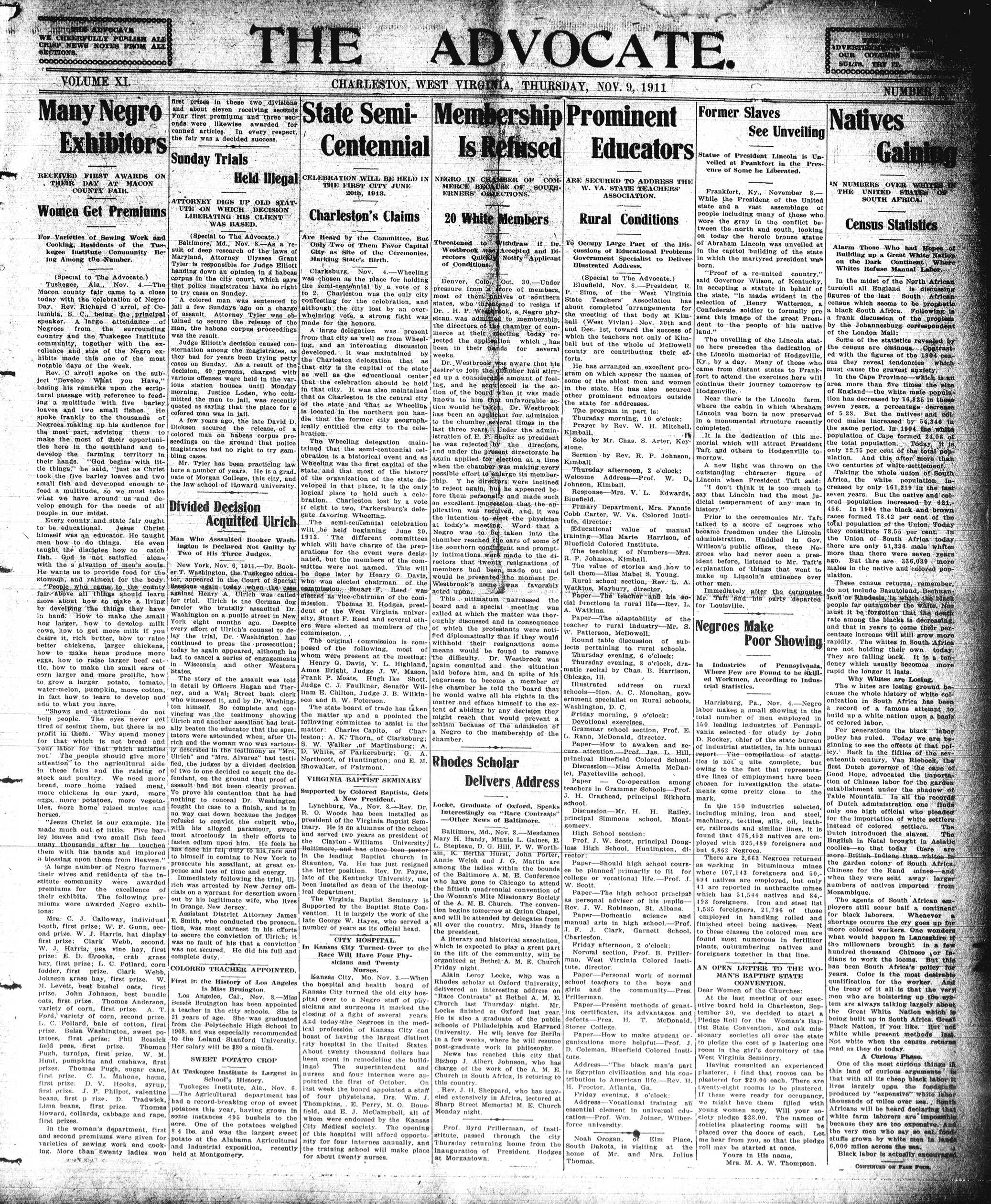
Many Negro Exhibitors
RECEIVED FIRST AWARDS ON THEIR DAY AT MACON COUNTY FAIR.
For Varieties of Sewing Work and Cooking, Residents of the Tuskegee Institute Community Being Among the Number.
(Special to The Advocate.)
Tuskegee, Ala., Nov. 4.—The Macon county fair came to a close today with the celebration of Negro Day. Rev. Richard C arrol, of Columbia, S. C., being the principal speaker. A large attendance of Negroes from the surrounding country and the Tuskegee Institute community, together with the excellence and size of the Negro exhibits made this one of the most notable days of the week.
Rev. C arroll spoke on the subject "Develop What you Have," basing his remarks upon the scriptural passage with reference to feeding a multitude with five barley loaves and two small fishes. He spoke frankly to the thousands of Negroes making up his audience for the most part, advising them to make the most of their opportunities here in the southland and to develop the farming territory in their hands. "God begins with little things," he said, "just as Christ took the five barley loaves and two small fish and developed enough to feed a multitude, so we must take what we have around us and develop enough for the needs of all people in our midst.
Every county and state fair ought to be educational. Jesus Christ himself was an educator. He taught men how to do things. He even taught the disciples how to catch fish. God is not satisfied alone with the s salvation of men's souls. He wants us to provide food for the stomach, and aliment for the body. "People who came to the county fair above all things should learn more about how to make a living by developing the things they have in hand. How to make the small hog larger, how to develop milk cows, how to get more milk if you desire it, rich butter, how to raise better chickens, larger chickens, how to make hens produce more eggs, how to raise larger beef cattle, how to make the small ears of corn larger and more prolific, how to grow a larger potato, tomato, water-melon, pumpkin, more cotton, in fact how to learn to develop and add to what you have.
"Shows and attractions do not help people. The eyes never get tired of seeing them, but there is no profit in them. Why spend money for that which is not bread and your labor for that which satisfies not." The people should give more attention to the agricultural side in these fairs and the raising of stock and poultry. We need more bread, more home raised meat, more chickens in our yard, more eggs, more potatoes, more vegetables, more home raised mules and horses.
"Jesus Christ is our example. He made much out of little. Five barley loaves and two small fish feed many thousands after he touched them with his hands and implored a blessing upon them from Heaven."
A large number of Negro farmers their wives and residents of the institute community were awarded premiums for the excellence of their exhibits. The following premiums were awarded Negro exhibitions:
Mrs. C. J. Calloway, individual booth, first prize; W. F. Gunn, second prize. W. J. Harris, hat display first prize; Clark Webb, second. W. J. Harris, pea vine hay, first prize; E. D. Brooks, crab grass hay, first prize; L. C. Pollard, corn fodder, first prize; Clark Webb, Johnson grass hay, first prize. W. M. Levett, best bushel oats, first prize. John Johnson, best bundle oats, first prize. Thomas Anderson, variety of corn, first prize. A. T. Ford, variety of corn, second prize. L. C. Pollard, bale of cotton, first prize. Belza Washington, sweet potatoes, first prize; Phil Bessick field peas, first prize. Thomas Pugh, turnips, first prize. W. M. Hunt, pumpkins and cushaws, first prizes. Thomas Pugh, sugar cane, first prize. C. L. Mahone, hams, first prize. D. V. Hooks, syrup, first prize. J. P. Philpot, valentine beans, first p prize. D. Tradwick, Limba beans, first prize. Thomas Howard, collards, cabbage and rape, first prizes.
In the woman's department, first and second premiums were given for varieties of sewing work and cooking. More than twenty ladies won
THE
first prizes in these two divisions and about eleven receiving seconds Four first premiums and three seconds were likewise awarded for canned articles. In every respect, the fair was a decided success.
ATTORNEY DIGS UP OLD STATUTE ON WHICH DECISION LIBERATING HIS CLIENT WAS BASED.
(Special to The Advocate.)
Baltimore, Md., Nov. 8.—As a result of deep research of the laws of Maryland, Attorney Ulysses Grant Tyler is responsible for Judge Elliott handing down an opinion in a habeas corpus in the city court, which says that police magistrates have no right to try cases on Sunday.
A colored man was sentenced to jail a few Sundays ago on a charge of assault. Attorney Tyler was obtained to secure the release of the man, the habeas corpus proceedings was the result.
Judge Elliott's decision caused consternation among the magistrates, as they had for years been trying petty cases on Sunday. As a result of the decision, 60 persons, charged with various offenses were held in the various station houses until Monday morning. Justice Loden, who committed the man to jail, was recently quoted as saying that the place for a cofed man was in fail.
A few years ago, the late David D. Dickson secured the release, of a colored man on habeas corpus proceedings on the ground that police magistrates had no right to try gambling cases.
Mr. Tyler has been practicing law here a number of years. He is a graduate of Morgan College, this city, and the law school of Howard university.
Divided Decision Acquitted Ulrich
Man Who Assaulted Booker Washington is Declared Not Guilty by Two of His Three Judges.
New York, Nov. 6, 1911.—Dr. Booker T. Washington, the Tuskegee educator, appeared in the Court of Special Bessions again today when the cage against Henry A. Ullrich was called for trial. Ullrich is the German dog fancier who brutally assaulted Dr. Washington on a public street in New York eight months ago. Despite every effort of Ullrich's counsel to delay the trial, Dr. Washington has continued to press the prosecution; today he again appeared, although he had to cancel a series of engagements in Wisconsin and other Western States.
The story of the assault was told in detail by Officers Hagan and Tierney, and a Wal] Street bank clerk who witnessed it, and by Dr. Washington himself. So complete and convincing was the testimony showing Ulrich and another assailant had brutally beaten the educator that the spectators were astounded when, after Ulrich and the woman who was variously described in the testimony as "Mrs. Ulrich" and "Mrs. Alvarez" had testified, the judges by a divided decision of two to one decided to acquit the defendant, on the ground that proof of assault had not been clearly proven. To prove his contention that he had nothing to conceal Dr. Washington fought the case to a finish, and is in no way cast down because the judges refused to convict the culprit who, with his alleged paramour, swore most atrociously in their efforts to fasten odium upon him. He feels he has done his full duty to his race and to himself in coming to New York to prosecute his assailant, at great expense and loss of time and energy.
Immediately following the trial, Ulrich was arrested by New Jersey officials on a warrant for desertion sworn out by his legitimate wife, who lives in Orange, New Jersey. Assistant District Attorney James E. Smith, who conducted the prosecution, was most earnest in his efforts to secure the conviction of Ulrich; it was no fault of his that a conviction was not secured. He did his full and complete duty.
COLORED TEACHER APPOINTED.
First in the History of Los Angeles Is Miss Brutington.
Los Angeles, Cal., Nov. 8.—Miss Bessie Brulington has been appointed a teacher in the city schools. She is 21 years of age. She was graduated from the Polytechnic High School in 1908, and was especially recommended to the Le兰 Stanford University. Her salary will be $80 a month.
SWEET POTATO CROP
At Tuskogee Institute is Largest in School's History.
Tuskegee Institute, Ala., Nov. 6.
The Agricultural department has had a record-breaking crop of sweet potatoes this year, having grown in some instances 495 bushels to the acre. One of the potatoes weighed 8.4 lbs. and was the largest sweet potato at the Alabama Agricultural and Industrial exposition, recently held at Montgomery.
Sunday Trials
CHARLESTON, WEST VIRGINIA, THURSDAY, NOV. 9, 1911
State Semi Centennial
CELEBRATION WILL BE HELD IN THE FIRST CITY JUNE 20th, 1013.
Charleston's Claims
Are Heard by the Committee, But Only Two of Them Favor Capital City as Site of the Cerconies, Marking State's Birth.
Clarksville, Nov. 4. — Wheeling was chosen as the place for holding the semi-centennial by a vote of 8 to 2. Charleston was the only city contesting for the celebration, and although the city lost by an overwhelming vote, a strong fight was made for the honors.
A large delegation was present from that city as well as from Wheeling, and an interesting discussion developed. It was maintained by the Charleston delegation that as that city is the capital of the state as well as the educational center that the celebration should be held in that city. It was also maintained that as Charleston is the central city of the state and that as Wheeling is located in the northern pan handle that the former city geographically entitled the city to the celebration.
The Wheeling delegation maintained that the semi-continental celebration is a historical event and as Wheeling was the first capital of the state and that most of the history of the organization of the state developed in that place, it is the only logical place to hold such a celebration. Charleston lost by a vote if eight to two, Parkersburg's delegate favoring Wheeling.
The semi-centennial celebration will be held beginning June 20, 1913. The different committees which will have charge of the preparations for the event were designated, but the members of the committee were not named. This will be done later by Henry G. Davis, who was elected chairman of the commission. Stuart F. Reed was elected as vice-chairman of the commission. Thomas E. Hodges, president of the West Virginia university, Stuart F. Reed and several others were elected as members of the commission.
The original commission is composed of the following, most of whom were present at the meeting: Henry G. Davis, V. L. Highland, Amos Eright, Judge J. W. Mason, Frank P. Moats, Hugh Ike Shott, Judge C. J. Faulkner, Senator William E. Chilton, Judge J. B. Wilkinson and B. W. Peterson.
The state board of trade has taken the matter up and a pointed the following committee to assist in the matter: Charles Capito, of Charleston; A. K. Thorn, of Clarksburg; S. W. Walker, of Martinsburg; A. D. White, of Parkersburg; G. A. Northcott, of Huntington; and E. M. Showalter, of Fairmont.
VIRGINIA BAPTIST SEMINARY
Supported by Colored Baptists, Gets A New President.
Lynchburg, Va., Nov. 8.—Rev. Dr. R. O. Woods has been installed as president of the Virginia Baptist Seminary. He is an alumnus of the school and served two years as president of the Clayton-Williams University, Baltimore, and has since been pastor in the leading Baptist church in Staunton, Va. He has just resigned the latter position. Rev. Dr. Payne, late of the Kentucky University, has been installed as dean of the theological department.
The Virginia Baptist Seminary is Supported by the Baptist State Convention. It is largely the work of the late George W. Hayes, who served a number of years as its official head.
CITY HOSPITAL
Kansas City, Mo. Nov. 3.—When the hospital and health board of Kansas City turned the old city hospital over to a Negro staff of physicians and surgeons it marked the closing of a fight of several years. And today the Negroes in the medical profession of Kansas City can boast of having the largest distinct city hospital in the United States. About twenty thousand dollars has been spent in remodeling the building. The superintendent and nurses and four interns were appointed the first of October. On last week the board appointed a staff of four physicians, Drs. Wm. J. Thompson, E. Perry, M. O. Bousfield, and E. J. McCampbell, all of whom were endorsed by the Kansas City Medical society. The opening of this hospital will afford opportunity for four internes annually, and the training school will make place for about twenty nurses.
ADVOCATE.
NEGRO IN CHAMBER OF COMMERCE BECAUSE OF SOUTHERNERS' OBJECTIONS.
Threatened to Withdraw if Dr. Westbrook was Accepted and Directors Quickly Notify Applicant of Conditions.
Denver, Colo., Oct. 30.—Under pressure from a score of members, most of them aviates of southern states, who threatened to resign if Dr. H. P. Westbrook, a Negro physician was admitted to membership, the directors of the chamber of commerce at their meeting today rejected the application which has been in their hands for several weeks.
Dr. Westbrook was aware that his desire to join the chamber had stirred up a considerable amount of feeling, and he acquiesced in the action of the board when it was made known to him that unfavorable action would be taken. Dr. Westbrook has been an applicant for admission to the chamber several times in the last three years. Under the administration of E. F. Sholtz as president he was rejected by the directors, and under the present directorate he again applied for election at a time when the chamber was making every possible effort to enlarge its membership. T he directors were inclined to reject again, but he appeared before them personally and made such an excellent impression that the application was received, and it was the intention to elect the physician at the meeting. Word that a Negro was to be taken into the chamber reached the ears of some of the southern contingent and promptly intimations were made to the directors that twenty resignations of members had been made out and would be presented the moment Dr. Westbrook's name was favorably acted upon.
This ultimatum narrassed the board and a special meeting was called at which the matter was thoroughly discussed and in consequence of which the protestants were notified diplomatically that if they would withhold their resignations some means would be found to remove the difficulty. Dr. Westbrook was again consulted and the situation laid before him, and in spite of his eagerness to become a member of the chamber he told the board that he would waive all his rights in the matter and offace himself to the extent of abiding by any decision they might reach that would prevent a schism because of the admission of a Negro to the membership of the chamber.
Rhodes Scholar
Locke, Graduate of Oxford, Speaks Interestingly on "Race Contrasts" —Other News of Baltimore.
Baltimore, Md., Nov. 3. —Mesdames Mary H. Handy, Minnie L. Gaines, E. L. Stepteau, D. G. Hill, P. W. Wortham, K. Bertha Hurst, Porter, Annie Welsh and J. G. Martin are among the ladies within the bounds of the Baltimore A. M. E. Conference who have gone to Chicago to attend the fifthth quadrennial convention of the Woman's Mite Missionary Society of the A. M. E. Church. The convention begins tomorrow at Quinn Chapel, and will be attended by delegates from all over the country. Mrs. Handy is the president.
A literary and historical association, which is expected to play a great part in the lift of the community, will be organized at Bethel: A. M. E. Church Friday night.
Alain Leroy Locke, who was a Rhodes scholar at Oxford University, delivered an interesting address on "Race Contrasts" at Bethel A. M. E. Church last Thursday night. Mr. Locke finished at Oxford last year. He is also a graduate of the public schools of Philadelphia and Harvard University. He will leave for Berlin in a few weeks, where he will resume post-graduate work in philosophy. News has reached this city that Bishop J. Albert Johnson, who has charge of the work of the A. M. E. Church in South Africa, is returning to this country. Rev. J. H. Sheppard, who has traveled extensively in Africa, lectured at Sharp Street Memorial M. E. Church Monday night.
Prof. Byrd Prillerman, of Institute, passed through the city Thursday returning home from the inauguration of President. Hodges at Morgantown.
Prominent Educators
ARE SECURED TO ADDRESS THE W. VA. STATE TEACHERS' ASSOCIATION.
Rural Conditions
To Occupy Large Part of the Discussions of Educational Problems Government Specialist to Deliver Illustrated Address.
(Special to The Advocate.)
Bluefield, Nov. S.—President R. P. Sims, of the West Virginia State Teachers' Association has about completed arrangements for the meeting of that body at Kimball (West Vivian) Nov. 30th and Dec. 1st, toward the success of which the teachers not only of Kimball but of the whole of McDowell county are contributing their efforts.
He has arranged an excellent program on which appear the names of some of the ablest men and women in the state. He has also secured other prominent educators outside the state for addresses.
The program in part is:
Thursday morning, 10 o'clock:
Prayer by Rev. W. H. Mitchell,
Kimball.
Solo by Mr. Chas. S. Arter, Keystone.
Sermon by Rev. R. P. Johnson, Kimball
Thursday afternoon, 2 o'clock;
Welcome Address—Prof. W. D.
Johnson, Kimball.
Response—Mrs. V. L. Edwards,
Bluefield.
Primary Department, Mrs. Fannie
Cobb Carter, W. Va. Colored Institute,
director:
Educational value of manual training—Miss Marte Harrison, of Bluefield Colored Institute.
The teaching of Numbers—Mrs.
R. P. Johnson, Kimball.
The value of stories and how to tell them—Miss Mabel S. Young.
Rural school section, Rev. L. A. Watkins, Maybury, director.
Paper—the teacher and his social functions in rural life—Rev. L. A. Watkins.
Round table discussion of subjects pertaining to rural schools. Thursday evening, 6 o'clock:
Thursday evening, 8 o'clock, dramatic recital by Chas. B. Harrison, Chicago, Ill.
Illustrated address on rural schools—Hon. A. C. Monohan, government specialist on Rural schools, Washington, D. C.
Friday morning, 9 o'clock:
Devotional exercises.
Grammar school section, Prof. E. L. Rann, McDonald, director.
Paper—How to awaken and secure attention—Prof. Jas. L. Hill, principal Bluefield Colored School.
Discussion—Miss Amelia McDaniel, Fayetteville school.
Paper — Co-operation among teachers in Grammar Schools—Prof. J. H. Craghead, principal Elkhorn school.
Discussion—Mr. H. H. Railey, principal Simmons school, Montgomery.
High School section:
Prof. J. W. Scott, principal Douglass High School, Huntington, director:
Paper—Should high school courses be planned primarily to fit for college or vocational life.—Prof. J. W. Scott.
Paper—The high school principal as personal adviser of his pupils—Rev. J. W. Robinson, St. Albans.
Paper—Domestic science and manual arts in high school.—Prof. J. F. J. Clark, Garnett School, Charleston.
Friday afternoon, 2 o'clock:
Normal section, Prof. B. Prillerman, West Virginia Colored Institute, director.
Paper—Personal work of normal school teachers to the boys and girls and the community—Pres. Prillerman.
Paper—Present methods of granting certificates, its advantages and defects—Pres. H. T. McDonald. Storer College.
Paper—How to make student organizations more helpful—Prof. J. D. Coleman, Bluefield Colored Institute.
Address—"The black man's part in Egyptian civilization and his contribution to American life." Rev. H. H. Proctor, Atlanta, Ga.
Friday evening, 8 o'clock:
Address—Vocational training an essential element in universal education—Prof. Wm. Joiner, Wilberforce university.
Noah Orogan, of Elm Place, South Dakota, is visiting at the home of Mr. and Mrs. Julius Thomas.
Statue of President Lincoln is Unveiled at Frankfort in the Presence of Some he Liberated.
Frankfort, Ky., November 8.—While the President of the United state and a vast assemblage of people including many of those who wore the gray in the conflict between the north and south, looking on today the heroic bronze statue of Abraham Lincoln was unveiled at in the capitol building of the state in which the martyred president was born.
"Proof of a re-united country," said Governor Wilson, of Kentucky, in accepting a statute in behalf of the state, "is made evident in the selection of Henry Watterson, a Confederate soldier to formally present this image of the great President to the people of his native land."
The unveiling of the Lincoln statue here precedes the dedication of the Lincoln memorial of Hodgeville, Ky., by a day. Many of those who came from distant states to Frankfort to attend the exercises here will continue their journey tomorrow to Hodgeville.
Near there is the Lincoln farm, where the cabin in which Abraham Lincoln was born is now preserved in a monumental structure recently completed.
It is the dedication of this memorial which will attract President Taft and others to Hodgeville tomorrow.
A new light was thrown on the outstanding character figure of Lincoln when President Taft said: "I don't think it is too much to say that Lincoln had the most judicial temperament of any man in history."
Prior to the ceremonies Mr. Taft talked to a score of negroes who became freedmen under the Lincoln administration. Huddled in Gov. Willison's public offices, these Negroes who had never seen a president before, listened to Mr. Taft's explanation of things that went to make up Lincoln's eminence over other men.
Immediately after the ceremonies Mr. Taft and his party departed for Louisville.
Negroes Make Poor Showing
In Industries of Pennsylvania,
Where Few are Found to be Skilled
Workmen, According to Industrial
Statistics.
Harrisburg, Pa., Nov. 4.—Negro
labor makes a small showing in the
total number of men employed in
150 leading industries of Pennsylvania
selected for study by John
D. Rockey, chief of the state bureau
of industrial statistics, in his annual
report. The compilation of statistics
is not quite complete, but
owing to the fact that representative
lines of employment have been
chosen for investigation the statements
come pretty close to the mark.
In the 150 industries selected, including mining, iron and steel, machinery, textiles, silk, oil, leather, railroads and similar lines, it is found that 475,453 natives are employed with 325,489 foreigners and but 6,862 Negroes.
There are 2,663 Negroes returned as working in bituminous mines where 107,143 foreigners and 50,-694 natives are employed, but only 41 are reported in anthracite mines which has 51,544 natives and 84,-493 foreigners. Iron and steel list 1,535 foreigners, 21,796 of those employed in handling rolled and finished steel being natives. Next to these classes the colored men are found most numerous in fertilizer plants, outnumbering natives and foreigners together in that line.
At the last meeting of our executive board held in Charleston, September 30, we decided to start a Pledge Roll for the Woman's Baptist State Convention, and ask missionary societies all over the state to pledge the cost of p lastering one room in the girl's dormitory of the West Virginia Seminary.
Having consulted an experienced plasterer, I find that rooms can be plastered for $29.00 each. There are twenty-eight rooms to be plastered. If these were ready for occupancy, we might have them filled with young women now. Will your society pledge $28.00. The names of societies plastering rooms will be placed over the doors of each. Let me hear from you, so that the pledge roll may be started at once.
Yours in His name,
Mrs. M. A. W. Thompson.
IN NUMBERS OVER WHITES
THE UNITED STATES OF
SOUTH AFRICA.
Census Statistics
Alarm Those Who had Hopes of Building up a Great White Nation on the Dark Continent Where Whites Refuse Manual Labor.
In the midst of the North African turmoll all England is discussing figures of the last South African census which seems to be prophetic a black South Africa. Following is a frank discussion of the problem by the Johannesburg correspondent of the London Mall:
Some of the statistics revealed by the census are omnious. Contrasted with the figures of the 1894 census they reveal tendencies which must cause the gravest anxiety.
In the Cape Province—which is an area more than five times the size of England—the white male population has decreased by 16,825 in these seven years, a percentage decrease of 5.28. But the natives and colored maies increased by 54,346 in the same period. In 1904 the white population of Cape formed 24.06 of the total population. Today it is only 22.75 per cent of the total population. And this after more than two centuries of white settlement.
Taking the whole union of South Africa, the white population increased by only 161,219 in the last seven years. But the native and colored population increased by 821,456. In 1904 the black and brown races formed 78.42 per cent of the total population of the Union. Today they constitute 78.55 per cent. In the Union of South Africa today there are only 51,336 male whites more than there were seven years ago. But there are 336,039 more males in the native and colored population.
These census returns, remember, do not include Basutoland, Bechmanland or Rhodesia, in which the black people far outnumber the white. Now must it be forgotten that the death rate among the blacks is decreasing, and that in years to come their percentage increase will still grow more rapidly. The whites in South Africa are not holding their own today. They are falling back. It is a tendency which usually becomes more rapid the longer it lasts.
Why Whites are Losing.
The w hites are losing ground because the whole history of white colonization in South Africa has been a record of a famous attempt to build up a white nation upon a basis of colored labor.
For generations the black labor policy has ruled. Today we are beginning to see the effects of that policy. Back in the fifties of the seventeenth century, Van Riebeck, the first Dutch governor of the cape of Good Hope, advocated the importation of Chinese labor for the garden establishment under the shadow of Table Mountain. In all the records of Dutch administration one finds only one high official who pleaded for the importation of white settlers instead of colored settlers. The Dutch introduced the slaves. The English in Natal brought in Asiatic coolies—so that today there are more British Indians than whites in the garden colony of South Africa. Chinese for the Rand mines—and when they were sent away larger numbers of natives imported from Mozambique.
The agents of South African employers still scour half a continent for black laborers. Whenever a shortage occurs the cry goes up for more colored workers. One wonder what would happen in Lancashire if the millowners brought in a few hundred thousand Chinese or Indians to work the looms. But this has been South Africa's policy for years. Color is the most desirable qualification for the worker. And the irony of it all is that the very men who are bolstering up the system are always talking largely about the Great White Nation which is being built up in South Africa. Great Black Nation, if you like. But not white while present methods last. Not white when the census returns read as they do today.
A Curious Phase.
One of the most curious things in this land of curious arguments is that with all its cheap black labor it lives largely upon the foodstuffs produced by "expensive" white labor thousands of miles over sea. South Africans will be heard declaring that white farm laborers are 'impossible because they are too expensive. And the very men who say so eat food stuffs grown by white men in lands 6,000 miles across the sea. Black labor is actually encouraged
CONTINUED ON FACE FOUR.
THURSDAY, NOVEMBER 9, 1911
CORRESPONDENCE
---
The Parents' Club met at Mt. Zion Baptist Church, Sunday afternoon. A large number were in attendance and a splendid meeting was held. The Carnation Club gave a very delightful entertainment. Friday evening, at Trinity M. E. Church. A large number attended. Ms. Giayee Biglow, Missos Stella Cambris, Mamie Johnson, Ann Polndowker, Hannah Meade, Margaret Meade, and Mrs. Annie Meade attended the funeral of Mrs. Bessie Meade, at Fairmont, Thursday. Many friends here were greatly packed to learn of Mrs. Meade's death. Mrs. Jus, Beckwith, Mrs. James Booker and Mrs. William Wilkinson were called to Fairmont by the death of Mrs. Bessie Meade. M. T. Obie was here last week.
Mr. and Mrs. Wm. Woodard, of Atlantic City, are visiting the latters mother, Mrs. Mosebay, Mrs. Mosebay will return with her daughter for permanent residence in Atlantic City. Mrs. Stella White, of baltimore, and Mrs. Amanda Freeman, of Washington, D.C. have returned to their respective homes after a pleasant visit here with Mrs. Amie Freeman. Mr. and Mrs. Herbert Russell entertained a number of friends, Wednesday evening. Miss Gaynelle Dyer, who has been visiting here for some time left, Sunday tor Chicago. Miss Dyer made many friends while here. A merry party of friends accompanied her to the station. Ashby Grayson, who has been traveling with a wild west show, has returned home for the winter.
The many friends of Mrs. Lily Boston Mallard, of Baltimore, were pained to hear of her serious illness. Her grandmother, Mrs. Annie Freeman, has received information that she is critically ill with typhoid fever. Mrs. Dale Dean and Mrs. Nellie Ogden were Bridgeport visitors, Sunday.
SMITHERS AND LONGACRE.
Rev. B. A. Brooks has closed his revival meeting with seven converts and seven reclaimed.
The Executive Board of the 7th District Sunday School Union, was held with the Longacre First Baptist Church, Saturday
Rev. J. J. Turner, of Mt. Carbon, J. W. Cain, of Vanetta and Andie Eans, of Ward, were entertained at dinner at the home of Mr. and Mrs. B. B. Dautton, Saturday
Mr and Mrs. H. J. James, were visiting in Montgomery, Sunday. Miss Dora Smith was visiting friends at Cedar Grove, Sunday.
W. M. Wicks was visiting his parents here, Sunday.
Mrs. A. Kinney, of Camelton, was visiting her sister, Mrs. Rodges, here Sunday.
P. E. Payne was calling on friends here, Sunday.
Watt Smith left for Fayetteville, Friday, to visit his mother.
Mrs. J. A. Keyton and W. M. Wird are very sick.
Miss Edith Wood and Mrs. Flossie Scott visited Lewisburg, Saturday.
A. P. Straughter, of Hinton, was a business visitor here last week.
Mrs. Maggie Eubanks, who has been sick for the past two weeks, is slowly improving.
Elmore, son of Mr. and Mrs. G. B. Cousins, is sick with fever.
Roy Jackson, of Remick, was a visitor here last week.
J. B. Williams, of Lewisburg, has been spending the past week here, visiting friends.
Phillip Smith, who has had a slight attack of fever for the past week is much improved.
Jas. Morton was a business visitor at Lewisburg, Monday.
Miss Loda Johnson, of Frankford, was the guest of her sister, Mrs. D. R. Hickman, last Saturday.
Mrs. Amie Riddle visited relatives at Ft. Springs, last week.
Sam Johnson was a visitor here, Sunday.
Miss Effelda Jackson died last Monday evening at 7:30 p. m., at the residence of Mrs. Fannie Smith, after a short illness of ten days. Miss Jackson was in her 21st year, and was commencing her second term as teacher of Maple Grove school. She is survived by her father and mother, two sisters, one brother and a host of friends. The remains were shipped to Canton, Ohio, her home. Tuesday night for interment.
The little fourteen months old daughter of Mr. and Mrs. Robert Liggons died Sunday afternoon after an illness of four weeks. The funeral service was conducted by Rev. C. E. Page, of Montgomery. The colored undertaker, Mr. Monley, was in charge.
Rev. I. V. Bryant, of Huntington, preached last Tuesday night.
Mr. and Mrs. T. W. Wade, Mrs. James, Mrs. Emma Teague, Luther Brown, Mrs. Laura-Ricland, D. S. and Sand Saunders attended the Baptizing, at Montgomery, Sunday.
Miss B. Holmes spent the week end with Mrs. Emma Teague.
Miss Nellie Hayden is out again after a short illness.
Pres. Byrd Prillerman, of Institute, was a visitor here for the inaugural exercises of the West Virginia Univer
CLARKSBURG
RONCEVERTE
MORGANTOWN.
sity. While here he was the guest of J. H. Huitt.
Mrs. Belle Banks, of Clarksburg, is here visiting her sister, Mrs. Ettru Anderson.
Miss Beulah Smith left Wednesday morning for Baltimore, Md., where she will make her home with Mrs. Harry Cummings, and attend Morgan College.
J. Adams, of Charleston, is a visitor here.
Mrs. Jennie Pierce, of Parkersburg, is here visiting her mother, Mrs. Watkins.
Mrs. Rosa Holland gave a party in honor of Mrs. Jennie Pierce. Those present were: Mrs. J. J. Gibbons, Edna Brown, Mrs. Watkins, Mrs. Edwards, Misses Claudia Watkins, Bertha and Julia Dixon, Frances Morton, Messrs. Alphonse Nichols, Gabriel Holland, Jr., Dr. McDaniels, Rev. Gibbons.
The Jolly Masqueraders gave a dance Hallowe'en at Hunt's Hall.
Welcome Address..... Rev. A. J. Payne
Duet..... Mrs. Jennie Payne, Mrs.
Anna Coles.
Address..... Mr. Mallie Coles.
Solo..... Mis Alberta Rhodes.
aper..... Miss Lillian Henshaw.
Duet..... Miss Scott, Mrs. Rhodes.
Closing Remarks..... Mrs. Rhodes.
Floyd Foulks celebrated his 20th
birthday at the home of Mrs. Belle
Ellis. Those present were: Misses
Ardella, Lottie and Katie Richardson,
Marion and Lillian Henshaw, Julia
Dixon, Alberta and Emma Ellis: Lee
Wade, Raymond Slaughter, Hardly
Parker, J. Adams.
Blair Dabney spent Sunday at Clarksburg.
T. A. Brown left last week for Middle Fork where he has employment.
Miss Susie Jones was the guest of Mr. and Mrs. Chas. Dickerson at Clarksburg, the latter part of the week.
Mr. and Mrs. J. W. Mumford entertained the Silver Leaf Club Friday evening.
Miss Eva Simms, who was seriously ill last week is able to be out again.
Miss Ella Wilkerson, of Overhill, was in town last week.
Born to Mr. and Mrs. Jerry Lewis, a daughter.
The Ladies' Aid of Simpson M. E. church met with Mrs. Georgiana Wright Friday night. Mrs. Myrtle Lewis and children have returned from a visit with relative at Sutton. The Mite Missionary Society of Hall's Chapel A. M. E. church met Sunday afternoon at the church. Rev. A. J. Smoot returned from conference Monday. He will leave shortly for Bluefield to take charge of the church there.
Rev. S. E. Williams was in Parkersburg Sunday.
Stuart Harvey passed quietly away Friday night at the ripe old age of seventy-one. He had been a sufferer for eight days with hemorrhage of the brain. The funeral services were conducted by Rev. J. J. Turner at the Mt. Hope Baptist church Monday afternoon. The deceased spent more than 30 years of his life in Fayette county as a good citizen.
John W. Harris, or Lancaster, O., an old citizen of this town who has been in Ohio for twelve years, was here to attend his step-father's funeral.
New Pastor at St. Paul.—To succeed Rev. R. R. Downs, who was appointed presiding elder for this district, Rev. E. Fort, late of Cleveland, O., has been assigned to St. Paul A. M. E. church. He announces for the services Sunday, preaching at 11:00 a.m. subject, "True Discipleship" and at 8:00 p.m. "The Willing Mind." Union services will be held at 3 in the afternoon. This being his first Sunday he is desirous of seeing all the members and friends of the church present.
Team Goes to Kentucky.—The foot ball team of the West Virginia Colorea Institute, fourteen strong leaves today for Frankfort, Ky., where they will play the Kentucky Normal and Industrial Institute Friday. They will be accompanied by W. H. Lowry, commandant of cadets, manager; C. E. Mitchell, business manager of the institution; and Dr. J. H. Brown, of this city coach.
Registered at Hotel Brown.
The new arrivals at Hotel Brown
the week are: J. W. Lee, Ray-
mond City, J. H. Barrett, Hans-
ford; Bert Mitchell, Wintrie-
d J. H. King, Cedar Grove, Rev. J. W.
Hobinson, St. Albans; R. H. Miller,
Warm Springs, Va.; Rev. W. W.
Smith, R. W. Sneed, F. Dawson,
Page; Mr. and Mrs. Williams Micke-
nks, Plymouth; Mr. and Mrs. S.
Green, Ethel; Mr. and Mrs. J. E.
Johnson, L. longacre, Rev. and Mrs
E. W. L. Curry, Urbana, O.; Mr.
and Mrs. Joffin Harris, Gassaway.
BUCKHANNON.
MT. CARBON
Charleston
CHARLESTON
A. Ayres, Uniontown, Pa.; Mr. and Mrs. R. D. Woolfolk, Hoc Springs, Va.; Miss Beulah Williams, White Sulphur Springs Key. E. Fort, Cleveland, O.; B. Ballard, Berea, Ky.; J. H. Harris, Lancaster, Ohio. Majestic Theatre to Re-open. The inclined floor has been put in and other changes are being made as rapidly as possible at the Virginia Hotel where the Majestic theatre will open next week. Until an extension can be added to the building, a accommodations will be provided for about 100 only and the attraction will be limited to moving pictures. It is the intention of the management to build an extension for a vaudeville stage and, at the same time, greatly increase the seating capacity of the room. The work will begin as soon as the temporary arrangement are completed.
Object to Time for Unvcling. By a vote almost unanimous Capital City Lodge No. 1, Knights of Pythias, adopted resolutions requesting that the unveiling of the Starks monument be postponed until next spring when more favorable weather may be expected than on the 20th of this month. This action was taken at their meeting Thursday night of last week. Similar steps were taken by West Virginia lodge No. 60, the other local Pythian organization, at its meeting Tuesday night. The movement for postponement of the ceremony is in response to a general demand, all who have had anything to say on the subject being of the opinion that the occasion means too much to the Negro people of the state to take unreasonable chances on the weather.
Personals and Locals.
J. A. Jackson has about recovered from his recent illness and was able to resume his duties at the state library Monday.
Nicholas Walton was called to Kimberly Monday, to attend the funeral of his brother.
Rev. E. W. B. Curry, of Urbana, O., is conducting the revival services at the First Baptist church and is meeting with much success.
Mrs. F. W. Bryant left Wednesday to visit her parents in Ironton, O.
Miss Nannie Thompson, of Richmond, Va., was the guest of Mrs. Will Hamponds, of Donally street, last week.
Miss. Susan Wade is seriously ill at her home on Washington street Miss Amy Hutchinson was unable to reach the latter part of last week because of a sprained wrist. Dr. Andrew Brown returned Sunday from Detroit, Mich., where he spent the Summer. Alice Smith has returned to the city after an extended stay in Pittsburg, Pa. The improvement League will be entertained Friday by Miss Estella Green
Mr. and Mrs. Wan. Stuart left Thursday of last week for Norfolk, Virginia.
Mrs. Harry Glenn has been ill at her home on Elmwood avenue.
E. R. Starks was called to Columbus, O. because of the illness of his sister.
The junior class of the G. H. S. was entertained Monday evening by Miss Emma Wade at her home on Fiedmont street.
Miss Emma Dorsey, of institute, was shopping in town Tuesday.
Mrs. Eugene Gough has been ill at her home on the South Side.
HARPERS FERRY
On the 30th the young ladies of Storer College gave a Halloween party to which five cents admission was charged. Cocoa and cookies were served free. The reception hall was decorated with the harvest vegetables, autumn foliage, old gold, orange, black and green crepe paper. The young ladies appeared as many fairies, tripping about in their gay colored Halloween costumes.
Mr. Monohon from the Bureau of Education in Washington, D. C. spoke on Rural Education. It was very instructive.
The game with "M" Street was postponed on Saturday.
Madam Berdice Byle's musical entertainment and Rev. Mr. Sail's Lecture on "Gibberia" that were to be given this week, Monday and Tuesday evenings, have been postponed. Armstrong High School, of Washington, D.C., comes to Harper's Ferry for a foot ball game with Storer on Saturday, 11th. The College Choir, under the direction of Miss Horton, music teacher, is planning a reception and supper for the visiting team. The proceeds of the entertainments are to be used in procuring music and vestments for the choir.
POSTAL SAVINGS BANK.
Is Opened at Tuskegee Institute, the
First of the Kind in the Country
Tuskegee, Ala., Nov. 8.—A postal
savings bank was opened at the
Tuskegee Institute postoffice Monday.
Quite a number of teachers
and students werg among the first
depositors. The bank is the first to
be opened in this country at a post-
office run by the race.
THE ADVOCATE
W. Va. Annual Conference
OF THE A. M. E. CHURCH HOLDS INTERESTING SESSION AT HUNTINGTON.
Will be Rev. Downs, Formerly Pastor of Local Church, who Succeeds Rev. West, Transferred to Chillothe. 0.
---
Huntington, Nov. 6.—Of all the conferences of the African Methodist Episcopal church, the West Virginia annual conference is the youngest, called "The Baby," by no means the least promising. The session was held here from Nov. 1st and closed Sunday night about 11 p.m., Nov. 10th. Bishop W. B. Derrick, presided and conducted its sessions in such a manner that good humor and harmony prevailed throughout. The bishop is a man that the people love to hear, being instructed as well as esteemed, a man of intense self-consciousness, militant and of a culture from travel, association and from the contact with brilliant characters as well as from an early training in the school. Mrs. Derrick was a constant attendant and welcomed by the conference, quite friendly and made herself especially agreeable. Among the visitors were the Rev. J. M. Ross and J. C. Turner, from Ohio, men who are not only students and preachers of the highest life, but examples. Rev. T. J. Askew of the Pittsburgh conference contributed to the enthusiasm of the conference by his songs; Dr. Joshua H. Jones by his eloquence, Dean Woodson by his strong plea for the educated ministry. All of these last are Ohio ministers.
Dr. W. H. H. Butler, the Bishop's private secretary, represented the Missionary department and was very attentive to the brethren because of his candidacy for the position of Secretary of Missions. Rev. S. P. West, the secretary of the conference a man esteemed, well known, useful and intelligent was transferred to the Ohio conference and succeeds Rev. Walker at Chillicothe. Ohio is to be congratulated upon such an accession to its pastoral ranks and West Virginia's regret the unfilled vacancy.
Mrs. Payne, in active, intelligent woman, represented the Publication department and seemed to have considerable patronage. She makes a good agent and the concern will profit thereby; she is also a good singer and advertises her song books by singing selections
Sometimes it appeared in the discussion of positive moral questions, that the standard was lost in the haze and maze of cheap sentiment and a sensual sympathy. This is a characteristic and general fact of most of our public gatherings and declares an unfitting for sitting in judgment. It is all of mercy to offenders and but a fractional justice. Friday night was given to discussion of the Church Extension Department. There is an impression, that the department, instead of proving a good business feature is regarded a crutch for dependents, reenquishing responsibility, vitiating obligations and inculcates a spirit of "give-me"—a spirit of beggary. There is reported an uncollectable sum of over one hundred thousand dollars, loaned to churches to tide them over embarrassments, which do not keep up the interest.
There is a strong demand in the conference and out upon the field for strong, able, heroic, intelligent, young men. The kind wanted are those who pant for the gospel conflict with ignorance and sin, to labor in the wide territory of West Virginia opportunity. The church is going to get them and push forward her mission.
Rev. R. R. Downs succeeds Rev. W. H. Thomas as presiding elder and Rev. Thomas is assigned to Wheeling; Rev. J. E. Jones, of Huntington goes to Bluefield, Rev. T. J. McConnell to Huntington, Rev. B. W. Ford to Parkersburg, Rev. E. J. Farley to Clarksburg, Rev. J. E. Gibbons to Morgantown, Rev. F. L. Brown to Buckhannon and Rev. A. J. Smoot to Thomas and Beverly. In the election of general conference delegates Rev. R. R. Downs leads the delegation with Rev. J. T. Gibbons second. The conference presented the bishop through Dr. West just before adjournment, with a purse of money. The next session, 1912, will be in Clarksburg. The pastoral reports exceed those of last year.
At Indianapolis is Assured, Neces
say Amoret Robles Sight
Saray Amount Being in Sight.
Indianapolis, Ind., Nov. 8.—The residents of this city have nearly raised all of $75,000, which will be necessary to secure $25,000 offered by Julius Rosenwald, of Chicago, toward the erection of a colored Y. M. C. A. Washington, Los Angeles, Atlanta and Philadelphia also boast of similar sums raised for colored Y. M. C. A. buildings.
Gold Filked
Rose Gold Finish
Two Brilliantas
1 Amethyst Doublet
Free to Girls
This fine Ring or Sterling Silver Chased Lock and Key Bracelet for sell only One Dozen Childs Red Cross Salve (at 25c per box). Send no money. We trust you until goods are sold. Your name on a postal will do, and goods will be promptly sent. Write today as you may not see this ad again.
CHILDS & CO.
CRANFORD, - NEW JERSEY
Department A.
Grandfather clause Denounced by Bishops
Of the Methodist Episcopal Church Holding their Semi-Annual Meeting in Oklahoma with Large Attendance.
Oklahoma City, November 1. Twenty-five Methodist Episcopal Bishops are here for the semi-annual meeting of the Bishops which began today. The conference will continue over Sunday. The first session was marked by denunciation of the famous "grand-father clause" in the Oklahoma constitution, which makes it almost impossible for a Negro to vote, by Bishop Harttsell, of Monrovia, Liberia. He also said all Christian nations should pray for success of Italy in its war against Turkey. Bishop Harttsell also told of great progress in work in the Negro state of Liberia.
Foremost churchnen here include W. S. Lewis, in charge of the Methodist church work in China; Bishop J. C. Hartsell, Monrovia, Liberia; Bishop Frank Bristol, formerly President McKinley's pastor in Washington, now in Buenos Ayres; Bishop William Burt, Zurich, Switzerland; Bishop William F. McDowell, just returned from a trip around the world, giving especial attention to conditions in India; Bishop Henry W. W arren, Denver; Bishop J. F. Berry, former editor of the Epworth Herald; Bishop David H. Moore, Cincinnati; Bishop John M. Walden, retrex, of Cincinnati; Bishop Earl Cranston, Washington; Bishop Lurier B. Wilson, just returned from Africa; Bishop Edwin H. Hughes, San Francisco, and Bishop C. W. Smith, of Portland, Ore., for 25 years edition of the Christian Advocate, of Pittsburg.
---
COMING INTO THEIR OWN.
The whites in South Africa are becoming alarmed lest the natives eventually regain control of the country. This does not seem to be such an ominous outlook for the natives, who can not be said to have improved either in material welfare or in morals under white domination.
NEGRO TAKEN FROM OFFICER
For Having Attacked White Man.
Meridian, Miss., Nov. 7—"Judge" Moseley, a negro was taken from Deputy Sheriff Brown near Lockhart this morning by a mob of 400 persons and lynched. The Negro's body was bullet-riddled. Mostly attacked J. H. Covington, white, with a stick at Lockhart vesterly
HOSE WAGON.
Collides With Street Car—One Fireman Killed (Another Badly Hurt. Indianapolis, Ind., November 8. In a collision between a street car and a hose wagon responding to an alarm of fire today Lieutenant Thomas Smith, Negro of the fire department, was killed, and his captain, Thomas Howard, also colored, was seriously injured. Smith, was one of the oldest men in the department was driving and Howard was sitting at his side when the wagon and the car crushed together at the crossing of College Avenue and Sixteenth street. The car passed over Smith's body.
A FATHERS VENGANCE
would have fallen on anyone who attacked the son of Peter Bondy, of South Rockwood, Mich., but he was powerless before attacks of kidney trouble. "Doctors could not help him," he write, "so at last we gave him Electric Bitters and he improves wonderfully from taking six bottles. Its the best kidney medicine I ever saw." Backache, Tired feeling, Nervousness, Loss of Appetite, warm of Kidney trouble that may end in drops, d labietis or Bright's disease. Beware: Take Electric Bitters and be safe. Every bottle guaranteed.
THE BAUER MEAT & FISH CO.
28 AND 30 CAPITOL ST.
Beef, Veal, Mutton, Pork, Fresh Pork Sausage OUR OWN MAKE.
Try our machine sliced Hams and Bacon
OYSTERS, FISH, POULTRY
The best qualities in all the popular kinds of
We want your patronage for we have complete stock in our lines and you an get it when you want more. BLACKS IN REVOLT. In Portuguese Africa Burn and Pil- NEGROES ARE STONED. Winneneg Manitoba New
lage Everything in Their Path.
Lisbon, November 7.—Serious news is received daily from Angola, the Portuguese possession in Western Africa. A revolt among the natives is spreading rapidly, and the blacks are burning and pillaging everything in their path. There is great terror among the settlers, who are abandoning their properties, and, accompanied by their women and children, find refuge in the towns, where, intrenching themselves, they await the attack of the savages.
SAVED MANY FROM DEATH.
W. L. Mock, of Mock, Ark., believes he has saved many lives in his 25 years of experience in the drug business. "What I always like to do," he writes, "is to recommend Dr. King's New Discovery for weak, sore lungs, hard colds, hoarseness, obstinate coughs, la gripe, croup, asthma or other bronchial affection, for I feel sure that a number of my neighbors are alive and well today because they took my advice to use it. I honestly believe its the best throat and lung medicine that's made." Easy to prove he's right. Get a trial bottle free, or regular 50c or $1.00 bottle. Guaranteed by all drugists. 11-2-57
NEGRO IN OFFICE.
Columbus, O., Nov. 7.—L. H. Goodman, the first regro man in the history of the state to become an attache of the attorney general's office, began his duties today. Goodman was former secretary to Federal Judge Sater and is now assistant to the attorney general.
Ten and twenty year combination distribution certificate of membership as devised by the American Workmen Fraternal Insurance Company, of Washington, D.C., one of the most liberal, strongest and reliable fraternal institutions in the field. For further particulars see
D. E. V. JORDAN
D. E. V. JORDAN
General Agent for West Va.
Office: Room 2, E. of P. Bldg
Charleston, W. Va.
100 AGENTS WANTED.
NEGROES ARE STONED.
Winnepeg, Manitoba, November 6.—Conferences between the mine operators and miners, in session all last week at Frank, Alberta, adjourned today because of the threatening attitude of mine workers who object to the importation of Negroes from the United States.
There was incipient rioting today and serious trouble was averted only by the presence of police and provincial constables.
As a number of Negroes from West Virginia jumped from the train the police were on hand to protect them. A crowd followed them down town, throwing stones.
A Negro turned upon his pursuers and opened fire with a revolver. The police stide-stepped and the mob rushed upon the Negro. He was severely beaten. More trouble is anticipated as more strike breakers are arriving.
The government of Saskatchewan has notified the department of labor at Ottawa that it finds the coal shortage in Saskatchewan to be 200.000 tons as the result of the strike. A fuelamine seems inevitable.
SHIRLEY
PRESIDENT
SUSPENDERS
The kind that most men wear. Notice the cord back and the front ends. They slide in frictionless tubes and move as you move. You will quickly see why Shirley President Suspenders are comfortable and economical for the working man or business man.
Light, Medium or Extra Heavy Weights — Extra Lengths for Tall Men.
Price 50 Cents from your local dealer or by mail from the factory.
Signed Guarantee on every pair
THE C. A. EDGARTON MFG. CO.
233 MAIN*STREET, SHIRLEY, MASS.
THURSDAY, NOVEMBER 9, 1911.
At the Nation's Capital
PUBLIC PRINTER DONNALLY SETS DOWN ON COLOR TYRANNY OF LABOR UNIONS.
A Praiseworthy Example of Official Backbone—Colored Woman Will Not Be Hung—Brilliant Outlook for Howard Theatre—New Hotel Planned for Washington—Business League Interest to be Revived.
(Thompson's National News Bureau) part:
Washington, D. C.) "T
Public Printer Donally has shown the labor unions that he is a government official of backbone. He will not permit a private organization to supersede his functions as head of the government printing office. He has been abused and berated unmercifully by the Bricklayers' union and organized labor in general, because he would not draw the color line in the employment of bricklayers on a job at the great national printery. He has stood his ground and allowed the professional agitators to roar to their heart's content. The row has subsided now, for want of ammunition. The Public printer is being scored as disloyal to the best interests of unionism, but is standing pat on the record he has made in the recent disturbance.
The story is familiar to most of the reading public. A wall was to be built adjoining the government printing office. Mr. Donnelly drew on the civil service commission for an additional bricklayer. A colored man named Moore was certified by the commission and Mr. D Donnelly put him to work. The white brick-layers struck, and told the public printer that they could not work alongside a Negro. Mr. Donnelly could see no reason for such an objection and declined to discharge the colored man. The whites quit, and the black workman toiled on alone. Then the happy thought struck the strikers. They, as an afterthought, claimed that Moore was incompetent, and gave that as their reason for quitting and agreed to return to work if Moore should be put off. The public printer would not yield, and Moore worked on, Five or six more Negroes were found and placed on the wall, the white men still out. Under a searching inquiry a flaw was discovered in Moore's civil service papers, which led to his discontinuance, but the other Negroes were kept on the job, until now it is practically completed. The striking whites are "in bad," and will probably never cover their standing in the office. In the meantime the unionists are continuing their warfare on Mr. Donnelly and are threatening to ask the president to remove him from office, with the further threat to vote against the president if he dares refuse their request. This is union tyranny run mad. Of course, President Taft will not be moved by any such demagogic conduct. Moore may be reinstated in the service when Mr. Donnelly gets a chance to look thoroughly into his case.
Mr. Donnelly stood upon the solid ground of right throughout the controversy. He could not have done otherwise and maintained his dignity as an officer of the government.
"No Discrimination" is the Public Printer's Motto.
Public Printer Donnelly is a New York man, of broad judgment and ample experience with all classes of people. He hasn't any patience with foolishness when business is to be attended to. Discussing the bitterness of the union fight on him, Mr. Donnelly's aid to your correspondent, in
W.B. NUFORM CORSETS
fect your figure. It dehnes graceful bust, waist and hip lines and fits at the back.
The range of shapes is so varied, every figure can be fitted with charming result.
All Nuform Corsets are made of serviceable fabrics—both heavy and light weight—daintily trimmed and well tailored.
Your dealer will supply you with the model best suited to your figure.
Nuform, Style 478. (As pictured). For average figures. Medium low bust, extra skirt length over abdomen and hips. Made of durable coutil and light weight batiste. Hose supporters. Sizes 18 to 30.
Price, $1.00.
Nuform, Style 485. For average and well developed figures. Medium bust, extra length over hips, back and abdomen. Coutil and batiste. Hose supporters. Sizes 18 to 30. Price, $1.50.
Nuform, Style 488. For average and well developed figures. Unique coat construction over hips, back and abdomen, insuring comfort with modish lines. Made of excellent couil and batiste. Hose supporters. Sizes 19 to 30. Price, $2.00.
Sold At All Stores
WEINGARTEN BROS., Makers, 34th St. & Broadway, New York
Nu-
ures. U
insuring co
and batiste. H
WEINGARTI
"The incident which has been the cause of the resolutions attacking me was trifling, and o'rincarily would have attracted no attention. The work had to be done, and the colored man, Moore, was available. To all intents and purposes he was qualified under the law. When the six union bricklayers struck because of the presence of Moore, I was compelled to employ others. I put colored men to work, because the union men had surrendered their places. They did their work well and were retained until the job was completed this week.
"I am loyal to union principles, when they stand for protection and fair play to all concerned. Negro bricklayers work side by side with white bricklayers in the Washington and other navy yards. I cannot see why, in the case of the work to be done at the government printing office the white bricklayers should expect an exception to be made in their favor. There are 400 Negro employees in the government printing office. Colored persons work in the various departments side by side with other employees in harmony and with great efficiency.
"I wish to declare with all emphasis," continued the public printer "that any employee of this establishment who tries to precipitate the devilish stricture of race prejudice will be immediately dismissed and will not again be employed."
In this manly attitude, Public Printer D onnellly is being sustained by the enlightened sentiment of the community. The narrow policy of the labor organizations in denouncing him for doing his plain duty is meeting with universal condemnation. The president will not interfere with a government official w ho upholds the dignity and authority of the u nited States against the enroachments of a w ould-be oligarcy, as Mr. Donnellly has so signally done in this instance. The public printer is made of the right, kind of stuff, and the President should find a hundred more like him and give them the best offices at his disposal. The colored people return Mr. Donnellly a vote of thanks for his sturdy defense of human rights.
Mattie Lomax Will Not Be Hanged.
The department of justice has arranged to bring the case of Mattie Lomax to the president, and a reprieve will be asked for until her petition for clemency can be given due consideration by the chief executive. Mrs. Lomax is under sentence to be hanged November 20, but as the president will not have time to examine the papers urging a commutation to life imprisonment, an extension will probably be granted until January. The woman is sado to be in a dying condition—in the last stages of tuberculosis, and may not live until the date set for her "execution. The District feeling is against putting a woman to death, and it is possible that the repugnance may grow so strong by reason of the present agitation, that capital punishment here may be abolished altogether. Rev. Simon P. W. Drew deserves the lion's share of the credit for arousing public sentiment in behalf of Mrs. Lomax. Through his efforts the petition bearing 50,000
names was gotten together, and at his church have been held the meetings protesting against the hanging. Some of the most influential men in the country have spoken there. Brilliant Outlook at New Howard
The New Howard Theatre is prospering under the management of Andrew J. Thomas, who is a Washington boy and a business man of the first rank. He is putting on a high grade of vaudeville attractions, supplemented by photo plays of an educational and entertaining character. Notwithstanding sensational rumors from irresponsible sources, Mr. Thomas is the sole lessee and proprietor of the Howard, and his ten years' lease is an iron-clad contract, made in good faith, with himself alone obligated to its fulfillment. He offers to forfeit $1,000 in cash to any person who can prove that his representations are not true to the letter. Assertions to the contrary are regarded by him libelous, intended to injure his business investment and destroy his reputation as an honest man. It is not unlikely that he will carry those into court who have industriously circulated the report that he is simply a stalkinghorse for a prominent white capitalist in this whose plan is to get the colored people's money under false pretenses. Mr. Thomas is justly indignant over the allegations, and is being urged by his friends to take such action at court as will put a stop to this evident attempt to break up his business. Men and women of standing influence have promised to support Mr. Thomas, and no stone will be left unturned to sustain him in his earnest endeavors to give the colored people of his community a first-class place of amusement, unmolested by the envious and free from the stabs of the malicious. New developments are in store before this reaches the eye of the out-of-town readers.
For the current week Manager Thomas is offering the famous Griffin sisters, in their novelty act; Albert Bowers, female impersonator; the Ginger Trio; "Rastus," monologist and comedian; the Majestic Duo, and three reels of photo plays. The orchestra of six pieces under the direction of Mr. Alfred Ross, is a pleasing feature of the performance. Besides Manager Thomas, the official roster of the Howard is: Rufus G. Byars, house manager; Florine M. Tyson, cashier; R. S. Clay, electrician; Lew W. Henry, stage manager; Jesse N. Dorster, house detective; George W. Taylor, advertising solicitor. The lady ushers are proving to be a success.
For Thanksgiving week, the one only, and celebrated Aida Overton Walker, supported by a company of unusual strength, is announced. Later will come Rosamond Johnson's "Sambo Girls," "The Ten Dark Knights," Fiddle and Shelton, Abbie Mitchell, Carita Day, Avery and Hart, and others of like note.
Emmett J. Scott Stops Over.
Emmet J. Scott passed through the city last Thursday night, en route to New York, to attend the Washington-Ulrich hearing. He spoke appreciatively of the applendid treatment the colored papers of the country had given the recent incident in court, and was confident that the outcome on Monday would be satisfactory to the friends of the "Wizard" everywhere. It is stated that Mr. Scott is compiling his many special articles, addresses, editorials, etc., in comprehensive form, with a view of issuing a book shortly. He has been urged repeatedly for years by his friends to do this, and incorporate in the volume his own story of the early struggles and final triumphs of the Tuskegee Institute. His opportunity to study this wonderful school and its illustrious founder at close range has been equaled by no other man on earth, and an analysis of the man and his work, written in Mr. Scott's graceful style, would be certain to be one of the decade's "best sellers."
Worthy Chicago Girl Promoted in Treasury.
In consonance with his practical policy of recognizing merit and faithful service in the Treasury Department, wherever found, regardless of race, color or previous condition, Secretary McVeagh recently ordered the promotion or Miss Louise Blanche Wright from a $900 clerkship to one of the $1,600 grade, in the office of the auditor for the Navy Department. Miss Wright is from C Chicago. She was first appointed in the office of the Supervising Architect, from the civil service register, and was later transferred to her present position. In addition to being a skilled stenographer, Miss Wright is a soprano vocalist of marked ability, and is a valued member of the choir of the Berean Baptist church.
New Hotel Planned for Washington. Nathaniel Ruffin, a well-known business man, is planning to establish a new hotel in Washington rov colored patrons. He sees a demand for a first-class hostelry in the West end, not far from the commercial center of that region. It is his purpose to form a company and purchase the Lexington apartment house at 21st and L streets, northwest, and remodel it into a hotel of about fifty rooms, with office, parlor, dining rooms and all necessary appurtenances. Papers have been drawn up and the architect is already at work on the plans. A num
ber of reliable business men are said to be interested in the project, and it bears the ear-marks of a success. The new hotel will be called the Lexington.
Memorial for Justice Harlan.
December 11th has been set apart for a city wide memorial meeting in honor of the memory of the late Justice John Marshall Harlan, and the Metropolitan A. M. E. church has been designated as the place. The 11th is the anniversary of Justice Harlan's appointment to the supreme bench. The committee on arrangements has elected John W. Cromwell, chairman; Shelby J. Davidson, secretary, and Daniel Murray treasurer. Eminent speakers will be invited to deliver addresses on the life, character and public services or the distinguished jurist.
J. C. Napier, register of the treasurer, left for Macon, Ga., Monday night, to deliver the principal address at the Georgia Colored State Fair, now in progress there under the direction of Prof. R. R. Wright. Mrs. A. M. Curtis is to speak on "Woman's Day." There will be no distinctively colored exhibit at the Panama Canal Exposition at San Francisco in 1915, but it is expected that a great many Negroes will have exhibits in the general display, and there will be a method adopted whereby it will become known that the exhibitors are Negroes, if they desire the fact to be made prominent. The managers make it very plain that there will be no color line at the exposition, if they can prevent it.
It has been decided to hold the banquet in honor of Assistant Attorney-General W. H. Lewis on Monday evening, November 27, in the main a uditorium of the True Reformer's Hall, 12th and U streets, northwest. The committees are being organized and invitations will be in a few days. The affair is to be a a "dollar pop," and will embrace every variety of citizen of the "worth while" type. "Will" Lewis is a a "man of the people," and the masses are gladly responding to the call to do him honor.
Now that Charles D. Hilles has returned to town the colored friends of President Taft are anxious to get ready for the titanic struggle that is to come off within the next few months. There is still a general insistence that Mr. Hilles be made chairman of the republican national committee and that the election to take place at the December meeting of the committee. It is said that a colored man, experienced in political affairs and an o rator of pronounced ability, will be made a member of the advisory committee to the national organization, to look after the campaign among the colored people of the country. He will keep in touch with the situation in the various states where there is a considerable Negro vote. Those on the inside say that the Negro voters in the pivotal states will be m ore compactly organized next year than has been true in any campaign since McKinley ran in 1896.
The unexpected death of Mrs. Agnes Merriweather Brownley, at Charleston, W. Va., c caused much sadness among her host of friends in this city, w here she was born and reared. She was popular in social circles, and her marriage a year or so ago to Dr. B. P. Brownley, a prosperous pharmacist of the West Virginia capital, was a notable event. The funeral services were held at the 15th street Presbyterian church. It is reported that Lawyer R. R. Horner will run for delegate to the next republican national convention as a "progressive." Dr. J. E. Shepard speaks before Bethel Literary and Historical Association January 23, instead of January 9, as previously announced
Howard University's eleven meets the Lincoln University team Thanks-giving day on the Howard Campus. A car load of Lincoln rooters will be on hand, and with the home folks worked up to the highest tension, the contests promises to be a spirited affair.
John W. Wills, a literary man of note and a hustling man of business has joined the staff of the National Union.
November 17, Harry A. Williams, C leveland's gifted musician will give a recital at the Conservatory of Music.
Mrs. Mary Church Terrell is lecturing in Ohio and Indiana this week. November 21 she begins her series before the Brooklyn Academy of Arts and Sciences on "The Negro in the United States."
The Howard University choir will render Handel's "The Messiah" in the university chapel, December 29 and 21 under the supervision of Miss Lulu Vere Childers. J. C. Waters, Jr., secretary of the Howard University A lumi Association and a recent graduate of the Howard Law School, is contributing editor of the Clarion, a weekly published by T. L. Higgins at Clarksville, W. Va. Mr. Waters is announced to speak before the Bethel Literary and Historical Association next Tuesday evening. His theme will be "A Study in Contrasts," an analytical exhibit suggested by Dixon's "A Doll's House."
Dr. W. M. Davidson, superintendent of the Washington public schools has been dubbed the "Roosevelt of education." He is one of the most level-headed men in professional
life. He is running our public schools on a strictly business basis and is playing no favorites. He has demonstrated that he cannot be stamped, no matter how artfully a panic may be framed up nor how adroitly popular sentiment may be manipulated. Dr. Davidson is just what the doctor ordered for Washington, so to speak.
Assistant Attorney General W. H. Lewis attended the hearing of the Washington-Ulrich case in New York City Monday.
Mrs. L. B. Moore is the active manager of a grand charity ball, to be held at convention hall, on the evening of December 8, for the benefit of the social settlement house on L street in South Washington, which is doing a mint of good toward the uplift of the poorer masses of the colored people of Washington. A host-of patrons have already subscribed their dollar, and hundreds of others will be in, in a few days. The society people, headed by Dr. and Mrs. John R. Francis, are taking a commendable degree of interest in this helpful movement, and it is evident that the great convention hall will have a capacity attendance on the 5th of next month.
The Mu-So-Lit Club's November meeting was addressed by Prof. H. C. Scurlock, of Howard University. The new season is opening quite auspiciously, and the administration oDr. Arthur S. Gray is proving to be one of the very best the club has had in its eight years of existence. A permanent club home is talked of and may become a reality in the near future.
The colored branch of the Y. M. C. A. will not be able to dedicate its new $100,000 building on Thanksgiving Day, as had been planned by Secretary L. E. Johnson and his co-workers. The $15,000 p ledged by the central body (white), to secure the $25,000 promised conditionally by Mr. Julius Rosenwald, of Chicago, is not yet in hand, and proceedings are halted for the time being. The boys are saying "more 'pep' is wanted on the part of the white friends down town." It is understood that President Taft, through whose importunity Mr. Rosenwald was led to tender the $25,000, will deliver the dedicatory address w however the Association is ready.
Prof. Charles H. Moore, national organizer of the National Negro Business League, is expected to be here next month to attend the projected midwinter meeting of the executive committee of the league. As a monster convention is looked for at Chicago next August, the officials of the League will probably put prot. Moore at work in the field immediately after the session here. He was unanimously re-elected as organizer, following the splendid meeting of the league at Little Rock. The white business men of Washington are arranging for a "get together" dinner. Would it not be a fine idea to have such a "love feast" of the colored business men of this city about the time the business league assembles here? While the "get together" spirit is upon our commercial forces, it would be an easy task师 Prof. Moore to crystallize the era of good feeling into an active, aggressive local league. President John C. Dancy, former President Pittman and other are heartily in sympathy with the suggestion, and are hoping the local business men will take hold of the matter and make something out of it.
At a mass meeting last week at the Cosmopolitan Baptist church, resolutions were adopted depicting the death of Justice John Marshall Harlan and paying a sublime tribute to his matchless public services. The president was asked to favorably consider former Senator Joseph B. Foraker as his successor on the supreme bench. The resolutions were offered by Rev. Simon P. W. Drew, pastor of the Cosmopolitan Baptist Church. It was further resolved that November 12 be set aside as a day of prayer for former Senator J. E. Henderson, author of the 13th amendment, which freed the
matters, which freed the slaves.
Tuesday was "Howard University Night" at the Bethel Literary and Historical Association. Dr. W. P. Thirkield, president of the university spoke eloquently on "The Building of a Man." The University choir, brass band and glee club assisted to make the occasion the biggest meeting of the present season.
At the formal reception of the Junior class of the Normal school No. 2 by the seniors Monday, Miss Vivian Lucile Thompson delivered the address of welcome.
While the press is worrying over the location of the residence of Justice Charles E. Hughes in a "colored neighborhood," the judge is not saying a word. As a matter of fact, the new home of Justice Hughes is in one of the swellest portions of Washington. It is a stone's throw from the Boundary Castle, the home of ex-Senator Henderson, and not far from the embassy section of 16th street. Across the street will soon be established the new Meridian Hill park. The Negroes, of whom papers complain live around the corner on V. street, and they are of the better class. The "tenements" spoken of are substantial brick houses, newly built and modern in every detail.
John Henry Tibbs, the colored chief water tender of the torpedo boat Tingey, who was killed recently by a boiler explosion on his boat.
(CONTINUED ON PAGE FOUR)
A
A Value Unequated. Sold on $1.00 Profit Margin.
FROM FACTORY TO USER
Write for prices and other styles. Send for Catalogue.
C. R. PATTERSON & SONS,
GREENFIELD, OHIO.
N. C. BRACKETT Treasurer.
STORER COLLEGE Harper's Ferry, W. Va
COLLEGE
erry, W. Va
STORER COLLEGE Harper's Ferry, W. Va
—Founded in 1867—
More than 400 men and women have graduated here. The oldest school in the state for Colored students. Magnificent location. Elevation high. Remarkably healthful. Ample buildings. THREE NEW BUILDINGS BEING ADDED TO OUR PLANT THIS YEAR. The regular faculty of sixteen highly educated, earnest teachers does not include assistants.
More than 400 men and women have graduated here, school in the state for Colored students. Magnificent local location high. Remarkably healthful. Ample buildings. THE BUILDINGS BEING ADDED TO OUR PLANT THIS YEAR lor faculty of sixteen highly educated, earnest teachers doe assistants.
Our Library catalogued according to the Dewey System, the largest in the state.
FIRST GRADE CERTIFICATES ARE GRANTED TO THE PERS OF THE GRADUATING CLASSES WHO ARE RECORDED TO THE STATE BOARD OF EDUCATION. Storee is interred in its faculty and student body. Its whole influence is to town living. Literary Societies, Christian Organizations, Musical Bands and Sane Athletics.
COURSES: Academic, State Normal, Industrial, Musical For illustrated catalogue and other printed matter write
Have You Any Mantle Troubles?
USE BLOCK INNERLIN LINED MANTLES PATENTED-REQUIRED
AND YOUR TROUBLES ARE OVER.
Block Innerlin Lined Mantles give 50 per cent. light and will outlast mantles. This means a saving of 75 per cent. on your mantle ex COMPLETE GAS MANTLES IN ONE. Price, 25 cents
GET ONE TO TRY WITHOUT
Save the box covers from 12 Block Vy-tal-ty Mantles 10 and 15-cent grade of mantles sold—take them or send them to us, and get a Block Innerlin Lined Block Vy-tal-ty and Block Innerlin Lined Mantles are for s China, Plumbing, Grocery and Department Store.
Dealers Write for Our Descriptive Circular and New The Block Light Co., Youngstown (Sole Manufacturers)
Headquarters for Incandescent Mantles, Burners and Suspension, Gas, Gasoline, Kerosene, High Pressure
PATENT
Prize Offers from Leading Manufacturer
Book on patents. “Hints to inventors.” “Inventions.” “Why some inventors fail.” Send rough sketch or the search of Patent Office records. Our Mr. Greeley was Acting Commissioner of Patents, and as such had full the U. S. Patent Office.
GREELEY & McINTIRE
PATENT ATTORNEYS
WASHINGTON, D. C.
have graduated here. The oldest
ents. Magnificent location. Eleva-
ample buildings. THREE NEW
ER PLANT THIS YEAR. The regu-
red, earnest teachers does not include
ing to the Dewey System, is one of
S ARE GRANTED TO THOSE MEM-
SES WHO ARE RECOMMENDED
TION. Storeer is interdenominational
whole influence is toward Christian
on Organizations, Musical Clubs.
formal, Industrial, Music.
other printed matter write to
Our Library catalogued according to the Dewey System, is one of the largest in the state.
FIRST GRADE CERTIFICATES ARE GRANTED TO THOSE MEMBERS OF THE GRADUATING CLASSES WHO ARE RECOMMENDED TO THE STATE BOARD OF EDUCATION. Storeer is interdenominational in its faculty and student body. Its whole influence is toward Christian living. Literary Societies, Christian Organizations, Musical Clubs, Bands and Sane Athletics.
COURSES: Academic, State Normal, Industrial, Music.
For illustrated catalogue and other printed matter write to
The President
Have You Any Mantle Troubles?
USE INNERLIN LINED
BLOCK MANTLES
ment. more light and will outlast six ordinary
cent. on your mantle expense. TWO
E. Price, 25 cents
DO TRY WITHOUT COST
from 12 Block Vy-tal-ty Mantles—the best
of mantles sold—take them to your dealer,
and get a Block Innerlin Lined Mantle free.
Innerlin Lined Mantles are for sale at Hardware,
Grocery and Department Stores.
Descriptive Circular and New Catalogue
Light Co., Youngstown, Ohio
(ole Manufacturers)
Descent Mantles, Burners and Supplies of every
Gasoline, Kerosene, High Pressure, etc.
ENTS
leading Manufacturers
inventors." "Inventions needed."
Send rough sketch or model for
Our Mr. Greeley was formerly,
and as such had full charge of
& McINTIRE
ATTORNEYS
TON, D. C.
Block Innerlin Lined Mantles give 50 per cent, more light and will outlast six ordinary mantles. This means a saving of 75 per cent, on your mantle expense. TWO COMPLETE GAS MANTLES IN ONE. Price, 25 cents
GET ONE TO TRY WITHOUT COST
Save the box covers from 12 Block Vy-tal-ty Mantles—the best 10 and 15-cent grade of mantles sold—take them to your dealer, or send them to us, and get a Block Innerlin Lined Mantle free.
Block Vy-tal-ty and Block Innerlin Lined Mantles are for sale at Hardware, China, Plumbing, Grocery and Department Stores.
Dealers Write for Our Descriptive Circular and New Catalogue
The Block Light Co., Youngstown, Ohio
(Sole Manufacturers)
Headquarters for Incandescent Mantles, Burners and Supplies of every description, Gas, Gasoline, Korosene, High Pressure, etc.
PATENTS
Book on patents. "Hints to inventors." "Inventions needed." "Why some inventors fail." Send rough sketch.or model for search of Patent Office records. Our Mr. Greeley was formerly Acting Commissioner of Patents, and as such had full charge of the U. S. Patent Office.
GREELEY & McINTIRE
PATENT ATTORNEYS
WASHINGTON, D. C.
HOURS: 8:30 TO 1:30 P.M.
2:00 TO 6:00 P.M.
Dr. James B. Brown
Dental Surgeon
Dr. James B. Brown
Dental Surgeon
Office: Room 1, K. of P. Bldg. Home Phone 429.
THE CRYSTAL BATH HOUSE
Owned and controlled by the Knights of Pythias of North America, South America, Europe, Asia, Africa and Australia
BATH HOUSE
THE CRYSTAL BATH HOUSE
Owned and controlled by the Knights of Pythias of North America, South America, Europe, Asia, Africa and Australia The only bath house of its kind in the United States for Colored People, receiving its hot water direct from the United States Government. Equipped with all the latest improvements. Experienced attendants. Steam heated throughout.
PRICE OF BATHS:
$4.00 per course of 21 baths:
$2.00 per half course of 10 baths.
25 cers per single bath.
25 cents per single bath.
Knights of Pythias and members of the Court of Calanthe with certificates of good standing in their respective lodges are entitled to half the above rates.
Attendants' Fees
$3.00 per course of 21 Baths
$1.50 per course of 10 Baths
Dr. C. M. Wade, Surgeon-in-Chief
J. T. T. Warren, Auditor
Call on or Address
CRYSTAL BATH HOUSE-
J. R. SMITH, Mgr.
HOTSPRINGS, AU
J. R. SMITH. Mgr.
HOT SPRINGS. ARN.
HENRY T. M'DONALD,
President
SEE THE LINING?
IMMUNE
LIFTING
```markdown
```
CROWN AND BRIDGE WORK
A SPECIALTY
Office: Room 1, K. of P. Bldg.
CITY HALL
```markdown
```
Home Phone 429
PAGE FOUR
PUBJISHED EVERY THURSDAY BY THE ADVOCATE PUB. CO.
The Advocate is entered in the Post-office at Charleston, W. Va., as second class matter.
SUBSCRIPTION RATES:
Three months ..... $0.50
si. months ..... 1.00
One year ..... 1.50
SHALL THE UNVEILING BE POSTPONED.
The Advocate does not matter itself by assuming responsibility for the action, but it is none the less gratified by the steps taken by the local Knights of Pythias to bring about a postponement of the unveiling of the Starks monument.
As the twentieth of November, the day appointed for the ceremony, approaches, and the weather becomes more and more unfavorable, the risk of the occasion being married becomes more apparent; those who fully realize its significance become more apprehensive, and the expression of desire for postpone ment is more pronounced.
It is not clear just how those having the matter in hand are going to ignore the request of the local members of the order, men and women, too, many of them intimate friends of the late S. W. Starks, who are not willing that the affair be made a fiasco by inclement weather. The responsibility resting upon the management is therefore grave, and should the fears of the petitioners be realized, insistence upon the date set will not reflect credit upon its judgment.
It is not yet too late to make the change, and every reasonable consideration demands that the change be made; not to do so would be an exhibition of stubbornness which rain or snow would develop into asininity.
No harm can be done by adding a few months to the sixteen that have elapsed since the fund was completed; rather, a further delay would in a manner atone for the past inexplicable postponement of the erection of the monument.
Another factor which would seem to us to make a reconsideration very agreeable to the powers that be is the failure up to the time this was written, of the monument makers to deliver it in Charleston. But twelve days remain and still the monument has not put in its appearance.
But why argue the matter further? If what has already been said does not meet with a favorable response, it were a waste of time to advance additional reasons. And yet it is not pleasant to reflect upon the position in which we would be placed, through no fault of our own, if the monument should not arrive in time or the unveiling on the day appointed, or if the weather should be such as to prevent the ceremony.
MEN AND RELIGION FORWARD MOVEMENT.
The comment in these columns last week on the apparent intention of the local committee to confine the Men and Religion Forward Movement to whites only was displeasing to some of the officers or that committee. In conversation with the writer one of them went into he matter fully, explaining every detail.
It appears that Rev. Carroll, of Simpson M. E. church and Rev. Reed of the First Baptist church were invited by phone to come to the headquarters and discuss the Movement. The former called, but found the secretary absent and reported ill. The matter was allowed to drop by both sides. Executive Secretary Brooks says the subject of the colored people participating in the Movement has been discussed several times by his committee, but nothing was done for the reason they found themselves unable to meet the demands made upon them by their own people. They would gladly welcome the colored people to any of their public meetings; will try and arrange for speakers to attend any meetings the colored people themselves get up; will discuss the Movement personally with any of the colored pastors who will call at headquarters; in fact, they will be delighted to point the way but their own demands are such as to prevent their leading.
The Advocate, it is pleased to state, erred in saying that the committee odes not want the Negro to participate in the Movement. It wants them, we believe, but we do not just understand how he is to get the full benefits of this nationwide effort to bring men closes to the church. If those who have been specifically instructed confess that the movement has assumed such a magnitude that even they are almost at sea, how is the Negro leader in religious thought to guide his flock aright with only such instructions as the over-burdened local committees is able to give him?
Summed up in a nutshell, if the Negro people want to participate in the Men and Religious Forward Movement, the greatest concerted effort of Protestants to advance their cause the world has ever seen.
they must walk right in and take what they can get. The whites are too busy caring for their own to look after the colored brother just now, however much they may desire to help him.
WHEN PREJUDICE SITS IN
JUDGMENT
Except in its widest significance, that showing the influence color exerts in tribunals of justice, there is not in the acquittal of Ulrich, charged with assaulting Dr. Booken T. Washington, either a source of pleasure to his enemies or a cause of pain to his friends. That the defendant was found "not guilty" reflects no discredit upon his accuser. The verdict simply mirrors the trend of the times.
It is to be seen clearly in the printed reports of the trial that the preponderance of evidence was on the side of the defense. The custom is so old as to be as strong as written law, that the word of any white woman has more weight than that of any Negro on any question involving the "social equality" bugaboo. It matters not if, as in the case under consideration, the woman is a self-confessed adulteress, or the black man's record is as white as snow. If the white woman testifies that a man of color attempted undue liberties with her, prejudice, not justice, will in ninety-nine instances out of every hundred reder the verdict. In such trials the court is always organized to convict.
That a man of Dr. Washington's eminence, friend of emperors and kings, queens and princesses, millionaires and paupers, admired the world over by the best of the whites the blacks, the yellows and the reeds, should not be above the lurking, horrible suspicion of wanting to "cross the line", shows to what absurdities race prejudice will lend itself. It furnished conclusive evidence, if any were wanting, that however high the Negro may climb, he is still a Negro, subject to all the "slings and arrows of outrageous fortune" which do hedge about the lowliest of his kind. None are so high, if a white woman raises even a false alarm, as not to have their veracity doubted in some communities, their liberty or lives endangered in others.
When prejudice stls in judgment, blind Justice closes her cars.
SAVED AGAIN
The Negroes of Maryland do not rejoice alone in the outcome of Tuesday's battle, which gave them another lease on political life. On this side of the line the result was awaited with no less apprehension and the victory is hailed with pleasure equally as great. For the Negroes of West Virginia have experienced the humiliation of threatened disfranchisement; they, too, have looked forward with fear to election day lest its close leave them without the right to vote.
The defeat of the proposed disfranchising amendment to the constitution is a distinct victory for justice, it is a rebuke to the fraudulent methods adopted by the democrats to secure their nominations, and the criminal means used to effect republican defeat. Throughout the trying period of the campaign and on election day the Negro voters of Maryland quitted themselves like men. In the hour of victory may they remember that eternal vigilance is the price of liberty." Though this is the fourth time they have conquered, their victim is simply scotched, not killed.
IN OLD KENTECKY
Judge O'Rear failed to carry his home county, Montgomery, by 436 votes, and lost his adopted precinct, Crutcher's Schoolhouse, in the county, by 15 votes, although the precinct is normally 30 republican. There is a large Negro vote in the precinct, as it contains the State Normal and Industrial Institute (colored state school) and the result indicates that the Bereal college decision caused the Negro voters to scratch Judge O'Rear.—News item.
For the benefit of those whose memories are short, it is stated that the Berea college case involved the right of the institution to educate whites and Negroes, as had been its custom for years. Judge O'Rear, a republican member of the supreme court, voted against the institution and the separation of the races was effected. It did not develop in any of the hearings of the case that the students of either race had been harmed by sitting in the same recitation rooms and receiving instructions from the same teachers. Some little legislator saw in the situation a chance to get a bit of publicity, pushed a bill through the legislature prohibiting its continuance and the supreme court upheld the validity of the law.
The revenge of those Kentucky Negroes should be given the widest publicity, both as a warning to ambitious men who ruthlessly trample the Negroes's few privileges under foot, and as a lesson to Negroes so treated who would "get even with" the offender.
A dose of the same medicine would doubtless have a salutary effect if given to every candidate who had previously broken his pledge or was instrumental either in barring the Negro from some position allotted the race, or had cast a vote imimical to its welfare. Other people have found that an efficacious
method of establishing respect for their opinions and wishes. The sooner the Negro learns to remember his political affronts and begins to use the ballot both as an offensive as well as a defensive weapon, the sooner will he gain the respect of all parties.
WORSE THAN THE ARMENIAN
MASSACRES.
With the receipt of uncensored dispatches from Tripoll confirming the rumors of Italian atrocities, sympathy is rapidly veering to the Turks. For unbridled barbarities the soldiers fighting under the Cross have the defenders of the Crescent "beat a mile."
With the passing of the mosquito comes another pest, the handshaking candidate.
A PRECAUTIONARY MEASURE.
Yes, Jennie, a pair of rubber boots, a rain coat and an umbrella would be quite proper, may be absolutely necessary, apparel for a November monument unveiling. On your return home, you might drink a hot toddy to ward off pneumonia.
ON JUMPING AT CONCLUSIONS.
Southetnr chivalry is getting some hard jolts these days. A Virginia pastor is on trial for murdering his "lady friend" in Massachusetts. Beattie will be electrocuted in Virginia for wife murder in a few weeks. A Louisiana matron is experiencing some difficulty in showing she was defending her honor when she shot a youth in the back who was a frequent visitor at her house. And a Georgia widow, attempting to break the will of her deceased husband, a former Mayor of Atlanta, has made some startling disclosures of society "doings" in that city. From the above it would not be logical to conclude, however, that all Southern white people are murderously inclined or libertines, although the Negro race as a whole is judged by the actions of a few.
UNCLE PRESSLEY ON THE JOB AGAIN.
The Sunday Journal-Gazette, of Parkersburg, signalizes its advent upon the stormy sea of journalism with a bitter attack on the "Wheeling Newspaper Trust" in general and the Intelligencer and its editor in particular. Its list of editors contains the name of Hon. P. W. Morris, a guarantee that the paper will attack an octupus with the same fearlessness it would a fly. In politics the Journal-Gazette announces it will be independent, another surety that heads will be cracked without respect or name or position, if they hold ideas at adds with Uncle Pressley's.
If there were more men in public places with the backbone of Public Printer Donally, there would be fewer barriers thrown up against merit not stamped with the union trade mark.
The most that either party can claim for Tuesday's contest is an even break.
It would be well for the Democrats and Republicans to remember that while they are fighting one another the Socialists may sneak away with the bone.
MAINTAINING WHITE SUPREMACY.
To enliven the tedium of election day down in Mississippi where there is never a contest, a Negro was lynched for threatening to strike a white man with a stick. White supremacy must be maintained at all costs.
Some mighty fat positions will be lost to the race by the Democratic victory in Cincinnati. Say what they please about Boss Cox; he knew to care for his henchment, black as well as white.
Howard University
WASHINGTON, D. C.
Wilbur P. Thirkield, L. L. D., Press.
Located in Capital of the Nation.
Campus of over twenty acres. Advantages unsurpassed. Modern, scientific and general equipment. New Carnegie Library. New Science Hall. Faculty of over one hundred. 1382 students from 37 states and 10 other countries. Unusual opportunities for self-government. No young man ences. Graduates helped to posi- or woman of energy or capacity need be deprived of its advantages.
COLLEGE OF ARTS AND SCIENCES
Devoted to liberal studies. Courses in English, Mathematics, Latin Greek, French, German, Physics, Chemistry Biology, History, Philosophy, and the Social Sciences, such as are given in the best approved colleges. Sixteen Professors. Kelly Miller, A. M., Dean.
THE TEACHERS' COLLEGE.
Special opportunities for teachers. Regular college courses in Psychology, Pedagogy, Education, etc., with degree of A. B., Pedigogical course leading to degree of Ph. B. High-grade courses in Normal training. Music, Manual Arts, Domestic Scltions, Lewis B. Moore, A. M., Ph. D., Dean.
THE ACADEMY.
Faculty of 13. Three courses of
THE ADVOCATE.
four years each. High-grade preparatory school. George J. Cummings, A. M., Dean.
THE COMMERCIAL COLLEGE. Courses in Bookkeeping, Stenography, Commercial Law, History, Civies, Etc., Business and High School education combined. George, Wm. Cook, A. M., Dean.
SCHOLL OF MANUAL ARTS AND APPLIED SCIENCES.
Furnishes thorough courses. Six instructors. Offers four year courses in Mechanical and Civil Engineering and Architecture.
PROFESSIONAL SCHOOLS.
The School of Theology—Interdenominational. Five professors Broad and thorough courses. Advantages of connection with a great university. Students Aid. Low expenses. Isaac Clark, D. D., Dean.
The School of Medicine—Medical Dental and Pharmaceutical Colleges. Forty-nine professors. Modern laboratories and equipment. Connected with new Freedmen's Hospital, costing half million dollars. Clinical facilities not surpassed in America. Post-Graduate School in Polyclinic. Edward A. Balloch, M. D., Dean, 5th and W Streets, N. W., W. C. McNell, M. D., Secretary, 901 R Street, N. W.
The School of Law—Faculty of eight. Courses of three years, giving a thorough knowledge of theory and practice of law. Occupies own building opposite court house. Benjamin F. LeLighton, L. L. B., Dean; 420 5th St. N. W.
Natives Gaining
(Continued from Page One.) by the laws of the land. The operation of the Pass law in Transvaal, the terms of the workmen's compensation acts, the very system of tacation—all aim to give the employer as much cheap labor and easily controlled black labor as possible. Naturally this policy, extending over generations, has had the effect of creating in the mind of the white man a prejudice against manual labor. All rough work is "Kafir's work," degrading to the white aristocrat. Honorable poverty, a decent subsistence upon charity, is preferable. The objection is breaking down slowly, but for years it must help those who are in favor of the colored labor system, whatever the ultimate effect upon South Africa may be.
Under this policy White South Africa is going back. Whole industries are drifting into the hands of the colored races.
And unless the system which has been obtained for more than two centuries is altered South Africa must become a black man's land. It may support a nation. But it will be a black and brown nation—never a white nation.
It may be that any effort now will come too late. But if the attempt be made it must follow upon these lines:
1—The prohibition of the importation of any colored labor from outside the Union of South Africa.
2—Sweeping away all the premiums now placed upon the employment of colored labor.
3—A vigorous policy of white immigration and land settlement.
This, remember, is the vital question before South Africa. It is not whether English will rule Dutch or Dutch rule English. It is whether or not the black man will rule both. Unless there is a change of policy the white race in South Africa must inevitably dwindle to a mere handful of overseers set down amid a great sea of colored people. The thing is certain. Each succeeding census will emphasize the preponderance of the black races. Reject the white man policy, and South Africa will become a black man's land. It will in the end be classed not with Canada and Australia, but with Jamaica, Trinidad and South African territories.
WEST VIRGINIA WOMAN
Makes a Good Showing at National
Milwaukee, Wis., Nov. 3.—The great National Woman's Christian Temperance Union held here Oct. 28 to Nov. 2, demonstrated that the colored people for the northern states organized for the protection of the home, are increasing their numbers rapidly. The southern state unions will have to work steadily now to keep even with them. Ohio is the banner state for the largest colored membership of any state in the north.
Louisiana's president, a member of the A. M. E. church was among the leading colored women who were delegates to the national convention. Mrs. Clara E. Wells, of Hinton, State secretary of the Loyat Temperance Legion of the colored W. C. T. U., of West Virginia did credit to the women of that state. She addressed the Allen League at the A. M. E. church Sunday evening and on Jubilee night. In the great auditorium where the convention mat, she represented the state president, Miss Mary E. K. Brady, of Storer's College, Harper's Ferry, with well chosen words and received many compliments from the women of both races who made up the convention. All races are welcome but the Negro leads all other races, coming next to the American white woman in interest and work.
THE WEST VIRGINIA COLORED INSTITUTE Offers Three Literary Courses---English, Academic, and Normal.
V
Nation's Capital
(Continued from page three. was buried at Arling ton, with full military ceremonies. A detail of sixteen white sailors and an officer from the navy yard was the military escort, and the six colored sailors, also from the navy yard, served as pall bearers. "Taps" was sounded at the grave, and the three volleys of a soldier were given. Mr. Tibbs held a medal for bravery, granted him by Congress at the close of the Spanish-American war, on account of a similar explosion on the battle-ship Texas. Pauline Wayne, the White House cow, is to be on exhibit at the Macon, Ga., colored state fair, operated by Prof. R. R. Wright.
The new boat just purchased for the colored excursion trade for next summer is called the "Angler." It is said to be a well constructed craft and will carry from 1,500 to 1,800 people. The Angler will run to Washington park. The "River Queen" was burned to the water's edge last season, in the height of the excursion business.
Negotiations are under way for the use of the Howard Theatre for the production of one of the standard operas early in the spring by Prof. J. Henry Lewis, director of the Amphion Glee Club. "Robin Hood" is a big favorite in the test Prof. Lewis is making of the taste of the people for the various high-grade operas he had under contemplation. Dr. J. E. Shepard, president of the National Religious Training School, at Durham, N. C. writes that the outlook for his coming ministerial conference is exceedingly bright. He is keeping the matter steadily before the ministers of the country, regardless of denomination. Dr. Shepard is a believer in the practice of putting b business into religion as well as putting religion into business.
Social Uplift
A Record from the November Crisis of Recent Happenings Among Negro People.
The report of the college-bred Negro recently issued by Atlanta University has aroused a great deal of favorable comment.
The eleventh annual report of the Baptist Woman's Convention shows that they have rased, during the year, $13,118 for missionary and uplift purposes. In addition to this, local associations have raised $7,573.
The total cost of the universal races congress, until July 22, 1911, was $17,065.
The Howard Colored Orphan Asylum has dedicated thirteen buildings placed on 573 acres of land at King's Park, Long Island.
The colored people of New Orleans are raising $7,000 to enlarge the colored female annex to the Charity Hospital. A Negro aviator is flying at Memphis, Tenn., and Macon, Ga.
The highest stand man in the French government's school of agriculture this year is R acine Madolmba, a Negro, who is the son of the governor of an upper Niger state. The father entered the F rench service as a telegraph operator, won the Cross of the Legion of Honor as a soldier and acquired with his governorship a kingly title. Also, he is a millionaire cotton pranter, who has the brains to help his son be-
J. E. Johnson Co., Funeral Directors and Embalmers.
ALL CALLS PROMPTLY ATTENDED.
OUR PRICES ARE THE MOST REASONABLE.
For Promptness and Care Try Our Ambulance Service.
Open day and night. Phone 2472
609 SUMMERS STREET. CHARLESTON, W. VA.
Special Attention Given Out of Town Calls.
come a brilliant agriculturist, rather than retain him as a petty p rince. A lady at Hotel Champlain, New York, lost a $1,600 diamond ring which was promptly returned to her by a colored bell boy. Mr. Eooker T. Washington, principal of Tuskegee Institute, has made a lecture tour of the state of Texas. The Lincoln Hospital of Indianapolis is a colored institution, accommodating about fifty patients, and is usually crowded. The democratic legislature of New York passed the bill establishing 1 Negro regiment. It went to the governor, who returned it for technical revision. The legislature thereupon adjourned, before reaching the bill for reconsideration.
The Rev. David E. Murff and wife, who are conducting a Negro Baptist Mission in Africa, are visiting in this country. They have under their supervision 15,000 native Christians, 110 students, 65 native preachers and 10 day schools. Mrs. Mary Church Terrell will deliver five lectures before the Brooklyn Institute of Arts and Sciences on the negro in the United States. Davis E. Jones a graduate of Wesleyan University, Conn., has been made one of the colored national secretaries of the Y. M. C. A. work. The Negro building at the Appalachian exposition at Knoxville, Tenn., has been opened. The exhibits include farming products, domestic science and needle work and art exhibits. Knoxville College is especially prominent.
A colored man named Brown, at Atlanta, Ga., at considerable risk, saved twenty-five horses from being burned to death. In Beunos Ayres is a statue to Falucho, a Negro soldier who refused to haul down the Argentine flag at the bidding of the Spanish soldiery, during the first Argentine revolution and was shot down by the Spanish.
"I wouldn't let a doctor cut my foot off," said H. D. Ely, Banatm, Ohio, "although a horrible ulcer had been the plague of my life for four years. Instead I used Bucklen's Arnica Salve, and my foot was soon completely cured." Heals, Burns, Boils, Sores, Bruises, Eczema, Pimples, Corns. Surres Pile cure, 25c at all druggists. 11-2-5
MANKY NEGRO EXHIBITORS.
ED INSTITUTE
ss---English,
nal.
R 20, 1911
Surroundings Good
MAN, President,
Institute, West Virginia
DIAMONDS
combine three important qual- ities, all of which no other one thing possesses:
1 Beauty
2 Durability
3 Investment Value
You can use them without decreasing their value. They have charm of beauty which no other gem possesses.
As evidence of success in life they give prestige.
They steadily increase in market value.
We are offering attractive prices on choice diamonds.
ERNST
The Jeweler & Mfg. Optima
208 Capital Street.
STARTS MUCH TROUBLE.
If all people knew that neglect of constipation would result in severe indigestion, yellow jaundice or virulent liver trouble they would soon take Dr. King's New Life Pills, and end it. Its the only safe way. Best for billiousness, headache, dyspepsia, chills and debility. 25c at all druggists. 11-2-5f
Lame back is one of the most common forms of muscular rheumatism. A few applications of Chamberlain's Liniment will give relief. For sale by all dealers.
enson Co.,
and Embalmers.
PTLY ATTENDED.
The Agricultural Laborer in Italy and Hungary
T. Washington's. Forthcoming Book, "The Man Fa. Fiest Down."
THURSDAY, NOVEMBER 9, 1911
In the preceding chapters I have told something of life among those farthest down in London and of strikes. In the present chapter I shall describe what I saw of the agricultural laborer in Italy and Hungary.
While the situation of the farm hands in Hungary differs from that of the farm hands in Italy in many ways, there are two important respects in which the situation of each is the same. First, a large part of the land of both countries is held in large estates; second, farm laborers, as a rule particularly in Hungary do not live, as is the case in America, on the land. On the contrary, they dwell apart in villages, so that they are hardly any more attached to the soil they cultivate than the factory hand is attached to the factory in which he is employed. In Hungary, for example, it is the custom, for a group of laborers to enter into a contract with the land owner, during the summer to harvest his crop in the fall. A contractor, who either represents or employs a farm hand, will book over the field and bargain with the owner, to do the harvest work for a certain per cent, of the crop. At the harvest time, the contractor arrives with his laborers, just as he would come with a gang of men to build a house or dig a ditch. While the work going on, the laborers, men and women together, practically camp in the fields, sleeping sometimes in the open fields, or in such scant shelter as they are able to find.
It happened that, I was in Hungary at the harvest time and, in the course of my journey through the country, I have several times seen these ganges of men and women going to their work at daybreak. In this part of the country, the strangest costumes are worn by the peasant people, and the women, especially, with their bright kerchiefs over their heads, their short skirts and high boots, when they were not barefooted, were quite as picturesque as anything I had read had led me to expect. The field hands go to work at early dawn during the harvest season. They work sometimes as much as 16 to 18 hours a day, I have been told, and then throw themselves down to rest for the night on a truss of straw or under a single blanket. After the harvest is over they return again to their villages.
Working in this way, in troops of wandering laborers, there was no room for any permanent relationships between themselves and their employers; such relationships, for example, as exist in spite of the differences of race and color, between every white planter in the South and his Negro tenants. On the other hand, the laborers, working and living together in the way I have described, come to have a strong sense of their common interest, all the more, perhaps, because they are looked down upon by the rest of the population, and particularly by the small land owners, with whom they had been associated up to the time of their emancipation in 1848.
About 1890, a series of bad harvests, coming on the heels of other changes which, for a number of years had made their lives harder helped to increase the discount of the agricultural laborers. Thus it was that when, about this time, the socialists turned their attention to the agricultural population of Hungary, they found the people prepared to listen to their doctrines.
What made Socialism the more popular among the lowest farming classes was the fact that it not only promised to teach the farm laborers how they might increase their wages, but declared that the state was going to take the land out or the hands of the large land owners and divide it among the people who cultivated it.
What made the situation the more difficult was the fact that, as soon as they were thoroughly organized, the agricultural laborers had the land owners, during the harvest time, at a peculiar disadvantage because when work in the fields stopped, the standing grain ripened and spilled and the land owner was ruined.
In the emergency created by these strikes, the government came to the rescue of the land owner by establishing recruiting stations for farm laborers in different parts of country, Collecting laborers in those parts of the country where labor was abundant, they shipped them to other parts of the country, where, because of the strikes, laborers were scarce and crops were in danger. The government had at one time a reserve force not less than 10,000 strike-breakers with which it was at any moment able to come to the rescue of a land owner who was threaten.
Many cases the government undertook to regulate wages between landowners and their hands. In some cases they even sent troops to compel laborers to fulfill their contracts and, in the course of the struggle, there was more than one bloody encounter between the soldiers and the laborers.
One effect of those disturbances was to greatly increase the amount of emigration to America. In 1904 when the struggle was at its height, no less than 200,000 persons, mostly from the country districts, emigrated from Hungary. Thousands of others left the county and moved into the cities. The exodus of the farm laborer from Hungary threatened, in spite of the
rapid increase of the population, to permanently check the rising prosperity of that country. It was soon found that the great land owners could not rely upon repressive measures alone to solve their labor problems. Something must be done to redress the grievances and to improve the condition of the agricultural population.
Relief funds were organized in 64 counties and boroughs to aid temporarily disabled workmen. Public prizes and diplomas were offered to laborers who were faithful to their masters.
Something was also done to brighten the monotony of the agricultural laborer's life and strengthen the ties between the laborers tnd employers. At the suggestion of the Minister of Agriculture, an attempt was made to revive the harvest feast which brought the farmer and his laborer together, workingmen's clubs, libraries, friendly and co-operative societies were encouraged by the government. A popular weekly paper, printed in seven different languages, was started for the benefit of agricultural laborers and as a means of agricultural education. A bill for insurance against accidents and old age for the benefit of agricultural laborers provided that if laborer loses more than week's time shall receive in addition to the expenses of doctor and medicine, a sum amounting to about twenty-five cents a day for sixty days. In case of death of an agricultural laborer, his family receives a sum amounting to something between $40 and $50.
In Italy the Socialistic movement among the agricultural classes, has taken a somewhat different course. For one thing, It was not confined merely to the poorest class, namely, those laborers who live in the villages and go at certain seasons to assist in the work on the farms, but extended to the small proprietors also and those who rented land. In many cases the large estates in Italy are not managed as in Hungary by the proprietor, but middlemen and overseers, who pay certain amount of rent to the proprietor and then sublet to tenants. Sometimes, particularly in Southern Italy, lands are sublet again a second and third time.
In many cases, the terms upon which the land was held and worked by the small farmer, were terribly oppressive, even in Northern Italy, where conditions are said to be incomparably better than in the South. Although the peasants in Northern Italy were normally given their freedom in 1793, their condition, until a few years ago, has been described by one who was himself a large land proprietor as, "a little better than if they were slaves." In addition to the high rents, the tenant farmer was compelled to furnish the overseer with a certain number of chickens and eggs, and a certain amount of peaches, nuts, figs, hemp and tax, in proportion to the amount of land he rented.
The overseer claimed, also, just as the overlord did in the days of feudalism, the rights to the labor of the peasant and his ox-cart for a certain part of every year. His children were expected to work as servants in his household at a nominal price. The overseer sold the crop of the tenant farmer, and, after deducting all that was coming to him, for rent and other charges, returned the remainder to the tenant former as his share of the year's work.
In one case where, as a result of the revolt of his tenants, the middle man was driven out, the tenant farmer, under the direction of the Socialist leaders undertook to rent the land directly from the land owners. It was found that the middle man had been appropriating not less than forty-five per cent, of the profits, which, under the new arrangement went directly into the hands of the man who tilted the soil.
For a number of years there have existed among the small farmers, numerous friendly societies for mutual aid of various kinds. After the Socialists began to turn their attention to the agricultural population, they succeeded in gaining leadership in these societies and used them as a means of encouraging agricultural strikes. It was from these same societies also that they recruited the members of these organizations of farm laborers and tenants which have attempted to form large estates on a co-operative basis. By this means, the small farmer has been able to do away with the middleman and still retain the advantages which result, particularly in harvesting and making the crops, of conducting the operations on a large scale.
In recent years, co-operative organization of all kinds have multiplied among the small farmers of Northern Italy. There are societies for purchasing supplies as well as for disposing of the products of the small farmers; the most important of these societies have been perhaps, the cooperative credit organizations, by which the small land owners have been able to escape the burden of the heavy interest charges they were formerly compelled to pay.
There is much in the history of the agricultural laborers of Hungary and Italy that is interesting to any one who has studied the condition of the Negro farm laborer in the South. In many respects their history has been the same. There is, however, this difference, when the serfs were freed in
Hungary as in most other parts of Europe, provision was made to give them land, though to a very large extent they were denied the political privileges enjoyed by the upper classes. In Italy also it was intended, in giving the serfs freedom and again when the vast estates of the church were taken over by the States, to create a large class of small owners and to give the land to the people who tilled it. In both cases, however, it was but few years before the greater portion of the peasant owners were wiped out and their lands had been absorbed into the large estates. At the present time, the small land owners, under the influence of education and agriculture organization are gaining ground, and both countries in the interest of agriculture, are seeking to encourage this movement.
The case of the Negro is just opposite. When the masses of the Negro people were turned loose from slavery, they carried in their hand, the ballot that they did not know how to use, but they took no property with them. At the present time, I believe, by a conservative estimate, that the Negroes in the South, own not less than twenty million acres of land, are area greater than that of the four New England States of Vermont, Massachusetts, Rhode Island and Connecticut. On the other hand, the Negroes have largely lost, at least temporarily, many of the political privileges which were given them at emancipation.
The experience of the peasants of Europe just as the experience of the Negro in American has served to conform an opinion I have held, namely, that it is very hard for a man to keep anything that he has not earned or doesn't know how to use, and, in most cases, the best way and, in fact, the only way, to insure any people in the possession either of property or political privileges is to fit them by education to use these gifts for their own good and for the highest good of the community in which they live.
ERIE RAILROAD TRIP
A. E. Barkhardt, the International Fair Merchant, w who is making Cincinnati famous as one of the world's great fur centers, extends an invitation to all the citizens of Charleston who intend to purchase furs for this season to visit Cincinnati and inspect his enormous plant, where furs are manufactured and sold direct "From Trapper to Wearer," thus eliminating all "middlemen" profits. They are the largest purchasers of raw fur skins in this country, being exporters, importers and manufacturers; and their low prices on furs of all kinds and varieties for women's wear are positively beyond all possibility of competition. This is the general proposition he makes: Go to Chaci nnati, look over A. E. Barkhardt's enormous stock in the two six floor buildings at the corner of Main street and Thair Aceane, select just what you want, and the cost of your railroad fare. or BOOTI WAYS, will be paid by the firm, providing it does not amount to more than ten per cent. (10) of the purchase price of the article. All goods are marked in p lain figures and you need not mention that you wish your railroad fare refunded until after making your purchase.
We advise our readers to take advantage of this liberal offer.
The Associated Press dispatch announcing the recent decision of the United States Supreme court in the Virginia debt case has already been published in these columns, with the announcement that this decision granted what counsel for West Virginia asked for. Below is given the text of that decision and the argument of Attorney General Conley, showing the validity of these statements.
The Opinion of the Court.
"SUPREME COURT OF THE UNITED STATES".
"No. 3—Original—October Term, 1911."
"Commonwealth of Virginia"
"Mr. Justice Holmes delivered the opinion of the Court.
"Mr. Justice Holmes delivered the opinion of the Court.
"This is a motion on behalf of the Commonwealth of Virginia that the Court proceed to determine all questions left open by the decision of March 6, 1911, 220 U. S. L. The grounds of the motion are these: On April 20, 1911, the Virginia Debt Commission wrote to the Governor of West Virginia, referring to the suggestion of a conference between the parties in the decision, and requested that he would take steps that would lead to such a conference at an early date. At that time the Governor of West Virginia had called an extra session of the Legislature upon another matter. The constitution forbade the Legislature, when so convened, entering upon any business except that stated in the call, but as there were twenty-six days between the call and the session that followed it, there was time for the Governor to issue a further proclamation on the subject to the matter, and put, as questions to be considered, whether the appointment of the West Virginia Debt Commission was enough to require West Virginia now 'to take the Initiative,' and whether a Commission
THE ADVOCATE.
should be appointed to meet the Virginia Commission. He also stated that if without formal action of three-fifths of the body under the Constitution, a majority should express to him the opinion that the Legislature ought to be called into extraordinary session to consider the matter, he should deem it sufficient reason for a call. But it seems that he did not use his power of his own motion or receive such an expression as induced him to use it, and the legislature does not meet in regular session until January, 1913. The Commonwealth of Virginia concludes from these facts that there is no likelihood of a conference with and satisfactory response.
"The Attorney General of West Virginia answered that the members of the Legislature convened in May, 1911, were elected before this cause had been argued and under conditions that left them uncertain as to the wishes of their constituents, that the Governor was of opinion that he could not constitutionally amend his proclamation so as to embody consideration of the debt, and that there is no one in West Virginia except the Legislature that has the power to deal with the matter. He then suggested a doubt whether the Virginia Debt Commission was empowered to deal with the case in its present phase, in view of the provision in the resolution creating it that it should not negotiate except upon the basis that Virginia is bound only for the two-thirds of the debt that she had provided for, and concluded that this Court ought not to act before the West Virginia Legislature at its next regular session can consider the case in the spirit anticipated by the opinion of the Court.
"With regard to the doubt implied by the Governor of West Virginia whether it now is incumbent upon that State to take the initiative, and that suggested by its Attorney General whether the Virginia Debt Commission has the necessary power, we are of opinion that neither of them furnishes a just ground for delay. The conference suggested by the Court is a conference in the cause. The body that directed the institution of the suit has taken the proper step on behalf of the plaintiff, and it is for the defendant to say whether it will leave the Court to enter a decree irrespective of its assent or will try to reach a result that the Court will accept. The conference is not for an independent compromise out of the Court, but an attempt to settle a decree. The provision as to negotiations, in the Virginia Resolution preceding the State authorizing this suit, refers we presume, to a settlement out of Court and has nothing to do with the conduct of the cause. If the parties in charge of the suit consent, this Court is not likely to inquire very curiously into question of power, if, on its part, it is satisfied that they have consented to a proper decree.
"A question like the present should be disposed of without undue delay. But a State cannot be expected to move with the celerity of a private business man; it is enough if it proceeds, in the language of the English Chancery, with all deliberate speed. Assuming, as we do, that the Attorney General is correct in saying that only the Legislature of the defendant State can act, we are of opinion that the time has not come for granting the present motion. If the authorities of West Virginia see fit to await the regular session of the Legislature, that fact is not sufficient to prove that when the voice of the State is heard it will proclaim unwillingness to make a rational effort for peace. Motion overruled without prejudice." True copy.
Arguments of The Attorney General
Below is the argument of the State of West Virginia, by William G. Conley, Attorney General of West Virginia, asking that the Supreme Court of the United States take no further action in the Virginia debt suit until the Legislature of West Virginia has had opportunity to consider the case on the lines laid down by the Supreme Court of the United States in its original opinion. From the foregoing decision, it will be seen that the Supreme Court of the United States granted the request of the States attorney general. The argument of the attorney general follows:
"And now on this, the tenth day of October, 1911, comes the respondent, the State of West Virginia, by William G. Conley, Esquire, her Attorney General, and for response to the motion submitted in the above case.
'recommit the cause to the Special Master with instruction; to ascertain and report forthwidth to the court the amount in interest which the State of West Virginia should be required to pay on the principal sum already indicated by the court, or that the court will proceed otherwise as it may determine to adjudicate that question.'
"pays that she is advised that the court will not upon motion make such an order as that contemplated by this proceeding, which requires a determination of one of the principal points involved in the controversy in this cause, without the consent of this respondent, expressed by her counsel in court, because the grounds of said motion are based upon matters not appearing of record in the said cause; and further there must be a hearing whether or not any liability for interest exists on the part of this respondent.
ent before the court will again refer this cause to a Master.
"This application should therefore be for leave to file a petition setting the complainant asks relief sought by this motion. If no substantial objections were offered to the granting of such leave, then the filing of the petition would follow and the defendant could make answer thereto, and the rights of the parties as shown by the petition and answer thereto would be argued and heard by the court and such disposition be made thereto as would be proper and just.
"If the proceeding were one by petition, it would become a pleading and its facts controverted by answer, evidence heard in support of and against the petition applicable to the rights of the parties arising upon it, and the proceeding heard and determined as any other matter in the cause."
"It seems, therefore, that this motion ought to be dismissed and that any proceeding had for this purpose can only be properly instituted by petition duly verified, thus affording the defendant opportunity to answer the petition and controvert the facts, or introduce by way of answer any other matter proper for the consideration of the court at this stage of the case.
And the respondent not waiving its motion going to the irregularity of the procedure on the part of the complainant seeking relief as stated in said motion, but adhering to God insisting upon the same, now submits to the court the further grounds why relief sought by said motion should not be granted.
"(1) The motion is premature, as the opinion of the court was handed down on the sixth day of March, 1911, after the adjournment of the regular session of the legislature, and when the special session of the legislature called for a specific purpose could not have constitutionally considered the matter.
"(2) At the time the members of the legislature which convened in special session in May, 1911, were elected, the above cause had not been finally argued, and the impression obtained generally throughout the State that Virginia would not succeed with her bill asking for relief against the State as set forth therein, as Virginia was only suing on behalf of the holders of the certificates, who were to receive the proceeds of any decree that might be entered in the cause, and upon this ground it was generally understood and believed that Virginia would not obtain any decree in her favor against West Virginia. This opinion obtained so generally that the members of the legislature were not advised as to the wishes of their constitutions relating to the matters in controversy in said suit, and hence it was not expected that they would ever be called upon in their legislative capacity to act thereon.
"(3) It was assumed on the part of West Virginia that the State of Virginia would not act with undue hasten in reference to a conference between the two States as suggested by this court in its opinion on final hearing until the Debt Commission of Virginia, by its representatives, called upon the Governor of West Virginia, after his proclamation had been made convening the legislature in special session to assemble in the month of May, 1411, and requested the said Governor to amend his proclamation by inserting therein a provision authorizing the legislature to enter upon a consideration of the Virginia debt matter. The Governor, under the authority vested in him by the Constitution of West Virginia, being of opinion that he could not amend his proclamation so as to embody in the said call the consideration of the matter of the said debt, the same was not there-fore included therein, as have done so would have invalidated any acts performed by the legislature at such special session, and the failure of the Governor to include said matter in his proclamation was not for the purpose of evading the request or suggestion of this court in its opinion that the two States confer together touching the final settlement and adjustment of the controversy between them left undetermined by this court. The people of West Virginia are not mindful of their obligation to meet the situation with reference to said debt as presented to them by the opinion of this court rendered in the above cause, but have it ever in mind and the subject will be considered at the next general election when the members of the next legislature will be chosen; and in one year and three months from this day the new legislature will convene in regular session, when that body can properly take up, consider, and dispose of the Virginia debt question.
"(4) This respondent further avers that there is no one in West Virginia with any authority to negotiate or confer with Virginia, or any other commission appointed by Virginia, in reference to the matters in controversy herein except the legislature; neither the Governor nor any other officer of the State of West Virginia nor the counsel in this cause having any power so to do.
"(5) This is not an ordinary case that obtaining between individual suitors, but is one arising between quasi sovereignies referred to this court in reliance upon the honor and constitutional obligations of the States concerned, rather than upon ordinary comedies, and in such controversies the rules which modern court of equity call for more time and greater delay for the consideration of the questions arising between the parties than under ordinary circumstances, inasmuch as States are incapable of acting with that promptness with which individuals may act. Rhode Island rs. Massachusetts, 12 Pet., 23; 10 Law Ed., 41.
(6) The respondent most respect-
fully calls the attention of this court to the fact that the Virginia Debt Commission was created by a joint resolution passed by the Virginia Assembly in 1894 and approved March 6 of that year, and suggests that this commission is not authorized to institute the proceeding which it is now seeking to proscribe, as such a mat. er was not within the purview of the joint resolution of 1894 or the act of 1900; that is, such a proceeding was not contemplated at the time this commission was created and empowered to act. The joint resolution was simply one providing that the commission be 'authorized and directed to negotiate with the State of West Virginia an adjustment of the proportion of the public debt of the original State of Virginia, proper to be borne by West Virginia.'
"From this it will be preceived that the resolution did not contemplate the bringing of any suit, but only abilicable negotiations to be conducted by this commission on the part of Virginia with West Virginia to ascertain what proportion of the public debt should be borne by West Virginia. The act of 1900 authorized the commission.
by and with the advice and approval of the Attorney General of Virginia to take such action and institute such proceedings on behalf of the State as may in the judgment of said commission, and the Attorney General, be needful and proper to protect the interests of the State, and bring about and carry into effect a settlement as aforesaid. All the expenses involved in connection with any of the matters aforesaid shall be borne by the certificate holders, as provided in the joint resolution aforesaid, and the State shall not be subjected to any expense on that account."
"The settlement referred to above was to be made with West Virginia with respect to the certificates issued for that part of the debt not assumed by Virginia, and only upon the basis that
'Said commission shall in no event enter into any negotiations hereunder except upon the basis that Virginia is bound only for two-thirds of the debt of the original State, which she has already provided for as her equitable proportion thereof.'
"In pursuance of this authority the commission sent to the legislature of West Virginia that assembled in 1905 its representatives, and sought to contain a settlement of the matter 2 controversy upon said basis. After this attempted negotiation on the part of the commission through its representatives, the Debt Commission reported the results thereof to the General Assembly of Virginia on January 9, 1906. Afterwards, with the approval of the Attorney General of Virginia, and the consent of the certificate holders, a suit was instituted in the name of Virginia to ascertain the proportion of the debt to be borne by West Virginia. After the various steps taken in the case and the cause submitted to the court for final determination of the matters in controversy, the court ascertained and fixed the proportion of the public debt to be borne by West Virginia at the sum specified in its decree, leaving the matter of interest understimbed, but upon a different basis than that upon which the commission was empowered to act.
"This act of the court presented a new phase of the case and not one contempted by either of the parties at any time before the institution of this suit or during its progress, and not contempted by the commission or the legislature of Virginia, when the commission was created and empowered to act. If this matter were brought to the attention of the legislature of Virginia in the present light of the situation, being now fully advised as to the effect of the opinion of the court with reference to the interests of Virginia, the General Assembly of that State would probably not insist upon further contending with West Virginia for interest, and would be satisfied with West Virginia's assumpst of such amount as might be agreed upon between the two States acting in joint conference through a disinterested commission composed wholly of the citizens of the two States.
"In view of these considerations it is respectfully submitted that the motion of the complainant ought not to preacall, and that no further action should be taken by this court until the legislature of West Virginia has had an opportunity in regular session to consider this case along the lines and in the spirit indicated by this court in its opinion announced on the 6th of March, 1911."
All of which is respectfully submitted.
THE PRISON REPORT AND INTERESTING PRISON STATISTICS
THE PRISON REPORT AND INTERESTING PRISON STATISTICS
A report showing the number of prisoners received in the state penitentiary during the month of October, has been received at the office of the governor from Warden M. M. Brown. The new prisoners received number forty and all of them are convicted by state courts. Three discharged numbered 23, making an addition to the prison family of 17. The total number of inmates is now 1126 and the daily average for the month was 1117-7-31.
It is not often that a report for one month shows the discharge from the state prison as many as seventeen convicts, and in that particular, the report for the last month is exceptional. The life sentences are included in the foregoing list.
County, ss:
At rules held in the Clerk's Office of the Circuit Court of Kanawha county, on the first Monday in the month of October, 1911
R. W. BOHANNON, Plaintiff
vs. ) In Chancery No. 2874
ELLA BOHANNON, Defendant.
(The object of this suit is to obtain a divorce from the bonds of matrimony).
This day came the Plaintiff by his Attorney; and on his motion, and it appearing by affidavit filed, that the Defendant is a non-resident of this State, it is ordered that she do appear within one month after the date of the first publication hereof, and do what is necessary to protect her interest in this suit.
NOTICE TO 1 AKE DEPOSITION.
To Ella Bohannon:
Take Notice: That on the 11th day of November, A. D. 1911, between the hours of 8 o'clock A. M, and 6 P. M., at the law office of E. R. Carter, at No. 604 1-2 Kanawha street, Charleston, Kanawha County, West Virginia I will take the deposition of myself and others to be read in evidence in my behalf of a certa suit in Chancery now pending in the Circuit Court for the County of Kanawha and State of West Virginia, in which I am the Plaintiff and you are the Defendant.
If from any cause the taking of said depositions shall not be commenced or completed on the day after said, the same shall be continued from day to day, or from time to time, at the same place, and between the same hours, until the same shall be completed.
E. R. CARTER, Sol.
10-5-41
Many things go to prove that it is.
The way thousands are trying to help others is proof. Among them is Mr. W. W. Gould, of Pittsfield, N. H.
Finding good health by taking Electric Bitters, she now advises other sufferers, everywhere, to take them. "For years I suffered with stomach and kidney trouble," she writes. "Everything I used failed till I took Electric Bitters. But this great remedy helped me wonderfully." They'll help any woman. They're the best tonic and finest liver and kidney remedy that's made. Try them. You'll see. 60s at all drugists.
Is splendidly equipped to print everything in the Job Printing line. Special Ruling a
specialty. We rule, print and bind Blank Books of all kinds. No job of ruling too
difficult for our machines.
of every description, including books, pamphlets, brochures, posters, dodgers, invitations,
letter heads, note heads, bill heads, shipping cards and tags. Special facilities for
printing posters in one or more colors.
There | Printing That W2 Cannot |
ere is No Job of Printing Ihat W2 Ca
and do satisfactorily. We are prompt with all our work. Our prices are reasona-
ble---a little more so than those of other establishments in the city. A trial will con-
vince you that our work and prices cannot be beaten in Charleston. /
THE NEWS-MAIL COMPANY
‘No. 803 Kanawha Street NEWSPAPER, BOOK AND JOB PRINTE
WATER FRANCHISE BEATEN IN THE
POUNCIL BY THE VOTE OF 30 T08
P40n SIX.
. After roll call, at the recess meet-
Ang of Council last night, an attempt
was made to take up communica-
tions from the Board of Affairs.
‘Councilman Vickers rose to a point
order, stating that the Water
‘anchise had the precedence, as
is was under consideration at the
jae of taking a recess the night
Hbiptore. President Burdette ruled
that the franchise was the order of
‘business, and the reading of the
Jordinance was proceeded with.
= After the vote was taken it was
shown that the franchise_bad been
Frejected by: a vote of 30 to 6: 4
sent or not voting.
: How The Vote Stood.
Those voting for rejectment were
!Messrs. Howard Baker, W. P. Bowl-
‘ing, S. C. Butler, Peter Carroll, D
G. Lilly, Friend Cochran, Lester
‘Cunningham, F. J. Daniels, W. G.
Morris, Fred Gardner, O. A. Devin-
ney, P. C. Greenleaf, John R. Isaac,
jR. I. Jarrett, George Medley, J. N.
“McConihay, Philip Nerman,. Frits
Nunenkamp, James O'Grady, Fosep
Popp, Mose Puskin, T. S. Richard-
sun, S. P. Richmond, W. 1. Ander-
son, A. KE. Scherr, D. R. Tickle, L.
.D. Vickers, R. &. Wood and E. M
Burdette. Voting against reject-
ment; S. B. Chilton, J. A, deGruyter,
Jacob Gluck, J. M. Slack, Ren L.
Right and Clarence Wood. Messrs
©. W. Eagler and Guy Willey were
absent; J. F. Englert. and A.B
Lewis present, out not voting.
Mr. Vickers Speaks.
Mr. L. D. Vickers, the first to be
recognized by the Chair, said that
he was opposed to the granting of
the franchise and was in favor of
rejectment, and preparatory to mak-
ing a motion of that effect, de-
divered an address, consuming about
an hour and a balf in support of
the position he was taking. During
his opening rémarks he made par-
ticular reference to that pari of the
franchise, under section 21, giving
the cily the option of purchasing
the water plant; he said that thts
required the city to purchase rights
and privileges which they had givea
away; that as far as he was con-
cerned personally he woulda rather
die in his tracks than to vote in
favor of any such measure. He
ciaimed that the company stated tha
they could not accept a franchise on
way other conditions, and that in
justice to itself could not accept 4
more liberal one, therefore, wh:
should the Council hesitate about re
jection; that the Company, in a let-
ter, had insinuated that Counell
‘was not capable of taking up the
franchise for adjustment, but
should close their mouths and pass
it as presented. He referred to Mr.
Grosscip's speech of the night be-
fore, saying tha: Mr. Grosscup had
claimed to have coined a new word,
which was put in the franchise, that
was of more importance to the peo-
‘ple of Charleston than the question
of rates cr any matter; the word
“filtered” Mr. Vickers referred to
the old, or present franchise, where
the Company was required to furn-
ish pure and wholesome water, say-
fin that he would like to know who
would obicet to water of that kind:
that the Company, until — recently,
shad not lived up to their contract,
vor, if water was pure and whole-
[some there could not be any foreign
substances in it.
| Replying to Senator MacCorkle’s
statement of the night before, he
sia that the Governor had said the
water at Clarksburg was not fit to
use, even to Wash in. Mr. Vickers
said that he was in Clarksburg on
the Sth and 9th of last October, and
that the water was pumped, filtered,
and dear as a crystal; that their
filtering plant cost only $38,000.00
and had eanaecity of six million gal-
lons a day as against Charleston's
five million. He claime~ that mu
nicipal owned Water Works furnish-
ed water cheaper than private con-
cerns, and gave figures to substan-
liste his statements that municipal
owned water works were — paying
propositions, and read letters from
officials of about twenty different
cities to substantiate this. Among
the cities referred to were Parkers-
burg, Martinsburg, Clarksburg,
Fairmont anc Wneeling, all of this
state. He said that Marietta, Ohio,
had the same filtering system that
is used by this city: thar it cost om
1y $30,000.00 and the capacity was
four million gallons per day as
jaainst Charleston's five million,
tnat as it was installed by tne sam
joeople, and, taking into consider
vation the difference, in the cos
{the filtration plant here should no’
cost over $37,500.00 and. addressins
‘nis remarks to Mr. Grosscup, sai
‘bat if this Company paid more the
had been stuck. He read an itemiz
ed list, giving the size and numbe
of fect of water mains now in use ft
this city, showing that there were o1
,ly 12 miles and a fraction of 6-inel
ee POL ET AN a ge ee, eee
Office Phone 573 Bell Residence Phone 1493 Home
Physician :
CHARESTON, WEST VIRGINIA
Office Room 5 K. of P. Building
Office Hours oes
Cor. Washington & Dickinson Sts.
Stoll, 1104, 6169 Residence 413. Shrewsbury St.
THE REPUBLICANS MAKE GREATEST GRINS
Election returns from a number of states today clear up the un-
certainties apparent in last night's late reports.
Governor Foss, Democrat, is elected in Massachusetts by a largely
devreased plurality. All the other “tate officers are Republican.
Returns from New Mexico indicate the Democrats have carried the
state, but the legislature, which will elect two senators, looks like
it is Republican,
In Chio, the principal cities elected Democratic mayors, and the
Socialists made gains.
James Bennett McCreary is elected governor of Kentucky and Rey-
resentittive Ollie James will be sent to the Senate.
New York and New Jersey replaced the Democratic general as-
semblies by Republicans.
The Democrats elected the governor and state officers in Missis-
sippi_ and (he Kepublicans elected the state offices in Rhode Island.
and over as against 27 miles and a
fraction of 4-inch and less, stating
further that it was a well known
fact that mains of four inches or
under could not be used for fire
purposes.
Mr. deGruyter's Proposition.
At the conclusion of his remarks
he moved that the franchiso be re-
jected. At this juncture Mr. de
Gruyter arose and offered ag an
amendment that council be resolved
into a committee as a whole to take
the question under advisement. Mr.
Vickers asked for a vote, but. the
Chair ruled that Mr. deGruyter’s
motion had the precedence. After
a few remarks by Mr, deGruyter a
vote was taken and his motion wa:
defeated
Mr. Clark Makes Appeal.
Mr. Clark, representing the Water
Company, then arose and asked per-
tnission to address the council. Mr
Vickers objected, and the Chair put
the motion, declaring, over Mr. Vick.
er’s request for a roll call, that the
motion had carried. Mr. Clark in
short address, during which he at
vised the city against taking up the
proposition of municipal ownership
on the mere statement of Mr. Vick.
ers, and further declared that he
considered the franchise a fair one
and asked council not to reject the
: THE ADVOOATE
=scaninaaeinsanesseememeiememmamemaimamanl
Residence Phone 1493 Home |
.
. ELLIS |
ician :
VEST VIRGINIA
fice Room 5K. of P. Building
or. Washington & Dickinson Sts.
Residence 413. Shrewsbury St.
2 SS TTT
SS
franchised.
‘Oheering Greets Vote.
The council chamber was crowd-
ed during the proceedings, and when
the vote was announced it was re-
celved with loud cheering and clap-
ping of hands.. This was after 11
o'clock, and within a few minutes
the chamber was practically desert-
ed, only members of the council re-
maining to také up a few matters of
business. One was the establishing
of a building line on the west side
of Capitol street from State to Don-
nally, providing for a 12-foot side-
walk, The other was the granting
of a liquor license to T. E, Bush.
“Iam pleased to recommend
Chamberlain's Cough Remedy as the
best thing I know of and safest
remedy for coughs, colds and. bron-
chial trouble.” writes Mrs. L. B.
Arnold of Denver, Col. “We have
used it repeatedly and it has neever
tailed (o give relief.” For sale by
all dealers.
| TO CURE A COLD IN ONE DAY
fake LAXATIVE BROMO Quinine
‘Tablets. Druggists refund money if
it fails to cure. E. W. GROVE'S
signature is o4 each box. 2c.
Tue, Tnurs. &Sat
THURSDAY, NOVEMBER. 9; 1911.
If you are working and saving your money and putting {t in a bank where you get no interest, keep,
tog it in a trunk or hiding {t some where about your house—You Are Working for Moxey.
If you are working and saving your money and investing it in a safe way, where it will b> working
day and night whether you are working or not, and makivg you »* least wix per cent. interest — Your
| Moncy is Working For You,
The Pythian Mutual Inves‘ment Association was organized in order to give ug an opportynity to put
the moncy we could save together and then put it to work, The above is a picture of our building on
the Capitol Square in Charleston. We have jst purchased a splendid three story brick building on one
of the main business streets In the city of Huntington, The first floor is occupied by the Huntington
Herald, the largest daily newspaper published in that section of the state, the second foo. ts used tor
office rooms, while the third floor is a large assembly and lodge hall: ‘This bullding Is sure. to pay us
well. After the Charleston building had been occuted only eight months our stockholders, ere pald a
dividend or six per cent. :
Svock is still on sale at $10.00 per sharo, elther paid np or or on the installment plan. As* your
| agent In your locality about It or write to this office.
| LET YOUR MONEY WORK FOR YoU—
PYTTIAN MUTUAL INVESTMENT
LO. WASON TO ‘WESTON, W. VA
Subscribe tor
THE ADVOCATE