The Advocate
Thursday, December 7, 1911
Charleston, West Virginia
Page text (machine-generated)
(1)
THE ADVOCA/
WE CHEERFULLY PUBLISH ALL
CRISP NEWS NOTES FROM ALL
SECTIONS.
VOLUME XI.
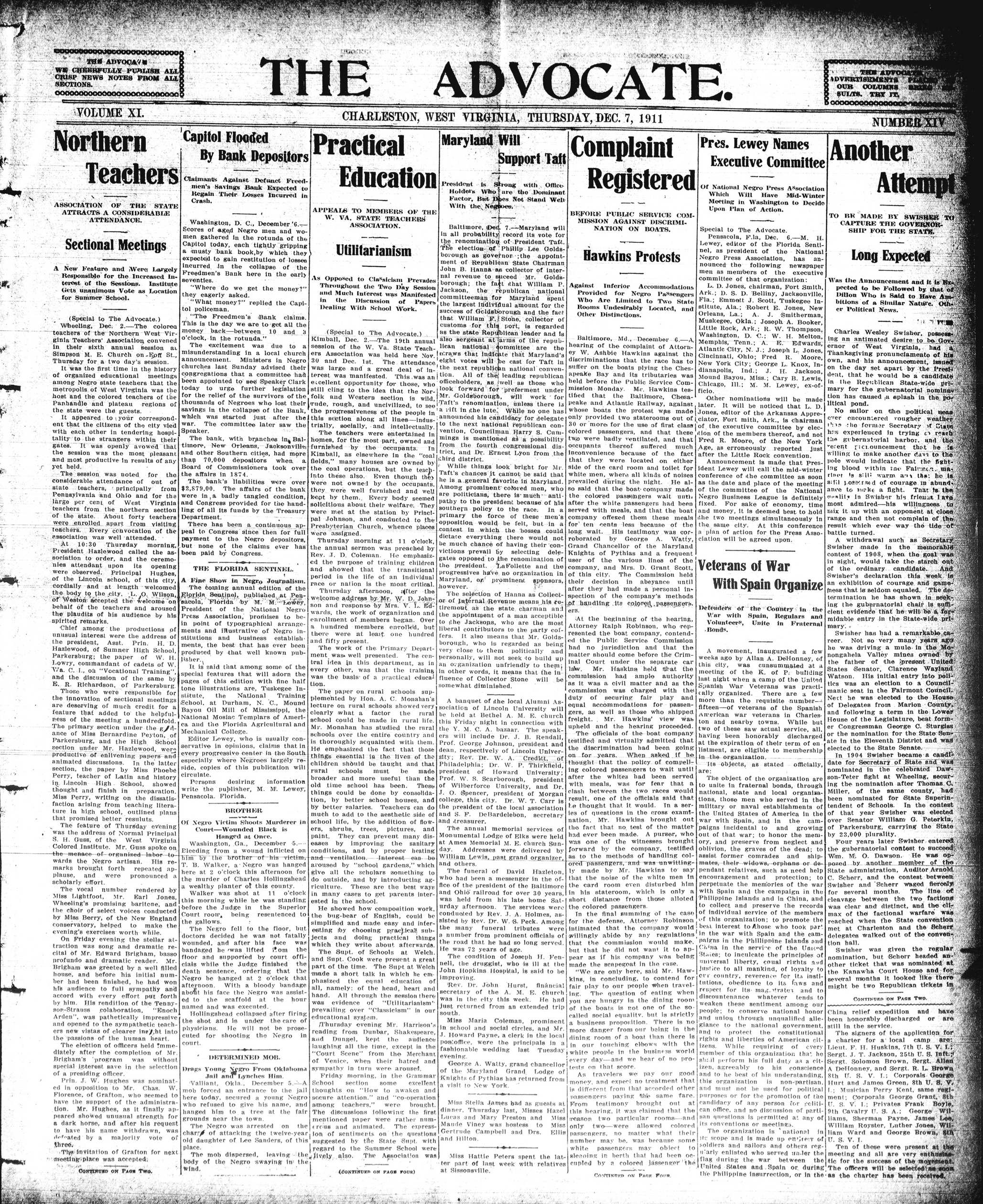
Northern Teachers
ASSOCIATION OF THE STATE ATTRACTS A CONSIDERABLE ATTENDANCE.
Sectional Meetings
A New Feature and Were Largely Responsible for the Increased Interest of the Sessions. Institute Gets unanimous Vote as Location for Summer School.
(Special To The Advocate.)
Wheeling, Dec. 2.—The colored teachers of the Northern West Virginia Teachers' Association convened in their sixth annual session at Simpson M. E. Church on-Eoff St., Thursday for a two day's session.
It was the first time in the history of organized educational meetings among Negro state teachers that the metropolis of West Virginia was the host and the colored teachers of the Panhandle and plateau regions of the state were the guests.
It appeared to your correspondent that the citizens of the city vied with each other in tendering hospitality to the strangers within their gates. It was openly avowed that the session was the most pleasant and most productive in results of any yet held. The session was noted for the considerable attendance of out of state teachers, principally from Pennsylvania and Ohio and for the large per cent of West Virginia teachers from the northern section of the state. About forty teachers were enrolled apart from visiting teachers. Every convocation of the association was well attended.
At 10:30 Thursday morning, President Hazlewood called the association to order, and the ceremonies attendant upon its opening were observed. Principal Hughes, of the Lincoln school, of this city, cordially and at length welcomed the body to the city. L. O. Wilson, of Weston accepted the welcome on behalf of the teachers and aroused the plaudits of his audience by his spirited remarks.
Chief among the productions of unusual interest were the address of the president, Asst. Prin. H. D. Hazlewood, of Sumner High School, Parkersburg; the paper of W. H. Lowry, commandant of cadets of W. Wa. C. L., on "Vocational Training" and the discussion of the same by E. R. Richardson of Parkersburg
Those who were responsible for the innovation of sectional meetings are deserving of much credit for a feature that added to the helpfulness of the meeting a hundredfold. The primary section under the guidance of Miss Bernardine Peyton, of Parkersburg, and the High School section under Mr. Hazlewood, wore productive of enlivening papers and animated discussions. In the latter section, the paper by Miss Phoebe Perry, teacher of Latin and history in Lincoln High School, showed thought and finish in preparation. Miss Perry, writing on the dissatisfaction arising from teaching literature in high school, outlined plans that promised better resolutions.
The feature of Thursday evening was the address of Normal Principal S. H. Guss, of the West Virginia Colored Institute. Mr. Guss spoke on the menace of organized labor towards the Negro artisan. His remarks brought forth repeated applause, and were pronounced a scholarly effort. The vocal number rendered by Miss Lightfoot, Mr. Earl Jones, Wheeling's promising baritone, and the choir of select voices conducted by Miss Berry, of the New England conservatory, helped to make the evening's exercises worth while.
On Friday evening the stellar attraction was song and dramatic recital of Mr. Edward Brigham, basso profundo and dramatic reader. Mr. Brigham was greeted by a well filled house, and before his initial number had been finished, he had won his audience to full sympathy and accord with every effort put forth by him. His rendition of the Tennyson-Strauss collaboration, "Enoch Arden", was pathetically impressive and opened to the sympathetic teachers new vistas of clearer in.ft. into the passions of the human heart.
The election of officers held immediately after the completion of Mr. Brigham's program was without special interest save in the selection of a presiding officer.
Prin. J. W. Hughes was nominated in opposition to Mr. Chas. W. Florence, of Grafton, who seemed to have the support of the administration. Mr. Hughes, as it finally appeared showed unusual strength for a dark horse, and after his request to have his name withdrawn, was defeated by a majority vote of three.
The invitation of Grafton for next meeting place was accepted.
CONTINUED ON PAGE TWO.
THE
Claimants Against Detunet Freedmen's Savings Bank Expected to Regain Their Losses Incurred in Crash.
Washington, D. C., December '6.—Scores of aged Negro men and women gathered in the rotunda of the Capitol today, each tightly gripping a musty bank book, by which they expected to gain restitution of losses incurred in the collapse of the Freedmen's Bank here in the early seventies.
"Where do we get the money?" they eagerly asked.
"What money?" replied the Capitol policeman.
"The Freedmen's Bank claims. This is the day we are to get all the money back—between 10 and 3 o'clock, in the rotunda." The excitement was due to a misunderstanding in a local church announcement. Ministers in Negro churches last Sunday advised their congregations that a committee had been appointed to see Speaker Clark today to urge further legislation for the relief of the survivors of the thousands of Negroes who lost their savings in the collapse of the Bank, which was started just after the war. The committee later saw the Speaker. The bank, with branches in Baltimore, New Orleans, Jacksonville and other Southern cities, had more than 70,000 depositors when a Board of Commissioners took over the affairs in 1874.
The bank's liabilities were over $2,879,00. The affairs of the bank were in a badly tangled condition, and Congress provided for the handling of all its funds by the Treasury Department. There has been a continuous appeal to Congress since then for full payment to the Negro depositors, but none of the claims ever has been paid by Congress.
THE FLORIDA SENTINEL
A Fine Show in Negro Journalism
The coming annual edition of the Florida Sentino, published at Pensacola, Florida by M. M. Lewey
President of the National Negro Press Association, promises to be in point of typographical arrangements and illustrative of Negro institutions and business establishments, the best that has ever been produced by that well known publisher.
It is said that among some of the special features that will adorn the pages of this edition with fine hall tone illustrations are, Tuskegee Institute, the National Training School, at Durham, N. C., Mound Bayou Oil Mill of Mississippi, the National Mosque Templars of America and the Florida Agricultural and Mechanical College.
Editor Lewey, who is usually conservative in opinions, claims that in every progressive center in the South especially where Negroes largely reside, copies of this publication will circulate. Persons desiring information write the publisher, M. M. Lewey, Pensacola, Florida.
Of Negro Victim Shoots Murderer in Court—Wounded Black is Hanged at Once.
Washington, Ga., December 5.—Eleeding from a wound inflicted on him by the brother of his victim, T. B. Walker, a Negro was hanged here at 2 o'clock this afternoon for the murder of Charles Hollingshead a wealthy planter of this county.
Walker was shot at 11 o'clock this morning while he was standing before the Judge in the Superior Court room, being resentenced to the gallows.
The Negro fell to the floor, but doctors decided he was not fatally wounded, and after his face was bandaged he was lifted from the floor and supported by court officials while the Judge finished the death sentence, ordering that the Negro be hanged at 2 o'clock that afternoon. With a bloody bandage about his face the Negro was assisted to the scaffold at the hour named and was executed.
Hollingshead collapsed after firing the shot and is under the care of physicians. He will not be prosecuted for shooting the Negro in court.
Drags Young Negro From Oklahoma
Jail and Lynches Him.
Valliant, Okla, December 5. A
mob forced an entrance to the jail
here today, secured a young Negro
who refused to give his name, and
hanged him to a tree at the fair
grounds near the town.
The Negro was arrested on the
charge of attacking the twelve-year
old daughter of Lee Sanders, of this
place.
The mob dispersed, leaving the
body of the Negro swaying in the
wind.
BROTHER
DETERMINED MOB.
CHARLESTON, WEST VIRGINIA, THURSDAY, DEC. 7, 1911
Practical Education
APPEALS TO MEMBERS OF THE W. VA. STATE TEACHERS ASSOCIATION.
Utilitarianism
As Opposed to Classicism Precedes Throughout the Two Day Session and Much Interest was Manifested in the Discussion of Papers Dealing With School Work.
(Special to The Advocate.)
Klimball, Dec. 2.—The 19th annual session of the W. Va. State Teachers Association was held here Nov. 30 and Dec. 1st. The attendance was large and a great deal of interest was manifested. This was an excellent opportunity for those, who still cling to the idea that the Norfolk and Western section is wild, rude, rough, and uncivilized, to see the progressiveness of the people in this section along all lines—industrially, socially, and intellectually.
The teachers were entertained in homes, for the most part, owned and furnished by the occupants. In Kimball, as elsewhere in the "coal fields," many houses are owned by the coal operations, but the teach-in these also. Even though they were not owned by the occupants, they were well furnished and well kept by them. Every body seemed solicitous about their welfare. They were met at the station by Principal Johnson, and conducted to the Presbyterian Church, whence places were assigned.
Thursday morning at 11 o'clock, the annual sermon was preached by Rev. J. D. Coleman. He emphasized the purpose of training children and showed that the transitional period in the life of an individual race or nation is the most critical.
Thursday afternoon, after the welcome address by Mr. W. D. Johnson and response by Mrs. V. L. Edwards, the work of organization and enrollment of members began. Over a hundred members enrolled, but there were at least one hundred and fifty present. The work of the Primary Department was well presented. The central idea in this department, as in every other, was that the training was the basis of a practical education.
The paper on rural schools supplemented by Hon. A. C. Monahan's lecture on rural schools showed very clearly what a factor the rural school could be made in rural life. Mr. Monahan has studied the rural schools over the entire country and is thoroughly acquainted with them. He emphasized the fact that those things essential in the lives of the children should be taught and that rural schools must be made broader and more useful than the old time school has been. These things could be done by consolidation, by better school houses, and by better salaries. Teachers can do much to add to the aesthetic side of school life, by the addition of flowers, shrubs, trees, pictures, and paint. They can prevent many diseases by improving the sanitary conditions, and by proper heating and ventilation. Interest can be aroused by "school gardens," which give all the scholars something to do outside, and by introducing agriculture. These are the best ways in many cases to get parents interested in the school.
He showed how composition work, the bug-bear of English, could be simplified and made easy and interesting by choosing practical subjects and doing practical things which they write about afterwards. The Supt. of Schools at Welch, and Supt. Cook were present a great part of the time. The Supt at Welch made a short talk in which he emphasized the equal education of all, namely: of the head, heart and hand. All through the session there was evidence of "Utilitarianism" prevailing over "Classicism" in our educational system. Thursday evening Mr. Harrison's reading from Dunbar, Shakespeare, and Dungel, kept the audience laughing all the time, except in the "Court Scene" from the Merchant of Venice, when their hatred and sympathy in turn were aroused.
Friday morning, in the Grammar School section some excellent thoughts on "How to awaken and secure attention," and "co-operation among teachers," were brought. The discussions following the first mentioned paper were rather numerous and animated. The expression of sentiments on the questions suggested by the State Supt. with regard to the Summer School were lively also. The Association was
(CONINDED ON PAGE FOUR)
ADVOCATE.
President is Strong with Office-
Holders Who are the Dominant
Factor, But Does Not Stand Well
With the Negroes.
Baltimore, Dec. 7. Maryland will in all probability record its vote for the renomination of President Taft. The election of Philip Lee Goldsborough as governor; the appointment of Republican State Chairman John B. Hanna as collector of internal revenue to succeed Mr. Goldsborough; the fact that William P. Jackson, the republican national committeeman for Maryland spent the largest individual amount for the success of Goldsborough and the fact that William F. Stone, collector of customs for this port, is regarded as the state Republican leader and is also sergeant at arms of the republican national committee are the draws that indicate that Maryland's eight votes will be cast for Taft in the next republican national convention. All of the leading republican officeholders, as well as those who look forward for preferment under Mr. Goldsborough, will work for Taft's renomination, unless there is a lift in the lute. While no one has announced his candidacy for delegate to the next national republican convention, Councilman Harry S. Cummings is mentioned as a possibility from the fourth congressional district, and Dr. Ernest Lyon from the third district.
While things look bright for Mr. Taft's chances it cannot be said that he is a general favorite in Maryland. Among prominent colored men, who are politicians, there is much antipathy to the president because of his southern policy to the race. In a primary the force of these men's opposition would be felt, but in a contest in which the bosses could dictate everything there would not be much chance of having their convictions prevail by selecting delegates opposed to the renomination of the president. LaFollette and the progressives have no organization in Maryland, or prominent sponsors, however.
The selection of Hanna as Collector of Internal Revenue means his retirement as the state charman and the appointment of a man acceptable to the Jacksons, who are the most liberal contributors to the party coffers. It also means that Mr. Goldsborough, who is regarded as being very close to them politically and personally, will not seek to build up an organization unfriendly to them; in other words, it means that the influence of Collector Stone will be somewhat diminished.
A banquet of the local Alumni Association of Lincoln University will be held at Bethel A. M. E. church this Friday night in connection with the Y. M. C. A. bazaar. The speakers will include Dr. J. B. Rendall, Prof. George Johnson, president and dean, respectively of Lincoln University; Rev. Dr. W. A. Creditt, of Philadelphia; Dr. W. P. Thirkeld, president of Howard University; Prof. W. S. Scarborough, president of Wilberforce University, and Dr. J. O. Spencer, president of Morgan college, this city. Dr. W. T. Carr is the president of the local association and S. F. DeBardelebon, secretary and treasurer.
The annual memorial services of Monumental Lodge of Elks were held at Ames Memorial M. E. church Sunday. Addresses were delivered by William Lewis, past grand organizer, and others.
The funeral of David Hazleton, who had been a messenger in the office of the president of the Baltimore and Ohio railroad for over 30 years, was held from his late home Saturday afternoon. The services were conducted by Rev. J. A. Holmes, assisted by Rev. Dr. W. S. Peck. Among the many funeral tributes were a number from prominent officials of the road that he had so long served. He was 72 years of age. The condition of Joseph H. Fennell, the druggist, who is ill at the John Hopkins Hospital, is said to be improving. Rev. Dr. John Hurst, financial secretary of the A. M. E. church was in the city this week. He had just returned from an extended trip south.
Miss Maria Coleman, prominent in school and social circles, and Mr. J. Howard Payne, a clerk in the local postoffice, were the principals in a fashionable wedding last Tuesday evening.
George A. Watty, grand chancellor of the Maryland Grand Lodge of Knights of Pythias has returned from a visit to New York.
Miss Stella James had as guests at dinner, Thursday last, Misses Hazel Lucas and Mary Preston and Miss Maude Viney was hostess to Miss Gertrude Campbell and Drs. Ellis and Hilton.
Miss Hattie Peters spent the latter part of last week with relatives at Sissonsville.
Complaint Registered
BEFORE PUBLIC SERVICE COM
MISSION AGAINST DISCRIM
NATION ON BOATS.
Hawkins Protests
Against Inferior Accommodations Provided for Negro Passengers Who Are Limited to Two State Rooms Undesirably Located, and Other Distinctions.
Baltimore, Md., December 6.—A hearing of the complaint of Attorney W. Ashleigh Hawkins against the discriminations that the race has to suffer on the boats plying the Chesapeake Bay and its tributaries was held before the Public Service Commission Monday. Mr. Hawkins testified that the Baltimore, Chesapeake and Atlantic Railway, against whose boats the protest was made only provided two staterooms out of 30 or more for the use of first class colored passengers, and that these two were badly ventilated, and that occupants thereof suffered much inconvenience because of the fact that they were located on either side of the card room and toilet for white men, where all kinds of noises prevailed during the night. He also said that the boat company made the colored passengers wait until, after the white passengers had been served with meals, and that the boat company offered them these meals for ten cents less because of the long wait. His testimony was corroborated by George A. Watty, Grand Chancellor of the Maryland Knights of Pythias and a frequent user of the various lines of the company, and Mrs. D. Grant Scott, of this city. The Commission held their decision in abeyance until after they had made a personal inspection of the company's methods of handling its colored passengers.
At the beginning of the hearing, Attorney Ralph Robinson, who represented the boat company, contended the Public Service Commission had no jurisdiction and that the matter should come before the Criminal Court under the separate car law. Mr. Haskins held that the commission had ample authority as it was a civil matter and as the commission was charged with the duty of securing fair play and equal accommodations for passengers, as well as those who shipped freight. Mr. Hawkins' view was upheld and the hearing proceeded.
The officials of the boat company testified and virtually admitted that the discrimination had been going on for years. When asked if he thought that the policy of compelling colored passengers to wait until after the whites had been served with meals, was for fear that a clash between the two races would result, one of the officials said that he thought that it would. In a series of questions in the cross examination, Mr. Hawkins brought out the fact that no test of the matter had ever been made. A purser, who was one of the witnesses brought forward by the company, testified as to the methods of handling colored passengers, and was unwittingly made by Mr. Hawkins to say that the noise of the white men in the card room even disturbed him in his stateroom, which is only a short distance from those allotted the colored passengers.
In the final summing of the case for the defense, Attorney Robinson intimated that the company would willingly abide by any regulations that the commission would make, but that he did not want it to appear as if his company was being made the scapegoat in the case. "We are only here, said Mr. Hawkins, in concluding, to contend for fair play to our people when travelling. The question of eating when you are hungry in the dining room of the boats is not one of the so-called social equality, but is strictly a business proposition. There is no more danger from our being in the dining room of a boat than there is in our touching elbows with the white people in the business world every day—and we hear of no protests on that score.
As travelers we pay our good money, and expect no treatment that is different from that accorded other passengers paying the same fare. From testimony brought out at this hearing, it was claimed that the reason two particular rooms—and only two—were allowed colored passengers, no matter what their number may be, was because some white passengers may object to sleeping in berth that had been occupied by a colored jessenger the
Pres. Lewey Names Executive Committee
Of National Negro Press Association
Which Will Have Mid-Winter
Meeting in Washington to Decide
Upon Plan of Action.
Special to The Advocate.
Pensacola, Fla., Dec. 6.—M. H.
Lewey, editor of the Florida Sentinel,
as president of the National Negro Press Association, has announced the following newspaper men as members of the executive committee of that organization:
L. D. Jones, chairman, Fort Smith, Ark.; D. S. D. Belliny, Jacksonville, Fla.; Emmett J. Scott, Tuskegee Institute, Ala.; Robert E. Jones, New Orleans, La.; A. J. Smitherman, Muskegee, Okla.; Joseph A. Booker, Little Rock, Ark.; R. W. Thompson, Washington, D. C.; W. H. Melton, Memphis, Tenn.; A. E. Edwards, Atlantic City, N. J.; Joseph L. Jones, Cincinnati, Ohio; Fred R. Moore, New York City; George L. Knox, Indianapolis, Ind.; J. H. Jackson, Mound Bayou, Miss.; Cary B. Lewis, Chicago, Ill.; M. M. Lewey, ex-officio.
Other nominations will be made later. It will be noticed that L. D. Jones, editor of the Arkansas Appreciator, Fort mith, Ark., is chairman of the executive committee by election of the members thereof, and not Fred R. Moore, of the New York Age, as erroneously reported just after the Little Rock convention.
Announcement is made that President Lewey will call the mid-winter conference of the committee as soon as the date and place of the meeting of the committee of the National Negro Business League is definitely fixed. For sake of economy, time and money, it is deemed best to hold the two meetings simultaneously in the same city. At this conference a plan of action for the Press Association will be agreed upon.
Defenders of the Country in the War with Spain, Regulars and Volunteers, Unite in Fraternal Bonds.
A movement, inaugurated a few weeks ago by Allan A. DeHonney, of this city, was consummated at a meeting of the K. of P. building last night when a camp of the United Spanish War Veterans was practically organized. There are a few more than the requisite number—fifteen—of veterans of the Spanish American war veterans in Charleston and nearby towns. While but two of these saw actual service, all, having been honorably discharged at the expiration of their term of enlistment, are eligible to membership in the organization.
Its objects, as stated officially, are:
The object of the organization are to unite in fraternal bonds, through national, state and local organizations, those men who served in the military or naval establishments of the United States of America in the war with Spain, and in the campaigns incidental to and growing out of that war; to honor the memory, and preserve from neglect and oblivion, the graves of the dead; to assist former comrades and shipmates, their widows, or orphans or dependant relatives, such as need help encouragement and protection; to perpetuate the memories of the war with Spain and the campaign in the Philippine Islands and in China, and to collect and preserve the records of individual service of the members of this organization; to promote the best interest to those who took part in the war with Spain and the campaigns in the Philippine Islands and China in the service of the United States; to inculcate the principles of universal liberty, equal rights and justice to all mankind, of loyalty to our country, reverence for its institutions, obedience to its laws and respect for its magistrate, and to discountance whatever tends to weaken these sentiment among our people; to conserve national honor and union through unqualified allegiance to the national government, and to protect the constitutional rights and liberties of American citizens. While requiring of every member of this organization that he shall perform his full duty as a citizen, agreeably to his conscience and to he best of his understanding, this organization is non-partisan, and must not be used for political purposes or for the promotion of the candidacy of any person for politician office, and no discussion of partisan questions is permitted at any of its conventions or meetings.
The organization is national in its scope and is made up entirely of soldiers and sailors and others regularly enlisted who served under the flag during the war between the United States and Spain or during the Philippine insurrection or in the
NUMBER XIV
TO BE MADE BY SWISHER
CAPTURE THE GOVERNOR
SHIP FOR THE STATE.
Was the Announcement and it is Expected to be Followed by that of Dillon Who is Said to Have Ambitions of a Similar Nature. Other Political News.
Charles Wesley Swisher, possessing an animated desire to be Governor of West Virginia, had a Thanksgiving pronunciation of his own, and his announcement, issued on the day set apart by the President, that he would be a candidate in the Republican State-wide primary for the gubernatorial nomination has caused a splash in the political pond.
No sailor on the political seas ever encountered tougher weather than the former Secretary of State has experienced in trying to reach the gubernatorial harbor, and the recent announcement that he is willing to make another data to the pole would indicate that the fighting blood within the Fallon mariner is still warm and that he is still possessed of courage in abundance to make a fight. That is the reality in Swisher his friend I have most admired—his willingness to mix it up with an opponent at close range and then not complain of the result which ever way the tide of battle turned.
A withdrawal such as Secretary Swisher made in the memorable contest of 1908, when the goal was in sight, would take the starch out of the ordinary candidate. And Swisher's declaration this week is an exhibition of courage and gameiness that is seldom equaled. The determination he has shown in seeking the gubernatorial chair is sufficient evidence that he will be a formidable entry in the State-wide primary.
Swisher has had a remarkable career. Not so very many years ago he was driving a mule in the Monongahela Valley mines owned by the father of the present United States Senator, Clarence Wayland Watson. His initial entry into politics was an election to a Councilmanic seat in the Fairmont Council. Next he was elected to the House of Delegates from Marion County, and following a term in the Lower House of the Legislature, beat former Congressman George C. Sturgis or the nomination for the State Senate in the Eleventh District and was elected to the State Senate.
In 1904 Swisher became a candidate for Secretary of State and was nominated in the celebrated Dawson-Teter fight at Wheeling, securing the nomination after Thomas C. Miller, of the same county, had been nominated for State Superintendent of Schools. In the context of that year Swisher was elected over Senator William G. Peterkin, of Parkersburg, carrying the State by 23,000 plurality.
Four years later Swisher entered the gubernatorial contest to succeed Wm. M. O. Dawson. He was opposed by another member of the State administration, Auditor Arnold C. Scherr, and the contest between Swisher and Scherr waged fiercely for several months. The line of cleavage between the two factions was clear and distinct, and the climax of the factional warfare was reached when the State convention met at Charleston and the Scherr delegates walked out of the convention hall. Swisher was given the regular nomination, but Scherr headed another ticket that was nominated at the Kanawha Court House and for several months it looked like there might be two Republican tickets in
CONTINUED ON PAGE TWO
China relief expedition and have been honorably discharged or are still in the service. The signers of the application for a charter for a local camp are: Lieut. F. H. Huskins, 7th U. S. V. I. Sergt. J. T. Jackson, 25th U. S. Inft. Sergt. Solomon Brown, Sergt. Allen A Deffonney, and Sergt. R. L. Brown 8th U. S. V. I.; Corporals George Hurt and James Green, 8th U. S. V. I.; Musician Perry Kent, same regiment; Corporals George Grant, 8th U. S. V. I.; Privates Frank Boyle, 9th Cavalry U. S. A.; George Williams, Sherman Payne, James Lee, William Royster, Luther Jones, William Ward and George Brown, 8th U. S. V. I. Ten of these were present at the meeting and all are very enthusiastic for the success of the movement. The officers will be selected as soon as the charter has been received
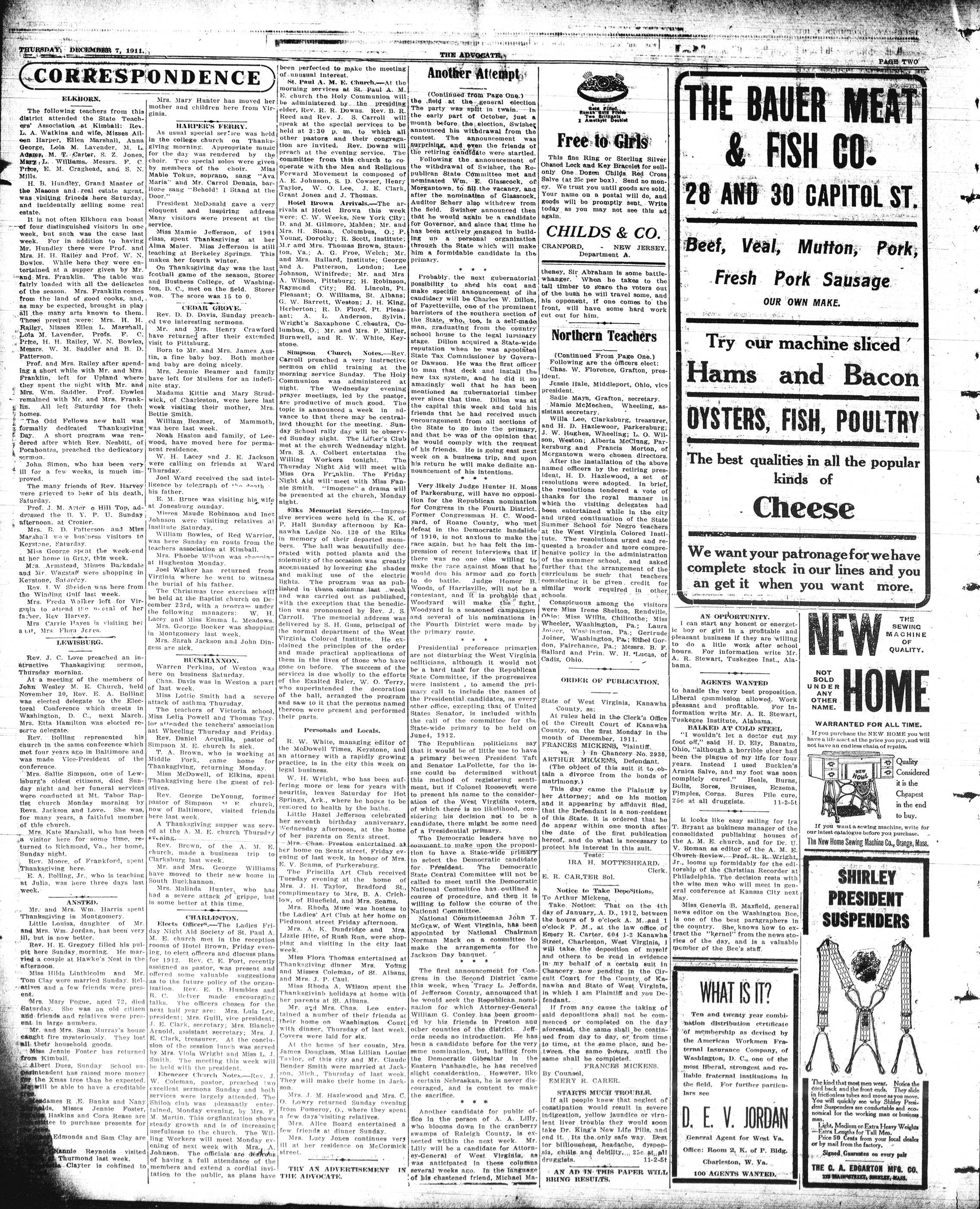
CORRESPONDENCE
ELKHORN.
The following teachers from this district attended the State Teachers' Association at Kimball: Rev. L. A. Watkins and wife, Misses Aliceen Harper, Ellen Marshall, Anna George, Lola M. Lavender, M. L. Adams, M. T. Carter, S. Z. Jones, Mary L. Williams, Messrs. F. C. Price, E. M. Craghead, and S. N. Mills.
H. B. Hundley, Grand Master of the Masons and real estate agent, was visiting friends here Saturday, and incidentally selling some real estate.
It is not often Elkhorn can boast of four distinguished visitors in one week, but such was the case last week. For in addition to having Mr. Hundley there were Prof. and Mrs. H. H. Railey and Prof. W. N. Bowles. While here they were entertained at a supper given by Mr. and Mrs. Franklin. The table was fairly loaded with all the delicacies of the season. Mrs. Franklin comes from the land of good cooks, and, as may be expected, brought in play all the many arts known to them. Those present were: Mrs. H. H. Railey, Misses Ellen L. Marshall, Lota M. Lavender, Profs. F. C. Price, H. H. Railey, W. N. Bowles, Messrs. W. M. Saddler and B. D. Patterson
Prof. and Mrs. Railey after spending a short while with Mr. and Mrs. Franklin, left for Upland where they spent the night with Mr. and Mrs. Wm. Saddler. Prof. Bowles remained with Mr. and Mrs. Franklin. All left Saturday for their homes.
The Odd Fellows new hall was formally dedicated Thanksgiving Day. A short program was rendered after which Rev. Nesbitt, of Pocahontas, preached the dedicatory sermon.
John Simon, who has been very ill for a few weeks, is much improved.
The many friends of Rev. Harvey were grieved to hear of his death, Saturday.
Prof. J. M. Arter o Hill Top, addressed the B. Y. P. U. Sunday afternoon, at Crozier.
Mrs. D. D. Patterson and Miss Marshall were business visitors to Keystone, Saturday.
Miss George spent the week-end at her home in Gray, this week.
Mrs. Armstead, Misses Barkdale and Mr. Wagstaff were shopping in Keystone, Saturday.
Rev. L W Sheiden was here from the Winding Gulf last week.
Mrs. Freda Walker left for Virginia to attend the memorial of her father, Rev Harvey.
Mrs. Carrie Hayes is visiting her aunt, Mrs. Flora Jeros.
Rev. J. C. Love preached an instructive Thanksgiving sermon, Thursday morning. At a meeting of the members of John Wesley M. E. Church, held November 30, Rev. E. A. Bolling was elected delegate to the Electoral Conference which meets in Washington, D. C., next March. Mrs. Etta Hamilton was elected reserve delegate. Rev. Bolling represented his church in the same conference which met four years ago in Baltimore and was made Vice-President of the conference.
Mrs. Sallie Simpson, one of Lewisburg's oldest citizens, died Sunday night and her funeral services were conducted at Mt. Tabor Baptist church Monday morning by Revs. Jackson and Love. She was, for many years, a faithful member of this church.
Mrs. Kate Marshall, who has been a visitor here for some time, returned to Richmond, Va., her home, Sunday night.
Rev. Moore, of Frankford, spent Thanksgiving here.
E. A. Bolling, Jr., who is teaching at Julia, was here three days last week.
ANSTED.
Mr. and Mrs. Wm. Harris spent Thanksgiving in Montgomery.
Little Louisa, daughter of Mr. and Mrs. Wm. Jordan, has been very ill, but is now better.
Rev. H. E. Gregory filled his pulpit here Sunday morning. He married a couple at Hawke's Nest in the afternoon.
Miss Hilda Linthicolm and Mr. Tom Clay were married Sunday. Relatives and a few friends were present.
Mrs. Mary Pogue, aged 72, died Saturday. She was an old citizen and friends and relatives were present in large numbers.
Mr. and Mrs. Sam Murray's house caught fire mysteriously. They lost all their household goods.
Miss Jennie Foster has returned from Kimball.
Albert Dues, Sunday School sub-
sintendent has raised more money
for the Xmas tree than he expected.
He will be able to have a creditable
funds R. E. Banks and Nany
Bondames R. E. Banks and Nany
Bondames, Misses Jennie Foster,
Miss Haskins and Cora Rease are
committee to purchase presents for
Edmonds and Sam Clay are
Nannie Reynolds visited
Thurmond last week.
The Clayter is confined to
Mrs. Mary Hunter has moved her mother and children here from Virginia.
HARPER'S FERRY
As usual special service was held in the college church on Thanksgiving morning. Appropriate music for the day was rendered by the choir. Two special solos were given by members of the choir. Miss Mable Tokus, soprano, sang "Ava Maria" and Mr. Carrol Dennis, baritone sang "Behold! I Stand at the Door."
President McDonald gave a very eloquent and inspiring address. Many visitors were present at the service.
Miss Mamie Jefferson, of 1904 class, spent Thanksgiving at her Alma Mater. Miss Jefferson is still teaching at Berkeley Springs. This makes her fourth winter.
On Thanksgiving day was the last football game of the season, Storer and Business College, of Washington, D. C., met on the field. Storer won. The score was 15 to 0.
CEDAR GROVE
Rev. D. D. Davis, Sunday preached two interesting sermons.
Mr. and Mrs. Henry Crawford have returned after their extended visit to Pittsburg.
Born to Mr. and Mrs. James Austin, a fine baby boy. Mother mother and baby are doing nicely.
Mrs. Jennie Beamer and family have left for Mullens for an indefinite stay.
Madams Kittie and Mary Strudwick, of Charleston, were here last week visiting their mother, Mrs. Bettie Smith.
William Beamer, of Mammoth, was here last week.
Noah Haston and family, of Leewood, have moved here for permanent residence.
W. H. Lacey and J. E. Jackson were calling on friends at Ward Thursday.
Joel Ward received the sad intelligence by telegraph of the death his father. E. M. Bruce was visiting his wife at Jonesburg Sunday.
Misses Maude Robinson and Inez Johnson were visiting relatives at Institute Saturday. William Bowles, of Red Warrior, was here Sunday en routes from the teachers association at Kimball. Mrs. Phoebe Wilson was showing at Hugheston Monday.
Joel Walker has returned from Virginia where he went to witness the burial of his father. The Christmas tree exercises will be held at the Baptist church on December 23rd, with a program under the following managers: W. H. Lacey and Miss Emma L. Meadows. Mrs. George Bocker was shopping in Montgomery last week. Mrs. Sarah Jackson and John Dingess are sick.
BUCKHANNON
Warren Perkins, of Weston was here on business Saturday.
Chas. Davis was in Weston a part of last week.
Miss Lottie Smith had a severe attack of asthma Thursday.
aat Wheeling Thursday and Friday.
Rev. Daniel Acquilla, pastor of Simpson M. E. church is sick.
T. A. Brown, who is working at Middle Fork, came home for Thanksgiving, returning Monday.
Miss McDowell, of Elkins, spend Thanksgiving here the guest of relatives.
Rev. George DeYoung, former pastor of Simpson M. E church, now of Baltimore, visited friends here last week.
A Thanksgiving supper was served at the A. M. E. church Thursday evening.
Rev. Brown, of the A. M. E. church, made a business trip to Clarksburg last week.
Mr. and Mrs. George Williams have moved to their new home in South Buckhannon.
Mrs. Malinda Hunter, who has had a severe attack of grippe, but is some better at this time.
CHARLESTON
Elects Officers.—The Ladies Friday Night Aid Society of St. Paul A. M. E. church met in the reception rooms of Hotel Brown, Friday evening, to elect officers and discuss plans for 1912. Rev. C. E. Fort, recently assigned as pastor, was present and offered some valuable suggestions as to the future policy of the organization. Rev. E. D. Humbles and R. C. McIver made encouraging talks. The officers chosen for the next half year are: Mrs. Lula Lee, president; Mrs. Gullil, vice president; J. E. Clark, secretary; Mrs. Blanche Arnold, assistant secretary; Mrs. J. E. Clark, treasurer. At the conclusion of the session lunch was served by Mrs. Viola Wright and Miss L. J. Smith. The meeting this week will be held with the president.
Ebenezer Church Notes.—Rev. J. W. Coleman, pastor, preached two excellent sermons Sunday and both services were largely attended. The Shiloh club was pleasantly entertained, Monday evening, by Mrs. F. M. Martin. This orgifiianization shows steady growth and is of increasing usefulness to the church. The Willing Workers will meet Monday evening of next week with Mrs. A. J. Johnson. The officials are desirous of having a full attendance of the members and extend a cordial invitation to the public, as plans have
been perfected to make the meeting of unusual interest.
St. Paul A. M. E. Church. At the morning services at St. Paul A. M. E. church the Holy Communion will be administered by the presiding elder, Rev. R. R. Downs. Rev. B. R. Reed and Rev. J. S. Carroll will speak at the special services to be held at 3:30 p. m. to which all other pastors and their congregation are invited. Rev. Downs will preach at the evening service. The committee from this church to cooperate with the Men and Religious Forward Movement is composed of A. E. Johnson, S. D. Cowser, Henry Taylor, W. O. Lee, J. E. Clark, Grant Jones and J. Thomas.
Hotel Brown Arrivals.—The arrivals at Hotel Brown this week were: C. W. Weeks, New York City; D. and M. Gilmore, Malden; Mr. and Mrs. H. Sloan, Columbus, O.; P. Young, Dorothy; R. Scott, Institute; Mr. and Mrs. Thomas Brown, Staunton, Va.; A. G. Froe, Welch; Mr. and Mrs. Ballard, Institute; George and A. Patterson, London; Lee Johnson, Winifrede; Mr. and Mrs. A. Wilson, Pittsburgh; H. Robinson, Raymond City; Ed. Lincoln, Pt. Pleasant; O. Williams, St. Albans; G. W. Barrett, Weston; J. H. King, Herberton; R. D. Floyd, Pt. Pleasant; A. L. Anderson, Sylvia, Wright's Saxaphone C.chestra, Columbus, O.; Mr. and Mrs. P. Miller, Burnwell, and R. W. White, Keystone.
Simpson Church Notes.—Rev. Carroll preached a very instructive sermon on child training at the morning service Sunday. The Holy Communion was administered at night. The Wednesday evening prayer meetings, led by the pastor, are productive of much good. The topic is announced a week in advance to that there may be centralized thought for the meeting. Sunday School rally day will be observed Sunday night. The Lifter's Club met at the church Wednesday night. Mrs. S. A. Colbert entertains the Willing Workers tonight. The Thursday Night Aid will meet with Miss Ora Franklin. The Friday Night Aid will meet with Miss Fannie Smith. "Imogene" a drama will be presented at the church, Monday night.
Elks Memorial Service.—Impressive services were held in the K. of P. Hall Sunday afternoon by Kanawha Lodge No. 130 of the Elks in memory of their departed members. The hall was beautifully decorated with potted plants and the solemnity of the occasion was greatly accentuated by lowering the shades and making use of the electric lights. The program was as published in these columns last week and was carried out as published, with the exception that the benediction was pronounced by Rev. J. S. Carroll. The memorial address was delivered by S. H. Guss, principal of the normal department of the West Virginia Colored Institute. He explained the principles of the order and made practical applications of them in the lives of those who have gone on before. The success of the services is due wholly to the efforts of the Exalted Ruler, W. O. Terry, who superintended the decoration of the hall, arranged the program and saw to it that the persons named thereon were present and performed their parts.
Personals and Locals.
R. W. White, managing editor of the McDowell Times, Keystone, and an attorney with a rapidly growing practice, is in the city this week on legal business.
W. H. Wright, who has been suffering more or less for years with neuritis, leaves Saturday for Hot Springs, Ark., where he hopes to be restored to health by the baths.
Little Hazel Jefferson celebrated her seventh birthday anniversary, Wednesday afternoon, at the home of her parents on Sentz street.
Mrs. Chas. Preston entertained at her home on Sentz street, Friday evening of last week, in honor of Mrs. E. V. Seams, of Parkersburg.
The Priscilla Art Club received Tuesday evening at the home of Mrs. J. H. Taylor, Bradford St., complimentary to Mrs. B. A. Crichlow, of Bluefield, and Mrs. Seams.
Mrs. Rhoda Muse' was hostess to the Ladies' Art Club at her home on Piedmont street Friday afternoon.
Mrs. A. K. Dandridge and Mrs. Lizzie Hite, of Rush Run, were shopping and visiting in the city last week.
Miss Flora Thomas entertained at Thanksgiving dinner Mrs. Yotng and Misses Coleman, of St. Albans, and Mrs. J. P. Caul.
Miss Rhoda A. Wilson spent the Thanksgivinb holidays at home with her parents at St. Albans.
Mr. and Mrs. Chas. Lee entertained a number of their friends at their home on Washington Court with dinner. Thursday of last week. Covers were laid for six.
At the home of her cousin, Mrs. James Douglass, Miss Lillian Louise Taylor, of this city and Mr. Claudo Bender Smith were married at Jackson, Mich., Thursday of last week. They will make their home in Jackson.
Mrs. J. M. Hazlewood and Mrs. C. O. Lowry returned Sunday evening from Pomeroy, O., where they spent a few days' visiting relatives.
Mrs. Alice Board entertained a few friends at dinner Sunday.
Mrs. Lucy Jones continues very ill at her residence on McCormick street.
TRY AN ADVERTISEMENT IN THE ADVOCATE.
THE ADVOCATE
Another Attempt
(Continued from Page One.) the field at the general election The party was split in twain. In the early part of October, just a month before the election, Swisher announced his withdrawal from the contest. The announcement was surprising, and even the friends of the retiring candidate were startled. Following the announcement of the withdrawal of Swisher, the Republican State Committee met and nominated Wm. E. Glasscock, of Morgantown, to fill the vacancy, and after the nomination of Glasscock, Auditor Scherr also withdrew from the field. Swisher announced then that he would again be a candidate for Governor, and since that time he has been actively engaged in building up a personal organization through the State which will make him a formidable candidate in the primary.
* * *
Probably, the next gubernatorial possibility to shed his coat and make specific announcement of his candidacy will be Charles W. Dillon, of Fayetteville, one of the prominent barristers of the southern section of the State, who, too, is a self-made man, graduating from the country school house to the legal luminary stage. Dillon acquired a State-wide reputation when he was appointed State Tax Commissioner by Governor Dawson. He was the first officer to man that deck and install the new tax system, and he did it so amazingly well that he has been mentioned as gubernatorial timber ever since that time. Dillon was at the capital this week and told his friends that he had received much encouragement from all sections of the State to go into the primary, and that he was of the opinion that he would comply with the request of his friends. He is going east next week on a business trip, and upon his return he will make definite announcement of his intentions.
* * *
Very likely Judge Hunter H. Moss of Parkersburg, will have no opposition for the Republican nomination for Congress in the Fourth District. Former Congressman H. C. Woodyard, of Roane County, who met defeat in the Democratic landslide of 1910, is not anxious to make the race again, but he has felt the impression of recent interviews that if there was no one else willing to make the race against Moss that he would don his armor and go forth to do battle. Judge Homer B. Woods, of Harrisville, will not be a contestant, and it is probable that Woodyard will make the fight. Woodyard is a seasoned campaigner and several of his nominations in the Fourth District were made by the primary route.
* * *
Presidential preference primaries are not disturbing the West Virginia politicians, although it would not be a hard task for the Republican State Committee, if the progressives were insistent, to amend the primary call to include the names of the Presidential candidates, as every other office, excepting that of United States Senator, is included within the call of the committee for the State-wide primary to be held on June4. 1912.
The Republican politicians say that it would be of little use to have a primary between President Taft and Senator LaFollette, for the issue could be determined without this method of registering sentiment, but if Colonel Roosevelt were to present his name to the consideration of the West Virginia voters, of which there is no likelihood, considering his decision not to be a candidate, there might be some need of a Presidential primary.
The Democratic leaders have no comment to make upon the proposition to have a State-wide primary to select the Democratic candidate for President. The Democratic State Central Committee will not be called to meet until the Democratic National Committee has outlined a course of procedure, and then it is willing to follow the course of the National Committee.
National Committeeman John T. McGraw, of West Virginia, has been appointed by National Chairman Norman Mack on a committee to make the arrangements for the Jackson Day banquet.
The first announcement for Congress in the Second District came this week, when Tracy L. Jeffords, of Jefferson County, announced that he would seek the Republican nomination for which Attorney-General William G. Conley has been groomed by his friends in Preston and other counties of the district. Jeffords needs no introduction. He has been a candidate before for the very same nomination, but, hailing from the Democratic Gibraltar in the Eastern Panhandle, he has received slight consideration. However, like a certain Nebraskan, he is never discouraged, and is content to make the sacrifice.
---
Another candidate for public office in the person of A. A. Lilly, who blooms down in the cranberry swamps of Raleigh County, is expected within the next week. Mr. Lilly will be a candidate for Attorney-General of West Virginia, as was anticipated in these columns several weeks ago. In the language of his chastened friend, Michael Ma-
Bota Filled
Roman Toro Flintb
British
X Amethyst Double
Free to Girls
This fine Ring or Sterling Silver Chased Lock and Key Bracelet for sellonly One. Dozen Childs Red Cross Salve (at 25c per box). Send no money. We trust you until goods are sold. Your name on a postal will do, and goods will be promptly sent. Write today as you may not see this ad again.
CHILDS & CO.
CRANFORD, - NEW JERSEY.
Department A.
theney, Sir Abraham is some battle-
whanger. When he takes to the
tall timber to scare the voters out
of the bush he will travel some, and
his opponent, if one comes to the
front, will have some hard work
out for him.
Northern Teachers
(Continued From Page One.)
Following are the officers elect:
Chas. W. Florence, Grafton, president.
Jessie Hale, Middleport, Ohio, vice president.
Sadie Mays, Grafton, secretary.
Mamie McMechen, Wheeling, assistant secretary.
Willa Lee, Clarksburg, treasurer, and H. D. Hazlewoor, Parkersburg; J. W. Hughes, Wheeling; L. O. Wilson, Weston; Alberta McClung, Parkersburg and Francis Morton, of Mergantown were chosen directors. After the installation of the above named officers by the retiring president, H. D. Hazlewood, a set of resolutions were adopted. In brief, the resolutions tendered a vote of thanks for the royal manner in which the visiting delegates had been entertained while in the city and urged continuation of the State Summer School for Negro teachers at the West Virginia Colored Institute. The resolutions urged and requested a broader and more comprehensive policy in the administration of the summer school, and asked further that the arrangement of the curriculum be such that teachers completing it be given credit for similar work required in other schools.
Conspicuous among the visitors were Miss Irene Shelton, Rendville, Ohio; Miss Willis, Chilicathe; Miss Wheeler, Washington, Pa.; Laura Joiner, Washington, Pa.; Gertrude Joiner, Washington, Pa.; Ethel Gordon, Fairchance, Pa.; Messrs. B. F. Ballard and Prin. W. H. *Lucas*, of Cadiz, Ohio.
ORDER OF PUBLICATION.
State of West Virginia, Kanawha
County, ss:
At rules held in the Clerk's Office
of the Circuit Court of Kanawha
County, on the first Monday in the
month of December, 1911.
FRANCES MICKENS, Plaintiff.
vs. ) In Chancery No. 2930,
ARTHUR MICKENS, Defendant.
(The object of this suit it to
obtain a divorce from the bonds of
matrimony.)
This day came the Plaintiff by
her Attorney; and on his motion
and it appearing by affidavit filed,
that the Defendant is a non-resident
of this State. it is ordered that he
do appear within one month after
the date of the first publication
hereof, and do what is necessary
to protect his interest in this suit.
IRA H. MOTTESHEARD,
Clerk
E. R. CAR,TER Sol.
Notice to Take Depositions,
To Arthur Mickens,
Take Notice: That on the 4th
day of January, A. D., 1912, between
the hours of 9 o'clock A. M. and 1
o'clock P. M., at the law office of
Emery R. Carter, 604 1-2 Kanawha
Street, Charleston, West Virginia, I
will take the deposition of myself
and others to be read in evidence
in my behalf of a certain suit in
Chancery, now pending in the Circ
cuit Court for the County of
Kanawha and State of West Virginia,
in which I am Plaintiff and you Defendant.
If from any cause the taking of said depositions shall not be commenced or completed on the day aforesaid, the same shall be continued from day to day, or from time to time, at the same place, and between the same hours, until the same shall be completed.
EMERY R. CARER.
STARTS MUCH TROUBLE.
If all people knew that neglect of constipation would result in severe indigestion, yellow jaundice or virulent liver trouble they would soon take Dr. King's New Life Pills, and end it. Its the only safe way. Best for billiousness, headache, dysposia, chills and debility... 25c at all druggists.
AN AD IN THIS PAPER WILL BRING RESULTS.
28 AND 30 CAPITOL ST.
Beef, Veal, Mutton, Pork, Fresh Pork Sausage OUR OWN MAKE.
Try our machine sliced Hams and Bacon
The best qualities in all the popular kinds of
We want your patronage for we have complete stock in our lines and you an get it when you want more.
AN OPPORTUNITY.
I can start any honest or energetic boy or girl in a profitable and pleasant business if they are willing to do a little work after school hours. For information write Mr. A. R. Stewart, Tuskegee Inst., Alabama.
AGENTS WANTED
to handle the very best proposition. Liberal commission allowed. Work pleasant and profitable. For information write Mr. A. R. Stewart, Tuskegee Institute, Alabama.
BALKED AT COLD STEEL
"I wouldn't let a doctor cut my foot off," said H. D. Ely, Banatm, Ohio, "although a horrible ulcer had been the plague of my life for four years. Instead I used Bucklen's Arnica Salve, and my foot was soon completely cured." Heals, Burns, Bolls, Sores, Bruises, Eczema, Pimples, Corns. Sures Pile cure, 25c at all drummers. 11-2-5t
It looks like easy sailing for Ira T. Bryant as business manager of the consolidated publishing houses of the A. M. E. church, and for Dr. U. V. Roman as editor of the A. M. E. Church Review. Prof. R. R. Wright, Jr., looms up formidably for the editorship of the Christian Recorder at Philadelphia. The decision rests with the wise men who will meet in general conference at Kansas City next May.
Miss, Genevia B. Maxfield, general news editor on the Washington Bee, is one of the best paragraphers in the country. She, knows how to extract the "kernel" from the news stories of the day, and is a valuable member of the Bee's staff.
WHAT IS IT?
Ten and twenty year combination distribution certificate of membership as devised by the American Workmen Fraternal Insurance Company, of Washington, D. C., one of the most liberal, strongest and reliable fraternal institutions in the field. For further particulars see
D. E. V. JORDAN
General Agent for West Va.
Office: Room 2, K. of P. Bldg.
Charleston, W. Va.
100 AGENTS WANTED.
NEW
NEW
THE SEWING
MACHINE
OF
QUALITY.
NOT
SOLD
UNDER
ANY
OTHER
NAME.
HOME
WARRANTED FOR ALL TIME.
If you purchase the NEW HOME you will
have a life asset at the price you pay, and will
not have an endless chain of repairs.
NEW HOME
Quality
Considered
it is the
Cheapest
in the end
to buy.
If you want a sewing machine, write for
our latest catalogue before you purchase.
The New Home Sewing Machine Co., Orange, Mass.
C
The kind that most men wear. Notice the cord back and the front ends. They slide in frictionless tubes and move as you move. You will quickly see why Shirley President Suspenders are comfortable and economical for the working man or business man.
Light, Medium or Extra Heavy Weights
Extra Lengths for Tall Men.
Price 50 Cents from your local dealer
or by mail from the factory.
Signed, Guarantee on every pair
THE C. A. EDGARTON MFG. CO.
238 WASHSTREET, SHIRLEY, MASS.
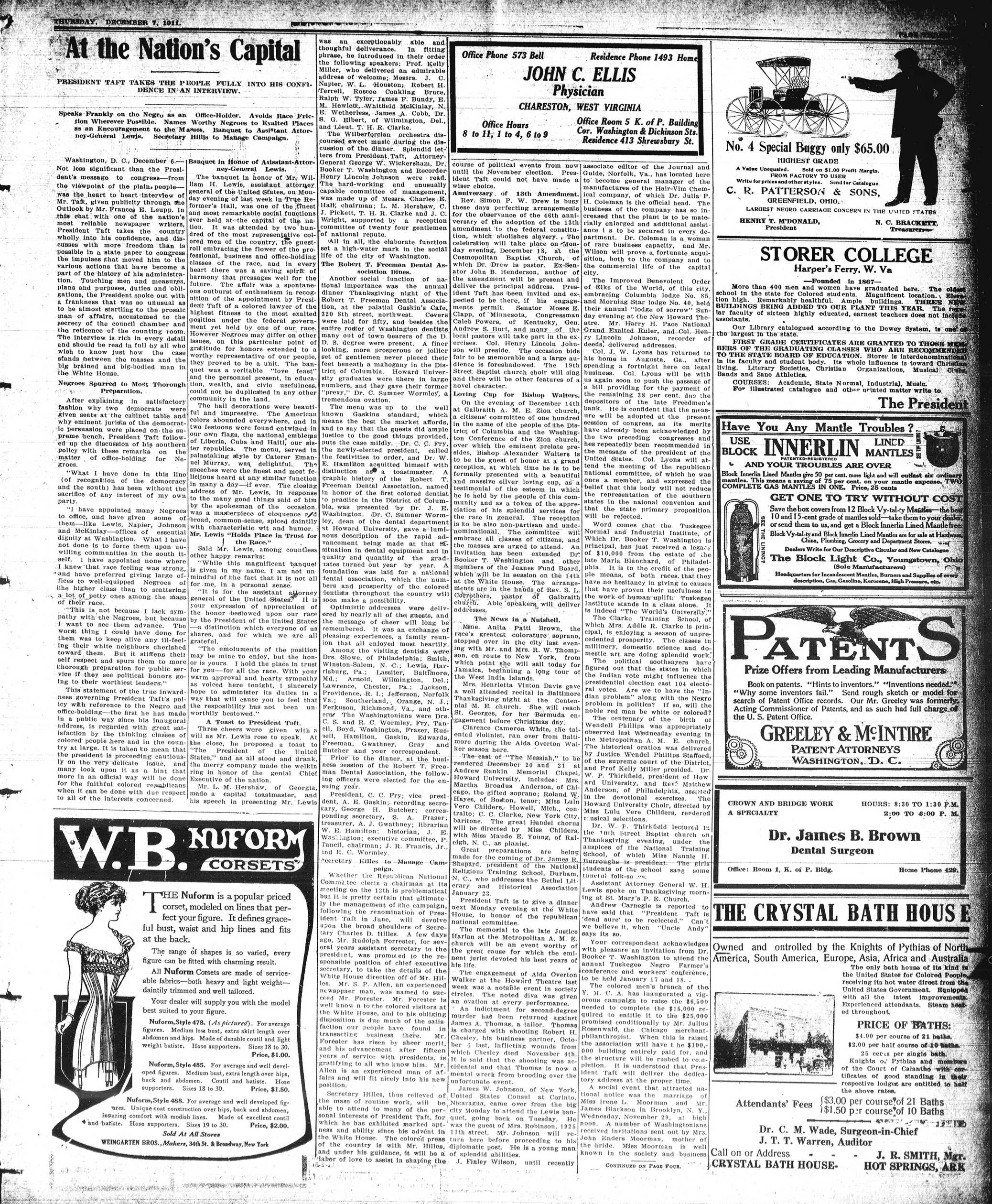
At the Nation's Capital
PRESIDENT TAFT TAKES THE PEOPLE FULLY INTO HIS CONFIDENCE IN AN INTERVIEW.
Speaks Frankly on the Negro as an Office-Holder. Avoids Race Friction Wherever Possible. Names Worthy Negroes to Exalted Places as an Encouragement to the Masses. Banquet to Assistant Attorney-General Lewis. Secretary Hills to Manage Campaign.
Washington, D. C., December 6.—Not less significant than the President's message to congress—from the viewpoint of the plain people—was the heart to heart interview of Mr. Taft, given publicity through the Outlook by Mr. Frances E. Leupp. In this chat with one of the nation's most reliable newspaper writers, President Taft takes the country wholly into his confidence, and discusses with more freedom than is possible in a state paper to congress the impulses that moved him to the various actions that have become a part of the history of his administration. Touching men and measures, plans and purposes, duties and obligations, the President spoke out with a frankness that was so unusual as to be almost startling to the prosocial man of affairs, accustomed to the secrecy of the council chamber and the reticence of the counting room. The interview is rich in every detail and should be read in full by all who wish to know just how the case stands between the masses and the big brained and big-bodied man in the White House.
Negroes Spurred to Most Thorough Preparation.
After explaining in satisfactory fashion why two democrats were given seats at the cabinet table and why eminent jurists of the democratic persuasion were placed on the supreme bench, President Taft followed up the discussion of his southern policy with these remarks on the matter of office-holding for Negroes.
"What I have done in this line (of recognition of the democracy and the south) has been without the sacrifice of any interest of my own party.
"I have appointed many Negroes to office, and have given some of them—like Lewis, Napier, Johnson and McKinlay—offices of essential dignity at Washington. What I have not done is to force them upon unwilling communities in the south itself. I have appointed none where I knew that race feeling was strong, and have preferred giving large offices to well-equipped Negroes of the higher class than to scattering a lot of petty ones among the mass of their race.
"This is not because I lack sympathy with the Negroes, but because I want to see them advance. The worst thing I could have done for them was to keep alive any ill-feeling their white neighbors cherished toward them. But it stiffens their self respect and spurs them to more thorough preparation for public service if they see political honors going to their worthiest leaders."
This statement of the true inwardness governing President Taft's policy with reference to the Negro and office-holding—the first he has made in a public way since his inaugural address, is regarded with great satisfaction by the thinking classes of colored people here and in the country at large. It is taken to mean that the president is proceeding cautiously on the very delicate issue, and many look upon it as a hint that more in an official way will be done for the faithful colored republicans when it can be done with due respect to all of the interests concerned.
B. NUFORM CORSETS
THE Nuform is a popular priced corset, modeled on lines that perfect your figure. It defines graceful bust, waist and hip lines and fits at the back.
W.B. NUFORM CORSETS
The range of shapes is so varied, every figure can be fitted with charming result.
All Nuform Corsets are made of serviceable fabrics—both heavy and light weight—daintily trimmed and well tailored.
Your dealer will supply you with the model best suited to your figure.
Nuform, Style 478. (As pictured). For average figures. Medium low bust, extra skirt length over abdomen and hips. Made of durable coulter and light weight batiste. Hose supporters. Sizes 18 to 30. Price, $1.00.
Nuform, Style 485. For average and well developed figures. Medium bust, extra length over hips, back and abdomen. Coulter and batiste. Hose supporters. Sizes 18 to 30. Price, $1.50.
form,Style 488. For average and well developed fig-
ique coat construction over hips, back and abdomen,
comfort with modish lines. Made of excellent contil
se supporters. Sizes 19 to 30. Price, $2.00.
Sold At All Stores
BROS., Makers, 34th St. & Broadway, New York
Nuform,Style 488. For average and well developed figures. Unique coat construction over hips, back and abdomen, insuring comfort with modish lines. Made of excellent cowl and batiste. Hose supporters. Sizes 19 to 30. Price, $2.00.
Sold At All Stores
WEINGARTEN BROS., Makers, 34th St. & Broadway, New York
U
Banquet in Honor of Asstistant-Attorney-General Lewis.
The banquet in honor of Mr. William H. Lewis, assistant attorney general of the United States, on Monday evening of last week in True Reformer's Hall, was one of the finest and most remarkable social functions ever held at the capital of the nation. It was attended by two hundred of the most representative colored men of the country, the guestroll embracing the flower of the professional, business and office-holding classes of the race, and in every heart there was a saving spirit of harmony that presses well for the future. The affair was a spontaneous outburst of enthusiasm in recognition of the appointment by President Taft of a colored lawyer of the highest fitness to the most exalted position under the federal government yet held by one of our race. However Negroes may differ on other issues, on this particular point of gratitude for honors extended to a worthy representative of our people, they proved to be a unit. The banquet was a veritable "love feast" and the personnel present, in education, wealth, and civic usefulness, could not be duplicated in any other community in the land.
The hall decorations were beautiful and impressive. The American colors abounded everywhere, and in two festoons were found entwined in our own flags, the national, emblems of Liberia, Cuba and Haiti, our sister republics. The menu, served in painstaking style by Caterer Emanuel Murray, was delightful. The speeches were the finest and most felicitous heard at any similar function in many a day—if ever. The closing address of Mr. Lewis, in response to the many good things said of him by the spokesman of the occasion, was a masterpiece of eloquence and broad, common-sense, spiced daintily with characteristic wit and humor. Mr. Lewis "Holds Place in Trust for the Race."
Said Mr. Lewis, among countless other happy remarks:
"While this magnificent banquet is given in my name, I am not unmindful of the fact that it is not all for me, in a personal sense."
"It is for the assistant attorney general of the United States. It is your expression of appreciation of the honor bestowed upon our race by the President of the United States—a distinction which everyone of us shares, and for which we are all grateful.
"The emoluments of the position may be mine to enjoy, but the honor is yours. I hold the place in trust for you—for all the race. With your warm approval and hearty sympathy as voiced here tonight, I sincerely hope to administer its duties in a way that will cause you to feel that the responsibility has not been unworthily bestowed."
Three cheers were given with a will as Mr. Lewis rose to speak. At the close, he proposed a toast to "The President of the United States," and as all stood and drank, the merry company made the welkin ring in honor of the genial Chief Executive of the nation. Mr. L. M. Hershaw, of Georgia, made a capital toastmaster, and his speech in presenting Mr. Lewis
was an exceptionably able and thoughtful deliverance. In fitting phrase, he introduced in their order the following speakers; Prof. Kelly Miller, who delivered an admirable address of welcome; Messrs. J. C. Napler, W. L. Houston, Robert H. Terrell, Roscoe Conkling Bruce, Ralph W. Tyler, James F. Bundy, E. M. Hewlett, Whitfield McKinlay, N. E. Wetherless, James A. Cobb, Dr. S. G. Elbert, of Wilmington, Del, and Lieut. T. H. R. Clarke.
The Wilberforcian orchestra discoursed sweet music during the discussion of the dinner. Splendid letters from President Taft, Attorney-General George W. Wickersham, Dr. Booker T. Washington and Recorder Henry Lincoln Johnson were read. The hard-working and unusually capable committee of management, was made up of Messrs. Charles E. Hah, chairman; L. M. Hershaw, C. J. Pickett, T. H. R. Clarke and J. C. Wright, supported by a reception committee of twenty four gentlemen of national repute. All in all, the elaborate function set a high-water mark in the social life of the city of Washington. The Robert T. Freeman Dental Association Dines.
Another social function of national importance was the annual dinner Thanksgiving night of the Robert T. Freeman Dental Association, at the palatial Gaskin's Cafe, 320 Sth street, northwest. Covers were laid for fifty, and besides the entire roster of Washington dentist many out of town bearers of the D. D. S. degree were present. A finer looking, more prosperous or jollier set of gentlemen never placed their feet beneath a mahogany in the District of Columbia. Howard University graduates were there in large numbers, and they gave their former "prexy," Dr. C. Sumner Wormley, a tremendous ovation.
The menu was up to the well known Gaskins standard, which means the best the market affords, and to say that the guests did ample justice to the good things provided, puts the case mildly. Dr. C. C. Fry, the newly-elected president, called the festivities to order, and Dr. W. E. Hamilton acquitted himself with distinction as a toastmaster. A graphic history of the Robert T. Freeman Dental Association, named in honor of the first colored dentist to practice in the District of Columbia, was presented by Dr. J. E. Washington. Dr. C. Sumner Wormley, dean of the dental department at Howard University, gave a luminous description of the rapid advancement being made at that situation in dental equipment and in quality and quantity of the graduates turned out year by year. A foundation was laid for a national dental association, which the numbers and prosperity of the colored dentists throughout the country will soon make a possibility.
Optimistic addresses were delivered by nearly all of the guests, and the message of cheer will long be remembered. It was an exchange of pleasing experiences, a family reunion that all enjoyed most heartily. Among the visiting dentists were Drs. Slowe, of Philadelphia; Smith, Winston-Salem, N. C.; Lewis, Harrisburg, Pa.; Lassiter, Baltimore, Md.; Arnold, Wilmington, Del.; Lawrence, Chester, Pa.; Jackson, Providence, R. I.; Jefferson, Norfolk Va.; Southernland, Orange, N. J.; Ferguson, Richmond, Va., and others. The Washingtonians were Drs. C. S. and R. C. Wormley, Fry, Tancil, Boyd, Washington, Fraser, Russell, Hamilton, Gaskin, Edwards, Freeman, Gwathney, Gray and Butcher and your correspondent. Prior to the dinner, at the business session of the Robert T. Freeman Dental Association, the following officers were elected for the ensuing year.
President, C. C. Fry; vice president, A. E. Gaskin; recording secretary, George H. Butcher; corresponding secretary, S. A. Fraser; treasurer, A. J. Gwathney; librarian W. E. Hamilton; historian, J. E. Washington; executive committee, P. Panclell, chairman; J. R. Francis, Jr., and R. C. Wormley. Secretary Killies to Manage Campaign.
Whether the Republican National Committee elects a chairman at its meeting on the 12th is problematical but it is pretty certain that ultimately the management of the campaign, following the renomination of President Taft in June, will devolve upon the broad shoulders of Secretary Charles D. Hilles. A few days ago, Mr. Rudolph Forrester, for several years assistant secretary to the president, was promoted to the responsible position of chief executive secretary, to take the details of the White House direction off of Mr. Hilles. Mr. S. P. Allen, an experienced newspaper man, was named to succeed Mr. Forrester. Mr. Forrester is well known to the colored visitors at the White House, and to his obliging disposition is due much of the satisfaction our people have found in transacting business there. Mr. Forrester has risen by sheer merit, and his advancement after fifteen years of service with presidents, is gratifying to all who know him. Mr. Allen is an experienced man of affairs and will fit nicely into his new position.
Secretary Hilles, thus relieved of the mass of routine work, will be able to attend to many of the personal interests of President Taft, for which he has exhibited marked aptness and ability since his advent in the White House. The colored press of the country is with Mr. Hilles, and under his guidance, it will be a labor of love to assist in shaping the
JOHN C. ELLIS
Physician
CHARESTON WEST VIRGINIA
CHARESTON, WEST VIRGINIA
Office Hours
8 to 11, 1 to 4, 6 to 9
course of political events from now until the November election. President Taft could not have made a wiser choice.
Anniversary. of 13th Amendment.
Rev. Simon P. W. Drew is busy these days perfecting arrangements for the observance of the 46th anniversary of the adoption of the 13th amendment to the federal constitution, which abolishes slavery. The celebration will take place on Monday evening, December 18, at the Cosmopolitan Baptist Church, of which Dr. Drew is pastor. Ex-Senator John B. Henderson, author of the amendment will be present and deliver the principal address. President Taft has been invited and expected to be there, if his engagements permit. Senator Moses E. Clapp, of Minnesota, Congressman Caleb Powers, of Kentucky, Gen. Andrew S. Burt, and many of the local pastors will take part in the exercises. Col. Henry Lincoln Johnson will preside. The occasion bids fair to be memorable and a large audience is foreshadowed. The 19th Street Baptist church choir will sing and there will be other features of a novel character.
Loving Cup for Bishop Walters.
On the evening of December 14th at Galbraith A. M. E. Zion church, a citizens' committee of one hundred in the name of the people of the District of Columbia and the Washington Conference of the Zion church, over which the eminent prelate presides, Bishop Alexander Walters is to be the guest of honor at a grand reception, at which time he is to be formally presented with a beautiful and massive silver loving cup, as a testimonial of the esteem in which he is held by the people of this community and as a token of the appreciation of his splendid services for the race in general. The reception is to be also non-partisan and undenominational. The committee will embrace all classes of citizens, and the masses are urged to attend. An invitation has been extended Dr. Booker T. Washington and other members of the Jeanes Fund Board, which will be in session on the 14th at the White House. The arrangements are in the hands of Rev. S. L. Crothers, pastor of Galbraith church. Able speakers will deliver addresses.
Mine. Anita Patti Brown, the race's greatest colorature, soprano, stopped over in the city last evening with Mr. and Mrs. R. W. Thompson, en route to New York, from which point she will sail today for Jamaica, beginning a long tour of the West India Islands.
Mrs. Henrietta Vinton Davis gave a well attended recital in Baltimore Thanksgiving night at the Centennial M. E. church. She will reach St. Georges, for her Bermuda engagement before Christmas day.
Clarence Cameron White, the talented violinist, ran over from Baltimore during the Aida Overton Walker season here.
The cast of "The Messiah," to be rendered December 20 and 21, and Andrew Rankin Memorial Chapel Howard University, includes: Mrs Martha Broadus Anderson, of Chicago, the gifted soprano; Roland W. Hayes, of Boston, tenor; Miss Luulu Vere Childers, Howell, Mich., contralto; C. C. Clarke, New York City, baritone. The great Handel chorus will be directed by Miss Childers, with Miss Maude E. Young, of Raleigh, N. C., as pianist. Great preparations are being made for the coming of Dr. James R. Shepard, president of the National Religious Training School, Durham, N. C., who addresses the Bethel Literary and Historical Association January 23. President Taft is to give a dinner next Monday evening at the White House, in honor of the republican national committee.
The memorial to the late Justice Harlan at the Metropolitan A. M. E. church will be an event worthy of the great cause for which the eminent jurist devoted his best years of his life.
The engagement of Alda Overton Walker at the Howard Theatre last week was a notable event in society circles. The noted diva was given an ovation at every performance.
An indictment for second-degree murder has been returned against James A. Thomas, a tailor. Thomas is charged with shooting Robert H. Chesley, his business partner, October 5 last, inflicting wounds from which Chesley died November 4th. It is said that the shooting was accidental and that Thomas is now a mental wreck from brooding over the unfortunate event.
James W. Johnson, of New York, United States Consul at Corinto, Nicaragua, came over from the big city Monday to attend the Lewis banquet, going back on Tuesday. He was the guest of Mrs. Robinson, 1925 11th street. Mr. Johnson will return here before proceeding to his diplomatic post. He is a young man of splendid abilities.
Office Room 5 K. of P. Building Cor. Washington & Dickinson Sts. Residence 413 Shrewsbury St.
associate editor of the Journal and Gulde, Norfolk, Va., has located here to become general manager of the manufactures of the Hair-Vim Chemical company, of which Dr. Julla P. H. Coleman is the official head. The business of the company has so increased that the plant is to be materially enlarged and additional assistance is to be secured in every department. Dr. Coleman is a woman of rare business capacity, and Mr. Wilson will prove a fortunate acquisition, both to the company and to the commercial life of the capital city.
The Improved Benevolent Order of Elks of the World, of this city, embracing Columbia lodge No. 85, and Morning Star lodge No. 40, held their annual "lodge of sorrow" Sunday evening at the New Howard Theatre. Mr. Harry H. Pace National Grand Exalted Ruler, and Col. Henry Lincoln Johnson, recorder of deeds', delivered addresses.
Col. J. W. Lyons has returned to his home in Augusta, Ga., after spending a fortnight here on legal business. Col. Lyons will be with us again soon to push the passage of a bill providing for the payment of the remaining 38 per cent. due the depositors of the late Freedmen's bank. He is confident that the measure will be adopted at the present session of congress, as its merits have already been acknowledged by the two preceding congresses and has repeatedly been recommended in the message of the president of the United States. Col. Lyons will attend the meeting of the republican national committee, of which he was once a member, and expressed the belief that this body will not reduce the representation of the southern states in the national convention and that the state primary proposition will be rejected.
Word comes that the Tuskegee Normal and Industrial Institute, of Which Dr. Booker T. Washington is principal, has just received a legacy of $10,000 from the estate of the late Maria Blanchard, of Philadelphia. It is to the credit of the people means, of both races, that they have no hesitancy in giving to causes that have proven their usefulness in the work of human uplift. Tuskegee Institute stands in a class alone. It is indeed "The World's University." The Clarke Training School, of which Mrs. Addle R. Clarke is principal, is enjoying a season of unprecedented prosperity. The classes in millinery, domestic science and domestic art are doing splendid work.
The political soothsayers have figured out that the states in which the Indian vote might influence the presidential election cast 104 electoral votes. Are we to have the "Indian problem" along with the Negro problem in politics? If so, will the noble red man be white or colored? The centenary of the birth or Wendell Phillips was appropriately observed last Wednesday evening in the Metropolitan A. M. E. church. The historical oration was delivered by Justice Wendel Phillips Stafford, of the supreme court of the District, and Prof Kelly Miller presided. Dr. W. P. Thirkield, president of Howard University, and Rev. Matthew Anderson, of Philadelphia, assisted in the devotional exercises. The Howard University Choir, directed by Miss Lulu Vere Childers, rendered musical selections.
Dr. W. F. Thirkind lecture in the 10th Street Baptist church on Thanksgiving evening, under the auspices of the National Training School, of which Miss Nannle H. Burroughs is president. The girls students of the school sang some tuneful folk-so-ss.
Assistant Attorney General W. H. Lewis spoke on Thanksgiving morning at St. Mary's P. E. Church.
Andrew Carnegie is reported to have said that "President Taft is 'dead sure' to be reelected." Can't we believe it, when "Uncle Andy" says its so.
Your correspondent acknowledges with pleasure an invitation from Dr. Booker T. Washington to attend the annual Tuskegee Negro Farmer's conference and workers' conference, to be held January 17 and 18.
The colored men's branch of the Y. M. C. A. has inaugurated a vigorous campaign to raise the $6,500 needed to complete the $15,000 required to entitle it to the $25,000 promised conditionally by Mr. Julius Rosenwald, the Chicago merchant-philanthropist. When this is raised the association will have t he $100,000 building entirely paid for, and the structure will be rushed to completion. It is understood that President Taft will deliver the dedicatory address at the proper time.
A social event that attracted national notice was the marriage of Miss Irene L. Moorman and Mr. James Blackson in Brooklyn, N. Y., Wednesday, November 29, at high noon. A number of Washingtonians received invitations sent out by Mrs. John Enders Moorman, mother of the bride. Miss Moorman is well known in the society and business
CONTINUED ON PAGE FOUR.
No. 4 Special Buggy only $65.00
HIGHEST GRADE
A Value Unequaled. Sold on $1.00 Profit Margin.
FROM FACTORY TO USER
Write for prices and other styles. Send for Catalogue.
C. R. PATTERSON & SONS,
GREENFIELD, OHIO.
LARGEST NEIGRO CARRIAGE CONCERN IN THE UNITED STATES
HENRY T. M'DONALD,
President
N. C. BRACKETT,
Treasurer
STORER COLLEGE Harper's Ferry, W. Va
—Founded in 1807—
More than 400 men and women have graduated here. The oldest school in the state for Colored students. Magnificent location. Elevation high. Remarkably healthful. Ample buildings. THREE NEW BUILDINGS BEING ADDED TO OUR PLANT THIS YEAR. The regular faculty of sixteen highly educated, earnest teachers does not include assistants.
men and women have graduated
or Colored students. Magna-
city healthyful. Ample buil-
dDED TO OUR PLANT T
highly educated, earnest
alogued according to the L.
state.
CERTIFICATES ARE GRAD-
UATING CLASSES WHO
WORD OF EDUCATION. Store-
ent body. Its whole infu-
nities, Christian Organiz-
etics.
Educatic, State Normal, Indu-
catalogue and other printers.
Any Mantle Trouble
INNERLIN LIN
MANAGER-RESTRIERED
OR TROUBLES ARE OVER
mantles give 50 per cent. more light and saving of 75 per cent. on your mantles IN ONE. Price, 25.
IT ONE TO TRY W
the box covers from 12 Block V
15-cent grade of mantles sold
them to us, and get a Block
Wy-tal-ly and Block Innerlin Lined M
China, Plumbing, Grocery and
dealers Write for Our Descriptive C
Block Light Co.
(Sole Manufacturer
quarters for Incandescent Mantles,
description, Gas, Gasoline, Kerose-
ters from Leading Mantles.
"Hints to inventors."
Inventors fail." Send rough-
office records. Our Mr.
sioner of Patents, and as su-
Office.
EELEY & M.C.
PATENT ATTORNEY
WASHINGTON, D.
Our Library catalogued according to the Dewey System, is one of the largest in the state.
FIRST GRADE CERTIFICATES ARE GRANTED TO THOSE MEMBERS OF THE GRADUATING CLASSES WHO ARE RECOMMENDED TO THE STATE BOARD OF EDUCATION. Storeer is interdenominational in its faculty and student body. Its whole influence is toward Christian living. Literary Societies, Christian Organizations, Musical Clubs, Bands and Sane Athletics.
COURSES: Academic, State Normal, Industrial, Music.
For illustrated catalogue and other printed matter write to
Have You Any Mantle Troubles? USE BLOCK INNERLIN LINED MANTLES
Block Innerlin Lined Mantles give 50 per cent. more light and will outlast six ordinary mantles. This means a saving of 75 per cent. on your mantle expense. TWO COMPLETE GAS MANTLES IN ONE. Price, 25 cents
GET ONE TO TRY WITHOUT COST
Save the box covers from 12 Block Vy-tal-ty Mantles—the best 10 and 15-cent grade of mantles sold—take them to your dealer, or send them to us, and get a Block Innerlin Lined Mantle free.
Block Vy-tal-ty and Block Innerlin Lined Mantles are for sale at Hardware, China, Plumbing, Grocery and Department Stores.
PATI
Prize Offers from
Book on patents. "Hints
"Why some inventors fail."
search of Patent Office record
Acting Commissioner of Pat
the U. S. Patent Office.
Prize Offers from Leading Manufacturers
Book on patents. "Hints to inventors." "Inventions needed." "Why some inventors fail." Send rough sketch or model for search of Patent Office records. Our Mr. Greeley was formerly Acting Commissioner of Patents, and as such had full charge of the U. S. Patent Office.
GREELEY & McINTIRE
PATENT ATTORNEYS
WASHINGTON, D. C.
CROWN AND BRIDGE WORK
A SPECIALTY
Dental Surgeon
Office: Room 1, K. of P. Bldg.
THE CRYSTAL BAY
Owned and ontrolled by the Knight
America, South America, Europe, Asia
The on
the United
receiving
United St
CRYSTAL BAT
rolled by the Knights
america, Europe, Asia,
THE CRYSTAL BATH HOUSE
Owned and ontrolled by the Knights of Pythias of North America, South America, Europe, Asia, Africa and Australia
Attendants' Fees $3
$1
Dr. C. M. Wade
J. T. T. Warren,
Call on or Address
M. Wade, Surgeon-
F. Warren, Auditor
I HOUSE- HOT
Call on or Address J. R. SMITH, Mgr.
CRYSTAL BATH HOUSE- HOT SPRINGS, ARK
SIZE TANK LINING 07
Gear
women have graduated here. The oldest and students. Magnificent location. Blessful. Ample buildings. THREE NEW TO OUR PLANT THIS YEAR. The reg. educated, earnest teachers does not include according to the Dewey System, is one of MICRATES ARE GRANTED TO THOSE MEN MAGGLES WHO ARE RECOMMENDED EDUCATION. Storeer is interdenominational. Its whole influence is toward Christian Christian Organizations, Musical Clubs. State Normal, Industrial, Music, and other printed matter write to The President
Mantle Troubles?
BRLIN LINED MANTLES
MANTLES ARE OVER
10 per cent. more light and will outlast six ordinary of 75 per cent. on your mantle expense. TWO BRLIN ONE. Price, 25 cents
BE TO TRY WITHOUT COST
Servers from 12 Block Vy-tal-ty Mantles—the best grade of mantles sold—take them to your dealer, us, and get a Block Innerlin Lined Mantle free.
Block Innerlin Lined Mantles are for sale at Hardware, Plumbing, Grocery and Department Stores.
Use for Our Descriptive Circular and New Catalogue
Bark Light Co., Youngatown, Ohio
(Sole Manufacturers)
Incandescent Mantles, Burners and Supplies of every Gas, Gasoline, Kerosene, High Pressure, etc.
PATENTS
From Leading Manufacturers
prints to inventors." "Inventions needed." "Call." Send rough sketch or model for records. Our Mr. Greeley was former Patents, and as such had full charge of
KEY & McINTIRE
ATTORNEYS
WASHINGTON, D. C.
HOURS: 8:30 TO 1:30 P.M.
2:00 TO 6:00 P. M.
AL BATH HOUSE
by the Knights of Pythias of North
Europe, Asia, Africa and Australia
The only bath house of its kind in
the United States for Colored People,
receiving its hot water direct from the
United States Government. Equipped
with all the latest improvements.
Experienced attendants. Steam heat-
ed throughout.
PRICE OF BATHS:
$4.00 per course of 21 baths.
$2.00 per half course of 10 baths.
25 cera per single bath.
Knights or Pythias and members of the Court of Calantho with certificates of good standing in their respective lodges are entitled to half the above rates.
$3.00 per course of 21 Baths
$1.50 per course of 10 Baths
ade, Surgeon-in-Chief
ren, Auditor
J. R. SMITH, Mgr.
USE-
HOT SPRINGS, ARK
The Advocate is entered in the Post-office at Charleston, W. Va., as second class matter.
SUBSCRIPTION RATES.
WHAT'S THE MATTER WITH CHARLESTON.
A local correspondent asks what has become of the Cog City Business League which was launched at Simpson M. E. Church, some months ago, with such bright prospects.
The Advocate, too, would like to know what has become of this organization. Has it gone the way of all the other previous attempts to organize the forceful factors of the race for mutual helpfulness?
It begins to look as if it had. That leads the query, "what's the matter with Charleston?" With by far the largest Negro population of any city in the state, the greatest number of children attending school, the strongest church numerically, two race papers and many other agencies which should make for united effort, Charleston is far behind some of the sister cities. She is sadly lacking in constructive unity.
Here a business enterprise conducted by a Negro, even a saloon, is "up against the real thing." If, as soon as it begins to display a healthful growth, it does not create evious competition, it is extremely lucky. The rule is to establish a similar business if the pioneer attempt show signs of success. It matters not whether there is sufficient room for the two, whether sufficient patronage can be secured by the two to make both a paying business. Start the opposition and take chances on both failing.
And failure is the fate of most business attempts in this city. If they do not fail because the patronage which would barely support one has been divided between two, they are compelled to close because their patrons exceed their credit limit and then transfer their accounts elsewhere.
In Charleston there is one of the best appointed and stocked Negro drug stores in the state. If it received one half of the consideration from the public that its worth demands, it could double the number of its employees, who, it might be said in passing, have had no additions since the opening day.
Adjoining this drug store, is a grocery, and that, too, is well stocked, clean and offers the most polite attention. Yet, it, like the drug store, has to depend largely upon the white trade for maintenance. Still there are those among us eternally complaining because there are no openings, outside of domestic service for the graduates of our schools. Their plaint would be really laughable if the situation were not so to be pitied.
Openings indeed! How can there be openings for Negro boys and Negro girls if they are not created by the race, if the man or men who risk their money in business enterprises are not supported by the race. The white merchants are certainly not going to employ Negro clerks, their limit is the porter. The way to make these openings is plain, the trouble is to get most of us to see it.
Here is where the public school teachers and the preachers might increase their usefulness. More frequent talks from them to their scholars and congregations on race building by co-operation would work wonders in this community. If they and other forces for uplift would display less selfishness, unite and give their support to every elevating movement, they could command more assistance in their undertakings.
The matter with Charleston is that the spirit of "every man for himself, the Good Lord for us all and the devil take the hindmost" prevails. Under such conditions no business league nor any other organization for united effort, excepting a lodge can live.
MISDIRECTED ENERGY
The support of The Advocate has been solicited in creating sentiment for the resolutions below which were adopted by the West Virginia State Teachers' Association.
The resolution read:
"Whereas, There are no provisions made by our state for educating colored students who wish to pursue courses beyond the Normal grade; and.
Whereas, Higher training is necessary as a means of preparing competent leadership for the growing colored population in the State.
"Resolved. That we favor the passage of a law to create a certain number of scholarships in colleges outside of the State for the graduates of our high and normal schools, the same to be awarded on a competitive basis;
"Resolved that a committee be appoint to frame a bill and to present same to the proper authorities for legislative action."
The Advocate subscribes without reservations to the "whereases," but it questions the wisdom of the receives. Why purchase scholar-rites in schools outside the State, when there are three within its bord-
ers any one of which could be brought up to the desired standard? If objection should be made to the W. Va. Colored Institute for the reason that the addition of such a course would interfere with its instructions in the trades, there remain still the schools at Bluefield and Harper's Ferry. Either of these, with increased appropriations could secure the necessary equipment, employ additional instructors and offer a curriculum as good as is to be had in any Negro college in the land.
A plea to the Legislature for an appropriation to be expended as indicated above, would, we think, meet with a more favorable response than if the money were to be sent out of the State. The scholarship plan, it is true, would require a smaller annual outlay than would the raising of the standard, of any of the schools, but the fact that a state institution would derive the benefit would not be without weight in the minds of the legislators, especially if it were remembered that railroad fare would be an increased expense to the holders of the scholarship.
The Advocate invites discussion on this subject and tenders its support to the plan having the greatest merits. It would be pleased to hear particularly from the heads of the three normal schools and the principals of the high schools. Space will be reserved for the publication of their views.
AS TO POLITICAL FRIENDS AND FOES.
A careful reading of President Taft's interview appearing in our Washington letter and a review of his administrative acts will convince any reasonable person that the race has had many worse enemies in the White House than the present occupant. In exercising his appointing powers he has not been as liberal in the number of offices as some of his predecessors, but the dignity of the places assigned to us and the emoluments attached thereto more than balance the scales.
As between LaFollette and President Taft there is no difficulty of choice for the Negro man who measures a president by the number of Negro office-holders he appoints. The president has demonstrated his willingness over and over to give recognition to the worthy of all races. Senator LaFollette is an unknown quantity. Several opportunities have presented themselves since he has been sitting in the Senate, to show his friendliness, but no instance is now recalled of his "setting the woods on fire" to get any Negro anything. His progressive ideas do not seem to include any of those vitally important to us.
In politics as in everything else, the safer plan is to stick to one's friends. When a candidate has been proved true, as President Taft has, and makes a bid for the suffrage of the race he ought to and will receive it.
So rueen for President Taft and others who have stood the test, but what of those who have broken their solemn promises, who have thus far failed to put Negroes into positions as they promised before election to do. Some of this very class will be up for nomination again. Will the Negroes support them? The Advocate believes they will not. It is of the opinion that all fair means should be exerted to encompass their defeat, that a man who fails to keep his word does not deserve and should not receive the support of those to whom he has proved faithless.
SCOTT OR SWISHER
It is no violation of confidence nor mistreatment of facts to say that if Senator Scott should announce his candidacy for the gubernatorial nomination he would please a large number of Republicans who feel that in this crisis of the party's affairs in the State, the strongest possible candidate must be put forward it the head of the ticket is to be saved.
In the years that Senator Scott has been identified with public affairs he has attached to himself a loyal following, men who have watched his course and have confidence in his leadership. They and others not such admirers of him are all of one mind in the belief that he is a strong factor in the party and that his services entitle him to further honors.
Mr. Swisher, too, has friends equally influential and loyal. They and a large number of other fair-minded men think he is entitled to any consideration he may ask from his party. They remember his surrender of the nomination honestly won, and hold that his party would exhibit base ingratitude if it did not repay at this time his unselfish action during the last campaign. Under either the Scott or Swisher banner, it appears at this distant date from the election that the Republican party could win with ease and that, consequently, no mistake would be made in the selection of either to head the State ticket.
A REPUBLICS INGRATITUDE.
The truth of the statement that republics are ungrateful was never better demonstrated than in the continued refusals of Congress to reimburse in full the depositors of the ill-fated Freedmen's bank, whose affairs were wound up by a board of commissioners appointed by the government.
Many of the claims against the bank were settled in part, years ago, but there yet remain thousands of dollars in the United States treasury to the credit of the depositors. These people all need the money, many of them or their descendants being in destitute circumstances; but despite the efforts of Judson Lyons and others who have appealed time and again to Congress to settle the matter, the claims are still unpaid.
Much of the money in question represents the savings of the freedmen who answered the frantic appeals of the government to save it from dissolution when rebel hands encircled its throat. They placed implicit confidence in the bank, believing that it was backed by the government which had given them their liberty. It has been more than thirty-five years since the bank closed its doors, and it certainly seems that the time has arrived when these ignorant and confiding people should come into their own. To defer the statement longer reflects no credit upon the United States of America, whose boast is that it gives every man his due.
A GENTLE HINT.
Having banqueted about everybody else in sight, it seems that our Washington friends, especially the office-holding class, would "chip in" now and give a feed complimentary to the man who has done and is doing more than any other to keep them before the public—R. W. Thompson.
In stasion and out of season Mr. Thompson has tooted some other fellows horn. He never knocks, preferring to remain silent when he could not speak a good word.
Such correspondents are rare, very rare; and when they are found they should receive much more consideration than has been accorded him.
This oversight of Mr. Thompson's services does not, however, surprise us. We have long since learned that per hundred more ungrateful men are to be found among the "leaders" than among any other class in the race. Though they are the recipients of the most publicity, the subscription payers among them are as rare as icicles in Abyssinia. They are the salt of the earth, but God help the newspaper and, it appears, newspaper correspondent who look to them for substantial recognition of services rendered.
AMERICAN JUSTICE
It is a terrible reflection on American justice that a confessed white murderer of twenty-one people is sentenced to prison for life, with the remote possibility of a pardon, and that a black suspect of a misdeanor, in some sections, frequently suffers the death penalty without so much as the formality of a trial. "The land of the free and the home of the brave!" Piffle! With a record of one out of eighty-seven convicted men legally executed for murder and that one usually a black man, we have as much right to claim to be "the land of the free and the home of the brave" as Satan had to claim the dominion of heaven.
BEHIND THE PROCESSION AS USUAL
The Negroes of McDowell and Fayette counties have mapped out, we are reliably informed, an ambitious program for themselves during the coming campaign. They have, at last, come to the conclusion that "in union there is strength," and will demand recognition commensurate with the weight of their influence in the affairs of the party to which they have hitherto given their suffrage.
Will the Negroes of Kanawha never awake and seize their opportunity?
OPPOSITION TO TAFT
President Taft's re-election is to be opposed by business men because he has disturbed business; by retail merchants because he favors a parcels post; by the ultimate consumer because of the tariff; and still others just because. Otherwise, his chances next year are excellent.
DO YOU WANT ONE
The Advocate has a limited number 8 x 10 photographs of the Starks Monument on hand which it will send to any address, prepaid, on receipt of one dollar. With this offer is included a large lithograph of Mr. Starks. Both will be sent for the one price.
CAN'T KEEP THEM OUT
Among those defeated for office in Los Angeles municipal election was a Negro candidate for city council on the Socialist ticket. And thug, in an indirect way, the race gets into the McNamara case. No need of trying to keep him out of anything.
OR A HERO MEDAL
Whether W. Ashbie Hawkins succeeds or not in having better accommodations provided for colored people traveling on the boats plying on the Chesapeake Bay, he will merit the thanks of the race for having made the attempt.
GUILTY AS CHARGED
The silence with which the presidents of the Negro land grant colleges received the publication of their display of the yellow streak at Columbus, strengthens the belief that they are guilty as charged.
Woodrow Wilson's boom is still able to command an enthusiastic college yell.
Ohio County is said to have a candidate for State Committeeman at Large. He makes three in the field and more to come.
One thing sure, the legal suffrage states will have to post a bargain sale in poll taxes if they expect women to get up any enthusiasm.
We hope when poor Lo succeeds in getting the ballot he will not attempt to cut the regular market price of $2.00.
Nothing succeeds like getting a press agent to make the world think you have won success.
After you have listened to all the weather prognosticators and heard their ideas of the kind of winter we are going to have, turn right back to the goosebone and pln your faith to it. The goosebone never deceives.
If those pigtailed Chinese revolutionists would only wear tight trousers, they'd look more like "The Spirit of 76."
Some men run newspapers to boost others, others to boost themselves. It is noticable that no editors who have made marks for themselves or their papers are in the second class.
Practical Education
(Continued from page one.) unanimous in all questions s except of the place for holding the school next Summer.
Before the vote was taken Prof. Sims stated clearly what he considered the claims of Institute, Bluefield, and Storer upon the school for next Summer as follows: Institute was near the State Capitol, and could thus draw upon department officials, beautiful scenery. Bluefield, healthful location, beautiful scenery, combination of city and rural life, its proximity to the largest teacher force and a revival of the Summer school idea in 1909. Storer, beautiful scenery, historical associations, and proximity to National Capitol and other large cities Pres. Prillerman added pre-historic associations to Institute's claims. It was agreed that whichever place was decided upon the vote would be made unanimous and all would work for the success of the school at that place. Institute received forty-nine, Bluefield, forty-three, and Storer, twenty votes. As agreed, the vote was made unanimous for Institute.
Prof. Joiner, of Wilberforce, delivered a fine address on Vocational Training. He mentioned the attention vocational training had received in late years and defined it as that kind of training which can be applied directly to life's work. Education he says makes a complete life and makes labor profitable and effective. The common vocation of the laborer seems to be the common vocation of life, and he illustrated by the cook and chef; barber and torsorial artist; washer-woman and laundress. Efficiency is the demand of the age. Neither classical education nor industrialism satisfied the demands of the age, but they led to Manual Training in the public school system. One trade, he said, should not be elevated above another, because one trade does not enable one to escape from work, but its object is to free one from the drudgery due to ignorance. We should prevent a cleavage along a vocational line which could be done by teaching as many subjects and industries under the same management to the same body of pupils as possible. Education fits one to live and to work. A nation leaves as a legacy to future generations those things in which she excelled all other nations, but no nation or individual can excel unless he has and uses brain power, were some some of his thoughts.
In the High School section were read three very interesting papers. In one the thought emphasized was that high schools should prepare pupils primarily for vocational life rather than college, but the administration and organization are not in accord with the demands of the age. An industrial democracy needs efficient workers, because it is necessary for us to hold our own with other countries which we cannot do without efficient workers. We err in fitting the child to the school, rather than we should fit the school to the child.
In another paper it was held that high school principals, in order to advise their pupils intelligently, should be students of human nature; have high ideals; a magnetic personality; and should not be too bookish. They should be open and frank and have the ability to secure the personal friendship of pupils and should build character both by procept and example. In the last paper of this group some practical suggestions as to the domestic training of girls were given. The aim of the high school should be to make something useful to society. Utilitarianism was the idea.
Pres. H. T. McDonald of Storer could not be present, but he sent at paper on "Present Methods of Granting Certificates." He recited the method in vogue at each of the three schools for colored youth. Institute issues certificates upon grad-
THE WEST VIRGINIA COLORED INSTITUTE Offers Three Literary Courses--English, Academic, and Normal.
```markdown
```
nation by special act of the Legislature. Bluefield issues certificates after an examination and recommendation by the State Board of Education. Storer issues upon recommendation of the faculty. No one who is known to be addicted to the use of tobacco or intoxicants of any kind is even recommended by Storer, and her recommendations are rarely more than 50 per cent of the number of graduates. Mr. McDonald was opposed to the present method on the ground that it was "class legislation" in favor of Institute. Not every one who graduates should receive a certificate because not every one is fitted to teach. The schools furnishing teachers to a state, to a great extent determine the ideals of that state. The standard of work done by teachers will be in proportion to the standard of efficiency of those sent out.
The last number on the program was an address by Rev. H. H. Proctor, of Atlanta, Ga. After rehearsing the conditions that exist between the two races in W. Va., he said the teachers, should teach so as to keep those conditions and hold the prylleges which the race has. He spoke upon the Contribution of the Black Man to Ancient Civilization and his contribution to that of America. The following are some of the impressions he received white abroad: That three-fourths of the population abroad are colored; as the Japanese, Chinese, Indians, "Originally, man," he said. "was red, as he went North he was bleached white, and as he went South into the warmer climates he was tanned various colors;" that Negroes were found scattered all over the world, in England, Germany, France, Belgium, and Turkey. No where were color lines drawn abroad, and what is true of the world in general must eventually be true of our own country. He mentioned the great monuments in the Nile valley as examples and evidences of the great part the Negro has played in the world's civilization. The Sphynx is the face of a Negro; the Statue of Rameses II is a full-sized black King. Pharaoh of the Fible was a Negro.
"We want to make to our civilization, 1st, he said an intellectual contribution; 2nd, a spiritual contribution. In order to do this, it is necessary to teach those about us, 1st to preserve their physical forces, 2nd teach them how to be skillful; 3rd how to economize, and 4th teach them how to co-operate."
The officers for the ensuing year are as follows:
President, R. P. Sims, Bluefield
First Vice Pres., E. L. Rann, McDonald.
Second Vice Pres., J. W. Robinson, St. Albans.
Secretary, Mrs. F. C. Carter, Institute.
Treasurer, Mrs. H. H. Railey Montgomery. Historian, J: W. Scott, Hunlngton.
Board of Directors.
President—Byrd Pillerman, Institute; Miss Henrietta James, Montgomery; W. H. Browles, Charleston; W. D. Johnson, Kimball; Mrs. P. T. Grimes Wolch; Samuel Wade, Bluefield; Miss A. J. McDonald, Fayetteville; W. W. Banks, Alderson; N. Wiley, Kimball.
WITH THE FOURTH ESTATE
WITH THE FOURTH ESTATE
James C. Waters, Jr., and W.
Preston Bayless, two waiters of force
and brilliance, are contributing some
very excellent editorials and special
matter to The Clarion, published at
J. E. Johnson Co.,
Funeral Directors and Embalmers.
ALL CALLS PROMPTLY ATTENDED.
OUR PRICES ARE THE MOST REASONABLE.
For Promptness and Care Try Our Ambulance Service.
Open day and night. Phone 2472
609 SUMMERS STREET. CHARLESTON, W. VA.
Special Attention Given Out of Town Calls.
Clarksburg, W. Va., by Lawyer T. L. Higgins.
In recognition of his more than fifty years' service in various public activities, the friends of Rev. W. J. White, editor of the Georgia Baptist, Augusta, Ga., have inaugurated a movement to tender him a fitting testimonial on his birthday, December 25. Former Register J. W. Lyons Rev. Silas X. Floyd, Mrs. Mary C. Jackson and Miss Lucy Laney have led off with a subscription of $1.00 and invited the hundreds of Dr. White's admirers throughout the country to follow suit. For thirty-two years Dr. White has published the Georgia Baptist, building it from nothing to a first class plant, operated by electric power and paying handsomely, giving employment to a goodly number of the young people of the race. The folks of "The Fourth estate..." should not forget to join in this very appropriate tribute to a faithful worker for the human uplift. "He gives twice who gives quickly."
John L. Thompson has assumed entire control of the Iowa State Bystander, of Des Moines, Iowa, having purchased the shares of all the other stockholders in the company. For several years Mr. Thompson has been editor of the Bystander. It is the only race paper published in the state of Iowa and is seventeen years old. President M. M. Lewey announces Editor L. D. Jones, of the Arkansas Appreciator-Union, Fort Smith, as the chairman of the executive committee of the National Negro Press Association. It is expected that a conference of the committee will be called shortly in connection with a conference of the committee of the National Negro Business League.
December 12 has been set apart, at the suggestion of Rev. W. A. Jones, of Lexington, Ky., as "American Baptist Day," at which time the Baptists of the state of Kentucky and vicinity will make a formal rally for the benefit of Prof. W. H. Steward's able paper, which he has issued at Louisville for more than thirty years. The American Baptist has been a tower of strength to the Baptist Association in the middle west and border south and an opportunity is now presented to make proper acknowledgment of the great good that Prof. Steward has been doing all these years—some of them "lean," and none of them any too "fat." None of these threatened Negro "dailies" is yet in eight.
Nation's Capital
(Continued from Page Three.) circles of Greater New York, and has a host of friends in all sections of the country. Mr. Blackston is a business man of enterprise and has achieved success in all he has undertaken. The "Sphinx Club," a new high-grade organization, is making rapid progress. It has acquired an e.g. elegant club home at 201 T. street, and will soon have a membership recruited up to the limit with solid, substantial men. The limit has been placed at sixty. Warring Washingtonians show signs of "getting together." Good!
Complaint Registered
(Continued from Page One.) night before, yet it was said that the company did not especially mark the bed linens used by a colored sleeper, that the night after its use by a colored man a white man may sleep contentedly in the same the next night. We only ask that our appeal be considered in a fair manner and in all of its aspects." The fight undertaken by Mr. Hawkins is in the interest of the race in this state, and was without one cent of renumeration. He spent four hours at the hearing in cross examining witnesses.
December 6.—At a stormy meeting of local True Reformers, held here last Friday night, Grand Master W. R. Griffin installed Hezekiah Brown as chief for the Maryland division, vice James H. Nutt, removed.
David B. Grange, of New York, is the only colored delegate attending the sixteenth annual convention of the International Seamen's Union now being held in this city.
The annual installation of officers of the Grand Council of the Order of Good Hope was held here Thanksgiving day. The officers include: W. G. Price, Grand Master; Alfred J. Nixon, Grand Secretary; and George Pullman, Treasurer.
Mr. and Mrs. Murray Ralph celebrated the twenty-fifth anniversary of their marriage last Friday night. The late Frederick Douglas always stopped with Mr. Ralph when he visited this city.
To the Senate and House of Representatives:
This message is the first of several which I shall send to Congress during the interval between the opening of its regular session and its adjournment for the Christmas holidays. The amount of information to be communicated as to the operations of the Government, the number of important subjects calling for comment by the Executive and the transmission to Congress of exhaustive reports of special commissions, make it impossible to include in one message of a reasonable length a discussion of the topics that might be brought to the attention of the National Legislature at its first regular session. The Anti-Trust Law—The Su
preme Court Decisions.
In May last the Supreme Court handed down decisions in the suits in equity brought by the United States to enjoy the further maintenance of the Standard Oil Trust and of the American Tobacco Trust, and to secure their dissolution. The decisions are epoch-making and serve to advise the business world authoritatively of the scope and operation of the anti-trust act of 1830. The decisions do not depart in any substantial way from the previous decisions of the court in constructing and applying this important statute, but they clarify those decisions by further defining the already admitted acceptance to the literal construction of the act. By the decrees, they furnish a useful precedent as to the proper method of dealing with the capital and property of illegal trusts. These decisions suggested the need and wisdom of additional or supplemental legislation to make it easier for the entire business community to square with the rule of action and legality thus finally established and to preserve the benefit (freedom, and spur of reasonable competition without loss of real efficiency or progress.
The statute in its first section declares to be illegal "every contract, combination in the form of trust or otherwise, or conspiracy, in restraint of trade or commerce among ten several States, or with foreign nations," and in the second, declares guilty of a misdemeanor "every person who shall monopolize or attempt to monopolize or combine or conspire with any other person to monopolize any part of the trade or commerce of the several States or with foreign nations."
In two early cases, where the statute was invoked to enjoin a transportation rate agreement between interstate railroad companies, it was held that it was no defense to show that the agreement as to rates complained of was reasonable at common law, because it was said that the statute was directed against all contracts and combinations in restraint of trade whether reasonable at common law or not. It was plain from the record, however, that the contracts complained if in those cases would not have been deemed reasonable at common law. In subsequent cases the court said that the statute should be given a reasonable construction and refused to include within its inhibition, certain contractural restraints of trade which are denominated as incidental or as indirect.
These cases of restraint of trade that the court excepted from the operation of the statute were instances which, at common law, would have been called reasonable. In the Standard Oil and Tobacco cases, therefore, the court merely adopted the tests of the common law, and in defining exceptions to the literal application of the statute only substituted for the test of being incidental or indirect, that of being reasonable, and this, without varying in the slightest the actual scope and effect of the statute. In other words, all the cases under the statute which have now been decided would have been decided the same way if the court had originally accepted in its construction the rule at common law.
It has been said that the court, by introducing into the construction of the statute common-law distinctions, has emasculated it. This is obviously untrue. By its judgment every contract and combination in restraint of interstate trade made with the purpose or necessary effect of controlling prices by stifling competition, or of establishing the whole or in part a monopoly of such trade, is condemned by the statute. The most extreme critics can not instance a case that ought to be condemned under the statute which is not brought within its terms as thus construed.
The suggestion is also made that the supreme court by its decision in the last two cases has committed to the court the undefined and unlimited discretion to determine whether a case of restraint of trade is within the terms of the statute. This is wholly untrue. A reasonable restraint of trade at common law is well understood and clearly defined. It does not rest in the discretion of the court, but must be limited to accomplish the purpose of a lawful main contract to which, in order that it shall be enforceable at all,
It must be incidental. If it exceed the needs of the contrast, it is void. The test of reasonableness was never applied by the court at common law to contrasts or—combination or conspiracies in restraint of trade whose purpose was or whose necessary effect would be to stifle competition, to control prices, or establish monopolies. The courts never assumed power to say that such contracts or combinations or conspiracies might be lawful if the parties to them were only moderate in the use of power thus secured and did not exact from the public too great and exorbitant prices. It is true that many theorists, and others engaged in business violating the statute, have hoped that some such line could be drawn by court but, no court of authority has ever attempted it. Certainly there is nothing in the decisions of the latest two cases from which such a dangerous theory of judicial discretion in enforcing this statute can derive the slightest sanction.
Force and Effectiveness of State
a Matter of Growth.
We have been twenty-one years making this statute effective for the purpose for which it was enacted. The Knight case was discouraging and seemed to remit to the states the whole available power to attack and suppress the evils of the trusts. Slowly, however, the error of that judgment was corrected, and only in the last three or four years has the heavy hand of the law been laid upon the great illegal combinations that have exercised such an absolute domination over many of our industries. Criminal prosecutions have been brought and a number are pending, but juries have felt adverse to convicting for jail sentences and judges have been most reluctant to impose such sentences on men of respectable standing in society whose offense has been regarded as merely statutory. Still, as the offense becomes better understood and the committing of it partakes more of studied and deliberate defiance of the law, we can be confident that juries will convict individuals and that jail sentences will be imposed.
The Remedy in Equity by Dissolution
In the Standard Oil case the supreme and circuit courts found the combination to be a monopoly of the interstate business of refining, transporting, and marketing petroleum and its products, effected and maintained through thirty-seven different corporations, the stock of which was held by the New Jersey company. It in effect commanded the dissolution of this combination, directed the transfer and pro rata distribution by the New Jersey company of the stock held by it in the thirty-seven corporations to and among its stockholders; and the corporations and individual defendants were enjoined from compulsing or combining to restore such monopoly; and all agreements between the subsidiary corporations tending to produce or bring about further violations of the act were enjoined.
In the tobacco case the court found that the individual defendants, twenty-nine in number, had been engaged in a successful effort to acquire complete dominion over the manufacture, sale, and distribution of tobacco in this country and abroad, and this had been done by combinations made with a purpose and effect to stifle competition, control prices, and establish a monopoly, not only in the manufacture of tobacco, but also of tin-foll and licorice used in its manufacture and of its products of cigars, cigarettes, and snuffs. The tobacco suit presented a far more complicated and difficult case than the Standard Oil suit for a decree which would effectuate the will of the court and end the violation of the statute. There was here no single holding company as in the case of the Standard Oil Company. The main company was the American Tobacco Company, a manufacturing, selling, and holding company. The plan adopted to destroy the combination and restore competition involved the redivision of the capital and plants of the whole trust between some of the companies constituting the trust and new companies organized for the purpose of the decree and made parties to it, and numbering, new and old, fourteen.
Situation After Readjustment.
(The American Tobacco Company,
(old), readjusted capital, $92,000,
000; the Ligget & Meyers Tobacco
Company (new), capital, $67,000,
000; the P. Lorillard Company
(new), capital, $47,000,000; and
the R. J. Reynolds Tobacco
Company (old), capital, $7,525,000, are
clearly engaged in the manufacture
and tale of chewing and smoking
tobacco and cigars. The former one
tin-foll company is divided into, two,
one of $825,000 capital and the
other of $400,000. The one snuff
company is divided into three
companies, one with a capital of $15,
000,000, another with a capital of
$8,000,000, and a third with a capital
of $8,000,000. The licorce companies are two, one with a capital of $5,758,300 and another with a capital of $2,000,000. There is, also,
the British-American Tobacco Company,
a British corporation, doing
business abroad with a capital of
$1,800,000, and the corporation of
United Cigar Stores, with a capital
of $5,000,000.
Under this arrangement each of the different kinds of business be distributed between two or more companies with a division of the prominent brands in the same tobac-
co products, sb as to make competition not only possible but necessary. Thus the smoking tobacco business of the country is divided so that the present independent companies have 21.39 per cent, while the American Tobacco Company will have 33.08 per cent, the Liggett & Meyers 20.05 per cent, the Lorillard Company 22.83 per cent, and the Reynolds Company 2.66 per cent. The stock of the other thirteen companies, both preferred and common, has been taken from the defendant American Tobacco Company and has been distributed among its stockholders. All covenants restricting competition have been declared null and further performance of them have been enjoined. The preferred stock of the different companies has now been given voting power which was dehilited it under the old organization. The ratio of the preferred stock as to the common was as 78 to 40. This constitutes a very decided change in the ownership and control of each company.
In the original suit there were twenty-nine defendants who were charged with being the conspirators through whom the illegal combination acquired and exercised its unlawful dominion. Under the degree these defendants will Hold amounts of stock in the various distributee companies ranging from 41 per cent as a maximum to 28.1-3 per cent as a minimum, except in the case of one small company, the Porto Ricaol Tobacco Company, in which they will hold 45 per cent. The twenty-nine individual defendants are enjoined for three years from buying any stock except from each other, and the group is thus prevented from extending its control during that period. All parties to the suit, and the new companies who are made parties, are enjoined perpetually from in any way effecting any combination between any of the companies in violation of the statute by way of resumption of the old trust. Each of the fourteen companies is enjoined from acquiring stock in any of the others. All these companies are enjoined from having common directors or officers, or common buying or selling agents, or common offices, or lending money to each other.
Size of New Companies.
Objection was made by certain independent tobacco companies that this settlement was unjust because it left companies with a very large capital in active business, and that the settlement to be effective to put all on an equality would be a division of the capital and plant of the trust into small fractions in amount more nearly, equal to that of each of the independent companies. This contention results from a misunderstanding of the anti-trust law and its purpose. It is not intendent thereby to prevent the accumulation of large capital in business enterprises in which such a combination secures reduced cost of production, sale and distribution. It is directed against such an aggregation of capital only when its purpose is that of stifling competition, enhancing or controlling prices, and establishing a monopoly. If we shall have by the decree defeated these purposes and restored competition between the large units into which the capital and plant have been divided, we shall have accomplished the useful purpose of the statute.
Confiscation Not the Purpose of the
Shatute.
It is not the purpose of the statute to confiscate the property and capital of the offending trusts. Methods of punishment by fine or imprisonment of the individual offenders, by fine of the corporation or by forfeiture of its goods in transportation, are provided, but the proceeding in equity is a specific remedy to stop the operation of the trust by injunction and prevent the future use of the plant and capital in violation of the statute.
Effectiveness of Decree.
I venture to say that not in the history of American law has a degree more effective for such a purpose been entered by a court than against the Tobacco Trust. As Circuit Judge Noyes said in his judgment approving the decree:
"The extent to which it has been necessary to tear apart this combination and force it into new forms with the attendant burdens ought to demonstrate that the Federal anti-trust statute is a drastic statute which accomplishes effective results; which so long as it stands on the statute books must be obeyed, and which can not be disobeyed without incurring far-reaching penalties. And, on the other hand, the successful reconstruction of this organization should teach that the effect of enforcing this statute is not to destroy, but to reconstruct; not to demolish, but to re-create in accordance with the conditions which the congress has declared shall exist among the people of the United States."
It has been assumed that the present pro rata and common ownership in all these companies by former stockholders of the trust would insure a continuance of the same old single control of all the companies into which the trust has by decree been disintegrated. This is erroneous and is based upon the assumed inefficacy and innocuousness of judicial injunctions. The companies are enjoined from cooperation or combination; they have different managers, directors, purchasing, and sales agents. If all or many of the numerous stockholders, reaching into the thousands, attempt to secure concerted action of the companies with a view to the control of the market
their number is so large that such an attempt could not well be concealed and its prince movers and all its participants would be at once subject to contention proceedings and imprisonment of a summary character. The immediate result of present situation will necessarily be activity by all the companies under different managers, and then competition must follow; or there will be activity by one company and stagnation by another. Only a short time will inevitably lead to a change in ownership of the stock, as all opportunity for continued cooperation must disappear. Those critics who speak of this disintegration in the trust as a mere change of garments have not given consideration to the inevitable working of the degree and understand little the personal danger attempting to evade or set at naught the solemn injunction of a court whose object is made plain by the degree and whose inhibitions are set forth with a detail and comprehensively as unexamined in the history of equity jurisprudence.
Voluntary Reorganizations of Other Trusts at Hand.
The effect of these two decisions has led to dec eves dissolving the combination of manufacturers of electric lamps, a southern wholesale grocers' association; an interlocutory decree against the Powder Trust with directions by the circuit court compelling dissolution, and other combinations of a similar history are now negotiating with the Department of Justice looking to a disintegration by decree and reorganization in accordance with law. It seems possible to bring about these reorganizations without general business disturbance.
Movement for Repeal of the Anti-
Truth Law
But now that the anti-trust act is seen to be effective for accomplishment of the purpose of its enactment, we are met by a cry from many different quarters for its repeal. It is said to be obstructive of business progress, to be an attempt to restore old-fashioned methods of destructive competition between small units, and to make impossible those useful combinations of capital and the reduction of the cost of production that are essential to continued prosperity and normal growth.
In the recent decisions the Supreme Court makes clear that there is nothing in the statute which condemns combinations of capital or mere bigness of plant organized to secure economy in production and a reduction of its cost. It is only when the purpose or necessary effect of the organization and maintenance of the combination or the aggregation of immense size are the stifling of competition, actual potential, and the enhancing of prices and establishing a monopoly that the statute is violated. More size is no sin against the law. The merging of two or more business plants necessarily elites competition between the hits thus combined, but this elimination is in contravention of the statute only when the combination is made for purpose of ending this particular competition in order to secure control of, and enhance, prices and create a monopoly.
Lack of Definiteness in the Statute
The complaint is made of the statute that it is not sufficiently definite in its description of that which is forbidden, to enable business men to avoid its violation. The suggestion is, that we may have a combination of two corporations, which may run on for years, and that subsequently the Attorney General Day conclude that it was a violation of the statute, and that which was supposed by the combiners to be innocent then turns out to be a combination in violation of the statute. The answer to this hypothetical case is that when men attempt to amass such stupendous capital as will lie them to suppress competition, central prices and establish a monopoly, they know the purpose of their acts. Men do not do such a thing without having it clearly in mind. If what they do is merely for the purpose of reducing the cost of production, without the thought of suppressing competition by use of the bigness of the plant they are creating, then they can not be convicted at the time the union is made, nor can they be convicted later, unless it happen that later on they conclude to suppress competition and take the usual methods for doing so, and thus establish for themselves a monopoly. They can, in such a case, hardly complain if the motive which subsequently is disclosed is attributed by the court to the original combination.
New Remedies Suggested
New Remedies Suggested.
Much is said of the repeal of this statute and of constructive legislation intended to accomplish the purpose and blaze a clear path for honest merchants and business men to follow. It may be that such a plan will be evolved, but I submit that the discussions which have been brought out in recent days by the fear of the continued execution of the anti-trust law have produced nothing but glittering generalities and have offered no line of distinction or rule of action as definite and as clear as that which the Supreme Court itself lays down in enforcing the statute.
Supplemental Legislation Needed
Not Repeal or Amendment.
I see no objection—and indeed I can see decided advantages—in the enactment of a law which shall describe and denounce methods of competition which are unfair, and are badges of the unlawful purpose denounced in the anti-trust law. The attempt and purpose to suppress a competitor, by underselling him at a price so unprofitable as to drive him out of business, or the making of exclusive contracts with customers
under which they are required to give up association with other manufacturers, and numerous kindred methods for stifling competition and effecting monopoly, should be described with efficient accuracy in a criminal statute on the one hand to enable the government to shorten its task by prosecuting single misdemeanors instead of an entire cospiracy, and, on the other hand, to serve the purpose of polling our more in detail to the business community what must be avoided.
Federal Incorporation Recommended.
In a special message to congress on January 7, 1910, I ventured to point out the disturbance to business that would probablyattend the dissolution of these offending trusts. I said:
"But such an investigation and possible prosecution of corporations whose prosperity or destruction affects the comfort not only of stockholders but millions of wage earners, employees, and associated tradesmen must necessarily tend to disturb the confidence of the business community, to dry up the now flowing sources of capital from its places of hoarding, and produce a halt in our present prosperity that will cause suffering and strained circumstances among the innocent many for the faults of the guilty few. The question which I wish in this message to bring clearly to the consideration and discussion of congress is whether, in order to avoid such a possible business danger, something can not be done by which these business combinations may be offered a means, without great financial disturbance, of changing the character, organization, and extent of their business into one within the lines of the law under Federal control and supervision, securing compliance with the anti-trust statute.
"Generally, in the industrial combinations called 'trusts,' the principal business is the sale of goods in many states and in foreign markets; in other words, the interstate and foreign business far exceeds the business done in any one state. This fact will justify the Federal government in granting a Federal charter to such a combination to make and sell in interstate and foreign commerce the products of useful manufacture under such limitations as will secure a compliance with the anti-trust law. It is possible so to frame a statute that while it offers protection to a Federal company against harmful, vexatious, and unnecessary invasion by the States, it shall subject it to reasonable taxation and control by the states with respect to its purely local business
"Corporations organized under this act should be prohibited from acquiring and holding stock in other corporations (except for special reasons, and upon approval by the proper Federal authority), thus avoiding the creation under national auspices of the holding company with subordinate corporations in different states, which has been such an effective agency in the creation of the great trusts and monopolies.
"If the prohibition of the antitrust act combinations in restraint of trade is to be effectively enforced, it is essential that the National Government shall provide for the creation of national corporations to carry on legitimate business throughout the United States. The conflicting laws of the different States of the Union wit respect to foreign corporations make it difficult, if not impossible, for one corporation to comply with their requirement go as to carry on business in a number of different States."
I renew the recommendation of the enactment of a general law providing for the voluntary formation of corporations to engage in trade and commerce among the states and with foreign nations. Every argument which was then advanced for such a law, and every explanation which was at that time offered to possible objections, have been confirmed by our experience since the enforcement of the antitrust statute has resulted in the actual dissolution of active commercial organizations.
It is even more manifest now than it was then that the denunciation of conspiracies in retrain of trade should not and does not mean the denial of organizations large enough to be entrusted with our interstate and foreign trade. It has been made more clear now than it was then that a purely negative statute like the anti-trust law may well be supplemented by specific provisions for the building up and regulation of legitimate national and foreign commerce.
Government Administrative Experts Needed to Aid Courts in Trust Dissolutions.
The drafting of the decrees in the dissolution of the present trusts, with a view to their reorganization into legitimate corporations, has made it especially apparent that the courts are not provided with the administrative machinery to make the necessary inquiries preparatory to reorganization, or to pursue such inquiries, and they should be empowered to invoke the aid of the Bureau of Corporations in determining the suitable reorganization of the disintegrated parts. The circuit court and the Attorney General were greatly aided in framing the decree in the Tobacco Trust dissolution by an expert from the Bureau of Corporations.
Federal Corporation Commission Proposed
I do not set forth in detail the terms and sections of a statute which might supply the constructive
legislation permitting and aiding the formation of combinations of capital into Federal corporations. They should be subject to right rules as to their organization and procedure including effective publicity, and to the closest supervision as to the issue of stock and bonds by an executive bureau or commission in the Department of Commerce and Labor, to which in times of doubt they might well submit their proposed plans for future business. It must be distinctly understood that incorporation under Federal law could not exempt the company thus formed and its incorporators and managers from prosecution under the anti-trust law for subsequent illegal conduct, but the publicity of its procedure and the opportunity for frequent consultation with the bureau or commission in charge of the incorporation as to legitimate purpose of its transactions would offer it as a great security against successful prosecutions for violations of the law as would be practical or wise.
Such a bureau or commission might well be invested also with the duty already referred to, of adding courts in the dissolution and re-creation of trusts within the law. It should be an executive tribunal of the dignity and power of the Comptroller of the Currency or the Interstate Commerce Commission, which now exercise supervisory power over important classes of corporations under Federal regulation.
The drafting of such a Federal incorporation law would offer ample opportunity to prevent many: manifest evils in corporate management today, including irresponsibility of control in the hands of the few men who are not the real owners.
Incorporation Voluntary.
I recommend that the Federal charters thus to be granted shall be voluntary, at least until experience justifies mandatory provisions. The benefit to be derived from the operation of great businesses under the protection of such a charter would attract all who are anxious to keep within the lines of the law. Other large combinations that fall to take advantage of the Federal incorporation will not have the right to complain if their failure is ascribed to unwillingness to submit their transactions to the careful official scrutiny, competent supervision and publicity attendant upon the enjoyment of such a charter.
Only Supplemental Legislation Needed.
The opportunity thus suggested for Federal incorporation, it seems to me, is suitable constructive legislation needed to facilitate the squaring of great industrial enterprises, the rule of action laid down by the anti-trust law. This statute as construed by the supreme court must continue to be the line of distinction for legitimate business. It must be enforced, unless we are to banish individualism from all business and reduce it to one common system of regulation or control of prices like that which now prevails with respect to public utilities, and which when applied to all business would be a long step toward state socialism.
Importance of the Anti-Trust Act.
The anti-trust act is the expression of an effort of freedom-loving people to preserve equality of opportunity. It is the result of the confident determination of such a people to maintain their future growth by preserving uncontrolled and unrestricted the enterprise of the individual, his industry, his ingenuity, his intelligence, and his independent courage.
For twenty years or more this statute has been upon the statute book. All knew its general purpose and approved. Many of its violators were cynical over its assumed impotence. It seemed impossible of enforcement. Slowly the mills of the courts ground, and only gradually did the majesty of the law assert itself. Many of its statesmen-authors died before it became a living force, and they and other saw the evil grow which they had hoped to destroy. Now its efficacy is seen; now its power is heavy; now its object is near achievement. Now we hear the call for its repeal on the plea that it interferes with business prosperity, and we are advised in most general terms, how by some other statute and in some other way the evil we are just stamping out can be cured, if we only abandon this work of twenty years and try another experiment for another term of years.
It is said that the act has not done good. Can this be said in the face of the effect of the Northern Securities decree? That decree was in no way so drastic or inhibitive in detail as either the Standard Oil decree or the Tobacco decree; but did it not stop for all the time the then powerful movement toward the control of all the railroads of the country in a single hand? Such a one-man power could not have been a healthful influence in the republic, even though exercised under the general supervision of an interstate commission.
Do we desire to make such ruthless combinations and monopolies lawful? When all energies are corrected, not toward the reduction of the cost of production or the public benefit by a healthful competition, but towards new ways and means for making permanent in a few hands the absolute control of the conditions and prices prevailing in the whole field of industry, then individual enterprise and effort will be paralyzed and the spirit of commercial freedom will be dead. Wm. H. TAFT. The White House, Dec. 5, 1911.
Howard University
Wilbur P. Thirkield, L. I. D., Press Located in Capital of the Nation Campus of over twenty acres. Advantages unsurpassed. Modern, scientific and general equipment. New Carnegie Library. New Science Hall. Faculty of over one hundred. 1582 students from 37 states and 10 other countries. Unusual opportunities for self-government. No young man ences. Graduates helped to posi- or woman of energy or capacity need be deprived of its advantages. COLLEGE OF ARTS AND SCIENCES Devoted to liberal studies. Courses in English, Mathematics, Latin Greek, French, German, Physics, Chemistry Biology, History, Philosophy, and the Social Science, such as are given in the best approved colleges. Sixteen Professors. Kelly Miller, A. M., Dean.
THE TEACHER'S COLLEGE.
Special opportunities for teachers.
Regular college courses in Psychology.
Pedagogy, Education, etc., with
degree of A. B., Pedagogical course
leading to degree of Ph. B.
High-grade courses in Normal training.
Music, Manual Arts, Domestic Sections.
Lewis B. Moore, A. M., Ph. D., Dean.
THE ACADEMY.
Faculty of 13. Three courses of four years each. High-grade preparatory school. George J. Cummings, A. M., Dean.
THE COMMERCIAL COLLEGE Courses in Bookkeeping, Stenography, Commercial Law, History, Clivies, Ete, Business and High School education combined. George Wm. Cook, A. M., Dean.
SCHOLL OF MANUAL ARTS AND APPLIED SCIENCES. Furnishes thorough courses. Six instructors. Offers four year courses in Mechanical and Civil Engineering and Architecture.
PROFESSIONAL SCHOOLS.
The School of Theology—Interdenominational. Five professors Broad and thorough courses. Advantages of connection with a great university. Students Aid. Low expenses. Isaac Clark, D. D., Dean.
The School of Medicine—Medical Dental and Pharmaceutical College. Forty-nine professors. Modern laboratories and equipment. Connected with new Freedman's Hospital, costing half million dollars. Clinical facilities, not surpassed in America. Post-Graduate School in Polyclinic Edward A. Balloch, M. D., Dean, 5th and W Streets, N. W., W. C. McNell, M. D., Secretary, 901 R Street, N. W.
The School of Law.—Faculty of eight. Courses of three years, giving a thorough knowledge of theory and practice of law. Occupies own building opposite court house. Benjamin F. Leighton, L. L. B., Dean, 420 5th St. N. W.
8-3-12t
A FATHERS VENGANCE
would have fallen on anyone who attacked the son of Peter Bondy, of South Rockwood, Mich., but he was powerless before attacks of kidney trouble. "Doctors could not help him," he write, "so at last we gave him Electric Bitters and he improves wonderfully from taking six bottles its the best kidney medicine I ever saw." Backache, Tired feeling, Nervousness, Loss of Appetite, warn of Kidney trouble that may end in dropsy, d iabetis or Bright's disease. Beware: Take Electric Bitters and be safe. Every bottle guaranteed. 50c at all druggists. 1-2-5t
combine three important qualities, all of which no other one thing possesses:
1 Beauty
2 Durability
3 Investment Value
You can use them without decreasing their value. They have charm of beauty which no other gem possesses. As evidence of success in life they give prestige. They steadily increase in market value. We are offering attractive prices on choice diamonds.
ERNST
The Jeweler & Mfg. Orkney
208 Capital Street.
In Fairmont this week one of the biggest and best meetings ever held by 'the West Virginia Mining Institute was conducted and men of prominence in the coal business were present, including a number of experts who are thoroughly acquainted with the technical matters in connection with the important industry. Among the experts present was Chief Mine Inspector John Laing, of this state, who was, by the way, honored by the election to the third vice presidency of the Institute for the next year. Mr. Laing was one of the speakers at the meeting, and he had one subject which is of interest to everyone in the mining business. He read a paper of some length on the subject "The Mine Foreman." It proved a splendid instrument and shows that Mr. Laing is thoroughly acquainted with the subject, for he conveyed to all his hearers many new ideas on the matter. Mr. Laing's paper is as follows:
The Mine Foreman.
This subject has been selected by the writer as a topic, for the reason that he is often asked by managers, directors and presidents of coal companies to explain the most important requirements of a coal proposition, and what is needed to operate a coal mine satisfactorily to the State, its employees and its owners. Experience teaches us that the efficient mine foreman is the bone, sinew and muscle of the operation. It matters not what money has been spent for equipping the mine in a modern manner, viz. electric plants, electric locomotives, mine machines, ventilating apparatuses, etc., if the man in charge of the mine is not endowed with common sense, a good knowledge of human nature and trained in discipline, the operation cannot make the success it should. There are many different opinions among the mine foreman themselves as to what should constitute the efficient mine foreman. If I were asked to give the qualifications of a first class mine foreman, I would say, that he should be a man of good morals, interested in the welfare of the community in which he lives, and show by his actions, conduct and demeanor that he was deserving of the highest respect, both from his employer and employees. It has been truly said that a man is largely the product of his environment, and it is in the power of the efficient mine foreman to create to a certain extent the proper environment. As he works this environment, or in other words, the conditions, or whatever the influence he has exerted among the workmen, so will be the atmosphere about the operation, and any workman who has had experience in mining knows that there is an element permeating the atmosphere about every mine operation, that is either exhilarating, or depressing.
Moral Power Most Effective.
The initial management (who is the mine foreman) must be responsible for the one or the other of the effects indicated, and just why it is so, we may not be able to fully explain to the satisfaction of each of you gentlemen. Personally, we have come into contact with some of the atmosphere surrounding the coal mines that has been developed by men versed more or less in mining, and yet, because of their principles, being of such low moral character, their services could not be effective, simply because of the fact they so contaminated the atmosphere about them that it nullified their efforts. We have seen men who were not as well versed in mining as the former, but because of their good influence, example and attention to business, made them the more desirable character for the citizens of their community to imitate, which gave them increased strength in an executive way, and we have seen these two initial forces put to test, where a man having the qualities, first enumerated, made a complete failure, and the man with the latter forces, appointed in his stead, and little by little his better influence crept in and displaced the obnoxious odor that had been shed by his predecessor, and this proposition, which has been a complete failure under the management of the former proved a complete success under the management of the latter. And it is the duty of every owner of a coal property, in my judgment to make a study of the man that he is about to employ and ascertain his character and fitness for the responsibilities that he is to assume in the executive, social and other duties that he expects such person to perform.
Importance of Self Control. There is a saying that, "He who cannot govern himself, need hardly expect to be able to govern others," and this government in the case of a mine foreman, should extend, not only to himself, but should include his household as well. We have seen instances on ungoverned households, where the mine foreman permitted members of his family to interfere with the management of his business, thereby breeding discord making harmon-
ious operation impossible, and consequently, strangling both the success of himself and his employer, and ultimately causing a request for his (the mine foreman's) resignation and being supplanted perhaps by an inferior person and the man accepting this position should make a special effort to see that personal affairs and personal opinions should not be allowed to prejudice his mind, one way or another, so, as above stated, to come into contact with the business and the affairs of the company he represents.
The Mainspring of the Plant.
There are many features that enter into the qualifying elements that constitute and make possible harmonious whole and I cannot better illustrate my ideas on this subject than to say that a mine foreman holds the same relationship to a coal mine as a mainspring does to a watch, for the efficient mine foreman is just as necessary to the proper operation of the mine as is the mainspring to the movement of the well regulated time piece. As the mainspring becomes weak, the accuracy and reliability of the watch is affected, and so it is with a mine foreman, if he is not alert at all times, or if he becomes careless or indifferent, his reliability will be lessened, and his whole organization will be affected accordingly.
It is one of the essential features of a well regulated mine that the foreman should be able to detect his own weaknesses as well as of those about him and give due consideration to each.
Some Adverse Influences.
Among the things that affect the efficiency of a mine foreman are, first, his superior may be very overbearing and dictatorial in manner, with a very limited knowledge of coal mining, but very full of what mining men term red tape ideas and knows nothing whatever of mine labor, the harmonious operation of a mine and the influence he should, as a superior officer, exert ever same.
Second, It may also come from a member of his inside working organization, who is desirous of in some way supplanting the mine foreman and will begin first by criticizing to some one of the organization of the work and orders of the mine foreman, and while it is far from our purpose to expect any organization of any kind or character, either around a coal mine or elsewhere, to be perfect, it is, nevertheless the fact, that when a man becomes disloyal to his superior, he is a hindrance both to the company he works for and the whole organization in general, and his services should be dispensed with, for all men who are capable of being promoted should know that anything that is worth having is worth waiting for, and that obedience and loyalty to their superior is their first duty, and when they forget this they dispense with the value of their services, regardless of how valuable it may have been previous to this time, and the men of experience, who are capable of having in their charge the responsibility of the operating of a coal mine, should have full possession and authority to rule and govern his organization and put to flight any and all persons who put a condition either visible or invisible that constitutes a hindrance to the efficient operation of the mine.
Strict Discipline Necessary. There is not an industrious occupation in which a discipline of a military character is so absolutely necessary as it is in a coal mine, from the mine foreman to the door boy, or water bailer, and we should have such a system of discipline in all mines that infraction of the rules governing the mines, either by a miner, a laborer, a door boy, a mine foreman, superintendent or any person employed in or about a coal mine, that would endanger the lives of the men in the mine, should be found guilty, discharged and held criminally responsible and be prosecuted accordingly, and this should apply to every person who enters the mine, and no person should be exempted.
There are three parts that constitute the training and education of a first class mine foreman, first, the experience he has gained by working in and around coal mines, which he calls practical experience, second, information he has gained by reading, studying, etc., as the theoretical training, and last but not least, the crystalizing and classifying of the practical and theoretical knowledge, by putting them jointly into practice, both by work and demonstrations. There is much difference of opinion among men of equal ability, so far as their practice and scientific knowledge of operating a coal mine is concerned, as to what are the proper methods to be employed.
Ability to Tell Others.
We have seen men well fitted for the highest position that could be offered them inside of a coal mine, but they were so limited in their vocabulary that they were not able to even explain their own ideas to
men under their direct charge, so that the men who were to do the work could fully understand, and unless the man having this falling could be on hand at all times, he could have nothing done in an explicit manner, so that one of the very essential parts of a mine foreman is to be able to explain both to his superior and his subordinates, the way and manner of doing things that he wishes done, and if he has the quality of defining clearly his ideas, so that the other man can understand, he is a much more valuable foreman any where you place him. Therefore, the ability to tell others, as above stated, is a most important factor in this part of the work. Another essential point of value to the mine foreman is the necessity for care and minute observation, for unless a man has the faculty for seeing things, and remembering them, he cannot be a success as a mine foreman, and the man who gives attention and notices as he travels the mine will always see something whereby he can improve conditions, regardless of how perfect others may think them to be.
The Physical Conditions.
We will now dwell on the physical conditions. The great mistake that many owners of coal properties make, is, that they hear in some distant parts, of a man who is making a success in operating a coal mine, and they write to him and employ him at a large salary, without knowing anything about who, or what conditions were responsible for his success, and they employ him as a manager, general superintendent, or mine foreman, and give him absolute charge of planning and developing the mine, when the facts are, that he may know nothing whatever, of that part of the work, and if the details had been gone into, it might have been learned that the chief engineer, the General Manager, or some other person was responsible, other than he, for the success of the operation that he had previously had charge of, and when left to plan for himself he may prove to be an absolute failure, and what we wish to imply is this, that on a coal properties before the permanent drift mouth, shaft or slope should be opened, property should be gone over carefully under the supervision of a practical and experienced coal mining engineer, and each entry, airway, brake through, room, etc., should be designated on a development map, or projection, so that when the mine foreman comes to take charge of the mine, he has a plan to work by, and is held responsible only to execute the work as the map calls for, for much as we would have it otherwise, it is nevertheless true, that the average mine foreman is not capable of taking the property and planning it successful and needs the assistance as outlined above, and in the majority of cases, as soon as he becomes proficient and expert enough, to plan and lay off work for himself, is usually in demand elsewhere (in a superior position) and all that should be expected of a mine foreman is the handling of his men and the execution of the work, in accordance with the plan as above stated.
Mine Foreman's First Duty. The first duty of the mine foreman is the protection of human life, and the property under his care, and to this end, he should always know that the ventilating apparatus, the airways, hall ways, traveling ways, etc., are safe and in proper condition, for the men to enter and return, from the mine. He should be a man who is versed in all of the dangers incident to coal mining, wiz., he should have full knowledge of the danger from coal dust, loose rock, mine gases, the danger of advancing towards old and abandoned working, filled either with gas or water and give minute attention to duties along these lines.
Some Unreasonable Demands.
It is not my intention to dereciate the ability, intelligence and past accomplishment of the mine foreman, but in this, as in all other states, there have been demands made upon all mine foremen, that were not in keeping with the position. For instance, an owner of an undeveloped coal property, who, himself, knew nothing whatever about coal mining, would organize a coal company and proceed to open the mine and develop the property, without making any survey or working plan of any kind whatever for the mine, and simply employ what he termed a mine foreman and give him absolute charge, allowing him to make his own plans, do the work in a haphazard manner, and then when failure came (as it always will in these instances) the owner of the property would say his foreman was not efficient would discharge him and then proceed to do (what he should have done in the first place)—secure the services of a mining engineer, and have the property surveyed and all工作的 projected in a proper manner. In order to do this, it is generally necessary to abandon the original entry entirely and proceed to make a new mine from the outside, when the real facts are, that if this had been done in the first place, the original mine foreman may have been a complete success.
What we wish to illustrate here is: that the mine foreman is an executive, but not always an educated personal, as the wages paid do
We Are Ready For the Holidays, Are You?
Observe that the highest-priced Custom-made shoes are the plainest, and look most like real feet.
We make it easy for them here to fit Fancy as well as Feet, in our wide range of nifty 1911 Regals. However,—don't be misled by our strong display of Smart Ultra-Styles, at $4.00 and under. We know how to make them, how to put the finishing touch to their "Snap" and "Ginger." But,—we wear the quiet conservative foot-shaped Styles ourselves—Styles copied faithfully from the fine Custom models of Master Shoemakers. We are pleased and complimented when a customer chooses such a style as that shown in the picture herewith. We know it will bring him back for his next pair, through Solid Satisfaction.
If price be a serious matter with him he need go no higher for a Gentleman's shoe than our—
Regal-Sta
$4.00 Sh
Made in Regal Shoe F
on a 5% Profit
Regal-Star $4.00 Sh
al-Stand
4.00 Shoe
Made in Regal Shoe Factories
on a 5% Profit
Low Prices Keep Us Busy
not justify men of technical training, in accepting these subordinate positions, and a coal company should not expect something from a mine foreman that he does not pay for. The surveying, mapping, etc., of the mine is strictly within the province of the mining engineer,
The Sad Future of Accidents. The sad feature of many of the accidents, both fatal and non-fatal that occur in this and other states can be attributed in a large measure to the contributory negligence of the mine foreman, the assistant mine foreman and the fire boss, and it is of the utmost importance of the mining fraternity in general that the efficient and capable mine foreman be morally and materially encouraged and supported in the execution and discharge of his duties. It is to be hoped that the day is not far distant when every man in charge of a coal mine will appreciate the fact that his work is humitarian and that on him depends in a large measure, the health, happiness and prosperity of those about him and as stated previously, if he will do his work in a strictly conscientious manner, honor and success will crown his efforts and he will receive the applause of an appreciative people.
SAVED MANY FROM DEATH.
SAVED MANY FROM DEATH. W. L. Mock, of Mock, Ark., believes he has saved many lives in his 25 years of experience in the drug business. "What I always like to do," he writes, "is to recommend Dr. King's New Discovery for weak, sore lungs, hard c olds, hoarsness, obstinate coughs, la gripe, croup, asthma or other bronchial affection, for I feel sure that a number of my neighbors are alive and well today because they took my advice to use it. I honestly believe its the best throat and lung medicine that's made." Easy to prove he's right. Get a trial bottle f ree, or regular 50c o r $1.00 bottle. Guaranteed by all druggists. 11-2-5t
By Tennessee Mob Which Tried Them
to Wagon Loaded with Hay.
Memphis, Tenn., Dec. 6.—Two Negro
men and one young woman
were burned to death by a mob of
white land tenants who objected to
occupancy of the land by Negroes,
near Savannah, Tenn., yesterday.
The three Negroes were traveling to
a gin with a load of cotton. They
were waylaid, tied to the wagon, it
is said, and the mob, after building
a fire beneath the wagon stood
guard until the Negroes were cremated.
SUBSCRIBE FOR THE ADVOCATE AND GET THE NEWS.
ARE YOU WORKING FOR MONEY? OR IS YOUR MONEY WORKING FOR YOU?
If you are working and saving your money and putting it in a bank where you get no interest, keeping it in a trunk or hiding it some where about your house—You Are Working for Money.
If you are working and saving your money and investing it in a safe way, where it will be working day and night whether you are working or not, and making you least six per cent, interest — Your Money is Working For You.
The Pythian Mutual Investment Association was organized in order to give us an opportunity to put the money we could save together and then put it to work. The above is a picture of our building on the Capitol Square in Charleston. We have just purchased a splendid three story brick building on one of the main business streets in the city of Huntington. The first floor is occupied by the Huntington Herald, the largest daily newspaper published in that section of the state, the second floor is used for office rooms, while the third floor is a large assembly and lodge hall. This building is sure to pay us well. After the Charleston building had been occupied only eight months our stockholders were paid a dividend or six per cent.
Stock is still on sale at $10.00 per share, either paid up or on the installment plan. Ask your agent in your locality about it or write to this office.
Subscribe for THE ADVOCATE
REGAL "Bump" Model
SNAPPY SUITS AND Overcoats for Winter to please and fit the most fastidious dresser may he be old or young, fresh from the world's most famous makers, elegant new winter styles. There is character and dignity in our new clothing. There is the touch of hand-tailored garments----a made-for-you appearance that stands the scrutiny of the best judges.
BOYS AND CHILDREN'S wear? Why yes, our line is at its best, of all the best and newest that can be had. Our stock of Haberdashery and Hats is complete in every detail. Come in and take a look, you will be well pleased. THERE ARE YEARS OF clothing experience behind every garment we sell and all are guaranteed to give absolute satisfaction.
Head-to-Foot Outfitters
MONEY?
G FOR YOU?
where you get no interest, keep-
working for Money.
ay, where it will be working
per cent. interest — Your
give us an opportunity to put
a picture of our building on
history brick building on one
occupied by the Huntington
the second floc. is used for
building is sure to pay us
our stockholders were paid a
installment plan. Ask your
OR YOU
ESTMENT
WESTON, W. VA. for