The Advocate
Thursday, February 22, 1912
Charleston, West Virginia
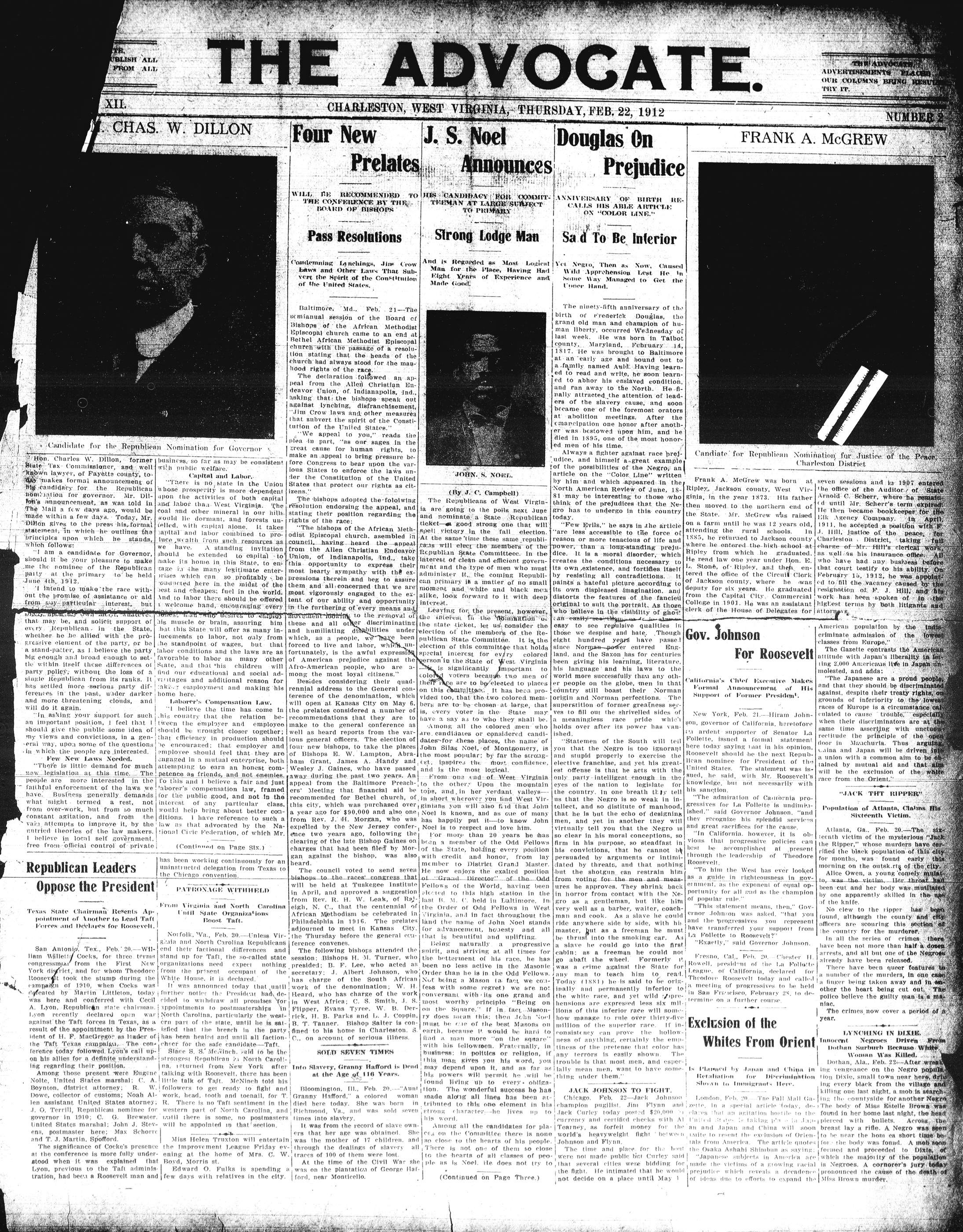
Page text (machine-generated)
1910
Hon. Charles W. Dillon, former State Tax Commissioner, and well known lawyer, of Fayette county, today makes formal announcement of his candidacy for the Republican nomination for governor. Mr. Dillon's announcement, as was told in The Mail a few days ago, would be made within a few days. Today, Mr. Dillon gives to the press his formal statement, in which he outlines the principles upon which he stands, which follows:
"I am a candidate for Governor, should it be your pleasure to make me the nominee of the Republican party at the primary to be held June 4th, 1912.
"I intend to make the race without the promise of assistance or aid from say particular interest, but
sometimes own interest, whatever that may be, and solicit support of every Republican in the State, whether he be allied with the progressive element of the party, or be a stand-patter, as I believe the party big enough and broad enough to settle within itself these differences of party policy, without the loss of a single Republican from its ranks. It has settled more serious party differences in the past, under darker and more threatening clouds, and will do it again.
"In asking your support for such an important position, I feel that I should give the public some idea of my views and convictions, in a general way, upon some of the questions in which the people are interested.
"Thoife is little demand for much new legislation at this time. The people are more interested in the faithful enforcement of the laws we have. Business generally demands what might termed a rest, not from over-work, but from so much constant agitation, and from the vain attempts to improve it, by the untried theories of the law makers. I believe in local self government, free from official control of private
Republican Leaders
Oppose the President
Texas State Chairman Resents Appointment of Another to Lead Taft Forces and Declares for Roosevelt.
San Antonio, Tex., Feb. 20.—William Willett Cocks, for three terms congressman from the First New York district, and for whom Theodore Roosevelt took the stump during the campaign of 1910, when Cocks was defeated by Martin Littleton, today was here and conferred with Cecil A. Lyon, Republican state chairman. Lyon recently declared open war against the Taft forces in Texas, as a result of the appointment by the President of H. F. MacGregor as leader of the Taft Texas campaign. The conference today followed Lyon's call upon his allies for a definite understanding regarding their position.
Among those present were Eugene Nolte, United States marshal; C. A. Boynton, district attorney; R. W. Dowe, collector of customs; Noah Allen assistant United States attorney; J. G. Terrill, Republican nominee for governor in 1910; C. G. Brewster, United States marshal; John J. Stevens, postmaster here; Max Schorre and T. J. Martin, Spofford.
The significance of Cocke's presence at the conference is more fully understood when it was explained that Lyon, previous to the Taft administration, had been a Roosevelt man and
THE ADVOCATE.
business, so far as may be consistent with public welfare.
Capital and Labor.
"There is no state in the Union whose prosperity is more dependent upon the activities of both capital and labor than West Virginia. The coal and other mineral in our hills would lie dormant, and forests unleashed, with capital alone. It takes capital and labor combined to produce wealth from such resources as we have. A standing invitation should be extended to capital to make its home in this State, to engage in the many legitimate enterprises which can so profitably be conducted here in the midst of the best and cheapest fuel in the world. And to labor there should be offered a welcome hand, encouraging crow
many, in fact, who desires to employ his muscle or brain, assuring him that this State will offer as many inducements to labor, not only from the standpoint of wages, but that labor conditions and the laws are as favorable to labor as many other State, and that this children will find our educational and social advantages and additional reason for taking employment and making his home here.
Laborer's Compensation Law.
"I believe the time has come in this country that the relation between the employer and employee should be brought closer together; that efficiency in production should be encouraged; that employer and employee should feel that they are engaged in a mutual enterprise, both attempting to earn an honest competence as friends, and not enemies. To this and I believe a fair and just laborer's compensation law, framed for the public good, and not in the interest of any particular class, would help bring about better conditions. I have reference to such a law as that advocated by the National Civic Federation, of which Mr.
(Continued on Page Six.)
has been working continuously for an uninstructed delegation from Texas to the Chicago convention.
PATRONAGE WITHHELD
From Virginia and North Carolina
Until State Organizations
Boost Taft.
Norfolk, Va., Feb. 20.—Unless Virginia and North Carolina Republicans end their factional differences and stand up for Taft, the so-called state organizations need expect nothing from the present occupant of the White House, it is declared.
It was announced today that until further notice the President had decided to withdraw all promises for appointments to postmasterships in North Carolina, particularly the western part of the state, until he is satisfied that the breach in the party has been healed and until all faction-check for the safe candidate—Taft. Since S. S. McNinch, said to be the strongest Republican in North Carolina, returned from New York after talking with Roosevelt, there has been little talk of Taft. McNinch told his followers to get ready to fight and work, head, tooth and toenail, for T. R. There is no Taft sentiment in the western part of North Carolina, and until there is some, no postmasters will be appointed in that section.
Miss Helen Truxlon will entertain the Improvement League Friday evening at the home of Mrs. C. W. Boyd, Morris st. Edward O. Fulks is spending a few days with relatives in the city.
Prelates
WILL BE RECOMMENDED TO
THE CONFERENCE BY THE
BOARD OF DISHOPS
Condemning Lynchings, Jime Crow
Laws and Other Laws That Subvert
the Spirit of the Constitution
of the United States.
Baltimore, Md., Feb. 21—The semiannual session of the Board of Bishops of the African Methodist Episcopal church came to an end at Bethel African Methodist Episcopal church with the passage of a resolution stating that the heads of the church had always stood for the manhood rights of the race.
The declaration followed an appeal from the Allen Christian Endeavor Union, of Indianapolis, Ind., asking that the bishops speak out against lynching, disfranchisement, "Jim Crow laws and other measures that subvert the spirit of the Constitution of the United States."
"We appeal to you," reads the plea in part, "as our sages in the great cause for human rights, to make an appeal to bring pressure before Congress to bear upon the various States to enforce the laws under the Constitution of the United States that protect our rights as citizens." The bishops adopted the foliolwing resolution endorsing the appeal, and stating their position regarding the rights of the race:
"The bishops of the African Methodist Episcopal church, assembled in council, having heard the appeal from the Allen Christian Endeavor Union, of Indianapolis, Ind., take this opportunity to express their most hearty sympathy with the expressions therein and beg to assure them and all concerned that we are most vigorously engaged to the extent of our ability and opportunity in the furthering of every means and movement looking to the removal of these and all other discriminating and humiliating disabilities under which, as a people, we have been forced to live and labor, which unfortunately, is the awful expression of American prejudice against the Afro-American people, who are among the most loyal citizens."
Besides considering their quadrennial address to the General conference of the denomination, which will open at Kansas City on May 6, the prelates considered a number of recommendations that they are to make to the general conference as well as heard reports from the various general officers. The election of four new bishops, to take the places of Bishops E. W. Lampton, Abraham Grant, James A. Handy and Wesley J. Gaines, who have passed away during the past two years. An appeal from the Baltimore Preachers' Meeting that financial aid be recommended for Bethel church, of this city, which was purchased over a year ago for $90,000 and also one from Rev. J. H. Morgan, who was expelled by the New Jersey conference two years ago, following the clearing of the late Bishop Gaines on charges that had been filed by Morgan against the bishop, was also heard.
The council voted to send seven bishops to the races' congress that will be held at Tuskegee Institute in April, and approved a suggestion from Rev. R. H. W. Leak, of Raleigh, N. C., that the centennial of African Methodism be celebrated in Philadelphia in 1916. The prelates adjourned to meet in Kansas City, the Thursday before the general conference convenes.
The following bishops attended the session; Bishops H. M. Turner, who presided; B. F. Lee, who acted as secretary; J. Albert Johnson, who has charge of the South African work of the denomination; W. H. Heard, who has charge of the work in West Africa; C. S. Smith, J. S. Slipper, Evans Tyree, W. B. Derrick, H. B. Parks and L. J. Coppin, B. T. Tanner. Bishop Slatier is confined to his home in Charleston, S. C., on account of serious illness.
SOLD SEVEN TIMES
Into Slavery, Granny Hafford is Dead at the Age of 116 Years.
Bloomington, Ill., Feb. 20.—"Aunt Granny Hafford," a colored woman died here today. She was born in Richmond, Va., and was sold seven times into slavery.
It was from the record of slave owners that her age was obtained. She was the mother of 17 children, and through the dealings of slavery all traces of 100 of them were lost.
At the time of the Civil War she was on the plantation of George Hafford, near Monticello.
HIS CANDIDACY FOR COMMITTEE TEFMAN AT LARGE SUBJECT TO PRIMARY
And is Regarded as Most Logical Man for the Place, Having Had Eight Years of Experience and Made Good.
THE LEGEND OF THE
MUSICIAN
The Republicans of West Virginia are going to the polls next June and nominate a State Republican ticket good strong one that will spell victory in the fall election. At the same time these same republicans will elect the members of the Republican State Committee. In the interest of clean and efficient government and the type of men who must administer it, the coming Republican primary is a matter of no small moment and white and black men alike, look forward to it with deep interest.
Leaving for the present, however, the interest in the nomination of the state ticket, let us consider the election of the members of the Republican State Committee. It is the election of this committee that holds special interest for every colored person in the State of West Virginia — it is significantly important to colored voters because two men of their race are to be elected to places on this committee. It has been provided too, that the two colored members are to be chosen at large, that is, every voter in the State may have a say as to who they shall be. Among all the colored men who are candidates or considered candidates for these places, the name of John Silas Noel, of Montgomery, is the most popular; by far the strongest, inspires the most confidence, and is the most logical.
From one end of West Virginia to the other: Upon the mountain tops, and in her verdant valleys—in short wherever you find West Virginians you will also find that John Noel is known, and as one of many has happily put it—to know John Noel is to respect and love him. For more than 20 years he has been a member of the Odd Fellows of the State, holding every position with credit and honor, from lay member to District Grand Master. He now enjoys the exalted position of "Grand Director" of the Odd Fellows of the World, having been elected to this high station in the last B. M. C. held in Baltimore. In the Order of Odd Fellows in West Virginia, and in fact throughout the land the name of John Noel stands for advancement, honesty and all that is beautiful and uplifting.
Being naturally a progressive spirit, and striving at all times for the betterment of his race, he has been no less active in the Masonic Order than he is in the Odd Fellows. Not being a Mason (a fact we confess with some regret) we are not conversant with its one grand and most worthy principle "Being on the Square." If in fact—Masonry does mean this; then John Noel must be one of the best Masons on earth, because it would be hard to find a man more "on the square" with his fellowmen. Fraternally, in business; in politics or religion, if this man gives you his word, you may depend upon it, and as far as his powers will permit he will be found living up to every obligation. The wonderful success he has made along all lines has been attributed to this one element in his strong character—the lives up to his word.
Among all the candidates for places on the Committee there is none so close to the hearts of his people. There is not one of them so close to the hearts of all classes of people as is Noel. He does not try to
(Continued on Page Three.)
ANNIVERSARY OF BIRTH RECALLS HIS ABLE ARTICLE ON "COLOR LINE."
Yet Negro, Then as Now, Caused Wild Apprehension Lest He In Some Way Managed to Get the Upper Hand.
The ninety-fifth anniversary of the birth of Frederick Douglas, the grand old man and champion of human liberty, occurred Wednesday of last week. He was born in Talbot county, Maryland, February 14, 1817. He was brought to Baltimore at an early age and bound out to a family named Auld. Having learned to read and write, he soon learned to abhor his enslaved condition, and ran away to the North. He finally attracted the attention of leaders of the slavery cause, and soon became one of the foremost orators at abolition meetings. After the emancipation one honor after another was bestowed upon him, and he died in 1895, one of the most honored men of his time.
Always a fighter against race prejudice, and himself a great example of the possibilities of the Negro, an article on the "Color Line" written by him and which appeared in the North American Review of June, 18-81 may be interesting to those who think of the prejudices that the Negro has to undergo in this country today.
"Few Evils," he says in the article "are less accessible to the force of reason or more tenacious of life and power, than a long-standing prejudice. It is a moral disorder, which creates the conditions necessary to its own existence, and fortifies itself by resisting all contradictions. It paints a hateful picture according to its own displeased imagination, and distorts the features of the fancied original to suit the portrait. As those who believe in the visibility of ghost can easily see them, it is easy to see repulsive qualities in those we despise and hate. Though eight hundred years have passed since Norman power entered England, and the Saxon has for centuries been giving his learning, literature, his language and his laws to the world more successfully than any other people on the globe, men in that country still boast their Norman origin and Norman perfections. The superstition of former greatness serves to fill out the shrivelled sides of a meaningless race pride which holds over after its power has vanished.
"Statemen of the South will tell you that the Negro is too ignorant and stupid properly to exercise the elective franchise, and yet his greatest offense is that he acts with the only party intelligent enough in the eyes of the nation to legislate for the country. In one breath they tell us that the Negro is so weak in intellect, and so distitute of manhood, that he is but the echo of designing men, and yet in another they will virtually tell you that the Negro is so clear in his moral conceptions, so firm in his purpose, so steadfast in his convictions, that he cannot be persuaded by arguments or intimidated by threats, and that nothing but the shotgun can restrain him from voting for the men and measures he approves. They shrink back in horror from contact with the Negro as a gentleman, but like him very well as a barber, waiter, coachman and cook. As a slave he could ride anywhere side by side, with his master, but as a freeman he must be thrust into the smoking car. As a slave he could go into the first cabin: as a freeman he could not go abaft the wheel. Formerly it was a crime against the State for any man to teach him to read. Today (1881) he is said to be originally and permanently inferior to the white race, and yet wild expressions are expressed less six millions of this inferior race will somehow manage to rule over thirty-five million of the superior race. If inconsistency can prove the hollowness of anything, certainly the emptiness of the pretense that color has any terrors is easily shown. The trouble is that most men, and especially mean men, want to have something under them."
JACK JOHNSON TO FIGHT.
Chicago. Feb. 22-Jack Johnson champion pugilist. Jim Flynn and Jack Curley today posted $20,000 in currency and certified checks with Al Toanney, as forfeit money for the world's heavyweight fight between Johnson and Flynn.
The time and place, for the bout were not made public but Curley said that several cities were bidding for the fight. He intimated that he would not decide on a place until May 1.
THOM. C. ARTHURS E. THOM.
Frank A. McGrew was born at Ripley, Jackson county, West Virginia, in the year 1873. His father then moved to the northern end of the State. Mr. McGrew was raised on a farm until he was 12 years old, attending the rural schools. In 1885, he returned to Jackson county where he entered the high school at Ripley from which he graduated. He read law one year under Hon. E. L. Stone, of Ripley, and then entered the office of the Circuit Clerk of Jackson county, where he was deputy for six years. He graduated from the Capital City Commercial College in 1901. He was an assistant clerk of the House of Delegates for seven sessions and in 1907 entered the office of the Auditor of State Arnold C. Scherr, where he remained until Mr. Scherr's term expired. He then became bookkeeper for the Elk Agency Company. In April, 1911, he accepted a position with F. J. Hill, justice of the peace, for Charleston District, taking full charge of Mr. Hill's clerical work as well as his insurance office. All who have had any business before that court testify to his ability. On February 15, 1912, he was appointed to fill the vacancy caused by the resignation of F. J. Hill, and his work has been spoken of in the highest terms by both litigants and attorneys.
Gov. Johnson For Roosevelt
California's Chief Executive Makes Formal Announcement of His Support of Former President<sup>1</sup>.
New York, Feb. 21.—Hiram Johnson, governor of California, heretofore ardent supporter of Senator La Follette, issued a formal statement here today saying that in his opinion, Roosevelt should be the next Republican nominee for President of the United States. The statement was issued, he said, with Mr. Roosevelt's knowledge, but not necessarily with his sanction.
"The admiration of California progressives for La Follette is undiminished," said Governor Johnson, "and they recognize his splendid services and great sacrifices for the cause.
"In California, however, it is obvious that progressive policies can best be accomplished at present through the leadership of Theodore Roosevelt.
"To him the West has ever looked as a guide in righteousness in government, as the exponent of equal opportunity for all and as the champion of popular rule."
"This statement means, then," Governor Johnson was asked, "that you and the progressives you represent have transferred your support from La Follette to Roosevelt?"
"Exactly," said Governor Johnson.
Fresno, Cal., Feb. 20—Chester H. Rowell, president of the La Follette League, of California, declared for Theodore Roosevelt today and called a meeting of progressives to be held in San Francisco, February 28, to determine on a further course.
Exclusion of the Whites From Orient
Exclusion of the Whites From Orient
Is Planned by Japan and China in Retaliation for Discrimination Shown to Immigrants Here.
London, Feb. 20. The Pall Mall Gazette, in a special article today, declares that an agitation hostile to the United States is taking place in Japan and Japan and China will soon write to resent the exclusion of Orientals from America. The article quotes the Osaka Ashiab Shimin as saying: "Japanese subjects in America are made the victims of a growing racial prejudice which reveals a decadence of ideas due to efforts to expand the
THE ADVOCATE
ADVERTISEMENTS PLACES
OUR COLUMNS BEING RESU
TRY IT.
McGREW
nation for Justice of the Peace.
leston District
seven sessions and in 1907 entered the office of the Auditor of State Arnold C. Scherr, where he remained until Mr. Scherr's term expired. He then became bookkeeper for the Elk Agency Company. In April, 1911, he accepted a position with F. J. Hill, justice of the peace, for Charleston District, taking full charge of Mr. Hill's clerical work as well as his insurance office. All who have had any business before that court testify to his ability. On February 15, 1912, he was appointed to fill the vacancy caused by the resignation of F. J. Hill, and his work has been spoken of in the highest terms by both litigants and attorneys.
American population by the indiscriminate admission of the lowest classes from Europe."
The Gazette contrasts the American attitude with Japan's liberality in forcing 2,000 Americans live in Japan unmolested, and adds:
"The Japanese are a proud people, and that they should be discriminated against, despite their treaty rights, on grounds of inferiority to the lowest races of Europe is a circumstance calculated to cause trouble," especially when their discriminators are at the same time asserting with uncertainty the principle of the open door in Macachuria. Thus arguing China and Japan will be driven into a union with a common aim to be obtained by mutual aid and that aim will be the exclusion of the white race from the Orient."
"JACK THT RIPPER"
Population of Atlanta, Claims His Sixteenth Victim.
Atlanta, Ga., Feb. 20.—The sixteenth victim of the mysterious "Jack the Ripper," whose murders have terrified the black population of this city for months, was found early this morning on the outskirts of the city.
Alice Owen, a young comely mutant, was the victim. Her throat had been cut and her body was mutilated by one apparently skilled in the use of the knife.
No clew to the ripper has been found, although the county and city officers are scouring this section of the country for the murderer.
In all the series of crimes there have been not more than half a dozen arrests, and all but one of the Negroes already have been released. There have been queer features in a number of the murders, in one case a finger being taken away and in another the heart being cut out. The police believe the guilty man is a maniac.
The crimes now cover a period of a year.
LYNCHING IN DIXIE.
Innocent Negroes Driven Free Dothan Surburb Because White Woman Was Killed.
Dothan, Ala., Feb. 22—After wreaking vengeance on the Negro population Dixie, small town near here, drives every black from the village and killing one last night, a mob is searching the countryside for another Negro. The body of Miss Estelle Brown was found in her home last night, the head pierced with bullets. Across the breast lay a rifle. A Negro was seen to be near the hom ea short time before the body was found. A mob soon formed and proceeded to Dixie, of which the majority of the population is Negroes. A cornorer's jury today pronounced the cause of the death of Miss Brown murder.
---
CORRESPONDENCE
PAGE TWO.
CLARKSBURG
The W. C. T. U. held a most interesting meeting at Pride A. M. E. Church Sunday afternoon.
Quite a number of members were in attendance.
The following program was carried out:
Singing—Where is My Wandering Boy.
Prayer—Rev. W. H. Thomas.
Singing—Throw out the life line.
Scripture Lesson—Mr. D. H. Kyle.
Paper—How Shall We Interest the Young People, Miss Hanna L. Meade.
Singing—Rescue the Perishing.
Singing—Rescue the Perishing.
Paper—What Our W. C. T. U. has
Accomplished and its Possibilities,
Mrs. L. R. Jordan.
Paper—Shall We Have a Temperance Column in Our Papers?, Miss Estella Walker.
Edward James is seriously ill at his home on First St.
Miss Anna Poindexter, who has been quite ill, is convalescing.
Miss Lula Brown and Mrs. Mary Grayson continue quite ill. Their many friends wish them a speedy recovery.
The entertainment at Trinity M. E. Church last week in commemoration of Lincoln's birthday, was well attended.
A program will be rendered Thursday evening at Pride A. M. E. Church for the benefit of the missionary society.
Rev. I. V. Bryant, of Huntington, assisted Rev. W. F. Kenney with his revival last week. Prominent visitors at the Water Street School last week were Rev. W. F. Kenney, city Rev. Jackson, Rev. I. V. Bryant, of Huntington, Rev. W. S. Brown, of Buckhannon, and Rev. J. E. Morris, of Braddock Pa. The revival at Mt. Zion Baptist Church closed Friday. Many accessions were made to the church and the membership greatly revived. The Dunbar Reading Circle will meet Friday night. Several persons from Fairmont and Monongah attended the funeral of Mrs. Geer, Tuesday.
Mrs. Cornhella Geer, aged 55 years died Sunday morning at 2:30 o'clock after a long illness of a complication of diseases, at the home of her daughter, Mrs. James E. McCoy, 101 Watson street.
Mrs. Geer moved to Clarksburg eight years ago from Dunham, N. C., in that time she had made many friends in the city. She was a life-long member of the Baptist church, and daring her entire life so, as an active part in church work.
The funeral was held Tuesday by two daughters and a brother. The daughters are Mrs. James E. McCoy and Mrs. Emma Perkins, both of this city. The brother is Rufus Bragg, of Durham, N. C.
The funeral was held nesday afternoon at 2 o'clock in the Mt. Zion Baptist church, the Rev. W. T. Kennedy leading the services. The burial followed in Greenlawn cem
MacDONALD
Mr Craig has moved his family to Sun, where he adams a much better position than he had here.
Hon. J. M. Ellis, of Oak Hill, was a business visitor here last week. He was taking depositions before our new notary public, H. B. Hendley, who was commissioned by Gov. Glasseock a few weeks ago.
The new bell for the MacDonald Baptist Church has been installed and is now ready to call the members to services.
Mrs George Morton, who has been ill for several weeks, is but slightly improved at this writing.
Cleveland Richardson and Morton Cyrus, who were badly bursed a few weeks ago in the mines, are now able to leave the hospital. Their friends will be glad to know that they will not be scared as a result of their burns.
William Craig, of Sun, was calling on friends here Sunday. Derman Jones has moved into the house formerly occupied by Mr. Craig. Stephen Spears has returned from a three weeks visit on the N. & W. and reports a very fine time. The Colored Republicans of MacDonald have organized themselves into a club that bids fair to be a great factor in the moral and political life of the Negro. Clem Callaway is the president. Public meetings are held on the second Monday and fourth Friday of each month at which time prominent persons will be invited to address them. On Monday evening, Feb. 19th, a very interesting meeting was held, eloquent addresses being made by H. B. Hundley, Dr. P. H. Calloway and others.
HINTON
Dr. C. H. Payne, Jr, left last Thursday morning for Washington, D. C., accompanied by Mrs. A. P. Straughter and Mrs. Mary Morris whom he took to Freedmen's Hospital for an operation. Mrs. Straughter was operated on Friday and stood the ordinal well.
Born to Mr. and Mrs. William Woods, of Park avenue, a fine son.
The Progressive Daughters and Sons were entertained by Mrs. Mattie Strange, Miss Lena Edwards and Miss M. S. Booth at the home of Mrs.
Strange Monday evening. A large number of members were present and some important business was disposed of. A dainty repast was served after the meeting at which many friends of the club were present. Everybody seemed to have enjoyed themselves. Rev. Lewis' sermon to the young people Sunday evening was well prepared and well delivered. His subject was chosen from the third chapter of Ecclesiastes. A large crowd was present.
The Merry Makers met with the Misses Smithers last Saturday evening. The young ladies will glance in retrospect on the evening of the seventeenth for a long time, from the fact of the many gentlemen friends present. The out-of-town guests were Messrs. Gilmer, Jackson, James and Dr. Ellis, of Charleston; Mr. Davis, of Lynchburg, Va.; Mr. Hutchington, of Covington, Va.; Mr. Saunders, of Eagle, and Mr. Brown, of Ronceverla. The last four young men named remained over Sunday and the Misses Smithers, with the club girls, served four o'clock tea for them. They spent the evening at the sanitarium, where music was the divertissement until time for the nine-twenty train on which they all left.
WINIFREDE
Miss Emma Meadows spent Saturday and Sunday here the guest of Mr. and Mrs. J. F. Mosley. Mrs. B. B. Allen who has been confined to her room for the past few weeks, is able to be out again. G. W. Williams of Handley, left for his home at that place Saturday. W. W. Lewis spent Saturday and Sunday at his home at Kanawha City. A. Wilson and R. H. Allen spent Saturday and Sunday at their home in St. Albans. Mr. and Mrs. J. F. Amos entertained at dinner Sunday: Mr. and Mrs. Ed Robinson, Misses Chamie Mason and Emma Meadows. Messrs. R. H. Allen, F. Adams, S. Belle, O. Saunders and Lee Johnson. Rev. F. E. Smith filled his regular appointment here Sunday and preached two very good sermons.
BLUEFIELD.
Bluefield Institute is steadily improving in the number enrolled. The total enrollment for the session is 162, with an addition of 41 in the model school. These figures show that the school is taxed to its utmost capacity. Some of the classes, the first year normal especially, have been divided because of a lack of class room capacity sufficient to accommodate the entire class.
From the notices sent out, the indications are that the Summer school is going to be something good. The men at the head of it and the instructors are the best in the country. All who were present last session will be glad to know that Press H. T. McDonald's name appears on the list.
The students had the privilege of witnessing two of Shakespeare's plays week before last "Hamlet" and "The Merchant of Venice." A goodly number of the students accompanied by the teachers went to the theatre where a portion of the house had been reserved by the management for them.
Oscar Holly of the class of '06, B. C. L., was killed in the mines the middle of January. He in company with others, was just coming out at 6 o'clock when he was caught under falling slate.
J. S. Caldwell of the class of '09 was married to Miss Jackson soon after Christmas. Both are teaching near Gary.
Stewart Adams of the class of '05 is studying dentistry in Howard University.
H. L. Dickerson of the Academic class '10, writes that he passed all his examinations the first time at Ohio State University, getting a merit in mathematics and constitutional history.
D. L. Brown, class of '11, normal department, lacked one half unit of the requirements of admission to the pharmaceutical department at O. S. U. so he is taking "paragraphing" this semester to make it up.
Rev. J. D. Coleman has been supplying for the Baptist church in Pocahontas, Va., for several months.
Rev. S. R. Bullack is still doing good gork at Scott St. church. He has been giving a series of excellent scraps. It is said that he is raising chickens and that his stock is fine.
Rev. Hicks was out of town Sunday.
Dr. Crichlow's baby, threatened with pnueomia, is well now.
The stork descended upon Institute hill two weeks ago and left a fine girl with Dr. and Mrs. C. W. Mitchell.
Dr. Mitchell, class of '06, is "making good" as a dentist in Bluefield.
Thaddus Warren, class of '05, is at Western Reserve University, Cléverland.
Miss Lucy Maynard, class of '11, is supplying at Elkhorn.
Mrs. Nannie Thomas, of Reese st., was called to Pittsburgh last week on account of the death of her sister.
Miss Mitildia Williams of Greenbrier county enrolled the last of January.
Mrs. J. V. Wilkerson who spent the first term here, is finishing a term teaching at Heberton.
THE ADVOCATE
Rev. P. B. Edwards, of Point Pleasant, spent several weeks with his family in Bluefield during the Christmas and January.
CHARLESTON
Quarterly Meeting at St. Paul. The second quarterly meeting will be held at St. Paul A. M. E. church Court street, Sunday. Presiding Elred Downs will preach at 11:00. The love feast will be at 3.00 in the afternoon, and either the presiding Elder or the pastor, Rev. E. Fort, will preach at the evening service. On Thursday the 29th a musicale will be given under the direction of Mrs. Davis. The affair will be held at the church and the proceeds will be turned into its treasury.
Preachers Meet. The Interdenominational Preacher's Union held an interesting meeting. Wednesday morning of last week, at the Hotel Brown. Rev. S. P. Crummett of the Antisaloon League. gave an instructive and helpful address on "The Minister's Part in the Coming Campaign as it relates to the Prohibition amendment." The subject was again discussed at the meeting yesterday when Rev. B. A. Brooks presented a well written paper.
Ten Commandments Theme. Rev
J. S. Carroll, pastor of Simpson
Methodist Episcopal church, is
preaching a series of sermons on the
Ten Commandments. Sunday night
he will take up the fifth and cordially
invites all members and friends
of the church to hear him. The
regular services will be held Sunday.
Preaching at 11:00; Sunday school
at 2:30 and the usual evening service.
Hotel Brown Arrivals. P. Young, Dorothy; O. Miler, Glen Ferris; L. A. Hilton, H. G. Oliver, Pine Grove; Mrs. Eph. Williams, Milwaukee, Wis.; Mrs. Claude Hurt, Shrewsbury; M. McDonald, Longacre; S. H. Denson, Covington, Va.; C. Logan, Ward; C. A. Parker, W. A. Henson, W. D. Robbins, S. H. Stewart, Jos. P. Jones, Columbus, O.; E. Brown, Pittsburg, B. C. Bell, B. L. Johnson, Wm. Wilson, Portsmouth, O.; H. Lewis, Woodviola, Va.; Miss Laura Smith, Smithers, J. H. Bowles, J. P. Bowles, J. J. Lee, Columbus, O.; C. E. Gordon, Cleveland, O.; Wm. H. Buckner, Columbus, O.; Jas Templeton, Carbondale; W. H. Lewis, Institute; B. Williams and G. Crawford, Cannellton, were registered at Hotel Brown this week.
Knights Templars Instituted. Saturday night and Sunday John H. Bowles, of Columbus, commander-in-chief, assisted by W. H. Ruffner, deputy grand commander, Chas, E. Corden, grand captain general, J. J. Lee, grand prelate, William Wilson, grand guard, Benjamin Johnson, senior warden, Benjamin Bell, junior warden, John T. Bowles, standard bearer, all of the state of Ohio, and others instituted a commandery of Knights Templars with the following officers: I. M. Carper, eminent commander; C. C. Campbell, generalissimo; W. H. Lowry, captain general; W. H. Parker, prelate; Ernest Porterfield, treasurer; C. E. Mitchell, recorder; J. M. Dillon, senior warden; J. F. J. Clark, junior warden; Jos. Kent, sword bearer; Geo Willis, standard bearer; D. M. Miller, guard.
Baptist Executive Board. There will be a meeting of the executive board of the West Virginia State convention at the Baptist church this morning at nine o'clock. In the afternoon at 1:30 the executive board of the Sunday School convention will convene at the same place. A number of members of both organizations are already in the city.
Death of Mrs. Fields. Mrs. Ruth Preston Fields died Tuesday morning of a complication of diseases at her home on Sentz street. Mrs. Fields had been ill for several weeks and for several days her condition had been such that her relatives and friends despaired of her recovery. She leaves a husband, four children; mother, four sisters and four brothers, all of whom reside in the city. The funeral services will be held at the First Baptist church, this afternoon.
Personalns and Locals.
J. C. Gilmer, Dr. J. C. Ellis, J. A. Jackson and Edward James were guests of the "Merry Makers," a club of young ladies at Hinton, Saturday evening. Dancing and cards were the divertiments.
W. H. Parker, manager of the People's Grocery Co., was a witness in the U. S. District Court at Cincinnati, O., the first of the week. John Clark, of Donnally street, whose condition has caused his friends considerable alarm the past few weeks, is slowly improving. Mrs. Ada Howard, of Cincinnati, arrived in the city Friday of last wke, called by the serious illness of her mother, Mrs. Drucilla Knox. Little Marie Brown is ill at the home of her parents at Hotel Brown. Absolute quiet has been prescribed as a condition to the recovery of J. M. Hazlewood, who is now confined to his bed. His state is regarded as serious. His mother is in attendance upon him. A. A. Dehonney has been ill with the grip at his home on Lewis street the past three or four days.
Mrs. Malinda Wells, of Pomeroy, O., spent the week-end here visiting her brother, J. M. Hazlewook. Dr. L. A. Hilton, of Wilcoe, arrived in the city last night to spend a few days with friends.
Attorney J. W. Chappelle, who has been ill the past week, is able to be out.
Mrs. E. V. Seams, of Parkersburg, arrived in the city last night to visit relatives.
Miss Helen Truxton will be hostess to the Women's Christian Temperance Union this week.
Misses Jennie Foster and Hatie Peters were dinner guests of Attorney and Mrs. E. R. Carter, Sunday.
Mrs. James Allen, Second avenue, West Side, entertained the Willing Workers of the Ebenezer Baptist church, Monday.
Miss Rosalynde Friend, of Institute, was the guest of Mrs. Maria Bush, Washington street the first of the week.
Rev. J. W. Robinson, of St. Albans, attended the Roosevelt meeting here Thursday night of last week.
Mr. and Mrs. Wm. Stuart, Jr. have returned to the city after an extended visit to relatives in Richmond, Va.
Noble Mitchell is ill at his home on Sentz st.
Miss Mary E. Eubank is able to be out after several weeks illness.
Miss Jennie Toster of Nashville, Tenn., spent a few days in the city with Miss Amelia Wilcher, Bradford street.
Mrs. Barbara Rose is ill at her home on the South Side.
Miss Hattie Peters left Wednesday evening to spend a few days with Mrs. Ernest Hardy, of Huntington.
Miss Rhoda Wilson is spending the vacation with her parents in St. Albans.
Dr. H. F. Gamble will entertain the Married Ladies' Whist Club, on Thursday afternoon at his home on Washington street.
Miss Emma Wade entertained a few girl friends Thursday evening with a Candy Party at her home on Piedmont street.
Mrs. Anna Smith and Mrs. Leighuna Richardson are visiting their mother, Mrs. R. L. Mickey, lower Lewis st.
TO BE GIVEN FROM EDUCATION
AL TRAIN TO BE OPERATED
ON B. & O.
Experts In Charge
Will Endeaver to Improve Farming Conditiois by Giving Instructions on Soil Fertility, Corn Selection and Kinetic Topics.
An Agricultural Educational Train will be operated over the Baltimore and Ohio Railroad lines in West Virginia for 40 days, beginning March 4th, by the Division of Agricultural Extension of West Virginia University. Lectures on agricultural subjects, including soil fertility, seed corn, selection and germination, potato growing, horticulture and spraying of fruit trees, will be delivered to the farmers of the State who visit the train: Prof. C. R. Titlow, Director of the Division of Agricultural Extension, will be in charge of the train for the University, the lectures to be delivered under his auspices. The topics of discussion have been chosen with a view to improving farming conditions in the Section of West Virginia which will be visited, and to insure such result recognized authorities on agriculture have been engaged to accompany the train.
W. W. Wood, General Industrial Agent of the Baltimore & Ohio Railroad, will be in charge of the train representing the railroad. George H. Campbell, Assistant to President will accompany the party, as will officials representing the passenger and freight and operating departments.
The Educational Special will consist of first-class coaches furnished by the Baltimore & Ohio for lecture purposes, so that there need be no interruption due to inclement weather. The train will leave Clarksburg over the Short Line Railroad for New Martinsville, from whence it will proceed over the Ohio River Division to Point Pleasant, thence returning over the main line to Clarksburg. Stations over the West Virginia and Pittsburg lines south of Clarksburg will also be visited, including Weston, Sutton, Buckhannon, Phillippi, and intermediate points. Meetings will be held in the town hall at night at the towns where the train is scheduled for a night stop.
Following is the schedule which will be maintained by the train:
Monday, March 4, Lumberport, 9: to 10:30 a. m.; Wallace, 11:00 to 12:30 p. m.; Smithfield, 1:00 to 2:30 p. m.; Jacksonburg, 3:00 to 5:00 p. m.; New Martinsville, at night.
Tuesday, March 5th, Sisterville, 9:00 to 10:45 a. m.; Friendly, 11:00 to 12:45 a. m.; Beng Run, 1:00 p. m. to 2:45 p. m.; Raven Rock, 3:00 to 5:00 p. m.; St. Mary's, at night.
Wednesday, March 6, Waverly, 9: to 10:45 a. m.; Williamstown, 11:00 a. m. to 12:20 p. m.; Washington, 1:15 to 2:30 p. m.; Belleville, 3:00 to 5:00 p. m.; Ravenswood, at night.
Thursday, March 7, Willow Grove 9:00 to 10:45 a. m.; Millwood, 11: a. m. to 12:45 p. m.; Lettart, 1:00 to 2:45 p. m.; New Haven, 3:00 to
6:00 p. m.; Mason City, at night.
Friday, March 8, Clifton, 9:00 to
10:30 a. m.; Maggie, 11:00 a. m.
to 12:20 p. m.; Apple Grove, 1:15
to 2:45 p. m.; Cox Landing, 3:30
to 5:00 p. m.; Pt. Pleasant, at night.
Saturday, March 9, Petro/um, 9:
to 10:30 a. m.; Calro, 11:00 a. m.
to 12:30 p. m.; Ellenboro, 1:00 to
2:45 p. m.; Pennsboro, 3:00 to 5:00
p. m.; West Union, at night.
Monday, March 11, Morgansville,
9:00 to 10:30 a. m.; Salem, 11:00
a. m. to 12:30 p. m.; Wolf Summit,
1:00 to 2:30 p. m.; Bridgeport, 3:25
to 5:00 p. m.; Clarksburg, at night.
Tuesday, March 12, Byron, 9:00
to 10:45 a. m.; Lost Creek, 11:00
a. m. to 12:45 p. m.; Jane Lew,
1:00 to 2:50 p. m.; Deanville, 3:15
to 5:00 p. m.; Weston at night.
Wednesday, March 13, Roanville,
9:00 to 10:20 a. m.; Burnsville, 11;
a. m. to 12:30 p. m.; Heaters, 1:00
to 2:45 p. m.; Flatwoods, 3:00
to 5:00 p. m.; Sutton, at night.
Thursday, March 14, Gaston, 9:00
to 10:30 a. m.; Lorentz, 11:00 a. m.
to 12:35 p. m.; Buekhamnon, 1:
to 2:30 p. m.; Bellington, 4:00
to 5:30 p. m.; Phillppl, at night.
New River Valley Baptist Ministers
And Deaconss Union Holds an Interesting Meeting at Macdonald Where Denominational Subjects Are Discussed.
Macdonald, Feb. 16.—The New River Valley Baptist Ministers' and Deacons' Union met here the 12th and 13th.
On the first day the introductory sermon was preached by R. S. Gordon. In the afternoon the subject, "Christ": As Saviour was opened by Rev. J. P. Price; as Emmanuel, by R. S. Gordon, as Redeemer, by Rev. D. W. Stratton; as mediator, by Rev. H. E. Braxton.
A sermon was preached in the evening by Rev. D. W. Stratton, text, 1 Cor. 15:57.
The welcome address was delivered by Prof. E. L. Rann; response by Rev. A. D. Lewis.
The subject for the session the morning of the second day was the Importance of Prayer, which was opened by Rev. Wm. Jackson, who brought out many helpful thoughts.
At 11 o'clock a sermon was preached by Rev. C. H. Rollings, text, Epher. 6: 10.
In the afternoon the subject, "Is Baptism Essential to Salvation," was opened by Rev. H. C. Gregory, and discussed at some length by many others.
In the evening a sermon was preached by Rev. R. D. W. Meadows, text, Rev. 22: 17.
The following officers were elected: Rev. D. C. Hunter, D. D. president; Rev. Wm. Jackson, vice president; Rev. H. C. Gregory, treasurer; R. S. Gordon, secretary.
The officers were installed by Rev. D. W. Stratton. Resolutions of thanks were tendered to the people of Macdonald for their hospitality. The next meeting will be held Tuesday before the third Sunday in June, with the Second Baptist church of Fayetteville. All of the subjects were well discussed and many good thoughts were brought out. The meeting at Macdonald was a success in every way.
TAFT AND TEDDY.
Should Both Retire to Avert Split in Republican Party, Think Chandler.
Concord, N. H., Feb. 22—The suggestion that both President Taft and former President Roosevelt should decline to be candidates for re-election this year, in the interests of uniting the republican party, is made by former United States Senator William E. Chandler, in an open letter to the republicans of New Hampshire, made public tonight. Mr. Chandler expresses the opinion that the republican party is divided between Taft and Roosevelt and as long as the split lasis, is certain of defeat. Mr. Chandler declares that while he personally favors Senator LaFollette, he would surrender his preference for some one like Charles E. Hughes, Albert B. Cummins, Charles W. Fairbanks, or Governor Hiram Johnson, of California.
AX USED AGAIN.
And Four Victims Are Added To Series of Murders.
Beaumont, Texas, Feb. 19—The seventh of a series of crimes in which 20 Negroes have been murdered occurred near here last night. Ethel Love a colored woman, her son and two daughters were slain as they slept in their cabin.
The several murders have taken place in Southwestern Louisiana and Southeastern Texas, and in each instance have been committed with an ax, and after killing the ax has been left near the bodies.
Five were killed at Hayne, Ala., at one time, seven at Crowley, La., and eight at Lafayette, La., each of which was visited twice; five at Lake Charles, La., and four at Beaumont.
THE BAU MEAT AND FISH 28 and 30 Capitol
Try Our Machine Sliced Hams and Bacon
The best qualities in all the popular kinds of CHEESE
We want your patronage for we have complete stock in our lines and you can get it when you want more.
CROWN AND BRIDGE WORK A SPECIALTY
HOURS: 8:30 A.M. to 1:30 P.M., 2:00 to 6:00 P.M.
Office: Room 1, K. of P. Bldg.
J. E. JOY
FUNERAL DIRECTOR
All Calls Pre
Our Prices are the M
For Promptness and O
Our Ambulance-Service
609 SUMMERS STREET, CHARLESTON
SPECIAL ATTENTION
M. JOHNSON
DIRECTORS AND
Calls Promptly Attend
the Most Reasonable
Business and Care Try
ance Service.
Open DAY
Phon
STREET, CHARLESTON, W. VA.
ATTENTION GIVEN OUT
CALLS.
J. E. JOHNSON CO.
All Calls Promptly Attended. Our Prices are the Most Reasonable. For Promptness and Care Try Our Ambulance Service
SPECIAL ATTENTION GIVEN OUT OF TOWN CALLS.
HENRY T. M'DONALD,
President.
STORER COLLEGE
Harper's Ferry, W. Va.
Found
more than 400 men and women
the state for Colored students,
markably healthful. Ample bu
G ADDED TO OUR PLAN'T THE
in highly educated, earnest teac
Founded in 1867
men and women have graduated
hired students. Magnificent loca-
tion.
1. Ample buildings. THREE N
PLANT THIS YEAR. The re-
cruit, earnest teachers does not
alleged according to the Dewey
More than 400 men and women have graduated here. The oldest school in the state for Colored students. Magnificent location. Elevation High. Remarkably healthful. Ample buildings. THREE NEW BUILDINGS BEING ADDED TO OUR PLANT THIS YEAR. The regular faculty of sixteen highly educated, earnest teachers does not include assistants.
Our Library catalogued according to the Dewey System, is one of the largest in the State.
FIRST GRADE CERTIFICATES ARE GRANTED TO THOSE MEMBERS OF THE GRADUATING CLASSES WHO ARE RECOMMENDED TO THE STATE BOARD OF EDUCATION. Storer is interdenominational in its faculty and student body. Its whole influence is toward Christian living. Literary Societies, Christian Organizations, Musical Clubs, Bands and Sane Athletics.
COURSES: Academic, State Normal, Industrial, Music.
For illustrated catalogue and other printed matter write to
Home Phone 429
ON CO.
AND EMBALMERS
Attended.
Reasonable.
DAY and NIGHT
Phone 2472
OUT OF TOWN
N. C. BRACKETT,
Treasurer.
CLEGE
Va.
Located here. The oldest school location. Elevation high.
FREE NEW BUILDINGS BE-
the regular faculty of six-
include assistants.
Lawey System, is one of the
NANTED TO THOSE MEM-
ARE RECOMMENDED TO
is interdenominational in-
ce is toward Christian liv-
s, Musical Clubs, Bands and
industrial, Music.
matter write to
The President
AND NTGRO CHILDREN ARE BEING GIVEN A BETTER CHANCE TO IMPHOVE
"Lone Star" State leads the South in the Matter of Providing Educational Facilities for Her Negro Citizens Who Are Rapidly Improving.
Prarie View, Texas, Feb. 20—Whatever one might say of the disposition of the South towards Negro education, it must be admitted that in recent years sentiment has gradually changed in favor of giving to the children of the Negro race a better chance to improve their condition. Practically every southern state makes some provision for the education of Negroes beyond that afforded in the public schools. Tennessee is the latest state to make such provision, the last legislature providing handsomely for the commencement of the Negro State Normal School at Nashville.
In Texas, where more than in any other state, the Negroes have taken advantage of the opportunities offered in this new country, and have begun to make records for themselves, the state has been very liberal. In his recent trip thru Texas, Dr. Booker T. Washington repeatedly called attention to the fact in the matter of providing for the education of Negroes, Texas led all other Southern states, and that there were more Negro high schools in Texas than in all other Southern states combined. As is frequently stated by Dr. Washington, it is left largely to the educated Negro himself just to what extent the state will provide for Negro education, for more and more, it is conceded that the Negro must convince the public that education for his children is worth while.
The Prarie View State Normal College has been in existence since 1879, and was established primarily for the training of colored teachers. Later, under the twenty-sixth legislature the name was changed to the Prarie View Normal and Industrial College, and placed under the supervision of the Board of Directors of the^A. & M. College, and its work is conducted practically along the same lines, with the possible exception of the fact that more pronounced industrial work is done at the Negro school.
Prarie View is best known to the public by reason of the fact that Prof. E. L. Blackshear, a well known Negro educator and leader has been its head for fifteen years, and that much of its real and substantial growth is due to his wise and efficient management. While the Texas school under the management of Prof. Blackshear has done good work and has made its influence to be felt all over the Southland, there is no getting around the fact that it would have done much better work, borne much better fruit, have been able to do more real and substantial good with more commensurate appropriation. None of the schools in the South get what they deserve or what they need when the work they are expected to do is taken into account.
The same may be said of all the state schools, whether for white or black. In the first place the legislatures are not always made up of men to whom the needs of the young people, so far as education is concerned are paramount. Then again, the state treasuries are not always in condition to take care of the needs of these institutions for a future period. The best that can be done frequently is to take care of the growth that has taken place, instead of making provisions for the future. For example, time was when appropriations were made for the usual accommodation of 350 or perhaps 500 students. Suddenly, in the face of this provision, which was then adequate, the student body suddenly jumped to about 800, due to an educational awakening that spread throughout the South among the colored people. Churches, fraternal organizations, Negro newspapers were crying out the need of education and the response in the increase enrollment and taxed facilities in all negro schools was startling.
The appropriations by the recent legislature, seek to remedy that situation within the next few months, and a new mess hall, capable of accommodating a thousand students, with an assembly hall above is now being planned by Prof. Terrell, the head of the mechanical department. A new dormitory for girls will also be erected during the year which will greatly increase the facilities and relieve the over-crowded condition.
That students are willing to come to an institution and suffer overcrowded conditions means much of a tribute to the work done here. Whatever may be said of the overcrowded facilities, the fact remains that the work of the Prarie View Normal and Industrial College is of the gilt edge variety and in its industrial work, it comes close to Tuskegee. Many of the graduates of that famous institution find a
ready market here for their ability, and with but few exceptions, those graduates are in charge of industrial divisions. It is not to be inferred from any previous statement that the work here is in any degree inferior, nor are the accommodations, while they are good, they do not suffice. The need in Texas is greater than in any other state in the Union. While there are church schools and private schools in nearly every important center in Texas, the students are crowding into them also, and there is no other state school in the country that has a larger or better appearing set of students.
Here good work is done in spite of the congested conditions and the class of equipment that most of our school men have to put up with. It must be borne in mind that state schools are handicapped often with the burden of the State game. That is to say that an institution owned and controlled by the state can not so readily receive aid from the generous public as other schools, the presumption being that the state is amply able to maintain them, whether it be so or not.
Yet Prarie View is making its existence worth while. One of the many features that struck the individual members of the Washington party most foreboding on the visit to this institution, was the discipline maintained among the students, the great amount of college spirit manifested by them, the cleanliness of the shops and all surroundings and the very efficient work done in the shops and on the farm.
It is stated here that it is difficult to keep the young men off the farm that at this school the farm claims more than its fair share of students from the other industries. Texas offers such advantages to young men as expert farmers, that they are inclined to take up, that work here more than any other. It is no unusual thing to see many graduates of Prarie View and other schools in Texas who have become large farmers, and who thereby are enobling the work far above the state of drudgery.
The department of farm work is well organized with W. B. Woodfuff, superintendent and John Harris, Foreman. C. H. Waller, a very efficient graduate from the Tuskegee Institute and Pennsylvania State College, has charge of the truck gardening division with E. G. Fisher, foreman. In this work also, is found E. W. Scott, broom and mattress making. The general farm department deals chiefly with the practical work of agriculture, furnishing the greater part of the school necessities, such as vegetables, farm crops, hogs and beef. During the last year, the department embraced the following crops: corn, 135 acres; sweet potatoes, 10 acres; Irish potatoes, 21-3 acres; ribbon cane for syrup, 10 acres; sorghum, 6 acres; colorado grass, 5 acres; prarie grass 50 acres; garden truck, 7 acres; water-melon, 15 acres; black-eyed peas, 8 acres; broom corn, 6 acres; trucking for hogs, 4 acres. The department also has four mule teams, one horse team, 102 head of Poland-China hogs; a grist mill and syrup mill.
Vegetables for the mess hall are grown in the truck gardening department, and much material for the market. The department under Mr. Waller's supervision during the last summer, shipped a large quantity of melons, in car load lots to the Houston market, with a handsome profit to the school.
The chief aim of this department however, is not to make money, nor to raise provisions, but to experiment with the growing of different vegetables, and to prepare young men for work as foremen and managers of farms. The truck farm proper has seven acres, with 65 additional for field crops. The division has two mules and six horses for its use. The dairy herd, also under Mr. Waller's supervision has 55 cows and one registered male. Prof. Waller is also associated with Prof. J. W. Hoffman, principal of the department of agriculture in teaching theoretical farming, which is combined with the practice in the fields. This department is well equipped with laboratories for research and experimental work, a good dairy being by no means a small portion of this equipment.
The great object of the mechanical department is to foster high appreciation of the value and dignity of labor. Prof. W. P. Terrell has charge of this department, and has associated with him E. W. Madison, tailoring; A. E. Flewellyn, engineer; J. B. Moore, blacksmithing, wheelwrighting and plumbing; A. D. Ewell, laundry; Ewell Starks, hat-making; T. H. Brittain, carpentry; T. L. Holley, carpentry; R. F. Johnson, shoemaking, and William Cook, printing. In addition to these mechanical departments, special trade courses are given in laundering; hat making—real hat making, the first on record; wheelwrighting, carpentry and shoemaking. Under Mr. Flewellyn, a good course in electrical and stationary engineering can be had, for here the whole plant of some fifteen large buildings and about 18 homes and cotages are lighted by electricity, which is generated in the institution's own plant. A student is trained in the harness making plant to cut and make harness from hides while the latest division, that of printing, has become one of the most useful departments of the institution.
Miss E. M. Scott, a graduate of Tuskegee Institute, and a sister to the
well-known Emmett J. Scott, has charge of the department of cooking. So very commendable was her work that a public compliment was paid her by Dr. Washington during his recent visit to this institution. The care of the dining room, the setting of the table, side table and side board, preparation of relishes, bread, water, etc.; and serving meals are daily lessons to the special students in this department.
The sewing and millinery divisions under Misses E. E. Houseworth and R. E. Cox are well attended by the girls, and it is in this department that all the uniforms for the large, number of girls are made. Short lectures and practice three hours a week, make up the course of instruction which include plain sewing as well as fancy work and the making of difficult garments.
Miss Eddie L. Blackshear, daughter of principal Blackshear, has charge of the department of instrumental music, teaching plano, violin and mandolin. To a large degree the young men are governing. The discipline tends to teach the boys self control, self respect, and a regard for the wishes and rights of others. In this connection the athletic department and the Y. M. C. A. have a salient influence. The boys from this institution have done well in athletics. The special aim in these departments, wherein the boys themselves have practical control is to inculcate a sense of honor, a regard for truthfulness and honesty and an appreciation of responsibility and duty.
The literary work of the institution is as thorough as its industrial work and the diplomas from the Prairie View School are recognized by the State Board of Education as certificates. This same fact obtains in Texas with reference to no other schools save Willey University at Marshall and Flisk University at Nashville, Tenn. There is every reason to suppose that the good work of this institution will in time receive substantial encouragement in the shape of larger revenue from the State. The property now is worth approximately $500,000 and with the addition of the new assembly and mess hall and the dormitory for girls, the overcrowded and hampered condition will be considerably relieved.
John S. Noel
(Continued from page one) Live above his race; he does not claim to be one of them today for favor or public office, and tomorrow spurn them. Noel is of his people, by his people and for his people—all the time. His was no royal road to success and esteem. He is a son of toil. His pathway to the top, ran by the way of the cornfield and coalbank. There is no stage of life among the colored people that he does not know, and is therefore the best qualified candidate to represent them.
When it comes to the most logical Negro to be elevated to the Republican state committee, and the one among us best fitted for the place, John Noel is in a class all alone. For more than 18 years he has been a member of the Fayette County Republican Executive Committee, and has been one of the most potent factors in the growth of the party in southern West Virginia.
For 8 years he has been a member of the Republican State Committee (the continued membership of which he must and will be elected in June). The record of these 8 years service is an open book—clean, honorable and efficient. A record to be proud of by any man, be he white or black. The confidence of the Committee was shown to the marked degree, that in almost every campaign since he has been a member of it, he has been given full control of the fight in the ranks of the colored voters. As chairman of the Audiliary Committee, handling the colored end of the campaign, Noel showed his great worth politically and developed that skill and tact that has since made him one of the most valuable men in the council of the party. With the confidence and respect of the colored people always at his back, he has managed campaign after campaign without friction or discord. He is a hard constant worker, and the interest and enthusiasm he can throw into a political campaign may be understood by the great colored vote, that to a man, files into Republican voting booths on election day.
John Noel's long and valuable service in the cause of Republicanism; his clean and efficient record, both upon the Fayette county committee and the State Republican Committee; his loyalty to his friends his honesty and trustworthiness, command the admiration, and merit the support of the West Virginia voters.
The colored people of the state will pay a debt of gratitude and reward, by seeing to it that he retains the Place on the Republican State Committee he has for so long, so honorably and so creditably filled. The whole voters of the State know him and can trust him, their support is assured.
San Francisco, Calif. Feb. 23—Star athletes representing clubs and colleges throughout this section trooped into San Francisco today to compete for honors in the big Indoor track and field meet arranged by the Pacific Athletic Association. The entry list gives promise of one of the most notable events of its kind ever pulled off here.
THE ADVOCATE.
Post in Africa
Offered Robinson
But St. Albans Pastor Yields to
Wishes of Church and Declines
Superintendency of Missions.
100
REV. J. W. ROBINSON.
St. Albans, Feb. 21.—Rev. J. W. Robinson, pastor of St. Paul Baptist church, and teacher of the city school has been elected superintendent of missions in South Africa by the Foreign Mission Board of the National Baptist Convention, to have immediate charge of the station at Cape Town where the board owns considerable property, including a modern brick house for the missionaries to live in. This is the best station that the board has to offer in Africa. Rev. Robinson has had the matter under consideration for some time but he has about decided not to accept at the present time. His church and people are unwilling to give him up.
To Boost Roosevelt
MEETING OF REPUBLICANS FAVORING HIS NOMINATION IS CALLED AT PARKERSBURG ON THE 29TH INST.
A meeting of the Republican voters of West Virginia who favor the nomination of Theodore Roosevelt for President of the United States, will be held at Parkersburg, on Thursday, February 29, 1912, at 1:30 o'clock p.m. for the purpose of organizing and making effective what we believe to be the sentiment and conviction of a large majority of West Virginia Republics.
All Republican voters of the State who are in accord with that purpose are earnestly invited to be present.
DAVID B SMITH, huntington.
HCWARD SUTHELAND, Elkins.
AMOS BRIGHT, Sutton.
st M. H. PROUDFOOT, Rowlesburg.
a A. B. WHITE, Parkersburg.
w C. GRIMES, Cameron.
n S. BURLEW, Charleston.
i V. BARTON, Wheeling.
h B. CURTIN, Clarksburg.
a C. SCHERB, Charleston.
ira J. HARSHBARGER, Huntington.
s B. MONTGOMERY, Kingwood.
t J. J. MCGINNIS, Beckley.
sAMUEL LOGAN, Parkersburg.
w C. KELLY, Charleston.
w P. McABOY, Huntington.
m J. SIMS, Montgomery.
e H. FLYNN, Spencer.
geo W. WISEMAN, Hinton.
john B. M.CARLSON, Sutton.
c W. KENDLE, Huntington.
jAMES RED, Clay.
a F. McCUE, West Union.
f L. HURSEY, Huntington.
f T. McDOUGAL, Ceredo.
CHAS. N. KIMBALL, Sistersville.
a R. WARDEN, Grafton.
h V. ROW, Huntington.
j MENTOR CALDWELL, Parkersburg.
J. H. STRICKLING, Huntington.
GEO. M. KITTLE, Phillippl.
S. E. BRADLEY, Madison.
S. C. GIST, Wellsburg.
H. M. BLOSS, Huntington.
L. R. CHARTER, West Union.
J. C. PARSONS, Clay.
F. P. SWANN, Huntington.
W. H. THOMAS, Bramwell.
E. B. REYNOLDS, Keyser.
J. LEVINE, Williamson.
J. C. CARTER, Huntington.
A. G. SINE, Parkersburg.
N. G. KEIM, Elkins.
A. H. RECEE, Huntington.
WM. B. BLAKE, JR., Ronceverte.
H. W. MAHON, Huntington.
JAMES T. RUCKER, Lewisburg.
R. R. HOBES, New Cumberland.
W. S. ELWARDS, Charleston.
JOHN W. SMITH, Jacksonville.
C. H. ICE, Mannington.
E. M. LEWIS, Moundsville.
R. E. MITCHELL, Pt. Pleasant.
J. M. HENRY, Weston.
I. SCHWABE, Charleston.
GEORGE GATCHEL, Cottageville.
T. M. COCHRANE, New Cumberland.
GEO. E. AMOS, Fairmont.
T. H. B. DAWSON, Berkeley Springs.
RICHARD ROBERTSON, Wheeling.
FRANK H. B. BB, Keyser.
JOHN SHRIVER, Morgantown.
G. W. W. JENKINS, Wheeling.
GEO. E. CURTIN, Curtin.
M. S. HARMISON, Berkeley Springs.
Z. F. DAVIS, Fairmont.
O. E. KENT, Huntington.
N. C. McNEIL, Marlinton.
---
```markdown
```
Various Industrial Courses are Offered. Climate Healthful. Surroundings Good.
F. B. HALLER, Tyrconnell.
R. V. DORSEY, Hurricane.
J. W. McINTIRE, New Martinsville.
J. D. FRUM, Grafton.
A. J. MARPLE, Lorentz.
O. C. OGDEN, St. Marys.
ARTHUR S. DAYTON, Phillippi.
WILLIS F. EVANS, Martinsburg.
And many others.
Mob Enters
Jail Cells
AND FIRES ON THREE NEGROES
ACCUSED OF MURDERING
RAILWAY OFFICER
1 Killed; 2 Injured
When Lawless Whites Broke Into Sheriff's Office and Opened Fire on Defenseless Prisoners Already Badly Beaten.
Shelbyville, Tenn., Feb. 20.—Deprived of its prey in the first attempt to slaughter three Negroes as they were being taken from the courthouse to jail here, a mob broke into the sheriff's office, where the wounded Negroes had been taken, and fired upon them. Two of them are still alive, but it is feared the mob will storm the jail again and finish its work.
Evidence that the blacks killed Special Officer S. W. Everson, of the Nashville, Chattanooga and St. Louis Railroad, was so strong at the preliminary hearing today, that the three were bound over to a higher court. As they were being taken down the courthouse steps the mob attacked the sheriff and slx deputies, killed one of the Negroes and badly beat the others.
They were hurried into the sheriff's office near by and the sheriff stationed himself at the door.
Reports sent out from the office that all the Negroes were dead was not be led by mob members, and at 4 o'clock they stormed again. The sheriff was captured and one member of the mob broke down the door of the room in which the Negroes were huddled and opened fire. Each of the wounded prisoners was struck. Evidently believing all three were dead, the mob dispersed. Later the two wounded blacks were secretly taken to the jail.
Sheriff Williams telegraphed to the governor to send troops and a Nashville company was ordered out. This was countermanded later, however, when Williams informed the Governor that he believed he could handle the situation.
Everson was killed on the night of February 10 when he was thrown from a Nashville, Chattanooga and St. Louis train near Bell Buckle, Teen. He had tried to quiet boisterous groves in the "Jim Crow" car. It is stated the mob, which was composed of not more than 20 men, was made up largely of persons from Nashville, most of them employees of the railroad Everson worked for. They wore no masks. Governor Hooper has offered a reward of $50 each for the capture and conviction of the mob members. The dead Negro was Walt Greer, and the others are Dave Neal and Green Bomar.
The WEST V OFFERSTH ENGLISH,
HON. M. P. SHAWKEY, Charleston, W. Va. PROF. BYND PRILLERMAN, Institute, W. Va.
In Alabama Agents Teach
NEGROES TO BE BETTER FARMERS BY MEANS OF DEMONSTRATION PLOTS
Corn Production
And Yield of Cotton Seed In Increased Far Above the Average by Negro Demonstration Agents. Four of Whom Are From Tuskegee.
Montgomery, Ala., Feb., 22—Five counties in Alabama now have Negro Demonstration Agents to carry on the work of demonstration plots. There are at present Negro Demonstration Agents in nearly all the Southern states, with the exception of Virginia, which has seven agents working in eleven counties. There is no other state where so much work is being done by Negro agents for Negro farmers as in Alabama. The reason so much is being done for the Negro farmers in Alabama is undoubtedly due to the influence of Tuskegee Institute, just as the reason that so much is being done for Negro farmers in Virginia is due to Hampton Institute, of which the Tuskegee school is an offshoot.
Of the six Negro Demonstration agents in Alabama, four gained their training at Tuskegee, and the district agent, T. M. Campbell, who has charge of the work among negroes in Alabama, Mississippi, Louisiana and Oklahoma, is a graduate of the same school. A recent report made by the Agricultural Department on the work of the Demonstration Agents in Alabama, shows that the Negro farmers, working under the direction of these agents, have made a pretty good showing. The following is a summary of results obtained by some of the Negro county demonstration agents in farm demonstration work during the past season:
C. D. Meneefee, Lee county, conducted fifty-nine demonstrations in corn and sixty in cotton, using 123 acres for the former and 300 acres for the latter. The results were an average of forty-four bushels of corn per acre and an average of 1,869 pounds of cotton per acre.
Washington A. Tate, Macon county,
had charge of twenty-two demonstrations in corn and thirty-eight in cotton, using a total of thirty-nine and one-half in corn, and seventy-two acres in cotton. The results were an average of 54.1 bushels of corn per acre and 1,429 pounds of cotton on the same amount of land.
Harry Sims, Wileo county, supervised one demonstration in corn and twenty-two in cotton, planting one acre in corn and thirty-five acres in cotton. The one acre in corn yielded twenty-seven bushels; the thirty-five acres in cotton yielded an average of 1,99 pounds per acre.
G. W. Patterson, Madison county, had charge of twenty-one demonstrations in corn and twenty-five in cotton. The amount of land cultivated in corn was thirty-one acres, and fifty-six acres were in cotton. This dem-
(Continued on Page Six.)
DIAMONDS
combine three important qual-
ties, all of which no other one
thing possesses:
1 Beauty
2 Durability
3 Investment Value
You can use them without decreasing their value. They charm of beauty which no other gem possesses.
As evidence of success in life they give prestige.
They steadily increase in market value.
We are offering attractive prices on choice diamonds.
ERNST
The Jeweler &. Mfg. Optician.
208 Capitol Street.
THE ADVOCATE
Published every Thursday by The Advocate Printing and Publishing Co., Inc.
S. M. HAZLEWOOD, Business, Mgr.
Entered as second class matter at
the Post Office at Charleston, W.
Va., under Act of Congress of
March 30, 1879.
Office: Room 11 K. of P. Building.
Phone 2185.
RATES BY SUBSCRIPTION.
By mail, one year ..... $1.50
By mail, six months ..... $1.00
By Mall, three months ..... .50
NOEL FOR COMMITTEE MAN
In the news columns of this issue of The Advocate, John S. Noel, of Fayette county, announces his candidacy for committeeman at large on the republican State Committee.
Mr. Noel needs no introduction to our readers; his name is already a household word, wherever in the State there is a man who has kept in touch with those forces which have contributed to the advancement of the race.
Mr. Noel is not a man of broad education, his opportunities strong that line having been limited, but in experience with affairs political—not ward not yet county, rather State—there are a few, if any. Negro men his superior. Nor are there any who have done more to further the interests of their constituency than he.
During the eight years that Mr. Noel has served on the State Committee, he has been a watchman on the wall, sounding the alarm when danger threatened and leading the attack against the foe. He has missed but few meetings of the committee and has therefore, been able to keep close watch on all its enactments. And this, too, not as many think, at great loss of time and money; for, be it known, the position of member of the State Committee is not a salaried one; on the contrary, each member is compensed to defray his own expenses whenever and wherever he attends a meeting.
About the best recommendation. The Advocate can give Mr. Noel and it thinks there is none higher, is that he is absolutely honest, above price. Many another Negro max placed in such a position demanding the highest political integrity has sold out to his own damnation and the distress of his race. No such aspersion can be cast against John Noel, nor can it be said that he has ever placed his own advancement above that of his people. Modest, unassuming, he has stood ever ready to forward all beneficial legislation and to "place" a Negro whenever the opportunity offered.
There is yet another claim that Noel has on the suffrage of the colored Republican voters at the June Primary—he hails from a county which is the second in point of Negro population in the State. Witness her 9,311 Negroes, Fayette county rightly demands representation in the supreme council of the party. John Noel is her choice. The Negroes of the State will make no mistake in supporting it.
BILLION'S CANDIDACY
It is going to be a hard proposition for any party to get a candidate better equipped for the office to which he aspires, than is C. W. Dillon, whose announcement of his candidacy for the Republican nomination for governor appears in The Advocate this week.
Mr. Dillon has been long in the public eye, the position of tax commissioner which he was the first to fill when that office was creater, having lifted him up into the seat of the mighty. Since his retirement from that office he has continued to grow in greatness and power, till now he is without a superior among the builders of the State. A careful study of the platform upon which he will make his campaign for the nomination leaves little, if anything, to be desired. Its every plank spells progress along those lines which would injure no interest, but benefit them all while giving to the people the greatest good consistent with public weal. It is the product of a consistent mind, one that is well trained in the law and stands high in the legal profession. Unlike of old, all the Republican voters of the State may take a direct part in selecting the candidate who is to lead them to victory. They will have a fine lot of men from whom to make their choice. Should it fall upon Mr. Dillon, the selection will be a wise one, for he is a man around whose banner the party would rally and be irresistible.
A TIME TO THINK
If there is any truth in the adage that straws tell which the wind is blowing, there is every reason for the belief that if the choice were left to the people, Col. Theodore Roosevelt would be the Republican nominee for the presidency. This is said in spite of the fact that about all of the delegates selected to the Republican national convention, at the time this is written, have been instructed for President Taft.
The belief of The Advocate—this is not an expression of preference—in the popularity of "T. R." is based upon the result of the straw ballots which have been taken in various, widely separated, parts of the count.
ry. In none of those has the present occupant of the White House come out even a good second; he has been completely overwhelmed.
It does not appear from the polite thus far taken, nor the expressiona of opinion which have been given publicity that Mr. Taft has done anything to incur the unforgiveness of his party. Rather it seems that he has failed to retain the regard of the rank and file, that (to paraphrase Shakespeare) they do not love Taft less, but Roosevelt more. In other words they will support the President if he is the nominee, but they would prefer to follow the standard of Col. Roosevelt.
"There is a reason," and one does not have to go far nor to seek long to find it. Mr. Taft has not measured up to the standard by which, during his incumbency, Col. Roosevelt taught the people to measure the president. Under the circumstances, no man might have been able to direct the affairs of the nation better than they have been directed the past four years, but there is no denying the fact that there is wide-spread dissatisfaction with the result, and the President has come in for much criticism. Especially is this true of his southern policy as it regards the appointment of Negroes. His henchmen at Washington realize this face. So much impressed with it are they that in order to counteract, if possible, the evil effect of its repeated discussion they have seen fit to declare again their allegiance and to place the blame upon the President's Southern advisers.
The time is near at hand when the Republican party must decide whom it will follow—President Taft or Col. Roosevelt. If it "throws down" the former, his friends argue his administration will be repudiated and the party will confess that its policies the past four years have been a mistake. In reply, Col. Roosevelt's friends say it were better to heed the voice of the people and nominate the former President than to cling to a candidate whose popularity is rapidly waning—that opposition is getting on to his curves, thus necessitating a change of pitchers. All of which goes to show that the rank and file must get down to hard thinking.
---
CHICKENS COMING HOME.
If, as the press reports, sentiment is crystallizing in the Orient to exclude the western nations, there is no occasion for surprise. For years the whites, particularly the American people, have rarely missed an opportunity to humiliate the Japanese and Chinese. They have demanded and received for themselves every consideration of trade and residence, while denying to these people privilege that is accorded to the very lowest class of European immigrants. Cammorists from Italy and Nihilists from Russia have had entry at our ports, but the peace-loving and law-abiding races of the Orient have been debarred on the most trivial pretexts.
Now that Japan has shown that it is able to protect its own, and China has put off the swaddling clothes, they are in position to demand a square deal or to threaten retaliation. In their contention they will have the sympathy and, may be, the support of other dark races which have long suffered at the hand of the whites. In India there is dissatisfaction with white arrogance. Egypt is only kept down by England's iron hand. Every where there is an increasing intelligence among non-caucasian races is found a growing resentment against the masters of the earth. Just when the clash will come is largely a matter of conjecture, but that it cannot be much longer postponed is certain. In the meantime, if the yellow people should adopt the course threatened, it would be only another case of chickens coming home to roost.
---
THE NEGRO ANNIVERSARY.
If Congress should, as now seems likely, appropriate $250,000 toward a $300,000 fund for the celebration of the fiftieth anniversary, in 1913, of the promulgation of the Emancipation Proclamation, how will it be expended?
It will be recalled that the last Congress was requested to provide for a national exposition in commemoration of that event. For some reason, mismanagement has been charged, but not substantiated, the bill appropriating the money failed of passage. Shortly after, Dr. Washington advised that the several States independently endeavor to celebrate the fiftieth year of freedom in some suitable manner. Failing in that, communities of Negroes were asked to take the matter up.
How is the national appropriation, if it is made, to be expended? The sum is much too small to defray the expenses of a national celebration. Divided among the states it would be a mere pittance. Will the projectors not let the public into their confidence? There is nothing to be gained by secrecy, on the other hand, much good might be accomplished if it were generally known for what purpose the appropriation is being sought.
DOWNS FOR BISHOP.
The rumor is current that the Rev. R. R. Downa, presiding elder for West Virginia, formerly pastor of the African Methodist Episcopal church in this city, will be a candidate for bishop in the quadrennial general conference of his denomina-
tion at Kansas City, Mo., in the early summer.
The delegates to that convention could not make a wiser selection than the Rev. Downs for one of the four positions to be filled on the Bench of Bishops, for in training, learning and morals he is preeminently fitted for the place. But the Advocate does not delude itself with the hope that any such action will be taken. He has about as much chance to append Right Reverend to his name as a snow ball has in—beyond the Styx.
In the first place, Rev. Downs has not complied with the rules made for the government of candidates for the bishopric; he has no press agent nor has he tooted his own horn loud enough to be heard outside of the State. Then again, he is known as an insurgent, one who has spoken right out in meeting against corruption whether it was among the prelates themselves, in the pulpit or the pew. For this lese majeste he has been frequently "disciplined," but has in no wise desisted in his efforts to turn the ruscals out.
Such a course as the Rev. Dowas has pursued will never land him nor any other man, he be admittedly worthy, in a place of power in any religious organization these days. There was undoubtedly a time, as in politics, when the place sought the man, but that time is passed. Now, there cannot be too many bands, too much red fire nor printer's ink. The more he employs the methods of the practical politician, the more likely is the aspirant for religious honors to receive them. And he must by all means stand in with the ring.
In confirmation of what is here said, we cite the record of any of the more prominent candidates for places to be assigned at the general conference of either of the two Negro Methodist churches this summer. One and all, they have seduously courted publicity, never missing an opportunity to let the dear public know what sacrifices they have made for the advancement of the cause. Having thus advertised their wares, they easily dispose of them when the demand arises.
Such a procedure may not be in accord with primitive teachings, it may be abhorrent to the Master Christian, but it is done in the broad light of day and there are but few to protest against it.
NOTHING DOING.
To save a vast amount of correspondence it is repeated again that The Advocate does not publish resolutions of any nature whatsoever, cards of thanks, lengthy obituaries for notices of gatherings to which an admission is charged, unless they are paid for
It seems impossible to bring the general public to a realization of the fact that the publisher is within his rights when he demands payment for the publication of matter that has no news value. The average individual or organization willingly pays the printer for "d/ydgers" or "posters", calling attention to an entertainment or a business, but it takes a newspaper ought to advertise a free of charge. A society passes resolutions of condolence with instructions that a copy be sent to the family of the deceased. The subject matter is of interest only to a few individuals, but the newspaper is expected to give it wide publicity with no charge. The bereaved family wishes to express its thanks to friends for services rendered. To save postage, a card is handed to the newspaper publisher with the request that it be inserted free of charge, of course. In time it may happen that the paper discontinues publication. Then there is a chorus of "I told you so's," usually sung by those who, in addition to have it availed themselves of its advertising space, without charge, are delinquent in subscriptions.
The Advocate has had sufficient experience of this kind to warrant the statement that it knows where it speaks; consequently it will, without exceptions hereafter punish only at the regular advertising rate communications of the nature referred to above.
Better Credentials Necessary
Better Credentials Necessary.
Because he has always supported
the principles of the Republican
party and has striven without ceasing
to advance the cause of his dem-
bilation, is the unique idea made
by one candidate for committee
at large. Come again, brother! The
Negroes of West Virginia must have
have some more tangible reason to
place you on the State Committee,
even if it is merely a position of
honor. You must show that you have
one something more than merely
vote and preach the gospel, for
the latter of which you were, of
course, paid.
"BLACK AND TAN."
Repudiated by Capers and He was Read Out of the Republican Party.
Spartanburg, S. C. Feb. 22--Because of his repudiation of the regular or "black and tan" Republican organization of South Carolina, in favor of a recently organized "tilly white" faction, from which Negroes are eliminated, John G. Capers, South Carolina member of the Republican National Committee, was read out of the party at the convention held here today to select delegates to the state convention of February 29. Resolutions were adopted denounce
ING Captain Capers as "a traitor to the party and to the trusts confided to his keeping" and declaring he is unsafe for further leadership. Captain Capers has advised white Republicans to have nothing to do with the "black and tan" convention but it is reported that L. W. Blalock, State Chairmen of the "illy whites" faction, has made overtures to the "black and tan" to be received back in the fold. United States Marshal Adams and State Chairman J. W. Tolbert, both white men, but members of the "black and tan" party, are candidates for National Committeemen to succeed Captain Capers.
Announcements
FOR STATE AUDITOR
To the Republicans of West Virginia:
I hereby declare my candidacy for re-nomination and election to the office of State Auditor, subject to the decision of State-wide primary election to be held June 4th, 1912.
Respectfully,
J. S. DARST.
Charleston, W. Va., Feb. 12, 1912.
STATE TREASURER
I hereby announce my candidacy for re-nomination and election to the once of State Treasurer of West Virginia, subject to the approval or rejection of the Republican Primary Election, June 4th, 1912.
Respectfully,
E. L. LONG.
Charleston, Feb. 1st, 1912.
STATE SUPT. OF SCHOOLS
I hereby announce my candidacy for the nomination for State Superintendent of Free Schools of West Virginia, subject to the decision of the Republican Primary Election.
Respectfully.
M. P. SHAWKEY.
Charleston, W. Va., Feb. 2, 1912.
FOR SHERIFF
To the Republicans of Kanawha County;
I hereby beg to announce my candidacy for the Republican nomination for Sheriff of the County, my candidacy being subject to the decision of the voters as may be recorded in the primary election for nomination of county candidates.
Respectfully,
U. G. YOUNG.
Charleston, W. Va., Feb. 12, 1912.
COMMISSIONER COUNTY COURT
I hereby announce my candidacy
for the Republican nomination for
Commissioner of the Kanawha County
Court, subject to the decision of
the voters in primary election or be
such other method as may be decided upon.
M. P. MALCOLM
FOR JUSTICE OF THE PEACE
I announce myself a candidate for Justice of the Peace of Charleston District, subject, to the Republican primary, when held. I earnestly so felt the support of my friends.
A. M. PAULEY.
---
Subject to the approval of my party, I am herewith announcag my candidacy for the Republican nomination for Justice of the Peace in Charleston district, and solicit the support of my friends. If elected I shall be on the square. Yours in earnest.
JOHN H. BLOUNT.
(2.4.4.10) Boundary conditions
I hereby announce to the voters of Charleston Magisterial District that I am a candidate for the Republican nomination for Justice of the Peace of said district, subject to the decision of the voters as may be rendered in primary election.
Respectfully,
Charleston, Feb. 13, 1912.
C. W. DERING.
For Committeeman At-Large.
To the Republican Voters of West Virginia:
I hereby announce my candidacy for Committeeman at large, subject to the approval or rejection of the Republican voters of the state, in the primary election to be held, June the 4th, 1912.
I will heartily appreciate the support of my many friends and Republican voters of the party generally.
Respectfully submitted,
J. S. Noel.
Y. M. C. A. BOYS IN SESSION
Fall River, Mass., Feb. 23—Representatives of the boys departments of the different Y. M. C. A. branches throughout Massachusetts and Rhode Island gathered in this city today for their twenty-second annual conference. The object of the conference is to bring the boys together in a manner that will promote a moral and social uplift. To this end a number of well known religious workers and educators have been invited to deliver addresses. The sessions which were commenced today will be brought to a close with exercises in the Central Congregational church Sunday evening, when about 500 boys will take part in a devotional meeting.
---
ARE YOU WORKING FOR MONEY? OR IS YOUR MONEY WORKING FOR YOU?
If you are working and saving your money and putting it in a bank where you get no interest, keeping it in a bank or hiding it some where about your house—You Are Working for Money.
If you are working and saving your money and investing it in a safe way, where it will be working day and night whether you are working or not, and making you at least six per cent interest—Your Money is Working For You.
The Pythian Mutual Investment Association was organized in order to give us an opportunity to put the money we could save together and then put it to work. The above is a picture of our building on the Capitol Square in Charleston. We have just purchased a splendid three story brick building on one of the main business streets in the city of Huntington. The first door is occupied by the Huntington Herald, the largest daily newspaper published in that section of the state, the second floor is used for office rooms, while the third floor is a large assembly and lodge hall. This building is sure to pay us well. After the Charleston building had been occupied only eight months our stockholders were paid a dividend of six per cent.
Stock is still on sale at $10.00 per share, either paid up or on the installment plan. Ask your agent in your locality about it or write to this office.
PYTHIAN MUTUAL INVESTMENT ASSOCIATION
L. O. WILSON, PRESIDENT
Parental Resp
A Sermon by Rev. J. S. CARROLL, Past
ist Episcopal Chur
Parental Responsibility
A Sermon by Rev. J. S. CARROLL, Pastor of Simpson Methodist Episcopal Church.
---
11 Kings, 4:26. Is it well with the child? And she answered: It is,well.
Elisha, the prophet, had gone to Shuatem, a city in the tribe of Isachar, to the south of the Brook Kishon, and at the foot of Mount Tabor. Here was a woman said to be a great woman. This woman is said to be the sister of the Abishag, the Shunammite, well known in the history of David. Instead of 'great woman' the Chaldee has, 'a woman fearing sin' and the Arabic, 'a woman, oriented for piety before God.' This made her truly great. She recognized in Elisha that he was a holy man of God, and told her husband the same thing. With her husband's consent, she made a little chamber on the wall and fitted it up with a bed, table, stool and cadle-sick. One day as the prophet lay there in his little room, he said to Gehazi, his servant, "Call this Shunammite." When she stood before him, Elisha said unto Gehazi, 'say now to her, Behold, thou hast been careful for us with all this care; what is to be done for three? Woulddest thou be spoken for to the king, or to the captains of the host-She answered, "I dwell among my own people." As much as to say: 'I am satisfied and contented with my lot in life; I live on the best thing with my neighbors, and am encompassed with my kindred, and feel no disposition to change my connections or place of abode.' How truly has it been said. "How few are there like this woman on the earth?" Who would not be wished to be recommended to the king's notice, or get a post for a relative in the army, etc. When would not like to change the country for the town, and the rough of the inhabitants of the villages for the polished conversation and amusements of the court? Who is so contented with what he has as not to desire more? Who trembles at the prospects of riches, or believes there are any shares in an elevated state, or in the company and conversation of the great and honorable. How few are there who will sacrifice everything; peace, domestic comfort. Their friends, their conscience and their God for money, honors, granduer and parade Gehazi remedies the situation by suggesting to the prophet that she is childless and her husband is old. Gehazi has his servant to call the woman again and says to her: "About this season, according to the time of life, thou shalt embrace a son." "Nay my lord thou man of God," said the prophet "do not lie unto the handmaid" that is to say, "let thy words become true" or "do not mock me by giving me a son that small survive me." According to the prophet's word a child was born to her. One day when he was about five or six years old while he was out in the field he became sick and was carried to his mother. But about moon he died.
Without telling her husband what had happened, ship wont up stairs, and the dead child upon Elisira's hot, came out and shut the door and called to her husband and said: "Send me. I pray the one of the young man, and one of the asses, that I may run to the man of God, and come again."
"Wherefore wilt thou go to him today" said the husband. "It is neither new moon nor Sabbath." She simply replied, "It shall be well." Then she saddled an ass, and said to her servant, "Drive, and go forward; shack not thy riding for me, except I bid thee." Thus she went and came to Elisha to Gehazi, "Behold, yonder is that Shunammitte: run now, I pray thee, to meet her, and say unto her, Is it well with thee? Is it well with thy husband? Is it well with the child? She replied, "It is well." Human tongue cannot explain the burden that was upon that mother's heart. We cannot tell the pent up sorrow that was in her soul. But when she got to the prophet, no looser could she keep back that sorrow and that burden, for she fell at the feet of the prophet and caught him by the feet. Gehazi, like so many who cannot understand a mother's heart or a mother's grief started to thrust her away, but the man of God said, "Let her alone; for her soul is vexed within her; and the Lord hath hid it from me, and hath not told me." Then the woman said: "Did I desire a son of my Lord? Did I not say Do not deceive me!" Then Elisha understood what was the matter and offered to send his servant with his staff but the woman would not be satisfied, yea, she would not leave the prophet. Thus Elisha went with the woman and her son was restored to her. Elisha's question to this woman is the question that every parent must come face to face with? "Is it well with the child?"
(1) The responsibilities of Parentage. Every person contemplating matrimony and those who are already parents should give the most earnest attention to the thought of parental responsibilities. Too many marry without giving this important question any consideration at all. Wherever opportunity is given I deem it my duty to impress upon the minds of those who are about to marry as well as those who are already married the importance of considering well the responsibilities they are assuming. Many domestic difficulties would be avoided if there had been a proper thought upon this subject. I consider it criminal to hear a parent say "My child is no responsibility to me." Every parent has some responsibility resting upon him. No one is free.
11.) There is the responsibility of knowing the child. Many parents fail to properly train their children because they are ignorant of the child. They do not know the child's disposition, his temperament, his
THURSDAY, FEBRUARY 22, 1912
FOR MONEY?
ING FOR YOU?
where you get no interest, keeping it
away, where it will be working day and
t. Interest—Your Money is Working
give us an opportunity to put the
figure of our building on the Capitol
block building on one of the main bus-
Huntington Herald, the largest daily
for office rooms, while the third floor
After the Charleston building had
six per cent.
inment plan. Ask your agent in your
FOR YOU
VESTMENT
WESTON, W. VA.
likes and dislikes. There are no two children alike. Since this is true, it should be the parent's duty to know each child. But a knowledge of the child comes only through a study of the child. If we want to know about the flowers and plant life generally we study botany. If we want to know about animals we study zoology. To know the child we must study child psychology. Perhaps some of our mothers of the olden times will boot at the idea. But they studied child psychology unconsciously. If they did not have theoretical child psychology they had what was even better the practical. My sainted mother, who could not read a word in the book, was a student of the child. In her girlhood days she was a nurse in a very wealthy family. The mother of the child whom she nursed, had studied child psychology and in following the directions of that woman she too got a practical knowledge of child psychology.
"For the first four years of the child's life the family education has been all in all for him," says Dr. Wm. T. Harris in his Psychologic Foundation of Education. These 4 years give a splendid opportunity for a study of the child. As has been said by one: The child in his first year has learned to hold up his head to clutch things with his hands, using his thumbs in contraposition to his fingers, to follow moving objects with his own eyes: he has learned smells and tastes, sounds and colours, and the individuality of objects. He has learned to move himself, using his limbs somewhat as a turtle does in crawling. In his second year he has learned to stand alone ad to walk; to use some words and to understand the meaning of a great many more. In the third and fourth years the child's knowledge of the external world has progressed steadily, powerfully aided, as it is now, by the acquisition of language. These are avenues through which woman study the child.
(111.) Responsibility of instructing the child. Our prime object is knowing the child should be to better prepare us to instruct him. This is a parental responsibility and should not be shifted upon the shoulders of the public school teacher and the Sunday school teacher. Too much responsibility, already has been shifted by parents upon the poor teacher. I have heard parents say: "Oh, I am so glad it is time for school in order that my child can be out of my way." Remember, my dear hearers, this morning, that the teacher has your child about six or seven hours in a day or the Sunday school teacher, one hour a week while you have the child all the rest of the time. You should instruct the child in regard to his existence, his being. When the inquiring mind of the child begins to ask questions pertaining to his origin, it is your duty yea your privilege to tell him. Do not allow your child to learn from the lips of others what you yourself should tell him. Many a boy of girl learns in the most vulgar and vile way the story of the origin of his being. Mothers take your daughters into your confidence. Make them your bosom friends. Let your daughter love you more than anyone else. Make her so much your companion that she will have no se
Continued on Page Six
Send in a Subscription or Two to The Advocate, One of the Best Weekly Papers in the State.
THURSDAY. FERRUARY 22. 1012.
Roosevelt's Address Before the Ohio Constitutional Convention.
Control of Trusts Should Be Administrative and Not Judicial-Lincoln Pointed the Way We Must Follow. Approves Initiative and Referendum. Direct Nominations and Popular Election of Senators.
Mr. President and Members of the Ohio Constitutional Convention: I am profoundly sensible of the honor you have done me in asking me to address you. You are engaged in the fundamental work of self government. You are engaged in framing a constitution under and in accordance with which the people are to get and to do justice and absolutely to rule themselves. No representative body can have a higher task. To carry it through successfully there is need to combine practical common sense of the most hard headed kind with a spirit of lofty idealism.
I believe in pure democracy. With Lincoln I hold that "this country, with its institutions, belongs to the people who inhabit it. Whenever they shall grow weary of the existing government they can exercise their constitutional right of amending it." We progressives believe that the people have the right, the power and the duty to protect themselves and their own welfare; that human rights are supreme over all other rights; that wealth should be the servant, not the master, of the people. We believe that unless representative government does absolutely represent the people it is not representative government at all. We test the worth of all men and all measures by asking how they contribute to the welfare of the men, women and children of whom this nation is composed. We are engaged in one of the great battles of the age-long contest waged against privilege on behalf of the common welfare. We hold it a prime duty of the people to free our government from the control of money in politics.
This country, as Lincoln said, belongs to the people. So do the natural resources which make it rich. They supply the basis of our prosperity now and hereafter. In preserving them, which is a national duty, we must not forget that monopoly is based on the control of natural resources and natural advantages and that it will help the people little to conserve our natural wealth unless the benefits which it can yield are secured to the people. Let us remember also that conservation does not stop with the natural resources, but that the principle of making the best use of all we have requires with equal or greater insistence that we shall stop the waste of human life in industry and prevent the waste of human welfare which flows from the unfair use of concentrated power and wealth in the hands of men whose eagerness for profit blinds them to the cost of what they do. We have no higher duty than to promote the efficiency of the individual. There is no surer road to the efficiency of the nation.
Power Is the People's
I am emphatically a believer in constitutionalism, and because of this fact I no less emphatically protest against any theory that would make of the constitution a means of thwarting instead of securing the absolute right of the people to rule themselves and to provide for their own social and industrial well being. All constitutions, those of the states no less than that of the nation, are designed and must be interpreted and administered so as to fit human rights. Lincoln so interpreted and administered the national constitution. Buchanan attempted the reverse, attempted to fit human rights to and limit them by the constitution. It was Buchanan who treated the courts as a fetish, who protested against and condemned an criticism of the judges for unjust and unrightful decisions and pheid the constitution as an instrument for the protection of privilege and of vested wrong. It was Lincoln who appealed to the people against the judges when the judges went wrong, who advocated and secured what was practically the recall of the Dred Scott decision and who treated the constitution as a living force for righteousness. We stand for applying the constitution to the issues of today as Lincoln applied to the issues of his day. Lincoln, mind you, and not Buchanan, was the real upholder and preserver of the constitution, the only real constitutionalist, the only real conservative. If the constitution is successfully invoked to nullify the effort to remedy injustice it is proof positive either that the constitution needs immediate amendment or else that it is being wrongfully or else that it is being construed. I therefore very earnestly ask you clearly to provide in this constitution means, which will enable the people readily to amend it if at any point it works injustice and also means which will permit the people themselves by popular vote, after due deliberation and discussion, but finally and without appeal, to settle what the proper construction of any constitutional
point is. It is often said that birds are a government of checks and balances. But this should only mean that these checks and balances obfuscate as among the several different kinds of representatives of the people-judicial, executive and legislative—to whom the people have delegated certain portions of their power. It does not mean that the people have parted with their power or cannot resume it. The "division of powers" is merely the division among the representatives of the powers delegated to them. The term must not be held to mean that the people have divided their power with their delegates. The power is the people's and only the people's.
Make Popular Rule Effective.
Make Popular Rule Effective.
I hold it to be the duty of every public servant and of every man who in public or in private life holds a position of leadership in thought or action to endeavor honestly and fearlessly to guide his fellow countrymen to right decisions, but I emphatically dissent from the view that it is either wise or necessary to try to devise methods which under the constitution will automatically prevent the people from deciding for themselves what governmental action they deem just and proper. It is impossible to invent constitutional devices which will prevent the popular will from being effective for wrong without also preventing it from being effective for right. The only safe course to follow in this great American democracy is to provide for making the popular judgment really effective.
Lincoln, with his clear vision, his ingrained sense of justice and his spirit of kindly friendliness to all, foresees our present struggle and saw the way out. What he said should be pondered by capitalist and workingman alike. He spoke as follows (1 condense):
I hold that while raan exists it is his duty to improve not only his condition, but to assist in ameliorating mankind. Labor is prior to and independent of capital. Labor is the superior of capital and deserves much the higher consideration. Capital has its rights, which are as worthy of respect as those of man. He should this lead to a war upon property. Property is the fruit of labor. Property is desirable, is a positive good in the world. Let one who is house-hunts pull the rope of his property, work diligently and build one for himself, thus by example assuring that his own shall be safe from violence when built.
This last sentence characteristically shows Lincoln's homely, kindly common sense. His is the attitude that we ought to take. He showed the proper sense of proportion in his relative estimates of capital and labor, of human rights and the rights of wealth.
Prosperity Must Be Distributed. In the good of government in our democracy are to secure by genuine popular rule a high average of moral and material well being among our citizens. It has been well said that in the past we have paid attention only to the accumulation of prosperity, and that from henceforth we must pay equal attention to the proper distribution of prosperity. This is true. The only prosperity worth having is that which affects the mass of the people. We are bound to strive for the fair distribution of prosperity. But it behooves us to remember that there is no use in devising methods for the proper distribution of prosperity unless the prosperity is there to distribute. I hold to be our duty to see that the wageworker, the small producer, the ordinary consumer, shall get their fair share of the benefit of business prosperity. But it either is or ought to be evident to every one that business has to prosper before anybody can get any benefit from it. Therefore I hold that he is the real progressive, that he is the genuine champion of the people, who endeavors to shape the policy alike of the nation and of the several states so as to encourage legitimate honest business at the same time that he warms against all crookedness and injustice and unfairness and tyranny in the business world, for of course we can only get business put on a basis of permanent prosperity when the element of injustice is taken out of it. This is the reason why I have for so many years insisted as regards our national government that it is both futile and mischievous to endeavor to correct the evils of big business by an attempt to restore business conditions as they were in the middle of the last century, before railways and telegraphs had rendered larger business organizations both inevitable and desirable.
The effort to restore such conditions and to trust for justice solely to such proposed restoration is as foolish as if we should attempt to arm our troops with the flintlocks of Washington's Continentals instead of with modern weapons of precision. Flintlock legislation of the kind that seeks to prohibit all combinations, good or bad, is bound to fall, and the effort, in so far as it accomplishes anything at all, merely means that some of the worst combinations are not checked and that honest business is checked. What is needed is, first, the recognition that modern business conditions have come to stay, in so far at least as these conditions mean that business must be done in larger units, and then the cool headed and resolute determination to introduce an effective method of regulating big corporations so as to help legitimate business as an incident to thoroughly and completely safeguard the interest of the people as a whole. We are a business people. The fillers of the soil, the wageworkers, the business men—these are the three big and vitally important divisions of our population. The welfare of each division is vitally necessary to the welfare of the people as a whole. The great mass of business is, of course, one by men whose business is either small or of moderate size.
Should Be Fixed Policy.
The average business man of this type is, as a rule, a leading citizen of his community, foremost in everything
that poll for its betterment, a man whom his neighbors look up to and respect. He is in no sense dangerous to his community just, because he is an integral part of his community, bone of the bone and flesh of its flesh. His life fibers are intertwined with the life fibers of his fellow citizens. Yet nowadays many men of this kind when they came to make necessary trade agreements with one another find themselves in danger of becoming unwitting transgressors of the law and are at a loss to know what the law forbids and what it permits. This is all wrong. There should be a fixed governmental policy, a policy which shall clearly define and punish wrongdoing and shall give in advance full information to any man as to just what he can and just what he cannot legally and properly do. It is absurd and wicked to treat the deliberate lawbreaker as on an exact par with the man eager to obey the law, whose only desire is to find out from some competent governmental authority what the law is and then live up to it. It is absurd to endeavor to regulate business in the interest of the public by means of long drawn lawsuits without any accompaniment of administrative control and regulation and without any attempt to discriminate between the honest man who has succeeded in business because of rendering a service to the public and the dishonest man who has succeeded in business by cheating the public.
This is precisely the attitude we should take toward big business. It is the practical application of the principle of the square deal. Not only as a matter of justice, but in our own interest, we should scrupulously respect the rights of honest and decent business and should encourage it where its activities make, as they often do make, for the common good. In other words, our demand is that big business give the people a square deal and that the people give a square deal to any man engaged in big business who honestly endeavors to do what is right and proper.
On the other hand, any corporation, big or little, which has gained its position by unfair methods and by interference with the rights of others, which has raised prices or limited output in improper fashion and has been guilty of demoralizing and corrupt practices, should not only be broken up, but it should be made the business of some competent governmental body by constant supervision to see that it does not come together again, save under such strict control as to insure the community against all danger of a repetition of the bad conduct.
Control Should Be Administrative.
THE ADVOCATE
The important thing is this that under such government recognition as we may give to that which is beneficial and wholesome in large business organizations we shall be most vigilant never to allow them to crystallize into a condition which shall make private initiative difficult. It is of the utmost importance that in the future we shall keep the broad path of opportunity just as open and easy for our children as it was for our fathers during the period which has been the glory of America's industrial history. In a word, then, our fundamental purpose must be to secure genuine equality of opportunity. No man should receive a dollar unless that dollar has been fairly earned. Every dollar received should represent a dollar's worth of service rendered. No watering of stocks should be permitted, and it can be prevented only by close governmental supervision of all stock issues so as to prevent overcapitalization.
We stand for the rights of property, but we stand even more for the rights of man. We will protect the rights of the wealthy man, but we maintain that he holds his wealth subject to the general right of the community to regulate its business use as the public welfare requires.
Welfare of Labor.
We also maintain that the nation and the several states have the right to regulate the terms and conditions of labor, which is the chief element of wealth, directly in the interest of the common good. It is our prime duty to shape the industrial and social forces so that they may tell for the material and moral upbuilding of the farmer and the wageworker, just as they should do in the case of the business man. You, framers of this constitution, be careful so to frame it that under it the people shall leave themselves free to do whatever is necessary in order to help the farmers of the state to get for themselves and their wives and children not only the benefits of better farming, but also those of better business methods and better conditions of life on the farm.
Moreover, shape your constitutional action so that the people will be able through their legislative bodies or, failing that, by direct popular vote to provide workmen's compensation acts, to regulate the hours of labor for children and for women, to provide for their safety while at work and to prevent overwork or work under unhygienic or unsafe conditions. See to it that no restrictions are placed upon legislative powers that will prevent the enactment of laws under which your people can promote the general welfare, the common good.
So much for the ends of government, and I have, of course, merely sketched in outline what the ends should be. Now for the machinery by which the ends are to be achieved, and here again remember I only sketch in outline and do not for a moment pretend to work out in detail the methods of achieving your purposes. Let us at the outset urge upon you to remember that, while machinery is important, it is easy to overestimate its importance and, moreover, that each community has the absolute right to determine for itself what that machinery shall be, subject only to the fundamental law of the nation as expressed in the constitution of the United States. Massachusetts has the right to have appointive judges who serve during good behavior, subject to removal, not by impeachment, but by simple majority vote of the two houses of the legislature whenever the representatives of the people feel, that the needs of the people require such removal. New York has the right to have a long term elective judiciary. Ohio has the right to have a short term elective judiciary without the recall. California, Oregon and Arizona have each and every one of them the right to have a short term elective judiciary with the recall. Personally of the four systems I prefer the Massachusetts one if addition be made to it as I hereafter indicate.
In the first place, I believe in the short ballot. You cannot get good service from the public servant if you cannot see him, and there is no more effective way of hiding him than by mixing him up with a multitude of others so that they are none of them important enough to catch the eye of the average workaday citizen. The crook in public life is not ordinarily the man whom the people themselves elect directly to a highly important and responsible position. The type of boss who has made the name of politician odious rarely himself runs for high elective office, and if he does and is elected the people have only themselves to blame. The professional politician and the professional lobbyist thrive most rankly under a system which provides a multitude of elective officers, of such divided responsibility and of such obscurity that the public knows and can know, but little as to their duties and the way they perform them.
Direct Nominations
I believe in providing for direct nominations by the people, including therein in direct preferential primaries for the election of delegates to the national nominating conventions. Not as a matter of theory, but as a matter of plausion and proved experience, we find that the convention system, while it often records the popular will, is also often used by adroit politicians as a method of thwarting the popular will. In other words, the existing machinery for nominations is cumbersome and is not designed to secure the real expression of the popular desire.
I believe in the election of United States senators by direct vote. Just as actual experience convinced our people that presidents should be elected as they now are in practice, although not in theory) by direct vote.
of the people instead of by indirect vote through an untrammeled electoral college, so actual experience has convinced us that senators should be elected by direct vote of the people instead of indirectly through the various legislatures.
I believe in the initiative and the referendum, which should be used not to destroy representative government, but to correct it whenever it becomes misrepresentative. Here again I am concerned not with the theories, but with actual facts. If in any state the people are themselves satisfied with their present representative system then it is, of course, their right to keep that system unchanged, and it is nobody's business but theirs. But in actual practice it has been found in very many states that legislative bodies have not been responsive to the popular will; therefore I believe that the state should provide for the possibility of direct popular action in order to make good such legislative failure.
Recall of Judges.
As to the recall, I do not believe that there is any great necessity for it as regards short term elective officers. On abstract grounds I was originally inclined to be hostile to it. I know of one case where it was actually used with mischievous results. On the other hand, in three cases in municipalities on the Pacific coast which have come to my knowledge it was used with excellent results. I believe it should be generally provided, but with such restrictions as will make it available only when there is a widespread and genuine public feeling among a majority of the voters.
There remains the question of the recall of judges. One of the ablest jurists in the United States, a veteran in service to the people, recently wrote me as follows on this subject:
"There are two causes of the agitation for the recall as applied to judges. First, the administration of justice has withdrawn from life and become artificial and technical. The recall is not so much a recall of the administration of justice back to life, so that it shall become, as it ought to be, the most efficient of all agencies for making this earth a better place to live in. Judges have set their rules above life. Like the Pharisees of old, they have said, 'The people be accursed; they know not the law' (that is, our True). Courts have repeatedly defeated the aroused moral sentiment of a whole commonwealth. Take the example of the St. Louis boulders. Their guilt was plain and in the main confessed. The whole state was aroused and outraged. By an instinct that goes to the very foundation of all social order they demanded that the guilty be punished. The boulders were convicted, but the supreme court of Missouri, never questioning their guilt, set their conviction aside upon purely technical grounds. The same thing occurred in California. Nero, fiddling over burning Rome, was a patriot and a statesman in comparison with judges who thus trifle with and frustrate the aroused moral sentiment of a great people, for that sentiment is politically the vital breath of both state and nation. It is to recall the administration of justice back from such practices that the recent agitation has arisen.
"Second, by the abuse of the power to declare laws unconstitutional the courts have become a lawmaking instead of a law enforcing agency. Here again the settled will of society to correct confessed evils has been set at naught by those who place metaphysics above life. It is the courts, not the constitutions, that are at fault. It is only by the process which James Russell Lowell when answering the critics of Lincoln called 'petfogging the constitution' that constitutions which were designed to protect society can thus be made to defeat the common good. Here again the recall is a recall of the administration of justice back from academic refinements to social service."
An independent and upright judiciary which fearlessly stands for the right, even against popular clamor, but which also understands and sympathizes with popular needs, is a great asset of popular government. There is no public servant and no private man whom I place above a judge of the best type and very few whom I rank beside him. I believe in the cumulative value of the law and in its value as an impersonal, disinterested basis of control. I believe in the necessity for the courts' interpretation of the law as law without the power to change the law or to substitute some other thing than law for it. But I agree with every great jurist, from Marshall downward, when I say that every judge is bound to consider two separate elements in his decision of a case, one the terms of the law and the other the conditions of actual life to which the law is to be applied. Only by taking both of these elements into account is it possible to apply the law as its spirit and intent demand that it be applied. Both law and life are to be considered in order that the law and the constitution shall become, in John Marshall's words, "living instrument and not a dead letter."
Justice between man and man, between the state and its citizens, is a living thing, whereas legalistic justice is a dead thing. Moreover, never forget that the judge is just as much the servant of the people as any other official. Of course he must act conscientiously. So must every other official. He must not do anything wrong because there is popular clamor for it any more than under similar circumstances a governor or a legislator or a public utilities commissioner should do wrong. Each must follow his conscience, even though to do so costs him his place. But in their turn the people must follow their conscience, and when they have definitely decided
on a given policy they must have public servants who will carry out that policy.
Impeachment a Failure
Impachment a Failure.
Keep clearly in mind the distinction between the end and the means to attain that end. Our aim is to get the type of judge that I have described, to keep him on the bench as long as possible and to keep off the bench and, if necessary, take off the bench the wrong type of judge. Under the conditions set forth in the extract from the letter given above I would personally have favored the recall of the judges both in California and in Missouri, for no damage that could have been done by the recall would have equaled the damage done to the community by judges whose conduct had revolted not only the spirit of justice, but the spirit of common sense. I do not believe in adopting the recall save as a last resort, when it has become clearly evident that no other course will achieve the desired result. But either the recall will have to be adopted or else it will have to be made much easier than it now is to get rid not merely of a bad-judge, but of a judge who, however virtuous, has grown so out of touch with social needs and facts that he is unit longer to render good service on the bench. It is nonsense to say that impeachment meets the difficulty. In actual practice we have found that impeachment does not work; that unit judges stay on the bench in spite of it. Impeachment as a remedy for the lills of which the people justly complain is a complete failure. A quicker, a more summary, remedy is needed.
But there is one kind of recall in which I very earnestly believe and the immediate adoption of which I urge. There are sound reasons for being cautions about the recall of a good judge who has rendered an unwise and improper decision. Every public servant, no matter how valuable, and not omitting Washington or Lincoln or Marshall, at times makes mistakes; therefore we should be cautious about recalling the judge, and we should be cautious about interfering in any way with the judge in decisions which he makes in the ordinary course as between individuals. But when a judge decides a constitutional question, when he decides what the people as a whole can or cannot do, the people should have the right to recall that decision if they think it wrong. We should hold the judiciary in all respect, but it is both absurd and degrading to make a fetish of a judge or of any one else. Abraham Lincoln said in his first inaugural: "If the policy of the government upon vital questions affecting the whole people is to be irrevocably fixed by decisions of the supreme court * * * the people will have ceased to be their own rulers, having to that extent practically resigned their government into the hands of that eminent tribunal. Nor is there in this view any assault upon the courts or the judges." Lincoln actually applied in successful fashion the principle of the recall in the Dred Scott case.
Trust the People
Many eminent lawyers who more or less frankly disbelieve in our entire American system of government for, by and of the people violently antagonize this proposal. They believe and sometimes assert that the American people are not fitted for popular government and that it is necessary to keep the judiciary "independent of the majority or of all the people;" that there must be no appeal to the people from the decision of a court in any case and that therefore the judges are to be established as sovereign rulers over the people. I take absolute issue with all those who hold such a position. I regard it as a complete negation of our whole system of government, and if it became the dominant position in this country it would mean the absolute upsetting of both the rights and the rule of the people. If the American people are not fit for popular government and if they should of right be the servants and not the masters of the men whom they themselves put in office, then Lincoln's work was wasted and the whole system of government upon which this great democratic republic rests is a failure. I believe, on the contrary, with all my heart that the American people are fit for complete self government and that in spite of all our failings and shortcomings we of this republic have more nearly realized than any other people on earth the ideal of justice attained through genuine popular rule. If the courts have the final say on all legislative acts and if no appeal can lie from them to the people, then they are the irresponsible masters of the people.
The only tenable excuse for such a position is the frank avowal that the people lack sufficient intelligence and morality to be fit to govern themselves. In other words, those who take this position hold that the people have enough intelligence to frame and adopt a constitution, but not enough intelligence to apply and interpret the constitution which they have themselves made.
I do not say that the people are infallible, but I do say that our whole history shows that the American people are more often sound in their decisions than is the case with any of the governmental bodies to which, for their convenience, they have delegated portions of their power.
Just as the people and not the supreme court under Chief Justice Tanexe were wise in their decisions of the vital questions of their day, so I hold that now the American people as a whole have shown themselves wiser than the courts in the way they have approached and dealt with such vital questions of our day as those concerning the proper control of big corporations and of securing their rights to industrial workers.
GOVERNMENT
OWNERSHIP OF
THE TELEGRAPH
HITCHCOCK IS PRAISED
Washington, Feb. 22.—President Taft today informed Congress that he did not approve of Postmaster General Hitchcock's suggestion that the government buy and operate all graph lines as an adjunct of the postal system. Mr. Taft said that if it could be shown that the public would benefit by receiving a service at a less price than is now paid he might think differently of the plan, but that he was convinced such would not be the effect.
After referring to the practical wiping out of the postal deficit and other features of Mr. Hitchcock's administration of affairs, Mr. Taft in transmitting the Post Office Department's report to Congress today said:
"There is only one recommendation in which I cannot agree—that is one which recommends that the telegraph lines in the United States should be made a part of the Postal system and operated in conjunction with the mail system. This presents a question of Government ownership of public utilities which are now being conducted by private enterprise under franchises from the Government.
"I believe that the true principle is that private enterprise should be permitted to carry on such public utilities under due regulation as to rates by proper authority rather than that the Government should itself conduct them. This principle I favor because I do not think it in accordance with the best public policy thus greatly to increase the body of public servants.
"Of course, if it could be shown that telegraph service could be furnished to the public by telegraph companies, and with equal efficiency, the argument might be a strong one in favor of the adoption of the proposition. But I am not satisfied from any evidence that if these properties were taken over by the Government they could be managed any more economically or any more efficiently or that this would enable the Government to furnish service at any smaller rate than the public are now required to pay by private companies."
The President found much, he said, to commend in Mr. Hitchcock's department. "I cannot speak with too great emphasis," he said, "of the improvement in the Post Office Department under the present management" said the President. He showed that there was a surplus of $219,118.12 at the end of the last fiscal year compared with a deficit of $17,479,770.47 two years before. This was not to be accounted for, the President pointed out, by reductions of force or numbers of post-offices or salaries but by scientific economy. Mr. Taft approved the adoption of a parcels post recommended by Mr. Hitchcock; said that the placing of assistant postmasters in the civil service should be followed by placing under the classified service of postmaster and commended the postal savings system. Preparations are being made, he said, to establish this system at about 40,000 fourth class offices.
New York, Feb. 22.—Theodore Roosevelt returned here at noon and will spend the day at the home of his cousin in Manhattan. "I had a fine time in Columbus," he said, "and preserved good sound doctrine."
WHAT IS IT?
Ten and twenty year combination distribution certificate of membership as devised by the American Workmen Fraternal Insurance Company, of Washington, D. C., one of the most liberal, strongest and reliable fraternal institutions in the field. For further particulars see.
D. E. V. JORDAN
General Agent for West Va.
Office: Room 2, K. of P. Bldg.
Charleston, W. Va.
100 AGENTS WANTED
PRESIDENT SENDS MESSAGE TO
CONGRESS ON THE POSTAL RATE
PAKG SIX.
ON MAGKZINES AND
OTHER PERIUDICALS
UAGING AN INCREASE
As eoniuandsa By
the Finding of the
Commission
APPOINTED
ON MATTER
Sah OGay Approved una torwardec
to Congress the report of the com
mission on sezond class mail martes
recommending ‘that the jo.
on magazines and newsnayers
raised from ove cent to (wo a
@ pound.
Postmaster General Hiteheocs
originally recommended a four ce
rate, bul kiter changed this to two
The commission finds that the cost
of handling second class matter is
about five and a hat! conts at pound
In approving the two cent rate,
however, President ‘Taft declares
that the business enterprises of the
publishers of periodicals have eeu
built up on the basis of the one vont
rate and therefore it would be man
ifestly unfair to put into inmediaty
effect a larger increase in postage.
As to the effect of the propase |
increase from one to two cents 3
pound President. Taft quotes trom
the report of the postal commission
the following paragraph:
“Such an inerease will not, in the
ovinion of the commission, bring dis-
tress upon the -publishers: of news-
papers and periodicals, or seriously
interfere with the dissemination 9°
useful news or information \
reasonable time should be allowed
after the rate is fixed, before it is
PUL into effect, While the new rate
Will be very far from compensating
the Government for the carriage and
handling of se¢ond-class matter, it
Will to some extent relieve the ex-
isting burden and result in a more
equitable adjustent of rates.”
That newspapers and — magazines
have heen potent agencies for the
dissemination of public imediscnec
and consequently have borne a
worthy part in the development of
the country, Mr Taft says, all must
admit
“Pure he adds, “it is likewise
true tht the orisinal purpose — of
Congress is providing for them a
subvention hy way of nominal postal
charges in consideration of their val-
ue as medinms of public information
Ought NOt 16 prevent an increase, be-
cause they are now not only ednca-
tional but highly profitable. ‘There
is no warrant for the great dispar
ity between existing postage rates
on periodicals and the cost of the
service the Government performs for
them. The aggregate postal rev-
enues for the fiseal year 1911 were
$237,879,823.50, derived — mainiy
fram the yostage collected on the
Tour classes of mail matter. It is
carefully estimated by the Post Of-
hee vepartment, that the revenue
derived from mail matter of the
first class is approximately one ans
one-half times the cost of handline
and carriage: that the returns fro:n
third and fourth class matter are
slightly in excess of their cost of
handling and carriage: and ths!
while second class mater embraces
over G5 per cont of the entire weisht
of all the mail carried, if, neverthe
Jess, sields little more than 3. jer
cent of the postal revenues.
‘The post! commission on secon
class matter was appointed ig Pres
dent ‘Tatt following the conirovers:
caused by the Postimaster's original
recommendations for the increase in
rates. ‘The matter was taken up bs
magazine publishers before commit.
tees of Congress and a sharp. issav
was raised as lo the correctness. ot
the Postoffiee Department's figures
Congress finally passed a joint res:
olution authorizi:s the appointment
of the commission which was made
up of Justice Charles B. Mughes, of
the Supreme Court: President A.
Lawrence Lowell, of Harvard Univer:
sity and Harry A. Wheeler, President
of the Chicago Association of Con
merce.
‘The findings of the commission”
says the President, “confirm — the
view that the cost of handling and
(ransporting second-class mail mat
ter is greatly in excess of tie postany
paid. and that an inerease in he
rate is not only justified hy the facts,
but is desirable
“The postal serview is now, for the
firat Ume in years, onerated avons
self-sustaining tasis. awd ino
indgment that is a wise poliey: jn
it should nor he carried ont al tis
expense of eartain classes of may
matter that pay revenue fursely
excess of their cost. jt is not jut
that some classes of mail sient on
exorbitantly taxed to ieet a defi
cldney caused by other classes, th
reventte from which is mueh helo:
their cost cost of handling and car
tage. © Where such inequalitic
The proposed increase of 1 cont
and if susicient time is allowed be
should work litte serious injury to
Imoastre, the burdens of postal uwsxa-
ition
dent's approval would abolish — the
delivery
carapace
|
| For Taft
PAST WEEK BROUGHT FOUR.
TEEN INSTRUCTED DELE-
Workers Are Pleased
Wille Reports Peom Barthest North
Hepubtican Convention Whiel Did
the Expected While the Onlice-
Holders Controlled in Georgia.
| Holders Controtted in Georgia.
Washington, Feb, 22.— Fourteen in-
structed Tart deiesaies 10 the Chicago
| Convention were olectod during the
jock just ended, bringing the Presi-
Hdent’s total score to 32. 1f there is
[ey real opposition to President Taft's
jMnoméraiion it has not yer been made
jmanitess shrongh the selection of anti-
PTaft dolesates, ‘The delegates that
Hwere added to the ‘Taft column this
j Week were the four from Georgia at
large and two each from the Ist, 5th,
Jand sth Georgia distriet, the Sth Vir-
jeinia district and the Ist Tennessee.
| In other respects the progress of
the campaign for Mr. Taft's renomina-
jtion has been most siiistactory: 10
‘Cirector McKinley, Secretary Hilles
jand the others who are takiug an ae-
Itive part. AH the news received dur-
ing the week has been encouraging
and of a reassuring character, and
Feven from these states in which the
so-ealled anti-Taft sentincat has been
Jxdvertised as predominating, comes
Hews of a most optimistic characér.
| Thus, tor instance, delegates select-
fed by the Watertown, Wis. conven-
tion to the 2nd Congressional District
|meeiing unanimously endorsed the
“President. ‘The 2rd Wisconsin district
ss put Taft delegates iato the field.
In Calhoun county, Towa, 92 of the 142
delegates to the County Convention
declaved for Taft and instructed the
delegates to the lth district and state
conventions. Assurances from Lowa,
Kansas, Wisconsin, New Jersey, Ohio,
New York, West Virginia, Missour.
|and other states brought cheer io the
mea at Tati headquarters. Grove L.
JSolnson, father of Governor. Hiram
|Jolnson, of California, declared that
California is for Tatt, and former
as J. M. Gillette: cordially <ndorsed
iis stasemeni
[Former Governor Hoch, of Kansas,
[has come ai openly for President
att. predicting the support of his
sa and the triumphant 1enomyia-
Vow of the President,
| Tangible resulis have been achieved
‘in other sections, The “farthest
iporth’’ Republican convention — at
iNome, Alaska: instructed its 50 dele-
retes 19 the tertitorial conventic at
Cordova on March 80 for President
Tall. The state committee of Colora-
jdo has endorsed the President by «
{vote of 105 10.10, The Kentucky state
[Republican committee, lacking — but
one vote of making it unanimous, en-
dorsed the President for renomination,
The Oklahoma state commitice did
likewise hy a vote of 57 10 2. ‘The Re-
publican ventral committee, of -Cow-
Ty couaty, Kansas, one of the largest
ae ienitural counties in the state, en-
dorsed the President, ‘The Vermont
stare Commitee came ont ynanimonsly
in his faver, ‘The district committer
of the Oktabema Ist didriet endorsed
him. Se did the Republican. gather-
ings of Chesterfield county, Lee eoun-
ty, Wythe connty, and Bland county,
ins'rneting istic: and state dele.
wales for the Presiden. In Merce
county, Missenri, @ convention elect.
ed Tat det sates 10. the state conven,
lion, In the th Alabama district, the
one in which is crowded the entire
antiFaft men eaptired the commities
by a vote of 18 i012, thereby vemoy
ine AN doubis as to the maken ot
the delegation from Alabama, 1 wii
bo sold for Taft. Hawaii has tailen
Anto line and the action taken by th
committee and leading Repblicans o}
the Tervitory assire President ‘Taft of
the six deleswes trom the ishand
Tati clits are being organizes
eyergwchere, ainong the impartial or
xanizations reported during the weeb
heing those fom Spokane. Washing
ton. Bart Liverpool, Ohio, sal Hack
ensaeh. Nok holy wemmty, in
which Memphis, ‘Tom. is located,
the Remibliean county convention ev
Horsed Presiden: “Patt for renomina
tion. ‘The Republican executive com
mites of the 2nd ‘Tennesse disteiel
did Hikewise, fa Indiana the Lincotn
Leaxne, whose membership comprise
‘0 of the vounger Republicans a}
‘|the state, mesting at New Castle, en
dorsed the President's renomination
in Grand Rapids, Michigan, the Re-
porter, a La Pollette organ, has made
anvouncement that if Senator La Fol-
lette cannot be noméuated the Repor-
ter will support President Taft.
Some of the misrepresentations of
the past are being exploded, former
Mayor Fred A. Busse, of Chicago, con-
tributing toward that end by de-
houncing angrily the reports which
have put hin in the anti-Tatt column.
In a telegram to Director MeKinley hc
unequivocally states “lam for Taft.”
Parental Responsibitity
p SER SOE LA REREOAL Sts ELATNES Fe
the Hoard of Home Missions and
Church Extcasion, told at the con
Terence, how he won his boy to
Christ, He said his wite aad daugh-
ters were about to join the chureh
in he community i whlen they
had moved. He said it pained him
te Uriak that his boy of avout t2
or 1 years was not ready, to join
also, He made ap his mind te win
that boy. So one day he said to the
hoy, “Come, let us have a game of
hase ball in the side yard.” Now,
De, Rosweil is kaowa everywhere
lor his piety and holy life. So he
said some people said, “Look out
wortor, You will lose your sanctifi-
cation Eur Dr, Roswell replied, “Ir
Hose my sanetitieation, | will sain
my so.1."" 1 von hecoma such a ehum
of Your children you eaa tell then:
the iysterious story of the begian-
ing of their exiscence aad they wil!
hear it as they oagh, to hear it from
your lips.
Now to care for his body. You
should teach lin the harm that nar-
cotics will do t9 thebody. ‘Peach
him by precept and example as well
hew to kecp his vody as a tit tem-
phe ef God. The parents who are
carcless as to bodily eleaatiness will
have their childven caretess also.
Veach the child what ne should
eat, how he should dress, how he
should give attention to setting the
proper amonnt of steep,
How t care tor his soul. ‘This,
Jo doubt, is your greatest respo.t-
sibility. To instract your child you
yourself imust ive a consecrated
fife. ‘That our people ara not giving
she proper attentica to this impor-
taat question is what I fear every
fay. Listen whaz the Sunday School
Journal for Juac says about our
enildren in relation to the Sunday
school and cosequently tothe
‘hureh, It is under the caption,
“fwiday School Decrease in Colored
Conte re tees.” The article reads, The
wcthren of our colored conference
should sive very thoughtful atten-
ica io the fact that there is a very
hsappo ating decrease in their Sun-
tay schools, In 1908 tha twenty col-
wed conferences reporied 3,721
schools, with an aggregate member-
stip of 221,130, Por 1909 the re-
ports shoy 3.709 schools with an
agErezate membership of 227,097
‘Tiis teprese ty a decrease of 21
schools and a decrease of 4.12% in
vanbership, This tendeacy, taken in
Cimection with the fact that ‘the
Kembersiip of the Sumtay gehools
in the colorea churcies on an aver-
age is small as compared with iho
White churches in.proportion to the
embership of the chureh, ig aot a
soo. symptom, amd it shove be in.
viral isto witht great eare, and
dehnnite mexis should ve adopted
o cheek and reverse the tendency
I the xowag colored people are lost
oUt ot the Suaday school, they will
ye largely lox to the church; and
uoreover, it must be remembered
hat che students in the higher
cchools are rectnited almost alto-
cther trom those who have come
1p through the Sunday school. Our
olored brethren showld institute
A maintain a very earnest Sunday
scheol campaiza.” My dear friends
this onght 10 make us thlak what
we ave dom 19 influence our chile
Noy towards a religions life? 4
Vent to call upon a member of my
hare: ina place where 1 was once
pastoring. ‘The women had gene to
he theate= and carried herent,
Phe child was rbot thre scars old
possibly that mother ibeweh: that
it was her own Insiness where she
sok ner child, Grant that it was.
Sat Ue pow P wish to make is this,
“har same woman during my tem
of pastor of thai church had vot
brought that child to the Sunday
school more than twice. [ know of
another parent who carries her dangh-
ters to (he dance nearly every. night
UI has never brought those girls to
chureh, Around the fireside in the home
‘is where the ehild should get some im-
Hwessions of the religions life, Soto
hon was right when he sald
“Hain uy a child ia the way he
should go and when he is old he will
ob depary from it”
Fond the tree whey it ts young
ved tender ‘The trouble with) some
Yaiaing 18 it does -:00 xo far enough
Let net vour training cease watil
vou sec there ix strength of chanac-
ter, We do not remove the props
tom tie tree until we wee that the
nee ean suind for itself
Tegel sour child about God aad
how lo live an upright life
HV) God holds ts responsible
fer how we traia one children. Elis-
his question to the #hitaammite,
Is it well with the child?” ie the
THE ADYOOATE,
“ide for thetr children, yet allowed
fone boy to sell newspapers on Sun-
day fustead) of being In Sunday
school and church.
You must give your children a
« uuce Lo Know God,
If we desire to build up a race o.
strong manhood yd womanhood we
must seo to it that the boys and
girls are properly trained, We must
take the time to (rain our childrea.
How frequently do we hear parents
say, “lam too busy. I cannot stop
to tke a tittle time with my boy or
sith’ A more serious mistake can-
ret be made, A moment with that
boy or girl may lay a strong. stone
ja the structure of their character.
While 1 was prepartag this sermon
my older boy came into the stady.
lu his usual way he said to me, “ex-
cise me papa, for bothering you,
but won't vou tell the the name oF
iis boow?” 1 could have told him to
xo along that papa was too busy then
te talk, but no, | considered fh no.
fuck of interest in my work: or dis-
respect to my Mister to pay atten
tion to that boy's question. What
did t do Perhaps the sermon is in-
jured by that interruptica, butt
have gotten that much never my
boy and am in a better posiica tw
make him even more my -chim.’
‘That Shunanmite rode more than
thirty miles, with her neart filled
With sorrow becxuse of her child.
No doubt she sifered much vicon
venience, still her only thousht wa:
her chill, Oh, mothers and fathers
ov this twentieth coatury, when you
Nave so much at stake, are you no,
Willing to go the length ana do the
mimost for your seas and caugh-
tees? Is ig well with thy eniid? Are
you giving yoar child every pos
sible advantage of education? Are
you teachiag hint about Christ both
by percept “and example? Are you
liviag so that when your body is
siven back to mother earth, that
chill will call you blessed? God
srant that every parent here today
Iccanse he is giving his ebild the
very best opportunities that he cw,
ean conscientiously aaiswer the ques-
Con as that Shuammite did and say:
“It is well with the child.”
1 ki0w the resonsibilities — are
ereat but God wili help us Lear these
responsibilities if we trast in) Hime
for help.
let us recognize tha importance
of the child. With our ow. Paul
Laurence Dunbar, we, too, can say
1 thank God. for innocence, dearer
than art,
‘hat lights oi a by-way which
leads to the heart
And led by an impuise no less thas
divine, .
Walks into the temple and sits at
the shrine,
1 wonld vather pluck daisies that
srow in the wild,
Or take one simple rose from the
hand of a child.
Thay to breathe the rich fragrance
of Mowers that hide
In the gardens of lusury, passion
and. pride
1 knew aot, my wee one. how came
you to know
Whien way to my heart was the
right way to go:
Caless in your purity, soul-clews
and clear
God whispers his messages isto.
your ear, 5
You have now had my song, let me
eng with a prayer
That your life may be always so
sweet, happy aad fair:
That your joys may be many, and
absent your woes,
Dear little Indy who gave me the
rose!
Hon. Chas. W. Dillon
Seth Low is president, and which is
endorsed by the American Bar Asso-
ciation, Such a law has been adopt-
edby mote than twenty-five foreign
governments, by a number of — the
states of the Unica, and such a sys-
tem has been voluntarily put iato
operation by a large number of the
big railroads, and industrial plants,
inchiding seme coat mitnes in this
country. Such a law, properiy work-
ed out, applying to those engaged in
hazardous employment, would not bé
as great a charge upon the tadustry
as the present of industrial warfare.
A law of this kind should be uniform
throughout all ae states, to avoid un-
just_ competition.
‘Taxation.
“Ip endorse most unqualified|y the
ax depariment of our State, and our
fax laws. ‘The law must, as in the
past, be fairly and faithfully enforced,
and should be strengthened -by new
legislation, wherever aecessary to got
the best results for uniformity, ‘There
ays some people in. owr State, and
the majority of the Democratic tead-
ers, who woth repeal these Jaws, as
was evidenced by the bill introduced
in the Jast legisiiiure by Senator W.
A. MacCorkle, and but for the fifteen
Republican senators, no doubt — the
Democratic fight on the best tax tay
West Virginia ever had would have
been successful
Primary Blection
“T favor a primary election law ro.
quiring nominations 10 be made for
all political partirs on the same day
allowing the poopie hy direct vote, 01
by proper reoresen‘ative methods, 1¢
determine for thes:selves their candi
dates for ‘pthii office, This law
should be so france as to avoid al
possibility of werhine-made candi
dates, ‘This ow ic what our parts
has alread” Seelaree tor, and whal
the Demoo as Seve prevented — us
from having at this ime.
Corrupt Practices.
“Republican form of government
et SE When, the arectpratp,
we any coasiderable part of it, Is
weibed or corrupted by the use of
noney or other corrupt practice tn-
lulged in to thwart the will of the
majority. I therefore advocate a cor-
upt practice law, so strong and sure
n ls penalties as to make the use
of money for {Megal purposes next to
impossible, and also with ‘such a law
‘hould be a penalty providing that
‘he candidate who violates any of its
wovisions, directly or — indireetly,
shall be ineligible to hold office for
vhich he is a candidate. It should
‘Iso be provided that the man who
takes meaey for his vote ‘> dis-
‘vanchised for a long period of time
‘or the first offense, and permanently
“or the second offense, that no per-
son be relieved from answering on the
yround that. it would subject him to -
penalty. The ballot must be made
dure and its integrity maintained. 7
. Agricuiture.
“L heartily favor the liberal main-
eaance of the Department of Agri-
ulture. I believe xreat good will re-
sult in teaching the modern and
scientific method of farming, and a
yack to the farny movement should
ye encouraged. West Virginla has
‘ast quantities of fertilé, — tillable
ands lying idle. We are purchasing
from other states, especially through
the southern portion of the State, and
‘n the coal fields. over 75 per cent of
he farm products we use. All of this
upply should be produced in West
‘irgiaia, and will be, when the prop-
w attention has been given to farm-
‘ng. This industry should be encour-
‘ged by the State.
Public Economy.
“J belleve in the economical ad.
uinistration of State affairs: that
public money showld be used with
conomy, consistent with public
needs, but with a liberal and proper
are of our public humeae and char-
ltable institutions, and especially lib-
‘ral provisions showld be made for
aur public schools. The education of
cur youths must not be neglected.
"he State is spending now for edu-
tational purposes double the amount
pent for that purpose under the last
Yemocratic administration, Our free
schools have almost doubled, the terms
increased Trom Tour to Sik Months:
Ve have better teachers, sad — pay
hem bigger wages.
Party Endorsement.
“Every Republican should feel proud
ot the administration of the State's
airs for the past sixteen years, The
varty has made good, and deserves to
be retained in power. No period of
var State's history shows such rapid
rowth, material development and
houndiess prosperity, as that. which
has taken place in these sixteen years
of Republican rule. ‘The party came
into- power and found an empty treas-
sry, while today it contains over $5.
199,000 to the good, All public hu-
eae and charitable institutions have
been eiflarged, and better cared. fov,
and with a saving of $100,000 per an-
num in their management by a board
of control. ‘The direct State tax prac-
tically removed, and the lowest tax
rate for all purposes of any State in
the Union, All our four administra-
tions have been able, worthy and hea-
orable, and deserve the highest com-
wendation and approval by all the
seople.
Conclusion.
“Tam too much limited in space to
do more than mention a few of the
more important things here. 1 be-
lieve in a strict enforcement of all
laws, and that every officer, high or
low, should measure up to the full re-
sponsibilities of his duties. ‘That
‘hose administering public affairs
should stand for civic righteousness,
for the highest ideals in citizenship
and for those things which make for
the moral development of our people
as well as their material advanee-
ment
“With these few general principles
as the basis of wiat I believe shoul
be the aim of the Chief Executive, 1
enter the race with the full assur-
ance that the 125,000 wepublicans of
this State. who cast their votes for
Roosevelt, in 1904, and for Taft in
1908. will, on the 4th of June next,
select a candidate for governor, whom
they will elect at the polls, wad if 1
Have “not been thoi c-ofce, 1 will
heartily and enthusiastically join with
them in helping to elect the man nom-
inated
Respectfully,
“CHARLES W. DILI.ON.”
In Alabama
| Cocnsven From Page Tiree.
onstrator made an average of 43.3
bushels of corn per acre and averaged
910 pounds per acre for cotton.
Some notion of wha: the demonstra-
tion agents have done for the Negro
farmers may be gathered from the
fact that the average yield of corn por
acre for Negro farmers in 1909, the
year tho census was taken, was less
than cigut bushels per acre. ‘The aver-
age bushels made this year by Negro
demeastration farmers In Macon coun
ty was 34.1 bushels per acre. This
was the best average made by farmers
under any of the ..egro demonstration
agents and was nearly eight bushels
above the average of the other white
and Negro demonstration agent:
‘Mnonghont the state
‘The average yield of seed cotton fn
Alabama in 111 was abont 600
pounds per acre. ‘The highest aver-
axe yield made on the farms. con-
ducted under a Negro agent was 1
Lee county, where the average was
1,867 pounds of cotton per acre. This
was 424 pounds of cotton above the
average made on the other demonstra:
tion plots in aifferent parts of the
state and more than 1,29 pound:
more than was made on the averag
farm.
Bluefield Colored Institute
\ school in a healthful lo-cality, with the best of school eom-
forts and convenicnoes at the lowest possible cost.
Regnlar Normal and Academic Courses, vocal and instrumen-
tal music, sewing, cooking, laundering and dfessmaking. Libra-
ries and laboratories well equipped for the purposes for which
they were planned.
A ‘Training Department with a Model School in which grad-
uates who are to become applicants for certificates get actual
experience in teaching.
Located at Bluefield, W. Va., on the main line of the Norfolk
& Western Railway and easy of access from the Virginian
’ RP. SIMS, Principal.
ROOSEVELT ADHERENTS OPEN
CAMPAIGN IN STATE FOR
HIS NOMINATION
Big Meeting Called
Next Weck at Parkersburg to Effect
Suutewide Orgajaization — Darst
Announces—Shawkey May Have
No Opposition for State Superin-
BE oR RE OT EE EE: ae
Feat during the week for a state meet-
ing of the friends of the former’ Pres-
ident to be held at Parkersburg on
February 20 for the Purpose of effect:
ing a Roosevelt statewide organiza-
tion, Preparations are being made to
bring the progressive element of the
party together on that occasion,
During the past week there has been
considerable activity on the part of
the supporters of President Tatt. ‘This
is particularly true at Parkersburg,
where there are. many. Federal office-
holders. A number of stroag _ state-
ments have been issued in favor of the
renomination of President Taft, and
the movement for Roosevelt has
brought many of the — Presdent’s
friends to the front,
In the Kanawaa district the Taft
supporters expect to organize a Taft
ciub and promote an organization.
‘The Taft leaders believe the Roosevelt
movement will recede, and that there
will be camplete harmony before the
time of the Chicago convention. The
siatemment to be issued by Colonel
Roosevelt in response to the request
of the eight Governors is expected by
some of the ‘Taft supporters to show
the attitude of the former President.
John ShermanDarst, present State
Aulitor, blossomed out last week as
a real candidate to succeed himsel
and declared his willingness to enter
the state-wide primary next June for
an endorsement from hig Republican
Supporters. As he has no opposition
for the place, and with no one men-
tioned as a possible successor, the an-
nowrcement was merely perfunctory,
the auditor embracing the opportunity
to declare his allegiance to his party
and his willingness tu make the fight
in the coming campaign. Darst’ fig-
ures, 4s & necessity with the Repub-
licans. He has been connected with
the state administration, either in the
Icgislative or executive departments,
since the electicus in 1896, when tha
McKinley wave separated West Vir-
ginia from the solid South. Three
terms Darst served in the House of
Delegates, during wafea ame ne en-
Sineered through the course of pas-
sage the constitutional amendments
which eliminated the fee system in
the state offices and made the secretary
of state an-elective officer. Later he
served a term in the State Senate, and
then was elected to the office of au-
ditor, Many of the frieads of Audi-
ter Darst endeavored to persuade him
to enter the gubernatorial embroglio,
but the Jackson county miller, whose
figures on state finances and taxes
have been adopted as official by the
Republicans, figured that an office
without a contest was worth two with
a fight and took his stand for a re-
nemination to the office for which
there are no aspirwats. At the pres-
ent time Audtor Darst seems to have
a cinch on the nomination and has
hung out the S. R. O. sign, with no-
tice to all contenders that all space
on the primary ballot unde the offi-
cial heading of Auditor is now occu-
pled *
‘There is another spot on the pri-
mary ballot which does not seem to be
attractive to ambitious schoolteachers.
Lt is the office of State Supertatendent
of Free Schools, and M, P. Shawkey
who-ts-% candidate to-succeed himself,
bas no other alternative but to be re-
nominated. He is the only ‘real lve
person who wants the job. No. other
human being has applied and there ara
no prospects just at present for a
grand entry. There has been some
talk of C. D. Brilles, of Wheeling, be-
ing a conteader for the office, but it
did not have its origin with Mr
Brilles, Abraham Armistead Lilly
has no opponent for a place on the
ticket as the successor of Attorney
General William G. Conley. Howard
N. Ogden, of Fairmont, jumped into
THURSDAY, FEBRUARY 22, 1019,
——————[—[SSSESSE=———
an attack of Taftitis,. which lett him
a ilttle gun shy, andthe Ralelgh Lally
ceatinues to bloom. For the other
two offices on tho lower end of the
state ticket there are contests, Mike
King, of Randolph county, ts pursuing
Secretary of State Stuart F. Reed, and
Skip Rathbone, of Wood. 1s on_ the
long trek after State Treasurer EB, L,
Long:
UIVE WIRE CAUSED -
DEATH OF FIREMAN
JOSEPH WHITTAKER
Fire Tepartavent Has
Lost one of Its
Best Men
With the death of Joseph Whit-
taker, which was the result of his
coming in contact with a live electric
Wire last night about 9:45 o'clock,
near the corner of Clendenin and
Whittaker streets, the Charleston
Fire Department loses one of its best
men.
Whittaker and Herman Gard-
ner, both members of the depart-
ment, had gone to the locality to cut
some wires loose that had heen torn
down by a'tree that had been blown
down by the wind, whieh, in addi-
tion to having set fire to the tree,
Was a danger to passing pedestrians.
On/the arrival they first cut’all the
wires ioose, and Whittaker was roll-
ink them up, preparatory to hanging
them up out of the reach of any ons
passing, when his hand came in con-
tact with a part of the wire that the
insnlation had worn off, and he was
instantly knocked down. Gardner,
who was standing by holding a lant-
ern, immediately Knocked the wire
loose from Whittaker, and asked
him if he was free from contact, He
replied, “Yes, but it shocked me,”
and fell back dead. Gardner, as-
sisted by Max Cohen, carried him In-
to the Cohen ‘home, which is near by,
and not realizing the man was dead,
attempted to resuscitate him. Somo
while afterward, Dr. Erra Stump,
who had been summoned, arrived,
and after making + an examination,
Pronounced the man beyond human
aid,
Whittaker was woaring a pair of
canvas gloves at the time c: the ac-
cident and after .he was-carrled-t>
to the Cohen home, Gardner noticed
smoke coming frora Whittaker's
hand, which was clenched, and on
opening it, it was found that the
glove was smouldering where it had
been burned by the -clectricity
Outside of a small, burn on the
thumb, en were no other marks
from the ¢¢hiact, except a general
darkness of the flesh, caused by the
blood underneath. the surface. The
wire which he came in contact with
was carrying 2,200 volts,
Residents of the neighborhood say
that the Electric Company had been
notified on several occasions of the
condition of the wires in the vicin-
ity where the acefdent occurred, for
there Was a continual sputtering,
cansed from the insulation being rot-
ted from the wire, The tree that
fell across the wires became ignited
and it was necessary to uso a hand
chemical to extinguish the blaze.
Whittaker wouid have been 35
years old on July 4, next, and had
been a member of the department
since May, 1907. . He was one of
the first to join under the new ordi-
nance by which the department ts
now regulated Chief Rand, in
speaking of Fireman Whittaker, sai.t
that he was one of the best men in
jthe department; that he Hved strictly
up to the rules governing that body,
and that he could be depended on
for any emergency. He was very
popular with his fetiow members,
and his sudden. retirement, due to
a call from the Great Chief of all, haa
cast a spel of gloom over the en-
tire department.
Whittaker'’s home is at-the corner,
of Court, and Kanawha streets, ang
he is survived by his wife, and two
brothers, Edward and William, of
Jumping Branch, near Hinton. The
body was removed to Undertaker
Simpson's morgue and prepared for
burial, and the funeral, arrangements
will he made after the arrival of rel-
atives, who were notified last night