The Advocate
Thursday, February 29, 1912
Charleston, West Virginia
Page text (machine-generated)
THE ADVOCATE. WE CHEERFULLY PUBLISH ALL CRISP NEWS NOTES FROM ALL SECTIONS.
VOLUME XII.
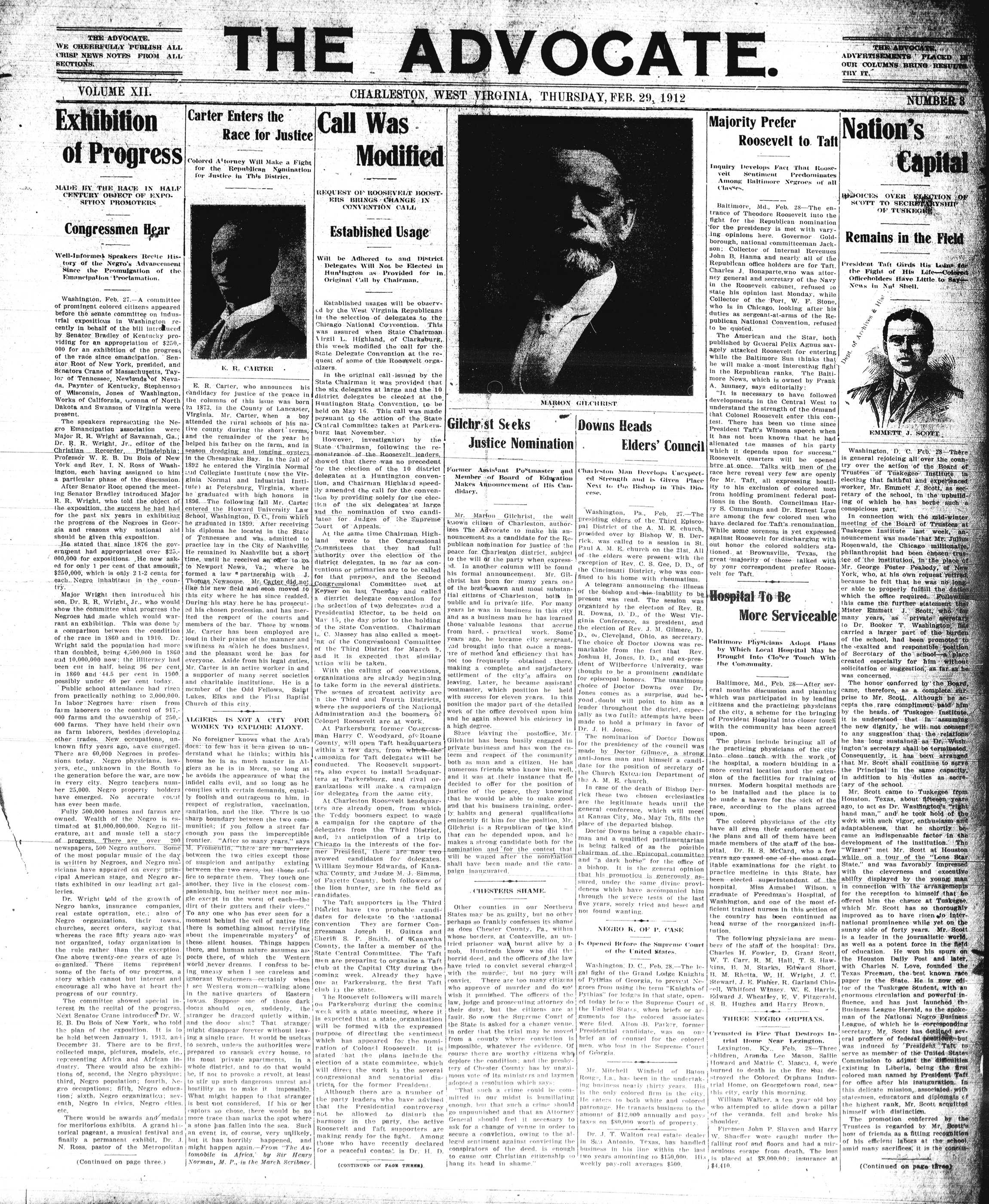
Exhibition of Progress
MADE BY THE RACE IN HALF CENTURY OBJECT OF EXPOSITION PROMOTERS
Well-Informed Speakers Recite History of the Negro's Advancement Since the Promulgation of the Emancipation Proclamation.
Washington, Feb. 27.—A committee of prominent colored citizens appeared before the senate committee on industrial expositious in Washington recently in behalf of the bill introduced by Senator Bradley of Kentucky providing for an appropriation of $250,000 for an exhibition of the progress of the race since emancipation. Senator Root of New York, presided, and Senators Crane of Massachusetts, Taylor of Tennessee, Newlands of Nevada, Paynter of Kentucky, Stephenson of Wisconsin, Jones of Washington, Works of California, Gronna of North Dakota and Swanson of Virginia were present.
The speakers representing the Negro Emancipation association were Major R. R. Wright of Savannah, Ga.; Dr. R. R. Wright, Jr., editor of the Christian Recorder; Philadelphia; Professor W. E. B. Du Bois of New York and Rev. I. N. Ross of Washington, each having assigned to him a particular phase of the discussion. After Senator Root opened the meeting Senator Bradley introduced Major R. R. Wright, who told the object of the exposition, the success he had had for the past six years in exhibiting the progress of the Negroes in Georgia and reasons why national aid should be given this exposition.
He stated that since 1876 the government had appropriated over $25,000,000 for expositions. He now asked for only 1 per cent of that amount, $250,000, which is only 2-1-2 cents for each. Negro inhabitant in the country.
Major Wright then introduced his son, Dr. R. R. Wright, Jr., who would show the committee what progress the Negroes had made which would warrant an exhibition. This was done by a comparison between the condition of the race in 1860 and in 1910. Dr. Wright said the population had more than doubled, being 4,500,000 in 1860 and 10,000,000 now; the illiteracy had been cut in half, being 96 per cent in 1860 and 44.5 per cent in 1900, possibly under 40 per cent today.
Public school attendance had risen from practically nothing to 3,000,000. In labor Negroes have risen from farm laborers to the control of 917,000 farms and the ownership of 250,000 farms. They have held their own as farm laborers, besides developing other trades. New occupations, unknown fifty years ago, have emerged. There are 60,000 Negroes in professions today. Negro physicians, lawyers, etc., unknown in the South to the generation before the war, are now in every city. Negro teachers number 25,000. Negro property holders have emerged. No accurate court has ever been made.
Fully 500,000 homes and farms are owned. Wealth of the Negro is estimated at $1,000,000,000. Negro literature, art and music tell a story of progress. There are over 200 newspapers, 500 Negro authors. Some of the most popular music of the day is written by Negroes, and Negro musicians have appeared on every principal American stage, and Negro artists exhibited in our leading art galleries.
Dr. Wright told of the growth of Negro banks, insurance companies, real estate operation, etc.; also of Negro organizations, their towns, churches, secret orders, saying that whereas the race fifty years ago was not organized, today organization is the rule rather than the exception. One above twenty-one years of age is organized. These items represent some of the facts of our progress, a story which cannot but interest and encourage all who have at heart the progress of our country.
The committee showed special interest in the recital of the progress. Next Senator Crane introduced Dr. W. E. B. Du Bois of New York, who told the plan of the exposition. It is to be held between January 1, 1913, and December 31. There are to be first, collected maps, pictures, models, etc., representing Africa and African industry. There would also be exhibitions of, second, the Negro physique; third, Negro population; fourth, Negro occupations; fifth, Negro education; sixth, Negro organization; seventh, Negro in civics, Negro cities, etc.
There would be awards and medals for meritorious exhibits. A grand historical pageant, a musical festival and finally a permanent exhibit, Dr. J. N. Ross, pastor of the Metropolitan
(Continued on page three.)
THE ADVOCATE.
Colored Attorney Will Make a Fight for the Republican Nomination for Justice in This District.
THE MAYOR OF NEW YORK
E. R. Carter, who announces his candidacy for justice of the peace in the columns of this issue was born in 1873, in the County of Lancaster, Virginia. Mr. Carter, when a boy attended the rural schools of his native county during the short terms, and the remainder of the year he helped his father on the farm, and in season dredging and tonging oysters in the Chesapeake Bay. In the fall of 1892 he entered the Virginia Normal and Collegiate Institute (now the Virginia Normal and Industrial Institute) at Petersburg, Virginia, where he graduated with high honors in 1896. The following fall Mr. Carter entered the Howard University Law School, Washington, D.C., from which he graduated in 1899. After receiving his diploma he located in the State of Tennessee and was admitted to practice law in the City of Nashville. He remained in Nashville but a short time, until he received an offer to go to Newport News, Va., where he formed a law partnership with J. Thomas Newsome. Mr. Carter did not like his new field and soon moved to this city where he has since resided. During his stay here he has prosecuted his chosen profession, and has merited the respect of the courts and members of the bar. Those by whom Mr. Carter has been employed are loud in their praise of the manner and swiftness in which he does business, and the pleasant word he has for everyone. Aside from his legal duties, Mr. Carter is an active worker in and a supporter of many secret societies and charitable institutions. He is a member of the Odd Fellows, Saint Lukes, Elks and the First Baptist Church of this city.
ALIGIERS IS NOT A CITY FOR WOMEN TO EXPLORE ALONG.
No foreigner knows what the Arab does: to few has it been given to understand what he thinks; within his house he is as much master in Algiers as he is in Mecca, so long as he avoids the appearance of what the infidel calls evil, and so long as he complies with certain demands, equally foolish and outrageous to him, in respect of registration, vaccination, sanitation, and the like. There is no sharp boundary between the two communities; if you follow a street far enough you pass the imperceptible frontier. "After so many years," says M. Fromentin, "there are no barriers between the two cities except those of suspicion and antipathy existing between the two races, but those suffice to separate them. They touch one another, they live in the closest companionship, but neither meet nor mingle except in the worst of each—the dirt of their gutters and their vices." To any one who has ever seen for a moment behind the veil of native life there is something almost terrifying about the impenetrable mystery of these silent houses. Things happen there, and human nature assumes aspects there, of which the Western world never dreams. I confess to being uneasy when I see careless and ignorant Westerners—certainly when I see Western women—walking alone in the native quarters of Eastern towns. Suppose one of those dark doors should open, suddenly, the stranger be dragged quietly within, and the door shut? That stranger might disappear forever without leaving a single trace. It would be useless to search, unless the authorities were prepared to ransack every house, to its most private apartments, in a whole district, and to do that would be, if not to provoke a revolt, at least to stir up such dangerous unrest and hostility as to make it impossible. What might happen to that stranger is best not considered. If his or her captors so chose, there would be no more trace than marks the spot where a stone has fallen into the sea. Such an event is, of course, very unlikely, but it has horribly, very unlikely, might happen again—From "The Automobile in Africa," by Sir Henry Norman, M. P., in the March Scribner
REQUEST OF ROOSEVELT BOOSTERS BRINGS CHANGE IN CONVENTION CALL
Will be Adhered to and District Delegates Will Not be Elected in Huntington as Provided for in Original Call by Chairman.
Established usages will be observed by the West Virginia Republicans in the selection of delegates to the Chicago National Convention. This was assured when State Chairman Virgil L. Highland, of Clarksburg, this week modified the call for the State Delegate Convention at the request of some of the Roosevelt organizers.
In the original call issued by the State Chairman it was provided that the six delegates at large and the 10 district delegates be elected at the Huntington State Convention, to be held on May 16. This call was made pursuant to the action of the State Central Committee taken at Parkersburg last November.
However, investigation by the State Chairman, following the remonstrance of the Roosevelt leaders, showed that there was no precedent for the election of the 10 district delegates at a Huntington convention, and Chairman Highland speedily amended the call for the convention by providing solely for the election of the six delegates at large and the nomination of two candidates for Judges of the Supreme Court of Appeals.
At the same time Chairman Highland wrote to the Congressional Committees that they had full authority over the election of the district delegates, in so far as conventions or primaries are to be called for that purpose, and the Second Congressional Committee met at Keyser on last Tuesday and called a district delegate convention for the selection of two delegates and a Presidential Elector, to be held on May 15, the day prior to the holding of the State Convention. Chairman L. C. Massey has also called a meeting of the Congressional Committee of the Third District for March 9, and it is expected that similar action will be taken.
With the calling of conventions, organizations are already beginning to take form in the several districts. The scenes of greatest activity are in the Third and Fourth Districts, where the supporters of the National Administration and the boomers of Colonel Roosevelt are at work. At Parkersburg former Congressman Harry C. Woodyard, of Roane County, will open Taft headquarters within a few days, from which the campaign for Taft delegates will be conducted. The Roosevelt supporters also expect to install headquarters at Parkersburg, and rival organizations will make a campaign for delegates from the same city.
At Charleston Roosevelt headquarters are already open, from which the Teddy boomers expect to wage a campaign for the capture of the delegates from the Third District, and, in anticipation of a trip to Chicago in the interests of the former President, there are now two avowed candidates for delegates. William Seymour Edwards, of Kanawha County, and Judge M. J. Simms, of Fayette County, both followers of the lion hunter, are in the field as candidates.
The Taft supporters in the Third District have two probable candidates for delegate to the national convention. They are former Congressman Joseph H. Gaines and Sheriff S. P. Smith, of Kanawha County, the latter a member of the State Central Committee. The Taft men are preparing to organize a Taft club at the Capital City during the coming week. Already they have one at Parkersburg, the first Taft club in the state.
The Roosevelt followers will march on Parkersburg during the coming week with a state meeting, where it is expected that a state organization will be formed with the expressed purpose of directing the sentiment which has appeared for the nomination of Colonel Roosevelt. It is stated that the plans include the election of a state committee, which will direct the work by the several congressional and senatorial districts, for the former President. Although there are a number of the party leaders who have advised that the Presidential controversy not be allowed to disturb the harmony in the party, the active Roosevelt and Faft supporters are making ready for the fight. Among those who have recently declared for a peaceful contest is Dr. H. D.
(CONTINUED ON PAGE THREE)
Former Assistant Postmaster and Member of Board of Education Makes Announcement of His Candidacy.
Mr. Marton Gilchrist, the well known citizen of Charleston, authorizes The Advocate to make his announcement as a candidate for the Republican nomination for justice of the peace for Charleston district, subject to the will of the party when expressed. In another column will be found his formal announcement. Mr. Gilchrist has been for many years one of the best known and most substantial citizens of Charleston, both in public and in private life. For many years he was in business in this city and as a business man he has learned those valuable lessons that accrue from hard, practical work. Some years ago, he became city sergeant, and brought into that once a measure of method and efficiency that has not too frequently obtained there, making a complete and satisfactory settlement of the city's affairs on leaving. Later, he became assistant postmaster, which position he held with success for eleven years. In this position the major part of the detailed work of the office devolved upon him and he again showed his efficiency in a high degree.
Stace leaving the postoffice, Mr. Gilchrist has been busily engaged in private business and has won the esteem and respect of the community both as man and a citizen. He has numerous friends who know him well, and it was at their instance that he decided to offer for the position of justice of the peace, they knowing that he would be able to make good and that his business training, orderly habits and general qualifications eminently fit him for the position, Mr. Gilchrist is a Republican of the kind that can be depended upon, and he makes a strong candidate both for the nomination and for the contest that will be waged after the nomination shall have been made and the campaign inaugurated.
CHESTERS SHAME
Other counties in our Northern States may be as guilty, but no other perhaps so frankly confesses its shame as does Chester County. Pa., within whose borders, at Coatesville, an untried prisoner was burnt alive by a mob. Hundreds know who did the horrid deed, and the officers of the law have tried to convict several charged with the murder; but no jury will convict. There are too many citizens who approve of murder and do not wish it punished. The officers of the law, judge and prosecuting attorney do their duty, but the citizens are at fault. So now the Supreme Court of the State is asked for a change venue, in order that the trial may be moved from a county where conviction is impossible, whatever the evidence. Of course there are worthy citizens who deplore the condition; and the presbystery of Chester County has by unanimous vote of its ministers and laymen adopted a resolution which says:
"That such a crime could be committed in our midst is humiliating enough, but that such a crime should go unpunished and that an Attorney General should feel it necessary to ask for a change of venue in order to secure a conviction, owing to the alleged sentiment against convicting the conspirators of the deed, is enough to cause our Christian citizenship to hang its head in shame."
Charleston Man Develops Unexpected Strength and is Given Place Next to the Bishop in This Diocese.
Washington, Pa., Feb. 27.—The presiding elders of the Third Episcopal District of the A. M. E. church, presided over by Bishop W. B. Derrick, was called to a session in St. Paul A. M. E. church on the 21st. All of the elders were present with the exception of Rev. C. S. Gee, D. D., of the Cincinnati District; who was confined to his home with rheumatism.
A telegram announcing the illness of the bishop and his inability to be present was read. The session was organized by the election of Rev. R. R. Downs, D. D., of the West Virginia Conference, as president, and the election of Rev. J. M. Gilmere, D. D., o., Cleveland, Ohio, as secretary. The choice of Doctor Downs was remarkable from the fact that Rev. Joshua H. Jones, D. D., and ex-president of Wilberforce University, was thought to be a prominent candidate for episcopal honors. The unanimous choice of Doctor Downs over Dr. Jones comes as a surprise, and beyond doubt will point to him as a leader throughout the district, especially as two futile attempts have been made to hold a primary in favor of Dr. J. H. Jones.
The nomination of Doctor Downs for the presidency of the council was made by Doctor Gilmec, a strong anti-Jones man and himself a candidate for the position of secretary of the Church Extension Department of the A. M. E. church. In case of the death of Bishop Derrick these two chosen ecclesiastics are the legitimate heads until the general conference, which will meet at Kansas City, Mo., May 7th, fills the place of the departed bishop.
Doctor Downs being a capable chairman and a qualified parliamentarian is being talked of as the possible chairman of the Episcopal committee and "a dark horse" for the office of a bishop. It is the general opinion that his promotion is generously assured, under the same divine providences which have accompanied him through the severe tests of the last five years, sorely tried and beset and not found wanting.
Is Opened Before the Supreme Court of the United States.
Washington: D. C., Feb. 28.—The legal fight of the Grand Lodge Knights of Pythias of Georgia, to prevent Negroes from using the term "Knights of Pythias" for lodges in that state, opened today before the Supreme Court of the United States, when briefs or arguments for the colored associates were filed. Alton B. Parker, former Presidential candidate, was on one brief as of counsel for the colored men, who lost in the Supreme Court of Georgia.
Mr. Mitchell Winfield of Baton Rouge, La., has been in the undertaking business nearly thirty years. His is the only colored firm in the city. He caters to both white and colored patronage. He transacts business to the amount of $12,000 annually and pays taxes on $80,000 worth of property.
Dr. J. T. Walton real estate dealer in San Antonio, Texas, has handled business in his line within the last two years amounting to $150,000. His weekly pay-roll averages $500.
Inquiry Develops Fact That Roosevelt Sentiment Predominates Among Baltimore Negroes of all Classes.
Baltimore, Md., Feb. 28—The entrance of Theodore Roosevelt into the fight for the Republican nomination for the presidency is met with varying opinions here. Governor Goldborough, national committeeman Jackson; Collector of Internal Revenues John B. Hanna and nearly all of the Republican office holders are for Taft. Charles J. Bonaparte, who was attorney general and secretary of the Navy in the Roosevelt cabinet, refused to state his opinion last Monday, while Collector of the Port, W. F. Stone, who is in Chicago, looking after his duties as sergeant-at-arms of the Republican National Convention, refused to be quoted.
The American and the Star, both published by General Felix Agnus savagely attacked Roosevelt for entering while the Baltimore Sun thinks that he will make a most interesting fight in the Republican ranks. The Baltimore News, which is owned by Frank A. Munsey, says editorially:
"It is necessary to have followed developments in the Central West to understand the strength of the demand that Colonel Roosevelt enter this contest. There has been no time since President Taft's Winona speech when it has not been known that he had alienated the masses of his party which it depends upon for success." Roosevelt quarters will be opened here at once. Talks with men of the race here reveal very few are openly for Mr. Taft, all expressing hostility to his exclusion of colored men from holding prominent federal positions in the South. Councilman Harry S. Cummings and Dr. Ernest Lyon are among the few colored men who have declared for Taft's renomination. While some soreness is yet expressed against Roosevelt for discharging with out honor the colored soldiers stationed at Brownsville, Texas, the great majority of those talked with by your correspondent prefer Roosevelt for Taft.
Hospital To Be More Serviceable
Paltimore Physicians Adopt Plans by Which Local Hospital May be Brought Into Closer Touch With the Community.
Baltimore, Md., Feb. 28—After several months discussion and planning which was participated in by leading citizens and the practicing physicians of the city, a scheme for the bringing of Provident Hospital into closer touch with the community has been agreed upon.
The plans include bringing all of the practicing physicians of the city into close touch with the work of the hospital, a modern bluding in a more central location and the extension of the facilities for training of nurses. Modern hospital methods are to be installed and the place is to be made a haven for the sick of the race, according to the plans agreed upon.
The colored physicians of the city have all given their erfordement of the plans and all of them have been made members of the staff of the hospital. Dr. H. S. McCard, who a few years ago passed one of the most creditable examinations for the right to practice medicine in this State, has been elected superintendent of the hospital. Miss Aimabel Wilson, a graduate of Freedman's Hospital, of Washington, and one of the most efficient trained nurses in this section of the country has been continued as head nurse of the reorganized institution.
The following physicians are members of the staff of the hospital: Drs Charles H. Fowler, D. Grant Scott W. T. Carr, R. M. Hall, T. S. Hawkins, B. M. Starks, Edward Short B. M. Rhetta, W. H. Wright, J. C Stewart, J. E. Fisher, R. Garland Chisell, Whitford Winsey, W. E. Harris Edward J. Wheatley, E. V. Fitzgerald S. B. Hughes and Harry Brown.
THREE NEGRO ORPHANS
Cremated in Fire That Destroys Intral. Hone, New Lezington.
Trial Home Near Zezington.
Lexington, Ky. Feb. 28-Three children, Aranda Lee Mason, Salille Howard and Mattie C. Masca. 4, were burned to death in the fire that destroyed the Colored. Orphans Industrial Home, on Georgetown road, near this city, early this morning.
William Walker, a ten year old boy who attempted to slide down a pillar of the veranda, fell and broke his shoulder.
Firemen John P. Slaven and Harry W. Shaffer were caught under the falling roof and floors and had a miraculous escape from death. The loss is placed at $8,000.00; insurance at $4,410.
THE ADVOCATE
ADVERTISMENTS PLACED IN
OUR COLUMNS BRING RESULTS
TRY IT.
REDOICES OVER ELECTION OF
SCOTT TO SECRETARYSHIP
OF TUSKEGEE
Remains in the Field
President Tatt Girds His Laurel for the Fight of His Life—Colored Officeholders Have Little to Say—News in Nut Shell.
Dept. of Archives & His
EMMETT J. SCOTT
Washington, D. C. Feb. 28-There is general rejoicing all over the country over the action of the Board of Trustees of Tukegee Institute in electing that faithful and experienced worker, Mr. Emmett J. Scott, as secretary of the school, in the upbuilding of which he has borne such a conspicuous part.
In connection with the mid-winter meeting of the Board of Trustees at Tuskegee Institute last week, announcement was made that Mr. Julius Rosenwald, the Chicago millionaire philanthropist had been chosen trustee of the institution, in the place of Mr. George Foster Peabody, of New York, who, at his own request retired because he felt that he was no longer able to properly fulfill the duties which the office required. Following this came the further statement that Mister Emmett J. Scott, who for many years, as private secretary to Dr. Booker T. Washington, has carried a larger part of the burden of the school, had been promoted to the exalted and responsible position of Secretary of the school—a place created especially for him without solicitation or suggestion, as far as he was concerned.
The honor conferred by the Board came, therefore, as a complete surprise to Mr. Scott. Although he accepts the rare compliment paid him by the heads of Tuskegee Institute, it is understood that in assuming the new dignity, he will not consent to any suggestion that the relations he has long sustained as Dr. Washington's secretary shall be terminated. Consequently, it has been arranged that Mr. Scott shall continue to serve the Principal in the same capacity, in addition to his duties as secretary of the school.
Mr. Scott came to Tuskegee from Houston, Texas, about fifteen years ago, to act as Dr. Washington's "right hand man," and he took hold of the work with such vigor, enthusiasm and adaptableness, that he shortly became an indispensable factor in the development of the institution. The "Wizard" met Mr. Scott at Houston while on a tour of the "Lone Star State," and was favorably impressed with the cleverness and executive ability displayed by the young man in connection with the arrangements for the reception to himself that he offered him the chance at Tuskegee, which Mr. Scott has so thoroughly improved as to have risen to international prominence while yet on the sunny side of forty years. Mr. Scott is a leader in the journalistic world, as well as a potent force in the field of education. He won his spurs on the Houston Daily Post and later, with Charles N. Love, founded the Texas Freeman, the best known race paper in the State. He is now editor of the Tuskegee Student, with an enormous circulation and powerful influence, and has just launched the Business League Herald, as the spokesman of the National Negro Business League, of which he is corresponding secretary. Mr. Scott has declined several proffers of federal positions, but was induced by President Taft to serve as member of the United States Commission to adjust the difficulties existing in Liberia, being the first colored man named by President Taft for office after his inauguration. In this delicate mission, associated with statesmen, educators and diplomats of the highest rank, Mr. Scott acquitted himself with distinction.
The promotion conferred by the Trustees is regarded by Mr. Scott's host of friends as a fitting recognition of his efficient labors at the school, amid many sacrifices, it is the concern-
CORRESPONDENCE
PAGE TWO.
RED STAR.
Prof. E. L. Rann, of McDonald, delivered an interesting address in memory of Abraham Lincoln at the M. E. church Sunday, February 18th, and was the guest of Prof. Thos, Jefferson while here.
Prof. Hamila S. Guss and wife were guests of Prof. Thos. Jefferson while in these parts a few weeks ago.
Dennis Oglesby, who has been to the hospital, returned Saturday, but he is very ill yet.
Mrs. Nancy Patterson has been quite ill but is much improved at this writing.
Miss Cortez James, who is teaching at Thayer, was up Sunday to see her sisters, Mesdames Davis and Banks. Angelius Ashburn, of Richmond, Va., who is touring the State in the interest of his shirt factory, was here from Tuesday until Sunday. He was a former student of Prof. Thos. Jefferson at the Virginia Seminary, Lynchburg, Va., and naturally looked up his teacher while in these parts.
Prof. J. M. Arter returned Saturday after visiting several points in the interest of the West Virginia Seminary and College. The State Executive Board met in Charleston, February 22. The life of the West Virginia Seminary and College was discussed largely.
Mrs. Pearl Robinson and Mrs. Griffin, of Scarbro, worshipped a the M. E. church Sunday. They were guests of Dr. S. A. Washington and wife.
Mrs. E. W. James entertained Miss Cortez James and Mr. Chas, Legrand at dinner Sunday.
District Superintendent A. A. Hedrick, accompanied by Mr. Chaplain, instructor in mathematics of the Mt. Hope High School visited the colored high school of Hill Top Tuesday afternoon and while there heard the classes in algebra and geometry recite and expressed their appreciation of the exhibition of the classes.
E. W. Jones, of Beckwith, was a pleasant visitor at the High School Friday and rendered a beautiful bass solo at the rhetorical. Mr. Ashburn also recited one of his own compositions, "The Negro of Fifty Years Ago."
Prof. Thos, Jefferson preached at the First Baptist church of Greenville Sunday morning for Rev. D. Stratton, who was much indisposed. A good congregation was present and seemed to appreciate what they heard.
Dr. S. A. Washington was a business visitor to Montgomery Thursday. The League's "Leap Year Party" is the talk of the season. Thursday is the time.
Mrs. Sophia Tilghman was down from Winnipeg in the interest of the Court of Calanthe. She was the guest of Mesdames Arter and Washington. Chas. Legrand, a Cuban, gave an excellent lecture under the auspices of the Ladies' Aid Sunday. Subject, "Shall Women Keep Still?" The choir from the First Baptist Church rendered music.
HUNTINGTON
J. C. Gilmer spent Saturday in the city on business.
Miss Hattie Peters spent the weekend here as guests of Mrs. Ernest Hardy.
Mrs. Eph. Williamz. of Milwaukee. Wis., was in the city a few days the guest of Dr. Barnett.
Mr. and Mrs. Juo. Riddle, of Ronceverte, were here visiting relatives this Week.
W. O. James is sick.
Mesdames S. A. Thurston, Wm. Jessup and A. D. Lewis are convalescent.
Mr. and Mrs. Milton Owens lost their infant daughter Saturday.
On Thursday at their home on Eighth avenue, Miss James and Linsay entertained a number of friends from three to five.
The B. M. A. C. club gave a very unique entertainment Friday evening at the residence of Mrs. George Hughes. The dining room was especially beautiful in its pleasing arrangement. The color scheme being red and green.
A number of friends were delightfully entertained at a dinner party in the home of Prof. J. W. Scott on Eighth avenue. Dainty little place cards on which were quotations from Douglas to be read and enlarged on as a toast from each one present was a feature.
On Tuesday evening at her home in Seventh avenue, Mrs. Eugene Burnett entertained a number of friends in honor of Mrs. Eph. Williams.
HINTON.
Sad indeed was the death of Edward Bush, which came as a thunderbolt out of a clear sky lag Friday afternoon at one forty-five in the Holley Sanitarium. He was an engine cooler at the local C. O. shops and Friday while at his post of duty, was in some way jammed between the engine and his left leg was crushed to a pulp from the ankle above the knee. It was about an hour before he was taken to the hospital where an amputation of the limb was made immediately, although his condition was serious from the loss of blood. He rallied from the operation, but death was caused by snook, due to the extreme loss of blood. He leaves a wife and one little daughter about nine years old, several sisters, one brother and many friends. The funeral and interment took place Sunday afternoon in Talcot, the birthplace of the deceased. Over a hundred friends from here attended the services, Mr. Harrison, the trainstorm, gave a spe-
cial train for the occasion. Rev. A. D. Lewis, officiated. $ ^{4} $
Thomas Pack, who has been ill for months with tuberculosis, died at the home of his mother, Mrs. Mary Pack, Saturday night. Mr. Pack was well known here and while death is always sad, his friends are rel ved to know that God has taken him out of his suffering. He was a member of the Second Baptist church where his funeral was preached by Rev. Lewis Monday at two o'clock p. m. He leaves a mother, wife, four sisters, four brothers, one daughter and a host of friends to remember the broken link in memory's chain. The interment took place in Hill Top cemetery.
Rev. D. C. Dean preached Sunday morning and evening at the Second Baptist church. Good lessons for every day life were taught in each sermon.
Anderson Wells was ordained as deacon in the Second Baptist church Sunday night. He is well suited to the office, having been prayer meeting leader for a number of years.
"The Progressives" met with Mrs. Jordan Peters on James street Monday at 3 p.m.
The box social on last Tuesday evening with Mrs. Anderson Wells, as chairman, given by the wives of the deacons in the social room of the Seccad Baptist church, was a great success. Twenty-four dollars were realized, although the night was very bad.
The "Murry-Makers" met with Miss Mary S. Booth last Friday evening. Honorary members was the most important topic. Lots of fun was about all gained
HARPER'S FERRY.
Mrs. McDonald has been confined to her home for a week on account of illness but is improving and is able to hear her classes recite in her home.
Rev. C. C. Mitchell, pastor of the First Free Baptist Church, Pawtucket, Rhode Island, lectured on "Job or the World's Ash Heap" on Friday, February 23. His lecture was most eloquent and inspiring.
W. A. Hunton, the Colored International Secretary of the Y. M. C. A., spent Sunday at Storer. Mrs. Hunton was busy speaking all day. His talks are always inspiring.
Lotenzo Bird, class 1900, Storer, spent a few days visiting his wife and friends last week. Mr. Bird while here spent many hours in renewing friendship with his alma mater. He gave to the gymnasium baskets for the basketball team, he also had them correctly hung and superintended the marking off of the gymnasium floor for the game. Mr. Bird is an enthusiastic athlete. During his short stay here he worked up a great deal of basketball enthusiasm among the students. The result has been the formation of teams among both girls and boys.
ELKHORN
Mrs. Sallie Ward of Wolfe, spent Tuesday with her friend, Mts. Mattie A. Franklin.
) Miss A. E. George attended the Washington's Birthday Party given at Bluefield Institute.
Dr. R. H. McKoy filled his regular appointment at Upland.
Misses Lavender and George attended services at Upland, after which they took dinner with their friend, Mrs. Janie Manns.
Miss Mary Hairston who has been attending school at the Bluefield Institute, is at home again this week because of illness.
Miss Mary Williams spent Sunday with her friend, Miss Carter.
Misses L. E. Maynard and Jones attended the Brown's Creek Teacher's Institute at Kimball last week. Mrs. Cora Armstead has been quite ill for a week with tonsilitis but is better at this writing. Elkhorn Star No. 494, U. O. T. R., installed new officers Tuesday night the work being conducted by Mrs. Codtella Ward. Crozer Temple Baptist Church gives an entertainment Monday night. The officers of Crozer Sunday School were installed by the pastor. Mrs. Bettha Wheate has returned to Grahahn after a short visit to her mother, Mrs. R. H. Perdue.
FAIRMONT
M. T. Obie is suffering a relapse from rheumatism and at this time is very ill and confined to his bed. Mrs. Chas. Hamilton and baby Ellen left Sunday, the 18th to visit her parents, Mr. and Mrs. G. H. Jordan, at Pt. Pleasant. E. L. Morton spent a few days at Clarksburg and Weston last week. Mrs. C. C. Gill and Miss Daisy Johnson left last week on a business visit to Pittsburgh. Mrs. Harrisa Jones is suffering from an attack of la gripe. Dr. Moorman of Clarksburg, was a business visitor here Tuesday. Mrs. Chas. Hamilton entertained a number of friends on February 14th, the occasion being her little daughter's first birthday. A very pleasant time was had by those in attendance und Ellen Elizabeth received many beautiful and useful presents.
Arch Mende had the misfortune to brain his wrist quite severely by a all last week. Floyd Lewis was a visitor to Clarkaburg, Sunday. fThe annual church bazaar and baby
contest will start on Monday, at Trinity M. E. Church.
CLARKSBURG
The entertainment given for the benefit of the Women's Mite Missionary Society, proved quite a success. Miss M. Esther Colston, of Parkersburg, was the week-end guest of Mrs. M. A. Rone. Mrs. Mary Grayson is much improved in health. The parents union will meet Sunday at Pride, A. M. E. church. "Oakbound" a four act drama will be presented at Reed's Hall, Tuesday night by members of the daughters of Sphinx. Special revival services are being held at the A. M. E. church this week.
Woman's Day will be observed at Trinity M. E. Church, Sunday. A splendid program has been arranged for the day. The affair is under the auspices of the Queen Esther Society. Mrs. Lillian Weathers will be hostess to the women's Mite Missionary Society, Wednesday night. Miss Mary Grant and Mr. Frank Hanger were united in marriage Tuesday night at the Catholic rectory. They have the best wishes of a host of friends. Mrs. Hanger is a native of Kingston, Jamaica. Mrs. Annie Scott, who has been in Columbus, Ohio, for some time, is visiting her mother, Mrs. Fanny Hatcher. Miss Celeste Johnson, who was visiting friends in different point in Ohio, has returned home.
INSTITUTE
Henry Friend died at his home near Dunbar Sunday morning and was buried Monday evening. Rev. J. S. Carroll of Simpson M. E. Church, of Charleston, officiated.
Miss Virginia Lincoln is in Pt Pleasant, owing to the illness of her brother.
Miss Joe Willie Morgan of Montgomery, has resumed her studies at the West Virginia Colored Institute.
John Henderson of Pt. Pleasant, has returned to school at the W. Va. Colored Institute.
Miss Amelia Welcher was the guest of Miss Charlotte Campbell, Sunday.
Miss Mary Eubank, who has been ill several days, has resumed her work at the West Virginia Colored Institute.
L. N. Brown spent a few days with his family, this week.
Mrs. E. A. Dorsey spent Monday in Charleston.
E. M. Burgess is spending a few days in Columbus, Ohio. The Agricultural train made a forty five minute stop at Institute Wednesday. A. W. Curtiss is draining a plot of the school farm that lies near the railroad. The work is filling a long felt want. This land when properly drained will be the most productive plot of the school farm.
MONTGOMERY.
Miss Etta Hall was hostess to the Reading Circle, Friday evening. J. H. Hardy, who has been sick for some weeks, went to Cincinnati Tuesday to consult a specialist. The infant child of Mr. and Mrs. Paul Thomas died Thursday and was buried Saturday. Manley and Martin nad charge. Prof. B. Prillerman, of the West Virginia Colored Institute, came up Wednesday to speak at the closing of the Smithers' school, which was at the Longacre church that night. He visited the town school and while here was the guest of Mr. and Mrs. Archie McKinney. Councilman M. D. Buster, who accompanied ExSenator T. P. Davis, to Mr. Cleming, has returned and reports Mr. Davis better.
Dr. S. A. Washington of Red Star, was a business visitor here Saturday. The brothers of the late S. J. Jackson soon after his death brought suit against the estate, but since decided to accept a compromise of a farm in Virginia and $250.00. So now Mrs. Jackson has absolute control of the estate.
Mr. and Mrs. Nedson Locke and Mr. and Mrs. George Gough, were called to Charleston because of the death of Mrs. Samuel Fields.
The ladies aid of the M. E. church met Tuesday afternoon with Mrs. P. H. Shepherd.
Mrs. Clare Powell will give a pie social at the Odd Fellow Hall, Monday night.
CHARLESTON
Simpson Church Notes—the services were well attended last Sunday. The pastor preached morning and evening. The subject of the morning discourse was "Preparation for Conquest" and that of the evening was "The Fifth Commandment." The attendance at Sunday school was one hundred and fifteen. The parsonage committee gave quite an excellent supper last Monday at the parsonage. Quite a number of persons ate their supper. The lifters met at the residence of Mrs. Alice Wanzer on Donally street, on Tuesday night. The Willing Workers will be entertained by Mrs. Sadie Dillon at the parsonage on Thursday night. The Friday Night Aid will meet at the residence of Mr. Henry Taylor on Lew-
THE ADVOCATE
day afternoon at 2:30 o'clock, the Sunday school will hold its regular missionary service. All parents and friends are cordially invited to attend. All of the officers and members and friends of the church are request ed to be present at the Communion service next Sunday night. This is the last Communion Service this conference year. All probationers are requested to meet at the parsonage at 7:30 p. m. on Thursday. It is very important that all perons now on probation should meet. Prayer meeting on Wednesday night. The service is short, inspiring, interesting and helpful. Come and bring your friends with you. The pastor is now winding up the work of the conference year. Every member and friend of the church is asked to give $1.00 on the benevolences. All who have already subscribed will please note that this is the time to pay the subscriptions.
ST. PAUL CHURCH—Progress along all lines was shown by the reports made at the quarterly conference at St. Paul A. M. E. church, Monday night. The ministers social helpers were entertained the evening of the 19th by Mrs. Peynard, Pledmont st. Monday evening of this week, Mrs. Turner was the hostess, the reception being held at the residence of Mrs. Johnson, Morris street. The Ladies Aid Society meets at the church, Friday.
Missionary Society Meets--Missionary Society No. 2, of the First Baptist church held an interesting meeting with the president, Mrs. Frank Henley, Friday evening. Plans were submitted and adopted looking to the immediate financial assistance of the W. Va., Seminary and College at Hill Top. At the conclusion of the session, ice cream, cake and coffee were served.
Program Arranged—The Tube of Judah of the First Baptist church was entertained at the home of Mrs. Scruggs by Mesdames Lottle and Mary Walton. They have arranged an excellent program for their bazaar night, Wednesday of next week. The thanks of the society were expressed to the hostess by Rev. Edward Humbles for the refreshments served and the entertainment of the next meeting was assigned to Mrs. Lizzie Humbles, Sentz street who will be assisted by Hrs. M. L. Dawson and Mrs. Line Tuck.
Off to School—Howard, the eight-year old son of Mr. and Mrs. John Brooks, Court street, has been sent to Parkville, Md., where he will receive instructions in the school for deaf and dumb children. The boy lost his speech and hearing following an attack of spinal meningitis about sixteen months ago. His leave taking from his parents and playmates was very touching.
Hotel Brown Arrivals—The following persons were registered at Hotel Brown this week: Richard Allen, Copeland; G. Holmes, Montgomery; Martha Freeman, Powellton; J. M. Arter, Hill Top; C. N. Harris, Fayetteville; H. E. Richford, Keystone; L. Dabney, Freeman; G. Marsh, Clarksburg; J. W. Robinson, Clarksburg; Miss Watkins, Coshocton, O.; C. R. Comedy, Parkersburg; S. Dawson, Plymouth; J. Tinsley, Raymond City; Mrs. Claude Hurt, Shrewsbury; Jas. Thompson, Boomer; J. M. Johnson, Garrison; J. Robinson, Lester; E. Manlove, Shirley, Ind.; and Mrs. F. Mitchell, Columbus, O.
Washington's Birthday Dance—The dance given by the Kanawha Club at the K. of P. hall, Thursday evening of last week, was the most enjoyable affair of the kind this season. About fifty couples participated, among them being several gentlemen from out of town. The dresses of the ladies were beautiful and the gentlemen's evening dress were the acme of perfection. So well pleased were all those who attended that the club has yielded to the popular demand to give another dance the Monday evening immediately following Easter Sunday.
Miss Waters An Athlete—Miss Phyllis Waters, of this city, Who is a senior in the Ann Arbor, Mich., High school, has been elected to the captaincy of the girl's basket ball team of the Episcopal Sunday school in that city. The white Sunday, schools of Ann Arbor all have basket ball teams composed of girls and these form a league in which Miss Waters is the only young lady of color. She is also one of the brilliant players of the high school team.
"Josephs" Entertained—The Tribe of Joseph of the First Baptist church was the guest of J. W. Jarrett at the residence of Mrs. Mollie Mills, Friday evening. This society is said to have the distinction of being the only one among the colored churches to be working for state missions and education alone. It is making an effort to send delegates to the Baptist State convention at Wheelling, next summer. Its next meeting will be held at the home of Mrs. Susfe Martin Quarrier street and Mrs. Ella Green will be the hostess. Mrs. Jarrett was assisted by Mrs. Mills and Misses Minana Booker and Helen Payne. R. C. Mciver thanked them on behalf of the society.
Linna Shower for Bride Elect—A number of young girls gave a linen shower, Tuesday evening at the home of Mrs. Samuel Hale, Sentz street.
in honor of Miss Beatrice Burks. A tempting lunch was served. Those participating were: Miss Sallie Hale, Ola Mitchell, Ardonia Price, Ethel Smith, Bessie Jackson, Lula Wade, Mary Claire, Princess Stewart and Lillian Watkins.
Aged Citizen Diss—Miss Sarah Bullard, one of the oldest of Charleston's citizens, died of a paralytic stroke Friday morning at her home on Washington street. In the scores of years that Miss Bullard had dwelt here she made for herself a large number of friends and earned the respect of all, both colored and white. She leaves behind her these and many relatives whose grief is assuaged by the thoughts of her preparness for the end after a long well-spent life. The funeral services were conducted at the First Baptist church. Sunday afternoon.
PERSONALS AND LOCALS.
J. C. Gilmer was a business visitor to Huntington, Saturday.
Mrs Allen DeHonney and little son are spending a few days with relatives at Montgomery and Eagle.
J. H. Taylor and T. G. Nutter are members of the executive committee of the Taft club, organized at Hotel Kanawha last week.
J. E. Clark, Donnally street, is slowly recovering from a serious illness.
Clarence Frane, of the West Side, who has been very ill, is improving slowly.
The dancing class which has been receiving instructions from Miss Virginia Glimmer, gave an informal dance Friday night of last week.
George Evans had his arm burned severely at the Kelly Ax Factory, last week. He is able to be out.
Rev. J. W. Wagner, who has been attending, the Ebaptist seminary at Louisville, Ky., will return home on March 2nd.
Samuel Wallace of Dayton, O., is visiting his mother-in-law, Irs.
Nancy Jones, West Charleston.
Mrs. E. V. Seams, who was called here by the death of Mrs. Ruth Fields, returned to her home at Parkersburg, Monday. The condition of J. M. Hazlewood is reported as unchanged. Mr. and Mrs. Geo. Gough of Montgomery, were in the city last week to attend the funeral of Mrs. Ruth Fields. Frank Taylor teacher in McDowell county, was called to the city last week because of the death of his aunt, Miss Sarah Bullard. John Hunter, Jr., was the guest of Edward O. Fulks, Thursday. C. R. Comedy of Parkersburg, spent the latter part of the week visiting friends in the city.
An informal dance was given on Friday evening at the K. of P. hall in honor of Mrs. Grace Seams and Mr. Cecil Comedy of Parkersburg. Miss Amelia Wilcher spent the holidays visiting relatives at Institute. Mrs. Thos. Hale, Jr., of Huntington, spent Sunday and Monday in the city the guest of Mr. and Mrs. Thos. Hale, Sr., Southside. Walter Lowry and Miss Beatrice Burks were quietly married at the parsonage of the First Baptist church Wednesday evening. They are at home to their friends at Brown Hotel. The L. T. L. had an interesting meeting Wednesday afternoon at the Garnett school. A contet was held and Virginia Wanzer won the prize.
Miss Flora Webster will entertain the Improvement League, Friday at her home on Brooks street.
To Be Admitted as Associate Members of National Association.
Chicago, Feb. 28.—The Association of American Medical Colleges, at its twenty-second annual convention, today voted to establish an associate membership for Negro colleges. The action was in recognition of the efforts of the Meharry College, of Nashville, Tenn., to meet the requirements of the association. The associate branch will also take in Howard University, Washington, D. C., the only other institution for colored students that is a member of the association.
COFFIN
Placed on Porch of Negro Preacher's Home as Warning For Him to Leave Community.
Valdosta, Ga., Feb. 28—Rev. James B. Frazer, a leading Negro preacher of this section, has a coffin for which he has no especial use at present, but fears that he may need it at an early day.
Frazer found the coffin on the front porch of his home this morning, and accompanying was a note, as follows:
"We have no ill will against you, but this neighborhood is not large enough for your institution, therefore you had better move or we'll put you in this coffin."
The note was signed "Your White Friends."
Frazer recently acquired a large house in a thickly settled white portion of town and announced he intended to start a home there for Negro orphans. This was opposed by the whites, who tried to buy the property from Frazer. The officials this afternoon urged Frazer to move, but he refused.
E BALE
AND F
130 Cap
on,
Pork S
Our Own Ma
our Machin
and
S., FISH,
qualities
regular kind
your pat
complete s
you can g
more.
ND BKIDGE WORK
A. M. to 1:30 P. M.
MES B.
Dental Surge
Beef, Veal Mutton, Pork Fresh Pork Sausage, Our Own Make
Try Our Machine Sliced Hams and Bacon
The best qualities in all the popular kinds of
We want your patronage for we have complete stock in our lines and you can get it when you want more.
CROWN AND BRIDGE WORK A SPECIALTY
HOURS: 8:30 A.M. to 1:30 P.M., 2:00 to 6:00 P.M.
Dr. JAMES B. BROWN Dental Surgeon
Office: Room 1, K. of P. Bldg.
J. E. JOHN
FUNERAL DIRECTOR
All Calls Pre
Our Prices are the M
For Promptness and C
Our Ambulance Servi
609 SUMMERS STREET, CHARLESTON
SPECIAL ATTENTION
JOHNS
RECTORS AND
s Promptly
the Most Reas
and Care Try
Service.
J. E. JOHNSON CO.
FUNERAL DIRECTORS AND EMBALMERS All Calls Promptly Attended. Our Prices are the Most Reasonable. For Promptness and Care Try Our Ambulance Service.
CHARLESTON, W. W.
ENTION GIVEN
CALLS.
LD.
ER COL
oer's Ferry, W.
SPECIAL ATTENTION GIVEN OUT OF TOWN CALLS.
STORER Harper's
STORER COLLEGE
Founded in 1867
women have graduat
ents. Magnificent
triple buildings. THR
NT THIS YEAR. The
test teachers does not
according to the De
FICATES ARE GRA
ING CLASSES WHO
EDUCATION. Stores
Its whole influen
Christian Organizations
State Normal, Indus
e and other printed
More than 400 men and women have graduated here. The oldest school in the state for Colored students. Magnificent location. Elevation high. Remarkably healthful. Ample buildings. THREE NEW BUILDINGS BEING ADDED TO OUR PLANT THIS YEAR. The regular faculty of sixteen highly educated, earnest teachers does not include assistants.
Our Library catalogued according to the Dewey System, is one of the largest in the State.
FIRST GRADE CERTIFICATES ARE GRANTED TO THOSE MEMBERS OF THE GRADUATING CLASSES WHO ARE RECOMMENDED TO THE STATE BOARD OF EDUCATION. Storer is interdenominational in its faculty and student body. Its whole influence is toward Christian living. Literary Societies, Christian Organizations, Musical Clubs, Bands and Sane Athletics.
COURSES: Academic, State Normal, Industrial, Music.
For illustrated catalogue and other printed matter write to
HENRY T. MCDONALD,
President.
THURSDAY, FEBRUARY 20, 1912
BAUER
FISH CO.
Capitol St.
Veal
, Pork
k Sausage,
wn Make
machine Sliced
and Bacon
SH, POULTRY
ities in all the
kinds of
ESE
r patronage for
ete stock in our
can get it when
e.
GE WORK A SPECIALTY
1:30 P. M., 2:00 to 6:00 P. M.
S B. BROWN
Surgeon
JHNSON CO.
ERS AND EMBALMERS
Amptly Attended.
Most Reasonable.
are Try
e.
Open DAY and NIGHT Phone 2472
ATOM, W. VA.
N GIVEN OUT OF TOWN
CILLS.
COLLEGE
Berry, W. Va.
in 1867
have graduated here. The oldest school
significant location. Elevation high.
ings. THREE NEW BUILDINGS BEYEAR. The regular faculty of six
does not include assistants.
to the Dewey System, is one of the
ARE GRANTED TO THOSE MEM-
SES WHO ARE RECOMMENDED TO
N. Storer is interdenominational in
mole influence is toward Christian liv-
organizations, Musical Clubs, Bands and
mal, Industrial, Music.
her printed matter write to
Home Phone 429
N. C. BRACKETT,
Treasurer.
The President
(Continued from Page One.) cus of opinion that he will become an even more useful helper in his enlarged sphere of activity.
The acquisition of Mr. Rosenwald is a valuable asset to the Institute, as is also Mr. Charles E. Mason, of Boston, who recently accepted a place on the Board. The personnel of the Board of Trustees and their friends who accompanied them from New England, New York and other sections of the country, covers a wide range of influential agencies in the uplift of humanity, and their visit to Tuskegee has been one of mutual inspiration and benefit.
President Taft Remains in The Field
The formal announcement of Coloulet Roosewelt into the race for the presidential nomination has been the talk of the country this week. He says:
"I will accept the nomination for President if it is tendered me, and I will adhere to this decision until the convention has expressed it preference."
The people who have watched the trend of events were not greatly surprised, being prepared for such an announcement by the careful and exhaustive presentation of the colonel's platform through the Columbus address.
President Taft is firm in his declaration to remain in the field, and his friends are standing by him with renewed zeal and unchangeable loyalty. His Comment is:
"We know we are right, and I am confident we will win."
Of the delegates elected so far about forty-four are all under iron-clad instructions to vote for the re-nomination of Taft. By the same token, it is expected they will adopt such a platform as will coincide with his views on all public questions. The Taft Renomination Bureau, with Congressman William B. McKinley in charge, is running at full blast and is sending out some very encouraging literature. The new head of the publicity bureau is Mr. Leroy T. Vernon, the Washington correspondent of the Chicago Daily News, conceded to be one of the most brilliant young newspaper men in the country. Colored men will have a share in the work of "spreading the news" touching the presidential situation, as Mr. Vernon knows that the Negro newspapers have grown to be an important factor in any campaign of education.
The colored leaders are talking little this week, but the following excerpt from an editorial in the Washington Post sizes up their views pretty well; says the Post:
"The country can breathe a little easier now. The situation will be cleared, and the republicans will decide which flag they will fight under. It will be an embarrassing time for the doubledealers and dodgers, but every honest and independent man will welcome Col. Roosevelt's definite announcement. The fight will now be in the open, where every one can see what is going on. The whisperers will have to go out of business.
Every man to his tent, O Israel!
The wayfaring man, though a fool, cannot doubt that there is to be "something doing" within the next four months. "Twilbe a battle of giants."
The North Carolina Mutual A Business Marvel.
The North Carolina Mutual and Provident Association is again in the "spotlight" for the study of the entire country. Confessedly the largest Negro Insurance Company in the world, its phenomenal growth from comparatively nothing to its present proportions, is little short of a commercial marvel. North and South, it is talked about and any information concerning it is gladly given in the most exclusive bushes circles. The standing of the "N. C. Mutual" at Dunn's or Bradstreet's is "A No. 1," and its "paper" will float anywhere on the continent.
The home office of the North Carolina Mutual and Provident Association is at Durham, N. C., but its operations have so expanded that it covers large sections of South Carolina, Georgia and adjacent states, and owns valuable property in each of the localities which it has invaded. The company was founded in 1898, and incorporated in 1899. The officers, all solid business men of Durham, are: President, Jno. Merrick vicepresident and general manager, C. C. Spaulding; secretary and treasurer, Dr. A. M. Moore; directors, John Merrick, A. M. Moore, M. D., C. C. Spaulding, E. R. Merrick, J. M. Avery and J. H. Garner.
The organization has succeeded because "It is on the square," and throu-
out its history has not had a single unpaid claim. It is giving lucrative
employment to scores of educated young men and women, and opening
new avenues constantly for generations of our race that are to come after us.
Starting thirteen years ago the company's first year showed only $840.00
worth of business; the next year the amount of business done was $1,265;
third year. $2,640; fourth. $3,228;
fifth. $10,330; sixth. $26,912; seventh.
$70,912; eighth. $104,997; ninth. $129.
818; tenth. $187,136; eleventh. $220.
100; twelfth. $245,238; thirteenth,
the business reached the almost unbelievable volume of $260,000.
An abstract from the 13th annual report of the N. C. Mutual shows some items that will prove encouraging to every Negro engaged in any kind of a business enterprise. The balance
brought forward January 1, 1911, was $95,535.32. The total collections, $260,-004.58, making an account for the year of $355,539.91. The net balance, after paying claims, etc., was $113,875.27. The ledger assets as stated added to market value of holdings over book values, fixtures, etc., indicate gross assets amounting to $130,109.27. Taking out non-admitted assets, the report shows a total of admitted assets to the amount of $122,012.82, with liabilities aggregating only $15,000, evidencing a solvency that no ordinary reverses could reduce to the danger point.
Such an institution as the North Carolina Mutual and Provident Association is a positive credit to the race. It bespeaks for us a capacity to "big business" that cannot fall to impress favorably those who largely control the educational and commercial destiny of our people.
The News In a Nut-Shell
The colored lawyers of the capital are opposed to the recall of judges, on the ground that adverse public sentiment in many sections would react to the detriment of the race, influencing men on the bench to aim for popularity rather than the right in deciding cases involving the Negro issue.
The funeral of Rev. W. P. Gibbons, held at the Mt. Carmel Baptist church, of which he was pastor, was one of the largest this city has ever known. The body laid in state during the foremono of Monday, and on the following morning was taken to Charlottesville, Va., for interment. The services were conducted by Rev. W. Bishop Johnson, assisted by a score of well-known Baptist divines of the District. The deceased was a man of marked ability and is said to have amassed a considerable fortune by his shrewd business investments.
Many colored visitors are showing unlucky in the Taft headquarters in the Raleigh Hotel. There is no semblance of a color line, although the notery is one of the capital's finest and most exclusive. Chairman McKinley and Mr. Eversman, his assistant, and Mr. L. T. Vernon, the official publicity agent, are keeping "open house" and everybody is welcome.
There seems to be no likelihood that the election of Messrs. Chase and Bradshaw as delegates to the Chicago convention will be seriously contested. They are irrevocably committed to the renomination of President Taft and will stick to their colors.
The Mu-So-Hit club held a special meeting Tuesday night at Martin's to consider plans relative to permanent quarters for the club. Several very desirable pieces of property have been offered to the organization and it is likely that one of them will be taken at an early date, with a view of purchasing eventually. As many men of quality have not been able to become members owing to the quota being full, a movement has been started to raise the limit to 125 or 150.
Some observant statistician has noticed that all three of the colored members of the Board of Education are Episcopalians. They are Mrs. Carrie Wilder Harris, Dr. W. V. Tunnell and Attorney R. R. Horner.
Bishop Alfred Harding will confirm a class at St. Luke's Protestant Episcopal Church on the 13th of March. Rector T. J. Brown is doing a splendid work at the church made famous by Dr. Alexander Crummell and Rev. Owen Meredith Waller. He is conceded to be one of the ablest pulpit orators in the denomination and is favorably mentioned in connection with the office of suffrage Bishop, should the post be provided for at the forthcoming Episcopal convention.
"The New Era," the organ of the colored democracy, is to be launched shortly. It is to be edited by N. B. Marshall and James L. Neill. Rev. S. L. Corrothers, pastor of Galbraith church, is the head of the local branch of the National Negro Democracy League, which claims to have on its rolls 300,000 colored men in the pivotal states of the Union.
Instead of the usual vespers last Sunday at Howard University, the choir gave a special song service. Sacred songs, including a number of the greatest church hymns, were readered by the vested choir of 50 voices under the leadership of Miss Lulu Vere Childers, directoress of music of the University.
Mr. Ferninand D. Lee, a high Mason, president of the Hampton Alumni Association of Washington and one of the most active agencies in the social and religious uplift of the capital, deserves unstinged credit for his admirable services in connection with the recent mass meeting of the Masonic fraternity, at which Dr. Booker T. Washington was the principal speaker. Mr. Lee assisted Most Worshipful Grand Master Weatherless as general manager, and the record-breaking attendance was due in no small degree to the expert advertising done by Mr. Lee and his publicity staff.
Rev. A. C. Garner and Mr. Lewis E. Johnson were conspicuously identified in an official capacity with the recent eight days campaign of the "Men and religious Forward" Movement," and stirred the colored citizens to strenuous activity. The ministers of the District are a unit in saying that this movement treated the colored brethren with greater liberality than has been true of any previous relig-
A.
REGISTER J. C. NAPIER
A Welcome Visitor at the White
House.
ious campaign carried on in this
vicinity. The Christian forces of the
community have somewhat redeemed
themselves from the "bad break" made
a year or so ago in excluding colored
people from the great parade of the
World's Sunday School Convention.
The Nurse's Home, erected adjoining Freedmen's Hospital at a cost of $40,000, has been completed and await only the furnishing before being ready for occupancy by the nurses' corps. Freedmen's Hospital, under the careful guidance of Dr. W. A. Warfield, surgeon-in-chief, has been developed into the Leading institution of its kind among Negroes in the world and one of the very best in America, regardless of color. It is under government control and no color line is drawn, but it is generally allotted to the Negro, and offers an advantageous field for the advancement of the race in medicine, surgery, nurse-training and all of the allied medical sciences. The plant is estimated to be worth $750,000. It is intimately associated in its work with the medical department of Howd University.
In Washington there is a rule forbidding the sale of lipour to Indians. A number of saloon-keepers are in trouble because two of our aboriginal ancestors went off a few days ago and celebrated in modern civilized fashion. The gentlemen in question bore the omens of "Bacon Rind" and "Red Eagle."
The personal interview between Taft and the committee representing the District Masonic Fraternity (Messrs. N. E. Weatherless and F. D. Lee) to invite the President to attend the Booker T. Washington meeting, was made possible by the friendly offices of Register J. C. Napier, who is always ready and willing to thus assist his people. Mr. Napier is a welcome visitor at the White House and remarks, with pardonable pride, that "the colored people are closer to the present administration than to any previous regime at the Executive Mansion."
Justice Pitney Succeeds Harlan.
The appointment of Chancellor Mahlon Pitney, of New Jersey, as Associate Justice of the Supreme Court to succeed the late Justice John Marshall Harlan, is well received by all classes of citizens. Chancellor Pitney has long been an honored member of the bench in the State of New Jersey, and his decisions involving causes of moment have been marked by a high standard of statemanship and regard for the equities of all concerned.
The designation of Justice Pitney is all the more welcome because it marks the defeat of Judge William G. Hook, who, until the exposure of his undesirable record on the "jim crow" question, had the position practically within his grasp. The rejection of Judge Hook, because of the unanimous protest of the colored press and people, is a distinct triumph for human rights, and is a striking illustration of the irresistible power of united protests, when the protest has genuine "bottom." Judges hereafter, when called upon to decide case touching the Negro's civic privileges will hesitate long before outraging common decency by yielding to the race prejudice that is said to have inspired the opinion handed down in the McCabe vs. the Santa Fe Railroad contest in Oklahoma.
The colored people are hearing good reports about the future Justice Pitney. He comes with a clear bill of health at the hands of his colored fellow citizens in New Jersey, and the country is willing to accept him at their appraisement. It is hoped that his career on the Supreme bench will be as long and as eminently satisfactory as that of the great jurist who immediately preceded him.
Among Theatrical and Musical Lights.
"Tallaboo," a thrilling drama of the Negro race, by Lawyer N. R. Harper, of Louisville, Ky., comes to the New Howard next week, under the management of Mr. J. I. Harper. The play is staged by Jerry Mills, a leading dramatist, and the supporting cast is said to be of a high order of merit. "My Friend From Dixie" played to crowded houses at every performance last week, and won the town. Mr. J. Loubric Hill, while delighted, could not help thinking of last year, when a lasto could not pull the people near the house. A return engagement is
said to be under contemplation. The show is one of the very best on the road and deserves the popularity it has achieved here and elsewhere. Bert Williams is drawing heavily this week at the National, with Ziegfeld's "Follies of 1911." He is to be starred by Mr. Zeigfeld in 1913-4, in a new musical comedy. Miss Jean Kelly is to have a testimonial at the Metropolitan A. M. E. church, April 4. Among the stars assisting her will be Miss Abbie Mitchell, a favorite here. Miss Kelly is one of the finest contraltos now before the public, and will doubtless be greeted by a crowded house.
"One of the Eight" is the comedy selected by the Howard University players for their annual appearance. The piece will soon be seen at the Howard Theatre, March 28 and 29. A. H. Tavernire is business manager this season. S. H. Dudley is on the way.
Exhibition
(Continued from page one.) church, Washington, made the closing address on the good such an exhibition would do. His speech was pronounced one of the most eloquent and pointed five minute speeches ever made before the committee. Dr. Ross said in substance: "Such an exposition would show the real significance of the American form of government and the meaning of American opportunity.
"Second—It would be an inspiration to millions of our people who do not know the opportunities that are theirs and who are despondent because of ignorance of the progress made by their race.
"Third—It would inspire hope and respect in the whites. They would then see a side of the Negro which is not usually seen and would be brought to respect him more, thus bringing about a more friendly feeling among the races.
"Fourth—It would also show the world that America has interest in all hqr people." Senator Bradley then made a few remarks, and Major Wright thanked the committee, which went immediately into executive session and after a short deliberation decided to report the bill favorably, which has since been done and also placed on the regular senate calendar.
Call Was Modified
(Continued from page one) Hatfield, of McDowell County, who insisted that the West Virginia Republicans could not afford to tear down their organization on the Presidential issue.
There is an even division of the leaders of the state. On one hand Governor Glasscock, former Governors William M. O. Dawson and Albert B. White, William P. Hubbard Arnold C. Scherr, ex-Speaker James H. Strickling, State Senators David B. Smith, Howard Sutherland and W. C. Grimes, State Committeeman Amos Bright, Judge M. J. Simms, Colonel William Seymour Edwards, Noah Kelm and a majority of the candidates for state offices are favoring the nomination of Roosevelt. So far two of the county committees, Barbour, the bell-weather county, and Hardy, have declared for the nomination of the Colonel.
The Taft supporters are pointing also to a formidable array of leaders like Issa T. Mann, H. C. Ogdin, M. H. Lowther, Samuel Dixon, former Congressman Joseph H. Gaines and Harry C. Woodyard, Sherman C. Denham, and a majority of the State Central Committee, who have insisted that the state delegates should go to Chicago instructed for the nomination of President Taft. National Committeeman N. B. Scott has been claimed by both sides, and is reported also to favor the nomination of former Vice President Charles Warren, Fairbanks.
Former Senator Davis Elkins, of Morgantown, while stated to be in sympathy with the Roosevelt movement, called at the White House last week, along with Senator Sam E. Montgomery, an ardent Roosevelt supporter. Senator Elkins is taking no active part, but is credited with seeking to prevent an ambittered contest over the selection of the delegates. M. Keyser, at the harmony dinner, Senator Montgomery denounced as untrue the report that he had swerved in his support of Roosevelt to the Taft column.
It is not already apparent what effect the Columbus speech of Colonel Roosevelt will have upon his support in West Virginia. His attitude on many of the national questions he discussed at the Ohio capital has been known for some time, but opinion is divided as to his advocacy of the initiative, referendum and recall. The Taft press of the state assert that his advocacy of the recall is entirely too radical, but the Roosevelt supporters insist that these questions were to be met and that in taking a stand for the recall of judicial decisions, rather than judges, the former President pointed out a new line of thought which will eventually be approved.
There will be three candidates in the field for the Republican gubernatorial nomination when the statewide primary is held next June, unless of course, a case of frigid pedals develops before that date, for this week Charles W. Dillon of Fayetteville, and
The WEST VIRGINIA COLORED INSTITUTE OFFERS THREE LITERARY COURSES ENGLISH, ACADEMIC, NORMAL
```markdown
```
Various Industrial Courses are Offered. Climate Healthful. Surroundings Good.
Dr. H. D. Hatfield, of McDowell county, left the field of tenative candidates and announced they were in the gubernatorial contest to the end.
The announcement of Senator Hatfield that he would stick to the finish was made at Keyser, Mineral county, where a harmony dinner was held on last Tuesday. Dr. Hatfield and former Secretary Swisher were present at this meeting the third candidate Mr. Dillon being unable to attend. Senator Hatfield there declared that he was a real boona fide candidate and was out to win. Secretary Swisher had already made formal announcement of his candidacy and is at work on an organization.
Dillon made definite announcement of his candidacy at a time when it was reported that he would withdraw. Act II, the dining room secene of from the contest. Needless to say these rumors of withdrawal were ended by his announcement, which he made at the same time he published his platform principles.
In his declaration that at the present time there was not a great demand for much new legislation, but that business generally was asking for a rest not from overwork, but from the constant agitation of the untried theories of lawmakers. He declared unequivocally for a direct primary law and amended corrupt practices act and for a laborer's compensation law, at the same time indorsing the theories of four Republican Governors and insisting upon economy in the conduct of the state government
The plunge taken by Dillon and Hatfield into the gubernatorial fray is taken to mean a lively contest and no one deems himself competent at the present, because of unfamiliarity with statewide primaries, to forsee the result of the contest. Hatfield, coming from Norfolk and Western sections of the State, leaves his home section with a slight advantage over Swisher and Dillon, but the latter two candidates will poll unusually heavy votes in their home counties of Karawa and Fayette while the whole northern and central sections of the state known as debatable territory, with each candidate showing particularly strong in spots.
The sudden death of Charles T. Taney at Wheeling last week, was a distinct shock to the Democratic politicians of the state. Mr. Taney, who for years had been the directing head of the Wheeling Register, one of the strong Democratic dailies of the state, had been a prominent figure in the Democratic councils of the party. He had never sought office, but was honored by his party with an election as delegate to the St. Louis Convention of 1904. His brother James B. Taney, was appointed Consul to Belfast, Ireland, by former President Grover Cleveland. Editor Taney, after the election of 1908, was appointed by Governor Glasscock as one of the board of Directors of the Second Hospital for Insane at Spencer and served until he was succeeded by the State Board of Control.
Democratic leaders in the Third Congressional District are supporting William O. Alney, a prominent business man of Charleston for delegate to the Baltimore Convention. Mr. Abney belongs to the Kanawha co. Democracy and is popular. While in no sense a candidate, he is regarded as representative of the Democracy of the Kanawha Valley, has never been a participant in factional struggles and will probably be the unanimous choice of his party for the honor.
Marica county Republicans surprised the state this week by ending a fae-
tional fight of long standing in that county by the consolidation of the two warring County Committees. Marion is the home of Senator Clarence Wayland Watson, and an internal warfare has been depleting the Republican ranks in that county. This week the two committees met and decreed that henceforth harmony should be written throughout the county. The officers of both committees resigned and W. A. Arnett was elected Chairman and A. S. Fleming Secretary of the joint committee. J. V. S.
Cardinal Issues Plea for Negroes
More Funds Needed to Carry on Mission Work Among Negroes and Indians, Says Cardinal Gibbons.
Baltimore, Md., Feb. 28—Cardinal Gibbons has issued a strong appeal for Catholic Negro and Indian Missions. The appeal is issued on behalf of the Catholic Board of Negro and Indian Missions, of which he, Cardinal Farley, of New York and Archbishop Prendergast, of Philadelphia, are members.
The appeal follows in part: "In making to you our appeal this year we call your attention to several important points. First, that the work of evangelizing the Negro and the Indian, owing to your past generosity, is growing; that there are now engaged in it a greater number of workers, and that more work is being accomplished. The body of secular priests and the number of religious workers among the Negroes are greater than ever before. Secondly, that with the increase of the workers and the work there is necessity for means to carry on the work.
"Again, there are now in our midst 70,000,000 non-Catholics, of whom the Negroes and Indians form one-sixth only. Is it possible for us to fulfill our serious, adequate obligations toward them unless we arouse ourselves to a fuller missionary spirit and activity, a spirit and penance and sacrifice for them far greater than any we have hitherto shown? Let us not forget that a woe is upon us, if we preach not the gospel to them as it should be preached."
Rev. J. E. Moorland an international secretary of the Y: M: C. A. was in the city Friday conferring with leading spirits in Y. M. C. A. work regarding the raising of $100,000 for the erection of a $100,000 building for the Colored Y. M. C. A.
A meeting of the recently organized branch of the Association for the Advancement of the Negro was held at the Y. M. C. A. last Tuesday night. Dr. F. N. Cardeze is the president. Mr. and Mrs. Charles T. Queen celebrated the ninth anniversary of their marriage tonight at their home, 530 W. Lee st. Attorney's W. Ashbie Hawkins has filed an appeal in Circuit Court No. 2 against the decision of the Public Service Commission denying his plea for equal accommodation for the race on boats plying the Chesapeake Bay.
NOTES OF PROGRESS
It is said that the aggregation of Negroes, business men, professional men and farmers which met in Houston Saturday, January 27, at the Oregon office, 4091-2 Milam street, when they passed a resolution authorizing and empowering the Oregon Company to buy the building, corner Milam
and Prairie, represented, collectively more than one million dollars. It is said that one of the number, Editor Roberts, of Wharton county, is worth over $100,000, and that Miles Molley of Washington county, is worth every bit of $100,000. These two are farmers whose individual income will aggregate $10,000 annually.
A colored church in Baltimore applied for an injunction against the police board from interfering with the church under the segregation law because of its being in a white district. The board filed a demurrer which has been overruled by the court and ordered to file an answer to the plea for an injunction. This practically decides that a church has a right to worship anywhere and is first blood against the Baltimore segregation law.
The trustees of the Brown-Morris University of Atlanta, Ga., a Negro institution, have paid $25,000 for 632 acres of land in East Macon where an industrial school of large proportions will be established at an early date. The deal was closed between the trustees of the college and J. H. Lowe and Mrs. C. M. Lowe, executor and executrix of the Lowe estate. Claude Estes acted as attorney for the purchasers.
The land purchased is bourded on the east by the Clinton road, on the northwest by the line of Mrs. Lang and Mrs. Carson: on the north by the lands of Mrs. Minnie Walker, Katie Phelps and the river road, and on the west by the river road.
It is an easy matter to get a colored man to declare for his race and its enterprises with his mouth. When it comes to back it with a few cold cents or dollars that turns out to be a different thing—Home Protective Record.
DIAMONDS
combine three important qualities, all of which no other one thing possesses:
1 Beauty
2 Durability
3 Investment Value
You can use them without decreasing their value. They charm of beauty which no other gem possesses.
As evidence of success in life they give prestige.
They steadily increase in market value.
We are offering attractive prices on choice diamonds.
ERNST
The Jeweler & Mfg. Optician.
208 Capitol Street.
ED INSTITUTE
Y COURSES
NORMAL
Published every Thursday by The Advocate Printing and Publishing Co., Inc.
CARTER FOR JUSTICE OF PEACE. It should be a pleasing bit of intelligence to the Negro voters of Charleston that among the hundred, more or less, candidates for nomination for state and county offices there is to be one of the race after a lapse of twelve years. Then it was that J. H. Hill, one time principal of the West Virginia Colored Institute, flung his hat in the ring and made a try for the House of Delegates. His fate was the same as that of the late S. W. Starks, who was, if the writer is correctly informed, the first to try seriously for this nomination.
In each instance the Negro voters rallied about their candidate, but the odds were too strong for him to overcome.
Mr. Carter should meet a better fate, and he will, if the nine hundred or a thousand men of his race will but exhibit that fixity of purpose and unity of action which characterizes other races when one of their own seeks honors.
The whites have now five candidates for these two nominations and others are yet to come. Each will have his personal following, but that of none of them will equal the Negro vote in the city. It follows, then, that if all the Negroes vote for Mr. Carter he will receive the nomination.
In the matter of Mr. Carter's candidacy let no one harbor a doubt as to The Advocate's position. It has ever been the pride of this paper that it has never lost an opportunity to advance the political cause of the race, collectively or individually. Whenever any worthy colored man has aspired to an office The Advocate has enrolled under his banner and fought his fight as best it knew how. There will be no exception in this case. We are for Mr. Carter first, last and all the time, and it is the writer's earnest hope that The Advocate's clientele may forget whatever personal dislikes—if any—they may have against Mr. Carter, and aid him in every way possible to secure this recognition for the race.
OUT OF THE RENNING
Ohio county, it appears from a communication, to be found on this page, is not for the Rev. G. W. W. Jenkins for committeeman-at-large. It is well. Not that personally the reverend gentleman is repugnant but The Advocate does not think that either of the two commitment should be a preacher of any denomination and particularly, not of the class subject to change of residence yearly.
Col. Roosevelt for President.
Now that the colonel has followed his hat into the ring, the political atmosphere is cleared and the two wings of the Republican party will get down to business. In this fight for supremacy, the Negro, as an influential factor in the affairs of the party, must enlist with one side or the other; he must ally himself with those who favor the renomination of President Taft, or with those who seek the selection of Colonel Roosevelt. But few of them, unfortunately, will concern themselves with the policies of the opposing factions, but will look, rather, to the personality of their chief exponents.
They will want to know, primarily, which of the two men most prominently mentioned in connection with the Republican p residential nomination has exhibited the greatest solicitude for the welfare of the race; and which, by action as well as by word, has shown the least disposition to treat the Negro otherwise than he treats the other elements composing the citizenry of the country.
On such a basis of comparison President Taft must inevitably be the loser. His deplorable Southern policy, enunciated in his inaugural address and rigidly enforced by his advisers, who placed the worst construction upon it has alienated from him the regard of thousands of black votes. They have seen in its operation the tacit approval of the disfranchising laws of the South, and have witnessed the rapid growth of "illy whiteism" nurtured apparently on that policy.
His Negro supporters—and they are chiefly Federal office-holders at the national capital—are aware of this fact. So potent did they think it that a delegation of them called at the White House, within the past month, to point out the harm that it is doing and to advise against its continuance. But the harm was done. Mr. Taft has been a good president, but his immediate predecessor, whose slogan was "al men up and no man down" was a better. For these reasons and others which will be expressed from time to time.
The Advocate is for Col. Roosevelt for President. It is not alarmed because of what those who oppose him are pleased to term his "hereSes," because this appellation comes rolling down the corridors of time, applied to every movement differing from the established rule. Whenever and wherever one has advocated an enlargement of the powers of the masses, he has been daubed a heretic and his teaching heresies. Jesus of Nazareth was a heretic. Martin Luther was a heretic. George Washington was a heretic. And Abraham Lincoln was a heretic. All these reformers of the abuses of their time came in for vilification at the hands of the vested interests either of church or state.
In the initiative and referendum of legislation, and the limited recall of judges, the masses have nothing to lose, but much to gain. These are not untried innovations. Where they have been tried free government still exists, the only difference being that the people have a larger measure in the conduct of their affairs and those affairs are more carefully conducted.
Col. Roosevelt stands for government of the people, for the people and by the people. On this platform The Advocate supports him
Sullivan on the Situation.
Under the head of "Comments on Congress," Mark Sullivan writes informingly each week in Collier's Weekly. There are few deeper students of current politics in the country than Mr. Sullivan and none who are more independent. His estimate, then, of the respective chances of President Taft and Col. Roosevelt of election is worthy of consideration. Mr. Sullivan wrote lost week:
The number of States that have Republican Governors is twenty; the number Democratic is twenty-eight. The figures alone are illuminating as to the present fortunes of the Republican party; a further analysis of the twenty Republican-states is even full of light. Of the Governors of Republican States, these eight met at Chicago and signed a call on Mr. Roosevelt to run for President: Kansas, Stubbs; Michigan, Osborn; Missouri, Hadley; Nebraska Aldrich; New Hamshire, Bass; South Dakota, Vessey; West Virginia, Glasscock; Wyoming, Carey.
Here, obviously, are eight Republican States and Governors who want a progressive candidate for the Presidency. Add to them two more: California, Johnson; Wisconsin, McGovern.
McGovern and Wisconsin, are, of course, for LaFollette; Johnson of California has been for La Follette and will be for Roosevelt; both these State and Governors, clearly are to be added to the ones that want a progressive Republican as their candidate for the Presidency. To the ten States already enumerated in this class add these, for, however their Governors may stand individually, every political observer knows that the Republicans in these States are overwhelmingly progressive and want Roosevelt, or some other progressive as their candidate:
Iowa, Minnesota, Washington.
This leaves out of the only twenty States which are Republican just eight which may be claimed to be for Taft:
Deleware, Illinois, Maryland, Nevada, Pennsylvania, Rhode Island, Utah, Vermont.
Some of these are very doubtful. As between Taft and Roosevelt, probably the latter can carry Illinois and Nevada. Maryland has somewhat the situation of a Southern State; the Federal machine will be for Taft, but the rank and file will be for Roosevelt. Also, Pennsylvania has a Presidential primary law, and Roosevelt will have a considerable number of the delegates.
The inference from all this cannot be escaped: Wherever the Republican party is prosperous, it is progressive. It is prosperous because it is progressive. Wherever the Republican party is successful, the Republican voters demand Roosevelt. If Taft gets the nomination, he will get it from Democratic States. If the Republicans want a candidate who will cause States to go Republican they will name Roosevelt; if they want a candidate who will cause and has already caused States to go Democratic, they will name Taft.
Federal Patronage His Hopes
Federal patronage is to be the main-spring of Mr. Taft's campaign for the nomination. This much is evident, say progressive Congressmen from the manner in which the campaign has started out. The placing of Representative Burke, of South Dakota, at the head of the Republican Congressional Committee, in the eyes of these congressmen, keeps the shadow of the patronage club ever above their heads.
The resignation of Representative McKinley, as chairman of the committee, done, it was stated, that no criticism of the committee might arise through having the chairman manage the President's campaign has done nothing to dispel the menace of the "steam roller," according to statements made at the Capitol.
One of the progressive congressman, has stated that so long as Penrose, Crane, Smoot and Cannon all post graduates of the standup school have anything to do with the Taft Campaign the Congressmen who are seeking re-nomination may expect the Congressional Committee to exert more or less pressure.
That the Taft managers realize that every resource must be called upon to nominate the President, is made evident by an analysis of the electoral votes in the various states. Twenty-three of the 48 states now have Republican governors. The vote of those states in the electrical college total 238. With 331 votes in the electoral college and 266 necessary to a choice, the Republicans will need only 28 additional votes providing they can hold the states in which they now have the governorship, to carry the next Presidential election.
The governors of Kansas, Michigan, Missouri, Nebraska, New Hampshire, South Dakota, West Virginia and Wyoming have openly joined a movement for the nomination of Col. Roosevelt. The aggregate electoral votes of these states is 71. In California, Illinois, Iowa, Minnesota, New Mexico, Washington and Wisconsin there is a decided opposition to President Taft. These states have an aggregate of 90 electoral votes.
From this it will be seen that 166 electoral votes from 15 normally Republican states are put in the "doubtful" column and the moment President Taft is declared the nominee of the Chicago convention, there will be a strong probability of Democratic success in at least 75 of them. Should Colonel Roosevelt be the nominee, it is likely that he would carry all of the 23 Republican states with the exception of Maryland and Tennessee and thus would be assured of at least 218 electoral votes to start with. To carry the election he would have to win in other states an aggregate of only 18 electoral votes.
From North and South Carolina have come the echoes of dissatisfaction to the Taft administration. In Texas the progressive element is making a strong bid for recognition and in many southern states the feeling that Colonel Roosevelt is the "Man of the Hour" predominates.
---
Taking Desperate Chances.
Are't the friends of President Taft assuming a fearful responsibility in dragging the moving picture into politics? It may be well enough to present the President signing the Arizona proclamation, or Private Secretary Hilles personally conducting the affairs of the nation. But what is to prevent Wall street from starting a riot by presenting a Woodrow Wilson or LaFollette speech 4 hours long, running the film at the rate of forty miles an hour? The sketch of Roosevelt in absolute silence would certainly be a moving picture. It would almost move the spectators to tears. We may yet have the scene of Mr. Bryan refusing the Presidency, Mr. Taft welcoming the Democratic tariff bill and "Uncle Joe Cannon cheering for Champ Clark."
What's the matter with General Grosvenor? He has not yet come out with any figures showing who will be nominated next summer and elected next fall.
---
A Texas woman in contributing a dollar to the government conscience fund, expresses the hope of getting to heaven. Evidently she is expecting only a gallery seat.
---
The insurgents and the standpatters of yesterday are the neurotics and parietics of today, we are told And there is a tomorrow coming.
---
"Expert tailors say that thin men will be all the rage this year," according to the New York Herald Great news for Woodrow Wilson Both Taft and Roosevelt are fat, and Champ Clark is po living skeleton
If Col. Roosevelt should be nominated and elected—and the indications are that he will be—what a shaking up of dry bones, there would be at Washington. No wonder the "Black Cabinet" can find no fault in the man.
STILLYARD A CANDIDATE.
Wheeling, Feb. 28, 1912
To the Editor of the Advocate,
Charleston, W. Va.
Dear Sir:—
We note in your editorial a comment on the election of a Delegate-at-large. We further note in your editorial that we have a candidate in Ohio County in the person of a preacher. It may be a fact that this preacher is a self styled candidate, but we, as voters, know nothing of any such candidate. As touching our claim to being entitled to a delegate from Ohio county, we have never had that honor from this end of the state. We are perfectly willing to concede one delegate to the Southern counties, and we think it is nothing more than just and right that the other counties should be accorded the other delegate. We do not wish to disparage the aspiration of any other candidates from the Eastern and Northern counties, but the voters of Ohio county have a candidate in the person of Dr. B. H. Stillyard, who is an old and tried Republican, and has worked for the Republican party in this state for more than thirty years.
Yours truly,
Charles W. Williams
THE ADVOCATE
Announcements
To the Republicans of West Virginia I hereby declare my candidacy for re-nomination and election to the office of State Auditor, subject to the decision of State-wide primary election to be held June 4th, 1912.
Respectfully,
J. S. DARST.
Charleston, W. Va., Feb. 12, 1912.
STATE TREASURER
I hereby announce my candidacy for re-nomination and election to the once of State Treasurer of West Virginia. subject to the approval or rejection of the Republican Primary Election, June 4th, 1912.
Respectfully,
E. L. LONG.
Charleston, Feb. 1st, 1912.
I hereby announce my candidacy for the nomination for State Superintendent of Free Schools of West Virginia, subject to the decision of the Republican Primary Election.
Respectfully,
M. P. SHAWKEY.
Charleston, W. Va., Feb. 2, 1912.
FOR SHERIFF
To the Republicans of Kanawha County:
I hereby beg to announce my candidacy for the Republican nomination for Sheriff of the County, my candidacy being subject to the decision of the voters as may be recorded in the primary election for nomination of county candidates.
Respectfully.
U. G. YOUNG.
Charleston, W. Va., Feb. 12, 1912.
COMMISSIONER COUNTY COURT I hereby announce my candidacy for the Republican nomination for Commissioner of the Kanawha County Court, subject to the decision of the voters in primary election or by such other method as may be decided upon. M. P. MALCOLM.
FOR JUSTICE OF THE PEACE
I announce myself a/candidate for
Justice of the Peace of Charleston
District, subject to the Republican
primary, when held. I earnestly so-
felt the support of my friends.
A. M. PAULEY.
Subject to the approval of my party, I am herewith announcing my candidacy for the Republican nomination for Justice of the Peace in Charleston district, and solicit the support of my friends. If elected I shall be on the square. Yours in earnest. JOHN H. BLOUNT.
I hereby announce to the voters of Charleston Magisterial District that I am a candidate for the Republican nomination for Justice of the Peace of said district, subject to the decision of the voters as may be rendered in primary election.
Respectfully,
Charleston, Feb. 13. 1912.
C. W. DERING.
For Committeeman At-Large.
To the Republican Voters of West Virginia:
I hereby announce my candidacy for Committee at large, subject to the approval or rejection of the Republican voters of the state, in the primary election to be held, June the 1th, 1912.
I will heartily appreciate the support of my many friends and Republican voters of the party generally.
---
I hereby announce my candidacy for nomination of Justice of the Peace of Charleston Magisterial District, subject to the Republican Primary when held. Your support is earnestly solicited.
E. R. CARTER.
To the Republicans of Charleston District:
I am a candidate for the nomination by the Republican party for Justice of the Peace for Charleston District. If nominated and elected I shall, to the best of my ability, discharge the duties of the office in an honest and efficient manner. Your support will be appreciated.
I hereby announce my candidacy for nomination for Justice of the Peace of Charleston District, subject to the Republican primary when held. I solicit the support of all Republicans, pledging the faithful administration of the duties of the office if elected.
Respectfully
MARION GILCHRIST
February 20, 1912.
ARE YOU WORKING FOR MONEY? OR IS YOUR MONEY WORKING FOR YOU?
If you are working and saving your money and putting it in a bank where you get no interest, keeping it in a trunk or hiding it some where about your house—You Are Working for Money.
The Pythian Mutual Investment Association was organized in order to give us an opportunity to put the money we could save together and then put it to work. The above is a picture of our building on the Capitol Square in Charleston. We have just purchased a splendid three story brick building on one of the main business streets in the city of Huntington. The first door is occupied by the Huntington Herald, the largest daily newspaper published in that section of the state, the second floor is used for office rooms, while the third floor is a large assembly and lodge hall. This building is sure to pay us well. After the Charleston building had been occupied only eight months our stockholders were paid a dividend of six per cent.
Stock is still on sale at $10.00 per share, either paid up or on the installment plan. Ask your agent in your locality about it or write to this office.
LET YOUR MONEY WORK FOR YOU
PYTHIAN MUTUAL INVESTMENT ASSOCIATION
State Summer School for Colored Teachers.
State Summer School for Colored Teachers.
Third Session, June 17th, to July 26th, 1912. Institute, W. Va.
Two Distinct departments will be maintained: 1. The Academic, which will be devoted to thorough work on the branches of the school course, for which credit may be had in the various institutions. Also in this connection thorough drill classes for persons expecting to pass the examinations will be maintained. 2. The Professional, which is designed for principals, high school teachers, and other advanced students. Some of the best talent in the country has been secured for this school. Three of the most distinguished educators in this country have accepted places on the Summer School Faculty, viz: KELLY MILLER, A. M. W. E. B. Du BOIS, Ph. D., BOOKER WASHINGTON, LL.D.
This is to be the Biggest and Best School Yet. Prepare now to enroll. For particulars address: Byrd Prillerman, Institute, W. Va., R. P. Sims, Bluefild, W. Va.; H. T. McDonald, Harper's Ferry, W. Va.; or M. P. Shawkey, Charleston, W. Va.
Summer School Arouses Interest
Presence of Three Most Noted Educators of Race is Expected to Draw Large Attendance of Teachers.
PETER H. BURKE
DR. BOOKER T. WASHINGTON
Much interest is being manifested in the coming session of the State Summer School which will be held at the West Virginia Colored Institute June 17 to July 26, 1912. It will be interesting to the teachers of the State to know that they will have an opportunity to hear a course of fifteen lectures covering three weeks by Dr. W. E. B. DuBois, a course of lectures covering two weeks on Sociology and Higher Mathematics by Prof. Kelly Miller, dean of College of Arts and Sciences of Howard University, Washington, D. C.; and one or two lectures by Dr. Booker T. Washington.
The management of the Summer School is much elated over the fact that three of the most distinguished Negro educators of the country have been secured for this session. State Superintendent Shawkey has selected
some of the most competent teachers of the State as instructors. Circulars giving full information are in preparation and will be issued soon. No teacher in the State can afford to miss the opportunities offered at the coming session of the State Summer School.
A.
DR. W. E. BURGHARDT DU BOIS
Cousins-Fleming Wedding Brilliant
Former McDowell County Teacher Becomes the Bride of a Member of the Cleveland, O., City Council.
Tazewell, Va., Feb. 22. The home of Mr. and Mrs. J. A. Cousins was the scene of a very pretty home wedding last evening, when their eldest daughter, Miss Letha, became the bride of Attorney T. W. Fleming, of Cleveland, Ohio. Promptly at 7 o'clock Miss Jena Whitten began the beautiful Wedding March from Lohengrin, and the best man, W. T. Blue, business part-
THURSDAY, FEBRUARY 29, 1912
FOR MONEY?
ING FOR YOU?
where you get no interest, keeping it for Money.
way, where it will be working day and it. interest—Your Money is Working
give us an opportunity to put the picture of our building on the Capitolick building on one of the main bus-Huntington Herald, the largest daily for office rooms, while the third floor After the Charleston building had six per cent. allment plan. Ask your agent in your
FOR YOU
INVESTMENT
WESTON, W. VA
der of the groom, entered, followed by the groom. Then came the maid of honor, Miss Willie Cousins, who was charmingly attired in embroidered mousseline de sole over mais messaline, and carried a bouquet of white carnations. Mrs. A. E. Goodwyn in all over embroidery (white) and pink carnations, with Mr. Goodwyn, completed the list of attendants. Next the bride entered. She was a vision of loveliness in a gown of white crepe de chine over white messaline, with trimmings of pearl passamentarie and white silk fringe. While a veil of white mailine held in place by a band of brilliants, extended to the end of the long train. She carried a bouquet of white roses.
The impressive ceremony was performed by Rev. Hughes, pastor of the M. E. church of Tazewell. After which the bride and groom, received the congratulations of their friends. The guests then repaired to the dining room where an elaborate supper was served. The room was tastefully decorated with cut flowers, while a large wedding bell hung directly over the table, in the center of which sat the bride's cake which was beautifully decorated with orange blossoms, and a miniature figure of a bride and groom. The same idea was carried out in the ice cream. The ladies received as favors small baskets of candy and place cards with hand painted figures of a bride and groom. The gentlemen received buttonhole bouquets of orange blossoms. After music and dancing till a late hour, the guests departed for their several homes. The out-of-town guests were Mr. Thompson, Mrs. Sinkford, Bluefield; Mesdames Holly, Shell and Pleasants, Graham; O. Thompson, Tip Top; Fred Moore, Kimball; Miss Pogue, Big Sandy; A. L. Calhoun, Keystone, and Squire and Mrs. Carter and Miss Lavender, Elkhorn.
Miss Cousins was for many years a teacher in the schools of McDowell county, but failing health necessitated her retirement and subsequent location at Ashville, N. C., where she was engaged in the millinery business.
Mr. Fleming has been practicing law in the city of Cleveland for seven years and is also a member of the firm of Blue & Fleming, real estate, insurance and loans. He is the only colored member of the Cleveland Cfv Council, and has the distinction of being the first colored man ever elected to that position.
The presents were numerous and beautiful, there being a number of beautiful pieces of silver and cut glass, besides a number of other useful articles.
Mr. and Mrs. Fleming left on No. 3 for Cleveland, where they will reside. They carry with them the best wishes of a host of friends.
---
Texas has more newspapers—twenty nine in all—published by our people than any other state in the Union. These papers represent nearly 200,000 copies during a month. It is estimated that close to half 4 million readers are reached every month. These periodicals represent an investment of nearly $100,000 and give employment to about 300 persons.
A tew of the well-to-do colored residents of Atchison, Kan., are Dr. W. H. Hudson, rated at $40,000; Mesars. Johh' Kelly; $50,000; George Irving; $20,000 and J. D. Colbert; $10,000.
Sung by LILLIAN LORRAINE ir EGFELD" Revue The "Follies of 1909" at the Jardin aris, New York Theatre Roof yrlo by HARRY B. SMITH Music by MAURICE LEVI
1. When you were young and I was young we used to play a game, And
2. When you grew up in later years, you loved a pretty girl, You
Till ready.
ver - y hap - py for an hour we'd seem;
begged her to ac - cept a wed - ding ring;
We did not call it pipe dreams, but it was al-most the same, Be -
She seemed a per - fect jew - el, and you tho't she was a pearl, And
cause it was a pipe that made us dream.
like a pearl she had you on a string.
We'd play at blowing bubbles, and we'd watch them sail away, Like
She said she loved you dear - ly, and would be your own for life, A
lit - tle boats up - on a sea of blue,
kiss up - on her ro - cy lips you pressed;
En - dur - ing but a mo - ment with their
You thought you would be hap - py when you
Canadian rights secured. || Copyright, moxix, by JEROME II. REMICK & Co., Detroit-New York || Performing rights reserved
Used by permission, MURRAY MUSIC CO., New York.
introduced by EMMA JANVIER in Klaw & Erlanger's production "THE SILVER STAR"
Words by EDGAR LESLIE
Allegro.
1. Last year, when con-sin Geor-gie from the country came to call. I
2. Last night the folks were all a sleep, as qui-et as a mouse, When
3. The other eve we went to see a mel-o-dram-a play, The
made him go a long with me, to see a game of ball; The
sud-den-ly my mother-er said, "There's burg-lars in the house," We
first act showed us how the leading la-dy ran a way. The
players wran-gled as to whom the um-pi-re should be, So
held a hurried meeting and I heard my fa-ther say, "Let
vil-lain still pursued her and he al-most drove her wild, Till
I sug-gest-ed that the teams let Geor-gie ref-er ce-in de-spair she shout-ed out; "Won't some-one save my child."
Musical Dictionary and Teacher's Assistant for 2 cent stamp and name of your dealer
Copyright, MCMX, by LEO FEIST, 134 West 37th St., New York
International Copyright Secured Rights for Mechanical Instruments Reserved
Used by permission, MURRAY MUSIC CO., New York
THURSDAY, FEBRUARY 20, 1912
LET GEORGIE DO IT
New York, Feb. 26—Colonel Roosevelt's letter to the eight governors stating briefly that he would accept the nomination for President, if it was tendered him, issued from his office last night, created to surprise in political circles here, in view of his laconic remark to a friend in Cleveland last week, that "My hat is in the ring". The letter follows:
"New York, Feb. 24, 1912
"Gentlemen; I deeply appreciate your letter and realize to the full the responsibility it places upon me, expressing as it does the careful considered convictions of men elected by popular vote to stand as the heads of government in their several states.
"I absolutely agree with you that this matter is not to be decided with any reference to the personal preferences or interests of any man, but purely from the standpoint of the interests of the people as a whole. I will accept the nomination for President if it is tendered to me, and I will adhere to this decision until the convention has expressed its preference. One of the chief principles for which I have stood and for which I now stand and which I now stand and which I have always endeavored and always shall endeavor to reduce to action is the genuine rule of the people." And, therefore, I hope that so far as possible the people may be given the chance, through direct primaries, to express their preference as to who shall be the nominee of the republican presidential convention."
"Very truly yours.
"THEODORE ROOSEVELT".
The letter was addressed to Governors Glasscock, of West Virginia, Aldrich, of Nebraska; Bass, of New Hampshire; Carry, of Wyoming; Osborne, of Michigan; Stubbs, of Kansas and Hadley, of Missouri.
NO SURPRISE EXPRESSED
New York, Feb. 26—Colonel Roosevelt's letter in answer to the eight governors who wanted to know his position on the presidential nomination created no surprise in political circles today. Governor Johnson of California, said it would bring many friends to him, and National Democratic Chairman Norman Mack said it was a fine thing for the 'Democrats. Republican County Chairman Keenning said New York county will be for Taft, and Amos Pinchot claimed a majority of the New York state delegation for Roosevelt.
Boston, Feb. 26.—"We're in the fight," "that's all," said Colonel Roosevelt today. It was his only comment on the statement issued last night that he would accept the Republican nomination. With him squarely on record the active work of getting the Roosevelt organization together was begun here today. Telegrams poured in from all parts of the country. He was urged to toll up his sleeves and plunge into the fray, but he let it be known that he intended to do little, preferring to await the indications of the effect of his announcement.
GOV. GLASSCOCK PLEASED
Governor Glasscock last night personally received a copy of the foregoing letter, he being one of the parties to whom the "original letter was addressed.
The governor, who has been very active in his advocacy of Colonel Roosevelt as a candidate, and took charge of calling a monster meeting of Roosevelt Republicans at Parkersburg for next Thursday, was in a happy mood when informed Colonel Roosevelt had announced he would accept the presidential nomination if tendered him. The governor has no criticism of President Taft. "We love President Taft, but we love Colonel Roosevelt more," he had declared on several occasions, and this seems to be the sentiment among the republicans of the state who have been advocating the nomination of the former president.
That is what Governor Glasscock had to say about the report being circulated that prominent Republicans who have been expressing a preference for Roosevelt had gone over to the Taft side, and that the Roosevelt boom was losing out.
FALSE REPORT, SAYS GOVERNOR
"There is absolutely no truth in the report that some of the Roosevelt leaders are deserting the Roosevelt cause. As a matter of fact large numbers are joining every day. We have the letters to show, and that ought to be ample proof."
Tennessee Judge
Shelbyville, Tenn., Feb. 28—Other than submission of names of suspected mob leaders to Governor Hooper there were no retaliatory developments today following yesterday's outbreak on the courthouse entrance, in which one Negro was killed and two wounded.
One of the wounded Negroes, it is declared, cannot live through the night but the other probably will survive to answer for the murder of S. W. Everson, railroad detective.
It has been found beyond question that the men who composed the mob were from Nashville.
Investigation of the mob's violence will be delayed until the convening of the circuit court in Shelbyville.
Place Among Whites of Colored Genius
Ho v Men of African Descent Have Succeeded in Art and Letters---Notable Examples.
Place Among of
How Men of African Desc
and Letters---No
The celebration of the first anniversary of the Emancipation Proclamation will not be a national event. It will, however, be a very significant event in the affairs of this country. It will, however, be very significant on the part of a people who need considerable encouragement. Is Shopee a sufficient sum to warrant the fulfillment of the best hopes in the matter of an exposition in celebration of so great an event as the abolition of American slavery. We who are most concerned, feel to ask for unlimited credit, thinking that for the good of the country and for the good of the Negro race, and more, for universal man, no greater boon has fallen upon mankind since the ascent of the cross. We think the greater opportunity, however, will come.
the three hundredth anniversary of the Negroes' arrival on the soil.
This event would include all, and at the same time would not amuseize any feeling left over owing to former master and slave relations. North, South, Enst, West, we think, would be unanimous for an event tended to the glory and stability of the country. However, if we are to have a great demonstration in 1917 supported by Congress, it should be made worth while. Will the $50,000 do it?—The Freeman.
Negro voters will have to read between the lines, so to speak, they will have to use good judgment in voting. They must decide that the old habit of closing the stable door after the house is out will not do, but that men who are entrusted with the execution of the law must do their whole duty. They must be men who can see danger approaching, and before it is too late to make preparation to guard against it. No man is fit to hold office who is so stupid as to allow himself to be caught in a predicament that renders him powerless to do his duty. These times need courageous men. These times need must look well to these things. They must not allow a smile and a pat on the back deceive them, but must insist that nothing will suffice but the useful performance of duty according to law.—Nashville Globe
```markdown
```
Strange things happen in names and politics. At the Republican State convention, which met at Atlanta, Ga. Thursday, February 15, the steam roller crushed the Roosevelt delegates and sentiment to deslocation, and a solid delegation of twenty-six was elected for President Taft. The four delegates at large are Henry Lincoln Johnson, C. P. Gore, Henry S. Jackson and Benjamin Jefferson Davis. Mr. Henry Lincoln Johnson dominated the convention, the first time a Negro has done this—New York Age.
What is the use of crying "hard times." It certainly does not make matters bitter. Agitation of "hard times" is liable to give people the impression that times are "hard" resulting in making our lives miserable in waiting for something to "turn up." Be of good cheer, brighter days are ahead. Losen up on the string of your purse, renew your subscription to this paper. It is your paper, fullfledged enterprise. Boog among your friends in your vicinity and elsewhere, ask them to subscribe without delay, and water the Advocate grow.—Wilkesbarre Advocate.
We have watched the signs of the times with a particular interest in what will become of the Roosevelt Boom vs. Taft and office holders. We see this in the situation: Roos will be the man for president of these United States and in our opinion the only man who can be elected safely without serious trouble. He is the man the people want and the strongest man for the colored man, since the days of Abraham Lincoln. He is an executive with an opinion of his own and one that is accepted by the people who are to elect a president—Himrigham Reporter.
We appreciate the idea advanced by our esteemed friend, Editor J. C. Gilmer of Charleston, when he says he favors and thinks the two colors commitmen from sections of the State where they are the largest in number like McDowell and Fayette is where they should come from. We rather believe that Editor Gilmy might and could have said the same principles ought to hold good in the State and Federal appointments.—McDowell Times.
It is the lie direct which the Washington colored citizens in their quidrenial elections of delegates to the political conventions rise to the political cities of the race. Thus the best class of colored people doesn't interested in their race's political rights seems to us more than interest when nine-tenths of the vote cast were those of the colored men Amsterdam News.
WILL CALL HIM BLESSED
If President Taft would only allow his refusal to appoint Judge Hook
to the Supreme Court. Bench with an
immediate order of that disappointing
Southern policy which was, thus far,
short the door of hope in the face of
Nigroes in the South he would cause
the race to rise up and call him
Husset. The race demands a wildewal
of the Southern policy."
The Bos.
Roe v. Willett has so endeared himself
to the American people because of his
honesty and purity o. purpose. It
will be hard to down at honest man.
I. Pamapolis Plains alter
Racial Progress
The new business directory recently published by Whittier H. Wright of Savannah, Georgia, contain the names of three hundred and thirty two 2012-colored men doing business in that city. They are engaged in forty-six different kinds of business, the largest number being in the barbering business — seventy five in number. There are four dentists, two banks, five industrial insurance companies, one theatre, one hotel, one livery stable, two real estate dealers, two newspapers, one drug store, one laundry, seven hundred and thirteen owners of real estate, etc.
The Farmers and Mechanics Bank although secrely two years old, is another institution of its kind in Texas as that is growing strong and popular. The founder and president is Mr. Robert L. Smith, formerly of Paris but now of Waco, where the bank's headquarters are, Mr. Smith is held in great esteem by the members of the race through honesty, steeling world and magnetic influence. He is also head and front of The Farmers Improvement Association which he organized several years ago, comprising over 50,000 farmers in Texas.
The bank has an authorized capital of $75,000, the most of which is paid up. It carries deposits to the amount of $75,000 while its resources aggregate $65,000. The bank is gradually and permanently growing in favor with the people for whose special benefit it was started because they are confined in there is a man at the head of it in the person of Robert L. Smith, who is safe, sound and conservative.
The annual meeting of the Stock holders of the Mechanics and Farmers Bank, Ricmond, Va., was held January 20.
When the president, Mr. John Mitchil, Jr., made his report, it was learned that the resources of the bank had grown from $10,000 to $50,000 in the years; the total deposits for the year closing December 5, 1911 $180,226.88; cash balance at that time $14,057.25. The total value of all the property of the Mechanics Saving Bank is estimated at $144,003.71.
The directors of the bank at Palestine, Texas own fifteen acres of land within the corporate limits of the city. It is called Westside Heights and valued at $42,000. The directors have had it divided up into lots to be sold to persons desiring to build for residential purposes. In addition to the above piece of property, the bank also owns twenty tenement houses. The building in which age the heads, quarters of the bank cost $6,250, but it would easily bring today $10,000. The bank is capitalized at $50,000 on which it transacted a business last year of $60,000.
Messrs. All n and Brown, Baton Rouge, La., general contractors, enjoy a very large patronage in their line of business. Over two years ago a disastrous storm swept over the capital city and seriously dismantled the Star House, Deaf and Dumb Institute and the A, and M. College buildings. When the authorities awarded the contract for the repair of these institutions it was given to Messrs. Allen and Brown whose bills were $115,000. They were the only colored contractors among the half dozen others who put in bids.
Some of the other structures on which they have done brick work within the past five years are: two public school buildings, costing respectively $12,000 and $26,000; Kras 5 and 10 Cent Store $55,000; Fuju Hardware Store $12,000; Miss Hall of the Louisiana State University $28,000; Albered Hall, $45,000; Court House at Alexandria, $100,000; Hotel at the same place $75,000; Open House, $55,000; High School $15,000.
The firm does a business upon a capital of $20,000.
Mr. Albion owns two new two-bounce which yield him an income or $15 to $18 a month each for four. Mr. Brown is estimated to be worth about $75,000.
At Columbia, Missouri, live Hip Hop
Kirkland, who is well known as the
cardinal of that city because of his
historical success in the truck garden
business. For years he was employed
in the State Agricultural Corp. as
the whites located there, receiving a
mental wages of $1.25 a day. So efficient in this particular calling was he that the teacher in the department of agriculture, who was receiving $3,000 a year, would often take his classes out into the field for practical work and turn them over to Mr. Kirkland for instructions, etc.
In the course of time this colored employee at $1.25 a day put on his thinking cap and as a result of doing so, he relinquished his job at thy state institution some ten or twelve years ago and started in on one of his own, which has in the meanwhile turned him out a handsome fortune. Last season on one and a half acres of land he netted $900 profit, notwithstanding the excessive drought that unusually prevailed during that period.
Here also, is the home of another very prosperous farmer Bartlett Akers whose farm lands and other real estate holdings are valued at $50,000; and Arthur Strawn who owns in addition to several hundred fertile acres three splendid thoroughbred stallions, the combined value of which is estimated to be $10,000.
Voice of The Press
A country or people producing a John Milton or a William Shakespeare can scarcely be said to be lacking in that essential qualification of artistic coinement, genius.
Similarly, a race capable of producing a Poushskin, a Dumas, and a Dunbar in letters, and a Coleridge-Taylor and a Marion Cook in music, can neither be lacking in high intellect, and artistic temperament, nor devoid of that dash of creative genius without which literature is debased to the level of nonsensical drivel and music degraded to a dacei medley of conventional sounds.
It is a rather remarkable fact that three men of Ethiopian blood—Poushkin in Russia, Dumas in France, and Colbidge-Taylor in England—should have added lustre, through their names, to the art of the countries that gave them birth. And what is true of Enron is still more remarkable in the land of the dollars. Dvorak once said that the Americans had no National music except that emanating from Negro melodies, and that it was to the Negro that the Americans would have to look for creative work in that direction.
Quite recently Pucointi, on his return to Europe after producing "The Girl of the Golden Wear" in New York, although not going so far as Dvorsak, also averted that the only music the Americans possessed was the Negte melodies. The latter part of Dvorsak's statement was something of a prophecy when we remember Will Marion Cook, the composer or "In Da honeoy." "Abyssinia," "Bandanna Land," and "The Casino Girl." Thus we have tour mulattoes who have done credit to the dual race to which they belong.
A Famous Quartet.
A FAMILY QUARTET
Alexander Sergievich Poushkin, born in 1899 of a noble Russian family, on the paternal side had an Ethiopian grandmother. Alexander Dumas, pere, born 1802, descended from an African grandmother from Haiti and a French nobleman. The novelist's father took the name Dumas from his Ethiopian mother. Samuel Colofridge-Taylor, born in Loudon in 1875, the son of a West African doctor and an English mother, and Will Marion Cook, with both maternal and paternal African forbears. Cook's mother was the first colored teacher in the state of Kentucky, and his father one of the first colored lawyers in America to practice in the City of Washington, D.C., where the composer was born forty-four years ago.
In France the color question is a negligible quantity, and Dumas was trained for the Church, although he was eventually appointed to a notary. Later he salienced forth like D'Artaignan to make fame and fortune in Paris with a patrimony consisting of hope and bovary inherited from his grandmother, bravery from his soldier father, the grand manner of a noble grandfather, a genius belonging to none but himself, and his pockets lined with twenty francs.
Dumas did for French fiction what Sir Walter Scott accomplished in English literature, but while Scott's style is ponderous, and for the most part editions, like the treat of a lumbering elephant, Dumas's style is light and dry, like he gambol of a gazelle.
Vonkhin and Vorhagen, Tapestry
Poetskhin not only gave dignity to Russian poetry, but his prose works, which include such novels as "The Captain's Daughter" and "Dubnorskil" and his "History of the Pugatcheff Interaction"—for which he received good couples in 1882—gave Russian prose a literary perfection. His best was original, his intuition quick, his wit keen, and his humor gentle. He possessed an extraordinary mastery of technique both in prose and poetry, and his opiromes are said to be the best produced in any language.
Samuel Coleridge-Taylor's genius may be said to have assignee itself when, as a boy of six, Mr. Joseph Becswil discovered him in Waddon new Roald, Croydon, "holding a very small-sized violin in one hand, and playing at marbles with the other." The real discovery was, however, made by his guardian, friend, and son-factor, Col. Heghebt A. Walters, V. D., late commanding the Fourth 'Battalion The Queen's Regiment." There have been boy prodigies in abundance, but never before in the history of music has a boy, showing early promise, such as that identified with Coleridge-Taylor's early youth—
except Handel and Brindis de Sallis—fulfilled that promise on arriving at man's estate. Handel wrote his first opera, "Almira" at twenty. "Hiawatha" was produced when Coleridge-Taylor was twenty-three. Mr. Coleridge-Taylor has been recently elected principal Professor of Musical Composition at the Guildhall School of Music, London. For five years he has been and still is, conductor of the Handel Society of London.
The Ethiopian Barns.
The Ethiopian Barus.
Paul Laurence Dunbar, the pure-blooded Etalopian poet, may be termed the Burns of the Negro race, William Dean Howells, in his introduction to Dunbar's "Lyrics of Lowly Life," says: "What struck me in reading Mr. Dunbar's poetry was that however gifted his race had proved itself in music, in oratory, in several of the other arts, here was the first instance of an American Negro who had evinced innate distinction in literature." Here is a specimen: "When Malinicy Sings," trota "Lyrics of Lowly Life."
G'way and quit dat noise, Miss Lucy
Pui dat music-book away!
What's de use to keep on tryin'?
If you practice twell you're gray.
You can't stait no notes a-lylin'
Lak de ones dat rants and rings
From de kitchen to de big woods
When Malindy sings.
You ain't got de nachel o'gans
Fu' to make the sound' come right.
You ain't got de tburns an twistin'
Fu' to make it sweet and light.
Tell you one thing now, Miss Lucy.
An' I'm tellin' you fu' true.
When hit comes to real right singin'
Taint: no easy thing to do.
Easy 'nough fu' folks to hollah.
Lookin' at de lines an dots.
When dey ain't no one kin sense it.
An' de chune comes in, in spots:
But fu' real melojous music.
Dat jes strikes yo' heat and clings,
Jas you stan' an' listen wif me
When Malindy sings.
As long as the Ethiopian race shall continue to produce Coleridge-Taylor,
Dumbarns, Booker T. Washigtons, Du Bois, Blydens, Marion Cooks, and others who have made an impression upon their age, whether in law, letters, music, or the sister arts, so long will there be hope for the social, material, and political advancement of the Ethiopian race.—Duse Mohamed, author of "In the Land of the Pharaons," in London T. P.'s Magazine.
SALE OF VALCABLE REAL ESTATE.
Pursuant to a decree made and entered on the 7th day of December, 1911, in the Chancery Cause of M. Edward Morley against George Ferrell, in the Circuit Court of Kanawha County, West Virginia, the understanding Special Commissioner will, on the 6th day of March, 1912, at 10 o'clock A. M., at the East Front Door of the Court House of Kanawha County, West Virginia, in the City of Charleston, sell, by way of public auction to the highest bidder, the following described real estate in Elk District, Kanawha County, West Virginia, and more particularly bounded and described as follows. Beginning at a stake in the Burrow true near the Southeast corner of Reuben Cook's tract, and running with the Burlew line N 50 E 160 poles to a stake in the Burlew line; thence N 47 W 310 poles to two beeches on the bank of Leatherwood Creek, corner of Cook's land; thence with Cook's line S 41 E 185 poles to two chestnuts and chestnut oaks, near poplar fork; thence S 65 W 54 poles to a sourwood and beech; thence S 25 E 102 poles to a bake; thence S 5 E 20 poles to a dogwood; thence S 60 W 50 poles to a stake; locust and hickory; thence S 81 E 22 poles to the beginning, containing One Hundred and Twenty-five acres, more or less and being the same property conveyed to said George Ferrell by M. Edward Morley, by deed dated December 21, 1904, and of record in the Office of the Clerk of the County Court of Kanawha County, West Virginia, in Deed Book No. 95, at page 480.
Terms of Sale.
Cash in hand on day of sale.
C. W. GOOD,
Special Commissioner.
I. Ira H. Mottesheard, Clerk, do hereby certify that bond and security has been given by the above named C. W. Good, Special Commissioner, in accordance with the aforesaid decree and as required by law.
IRA H. MOTTESHEARD, Clerk of the Circuit Court of Kanacha County, West Va.
STOMACH
The Magic Cure for
Stomach & Nerves
FREE
Washington, D.C. Autio-German
Hospital, 12th Street, N.W., 1st Fl.,
Washington, D.C. 20001
Made you soon
of the treatment.
New prince-
dom of the world.
Pack of 3P
on receipt of
a free first
treatment at deng-
tion.
Chemical Co.
Ohio.
Nutrition WFS
AN ADVERTISEMENT IN THE ADVOCATE WILL BRING RESULTS
WHAT IS IT?
Ten and twenty year combination distribution certificate of membership as devised by the American Workmen Fraternal Insurance Company, of Washington, D.C., one of the most liberal, strongest, and volatile fraternal institutions in the field. For further particulars see
D. E. V. JORDAN
General Agent for West Va.
Office: Room 2, K. of P. Bldg.
Charleston, W. Va.
100 AGENTS WANTED.
THURSDAY, FEBRUARY 20, 1912.
Bluefield Colored Institute
A school in a healthful locality, with the best of school comforts and conveniences at the lowest possible cost.
Regular Normal and Academic Courses, vocal and instrumental music, sewing, cooking, laundering and dressmaking. Libraries and laboratories well equipped for the purposes for which they were planned.
A Training Department with a Model School in which graduates who are to become applicants for certificates get actual experience in teaching.
Located at Bluefield, W. Va., on the main line of the Norfolk & Western Railway and easy of access from the Virginian