The Advocate
Thursday, April 18, 1912
Charleston, West Virginia
Page text (machine-generated)
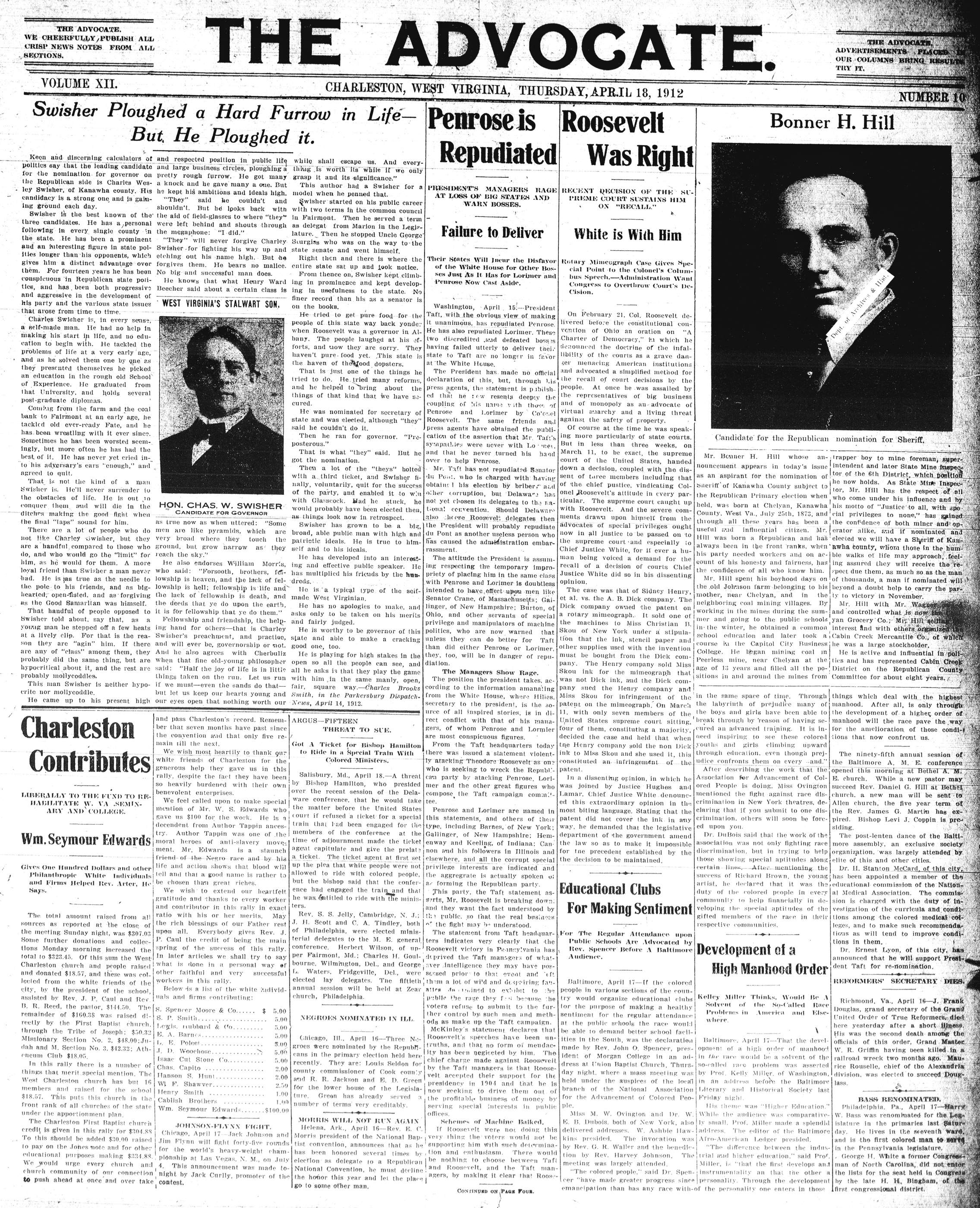
Swisher Ploughed a Hard Furrow in Life But He Ploughed it.
THE ADVOCATE.
WE CHEERFULLY/PUBLISH ALL
CRISP NEWS NOTES FROM ALL
SECTIONS.
VOLUME XII.
Keen and discerning calculators of politics say that the leading candidate for the nomination for governor on the Republican side is Charles Wesley Swisher, of Kanawha county. His candidacy is a strong one and is gaining ground each day. Swisher is the best known of the three candidates. He has a personal following in every single county in the state. He has been a prominent and an interesting figure in state polities longer than his opponents, which gives him a distinct advantage over them. For fourteen years he has been conspicuous in Republican state politics, and has been both progressive and aggressive in the development of his party and the various state issues that arose from time to time.
Charles Swisher is, in every sense, a self-made man. He had no help in making his start in life, and no education to begin with. He tackled the problems of life at a very early age, and as he solved them one by one as they presented themselves he picked an education in the rough old School of Experience. He graduated from that University, and holds several post-graduate diplomas. Coming from the farm and the coal bank to Fairmont at an early age, he tackled old ever-ready Fate, and he has been wrestling with it ever since. Sometimes he has been worsted seemingly, but more often he has had the best of it. He has never yet cried into his adversary's ears "enough," and agreed to quit.
That is not the kind of a man Swisher is. He'll never surrender to the obstacles of life. He is out to conquer them and will die in the ditches making the good fight when the final "taps" sound for him.
There are a lot of people who do not like Charley Swisher, but they are a handful compared to those who do, and who would go the "limit" for him, as he would for them. A more loyal friend than Swisher a man never had. He is as true as the needle to the pole to his friends, and as big-hearted, open-fisted, and as forgiving as the Good Samaritan was himself.
That handful of people opposed to Swisher told about, say that, as a young man he stepped off a few heats at a lively clip. For that is the reason they are "agin" him. If there are any of "class" among them, they probably did the same thing, but are hypocritical about it, and the rest are probably mollycodles.
This man Swisher is neither hypocrite nor mollycodle.
He came up to his present high
Charleston Contributes
LIBERALLY TO THE FUND TO RE HABILITATE W. VA. SEMINARY AND COLLEGE.
Wm. Seymour Edwards
Gives One Hundred Dollars and other Philanthropic White Individuals and Firms Helped Rev. Arter, He Says.
The total amount raised from all sources as reported at the close of the meeting Sunday night, was $307.03. Some further donations and collections Monday morning increased the total to $223.45. Of this sum the West Charleston church and people raised and donated $18.57, and these were collected from the white friends of the city, by the president of the school, assisted by Rev. J. P. Caul and Rev. B. R. Reed, the pastor, $144.50. The remainder of $160.3$ was raised directly by the First Baptist church through the Tribe of Joseph; $50.32 Missionary Section No. 2, $48.00; Judah and M. Section No. 3, $12.32; Atheneum Club $18.05.
In this rally there is a number of things that merit special mention. The West Charleston church has but 16 members and raised for the school $18.57. This puts this church in the front rank of all churches of the state under the apportionment plan.
The Charleston First Baptist church credit is given in this rally for $304.88. To this should be added $30.00 raised to pay on the Jones note and for other educational purposes making $334.88. We would urge every church and church community of our connection to push ahead at once and over take
THE ADVOCATE.
and respected position in public life and large business circles, ploughing a pretty rough furrow. He got many a knock and he gave many a one. But he kept his ambitions and ideals high. "They" said he couldn't and shouldn't. But he looks back with the aid of field-glasses to where "they" were left behind and shouts through the megaphone: "I did." "They" will never forgive Charley Swisher for fighting his way up and etching out his name high. But he forgives them. He bears no malice. No big and successful man does. He knows that what Henry Ward Beecher said about a certain class is
WEST VIRGINIA'S STALWART SON.
1910
HON. CHAS. W. SWISHER
CANDIDATE FOR GOVERNOR
as true now as when uttered: "Some
men are like pyramids, which are
very broad where they touch the
ground, but grow narrow as they
reach the sky."
He also endorses William Morris,
who said: "Forsooth, brothers, fellowship is heaven, and the lack of fellowship is hell; fellowship is life and the lack of fellowship is death, and the deeds that ye do upon the earth,
it is for fellowship that ye do them."
Fellowship and friendship, the helping hand for others—that is Charley Swisher's preachment, and practice, and will ever be, governorship or not. And he also agrees with Cherbuliz when that fine old-young philosopher said: "Half the joy of life is in little things taken on the run. Let us run if we must—even the sands do that—but let us keep our hearts young and
and pass Charleston's record. Remember that seven months have past since the convention and that only five remain till the next.
We wish most heartily to thank our white friends of Charleston for the generous help they gave us in this rally, despite the fact they have been so heavily burdened with their own benevolent enterprises.
We feel called upon to make special mention of Mr. W. S. Edwards who gave us $100 for the work. He is a descendent from Author Tappin ancestry. Author Tappin was one of the moral heroes of anti-slavery movement. Mr. Edwards is a staunch friend of the Negro race and by his life and action shows that blood will tell and that a good name is rather to be chosen than great riches.
We wish to extend our heartfelt gratitude and thanks to every worker and contributor in this rally in exact ratio with his or her merits. May the rich blessings of our Father rest upon all. Everybody gives Rev. J. P. Caul the credit of being the main spring of the success of this rally. In later articles we shall try to say what is done in a personal way of other faithful and very successful workers in this rally. Below is a list of the white individuals and firms contributing:
S. Spencer Moore & Co. $ 5.00
S. P. Smith 5.00
Lewis. rubbard & Co. 5.00
E. A. Barnes 5.00
L. E. Polet 5.00
J. D. Woochose 5.00
Isaac Cut Stone Co. 5.00
Chas. Capito 2.00
Hanson S. Hunt 2.00
W. F. Shawver 2.50
Henry Smith 1.00
Cablish Brothers 1.00
Wm. Seymour Edwards $100.00
JOHNSON-FLYNN FIGHT.
Chicago, April 17-Jack Johnson and Jim Flynn will fight forty-five rounds for the world's heavy-weight championship at Las Vegas, N. M., on July 4. This announcement was made tonight by Jack Curlly, promoter of the contest.
CHARLESTON, WEST VIRGINIA, THURSDAY, APRIL 18, 1912
while shall escape us. And everything is worth its while if we only grasp it and its significance."
This author had a Swisher for a model when he penned that.
Swisher started on his public career with two terms in the common council in Fairmont. Then he served a term as delegate from Marion in the Legislature. Then he stopped Uncle George Sturgiss who was on the way to the state senate and went himself.
Right then and there is where the entire state sat up and took notice.
From thence on, Swisher kept climbing in prominence and kept developing in usefulness to the state. No finer record than his as a senator is on the books.
He tried to get pure food for the people of this state way back yonder when Roosevelt was a governor in Albany. The people laughed at his efforts, and now they are sorry. They haven't pure food yet. This state is the haven of the food dopsters.
That is just one of the things he tried to do. He tried many reforms, and he helped to bring about the things of that kind that we have secured.
He was nominated for secretary of state and was elected, although "they" said he couldn't do it.
Then he ran for governor. "Preposterous."
That is what "they" said. But he got the nomination.
Then a lot of the "theys" bolted with a third ticket, and Swisher finally, voluntarily, quit for the success of the party, and enabled it to win with Glasscock. Had he stuck, he would probably have been elected then, as things look now in retrospect. Swisher has grown to be a big, broad, able public man with high and patriotic ideals. He is true to himself and to his ideals. He has developed into an interesting and effective public speaker. He has multiplied his friends by the hundreds. He is a typical type of the self-made West Virginian. He has no apologies to make, and asks only to be taken on his merits and fairly judged.
He is worthy to be governor of this state and able to make a cracking good one, too.
He is playing for high stakes in the open so all the people can see, and all he asks is that they play the game with him in the same manly, open, fair, square way.—Charles Brooks Smith, in the Parkersburg Dispatch-News, April 14, 1912.
ARGUS—FIFTEEN
THREAT TO SUE.
Got A Ticket for Bishop Hamilton to Ride in a Special Train With Colored Ministers.
Salisbury, Md., April 18.—A threat by Bishop Hamilton, who presided over the recent session of the Delaware conference, that he would take the matter before the United States court if refused a ticket for a special train that had been engaged for the members of the conference at the time of adjournment made the ticket agent capitulate and give the prelate a ticket. The ticket agent at first set up the plea that white people were not allowed to ride with colored people, but the bishop said that the conference had engaged the train and that he was entitled to ride with the ministers.
Rev, S. S. Jelly, Cambridge, N. J.; J. H. Scott and C. A. Tindley, both of Philadelphia, were elected ministerial delegates to the M. E. general conference. Herbert Wilson, of upper Fairmont, Md.; Charles H. Goulbourne, Wilmington, Del., and George L. Waters, Fridgeville, Del., were elected lay delegates. The fifthth annual session will be held at Zean church, Philadelphia.
NEGROES NOMINATED IN ILL
Chicago, Ill., April 16—Three Negroes were nominated by the Republicans in the primary election held here recently. They are: Louis Seldon for county commissioner of Cook county and R. R. Jackson and E. D. Green for the lower house of the Legislature. Green has already served a number of terms very creditably.
MORRIS WILL NOT RUN AGAIN
Helena, Ark., April 16—Rev. E. C. Morris president of the National Baptist convention, announces that as he has been honored several times by election as delegate to a Republican National Convention, he must decline the honor this year and let the place go to some other man.
Penrose is Repudiated
PRESIDENT'S MANAGERS RAGE AT LOSS OF BIG STATES AND WARN BOSSES.
Failure to Deliver
Their States Will Incur the Disfayor of the White House for Other Bosses Just As It Has for Lorimer and Penrose Now Cast Aside.
Washington, April 15.—President Taft, with the obvious view of making it unanimous, has repudiated Penrose. He has also repudiated Lorimer. These two discredited and defeated bosses having failed utterly to deliver their state to Taft are no longer in favor at the White House.
The President has made no official declaration of this, but, through his press agents, the statement is published that he row resents deeply the coupling of his name with those of Penrose and Lorimer by Co'lenel Roosevelt. The same friends and press agents have obtained the publication of the assertion that Mr. Taft's sympathies were never with Looney, and that he never turned his hand over to help Penrose.
Mr. Taft has not repudiated Senator du Pont, who is charged with having obtained his election by bribery and other corruption, but Delaware has not yet chosen its delegates to the national convention. Should Delaware also choose Roosevelt delegates then the President will probably repudiate du Pont as another useless person who has caused the administration embarrassment.
The attitude the President is assuming respecting the temporary impropriety of placing him in the same class with Penrose and Lorimer is doubtless intended to have effect upon men like Senator Crane, of Massachusetts; Gailinger, of New Hampshire; Burton, of Ohio, and other servants of special privilege and manipulators of machine politics, who are now warned that unless they can do better for Taft than did either Penrose or Lorimer, they, too, will be in danger of repudiation.
The Managers Show Rage.
The position the president takes, according to the information amanaging from the White House, where Hillies, secretary to the president, is the source of all inspired stories, is in direct conflict with that of his managers, of whom Penrose and Lormler are most conspicuous figures.
From the Taft headquarters today there was issued a statement violently attacking Theodore Roosevelt as one who is seeking to wreck the Republican party by attacking Penrose, Lormler and the other great figures who compose the Taft campaign committee.
Penrose and Lorimer are named in this statements, and others of their type, including Barnes, of New York; Gallinger, of New Hampshire; Hemenway and Keeling, of Indiana; Cannon and his followers in Illinois and elsewhere, and all the corrupt special privilege interests are indicated and the aggregate is actually spoken of as forming the Republican party.
This party, the Taft statement asserts, Mr. Roosevelt is breaking down and they want the fact understood by the public, so that the real business of the fight may be understood.
The statement from Taft headquarters indicates very clearly that the Roosevelt victory in Pennsylvania has deprived the Taft managers of whatever intelligence they may have possessed prior to that event and left them a lot of wild and despairing factions deprived to exhibit to the public the rage they feel because the voters refuse to submit to the further control by such men and methods as make up the Taft campaign.
McKinley's statement declares that Roosevelt's speeches have been untruths, and that no form of mendacity has been neglected by him. The chief charge made against Roosevelt by the Taft managers is that Roosevelt accepted their support for the presidency in 1904 and that he is now seeking to drive them out of the profitable business of money by serving special interests in public offices.
Schemes of Machine Baked.
If Roosevelt were not doing this very thing the voters would not be supporting him with such determination and enthusiasm. There would be nothing to choose between Taft and Roosevelt, and the Taft managers, by making it clear that Roose
"The colored people," said Dr. Spen- instrumentality an that the other a cer "have made greater progress since personality. Through the development emancipation than has any race with-of the personality one enters in those
Roosevelt Was Right
RECENT QECISION OF THE SU PREME COURT SUSTAINS HIM ON "RECALL"
White is With Him
Rotary Mimeograph Case Gives Special Point to the Colonel's Columbus Speech.—Administration Want Congress to Overthrow Court's Decision.
On February 21, Col. Roosevelt delivered before the constitutional convention of Ohio an oration on "A Charter of Democracy," in which he denounced the doctrine of the infallibility of the courts as a grave danger menacing American institutions and advocated a simplified method for the recall of court decisions by the people. At once he was assailed by the representatives of big business and of monopoly as an advocate of virtual anarchy and a living threat against the safety of property.
Of course at the time he was speaking more particularly of state courts. But in less than three weeks, on March 11, to be exact, the supreme court of the United States, handed down a decision, coupled with the dissent of three members including that of the chief justice, vindicating Colonel Roosevelt's attitude in every particular. The supreme court caught up with Roosevelt. And the severe comments drawn upon himself from the advocates of special privileges ought now in all justice to be passed on to the supreme court and especially to Chief Justice White, for if ever a human being voiced a demand for the recall of a decision of courts Chief Justice White did so in his dissenting opinion.
The case was that of Sidney Henry, et al. vs. the A. B. Dick company. The Dick company owned the patent on a rotary mimeograph. It sold one of the machines to Miss Christian B. Skou of New York under a stipulation that the ink, stencil paper and other supplies used with the invention must be bought from the Dick company. The Henry company sold Miss Skou ink for the mimeograph that was not Dick ink, and the Dick company sued the Henry company and Miss Skou for infringement of the patent on the mimeograph. On March 11, with only seven members of the United States supreme court sitting, four of them, constituting a majority, decided the case and held that when the Henry company sold the non Dick ink to Miss Skou and she used it, this constituted an infringement of the patent.
In a dissenting opinion, in which he was joined by Justice Hughes and Lamar, Chief Justice White denounced this extraordinary opinion in the most biting language. Stating that the patent did not cover the ink in any way, he demanded that the legislative department of the government amend the law so as to make it impossible for the precedent established by the decision to be maintained.
Educational Clubs For Making Sentiment
For The Regular Attendance upon Public Schools Are Advocated by Rev. Spencer Before A Baltimore Audience.
Baltimore, April 17—If the colored people in various sections of the country would organize educational clubs for the purpose of making a healthy sentiment for the regular attendance at the public schools the race would be able to demand better school facilities in the South, was the declaration made by Rev. John O. Spencer, president of Morgan College in an address at Union Baptist Church, Thursday night, where a mass meeting was held under the auspices of the local branch of the National Association for the Advancement of Colored People.
Miss M. W. Ovington and Dr. W. E. B. Dubois, both of New York, also delivered addresses. W. Ashie Hawkins presided. The invocation was by Rev. G. R. Waller and the benediction by Rev. Harvey Johnson. The meeting was largely attended.
Bonner H. Hill
Bonner H. Hill
Candidate for the Republican
Dept. of Archives & Hist.
Mr. Bonner H. Hill whose announcement appears in today's issue as an aspirant for the nomination of Sheriff of Kanawha County subject to the Republican Primary election when held, was born at Chelyan, Kanawha County, West Va., July 25th, 1873, and through all these years has been a useful and influential citizen. Mr. Hill was born a Republican and has always been in the front ranks, when his party needed workers and on account of his honesty and fairness, has the confidence of all who know him. trapper boy to mine forest intendent and later State Mator of the 6th District, who he now holds. As State Mator, Mr. Hill has the resi who come under his influence his motto of "Justice" to al- cial privileges to none," the confidence of both min- erator alike, and if nom- elected we will have a She awha county, wliom those bile walks of life may app- ing assured they will rece- spect due them as much so
Mr. Hill spent his boyhood days on the old Johnson farm belonging to his mother, near Chelyan, and in the neighboring coal mining villages. By working in the mines during the summer and going to the public schools in the winter, he obtained a common school education and later took a course in the Capitol City Business College. He began mining coal in Peerless mine, near Chelyan at the age of 13 years and filled all the positions in and around the mines from
in the same space of time. Through the labyrinth of prejudice many of the boys and girls have been able to break through by reason of having secured an advanced training. It is ineed inspiring to see these colored youths and girls climbing upward through education, even though prejudice confronts them on every and." After describing the work that the Association for Advancement of Colored People is doing, Miss Ovington mentioned the fight against race discrimination in New York theatres, declaring that if you submit to one discrimination, others will soon be forced upon you.
Dr. DuBois said that the work of the association was not only fighting race discrimination, but in trying to help those showing special aptitudes along certain lines. After mentioning the success of Richard Brown, the young artist, he declared that it was the duty of the colored people in every community to help financially in developing the special aptitudes of the gifted members of the race in their respective communities.
Development of a High Manhood Order
Kelley Miller Thinks, Would Be A Solvent of the So-Called Race Problems in America and Elsewhere.
Baltimore, April 17—That the development of a high order of manhood in the race would be a solvent of the so-called race problem was asserted by Prof. Kelly Miller, of Washington, in an address before the Baltimore Literary and Historical Society last Friday night.
His theme was "Higher Education." While the audience was comparatively small, Prof. Miller made a splendid address. The editor of the Baltimore Afro-American Ledger presided.
"The difference between the industrial and higher education," said Prof. Miller, is "that the first develops and instrumentality an that the other a personality. Through the development of the personality one enters in those
```markdown
```
nomination for Sheriff.
trapper boy to mine foreman, superintendent and later State Mine Inspector of the 6th District, which position he now holds. As State Mine Inspector, Mr. Hill has the respect of all who come under his influence and by his motto of "Justice to all, with special privileges to none," has gained the confidence of both miner and operator alike, and if nominated and elected we will have a Sheriff of Kanawha county, wilom those in the humble walks of life may approach, feeling assured they will receive the respect due them, as much so as the man of thousands, a man if nominated will beyond a doubt help to carry the party to victory in November.
Mr. Hill with Mr. Wagner, and controlled what is now his yan Grocery Co.; Mr. Hill willing interest and with others organized the Cabin Creek Mercantile Co., of which he was a large stockholder.
He is active and influential in politics and has represented Cabin Creek District on the Republican County Committee for about eight years.
things which deal with the highest manhood. After all, is only through the development of a higher order of manhood will the race pave the way for the amelioration of those conditions that now confront us.
The ninety-fifth annual session of the Baltimore A. M. E. conference opened this morning at Bethel A. M. E. church. While a new pastor may succeed Rev. Daniel G. Hill at Bethel church, a new man will be sent to Allen church, the five year term of the Rev. James G. Martin has expired. Bishop Levi J. Coppin is presiding. The post-lenten dance of the Baltimore assembly, an exclusive society organization, was largely attended by elite of this and other cities.
Dr. H. Stanton McCard, of this city, has been appointed a member of the educational commission of the National Medical Association. The commission is charged with the duty of investigation of the curricula and conditions among the colored medical colleges, and to make such recommendations as will tend to improve conditions in them. Dr. Ernest Lyon, of this city, has announced that he will support President Taft for re-nomination.
REFORMERS' SECRETARY
Richmond, Va., April 16—J. Frank Douglas, grand secretary of the Grand United Order of True Reformers, died here yesterday after a short illness. His was the second death among the officials of this order, Grand Master W. R. Griffin having been killed in a railroad wreck two months ago. Maurice Roussele, chief of the Alexandria division, was elected to succeed Doug-
BASS RENOMINATED.
Philadelphia, Pa., April 17—Harry W. Bass was renominated for the Legislature in the primaries last Saturday. He lives in the seventh ward, and is the first colored man to serve in the Pennsylvania legislature.
George H. White a former Congressman of North Carolina, did not enter the lists for the seat held in Congress by the late H. H. Bingham, of the first congressional district.
CORRESPONDENCE
OLARKSBURG
The funeral of J. L. Jones took place Wednesday afternoon from the residence of J. L. Ruffa. Mrs. Jones and two sons returned home Saturday. Miss Beulah Wright and grandfather, Mr. Jackson, of Buckhannon, attended the funeral of J. L. Jones. Miss Mary Gordon, of Fairchance. Pa., passed through the city Wednesday en route home from Venetta, where she closed a successful school term. While here Miss Gordon was the guest of her cousin, Miss Lily Allen. Mrs. D. H. Kyle and Mrs. Geo. Biglow arranged a very delightful surprise for Miss Estella Cambric Friday night, the occasion being the anniversary of her birthday. A number of friends gathered to wish her many happy returns of the day.
On Thursday night a large crowd assembled at Mt. Zion Baptist church where a pleasing program was rendered. A neat sum of money was realized.
The teap-year social at Trinity M. E. church Friday night was well attended.
The regular quarterly services were held at Trinity M. E. church Sunday District Supt. Curry preached two excellent sermons.
At Pride Chapel Sunday rally day was observed and $246 realized.
The W. M. M. Society is preparing to hold a bozaar in the near future.
The pupils of 1st, 2nd, 3rd and 4th grades will give an entertainment Friday night at the school hall. Proceeds for library purposes.
David Yates, who was operated on for appendicitis, is able to be out again.
Misses Eva and Beulah Green have returned from Elkins where they attended the Sunday School convention.
Rev. W. H. Thomas attended district conference at Elkins last week.
Rev. R. R. Downs will conduct the regular quarterly services here next Sunday.
The W. C. T. U. will meet Sunday afternoon at Trinity M. E. church.
D. H. Kyle addressed the Mothers' Congress at Grafton Sunday.
J. W. Strange was a visitor in Fairmont Sunday.
L. O. Wilson, of Weston, addressed the A. M. E. Sunday School Sunday. Mrs. Lulu Brown, Mrs. John Ogden Mrs. Jas. Thomas and Mrs. Albert Turner are able to be out again.
EAGLE
Mrs. Ella Hayden, who has been ill for some time with heart trouble, died Monday. Her death came as quite a shock to her many friends by whom she will be sadly missed. The remains were taken to her home at Hinton.
Miss Francis Goodwine, of Detroit, Mich., was called here on account of the death of her sister, Mrs. Ella Hayden.
Mrs. E. B. Ross attended the Reformers' Passed Officers Council at Montgomery Saturday.
Rev. R. D. W. Meadows preached a fine sermon Sunday night.
Luther Brown attended the district meeting in Montgomery Saturday.
WINIFREDE
Mrs. B. B. Allen left Monday for Charleston General Hospital where she is expected to undergo an operation. She was accompanied by her husband and Miss Virginia Smith.
Miss M. L. Walker spent a few days in St. Albans last week visiting friends.
John Wilson and Herbert Mitchell were business visitors to Charleston Friday.
Mr. and Mrs. J. F. Smoot entertained at dinner Sunday Mr. and Mrs. H. P. Day.
R. H. Allen spent Saturday and Sunday at his home in St. Albans.
N. S. Alexander spent a few days at his home at Kanawha City this week.
Misses M. L. Walker and Sadie Smith were shopping in Charleston Saturday.
Thomas Mitchell, who had his arm broken in the mines some time ago, is able to be out again.
Mr. and Mrs. J. M. Wooding entertained at dinner Sunday Misses M. L. Walker, Ella Smith and Lee Johnson.
W. E. Cary and C. Ross spent a few days in Charleston on business last week.
On Easter Monday Storer College baseball team played Armstrong Manual Arts High School, Washington, D.C. The teams played two games. Storer won both.
Friday the 19th the Interscholastic Declamatory Contest between Storer and Morgan is to take place in Baltimore. Horace Helm, Class 1915, and William Reddix, of the same class, are Storer's representatives. The two literary societies, Lincoln Debating
Society and Woman's League, have voted to seed the successful contestants of last spring to Baltimore at this time, popping that they might serve as an inspiration to the declaimers. Charles Palmer, 1912, Layton Wheaton 1911, Hazel Dillard 1912 and Mary Parker 1911 were successful last spring in winning the honors.
Sunday quarterly meeting was held in the College church. Visitors from Charles Town, Martinsburg and Johnson town were present. Rev. Crayon, of Charles Town, was moderator of the meetings and preached the opening sermon. Saturday night Rev. Richard R. Thompson, of Martinsburg church, addressed the morning services. The choir furnished excellent music.
Friday, April 12, the Harper's Ferry W. C. T. U. gave their Matrons' Declamatory Contest and Aunt Dinah's Quilting Party in Charles Town. The opera house was full. The W. C. T. U. had a successful night.
FAIRMONT
Miss Beulah Smith, of Clarksburg, was a business visitor here Monday. Mrs. Anna Meade, of Clarksburg, spent Sunday and Monday here, the guest of Mrs. H. W. Meade.
Mrs. C. G. Taylor, wife of Rev. Taylor, M. E. minister, and son, arrived here Thursday from Winchester, Va. and are now at home in the parsonage.
Wm. Bailey left last Friday for his home at Buxton, la., after spending ten days with his mother, Mrs. Faany Fraction.
Miss Ethel Burkhead left Friday for home in Columbus after spending several days with Miss Florence Goff.
Straughther Gray is very low at Cook's Hospital. His relatives are here.
George M. Whiting, Jr., aged 17 years, died Tuesday 9th at Washington, D. C., after an illness of a few weeks with appendicitis and peritonitis. His remains were brought here by his father. He leaves a mother, father, three sisters, two brothers and grandmother, and other relatives and friends. The funeral services were held Thursday from the home and interment at the city cemetery.
Mrs. George Whiting is very ill at this writing.
The play entitled "The Old Maids' Convention" was very good and quite a success.
Mr. and Mrs. E. L. Slorton entertained at supper Wm. Bailey, of Buxton, Ia.
PARKERSBURG
Under a special dispensation granted by Supreme Chancellor S. W. Green, Blennherasset Lodge No. 77 K. of P., held its annual thanksgiving services at Logan M. E. Church on Ann street. The day was ideal for the occasion and many took advantage of the opportunity to attend. The procession, headed by Blennherasset Band and the Uniform Rank, formed at the hall on Market street marched to Seventh street and from there to the church. The services had been well announced and a large audience had already filled the church. Dr. J. W. Sheleroft acted as chancellor commander. When the meeting had been opened, he surrendered the gavei to Sir William McClung, who presided as master of ceremonies. Mr. McClung briefly explained the significance of the meeting and proceeded to carry out the program is outlined in the supreme chancellor. At the conclusion of the address Pythianism, which was made by Mr. H. D. Hazlewood, Mr. Pearl Seals rendered a very beautiful solo. The master of ceremonies then introduced to the audience Dr. C. H. Sheene, of Elkius, W. Va., a member of the local lodge and a former pastor of the A. M. E. church of this city. Dr. Sheene ably sustained the great reputation which he has as a forceful and impressive pulpit orator. His effort on this occasion was a scholarly one-characterized by a purity of diction and a loftiness of style peculiar to Himself. His text, which he announced as the basis of his discourse, was the 96th verse of the 119th Psalm: I have seen an end of all perfection, but thy commandment is exceedingly broad. The audience listened attentively while the speaker, in his own inimitable way, gave to them the highest and noblest conception of Pythianism.
The music for the occasion was under the direction of Mr. George McClung and Mrs. J. W. Shelletoft. They were very much pleased by the many words of praise which they received. Miss Virginia D. Gilmer, who was the house guest, Easter week, of Mrs. C. A. Williams of 19th street, was guest of honor at a bridge dance at the K. of P. hall. Thursday afternoon and night, given by the P. & M. Bridge Club which is composed of the following ladies, Mrs. L. Curtis, Mrs. H. D. Hazlewood, Mrs. E. M. Simpson
THE ADVOCATE
Miss Gordon, of Fairchance, Penn., spent Easter as the guest of Mrs. Martha Brown-Booker.
The Rev. Gill has moved his family here and they now reside in the parsonage of the M. E. church.
Rev. William Toney spent last week here with his family.
Miss Virginia Gilmer, of Charleston, was the guest of Mrs. C. A. Williams, on 19th street. She returned home Saturday.
Mrs. J. W. Shelleroft entertained Wednesday in honor of Miss Gilner. Those present were Mrs. H. D. Hazlewood, Mrs. James Hayes, Mrs. C. A. Williams, Miss Gilner; Messrs. Stape Wright and Kendall members of Wright's Saxophone Trio, of Columbus, Ohio. Music was the past time of the afternoon, as each one present rendered a number, either vocal or instrumental. The most enjoyable being several numbers played by Messrs. Wright and Kendall. Mr. Wright is an accomplished saxaphone artist and Mr. Kendall is one of the finest pianists in orchestra work. Dinner was served at six o'clock and all present voted Mrs. Shelleroft a charming hostess.
The P. & M. Bridge Club met Thursday afternoon with Mrs. I. Curtis. John Jackson has returned after an absence of several months. Mrs. Lottie Monts is quite ill at her home on Avery street. The R. O. S. Club met Saturday afternoon with Mrs. Rosa Dishroon. Miss Lilly Brown, who has been sick for several weeks, is now able to be out. Mr. and Mrs. E. V. Seams entertained Misses Alberta and Lena McClung at dinner Monday evening. The Phoenix Literary met Tuesday evening at the Baptist church. An interesting program was rendered.
Mrs. B. F. White and daughter, Dorothy, of Huntington, who have been visiting relatives here several days, left Monday for Institute.
Mrs. George Jackson, who has been sick for some weeks, is able to be out. Mrs. M. L. Reed, of Kimberly, was the guest of Mrs. L. E. P. Callender, Saturday. Rev. R. D. W. Meadows, of Huntington, was a business visitor here Saturday. Mrs. Mayme W. Jackson entertained at Luncheon Friday complimentary to Mrs. B. F. White, of Huntington. The Ladies of the First Baptist; church surprised Rev. and Mrs. Warner Brown with a donation party Monday evening. Rev. J. J. Turner, of Mt. Carboe, was here on business Saturday. Mrs. Jenny Johnson is sick at her home on College Hill. Anestine Jackson entertained with a party Friday evening at the home of Mrs. Mayme W. Jackson, in honor of Dorothy White, of Huntington. Mrs. Clara Powell, who was sick several days, is able to be out. Mrs. Irvie Woods visited her family at Harewood Sunday.
ELKINS
The A. M. E. District Conference which had been in session at the A. M. E. church since Tuesday, closed Friday evening. Rev. R. R. Downs, D. D., is the presiding elder. Rev. A. J. Smoot were elected secretary... J. C. Douglas and W. Newman were elected marshals. Rev. T. B. McConnell and W. L. Brown preached able sermons Thursday. Interesting papers were read by the members. Dr. C. H. Shreen, Rev. W. W. Mayle and, F. H. Alleyne gave strong lectures to the conference.
The Sunday School convention is in session also. Miss B. Green of Clarksburg, is the secretary of the convention. Rev. S. F. Boston, of Huntington, editor of the West Virginia Register, is in attendance also. Rev. Alleyne and his congregation as well as the citizens in general have entertained the conference. Dr. Downs preached Friday night.
The following resolution was offered by Rev. W. W. Mayle and unanimously adopted by the W. Va. Dist. Conference A. M. F. Church:
Resolution.
Whereas, the West Virginia Conference is highly honored by haying as her efficient presiding elder, the Rev.
MOXTGOMERY
ELKINS
R. R. Downs, D. D., a man of strong steeling character, broad culture and scholarship, a successful pastor and an acknowledged leader, ripe with years of experience in the church, and Whereas, these and other worthy qualities of the man so easily to be seen, that "he who runs may read" have evoked the most exhalted praise from the press and the general church" that his name is being heralded throughout African Methodism as a deserving candidate for Episcopal honors:
Therefore, be it Resolved. That we, the members of the District Conference, West Virginia Division of the A. M. E. church unanimously endorse the candidacy of the Rev. R. R. Downs, D. D., for bishop in the A. M. E. church and hereby instruct the delegation of this conference to so cast their vote, at the next general conference as the express sentiment of the men of the above named conference. Unanimously adopted.
Rev. E. C. Page is conducting a revival meeting at the Baptist church this week. Miss Hattie Peters visited here Monday afternoon.
Friday was arbor day and clean up day at the West Virginia Colored Institute. In the evening the students were tendered a banquet. Music was furnished by the West Virginia Colored Institute orchestra.
T. G. Nutter of Charleston, was the guest of honor at the close of the feast, he was presented to the students by President Prillerman. Mr. Nutter made some very timely remarks and the mentioning of the success of Richard Brown, the young artist, brought forth long applaus. At the conclusion of Mr. Nutter's address Garnett Ferguson moved that a committee be appointed to draft resolutions complimenting C. E. Mitchell who made the banquet possible.
Morrill day was celebrated Monday afternoon and evening by appropriate exercises. Governor William E. Glasscock addressed a large audience in Hazlewood Assembly Hall at 6:30. Hon. John A. Shepherd and Supt. George S. Laidley delivered addressed to the student body and visitors.
Miss Lucy C. Smith was the guest of Miss Naola Farrar, at Charleston, Saturday evening.
Miss Lillian Foster has returned home, having closed her school for the season.
G. H. Beane, of Charleston, spent Sunday in this neighborhood.
U. G. Tyler and wife of Charleston, were guests of Pres. Prillerman and wife. Saturday evening.
Miss Sadie Merriwether of Washington, D. C., was the guest of Mrs. E. R. Carter, Friday afternoon.
Louis Jones visited friends here on Tuesday.
William Brown was the guest of his brother, A. G. Brown, Monday.
Miss Amelia Wilcher spent Friday evening among her Institute friends.
The Homemakers club celebrated its tenth anniversary Thursday evening by giving a leap year social at the residence of Mr. and Mrs. Guss.
Miss Zanphra Robinson has returned home after closing a very successful school year.
Miss Georgia Brown has closed her school and is spending a few days among her friends at Institute. Mrs. B. F. White, of Huntington, is spending a few days here, the geust of her parents, Mr. and Mrs. Z. Taylor Brown.
S. J. Jackson of Upland, sustained a severe injury in the mines Saturday. He was taken to the Welch hospital where it was found necessary to amputate his foot. Since our last letter, Anna, the litter daughter of Mr. and Mrs. N. Thornton, died at her home at Upland. The funeral services were held at Upland Baptist church. Rev. F. C. Patterson filled his regular appointment here Sunday.
Miss Mary Hairston is rapidly improving.
Mrs. Sallie White has been indisposed for some time.
Miss George was a business visitor to Keystone, Saturday.
T. G. Nutter, of Charleston, and Jas. Harper, of Keystone were business visitors to Elkhorn.
F. M. Perkins was in Kimball, Sunday.
Mr. Holt was calling on Miss Maynard last week.
Mr. Mills and Miss Williams were visitors here Sunday.
B. D. Patterson went to Lick Branch on business Tuesday.
Katherine Walker the daughter of Mrs. Nannie Simmons is very ill with pnuemonia.
Miss Sommerville Jones was a business visitor to Bluefield, Saturday.
There is no noticeable improvement in Paul, the son of Mr. and Mrs. Richard Moore.
Miss Lola M. Lavender, teacher in the Elkhorn graded school sustained
INSTITUTE
ELKHORN
severe injuries from a fall last week. Her right arm was dislocated at the elbow. Although it is much improved it present, yet it may be some time before she is able to use it. S. Earley is very sick at this writing. B. D. Patterson, Jr., has been ill with the measles, but is able to be out again. Several of the teachers of this district plan to attend Summer school, during their vacation.
HINTON
The Knights of Pythias' annual sermon was preached Sunday night by Rev. Robinson of St. Albans. A large crowd was out for the occasion. He made his sermon a strong one especially for the duty of every loyal Sir Knight.
The progressives were most delightfully entertained by Mrs. Clara Wells Monday evening at eight o'clock. The color scheme for the occasion was yellow and white, which was carried out in the parlor and dining room. After the business of the evening was disposed of, a pretty as well as delicious repast was served by Misses Luille Wells and Irene Trent. The sandwiches were tied with yellow ribbons which were kept as favors by each person.
The menu was chicken salad, on lettuce, cheese sandwiches, stuffed eggs, lemon ice, ice cream, cake. An enjoyable evening was had by all present.
Whooping cough is having its day with the children of Hinton. Several social affairs are being planned for the balmy month of May.
CHARLESTON
After Boyd's Scalp—The rumor is current that a delegation of colored citizens waited upon the Board of Education last night and filed charges reflecting seriously upon the competency of C. W. Boyd as principal of the city colored schools. Allen A. Dehonney is said to have acted as spokesman and to have voiced the sentiments of his colleagues with out reserve. Th report that comes to this paper goes further in saying that the board promised its petitioners to enquire fully into their complaints and to take steps to correct the abuses they charge if they are based upon facts.
Lining up for Roosevelt—A large and enthusiastic meeting of Roosevelt followers was held in the Board Walk Social club rooms, Summers street, Tuesday night and illuminating addresses were delivered by Attorney J. W. Chappelle, General Jas. A. Campbell and others. The meeting was presided over by Attorney E R. Carter, himself a candidate for justice of the peace, and the sentiment of those present was manifested in unmistakeable terms favorable to Colonel Roosevelt's candidacy. This was the first of a series of meeting to be held in the city prior to the convention Friday afternoon of next week. The second will be held in the first ward, this evening. The speakers will be Attorneys Chappelle and Carter.
Hotel Brown Arrivals—Messrs. Hickman, Robbins and Stewart, Columbus Ohio;. Mr. and Mrs. S. B. Johnson, Raymond City; Rev. J. W. Robinson, St. Albans; Prof. E. W. B. Curry, Urbana, O.; S. Farrell, Handley; Mr. and Mrs. F. L. Carter, Richmond, Va.; Mr. and Mrs. L. Ed. Banks, Drakes Springs, Va.; Wm. Veneble, R. Henderson, Plymouth; Mr. and Mrs. Gray Boomer; C. H. Williams, Longacre; J. H. King, Riverside; J. L. Williams, Kimberly; H. Robinson, Raymond City and Miss Della L. Brown, Quinnimont.
Missionary Section No. 2—Mrs. E. D. Humbles and Miss Carrie Jamison were hostesses to Missionary Section No. 2, at Mrs. Frank Henley's, Tuesday evening. After brief devotional exercises conducted by Miss Mary Mil ARGUS—MINETEEN
ler and Mrs. Malinda Foreman, 23 members responded to the roll call and $1.40 was collected. Among the visitors who made encouraging remarks were: Mrs. Clara Banion, of Columbus, O., and Mrs. Lizzie Ray, of Huntington, Rev. E. J. Woodard expressed the thanks of the Section to the hostesses. Mrs. Percy Taylor, Mrs. Mary Miller and Mrs. E. J. Woodard will be hostesses next week at the home of Mrs. M. A. Alexander, Sentz street.
Minors Representatives Here--Among the delegates from several "locals" of the United Mine Workers of America in conference here with the operators on the wage scale are J. H, King, board member, Cedar Grove: C. H. Williams, Longacre; J. R. Williams, Kimberly; A. B. Calloway, Eagle; W. L. Currin, Boomer; B. G. Gray, Harewood; J. D. Hairston, Harewood; J. H. Moore, Tomsburg and C. W. Kingsley, Raymond City. Tribe of Joseph—The Tribe of Joseph was entertained Friday evening at the home of Mrs. Mollie Mills by Miss Minna Booker and Flora Lee. Devotional exercises were conducted by Mrs. Ada Scott and Miss Mildred Kenney and the following program rendered: Reading from the "Coal of Altar," Mrs. Lucy Pleasants; solo, Mrs. Lewis Patterson; recitation, by Miss Gertrude Miner; solo, Mrs. Fannie Harglevage; Rev. J. W. Robinson.
of St. Albans, delivered an excellent address. Fifty-six members and visitors were present and their thanks were expressed to the hostesses by Miss Rebecca Bullard. The club will meet with Mrs. Willis Wallace, Quarrier street this week. Miss Maggie Robinson, Harry Preston, Luther Moore and George Wilson being hosts.
Birthday Celebrated—Miss Edna Hammond celebrated the sixteenth anniversary of her birth, Monday evening, at her home in West Charleston. A very pleasant time was spent by her guests, among whom were: Misses Edith Purnell, Geola Gallion, Edna Roberts, Esther Triplett, Harriet Crozier, Brunette Brown and Lucy Ransberry; George Lewis, Hobert Alexander, Charles Jefferson, Irving Purnell, William Thompson, Macco Hammond, F. Roberts and John Gallion.
The Antheum Club—Reading from Shakespeare by Rev. R. D. W. Meadows and songs by the quartette composed of William Dickerson and others were the features of the meeting of the Antheum club with Mrs. Julia Campbell Monday evening, at which time Miss J. C. Chancellor, Mrs. Malinda Foreman and Lewis Paterson were hosts. Other numbers on the program were: Solo, Mrs. Carrie Jamison and recitation. Miss Minnie Peters. R. C. McIver tendered the thanks of the club and the meeting closed with the announcement that Mrs. Annie Lewis, Mrs. H. Meadows and William Dickerson would entertain the club at its next meeting at the parsonage.
State Summer
Colored T
Third Session, June 17th, to J.
Two Distinct departments
demic, which will be devoted to
the school course, for which credit
tutions. Also in this connection,
expecting to pass the examination
Professional, which is designed for
and other advanced students.
country has been secured for this
tinguished educators in this course
Summer School Faculty, viz:
B. Du BOIS, Ph. D., BOOKER
This is to be the Biggest and Best
enroll. For particulars address
Va., R. P. Sims, Bluefild, W.
Ferry, W. Va. for Mc P. Shawk
CROWN AND BRIDGE
HOURS: 8:30 A. M. to 1
Dr. JAMES
Dental
Summer S
ured Team
17th, to July 20
departments will be
voted to thorough
which credit may
connection thorough
examinations will
designed for print
students. Some
led for this school
in this country h
y, viz: KELLY
BOOKER WASCH
best and Best Scho
address: Byrne
Buffield, W. Va.; I
P. Shawkey; Ch
D BRIDGE WOOD
A. M. to 1:30 P. M.
JAMES B
ental Sun
State Summer School for Colored Teachers.
Third Session, June 17th, to July 26th, 1912, Institute, W. Va.
Two Distinct departments will be maintained: 1. The Academic, which will be devoted to thorough work on the branches of the school course, for which credit may be had in the various institutions. Also in this connection thorough drill classes for persons expecting to pass the examinations will be maintained. 2. The Professional, which is designed for principals, high school teachers, and other advanced students. Some of the best talent in the country has been secured for this school. Three of the most distinguished educators in this country have accepted places on the Summer School Faculty, viz: KELLY MILLER, A. M., W. E. B. Du BOIS, Ph. D., BOOKER WASHINGTON, LLD.
This is to be the Biggest and Best School Yet. Prepare now to enroll. For particulars address: Byrd Prillerman, Institute, W. Va., R. P. Sims, Bluefield, W. Va.; H. T. McDonald, Harper's Ferry, W. Va. or Mc P. Shawkey, Charleston, W. Va.
CROWN AND BRIDGE WORK A SPECIALTY
HOURS: 8:30 A.M. to 1:30 P.M., 2:00 to 6:00 P.M.
Office: Room 1, K. of P. Bldg.
J. E. JOHN
FUNERAL DIRECTORS
All Calls Prom
Our Prices are the Most
For Promptness and Care
Our Ambulance Service
609 SUMMERS STREET, CHARLESTON
SPECIAL ATTENTION
JOHNS
RECTORS A
Promptly
the Most Rea
and Care Try
Service.
CHARLESTON, W. NATION GIVEN CALLS. LTD. ER CO. oper's Ferry, V
SPECIAL ATTENTION GIVEN OUT OF TOWN CALLS.
HENRY T. M'DONALD,
President.
STORER
Harper's Fe
Founded
More than 400 men and women h
in the state for Colored students. Ma
Remarkably healthful. Ample buildi
ING ADDED TO OUR PLANT THIS
teen highly educated, earnest teacher.
Our Library catalogued according
largest in the State.
FIRST GRADE CERTIFICATES
BERS OF THE GRADUATING CLAS
THE STATE BOARD OF EDUCATION
its faculty and student body. Its wh
ing. Literary Societies, Christian Or
STORER COLLEGE
Founded in 1867, women have gra-
dents. Magnificent triple buildings. T
N'T THIS YEAR. Most teachers does
according to the
TICATES ARE G
ING CLASSES W
DUCATION. Ste
y. Its whole infi-
ristian Organizati
State Normal, In-
ce and other print
More than 400 men and women have graduated here. The oldest school in the state for Colored students. Magnificent location. Elevation high. Remarkably healthful. Ample buildings. THREE NEW BUILDINGS BEING ADDED TO OUR PLANT THIS YEAR. The regular faculty of sixteen highly educated, earnest teachers does not include assistants.
Our Library catalogued according to the Dewey System, is one of the largest in the State.
FIRST GRADE CERTIFICATES ARE GRANTED TO THOSE MEMBERS OF THE GRADUATING CLASSES WHO ARE REGOMMENDED TO THE STATE BOARD OF EDUCATION. Storer is interdenominational in its faculty and student body. Its whole influence is toward Christian living. Literary Societies, Christian Organizations, Musical Clubs, Bands and Sane Athletics.
COURSES: Academic, State Normal, Industrial. Music.
For illustrated catalogue and other printed matter write to
"Litters" Entertained—Miss Grace Robinson ver. pleasantly entertained the Lifters club at the M. E. parsonage, Tuesday night. In addition to the membership of the club, Mrs. Burgess, mother of C. E. Burgess, of Institute, and Mesdames Jones, Punnel and Peden and Miss Monroe, of the West Side, were present. The club will meet with Mrs. Daniel McGhee, Elmwood avenue, Tuesday evening next week.
PERSONALS AND LOCALS
I. C. Cabell was appointed to report church items for The Advocate and J. W. Essex to the Mountain Leader.
Miss Bertha Monroe, of Charlottesville, Va., who is visiting Mrs. Adelaide Peden, West Charleston, will return to her home, Sunday.
Mrs. Annie Jones and children, of West Charleston, will return to their home in Jeffersonville, Ind., next week. Her many friends regret very much to lose Mrs. Jones from the community.
The prayer meeting at Simpson M. E. church continues to increase in numbers and interest. The pastor discusses some phase of christian activity at each meeting.
District superintendent Curry will preach Sunday evening at Simpson M. E church at which time the Lord's Supper will be administered. The first quarterly conference will be held Thursday night.
The Friday Aid society will meet with Mrs. Emiline Hackley, at 511 Shelton avenue at 8:30 tomorrow evening.
er School for Teachers.
July 26th, 1912, Institute, W. Va.
Tests will be maintained: 1. The Acad-
mics thorough work on the branches of
credit may be had in the various insti-
tion thorough drill classes for perso-
sions will be maintained. 2. The
for principals, high school teachers,
Some of the best talent in the
this school. Three of the most dis-
country have accepted places on the
KELLY MILLER, A. M., W. E.
MR WASHINGTON, LLD.
Best School Yet. Prepare now to
pass: Byrd Prillerman, Institute, W.
Va.; H. T. McDonald, Harper's
Mckoy; Charleston, W. Va.
AGE WORK A SPECIALTY
1:30 P. M., 2:00 to 6:00 P. M.
S B. BROWN
Med Surgeon
HNSON CO.
ERS AND EMBALMERS
emptly Attended.
est Reasonable.
are Try
e.
Open DAY and NIGHT Phone 2472
BUTTON, W. VA.
N GIVEN OUT OF TOWN
WILLS.
COLLEGE
Ferry, W. Va.
In 1867 we have graduated here. The oldest school magnificent location. Elevation high. buildings. THREE NEW BUILDINGS BEYEAR. The regular faculty of sixers does not include assistants. going to the Dewey System, is one of the ARE GRANTED TO THOSE MEMSES WHO ARE RECOMMENDED TO ON. Storer is interdenominational, in whole influence is toward Christian liv-Organizations, Musical Clubs, Bands and formal, Industrial, Music. Other printed matter write to
THURSDAY, APRIL 18, 1912
Home Phone 429
N. C. BRACKETT,
Treasurer.
The President
THURSDAY, APRIL 18, 1912
W. Virginia Convention
LIKELY TO BE CONTROLLED BY FRIENDS OF FORMER PRESIDENT
Vote of Two to One
In Ten Counties Shows How Roosevelt Is Regarded and Assures Him of Delegates From All Congressional Districts Except the Fourth.
Roosevelt victories in the magistrial district conventions, held Saturday, in at least four of the five counties where delegates were selected, give the former President a big hunch on the lead for the control of the State Delegate Convention in May; while the Roosevelt boomers have taken the lead in each of the congressional districts except the Fourth, where the President is leading the Oyster Bay citizen by seven votes, due to the victory in Wood County a week ago.
Cabell County furnished the surprise in the conventions Saturday. Outside of the city of Huntington, Roosevelt made a clean sweep with the exception of one delegate in Barboursville District. At Huntington the President carried two of the wards, securing eight delegates, while Colonel Roosevelt carried three wards, for 15 delegates. The final verdict of the county was 24 for Roosevelt and nine for Taft.
There was considerable disorder in the Huntington conventions, which were not held until 8 o'clock Saturday night. In the Second Ward the Roosevelt forces scented a neat trimming and did not enter the hall and the Taft delegates carried off the credentials.
In the Third Ward another delegation of six are in dispute. In this ward State Committeeman William F. Hite was overpowered by the minions of the lion hunter and Hite and his followers left the convention. The Roosevelt delegation has the proper credentials.
Breach of Party Harmony.
Fayette County was the scene of another breach of party harmony. With the exception of Quinnimont and Fayetteville Districts, Roosevelt swept the county. At Quinnimont, four Taft and one Roosevelt delegate were sent to the State Convention and the figures were reversed by the District Convention.
At Fayetteville, Samuel Dixon, a member of the State Committee, presided. The Roosevelt forces had slipped into the mountain town a large number of voters and the Teddyites claimed they had the Taft supporters outnumbered. Colonel Dixon refused to entertain any motion made by the Roosevelt followers, refused a count of the crowd and appointed an uninstructed delegation of sixteen. The Roosevelt forces took a stand at the same place and named a delegation of their own and instructed them for Roosevelt.
Fayetteville is the home of Charles W. Dillon, one of the candidates for Governor. Dillon is a Roosevelt supporter, and said Saturday that sentiment was overwhelming for the former President at his home. Dixon and Dillon are close friends, and it is generally conceded at the Capitol there will be a compromise in Fayetteville district.
Piedmont District for Taft.
Mineral County gave the former President 11 of 13 delegates. Piedmont district, after a sharp contest, was carried for President Taft. Upshur County sent solid Roosevelt delegations to each convention. State Committeeman Erk Martin, of Upshur, a Roosevelt supporter, will be a candidate for delegate at large.
Jefferson County, contiguous territory to Washington, was snatched by the Taft workers. George H. Childs, of Harper's Ferry, along with a number of other good workers, had charge of the county for the President and in a mass convention eight Taft delegates were elected.
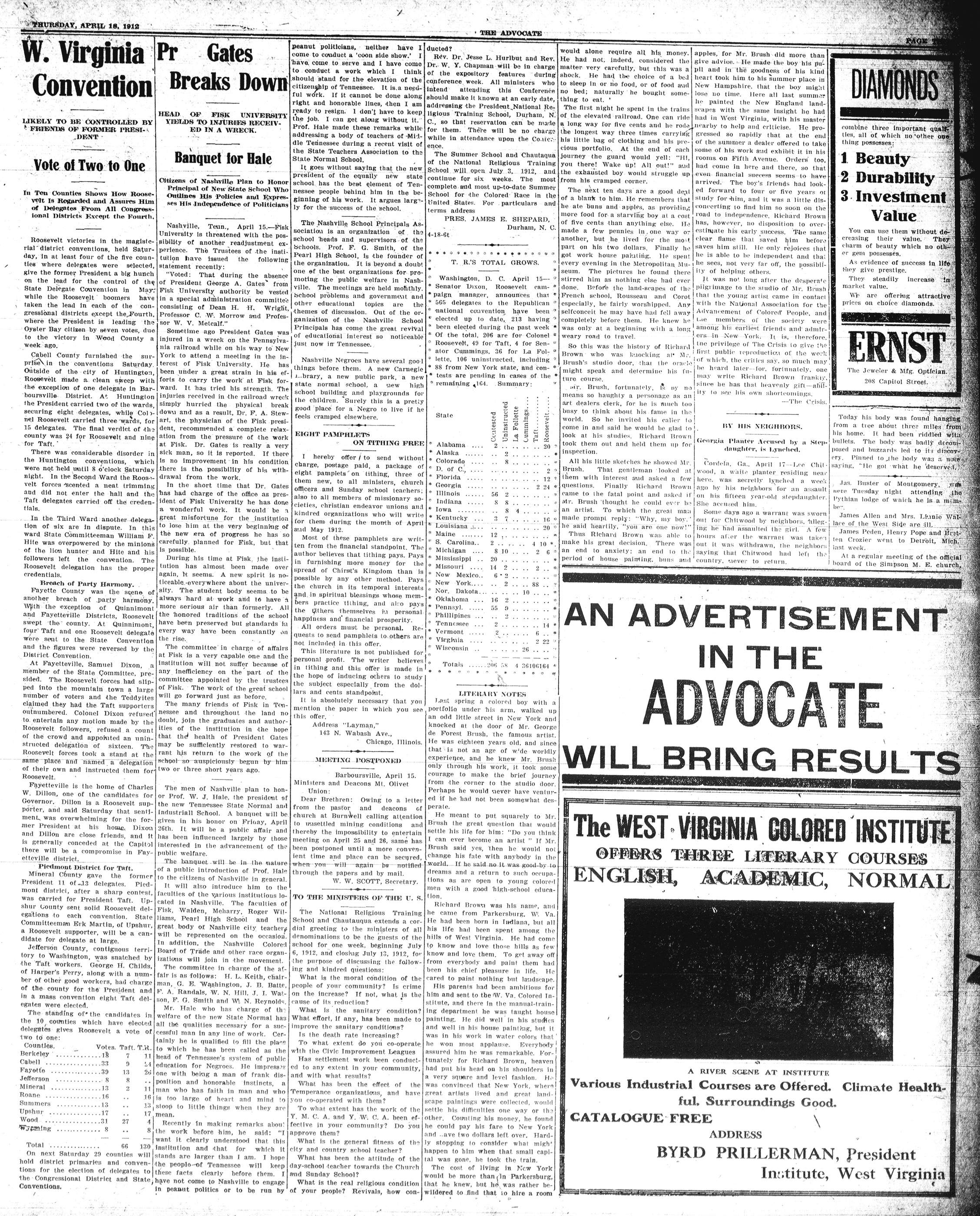
The standing of the candidates in the 10 counties which have elected delegates gives Roosevelt a vote of two to one:
Counties. Votes. Taft. T.R.
Berkeley .18 7 11
Cabell .33 9 24
Fayette .39 13 26
Jefferson .8 8 ..
Mineral .13 2 11
Roane .16 .. 16
Summers .13 .. 13
Upshur .17 .. 17
Wood .31 27 4
Wyoming .8 .. 8
Total . . 66 130
On next Saturday 29 counties will hold district primaries and conventions for the election of delegates to the Congressional District and State Conventions.
HEAD OF FISK UNIVERSITY YIELDS TO INJURIES RECEIVED IN A WRECK.
Banquet for Hale
Oltizens of Nashville Plan to Honor Principal of New State School Who Outlines His Policies and Expresses His Independence of Politicians
Nashville, Tean., April 15.—Fisk University is threatened with the possibility of another readjustment experience. The Trustees of the institution have issued the following statement recently:
"Voted: That during the absence of President George A. Gates from Fisk University authority be vested in a special administration committee consisting of Dean H. H. Wrigft Professor C. W. Morrow and Professor W. V. Metcalf."
Sometime ago President Gates was injured in a wreck on the Pennsylvania railroad while on his way to New York to attend a meeting in the interest of Fisk University. He has been under a great strain in his efforts to carry the work at Fisk forward. It has tried his strength. The injuries received in the railroad wreck simply hurried the physical break down and as a result, Dr. F. A. Stewart, the physician of the Fisk president, recommended a complete relaxation from the pressure of the work at Fisk. Dr. Gates is really a very sick man, so it is reported. If there is no improvement in his condition there is the possibility of his withdrawal from the work.
In the short time that Dr. Gates has had charge of the office as president of Fisk University he has done a wonderful work. It would be a great misfortune for the institution to lose him at the very beginning of the new era of progress he has so carefully, planned for Fisk, but that is possible.
During his time at Fisk, the institution has almost been made over again, it seems. A new spirit is noticeable everywhere about the university. The student body seems to be always hard at work and to have a more serious air than formerly. All the honored traditions of the school have been preserved but standards for every way have been constantly on the rise.
The committee in charge of affairs at Fisk is a very capable one and the institution will not suffer because of any inefficiency on the part of the committee appointed by the trustees of Fisk. The work of the great school will go forward just as before.
The many friends of Fisk in Tennessee and throughout the land no doubt, join the graduates and authorities of the institution in the hope that the health of President Gates may be sufficiently restored to warrant his return to the work of the school so auspiciously begun by him two or three short years ago.
The men of Nashville plan to honor Prof. W. J. Hale, the president of the new Tennessee State Normal and Industrial School. A banquet will be given in his honor on Friday, April 26th. It will be a public affair and has been influenced largely by those interested in the advancement of the public welfare.
The banquet will be in the mature of a public introduction of Prof. Hale to the citizens of Nashville in general. It will also introduce him to the faculties of the various institutions located in Nashville. The faculties of Fisk, Walden, Meharry, Roger Williams, Pearl High School and the great body of Nashville city teachers will be represented on the occasion. In addition, the Nashville Colored Board of Trade and other race organizations will join in the movement. The committee in charge of the affair is as follows: H. L. Keith, chairman, G. E. Washington, J. B. Batte, F. A. Randals, W. N. Hill, J. I. Watson, F. G. Smith and W. N. Reynolds.
Mr. Hale who has charge of the welfare of the new State Normal has all the qualities necessary for a successful man in any line of work. Certainly he is qualified to fill the place to which he has been called as the head of Tennessee's system of public education for Negroes. He impresses one with being a man of frank disposition and honorable instincts, a man who has faith in man and who is too large of heart and mind to stoop to little things when they are mean.
Recently in making remarks about the work before him, he said: "I want it clearly understood that this institution and that for which it stands are larger than I am. I hope the people-of Tennessee will keep these facts clearly before them. I have not come to Nashville to engage in peanut politics or to be run by
peanut politicians, neither have I come to conduct a 'coon side show.' I have come to serve and I have come to conduct a work which I think should stand for the elevation of the citizenship of Tennessee. It is a needful work. If it cannot be done along right and honorable lines, then I am ready to resign. I don't have to keep the job. I can get along without it. Prof. Hale made these remarks while addressing a body of teachers of Middle Tennessee during a recent visit of the State Teachers Association to the State Normal School. It goes without saying that the new president of the equally new state school has the best element of Tennessee people behind him in the beginning of his work. It argues largely for the success of the school.
The Nashville School Principals Association is an organization of the school heads and supervisors of the Schools. Prof. F. G. Smith, of the Pearl High School, is the founder of the organization. It is beyond a doubt one of the best organizations for promoting the public welfare in Nashville. The meetings are held monthly. School problems and government and other educational topics are the themes of discussion. Out of the organization of the Nashville School Principals has come the great revival of educational interest so noticeable just now in Tennessee.
Nashville Negroes have several good things before them. A new Carnegie library, a new public park, a new state normal school, a new high school building and playgrounds for the children. Surely this is a pretty good place for a Negro to live if he feels cramped elsewhere.
EIGHT PAMPHLETS
I hereby offer / to send without charge, postage paid, a package of eight pamphlets on tithing, three of them new, to all ministers, church officers and Sunday school teachers; also to all members of missionary societies, christian endeavor unions and kindred organizations who will write for them during the month of April and May 1912.
Most of these pamphlets are written from the financial standpoint. The author believes that tithing pays. Pays in furnishing more money for the spread of Chirst's Kingdom than is possible by any other method. Pays the church in its temporal interests and in spiritual blessings whose members practice tithing, and also pays the others themselves in personal happiness and financial prosperity.
All orders must be personal. Requests to send pamphlets to others are not included in this offer.
This literature is not published for personal profit. The writer believes in tithing and this offer is made in the hope of inducing others to study the subject especially from the dollars and cents standpoint.
It is absolutely necessary that you mention the paper in which you see this offer.
Address "Layman."
MEETING POSTPONED
Dear Brethren: Owing to a letter from the pastor and deacons of church at Burnwell calling attention to unsettled mining conditions and thereby the impossibility to entertain meeting on April 25 and 26, same has been postponed until a more convenient time and place can be secured, when you will again be notified through the papers and by mail.
The National Religious Training School and Chautauqua extends a cordial greeting to the ministers of all denominations to be the guests of the school for one week, beginning July 6, 1912, and closing July 13, 1912, for the purpose of discussing the following and kindred questions:
What is the moral condition of the people of your community? Is crime on the increase? If not, what is the cause of its reduction?
What is the sanitary condition? What effort, if any, has been made to improve the sanitary conditions?
Is the death rate increasing?
To what extent do you co-operate with the Civic Improvement Leagues
Has settlement work been conducted to any extent in your community, and with what results?
To what extent has the work of the Y. M. C. A. and Y. W. C. A. been effective in your community? Do you approve them?
What is the general fitness of the city and country school teacher?
What has been the attitude of the day-school teacher towards the Church and Sunday School?
What is the real religious condition of your people? Revivals, how con-
The Summer School and Chautaqua of the National Religious Training School will open July 3, 1912, and continue for six weeks. The most complete and most up-to-date Summer School for the Colored Race in the United States. For particulars and terms address
* Washington, D. C. April 15—
* Senator Dixon, Roosevelt camp-
paign manager, announces that
565 delegates to the Republican
national convention have been
elected up to date, 213 having
been elected during the past week
Of the total, 206 are for Colonel
Roosevelt, 49 for Taft, 4 for Sen-
ator Cummings, 36 for La Fol-
lette, 106 uninstructed, including
88 from New York state, and con-
tests are pending in cases of the
remaining 164. Summary:
State Contested Uninstructed La Follette Cummings Taft Roosevelt
* Alabama 2 20
* Alaska 2
* Colorado 8
* D. of C. 2
* Florida 12
* Georgia 2 24
* Illinois 56 2
* Indiana 8 8
* Iowa 8 4
* Kentucky 3 7 16
* Louisiana 20
* Maine 12
* S. Carolina. 2 4 10
* Michigan 8 10 2 6
* Mississippi 20
* Missouri 14 2 2
* New Mexico. 6 2
* New York. 2 88
* Nor. Dakota. 10
* Oklahoma 16 2
* Pennsyl. 55 9
* Phillipines 2
* Tennessee 2 14
* Vermont 2 6
* Virginia 2 22
* Wisconsin 26
Totals 206 58 4 26106164
LITERARY NOTES
Last spring a colored boy with a portfolio under his arm, walked up an odd little street in New York and knocked at the door of Mr. George de Forest Brush, the famous artist. He was eighteen years old, and since that is not an age of wide worldly experience, and he knew Mr. Brush only through his work, it took some courage to make the brief journey from the corner to the studio door. Perhaps he would never have ventured if he had not been somewhat desperate.
He meant to put squarely to Mr. Brush the great question that would settle his life for him: "Do you think I can ever become an artist." If Mr. Brush said yes, then he would not change his fate with anybody in the world. If he said no it was good-by to dreams and a return to such occupations as are open to young colored men with a good high-school education.
Richard Brown was his name, and he came from Parkersburg, W. Va. He had been born in Indiana, but all his life had been spent among the hills of West Virginia. He had come to know and love those hills as few know and love them. To get away off from everybody and paint them had been his chief pleasure in life. He cared to paint nothing but landscape. His parents had been ambitious for him and sent to the W. Va. Colored Institute, and there in the manual-training department he was taught house painting. He did well in his studies and well in his house painting, but it was in his work in water colors that he won most applause. Everybody assured him he was remarkable. Fortunately for Richard Brown, heaven had put his head on his shoulders in a very square and level fashion. He was convinced that New York, where great artists lived and great landscape paintings were collected, would settle his difficulties one way or the other. Counting his money, he found he could pay his fare to New York and save two dollars left over. Hardly stopping to consider what might happen to him when that small capital was gone, he took the train.
The cost of living in New York would be more than in Parkersburg, that he knew, but he was rather bewildered to find that to hire a room
AN ADVERTISEMENT
IN THE
ADVOCATE
WILL BRING RESULTS
The WEST VIRGINIA COLORED INSTITUTE
OFFERS THREE LITERARY COURSES
ENGLISH, ACADEMIC, NORMAL
A RIVER SCENE AT INSTITUTE
Various Industrial Courses are Offered. Climate Healthful, Surroundings Good.
CATALOGUE FREE
ADDRESS
BYRD PRILLERMAN, President
Institute, West Virginia
would alone require all his money. He had not, indeed, considered the matter very carefully, but this was a shock. He had the choice of a bed to sleep in or no food, or of food and no bed; naturally he bought something to eat. '
The first night he spent in the trains of the elevated railroad. One can ride a long way for five cents and he rode the longest way three times carrying his little bag of clothing and his precious portfolio. At the end of each journey the guard would yell: "Hi, you there! Wake up! All out!" and the exhausted boy would struggle up from his cramped corner.
The next ten days are a good deal of a blank to him. He remembers that he ate buns and apples, as providing more food for a starving boy at a cost of five cents than anything else. He made a few pennies in one way or another, but he lived for the most part on his two dollars. Finally he got work house palating. He spent every evening in the Metropolitan Museum. The pictures he found there stirred him as nothing else had ever done. Before the land-scapes of the French school, Rousseau and Corot especially, he fairly worshipped. Any selfconceit he may have had fell away completely before them. He knew he was only at a beginning with a long weary road to travel.
So this was the history of Richard Brown who was knocking at Mr. Brush's studio door, that the oracle might speak and determine his future course.
Mr. Brush, fortunately, is by no means so haughty a personage as an art dealers clerk, for he is much too busy to think about his fame in the world. So he invited his caller to come in and said he would be glad to look at his studies. Richard Brown took them out and held them up for inspection.
All his little sketches he showed Mr. Brush. That gentleman looked at them with interest and asked a few questions. Finally Richard Brown came to the fatal point and asked if Mr. Brush thought he could ever be an artist. To which the great man made prompt reply: "Why, my boy," he said heartily, "you are one now!" Thus Richard Brown was able to make his great decision. There was an end to anxiety; an end to the period of house painting, buns and
apples, for Mr. Brush did more than give advice. He made the boy his pupil and in the goodness of his kind heart took him to his summer place in New Hampshire, that the boy might lose no time. Here all last summer he painted the New England landscapes with the same insight he had in West Virginia, with his master nearby to help and criticise. He progressed so rapidly that at the end of the summer a dealer offered to take some of his work and exhibit it in his rooms on Fifth Avenue. Orders too, had come in here and there, so that even financial success seems to have arrived. The boy's friends had looked forward to four or five years of study for him, and it was a little disconcerting to find him so soon on the road to independence. Richard Brown has, however, no disposition to overestimate his early success. The same clear flame that saved him before saves him still. He only rejoices that he is able to be independent and that he sees, not very far off, the possibility of helping others.
It was not long after the desperate pilgrimage to the studio of Mr. Brush that the young artist came in contact with the National Association for the Advancement of Colored People, and the members of the society were among his earliest friends and admirers in New York. It is, therefore, the privilege of The Crisis to give the first public reproduction of the work of which, the critics say, so much may be heard later—for, fortunately, one may write Richard Brown frankly, since he has that heavenly gift—ability to see his own shortcomings.
BY HIS NEIGHBORS
Georgia Planter Accused by a Step-daughter, is Lynched.
Cordela, Ga., April 17—Lee Chitwood, a white planter residing near here, was secretly lynched a week ago by his neighbors for an assault on his fifteen year-old stepdaughter. She accused him.
Some days ago a warrant was sworn out for Chitwood by neighbors, alleging he had assaulted the girl. A few hours after the warrant was taken out it was withdrawn, the neighbors saying that Chitwood had left the country, never to return.
combine three important qualities, all of which no other one thing possesses:
1. Beauty
2. Durability
3. Investment Value
You can use them without decreasing their value. They charm of beauty which no other gem possesses. As evidence of success in life they give prestige. They steadily increase in market value. We are offering attractive prices on choice diamonds.
ERNST
The Jeweler & Mfg. Optician.
208 Capitol Street.
Today his body was found hanging from a tree about three miles from his home. It had been riddled with bullets. The body was badly decomposed and buzzards led to its discovery. Planned to the body was a note saying, "He got what he deserved.
Jas. Buster of Montgomery, was here Tuesday night attending the Pythian lodge of which he is a member;
James Allen and Mrs. Lknie Wallace of the West Side are ill.
James Peden, Henry Pope and Bretten Crozier went to Detroit, Mich. last week.
At a regular meeting of the official board of the Simpson M. E. church,
‘, v.
Sci ieee iene nie A —— eee ae ee
oo ecu =
f cy
PRE ADVOCAr
fH ‘abltshed every Thursday by The
Mavoeme Printing and Publishing
en re
h | 3.0. GILMER, Fditor. ~~
{M. HAZLEWOOD, Business. Mgr.
Biatered ‘ms necond class matter at
Bip Poet Oflice at Charleston, W.
Ha. winder Act of Congress of
ch’ 80, 1879.
gOfiice: Ttoom 11 K. of P. Building.
re Phone 2185,
«) RATES HY SUBSCRIPTION.
mail, one year......... $1.50
mail; six months... ..... $1.00
Mall, three months....... 50
Bel
” AB TO THE RECALL.
ee ee ae ee en See
“tet that if Colonel Roosevelt's “re-
eal" proposition showld ever b> en-
acted into law, the Negro people
_ Would suffer.
“As & case in pot, listen to this
itluminating statement from a local
waper:
“Sispose a Southern Siate should
Dass a law disfranchinsing ihe Scgro
That law would immediate: get into
the courts and on appeal te te Su-
Preme Cee: wood be watt ta be ne
-eonsi!tutiveal, ‘ben if sae vight to
reea!] dcetsions existed, th. uecision
© Uy cunrts would be taken before
the people and reversed and the con-
atitutionality of the law confirmed,
and the Negro would be out of polities
There is hardly a State in the South
where the entire white vote wou:l not
be cast for the Negro’s disfrauch'se-
ment, and in the South the Negra
Would not be counted on a reer'l Gt
such a decision.”
As a supposition, our contempor-
ary's statement goes as far as suppo-
sitlons usually go, but what are the!
tacts? Assuming that by “Suprez¢
Court” is meant the Supreme Court
of the State, there is no need to de
any supposing, If any Supreme Court
of a Southern State has declared a)
disfranchising law wnconstirutional—
and no such instance is recalled—|
the legislature has forwith remedied
whatever errors there were in the law
and the Negro was thereafter depriv
ed of his vote. Where appeal was
taken to the Supreme Court of the
United States it was deniei en the
ground that it was improperty pre-
sented or for some other reasca which
would cloak the real sympathy of chat
tribunal with disfranchising legisla-
tion, With the examples which
have before us it is buncomb, ther,
to suppose that the Negro’s civic
rights will be injuriousiy affected by
the “recall’ if any one of the few re-
maising Seu.ein States should wa
to disfranchise tim, It is only neces-
sary tor as. Meet aantes of vor =
In any sth e to desire ¢ :franchi'
ment sien © fe a comp ited, and
tained b- the courts
This our contemporary brows, but
he would Lave it appear 6 herwise 10
bolster up (ie .osing wet. Se is mak-
Ing fo Presvlem Gath aig is Ler
white delegations from the Black Belt
in the South and the boss-riddea
States of the North. He knows tha!
instead of the “recall” beiag injurious
to the Negro as a cit’zen, if Colonel
Roosevelt's iCeas on this subject «
enacted into law, ihe Negro will be
immeasurely benefitied In States
where Workmen's Compensation Acrs,
Children’s and Women’s Labor Laws
and other measures beneficial to the
masses have been declared unconsti-
tutional, the Negro, along with the
general public, will share whateve
Dlessings the-e measures confer, 1f the
court's decisions could be recalled. To
say that recall of judicial decisions on
constitutional questions will be 10 our
injury is in line we'h the campaign
of villification and deception which
—the-Tatt adherents are waging every-
where. They have branded every
Proposition of Colonel Roosevelt x
Socialistic and have charged him with
attonpling !0 Jay impious hands npon
the arb co tha reverent of the go teen
Went tn bie give acy Of the re-set
dum, initiative and recall, bur it is
the same old story. We heard it
same old argument agains! the yait
way rate bl, the conservation of iat
ural resources bill, the pure fom 95.
drag Lili and, i fact, agains: eves
Prisenenic designe t by Colonel Were
vel, white he oeenpied the Wait
h, House, 10 make this a govermmcr. v
the yeeple by the peeple and tor th
reople.
The sdvecate ie vee thay just a
the opposition to these last nam
failed, so will those Who are fighttn
now against the initiative, referendun
“and? recall rail It betieves that th
peoyle ve ewake to the danger wiie!
threators the Republic from boss ral
and will, at the Chicago conventior
repudiate Mr, Taft and the men wh
have used aim as a tool to acconplis
their selfish purposes
a Sesaere taeda meeare
AWE an emphasis that would ne
commendable if employed in a worthy
canse, our McDowell county contem-
Dorary reiterated, last week, its alle
Blance to tue candidacy of its county's
choice—in a packed convention—for
committesman at large. On the
grounds that MeDowell is entitled to
the place on account of its large Re-
publican majorities it pleads for Hav-
ber’s election, and intimates that ‘t
Would-be-the part of wisdom, if he has
faults, to take him around the corner
and tell him about them, but thas
they should not be proclaimed in the
public square,
Again, The Advocate acknowledges
that McDowell county is entitled to a
Placg om the committee, and it again
states with all possible emphasis that
what little strength it has would have
been thrown to McDowell's candidate,
if that county had advanced a cana
date mot quite so utierly impossible
as the man the Times now asks the
voters of the Stale to support.
Since he is what he is and condi-
Hons are what they are, the writer
does not concur with his friends in,
“the Republican strong-hold” in the
Flat Top region as to the wisdom of
having a confidential confessional of
Harper's utter wmworthiness to rep-
resent in any capacity any class cf
people who have any regard for de-
cency. A pussy-footed — campaijn
agains: him may seem better to them
—and it may be policy—but ‘the Ad-
Vorate is not doing business alone
that line just at the present time.
We have seen the folly of commead-
ing publicly and condemning private-
ly those whose only recommendation
(0 places of power is brass, We too.
have remained silent’ when just’ a
slight display of moral courage to
speak out would have averted serious
evils: when what was whispered, if
poken aloud, would have turned or
sept. an undesirable out. Then,
when that which in cowardice we
feared to denounce, became so patent
hat all might see it, there was not
eft to us the debatable consolation
Mf saying: “I told you so.”
In the newspaper fraternity as well
1s among the laity, there is a ques-
ion as to wheteher the function of an
‘ditorial is to reflect or to guide pub-
ie opinion: whether it should learn
what the public wants and confine its
comments to that or tell them what
they need, ‘This paper believes 11
should do both, and, acting on that
relief, though some of its hypocritic~
brethren throw conniption fits, it
vould impress upca its readers their
Iuty 10 rebuke at the polls on June
th :ne brazen effrontery of Howard
Harper in dragging into the light a
record which, in bitter shame, any
ther would envelop in profound dark-
ness
Abas with him,
UNCLE TOMS BRROR.
Uncle Tom Fortune of the New York
Age is a mighty good editorial writer,
an editorial writer, too, who usuatly
sees behind the curiain and is not
afraid ro tell what he sees. But Uncle
Tom is human and therefore, liable to
err and err grievously, This he does
vhen he says:
“Colonel Roosevelt's speech-making
swing last week through Kentucky,
Itinois, West Virginia and Pennsyl-
Vania was Spectacular and noisy
caough, bul it did not net any dele-
getes to che Chicago convention worth
while. The fact is that when Colonel
Roosevelt fell down in the New York
primaries, Mareh 26, it made it im-
possible for him to rise up in the Chi-
cago convention, With his State lined
up against him in the convention the
will hardly be considered seriously
for she nomination.”
Colonel Roosevelt's tour did not
het any delegates worth while! Oh
my prophetic soul! He netted all but
two in Illinois and lost only nine out
of seventy-six in Pennsylvania, yet
The Age says he did not profit by his
tour Well. maybe he did not. As
The Age sees it. his having received
o date twice as many delegates to
the convention in West Virginia may
no: be worth while now, but it may
Place a higher estimate on his achieve
ments after the Chicago convention.
Our friend in “Little Old New York
may then appreciate at its full worth
the failure of Barnes and the other
New York bosses to instruet the New
York delegation for President Taft.
BONNER HILL FOR SHERIFF.
Elsewhere in this issue of The Ad-
vocate Mr. Bonner 1, Hill announ-
ves Wis candidacy for the Republican
homination for the office of sheriff of
Kanawha connty
Outside of his personality and gen-
eral fitness for she office 10 whieh he
aspires, Me. Hills place of residence
ought to be a large factor in come
mending his eandidary to the chought.
ful consideration of his party. fie
hails from Chelyan in Cabin. Cres
Wistriet, a distries among the mos!
populous and strongly nepuetican in
the county. fr has been te this dis.
trier that the Republican party af te
county has long looked to ewell ies
majorities oy to save it from over.
whelming defeat. Tr has not in a gee
eration had sney an important omice
as that of sheriff and its claims now
in the person of Mr. Sith cannot. iy
Highily east asids
But Mr. Hill bas more than place of
residence upon which to basi his plea
for his party's suffrage. He has, sinve
he reached his majori-y, worked tire:
lessly and faithfully 10 promote. its
faterests, worked hoch in. its conned:
chambers and on the field that others
might receive the honors to some of
which he now aspires, Behind him
there is a record, both as a citizen and
an officer, to which those who know
him best point with pride. For a num.
ber of years he has been one of the
most efficient of the mine inspectors
and has time agala demonstrated his
fidelity Yo duty and -reptization of
the responsibility which goes along
with a public office.
Mr. Hill has made good in his pri-
vate affairs and as a public officer,
and the same success that has attend-
ed his efforts in hese would undoubr-
edly follow him ff his party should
see fit to nominate him for sheriff.
He would make a strong race, win the
coveted prize and make a good and
trustworthy public officer,
———
MR. LITTLEPAGE'S APPOINT= —
MENTS. /
‘The New Era, a little magazine be-
ing published at Washington by Bis-
hop Walters and other Negroes w10
are advocating the cause of Democ-
laey, carried the announcement re-
centis that, Congressman ‘dam B.
Littlepage from this district has made
several colored appointments and if
elected will make several more. The
Advocate attemptes to keep posted on
such matters bur diligent inquiry on
its part fails to disclacn the identity
ef these “several appointments.” So
fav as we have been able to aces «an,
Mr, Littlepage has made on colored
appiontmeat—that of a Negro janitor
and tHis statement has not been yeri-
fied.
Such statements as this may he'p
the cause, of Democracy in some sec-
tions, but they are not calculated to
forward Mr. Littlepage’s chances of
re-election from this district wher
(na facts ere known.
———~-
THE SPERD MANIA.
When history gives its verdict upon
the Titanic’s awful end, it will be at-
tributed neither to the steamship com-
pany’s greed for gold nor the cap-
tain’s rashness, but to the traveling
public's mania for speed. That and
that alone is responsible for the loss
of more lives in wrecks on land and sea
than have gone to fill the insatiable
maw of war in a half century. When
a captain understands, as one is sald
to have expressed it, that he must
reach Heaven, Hell or New York in 5
days; when an engineer knows that
he must keep up with a schedule
worked out to the last second or re-
port the reason why, no risk is con-
sidered too great to fun and no chance
too slim to take.
a
If any further evidence of the weak-
ness of the Taft candidacy were aee-
ed, it could be easily found in the in-
creasing demand from Col. Roosevelt s
political opponents for a compromise.
But the Colonel will have none of this
compromise talk. He is in the fight
to the finish which, by the way, was
greatly hastened by his crushing vi>-
tory in Peansylvania last Saturday
IT LOOKS LIKE IT.
With tea counties xeporting and
the Roosevelt delegates to the State
convention numbering two to Taft's
one, the doubtful are beginning to be-
lieve that Governor Glasscock simply
voiced the sentiment of the public
when he said West Virginia is for T.
FOR GOVERNOR.
Editor The Advocate:
You are authorized to annonnce
through the columns of the Advocate
that 1 am a candidate for the Re-
Publican nomination for Governor
subject to the will of the Aspubli-
can voters in the State primary
©. W. Dillon
I hereby announce my candidacy
for the nomination for Governor of
West Virginia, subject to the de-
cision of the Republican voters of
the State as may be recorded — in
the State-wide Primary called for
June 4th, 1912
Respectfully,
CHAS. W. SWISHER
Charleston, W. Sa
a
| We are authorized 10 annonnee the
candidacy of Dr. HL. D, Hatfield, of
Eckman, MeDowell county, for nom-
ination for Governor, subject to the
Republican Primary Klection to be
held on June 4th, 1912.
FOR STATE AUDITOR y
‘To the Republicans of West Virginia
I hereby declare my candidacy for
renomination and election to the of-
fice of State Auditor, subject to the
decision of State-wide primary. elec-
Hon to be held dune 41h, 102.
Respectfully,
4. 8. DARST.
Charleston, W, Va., Feb, 12, 1912.
FOR STATE TREASURER.
Editor The Advocate: —
I hereby announce my candidacy
to the office of State Treasurer, snb-
ject to the action of the Republican
Primary to be held June 4th.
C.F. RATHBONE
| STATE TREASURER
1 hereby announce my candidacy
for re-nomination and election to the
office of State Treasurer of West Vir-
Rinia, subject to the approval or re-
Jection of the Republican Primary
Election, June 4th, 1912.
Respectfully,
E. 1, LONG,
Charleston, Feb, 1st, 1912
+ STATE SUPT. OF SCHOOLS
I hereby announce my candidacy for
the nomination for State Superin-
tendent of Free Schools of West Vir-
ginia, subject to the decision of the
Republican Primary Election,
Respectfully,
M. P. SHAWKEY.
Charleston, Wt Va.. Feb, 2, 1912.
FOR JUDGE OF SUPREME COURT
The Advocate is authorized to an-
nounce the candidacy of George Poff-
enbarger, of Pt. Pleasant, Mason cou
ty, for the Republican nomination for
Judge of the Supreme Court of Ap-
peals, subject io the action of the
state convention to be held at Hunt-
ington, May ith
See |
FOR SUPREME COURT JUDGE. |
| 1 hereby announce my candidacy
for Supreme Court Judge, subject
to the action of the Republican
State convention at Huntington on
May 16.
Respectfully,
HLM. WILLIS.
New Martinsville,
For Committeeman At-Large.
To the Republican Voters of West
Virginia:
IT hereby nanounce my candidacy
for Committeeman at large, subject
to the appraval or rejection of the
Republican voters of the state, in the
primary election to be held, June
the 4th. 1912.
1 will heartily appreciate the sup-
port of my many friends and Repuh-
Nean voters of the party generally.
Respectfully submitted,
J. S. Noel
The Advocate is authorized to an-
nounce the candidacy of Dr. GC. GC.
Rarnett, of Huntington, Cabell coun-
ty, for committeeman-at-large, sub-
ject tu the action of the primary elec-
tion to be held June 4th,
FOR SHERIFE
To the Repubiican Voters of Kana-
wha County:
1 herewith announce Arasit a can-
didate for the nomination for Sheriff
of Kanawha County, subject to the
approval or rejection of the voters in
primary election. -My record of three
years service as County Commission-
‘er is offered in evidence of my ability
to administer the affaira of the of-
Bee of Sheriff, if nominated and elect-
ed. Your support is earnestly solic-
ited,
Respectfully,
A, R. SHEPPARD,
March 5, 1912,
FOR SHERIFF
To the Republicans of Kanawha
County:
T hereby beg to annownce my can-
didacy for the Republican nomination
for Sheriff of the County, my candi.
Gacy being subject to the decision of
the voters as may be recorded in the
primary election for nomination of
county candidates.
. Respectfully,
| U. G. YOUNG.
‘Charleston, W. Va.. Feb. 12, 1912,
T hereby announce my candidacy
for the Republican nomination for
Sheriff of Kanawha county, subject
to the decision of the primary elec-
tion, whea neld. T will heartily ap-
preciate your support.
McLEAN NASH,
Charleston, W. Va., March 26, 1912.
COMMISSIONER COUNTY COURT
1 hereby announce my candidacy
for the Republican saomination for
Commissioner of the Kanawha Coun-
ty Court, subject to the decision of
the voters in primary election or by
such other method as may be decided
upon. 5
‘MP. MALCOLM.
T hereby announce my candidacy for
homination of Justice of the Peace of
Charleston Magisterial District, sub-
ject to the Republican Primary when
held, Your support is earnestly &o-
licited,
E.R. CARTER,
FOR JUSTICE OF THE PEACE
J announce myself a candidate for
Tustice of the Peace of Charleston
District, subject to the Republican
primary, when ‘held, T earnestly s0-
Melt the support of my friends.
A.M, PAULEY.
Subject to (he approval of my par-
ty, Tam herewith announcing my can-
didacy for the Republican nomination
for Justice of the Peace in Chartes-
ton district, and solicit (he support of
my friends. Tf elected T shall he on
the square, Yours in earnest,
JOHN Tf. BLODNT.
T hereby announce to the yoters of
Charleston Magisterial District that
Tam a candidate for the Republican
homination for Justice of the Peace
of said district, subject to the de-
clston of the voters ax may be ren-
dered in primary. election.
Rocpectfaily,
n, W. DERING,
Charleston, Feb, 1%, 1912.
ARE YOU WORKING FOR MONEY?
OR IS YOUR MONEY WORKING FOR YOU?
af
If you are working and saving your money and putting it in a bank where you get no interest, keeping It
in-adrmk or hiding it some where about. your_house—You—Are Working for Money. - petit
If you are working and saving your money and investing it in a safe way, where it will be working day and
night whether you are working or not, and making you at least six per cent. imterest—Your Money is Working
For You.
‘The Pythian Mutual Investment Association was organized in order to give us an opoprtunity to put the,
money we could save together and (hen put it to work. ‘The-above is a picture of our building on the Capitol
Square in Charleston. We have just purchased a splendid three story brick building on one of the main bus-
iness streets in the city of Huntington. The first door is occupied by the Huntington Herald, the largest daily
newspaper published in that section of the state, the second floor is used for office rooms, while the third floor
is a large assembly and lodge hall, ‘This building is sure to pay us well. After the Charleston building had
been oceupied only eight months our stockholders were paid a dividend of six per cent,
Stock is still on sale at $10.00 per share, cither paid up or on the installment plan. Ask your agent in your
locality about it or write to this office.
LET YOUR MONEY WORK FOR YOU.
PYTHIAN MUTUAL INVESTMENT
0). WILSON UT WESTON, W. VA
|, I hereby announce my candidacy
for nomination for “Justice of “the
Peace of Charleston District, subject
to the Republican primary when held.
I solicit the support of all Republl-
cans, pledging the faithful administra-
Uon of the duties of the office if elect:
ed,
Respectfully,
MARION GILCHRIST.
February 20, 1912. .
To the Republicans of Charleston
District:
Tam a candidate for the nomination
by the Republican party for Justice
of the Peace for Charleston District,
If nominated and elected 1 shall, to
the best of my ability, discharge the
duties of the office in an honest and
efficiant’ manner. Your support will
be appreciated, =
Sincerely yours,
FRANK A. McGREW.
Editor The Advocate:
Please announce through the col-
umuns of your paper, that I am a can-
didate for the nomination for the of-
fice of Sheriff of Fayette county, sub-
Ject te the action of the Republican
primary to be aeld June 4th, 1912,
To my friends I promise that they
will have the honor of being with a
winner, or loser, but no quitter, as I
now promise that I will stay until 1
am elected or defeated,
I further promise, it nominated and
elected, that I will conduct myself and
the business affairs of the office in a
way that will bring no discredit to
those who have honored me with their
to administer the affairs of the office
in a safe, conservative fair and bus
iness-like manner, treating all in an
impartial manner,
Very truly yours,
T. J. DAVIS.
Montgomery, W. Va. Mareh 7, 191g,
ee
Penrose is Repudiated
— (Continued from page one)
velt_ is fighting them and all of their
kind as corruptionists, and that they
are themselves laboring to hoid
‘Taft in office in order to use nim, do
actually present the real am the the
Sreatest issue in the fight,
To that extent the Taft statement
will have the effect of making the
issue better understood, But it will
not do Roosevelt any harm, and it
cannot pessibly co Taft any good.
It is now generally conceded that
nothing can do Taft any good. Prom
the outset the sheme to re-nominate
Taft was a scheme to steal the nomi-
nation, The soutnern office holders
paid in advance tor their work with
balvie Oftces, wee to contribue 200
Kelegates,
Penrose, Lorimer, Cr:tne, Barnes,
of New York; Hemenway and his
sang in Indiana; Iiradjey ana the
ollice-holders of Kentucky: and the
machine leaders in Michigaa, were
to accomplish the rest ihrough con-
trolled conventions and packed cau-
cuses. The Republican party, it was
estimated, was uothing bet a ma-
chine, which men like Penrose, Lor-
imer, McKinley, Cannon and the oth-
ers could easily manipulate.
People Were Not Considered.
There was never a moment any
thought was given to the sentiment
of the public, Had there been, it
would have been known that the pub
Me resented Tatt’s absolute surrend-
er to this crew of machine bosses
and servants of spegial . privileges,
And that it was certain to take a
stand in “determined opposition to
further efforts by the president in be-
halt of special privilege,
It wodld have been see 1 that every
demonstration of Taft's hearty co-
operation with Penrose and Lortmer
and Galliager and Crane and=Smoot,
in their schemes in their promotion
of special privilege at the expense
of Koneral welfare would tucrease
bublig resentment. All these sehemos
find now that they themselves count
for nothing against the aroused sont-
iment of the public, and the spirit
of the American people which ab-
solittely repudiates Taft and tls gang
associates, This is why they are so
indignant. ‘The defeat of Taft means
defeat for every one of them, just as
the Tatt defeat in Peansylvania has
overwhelmed Penrose and demolished
his machitie coutrol of the state., .
It means too that the Republican |
party is a party of ‘the people, and not
as Taft thinks merely a’ party of the
bosses and thelr masters, the special
privilege combination. Taft and his
managers cannot hold the strength
whieh they had counted upon as sure-
ly reliable,
Join Roosevelt Forces.
Members of congress are turning to
Roosevelt in droves, The mails ‘o-
day brought 10 Senator Dixon, atthe
Roosevelt, headquarters, more than
twenty leters from men in the south
who have been elected delegates to (he
convention and instructed for Taft, |
In every one of these letters the
statement is made that when the
writers accepted instruction they had
been told that under no circumstances
rould Roosevelt be induced to accept
A nomination. ‘They complain now
Mat they were deceived and that they
intend to vote for Roosevelt.
These letters merely indicate (hat
Ihe mercenaries of the south, who ex-
pect to be paid for votes in office are
deserting Taft and leaping for the
Roosevelt band wagon. They are not
wanted by the Roosevelt managers,
but they cannot be kept away, and
heir present activity makes the nom-
ination of Roosevelt. more certain.
So many things were eliminated
(rom the fight by the results in Penn-
sylvania on Saturday that it is diffi-
cult to enumerate them all. Taft was
eliminated as a possibility, ‘Talk of
2 compromise candidate was likewise
eliminated, and with it the possibility
of a third ticket.
In addition,. there was eliminated
the statement that .the independent
busiaess men are against Roosevelt,
and also the talk of combined oppost-
lion 10 Roosevelt by different religious
denominations. The Taft men had
actually persuaded themselves that
their own statements on these matters
were true,
What is shown to have bene true i
that the spirit of American citizen-
ship is all on the side of right, ct
honesty in polities and of government
for the whole people, and that it is in-
tensely opposed to special privilege
control of business and of government
and to the men like Taft, and his sup-
Dorbers;:who. would:perpetuate all ex-
isting abuses and corrupt practices.
And ft has been shown that tris spir-
\t is not confined to any classes, but
1s the spirit of the public, to which
business men, church connections and
the pillaging combinations belong.
Statement of Taft Bureau,
A statement, in part as follows, was
issued from the Taft. bureau to-day
after a visit-to-tha: (ailtg- 00mg al
those in charge af the president’s cam=
paign headquarters,
“Former President ‘Theodore Roose-
velt, in his campaign for re-momina-
tlon_for a third term in the. White
souse, is conducting an organized
Propaganda to wreck the Republican
party, No word or deed has up to
‘his Uime been too mendacious to too
mean, either on his part or on the
part of his understrappers, to accom-
plish the recognized end they have In
view. =
“My Roosevelt himself has denounc-
ed by name the Republican leaders in
New York state, who now oppose him
for a third term, regardless of the fact
that he accepted to the full their sup=
port for governor and vice. president
and president of the United States,
“The deliberate, reckless and men-
dacions campaign of Theodore Roose:
velt for the wrecking of the Republi-
can party, is called to the attention
of ihe country fn order that the issues
hereafter may not be misunderstood.”
NEGRO FARMERS:
Will Receive Assistance From Ey-
perts of Their Own Race,
Washington, D. C., April 16—Seere-
tary of Agriculture Wilson announces
that during the present year, the Far-
mers’ Co-operative Demonstration
Work of the Bureaw of Plant Industry
will have 32 Negro agents in the fleld,
These agents now have enrolled as
demonstrators and co-operators some-
thing like 3,500 Negro farmers, and
before April 15 this list will probably
be incréased to 4,000 Negro farmers.
In addition to this work, having
for its object the aiding of the Negro
farmer in the South, numerous Negro
farmers are also enrolled under the
White agents of which there are now
68iy- Altogether it is estimater-that
there will probably be between 10,000
and 15,000 Negro demonstrators aad
co-operators on the lists working with
the department's agents the coming
season, and that in addition to these
another 10,000 will be indirectly reach
ed, making 25,000 Negro co-operators
in all.
CLASSED AS A NEGRO; SUBS
Honston,” Tex., April 17—Just be-
cause the city directory classed him as
a Negro, Charles A. Debrill has sued
the directory company for $10,000,
Miss Lee, of Elizabeth, N. C., who
is spending a few weeks with Rev. and
Mrs. J. W. Robinson at St. Albans,
spent Sunday here the guest of Miss
Cordelia Wanzer, Miss Lee was ac-
companied by Mrs. F. W. Waddy and
son. ‘
Huelin Lewis spent Sunday at In-
stitute visiting friends.
THE BAUER MEAT AND FISH CO. 28 and 30 Capitol St.
Beef, Veal Mutton, Pork Fresh Pork Sausage, Our Own Make
Try Our Machine Sliced
OYSTERS, FISH, POULTRY
The best qualities in all the popular kinds of
We want your patronage for we have complete stock in our lines and you can get it when you want more.
Bluefield Colored Institute
A school in a healthful locality, with the best of school comforts and conveniences at the lowest possible cost.
Regular Normal and Academic Courses, vocal and instrumental music, sewing, cooking, aundering and dressmaking. Libraries and laboratories well equipped for the purposes for which they were planned.
A Training Department with a Model School in which graduates who are to become applicants for certificates get actual experience in teaching.
Located at Bluefield, W. Va., on the main line of the Norfolk & Western Railway and easy of access from the Virginnian.
A. C. C. C.
JAPANESE TEA GARDEN IN GOLDEN GATE PARK, SAN FRANCISCO Japan will make the greatest exhibit ever shown from the Flowery Kingdom at the Panama-Pacific International exposition at San Francisco in 1915.
THURSDAY, APRIL 18. 1912
R. P. SIMS, Principal.
Subscribe for the Advocate.
DR. HATFIELD'S PLATFORM
Formal Announcement of His Candidacy For Governor.
STANDS UPON HIS OWN RECORD
His Position Outlined on Some of the Most Important Questions of the Day—Party Success in State First.
To the Republicans of West Virginia: I am a candidate for the nomination for Governor of West Virginia, subject to the primary to be held June 4th, 1912.
In my tentative announcement some weeks past, I stated that I would submit to the people at a later date a formal announcement together with my position on different matters which interest the whole people, thereby giving to them a better opportunity to judge my fitness for the high position of honor and trust for which I am asking them to consider me. I am glad to submit my claims to the Republicans of West Virginia, and ask them, after due consideration, to render a verdict according to their best judgment.
Permit me to say that I shall make my contest independently of any faction, but submitting my claims to the whole party. In case of my nomination, I shall then feel that I am indebted to the party as a whole and be free to act independently in deciding matters as well as discussing the political conditions which will and do affect each and every Republican alike regardless of his alignment in the past.
The act of our forefathers in dividing our government into three distinct or separate branches was wise and thoughtful, and any branch of the government which assumes to dictate or to control the other, is in absolute conflict with the state's constitution. I thoroughly recognize that the duty of the Chief Executive under our form of government is to carry out the mandates of the people, as express by their representatives. True, it is one duty of the Chief Executive to recommend and earnestly insist upon proper laws, but it is still more important that the people see to it that they are represented by men in the legislature who will act for them in the fullness of their confidence. If this is done, the governor is relieved of the arduous task of seeing that only such laws are placed upon the statute books as are proper, and which meet with the approval of the people. Never in the history of the party in this state have the people had a better opportunity to select able and substantial material from the sentimental and legislative districts to represent them in the legislature than through the primary election where the elector is guaranteed his free and fail voice in selecting capable men according to his best judgment. I shall, if nominated and elected governor, adhere to the duties of the executive branch of our state government, and trust the people in the selection of representatives to carry out their ideas of legislation.
Good Roads.
I am heartily in accord with the prevailing sentiment for the betterment of the public roads and highways of the state. I favor the enactment of such laws as will put our roads in first-class condition, build new roads where needed, and maintain the same at the least possible cost to the people. I favor the building of main roads through the state over the most practical routes; and, as far as possible with due regard to the convenience of the counties through which these main roads will not pass. I favor the working of convicts on the public roads of the state, and especially in building the proposed main roads. Convict labor thus employed removes objectionable competition with free labor in the various pursuits in which it is now employed in the state.
There has been, for a number of years, a great deal of discussion, among persons interested in the reformation of criminals, as to the best means of accomplishing this end. It is a fact to be deprecated that many persons, young in years and inexperienced in the ways of the world, who are yet not beyond reformation, are sent to the penitentiary, where they are compelled to associate with the most hardened and depraved characters.
As a means of remedying, at least to some extent, this deplorable condition and at the same time giving to the state the benefit of the services of the convicts, I favor a law to provide for working on the public roads of this state, under the supervision of the department of agriculture, all male persons, convicted for the first time of a felony, when the punishment fixed by the court does not exceed confinement for five years, and giving to the courts discretion to sentence them to hard labor on the public roads, instead of sending such persons to the penitentiary.
Such a law would not only enable us to build, improve and keep in repair our reads, but would wisely give to the courts the discretion to sentence persons convicted for the first time of a felony and who are not pro
festonal criminals, to work on the public roads of the state, instead of confining them in the penitentiary, where they will become contaminated by association with criminals who are beyond reformation.
Education.
The most important subject of all those to be considered by the people of the state is the education of the children. What West Virginia shall be in a few years from now, depends entirely upon the manner in which that part of our population now of tender years is made ready to discharge the duties devolving upon them when they have arrived at maturity. The advancement of public education in this state in the past few years, under Republican rule, has been remarkable. It has seldom been equalled and never surpassed, but much remains yet to be done. I wish to lay down as a fundamental proposition, that money honestly and judiciously expended on our public free schools is money well spent. Along no other lines can such tremendous returns from an investment be derived.
The citizenship of a state is its most precious possession, infinitely more so than mines of gold or precious stones, extensive forests or large areas of coal, for to all these things there must some time come an end. But that state which has built up for itself a body of highly intelligent and honorable citizens will be able to endure with happy homes and increasing prosperity, finding new resources and new ways of caring for them when our present resources have been exhausted and the industries incident thereto have vanished.
Therefore, in the day of prosperity it is well to take thought for the future, and the best way to do so is to see to it that every child who is growing up in West Virginia is not only provided with the opportunity to secure as high a degree of education as he is capable of receiving, but also that he takes advantage of the opportunities thus afforded and that in the best possible way.
To this end the element of highest importance is the common schools, both in the city and country. We need better school houses, more comfortable furniture, more and better apparatus, and more sanitary and more pleasant surroundings. And, since the school teacher is the most vital element of a good school, we must not for a moment forget the necessity of constantly improving the character of our teaching force, both in general education and professional ability. Teachers should be paid a salary commensurate with the importance of their work and the position they hold in the community.
For the benefit of all children who have completed the course of study present for the common schools, a sufficient number of high schools should be established. In times past, the common school has been called "the people's college" because so few children ever advanced beyond it. But in this age of greater opportunities and rapid development to obtain even a moderate success in life demands more than a common school education. No parent having the interest of his children at heart can or will be satisfied with less than a four years' high school course for them. And there should be in West Virginia a sufficient number of these schools, and these so conveniently located as to enable the children of the poor to have as ready access to them as the children of the rich. The country boys and girls should have as good an opportunity as those of the towns and cities.
Our normal and teachers' training schools should be made such in the fullest and truest sense of the word, yet with the understanding that we need a great many more high schools than we now have before these schools can abandon the class of subjects usually taught in the high school. Much of our educational progress in the past is due to the good work of the normal schools and their influence should increase.
The state university stands at the head of our free school system. It is designed to take up the work where it is left off by the normal and high schools and furnish an opportunity for our ambitious young men and women to advance themselves in general education, and to prepare themselves for the professions and all sorts of useful occupations. It should be heartily and liberally supported by the state. Such buildings should be added from time to time as are necessary to enable it to perform its great task and such additional departments as are requisite to fully meet the requirements of our young people, provided for as rapidly as possible.
The school for the deaf and blind, the Boys' Reform school and the Girl's industrial school are all deserving of our most careful consideration, and no effort should be spared to make them the best of their kind. Private and denominational institutions, providing educational facilities without cost to the state, should be recognized and encouraged and due credit given for the work done therein in so far as it conforms to recognized standards.
If we expect to see the halls of our criminal courts deserted for want of business and the walls of our penal institutions decay from disuse, we must turn from the courts and the legislature and put our trust in the humble teacher of the school. Not legislation, but education is the watchword of our civilization, and we can never attain to that high standard of life and conduct, which should be our aim, until we fully realize the
paramount importance of the public schools in attaining this end.
A Primary Law.
Political parties are essential to our form of government and organization is the basic principle which goes to make up such parties. I am in favor of primaries for the selection of state, congressional and county officers, and I am in favor of a law that will throw about party primaries all the sanctity and protection of the courts. Party primaries should be conducted by officers who are directly responsible to the courts, whose work can be reviewed and examined into by judicial authority, and wrong doing in party primaries should be punished as vigorously and effectively as wrong doing in the elections.
Industries
It is a lamentable fact that with all our great natural resources we have not more manufactories, to utilize our raw material and convert same into finished products. There should be a special campaign to induce more factories to locate within our state and use our raw material at home. If our laws are faulty, they should be so amended as to offer industries special inducements to come within our borders.
Labor.
It was my pleasure as president of the state senate, on the last night of the session, to take up out of its order the child labor law and assist in its passage. Again, it devolved upon me to appoint, on the part of the senate, representatives from that body on the committee which is at present working up an employer's liability law.
We all recognize the fact that there is a medium which is fair to both labor and capital, which the two should be willing to meet, for they are mutually dependent and neither can exist without the other. The time is ripe for a disposition of this matter and I am in favor of a just and equitable measure. I have every confidence in the present committee, and confidently look forward to a report which will give the next legislature good, substantial data from which to frame an employer's liability law, sat isfactory to all interests, and if nominated and elected governor I will urge the passage of such a law.
Agriculture.
Our state is chiefly renowned abroad for its mineral wealth. The prominence given this branch overshadows the not generally known fact that the income received from agricultural and horticultural products largely exceeds that derived from any other source within the state. Mineral wealth is transient, and to agriculture and horticulture alone must future generations look for support for the state and its citizens. It therefore behooves us to so promote and build up these industries that when the time comes that the state's needs are urgent, they will be ready to take up and vigorously carry the burdens imposed. We have just established the office of the commissioner of agriculture. This department of the state government should be supported on a liberal scale, providing for scientific instruction to our farmers, studies of soils and plant life, and the publication of such other general information as will promote agriculture. Particularly I would urge wider and more effective use of the facilities provided by the school of agriculture and the agricultural experiment station at the state university.
Liquor.
The last legislature having submitted to a vote of the people the proposition to so amend the state's constitution as to prohibit the manufacture and sale of intoxicating liquors, this question is with the people to decide. Personally I do not use liquors in any form. If nominated and elected governor of West Virginia and the prohibition amendment prevails, I shall use every means at my command to make the sale and distribution of intoxicating liquors absolutely impossible.
On the other hand, should the amendment not prevail, I shall favor a stringent local option law and license laws that will limit the right to sell liquors to persons who will fully comply with the requirements of the statutes, which should be fraught with a view to rigid control and restriction of such traffic.
Economy.
The present tax laws of the state have proven adequate, and with such amendments as may become necessary after further experience, they have my hearty approval. While in the state senate I advocated and supported the bill creating the state board of control, and many others having for their object the more equitable distribution of the burden of taxation. With due regard for the best interest of our educational and humanitarian institutions, I favor the strictest economy in the management of the state's affairs and full publicity of reports as to receipts and expenditures of all institutions and departments of the state.
Public Service Commission.
It is essential to the welfare of both the public service corporations and the public, that they each should be protected from the unreasonable acts and demands of the other. For the accomplishment of this purpose, I favor a public service corporation commission, to be maintained by the state, and modeled after the plan of the New York public service commission which was established under the wise direction of Ooy. Hughes, and
which has operated, satisfactorily to all parties in that state.
I favor the protection of West Virginia forests, its water, soil and mineral resources, by reasonable regulation whereby needless waste may be checked.
I commend the proficiency of the present mining department and shall stand ready at all times to advocate such measures as will more securely protect the miner in his hazardous labors as well as from conditions detrimental to his health.
Having outlined to you my position on some of the most important questions of the day, I submit to your good judgment in selecting your candidate for governor on the Republican ticket. Awaiting the verdict, I stand ready to carry out your wishes.
H. D. HATFIELD.
Welch, W. Va., April 9, 1912.
A COLORED BOY
"Water and Power in Industry., will be the subject of four papers in the May number of Scribner's Magazine. Commissioner Herbert Knox Smith recently submitted his report on this great development, which now reaches about six million horse-power in the United States, nearly two million of which is hydro-electric—that is, water power converted into an electrical current and transmitted to a distance The Scribner articles will present the picturesque, industrial, commercial, and engineering phases of this development, which is of unusual importance along the Pacific slope.
Judge Robert Grant in the May Scribner discusses old age pensions and believes that they are bound to come in this country—at least Fred of his "Convictions of a Grandfather" takes that attitude.
John Fox, Jr., in his new serial in Scribner's "The Heart of the Hills," deals with the very type of people who brought about the Hillsville massacre of a judge and jurors; indeed one of Mr. Fox's previous novels sketches a scene that resembles this tragedy.
Renoir, the French artist, who is seventy years of age, expresses in Scribner's for May, through Walter Pach, some vigorous opinions in regard to art and its tendencies, with particular appreciation of the classics. The State of California is said to be the greatest centre of power transmission by electricity in the world. The whole development along the Pacific Coast is fully elaborated in one of the articles in Scribner's Magazine for May—which is a Water and Power number.
Horning's Fitching Hill stories in Scrioner's Magazine are in an entirely different vein from any thing that he has written. Each story is complete in itself, although two ingenious young men appear in them all. The story in the May number is mysterious and pathetic, and contains a surprise.
A CIRCUS IN MIDAUR.
In this branch of arentic art the really star performers possess the most thrilling interest for everybody, and are pre-eminently strong with the Hagenback-Wallace Shows which will exhibit here Monday, April 29th. They present an unparalleled number of the greatest and most venturesome and original male and female midair trapese, horizontal bar, floating ring, invisible wire and funambulistic experts in the strongest and most starling and stupendous combinations. The list includes Five Galazmos, the Flying Nelson, the Eight Delnos, the Van Dieman Troupe, and the Rutherfords. Many of them have appeared in every capital in every country on the continent of Europe and are now completing a tour of the world, embracing a season in this country with the Hagenbeck-Wallace Shows. These companies comprises men with the forms of an Adonis and the aerial skill of a Mercury, and the women each a flying Venus would be but a mild description. Their acts are absolutely new, novel and hazardous and the feats and exploits, all accomplished with such precision and certainty of execution, that thought of fear in the beholder is dispelled and he can but marvel and admire. At dizzy heights they soar like unwinged birds through space, darting and diving from swaying porches; passing and exchanging on far-swinging trapeze, throwing and catching one another; piroqueting and somersaulting and filling the air with flying forms until the aduiceure becomes spellbound. They are not alone in the field of aerial exploit with the Hagenbeck-Wallace Shows, for there are scores of other companies and individuals who participate in the midair circus. The famous Carmen Troupe, whose feats on an apparently invisible wire stretched high beneath the dome of the tent, would be considered marvelous, even if performed on the ground. No equilibristic performance of any time has equalled this in sensationalism. There are troupes of aerial artists, high horizontal bar performers and sensational diving somesaulters who are the acknowledged champions of their class, all of whom help to conjure up a mind picture of the miraculous performances in the air at these great shows. Never before has such a large and astonishing aggregation of aerialists been gathered together under canvas with any show.
Ten and twenty year combination distribution certificate of membership as devised by the American Workmen Fraternal Insurance Company, of Washington, D. C., one of the most liberal, strongest and reliable fraternal institutions in the field. For further particulars see
D. E. V. JORDAN
General Agent for West Va.
Office: Room 2, K. of P. Bldg.
Charleston, W. Va.
100 AGENTS WANTED.
G. T. Taylor has as his guest this week, Wm. Douglass, of Storer College, Harpers Ferry.
Miss Della Brown has closed her school at Quinnimont and is in the city.
Mrs. H. B. Rice, Brooks street, will entertain the Loyal Union, Monday of next week.
The Ladies Art club will meet with Mrs. Colbert, Morris street, Tuesday at 3:00 in the afternoon.
The Willing Workers of Simpson M. E. church will serve supper at the parsonage, Monday beginnig at six o'clock.
Mrs. Burgess of Mt. Pleasant, Pa., is the house guest of Mrs. Geo. E. Wanzer.
Mrs. Lizzie Ray, who has been visiting her sister, Mrs. E. J. Woodard, Elmwood avenue, the past eight days left Friday for her home at Huntington.
Miss Florence Gray, of Sun, is visiting friends on Bradford street, tails week.
Mrs. Gertrude McIver left Wednesday for a limited stay at Columbus, Ohio. She was accompanied by Rev. B. R. Reed.
Rev. D. Stratton, of St. Albans and Rev. R. D. W. Meadows of Huntington, were mid-week visitors to the city.
William Keiskell, who went to Staunton, Va., is expected to return Saturday with his mother who will spend the summer with him.
Rev. E. D. Humbles preached at St. Albans Sunday morning and evening for Rev. J. W. Robinson, pastor of St. Paul Baptist church.
The Ladies Aid of the St. Paul A. M. E. church will be entertained, Friday evening at the home of Mrs. Lettie Johnson, Morris street, by Mrs. Sophia Spencer.
Miss Virginia Gilmer returned Saturday from a short visit to friends in Parkersburg. While there she was the guest of honor at many social funerals.
Miss Sadie N. Merriweather left on Tuesday for her home in Washington.
Mrs. Jacob Johnson was removed Wednesday to her home at institute.
Miss Hattie Peters attended the Morrill exercises at Institute, Monday.
Mrs. Maggie Burke was hostess to the Fluer de his Whist Club Friday of last week.
Miss Sallie Hale was ill several days last week, at her home on South Side.
U. G. Tyler left Monday for his home in Baltimore, Md.
Mrs. Alfred Allen, of Baltimore, is the guest of Mr. and Mrs. Chas. Neale.
Jas. Allen who has been visiting his sister, Mrs. Chas. Male, left for his home in Baltimore, Sunday.
Mrs. Anna Fulks-Davis entertained the Improvement League, Friday of last week at her home on Jacob street cars. Julia Jones, Paducah, Ky., and U. G. Tyler, Baltimore, Md., were the guests of the honor.
The many friends of Miss Daisy Jordan will be surprised to learn of her marriage to Mr. W. J. Waldon, of Columbus Ohio, which took place in that city Tuesday, April the 9th. Mrs. Waldon is a Charleston girl and has many friends in the city from whom she has the best wishes.
Misses Esther Fulks and Virginia Gillner entertained informally Monday evening at the home of the former in honor of Mrs. W. J. Waldon, of Columbus, Ohio.
Miss Amanda Gamble, of Institute, spent Friday and Saturday in the city.
Miss Esther Fulks en-tained a few friends Friday evening of last week in honor of Miss Amanda Gamble and Miss Helen Truxton.
Mrs. Thomas Hale, Jr., of Huntington, is visiting relatives in the city.
Mr. and Mrs. Chas. Male have issued invitations to a reception Thursday afternoon for their friends to meet Mrs. Alfred Allen.
Dr. J. C. Ellis returned Monday from a ten days' visit to relatives in Washington, D. C.
Mrs. W. I. Walden, of Columbus, O., a rived in the city Saturday and spent the first o- the week with Mr. and Mrs. Male, Lewis, street, leaving Tuesday for her home.
Big Circus Coming Charleston, Monday, April 29th
THE CARL
HAGENBECK
AND GREAT
WALLACE
SHOWS COMBINED
CARL HAGENBECK
B. E. WALLACE
2 BIGGEST MENAGERIES - TWO BIGGEST CIRCUSES
2 BIGGEST HIPPODROMES Eclipsing in Superlative Splendor All Grandest Results of Gigantic Genius
THE BIGGEST AND BEST IN ALL THINGS—THE NEWEST AND MOST UNIQUE No Fake Figures—False Facts—Silly Statements—No Self-Made Press Quotations Employed With Which to Delude and Deceive the Public.
COLLOSAL COLLECTION OF CHAMPION CIRCUS Celebrities IN THE EXNORMOUS COLLECTION DOUBLE SHOWS
Egyptian relief showing a scene of a large army marching through a desert landscape, with many soldiers carrying weapons and carrying supplies. The scene is depicted in a black-and-white color scheme, with hieroglyphic inscriptions on the walls.
THE GRANDEST, RICHEST AND MOST GORGEOUS STREET PARADE
EVER SEEN HERE AT 10 O'CLOCK IN THE MORNING OF THE EXHIBITION Reserved Chairs and Admission Tickets can be Secured on Show Day at Potterfield's Drug Store, at Same prices charged in the Ticket Wagons on the show grounds.
A man in a suit stands in a train station, holding a suitcase and a phone. In the background, a crowd of people is visible.
Adds to Travelers' Comfort
THE TRAVELING man was leaving hurriedly on an unexpected trip. There had been no time to make the usual arrangements for accommodations, or to plan his appointments.
With a few minutes to spare at the depot he used the Long Distance Bell Telephone to public pay station and arranged his plans so that he was able to save half a day.
In contingencies and in ordinary affairs the satisfaction of a Long Distance Bell Telephone message outweighs the cost tenfold.
By the way, Have you a Bell Telephone?
Southern Bell Telephone and Telegraph Company
PAGE SIX
Big
Charleston
HA
W
CARL HAGENBECK
2 BIGGEST MENAGER
2 BIGGEST HIPPODR
THE BIGGEST AND BEST IN
No Fake Figures—False Facts—
COLLOSAL COLLE
ENORMOUS COMEDY
3 Great Herds performing elephants including the Menage Pachyderm taught and driven by a woman.
40 Laugh makers—almost a one-half hundred clowns from all over the world.
Wallace's double Sextette of High School Horses in most difficult feats and dances.
THE GRANDEST, RICHEST
EVER SEEN HERE
Reserved Chairs and Admission Ticket
Same prices charged in the Ticket
Adds to
THE TRAVEL
unexpected
the usual
plan his appoint
With a few
Long Distance
arranged his plan
In continge
of a Long Distance
cost tenfold.
By the w
SOUTH AND
NORTH
21 Aerialists in feats of daring 209 Greatest acts of heroic skill, including the Flying Nelsons. grace and daring ever presented Barn Yard Circus with Pigs. before American public.
Kullaryo Who walks up and down stairs on his head.
20 Champion Equestrians. The greatest aggregation of Bareback Riders the world has ever seen
14 Russian Dancers, a whizzing whirlwind of Lithe and Limber Lagged Men and Women. HAGENBECK'S Wonderful trained Wild Animals
Advertise in the Advocate Watch Your Business Grow
THE ADVOCATE
JESUS A SPIRIT NO LONGER FLESH
Pastor Russell Explains an Unscriptural Error.
THE RESURRECTION OF CHRIST
Bible Clear and Harmonious on This Subject, Pastor Russell Points Out, Theory of Body Resurrection Unreasonable and Suggests Ghastliness. "Flesh and Blood Cannot Inherit the Kingdom of God"—Natural Mon Cannot Appreciate Spiritual Things.
Baltimore, Md., April 14.—Pastor Russell addressed large audiences here today. We report one of his discourses from the text, "With what body do they come?"—I Cor. xv, 35.
PASTOR RUSSELL
On last Lord's day we discussed the fact of the resurrection and showed from St. Paul's words that without God's purpose of a resurrection those who have fallen asleep in death would have perished as brutes. We followed with the Apostle the assurances that Christ did rise from the dead and become the First-fruits of all those who have gone into the sleep of death. Others, indeed, were awakened temporarily—as, for instance, Jairus' daughter, Lazarus the friend of Jesus, and the son of the widow of Nain.
Yet none of those instances is counted as a resurrection, for it is said that Christ is the First-fruits of those who slept. Their awakening was merely of a temporary nature, and they soon relapsed into the sleep of death. They did not have a full resurrection—anastasis—a raising up to perfection of life, such as the redemptive work of Jesus guarantees to Adam and to all his race willing to accept the same under the terms of the New Covenant.
You will recall that on last Lord's day we demonstrated from the Scriptures that It is not the body, but the soul; that it is promised a resurrection—that it was our Lord's soul that went to sheol, to hades, to the death state, and that God raised Him up from death on the third day. We noted a difficulty into which all Christendom was plunged by the unscriptural theory that it is the body that is to be resurrected. We now continue to search and note well further difficulties into which this error plunged us as believers in the words of Christ, particularly in connection with our Redeemer's resurrection.
What Went to Heaven?
The ordinary thought in Christian minds in respect to Jesus' death and resurrection is that when He seemed to die He did not die; that He, the being, the soul, could not die; that, instead, He went to Heaven, and then, on the third day, came back to get the body which had been crucified; and that He took it to heaven forty days later; that He has had that body ever since; and that He will have it to all eternity, marred with the point of the nails in His hands and feet, the thorns upon His brow, and the spear mark in His side. What a ghastly thought! How strange, that we should ever have been mised into so unscriptural and unreasonable a theory! Some endeavor to gloss the matter by suggesting that our Lord's flesh is glorified—that it shines—the shining presumably making the wounds all the more conscious.
Our Methodist friends have not yet changed their statement of the matter, namely, "He ascended up on high, taking His fleshly body with Him, and all that appertained thereto, and sat down on the right hand of God." This medieval statement correctly admits that the fleshly body was not the Lord's, but that He, the soul, took it with Him as luggage. The statement, "and all that appertained thereto," presumably would refer to our Lord's "sandals, walking stick and such clothing as the soldiers did not divide amongst them at the time of His crucifixion—if indeed He had any others! But our dear Methodist friends want to be sure that nothing was left behind.
All this is of a piece with the theory that the saints when they die go to heaven, and then, later, come back and get their bodies, "and all things appertaining thereto"—the inconveniences that they have been rid of for centuries! How many trunkloads of "things appertaining thereto" may be taken by some, and how mixed an assortment by others is not stated. Neither are particulars given respecting those whose clothing, etc., have meantime worn out. But we have had enough of this, if it has helped us to see the absurdity of our theories received from the "Dark Ages"—if it has awakened us to thought and to Bible investigation on this important and interesting subject.
What Say the Scriptures?
The Bible presentation of this subject is every way reasonable, consistent and harmedious. St. Paul points out that "there is a natural body and there is a spirit body." He does not mean and he does not say that the spirit body is a human body glorified. Quite to the contrary, he declares that "Flesh and Blood cannot infiltr the Kingdom or God"—no matter how glorified it might be. A human being
would be so totally different from a spirit being that, as St. Paul says, "It doth not yet appear what we shall be," in our resurrection change; and the Scriptures do not even attempt to give us an explanation.
The Bible merely declares that as we now bear the image of the earthy, Adam, we shall, by the glorious resurrection change, be given a share in the nature and likeness of the Second Adam, our glorious Lord. We shall be like Him and see Him as He is; and, be it noted, we must change from flesh and blood conditions to spirit conditions by resurrection power, in order that we may see Him as He is. Surely this proves that our Lord Jesus is no longer flesh, as He once was—"in the days of His flesh."—Hebrews v, 7.
Difference Between Heavenly and Earthly Bodies
Our text calls attention to the difference between celestial bodies and terrestrial, or earthly bodies, and declares that they, have different glories. It tells us that the first Adam was made a living soul, a human being, but that our Redeemer, who humbled Himself and took the earthly nature, "for the suffering of death," thereby became the Second Adam—one Heavenly Lord. The wide distinction between the Second Adam and the first Adam is clearly set forth. One was earthy and the other heavenly. As we now bear the image of the earthy, we shall, if faithful, bear the heavenly image of our Lord, the second Adam, after our resurrection change.
St. Paul illustrates by saying that we know of many kinds of organisms on the earthy or fleshly plane—one flesh of man, another of beasts, another of birds and another of fish. But however different the organisms they are all earthy. So, on the heavenly plane, the spirit plane, there are varieties of organisms, but all are spirit.
Our heavenly Father is the Head or Chief—"God is a Spirit." Cherubim, scaphim, and the still lower order of angels are all spirit beings; and Christ Jesus, our Redeemer, after finishing the work of sacrificing appointed to Him, was resurrected to the spirit plane—far above angels, principalities and powers—next to the Father; and thus we read, "Now the Lord is that Spirit." And again that "He was put to death in the flesh, but quickened (or made alive) in the spirit." I Pet. tii. 18
The more we examine the subject the more foolish and unscriptural the views handed to us from the Dark Ages appear. For instance, the Scriptures clearly set forth that our Redeemer, prior to becoming a Man, was a spirit being—"the Only Begotten of the Father, full of grace and truth." His leaving the spirit plane to become a Man is Scripturally described as a great stoop or humiliation. Is it reasonable to suppose that the heavenly Father would perpetuate to all eternity that humiliation, after it had served its intended purpose? Surely not.
The Bible tells us why Jesus humbled Himself to the human nature—a little lower than the angels." It was because a man had sinned, and the Redeemer must, under the Law, be on the same plane of being as the one whom He would redeem. Thus Jehovah particularly specified, "An eye for an eye, a tooth for a tooth, a life for a life." Hence the death of an angel, or of our Lord in His pre-human condition, could not have affected the payment of man's penalty and the consequent release of the condemned race. Thus again we read, "A body hast Thou prepared Me," "for the suffering of death."—Hebrews x, 5; ii. 9.
No one questions that this applies exclusively to our Lord's experiences during the years in which "He who was rich for our sakes became poor, that we through His poverty might be made rich." Surely it is unsuspossible that the Father would arrange a Plan by which our Redeemer's faithfulness in accomplishing man's redemption would cost Him an eternity of poverty, humiliation, degradation to a plane "a little lower than the angels," while the Church would be made rich, and would attain a spirit state "far above angels"—be made "partakers of the divine nature."—II Peter 1. 4.
God Highly Exalted Him
On the contrary, the very same Apostle who tells us of our Lord's humiliation carries the matter to the climax, telling us of His faithfulness, as the Man Christ Jesus, unto death, even the death of the cross; and then he adds an assurance of the heavenly Father's faithfulness in not leaving His son on a lower plane: "Wherefore, says the Apostle, "God also highly exalted Him, and hath given Him a name above every name." This, too, is in harmony with our Lord's words in His prayer to the Father. A joy had been set before Him by the Father—a joy of pleasing the Father, of bringing a blessing to mankind, and the joy also of oxalation, as a special reward for obedience.
But the Redeemer, ignoring all the promises of a higher glory as a reward for His faithfulness, merely prayed to the Father in these words, "Father, glorify Thou Me with the glory which I had with Thee before the world was." In humility He asked no reward. He did not pray. Remember that you promised a still greater exaltation in glory! No, He would be quite content to have served the Father's purpose and plans and then to return to the glorious state in which He was before He left the glory, and for our sakes became poor and took upon Himself the human nature. And what said the heavenly Father in response to that prayer? Oh, we remember the words of Jehovah were, "I have glorified Thee, and I will glorify Thee again," or further—the implication is that of a still higher glory than the one which He enjoyed before He was made flesh.
He Appeared and Disappeared.
Two lines of difficulties present them.
selves, one of which can be answered and the other cannot. The unanswer- able difficulty is where a natural-minded man undertakes to reason the subject out. He finds it impossible of comprehension as he finds other items of Divine revelation. St. Paul explains this, saying, "The natural man receiveth not the things of the Spirit of God, neither can he know them, because they are spiritually discerned." The Apostle proceeds to tell us that all men are natural men, except such as have been begotten by the Holy Spirit. All natural men will, in their resurrection, receive earthly, or human bodies, while all spiritual ones, New Creatures in Christ, will receive spirit bodies, as St. Paul explains in our context, verses 36-50.
Those of my hearers, therefore, who have never accepted Christ, and made a full consecration of their all to be His disciples, following in His footsteps, may know that they have not been begotten of the Holy Spirit (because only upon these terms are any begotten of the Spirit). These, therefore, I will ask to consider what I say, and hold it, if they please, tentatively, until such time as, in God's providence, they may be begotten of the Holy Spirit, and thus be enabled to understand spiritual matters such as this.
Another class who have difficulty on this subject are the spirit-begotten ones who have been entangled in their reasoning by the declaration of the creeds respecting the resurrection of the body.
it is difficult to unlearn error. When visiting various lands and learning of the hold of superstition upon the heathens, I said to myself, I believe that we Christians experience just as much difficulty in unlearning our errors as these heathens do in getting free from theirs.
The Unconsecrated Cannot Understand Spiritual Problems.
Coming to the point of what is to be resurrected, we note the fact that our Lord appeared in a body of flesh, and showed the disciples the print of the nails and the hole made by the spear. But we, perhaps, failed to note that only twice did He thus appear, and but for a few moments each time. His other six or seven appearances during that forty days were also very brief, and in various bodies—once as a gardener, another time as a traveler—His third time as a stranger on the shore, and to Saul of Tarsus, as a spirit being, of more than angelic brightness, "shining above the brightness of the sun at noonday." We overlooked the fact that these appearances, if all put together, would probably not have exceeded four hours out of the entire forty days in which our Lord tarried with His disciples after His resurrection and before His ascension. We were not critical students when we overlooked those things, and forgot to ask ourselves why these things were so.
Now we see more distinctly why our Lord did as He did. His disciples were natural men and therefore could not appreciate spiritual things. Furthermore, they could not receive the guiding of the Holy Spirit until the Lord's ascension and appearance in the presence of the Father on behalf of His Church, to make satisfaction for their sins, and to make them acceptable joint-sacrificers with Him. Mentime, had Jesus not tarried those forty days—had He ascended immediately after His resurrection—the disciples, stunned and bewildered, would have had no assurance of His resurrection. They would have found it impossible to go out and tell the people that He had risen from the dead when they had no proof to this effect.
And even if Jesus had appeared to them as He did to Saul of Tarsus, above the bright shining of the sun, this would not have been convincing and satisfactory. They might have said, Here is a phenomenon, but how can we positively associate it with the life and death of Jesus? Matters were different with Saul of Tarsus. He needed something so thoroughly arouse him and to teach him for all time, and others through him, that the Lord is not a Man, but "that Spirit." Besides, some of the disciples who already believed were able to give Saul of Tarsus assurances of what they knew respecting the resurrection of Jesus and His ascension.
No Foolish Suggestions In Bible About the Resurrection.
The Lord adopted the only reasonable way of helping His disciples to understand that He was no longer dead—that He had risen from the dead—and that He was no longer human, but had been glorified, and had become a spirit being. The two things were necessary and they were done at the same time.
Even on the occasions when our Lord appeared in a body like to the one crucified. He took care that the manifestation should be under such conditions as would positively prove that He had become a spirit being. He came into the room where they were while the door was shut, and after a few words with them He vanished from their sight, as no human being could have done and as He never did during His earthly career. That the Apostles caught the thought is well evidenced by St. Paul's argument on the subject in our text. There is no foolish suggestion in the Bible about Jesus having a fleshly body in heaven—that is all in our creeds and hymn books, prepared for us by our well-meaning but mistaken forefathers, who used to burn one another at the stake if they failed to promptly agree together on such propositions.
We mourn the dead, but they shall wake;
The lost, but they shall be restored!
O! well our human hearts might break
Without that sacred wood!
O! well our human hearts might break
Without that sacred word!
Dim eyes, look up! sad hearts, rejoice!
Seeing God's bow of promise through.
At sound of that prophetic voice:
"I will make all things new."
THURSDAY, APRIL 18, 1912
OFFICIAL CALL
For The Third Congressional District Delegate Convention to be held at Charleston, W. Va., May 15, 1912. To the Republican voters of the Third Congressional District of West Virginia:
In accordance with established usage, the Republican Congressional Committee of the Third Congressional District of West Virginia, directs that a District Convention of delegates representatives of the Republican party be held at the city of Charleston in the county of Kauaiha, on the 15th day of May, 1912, for the purpose of selecting two delegates from the District, and one alternate for each Delegate, to the National Republican Convention to be held in the city of Chicago, State of Illinois, on the 18th day of June, 1912, for the purpose of nominating a candidate for President and Vice President of the United States of America. Also for the purpose of nominating one Presidential elector for the Third District of West Virginia.
Said Convention shall assemble at one o'clock p.m., on the 15th day of May, 1912, and shall consist of Delegates from the several counties of the District to be apportioned among the several magisterial districts of each county.
Each county shall be entitled to one Delegate in said convention, and no more, for each 150 votes, or major fraction thereof, cast in the county for the Presidential elector receiving the highest number of votes at the election held in 1908; that is to say:
Counties Votes Del
Clay 1,320 9
Fayette 5,874 39
Grendbrier 2,415 16
Kanawha 9,663 64
Monroe 1,523 10
Nicholas 1,795 12
Pocahontas 1,687 11
Summers 1,940 13
Upshur 2,571 17
Wobster 932 6
Total ..... 29,720 197
No county shall have more delegates than the number to which it is entitled, under the above apportionment. No alternate shall be appointed or elected and no proxy admitted to the Convention. The delegates present from each county shall be entitled to cast the entire vote of the county in the convention. The name and postoffice address of each delegate must be certified to the chairman of the Republican Congressional Committee, at Charleston, W. Va., on or before May 5, 1912.
The Republican County Committee for the different counties may meet, after ten days notice, and provide, by a proper call for a district mass meeting or district primary election of such delegates from the various magisterial districts of the county. Notice of such district mass convention or district primary for the selection of Delegates must be published for at least thirty days prior to the date fixed for holding the same, in the Republican newspapers published in the county, or in such of them as will publish such notice without charge or at a reasonable charge.
All magisterial district mass conventions or primary elections for the selection of delegates to the said convention must be held not later than April 30, 1912.
The meeting of county committee for the purpose of calling district primary elections or district mass conventions for the selection of delegates to the Republican Third Congressional District Delegate Convention must be held not later than March 28, 1912, in order that thirty days notice of the primary election or mass, conventions may be published.
The Republican county executive committee must ascertain the result of the district primary election or district mass convention for the selection of Delegates and certify the same to the Chairman of the Republican Congressional Committee.
All notices of contests, and all statements, evidence, etc., relating thereto, printed or typewritten, must be sent to the Chairman of the Republican Congressional Committee, at Charleston, on or before May 5, 1912.
Nothing in this call shall disturb the actions of the several counties which have heretofore called conventions or primaries for the selection of delegates to said convention, provided calls of said county committee were legal and in accordance with established usages.
This the 9th day of March, 1912.
O. R. Graham, Secretary,
Hinton, Wa. Va.
L. C. MASSEY, Chairman,
Charleston, W. Va.
For VITAL WEAKNESS and KIDNEY TROUBLE
LASICO
FOR
SUPERB
MANHOOD
PRICE $100 SMALL SIZE 50
ROOM
LAKESIDE MEDICINE CO. CHICAGOILLIS
LASICO PACKAGE BY PRODUCED IN SIZE
healthy, vligorous men and women. Get testimonials. Sold by
T. B. STALNAKER DRUGGIST,
612 Kanawaha St. Charleston, W. Va.