The Advocate
Thursday, August 8, 1912
Charleston, West Virginia
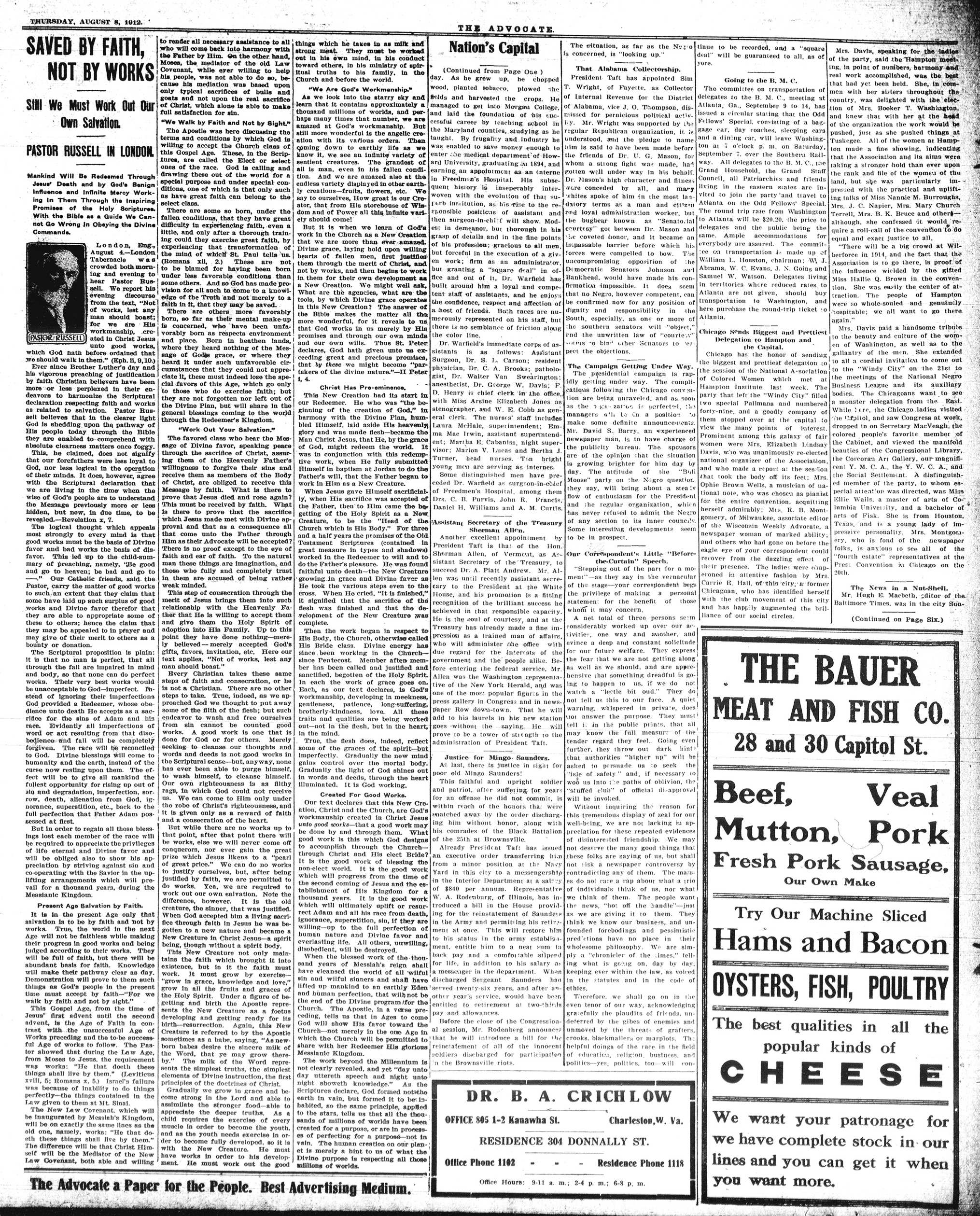
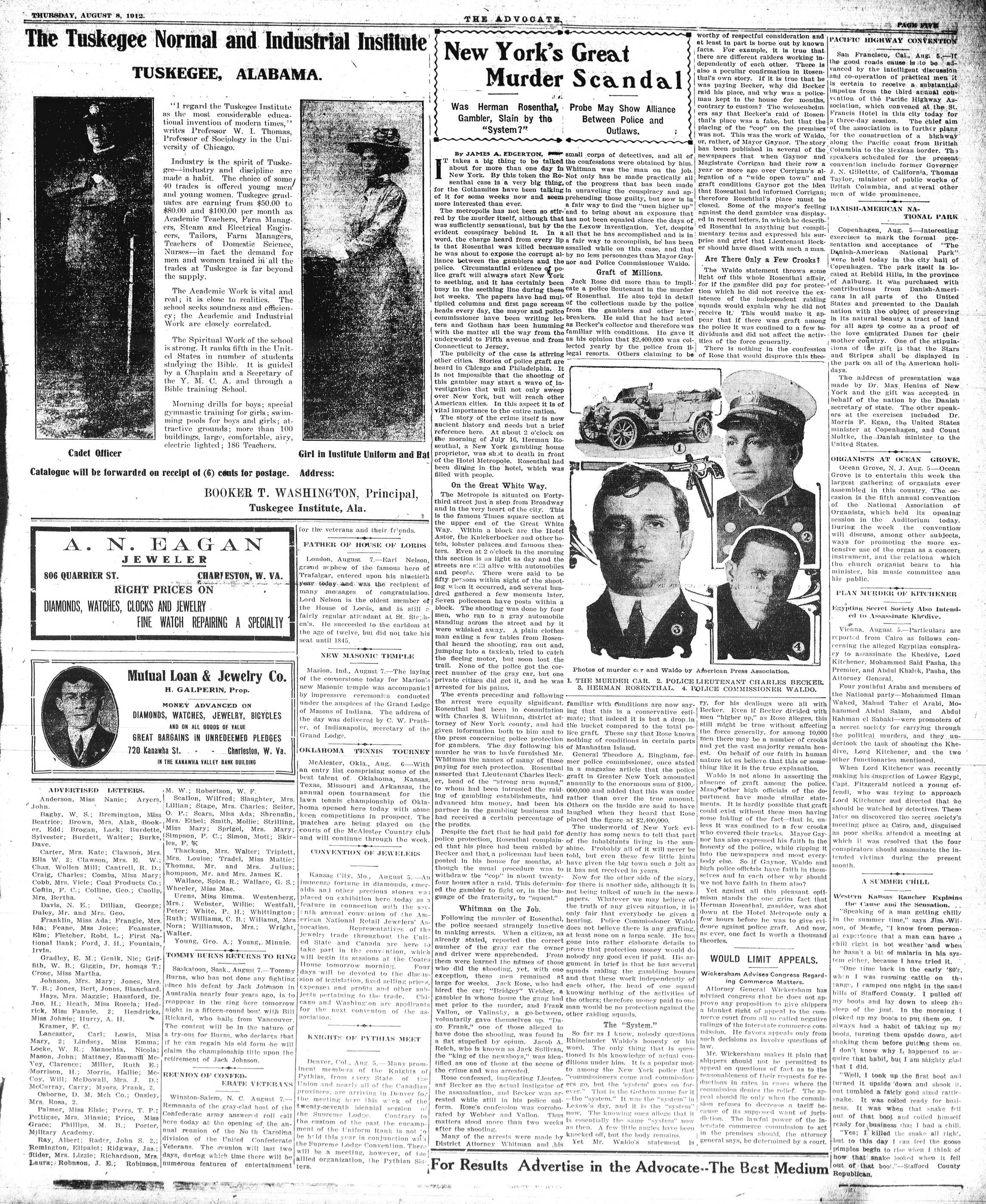
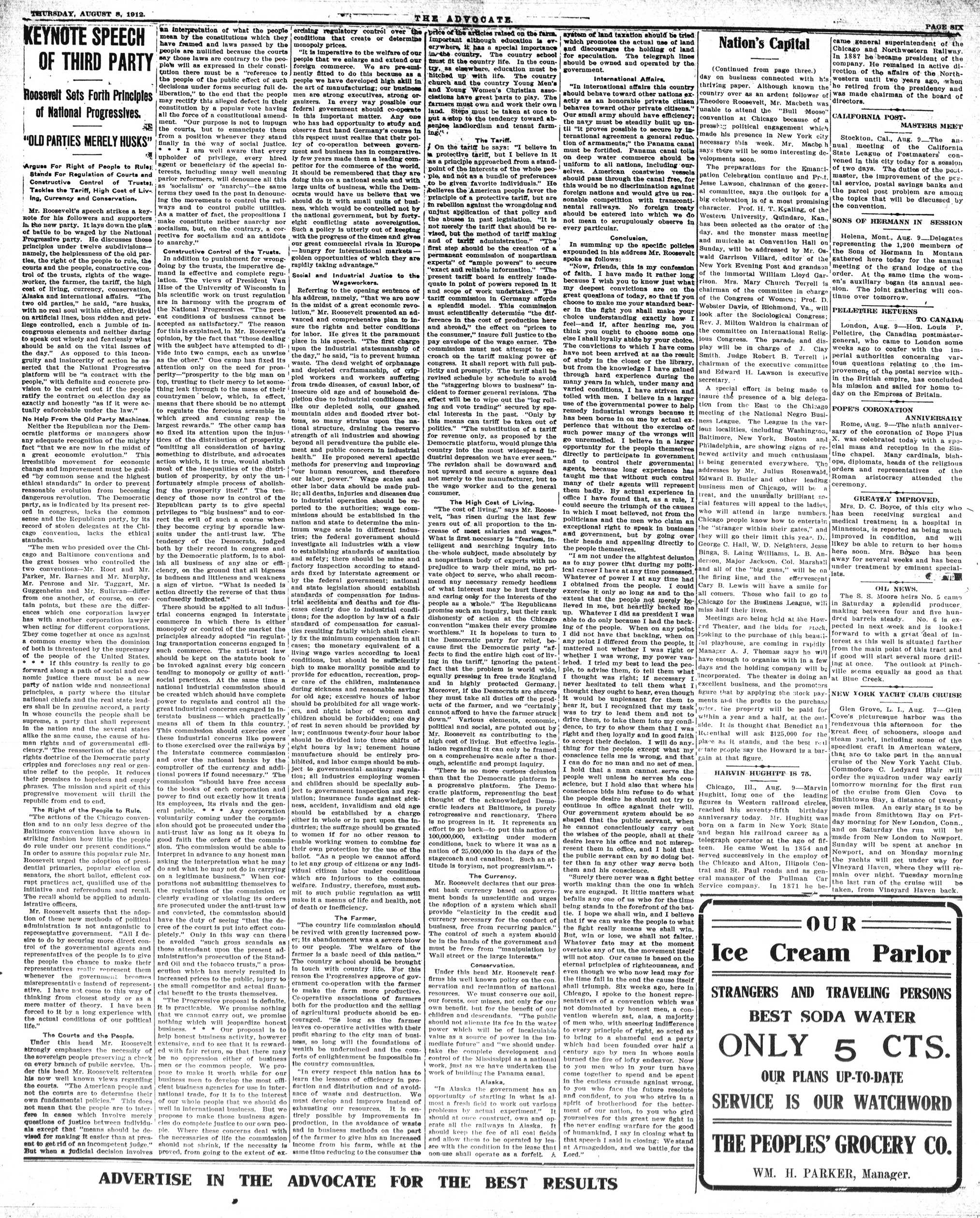
Page text (machine-generated)
THE ADVOCATE. WE CHEERFULLY PUBLISH ALL CRISP NEWS NOTES FROM ALL SECTIONS.
VOLUME XII.
Addresses Delivered
BY DR. JESSE JOHNSON AT THE NATIONAL RELIGIOUS TRAIN- ING SCHOOL
Dr. D. Webster Davis
The Greatest Living Negro Poet Lectures on the subject "Negro Ideals". Prof Boyer's
Durham, N. C., August 3.—The kind of message that will cause young and old people to reflect and bring something worth the while to pass was delivered last Wednesday at the National Religious Training School, this city, by the eminent church historian and authority on apologetics, Dr. Jesse Johnson, of Xenia, Ohio. This lecture will undoubtedly become a potent leaven in the activities of hundreds of people. He prescribed the right kind of remedy that will prevent many social ill that are common to humanity. There was a kind of enthusiasm manifested by the audience that indicated that they deeply appreciated the lecture by Dr. Johnson on the subject, "Practical Thought for Practical Young People."
In the outset Dr. Johnson, in part, said: "I believe in the efficacy of work. Labor will not conquer all things, but it will conquer conquerable things. It is the only thing that does."
"Catch the inspiration of the times," exclaimed Dr. Johnson. Another important phase of the lecture was that one should know what one's natural endowments are and not imagine that high places are at the will of the individual. For the success that one strives for, he said, that one should have a pure life during the period when one's character is mobile and flexible. One of the cardinal features of this lecture was the speaker's ability to make the audience seriously consider the import of this message and to appreciate what moral backbone means in the development of character. He gave fitting illustrations of the many misunderstandings in the religious and other activities of men, which he said could be avoided by taking time to see the other side of the question at issue.
Dr. D. Webster Davis, who is now con lered the greatest living Negro poet; the Mark Twain of ebony hue; one of the most popular lecturers in America; one of the leading Negro authors and author of the Negro history now being used in schools in many of the Southern states; a philosopher, able preacher, educator and one of the most potent factors in the development of the Afro-American people, began his series of lectures on the subject, "Negro Ideals," Friday afternoon, at this school. He is drawing large crowds from both races, as he does in every section of the country. He is regarded among the material element of the race as a sane leader and in many instances he is more popular than Dr. Booker T. Washington
Saturday morning a representative audience heard Dr. Davis deliver his second lecture on "Negro Ideals." He discussed "Domestic Ideals" and clearly revealed the sacredness of the home and said that the home is a divine institution and that the English people was especially a domestic people. He said that owing to the Negro's conditions in this country that his domestic ideals are practically new to him. "God is doing batter work," said the popular, but practical speaker, in showing that the Negro is making encouraging progress in his domestic life.
Last Friday night a large audience received a treat in the form of an able lecture by Prof. Chas, H. Boyer, St. Augustine School, Raleigh. His subject was his recent trip abroad. This lecture was full of interesting things that would broaden the average student. Prof. Boyer is a graduate of Yale and one of the leading educators in the race. He has done a remarkable work in the developing of characters of hundreds of young people.
Dr. Davis will lecture each day until August 11th, at which time the summer school and chautauqua will close. Dr. S. N. Vass, the widely known Bible instructor and lecturer will give a series of lectures during the week. Miss Hallie Q. Brown, the famed dramatist is another big attraction for the closing week.
THE ADVOCATE.
Self-Restraint in the Use of Authority
A Lack of Fairness and Poise Shown by the Average Negro on Reaching A Palace of Distinction and Power—The Young Negro May School Himself to Avoid Wrecking Himself on the Hidden Rocks of Austerity.
(Editorial Contribution to the Southern Life Magazine.)
Respect for the opinions of others is something to which we cannot all lay claim. It is not by any means necessary that each individual in this world should read. Blackstone's Commentaries in order to get a clear idea of a person's individual rights and privileges—those he is entitled to demand for no reason other than that his is a sane human being.
It ought to be necessary only to call the attention of any warped, biased intellect to the necessity, for his own future good, of thinking and meditating on the solemn truths proving that every person, ignorant or intelligent, is due a hearing when he is concerned and desires it, and that according to the teaching of Christianity and of civilization generally, every person's opinions ought to be considered and at least be respected as his right to them even though they cannot be accepted.
The infidel, sceptic or agnostic has a right to express the conclusions of his reasonings; so has the anarchist. It seems to us that we need be seriously concerned in our treatment of any one only in so far as that person allows his opinions to influence his actions toward us or toward his fellowman generally.
We feel safe in concluding that there is never an excuse for contemptuously disregarding, discounting or villifying any individual because of his thoughts or opinions merely. It must be admitted that it is every one's unhindered right to think and to express his thoughts should he see fit so to do.
We fear that the Negro can lay a far smaller claim to a share of this full realization of individual rights than can any other race of people. Imposed upon most unreasonably when a slave, legislated against as a freeman and treated as though he landed upon this earth accidentally from some other planet, the average black man today finds himself falling out repeatedly with his neighbors who may chance to entertain opinions at variance to his own. It seems to be a natural result following past lessons taught him when he was powerless to decide what he wished to learn.
On coming into possession of a little authority we find the average Negro overbearing; not wearing his honors with becoming grace and humility. We find him often discounting the wishes, desires or demands of his subordinates, and falling out entirely with any who might entertain thoughts and opinions that cannot coincide with his own. Unreasonableness often holds sway in his decisions and actions.
The young Negro who is gradually gaining a place in the world is thereby warned that if he wishes permanently to retain influence with his fellows and enjoy their highest respect and esteem, he must ever be watchful to retain his poise and equilibrium; not to become haughty, domineering and tyrannical, but to remember that the possession of power gives him no further right to treat people as people treat cattle, than he had when first he was born.
Every aspirant for place and position should hold in mind that however strong are his convictions in any direction, there exist diametrically opposite convictions, just as strong as his, and the persons possessing them have a perfect right to them, and not only can but should expect decent treatment from him in spite of these differences. Any one who cannot see the wisdom of these observations is narrow indeed. And he who will not be influenced by the advice here given must be a hopeless case and a coming tyrant.
We feel that the young Negro especially needs to learn these lessons. He ought never forget that whatever other way his feelings dictate, he is unreasonable when he falls out with a fellow because he beats him in an argument.
IOWA POSTMASTERS IN SESSION Spirit Lake, Ia., Aug. 6—The annual tate convention of the Iowa League of Postmasters met here today and will continue in session over tomorrow. A majority of the principal cities and towns of the State are represented.
CHARLESTON, WEST VIRGINIA, THURSDAY, AUGUST 8, 1912
National Association
HOLDS THIRD ANNUAL SESSION
AT ST. PAUL, JULY 15-19.
Excellent Program
Noted Men Speaks and Vocal and Instrumental Solos Rendered.
The Negro National Educational Congress held its third annual session at St. Paul, Minn., July 15-19. The sessions of the Congress were held in the assembly hall of the old State capitol. A very excellent program was rendered. The local committee of which Dr. J. R. White was chairman secured the city auditory which is conceded to be the finest in the Northwest. The Congress held its session in the auditorium Tuesday evening, the 16th at which time the mayor of St. Paul and the governor of Minnesota delivered welcome addresses on behalf of the city and State. Both the mayor and governor paid very high tributes to the progress which the tribute has made during the last 45 years. The governor is an apostle of vocational education. Very excellent responses on behalf of the Congress were made by Prof. Smallwood of Clairmont, Virginia, Rev. Morris of Norfolk, Va., and lawyer Harrison of Oklahoma City. All of these gentlemen made very excellent addresses. The governor expressed himself as being in full accord with the aim and object of the Congress. The musical feature of the Congress was of the most excellent character. In addition to the orchestra there were several very excellent vocal and instrumental solos. Miss Nannie Burden of Kansas City, Mo., carried away the laurels as a soprano soloist. Miss Burden spent 18 months in Europe singing in London, Paris, Berlin and other leading cities of Europe. She appeared several times in Buckingham Palace.
Many social, economic, Industrial, educational and religious addresses were made. All phases of the race problem were touched upon from practical points of view. An address will be sent to the press of the country setting forth the objects of the Congress in full. Among those present were Prof. Smallwood of Virginia, who has just dedicated a $50,000 dormitory. Prof. N. C. Bruce, Principal of the Dalton Industrial and Collegiate Institute of Dalton, Mo., the Tuskegee of the West; Dr. McCrory, President of Biddie Univ., Drs. Bowling, and Morris, of Norfolk, Va., Dr. Gray of Chicago, lawyer Harrison, and Prof. Debnam of Oklahoma City, Mr. Blair, wealthy farmer of South Dakota, who owns 1800 acres of land, Mrs. Embry, the editress of Colorado Springs, Pres. J. Silas Harris of Kausas City, Mo., and a host of others too numerous to name.
By request of the governor visited the Capitol building and were shown through that magnificent building. Minnesota is said to have the finest State building of any other State in the Union. The delegation was received by the Governor who responded to an address delivered by Doctor Morris, of Norfolk, on behalf of the Congress. Minnesota entertained the Congress at Minnehaha Falls on Thursday and in the auditorium of the City Thursday night at which time the Mayor delivered the welcome address for the city of Minneapolis.
It is the consensus of opinion that this was the most successful session the Congress has ever held. Prof. J. Silas Harris of Kansas City, Mo., was re-elected president and Rev. J. W. Robinson of St. Albans, W. Va., was elected National Statistician and Vice-President for West Virginia. The next session will be held at Clairmont Virginia.
The first American shoe store in China will be opened soon in Shanghai and will be a "Walk-Over" Store managed by Walter A. Baldwin, of Brockton, Mass.
Col. Roosevelt's Letter
EXPRESSING VIEWS ON THE POSITION OR THE NEGRO IN NATIONAL POLITICS AND HE REPRESENTATION OF THE NEGRO DELEGATES IN THE NATIONAL CONVENTION OF THE PROGRESSIVE PARTY.
New York, August 2.—In a letter written to Julian Harris, of Atlanta, editor of Uncle Remus's Magazine, and son of the late Joel Chandler Harris, Colonel Roosevelt expresses his views on the position of the Negro in national politics, and the representation of Negro delegates in the convention of the Progressive party in Chicago. In part Colonel Roosevelt writes:
gressive Convention colored delegates from the very places where we expect to develop our greatest strength, and we hope to see these men of such character that their activity shall be of benefit not only to the people at large, but especially to their own race.
"For 45 years the Republican party has striven to build up in the Southern states in question a new hope."
"In pursuance of our conversation I write you this letter. There is a peculiar fitness in writing it to the son of the man whose work made all Americans his debtors. His life and his work tended to bring his fellow countrymen, North and South, into closer relations of good will and understanding, and surely it should be needless to say that the author of 'Uncle Remus' and 'Free Joe and the Rest of the World' felt a deep and most kindly interest in the welfare of the Negro.
"Many letters dealing with the subject of which you spoke to me have been sent to me within the last few days. Those written by men living in the North usually ask me to insist that we get from the South colored delegates to the National Progressive Convention. Those written by citizens of the South ask that I declare that the new party shall be a white man's party. I am not able to agree to either proposal.
"In this country we cannot permanently succeed except upon the basis of treating each man on his worth as a man. We can fulfill our high mission among the nations of the earth, we can do lasting good to ourselves and to all mankind only if we so act that the humblest among us, so long as he behaves in straight and decent fashion, has guaranteed to him under the law his right to life, to liberty, to protection from injustice, his right to enjoy the fruits of his own honest labors and his right to the pursuit of happiness in his own way, so long as he does not trespass on the rights of others. For us to oppress any class of our fellow citizens is not only wrong to others, but hurtful to ourselves. Surely no man can quarrel with those principles.
"I believe that the progressive movement should be made from the beginning one in the interest of every honest, industrious, law-abiding colored man, just as it is in the interest of every honest, industrious, law-abiding white man. I further believe that the surest way to render the movement impotent to help either the white man or the colored man in those regions of the South where the colored man is most numerous, would be to try to repeat the course that has been followed by the Republican party in those districts for so many years, or to endeavor in the states in question to build up a progressive party by the same methods which in those states have resulted in making the Republican party worse than impotent.
"In the South the Democratic machine has sought to keep itself paramount by encouraging the hatred of the white man for the black; the Republican machine has sought to perpetuate itself by stirring up the black man against the white, and surely the time has come when he should understand the mischief in both courses and should abandon both. I believe that wherever the racial issue is permitted to become dominant in our politics it always works harm to both races, but immeasurably most harm to the weaker race. I believe that in this movement only damage will come if we either abandon our ideals on the one hand, or, on the other, fail resolutely to look facts in the face, however unpleasant these facts may be.
"In many of the states of the Union, where there is a considerable colored population we are able in very fact and at the present moment to bring the best colored men in the movement on the same terms as the white man. In Rhode Island and Maryland, in New York and Indiana, in Ohio and Illinois, in New Jersey and Pennsylvania, or speak only of states of which I have personal knowledge, this is now being done, and from some or all of these states colored delegates will be sent to the National Progressive Convention in Chicago.
"In the Republican National Convention the colored members have been almost exclusively from the South, and the great majority of them have been men of such character that their political activities were merely a source of harm, and of very grave harm, to their own race. We, on the contrary, are hoping to see in the National Pro
gressive Convention colored delegates from the very places where we expect to develop our greatest strength, and we hope to see these men of such character that their activity shall be of benefit not only to the people at large, but especially to their own race.
"For 45 years the Republican party has striven to build up in the Southern states in question a party based on the theory that the pyramid will unsupported stand permanently on its apex instead of on its base. For 45 years the Republican party has endeavored in these states to build up a party in which the Negro should be dominant, a party consisting almost exclusive of Negroes. Those who took the lead in this experiment were actuated by high motives, and no one should now blame them because of what, with the knowledge they then had and under the then existing circumstances they strove to do. But in actual practice the result has been lamentable from every standpoint. It has been productive of evil to the colored men themselves, it has been productive only of evil to the white men of the South and it has worked the gravest injury to, and finally the disruption and destruction of, the great Republican party itself.
"There has in the past been much venality in Republican national conventions in which there was an active contest for the nomination for President * * * for the most part among the Negro delegates from these Southern states. Finally, in the convention at Chicago last June the break-up of the Republican party was forced by those rotten-borough delegates from the South. In the primary states of the North the colored men in most places voted substantially as their white neighbors voted. But in the Southern States, where there was no real Republican party, and where colored men, or whites selected purely by colored men, were sent to the convention, representing nothing but their own greed for money or office, the majority was overwhelmingly anti-progressive. Seven eighths of the colored men from these rotten-borough districts upheld by their votes the fraudulent actions of the men who in that convention defied and betrayed the will of the mass of the plain people of the party.
"It would be not merely foolish, but criminal, to disregard the teachings of such a lesson. The disruption and destruction of the Republican party and the fact that it has been rendered absolutely impotent as an instrument for anything but mischief in the country at large, has been brought about in large part by the effort to pretend that in the Southern States a sham is a fact, by the insistence upon treating the ghost party in the Southern States as a real party, by refusing to face the truth, which is that under existing conditions there is not and cannot be in the Southern States a party based primarily upon the Negro vote and under Negro leadership or the leadership of white men who derive their power solely from Negroes. With these 45 years of failure of this policy in the South before our eyes, and with catastrophe thereby caused to a great national party not yet six weeks distant from us, it will be criminal for the progressives to repeat the course of action responsible for such disaster, such failure, such catastrophe.
"It would be much worse than useless to try to build up the progressive party in these Southern States where there is no real Republican party, by appealing to the Negroes, or to the man who in the past have derived their sole standing from leading and manipulating the Negroes.
"I earnestly believe that by appealing to the best white men in the South, the men of justice and of vision as well as of strength and leadership, and by frankly putting the movement in their hands from the outset we shall create a situation by which the colored men of the South will ultimately get justice, as it is not possible for them to get justice if we are to continue and perpetuate the present conditions. The men to whom we appeal are the men who have stood for securing the colored man in his rights before the law, and they can do for him what neither the Northern white man nor the colored men themselves can do. Our only wise course from the standpoint of the colored man himself is to follow the course that we are following toward him in the North and to follow the course we are following toward him in the South."
THOUSANDS AND THOUSANDS OF DOLLARS DUE COLORED EX-
SOLDIERS. — IMPROVEMENS AT FREEMAN'S HOSPITAL . PRESIDENT TAFT APPOINTS HON. SHERMAN ALLEN, ASSISTANT SEC-
RETARY OF TREASURY.
Many Happenings of Interest
Justice in 'Sight for Mingo Saunders,
Meeting';—Chicago's Delegation to
Washington, D. C., August 7. "There are, in all probability, thousands and thousands of dollars lying in the United States Treasury, due colored ex-soldiers and sailors of the Civil and Spanish-American Wars," was the statement made recently by William L. Houston, ex-grand master of the Colored Odd Fellows, and now a practicing attorney, with offices in the Dietz Building, 7th and F streets, of this city. Prior to practicing law, Mr. Houston was for a number of years a clerk in the War Department here, and as such, became familiar with military laws and records.
Bounty, Prize-Money and Pensions in "Strong-Box."
Continuing, Mr. Houston said: "It seems almost incredible that colored ex-soldiers and sailors, or their heirs, would fail to file claims for monies rightfully due them from the government. In many cases, however, heirs are ignorant of the fact that any money is due their relatives who have served in either the Civil or the Spanish-American War. In some cases the money due is 'prize money,' in others it is bounty, arrears in pay or pension. During the Civil War and during the Spanish-American War, there were many colored sailors who served on American ships that captured ships of the enemy. Such are entitled to 'prize money,' and if they did not receive it, they are still entitled to it. Then, there are cases of colored soldiers or sailors who served in the Civil War, enlisting before a certain period, who are entitled to a bounty of $100 per year served. If they were not paid white bounty at the time of their discharge, then they or their heirs are still entitled to it, and can secure it now by filing claim for it. And, there are many colored veterans of the Civil War and some of the Spanish-American War, who can doubtless prove their claim to a pension, or perhaps to some arrears in pay, for in not a few instances, soldiers and sailors failed to receive all due them at the time of their discharge, or perhaps, if killed, or dying in the service, their heirs, failed to receive all that was due them as pay." Sound Claims That Have Been Paid. As Mr. Houston practiced regularly before the Departments at Washington, he is familiar with all procedures necessary to secure whatever is due colored ex-soldiers and sailors, or their heirs, from the United States government. Mr. Houston referred to, or rather, cited three recent instances of heirs of colored men who served either in the Army or Navy branch of the government, filing claims and securing the money due them. In one instance he cited, a widow made claim for and received over $1,000; in another case, a widow made claim and received over $400; and in a third case, a widow was paid over $100. And, he added, that in his opinion, there are scores and scores of others, who, if they will but file and prove their claims, are entitled to a comfortable sum of money.
Mr. Houston, noted for his public spirit and ever willingness to help all kinds and conditions of mankind, stated that he, himself, would gladly take up any case of colored ex-soldiers or sailors or their heirs, which might be called to his attention. "The government is sure pay," said he, "if a claimant proves his claim; but they must prove all claims. White ex-soldiers and sailors, or heirs of the same, are constantly—dally—filing claims. But, remarked Mr. Houston, it is a rare thing for a colored person to file a claim. Why our people are so slow, it is difficult to fathom. The time to act is now."
Improvements at Freedmen's Hospital.
Not nearly as many people know as ought to know that there is at the nation's capital, primarily, for the benefit of the Negro citizens of the Republic, one of the very largest, finest and most completely equipped hospitals in the world. This is Freedmen's Hospital, established shortly after the Civil War, as a part of the movement that gave to the Negro race Howard University, its much-needed medical school; and other facilities for the propagation of the higher training of the newly-emanci-
THE ADVOCATE ADVERTISEMENTS PLACED IN OUR COLUMNS BRING RESULTS TRY IT.
Correspondent Talks—B. M. C. Hampton. The News in a Nut Shell
pated colored people. Visitors who come to Washigh invariably ask about this magazine institution, and it is pointed as one of the conspicuous "y" places" of the town. It is ideal located in North Washington, c. rise of one of the capital's eight hills, fitting symmetrically in education and civic center' is destined to become famous the nation over. It faces the open grounds of Howard Park, with Howard University towering in the rear. Howard Medical School to the southward, flanked by Mott School on the East and the site of the new $250,000 Normal School No. 2 to the westward, surrounded by the homes and churches of the representative colored citizens of the district. It is one of the prettiest and most healthful spits to be found anywhere. The structure is of brick and is two stories high, so arranged in a series of wings that a maximum of light and air is obtained for all of the rooms. It is comparatively new, having been erected in 1904, and covers practically all of the tract bounded by 4th and 6th, Trumbull and College streets. For the appropriations that led to the new building and its development, the hospital authorities are very grateful to the good offices of Senators W. B. Allison and Benjamin Ryan Tillman. Fostered by humanitarians in Congress, the growth of the institution has been rapid, but solid. It has now 278 beds, is provided with the most modern appliances and apparatus for its surgical, medical and chemical departments, and has a corps of employees numbering about 100 persons. Its visiting and consulting staff embraces some of the most noted men in the profession, and it is regarded as no small honor to be a member thereof. The operating expenses last year were $69,000, and this year's estimates call for $74,000. The hospital is a government institution, a bureau of the Interior Department, and is for all the people, but social conditions here are such that it come to be known as a colored institution. The bulk of its patients are of our race and the managing authorities are colored. 2,900 patients were treated last year, United States and District; 12,712 prescriptions were compounded; 1,767 operations were performed and 983 emergency cases were handled. Some of the most intricate operations known to the science have been performed here. The entire plant is valued at not less than $750,000—three-quarters of a million—and it has not yet reached the zenith of its great possibilities.
Beginning July 1, a "pay ward" was established, for the accommodation of persons able to pay, but previously barred by the law restricting service to the indigent. Eventually a $60,000 building will be erected especially for the pay patients, if the recommendation of Dr. Warfield goes through. An orthopedic ward is also one of the new features asked for, along with an electric ambulance, an ice-plant and additional employees, together with an appropriation for the beautification of the grounds. Not long ago a nurses home was built on the grounds, at a cost of $40,000. The Nurses' Training School is one of the best branches of the institution. It has sent 230 trained women to various portions of the country, and this year there were forty-two taking the three-year course. A pathological building, to cost $25,000, is one of the possibilities of the near future. Great pride is taken by Dr. Warfield in the new and well-worked-out "card index" system, through which the records of the institution are faithfully kept and from which any fact can be gleaned in a moment's time.
Surgeon-in-Chief Warfield "A Self- Made Man."
Dr. William A. Warfield, the progressive and ever-alert surgeon-in-chief of Freedmen's Hospital, has held the office since 1901. He is a "self-made man" in the truest sense of the term, rising steadily by dint of his own efforts and indomitable pluck from obscurity to eminence. A native of Montgomery county, Maryland, he started out as a farmer's boy, working from dawn until dark for the munificent salary of twenty-five cents per
(Continued on page three.)
CORRESPONDENCE
PAGE TWO.
MONTGOMERY
Messrs. Thomas Johnson, V. M. Willis and S. E. Chiles, were called to Louisa, Va., on account of the death of the latter's uncle.
Mrs. Lizzie Brown is visiting her people in Virginia.
Mrs. R. L. Geter is visiting her people in Whiston-Salem, N. C.
Mrs. G. B. Page and Mr. A. B. Calloway are delegates to the Grand Lodge of Fishermen which meets in Wilmington, Delaware.
Mrs. E. V. Seams, of Parkersburg, is the house guest of Mrs. L. M. Noel.
Mrs. Minnie Hurt, of Institute, was in town this week.
Miss H. M. James, one of the teachers of the Public School was the guest of her uncle this week.
Mrs. George McCoy is very sick in the west end of town.
The Ladies Council met with Mrs. R. Wood at Longacre last Friday.
Mrs. Clara Powell entertained the Ladies Aid Monday.
Mrs. Mamie Jackson left Thursday for Orange, Va., to visit her parents.
WINIFREDE
Miss Ella Smith has been spending a few weeks on Cabin Creek visiting her sister, Mrs. J. M. Wooding. J. D. Wisenor, Wm. Tucker and children, Arthur Mitchell and Joe Smoot were business visitors to Charleston last week. Herbert Mickell spent the week end at Montgomery visiting friends. George Smith was a business visitor to Lewiston Saturday. Clydell, the son of Mr. and Mrs. S. Lester has been reported on the sick list, and his condition has been considered serious. Miss Virginia Smith has been shopping in Charleston. Rev. R. B. Yancey, of Nutallburg, has been called to the pastorate of the Mt. Maria Baptist Church here.
C. H. Ross has been spending a few days in Charleston visiting relatives.
K. Brooks left Cabin Creek last week where he has employment.
H. C. Allen was a business visitor to Charleston last week.
E. S. Shelton returned Thursday from Coal River where he spent a few days visiting.
CHARLESTON
Ministers' Social Helpers Entertained.—The Ministers' Social Helpers, of St. Paul A, M. E. Church, Court street, was entertained to the delight of all present at Miss Emma Cooper's residence on Lewis street. Mrs. Jessie Turner and Miss Emma Cooper were hostesses. After a very pleasant session all returned to their homes with much praise for the hostesses. The congregation of St. Paul on last Sunday was much larger than usual. Services next Sunday, August 11th. Preaching at 11 a. m. and 8 p. m. All are welcome.
Hotel Brown Arrivals.—Geo. Hare, Winfield; Taylor Works, Raymond City; Wm. Saddler, Elkhorn; H. Prentiss Kyle, Raymond City; H. D. Lee, Huntington; Mr. and Mrs. Beemer Farrell; Mrs. Mattie Dingess, Cedar Grove; Wm. Williams, Pt. Pleasant; S. Wanzer, Raymond City; N. L. Seay, Sharon, Pa.; Mrs. Beatrice Brown, Mrs. Beine Howard, Thurmond; Mr. and Mrs. Thos. Blackwell, Montgomery; Mr. and Mrs. Wm. Bell, Harewood; H. Winters, Toledo, O.; Mr. and Mrs. Hicks, Cannelton; Mr. and Mrs. R. Miner, Charlottesville, Va.; Mr. and Mrs. Harris, Mr. and Mrs. Watkins, Roanoke, Va.; J. H. Carter, Montgomery; C. E. Nichols, Adrian; N. Allen Montgomery; Misses Dora Tucker, Lynchburg, Va.; D. Gould, Louisville, Ky.; R. J. Blackwell, Glen Alum; D. Price, Pomeroy, Ohio; F. Miller, Charlottesville, Va.; H. Robinson, Raymond City; Jno. Ewart Ironon, O.; Dr. M. Sinclair, Bancroft; Rev. J. H. Pressley, St. Albans; Miss R. L. Mosby, Wm. Mickens, Plymouth; S. R. Rankin, Winston-Salem, N. C.; Prof. Byrd Prillerman, Prof. A. W. Curtis, Institute; J. H. Slade, H. Callis McAlpin; L. Lee, M. Agee, Detroit, Mich.; A. E. McNaghlin, Pleasantville, O.; E. Bullitt Wilson, Hollow; T. Keeney, Washington, D. C.
Personal and Local
Mr. E. V. Steams, of Parkersburg, is the guest of Mr. and Mrs. Chas. Stevenson, on Bibby street.
Mrs. Cornelia Washington has recovered from a recent illness.
Jas. Grant is ill at his home on Bibby street with typhoid fever.
The W. C. T. U. will meet at First Baptist Church next Tuesday evening at 7:30. All members and friends requested to be present.
All persons under the age of 21 are invited to be present Thursday evening of next week at the First Baptist church to join a new organization—"The Young Campaigners." A good musical program will be one of the features. Admission free.
Mrs. Lena Houston, who spent several weeks with her mother, Mrs. Alexander, Sentz street, has returned
to her home in Parkersburg.
Mrs. Delphi Preston, accompanied by her daughter, Mrs. Ollie Chatman, is spending the summer in Ypsilanti, Mich.
Dr. and Mrs. T. M. Sinclair and little son, of Bancroft, were in the city this week.
Mr. John Q. Adams and Miss Sallie Gardner were quigly married on August 2nd at the Simpson M. E. parsonage on Brooks street. The ceremony was performed by Rev. J. S. Carroll, pastor of Simpson M. E. church. The newlyweds left Friday evening for Atlantic City where they will spend their honeymoon.
The Ladies' Art Club met Tuesday with Mrs. Alexander, Sentz street. Next meeting will be held with Miss Bowles, Piedmont street.
Mrs. Wm. Wickens, of Plymouth, is at the General Hospital.
Master Hobart Alexander, of Parkersburg, is visiting his grandmother, Mrs. Maria Alexander, Scutz street.
Mrs. Chas. Stevenson left Wednesday on No. 2 for Washington. Atlantic City and New York City to spend the summer.
Mrs. Henry Leigh, of Springfield, Ohio, is the guest of her parents, Rev. and Mrs. B. R. Reed, Washington street.
PROGRAM OF THIRTEENTH ANNUAL SESSION HELD IN CHICAGO AUGUST 21, 22 AND 23, 1912.
Wednesday, August 21, 10:30 a. m.
At the Institutional Church, 3825 Dearborn Street
The League Called to Order: Dr. George C. Hall, President, Chicago Negro Business League and Member of Executive Committee of the National Organization . Prayer. Addresses of Welcome: "On Behalf of the Chicago Negro Business League." Hon. J. Gray Lucas; "On Behalf of the Citizens of Chicago and the Chicago Association of Commerce." Mr. E. B. Butler, of Butler Brothers. Responses. Appointment of Committees: (a) Credentials; (b) Resolutions; (c) Auditing. "Breeding Thoroughbred Brown Leghorn Chickens." Paul Scott, Mitchell, South Dakota.
"Making Farming Pay," C. N. Miller, Rolling Fork, Miss.; Oliver Dickerson, Dickerson, Miss.; A. L. Caston, Shelby, Miss.
"My Success as Farmer, Stock-Raiser and Thresher," W. V. Smith, Larned, Kansas.
"Truck Farming," Washington Reed, Weston, Mo.
"Conducting a Thoroughbred Stock Farm," Peter L. Hensley, Mt. Sterling, Ky.
"Truck Gardening," Gid Hooper, Fort Worth, Texas.
"Wheat Growing as a Business" J. D. Rouse, Hitchcock, Okla.
"My Experience as a Cotton Buyer and Commission Merchant" George Giles, Ocala, Florida.
"Making Boot Blacking Pay," J. E.Morrisette, Philadelphia, Pa.
"My Success as a Dealer in Railroad Ties, Telegraph Poles, Pilings, etc." Warren H. Davis, Great Barrington, Mass.
"What I Have Accomplished as a Real Estate Dealer." Watt Terry, Brockton, Mass; Lawrence H. Ferribe, Chicago, Illinois.
"Wednesday Evening, 8 o'clock"
"The League Called to Order, Prayer."
"The President's Annual Address"
"The Work of the Organization Society in Virginia." Major R. R. Meton, Hampton Institute, Va.
"Conducting a Wholesale Business in Fruits, Grains and Vegetables." William P. Crump, Phoenix, Arizona.
"Managing a Motor Car Machine Shop." Andrew J. Offord, Chicago, Ill.
"Ten Years at a Baker." W. A. Wallace, Chicago, Ill.
"Twenty Years' Experience as General Engineer for the United Fruit Company." J. Alexander Mackenzie, Port Antonio, Jamaica, B. W. L.
"Manufacturing Hair Preparations." Mrs. J. H. P. Coleman, Washington, D. C.
"Cigar Manufacturing." J. Andrew Williams, Tampa, Fla.
Thursday Morning, 10 o'clock
The League Called to Order.
Prayer.
"Developing Industrial Insurance." J. H. Phillips, Montgomery Ala.; A. L. Lewis, Jacksonville, Florida. "Fraternal Insurance." W. F.
AT THE BURLEW EVERY NIGHT LATEST MOVING PICTURES BALCONY RESERVED FOR COLORED PEOPLE 5c. ALL SEATS 5c. 7-11 P. M.
Bledsoe, Marshall, Texas.
"The Real Estate and Insurance Business," W. H. Jenkins, Roxbury, Mass.
"The Heavy Moving Business," J. J. Johnson, Grand Rapids, Mich Walter Jameson, Indianapolis, W. H. Bell, Evansville, Ind.
"Chances for Success in the Millinery Business," Mrs. A. L. Winga, Philadelphia, Pa.
"Ten Years in the Regalia Business," Joseph L. Jones, Cincinnati, Ohio.
"The Negro in the Máil Order Business," Hunter C. Haynes, New York, N. Y.
"The Largest Negro Manufacturing Enterprise in the United States," Anthony Overton, Chicago, Ill.
"Conducting a Wholesale and Retain Coal Business." Samuel Welch, Indianapolis, Ind.
"White Goods Manufacturing and Merchandising," H. L. Sanders, Indianapolis, Ind.
"The Undertaking and Livery Business," E. W. Chenault, Lexington, Ky.
Thursday Evening, 8 o'clock
Liberia: "An Opportunity for Negro Business Men," Rt. Rev. I. B. Scott, Bishop of Africa, Monrovia, Liberia.
"The Publishing Business—Its Bitters and Its Sweets," W. E. King, Publisher, The Dallas Express, Dallas Texas; B. J. Davis Publisher, Atlanta Independent, Atlanta, Georgia.
Address — Julius Rosenwald,
President, Sears, Roebuck & Co.
Chicago, Ill.
"The Development of a National
Publishing Business," Dr. R. H.
Boyd, Nashville, Tennessee.
"Sixteen Years Experience as a
Newspaper Publisher," John L.
Thompson, Publisher The Bystander,
Des-Moines, Iowa.
"Making Printing Pay," Major
R. R. Jackson, Chicago, Hl.
"General Merchandising," Dr.
N. Leathers, Corpus Christi, Texas
James E. Duncan, Daytona, Fla.
"Staple and Fancy Grocery
Dealing," L. D. Lyons, Austin,
Texas.
"Conducting a Dry Goods, Notions
and Millinery Store. F. P.
Gadson, Ocala, Fla.
"Conducting a Haberdashery."
D. W. Crutcher, Nashville, Tenn.
"Merchant Tailoring." E. L. Price, Nashville, Tennessee.
"The Meat and Grocery Business." T. J. Nevins, St. Louis, Mo.
Friday Morning, August 23rd
10 o'clock
The League Called to Order.
Prayer.
Music.
Reports from State Negro Business Leagues: Alabama, Arkansas,
Indiana, Florida, Mississippi, Texas,
Colorado, Virginia, North Carolina, South Carolina, Louisiana
and Kansas.
Reports From Affiliated Organizations: The National Negro Bankers' Association, represented by: "How can Banks Secure the Cooperation of the Masses as well as that of the Business and Professional Men," L. K. Atwood, Southern Bank, Jackson, Miss. "The Work of a Bank as an Agent in Developing the Many Interests of the Race," J. W. Francis, Bank of Mound Bayou, Mound Bayou, Miss. "The Importance of Bankers being Honest and Faithful Servants, thereby Securing the Confidence of the Race," W. W. Hadnott, Prudential Savings Bank, Birmingham, Ala.
"How the Banks may Maintain a Cordial and Helpful Relation with their Customers." Rev. E. M. Griggs, Farmers' and Citizens' Savings Bank, Palestine, Texas.
The National Negro Funeral Directors' Association.
The National Negro Press Association.
The National Negro Bar Association.
"The Dyeing and Cleaning Business." Elmo E. Furey, Cambridge Mass.
"Blacksmithing and Carriage Making." H. C. Gibson, Nashville, Tenn.
"Building Contracting." S. E. Wiggins, Little Rock, Ark.
"Brick Contracting." Richard Cotman, Springfield, Ohio.
"Making an Employment Agency Pay." V. M. Cole, Tuscon Arizona.
The Call for the Skilled Negro
TRAINING THE POST GRADUATE. STUDENTS TURNING eHEIR ATTENTION TO SPECIAL INDUSTRIAL WORK AT TUSKEGEE INSTITUTE. AGRICULTURAL A FACTOR.
July Clearance Sale
AN EVENT OF GREA INTEREST TO ALL ECONOMICAL BUYERS Ladies' Garments, Dry Goods and Millinery. Prices marked at and below cost as we must make room for our fall stock. 839 Ladies' Dresses, made of Silk, Voile, Chiffon, Gingham, Lawn and Lingeris, to be sold at half of former prices. We are the busiest store in Charleston
And Follow the crowds of Economical Buyers to
"THAT POPULAR TRADING PLACE"
602 Kanawha St., Cor. Anderson. Joseph Schwab, Proprietor
THE ADVOCATE
BURLEW EVEN
AT MOVING PI
ERVED FOR COL
ALL SEATS
7-11 P. M.
The Call for
S
TRAINING THE POST GRADUATE
TENTION TO SPECIAL INDUSTR
TUTE. AGRICULTURAL A FAC
Training the Post Graduate. Tuskegee Institute, Ala., Aug. 3, 1912—Just as one finishes at College and then pursues special studies in a university, so students after receiving a fair elementary training in both academic and manual work are turning their attention to special industrial training at Tuskegee Institute. In no calling is this special training in higher demand than in Agriculture, and in no school, certainly no Negro school, are the facilities so ample to meet this demand as at Tuskegee Institute. There is the laboratory with its appliances and apparatus suited to the experimental study of farming—to the study of seeds, seed germination, chemistry of soils and the composition and importance of various kinds of fertilizer. The best Negro teachers available, teachers who understand the colored student and teachers who can also grow the product conduct these classes and experiments. On the other hand there is the farm with its 2400 acres of farm land. 1,000 of which is under cultivation, to test and apply the theories developed in the laboratory.
This combination of theory and practice exists not only on the general farm but in the special branches of farming as well. Over all farming industries there is one man known as the Director of Agriculture. Under him there is a head for each division. Thus there is one man who instructs in, and has charge of, pig raising, and he actually raises pigs. There is another who has charge of butter-making and the selling of milk—while actually making butter and supplying a market himself. There is a third who gives instruction in truck farming—while he himself is raising and handling produce for 2,000 people about Tuskegee Institute. It thus happens that no student or a mere theorist or a mere farm laborer. Rather he goes away with skill in all the various lines of his work.
The story of this year's peach crop at Tuskegee Institute will illustrate in detail this system of Agricultural training. In the orchard there were several students specializing in fruit growing. Of course they were taught in a practical way how to grow other fruits than peaches, but as peaches called for the biggest harvesting they will be taken. To begin with the school bought 1,000 peach shrubs and set them out on land that was good for little else, but excellent for peach growing. It taught the student how to set out a peach three—how deep to dig, when to dynamite a hole and why, what vegetables could be grown in the young orchard and why, when the growing of any other product in the orchard should cease and why. At the same time there was a vast orchard over there, bringing forth peaches. What was to be done here and why. There was smudging to be done if the weather was
July Clear AN EVENT OF GREA INTEREST Ladies' Garments, Dry Goods at and below cost as we must 839 Ladies' Dresses, made of Lawn and Lingeris, to be so We are the busiest store in C There is a Reason.
And Follow the crowds
The Peop
"THAT POPULAR
602 Kanawha St., Cor. Anderson.
cold, there was the making of solutions for spraying the trees. Moreover there was spraying for different purposes and at different times of the year, each requiring a different solutions. There was one kind of spraying for San Jose Scale, another kind for insects, and still another kind for worms. All the theories of spraying peaches were learned—and then applied right there on the trees.
Then came the peach harvest. Given a large peach crop, how shall the student save it? The first problem was that of labor. Persons were hired to pick by the bushel, but it was found that they raked everything off the tree to fill up the measure. Thus they ruined the harvest. Then these same persons were hired by the day, but an average number of bushels was determined upon and required of each picker. If a workman fell below the average for any length of time he was locked. It was found too that very small boys and girls can pick peaches thus saving the heavy workmen for other tasks.
Another problem they learned to handle was that of marketing. What will a man do when his products overrun the local markets? Break into other markets. How, and at what gain? All this the young fruit grower learned this year by actually doing, for this was the situation that confronted the fruit growing division at Tuskegee Institute. Thus the student fruit grower learned how to plant, harvest, pack and ship fruit meeting in a practical way every problem he would meet in actual life.
The incident in the fruit growing division is typical as showing the kind of training the Negro agriculturalist receives. He meets this same happy combination of theory and practice in farming, truck gardening, market gardening care and management of horses and mules, dairy husbandry, dairying, swine raising, beef production and slaughtering, canning, and veterinary science.
To meet the demand for the student trained in agriculture Tuskegee Institute offered several alluring advantages. It will be noticed that in all cases the agricultural student must work, must do actual and profitable work. For this work the Institute gave him certain advantages. In the first place all other students on entering school pay $10 entrance fee; the post graduate agricultural student has this sum omitted. All other students pay $10 per month for board part of which they may work out. The post graduate agricultural student receives $15 per month for his work. Thus after his board is taken out, he has $5 per month. In this way he receives his training and earns a small wage besides.
That good positions await him /indeed there is jealousy arising that the agriculturist is getting overpaid) is shown by the positions held during the last few years by
Think it Over.
the Tuskegee graduate in Agriculture. There are T. M. Campbell, Washington A. Tate, Crawford D. Menafee and Harry Sims, Farum Demonstration agents for Uncle Sam: There are Walter S. Buchanan, Jesse E. Whitfield, Agustus Simons, Luther Van Hose, Rollin W. James, Dennis A. Starks, Christopher T. Evans, Grover C. Buchanan, all principles of schools or heads of agricultural work because of their training in agriculture. Their salaries range from $50 to $100 per month the year round.
TO DISCUSS WORLD'S COAL SUPPLY
Toronto, Ont., Aug. 9—Arrangements are practically completed for the meeting in Toronto this month of the International Geological Congress. The local committee is in
DRY C
NUV
SHOE R
DRY CLEANING
U WAY
SHOE REPAIRING
DRY CLEANING
NU WAY
SHOE REPAIRING
Charleston, W. Va.
DO YOU PAY
FOR
You should have the
We sell for cash only and give
DIAMOND S
215 CAP
The Bungalo Store
YOU PAY CASH
FOR YOUR SHOES?
you should have the benefit of it if you do,
or cash only and give 10 per cent. off on all sales.
MOND SHOE STORE
215 CAPITOL ST.
alo Store Next door to "Colonial"
DO YOU PAY CASH
FOR YOUR SHOES?
You should have the benefit of it if you do,
We sell for cash only and give 10 per cent. off on all sales.
DIAMOND SHOE STORE
215 CAPITOL ST.
The Bungalo Store Next door to "Colonial"
SOLIDARITY IN FRACTIONS AND MORE
State Summer Colored
Third Session, June 17th, to J.
Two Distinct departments, demic, which will be devoted to the school course, for which creditations. Also in this connection expecting to pass the examination Professional, which is designed for and other advanced students. country has been secured for this tinguished educators in this course Summer School Faculty, viz: I. B. Du BOIS, Ph. D., BOOKER.
This is to be the Biggest an enroll. For particulars address Va., R. P. Sims, Bluefild, W. Ferry, W. Va.; or M. P. Shawke.
CROWN AND BRIDGE
HOURS: 8:30 A. M. to 1:
Dr. JAMES
Dental
Office: Room 1, K. of P. Bldg.
The Summer School for Colored Teachers.
Session, June 17th, to July 26th, 1912, Institute, W. Va.
Distinct departments will be maintained: 1. The Academy will be devoted to thorough work on the branches of course, for which credit may be had in the various institutes in this connection thorough drill classes for persons to pass the examinations will be maintained. 2. The Academy, which is designed for principals, high school teachers, advanced students. Some of the best talent in the country been secured for this school. Three of the most discern educators in this country have accepted places on the School Faculty, viz: KELLY MILLER, A. M., W. E. S., Ph. D., BOOKER WASHINGTON, LLD.
This is to be the Biggest and Best School Yet. Prepare now to particulars address: Byrd Prillerman, Institute, W. Sims, Bluefld, W. Va.; H. T. McDonald, Harper's Va.; or M. P. Shawkey, Charleston, W. Va.
BROWN AND BRIDGE WORK A SPECIALTY
HOURS: 8:30 A. M. to 1:30 P. M., 2:00 to 6:00 P. M.
JAMES B. BROWN
Dental Surgeon
1, K. of P. Bldg.
Home Phone 429
State Summer School for Colored Teachers.
Third Session, June 17th, to July 26th, 1912, Institute, W. Va.
Two Distinct departments will be maintained: 1. The Academic, which will be devoted to thorough work on the branches of the school course, for which credit may be had in the various institutions. Also in this connection thorough drill classes for persons expecting to pass the examinations will be maintained. 2. The Professional, which is designed for principals, high school teachers, and other advanced students. Some of the best talent in the country has been secured for this school. Three of the most distinguished educators in this country have accepted places on the Summer School Faculty, viz: KELLY MILLER, A. M., W. E. B. Du BOIS, Ph. D., BOOKER WASHINGTON, LLD.
This is to be the Biggest and Best School Yet. Prepare now to enroll. For particulars address: Byrd Prillerman, Institute, W. Va., R. P. Sims, Bluefild, W. Va.; H. T. McDonald, Harper's Ferry, W. Va.; or M. P. Shawkey, Charleston, W. Va.
CROWN AND BRIDGE WORK A SPECIALTY
HOURS: 8:30 A. M. to 1:30 P. M., 2:00 to 6:00 P. M.
Dr. JAMES B. BROWN
Dental Surgeon
Office: Room 1, K. of P. Bldg. Home Phone 429
HENRY T. M'DONALD,
President.
STORER COLLEGE
Harper's Ferry, W. Va.
Founded
More than 400 men and women
in the state for Colored students. Mr.
Remarkably healthful. Ample buil-
ING ADDED TO OUR PLANT THIS
teen highly educated, earnest teacher.
Our Library catalogued according
largest in the State.
FIRST GRADE CERTIFICATES
BERS OF THE GRADUATING CLAS-
THE STATE BOARD OF EDUCATION
its faculty and student body. Its w
wing. Literary Societies, Christian O
Sane Athletics.
COURSES: Academic, State No.
For illustrated catalogue and o
Founded in 1867
in 400 men and women have graduated here. The oldest school for Colored students. Magnificent location. Elevation high, breathful. Ample buildings. THREE NEW BUILDINGS BEFORE OUR PLANT THIS YEAR. The regular faculty of six-educated, carnest teachers does not include assistants.
Every catalogued according to the Dewey System, is one of the State.
MADE CERTIFICATES ARE GRANTED TO THOSE MEMBER GRADUATING CLASSES WHO ARE RECOMMENDED TO BOARD OF EDUCATION. Storer is interdenominational in student body. Its whole influence is toward Christian liv- societies, Christian Organizations, Musical Clubs, Bands and
Academic, State Normal, Industrial, Music.
Rated catalogue and other printed matter write to
Founded in 1867
More than 400 men and women have graduated here. The oldest school in the state for Colored students. Magnificent location. Elevation high. Remarkably healthful. Ample buildings. THREE NEW BUILDINGS BEING ADDED TO OUR PLANT THIS YEAR. The regular faculty of sixteen highly educated, earnest teachers does not include assistants.
Our Library catalogued according to the Dewey System, is one of the largest in the State.
FIRST GRade CERTIFICATES ARE GRANTED TO THOSE MEMBERS OF THE GRADUATING CLASSES WHO ARE RECOMMENDED TO THE STATE BOARD OF EDUCATION. Storer is interdenominational in its faculty and student body. Its whole influence is toward Christian living. Literary Societies, Christian Organizations, Musical Clubs, Bands and Sane Athletics.
COURSES: Academic, State Normal, Industrial, Music.
For illustrated catalogue and other printed matter write to
RY AN AD IN THE ADVOCATE
701 T 18Y B 01630VDA 9F1
3100711101 T 189 E 01509B4 991
115 Summers St.
THURSDAY, AUGUST 8, 1912.
receipt of advices indicating that all of the leading countries of the world will be represented by delegates. the congress has selected the world's coal supply as the principal subject to be considered at the meeting.
OARSMEN IN NATIONAL REGRATTTA
Peoria, Ill., Aug. 9—The waters of the Illinois river were riffled today by the darting shells of scores of oarsmen gathered here for the annual regatta of the National Association, several elimination events of which were contested this afternoon Tomorrow will come the finals and the long-looked-for championships. The entries include many of the foremost amateur oarsmen of the United States and Canada and keen competitions are assured in the various events.
Phone 790
N. C. BRACKETT, Treasurer.
The President
THURSDAY, AUGUST 8, 1912.
SAVED BY FAITH NOT BY WORKS
PASTOR RUSSELL IN LONDON
Mankind Will Be Redeemed Through Jesus' Death and by God's Benign Influence and Infinite Mercy Working In Them Through the Inspiring Promises of the Holy Scriptures. With the Bible as a Guide We Cannot Go Wrong In Obeying the Divine Commands.
London, Eng., August 4.-London Tabernacle was crowded both morning and evening to hear Pastor Russell. We report his evening discourse from the text, "Not of works, lest any man should boast; for we are His workmanship, created in Christ Jesus.
PASTOR RUSSELL
London, Eng.
August 4.-London
Tabernacle was
crowded both morning
and evening to
hear Pastor Russell.
We report his
evening discourse
from the text, "Not
of works, lest any
man should boast;
for we are His
workmanship,
created in Christ Jesus
unto good works,
which God nath before ordained that we should walk in them." (Eph. 11. 9.10.)
we should walk in them." (kph. 1, 9, 10).
Ever since Brother Luther's day and his vigorous preaching of justification by faith Christian believers have been more or less perplexed in their endeavors to harmonize the Scriptural declaration respecting faith and works as related to salvation. Pastor Russell believes that in the clearer light God is shedding upon the pathway of His people today through the Bible they are enabled to comprehend with absolute clearness matters once foggy. This, he claimed, does not signify that our forefathers were less loyal to God, nor less logical in the operation of their minds. It does, however, agree with the Scriptural declaration that we are living in the time when the wise of God's people are to understand the Message previously more or less hidden, but now, in due time, to be revealed.—Revelation x. 7.
The logical thought which appeals most strongly to every mind is that good works must be the basis of Divine favor and bad works the basis of disfavor. This led up to the child-summary of preaching, namely, "Be good and go to heaven; be bad and go to —" Our Catholic friends, said the Pastor, carry the matter of good works to such an extent that they claim that some have laid up such surplus of good works and Divine favor therefor that they are able to appropriate some of these to others; hence the claim that they may be appealed to in prayer and may give of their merit to others as a bounty or donation.
The Scriptural proposition is plain: it is that no man is perfect, that all through the fall are impaired in mind and body, so that none can do perfect works. Their very best works would be unacceptable to God—Imperfect. Instead of ignoring their imperfections God provided a Redeemer, whose obedience unto death He accepts as a sacrifice for the sins of Adam and his race. Evidently all imperfections of word or act resulting from that obedience and fall will be completely forgiven. The race will be reconciled to God. Divine blessings will come to humanity and the earth, instead of the curse now resting upon them. The effect will be to give all mankind the fullest opportunity for rising up out of sin and degradation, imperfection, sorrow, death, alienation from God, ignorance, superstition, etc., back to the full perfection that Father Adam possessed at first.
But in order to regain all those blessings lost each member of the race will be required to appreciate the privileges of life eternal and Divine favor and will be obliged also to show his appreciation by striving against sin and co-operating with the Savior in the uplifting arrangements which will prevail for a thousand years, during the Messianic Kingdom.
Present Age Salvation by Faith.
It is in the present Age only that salvation is to be by faith and not by works. True, the world in the next Age will not be faithless while making their progress in good works and being judged according to their works. They will be full of faith, but there will be abundant basis for faith. Knowledge will make their pathway clear as day. Demonstration will prove to them such things as God's people in the present time must accept by faith-"For we walk by faith and not by sight."
This Gospel Age, from the time of Jesus' first advent until the second advent, is the Age of Faith in contrast, with the unsuccessful Age of Works preceding and the to-be successful Age of works to follow. The Pastor showed that during the Law Age, from Moses to Jesus, the requirement was works: "He that doeth these things shall live by them." (Leviticus xvil, 5; Romans x. 5). Israel's failure was because of inability to do things perfectly—the things contained in the Law given to them at Mt. Sinai.
The New Law Covenant, which will be inaugurated by Messiah's Kingdom, will be on exactly the same lines as the old one, namely, works: "He that doeth these things shall live by them." The difference will be that Christ Himself will be the Mediator of the New Law Covenant, both able and willing
to render all necessary assistance to all who will come back into harmony with the Father by Him. On the other hand, Moses, the mediator of the old Law Covenant, while ever willing to help his people, was not able to do so, because his mediation was based upon only typical sacrifices of bulls and goats and not upon the real sacrifice of Christ, which alone is able to make full satisfaction for sin.
"We Walk by Faith and Not by Sight."
The Apostle was here discussing the terms and conditions by which God is willing to accept the Church class of this Gospel Age. These, in the Scriptures, are called the Elect or select ones of the race. God is calling and drawing these out of the world for a special purpose and under special conditions, one of which is that only such have great faith can belong to the select class.
There are some so born, under the fallen conditions, that they have great difficulty in experiencing faith, even a little, and only after a thorough training could they exercise great faith, by experiencing that transformation of the mind of which St. Paul tells us, (Romans xiil, 2). These are not to be blamed for having been born under less favorable conditions than some others. And so God has made provision for all such to come to a knowledge of the Truth and not merely to a faith in it, that they may be saved.
There are others more favorably born, so far as their mental make-up is concerned, who have been unfavorably born as respects environment and place. Born in heathen lands, where they heard nothing of the Message of Gods grace, or where they heard it under such unfavorable circumstances that they could not appreciate it, these must indeed lose the special favors of this Age, which go only to those who do exercise faith; but they are not forgotten nor left out of the Divine Plan, but will share in the general blessings coming to the world through the Redeemer's Kingdom.
"Work Out Your Salvation."
The favored class who hear the Message of Divine favor, speaking peace through the sacrifice of Christ, assuring them of the Heavenly Father's willingness to forgive their sins and receive them as members of the Body of Christ, are obliged to receive this Message by faith. What is there to prove that Jesus died and rose again? This must be received by faith. What is there to prove that the sacrifice which Jesus made met with Divine approval and that as a consequence all that come unto the Father through Him as their Advocate will be accepted? There is no proof except to the eye of faith and ear of faith. To the natural man these things are imagination, and those who fully and completely trust in them are accused of being rather weak minded.
This step of consecration through the merit of Jesus brings them into such relationship with the Heavenly Father that He is willing to accept them and give them the Holy Spirit of adoption into His Family. Up to this point they have done nothing—merely believed—merely accepted God's gifts, favors, invitation, etc. Here our text applies. "Not of works, lest any man should boast."
Every Christian takes these same steps of faith and consecration, or he is not a Christian. There are no other steps to take. True, indeed, as we approached God we thought to put away some of the filth of the flesh; but such endeavor to wash and free ourselves from sin cannot be counted good works. A good work is one that is done for God or for others. Merely seeking to cleanse our thoughts and words and deeds is not good works in the Scriptural sense—but, anyway, none has ever been able to purge himself, to wash himself, to cleanse himself. Our rags own righteousness is as filthy rags, in which God could not receive us. We can come to Him only under the robe of Christ's righteousness, and it is given only as a reward of faith and a consecration of the heart.
But while there are no works up to that point, after that point there will be works, else we will never come off conquerors, nor ever gain the great prize which Jesus likens to a "pearl of great price." We can do no works to justify ourselves, but, after being justified by faith, we are permitted to do works. Yea, we are required to work out our own salvation. Note the difference, however. It is the old creature, the sinner, that was justified. When God accepted him a living sacrifice through faith in Jesus he was begotten to a new nature and became a New Creature in Christ Jesus—a spirit being, though without a spirit body.
This New Creature not only maintains the faith which brought it into existence, but in it the faith must work. It must grow by exercise—"grow in grace, knowledge and love," grow in all the fruits and graces of the Holy Spirit. Under a figure of begetting and birth the Apostle represents the New Creature as a foetus developing and getting ready for its birth—resurrection. Again, this New Creature is referred to by the Apostle sometimes as a babe, saying, "As newborn babes desire the sincere milk of the Word, that ye may grow thereby." The milk of the Word represents the simplest truths, the simplest elements of Divine instruction, the first principles of the doctrines of Christ.
Gradually we grow in grace and become strong in the Lord and able to assimilate the stronger food-able to appreciate the deeper truths. As a child requires the exercise of every muscle in order to become the youth, and as the youth needs exercise in order to become fully developed, so it is with the New Creature. He must have works in order to his development. He must work out the good
things which he takes in as milk and strong meat. They must be worked out in his own mind, in his conduct toward others, in his ministry of spiritual truths to his family, in the Church and before the world.
"We Are God's Workmanship."
We Are God Workmanship-
As we look into the starry sky and learn that it contains approximately a thousand millions of worlds, and perhaps many times that number, we are amazed at God's workmanship. But still more wonderful is the angelic creation with its various orders. Then coming down to earthly life as we know it, we see an infinite variety of sentient creatures. The grandest of all is man, even in his fallen condition. And we are amazed also at the endless variety displayed in other earthly creations—fruits, flowers, etc. We say to ourselves, How great is our Creator, that from His storehouse of Wisdom and of Power all this infinite variety should come!
But it is when we learn of God's work in the Church as a New Creation that we are more than ever amazed. Divine grace, laying hold upon willing hearts of fallen men, first justifies them through the merit of Christ, and not by works, and then begins to work in them for their own development as a New Creation. We might well ask, What are the agencies, what are the tools, by which Divine grace operates in this New Creation? The answer of the Bible makes the matter all the more wonderful, for it reveals to us that God works in us merely by His promises and through our own minds and our own wills. Thus St. Peter declares, God hath given unto us exceeding great and precious promises, that by these we might become "partakers of the divine nature."—II Peter 1.4.
Christ Has Pre-eminence
This New Creation had its start in our Redeemer. He who was "the beginning of the creation of God," in harmony with the Divine Plan, humbled Himself, laid aside His heavenly glory and was made flesh—became the Man Christ Jesus, that He, by the grace of God, might redeem the world. It was in conjunction with this redemptive work, when He fully submitted Himself in baptism at Jordan to do the Father's will, that the Father began to work in Him as a New Creature.
When Jesus gave Himself sacrificially, when His sacrifice was accepted of the Father, then to Him came the begetting of the Holy Spirit as a New, Creature, to be the "Head of the Church which is His Body." For three and a half years the promises of the Old Testament Scriptures (contained in great measure in types and shadows) worked in the Redeemer to will and to do the Father's pleasure. He was found faithful unto death—the New Creature growing in grace and Divine favor as he took the various steps even to the cross. When He cried, "It is finished," it signified that the sacrifice of the flesh was finished and that the development of the New Creature was complete.
Then the work began in respect to His Body, the Church, otherwise called His Bride class. Divine energy has since been working in the Church—since Pentecost. Member after member has been called and justified and sanctified, begotten of the Holy Spirit. In each the work of grace goes on Each, as our text declares, is God's workmanship, developing in meekness, gentleness, patience, long-suffering, brotherly-kindness, love. All these traits and qualities are being worked out—not in the flesh, but in the heart, in the mind.
True, the flesh does, indeed, reflect some of the graces of the spirit—but imperfectly. Gradually the new mind gains control over the mortal body. Gradually the light of God shines out in words and deeds, through the heart illuminated. It is God working.
Created For Good Works
Our text declares that this New Creation, Christ and the Church, are God's workmanship created in Christ Jesus unto good works—that a good work may be done by and through them. What good work is this which God designs to accomplish through the Church—through Christ and His elect Bride? It is the good work of blessing the non-elect world. It is the good work which will progress from the time of the second coming of Jesus and the establishment of His Kingdom for a thousand years. It is the good work which will ultimately uplift or resurrect Adam and all his race from death, ignorance, superstition, sin, if they are willing—up to the full perfection of human nature and Divine favor and everlasting life. All others, unwilling, disobedient, will be destroyed.
When the blessed work of the thousand years of Messiah's reign shall have cleansed the world of all wilful sin and wilful sinners and shall have lifted up mankind to an earthly Eden and human perfection, that will not be the end of the Divine program for the Church. The Apostle, in a verse preceding, tells us that in Ages to come God will show His favor toward the Church—not merely in the one Age in which the Church will be permitted to share with her Redeemer His glorious Messianic Kingdom.
The work beyond the Millennium is not clearly revealed, and yet "day unto day utterte speech and night unto night showeth knowledge." As the Scriptures declare, God formed notthe earth in vain, but formed it to be inhabited, so the same principle, applied to the stars, tells us that all the thousands of millions of worlds have been created for a purpose, or are in processes of perfecting for a purpose—not in vain. The human creation on our planet is merely a hint to us of what the Divine purpose is respecting all those millions of worlds.
DR. B. A. CRICHLOW
OFFICE 805 1-2 Kanawha St. Charleston, W. Va.
RESIDENCE 304 DONNALLY ST.
Office Phone 1102 - - - Residence Phone 1118
Office Hours: 9-11 a. m.; 2-4 p. m.; 6-8 p. m.
THE ADVOCATE
Nation's Capital
(Continued from Page One ) day. As he grew up, he chopped wood, planted tobacco, plowed the fields and harvested the crops. He managed to get into Morgan College, and laid the foundation of his successful career by teaching school in the Maryland counties, studying as he taught. By frugality and industry he was enabled to save money enough to enter the medical department of Howard University, graduating in 1894, and earning an appointment as an intern in Freedman's Hospital. His subsequent history is inseparably interwoven with the history of that superb institution, as his rise to the responsible positions of assistant and then surgeon-in-chief will show. Modest in demeanor, but thorough in his grasp of details and in the fine points of his profession; gracious to all men, but forceful in the execution of a given work; firm as an administrator but granting a "square deal" in office and out of it, Dr. Warfield has built around him a loyal and competent staff of assistants, and he enjoys the confidence, respect and affection of a host of friends. Both races are numerously represented on his staff, but there is no semblance of friction along the color line.
Dr. Warfield's immediate corps of assistants is as follows: Assistant Surgeon, Dr. S. L. Carson; resident physician, Dr. C. A. Brooks; pathologist, Dr. Walter Van Swearington; anesthetist, Dr. George W. Davis; F. D. Henry is chief clerk in the office, with Miss Arline Elizabeth Jones as stenographer, and W. E. Cobb as general clerk. The nurses' staff includes Laura McHale, superintendent; Emma Mae Irwin, assistant superintendent; Martha E. Cabaniss, night supervisor; Marion V. Lucas and Bertha J. Turner, head nurses. Ten bright young men are serving as internes. Some distinguished men have preceded Dr. Warfield as surgeon-in-chief of Freedmen's Hospital, among them Drs. C. B. Purvis, John R. Francis Daniel H. Williams and A. M. Curtis
Assistant Secretary of the Treasury
Sherman Alcorn
Another excellent appointment by President Taft is that of the Hon. Sherman Allen, of Vermont, as Assistant Secretary of the Treasury, to succeed Dr. A. Piatt Andrew. Mr. Allen was until recently assistant secretary to the President at the White House, and his promotion is a fitting recognition of the brilliant success he achieved in that responsible capacity. He is the soul of courtesy, and at the Treasury has already made a fine impression as a trained man of affairs, who will administer the office with due regard for the interests of the government and the people alike. Before entering the federal service, Mr. Allen was the Washington representative of the New York Herald, and was one of the most popular figures in the press gallery in Congress and in newspaper Row down-town. That he will add to his laurels in his new station goes without the saying. He will prove to be a tower of strength to the administration of President Taft.
Justice for Mingo, Saunders
This faithful and upright soldier and patriot, after suffering for years for an offense he did not commit, is within reach of the honors that were snatched away by the order discharging him without honor, along with his comrades of the Black Battalion of the 25th at Brownsville.
Already President Taft has issued an executive order transferring him from a minor position at the Navy Yard in this city to a messengership in the Interior Department at a salary of $840 per annum. Representative W. A. Rodenburg, of Illinois, has introduced a bill in the House providing for the reinstatement of Saunders in the Army and permitting his retirement at once. This will restore him to his status in the army establishment, entitle him to a near sum in back pay and a comfortable stipend for life, in addition to his salary as a messenger in the department. When discharged Sergeant Saunders had served twenty-six years, and after another year's service, would have been entitled to retirement at two-thirds pay and allowances.
Before the close of the Congressional session, Mr. Rodenberg announces that he will introduce a bill for the reintroduction of all of the innocent soldiers discharged for participation in the Brownsville riots.
The situation, as far as the Negro is concerned, is "looking up."
President Taft has appointed Sim T. Wright, of Fayette, as Collector of Internal Revenue for the District of Alabama, vice J. O. Thompson, discussed for pernicious political activity. Mr. Wright was supported by the regular Republican organization, it is understood, and the pledge to name him is said to have been made before the friends of Dr. U. G. Mason, for whom a strong fight was made, had gotten well under way in his behalf. Dr. Mason's high character and fitness were conceded by all, and mary whites spoke of him in the most lawful terms as a man and citizen and loyal administration worker, but the bugbear known as "Senatorial courtesy" got between Dr. Mason and the coveted honor, and it became an impassable barrier before which his forces were compelled to bow. The uncompromising opposition of the Democratic Senators Johnson and Bankhead, would have made his confirmation impossible. It does seem that no Negro, however competent, can be confirmed now for any position of dignity and responsibility in the South, especially, as one or more of the southern senators will "object," and the unwritten law of "courtesy" occurs to him other Senators to respect the objections.
The Campaign Getting Under Way.
The presidential campaign is rapidly getting under way. The complications following the Chicago convention are being unravelled, and as soon as the organization is perfected, the managers will be in a position to make some definite announcements. Mr. David S. Barry, an experienced newspaper man, is to have charge of the publicity bureau. The sponsors are of the opinion that the situation is growing brighter for him day by day. The attitude of the "Bul Moose" party on the Negro question, they say, will bring about a steady flow of enthusiasm for the President and the regular organization, which has never refused to admit the Negro of any section to its inner councils. Some interesting developments seem to be in prospect.
Our Coffe-spondent's Little "Before the Curtain" Sneech.
the-Curtain" Speech.
"Stepping out of the part for a moment"—as they say in the vernacular of the stage—your correspondent begins the privilege of making a personal statement: for the benefit of those whom it may concern.
A net total of three persons seem considerably worked up over our activities, one way and another, and evince a deep and constant solicitude for our future welfare. They express the fear that we are not getting along as well as we should, and are apprehensive that something dreadful is going to happen to us, if we do not watch a "lettle bit oud." They do not tell us this to our face. A quiet warning, whispered in private, does not answer the purpose. They must tell it in the public prints, that all may know the full measure of the tender regard they feel. Going even further, they throw out dark hints that authorities "higher up" will be asked to persuade us to seek the "isle of safety" and, if necessary to woo us into the paths of oblivion, the "stuffed club" of official di-approval will be invoked.
Without inquiring the reason for this tremendous display of zeal for our well-being, we are not lacking in appreciation for these repeated evidences of disinterested friendship. We may not deserve the many good things that these folks are saying of us, but shall not risk a newspaper controversy by contradicting any of them. The masses do not care a rap about what a trio of individuals think of us, nor what we think of them. The people want the news, "hot off the handle"—just as we are giving it to them. They think we know our business, and unfounded forebodings and pessimistic predictions have no place in their wholesome philosophy. We are simply a "chronicleer of the times," telling what is going on, day by day, keeping ever within the law, as voiced in the statutes and in the code of ethics.
Therefore, we shall go on in the even tenor of our way, acknowledging gracefully the plaudits of friends, undeterred by the gibes of enemies and unmoved by the threats of graffers, crooks, blackmailers or marplots. The helpful doings of the race in the field of education, religion, business, and politics—yes, politics, too—will con-
The best qualities in all the popular kinds of
We want your patronage for we have complete stock in our lines and you can get it when you want more.
tinue to be recorded, and a "square deal" will be guaranteed to all, as of yore.
Going to the B. M. C.
The committee on transportation of delegates to the B. M. C., meeting at Atlanta, Ga., September 9 to 14, has issued a circular stating that the Odd Fellows' Special, consisting of a baggage car, day coaches, sleeping cars and a dining car, will leave Washington at 7 o'clock p. m. on Saturday, September 7, over the Southern Railway. All delegates to the B. M. C., the Grand Household, the Grand Staff Council, all Patriarchies and friends living in the eastern states are invited to join the party'and travel to Atlanta on the Odd Fellows' Special. The round trip rate from Washington to Atlanta will be $20.20, the price to delegates and the public being the same. Ample accommodations for everybody are assured. The committee on transportation is made up of William L. Houston, chairman; W. J. Abrams, W. C. Evans, J. N. Goins and Samuel W. Watson. Delegates living in territories where reduced rates to Atlanta are not given, should buy transportation to Washington, and here purchase the round-trip ticket to Atlanta.
Chicago Sends Biggest and Prettiest Delegation to Hampton and the Capital
Chicago has the honor of sending the biggest and prettiest delegation to the session of the National Association of Colored Women which met at Hampton Institute last week. The party that left the "Windy City" filled two special Pullmans and numbered forty-nine, and a goodly company of them stopped over at the capital to view the many points of interest, Prominent among this galaxy of fair women were Mrs. Elizabeth Lindsay Davis, who was unanimously re-elected national organizer of the Association, and who made a report at the session that took the body off its feet; Mrs. Ophie Brown Wells, a musician of national note, who was chosen as pianist for the entire convention, acquiring herself admirably; Ms. R. B. Montgomery, of Milwaukee, associate editor of the Wisconsin Weekly Advocate, a newspaper woman of marked ability, and others who had gone on before the eagle eye of your correspondent could recover from the dazzling effect of their presence. The ladies were chaperoned in attentive fashion by Mrs Carrie E. Hall, of this city, a former Chicagoan, who has identified herself with the club movement of this city and has happily augmented the brilliance of our social circles.
Mrs. Davis, speaking for the ladies of the party, said the Hampton meeting, in point of numbers, harmony and real work accomplished, was the best that had yet been held. She, in common with her sisters throughout the country, was delighted with the election of Mrs. Booker T. Washington, and knew that with her at the head of the organization the work would be pushed, just as she pushed things at Tuskegee. All of the women at Hampton made a fine showing, indicating that the Association and its aims were taking a stronger hold than ever upon the rank and file of the women of the land, but she was particularly impressed with the practical and uplifting talks of Miss Nannie M. Burroughs, Mrs. J. C. Napier, Mrs. Mary Church Terrell, Mrs. B. K. Bruce and other—although, she confessed it would require a roll-call of the convention to do equal and exact justice to all.
"There will be a big crowd at Wilberforce in 1914, and the fact that the Association is to go there, is proof of the influence wielded by the gifted Miss Hallie Q. Brown in the convention. She was easily the center of attraction. The people of Hampton were so whole-souled and genuinely hospitable; we all want to go there again."
Mrs. Davis paid a handsome tribute to the beauty and culture of the women of Washington, as well as to the gallantry of the men. She extended to all a cordial invitation to come out to the "Windy City" on the 21st to the meetings of the National Negro Business League and its auxiliary bodies. The Chicagoans want to see a monster delegation from the East. While here, the Chicago ladies visited the Capitol, and saw Congress at work, dropped in on Secretary MacVeagh, the colored people's favorite member of the Cabinet, and viewed the manifold beauties of the Congressional Library, the Corcoran Art Gallery, our magnificent Y. M. C. A., the Y. W. C. A., and the Social Settlement. A distinguished member of the party, to whom especial attention was directed, was Miss Ellie Wails, a master of arts of Columbia University, and a bachelor of arts of Fisk. She is from Houston, Texas, and is a young lady of impressive personality. Mrs. Montgomery, who is fond of the newspaper folks, is anxious to see all of the "fourth estate" representatives at the Press Convention in Chicago on the 20th.
The News in a Nut-Shell.
Mr. Hugh E. Macbeth, editor of the Baltimore Times, was in the city Sun-
(Continued on Page Six.)
PAGE FOUR
Published every Thursday by The Advocate Printing and Publishing Co., Inc.
Entered as second class matter at the Post Office at Charleston, W. Va., under Act of Congress of March 30, 1879.
Office: Room 11 K. of P. Building.
Phone 2185.
RATES BY SUBSCRIPTION.
By mail, one year..... $1.50
By mail, six months..... $1.00
By Mail, three months..... .50
WEST VA. SEMINARY AND COL LEGE THE REMAINDER OF THE APPORTIONMENT
To all Our Churches and Friends of Education over the Entire State: Dear Brothers and Sisters and Friends: But little more than two weeks remain between now and the meeting of the Baptist State Convention at Beckley. Many of the churches have done finely in raising the apportionment. They say they plant to bring up the remainder at the time of the convention, August 28-30. We urge all our churches to bestir themselves to the utmost to raise and send up to the convention every dollar of the remainder by the time the convention meets.
Rally! Rally! Rally!
Be loyal, be energetic, be victorious.
Bring up the last dollar of the apportionment.
We are hard at work on the new building. We hope to have finished fourtten dormitory rooms by September 15, and to get the chapel floor and kitchen ready for use so as to open school October 1st.
We urge all those churches, societies, clubs, Sunday Schools and individuals who are planning to finish and furnish rooms, to bestir themselves greatly to raise and place the money at once through the Woman's Convent or otherwise in the Oak Hill Bank where it can be had to pay for supplies of material and the workmen.
Johnson Will Never Enter Ring Again
Johnson Will Never Enter Ring Again
IN STATEMENT ISSUED HE DE-
CLARES HE WILL NEVER DON
FIGHTING CLOTHES.
---
Chicago, August 7.—"They won't let me fight a white man in New York and there's too much red tape connected with the shorter bouts," said John Arthur Johnson yesterday. "I've got all that I can get out of the game, now. Let the others fight it out among themselves.
"No, there's no chance for me to come back. I'm through and that means that there can be no inducement offered which will be suffited strongly to get me to don my fighting clothes again."
Johnson further said that not even an offer of $100,000 would bring him back.
"I may do some exhibition work but as far as a real bout is concerned there is nothing doing," said the champion. "I star d before my fight with Flynn that I was through Labor day, but as the promoters don't see fit to give me what I want it is good by to the arena. I feel that I have given every fighter in the world who was worthy a chance for a bout, and before I am xed the title I was willing to fight for not much more than a square meal. Now, when I have the championship, the promoters still think I ought to do the same.
"Some of my enemies may say that I am leaving the ring to avoid a match with Joe J. Annette or Sam Langford, but this is not true. The New York promoters, as well as all others who have asked me to fight, have received my terms. These they refuse to grant me, so that is all. You can put this down for good. Jack Johnson will never enter the ring again in a real bout."
---
GALVESTON BEACH AUTO RACES
Galveston, Texas, August 7. On the eve of the richest and most spectacular automobile race meeting ever held in the Southwest, Galveston is throbbing with enthusiasm and expectancy. The races, which are to be held in connection with the annual Cotton Carnival, will begin tomorrow and continue through the remainder of the week. The contests will be conducted on the beach course, which experts pronounce to be one of the finest in the country. The course is two and one half miles long. A grand stand to accommodate 10,000 spectators has been erected at the finish point. There are five events on the programme for each of the first two days of the meet and a 200-mile free for all contest will be run on Saturday the final day.
National Association of Colored Women
Hampton, Va., Aug. 8.—The eighth biennial convention of the National Association of Colored Women, held at Hampton Institute July 23 to 27, at the call of Miss Elizabeth C. Carter, New Bedford, Mass., the national president for four years, brought together for mutual help and inspiration some three hundred self-sacrificing, distinguished colored women who have been actively engaged through out the whole country in club work for the moral, mental, and material progress of the Negro race.
It is estimated that there are about eight hundred local clubs managed by colored women. A few statistics from two hundred clubs, making reports to the N. A. C. W., will show the vast strength of the club movement among the colored women: Total membership, 10.908
Money collected in two years. $82,424.66.
Cost of property owned by clubs. $61,845.15.
Present valuation of property. $113,332.25.
The Association was organized in Washington, D. C., in 1896. It was affiliated with the National Council of Women of the United States in 1900 and was incorporated in 1904. National conventions have been held in Nashville, Buffalo, Detroit, Louisville, Chicago, St. Louis and Brooklyn.
The following national officers were elected: Mrs. Margaret Murray Washington, Tuskegee, Ala., president; Mrs. Ione E. Gibbs, Minneapolis, Minn., vice president at large; Mrs. Mary Talbert, Buffalo, N. Y., chairman of executive board Miss Ida R. Cummings, Baltimore, Mel., corresponding secretary; Mrs. Mamie E. Steward, Louisville, Ky., Mrs. Janie Porter Barrett, Hampton, Va., Miss Roberta Dunbar, Providence, R. L. first, second and third recording secretaries, respectively; Mrs. Ida Joyce Jackson, Columbus, O., treasurer; Mrs. Emma Linsay Davis, Chicago, Ill., national organizer; Miss Hallie Q. Brown, Wilberforce University, Wilberforce, O., parliamentarian; Mrs. Mary V. Parish, Louisville, Ky., statistician.
Mrs. Booker T. Washington announced the names of the following heads of national departments: Mrs. Sylvia Williams, New Orleans, La., mothers' clubs; Mrs. C. T. Dorrah, Ocala, Fla., children; Miss Nannie H. Burroughs, Washington, D. C., young women's work Dr. Mary Fitzhutter Waring, Chicago, Ill., health and hygiene; Mrs. Bishop Handy, Baltimore, Md., humane; Mrs. Wilkerson, Orangeburg, S. C., domestic science; Mrs. Joseph Brown, Des Moines, Iowa, social science; Mrs. Maggie L. Walker, Richmond, Va., business; Miss Mary S. Jackson, Providerce, R. L., suffrage; Miss Alice Wylie Seay, Brooklyn, N. Y., associated charities; Mrs. Josephine B. Bruce, Washington, D. C., civic and forestry; Mrs. Ella Jackson, Lexington, Ky., rescue work; Mrs. J. C. Napier, Nashville, Tenn., educational; Mrs. Jaeobson, Oklahoma City, Okla., kindergarten; Mrs. W. T. B. Williams, Hampton, Va., music; Adella Hunt Logan, Tuskegee Ala., rural conditions; Mrs. C. W. Posy, Homestead, Pa., art; Mrs. Bishop Clinton, Salisbury, N. C., literature; Mrs. William Alphin Waco, Tex., religious work; Mrs. Agnes Lewis, Montgomery, Ala., agriculture; Mrs. M. C. B. Mason Cincinnati, Ohio, temperance; Mrs. Sadie B. Hamilton, Pittsburg, Pa., juvenile courts.
What the N. A. C. W. Is Doing
The members of the National Association of Colored Women are vitally interested in everything that pertains to race development, including the study of better methods of caring for children, the improvement of homes and home life, the relation of children to their parents and of parents to their children, the duty of young women in all phases of homemaking, the helping of country men and women to a brighter, happier life, the introduction of pictures, books, music, games, and newspapers into rural homes, the problem of teaching older people how to economize time, strength, and material products and use all of their assets to better advantage.
The National Association of Colored Women is helping along many lines in the making of substantial and happy homes. It is carrying into practice the idea of relating knowledge and experience to the improvement of life in the home, the school, the church, and the
community. Nothing that is of interest or value to the Negro race is outside of the program of activity that is being worked out by the splendid colored women who bring to their task of race and national uplift keen, minds and warm. Christian hearts. These questions were ably discussed at the eighth biennial convention, recently held at Hampton Institute.
Activities of the N. A. C. W.
Special work along the following lines is carried on by the N. A. C. W.: Support of reformatories, old folks' homes, nurseries, working girls' homes, and social settlements study of civies, needlecraft, art, literature, and domestic science; and the development of social uplift work. The national motto,
"Lifting as We Climb." has been worked out with rare thoroughness by thousands of colored women.
Frankness, honesty, and seriousness characterized the many discussions dealing with the work of colored women engaged in the white plague crusade, child welfare work, the more efficient organization of community work, the problem of dealing with delinquent boys and girls, the promotion of the Young Women's Christian Association work, the proper care of infants, the problems of the adolescent period, the twentieth century woman, the segregation and housing of Negroes in cities and towns, woman suffrage, and the relation of white and colored people throughout the country.
No attempt was made to gloss over the questions of lynching and kindred evils, Jim Crow ears, the traffic in girls and women, and the need of concerted action on the part of colored people to secure fairer treatment.
Resolutions
The report of the committee on resolutions, read by Mrs. Warren Logan, Tuskegee, Ala., protested against the Jim Crow cars with their uncomfortable and inferior accommodations as well as the friction which they create; declared against race segregation which compels good colored people to live in surroundings that are subject to the vile influences of commercialized vice to which they are in no way a party; urged the co-operation of white and colored people for the suppression of the social evil and the punishment of those engaged in the traffic of girls and women; idorsed the work of the National League on Urban Conditions among Negroes, which aims to do constructive and preventive social work for improving the social and economic conditions among Negroes in urban centers; deplored lynching and called upon ministers and other public men to enlist against mob violence; declared in favor of full woman suffrage and advocated the formation of political study clubs to stir up men to greater interest in matters concerning their own welfare; recommended the introduction of agriculture in the public schools, school gardens, corn and canning clubs, social and literary clubs in rural communities; approved officially the chivalry shown by the men in the "Titanic" disaster.
Work for Others
Mrs. Brooks Lewis reported to the convention the case of Virginia Christian, of Hampton, Va., who was recently condemned to die in Richmond on August 2. A petition signed by three hundred colored women was sent to William Hodges Mann, governor of Virginia, asking him to commute the sentence of Virginia Christian. The following plea was made: "The extreme youth of this girl, the lack of training during her childhood, and the neglect for which she was not responsible are extinguating circumstances which we feel justify us in imploring His Excellency to show a merciful clemency to the unfortunate girl. Considering all the circumstances of the case, we feel that the electrocution of this poor girl would be repugant to the Christian womanhood and manhood not only of the United States but of the whole civilized world." A committee was appointed to go to Richmond to see Governor Mann who granted Virginia Christian a stay until August 16.
Mrs. Belle Jackson, of Bexington Ky., who reported the loss of her orphan home and the death by fire of three children, will receive from the N. A. C. W. one hundred dollars for her work after the current bills have been paid. A convention offering was taken for the work of the Laytona Educational and Industrial School for Negro Girls,
THE ADVOCATE. which is conducted by Mrs. Mary McLeod Bethune. Entertainment of Guests The entertainment committee of the Virginia Federation of Colored Women's Clubs, under the direction of Mrs. W. T. B. Williams, Hampton Institute, arranged with other things for a series of tableaux and a pageant.
Chapters in the development of the Negro women in America were illustrated in a series of choruses and tableaux. The pageant included the following scenes dealing with prominent women in history; Nausicaa's hospitality to Ulysses; Cleopatra's visit to Anthony; Joan of Are in the streets of Orleans; Queen Isabelle of Spain receiving Columbus; Queen Elizabeth and Sir Walter Raleigh; Sacajawea, an Indian woman guiding Lewis and Clark on their exploring expedition to the far West; the work of Miss Clara Barton (A sham battle, Red Cross nurses attending the wounded); Suffragette Parade; and College Women's Procession.
Hampton Institute chartered a steamer to take the delegates to Newport News where Dr. Booker T. Washington spoke to the colored men and boys of the great shipbuilding plant on the necessity of doing their work satisfactorily so as to remove the present cause for dissatisfaction.
At the close of the convention a reception was given at the home of Dr. and Mrs. Frissell. Music was furnished by the Hampton Institute summer band. Mrs. Robert R. Moton, chairman of the Hampton reception committee, Mrs. Harris Barrett, president of the Virginia Federation, Miss Elizabeth C. Carter, honorary president of the N. A. C. W., Mrs. Booker T. Washington, president elect, Mrs. W. T. B. Williams, Mrs. Allen Washington, and a number of colored women belonging to the Virginia clubs received.
Women's Work
An interesting exhibit of women's work was arranged in the Domestic Science Building by Mrs. C. W. Posey, Homestead, Pa. From distant states colored women sent to Hampton Institute specimens of their work in needlecraft, handpainted china, canning and preserving, home gardening, and useful household arts. The specimens of work put on exhibition showed clearly that the colored women who are busily engaged in advancing the club movement are alive to the importance of making home life better and more attractive. There was a rare combination of the artistic and the useful, of the cultural and the practical. Daily there were demonstrations in dressmaking and cooking. Thrift, economy, and culture were shown in this practical aspect of the convention as well as in all the discussions.
In the absence of Dr. Hollis B. Frissell, principal of Hampton Institute, Major R. R. Moton, the school commandant, delivered a short address of welcome. He emphasized the importance of the tremendous power that the colored women assembled at the eighth biennial convention of the National Association of Colored Women, were exerting over the Negro men of the nation. He declared that the presence of so many earnest, faithful, God-like women at Hampton made him more hopeful than ever before. Mrs. Harris Barrett of Hampton, Va., who has done such excellent work for more than twenty years in conducting a social settlement in Hampton and who was instrumental in bringing the N. A. C. W. to Hampton Institute, spoke briefly of the organization of the Virginia Federation of Colored Women's Clubs, of which she is the president. Mrs. W. T. B. Williams spoke on behalf of the local clubs, and Mrs. Laura E. Titus, Norfolk, Va., spoke on behalf of the Virginia Federation.
Negroes in the Cities Dr. George Edmund Haynes, director of the National League on Urban Conditions among Negroes, and professor of social science in Fisk University, spoke on "City Problems Confronting Negroes." He considered the movement of Negroes to cities, the problem of segregation and the treatment of Negroes in cities. He showed clear that the segregation of Negro population in cities has had the following results: Less effective police protection; poorly paved streets; uncollected garbage; poorer street car service; the better elements of white and colored people have been removed from neighborhood contact; poor public schools; absence of fire protection; lack of library facilities; general presence of many evils. Since the development of an individual, it is no wonder that Negroes in the cities have suffered. Addresses
Miss Elizabeth C. Carter, in her biennial address, outlined the national character of the work of colored women in organizing women's
The WEST VIRGINIA COLORED INSTITUTE
OFFERS THREE LITERARY COURSES
ENGLISH, ACADEMIC, NORMAL
A RIVER SCENE AT INSTITUTE
Various Industrial Courses are Offered. Climate Health-
ful. Surroundings Good.
CATALOGUE FREE
ADDRESS
BYRD PRILLERMAN, President
Institute, West Virginia
ARE YOU WORKING FOR MONEY? OR IS YOUR MONEY WORKING FOR YOU?
If you are working and saving your money and putting it in a bank where you get no interest, keeping it in a trunk or hiding it some where about your house—You Are Working for Money.
The Pythian Mutual Investment Association was organized in order to give us an opportunity to put the money we could save together and then put it to work. The above is a picture of our building on the Capitol Square in Charleston. We have just purchased a splendid three story brick building on one of the main business streets in the city of Huntington. The first door is occupied by the Huntington Herald, the largest daily newspaper published in that section of the state, the second floor is used for office rooms, while the third floor is a large assembly and lodge hall. This building is sure to pay us well. After the Charleston building had been occupied only eight months our stockholders were paid a dividend of six per cent.
Stock is still on sale at $10.00 per share, either paid up or on the installment plan. Ask your agent in your locality about it or write to this office.
PYTHIAN MUTUAL INVESTMENT ASSOCIATION
clubs in the warfare against intemperance and immorality. She emphasized the importance of improving home life, especially in contact with the girls. She declared that an appeal should be made to the postal authorities to suppress post cards showing scenes of lynching. She said that the N. A. C. W. offered its protest against ynching and unjust discriminations. She urged that all legislation tending to lessen the right and privileges of colored people should be vigorously opposed. She spoke in favor of introducing domestic science work in the school and of urging girls to join corn and canning clubs. Her address centered about three important ideals—thrift, economy and culture.
Mrs. Warren Logan made an excellent plea for an enlarged intelligence on the subject of woman suffrage through systematic study of civic problems. With an outline map of the United States, she was able to show that in those states where women have had complete or partial suffrage, where they have been able to back up their petitions with votes, matters affecting public welfare have been more intelligently handled than they have in places where women simply had the right of petition.
A stirring address was made by Mrs. Mary McLeod Bethune who told with rare eloquence the story of her struggle on the cotton and rice farm in South Carolina through Scotia Seminary and the Moody Bible Training School in Chicago to the founding of an industrial training school at Laytona in Florida, for the training along practical lines of the Negro girls. A collection was taken at the meeting for Mrs. Bethune's school.
The subject of juvenile courts was ably handled by Mrs. Joanna Snowden, Chicago, Ill., Mrs. Sadie D. Hamilton, Pittsburg, Pa., Mrs. J. T. S. Jackson, Philadelphia, and Miss Eartha White, Jacksonville, Fla. Plans were worked out for a closer organization of this work with Miss Eartha White as secretary.
Woman in Business
Mrs. Maggie L. Walker, Richmond, Va., spoke on the subject of the "Twentieth Century Woman in Business." She gave some of the important facts concerning her own public life during the past fourteen years and showed what the St. Luke Penny Savings Bank and the St. Luke beneficial organization has been able to do for the colored people. Pennies, dimes, and dollars have been put together
THURSDAY, AUGUST 8, 1912.
by the colored people and have produced good results. The St. Luke Bank, which began nine years ago with a capital stock of fifty, thousand dollars, has already handled three million dollars. Mrs. Walker urged the colored women to start their own business enterprises and by putting their money, energy, and brain into active service they can secure excellent results. Mrs. Booker T. Washington was chosen delegate to represent the N. A. C. W. at the Emancipation Jubilee which will be held in Washington, September 26, 1912. The next biennial convention will be held at Wilberforce University, Wilberforce, Ohio.
MRS. M. J. MASON'S HAIR DRESSING SHOP.
Plain or Electric Massage,
Shampooing and Manicuring
125 Court St. Phone 3072-F
Residence Phone 2875-M
. THURSDAY, AUGUST 8, 1912. ‘ 7 ane SO voce
The Tuskegee Normal and | New York’s |
ms TUSKEGEE, ALABAMA. Marder |
Cadet Ullicer Girl im Institute Uniform and Hai
Catalogue will be forwarded on receipt of (6) cénts for postage. Address:
: BOOKER T. WASHINGTON, Principal,
Tuskegee Institute, Ala. —
ALN. EAGAN |
JEWELER 5
806 QUARRIER ST. . CHART ESTON, Ww. VA. |
RIGHT PRICES ON eg
| DIAMONDS, WATCHES, CLOCKS AND JEWELRY
| » FINE WATCH REPAIRING A SPECIALTY
APA Mutual Loan & Jewelry Co.
hat a
y ce H. GALPERIN, Prop.
ah ee ve |
f ce a cme, MONEY ADVANCED ON
ae sy ae DIAMONDS, WATCHES, JEWELRY, BICYCLES
ees ee a AND ON ALL 8000S OF VALUE
| e GREAT BARGAINS iN UNREDEEMED PLEDGES
; \ lie 720 Kanawha St. . - - — Gharleston, W. Va.
| eae IH THE KANAWHA VALLEY BANK BUILDING |
(2 ee
| ae
Ae
| aes °
| 2
: e i ee
| Pe ce cae]
De pce Et
rat ease
| . oe ee,
| PEE 0 ii ee
P< a
eg eee! We
C SCC TMG fare!
Peer erer es cere EB
erent
ee ieee bea
ies Roe en
EoSeuenai rene ein aamuee
ecu eee
PSE aaa
ee oe
ocr ee aes
rice a
gual 7427, ca a aa
ADVERTISED LW?PPERS.
Anderson, Miss Nanie; Aryers,
‘John.
Bagby, W. S.; Bremington, Miss
Beatrice; Brown, Mrs, Alak, \Book-
er, Edd; Brogan, Lack; Burdette,
Sylvester; Burdett, Walter; Burke,
Dave.
Carter, Mrs. Kate; Clawson, Mrs.
Hla W. 2; Clawson, Mrs, B. W.;
Chas, Wollen Mill; Cantrell, R. D.;
Craig, Charles; Combs, Miss Mary;
Cobb, Mrs. Vicle; Coal Products Co.;
Coftin, F. C.; Colline, Geo.; Cuolip,
Mrs, Bertha. .
Davis, N. @.; Dillian, George;
Duley, Mr, and Mrs. Geo,
Franklin, Miss Ada; Mrangie, Mrs.
Ida; Feane, Mss Joice; Ieamster,
Kim; Pletcher, Robt. 1.; Mirst Na-
tional Rank; Ford, J. 11; Mountain,
Irvin.
Gradley, B. M.; Gonik, Nic; Grit-
fith, W. B.; Giggin, Dr. homgs T.;
Crose, Miss Martha.
Johnson, Mrs. Mary; Jones, Mrs,
T. B.; Jones, Bert, Jones, Blanchard.
Hays, Mrs. Maggie; Hansford, Dr.
Jno, H.; Heath, Miss Rosela; Hed-
rick, Miss Fannie, 2; Hendricks,
Miss Johnie; Hurry, A. H. .
Kramer, F. ©.
Lancaster, Carl; Lewis, Miss
Mary, 2; Lindsey, Miss mma;
Locke, W. R.; Manochia, Nicola:
Mason, John; Mattney, Emmaf’ Mc-
Vey, Clarence; Miller, Ruth Bi;
Morrison, H.; Morris, Hallie; Me-
Coy, Will; McDowall, Mrs. J. D.:
MeCurray, Carry; Myers, Frank, 2.
Osborne, D. M. Mch Co.; Onsley,
Mra, Rosa, 2.
Palmer, Miss Hisie; Perrs, T. P.;
Pettigue, Mrs, Minnie; Prico, Miss
Grace; Phillips, M. 1; Porter,
Military Academy.
Ray, Albert; Rader, John S. 2;
Remington, Wlipalet; Ridgway, Jas.;
Rider, Mrs, Lizzie; Richardson, Mrs.
Laura; Robnson, J. 1.; Robinson,
ade ne Beti skn aN isk eee gt iB Te Rete ee 8 ou
“T regard the Tuskegee Institute
us the most considerable educa-
tional invention of modern times,’?
writes Professor W. I. Thomas,
Professor of Sociology in the Uni.
versity of Chicago,
Industry is the spirit of Tuske-
gee—industry and discipline are
made a habit. The choice of. some,
40 trades is offered young men!
and young women. Tuskegee grad-
uates are earning from $50.00 to
$80.00 and $100.00 per month as
Academie Teachers, Farm Manag-
ers, Steam and Electrical Engin-
cers, Tailors, Farm Managers,
Teachers of Domestie Science,
Nurses-—in fact the demand for
men and women trained ini‘all the
trades at Tuskegee is far beyond.
the supply.
The Academie Work is vital and
real; it is close to realities. ‘The
school seeks soundness and efficien-
ey; the Academie and Industrial
Work are closely correlated.
The Spiritual Work of the school
is strong. It ranks fifth in the Unit-
ed States in number of students
studying the Bible. It is guided
by a Chaplain and a Secretary of
the Y. M. C. A. and through a
Bible training School.
Morning drills for boys; special
gymnastic training for girls; swim-
ming pools for boys and girls; at-
tractive grounds; more than 100
buildings, large, comfortable, airy,
electric lighted; 186 Teachers,
M. W.; Robertson, W. F.
| Scallon, Wilfred; Slaughter, Mrs.
Lillian; Stage, Mrs. Charles; Seiler,
O. P.; Sears, Miss Ada; Shrensfin,
Mrs. Ethel; Smith, Mollie; Strilling,
Miss Mary; Sprigel, Mrs. Mary;
Simpson, P. C.; Simon, Mott; Skir-
les, F. (kK
‘Thackson, Mrs. Walter; ‘Triplett,
Mirs. Louise; ‘Tradel, Miss Mattie;
‘Thomas, Mr. and Mrs. Julius:
hompson, Mr. and Mrs. James K.
Wallace, Spica R.; Wallace, G. S.;
Wheeler, Miss Mae.
Urens, Miss Emma. Westenberg,
Mrs.; Webster, Willie; Westfall,
Peter; White, P. H.; Whittington:
Ruth; Williams, C. B.; Willams, Mre
Nora; Williamson, Mrs.; Wright,
Walter,
Young, Geo. A.; Young, Minnie,
at pre
romary’ BURNS RETURNS TO RING
Saskatoon, Sask., August 7.—Tommy
| vene who has not. done any fighting
inc his defeat by Jack Jobson in
Australia nearly four years ago, is to
reappear in the ring there tomorrow
night in a fifteen-ronnd bout with Bill
Rickard, who ‘hails from Vancouver.
The contest will be in the nature of
a try-out for Burns, who declares that
if he can regain his old form she will
claim the championship title upon the
retirement of Jack Johnson,
erences
REUNION OF CONFED-
ERATE VETERANS
Winston-Salem, N. GC. August 7.—
Remnants of the gray-clad host of the
Confederate army answered roll call
here ttoday at the opening of, the an-
nual reunion of the No th Carolina
division of the United Confederate
Veterans. ‘The eunton will last two
days, during which time there will bo}
numerous features of entertainment
Ree a est 0 Xe
RCA cia rinks seis Lt
pas bait aaitgyshiniy «xia cee
ewes
CRS Se Ra eee
ee aceite
eee aa ie
ea sea ce
te noha yy
eu eet ie pe
; eS eg
ne a ei ||
if ‘ed he
he i tee wie ica ie
sce hae yo
Hb eae
|e Rea Une
H pes! (emeee
H Bemis i 1 Fay ee
eee ea
MERC Sp" KxroaRerne 3)
| eas ee
ee eae i
} eee! he ea
} f eee hoa
ee
Pre aca
hee Coe
Smear ns Na i ae
' eo icin a
eee ce
oi Ree Ppa nears
maven ore Ae inet 3)
ROR er Same is iE
Rae Cs ee
Ber or aarrers stam Se
Pe co)
Baten eNrcr Ss gra
for the veterans and their friends.
——S ees
FATHER OF HOUSE OF LORDS
London, August 7.—Harl Nelson,
grand nephew of the famous hero of
‘Trafalgar, entered upon his ninctieth
year: today-and:'was the recipient of
many mersages of congratulation.
Lord Nelson is the oldest member of
the House of Lords, and is still ¢
fairly regular attendant at St. Ste:h-
en's. He succeeded to the earldom at
the age of twelve, but did not take his
seat until 1845,
——_~+-__.
NEW MASONIC TEMPLE
Marion, Ind., August 7.—The laying
of the comersione today for Marion's
new Masonic temple was accompanies
by impressive ceremonics conducted
under the auspices of (he Grand Lodge
of Masons of Indiana. ‘The address of
the day was delivered by C. W. Prath-
cr, of Indianapolis, secretary of the
Grand Lodge.
ares
OKLAHOMA ‘TENNIS ‘TOURNEY
MeAlester, Okla., Aug. 6—With
an entry list comprising some of the
best talent of Oklahoma, Kansas,
Texas, Missouri and Arkansas, the
annual open tournament for the
lawn tennis championship of Okla-
homa opened here today with some
Keen competitions in prospect, ‘The
Matches are being played on the
courts of the McAlester Country club
and will continue through the week.
ae
CONVENTION OF JEWELERS.
Kansag City, Mo, August 5.—An
immensg fortune in diamonds, emer-
alds and other precious stones wa:
placed on exhibition here today as 1
feature in connection with the s>v-
nth annual convention of the Any
erican National Retail Jewelers’ As-
socation Representatives of the
Jewelry trade throughout the Unit-
ed State and Canada are here io
fake part in the convention, which
Will begin its sessions at the Coates
House tomorrow mornins. Four
days ‘will he devoted to the dlscas-
sion of legislation, fixed selling prices,
expenses and profits and other. sub
jects pertaining to the trade. Chi-
cago and Washington are applicants
for the next conventon of the as-
sociation
———-+-___
KNIGHTS OF PYTHIAS MEET
Denver, Col, Anse. 5. Many prom-
inent members of the Knights of
Pythias, from cvery State of the
Union and nearly all of the Canadian
provinces, are arriving in Denver for
the meeting here this week of the
twenty-seventh biennial session oe
the Supreme Lodge. Contrary to
the custom of the past the encamp-
ment of the Uniform Rank is not {0
be brid this year in conjunction with
the Eupreme Lodge Convention. There
will be a meeting, however, of Ine
allied organization, the Pythian sis-
ters. y
New York’s Great |
Murder Scandal
For Results Advertise in the Advocate--The Best Mediuin
y a Bm
Was Herman Rosenthal,
Gambler, Slain by the
“System?”
By JAMES A. EDGERTON, #==
© takes a big thing to bo talked
about for more than one day in
New York. By this token the Ro-
senthal case isa very big thing,
for the Gothamites have been talking
of it for somo weeks now and seem
more interested than ever.
‘The metropolis has not been so stir-
red by the murder itself, although that
was sufliciently sensational, but by the
evident conspiracy behind it. In a
word, the charge heard from every lip
fs that Rosenthal was killed because
he was about to expose the corrupt al-
Hance between the gamblers and the
police. Cireumatantial evidenco of po
lice graft will always start New Work
to seething, aud it has certainly been
busy in the seething line during these
hot weeks, ‘The papers have had mul-
tiplied columns and first page scream
heads every day, the mayor and police
commissioner have been writing let-
ters and Gotham has been humming
with the matter all the way from the
underworld to Fifth avenue and from
Connecticut to Jersey.
‘The publicity of the case ts stirring
other cities. Stories of police graft are
heard in Chicago and Philadelphia. Tt
4s not impossible that the shooting of
this gambler may start a wave of in-
vestigation tliat will not only sweep
over New York, but will reach other
American cities. In this aspect it 18 of
vital importance to the cutive nation.
‘The story of the crime itself {s now
ancient history and needs but a briet
reference here. At about 2 o'clock on
jthe morning of July 16, Merman Ro-
senthal, a New York gambling house
proprietor, was shot to death in front
of the Hotel Metropole. Rosenthal had
Deen dining in the hotel, which was
filled with people.
vital importance to the entire nation,
‘The story of the crime itself 1s now
ancient history and needs but a brief
reference here. At about 2 o'clock on
the morning of July 16, Herman Ro-
senthal, 2 New York gambling house
proprietor, was shot to death in front
of the Hotel Metropole, Rosenthal had
been dining in the hotel, which was
filled with people.
On the Great White Way.
The Metropole is situated on Forty-
third street just a step from Broadway
and in the very heart of the city. ‘This
fs tho famous ‘Times square scetion at
the upper end of the Great White
Way. Within a block are the Hotel
Astor, {he Knickerbocker and other ho-
tels, lobster palaces and famous thea-
ters. Even at 2 o'clock in the morning
this section is as light as day and the
streets are sil alive with automobiles
and people. ‘Chere were said to be
fifty persons within sight of the shoot-
ing when It occurred, and several hun-
dred gathered a few moments Inter,
Seven policemen have posts within a
block. ‘The shooting was done by four
men, who ran to a gray automobile
standing across the street and by it
were whisked away. A plain clothes
‘man eating a few tables from Rosen-
‘thal heard the shooting, ran out and,
jumping into a taxicab, tried to cateh
the fleeing motor, but soon lost the
trail. None of the police got the cor-
rect number of the gray ear, but one
private citizen did get it, and he was
arrested for his pains.
‘The events preceding and following
the arrest were equally significant.
Rosenthal had been in consultation
with Charles $. Whitman, district at-
torney of New York county, and had
given Information both to him and to
the press concerning police protection
for gamblers. ‘The day following his
murder he was to have furnished Mr.
Whitman the names of many of those
paying for such protection. Rosenthal
asserted that Lieutenant Charles Beck-
er, head of the “strong arm squad,”
to whom had been intrusted the raid-
ing of gambling establishments, had
advanced him money, had been his
partner in the gambling business and
had received a certain percentage of
the profits.
Despite the fact (hat he had paid for
police protection, Rosenthal complain-
ed that his place had been raided by
Becker and that,a policeman had been
posted in his house for months, al-
though the usual procedure was to
withdraw the “cop” in about twenty-
four hours after a raid. This determin-
ed the gambler to fixht or, in the lan-
guage of the fraternity, to “squeal.”
Whitman on the Job.
Following the murder of Rosenthal,
the police seemed strangely inactive
‘in making arrests. When a citizen, as
‘already stated, reported tho correct
aumber of the gray car the owner
and driver were apprehended. From
them were learned the names of those
who did the shooting, yet, with one
exception, these inen remained at
large for weeks. Jack Rose, who had
hired the car; “Iridgey” Webber, a
gambler in whose house the gang had
met prior to the murder, and Frank
Vallon, or Valinsky, © go-between,
voluntarily gavo themselves up. “Da-
go Frank,” one of those alleged to
have done the shooting, was found in
n flat stupefled by opium. Jacob A,
Reich, who ts known as Jack Sullivan,
the “king of the newsboys,” was iden-
tified a8 one of those at the scene of
the crime and was arrested.
Nose confessed, implicating Lieuten-
ant Becker ag the actual instigator of
the assassination, and Becker was ar-
rested while still in his police unt-
form. Rose's confession was corrobo-
rated by Webber and Vallon. ‘Thus
matters stood more than two weeks
after the shooting.
Many of the arrests were male by
District Attorney Whitman and ile
ClO. | 0) Se
Cars im >
| > ioe ale —_@
a CUM a aa :
. 2 "a
‘. . on ae 4 si . 4
ED a — fe
ef ‘ Ye .
.
) fae is
@
Photos of murder cir and Waldo by American Press Association,
1. THE MURDER CAR. 2. POLICE LIBUTENANT CHARLES BECKER,
8. HERMAN ROSENTHAL, 4. POLICE COMMISSIONER WALDO,
Probe May Show Alliance
Between Police and
Outlaws. :
small corps of detectives, and all of
the confessions were obtained by him.
Whitman was the°man on the job.
Not only has he made practically all
of tho progress that bas been made
in unraveling the couspfracy and ap-
prehending those guilty, but now Is in
a fair way to fnd the “men higher up”
‘and to bring about an exposure that
has not been equaled since the days of
the Lexow Investigation. Yet, despite
all that he has accomplished and ts in
a fair way to accomplish, he has been
assailed while on this ense, and that
by no less personages than Mayor Gay-
hor and Police Commissioner Waldo.
Graft of Millions.
Jack Rose did more than to impll-
cate a police Meutenant In the murder
of Rosenthal. He also tojd in detail
of the collections made by the police
from the gamblers and other law:
breakers. He said that he had acted
ag Becker's collector and therefore was
familiar with conditions. Ife gave it
as his opinion that $2,400,000 was col-
lected yearly by the police from 1b
legal resorts. Others claiming to be
familiar with Conditions are now say-
ing that this is a conservative esti-
mate; that indeed it is but a drop. in
thie bucket compared to the total po-
lice graft. ‘These say that Rose knows
nothing of conditions in certain parts
of Manhattan Island.
General Theodore A. Bingham, for-
mer police commissioner, once stated
in a magazine article that the police
graft In Greater New York amounted
annually to the enormous sum of $100,-
000,000 and added that this was under
rather than over the true amount.
Others on the Inside are said to bave
laughed when they heard that Rose
placed tho figure at $2,400,000.
‘The underworld of New York evi-
dently has somg news to tell that part
of the inhabitants living in-the sun-
shine. Probably all of it will never be
told, but even these few little hints
have given the big own such a Jolt as
it has not recelved in years.
Now for the other side of the siory,
for there Is another side, although it is
not being talked of much iu the news:
papers. Whatever we may believe of
the truth of any given situation, it is
only fair that everybody be given a
hearing. Police Commissioner Waldo
does not believe there is any grafting.
at least none on a larga scale. He has
gone into rather elaborate details {0
prove that protection money would do
nobody any good even if paid. is nr-
gument in brief is that he has several
squads raiding the gambling houses
and that these work Independently of
each other, the head of one squad
knowing nothing of the activities of
the others; therefore money paid to one
man would be no protection against the
other raiding squids,
The “System.”
So far ag I know, nobody questions
Rhinelander Waldo's honesty or his
word. The only thing that is ques-
tioned Js his knowledge of actual con-
ditions under him, [tis a popular mot-
to among the New York police that
“commissioners come and commisston-
ers ro, but the ‘system’ goes on for-
ever.” ‘That is the Gotham name for it
tho “system.” Th wax the “system” in
Lexow's day, and it is the “xystem"
now, The knowing ones alee that, it
4s essentially the saine "system now
as then, A few little angles have been
knocked off, but the body remains
Yet Mr. Waldo's statement is
worthy of respectful consideration and
at least in part is borne out by known
facts. For example, it is tru that
there are different ralders working in-
dependently of each other. ‘There is
also a pecullar confirmation in Rosen-
that’s own story. If it is true that he
was paying Becker, why did Beeker
raid his place, and why was a police-
man kept in the house for months,
contrary to custom? ‘The weissenhelm.
ers say that Becker's raid of Rosen-
thal’s place was a fake, but that the
placing of the “cop” on the premises
was not. ‘This was the work of Waldo,
or, rather, of Mayor Gaynor. ‘The story
has been published In several of the
newspapers that when Gaynor and
Magistrate Corrigan had their row a
year or more ago over Corrigan's al-
legation of a “wide open town" and
graft conditions Gaynor got the idea
that Rosenthal had informed Corrigan;
therefore Rosenthal’s place must be
closed. Some of the mayor's feeling
against the dead gambler was display.
ed in recent letters, In which he deserib.
ed Rosenthal In anything but compli-
mentary terms and expressed his sur-
prise and grief that Lieutenant Beck-
er should have dined with such a man.
Are There Only a Few Crooks?
‘The Waldo statement throws some
light orf this whole Rosenthal atair,
for if the gamer did pay for protec-
tion which he did not receive the ex-
Istence of the independent raiding
squads would explain why he did not
receive it: This would make it ap-
pear that if there was graft among
the police it was confined to a few fu-
dividuals and did not affect the aetiv-
Iles of the force generally.
There is nothing im the confession
of Rose that would disprove this theo-
Ty, for his dealings were all with
Beeker. Even if Becker divided with
‘men “higher up,” as Rose alleges, this
‘still might be trae without affecting
the force generally, for among 10,000
men there may be a number of crooks
sand yet the vast majority remain hon-
est. On behalf of our faith in buman
lature let us believe that this or some-
thing like it is the true explanation,
| Waldo fs not alone in asserting the
‘absence of geatt among tho police.
‘Many*other high officials of the de-
‘partment have made similar state-
thents, Tt is hardly possible that gratt
could exist without these men having
‘some inkling of the fact—that is, un-
less It was confined to a few crooks
who covered their tracks. Mayor Gay-
nor has also expressed his faith fn the
honesty of the police, while ripping ft
into the newspapers and most every-
body else. So if Gaynor, Waldo and
high police offictals have faith In them-
selves and in cach other why should
we not have faith in them also?
Yet against all this pleasant optl-
pinisin stands the one grim fact that
Herman Rosenthal, gambler, was shot
down at the Hotel Metropole only a
few hours before he was to give evi-
dence against police graft. And now,
as ever, one fact 4s worth a thousand
theorles,
WOULD LIMIT APPEALS.
Wickersham Advises Congress Regard:
ing Commerce Matters.
Attorney General Wickersham has
advised congress that he doos not ap-
Prove any proposition to sive shippers
a blanket right of appeal to the com-
merce court from nll so called negative
rulings of the interstate commerce. com.
mission, Te favors appeals only from
such decisions as involve questions of
law.
Mr. Wickersham mates it plain that
shippers should not be permitted to
appeal on questions of fact na to the
rensonableness of their requests for re-
ductions in rates in cnses where the
commission denies the relief. The Ap.
neal should lie only when the commils-
sion refuses to decrease n tariff be-
cause of its supposed want of Juris-
diction. ‘The lawful power of the in-
ferstate commerce commission to act
jin the premises should, the attorney
general says, be determined by a court.
es
»-- The Best Medium
PACIFIC HIGHWAY CONVEN' .
San Francisco, Gaby Aug. ByoTt
the good roads cause ts ito be) ad=
vanced by the intelligent discussion
and Co-operation of priictical men it
is certain to receive #, substantiah
impetus trom the third annual cot
vention of thé Pacifle Highway Ag-
sociation, which convened at the St.
Francis Hotel in this elty today for
a three-day session. ‘The ¢hlef alm
of the association is to further plang
for the construction of a highway
along the Pacific coast ftom British
Columbia to the Mexican border. Tha
speakers scheduled for the present:
convention include former Governer
J.N. Gillette, of California, Thomas
‘Taylor, minister of public works of
Britsh Columbia, and several other
men of wide prominence,
reese
DANISH-AMERICAN NA-
7 TIONAL PARK
Copenhagen, Aug. 5—Interesting
exercises to mark the formal pre-
sentation and acceptance of ‘The
Danish-American ‘National Park’
were held today in the city hall of
Copenhagen, The park Itself is. lo-
cated at Rebild Hills, in the province
of Aalburg. It was purchased with
contributions from — Danish-Ameri-
cans in all parts of the United
States and presented to the Danish
nation with the object of preserving
in its natural beauty a tract of land
for all ages to come as a proof of
the love emigrated Danes for their
mother coiintry. One of the stipula-
sions of the gift is that the Stars
and Stripes shall be displayed in
‘the park on all of the American holi-
days,
| The address of presentation was
‘made by Dr. Max. Henius of New
York and the gift’ was accepted, in
hehalf of the nation by the Danish
secretary of state. ‘The other speak-
ers ut the exercises included Dr.
Morris F. Egan, the United States
minister at Copenhagen, and Count
Moltke, the Danish minister to the
i States,
—_—__+-___
ORGANISTS AT OCKAN GROVE.
Ocean Grove, N. J. Aug. 5—Ocean
Grove is to entertain this week the
largest. gathering of organists ever
assembled in this country, ‘The oc-
casion is the fifth annual convention
of the National Association of
Organists, which held its opening
session in the Auditorium — today.
During the week the convention:
will discuss, among other subjects,
ways for promoting the more ex-
tensive use of the organ as a concert
instrument, and the relations which
the ehurch organist bears to his
minister, his music committee ana
his public,
PLAN MURDEI OF KIPCHENER
Hayptian Seerct Society Also Intend
ed lo Assassinate Khedive.
Vienna, August 5.—Particulars are
reported from Cairo as follows con-
cerning the alleged Egyptian conspira-
cy to assassinate the Khedive, Lord
Kitchener, Mohammed Said Pasha, tha
Premier, and Abdul Khalok, Pasha, tho
Attorney General,
Four youthful Arabs and members of
the National party—Mohammed Iman
Waked, Mahud Taher el Arabi, Mo=
hammed Abdul Salam, and Abdul
Rahman el Sabaki—were promoters of
a seeret socicty for carrying through
the political murders, and they un-
dertook the task of shooting the Khe-
dive, Lord Kitchener, and the two
other functionaries mentioned,
When Lord Kitchener was recently
making his inspection of Lower Egypt,
Capt. Fitzgerald noticed a young ef-
fendi, who was trying to approach
Lord Kitchener and directed that he
should be watched by detectives. Thesa
later on discovered the secret society's
meeting place at Cairo, and, disguised
as poor sheiks attended a meeting at
which if was resolved that the four
conspirators should assassinate the in-
fended victims during the — present
mont
A SUMMER CHILL
Western Kansas Rancher Pxpivins
the Cause and the Sensation, . .
“Speaking of a man getting chilly
in the summer time,” says Jim, <Wil-
son, of Meade, “I know from person-
al expertence that a man can have a
chill right in hot weather-and when
he hasn't a bit of malaria in his sye-
be cither, because T have tried it.
| “One time back in the early '80's,
whn T was runming cattle on ths
‘vange, L camped one night in the sand
hills of Stafford County. 1 pulled off
aby. boots and lay down to sleep thy
sleep of the just. In the morning {
vigked up my boots {o put them on. f
always had a habit of taking up my
dools, turning them upside down, anil
shaking them before putting them on
1 don't know why L. happened to ac-
aitire that habit, but fam niighty glad
that { did.
“Wiel, 1 took up the first boot anit
turned ft upside ‘down and shook it.
out tumbled @ fatrly good sized rattle
snake. It was coiled ready for busi-
ness. It was when that snake fell
out of that boot and coiled himselt
ready for business that T had a chill.
“Yes; VP killed the snake all right,
but to this day T can feet the goose
pimples begin to rise when L think of
|how that’ snake looked when it fell
pe of that boo!."—Stafford County
Republican,
re se hee dyad
ADVERTISE IN THE ADVOCATE FOR THE BEST RESULTS
THURSDAY, AUGUST 8, 1912.
KEYNOTE SPEECH
OF THIRD PARTY
Roosevelt Sets Forth Principles
of National Progressives.
"OLD PARTIES MERELY HUSKS"
Argues For Right of People to Rule;
Stands For Regulation of Courts and
Constructive Control of Trusts;
Tackles the Tariff, High Cost of Liv-
ing, Currency and Conservation.
Mr. Roosevelt's speech strikes a key note for his followers and supporters in the new party. It lays down the plan of battle to be waged by the National Progressive party. He discusses those principles under twelve subdivisions—namely, the helplessness of the old parties, the right of the people to rule, the courts and the people, constructive control of the trusts, rights of the wageworker, the farmer, the tariff, the high cost of living, currency, conservation, Alaska and international affairs. "The two old parties," he said, "are husks, with no real soul within either, divided on artificial lines, boss ridden and privilege controlled, each a jumble of incongruous elements and neither during to speak out wisely and fearlessly what should be said on the vital issues of the day." As opposed to this incongruity and insincerity of action he asserted that the National Progressive platform will be "a contract with the people," with definite and concrete provision to be carried out if the people ratify the contract on election day as exactly and honestly "as if it were actually enforceable under the law."
No Help From the Old Party Machines. Neither the Republican nor the Democratic platforms or managers show any adequate recognition of the mighty fact "that we are now in the midst of a great economic evolution." This irresistible movement for economic change and improvement must be guided "by common sense and the highest ethical standards" in order to prevent reasonable evolution from becoming dangerous revolution. The Democratic party, as is indicated by its present record in congress, lacks the common sense and the Republican party, by its record of stolen delegates at the Chicago convention, lacks the ethical standards.
"The men who presided over the Chicago and Baltimore conventions and the great bosses who controlled the two conventions—Mr. Root and Mr. Parker, Mr. Barnes and Mr. Murphy, Mr. Penrose and Mr. Taggart, Mr. Guggenheim and Mr. Sullivan—differ from one another, of course, on certain points, but these are the differences which one corporation lawyer has with another corporation lawyer when acting for different corporations. They come together at once against a common enemy when the dominion of both is threatened by the supremacy of the people of the United States. * * * If this country is really to go forward along a path of social and economic justice there must be a new party of nation wide and nonsectional principles, a party where the titular national chiefs and the real state leaders shall be in genuine accord, a party in whose councils the people shall be supreme, a party that shall represent in the nation and the several states alike the same cause, the cause of human rights and of governmental efficiency." The reassertion of the states' rights doctrine of the Democratic party cripples and forecloses any real or genuine relief to the people. It reduces their promises to hopeless and empty phrases. The mission and spirit of this progressive movement will thrill the republic from end to end.
The Right of the People to Rule
"The actions of the Chicago convention and to an only less degree of the Baltimore convention have shown in striking fashion how little the people do rule under our present conditions." In order to assure this popular rule Mr. Roosevelt urged the adoption of presidential primaries, popular election of senators, the short ballot, efficient corrupt practices act, qualified use of the initiative and referendum and recall. The recall should be applied to administrative officers.
Mr. Roosevelt asserts that the adoption of these new methods of political administration is not antagonistic to representative government. "All I desire to do by securing more direct control of the governmental agents and representatives of the people is to give the people the chance to make their representatives really represent them whenever the government becomes mlsrepresentative instead of representative. I have not come to this way of thinking from closest study or as a mere matter of theory. I have been forced to it by a long experience with the actual conditions of our political life."
The Courts and the People.
Under this head Mr. Roosevelt strongly emphasizes the necessity of the sovereign people preserving a check on every branch of public service. Under this head Mr. Roosevelt reiterates his now well known views regarding the courts. "The American people and not the courts are to determine their own fundamental policies." This does not mean that the people are to interfere in cases which involve merely questions of justice between individuals except that "means should be devised for making it easier than at present to get rid of an incompetent judge." But when a judicial decision involves
ADVER
an interpretation of what the people mean by the constitutions which they have framed and laws passed by the people are nullified because the courts say those laws are contrary to the people will as expressed in their constitution there must be a "reference to the people of the public effect of such decisions under forms securing full deliberation," to the end that the people may rectify this alleged defect in their constitution by a popular vote having all the force of a constitutional amendment. "Our purpose is not to impugn the courts, but to emancipate them from a position whenever they stand finally in the way of social justice. * * * I am well aware that every agent or beneficiary of the special interests, including many well meaning parlor reformers, will denounce all this as 'socialism' or 'anarchy'—the same terms they used in the past in denouncing the movements to control the railways and to control public utilities. As a matter of fact, the propositions I make constitute neither anarchy nor socialism, but, on the contrary, a corrective for socialism and an antidote to anarchy."
Constructive Control of the Truste.
In addition to punishment for wrongdoing by the trusts, the imperative demand is effective and complete regulation. The views of President Van Hise of the University of Wisconsin in his scientific work on trust regulation are in harmony with the program of the National Progressives. "The present conditions of business cannot be accepted as satisfactory." The reason for this is explained, in Mr. Roosevelt's opinion, by the fact that "those dealing with the subject have attempted to divide into two camps, each as unwise as the other." One camp has fixed its attention only on the need for prosperity—"prosperity to the big man on trust, trusting to her mercy to let something leak through to the mass of their countrymen' below, which, in effect, means that there should be no attempt to regulate the ferocious scramble in which greed and cunning reap the largest rewards." The other camp has so fixed its attention upon the injustices of the distribution of prosperity, "omitting all consideration of having something to distribute, and advocates action which, it is true, would abolish most of the inequalities of the distribution of prosperity, by only the unfortunately simple process of abolishing the prosperity itself." The tendency of those now in control of the Republican party is to give special privileges to "big business" and to correct the evil of such a course when they become crying by sporadic lawsuits under the anti-trust law. The tendency of the Democrats, judged both by their record in congress and by the Democratic platform, to abolish all business of any size or efficiency, on the ground that all bigness is badness and littleness and weakness a sign of virtue. "What is needed is action directly the reverse of that thus confusedly indicated."
There should be applied to all industrial concerns engaged in interstate commerce in which there is either monopoly or control of the market the principles already adopted "in regulating transportation concerns engaged in such commerce. The anti-trust law should be kept on the statute book to be invoked against every big concern tending to monopoly or guilty of antisocial practices. At the same time a national industrial commission should be created which should have complete power to regulate and control all the great industrial concerns engaged in interstate business — which practically means all of them in this country. This commission should exercise over these industrial concerns like powers to those exercised over the railways by the interstate commerce commission and over the national banks by the comptroller of the currency and additional powers if found necessary." The commission "should have free access to the books of each corporation and power to find out exactly how it treats its employees, its rivals and the general public. * * * Any corporation voluntarily come under the commission should pot be prosecuted under the anti-trust law as long as it obeys in good faith the orders of the commission. The commission would be able to interpret in advance to any honest man asking the interpretation what he may do and what he may not do in carrying on a legitimate business." When corporations not submitting themselves to the regulations of the commission or clearly evading or violating its orders are prosecuted under the anti-trust law and convicted, the commission should have the duty of seeing "that the degree of the court is put into effect completely." Only in this way can there be avoided "such gross scandals as those attendant upon the present administration's prosecution of the Standard Oil and the tobacco trusts," a prosecution which has merely resulted in increased prices to the public, injury to the small competitor and actual financial benefit to the trusts themselves.
"It the Progressive proposal is definite, it is practicable. We promise nothing that we cannot carry out, we promise nothing which will jeopardize honest business. * * * Our proposal is to help honest business activity, however extensive, and to see that it is rewarded with fair return, so that there may be no oppression either of business men or the common people. We propose to make it worth while for our business men to develop the most efficient business agencies for use in international trade, for it is to the interest of our whole people that we should do well in international business. But we propose to make those business agencies do complete justice to our own people. Where these concerns deal with the necessities of life the commission should not shrink, if the necessity is proved, from going to the extent of ex-
erasing regulatory control over the conditions that create or determines monopoly prices.
"It is imperative to the welfare of our people that we enlarge and extend our foreign commerce. We are pre-eminently fitted to do this because as a people we have developed high skill in the art of manufacturing; our business men are strong executives, strong organizers. In every way possible our federal government should co-operate in this important matter. Any one who has had opportunity to study and observe first hand Germany's course in this respect must realize that their policy of co-operation between government and business has in comparatively few years made them a leading competitor for the commerce of the world. It should be remembered that they are doing this on a national scale and with large units of business, while the Democrats would have us believe that we should do it with small units of business, which would be controlled not by the national government, but by forty-eight conflicting state sovereignties. Such a policy is utterly out of keeping with the progress of the times and gives our great commercial rivals in Europe — hungry for international markets — golden opportunities of which they are rapidly taking advantage."
Social and Industrial Justice to the Wageworkers.
Referring to the opening sentence of his address, namely, "that we are now in the midst of a great economic revolution," Mr. Roosevelt presented an advanced and comprehensive plan to insure the rights and better conditions for labor. He gives it the amount place in his speech. "The first charge upon the industrial statesmanship of the day," he said, "is to prevent human waste. The dead weight of orphanage and depleted craftsmanship, of crippled workers and workers suffering from trade diseases, of casual labor, of insecure old age and of household depletion due to industrial conditions are, like our depleted soils, our gashed mountain sides and flooded river bottoms, so many strains upon the national structure, draining the reserve strength of all industries and showing beyond all peradventure the public element and public concern in industrial health." He proposed several specific methods for preserving and improving "our human resources, and therefore our labor, power." Wage scales and other labor data should be made public; all deaths, injuries and diseases due to industrial operation should be reported to the authorities; wage commissions should be established in the nation and state to determine the minimum wage scale in different industries; the federal government should investigate all industries with a view to establishing standards of sanitation and safety; there should be mine and factory inspection according to standards fixed by interstate agreement or by the federal government; national and state legislation should establish standards of compensation for industrial accidents and deaths and for diseases clearly due to industrial conditions; for the adoption by law of a fair standard of compensation for casualties resulting fatally which shall clearly fix the minimum compensation in all cases; the monetary equivalent of a living wage varies according to local conditions, but should be sufficiently high to make morality possible and to provide for education, recreation, proper care of the children, maintenance during sickness and reasonable saving for old age; excessive hours of labor should be prohibited for all wage workers, and night labor of women and children should be forbidden; one day of rest in seven should be provided by law; continuous twenty-four hour labor should be divided into three shifts of eight hours by law; tenement house manufacture should be entirely prohibited, and labor camps should be subject to governmental sanitary regulation; all industries employing women and children should be specially subject to government inspection and regulation; insurance funds against sickness, accident, invalidism and old age should be established by a charge either in whole or in part upon the industries; the suffrage should be granted to women if for no other reason to enable working women to combine for their own protection by the use of the ballot. "As a people we cannot afford to let any group of citizens or any individual citizen labor under conditions which are injurious to the common welfare. Industry, therefore, must submit to such public regulation as will make it a means of life and health, not of death or inefficiency.
The Farmer
"The country life commission should be revived with greatly increased power; its abandonment was a severe blow to our people. The welfare of the farmer is a basic need of this nation." The country school should be brought in touch with country life. For this reason the Progressives approve of government co-operation with the farmer to make the farm more productive. Co-operative associations of farmers both for the production and the selling of agricultural products should be encouraged. "So long as the farmer leaves co-operative activities with their profit sharing to the city man of business, so long will the foundations of wealth be undermined and the comforts of enlightenment be impossible in the country communities.
"In every respect this nation has to learn the lessons of efficiency in production and distribution and of avoidance of waste and destruction. We must develop and improve instead of exhausting our resources. It is entirely possible by improvements in production, in the avoidance of waste and in business methods on the part of the farmer to give him an increased income from his farm, while at the same time reducing to the consumer the ADVOCATE FOR
THE ADVOCATE.
the price of the articles raised on the farm
important although education is everywhere, it has a special importance in the country. The country school must fit the country life. In the country, as elsewhere, education must be hitched up with life. The country church and the country Young Men's and Young Women's Christian associations have great parts to play. The farmers must own and work their own land. Steps must be taken at once to put a stop to the tendency toward absentee landlordism and tenant farming.
The Tariff.
On the tariff he says: "I believe in protective tariff, but I believe in it as a principle approached from a standpoint of the interests of the whole people, and not as a bundle of preferences to be given favorite individuals." He believes the American people favor the principle of a protective tariff, but are in rebellion against the wrongdoing and unjust application of that policy and the abuses in past legislation. "It is not merely the tariff that should be revised, but the method of tariff making and of tariff administration." "The first step should be the creation of a permanent commission of nonpartisan experts" of "sample powers" to secure "exact and reliable information." "The present tariff board is entirely inadequate in point of powers reposed in it and scope of work undertaken." The tariff commission in Germany affords a splendid model. This commission must scientifically determine "the difference in the cost of production here and abroad," the effect on "prices to the consumer," insure full justice to the pay envelope of the wage earner. The commission must not attempt to encroach on the tariff making power of congress. It shall report with full publicity and promptly. The tariff shall be revised schedule by schedule to avoid the "staggering blows to business" incident to former general revisions. The effect will be to wipe out the "log rolling and vote trading" secured by special interests in the past. "Only by this means can tariff be taken out of politics." "The substitution of a tariff for revenue only, as proposed by the Democratic platform, would plunge this country into the most widespread industrial depression we have ever seen." The revision shall be downward and not upward and secure a square deal not merely to the manufacturer, but to the wage worker and to the general consumer.
The High Cost of Living.
"The cost of living," says Mr. Roosevelt, "has risen during the last few years out of all proportion to the increase of most salaries and wages." What is first necessary is "fearless, intelligent and searching inquiry into the whole subject, made absolutely by a nonpartisan body of experts with no prejudice to warp their mind, no private object to serve, who shall recommend any necessary remedy headless of what interest may be hurt thereby and caring only for the interests of the people as a whole." The Republicans promise such an inquiry, but their rank dishonesty of action at the Chicago convention "makes their every promise worthless." It is hopeless to turn to the Democratic party for relief, because first the Democratic party "affects to find the entire high cost of living in the tariff," ignoring the patent fact that the problem is world wide, equally pressing in free trade England and in highly protected Germany. Moreover, if the Democrats are sincere they must take all duties off the products of the farmer, and we "certainly cannot afford to have the farmer struck down." Various elements, economic, political and social, are pointed out by Mr. Roosevelt as contributing to the high cost of living. But effective legislation regarding it can only be framed on a comprehensive scale after a thorough, scientific and prompt inquiry.
"There is no more curious delusion than that the Democratic platform is a progressive platform. The Democratic platform, representing the best thought of the acknowledged Democratic leaders at Baltimore, is purely retrogressive and reactionary. There is no progress in it. It represents an effort to go back—to put this nation of 100,000,000, existing under modern conditions, back to where it was as a nation of 25,000,000 in the days of the stagecoach and canalboat. Such an attitude is toryism, not progressivism."
The Currency.
Mr. Roosevelt declares that our present bank currency based on government bonds is unscientific and urges the adoption of a system which shall provide "elasticity in the credit and currency necessary for the conduct of business, free from recurring panics." The control of such a system should be in the hands of the government and must be free from "manipulation by Wall street or the large interests."
Conservation.
Under this head Mr. Roosevelt reaffirms his well known policy on the conservation and reclamation of national resources. We must conserve our soil, our forests, our mines, not only for our own benefit, but for the benefit of our children and descendants. "The public should not alienate its fee in the water power which will be of incalculable value as a source of power in the immediate future" and "we should undertake the complete development and control of the Mississippi as a national work. Just as we have undertaken the work of building the Panama canal.
Alaska.
"In Alaska the government has an opportunity of starting in what is almost a fresh field to work out various problems by actual experiment." It should at once construct, own and operate all the railways in Alaska. It should keep the fee of all coal fields and allow them to be operated by lessee with the condition in the lease that non-use shall operate as a forfeit.
system of land taxation should be tried which promotes the actual use of land and discourages the holding of land for speculation. The telegraph lines should be owned and operated by the government.
International Affairs
"In international affairs this country should behave toward other nations exactly as an honorable private citizen behaves toward other private citizens." Our small army should have efficiency; the navy must be steadily built up until it "proves possible to secure by international agreement a general reduction of armaments;" the Panama canal must be fortified. Panama canal tolls on deep water commerce should be uniform to all nations, including ourselves. American coastwise vessels should pass through the canal free, for this would be no discrimination against foreign nations and would give us reasonable competition with transcontinental railways. No foreign treaty should be entered into which we do not mean to scrupulously observe in every particular.
Conclusion.
In summing up the specific policies expounded in his address Mr. Roosevelt spoke as follows:
"Now, friends, this is my confession of faith. I have made it rather long because I wish you to know just what my deepest convictions are on the great questions of today, so that if you choose to make me your standard bearer in the fight you shall make your choice understanding exactly how I feel—and if, after hearing me, you think you ought to choose some one else I shall loyalty abide by your choice. The convictions to which I have come have not been arrived at as the result of study in the closet or the library, but from the knowledge I have gained through hard experience during the many years in which, under many and varied conditions, I have striven and toled with men. I believe in a larger use of the governmental power to help remedy industrial wrongs because it has been borne in on me by actual experience that without the exercise of such power many of the wrongs will go unremedied. I believe in a larger opportunity for the people themselves directly to participate in government and to control their governmental agents, because long experience has taught me that without such control many of their agents will represent them badly. By actual experience in office I have found that, as a rule, I could secure the triumph of the causes in which I most believed, not from the politicians and the men who claim an exceptional right to speak in business and government, but by going over their heads and appealing directly to the people themselves.
"I am not under the slightest delusion as to any power that during my political career I have at any time possessed. Whatever of power I at any time had I obtained from the people. I could exercise it only so long as and to the extent that the people not merely believed in me, but heartily backed me up. Whatever I did as president I was able to do only because I had the backing of the people. When on any point I did not have that backing, when on any point I differed from the people, it mattered not whether I was right or whether I was wrong, my power vanished. I tried my best to lead the people, to advise them, to tell them what I thought was right; if necessary I never hesitated to tell them what I thought they ought to hear, even though it would be unpleasant for them to hear it, but I recognized that my task was to try to lead them and not to drive them, to take them into my confidence, to try to show them that I was right and then loyalty and in good faith to accept their decision. I will do anything for the people except what my conscience tells me is wrong, and that I can do for no man and no set of men. I hold that a man cannot serve the people well unless he serves his conscience, but I hold also that where his conscience bids him refuse to do what the people desire he should not try to continue in office against their will. Our government system should be so shaped that the public servant, when he cannot conscientiously carry out the wishes of the people, shall at their desire leave his office and not misrepresent them in office, and I hold that the public servant can by so doing better than in any other way serve both them and his conscience.
"Surely there never was a fight better worth making than the one in which we are engaged. It little matters what befalls any one of us who for the time being stands in the forefront of the battle. I hope we shall win, and I believe that if we can wake the people to what the fight really means we shall win. But, win or lose, we shall not falter. Whatever fate may at the moment overtake any of us, the movement itself will not stop. Our cause is based on the eternal principles of righteousness, and even though we who now lead may for the time fall in the end the cause itself shall triumph. Six weeks ago, here in Chicago, I spoke to the honest representatives of a convention which was not dominated by honest men, a convention wherein sat, alas, a majority of men who, with anering indifference to every principle of right, so acted as to bring to a shameful end a party which had been founded over half a century ago by men in whose souls burned the fire of lofty endeavor. Now to you men who in your turn have come together to spend and be spent in the endless crusade against wrong, to you who face the future resolute and confident, to you who strive in a spirit of brotherhood for the betterment of our nation, to you who gird yourselves for this great new fight in the never ending warfare for the good of humankind. I say in closing what in that speech I said in closing: We stand at Armageddon, and we battle for the Lord."
OUR
Ice Cream Parlor
STRANGERS AND TRAVELING PERSONS
BEST SODA WATER
ONLY 5 CTS.
OUR PLANS UP-TO-DATE
SERVICE IS OUR WATCHWORD
THE PEOPLES' GROCERY CO.
WM. H. PARKER, Manager.
Nation's Capital
Nation's Capital
(Continued from page three.) day on business connected with his thriving paper. Although known the country over as an ardent follower of Theodore Roosevelt, Mr. Macbeth was unable to attend the "Bull Moose" convention at Chicago because of a pressing political engagement which made his presence in New York city necessary this week. Mr. Macbeth says there will be some interesting developments soon.
The preparations for the Emancipation Celebration continue and Prof. Jesse Lawson, chairman of the general committee, says the outlook for a big celebration is of a most promising character. Prof. H. T. Kegling, of the Western University, Quindaro, Kan., has been selected as the orator of the day, and the monster mass meeting and musicale at Convention Hall on Sunday, will be addressed by Mr. Owald Garrison Villard, editor of the New York Evening Post and grandson of the immortal William Lloyd Garrison. Mrs. Mary Church Terrell is chairman of the committee in charge of the Congress of Women; Prof. D. Webster Davis, of Elohmond, Va., will look after the Sociological Congress; Rev. J. Milton Waldron is chairman of the committee on International Religious Congress. The parade and display will be in charge of J. Clay Smith. Judge Robert B. Terrell is chairman of the executive committee and Edward H. Lawson is executive secretary.
A special effort is being made to insure the presence of a big delegation from the East to the Chicago meeting of the National Negro Business League. The League in the various localities, including Washington, Baltimore, New York, Boston and Philadelphia, are showing signs of renewed activity and much enthusiasm is being generated everywhere. The addresses by Mr. Julius Rosenwald, Edward B. Butler and other leading business men of Chicago, will be a treat, and the unusually brilliant social features will appeal to the ladies, who will attend in large numbers. Chicago people know how to entertain the "stranger within their gates," and they will go their limit this year. D. George C. Hall, W. D. Neighters, Jesse Binga, S. Laing Williams, L. B. Anderson, Major Jackson, Col. Marshall and all of the "big guns," will be on the firing line, and the effervescent Cary B. Lewis will have a smile for all comers. Those who fail to go to Chicago for the Business League, will miss half their lives.
Meetings are being held at the Howard Theater, and the bids for stock, looking to the purchase of this beautiful playhouse, are coming in rapidly. Manager A. J. Thomas says he will have enough to organize with in a few days and the holding company will be incorporated. The theater is doing an excellent business, and the promoters figure that by applying the stock payments and the profits to the purchase price, the property will be paid for within a year and a half, at the outside. It is thought that Benedict and Resenthal will ask $125,000 for the place as it stands, and the best real estate people say the Howard is a bargain at that figure.
HARVIN HUGHITT 18 75.
Chicago, Ill., Aug. 9—Marvin Hughitt, long one of the leading figures in Western railroad circles, reached his seventy-fifth birthday anniversary today. Mr. Hughitt was born on a farm in New York State and began his railroad career as a telegraph operator at the age of fifteen. He came West in 1854 and served successively in the employ of the Chicago and Alton, Illinois Central and St. Paul roads and as general manager of the Pullman Car Service company. In 1871 he be
came general superintendent of the Chicago and Northwestern Railway. In 1887 he became president of the company. He remained in active direction of the affairs of the Northwestern until two years ago, when he retired from the presidency and was made chairman of the board of directors.
Stockton, Cal., Aug. 9. The annual meeting of the California State League of Postmasters' convened in this city today for a session of two days. The duties of the postmaster, the improvement of the postal service, postal savings banks and the parcel post problem are among the topics that will be discussed by the convention.
SONS OF HERMANN IN SESSION
Helena, Mont., Aug. 9—Delegates representing the 1,200 members of the Sons of Hermann in Montana gathered here today for the annual meeting of the grand lodge of the order. At the same time the women's auxiliary began its annual session. The joint gathering will continue over tomorrow.
PELLETIRE RETURNS
TO CANADA
London, Aug. 9—Hon. Louis P. Pelletier, the Canadian postmaster-general, who came to London some weeks ago to confer with the imperial authorities concerning various questions relating to the improvement of the postal service within the British empire, has concluded his mission and saluted for home today on the Empress of Britain.
POPE'S CORONATION
ANNIVERSARY
ANNIVERSARY
Rome, Aug. 9—The ninth anniversary of the coronation of Rope Plus X, was celebrated today with a special mass and reception in the Sistine chapel. Many cardinals, bishops, diplomats, heads of the religious orders and representatives of the Roman aristocracy attended the ceremony.
GREATLY IMPROVED
Mrs. D. C. Boyce, of this city who has been receiving surgical and medical treatment in a hospital in Minnesota, is reported as being much improved in condition, and will likely be able to return to her home here soon. Mrs. Boyce has been away for several weeks and has been under treatment by eminent specialists.
OIL NEWS.
The S. S. Moore heirs No. 5 camp in Saturday a splendid producer, making between four and five hundred barrels steady. No. 6 is expected in next week and is looked forward to with a great deal of interest as this well is situated farther from the main point of this tract and if good will start several more drilling at once. The outlook at Pinchville seems equally as good as that at Blue Creek.
NEW YORK YACHT CLUB CRUISE
Glen Grove, L. I., Aug. 7—Glen Cove's picturesque harbor was the rendezvous this afternoon for the great fleet of schooners, sloops and steam yacht, including some of the speediest craft in American waters, that are to take part in the annual cruise of the New York Yacht Club, Commodore C. Lodyard Blair will order the squadron under way early tomorrow morning for the first run of the cruise from Glen Cove to Smithtown Bay, a distance of twenty seven miles. An early start is to be made from Smithtown Bay on Friday morning for New London, Conn. and on Saturday the run will be made from New London to Newport. Sunday will be spent at anchor in Newport, and on Monday morning the yachts will get under way for Vineyard Haven, where they will remain over night. Tuesday morning the last run of the cruise will be taken, from Vineyard Haven back.