The Advocate
Thursday, August 22, 1912
Charleston, West Virginia
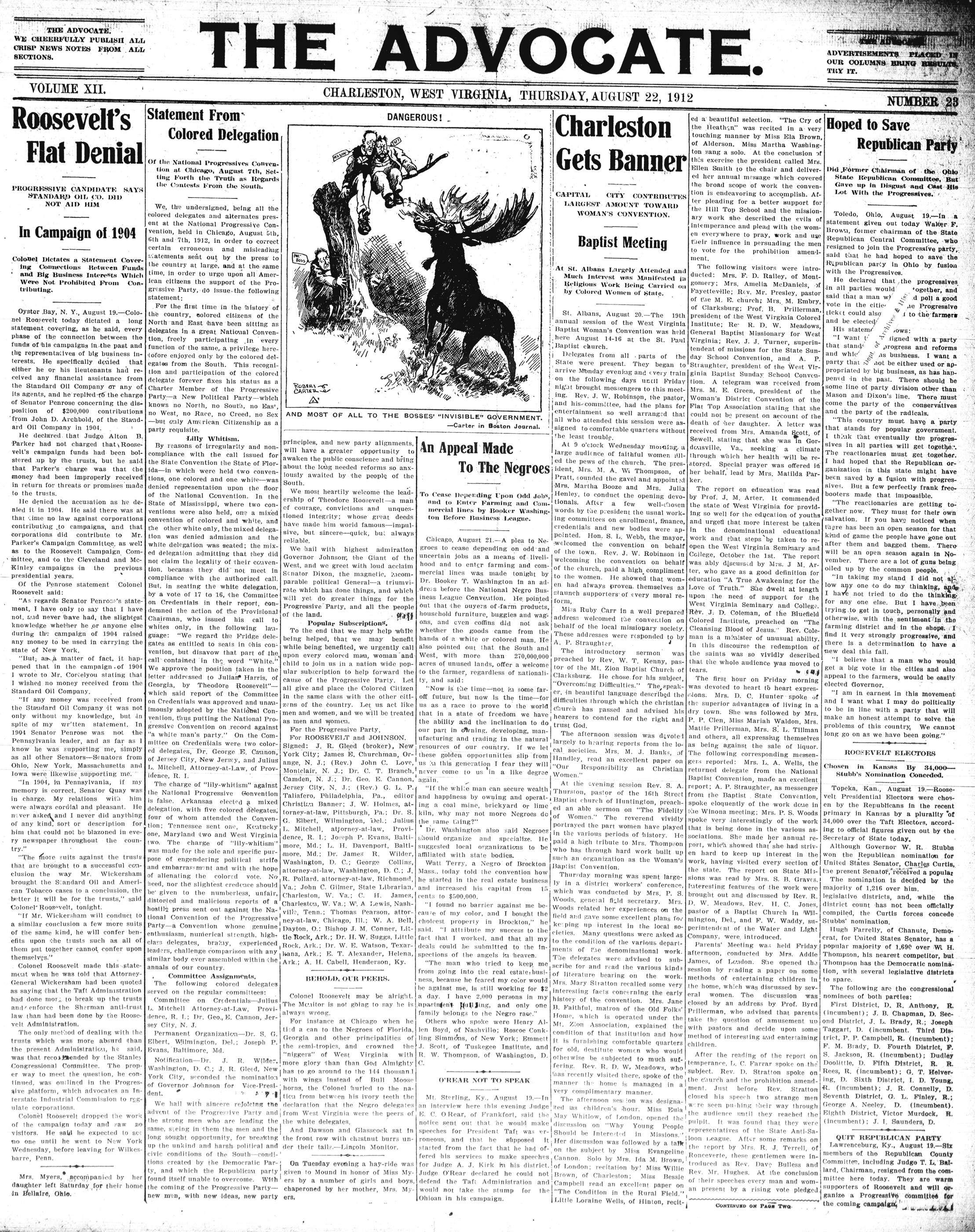
Page text (machine-generated)
THE ADVOCATE WE CHEERFULLY PUBLISH ALL CRISP NEWS NOTES FROM ALL SECTIONS.
VOLUME XII.
Roosevelt's Flat Denial
PROGRESSIVE CANDIDATE SAYS
STANDARD OIL CO. DID
NOT AID HIM
In Campaign of 1904
Colonel Dictates a Statement Covering Connections Between Funds and Big Business Interests Which Were Not Prohibited From Contributing.
Oystor Bay, N. Y., August 19.—Colonel Roosevelt today dictated a long statement covering, as he said, every phase of the connection between the funds of his campaigns in the past and the representatives of big business interests. He specifically denied that either he or his lieutenants had received any financial assistance from the Standard Oil Company or any of its agents, and he replied to the charge of Senator Penrose concerning the disposition of $200,000 contributions from John D. Archbold, of the Standard Oil Company in 1904.
He declared that Judge Alton B. Parker had not charged that Roosevelt's campaign funds had been bolstered up by the trusts, but he said that Parker's charge was that the money had been improperly received in return for threats or promises made to the trusts.
He denied the accusation as he denied it in 1904. He said there was at that time no law against corporations contributing to campaigns, and that corporations did contribute to Mr. Parker's Campaign Committee, as well as to the Roosevelt Campaign Committee, and to the Cleveland and McKinley campaigns in the previous presidential years.
Of the Penrose statement Colonel Roosevelt said:
"As regards Senator Penrose's statement, I have only to say that I have not, and never have had, the slightest knowledge whether he or anyone else during the campaign of 1904 raised any money to be used in carrying the state of New York.
"But, as a matter of fact, it happened that in the campaign of 1904 I wrote to Mr. Cortelyou stating that I wished no money received from the Standard Oil Company.
"If any money was received from the Standard Oil Company it was not only without my knowledge, but in spite of my wr'tten statement. In 1904 Senator Penrose was not the Pennsylvania leader, and as far as I know he was supporting me, simply as all other Senators—Senators from Ohio, New York, Massachusetts and Iowa were likewise supporting me.
"In 1904, in Pennsylvania, if my memory is correct, Senator Quay was in charge. My relations with him were always cordial and pleasant. He never asked and I never did anything of any kind, sort or description for him that could not be blazoned in every newspaper throughout the country."
"The more suits against the trusts that are brought to a successful conclusion the way Mr. Wickersham brought the Standard Oil and American Tobacco cases to a conclusion, the better it will be for the trusts," said Colonel Roosevelt, tonight.
"If Mr. Wickersham will conduct to a similar conclusion a few more suits of the same kind, he will confer benefits upon the trusts such as all of them put together cannot confer upon themselves."
Colonel Roosevelt made this statement when he was told that Attorney-General Wickersham had been quoted as saying that the Taft Administration had done more to break up the trusts and enforce the Sherman anti-trust law than had been done by the Roosevelt Administration.
The only method of dealing with the trusts which was more absurd than the present Administration, he said, was that recommended by the Stanley Congressional Committee. The proper way to meet the question, he continued, was outlined in the Progressive platform, which advocates an Interstate Industrial Commission to regulate corporations.
Colonel Roosevelt dropped the work of the campaign today and saw no visitors. He said he expected to see no one until he went to New York Wednesday, before leaving for Wilkesbarre, Penn.
Mrs. Myers, accompanied by her daughter left Saturday for their home in Bellaire, Ohio.
THE ADVOCATE.
Statement From Colored Delegation
Statement From Colored Delegation
Of the National Progressives Convention at Chicago, August 7th, Setting Forth the Truth as Regards the Contests From the South.
We, the undersigned, being all the colored delegates and alternates present at the National Progressive Convention, held in Chicago, August 5th, 6th and 7th, 1912, in order to correct certain erroneous and misleading statements sent out by the press to the country at large, and at the same time, in order to urge upon all American citizens the support of the Progressive Party, do issue the following statement:
For the first time in the history of the country, colored citizens of the North and East have been sitting as delegates in a great National Convention, freely participating in every function of the same, a privilege herefore enjoyed only by the colored delegates from the South. This recognition and participation of the colored delegate forever fixes his status as a Charter Member of the Progressive Party—a New Political Party—which knows no North, no South, no East', no West, no Race, no Creed, no Sex—but only American Citizenship as a party requisite.
Lilly Whitism.
By reasons of irregularity and non-compliance with the call issued for the State Convention the State of Florida—in which were held two conventions, one colored and one white—was denied representation upon the floor of the National Convention. In the State of Mississippi, where two conventions were also held, one a mixed convention of colored and white, and the other white only, the mixed delegation was denied admission and the white delegation was seated; the mixed delegation admitting that they did not claim the legality of their convention, because they did not meet in compliance with the authorized call. But, in seating the white delegation, by a vote of 17 to 16, the Committee on Credentials in their report, condemned the action of the Provisional Chairman, who issued his call to whites only, in the following language: "We regard the Fridge delegates as entitled to seats in this convention, but disavow that part of the call contained in the word "White." We approve the position taken in the letter addressed to Julian Harris, of Georgia, by Theodore Roosevelt"—which said report of the Committee on Credentials was approved and unanimously adopted by the National Convention, thus putting the National Progressive Convention on record against "a white man's party." On the Committee on Credentials were two colored delegates, Dr. George E. Cannon, of Jersey City, New Jersey, and Julius L. Mitchell, Attorney-at-Law, of Providence, R. I.
The charge of "lily-whitism" against the National Progressive Convention is false. Arkansas elected a mixed delegation, with five colored delegates, four of whom attended the Convention; Tennessee sent one, Kentucky one, Maryland two and West Virginia two. The charge of "lily-whitism" was made for the sole and specific purpose of engendering political strife and embarrassment and with the hope of alienating the colored vote. No heed, nor the slightest credence should be given to the numberless, unfair, distorted and malicious reports of a hosting press sent out against the National Convention of the Progressive Party—a Convention whose genuine enthusiasm, numerical strength, high-class delegates, bravery, experienced leaders, challenge comparison with any similar body ever assembled within the annals of our country.
The following colored delegates served on the regular committees:
Committee on Credentials—Julius L. Mitchell Attorney-at-Law, Providence, R. L.; Dr. Geo., E. Cannon, Jersey City, N. J.
Permanent Organization—Dr. S. G. Elbert, Wilmington, Del.; Joseph P. Evans, Baltimore, Md.
Notification—Dr. J. R. Wilder, Washington, D. C.; J. R. Gleed, New York City, seconded the nomination of Governor Johnson for Vice-President.
We hail with sincere refolicing the advent of the Progressive Party and the strong men who are leading the same, seeing in them the men and the long sought opportunity, for breaking up the unkind and harsh political and civic conditions of the South—conditions created by the Democratic Party, and which the Republican party found itself unable to overcome. With the coming of the Progressive Party—new men, with new ideas, new party
CHARLESTON, WEST VIRGINIA, THURSDAY, AUGUST 22, 1912
DANGEROUS!
MASON
KAT
PAT BOSS
ROBERT CARTER
AND MOST OF ALL TO THE BOSSES' "INVISIBLE" GOVERNMENT. —Carter in Boston Journal.
principles, and new party alignments, will have a greater opportunity to awaken the public conscience and bring about the long needed reforms so anxiously awaited by the people of the South.
We most heartily welcome the leadership of Theodore Roosevelt—a man of courage, convictions and unquestioned integrity; whose great deeds have made him world famous—impulsive, but sincere—quick, but always reliable.
An Appeal Made To The Negroe
To Cease Depending Upon Odd Job and to Enter Farming and Commercial lines by Booker Washington Before Business League.
Chicago, August 21.—A plea to N
We hail with highest admiration Governor Johnson, the Giant of the West, and we greet with loud acclaim Senator Dixon, the magnetic, Incomparable political General—a triumvirate which has done things, and which will yet do greater things for the Progressive Party, and all the people of the land.
Popular Subscriptions.
To the end that we may help while being helped, that we may benefit while being benefited, we urgently call upon every colored man, woman and child to join us in a nation wide popular subscription to help forward the cause of the Progressive Party. Let all give and place the Colored Citizen in the same class with the other citizens of the country. Let us act like men and women, and we will be treated as men and women.
For the Progressive Party,
FOR ROOSEVELT and JOHNSON.
Signed: J. R. Gleed (broker), New York City; James E. Churchman, Orange, N. J.; (Rev.) John C. Love, Montclair, N. J.; Dr. C. T. Branch, Camden, N. J.; Dr. Geo. E. Cannon, Jersey City, N. J.; (Rev.) G. L. P. Taliafero, Philadelphia, Pa., editor Christian Banner; J. W. Holmes, attorney-at-law, Pittsburgh, Pa.; Dr. S. G. Elbert, Wilmington, Del.; Julius L. Mitchell, attorney-at-law, Providence, R. L.; Joseph P. Evans, Baltimore, Md.; L. H. Davenport, Baltimore, Md.; Dr. James R. Wilder, Washington, D. C.; George Collins, attorney-at-law, Washington, D. C.; J. R. Pollard, attorney-at-law, Richmond, Va.; John C. Gilmer, State Librarian, Charleston, W. Va.; C. H. James, Charleston, W. Va.; W. A. Lewis, Nashville, Tenn.; Thomas Pearson, attorney-at-law, Chicago, Ill.; W. A. Bell, Dayton, O.; Bishop J. M. Conner, Little Rock, Ark.; Dr. H. W. Suggs, Little Rock, Ark.; Dr. W. E. Watson, Texasana, Ark.; E. T. Alexander, Helena, Ark.; A. H. Cabell, Henderson, Ky.
Colonel Roosevelt may be alright. The Monitor is not going to say he is always wrong.
For instance at Chicago when he tied a can to the Negroes of Florida, Georgia and other principalities of the semi-tropics, and crowned the "niggers" of West Virginia with more glory than than God Almighty has to go around to the 144 thousand with wings instead of Bull Moose horns, the Colonel hurled to the natica from between his ivory teeth the declaration that the Negro delegates from West Virginia were the peers of the white delegates.
And Dawson and Glasscock sat in the front row with chasstnut burrs under their tails—Lincoln Monitor.
On Tuesday evening a hay-ride was given to Mound in honor of Miss Myers by a number of girls and boys chaperoned by her mother, Mrs. Myers.
REHOLD. OUR PEERS.
An Appeal Made To The Negroes
To Cease Depending Upon Odd Jobs,
and to Enter Farming and Com-
mercial lines by Booker Washington
Before Business League.
Chicago, August 21.—A plea to Negroes to cease depending on odd and uncertain jobs as a means of livelihood and to enter farming and commercial lines was made tonight by Dr. Booker T. Washington in an address before the National Negro Business League Convention. He pointed out that the buyers of farm products, household furniture, buggies and wagons, and even coffins did not ask whether the goods came from the hands of a white or colored man. He also pointed out that the South and West, with more than 270,000,000 acres of unused lands, offer a welcome to the farmer, regardless of nationality, and said:
"Now is the time—not in some faroff future, but now is the time—for us as a race to prove to the world that in a state of freedom we have the ability and the inclination to do our part in owning, developing, manufacturing and trading in the natural resources of our country. If we let these golden opportunities slip from us in this generation I fear they will never come to us in a like degree again.
"If the white man can secure wealth and happiness by owning and operating a coal mine, brickyard or lime kiln, why may not more Negroes do the same thing?"
Dr. Washington also said Negroes should organize and specialize. He suggested local organizations to be affiliated with state bodies.
Watt Terry, a Negro of Brockton Mass., today told the convention how he started in the real estate business and increased his capital from 15 cents to $500,000.
"I found no barrier against me because of my color, and I bought the choicest property in Brockton," he said. "I attribute my success to the fact that I worked, and that all my deals could be submitted to the inspections of the angels in heaven.
"The man who tried to keep me from going into the real estate business, because he feared my color would be against me, is still working for $2 a day. I have 2,000 persons in my apartment building, and only one family belongs to the Negro race."
Others who spoke were Henry Allen Boyd, of Nashville; Roscoe Coe Knelling Simmons, of New York; Emmett J. Scott, of Tuskegee Institute, and R. W. Thompson, of Washington, D.
Mt. Sterling, Ky., August 19.—In an interview here this evening Judge E. C. O'Rear, of Frankfort, said the notice sent out that he would make speeches for President Taft was erroneous, and that he supposed it started from the fact that he had offered his services to make speeches for Judge A. J. Kirk in his district, Judge O'Rear declared he could not defend the Taft Administration and would not take the stump for the Ohioan in his campaign.
O'REAR NOT TO SPEAK
Charleston Gets Banner
CAPITAL CITY CONTRIBUTES LARGEST AMOUNT TOWARD WOMAN'S CONVENTION.
Baptist Meeting
At St. Albans Largely Attended and Much Interest was Manifested in Religious Work Being Carried on by Colored Women of State.
St. Albans, August 20.—The 19th annual session of the West Virginia Baptist Woman's Convention was held here August 14-16 at the St. Paul Baptist church.
Delegates from all parts of the State were present. They began to arrive Monday evening and every train on the following days until Friday night brought messengers to this meeting. Rev. J. W. Robinson, the pastor, and his committee, had the plans for entertainment so well arranged that all who attended this session were assigned to comfortable quarters without the least trouble.
At 9 o'clock Wednesday morning, a large audience of faithful women filled the pews of the church. The president, Mrs. M. A. Wi Thompson, of Pratt, sounded the gavel and appointed Mrs. Martha Booze and Mrs. Julia Henley, to conduct the opening devotionals. After a few well-chosen words by the president the usual working committees on enrollment, finance, credentials and new bodies were appointed. Hon. S. L. Webb, the mayor, welcomed the convention on behalf of the town. Rev. J. W. Robinson in welcoming the convention on behalf of the church, paid a high, compliment to the women. He showed that women had always proven themselves as staunch supporters of every moral reform.
Miss Ruby Curr in a well prepared address welcomed the convention on behalf of the local missionary society. These addresses were responded to by A. P. Straughter.
The introductory sermon was preached by Rev. W. T. Kenny, pastor of the Mt. Zion Baptist Church of Clarksburg. He chose for his subject, "Overcoming Difficulties." The speaker, in beautiful language described the difficulties through which the christian church has passed and advised his hearers to contend for the right and trust God.
The afternoon session was devoted largely to hearing reports from the local societies. Mrs. M. J. Banks, of Handley, read an excellent paper on "Our Responsibility as Christian Women."
At the evening session Rev. S. A. Thurston, pastor of the 16th Street Baptist church of Huntington, preached an able sermon on "The Fidelity of Women." The reverend vividly portrayed the part women have played in the various periods of history. He paid a high tribute to Mrs. Thompson who has through hard work built up such an organization as the Woman's Baptist Convention.
Thursday morning was spent largely in a district workers' conference which was conducted by Mrs. P. S. Woods, general field secretary. Mrs. Woods related her experiences on the field and gave some excellent plans for keeping up interest in the local societies. Many questions were asked as to the condition of the various departments of the denominational work. The delegates were advised to subscribe for and read the various kinds of literature bearing on the work. Mrs. Mary Stratton recalled some very interesting facts concerning the early history of the convention. Mrs. Jane B. Faithful, matron of the Old Folks' Home, which is operated under the Mt. Zion Association, explained the condition of that institution and how it is furnishing comfortable quarters for old, destitute women who would otherwise be subjected to much suffering. Rev. R. D. W. Meadows, who has recently visited there, spoke of the manner the home is managed in a very complimentary manner.
The afternoon session was designated as children's hour. Miss Eula May Whitlow, of London, opened the discussion on "Why Young People Should be Interested in Missions." Her discussion was followed by a talk on the subject by Miss Evangeline Cannon. Solo by Mrs. Ida M. Brown, of London; recitation by! Miss Willie Brown, of Charleston; Miss Bessie Campbell read an excellent paper on "The Condition in the Rural Field." Little Loraine Wells, of Hinton, recit-
ed a beautiful selection. "The Cry of the Heathen" was recited in a very touching manner by Miss Ela Brown, of Alderson. Miss Martha Washington sang a solo. At the conclusion of this exercise the president called Mrs. Ellen Smith to the chair and delivered her annual message which covered the broad scope of work the convention is endeavoring to accomplish. After pleading for a better support for the Hill Top School and the missionary work she described the evils of intemperance and plead with the women everywhere to pray, work and use their influence in persuading the men to vote for the prohibition amendment.
The following visitors were introduced: Mrs. F. D. Railey, of Montgomery; Mrs. Amelia McDaniels, of Fayetteville; Rev. Mr. Presley, pastor of the M. E. church; Mrs. M. Embry, of Clarksburg; Prof. B. Prillerman, president of the West Virginia Colored Institute; Rev. R. D. W. Meadows, General Baptist Missionary for West Virginia; Rev. J. J. Turner, superintendent of missions for the State Sunday School Convention, and A. P. Straughter, president of the West Virginia Baptist Sunday School Convention. A telegram was received from Mrs. M. E. Green, president of the Woman's District Convention of the Flat Top Association stating that she could not be present on account of the death of her daughter. A letter was received from Mrs. Amanda Scott, of Sewell, stating that she was in Gordonsville, Va., seeking a climate through which her health will be restored. Special prayer was offered in her behalf, lead by Mrs. Matilda Parker.
The report on education was read by Prof. J. M. Arter. It commended the state of West Virginia for providing so well for the education of youths and urged that more interest be taken in the denominational educational work and that steps be taken to reopen the West Virginia Seminary and College, October the 1st. The report was ably discussed by Mrs. J M. Arter, who gave as a good definition for education "A True Awakening for the Love of Truth." She dwelt at length upon the need of support for the West Virginia Seminary and College. Rev. J. D. Coleman, of the Bluefield Colored Institute, preached on "The Cleansing Blood of Jesus." Rev. Coleman is a minister of unusual ability. In this discourse the redemption of the saints was so vividly described that the whole audience was moved to tears.
The first hour on Friday morning was devoted to heart to heart expressions. Mrs. D. C. Hunter spoke of the superior advantages of living in a dry town. She was followed by Mrs. P. P. Clen, Miss Mariah Waldon, Mrs. Mattie Prillerman, Mrs. S. L. Tillman and others, all expressing themselves as being against the sale of liquor. The following corresponding messengers reported: Mrs. L. A. Wells, the returned delegate from the National Baptist Convention, made an excellent report; A. P. Straughther, as messenger from the Baptist State Convention, spoke eloquently of the work done in the Winona meeting; Mrs. P. S. Woods spoke very interestingly of the work that is being done in the various associations. She made her annual report, which showed that she had striven hard to keep up interest in the work, having visited every section of the state. The report on State Missions was read by Mrs. S. B. Graves. Interesting features of the work were brought out and discussed by Rev. R. D. W. Meadows, Rev. H. C. Jones, pastor of a Baptist Church in Wilmington, Del., and F. W. Waddy, superintendent of the Water and Light Company, were introduced.
Parents' Meeting was held Friday afternoon, conducted by Mrs. Addie James, of London. She opened the session by reading a paper on some methods of entertaining children in the home, which was discussed by several women. The discussion was closed by an address by Prof. Byrd Prillerman, who advised that parents take the question of amusement up with pastors and decide upon some method of interesting and entertaining children.
After the reading of the report on temperance, L. C. Farrar spoke on the subject. Rev. D. Stratton spoke on the church and the prohibition amendment. Just before Rev. Stratton closed his speech two strange men were seen pushing their way through the audience until they reached the pulpit. It was found that they were representatives of the State Anti-Saloon League. After some remarks on the report by Mrs. R. J. Terrell, of Ronceverte, these gentlemen were introduced as Rev. Dave Bulless and Rev. Mr. Hughes. At the conclusion of their speeches every man and woman present by a rising vote pledged
CONTINUED ON PAGE TWO.
ADVERTISEMENTS PLACED IN OUR COLUMNS BRING RESULTS. TRY IT.
NUMBER 23
Did Former Chairman of the Ohio State Republican Committee, But Gave up in Disgust and Cast His Lot With the Progressives.
Toledo, Ohio, August 19.—In a statement given out today Walter F. Brown, former chairman of the State Republican Central Committee, who resigned to join the Progressive party, said that he had hoped to save the Republican party in Ohio by fusion with the Progressives.
He declared that the progressives in all parties would together, and said that a man w)d poll a good vote in the cities the Progressive ticket could also to the farmers and be elected.
The outcome is:
"I want to be dignified with a party that stands for progress and reforms and while as business. I want a party that not be either used or appropriated by big business, as has happened in the past. There should be some line of party division other than Mason and Dixon's line. There must come the party of the conservatives and the party of the radicals.
"This country must have a party that stands for popular government. I think that eventually the progressives in all parties will get together. The reactionaries must get together. I had hoped that the Republican organization in this state might have been saved by a fusion with progressives. But a few perfectly frank freebooters made that impossible.
"The reactionaries are getting together now. They must for their own salvation. If you have noticed when there has been an open season for that kind of game the people have gone out after them and bagged them. There will be an open season again in November. There are a lot of guns being oiled up by the common people.
"In taking my stand I did not allow any one to do my thinking, and I have not tried to do the thinking for any one else. But I have been trying to get in touch, personally and otherwise, with the sentiment in the farming district and in the shops. I find it very strongly progressive, and there is a determination to have a new deal this fall.
"I believe that a man who would get a big vote in the cities and also appeal to the farmers, would be easily elected Governor.
"I am in earnest in this movement and I want what I may do politically to be in line with a party that will make an honest attempt to solve the problems of this country. We cannot long go on as we have been going."
ROCSEVELT ELECTORS
Chosen in Kansas By 34,000— Stubb's Nomination Conceded.
Topeka, Kan., August 19.—Roosevelt Presidential Electors were chosen by the Republicans in the recent primary in Kansas by a plurality of 34,000 over the Taft Electors, according to official figures given out by the Secretary of State today.
Although Governor W. R. Stubbs won the Republican nomination for United States Senator, Charles Curtis, the present Senator, received a popular The nomination is decided by the majority of 1,216 over him. legislative districts, and, while the district count has not been officially compiled, the Curtis forces concede Stubbs' nomination.
Hugh Farrelly, of Chanute, Democrat, for United States Senator, has a popular majority of 1,690 over W.H. Thompson, his nearest competitor, but Thompson has the Democratic nomination, with several legislative districts to spare. The following are the congressional nominees of both parties:
First District, D. R. Anthony, R. (incumbent); J. B. Chapman, D. Second District, J. L. Brady, R.; Joseph Taggart, D. (incumbent. Third District, P. P. Campbell, R. (incumbent); F. M. Brady, D. Fourth District, F. S. Jackson, R. (incumbent); Dudley Doolittle, D. Fifth District, R. R. Rees, R. (incumbent); G. T. Helvering, D. Sixth District, I. D. Young, R. (incumbent); J. R. Connelly, D. Seventh District, G. L. Finley, R.; George A. Neeley, D. (incumbent). Eighth District, Victor Murdock, R. (incumbent); J. I. Saunders, D.
QUIT REPUBLICAN PARTY Lawrenceburg, Ky., August 19.—Six members of the Republican County Committee, including Judge T. L. Ballard, Chairman, resigned from the committee here today. They are warm supporters of Roosevelt and will organize a Progressive committee for the coming campaign.
CORRESPONDENCE
OUR
Ice Cream Parlor
STRANGERS AND TRAVELING PERSONS
BEST SODA WATER
ONLY 5 CTS.
OUR PLAN'S UP-TO-DATE
SERVICE IS OUR WATCHWORD
THE PEOPLES' GROCERY CO.
WM. H. PARKER, Manager.
FAGLE
Rev. B. A. Brooks, of Charleston, filled his appointment here Sunday and preached two fine sermons.
C. C. Woods, of Boomer, attended service here Sunday.
Mrs. Orange Page, of Jacksonville, was the guest of Misses Ellen and Hinda Banner, at Boomer, Sunday.
C. C. Woods and David Ware, of Boomer, were callers at the home of Mr. and Mrs. Henry Lemons Sunday.
Mrs. Rosie Clarine, of Washington, D. C., is visiting her brother-in-law, Luther Brown.
Miss Francis Calloway, of Virginia, is the guest of her sister, Mrs. Wheeler.
Mrs. Fannie Folks, of Gauley, was the guest of Willie J. Miller Monday. Mrs. Eva B. Russ and Mrs. Willie J. Miller attended the Improvement League of Montgomery at the home of Mrs. A. W. Slaughter, Thursday.
MONTGOMERY
Dr. W. C. Lawrence is representing the West Virginia Medical Association at Tuskegee this week. He was accompanied by Mrs. Lawrence and son, Paul' Dunbar.
H. H. Railey, George Brown and R. L. Gater, are attending the Grand Lodge of Red Men, at Fayetteville.
Mrs. C. W. Watson, who was called to Louisa, Va., because of the death of her mother, returned Tuesday.
Mrs. F. Donnally Railey is home again after a week's visit to Institute, St. Albans and Charleston.
The rally at the Methodist church and Baptist church was a success financially.
The Red and Blue Club gave a reception on the lawn of the First Baptist church Monday evening.
Miss Wysor Watson entertained with a whist party at her home on College street Tuesday evening. Taylor Brown, Scott Brown, Mr. and Mrs. Roseoe Howard, Mr. and Mrs. Ballard and Mrs. George Hurt, of Institute, were the Sunday guests of Mr. and Mrs. H. H. Railey.
The Drug Company known as R. L. Garter, Dean & Hodge has dissolved partnership and will be known in the future as R. L. Geter Drug Co.
* J. C. Gilmer, of Charleston, was a business visitor here Saturday.
Dr. Charles Anderson, of Mt. Hope is here looking after the practice of Dr. Lawrence in his absence.
The Literary Society with John Johnson as President; meets every Friday evening in the Odd Fellows Hall. An interesting program is rendered every evening. The Art Club will meet Friday afternoca at 3 o'clock. All members are requested to be present.
LEWISBURG
Mrs. Fannie Weeks was visiting relatives in Alderson last week.
Miss Fidella Freeland returned from Pittsburg Thursday, accompanied by her neph w. John J. White, to spend the rest of the summer with her mother, Mrs. Rose A. Freeland.
Little Harry Dolan is ill with the fever.
Mrs. J. C. Love was taken suddenly ill Monday, but is now better.
Miss Linnie Breckenridge and Mrs. Lillian Lee, of Charleston, are guests of Mrs. Agnes Lewis.
A large crowd of ladies attended the Woman's Home Missionary Convention at Sgebent on the 9th. They report a delightful time.
The carnival given by Mrs. Brunette Chambers' Club for the benefit of the M. E. Church last week was a success. The trustees' rally at the M. E.
OUR
Ice Cream
STRANGERS AND TR
BEST SODA
ONLY 5
OUR PLAN'S U
SERVICE IS OUR
THE PEOPLES' G
WM. H. PARKE
---
Church Sunday was the greatest financial success in the history of the church. Rev. J. H. Johanson, of Haton, occupied the pulpit at 11 a. m., and 8 p. m., and delivered two very fine sermons. Rev. Wm. Jackson preached at 3 p. m. The sum realized was $316.30. The five clubs reported as follows: Mrs. Brunette Chambers, $93.35; Mrs. Janye Woodson, $62.78; Mrs. Emma James, $48.67, and Mrs. Mary Stewart, $23.00.
Mrs. Charity Robinson and grandson, Henry, spent a week in Ronceverte, visiting Mrs. Debby Terry.
CHARLESTON
Hotel Brown Arrivals—Mr. Matt Buster, Montgomery; B. F. Johnson, Kayford; J. S. Notel, Montgomery; Ehiel Rhodes, Clifton Forge; Chas Macker, A. Anderson, Danville, Va.; Roy Smith, Pittsburgh; H. White; Fred Jones, Eccles; Chas Brady, East Bank; E. Harris, Montgomery; Willis Nelson, Marshall, Tenn.; Mr. and Mrs. H. Bennon, Birmingham, Ala.; H. Jones, London; Mr. and Mrs. Stokes, Burnwell; C. B. Caldwell, Chas, Cain, Ivydale; William Teal, Wake Forest; E. T. Jackson, Cedar Grove; Leota Harris, Burnwell; Mr. and Mrs. C Cooper, Columbus, O.; E. Jones, R. Randolph, Raymond City; E. Rice, Dana; William Alston, Raymond City; Mr. and Mrs. Edw. Young, Sylvia; W. G. Napper, Institute; William Bradley, Jas. Bradley, Lynchburg, Va.; Mr. and Mrs. J. W. Jones, Page; R. Boswell, Morris Creek; Mrs. J. M. Lee, Beckley, and Mrs. Lila Cobbs, Fatmont, were registered at Hotel Brown this week.
Birthday Celebration—Little Miss Catherine Page gave a pretty lawn party at the home of her parents on Bradford street, Friday evening, the occasion being the celebration of her seventh birthday anniversary. A large number of her friends responded to the invitation and spent a pleasant evening. Marie Robinson and Helen Strawther served lemon ices while Minnie Page and Mildred Randolph assisted in the dining room. A large cake decorated with seven candles was one of the pleasing decorations.
Popular Couple to Marry—The following invitation was issued Tuesday:
Mr. and Mrs. Thomas Davis
Request the honor of your presence at the marriage of their daughter
Mr. William Henry Wright Wednesday evening, the fourth of
Charleston, West Virginia.
Visitors Entertained at Dinner
Mrs. Charles Williams, of Elmwood avenue, gave a dinner Saturday evening at 6:30 complimentary to Mrs. Carey Williams, and Misses Olive Lee and Jennie West. The other guests were: Misses Esther Fulks, Maude Viney, Virginia Gilmer and Mrs. Russell Forney.
Aquatic Box Party—One of the most enjoyable affairs of the mid-summer was a box party aboard the "Moonlight" Friday evening in honor of the visitors, Mrs. Williams and Misses Lee and West. Brown's orchestra furnished music for the occasion and dancing was indulged in till a late hour.
Personals and Locals.
A dance was given at the K. of P. hall last night in honor of Miss Elfreda Kennedy. Mrs. Geo, Chair left for Lancaster, Ohio, Friday, for a few weeks' visit. Miss Gertrude Campbell is visiting
Dr. B. P. Brownley leaves for Washington Friday for a week's vacation.
Mrs. Allen DeHonney Leaves for Cincinnati Friday to attend Mohler College.
Mrs. Daniel Butler goes to Columbus, Ohio. Wednesday to attend the conclave.
Miss Hattie Peters was in the city Saturday on business.
An enjoyable hay-ride was given Saturday night by the young men in honor of the visiting ladies.
Mrs. L. T. Banks has returned from Gulfport, Miss., at which place she spent the past three months.
Mrs. C. A. Wilhams, of Parkersburg, arrived in the city Wednesday to be the house-guest of Miss Gilmer.
Miss Esther Fulks entertained a number of friends Monday evening in honor of her guests, Miss Olive Lee and Jennie West, of Columbus.
Mr. W. O. Terry and Rufus Penn entertained with a bathing party at Lock 6 Wednesday in honor of the visiting ladies.
A dance was given at the K. of P. hall Wednesday night in honor of Misses Jeanie West, Olive Lee, Alfreda ennedy and Mrs. C. A. Williams, Miss Esther Fulks and Virginia Gilmer entertained at cards Thursday afternoon in honor of Misses Lee and West, and Mrs. C. A. Williams.
Monday evening Mr. and Mrs. Jas. A. Browder entertained in honor of Mrs. T. A. Myers and daughter, of Bellaire, Ohio. A very pleasant evening was spent.
Miss Hazel Bailey entertained at dinner Sunday at her home on Hansford street. A number of friends in honor of Miss Zella V. Myers.
On Wednesday afternoon a reception was given by Mrs. Geo. E. Wanzer at her residence on Donnally street in honor of Mrs. Myers. The guests were received by Mrs. Harvey Mickens and introduced by Mrs. M. D. Webb. Luncheon was served by Mrs. Jas. Browder, Miss Nellie Merritt and Mrs. Harry Brown. Miss Maude Wanzer and Miss Ella Holmes presided at the punch bowl.
Miss Maude Wanzer and Miss Margaret Parker entertained with a porch party at the residence of Mrs. W. H. Parker on Friday evening in honor of Miss Myers. Music and games were the main features of the evening. Music was furnished by Freeman's Orchestra. Luncheon was served by Misses Margaret James and Inez Bowe.
Mrs. F. R. Johnson, of Bellaire, Ohio, who was visiting Mrs. Geo, E. Wanzer, was called home Monday by the serious illness of her husband.
W. O. Terry and J. H. Taylor left Monday for Parkersburg where they will spend the week with a camping party.
Miss Stella James went to Columbus, Ohio, Sunday for a short visit to relatives.
W. H. Parker is visiting the Ohio Grand Lodge, of Masons, at Columbus this week.
T. G. Nutter leaves Sunday for Dayton, Ohio, to attend the Grand Lodge of Elks, of which he is an officer.
The Loyal Union will meet Monday with Mrs. Anna Jefferson. A public meeting will be held with Mrs. Matilda Parker, Wall street, the following Monday night.
Mrs. Frank Henley entertained at six o'clock dinner Tuesday evening the honor guest being Mrs. Fannie Dickinson, of Louisville, Ky., and Mrs. Henry Leigh of Springfield, O.
Mrs. Amanda Payne was at home or a few friends, Wednesday evening, for her daughter, Miss Hill, of Wheeling Mrs. Daisy Nelson entertained at dinner Sunday evening at Hotel Brown. Her guests were Mrs. S. D Cowser, Mrs. Ella Walton and Mrs. Viola Wright. Edward James leaves this morning for Columbus to attend the centennial He will be absent a week or ten days
Miss Cordelia E. Wanzer and Miss Bertha E. Payne left for Chicago and St. Paul, Minn., Sunday for an extended visit.
THE RACE ISSUE ALWAYS.
We often wonder if the injection of the race issue at every turn by colored men themselves is not responsible in large measure for the often harrowing anxiety and consequent disappointments which follow that agitation by colored men. We wonder if often men known by long practiced policy and concrete acts as great and good friends are so embarrassed by having the race question incessantly and insistently pressed upon them that when they are made to declare on a mythical issue between their own race and the black race they are not forced by cir-
cumstances to appear as favoring their own. The question: How do you stand on the color line? so often raised by colored men is the same one inverted that is forced upon white political candidates by the Southern rabble. If the candidate does not declare a policy of "Negro annihilation," "an irrepressible conflict between the races, rendering it impossible for them to live side by side," he is at once sacrificed to public sentiment.
The proof of the pudding is the eating. The test of the ability of the races to live side by side and thus to prosper is the fact that they are living side by side and they are prospering.
The stand of a man white or black, upon the race question is his deeds and his work for or against the rightful, fair and square solution of that question. The colored citizen, thinking too much and too often of himself as a separate nation within a nation, thus politely segregates himself. His needless and eternal raising of the issue himself cannot but lose him prestige and public favor, cannot but result eventually in disaster to his own standing. Despite his points in common with Anglo-Saxons, the colored man of this country, from the standpoint of his racial self-consciousness, is prone to assert his racial identity much more frequently than does the Hebrew or Italian. The colored citizen is an American citizen first, entitled to all rights and privileges of all other Americans. If he will but think so and act so he will be treated so much sooner than now seems evident. Not long ago in a session of a plasterers' union in this city a colored member, fined for a clear infraction of the law, immediately proclaimed the race prejudice and persecution which the choir was inflicting upon him. Many colored lawyers and white ones, too, immediately raise the question of color as a mitigating element of the offense of their colored client. Socially and in places of public accommodation the average colored man confidently looks for the color line, and people generally find what they are looking for.
Let colored men quit hysterically raising the color question themselves and there will be less race question raised by white men, there will be less of the dangerous race hysteria, whose paigs the race too often feels through its sensitive skin, and whose anger it not infrequently invites upon itself—Amsterdam News.
ROOSEVELT.
Thou wilt not yield corruption's toll,
Roosevelt, O, Roosevelt;
Thou wilt not crook to it's control,
Roosevelt, O. Roosevelt:
Roosevelt, O, Roosegelt;
So let the waves of malice roll,
They cannot swerve thy fearless soul,
They cannot keep thee from the goal
I hear the distant thunder roar
Roosevelt, O, Roosevelt;
The fife and drum and bugle corps
Roosevelt, O, Roosevelt;
Roosevelt, O, Roosevelt;
Come! to thine own heroic throng,
That stalks with Liberty along,
And ring, ring, dunzeelz, dunzeelz.
and ring thy dauntless slogan song
Roosevelt, O, Roosevelt.
Sixth District Sunday Schools
Hold Tbird Semi-Annual Meeting and
Hear Reports of Work Done in
Past Half Year. Religious Topics
are Also Discussed.
Wake Forest, August 20.—The third semi-annual session of the 6th District Sunday School Union of the West Virginia Baptist Sunday School Convention was held here Saturday and Sunday with the First Baptist Sunday School. Owing to serious trouble in the mining circles throughout Cabin Creek District the meeting was not largely attended.
At 7:30 Saturday evening President Rev. H. M. C. Reed called the meeting to order and appointed Rev. Richard Hughes to conduct the opening devotionals. After a few words of greeting by the president, Rev. T. A. Torrence opened the discussion on "The Sunday School and the Home." Jno. Hughes and J. J. Thomas also spoke on the subject, saying that the school and the home should be brought closer together in the interest of the child.
At 9:30 o'clock Sunday morning a very interesting Sunday School service was conducted by Superintendent of Missions, Rev. J. J. Turner, who suggested some helpful ways of putting interest in the Sunday School work.
At 11 o'clock a very interesting
sermon was preached by Rev. D. W. Edwards, of Eskdale.
In the afternoon Rev. J. M. Wooding, of Wevaco, conducted the opening exercise. Mrs. J. I. Thomas opened the discussion on "Child Study." Jno. W. Winston, a student of Livingston College, spoke on the subject. Rev. Turner delivered a very helpful address on "Teacher Training." Rev. Turner is striving earnestly to raise the standard of Sunday School teaching. He has an arrangement through which he is giving an excellent training course, which leads up to the regular teachers training diploma free of charge. Resolutions were passed urging that the school send up more money for missions.
After the usual opening devotionals Sunday evening, Rev. Turner read a strong resolution condemning the use of intoxicating drinks and pleading that all Sunday School officers use their influence persuading all voters to cast their ballots for the prohibition amendment in the fall election.
The meeting was closed with a very excellent sermon by Rev. H. M. C. Reed, who used for his subject "Prayer." Rev. Reed in referring to distressing condition in mining sections pleaded with his hearers to obey the laws of the State, avoid assembling with men in meetings that disregard civil authority and above all things be prayerful.
The following were elected as officers: President, Rev. H. M. C. Reed of Carbon; vice-president, Rev. D. W Edwards, Eskdale; recording secretary J. J. Thomas, Wevaco; corresponding secretary, J. T. Mitchell, Lainge; treasurer, A. J. Williams, Garrison.
Charleston Gets Banner
(Continued from page one.)
to work for the ratification of the prohibition amendment.
A. P. Straighter read the finance report which showed that $872.00 had been sent up, $521.00 of this amount being appropriated for the Hill Top School. The following churches lead in the amounts sent up: Charleston, $156.00; Alderson, $108.00; Powellton, $75.00; Hinton, $57.00; Claremont, $36.00; Bancroft, $35.00; Winona, $30.00; Glen Jean, $28.00; Beckley, $20.00; Elkridge, $20.00; Page, $19.00 Charleston received the first banner having sent up the largest amount; Alderson received the second banner. A. P. Straighter and Mrs. J. M. Arter presented them.
The following were elected as officers: President, Mrs. M. A. W. Thompson; 1st vice president, Mrs. Ellen Smith; 2nd vice president, Mrs. S. E. Graves; recording secretary, Mrs. T. C. Carter; treasurer, Mrs. Maria Alexander; corresponding secretary, Mrs. A. K. Dandridge. The 1913 meeting will be held in Charleston
EDUCATIONAL NOTES.
The sand bin, the slide, the giant stride, the horizontal bar, indoor baseball diamond (for boys and girls), courts for volley ball and tether ball, running track and jumping pit, and a skating rink where the climate permits; these are some of the desirable features of an up-to-date school playground, as planned by Mr. Henry S. Curtis in a bulletin just issued by the United States Bureau of Education. Mr. Curtis shows how the attitude of the public has changed in the last ten years, since the great play movement burst upon us. The typical school playground used to be as bare and forbidding as a prison—the modern spirit requires that it shall be roomy, inviting, well cared for, open at all times to the children, and equipped with every safe means for enjoyable, profitable play.
George Peabody College for the Training of Teachers, at Nashville, Tennessee, is attracting wide attention in its effort to raise a million dollars for its endowment fund. The college is conspicuous for its high aim. Believing that "the most urgent educational need of the South is trained leadership," it seeks to furnish that leadership. It seeks to do for teaching in the South "what Harvard and Johng Hopkins have done for medicine, and what Teachers College of New York has done for teaching." The amount needed for the new undertaking is $1,500,000, and the trustees of the Peabody fund have offered $500,000 provided the college will raise the million.
A striking instance of the prevailing cosmopolitanism of American life is afforded by the German Presbyterian Theological School of the Northwest, where a group of students showed the following races represented: Jew, Bohemian, Mexican, German, Slovak, Russian, Japanese. The basis of the work of the school is German; a thoroughly equipped Bohemian course parallels the German course; and the sciences and mathematics are taught in English; while other languages are taught as required.
"In Rome, in the time of the Republic, 64 days in every year were
devoted to public festivals recognized by law. The American Republic has not reached such a number of holidays, but its schools surpassed it long ago," says the current report of the United States Bureau of Education. The document points out, however that there is now a wholesome trend away from the custom of granting an overabundance of school holidays.
"We find widespread within the college, as in the community, the doctrine of intellectual socialism—a desire to learn only those things by which one can minister immediately to the needs of the many," declares bulletin (1912, No. 14), just issued by the United States Bureau of Education." "Devotion of science is looked upon as selfish in an age marked at once by selfishness and a quickened conscience."
The importance of rest periods in school work and of as much fresh
DRY C
NYV
SHOE R
115 Summers St.
Charleston
DO YOU PAY FOR YOU
You should have the
We sell for cash only and gl
DIAMOND S
215 CA
The Bungalo Store
State Summer
Colored
Third Session, June 17th, to
Two Distinct departments
demic, which will be devoted to
the school course, for which crec
tutions. Also in this connection
expecting to pass the examination
Professional, which is designed for
and other advanced students.
country has been secured for the
tinguished educators in this co
Summer School Faculty, viz:
B. Du BOIS, Ph. D., BOOKER
This is to be the Biggest a
enroll. For particulars address
Va., R. P. Sims, Bluefild, W.
Ferry, W. Va.; or M. P. Shawl
CROWN AND BRIDGE
HOURS: 8:30 A. M. to
Dr. JAMES
Dental
Office: Room 1, K. of P. Bldg.
CLEAR
W
REPAIR
WAY CASH
FOR YOU
Save the benefit
and give 10 per
SHOP
CAPITOL
Summer S
ed Team
7th, to July 26th
departments will be
noted to thorough
which credit may be
connection thorough
examinations will
signed for princi
ents. Some of
for this school
this country have
viz: KELLY
COOKER WASHI
biggest and Best S
address: Byrd
old, W. Va.; H.
Shawkey, Char
BRIDGE WOR
M. to 1:30 P. M
IES B.
Dental Surg
Bldg.
DRY CLEANING
N.Y.WAY
SHOE REPAIRING
DO YOU PAY CASH
FOR YOUR SHOES?
You should have the benefit of it if you do,
We sell for cash only and give 10 per cent. off on all sales.
DIAMOND SHOE STORE
215 CAPITOL ST.
The Bungalo Store Next door to "Colonial"
State Summer School for Colored Teachers.
State Summer School for Colored Teachers.
Third Session, June 17th, to July 26th, 1912, Institute, W. Va.
Two Distinct departments will be maintained: 1. The Academic, which will be devoted to thorough work on the branches of the school course, for which credit may be had in the various institutions. Also in this connection thorough drill classes for persons expecting to pass the examinations will be maintained. 2. The Professional, which is designed for principals, high school teachers, and other advanced students. Some of the best talent in the country has been secured for this school. Three of the most distinguished educators in this country have accepted places on the Summer School Faculty, viz: KELLY MILLER, A. M., W. E. B. Du BOIS, Ph. D., BOOKER WASHINGTON, LLD.
This is to be the Biggest and Best School Yet. Prepare now to enroll. For particulars address: Byrd Prillerman, Institute, W. Va., R. P. Sims, Bluefild, W. Va.; H. T. McDonald, Harper's Ferry, W. Va.; or M. P. Shawkey, Charleston, W. Va.
CROWN AND BRIDGE WORK A SPECIALTY
HOURS: 8:30 A. M. to 1:30 P. M., 2:00 to 6:00 P. M.
Dr. JAMES B. BROWN
Dental Surgeon
Office: Room 1, K. of P. Bldg.
Home Phone 429
HENRY T. M'DONALD,
President.
STORER
Harper's H
Founded
More than 400 men and women
in the state for Colored students. M
Remarkably healthful. Ample buil
ING ADDED TO OUR PLANT THIS
teen highly educated, earnest teach
Our Library catalogued accordi
largest in the State.
FIRST GRADE CERTIFICATES
BERS OF THE GRADUATING CLAS
THE STATE BOARD OF EDUCAT
its faculty and student body. Its w
ing. Literary Societies, Christian
Founded in 1867 More than 400 men and women have graduated here. The oldest school in the state for Colored students. Magnificent location. Elevation high. Remarkably healthful. Ample buildings. THREE NEW BUILDINGS BEING ADDED TO OUR PLANT THIS YEAR. The regular faculty of sixteen highly educated, earnest teachers does not include assistants
women have gra-
t students. Magnificent
people buildings. T
NENT THIS YEAR.
best teachers does
according to the
FICATES ARE GRE
NG CLASSES W
EDUCATION. Stor-
ery. Its whole influ-
cientian Organizat-
tion.
State Normal, In-
tire and other print
Our Library catalogued according to the Dewey System, is one of the largest in the State.
FIRST GRADE CERTIFICATES ARE GRANTED TO THOSE MEMBERS OF THE GRADUATING CLASSES WHO ARE RECOMMENDED TO THE STATE BOARD OF EDUCATION. Storer is interdenominational in its faculty and student body. Its whole influence is toward Christian lying. Literary Societies, Christian Organizations, Musical Clubs, Bands and Sane Athletics.
COURSES: Academic, State Normal, Industrial, Music.
For illustrated catalogue and other printed matter write to
THURSDAY, AUGUST 22, 1916
air as possible is emphasized by recent scientific investigations, which have shown that the condition of the blood corpuscles in children is far less favorable after mental exertion in school than after hard physical effort.
Italy is transforming her State reformatories into institutions that shall be schools, rather than prisons. To emphasize this enlightened attitude the authorities are naming the institutions thus reorganized after prominent educators.
The first German school to have a moving picture machine as a regular part of its equipment is in Thurliangla. The apparatus will be used mainly in geography and nature stury.
Nearly 5,000 students from foreign countries studied studied at American institutions of higher learning in 1912.
LEANING
WAY
EPAIRING
CASH
YOUR SHOES?
benefit of it if you do,
have 10 per cent. off on all sales.
SHOE STORE
PITOL ST.
Next door to "Colonial"
er School for Teachers.
July 26th, 1912, Institute, W. Va.
will be maintained: 1. The Acad-
thorough work on the branches of
it may be had in the various insti-
thorough drill classes for persons
ons will be maintained. 2. The
for principals, high school teachers,
Some of the best talent in the
school. Three of the most dis-
tinctly have accepted places on the
KELLY MILLER, A. M., W. E.
WASHINGTON, LLD.
and Best School Yet. Prepare now to:
Byrd Prillerman, Institute, W.
Va.; H. T. McDonald, Harper's
ey, Charleston, W. Va.
WORK A SPECIALTY
1:30 P. M., 2:00 to 6:00 P. M.
B. BROWN
Surgeon
Home Phone 429
N. C. BRACKETT,
Treasurer.
COLLEGE
Terry, W. Va.
In 1867
have graduated here. The oldest school
magnificent location. Elevation high,
dings. THREE NEW BUILDINGS BE-
YEAR. The regular faculty of six-
ers does not include assistants.
going to the Dewey System, is one of the
ARE GRANTED TO THOSE MEM-
SES WHO ARE RECOMMENDED TO
GN. Storer is interdenominational in
whole influence is toward Christian lly-
organizations, Musical Clubs, Bands and
ormal, Industrial, Music.
other printed matter write to
Phone 790
The President.
The Negro in the Republican _
Presidential Campaign, 1912
MHURSDAY, AUGUBT) 22, 1012,
velopment of American resources has
proceeded with amazing rapidity.
Along with the development of our
matural resources has been the remark-
able growth of Amirican industry.
During recent years all the great
Ines of business controling the neces-
saries of life taave been organized and
concentrated into corporations of stu-
pendous size. More and morc compe-
titioa has been destroyed and monopoly
established effecting most of the com-
mon necessaries consumed by the gen-
eral public. 'Dhrough contributions to
campaigns and active participation in
public affairs these big corporations
and trusts have corrupted politics and
given rise to all those economic and
political evils growing out of the sin-
ister alliance between crooked big bus-
inesy on the one hand and corrupt po-
litical bosses on the other. So that
the functions of government, state and
national, have been perverted almost
entirely from the protection of the ma-
ny and the general welfare to the pro-
tection and the promotion of the spe-
cial interests of the favored few. This
abnormal economic and political situa-
ton thas justty alarmed the friends of
the people and brought forth a pro-
gressive movement which threatens to
control or destroy the two great ex-
‘sting political parties,
'The Progressive Movement. *
‘This Progressive Movement is a fun-
damental attack upon the forms and
administration of government as in-
terpreted by the servers of favored in-
terests and embraces the best reme-
dies offered by the advanced thought
of the country for the existing indus-
trial and political evils. Stroagey
than party ties it is linked with the
real and vital welfare of the great
mass of the people and is inseparable
from the future progress and happl-
ness of the nation. Through the bril-
liant advocacy of Col. William J. Bry-
an it has finally secured control of
the Democratic party. In Wisconsin
Senator Robert M. La Follette gave
the country an inspiring example st
what Progressive Principlos enacted
into law mean for the general social
and political progress of the people.
Provident Roosevelt introduced — Pro-
gressive Principles into national affairs
while in office aad gave to the move:
ment its decided ascendancy when he
openly championed it from the. plat!
form,
Progressive Principles,
‘Phe chief Progressive Principles in-
elude the revision of the tariff in th:
interest of the people; the regulation
of ‘trusts and public-service corpora-
tons in behalf of the general public;
the equalization of the burdens of tax-
ation by taxing the newer and more
modern forms of wealt’; the initiation
of legislation by the people which they
want and which their representatives
refuse to give because of the influence
of special interests; the referendum
to cnable the people to defeat meas-
ures antagonistic to the public weal
and which were put through by the
combination of the political boss and
the representatives of crooked busi-
ness; the r:call to restore to the people
the power to remove from office such
officials as have proven recroant to the
public good; the conservation of our
natural resources for the people in-
stead of selling them to private inter-
ests for private and personal gain; and
the direct primaries for the nomina-
tion of such state and national officers
ag will restore to the people the pow-
er to effectively rule themselves and
to destroy the financial and_politicai
oligarchyswhose domination in politics
has been attended with so muet in-
dustrial Injustice and political sean-
dal. \
‘The Preconvention Campaign in the
Republican Party.
In 1908 President ‘Taft entered upon
the duties of his office piedged to
carry out the Progressive policies of
Presiden! Roosevelt, He began to re-
pudiate them in his inaugural ad-
dress when he! announced that he
Would not appoint black citizens to
office in Whe South where the whites
objected. He surrender??*9,.the sin-
fluence of pyedatdry wer mth
iff, tie conservdtion of urces,
the control of trusts, ade such
mistakes in his appoints and with
tithe gia ee a ge
13 Republicaf states with 162 electo-
[ral votes from the Republican to the
Democratic column, with a loss to the
Republican party of something Uke
2,090,320 votes. Barly in his admin-
istration he made the further mistake
Jot giving an order making persona
jnon grata in the departments” Pro-
gressive Republicans in Congress. and
Ituen withdrew “after the Repubjican
jtosses of 1910 with an admission of
\its folly.
Demand for Roosevelt's Nomination,
| With such a record the Progressive
\Republicans of the country reached
the cctrclusion that unless they could
sccure control of the Republican’ Par-
(ty and nominate a Progressive the
Democrats would win the presidential
election in 1912. During the latter
‘part of 1911 the Progressives met in
confersnce at Chicago and indorsed
\Senator Robert M. La Follette as their
‘candidate for the Republican presi-
(dential nomination. Senator La~Fol-
lette began his campaign and after
{several months it appeared that unless
another Progressive was brought for-
rward President Taft would be renom-
, inated with consummate . ease. A
country-wide demand through six Re-
publican governors was presented to
‘Gotonel Roosevelt and he entered for
the nomination with reluctance. The
campaign at once took on new aspects
and the two leading candidates began
hat has turned out to be a finish
‘fight.
| Importay.ce of Negro Voter.
Tn at least a dozen ‘Republican
states the Negro voter is not only the
"yalance of power between the two
fercat parties, but is a very important
and decisive factor in the Republican
iparty. In such a contest the eyes of
the country were turned toward the
‘colored citizen, Lis attitude in this
‘contest more than vindicates his citi-
‘zenship and is believed to have much
| bearing upon the future civil status of
the American Negro. The average
'Negro voter threw off the leadership
of the official Negro adviser and lined
.wp with the advanced and Progressive
| forces of his party aad his country.
His action therefore in view of what
‘happened at Chicago is decidedly im.
‘portant and significant.
| Both Colonel Roosevelt and Presi-
Jdont ‘Tatt had Negro policies. Both
|were president and the issues of the
preconycntion campaign turned chiefly
Jon tieir official records and their atti-
.tude toward the Progressive Move-
‘ment and the Negro race.
“@he Example of Ilincis Presidential
| Primaries,
| In the beginning of the campalgn
. Colonel Roosevelt announced his will-
“inguess to abide by the will of the
| People as expressed in a popular and
, fair primary. President Taft through
s his supporters resisted the primary
‘where it was not already establishgd
‘by law and in a number of states pre-
ven ed amy expression of the will of
the people. He failed, however, in I1-
line!s where Colonel Roosevelt's
‘friends obtained a presidential pri-
‘mary law. Here the active campaign
orencd with Senator La Fellette, Pres-
ident Taft and Colonel Roosevelt atl
rpeaking in (ae state. Colonel Roose-
vel defeated President Taft in [li-
Oils more than two to cae with a plu-
yrality of 164,436 and with 121,744
more votes tan Taft and La Follette
jcombined, ‘The good example set by
Illinois was followed with varying
‘majorities by Pennsylvania, Ohio, New
‘Jersey, California, and all the primary
Istates except. Massacnusctts, where
Roosevelt delegates won by 7,000 and
‘Taft was declared to be the preference
loy less than 4,000, resulting in each
{getting the same number of votes from
that state. It would seem that any
jan who had the least regard for the
| wishes: or welfare of the prople would
have listened to the overwhelming
voice of these primaries asking Presi-
lraent Taft to retire
‘Tut and Roosevelt on Brownsville.
| The defeats in Hlinois and Pennsy!-
jvania were so humiliating that Presi-
dent Taft sought in Obio to alienate
the Negro vote, from Colonel Roose-
jvelt by parading the Brownsville in-
cident in connection with some of the
discharged "soldiers. Colonel Roose-
!velt promptly clos: tis feature of
Pde. cei tenwum Riser diem —seamctee Lill se seeee: vivicons-comsithsadh
field McKtaley, collector of the port
at Georgetown, and William H. Lewts,
assistant attorney generel of the Unit-
cd States, and besides a few usual Ne-
bro .appointments had retained toe
following Roosevelt . appointnmats:
Ralph W. Tyler, auditor for Ge ivy
Department; Charles W. Anderson,
collector of internal revenue ja New
York City; James A. Cobb, assistant
United States district attorney — tn
Washington City; S. Laing Williams,
assistant United States district attor-
ney in Chicago, and young Matthews,
assistant United States district attor-
ney %1 Boston, In an éndeavor to in-
fluence the Negro voters in the Mas-
sachusetts primaries. Aslde from this
the President during the campaign
condemned lynching In an addfess at
Howard University and sent a bouquet
to Madam Terrell. And ‘therefore it
was contended that the Negro should
support Mr. Taft for renomiaation.
Taft Discriminations Against Negro.
On the other hand the Negro constd-
ered what was against the President:
(1) in the discharge of 128 Negro
4th class postmasters; (2) the dis-
charge of Henry A. Rucker, the last
colored Georgia official, though en-
dorsed by the best whites of his state;
(3) the dismissal of Joshua A. Wilson,
colored postmaster at Florence, S. C.,
though endorsed by a majority of
witlle: in that section; (4) the dis-
missal of over 108 colored federal ap-
pointces in Texas; (5) the discharge
of Mr. Christian, colored postmaster
for 25 years at Yorktown, Va‘, over
the protest of white business mea; (6)
the reduction of Dr, Joan M. Prather
‘and Jere Brown in the immigration
service because they were colored;
(7) the refusal of Benjamin Bundy a
consular appointment because of color;
(8) the order to Director Durand not
to rermit colored ‘¢numerators to
count white people in the South; (9)
his statement in a letter to Fisk Univ-
ersity that the Negro race should be
treatcd separate and distinct from the
white race; (10) all this record of
discrimination and more carried out
in accord withthe Taft Negro policy
announcéd in his inaugural address
‘hat colored men would not be ap-
pointed to office over the objection of
Southern prejudice.
Roosevelt's Record on the Negro.
The record of Colonel Roosevelt on
the Negro citizon was just the reverse.
He announced as ‘his Negro policy that
he would treat colored citizens on their
merits the same as other citizens. In
accord with tais policy he abolished
the postoffice af Indianola because the
white patrons refused to treat justly
a, capable and efficient colored post-
mistress. He appointed Negroes to of-
fice in the South as he did white men
according to qualifications, character,
&s. He forced a reluctant Republica.
Senate by repeated nomination to con-
firm Dr. William D, Crum, collector
of the port at Charleston, S.C. He
forened up new offices for the Negro
citizcns of the North when it took
courage to do it by appointing Charles
W. Anderson, collector of infernal
revenue in New York City; Ralph W.
Tyler, auditor for the Navy Depart:
ment, aad three assistant United
States district attorneys in different
sections of the county. He condemn-
ed lyncaing not for political purposes
but to stop it and staied in a letter
lo Fisk University that the Negro
should be educated as other people.
fHe repeatedly announcedto the coun-
try that the door of hope should not
be closed against the Negro because
of color, and that all men, black as
well as white, should have a square
deal.
The Judgment of Negro Masses.
The great masses of Negro voters of
the North and border states carefully
consideréd the race policies of ‘Taft
and Robdsevelt, together with the faci
that Taft rccommended the discharge
of bie Brownsville soldiers, and reach-
ed the conclusion that the Taft Negro
policy was detrimental to the whole
Negro race, and that Colonel Roose-
velt was the real and tried frion@ of
tie Negro citizen. The Negroes.
therefore, joined hands with the great
mass<s of the white citizens aad em-
Phatically announced in unmistakable
terms as often as they had the oppor-
tunity that Roosevelt was the un-
ee
Hy the time the convention met the
Republican Party had becn definitely
divided into two bitier and hoztile and
warring camps, representing the two
kreat progressive and conservative
forces of society. ‘The conventigg wax
compored of 1073 delegates ally
tributed ‘in’ varying numbers amenx
four presidential aspirants. Those
representing Colonel Roosev lt and
{xe other Progressives came mostly
from Republican states and were se-
lected by the Republican voters after
a free and fair discussion of the is-
ses involved, . The great bulk of those
favoring Presldent Taft wexe from
machine-ridden states where the po-
litical bosses prevented presidential
primaries and selected delegates to the
convention without regard to the
wiehes of the Republican voters, or
from the Southern states which give
fHE ADVOOATE, ~° °>>
Fe a Nang ee TT ee
voting tezritories and where the fed-
eral office-holding trust selects tae del-
egates under the Influence of national
patronage with little or "0 regard for
the issues at stake,
Of this 1078 delegates thus select-
ed Roo-evelt had uncontested and In-
structed for him! from states in the
main electing Republican presidents
411, Taft £01, La Follette 36 and Cum.
mings 10; 264 were contested by
Roosevelt or Taft and the remaining
166 were uninstructed,—540 being
‘aecessary to a choice.
Injustice of Republican National
Committee.
From the foregoing it is plain that
Roosevelt would be nominated untess,
somehow, the complexton of the con-
vention was materially changed, ‘This
was the work assigned by design to
[and consummated by tae National Re-
publican Committee. The only oppor-
[tunity for the success of such a pro-
gram against the kaown verdict of the
people was offered in the disposition
of the 254 contests by the Nationa’
Committee. It began its hearing of
the contests June 6th and concluded
June 15th, 1912. It decided as fol-
| }ows: 235 were given’ to President
[rate and 19 to Colonel Roo-evelt. The
contests were grouped together wher-
lever possible and disposed of without
‘regard to the evidence with wabecom-
‘ing ‘asic and restriction.
| To understand something of the mo-
tive of revenge which seems to have
‘such complete control over the Re-
publican National Committee it is nee:
Jescary to know something of its per:
sonnel and their political status, &c.
On the committee, President Taft's
|votiag strength was 36 at its mini.
mum, 14 of whom were from Republi-
can states that had repudiated Pres-
idcat Taft and had declared decisive-
ly for Colonel Roosevelt; 6 of the re-
maining 22 were from states that
\ give no electoral votes to Republican
| candidates; and 4 of the 16 left were
Ifrom territories tat do not vote at all
Many cf the Taft committeemen had
{nee discredited and retired by Col-
onel Roosevelt and their work shows
lthat they had resolved to defeat him
ltor the Republican nomiaation even
at the sacrifice of the Republican par-
‘ty.
‘Phe Death Struggle in the Conven-
tion,
No sooner had the Republican Na
tional Committee disposed of the con-
‘ests dhan an appeal in charge of Gov.
ernor Hadley was prepared for th¢
Credentials Committee. In thémean
time tae Roosevelt forces lined up for
the struggle for temporary chairman
Senator Root, of New York, was th
candidate of the Taft adHerents. Sen.
ator Borah, of Idaho, was-the candidate
of the Progressive: but Governor M
jGovern, of Wisconsin, was substitute
in an endeavor (o unite all the Pro.
gressive strength. Senator Root wa
elected by only 18 more votes than
were necessary to nominate tho can.
didate for presidcat, the vote belag
553 for Root and 502 for McGovern
the clection of Senator Root being ac
complished by the assistance of th
delegates claimed (0 ‘have been fraud
ulntly seated by the National Com:
mittee.
The Roosevelt forces now determin.
ed to purge the roll of fraudulent del.
egates or to take no part in the ac
tions of the conveniion. Of the 254
contests, at least 72 were-go. wajustly
seated as to constitute fraud involy-
ing delegates from Alabama, Arizona
Arkansas, California, Indiana, Ken.
tucky, Texas and Washington, ‘The
Committee on Credentials like the Na-
tional Committee wa: under the do.
minion of the repudiated Republicar
bosses gud it adopted such Unjust rules
in its proceeding that many of the
Roovevelt members withdrew. Its
complexion was 32 for Tafi and 1s
for Roosevelt. However, the contest:
were presented to it with the result
(oat the fraud of the National Com-
mittee was confirmed and al! the con-
tested fraudulent delegates were per-
mitted to remain on the roll atu: re
voie in the convention ov their own
cases,
The decision of the Committee on
Credentials was brought up for review
by the convention in the Deneen res.
olution to exelude th: fraudulently
Te ee oe we ene SOP
thing important ‘had happened for the
people and the country.
Whe Attitude of Negro Delegates. |
‘The activa of ‘the Negro delegatss
ty the coavention was paradoxical.’
Notwitistanding that the great masses
of the Negroes, North and South, were
cor Roosevglt, the Nigro delegates,
“sith a few exceptions, voted with the
Tall forces to sustain the traud and
evenge of the discredited* apd de-
cated Taft political bosses. ‘The 66
Negro delegates from the South were
more tan the balance of power be-
ween the par.y divisions and could
ave casily giv..n effect in the convea-
ion to Uy wishes of tie people in all
etious of the country, and especial-
y advanced the interest of the Ne-
.ro race South, which suffers und r
the same kind of a political oligarchy
which had dominion ai‘the convention,
at is said that they were instructed
or President Taft and were bowad io
varry out their instructions, Without
violating their instru¢ions be it re-
nembired that men, really at heart
tor Taft but instructed for Roosevelt,
voted in the convention for Root for
emporary chairman and to table the
Jencen resolution to purge the roll of
raud, but who still intended to vote
Jor Roos;velt as wastructed. Had the
Negro delegates done likewise and
yoted for McGovern instead of Root
ind again’ tabling the Deneen reso-
lution, they would not only have saved
he Republican party from fraud and
verhaps from disruption, but they
would have availed themselves of the
vest opportunity to serve their race
that ‘has been presented in mor? ‘than
t quarter of a evatury.
Numerous mass meetings were held
ay the Negroes of Chicago where rep-
sentative Negroes spoke from all
sections of the céuntry, appealing to
Negro delegaics to vote for Roosevelt,
who stood for the best interest of all
he people and the Negro race. Tey
apparently turned the deaf ear to all
appeals, and it is generally believed
hat they were govirned by the influ-
mee of patronage and other personal
ind local considerations of far less
\mportaace than tse civil and_politi-
‘al interests of the Negro people.
Charles Banks, a Negro banker, dele-
gate from Mississippi in returning
$800-to Director William B. MeKin-
ley with a long statement which wa
not denied, throws a flood of lig’!
upon the influence which were being
smployed ‘to induee Negroes to stand
out against their race.
‘The Negro Delegates and the Party
Crisis.
‘The action of the great majority of
he Negro delegates in valiiag, for the
Jraud of the Republican Nittional Com:
mittee, for a’v2 Taft candidate for ‘tem-
yorary chairman, and for the reten-
tion at least. of 72 fraudulently seated
delegates, puts them on record in a
peculiar and conspicuous sense against
‘eform in our political methods,
‘igainst th. social and political proz-
ess of the great mases of the Amer-
ican people in all the states, aad
challenges the Negroes of the country
6 come forward at once with a new
wadership, if they would — preserve
their status as freemen and American
citizens, entitled to the rights and
wivileges of oizer citizens, and free
the race from the galling conditions
of the South and the increasing proj
dice cad discriminations of the na-
tion.
It is true that the same number of
vhiie delegates had the same oppor-
tunity. But if is also true that the
Negro delegates wore the represent-
tives of a people and class under spe-
cial suffering and injustice as were no
sther delegates in that convention.
And for the action of ti Negro dele-
gates, as we believe against the inter-
ast of the black and white masses, the
white delegate hal a clear and decide
majority for deccacy and honesty in
politics and a square deal for the
Negro as for other citizens. And for
roeir decisive support these delegates
did not even get in the Republicar
platform the usual Negro pianks 01
any substitutes in the interest of the
race. What did tacy get for such an
opportunity to serve the race?
‘The Negro delegates in the main,
therefore, chore not only (0 go against
BASEBALL BUBRLNTS.
Not only did Friend Williams, in
hig first. game of professional bail,
hold his opponents to no hits In ruil
nine innings, but he did not allow
one of them to reach first base
thronghont the comtest. The game
was played by Bridgeport against the
Steubenville team, both in the Ohio
and Pennaylvania Leagues Williams
went to Bridzeport from Motindavilte.
His first professional appearance as a
JEWELER
806 QUARRIER ST. CHARFESTON, W. VA.
RIGHT PRICES ON
DIAMONDS, WATCHES, CLOCKS AND JEWELRY we
FINE WATCH REPAIRING A SPECIALTY
SP. Mutual Loan & Jewelry Co.
a. 2: H. GALPERIN, Prop.
@ rr MONEY ADVANCED ON
fee =) DIAMONDS, WATCHES, JEWELRY, BICYCLES
eee ae ae AND OM ALL GOODS OF VALUE
ae ‘ y/ GREAT BARGAINS iN UNREDEEMED PLEDGES |
\ 4, fY 720 Kanawha St. - - Charleston, W. Va.
2 wa vor IM THE KANAWHA VALLEY BANK BUILOING |
SESE ee |
| DR. B. A. CRICHLOW |
OFFICE 805 1-2 Kanawha st : “Charleston, W. Ve. -
RESIDENCE 304 DONNALLY ST.
Office Phone 1102 = : - - Residence Phone 1118
4 Office Hours: 941 a. m et D. a 6-8 p,m.
a FS EGE MAE BGs
| THE BAUER:
MEAT AND FISH 7
28 and 30 Capitol St.
SSS ee
Beef, Veal
Mutton, Pork|
Fresh Pork Ssusede,
Our Own Make
| Try Our. Machine Sliced |
Hams and Bacon,
OYSTERS, FISH, POULTRY
SSS ee
The best qualities ia all the
popular kinds of 4
CHEESE:
Sees
We want your patronage for
we have complete stock in our
lines and you can get it when
you want more. _ y
twirler afforded him the chance
Which he took to make a record the
like of which is .not recorded in
baseball history, The game result-
ed in a score of two to nothing.
INDIANA HORTICUL-
TURISTS MEET
“Orleans, Ind., Aug. 20—The two-
days’ summer mecting of the In-
diana Horticultural Society openes
here today with an unusually large
attendance. ‘The visiting members
were entertained ‘at luncheon — this
noon at the home of Mr. J. A, Bur-
ton and after luncheon they were
taken by him through the séciety’s
experimental orchard. At the busi-
ness mectings tonight and Wednes-
day morning Senator Joseph Dunlap
of IMlinois; Prof. Wendell Paddock,
of the horticultural department of
the Ohio State University; ‘Thomas
'P! Lituepage of Washitigton! ‘Db. ¢.;
PAGS TAR
and several other experts will deliver
addresses.
—-+-____
VETERINARIANS TO MERT
Indianapolis, Ind., ‘Aug, 23_The
annual convention of the American
Veterinary Medical —_ Association,
which is to be held in this city the
coming week, is expected to attract
about 2,000 members from all sec
tions of the United States and
Canada. Among those who wilt
take part in the convention program
are Dr. M. F. Brenton of Detrott,
presitent of the association; Dr. J.
W. Klotz, of Noblesville, Ind., who
‘will have vharge of the — surgical
ciimies: Dr. Harry D, Gill of New
‘York, who will have charge of the
medical clintes, and Dr. D. EB. Sal-
mon, who was the first veterinary to
become a member of the United
States bureau of animal industry.
PAGE FOUR
THE ADVOCATE
Published every Thursday by The Advocate Printing and Publishing Co., Inc.
J. C. GILMER, Editor.
G. L. CUZZENS, Business Manager.
Entered as second class matter at the Post Office, at Charleston, W. Va., under Act of Congress of March 30, 1879.
Office: Room 11 K. of P. Building.
Phone 2185.
CO-OPERATION NECESSARY.
If the Republican press of the State is as desirous that the Republican state ticket be elected as it claims to be, it is pursuing a mighty queer method to accomplish its purpose. With but few exceptions every daily and weekly paper which carries the names of Taft and Sherman at the head of its editorial columns is bitter in its denunciation of the Progressive party and those who have espoused that cause in this State.
Now, it is generally understood that the Progressives will place the names of the Republican nominees for State offices on their ticket and work for the election of each and all. It is also generally conceded that without the support of the Progressives the Republican nominees for State offices stand no possible show to win, their "goose is cooked" now. That being the case, it would seem the better part of wisdom for the "Regulars" to stop their yawpings about the Progressives and continual insinuations as to the honesty of those selected as leaders of that party. Both Progressives and Republicans have one object in common—the saving of the State from the Democrats, and this can be done only through harmonious cooperation of the parties interested. If either fails to do his part the result will be disastrous.
So, let's have done with these demands for confessions of faith in the Republican party and other requirements being made of the nominees for office. If the Progressives, the major party, is willing to support them without question, the Republicans ought to be inexpressibly glad of it. That Mr. Taft commands a sinking ship even his most ardent supporters cannot honestly deny. In the innermost recesses of their hearts they know that Mr. Taft's chances are about equal to those of a jack rabbit in a fight with a bull dog. The Democrats have passed the word down the line that it is upon Colonel Roosevelt and not Mr. Taft that their heaviest artillery must be trained. There can not, therefore, be any excuse, except that of regularity, for heckling the nominees about their attitude toward the heads of the two tickets. And as to regularity, some of those who are loudest now in their demand for it, openly, brazenly supported the Democratic ticket in the last campaign.
---
THE PROGRESSIVE PARTY
It is gratifying to see that here and there in the South as well as in the North is an editor of a Negro newspaper of sufficient breadth of vision to take in in its entirety the Progressive scheme for the political regeneration of the Negro in the Southern States.
One and all, they have long since agreed that under the present system the Negro in Dixie has but little to hope for as regards the return of his franchise rights. They have all seen successive Republican administrations gradually yield to the demand of the white South to be allowed to settle its own affairs without outside interference. Republican congresses have notoriously refrained from excercling the power given them to reduce congressional representation where the right to vote was denied because of race, color or previous condition of servitude. The present occupant of the White House, they know, stopped so low to Southern Democratic prejudice as to announce upon his inauguration that he would appoint no Negro to office where there was objection from those whom he was to serve. The Republican plan of attempting to force the South to respect the black man's right to vote and then of tactily deserting him to his enemies, all are aware, has proved a dismal failure. In spite of all this he has followed the Gone Old Part with a blind faith and served it with slavish devotion.
This and more the editors of Negro newspapers throughout the land and their readers know. Yet there are some of them who look with suspicion upon the Progressive plan to cut loose from impossible methods and to try new ones which offer some hopes of success. They prefer to have meaningless representation in national conventions and to be "jollied" with empty platform pledges and pre-election promises. These hypocrites they set above the out-spoken declaration that they shall not be allowed participation in the
affairs of the Progressive party until they have proved their fitness and that when that fitness is proved they shall be rewarded according to their merits. The trouble is that they have been treated so long as children they do not appreciate this opportunity to act as men. They have been accustomed to the counterfeit so long that they can not place the true valuation upon the genuine. Therefore these charges that Colonel Roosevelt has betrayed the race, that he is willing to sacrifice it at the South with the hope of gaining the white vote, that he is crazy for power, and a lot of other rubbish and billingsgate which has no foundation in fact.
From a conversation with the nominee of the Progressive party, the writer knows that Colonel Rosevelt deplores the dire necessity which compelled him to enunciate the much talked-of principle as regards Negro representation from the South, and that he hopes eventually that through his party the race may be restored to all the privileges of American citizenship. No such assurance was needed, however, to bolster up the faith of The Advocate in the sincerity of the big Bull Moose in his attitude toward the Negro. This paper has never been among those which doubted his honesty even when he discharged the Black Battalion, and it will not do so now. For, by his works it knows him. It knows him as a big-hearted, impulsive man, who does the right to God gives him to see it; subject, like all other mortals, to err at times, but sincere in his motives because he believes them right.
For these and other reasons which will be stated from time to time, The Advocate supports the candidacy of Colonel Roosevelt for the presidency. In the party which he leads it sees fruition of hopes once thought vain, the enunciation of principles long the subject of hopes deferred.
NOTES ON RACIAL PROGRESS.
The Negro firemen of Georgia fear being dismissed because of a bill now pending in the State Legislature which seeks to bar them from employment on Georgia railroads.
---
A case of peonage was found in Screven county where two Negro laborers were held on a 13,000 acre farm. The cases were worked up by a special agent of the Department of Labor.
A prominent Negro lawyer in Brooklyn, has recently become a Jew, having accepted their faith.
Stonewall Jackson; the crack colored sprinter, of Central Union High School, showed in the national inter scholastic meet at Chicago that he was the best high school sprinter in the country.
The new Bethel A. M. E. Institutional Church, of Scranton, Pa., of which Rev. Geo. T. Smith is founder and pastor, has broken ground for the new edifice.
The Rev. Ezra Tipple, D. D., has been elected president of Drew Theological Seminary, succeeding the venerable Rev. Henry A. Buttz, D. D., now president emeritus and professor of New Testament exegesis.
It is reported that an anvil, used by John Bunyan in 1647 is to be exhibited at the Los Angeles Exposition.
Clark University and Gammon Theological Seminary, Atlanta, Ga., which were combined two years ago under one president, have again been separated, the double task being considered too much for one man.
The Home Mission Conference and Summer School for Sunday School workers held at Northfield, is reported as a great success. Six hundred delegates were present.
The training school camp for the Colored Branca of Y. M. C. A. secretaries held at Arundel-on-the-Bay, Maryland, closed last week very successfully. Secretaries W. A. Hunton and Jesse E. Moreland are the leaders in this work.
That W. R. Bennett should never have been permitted to take a seat on the beach in Fayette or any other county, is shown by his removal of T. T. Hubbard as commissioner and appointing in his stead one of Sam Dixon's Negro heuchmen, simply because Mr. Hubbard had sufficient decency to sign the petition calling for the impeachment of Judge Bennett,—Kanawha Citizen.
"Never before," remarked Col. Roosevelt in his Chicago convention speech, "has West Virginia sent two colored delegates to the national convention, and the colored delegates It sent are in character and standing the peers of the white delegates from that State." The Colonel must certainly have had some intimate knowledge of the character and standing of the white delegates, to make such a remark in public.—Charleston Mail.
PROGRESS
PART
GO.R.
DEN.
BOOK BY
CARTER PARKS
The Call For The Skillful Negro
TRAINING WOMEN
Tuskegee Institute, August 17.—Whatever her station in life it is pretty certain that sooner or later the young woman will have something to do with things domestic. The few who do not are rare indeed. Taking this as a fact, not stopping to argue whether she will be a housewife, a school teacher, a community worker, or even a business woman, Tuskegee Institute has so shaped its course for women that both in a general way and in a particular trade, the girl graduate goes forth ready to take her place in the world.
The general work all girls who pursue the regular course at Tuskegee must take. They must know how to clean and put a room, in order, how to set a table and wait on it, how to cook and serve a meal, and how to care for young children. Whatever their particular trade, these braches they must study both in theory and in practice. This work begins with their own rooms which must be kept tidy, at all times subject to inspection. They must attend cooking classes so many hours per week where they take up the theory of cooking and then actually cook under the direction of competent teachers. In these classes much stress is placed on cooking the ordinary dishes, so as to bring more delight into the homes of the common people. Along with instruction in setting the table and managing the meal from the point of view of the hostess receives much attention. Then they go away to the students' dining hall, thence to the teachers' dining hall, where they are required to serve a certain amount of time putting their theories into actual practice.
A regular room is set apart for child-study work. Bassinets, pillows, toys and all the material used in an ordinary nursery are placed at the disposal of the girls. The teacher begins with the study of the child in its earliest infancy, how to amuse, bathe, dress and care for the child in its earliest stages. The Tuskegee hospital and the surrounding homes serve as laboratories for the students in these classes. They visit observe and then do the work themselves. This course, however, is open to upper class girls only and not to those just beginning their course.
With her general work and her academic work the young women may choose one of several trades. Of course young women may pursue studies in poultry raising, dairying, fruit growing and the like, as many are now doing; but the trades open particularly for girls are: plain sewing, dressmaking, ladies tailoring, millinery, cooking or domestic science, soap making, laundering, mattress-making, basketry, broom making and nurse training.
In all these trades a fair balance is struck between theory and practice. A young woman who works in the laundry, for example, does not simply learn to wash and iron. She learns the various chemicals used in washing, how to bleach, remove stains and the like. She learns how to handle all the up-to-date machinery in the laundry, the washer, the mangle, the evaporator, machines built especially for certain articles, for collars or for shirts. Then she gains a business knowledge of the trade, by handling and checking clothes as they come in and again checking them and verifying them as they go out. When therefore she receives her certificate she is not simply
R THE ENGINE.
Carter in Philadelphia Times. e Skillful Negro
ready to go out and wash and iron but to establish a laundry business with all the modern equipment her capital and patronage will permit. So too it is again, to choose one more example, with the young woman who makes a specialty of cooking or domestic science. During her course she cooks and serves meals. She has her classes in theory and of directing a meal and then in her chemistry class she makes a specialty of the chemistry of cooking.
Probably no call now is louder than that for women trained in one or more of these branches of industry. Year by year more public and private schools are putting the teaching of these trades on their curricula. They need teachers. From Texas, Oklahoma, Illinois, Tennessee, Kansas, Missouri and many other states come annually more demands for such teachers than Tuskegee can fill; and the salaries are good.
As with the boys, the young woman is given a chance to use any special talent she has to aid her through school. If she wants to wait on table to pay part of her board such a chance is open to her. If she sings, she is paid for her services in the choir. If she plays various opportunities will be given her to use her talent in this direction.
On the other hand if she wishes to pursue courses in music these with a slight extra charge are open to her. Regular lessons are given in both plano and voice and any student who proves at all fit is given countless opportunities to appear in public. Class exercises rhetoricals, public debates, and the social gatherings between the boys and girls afford ample sway for all those who have talent and wish to develop confidence.
Most important of all, in all the work whether theoretical or practical the young woman's physical education is no lost sight of. Just as it is believed that no woman is really educated without some knowledge of domestic life, so it is felt that no girl is ready to go out into the world without a well trained, graceful body. Hence a regular course in gymnastics is scheduled for all girls. If the young woman attends day school she has so many hours per week for gymnastics work. If she goes to night school, she has her gymnastics before these classes begin. In all cases, when the weather permits the classes are held out of doors, the idea being to bring good health and strong bodies rather than to teach the rather fancy indoor gymnastics. Dumb bell drills wand drills, exercises in running, basket ball played and marching lend variety throughout the course.
These exercises are for all girls but in later years the placing of Negro schools in the hands of Negroes has given rise to the young women gymnastic teacher. In many of the larger Negro city schools, and more especially in Negro private schools and colleges the Negro girl who can teach gymnastics is eagerly sought. Tuskegee offers special courses to those who are planning to do this work, under the instructor from Sargent's Gymnasium.
England has 20,757 elementary
public schools with 5,500,000 pupils.
The 1912 budget for education \js
$72,000,000, of which $1,000,000 is
for teachers' old age. pensions.
THE ADVOCATE
POLITICS AND POLITICIANS
The voters of Anniston, Ala., have negatived a proposal to adopt the commisslon plan of government.
Governor Baldwin will be unanimously renominated by the Democratic State convention of Connecticut next month.
Adlai E. Stevenson, of Illinois, former vice president of the United States, will take the stump for the Democratic national ticket.
Missouri Progressives are to meet in St. Louis soon to decide the question of putting Roosevelt State and county tickets in the field.
The Vermont election on September 10 will give the politicians their first opportunity to gauge the strength of the third party movement.
Arthur Cappor, the Republican nominee for governor of Kansas, began his career as a composer on the Topeka newspaper of which he is now the publisher.
Congressman Cyrus A. Sulloway, of the First New Hampshire district, has the distinction of being the tallest and largest man of the national house of representatives.
Representative W. C. Redfield, of New York, has been selected to open the Democratic national campaign in Maine with a series of speeches at Portland and other cities, beginning September 3.
It is estimated that the expense of the recent convention in Ohio to frame a new constitution and of the special State election next month to ratify or reject the proposed amendments will amount to three-quarters of a million dollars.
The nomination of Governor Thomas R. Marshall for second place on the Democratic ticket has drawn attention to the fact that Indiana has furnished seven vice-presidential candidates of which number two crats.
John Laws, ninety years old, has been elected for the thirty-first time as register of deeds in Orange County, N. C. Mr. Laws was first elected during the gold excitement of '49 and has held office continuously for sixty-three years.
Hamilton Fish, ex-congressman, former assistant Secretary of the Treasury and former speaker of the New York general assembly, is a candidate for the congressional nomination on the National Progressive ticket in the Twenty-sixth New York district.
Florida is the only Southern State which boasts a Progressive party graternator candidate. He is William C. Hodges, one of the leading lawyers of Tallabasee, and he is making a vigorous campaign
AT THE BURLEW EVERY NIGHT LATEST MOVING PICTURES BALCONY RESERVED FOR COLORED PEOPLE 5c. ALL SEATS 5c. 7-11 P. M.
ARE YOU WORKING FOR MONEY? OR IS YOUR MONEY WORKING FOR YOU?
If you are working and saving your money and putting it in a bank where you get no interest, keeping it in a trunk or hiding it some where about your house—You Are Working for Money.
If you are working and saving your money and investing it in a safe way, where it will be working day and night whether you are working or not, and making you at least six per cent. Interest—Your Money is Working For You.
The Pythian Mutual Investment Association was organized in order to give us an opportunity to put the money we could save together and then put it to work. The above is a picture of our building on the Capitol Square in Charleston. We have just purchased a splendid three story brick building on one of the main business streets in the city of Huntington. The first door is occupied by the Huntington Herald, the largest daily newspaper published in that section of the state, the second floor is used for office rooms, while the third floor is a large assembly and lodge hall. This building is sure to pay us well. After the Charleston building had been occupied only eight months our stockholders were paid a dividend of six per cent.
Stock is still on sale at $10.00 per share, either paid up or on the installment plan. Ask your agent in your locality about it or write to this office.
against Park Tramwell, the Democratic nominee. Governor Hiram Johnson, of California, who has second place on the Progressive national ticket, is the sixth Johnson to be nominated for Vice President of the United States. The first was R. H. Johnson, of Kentucky, who was elected with Van Buren in 1836, and 4 years later went down to defeat with Van Buren. Herschel V. Johnson, of Georgia, was the next to appear on the ticket with Stephen A. Douglas in 1860. In 1864 Andrew Johnson of Tennessee was elected on the ticket with Lincoln. Hale Johnson of Illinois, was the Prohibition candidate for vice president in 1896.
A LION RUNS 100 YARDS IN 7
SECONDS
In the September American Magazine, Stewart Edward White writes a most interesting article on lion hunting. It is based on experiences he recently had on a year's hunt in Africa, during which he saw over seventy lions. An extract from the article follows:
"To the man not temperamentally qualified, lion shooting is dangerous enough. The lion, when he takes the offensive, intends to get his antagonist. Having made up his mind to that, he charges home, generally at great speed. The realization that it is the man's life or the beasts is disconcerting. Also the charging lion is a spectacle much more awesening in reality than the most vivid imagination can predict. He looks very large, very determined, and has uttered certain rumbling, blood-curdling threats as to what he is going to do about it. It suddenly seems most undesirable to allow that lion to come any closer—not even an inch! A hasty, nervous shot misses—
"An unwounded lion, charging from a distance, is said to start rather slowly, and to increase his pace only as h<sub>0</sub> closes. Personally I have never been charged by an unwounded beast; but I can testify that the wounded animal comes very fast. Cunninghame puts the rate at about seven seconds to the hundred yards. Certainly I should say that a man charged from fifty yards or so would have little chance for a second shot, provided he missed the first. A hit seemed, in my experience, to check the animal, by sheer force of impact, long enough to permit me to throw in another cartridge. A lioness thus took four frontal bullets starting at about sixty yards. An initial miss would probable have permitted her to close.
THURSDAY. AUGUST 29. 1912.
"Here as can be seen, is a great source of danger to a flurried or nervous beginner. He does not want that lion to get an inch nearer; he fires at too long a range; misses, and is killed or mauled before he can reload. This happened precisely so to two young friends of MacMillan. They were armed with double riles, let them off hastily as the heast started at them from two hundred yards, and never not another chance. If they had possessed the experience to have waited until the lion had come within fifty yards they, would have had the almost certainty of four barrels at close range. Though I have seen a lion missed clean well inside those limits.
"From such performances are so-called lion accidents built. During my stay in Africa I heard of six white men being killed by lions, and a number of others mauled. As far as possible I tried to determine the facts of each case. In every instance the trouble followed either foolishness or loss of nerve. I believe I should be quite safe in saying that from identically the same circumstances any of the good lion men—Tarleton, Lord Delamere, the Hills and others—would have extricated themselves unharmed.
"This does not mean that accidents may not happen. Rifles jam—but generally because of flurried manipulation!—one may unexpectedly meet the lion at too close quarters; a foot may slip, or a cartridge prove defective. So may one fall downstairs, or bump one's head in the dark. Sufficient forethought and alertness and readiness would go far in either case to prevent bad results."
MONTANA PIONEERS
Deer Lodge, oMnt., Aug. 20—This being the fiftieth anniversary of the discovery of gold in Montana, the annual meeting of the Montana Pioneers, which opened here today for a session of three days, partakes of a double importance, as the commemoration of an interesting event in the history of the State and as a friendly reunion of the surviving pioneers who, in the early days of the present Commonwealth laid the foundation for its future greatness and prosperity. Deer lodge played a rather important part in the early history of this State and many of the visiting pioneers at some time resided here during their early experiences. The citizens have arranged an elaborate program for the entertainment of the visitors.
ERY NIGHT
PICTURES
LORED PEOPLE
5c.
R MONEY?
NNG FOR YOU?
where you get no interest, keeping it for Money.
away, where it will be working day and t. Interest—Your Money is Working
give us an opoprtunity to put the structure of our building on the Capitol brick building on one of the main bus-
Huntington Herald, the largest daily for office rooms, while the third floor
After the Charleston building had six per cent.
mallment plan. Ask your agent in your
K FOR YOU
INVESTMENT
WESTON, W. VA
ONE REDEEMER FOR WORLD'S SIN
Universal Opportunity For Salvation Guaranteed.
PASTOR RUSSELL AT BERLIN.
According to God's Plan Opportunity For Eternal Life Is to Be Extended to All Mankind—Faith, Obedience and Loyalty the Qualifications. Rightly Dividing the Word of Truth.
Berlin, Aug. 18.—Pastor Russell of London and Brooklyn had a splendid hearing here today. This is his third visit. He spoke through an interpreter. His text was, "He is the propitiation for our sins (the Church's sins), and not for ours only.
PASTOR RUSSELL
Berlin, Aug. 18.—Pastor Russell of London and Brooklyn had a splendid hearing here today. This is his third visit. He spoke through an interpreter. His text was, "He is the propitiation for our sins (the Church's sins), and not for our only, but also for the
sins of the whole world."—I John ii. 2.
As the Jews applied all of God's promises to themselves and left none for the Gentiles, until the end of the Jewish Age, so we Christians have been inclined to appropriate to ourselves all of the gracious promises of the Bible, leaving nothing for the Jews and the world in general—until now, in the ending time of this Age and the dawning of the Millennium, we are coming to see God's Word in a clearer and more beautiful and harmonious light. Now we see special promises for the Jews in the past, special promises for the Gospel Church, promises for the Jews in the near future, and still other promises and blessings for every creature. And the more the light increases on the pathway the more reasonable the Divine Plan appears to us. Why should God select one nation or people of one religious cult for glory and make preparations from the very beginning of creation for the eternal torture of all others? Surely we have been most inconsistent in our interpretations of the Divine Message, yet just as surely the all-wise One knew of our plight and permitted us to remain in darkness until now; and He is able to overrule our measure of blindness so that it will be of no injury to us.
Perhaps, indeed, the beauty of the Divine Word and Plan is much more perspicuous now because of the darkness in which we all were so recently involved, and perhaps the same principles later on will apply to the whole world. When all shall emerge out of the darkness and ignorance and superstition into the glorious sunlight of Divine truth and grace, undoubtedly the contrast will make the blessings of the future all the more precious, and the more inlain every knee to bow.
After Divine favor had first granted opportunity to the Jews to accept the Redeemer, shedding upon them first the special light of the Gospel, then the Message was sent forth without restriction gradually through Asia Minor, into Greece and into Rome, and then favored chiefly the Germanic nations—and amongst these I include the British people and the larger proportion of our American population. In these peoples, too, the Reformation Movement found its chief adherents. The Message of Christ has made great in civilization all the nations it has touched, in proportion as they have received the Message in simplicity and purity, and in proportion as they have lived out their Christian profession as footstep followers of Jesus.
Less Favor. Not Less Worthy.
Less Favor, Not Less Worthy.
So far as human judgment can discern, the Divine records show that these favored peoples were not superior to others less favored. The Bible shows us some noble characters amongst the Gentile nations before the Redeemer's day and plainly intimates that God intentionally bestowed His favor upon a stiff-necked race, less tractable than others of that time. We see the same thing in respect to the operation of God's grace during this Gospel Age. Apparently the peoples of India and China were more docile and of much more likely soil for the Gospel Message than the fierce Goths and Huns and Franks to whom the Gospel was more-particularly directed. How unlikely it would be that the less-favored nations should have no provision in the Divine Plan!
On the contrary we perceive that a special election, or selection, of a saintly class was made during the Jewish Age-Abraham, Isaac and Jacob and all the Prophets and salitty Jews. (Hobrows x1, 38-40.) And since the selection of the saintly Jews the calling of the Bride class, chiefly from the nations of Europe, implies that when this spirit of children, Spiritual Israel, spiritual children of Abraham, shall be completed, then all nations will be saints favored, in the distribution of the coming blessings declared to be for all other peoples, kindreds and tongues.
No Predestination to Misery
While speaking last Sunday in the great Victoria Hall of Geneva my mind naturally went back to the days when that great and good man John Calvin cut such a swath in religious sentiment that it still influences about one-half of all Protestants. I saw the monument to Calvin, and I saw the monument unveiled this very year by Calvin's followers to the honor of Servetus, whom Calvin so horribly burned to death at
the stake. Indeed, I am sure that the monument, as it declares, was not so much of a tribute to Servetus as a protest against Brother Calvin's atrocity committed in the name of Jesus, the Bible, and the God of Love.
We must give John Calvin credit for emphasizing the doctrine of Election, although we cannot give him credit for making that doctrine, for of course it was a Bible doctrine fifteen centuries before his birth. Had he been contented with emphasizing the election for the Church and had he said, "I know not what will be the fate of the non-elect," he would have deserved to this day our unstinted praise. But alas to err is human. Calvin was not content to leave the matter thus. He reasoned out his theory, and, his head being imperfect, his conclusions were defective when he surmised that all of the non-elect, whether infants or gray-headed, were predestined to eternal torture. This feature, purely Calvinistic, and strictly unscriptural, has been the cause of unattellable difficulties in the theology of Christendom from Calvin's day until now.
The Key to the Problem.
The key which solves the problem is so simple that we wonder that we have all so long overlooked it. The key is found in the promise made to Abraham that his Seed was to be the Elect—Jesus the Head and the Church His members—Jesus the Bridegroom, typified by Isaac, and the Church His Bride, typified by Rebecca, Isaac's wife. And this Seed of Abraham when completed, according to Divine promise, is to be the channel for blessing all the families of the earth—the living and the dead. The blessing that is to come to all is clearly stipulated by St. Paul, saying, "God our Savor will have all men to be saved (from the condemnation that came on them through Adam) and to come unto the knowledge of the Truth."—I Timothy ii. 3-4.
The basis of the Apostle's argument is set forth in Romans v. 12. He there shows that Adam, and not his race, was put on trial in Eden—that Adam and not his race was directly condemned—but that Adam's race were involved through heredity, by inheriting the weaknesses and dying conditions of their parent. St. Paul then shows forth in the same argument that as condemnation and death thus passed from Adam to all of his race, so Christ Jesus, having become Adam's Redeemer, Divine mercy through Him extends beyond Adam to all the members of his race who were involved with him in the death sentence, by laws of heredity. The argument is plain. To see it is to be convinced, because it is so logical. And it could not be supposable for a moment that God would provide the ransom-price for all mankind and fall to make it operative, because the great mass of mankind went down to death without a knowledge of it—many of them during the four thousand years before. Christ came into the world to give His life a Ransom.
The Explanation of the Water down into the Bible hell—down to the tomb, the death state, in harmony with the sentence, "Dying thon shalt die." Provision is made for the redemption of all from sheol, (Hosea xlii, 14.) Christ died for all and, as a result, there is to be a resurrection of the dead, both the just and the unjust. (Acts xxiv, 16). The just are the justified, and are the comparatively few who have heard of God's grace and have responded and come into fellowship with the Father and being approved of Him are to have share in the better or First Resurrection. The remainder of the world, equally redeemed with the precious blood from the power of the tomb, are all to come forth unto a resurrection of the dead. "For as all in Adam die, even so all in Christ shall be made alive, each in his own order." — I Corinthians xv, 22.
The Church's Sin—the World's Sin.
How clearly our text defines the fact that the Church is a separate and distinct class from the world—a class called out from the world. As Jesus said, "Ye are not of the world, even as I am not of the world," "for I have chosen you out of the world." The ordination of the Church is to association with the Redeemer in His great work of witnessing now for the Truth, showing faithfulness even unto death and sacrificing all the earthly interests, to the intent that they with the Redeemer may later on be associated in the work of blessing the world as the antitypical, the spiritual, Seed of the Abrahamic promise. (Galatians 11, 20.) All along we read in our Bibles that "Jesus Christ, by the grace of God, tasted death for every man." (Hebrews 11, 0). But other texts misunderstood, beclouded our judgment and led us to think that this text meant every man in Christ. We all know that the Bible declares that "God so loved the world that He gave His only-begotten Son, that whosoever believeth on Him might not perish but have eternal life." (John 11, 10). We found it difficult to limit this text to the Church when it specifically declares the world. We see now that it applies to the Church first and to the remainder of the world afterward.
Those who in the present life, during this Gospel Age, hear of Christ and have their eyes and understanding open to recognize Him as the Son of God and the Savior of men—these shall not perish in the Second Death, but pass immediately by faith to a reckoned everlasting life, which will be completely ticers when they shall have experienced the glorious "change" of the First Resurrection. We are glad now to see that the Divine purpose still holds on with respect to the world that was lost and redeemed. We perceive now that God intends to bring all men to a knowledge of the Truth. More than that, He intends to give the world the assistance of the
Royal Priesthood for a thousand years for their edification, instruction and uplifting out of sin, degradation, death, back to full perfection of the image of God in the flesh, freely provided for all who will come unto the Father through the precious arrangements then operative.
The same original sin of Adam was inherited by all of his race and therefore was as much against the class chosen as the Church as against the remainder of the world. This the Apostle declares, saying, "We (the Church) were children of wrath, even as others." (Ephesians ii, 3). We have merely been delivered from the curse, the death sentence, in advance of the world as a result of special Divine favor enjoyed by us—whether that favor consisted in not being so seriously fallen as some, or whether it consisted in special opportunities for coming into this grace. And if the Church has enjoyed some special favor of God in being constituted the first-fruits of His creatures to be delivered from the power of sin and death, why should we ever have imagined that He had no grace whatever remaining for our less fortunate brethren (the world in general)? And how could we think of ourselves of the Church as the first-fruits and suppose that there would be no after-fruits—no general harvest for the world?—James l. 18.
Our text forcefully calls attention to this double action of Divine grace—first upon the Church and secondly upon the world—and points us to the fact that the salvation of the willing of the Church of this Age, and the salvation of the willing of the world in the next Age—two distinct salvations—both proceed or result from the one redeptive sacrifice of the Lord Jesus Christ finished at Calvary. Notice the statement, "He is the propitiation (satisfaction) for our sins (the Church's sins), and not for ours only, but also for the sins of the whole world."
Will Truth Injure?
Many ministers all over the world, following the suggestions of the I. B. S. A. Convention, have informed their congregations and the world in general through the newspapers that they do not believe in a hell of eternal torture, and that they do not believe that the Bible, rightly interpreted, teaches this. But there are others who, by some influence, take an opposite course. They denounce the Bible Students, and myself in particular, for telling the people the Truth. These ministers, generally without much influence even in their own congregations, have, I am told, threatened the newspapers all over the world that are publishing my sermons that they will boycott them and influence their congregations.
But the editors are finding out that narrow minded people never have much influence, good or bad. Hence the sermons still appear in nearly fifteen hundred newspapers in the English language and are spreading, I am told, into the German and Swedish. These brethren claim that the world is likely to be injured and to be turned away from God and the Bible by its proper interpretation. We answer, Not so. After the preaching of eternal torment for sixteen centuries the net result is that everybody is losing faith in the Bible, which has been misinterpreted, and many are even losing faith in a personal Creator. Is it not time, even for policy's sake, to discontinue the misrepresentation of God and His character to see if the Truth will not accomplish more than the error has done? And aside from the policy question, if we have been slandering our Creator and misrepresenting the Bible for centuries, is it not all the more incumbent upon us now to set the matter right?
Who will deny the fact that life and property are less secure in so called Christian lands, where the eternal torment has been preached for centuries, than in any other part of the world? We assure the dear brethren who are fearful that we have many evidences to prove, the very contrary of their fears—to prove that a better knowledge of God and His love, as expressed in the Divine Plan of the Ages, is helping many, not only out of ignorance and darkness, but also out of indifference and wickedness, into fellowship with God. But anyway, how dare we, as Christian ministers, either directly or indirectly, shander the character of our God in a way and to a degree that we would resent if charged against our worst enemy?
We fear that some of these misguided brethren are more solicitous for their own supposed welfare and the supposed interest of their own churches than for the glory of God or the welfare of the people. They are afraid to have the people see the light of Present Truth and gain a clear comprehension of the Bible, possibly because they fear that this would reflect upon them as not having properly instructed the people. They seem to know that if the people will read they will be convinced—and if convinced, they will no longer be sectarian, not pay good money to help to misrepresent God's character and keep the people in ignorance of the true meaning of His Word. This accounts for the wild and fanatical and untruthful misrepresentations of my teachings! They give the people horrible misrepresentations of my teachings to hinder them from coming to a knowledge of the Truth. In three different cities ministers in this enlightened Twentieth century have under one pretext or another collected my books and burned them after the style of the autodate of centuries ago. In every case, however, good has resulted. Saner or more honest minds have been led to investigate—just as when, centuries ago, the Bishop of London bought up and burned publicly the Bibles which Tyndale had translated and published.
Prison reform has hosted a success in Outario province. A work farm established in the open river valley three years ago has done so well that the provincial parliament is likely to extend its scope while Tesotoni officials are seriously considering the establishment of one like it in municipal prisoners. The honor system is now largely employed in dealing with about 500 convicts who are serving terms of less than two years, and it is proposed that those having terms of less than five years shall be included in the system.
The Speed river farm was established in 1900 as a result of the overcrowding of the central prison in Toronto. A commission was sent to look into the various penal systems in Canada and the United States, and as a result parliament authorized the farm, and a tract of 900 acres was purchased. There is a fine limestone, quarry on it, which furnishes not only crushed stone, but the Giner building grades. This was first developed, and from its product came material for most of the buildings now on the place.
an administration building three stories high, a large dormitory and cellhouse are in course of construction, and when these and other planned buildings are completed there will be accommodations for 600 convicts in fireproof structures. A fine macadam road leads up to the institution, and over the Speed river, a pretentious concrete bridge built by the inmates and decorated by some of the more skilled of them. The farm is extensive, furnishing supplies not only for the inmates of this institution, but all that is needed for the central prison. The dryy barn houses more than 100 cattle.
Little supervision is had over the prisoners. They do their work under a foreman, who is generally the only guard and who could be easily overpowered if there should be a mutiny. The sense of honor among the convicts, however, is high, and there have been few escapes from the farm.
NATION'S THIRST GROWING.
Has Consumed 133,377,458 Gallons of Whisky In a Year.
The people of the United States drank more whisky and rum and smoked more cigarettes during the fiscal year ending June 30, 1912, than ever before in its history, according to the preliminary annual report of Royal E. Cabell, commissioner of internal revenue. The consumption of whisky was exceeded only by the year 1907, but beer drinking fell off by a substantial percentage.
The unprecedented smoking of 11,221,624,084 cigarettes, exceeded the record of 1911 by nearly 2,000,000,000
Stored in warehouses the country over are 203,780,000 gallons of whisky and rum, the greatest on record. In Kentucky alone are stored 158,000,000 gallons, which exceeds the total amount of whisky and rum in the whole United States eleven years ago. The record production of these intoxicants for 1012 was 188,000,000 gallons, or 13,000,000 gallons greater than 1011. The consumption of whisky and rum for 1912 was 133,377,458 gallons, the nearest approach to the record of 134,031,000 gallons in 1007. The consumption of beer for 1912 was only 62,108,733 barrels, a decrease of more than 1,108,000 barrels as compared with 1911.
NOTES FROM THE
LABOR WORLD
The cost of the union of the button workers' strike at Muscatine, Ia. which was called off, was $79,000.
The employees of the government printing bureau at Ottawa, Ont., have received an increase of $1.50 a week.
A "lady barbers" union is the very latest addition to the ranks of organized labor in San Francisco, Calif.
A movement is under way for the establishment of a home for disabled members of the Coopers' International Union.
Workingmen of Montreal identified with various local unions have decided to honor the memory of J. A. Rodier, the founder of the Montreal Trades and Labor Council, by erecting a mounment.
Railway car men on the Southern railway and allied lines, in conjunction with other crafts of the system federation, have recently secured a renewal of their agreement in which a substantial increase in pay and beneficial working rules were secured.
Twelve members of the St. Paul barbers' union went to St. Joseph's orphan asylum on a recent Sunday and cut the hair of eighty-eight orphans boys there free of charge, making this sacrifice of their holiday for the good of the union and organized labor in general.
Steps were taken at a meeting of wireless operators in Hoboken to arrange for the organization of a world-wide union of wireless telegraphers, and a resolution was passed to put the question of forming such a union to a referendum vote of all the operators in the world.
At the Retail Clerk's International Union convention, recently held in Columbus, O., it was decided to invade Canada organize it from one to the other. 'An army of men will start out at once with the intention of placing a local union in every town and city in the Dominion.
SCENES AND ACTUAL ENGAGEMENTS IN GREAT WAR GAME NEAR NEW YORK
$\textcircled{1}$
$\textcircled{2}$
$\textcircled{3}$
$\textcircled{4}$
$\textcircled{5}$
$\textcircled{6}$
1. On firing line behind temporary breastworks; 2, the smoke of battle; 3, skirmishing party; 4, "double quick;" 5, pulling big gun into position; 6, aviator preparing for flight.
FOR more than a week 20,000 troops were engaged in mime battles in a campaign to capture New York. The theory of the "war game" was that a foreign foe had declared war against the United States, had defeated and destroyed a part of our fleet and bottled up the remainder at Hampton Roads, had landed an army near Boston and driven the American troops off toward Albany and had landed another force in Connecticut whose objective was the capture of New York. It was between this invading army and the defenders of the metropolis that the make believe battles were to be waged.
The foreign troops were known as the red army, the American defenders as the blue army, the first under the command of Brigadier General Frederick A. Smith, the last under that of Brigadier General Albert L. Mills. The chief umphew was Brigadier General Tasker H. Bliss, on whose staff were officers from all over the eastern half of the country. Of the 20,000 troops engaged they were made up both from the regular army and from the national guard of New York and other nearby states.
One of the most interesting features of the campaign was the aviation corps, which was employed to an extent never before witnessed in America. At one time the engine of the machine being operated by Lleutenant Benjamin D. Foulois was short circuited by a mist and he was compelled to alight in the lines of the enemy, but ran to a nearby telephone and sent in his report before the astonished foe could capture him.
In the first few days' fighting the red army had all the best of it, making it appear certain that New York, with all its rich treasures, would fall into the hands of the enemy, by whom it would be theoretically looted and possibly destroyed. The gallant blues did not give up hope, however, and gamey rallied to the defense.
It is believed that the war game has proved a valuable school of instruction to officers and men alike. There were a few accidental casualties and many a soldier struggled with three real foes—indigestion, exposure and poison ivy.
For Results Advertise in the Advocate--The Best Medium
Battle Hymn
Just before the battle, mother,
I am thinking most of you—
Thinking of your roast beef dinners
As I am near.
Hark! I hear the bugle calling.
Duty says we must begin.
I'll be thinking of you, mother,
Should I die while filling in.
Farewell, mother! You may never
Press me to your heart again.
Don't forget 'twas indigestion,
Not by bullets, I was slain.
Comrades all around me lying,
Filled with hash and shredded cod,
Feeling that by noon tomorrow
the good food will be good.
Some have got the chills in their
Sleeping on the rain soaked loam.
How I miss the wooden blankets
And my little bed at home!
(August, 1912)
All our days are spent in marching,
Camping where mosquitoes dwell.
I agree with old man Sherman,
War, yes, mimic war is—swell.
Rations of fierce mosquitoes
Fall by day.
But when you see the moving picture,
I'll be foremost in the fray.
James M. McGee in New York Times.
The Tuskegee Normal and Industrial Institute
Catalogue will be forwarded on receipt of (6) cents for postage.
The Attitude of Labor Organizations and Labor Leaders on Prohibition
The WEST VIRGINIA COLORED INSTITUTE
OFFERS THREE LITERARY COURSES
ENGLISH, ACADEMIC, NORMAL
A RIVER SCENE AT INSTITUTE
Various Industrial Courses are Offered. Climate Healthful. Surroundings Good.
CATALOGUE FREE
ADDRESS
BYRD PRILLERMAN, President
Institute, West Virginia
THE NEW YORK TIMES
Cadet Officer
Catalogue will be forwarded on
The Attitude of Labor
and Labor I
The question which is now impermanent with the people of this state, is the constitutional prohibition amendment which is to be voted upon at the general election November next.
Every union man is obligated to support every other union man who belongs to any organization affiliated with the American Federation of labor, such that there may be different or opposite interests from the affiliation of the statewide prohibition union, there is no doubt that its adoption would absolutely annihilate, in many of the unions of West Virginia, without benefiting in any way a single man.
The WEST V OFFERSTHE ENGLISH
TUSKEGEE. ALABAMA.
Girl in Institute Uniform and Ea
Girl in In receipt of (6) cents for postage. Address: BOOKER T. WASHINGTON Tuskegee Institute
Organizations leaders on Prohibition
of Labor, port to the endangere ever.
To empl labor aig prohibition the action other best movement.
Address:
of Labor, which guarantees its support to the affiliated unions when endangered from any source whatever.
To emphasize the conservation of labor organizations in opposing prohibition, we wish to quote from the action of labor leaders and other bodies of the American labor movement:
"I am opposed to prohibition," said Samuel Gompers. President of the American Federation of Labor, when asked in Chicago to aid the Anti-Saloon League of Chicago. "Prohibition is a failure and I am not in sympathy with that movement. Proper regulation of the honor traffic is much more effective for temperance than the abolishment of the saloons under the prohibition laws. I have not of the experiments of cities in the United States and Europe, and I am convinced that prohibition does not accomplish what the prohibitionists are seeking."
VIRGINIA COLORED IN THREE LITERARY CO ACADEMIC N
"I regard the Traskegee Institute as the most considerable educational invention of modern times," writes Professor W. I. Thomas, Professor of Sociology in the University of Chicago.
Industry is the spirit of Tuskegee—industry and discipline are made a habit. The choice of some 40 trades is offered young men and young women. Tuskegee graduates are earning from $6,000 to $7,000 and $10,000 per month as Academic Teachers, Farm Managers, Steam and Electrical Engineers, Tailors, Farm Managers, Teachers of Domestic Science, Nurses—in fact the demand for men and women trained in all the trades at Tuskegee is far beyond the supply.
The Academic Week is vital and real; it is close to realities. The school seeks soundness and efficiency; the Academic and Industrial Work are closely correlated.
The Spiritual Work of the school is strong. It ranks fifth in the United States in number of students studying the Bible. It is guided by a Chaplain and a Secretary of the Y. M. C. A. and through a Bible training School.
Morning drills for boys; special gymnastic training for girls; swimming pools for boys and girls; attractive grounds; more than 100 buildings, large, comfortable, airy, electric lighted; 186 Teachers.
off to union.
The members of the unions affiliated with the State Federation of labor in good faith, and are earnest in likelihood for themselves and their families by working at the only trade which they have learned to make in view of these circumstances, very often carrying a union card is mutually bound to protect the members of the unions dispatched with extinction or injury, by doing all in their power to prevent the adoption of the stated prohibition amendment at the coming election.
In adopting this policy, every union may be upheld and clearly in line with the American Federation.
M
President Gompers went stil
REPUBLICAN MOVEMENT
TAFT
A. ROBERT CARTER
THE ADVOCATE
THE PRIZ
further, when asked for advice and light upon this subject for the workingmen of Texas by Labor Organizer C. W. Woodman, of Fort Worth, when he declared emphatically against prohibition, saying: "Prohibition simply means the creation of deceit, the breaking of the law, the impossibility of its enforcement and the substitution of the worse form of poisonous drinks for ordinary drinking. The liquor traffic ought to be regulated according to experience and common sense. You know my stand in favor of personal freedom and my objection to the attempt to regulate personal habits."
The head of the great American Federation of Labor is strongly backed up and supported in his stand against prohibition by the West Virginia State Federation of Labor, which unanimously passed the following resolution at its fifth annual convention, held in the city of Wheeling, May 13 to 17, 1912: Whereas, By an enactment of the last legislature of the State of West Virginia, there will be submitted to the voters of the State at the general election to be held in November, 1912, an amendment to the State Constitution, prohibiting within this State, the manufacture ale and keeping for sale of malt, vinous or spirituous liquors, wine-porter, ale, beer, or any drink, mixture or preparation of like nature, and
Whereas, Experience has demonstrated the futility and ineffectiveness of prohibition and has always been the means of depriving great numbers of tradesmen from gaining a livelihood at their chosen occupation, and Whereas, Prohibition in West Virginia would mean the total destruction of industries wherein thousands of our fellow unionists earn their livelihood, we believe it to be the highest function of the trade union movement to render all possible support and assistance to its constituent parts, whenever and wherever they may be threatened with grave economic injury, therefore be it.
Resolved. By the State Federation of Labor, in annual convention assembled, that we hereby declare against the ratification of said constitutional amendment, and hereby most earnestly appeal to all tradesmen and their friends to use all honorable means to defeat said constitutional amendment at the general election to be held in November next." The Missouri State Federation of Labor stands for temperance, but not prohibition, saying:
"Resolved, That the Missouri State Federation of Labor, in convention assembled, declare itself opposed to the doctrine of prohibition under whatever from advocated. In taking this position against prohibition, however, we wish it to be understood that we favor temperance as against prohibition and desire the strictest regulation and control of the so-called liquor traffic, and we call upon and urge our fellow workers in every county and city in the state to use every honorable means to defeat prohibition."
The Massachusetts State Federation of Labor, after an investigation of the operation of prohibition, declared:
"The absurdity of prohibition has been amply demonstrated in the Massachusetts cities, in which this policy has been given a trial. 'It has,' they say, 'neither brought about improved moral conditions or anything of value or benefit economically. It has failed to elevate the moral standard of the cities and has robbed many of our
fellow workmen of honest occupation. The methods of distribution which usually follows prohibition are a greater evil than licensed saloons and these illicit dispensaries have done much toward promoting intemperance and hypoerisy among all classes.'"
The delegates to the Colorado State Federation of Labor, resolved that,
"While we favor the strict regulation of the liquor traffic, we are opposed to prohibition, in its various forms, as detrimental to the interests of organized labor; in fact, it has been the means of disrupting many of our organizations throughout the country. Therefore, we are opposed to such legislation."
The workingmen of Oregon in their Portland convention, unanimously declared that:
"Experience has demonstrated the futility and ineffectiveness of prohibition legislation which merely displaces a regulated and legitimate liquor industry and establishes in its place an illicit traffic."
The Anti-Prehibition Trades Union League, of St. Louis, in a circular addressed to "the officers and members of organized labor" declared that "the man that founded this government intended it should be free of all intolerance."
"The Constitution of the United States was framed for the special purpose of granting the greatest individual freedom, and prohibition is an invasion of that right.
"The Central Trades and Labor Union of St. Louis and viciniahy hereby calls upon all members of organized labor to oppose to the full extent of their ability any movement favoring prohibition, on the ground that it is contrary to the best interest of the wage worker and an intolerant invasion of the rights of the individual citizen, a retrograde step in the march of progress of the present age and time."
Florida says: "There are 3,000 cigar makers out of work in our state, due largely to prohibition agitation in other states, and should prohibition be adopted in Florida, thousands more would lose their jobs. In Alabama, Georgia and Tennessee, whole unions have been destroyed by prohibition, and their members have been forced to leave their homes and families in a fruitless effort to seek employment. Prohibition will destroy our opportunities and that of thousands of others to earn a living for their wives and children."
Rhode Island is sympathetic. They say, in a ringing resolution: "We believe we voice the sentiments of our fellow workers when we object to the efforts of the prohibitionists to destroy the means of livelihood which thousands of men and their families have to depend upon.
ROBERTS & AULTZ
CHARLESTON, W. Va.
NOTES FROM THE LABOR WORLD
The annual convention of the Building Laborers' International Protective Union of America will meet in Terro Haute, Ind., September 17.
The International Photo-Engravers' Union of North America will hold its next annual convention at Denver, Colo., beginning with next Monday.
The American Federation of Musicians has at present a cash balance of $89,000 in its treasury and 588 locals on its roster, all in good standing.
The International Alliance of Theatrical Stage Employees of the United States and Canada at the present time comprises 250 locals and forty-two branches.
valuable though less sensational work in obtaining evidence against over five hundred dangerous swishlers—astrologers, palmists, fortune-tellers, crystal-gazers, psychics, trance mediums, Hindu magicians, quack doctors and surgeons, and others that in the large cities prey upon foolish people, almost unmolested because of the difficulty of proving that they actually violate the law."
HONORS FOR OLYMPIC
ATHLETTS
New York, Aug. 23—All of New York, or at least all of the large proportion of its inhabitants who take an interest in sport and athletics, is agog in anticipation of the
According to the industrial accident record of the Canadian Department of Labor, sixty-two persons were killed and 249 injured in the course of their employment in the month of June.
The domestic union, in Germany, is the youngest, organized only two years ago, and numbers 25,000 now. The law does not permit strikes in this union. Should a servant leave her mistress without due notice, she is arrested.
The workmen's insurance law became effective in Great Britain recently, with ten million wage earners on the rolls under its provisions. Ten thousand Liverpool dock workers went on a strike to signify their objection to the method of collecting the insurance premiums from the workers themselves.
Comparative statistics show that, while the cost of living of a railroad employee in the United States is less than fifty per cent, higher than that of a corresponding employee in the United Kingdom or on the Continent, his compensation, on a general average for all lines of work, is twice as great.
It is reported that a new wage agreement, carrying substantial wage increases for the eight thousand miners in the State of Wyoming, has just been signed by representatives of the operators and officials of the United Mine Workers of America. The new agreement just concluded will remain in force until Sept. 1, 1914.
The hotel chambermaids of New York City, of whom there a.e. several thousands, are being urged by labor representatives to form themselves into a union, so that their grievances, which include, among other things, long hours and unsanitary and uncomfortable sleeping accommodations, may be effectively and promptly dealt with.
Comprehensive plans to organize the labor employed in the iron and steel industry of this country are about to be launched by the American Federation of Labor. The campaign to bring the employees of the "open shops" in the country into the union is about to begin with the holding of organization meetings and simultaneously in every city and town having an iron or steel plant.
FAMOUS WOMAN DETECTIVE
In the September Woman's Home Companion appears the following account of Mrs. Isabella Goodwin, the famous detective in New York City in connection with the Police Department:
"Here is a real Sherlock Holmes who has been instrumental in the capture of hundreds of lawbreakers, without smoking a single pipeful of tobacco. She is Mrs. Isabella Goodwin, police matron, recently promoted to detective of the first grade on the New York City force, with a salary of $2,250 a year, in recognition of her services in procuring the capture of the "taxicab bandits," whose reckless exploits had startled the city. Mrs. Goodwin is a widow, forty-seven years old, the mother of three children, and her home life is as peacefully busy as that of any village housekeeper. Since the death of her husband, a roundsman on the police force, fifteen years ago, until her recent promotion, Mrs. Goodwin served as a police matron incidentally exercising her gifts as a detective in quietly gathering evidence against hundreds of dangerous frauds and quacks.
"Her elder son is a detective of the first grade; her sister is a department-store detective, and her daughter, also, has already manifested ability in detective work. When the taxicab bandits, after robbing two bank messengers of twenty-five thou- and dollars, had seemingly baffled the police, Mrs. Goodwin was enlisted in the case. By impersonating the sister of the landlady of a boarding-house frequently by friends of robbers, she was enabled gradually to pick up information that was invaluable to authorities in running down criminals. It was this case that won her promotion and official station as a detective; yet through her fifteen years of service she had already done an enormous amount of even more
Phone 1705
THURSDAY. AUGUST 22, 1012.
& AULTZ
ERS IN
randies, Beer, Gigars & Tobacco
IN CONNECTION
508 Kanawha St.
valuable though less sensational work in obtaining evidence against over five hundred dangerous swindlers—astrologers, palmists, fortune-tellers, crystal-gazers, psychics, trance mediums, Hindu magicians, quack doctors and surgeons, and others that in the large cities prey upon foolish people, almost unmolested because of the difficulty of proving that they actually violate the law."
HONORS FOR OLYMPIC
New York, Aug. 23—All of New York, or at least all of the large proportion of its inhabitants who take an interest in sport and athletics, is agog in anticipation of the great demonstration to be given here tomorrow in honor of the American athletes who carried the Stars and Stripes to victory in the recent Olympic games at Stockholm. The final arrangements which were completed today indicate that the demonstration will be one of the most notable affairs of its kind ever witnessed in Gotham. Everyone, from the mayor of the city down to the smallest pupils in the public schools, appeafs interested in the celebration Broadway, from Forty-second street to the City Hall, is being handsomely decorated with flags and bunting for the parade which will be the leading feature of the demonstration of welcome.
---
WINONA BIBLE CONFERENCE.
Winona Lake, Ind., Aug. 23—The annual Winona Bible conference, one of the most notable assemblies of its kind in the country, opened today and will continue until September 1. Prominent among the scheduled speakers this year are Prof. W. P. Patterson of the University of Edingburgh, Bishop Edwin H. Hughes of the Methodist Episcopal church, William J. Bryan of Nebraska, Charles M. Sheldon, the preacher and author, and Rév. Mark A. Matthews of Seattle, moderator of the Presbyterian general assembly.
PLAYS AND PLAYERS.
Robert Edeson may be seen in a new drama called "Mister Bill, a Man."
Bert Williams has been engaged for a leading part in "The Follies of 1912."
John Philip Susa's opera, "The Glassblowers," is to be produced in the fall.
Frances Starr will open her season in "The Case of Becky" in Providence late next month.
Frederick Bond has been engaged for the cast of "Buxl," in which H. B. Warner will star.
Five hundred Chinamen are to take part in the Liebler production of "The Daughter of Heaven."
Mme. Simone is to have a play of the time of Louis XIV, by Louis N. Parker and D. Devere Stackpole.
Somerset Maughan, the English dramatist, is to write a play of Canada which Charles Frobhman will produce. After a time with "Officer 666," Douglas Fairbanks is to star in "Hawthorne, U. S. A.," a comedy by James Fagin.
HORSE SHO WAT BAR HARBOR.
Bar Harbor, Me., Aug. 20—The fashionable summer colony passed up golf, tennis and yachting today and turned its attention exclusively to Robin Hood Park, where the twelfth annual exhibition of the Bar Harbor Horse Show association was opened under brilliant auspices. In the quality and number of exhibits the show this year has never been excelled here. Particular attention is being paid to the hunters and jumpers, though numerous other classes are included in the program The show will continue three days.
FETE FOR TITANIC MEMORIAL
Boston, Mass., Aug. 23—The President and Mrs. Taft, residing for the summer at Beverly; the many foreign diplomats who have their summer homes at Magnolia and Manchester-by-the-Sea, and a long list of notables included among the North Shore summer colonists, all journeyed this afternoon to Gloucester in acceptance of invitations to be guests at the grand garden fete at "Lookout Hill", the magnificent summer estate of Mr. and Mrs. John Mays Hammond. The party, for which preparations on the most elaborate scale have been making for weeks past, is for the purpose of raising funds to aid the project for the erection of a memorial in Washington to the memory of the men who went down in the Titanic.
Twenty-one German universities had 57,415 students in the winter semester. 1911-12, as compared with 54,822 in the preceding semester.