The Advocate
Thursday, August 29, 1912
Charleston, West Virginia
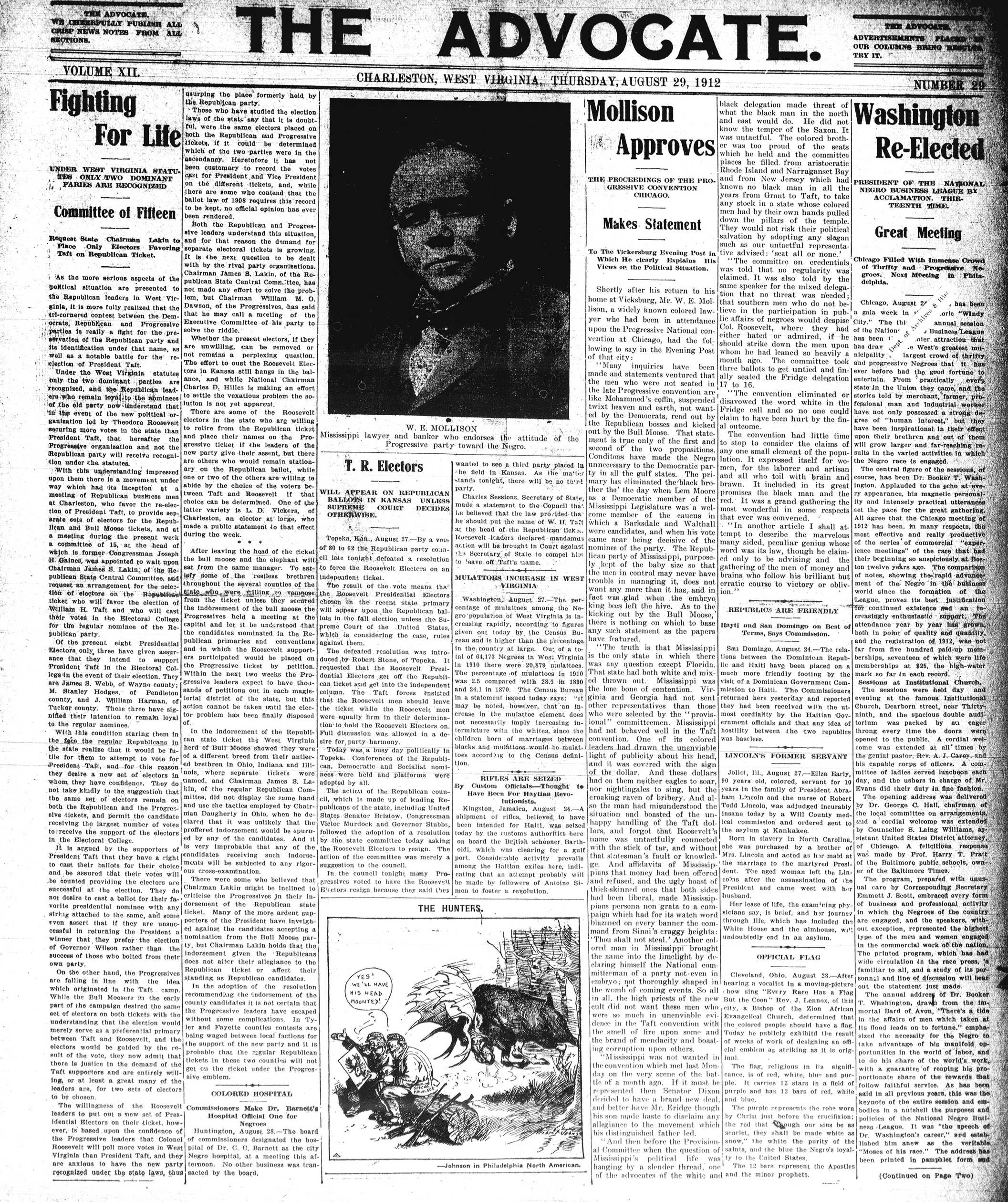
Page text (machine-generated)
THE ADVOCATE.
WE CHEERFULLY PUBLISH ALL
CRISP NEWS NOTES FROM ALL
SECTIONS.
VOLUME XII.
Fighting For Life
UNDER WEST VIRGINIA STATUS
TESS ONLY TWO DOMINANT
FARIES ARE RECOGNIZED
Committee of Fifteen
Request State Chairman Lakin to Place Only Electors Favoring Taft on Republican Ticket.
As the more serious aspects of the political situation are presented to the Republican leaders in West Virginia, it is more fully realized that the tri-cornered contest between the Democrats, Republican and Progressive parties is really a fight for the preservation of the Republican party and its identification under that name, as well as a notable battle for the re-election of President Taft.
Under the West Virginia statutes only the two dominant parliies are recognized, and the Republican leaders who remain loyal to the nominees of the old party now understand that in the event of the new political organization led by theodore Roosevelt securing more votes in the state than President Taft, that hereafter the Progressive organization and not the Republican party will receive recognition under the statutes.
With this understanding impressed upon them there is a movement under way which had its inception at a meeting of Republican business men at Charleston, who favor the re-election of President Taft, to provide separate sets of electors for the Republican and Bull Moose tickets, and at a meeting during the present week a committee of 15, at the head of which is former Congressman Joseph H. Gaines, was appointed to wait upon Chairman James S. Lakin, of the Republican State Central Committee, and request an arrangement for the selection of electors on the Republican ticket who will favor the election of William H. Taft and who will cast their votes in the Electoral College for the regular nominee of the Republican party.
Of the present eight Presidential Electors only three have given assurance that they intend to support President Taft in the Electoral College in the event of their election. They are James S. Webb, of Wayne county; M. Stanley Hodges, of Pendleton county, and J. William Harman, of Tucker county. These three have signified their intention to remain loyal to the regular nominee.
With this condition staring them in the face the regular Republicans in the state realize that it would be futile for them to attempt to vote for President Taft, and for this reason they desire a new set of electors in whom they have confidence. They do not take kindly to the suggestion that the same set of electors remain on both the Republican and the Progressive tickets, and permit the candidate receiving the largest number of votes to receive the support of the electors in the Electoral College.
It is argued by the supporters of President Taft that they have a right to cast their ballots for their choice and be assured that their votes will be counted providing the electors are successful at the election. They do not desire to cast a ballot for their favorite presidential nominee with any string attached to the same, and some even assert that if they are unsuccessful in returning the President a winner that they prefer the election of Governor Wilson rather than the success of those who bolted from their own party.
On the other hand, the Progressives are falling in line with the idea which originated in the Taft camp. While the Bull Moosers in the early part of the campaign desired the same set of electors on both tickets with the understanding that the election would merely serve as a preferential primary between Taft and Roosevelt, and the electors would be guided by the result of the vote, they now admit that there is Justice in the demand of the Taft supporters and are entirely willing, or at least a great many of the leaders are, for two sets of electors to be chosen.
The willingness of the Roosevelt leaders to put out a new set of Presidential Electors on their ticket, however, is based upon the confidence of the Progressive leaders that Colonel Roosevelt will poll more votes in West Virginia than President Taft, and they are anxious to have the new party recognized under the state laws, thus
THE
usurping the place formerly held by the Republican party. Those who have studied the election laws of the state say that it is doubtful, were the same electors placed on both the Republican and Progressive tickets, if it could be determined which of the two parties were in the ascendancy. Heretofore it has not been customary to record the votes cast for President and Vice President on the different tickets, and, while there are some who contend that the ballot law of 1908 requires this record to be kept, no official opinion has ever been rendered.
Both the Republican and Progressive leaders understand this situation, and for that reason the demand for separate electoral tickets is growing. It is the next question to be dealt with by the rival party organizations. Chairman James S. Lakin, of the Republican State Central Committee, has made any effort to solve the problem, but Chairman William M. O. Dawson, of the Progressives, has said that he may call a meeting of the Executive Committee of his party to solve the riddle.
Whether the present electors, if they are unwilling, can be removed or not remains a perplexing question. The effort to oust the Roosevelt Electors in Kansas still hangs in the balance, and while National Chairman Charles D. Hilles is making an effort to settle the vexatious problem the solution is not yet apparent.
There are some of the Roosevelt electors in the state who are willing to retire from the Republican ticket and place their names on the Progressive ticket if the leaders of the new party give their assent, but there are others who would remain stationary on the Republican ballot, while one or two of the others are willing to abide by the choice of the voters between Taft and Roosevelt if that choice can be determined. One of the latter variety is L. D. Vickers, of Charleston, an elector at large, who made a public statement to that effect during the week.
After leaving the head of the ticket the bull moose and the elephant will eat from the same manager. To satisfy some of the restless brethren throughout the several counties of the state who were killing to vampose from the ticket unless they secured the indorsement of the bull moose the Progressives held a meeting at the capital and let it be understood that the candidates nominated in the Republican primaries and conventions and in which the Roosevelt supporters participated would be placed on the Progressive ticket by petition. Within the next two weeks the Progressive leaders expect to have thousands of petitions out in each magisterial district of the state, but this action cannot be taken until the elector problem has been finally disposed of.
In the indorsement of the Republican state ticket the West Virginia herd of Bull Moose showed they were of a different breed from their anteried brethren in Ohio, Indiana and Illinois, where separate tickets were named, and Chairman James S. Lakin, of the regular Republican Committee, did not display the same hand and use the tactics employed by Chairman Daugherty in Ohio, when he declared that it was unlikely that the proffered indorsement would be spurned by any of the candidates. And it is very improbable that any of the candidates receiving such indorsements will be subjected to any rigorous cross-examination.
There were some who believed that Chairman Lakin might be inclined to criticise the Progressives in their indorsement of the Republican state ticket. Many of the more ardent supporters of the President have inveighed against the candidates accepting a nomination from the Bull Moose party, but Chairman Lakin holds that the Indorsement given the Republicans does not alter their allegiance to the Republican ticket or affect their standing as Republican candidates.
In the adoption of the resolution recommending the endorsement of the county candidates it is not certain that the Progressive leaders have escaped without some complications. In Tyler and Fayette counties contests are being waged between local factions for the support of the new party and it is probable that the regular Republican tickets in these two counties will not get on the ticket under the Progressive emblem.
COLORED HOSPITAL
Commissioners Make Dr. Barnett's Hospital Official One for Negroes
Huntington, August 28.—The board of commissioners designated the hospital of Dr. C. C. Barnett as the city Negro hospital, at a meeting this afternoon. No other business was transacted by the board.
CHARLESTON, W.
W. E. MOLL
Mississippi lawyer and banker w
Progressive part.
[Image of a man in a suit with a bow tie].
T. R. Electors
WILL APPEAR ON REPUBLICAN BALLOTS IN KANSAS UNLESS SUPREME COURT DECIDES OTHERWISE.
Topeka, Kan., August 27.—By a vote of 80 to 62 the Republican party council late tonight defeated a resolution to force the Roosevelt Electors on an independent ticket.
The result of the vote means that the Roosevelt Presidential Electors chosen in the recent state primary will appear upon the Republican ballots in the fall election unless the Supreme Court of the United States, which is considering the case, rules against them.
The defeated resolution was introduced by Robert Stone, of Topeka. It requested that the Roosevelt Presidential Electors get off the Republican ticket and get into the independent column. The Taft forces insisted that the Roosevelt men should leave the ticket while the Roosevelt men were equally firm in their determination to hold the Roosevelt Electors on. Full discussion was allowed in a desire for party harmony.
Today was a busy day politically In Topeka. Conferences of the Republican, Democratic and Socialist nominees were held and platforms were adopted by all.
The action of the Republican council, which is made up of leading Republicans of the state, including United States Senator Bristow, Congressman Victor Murdock and Governor Stubbs, followed the adoption of a resolution by the state committee today asking the Roosevelt Electors to resign. The action of the committee was merely a suggestion to the council.
In the council tonight many Progressives voted to have the Roosevelt Electors resign because they said they
YES!
WE'LL HAVE
HIS HEAD
MOUNTED!
THE HUNTERS.
YES! WE'LL HAVE HIS HEAD MOUNTED!
CHARLESTON, WEST VIRGINIA, THURSDAY, AUGUST 29, 1912
ADVOCATE.
wanted to see a third party placed in the field in Kansas. As the matter stands tonight, there will be no third party.
Charles Sessions, Secretary of State, made a statement to the Council that he believed that the law provided that he should put the name of W. H. Taft at the head of the Republican ticker. Goosevelt leaders declared mandamauction will be brought in Court against the Secretary of State to compel him to leave off Taft's name.
MULATTOES INCREASE IN WEST VIRGINIA
Washington, August 27. The percentage of mulattoes among the Negro population of West Virginia is increasing rapidly, according to figures given out today by the Census Bureau and is higher than the percentage in the country at large. Out of a total of 64,173 Negroes in West Virginia in 1910 there were 20,879 mulattoes. The percentage of mulattoes in 1910 was 2.5 compared with 28.3 in 1890 and 24.1 in 1870. The Census Bureau in a statement issued today says: "It may be noted, however, that an increase in the mulattoe element does not necessarily imply increasing intermixture with the whites, since the children born of marriages between blacks and mulattoes would be mulattoes according to the Census definition.
Kingston, Jamaica, August 24.—A shipment of rifles, believed to have been intended for Haiti, was seized today by the customs authorities here on board the British schooner Barth oldi, which was clearing for a gull port. Considerable activity prevails among the Haitian exiles here, indicating that an attempt probably will be made by followers of Antoine Simon to foster a revolution.
Mollison Approves
THE PROCEEDINGS OF THE PROGRESSIVE CONVENTION CHICAGO.
Makes Statement
To The Vickersburg Evening Post in Which He clearly Explains His Views or the Political Situation.
Shortly after his return to his home at Vicksburg, Mr. W. E. Mollison, a widely known colored lawyer who had been in attendance upon the Progressive National convention at Chicago, had the following to say in the Evening Post of that city:
"Many inquiries have been made and statements ventured that the men who were not seated in the late Progressive convention are like Mohammed's coffin, suspended twixt heaven and earth, not wanted by the Democrats, read out by the Republican bosses and kicked out by the Bull Moose. That statement is true only of the first and second of the two propositions. Conditions have made the Negro unnecessary to the Democratic party in all the gulf states. The primary has eliminated the black brother the' the day when Lem Moore as a Democratic member of the Mississippi Legislature was a welcome member of the caucus in which a Barksdale and Walthall were candidates, and when his vote came near being decisive of the nominee of the party. The Republican party of Mississippi, purposely kept of the baby size so that the men in control may never have trouble in managing it, does not want any more than it has, and in fact was glad when the embryo king bees left the hive. As to the kicking out by the Bull Moose, there is nothing on which to base any such statement as the papers have featured.
"The truth is that Mississippi is the only state in which there was any question except Florida. That state had both white and mixed thrown out. Mississippi was the lone bone of contention. Virginia and Georgia had not sent other representatives than those who were selected by the "provisional" committeemen. Mississippi had not behaved well in the Taft convention. One of its colored leaders had drawn the unenviable light of publicity about his head, and it was covered with the sign of the dollar. And these dollars had on them neither eagles to soar, nor nightingales to sing, but the croaking raven of bribery. And also the man had misunderstood the situation and boasted of the unhappy handling of the Taft dollars, and forgot that Roosevelt's name was untactfully connected with the stick of tar, and without that statesman's fault or knowledge. And idavids of Mississippi that money had been offered and refused, and the ugly boast of thick-skinned ones that both sides had been liberal, made Mississippi persona non grata to a campaign which had for its watch word blazoned on every banner the command from Sinai's craggy heights: 'Thou shalt not steal.' Another colored man in Mississippi brought the name into the limelight by declaring himself the National committee of a party not even in embryo; not thoroughly shaped in the womb of coming events. So all in all, the high priests of the new cult did not want these men who were so much in unenviable evidence in the Taft convention with the smell of fire upon some and the brand of mendacity and boasting corruption upon others.
"Mississippi was not wanted in the convention which met last Monday on the very scene of the battle of a month ago. If it must be represented then Senator Dixon decided to have a brand new deal, and better have Mr. Eridge though his son made haste to disclaim any allegiance to the movement which his distinguished father led.
"And then before the Provisional Committee when the question of Mississippi's political life was hanging by a slender thread, one of the advocates of the white and
black delegation made threat of what the black man in the north and east would do. He did not know the temper of the Saxon. It was untaftful. The colored brother was too proud of the seats which he held and the committee places he filled. from aristocratic Rhode Island and Narraganset Bay and from New Jersey which had known no black man in all the years from Grant to Taft, to take any stock in a state whose colored men had by their own hands pulled down the pillars of the temple. They would not risk their political salvation by adopting any slogan such as our untaftful representative advised: 'seat all or none.'
"The committee on credentials was told that no regularity was claimed. It was also told by the same speaker for the mixed delegation that no threat was needed; that southern men who do not believe in the participation in public affairs of negroes would despise Col. Roosevelt, where they had either hated or admired, if he should strike down the men upon whom he had leaned so heavily a month ago. The committee took three ballots to get untied and finally seated the Fridge delegation 17 to 16.
"The convention eliminated or disavowed the word white in the Fridge call and so no one could claim to have been hurt by the final outcome.
The convention had little time to stop to consider the claims of any one small element of the population. It expressed itself for women, for the laborer and artisan and all who toil with brain and brawn. It included in its great promises the black man and the red. It was a grand gathering the most wonderful in some respects that ever was convened.
"In another article I shall attempt to describe the marvelous many sided, peculiar genius whose word was its law, though he claimed only to be advising and the gathering of the men of money and brains who follow his brilliant but erratic course to victory or oblivion."
Hayt1 and San Domingo on Best o
Terms, Says Commission.
Sai Domingo, August 24.—The relations between the Dominican Republic and Haiti have been placed on a much more friendly footing by the visit of a Dominican Government Commission to Haiti. The Commissioners returned here yesterday and reported they had been received with the utmost cordiality by the Haitian Government officials and that any idea of hostility between the two republics was baseless.
LINCOLN'S FORMER SERVANT
Jollet, Ill., August 27.—Eliza Early, 90 years old, colored, servant for 10 years in the family of President Abraham Lincoln and the nurse of Robert Todd Lincoln, was adjudged incurably insane today by a Will County medical commission and ordered sent to the asylum at Kankakee. Born in slavery in North Carolina, she was purchased by a brother of Mrs. Lincoln and acted as her maid at the marriage to the martyred President. The aged woman left the Lincoln after the assassination of the President and came west with her husband. Her lease of life, the examining physicians say, is brief, and her journey through life, which has included the White House and the almhouse, will undoubtedly end in an asylum.
OFFICIAL FLAG
Cleveland, Ohio, August 23.—After hearing a vocalist in a moving-picture show sing "Every Race Has a Flag But the Coon" Rev. J. Lennox, of this city, a Bishop of the Zion African Evangelical Church, determined that the colored people should have a flag. Today he publicly exhibited the result of weeks of work of designing an official emblem as striking as it is original. The flag, religious in its significance, is of red, white, blue and purple. It carries 12 stars in a field of purple and has 12 bars of red, white and blue.
The purple represents the robe worn by Christ just before the crucifixion; the red that through our sins be as scarlet, they shall be made white as snow," the white the purity of the saluts, and the blue the Negro's loyalty to the United States.
The 12 bars represent the Apostles and the minor prophets.
Washington Re-Elected
PRESIDENT OF THE NATIONAL NEGRO BUSINESS LEAGUE BY ACOLAMATION. THIRTEENTH TIME.
Chicago Filled With Immense Crowd of Thrifty and Progressive Negroes. Next Meeting in Philadelphia.
Chicago, August 22 has been a gala week in horcic "Windy City." The third annual session of the Nation's Business League has been held in Dept. of inter attraction that has drawn West's greatest municipality, largest crowd of thrifty and progressive Negroes that it has ever before had the good fortune to entertain. From practically every state in the Union they came, and the stories told by merchant, farmer, professional man and industrial worker have not only possessed a strong degree of "human interest," but they have been inspirational in their effect upon their brethren and out of them will grow larger and far-reaching results in the varied activities in which the Negro race is engaged. The central figure of the sessions, of course, has been Dr. Booker T. Washington. Applauded to the echo at every appearance, his magnetic personality and intensely practical utterances set the pace for the great gathering. All agree that the Chicago meeting of 1912 has been, in many respects, the most effective and really productive of the series of commercial "experience meetings" of the race that had their beginning so auspicious at Boston twelve years ago. The comparison of notes, showing the rapid advancement of the Negro in the business world since the formation of the League, proves its best justification for continued existence and an increasingly enthusiastic support. The attendance year by year has grown, both in point of quality and quantity, and the registration of 1912, was not far from five hundred paid-up memberships, seventeen of which were life memberships at $25, the high-water mark so far in each record. Sessions at Institutional Church. The sessions were held day and evening at the famous Institutional Church, Dearborn street, near Thirty-ninth, and the spacious double auditorium was packed by an eager throng every time the doors were opened to the public. A cordial welcome was extended at all times by the genial pastor, Rev. A. J. Carey, and his capable corps of officers. A committee of ladies served luncheon each day, and the ushers in charge of Mr. Evans did their duty in fine fashion.
The opening address was delivered by Dr. George C. Hall, chairman of the local committee on arrangements, and a cordial welcome was extended by Counsellor S. Laing Williams, assistant United States District attorney, of Chicago. A felicitous response was made by Prof. Harry T. Pratt of the Baltimore public schools, owner of the Baltimore Times.
The program, prepared with unusual care by Corresponding Secretary Emmett J. Scott, embraced every form of business and professional activity in which the Negroes of the country are engaged, and the speakers, without exception, represented the highest type of the men and women engaged in the commercial work of the nation. The printed program, which has had wide circulation in the race press, a familiar to all, and a study of its personal and line of discussion will bear out the statement just made.
The annual address of Dr. Booker T. Washington, drawn from the immortal Bard of Avon, "There's a tide in the affairs of men which taken at its flood leads on to fortune," emphasized the necessity for the Negro to take advantage of his manifold opportunities in the world of labor, and to do his share of the world's work, with a guarantee of reaping his proportionate share of the rewards that follow faithful service. As has been said in all previous years, this was the keynote of the entire session and embodies in a nutshell the purposes and policies of the National Negro Business League. It was "the speech of Dr. Washington's career," and established him anew as the veritable "Moses of his race." The address has been printed in pamphlet form and
(Continued on Page Two)
CORRESPONDENCE
— ovR————.
Tee Cream Parlor
“STRANGERS AND TRAVELING PERSONS
BEST SODA WATER
ONLY 5 CTS.
OUR PLANS UP-TO-DATE
SERVICE IS OUR WATCHWORD
THE PEOPLES’ GROCERY CO.
WM. Hl. PARKER, Manager, j
RONCEVERTE
SsyMre. H. T. Moore attended the
‘Grand Council of I. of O. of St. Luke's.
Delegate J. M. Mallory returned
Thursday night from the Grand Coun-
cll of St. Luke.
H. T. Moore attended the Red
Men's Mceting in Fayetteville.
Mrs. E. C. Brown and Master Ken-
neth were visiting in the country
‘Thursday.
The Baptist Sunday School picnic
was largely attended in Montgomery's
Grove.
Wiss Bettie Williams has gone to
Virginia to visit her people.
John Washington, of this city, and
Miss Goare, of Spence Spring, were
auletly married Sunday might.
Miss Eva Calloway and brother An-
thony, of Beckley, are visiting their
aunt, Mrs. A, K. Dandridge.
Mr, Lawrence Haynes, Edward Ham-
‘Miton and Mrs, Howard attended the
Picnic Saturday a: Talcott.
-Mr. and Mrs, A. E. Sweeney are
visitors to Cincinnati this week.
E. W. Hester's mother, of Low Moor,
Va,, is visiting him this week.
Mrs. A. K. Dandridge is improving
rapidly afer two or three weeks of
dMness.
MONTGOMERY.
Prof. C. E, Mitchell, of Institute,
was the week-end guest of friends.
Rey. R. D. W. Meadotws, of Hunt-
‘ington, was a business visitor here
Saturday.
Mrs. H. H. Railey is spending the
week at Mt. Hope
Mrs. Belle Payne and Mrs, Rome
Jevkins, of Huntington, are here the
grests of friends.
Mrs. C. R, Pack and daughters, of
Institute, were here last week the
guests of Mrs. H. H. Railey.
Dr. B. F. White, of Huntimgton, was
looking after business interests here
Saturday.
T. H. Norman, of Washirgton, is
here on his annual visit.
Mrs, G. W. Carter, of Charleston,
spent Thursday here the guest of Mrs.
Railey.
O. T. Wilkerson, Jr., ‘and Roscoe
Clarkson, returned Sunday frem Blue-
field, where they attended teachers
institute.
Miss Lola M. Lavender is havimg an
‘eight-room cottage er-eted on her lot
by Lee & Son, of Huntington
Mrs. Warner Brown has returned
from-a visit to relatives in Virginia.
‘The Women's Improvement League
and Ladies Council, and trends, wi
take a boat ride down the Kanawhz
to Charleston, Thursday.
Mrs. Willa Washmgton entertained
with dinner Sunday Mr. and Mrs. P
H. Shepherd. Mr. and Mrs Francis
Shepherd, Mr. S. B. Morgan, Miss
Mayme Taylor and Miss Lizzie Wash.
ington.
CHARLESTON
Distinguished. Visitors Here.—
John Mitchell, Jr. of Richmond. Va.,
president of she Mechanics Savings
Bank and editor of the Richmond
Plauct..passed through the city ‘Tues-
day en route to Columbus, Ohio, where
he was one of the orators on Negro
Day—Wednesday—in connection wit
the Centennial celebration. Eighteen
years have passed since Mr, Mitchell
was last in Charleston, and he ex-
Pressed great amazement at the growth
of the city
Hotel Brown Arrivals Mr. and
Mrs. S. M. Jackson, Minden: Mr, and
Mrs. Cheatham, B. S. and M. Cheatam,
Pocahontas, Va.; Mrs, T. M, Dickens,
Bluefield; Mr. and Mrs, W. J. Napper.
Institute; F. Hancock. H. Lipscomb,
George Wells, Longacre: Mrs. Hilda
Hurt, Shrewsbury; Mrs, M. J. Allea,
Barnes, Marlinton; S. W. Mills, Bos.
ton, Mass; William Combs, Cincin-
nati, Ohio; Geo. Sullivan, Burwell;
W. H. Lee, Pittsburg, Pa.: Mrs. C.
Bumgardner, Glouster, 0.: B. F. John.
son, Widen; Mr, and Mrs. H. Sims.
Bramwell; A. Jones, Pt. Pleasant:
Lillian M. Neat, Pittsburgh, Pay 1
Rufus White, Hunting:on: Mrs. J. @.
Moward, CA. Jones, Cokumbus, O.;
i and Mrs. W. Moore. Norfolk, Va.;
Loving Smith. Anna Wilson, Colum-
bus, 0.; Clyde Perkins: Perey Cousias
Raymond City: Emma Bowles, Lay-
land: Mrs. Lila Cobbs, Faitmont:
Miss Maria Barton, Miss G, Holliday,
Gary: FP. R. Catlipp, Miss M. A, Mar.
tin, Gassaway, were registered at
Hotel Brown this week
" Visitor Surprised. —_pleasan’
“surprise” party was tendeFed Mrs,
Henry Leigh at the Baptic: parsonage.
Thursday evening of last week. Mrs.
Leigh, who resides at Spriagfeld, 0.,
is here visiting her parents, Rev, and
Mrs. BL R. Reed.
To Entertain Bride-Flect—Mrs. R.
W. Jennison gad Mrs, Jane Claire
will serve tea from 3:00 til 5:00 p,m.
Tuesday evening of next weex in hon-
or of the bedeelect Miss Cornetia
Davis. A number of her friends have
deen invited to meet Miss Davis on
tha: occasion at the home of Mrs
Claire, 1115 Piedmont stree:.
Mines: Compels Return Home.
Unless there is marked improvement
in the conditica of Mrs, J, A. Jack-
son, who has been ill the past tirve
weeks, she will be taken to her home
at Washington, D. C. for an opera-
tion at Freedmen’s hospital, She
will be accompanied by her husband
and sister, Miss Elfreda Kennedy, who
has been visiting here several weeks.
As soon as Mrs, Jackson's conditica
permits, Mr. Jackson will go to Char-
tes Town for the Fall term of the Su-
preme Court ef Appeals. for whici
‘te will act as assivtant clerk and
page.
Phice of Wedding Changed—Mr.
and Mrs. Thomas Davis announce that
the marriage of their daughter, Miss
Cornelia Fretia on September 4ih, to
Mr. William Henry Wright, which was
to have been solemnized at 509 Dick-
Inson street, will take place instead at
the same time and date at 22 Brad-
ford street. This change was made
necessary by unavoidable cireumstan-
ces.
Loyal Union's Public Meetine —\
general invitation has ben o.cated
by the Women’s Loyal Unina to cacir
public meting 49,,d¢peli, Monday st
ee nome oF ae ae Be di
ret ‘The program for the- oeca
ion has the following numbers: Song,
[Caion: seriprure reading, Rev. Baw.
Humbles:; Song, Union: recitation.
Miss Martha Harris; Solo, Mrs, Nora
[Caul; recitation, Mics Sellers; Solo.
E, J. Seales; recitation, Miss Maurice
frown: Solo, King Jackson: Union
senses Mrs Campbell, song Union.
Mrs. Dickinson Entertains. Mrs.
‘Fannie Dickinson, of Louisville, Ky.,
entertained Friday evening at the
Thome of her mother, Mrs. Coleman
‘Hammonds West Side. Her guests
were: Mesdames Moilie Mills, Nannic
Siraushter, Sarah Stevens. Clara R.
Jennings, Misses Flora Lec, Mina
Booker, Nannie Gallion. Eula Gatlion,
iMessts. King Jackson and Thomas
Parker,
| Baptist Church Notes. — The
Athenion Club met last Monday ¢ven-
ing with Miss Minnie Peters and Mrs.
/Meatow= on che South Side.
| The Tribe of Judah mecis this week
wit Rey. and Mrs, Ed. Humbles on
| A large number of ladies eave a de-
Hightful surprise at the parsonage last
‘Thursday evening in honor of Mrs
‘Henr! Leigh, of Springfield, Ohio
the Young Campaigners sill: meet
be Three New Pictures 5¢:
ee _ j
THE AIRDOME:
| Comfortable Seats. Plenty'of Room.
Your Patronage Solieliea
Each Picture is a First Run. ‘Never Shown in
woe _ Charleston Beforeeccsscesnms eer
At the church Friday evening at $:30
All parents are requested to have
their children join this movemen”
Every member of the W. CT. U. and
all leaders are urgently requested to
be present.
Rev. B, R, Reed is attending the W.
Va. Baptist State Convention at Beck-
ley this week,
Death Ends Sufferiag.—Afrer an
illness of several weelss, Mrs. Clara
Jarret: died Tuesday az tho home of
2er daughter, Mrs. Nettie Haekley.
Funeral services were held Wednes-
day at Simpsca Mo EL church, of
which she was a member. Besides
her daughter the decedent is survived
a grad daughter and seveial great
grandediidren,
Personals «nd Locals.
sev. &. F. Boston, editor of the W.
Va. Register, Huntington, was here
yesterday on busine ss.
Miss Stella James returned Tues-
lay evening from a ten dayes’ visit
with relatives at Cohimbus, Ohio.
Mrs. C. A. Williams and daughter,
who have been the hause guesis of
Miss Virginia Gilmer. returned “to
their home at Parkersburg, Monday.
| J.C, Gilmer was a business visitor
to Columbus, 0.. the first of the week.
Mr, and Mrs, R. W. Jammisoo hav.
purchased and moved into a residence
on the South Side.
Mrs. Daniel Piper has returned to
her home at Wheeling after a pleas-
ant visit here with her parents, Rev.
and Mrs. R, R, Downs.
Mrs, F. H. Huskins left Monday for
a visit to her mother at ‘Alderson.
An in-door picnic was given, Friday
evening of last week, by Mrs. F. H.
Huskins at her home on Summers
street, complimentary :o Mrs. Henry
Leigh.
Miss, Marg, Williams Ieaves Satur-
Was Tor Keie where EWN open her
School next week.
F. W. Bryant visited friends at
Ironion, O., Sunday.
Mrs. S, D, Cowser and Mrs. Viola
Wright spent Saturday and Sunday #
St. Albans.
Mrs. Lillian Neal, of Wheeling,
spent the first of th. week here vis-
iting her mother
Presiding elder, Rev. R. R. Downs
will preach Sunday at both services
at St. Paul A. M. EL church, when the
exercises of the last quarterly me:t-
ing will be held.
Mrs. John Land and Mrs. Julius
Thomas entertained the Ad Society
of the A. M. E. church at their home
‘on Donnaily street Friday evening,
Phil Waters, assistant clerk of the
Supreme Court of Appeals, spent Swa-
day in Washington, D. C.
Mrs. Fannie DeHonney is spending
three weeks in Cincinnati, O she left
the city Wednesday
Mrs, Thos, Whittaker has revurned
from a week's visit to Columbus, O.
Edward 0, Fulks was in Thurmond
a few days last week on business.
Misses Alice Whittaker and Miss Ju-
lia Dorsey returned Saturday from
a two week vacation In Unio.
J.C. Gilmer leaves Saturday for
New York City in response to an in-
vitation from the Progress!ve Nation-
al headquar‘er:
Miss Gertrude Campbell is home
from a pleasant visit to diends at
Laneca:ter, Ohio.
Mrs. Henry Parker has returned
from Atlantic City where she spent
several weeks
Mr Alene Bibb, of Clifien Forge,
ffs in the city for a short stay, visit-
ing hor rations and friends. She 16
stopping at Mrs. Grays, Wrshingion
Washington Re-Flected
(Continued from Page One)
will be civen a nation-wide cireula-
Mr. Rosenwald's Hearty Reception.
‘The League's special guest of the
series was Mr. Julius Rosenwald, the
renowned merebant prince and
Phianthrop'=t, a member of the firm
of Sears, Roebuck & Co., who has be-
come famons the world over because
of S open-handed generosity of lib
ral gifts (oe the building funds of the
colored ¥. M. C. Association of the
counry, He spoke on ‘Thursday
Mr. Rosenwald took an cptimistic
viow of the future of the Negro peo-
ple and found infinite satisfaction in
THE ADVOGATE.
———————=_
PYeery at oor,
Plenty of Room.
ly shbeei dis.)
rage Solicited
Neves Been
t Run. .Never ‘Shown in
ON BELO Cm ecsscestms shone:
LoS
0 Ino study of the ‘progres: of the col-
die car eee ee
|ttai and economic: success, ‘rising 10
forty-nine years from absolute poverty
I:0 the possession of millions of dol-
j!27s in property amd presenting a pop-
j:tatioa of ten milifons, sixty-eight per
jcent of whont ean read axtd write—a
jMeveiopment that reads Uke a ro
inde. Mr, Rosenwati’s ptain, bus-
iness-Hke talk brought down the
Mouse, and his lessons of life, pointing
out that only through honest straight-
Horward methods’ and rigid habits of
punctuality, loyalty to employer and
fidelity to patrons, can a permanent
ousiness or other career be builé wn,
was received with enthusiastic approv-
al
“It pays to be aonest,” declared Mr.
Rosenwald. “Give an honest dollar's
st of service for every dollar re-
ceived and your success ts assured.
‘Be of service to someone “lee—aire
Yourself for the good of mankind and
you will be happy. Determination,
hard work, keeping cyerlastimgly at!
i—these bring realiza‘ion to wha‘|
seems a dream. Victory will come to
the Negro. as it comes to every other
people, through the struggies wrll
fought out—bringing triumph as the:
tegitimate outcome of well-direc:ed in-
Hence and sterling worth. The ae
10 is growing stronger because he has
learned the lesson that color counts
for little if merit is behind the man,
‘The worid little cares who does its
work, but it wants that work done in
the very best way.”,
Ho lauded the work Dr. Washington
is doing at Tuskege> Instizute and
hailed him as a true leader of a great
people, :
Hundreds of miniature American
flags were waved by the audience as
Mr. Rosenwald was introduced to speak
and the demonstration wag repeated at
the close of his helpful address,
Many Notable Addresses.
Among the many notable addresses
delivered before the convention were
thoze delivered by Bishop J. B, Scott
of the M. E, Chureh, who told of the
splendid opportunities for investmeat
of our people ia Liberia and Wes'era
Africa; Isaiah T. Montgomery, de-
scribing the founding of the Negro
iown of we Miss.; Major Join R.
Lynch &f ihe United States Army:,
Rev. M. C. B. Mason, of th: Freed-
men’s Bureau of the Methodist Epts-
copal Chureh, and Prof. R. 'T. Greener,
former consul to Viadivostok, Russia.
Reports of program speakers. will
appear later.
Inspiring Musica Features.
| An inspiring ature of the “Rosen-
wald evening” was the musical selec-
ose rendered by the Williams Jubi-
ee Singers, who have eatertaind roy-
aity on several continents. Led by
Mr. Charle8 P. Williams, these — six
singers rend red “Suwanee River” and
kindred foik-songs in a manner that
delighted the immense audience and
evoked the warm-st approval of Mz.
Rosenwald and his party. OtMers who
assisted advantageously in ‘he musi-
cal diversions of the Business League
[week were Mrs, Martha Broadus An-
derson, soprano soloist par excel-
Jenee; Miss St. Clair White, a finish-
ed violinist, accompanied by Mr. Alex-
ander C. Taylor: “Tuskegee Club" of
Chicago, mad: up of graduates of Tus-
kegee Institute: the Ladies’ Band ef
Chicago. and Mme. Anita Patti Brown,
styled the “Broaze Tetrazzini.” who
has jnst returned from a triumphal
tour of Jamaica and the Central
America states.
Next Meeting at Phiadelphia.
Endorsing the action of the execu-
tive committee of the League, the
hex! meeting of the organization will
be held in Philadelphia in August of
1912, where will also be celcbrated
the fiftieth aniversary of the emanci-
pation of the American Negro. Al-
ready Persusylvania has appropriated |
$20,000 to assist the race in making
this observance a success, and the
neighboring state of New Jersey is
supplementing the fund with a simi-
Jar amount. |
The rAport of the committer on res-
olutions throngh R. L. Smith, of
Texas, Weclaring for, higher race
ideals and a stronger effort io make
an honorable place for the people in
commerce and the industries, was
imei (aMaee ae tee pred ita
the work of the organisation. .- _ 5
DF, Washington Re-elected, Presi<
| dent by Acclamation, © |
For the thirteenth time Dr. ‘Booker
|r. Washington has been chosen pres:
ident of the National Negro’ Business
HLeague. On motion of Counsetior J.
[Madison Vance of Louisiana, second,
ed by Dr. B.C. Morris of Arkansas,
|president of the "National Baptiat
Convention for eighteen years, ‘with
praise *choes by eloquent speakers
‘trom Meiigiaes, the ‘rales. were, sus-
penile”! Dr. Washipgtoy was re,
elected:atald the heartiest ‘Bemcustrh.
tion of the week. It was a striking
‘thd sigaificant recognition of his
power as a leadér and a testimonial
‘that the entire race fs at his back in
‘the’elforts hevis making to-uplift his
People. The other officers'elected are:
‘First vice-president, Charles Banks,
atetecinen second ‘vice-president, J.
,E. Bush, Arkansas; third ‘ vice-pres}-
Jdent, Dr. SG. Elbert, Delaware;
fourth ~vice-president, Harry T. Pratt,
{Marsiand: fifth vice-president, John
/M. Wright, Kensas? corresponding
secrévary, Emmett J. Scott, Tuskegeo
Institute, Alabama: treasurer, Charles
H. Anderson, Florida; registrar, F. H.
Gilberf, New York; assistant registrar,
R, C. Houston, Texas; transportation
agent, Dr, A.B. Jackson, Pennsylva-
nia;“oMcial stenographer, W. H. 'Dav-
f Washington, D. C., and compiler, 8.
talus Williams, ‘Minors. Members of
the executive committee: J. C. Na-
ier, Nashville, Tenn., chairman; Dr.
'S. E. Courtney, Massachusetts; W. T.
Andrews, South Caroliaa; Dr. Sum-
ner A. Furniss, Indiana; J. B. Bell,
Texas; M. M. Lewey, Florida; J. C.
Jackson, Kentucky; Rey. R. E. Jones,
Louisiana; Walter P. Hall, Pennsyl-
vania; Seipio A. Jones, Arkansas;
H. Haynes, Tennesses; Dr. G. C. Hall,
Mlinois; T. J. Elliott, Oklahoma, and
W. C. Gordon, Missourt.
Affiliated Bodies Hold Interesting
Mectings.
The National Association of Funer=|
al Direstors, an aifiliated body of the
National Negro Business League, held
the most profitable session in the six
years of its history. Officers were
elected as follows: President, G. W.
Franklin, Tennessee; vice-presidents,
J. B. Cooper, Kentucky, and Mrs. Sa-
rah Johnson, Illinois; secretary, J. N.
Shelton, Indiana; treasurer, Mrs:
Daisy M. Saffell, Kentucky. Modern
methods of handling funerals and im-
provement of equipment were discuss-
ed, and it was found that the Negro
undertakérs are doing the buik of the|
work among the Negroes of the na-
tion. :
The National Negro \Pre:s_ Assocla-
tion held the most harmonious and
really ‘helpful meeting of its four
years of life, and took high ground ov
the service the press of the race is to
perform for Mts constituency. R. ;W.
Thompson, of Washington, D. C., was
elected to succeed M. M. Lewey, of
Florida, a return (o the chair after
two years. ‘The vice-president is Jo-
sepsh L. Jones, Ohio; corresponding
secretary, Henry Allen Boyd, Tennes-
see; recording secretary, Charles Sum-
ner Smith, Minnesota: treasurer, John
L. Thompson, Jowa; chairman of the
executive committee, N. B. Dodson,
New York City. A member, of the
executive committee from eaéh state
was provided for. The attendanee was
large and enthusiastic, over fifty pa-
pers being represented by men of in-
fluence and standing. '
Mr. J. T. Setile, of Memphis, Tenn.,
was reelected president of the National
Bar Association, and delivered an able
address oa the relation of the lawyer
‘to the business interests of the race.
| The National Association of Negro
Bankers, to which was given the
‘morning session of Friday, elected the
following officers: President, W. R.
Pettiford, Alabama; _vice2presidents,
W. W. Cox, Micsissippi, and Rev. E.
M. Griggs, Texas; recording secretary,
S. S. Brown, Tenn:ssee; correspond-
ing secretary, C. N. Langsien,
nessee; (reasurer, T. H. Haynes, Ten-
nessee. An important social funetton
of tie week was the magnificent ban-
quet at the Patmer House, tendered by
W. D. Neighbors, cashier of the Amer-
ican Bank of Chicago, in honor of the
members of the National Negro
Bankers’ Association. Mr, Neighbors
IN UWAY
|
as Summers St. , ‘Phone 790
Charleston, W. Va.
DO YOU PAY CASH
FOR YOUR SHOES?
| We sell fer colh tdhr entooe topes ‘ae a sales,
DIAMOND SHOE STORE
215 CAPITOL ST. |
| Fhe Bungalo Store <se» - Nex door to: “Colonial”,
third Session, June 17th, to July 26th, 1912, Institwte, W. Va.
Two Distinet departments will be maintained: 1. The Aea-
demic, which will be devoted to thorough work on the branches of
the school course, for which credit may be had in the various insti-
tutions. Also in this connection thorough drill classes for persons
expecting to pass the examinations will be maintained. 2. The
Professional, which is designed for principals, high school teachers,
and other advanced students. Some of the bést talent in the
country has-been seeurd for this scliool Three of the most_dis-
tinguished educators in this country have accepted places "on ‘the
Summer School Faculty, viz: KELLY MILLER, A. M., W. B.
B. Du BOIS, Ph. D., BOOKER WASHINGTON, LL.D.
This is to be the Biggest and Best School Yet. Prepare now to
enroll. For particulars address: Byrd Prillerman, Institute, W.
Va., R. P. Sims, Bluefild, W. Va.; If. T. MeDonald, Harper's
Ferry, W. Va.; or M. P. Shawkey, Charleston, W. Va. |
I os
CROWN AND BkIDGE WORK A SPECIALTY >
HOURS: 8:30 A. M. to 1:30 P. 1., 2:00 to 6:00-P. M,
Dr. JAMES B. BROWN
Dental Surgeon
Office: Room 1, K. of P. Bidg. Home Phone'429 |
HENRY T. M'DONALD, N.C. BRACKETT,
President. . Treasurer.
Harper’s Ferry, W. Va.
Founded fn 1867
More than 409 men and women have craduated here, The oldest schoot
in the state for Colored students. Magnifiecnt location. Elevation — high.
Remarkably healthful. Ample buildings. THREE NEW BUILDINGS BR-
ING ADDED TO OUR PLAN? THIS YEAR. The regular faculty of six-
teen highly educated, earnes: teachers docs not iuclude assistants.
Our Library catalogued according to the 1D. wey System, is one of tie
largest In the State. .
FIRST GRADE CERTHACATES ARE GRANTED TO THOSE MEM.
BEYS OF THE GRADUATING CLASSES WHO A RE RECOMMENDED TO
‘THE STATE BOARD OF EDUCATICN. Storer is interdenominational in
its faenity and student body. Its whole influence is. toward Christian liv-
ing. Literary Societies, Christian Organizations, Musical Clubs, ands and
Sane Athletics,
COURSES: Academic, State Normal, Indusirial, Music,
For illustrated catalogue and otter printed matter write to
The President.
oer dy “Mrs. George ©. Hall;
Mrs. Washington was escorted by Dri
\G. C. Hall, and prominent in the res
ceiving line were Registrar and Mri.
J. C. Napter,'Mr. and Mrs. S. Laing
Witiams and others.
“All things ‘considered, Chicago out-
did hore:}t in making the convention
of 1912 a glitteryag success, and its|
influence will be of lasting beneft to
tie commercial well-beiig of the race.
Tt was the best of the long series and
will b> memorable for'the good that|
was accomplished: aad for the ideals it
has so firmly established:
“R. W."THOMPSON.
ee NN
MORRIS RESIGNS MEMMERSHIP,
™ the American Bar Association“on
» Account of Opposition Bascht
Upon His Cotor. s
Milwaukee, August 28.—The race
question again came up before the
A AUST
American ‘Bar’ Association today,
William R. Morris, of Minnyanolls,!one
of the three Negro lawyers who had
been unseated by the Bxeeutive Cqm-
mittee and this ruling reversed by the
assoolation; sent a telegram annowhe-
Ing Ris resignation, “caying It was
based on “an entirely’ ansélfish cou-
sideration of the best ‘interests of the
association.”
On motion of Joseph: 'Meraill, Zot
Thomasville, Ga., the restgnation was
accepted. * f =
“am opporsd to the admission of
Negroes to this organization,’ eaid Mr.
Merri; “but I want to express appre=
ciation Of his dignified attitude in re-
signing.”
» Mr. Morris was one of three Negro
members who had, been unseatdd “by
the Executive ‘Committee’ bécause . of
their race. One’ 6f the* othets was
William H. Lewis an assistant United
Swates Attorney-General.
ee ee
Best Bottled in Bond Whisk
Money Can Buy.
Old Moorman, per quart,........$1.00; per pint ............300: per 1-2 pint 2.....5........25¢
Cove Spring, per quart.......... 90; per pint.............50e: per 1-2 pint: .......2......25¢
Black and Green, per quart...... 95: per pint. ............500; per 1-2 pint 2.20 00002......25¢
Old Charter, per quart.......... 1.15; per pint ....0.......600; per 1-2 pint ...............3060
Sunny Brook, per quart.........-1.00; per. pint seeeeeees+-60¢; per 1-2 pint ..............300
Whiskies in Wood, N B
ISKIe€s In ood, one Detter
Old 88, 10 years old, per gal... ..$4.00; per quart...........$1.00; pint 50e; per 1-2 pint......25¢
Mellwood, per gal............... 3.50; per quart ......... 90; pint 50e; per 1-2 pint......25¢
Silver Spring, -per gal........... 3.00; per quart ......... 73; pint 40c¢; per 1-2 pint......20e
Old Home, per gal.............. 3.00; per quart .......... 75: pint 40e; per 1-2 pint......40¢
Wi B nm the Mark
ines, Dest on the Market
Sherry, per gallon,..............$2.00; per quart seteeeeeee M005 per pint 22.0202. ..2.. 22. 250.
Port, per gallon ................ 2.00; per quart ceeeeee eee. M005 per pinto... 0.2.2... 250
Blackberry, per gallon.......... 2.00; per quart teeeeeeess A003 per pint 2.2.02... 250,
Small Bottles of Beer, per doz... .75e; Large Bottles of Beer per doz.............$1.25
J. D. Garten & Company
MORRIS STARK, Manager .
DBipre © _ WW Oe a Fn eg oe ry ee
THURSDAX, AUGUST 20, 1912.
STORER COLLEGE
The prospects for a large enroll-
ment this coming month are good.
The Myrtle Hall girls will be glad to
find new hard pine floors “in their
rooms,
Prof. Winters and his student help-
ers are smiling over the fine returns
from the college gardens.” While the
éummer stason has been rather dull
here until this math, there has been.
as ever a regular demand for the
fresh, first class products of tne school
gardens,
Preparations ahe under way look-
ing toward the filling with ensilage
the 65-ton college Silo. Its use last
year when feed for stock was so ex-
pensive was most satisfactory.
Myrtle Hall is being managed again
as a summer boarding house. Miss
Smith is conducting it wita efficiency
and general satisfaction.
Miss Mabel Young is spetiding her
vacation in Boston and is making ex-
cellent use of her time attending the
summer school of gymnastics at Har-
vard University,
While the college is sorry to lose the
fervices of Miss Horton, music teach-
er, it is especially fortunate in secuz-
ing the services of Miss Venitta Duad-
geva, who receivcd her musical edu-
cation at the London, Ontario Conser-
vatory of Music, Miss Dudgeon will
offer courses in piano, voice and pipe
organ and in addition will give in-
struction on the violin and harp, Miss
Dudgeon comes very highly recom-
mended as a ‘aighly culture! aud ac-
complished musician and will doubt-
less add to the good foundation
in music already laid here.
Another teacher has beer added to
the faculty for this coming year. Her
name is Miss Harriett D. Church. She
is a Bates College graduate with teach-
ing experience. For a number of years
she taught in New Orleans University,
one of the leading schools fur colored
youth in the far South. Her specialty
is Latin. She comes as teacher of
that Iwaguage. Storer now has thir-
teen teachers giving their entire time
to academic and normal instruction—
& number practically equal to all 80
employed in both the other institu-
tions,
With special teachers in English, in
Latin, in German, in French, in
scieace, in history, in normal train-
ing. in mathematics—and all excel-
Jentlygqualified for the work they do,
Storer is now fitted to give the most
efficient instruction in her entire his-
tory.
Miss Mabel 8. Brady, preceptress of
Bluefield Institute, is spending her va-
cation at her home in Harper's Fer-
ry.
Mrs. Lois Evans Bird of Canandai-
gua, N. Y., is spending the summer at
her home with her pareats, Mr. and
Mrs. W. R. Evans, Bolivar.
The college hasbeen able to do the
town of Harper's Ferry a good tura
this summer by furnishing it water
for the building of the new High
‘School Building. The new water sup-
ply of the collge is thus serving the
Jinstituvion and the public as ‘well,
“Pap” Trinkle smiles these days
when the soldiers are here and says
less about selling out to the first bid-
der,
‘The presence of more than a thou-
sead militiamen from the District of
|Columbia-for-fifteen days has served
to recall to the old timers cther days
men soldiering was a real and serious
matter,
President MéDonald left some time
ago for Boston where he will spend
August with Mrs. McDonald and their
[little girls, Their house is occupied
he Capt. Smith, U. S.A. and family
this summer,
Jacksou Cottage is occupied by the
am of Asst. Librarian of Congress
Murry, Sinclair Cottage is oceupied
J by Prof. Montgomery and family, of
Washington,
MULATTIOES
Washington, August 27.—The pro-
Portion of mulattoes to the total Ne-
&°0 population is decreasing in Ohio
and Indiana and increasing ia Ken-
tucky and West Virginia, according
{o a report made today by the Cen-
sus Bureau, based on the thirteenth
decennial census.
The report shows trat in Ohio the
percentage of mulattoes to total Ne-
&ro population in 1910 was 25.2, as
against 42.5 1 1890 and 282 in 1879.
There were 111,452 full-blooded Ne-
groes and 39,249 mulattocs 'n Ohio tn
1910. In 1890 there were 87,113 Ne-
groes and 37,035 mulattoes, and in
1870 there were 63,213 Negroes and
17,839 mulattoes.
In 1910 the per cent of mulattoes
to total Negro population in Indiana
was 24.1, as compared with 30.2 in
1890 and 28.6 in 1870, There were
60,202 Negroes and 14,553 mulattoes in
Tadiana in 1910. In 1890 there were
45,215 Negroes and 13,658 mulattoes
in that state. This was’ a marked in-
crease over 1870, when there were 24-
560 Negroes and 7,012 mulattoes.
The bulletin announces that Ken-
tucky's Negro population, as shown
by the 1910 census, is 261,656, and
that there are 65,943 mulattoes in the
Blue Grass State. The total Negro
population of Kentucky has fallen off
since 1890, but there has been a gaia
in the number of mulattoes.
There were 64,171 Negroes within
the borders of West Virginia ‘in 1200,
as shown by the report given out to-
day. In addition there were 20,879
mulattoes. In West Virginia the Ne-
gro population nearly doubled and the
mulattoes more than doubled between
1890 and 1900,
The Census Bureau admits that its
statistics as to mulattoes are of ques-
ticaable reliability, because, in the na-
ture of things, in enumerating mulat-
toes the enumerator’s own eyes and
judgment must be his guide, but the
opinion is expressed that in the main
the statisties are accurate.
‘The total Negro population is placed
at 9,827,763. Of this number 2,050,-
686 are set down as mula:toes. The
Negro population in 1870 was 4,880,-
000, with 584,049 mutatioes. The per-
centage of mulattoes in 1870 was 12
per cent of the whole, while 2a the
census of 1910 it is set down as prac-
Ucally 21 per c:nt.
The greater increase has been in the
Northern States. Tis, it is Pointed
out. is not necessarily because of in-
termarriage between whites and Ne-
groes, but due to the natural increase
that would come of the marriage of
full-blooded Negroes to mulattoes,
whose children are mulattoes_
| ANNUAL ELECTION
Of Negro Elks Opens at Dayton—
‘ Ratde for Name Begun.
| Dayton, Ohio, August 27.—The thir-
teenth annual session of the Negro
Order of Elks of the world was begun
here today, with about 400 delegates
jaa attendance. The first session was
called to order by Grand Exalted Ru-
Jer Harry H. Pace, of Memphis. Tenn.,
George E. Bates, of Jersey City, N. J.,
serving as cecretary.
Already several cities have inaugu-
rated a campaign to capture the con-
vention next year, among the most
formidable being Atlantic City anid
Indianapolis,
Considerable indignation was ox
pressed wha the members were tr
formed that the white Elks had in-
stituted suit to enjoin them from 1.
use of the name “Elks.”"
Judge Morris stated that jt had berit
his purpose to propose that the nance
“Elks” be dropped by their order, and
that some other name be substitute !,
but that the action of the white Elkx
made i. impossible for the order to
consid<«r any such action.
Give a Guess.
If the Lord loveth a cheerful giver
ve wonder what his opinion is of the
berd loser,
THE ADVOOATE. 7 C 3 ow
eon
SPEECHES TO BE TAKEN , ———
BY THE wrroanarvon ROBE
Instrument Similar to Dictograph to |
Be Put te Nove! Use. |
No stenographers will be needed when
@elegates to the elghth International
congress of applied chemistry, which is
to meet in New York Sept 6 to 13,
read thelr papers in four languages.
‘The place of the shorthand writers is
to be taken by dictograph, hitherto
heard of for the most part in connec-
tion with the detection of crime, now
to have Its christening as the hand-
maid of science. Strictly speaking, It
1s a kind of cousin of the dictograph,
4 micrographone, that will be em-
ployed.
No delegate to the congress will be
permitted to speak from the floor.
Whoever bas anything to say must
mount the rostrum and stand under
the apparatus, so that hls words may
be recorded on a phonograph cylinder.
This will be the first trial of the in-
strument in circumstances of this kind.
If the machine works as it is expected
to it will furnish a perfectly saccurate
record of the. proceedings of the con-
gress in the four official Iauguages—
English, French, German and Italian.
CHANGE THE MONTH STONES.
Jewelers Want More Expensive Gems
Than the, Ancient Rule Gave.
To soothe the quite understandable
resentment of young women born in
those months of the year that are tra-
ditionally represented by cheap and
not very attractive birthstones the
American Retail Jewelers’ association
at its session in Kansas City has decid-
ed to make a complete change in the
Ust of jewels that have, by time hon-
ored tradition, been considered the
birthstones for the various months of
the year.
Protests against the ancient and ac-
cepted lists have become so numerous
in this Jewelry Ioving age that the Jew-
elers, catering to the desires of the
young women (and old women) whose
longings have ever been transplanted
in terms of dollars and cents in the
Jewelry shops, have decreed the list of
birthstones hereafter as ‘follows:
January—Garnet.
February—Amethyst.
March—Bloodstone and aquamarine.
April_Diamond.
May—Emerald.
‘June—Pearl and moonstone.
July—Ruby. .
August—Sardonyx and peridot.
Beptember—Sapphire. :
October—Opal and tourmaline.
November—Topaz.
December—Turquots and lapts Jazult.
TAKES SERMON AND REPENTS.
Woman Made Penitent by Manuscript
In Clergyman’s Suit Case.
After reading the manuscript of a
sermon she found in a suit case she had
stolen a young woman tried to make
restitution. The Rev. Hugh Charles
McBride, pastor of the Disston Me-
morial Presbyterian chureh, in a Phila-
delphia suburb, owns the case, which
contained a sermon entitled “Right
and Wrong.”
Recently Mr. McBride received a let-
ter signed “Heartbroken Young Wo-
man.” The writer eonfessed she had
stolen the case. She said she had read
the sermon and ker coriscience trou-
bled her. She tried to send it to At-
lantie City, where the clergyman is
staying for the summer, but found It
would cost more money than she had.
She then pawned two razors and with
the money put the case in a storage
house.
it 1s safe to say she will never steal
another sermon.
WRITES BOOK WITH FOOT.
Unable to Use Hands, Girl Operates
Typewriter With Toes.
‘Three years ago Miss Epbie Gladys
Virtue of St. Paul, Minn., now aged
twenty-four years, but a physical
dwarf since childhood, started to write
4 book. She labored at it many hours
a day, revising and revising. Recently
it eame from the press—a neat volume
of 175 pages—and she is happy.
When three months old Miss Virtue
was stricken with spinal meningitis.
Grown to womanhood now, her mental
strength Is marvelous, but she cannot
use her hands.
Every word of the book was written
on a typewriter by the use of one foot.
Holding a pencil between her toes, she
clicked off the thousands of words,
striking the keyboard with the pencil
and paying little attention to fatigue.
‘Three times did she rewrite the entire
manuscript before she was satisfied.
A MUMMY 18 INCHES TALL.
One of That Height Found In Now
Mexico Cliff Dwellinas. |
An ancient mummy eighteen inches
high, in @ good state of preservation,
has been found at the cliff dwellings
on the upper Gila, near Stiver City,
N. M, and instructions have been re-
celved to forward it to the Smithsonian
Institution at Washington.
Careful examination shows indis-
putable evidence and confirms the idea
of many scientists that the old cliff
men were a dwarf race,
‘The moat striking feature of their
dwellings was very small doorways and
extremely low ceilings.
Baby Weighed Eighteen Pounds.
“Mother and baby are doing fine,”
was the information given out from
the home of Mrs, Antone Crosso of
Grand Junction, Colo., who gave birth
to a boy whose weight was just one-
fifth of that of the mother. Mrs. Cros-
80 weighs ninety pounds, while the
Weight of the child is eighteen pounds,
Matter of Possession,
Anything which you have which you
oan’t get along without—hag you,
ROBERTS & AULTZ
DEALERS IN ’
Pare Whiskles, Wines, Gins, Braudies, Beer, Gigars & Tobacco
LUNCH COUNTER IN CONNECTION
Phone 1705 508 Kanawha St.
4 CHARLESTON, W. Va.
AT THE BURLEW EVERY NIGHT
LATEST MOVING PICTURES
BALCONY RESERVED FOR COLORED PEOPLE
Se. ALL SEATS | 5¢.
- 7-11 P. M.
If you are working and saving your money and putting it in a bank where you get no interest, keeping i
in a trunk or hiding it some where about your house—You Are Working for Money.
If you are working and saving your money and investing it in a safe way, where it will be working day and -
night whether you are working or not, and making you at least six per cent. interest—Your Money is Working
For You
The Pythian Mutual Investment Association was organized in order to give us an opoprtunity to put the
money we could save together and then put it to work. The above is a picture of our building on the Capitol
Square in Charleston. We have just purchased a splendid three story brick building on one of the mai bus)
iness streets in the city of Huntington. The first door fs occupied by the Huntington Herald, the largest daily.
Newspaper published in that section of ‘he state, the second floor is used for office rooms, while the third floor.
is a large assembly and lodge hall. This building Is sure to pay us well. After the Charleston building had
been occupied only eight months our stockholders were paid a dividend of six per cent, ag
Stock is still on sale at $10.00 per share, either paid up or on the installment plan. Ask your agent in your
locality about it or write to this office. z
| LET YOUR MONEY WORK FOR YOU—|
PYTHIAN MUTUAL INVESTMENT
SON ASOT WESTON, W. VA
. What a Man Is Made Of.
‘The average man has “Ingredients’
to make fat for seven bars of soap
tron for a medium-sized nail, sugar tc
AN a small bowl, salt to fill a shaker
lime to whitewash .a chicken coop.
phosphorus to make 2,200 match tips.
magnesium for a dose of magnesia,
sodium to neutralize a pint and « half
of water, potassium to explode a toy
cannon, sulphur to rid a dog of fleas,
and albuminoids to make a case of
eggs.—Leslie’s Weekly.
relgueasis
* Advocates Leaves of Soap.
A chemical friend of the Scientific
American suggests that a campaign be
Started against the common cake of
woap. About 50 years ago there was
wold a form of soap for travelers, con:
sisting of a booklet, about two inches
by four inches, in which small leaves
of soap paper saturated with soap
were bound. Each leaf contained
enough soap for one washing of the
hands. It is suggested that one might
profitably dispense, through a penny-
In-the-slot machine, a paper towel ip
which is Zolded a sheet of svap paper,
for convenient use in public lava.
tories.
——_-++-__.
in een Bak:
‘The production of gas from peat
having a low water content (up to
about 20 per cent.) for use in suction
gas (sauggas) engines has already
met with success in Germany, but for
a number of years efforts have been
made to utilize peat with a water con-
tent as high as 50 to 60 per cent. and
ths eliminate the costly process of
ury'ng the raw material,
——_+-___
Speak Kindly.
If In our speech we would only con:
elder how our words will affect those
to whom they are spoken—if we would
try to hear them with their ears and
consider how they affect hearts, there
would not be much passionate or tn-
advised speech; certainly there would
be few spirits wounded or lives em:
bittered by the words of our ips.—
W. G. Horder.
industrious Navajos.
| The Navajos, numbering 30,000, live
tm northern Arizona and northwesterz
New Mexico. They occupy an area
about ay large as the state of Penn
syivania, most of which’ 1s a desert
Here for centuries they have made
their own liv.og by raising sheep ang
goats. A part of the wool 1s woven
by their inaustrious, resourceful wein
en into the beautiful and durable
Navajo blankets, which promise tc
become a tair competitor of the im
ported rug.
——-+-+____
Always Some Shred of Good.
No man ts pertect; yet no man ts
wholly broken and useless You may
grind a mirror to powder, so that It
no longer reflects a singte ray of tight
but you canrot crush a human soul 8c
utterly that no trace of goodness—
which Is a reflection of “he eterna:
Goodness—may be found somewhere
in {ts depths.—Christian Endeavor
World.
— +++
Some Proof.
Hunt Secretary (to inexperienced
assistant, who fs telling bim, after run.
about some poultry clalm)—“But how
do you know they ever nad the fowls?
Did they stew von the corpses?” As-
sistant—"No, not exactly; but 52's all
right, don't you know, they showed
me the empty rcosts."—Punch.
———-+-___
Separating Lady's Finger Tips.
Many boys pride themselves on
their muscular strength. Let a girl
place the tips of her foretingers togeth.
er, keeping her elbows on a level with
her shoulders, and challenge any boy
to take hold of her wrists and sep
arate them by a steady pull. Unless
she be unusually weak or he be very
strong, he will probably fail—Wom
an's World,
‘ih i ai
“ Poke Eazley and Fletcher Henstep
got into a fight Tuesday morning.
Poke rushed away after a fence rail,
but he was so long in finding one that
he was in a good humor by the time
he got back.—Hogwallow Kentuckian.
7. a
Sancho Panza'e Fributll Yo
Now, blessings Might on’ “Bim: \
first Invented this same sleep! It4
ers a man all over, thoughts and:
like a cloak; it is meat for the hum
sry, drink for the thirsty, heat for the
cold and cold for the hot: ee
current coin that purchases all
pleasures of the world cheap and the
valanco that sets the king and the
shepherd, the fool and the wise man,
eVen.—-Cervautes.
For Bone-Settera,
A recently invented aluminum appa
ratus makes the most minute detaila
of @ fracture distinctly visible. Alum
{num fs no more an obstacle to. the
X-rays than clear glass ts to the sight,
As the metal is transparent to the
rays the operating surgeon can exam
Ine the fracture without haste or dif?
ficulty, closing his apparatus only
when every fragment has been put im
place. *
Nervous Children. - 2
‘The nervous child bas in him, the’
making of the brilliant mau, bat he ts.
generally spoiled in the making. You
must be patient and long-suffering
with the boy er girl of nervous tet:
erament, e'se you will do your child
great injury. Never scold or tease
Never hold the little one to ridicule
Above all never use the whip. It is
only by the greatest means that the
best can be brought out of the highly
strung cbild, but when the proper
course is taken such children are.
wonderfully responeive.
+
Woulds't Try It On Himself.
“And you didn't know {t was load-
ed?" “No, judge, I swear I didn't”
“But before pointing it at the do
ceased, shy did you not ook into the
barrel to see whether or not It was:
loaded?” “Why, Judge, that’ would
dave been a fool thing to do! It might
have exploded and killed me.”—Houy
ton Post. :
———_~+-___
Riis Masdtiisevtad thamanauss
As the result of many years of ex-
Derimenting in England, a new snb-
stitute for hard rubber, gutta percha
and leather has-been announced. It ia
a product of seaweed, The new ma
terial is said to be especially usefal
in the electrical industries, being a
noninflammable insulation of bigh
dielectric strength, proof against
heat, cold, oils and weather.
Many Good Things of Lifé,
When we look into the long aveme
of the future and see the good there fs
for each one of us to do, wo realize
after all what a beautiful thing it ta
to work, and to live, and be happy.—'
Robert Louls Stevezson.
Published every Thursday by The Advocate Printing and Publishing Co., Inc.
Entered as second class matter at the Post Office at Charleston, W. Va., under Act of Congress of March 30, 1879.
Office: Room 11 K. of P. Building.
Phone 2185.
RATES BY SUBSCRIPTION.
By mail, one year..... $1.50
By mail, six months..... $1.00
By Mail, three months..... .50
"WE STAND AT ARMAGEDDON
AND WE BATTLE FOR
THE LORD."
PROGRESSIVE-REPUBLICAN TICKET
For President.
Theodore Roosevelt, of New York
For Vice President.
Hiram Johnson, of California.
STATE TICKET
For Governor,
Dr. H. D. Hatfield.
For Supt. of Free Schools,
M. P. Shawkey.
For Commissioner of Agriculture,
Howard E. Williams.
For Attorney General,
A. A. Lilly.
For State Treasurer,
E. L. Long.
For Congressman-at-Large,
Howard Sutherland.
For Judges of Supreme Court,
George Poffenbarger,
Chas. W. Lynch.
For Congress, Third District,
Samuel B. Avis.
SENATORIAL TICKET.
For State Senate, 8th District,
E. T. England.
For Judge of Circuit Court, 10th
District,
S. C. Burdette.
KANWAHA COUNTY TICKET
For Sheriff,
Bonner H. Hill.
For Prosecuting Attorney,
Thos. C. Townsend.
For County Commissioner,
Dr. M. P. Malcolm.
For Assessor,
Henry A. Walker.
For House of Delegates,
John Bannister,
G. C. Reynolds,
Adolph E. Scherr,
A. C. Vandine,
W. W. Wertz.
CHARLESTON DISTRICT TICKET
For Justice of the Peace.
C. W. Dering.
Marion Gilchrist.
For Constable,
G. D. Acree,
Hansford F. Jenkins.
A BIT OF INFORMATION
In an editorial which, taken as a whole, is somewhat mixed in meaning, the Clarksburg Clarion advises the writer not to get "het up" about Roosevelt's placing him in his cabinet, and then expresses its agreement with the Richmond Planet about the unfairness of saying "a word to contesting Roosevelt colored men who were at Chicago."
For the benefit of the Clarion's editors and all others who think as they do, the writer takes pleasure in stating that he never had and does not now have any such foolish hope; and, further, that he believes that much of the political ill favor in which the Negro finds himself today arises largely from the entertainment of such imbecile notions as The Clarion is pleased to attribute to us. Fortunately, there yet remains in this office a faint conception of the eternal fitness of things.
While engaged in this delightful task of imparting information, it would not be amiss to inform further the lawyer-preacher editors of The Clarion that no humiliation was suffered at Chicago by the
Roosevelt Colored delegates from this State. Their seats were not contested; therefore, they are not among those to whom it would be "unfair to say a word."
WHY GILMER WAS THERE
"Why was Gilmer there?" asks the Bluefield Weekly News in its comment upon the Progressive National convention. It answers its question by saying, "He is to manage the Colonel's campaign for the colored voters with headquarters at Charleston, in this State."
Really, such perspicacity should have a broader field of expression than is possible through the columns of a Negro weekly published in a city like Bluefield, so far from the crowd's ignoble strife. New York or Chicago should claim the writer of such flubdub as its own and not leave him to blush unseen and waste his sweetness on the desert air.
"Why was Gilmer there?" He was there because he was a delegate He was there because he believed in the principles enunciated by the candidates chosen by that convention. He was there because he believed and believes the nomination was stolen from Colonel Roosevelt in the June convention, and that the gentleman from Oyster Bay is the only leader who can save West Virginia from Democracy and all that entails, in November.
The thought of managing the colonel's campaign for the colored voters in this state did not induce Gilmer to go to Chicago. He knew before he was elected as a delegate that provisions had been made for the selection of five Negroes, presumably one from each congressional district, as members of the Progressive State Committee, and that these five would be expected—along with other members of the committee—to look after the colored voters. If these reasons are not sufficient, further information will be given gladly upon request at this office, or they may be had from these columns from week to week.
WHY WE FOLLOW ROOSE.
VELT
The (Danville, Ky.) Torchlight thinks The Advocate "to be consistent should now espouse the cause of Tillman, and show its readers that all Tillman has said and done against the Negro was for his real good," because "it praises Col. Roosevelt for his courage-in speaking plainly his sentiments in the Chicago convention on the Negro question."
It is difficult to believe that any Negro who has even a passing knowledge of Senator Tillman and Colonel Roosevelt could make a suggestion so utterly absurd. Our Danville contemporary must surely be affected with a distorted vision if it can see any similarity between the expressed opinions of these two men as to the Negro. The worst that it can say about Col. Roosevelt is that he would leave it to the several States to determine whether their delegations should be composed of all whites or should be mixed, and that he told the truth about the Negro in politics in the South.
As has been said in these columns before, we have been treated so long as a child race, and used so much as children to further the designs of scheming politicians, that when an opportunity is given us to declare ourselves men and to act as the millions of other men who compose the electorate of the nation, we yell like a baby deprived of its sugar teat. Because the Republican party in its national conventions has "viewed with alarm" disfranchisement, jim crowism and lynching, and has pledged itself to correct these abuses—pledges made every four years, but never fulfilled—we have de-luded ourselves with the belief that other parties which do not indulge in these hypocrises are hostile to our political bettug.
That Colonel Roosevelt had sufficient courage to give expression to what all of us knew deep down in our hearts to be true but were too cowardly to express, does not liken him to Senator Tillman or any of those who have advocated the elimination of all Negroes for all times from the political life of the nation. Col. Roosevelt is for that representation in conventions which really represents something —somebody, not merely the representative himself or the boss who selected him. This, as The Advocate sees it, is the law and the gospels, and this is why we "follow, follow we will follow Roosevelt."
THE PLAIN FACTS
The attention of those Negro editors who are losing sleep o' nights trying to find new maledictions to hurl at the head of Col. Roosevelt because of his alleged betrayal of the race, is called to a
statement of W. E. Mollison published in our news columns on this subject. In passing it might be stated that Mr. Mollison, a colored lawyer and fraternal society man who has loomed large in Mississippi and national affairs for years, was present at both the Chicago conventions and has always been rated as a staunch Republican.
The Advocate does not think it necessary to comment upon Mr. Mollison's contribution to the controversy which is now attracting so much attention. His statement is not academic nor sentimental, but a plain, unvarnished talq, setting forth the faets as he knows them. There is no "long distance" firing such as characterizes the misguided brethren of the opposition. Mr. Mullison lives in the South and he knows what he is talking about.
MITCHELL'S POSITION
Mr. John Mitchell, Jr., of the Richmond Planet, indignantly resents the nomination of himself by this paper for membership in the Ananias club, and says anybody who would suggest such a thing is no gentleman.
The Advocate has the highest regard for Mr. Mitchell, but it fears his judgment on the question of gentility is as faulty as his reasoning that Col. Roosevelt is opposed to Negroes holding any office that a white man wants. Mr. Mitchell's trouble appears to be that of all the other old-school politicians of his race who have worked along theoretical and sentimental lines and have closed their eyes to actual conditions. They know that the success of the Progressive ticket will expose their folly in virgin nakedness and uncover to the rising generation the incompetency (not to use harsher a term of the old leadership.
IS PROBIBITION GOOD FOR
THE STATE?
Someone has defined history as philosophy teaching by example. Surely there has been no lack of such teachings as to effects and consequences on prohibition wherever tried in this country. Among the states which have made a more or less disastrous trial of prohibition and have abandoned it for license, we may name Vermont, Connecticut, Rhode Island, New Hampshire, Michigan, Iowa, Illinois, Nebraska, Pennsylvania and South Dakota.
These members of our commonwealth have, at different times but with almost equal emphasis, answered the question propounded above: they have replied that prohibition was not good for them.
But why was prohibition not good for them?
Prohibition did not benefit the States named, and cannot benefit any State, for certain moral and material reasons. On the contrary it did them great and positive harm.
Let us first barely glance at the moral evils wrought by prohibition—evils which it must always produce, as the tree bearest fruit according to its kind.
Prohibition refuses to recognize natural laws, and it has therefore failed where every condition and circumstance seemed to favor it. Prohibition is the parent of illicit traffic, which enormously aggravates the drink evil. It is a violation of the American spirit and a contradiction of our theory of government. It is an axiom that laws which are not founded in right and reason can never be enforced. The habitual disregard for prohibitory statutes wherever they are presumed to be in force tends to create disrespect for all law.
On this very point the Committee of Fifty (headed by such men as President Eliot of Harvard, Bishop Potter, Seth Low, Hon. Carroll D. Wright, Hon. Chas. J. Bonaparte, Dr. Felix Adler, Prof. W. O. Atwater and Richard Watson Gilder) has made a searching report in which they say: "There has been concurrent evit of prohibitory legislation. The efforts to enforce it during forty years have had some unlooked for effects on public respect for courts, judicial proceedings, oaths and laws in general and for officers of the law, legislators and public servants."
The Committee goes on to point out that "the public has seen law defied, a whole generation of habitual law-breaking schooled in evasion and shamelessness, courts ineffective through fluctuations of policy, delays, perjuries, negligencies and other miscarriages of justice, officers of the law double-faced and mercenary, legislators timid and insincere, candidates for office hypocritical and truckling and office-holders unfaithful to pledges and reasonable expectation. Through an agitation which has always had a moral end, these immoralities have been developed and made conspicuous."
JANE BANKS
OLD AUS
CHILD LABOR
POVERTY
ROBERT CARTER
Finally this eminet and unimpeachable Committee reaches these conclusions, which would seem to settle decisively the moral side of the question:
"Almost every sort of liquor legislation creates some specific evil in public."
"Legislation to secure the ends of prohibition intensifies political discussions, incites to social strife and adjudges the public sense of self-respecting liberty."
"It cannot be positively affirmed that any one kind liquor legislation has been more successful than any other in promoting real temperance." So much for the greater moral evils that attend prohibition and testify significantly that it is by no means "good for the State." We have said nothing of the secret drinking, the addiction to baneful drugs, the crime-breeding ("speak-cases") and similar nameless dives, the special crop of evils for the individual and the home, which are equally chargeable to prohibition. These are indeed known of all men and ask no commentary.
Now as the material side of the question, "Is prohibition good for the State?" This in truth is easier to answer and claims a more emphatic negative. A very few facts and figures will suffice to establish our position.
It is, of course, to be taken for granted that the State is not indifferent to its material prosperity or to any conditions injuriously affecting the same. Such a condition is brought about speedily and inevitably under prohibition. The North American Review, a conservative authority, says on this point
"The states of the Union, without exception, which have adopted prohibitory laws, either in whole or in part, have either experienced a material decrease in population, or have fallen very far behind the other states in their growth."
"In 906 towns located in 33 different states, 644 of them under prohibition or local option laws and, of course, legally permitting no liquor to be sold in them, the average tax rate on each $100.00 of valuation in 1902 was $2.43 in the prohibition towns, and $1.59 in the towns where liquor was permitted. The average, therefore was 59 per cent, higher in the prohibition than in the licensed towns. A similar investigation gives like results as to rents and real estate values in such localities."
North, South, East and West, wherever prohibition gets a foothold, the immediate and certain results are increased taxes, stagnation of business and decline of local property. Increase of population is conceded to be "good for the State." Well, Maine is the oldest the banner prohibition State. Her population in 1860 was 21.2 to the square mile; thirty years later it was 21.7. How is that for prohibition?
Is pauperism "good for the State?" Sparsely populated Maine "all dry," at least in theory, has 163 out of every 100,000 of its people living in almshouses, while thickly populated New Jersey has only 94 in the same proportion. So we begin to see the tangible, material fruits of prohibition are loss of population, pauperism, discontent and crime. None of these things are, however, "good for the State," and in all of them the prohibition States have achieved the head of the column.
Finally, prohibition deprives the State of enormous revenue by which many public institutions of social, charitable and educational utility are maintained. This revenue cannot otherwise be supplied without working great hardship to the people and inviting a train of economic disorders. Perhaps the Fathers of our country knew what was "good for the State." It is certain, at any rate, that Jefferson, Madison and Hamilton, with the majority of the early law-makers, favored and
—Carter in Philadelphia Times.
sought by legislation on to foster the native wine and brewing industries. And it may be pointed out that in more than one crisis of our history the public revenue derived from these has proved exceedingly "good for the State."
President Taft announces that he is out of active politics. That has been a matter of common knowledge ever since the returns from the recent presidential preference primaries were counted.
A Cleveland preacher is reported to have designed an official flag for the Negro race. Most of them in West Virginia have already adopted the red bandanna.
THE COLORED DELEGATES.
(Bluefield, W. Va., Weekly News.) The regular Negro delegates who were elected delegates to the republican national convention were seated. Irregular Negro delegates were not seated. Roosevelt and his managers charge was that they weren't seated because they were Roosevelt delegates. Why! O why didn't manager Dixon and Roosevelt seat them in their convention? Because the southern white man didn't want them seated. Why did the colonel specially mention Gilmer and James. Because West Virginia Negroes hold the balance of power and can throw the electoral vote of the state the way it wants it. This species of sophistry on the part of an ex-president should be resented at the polls by every Negro with one grain of manhood.
Why was Gilmer there? He is to manage the colonel's campaign for the colored voters with headquarters at Charleston, in this state.
SOMEWHAT MUDDLED
( Clarksburg, W. Va., Clarion.) Our good friend editor Gilmer, of the Charleston, W. Va., Advocate, has worked himself up considerably over Roosevelt and his new party. Calm your nerves, brother, Roosevelt will not put you in his cabinet. We agree with our brother editor of the Richmond Planet that when he says that "it is unfair to say a word to any one of the contesting Roosevelt colored men, who were at Chicago. They suffered enough humiliation there without being asked any questions."
BRAVERY HIS VIRTUE.
(Danville, Ky., Torchlight.) The Advocate of West Virginia praises Col. Roosevelt for his courage in speaking plainly his sentiments in the Chicago Convention on the Negro question. The Advocate says: "His outspoken utterances received endorsement from Negroes themselves." Is his courage all the Negro finds in Mr. Roosevelt to endors? Ben Tillman and Vardaman have plenty of that; and Mr. Roosevelt has not been much more emphatic than these gentlemen in shutting the Negro out of the council of the government. To be consistent the Advocate should now espouse the cause of Tillman, and show to its readers that all Tillman has said and done against the Negro was for his real good. In fact when the secrets of men's lives are revealed it will be discovered that Roosevelt's heart is ten times blacker than Tillman's.
(Richmond Planet.)
We are not disposed to bandy epithets with a journalist of the type of Mr. J. C. Gilmer, of the Charleston, W. Va., Advocate. We have been trained to conduct an argument along the lines of a gentleman's standard and to realize and understand that two honorable persons may disagree upon a given subject without either the one or the other being guilty of
A. N. EAGA
JEWELER
CARRIER ST. CHARLESTON
RIGHT PRICES ON
S, WATCHES, CLOCKS AND JEWELRY
FINE WATCH REPAIRING A
Mutual Loan & Jewel
H. GALPERIN, Pro
EAGAN
JEWELER
CHARLESTON, W. VA.
RIGHT PRICES ON
CLOCKS AND JEWELRY
FINE WATCH REPAIRING A SPECIALTY
Mutual Loan & Jewelry Co.
H. GALPERIN, Prop.
A. N. EAGAN
JEWELER
806 QUARRIER ST. CHARLESTON, W. VA.
RIGHT PRICES ON
DIAMONDS, WATCHES, CLOCKS AND JEWELRY
FINE WATCH REPAIRING A SPECIALTY.
9
MONEY ADVANCED ON
DIAMONDS, WATCHES, JEWELRY, BICYCLES
AND ON ALL GOODS OF VALUE
GREAT BARGAINS IN UNREDEEMED PLEDGES
720 Kanawha St. - - Chmrleston, W. Va.
IN THE KANAWHA VALLEY BANK BUILDING
R. B. A. CRICHLO
805 1-2 Kanawha St. Charleston
RESIDENCE 304 DONNALLY ST
phone 1102 - - - Residence P
A. CRICHLOW
DR. B. A.
OFFICE 805 1-2 Kanawha St.
RESIDENCE 304
Office Phonc 1102
RESIDENCE 304 DONNALLY ST.
phone 1102 - - - Residence Phone 1118
Office Hours: 9-11 a. m.; 2-4 p. m.; 6-8 p. m.
We said that according to Col. Roosevelt's policy, Mr. J. C. Gilmer, the State Librarian will part company with his job the next go'round. We said what we meant and we meant what we said.
Col. Roosevelt has adopted the Negro-haters policy that no Negro shall hold office in the Southland and that no colored man shall be recognized as a legal delegate to the Progressive Convention even though the majority of the Progressive electorate send him there if that majority is largely composed of Negroes.
This policy will in all probability give the State of West Virginia to the Democrats who have always advocated this policy. It is alleged that the holding by colored men of posi-
THE B
THE BAUER
E BAUER
THE BAUER
MEAT AND FISH CO.
28 and 30 Capitol St.
Beef, Veal
Mutton, Pork
Fresh Pork Sausage,
Our Own Make
Try Our Machine Sliced
Hams and Bacon
OYSTERS, FISH, POULTRY
The best qualities in all the
popular kinds of
CHEESE
We want your patronage for we have complete stock in our lines and you can get it when you want more.
THURSDAY, AUGUST 29, 2012.
Charleston, W. Vg.
tics of the size and importance of the State Librarian, where white and colored men come in personal contact with the aforesaid official is not good public policy and they must give way to some white appointee. We have always opposed this policy and condemned this doctrine. This is why we are criticising the distinguished citizen of Oyster Bay, New York. When J. C. Gilmen, though, would intimate and say that John Mitchell, Jr., is qualifying for the Ananias Club or that he has deliberately distorted the truth by what he has said, then further discussion of the subject with him from a gentleman's platform must cease. Oh, the pity that some folks were not raised with good manners!
New Fall Goods With Low Prices Await You At THE O. J. MORRISON DEPARTMENT STORE
Save Your Bills As We Give Valuable Premiums in Exchange For Bills. We Ask One and All to Pay Us a Visit. We Are Sure the Visit Will Pay You
THE O. J. MORRISON DEPARTMENT STORE CO.
Special Bargains in Ladies' Suits At $9.95
Made from strictly all wool serge coat, cut 32 inch, the new fall length. Special tailored. Front lined throughout with good quality satteen. Skirt made in new fall styles. Pannel back side gores, neatly tailored. Colors black, blue, brown and garnet, actual value $15.00, our underselling price - $9.95
Ladies' Suitings
ality Serge and other fine all w Norfolk and neatly tailored desi $18.00, for only
in extra quality Serge and other fine all wool materials in Norfolk and neatly tailored designs worth fully $18.00, for only
LADIES' SILK WAISTS $1.98, made from fine c
ty Messaline Silk with hand-worked Emb
ery, neatly tailored, worth fully $3, buying o
at jobbers' prices enables to sell them at
$1.98
Special prices on Ladies' New Sweater o
just received from eastern factory, new sty
lars, white, garnet, blue and gray, special
$2.25, $1.98, $1.48 and $.9
LADIES' SILK WAISTS $1.98, made from fine quality Messaline Silk with hand-worked Embroidery, neatly tailored, worth fully $3, buying direct at jobbers' prices enables to sell them at
Special prices on Ladies' New Sweater Coats just received from eastern factory, new style collars, white, garnet, blue and gray, special price.
$2.25, $1.98, $1.48 and $.98
Cut full length, 52 inches long, large Shall C new sleeves, turnover cuffs, lined with merced lining fastened at front with two large silk I Would be a bargain at $7.50 but our under ing methods brings them down to.....
REGULAR $10.00 CARACAL COATS $7.50. Child Misses' Coats, all styles and prices. Ladies' Coats to close.
Cut full length, 52 inches long, large Shall Collar, new sleeves, turnover cuffs, lined with mercerized lining fastened at front with two large silk loops. Would be a bargain at $7.50 but our underbuying methods brings them down to..... $4.98
REGULAR $10.00 CARACAL COATS $7.50. Children & Misses' Coats, all styles and prices. Ladies' Cloth Coats to close..... $2.75
Ladies' New Fall Hats 98c, $1.48
$1.98, $2.25 and $2.50.
We purchased our Hats, Ribbons and Trimings direct from the largest manufacturers and have skillful trimmers and it will be a pleasant surprise for you to see the beautiful Hats we are selling at $2.50, $2.25, $1.98, $1.48 and 98 cents.
Bills As We Give Valuable O. J. MO
The Outlook emphasizes its hearty agreement with the principles which Mr. Roosevelt defines in the following article, and which he enunciated in his letter to Mr. Julian Harris and in his speech at the Chicago Progressive Convention. These will not suit the extremists on either side. Or the one hand, it is said that the Negro, whatever his character, must be kept out of all participation in political activity, contented to be without any voice in the government under which he lives and must trust to others to protect him in his personal and property nights. On the other hand it is desired that the Negro be thrust forward into political activity regardless of the effect on him or his neighbors. We might quote actual utterances from both classes of extremists here; it is not necessary. A very satisfactory justification of the position taken by Mr. Roosevelt is furnished by the fact that it is at the same time attacked by Negro politicians of the South because he has not stood by them and by representatives of the Negrophobe element who revolt against this position on the ground that he has not stood by them. He
the trust to
today regardless
of their neighbors.
All utterances
remisters here;
every satisfa-
cation-take
furnished by
its same time
dictates of the
not stood by
natives of the
who revolt
to the ground
principles without a dissenting voice
indicates that he stands upon a re-
cognized ground of common sense and
common justice.—The Editors.
The recent Progressive National
Convention differed seriously, in
many ways, from all previous con-
ventions of both the Republican and the
Democratic parties, and in no way
more marketedly than in its action
toward the colored man. For many
years the attitude of the Democratic
party towards the colored man has
Oct. 20, 1925
Only $1.98
1
Only $4.98
The Progressives
er fine all wool
tailored designs
made from fine quali-
and-worked Embroid-
fully $3, buying direct
to sell them at
08
' New Sweater Coats
factory, new style col-
and gray, special price,
1.48 and $.98
Ladies' Caracal Coals
long, large Shall Collar,
lined with mercerized
h two large silk loops.
5.50 but our underbuy-
own to.....$4.98
DATS $7.50, Children &
1 prices. Ladies' Cloth
.....$2.75
A
VALUABLE PRE MOR
has, in fact, taken the ground of reason and justice—the ground that in a representative government no man is to be accepted as a representative unless he does in fact represent the community from which he comes; and no representative is to be rejected if he does in fact represent such community. It is perfectly notorious that the Negro delegates who have claimed to represent the extreme South in Republican conventions have not truly represented the community: in the Progressive Convention every Negro delegate accepted did represent the community and came with the good will of his white neighbors. The fact that after Mr. Roosevelt's speech the delegates from East and West, South and North, Negroes and whites, radicals, and conservatives, accepted his
dissenting voice ends upon a recurrence sense and Editors. Itsive National irritatingly. In previous conveni-ublican and the and in no way in its action man. For many the Democratic clored man has The reason we took wee Mr. Julian ier Harris a vention from my spc emb war to a qu galleries. Tion proved we spoke. In Nation there have Negro delo
principles without a dissenting voice indicates that he stands upon a recognized ground of common sense and common justice. -The Editors.
The recent Progressive National Convention differed seriously, in many ways, from all previous conventions of both the Republican and the Democratic parties, and in no way more marketedly than in its action
The reasons for the action which we took were set forth in my letter to Mr. Julian Harris, son of Joal Chandler Harris and a delegate in the Convention from Georgia; and also in my speech to the Convention in answer to a question asked from the galleries. The action of the convention proved the good faith with which we spoke.
$12.50
$1.98
tude of the Republican party towards him one of hypocrisy. One party has brutally denied him, not only his rights, but all hope of ever being treated aright; the other has hypocritically pretended to be zealous for his rights, but has acted only in ways that did him harm and not good. The Progressives, on the contrary, have at the very outset of their party career acted towards him with good faith and also with entire frankness and sincerity, keeping true to their ideals and yet also looking facts in the face, performing for him in the present more than either of the old parties has ever performed, acting so that there will be an increased measure of performance in the future, and yet promising nothing that cannot be performed.
Best Bargains Ever Offered
Mr. Mack Conker, who has charge of our Clothing Department, says he has been selling Clothing in Charleston for the past twenty years and he never saw such values bought and never sold such values as he is now selling for The O. J. Morrison Department Store Co. You will always find Mr. Conker on our second floor and he will be only too glad to show you these values.
Mr. Henry Puckett says, "I have been buying Buster Brown Shoes for my children for the past six years, they fit better and wear longer than any shoes I ever bought.
"I Will Buy Nothing Else As Long As I Can Buy Buster Brown Shoes."
AND MISSES' HOSE.....1.10
LADIES' TRIMMED HATS.....1.98
CHILDREN'S VELT HATS.....1.98
APRON GINGHAM.....0.44
LADIES' ALL WOOL SERGE
DRESSES.....$1.98
CHILDREN'S GINGHAM
DRESSES.....2.25
CHILDREN'S UNION SUITS.....2.25
MEN'S FLEECE LINED
SHIRTS.....2.29
U. S. ARMY GUNS.....1.98
GOOD BLEACHED MUSLIN.06 1-4
MEN'S CORDUROY PANTS.....1.98
openly venal—and practically none from the North. In the Democratic Conventions there have been none from the South, and rarely one from anywhere. In the Progressive National Convention there were numerous colored delegates from the North—from Massachusetts, Rhode Island, New Jersey, Pennsylvania, Ohio, Indiana, Hinois—and also from the belt of States in the South that used to be called "border" states—Delaware, Maryland, West Virginia, Kentucky, Tennessee, Arkansas. From all these states taken together, in all of which there already existed a real and strong Progressive party, there were several times as many colored delegates as had ever been in a Republican National Convention. All these delegates were men of character and standing, who stood on a level with their white fellow-legates in point of ability and integrity. From the South Atlantic and Gulf states there were no colored delegates and from two of them no white delegates. In these states the Progressive party had to be formed out of absolutely new material.
each white fellow delegates in point of ability and int grity. From the South Atlantic and Gulf states there were no colored delegates and from two of them no white delegates. In these states the Progressive party had to be formed out of absolutely new material.
The Progressive Convention, therefore, on this point differed from the Democratic Conventions in the fact that there were many colored delegates instead of none. It differed in this regard it is an instance of performance instead of mere promise; and in the next place because it shows just the attitude we Progressives are taking towards the difficult question of actually getting fair play between the two races, instead of merely indulging in fine talk about it.
We felt with all our hearts that in a democracy like ours, and, above all, in such a genuinely democratic movement as ours, we cannot permanently succeed except on the basis of treat-
MEN'S 50c' DRESS SHIRTS.....
MEN'S SILK 4 " TIES.....
LADIES' FINE SHOES.....
BOYS' SHOES 9 TO 13.....
WIDE TAFFETA SILK RIB-
BON.....
MISSES' WHITE CANVAS
SHOES.....
HEAMP CARPET.....
$2.50 & $3.00 PUMPS TO
CLOSE.....
9x12 MATTING RUGS.....
NICKLE ALARM CLOCKS.....
SUIT CASES.....
MISSES' GINGHAM DRESSES
MISSES' UNION SUITS.....
LADIES' VELVET HAND
COATS .48
BOYS' KNICKERBOCKER
PANTS .48
r Bills. We Ask One and
EPARTMEN
from the Republican Conventions in the fact that these colored delegates came from the states where there were strong white Progressive parties, whereas in the Republican Conventions the colored men came from states where there was no white Republican party. The Progressives did justice to their own colored neighbors who dwelt among them, whereas the Republicans had always exercised a cheap virtue by admitting colored delegates from the states where they themselves did not dwell. Incidentally, I wish to emphasize the fact that absolutely no good of any kind resulted to the colored man from being allowed to appear as a farcical "delegate" from states wherein he possessed no shred of real political power.
I instance the Progressive National Convention, in the first place because
in this regard it is an instance of performance instead of mere promise; and in the next place because it shows just the attitude we Progressives are taking towards the difficult, question of actually getting fair play between the two races, instead of merely indulging in fine talk about it.
We feel with all our hearts that in a democracy like ours, and, above all, in such a genuinely democratic power.
Suits worth $15.00, for only $9.95. WE CHALLENGE ANY ONE TO SELL A BETTER SUIT for $15 than we are selling for $9.95 and we have the suits to back up our statment. Five hundred satisfied customers wearing these suits and we have at this time a much larger line at these prices to select from in Blue Serges, neai Brown and Gray Worsteds and the new Brown and Blue mixtures, buying direct in large quantities for spot cash enables us to do this.
Examine these suits and save the difference between $15, their value, and our price $9.95
MEN'S EXTRA FINE TAILORED SUITS Blues,
Browns and Grays, special values $15.00
and $12.50, Boys' Suits $.98, $1.48, $1.98,
$2.50, $2.98 and $3.50.
Special Value in Men's Shoes At $198
ONLY $1.00
Extra Value in
$1.25.
Made from Vici Tanned G
ing qualities. Solid lath
counters and full length
have sold without one co
98c. Sizes 13 1-2 to 2
for $1.39.
Extra Value in Boys' Shoes $1.25 and 98c
Table from Vici Tanned Goat Stock noted for its
qualities. Sold 1 leather soles and heels, 1
inters and full length vamps. Over 3000 Pa-
re sold without one complaint. Sizes 9 to 1
Sizes 13 1-2 to 2 for $1.25. Sizes 2 1-2
$1.39.
Extra Value in Boys' Shoes $1.39 $1.25 and 98c
Made from Vici Tanned Goat Stock noted for its wearing qualities. Sold 1 leather soles and heels, leather counters and full length vamps. Over 3000 Pairs we have sold without one complaint. Sizes 9 to 13 for 98c. Sizes 13 1-2 to 2 for $1.25. Sizes 2 1-2 to 5 for $1.39.
Latest style made from solid leather Lace or $1.75 or more for only.
Ladies' Better Shoes At
$2.75, $3.00
To close Ladies fine Shoes and mostly small sizes bu
98c.
best style made from Vici Kid Stock strictly
kid leather Lace or Button usually sold at
$75 or more for only..... $15
Ladies' Better Shoes At $1.75, $2.00, $2.25, $2.50
$2.75, $3.00 and $3.50.
close Ladies fine Shoes, some a little out of o
and mostly small sizes but extra good shoes for o
Latest style made from Vici Kid Stock strictly all solid leather Lace or Button usually sold for $1.75 or more for only..... $1.39
Ladies' Better Shoes At $1.75, $2.00, $2.25, $2.50
$2.75, $3.00 and $3.50.
To close Ladies fine Shoes, some a little out of date and mostly small sizes but extra good shoes for only 98c.
Buster Brown Shoes For Boys and Girls
and All to Pay Us a Visit.
ENT STOR
ENT STO
instance of
eure promise;
uise it shows
reserves are
not question
lay between
merely in-
it.
arts that in-
d, above all,
cratic move.
Now, as riz-
the only way
plis is to prom-
spirit of fait do
the white man
The white man
can do very li-
man in this co-
our own limits.
section can do
man in another
ance of promises it shows lives are question between merely in that in move all as regards the colored man, the only way to realize these principles is to promote good will and the spirit of fair dealing between him and the white man who is his neighbor. The white man in other countries can do very little to help the colored man in this country; and so, within our own limits, the white man in one section can do but little for the colored man in another section compared.
ONLY $1.98
Women's Fine Shoes
ing each man on his worth as a man. The humblest among us, no matter what his creed, his birthplace, or the color of his skin, so long as he behaves in straight and decent fashion, must have guaranteed to him under the law his right to life and liberty, to protection from injustice, to the enjoyment of the fruits of his own labor, and to do his share in the work of self-government on the same terms with others of like fitness. Our movement is in the interest of every honest, industrious, law-abiding colored man, just as it is in the interest of every honest, industrious, law-abiding white man. To this cause, embodying this as one of our chief tenets, we have dedicated ourselves, with whatever of high purpose, of wisdom, patience, and resolve courage we possess.
Made on neat, nobby lasts, in Gunmetal. Velour Calf and Patent Leather. Lace or Button; will compare with most $3 Shoes. for only $1.98.
W. L. Douglas Shoes in Tans, Gunmetal and Patent Leather; Lace or Button, new nobby lasts for 1912 at $4, $3.50 and $3. High and Low Winter Shoes for Men and Boys.
M.
Only $9.95
Shoes At $1 98
nobby lasts, in Gunmet-
elf and Patent Leather.
on; will compare with
for only $1.98.
Shoes in Tans, Gunmet-
t Leather; Lace or But-
by lasts for 1912 at $4,
High and Low Winter
and Boys.
14
```markdown
```
We Are Sure the Visi Will Pay You RE CO.
white neighbor will only himself undertake the task. For nearly half a century the Republican party has proceeded on the theory that the colored man in the South, in order to secure him his political rights, should be encouraged to antagonize the white man in the South; for nearly half a century the Democratic party has encouraged the white man of the South to trample on the colored man. The Republican policy has utterly and miserably failed in its object: it has not only done no good to the colored man, but has harmed him, has also harmed the white man of the South, and through the votes of the colored man of the South in the National Convention has finally destroyed the Republican party itself. The Democratic party has succeeded in its policy, but at the cost of the utmost damage not only to the colored man, but also to those in whose interest the policy was suposed to be carried on—the white men of the South themselves. One of the greatest services that can be performed for the white men of the South is to emancipate them from their slavery to the Democratic party. As regards the colored man, I used hardly point out that the Democratic party is, as it always has been, his
Continued on page slx.)
The Tuskegee Normal and Industrial Institute
TUSKEGEE, ALABAMA.
Cadet Officer . Girl in Insti‘ute Uniform and Hat
Catalogue will be forwarded on receipt of (6) cents for postage. Address:
BOOKER T. WASHINGTON, Principal,
Tuskegee Institute, Ala.
The WEST- VIRGINIA G8LORED INSTITUTE
’ OFEERS THRER LIZERARY GOURSES -
ENGLISH, ACADEMIC, NORMAL
Various Industrial Sonmada i ee Offered. Climate Health-
ful, Surroundings Good.
CATALOGUE FREE /
ADDRESS
' BYRD PRILLERMAN, President
Institute, West Virginia
fd MK
The Tuskegee
TU.
eo
a
eo a
pot 8
oes
: a
oe aoe
| ae |
:
oe
| :
ae ea a Ba
ete eal au an
“ Fe ae Bee ey, ‘
‘(Continued from page five)
consistent foe; mad no man who sup-
ports the Democratic party and its
candidates in this contest can hon-
estly say that he is the friend of tie
colored man, or entiiled to be listened
to when he pretends to be such
Unlike, the Democratic party, the
Progressive party stands for justice
and fair dealing towards the colored
man; and, walike the Repubiican par-
ty, it propares to secure him justice
and fair dea%ng in the only practica-
ble way, by encouraging in «very
part of the country good feeling be-
tween the white men and the colored
men who are neighbors, and by ap-
pealing in every part of t+) couniry
tothe white men who are the colored
man's neighbors, and who alone can
help him, to give him such help, noi
because they are forced by outsid rs
to do so, but as a matter of honorable
obligation feely recognized on thelr
own part. The plans already tied by
the Republican and Democratic par-
“T regard the Tuskegee Institute
as the most considerable educa.
tional invention of modern times,”
writes Professor W. L. ‘Phomas,
Professor of Sociology in the Unie
versity of Chicago.
Industry is the spirit of Tuske-
gee—industry and discipline are
mrtde a habit. ‘The choice of some
40 trades is. offered young men
ated young women, Tuskegee grad:
wales are earning from $50.00 to
$80.00 and $100.00 per month as
academic Teachers, Farm Manag-
ers, Steam and Elevetrival Eugin-
cers, Tailors, Farm Managers,
Teachers of Domestic Science,
Nurses—in fact the demand for
men and women trained in all the
trades at Tuskegee is far beyond
the supply.
The sAcademie Work is vital and
real; it is close to realities. The
school seeks soundness and efficien-
ey; the Academic and Industrial
Work are closely correlated.
The Spiritual Work of the school
is strong. It ranks fifth in the Unit-
ed States in number of students
studying the Bible. it is guided
by a Chaplain and a Seeretary of
the Y. M. C. A. and through a
Bible training School.
Morning drills for boys; special
gymnastic training for girls; swim-
ming pools for boys and girls; at-
tractive grounds; more than 100.
buildings, large, comfortable, airy,
elcetric lighted; 186 Teachers,
lies have failed utterly and inopelessly.
No other plan than the one we pro-
pore offers the remotest. chance of
benefittag either the white™man or
the colored man of the South, There-
fore it is merely the part of wisdom
to try our plan, which is to try for
the gradual re-enfranchisement of the
worthy colored man of the South by
frankly giving the leader-hin of our
movement to the wisest and justest
white men of the South.
Now, the first essential is to show
that we are honest in our proposals.
The Republican party became deeply
tainted with hypocrisy beeauss 31
practically confined its manifestations
of friendship for the Negra to loud
protestations and to acts on behalf of
the Negro who lived somewhere else,
We have begun and must go on. by
showing our good faith in our treat-
ment of the Negro at home,
This we have already done; tin the
states where the Progressive party. is
already flourishing w2 have given him
a share in its councils such as the Re-
publican party tever dreamed of do-
Tipe ie at cn Se
i
ISS ta SSRN
te eee E
Rea ie ears a
Seo ae a
ee i
ee clan RES ae.
RS OE RE fe oa
Re, a RO ais hed
Oe a a
ene eer eer}
° one a B eke
; : ik a
aE
ang 3
a
eel
ee
i 5
:
Se
a e
Leen
ing. This is trust not only as re-
gards the numbers but as regards the
character of the colored men who
have sat in our conventions, We
realize it behooves us to look to the
conditions of life among our colored as
well as among our white fellow-citi-
zens of the North; there have been
plenty of lynchings and race riots ia
the North; and we intend to make
sevious and conscientious effort to do
away with the conditions which have
brougat about these race riots and
lynchings. E
In the South we propose ta proceed
Just as we are procceding in the
North, by appeating to what is best
in the best mea in the country, the
most upright and honest and far-
sighted citizens. The average Amer-
ican objects to being driven, but he
is susceptible to any appeal made
frankly to his sense ef honor and
jietice, We no more propose to try,
or pretend to try, to dragoon the peo-
ple of Georgia or Louisiana than the
people of New York or Mlinois. We
feel that when the movemeat fis al-
lowed to come from within, the men
THE ADVOOATE.
THE FIRST SIGNER.
yy wee 4 i i Seer c
Yh Perens { il ii |
y (aed 57 Hf |
i 6 Cee S yy, eZ
4 ee ve i fs
ih i ; os Gf Y
| S N Wh VJ
wor yee | ; »
PaaS Ew Zz fo ie i
Sin, te ZA le
Zo thay mm. Vaan
a Yl WO on Ny ne
ee Ae fill"
«ERE, Re) WN
worn MOONS ANTE
"ate, = eel Y nl ny
of the right type from the South At-
lantic and Gudf States will act as
their brethren elsewhere act; and
then the colored man who is a good
citizen will have the same chance in
one place as in another. The Pro-
gressives of ‘West Virgtaia, Mary-
land, Tennessee, Kentucky, have set
a standard (o which we havo the
reasonable hope that the states touch-
ing them on the south will attain
when there is no longer any attempt
made to drive them, when the matter
is left to their own awakened con-
sciences, and when the men who live
elsewhere, under easier conditions,
themselves do their duty by the Ne-
gro, showing neither brutality and
lack of consideration nor foolish sen-
timentality and the attempt to treat
shams as facts.
Our hope is that under the lead of
practical competent, high-minded
white men, we shall in the end every-
where see—and nowhere save under
such lead will we cver sce—the right
of free political expression secured to
the Negro who shows that he possess-
es the intelligence, integrity, and self-
respect which justify such right of
political expiession in his white neigh-
bor. ‘That tiis Is a reasonable hope Is
shown by Mr, Harris in his Ie(ter any-
werlng mine. He says: “Th'e white
man in the South is desirous of gen-
uinely helping the Negro. The prog-
ress of Ure Negro indw'trially and ag-
riculturally ‘in the South has been
under the supervisica and with the
co-operation ‘of Mis white neighbor.
That this progress has been amazing
only a glance at the proper govern-
ment reports is necessary tc prove.
The ‘patriotic sensible white men of,
the South desire to see the Negro
built up in oharacter and stimulated
to a sense of personal responsibility.
“Under these conditions (created
by the action of the Progressive par-
ty) "it will become for the first time
possible that’ the Negro who shows
the qualities that entitle him to res-
pect and confidence will, with the
cordial good will of his white neigh-
bors, do his part in healthy political]
work for the common good.”
Both of the old parties have utterly
failed cven to attempt to look this
auestion squarely in the face, and to
try to solve it in a spirit of justice
combined with common sense. In-
deed, no party: for half a century so
much as made the effort, until the Pro-
gressives in Chicago took t actier
they did, No other plan thou taat we
propose offers even the remotest
chance of success, ‘That ours, if hon-
estly carried out, will work a meas-
urable betterment in conditions in
both North and South seems to me
certain. Such being the case, it
should surely be tried,
Providence ig not always on the
side of the biggest battalions, and the
last word has not necessarily been
spoken when the biggest crowd has
done its shouting.—Exchange
———————EEEEs
MRS. M. J. MASON’S
HAIR DRESSING SHOP
Plain or Electric Massage,
Shampooing and Manieuring
125 Court St. Ph: ne 3072-F
Residence Phone 2875-M
Occasional Exceptions.
Danger in Excessive Fatlque.
Everybody understands the danger
of catching coid if you have been per
spiring freely or have on wet clothes.
But very few people know that you
are specially Hable to catch cold
when you ate tired. “Additional pro-
tection,” writes Doctor Goldsburg, “is
seeded by the body when tired, for in
such a state colds may be taken as
easily as when sweating or through
vet garments.”
+--+
To Preserve Old Photographe. |
One way to preserve old photo
staphs is as follows: Put the pnoto-
raphs into clean,.hot water; very
‘oon the pictures Joosen and may be
‘asily remeved from the carés. When
lry, elther trim down to economise
space, or carefully cut away the back-
3round entirely. Mount them in a
seray book or a beck made especially
for kodak pictures. You will then
dave a book with which you can
apend many happy moments !ooking
over famillar scenes and faces.
A “Twenty-two Years Ago” item
from the Wilson County Citizen:
‘Once in a while we hear of a man
who knows of a good thing when he
seta it, A citizen of lowa whoie.wifé
elcped with unother-ellow recetved
dotice from a neighboring city that
the couple had arrived there. He
promptly telegzaphed: ‘Don't arrest
the runaways; have decided to let
them go to the devil.’”"—Kansas City
Star,
“Man,” didactically began Professor
‘Twiggs during a recent session of the
Soc Et Tu Um club, “Is a creature of
habit.” “Eh-yah!” grunted Old Codg:
er. “Tennyrate, my nephew, Canute
J. Babson, seems to be. He has been
Tun over by the same automobile
twice. But then Canute always comes
home down the same lane at about the
game hour in the evening, after he has
partaken of about the same amount of
hard cider.”—Puck.
“Words are terribly funy things,
aren't they,” said Mrs. Jones. “Take
the word gargle—how on earth do
you suppose they ever got that?”
“Very simple, my dear,” gald Mr
Jones “Just look at yourself in the
glass sometime when you gargie, and
then look at a gargoyle, and you'll
see.”—Harper’s Weekly,
ag ae
Two or Four Kinds of Women.
Someone—probably one of thos
Frenchmen whose life job It was t
make eplgrams—onco sald that ther.
are but two kinds of women: goo
women and bad womea. Ever sinc:
then problem playwrights have bee
putting that fiétion into the mouth.
of wronged husbands and_ bulldin;
thelr “big scene” around It. Bu
don't you believe ft. There are fou,
kinds: good women, bad women, g00.
bad women and bad good women, An
the worst of these {s the las!.—Amer
{can Magacine,
+ -
Emotions and the Senate.
Plegsurable sensations arouse pleas-
ant emotions. The sunshine 1s always
enlivening to some people, and the
gloom always dopressing—men have
dogpaired in darkness and: taken thotr
ives because of an opyresston due to
the dark. We can to a degree choose
what our sensations shail be, and: 60
to some extent determine our emo-
tlons, but the mere gratification of
s6nso is nearly alwaye followed by de-
presslng emotions.
ce
“To Keop From Loeing Breath,
‘Where reapiration 1s rhythmical
there is no Joss of breath fh walking
fast, running uphill or gotng upstairs.
Tho method of preventing breathless-
ness consists in maintaining the
rhythm and the apeed of respiration.
When the breathing ts rhythmio the
breathing keops paco with the step.
‘Tho outbreathing must be twice the
longth of the inbreathing and not more
than elghteen or twonty complete
breath olrcults must be made per min-
nte.--Harper’s Weekly.
—Carter in Boston Journal.
Sensible Max.
Creature of Hablt.
Possible Derivation.
Advertise in The Advocate Now!
he C.- t: , a ee
BEQUEST OF $2,000,000:
_ REPAYS ACT .OF KINDNESS
Poor Knoxville Man Helr of Man He
Btaked For an Alacke Trip,
Joo Harris of Knoxville, Tenn. aged
sixty-two, who years ago was a pros-
Derous auctioneer, but 1s now poor,
has cause to remember that twenty-
four years ago on a winter morning
he befriended a poor stranger, a man
of twenty-elght, just from Scotland,
whose sweetheart had jilted him,
Colonel Cary F. Spencer, the Knox-
ville postmaster, recently read to Har
rig a letter which stated that Willlem
Robinson had died in Brisbane, leav-
ing his fortune of. $2,000,000 to Joe
‘Harris, who had. staked him on a trp
‘to Alaska, where ho had “struck it
rich.”
‘The letter was written by A. D.
Smythe from New York city, Smythe
‘stating thet he had just landed trom
Brisbane on his way to Bngland. He
‘had learned of the will and wrote to
the postmaster of Nashville, who for-
warded the letter to Colonel Spencer.
‘The will mentioned Harris as having
been a member of: the Tennessee leg-
islature in 1888,
| Five years after Harris had staked
‘Robinson a letter came from Nome,
Inclosing $500 and stating that Rob-
tnson had made a fortune. As this
more than repaid Harris for bis stake,
‘be was not werprised that he ld ust
again hear from the young Scotch-
man.
Spencer had to, read the Iptter sov-
eral times to the excited auctioneer,
who could scarcely believe its con-
‘sete
PASS SHERMAN’S TROUSERS.
Treasury Pays For Motoring Garments
Vice President Bought.
Vice President Sherman's trousers
are a legal charge against the govern-
ment. The senate committee on audit
and control decided so, and the govern.
ment of the United States promptly
paid $20 for them, with a coat thrown
in. Another $5 got the vice president
8 rubber coat, all three garments being
for motoring, and under a general ap-
Propriation act that bill has also been
Paid out of the treasury. Both items
go with the provision of law granting
an automobile, a chauffeur and the
maintenance of both to the vice prest-
dent and to the speaker. Cabinet offi-
cers and justices of the supreme court
have carriages.
‘The vice president has been scrupu-
lous in the accounts he sent in. One
item for 10 cents tells how he bought
twenty Cotter pins one inch long. At
one time he was forced by local con-
ditions to buy gasoline for 18’ cents a
gallon. ‘That was in November, and
he bought only two gallons in that
market, but in December, when he
could get of] at 12} cente, he bought
a largé supply. Five feet of priming
wire for the motor cost the govern-
ment 80 cents. The chauffeur’s salary.
$1,000, was fixed by a senate resolu-
tion of July 27, 1911.
ARTILLERYMAN IS NEW CHIEF.
Colonel Townsley First of His Branch
to Superintend West Point.
Wor the first time gn its history the
United States Military academy has as
ts superintendent an officer of the
coast artillery arm of the service. En-
gineers, cavalrymen, infantrymen and
field artillerymen have occupled the
chair of Lee, Cullom, Schofield, Mer-
ritt, Delafield, Mills, Scott and Barry,
but Colonel C. P. Townsley, the new
superintendent, Js the first of the coast
defense service to hold the position. .
Colonel ‘Townsley, who was relleved
of command of the artillery district of
Portland, Me., is the successor of Ma-
Jor General Thomas H. Barry, who as-
sumed command of the eastern divi-
sion, with headquarters on Governors
Island.
‘The new superintendent 1s a gradu:
ate of the academy of the class of 1881.
fe has been a colonel of artillery since.
last April. He 1s also a graduate of
the artillery school of the class of 1884,
He is Bfty-seven years old.
4LSOP CLAIMS TO BE PAID.
Chile Pays In $906,666 to State Depart-
mont.
After more than fifty years the 100
© more heirs of the members of the
‘irm of ATsop & Co,, operating in Chile,
Bollvia and Peru, are to recolyo their
shares of tho claims for which they
have fought during all this time and
which were adjudicated by King
George of England.
Acknowledging the dectaton of the
British king, the Chilean government
‘hag pald over to the stato department
the sum of $906,666.76, the amount
«warded, and this has been turned into
the treasury. Acting Secretary of Stato
Wilson has notified all the hefrs of the
uvards, and certificates will be issued.
© them immediately after they sign
chelr vouchers and retarn them,
ee 1K
. Jost a-Layin’ Round,
Jent ez lazy ez kin be,
Don't keer fer nothin’ ner nobuddy;
Don't keer If skule keeps er not.
Weather'a Jost too gosh binmed hot.
Ruther lay here on th’ ground.
Cozlest spot I've ever found.
Work don’t suit mo—I wuz mado
Jost fer layin’ in th’ shade,
Fleecy clouda a-aailin' high;
Rumblebees a-dronin’ by;
Robins twitterin’ to thelr brood;
Redheads peckin’ for tholr food;
Violets bloomtn’ here an’ there
Put @ perfumo in th’ alr.
Everything Jest seoms to ay:
“Come an’ loat. Don't work today.”
—J. H. Larimore, Westerville, O.
ee RUS TRL
KPAN-AMERI can r
_ LAW ASSEMBLY
Sanat x
Movement to Insure Peace Be-
.twoen Western States,
Sree Be)
TENTATIVE * PLANS — READY,
Carnegie Niichios | was a
Senecio
A quiet movement, begun sometime
ago, looking to tightening bonds vot
sympathy and interest between states
of the western hemisphere, ts begin:
ning to take tangible form, In the
near future it ig expected a: pan-
American conference will be held, per.
haps in Washington, although some
other American ‘capital may be se
lected. r
Recognizing the suspicion and" dis-
trust on the part of smaller states of
Latin America toward thelr more pow-
erful neighbors, an effort 1s to be
made to Ink together mon of ‘intelll-
gence and influence in public. affairs
in the various countries for the pur-
Pose of diminishing international fric-
tion and the risks of war by the creg-
tlon of a pan-American international:
law conference, es
The moving spirits In thie ent ;
have been Dr. James Brown’
secretary of tho Carnegie Endowzient
For International Peace, and. Senor .Al-
vares, a noted Chilean: publicist. Eaat
October they sent confidential notes
to publte men througbout South and
Central America, outliinng the echeme
for, thie projected conference, which:
may do for the Americas what the. ta-
mous international law conference has:
been doing for Burope,
The plan contemplates the creation
of ‘the pan-American conference on the
bag}s of a memberghip of five interna-
tional lawyers in each of the repud-
les. These members would be seléct-
ed by local or national and interna-
tional law socteties, insuring a repre-
sentative gathering. A meetifg held
in Washington last April, without at-
tracting public attention, selected
members of the first conference, who
will give place to those hereafter
elected by the various national aseo-
cations, me
A constitution and bylaws were
agreed upon and have been rent to
the temporary members, with’ a ‘re-
quest that they submit amendments
and express opinions. Members are
also invited to secure expreasions from
thelr local institutes ae to the proper
time and place for the frst pan-Amet-
{ean international conference, to be
held some time in 1913,
To further the plan a special edt
tion in Spanish of the magazine of the
Carnegie endowment is being sent to
all of the American republics, 3
PATRICK AN EYE DOocTOoR.
Noted Death House Inmate Is Asslet-.
ing the Prison Optometrists.
+ Albert T. Patrick, the New York law-
yer who 1s serving a sehtence of life
imprisonment at Sing Sing prison for
the murder of William M. Rico, his
wealthy client, has taken up the study,
of optometry. *
Colonel Scott superintendent of state
prisons, said that Patrick was assist-
ing the doctors at the prison, who are
making an inspection of the condition
of the eyes of moro than 1,000 inmates,
Patrick was selected by the doctors to
make notes of their observations.
“Patrick {s deeply interested in the
work,” sald Colonel Scott. “In fact,
he {8 go absorbed in his ney duties.
that recently he neglected ‘aiberita to
his wife for several days, Mra... Pat.
rick had been in the habit of hearing
from him frequently, but when she
failed to receive her customary letter
she wrote to Warden Kennedy to in-
quire if anything was wrong. ‘The
warden informed Patrick of thé To,
celpt of the letter, and he replied that
he bad been so busy with his new
work that he had almost forgott.n his
wife.”
Colonel Scott sald Patrick was the
picture of health despite his long con-
finement, including five yearg in the
death house. y
ICE HOT ENOUGH TO BOIL. |
Harvard Professor Makes It by Meane
of Tremendous Pressure.
Ice which 1s so hot after it has been
frozen that a small piece placed in a
quantity of alcohol would cause the
spirit to boil has been produced by.
Professor Perey W. Bridgeman of the
Jefferson laboratory at Harvard.
Water is placed in a specially con-
structed steel bottle able to withstand
the great pressure of 800,000 pounds to
the square inch,
The liquid ts heated to a tempera-
ture of 178 degrees I’. before the pres
sure is applied. In spite of the tem-
perature the water becomes solfd and
temains 80 as long as the hydraulic
pressure remains,
Plant 30,000,000 Lobetere.
Lobsters helped the government to
break all records of fish planting in the
United States during the past year.
‘The annual report of George M. Bow-
ors, United States fish coromisatoner,
will show that during the last year
there were 3,700,000,000 fish planted fn
this country, an Increase of 20,000,000,
‘Thirty million lobsters were planted.