The Advocate
Thursday, October 17, 1912
Charleston, West Virginia
Page text (machine-generated)
Speaker Quotes Statistics to Show That State-Wide Prohibition is a Force, no Attempt Being Made in Many Cities to Enforce its Provisions. Although Local nature has Passed Every Conceivable Law to That End.
Address of Hon. Cyrus W. Davis, Secretary of the State of Maine, delivered before the Tax Payers' Protective Association of West Virginia, at Charleston, Monday evening, October 14th, at 12.
My Fellow Countrymen:
It is a rant pleasure to me to look into the faces of this splendid American audience. I regard you as patriots and not as partisans. There is, in fact, little room in this great country of ours for partisanship.
There are very many illuminated pages in American history; pages which have lighted up with lustre undimmed, our centuries of colonial and of national life.
The first of them were written by the Old Dominion State of which your commonwealth was once a part; and the student of history anxiously scanning the future for a sure sign of what America is to be, can do no better than to turn occasion
I think I may safely go further and address you as statesmen and as optimists. My ideas of statesmanship and of optimism may differ slightly from others, but I cannot help feeling that a real definition of statesmanship is not the one given by a facetious congressman of my own state, as a "politician who is dead," but within the average American citizen with a thoroughly educated brain enlightened conscience and devotion to the ideals of the greatest republic the world has yet known.
I have but little patience with some of our modern types of statesmanship; with men who see in one political party all the evils of public life and in the other political party all the virtues of public life; the man who insists in changing the national anthem from "My Country," "Tis of Thee, Sweet Land of Liberty, of Thee I Sing," so that it will read "My Country "Tis of ME, Sweet Land of Liberty, of ME, I sing."
I somehow feel that the statesman whom you and I believe in is the man who is able to impress the loftiness of the ideals for which he stands, upon his country rather than his own personality.
I am not worried when such a man dies, for I know that his ideals will survive.
Party tags are not everything, for citizenship should always be greater than party. Occasionally, you will find notable exceptions to this, as in the case of an arden' democrat of my acquaintance in one Pine Tree State, who has always prided himself on being a member of the party of Jefferson. In a recent discussion of 'the relative merits of the Republican, Progressive and Democratic parties, he expressed himself in this wise: "The elephant is a pretty slow fellow. He can carry a tremendous load, but he hasn't an abundance of gray matter." The Bull Moose is a misfit name for any party. The Bull Moose's naturally a coward. He runs at the approach of danger, he smells badly, he leaves his wife on the slightest provocation, and he devours every green leaf and twig in his pathway. It is true that my party is sometimes characterized by the title Jackass. Now the Jackass has one desirable qualification as a party emblem these days. You who have attended the circus, have, of course, noticed the jackass act, where the clown offers a reward to the fellow who can ride him, and you have seen them make the attempt and with what disastrous results as they were thrown in every direction.
Do you see the point? There isn't a political boss on earth who can ride the democratic jackass.
My friends, I assure you, that, is my only allusion to anything of political nature, in my address this evening, and you are no, obliged to make any application of it.
You men of West Virginia come honestly by your high ideals of citizenship. It is a part of your colocal inheritance. Way back centuries ago on a beautiful day in June all England, Scotland, Ireland and Wales were marching as one man to that historic spot known as Runnymede. They were opposed only by King John and a few barons of the north. They were there for a purpose, and that purpose to establish for themselves the rule of the people, and upon that historic spot that day, there was set up a milestone in English history, for there was enacted that famous Bill of Rights known today by every school boy and girl in America as "Magna Charta." One clause of that famous bill reads something like this: "We will not go out against one man, proceed against him, nor disposses him of his rights, except through the judgment of his peers." The court no longer followed the king from place to place and trial by jury was established. These ideals came down o
There are very many illuminated pages in American history; pages which have lighted up with lustre undimmed, our centuries of colonial and of national life.
The first of them were written by the Old Dominion State of which your commonwealth was once a part; and the student of history anxiously scanning the future for a sure sign of what America is to be, can do no better than to turn again and again, as I have done, to Virginia past.
On a beautiful day in April, 1684, two staircase ships commissioned by Queen Elizabeth to find a northwest passage to China, set sail from old England, and under the leadership of Walter Raleigh, on July 4, a day destined to become the birthday of the nation, landed on the American coast; found a harbor and took possession in the name of his Queen.
And this was his report: "A land the most beautiful and sweet in all the world, and the people such as live after the manner of the Golden Age." For this discovery Raleigh was knighted, and the new land bore the Queen's malden name. Virginia.
From that time Virginia's history began and has continued unbroken to the present time. Thomas Nelson Page has well said: "Her history belongs not to the present Virginia alone, it is the heritage of every state carved from the mighty empire once embraced within her borders. She brought forth a new civilization where character, sincerity and honor were new badges of citizenship."
Washington, Jefferson Madison Henry and Mason were no accidents. They were the natural products of a government with such ideals of citizenship: Virginia like the old New England colonies had remained a beacon light of the world because she has a foundation; a triple foundation, if you please; ownership of soil, self-government, adherence to Christian faith.
These foundations were charter rights, renewed again in 1606, 1609 and 1612, and were the basis of the liberties for which we fought in 1776 when England forgot righteousness and forgot Runnymede.
These foundations made possible men like Senator Willey, whose broad statesmanship did so much in your time of trial, to safely carve from the 24,000 square miles of territory—this mighty wedge between Ohio and Pennsylvania and Maryland and bounded on the east by the sky-kissed summit of the Allegranies—a state which has become a star in the grand galaxy of states, shining with as pure a lustre as any of them.
Senator Wilty saw the future of West Virginia with the vision of a true prophet when in his plea before the United States Senate, in summing up his argument for the state's autonomy, he said: "West Virginia like a newly discovered star—East Virginia and West Virginia twin stars—shall hereafter shine with ever increasing lustre in the zodiac of states encircling our Western Hemisphere."
My fellow countrymen, because we believe in foundations of government; foundations which forced their way down through shifting sands and glare and top soil of public opinion to the bed-rock of eternal verities, we are optimists, optimists some of us, I fancy, with the same cheerful temperament possessed by Burdett's hero, who when he fell from a tenth story window could count the stories as he shot downward, and who in passing the last one said "Well, it's all right so far."
Let politicians who are afraid take a day off and read history. Let them begin with Virginia, let them go to Mount Vernon and to Monticello. Let them listen again to the patron saint of democracy, Thomas Jefferson, and hear these words of wisdom as they ring down the centuries: "All men are created equal. Governments for their perpetuity must rest upon the consent of the governed." We have been building some worthless scheme of government upon this old foundation, and if we have they will prove a house of cards, and the house will rise no higher than the selfish ambitions of the builders. When our American scheme of government builted upon the old foun-
CHARLESTON, WEST VIRGINIA, THURSDAY, OCTOBER 17, 1912
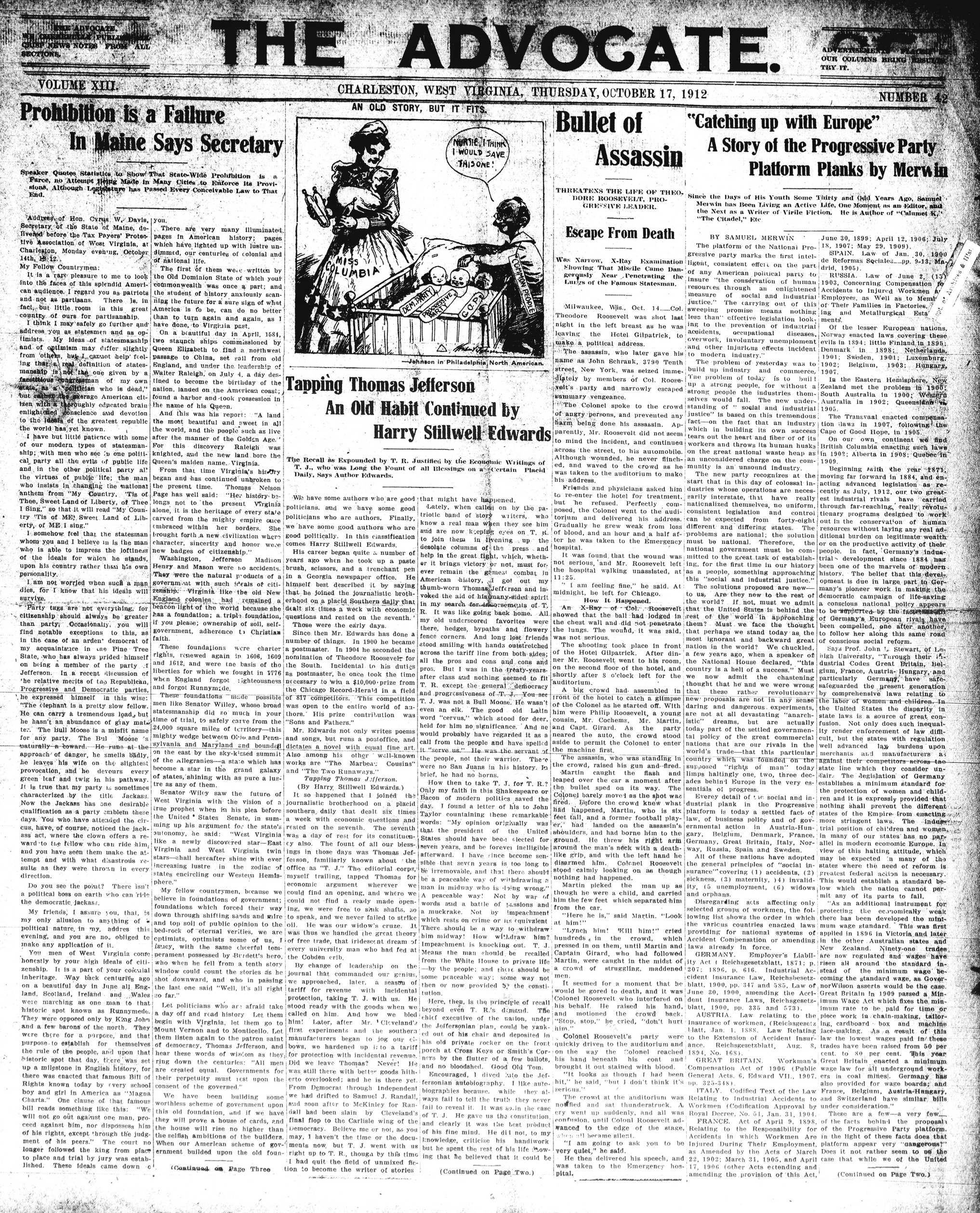
NURTLE I THINK I WOULD SAVE THIS ONE!
MISS COLUMBIA
DEM.PARTY
PROGRESSIVE
COPE
COMMON PEOPLE
Tapping Thomas Jefferson An Old Habit Continued by Harry Stillwell Edwards
The Recall as Expounded by T. R. Justified by the Economic Writings of T. J., who was Long the Fount of all Blessings on a Certain Placid Daily, Says Author Edwards.
We have some authors who are good politicians, and we have some good politicians who are authors. Finally, we have some good authors who are good politically. In this classification comes Harry Stillwell Edwards. His career began quite a number of years ago when he took up a paste brush, scissors, and a trenchant pen in a Georgia newspaper office. He himself best described it by saying that he joined the journalistic brotherhood on a placet Southern daily that dealt six times a week with economic questions and rested on the seventh. Those were the early days.
Since then Mr. Edwards has done a number of things. In 1900 he became a postmaster. In 1904 he seconded the nomination of Theodore Roosevelt for the South. Incidental to his duties as postmaster, he once took the time necessary to win a $10,000-prize from the Chicago Record-Herald in a field of 817 competitors. This competition was open to the entire world of authors. His prize contribution was "Sons and Fathers."
Mr. Edwards not only writes poems and songs, but runs a postoffice, and dictates a novel with equal fine art. Also among his other well-known works are "The Marbeat: Cousins" and "The Two Runaways."
Tapping Thomas Jefferson.
(By Harry Stillwell Edwards.) It so happened that I joined the journalistic brotherhood on a placid southern daily that dealt six times a week with economic questions and rested on the seventh. The seventh was a day of rest for its constituency also. The fount of all our blessings in those days was Thomas Jefferson, familiarly known about the office as "T. J." The editorial corps, myself trailing, tapped Thomas for economic argument wherever we could find an opening, and where we could not find a ready made opening, we were free to sink shafts, so to speak, and we never failed to strike oil. He was our widow's cruze. It was thus we handled the great theory of free trade, that iridescent dream of every university man who had fed at the Cobden crib.
By change of leadership on the journal that commanded our genius, we approached, later, a season of tariff for revenue with incidental protection, taking T. J. with us. He stood ready with the goods when we called on him. And how we bled him! Later, after Mr. Cleveland's first experiments and the southern manufacturers began to jog our cibows, we hardened up into a tariff for protection with incidental revenue. Did we leave Thomas? Never! He still there with better goods hitherto overlooked; and he in better wet
From Democrat through Independent we had drifted to Samuel J. Randall, and soon after to McKinley for Randall had been slain by Cleveland's final flop to the Carlisle wing of the Democracy. Believe me or not, as you may, I haven't the time or the documents now, but T. J. went with us right up to T. R., though by this time
I had quit the field of unmixed fiction to become the writer of stories
that might have happened.
Lately, when called on by the patriotic band of story writers, who know a real man when they see him and are now keeping eyes on T. J. to join them in livening up the desolate columns of the press and help in the great fight, which, whether it brings victory or not, must forever remain the guest combat in American history. I got out my thumb-worn Thomas Jefferson and invoked the aid of his many-sided spirit in my search for accomplishments of T. R. It was like going back home. All my old underscored favorites were there, hedges, hypothes and flowery fence corners. And long lost friends stood smiling with hands outstretched across the tariff line from both sides; all the pros and cons and cons and pros. But I was in the treaty-years-after class and nothing seemed to fit T. R. except the general democracy and progressiveness of T. J. You see T. J. was not a Bull Moose. He wasn't even an elk. The good old Latin word "cervus," which stood for deer, held for him no significance. And we would probably have regarded it as a call from the people and have spelled it "serve us." He was the servant of the people, not their warrior. There were no San Juans in his history. In brief, he had no horns.
How then to take T. J. for T. R.? Only my faith in this Shakespeare or Bacon of modern politics saved the day. I found a letter of his to John Taylor containing these remarkable words: "My opinion originally was that the president of the United States should have been elected for seven years, and be forever ineligible afterward. I have since become sensible that seven years is too long to be irremovable, and that there should be a peaceable way of withdrawing a man in midway who is doing wrong." A peaceable way! Not by war of words and a battle of passions and a muckrake. Not by impeachment which rests on crime or its equivalent. There should be a way to withdraw him midway! How withdraw him? Impeachment is knocking out. T. J. Means the man should be recalled from the White House to private life—by the people; and those should be some peaceable way; some way not then or now provided by the constitution.
Here, then, is the principle of recall beyond even T. R.'s demand. The chief executive of the nation, under the Jeffersonian plan, could be yanked out of his chair and deposited in his old private rocker on the front porch at Cross Keys or Smith's Corners by the flutter of a few ballots, and no bloodshed. Good Old Tom. Encouraged, I dived into the Jeffersonian autobiography. I like autobiographies because, while they always fail to tell the truth they never fail to reveal it. It was so in the case of T. J. He gave us the constitution, and clearly it was the best product of his fine mind. He did not, to my knowledge, criticise his handiwork but he spent the rest of his life knowing that he believed that it could be
(Continued on Page Two.)
Bullet of Assassin
THREATENS THE LIFE OF THEO,
DORE ROOSEVELT, PRO-
GRESSIVE LEADER.
Escape From Death
Was Narrow, X-Ray Examination Showing That Missile Came Dangerously Near. Penetrating the Lungs of the Famous Statesman.
Milwaukee, Wjis., Oct. 14.—Col. Theodore Roosevelt was shot last night in the left breast as he was leaving the Hotel Gilpatrick, to make a political address.
The assassin, who later gave his name as John Schrank, 3790 Tenth street, New York, was seized immediately by members of Col. Roosevelt's party and narrowly escaped summary vengeance.
The Colonel spoke to the crowd of angry persons, and prevented any harm being done his assassin. Apparently, Mr. Roosevelt did not seem to mind the incident, and continued across the street, to his automobile. Although wounded, he never finched, and waved to the crowd as he was taken to the auditorium to make his address.
Friends and physicians asked him to re-enter the hotel for treatment, but he refused. Perfectly composed, the Colonel went to the auditorium and delivered his address. Gradually he grew weak from loss of blood, and an hour and a half after he was taken to the Emergency hospital.
It was found that the wound was not serious, and Mr. Roosevelt left the hospital walking unassisted, at 11:25.
"I am feeling fine," he said. At midnight, he left for Chicago.
How It Happened.
An X-Ray of Col. Roosevelt showed that the ball had lodged in the chest wall and did not penetrate the lungs. The wound, it was said, was not serious.
The shooting took place in front of the Hotel Gilparick. After dinner Mr. Roosevelt went to his room, on the second floor of the hotel, and shortly after 8 o'clock left for the auditorium.
A big crowd had assembled in front of the hotel to catch a glimpse of the Colonel as he started off. With him were Philip Roosevelt, a young cousin, Mr. Cochems, Mr. Martin, and Capt. Girard. As the party neared the auto, the crowd stood aside to permit the Colonel to enter the machine first.
The assassin, who was standing in the crowd, raised his gun and fired. Martin caught the flash and leaped over the car a moment after the bullet sped on its way. The Colonel barely moved as the shot was fired. Before the crowd knew what had happened, Martin, who is six feet tall, and a former football player, had landed on the assassin's shoulders, and had borne him to the ground. He threw his right arm around the man's neck with a deathlike grip, and with the left hand he disarmed him. Colonel Roosevelt stood calmly looking on as though nothing had happened. Martin picked the man up as though he were a child, and carried him the few feet which separated him from the car. "Here he is," said Martin. "Look at him!"
"Lynch him! 'Kill him!" cried hundreds in the crowd, which pressed in on them, until Martin and Captain Girard, who had followed Martin, were caught in the midst of a crowd of struggling, maddened men.
It seemed for a moment that he would be gored to death, and it was Colonel Roosevelt who interfered on his behalf. He raised his hand, and motioned the crowd back. "Stop, stop," he cried, "don't hurt him."
Colonel Roosevelt's party were quickly driven to the auditorium and on the way the Colonel reached his hand beneath his coat and brought it out stained with blood.
"It looks as though I had been hit," he said, "but I don't think it's serious."
The crowd at the auditorium was notified and sat thunderstruck. A cry went up suddenly, and all was confusion, until Colonel Roosevelt advanced to the edge of the stage, when all became silent.
"I am going to ask you to be very quiet," he said.
He then delivered his speech, and was taken to the Emergency hospital.
---
"Catching up with Europe"
A Story of the Progressive Party
Platform Planks by Merwin
Since the days of His Youth Some Twenty and 40 Years Ago, Samuel Merwin has Been Living an Active Life. One Moment as an Editor, and the Next as a Writer of Virile Fiction. He is Author of "Calumet K," "The Citadel," Etc.
BY SAMUEL MERWIN
The platform of the National Progressive party marks the first intelligent, consistent effect on the part of any American political party to insure "the conservation of human resources through an enlightened measure of social and industrial justice." The carrying out of this sweeping promise means nothing less than effective legislation looking to the prevention of industrial accidents, occupational diseases, overwork, involuntary unemployment and other injurious effects incident to modern industry.
June 30, 1899; April 12, 1906; July 18, 1907; May 29, 1909.
SPAIN. Law of Jan. 30, 1900 de Reformas Socales...pp. 9-13, Madrid, 1905.
RUSSIA. Law of June 2, (15) 1903, Concerning Compensation for Accidents to Injured Workmen as Employees, as Well as to Memb of Their Families in Factories, ing and Metallurgical Establishments.
Of the lesser European nations, Norway enacted laws covering these evils in 1894; little Finland in 1895; Denmark in 1898; Netherlands in 1891; Sweden in 1894; Luxembourg.
The problem of yesterday was to build up industry and commerce. The problem of today is to build up a strong people, for without a strong people the industries themselves would fall. The new understanding of "social and industrial justice" is based on this tremendous fact—on the fact that an industry which in building its own success tears out the heart and fiber of its workers and throws its human husks on the great national waste heap as an unconsidered charge on the community is an unsound industry.
The new party recognizes at the start that in this day of colossal industries whose operations are necessarily interstate, that have really nationalized themselves, no uniform, consistent legislation and control can be expected from forty-eight different and differing states. The problems are national; the solution must be national. Therefore, the national government must be committed to the great task of establishing, for the first time in our history as a people, something approaching this "social and industrial justice."
The solutions proposed are new—to us. Are they new to the rest of the world? If not, must we admit that the United States is behind the rest of the world in approaching them? Must we face the thought that perhaps we stand today as the most ignorant and backward great nation in the world? We chuckled, a few years ago, when a speaker of the National House declared, "this country is a hell of a success." Must we now admit the chastening thought that he and we were wrong that these rather revolutionary new proposals are not in any sense daring and dangerous experiments, are not at all devastating "anarchistic" dreams, but are actually today part of the settled governmental policy of the great commercial nations that are our rivals in the world's trade—that this particular country which was founded on the supposed "rights of man" today limps hattingly one, two, three decades behind Europe in the very essentials of progress.
Everey detail of the social and industrial plank in the Progressive platform is today a settled fact of law, of business policy and of governmental action in Austria-Hungary, Belgium, Denmark, France, Germany, Great Britain, Italy, Norway, Russia, Spain and Sweden. All of these nations have adopted the general principles of "social insurance" covering (1) accidents, (2) sickness, (3) maternity, (4) invalidity, (5) unemployment, (6) widows and orphans. Disregarding acts affecting only selected groups of workmen, the following list shows the order in which the various countries enacted laws providing for national systems of Accident Compensation or amending laws already in force.
GERMANY. Employer's Liability Act ( Reichsgesetzblatt, 1871; p. 207; 1896, p. 616. Industrial Accident Insurance Law, Reichsbesetzblatt, 1900, pp. 347 and 585. Law of June 30, 1900, amending the Accident Insurance Laws, Reichsgesetzblatt, 1900, pp. 335 and 573). AUSTRIA. Law relating to the insurance of workmen, (Reichsgesetzblatt, Jan. 1, 1888. Law relating to the Extension of Accident Insurance, Reichsgesetzblatt, Aug. 8, 1894, No. 168). GREAT BRITAIN. Workman's Compensation Act of 1906 (Public General Acts, 6, Edward VII., 1907, pp. 325-348). ITALY. Codified Text of the Law Relating to Industrial Accidents to Workmen (Codification Approval by Royal Decree, No. 51, Jan. 31, 1904)
FRANCE. Act of April 9, 1898. Relating to the Responsibility for Accidents in which Workmen Are Injured During Their Employment, as Amended by the Acts of March 22, 1902; March 31, 1905, and April 17, 1906 (other Acts extending and amending the provision of this Act,
June 30, 1899; April 12, 1906; July 18, 1907; May 29, 1909).
SPAIN. Law of Jan. 30, 1900 de Reformas Sociaales...pp. 9-13; Madrid, 1905).
RUSSIA. Law of June 2, (15) 1903, Concerning Compensation to Accidents to Injured Workmen at Employees, as Well as to Memb of Their Families in Factories, ing and Metallurgical Estaments.
Of the lesser European nations, Norway enacted laws covering these evils in 1894; little Finland in 1895; Denmark in 1898; Netherlands, 1901; Sweden, 1901; Luxemburg, 1902; Belgium, 1903; Hungary, 1907.
In the Eastern Hemisphere, New Zealand met the problem in 1900; South Australia in 1900; Western Australia in 1902; Queensland in 1905.
The Transvaal enacted compensation laws in 1907, following the Cape of Good Hope, in 1905. On our own continent we find British Columbia enacting such laws in 1902; Alberta in 1908; Quebec in 1909.
Beginning with the year 1871, moving far forward in 1884, and enacting advanced legislation as recently as July, 1912, our two greatest industrial rivals have carried through far-reaching, really revolutionary programs designed to work out in the conservation of human resources without laying any real additional burden on legitimate wealth or on the productive activity of their people. In fact, Germany's industrial development since 1884 has been one of the marvels of modern history. The belief that this development is due in large part to Germany's pioneer work in making the democratic campaign of life-saving a conscious national policy appears to be supported by the fact that of Germany's European rivals have been compelled, one after another, to follow her along this same road of conscious social reform.
Says Prof. John L. Stewart, of Lehigh University, "Through our industrial Codes Great Britain, Belgium, France, Austria-Hungary, and particularly Germany, have safesafeguarded the present generation by comprehensive laws relating to the labor of women and children. In the United States the disparity in state laws is a source of great confusion. Not only does such inequality render enforcement of law difficult, but the states with regulation well advanced law burdens upon merchants and manufacturers against their competitors across the state line which they consider unfair. The delegation of Germany establishes a minimum standard for the protection of women and children and it is expressly provided that nothing shall prevent the different states of the Empire from enacting more stringent laws. The industrial position of children and women in many of our states has no parallel in modern economic Europe. In view of this halting attitude, which may be expected in many of the states where the need of reform is greatest federal action is necessary. This would establish a standard below which the nation cannot permit any of its parts to fall.
"As an additional instrument for protecting the economically weak there has been developed the minimum wage standard. This was first applied in 1896 in Victoria and later in the other Australian states and New Zealand. Ninety-one trades are now regulated and wages have risen all around the standard instead of the minimum wage becoming the standard wage, as Governor Wilson asserts would be the case. Great Britain in 1909 passed a Minimum Wage Act which fixes the minimum rate to be paid for time or piece work in chain-making, tailoring, cardboard box and machine lace-making. As a result of this law the lowest wages paid in these trades have been raised from 50 per cent. to 80 per cent. This year Great Britain enacted a minimum wage law for all underground workers in coal mines. Germany has also provided for wage boards; and France, Belgium, Austria-Hungary, and Switzerland have similar bills under consideration."
These are a few—a very few—of the facts behind the proposal of the Progressive Party platform. in the light of these facts does that platform appear very "nangerous?" Does it not rather seem to be the case that while we of the United
CORRESPONDENCE
ALL WEEK
Free
RAINCOATS
WITH EACH SUIT
Consisting of Coat, Pants and Vest
or
Overcoat Ordered
SUITS AND OVERCOATS
$14
WITHOUT VESTS
$13
Made to Measure
made to fit
CAM KELLER
11 Capitol St.
Next Door to Kanawha Valley Bank
On Friday evening, Oct. 11th, a reception was tendered the new students under the direction of the Woman's League and Lincoln Debating Society of Storer college. The first part of the evening was given over to a musical and literary program. After the program was gandered the reception took the form of a social affair. The new students were introduced and made to feel at home. Games were played, and refreshments served. Everyone had an enjoyable time. It was with regret that the party broke with the sounding of the quartet of ten bell.
Mr. Best, the chairman of the committee on nominating of new Sunday school officers for 1912-13 reported as follows: Superintendent, Proof Saunders, assistant superintendent, Mr. Winters; Treasurer, Miss E. V. Smith; secretary, Lloyd P. Fisher assistant, William Reddix; organist Miss Florence Young; assistant, John Zeigler; chorister, Miss. Virginia Crawford; assistant, Milton Johnson. The W. C. T. U. had a good meeting last Wednesday night at Mrs. Moores in Boliver. They are very enthusiastic workers in the temperance cause. The members are loyal upholders of the prohibition cause!
Mrs. Mary Harris Armor, of Georgia, orator on temperance, made a chapel speech on Friday morning. Mrs. Armour is an exceptionally fine speaker. She has the power of carrying her audience along with her. The students gave her a great ovation when her speech was finished. The young ladies of the Senior class have formed themselves into a Literary Club, under the direction of Miss Smith. The young ladies meet each Thursday evening and discuss some current topic. Much interest and enthusiasm is shown by the members. Mrs. Mc. Donold is able to take her place in the school. Her classes greeted her gladly. Miss Horton, music teacher of last year, has this fall accepted the call to take charge of the music department of Willberforce university.
The young ladies of Myrtle have voluntarily formed themselves into a bible study class. Each Sunday afternoon the class meets. Miss Smith kindly gives her time as instructor and helper.
EAGLE
Rev. B. A. Brooks closed his two weeks meeting last Wednesday night. He had the assistance of Rev. J. V. Bryant, of Huntington, the first week. Ten have been added to the church. Mrs. Lizzie Winston went to the Sheltering Arms Hospital Thursday for treatment. She was accompanied by her daughter Mrs. Eva B. Ross. Naval Lewis and sister, Miss Louise of Montgomery were calling on Mrs. Willie J. Miller Sunday afternoon. Miss Ada Lewis and Mr. Jessie Carter were quietly married Wednesday evening at the home of bride's parents, Mr. and Mrs. Chas, Lewis, in the presence of a few friends. Rev. B. A. Brooks officiated. Mrs. Dora Simons was shopping in Montgomery Friday.
Jas. Ross visited his mother-in-law at the Sheltering Arms Hospital Sunday.
Mrs. Eva B. Russ and Mrs. Willie J. Miller met with the Womans Improvement League, of Montgomery, at the home of Mrs. Ada Shepard Thursday.
Mrs. Lucy Dow, Hattie Clayton and Stella Cosby were shopping in Montgomery last week.
Mrs. Willie Whiting, of Montgomery was the guest of her aunt, Mrs. Emma Teague, Sunday.
Mrs. Orange Page entertained friends at dinner Sunday.
CHARLESTON
HOTEL BROWN ARRIVALS:
Mrs. Mattie Mitchell, Smithers; Mr. and Mrs. Adams Clifton Forge Va.; Mr. and Mrs. W. H. Washington Louisa, Va.; J. H. King, Riverside; Mr. and Mrs R. O. Cary, Sewell; Nrs. L. McKinley, Roanoke, Mrs B. Penn, Mostomery; C. D. King, Lexington, Va.; L. Chandler Fairmont; J. H. Campbell, Clendennin; H. W. Williams, Columbia S. C. Mrs. Blanche Harris, Mrs. Mamie Briscoe, Newark, N. J.; Mrs J. J. Layton, Washington, D. C.; Mrs Laura Smith, Plymouth; Mr. and Mrs Anderson, Boomer; Chas. Lee, Raymond City; Mr. and Mrs. Fred Quarles, Covington, Va.; Miss Lizzie Baggy, Lynchburg, Va.; H. S. Sterling Collier; Hannah Ellis, Covington Va.; Mr. and Mrs. Jas, McCarver Carbon; Harvey Taempson, Winfred; and Woo Keat, South Carbon, were guests at Hotel Brown this week.
To Discuss Prohibition Amendment.—The proposed amendment to the constitution to prohibit the sale of intoxicants throughout the State will be thoroughly discussed by a number of able speakers at the K. of P. hall. Monday night, it is announced. A hand will be, on hand to furnish music and those having the meetings in hand are hopeful of a large attendance.
Opening of Dance Season.—Preparations are about completed for the opening of the dance season on the evening of the 25th, instant. When Miss Gilmer's physical culture club will have its initial ball, Wright's saxa, the orchestra of Columbus, O. has been secured, orders have been placed for plants, flowers and bunting for decorative purposes, and the refreshment committee has decided upon the menu. It has leaked out that the competition between the ladies as to whose costume will be the prettiest will produce some wonderful creations in that line.
Undertaking Establishment.—It is currently reported that J. C. Campbell, who came over from Washington for a few days last week, has secured an option on the equipment formerly owned by Hazlewood & Garrett, funeral directors, and will soon return to this city to reopen the business. This being Mr. Campbell's birthplace and the home of his people he would doubtless meet with success should he determine to enter into the venture.
PERSONALS AND LOCALS.
W. J. Thompson, formerly located here as Grand Chancellor, of the Knights of Pythias, passed through the city last night going from his home at Thomas to Raleigh county, to deliver a few speeches for the Republican state ticket. G. E. Mitchell, business manager of the W. Va. Colored Institute, and A. W. Curtis, head of the department of agriculture in the same institution, went to Louisville, Ky. Wednesday night to purchase a number of mules for use on the farm. Dr. J. B. Brown, who has been coaching for a number of years the foot ball team of the W. Va. Colored Institute, accompanied the team to Wilberforce where they have a game scheduled for Friday.
Mrs. B. R. Reed and Mrs. Julia Henley are making preparations to serve dinner to the door. Donations will be received by the ladies at 606 Pemberton Ave. Mrs. Rose Thompson was hostess to the Loyal Union, Monday evening. The "trip around the world" will start from the home of Mrs. Maria Alexander, Sentz St. The Improvement League was entertained by Miss Webster at the home of Mrs. Muse, last week. Mrs. Ballard Brooks will be hostess to the League, this week.
A reception will be tendered Rev. C. H. Sheen, the new pator of St. Paul A. M. S. chur. a Monday evening. The affair will be given at the church.
Mrs. Rosa Warren entertained at her home on Summers street Monday evening complimentary to Miss Julia Irving, of Malden.
H. B. Hundley, past Grand Master of the Masons, was a business visitor here yesterday.
Mrs. Rosa Branch, of Page was a guest of Mrs. Nanale Warren, last week.
Miss Charity Wilson entertained a dinner party, Sunday, in honor of Mrs. J. M. Minor, of St. Louis.
Otho Warren spent Sunday at Spring Hill with his mother.
Mrs. H. L. Jackson is ill at her home on Bullitt St.
D. W. Butler is visiting relatives in Kentucky.
The Social Helpers of the A. M. E church met with Mrs. Moss, Craig St., Monday evening.
Miss Reavely Hayes, of Lexington, Va. is in the city.
Rufus Pem entertained a few frends at dinner at Hotel Brown, Sunday.
Mrs. Daisy Nelson has returned from Chester, S. C. where she spent the summer with her parents.
Mrs. Carrie Jennings has returned from a visit to New York.
The married Ladies Whist Club held its first meeting Thursday afternoon at the home of Mrs. J. W. Viney, Jacob St.
Quite a number of young people enjoyed themselves Monday evening at the home of Miss Maude Viney, Jacob St.
J. C. Campbell, of Washington, D.C., was a business visitor to the city last week.
Miss Hattie Peters spent the week end in Sissonville.
Miss Moss Clay returned to the city Sunday after visiting relatives in Clarksburg.
(Continued From Page One.)
bettered. First, he wanted a way to withdraw the unsatisfactory President. Then he gave us these vigorous suggestions:
"I repeat that I do not charge the judges with wilful and ill-intentioned error; but honest error must be arrested when its toleration leads to public ruin. As for the safety of society, we commit honest maniacs to Bedlam, so judges should be withdrawn from their bench, whose erroneous phrases are leading us to dissolution. It may indeed harm them in fame and fortune, but it saves the republic, which is the first and supreme law."
T. J. doesn't want judges impeached. At least he doesn't sav that they should be. He waives the question of guilt and goes after the men of "honest error." We don't punish the honest and the purely erroneous; we arrest the error and not the man to save the public. Did T. J. mgan that the judge should be recalled? Undoubtedly. How otherwise—under what existing or possible law could you get rid of an honest error. And should the error, his dangerous decision threatening as law and precedent the public, remain? Logically it had to be recalled too, and only the people can recall it. The first and supreme law is to save the republic, so Jefferson thought. So thought Lincoln and so thinks Theodore Roosevelt evidently. Only one points out a clear, peacable method, and Jefferson did not, while Lincoln was driven into battle and the violation of the constitution as a war measure.
But I wonder what the dear old ladies of the editorial sanctions would do to T. R. if he should call our honestly erroneous judges—and God knows the fence corors are alive with them—nianliacs and suggest that they be locked up among the feeble minded.
Catching Up
(Consider From Page One.)
States have been content to look at the mere size and activity of our industries with self-satisfaction and to speak of them with boasting, the complex life of the great world, ever moving on and on in an endless process of change and growth, has swept far beyond us toward the real civilization which we have only begun dimly to perceive? Does it not begin to appear that we must pocket our pride, face the fleeing facts, and make a determined effort to catch up with the life of the world? And may it not be that this "social and industrial justice," far from being a dream of "visionaries," is the most "practical" matter in the world today for really "practical" men to consider?
One of the most vital of our problems as a nation today is the not-so-simple matter of "catching up with Europe." The Progressive Party is pointing out the first necessary step. The experiment need not be very dangerous; all the civilized world has taken the step before us.
Perfect Feet
Free From
Corns and
Bunions
Dr. A.
Reed Cushion
Shoe
This is the place to get them. We are collecting all the corns and bunions in town—giving in exchange perfect, healthy, normal feet—free with every pair of the famous Dr. A. Reed Cushion Shoes.
You simply can't have corns or bunions if you wear Dr. A. Reed Cushion Shoes. They're made to prevent and to go away with corns—and inside of a month, you'll see the wonderful change in your feet.
The reason is simply this: In Dr. A. Reed Cushion Shoes, your foot sinks into a soft cushion insole—the pressure of the upper is released—and there's no friction at all—your corns disappear.
But best of all, you'll enjoy walking—for when your foot sinks into the cushion insole—your weight is spread evenly over your foot—and it's like walking on air. Corns in and see this famous Dr. A. Reed Cushion Shoe—many styles to choose from at reasonable prices.
Exclusive Agency
BELL SHOE CO.
708 Kanawha Street
OUR
Ice Cream Parlor
STRANGERS AND TRAVELING PERSONS
BEST SODA WATER
ONLY 5 CTS.
OUR PLANS UP-TO-DATE
SERVICE IS OUR WATCHWORD
THE PEOPLES' GROCERY CO.
WM, H. PARKER, Manager.
THE ADVOCATE
Poles Show Big Increase for T. R.
Labor Men are Appreciating his Support and Decided Sentiment in his Favor is Shown in Big Factories.
The polls being taken throughout the country continue to show an increase in unionized, Roosevelt. This not only reaches into our mid and farming section but also into the federal departments. As an evidence of the truth of these statements, a few of the polls, taken at random, are given below:
Poll taken in machine shop, United States Navy Yard, Washington, showed:
Rosevelt, 53; Wilson, 8; Taft, 1; Debs, 1.
A poll taken among the plate printers on the night force in the Bureau of Engraving and Printing showed:
Roosevelt, 33; Wilson, 10; Taft, 5; Debs, 1.
That labor appreciates Colonel Roosevelt's support, and stands ready to give him its votes. A straw vote was taken in Buffalo among the industrial establishments there indicates that the workingmen are lined up solidly. In the works of the American Radiator company 3,000 men were asked their preferences and 1,780 came out for Roosevelt. Here are some further interesting results taken in the city of Buffalo, N. Y.
Larkin Soap company (office force)—Roosevelt, 123; Taft, 0; Wilson, 2.
Kurtzman Piano Factory—Roosevelt, 81; Taft, 14; Wilson, 5.
New York Steel plant—Roosevelt, 165; Taft, 27; Wilson, 24.
Smith and Davis, insurance—Roosevelt, 15; Taft, 0; Wilson, 3.
Buffalo Veneer company—Roosevelt, 58; Taft, 8; Wilson, 4.
Buffalo and Rochester train—Roosevelt, 36; Taft, 12; Wilson, 2.
Crystal Beach boat—Roosevelt, 44; Taft, 11; Wilson, 7.
Lake Shore train—Roosevelt, 62; Taft, 26; Wilson, 11.
Lockport trolley car—Roosevelt, 52; Taft, 5; Wilson, 1.
Buffalo Southern railroad—Roosevelt, 17; Taft, 1; Wilson, 0.
A straw vote taken among the workingmen in the Culebra. Cut in the Panania Canal zone, showed Roosevelt received 80 per cent. Wilson 15 per cent. and Taft 5 per cent. of the total vote. A similar poll four years ago gave Taft 25 and Bryan 75 per cent.
LITERARY NOTES
Price Collier's "Germany and the Germans from an American Point of Vi w" began in the November Bornner with an article on the Empire which he calls "The Indiscreet." It is a remarkable candid study of tax of the most pictresque and influential personalities of the world. It will be interesting to learn what Germans will think of the author's characterization. However they may differ with regard to details, they will no doubt appreciate its acuteness and friendliness.
Sir Sidney Colvin has collected some "Stevensoniania"—copyrighted articles and letters of Robert Louis Stevenson, that appear in the November Scribner. There is a long letter written from Sarnoa delightfully full of fun and drollery. The story of how he tamed the parrot is an amusing one.
Brand Whitlock, known everywhere as the form mayor of Toledo, has a scholarly and convincing article on the "City and Civilization" in the November Scribner. He says it has been the cities that have made for progress and even for morality.
Francis Wilson's daughter, who married the French etche, Huard, has an article on "Parisian Cafes" in the November Scribner. She says the old cafes are passing away, though the "Theure de la verte" is still observed on the boulevards as of old.
President Finley's article on "The French in the Heart of America" in the November Scribner tells of the adventurers who made their way down the rivers in their canoes and over the forest paths to barter with the Indians. The caureurs de bois were a picturesque group, comparable in their lives to the old trappers of the plains.
GET THE HABIT
WEAR
Diamond Shoes
And Save Money
Diamond Shoe Store
215 Capitol Street
DRY CLEANING
NU WAY
SHOE REPAIRING
More than 400 men and women have graduated here. The oldest school in the state for Colored students. Magnificent location. Elevation high. Remarkably healthful. Ample buildings. THREE NEW BUILDINGS BEING ADDED TO OUR PLANT THIS YEAR. The regular faculty of sixteen highly educated, earnest teachers does not include assistants. Our Library catalogued according to the Dewey System, is one of the largest in the State.
FIRST GRADE CERTIFICATES ARE GRANTED TO THOSE MEMBERS OF THE GRADUATING CLASSES WHO ARE RECOMMENDED TO THE STATE BOARD OF EDUCATION. Storer is interdenominational in its faculty and student body. Its whole influence is toward Christian living. Literary Societies, Christian Organizations, Musical Clubs, Bands and Sane Athletics.
COURSES: Academic, State Normal, Industrial, Mušic.
For illustrated catalogue and other printed matter write to
S. BERMAN
LOAN OFFICE
Money Loaned on Jewelry and
Clothing
605 Kanawha Street
HENRY (T. M'DONALD,
President.
The President.
READ!
Old Moorman, per quart,..... $1.00; per pint .....50e; per 1-2 pint .....25e
Cove Spring, per quart..... .90; per pint.....50e; per 1-2 pint .....25e
Black and Green, per quart..... .95; per pint.....50e; per 1-2 pint .....25e
Old Charter, per quart..... 1.15; per pint.....60e; per 1-2 pint .....30e
Sunny Brook, per quart..... 1.00; per pint .....60e; per 1-2 pint .....30e
Old 88, 10 years old, per gal.....$4.00; per quart.....$1.00; pint 50e; per 1-2 pint.....25e
Mollwood, per gal.....3.50; per quart......90; pint 50e; per 1-2 pint.....25e
Silver Spring, per gal.....3.00; per quart......75; pint 40e; per 1-2 pint.....20e
Old Home, per gal.....3.00; per quart......75; pint 40e; per 1-2 pint.....40e
Sherry, per gallon..... $2.00; per quart .....40e; per pint .....25e.
Port, per gallon ..... 2.00; per quart .....40e; per pint .....25e.
Blackberry, per gallon..... 2.00; per quart .....40e; per pint .....25e.
Small Bottles of Beer, per doz..... 75e; Large Bottles of Beer per doz..... $1.25
daticas is complete it will pierce the eternal blue of heaven.
But my friends, my mission here tonight is not to discuss with you the so-called political issues of the hour. These are being able handled by men of each and all parties. These questions are vital and every man will decide for himself. It is a healthy sign when the government is getting nearer to the common people; when the states are adopting the initiative and referendum direct primaries, publicity of campaign contributions, corrupt practices acts, election of United States senators by the people, laws to prevent the filling of our mills and shops with children of school age, conservation of our great natural resources, both of life and property. These activities, my fellow countrymen, do not indicate a decadent government, but rather a government seeking to build on the ideal of its founders. The questions of the hour are both political and moral, and demand the most loyal attention of every man and woman in America who places good citizenship first. I pity the man or the woman who isn't a politician; who has no time or inclination to mix into the great questions which concern the present and future welfare of the state and of the nation. If such a man and such a woman gets poor government they get what they deserve. Let me lay down this proposition right here and now. In a republic like ours, government, whether town, city or federal is just what all the people make. The man who stays away from the polls on election day has as much influence in shaping legislation as the man who deposits his ballot; and it has often happened that such neglect of Amercanship has defended or retarded many a good measure.
Neither the time at my disposal nor your patience would warrant a discussion of many of these great political questions which are stirring our country from center to circumference. There is, however, one question which I am here to discuss with you frankly this evening. A question which, while it has been made by some a moral issue solely, and by others a political issue solely, is primarily and essentially a question of domestic policy. It is a question limited to no municipality in all this broad land. Its right solution means as much to the future of America as perhaps any and all other questions combined, and at the very outset I beg you to believe I come to you at the solicitation of Business Men's Association with the earnest desire to aid you in a right solution
of the liquor question in its statewide application.
I come from a state where state-wide probition has been in the basic law of the state for twenty-eight years. A careful observation of that law and its workings begun by me in the legislature twelve years ago convinced me that the cause of temperance in Maine has had no greater draw-back than this same law; and that by comparison with out sister-states which once had the law, and discarded it, Maine has suffered by the comparison. I have therefore been zealous for its repeal, and for a sane regulation which would measure at all times the exact wishes of the cities and towns and where the question could be handled at short range and not long range through the constitution. During the past eleven years, while Representative from my home city to the Legislature, and as candidate for Governor, I have done what I could to bring about the repeal of this law. I have done it at my own expense and with abiding conviction of the justice of my cause. In discussing this question it is well to state at the very outset that the opinion of the fanatic or the ultra-prohibitionist is worth but little, for the simple reason that this class always insist that we live in Altruula and have neither locks to our doors or bars to our windows. They see conditions as they want them and not as they are. They utterly forget the patent fact in all history that the inquisition never made a saint, nor a man-made law, statutory or constitutional ever made a teetotaler.
Temperance, virtue, patriotism where ever found are always the process of evolution and not the result of logical enactments from: without. Thirty-seven states handle the liquor question locally through properly constituted municipal or county officers. Three states are under license, while eight states only have prohibition; and I want to to record my belief that real prohibition territory has nowhere suffered in local option states.
The amendment to your constitution on which you are to vote in November provides: "That on and after the 1st day of July, 1914, the manufacture, sale and keeping for sale of malt, vinous or spiritous liquors, wine, ale, porter or beer, or any intoxicating drink, mixture or preparation of like nature, except as hereinafter provided, are prohibited on this state.
"PROVIDED HOWEVER that the manufacture and sale and keeping for sale of such liquors for medicinal pharmaceutical, mecanical, sacramental and scientific purposes, and the manufacture and sale of denatured alcohol for industrial purposes.
may be permitted under such regulations as the legislature may prescribe."
Put that piece of legislation in the basic law of your state, gentlemen, and you will strike a blow at temperance in your state from which it will not recover in years.
You will substitute for local self-government state-wide nullification. Your state dispensaries or agencies for the selling of liquors for medicinal and pharmaceutical purposes, for which the proposed amendment provides, will become your biggest run-shops and you will make rum shops of a large proportion of your drug stores and more degrading than all else, you will set up in every city and large town in your state, rum express, bootleggers, kitchen dives and social booze clubs. I can prove that to every fair-minded man and woman in this ball, and prove it from miscalled prohibition Maine, and in proving it, aside from history and my own personal opinion. I will prove it from prohibition evidence alone.
In discussing this question I am not detracting from the fair name of my state. I hold no brief in the National Brewers' Association, although that has been charged by the prohibition press of Maine. I am presenting the situation as I found it when I first began to expose the uselessness of the law; and as the situation is today, after twenty-eight years of fair trial; and shall continue to so present it, until my state joins the other New England States and returns to a sane treatment of the rum question.
Maine has had a fair trial of statewide and constitutional prohibition by law. She became a prohibition state in 1851, and in 1885 prohibition went into the constitution by a majority on popular vote of 40,000, elder and liquor for mechanical purposes being exempted. Previous to this there had been much agitation on the question. It had been the subject of countless lectures addresses and messages from governors of the state.
The MODERN - MG.1911-
of the basic law of the state or popular vote.
This act marked the end of about all the real work for temperance for which Maine was noted. The lectureships and the temperance organizations gradually became a thing of the past. Moral suasion lost its force, and the leather-bound volume in the archives of the state bearing the names of the legislators of those days affixed to a total abstinence pledge is a mute reminder of the days in Maine when men's higher natures were appealed to.
One significant fact in the effort to secure constitutional prohibition must not be overlooked. The hardest worker in the interest was the dive keeper. Although a mere boy then I marveled at this until a friend said: "The dive keeper is wiser than you. He knows that if the rum question gets tucked away into the constitution of the state the fanatic will go to sleep and he can then do a thriving business," and the dive keeper was right, as I will show you later.
Another significant fact for you to bear in mind in this discussion, for it has a great significance in its relation to temperance. Previous to constitutional prohibition, beer, wine ale and the lighter non-alcoholic drinks were sold. After these became outlawed it was easier and more profitable for the saloon to deal almost wholly in distilled liquors and whiskey of his own manufacture. Thus was dealt to the cause of temperance, morality and health a staggering blow.
At times the reign of illegal option, for that is what we had, was well nigh unbearable. The holes, the dives, the pocket-paddling, the rum expresses and mail order business thrived, and Maine began to wake up to the fact that constitutional prohibition was a failure.
Do you believe it? I present the record. Every statute law which the monds of astute attorney could devise was passed by the legislature to back up the constitution. Common Nuisance Search and Seizure, Condemning of Property where Liquor was Sold Spotter Evidence, Imprisonment on second offence and more recently Authority placed in the hands of the Governor with the Treasury of the state behind him to supercede the authority of the sheriffs who had been elected by popular vote of the people. Such was our prohibition law, gentle men, and such were the attempts to make the law effective by drastic statutes. Is its eximinance in the basic law of our state warranted, and is it one single good result to its credit?
The right answer to these questions concerns you people of Charleston tonight. In 1901, seventeen years after constitutional prohibition was enacted, nullification was practically at high-water mark. The Internal-Revenue Department at Portsmouth, N.H., showed 1513 liquor license held in Maine, one to every 460 of the population, which was just about the same proportion as Mr. and other local option states. Only seventy-nine out of 520 towns in Maine were without license. At this time the average arrests per year for drunkenness were, in Boston 35, in New York 13, in Chicago 23, and in Portland, Maine, 42 to each 1,000 of population.
During the twenty-seven years of constitutional prohibition the number of licenses in Maine have run from 1,000 to 1500 per year, the year 1911 showing 1313. During these years the agency system, until the time of its abolishment in 1905, had a record in sales of liquors aggregating $5,000,000. These are facts gentlemen, and from sources which are not disputed.
Now, what are the present conditions in Maine? I will give you the answer to this question from our prohibition friends themselves, the Maine Civic league and the Temperature Press of the State; and in so doing I shall abolish escape the charge
as a witness on ardent exponent of the Maine Civic League, the Rev. Henry N. Pringle. This is what he said in the September, 1911 Outlook on page 51: "I have talked with two thirds of the thousand clergymen of Maine, and estimate that seventy-five of them and ten per cent. of the church members are opposed to prohibition. Five daily parers, 13 weekly papers are opposed to prohibition two daily and six weekly papers are silent. I have 100 photographs of Maine bar rooms, and have considerable knowledge of the liquor business throughout the state. Saloons are conducted in seven of the twenty cities and ten villages, also there is selling in the towns and more open vending at hunting camps and alongote roads. I have seen bar rooms in Portland, Rockland and Bangor which must have cost $1,000 for furnishing. I have heard that the 140 wholesale liquor dealers of Boston (Bonfort's 'Directory, p.' p. 71-73) who have established a mail order business in Maine, prefer prohibition in this state. In 1907, 719 parties paid United States, liquor taxes in 106 cities and villages, which is less than the present number."
And Mr. Pringle might have added some of these licenses are held by social clubs, of which there are not less than 150, and with a membership of approximately 20,000. He might also have stated that no accurate estimate can be made of the quantities of liquors coming into the state daily by express and the quantities sold without the trouble on the part of the dealer to take out and pay for a United States license.
Let me give you the conditions under prohibition in the city of Lewiston, Maine, as seen through the eyes of Prof. L. C. Bateman, a member of the Patrons of Husbandry, a newspaper man and a public speaker of ability. Prof. Bateman says: "Take the condition of Lewiston as one example. Never was there such a reign of corruption and public debauchery as we now see. Rum shops are wide open on every side, gambling joints keep their watches at the outside door to entice young men to their ruin, while brazen-faced demondes apply their trade on our public streets without even a rebuke from constituted authorities. Thugs and criminals are almost immune as they hold up men or knock down women. Every element and sign that marks the decay of people are in our midst. When the basic elements control either a nation, state or community ruin and desolution are not far away."
The Kennebec Journal, one of the leading prohibition organs of the state, in commenting on this, said: "It will occur to thousands of readers that Prof. Bateman, who knows the public pulse on Maine, is voicing a sentiment that is daily becoming stronger."
The Keniebee Journal, commenting on the liquor situation in Somerset City says editorially: "Half surrounded by a territory in which officials brazenly, nullify the law. Somertiest boozers are not troubled in securing the booze, but they are promptly arrested when they become obnoxious to sober citizens in that county; while in Kennebee and in several other counties, such fellows are unmolested by police officer or are sent home to avoid arrest, thus keeping down the number of arrests for drunkenness in nulification cities and counties. The following bit of evidence from the Civic League Record of Maine will also be of interest. In one of their March, 1912 issues they say: "A recent investigation in Waterville, Augusta, Gardiner, Hallwell and Randolph disclosed two facts. First, a large number of places were found where intoxicants were freely sold to strangers, where a large stock of liquor was openly kept. "Liquors are sold openly at forty places in Waterville."
ROBERTS & AULTZ
DEALERS IN
Pure Whiskies, Wines, Gins, Braudies, Beer, Gigars & Tobacco
LUNCH COUNTER IN CONNECTION
Phone 1705 508 Kanawha St.
CHARLESTON, W. Va.
DR. B. A. CRICHLOW
OFFICE 805 1-2 Kanawha St. Charleston, W. Va.
RESIDENCE 304 DONNALLY ST.
Office Phone 1102 - - - Residence Phone 1118
Office Hours: 9-11 a. m.; 2-4 p. m.; 6-8 p. m.
中
A. N. E.
JEW
806 QUARRIER ST.
RIGHT P
DIAMONDS, WATCHES, CLOCKS A
FINE
The following list of arrests for
drunkenness in the city of 12,000
population published also in the
March Record is of interest:
Year. Arrests
1900 120
1901 214
1902 232
1903 120
1904 1432
1905 230
1906 350
1907 440
1908 430
1909 220
1910 515
1911 720
The Civic League Record of the same month and the same issue says as to fines imposed in four terms of court in Kennebec county, $17,150 were imposed in 76 cases, the average fine in the city of Waterville being $170.
The Record says as to imprisonment "In the municipal court of Waterville three defendants accepted sentences aggregating five months and thirty-seven defendants appealed from sentences aggregating five years and eight months. In the Superior court the jail sentences with no alternative of fine at four (terms for the entire county, aggregated ten months and were against three respondents." As showing conditions in the County of Penobscot, in which is located the city of Bangor, the Civic League Record says:
"It is reported that County Attorney Thompson recently bought a $2,500 automobile an $11,000 house in Bangor. The alary of the county attorney in that county must be very large to warrant such expenditures. But it is also rumored that there are 200 locally licensed liquor sellers in Bangor and as many more in the rest af the county. It is reported that each of these liquor sellers pays some one $250 a year."
And the Civic League Record might have added that the 400 licensed liquor sellers in Penobscot County are no new thing, for Bangor and some other of the larger cities and towns of the county have persistently and consistently openly opposed and violated constitutional prohibition.
Gentlemen I could multiply this evidence until midnight and from the same prohibition authorities, but of what use would it be? It is the same nullification record in practically every city and town in the state; and our prohibition friends, while they know it to be true, and parade the record at election time, are so wedded to the idea of state-wide prohibition as a theory that they minimize, if not actually overlook, real conditions. This question in Maine has become a political question, and has perforce regarded the progress of the State along the lines of its material development. The Republican party, which has been the dominant party in Maine for a generation, previous to 1911 and
1912, allied itself with the prohibitionists by incorporating in its platforms a statement of belief in the prohibitory law and in its enforcement, and this declaration of belief has invariably caught the prohibition vote and silenced the Republican press on the rum question, while the actual and normal condition on the rum question were nullification pure and simple.
The prohibition answer to my argument is, yes, these conditions exist, but they are largely the results of Democratic administration and democratic attitude.
If that were true and the preceding twenty-six years were years of enforcement, then Maine's Prohibitory law would have a reason for its existence.
Suppose we look at the facts. In 1901 and 1903 and during Governor Hill's administration when the democracy had but 22 members in the House and but 1 member in the Senate, Maine had 1506 liquor licenses in force; one of them held by the proprietor of the Augusta House bar and under the very shadow of the dome of the State House was worth $5,000 per year to its holder. The cities as now, were wide open. From 1884 to 1893 the Attorney General's reports show 10,000 violations of the liquor law. The state agencies, as I have already shown had to their credit sales aggregating $5,000,000 in spirituous liquors (for sickness of
course). Courts would not pass sentence. Rum cases were then, as now filed, nolle prossed or settled with fines. Conditions during those years were so deplorable that Governor Cobb openly charged his party (the Republican party) with a "long dig of nullification." Let me give you one illustration of the way in which the party then in power evaded the plain provisions of the constitution.
The recently elected Republican Governor of Maine was County Attorney of my home county of Kennebec for four years and during that period, and as such attorney, he had in his court seven hundred and forty three violations as the prohibition law. Every one of these cases were filed noile prosssed or received money fines which was the approved substitution for the plain provision of the law. Not a small man received a jail sentence. This was also true of other countigs in the state, and the Governor Hines was elected by a narrow margin largely on his assertion that the prohibitory law could and should be enforced. Gentlemen. It is a sad record, but it belongs exclusively to no party. The light regard which our people have for this unworkable law presents a indriculous as well as a serious side. In 1901 Chief Justice Peters, one of Maine's grand men retired from the bench. The Court in honor of the occasion gave him
Published every Thursday by The Advocate Printing and Publishing Co., Inc.
J. C. GILMER, Editor.
G. L. CUZZENS, Business Manager.
Entered as second class matter at the Post Office at Charleston, W.
Va., under Act of Congress of March 30, 1879.
Office: Room 11 K, of P. Building.
Phone 2185.
RATES BY SUBSCRIPTION.
By mail, one year..... $1.50
By mail, six months..... $1.00
By Mail, three months..... .50
"WE STAND AT ARMAGEDION
AND WE BATTLE FOR
THE LORD."
PROGRESSIVE-REPUBLICAN
TICKET
For President,
Theodore Roosevelt, of New York
For Vice President.
Hiram Johnson, of California.
For Governor,
Dr. H. D. Hatfield.
For Secretary of State,
Stuart F. Reed.
For Supt. of Free Schools,
M. P. Shawkey.
For Commissioner of Agriculture,
Howard E. Williams.
For Attorney General,
A. A. Lilly.
For State Treasurer,
E. D. Long.
For Congressman-at-Large,
Howard Sutherland.
For Judges of Supreme Court,
George Poffenbarger,
Chas., W. Lynch.
CONGRESSIONAL TICKET
For Congress, Third District,
Samuel B. Avis.
For State Senate, 8th District,
E. T. England.
For Judge of Circuit Court, 104th
District,
S. C. Burdette.
For Sheriff,
Bonner H. Hill.
For Prosecuting Attorney,
Thos. C. Townsend.
For County Commissioner,
Dr. M. P. Malcolm.
For Assessor,
Henry A. Walker.
For House of Delegates,
John Bannister,
G. C. Reynolds,
Adolph E. Scherr,
A. C. Vandine,
W. W. Wertz.
CHARLESTON DISTRICT TICKET
For Justice of the Peace.
C. W. Dering.
Marion Gillechrist.
For Constable,
G. D. Acree.
Hansford F. Jenkins.
THE ASSAULT ON ROOSEVELT.
I was more deeply impressed by what I read in the newspapers and after having this dream (that Roosevelt was McKinney's murderer) was more convinced than ever that I should free the country from the menace of Roosevelt's ambition, is what John Schrard said in part in explanation of his attempted assassination of Colonel Roosevelt. I mean what he had read in the newspapers, andank was impelled to make an attempt to show the life of the greatest living American, yes, upon the greatest living human being in the world. And what had Schrard read in the newspapers? The poor weak-minded man had read that Theodore Roosevelt is a trust booster, eager to use fraud, a dangerous aggrandizer, an Aaron Burr, shameless, hypocritical and dangerous, a dangerous and self-seeking autocrat, a Theodore Arnold, a master prevarication, insane madman, bully, maniac, bragart, betrayer, the most cunning politician who ever appeared in Amerios. He had read that his enemies are witty statements, nowonical play-acting, utter disregard for truth, ridiculous contemptible shocking demagogism, baseless and.
dangerous appeals, revolutionary and subversive, blatant insincerity, damning proof of insincerity, hollow and insincere, unblushing effrontery, unspeakable deceit, undisguised treason, revolting shamelessness, impudent appeals, insane, pretetual lying, yawping and attempts at wholesale robbery. The newspapers which oppose the Progressive party have told him that the leader of that party is guilty of insincerity, deep and hopeless hypocrisy, shocking unscrupulousness, unparalleled viciousness and dishonesty, insensate ambition, charlatanism, plain abberation, bad faith, unworthy ambitions, horrible glibness, indecent performance, crazy socialistic schemes, shabby tactics, duplicity, shrewd political trickery, utter untrustworthiness, squalid banding of words, no, respect for truth, hoodlumism, frantic rage, unrepentant deprivacy, a seamy record, and cuttle fish politics. And he had read that one of "his antics" as he "shrieks his hostility" against constituted government to win the howling mobocracy is "gnashing his teeth."
All this and more, if he has waded through one half the yellow journals, Schrank read. Convicted by what he read that Col. Roosevelt was an actual menace to the country, that his election would plunge the United States into a state of chaos unparalleled in the world's history, he was led to offer himself up as a martyr that this country might be saved from the dangers which were said to threaten.
Who, then, is responsible for this insane attack? Schrank alone? No impartial jury acquainted with the facts would so determine. For every drop of blood that Col. Roosevelt has shed, for all the anxiety his wife, his children and his thousands of admirers have experienced since the attempt was made on his life, the yellow press. J. Adam Bede and the small-calibre son of the lamented Justice Harlan must some day answer to God. If it should be that our leader's life must be snuffed out at this time when he is needed most, if the fates have willed that his sun shall set at its meridian, that his speech at Milwaukee shall be indeed his valedictory to the American people, after the name of Schrank—a mere instrument—"murderer" will follow the names in the Book of Life of all those whose utterances inflamed him to commit the horrible deed. For just so guilty as was the Hearst publications of the murder of McKinley will be the agencies which have villified Colonel Roosevelt in a manner which should bring shame to any civil nation.
Let no Negro jump at the conclusion, from what is written above, that, as heretofore, we have been neither principals nor accomplices in a crime which has shocked the world, for, unfortunately, we can not plea it "not guilty." The Advocate records it with the greatest reluctance that among the principal offenders, among those who have been loudest in this silly abuse of Col. Roosevelt has been a coterie of pin-headed Negro editors whose limit of abuse of the former president was the extent of their vocabulary reinforced by what they could plagerize from the white newspapers. Taking their cue from the opposition press they have revelled in vituperation of the Progressive party leader and have wallowed in the deepest pits of slime to find a missile to hurl at him and his range.
But "God moves in a mysterious way. His wonders to perform." A bullet made Theodore Roosevelt President of the United States once. Who knows but that He has used his traducers as the motive power behind another bullet to make him President again? Who knows?
CAMPAIGN CONTRIBUTIONS.
For a number of weeks there has been carried in the advertising columns of The Advocate an appeal for contributions to the campaign fund of the Progressive party. Some few responses have been received, but they have been compulsorate neither with the worth of the cause nor with the ability of those to whom the appeal was made.
Some of those whose attention has been called to this difference have attempted to excuse it on the ground that contribution on the part of the masses to campaign funds is a new
'stunt; that they have been so long accustomed to being contributed to that they have not yet adjusted themselves to the idea of being contributors. That is largely a matter of fact, and it is this fact that is responsible for the small part the Negro plays in the game after the ballots have been cast. Men who have financed the campaign, have, spent their money to get the desired results, very naturally have dictated the division of the spoils. The Negro, having been a beneficiary, though to a limited extent, before the election, is considered to have received his reward and does not, therefore, participate in the distribution of offices.
The Progressive party—a party of the people—must be financed by the people. Its attitude on the question of big business renders assistance from that source impossible, even if the party were willing to accept it. If then, becomes incumbent upon those who have hitherto stood on the sidelines to get into the game—the spectators must become players.
Just little over two weeks remain before the campaign closes. In its last days the need for money will become more imperative. Our leader
Hes wounded in a hospital and a large reinforcement must be sent to fill up the gap where he stood and fought so valiantly. This reinforcement will cost, money. Will you help to the extent of one dollar?
GRASPING AT STRAWS
Every Negro Taft organ in the county has carried a news item sent out from Republican national headquarters stating that, the National Baptist convention endorsed the administration of President Taft and urged the Negro voters of the country to rally to his support. In our news columns we carry a direct denial of the truth of this statement. The Baptists, say the officers of the convention, took no such action and all report to that effect are false, circulated for the purpose of bolstering up a lost cause.
This misuse of the name of the largest Negro organization in the country goes to show to what straits Mr. Taft's supporters have been reduced, how desperate is their plight. They know that the Negro voters, those who think, have grown tired of their empty pledges and broken promises. They know that the plans proposed by the Progressive party for political rehabilitation of the black man at the South is daily growing in favor among his kind, steadily growing as it comes to be understood. Hence, this resort to deliberate falsehoods. The Negro ote must be retained at any cost. Bishop this anil reverend that must be "influenced" to sigh a statement for publication that the Republican party is God and Taft is His prophet. Every little two-by-twice Negro sought to have a following must be approached with a proposition to "come out for Taft." Anything, anything to give Mr. Taft one more term in the White House.
But these old tricks deceive no one, gentlemen. They have been staged too often to get a single hand clap. The average Negro voter is "on to" this scheme of preachers selling out their congregations, of this or that organization endorsing' some party. Either the reports of such action are false, or some one has been "influenced" to bring 't about. But a drowning man, 'tis said, will grasp at a straw. Mr. Taft is entitled to the same privilege.
THE TICKET TO VOTE.
With the exception of Winfield H. Turley, a Lincoln county candidate for House of Delegates, The Advocate can not use language too forcible in urging its clientele to support the Republican state ticket, which will appear on the Progressive ticket from Dr. Hatfield down to and including the candidates for constable in the several magisterial districts.
There is nothing to be gained by voting for any Democrat. That party as a whole has shown so persistently and consistently its hostility to those to whom we now speak, that none of them, except at the risk of being considered knaves or fools, can afford to support any Democrat. This is not the time to put Democrats into office. They have not yet arisen from the depths of civil and political prejudice. Once in they are too likely to fix it at our expense so that may stay in forever. So, vote the Progressive ticket on which are names of the Republican candidates for State, congressional, county and district offices.
MAKE TURLEY SHUT UP
Mr. Winfield H. Turley, Republican candidate for the House of Delegate in the county of Lincoln, has issued a pamphlet, says the Huntington Advertiser, outlining his position in the campaign. In one paragraph he states:
"Second—I am in favor of and will vote for a "Jim Crow car law." If the managers of the Republican state campaign have any thing to say in the matter, they ought to make Turley withdraw the t leaflet and apologize with some sort of excuse, even if he has to say that he was drunk or crazy when he wrote it. This ought to be done, for the publication of such a platform by a Republican will certainly not help the Republican party as a whole. It may benefit Mr. Turley in Lincoln county where the Negro population is extremely small, too small to rebuke him at the polls as he deserves, but it will react against the party in the State. So, muzzle Turley, stoc his mouth, else the animal will do some other darn fool trick.
BETTER LATE THAN NEVER.
The National Republican headquarters have called off the meeting billed for Bede and Harlan. These gentlemen were blood to trail Col Roosevelt and sling mud at him. With the Colonel lying in a hospital it would have been extremely bad taste to continue their program, and, being without an issue, they were recalled. Mr. Hilles 'r to be congratulated upon his beloved sense of decency.
The national headquarters of the tive here, named Syphax, repugnant tive here, named Syphax, repugnant even to Big Chief DeHonney of "Black Tammany," the headquarters of which are at the city crematory. Syphax certainly must have been rotten
From Captured Silver.
A silver set was recently sold in London sold to have been made from silver recovered from the Armada.
UNCLE SAM HITCHIN' UP
It's a darned important journey, an'
I'm calculatin' which
of the crittors in my stable it 'ud be
the best to hitch:
(He'll be up against some haulin,
for I'm loaded like the deuce),
'The Elophant? The Donkey? or the
When last I tried to make it, with the Elephant along—
Well, you'd hardly blame me, for he looked so good an' strong;
Put he wasn't oachydermis any deeper than his hide.
An' as soon as he got started there
was somethin' also inside!
he's standin' here a-trumpetin' that
he's olphant all through.
But he's got so mean an' ornery he's
not a bit of use.
So I'll have to hitch the Donkey—or
the Old Bull Moose.
The Donkey's done some haulin'—
just around the stable yard.
But he's never had to tackle any goin' that was hard.
And because the trip I'm takin' ain't related to a cinch.
Why, he'll mebbe go and founder when I need him in a pinch.
Then, there's some in' free an' easy in the way I've heard him bray.
An' I wouldn't want him smashin' every tollgate on the way!
No, I never knew a donkey, any donkey, to produce—
So I better be a-squintin' at the Old Bull Moose.
I haven't druv him lately, but he's prancin' in his stall.
An' he looks as if his layoff didn't hurt him none at all;
Theo' it wouldn't be so awful if he is a little slower,
For that other time I used him—jumpin' hemlock, what a goer!
When we'd hit the billy places you could bet your bottom dollar He'd either pull 'er over or go climb in' through the collar!
It's a darned important journey, an'
I'm calculatin' which
Of the crittets in my stable it 'ud be the best to hieh;
But he's got to do some haulin', for I'm loaded like the deuce.
So I guess I'll put the harness on the Old Bull Moose.
Nation's Capital
AUTUMN SEASON IS IN FULL
SWING, BEING USHERED IN
BY USUAL FUNCTIONS.
Bethel Literary
Offers Fine Attractions—Honors won by Negro Bandman—Odd Fellows Journal May Not be Moved. In Theatrical Circles.
Washington, D. C., Oct. 16—David D. Rogers, for many years an attache of the Internal Revenue division of the Treasury department, reached his 34th milestone last Saturday night under happy auspices. A group of his intimate friends gathered at his cosy home on 1339 Wallach Place and celebrated the glorious occasion. Cards and music followed by a magnificent luncheon, prepared by Mrs. Rodgers, and a flow of oratory complimentary to the hero of the hour, constituted the elaborate program, all of which was hugely enjoyed. The parlors were beautifully decorated with flowers, and the table was a "dream." Mr. R. W. Thompson acted as toastmaster, and those who responded in witty and appropriate speeches were Messrs. W. B. Harris, district grand master of Odd Fellows, James B. Smith, E. W. Brown, Jesse C. Powell, Arthur Grimshaw, E.-B. Woodford W. H. Terrell, Chas. M. Miller, and Alex. Middleton.
Mr. Rogers is a native of North Carolina and is one of the most popular and useful young men connected with the great Treasury Department. Many beautiful gifts were received and a general wish, that he live to see countless more such delightful anniversaries was expressed by his host of friends.
At last Friday evening's meeting of the Mu-So-Lit. Club the following new members were elected by ballot, in a nominating list of more than a score: Messrs. J. B. Allen, J. C. Bruce, W. A. Wells, Chester A. Carpenter, F. H. M. Murray, H. P. Slaughter and C. A. Wright. Prof. W. J. Decatur, who has gone to Wilberforce University as a member of the faculty, was placed on the roll of honor. The roster
The New Party of the People Must Be Financed by the People
The Progressive campaign fund is being raised by individual contributions from Progressive men and women
Have you done your part in this proper and necessary work?
Every person contributing one dollar to the Progressive campaign fund at any place where certificates are on sale or through the mails will receive a certificate as a CHARTER MEMBER of the Progressive party. Different certificates are given for larger amounts. Each one will come to have an historic interest, for each will prove its owner's active share in the most notable American movement since the Civil War.
On sale, too, are the Progressive stamps. Affixed to your letters, these picturesque little emblems are effective advertisements for the Progressive party.
is limited to one hundred and memb erships are highly prized by the professional, educational and busi-
At the opening night of the MUS. Lit Club on the 11th Prof. M. Grant Lucas, principal of the Bruce School, made a ringing speech for Taft, and was vigorously applauded by the "flower of Washington's business and professional life." R. A. Pelham procll.
THE M. LAURIN-JOHNSON
NUPTIALS
One of the prettiest of the autumn weddings was that of Miss Elizabeth Johnson, who was led to the hymenical altar by Mr. Sylvester Laughlin McLaurin at the home of Mr. and Mrs. Johnson, 1928 13th street, northwest. Rev. M. W. Clair, pastor of Asbury M. E. Church, performed the impressive ceremony. The bride, who was given in marriage by her brother, Mr. Charles Johnson, was gowned in white satin, trimmed with real point d'esprit lace and pearls. She wore a white veil caught with rosebuds and carried a shower bouquet of white roses. Miss Lena A. Meyers was the maid of honor. She wore pink mousseline de soie trimmed in silk fringe over pink. She carried a shower bouquet of pink rosebuds. Miss Alice Barlow, the bridesmaid, wore white batiste heavily trimmed with hand made eluny and German valenciennes over canary messaline. She carried a bouquet of pink rosebuds. Mr. Oliver Randolph was "best man" and Mr. John D. Drake was the other groomsman. The wedding march was played by Miss Pauline Johnson, the bride's cousin. The house was decorated with flowers and palms. A reception followed, after which Mr. and Mrs. McLaurin left for a wedding trip to Canada. Mrs. McLaurin traveled in a dark blue suit and a large white hat.
The bride, Miss Johnson, is a Virginian, and attended college in Lynchburg. She is a most cultured young lady and is much loved in her circle of friends. Mr. McLaurin is from Mississippi, a graduate of the Howard Law School, and is a member of the bar of the District of Columbia. He also holds an important federal position, being chief of the property division in the forestry service. Department of Agriculture. He is a B. S. of Alcorn University. The presents received were numerous and beautiful.
Bethel Literary and Historical Association continues to prosper under the paintaking guidance of President S. M. Dudley, who seems to have struck a popular chord among the literary people of the community.
Last week's meeting was given over to a discussion of "Votes for Women," and strong arguments for equal participation of the sexes in the right of suffrage were presented by Miss Margaret Gruening, of New York City, Dr. V. Morton Jones, Brooklyn, N. Y., Mrs. Coralie, Franklin Cook, Miss Mariette J. Hifton, Mrs. Mary Church Terrell, Mrs. Daniel Murray, Mrs. Marie A.
NEWS
COL. ROOSEVELT
BELIEVES IN
THE RECALL
OF THE
PRESIDENT
TAFT
Morris in Spokane Spokesman-Review.
If you cannot buy certificates or stamps near home, cut out this coupon, pin it to a bill or check, and mail it to
D. Madre and others. Mrs. Carrie W. Clifford, the head of the women suffrage movement in the District, presided. On last Tuesday evening, Prof. John R. Hawkins, financial secretary of the A. M. E. Church, spoke on "Spiritualism vs. Materialism." Mrs. Coralie Franklin Cook is to be the attraction next Tuesday evening and on the 29th, the Amphion Glee Club celebrates its twenty-third anniversary. This will be one of the most notable events of the year, and Director J. Henry Lewis is preparing a program that will appeal to all. Some of the speakers announced for an early appearance are Bishop G. L. Blackwell, Presidents J. B. Dudley, J. E. Shepard and W. H. Goler, Prof.' S. G. Atkins, Register J. C. Napier and others of like note. Howard University, Tuskegee Institute, Wilberforce, Hampton Institute, The National Negro Press Association, the Business League, etc., will have "evenings" in the course of the year.
WILL THANK PRESIDENT
TAFT
Arrangements have been made by a large body of colored citizens of the District and the states to call upon President Taft upon his return to Washington for the purpose of thanking him for the interest he has manifested in the educational advancement of the colored people. The chairman of the committee is Rev. S. L. Corothers, president of the National Civil and Political League, which is putting in some hereulean work for the Republican ticket in all of the so-called doubtful states, where the Negro holds practically the balance of power.
IN THEATRICAL CIRCLES The big bill at the Howard Theater this week embraces. The Chicago Trip: Blanche Deas, the Towels, Bud Minus, Charlie York and At Dudley s're holding forth: The Goodmans, Dixon and Han-
son and Eddie Green. Miss Susie Sutton holds over the Blue Mouse in her versatile impersonations, and Effie and Lottie Gee are in their third week at the Fairyland.
Paul Floyd and Russell, at the Howard last week, is an Indianapolis boy who has gone East and made good.
Clarence Powell, the eccentric comedian and monologist; was prominent among the specially inviited guests last Friday evening at the famous Mus-So-Lit Club, and delivered an address that was the "last word" in wit, humor and sage philosophy. Mr. Powell is one of the most original performers on the stage and knows the business from the ground up. He made an excellent impression upon the members of the club.
Mine, Anita Patti Brown, the renowned colored soprano, is to be here in stat concert next month, under direction of Miss Lulu Vero Childers, of Howard University.
"The Brown Girls," Babe and Maybelle, are to be top-liners at the Howard next week.
HONOR WON BY NEGRO
BANDSMAN
The War Department has announced that five bandsmen of the United States Army will soon begin a year's course of instruction at the Institution of Musical Art in New York City. The bandsmen will be admitted to the Institute on scholarships offered the Army by Frank Damrosch, the men selected having won their honors by a rigid competitive examination. One of the five men thus chosen was Alfred J. Thomas, a colored musician chief bandsman of the 10th Cavalry.
ODD FELLOWS' JOURNAL
MAY NOT MOVE
It is by no means certain that
(Continued on page six.)
The image provided is too blurry and pixelated to accurately recognize any text or content. It appears to be a blank or heavily distorted image.
Various Industrial Courses are Offered. Climate Healthful. Surroundings Good.
DRAW LARGE AND ENTHUSIASTIC AUDIENCES IN TEN-DAYS' TOUR OF STATE
The Flying Squadron
Gets in Some Good Work for the Progressive Party, in the Seven Meetings held in Southern West Virginia the Past Fortnight.
The capacity of the halls was the limit of the audiences which heard the Progressive "Flying Squadron"—in its ten days' tour through the southern section of the state. Starting at Hinton, Monday night of last week, the party, composed of Mrs. Julia Mason Layton, of Washington, D.C., Mrs. H. B. Harris, and Mrs. Mamie Briscoe, of Newark, finished their itinerary at Ward, Tusda evening of this week. In the meantime they had appeared at Glen Jean, Tuesday, at Bluefield, Wednesday, at Pt. Pleasant, Friday at Charleston, Saturday and at Raymond Citty, Monday.
At each of these points large and enthusiastic crowds greeted them. Attracted largely by the novelty of Negro women sent out to campaign by the national committee of a political party, hundreds who heard them remained to applaud the sweetness of their singing and the logic with which they presented their cause. The "Flying Squadron" was sent out primarily to influence colored voters, but with tw) possible exceptions the audiences which heard them were more than half white. Especially was this true at Pt. Pleasant and Ward where the crowds were record breaking. The report which reached this city from the last named place showed a situation so unusual as to demand more than passing notice.
There, at Ward, Mr. Peter Jones, a white man, had been previously billed to speak for the Progressive national and congressional tickets. And so was Mr. Littlepage, the Democratic candidate for judge of the Circuit Court. The opera house had been engaged for Mr. Jones, the school house for Mr. Littlepage. Mr. Jones very courtesly allowed the ladies the first place on the program. The singing of Progressive songs by Mrs. Harris and Mrs. Briscoe, particularly of that one composed by William Seymour Elwards—"They're Calling From the Mountains"—evoked the wildest/ applause. But the songsters were not alone in receiving their full mood of praise, for the address of Mrs. Layton was so frequently interrupted by shouts of approval from all parts of the opera house that it was with difficulty that they confined themselves to the limit which they themselves had get
Following the "Souadron," Mr. Jones smoke a little ever an hour. Then the surprise of the evening came. Mr. Littlepage failing to attract any one to hear him at the school house, asked for and obtained permission to address the Progressive meeting. He is reported to have rambled nearly two hours about, "bill!
billies" and other subjects which show his utter unfitness for the office to which he aspires.
There was presented the unusual spectacle of colored women and white men speaking from the same platform and one of these men a Democrat. "Surely," as one enthusiastic colored Bull Moose was heard to say, "these certainly are strange times, and the Lord is moving through the Progressive party to bring the black man and the black woman into their own."
hours after the death of the other.
Born in Columbus county in slavery times, the women, who were colored were sold in their youth for $40,000 for exhibition purposes. being shown in Philadelphia, a few years after their sale, they were stolen and nothing was heard of them by their owner for a number of years. Finally he located them in the city of London and regained possession of them. He again placed them on exhibition and they appeared before many of the
At the meeting in this city, Saturday night, the attendance was more than half ladies. In the audience sat former Governor William M. O. Dawson, and Mr. H. B. Buster, secretary of the Progressive State committee, and Judge Henry B. Brannon, the president and hostor of the Supreme court of appeals of the State, Mr. J. W. Chappelle, attorney-at-law, presided, introducing the ladies in a few well-chosen words.
Mrs. Layton shattered into smithfereens the argument by the standpatters that the Negro owes an eternal debt of gratitude to the Republican party for his freedom. She said the 178,975 black soldiers who enlisted and fought under the "Stars and Stripes" had certainly contributed something to the freedom of their race, and she quoted President Lincoln to show that the Emancipation Proclamation was simply a war measure intended, as it did, to undermine the cause of the Rebellion. "But even if," she exclaimed, "the Negro owes his freedom solely to the Republican party, the years that his vote has kept it in power in the nation and the poor return he has received for his devotion, must cancel any debt of gratitude he owes."
The Democratic party came in for some hard knocks at her hands, but knowing that very few of them her-abouts will be foolish enough to cast their lot with that party, she confined her efforts to showing the superior advantages over both old parties that the Progressives offer. That her audience was in record with her aim was attested by the vociferous applause which greeted every mention of Col. Roosevelt's name. In keeping with the policy of the party, a request was made for a general contribution to the popular campaign fund. In response to the appeal a collection of $11.43 was taken up and forwarded to the national headquarters, an extraordinarily large sum when it is considered that requests for contributions at a political meeting are unique in this neck of the woods.
Mrs. Leyton and her party left Charleston, Wednesday noon, for Indianapolis, Ind. to fill a four days' engagement.
Colored Twins Die an Hour Apart
With Two Hands and Two Sets of Lower Extremities for one Body They Lived to Rise Old Age.
Washington, D. C., Oct. 12. Word was received here yesterday afternoon that Millie, one of the celebrated Millie-Christine twins, known all over the world, had died at the home of the pair near Whiteville, Columbus county, and Wednesday night a message was received stating that Christine died at 1:30 o'clock in the afternoon, some
ored were sold in their youth for $40,000 for exhibition purposes, being shown in Philadelphia, a few years after their sale, they were stolen and nothing was heard of them by their owner for a number of years. Finally he located them in the city of London and regained possession of them. He again placed them in exhibition and they appeared before many of the
they appeared before many of the crowned heads of Europe, as well as being exhibited throughout the old country and America. They were seen in Wilmington the last time with a carnival a year or two ago.
Millie-Christine had two heads and two sets of lower extremities, but only one body. What one disliked the other disliked, the same things made each sick, but they had their differences and were known to have quarreled with themselves. Morning Star.
Negroes and the Bull Moose Party
John H. Moseley, a colored man has been nominated for Presidential elector on the Bull Moose ticket in the State of Illinois. Forty-eight colored 'men were delegates to the Bull Moose State Convention at Columbus, Ohio. Thirty/ of these colored delegates came from Hamilton county, which happens to be the home county of President, Taft. After counting the colored delegates Mr. Henry Taylor, of Cleveland, said, "It is the largest number of Negroes that ever sat in a political convention in Ohio. I guess that answer the attitude of the Progressive Party toward the Negro."
Over twenty colored men were delegates to the recent State Bull Moose Convention which met at Syracuse and nominated Hon. Oscar S. Straus for Governor of New York. The colored delegates took an active part in the proceedings of the convention. Several colored delegates made speeches, and one of them seconded the nomination of Straus For Governor. Through the influence of the colored delegates two important planks affecting the colored people were put into the platform. One planks put the party on record as denouncing race discrimination in cafes and places of public amusement, while the other plank favors the enlistment of a colored regiment in the National Guard of the State of New York.
At a recent meeting of the New York Progressive State Committee the following named gentlemen were elected as members of that body: John R. Gleed, New York county; H. L. Scott, Eric; Rev. W. H. Byrd, Monroe; and Dr. C. P. McBlendon, Westchester. All of them are Negroes. This is the largest representation that the colored people of New York ever had on the State Committee of a political party. For over twenty years, there has been but one colored man on
617 Kanawha St.
Phone No. 852
FOR RENT--Four room cottage with gas. Large lot, 100 x 200 ft., adapted to raising chickens and hogs Rent reasonable. See T. G. Nutter, 604% Kanawha Street.
Phone 2405 For prompt and Courteous Service to Passengers and safe delivery of baggage---Call
Taxi Cab Co.
DAY OR NIGHT
211 Hale St. Phone 84
JOHN M. CAMPBELI, Mgr.
the Republican State Committee.
With but three exceptions all of the Negro Presidential appointees in Washington were appointed by Col. Roosevelt while he was President. Almost all of the colored government employees in the city of Washington who are now holding positions either came in or were retained in office while Roosevelt was President. E. Adams, the Negro assistant register of the Treasury, who recently compiled, a Republican campaign book for Negroes, in which he erroneously gives the Taft administration credit for all the Negro appointments, was himself holding the same office that he has now under Roosevelt: Mr. Adams got out a similar campaign book in 1908, giving Roosevelt credit for the same Negro appointments which he now gives Taft credit for in his new book.
J. C. Gillmer, of Charleston, W. Va., a staunch Bull Moose, is Librarian of the State of West Virginia, and is also the editor of the Charleston, (W. Va.) Advocate, a strong Roosevelt paper.
Dr. S. G. Elbert, of Deleware, is a Bull Moose. He is one of the wealthiest colored men in his state. His residence is one of the finest owned by any colored man in this country.
WHAT ROOSEVELT SAID
AFTER HE WAS SHOT
And now, friends, I want to take advantage of this incident to say as solemn word of warning as I know how to my fellow Americus.
"First of all I want to say this about myself. I have altogether too many important things to think of to pay any heed or feel any concern over my own death.
"Now, I would not speak to you insincerely within five minutes of being shot.
"I am telling you the literal truth when I say that my concern is for many other things. It is not in the least for my own life.
"I want you to understand that I am ahead of the game, anyway. No man has had a happier life than I have had.
"I have been able to do certain things that I greatly wished to do, and I am interested in doing other things. I can tell you with absolute truthfulness that I am very much uninterested in whether I am shot or not.
"It was just as when I was Colonel of my regiment. I always felt that a private was to be excused for feeling at times some pangs of anxiety about his personal safety, but I cannot understand a man fit to be Colonel who can pay any heed to his personal safety when he is occupied as he ought to be occupied with the absorbing desire to do his duty.
"I am in this cause with my whole heart and soul; I believe in the pro-
GENTLEMEN! NOW'S THE TIME
FURNITURE
THE NEWEST AND
FOR MEN A
Styles for the Chap That W
in the new styles---Whether
to purchase or not.
Clothing Bought of us
enberger & Co
Survey Brand Clothing
Smart, Snappy Styles for
show you the new
to p
We Press all Clothing
Frankenbe
Smart, Snappy Styles for the Chap That Wants to be It. Let us show you the new styles---Whether you wish to purchase or not.
We Press all Clothing Bought of us Free of Charge.
Frankenberger & Company
INDIVIDUALITY
IN OUR GOODS
"Head to Foot Outfitters"
THE B
1. 2017.09.09
INDIVIDUALITY IN OUR GOODS
gressive movement—a movement for the betterment of mankind, the movement for making life a little easier for all our people, a movement to try to take the burdens off the men, and especially the women in this country who is most oppressed. I am absorbed in the success of that movement. I feel uncommonly proud in belonging to that movement. Friends, I ask you now this evening to accept what I am saying as absolute truth when I tell you I am not thinking of my own success, I am not thinking of my life or anything connected with me personally.
Great effects come of industry and perseverance; for audacity doth almost bind and mate the weaker sort of minds.—Bacon.
Help and Be Happy.
Happiness is not a task. It is not even an occupation. It is a quality of life. Happiness depends on helpfulness. That's the reason joy is social. Helpfulness keeps happiness because it adds to the area of affection. People are not happy when they seek after happiness. They become steeped in happiness when they undertake to promote the joy of others—Walter Williams.
Is Anxious to Meet Him:
the vicar of a Kew (England) church is advertising for the person who has been in the habit of placing in the offertory bag an envelope containing a dirty and somewhat greasy halfpenny stamp, so that he may be able "to exchange the stamps for current coin of the realm, and have the opportunity of making the acquaintance of a most interesting parishioner."
Got Back at the Judge
A celebrated engineer, being exam fined at a trial where both the judge and counsel tried in vain to browbeat him, made use in his evidence of the expression, "the creative power of a mechanic," on which the judge rather tartly asked him what he meant by "the creative power of a mechanic." "Why, my lord," said the engineer, "I mean that power which enables a man to convert a goat's tail into a judge's wig."
Benevolent Party — "Don't you think fishing is a very cruel sport?" Angler—"Cruel? Well, I should say so. I've sat here three days and not had a bite, been nearly eaten up by gnats and stung by two wasps, lost my pocket knife in the river, and the sun has taken all the skin off the back of my neck."
NOW'S THE TIME, MEN, TO GET YOUR NEW FALL SUIT. DON'T WAIT UNTIL THE SON IS HALF OVER—GET IT NOW AND THE PLEASURE OF WEARING IT ALL THROUGH THE BRISK FALL WEATHER WHEN ALL YOUR FRIENDS ARE SURROUNG UP.
HAVE YOU SEEN THE BEAUTIFUL BLUES, GREYS, BROWNS, TANS, AND PURPLES THAT WE ARE SHOWING THIS SEASON IN THOSE SMART NEW ENGLISH FORM FITTING MODES THAT THE WELL-DRESSED YOUNG FELLOWS ARE WEARING NOW! FOR
$15 and $20
CAN SHOW YOU A LINE, OF S
WHAT YOU CAN'T MATCH ELSEW
BY PRICE, AND HIGHER PRICED
WANT THEM.
How About Your Fall I?
FOR A NE WONE—DON'T YOU T
OLD ONE IS PRETTY WELL O
NOW. WE HAVE A LARGE LIT
T FROM IN DERBY'S AND SOFT L
WE CAN SHOW YOU A LINE OF SWELD SUITS THAT YOU CAN'T MATCH ELSEWHERE AT ANY PRICE, AND HIGHER PRICED SUITS IF YOU WANT THEM.
TIME FOR A NE WONE-DON'T YOU THINK? THE OLD ONE IS PRETTY WELL OUT OF DATE NOW. WE HAVE A LARGE LINE TO SELECT FROM IN DERBY'S AND SOFT FELTS.
FURNISHINGS
NEWEST AND LATEST NOVE FOR MEN AND YOUNG MEN. Up That Wants to be it. L ---Whether you wish or not. right of us Free of Char & Company
THE NEWEST AND LATEST NOVELTIES FOR MEN AND YOUNG MEN.
IN OCTOBER 2021
THE BAUER
MEAT AND FISH CO.
28 and 30 Capitol St.
Beef, Veal
Mutton, Pork
Fresh Pork Sausage.
Our Own Make
Try Our Machine Sliced
Hams and Bacon
OYSTERS, FISH, POULTRY
The best qualities in all the
popular kinde of
CHEESE
We want your patronage for
we have complete stock in our
lines and you can get it when
you want more.
ROOSEVELT
INTEGRITY
HAVE THEM ANSWER THESE QUESTIONS
Here are some questions that every Democratic voter should ask his party's candidates for the legislature, for he is entitled to have a direct, unequivocal, truthful answer to each and every one of them.
Do you favor the abolition of the tax commissioner's office as proposed by the Democrats in the legislature of 1911?
Do you favor the repeal of progressive tax legislation and a return to the antiquated, corporation-favoring tax system such as was proposed by the MacCorkle bill, introduced in the senate at the legislative session of 1911, and by Lacy in the House, and passed by that body, at the same session?
Do you favor the election of Watson to the United States Senate? Will you, under any circumstances, vote for him?
Do you approve of the manner of the election of Watson and of Chilton by the legislature of 1911?
Do you favor the kind of Democracy proclaimed by Watson in his interview with State Senator Bland, prior to the assembling of the legislature of 1911, or do you favor the kind William Jennings Bryan has written in his Baltimore platform?
Do you believe in Bryan and Wilson Democracy, or are you like Chilton, opposed to "peanut" politics, and aligned with Ryan, Murphy, Belmont and Morgan?
Do you favor a disfranchisement law, such as proposed by the Democratic State platform of 1908, but which cowardice and deception relegated to the rear in 1912?
Do you favor the "jim crow" car law, such as the Democratic platform of 1908 demanded, but which was eliminated from the platform of 1912 at the behest of Democrats of Fayette and Kanawha counties, who expect to get a large part of the colored vote?
No candidate who will not give a positive answer in writing to each and every one of these questions has a right to solicit the vote of any man.
Prohibition is a Failure
Prohibition is a Failure
(Continued from Page Three.) banquet, it was a notable banquet, at which many of Maine's leading citizens were present. A menu was spread worthy of that or any other occasion, and this in prohibition Malne was the bill: Blue Points sur coquille, Green Turtle Imperial Sherry
Lobster a la Newburg
Dressed Tomatoes
Haute Sauterene
Spiced Jelly Rolls
Mummy's Fries-Dry
Toaster Crackers Neufchatel Chees
Brute Imperial
Maraschino Ice Brandy Sauce
Cake Cafe Noir
There is a companion piece to this banquet that presents another side. A few days later an express wagon backed up to the curbing in one of the poorer sections of the City of Portland. Two deputy sheriffs alighted from the seat and weed into a tenement house nearby, soon returning with a keg of beer and followed by a coal heaver and his wife who were vainly protesting against the seizure. The next morning this man and his wife appeared in court and received the due penalty of the law imposed by the honorable court.
A few years ago Hon. Frank Jones a brewer of the city of Portsmouth. N. H. died. He had been a valuable patron of the Maine Mehodist Con-
ference, and seminary at Kent's Hill. His gifts to the Conference were thankfully received and consecrated, quite properly, to the lord. The President of the school at that time and a beneficary of the. Brewer's fund to the extent of his salary, at least, was Rev. WiPur F. Berry of the Maine Civic League, a zealous believer in Maine's prohibitory law and also the man who brought the Rev. Geo. W. Morrow, of Michigan (the self confessed colonizer) into Maine in our "Yes" and "No" campaign of 1911, to tell our people what he thought he knew about prohibition. To show you the insincerity of the proponents of actual constitutional prohibition one incident will perhaps suffice.
In our last Spring municipal election in the city of Waterville, the mayor, who is also the Attorney General of Maine, made this public statement in a public meeting in reply to attacks upon the administration's record by one of the clergymen of the city: "Another thing, they say they want the liquor law enforced. There are not twenty men who deep down in their hearts want to see the law enforced. When you talk actual enforcement they shie. I never will take a different stand than I took when I said that the man in the factory had an equal right; to his glass of beer as the man in the club rooms. Therupon the said minister proceeded to secure his petition of twenty men who their signatures would ask for enforcement. The mayor stipulated that the owners of building drug stores, club members and violators of the law of high or low de-
gred should each and all be served with warrants and should suffer the due penalty of the law. It is needless to say that the minister failed to secure his petition.
Well, what does Maine now think of constitutional prohibition? If a success her people would endorse it pretty nearly unanimously, would they not? The conditions which I briefly portrayed have disgusted our people and they are equally divided on the advisibility of retaining this law.
The Democratic party in 1911 in legislature gave the prohibitory amendment back to the people for endorsement or rejection. In the election which followed the 44,000 majority by which brobibition went into the constitution in 1884 was wiped out.
In 1884, 23,422 voters voted against constitutional prohibition. In 1911, 56,433 voters voted against it. Eight counties of the sixteen counties of the state voted against constitutional prohibition. All the cities except one by an aggregate majority of 10,0000 votes voted against it, and this after the hardest fight by prohibitionist in the history of the state, backed by such foreign talent as Hobson, Glenn Morrow, Blaire and Littlefield, all under large salaries and with the further aid of campaign fund exceeding $100,000.
Gentlemen, Maine has changed her mind, she has tried state-wide prohibition and has found that it does not work. The democracy after the declaration of the vote on the retaining of the law, called a special session of the legislature and submitted another amendment which in substance gave local regulation to the cities and allowed towns to remain under constitutional prohibition, to change only when a majority of the voters of the town requested a change. This amendment was acceptable to a majority of the House and Senate, but did not have the necessary two-thirds majority to get it before the people. Now, why this condition, this dissatisfaction in Maine, and why should you good people of West Virginia keep such condition out of the constitution of your state? Let me give you the following reasons, which I believe are sound:
1st. Your constitution is no place for criminal or police regulations. In the constitution they become a dead letter, as they have too broad an application.
2nd. Constitutional prohibition makes the entire state the unit and nullification of the basic law of the state follows logically in every city and town where actual prohibition is not in the majority.
3rd. Constitutional prohibition leaves you no method of regulating your liquor traffic in the cities.
5th. You establish in all except dry territory a diregard of constitutional law and place a premium on hypocrisy.
6th. Local regulation making the city or the county the unit enables you to reach the question at short range through local officials, and this is majority rule; and majority rule in America is safest in the end.
7th. Constitutional prohibition transfers the control of domestic issue in your cities to a rural legislature who cannot possibly solve your question.
These conditions are the experience of Maine and were the experiences of the other New England States, which have returned to local option as Maine will surely return to it in time.
All honor to the men and women of high ideals, but we must deal with conditions as they are. Locks on your doors and bars to your windows, prisons, jails and reformatories, are not admissions of lack of faith in humanity, but they are necessary until the ideals of the founders of this government and the teachings of the Nazarine become the highest rule of the average American citizen.
Regulate, limit confine within proper bounds what you are not ready to discard altogether.
In addition to Maine's history on this great issue what more can I say than to quote from your historian: "Obedience to law is one of the highest qualities of a people and one of the first elements of national greatness. A law cannot be overridden without creating a spirit that will override all law."
Men and women of West Virginia, you live in a wonderful state. Your wealth in men, women and in the natural resources of the soil is incalculable. You are giving to this great country in natural resources and in high quality of citizenship what she most needs. Do not I be seevetch you, take any backward step by incorporating into the basic law of your state a question which can enter only unfavorably into your public life and which will prevent many measures of progress for your state.
ADVERTISEMENT
THE ADVOCATE
Nation's Capital
Continued from page four
the Odd Fellows' Journal will move back to Philadelphia, although a resolution was adopted at the Atlanta meeting of the B. M. C. ordering that the change be made. The present editor, H. P. Slaughter has developed a finely-appointed office here and has organized an office force who make their homes in this city. To break up and move this expensive plant to Philadelphia for no other reason than to gratify a foolish whim, will prove to be a costly proposition and the thinking men of the Order are impelled to ignore the command of the legislative body on the ground that it was issued hastily and without proper information on the subject. The issue will be threshed out at the next meeting of the Sub-Committee of Management in Philadelphia in December. If Editor Slaughters wishes are consulted, and it is likely that they will be, the Journal will remain here in Washington, where it belongs.
PROMOTION OF BEASON AND CARPENTER
The merited promotion of Messrs. George T. Beason and Chester A. Carpenter to $1,000 and $900 places in the office of the Register of the Treasury is the direct result of a persistent effort on the part of the Hon. J. C. Napier to see to it that worthy colored men on the eligible list for advancement shall be given their just dues. Both of the young men are faithful and efficient workers and are fairly entitled to the recognition given them by the record they have made through several years of the test service. No official under the government deserves more credit than does Mr. Napier, for his zeal in helping worthy men of the race to come into their own. He never hesitates to exercise his influence for his brethren when an opportunity presents itself for him to be of benefit to them. Mr. Napier is a leader who really leads.
DR. J. S. JACKSON'S NEW HOME AT BIRMINGHAM
Word comes that Dr. J. S. Jackson, financial secretary of the A. M. E. Zion Church, has accepted a set of plans from Architect W. A. Rayfield for a handsome residence at Birmingham, Ala., where he has decided to locate the headquarters of the financial department of the church, removing the same from Philadelphia. The change of base will bring the great substantial force of the church—the money branch—much nearer to the center of the church's population and save much precious time in reaching the masses of the people the energetic and resourceful secretary is serving. Dr. Jackson's new home is to be a modern structure throughout, 40 x 40 feet, hot-air heat, up-to-date plumbing, electric lighting, metal-shingle roof. Experienced architects who have examined Mr. Rayfield's plans say it will be one of the finest residences in Birmingham, regardless of race. Dr. Jackson indicates his sincere faith in the ability and skill of his own professional men by having his plans drawn by a colored architect. Not long ago he demonstrated his confidence in the financial integrity of his race by urging the selection of the Penny Savings Bank at Birmingham, carried on by Dr. W. R. Pettiford, as the principal repository of the funds of the A. M. E. Zion Church. Dr. Jackson's new home and the new headquarters of the Zion Church will be valued additions to the "show places" of Alabama's thriving metropolis.
BLUE PRINT; INSPECTOR IN NAVY DEPARTMENT
It is not generally known, but it is nevertheless a fact, that the principal blue-print operator in the great Navy Department is R. S. Penn, an enterprising colored man, who has for years made all of the important blue-prints used in showing the diagrams of vessels, location on the seas and indicating stages of construction. The highest officials of the Navy Department speak in glowing terms of Mr. Penn's character and ability.
The Monacans are getting ready for their first assembly of the season in December.
Dr. Arthur S. Gray and Lieut. Walter A. Pinchback took in the world's series in New York City last week.
Miss Ella Wiley shows signs of improvement.
Register J. C. Napier is campaigning for Taft and Hooper in Tennessee.
Dabney's Theater is being turned into a pool room.
The whist clubs have started for the season.
The Woman's Guild of St. Luke's P. E. Church, gave a concert typical of "Ye Olden Tyme" in the parish hall of the church last night. The affair was directed by Mr. W. Scott Mavo, precenter of the choir.
The revival at Ebenezer M. E. Church, Rev. W. H. Dean, pastor, has resulted in 120 conversions. A baptizing is set for the latter part of this month. The inauguration of President S. M. Newman, of Howard University, is to take place next month. It
will be an imposing ceremony,
Prof. Kelly Miller spoke at the
Y. M. C. A. meeting last Sunday af-
ternoon on "Life." Tomorrow
Wudge W. T. Norris will be the
speaker, his theme being "Immortal
Man."
An uptown hotel for colored people
is wanted in Washington.
Attorney G. C. Scurlock has been
admitted to practice in the District
Court of Appeals, on motion of the
Hon. W. D. Baker.
A banquet in honor of Dr. C. H.
Marshall, the new member of the
Board of Education, is proposed.
E. L. Scott announces himself as
a public accountant.
Dr. W. H. Conner, formerly of
the Pension Office, is practicing at
Indianapolis, Ind., and is doing well.
Lawyer L. Melendez King is
pushing the Order of Malachites.
Miss Jeannette Carter, notary public, has returned from New York. Ditto, Miss Minnie A. Crews, Phar D., of Gray & Gray's pharmacy. Register J. C. Napler opened the Howard Law School this year. He is an alumnus of the institution. Waters and Wilson have established a bureau of contributing editors, general correspondents and general investigators, offering to furnish information on any subject. Prof. Kelly Miller had the objectionable charts, reflecting on the morals of the Negro as a race, removed from the exhibit of the recent Congress on Hygiene and Demography.
Fred W. Hamilton has been appointed to a place in the Pension Office on the recommendation of Representative Nicholas Longworth, of Cincinnati. Mr. Hamilton hails from the Queen City and from the county which bears his name. R. W. Thompson.
Baptist Did Not Endorse
PRESIDENT TAFT AS REPORTED BY REPUBLICAN NATIONAL HEADQUARTERS
Report Brarded a Lie
By Officers of the Baptist National Convention who are Deeply Incensed that Organization was used to Further Taft's Candidacy.
Indignation among the Negro Baptists of the city and the state over what is purported to have been a shrewd political trick played upon the denomination, it is feared by some men who are high up in the councils of the denomination, grows worse instead of better. It appears that the politicians and a number of the political ministers who never lose an opportunity to get their party and their men before any large organization in their effort to turn these organizations from well beaten paths were not asleep at the Houston meeting of the National Baptist Convention. Early last week there reached Nashville from the political headquarters of New York and Washington circulars stating in bold type "Baptists for Taft." This letter was sent to an energetic young man of the city, who at once displayed it among the big guns of the Baptist forces, as they had always claimed their conventions and gatherings took no active part in politics, but that the sessions of their state and annual organizations were devoted almost entirely to the work of religious uplift in the race. Each man, however, they claim, reserves the right to vote as he sees fit.
The contents of the circular declare that "By an overwhelming majority the delegates advise the Afro-Americans of the country to vote the Republican ticket straight." It states further that these delegates represent a constituency of two and a half million Baptists. Then comes the resolution which sets forth in political style the whereas and resolves.
"There is not a scintilla of truth in it," said Dr. R. H. Boyd, who was present at the National Baptist Convention. "It is positively false," declared Dr. C. H. Clark, who is chairman of one of the boards. "It is an outrage upon the dignity of the Baptist Convention," asserted Rev. W. S. Ellington, pastor of the First Baptist Church, who was also at the National Baptist Convention.
"Our convention is not in politics," said the Rev. John Slaughter. However, the matter remained undenied officially until the following was received by a Globe representative from the Secretary of the National Baptist Convention:
"Selma, Ala., Oct. 7.
"No, the Convention did not indorse Mr. Taft, his administration or anyone else. The records of the proceedings of the meeting on this are as follows: 'Dr. E. J. Fisher, of Chicago, Ill., was recognized to offer a resolution. The resolution had reference to politics and was declared out of order."
"R. B. Hudson,
"Secretary National Baptist Convention."
This frank denial coming from the records of the National Baptist Con-
ONE PART TO BE REMEMBERED
When the present state administration ends on the 4th day of March next it will mark the end of 16 years of Republican management of State affairs during which time West Virginia has made almost unparalleled progress in growth and prosperity and the development of her great resources. While it is generally recognized that it has been under Republican administration that West Virginia has reaped her greatest share of prosperity through the development of her vast coal fields, the manufacture of lumber, the cultivation of orchards and the establishments of immense manufacturing plants, it is not so well known that during the last four Republican administrations that more money has been expended by the State in the construction and equipment of public buildings than was spent for that purpose in all the preceding administrations since the admission of the state.
The MacCorkle-Chilton ring, which is once more in control of the Democracy of the State, were the last Democratic occupants of the state-house. This ring, which is making a last effort to regain full control of the State government, were driven from the capitol by the ballots of the voters in 1896. The Democrats had held the control of the State up to 1897 for twenty-four years, the Republicans having manned the ship of state for a few years after the admission of the State. From 1864 to 1897 was a period of 33 years and in that period there was expended by the State for public buildings, lands and equipment the sum of $2,644,478.00. From 1897 to 1912, a period of 16 years, the State spent on public buildings, lands and equipment $2,942,804.63. More plainly, the four Republican administrations, Atkinson, White, Dawson and Glasscock, spent $300,000 more for the improvement of public buildings in 16 years than had been spent in the 33 years preceding.
The greater portion of the money expended in the past 16 years has been for the University, the Keyser and Montgomery preparatory schools, the hospitals for the insane, the colored institutes, Girls' Industrial home, capitol annex, miners' hospitals, reform school, tuberculosis sanitarium and the purchase of additional ground for the capitol.
MOO!
THE INTERESTS
WILSON
HASSLE THE LIFE
THE PEOPLE
vention will in all probability throw the matter out of the minds of the people, but does not allay the rumor current throughout the United States that men connected with the Convention have from time to time flirted with one political party and then another for favors, using the Convention as an inducement of recognition from the individual.
In the course of investigation by the Globe reporter it develops that a rumor had already reached Nashville that a big Baptist pastor in one of the large cities of the United States had offered to a press representative $5 to have a similar resolution appear in the papers as having been passed by the convention. This is said to have taken place during the sessions of the Convention at Houston. But the emphatic denial and the vigorous protest by the leaders of the denomination in this city, who still assert that their rights as citizens to vote as they please and absolutely refuse to carry politics into their Conventions, together with the assertion showing that the presiding officer ruled the matter out of order, are calculated to serve as a foundation upon which the denial can be made by all the Baptist papers.
The circular, while sent out from New York City, shows that it was printed by some union printing office in Washington, D. C., and that it perhaps found its way to the Republican headquarters in New York, from where it was dispensed as campaign literature.
The editor of the Union-Review, the official organ of the denomination published in the city, said: "The whole thing is information to me. Our Convention would not so forget itself as to leave off the affairs of the denomination with the great work of the Boards to endorse any political party. There are enough political conventions in the United States held annually and from time
to time to get all the Negroes to enforce whoever they like best. Our Convention at Houston did not go on record as favoring any political organization."
Dr. E. W. D. Isaac, Secretary of the National B. Y. P. U. Board, made the following statement to a Globe reporter: "The resolution in question was not voted on by the National Baptist Convention. Dr. E. J. Fisher, of Chicago, presented it, but President Morris ruled it out of order, and it thus passed from the notice of the Convention. That having been done, the author of the resolution and any or all persons connected with getting it into public print are false to the denomination, and guilty of misdemeanor, for which they should be severely censured and punished.
"E. W. D. ISAAC."
With this the matter has been left up to the Baptists and their organs for further denial—Nashville Globe.
Professor Paul van Dyke, writing on "College Life" in the November Scribner addresses himself especially to fathers who haven't been to college who have boys that want to go. It's about as good a document for the times as could be written. Even the layman can hardly find fault with the author's point of view. It dissipates a lot of nonsense about college snobbery and aristocracy.
Senator Lodge gives some vivid impressions of his boyhood days during the war, 1860-1866, in his "Memories" that appear in the November Scribner. He recalls the impression made upon a Boston boy upon hearing of the firing upon the Sixth Massachusetts in the streets of Baltimore and the fall of Sumter. There's a good story of the artistic temperament in the November Scribner by Virginia Tracy. It is about an actor and his wife and what happened at the Thanksgiving matinee.