The Afro-American Advance
Saturday, January 13, 1900
Minneapolis, Minnesota
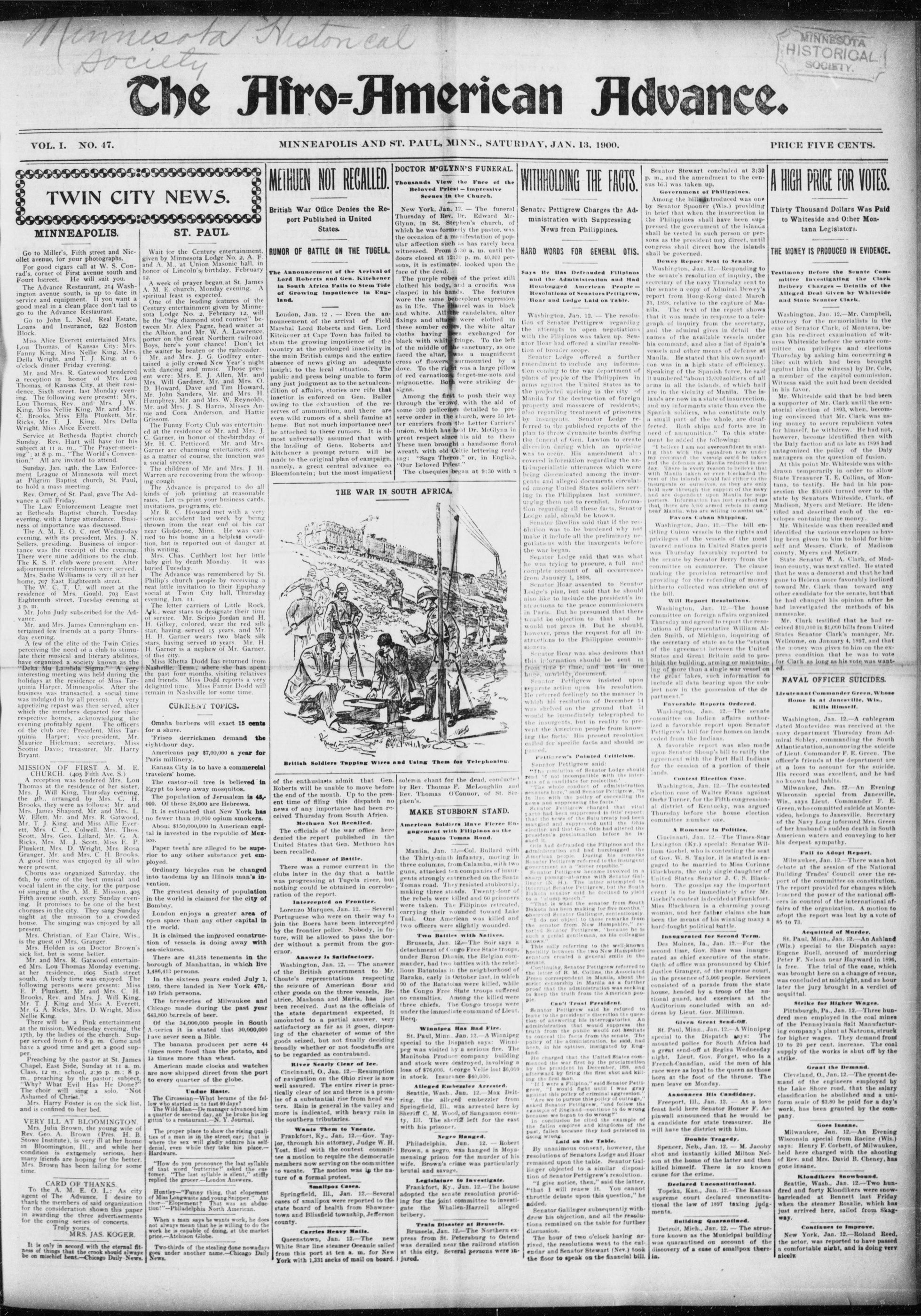
Page text (machine-generated)
TWIN CITY NEWS.
VOL.I. NO.47.
MINNEAPOLIS.
Go to Miller's, Fifth street and Niccollet avenue, for your photographs.
The Advance Restaurant, 214 Washington avenue south, is up to date in service and equipment. If you want a good meal in a clean place don't fail to go to the Advance Restaurant.
Go to John L. Neal, Real Estate, Loans and Insurance, 622 Boston Block.
Miss Alice Everett entertained Mrs. Lou Thomas, of Kansas City; Mrs. Fanny King, Miss Nellie King, Mrs. Della Wright, and T. J. King, at 6 o'clock dinner Friday evening.
Mr. and Mrs. R. Gatewood tendered a reception in honor of Mrs. Lou Thomas, of Kansas City at their residence. Sixth street is on Monday evening; the guests were present: Mrs. Lu Thomas, Rev. and Mrs. J. W. King, Miss Nellie King, Mr. and Mrs. C. Brooks, Miss Ella Plunket, Mr. Ricks, Mr. T. J. King, Mrs. Della Wright, Miss Alice Everett.
Service at Bethesda Baptist church Sunday. Rev. Hart will have for his subject at 1 a.m., "The Pray-meeting"; at 8 p.m., "The World's Convention." All are invited to attend.
Sunday, Jan. 14th, the Law Enforcement League of Minnesota will meet at Pilgrim Baptist church, St. Paul, to hold a mass meeting
Rev. Orner, of St. Paul, gave The Advance a call Friday.
The Law Enforcement League met at Bethesda Baptist church, Tuesday evening, with a large attendance. Business of importance was discussed.
The A. M. E. O. C. met Wednesday evening, with its president, Mrs. J. N. Sellers, presiding. Business of importance was the receipt of the evening. There were nine additions to the club. The K. S. P. club were present. After adjournment refreshments were served.
Mrs. Sadie Williams is very ill at her
Mrs. Sadie Williams is very ill at her home, 707 East Eighteenth street.
The W. C. T. U. will meet at the residence of Mrs. Gould, 703 East Eighteenth street. Tuesday evening at 3 p.m.
Mr. John Judy subscribed for the Adverse.
Mr. and Mrs. James Cunningham entertained few friends at a party Thursday evening.
A few of the elite of the Twin Cities perceiving the need of a club to stimulate their musical and literary abilities, have organized a society known as the "Delta Mu Lambda Sigma." A very interesting meeting was held during the holidays at the residence of Miss Tarquina Harper, Minneapolis. After the business was transacted, a social time was indulged in by all present. A very appetizing repast was then served, after which the members departed for their respective homes, acknowledging the evening probably spent. The officers of the club are: President, Miss Tarquina Harper; vice-president, Mr. Maurice Hickman; secretary, Miss Scottie Davis; treasurer, Mr. Harry Bryant.
MISSION OF FIRST A. M. E.
CHURCH. (405 Fifth Ave. S.)
A reception was tendered Mrs. Lou
Thomas at the residence of her sister,
Mrs. J. Will King, Thursday evening,
the 4th., arranged by Mrs. C. H.
Brooks, they were as follows: Mr. and
Mrs. James Shapard, Mr. and Mrs. L.
W. Ellett, Mr. and R. Gatwood,
Mr. T. J. King, and Miss Allie Everett,
Mrs. C. C. Colwell, Mrs. Thos.
Scott, Mrs. Geo. Lillard, Mr. G. A.
Ricks, Mrs. M. J. Scott, Miss E. P.
Plankett, Mrs. D. Wright, Mrs. C. H.
Rosgrager, Mr. and Mrs. C. H. Brooks.
A good time was enjoyed by all who
were present.
Chorus was organized Saturday, the
6th, by some of the best musical and
vocal talent in the city, for the purpose
of singing at the A. M. E. Mission. 405
Fifth Avenue, A. M. E. Sunday, ever
ing. It promises to be one of the best
chorus in the city. They sang Sunday
night at the mission to a crowded
house. The singing was enjoyed by all
present.
Mrs. Holden is on Doctor Brown's sick list, but is some better.
Mr. and Mrs. R. Gatwood entertained Mrs. Lou Thomas Monday evening, at her residence, 1605 Sixth street south. A lively time was enjoyed. The following persons were present: Miss E. P. Plunkett, Mr. and Mrs. C. H. Brooks, Rev. and Mrs. J. Will King, Mr. T. J. King and Miss A. Everett, Mr. G. A. Ricks, Mrs. D. Wright, Miss Nellie King.
There will be a Pink entertainment at the mission, Wednesday evening, the 17th, by the ladies of the church. Supper served from 6 to 8 p. m. Come and have a good time and get a good supper.
Preaching by the pastor at St. James Chapel, East Side, Sunday at 11 a. m. Class, 12 m.; school, 2:30 p. m. p. m., preaching by the pastor, subject, "Why? What Evil Has He Doe?"
The choir will sing a solo, "Not Ashamed of Christ."
Mrs. Harry Foster is on the sick list, and is confined to her bed.
VERY ILL AT BLOOMINGTON.
Mrs. Julia Brown, the young wife of Rev. Geo. A. Brown (Pres. H. B. Stowe Institute), is very ill at her home in Bloomington, Ill., and while her condition is extremely serious, her many friends are hoping for the better. Mrs. Brown has been failing for some
CARD OF THANKS
To the A. M. E. O. L.; As city agent of The Advance, I desire to thank the members of said organization for the consideration shown this paper in awarding the three advertisements for the coming series of concerts.
MRS. JAS. KOGER.
It is only in accord with the eternal
fitness of things that the crook should always
be in the grip of the sword.
The Afro-American Advance.
ST. PAUL.
Wait for the Century entertainment,
given by Minnesota Lodge No. 2, A. F.
and A. M., at Union Masonic hall,
in honor of Lincoln's birthday, February
12.
A week of prayer began at St. James
A. M. E. church, Monday evening.
A spiritual feast is expected.
One of the leading features of the
Century entertainment given by Minnesota
Lodge No. 2, February 12, will
have the Diamond stnd contest" between
Mr. Alex Pagine, head waiter at
the Albion, and Mr. W. A. Lawrence,
porter on the Great Northern railroad.
Boys, here's your chance! Don't let
the waiter be beaten or the railroader.
Mr. and Mrs. J. G. Godfrey entertained
a jolly crowd New Year's night
with dancing and music. Those present
were: Mrs. E. J. Allen, Mr. and
Mrs. Will Gardner, Mr. and Mrs. O.
D. Howard, Dave and Tim Howard.
Mr. John Sanders, Mr. Humphrey,
M. Humphrey, Mr. and Mrs. W. Reynolds,
W. and Mrs. J. S. Harris, Misses Annie
and Mrs. J. S. Harris, Misses Annie
Grissom
The Funny Forty Club was entertained at the residence of Mr. and Mrs. J. C. Garner, in honor of the birthday of Mr. H. C. Petticow, Mr. and Mrs. Garner are charming entertainers, and as a matter of course, the function was a social success.
The children of Mr. and Mrs. J. H. Warren are recovering from the whoooping cough.
The Advance is prepared to do all kinds of job printing at reasonable rates. Let us print your business cards, invitations, programs, etc.
Mr. R. C. Howard met with a very serious accident last week by being thrown from the rear end of his car near Gladstone, Minn. He was carried to his home in a helpless condition, but is reported out of danger at this writing.
Mrs. Hass Cuthbert lost her little girl girl death Monday. It was buried Tuesday.
The Advance was remembered by St. Phillip's church people by receiving a neat invitation to their Epiphany social at Twin City hall, Thursday evening, Jan. 11.
The letter carriers of Little Rock, Ak., wear stars to designate their time of service. Mr. Seipio Jordan and H. H. Gilkey, colored, wear the red silk star, having served 15 years, and Mr. H. H. Garner wears two black silk stars, having served 10 years. Mr. H. H. Garner is a nephew of Mr. Garner, of this city.
Miss Rhetta Dodd has returned from Nashville, Teem, where she has spent three months visiting relatives and friends. Miss Dodd reports a very delightful time. Miss Fannie Dodd will remain in Nashville for some time.
CUKRENT TOPICS.
Omaha barbers will exact 15 cents
for a shave.
'Frisco derrickmen demand the
eight-hour day.
Americans pay $7,000,000 a year for
Paris millinery.
Kansas City is to have a commercial
travelers' home.
The castor-oil tree is believed in
Egypt to keep away mosquitoes.
The population of Jerusalem is 48,
000. Of these 28,000 are Hebrews.
It is estimated that New York has no fewer than 30,000 olymp smokers.
no fewer than 10,000 opium smokers.
About: $150,000,000 in American capital is invested in the republic of Mexico.
Paper teeth are alleged to be superior to any other substance yet employed.
Ordinary bicycles can be changed into tadpoles by an Illinois man's invention.
The greatest density of population in the world is claimed for the city of Bombay.
London enjoys a greater area of open space than any other capital in the world.
It is claimed the improved construction of vessels is doing away with sea-sickness.
There are 41,318 tenements in the borough of Manhattan, in which live 1,486,413 persons.
In the sixteen years ended July 1, 1899, there landed in New York 476,149 Irish persons.
The breweries of Milwaukee and Chicago made during the past year 643,800 barrels of beer.
Of the 34,000,000 people in South America it is stated that 30,000,000 have never seen a Bible.
The banana produces per acre 44 times more food than the potato, and 13 times more than wheat.
American made clocks and watches are now shipped direct from the port to every quarter of the globe.
Undue Haste.
The Circassian—What became of the fellow, who started in to fast 40 days?
The Wild Man—De manager advanced him a quarter de second day, an he broke his gittin' to a restaurant.—N. Y. Journal.
The proper place to show the rising quality of a man is in the street ear; that is where he will likely admire his self-denial, even while they take his place—Hardware.
"How do you pronounce the last syllable of that man?" "Epilepion?" asked the customer. "The last syllable is silent," attitied replied the grocer.—London Answers.
Huntley—"Funny thing, that eloquence of Miss Longwaite and young Snapper." Author—"Epilepion?" That was an abduction!"—Philadelphia North American.
When a man says he wants work, he does not always mean that he is willing to do the work he is capable of doing, at the market price.—Atchison Globe.
Two-thirds of the stealing done nowadays goes under another name—Chicago Daily News.
MINNEAPOLIS AND ST. PAUL, MINN., SATURDAY, JAN. 13, 1900.
THE WAR IN SOUTH AFRICA.
British Soldiers Tapping Wires and Using Them for Telephoning.
METHUEN NOT REGALLED
British War Office Denies the Report Published in United States.
BUMOR OF BATTLE ON THE TUGELA
The Announcement of the Arrival of Lord Roberts and Gen. Kitchener in South Africa Falls to Stem Tide of Growing Impatience in England.
London, Jan. 12. — Even the announcement of the arrival of Field Marshal Lord Roberts and Gen. Lord Kitchener at Cape Town has failed to stem the growing impatience of the country at the prolonged inactivity in the main British camps and the entire absence of news giving an adequate insight to the local situation. The public and press being unable to form any just judgment as to the actual conclusion of affairs, stories are rife that inaction is enforced on Gen. Buller owing to the exhaustion of the reserves of ammunition, and there are even wild rumors of a shell famine at home. But not much importance need be attached to these rumors. It is almost universally assumed that with the landing of Gens. Roberts and Kitchener a prompt return will be made to the original plan of campaign, namely, a great central advance on Bloemfontein; but the most impatient
THE WAR IN S
British Soldiers Tapping Wires
of the enthusiasts admit that Gen Roberts will be unable to move before the end of the month. Up to the press time of filling this dispatch no news of any importance had been received Thursday from South Africa.
Methuen Not Recalled.
The officials of the war office here denied the report published in the United States that Gen. Methuen has been recalled.
Rumor of Battle.
There was a rumor current in the clubs later in the day that a battle was progressing at Tugela river, but nothing could be obtained in corroboration of the report.
Intercepted on Frontier.
Lorenzo Marques, Jan. 12. — Several Portuguese who were on their way to join the Boers have been intercepted by the frontier police. Nobody, in future, will be allowed to pass the border without a permit from the governor.
Answer Is Satisfactory.
Washington, Jan. 12. — The answer of the British government to Mr. Chate's representations respecting the seizure of American flour and other goods on the three vessels, Beatrice, Mashona and Maria, has just been received. Just as the officials of the state department expected, it amounted to a partial answer, very satisfactory as far as it goes, disposing of the character of some of the goods seized, but not finally deciding broadly whether or not foodstuffs are to be regarded as contraband.
River Nearly Clear of Ice.
Cineinnati, O., Jan. 12- Resumption of navigation on the Ohio river is now well assured. The entire river is practically clear of ice and there is a promise of a substantial rise from head waters. Rain is general in the valley and more is indicated, with heavy rain in the southern tributaries.
Wants Them to Vocate
Frankfort, Ky., Jan. 12. Gov. Taylor, through his attorney, Judge W. Hoyt, filed with the contest committee a motion to require the democratic members now serving on the committee to vacate. The motion was in the nature of a formal protest.
Smallpor Cases
Springfield, Bl., Jan. 12.—Several cases of smallpox were reported to the state board of health from Shawneetown and Blissfield township, Jefferson county.
Carica Heavy Mails.
Queenstown, Jan. 12.—The new White Star line steamer Oceanic sailed from this port at ten a. m. for New York with 1,331 sacks of mail on board.
DOCTOR M'GLYNN'S FUNERAL.
Thousands View the Face of the Beloved Priest - Impressive Scenes in the Church.
New York, Jan. 12. — The funeral
Thursday of Rev. Dr. Edward Mc
Glynn, in St. Stephen's church,
of which he was formerly the pastor, was
the occasion of a manifestation of popu-
lar affection such as has rarely been
witnessed. From 5:30 a. m. until the
doors closed at 12:30 p. m. 40,000
persons, it is estimated, looked upon the
face of the dead.
The purple robes of the priest still
clothed his body, and a crucifix was
clasped in his hands. The features
wore the same benevolent expression
as in life. The chancel was in black
and white. All the candelabra, altar
fixings and altars were clothed in
the somber colors the white altar
cloths having been exchanged for
black with white fringe. To the left
of the middle of the sanctuary, as one
faced the altar, was a magnificent
cross of flowers surmounted by a
dove. To the right was a large pillow
of red carnations, for forget-me-nots
and mignonette. Both were striking
designs.
Among the first to push their way through the erswd, with the aid of some 300 policemen detailed to preserve order in the church, were 50 letter carriers from the Letter Carriers' union, which has held Dr. McGlynn in great respect since his aid to them. These men brought a handsome floral wreath, with old Celtic lettering reading: "Saga Theron." or, in English "Our Beloved Priest." The obsequies began at 9:30 with a
SOUTH AFRICA.
and Using Them for Telephoning.
soleon chant for the dead, conducted by Rev Thomas F. McLoughlin and Rev Thomas O'Connor, of St. Stephen's.
MAKE STUBBORN STAND
American Soldiers Have Fierce Engagement with Filipinos on the Santo Tomas Road.
Manila, Jan. 12.—Col. Bullard with the Thirty-ninth Infantry, moving in three columns, from Calamba, with two guns, attacked ten companies of insurgents strongly entrenched on the Santa Tomas road. They resisted stubbornly, making three stands. Twenty-four of the rebels were killed and 60 prisoners were taken. The Filipinos retreated, carrying their wounded toward Lake Taal. One American was killed and two officers were slightly wounded.
Two Battles with Natives.
Brussels, Jan. 12.—The Soir says a detachment of Congo Free State troops, under Baron Dhani, the Belgian commander, had two battles with the rebellious Batatolos in the neighborhood of Baraka, early in October last, in which 90 of the Batatolos were killed, while the Congo Free State troops suffered no casualties. Among the killed were three chiefs. The Congo troops were under the immediate command of Lieut. Beeo.
Winnipeg, Man. Bad Fire.
St. Paul, Minn. Jan. 12.—A Winnipeg special to the Dispatch says: Winnipeg was visited by a serious fire. The Manitoba Produce company building and stock were destroyed, involving a loss of $76,000. George Velle lost $6,000 in stock. Insurance $40,000.
Alleged Embezzler Arrested
Seattle, Wash. Jan. 12. Max Deitring, the alleged embezzler from Springfield, Ill., was arrested here by Sheriff C. M. Wood, of Sangamon county, Ill. The sheriff left for the east with his prisoner.
Negro Hanged.
Philadelphia, Jan. 12. — Robert Brown, a negro, was injured in Moyamensing prison for the murder of his brother. That time was particularly brutal and savage.
Legislature to Investigate
Frankfort, Ky., Jan. 12.—The house adopted the senate resolution providing for the joint committee to investigate the Whallen-Harrell alleged bribery.
Trophe Disaster at Brussels.
Brussels, Jan. 12.—The Northern express from St. Petersburg to Ostend was derailed near the railroad station at this city. Several persons were injured.
WITHHOLDING THE FACTS.
Senator Pettigrew Charges the Administration with Suppressing News from Philippines.
HARD WORDS FOR GENERAL OTIS
Says He Has Defrauded Filipinos and the Administration and Had Husbandbugged American People—Resolutions of Senators Pettigrew, Roar and Lodge Laid on Table.
Washington, Jan. 12. — The resolution of Senator Pettigrew regarding the attempts to open negotiations with the Filipinos was taken up. Senator Hear had offered a similar resolution of broader scope.
Senator Lodge offered a further amendment to include any information coming to the war department of plans of people of the Philippines in arms against the United States as to the projected uprising in the city of Manila for the destruction of foreign property and massacre of residents; also regarding treatment of prisoners by insurgents. Senator Lodge referred to the published reports of the plan to throw dynamite bombs during the funeral of Gen. Lawton to create diversion during which an uprising was to occur. His amendment also covered information regarding the anti-imperialistic utterances which were being disseminated among the insurgents and alleged documents circulated among United States soldiers serving in the Philippines last summer urging them not to reenlist. Information regarding all these facts, Senator Lodge said, should be known.
Senator Rawlins said that if the revolution was to be burdened why not make it include all the preliminary negotiations with the insurgents before the war began.
Senator Lodge said that was what he was trying to procure, a full and complete account of all occurrences from January 1, 1898.
Senator Hoar assented to Senator Lodge's plan, but said that he should also like to include the president's instructions to the peace commissioners in Paris. But he presumed that there would be objection to that and he would not press it. But he should, however, press the request for all instructions to the Philippine commissioners.
Senator Hoar was also desirous that this information should be sent in from time to time, and not in one huge, unwieldy document.
Senator Pettigrew insisted upon separate action upon his resolution. He referred feelingly to the manner in which his resolution of December 14 was shelved on the ground that it would be immediately telegraphed to the insurgents, but in reality to prevent the American people from knowing the facts. His present resolution called for specifie facts and should be reused.
Pettigrew's Pointed Criticism
"The resolution of Senator Lodge should read if not incompatible with the interests of a candidate for reelection.
"The whole conduct of administration has been in line with the policy of concealing the news and suppressing the facts."
Senator Pettigrew charged that vital parts had been taken out of the report, the news of the Sui treaty had been mangled and suppressed until the Ohio election and that Gen. Otis had altered the president's proclamation before he issued it.
He had defrauded the Filipinos and the administration and had humbugged the American people. During his remarks Senator Pettigrew referred to an insurgent group as "the insurgent public."
Senator Pettigrew became involved in a smart passage-at-arms with Senator Gallinger (N. H.). The latter attempted to discredit Senator Pettigrew. Senator said he declined to yield to a "stump speech."
"That is what the senator from South Dakota has been making for five months," he said. "I do not object to these remarks from the senator from New Hampshire," restored Senator Pettigrew, "because he is such a gentleman, as his colleague."
Thisally referring to the well-known hostility between the two New Hampshire senators created a general smile in the crowd. Continuing, Senator Pettigrew referred to the letter of R. M. Collins, the Associated Press reporter, in a strict censorship in Manila as a further proof that the administration was seeking to keep the truth from the American peo-
Can't Trust President.
Senator Pettigrew said he refused to leave to the president's discretion the question of answering his interrogatories. An administration official said the public would not hesitate to conceal the facts from the senate. The policy of the administration, he said, had been, in his opinion, instigated by England. He charged that the United States commenced the war first by the proclamation by the president in December, 1868, and afterward by filing the first shot and killing the first man. He said "sanitized" said Senator Pettigrew, "I would fight until I was gay against this policy of criminal aggression." "Are we to pursue this policy of outrage," he said, "or are we to example of England—continue to do wrong because we began to do wrong?" In conclusion he cited the example of the fallen empires and kingdoms of the past, falls because they had persisted in
Laid on the Table.
By unanimous consent, however, the resolutions of Senators Lodge and Hour remained upon the table. Senator Gallinger objected to a similar disposition of Senator Pettigrew's resolution. "I give notice, then," said the latter, "that I will renew it. You cannot throttle debate upon this question," he added. Senator Gallinger subsequently withdrew his objection, and all the resolutions remained on the table for further discussion. The hour of two o'clock having arrived, the resolutions went to the calendar and Senator Stewart (Nev.) took the floor to speak on the financial bill.
Senator Stewart concluded at 3:30 p. m., and the amendment to the census bill was taken up.
Government of Philippines.
Among the bills introduced was one by Senator Spooner (Wis.) providing in brief that when the insurrection in the Philippines shall have been suppressed the government of the islands shall be vested in such person or persons as the president may direct, until congress shall direct how the islands shall be governed.
Dewey Repor: Sent to Senate.
Dewey Report sent to Senate.
Washington, Jan. 12. - Responding to the senate's resolution of inquiry, the secretary of the navy Thursday sent to the senate a copy of Admiral Dewey's report from Hong-Kong dated March 31, 1888, relative to the capture of Manila. The text of the report shows that it was made in response to a telegraph of inquiry from the secretary, and the admiral gives in detail the names of the available vessels under his command, and also a list of Spain's vessels and other means of defense at Manila. He stated that his own squadron was in a high state of efficiency. Speaking of the Spanish force, he said it numbered "about 15,000 soldiers of all arms in all the islands, of which half are in the vicinity of Manila. The islands are now in a state of insurrection, and my informants state even the Spanish soldiers, who constitute only a small part of the whole, are disaffected. Both ships and forts are in need of ammunition." To this statement he added the following:
“I believe I am not overconfident in stat- irg that with the squadron now under my command the vessels could be taken and the defenses at Manila reduced in one day. There is every reason to believe that with Manila taken or even blockaded the rest of the islands would fall either to the insurgents or ourselves, as they are only held now through the support of the navy and are dependent upon Manila for supporters. Information has just reached me that there are 5,000 armed rebels in camp near Manila, who are willing to assist us.”
Favors Cuban Shipping.
Washington, Jan. 42. The bill entitling Cuban vessels to the rights and privileges of the vessels of the most favored nations in United States ports was Thursday favorably reported to the senate by Senator Berry from the committee on commerce. The clause making the provision retroactive and providing for the refunding of money hitherto collected was stricken out of the bill.
Will Report Resolutions.
Washington, Jan. 12. "The house committee on foreign affairs organized Thursday and agreed to report the resolutions of Representative William Alden Smith, of Michigan, inquiring of the secretary of state as to the "status of the agreement between the United States and Great Britain said to prohibit the building, arming or maintaining of more than a single war vessel on the great lakes, such information to include all data bearing upon the subject now in the possession of the department."
Favorable Reports Ordered.
Washington, Jan. 12. The senate committee on Indian affairs authorized a favorable report upon Senator Pettigrew's bill for free homes on lands ceded from the Indians. A favorable report was also made upon Senator Shoup's bill to ratify the agreement with the Fort Hall Indians for the cession of a portion of their lands.
Contest Election Case.
Washington, Jan. 12.—The contested election case of Walter Evans against Oeder Turner, for the Fifth congressional district of Kentucky, was argued Thursday before the house election committee number one.
A Romance in Politics
Cincinnati, Jan. 12. "The Times-Star Lexington (Ky.) special: Senator William Goebel, who is contesting the seat of Gov. W. S. Taylor, it is stated is engaged to be married to Miss Corinne Blackburn, the only single daughter of United States Senator J. C. S. Blackburn. The gossips say the important event is to be immediately after Mr. Goebel's contest is decided at Frankfort, Miss Blackburn is a charming young woman, and her father claims she has been the means of his winning many a hard-fought political battle.
Inaugurated for Second Term.
Des Molines, Ia., Jan. 12.—For the second time, Gov. Shaw was inaugurated as chief executive of the state. Oakt of office was pronounced by Chief Justice Granger, of the supreme court, in the presence of 5,000 people. Services consisted of a parade from the state house, headed by a troop of the national guard, and exercises at the Auditorium concluded with an address by Lieut. Gov. Milliman.
Given Great Send-Off
St. Paul, Minn., Jan. 12.—A Winnipeg special to the Dispatch mays: The mounted police for South Africa had a great send-off at Regina Wednesday night, Lieut. Gov. Forget, who is a French-Canadian, said the men of his race were as loyal to the queen as those born at the foot of the throne. The men leave on Monday.
Appnances His Candidacy
Freeport, Ill., Jan. 12. — At a love feast held here Senator Homer F. Aspinwall announced that he would be a candidate for state treasurer. He will have the district with him.
Double Tragedy
Spencer, Neb., Jan. 12. — M. Jacoby shot and instantly killed Milton Nelson at the home of the latter and then killed himself. There is no known cause for the crime.
Declared Unconstitutional
Topeka, Kan., Jan. 12.—The Kansas supreme court declared unconstitutional the law of 1897 taxing judgments.
Building Quarantined.
Detroit, Mich., Jan. 12. — The structure known as the Municipal building was quarantined on account of the discovery of a case of smallpox therein.
MINNESOTA
HISTORICAL
SOCIETY.
A HIGH PRICE FOR VOTES.
Thirty Thousand Dollars Was Paid to Whiteside and Other Montana Legislators.
THE MONEY IS PRODUCED IN EVIDENCE.
Testimony Before the Senate Committee Investigating the Clark Bribery Charges - Details of the Alleged Deal Given by Whiteside and State Senator Clark.
Washington, Jan. 12.—Mr. Campbell, attorney for the memorialists in the case of Senator Clark, of Montana, began his re-direct examination of witness Whiteside before the senate committee on privileges and elections Thursday by asking him concerning a libel suit which had been brought against him (the witness) by Dr. Cole, a member of the capitol commission. Witness said the suit had been decided in his favor.
Mr. Whiteside said that he had been a supporter of Mr. Clark until the senatorial election of 1893, when, becoming convinced that Mr. Clark was using money to secure republican votes for himself, he withdrew. He had not, however, become identified then with the Daly faction and as late as 1898 had antagonized the policy of the Daly managers on the question of fusion. At this point Mr. Whiteside was withdrawn temporarily in order to allow State Treasurer T. E. Collins, of Montana, to testify. He had in his possession the $300,000 turned over to the state by Senators Whiteside, Clark, of Madison, Myers and McGarr. He identified and described each of the envelopes containing the money. Mr. Whiteside was then recalled and identified the various envelopes as having been given to kim to hold for himself and Messrs. Clark, of Madison county, Myers and McGarr.
State Senator W. A. Clark, of Madison county, was next called. He stated that he was a democrat and that he had gone to Helena more favourably inclined toward Mr. Clark than toward any other candidate for the senate, but that he had changed his opinion after he had investigated the methods of his namesake.
Mr. Clark testified that he had received $10,000 in $10,000 bills from United States Senator Clark's manager, Mr. Welcome, on January 4, 1897, and that the money was given to him on the express condition that he was to vote for Clark as long as his vote was wanted.
NAVAL OFFICER SUICIDES.
Lieutenant Commander Green, Whose Home Is at Janesville, Wis., Kills Himself.
Washington, Jan. 12.—A cablegram dated Montevideo was received at the navy department Thursday from Admiral Solley, commanding the South Atlantic station, announcing the suicide of Lieut. Commander F. E. Green. The officer's friends at the department are at a loss to account for the suicide, His record was excellent, and he had no known bad habits.
Milwaukee, Jan. 12.—An Evening Wisconsin special from Janesville, Wis., says Lieut. Commander F. E. Green, who committed suicide at Montevideo, belongs to Janesville. Secretary of the Navy Long informed Mrs. Green of her husband's sudden death in South American waters and conveying to her his deepest sympathy.
Fail to Adopt Report.
Milwaukee, Jan. 12.—There was a hot debate at the session of the National Building Trades' Council over the report of the committee on constitution. The report provided for changes which leashed the power of the national officers in control of the international affairs of the organization. A motion to adopt the report was lost by a vote of 85 to 73.
Acquitted of Murder
St. Paul, Minn., Jan. 12.—An Ashland (Wis.) special to the Dispatch says: Eugene Buell, accused of murdering Peter F. Nelson near Hayward in 1896, is free. The trial of the case, which was brought here on a change of venue, was concluded at midnight, and an hour later the jury brought in a verdict of acquittal.
Strike for Higher Wages.
Pittsburgh, Pa., Jan. 12.—Three hundred men employed in the coal mines of the Pennsylvania Salt Manufacturing company's plant at Natrona, struck for higher wages. They demand from 10 to 20 per cent. increase. The coal supply of the works is shut off by the strike.
Grant the Demand.
Cleveland, O., Jan. 12.—The recent demand of the engineers employed by the Lake Shore road, that the salary classification be abolished and a uniform scale of $3.80 be paid for a day's work, has been granted by the company.
Goca Insane.
Milwaukee, Jan. 12—An Evening Wisconsin special from Racine (Wis.) says: Henry F. Corbett, of Milwaukee, held here charged with the shooting of Rev. and Mrs. David B. Cheney, has gone insane.
Klondikers snowbound
Seattle, Wash., Jan. 12.—Two hundred and forty Klondikers were snowbarricaded at Bennett. last Friday when the steamer Rosalie, which has just arrived here, sailed from Skagway.
Continues to Improve.
New York, Jan. 12.—Roland Reed, the actor, was reported to have passed a comfortable night, and is doing very nicely.
Published every Saturday by the
ADVANCE PUBLISHING COMPANY
Office, 214 Washington Av. So.,
Tel. Call 2415-L3.
Minneapolis, - - - - - - Minnesota.
Entered at the Post Office, at Minneapolis, Minn., as second-class matter.
Subscription Rates:
One Year - - - - - - $1.00
Six Months - - - - - .60
Three Months - - - .35
Subscription Always Fayable in Ab-
vance.
Special rates if ordered by the dozen.
Orders for current issue should reach the
office by Wednesday evening.
Advertising Heter
Local Reading Notices, 10c per line,
each insertion.
Religious Notices (not over five lines), free.
"Want" and "To Let" advertisements,
8 cents per line for each insertion.
Display, 60 cents per inch each insertion,
rates will be given for space by the year.
Editorial Announcements.
manuscript postage should be enclosed.
Communications must reach the office by Wednesday morning, preceding the issue in which they are to appear.
All communications, enclosing news matter for publication, must bear the writer's name, not for publication, but as an evidence of good faith.
Contributions and items of news concerning the progress of the colored race are requested from our readers.
We reserve the right to reject any communication unavailable for publication.
Subscribers ordering addresses of their previous address will be given to the former as well as their present address.
Address all communications and make all remittances to THE AFRO-AMERICAN ADVANCE.
J. C. REID, EDITOR.
MRS. GEO. DUCKETT, Associate Editor.
To my Friends and Patrons: I shall be absent from the city during the winter—will reside in the South. The Advance will be issued under the management of Mr. Geo. Duckett and Lawyer James L. Curis. The former gave her ability as a good news paper woman. The latter I am sure will give to our readers able and scholarly editorials upon all current topics. Your humble servant feels safe to say that Mr. Curis' literary qualifications will stand the test of the most learned. I sincerely hope that the citizens of the Twin Cities will arouse fresh vigor in the support of this much-needed champion of Afro-American rights. Our paid-up subscribers have been given credit on our books. Those who have not paid will please退 to the management. With much success to The Advance, I remain your humble servant.
J. C. REID,
N. B. Mr. Curis has purchased the interest of Mr. Reid in The Advance.
The associate editor, Geo. Duckett, lies very ill with the grippet at her home, 305 Thomas street, and she desires to say that the St. Paul correspondence must be credited to Louse Jackson, a bright little high school miss, a friend of the associate editor.
The Florida Sentinel, which found its way into our office this week, has the appearance of a very strong race paper.
We hale with pleasure the Sedalia, Mo., Times, which arrived among our exchanges this week.
The New York Age appeared in a par excellent dress last week.
OPPOSED BY NAVY.
Bugsion to Create Two Grades of Vice Admiral Meets with General and Strong Objections.
There is general opposition throughout the navy to the creation of two grades of vice admiral. This opinion was expressed to the president at the conference held with the Santiago captains in regard to the suitable reward which should go to the officers of the North Atlantic fleet. It is hardly likely the president will recommend congress to provide for two such grades, which is out of all proportion to the requirements of the service, and would furnish three high grades beyond any in the military service.
In the conference there was little offered of personal character, and the discussion was on the broad lines of the needs of the service rather than on whether Sampon or Schley was entitled to the glory of the Santiago victory. The creation of the grade of vice admiral will be used as an argument for the revival of the grade of lieutenant general in the army, and it is said that one of the first actions of Gen. Miles' friends in the senate will be the introduction of a measure which will have the effect of creating the new grade for him.
It is by no means certain, however, that Miles will secure the place. There is abundant opposition to him still in the war department, and the withdrawal of Alger does not appear to have altered the conditions which prevailed under the latter's administration. Miles' recommendations are unheeded and his communications are practically ignored.
It took three weeks of time and the personal offices of a prominent army officer to secure Secretary Root's attention to a letter which Miles had written to the war department concerning the detail of a line major to his regiment in the Phillipines.
About Time He Saves 0
A Cleveland man secured his fifth divorce a few days ago, but in justice to him it should be added, says the Chicago Times-Herald, that he swore off at the beginning of the year.
Titled by Old Methods.
The soil of Egypt at the present day is tilled by exactly the same kind of plow that was used 8,000 years ago.
When a man is injured in a railway wreck he first asks his doctor if he can recover, and asks, and about how much.—L. A. W. Bulletin.
Experiments Being Made to Produce Army Sidearm.
An Automatic Hand Machine Gun is the Weapon Desired -Tests Being Made at Springfield (Mnaa.) Armory.
An important test of pistols is in progress at the Springfield, Mass., armory. The objects of these tests is to secure an improved sidearm for the army, and it is the aim of the ordnance department to obtain pistols which will not be open to the objections which prevail regarding the present army revolver. It is desired to do away with the present revolver feature of the pistol mechanism and to find a pistol which will in effect be an automatic hand machine gun.
There are several other defects in the revolver now used. Upon the discharge of the cartridge the quantity of gas generated necessarily escapes through the space between the cylinder and the barrel, thus obtaining for the ammunition less velocity than the cartridge is capable of giving under better circumstances. The insertion of cartridges upon the revolver cylinder is obviously slow, as in the piece now used each cartridge has to be placed separately. As far back as seven years ago a pack was produced which enabled the full revolver charge to be placed in the Smith & Wesson cylinder simultaneously, but this device was found impracticable for several reasons, one of the defects being that the round form of the package made it cumbersome.
Before the tests now in progress are completed the ordinance officers will have examined the German army type of muser pistol, the Bergmann pistol and the Manlicher pistol, all of which are magazine arms, in competitive comparison with the colt and Smith & Weapon revolvers. The several types of automatic mechanisms for small arms are represented in the muser, Bergmann and Maulicher pistols. It is said the escape of gas through the parts for the operation of the automatic mechanisms in these pieces is neither as great nor as fatal to the efficiency of the discharge as the loss of gas through the space between the cylinder and barrel of the revolver. Another advantageous feature of the automatic pistol is that the magazine can be filled speedily with one operation, the cartridges being held together by a clip in a manner resembling the assembled charges for the navy type of the Lee rifle.
BIG FINANCIAL GROWTH.
New York State Bank Superintenden
Reports Banks as Having Gained
Over $50,000,000 in Resources.
The New York state bank superintendent reports that during the last fiscal year the banks of deposit and discount under his supervision gained over $50,000,000 in resources, or more than 15 per cent. The gain in their actual condition has doubtless been even greater than is suggested by these figures.
Eight new trust companies were organized, and at least five others were in course of organization when the year closed. The combined capital and paid-in surplus of these 13 corporations approximates $22,000,000. The 52 companies reporting had resources aggregating $722,000,000, or $195,000,000 more than was reported by the 49 companies in business at the beginning of the calendar year. Nothing like this development has ever before been known.
The total resources of banks of deposit and discount were $732,982,538; of savings banks, $968,787,167; of trust companies, $722,356,523; of safe deposit companies, $5,303,224; of foreign mortgage companies, $12,716,773; building and loan associations, $64,746,636; total, $2,146,983,861. Compared with the previous year this is a gain of $322,432,231. The superintendent recommends legislation which will protect the public from private bankers like the Franklin syndicate, of Brooklyn, which promised the impossible rate of interest of 520 per cent.
The scandals in building and loan association affairs have been in part the culmination of reckless improvident management, says the superintendent.
NEW GERMAN CODE.
Will Make Matters Particularly Difficult for Americans Who Intend to Marry in the Empire.
With the beginning of the year a new civil code went into effect in Germany, and it makes things particularly difficult for Americans who intend to marry in the empire. The new law requires certain documents, which must be produced before the marriage can be legally contracted. They are: "First—Proof that the applicant is a citizen of the United States. Second—A certificate by the proper authorities of his native or home state to the effect that the authorities know of no just cause or impediment why the marriage should not take place, this certificate to be verified by the German ambassador or a German consul in the United States. Third—A certificate of birth, which must be verified by the German ambassador of a German consul in the United States. Fourth—Should there be any consanguinity or affinity between the applicant and his intended wife proofs must be furnished that in the applicant's home state such consanguinity or affinity forms no impediment to the marriage. Fifth—If the applicant has been married before the decree relating to the dissolution of the marriage must be produced, after having been verified by a consular officer.
Bread Baking in France
In France the bread is baked in rolls about the size of a man's arm and four feet long.
The Place for It.
"Well, gentlemen," remarked the president of the club, "motions are in order. It has been suggested that we have a banquet. "Mr. President," spoke up the man who was seldom heard from. "I move we dispose of by laying it on the table." Philadelphia.
The motion was carried.—Philadelphia North American.
An Explanation.
"It strikes me this ice water is dirt," said a Cincinnati hotel guest.
"Huly goe!" exclaimed the bellboy, as he looked in the giee. "I betheber de porter forgot ter wash it."—Chicago Evening News.
CHARGES STORAGE ON A LEG.
A Druggist of Concord, N. R., Presents
a Peculiar Bill Against a
Rich Man's Estate.
The executors of the eccentric millionaire, John H. Pierson, of Concord, N. H., the contest over whose will has just been settled, have been called upon to pay many peculiar claims from creditors. One of these was for storing an amputated leg of Mr. Pierson. Eleven years ago Mr. Pierson had to have one of his legs amputated. He decided to keep the leg and have it buried with him. He accordingly handed it over to a Concord druggist with orders to preserve it and produce it for burial at the proper time. This the druggist did. One of the bills presented to the executors is for "the storage and care of John H. Pierson's amputated leg." the charge being $3.450, or about one dollar a day, not including Sundays.
A NEW SEARCH LIGHT.
Fire Engine Equipped to Render Aid to Firemen in Locating the Seat of a Fire.
A new searchlight fire engine, built on plans suggested by Fire Chief Croker, of New York, was received from Elmira the other day. This is the first of the kind ever constructed. Its purpose is to aid the firemen by enabling them to locate at once the seat of a fire, instead of groping about in darkness. The engine is supplied with a projector that makes it possible to cover a large area with light at short range. The lamps give an are of 6,000 candle power. The engine complete weighs 6,500 pounds, and will be drawn by two horses. It is expected the new engine will be a great aid to firemen in locating blazes at night.
EVA ROACH ASLEEP AGAIN.
Montreal Girl Falls Into Another
Trance—Has Remained Uncon-
scious Since Christmas.
Eva Ronch, of Montreal, Que., is sound asleep again. She achieved a great deal of unwelcome notoriety by failing asleep Christmas eve a year ago. Although skilled doctors tried in many ways to arouse her from her trance, she remained unconscious for 38 days. She fell asleep this time Christmas eve and has not yet been aroused. Now, as a year ago, a needle can be plunged into the girl's body without arousing her. If her head is touched, however, she resents that action at once. She throws back her head, moves her body, and her hands clinch and twist violently.
Humiliating the Horse.
It seems as if the limit of humiliation has come at last to the horse. He has been used as a beast of profitless burden, cut up into sausage meat and otherwise abused in the flesh, and now doctors are making a drunkard of him, says the San Francisco Call, in order that with his virus they may destroy drunkenness in that unreliable animal, man.
Single Women vs. Married Ones. The single working girls of Boston are organizing against married women who work in restaurants and big stores for pin money. The girls think that women who have husbands to support them ought to stay at home and not interfere with others who are compelled to work for their living.
BIJOU TRUNK FACTORY
WM. LORENZ, Prop.
Trunks & Traveling Bags
Sample Trunks and Cases
Made to Order.
18-20-22 Wash. Av. N. Minneapolis, Minn.
Branch: Fifth and Nicollet.
MRS. J. B. WATSON.
Fashionable Dressmaker.
Cutting, Fitting and Making Over a
Specialty. New York and Paris Fash-
lions Always on Hand.
Farriers, 628 Fourth Avenue, South.
DR. R. S. BROWN.
Office: 405-6 Reeve Hidg, 408 Nolelvet A
Telephone: 7234-3-5.
Office Hours: 9:30 to 12:30; 2:00 to 4:00
p. m.; 5:30 to 7:00 p. m. Sundays: 9:30
to 11:00; 12:30 to 2:00
p. m. to Portland Ave. Telephone
317-424-South
PORTLAND, OREGON.
H. PERRY, Manager.
MR. L. A. JOHNSON.
The gentlemanly and obliging Porter at R. De Leo's Barber Shop, 200 Washington Av. South, is
JAMES L. CURTIS
603 Northwestern Bldg., Minneapolis.
Cor. 4th St. and Hennepla Av.
MRS. W. F. HALL,
Furnished Rooms
TABLE BOARD IF DESIRED.
Prices Reasonable.
246 East Seventh St.
St Paul Minn
BUY THE BEST
OF CHAS. E. BATTLES
UNIVERSAL STEEL RANGES
AND HEATING STOVES.
370 JACKSON, ST. PAUL.
Officers and Standing Committee of the Most Worshipful Grand Lodge A. F. and A. M. of Minnesota and jurisdiction: Grand Master-John L. Neal, Minneapolis.
Grand Junior Warden-J. C. Garner, St. Paul.
Grand Treasurer-Daniel Roy, St. Paul.
Grand Secretary-William R. Morris, Minneapolis.
Grand Lecturer-G. W. Duy (7), Minneapolis.
Deputy Grand Secretary-O. D. Howard (6), St. Paul.
Deputy Explain-Isaac Crawford (6), Minneapolis.
Grand Senior Deacon-John Martin (1), St. Paul.
Grand Junior Deacon-R. De Leo (7), Minneapolis.
Grand Senior Steward-J. H. Dillingham (8), St. Paul.
Grand Junior Steward-Wm. Stevens (3), St. Paul.
Grand Tyler-T. Bush (3), St. Paul.
Grand Marshall-C. H. McDonald (5), Duluth.
Grand Pursuivant-G. W. Duckett (4), St. Paul.
Grand Sword-Bearer-J. Adams (1), St. Paul.
Grand Standard-Bearer-G. J. Charleson (2), St. Paul.
Grand Register-J. G. Sterett (6), Minneapolis.
District Deputy Grand Master-First District-James Woodfork (1), St. Paul.
District Secretary-E. H. Hamilton (6), Minneapolis.
District Deputy Grand Master-Third District-J. K. Polk (5), Duluth.
MINNEAPOLIS.
G. U. O. O. O. F.
St. Anthony Lodge, No. 2877.
Meets the first and third Wednesday in each month for the transaction of business, 1st avenue in Washington.
A. H. MYRICK, N. G.
JAMES A. SCOTT, P. S. P. O. Box 33.
KNIGHTS OF PYTHIAS.
Nut. Turner Lodge, No. 2, K. of P.
Meet the second and fourth Thursdays in
weekend meetings. At welcome. At Labor Temple, Fourth
and Eighth avenue south.
RALPH WATSON, K. R. and S.
PRIDE of Minnesota Lodge, No. 1, K.
Pride of Minnesota Lodge, No. 1, K.
Meets the first and third Thursdays in each month. All brothers in good standing attend. Masons in good standing First avenue north and Washington. JAMES HOBERTS, C. C. W. C. JEFFERSON, C. C. W. C. JEFFERSON, C. C. J. K. HILYARD Lodge. Meets first Tuesday in each month at Windom Block. Second avenue South and Washington. Masons in good standing Windom Block. G. W. LILLARD, W. M. JASPER GIBBS, Sec. Guaranty Loan Restaurant Anchor Lodge, No 7. A. F. and A. M. Meets the first and second Monday in each month at Windom Block. Second avenue South and Washington. Masons in good standing welcome.
ODD FELLOWS.
Mars Lodge, No. 2202.
Meets first and fourth Wednesdays in each month at Odd Fellows Hall, 232 Wabasha street.
R. HICKMANN, P. S., 422 St. Anthony.
F. D. PARKER, N. G., 365 Edmund St.
Household of Ruth, No. 553, G. U. of O. F.
Meets first and fourth Monday in each month for business, second Monday for instruction, at Odd Fellows Hall, 232 Wabasha street.
R. W. SARAH C. KIRTLEY, M.N.G.
MRS. IDA JACKSON, W. R., 374 Summit place.
MOST WORSHIPFUL GRAND LODGE OF MINNESOTA, A. F. and A. M.
H. B. HOUSTON, Grand Master.
WM. H. B. HOUSTON, Grand Master.
H. G. GUARANZA Loan Blvd., Minnesapolis.
ST. PETER CLAYER'S SODALITY.
Meets the first and third Mondays of each month, W. J. Gardner, Pres., J. S. Harper, Pioneer Lodge, No. 1, A. F. and A. M.
Meets the first Monday in each month at Masonic Hall, southwest corner Fifth and Robert streets. Master Masons in good standing always. H. S. HADLEY, W. M. W. A. HILYARD, Sec. 124 Atwater.
Minnesota Lodge, No. 2, A. F. and Meets on the first and third Tuesday in each month at Masonic Hall, southwest corner of Fifth and Robert streets. Master Masons in good standing always wel
Meets second and fourth Monday in each month F. Mason Hall, southwest corner of Robert Mason's in good standing always welcome.
ANDREW JACKSON, W. M.
D. E. RIEHL, Ryan Hotel.
Perfect Ashler Lodge, No. 4, A. M.
Meets the second and fourth Tuesday in each month at Masonic Hall, southwest corner of Robert Mason's in good standing always welcome.
JOHN Q. A. WILSON, W. M.
E. W. R. WILSON, W. M.
Bethel Chapter, No. 28, R. A. M.
Meets the first and third Thursday in each month at Masonic Hall, southwest corner of Robert Mason's in good standing always welcome.
DANIEL ROY, H. P.
W. T. GASSAWY, Sec. State Capitol.
CHURCH DIRECTORY.
ST. PETER A. M. E. CHURCH.
Rev. W. S. Brooks, Pastor,
Sunday services; Preaching 11:30 a.m.
; Sunday School, 3:00 p.m.; evening
services; Evening worship, 4:00 p.m.
Thursday services, 8:00 p.m.
Wayman Home Circle, Tuesday evening
at different residences, Parsonage, 2205
BETHELSA BAPTIST CHURCH,
REDEEMDA BAPTIST CHURCH,
Sunday services; Preaching 11:30 a.m.
; Sunday School, 12:30 p.m.; Christian
meaver, 7:00 p.m.; evening services,
prayer meeting, 8:00 p.m. Parsonage,
1120 Eighth Street, South
THOMAS MISSION.
Rev. John J. Hole, Incharge,
151 Sixth avenue South.
Sunday services, 4:00 p.m.; Sunday
School, 3:00 p.m.
ST. JAMES A. M. E. CHURCH. Rev. J. W. King. Pastor.
Between First avenue and Second street
Southeast, near Exposition Bldg.
Sunday services: Preaching at 11:00 a.m.
m.; Sunday School; 3:00 p. m.; evening
services; $30 p. m. General prayer meet-
tle; $30 p. m. Weekly meetings of
the Debating Club.
ST. PAUL.
ST. JAMES A. M. E. CHURCH.
Rev. J. t. Anderson, Pastor.
Sunday services: 11:20 a.m. m. 7:20 p.m.
Sunday services: 11:20 a.m. m. 7:20 p.m.
Wednesday meeting 8:00 p.m. m.
ST. JAMES A. M. E. CHURCH.
Father Printon.
Cor. Fartington and Aurora avenues.
Sunday services: Mass. 8:00 a.m. m. High
m. 10:30 a.m. m. Evening service at
o'clock
PILGRIM BAPTIST CHURCH.
Hawkswood School.
Cor. 13th and Cedar.
Sunday services: Preaching at 11:20 a.m.
m. 10:30 a.m. m. School
o'clock
Wednesday meeting
gray prayer meeting
PHILIPS' EPSCOPAL MISSION
61 Hawkswood School, Avroys and Union.
S. PHILLIP'S EPISCOPAL MISSION
46 Rice street, bet. Aurora and University
Sunday services: Morning prayer, Litany and Sermon, 11:00 a. m.; Sunday School and Children's Vespers 3:00 p. m.; Morning and Sermon, 8:00 p. m.; Wednesday, 8:00 p. m.; Friday: Choir Rerearai and Brotherhood of St. Andrew, 8:00 p. m. All are cordially invited. Seats free.
NOTICE: Changes and corrections will be made upon notifytag the office. If we have neglected to place a notice of any society in the above directory it is because we do not know of it or have not seen its officers. Send name of any Lodge, place and time of meeting, name of officers and it will be inserted.
ALL NOSE AND NO BODY
Denies that the place to have your PICTURES FRAMED is at the.....
OLSON EARL,
..UNDERTAKER.
Funeral Director and Embalmer.
Open Day and Night. Satisfaction Guaranteed.
1503 S. Franklin Ave. - Minneapolis,
PATRONIZE THE BEST!
Free Delivery to All Parts of the City and Lake Minnetonka.
Our Motto: First-class Work and Moderate
Prices.
Crayon, Pastel and Water Colors a Specialty.
251-253 Cedar Avenue.
MINNEAPOLIS, MINNESOTA.
SEEDS OF FLOWERS Plants and Cut Flowers. We ship Funeral Flowers on telegraphic or mail orders any time, day or night. Budding or House Plants in their season. Cut Flowers, fresh and fragrant. Seeds that are good and honest, at five cents per packet. Our catalogue is FREE, send for it.
MENDENHALL, FLORIST.
411 Nicollet Ave., Minneapolis, Minn.
KLAFFKE'S
WHITE SEAL
FLOUR.
119 Central Ave., Minneapolis.
TEL. 2701-J-3.
NEXT TO YERSA'S.
WONDERFUL
DISCOVERY
Curly Hair Made Straight By
This wonderful hair pomade is the only safe preparation in the world that makes kinky hair prevent the hair from falling out and makes it look straight. It is warranted harmless. Testimonials free on re-orders straightening kinky hair. Beware of imitation. The genius never fails to create a beautiful, and beautiful. A toilet necessity for ladies and men. A pomade that vanages of this wonderful pomade is that by its superior and lasting quality it can be used to produce a preparation equal to it. Full directions to produce a preparation equal to it. Full directions to produce a preparation equal to it. Pay your name and address plainly to
OZONIZED OX MARROW CO.,
76 Wabash Ave., Chicago, Ill.
Magic Seeds
A wonderful Nerve
Remedy, that has no superior and
is guaranteed to cure all such nervous discourses as Nervous Protrusion,
Lack of Confidence, Lack of Confidence, Wakefulness, Headache, Nervousness, Lost Manhood, and all drains and loss of power in genera
A wonderful Nerve Remedy, that has no superior and is guaranteed to cure all such nerve diseases: Nervous Protrusion, Weak Memory, Lack of Confidence, Wakefulness, Headache, Nervousness, Lost Manhood, and all drains and loss of power in genera five organs of either sex, caused by Overexertion, Youthful Errors, Excessive use of Tobacco, Opium, or Stimulants, which lead to Infirmity, Consumption, and Insanity.
Magic Seeds restore the nerve and vigor of youth. Easily carried in the vest pocket. Sent prepaid in plain box by mail to any address, for $1,000, six boxes for $6,000 with a written guarantee to cure or money refunded. Write for free circular.
MAGIC MEDICINE CO.,
MANSFIELD, OHIO.
VICTORINE
THE WONDERFUL NEW
WASHING GOMPOUND
VICTORINE
TRADE MARK
THE GREATEST BLESSING TO
WOMANKIND
NO BOILING, NO RUBBING
OF CLOTHES REQUIRED.
PREVENTS SHRINKAGE OF WOOLENS.
5c. a Package—Two Week's Washing.
BARBEAU & CALLAHAN,
BOLE MANUFACTURERS, U.S.A.
AGENTS WANTED WHERE NOT REPRESENTED.
THE ADVANCE CAFE 214 WASHINGTON AV. SOUTH. Restaurant and Lunch Counter
MUSIC.....
Minneapolis School of Music
408 Nicollet Ave., 3d Floor.
Special Reduced Terms During May, June, July
August.
Piano, Organ, Violin, Elocution, Vocal,
Singing, Theory.
MUSIC . . .
Minneapolis School of Music
408 Nicollet Ave., 3d Floor.
Special Reduced Terms During May, June, July
August.
Organ, Violin, Elocution, Vocal, C
Singing, Theory.
Special Reduced Terms During May, June, July and August.
Piano, Organ, Violin, Elocution, Vocal, Chorus, Singing, Theory.
Thorough, Practical, Progressive Methods of Instruction for Beginners as well as Advanced Pupils.
LESSONS GIVEN DAY AND EVENING.
ANDREAS ROHNE, Musical Director.
WILL J. PARKY, Manager and Secretary.
D. H. BOONE, Pres.
N. JOSEPH LLOYD, Sec'y
SPEND A PLEASANT EVENING AT THE NORTH STAR SOCIAL CLUB
BILLIARD AND POOL TABLES.
Rooms, Second Floor, 202 Hennepin Avenue.
ESSONS GIVEN DAY AND EVENING
ROHNE, Musical Director.
WILL J. PARRY, Manager and
Pres. N. JOSEPH LLI
SPEND A PLEASANT EVENING AT THE
TH STAR SOCIAL C
BILLIARD AND POOL TABLES.
Rooms, Second Floor, 202 Hennepin Avenue.
D. H. BOONE, Pres. N. JOSEPH LLOYD, See'y.
SPEND A PLEASANT EVENING AT THE
NORTH STAR SOCIAL CLUB
BILLIARD AND POOL TABLES.
Rooms, Second Floor, 202 Hennelin Avenue
DR. THOS. S. COOK.
OFFICE HOURS:
10 TO 12 A. M.; 2 TO 4 P. M.; 7 TO 8 P. M.
TELEPHONE 386.
12TH AND ROBERT STS., S.
Office Telephone 1498-4.
VAL DO TUR
PHYSICIAN A
Office Hours: 8 to 10 a. m.; 12 to 2 p. m.; 4 to
Office, 27 E. 7th St. Kendrick Blk. Res. 350
25 YEARS' EXPERIENCE.
JAS. AMC
Practical Undertake
122 Washington Ave. S.
All our goods are first-class, and the pr
ROBERT STS., ST. PAUL, OVER DRU
Line 1498-4. Residence Telephone
CAL DO TURNER, M. D.
PHYSICIAN AND SURGEON.
to 10 a. m.; 12 to 2 p. m.; 4 to 6 p. m.
St. Kendrick Blk. Res. 353 Shorburn Ave. ST. PAUL
EXPERIENCE.
JAS. AMOR & CO.,
Local Undertakers and Embalm
122 Washington Ave. South, Minneapolis, Minn.
are first-class, and the prices we guarantee will defy con
12TH AND ROBERT STS., ST. PAUL, OVER DRUG STORE
S. Kierski
00R. FIFTH STREET AND CENTRAL AVENUE
MINNEAPOLIS, MINN.
Smoke "SUN
"BUCKIN
AND "PRIM
CHEW "PEACH AN
STRICTLY UNION
MANUFACTURED BY J. J. BA
PIPE FREE FOR "SUN
ke "SUN CURED"
BUCKINGHAM"
AND "PRIME MESS"
PEACH AND HONEY"
STRICTLY UNION LABEL TOBACCOS.
PICTURED BY J. J. BAGLEY & CO., DETROIT
E FREE FOR "SUN CURED" LABEL
MANUFACTURED BY J. J. BAGLEY & CO., DETROIT, MICH.
PIPE FREE FOR "SUN CURED" LABELS.
Miller
PHOTOGRAPHER
Finest Work. Prices Right.
ST. PAUL, 171-173 E. 70th St.
Opposite Olympic.
MINNEAPOLIS, 427-429 Nicollet Ave.
Over Yerxa's.
SMOKE THE SIGHT D
W. S. CONRA
400 FIRST AVE
COX & HARRIS,
The Climax L
FOR DISPLAYING GOODS
Any desired angle is quickly obtained B
itself in thirty days. V
Send for circular and
Manufactured by
CLIMAX TA
THE SIGHT DRAFT 5-CENT O
U.S. CONRAD, Distribut
400 FIRST AVENUE SOUTH.
ARRIS,
Climax Display T
PLAYING GOODS TO BEST ADVANT
angle is quickly obtained by turning a thumbscrew. W
itself in thirty days. Valuable addition to any stor
and well finished.
Send for circular and price list.
AGENTS B
by CLIMAX TAG CO., Dayton, C
SMOKE THE SIGHT DRAFT 5-CENT CIGAR.
W. S. CONRAD, Distributor,
400 FIRST AVENUE SOUTH.
COX & HARRIS, AGENTS.
The Climax Display Table
Any desired angle is quickly obtained by turning a thumb screw. Will pay for itself in thirty days. Valuable addition to any store. Neatly and well finished.
itself in thirty days. Valuable addition to any store. Neatly and well finished.
Send for circular and price list.
AGENTS WANTED.
Manufactured by CLIMAX TAG CO., Dayton, Ohio.
J. E. STEWART, SECY.
Twin City Club and
FURNISHE
With the Most Me
BARBER SHOP A
Where Meals are S
126 Hennepin Ave.
City Club and Employment B
FURNISHED ROOMS
With the Most Modern Conveniences.
BER SHOP AND RESTAURA
Where Meals are Served at All Hours.
nepin Ave. Minneapolis
NEW DESIGNS
In Mouldings and Novelties in the Picture Frame line at reasonable prices. A full line of Little $ \frac{1}{4} $ - inch Mouldings. A fine line of Etchings, from 20 to 65 cents. Five - inch Deep Gilt Moulding just the thing for large oil paintings, at a special price.
ANCE CAFE
BINGTON AV. SOUTH.
and Lunch Counter
His School of Music.
Collet Ave., 3d Floor.
Terms During May, June, July and
August.
In, Elocution, Vocal, Chorus
ing, Theory.
IN DAY AND EVENING.
Director.
WILL J. PARRY, Manager and Secretary.
N. JOSEPH LLOYD, Sec'y.
SANT EVENING AT THE
R SOCIAL CLUB
AND POOL TABLES.
00r, 202 Hennepin Avenue.
DR. J. E. PORTER.
OFFICE HOURS:
9 T0 10 A.M.; 1 T0 3 P.M.; 6 T0 7 P.M.,
AND NIGHTS.
S., ST. PAUL, OVER DRUG STORE.
Residence Telephone Dale 410-5.
BURNER, M. D.,
N AND SURGEON.
4 to 6 p.m.
tes. 353 Shorburn Ave. ST. PAUL, MINN.
TELEPHONE 755.
MOR & CO.,
Makers and Embalmers.
ave. South, Minneapolis, Minn.
the prices we guarantee will defy competition.
PHOTOGRAPHER...
UP-TO-DATE PHOTOS.
Copying and Enlarging a Specialty.
PRICES REASONABLE
N CURED" Cut Plug,
INGHAM" Cut Plug,
ME MESS" Granu-
lated.
AND HONEY" FINE CUT
ON LABEL TOBACCOS.
BAGLEY & CO., DETROIT, MICH.
"SUN CURED" LABELS.
PHOTOGRAPHER
Finest Work. Prices Right.
MINNEAPOLIS. 427-429 Nicollet Ave..
Over Yerxa.
T DRAFT 5-CENT CIGAR.
RAD, Distributor,
T AVENUE SOUTH.
AGENTS.
Display Table
MODS TO BEST ADVANTAGE
formed by turning a thumbscrew. Will pay for
it. Valuable addition to any store. Neatly
and well finished.
ar and price list.
AGENTS WANTED.
TAG CO., Dayton, Ohio.
HENRY MOSLEY, PRES.
and Employment Bureau
ASHED ROOMS
Modern Conveniences.
P AND RESTAURANT
are Served at All Hours.
Minneapolis, Minn.
```markdown
```
A HAPPY PHILOSOPHER.
I like the weather rainy an' I like the weather dry.
I like the world an' like the plan the Ruler runs it by!
There's mebby droughty seasons in some fair and farmin' spot.
While a streak of wet weather blights as not.
But I do so love earth's roses that the little thorns don't hurt.
An' life to me is somethin' more than drudgery an' dirt;
God tunes my heart to sweetness, so I shun the bitter lees
An' find so much of honey I am a-robbin' of the bees.
I've found that cornfields stunted till they wouldn't pay to shock
Will yield in huskin' seasons lots o' nubbins for the stock.
An' the shirveed wheat that rasted, one o' nuttering tricks.
Will do a sight toward feedin' all the hungry hens and chicks.
So what's the use o' whinin' if the run o' things don't suit.
You get to smell the blossoms though some bees take the fruit!
I reckon life's so happy I can wander where I please
An' find so much of honey I am a-robbin' of the bees.
A happy life's dependent not on gumption or on grit.
But jes' the plain philosophy of make the of course I amn't denyin' Sorrow's stalkin' through the land.
But her sister, Joy, is with her, an' a-holdin' of her hand.
So write me down as happy, in the summer,
An' even storms o' winter doesn't ice the blossoms all.
So jes' keep on a-hunin' in the fragrance or the fragrce.
An' I feel much of honey I am-a-robbin' of the bees.
—Roy Farrell Greene, in Youth's Companion.
A DISPENSATION
AT SUNSET in a little town in Queensland the proprietor of the best hotel the place could boast of was surprised, not to say flattered, to see a gentleman, gold-headed as to his cane, and evidently rich and influential, to judge from his servant and luggage, alight from the coach with all the appearance of one who was going to stay a week in the place. He was distinctly an American, with a twinkling gray eye, a long aquiline nose, a clean-shaven upper lip and a small goatete, which he smoothed meditatively as he stood like a long-legged Colossus of Khodes, in trousering of a very broad check pattern, surveying the pride of the proprietor's heart, namely, the hotel. "I guess it's not unlike my stables in Connecticut," he said, presently, as the proprietor came down to meet him.
"You must have fine stables, then," was the reply, offered gently, in the hope of turning away not the great man himself, but only his wrath.
"We have, sir; our stable yards are considerable. And I say it in praise of your shanty that it reminds me of my stables in Connecticut. I suppose you can give us a loose box for a week, maybe?"
The landlord recognized the free and easy American with plenty of money—the kind of man who was never to slow to give offense because he was the master of the situation by reason of the almighty dollar; he recognized the "colonel" and the "general," the man who travels as he lists the wide world over, and gets ready respect and deference from everybody.
"Certainly," he replied, "for a week or as much longer as you like."
"Well, I guess I only want to stay a week. You see, I arranged to wait here for Visecourt Thurton, who is going to join me next Thursday, and then we're going along to the new diggings just to reckon things up a bit to see whether the place is worth working on a large scale, as we do it in America. But I say, boss, this is real dull after Brisbane; isn't there any theater or place of amusement? I reckon I shall die of dullness right here."
The landlord, already under the distinguished patronage of Visecourt Thurton, became oily, almost greasy, in his manner. He explained that there was no troupe at the theater at present, and that the only excitement was the trial of a man who was supposed to be concerned in a daring coach robbery committed some little time before in the neighborhood.
"Ah! That would be interesting," said the stranger. "I should like to see that. Stuck up the coach, did he?" "Well, they say he did, but he himself swears that he is innocent, and that he was in Brisbane at the time the coach was stopped. If you would care to hear the trial, sir, I can get you a seat easily."
"I guess I'll take you up," returned the stranger, and it was agreed that the proprietor should escort the great man to the courthouse on the morrow, and by his influence secure him a good seat, just to enable him to while away the time until Viscount Thurton came along.
It so happened, however, that when they arrived the body of the court was full, so that the distinguished-looking American was accommodated with a seat on the bench, where he not only had a good view of the proceedings, but was seen and known by everyone as the friend of Viscount Thurlton, and a wealthy American who was going to buy the new digging township to "work it" as an ordinary man might work a potato patch.
The prisoner was standing in the dock with his eyes cast down listening in despair to the conclusive evidence against him. Presently he raised his eyes at some direct question from the judge, and was about to speak when his eye fell upon the stranger sitting on the bench. He paused and staggered, then gripped at the air, and fell senseless in the dock.
When at last he was brought round he stood up, and, pointing to the stranger, gasped for breath and tried to speak.
"What is it, my man?" said the judge. "Steady yourself. I ask again, have you anything to say in your defense?" "Oh, your honor!" said the prisoner, but last, "I am saved—saved at the last moment. I have already said that I was in Brisbane at the time of the robbery, and there is the man who man prove it."
All eyes followed the direction of
his finger and rested upon the stranger, who started, looked confused, then irritated, and finally bewildered, as if he fancied the prisoner must "o mad.
"If that gentleman will answer my question," resumed the prisoner, "I think I shall be able to prove to everyone that I was in Brisbane at the time I said."
The stranger shifted in his seat nervously, and at last said, in tones of annoyance and expostulation:
"Your honor, I've never to my knowledge set eyes on the prisoner before, and I don't see how I can fix up his innocence. Besides, I guess I didn't come here to be questioned by every son of a gun that holds up a mail coach—I beg your pardon, your honor, but you'll allow the annoyance is considerable, anyhow."
His honor admitted it was, but straightway appealed to the stranger's better feelings on behalf of the prisoner until he was somewhat mollified, and remarked: "Waal, if he thinks it's straight wire, he can start in, and I'll answer his questions. I don't mind taking him up on that." The stranger was then sworn, and as he stood in the witness box the prisoner addressed him.
"Sir," he said, "do you remember on the 3d of July a man running after your hat in the street in Brisbane and bringing it to you on the pavement?"
"I can't say that I do," replied the stranger after a little thought; "no, I can't fetch it."
"Do you not remember his saying that he was out of work and his three children were starving? And then can you recall giving him a sovereign and saying: 'Here's a shilling for you?' "
The stranger was silent, as if he wished to remember the occurrence, but presently he shook his head and said: "No; it's no use—you must be mistaking me for some one else." "Stay!" cried the prisoner again, in a voice of terrible tension, for it was his last chance. "Do you remember, before giving the sovereign, that the man told you he had fought in the Crimean war and could show wounds—that he had helped his country, but his country would not help him? Yes, you must remember his showing you the scars—one at the back of the head, another on his right breast—" The stranger interrupted him with a sudden exclamation: "I do. I do! The scar on your breast is a long one—a saber cut. Your honor, I remember meeting this man! I must apologize; his life was in my hands, and I nearly let him fall through. He is the man I saw in Brisbane."
There was a profound sensation in court as the prisoner steadied himself and wiped the cold moisture from his brow.
"Can you remember the date on which this happened?" asked the prosecuting counsel.
"Ah, I'm afraid I can't," the stranger returned; "but I know this—it was three days after the Carlisle Castle arrived at Sydney, if it's possible to find out what date that was."
The newspapers of the first week in July were then consulted, and it was found that the Carlisle Castle arrived at Sydney on June 30, so that three days afterward brought it to the exact date required.
Again there was applause in court as the prisoner was formally acquitted. Finally, turning toward the stranger, the judge remarked: "In the interest of justice, I thank you, sir; your presence here to-day is one of those remarkable dispensations of providence which are seldom met with."
That night the acquitted prisoner, the American gentleman, and his servant rode through the bush in a jovial frame of mind. For reasons best known to themselves they wished to put as great a distance as possible between the township and themselves before morning; and as they went they planned how they should hold up the mail a second time at no very distant date. But it was the last time the trick was played successfully in that neighborhood, for the distinguished American decamped without paying his hotel bill; moreover, Viscount Thurton never arrived, and a rat was subsequently smelt and seen floating in the air of the neighborhood of the courthouse—a rat which had grown considerably beyond the "bud" stage—Chicago Herald.
PLANTED BY THE QUEEN.
Trees That Have Been Started by Victoria Seem to Be Especially Long Lived.
The trees planted in Great Britain by her majesty and her immediate descendants, would, if they could be collected together, form a very fine grove; in fact, almost a wood, says the London Mail. As long ago as 1845 the queen commemorated her visit to the duke of Buckingham, at Stowe, by planting a tree in the grounds, and the prince consort followed her example.
Visitors to Lancaster will find a handsome oak near the fine old gateway tower of Lancaster castle. On a copper plate fastened to the palisades close by it is related that the tree was planted on October 8, 1848, by the queen, on her visit to the town of Lancaster. Another oak, now some 30 feet high, grows in front of Stoneleigh abbey. The queen and prince consort stayed there for three days in June, 1858, at the time they opened Aston hall, and visited Kenilworth and Warwick castle. They were originally twin trees, but the one planted by Prince Albert died.
The queen seems especially successful as a tree planter, for the oak she planted at Muckross, on the banks of Lake Killarney, has far outgrown others that were planted at the same time. The "jarvey" always points it out to his "fares" as the queen's oak.
Rich Foods for Pigs.
Dr. J. B. Hubbell, representative of the Red Cross society in Havana, has found that a former agent of the society, who had refused to give up certain Red Cross stores, has been using them to fatten his pigs with. The fattening food consisted of French peas and dried apples and apricots.—Albany Argus.
---
Problem for the Kindergarten.
After all the learned editors and college professors have debated over the time when the nineteenth century ends, it will be safe, says the Chicago News, to refer the entire matter to the kindergarten class.
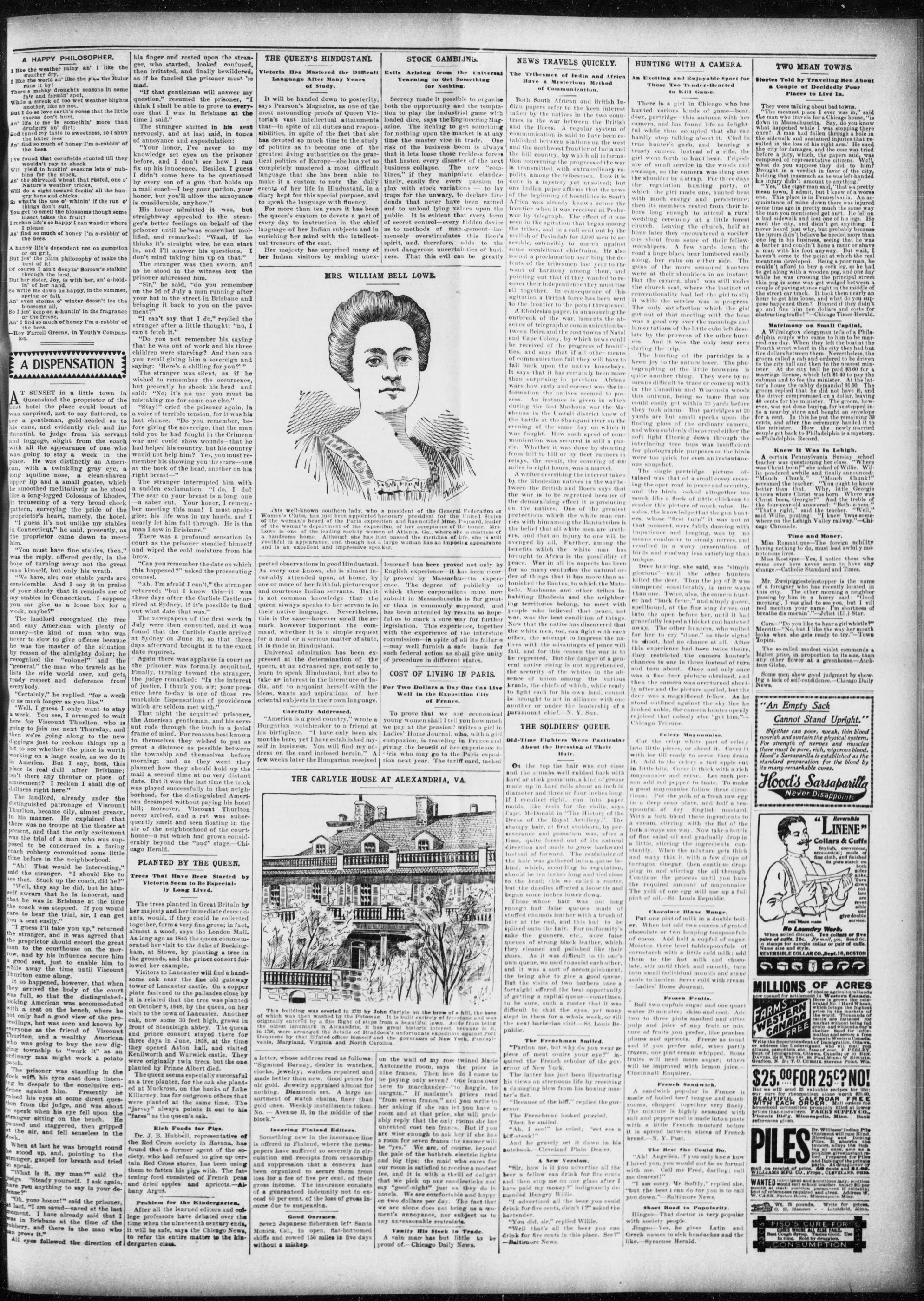
MRS. WILLIAM BELL LOWE.
This well-known southern lady, who is a president of the General Federation of Women's Clubs, has just been appointed honorary president for the United States of the woman's board of the Paris exposition, and has notified Mme Poulinard, leader of the women's association, that she is now the president of Lowe is one of the leading society women of Atlanta, Ga., where she is mistress of a handsome home. Although she has just passed the meridian of life, she is still youthful in appearance, and though not a large woman has an imposing appearance
THE CHINESE HOUSE AT HELENANDRIN, VA.
This building was erected in 1722 by John Carlyle on the hill, the base of which was then washed by the Potomac. It is built entirely of freestone and was originally entered by a fine flight of steps from a beautiful lawn. Aside from being the oldest landmark in Alexandria, it has great historic interest, because in it, the statue of Braddock's unfortunate expedition against Port Duquesne by that dilifted officer, the governors of New York, Pennsylvania, Maryland, Virginia and North Carolina.
THE QUEEN'S HINDUSTANL
Victoria Has Mastered the Difficult Language After Many Years of Study.
It will be handed down to posterity, says Pearson's Magazine, as one of the most astounding proofs of Queen Victoria's vast intellectual attainments that—in spite of all duties and responsibilities, in spite of the fact that she has devoted so much time to the study of politics as to become one of the greatest living authorities on the practical politics of Europe—she has yet so completely mastered a most difficult language that she has been able to make it a custom to note the daily events of her life in Hindustani, in a diary kept for this special purpose, and to speak the language with fluency. For more than ten years it has been the queen's custom to devote a part of every day to instruction in the chief language of her Indian subjects and in enriching her mind with the intellectual treasure of the east.
Her majesty has surprised many of her Indian visitors by making unex-
MRS. WILLIAM
his well-known southern lady, who
Women's Clubs, has just been appointed
of the woman's board of the Paris expos
of the woman's department of the expos
Love in one of the leading society women
a handsome home. Although she has p
youthful in appearance, and though not
and is an excellent and impressive spe
pected observations in good Hindustani. As every one knows, she is almost invariably attended upon, at home, by one or more of her faithful, pictureque and courteous Indian servants. But it is not common knowledge that the queen always speaks to her servants in their native language. Nevertheless, this is the case—however small the remark, however important the command, whether it is a simple request for a meal or a serious matter of state, it is made in Hindustani.
Universal admiration has been expressed at the determination of the queen, at an advanced age, not only to learn to speak Hindustani, but also to take interest in the literature of India, and to acquaint herself with the ideas, wants and aspirations of her oriental subjects in their own language.
Carefully Addressed.
"America is a good country," wrote a Hungarian watchmaker to a friend at his birthplace. "I have only been six months here, yet I have established myself in business. You will find my address on the card inclosed herein." A few weeks later the Hungarian received
THE CARLYLE HOUSE
This building was erected in 1732 by Jo of which was then washed by the Potomac originally entered by a fine flight of steps the oldest hardmark in Alexandria, ha in 1736, were arranged the detritus of Brad Duquesne by that illfated officer himself ar vania, Maryland, Virginia and North Car
a letter, whose address read as follows:
"Sigmund Barnay, dealer in watches
clocks, jewelry; watches repaired
and made better than new. Good prices
for old gold. Jewelry appraised almost for
nothing. Diamonds set. A large assortment of watch chains, finer than
gold ones. Weekly installments taken.
No. — Avenue B, in the middle of the
block."
Insuring Finland Editors
Something new in the insurance line is offered in Finland, where the newspapers have suffered so severely in circulation and receipts from censorship and suppression that a concern has been organized to secure them from loss for a fee of five per cent, of their gross income. The insurance consists of a guaranteed indemnity not to exceed 60 per cent. of the loss of gross income due to suspension.
Good Ourselves
Seven Japanese fishermen left Santa Monica, Cal., in open, flat-bottomed skiffs and rowed 150 miles in five days without a mishap.
STOCK GAMBI.ING.
Evils Arising from the Universal Yearning to Get Something for Nothing.
Secrecy made it possible to organize both the opportunity and the temptation to play the industrial game with loaded dice, says the Engineering Magazine. The itching to get something for nothing upon the market is at any time the master vice in trade. One risk of the business boom is always that it lets loose those reckless forces that hasten every disaster of the next business collapse. The new "combines," if they manipulate clandestinely, easily fire every passion to play with stock variations — to lay traps for the unwary, to declare dividends that never have been earned and to unload lying values upon the public. It is evident that every form of secret control—every hidden device as to methods of management—immensely overstimulates this dice's spirit, and, therefore, adds to the most dangerous uncertainties of business. That this evil can be greatly
AM BELL LOWE.
o s president of the General Federation of honorary president for the United States position, and has notified Mme. Foquard, leader position, of her acceptance of the honor. Mrs. man of Atlanta, Ga., where she is mistress of just passed the meridian of life, she is still a large woman has an imposing appearance speaker.
lessened has been proved not only by English experience—it has been clearly proved by Massachusetts experience. The degree of publicity to which these corporations must now submit in Massachusetts is far greater than is commonly supposed, and has been attended by results so hopeful as to mark a sure way for further legislation. This experience, together with the experience of the interstate commission—in spite of all its failures—may well furnish a safe basis for such federal action as shall give unity of procedure in different states.
COST OF LIVING IN PARIS
For Two Dollars a Day One Can Live
Well in the Exposition City
of New York
To prove that we are economical young women shall I tell you how much we pay at the pension? writes a girl in Ladies' Home Journal, who, with a girl companion, is traveling in France and giving the benefit of her experience to a girl who may go to the Paris exhibition next year. The tariff card, tacked
AT ALEXANDRIA, VA.
John Carlyle on the brow of a hill, the base ac. It is built entirely of freestone and was from a beautiful lawn. Aside from being a great historic interest, because in it dock, unfortunate expedition against Port and the governors of New York, Pennsylvania.
on the wall of my rose twined Marie Autointe room, says the price is nine francs. Then how do I come to be paying only seven? One leans over here to marchander—"to baggie, to bargain." If madame's prices read "from seven francs," and you write to her asking if she can let you have a room and at that price, she will probably reply that the only rooms she has unrented cost ten francs. But if you are wise enough to ask her if she has a room for seven francs the answer will be "yes." We are, of course, beyond the pale of the bathtub, electric lights and big tips; the maid who cares for our room is satisfied to receive a modest fee, and it is with a thrill of delight that we pick up our candlesticks and say "good-night" just as they do love. We are comfortable and happy on two dollars per day. The fact that we are alone does not bring us a moment's annoyance, nor subject us to any unreasonable restraints.
Vanity His Stock in Trade.
A vain man has but little to be proud of.—Chicago Daily News.
NEWS TRAVELS QUICKLY.
The Tribesmen of India and Aries Have a Mysterious Method of Communication.
Both South African and British Indian papers refer to the keen interest taken by the natives in the two countries in the war between the British and the Boers. A regular system of communication is said to have been established between stations on the west and the northwest frontier of India and the hill country, by which all information concerning the progress of the war is transmitted with extraordinary rapidity among the tribesmen. How it is core is a mystery yet unsolved; but one Indian paper affirms that the news of the beginning of hostilities in South Africa was already known across the frontier when it was received by Peshawar by telegraph. The effect of it was seen in the agitation that began among the tribes, and in a call sent out by the mullah of Povindah for 3,000 men to assemble, ostensibly to marche against some recalcitrant chieftains. He also issued a proclamation ascribing the defeats of the tribesmen last year to the want of harmony among them, and pointing out that if they wanted to recover their independence they must rise all together. In consequence of this agitation a British force has been sent to the frontier to the point threatened.
A Rhodesian paper, in announcing the outbreak of the war, lamented the absence of telegraphic communication between Belra and the cost towns of Natal and Cape Colony, by which news could be received of the progress of hostilities, and says that if all other means of communication fail they will have to fall back upon the native houseboyes. It says that it has certainly been more than surprising in previous African wars how early and correct was the information the natives seemed to possess. An instance is given in which during the last Mashoua war the Mashonas in the Unntali district knew of the battle at the Shangani river on the evening of the same day on which it was fought. How such speed of communication was secured is still a puzzle. Whether it was done by shouting from hill to hill or by fleet runners in relays, the result, the covering of 400 miles in eight hours, was a marvel.
A writer describing the interest taken by the Rhodesian natives in the war between the British and Roers says that the war is to be regretted because of the demoralizing effect it is producing on the natives. One of the greatest protections which the white man carries with him among the Bantu tribes is the belief that all white men are brothers, and that an injury to one will be avenged by all. Further, among the benefits which the white man has brought to Africa is the possibility of peace. War in all its aspects has been for so many centuries the natural order of things that has more than as tonished the Bantus, to which the Matabe, Mashonas and other tribes inhabiting Rhodesia and the neighboring territories belong, to meet with people who believed that peace, not war, was the best condition of things. Now that the native has discovered that the white men, too, can fight with each other, the attempt to impress the natives with the advantages of peace will fall, and for this reason the war is to be regretted. But the danger of a general native rising is not apprehended, the security of the whites in the absence of union among the various krains, the chiefs of which, while ready to fight each for his own land, cannot be brought to act in alliance with one another or under the leadership of a paramount chief—N. Y. Sun.
THE SOLDIERS' QUEUE
Old-Time Fighters Were Particular About the Dressing of Their
On the top the hair was cut out and the stumps well rubbed back with hard or stick pomatum, a kind of gress made up in hard rolls about an inch in diameter and three or four inches long if I recollect right, run into paper molds, like resin for the violin, says Capt. McDonald in "The History of the Dress of the Royal Artillery." The stumpy hair, at first stubborn, by perseverance and pomatum was, after a time, quite forced out of its natural direction and made to grow backward instead of forward. The remainder of the hair was gathered into a queue behind, which, according to regulation, should be ten inches long and tied close to the head; this we called a rooter, but the dandles affected a loose tie and began some inches lower down.
Those whose hair was not long enough had false queues made of stuffed chamois leather with a brush of hair at the end, and this had to be spliced onto the hair. For uniformity's sake the gunners, etc., wore false queues of strong black leather, which they cleaned and polished like their shoes. As it was difficult to tie one own queue, we used to assist each other, and it was a sort of accomplishment, the being able to give a good queue. But the visits of two barbers once a fortnight offered the best opportunity of getting a capital queue—sometimes, to be sure, a such a router that it was difficult to shut the eyes, yet many slept in them for a whole week, or till the next barberian visit.—St. Louis Republic.
The Frenchman Smiled
"Pardon me, but why do you wear so piece of meat ovire your eye?" inquired the French scholar of the governor of New York. The latter has just been illustrating his views on strenuous life by receiving a damaging blow from his boxing master's flat. "Because of the biff," replied the governor. The Frenchman looked puzzled. Then he smiled. "Ah, I see!" he cried; "eet eet a biff-steak!" And he gravely set it down in his notebook—Cleveland Plain Dealer.
A New Version.
"Sir, how is it you advertise all the beer a fellow can drink for five cents and then stop me on one glass after I have paid my money?" indignantly demanded Hungry Willie.
"I advertised all the beer you could drink for five cents, didn't I?" asked the bartender.
"You did, sir," replied Willie.
"Well that's all the beer you can drink for five cents in this place. See?" —Baltimore News.
HUNTING WITH A CAMERA.
An Exciting and Enjoyable Sport for Those Too Tender-Hearted to Kill Game.
There is a girl in Chicago who has hunted various kinds of game—bear, deer, partridge—this autumn with her camera, and has found life so delightful while thus occupied that she can hardly stop talking about it. Clad in true hunter's garb, and bearing a trusty camera instead of a rife, the girl went forth to hunt bear. Trips are of small service in the woods and swamps, so the camera was slung over the shoulder by a strap. For three days the regulation hunting party, of which the girl made one, hunted bear with much energy and persistence; then its members rested from their long enough to attend a rural wedding ceremony at a little forest church. Leaving the church, half an hour later they encountered a voeferous shout from some of their fellow-worshipers. A few yards down the road a huge black bear bummed easily along, her cubs on either side. The guns of the more seasoned hunters were at their shoulders in an instant. But the camera, alas! was still under the church seat, where the instinct of conventionality had bed the girl to slip it while the service was in progress. The only satisfaction which the girl got out of that meeting with the bear was a good cry over the mannings and lamentations of the little cubs left desolate by the prowess of the other hunters. And it was the only bear seen during the trip.
The hunting of the partridge is a keen joy to the nature lover. The photographing of the little brownies is quite another thing. They were by no means difficult to trace or come up with in the Canadian and Wisconsin woods this autumn, being so tame that one could easily get within 20 yards before they took alarm. But partridges at 20 yards are but small specks upon the finding glass of the ordinary camera, and when suddenly discovered either the soft light filtering down through the interlacing tree tops was insufficient for photographic purposes or the birds were too quick for even an instantaneous snapshot.
The single partridge picture obtained was that of a small covey crossing the open road in peace and security, and the birds looked altogether too much like a flock of little chickens to render this picture of much value. Besides, the knowledge that the gun hunters, whose "first turn" it was not at that moment, were fairly dancing with impatience and longing, was by no means conducive to steady nerves, and resulted in a wavy presentation of birds and roadway less satisfying than unique.
Deer hunting, she said, was "simply glorious"—until the other hunters killed the deer. Then the joy of it was dampened considerably, in more ways than one. Twice also, the camera hunter had "buck fever," and simply gazed, spellbound, at the fine stag drive, out into the open before her, until it had gracefully leaped a thicket and hastened away. The other hunters, who waited for her to cry "done," as their signal to shoot, had no chance at all. After this experience had been twice theirs, they restricted the camera hunter's chances to one in three instead of turn and turn about. Once and only once was a fine deer picture obtained, and then the camera was overturned shortly after and the picture spoiled, but the deer was a magnificent fellow. As he stood outlined against the sky line he looked noble, the camera hunter openly rejoiced that nobody else "got him."—Chicago Tribune.
Celery Mayonnaise
Cut the crisp white part of celery into little pieces, or shred it. Cover it with ice till ready to serve, then drain it. Add to the celery a tart apple cut in little bits. Cover it thick with a rich mayonnaise and serve. Let each person add red pepper to taste. To make a good mayonnaise follow these directions: Put the yolk of a fresh raw egg in a deep soup plate, add half a teaspoonful of dry English mustard. With a fork blend these ingredients to a cream, stirring with the flat of the fork always one way. Now take a bottle of fine sand oil and gradually drop in a little, stirring the ingredients constantly. When the mixture gets thick and waxy thin it with a few drops of turragon vinegar, then continue dropping in and stirring the oil through. Continue the process until you have the required amount of mayonnaise. The yolk of one egg will use up a full pint of oil—St. Louis Republic.
Chocolate Blane Mange.
Put one pint of milk in a double boiler. When hot add two ounces of grated chocolate or two heaping teaspoonfuls of cocoa. Add half a cupful of sugar. Moisten three level tablespoonfuls of cornstarch with a little cold milk; add them to the hot milk and chocolate, stir until thick and smooth, turn into small individual mounds and stand aside to harden. Serve cold with cream — Ladies' Home Journal.
Frozen Fruits.
Boll two cupfuls sugar and one quart water 20 minutes; skim and cool. Add two to three pints mashed and sifted pulp and juice of any fruit or mixture of fruits you prefer, like peaches plums and apricots. Freeze as usual and if you prefer add, when partly frozen, one pint cream whipped. Some fruits will need more sugar; others will be improved with lemon juice. Cincinnati Enquirer.
French Sandwich
A sandwich popular in France is made of boiled beef tongue and mushrooms, chopped together very finely. The mixture is highly seasoned with salt and pepper and is made into a paste with a little French mustard before it is spread between slices of French bread—N. Y. Post.
The Best She Could Do
"Ah! Angelena, if you only knew how I loved you, you would not be so formal with me. Call me Fred, darling; call me dearest!"
"I am sorry. Mr. Softly," replied she, "but the best I can do for you is to call you down." Baltimore News.
Short Road to Popularity.
Hingso- That doctor is very popular with society people.
Jingso- Yes, he gives Latin and Greek names to sleek headaches and the like.-Syracuse Herald.
TWO MEAN TOWNS.
Stories Told by Traveling Men About a Couple of Decidedly Poor Places to Live In.
They were talking about bad towns.
"The meanest place I ever was in," said the man who travels for a Chicago house, "is where I was when I happened what happened while I was stopping there once? A man had fallen through a hole in the sidewalk and sustained injuries that resulted in the loss of his right arm. He sued the city, and the city said before a jury, which, the papers said, was composed of representative citizens. Well, what do you suppose they did to him? He ordered an favor of the city, holding that man responsible for indicted his injury didn't amount to anything."
"Yes," the cigar man said, "that's a pretty mean town, I admit, but I know of a worse one. This place is in Pennsylvania. An acquaintance of mine down there was injured some time ago in pretty much the same way the man you mentioned got hurt. He fell on a bad sidewalk and lost one of his legs. He sued the city, and didn't get anything. I never heard just why, but probably because the jurors didn't believe he needed more than one leg in his business, seeing that he was a barber and couldn't hone a razor or shave a man with his foot anyway. But wait, I haven't come to the point at which the real meanness developed. Being a poor man, he couldn't afford to buy a cork leg, so he had to get along with a wooden peg, and one day while he was crossing the principal street this peg in some way got wedged between a couple of paving stones right in the middle of the street car track. It took them nearly an hour to get him loose, and what do you suppose happened then? Blamed if they didn't go and fine him ten dollars and costs for obstructing traffic!"—Chicago Times Herald.
Matrimony on Small Capital
A Wilmington clergyman tells of a Philadelphia couple who came to him to be married one day. When they left the boat at the Fourth street wharf in the city they had but five dollars between them. Nevertheless, the groom called a cab and ordered to be driven to the city where he was to be minister. At the city hall he paid $3.00 for a marriage license, which left $1.40 to pay the cabman and to fee the minister. At the latter's house the cabby demanded $1.50. The groom replied that he did not have it, and the cabman said he had $40 cents for the minister. The groom, however, was not done buying, for he stepped in to a nearby store and bought an envelope for a cent. In this he put the remaining 38 cents, and after the ceremony handed it to the newly married couple got back to Philadelphia as a mystery — Philadelphia Record.
A certain Pennsylvania Sunday school teacher was questioning her class, "Where was Christ born?" she asked of Willie. Willie pondered awaits and finally announced, "Mauch Chunk, Mauch Chunk, server the teacher," "Naught better than that, little George knows where Christ was born. Where was Christ born, Georgie?" And the treble of the four-year-old answered: "Beth-the-hem. That's right," said the teacher, "Well, where are you?" I knew two where on the Lebigh Valley railway." -Chicago Chronicle.
Time and Money.
Miss Romantique—The foreign nobility having nothing to do, must lead awfully monotone lives.
Miss costume—Yes, I notice those who cover up here never seem to have any change.—Catholic Standard and Times.
Mr. Zweibrückeinstopper is the name of a foreigner who has recently located in the city of warmer weather and now passing by him in a hurry and "Good morning," I was glad to see you, but I will nod mention your name; I'm shortness of breathe d'morning."—Follet (I) Star.
Cora—"Do you like to hear agri' whistle?" Merritt—"No, but I like the way her mouth looks when she gets ready to try."—Town Topics.
The so-called modest violet commands a higher price, in proportion to its size, than any flower at a greenhouse.—Atchion Globe.
Some men show good judgment by showing a lack of self-confidence.—Chicago Daily News.
Either can poor, weak, thin blood
nourish and sustain the physical system.
For strength of nerves and muscles
there must be pure, rich, vigorous blood.
Hood's Sarsaparilla is established as the
standard preparation for the blood by
its many remarkable cures.
Hood's Sarsaparilla
Never Disappoints
64 Reverable LINENE"
Collars & Cuffs
stylish, convenient,
economical; made of
fine cloth, and finished
in paris stitch on
both sides.
mike.
Turn down collars
are
reversible
and
give dovetail
service.
DEED MADE MARK
No Laudrey Work.
When soiled discard. Ten collars or five
pairs of cuffs, 28c. By mail, yoe. Send 6c.
in stamps for sample collar or pair of cuffs.
Name, sack, and style.
REVERSIBLE COLLAR CO. Dept. 18, BOSTON
choose agricultural lands
Here is grown the celer-
which brings the highest
price in the markets of
cattle and cattle fattened
cattle are fattened
main, and without a day's
shearer need for informa-
tion in Western Canada.
FARMS
WESTERN
CANADA
FREE
Here is grown the cole-
lons which brings the highest
price in the markets of the
country, which includes
cattle are fattened for
cattle and without day's
grain, and without day's
grain for livestock.
Located in Western Canada.
Write the Superintendent,
or address the Undersecret-
员, who will will mail you
the receipt of Immigration, Ou-
laus, Canada, or to BK.
Uptake of Immigration, Ou-
laus, Canada, or to BK.
Grafton, N. D. T. O. C. Ullman, Survives Point, W.
$25.00FOR25C?NO!
But we will send 25 valuable recipes for 300
meal ideas. In the meantime, BEAUTIFUL ORDER
WITH EACH ORDER. Mall orders for
prices than elsewhere. PARKWAY MILK CO.
Phoenix Bid'd, Minneapolis, Minn. Bank
references given.
PILES
Dr. Williams' Indian Pile
Ontment will cure Blind
Piles. It absorbs the
tumors, allows the Iich
position, gives instant re-
position, gives instant re-
position, and healing of the private
WANTED intelligent and ambitious lady; position
would suit school teacher, schooler. Salary per
month at a school is $12,000 plus post-
reference required and given. Address W.
W. CARK, Boston Boca, Minneapolis, Mn.
PISO'S CURE FOR
CURES WHERE ALL ELSE FAILS.
Best cure for everything good. Use
in home. Sold by druper.
CONSUMPTION
THE STORY TELLER
THE SONG OF HOPE.
I journeyed in a pleasant land
Where fields were green and broad:
The trees were limpid and
Sang praises unto God.
And here and there an orchard bloomed
And gladdened every breeze,
And many a graceful gable loomed
over a vineyard like a vineyard.
And many a flock and many a herd
Grazed there on mead and slope.
And from the throat of every bird
Arose a song of hope.
I halled a tolter in his field: "Your grain is
high." I said.
"And happiness abides with you"—but tol
he shook his head.
And leaned upon his hoe a space and an-
answered: "No, for she
That I would have to share my lot is not, alas, for me!
I journeyed down a quiet way and stopped to rest me where
Red roses bloomed and children played, but discontent was there.
"My crops are fair, the master sighed, but discontent was far, And I would live up in the town where wealth and splendens are."
I greeted Brown with words of cheer; he turned and gazed away;
"My crops are good," he said, "but I am not as young as Gray!
My words I have lost the fairest houses I had.
There's little left me but to die, and so make others glad"
Where Gray abode the fields were broad and rich with waving grain. And youth was in his handsome face, but in his breast was pain.
"There was a little one," he cried, "that played about my door—
Ah, what are flocks or crops to me since he is here no more!"
A snow-white cottage peeped above the trees that bloomed around.
And there, they told me, sweet contentment might, perchance, be found:
But the trees that bloomed was and, and, weeping, said to me
That she could not induce her dog and kitten to agree!
I journeyed in a pleasant land, Where fields were green and broad:
The winding streams were limpid and Sang praises unto God.
And she wandered through cherub bloomed And gladdened every breeze, And many a graceful gale toomed Above the nodding trees;
And senseless flocks and thoughtless herds And gladdened slope.
And only from the brooks and birds Arose the song of hope.
-B. E. Kiser, in Chicago Times-Herald.
A PHILIPPINE ROMANCE
The Brown Woman at Jaro Who
Married a Soldier.
PRIVATE SEVENSPOT, of company Y, 'Steenth United States infantry, sat in a carved mahogany rocker beneath the portico of the company quarters at Jaro, in the island of Panay, and honed his razor. His eyes blinked, dazzled by the glaring sunlight, when now and again he paused in his task to stare across the plaza. The prospect, as viewed by Sevenspot, was not pleasing, and he kept up a running mutter of criticism.
"Just luck at th' sun-baked countrhy, will yes," said he, gesticulating with the razor. "Av th' town were a mess of Philadelphia scrapple it could not be browner. Luck at th' wades an' brush in that dessert av a pliza. An' luck at th' toy min, av a call him min. I call th' brown rats. 'Tia a waste av good gunpowder to shoot at th' lokes av thim. Shure, we should be arraumed with pop-guns. Faugh!"
And with a castor-oil countenance, Sevenspot spat upon the ground.
A little brown woman—she was a woman, although she weighed no more than the average American schoolgirl of 12—shuffled barefooted down the street. To unaccustomed American eyes she was a mere caricature on womankind. A couple of yards of bright-red calico were gathered tightly about her waist and reached to her knees. The makeshift garment was wound smugly about her, outlining every curve and showing the motion of every muscle as she moved. Her brown legs and feet were bare. A white shirt waist was caught over one shoulder and had slipped off the other, exposing a bared neck. A white towel with bright red edging served as a sunbonnet. She walked or shuffled with knees far advanced so that she seemed in danger of falling backward. As she shuffled along she puffed a huge cigar, that in color, length and circumference matched her naked forearm. And the lips that poised the cigar were stained bright red and green from chewing betel nuts and leaves. But Margerita was a shapely little dab of femininity. Her face was saucy and fascinatingly impudent. Her eyes were alluring. And she chattered pigeon-English vivaciously, with graceful little gestures of babyish brown hands and pretty puckering of betel-stained lips.
And the poise and movement of her little head was birdlike.
"Now, luck at that!" excalimed Sevenpent, indicating Margarita with another wave of his razor. "Just tell me phwat does Big Bill want av a brown-skinned pocket-pace lope thu. Shure, av she wanst got lost in th' tall grass av th' plaza there, Bill couldn't found hurt with a tiltsope. Av he'd dab her well with flour an' carry hur under his arum, he'd re-simile wan av thim Eyetalians phwat pedle little statoaries in New York. Think av a six-futter loke Bill snaykin' off an' violatin' rigilashuns by marryin' a little brown imp av a woman no bigger than a cheeno cigarillo. Faugh! And again sevenpent spat upon the ground—his countenance expressive of castor oil and quinine.
Along the southern boundary of Jaro there ran a stream, during the rainy season a river, during the dry season a rivulet. Along the southern bank of the stream there was a narrow strip of scattered woodland, beyond that a three-mile strip of rolling prairie, and then a ridge surmounted by another bit of timber. Five miles beyond the ridge on a little eminence clustered the town of Santa Barbara. It was an insurgent stronghold, and its assault and capture were the first work of the autumn carapaign cut out for the little detachment of American troops quartered at Jaro. The American outpost,
No. 7, was on the Jaro bank of the stream. Just as a faint streak of light illuminated the eastern sky one morning two privates clasped hands with the pickets on No. 7, listened to a last word of caution from an officer and then silently waded the stream and disappeared in the timber on the opposite shore. The officer stood motionless for a few moments, with ears strained for a sound of the scouts, and then, as the blazing sun leaped above the horizon without the preliminary of a dawn, he turned and walked through the dusty streets of Jaro to his quarters.
It lacked an hour of midday. A mile to the south of Jaro, in a slight dip in the rolling prairie, two men in khaki uniforms wriggled cautiously through the tall sun-crisped grass. The sun directly overhead volleyed white-hot arrows that pierced them through and through. They reeked with perspiration; their faces were thorn-torn and dust-smeared. The horny right hand of each was wound in a blue handkerchief to protect it from the blistering heat of the rifles they dragged along the ground beside them. They moved by inches, their faces flattened to the ground. After gaining each foot or so of ground they rested side by side, their cheeks flat to the ground and looking in each other's bloodshot eyes. They panted and their tongues lolled like those of heat-spent dogs in August. Their dust-crusted lips gasped for water and their lungs sucked wistfully for air. Thus slowly, ardently, they progressed for another mile. Then one of them lifted himself cautiously to his knees and glanced first forward and then to the rear. Then he flattened out again, and, panting, whispered:
"We're two-thirds of th' way from timber to timber."
"Sight any Kakiack pickets?" asked the other.
A shake of the head was the answer, and again the two men panted and stared in each other's eyes. Their lungs labored huskily. The animate earth seemed in a dizzy, strangled silence for lack of air.
"Sevenspot," finally gasped the larger man of the two, "if you were in the Waldorf-Astoria right now, what would you order?"
Sevenspot lapped a swollen, dust-strong tongue along his cracked lips.
"Darned av I know," he whispered, "but av I were in Dolan's I'd order corned bafe an' biled cabbag an' a keg av cool beer."
"Bill," continued Sevenspot, after a breathing spell, "pwhat putt a college man loke you in th' regulars."
Bill hesitated, under perseverance of moistening his lips with a moistureless tongue. Then he whispered vehemently, fiercely: "Back in the states, in time of peace, an enlisted man is a dog, isn't he?"
Sevenspot nodded.
"But now—"
Sevenspot nodded again.
"But now," continued Bill, passionately, "and right here, a soldier is a man. And he wouldn't step aside to kick the ships of the feather-bed men who look down upon him in the states, would he? The featherbeds back there wonder what a fool soldier of $15.60 finds to be proud of. If one of them could be in my boots right now and could feel like I do in here, right now, he'd know, wouldn't he?"
Bill struck his breast with his clenched fist, and Sevenspot nodded.
He came to a full stop. Sevenspot waited and then finished the sentence for him: "A woman in it! Not a brown, but a white Margarita! An' ye think she'll weep a bit when she sees your name among th' dead heroes? An' you're married to a betel-chewin' brown wan."
"Sevenspot," began Bill, "have you ever noticed—"
With his rifle barrel Sevenspot listlessly poked a tarantula that was coming his way and headed it in the other direction. It would have required an effort to lift the rifle and smash it.
"Sevenspot," resumed Bill, "did you ever hear a bird sing on this island?"
Sevenspot shook his head. Then he said: "But there's an ondacit lizard, about two feet long, pwhat roosts in th' timbers over me bunk an' shouts in his slape. An' there another that clatters all night long loike a sewin' machine. Maybe he do be a singer."
The big man paid no heed to this witticism.
"Did you ever hear a woman sing on this island?" he asked.
"Never," said Sevenspot, "but Margarita, that swate Kaklack wife wives, Bail, called me something th' yesterday. Pwiatier it may mane, it sounds uncomplimentary."
"Niver," said Sevenapot, "onless you call it singin' when Beno Brown gets spillificated an' howls 'we is me, with no whiskee." "Sevenapot, persisted Bill; "did you ever hear a girl laugh on this island?" Sevenapot shook his head. "Tis toime, he said, that we moved on a bit we are to make that ridge an' get t' lay 'aiv th' land 'aivin an' back by mornin." They wriggled ahead to the crest of the next swell of the prairie. As they rested Bill asked:
"Or a boy whistle?"
"Niver!!" exclaimed Sevenspot, suddenly yanking his rifle up beside him and working the lever, "but I think both av us heard that puttles a bloody period to this scoutin' thrip, bad luck to th' sharp eyes of th' brown divils"
"He were a rale man, were Big Bill!" said Sevenspot, holding forth in quarters that evening. "Avin av he did consort with a brown woman. Shure, whin he volunteered for th' scoutin' thrip with me, I mislaked it at first because av th' thought av that Kakiack wife av his. But all th' mornin' he were notn' down th' lay l' o' land as cool-loke as a county surveyor at home. An' thin, whin the brown divills began boom-boomin', he squatted there on wan knee an' worked th' lever av his krug as methodical as if he were a machine gun an' wound up for all day. Thin 'bullet wint through him, he wint down on wan libow, with wan hand on his chist, an' luckin' up at me, who was puttin' down me krug to help him, see he;
"Kape poumpin'. Spot, kape poumpin'. I'm done for anyway, 'a ye must thry to kape thim back till th' byes come out for ye."
"An' seen' th' blood comin' in' spurts through his fingers an' th' film in his eyes. I knew he smoke thrue. So I wint
on with me rat-shootin', kapein' wn eye on Bill. His ilbow wint slip-slippin' out on th' red wet grass under him, till his head nodded down in th' crook av his arrum loke he were drowsy an' droppin' off to slope. Th' bloody hand on his chist fell jump-loke beside him. Thin he opened his eyes sleepy-loke wanst, an' muttered loke he were half-dreamin': 'Tis a woman singin'!"
"Thin he shut his eyes and dropped off aisy. An' I wint on with me rat-killin'. Thin I heard th' mountain guns barkin' behind me an' th' fire from th' front slackened. I could hear you min thramplin' through th' dry grass. An' here I am. But Bill—he were a man—Margarita or no Margarita."
It was the evening of the day after. the men of Y were leanning listlessly out on the casements of the big casa where the company was quartered to catch a breath of cool air. Across the street there was a native thatched shack. Under its propecting roof the forms of a man and a woman were dimly visible. The woman gently touched the strings of a guitar and just the suggestion of a plaintive melody floated across the way. The men leaned further out of the casements and listened. "Shure," said Sevenspot, "that little brown divil, Margarita, tuck it har-rd whin we putt away poor Bill th' mornin'. Whin th' bugle sounded taps. I shure thought she'd wape herself into nothing but a pint av wather. 'Tis a tinder heart she has under a brown skin. I misdoubt me I may have misjudged 'th' brown wimmen."
The banjo across the way gave forth a louder thrum-thrum, and then to a moaning, wailing, heart-breaking melody, a deep-chested alto唱了 sadly, monotonously in the native tongue. The soldiers looked and listened silently. The woman's voice rose and fell vividly in a wierd chant full of tears and moans and broken hearts, and then died away in a hopeless sob. Sevenspot drew a long, shuddy breath. "Tis the first native I liver heard sing," he whispered. "Who is she?" "Bill's Margarita," said Smithie, company Y's authority on Kaskiack lingo and customs. "Bill's Margarita!" exclaimed Sevenspot. "Shure that explains it! 'Twas that voice, not 'brown woman that Big Bill married! 'Twas an echo an' a memory that he wedded, poor and!"
Smithie nodded and puffed his cigar,
"Poor little brown Margarita," continued Sevenspot. "Ai I could sling 'tis lingo 'tis meself would go an 'thry an'
say a kind wormrd to her. 'Tis th' death
song an her love she were 'singing' an
'tis not unlike an honest Irish keen,
'Tis sad me could heart is for the poor little
brown divil, left all alone-alone."
Smithie threw back his head and
lugged aloud.
"Pwhat!" exclaimed Sevenspot, turning
fiercely, "pwhat do ye fzound so funny in a brave soldier's widow, be she brown or black?"
"Sevenspot!" said Smithie, putting a restraining hand on his friend's threatening arm. "Don't get sentimental in this climate. At leaf, don't get that way till you know the ways and lingo of the Tags. That was no death song, 'Twas no keen. 'Twas a love song. And 'twas the poor little brown bill, 'Twas Margarita, singing to her new husband, She married him this afternoon. His name is Yen Shee. Appropriate name, too. In Chenoo it means Number Two. He is the wealthy Chenoo banker at Iloilo. Savesy? If Bill's white Margarita in the Summies was a ditto girl, too, he surely lost out against the love game."
Just then the guitar across the way thrummed again, and again a deep-chested alto began to chant a mournful song full of tears and moans and broken hearts. Sevenpenot leaned far out of the casement and drew a deep breath. His big chest rose and swelled until the arch of it touched his chin. Then he roared and the candle lights of all Jaro went out as if by the wind of his belows.
"Shut up! Shut up! caramba! Shut up, before you and pull that epi-shack about your ears! Ye female tarantula."
The alto voice quivered and stopped. The dimly outlined figures of a man and woman disappeared stealthily and catlike within the door of the thatched shack. Across the plaza the bugle sounded taps plaintively. The town was silent and far-winged dreams of home and a white Margarita hovered over the casas of the soldiers, to be disturbed now and again by the crack of a Kakiack's remington or the bark of an American's krag, as the outposts took peaks at each other through the night.—N. Y. Sun.
ELOPES WITH MOTHER-IN-LAW
Queer Couple Which Has Arrived at New York City—Wife of Fourteen Deserted.
John Balle has come over seas to kill a tradition. He eloped with his mother-in-law. They are detained at the barge office at New York city. Balle, a strapping fellow of 35 years, is a baker and comes from Tarmowitz, Posen. He married a girl of 14. Her mother, Mrs. Sophia Brussig, who made the match, lived with the young folks. She is nearly 50 years old and has the air of one born to command. Balle tired of his child wife and with the mother-in-law set out for America. They arrived here on the St. Louis, and the difference in their ages attracted the attention of the immigration officials.
The two were detained for examination and then Balle told all he knew. He said he loved his mother-in-law and could not live without her. They will be sent back to Posen.
Appreciated the Play.
The following is from an essay written ten by a schoolboy, aged ten, on a play he had been to see: "The villin curled his mustard and seezing the pure vurgin shreeks ha ha mine or death blush is on my head this dagger stabs three to thy uttermost sole ha ha vengeance. But the good hero comes and says O hevins stur wun step and thy ded body lies at my door. Lay won parm on the vurgins korpe and it was better if you was drowned with a millstone. Avant avant from the sweet korpeps presunz."
Her Economy.
Mr. Quinn—Lucy, why in all creation do you persist in sending for that plumber if he charges more than the rest?
Mrs. Quinn—Because, Archibald, he always leaves enough scrap sice to tack over the rat holes in the kitchen.—Chicago Daily! ews.
A Pleasant Prospect.
Hunter—Miss Manly has persuaded me to take her after pheasants tomorrow.
Houser—Indeed! Shall I telephone for a freight car to bring in your game?
Hunter—No; you'd better telephone my size of coffin to your undertaker.—N. Y. World.
Never Touched Her.
"And you say that you were there when the earthquake happened?" said Miss Tommey to Miss Templeton.
"Yes."
"How did it feel?"
"Oh, I didn't notice it at all. You see, my Paris gown had just got home and I had discovered that there was a wrinkle down the back."—Judge.
A Woman's Secret.
She vowed on her lips she'd set a seal
And never to the world her plans reveal;
But when she walked about the tale was
told-
Her hat was new—but all its trimmings,
-Dear Face Press
She—Has my father anything against you?
He—Only a judgment.—Chicago Inter Ocean.
Woes of Mankind
In After Years.
Old Beau—Ah, Miss Clara, I love you.
May I hope to some day call you my wife?
Miss Clara—Have you spoken to my mother on the subject?
Old Beau—Why—er—yes, I believe I did—some 20-odd years ago—Chicago Daily News.
Sympathy.
Mrs. Greaves — Herbert suffered dreadfully yesterday morning from shooting pains.
Mrs. Cutter (who does not love Mrs. Greaves, sweetly)—What a shame! Mr. Cutting mentioned that he saw him last night "half shot."—N. Y. World.
Or Fae a Trumpet.
Bettie—Mamma, does Satan whisper in people's ears?
Mamma—Yes, dearie.
Bettie—Then I guess if he went to tell gran'ma anything he'd have to holler, 'cause she's no deaf, mamma—Chicago Daily News.
The End.
And the cooking-school swept on and on
Till its conquest was complete.
And womankind in general
Would rather cook than eat.
—Puck.
TABLE ETIQUETTE.
Fastidious Individual—Say, don't yer
know no better than ter eat dat ice
cream wid yer tongue? What was yer
fingers made for, eh?—Golden Days.
For Others.
The more we see of football,
The more we want to say
That it's the finest game on earth
For other men to play.
-N. Y. World.
Something Unusual.
Jimmie—Ain't you goin' ter lick me
to-day, teacher?
Teacher—No; why should I?
Jimmie—'Cause if I go home an' tell
paw I didn't git no lickin', he'll think
I'm lyn'—N. Y. Journal.
Qbexed Instructions
Auntie—Where is the money you had saved up last week?
Tommy—Father said I was to save it up for a rainy day. It was a rainy day yesterday, and so I spent it.—Tit-Bits.
The Prospect.
Freddie.—If I ate all those mince pies ma made do you think she would lay me out?
Cobwigger—No; but I think the undertaker would.—Judge.
Didn't Fill the Bill.
"Here's a poem on 'Our Daily Bread.'"
"Can't use it. What we want on our daily bread is butter."—Atlanta Constitution.
Kept His Word.
When'er he said he'd do a thing
He never hedged nor tarried.
So when he said he'd go to war
He went straightway and married.
—San Francisco Examiner.
No Chance for the Bird.
Mr. Crimsonbeak—Do you think it gets a chance, dear?—Yonkers Statesman.
Too Notry.
"The march of civilization," said the Old Man with the Chin Fringe, "is all right, except for the rattle of artillery that accompanies it."—Kansas City Independent.
Not What He Meant.
Scientific One-Yes; here comes my wife.—Syracuse Herald.
Never Touched Her.
"And you say that you were there when the earthquake happened?" said Miss Tommy to Miss Templeton. "Yes." "How did it feel?" "Oh, I didn't notice it at all. You see, my Paris gown had just got home and I had discovered that there was a wrinkle down the back." - Judge.
Had It All Fixed.
"Charley, dear," said young Mrs. Torkins, "why don't you converse? What have you been reading about?" "The proposed partition of the Samoan islands." "Well, I think a partition is a splendid idea. If they can't agree they ought to build one, and each keep on his own side."—Washington Star.
Something of a Hint.
"Stolen kisses are sweetest," he said.
"How I dislike a man who doesn't practice what he preaches," she returned.
Occasionally a man has to be jarred before he realizes what is going on.—Chicago Post.
He. She and It.
"My darling," cries the hero, throwing off his disguise, "I am he." "And I," falters the heroine, laying aside her maidenly reserve, "am she." Meanwhile the villain cowers in the corner. "I am it!" he gibbons, for he has gone mad under the strain—Detroit Journal.
Not So Particular.
Mr. Smallman—Will you marry me,
Miss Freckles?
Miss Freckles—What an extraordinary notion!
Mr. Smallman—Yes, I know it is; but, you see, I am not so particular as most Ally Sloper.
The Battle of Life
'Tis no wonder we feel squirmish
When the men of wedlock prattle;
An engagement's but a skirmish,
But a marriage a pitched battle.
—Judge.
IN THE NURSERY.
Mother—What is the matter with you children; why do you make so much noise?
Ella—I am so cold on my back and want you to cover me.
Mother—and you, Clara, what are you crying for?
Clara—You did not hear Ella and so—I helped her cry. — Meggendorfer Blaetter.
Just a Little Game.
The sighing lover led a heart,
A club the villain played;
The last work a diamond had,
And the sextoe hold a spade.
—Chicago Daily News.
Divided Sympathy.
"Ah!" said the good old lady who was visiting the prisoners; "how your poor wife must weep as she thinks of you here."
"Which one, ma'am?" asked the convict addressed; "I'm up for bigamy."—Philadelphia Record.
Crushed Him.
The Shoe Clerk—Beg your pardon, madam, but it is a number five shoe you want instead of a number three.
She—Number five? You must be thinking of the size of your hat.—N. Y. Press.
Love's Mistakes.
Man pledges flowers to strew the grave Or he holds most dear. While whispering that pot plants To fuss with while she's here. —Indianapolis Journal.
A TURKLE GOBBLER.
Chicago Inter Ocean.
A Frequent Disappointment. I asked my friend for good advice. My action now I sorely rue. For he advised--it wasn't nice—Just what I didn't wish to do. Washington Star.
Sure of Them.
"Jimmy, if you are going to wear a collar to school, you ought to wear cuffs, too."
"Oh, no, ma; the teacher furnishes them."—Philadelphia Bulletin.
Perils of Good Nature.
"I don't like amiable people."
"Why not?"
"Living with them will ruin the best disposition on earth."—Chicago Record.
Even Division.
Judge—What are you going to give your lawyer if he proves you innocent of the burglary?
Prisoner—Half the proceeds of the robbery.—Tit-Bits.
His Family Sapling.
Social Aristocrat—Did the founder of your family come over with the Conqueror?
Social Democrat—No; I came over alone—Norlem Life.
AN APPEAL TO HUMANITY GENERALLY
We need your assistance in announcing to the world the GREATEST REMEDY that Science has found. We need your assistance to secure relief for yourself and friends through SWANSON's " 5 DROPS ".
Lambago, Catarrh of all kinds, ASTHMA, Dyspepsia, Backache, Sleepefulness, Nervousness, Heart Weakness, Toothache, Earache, Creeping Numbness, Bronchitis, Liver and Kidney Troubles, etc., etc., or any disease for which we recommend it. "5 DROPS" is the name and the dose. "5 DROPS" is not the formula that contain Salicylate of Soda nor Opiates in any form. The Child can use it as well in any form. Read carefully what Mr. L. R. Smith of El Dorado Springs, Mo. writes us under date of Nov. 27, 1899, also Martan Bowers, of Caragh, Ohio, under date of Dec. 16th, 1899.
I do not know how to express how wonderful I think your "5 DROPS" medication to me an advertisement of the medicine with NALOXIDE. I would have to do it a month that I would receive it. One day a lady called to see me and brought it for three weeks and have not had it. I received it to try and send for a sample bottle. I have it saved my life. This statement is positively true. I shall also take pleasure in recommending your "6 DROPS" for the cure of NALOXIDE.
RHEUMATISM Your "5 DROPS" came to hand on the 11th of last month and agonies. The first dose helped about 60% of it. Bleast the name of God for all you say it will, and more too. I had severe pain all over. I was on my left leg. I could not put my foot to the floor without suffering great pain. I used four different bottles of NALOXIDE which gave me immediate reliefs as above stated. MARTAN BOWERS, Box 55, Caragh, Ohio. Dec. 16th to enable sufferers to give "5 DROPS" at least a trial. We will send a bottle, per bottle, by mail for $26. A sample bottle will convince you. Also, large bottles cost $1.00, 8 bottles cost $1.00.
SWANSON HUMEURIC CURE CO., 100 to 144 Lake St., CHICAGO, IL.
WINCHESTER
Factory Loaded Shotgun Shells.
"LEADER" loaded with Smokeless powder and "NEW RIVAL" loaded with Black powder. Superior to all other brands for
UNIFORMITY, RELIABILITY AND
STRONG SHOOTING QUALITIES.
Winchester Shells are for sale by all dealers. Insist upon having them when you buy and you will get the best.
REED AND HIS MUSTACHE
The Man from Maine Was Proud of It Till a Barber Did It Up for Him.
"The members of the last two congresses will recall the smooth-shaven visage of former Speaker Reed," said an old attache of the house to a Times reporter the other day, and a former member like likewise remember that Reed once time wore a mustache of a few straggling hairs, so often seen on the upper lips of extremely fleshy men. How Mr. Reed parted with his hirsute apology can best be told by a certain barber in the room where he attended a gentleman's wants.
"One day the big man from Maine settled himself in the barber's chair and requested a shave. When the operation was completed he sat in the barber's chair and asked: 'Have you any of that old-fashioned pomade to wax mustaches with?' The barber hung amongst his pots and jars and produced a French preparation in vogue a quarter of a century ago, and then the Maine stateman's few wirelike hairs. 'When the man of snap-shot sentences arose and contemplated himself in the glass, I cut this blanked-mustache off, for you have made me look like a confounded catfish.' Since then Mr. Reed has not worn any covering beneath his nose."—Washington Times.
His Card.
A commercial traveler on his trip called upon a well-known chemist. He was nervous as he put his hand in his pocket and handed out a card.
"I represent that concern," said the young man.
young man.
"You are fortunate," replied the chemist.
The commercial traveler was encouraged and said,
"I think so, air, and the chemist who trades with us is even more so. My firm has the finest line of cosmetics in the country."
"I shouldn't have thought it," slowly responded the man of medicine. "Her complexion looks natural.
He took it and photographed the photograph which the young man had given him by mistake.
He took it and left without waiting to make any farewell remarks—London Tit-Bits.
England's Armored Trains.
The magnificent armored trains used by England in her war with the Boers will transport her troops, protect bridges and telegraphic communications in about the same time as the French have dyspepsia from the human stomach and then mounts guard that it does not return. The Bittens has in every case of indication, he has been in the war for past fifty years. It is invaluable at all times.
He Is Tamed Now
About two years ago a fairly well-known young man of this town who, in the days of his bachelorhood, was addicted to the habit of conversing through his head-covering, was delivering himself oracularly on the subject of the duties of paternity. "A man who is not a paternity person has lovely," is a "triple-plated, quadruple-expansion ass." One Sunday afternoon lately he was observed—all of the customary carmarks of sartorial economy distinguishing his make-up—placially trundling a perambulator through Lafayette park. A huge, fat baby goo-gooed in the perambulator, and a little lady with a bulgy, home-made bonnet that was a bit too shiny for money, and there's a lot of paths in the spectacle of a tamed man—Washington Post.
How's This?
We offer One Hundred Dollars Reward for any case of Catarr that cannot be cured by Hall's Catarr cure.
We, the Cheers & Co. Props, Toledo, O.
We, the Cheers, have known F. J. Chenfer for the last 15 years, and believe him perfectly honorable in all business transactions and financially able to carry out any obligations made by their firm.
We, the Trux, Wholesale Druggists, Toledo, O.
Walding, Kinnan & Marvin, Wholesale Druggists, Toledo, O.
Hall's Catarr cure is taken internally, acting directly upon the blood and mucous system. Price 75c, per bottle. Sold by all Druggists. Testimonial free.
Hall's Family Pills are the best.
"Horsehose bring good luck, it is said." "Did you ever have your wife take a fancy to a gold one set, with diamonds."—N. O. Times-Democrat.
To Sure a Cold in One Box
To Cure a Bromo in One Day
Take Laxative Bromo Quimine Tablets. All druggists refund money if it fails to cure. 25c.
It would be as easy for one to be sick and well at the same time as it would to be selfish and happy—Elliott's Magazine.
PUTNAM FADELESS DYES produce the fastest and brightest colors of any known dye stuff. Sold by all druggists.
Sunday must be the strongest day, since all the others are weekdays, and yet Sunday is broken oftenest—Elliott's Magazine.
Hale's Honey of Horehound and Tar relieves wheaming cough.
Pike's Toothache Drops Cure in one minute.
Probably the most difficult man in the world to please is the one who doesn't know what he wants.—Chicago Daily News.
The veracity of figures often depends upon the honesty of the statistician.—Chicago Daily News.
We have not been without Piso's Cure for Consumption for 20 years—Lizzie Ferrel, Camp St., Harrisburg, Pa., May 4, 194.
While then livest keep a good tongue in thy head.—Shakespeare.
AN APPEAL TO HURT
We need your assistance in announcing to the
has ever produced, and you need our assistance
through SWANSON'S "S DROPS."
A REMEDY SUPREME
it, so will "S DROPS" unfailingly conquer all
Lumbago, Catarrh of all kinds, ASTHMA, Dy
Heart Weakness, Tooth
Liver and Kidney Trou
ommend it. "S DROPS
fectly harmless. Do
form. The Child can us
Read carefully what
us under date of Nov.
Martan Bowers, of Co
under date of 16th
Do not know how
[TRADE MARK] medicine is. I was nursed a month, and I could have an advertisement of "5 DROPS" I been taking it for three weeks and have not had any ill-effects. The treatment has been taking it for three weeks and have not had any ill-effects. The "5 DROPS" for the cure of NEURAL RHEUMATISM Your "5 DROPS" was glad agonies. The first dose helped me out of my pain on every day it will be. In my left arm I had severe pain. The worst pain will be. I had severe pain in most of different kinds of medicine for RHEUMATISM we may immediate relief as soon as possible. The 30 DROPS to enable sufferers to give "5 DROPS" paid by mail for $3e. A sample $0.00, 4 bottles for $5. Sold by wound wound surgery SWANSON RHEUMATIC CURE OF FACTORY
Keeps My Hair Soft
"I have used your Hair Vigor for five years and am greatly pleased with it. It certainly restores the original color to gray hair. It keeps my hair soft and smooth. It quickly cured me of some kind of humor of the scalp. My mother used your Hair Vigor for some twenty years and liked it very much. — Mrs. Helen Kilkenny, New Portland, Me., Jan. 4. 99.
Used Twenty Years
We do not know of any other hair preparation that has been used in one family for twenty years, do you?
But Ayer's Hair Vigor has been restoring color to gray hair for fifty years, and it never fails to do this work, either.
You can restyling upon it for stopping your hair from falling out, for keeping your scalp clean and healthy, and for making the hair grow rich and long.
Write the Doctor
If you do not obtain all the benefits you desire from the use of the Vigor, write the Doctor about it. Address,
Dr. J. C. AYER, Lowell, Mass.
FOR 14 CENTS!
We wish to gain this year $20,000 in cash offer of
1 Pkg. City Garden Bee
1 Pkg. City Garden Bee
1 Pkg. Earl's Emerald Cucumber
1 Pkg. Earl's Emerald Cucumber
1 Strawberry Melon
1 Strawberry Melon
1 Early Ripe Cabbage
1 Early Ripe Cabbage
1 Early Dinner Onion
1 Early Dinner Onion
Worth $1,00. for 14 cents. $14.
Above 10 Pkg. worth $1,00. we will send you our great Otalog, telling all about
SALEZER'S MILLION DOLLAR POTATO stamps, we invite your trade, and know when you once try Mayzer's
Prizes on Saizer's 1800-rare $200 Prizes on Saizer's 1800-rare $200 Prizes on Saizer's 1800-rare
Tomato plant on earth [x]
JOHN A. SALEZER
JOHN A. SALEZER
Dr.Bull's
Cures all Threat and Lung Affections.
COUGH SYRUP
Get the genuine. Refuse substitutes.
IS SURE
Dr. Bull's Pills cure Dyspnea. Trial, 20 for 50.
Meat smoked in a few hours with
COLLISIONS OF SOHE.
Made from hickory wood. Cheaper, clean
sweeter, and surer than the old way. Send
circular.
E. KRAUSER & BRO. Misson, Pa.
CARTER'S NK
Has the endorsement of the
U. S. Government and all
the Leading Railroads.
PATENT
Send for "Inventor's Pride
and Protect your Ideas.
Wille M. Beveridge & t.
Washington, D. C. Establish
Dialect. License land.
Communication.
DROPSY NEW DISCOVERY; quick relief and cure cases Book of testimonials and 10 days treatment Force Dr H. H. GREEN'S SONS, Box 4, Atlanta, GA
READERS OF THIS PAPER DESIRED TO BUY ANYTHING ADVERTISED IN ITS COLUMNS SHOULD INSIST UPON HAVING ALL SUBTITUTES OR IMITATIONS
WHEN WRITING TO ADVERTIER
please state that you saw the Advertiser
ment in this paper.
MANITY GENERALLY
world the GREATEST REMEDY that Science
nece to secure relief for yourself and friends
ME as surely as the American Navy has
conquered and will conquer all that oppres-
ses Rheumatism, Sciatica, Neuratica
pesia, Bacache, Sleeplessness, Nervousness,
ache, Earache, Cereack, Cunningness, Bronchitis,
les, etc., etc., or any disease for which we re-
vive, the name and the dose. "5 DROPS" is
it as well as the Adult.
r. L. R. Summ, of Doda nor Opiates in as
1899, also
aghair, Ohio,
NEURALGIA
intensely how wonderful I think your "5 DROPS"
greatest with NEURALGIA and thought no