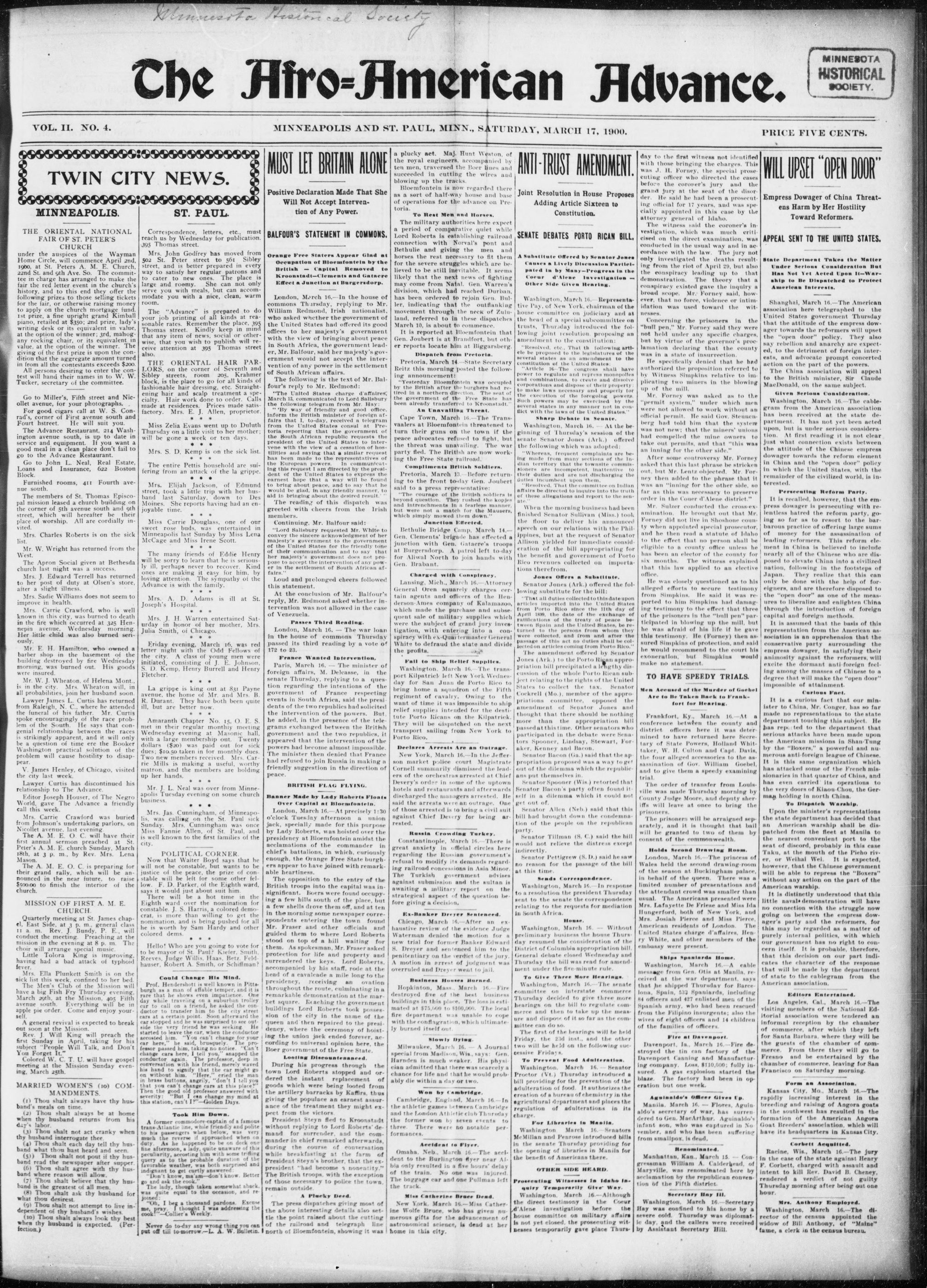
The Afro-American Advance
Saturday, March 17, 1900
Minneapolis, Minnesota
Page text (machine-generated)
The Afro-American Advance.
TWIN CITY NEWS.
VOL. II. NO. 4.
MINNEAPOLIS
THE ORIENTAL NATIONAL
FAIR OF ST. PETER'S
CHURCH
under the auspices of the Wayman Home Circle, will commence April 2nd, 1900, at St. Peters A. M. E. Church, 22nd st. and 9th Ave. So. The committee in charge has arranged to make the fair the red letter event in the church's history, and to this end they offer the following prizes to those selling tickets for the fair, or otherwise raising money to apply on the church mortgage fund, 1st prize, a fine upright grand Kimball piano, or $350; 2nd prize, lady's desk or table; or the valuable at the option of the winner, 3rd, mahogany rocking chair, or its equivalent in value, at the option of the winner. The giving of the first prize is upon the condition that the aggregate amount turned in from all the contestants exceed $200.
All persons desiring to enter the con-
ference hand their names. W. Tucker,
W. Tucker, committee.
Go to Miller's, Fifth street and Nicollet avenue, for your photographs.
For good cigars call at W. S. Conrad's, corner of First avenue south and Fourth street. He will suit you.
The Advance Restaurant, 214 Washington avenue south, is up to date in service and equipment. If you want a good meal in a clean place don't fail to go to the Advance Restaurant.
Go to John L. Neal, Real Estate, Loans and Insurance, 622 Boston Block.
Furnished rooms, 411 Fourth avenue south.
The members of St. Thomas Episcopal mission leased a church building on the corner of 5th avenue south and 9th street, which will hereafter be their place of worship. All are cordially invited.
Mrs. Charles Roberts is on the sick list.
Mr. W. Wright has returned from the West.
The Apron Social given at Bethesda church last night was a success.
Mrs. J. Edward Terrell has returned to her post of duty at Olsen's store, after a slight illness.
Mrs. Sadie Williams does not seem to improve in health.
Mrs. Carrie Crawford, who is well known in this city, was burned to death in the fire which occurred at 245 Hennepin avenue. Wednesday morning. Her little child was also burned seriously.
Mr. E. H. Hamilton, who owned a barber shop in the basement of the building destroyed by fire Wednesday morning, was burned out. His goods were insured.
Mr. W. J. Wheaton, of Helena Mont., is in the city. Mrs. Wheaton will, in all probabilities, join her husband soon.
Lawyer James L. Curtis has returned from Raleigh, N. C., where he attended the funeral of his father. Mr. Curtis spoke encouragingly of the race problem of the South. He says that conspiracy relationship, between the races is strikingly apparent, but it will be a question of time ere the Booker Washington practical solution of the problem will cause hostility to disappear.
V. James Henley, of Chicago, visited the city last week.
Lawyer Curtis has discontinued his relationship to The Advance.
Editor Joseph Houser, of The Negro World, gave The Advance a friendly call this week.
Mrs. Carrie Crawford was buried from Johnson's undertaking parlors, on Nicollet avenue, last evening.
The A. M. E. O. C. will have their first annual sermon preached at St. Peter's A. M. E. church Sunday, March 18th, at 3 p. m. by Rev. Mrs. Lena Mason.
The A. M. E. O. C. is preparing for their grand rally, which will be announced in the near future, to raise $500.00 to finish the interior of the church.
MISSION OF FIRST A. M. E.
CHURCH
Quarterly meeting at St James chapel, East Side, at 3 p.m., general class 11 a.m. Rev. J. Bundy, P. E., conduct the meeting. Preaching at the mission in the evening at 8 p.m. The choir will arrange special music. Tolora King is improving, having had a bad attack of typhoid fever. Mrs. Ella Plunket Smith is on the sick list this week, confined to her bed. The Men's Club of the Mission will have a big Fish Fry Thursday evening, March 20th, at the Mission, 405 Fifth avenue south. Everything will be in apple pie order. Come and enjoy yourself. A general revival is expected to break out soon at the Mission. Rev. J. Will King will preach the first Sunday in April, taking for his audience "The Will Talk, and Don't You Forget It." Colored W. C. T. U. will have gospel meeting at the Mission Sunday evening, March 26th.
MARRIED WOMEN'S (10) COM
MANDMENTS
(r) Thou shalt always have thy husband's meals on time.
(2) Thou shalt always be at home when thy husband returns from his day's labor.
(3) Thou shalt not act cranky when thy husband interrogate thee.
(4) Thou shalt each day tell thy husband when thy husband hast heard and seen.
(5) Thou shalt not pour thy husband read the newspaper after supper.
(6) Thou shalt agree with thy husband where reason will allow.
(7) Thou shalt believe that thy husband is the greatest of all men.
(8) Thou shalt ask thy husband for what thou desirest.
(9) Thou shalt not attempt to live independent of thy husband's wishes.
(no) Thou shalt always look thy best
wife, husband is expected. (Perfection)
(Perfection)
ST. PAUL
Correspondence, letters, etc., must reach us by Wednesday for publication. 395 Thomas street.
Mrs. John Godifrey has moved from 502 St. Peter street to 561 Sibley street, and is better prepared in every way to satisfy her regular patrons and to cater to new ones. The place is large and roomy. She can not only serve you with meals, but can accommodate you with a nice, clean, warm room.
The "Advance" is prepared to do your job printing of all kinds at reasonable rates. Remember the place, 395 Thomas street. Kindly keep in mind that any item of news, social or otherwise, that you wish to publish will receive attention at 395 Thomas street also.
THE ORIENTAL HAIR PAR-
LORS, on the corner of Seventh and Sibley streets, room 205, Krahmer block, is the place to go for all kinds of fashionable hair dressing, etc. Straightening hair and scalp treatment a specialty. Hair work done to order. Calls made at residences. Prices made satisfactory. Mrs. E. J. Allen, proprietor.
* * * *
Miss Zelia Evans went up to Duluth Thursday on a little visit to her mother; will be gone a week or ten days.
* * * *
Mrs. S. D. Kemp is on the sick list.
* * * *
The entire Pettis household are suifering from an attack of the la grip.
* * * *
Mrs. Elijah Jackson, of Edmund street, took a little trip with her husband last Saturday, down to Des Moines. She reports having had an enjoyable time.
Miss Carrie Douglass, one of our sweet rose buds, was entertained in Minneapolis last Sunday by Miss Lena McCage and Miss Irene Scott.
* * * *
The many friends of Eddie Henry will be sorry to learn that he is seriously ill, perhaps never to recover. Kind ones are making it easy for him, by loving attention. The sympathy of the Advance is with the family.
* * * *
Mrs. A. D. Adams is ill at St. Joseph's Hospital.
* * * *
Mrs. J. H. Warren entertained Saturday in honor of her mother, Mrs. Julia Smith, of Chicago.
* * * *
Friday evening, March 16, was red letter night with the Odd Fellows of the city. A class of young men were initiated, consisting of J. E. Johnson, S. D. Kemp, Henry Burrell and Henry Fletcher.
***
La grippie is king out at 831 Payne avenue, the home of Mr. and Mrs. B. R. Durant. They have both been quite ill, but are better now.
* * *
Amaranth Chapter No. 15, O. E. S. met in their regular monthly meeting Wednesday evening at Masonic hall, with a large membership out. Twenty dollars ($20) was paid out for sick dues, $10.50 taken in for monthly dues. Two team members, Mrs. C. E. Rie Mills is making a useful, worthy matron, and the members are holding up her hands.
★ ★ ★
Mr. J. L. Neal was over Minne-
apolis Tuesday evening on some church
---
Mrs. Jas Cunningham, of Minneapolis, was calling on the St. Paul sick Sunday. Mrs. Cunningham was once Miss Fannie Allen, of St. Paul, and is well known to the first families of the city.
POLITICAL CORNER
Now that Walter Boyd says that he will not be constable, but wants to be justice of the peace, the prize of constable will be left for some other fellow. F. D. Parker, of the Eighth ward, says it would just about suit him.
There will be a hot time in the Eighth ward over the nomination for constable. J. S. Harris, a colored democrat, is more than willing to get the nomination, and is being pushed for all he is worth by Sam Hardy and other colored dems.
Hello! Who are you going to vote for to be mayor of St. Paul? Kiefer, Smith, Reeves, Judge Willis, Haas, Betz, Feldhauer, Robert A. Smith, or Schiffman?
Could Change His Mind.
Prof. Hendershott is well known in Pittsburgh as a man of affable temper, and it is rare that he shows even impatience. One day while traveling on a suburban trolley car to call on a friend, he asked the conductor to transfer him to the city street car. He was told that the car stopped and he was surprised to see outside the very friend he was seeking. He started to leave the car, when the conductor accosted him. "You can't change for your car here," he said, brusquely. The professor pressed him, taking no action. He came here again, snapped the conductor again. The professor, deep in conversation with his friend, merely waved his hand to signify that the car might go on without him. "Here," cried the man in brass buttons, angrily, "don't I tell you that I want to go home?" Then the good old professor answered with severity: "But I can change my mind at this station, can I not?" -Golden Days.
Took Him Down.
A former commodore-captain of a famous trans-Atlantic line, while friendly and polite to his passengers when below, was very much the reverse if approached when on a train. He was a little late afternoon, a lady, quite unaware of this peculiarity, accompanying him with some trifling query as to the probable duration of the favorable weather, was both surprised and indignant to get curtly answered. "Don't know, my am-don't know. Better
The lady, though taken somewhat shack,
was quite equal to the occasion, and rejoined:
"Oh, I beg a thousand pardons. Excuse
me, pray. I thought I was addressing the
collar—'Collier's Weekly.' _____
Never do to day or any wrong thing you can
off to cut; to morrow—L. A. W. Bulletin.
MINNEAPOLIS AND ST. PAUL, MINN., SATURDAY, MARCH 17, 1900.
MUST LET BRITAIN ALONE
Positive Declaration Made That She Will Not Accept Intervention of Any Power.
BALFOUR'S STATEMENT IN COMMONS.
Orange Free Statera Appear Glad at Occupation of Bloemfontein by the British - Capital Removed to Kroonstad-Clements and Gatacre Effect a Junction at Burgersdorp.
London, March 16. In the house of commons Thursday, replying to Mr. William Redmond, Irish nationalist, who asked whether the government of the United States had offered its good offices to her majesty's government with the view of bringing about peace in South Africa, the government leader, Mr. Balfour, said her majesty's government would not accept the intervention of any power in the settlement of South African affairs.
The following is the text of Mr. Balfour's reply to Mr. Redmond:
"The United States charge d'affaires, March 13, communicated to Lord Salisbury the following telegram from Mr. Hay:
"By way of friendly and good office, inform the British minister of foreign affairs that I, to-day, received a telegram from the United States consul at Pretoria reporting that the government of the South African republic requests the United States to send a message with the view of a cessation of hostilities and saying that a similar request has been made to the representatives of the European powers. In communicating this request I am directed by the president of the United States to express the hope that that way will be found to bring about peace, and to say that he would be glad, in any friendly manner, to aid in bringing about the desired result." The reading of this dispatch was greeted with cheers from the Irish members.
Continuing. Mr. Balfour said:
"Lord Salisbury requested Mr. White to convey the sincere acknowledgment of her majesty's government to the government of the United States for the friendly tone of their communication and to say that the government does not propose to accept the intervention of any officer in the settlement of South African affairs."
Loud and prolonged cheers followed this statement.
At the conclusion of Mr. Balfour's reply, Mr. Redmond asked whether intervention was not allowed in the case of Venezuela.
Passes Third Reading.
London, March 16. — The war loan in the house of commons Thursday passed its third reading by a vote of 172 to 23.
France Wanted Intervention.
Paris, March 16. — The minister of foreign affairs, M. Delacasse, in the senate Thursday, replying to a question regarding the intentions of the government of France respecting events in South Africa, said the presidents of the two republics had solicited the intervention of the powers. But, he added, in the presence of the telegrams exchanged between the British government and the two republics, it appeared that the intervention of the powers had become almost impossible. The minister then denied that France had refused to join Russia in making a friendly suggestion in the direction of peace.
BRITISH FLAG FLYING
Banner Made by Lady Roberts Floats
Grass Capital at Biorefractory
London, March 16.—At precisely 1:30 o'clock Tuesday afternoon a union jack, specially, made for this purpose by Lady Roberts, was hoisted over the presidency at Bloemfontein amidst the acclamations of the commander in chief's battalions, in which, curiously enough, the Orange Free State burghers appear to have joined with remarkable heartiness.
The opposition to the entry of the British troops into the capital was insignificant. Boers were found occupying a few hills south of the place, but a few shells drove them off, and at ten in the morning some newspaper correspondents entering the town found Mr. Fraser and other officials and guided them to where Lord Roberts stood on top of a hill waiting for them. As spokesman, Mr. Fraser asked protection for life and property and surrendered the keys. Lord Roberts, accompanied by his staff, rode at the head of a cavalcade a mile long to the presidency, receiving an ovation throughout the route, culminating in a remarkable demonstration at the market square. Reaching the government buildings Lord Roberts took possession of the city in the name of the queen and then repaired to the presidency, where the ceremony of hoisting the union jack ended forever, according to universal opinion here, the Boer government of the Free State.
Looting Discountenanced.
During his progress through the town Lord Roberts stopped and ordered the instant replacement of goods which were being looted from the artillery barracks by Kaffirs, thus giving the populace an earnest assurance of the treatment they might expect from the victors.
President Steyn fled to Kroonstadt without replying to Lord Roberts' demand for surrender, and the commander in chief remarked afterwards, during the course of conversation while breakfasting at the farm of President Steyn's brother, that the expresident "had become a nonentity." The British troops, with the exception of those necessary to police the town, remain outside.
A Plucky Deed.
The press dispatches giving most of the above interesting details also settle the point raised about the cutting of the railroad and telegraph line north of bloomfontein, showing it was
a plucky act. Maj. Hunt Weston, of the royal engineers, accompanied by ten men, traversed the Boer lines and succeeded in cutting the wires and blowing up the tracks. Bloemfontein is now regarded there as a sort of half-way house and base of operations for the advance on Pretoria.
To Rest Men and Horses.
The military authorities here expect a period of comparative quiet while Lord Roberts is establishing railroad connection with Norval's pont and Bethlie and giving the men and horses the rest necessary to fit them for the severe struggles which are believed to be still inevitable. It seems likely that the next news of fighting may come from Natal. Gen Warren's division, which had reached Durban, has been ordered to rejoin Gen Buller, indicating that the outflanking movement through the neck of Zululand, referred to in these dispatches March 10, is about to commence.
It is reported at Bloomfontein that Gen Joubert is at Brandon, but other locations locate him at Biggarbersh.
Dispatch from Pretoria.
Pretoria, March 14—State Secretary Reitz this morning posted the following announcement: "Yesterday Bloomfontein was occupied by the British after the burghers had retired in a northern direction. The seat of the government of the Free State has been already transferred to Kroemstadt."
An Unavailing Threat.
Cape Town, March 16.—The Transvaalers at Bloemfontein threatened to turn their guns on the town if the peace advocates refused to fight, but the threat was unavailing. The war party fled. The British are now working the Free State railroad.
Compliments British Soldiers.
Pretoria, March 13. Before returning to the front to day Gen. Joonbert said to a press representative:
"The courage of the British soldiers is beyond question when the kopies and intruders attack a telegraph hunter, but were a match for the Mausers, which simply mowed them down."
Junction Effected.
Bethlehem Bridge Camp, March 14.—Gen. Clementa's brigade has effected a junction with Gen. Gataere's troops at Burgersdorp. A patrol left to-day for Aliwal North to join hands with Gen. Brabant.
Charged with Conspiracy
Lansing, Mich., March 16.—Attorney General Oren squarely charges certain agents and officers of the Henderson-Ames company of Kalamazoo, which made the purchase and subsequent sale of military supplies which were the subject of grand jury investigation, with entering into a conspiracy with ex-Quintermaster General White to defraud the state and divide the profits.
Fall to Ship Relief Supplies.
Washington, March 16.—The transport Kilpatrick left New York Wednesday for San Juan de Porto Rico to bring home a squadron of the Fifth regiment of cavalry. Owing to the want of time it was impossible to ship relief supplies intended for the destitute Porto Ricans on the Kilpatrick. They will be dispatched on the next transport sailing from New York to Porto Rico.
Business Acquisition
Declares Arrests Are an Outrage.
New York, March 16.—In the Jefferson market police court Magistrate Cornell summarily dismissed the leaders of the orchestra arrested at Chief Devery's order in some of the uptown hotels and restaurants and afterwards discharged the managers arrested. He said the arrests were an outrage. One of those arrested is to bring a civil suit against Chief Devery for being arrested.
Russia Crowding Turkey
Constantinople, March 16. There is great anxiety in official circles here regarding the Russian government's refusal to modify its demands regarding railroad concessions in Asia Minor. The Turkish government advises against submission and the sultan is awaiting a military report on the strategic aspect of the question before giving a decision.
Ex-Banker Dreyer Sentenced
Chicago, March 16.—After an exhaustive review of the evidence Judge Waterman denied the motion for a new trial for former Banker Edward S. Dreyer and sentenced him to the penitentiary on the verdict of the jury. A motion in arrest of judgment was overruled and Judge Dreyer went to jail.
Business Houses Hurned.
Hopkinton, Mass. March 16. Fire destroyed five of the best business buildings in this place. The loss is estimated at $75,000 to $100,000. The local fire department was unable to cope with the conflagration, which ultimately burned itself out.
Slowly Dying.
Milwaukee, March 16. — A Journal special from Madison, Wis. says: Gen Harnden is much weaker. His physician admitted that there was scarcely a chance for life and that he would probably die within a day or two.
Won by Cambridge
Cambridge, England, March 16—In the athletic games between Cambridge and the London Athletic club Thursday the former won by seven events to three. There were no notable performances.
Accident to Flyer.
Omaha, Neb., March 16. —The accident to the Burlington flyer near Alba only resulted in a five hours' delay of the train. No one was injured. The baggage car and one Pullman left the track.
Miss Catherine Bruce Dead
New York. March 18.—Miss Catherine Wolfe Bruce, who has given numerous gifts for the advancement of astronomical science, is dead at her home in this city.
ANTI-TRUST AMENDMENT
Joint Resolution in House Proposes Adding Article Sixteen to Constitution.
SENATE DEBATES PORTO RIGAN BILL
A Substitute Offered by Senator Jones
Causes a Lively Discussion Partiel-
pated in by Many—Progress in the
Cœur d'Alene Investigation —
Other Side Given Hearing.
"Resolved, etc. That th following article be proposed to the legislatures of the several states as an amendment to the Constitution, and that "Article 16-The congress shall have power to regulate and repress monopolies and combinations, to create and dissolve monopolies and combinations, to make laws necessary and properly for the execution of the foregoing powers. Such powers may be exercised by the legislatures of the several states, or flict with the laws of the United States.
Sharp Debate in Senate.
Washington, March 16. — At the beginning of Thursday's session of the senate Senator Jones (Ark.) offered the following which was adopted:
"Whereas, frequent complaints are being made from many sections of the Indian territory that the townsite commissioners are incompetent, inattentive to their duties and are not discharging the duties therefrom. That the committee on Indian affairs be directed to inquire into the truth of these allegations and report to the senate.
When the morning business had been finished Senator Sullivan (Miss.) took the floor to deliver his announced speech on our relations with the Philippines, but at the request of Senator Allison yielded for immediate consideration of the bill appropriating for the benefit and government of Porto Rico revenues collected on importations therefrom.
Jones Offers a Substitute.
Senator Jones (Ark.) offered the following substitute for the bill:
"That all duties collected to this date upon articles imported into the United States from Porto Rico since the 11th day of April, 1899, the date of the exchange of the articles by the authority of the between Spain and the United States, be returned to the persons from whom they were collected, and from and after the passage of this act no duties shall be collected on articles coming from Porto Rico."
The amendment offered by Senator Jones (Ark.) to the Porto Rican appropriation bill precipitated a lengthy discussion of the whole Porto Rican subject relating to the rights of the United States to collect the tax. Senator Cockrell (Mo.), member of the appropriations committee, opposed the amendment of Senator Jones and thought that there should be nothing more than the appropriation bill passed at this time. Other senators who participated in the debate were Senators Spooner, Lindsay, Stewart, Foraker, Kenney and Bacon.
Senator Bacon (Ga.) said that the appropriation proposed was a way to get out of the dilemma which the republicans put themselves in.
Senator Spooner (Wis.) retorted that Senator Bacon's party often found itself in a dilemma which it could not get out of.
Senator Alien (Neb.) said that this bill had brought down the condemnation of the people on the republican party.
Senator Tillman (S. C.) said the bill would not relieve the distress except indirectly.
Senator Pettigrew (S. D.) said he saw no reason for the passage of the bill at this time.
Sends Correspondence.
Washington, March 16. In response to a resolution the president Thursday sent to the senate the correspondence relating to the requests for mediation in South Africa.
House.
Washington, March 16. — Without preliminary business the house Thursday resumed the consideration of the District of Columbia appropriation bill. General debate closed Wednesday and Thursday the bill was read for amendment under the five-minute rule.
To Give Three More Hearings
To Give Three More Hearings.
Washington, March 16.—The senate committee on interstate commerce Thursday decided to give three more hearings on the bill to regulate commerce and then to take up the measure and dispose of it so far as the committee can do so.
The first of the hearings will be held Friday, the 23rd inst., and the other two will be held on the following successive Fridays.
To Prevent Food Adulteration
Washington, March 16. — Senator Proctor (V-1) Thursday introduced a bill providing for the prevention of a bill providing for the prevention of food. It authorizes the creation of a bureau of chemistry in the agricultural department and places the regulation of adulterations in its charge.
For Libraries in Manila.
Washington March 16.—Senators McMillan and Penrose introduced bills in the senate Thursday providing for the opening of libraries in Manila for the benefit of Americans there.
OTHER SIDE HEARD
quity Temporarily Give Way
Washington. March 16.—Although
the direct testimony in the Coeur
d'Alene investigation before the
house committee on military affairs
is not yet closed, the prosecuting
witnesses temporarily gave place Thura-
day to the first witness not identified with those bringing the charges. This was J. H. Forney, the special prosecuting officer who directed the cases before the coroner's jury and the grand jury at the seat of the disorder. He said he had been a prosecuting official for 17 years, and was specially appointed in this case by the attorney general of Idaho.
The witness said the coroner's investigation, which was much criticised on the direct examination, was conducted in the usual way and in accordance with the law. The jury not only investigated the deaths resulting from the riot of April 29, but also the conspiracy leading up to that demonstration. The theory that a conspiracy existed gave the inquiry a broad scope. Mr. Forney said, however, that no force, violence or intimidation was used toward the witnesses.
Concerning the prisoners in the "bull pen," Mr. Forney said they were not held under any specific charges, but by virtue of the governor's proclamation declaring that the county was in a state of insurrection. He specifically denied that he had authorized the proposition referred to by Witness Simpkins relative to implicating two miners in the blowing up of the mill. Mr. Forney was asked as to the "permit system," under which men were not allowed to work without an official permit. He said Gov. Steenunberg had told him that the system was not new; that the miners' unions had compelled the mine owners to take out permits, and that "this was an inning for the other side."
After some controversy Mr. Forney asked that this last phrase be stricken out, but Mr. Lentz objected, Mr. Forney then added to the phrase that it was an "inning for the other side, so far as this was necessary to preserve order in the Couer d'Aleene district." Mr. Sulzer conducted the cross-examination. He brought out that Mr. Forney did not live in Shoshone county when appointed special prosecutor, and he then read a statute of Idaho to the effect that no person shall be eligible to a county office unless he has been an elector of the county for six months. The witness explained that this law applied to an elective office.
He was closely questioned as to his alleged efforts to secure testimony from Simpkins. He said it was reported to him Simpkins had damaging testimony to the effect that three of the prisoners in the "bull pen" participated in blowing up the mill, but he was afraid of his life if he gave this testimony. He (Forney) then assured Simpkins of protection, and said he would recommend to the court his exoneration, but Simpkins would make no statement.
TO HAVE SPEEDY TRIALS.
Men Accused of the Murder of Goechel
Are to Be Taken Back to Frank-
fort for Hearing.
Frankfort, Ky., March 16. At a conference between the county and district officers here it was determined to have returned here Secretary of State Powers, Holland Whit-taker, W. H. Culton and Capt. Davis, the four alleged accessories to the assassination of Gov. William Goebel, and to give them a speedy examining trial.
The order of transfer from Louisville was made Thursday morning by County Judge Moore, and deputy sheriffs will leave at once to bring the prisoners.
The prisoners will be arraigned separately, and it is thought that ball will be granted to two of them by consent of the commonwealth.
Holds Second Drawing Room.
London, March 16.—The princess of Wales held the second drawing-room of the season at Buckingham palace, in behalf of the queen. There was a limited number of presentations and the attendant crowd was smaller than usual. The Americans presented were Mrs. Lafayette De Friese and Miss Ida Hungerford, both of New York, and Mrs. Josiah Pierce and Miss Pierce, American residents of London. The United States charge d'Affaires, Henry White, and other members of the embassy were present.
Skins Spaniards Home
Washington, March 16.—A cable message from Gen. Otis at Manila, received at the war department, says that he shipped Thursday for Barcelona, Spain, 533 Spaniards, including 84 officers and 427 enlisted men of the Spanish army, who had been rescued from the Filipino insurgents; also the wives of eight officers and 14 children of the families of officers.
Fire at Davenport.
Davenport, Ia., March 16. -Fire destroyed the tin can factory of the Davenport Canning and Manufacturing company. Loss, $110,050; fully insured. A gas explosion started the blaze. The factory had been in operation but one week.
Agnivalde's @fst Gives Up
Manila, March 16. — Flores, Aguin aldo's secretary of war, has renamed dered to Gen. MacArthur. Aguinaldo's infant son, who was captured in November, and who has been suffering from smallpox, is dead.
Renominated.
Manhattan, Kan., March 15. — Congressman William A. Calderhead, of Maryville, was nominated here by acclamation by the republican convention of the Fifth district.
Secretary Hay Ill
Washington, March 16.—Secretary Hay was confined to his home by a severe cold. Thursday was diplomatic day, and the callers were received by Assistant Secretary Hill.
MINNESOTA
HISTORICAL
SOCIETY.
PRICE FIVE CENTS.
WILL UPSET "OPEN DOOR"
Empress Dowager of China Threatens Harm by Her Hostility Toward Reformers.
APPEAL SENT TO THE UNITED STATES.
State Department Takes the Matter Under Serious Consideration But Has Not Yet Acted Upon It-Warship to Be Dispatched to Protect American Interests.
Shanghai, March 16.—The American association here telegraphed to the United States government Thursday that the attitude of the empress dowager towards the reformers will upset the "open door" policy. They also say rebellion and anarchy are expected, to the detriment of foreign interests, and advocate prompt concerted action on the part of the powers.
The China association will appeal to the British minister, Sir Claude MacDonald, on the same subject.
Given Serious Consideration
Washington, March 16.—The cablegram from the American association has been received at the state department. It has not yet been acted upon, but is under serious consideration. At first reading it is not clear just what connection exists between the attitude of the Chinese empress dowager towards the reform element in China and the "open door" policy in which the United States, with the remainder of the civilized world, is interested.
Persecuting Reform Party.
It is recalled, however, that the empress dowager is persecuting with relentless hatred the reform party, going so far as to resort to the barbarous practice of offering large sums of money for the assassination of leading reformers. This reform element in China is believed to include nearly all of the Chinese who are disposed to elevate China into a civilized nation, following in the footsteps of Japan. They realize that this can only be done with the help of foreigners, and are therefore disposed to the "open door" as one of the measures to liberalize and enlighten China through the introduction of foreign capital and foreign methods.
It is assumed that the basis of this representation from the American association is an apprehension that the conservative party surrounding the empress dowager, in satisfying their animosity against the reformers, will excite the dormant anti-foreign feeling among the masses of Chinese to a degree that will make the "open door" impossible of attainment.
Curious Fact.
It is a curious fact that our minister to China, Mr. Conger, has so far made no representations to the state department touching this subject. He has reported to the department that serious attacks have been made upon the American missions in Shan-Tung by the "Boxers," a powerful and numerous anti-foreign league of Chinese. It is this same organization which has attacked some of the French missionaries in that quarter of China, and has even carried its operations to the very doors of Kiaou-Chon, the German holding in north China.
To Dispatch Warship.
Upon the minister's representations the state department has decided that an American warship shall be dispatched from the fleet at Manila to the nearest convenient port to the seat of discord, probably in this case Taku, at the mouth of the Pieho river, or Weibal Wei. It is expected, however, that the Chinese government will be able to repress the "Boxers" without any action on the part of the American warship.
It is distinctly understood that this little naval demonstration will have no connection with the struggle now going on between the empress dowager's party and the reformers, for this may be regarded as a matter of purely internal politics, with which our government has no right to concern itself. It is probable, therefore, that this decision on our part indicates the character of the response that will be made by the department of state to the cablegram from the American association.
Editors Entertained.
Los Angeles, Cal., March 16—The visiting members of the National Editorial association were tendered an informal reception by the chamber of commerce, after which they left for Santa Barbara, where they will be the guests of the chamber of commerce. From there they will go to Fresno and be entertained by the chamber of commerce, leaving for San Francisco on Saturday morning.
Form an Association
Kansas City, Mo., March 16.—The rapidly increasing interest in the breeding and raising of Angora goats in the southwest has resulted in the formation of the American Angora Goat Breeders' association, which will have its headquarters in Kansas City.
Corbett Acquitted.
Racine, Wis., March 16. The jury in the case of the state against Henry F. Corbett, charged with assault and intent to kill Rev. David B. Cheney, rendered a verdict of not guilty Thursday morning after being out one hour.
Mrs. Anthony Employed.
Washington, March 16.—The director of the census appointed the widow of Bill Anthony, of "Maine," a flicker in the census burea.
Published every Saturday by the
Office, 603 Northwestern Bldg.
Tel. Main 2460-L-1.
Minneapolis, - - - - - Minnesota.
Subscription Rates:
One Year ..... $1.00
Six Months ..... .60
Three Months ..... .40
Special rates if ordered by the dozen
orders for current issue should reach the
100th.
Advertising Rates:
Local Reading Notices, 10c per line
each insertion.
Religious Notices (not over five lines)
free.
"Want" and "To Let" advertisements,
8 cents per line for each insertion.
Display, 40 cents per inch each insertion,
rates will be given for space by the year.
Editorial Announcements.
To secure the return of unsolicited manuscript postage should be enclosed in the communications preceding the issue in which they are to appear. The mail, communication, enclosing news matter, communication, the writer's name, not for publication, but as an evidence of good faith. Concerning the progress of news concerning the progress of the colored race are requested from our readers. Our communication unsuitable for publication. Subcriber ordering addresses of their paper changed are requested to their form for publication address. Address all communications and make all allitrements to THE AFRO-AMERI-TECH.
603 Northwestern Building,
Minneapolis, Minn.
EDITORIAL.
"ADVICE" TO HARRY SHEP-
PARD.
And now comes one Harry Sheppard, a new and formidable "Moses," who sets up the pitiful claim that he, together with The Appeal Man, has wrought greater miracles "unseen" for the sole benefit of St. Paul Afro-Americans, than many "weak" speaking colored newspapers, like the Advance and The Appeal. We judge, of course, that the "flimsy stuff" which appeared in The Advance aroused the ire of our erstwhile "new Moses" to egotistic resentment, or else he would not have made the following reply, in substance, to a clipping from the Minneapolis Journal, and editorial comment which appeared in The Advance a fortnight ago, concerning our subject. Journalistic etiquette adheres to the old proverb, answer a (Well!) according to his folly, lest he be conceived, etc. There is room in our subject's heart for repentance, for we are commanded not to boast of ourselves, but rather accord that courtesy to others, who see us not as we see ourselves. Mr. Sheppard has made a serious breach of this essential element of rugged manhood. Note! (a) either advice not mouthly? Think of such utterly such words! (b) The Sheppard Photo Company amounts annually to from $18,000 to $20,000 per annum, and Sheppard has expended more money in his method of fighting the Afro-Americans' battle in the last few years than would be necessary to run a half dozen such papers as "The Advance." (c) The Advance should lose no sleep over that "fat position" lost by Harry Sheppard.
(a) The man who asks neither advice nor sympathy ought not to claim what he has done, and is doing for the race, for the race in fact cares nothing for a man whose motives are for selfish purposes. It is contrary to human laws to appreciate, or even notice, the labor of those who attempt to boost their way to that which makes one man greater than another. The efforts of a man must be backed by unselfish motives, if he desires his labor appreciated by people. Sneers and contempt are the logical fruit of the man who assumes to live "alone" without the desire of human understanding, and the wise finite advice. Our good Brother Shepard, we are afraid, has caught the wrong incentive of his work, which he claims to perform "alone."
(b) A colored man in the Northwest with a business paying $20,000 per annum is indeed a great revelation to the Afro-Americans of the Twin Cities. We do not question the "motive" of this assertion, but we doubt whether this "motive" found a resting place in the hearts of our subjects, pupils, who "adore" Mr. Sheppard for making it possible for them to get a first class seat in St. Paul theaters. This annual $20,000 income should alone cause our subject to blush with shame because of leaving it merciless, and accepting of the four dollar a day job which he actually took to earn the "poor" Negro of less wealth. If Mr. Sheppard proves to us by employing a score or more of Afro-Americans, and works among the Afro-Americans in person, we will believe in his sincerity. We care nothing about what his annual income might be, whether it be sufficient to support "six Negro newspaper" such as The Advance, or $6. All we desire is for him to show race progress at home, by investing some of that $20,000 per year, thus giving employment to those of his race. As the case now stands we would rather think that it is $20,000 in "frivolous" words rather than actual currency. If the latter sentence were Mr. Sheppard's original "methods of fighting Afro-Americans battles in the last few years we would have been more with warriors, and we need no more of them. We want the Negro's battles fought with brains and the product of investing currency. Any other kind of fighting belongs to the "bow wow" gang.
(c) Rest assured The Advance will "lose no sleep" over a man who would live alone, fall alone, and progress alone. The publication regarding that "fat position" belongs to the editor of any public organ, who desired to "chip" and publish it, and if such misrepresented Mr. Sheppard, why did he not explain the situation from his point of vitw, in a gentlemanly and courteous manner. There was no necessity of speaking of his yearly income, nor what he had done for the race, or his inward intentions, etc. All these things were irrelative to the issue. Our subject must have been angry when forming the composition of his article, or the "Appeal printers" must have been
cross-eyed, from the appearance of repeated paragraphs. The same does not speak well for colored journalism. The Advance will solicit support from this $20,000 man and find out whether he must to prosecute his claims.
DON'T RIDE ON STREET CARS.
DON'T RIDE ON STREET CARS. The watchword with colored people now is, "Don't ride on street cars of Atlanta." Since the passage of the city street car ordinance several Negroes got their heads beaten and colored ladies have been insulted. The consequence is nearly all Negro travel has ceased. It is said that fully one hundred dollars a day is lost to the street car companies. Old men and women who used to ride on the cars are seen trudging along in the rain—Atlanta Age. We sympathize with all Afro-Americans who value manhood and womanhood more than inferior accommodations. Inconvenience, when dignity and honor are at stake, is worth many times the amount of convenience.
"The Negro World," a new race journal, made its first appearance Saturday last. It is a Twin City paper, with headquarters in St. Paul. In "make-up" and typographical accuracy, The World stands among our best papers. The editorials, while not consistent from a political point of view with Republicanism, was well wored and proved the editor to be a scholarly writer. We welcome The World in our office.
Never judge a man or woman by what others say about them, but learn the person for yourself. Many times the person whom you mistrust, because others assert their dislike, will prove to be your best friend. A mind easily influenced is a perpetual victim of others, instability. But a hard-headed, common sense person, must know, in fact, through personal conception, the real worth of the man or woman talked about by his or her neighbor, before a conclusion is reached.
We are glad to learn that our old friend, Bishop H. M. Turner, has so far recovered from a recent paralytic attack as to be able to walk without the use of crutches. Bishop Turner is a good, good man, and his life has been of great value to his day and generation—Ex.
Don't fail to attend the Oriental National fair at St. Peter A. M. E. church, commencing April 2nd. The management has promised to make this event the most interesting of the season. Over $400.00 worth of prizes will be given away.
AN ELABORATE PROGRAMME,
ENCHANTING MUSIC, UNDER
DER THE AUSPICES OF
THE ALUMNI.
(Special to The Advance.)
Urbana, Ohio, March 10, 1900.
Friday evening, March 9, friends from
the city and from alar gathered at the
Curry school to commemorate the eleventh anniversary of the institution and to witness the opening of the new building which has just been completed.
The programme was conducted by the alumni and the music was furnished by the C. S. chorus.
Prof. Winslow read a well prepared paper on "Our Faculty." President Curry delivered an address on "Education," and gave a review of the history of the school.
The school was begun in a shed kitchen, 12x14, in Delaware, Ohio, January, 1889, with an enrollment of three pupils. From that shed it has gone to the present brick, 48x88, with an ell addition of 9 apartments, making in all 19 apartments in the building; situated on a half block four squares from the city hall.
The campus is bedecked with a variety of trees. An orchard of choice fruits, which adds much to the value of the place, has been planted recently. Eight states and fourteen counties of Ohio are represented on the roll for this year.
The following departments are in operation: English Theological, Normal, Literary, Musical, Shortland and Type-writing, Printing, Cooking, Sewing, Gardening and the use of tools.
The citizens of Urbana, in general, are interested in the success of this school. The G. A. R. Post gave a benefit in the Opera House for the school. Revs. R. Donaldson, of the Presbyterian Church, and M. Fuller, of the M. E. Church, able speakers with state reputation, will deliver series of lectures, in different parts of Ohio, for the benefit of the school. The business men contributed largely to the erection of the church. President Curry has everything to encourage him. By his business tact and intellectual ability, he has made for himself a name to be envised. The editor of this paper solicits the support of the public in general for President Curry and his laudable work
Funny Footnotes.
If a girl can make lovely chocolate caramels a man thinks she can cook. Success is like a chicken; if you get it, you can up, it is well to keep an eye on the coop. When some women get the blues the family find it out by having to eat dried
After a girl has taken three French lessons she can do the French shrug, better than her teacher. But with but a single thought surprise everybody by finding an awful tool to talk about. Birth doesn't amount to so much; indifference often presents a fine imitation of the correct aeratic air - Indianapolis Journals.
A Modest Request.
Ambition is an admirable trait, but it is not the single qualification for success. Among highly ambitious youths must be numbered a German who for several years had been apprenticed to a cooper. The young man felt that constant cooperating was essential to his success. Accordingly, after deliberation, a few months ago he addressed a letter to the head of the great Rothchild banking house at Frankfort, setting forth at some length his strong dislike for his trade, and asking to be accepted as "an apprentice millionaire," to which he replied with the learning "the business." The young man is still a cooper.-Youth's Companion.
Pleasure of Necessities
A lady living in the Eighteenth ward answered a knock at her door the other morning to find a poory-dressed woman, greatly impressed by her tale excited sympathy in the land lady. The woman left she carried a big bundle of clothes and a sack containing many of the necessaries of life. The next morning the mother door a seven-year-old uncle of ruddy children shocked the lady of the house with that "Say, that lady you give the things to yesterday want to know if you've got a pair of shoes or one brother can wear." "Salt Lake Herald"
Santa Clara county's (Cuba) tobaccon crop will be the largest on record. Gen. Winslow says Cuba's future depends upon agricultural prosperity.
Chicago sends 40,000 quarters of dressed "English beef" to England every week.
The sugar trust profits are about $12,000,000 a year in spite of fluctuations in the value of its stock.
In New York city 150 retail druggists have formed an association to compete with department stores.
The Panama Canal company hopes to sell its rights to the United States or to an American syndicate.
The Massachusetts Daughters of Veterans have indorsed the trailing arbutus as the national flower.
A proposition has been made to the government to equip 27 cities with a pneumatic tube mail service for $2,522,000.
A New York grand jury will investigate gambling houses, said to pay Tammany $3,000,000 a year for police protection.
All the 20,000 employees of the National Tube trust will receive an increase of ten per cent. in wages beginning April 1 next.
The Illinois River Valley association will petition congress to name a federal commission to supervise the deep waterway project.
Massachusetts has 115 street railway companies, controlling 1,492 miles. Last year the increase in mileage in the state was 35.
Mayor Van Wyck, of New York, has issued a dictum to reporters in which he positively refuses to be interviewed for publication hereafter.
There are 16 Yale men in the present congress. Five of these are senators, E. O. Woolcott, W. M. Stewart, T. C. Platt, C. M. Depew and G. P. Wetmore.
Capt. Silas W. Terry, late in command of the town, has been assigned to succeed Admiral McCormick as commandant of the Washington navy yard.
From Philadelphia a cargo containing $1,000,000 worth of farm implements was shipped to Russia. It was the largest shipment of the kind ever made from the United States.
ELECTRICAL ENERGY.
It is proposed by a Michigan company to carry an electric current of 40,000 volts 90 miles. Electric cars are immensely popular in England, and the equipment companies can hardly keep up with their orders. Balloon wireless telegraphic communication is to be attempted at Portsmouth, England, with a view to establishing communication between the sea and a land force. The electric exhibit at the Paris exposition bids fair to be one of the most attractive parts of the show. There will be a complete retrospective exhibit of electrical and mechanical apparatus of historical character, and the special exhibit will be housed in the "Court of Honor" built of staff.
It is proposed to construct an electrically worked bridge crossing the Usk, says the English Electrical Review. The width of the river at this point is 240 yards and the time occupied by the carrier going from one bank to the other is estimated at about a minute. The bridge will coat $325,000.
PATRONIZE...
WM. JENKINS,
ROOMS FOR RENT
FIRST CLASS.
We Guarantee Superb Service. Prices moderate. Tel. 2737-L-3 Main.
No. 9 Second St. No. Minneapolis.
J. GARNER. W. H. WELLER.
The Elite Buffet
3030 STATE ST.,
FINE WINES,
LIQUORS
AND CIGARS.
Chicago.
Fashionable Dressmaker.
Cutting, Fitting and Making Over a Specialty. New York and Paris Fashions Always on Hand.
Parlors, 628 Fourteenth Ave. South.
DR. R. S. BROWN
Physician and Surgeon.
Office: 405-6 Reeve Bldg., 408 Nicollet Av.
Telephone 2734-5-3.
Office Hours: 9:30 to 12:30; 2:00 to 4:00
p. m.; 5:30 to 7:00 p. m. Sundays: 9:30 to
11:30; 11:30 to 2:00.
Residence: 2839 Portland Ave.
Telephone 317-L-South.
MR. L. A. JOHNSON.
The gentlemanly and obliging Porter at R. De Leo's Barber Shop, 200 Washington Av. South, is Always Ready to Dress Your Shoes in a thoroughly artistic manner, that is sure to win. JAMES L. CURTIS.
LAWYER
603 Northwestern Bldg., Minneapolis.
Cor. 4th St. and Hennepin Av.
Telephone, Main 2460-L-1.
DROPSY
Treated free.
Postcross UURB
Benedicta, Have
cured many then
DROPSY
Treated free. CURB with Vegetable. Removes many many nematodes. From first dose to symptoms rapidly disappear, and in ten days at least two-thirds of all symptoms now removed. TEN DAYS TREATMENT FURNISHED FREely by mail DR. H. R. GREEN & SONS, Specialties, Atlanta, GA. PLEASE TIME THIS PAPER every time you write.
LAMB'S best. Connections for Vocalists, to LAMB MFG. CO., Ottawa, Canada, for sample cards.
$20 A hundred for your neighbors' addresses.
ROMANCE MAGAZINE, NEW YORK.
DROPSY NEW DISCOVERY; gives quick relief and crossword cues. Back for book of terminology and 10 days' treatment.
GET RICH OUTSIDE. Send for book. "Harmful Waste."
---
THE ADVANCE CAFE 214 WASHINGTON AV. SOUTH. Restaurant and Lunch Counter
MANN & KOGER, Proprietors.
Officers and Standing Committees of the Most Worshipful Grand Lodge A. F. and A. M. of Minnesota and juridiction: Grand Masters—John L. Neal, Minnesota. Deputy Grand Master—Wade H. H. Hamptoft Grand Senior Warden—H. B. Howard, St. Paul. Grand Junior Warden—J. C. Garner, St. Paul.
Grand Treasurer-Daniel Roy, St. Paul
Grand Secretary-William R. Morris
Mortgage
Minneapolis.
Grand Lecturer—G. W. Day (7), Minne-
apolis.
Deputy Grand Secretary—O. D. Howard
(4), Grand Chapain—Isaac Crawford (6),
Minneapolis.
Grand Senior Deacon—John Martin (1),
St. Paul.
Grand Junior Deacon—R. De Leo (7),
Minneapolis.
Grand Senior Steward—J. H. Dillingham
(2), St. Paul.
Grand Junior Steward—Wm. Stevens (3),
St. Paul.
Grand Tyler- T. Bush (3) St. Paul.
Grand Marshall- C. H. McDonald (6)
Grand Marshall- C. H. McDonald (6)
Grand Pursuivant-G. W. Duckett (4).
St. Paul
District Deputy Grand Master-First District Deputy Grand Master-Second District Deputy Grand Master-Second District-E. H. Hamilton (6) Minneapolis. District-Third District-Third District-J. K. Polk (2) Duluth.
MINNEAPOLIS.
G. U. O. O. O. F.
St. Anthony Lodge, No. 2877.
Meets the first and third Wednesday in each month at 11 a.m. at 11st avenue N. and Washington, Washington.
JAMES A. SCOTT, P. B. P. Box 33.
KNIGHTS OF PYTHIAS.
Nat. Turner Lodge, No. 2, K. of P.
Meets the second and fourth Thursdays
in each month. Brothers in good stand-
ing. Fourth temple, temple, Fourth
and Eighth avenue south.
Meets the first and third Thursdays in each month. All brothers in good standings attend the first avenue north and Washington. JAMES HOBERTS, C. C. W. C. HOBERTS, C. C.
W. C. JEFFREY, K. R. and S.
Meets first Tuesday in each month at
Window Block, Second avenue South and
Washington. Masons in good standing
always welcome.
W. C. JEFFREY, W. LILLARD, W. M.
JASPER GIBBS, Sec. Guaranty, M.
Restaurant.
Aachieves, No. 7, A. F. and A. M.
Meets the first and second Monday in
each month at Window Block, Second
avenue South and Washington. Masons in
good standing welcome.
W. C. JEFFREY, SCOTT, W. M.
B. A. LEE, 2701 Aldrich avenue South.
Mars Lodge, No. 2280
Meets
Meets
Meets
in each month at Odd Fellows' Hall, 225
West 10th Street, New York, NY 10017
Wabasa street
T. R. HICKMANN, P. S., 422 St. An-
thony.
F. D. PARKER, N. G. 365 Edmund St.
Household of Ruth, No. 553, G. U. 0.
of F. F.
Meets first and third Monday in each
month for business second Monday for
weekend. 252 Wabasah.
MRS ARAH C KRISTLEY for M.
MRS DA JACKSON, W. R., 374 Summit
place.
MOST WORSHIPFUL GRAND LODGE OF MINESOTA, A. F. and A. M.
J. L. NEAL, Grand Master.
J. L. NEAL, Grand Master.
11 Guaranty Loan Bldg. Minesotas.
ST. PETER CLAYER'S SODALITY.
Meets the first and third Mondays of each month at Gardner Pres. J. S. Harper Sec. A. D. Sec.
Pioneer Lodge No. 1, A. F. and A. M.
Meets the first Monday in each month at Masonic Hall, southwest corner Fifth and sixth Masons in good standing always welcome.
S. H. HADLEY, W. M.
W. A. HILYAID, Sec. 12 Atwater.
Minnesota Lodge No. 2, A. F. and A. M.
Meets on the first and third Tuesday in each month at Fifth and Robert streets. Master Masons in good standing always welcome.
H. B. HOWARD, W. M.
J. S. STRONG, Sec. 12th and Robert st.
WM. STEVENES, No. 3, A. F. & A. M.
Meets second and fourth Monday in each month at Masonic Hall, southwest corner Fifth and Robert streets. Master Masons in good standing always welcome.
WM. JOHNSON, W. M.
D. E. BEASLEY, Sec. Ryan Hotel.
Perfect Ashler Lodge, No. 4, A. F.
Meets the second and fourth Tuesday in each month at Masonville Hall, southwest corner Flint and Robert street. Master W. DURANT always welcome. H. K. DURANT, W. M.
J. H. SHERWOOD, Sec.. 461 Carroll.
Bethel Chapter, No. 28, R. A. M.
Meets the first and third Thursday in
September at the Royal Arch Masons in
career of Fifth and Robert stresses. Royal
Arch Masons in good standing always
welcome.
DANIEL ROY H. P.
W. T. GASSAWAY, Sec. State Capitol.
CHURCH DIRECTORY.
ST. PETER A. M. E. CHURCH
Rev. W. S. B. pastor.
Cor. 252 st. 9th ave. South
Sunday school, 11:30 a.m.
; Sunday School, 3:00 p.m.; evening
services, 8:00 p.m. General prayer meet-
ing, Thursday evening, 8:00 p.m. Way-
ward residence, 8:00 p.m. Different residen-
cees, Parsonage, 2205
Ninth avenue South.
BETHESDA HAPPIST CHURCH
Bethesda and Twelfth avenues.
Sunday services: Preaching, 11:00 a.m.
; Sunday School, 12:30 p.m. Christian
Ensavor, 8:00 p.m. Wednesday evening,
general prayer meeting, 8:00 p.m. Parsonage,
1130 Eighth street South.
ST. THOMAS' MISSION,
Rev. J. H. King, in Charge,
615 sixth avenue South.
Sunday service; 4:00 p.m.; Sunday
School, 3:00 p.m.
ST. PETER A. M. E. CHURCH
Rev. J. W. K. King, Pastor.
Between First avenue and Second street
Southeast, near Exposition Bldg.
1130 a.m.; Sunday School, 3:00 p.m. evening
services, 8:00 p.m. General prayer meet-
ing, Thursday evening, Weekly meetings
at the Club.
ST. PAUL.
ST. JAMES A. M. E. CHURCH.
Rev. J. C. Anderson, Pastor.
C. Corraring and Aurora avenues.
mass. 10.30 a. m. Evening service at 7
10:30 a. m.
Sunday services: Preaching at 11:30 a.m. m. and 7:45 p.m. Sunday School at 12:30 o'clock. Wednesday evening general prayer meeting
ST. PHILLIPS' EPISCOPAL MISSION.
163 Rice street, bet. Aurora and University.
Sunday services: Morning prayer, Lit-
一
ST. PAUL.
any and Sermon, 11:0 a. m.; Sunday School and Children's Vespers 3:00 p. m.; Monday Evening Prayer and Lecture, 8:00 p. m.; Friday; Choir Rehearsal and Brotherhood of St. Andrew, 8:00 p. m. All are cordially invited. Seats free.
NOTICE.—Changes and corrections will be made upon notifying the office. If we do not know of any of the society in the above directory it is because we do not know of it or have not seen its officers. Send name of any of the officers, the name of any name of officers and it will be inserted.
OLSON EARL,
..UNDERTAKER...
Funeral Director and Embalmer.
Open Day and Night. Satisfaction Guaranteed.
1503 S. Franklin Ave. - Minneapolis.
PATRONIZE THE BEST!
The Fuller Laundry Co.
Free Delivery to All Parts of the City and Lake Minnetonka.
Our Motto: First-class Work and Moderate
Prices
Telephone: 708-750-154
Crayon, Pastel and Water Colors a Specialty.
251-253 Cedar Avenue,
MINNEAPOLIS, MINNESOTA.
SEEDS OF FLOWERS Plants and Cut Flowers. We ship Funeral Flowers on telegraphic or mail orders any time, day or night. Budding or House Plants in their session. Cut Flowers, fresh and dried. Our flowers are good and honest, at five cents per packet. Our catalogue is FREE, send for it.
MENDENHALL, FLORIST.
414 Nicollet Av., Minneapolis, Minn.
KLAFFKE'S
WHITE SEAL
FLOUR.
119 Central Ave., Minneapolis.
TEL. 2701-J-2. NEXT TO YERXA'S.
WONDERFUL
DISCOVERY
Curly Hair Made Straight By
```markdown
```
Magic Seeds
Magic Seeds
Awonderful Nerve
Remedy, that
has no superfor and
is guaranteed to
cure all such nervous diseases as Nervous Prostraction, Weak Memory, Lack of Confidence, Wakefulness, Headache, Nervousness, Lost Manhood, and all drains and loss of power in generative organs of either sex, caused by Overexertion, Youthful Errors, Excessive use of Tobacco, Opium, or Consumption, which lead to Infinity, Consumption, and Insanity.
Magic restores the nerve and vigor of youth. Easily carried in the vest pocket. Sent prepaid in plain box by mail to any address, for $∞, six boxes for $∞, with a written guarantee to cure or money refunded. Write for free circular.
MAGIC MEDICINE CO.,
MANSFIELD, OHIO.
VICTORINE
THE WONDERFUL NEW
WASHING COMPOUND
VICTORINE
TRADE MARK
THE GREATEST BLESSING TO
WOMANKIND
NO BOILING, NO RUBBING
OF CLOTHES REQUIRED.
PREVENTS SHRINKAGE OF WOOLENS.
5c. a Package—Two Week's Washing.
BARBEAU & CALLAHAN,
ROLL MANUFACTURERS, CHICAGO U. S. A.
AGENTS WANTED WHERE NOT REPRESENTED.
A wonderful Nerve
Remedy, that
hasno superior and
is guaranteed to
cure all such nervous
discases as
Nervous Prostra-
tion, Lack of Confidence,
Wakefulness, Headache,
Nervousness, Lost Manhood,
and all drains and loss of
power in genera
Minneapolis School of Music.
408 Nicollet Ave., 3d Floor.
Special Reduced Terms During May, June, July and August.
Piano, Organ, Violin, Elocution, Vocal, Chorus Singing, Theory.
Thorough, Practical, Progressive Methods of Instruction for Beginners as well as Advanced Pupils.
LESSONS GIVEN DAY AND EVENING.
ANDREAS ROHNE, Musical Director.
WILL J. PARRY, Manager and Secretary.
D. H. BOONE, Pres. N. JOSEPH LLOYD, Sec'y. SPEND A PLEASANT EVENING AT THE NORTH STAR SOCIAL CLUB BILLIARD AND POOL TABLES. Rooms, Second Floor, 202 Hennepin Avenue.
DR. THOS. S. COOK.
OFFICE HOURS:
10 TO 12 A. M.; 2 TO 4 P. M.; 7 TO 8 P. M.
TELEPHONE 386.
12TH AND ROBERT STS.
Office Telephone 1498-4.
VAL DO TU
PHYSICIAN
Office Hours: 8 to 10 a.m.; 12 to 2 p.m.
Office, 27 E. 7th St., Kendrick Blk. Res.
25 YEARS' EXPERIENCE.
JAS. AM
Practical Undertak
1922 Washington Ave.
All our goods are first-class, and the
SMOKE THE SIGHT
W. S. CONRA
400 FIRST
COX & HARRIS,
J. E. STEWART, SECY.
Twin City Club and
FURNISH
With the Most
BARBER SHOP
Where Meals are
126 Hennepin Ave.
Smoke "SUN"
"BUCKLE
AND "PRIM
CHEW "PEACH A
STRICTLY UNION
MANUFACTURED BY J. J.
PIPE FREE FOR "
AT STS., ST. PAUL
RE
NO TURNER
MUSICIAN AND SUN
to 2 p. m.; 4 to 6 p. m.
Bk Blk. Res. 353 Sherburne
ENCE.
AMOR
undertakers and
Wellington Ave. South, Mil-
ess, and the prices we gue
SIGHT DRAFT
MONRAD, I
O FIRST AVENUE
Y.
Club and Emp
PERNISHED R
the Most Modern C
SHOP AND I
Meals are Served a
Ave.
SUN CU
OCKING
PRIME A
CH AND I
OLY UNION LABEL
BY J. J. BAGLEY
FOR "SUN CU
ST. STS., ST. PAUL, OVER DRUG STORE.
Residence Telephone Dale 410-5.
TO TURNER, M. D.,
MUSICIAN AND SURGEON.
To 2 p. m.; 4 to 6 p. m.
Bk Blk. Res. 353 Shorburn Ave.
ST. PAUL, MINN.
ENCE.
AMOR & CO.,
Undertakers and Embalmers.
Kington Ave. South, Minneapolis, Minn.
Pass, and the prices we guarantee will defy competition.
SIGHT DRAFT 5-CENT CIGAR.
ONRAD, Distributor,
O FIRST AVENUE SOUTH.
AGENTS.
HY.
HENRY MOSLEY, Press.
Sub and Employment Bureau
FURNISHED ROOMS
The Most Modern Conveniences.
SHOP AND RESTAURANT
Meals are Served at All Hours.
Ave. Minneapolis, Minn.
SUN CURED"
Cut Plug,
CKINGHAM"
Cut Plug,
PRIME MESS"
Granu-lated.
CH AND HONEY"
FINE CUT.
LY UNION LABEL TOBAGCOS.
BY J. J. BAGLEY & CO., DETROIT, MICH.
FOR "SUN CURED" LABELS.
12TH AND ROBERT STS., ST. PAUL, OVER DRUG STORE
25 YEARS' EXPERIENCE. TELEPHONE 765. JAS. AMOR & CO.,
SMOKE THE SIGHT DRAFT 5-CENT CIGAR W. S. CONRAD, Distributor,
Twin City Club and Employment Bureau
MANUFACTURED BY J. J. BAGLEY & CO., DETROIT, MICH. PIPE FREE FOR "SUN CURED" LABELS.
Miller
ST. PAUL, 171-173 E. 7th St.,
Opposite Olympic.
FOX $2.00 RAZOR is the FREE TRIAL AT YOUR
Your Express Agent, with the
r, if you send full amount of
satisfaction or money
E. State whether wide or
zon honed, stopped and a
FOX CUTLERY Co.
or the West: 928 Main St.
"The Fox Cutlery
imax Disc
ING GOODS TO
quickly obtained by turn-
thirty days. Valuable
for circular and priced
IMAX TAG C
onuments
Plain Ones in
White Bronze
FOX $2.00 RAZOR is the best that experience and skill can provide TRIAL AT YOUR HOME. For 250 we will send a FOX Express Agent, with instructions to allow you to take it home, if you send full amount with your order, we send Razor preparing satisfaction or money back, and a FOX STYPTIC PENE. State whether wide or narrow blade, square or round point honed, stripped and set ready for use.
CUTLERY Co., Mfrs., 48 Center St., New York City or the West : 928 Main St., Dubuque, Iowa.
"'The Fox Cutlery is perfectly reliable.' Editor."
max Display Table
ING GOODS TO BEST ADVANTAGE
quickly obtained by turning a thumbscrew. Will pay for thirty days. Valuable addition to any store. Neatly and well finished.
for circular and price list.
AGENTS WANTED.
IMAX TAG CO., Dayton, Ohio.
The FOX $2.00 RAZOR is the best that experience and skill can produce. FREEL TRIAL AT YOUR HOME. For 250 we will send a FOX Bazor to your Express Agent, with instructions to allow you to take it to home to try. Or, if you send full amount with your order, we send Bazor prepaid, guaranting satisfaction or money back, and a FOX STYPTIC PEN CILF FREE. State whether wide or narrow blade, square or round point. Every Bazor honed, stopped and set ready for use.
FOX CUTLERY CO. Mfrs. 48 Center St., New York City.
Address for the West : 928 Main St., Dubuque, Iowa.
The Climax
FOR DISPLAYING GOD
Any desired angle is quickly obtain
itself in thirty days
Send for circulation
Manufactured by
CLIMAX
Artistic Monument
Cost No More than Plain Ones
The Climax Display Table
Any desired angle is quickly obtained by turning a thumbscrew. Will pay for itself in thirty days. Valuable addition to any store. Neatly and well finished.
itself in thirty days. Valuable addition to any store. Neatly and well finished.
Send for circular and price list.
AGENTS WANTED.
Manufactured by CLIMAX TAG CO., Dayton, Ohio.
Marble is entirely out of date, stone gets more moisture and it requires constant expense and care, and granite is not as durable to Mother Earth. Besides it is very expensive.
White Bronze is strictly everlasting. It cannot growmoss is an impossible challenge. It is impossible than any stone. Then why not investigate it? It has been adopted for nearly one hundred public monuments, and by thousands more on the market over twenty years and is an established success. We have designs from $4.00 to $4.000.00. Write a letter to us and we will send you under no obligations. We deal direct and deliver everywhere.
The Monumental Bronze Co., 360 Howard Avenue, Bridgeport, Conn.
---
---
---
THE FOX RAZOR
FOR
HUNTING
MACHINE TOURING
BOWFISHING
BOATING
ZEEZOO
DR. J. E. PORTER.
OFFICE HOURS:
9 TO 10 A. M.; 1 TO 3 P. M.; 6 TO 7 P. M.,
AND NIGHTS.
PHOTOGRAPHER
Finest Work. Prices Right.
MINNEAPOLIS, 427-429 Nicollet Ave.
Over Yerx's.
Cemetery
The Troubles of a Credit Man
There is probably a smaller percentage of people in a town as large
as Chicago who buy goods on credit than can be found in smaller places. But while this percentage may be smaller there are still thousands of people who run credit accounts at the stores in Chicago, and there are thousands more who would
as Chicago who buy goods on credit than can be found in smaller places. But while this percentage may be smaller there are still thousands of people who run credit accounts at the stores in Chicago, and there are thousands more who would They Would Like a Charge Account. It would be practically impossible to give anything like accurate figures of the retail credit business done in a year in Chicago. I asked the credit man of what is probably the largest store in the city that does a credit business if he could give me some idea what the retail credit business of Chicago would amount to in a year.
"I would not even attempt to give an estimate," he replied. "I could of course tell you what our credit business amounts to each year, but that would prove nothing. It is certain, however, that the business that goes onto the books of the retail stores of Chicago that permit the running of credit accounts would run well into the millions.
"In our own case fully one-third of the business we do goes onto our books in the form of charges against our customers. There are, I imagine, other houses in the city who do a greater percentage of 'charged' business than we do, but we are carrying all the accounts that have been asked for that I consider it safe to carry. We could easily double our credit business in a year's time, but it is a question whether we could do so with safe accounts, or at least a sufficient number of safe accounts to prevent an increase in the percentage of loss, and it is that little matter of loss that the credit man must figure on if he is to prove of any value to his employer. Keep down the percentage of loss and profit will take care of itself."
Does Credit Pay?
There has always been a difference of opinion as to whether the merchant
of opinion as to what
who sells for cash
only can and does
sell goods cheaper
the merchant who does a
credit business. I
do not expect to
prove anything by
the following, but
there can be no
harm in quoting
what this same
credit man has to
say on the subject
of prices in connection with cred-
CASH OR ON TIME
The "On Time" Attracts Customers.
it accounts. I asked him what the percentage of loss was on the amount of business done, and he replied that it was considerably less than one percent. Then I asked him if even so small a percentage of loss as that would not have some effect on the prices charged for goods, and if not why it was that his concern, with the two items of loss from bad accounts and book keepers' salaries to account for, could afford to sell goods for the same price as the merchant without these two items to consider.
"These are days of the keenest kind of competition, when profits are cut to the very lowest point at which it is possible to do business at all," he said, "but you will find that, quality of goods considered, our prices are no higher than those of any strictly cash house in the city. The reason such a thing is possible is because of the larger volume of business that we do, which we would not do if it was not for our credit system.
"There is probably one-half of our 'charged' business that would go elsewhere were it not for the matter of accommodation which we extend in the matter of credit accounts. And of this business which we would lose the greater part of it is in articles upon which there is the greatest percentage of profits. In other words many of the people who do business with us buy expensive articles and have them charged when they would not or could not buy them if they had to pay for them at the time of purchase, and the profits on this class of goods are comparatively high."
Not a Bed of Roses.
The life of a credit man in a large department store is certainly an inter-
it man in a large decertainly an interesting one. If there is any man engaged in the mercantile business who must keep posted on all the latest tricks of the sharpers the credit man is the one. They must be able to read all classes of human nature at a glance, and would be encaused, as
esting one. If there is any man engaged in the mercantile business who must keep posted on all the latest tricks of the sharper the credit man is the one. They must be able to read all classes of human nature at a glance, and would be censured as Spoils His Chances for Credit.
for credit. We are consulted as quickly for turning away a customer who deserved credit, and where credit would prove profitable, as they would for granting credit to anyone who did not pay their bills.
There are hundreds of these latter class who apply for credit privileges at every credit-granting store in Chicago every month, and some of them are sharper than the credit men, and then another item is charged against the loss account.
"A credit man must be seemingly conscienceless," said the gentleman whom I have quoted before. "To the persons applying for credit as a matter of accommodation, and who intend to pay the bills they contract, it is seemingly an easy matter to secure an account with us, but occasionally I run across a case where nothing but nervousness on the part of the applicant
prevents our extending the credit they ask. This class of people act 'sheepish' when they apply for credit, as though they were asking for something which they did not deserve, and I often mistake these actions for criminal intentions, and so lose what might have proven a good customer.
"When a man asks for credit with seemingly good intentions I ask for references, and if employed, who he is employed by, or if in business, the name of his firm. That is all, but before I grant his request he is fully investigated. If he is employed, the amount of his salary is ascertained from his employer; if he is in business his financial standing is secured from the commercial agencies, and if they are satisfactory he is informed that he has been placed on our credit books."
Good and Bad References.
"There are three different kinds of references that I place very little re-
References that I liance in certain conditions," continued the credit man. "One would naturally suppose that reference to a bank would be the very best that could be given, but I have been taken in so often by relying on such references that I have ceased to look upon them as reliable
liance in under certain conditions," continued the credit man. "One would naturally suppose that reference to a bank would be the very best that could be given, but I have been taken in so often by relying on such references that I have ceased to look upon them as re- His Word Does Not Count.
"It is very seldom that we get beaten for a small amount by anyone giving a bank as reference when opening an account. Not so very long ago a woman requested permission to open a credit account with us and gave one of the prominent banks as reference. When I investigated I found that she had a deposit there of more than $2,000, but that her account with the bank was only of a few days' standing. I notified her that she could have a credit of not over $200 provided that her account was paid the first of each month. She bought the full $200 worth in three days, but when the first of the month came around she was not to be found and her account with the bank had been withdrawn. That woman was conducting a profitable business on a capital of $2,000 which she had never expended, but utilized to secure credit at the stores. It was certainly a profitable business for her.
"Another reference that I have learned not to place much reliance in one from a politician, and the third is that from a minister when presented by a woman. When a man comes in with a reference from his pastor it is a different matter, as his power of persuasion is not so great as a woman's with the ministerial profession. A politician is too easily influenced by possible votes to make his name good as a reference."
One Item of Loss.
"When opening accounts with par-
ties unknown to us it is customary to
limit the amount of the credit extended to them. In fact, it is only the well known business men of the city who may have unlimited credit on our books. In the case of salaried employees we usually limit the amount of credit extended to them to the value of one week's salary in
limit the amount of the credit extended to them. In fact, it is only the well known business men of the city who may have unlimited credit on our books. In the case of salaried employees we usually limit the amount of credit extended to them to the value of one week's salary in each month. That, I believe, is the rule in force in practically every store in Chicago.
"But, you know, there are exceptions to all rules, and one of these exceptions cost nearly every store in the business district of Chicago that extends credit to patrons a large sum a few weeks ago.
"About six months ago a woman came to me with a request for a credit account. She was gowned in the height of fashion, and was at the time wearing jewels that were in themselves a small fortune. She represented herself to be the wife of a well-to-do board of trade man, and said that her husband was worth at least $100,000. As she wished to make a few small purchases at the time I complained with her request at once, intending to look up the case later.
"Something or other prevented until the first of the month came around, and I found that her account was a little over $300. We sent a bill as she had directed, and almost by return mail we received a check for the full amount. That settled it, and that woman could have all the credit she wanted. The next month we got a check promptly for the amount of her account, and then we did not get another for three months. In that time her account with us had grown to a little over $1,000, which we will never get. The woman has gone to Europe with her purchases, the husband, who was only one of the small fry on the board, has failed, and we, like the rest of the stores, are the victims of a misplaced confidence."
WRIGHT A. PATTERSON.
A Pair Unnecessary
Tommy-I know now why you wear only one eyeglass.
His Big Sister's Beau—Why?
Tommy-Brother Jack says you ought to see with half an eye that sister doesn't care anything about you-- Jewelers Weekly.
Its Quality.
Rivers—That's the longest cigar holder I ever saw.
Brooks—Yes. I am using it on that last cigar you gave me. I thought distance might possibly lend enchantment to the flavor, but it doesn't—Chicago Tribune.
Ottawa, Ont., has a mayor named Payment, and an alderman named Champagne.
the Had Never Tried to Cook the
“Beasts” Before and Never
Would Again.
“Here, Bridget,” said the kind-hearted
boarder, “are some crabs. I heard
your mistress say that she was fond
of them. Will you cook them for
her?”
“Sure and I will,” responded Bridget,
taking the strong paper bag, containing the collection from the hand of the boarder.
“And it’s much obliged the mistress’lbe to you, sir,” and Bridget started uppairs to show the prize to her mistress, who was ill in bed, while the boarder went to his room on the top floor.
Now it happened that Bridget, in the course of her varied cooking experiences, had never before come in direct contact with crabs. She supposed, very naturally, that the little beasts were dead, the same as the other animals had been which she had prepared for the tables of her various mistresses; and, consequently, she had not the slightest idea of the hideous crawling life contained in the bag, which she held so carelessly in her arms as she entered the room of her mistress. The crabs, however, were only abiding their time.
"Mum," she said, "here's a present the ginerous Top-Floor-Front gave me, with the direction that I be after cooking thim for the mistress," and she held the bag close to her bosom by way of calling attention to their contents.
"What are they, Bridget?" inquired the mistress.
"Crabs," replied Bridget, with a broad grin. "Oh, it's a foin warm heart the Top-Floor-Front has, mum." "Why, Bridget," said the mistress, anxiously watching her careless handling of the bag, "don't you know that crabs are alive and can pinch?" "Sure, mum, and you'll be after making jolly, even if you are sick," and Bridget's smile broadened. "Why, I've baked bushels of the darlint little beasties," and by way of showing her familiarity with the animals she opened the bag and thrust her nose into it to have a good look at them. Now it happened that an exceedingly large, long-armed and strong-clawed revengeful old crab had pushed himself to the top of the pile within the bag. His black beady eyes caught sight of Bridget's plump nose. He did not know what it was, but it certainly looked as though it was made to pinch.
The nose came closer and closer. Suddenly, the long arm shot upward and the strong pinchers closed with a snap around the red end.
"Holy mither!!!" and with a yell that made the window panes rattle in the house across the street, Bridget leaped up into the air, hurling the bag of crustaceans violently from her; but not until another of the "darlint little beasties" had fastened hold on the little finger of her right hand and two more had gripped the neat white collar she always wore around her neck.
The bag fell on the bed, in front of the sick woman, burst open and about a dozen of the hideous crawlers started for shelter underneath the friendly bed clothes, while a couple made a scurry for the sick woman's long red hair, which was unfastened and lay on the pillow around her head, doubtless mistaking it for seaweed.
Never, in all history, sacred or profane, did a woman get out of bed as quickly as did the screaming mistress, and when she jumped she knocked the crabs sprawling in every direction all over the room.
The Top-Floor-Front and the French dancing master in the back hall room came downstairs, two steps at a time, and gallantly rushed to the ladies' rescue.
The instant they opened the door Bridget, with a yell that would have made the hair of a Comanche Indian stand on end, bounded out, knocking the little dancing master flat on his back, and made a dive for her bedroom in the basement. Fortunately the shock of the collision broke the hold of the crabs and they fell to the floor.
The mistress stood screaming on the top of the centertable, a fringe of crabs hanging to her nightgown and a couple dangling from her long red hair. The moment she caught sight of the kind-hearted boarder she fell fainting into his arms.
The two men secured the crabs and placed them in a large tin pail. Then the kind-hearted boarder started out to hunt up Bridget.
He found her in her bedroom, with her head under the bed clothes, mumbling prayers and counting her beads as fast as she could make her fingers fly. When she saw the kind-hearted boarder she leaped to her feet and shouted:
"Aoí man you are, you dirty blackguard, to be after frightening the siven wits out of a poor goirl with your nasty spidery crabs, with the devil's own grip in their toes. Get out!" and she hurried an old shoe at his head.
The kind-hearted boarder got—Everett McNeil, in Philadelphia Press.
Desirable Milk Foods.
Corn meal mush with skimmed milk makes a perfect and desirable food. Cup custards may be made from skimmed milk. Also milk soups where butter and flour are used as thickening; in such soups milk will be found in one of the best of conditions for digestion and nourishment. Some points to be remembered are: That cow's milk must be modified when used by infants; that milk is an admirable food for outdoor laborers, especially for those who use little or no meat, but it is poison to those of sedentary habits, from the fact that it is difficult of digestion, producing billowness and constipation. Mixed with a third barley or rice water, it is a perfect food for the aged and for young children who have teeth. Skimmed, it is good for the diabetic and obese and those suffering from Bright's disease, also for pneumonia patients. Institutions where for economy's sake meats are not used and other nitrogenous foods are scantily furnished, milk is a necessity. Bread and milk should form at least one meal each day, and whole, not skimmed, milk should be used—Ladies' Home Journal.
SYSTEM OF HOUSEKEEPING.
In the slow days of the old-fashioned woman the housekeeper was obliged to go to her husband and ask for money to defray the domestic expenses piece by piece. If he was a very decent sort of a man she received the amount, and perhaps a little bit more. When she wanted spending money for herself she asked him for that, and if he was a disagreeable person, he would say: "Where is that 25 cents I gave you over a week ago?" But, whether he was generous or ungenerous, he held the purse by a general if unwritten law, and he thought it was all right, while it made no sort of difference what she thought. He suffered himself in a way without knowing it. No woman was going to tease her husband for money to buy him delightfully surprising presents, even at Christmas time, and so it happened that he was at fault for the bargain-counter gifts that, so it is said, he used to receive.
However, the business woman who marries has revolutionized matters and has thought out solutions that are far ahead of even the allowance plan. In one household it is down to a fine system. In this case it happens that the wife has a small but sure income of her own, while the man has a sure and comfortably large salary. As things used to be managed, the woman's income would have been her spending money, but this is the way they have done. The total income is pooled and then divided into two equal parts, so that they may share and share alike. Then the next step, a family purse has been established, for which both are equally taxed. When the funds in the family purse begin to run low each member of the firm puts in five or ten dollars more and then uses the rest of the divided fund for personal bills till the time of the next taxation.
When it is necessary to give a united present to anyone, out of the family purse comes the money to buy it. If the family wishes to go to the theater, the family purse has to pay that bill. Everything is systematized as only the new woman knows how to sympathize it, and in a manner to which no one but the new woman and the new woman's husband would ever submit. Perhaps he at times chafes under the inflexible and unbending rule and longs for a little less mathematical precision, and perhaps he would even breathe a sigh of relief if he were allowed to go to other extremes from the rule of the past and be put on an allowance himself.
The method adopted in another household is not so original and is more oppressive, because it necessitates a rigid keeping of accounts, and because there is no private purse at all. Everything goes into the general purse. From this common fund each of the family borrows and then at the end of the week offers an itemized statement of how much has been spent and of the manner in which it has been spent. That weekly rendering of accounts tends to discourage reckless extravagance and is on the whole depressing. It goes quite without saying that these families are of rather limited membership. What would happen to the carefully arranged systems in the case of larger numbers to provide with food and clothes and toys might show a survival of the tried and true methods of managing the family finance.
No two of the up-to-date families employ exactly the same methods. The woman in each case prefers to originate ideas and lay down her own rules for regulating the family purse and getting on a fair money basis. But there is one thing upon which the housekeepers of limited income agree, and that is a hatred for bills, and therefore the envelope system is popular. The idea is to have a series of envelopes, one for the butcher, another for the grocer, another for the coal dealer, and so on, with one for each of the persons who may be expected to present claims.
Of course, a small amount going into each of these envelopes every day doesn't seem so great in the long run as the total sum paid out in one lump. But there are drawbacks. It takes a woman of superior mold not to borrow from the milkman or the gasman or the baker, or from their envelopes, rather, which amounts to the same thing. The difficulty is increased in one household by the propensity which the man of the family has developed of taking his turn at borrowing, too, and the result is that even the envelopes have to borrow from one another.
The most decided reaction from the condemned old-time method shows itself in the real live methods that rule in some households, in which the woman an manages the purse and doles out the spending money to her husband. It is the best all-around plan. The man in the case is spared all financial worry, except that of earning the money, while the woman is more economical than she would be if she received a certain sum just to spend. Of course, there are cases where it does not work well, as in the instance of the woman who gave her husband such a narrow margin for incidental expenses that he was forced to run away, but in most cases he is not driven to that extreme, fortunately for the future growth and popularity of the plan. -Chicago Chronicle.
Baked Suet Pudding.
When carefully made, baked suet pudding is a most palatable dish. To one cupful of boiled milk add three quarters of a cupful of sifted yellow corn meat and stir until smooth and well scalded. Add one cupful of molasses, one teaspoonful of salt and two tablespoonfuls of sugar. Make a mixture of one cupful of suet chopped fine, one quart of cold milk, one cupful of currants, seedless raisins or dried berries and add the boiling milk and meal mixture. Bake slowly for six hours, and let it stand in the oven over night, or, if possible, until the fire goes out. Serve with butter and cream—Boston Budget.
The Transparent慈禧
All wires from the seat of war are subjected to a strict official censorship, based mainly on two rules. One rule is that no intimation of deaths in the field shall be allowed to pass until such deaths have been announced by the authorities. The other strictly forbids the cabling of any information regarding the movements of troops.—N. Y. Sun.
NEW ORLEANS FUNERALS
A Factionel Flight for the Maintenance of Customs New York
A fierce war, impossible anywhere else in the country, is waging in New Orleans over what are known as "death posters." the old little bill to be found tacked on every lamp-post or telegraph pole and every vacant board in the city announcing the death of Mr. So-and-So, giving his birthplace, etc., the hour of his funeral and inviting friends and acquaintances to participate in the ceremonies. The war has been brought about by the proposition of a member of the city council to prohibit the posting of funeral notices in public places on the ground that it produces most unfavorable impressions on strangers and visitors. The proposition is resisted, as this custom is of the greatest antiquity. Conservation is very strong here; the disposition of people is to do as their fathers and grandfathers did; and there is a very general resentment at the constantly repeated demand that old customs and habits should be abandoned here less they might offend or be misunderstood by strangers. Such radical changes, they declare, have been made in the last ten years, so many cherished privileges surrendered, that New Orleans will soon lose all its peculiarities and drop down to the dead level of the average western or southern town. The duel has been abandoned in deference to this new sentiment, the throwing of flour and confetti on the carnival prohibited, a Sunday law enforced on the least Sunday-observing community in the world, and a hundred other changes insisted on to make New Orleans, with its large Latin population, its cosmopolitan idea and its ancient traditions conform to the habits and ideas of other American cities. The war over death posters, therefore, is a clear fight between the supporters of the old regime and the innovators of iconoclasts, who insist that New Orleans must be made a modern city and drop its old habits and customs.
Funerals are a matter of far more moment in New Orleans than in any other American city. They are larger, more impressive and more expensive. Of old, brass bands at funerals playing funeral marches were almost universal, but that was complained of by people living on the streets leading to the cemeteries, who said that Sunday, the usual day for funerals in New Orleans, was made hideous by a constant succession of funeral parades, playing the dead march from "Sanl," and other lugubrious tunes. As for the expense, it has become at times so heavy as to swallow up most of the estate of poor people, and the Catholic clergy have more than once interfered and urged that. In the interest of the widow and the orphans, the funeral be less elaborate and expensive.
Among the cereses the practice prevails of wearing mourning for even distant relatives, and there is a funeral enquête which determines just how long first and second mourning shall be for uncles, aunts, cousins, etc. Strangers are always struck by the large number of creole women in mourning, and even this is objected to by the advocates of new customs on the ground that it produces an unfavorable impression giving rise to the idea that New Orleans is very unhealthful, and that it suffers from a large number of deaths, whereas in consequence of the intermarriage of creole families a single death may plunge several hundred persons in mourning. But the respect which New Orleans feels for the dead is best shown on All Saints' day, which ranks next to Mardi Gras as the city's great holiday. The entire population visits the cemeteries to decorate the graves with flowers and other emblems, and spends the day there in communion with the dead.
Few customs have yielded less to innovations than these in regard to funerals, hence a proposition to make it a misdemeanor to invite persons to funerals by sticking up posters has raised a storm of protest, and the whole battle between the old regime and the new will be fought over. When first introduced, some weeks ago, the ordinance was tabled in the council, so strong was the sentiment against it, but it has come up again this week, reforced in strength. Strange to say, the undertakers are generally against it. They say that it adds considerably to the expense of funerals to post these death notices all over the city. Moreover, it is no longer necessary, as all deaths and notices of funeral are published in the papers. As it is, the death posters are not taken down and remain tacked on the posts and boards perhaps for months until the weather removes them. The consequence is that a large number accumulate, and give the impression of much sickness and a very heavy mortality. It is as though people would see crape hung on every other door.
The death poster has been somewhat modified of late years. Originally it was of the usual mourning paper pattern, with some funeral scene on it, perhaps a hearse, a tomb with weeping willows over it or something else of a character to suggest death. The old posters were so varied as to be interesting, and as high as $30 has been paid for a collection of them. Latterly these posters and mortuary mottoes and poetry have gone out of fashion, and they merely give the formal notice of death and funeral and an invitation to friends, families and societies to attend the funeral.—N. Y. Sun.
His Experience with Sound.
The man with the piece of plaster across the bridge of his nose wasn't going to say anything about it, but the young man on the opposite seat kept looking at him so steadily that he finally said:
"Young man, do you know how fast sound travels?"
"No, air." was the reply.
"Then you'd better git the figurer. Yesterday I called a man a liar. He was 200 feet away. I thought I'd have time to climb a fence before he could reach me, but he was on to me with one on the nose before I could wink three times. Sound, sir, travels at the rate of 2,000 feet a second, and don't you never call a man a liar unless he's at least a mile away and you've got your runin' shoes on!"--Chicago Evening News.
One of the largest national cemeteries in this country is located at Salisbury, N. C. There are over 11,000 unknown dead in the cemetery, which is kept in splendid repair by the government.
A PREHISTORIC RACE.
First Settlers of Pennsylvania Were More Intelligent Than Now
Conclusive evidence that western Pennsylvania was inhabited by some prehistoric race more intelligent than the North American Indian was discovered at Logan's Ferry, Allegheny county, not long ago.
A mound long supposed to be an Indian grace, but now believed to be the work of the mound builders, was opened and in it were found the distintegrated bones of two human beings. Many flint instruments and several strings of copper beads of crude manufacture also were found, the beads still intact upon the substance on which they originally were strung.
The mound is on the summit of a hill back from the Allegheny river. It stands out prominently in a sloping meadow, surrounded on two sides by forests.
The form of the mound is like the frustrum of a cone, the diameter at the base measuring about 30 feet. The diameter of the superior plane is slightly less.
The mound was about five feet in height. Its gymmetrical appearance has been destroyed more or less by blowing around it and by the trampling of domestic animals seeking shade under four large locust trees which adorn its crest. There also are the stumps of many trees, showing that the mound probably never has been disturbed since it was built centuries ago.
Among some of the residents of this locality there has been a story handed down from generation to generation from the early settlers that the mound contained buried treasure. This has been traced back for more than a century, but no person thought worth while investigating. Many doubted that the mound was anything more than a mark of nature, and set down tales about it as idle fancy. Last fall, however, scientific authority vouched for its genuineness as a monument of the mound builders. Prof. Thomas Harper, curator of the Carnegie museum in Pittsburgh, examined it and said it was the work of the prehistoric race whose mounds are found in several parts of the Ohio valley.
Plans for opening the mound were developed, and a party of eight men started out to explore it, more to satisfy curiosity than for ethnological enlightenment. Each man took a shovel or pick. The party was divided into two gangs. Two trenches were started on the west side of the mound, at such an angle as to meet at the center. Each was about two feet wide and dug to a depth slightly below the level of the ground surrounding. From the start every shovelful of dirt was examined carefully and anything of interest was laid aside.
Pieces of flint were found in abundance, the most of them having the appearance of having been burned. After digging into the mound for about three feet the earth was taken from the top in strata. Large flat stones and bowlers seemed to have been used as a flooring.
When the mound had been penetrated for about five feet and 18 inches below the surface a bright green shade was noticed on the soil. By taking the earth away carefully several copper beads were exposed, verdigris from them causing the green tinge on the earth. Soon after the beads were unearthed the outline of a skeleton was made out. The beads were around the neck of it. Great precautions were used in uncovering the skeleton. It was in a slitting posture, as could be seen by the dark, carbonaceous earth. Surrounding it were large stones, making a clist, and on the bottom was what appeared to be a layer of ashes and burnt stone. Efforts were made to remove the skeleton intact, but the bones broke and crumbled to dust almost as soon as they were exposed to air. Roots of innumerable trees were also interwoven with the rocks, which greatly retarded the progress of the explorers.
More than 40 beads were found, and more than half of them remained intact on the material on which they had been strung originally. They are of hammered copper, about one-sixteenth of an inch in thickness, and are simply colled over, having no trace of welding or fastening of any kind. They vary from one-eighth to more than an inch in length. The material on which they are threaded has the appearance of some peculiar fiber.
In the second trench a skull almost complete and the ribs and bones of the trunk of a second human body were found. They were perfect when first removed, but, like the others, soon crumbled to dust. No beads or ornaments were found in this trench, nor were the stones as large as those found in the other excavations.
How old the bones or the copper beads found may be cannot be determined by men versed in ethnology who have examined them. The mound builders existed long before the Indians and some scientists have estimated that they inhabited this section more than 20 centuries ago. The copper used in the beads is supposed to have come from the shores of Lake Superior.—Philadelphia Press.
Bits of Kemininity
The heads of small fur animals, mounted for hat pins, are a charming adjunct to the fur-trimmed turban. Ostrich feather fans are again much
Ostrich feather fans are again much affected of fashion.
The new pliable silk-back velvets are tucked, quilted, killed, accordion-plaited and machine stitched exactly like silk or wool fabrics.
Fine kid-finished cloths in ivory white, opal gray, turquoise blue and old rose are in marked favor for "dressy" frocks.
Great numbers of black tulle blouses, beautifully embroidered in jet, are seen. One of these, slightly cut out at the neck, is worn with long, transparent sleeves of white lace, which are circled with bands of black velvet ribbon, fastened with tiny steel buckles—Detroit Free Press.
Coconut Ice.
Grate the white flesh of a coconut
pretty finely and mix it to a paste
with two tablespoonfuls of caster
sugar and the stiffly-whipped white of
an egg, run it into a square tin and
cut it into bars as it is setting. Put
away, wrapped in grease-proof paper,
in an *u*-tight tin. If preferred, half
the "ice" can be colored a delicate
pink with a drop or two of carmine
and set in layers with the plain white.
—Philadelphia Press.
SMALLPOX DISTRIBUTORS.
How the Germs Are Nurtured and the Disease Is Spread.
It would seem that people will never learn to be careful. The recent alarming spread of that dire epidemic, smallpox, throughout different sections of the country has been traced by physicians and sanitarians in many instances directly to the moldy and rotting layers of paper and paste which cover the walls of many houses. The practice of laying layer after layer of paper on a wall, using common flour paste, is especially calculated to create homes for disease germs. People could not do more to effect such a result if they tried. The rotting vegetable matter affords caves from which are ready to dart forth the infection at every opportunity. There is no excuse for this practice, as walls and ceilings can be coated with a pure, cleanly and sanitary material like Alabastine, for instance, at no greater expense. Alabastine is a rock-base cement, which incorporates itself with the wall or ceiling. It is easily applied, comes ready to mix with cold water, requires no washing or scraping before renewing or retinting, is beautiful, long-lasting and safe.
For walls that have been infected, nothing is equal to Alabastate as a disinfectant to render them pure and clean and the rooms once more hab-
He Realt In His Dream
"May you take this lesson home with you to night, dear friends," concluded the preacher at the end of a very long and wearisome sermon. "And may its spiritual truths sink into your hearts and lives to the end that your souls may experience salvation, now how our heads in prayer, Deacon White will lead you!" There was no response. "Deacon White," this time in a louder voice. "Deacon White, will you lead?"
Still no response. It was evident that the good deacon was slumbering. The preacher made a third appeal and raised his voice to a pitch that succeeded in waking the drowsy man.
"Deacon White, will you please lead?"
The deacon rubbed his eyes and opened them wonderingly.
"Is it my lead? No—I just dealt."—Detroit Free Press.
"I won't say that I'm proof against temptation," said the peaceful citizen; "but I'm blesst if I wouldn't rather be right than be governor of Kentucky!"—Puck.
Some men need time locks on their imagination—Chicago Dispatch.
A hit-or-miss policy usually has few striking features—Chicago Dispatch.
Spring Medicine
There's no season when good medicine is so much needed as in Spring, and there's no medicine which does so much good in Spring as Hood's Sarsaparilla. In fact, Spring Medicine is another name for Hood's Sarsaparilla. Do not delay taking it. Don't put it off till your health tone gets too low to be lifted.
Hood's Sarsaparilla
Will give you a good appetite, purify and enrich your blood, overcome that tired feeling, give you mental and digestive strength and steady_perves. Be sure to ask for HOOD'S, and be sure that you get Hood's, the best medicine money can buy. Get a bottle TO-DAY. All druggists. Price$1.
ABSOLUTE SECURITY. Genuine Carter's Little Liver Pills.
See Fac-Simile Wrapper Below.
Very small end as easy
to take as sugar.
CARTER'S
LITTLE
LIVER
PILLS.
FOR NEADACHE.
FOR DIZZINESS.
FOR BILIOUSNESS.
FOR TORPID LIVEN.
FOR CONSTIPATION.
FOR SALLOW SKIN.
FOR THE COMPLEXION
GRANTED BY MARY SMITH SAGRAT.
Price 20 Cents
Purify Vegetable
Worth $4 to $6 compared with other makes.
Industrials: 1,000,000 western.
The genuine have W. L. Douglas' name and price stand in an obstinate claim to be as good. Your dealer should keep them — if we will send them on receipt of price and sex.
extra for carriage. state kind of leather,
carrier. W. L. DOUGLAS SHOE CO., Brockton, Mass.
DR. BULL'S COUCH SYRUP
Cures Group and Whooping-Cough Unexcelled for Consumptives. Gives quick, sure results. Refuse substitutes.
Dr. Bull's Pills cure Billowness. Trial, so for 90.
DROPSY NEW DISCOVERY gives quick relief and curews worst cause. Book of testimonies and 10 day treatment. Free. dr. H. N. GREENE. Attn: A. M. K. RHEUMATISM Cured for 250 with Herod's Encouragable Tubes. Noocked by dealers. Sent by I by Boring Mfg. Co., Brownhiller, Wis. & boxes. $1.60.
PISO'S CURE FOR
GROSS WHEAT ALL LIKE FAILS.
Best Cough Syrup. Tastes Good. Use
In time. Sold by druglines.
CONSUMPTION
Peiddadees
‘That teacher was the wort we eve
tackled;
He warn't so very tall, and he was lish
=It ts bent to lay your exes before you'y
‘cackied,
‘Though we never had a notion he cov!
— fight.
Por he acted sort o' meechin’ when h
opened up the rchool,
We wort of got the notion he was 1t—an/
‘we taxged ool.
We gave him lots of jolly In a free an
‘easy way,
And showed him how we handied guy a
ot 10 actin’ gay.
‘We showed him where the other one ha
torn away the door
‘When we lugged him out and dumped hin
fn the snow the yenr before
And soon's we thought we had him scart
Wwe nat and chawed and spit,
‘And kind 0” thought we'd run the schoo
=concludin' he wan It,
Te worked along in that way, ate, til! Fri
Gay afternoon,
“We hadn't lugged him out that week, bu
“lowed 10.49 It noon.
‘That Friday, ‘long about three o'clock, he
‘aid there'd be recess,
And ald: “The amsailer kids and giria oar
0 for Rood, T guess”
And ‘he mentioned smooth and smitty, bu
"with kind o* greenish even,
‘Twit "the bie boym were requented to re-
‘main for exercise.
‘And when he called us tn again he up and
locked the door,
Bhucked off hin co't and weskit, took the
middie of the floor,
And talked about gymnastys in a quiet iit
tie speech,
“Then he made a pans at Haskell, who wan
‘Rearert one. in reach:
“Twar hot and wwift und sudden, and it
took him on the Jaw,
‘And that wan all the exerelee the Haskell
feller saw.
‘Then Jumpin’ over Haskell’s went, he saun-
= tered up the aisle,
Achittin’ right and. hitiln’ fett and woartn’
that mime smile,
And when a feller started up and tried to
bit him back
‘Twan siipper-slapper, _whacko-cracker,
‘whango-bango-crack!!
And never, air, in all your lite, 414 you wee
Aippers’ whi
In such’ a blame chaln-lightnin’ style as
them ‘ere hands of his
And though we hit and though we dodged
ate ath rimhed by won and ihreen -
Je simply atrolied around that room and
eked us all ‘with ease
And when the thing was nicely done, he
dumped un In the yard,
He clicked the padiock on the door and
assed ur alla card
‘And ‘thin wan what was printed there:
“Prot. doneph Tate,
Athietion made a npecialty and champton
middie welght.””
‘That teacher was the worst we ever tack:
He warn't #0 very tall and he won tent
IU in bent to Jay your exw before you've
cackled,
‘Though we never had a notton he could
‘Mah
Holman Day, in Lewiston Kvening
na
Jenny's Strange Guest
S6N7 OU'RE sure you wou't be Tone:
©] some, Jenny?” Farmer John
Harinon stood in the glow of the broad
fireplace, wrapped in a great coat and
muftier, his fur cap pulled down about
Ris ears, and his whip in his hand, while
the pawing hoofs of his impatient
horses crunched the snow outside. He
stooped as he spoke, lifting hin little
daughter's chin till the clear, brown
yen looked full into hin own, with the
frank smile which always warmed his
heart,
“No, indeed, father! How could I be
Jonesome, with such a little chatter.
box as Tony? Hark! Ido believe he is
waking now--the darling!”
“L'm very sorry that Manda Lawson
couldn't have come to stay with you,
ut, of course, if Dave's sick, it stands
to reason that she can't leave him. But
Steve and I'll be back before dark,
never fear, Hello! you were right,
Jenny. Here comes the little gen.
eral!”
A chubby boy of three years old ap:
peared in his night gown from the ad-
Joining room, his cheeks roxy and his
Yellow curls tangled from his morning
hap.
‘The father caught him in his strong
arma, and held him, shrieking with
laughter, far above his head,
“Father's little man! Waked up to
nay good-by! And he'll take good care
of sinter, won't he?”
‘The young girl held out her arms, and
the child leaped into them, hiding his
face upon her shoulder,
“Well, good-by, Jennie!” He paused a
moment, a wistful look creeping over
his strong, sun browned face, “You're
more like your mother every day, my
Gaughter.”
“Father, father!" called @ cheery
voce outside,
“Coming, Steve!"
‘The door opened, letting in a great
wave of frosty air, and as it closed be-
hind him the sturdy farmer clambered
to a seat beside his son, and with a
erack of whip and jingle of bells the
Joaded leigh slipped cheerily away.
Jenny stood at the window, still hold:
ing the chiid. She was just 14, although
her slight, childish fgure made her
seem younger by two or three years
‘The death of her mother, when*Tony
was but a helpless baby, had thrown
Premature burdens upon her slender
shoulders—burdens which sbe had
borne with @ patient, woselish cour.
age far beyond her years,
‘She was quite used to being left alone
im the frontier cabin with her little
charge, while her father and brother
were at their work, and it was with ne
especial sense of loneliness that she
watebed the moving sleigh until it was
Jost from sight at a sharp turn of the
forest-bordered roadway. The neares!
neighbor lived a mile away, so she
‘would scarcely expect visitors on that
frosty winter's day.
She tureed from the window at last.
‘and seating herself before the cheerful
hearth, proceeded to dress the child
making merry game of the tank, as she
told over and over on his pink toes the
story of “the five little pigs.” Then
giving Aim his breakfast of bread and
milk, and placing on the oor for his
amusement @ box of well-worn play:
‘things, whe went briskly about her
Rousehold tasks.
‘Phe market town to which her father
and brother had gone was a good 15
miles away, and once there they saust
ait for the grinding of their load of
selves, Tony, deer,” said Jenny, mors
to herself than the child; “but there’l
be plenty of work to do, for sister mun
bake the bread and cakes for Sunday
and father cnd Steve will be wanting a
good hot supper to-night.”
“Tony help sister?” lisped the boy.
“Yes, Tony shall help sister, and sis
ter will fry him a doughnut man.”
Clapping his chubby hands, the ebild
drew his little cricket to the table
where, by climbing upon it, he could
overlook his sister's operations at her
molding board, and so, with frolic and
cheer, the short winter's day wore on.
Gradually the sky, which had been
clear in the early morning, grew over.
cast with clouds, and Jeuny saw from
the window the air filled with gray
mint.
“It's surely going to snow,” she aaid
to herself, a little anxiously. “But
father promised to be home early, and,
anyhow, Meg and Dobbin are strong
enough to pull them together.”
A few feathery flakes came floating
down am she xpoke, which proved but
the forerunner of a mighty host, as the
storm slowly settled over the landseape.
Hour after hour passed. There were
no longer any tracks to be discerned
along the narrow roadway, which was
the only avenue of approach through
the dense forest.
Inside the eabin it grew so dark that
Jenny placed a lighted lamp upon the
table, and, having finished her work,
sat down to listen for the first distant
sound of sleigh bells, while Tony curled
himself up sleeping upon her lap.
Suddenly she heard the muffied beat
of horses’ hoofs upon the snow, @
shadow darkened the window, and a
moment Inter a heavy knock resounded
upon the door. Jenny opened it,.hold-
ing Tony in her arms,
‘The vinitor, who had dismounted and
stood holding hix horse by the bridle
rein, was large, powerful man, in
hunter's dress, earrying a brace of pis-
tols, and a long, sheathed knife stick-
ing in his leathern belt,
A little eity-bred maiden might have
fainted with fright at sight of so for-
midable an apparition, but Jenny wax
too well accustomed to the rough ex-
teriorof the baskwoodsman to be easily
startled.
‘The wtranger looked at her keenly
ax the glow of the open fire lit up her
little figure, with Tony's golden head
upon her shoulder.
‘Then he anid:
“Can T atay all night? I've been
caught in the storm.”
‘The young girl hesitated, but only
for n moment,
“We're all alone, xir—T and the baby.
My father and brother went to town
thix morning, but I expect them home
every minute, and I'm sure they
wouldn't like me to let anyone go on
in the storm, 80 you're welcome, sir;
and you ean put your horse in one of
the empty stalls in the stable yonder.”
‘The man made no reply, but having
Jed his horse away in the direction in-
ented soon returned, and, taking hin
place in front of the fire, began to dry
his wet garments,
Hin face, which might once have
shown fine lines, wore a hard and bitter
expression, ax the flickering shadows
played over hin-bent head and averted
eyes.
A vague sense of discomfort crept
over the aplrits of his little hostess,
“1 wonder if he ix in trouble, poor
man?” she thought, “He looks xo mf%-
erable!"
‘Then whe said aloud:
“If you haven't had any supper, str,
1 can give you some of the pork and
beans I'm keeping hot for father and
Steve.”
“I don't want any," he answered, still
withont looking up.
Little Tony, who by this time wax
broad awake, had slipped from his six-
ter's arms, and stood with great, blue,
wondering eyes fixed upon the
stranger.
It was something wholly new to
Tony's short experience to find him:
self quite unnoticed by a visitor, and
he wan evidently pondering deeply the
problem of this unsolved personality.
He walked slowly up and down the
room, at each turn approaching a lit
tle nearer the grim, silent figure be-
fore the hearth.
At last he paused, and Inid a little,
rory hand on the man's knee, Still
there wax no response.
‘The child's breast heaved, his breath
came quickly, and a grieved expression
curled his pretty lips,
“Man,” he said, with tremulous baby
accent, half breaking into a aob, “why
don't “oo tore tittle boyn?””
‘The man started, and a spasm of un:
controllable feeling pansed his bearded
face, He turned upon the child, whose
golden hair shone in the firelight like a
halo, and with a swift, irresistible mo-
tion, swept him into hix aruss,
Some marvelous change seemed to
have transfigured his face, and the
hard lines softened like tee before the
sun, He held the child close, murmuc-
ing In his ear inarticulate expressions
of endearment.
‘Tony, on his part, accepted most gra-
clously this tardy homage to his
charms. Me tugged at the stranger's
wateh chain, laughing so merrity that
Jenny could not repress a soft echo
from her own corner,
‘The man looked up, transfixed her
with the mame keen gaze as at his en-
aon nen aging at Menem Wn Ve Len eee
‘morning. But you never mind; I'll at
tend to everything. You've got cattle
and things to look after, I suppose
T'll feed ‘em for you, and then I'll bring
in another log or two for the fire.”
“How good you are, sir! I know
fother will thank you @ thousand
times.”
“Thank me yourself, child! I'm not
doing it for your father. It’s long since
I've had occasion to be thanked, and
the words have a sweet sound.”
He opened the door and went out
through the blinding snow.
Returning a half hour later, he earee
fully replenixived the fire, raking the
coals together till the red blaze
mounted high in the great chimney.
‘Then he caught Tony in hix arms
ones more, making him laugh with
merry story, before Jenny carried hin
off to bed.
“There’a no use expecting your folk
to-night,” said the stranger, when
Jenny reappeared, having left her lit-
tle charge quietly sleeping. “The
storm grown harder every minute,
But they'll be here bright and early in
the morning, never fear. You go and
lie down with the boy, and I'll Just
camp here in front of the fire.”
“But you won't be comfortable, sir.”
“Comfortable! I'll get the aweetest
rent I've had for many a long night.”
Jenny did as she was biden. Stilt
dressed, she threw herself upon the bed
benide her little brother,
It was long before she slept. for an
the know beat against the window
panes she could not repress a sharp
anxiety for the safety of those she
loved.
“What should Chave done if this man
had not come?” she axked herself
again and again. “He seems 50
strange; but he in very, very kind.”
She lost consclousness at last, and
when she awoke, the sun was already
shining in at the eastern window.
She sprang up hastily, searcely able
to collect her seattered memories of
the night of storm.
Hark! Could it be? It was!~—the
sound of slowly tinkling bells ay
proaching through the still air
“They are coming!" she cried, joy-
fully, and ran into the adjeininy¢ room.
Tt wax empty, and the fire smolderedt
low upon the hearth. Her visitor had
gone, unannounced and sudden as he
had come.
“And he had no breakfast.” mourned
poor Jenny, “How shameful of me te
sleep like thint™
She flung open the door just ax her
father's sleigh appeared in sight, the
stout horses struggling — bravely
through the unbroken drifts,
A cheerful hatloo rang out, answered
by her own joyful voice.
‘The sleigh reached the door, and ina
moment Jenny was in her father's
armor,
“My poor little girl! Thank God.
youure safe! Twas wild with fear for
yon—all alone in the stormy night.”
“fut T wasn't alone, father. Aman
came here, and he wasso kind! Hy fed
the cattle, and made my fire; but—only
think!—T slept so late that he went
away without any breakfast.”
‘The father and son looked at ench
other.
“What ix that?” cried Jenny, planes
Ing at the table. “I do believe ha left
fa letter! Yex—and directed to you,
father!"
Mechanically the father unfolded the
bit of paper, and thin in what he read:
“1 knew of the money you took from the
exprenn office Inst week at Millville, 1
have heen watching my Opportunity. and
when you rote away to-day I followed you,
And cut down. the big trees which you
found across your rond an you cama back.
“Tdi this to gain time, for T knew you
could never cut your way around wefore
mornina.
“came here to rob you. Your chitdren
trusted me. ‘The boy ty like one thut I re-
member” if they had been aftald uf me,
T' should have found your money and gone
away. You will think It foolish, but it
Game to me that if there was something
left in ye that an innocent child could
trunt, perbapa It was enough for the bes
Kinning—Just the beginning—of a Detter
wee “JACK CARNIGAN"
The father's face grew ashy pale,
and the paper fell from his” band,
Stephen picked it up, glancing hurried-
ly over its contents, and the two gazed
at each other without power to speak,
‘The signature was that of a desper-
ado long the despair of the officers of
justice, whose name had been for
Years a terror among the homes of sol-
itary settlers all the country round.—
A HEADLESS HORSEMAN.
Adina on: shy Caanae toh inasines
cntly Led Awatast the
eee
It in a peculiar ciroumstance that
hardened and trained troops will go
through a long fight surrounded by all
the horrors that are inseparable from
war without flinching, and with the
uutinost apparent callousness, and the
same men will be struck terrified by a
single trifling incident,
Every war of any importance, par
ticularly wars between civilized na-
tions, is prolific in incidents of a trivial
character in themselves, but so un:
usual and unnatural that they appeal
to the natural instinctive horror of
men more suddenly and intensely than
Perhaps the main terrors of days of
carnage and surrounding seax of suf
fering. Such an incident is the one,
for example, which occurred at the bat.
‘tle of Worth, in the early days of the
Franco-Prussian war, .
In the heat of the great battle a
wing of the Prussian army was charged
by the regiments of French culrassiers,
ia the hope of turning the wing and
facilitating the falling back of tne
French infantry, But the enirassiers
were driven back by the unflinching
Prussians, Again the cuiressiers
charged, and again they were driven
back by the withering flreof shot and
shell.
For a third time they came down
‘ayrain, and as the enemy waited for
them to draw nearer a horrible, blood
freezing terror seized the Pravsians,
and for a moment it looked as {t they
woukl turn and fly, or be evt down
without defending themselves. Bat in
& moment they had pulled themselves
together t ad beaten back for the third
and inst time the gallant culrassers,
‘The sight that terrified the Prom
sians appears nothing very much in
Diack and white. It was a regiment of
cuirassiers led at a dashing rate to-
ward them by a headtieas officer sitting
upright in his saddle and apparently
encouraging on his men, after having
been decapitated by a cannon ball=
Cimclenati Enquirer.
‘PUNGENT PARAGRAPHS,
Harduppe—“I'm thinking of taking
@ house in the country.” Wigwag—
“With a camera?”—Philadelphia Kee-
ord.
“What's Miss Shriek singing?” “ ‘My
Heart's in the Highlands." “I wish
her voice was with it.” — Cleveland
Plain Dealer.
Innocent—“What do you know
alout this affair?” asked the court.
“Nuthin', sir, yer anner,” replied
Mike. “I'm the polisman on the beat.”
Philadelphia North American.
Cuxtomer—"I want to get a watch;
but I want one with a water-tight
case.” Fresh Clerk—"“All right, sirs
you can put any of these in soak with-
out hurting ‘em a bit.”—Philadelphia
Record.
Genealogist—“Have you any prefer-
ence, madam?” Parvenu—“Only this.
It will be necessary for us to come
of @ long-lived ancestry, our portrait
gallery ix so dreadfully’ small!"—De-
troit Journal.
“Beware,” cried the fortune-teller.
“Your bitterest enemy .will shortly
cross your path.” “Hooray!” ex.
claimed the scorcher, “I won't do a
thing to him.” In a frenzy of joy he
gave her an extra dollar.—Philadel-
Phia Press,
Green—“What is the difference _be-
tween music and a sick muse?” Rob-
inson—“Don't know, I'm sure, unless
it wan cause and effect." Green—
“What do you mean?" — Robinson—
“Why, that the music made the muse
sick.” —Ally Sioper.
“He proposed to her at the picnic,
didn't he?” “Yes. Did you see him?"
“1 saw him turn sadly away.” “Pooh!
He turned away to laugh." “To
laugh?" “Yes, He'd just bet seven
dollars that she'd refuse him."—Cleve-
land Plain Dealer,
IN INDIAN TERRITORY.
Anomatons Conditions Exist Whieh
Hequire a speedy and Had-
‘Gas hawmeas,
An anomalous condition of things exe
ists in the Indian territory, which
should not and cannot last, It is the
duty of congress at the present session
to remedy difficultien that are becom-
ing worse year by year, and are quite
threatening enough as matters stand.
Residents of the territory unite in say-
ing that though the non-Indian popula-
tion ix in the majority by ten to one
their children are growing up without
a chance to go to school, ‘There is po
other region in the United States suf-
fering from this unpardonable wrong.
‘The government rightly looks after the
education of Indian children. Last
year the number of such schools in op-
eration was 295, with an enrollment of
25,202. The appropriations made for
them by congresss have increased from
$20,000 in 1877 to. $2,996,080 in 1900,
When the statement comes from the
Indian territory that many thousand
children not of Indian blood are entire-
ly without sehool advantages an intol-
erable situation must be admitted. No
debate on this point is needed. Ameri-
can children deprived of education
represent neglect or mismanagement
that cannot be endured and which the
authorities having this ease in charge
will surely correct.
Lack of schools Is but one of the evils
that burden the Indian territory, ‘The
ownership, possession, leasing and di-
vision of lands, together with ques:
tions relating to pay for improvements,
fire in confusion, with no legal machin:
ery to dispose of urgent suits without
years of delay. Town sites cannot be
properly selected. Trade and agricul-
ture are at a heavy disadvantage,
Crime has an undue license. No law
exists for the care of the insane. The
territory Is without delegate in con-
gress (0 present its needs. Remnants
of five different kinds of government
are found within ite limits, so that
while in the practical sense it is not
governed at all it is governed too much
in a conflicting, incoherent fashion,—
Bt. Louls Globe-Demoerat,
Nrain's Lonely Voyage at Sea.
‘The Norwegian steamer Ceylon has
Intely arrived in port, after a voyage of
24 days from Bilboa, Spain, with a cargo
of iron ore, Capt, Hansen told the pilots
that he had encountered numerous ice-
bergs. On one oceasion he altered his
course to avoid one of the great moun-
tains of ice, Soon afterward a fog set-
tled down, and when it lifted the berg
‘was 80 close on the bow that a collision
seemed inevitable, Squatting upon his
haunehes, at the very point of the berg
where the vessel would have struck, was
a huge polar bear, ‘The man at the
wheel by quick work managed to turn
the steamer in time to avoid @ smash-
up and, as he giided by, the bear on the
berg gave a bow! of disappointment.
Evidently he had been imprisoned as
long as he wanted to be, for when he
saw his Inst chance of eseape slipping
away from him he plunged into the wa-
ter and swam toward the ship. His legs
were no match for steam, however, and
he was compelled to give up the chase.
The last seen of him he had climbed
upon the berg again and was waiting
for something to happen.— Philadelphia
‘Times,
Santi Senn.
The following extract from a letter
written shortly before the war in the
‘Transvaal from an official of President
Kruger's government to a correspond-
ent here, is, viewed in dhe light of re-
cent events, almost prophetic: “As I
predicted to you tour years ago, war Is
npon us. We are again compelied to
fight for our firesides, but do not de-
spair for us. Our struggle is very much
underestimated. Every home isan
arrenal, every man, woman and child
‘ean shoot, and the righteousness of our
cause directs our aim straight. The Srst
victories will be with ux, and you need
not be surprised after these victories to
see the Dutch from all over South Af-
rica flocking to our banners. The Eng-
lish may, of course, be ultimately suc-
cessful, but I believe there ix a future
for the men of my race in South Africa."
=N. Y. Tribune.
Am Intreptd Soldier.
One of the most daring dispateh rid-
fers in the Transvaal war is Mr. W. Cum-
mings, on whose head the Boers have
set & price of $1,500. On one occasion
this intrepht rider crept for nearly 30
miles on Bis hands aad knees with dis-
patches through a part of the country
swarming with the enemy, and sue
cessfully reached his destination —N,
Y. Journal.
HOT UP IN THE CLASSICS.
& Congressman Who Was in the
Dork as to Title and
‘Colophon.
A certain member of the house of rep-
resentatives, “nameles here forever more
met a pe ‘correspondent in the lol
the other day’ and mysteriously invited him
to his committee room. ‘The correspondent
east a chew of tobacco, out of his mouth
in’ anticipation, and followed the states
man to the seclusion of the place designated.
“Say,” said the member, looking about
tarefuily to see that only the two of them
Wwere present, “I want to ask you a question
in, confidence.” "
“Oh,” responded the correspondent in a
tone of disappointment, “is that what you
we, and tt ive me the inf
“Yes; and if you can give me the informa-
fion Tam after you wil do me a great
vor:
“All right,” said the correspondent, re
covering his wonted spirits, though "the
other kind were lacking, “what is it? Go
ahead with your rat killibg.”
“Well,” began the member in a manner
reminding one of the preface to a book, “I
had one of the boys look over a speech I'arm
going to make, just to see what he thought
of it and make @ suggestion or two to im-
prove it, if necessary, and he's got some-
thing into it that Tn'pot up to."
“What is it?” asked the correspondent,
asthe member hentated.
“Well, I'm fairly well up on the Bible, and
when I come across the sentence ‘abywhere
from Dan to “Beerahebay' I know what” it
means well enough, and also know about
Dan and the other one. I had that in the
epeech, but he said it was a chestnut by
thie time, and it would sound more tony
and abreast of the times and literary cut.
tre to change it from “Title to Colophon,’
gpd 1 told hm “all right’ but didn’t Fe on,
Now, you are a friend of mine, and I want
to arc you about this, As T said I'm up on
the Bible, but I don’t know the classical
busness a little bit, and while I can kind
of catch on to Title, I'd like to know who
in thunder Colophon was. Do you know?”
‘The correspondent explained, ‘and. "the
member saw to it that his cast-out chew
of tobaced was not wasted. Y. Bus,
Our Nation's Wealth.
Goldand Silver are poured sbundantly into
the lap of the nation, but our material wealth
And atrength in rather in iron, the most use-
ful ot all metals, just tok gateoh ae hue
man bev lies if -& useful stomach, If you
have overworked yours until it us disabled,
try Hostetter's Stomach Hitters. Tt will re:
Iieve the clogged. bowels, improve the appe-
fite and cure constipation and dyspepsia,
Biliousness, liver and kidney disease.
New Translation of B. 8. V. P.
A clergyman entering upon the charge of
anew living not far from London resolved tg
Invite all hls pariahoners to.an at home” i
order to make their acquaintance: and as
cordingly ‘ent out cards to that effect, A
district vinitor calling at one of the houses
waw at once accosted fp this way! “Oh, mise
Ihave been wanting so much Yo see you, fot
my neighbor and f have got an invitation
tard, but we are so puzzled about the four
big fetters"in the corner. She says they
man Hep toon, itu proved but
now you will be able to tell us.’ ica
Chroniels, os
NOOR Bas es Pare ie back ord vd
(val en BO aera Mec 8a
mm APN RR pee
The above illustration shows one of the
moth buildings occupied by the great
Stal ‘Order House of the John M. Smyth
Company of Chicago.
For one-third of a century this Company
has been in business, Beginning in smal
way they supplied their neighbors in the
geapby towns, each yee eee. their
field. ey are now selling merchandise di-
rect to the consumer at wholesale prices
throughout the United States,
Some years ago. they began supplying
their cultomers “with an ilustrated cntat
logue. As the business expanded they
were obliged to increase the size of this
catalogue, until to-day it exceeds 1,000 illus:
trated pages, quoting the lowest wholesale
a on everything to Eat, Wear and Use.
sy @ superior précess of color photography:
they illustrate many of oe ape im natural
colors, bringing out the rich color value of
curtains, carpets, draperies, and the latest
denigns in wall ‘papers, ef, thus enabling
_ ‘customer hundreds of miles distant to
acect goods at his own fread, knowing by
pod ceperiptoRs Siseteesion. ‘and price the
clans of goods he may expect.
This feature of their busines is becoming
more and more popular each year, for it not.
rons
Bin
RA i."
i ie ime fe
A608 ZA
Ceo
cpa cale |:
peeeHOTG ™::
A gM eds
ig ft} {| dhe ae
‘ =a
ae | ae
oh pe 4
Cela a ine
Te Syme
Saray 2:
EEO HSE
Saar = The
foe
‘The illustration above shows the recent
Dallding added to thie great enterprise.
‘The success of this Company seems in-
credible, considering the fact that they have
advertised so little. Their spirit of fair
‘nem and industry is the secret of this won-
derfal wuccens. ‘The quantity of ods thy
av in some lines enables them to handle
fain loads of merchanise vecured at the
lowest posible cost and freight rate.
‘When goods in the rough a1 ung fror
the millsand factorie n the Hast, lake
Steamers are {to service ata freight
Expense which is but little in advance of Sh
{om ore rates.
“Their references are: Any bank or ex.
:or wi hid
prem company, oF any tas, woman or
From Factory to USER,
aS
i Firat
a Bea
wes ee
Sapte ats gee
amt Sane
OUR
oe ANGE AGENT. $11.00
« iceman aeeaten ee
nie cae Se gee eae, meet
= ig te teed
$1100 < Bars Seek Wet Bo Saal ee eat 2"
A Te eh ieee
Pare Vastety in the TS cating dso oe
NOT THAT KIND OF A CAKE,
It Looked Suggestive of = Wedding
‘Dut Was Intended for « Dit-
ferent Purpose.
‘An East end car was loaded down with
bore eer women, for it was in the
middle of the alteraoon,’ Conversation was
proceeding at a great rate. It was like a
oy tea or & session of the sewing circle.
it all at once a hush fell over the fair chat-
terers. A negro lad entered, bearing in his
‘prms an immense cake, three or four decks
high, and frosted over from pit to dome, as
they sty ofa theater There was a profusion
of flowers by way of decoration, ani delicate
fracerion gf gougy lace. completed the ame
bellishments. The cake was so large that
the negro could scarcely carry it.
"The cake told the whole story of the wed-
ding, the bridesmaids, the orange flowers, the
flower ee and the banquet afterward.
Every feminine heart in that street car was
a-flutter as its owner gazed speechlessly
‘upon the evidence of a wedding to be.
Finally, when the car meee to let on
another passenger and everything was very
still, one lady took courage to ask the negro
where the wedding, was going to be.
“What weddin'?” asked the negro, his eye
trading.
ProfThe wedding that cake is for.”
Be gin't notweddin’ cake.”
£No'm. Dis yeres er cake walk cake.”
‘There was a tmile that reached from one
end of the car to the other, and very acon
Conversation was resumed as before: Mem
phis Scimitar. ph
és Sem
‘to ne readers of this paper will be pleased
to learn that there is at least one dreaded
disease that science has been able to cure in
all its stages, and that is Catarrh, Hall'e
Catarrh Cure is the only positive cure
known to the medical fraternity. Catarrh
being’ a constitutional dace, requires
constitutional treatment. Hall's Catarrh
Gare ig taken, internals, acting. directly
upon the blood and mucous surfaces of the
system, thereby destroying the foundation
Of the, disease, and giving the. patient
strength by building up the constitution and
assisting nature in doing its work. The
Proprietors have so mugh faith in its cura-
tive powers that they offer One Hundred
Dollars for oy case that it fails to cure,
Send for list of testimonials.
Address F. J. Cheney & Co., Toledo, O.
eld by Dryas "ie.
‘Hall's Family Pills are the best.
‘That Wasn't Much.
“You—you were in, the Inte war? be
Queried of the man who had been telling
bout the battie of Santiago.
“Certainly,” was the reply.
“And” you marched, and’ guffered and
ot and was a hero?”
“No, sir; nothing of the kind. I simply
landed at Santiago; decimated the ranks of
the enemy, forced him to surrender, and
thes beouent see 4 of the war.”
"Oh, that was all, eh? our pardon:
for the interruption,” Washtngion Pants
‘ou Can Get Allen's Foot ase FIER.
Write today’ Allen 8 Olmetol, Leroy,
N.Y., fora FREE sample of Allen's Foot
Bano’ powder to shake nto sour shows It
cures chilbiains, sweating, damp, swolien,
aching fect. It makes New or Beane shoes
easy. A certain cure for Corus and Bua
fond’ aitdruguiste and shoesworce sel it 256,
a
Miss Skreecher—"I noticed that Dr.
Brown, who sat next to you, was quite ta:
terested, Jn my singing last might.
‘Miss Peppery-t don't think it was your
pope, dear. He turned to me when you
bad ahd and and never mi an
opportunity to study’ the tonsils; it's
specialty, you koow.’—Troy Times.
Low Rate Home Seekers’ Excursions.
The Missouri Pacific Railway and Tron
Mountain Route arenow running a seriesof
excursions to. the Wert and. Southwent,
ickets on sale March Oth and 2och. April
alan rth at eer low raten Map od
rs, time cards and lluetrated pamphicts on
the various states mailed free on application
to. C. Townend: G. P&T: Aust Louis
We Knew. ,
“Now, boys,” aid the Sunday school-
teacher, “out lemon today teaches us that
Mt we are good while here on earthy when
we die we will go tova place of everlasting
Biles. “But, supjeewe are bad, ‘en wha
Beccinen ot ol gots a plac of
ereyantiog inter,” replied small boy at
tHe foot of the class Yonkers Statesman.
“$18 Per Week,
Acsalary of $18 per week and expenses wil
be paid to man with one or two-Hore fp 10
inttoduce cur Poultry Compound and hice
Killer "among Farmers, Address. with
stamp, Acme Sify. Co, Des Moines, Towa. "|
Y.—"Have your wages gone up?” C—"I
eas, 90: the boss made sn asaigament to-
day.” “Yonkers Statenman, '
T cannot speak too highly of Piso's Cure
for Consumption. Mrs. Frank Mobbs, 215
W. S81 Bis ew tke Ort.
No place is go woctleas that it has not
some foaters.-Washington (Ia,) Democrat.
cake
Jake Laxative Bromo Quinine Tablets. All
druggists refund mouey Ifit falisto cure. 25
It is hard for a crooked man to tell «
straight story —Chicago Dispatch,
PUTNAM FADELESS DYES do not
spot, streak or give your goods an unevenly
dyed appearance. Sold by all druggists.
Tae meg disitey ana
LUMBAGO
than any other muscular ail-
iment, but
has found it the easiet and
Byomptent wo cure of any form
LAME BACK
READERS OF THIS PAPER
DESIRING TO BUY ANYTHING
ADVERTISED IN 178 COLUMNS
SHOULD INSIST UPON HAVING.
WAT THEY ASK FOR, REFUSING
ALL SUBSTITUTES O& IMITATIONS.
MY BEAUTIFUL BABY poy
|ABY Boy
Sa SS RE Ri wr,
Finkham's | Vegetatle Compas?
Sy
‘Children, sa
ardent desire to have a chil. | 7?
been married three years ani
childless, so wrote to You to ting
the reason. Afi. :
lowing your kint of
4 E. Pinkha: =
Figs table Com nm
SS D
ieee tome. ii.
ie thanks to
FINELE, Rosout
‘a
From Grat
Mrs, Lane
“DEAR Mux
| Pivxuax: —}
wrote yousle,
ter som» tin,
‘ago, stating my case to you.
“I had pains through my howe)
headache, and backache, felt tin
and sleepy all the time, was trou),
with the whites. I followed soo
advice, took your Vegetable (ya
pound, and it did me lots of goo |
now have a baby girl. I certais'y by
lieve I would have miscarried hi
not been for Lydia E. Pinkham’s Veg.
table Compound. Thad a vers vs
time ; was sick only @ short tin.
think your medicine is @ gods
women in the condition in which |
was. I recommend it to all as the i
medicine for women."—Mus. May
Lane, Coytee, Tenn.
a tape warm sightor fart
hentea segenreate ties
SiCaRETe ah nee ate
Basel we mntieskatk cose
om Daca
canov
exmmanic
Woe AW: b
no
~. CURE CONSTIPATION. ..
CN
NO-TO-BAG oir oe CS
7 cOW ER P
ae] SOUR,
| iio)
ki “Ish BRAN” [M
save SLICKER
BAST Keeps both riser and saisie per- Pula
BU Scocututeswitisappenny arts
BU comrayeee recto
Px rower seeks
i) FOR 14 CENTS
Tr Mi ar sete hie Z oe ie
ee:
|: Giese. §
i
‘Worth €1.00, for 14 cents. To
7 Sree sean
secdgeseth peer sear
cama saeiet
aca terre erica
Excursion Rates to Western Canata
Prema 2
feats eee tices,
dade ek
Sappereseeenanie anes
Boiga urges st Pal: Minn | igene
| Stby a
| Free at Your tome
WALLBLOM PAYS
| THE FREIGHT
Seatius ou templet of el vente fos
iSacee oe
x WALinlow FOMiTORE SELEY oo,
is totes ents
$1,203
a Bol. ¢
worgtes Porare oreeents icc
Eee eaeremat
IS CLOVER}
tou sh tue em ta enone,
POOTEPSF EEE HESS TEEN TTT
The Magic Darner.
Suuptzasitn, emeeer
fatten His ombopetony ree acres
Eeecerenee soe =
ee
Siroraten wc Aaateie tes mo
Crome eceeesvase
AN. KO 1804
WHEN WRITING To ADVERTISERS
pience cenae tant you came tne avert
wiser state thas 7
vA [KON MOUNTAIN R22"
Tee Woris's Sanitarium snd all Tear Bons! 707
Eesorn. encuew ony sin te oe ages 175
Soringe: Fottacs were Sieping Cre ween
from St Loutn Recwoee eva Sig Boe,
feats, trom all coupes pote a tbe ©. 3 2! >
(er Poe comertgive nd, Weerryens
Sores scene Bee Fem
compeaz’s sents. or Bf Fy