The Afro-American Advance
Saturday, March 24, 1900
Minneapolis, Minnesota
Page text (machine-generated)
TWIN CITY NEWS.
VOL. II. NO. 5.
MINNEAPOLIS
THE ORIENTAL NATIONAL FAIR OF ST. PETER'S CHURCH
under the auspices of the Wayman Home Circle, will commence April 2nd, 1900, at St. Peters A. M. E. Church, 22nd st. and 9th avenue. So. The committee in charge has arranged to make the fair the red letter event in the church's history, and to this end offer the following prize: ticket for the fair, or otherwise raising money to apply on the church mortgage fund. 1st prize, a fine upright grand Kimball piano, retailed at $350; and prize lady's writing desk or its equivalent in value, at the option of the winner; 3rd, mahogany rocking chair, or its equivalent in value, at the option of the winner. The giving of the first prize is upon the condition that the aggregate amount turned in from all the contestants exceeds $200.
All persons desiring to enter the contest will hand their names in to W. W. Tucker, secretary of the committee.
The Howard Brass Band is progressing in a manner both pleasing and surprising to its many well wishers, and will make its initial bow to the public in the form of a concert at Plummer Post Hall, March 28th.
Go to Miller's, Fifth street and Nicolet avenue, for your photographs.
For good cigars call at W. S. Conrad's, corner of First avenue south and Fourt hstreet. He will suit you.
The Advance Restaurant, 214 Washington avenue south, is up to date in service and equipment. If you want a good meal in a clean place don't fail to go to the Advance Restaurant.
Go to John L. Neal, Real Estate, Loans and Insurance, 622 Boston Block.
Furnished rooms, 411 Fourth avenue south.
The members of St. Thomas Episcopal mission leased a church building on the corner of 5th avenue south and 6th street, which will hereafter be their place of worship. All are cordially invited.
ENUE SOUTH.
W. C. T. U. will have services at the Mission Sunday evening. All members of the society are expected to be present.
The quarterly meeting at St. James East Side, Sunday, was well attended by the St. Paul people. Rev. J. C. Anderson came over with a good many of his members. Rev. Hearding preached at three o'clock a soul-stirring sermon that brought forth many hearty anecdotes. Rev. J. Bundy, P. E., preached at the Mission in the evening a sermon that was helpful to all who heard him. The choir rendered sweet music. A bass solo was sung by Mr. J. T. Monroe. The old-time Fish Frie will be given at the Mission hall Friday, March 6th. See Bill!
Rev. J. Will King will preach "People Will Talk, and Don't You Forget It" first Sunday in April.
Preaching Sunday morning, 11 a. m. class 12 m. St. James East Side.
Rev. Orner, of St. Paul, preached a very interesting sermon at Bethesda Baptist church, Sunday morning. The funeral of Mrs. Carrie Crawford, the victim of the Hennepin avenue fire, was preached by Rev. Lena Mason. It was one of the saddest occasions ever seen in this city. Mrs. Mason spoke very feelibly. The paired carers were Very Friendly. Brown, the Paterson, Eller Vinegar, John. Samuels. The sympathy of the Advance is extended to the bereaved.
Condensed Telegrams
After a terrific battle with the ice, the fire boat Cleveland, carrying a large supply of Novisions, succeeded in reaching the two fishing tugs and the fire boat Farley, imprisoned in an ice field off Cleveland, O.
Senator Penrose introduced a bill in the U. S. Senate authorizing the committee on Pacific railroads to investigate the reorganization of the Northern Pacific and declaring that all transfers of land to or by the Northern Pacific Railway Company be declared illegal and void.
There is no truth in the report published in the United States that Osman Pasha, the hero of Plevan is dead. The famous Turkish general has been sick for a week past, but his health is now improving.
The seperating house at the Hercules Powder Works at Lamotte, Mo., blew up and Peter Bucks and Edmond Carter were blown to atoms.
One of the elevators in the seventh factory building, 247 Centre street, New York, broke its cable and fell seven stories, injuring three of its occupants. On Woolser's plantation in Houston county, Tex., four children of John Borden were burned to death. Oliga Nethersole, the actress, was indicted by the grand jury in New York for producing the play "Sapho." The old publishing house of D. Appleton & Co., New York, has assigned for benefit of creditors. Nearly 1,000 machinists at Cleveland, O., struck for nine hours a day with ten hours' pay. J. N. Wilton and J. W. Saunders, of Emporia, Va., were murdered and robbed by two tramps, one white, the other a negro. Wm. Glover and Tom McCain, colored, arrested at Hopkinsville, Ky., confessed that they wrecked the Louisville & Nashville train for the purpose of robbery.
Lieut.-Commander Seaton Schroeder, at present secretary of the naval inspection board, has been selected to succeed Capt. Leary as naval governor of the island of Guam. Julia Arthur, the actress, announces she will leave the stage, for a time at least, on account of ill health.
The Afro-American Advance.
ST. PAUL.
Correspondence, letters, etc., must reach us by Wednesday for publication.
Mr. J. H. Dillingham lies sick at his residence, 569 Rondo street. Mrs. John Watson will move the first of the month to 442 Lafond street. William Anderson, son of Mr. Noah Anderson, after a long illness, died at the age of 88. Mary night. Mr. Peter Conway, of this city, is reported sick on his car down in Florida, where he had gone with a party of railway officials. Born—To Mr. and Mrs. William Green, at 506 Fuller street, a fine baby girl. All well and happy. Mr. J. J. Johnson has returned to the house been away the greater part of the year, cooking at a hotel in Sandstone, Minn. Mrs. Phil Reid left Tuesday evening for Louisville, Ky., called there to the sick bed of her mother. Mr. J. H. Dunn and J. W. Milton started Thursday night for Florida and other southern points, to be gone a month. Mose Johnson, the handsome man at the Minnesota club, is sick this week. His friends will find him at the corner of Fith and Seventh streets.
Mrs. J. W. Koger, of Minneapolis, was in the city last Saturday, and Monday of this week, calling on friends. Mr. and Mrs. Jas. B. White, who have been at the Detention hospital for ten days, reported as having the small-pox, will be on the last of the week. Mr. C. S. Weber was initiated in Minneapolis, order of Old Fellows, on last Friday, with others present in last week's issue of our paper. Eddie Henry, only son of Mrs. Addie Henry Belleles, died at the home of his mother, Wednesday afternoon, age 24 years. Mrs. Anna Smith, after an illness lasting nearly five years, died at her residence on Atwater street, Tuesday night. Funeral from St. James A. M. E. church. Mrs. Valley, mother of Mrs. Thos. Morgan and Mr. Gilbert Valley, died Wednesday afternoon at the residence her son, 624 Aurora avenue. Funeral Station, from St. James A. M. E. church.
Mrs. John Godiray has moved from 502 St. Peter street to 501 Sibley street, and is better prepared in every way to satisfy her regular patrons and to cater to new ones. The place is large and roomy. She can not only serve you with meals, but can accommodate you with a nice, clean, warm room.
The "Advance" is prepared to do your job of printing all kinds at reasonable rates. Remember the place, 905 Thomas street. Kindly keep in mind that any item of news, social or otherwise, that you wish to publish will receive attention at 395 Thomas street also.
THE ORIENTAL HAIR PARLORS, on the corner of Seventh and Sibley streets, room 205, Krahm block, is the place to go for all kinds of fashionable hair dressing, etc. Straightening hair and scalp treatment a specialty. Hair work done to order. Cells in residence. Prices made satisfactory. Mrs. E. L. Allen proprietor.
Sunday, March 25th, will be quarterly review at St. James A. M. E. S. A very interesting time is promised. Among the features presented will be a paper, "The Life of Jesus Christ," as it appears in this quarterly's lessons, Mrs. J. E. Porter A paper, "The Life of John, the Baptist," as it appears in this quarterly's lessons, Miss Allen. The school will do some of its best singing. Come, you are welcome.
JAS. P. ANDERSON, Supt.
CORRESPONDENCE
Pass Christian, Miss., Mar. 15, 1900.
Editor of the Advance:
I promised when I left St. Paul, to write to you now and then and tell you of the people and the sights to be seen passing through the "sunny south" and on to Old Mexico.
Our first stop, of any length after leaving home, was New Orleans, La. I wasn't impressed with what I saw or heard. I had an occasion to go into the depot on an errand for General Manager Scott, the gentleman with whom I worked, to change my northern style for that of the southern servant if I wanted to light around there. Say to my friends, that St. Paul is good enough for me, although I was born down here. I have been away too long to appreciate the treatment one receives here.
I met quite a number of Mrs. W. L. Johnson's friends, I refer to Mrs. Johnson of 414 Edmund street. I also met a nephew of my wife, Mr. Sidney Cates. I regret that I did not have time to attend church here. I am quite sure had I have gone to any of the churches, I would have had something of more
I arrived in Pass Christian Mar. 14. This is not a large place, but it is so beautiful, and there are so many well-off colored people here. The young ladies are refined and cultured. The men are in business. There are three colored churches here, two Baptist and one Methodist; a Masonic society and an Odd Fellows' order.
Mr. Marshall Dedeans keeps a livery stable. Mr. John Belino, dealer in coal and wood. Mr. John Williams is a real estate agent. Mr. B Adams has a meat market. Miss V. Jones, dress-making and hairdresser. I was introduced to over ten carpenters, who have all the work they need to do. All the carpenters and run by colored people, as also all the barber shops. Prol. J. Randolph is the principal of the high school; his assistants are Miss Howard and Miss Steward. Mr. E Sancier is the hand master.
It was my good fortune to find a few "carpet baggers" down here, a Mr. John Lins, of Detroit, Mich; and Mr. Dan Webster, of the same place. Mr. Webster is head cook at the best hotel in the city, overlooking the Gull of Mexico. Mr. Webster is a brother-in-law to Mr. Phil Anderson, of Chemical Co. No. 4. St. Paul fire department. I leave to Belamy Miss, then to Mobile, Ala. Very truly yours. JOHN MARTIN.
MINNEAPOLIS AND ST. PAUL, MINN., SATURDAY, MARCH 24, 1900.
DEFEAT OF GEN. GATAGRE.
Report from Kroonstadt Says That British Have Been Repulsed with Heavy Loss.
THE NEWS NOT CREDITED IN LONDON.
Last News Received from Gatencore Was on Tuesday When He Reported "All Well"-col. Plumer Harassed by Boers May Not Be Able to Reach Mafeking.
Kroonstadt, Orange Free State, March 29 (via Pretoria March 23).—The Boers, commanded by Gen. Olivier, have engaged the British troops under Gen. Gatencore in the vicinity of Bethulia, repulsing the British with heavy loss and capturing many of them.
London, March 23.—The report from Kroonstadt, Orange Free State, via Pretoria, that the Boers, under the command of Gen. Olivier, had defeated the British troops under Gen. Gatacare in the vicinity of Bethulie, is not believed here. A dispatch to the Daily News, from Springfontein, dated Tuesday, March 20, says Gen. Gatacare was "all well", and adds that he and Gen. Brahant had not lost a dozen men in the fortnight. The last advices also placed Gen. Gatacare about 30 miles north of Bethulie, where the Boer report says the defeat was inflicted. This, combined with the fact that no mention of the affair was made by Lord Roberts, in his dispatch of March 21, confirms the belief that the Kroonstadt advices are erroneous.
Cause of Grave Anxiety.
The reports of skirmish near Lobatsi, while apparently not inflicting any serious loss on Col. Plumer's columns, cause grave anxiety in regard to his ability to reach Mafeking. Further news from that quarter is anxiously awaived, for in the six days that have elapsed since the last messages were sent off a serious engagement may have occurred, though not of Col. Plumer's seeking. The Boers seem determined not to give up their prey at Mafeking without a fierce struggle.
In reply to the mayor of Cape Town's request to make "Mafeking relief day" a public holiday, Premier Schreiner wrote:
"May the holiday come soon, and may a spirit of general good will and kindly congratulate you."
Can Continue the Struggle.
The Times, in its second edition, publishes a dispatch from Lorenzo Marques which quotes President Steyn as saying, at Kroonstadt, that the Boers could continue the struggle for six months longer.
While the Boers and British in the Orange Free State are taking advantage of the period of inactivity to enjoy a rest, those on the borders of Natal are beginning to show activity. A special dispatch from Duran says the town of Pomeroy, 30 miles east of Ladysmith, has been burned by the Boers. A British detachment, arriving at Pomeroy as the Boers evacuated the place, shelled the burghers, but they succeeded in taking up a strong position in the hills with a force estimated to number 5,000 men.
Excitement in Commons.
There was considerable excitement in the house of commons Thursday afternoon resulting from attempts on the part of the Irish members to secure more of the house's time, in which they succeeded, after noisy displays of passion on the part of both the Irish and their opponents. Only the tact of Mr. Balfour, the government leader, saved the uproar from developing into a scene of violent disorder.
Queen Visits Hospital.
The queen, accompanied by Princess Christian and attended by a large suite, visited Herbert hospital at Woolwich. Thursday afternoon, to see the sick and wounded soldiers who are being cared for there. Immense crowds awaited the arrival of her majesty at the station in Woolwich, and lined the route to the hospital. There were lavish decorations and unbound enthusiasm was displayed. The queen appeared to be in excellent health. She drove in an open landau through the arsenal grounds, where 20,000 employees were drawn up in line and gave her majesty a magnificent reception. The queen distributed quantities of Windsor flowers in the wards of the hospital.
Flocking to Roberts' Standard.
London, March 23. —Lord Roberts telegraphs from Bloomfontein, under date of March 21, as follows:
"So many burgers have expressed a desire to surrender under the terms of the last proclamation that I have sent small burgers to the soldiers and their burgers and take over their arms.
"A cavalry brigade has gone to the eastward to Thanachu, and a detachment from Springfontein has occupied Smith's camp. The soldiers and wagon with arms and ammunition were captured. The Scota guards are at Edenburg and Reddersburg. Gen Clement's brigade was way of way of Phillipopolis and Fauremist."
Return to Their Farms.
Alwal North, Cape Colony, March 23.—Commandant Olivier left Smithfield two hours before the British scouts arrived. He only succeeded in inducing about 150 men to accompany him, mostly insurgent colonists. The Free Staters refused to go with him and are returning to their farms.
Netherlands Replies to Kruger.
The Hague, March 23.—After mature deliberation the government has dispatched a reply to Presidents Steyn and Kruger regretting that it was unable to comply with their re-
quest for intervention in the South African war, after the formal declaration of the British government that intervention would not be accepted. It was added, however, that the government of the Netherlands would always be ready to support steps tending to the restoration of peace
Renches Cape Town.
Montreal, Can., March 23. The steamer Milwaukee with the last of the second Canadian contingent, composed of Toronto, Kingston and Montreal mounted rifles, has arrived at Cape Town.
SCENES OF WOE
Correspondent of a New York Paper
Tells of Sad Conditions in
Porto Rico.
San Juan, March 23. James Creeelman cables to the New York Journal: It is impossible to express the agony of despair with which the people of Porto Rico received the news that the republican majority of congress did not intend to extend the constitution over the island. The people are too weak to resist our bayonet rule, but their love for the United States is changing to apathy or fierce hatred. In San Juan one can hear on every street half-naked children singing the American national hymn. The scene is pathetic.
It is almost incredible, but from one district comes a message that more than 1,000 women in that neighborhood cannot leave their huts because they have no clothes. The same reports come from other districts. There are probably 80,000 naked women in the mountain districts. Thousands of children cannot attend school because the teachers refuse to receive them stark naked, as they present themselves. These are not savages, but gentle, loyal, civilized people. Mass-meetings are still being held all over the island to protest against the proposition to make the Porto Ricans subjects instead of citizens. The federal party, representing four-fifths of the wealth and education of the island and a great majority of the voters, have formally indorsed the demand for civil government and free trade.
Iowans Oppose Porto Rican Bill.
Des Moines, In., March 23. — Just before the adjournment of the lower house of the legislature at noon Thursday a resolution was introduced by Representative Kendall declaring "That the people of Iowa are unalterably opposed to the Porto Rico tariff bill passed by the lower house of congress." After considerable debate the resolution was adopted by a unanimous vote.
Schooner Is a Wreck.
Victorin, B. C. March 23—The steamer Cottage City, arriving from the north, brings news that ends the uncertainty and anxiety felt for the overdue schooner Lizzie Sorensen. She is a total wreck not far from Killinnoo, where she was caught while beating out on the 12th inst. It is reported that the crew is safe and well.
Anpleston Fall.
New York, March 23. - Justice Bischoff, of the supreme court, appointed J. Hampden Dougherty receiver for D. Appleton & Co., publishers, on the application of Daniel Pritchard, a stockholder. The bond of the receiver was fixed at the $150,000. The liabilities are $1,100,000. The assets consist of stock and outstanding accounts.
Causes Bitter Digestion.
Kington, Jamaica, March 23. — The legislative council, composed of government nominees, passed a law through the council appropriating over $3,500,000 to cover the expenses of the government during the current year. The press and people are bitterly dissatisfied with the action taken.
To Observe the Eclipse
San Francisco, March 23. - William H. Crocker has offered to defray the expense of sending out a party from the Lick observatory to observe the total eclipse of the sun on May 28. The party will be headed by Astronomers W. W. Campbell and C. D. Perine.
Bird of H: Wounds
St. Paul, Minn., March 23. - A Hele na (Mont.) special to the Dispatch says: The remains of the late Col. R. B. Wallace, of the Thirty-seventh infantry, arrived here from Fort Huehua, Ariz., where he died Friday, as a result of wounds received in the Philippines.
Go to Macon.
Savannah, Ga., March 23. — Admiral and Mrs. Dewey left on a special train for Macon. Hundreds of people gath ered at the depot to bid the guests fare well. The trip includes a visit to Jack sonville and Palm Beach.
In Dying.
Springfield, IL. March 23—Judge Samuel J. Cummings, well-known democratic politician, jurist and Knight Templar is dying at his home in Astoria, Fulton county, IL. at the age of 82.
Volney, Y. Ashford, Dear
Oakland, Cal., March 23. Volney V. Aksford, formerly a prominent Hawaiian political agitator and revolutionist, is dead at his residence in this city. He had been ill for some time.
Elevator Falls.
New York, March 22.—One of the elevators in the seven-story factory building at 247 Center street broke its cable and fell seven stories, injuring three of its occupants.
No Hopes of Recovery.
Santa Barbara, Cal., March 23. Early in the morning the condition of Sherman Rogers. of Buffalo, N. Y., was unchanged. The family have no hope of his recovery.
GOVERNOR ON THE STAND
Idaho's Chief Executive Testifies in the Coeur d'Alene Investigation at Washington.
THE OTHER SIDE NOW TO BE HEARD.
The Governor Tells of the Trouble Leading Up to the Blowing Up of the Mill and of His Call Upon the President for Federal Assistance.
Washington, March 23. — Unusual interest attached to the Courd d'Alene investigation Thursday, as the prosecution, after presenting testimony almost uninterrupted for five weeks, closed its case and gave way to the defense. Gov. Steenmenberg, of Idaho, was the first witness called to rebut the charges which have been made. He is a type of the sturdy far west, of massive build, and his indifference to conventionality is shown by his refusal to wear a necktie. As he took the stand he spread before him several hundred telegraph dispatches. The examination was conducted by J. C. Cheney, one of the counsel for the defense.
Gov. Steenunenberg said he was elected governor of Idaho in 1896 on the people's-democratic ticket, having accepted the nomination of the democratic convention. He read a number of telegrams dated several days prior to the blowing up of the Bunker Hill mill on April 29, and leading up to that event. On April 26 Frederick Burbridge, of the Bunker Hill mine, telegraphed that an armed mob had stopped the Bunker Hill men from working and calling for protection to the property interests. He also read many telegrams to and from the sheriff and others showing the steps taken to maintain order.
Suggested Arbitration.
The governor suggested arbitration of differences, but in answer Mr. Burbridge stated there was nothing to arbitrate, and again called for protection. On April 29, the day of the blowing up of the mill, Gov. Steunenberg said he received at 10:37 a.m. a dispatch from Mr. Burbridge stating that all the miners of Canyon Creek had laid off and were coming to Wardner to menace the Bunker Hill men. This was accompanied by another request for dispatches were received from A. L. Mohier, of the O. R. & N. railroad, first stating that an armed force had taken possession of the railway tracks at Wardner, and then, at four p.m., stating that the rioters had set fire to the Bunker Hill mill, and that it would be blown up. Sheriff Young also telegraphed him from Wardner that the mill was blown up giving the gravity of the situation. At six p.m., the governor said, he sent a dispatch to the president calling for federal aid, as the Idaho troops were absent in the Philippines.
Advised to Rush Troops.
The governor said he had been III prior to the Coeur d'Alene excitement, and being unable to go in person he sent a representative, Bartlett Sinclair, to the seat of disorder. On April 30 Sinclair telegraphed urging that the president be advised to rush troops from the nearest available post. He also telegraphed that he had thoroughly investigated the need of mortal law; that nine-tenths of the citizens favored martial law; that the local administration of the law was a force and amounted to maladministration; that people were afraid to testify, and that masked men were prowling about the town terrifying people.
Many like telegrams showing the exciting developments from day to day, the arming of the citizens, the making of arrests, etc., were read by the governor. On this information, the governor said, and from his own knowledge of affairs for six years, including repeated outrages with apparently no effort to apprehend the guilty parties, he proclaimed that a state of insurrection and rebellion existed at the scene of disturbance. Gov. Steenenberg said he cautioned Sinclair not to align himself with either side, employers or employees. Sinclair had made speeches in New York for Henry George, so that the governor said he regarded him as qualified to give fair consideration to the labor situation.
Lentz Objects.
Representative Lentz objected at this point to the line of inquiry by Mr. Cheney and also questioned the propriety of having private counsel direct the investigation.
Chairman Hill replied that the prosecution had selected Mr. Lentz to direct its side, Mr. Robinson, an attorney for the miners, had assisted, and the defense was entitled to have counsel. The committee voted to permit the question to stand as the attorney propounded it. As there were frequent objections to questions, the committee agreed to a motion by Mr. Sulzer that the governor be allowed to tell his story in his own way without interruption.
Gov. Steenberg then related in detail the steps taken to carry out the proclamation. The arrests were made, he said, of those reasonably suspected of complicity in the disturbance.
Took Precautions.
The governor said he took such precautions as were possible to look after the prisoners. But the conditions of insurrection were most unusual, and at every point the authorities were embarrassed by the insurrectionary element. He visited the barn and the stockade occupied by the prisoners, and sought to have the stockade, or
permanent quarters, completed. He said he talked with the prisoners, who told him that the bread was too light, but everything else was all right. The chief commissary of the state informed him that the parties who furnished bread had been waited upon by a committee, and warned that they must not continue the supply. A bakery was therefore built by the authorities, and good bread supplied.
An Insurrection Since 1892.
Gov. Steuenerberg was asked where the insurrection had its inception and what mining camps engaged in it. He said that, in his opinion, the mining district of Shoshone county had been in a state of insurrection since 1802. The insurrection of April 29, he said, started at Burke, where a meeting was held in the hall of the Western Federation of Miners. The participants proceeded to arm themselves and went by train to Wardner. At Gem, he said, a similar meeting at a similar hall was held and arms and masks were distributed. He described the gradual concentration of the men at Wardner, where, he said, they waited in a disorganized state until a single engine arrived from Wallace. Then systematic orders were given, the first being "Wardner to the front." A party secured dynamite, which was placed under the mill and fired. Firing began discriminately and one of the invading party was killed. Some of the Bunker Hill employees were taken prisoners by the masked men.
BIG SUIT SETTLED
Carnegie and Frick Said to Have Come to an Understanding- Big Steel Combination.
New York. March 20.—The Commercial Advertiser says: Authoritative confirmation was obtained Thursday of the report of a settlement of the contest between Andrew Carnegie and H. C. Crick. They have agreed to drop all suits and have signed articles for a great steel and iron combination, the details of which are to be arranged at Pittsburgh. The capital of the concern will be $200,000,000, or perhaps a little less. Pittsburgh. Pa., March 23.—The persistent reports that a compromise is being considered by the warring factions in the Carnegie Steel company, limited, received a new impetus Thursday day with the arrival of Henry Phipps Jr., fresh from his conference with Andrew Carnegie and other stockholders of the company. Mr. Phipps had not been in the Carnegie building long until he called at the office of H. C. Crick, whose side of the controversy he is advocating.
Consults the Pong.
Rome, March 23. — Archbishop Walsh, the object of whose visit here was to consult the vatican regarding the course the Catholic clergy of Ireland should pursue on the occasion of Queen Victoria's visit to Dublin will return to that city in time to be present on her majesty's arrival.
Claims Settled.
Washington, March 23.—Secretary Hay and Senior Correa, the Nicaraguan minister. Thursday signed a treaty providing for the settlement by arbitration of the claims of the two American concerns against the government of Nicaragua.
Junta Hears of Filipino Victory.
Paris, March 23.—The Intransigent has a telegram received by Aguilcoro Aguinaldo's envoy, announcing that the Filipino Gen. Pava has routed the Americans near Cubat and taken the town.
THE MARKETS.
Grain, Provisions, Etc.
FLOUR-Quiet and steady.
WHAT-Lower and unsettled. May
66%66%; July, 66%66%.
CORN-Weaker. Cash quoted at 36%66%.
May sold at 36%67%; July at 27%67%; September at 37%67; and 27%67%.
OATB - Steady. May, 23%@24c; July, 22%@23c.
RYE- Was dull and easy. No. 2 was 56
and No. 3 about 53%. No. 2 by sample, 56
%19%. May delivery, 56.
BARLEY- Heated and in-good demand,
screenings. 32%19%. common barley, feed
screenings. 32%19%. common barley, feed
screenings. 37%19%. good, 38%40%, and choice, 41%42%.
MESS PORK- Offering fair and the demand
rather active. Prices quotable at
$11.49%11.60 for regular, and $10.89%11.60 for
old, $11.49%11.60 for May, $11.27%11.60 for
40 for July.
LARD- Demand fairly active and offerings
not large. Prices quotable at $6.79%
6.12% for regular, $6.69%10 for choice old,
$6.12%12% for May and $6.79%14 for July.
HORT SIDE SIDER- Offering moderates
and demand fairly active. Prices quotable
at $15.49%40 for cash, according to weight,
$6.29%45 for May and $6.29%45 for July.
PATATOES- Firmer. Demand better,
Burbanks, 35%40%, Rurals, 38%40%, Hebrons
and Kings, 35%47%, mixed, 36%35%
EGB- Peeling easier. Loss off, cases
fresh eggs, quotably 9%18%; strictly fresh,
at mark, new, cases, quotably
11%19%12%.
BUTTER- Ruling quiet and easy. Creameries,
extra, 25% per pound firsts, 22%28%; imitation
creameries, 18%28%.
LIVE POULTRY-Chickens farmer Turkey,
kayaks, chickens! chickens! chickens!
Turkey, kayaks, chickens! chickens!
Live Stock
HOGH-Market active and firm. Prices 50 higher than yesterday's closing figures. Sales ranged at $ 42964.45 for pigs, $ 4896.50 for light, $ 4896.54 for rough package, $ 4996.15 for mixed and $ 6096.15 for rough package. CATTLE-Market moderately active and feeling steady. Prices unchanged. Quotations ranged at $ 4096.70 for choice to extra steers, $ 4096.25 for good to choice steers, $ 4096.40 for butchers' steers, $ 4096.30 for fed western steers, $ 4096.40 for feeding steers, $ 2394.45 for cows, $ 3994.75 for heifers, $ 3994.45 for bulls and oxen, $ 75.75 for cattle, $ 3994.75 for steers and $ 6096.75 for val calves.
SHEEP-Market rather active. Feeling firm. Prices 10c higher. Quotations ranged at $ 4796.65 for westerns, $ 4096.60 for western lamb and $ 6096.70 for native lamb.
MINNESOTA
HISTORICAL
SOCIETY.
PRICE FIVE CENTS.
SEEKING AN AGREEMENT.
Effort in the Senate to Unite the Republicans on Porto Rican Tariff Bill.
OPPONENTS OF THE BILL STAND FIRM.
A Possible Basis of Compromise May Be to Give President Authority to Remit Duties on Goods Going to Island—House Closes Debate on Loud Bill.
Washington, March 23.—Renewed efforts were made Thursday to secure an agreement on the Porto Rican bill. The friends of the measure are still confident, but the opponents on the republican side stated positively that the house tariff provision could not go through. Several propositions for a compromise have been made. One is to place in the hands of the president the authority to remit duties on goods going into Porto Rico and to retain the 15 per cent. duty on goods coming to this country till the Porto Rican legislature can convene and prepare a system of raising revenue for the island. It is said this proposition will be accepted by a number of the opponents of the present bill.
Senate Proceedings.
Washington, March 23.—At the opening of Thursday's session of the senate the following resolutions were passed:
A resolution by Senator Allen requesting information as to the tariff rates in force in the Philippines, Guam, Porto Rico and Cuba, and the amount collected in each instance since the American occupation; a resolution by Senator Butter asking the senate to grant information as to the bank charters granted since the passage of the currency bill, and for other information concerning the operations of the bill.
Senator Pettigrew introduced a resolution calling upon the president for an itemized statement of the expenses of the Philippine commission and each of its members, but Senator Davis objected to present consideration, and it went over.
The senate then took up the conference report on the Porto Rican appropriation bill.
Senator Bacon (Ga.) objected to the changes made in conference. The report would, he said, indicate that mutual concessions had been made on behalf of both the senate and the house, but he held that an analysis would show that the senate had yielded practically everything and the house nothing.
Foraker Springs & Surprise
Senator Foraker, accepting a challenge from Senator Allen, offered to separate the tariff bill from the government bill in the Porto Rican measure now pending in the senate and vote on the tariff bill at five o'clock.
At the request of several senators on the democratic side, Senator Foraker offered to have the vote taken Friday.
Senator Proctor (Vt.), speaking for those on the republican side who were opposed to the tariff bill, said this was a surprise and wanted more time. They would be willing, he said, to vote Thursday.
Senator Foraker modified his request and asked that the vote be taken Wednesday of next week, and while this was being discussed Senators Morgan and Pettus demanded the regular order, which cut off any opportunity for agreement.
Debate on Loud Bill Closed.
Washington, March 23.—In the house Thursday the special order—the Loud bill—was taken up immediately after the reading of the journal. This is the concluding day of debate on the measure. Mr. Moon (Tenn.) opened the discussion for the opposition. Mr. Loud, in charge of the bill, announced that Mr. Moody (Mass.) would close the debate for the supporters of the bill in an hour's speech.
Increase Number of Officers.
Washington, March 23—The senate committee on military affairs Thursday favorably reported a bill to add six officers to the subsistence department of the army, one colonel, one lieutenant colonel and four captains. The committee also reported a bill to authorize the payment of traveling allowances to enlisted men of the regular and volunteer force when discharged by order of the secretary of war and stated by him as entitled to travel pay.
Want It a Life Office
St. Louis, March 23 — Three of the leading commercial bodies of St. Louis have adopted a memorial to congress favoring a change in the law which will give to the interstate commerce commission a life tenure of office, the only condition attaching thereto being the power of removal in event of incompetency or malfeasance in office.
Bounty for Dead Highwaymen.
Kansas City. Mo., March 23. — R.J. McKierland, chief of the Kansas City (Kan.) police department, has hung up a bounty of $25 for the bodies of all highway robbers killed in the city while in the act of committing robbery or directly thereafter.
Is Not Dead.
Constantinople, March 23.—There is no truth in the report published in the United States that Omaa Pasha, the hero of Pleva, is dead. The famous Turkish general has been sick for a week past, but his health is now improving.
Princess Marries.
Vienna, March 23.—Crown Princess Stephanie and Count Lonay were married in the chapel of Miramar castle, the court chaplain officiating.
—THE—
AFRO-AIMERICAN
ADVANCE.
Publichea every Saturday by the
ADVANCE PUBLISHING COMPANY
Office, 608 Northwestern Bldg.
Tel. Main 2460-1-1.
Minneapolis, - - - - - - - Minnesota.
Entered at the Post Office, at Minne-
‘apoliz, Minn., as second-class matter,
Subsertption Rates:
OneYear - - - - $1.00
Six Months = ~- + + 0
Three Months - = ~~ 8
Subscription Always Payable in Ad-
vanes.
Special rates if ordered by the dozen.
Orders for current inrue should reach the
Office by Wednestay evening.
Advertising Rates,
Local Reading Notices, 10 per tne,
each insertion.
Religious Notices (not over five tines),
free,
“Want” and “To Let advertisements,
8 cents per line for each insertion. Dis-
Play, 40 cents per Inch exch Insertion,
Special ratex will be given for wpace by
the year.
Sbisbes anawemeceiets:
sabpebeee patience be Geen
Res Pia ar Mack “Te
by Weds morning, preceding the is-
pA Gc png
chs ERSTE OE ney
Set ears acters at
tp idence ot goad Eb.
Matias End ah ot wows con
Seruieee nage
eer eats eae see
ne meen. of
peed as eet owe, (ee
cantando agenda goa
ites rae ter ae
aera AFRO-AMERL-
003 Northwestern Building,
Minneapolis, Minn.
J.C. Rew, Evrron.
‘Maa. Gro, Duckert, Associate Editor.
EDITORIAL.
W. Calvin Chase, editor of the Wash.
ington Bee, wan elected a delegate to
the Philadelphia National convention
Editor Chase is an able man,
We received at our office the Chris:
tian Organizer, Lynchburg, Va, and
National Pilot, Petersburg, Va., both
are excellent papers and a credit to
Se ern
The Goebel tragedy, which occurred
in ney has been boiled down to
a@ hegro. ‘he latest report is that a
negro shot Goebel, It is hard for the
Segre shot Goe
Beware of the person who vents his
wrath with impure motives, This per-
son cannot be trusted. A person who
deals in personalities rather than gen-
eralities belongs to that class of people
who are to be shunned. Only the ma-
fare mind knows the polished and dead-
ly work of the deceiver who deals in
personalities,
When Mrs. Lillian Butts Franklin,
the young white lady who eloped with
Albert Franklin, a colored man, was
confined to jail to await action on part
of the grand jury, om entering the ‘wo
men's ward, one woman charged with
larceny tured up her nose and said:
"Oh, 1 am better than she is, anyway.”
The deep conceit of this woman dem
‘onstrates that she belongs to the defunct
class of hypocrits, and is a disgrace to
her sex
G, Stewart arrived from Washington
last Saturday and was the quest of ev
Scott, Mr. Stewart is to be census
official in the Hawaiian Islands. Me
Stewart to a wraduate of Tuskegee and
in & dairy expert. For some time he
had charye of large dairy interests in
South Dakota, but he has sold these to
£2." ltomotulu, where his father is
v, Scott is an Old acquaintance of his
father and the meeting between the
two was very pleasant—Feb, a4, Den-
ver Official,
Money is indeed a great gowes in the
world.” Modern people declare by them
acts that money is the greatest need
of mankind. If money was the power
that people would have one believe, the
negro would be a useless creature <<
earth, antes to say, but now-a-day,
if you are without money you are wee:
‘out friends, In this case the weakness
of human nature 4s strikingly corrupt
The man who thinks money will ive
him the feeling of a. true man, is false
‘The value of a pure character must pre.
see, the, value, placed upon money. i
manhood would be attained, True
manhood must be sought in character
and not. money
The vilest creature in human form is
the man or woman who attacks a per.
‘son's good name and character for per-
tonal rematance, Civilization aught to
frown out of human action such fends
among them. “They attempt to shield
their yp ‘by feeding their minds
‘the stigma of what they heard
abou their arene The poisonous
venom hurled from ear to ear has a
tendency to destroy the very foundation
of @ moral community. ‘The. moral
classes should arise in the power of te-
futation against the vicious class who
ik not a good word for any one,
We thall. umow thew ‘by their actin
end ee,
Houghton, Mich, March 17 —Indig-
‘Rant citizens of Laurium, the finest
residence suburb of the big copper
mining camp, have appointed a com.
mittee to rid the town of negroes. They
object to having it called a vigilance
eaceable "and. legal methods will "2
rt al methods wil
eed, but the negroes must or Col.
cored men were ‘creo unknown there
until the sewer contractor brought in
several eatloads of Tennessee and Ala:
bama coons eighteen months. ago.
Several white girls have cloped with
negroes, and constant trouble has led
the ‘etter classes to nite in ridding
community tough darkies
who are making lle unbearable, there.
hypocris “peace:
Saeed faoal tated to sok clon cl
their rights is enough to make the devil
blush. are worse than the Klu-
kiux of the South. But no vigilance
committee will ever compel white wo-
men tu hate colored wen. The white
poonle might as well learn, this rat as
I. Intermarriage cannot suppress-
ad whenever contact is in evidence.
ENEMIES OF THE BOERS.
Natives of South Afrion Have an In-
tense Hatred of Thetr Long
Time Oppressecs.
‘The Boers owe their political exist
ence to thé nation against which they
are now engaged in war. At any
movement during the past decade the
Diack hordes of Swasiland, Zululand
Basutoland, Bechuanaland and Mate
beleland, who have fornworn the asse
gai for the Krag-Jorgensen and Lee
Metford arms, could have overrun the
‘Transvaal and exterminated the Dutch
Usurpers whodinpossessed them of their
domain. England has held the re
straining hand, for the black races
both respect aid fear their imperial
conqueror and protector. ‘The natives
entertain Sinplacable hatred for the
Boers, for by them they have been
robbed, beaten and enslaved; but to-
ward the British, who have organized
the tribes and given them forms of
self-government, the Kaffirs on the
whole are friendly, In 1868 the great
Lasuto race sought refuge from Boer
aggression by voluntary submission to
England,
One of the secrets of the Great Trek
‘yas a determination on the part of the
Tioers to establish a sytem of slavery
which in British territory is forbidden,
‘The treatment of the blacks by the
Towers in a tragic story of injustice and
cruelty. In Johannesburg and Pre-
toria to-day a black man ix not per-
mitted to walk on the sidewalk; he
must keep in the middle of the xtreet
with the oxen and the horses. If went
on an errand which makes it necessary
for him to enter « building, he must
crouch ax he hurries from the gutter
to the store or stairway to which he is
bound.
‘One day in my office in Johannesburg
the door was pushed open by a Kafiir
prose on’ the fooh dragging Rime
y his elbows. Thinking he was wound:
ed, 1 rose to annitt him, He grinned
and handed me a letter. It was from
& government oficial, and the Kafr
wax merely an apprentice messenger
delivering @ public document, I made
him get up und take a chair while 1
anewered the menage, When I gave
him the note he slunk away, trembling
aml much mystified, Afterward 1
spoke to the Hoer official about the epi-
vole, He protested that T had done
very wrong. “I always kick them ax
they go out.” he explained; “than they
know who is the superior,” Another
law prohibits Kaffirs from whistlingsor
singing in the streets; and as the spirit
of the black man, however much he ix
oppressed, finds expression in melody,
thin statute is constantly violated; and
for their musical indiscretion Kaffirs
are dragged in great numbers to jail
and beaten mercilessly en route, The
Hoers explain that this law was passed
to nuppress the exasperating independ:
ence and jubilant bravado of the blacks
and to instruct them in the ways of
true humility. Possibly the law in also
due to the ereed of the Doppers, the
party long in control of the govern:
ment, who regard all music ax a profa:
nation, and who have accordingly re
nounced even the intoning of the
psalms in their dolemn services,
‘The drastic subjugation of the blacks
has produced a deep determination
mong the tribes to be avenged if op-
portunity ever occurs.Harold Boles,
in Frank Leslie's Popular Monthly.
THE CAP FITTED.
Mr, Ricketts Was Too Familiar and
Got What He Wasn't Look-
tau
Short, fat, red-faced and wheezy, he
wulked Into a down-town restaurant
with an alr of proprietorship, re-
moved the chair next to his at the
table no ax to have plenty of room,
snapped his pudgy fingers for a
waiter, gave a high-priced order and
then reveled in the attention he had
Attracted, ‘Two minutes later a gen:
tlemanty, well-groomed Detroit bank.
er quietly took a seat at the opposite
side of the table and gave a modest
order.
“Cold,” declared the big man in hin
digg voice.
‘The banker did not remove his eyes
from the paper he was scanning oF
Utter A sound,
“Cold.” repeated the irrepressible;
“devilish cold. Coldest snap we've had,
Say, do you know anyone in Plunk:
ton?”
“We have a correspondent there,”
without neglecting the paper.
“Can you tell me anything about «
‘man naimed Rickets out there?”
“Only by hearsay. 1 understanc
that he is @ mighty fine fecler; sort
of an overgrown toad in the local
puddie, I tmagine that it would be
‘eany to lone him anywhere else.”
“Say,” exclaimed the big man, “I'm
Ricketa, Yeu, sir. .ou've insulted me,
sir, You're nothin’ but a bloomin’
bristocrat,”
“It atrikes me,” sakt the banker,
steadily, looking up for the first time,
“that you are a delightful study in
cardinal gnimality, fats, oils and
steaming selfesteem.”
Others laughed, the big man hur-
ried out into the “devilish cold," and
the banker went on with his paper.—
Detroit Free Press.
Marked Likeneas,
‘The trials of a Chinese portrait:
painter must be many and varied it
he often has critics of the sort whose
remarks were recorded by a recent
sojourner in the land of “Chop-sticks,
bombs and gongs.” The artint had
finished the portrait of « prominent
man, and summoned his friends te
give their verdict of its success, “The
cap is very like," said the first one.
“The dress is very like,” anid the sec-
ond, “But it ix not the eap or dress
‘that makes the likeness,” said the art
int. “How in the face?” The three
friends stared solemnly at the por
trait in silence for a moment, ‘Then
up spoke the one who had not give
his opinion before, “The beard is very
like,” he said, gravely, and with that
the artist was obliged to be content,
Youth's Companion,
Minate Microbes,
A microbe so small that, as we are
told, 250,000,000 of them would be re-
quired to corer a square inch of nurtace,
is declared {0 be the primary cause of
the plague. In it not one of nature’
marvels that what is almost in@nitesi
maily minute may enuse terror more
widespread and prostrating than the
‘slarm created by earthquake coavul
sions ?—Yeath's Companice.
LIKE A FAIRY TALE.
A Dinner That Came to Suow-Nount
Soldiers When It Was Least
pe craig
“You mightn't believe it,” said on
army lientenant, “but once upea a
time when three of us officers were out
‘on the plains starving in the snow, 50
miles from any town bigger than a
watertank, we were suddenly drepped
into a feast of champagne, oysters
turkey and roast beef, and all the good
things you ean imagine a starving man
would like to encompass. Of course,
you don't believe it, but let me tell
you.
“A force of 50 men with five officers
were doing detail work in Montana
‘one winter, and ax amusements of all
Kinds were scarce, we were rendy for
almost anything. One day three of us
started out on a hunt and when night
eame we were caught by a snowstorm
in an old eabin out on the glains. There
was nothing to do but stop where we
were, and making a fire with such
parts of the eabin as we could spare,
we made ourselves comfortable ax pos-
sible for the night. We had nothing
to eat, and as soon ax morning came
we faced the storm which was still
bad and started to find headquarters.
We were in fairly good spirits at first,
but as we floundered around through
the snow, able to make very little prog-
Tens, and that in a direction we were
hot certain of, matters began to look
serious, and when the shades of even-
ing came on and we were completely
Jost and without shelter of any kind,
we began to droop and to wonder how
Jong it would be until our friends
found our bodies in the snow.
“Of course, we didn't mention any-
thing of this kind to each other, but
T will admit that we were not very
cheerful, and when it had become so
dark that we held hands so that we
khould not be loxt from éach other,
1, for one, felt that it. wax our last
hand clasp on earth. We had become
very silent now, and were struggling
along aimlessly, growing a little
weaker all the time, and colder and
leepier, Ax a sudden blast stronger
than the others swept by, I turned
half round to shield myself, and gx 1
did so T xaw off to the left the glimmer
of alight, It seemed to be rising from
the snow, and we thought it might be
rome cabin half covered by the drift
with a roaring fire inxide xtreaming
up through the chimney. Inany event,
we let loone the strongest shout we
had left and made for it, still clinging
to each other. It was not more than
& quarter of a mile away—if it had
been farther we never would have seen
it through the storm-.and when we
got to it we found it wax a Northern
Pacifie railroad train xnowed in. It
wan digging its way slowly through the
drift, and When we came down over
the snowbank onto it the trainmen
thought it war a ‘hold-up,’ but we told
them pretty soon what the matter
wax, and they hustled us aboard. It
was just after the second call for din-
ner, the dining-room ear was in full
operation, and there in the midst of
the cold, the desolation, the distance
from civilized homex and the howling
ftorm, we at down to a dinner which
15 minutes before weemed to be farther
away from ux than heaven. It was
like a fairy tale, I tell you. We spent
the evening telling our story to all
the passengers, went to bed early;
slept like moles, and the next morning
the train had worked through and we
got off at the first station to take the
next train back to headquarters.”
Washington Star.
PATRONIZE...
WI. JENKINS,
ROOMS "X= RENT
FIRST CLASS.
We Guarantes Superb Service. Prices
moderate, ‘Tel. 8767-1-8 Maint
No. 9 Second St. No. Minneapolis,
‘GARNER: w. H. WELLER.
The Elite Buffet
9030 STATE ST.,
Five wines,
AND Cioans. Chicago.
MRS. J. B. WATSON,
Fashionable Dressmaker.
Cutting, Fituing and Making Over a
Specialty. New York and Paris Fash-
jous Always on Hand.
Partors, 028 Fourteenth Av, Houth.
DR. R. S. BROWN,
Physician and Surgeon.
Omce: 408-6 Reeve Didg., 408 Nicollet Av.
Telephone 854-8.
OBice Hours: 0:80 to 12:80; 9:00 to 4:00
Bi oe ae m. Sundays: 9:80
Residence, 2439 Portland Ave. Tele
Phone 817-L-South.
MR. L. A. JOHNSON,
‘The gentlemanly and obliging Porter
at Re Leo's Harber Shop. 200 Washe
ington Av. South, Is
Always Ready to Dress Your Shoes
tu 8 thoroughly artistic manner, that
Is sure to win
J4MES i. CUMNTIS,
—LAWYER—
603 Northwestern Bidg., Minneapolis.
Cor, 4th Stand Mennepta Av.
Telephone, Main 9400-L-1.
Treated free.
rae cee
DROPSY ==
eum verses
a
iecmamareseo
‘Throat Candy, caeot ine
LANG'S Sees
S20 sire
PSY Lr MTT ce
SRE R reas
Wiss Ss
THE ADVANGE CAFE
214 WASHINGTON AV. SOUTH.
Restaurant and Lunch Counter
MANN & KOGER, Proprietors.
| Ctacese and Bheneing Commitionn ot the
oat Werth tirana, Lodge a and
sou emer acean:
SBad dtestiaa Eder titan
erty Orand Maver_Wate Hao
areca:
Fike Wren. B Mower
Bt. Paul.
EE yater warden . Gamer
ing tractor! Roy Pea
ise "pce ht a
ease
ited Eearee0. W. Dey), Mine
it Grind Secretar. D. Hwee
ict "Bglale-inne Crovord_
ata
MiaeY Br Denese Marin
Grand Junior Deacon—R. De Leo (7),
eee
ee tee mewart-d H, Dilaghar
a iTand Junior Steward—Wm, Stevens (3),
Grand Tyler—T. Bush (), 8t. Paul.”
Grand Marahali—t".'S4ebonald @,
ei
SREE Pein We beet
parand ‘Bword-Beorer—J. Adams (1), St.
Grand Standard-Rearer—G. J. Charles-
Grand Kegister—J. G. Sterett (6), Min-
MBER: ety crant Master rr
PB et ater Bag
Pia ign ee eer
a A
MINNEAPOLIs.
aoe
Ot Anthony Ledge, Ke, Serv.
Meets the frst and third Wednesday tp
euch manth for ‘tie tratartion of bask
nesn, Tet avenue. ‘una Washicgion
AM MyiUCK, NG.
games A. scott. B.'8 PO! Box 8.
KNIGHTS oF PYTHIAS.
Kat. Tarner Lode, No. 2, K. of P.
Meets, the aecond tnd’ fours ‘Tharadays
Inecaen tmonth rothere te mead Blank
Ine welcome, “AC Tabor temple, Fourth
and Bighth vente anath.
% TY VARKER, c. c.
RALPH WATBON, K. R. and 8.
Pride of Minmenstn Lodge, No. 1, K
Meets the frat and third, Thursdays. tn
each month. "An Wrothers in wood stand
ing welcome. “at Pumensr oat tail,
Fiat avenue natty and Waxhingion,
Ixttis Ronen TS Cc,
W. C. JEFFREY, Ie ie and 8.
J. K. Mityard Lodue.
Moete nin Mivegday jm vane. qonth at
iindom ilock,‘Becond avenue South and
Washington, “Masons: tn good’ standing
alwaye welcome
th W. LILLARD, W. at.
JASPER arisiis sec), Gantehty Loin
entaurant
Anchor Lodue, No. 7, A. F. and A.M.
2a ttn Wo lc, Ratan al
sig Boul nd Washinton Miao i
food standing weleome nye ete,
A. B. LEE, stot Aiarlen sven Bouth:
ST. PAUL.
opp FELLows.
Mare Lodue. No, 2202.
Meta carn knit fourth Wednesday In
Sach’ month at Odd Felows ial 3
Sebastian wtreat.
TORO HICRMANN, P. 8, a2 Bt. An-
FD PARKER, N. G., 2% Edmund Bt,
Household of Huth, No, 653, G. U. 0.
oor
Meets first and third Monday in each
month or tusinens."necand. Monday” for
thetructlon, "at "Odd "Pellows Dall, ‘3b
“MRS. SARAH C. KIRTLEY, MN.G.
Mitt IDA'ACRSON, W. i, HH Bum
mit place
MOST WORSHIPFUL GRAND LODGE
(OF MINNESOTA, A. Fund Av M.
JL, NEAL. Grand Master,
wir ‘ic. MORig 8 Gent Secretary.
‘af uisennty Loan Dida. "Minneapolis,
ST. PRTER CLAVER'S SODALIFY.
Meets the fret snd third Monday af ench
month. W. J, Gardner, Prem, J. 8. Hae:
ia" Bee.2 A. Davia, ens”
Pioneer Lodue, No. 1, A, F. and A.M.
Mots thelfirat Monday in each month at
Masonic ftalt xouthwent corner Fifth amd
Robert’ streets” 'Master Masons tn ood
Sanding aiways welcome
BH ADLEY, Ww. Mm.
W. A. HILYARDy, Sec. 1st Atwater,
Minnesota Lodge, No: 2 A. F. and
a >
Meets on the frat and third Tuesday tn
Sch mondh at ‘Maginict Hall outhwest
Sorner of Fitth and Robert streets. Mar
fer'Masons in good standing always wel-
lazer H. B. HOWARD, Ww. M
3.8, STRONG, Bee. Hith and Robert at
WM, STEVENS, No. AF. @ A. M
“Meets second and fourth Monday In each
onthe Matoata Hal. rout went cor
Eorner Pleth ‘and ‘Robert streets," Master
‘Mansi in yoo standing always welcome
Wa JO RRO
DB REASLEY, Mec.’ Ryan Hotel
Perfect Auhler Lode, Nov A. ¥.
Meets the second and foyrth Tuesday in
tach manth at Atagonie Hal, youthwest
Gpiters uth and. aera atreat Manter
Bo tea ?
Pot sek WooD. Beet Carrot
|| Rethel Chapter, No. 28, R.A. M.
Menta the rae and third Thur to
Sich "month at Masonic Hall southwest
Sornerof Ficth and’ Robert streets. Roy:
SITArEn’ Masons" good standing always
Wweitome.
RASIRL ROY, HP
W. T. GASBAWAY, Be State Capital:
CHURCH DIRECTORY.
MINNEAPOLIS.
Sv, PRTER ADM. R. CHURCH.
STN isa, SUNN
So pes pace Gerth
pag a pect aie
serie, Eres tas
ey
a at
BS, Mate" bate Wierd tangs
eee
EswEsoe wueruee caemcn.
mee ES Tee tae
gre: Buniay Schook, 12:90 p.m Christian
Face eget aes tas
SO" pmWednetay “sxenitg "general
ee
HED nti tit
en A ANE PN arae
**: a Bixih avenue South.
ptt ee
kare
rr games Sm gwemcn,
WANE: Riad Sau
etgen ant Treen eet
Sere Sareea Rb
epee ce eae
ey he Tae
Erie rane Well Sects
Be iss eke
ST. PAUL.
JAMES Aa ®. CHURCH,
"Tier. Ju'cs Andereus, Pastors
Soi hue ena jay sees
pypant ences. Teak eo Bm
wes reper meine" a
st Buiter. frintent
SSS eae
ees sect at
SONMLGRIN BAPTIST CHURCH.
‘Ker, D. 8 Orman, Puscor:
meas Set ee a ne
aed ae i2:3
Sank: “Waneaday "evening general
Ber FAL merecoras mrestox,
nicer oste aurere ta Univer
Bunday services: ‘ieeraing prayer, Lit-
[usic....
Minneapolis School of Music.
408 Nicollet Ave., 3d Floor.
Special Reduced Terms During May, June, July and
August.
Piano, Organ, Violin, Elocution, Vocal, Chorus
Singing, Theory.
Thorongh, Practical, Progressive
Methods of Instruction for Beginners
. as well as Advanced Pupils.
LESSONS GIVEN DAY AND EVENING.
| ANDREAS ROHNE, Musical Director.
WILL J. PARRY, Manager and Secretary,
gnyand Sermon, 11:0 a. m.: Sunday
Shoot ind’ Chigren s Veabers das nem
Exciong and detmon, Wb p om Wed.
teeday Byening Prayet apa Lectures
Fectibridas, Choir sRenegrani™ and
rothierhood "eft “Andre. 8°00 ptm
Allure ‘cordially nviteds “Beats tree.
NOTICE —Changes and corrections wil
bevinade upon notitying the otice: It'we
have nepletted to place a notice’ of ‘any
fecleth nthe abote directory. it Ie ‘be:
Crue we dg" not knw gt it oF have not
pdre place aod time ot meeting name
Of ofcers nnd it wil be Inwerted,
OLSON EARL,
Fanerai Director and Embalmer.
Open Day and Night. Satisfaction Guar
18036, Prankiia ave, Minneapolis.
PEC sea eae ape eens Co titne
D.H. BOONE, Pree. N. JOSEPH LLOYD, Secs, $
SPEND A PLEASANT EVENING AT THE 3
NORTH STAR SOCIAL CLUB 3
BILLIARD AND POOL TABLES. ;
; Rooms, Second Floor, 202 Hennepin Avenue. :
900000000000000 ——_______________ 99900000 c000005°
PATRONIZE THE BEST!
The Fuller Laundry Co.
Free Delivery to All Parts of the
City and Lake Minnetonka.
SD en a Bh Bak a nS me ES OG Oe SRE a SE
DR. THOS. S. COOK. DR. J. E. PORTER,
OFFICE HOURS: OFFICE HOURS
1070 2A. M:27T04r M7 T08P. mw. 970104 M:1703P M: 6TOTP x,
‘TELEPHONE 306. AnD mints.
12TH AND ROBERT STS., ST. PAUL, OVER DRUG STORE.
Our Motto: First-cieas Work and Moderate
Prices.
Telephone Z00I-6s
S. P. EGGAN,
PHOTOGRAPHER.
Crayon, Pastel and Water Colors a Specialty.
251-253 Cedar Avenue,
MINNEAPOLIS, MINNESOTA.
ee SOSSSSOSSSSOSSOSSOSSSSCOC OSes,
F omce eleone 1408-4 ‘iahdias/tleinesebaiestos, |
: VAL DO TURNER, M. D., :
; PHYSICIAN AND SURGEON. 3
b pues meena Mem athe i STLPAUL, MINN, §
Feoooccenenocceeeonnnc|ce coeseoeeooeoocoooeeceseces’
Fasrsrt owe
SEEDS OF FLOWERS eee ant
Re eee oe are
eee eae cece!
MENDENHALL, Evorist,
“asst acai Fe es tN a i aa i atin alates |
} 25 YEARS’ EXPERIENCE. TELEPHONE 765, $
; JAS. AMOR cw CO., 3
; Practical Undertakers and Embalmers.
itt Washlagios Ars: Bout; masse nie. ;
KLAFFKE’S
WHITE SEAL
FLOUR.
119 Central Ave., Minneapolis,
Dea ee ee eee og nee eee Ne
3 SMOKE THE SIGHT DRAFT 5-CENT CIGAR. !
; ieee
; W.S. CONRAD, Distributor, :
; 400 FIRST AVENUE SOUTH. ;
, COX & HARRIS, < A a AGENTS. +
eeccccccccescoesocccccecoscoones cosececcceeseeceess.
Curly Hair Made Straight By}
CD Pyar
BEFORE AND AFTER TREATMENT.
OZONIZED OX MARROW
Po adhe rng iy EE ee rd
estas arieenizspaees, Ponarne
OZONIZED OX MARROW CO.,
eines a
Twin City Club and Employment Bureau
FURNISHED ROOMS
With the Most Modern Conveniences.
BARBER SHOP AND RESTAURANT
126 Hennepin Ave. Minneapolis, Minn.
Smoke “SUN CURED” &it,
“BUCKINGHAI” $i.
““PRITIE MESS”’G2n"
CHEW “PEACH AND HONEY” 2"
STRICTLY UNION LABEL TOBACCOS.
MANUFACTURED BY J. J. BAGLEY & CO., DETROIT, MICH.
PIPE FREE FOR “SUN CURED" LABELS.
Coy Breast Nerve
9 Remedy, that
A Ihasnoseperior and
Re / tgearanteed to
ture all suc ner-
Sous diocare 00
Kervout Prostre-
Gea, Weak Mem
fry, Lack of Conte
dence, Webelal
RE ervvesnea
GTR sicctood, and alt
~ wz drains and loss of
wer In gener
Trade Mark Registered. tive organs of
sither ter, caused by Overexertion, Youthtel
Brrora, Ricontive use of Tobecen, Optum, or
Stiemlanta which lead to Taemity, Coosa
i, and Tosa.
Magic Seeds restore ihe nerve and vigor of
youl. Basly carried tathe vest pocket. Sent.
Prepaid 4a plain box by mail o aay addresn
for $1.00, six Bokes for Os.co, with @ written
frvaraniee 9 cure or mocey refunded. Write
{er tree circular
MACIC MEDICINE CO.,
MANSFIELD, OM0.
i. Gfore PHOTOGRAPHER |
Finest Work. Prices Right.
eae me dita
SRT ‘The FOX $2.00 RAZOR isthe bert thatexperience and still can pr™
WN GRAV AM once. FREE TRIAL AT YOUR HOME, For 230 we willscn! 9 Fox
FARR Qi sass your says Ave Shu esta utoejeute ot
RRR oer
- |rusrantecing eatistaction or money beck, and & FOX STYPTIC PEN
Po Jaen Cll. FREE. State whether wide or narrow binde, square or round pst
Ficieeeap A Saree. See vareerensce ener ta
focn eo Yox CUTLERY Co., Mfrs, 48 Center St., New York (ity
o Esa Address for the West : #28 Main St., Dubuque, Iowa,
“The Fox Cutlery is perfectly reliable.’ Editor.”
age TY ~ |
|Che Climax Display Table
| FOR DISPLAYING Goons To BERT ADVANTAGE
Any desired angle is quickly obtained by turning a thumbscrew. ‘Will pay for
itself im thirty days, Valuable addition to any store, Neatly
| - Send for cireular and price ist, AGENTS WANTED.
Mengatee¢ by CLIMAX TAG CO., Dayton, Ohio.
VICTORINE
WASHING GOMPOUND
ia
a fas \\s
Oe |
aN)
NS 7)
S y)
eee
Artistic Monuments =~
Cost No More thas Faia Ones ia Be Zap
t F
White Bronze = eyes
‘Marble te eatively out ee 3
of date, granite won geen Ro
Seern, teebeed se
Sas & ae
Riera — |
White Bronze *srciremiestes errm §
ee roe |
Pestana aera re
Sarees We nave entrant Bo tbat ga ree =
So See eee
The Monumental Bronze Co.,
7 360 Howard Avenue, Bridgeport, Conn. ;
THE OLD STORY.
I stand beside the window here
And gaze at John and May.
As hand in hand, unheeding him
They're sitting by the window
As ah, it brings me back the days,
As age had changed my view,
And every tale I heard or told
I still believed was new.
So on, go on, my happy boy,
And read your brief romance;
Youth is the time for love and rhyme,
So do not lose your chance,
Boy you may have days
I would not keep from you;
For soon you'll find the happy tale
Won't always seem so new.
We used to stroll, long years ago,
About the same old way;
You were a blushing maiden then,
And I a laughed gay.
I sold you how my heart was yours,
Boy you were it true,
Twas an old, old tale I told you, Kate
But ah, we thought 'twas new.
And as I stand and watch them here
It all comes back to me;
The shady walks, the loving talks,
In days that used to be.
There they go walking slow, absorbed,
Just as we used to do,
It's hard to do, telling Kate,
But, ah, they think it new.
But can it be that I am wrong,
Have I grown crabsbed with age?
Let me turn back life's closing book,
I'll turn back life's closing book,
I'm partly wrong, I'm partly right,
Love's story's old, 'tis true;
But though 'twas born in earth's firs
But though 'twas born in earth's first morn,
Love's self is ever new.
Paul Laurence Dunbar, in Good House
LET me endeavor to describe the camp and its surroundings, so that the reader may become a participant in the thrilling events, and share in imagination the feelings of awe and wonderment with which I gazed upon a scene such as few hunters have witnessed. A clear, limpid stream, 20 yards wide, flowing over a smooth sandy bottom, between low banks covered with reeds, ten to twelve feet in height. On the right bank the reed fringe, dense but narrow, separates the stream from a wide level terrace, covered with short grass, struggling bush, and here and there a fine spreading incangena tree. This terrace—in flood time is covered with water—runs back for a distance of 30 yards to the real flood bank of the stream, 20 feet above its present level. On the top surface of the present bank, my camp is pitched. Forest trees surround it, and in the branches of those nearest to the tent are hung masks and skins dry or drying, skulls and horns finding a resting place in some trees at a greater distance from the tent, while on a platform of logs, under a grass that is a pile of tusks. Beyond park stretches an extent of park-like forest. Across the river there is no open bench between it and the flood bank but a broad and almost impenetrable area of reeds, growing on the sandy ridges and in the intervening hollows, through which at times branches of the stream flow. Above, on the opposite high bank, the forest is excessively dense, full of low, thick jungle, and lacking the park-like appearance of the country on the right bank. In the light of day the views a color-scene of great brilliancy, for it is now nearly midsummer, and the green reeds are in flower, the acacias in blossom, and hung with sweet-scented balls of pink and gold flowers, many of which give forth delicious perfumes, are spread in clustering spangles through the vivid green of the young grass, or hung in festoons of color from the larger trees.
The forest itself is a wealth of foliage and color, to which my descriptive powers cannot do justice. Brilliant butterflies flit from flower to flower, while every now and then a black and yellow swallow-tail darts through the forest openings, skimming past the tent into the forest beyond, and dragon-files of startling color dart on gauzy wings among the reeds. Kingfishers seek their food among the arching branches, sweet-voiced birds at morn and evening court admiration, while myriads of insects swell the murmuring voices of these solitudes even in the intense heat of noonday. But now the sun has set in the glowing west, and the threatening thunder-clouds have passed away; the troops of the "monkey-people" have drunk their fill and frankolins uttered their cheer good night; the brief twilight is past, and the moon is over all, hanging like a silver shield in a sky of blue, studded with stars, whose brilliance the dweller in northern latitudes cannot in the open it is still as light as day, but in the shadows is the darkness of night. It was a moonlight night, as might be experienced in any other part of the tropical zone, and confirmation was yet required that the scene was that of a hunter's camp in the wilds of Africa. About 9:30 p.m. I had finished the various little duties which have to be attended to in the day after the day's sport is over, had cleaned my rifles, written my diary, and having smoked my evening half-pipe of tobacco, had turned into my mosquito-net, both ends of the tent remaining open. Perhaps there was less talking among the boys that night—at any rate the camp seemed quieter than usual—and in half an hour I was asleep. Suddenly I awoke, conscious that a loud, hoarse sound like—yet unlike—that made a lion when seizing its prey, was ringing in my ears, followed by a rush, a crash and a plaintive cry, such as a buffalo calf utters when deprived of its dam. I sprang up in my cot, listening, and saw a dark form creeping toward the tent, and then Dolambi, one of the carriers, crouched at the open doorway, "A lion, master; a lion! It has caught a buffalo!" he whispered excitedly. We listened again—no longer could we hear the bleating cry, but twice or three guttural sounds were borne on the gentle wind. I jumped out, courting the attacks of myriads of mosquitoes, which placed through and through my pajamas, and, taking refuge in the smoke of the fires with the awakened natives, listened intensely. The sounds appeared to emulate from a spot about a mile up the river, and the boys said that a couple of lions had seized a young buffalo out of a troop in the reeds, and, hav-
ing dragged it on to the opposite bank, were devouring it and growling between whiles. But I was not satisfied, for I had never before heard a lion without recognizing the sound beyond all doubt, whereas in this case it had many doubts.
Later on we heard a renewed crashing among the reeds, and grunts I failed to recognize. "That's no lion," I said; "buffaloes would never continue moving about and feeding contentedly in the reeds close to where a lion had attacked them. I believe it's a troop of elephants," I ordered the boys to remain quiet, and keep the fires low, as it was evident some big beasts were advancing in our direction. A quarter of an hour later and the question as to their identity was decided, as the slumbering forest rang with the shrill, trumpet-like notes of an elephant; then a brief pause, during which the echoes still vibrated on the calm night air, and once more pealed forth the shrill, defiant-challenge. How that sound electrifies a camp, and what a thrill of excitement it sends through the heart of the hunter! The grand music of the lion's voice has its special and unequaled, but it silences a camp in a wonderful way. The boys cluster round the fires, speaking with bated breath, and glancing fearfully behind and around them into the darkness or the deceptive moonlight, as they strive to make the dying fires blaze up, hardly daring to look one another in the face if the beast be close at hand. But the shrill challenge of an elephant excites and exhilarates, for every one realizes that mighty though his strength is, hinge his bulk and loud his voice, yet the merest child need not fear. To slip into my tent for two rifles and ammunition and back into the fire smoke to await events, was the work of a moment; and how anxiously I watched that wavering smoke as it blew sometimes straight across the river, then in the opposite direction, responsive to the shifting currents! The elephants were still leisurely feeding toward us, the bulk keeping in the reeds and the bed of the stream, but a few apparently moving through the forest on the other side, still I had hopes that as the bank on our side was above the stream, fortune might favor us, and the elephants come within sight, so that I might have the novel experience of tackling them by moonlight.
We had not long now to wait, for every moment the crashing of reeds and branches as the huge animals passed through became louder, till at last we could hear the splashing of the water as they walked down the stream, some collecting it in their trunks, throwing it over their bodies, and blowing through their trunks with a sharp, rattling sound. As I took up my position on the bank in the shadow of tent and trees, with my ten-bore rifle at hand, and with my double mordford—on to which I had slipped the enamel sight—on my knees, there enters the first of a vast troop of mighty creatures. With my eyes fixed on the spot among the moonlit reeds, which stretched away like a silver band between the somber forest, where the constant crushing and deep rumbling indicated the advance of the elephants, I marked the waving of the lofty stems, among whose feathered heads several black, sinuous objects, twisting and twinging about like great snakes, were visible. Then from the stream bed rose a dark mass and stood on a high sandbank, a huge figure, deep black in the shadows, glistening gray in the high lights, with two small points of white where the moonlight shone on the tusks. She was only an ordinary-sized cow, but in the spectral light she looked like a monster, standing for some moments with trunk uplifted testing the air, then outstretched it in front of her she sounded a low call, heard doubtless by every member of the troop, and simultaneously all moved forward.
The scene becomes grand beyond words. One by one, and in compact black and gray masses, the huge creatures seem to glide into view, till the whole stream-bed is alive with their massive forms, and their gray shadows pass across the open moonlit spaces in the otherwise dense forest on the other bank, while the whole air is full of deeply reverberating sounds, and the crackling of the reeds and crash of the branches fall sharp and clear on the ear. Once when the leading elephants were abreast of the camp a trumpet, loud and clear, rang out from among the dark masses a hundred yards back in the reeds, the forest caught up the sound and carried it to the stony slopes of the Piri, and thence to the gorge-rifted heights of the range, which reechoed it in eversoftening cadences. I seemed to live a lifetime in that brief hour during which these mighty creatures visited our moonlight encampment, and I felt when all was over that there was nothing more to live for.—From Sport in East Central Africa.
Search for Extinct Monsters
Search for Extinct Monsters.
The party of geologists, paleontologists and botanists who were invited last summer by the Union Pacific Railroad company to visit and explore the fossil fields of Wyoming, spent 40 days in the rocky wilderness. Within 20 days their number had dwindled from 60 to 14 men, the majority having given up the undertaking en route. About six tons of the fossil remains of ancient animals were collected and shipped eastward, but no complete skeleton of a dinosaur was discovered. Much of the exploration was in a rough country resembling the "Bad Lands" of Dakota. The bones were found cracked into innumerable pieces, and had to be bandaged and set in plaster before removal.
Writing on the decline of the French language, M. Jean Finot points out that at the end of the last century French was the language spoken by the greatest number of civilized people, whereas now it stands fourth. English is spoken by 116,000,000. Russian by 85,000,000. German by 80,000,000 and French by 58,000,000.
Motives and Manifestation
Mrs. Wipps—I hate winter, but my husband revels, simply revels in cold weather.
Mrs. Dipps—Oh, he doesn't look full-blooded.
"Oh, he doesn't enjoy winter because he is so full-blooded, he enjoys it because he's so full of contrariness."
—Washington Star.
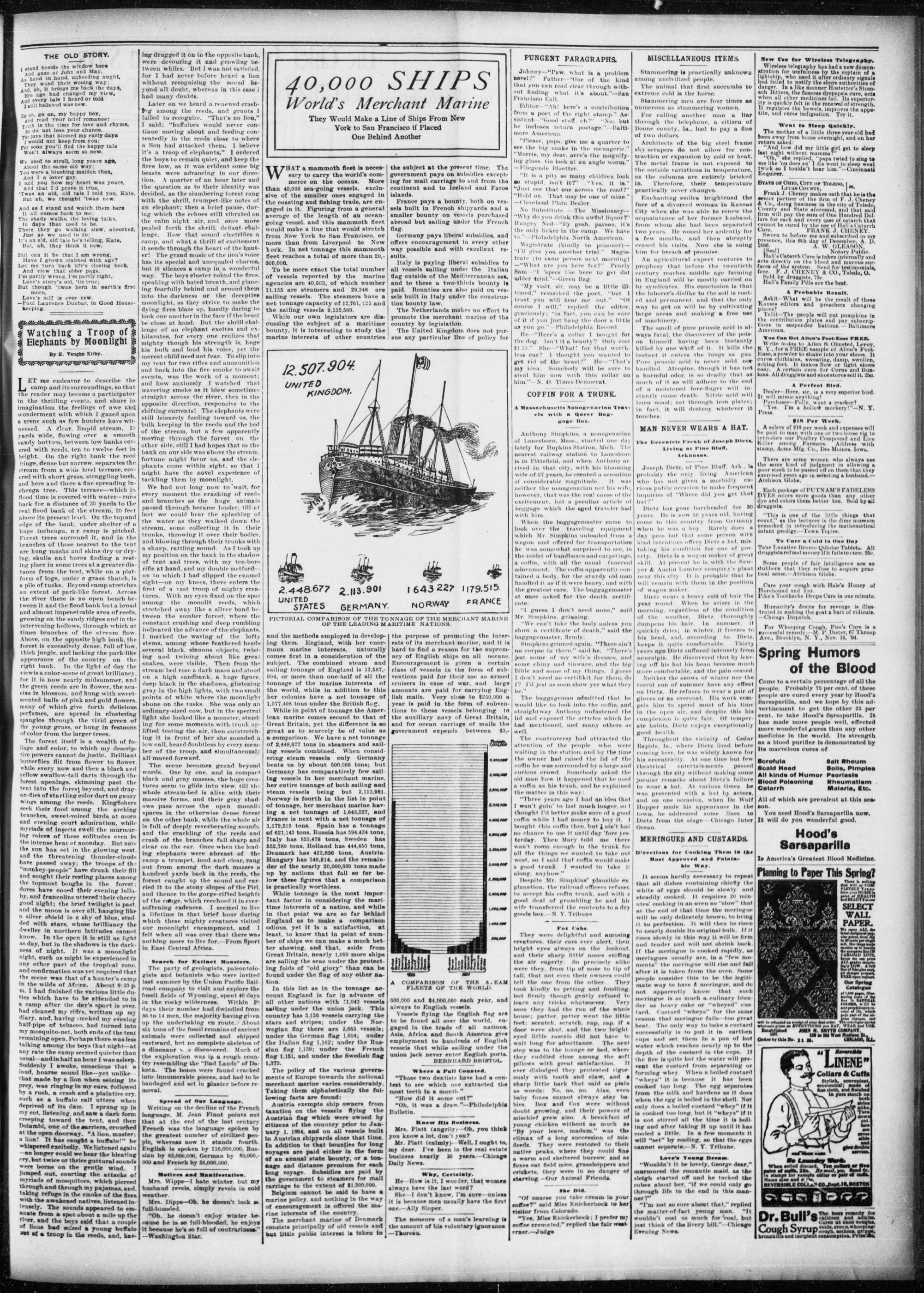
40,000 SHIPS World's Merchant Marine They Would Make a Line of Ships From New York to San Francisco if Placed One Behind Another
12.507.904.
UNITED
KINGDOM.
2.448.677
UNITED
STATES
2.113.901
GERMANY.
1643227
NORWAY
1179.515.
FRANCE
PICTORIAL COMPARISON OF THE TONNAGE OF THE MERCHANT MARINE OF THE LEADING MARITIME NATIONS.
WHAT a mammoth fleet is neces sary to carry the world's com
merce on the oceans. More than 40,000 sea-going vessels, exclusive of the smaller ones engaged in the coasting and fishing trade, are engaged in it. Figuring from a general average of the length of an ocean-going vessel, and this mammoth fleet would make a line that would stretch from New York to San Francisco, or more than from Liverpool to New York. In net tonnage this mammoth fleet reaches a total of more than 20,000,000.
To be more exact the total number of vessels reported by the marine agencies are 40,503, of which number 11,155 are steamers and 29,348 are sailing vessels. The steamers have a net tonnage capacity of 12,761, (25 and the sailing vessels 9,135,560.
While our own legislators are discussing the subject of a maritime bounty, it is interesting to study the marine interests of other countries
12.507.904.
UNITED
KINGDOM.
2.448.677
UNITED
STATES
2.113.901
GERMANY
PICTORIAL COMPARISON OF THE TRAVEL
OF THE LEADING MARKET
and the methods employed in developing them. England, with her enormous marine interests, naturally comes first in a consideration of the subject. The combined steam and sailing tonnage of England is 12,587,904, or more than one-half of all the tonnage of the marine interests of the world, while in addition to this her colonies have a net tonnage of 1,077,408 tons under the British flag.
While in point of tonnage the American marine comes second to that of Great Britain, yet the difference is so great as to scarcely be of value as a comparison. We have a net tonnage of 2,448,677 tons in steamers and sailing vessels combined. When considering steam vessels only Germany beats us by about 500,000 tons; but Germany has comparatively few sailing vessels in her merchant marine, her entire tonnage of both sailing and steam vessels being by 2,113,981. Norway is fourth in the list in point of tonnage, her merchant marine having a net tonnage of 1,643,227, and France is next with a net tonnage of 1,179,515 tons. Spain has a tonnage of 621,143 tons, Russia has 594,434 tons, Italy has 855,478 tons, Sweden has 552,789 tons, Holland has 444,450 tons, Denmark has 422,856 tons, Austria-Hungary has 349,814, and the remainder of the nearly 20,000 tons made up by nations that fall so far below these figures that a comparison is practically worthless.
While tonnage is the most important factor in considering the maritime interests of a nation, and while in that point we are so far behind England as to make a comparison odious, yet it is a satisfaction, at least, to know that in point of number of ships we can make a much better showing, and that, aside from Great Britain, nearly 1,000 more ships are sailing the seas under the protecting folds of "old glory" than can be found under the flag of any other nation.
In this list as in the tonnage account England is far in advance of all other nations with 1,1043 vessels sailing under the union jack. This country has 3,150 vessels carrying the stars and stripes; under the Norwegian flag there are 2,663 vessels; under the German flag 1,604; under the Italian flag 1,162; under the Russian flag 1,159; under the French flag 1,151, and under the Swedish flag 1,273.
The policy of the various governments of Europe towards the national merchant marine varies considerably. Taking them alphabetically the following facts are found:
Austria exempts ship owners from taxation on the vessels flying the Austrian flag which were owned by citizens of the country prior to January 1, 1894, and on all vessels built in Austrian shipyards since that time. In addition to that boundies for long voyages are paid either in the form of an annual state bounty, or a tonnage and distance premium for each long voyage. Subsidies are paid by the government to steamers for mail carriage to the extent of $1,000,000. Belgium cannot be said to have a marine policy, and nothing in the way of encouragement is offered the marine interests of the country.
The merchant marine of Denmark consists principally of old vessels and but little public interest is taken in
---
the subject at the present time. The government pays on subsidies excepting for mail carriage to and from the continent and to Iceland and Faroe islands. France pays a bounty, both on vessels built in French shipyards and a smaller bounty on vessels purchased abroad but sailing under the French flag. Germany pays liberal subsidies, and offers encouragement in every other way possible and with excellent results. Italy is paying liberal subsidies to all vessels sailing under the Italian flag outside of the Mediterranean sea, and to these a two-thirds bounty is paid. Bounties are also paid on vessels built in Italy under the construction bounty law. The Netherlands makes no effort to promote the merchant marine of the country by legislation. The United Kingdom does not pursue any particular line of policy for
1643227 1179.515.
NORWAY FRANCE
DOWNAGE OF THE MERCHANT MARINE
MARITIME NATIONS.
the purpose of promoting the interests of its merchant marine, and it is hard to find a reason for the supremacy of English ships on all oceans. Encouragement is given a certain class of vessels in the form of subventions paid for their use as armed cruisers in case of war, and large amounts are paid for carrying English mails. Very close to $250,000 a year is paid in the form of subventions to these vessels belonging to the auxiliary navy of Great Britain, and for ocean carriage of mails the government expends between $3.
4,600,000
4,000,000
3,600,000
3,000,000
2,600,000
2,000,000
1,600,000
1,000,000
500,000
A COMPARISON OF THE 6-EM
FLEETS OF THE WORLD.
A COMPARISON OF THE 5. EAM
FLEETS OF THE WORLD.
000,000 and $4,000,000 each year, and
always to English vessels.
Vessels flying the English flag are
to be found all over the world, eng-
aged in the trade of all nations.
Asia, Africa and South America give
employment to hundreds of English
vessels that while sailing under the
union jack now serve as naval brigades.
Where a Pull Counted.
"Those two dentists have had a contest to see which one extracted the most teeth in a month."
"How did it come out?"
"Oh, it was a draw."—Philadelphia Bulletin.
Knew His Business.
Mrs. Platt (angrily)—Ob, you think you know a lot, don't you?
Mr. Platt (calmly)—Well, I ought to, my dear. I've been in the real estate business nearly 20 years.—Chicago Daily News.
Why: Certainly.
He—How is it, I wonder, that women always have the last word?
She—I don't know, I'm sure—unless it is because men usually have the first one.—Ally Sloper.
The measure of a man's learning is the amount of his voluntary ignorance.—Thoreau.
PUNGENT PARAGRAPHS
Johnny—"Paw, what is a problem novel?" Father—"One of the kind that you can read clear through without finding what it's about."—San Francisco Call.
Editor—"Ah! here's a contribution from a poet of the right stump" Assistant—"Good stuff, eh?" "No; but he incloses return postage"—Baltimore American.
"Please, papa, give me a quarter to see the big snake in the menageric" Morris, my dear, here's the magnifying glass. Go look at an angle worm."—Flegende Blauer.
"It is a pity so many children look so stupid, isn't it?" "Yes, it is." "Just see that one across the road?" "Hold on. That may be one of mine."—Cleveland Plain Dealer.
No Substitute—The Missionary—"Why do you drink this awful Biquor?" Hungry Nod—"Gy肥, parson, it's the only licker in the camp. We have to."—Philadelphia North American.
Magistrate (kindly to prisoner)—"I'll give you another trial!" Magistrate (to same person next morning)—"What are you here for?" Pearly Sam—"I *spees* 'I be here to get dat udder trial!" -Green Bag.
"My visit, sir, may be a little ill-timed," remarked the poet, "but I trust you will hear me out." "Of course I will," replied the editor, graciously; "in fact, you can be sure of it if you just bang the door a little as you go." -Philadelphia Record.
He—"Here's a collar I bought for the dog. isn't it a beauty?" Only cost $1.50. She—"What! for that worthless cur? I thought you wanted to get rid of the beast?" He—"That's my idea. Somebody will be sure to steal him now with this collar on him." N. O. Times-Democrat.
COFFIN FOR A TRUNK.
A Massachusetts Nonogenarian Travels with a Queer Baggage Box.
Anthony Simpkins, a nonagenarian of Launesboro, Mass., started one day lately for Hopkins Station, Mich. The nearest railway station to Launesboro is in Pittafield, and when Anthony arrived in that city, with his blooming wife of 27 years, he created a sensation of considerable magnitude. It was neither the nonagenarian nor his wife, however, that was the real cause of the excitement, but a peculiar article of baggage which the aged traveler had with him.
When the baggagemaster came to look over the traveling equipment which Mr. Simpkins unloaded from a wagon and offered for transportation he was somewhat surprised to see, in the midst of bandboxes and carpetsings, a coffin, with all the usual funeral adornment. The coffin apparently contained a body, for the sturdy old man handled it as if it were heavy, and with the greatest care. The baggagemaster at once asked for the death certificate.
"I guess I don't need none," said Mr. Simpkins, grinning.
"We can't take the body unless you show a certificate of death," said the baggagemaster, firmly.
Simpkins grinned again. "There ain't no corpse in there," said he. "There's jest some of my wife's dresses, and some chiny and tinfoar, and the big Bible and some of my things. I guess I don't need no certifikit for them, do I? I'd jest as soon show yer what they be."
The baggageman admitted that he would like to look into the coffin, and straightway Anthony unfastened the lid and exposed the articles which he had mentioned, and many others as well.
The controversy had attracted the attention of the people who were waiting in the station, and by the time the owner had raised the lid of the coffin he was surrounded by a large and curious crowd. Somebody asked the old man how it happened that he used a coffin as his trunk, and he explained the matter in this way:
"Three years ago I had an idea that I won't goin' to last much longer, so I thought I'd better make sure of a good coffin while I had money to buy it. I bought this coffin then, but I also had no chance to use it until day 'fore yesterday. Then Mary told me there won't room enough in the trunk for all the things we wanted to take out west, so I said that coffin would make a good trunk. I wanted to take it along, anyhow."
Despite Mr. Simpkins' plausible explanation, the rulers officer refused to accept his coffin trunk, and with a good deal of grumbling he and his wife transferred the contents to a dry goods box.—N. Y. Tribune
Fox Cubs.
They were delightful and amusing creatures, their ears ever alert, their bright eyes always on the lookout, and their sharp little noses sniffing the air eagerly. So precisely alike were they, from tip of nose to tip of tail, that not even their owners could tell the one from the other. They took kindly to petting and fondling but firmly though gently refused to learn any tricks whatsoever. Very soon they had the run of the whole house; patter, patter went the little feet; serach, serach, rap, rap. if a door were shut, and the two bright-eyed little rascals did not have to wait long for admittance. The next step was to the lounge or bed, where they cuddled close among the soft pillows with great satisfaction. If ever dislodged they protested vigorously with tooth and claw, and a sharp little bark that said as plain as words: No, no, no. Alas, even baby foxes cannot always stay babies. Box and Cox were without doubt growing, and their powers of mischief grew also. A breakfast of young chicken without as much as "By your leave, madam," was the climax of a long succession of misdeeds. They were restored to their native peaks, where they could find a warm and sheltered burrow, and as foxes eat field mice, grasshoppers and crickets, they were in no danger of starving.—Our Animal Friends.
She Did.
"Of course you take cream in your coffee?" said Miss Knickerbock to her visitor from Colorado. "Yes, Miss Knickerbock; I prefer my coffee emulated," replied the fair western-er.-Judge
MISCELLANEOUS ITEMS.
Stammering is practically unknown among uncivilized people.
The animal that first succumbs to extreme cold is the horse.
Stammering men are four times as numerous as stammering women.
For calling another man a liar through the telephone, a citizen of Boone county, la., had to pay a fine of two dollars.
Architects of the big steel frame sky-scrapers do not allow for contraction or expansion by cold or heat.
The metal frame is not exposed to the outside variations in temperature, as the columns are entirely bricked in.
Therefore, their temperature practically never changes.
Enchanting smiles brightened the face of a divorced woman in Kansas City when she was able to renew the acquaintance of her former husband, from whom she had been separated two years. He wooed her ardently for a few months, and then abruptly ceased his visits. Now she is suing him for breach of promise.
An agricultural expert ventures to prophesy that before the twentieth century reaches middle age farming in England will be mostly carried on by syndicates. His conclusion is that the laborer's dislike to the soil is rooted and permanent, and that the only way to get on will be by cultivating large areas and making a free use of machinery.
The smell of pure prussic acid is always fatal, the discoverer of the poison himself having been instantly killed by one whiff of it. It kills the instant it enters the lungs as gas. Pure prussic acid is never sold not handled. Atropine, though it has not a harmful odor, is so deadly that as much of it as will adhere to the end of a moistened fore-finger will instantly cause death. Nitric acid will burn wood; eat through iron plates; in fact, it will destroy whatever it touches.
MAN NEVER WEARS A HAT.
The Eccentric Freak of Joseph Dietz,
Living at Pine Bluff,
Maine
Joseph Dietz, of Pine Bluff, Ark., is probably the only living American who has not given a morbidly curious public occasion to make frequent inquiries of "Where did you get that hat?" Dietz has gone bareheaded for 30 years. He is now 56 years old, having come to this country from Germany when he was a boy. Rarely does a day pass but that some person with kind intentions offers Dietz a hat, mistaking his condition for one of poverty. Dietz is a wagon maker of great skill. At present he is with the Sawyer & Austin Lumber company's plant near this city. It is probable that he will remain with them in the position of wagon maker.
Dietz wears a heavy suit of hair the year round. When he arises in the morning, regardless of the condition of the weather, Dietz thoroughly dampens his hair. In summer, it quickly dries; in winter, it freezes to his head, and, according to Dietz, keeps it quite comfortable. Thirty years ago Dietz suffered intensely from neuralgia. He discovered that by leaving off his hat he heaon became much more comfortable, and the pain ceased. Neither the snows of winter nor the torrid sun of summer have any effect on Dietz. He refuses to wear a pair of gloves or an overcoat. His work compels him to spend most of his time in the open air, and despite this his complexion is quite fair. Of temperate habits, Dietz enjoys exceptionally good health.
Throughout the vicinity of Cedar Rapids, In., where Dietz lived before coming here, he was widely known for his eccentricity. At one time but few theatrical entertainments passed through the city without making some jocular remarks about Dietz's failure to wear a hat. At various times he was presented with a hat by actors and on one occasion, when De Woit Hopper made his appearance in the town, he addressed some lines to Dietz from the stage—Chicago Inter Ocean.
MERINGUES AND CUSTARDS.
Directions for Cooking Them in the Most Approved and Palatable Way.
It seems hardly necessary to repeat that all dishes containing chiefly the white of eggs should be slowly and steadily cooked. It requires 20 minutes' cooking in an oven so "slow" that at the end of that time the meringue will be only delicately brown, to bring it to perfection. It will then be risen to nearly double its original bulk. If it rises slowly in this way it will be firm and tender and will not shrink back. If the meringue is cooked rapidly, as meringues usually are, in a "few moments" the meringue will rise and fall after it is taken from the oven. Some people consider this to be the legitimate way to have a meringue, and do not apparently know that such meringue is as much a culinary blender as heavy cake or "blued" custard. Custard "wheys" for the same reason that meringue falls—too great heat. The only way to bake a custard successfully is to put it in cartenh cups and set them in a pan of hot water which reaches nearly up to the depth of the custard in the cups. If the fire is quite hot the water will prevent the custard from separating or forming whey. When a boiled custard "wheys" it is because it has been cooked too long. The egg separates from the milk and hardens as it does when the egg is boiled in the shell. Not only does a boiled custard "wheys" if it is cooked too long, but it "wheys" if it is not stirred all the time it is boiling and after taking it up until it has cooled a little. In a few moments it will "set" by cooling, so that the eggs cannot separate—N. Y. Tribune.
Love's Young Dream.
"Wouldn't it be lovely, George dear," murmured the romantic maid, as the sleight started off and he tucked the robes about her, "if we could only go through life to the end in this manner?"
"I'm not so sure about that," replied the matter-of-fact young man. "It wouldn't cost us much for 'coal', but just think of the livery bill." - Chicago Evening News.
Wireless telegraphy
Wireless telegraphy and demonstration for usefulness by the patient's lightshield, who used it after ordinary signals had failed to notify the shore authorities of a ship's approach to Hatter's Storm when all other medicines fail. Its superiority is quickly felt in the renewal of strength, and improves the appetite, and cures indigestion.
Went to Sleep Quickly.
The mother of a little three-year-old had been away from home overnight, and on her return asked: "Did my little girl get to sleep last night without mamma?" "Oh," she replied, "papa tipped to sing to me like you does an an" I dived to sleep wealktick so I didn't hear him."—Cincinnati Enquirer.
STATE OF OHIO, CITY OF TOLEDO, LOUISIANA
Frank K. J. Chueny, co., doing business in the city of Toledo, County and State aforesaid, and that said firm will pay the sum of One Hundred Dollars for each and every case of catarch that be cared for by the City of Toledo Cure.
FRANK J. CHENY. Sworn to before me and subscribed in my presence, this 6th day of December, A. D. 1851 [Seal] A. W. LEAH. Written Public. Hall's Catarch Ture is taken internally and acts directly on the blood and mucous surfaces of the system. Send for testimonials, from the City of Toledo & CO., Toledo, O. Sold by druggets, Fills the best.
A Probable Result
Askit-What will be the result of these Kansas editors and preachers changing pumps?
Tellit-The people will put pumpkins in the contribution plates and pay subscriptions in suspender buttons. - Baltimore American.
You Can Get Allen's Foot-Ease FREE
Write to day-to-day to Allen S. Olsted, Leroy, N. Write to Allen S. Olsted, Leroy, N. Ease, Ease, to shake into your shoes. It cures chilblains, sweating, damp, swollen, aching feet. It makes N or right shoes wear. A certain cure for Corns and Runny Ears.
A Perfect Bird:
Dealer—Here, sir, is a very superior bird.
It will mimic anything!
Purchaser—Polly, want a cracker?
Yes. I'm a hollow mockery!—N. Y.
Yes.
$18 Per Week.
A salary of $18 per week and expenses will be paid to man with one or two horse rig to introduce the Poultry Compound and Lice Farming. The Addres will stamp, Acme Mp Co., Des Moines, Iowa.
There are some women who always use the musical instrument in the showpoet poole steak to be passed off on them that they exercised years ago in selecting a husband—Atchison Globe.
Each package of PUTMN'S FADELESS DYES colors more goods than any other dye and colors them better too. Sold by all druggists.
"This is one of the little things that count," as the lecturer in the dime museum infant prodigy — Town Topics.
To Cure a Cold in One Day
Tale Laxative Bromo Quinine Tablets. All druggists refund money if fails to cure. 22c.
Some people of fair intelligence are so stubborn that they refuse to acquire practical sense.—Atchison Globe.
Cure your cough with Hale's Honey of Horehound and Tar.
Pike's Toothache Drops Cure in one minute.
Humanity's desire for revenge is illustrated in making the goat a bit of ridicule.—Chicago Dispatch.
For Whoooping Cough, Pino's Cure is a successful remedy.—M. P. Dieter, 67 Throop Ave., Brooklyn, N. Y., Nov. 14, 1947.
Spring Humors of the Blood
Come to a certain percentage of all the people. Probably 75 per cent, of these people are cured every year by Hood's Sarsaparilla, and we hope by this advertisement to get the other 25 per cent, to take Hood's Sarsaparilla. It has made more people well, effected more wonderful gures than any other medicine in the world. Its strength as a blood purifier is demonstrated by its marvelous cures of
Sorofula Salt Rheum
Scald Head Bolls, Pimples
All kinds of Humor Psoriasis
Blood Poisoning Rheumatism
Catarrh Malaria, Etc.
Borofula Salt Rheum
Scald Head Bolls, Pimples
All kinds of Humor Psoriasis
Blood Poisoning Rheumatism
Catarrh Malaria, Etc.
All of which are prevalent at this season.
You need Hood's Sarsaparilla now.
It will do you wonderful good.
Hood's Sarsaparilla
Is America's Greatest Blood Medicine.
```markdown
```
"Rewarrable LINENE"
Collars & Cuffs
stylish, convenient,
economical; made of
fine cloth, and finished
in pure elast on
both sides
silk
Turn down
the furs
are
great
silk
and
give double
service.
Miada’
Never wus much of a feller fer gittin’ over
grown’:
‘Thar's Moily, a-pickia’ the banjer, an’ me
p_ Sent bangin’ eroun'!
‘The other fellers alr dancin’—keepin’ time
to the sour":
But as fer me, I'm a feller Jost made fer
hangin’ eroun't
An’ ain't them fellers jolly
‘Bhakin’ the sbinglen down!
What's he thinkin’ of—Mol y—
‘With me Jest hangin’ eroun’?
I'm Jest the backwardeat feller that ever
the country seen!
Never a banjer moves me—iddic, of tam-
boureen:
Ain't F lovin® of Molly? That's how they
wet it down!
But allus—ferever an’ ever I'm jest a-hang-
ta" eroun't .
‘An’ ain't them fellers Jotly,
Shakin’ the shingles down?
Mow does {1 look 19 Molly,
‘With me jot hangin’ eroun'?
£ Jost can't muster the courage to enter
the lively race:
I'm allux feelin’ an’ lookin’ out o° my
rightful piace
‘The marriage belly'il be Fingin’ alt over
the merry town,
Aa’ when Molly's led to the altar 1" still
be hangin’ ¢roun't
An’ Molly will look her westent,
‘Drested in the weddin’ gown;
‘They'll dance to the weddin’ munte,
‘An’ leave me hangin’ eroun’!
=F. L Stanton, to Atianta Constitution
She Had Smith's Money.
My Uie Wome ole hs Lam Qearcer
EES, CF BVOCEIya, BAS Been OU
2 paying bills. He had netted with
the butcher, the’ baker, the bieyele
maker and « variey of department
stores, which combined practically all
‘the other functions of trade. At the
end he found himself possessed of a
sensation of temporary contentment
and 25centsineash, Thesensation was
distributive, but the cash was all in
‘one piece, and its proud proprietor held
it in his band as he waited for the trol-
ley car whieh should bear him home Tor
‘one five-cent fare, To be able to re-
turn to Mrs, Smith, tell her that all bills
were settled, and heap the minted
richness of 25 cents’ surplus in her lap,
‘would be indeed « proud achievement.
‘Trolleys loomed and neared and
passed, but not Smith's trolley, One
of the Virtues that goes with residence
in Brooklyn i patience, and the trol
Jey ayntem door much to foster it.
Smith waited patiently. . Presently a
tall young woman of majestic but din-
tincily ornamental presence — ap-
pronehed with no little speed, and
Smith, chancing to make a wide-ntep
at the moment, she came im contact
with his back with such foree that
he was jolted into the gutter, Look-
ing up with some wrath Smith met a
pair of serene eyes, ond on the spur
of the moment apologized humbly.
‘The next moment he wondered why Ite
should apologize for being knocked off
the curb by a young woman who could
Jost as well have had oll the rest of
the sidewalk. The apology didn't seem
to have taken, either, The young wom:
‘an looked at him ax if he were a bug.
Then she turned her back without |
deigning to respond to hie apology,
marched out to the track and stood
waiting, says the New York Sun,
Amith marched after, not that he
particularly yearned for proximity, but
becaune he saw down the street a trol
ley car whieh looked like the one he
wanted. No nooner fad he come to a
hait behind the young woman than
she turned and ewept him from head
to foot with a look that chilled and
amazed him. He pondered what he
could have done to merit auch treat:
ment and presently it flashed upon
him that she wae one of those curl-
ous female phenomena who pass
through o troubled existence under the
painful oppression that every man in
wight is trying to flirt with them. This
theory no natiafled Smith that he
chuckled. He would have sworn that
he heard a low but penetrating snort
of contempt in response, The car came
and it wann't Smith's after all, Neith:
er was it the young woman's. They
both stood waiting and the car
passed on,
‘To fidget is human. In Smith fldget-
ting took the form of manipulating
whatever chanced to be in his hands
‘at the time, Me began to flip the lone
quarter in the alr and entehing it, At
the third or fourth triat he miattipped
and the coin, soaring easily over the
‘edge of the high turnup collar upon |
the young woman's coat, disappeared
from view. The young woman started
and turned. Smith hastily looked the
other way, and began to perspire
Could he get tt out without her per:
ceiving It? Certainly, he couldn't, a»
Jong as she kept her basilisk eye upon
him. To make matters worse, another
‘car was approaching, and he was sure
ft was his. He mustered up his cour-
age.
AC bee your pardon” he began,
“ar
“Sir!” Interrupted the young wom:
‘an with such ferocity that the unfor-
tunate man fairly jumped, Mut it was
& two-mile walk home, and he tried
again,
“If you will let me explain—"
“Sir—r—ei*
“Madam, Iam very sorry—"
“Sir—e—r—rt" The young woman
vas baginning to look around as if for
help.
“Goodness!” said Smith to himself.
“This ina't a girl, She is one of those
automatic dolls. If I'd touch the right
Dutton she'd play a tune; [know she
would.”
“Just a word,” he said aloud. “I
@ou't wish to"
“Birr orth
“Ob, blazes!” cried Smith in utter
exasperation. “Do you think I'm
pending all this time trying to fish up
fan acquaintance with you? 1 want my
quarter.”
A look of fright came over the face
of the young woman She began to
fumble at her purse,
“Oh, Fs aot & beggar growied the
raged Smith, “I dow’t want you:
money; I want mine.”
‘street car! All aboard!”
‘excitement Smith hadn't uo:
ileed the arrival of the ear—his car
‘The young woman hurried aboard
Smith followed. He took s sent across
from her and she glared at him, but
Smith is a pretty good glarer bimsel
when he gets mad, and he was very
mad now. Her eyes dropped and she
moved along. To Smith's great thank-
fulness, there were few other passen-
gers. When the conductor came to him
he pointed at the tall young woman.
“She will pay my fare,” he said.
“Sir—r—r—r-!" gasped the young
woman.
“She has every cent Ihave in the
world,” pursued Smith, doggedly.
“Oh, dear, The man is crazy, He
followed me on the car. He's crazy,
conductor. I don't know him.”
“D've touched the other button,” anid
Smith, grimly. “I thought there must
be something besides ‘Sir—r—r in her.”
“Laily says she don’t know you,” anid
the conductor, who waa somewhat puz-
sled, Smith didn't look either drunk or
erazy, or the kind of man to throw off
a car without well substantiated res-
sons.
“She doesn’t,” said Smith; “but she’s
got a quarter of my money.”
“Where? How?" demanded she.
“I don't know where it is now, and
1'@ hate to guess,” said Smith.
“Conductor,” said the young woman,
in tremulous tones, “this man came up
to me on the corner and tried to engage
me in conversation, I never saw him
in my life before.”
“I thought #0,” said Smith, com-
posedly. “Because I ventured to ad-
ddrese a Indy who had first thrust me
into the gutter and then absorbed my
last cent, you immediately jump to the
conclusion, you yourself being the lady
in question, that I am so overcome by
the attractiveness of the performance
as to try to get upa flirtation with you.
‘That's what you think, iwn’t it?”
“Sir—r—r—rt” said the young wom-
an, but this time she said it without
any enthusiasm, ax if, rather, she
couldn't think of anythingg else to say.
One of ‘the passengers was a youthful
ercature, who now conceived that here
was his grand chance to play the part
of hero for a damsel in distress, Ac:
cordingly he arose and approached
Smith from the rear.
“What right have you to annoy this
lady?" he began, and then stopped, for
Smith had whirled so suddenly as to
make him blink,
“Oh,” remarked Smith, in pleawed we-
cents, “You're a man, aren't you?
Anyway you wear trousers and the
rest of the garb.”
“What do you mean, sir?” demanded
the other in flerce accents,
“Why, you see, I've been laboring
under the disadvantage of argument
witha lady, But you're different. My
friend”—here Smith Iaid a hand, none
too lightly, on the shoulder of the
|
| eae l E |
[ae | i Uy
earn /, Yj
ta I
— ATEN
aa N=
Ne =
Pige\ Ve
other—“unless you wish to experiment
with m usually placid temper you will
#0 back to your seat and make money
usinding your business.”
‘The young man sat down, aided
allghtly, it may be, by the gentle prew
sure from the hand of Smith, Then the
conductor asked Smith if he wouldn't
rather pay his own fare than make
lot of trouble,
“Ofcourse I would,” answered Smith,
“if 1 could, but my last cent is now
helping to keep that lady warm."
Here the conductor turned to get the
young woman's fare and she, in her
hervousness, dropped It on the floor.
Then she stooped over to recover it.
Ax she stooped she gave a little exela-
mation of alarm and put her hand to
her neck, ‘Tho next instant a quarter
rolled out from the front of the collas
and fell to the floor. Sinith pointed to
it and smiled aweetly.
“Do you commonly carry loose
change in the back of your neck, mad-
am?” he asked,
“It inn’t mine,” she gasped. “I don'e
know how it got there.”
“No; It's mine,” said Smith, annexing
it, “and you'd have found out long ago
that it got there by slipping out of my
hand as I was tossing it im the alr if
you hadn't been so afraid that 1 was
trying to take adeantage of your un
chaperoned youth und beauty.”
The young wouan turned very red
Smith handed the quarter to the con:
duetor.
“Take two out of that,” he said,
“Let me out at the next corner,” said
the young woman, with vast dignity
and ahe went, leaving the eoin whe ha
dropped under the tloor-grating. The
youth who had interfered went out too
Smith got his change ane said to the
conductor, pointing to the deserted
coin under the grating
“that's your rake-off."
Then he went out on the platform
and contemplated with glee the tal
young woman standing on the cornet
‘And reputsing the advances of th
would-be squire of distressed ¢amsele
Mis Gradge Against Ram,
“Ab, my friend,” aighed the returw-
er, “rim causes lots of trouble in this
work.”
“Indeed it does,” agreed the listener,
“No doubt you or I would be happier
were it not for the rum demon,” wem
on the reformer,
“Indeed we would,” again agreed the
patient listener,
“And how has it caused you unhap-
piness?” asked the reformer,
“Years ago a woman told me that it
T stopped drinking she would marry
me.”
“And you could not stop?
“No,” roared the pationt listener;
“no, I did stop!" Baltimore Ameri
‘ean,
Japanese Rallway Pans,
‘The Japanese government decided
sesoe \tme ons te lnnrenne the pee
railway tickets by one-third. ‘The re
sult was @ loss instead of a gata in re.
ecipta,
Wealth and Society and
Other Things in Gotham
Not in New York alone, but wherever
in the country men are gathered to-
ee ore
find them discuns-
ing the extraordi-
nary revelations
ot Henry C. Frick,
as a step in his
great lawsuit
against Andrew
Carnegie.
The profits of
the Carnegie Steel
company for the
present year are
estimated by Mr.
Carnegie himself
at $40,000,000; by
&
$00,000. Mr. Carnegie owns fifty-three-
jone hundredths of the stock. His in-
“come from this source alone, therefore,
will be $24,500,000, upon Mr. Frick’s fig-
ures.
‘The Standard Ofl company has re-
cently declared a dividend at the rate
of 20 percent. a year. This means the
disbursement in dividends of $80,000,-
000, of which Mr. John D. Rockefeller
‘gets $32,000,000. And Mr, Rockefeller
‘has many more sourees of income, out-
ide of the business by which he is
‘chiefly known, than Mr. Carnegie. He
‘dabbles in iron, in lake ahipping, in gan,
| in electricity, in street car lines, in rail-
road stock. ‘He has just bad his son
elected a Delaware & Lackawanna rail-
road director; he is himself a power in
‘the Vanderbilt lines. His ineome tor
‘thin one year may very likely be $50,-
000,000, Mr. Carnegie hax more nearly
put all his eggs in one basket; it is not
‘Iikely that his total income will reach
$80,000,000. ‘These two men are with-
‘out doubt the two richest, not only in
the country, but in the world.
‘The one was the son of a very poor
and rather shiftless farmer up in cen-
tral New York. The other began busi-
ness life ax a telegraph messenger in
Pittsburgh at three or four dollars per
week.
How Wenlth Has Grown.
‘The recent death of the duke of West-
minster has given a convenient op
aa aS
Pare the world's
richest men.
Old William Ht.
Vanderbilt was
perfectly within
the truth when he
sald, the year be-
fore he died, that
he was the richest
man in the world.
He compared him-
self with the duke
of Westminster,
saying that the
London real estate
of the latter might
2
Te ae one care
greater in value than his railroad stock,
but that it did not produce so large an
Income. He might have said, with
equal justice, that the Grosvenor extate
of the dukes of Westminster does not
belong to one man, but isan institution
descending in trust from heir to heir.
‘Aw a matter of fact, the Inte duke's
will has just been probated. He left
exnotly $3,000,000, which he could per-
sonally dispose of by will. The estate
was entailed; the $3,000,000 was his pri-
vate property.
Powerful as jn the name and prestige
of the Rothschilds, there is no one of
them who alone can compare in wealth
with the new American millionaires,
And of all the Vanderbilts, there is only
one whose entire entate is larger than
the yearly income of either Carnegie
or Rockefeller. That is William K,
Young Alfred, sometimes erroneously
called the head of the family, will have
Jess than $30,000,000, in all probability,
when he comes Into his extate.
Far better than stocks and money-
lending, if one is in @ hurry to get rich
quickly, Is the control of some natural
wealth of the soil or the sea or the in-
ner earth. The wealth of Rockefeller
is represented by every can of kero-
sene that is lugged home from the
grocery, Carnegie takes toll of steel
and all that is made from it, The
Kothachilds lost money heavily upon
their investinents during the Franco-
German war, and again during our
own war with Spain; but the Almaden
quicksilver mines in the latter country.
which were long ago pledged to them
as security for a debt that Spain will
probably be unable to pay, have never
failed to pay a rich return.
Hams te Build a Rattrond.
Meanwhile, there are the bums, The
city is full of them. Every winter they
come to New York
to enjoy the sea-
non, ‘They ean live
ma along the Bowery
2 a bite for about 80 cents
(eee a day, which they
RGVeere easily secure by
CEPR ZS evcing or by an
yD a i] occasional job,and
a at there is plenty of
<j thx stale beer to be
NSS TE had for: two or
1 MAREE threecents aglass.
- a ‘These men do
not as arule at-
mee Wink, ct Meine OS tUle
to enjoy the sea-
won. They ean live
arnt along the Bowery
BAR for about $0 cents
(Eee a day, which they
ASEeeA easily secure by
(Eee begging or by an
GOS ah ocscisattrant
— aw there is plenty of
<a tRxty stale beer to be
We ai PUM had for: two or
™ MAREE threecents aglass.
See ‘These men do
not as a rule at-
One Way of Mullding tempt to work,
® Ratiroad —" patabright young
fellow has just succeeded in carrying
off. 150 of them to build a railroad in
Virginia, To do this in the dead of
winter was quite a feat, The con-
tractor did it by faviting all the men
to drink at his expense, and by assur-
ing them that the excellent whisky
with which he provided them was com-
mon and cheap where he came from.
Aino, he said that every man could
have a dollar and a quarter a day for
two years; but that was a minor con-
sideration.
Acting on the theory that the bum
is as fond of dirt as he ia of whisky,
the school authorities of the city are
‘about to try an experiment in one of
the most squalid tenement districts.
by equipping @ school with baths. i/
the scheme works, 88 other schools aro
to be similarly equipped. For there
are eo many great schools in the city,
each having more than 2,002 scholars
om the average, whose pupils mostly
come from homes which provide no fa-
cilities for bathing.
By this means the teaching force
expect to reduce the army of the great
Unwashed by some 70,000 or so. And,
if the experiment works, they will hare
reduced the army of tramps and vaga-
bonds as well.
Lent Begins; Season Ende.
AAs Lent begins, the season ends.
‘The New Yor idea of Lent has for
a good while not
ineluded much of
the old notion of
sacrifice. Of course
no weddings -oc-
cur in Lent; and '
there are no large
balla or festivities.
Butthere is plenty
going on, just the
same.
It all grew out
of “the Lenten
class.” These i
classes were very
fashionable ten O% orm of Lenten
cy oH
ae
LV. prey Fi
oe a
Jearned in them sewing, history, ge-
ology; you listened to lectures on
American history and other improving
topics. Perhaps you helped the
heathen or the poor by taking part
in something more frivolous at two
dollars per ticket for charity. Or you
took a course of lessons in fencing or
gymnastics, which was lots of fun, and
yet very Lenten, because “different,
don't you know.”
‘The times change. The Lenten
amusement now most popular tx to
see the Filipino dancers, or the Jap-
anese jugglers, who have become the
society peta of the moment. A state of
society so giddy that going to a cir-
cus seems appropriate to a season of
mortification of the flesh is rather re-
markable, But most society people
now like to be amused without too
much exertion on their own part.
Or it weary of New York, there is
the casy device of going abroad until
Lent is over. ‘The other day a Mediter-
ranean steamer ‘set out from New
York with 260 passengers, of whom
only 12 were men. All the others were
women and children, Probably more
than ‘half were women of moderate
tneans who go to infest the cheap
boarding houses of Italy; who shiver
over the microscopic fires provided by
‘Tuscan landlords, and spend their days
in visiting picture galleries. For there
is this difference between women and
men: ‘The former will visit picture
galleries and the latter won't.
‘This sort of economical absenteetam
of the women of the moderately well
to do is getting very common in New
York and its vicinity, and it is produe-
ing some much-regretted social results.
Capt. Marton Crawford.
type ot the fan ssore, foreign
Ainscigan in BUtarion Ceuvtona, he
isa Jait returned
te his. beloved
SS Htaly after a brief
MME visit to the land
RO or tis ashore
contort to ca
f seshen ot date
Ward Wome. aad
the son of
Rea craters the
(IMM scuiptor. Me
i) eae
Tra enough by his love
MOMEMTLIWIMD for teats? tor ne
: lived aoa litle
Cae arte be eS ne
Pe
. eee Soe: ee
had his studio, and talks the lingo like
a native, Mr, Crawford is the true
type of the cosmopolitan, He has
traveled much in India. He lives,
when he is at home, in a splendid pal-
ace on the lovely curving slope of the
plain of Sorrento, where you can go
out in your backyard in midwinter
and pick up oranges under the yel-
low-dotted trees.”
‘Mr. Crawford is not only @ yachts-
man, but a sea captain. He carries
with him a certificate of the United
States government authorizing kim to
command any ocean steamship.
Mr. Crawford is the most prolifle of
writers, He had long periods of idle re-
‘creation on water or on land. But
when he works he works, writing as
much as 6,000 words per day upon his
novels, his life of the pope, or what-
ever he may be doing. I should say
that 500 to 1,000 words per day is
nearer the average of most of other
“writers whose work is worth reading.
and still selling steadily.
Crawford must make a larger in-
come from his books than almost any
other American author, His “Via
Crucis” has sold more than 100,000
‘copies already, indicating a sale of
probably twice as many inthe long
‘run; and he has his royalties from a
‘full soore of novels already published.
OWEN LANGDON,
TO GET A “REST.”
Crutner New York to Be Replaced by
Kearsarge as Fingship of North
Atiantic Squadron.
It ia said at the Brooklyn navy yard
that the nary department has decided
to retire the armored cruiser New
York as flagship of the North Atian-
tie squadron and replacs her with the
new battleship Kearsarge. The New
York has been the flagship of the
squadron since before the war with
Spain and has seen much hard service.
‘The reason given for the change
that the cruiser is in need of an over-
hauling and a “rest.” It was said
that in addition to the Kearsarge the
new battleship Kentucky and the re-
constructed cruiser Atlanta will be
added to the North Atlantic squad-
ron. The New York is now tn West
Indian waters. She is due at Hamp
ton Roads on Mareh 23, and it is ex
pected will come to the Brooklyn
yard in Aprit, when Admiral Farquhar
Will tranafor hia flag to the Kearsarge.
Nearly §,000 cats were received last
year at the London Institution for
Lost and Starving Cate
The Chicf Justice of Samoa Says
Peruna is The Very Best Catarrh Cure
7 i cHier
C ——— saree
Gael ee Cola
BEAK EES 5) pa)
PAA ee
CANS ge)
Ws SM SA Py ZA
SN) RE
a eaek enemroe age ime
“TI have tried one bottle of Peruna, ae I can truthfully say
it is one of the best tonics I ever used, and I take pleasure in
recommending it to all sufferers who are in need of a good
medicine. I can recommend it as one of the very best remedies
for catarrh.”’ W. L. Chambers,
THE PLACE FOR A POOR MAN.
Alameda, N. W. T., Canada,
Dec. 22rd, 1899,
Mr. B. Davies, Canadian Government
Agent, St. Paul, Minn.:
Dear Sir--As I promised you about
‘two years ago that at some future time
I would let you know what I thought
‘of Western Canada and the chances of a
‘poor man making a start and support-
ing a family at same time, so will write
8 few facts concerning my own expe-
beer the past 21 months, ond what I
have done, any able-bodied man can do,
provided he will work.
I left Traverse country, March 20th,
1898, Innded in Alameda at noon the
Zist, with $3.55 in my pocket, o
stranger and among strangers, and
when my family came in Oct., 1898, my
wife had nearly $10, or barely enough
to pay freight on her stove, sewing-ma-
‘chine and clothes and beds. I com-
/meneed work March 25th, also made en-
try for homestead same day (the man
I started work for loaning me $15 to
pay entrance fee), and I have earned
or at least received $478.10 in wages
since then, and have been idle at least
2 months of the 21sinceIcame. The
homestead I took had 12 acres broke
by a former occupant. I paid $20
to have it replowed in July, '98, and the
‘seed wheat for it cost me $8.25. I let
it toa neighbor for ¥ in elevator clear
of all expense except the seed, and this
fall I received $70.10 for my part of
‘the crops off of the 12 acres, so my total
receipts the past 21 months has been
$548.10, and my expenses besides living
for self and family have been as fol-
lows:
Entrance fee ($5.00 being paid
| “for cancellation)......++.++++.8 15.00
Summer fallowing 12 acres.... 20.00
Bed forsame...sesseeceesseces 8.25
Gost of house, besides my own
labor On SAmMe.....6-csceeereees 75.85
20 acres of breaking and double
iscing SAME ..esecessesesnes 60.00
| $179.10
“My half of wheat ..esemsesssees 70.10
Net expense on homestead ... .$109.00
We moved on our homestead July
10th, 1899, have 32 acres in good shape
for crops in 1900. My wife joins with
me in sending best wishes to you and
yours.
You can truly say to any poor man
who pays a big rent to get a farm
(somebody else's land) or works for
‘wages to support a family, that I have
personally tried both in Minnesota and
tried hard to make a success of it, but
found to my sorrow that after working
hard a poor living was all I could get
out of it, and after nearly 2 years of
Western Canadian life I will say that
Iam very thankful to you for helping
me to decide to try it in Canada,
‘Yours respectfully,
W. H. KINKADE.
Don't a mane by his
1gDan't edges mac's prospects by his pre
Backaches
of
Women
are wearying beyond des:
eription and they indicate
real trouble somewhere.
er coeeme a ‘ana
the backaches continue
until the cause Is re-
moved.
[ips © Pusthan’s Vegettis Compouna |
does this more
certainly
IT HS
aa meduiee tar oe
man’s ills. it has done
much for the health of
ee en eae
pearing in this papers
women free of charge.
Her address is Lyan,
@ass.
OUR ADVANCE AGENT Sil 00
16 eames | tretisercnamtieae eon
Ry ee ind
a 7 iagrewe. Wnfoee
only Dewars ee ee
q eis re won WI AGLOOP PLOW SR, 1
$1.00 <9 Bis cae, a ae toy eA ig Sr
ALABASTINE #2222
peat ee
men, tot
hacer ar sere ws See tee
are teal eee
Spl ieee ete een
See eaeeeeiee ti cents
Be wag ices ete ege de
Bis Bei iss amu eaaerts tf
Should
should
ALABAS Sia nee
berileebih dl LA aa
solange tere fr a ibe
Hise oee ack one, all Se
Le
in chad eect th eh
farisee kai eager set SE
repcce esaiarpniean ke
Prone Zapsh gatoe,patonlarly eat
sd ing dain es fatten
ae aioe
Bes oy ct
Pere cee peer oor
Sete moet caraie
Rear omnes Penhicomet cans oP
Stason menet eee cuca ee
stich mn ral ree, ena,
SSIGaSes "sem noes nate
ALABASTINE COMPANY, of
GRAND RAPIDS, MICHIGAN, from
aly open oie te
fest teeta for fiptractive and intonat
4 y
POR:
iDnmaed i
Kl “sH_pRAS” [9
WILL KEEP YOU DRY.
SAD F Don't be footed with a mackintosh fia
decisis ieeencs
pigtesuccee cee
doreseases a De
W. L. DOUCLAS
$3 & 3.50 SHOES yyion
om gees comes
cesT
Sele Fs
to substrate cated to be
ee en
See hia
[Seed Saving} Savin
Serene reese §
Spain eraae aceinaaee
$ Cahoon Broadcast,
Seed Sower «
ae 2
esl Compan
enenSrenensnenenend
@ a iS
enon Poss eae
WALLBLOM PAYS
the rations
fetta oo semesy Sf Pe tars Fecal Rat
perce acme
sits Seesibg seek carpets ine Raviee
Higa catenin SER
Sex daaee Stoel eee
NEVER KNOWN TO FAIL!
mae
ey a ee
al ae
pea? ACS of PS
LIN NUTR
USSAR LER Ss on
[SEARED Saree
PRCON Se
Dear Baas
q iY B | orteres bt
WEA secs,
TANG a rete ee
) JOHNASAIZERSEED CO.
f LA CROSSE WIS.
From gag Factory to USER.
————<teeet —, ONE Profit. Ou
BN me scescicy
Sys Se
i Seren eS
é L_3 Gap or mero
bane
Sea eet
rh MELE taloig on'megne gree feed ck
wai ini myer ten cc
WEARS PIS We Fldeabennsind
ox valet aR ae ae
So Ree eure
purtserseoratesar
cntartine tos 1p tee Medica
“WINeHEStEs
Send your name and address 00 1
postal, and we will send you our 15 |
page illustrated catalogue free. ;
WINCHESTER REPEATING ARMS C2.
180 Winchester Avenue, New Haven, Con.
Excursion Rates to Western Canada
ry) a parscnlass 12
ve esteate gecesi
as Beletceecscat
edgar cetreteane
A lesnton ove
AA beater oN
Gig si Bes.
the fr and third Tomeday seth eos 20
Sa MosmeaatTor Mae sfalieny rt
REALS ASen ie trate faint
Ercatactita ditutet SP PEDLAT fort
Balser at Pa wine ne mince o>
RIDi "PO: Commis, Sevens Potat, Wis,
Beamer nies ee
Bice hy ‘aber
Rat eetares teh
ek eutectic ttre
98 Eacelpt of price "SO cents nei 81 2°.
WALT M MU Giowes etavetan
DROPSY frees
rcs “SOT aeRaNS SoM Messrs
Aaca CURE FOR
yee he Ta co
=ONSUMPTION.*
a eee | 1008
WHEN Warrixe To ApyexTis©=*
picece sents that you same tre asvers=r
sae Sotee
SS eS Ee tae Soe
Beet, tested oaig vin tne tems Engst 3
peek ee eee ar Sone
Seer peeeen cee ae
Sti cee
Senuce Soneeoe bee
See eee
Sees? sees EA Ee we