The Afro-American Advance
Saturday, April 7, 1900
Minneapolis, Minnesota
Page text (machine-generated)
TWIN CITY NEWS.
VOL. II. NO. 7.
TWIN CIT
ST. PAUL.
Correspondence, letters, etc., must reach us by Wednesday for publication. 305 Thomas street.
Mrs. John Godirey has moved from 302 St. Peter street to 148 East Ninth street, and is better prepared in every way to satisfy her regular patrons and to cater to new ones. The place is large and roomy. She can not only serve you with meals, but can accommodate you with a nice, clean, warm room.
The "Advance" is prepared to do your job printing of all kinds at reasonable rates. Remember the place, 395 Thomas street. Kindly keep in mind that any item of news, social or otherwise, that you wish to publish will receive attention at 395 Thomas street also.
THE ORIENTAL HAIR PARLORS, on the corner of Seventh and Sibley room, 395 Krahm block, is the place where for all kinds of fashionable hair dressing, etc. Straightening hair and scalp treatment a specialty. Hair work done to order. Calls made at residences. Prices made satisfactory. Mrs. E. J. Allen, proprietor. Mr. Robert Lavette, of 651 Mississippi street, is quite sick at his residence.
Mr. and Mrs. H. F. McIntyre moved Thursday into their new house, 88t Thomas street, where they will be pleased to meet their friends. The ladies of Pilgrim Baptist church have organized a club and will work together in the interest of their church. They intend to have an apron sale about April 24th, to last three nights. It is hoped and prayed that the sale will be held in their own church, corner Summit and Cedar. Friends and well-wishers are earnest requested to give their aid.
The "Advance" received a call this week from Mr. Fred D. McCraken, of Mt. Pleasant, Iowa. Mr. McCraken is a promising young man and brings business from leading business men of his home, telling of his sterling worth and good character. We wish all possible luck to the young man and that he may secure a lucrative position soon.
J. C. Reid, of Minneapolis, made a flying visit to St. Paul, Monday, on business.
Mrs. Wm. Harrison, of Western avenue, is sick. Mrs. Harrison is one of the old setters and, enjoys a visit from old-time acquaintances.
Mr. Geo. Duckett is in the city this week, renewing his social fences and enjoying a "lay off," the first vacation taken in three years.
Our genial friend R. B. Bebard says he not as young as he wishes to be, for a kindred complaints break him up and make him feel old.
Mr. O. D. Howard is out West, looking out for a probable location some where in Washington state or Oregon. The West is the land for the "coming man," and while we would miss the family and princely good fellow, we want to see him do well.
Miss Bessie Mills, of St. Paul, was entertained at the Commercial Club, Mills Park, by Mr. and Mrs. Joseph Patterson. Tuesday afternoon, to a very lunch luncheon.
The Masonic Hall, heretofore at Fifth and Robert streets, will be found at Rice and University avenue. Twin City hall will be the place to find the headquarters of the Afro-American Masons.
POLITICAL CORNER.
THE REPUBLICAN TICKET.
For Mayor- Chester R. Smith.
For Controller—J. J. McCardy.
For City Treasurer-August J. Fitzer.
For Assemblymen:
*Charles J. Nelson, of the First ward.
George D. Hammond, of the Second ward.
Howard Wheeler, of the Fourth ward.
*H. R. Denny, of the Fifth ward.
*George F. Dix, of the Sixth ward.
Harry T. Drake, of the Seventh ward.
*F. G. Warner, of the Eighth ward.
*C. S. Reagan, of the Ninth ward.
For Aldermen:
First Ward—John E. Holt
First Ward—John E. Holt.
Second Ward—*B. F. Knauft.
Third Ward—Francis A. Twiss.
Fourth Ward—Emil C. Schroeder.
Fifth Ward—Duncan F. Erskine.
Sixth Ward—*M. J. Bell.
Seventh Ward—C. E. Hamilton.
Eighth Ward—Peter Zimmermann.
Ninth Ward—P. D. Youngman.
Tenth Ward—Nels Larson.
Eleventh Ward—*J. W. Shepard.
For Justices of the Peace—
East of Wabasha Street—Charles S
Hoff
West of Wabasha Street—Frank E
Baker.
Sixth Ward—Louis N. Bryant.
Tenth and Eleventh Wards—*J
Blackwell.
For Constables—
East of Wabasha Street—*Peter J
Quint.
West of Wabasha Street—Arthur Caines, Jr.
Sixth Ward—William P. Fountain.
*Renominated.
REPUBLICAN HEADQUARTERS.
They Will Be Held in the Pioneer Press Building.
The republican city executive committee has selected headquarters in the Pioneer Press building, rooms 501, 502, and 503, on the fifth oor, overlooking Fourth and Robert streets. The headquarters will be occupied tomorrow.
Statistical Aid
there are more than 8,000 women farmers in the United States. "Is that the reason to make my wife a hen, or a cow, and take care of me?" —Indianaapolis Journal.
Anticipated News.
Mr. Isaacs (in Chicago)—Iah der a delegam fer Mr. Isaacs sayin' dot his shore has parsed down in New York? Hotel Telegraph Operator—Not! None! "Vell, when von gomes schoost sendt it right up to my room, belease!—Puck.
The Afro=American Advance.
MINNEAPOLIS.
THE ORIENTAL NATIONAL FAIR OF ST. PETER'S CHURCH
under the auspices of the Wayman Home Circle, will commence May 2nd, 1900, at St. Peters A. M. E. Church, 22nd St. and 9th Ave. So. The committee in charge has arranged to make the fair the red letter event, the coolory, and they offer the following prizes to those selling tickets for the fair, or otherwise raising money to apply on the church mortgage fund, 1st prize, a fine upright grand Kimball piano, retailed at $350; 2nd prize lady's writing desk or its equivalent in value, at the option of the winner; 3rd, mahogany rocking chair, or its equivalent in value, at the option of the winner. The giving of the first prize is upon the condition that the aggregate amount turned in from all the contestants exceeds $200.
All persons desiring to enter the contest will hand their names in to W. W. Tucker, secretary of the committee.
There will be a mask social at Bethesda Baptist church, Eighth street south, between Eleventh and Twelfth avenues south, Friday evening, April 13, 1900, given by the Ladies Dorsac Society. Each and every member of said society, regardless of age or sex, will come in mask and take part in the program, or be fined to cents.
A varied and elaborate program is being prepared, of which there are many amusing features.
The costumes alone are worth coming miles to see.
Hear Little Ab Cid "holler" when the bumble bee stings him.
Hear Uncle Mose in his dramatic speech, telling why life is not worth living.
Come one, come all. Everybody mask, laugh and grow fat.
Admission to 10 cents.
Lawyer James L. Curtis will give a series of lectures to the Scandinavian people, bys request. The "Indian Famine" committee secured his services.
Go to Miller's, Fifth street and Nicollet avenue, for your photographs.
For good cigars call at W. S. Conrad's, corner of First avenue south and Fourt hstreet. He will suit you.
Go to John L. Neal, Real Estate, Loans and Insurance, 622 Boston Block.
Furnished rooms, 411 Fourth avenue south.
The members of St. Thomas Episcopal mission leased a church building on the corner of 5th avenue south and 9th street, which will hereafter be their place of worship. All are cordially invited.
Mr. Chas. H. Allers, of 1407 Washington avenue south, who has been ill at his residence since March 24, is now able to be out again, and left here for the "Coast" on Thursday.
Rev. Nathaniel Young, of Chicago University, is in the city. He will supply the pulpit at Bethesda Baptist church during his stay.
Why is it that some colored men without any brain development, will insist upon calling colored men of means and positions by their first name, and humbly call a white man of no qualifications Mister. A certain colored lad of the bowery stamp met a colored business man on the street the other day, and said: "Hello, ____." While he conversed with a prominent white man, the latter amazed at the impertinent remark, looked first at one and then the other, and departed. Born to Mr. and Mrs. W. R. Morris, a bouncing boy. Dr. Brown says he is a chip of the old block and will probably be a lawyer. Mother and baby doing well. If it is true that the Great Northern Railroad Company has cut the salaries of the colored porters from $30 to $20, it is a shame. Not satisfied with this, it is stated that the dining car conductors (white) will deprive the porters in charge of their power to collect fares. How can a man support a family on $20 per month without ____. It is a very hard pill to swallow. Colored men, if die you must, die hard!
All persons are kindly requested to cease all calls upon Mrs. Sadie Williams, who lies dangerously ill at her residence. By order of physician in charge. Rev. Lena Mason preached an able sermon at Bethesda church. Sunday afternoon, last, to members of the G.A. Shorebrook School made by Revs. Brooks and Young, Col. Trowbridge and Serge Harper. Who was that colored man who told a Journal reporter that the colored population of this city felt highly elated over the fact that they were to be counted in the coming census. Could he not think of something else to say? It would have been more appropriate for this representative, and better for his people. Rev. W. S. Brooks in these days seems well nigh omnipresent, and if the members of the church catch inspiration from his tireless efforts in the behalf and emulate his example there will be no question about the mortgage on their church edifice being lifted at the close of their May rally.
The contest for the piano to be given by the Wayman Home Circle to the one raising the largest amount of money, in connection with their Oriental National Fair, waxes warm and Mrs. J. L. Neal and Mrs. W. S. Brooks, each seem disposed to make the other richly earn the piano. The progress made in the preparation for the Oriental National Fair, to be held at St. Peter's church, is 2, 3, 4 and 5, reflect greatly upon the judgment home Home Garden in choosing so energetic and helpful woman as Mrs. W. W. Tucker for their president. Easter Ball—Will be given by the West Hotel Gold Key Pleasure Club at Plummer Post hall, corner First avenue north and Washington, Monday evening. April 16th. Good music by
MINNEAPOLIS AND ST. PAUL, MINN., SATURDAY, APRIL 7, 1900.
first class orchestra. Refreshments will be served by first class caterer. All are cordially invited. The committee will spare no pains to make it pleasant for all. Admission, sgc. Pretty souvenirs will be given to all ladies present. G. W. Tyler, manager. The A. M. E. O. C. met Wednesday evening and business of importance transactions. Mr. Sadie Williams is slowly convas was transacted. Mr. Georgia Sellers, of 1828 Fifth avenue south, is sick with the croup. The Wayman Home Circle met Tuesday evening. The circle is anticipating a grand time on the 2nd of April. Mrs. F. V. Parker has been indisposed for work as a result of vaccination. Mrs. Lena Mason is holding revival for the white Presbyterians on Franklin avenue. She will preach her last sermon at St. Peters Sunday evening.
Mr. and Mrs. Jas. Cunningham entertained at their little girl's birthday Saturday. Total present, 16 ladies and 35 children. Little May Drue received quite a number of valuable presents. The whole details will appear in next week's issue. Mr. Chas Brower, who was very sick with the mumps irritated by a cold, is out again. His many friends are glad to see him out. Mrs. Sterling has moved to 2434 First avenue south. Every one is cordially invited to attend an Easter social Monday. April 9. Admission, 5 cents.
Mrs. J. N. Sellers entertained Mrs.
Mary Howard at tea Wednesday.
Mr. Buckner wishes to tell his
sister that he can't write this week. Too
full of business.
Look out for the collector next week,
as she is peeping into all the houses
that welcome the Advance.
MISSION OF FIRST A. M. E.
CHURCH, 405 FIFTH AVENUE SOUTH
There will be a novel affair at the
mission Tuesday evening. April toth,
the three maid paper dress entertainment.
Supper will be served by these
three paper maids. Admission: 5 cents.
Mrs. Kaziah Wilson is on the sick list this week.
The Fish Fry was a success. Mr. Cesteney is one among the tew who know how fish should be fried, which he showed at the mission last Friday evening, March 30th.
Preaching, 11 a. m., at St. James East Side, Class, 12 m. Sunday school at the mission, 2:30 p. m. Preaching at 8 p. m. Choir will sing. Subject, "Our Father."
JASPER GIBRS
Mr. Jasper Gibbs has assumed the entire management of the Commercial Globe, one of the most fashionable eating establishments in the city. Mr. Gibbs is one of the busiest Aro-Americans and one of the most popular Asian Loan Restaurant to look after, as well as the former. We wish him much success in his new venture.
CONDENSED TELEGRAMS.
The postoffice at Dewey, Wis., was burned and the postmaster injured. The president has informed several parties that the United States building at the Paris exposition will be closed Sundays. The democratic convention of Pennsylvania instructed its delegates to vote for Bryan. Ghazi Osman Nubar Pasha, the hero of Pleva, died at Constantinople, although the recent improvement in his condition led to hopes of recovery. He was born in 1832. The naval appropriation bill was reported to the house by Acting Chairman Foss of the naval committee. The amount carried by this bill is $61,219.916—the largest ever reported to the house from the naval committee. The war department is completing arrangements for the transportation of troops and supplies to the military posts in Alaska.
As a sequel to the demonstrations which attended the visit of the Argentine cruiser Presidente Sarmiento to Spanish ports recently, a cabinet council has voted a credit to hold a Hispano-American congress. The Ninth Ohio district republicans renominated James H. Southard for congress. Two bridges and two toil houses on the Logansport and Burlington pike in Indiana were blown up and burned by masked men. It is possible Chicago may abandon the Beeuw reception planned for May on account of political complications. The cannonball train on the Omaha & St. Louis railroad was wrecked near Silver City, Io. Most of the passengers were injured, two seriously.
A special dispatch from Lorenzo Marquez says sharp fighting occurred April 2 in the neighborhood of Mafeking. The garrison made a sortie while Colonel Plumer's cavalry attacked the Boers at Ramathlabama. Both attacks were repulsed. Twenty of Colonel Plumer's men were found dead on the field and six others were made prisoners. The federal losses were small.
The jury in the case of Oiga Nethersole, accused of maintaining a nuisance in performing the play "Sapho," returned a verdict not guilty.
Secretary Hay has notified Mr. Pruyn at New York, representing the Red Cross Aid association, that the state department will transmit to United States Consul Hay at Pretoria, any negotiable paper transferring funds to President Kruger in behalf of charity.
The Iowa legislature passed a bill prohibiting the sale or giving of intoxicating liquor to any student of a state educational institution.
Gen. Colville and Gen. French have given up the movement against the Boers east of Bloemfontein, and have rejoined the main army. A consignment of 1,000,000 pounds of bacon left Chicago for the Philippines.
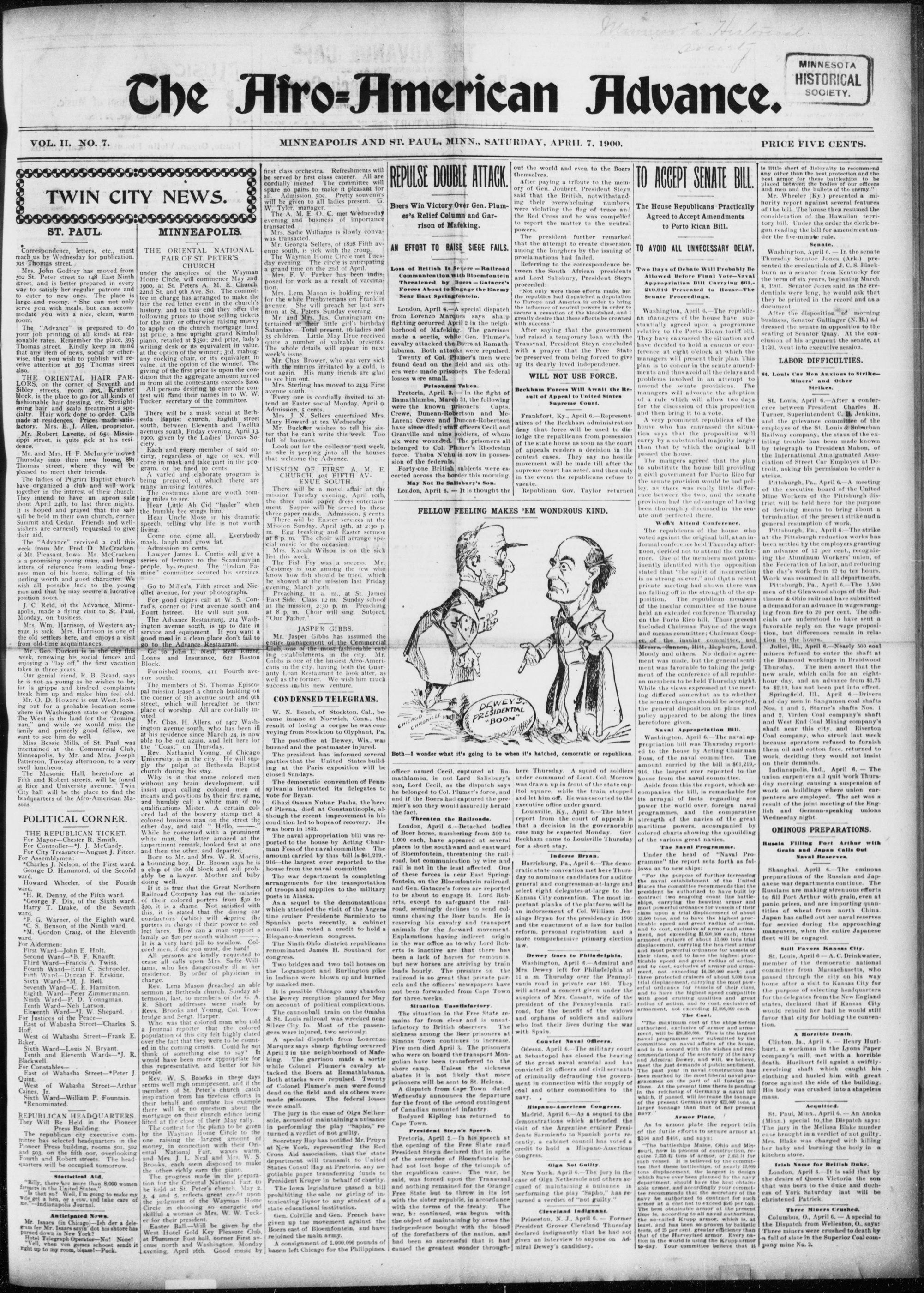
FELLOW FEELING MAKES 'EM WONDROUS KIND.
DEWEY'S
PRESIDENTIAL
"BOOM"
CHICAGO
CHRONICLE
Both—I wonder what it's going to be when it's hatched, democratic or republican
REPULSE DOUBLE ATTACK
Boers Win Victory Over Gen. Plumer's Relief Column and Garrison of Mafeking.
AN EFFORT TO RAISE SIEGE FAILS
Loss of British Is Severe — Railroad Communication with Bloemfontein Threatened, by Boer 's Gatacre's Forces About to Engage the Enemy Near East Springfontein.
London, April 8. A special dispatch from Lorenzo Mauques says sharp fighting occurred April 2 in the neighborhood of Mafeking. The garrison made a sortie, while Gen. Plumer's cavalry attacked the Boers at Ramatha labama. Both attacks were repulsed. Twenty of Col. Plumer's men were found dead on the field and six others were made prisoners. The federal losses were small.
Prisoners Taken.
Pretoria, April 3.—In the fight of Ramathlamba, March 31, the following were the known prisoners: Capts. Crewe, Duncan-Robertson and McLaren; Crewe and Duncan-Robertson have since died; staff officers Cecil and Granville and nine soldiers, of whom six were wounded. The prisoners all belonged to Col. Phimer's Rhodesian force. Thaba N'chu is now in possession of the federals. Forty-one British subjects were escorted across the border this morning.
May Not Be Sallebury's Son.
London, April 6. — It is thought the
FELLOW FEELING MAKE
CHICAGO
CHRONICLE
DEWEY
PRESIDENT
"BOOM"
Both—I wonder what it's going to be wi
offeier named Cecil, captured at Ramathlamba, is not Lord Salisbury's son, Lord Cecil, as the dispatch says he belonged to Col. Plumer's force, and if and if the Boers had captured the premier's son they would assuredly herald the fact.
Threaten the Railroads.
London, April 6. -Detached bodies of Boer horse, numbering from 500 to 1,000 each, have appeared at several places to the southward and eastward of Bloemfontein, threatening the railroad, but communication by wire and rail is not in the least affected. One of these forces is near East Springfontein, on the Bloemfontein railroad, and Gen. Gatacre's forces are reported to be about to engage it. Lord Roberts, except to safeguard the railroad, seemingly declines to send columns chasing the Boer bands. He is reserving his cavalry and transport animals for the forward movement. Explanations having indirect origin in the war office as to why Lord Roberts is inactive are that there has been a lack of horses for remounts, but new horses are arriving by train loads hourly. The pressure on the railroad is so great that private parcels and the officers' newspapers have not been forwarded from Cape Town for three weeks.
Situation Unsatisfactory
The situation in the Free State remains far from clear and is unsatisfactory to British observers. The sickness among the Boer prisoners at Simons Town continues to increase. Five men died April 3. The prisoners who were on board the transport Mongolian have been transferred to the shore camp. Unless the sickness abates it is not likely that more prisoners will be sent to St. Helena. A dispatch from Cape Town dated Wednesday announces the departure for the front of the second contingent of Canadian mounted infantry. Rudyard Kipling has returned to Cape Town.
President Steve's Speech.
Pretoria, April 2—In his speech at the opening of the Free State road President Steyn declared that in spite of the surrender of Bloemfontein he had not lost hope of the triumph of the republican cause. The war, he said, was forced upon the Transvaal and nothing remained for the Orange Free State but to throw in its lot with the sister republic, in accordance with the terms of the treaty. The war, he continued, was begin, with the object of maintaining by arms the independence bought with the blood of the forefathers of the nation, and had been so successful that it had caused the greatest wonder through-
out the world and even to the Boers themselves.
After paying a tribute to the memory of Gen. Joubert, President Steyn said that the British, notwithstanding their overwhelming numbers, were violating the flag of truce and the Red Cross and he was compelled to report the matter to the neutral powers.
The president further remarked that the attempt to create dissension among the burghers by the issuing of proclamations had failed.
Referring to the correspondence between the South African presidents and Lord Salisbury, President Steyn proceeded:
"Not only were those efforts made, but the republics had dispatched a deputation to Europe and America in order to bring the influence of neutral powers in order to secure a cessation of the bloodshed, and I greatly deserves that these efforts be crowned in honor."
After saying that the government had raised a temporary loan with the Transvaal, President Steyn concluded with a prayer that the Free State be preserved from being forced to give up its dearly-loved independence.
WILL NOT USE FORCE.
Beckham Forces Will Await the Result of Appeal to United States Supreme Court.
Frankfort, Ky., April 6.—Representatives of the Beckham administration deny that force will be used to dislodge the republicans from possession of the state house as soon as the court of appeals renders a decision in the contest cases. They say no hostile movement will be made till after the supreme court has acted, and then only in the event the republicans refuse to vacate.
Republican Gov. Taylor returned
ES 'EM WONDROUS KIND.
here Thursday. A squad of soldiers under command of Lieut. Col. Morrow was drawn up in front of the state capitol square, while the train stopped and let him off. He was escorted to the executive office under guard. Louisville, Ky., April 6.—The latest report from the court of appeals is that a decision in the governorship case may be expected Monday. Gov Beckham came to Louisville Thursday for a short stay.
Indorse Bryan:
Harrisburg, Pa., April 6. - The democratic state convention met here Thursday to nominate candidates for auditor general and congressman-at-large and select eight delegates-at-large to the Kansas City convention. The most important planks of the platform will be an endorsement of Col. William Jennings Bryan for the presidency in 1900 and the enactment of a law for ballot reform, personal registration and a more comprehensive primary election law.
Dewey Goes to Philadelphia
Washington, April 6—Admiral and Mrs Dewey left for Philadelphia at 11 a.m. Thursday over the Pennsylvania road in private car 180. They will attend a concert given under the auspices of Mrs. Cassatt, wife of the president of the Pennsylvania railroad, for the benefit of the widows and orphans of soldiers and sailors who lost their lives during the war with Spain.
Convict Naval Officers
Odessa, April 6. - The military court at Sebastopol has closed the hearing of the great naval scandal and has convicted 26 officers and civil servants of criminally defrauding the government in connection with the supply of coal and other commodities to the navy.
Hispano-American Congress
Madrid, April 6.—As a sequel to the demonstrations which attended the visit of the Argentine cruiser Presidente Sarmiento to Spanish ports recently, a cabinet council has voted a credit to hold a Hispano-American congress.
Giga Not Guilty.
New York, April 6.—The jury in the case of Ola G Nethersole and others accused of maintaining a nuisance in performing the play "Sapho," has returned a verdict of "not guilty."
Cleveland Indignant.
Princeton, N. J., April 6. - Former President Grover Cleveland Thursday declared indignantly that he had not given an interview to anyone on Admiral Dewey's candidacy.
TO ACCEPT SENATE BILL
The House Republicans Practically Agreed to Accept Amendments to Porto Rican Bill.
TO AVOID ALL UNNECESSARY DELAY.
Two Days of Debate Will Probably Be Allowed Before Final Vote—Naval Appropriation Bill Carrying $801,219,910 Presented to House—The Senate Proceedings.
Washington, April 6.—The republican managers of the house have substantially agreed upon a programme relative to the Porto Rican tariff bill. They have canvassed the situation and have decided to hold a caucus or conference at eight o'clock at which the managers will present their plan. This plan is to concur in the senate amendments and thus avoid all the delays and problems involved in an attempt to amend the senate provisions. The managers will advocate the adoption of a rule which will allow two days for the discussion of this proposition and then bring it to a vote.
A very prominent republican of the house who has canvassed the situation says that the proposition will carry by a substantial majority larger than that by which the original bill passed the house. The mangers agreed that the plan to substitute the house bill providing a civil government for Porto Rica for the senate provision would be bad policy, as there was really little difference between the two, and the senate provision had the advantage of having been thoroughly discussed in the senate and perfected there.
Won't Attend Conference.
The republicans of the house who voted against the original bill, at an informal conference held Thursday afternoon, decided not to attend the conference. One of the members most prominently identified with the opposition stated that "the spirit of insurrection is as strong as ever," and that a recent private meeting had shown there was no falling off in the strength of the opposition. The republican members of the insular committee of the house held an extended conference Thursday on the Porto Rico bill. Those present included Chairman Payne of the ways and means committee; Chairman Cooper, of the insular committee, and Messrs. Gannon, Hitt, Hepburn, Loud, Moody and others. No definite agreement was made, but the general sentiment was favorable to taking the judgment of the conference of all republican members to be held Thursday night. While the views expressed at the meeting differed somewhat as to whether the senate changes should be accepted, the general disposition on plans and policy appeared to be along the lines heretofore given.
Naval Appropriation Bill.
Washington, April 6.—The naval appropriation bill was Thursday reported to the house by Acting Chairman Foss, of the naval committee. The amount carried by the bill is $61,219,916, the largest ever reported to the house from the naval committee.
Aside from this the report, which accompanies the bill, is remarkable for its arrayal of facts regarding sea power the world over, foreign naval programmes, and the comparative strength of the navies of the great maritime powers, accompanied by colored charts showing the upbuilding of the various great navies.
The Naval Programme.
Under the head of "Naval Programme" the report set forth as follows as to new ships:
"For the purpose of further increasing the naval establishment of the United States the committee recommends that the president be authorized to have built by contract two seagoon coast line battleships, carrying the heaviest armor and most powerful ordnance for vessels of their size, of 13,500 tons, and to have the highest practicable speed and great radius of action, and to cost, exclusive of armor and armament, not exceeding $3,900,000 each; three armored cruisers of about 13,500 tons trial displacement, carrying the heaviest armor and most powerful ordnance for vessels of their class, and to have the highest practicable speed and great radius of action, and to cost, exclusive of armor and armament, not exceeding $4,500,000 each; three protected cruisers of about 8,500 tons trial displacement, carrying the heaviest armor and most powerful ordnance for vessels of their class, and to have the highest speed compatible with good cruising qualities and great radius of action, and to cost, exclusive of armament, not exceeding $2,800,000 each.
The Cost.
"The maximum cost of the ships herein authorized, exclusive of armor and armament, will be $25,000,000. This is the largest cost of the warship in a committee on naval affairs of the house, and is in accord with the wishes and recommendations of the secretary of the navy and Admiral of the Navy, and the demands of public sentiment. The past year in naval construction has been marked by the most liberal naval programmes on the part of all foreign navies, and the cost of the warship in the rechattage of Germany is a naval bill which, if passed, will increase the tonnage of the present German navy $42,000, tons, a larger tonnage than that of her present
Armor Plate.
As to armor plate the report tells of the futile efforts to secure armor at $300 and $400, and says:
"The battleships Maine, Ohio and Mississippi, now in process of construction, require 7,259 42 tons of armor, or 2,433 14 for each vessel. It is believed by the committee that these battleships, of nearly 13,900 tons displacement, the largest in design department, should have the best obtainable armor, and accordingly your committee recommends that the secretary of the navy be authorized to contract for each armor at a cost not to exceed $45 per ton. The department, which is, according to all naval authorities, the so-called Krupp armor, which is, at least, and has been so proven by ballistic tests, of 25 per cent. greater efficiency than that of the Harveyed armor. Every naval department has to do-day. Your committee believe that it
MINNESOTA HISTORICAL SOCIETY.
is little short of disloyalty to recommend any other than the best protection and the best armor for these battleships to be placed between the bodies of our officers and men and the bullets of the enemy.[17] Mr. Wheeler (Ky.) presented a minority report against several features of the bill. The house then resumed the consideration of the Hawaiian territory bill. Under the order the clerk began reading the bill for amendment under the five-minute rule.
Senate.
Washington, April 6. — In the senate Thursday Senator Jones (Ark.) presented the credentials of J. C. S. Blackburn as a senator from Kentucky for the term of six years, beginning March 4, 1901. Senator Jones said, as the credentials were long, he would ask that they be printed in the record and as a document.
After the disposition of morning business, Senator Gallinger (N. H.) addressed the senate in opposition to the seating of Senator Quay. At the conclusion of his argument the senate, at 1:30, went into executive session.
LABOR DIFFICULTIES.
St. Louis Car Men Anxious to Strike Miners' and Other Strikes.
St. Louis, April 6.—After a conference between President Charles H. Turner, Superintendent C. H. Jenkins, and the grievance committee of the employees of the St. Louis & suburban Railway company, the status of the existing trouble has been made known by telegraph to President Mahon, of the International Amalgamated Association of Street Car Employees at Detroit, asking his permission to order a strike.
Pittsburgh, Pa., April 6.—A meeting of the executive board of the United Mine Workers of the Pittsburgh district will be held here for the purpose of devising means to bring about a termination of the present strike and a general resumption of work.
Pittsburgh, Pa., April 6—The strike at the Pittsburgh reduction works has been settled by the employers granting an advance of 12 per cent, recognizing the Aluminum Workers' union, of the Federation of Labor, and reducing the day's work from 12 to ten hours. Work was resumed in all departments. Pittsburgh, Pa., April 6—The 1,500 men of the Glenwood shops of the Baltimore & Ohio railroad have submitted a demand for an advance in wages ranging from five to 29 per cent. The officials are understood to have sent a favorable reply on the wage proposition, but differences remain in relation to the hours.
Joliet, Ill., April 6—Nearly 500 coal miners refused to enter the shaft at the Diamond workings in Braidwood Thursday. The men assert that the new scale, which calls for an eight-hour day, and an advance from $1.75 to $2.10, has not been put into effect.
Springfield, Ill., April 6. — Drivers and day men in Sangamon coal shafts Nos. 1 and 2, Starne's shafts Nos. 1 and 2, Virden Coal company's shaft and West End Coal Mining company's shaft near this city, and Riverton Coal company, who struck last week because operators refused to furnish them oil and cotton free, returned to work, deciding they would not insist on their demands.
Indianapolis, Ind., April 6. — The union carpenters all quit work Thursday morning, causing a suspension of work on buildings where union carpenters are employed. The act was a result of the joint meeting of the English and German-speaking unions Wednesday night.
OMINOUS PREPARATIONS.
Russia Filling Port Arthur with Grain and Japan Calls Out Naval Reserves.
Shanghai, April 6. The ominous preparations of the Russian and Japanese war departments continue. The Russians are making strenuous efforts to fill Port Arthur with grain, even at panic prices, and are importing quantities of wheat from north China. Japan has called out her naval reserves for service during the approaching maneuvers, when the entire Japanese fleet will be engaged.
Still Favors Kansas City.
St. Louis, April 6 - A. C. Drinkwater, member of the democratic national committee from Massachusetts, who passed through the city on his way home after a visit to Kansas City for the purpose of selecting headquarters for the delegates from the New England states, declared that if Kansas City would rebuild her hall he would still favor that city for holding the convention
A. Horrible Death
Clinton, Ia., April 6. — Henry Hurlburt, a workman in the Lyons Paper company's mill, met with a horrible death. Hurlburt fell against a swiftly-revolving shaft which caught his clothing and hurled him with great force against the side of the building. His body was crushed into a shapeless mass.
Acquitted.
St. Paul, Minn. April 6. — An Anoka (Minn.) special to the Dispatch says: The jury in the Melissa Blake murder case brought in a verdict of not guilty. Mrs. Blake was charged with killing her baby and burning the body in a kitchen stove.
Irish Name for British Duke.
London, April 6. — It is said that by the desire of Queen Victoria the son that was born to the duke and duchess of York Saturday last will be christened Patrick.
Three Miners Crushed.
Columbus, O., April 6. — A special to the Dispatch from Welleston, O., say: Three miners were crushed to death by a fall of slate in the Superior Coal company mine No. 2.
Published every Saturday by the
ADVANCE PUBLISHING COMPANY
Office, 214 Washington Av. So.
Tel. Main 2415-L-8.
Minneapolis, - - - - Minnesota.
Entered at the Post Office, at Minne-
apolis, Minn., as second-class matter.
Subscription Rates:
One Year - - - - - $1.00
Six Months - - - - .60
Three Months - .35
Subscription Always Payable in
Advance.
Special rates if ordered by the dozen.
Orders for current issue should reach the
office by Wednesday evening.
Advertising Rates.
Local Reading Notices, 10c per line,
each insertion.
Religious Notices (not over five lines),
free.
"Want" and "To Let" advertisements,
8 cents per line for each insertion.
Display, 40 cents per inch each insertion.
Rates will be given for space by
the year.
Editorial Announcements.
To secure the return of unsolicited manuscript postage should be unclosed, reach the address by Wednesday morning, preceding the issue in the mail, are to appear, communicate, publish matter for publication, must bear the writer's name, not for publication, but as proof of publication.
Contributions and items of news concerning the progress of the colored race and the war. We reserve the right to reject any communication unsuitable for publication. Subscribers ordering addresses of their former chaperon may send the former as well as their present address. Address all communications and make all remittances to THE AFRO-AMERI CAN MANAGE 214 Washington Ave., South, Minneapolis, Minn.
MRS. GEO. DUCKETT.
PUBLISHER AND MANAGER.
MRS. J. B. KOGER, City Collector.
EDITORIAL.
Capt. Sigsbee, of the ill-fated Maine, is the guest of the Twin Cities.
If white men hunt up and seek to parade our weakness, let us parade the evidence of our strength.—The Odd Fellows Journal, Philadelphia.
Mrs. Dewey, wife of Admiral Dewey, has at last persuaded her husband to become a candidate for the presidential nomination. What wonders a woman can perform!
Archbishop Ireland, of St. Paul, will deliver the dedicatory address at the unveiling of Lafayette monument at the Paris Exposition. The address will be delivered in French.
A corporation company, composed entirely of colored men, will open a large grocery and provision house in Chicago, April 10th. This enterprise speaks progress for the colored man. We hope to soon see a similar one in the Twin Cities.
Philadelphia Afro-Americans are the first to consider plans for a large department store. Ere long the colored people of that city will give to the race a true solution. This example deserves emulation in every city where Afro-Americans exceed in numbers upward of 5,000.
The celebrated colored school case, which was decided by a jury at Alton, Ill., April 1st, excluding colored children from white schools, makes the third trial, each time a decision in favor of negro haters. An appeal will be taken to the supreme court. All honor or to the brave Afro-Americans of Alton.
If the colored Baptists of the Twin Cities would unite in the support of some able minister, we think that the two churches would never suffer for a competent shepherd, and everybody would be pleased. The aggregate attendance of the two churches could bountifully supply the financial needs of one good minister.
The loafing class is always in evidence, lounging on the corners, sporters on the promenade and at places of amusement, talking loud and guffawing on the street cars and making itself generally offensive on all occasions and everywhere.
Decent colored people are everywhere made to suffer on their account. It is not fair, but it is so.—The Freeman.
When a colored man begins to multiply progressive weight in the scale of prosperity he loses favor among his own people, and gains prestige among the whites. A striking peculiarity of the race indeed. Colored people idolize a man when he is full of chaff, despise the man of real action, and discourage the man who makes no effort to progress, by saying it is of no use. Who can locate him? It is well to lose favor for a time; if it is characteristic of the race, demand it. Perhaps such is the evolution of all rising races, but it seems to be of a peculiar kind.
Rev. John G. Mitchell, A. M., D. D., Dean of Payne Theological Seminary, died last Friday morning at 12:20, after having been confined to his bed for about two days. He had been failing in health for about a year; but since last summer he had been convalescent and his friends hoped that he would recover. He was conscious up until about two hours before his death. When the end came it was so natural and easy that those watching at the bedside did not realize that he was gone, only by the cessation of his breathing.
MERCERIZED COTTON.
Discovery of the Process Which Converts the Cheap Material Into Fine Silk.
A boy sat before the fire and watched his mother's kettle boil. The lid quivered, rose a little, and the boy gave steam power to the world.
John Mercer, an English dyer, filtered caustic soda through a square of cotton cloth. Thence a new verb—to mercerize in the language, a new fabric on the market, and a new business, engaging millions of capital, to cheer the unemployed.
The story of the boy, John Watt, is old, but Mercer's story is new and interesting. Mercerized cotton, either cotton yarn or cotton cloth, resembles silk absolutely. It has the luster of silk; it will take on, like silk, the richest and most brilliant dyes, and it has the unmistakable soft-harsh, nestling feel which nothing but silk ever had, says the Brooklyn Eagle.
Also cotton, under this process, does not weaken, as might have been feared, but it acquires strength. A skein of cotton yarn in the natural state that will carry 13 ounces without breaking will carry, after mercerizing, 19 ounces. And if you take three coats and line the first with a plain cotton lining, the second with mercerized cotton and the third with silk, the cotton and the silk will wear out, about together, but the mercerized lining will outlast them two or three times over.
Mercerized cotton is used in linings, in underwear, in spindle banding, in stockings, in dress goods, in negligee shirts. There is a profit in mercerizing of from 100 to 200 per cent. In the last year or two many public dyers have added mercerizing machines to their plants, and a good number of mercerizing mills have been established.
But there is room for more. Here is the proof of the demand for mercerized goods: Bradford, the ingenious and alert manufacturing town of England, ran night and day making cloths for us in the time of the low tariff. Bradford is still running night and day, but she is making for us now only mercerized things.
Mercerizing began as far back as 1846 in the English town of Accerington, where John Mercer, manager for the firm of Hargreaves, filtered caustic soda through a cotton cloth. Mercer, by accident, kept this cloth by him, happened to test its strength, happened to splash it with a dye. He found that it was about twice as strong and about twice as susceptible to dye liquor as it had been before. Slight savings, in connection with big outputs, come in the long run to astonishing totals. Here was a saving by no means slight. Here, just by running a cotton thread through a liquid as cheap as water, it would come to do the work of two threads, and in being dyeed it would save half the quantity of the dye stuff.
Mercer rejoiced. He refused for his secret an offer of $200,000 from a French firm. He had the idea of an immense syndicate, with himself at the head, rolling up millions of profits per annum.
Then it was found that cotton shrunk in the mercerizing. A yard of cloth would save in dyesuffa and in raw stock, say five cents to its manufacturers, but it would come out of the mercerizing bath only three quarters of a yard of cloth. Against the profit of five cents a loss through shrinkage of about ten cents would have to be set. This is why Mercer never formed his syndicate, why mercerizing was of no commercial importance until latterly.
For the remaining 20 years of his life the man toiled ineffectually on and he died disheartened. But his name lives. That is because, somewhere around 1890, Horace Lowe, in England, and Thomas and Provost, in Germany, began to try to see if it might not be possible to mercerize a cotton thread and to prevent the thread from shrinking in the process. They more than succeeded.
Mercer had taken his cotton, steeped it for about three hours in caustic soda, then washed it. That is mercerizing in its simplest terms. To the Englishman, Lowe, and the Germans, Thomas and Provost, came simultaneously the idea of keeping the cotton stretched while stealing it in the caustic soda bath. They tied the ends of their cotton threads to sticks and then mercerized them. The sticks did not break, the thread did not even show signs of shrinkage. So easy was it to do what Mercer had been failing at for years and years.
But, more than this, they found that cotton mercerized under tension came out glossy, soft and rustling. To their amazement they found that they had transformed cotton into silk. And ever since the Englishman and Germans have been fighting over the patients on this wonderful discovery.
The explanation of the luster that cotton, being mercerized, takes on, is simple. The soda and the tension together change the nature of the cotton fiber. The natural fiber is flat, shriveled; the mercerized fiber fills out, becomes round and smooth. And just as a flat, dried raisin has no luster, whereas the full ripe ripe catches and throws back the light, so there is no luster to the flat fiber of the natural cotton, but on the mercerized sort the light shines and is reflected just as on the grape.
Taken Literally.
It was only playfully that she referred to her husband as "a regular heathen," but it is always well to label such remarks when made in the presence of children.
The little one who overheard this remark troted away to Sunday school immediately thereafter, and in some way the subject of attendance at church came up in the class that day.
"My papa doesn't go," volunteered the little one.
"No?" returned the teacher inquiringly.
"Oh, no. He's a heathen, you know."—Chicago Post.
Similar But Different.
Mrs. Blinks—There's hardly any living with my husband; he doesn't know anything.
Mrs. Winks—There's no living at all with my husband; he knows everything.—Chicago Evening News.
MINOR NEWS ITEMS.
Mr. James G. Blaire is collecting her bushland's letters for publication in a biography.
An immense body of crystallized lead ore has been found on the outskirts of Helena, Mont.
Liquor exports to Cuba, Porto Rico and the Philippines have decreased since the Spanish war.
In the last 30 years 9,675 lives were lost in and about the anthracite coal mines of Pennsylvania.
Former Secretary of the Interior Hoke Smith has sold the Atlanta (Ga.) Journal to a Boston syndicate.
Ex-President Cleveland says the Nicaragua canal should be regarded as the United States' gift to the world.
While in the Philippines Gen. Wheeler learned several Filipino dialects, which he can speak with fair fluency.
Workingmen in California are becoming alarmed at the steadily increasing number of Japanese immigrants.
Cotton spinners of Japan have organized a cotton yarn trust, the object being to meet growing competition from the United States.
The president of the Mexico, Cuernavaca & Pacific railroad says Mexico is just entering a remarkable era of railroad construction.
Germany and Russia are said to have reached an agreement as to railway concessions, practically dividing Asia Minor between them.
The first American coal ever shipped to Japan has arrived at Nagasaki. The steamer Needleless has reached that port with 6,000 tons from Virginia.
Fourteen thousand people have engaged passage from Pacific coast ports to Cape Nome, Alaska, on the first fleet of steamers, which sails about May 1.
The Pennsylvania supreme court has held that a company incorporated in another state and not registered in Pennsylvania cannot recover in an action at law.
Cyril Arthur Pearson, principal owner, manager and editor of Pearson's Magazine and many other journals, intends shortly to launch a London daily newspaper, modeled on American lines. Naval authorities have decided that Guam strategically is of scarcely less value than Hawaii, and have begun the preparation of plans to make it one of the most important naval bases on the Pacific.
THE WORLDLY PHILOSOPHER.
All men tell the truth—when there is money in it.
Two cats in the alley can spoil the memory of ten sonatas.
It is hard to like the people who don't take kindly to our faults.
Some people are never so happy as when telling their troubles.
Remember that no man has ever been made better by post-morten kindness. Man boasts of his liberty, but husbands are managed and bachelors usually Miss managed. Most men get hungry when they become poets, but no man becomes a poet by becoming hungry.—Chicago Democrat.
It will take three years to build the underground rapid transit road recently begun in New York. The tunnel will cost $35,000,000, and will be 21 miles long. The contract is the largest single contract ever let. More than 65,000 tons of steel will be used in constructing the tunnel, and 2,000,000 cart loads of earth will be taken from the excavations.
PATRONIZE . . .
WM. JENKINS,
ROOMS FOR RENT
FIRST CLASS.
We Guarantee Superb Service. Prices
moderate. Tel. 2787-L-3 Main.
No. 9 Second St. No. Minneapolis.
J. GARNER. W. H. WELLER.
The Elite Buffet
3030 STATE ST.,
FINE WINES,
LIQUOR,
AND CIGARS.
Chicago.
Chicago.
Cutting, Fitting and Making Over a Specialty. New York and Paris Fashions Always on Hand. Farors, 628 Fourteenth A. South.
DR. R. S. BROWN.
Office: 405-6 Reeve Bldg. 408 Nicolelet V.
Telephone 8734-J-5.
Office Hours: 9:30 to 12:30; 2:00 to 4:00
p. u. m. s. m. Sundays: 9:30
to 11:00; 12:30 to 13:00.
Residence: 8839 Portland Ave. Tele-
phone 317-L-South.
The gentlemanly and obliquing Porter at R. De Leo's Barber Shop, 200 Washington Av. South, is Always Ready to Dress Your Shoes in a thoroughly artistic manner, that is sure to win. JAMES L. CURTIS
LAWYER
603 Northwestern Bldg., Minneapolis.
Cor. 4th St. and Hennepin Av.
Telephone, Main 2460-L-1.
DROPSY Treated free.
Possibility CURSE
with Reddies. Hard
Bendies. Hard
DROPSY
Treated free.
Possibly cured by
Therapy with Tea.
Bondage.
Hard cured many
thousands of
acquired hopsens.
From first dose symptoms rapidly disappear.
Blood tests at least two-thirds of all symptoms are
free.
BOOK of treatments for hospitalized free by
FREE.
TEN DAYS TREATMENT FURNISHED FREE by mail
DEE, R. H. GREEN & NONE, Appalachia, Atlanta, GA.
UPPRAIRIE THE PAPER CITY you will see.
LAMB'S Throat Candy, one of the
Confections for Vocales,
Public Speaking, etc.
to LAMB REG. CO., OTTAWA, Canada, for sample box.
$20 A hundred for your neighbors' address.
Send 10 cakes for contract and sample copy.
NOMANCE MAGAZINE, NEW YORK.
DROPSY
NEW DISCOVERY; gives
quick relief and curse worm
cause. Send for book or magazine worm
treatment Free. Do K. K. GREEN'S BON, Atlanta, GA.
GET RICH QUICKLY. Send for Brush, "Determinations Wanted."
ENGAR TATE & CO., 24th Broadway, Atlanta, GA.
THE ADVANCE CAFE 214 WASHINGTON AV. SOUTH. Restaurant and Lunch Counter
MANN & KOGER, Proprietors.
SOCIETY DIRECTORY.
Officers and Standing Committees of the Most Worshipful Grand Lodge A. F. and A. M. of Minnesota and jurisdiction: A Grand Master-John L. Neal, Minneapolis.
Deputy Grand Master-Wade H. H.amp-
fort Superior.
Grand Senior Warden-H. B. Howard,
St. Paul,
Grand Junior Warden-J. C. Garner, St.
Paul.
Grand Treasurer-Daniel Roy, St. Paul.
Grand Secretary-William R. Morris,
Minnesota.
Grand Lecturer-G. W. Day (7), Minneapolis.
Grand Secretary-G. O. Howard (4), St. Paul
Grand Chaplaim-Issaac Crawford (6), Minneapolis.
Senior Deacon-John Martin (1), St. Paul.
Grand Junior Deacon-R. De Leo (7), Minneapolis.
Senior Steward-J. H. Dillingham (2), St. Paul.
Junior Steward-Wm. Stevens (3), St. Paul.
Grand Tyler-T. Bush (3), St. Paul.
Grand Marshall-C. H. McDonald (6), Duluth.
Grand Pursuivant-G. W. Duckett (4), St. Paul.
Grand Sword-Bearer-J. Adams (1), St. Paul.
Grand Standard-Bearer-J. Charles (4), St. Paul.
Grand Register-J. G. Sterrett (6), Minneapolis.
District Deputy Grand Master-First District-James Woodford (3), St. Paul.
District Deputy Grand Master-Second District-E. H. Hamilton (6), Minneapolis.
District Third Deputy Third District-J. K. Fek (6) Duluth.
MINNEAPOLIS.
G. U. O. O. O. F.
St. Anthony Lodge, No. 2877.
Meets the first and third Wednesday in
each month for the transaction of busi-
ness, 1st avenue N. and Washington,
2nd avenue N. and Washington,
A. A. HYTTY, N. G.
JAMES A. SCOTT, P. S. P. O. Box 33.
KNIGHTS OF PYTHIAS.
Nat. Turner Lodge, No. 2, K. of P.
Meets the second and fourth Thursdays in
welcome. At Labor Temple, Fourth
and Eighth avenue south.
RALPH WATSON, K. R. and S.
Pride of Minnesota Lodge, No. 1,
K. Meets the first and second Thursdays
in each month. All brothers in good stand-
ing welcome. First avenue north Washington,
First avenue north Washington,
JAMES ROBERTS, C. W.
C. J. FREKEY, K. R. and S.
Meets first Tuesday in each month at
Windom Block, Second avenue South and
Washington. Masons in good standing
always welcome.
G. W. LILLARD, W. M.
JASPER GIBBS, Sec., Guaranty Loan
Restaurant.
Anchor Lodge, No. 7, A. F. and A. M.
Meets the first and second Monday in each month at Windsom Block, Second avenue South and Washington. Masons in good standing welcome. SCOUTT, W. M.
A. B. LEE, 701 Aldrich Avenue south
Mars Lodge, No. 2202.
Meets second and fourth Wednesdays in each month at Odd Fellows' Hall, 325 Wabasha street
T. R. HICKMAN, P. S., 422 St. Antoine
D. PARKER, N. G., 395 Edmund St. N.D. HOOK of Hook, No. 553 Edmund St. O. F. G.
Meets first and third Monday in each month for business, second Monday for instruction, at Odd Fellows' Hall, 325
MRS. SARAH C. KIRTLEY, M.N.G.
MRS. IDA JACKSON, W. R., 374
mount place
MORSEPHILIP GRAND LODGE
OF MINNESOTA, A. F. and A. M.
J. L. NEAL, Grand Master.
WM. R. MORRIS, Grand Secretary.
171 Guaranty Loan Bldg., Minneapolis.
ST. PETER CLAYER'S SODALY.
Meets the first and third Mondays of each
week.
J. S. HARRIS,
Sec. C. A. Davies, Treas.
S. H. HADLEY, W. M.
W. A. HILLYBROOK, 124 Atwater.
Minnesota Lodge, No. 2, A. P. and
A. M.
Meets on the first and third Tuesday in
each month at Masonic Hall, southwest
corner of Fifth Street and Robert streets.
Master Masons in good standing always
welcome.
H. R. HOWARD, W. M.
J. S. STRONG, Sec. 12th and Robert st.
WM. STEVENS, No. 3. A. F. & A. M.
Meets second and fourth Monday in each
month at Masonic Hall, southwest cor-
ner of Robert and Robert streets. Master
Masons in good standing always welcome.
WM. JOHNSON, W. M.
D. E. BEASLEY, Sec. Ryan Hotel.
Perfect Ashler Lodge, No. 4, A. P.
Meets the second and fourth Tuesday in
each month at Masonic Hall, southwest
corner Fifth and Robert street. Master
Masons in good standing always welcome.
J. H. SHERWOOD, Sec. 461 Carroll.
Bethel Chapter, No. 25, R. A. M.
Mason in first and third Tuesday in
each month at Masonic Hall, southwest
corner of Fifth and Robert streets. Royal
Arch Masons in good standing always
welcome.
DANIEL ROY, H. P.
W. T. GASSAWY, Sec. State Capitol.
CHURCH DIRECTORY.
MINNEAPOLIS.
**ST. PETER A. M. E. CHURCH.**
Rev. W. S. Bishop, Pastor.
Cor. 22d st. 98th ave. South
Sunday school; Eighth Avenue 11:30 a.m.
; Sunday School; 3:00 p.m.; evening
services; 8:00 p.m. General prayer meet-
ing, Thursday evening; 8:00 p.m. Way-
way; Sunday School; 3:00 p.m.; different
residences. Parsonage, 2200
Ninth avenue South.
BETRESDA BAPTIST CHURCH.
BethreSDa Baptist and Twelfth Ave.
Sunday services; Preaching; 11:00 a.m.
; Sunday School; 12:30 p.m. Christian
service; Sunday School; 8:00 p.m.; Wednesday evening; general
prayer meeting; 8:00 p.m. Parsonage,
1120 Eighth street South.
**PASSION.**
Rev. John J. Faude, in Charge.
615 Sixth avenue South.
Sunday service; 4:00 p.m.; Sunday
School; 8:00 p.m.
**ST. JAMES A. M. E. CHURCH.**
Rev. J. W. King, Pastor.
Between First avenue and Second street
Southeast, near Exposition Bldg.
8:00 p.m.; Sunday School; 3:00 p.m.; evening
services; 8:00 p.m. General prayer meet-
ing, Wednesday weekends of the Debating Club.
ST. JAMES A. M. E. CHURCH.
Rev. B. C. Anderson, Pastor.
Cory Fulcher and Jay streets
Cor. Fulcher and Jay streets
Wednesday services: 11:30 a.m. m. 7:30 p.m.
Wednesday prayer prayer: 8:30 p.m.
ST. PETER CLAYER'S
PRAYER CLAYER'S
Cor. Fartington and Aurora avenues.
Sunday services: Mass. 8:30 p.m. High
mass. 10:30 a.m. Evening service at 7
o'clock.
PILGRIM BAPTIST CHURCH.
Rev. D. S. Orner, Pastor.
Cor. 123h and Cedar.
Sunday services: Meeting at 11:30 a.m. and 7:45 p.m. Sunday School at 12:30
o'clock. Wednesday evening general
meeting.
ST. PHILLIPS EPISCOPAL MISSION.
Rice street, bet. Aurora and University.
Sunday services: Morning prayer, Lit-
ST. PAUL.
ST. PAUL.
any and Sermon. 11:0 a. m.; Sunday School and Children's Vespers 3:00 p. m.; Evanity Evening Prayer and Lecture, 8:00 p. m.; Friday; Choir Rehearsal and brotherhood of St. Andrew, 8:00 p. m. All are cordially invited. Seats free.
NOTICE—Changes and corrections will be made upon notifying the office. If we have neglected to place a notice of any society in the above directory it is because we do not know of it or have not left office. Send a copy of any Lodge, plenary and time of meeting, name of officers and it will be inserted.
OLSON EARL,
..UNDERTAKER..
Funeral Director and Embalmer.
Open Day and Night. Satisfaction Guaranteed.
1503 S. Franklin Ave. - Minneapolis.
PATRONIZE THE BEST!
The Fuller Laundry Co.
Free Delivery to All Parts of the City and Lake Minnetonka.
Our Motto: First-class Work and Moderate
Prices.
Crayon, Pastel and Water Colors a Specialty.
251-253 Cedar Avenue,
MINNEAPOLIS, MINNESOTA.
SEEDS OF FLOWERS Plants and Our
Succulent Flower on telegraphic or mail
orders any time, day or night. Budding or
House Plant their season. is the Flowers,
plants, and flowers are honest, at five cents per packet. Our catalogue
is FREE, send for it.
MENDENHALL, FLORIST,
414 Nicollet Av., Minneapolis, Minn.
KLAFFKE'S
WHITE SEAL
FLOUR.
119 Central Ave., Minneapolis.
TEL. 2701-J-3. NEXT TO PERKA'S.
WONDERFUL
DISCOVERY
Curly Hair Made Straight By
TAKEN FROM LIFE.
BEFORE AND AFTER TREATMENT.
OZONIZED OX MARROW
THE ORIGINAL-COPYRIGHTED.
This wonderful hair paint is the only safe preparation in the world that makes kinky hair straight as shown above. It nourishes the scalp, and gives it a grow. Solder over 40 years and used by thousands. It was the first preparation ever sold for quest. It was the first preparation ever sold for quest. It was the first preparation ever sold for quest. Get the Original Ozonized Ox Marrow, as the genuine never leaves a heap of hair plain and justified. A toilet necessity for ladies and gentlemen. Elegantly perfumed. The great advantage that it has is not only for a white hair man, but for any hair man, not only for anybody to produce a preparation equal to it. Full direction to the answer. Or buy it directly by dealers or send us $1.40 Postal or Express Money Order for an express paid. Write your address plainly.
OZONIZED OX MARROW CO.,
76 Wabash Ave. Chicago, Ill.
Magic Seeds
Magic Seeds
Awonderful Nerve Remedy, that has no superior and is guaranteed to cure all such nerve diseases as Nervous Prostataction, Weak Memory, Lack of Confidence, Wakefulness, Headache, Nervousness, Lost Manhood, and all drains and loss of power in genera of either sex, caused by Overperfusion, Youthful Errors, Excessive use of Tobacco, Ophthalm, or Stimulants, which lead to Infirmity, Consumption, and Inanity.
Magic Seeds restore the nerve and vigor of youth. Easily carried in the vest pocket. Sent prepaid in plain box by mail to any address, for $$$, six boxes for $$$, with a written guarantee to cure or money refunded. Write for free circular.
MAGIC MEDICINE CO.,
MANSFIELD, OHIO.
VICTORINE
THE WONDERFUL NEW
WASHING GOMPOUND
VICTORINE
TRADE MARK
REGISTERED
THE GREATEST BLESSING TO
WOMANKIND
NO BOILING, NO RUBBING
OF CLOTHES REQUIRED.
PREVENTS SHRINKAGE OF WOOLENS.
5c. a package - Two-week Washing
BARBEAU & CALLAHAN,
BOLE MANUFACTURERS, CHICAGO U. S. A.
AGENTS WANTED WHERE NOT REPRESENTED.
A wonderful Nerve
Remedy, that
has no superior and
is guaranteed to
cure all such nervous
diseases as
Nervous Prostration,
West Mem-
phis, and of
dence, Wakefulness,
Headache,
Nervousness, Lost
Manhood, and all
drains and loss of
power in genera
Special Reduced Terms During May, June, July and August.
D. H. BOONE, Pres. N. JOSEPH LLOYD, Sec'y.
SPEND A PLEASANT EVENING AT THE
NORTH STAR SOCIAL CLUB
BILLIARD AND POOL TABLES.
Rooms, Second Floor, 202 Hennepin Avenue.
DR. THOS. S. COOK.
OFFICE HOURS:
10 TO 12 A. M.; 2 TO 4 P. M.; 7 TO 8 P. M.
TELEPHONE 385.
12TH AND ROBERT STS.
Office Telephone 1498-4.
VAL DO TU
PHYSICIAN A
Office Hours: 8 to 10 a.m.; 12 to 2 p.m.; 4
Office, 27 E. 7th St. Kendrick Blk. Res.
25 YEARS' EXPERIENCE.
JAS. AM
Practical Undertak
122 Washington Ave.
All our goods are first-class, and the c
SMOKE THE SIGHT
W. S. CONRA
400 FIRST A
COX & HARRIS,
J. E. STEWART, SECY.
Twin City Club and
BERT STS., ST. PAUL, OVER DRUG STORE.
098-4. Residence Telephone Dale 410-5.
D. DO TURNER, M. D.,
PHYSICIAN AND SURGEON.
m. : 12 to 2 p. m. : 4 to 6 p. m.
Bendrick Blk. Res. 830 Sherburn Ave. ST. PAUL, MINN.
EXPERIENCE. TELEPHONE 755.
AS. AMOR & CO.,
Undertakers and Embalmers.
Washington Ave. South, Minneapolis, Minn.
First-class, and the prices we guarantee will defy competition.
THE SIGHT DRAFT 5-CENT CIGAR.
CONRAD, Distributor,
400 FIRST AVENUE SOUTH.
GIS, AGENTS.
12TH AND ROBERT STS., ST. PAUL, OVER DRUG STORE
25 YEARS' EXPERIENCE. TELEPHONE 755. JAS. AMOR & CO., Practical Undertakers and Embalmers. 122 Washington Ave. South, Minneapolis, Minn.
SMOKE THE SIGHT DRAFT 5-CENT CIGAR.
W. S. CONRAD, Distributor,
400 FIRST AVENUE SOUTH.
COX & HARRIS, AGENTS.
Club and Employment Bureau
Twin City Club and Employment Bureau
FURNISHED ROOMS
With the Most M
BARBER SHOP
Where Meals are
126 Hennepin Ave.
Smoke "SUN
"BUCKIN
AND "PRIN
CHEW "PEACH A
STRICTLY UNION
MANUFACTURED BY J. J. B
PIPE FREE FOR "S
with the Most Modern Conveniences.
ER SHOP AND RESTAURANT
Where Meals are Served at All Hours.
Pin Ave. Minneapolis, Minn.
"SUN CURED" Cut Plug,
BUCKINGHAM" Cut Plug,
"PRIME MESS" Granu-
lated.
BEACH AND HONEY" FINE CUT
PRICTLY UNION LABEL TOBACCOS.
RED BY J. J. BAGLEY & CO., DETROIT, MICH.
FREE FOR "SUN CURED" LABELS.
MANUFACTURED BY J. J. BAGLEY & CO., DETROIT, MICH. PIPE FREE FOR "SUN CURED" LABELS.
THE FOX $2.00 RAZOR is the best that experience and skill can pro-
duce. FREE TRIAL AT YOUR HOME. For 250 we will send a Fox
or to your Express Agent, with instructions to allow you to take it home.
Or, if you send full amount with your order, we send Razor prepaid,
grantee satisfaction or money back, and a FOX STYPTIC PEN-
FREE. State whether wide or narrow blade, square or round point.
Razor honed, stopped and set ready for use.
FOX CUTLERY CO., Mfrs. 48 Center St., New York City.
Press for the West: 925 Main St., Dubuque, Iowa.
"The Fox Cutlery is perfectly reliable." Editor."
CLIMAX Display Table
LAYING GOODS TO BEST ADVANTAGE
is quickly obtained by turning a thumb screw. Will pay for
self in thirty days. Valuable addition to any store. Neatly
and well finished.
Send for circular and price list.
AGENTS WANTED.
CLIMAX TAG CO., Dayton, Ohio.
The FOX $2.00 RAZOR is the best that experience and skill can produce. FREE TRIAL AT YOUR HOME. For 250 we will send a FOX Razor to your Express Agent, with instructions to allow you to take it to try. Or, if you send full amount with your order, we send Razor prepaid, guaranteeing satisfaction or money back, and a FOX STYPTIC PEN-CIL FREE. State whether wide or narrow blade, square or round point. Every Razor honed, stropped and set ready for use.
Fox CUTLERY Co., Mfrs. 48 Center St., New York City.
Address for the West: 925 Main St., Dubuque, Iowa.
The Climax
FOR DISPLAYING GOOD
Any desired angle is quickly obtained
itself in thirty days.
Send for circular
Manufactured by CLIMAX T
Artistic Monument
Cost No More than Plain Ones i
Any desired angle is quickly obtained by turning a thumb screw. Will pay for itself in thirty days. Valuable addition to any store. Neatly
itself in thirty days. Valuable addition to any store. Neatly and well finished.
Send for circular and price list.
AGENTS WANTED.
Manufactured by CLIMAX TAG CO., Dayton, Ohio.
Marble is entirely out of date, granite soon gets mossgrown, discolored, requires constant expense and care, and eventually crumble back to Mother Earth. Besides it is very expensive.
White Bronze is strictly everlasting. It cannot crumble with the action of frost. Monogrowth is an impossibility. It is more a mistake than an expense. We soon crumble back to Mother Earth. Besides it is very expensive.
White Bronze is strictly everlasting. It cannot crumble with the action of frost. Monogrowth is an impossibility. It is more a mistake than an expense. We soon crumble back to Mother Earth. Besides it is very expensive.
We have designs from $4.00 to $4.00.00. Write at once for free designs and information. It puts you under no obligations. We seal direct and deliver everywhere.
The Monumental Bronze Co., 360 Howard Avenue, Bridgeport, Conn.
---
Miller
ST. PAUL, 171-173 E. 7th St.,
Opposite Olympic.
THE FOX RAZOR
MAKE THE RAZOR
MAKE THE RAZOR
The FOX $2.00
duse. FREE TIME.
Razor to your Exit
to try. Or, if you
guaranteeing ea
CIL FREE. State
Every Razor hono
Address for the W
THE STATUE OF THE
MARTYR OF THE
WESTERN UNION
CIVIL WAR
---
DR. J. E. PORTER.
OFFICE HOURS:
9 TO 10 A. M.; 1 TO 3 P. M.; 6 TO 7 P. M.,
AND NIGHTS.
HENRY MOSLEY, PRES.
PHOTOGRAPHER
Finest Work. Prices Right.
MINNEAPOLIS, 427-429 Nicollet Ave.
Over Yerra's.
Dear Brother
A QUEER GIRL
{SAA HALL I invite her?”
_“Lwas thinking, mother,” responded
stella, “whether I should invite Myra
(arland to spend a week here. You
know that Patty Harper, Nellie Camp-
ell and Jennie Stagg are coming.”
“Why not invite Myra?” asked Mrs.
peeves, eyeing her daughter curiously.
“Well, I don’t know,” said Stella,
slowly. “She is ever so nice a girl, but
she’s queer.”
“How queer?” :
“Very quiet, and not at al like other
girls. Sometimes I like her, and some-
times I do not, and that is the way
with all the girls. She is not good com-
pany, I am afraid, and yet I want to
invite her for that very reason. She
never goes home except during the
summer, and it is so dreary in the acad-
‘emy during Christmas apd Easter hol-
idays. But I dare say she will not
come, anyhow.”
“Invite her, Stella,” said Mrs. Reeves,
quietly. And Stella did.
It was night when Myra came, the
train being late, and Mrs. Reeves did
‘not see her until they all sat at the
breakfast table next morning.
‘All the girls were there, end at first
Mrs, Reeves mentally decided that
Myra was only a homely girl with
brown hair and hazel eyes, and much
like other girls, but before the meal
was ended she found herself watching
the girl with increasing curiosity, She
‘was queer, in her reversed, almost mo-
rose, manner, in her habitual silence
and her grave, sweet smile.
“She is queer,” said Mrs, Reeves to
herself, “but I like her.”
Before the day was out she liked
‘Myra more than ever, When the other
girls went out for a walk, Myra stayed
indoors, fed the éanary, dusted the
trie-a-brae, and shook up the sofa and
air pillows, and did several other
title tasks which Stella generally for-
t.
i like to work,” said Myra, with her
grave smile, “and it is fortunate that
1 do.”
Mrs. Reeves could not refrain from
asking why, with her eyes.
“Hecause,” continued Myra, “I must.
Ihave no father or mother, and
auntie has only a small income. When
Tleave the academy next June I must
make my own living. Lean draw, paint,
play the piano and violin, and speak
three languages besides my own, and
I ought to be able to support my-
elf.”
“I should think so!” exclaimed Mrs.
Reeves.
And then she looked once more in
amazement at the 17-year-old girl, so
self-reliant and accomplished, and yet
#0 quiet and queer,
Within three days Myra was firmly
established in the Reeves household.
‘She was so handy and so helpful and
to good natured, everybody said, that
Stella and the girls actually held a cau-
cus to discover why they had called
her queer, and failed to find a cause.
On the evening of the third day Ar-
thur Reeves came home on leave from
‘the naval school, where he was a cadet.
Arthur was only 18, but such a big,
burly fellow, expecially in his cape
overcoat, that you would have taken
him for 25 at ieast—at a distance,
“You shall be our cavalier, Arthur,”
wid Stella, “and I promise you shall
lave your hands full.”
“All right,” asserted Arthur, care-
Iessly, “Bring on your girls; you can't
frighten @ sailor.”
Then began a round of gayety such
& fairly took away the girls’ breath.
‘They made trips to the old mill and
the abaridoned powder magazine, they
went hunting and skating, and Arthur
was the guiding spirit in all their
Pranks,
Myra revived her reputation for
queerness in these expeditions.
“Hy the great hoop-block!” cried
Arthur, with undisguised admiration,
to his mother, as he was eating a late
breakfast, “I call her a jelly girl, and
no mistake.”
“Don't roar so, Arthur,” said Mrs.
Reeves, with a smile. “Jolly, did you
way
“That's what I said. Why, mother,
she can outwalk me and climb a bill
like a soldier. She can handle a rifle
like a marine, although she is too soft-
hearted to aim at anything but a dead
forget, and she can skate better and
faster than any girl Lever heard of."
r “The girls say she is queer,” said Mrs.
Reeves,
“Queer!” he burst out. “Well, yes,
Perhaps she is, but I wish there were
Tore queer girls like her. Is she rich,
mother?”
“I believe not, Arthur.”
“That's lucky!”
“Lucky?”
“For her. She will have to work, and
the is sure to make her mark, and it
will be a big one. Mother, I think—"
“Arthur!” called Stella, outside, “if
You ever get through eating, we girls,
Would like to have you drive us to the
Pret office.”
On Tuesday Arthur's leave would ex-
Dire, and so it was arranged that 6n
Monday there should be a picnic. It
‘Was Arthur's idea.
“Why aot?” he asked. “It's mere
Ronsense to suppose that you can't
have a picnic enly in summer. What's
the matter with taking the big sleigh.
loading it up with picnic grub, inelud-
ing rubber blankets, in case we want
‘to sit on the ground, and having a first-
lass time generally?"
Tt was unanimously voted that there
Ee Ne ie ee ee ore ae
picnics. Have you ever been in Cairo?”
Arthur looked at her in amazement.
“What a queer girl!” he exclaimed,
involuntarily.
Myra aetuoy laughed.
“I know I am,” she said, quickly;
“but that is not answering my ques-
tion, Were you ever in Cairo?”
“Twice.”
“Do you know where the British con-
sul general has his office?”
“Quite weil. But what in the
world—"
“Patience!- Is there a large brick
warehouse directly opposite, owned by
an English firm, where ivory, ostrich
feathers and spices are stored ?”
“By Jove, there ist” ejaculated Ar-
thur, in increasing amazement. “I re-
member it quite well, it is such an old
building. But I say—"
“One more question.” interrupted
Myra, for the first time betraying some
excitement. “Do you remember the
Englishman's name?”
“Let me see," reflected Arthur. “I
have heard it often enough. It is Gold-
en—Garden—no, Gar—yea! Garland!
Why, that's your name, isn’t it?”
“Yes,” answered Myra, with another
smile, “The Cairo Garland was my
uncle, He is Gead, and I am going te
Egypt next month to straighten out
his affairs. I hear they are dreadfully
tangled.”
‘Arthur nearly let the lines fall.
“You are going to Egypt!” he repeat:
ed, mechanically. “Do you know any:
thing about Ezypt?”
“Not so muca as I expect to,” replie¢
Myra,
‘And before Arthur could tell her
what he thought of a 17-year-old gir
going half round the world to settle
anybody's affoirs, Stella called out:
“Arthur, how long is it going to take
to find a picnic ground?”
“We won't go a foot further,” saic
Arthur, reining up. “We are. eight
miles from home now, and it looks like
snow.’
“Let it snow!” cried the girls, reck
lessly.
Then they swept aclear space, spread
out the eatables, and began to eat right
away, as piénic folks always do, while
Arthur blanketed the horses.
But this picnic was just like every
other picnic. Not being in summer, it
couldn't rain; so it snowed, and after
braving it out until they looked like
snow images, it was decided to scurry
home.
‘Then the usual accident occurred
but somewhat more serious than usual
One of the horses kicked Arthur on the
knee as he was hitching him, and he
sank down in a heap, with acry of pain
At this there was a great uproar, an¢
the horse, highly alarmed, showe¢
signs of lashing out again, in which
case Arthur would have been brained
when Myra stepped forward quietly
but quickly, ond led the horse out o}
reach,
“Are you able to stand?” she asked
gently.
“Just about,” replied Arthur, trying
to choke off a groan. “I think some
small bonés must be fractured. Car
any of the girls hitch up the horses?”
There was a blank silence, and ther
Myra said:
“I think I ean, if you will look on and
keep me from going wrong.”
Arthur was thereupon helped inte
the sleigh, and just about the time the
horses were hitched up he complicated
matters by declaring that he felt s¢
faint he could not drive.
“What shall we do?” wailed Stella.
And there were signs of @ regula
panic, when Myra said: .
“I will drive, if Stella will show me
the way.”
Arthur was helped into the house
and then Myra added to the prevailing
astonishment by volunteering to go for
the doctor.
“It is only a mile,” she said, “and 1
have my hand in now."
You may be sure that Mrs. Reeves
and the girls made mugh of Myra for
the next day or two, and were as much
grieved as amazed when she announced
her intention of leaving them for a long
‘and perhaps dangerous journey.
“I thought.” sald Mrs. Reeves, in
quiringly, “that you had no friends
besides your aunt?”
“So did 1,” said Myra, quietly, “I
was the morning of the pienic that J
received the letter announcing my
uncle's death.
“And you made up your mind within
an hour what to do?” queried Arthur,
who was propped up among some cush:
ions.
Myra smiled assent.
“A very queer girl,” «aid Mrs. Reeves
to herself for the hundredth time.
She said it again when Stella received
a letter from Myra, dated Cairo, March
10, 1885, telling her how she had admin.
istered her uncle’s estate, and winding
up with these words:
“You need not expect to see me for
some time, as I have joined the Red
Cross society, and I leave for Khar.
toum to-morrow.”
“With all her money!" exclaimed
Stella, “Well, I never! I was certain
that she would go to Paris the very
first thing!”
Not another word from Myra until
‘a month after the cable brought the
news that the war in Egypt was over
‘and then came another long and loving
letter.
Arthur was home again, taller and
elauten dha. Guan dae adetr asinienn
CURIOUS WHEAT PROBLEM | THE KI
According te This Computation Bear-| There ts 1
clty of Food te Not by Any aeugw
Meads Ramee, i
If Sir William Crookes is to be be-| Dr. Frede
lieved, scarcity of food is not by any | sonian inst
tense remote; Ib may come within | two montl
sight of persons now alive, and these | bay, on the
not very young, says the London Spec- | found?ond,
tator. The case may be very easily | pericace. 1
stated. At present the deficiencies of | stitution
the wheat-eating countries are supplied | and of the |
by North America, especiaily by the | were of th
United States. In 1897-8 the wheat | romance ha
crop of the United States was about | ing as purs
540,000,000 bushels. Of this quantity | érs, There
217,000,000 bushels were exported to | the grizzled
Europe, where no country, excepting | to strike t)
Russia and Turkey, grows enough for | tle steam ci
its own population. The states are| The gun
able to do this without trenching on | poon, with |
the home supply, because the total pop- | the shaft u
ulation is not more than 75,000,000. In| and then p
1931, if the increase of population goes | selves. ‘Th
‘on at the same rate as that of the last | cigar-shape
$0 years, the 75,000,000 will have in-| explodes a
COL. & 0 PLUMER
AF >
YC:
p iy
RR Pe
Wifaa bs yy se
a Ma ‘dtl
A
at id if (ae? zs Rte
Np Et
OF A=
fe
fe F
iy gg lla ee eS
} fONVECOE OF >
This British oMcer, now In command of the troops of Rhodes, te sup noned to
Miu disused uy tok Eaten: Fewal, Fiitisr ivan old handat Attlann service D
creased to 130,000,000, and the surplus] generating a gas whie
for export will be no longer available. | the fish afloat after the
Whence, therefore, will the wants] of the shock on its inte
of the world be supplied? Russia at | left it a lifeless mass,
present exports largely, the total be-| attached to the butt ¢
ing something more than two-fifths of | and by this the whale
that from the states, But it cannot be | it threshes madly tht
“hoped that Russia will come to the re-| in a vain effort to ese
cue of a hungry world. It ig already | enemy. Death rapidly
hungry iteelf, exporting food while its | as sometimes happen
‘own people are starving. Any change | goes through the fish f
here must be in the way of distribu-| when a second shot ia
‘tion. This change will be the more pene
| speedy because the Russian population, START OF TH
in spite of its sufferings, increases. In- ae
deed, the difficulty of the general prob-| senator Clark Had ¢
‘Tem in aggravated by the fact that, up|. Daty setghty The
‘to the point of actual starvation, searel- for 6 604
ty not only does not check, but actual- mae
ly stimulates, the rate of increase. Al Gua Schmidt tells
pertectly well-fed, welleducated and | gonreeticn with the te
[generally comfortable population has | Clark, of Montana, wh
fa tendency to diminish rather than to| sued by Marcus Daly,
grow, comes apolix Press: i
Judge and Dancing Master, “The start of this |
An English paper tells of a Greek | their early mining ds
judge who took it into his head to|was dependent on thr
learn to dance. He is an elderly man, | small stream for the »
and in spite of all his efforts he only | ing of his mines. Daly
| ELEPHANTS AS RED CROSS NURSES.
: if i al, 5
= Ke! hog
Te MGIC Pie.
(a Ne ES ag
RA ae
1 ee ‘
6 | F f \
yj f
= et Y e .
“ee > Ges |
— SS tt~CS
succeeded in getting out of breath, so |
at lant the dancing master lost patience
and told his pupil that he was incapable
of learning. The judge therefore went
to law, and got ihe following verdict
in his favor: “Seeing that a man who
has no physical defects is not unfit to
be taught to dance, the professor is
ereby"condemned to continue hin es
sons until his pupil is proficient.” The
willing magistrate and the unwilling
dancing master have therefore set to
work again.
Double Guard, Double Beer.
A war correspondent writes ftom
South Afriea to the London Daily Mail:
“A certain gallant corps at Chieveley
camp provided the guard that should
protect our precious beer till Chrint-
mas day. In the morning two dozen
bottles were missing. "Disgraceful!’
raid the authorities; ‘double the guard.’
‘And they doubled it. Next day four
dozen were missing.”
‘The Golden Kale im Texas,
When men learn to do unto others
as they would have others do unto
them, horse trading will have become
ove of the lost arts.—Galveston News.
THE KILLING OF WHALES.
‘There Ie Little of Bxcttement or
Danger in ihe Parsutt as it
In Now Carried On,
Dr. Frederick W. True, of the Smith-
sonian institution, who has just spent
two months in whale hunting in Green
bay, on the northeastern coast of New-
found/ond, reports an*interesting ex-
pericace, ‘He was sent out by the in-
stitution to study the fishback whale
and of the 98 animals caught all but 11
were of this variety. The story-book
romance has gone entirely out of what
ing as pursued by tae Newfoundiand-
és, There is no frail whaleboat, with
the grizzled old harpooner in the bow
to strike the whale, but instead lit-
tle steam craft and a powerful gun,
The gun throws a Targe iron har-
poon, with erossarms which lie against
the shaft until it strikes a solid body
and then project out and imbed them:
selves, ‘The head of this harpoon is
cigar-shaped and sharp-pointed and
explodes as it strikes the whale's side,
generating a gas which serves to keep
the fish afloat after the wrecking effent
of the shock on its internal organs hax
left it m lifeless masa, A stout rope is
attached to the butt of the harpoon,
and by this the whale da kept in leash as
it threshes madly through the water
in a vain effort to eseape its unknown
enemy, Death rapidly ensues, unless,
as sometimes happens, the projectile
oes through the fish from side to side,
when a second shot is necessary.
START OF THE FEUD.
Senator Clark Had to Pay Marcos
Daly Kighty Thousnnd Dollars
for m Stream.
“Gua” Schmidt tells this story. in
connection with the trouble of Senator
Clark, of Montana, who is bitterly pur
sued by Marcus Daly, says the Indian
apolix Press:
“The start of this feud dates from
their early mining days when Clark
was dependent on the water from a
small stream for the snecessful work
ing of his mines. Daly bought the wa
}ter right for $35,000 amd compelled
Clark’ to pay $50,000 for Its use.
“A further item, which goes to show
Clark's luck, or pluck, in that « prom:
inent wentern smelting company was
financially embarrassed, and an it was
at a time of panie the company could
not obtain ready money. Clark exam-
ined ite books, and, finding them in
good condition, took $100,000 stock in
the company. Ip going over the books
he noticed a earload of ore once in
awhile that was exceedingly rich, and
made inquiry of the name of the imine
from which the ore came. He was told,
and went to the mine dressed as ®
miner and hired himself owt to the four
young men who owned it, and went to
work ss miner, After ering the
wealth of the mine he bought it for
$210,000, and this mine is now making
him millions.”
. A Vencemnker.
First Citizen—I sey the century be-
‘pan on the int of January, 1900,
"Second Citizen—I say It begins ov
‘the txt of January, 1901!
‘Third Citizen~Say, why can't you
compromise thin? Why not let it begin
on the Fourth of July, 19002—Duck.
MISCELLANEOUS ITEMS.
The peanut crop of 1899 is nearly
1,000,000 biusheis heavier than the eroy
of 1908,
|, Horses were introduced into Bxypt
by the Shepherd Kingw less than 17
[B.C, No Morse figures appear on the
early monuments of Egy pt
| Tt has been discovered that « lot of
expensive furniture in the capitol
Washington, supposed to be tolld ma
hogany, is only thinly veneered with
that wood.
‘The sum of $2,637,000 has been ex
pended in New Jersey making. 44
taller of good roads, Marsachtisett
thaw spent’ $2,625.300" on. 250. unllem
which are as perfect as any highways
jin Europe.
Buffalo, with a population of 400,
200, expended $173,210 on the poor tna
year, Rochester, with, 178.4 people
spent $10,000, while Syracuse, with
about 125,000, inhabitants, paid ou
more than $200,000.
The atreet cars of Havana are heavy
cumbersome, oltatyle ears, drawn By
three ponies, one in the lead of
xpan at the doubletree, all of then
hitched too far from the ear for econ
omy of effort om the part of the littl
benats oF successful handling by. th
driver
The original copy of the deelaratios
of independence ix no longer tb
aeen by the public, because: exporur
to the air and light has, made. th
text and signatures almont illegible
The document ix now kept in a wa
In the library of the state departmen
At Washington, and it ix believed tha
the faded lines are recovering. wom
of their color.
‘The: Chicago fire of October 8 an
8, 1871, Burned over about 3¥y aquar
miller, destroying 17-480 bulldings
Alling 200 persone and renderingy #8
500 hometexs. ‘The Tons ux over 200,
000,000, the mont dentructive fre eve
known, In the Heston fire. November
fs 1872, over 800 buildings wer
burned; loan §80,000,000.. Tm the Pi
aueiphin fire, July 9, 1830, 867 howe
pics ol nelliora
| A RIDE IN A NIGHT SHIRT.
Mamorous Inctdent af William the
Conqueror’ Eacape from a
| Among several incidente of "The
Hoyhood of “The Conqueror," related
by Adele E. Orpen, is this account of a
midnight fight
‘One of there shooting-matehes near
ly cont him his life, He wax about 20
Years old when, in early summer of the
Yeur 1047, he went with a large train of
friends and attendants to shoot
at Valogues, In those days there were
great forests covering: the bills and
Valleys around Valognes, and ax there
forests were full of game the young
duke and his friends expected to en
Joy themselves. ‘They formed so lary
a party that they had to separate and
lodge where they could in. the town,
This left the duke with only a few eery-
ants in the castle. In the middle of the
night he wag suddenly awakened by a
jou knocking, and the shouting of
rome one mounting the states to his
chamber, He listened, and recognized
the voice of Gallet, a strolling buffoon,
whom he knew very well, and to whor
he hud frequently given little trifles.
“Fly! fly!" shouted the buffoon.
“William, thou art lost! Fly, weet
friend! ‘Thy murderers are coming!
Txaw them, Fly, or thou wilt be
taken!”
William had been through too many
dangers, and had had too many narrow
excapes, to neglect such a warning. He
believed that Gallet, though but a fool,
spoke the truth, He sprang from his
bed, and, in hin nightdrens, with only
a short cloak flung upon his shoulders
dashed downstairs and into the court
yard, Pehraps he heard the sound of
armed men approaching: perhaps he
needed to hear nothing more in order
to realize hin danger; at all events, he
weized the first horse he could find,
leaped upon It bareback, and rode for
hin lite.
Not a moment too soon, He had
scarce galloped ont of the courtyard
before several armed men hurriedly
rode into it, Gallet met them at the
entrance, He had seen them a short
time before from his hayloft at the
inn, when they were preparing fur
their murderous errand, and whenes
he had run to warn bin “aweet friend”
William. He knew them and thelr pur
pore. “Ha, hal” be eried, with mad
klee, “you're late, my irr; you're Inty
The duke ix gone! William bn off
Your stroke hus inissed! Hut hark ye;
bide» bit, He will pay yout You made
him pass a bad night —he will make
you see an ill day.” And then he ea
pered derisively about them. — 8
Nicholas.
| Vell Short of Mer Ident,
When sehool girls grow confidential
with one another they sometimes, |
fm told, describe the Kort of a man
who corresponds to what they eal
their “beau ideal.” Did you ever
happen to hear what Mrs. Stephen
A. Douglan wax credited with waying
on thin topic? “When 1 wan nt
school,” she remarked, “I used to vow
that there were three kinds of men
1 never could be Induced to marry
Firet, 1 never would marry a man
who wax younger than I. Second, |
never would marry « man who wan
shorter than I. Third. 1 never would
marry © politician, Well, 1 kept my
vow, except that in marrying Mr.
Douglas t married a man who was not
quite as old aa L, who wan not nx tall
an J, and who was one of the mont
prominent politicians of bin day."
N. ¥. Mail and Express
OMrint Indtanation.
Quick ann flash the man snatehed
her purse and was off with it, Di
rectly Lehind her, not 20 yards away,
stood policeman who had witnessed
the crime, She turned to him, ery:
ing frantieally: “Bobher! robber!”
Ins few moments the policeman
stood Wewide her.
“say!” he eried. “Don't you yell
‘Rubber’ at me!”
His tndignation was but natural,
for wan it not hin duty, after all, to
see just such things ?— Philadelphia
Pres.
ee eae
| Bob—to you're waiting upon Mins
Blowboy Intely?
Tom—Lately? T should say so
We never get anywhere on time
Philedetphia Bulletin.
WONDERFUL CAPE NOME.
Capt. Craigte Corrohorntes the ste-
Flee of the Rich Gold
‘higakane
In a lotter received recently, Liewt,
Wallace M. Craigie, Seventh United
States infantry, now stationed at Cape
Nome, Alaska, in charge of an army
substation, says:
“Cape Nome, according to the old-
timers, will be the greatest: mining
camp, in the world, Nome City, as it
ix now called, in right on the const of
Nehring sea, ‘and extends for some
miles along the shore. Atong the beach
the miners rock out gold and make
from $5 to $80 oF more aday—one man,
‘This xounds like @ statement that ad-
mits of doubt, but itixa fact, One maa
told me himself he had worked with
[three otiers for 14 days, and they had
rocked out jun? $6,000, all hard-earned
kold, but they had it to prove the mtate-
ment, ‘Then up along the several
creeks Anvil, Discovery, Snow Guleh,
ete. the yield is really enormous. ‘The
famous claim here is known ax No, 1
on Discovery, and has turned out about
$1,000,000, A few days ago a nugget
weighing 0 ounces wax found, and
About a month ago one weighing a little
over 19 ounces was taken from the
sluice boxes on the name claim, Some
men have a centrifugal pump down on
the beach below the town, and have
sluice boxes running buck 10 the soll,
called tundra by the natives, which is
filled with fine gold of a very pure
‘quality
“The thing that impressed me moat
was that in less than a month after
the town started the ‘diggings’ was the
circulating medium, and valued at $16
fan ounee, although no official axsay
had been made, Men go out with thelr
rockers and pans, and come buck to
town, anit eat and drink, and pay for
it with the result of the day's digging.
There are numerous propositions to
Jinterest men of capital, auch axa good
water supply ayatem, electric light
plants, wut the man who can lay a
trolley avatem up to the mines for
transporting freight and suppiies has
the greatest avd surest business ven:
ture of all, These are now carried by
pack trains an’ freight wagons, Dogs
fre also used, they being able to carry
bout 40 pounds each, ‘The town han
increased in five months from about
250 to 3,000 inhabitants, and it in
thought when navigation opens in the
spring: there will be 10,000 6F 40,000 peo
ple here, Cont iy $78 a ton, lumber $128
per 1,000; yet people are building and
settling bere, OUR new quarters are
very comfortableframe covered with
corrugated fron, We are all nicely net
tled for the winter, Tam told the
northern lightsas seen here are beyond
deseription, and the moon ax bright
and clear anerystal, which Ina measure
will have to make up for no day or aun,
If our monthly mail scheme only
Proven muceensful there are many
worse phices than Cape Nome, even
though 0 isolated and distant, We
hope for rent things in the spring:
more United States troops and better
facilities for communication with the
outaide world during the long fall and
winter eesaon,"
HOW SHE TAMED HER HUSBAND
Adrolt Manner tm Whieh a Washing.
ton Woman Cured Her Cap-
dene deed:
1 dare say there isn't « woman on
earth who hasn't « theory on the subs
Jeet of how to manage « husbupd, and
U have never yet come acrom a man
who wax any the worse for a little
neientile handling now and then
If 1 were in the florist business 1d
wend a palm to a certain senator’
daughter, who hax net an example
managing wives imight follow with
Profit, She hax a husband, this sena-
tor'x daughter, who in disponed to be
critical, Mont of hin friends are men
of great wealth, wha live extremely
well, and axsocintion with them has
made him somewhat hard to please
In the matter of cooking, For sume
time the tendeney hax been growing
‘on him, Beareely @ meal at hin home
table passed without eriticiam frou
him.
What fe this meant for? he would
ank after tasting an entree hin wife
had racked her brain to think up,
“What on earth in thin?” he would
say when desert oaine on,
“In it nupponed to be « antad?” he
would Inquire sarcastically when the
lettuce wan nerved. ‘The wife stood
it an long we abe could. One evening
he came home in a particularly cap.
tious humor. Hix wife wan dressed in
her mont becoming gown and fairly
bubbled over with wit, ‘They went in
to dinner, ‘The soup tureen wan
brought in, ‘Tied to one handle was
card, and on that card the informa:
ton in a big round hand:
“Thin ix noup.”
Roast beet followed, with placard,
announcing:
“Thin in rout beef.”
‘The potatoes were labeled, ‘The
kravy dish was plucarded, ‘The olives
bore ® card marked “Otives,” the
salad how! enrried @ tug marked
“Hulad.” and when the joe eream
came ino curd announcing “Thin ix
jee cream” come with it. ‘The wife
talked of a thouxand different thing
AM throngh the meal, never once re
ferring by word oF look to the labeled
dishes. Neither then nor thereattet
did she say ® word about them and
never since that evening has the
captions husband ventured to inquire
what anything met before him ba—
Washington Post
Victim of Senteny.
WifeGeorge, are, you going to the
club tonight?
Husband—Yea, my love, 1 really
don't care to go, but it te an impor:
tant meeting, and it would hardly do
for me to abwent myself.
“What time do you expect to re
turn home?”
“Hy 11 o'clock at the Intent.”
“Well, om your way just stop for me
at the Woman's Twentieth Century
club, on Keener atreet; I'll be xure
to walt for you.”—Kichmond Dis
pateb,
His Ambition,
Minister—Well, Johnnie, what do
you propose to make of yourself when
you grow up to bem man?
Johnnie (thoughtfully) —Well, 1
don't know sure, but 1 have been
thinking Intely that I should like to
be a dogcateher—Bomerville Jour
‘sek.
Spring
Annually Says Take
5
Hood’s
Sarsaparilla
In the spring those Pimples,
Boils, Eruptions and General
Bad Feelings indicate that there
are cobwebs in the system. It
needs a thorough brushing, and
the best brush is Hood's Sarsa-
jpacille, wish sepa all AG
fetors'It. ‘This great medielag
scudicatea Borotule oubdons Salt
nvm, peatralians to caldite
Wash, auton epsilon ie
short, purifies the blood and
Uhorouguly renuyaten the whole
pase ve
Orehave tned Tosa's Sifvapes
sill aad 10 bas given toe best
be eatitestion, cogacially ua ®
spring medicina, 10 Dalles. wp
in wiser spits ae
mee iter Dyignr'O Fake
Whiteland, Indiana
a --d
TIORSES IN THE WAR.
Sasa seen at tne Cuarestostaalan
et tue Diaerent Syse0 tn
‘There are many different kinds of
horses employed Ma the present cam-
paign and the following gives a very
good Idea of the characteriticn of the
Various types, says the South African
Preas, The heavy horses of the royal
horse artillery are magnificent animals,
towers of strength every one. They,
fare splendidly trained and combine
Ammiense power with great activity.
It ino grand night to ree them in
action. The dragoons aud huasara are
mounted on great heavy chargers,
which thunder over the plain, but they
are lighter than the artillery horses.
‘The Australians have fine, serviceable
steeds, upstanding and by no means
Light, and kept in excellent order. The
New Zealanders brought their mounta
with them direct from the Hritain of
the south and an exceptionally shape-
ly lot they are, showing breed In every
line, They have done a great deal of
trying work since thelr arrival, really
more than thelr share, In fact, and
have shown themselves thoroughly re-
Hable nage, They average about 15%
hands and are perhaps a little lighter
than the Australian mounts,
A number of South American horses
have arrived from the Argentine and
‘they are In remarkably good condition,
fan sleek ax inoles. They are thick-aet,
strongly built little horses, too large
to call ponies, but nothing like the
height of the chargers above men-
ioned, and it {n likely that in the fleld
thers “big little” South American cobs
ahould prove an aerviceable as any.
Last, and least In stature, are the
horses of the mounted Infantry, South
African horses, light, active, #trong.
mall though they are, compared to
the majority of the mount, they are
Dy no means to be despised, for they
@o thelr work well and keep up re
markably. They are nimble over the
| atrong ridges, and feet of foot across
the native fints, and if well enred for
will get through the campaign in as
good order as any.
It fo onid that care will kill a cat; bat
Mf a nat doesn't care very much be will
probably find a bootjack or & qu juat ae
Hlective Chicago Daily News
‘The veracity of fiqures often depends upom
Fg henenty of the stattiont Chicago
A MOTHER'S STORY,
‘Tolls About Hor Daughtor's Tiness
and How Bhe was Relloved—
Two Lottors to Mrs Pinkhaso.
“Mus, Ponca -—T write to tell you
about my daughter. She is nineteen
‘pears old and is Sowing all the time,
and hes been for about
three months, ‘The doe
tor does her but ver}
Mitte nea ane
;
ee ee ee eee
try Lydia B. Pink-
ham's Vegetable
Compound, but I
want your advice
Before beginning ite
use. I have become
very much alarmed
about her, as she is
getting so weak.”
Mua, Matinpa A.
Came, — Manehester
Mill,’ Macon, Ga,
May 21, 1999.
“Dean Mns, Prorne
mam:—It affords me
great pleasure to tell
you of the benefit my
aughter has received from the use of
Lydia E. Pinkham's Vegetable Com-
pound. After beginning the use of
your medicine she began to mend
rapidly and is now able to be at her
work. Her menses aro regular and
almost painless. I fee! very thankful
to you and expect to always keep your
Vegetable Compound in my house, It
fn tho best medicine lever knew. You
have my permission to publish this
letter if you wish, it may be the means
of doing others good."—Mus, MATILDA
A. Camr, Manchester Mill, Macou, Gay
eptember 18, 1890.
FE “ Reversible
g “ Linen”
Coline & Cutts
\ a
1 —— 7 rere]
WARS
CLAD =
aoe
te Werk.
See ree
REVERSIBLE COLLAR CO 18, BOSTON |
Has hsews
Dr.Bull’s 23 725
Cough Syrup eirestesiss tod
AMinisterial Surprise
ee ce ee
pected that it was for reasons which
were best kept quiet. If anyone at
Green island showed any talent, ev-
€r¥one else was quick to proclaim that
It was quite inferior—else why should
the person be at Green Island? ‘The
town wax without social pleasures, No
@ne thought to nuk anyone elne to
ine. In the strict sense of the word,
Indeed, no one at Green Inland dined
The folkn ato when the table was set
=that was the fact of the case.
Behool-teachers who went there had
& melancholy tine, and usually broke
down and had to go home, — Their
complaints bore various names, but,
‘an a matter of fact, they were perish-
{ng of homesickness, It would not
have done for a Green Island girl to
have taught. No one would have con-
fidence in her. Even the town physi
clan was regarded with constant dix
trust, and his successful cases were
accounted accidents, or the work of
nature, while hie unsuccessful ones
were remembered with unrelenting te-
macity. ‘The attorneys alone enjoyed
something like a reputation, and they
had a great deal to do, In fact, liti-
gration wan one of the few diversions
of the folk at Green Island. x
‘The town had ita religion, of course.
It had three different brands — all
blown in on the bottle. And the one
display of courteay in the place was
the obligation, generally recognized,
‘af everybody to attend an ice cream
focinl oF an oyster supper, regardiens
of views about foreordination or lim-
mersion, By such contrivances: were
the clergymen paid their salaries—
those microscopical salaries so grudge
ingly bestowed, so complainantly ree
ollected by the congregation ax It sat
estimating whether or not it was gote
ting its money's worth, None of the
three churches had been able to se
‘cure a resident clergyman, but each
divided ite preacher with certain oth:
er congregations on an itinerary, and
enjoyed a sermon once In three Sune
days. But that Sunday might not be
passed without warship, it was the
euntom of the Green Inland folk to at.
tend en masse whatever meeting
house was open, Thin, it will be per
ceived, caused a aystematic rotation,
Now it happened that i.e clergy-
min at one of these churches, having
gathered nix olive branches about hin,
found it inconvenient to live on $250
& yenr—he wan said by all to be an
extravagant man—and he gave up hie
Position; aye, turned his back on his
calling and taught Latin in a certain
high kchool. ‘That wax how it came
about that the Heth Eden congreya-
tion and the two other churches of
that itinerary stood In need of a new
Preacher. One offered himself, He
came from the middle west, And he
gave it out that he wax going to live
At Green Island. This was really a
feather in the cap of Green Island,
but the people did not take it so,
‘They wondered what was the matter
with him, Was there any reason why
he preferred an “inland” to « railway
town? It was curious,
When he appeared, it seemed atilt
more curious, He was different. No
matter what anyone else was like, he
wan different. He walked alovg with
8 big awing and stride and seemed to
think all the people liked him, What
Ampertinence! He was dreased in an
selogant sult of shot gray—wan it not
Known that the uniform of a Green
Inland preacher, no matter what his
denomination, was shiny black? Hix
hat wax an inch and @ half too far
‘on the back of his head for clerical
dignity, and from the edge protruded
fringe of handsome red curla, Mix
yea were red-brown, large and laugh:
fog, bin heavy auburn eyebrows met
‘Aabore hik none, he was smooth-shaven,
and had a dimple in his chin, He was
Just the right height for hin shoul:
ders, which were two Inches broader
than the average, He had dark tan
shoes, no cane, no umbrella, no smirk,
no rubbing of the hands, no whine, no
attitude of humility. And, powers
above! When he got to fence he
vaulted over!
He had evidently made up his mind
to stay, for he began his activities,
not by calling on his parishioners, but
by purchasing @ barn at the end of a
peculiarly shady and beautiful old lot,
and be proceeded to ft it up into a
most ploturesque abiding place, Peo-
ple came around to mee What he was
doing, and he put up seats under the
trees, and talked and told stories ti
they forgot to go home. But thin was
in the evening. If they called during
the day he went right on with his
carpentering oF painting or garden:
ing, and invited them to take a hand.
When he came to preach his first
sermon everybody war agog.
“Do yeh think he'll go into the pub
pit in that there speckled suit?” Mary
Fennig asked of Cora Helle Harmon,
‘They and the other girls were intense-
ly interested, But he was in black,
‘of conventional cut, and he gave a
good Gospel sermon with no personal:
ities, He didn’t talk about the sins
of Green Island or the religious indit-
ference of the community, as the other
preachers had been in the habit of do-
fog. He appeared to be ignorant about
these subjects, Apparently he took
the religious ifterest of a community
with three churches for granted. He
made « good deal of the singing and
the prayers, and he had the congreya
toa respoud in the reading of the
bad to do Its half of brotherly fend.
liaess. Hitherto it had banked in the
condescending, yet propitiating, amites
of {tx clergyman,
Rev. Kite gave @ housewarming in
his barn presently and invited every-
body. It was in the afternoon, and
he had games and got up a football 11,
No one knew how he succeeded. Even
baseball had languished hitherto at
Green Island, Also he invited three
young fellows to go rowing up the
river with him the next week, to be
gone all day. And ax no one invited
him to dinner he asked the deacons
of his church and their wives to dine
with him, He had Miss Weasles, a
spinster of the discreet age and char-
acter, presiding over his domestic af-
fairn.
Green Island went home from this
remarkable housewarming in a flute
ter. To begin with, it wanted to know
where Rev, Thomas Kite got the
money for all this entertainment,
Moreover, it would be pleased to ax
certain how he was to find time for
upping and boating and football play
ing and the like, Hix conduct with
the young ladies was carefully —re-
viewed, but no one wax able, even aft-
er the mont strenuous efforts, to nay
that he paid more attention to one
than the other.
Everyone was at church the next
Sabbath—literally everyone.* But still
Rev. Kite neglected to mention Green
Inland oF its pronpects or condition,
xpiritual or temporal. He complained
of no lack of interent. He merely waid
he would take the Bible class for a
pianie the following ‘Thursday and
naked that the Lady's society arrange
for a pienic for the younger Sunday
Achool scholars, Without knowing it
Green Island began to enjoy itnelf. Tt
Degan to find itself Interesting. It
wan profoundly complimented when
Rev. Kite put the stamp of approval
on Ninn Cutler's singing by inviting
everyone to hear her at his house one
autumn evening, It was vastly enter-
tained by the Tennyson readings he
gave Monday nights. All of thene af
falrx were held in the large room in
the renovated barn, where the great
red brick fireplnce was, and the
shelves of books, and the piano and
comfortable plain chairs. Mins Wee
sili
fap")
4 ey “x Grays
ONT
Te NA Sa
aN re
eae) Ss
ome” MNS \ \
Sg ee
lea had grown urbane, She wore @
bine gown and a high-ribbed collar,
and she developed a genius for enter-
talning which had hitherto been une
suspected, She dispensed the simple
hompitality of the place with a gra:
cious air, Green Island, which had
always supposed there must be a big
apread*of cakes and pickles, jammed
meats, wondered at the calm eouns
tenance with which the young mins
Inter nerved a few cookies or crackers
and tea, But it concluded, after a
time, that thin was sensible, if rome:
what conspicuously frugal
At the end of @ year Green Island
found itself in a state of activity. 18
had two literary sovietion, a singing
club, a class in lathe work of an ornae
mental ebaracter, a guild of ine
needle workers, a civic committee whe
cut weeds down beside the streets,
cleaned up unsightly dumps, made a
flower garden in the school, and ress
cued the cemetery from unseemly
neglect, Moreover, It had golf links
north of the town and Rey, Thomas
Kite was president, major-domo, crack
player. Green Island people began to
wonder why more folks didn't. move
to town, and to marvel if anybody left
it, It Dewan to talk about ite Inter:
eating social circles. It thought it
would be a good thing for the rail:
road if {t should come there, And it
concluded, finally, that it couldn't af-
ford to let Thomax Kite go to some
other town two Sundays out of every
three, So It multiplied his anlary in
ratlo, and even went the length of
paying what it agreed to,
“Me made this town,” said Deacon
Fennig to hin dauchter. “There's no
getting around that, It was because
he wam alive way through. ‘Them thes
ological corpses almost done us up.
Hat T guess there vas a good doal
of the corpse about the lot of us
Mr. Kite, he kind a’ galvanized us."
Mory Fennig alghed, but said nothe
ing. She had her own view of the
cae, Tt didn’t seem at all diientt to
imagine & more appropriate mistress
for the pleturesque parsonage than
the aquinteyed Martha Weaslea—
Chicago Tribune.
Wis Value Rremptined.
The German emperor likes nothing
better than to occusionally: fraterniee
with his vokliers. His experiences are
sometimes rather amusing. Ata te:
cent inspection of recruits his majesty
asked one of them hit name, and was
told “Andree,” On his majesty asking
him 1€ he was aware that he hac a fa-
ous namesake, the sollier answered
in the aMimative,
“Who told you that?" asked the em-
peror.
“My captain, your majesty.”
“And what cid your eaptain tell you
about Andree
“Your majesty, the captain said that
‘he only wished Andree had taken me
with him!"—Chiengo Times-Herald,
Te Chicane,
Me. PorkchopeThat waa a corkin’
dinner last might, Maria; but T eau’s
get used to a dress suit,
© Mrs, Borkchope—No?
“No. Wouldn't T have enjoyed that
dinner If T could have eat it in my
shirt sleevea!”—Puck,
A Man's Pocketbook,
You can’t estimate @ man's finances
by the size of hie pocketbook. He may
carry his dunning letters in it,—Chiea
ana, * eaette gy
ALABASTINE.
‘The Ident Man.
‘There js much rivalry between the various
colleges ati ich si produce the Hea
: one
Intellecttal man, whe wil make the word
better for having lived. “Health will demand
rst consideration, for upon. that depends
brainand achievement. Hostetter’ Stomach
Bittern wil keep the bowels regular aod the
Stomaach ‘healthy by caring all'stomach dix
riers, Tt also’ peeventa malar, fever and
Sgue. Try ite
| An Overworked Bird.
Dorothy—Our Audubor elub bad » love
ty meeting thin alter.
Papa What did ‘Fou do, dear?
“Ohe we pumed ‘an eniunaaic real
tion appointing s committee to take immedr
et stepe—right off, You kaow-for the pre
Keeton of the cuckoo.”
Vey topes ip the sist,
eH papa; ip the cuckoo clock,
know.” trait Pree Prem” Oo 708
A SUCCESSFUL FARMER.
Within three miles of the town go-
ing eastward is the farm of Mr. W.
Creamer, one of the municipality's
‘largest and most prosperous mixed
‘farmers. Mr. Creamer came to this
| country in 1880 and settled on a por-
tion of the land which comprises his
| present enormous farm of 1,20 acres,
In common with many others of
similar period he experienced all the
hardships and difficulties common to
the absence of railway and market fa-
cilities, In no wise daunted, hy en-
ergy, industry and indomitable will
| he has been able to surmount all ob-
‘stacles and bas achieved an unpar-
alleled success, and ix known through-
‘out the district as one of its preemi-
nent farmers. His operations extend
over 1,280 acres, two sections (the
‘thought alone of so much land makes
the eastern farmer dizzy); 800 acres
of thix is broken and the remainder
is excellent pasture land and wood.
‘This harvest he took off a crop of
500 acres of wheat and 200 of other
grains. Four hundred acres are
plowed and ready for wheat next
spring. Mr. Creamer is, as has been
stated, a mixed farmer of no mean
proportions, having at the present
time 40 horses, 60 head of cattle and
50 pigs, The most modern farm
buildings are found on his premises,
the main building being a barn 55
feet square on a stone foundation
‘containing stabling for 16 horses and
a large number of cattle, The loft
‘is stored with 29 loads of sheaf oats
for feed and tons of hay; there is
also a cutting box, Another building
of large dimensions ia the granary, in
which after teaming large quantities
to market he stil has stored 3,000
bushels of wheat. A crushing ma-
chine is in the building. There are a
number of lesser buildings contain-
ing chicken house, pig pens and cattle
sheds. ‘The farm residence is a hand-
some frame structure of ample pro-
portions, {n connection with it is a
wood shed. The water supply is un-
excelled; besides house supply there
Is a well in the stables and a never
failing spring situate in a bluff, which
never freezes, Surrounded by a thick
bluff of poplars, extending in a semi
circle to the west, north and enst,
the winter storms are broken and ac-
cumulation of snow unknown, Added
to his farming operations, Mr. Cream-
er conducts a threshing outfit for the
season, His success is only one in-
stance of what can be accomplished
in Western Canada.—Baldur (Man)
Gazette, Nov, 16th, 1899,
Thousands are going to Western
Canada this year to take advantage of
the free homestead laws that are be-
tae offered be the eovernment.
CURRENT TOPICS.
Uncle Sam has sizty-one warships
under construction.
‘The United States and Canada con-
tain 400,000 coal miners.
Senator Hanna wants an elevator
put in the white house.
Ex-Congressman Tom [. Johnson
will soon return to Cleveland to live
There im talk in Jackson, Miss., of
turning the old statehouse into «
hotel.
‘The first Indian regiment to don
khaki became known as the “dust-
men.”
| London spends $140 @ year on the
education of each child in the public
echools,
| During 1898, 278,820 pounds of good
ivory were brought to the market
ot Zanzibar.
Gen. Wheeler has brought home «
‘collection of Philippine curios valued
‘at a considerable sum.
| It in stated the Hoers test every rifle
bought, but the British buyers for the
army only 1 per cent.
| To South African oxen the tulfy
plant, which the beasts greedily de
‘Your, Is a rank poison.
Monroe, Ga., is to have another eot
ton mill. The entire capital stock o!
$75,000 bas been subscribed.
‘The new automobile stages running
on Fifth avenue, New York, are built
to accommodate just thirteen per
sons.
‘The Duke of Newcastle, one of Eng
land's richest peers, owns a London
newspaper and writes for it contin
=
AMERICAN ENTERPRISE.
‘The pastor of the First Presbyte-
rian church at Pine Bluff, Ark., was
telling his congregation of his ‘tray
els in the Holy Land, and closed his
remarks with this incident, illustrat:
ing American enterprise: “When at
‘Jacob's Well’ he drew therefrom with
hia own hands a bucket of water;
after doing so and looking at the tin
bucket, he found it was a lard bucket
with the name of "Swift and Com-
‘pany’ branded om same, which was
‘the same as be had seen in Pine Bluff
‘many times.”—Kausas City Gazette.
WRAT ALARASTINE 18,
Alabastine is the original and only
Pe ey ead
atively" disterwnt from all Ralsomine pra
eae
Se ean
oe ei ps
Se pereere wees
Baeuenanrt eciee
Eo eee ee eres
i Winer arnare
Scieea cares cenes
See Seretasee cart ade
BACK wood
| HE WAS AGREEABLE.
Would Let the Ol@ Uncle Shoot tf
Me Found Him in Such @
| Pesttion.
‘This young fellow is engaged to a
‘Detrort pithy but they don't care to pi
the bane until alter Lent, ‘This. daturbs
fim irascible old uucle ‘of hers, who has
a daughter of his own, too much after hes
form abe taba ataroritee He took i'upaa
Mlnadt to send for the young man the et
er day. f ;
“Are to marry that, niece of
‘mine!” he asked! sternly, when they were
item mer ir, eek, T awant decline te
a “i, ine
answer. She bas a father and mother
‘and I'm on good terms with them. I fail
tovsee that it e your affair.”
“Theres a whole lot that you fail to see.
yong, man’ Tim realy the ead of at
aly, and’ ‘ot ahyee my duty Her
parents are a couple of chumps. Are you
brygge go nat engaged” :
“Fou foree me vo aay, sir, that it s none
of your iaferaal business atid that you are
fat what heard you mgr, « su, tome
aruiped oid eurmudgeon™
"ce heres sonny. Ili not bandy words
with the likes of 3a, but if you hud been
foing with my daughter os long as you have
thy niece, T'woudn't dos thing but put &
revolver to your head, informing you that
iF joa dat marcy her Va shou
And I'd beg of you to shoot."—Detroit
Free Press. :
WHAT THEY REALLY SAY.
Masband and Wite at the Theater
‘Who Appear to Be Engawed
ta Geuvedaation
A map and wile enter the theater. As
soon un they are seated and ahe digs round
fore hat pins sod removes heat they
ook at each other smiliogly atl seem, (3
onlookers, to be carrying om an acimated
conversation, Here's what they're really
saylog:
‘isband—Your hair's crushed and plas
Ticshand—Your hair's crushed and pla
tered down in {rot like s”dago. barber's
Ga you pve ts wipe that”
‘Wite—Unreasonable thing! How ean you
expect me to have my hair all uly. and
fice ax soon as T lake off « heavy toreador
Bag haces down over my
“Well, give ita couple of dabs, anyhow.
Look ow ae it youd been tag 2 gh
ive off :
Cth —now does it suit your lordlord
ip?
“Oy, oll, it ian’t an dinky an it was.
Whats Tecome of ¢htt— what you callie
{rat thing you got to put under your fro
hemp awhile ago! ‘Phat made it stick up
some, anyhow, and—"
“The gate it up, and it was too warm,
nyray. Tip, hata agit Mace pout
baer gave you tour Makes you look
Bikes flassian moujik! Don't you think
ou'd. better change Your barber?” ete
Washington Post.
i
» <ie 1 60. get make friends on easily 98
I used to with my fellow-trayelers,”” maid
the man who war relating. European ex-
periences. “It is not because I feel less so.
Eiably. inclined, but because of the cold
setback T received at Gibraltar. In the ho-
tel office one morning T entered into conver
sition with an Eoglithman and woman who
seemed to me to be the right sort. ‘They did
not meet, my friendly overtures with the
ttrual “Oh!” and an English stare.” On the
contrary, they seemed anxious to become
‘Aequainted with me, and soon we were chat:
ting plea . 1 congratulated myself
pen my apod fortune i falling in with
such agreeable people, who were almost nice
‘enough to be Americans. We discussed Gib-
alta and were jst planning a night seeing
expedition Tor the following day when one
of the hotel waiters thrust his head in
the doorway and said: “The missus wants
the “both of ext My new found trend
“were the maid and man servant of the duch,
em of Cleveland, Lord Rosebery's mother.”
Detroit Free Press.
How's Thist
ob%9,oet, One, Hundred Dollars Reward
lor any case of Catarrh that cannot be cured
by Hall's Catarrp Care,
F; J: Cheney & Co. Propa., Toledo, 0.
the undersigned, have known’ FJ.
Chenty for the iat 18 y¢ary and believe him
petfectly honorable in all business transac:
tions and financially able to carry out any
gblagatione made by their ari.
West & Truss, Wholesale Druggists, To.
Walding, Kinnan & Marvin, Wholesale
Druagiata, Toledo, 0.
Hall's Catarth ‘Cure is taken internally,
acting direetly upon the blood and mucous
surfaces of the system. Price 73c. per bot:
tle. “Sold by all” Druggiate, “ Tesiimoniale
Hall's Family Pills are the best,
‘Seaiicensinte ‘ein, tudaaiieninn:
Lady-—You tell me that you do not always
chop. word?
Sindy Pikes—No, mum! When I'm up
dis ‘way I chop wood; when I'm down in
Chinatown T chop suey. Chicago Evening
News. = a
ae
w ‘Allon 8 Olmsted, Leroy,
Yo fora FREE sample ot Allen's Fook
Easel pier to hak ito your shoes it
cares chiibiana, sweating, damp, swollen,
Sching feck It makes Now or Gg shoes
tay. A certain cure for Corus and Bun:
{oni aildrugiint aud sboestores sell i 50.
Neceaiy is wl to be the mother of io-
vention, Bat’ fe not oftentimes invention
The mother of seceualty! Moat investors
f° broke: ‘Boston Transcript.
a THE Million Doltay Fount
We, marvelous, Balaer’s catalog ¢
sig stout Rape for cattle seep aioe
Goria 2. te teow Ren and
Beli, today, ta thn” A Balser Seed
La Crosse, Wis., for his big catalog. (x)
‘An Ohio genius bas invented a chair that
cam be adjusted to 1,00 different positions,
It is designed for the small boy to sit im
when hie guee to church. Buffalo Express.
det 'term Ye fart mond, (rouble fading
jon't acem to have
the outer one—Puck
‘To Cure # Cold im One Day
Take Laxative rome Quinine Tablets. Alt
druggiata retundimouey tt it farinto cure. Se
wh aaa day to bimeelf he can’t
aya ang oe thing he longa to" do
when Ne was buay—Atchison Globe.
Mow My Throat Hurta!—Why don’t
ge Hale's Honey of Horehound aad Tae?
Bh ee ce en one Tart
my ort ented abd make good” Wank
a : Mt coode Waske
agton a.) Democrat.
reapetancas ST coe ot, 0, Deas sad
rookie of three ie
Gady, Huntington, Ind.. Nov. 12 1900”
Some pretty citle a
| Sars thent mise
PUTNAM FADELESS DYES produce
the fastest and brightest colors of any known
Aye stud, Sold byalldreggata,
Some folks think that honesty, in modera-
Gen, bo the best palley.~-Peak.
WHAT -RALSONINES” ARB.
saheies, eines. pk ater
es eter ere
ee teatcat oa
Pave eee rene
Etiear cee ed pao
ees aoe
eae Tina Seat Shas
Ey ae
Gn casein
(he 'Sonereghting of disease german belog
PERUNA PROTECTS OUR HOMES,
( \ a. \E Bia
. ...
Ose
Sg Z fr
The Roberts Family, of Falls City, Neb., Are Healthy and Happy—A Rare Sight in These Days. They Say
“We Think Peruna Is The Greatest Medicine On Earth.”
2Xo,man je betior known, in the State of Mr. 1G. Walker, Carneiro, Kat
jebraska than Mr. Carl T. Roberts, con-| ton, Wi ‘Youn writes: “It is with pleasure that T rye
tractor and mason. typical American — Hon, William _Youngblogd.. fAndltor | That I ain better thaa 1 have been fore
ei tieags sod al of btn peel, | recrera gag | writen, from| teh neve Perum wi c J
fe is not only a provider for his family, but | | [i Washington, | medicine that ever was used i
aiprotector, “In. recent letter to Dr. Tart: | | Mba RBs: DG. S" Set| family Te has cured my nervoussen ch
man he writes, among other things, as fol | | [inna Hartman, Colum: | which I have been afllieved for a gre vu
lows: aa | a ~ bus, Obie as fl: | ber of years.”
“Our boy, James, had the membranous || Mil we: ive of J
croup, andrepeated attacks of tung fever. || ten heard of your] It is a fact of ever-increasing astonish
Our boy, Charlie, ‘was also subject to re: || My | great medicine | ment that so many otherwise suis
peated attacks of pneumonia ‘and pleurisy. | | [Big and, have per-| provident people will, for the negle:t of «
Dur third boy, John, was subject to fever || PO suaded my wife, | simple a precaution as to have a
and ague (maldvial) and liver trouble, Your || (i who, ae baat | Beruna at hand, bring pen theszrv
remedy” Peruna, cured my boys entirely, || Hl much of @ suffer-| neediess suffering and foolish expeum fa
and now I have three of the healthiest boys er from eatarch, | h'practitioner of medicine is forced tw
inthe State of Nebranka, which L attribe SS». Ra es
Ute to your medicine. -My wife had a stom: || Ry, RY | and after, using
EQUI RONG Perna” A || MOI | $0 | aon nthe vel of Pras
rhe for’ my whole family we have wed || PE ep aarti | fraprived. Eehus| Peveated iy every houstold, bth ws
Rineteen bottles of Peruna, and have thus prove ou | Yentive and eure of these affectior
saved $500 in doctors’ bils, Tamacontract | | CEPSCac MM SRS | proved ali you ventive snd eure of these affection
or and mason by trade and am known all Hon William — | forit,and I take | dreds of thousands of chronic, ger
over Nebraska, "I ‘have’ hada stomach eA Pleasure ta ec. | eases of disease prevented. Peruza 's i
trouble which has been greatly relieved by || Youngblood. Smmending it to | household safeguard,
your remedy, Peruna, for which 1 am still | anyone who ts af
taking it, We, think ‘itis the greatest med- | icted with catarrh.” Peruna has become, | A complete work on <t.ronic catarsh
icine on earth.” C, T. Roberts, Falls City, | in a multitude of houseliolds, absolutely in- | free to any address by the Peruna Mesic:
Nebrarka ore dispensable, Company, Columbus, Ohio.
“\ Femisine Consintemer. | 6 FERS
Mrs. Greene—They do say that Mr. Slyder .
quble tot itewiut rt )
Mire Gray should say it war, Why, | RR a a
{i's almost as bad a stealing: If he wins, Cx avd > &
he robs some other man; if he loses, be ‘ P “ eee 5
Fabs he fool al _~ “S.
Kae any i, it in terribly wicked. By fe: SS — exten SN
the way I forgot to tell you I won the first
prize a the ‘rhiat tournament last night Py 7 ISUCCESSFUL SHOOTERS SHOOT
M beautiful silver cup.” YN
“Oh, you lucky woman! How I envy y ; ER
you!”Boston Transcript. Vs (is I
Mibicinin ilk din tae: SME men mm
pe eee ce tens naling Sskines
fution, Susquehanna Trail Sculpture of tre
Elf, Once a Pilar of the World, Feathers of
Fashion, and others. A delighiful volame,
beautifully illustrated. Ready for distribu:
fon about May 1. Send 10 cents (oT. W.
Lee, General Passenger Agent Lackawanna
Railroad, 26 Exchange Place, New York
City Edition Limited.
Some of the delights of single blessedness
were discovered by a Britintt bachelor whe
Was sewing s hutton on his overcoat without
2" thimbles When’ the meedie: was party
through the cloth he would force it further
by preming the stank against the wall; then
hie would sid the movement by draggitg the
eedie forward, with hig teh, a was
gaged inthe latter part of the performs
‘thee when his teeth slipped from the needle
find he fell backward from his chair to the
floor, breaking bis collar-bone.
Good Engagement.
First Veteran Actor Well, how goes it?
Good engagement, T muppose—good pay?
Necond’ Veteran’ Actors Welly old friend,
you know how these ‘thingy are. Salary?
Properly peaking, don't get, but Tat te
Whole of an ebormous beefstcak in the set
ond act—N. "World.
Evidence of Bill,
“A man with « bill!” aneounced the
‘court chamberlain.
‘The king wes visibly startled.
"He mist bea bird!" exclaimed. his
ci, take of the rigorou mesuren
faken to prevent creditors approuche
ing the royal perton.—Detrout Jourval,
Fond of Horses.
i eae fond of horses, isn't
\
Joax—If he ja it's something new
“Well [saw him out riding the other day,
‘and he had both arms around the hore's
beck." Philadelphia Record.
af
“Here, here! What are. you iittle girls
making 60 much noise about? exclaimed the
Little girls’ papa, looking up from his paper.
sy, chorused the Lite gris Philadel
arty," chorused the Lite giriaPhiladel:
Phia’ Record ©
Im Newsboys Alley.
a “You's de inside of = bunghole!” yelled
“Mou's de center of a eruller!" retorted
‘Micky.—Chicago Evening News.
The doomed man had a last reawest tn
make “"Vray donot tell wy parents’ he
Frplored, that’ 1" an banged "What
shail we’ say killed you, then?” we asked
Suspecting tothing. "Fhe deopey!™ cried
the wreisbed fellow, with a loud laugh —
Devevit Journal
“I shall never be able to find another hus
band’ ike dear John," said the welow, =
know,” rephed the persistent suitor. “But
wouldn't you like ah entirely different coe,
{eet by way of contrast” —Philadelphis
Noren American
Ela—"1 1 see away by Tense’
ma.” Stella" am worry we havent &
Sopy tw the howse.”—Town Topica
‘Doing nothing does half the mischief of
the world - Wosion Congregationalist.
CUURCERS AND scmoctmevens.
‘The terior walls school |
Rounes aid ail pubite halts should ever
Weeet eet eer ener
Seeiseatinaaige begs gaat
SS
est treat einen Tee gene
Ripitean gates She ion Feta afte
SES, a Sear ety ert
focgee taney aa wat og
SSuet, & casts ee
. Pe aaa iY Bo yl
A ie a
Pg ’ SUCCESSFUL SHOOTERS SHOOT
Y\@l WINCHESTER
i < PAW Rifles, Repeating Shotguns, Ammunition and
PANG || Loaded Shotgun Shell. Winchester guns and
ay *S ammunition are the standard of the world, but
rie HS 7 2c cast any sore th pooner mates
ARO All reliable dealers sell Winchester
as q FREE : Sendname and address yore for 156
ke My | pare hiustrated Catalogue describing all the guns and
Noa WINCHESTER REPEATING ARMS CO.,
ey “ty 180 WINCHESTER AYE., NEW HAVEN, CONN,
Hon. William Youngblood, Anditor
for the Interior.
writes from
Washington,
D.C, to Dr
‘Hartman, Colum-
bus, Ohio, as fol-
lows: “irve of-
ten heard of your
great medicine
snd Rave per.
suaded my wife,
who has been
much of a suffer-
er from catarrh,
wotry Peruna,
and “after using
9nd bottle she
has wonderfully
improved. Ithas
proved all you
‘ave claimed
for it, and T take
pleasure in rec-
commending it to
| (EZ Writes from
Fre ht z
EF SUESSIFG | Wasting ton,
; De be
| f Hartinan, Colum:
ze ~ bus, Ohio, as fol-
ie lows: “ive ‘of
| ten heard of your
| MM | creat medicine
: fad “have per:
© \PRME | suated my wie,
| be 4 who has’ eet
a nuh ofa suffer:
freon, atareh
3 touy Poruna,
Sa xo "after ‘using
R cas ‘bolle “ane
Lote RSE
ees improved. It has
SERENE S-£9 | proved "ai you
. a= - ave claimed
Mon Wiliam — | fur and T tako
* Pleasure. fn ‘rec:
Seer mmonding it to
__ anyone who 4s af
flicted with eatarrh.” Peru has become,
ina multitude of households, absolutely in’
25 ae
HIRES mn
os a)
| —
WwW. L POUCLAS
arene)
‘over
17000,000 wearers
‘The .
See ee ad Fee
to subaute cated tbe
‘Dolld beep them “il
‘ots we will sends pair
on recep ot ce ase
|e ad canned i ate tan Cece?
hoy |W: OOUGLAS SHOE GO. Brockios, Maun,
ge pains ats Bree wires
heumatism $2",
LA GRIFPR and CATIA
ssn st BMAP se Cyseans
in ta foi hm at aes
ease Senn Sheets SPs bate bee os
ek ogee otis a etal os
SWANSON RHEUMATIC CURE co.,
Teotes bake st. Chicage Hi
Br mmens tet re
Pies seated
Eereatie: St
Ee neers
iene
WALT Meee Fionn: Ctevataian Oma
MAE Ree reeromeecret
Rope thai? fsecctis shtsesetans
Of BSc Ameriean Specialty Cor Mliwasten, Whe,
DROPSY=: ater
Sanractecarerbes
fs ohvurasa wercs
Mr. T..G. Walker, Carneiro, Kans,
writes: “It is with pleasure that I repr
That T am better than I have been for icy
years. I believe Peruna is without a doubs
the best medicine that ever was ted is
family. It has cured my nervousness, wut
which I have been afflicted for a grea: nu.
| ber of years.”
It is a fact of ever-increasing astonish.
‘ment that so many otherwise senmtle acd,
provident people will, for the neglect of so
simple a precaution as to have a bottie of
Peruna at hand, bring ‘upon themselves the
needless suffering and foolish expeue it
& practitioner of medicine is forced tx.
ets every day.
‘As soon as the value of Peruna is fuls
preciated by every household, both asa
Yentive and eure of these affections, tert
thousands of lives will be saved, ard.
dreds of thousands of chronic, lngerng
feases of, disease prevented. Perusa is ti
household safeguard,
A complete work om c!.ronic catarrh sett
free to any address by the Peruna Medicue
‘Tonipeeg, Coluentan Obie,
; 40 4 E 'R 5 '
| <ago<' |
KI és pass? 1
BAD T Don't be fooled with a mackintosh pul
Matcher ya dear OF
fc
Porcine 2. Py
In 3or 4 Years an Independence Is Assured
Peiena ee
Rage
iesereeee, 4 ene Bec
Sarat Salar PEO et tee
Er obceaty Binet orgie ome
Sas are ces creed ae A
areata crema fee" ae
NEVER KNOWN TO FAIL!
ARTICHOKES w3e"eRcics.
Exrrmsteuer atm raetgt fee
Semis
C 2 sts tet oe om
See
Seeaenes. EF Wetien, Sone Bee Misnone™=
Use Certain Corn Cure. Price,'S¢-
RRADERS OF THIS PAPER
DESIRING TO BUY ANYTHING
ADVEDMAED 1X 178 COLUMNS
SU0ULD INsist UPON Havixo
WHAT THEY ask FoR, REFUSING
ALL SUBSTITUTES OM DMITATIONS
aoe. 1807
WHEN WaITIxe To ADyEETIsT=S
ipienve state that you naw tne asversor
Beaches pavers .
aE aa ae
Beet ioe om
i Miele