The Afro-American Advance
Saturday, April 14, 1900
Minneapolis, Minnesota
Page text (machine-generated)
The Afro-American Advance.
TWIN CITY NEWS.
VOL. II. NO. 8. TWIN CIT
MINNEAPOLIS.
under the auspices of the Wayman Home Circle, will commence May 2nd, 1900, at St. Peters A. M. E. Church, 22nd St. and 9th Ave. So. The committee in charge has arranged to make the fair the red letter event in the church's history, and to this end they offer the following prizes to those selling tickets for the fair, or otherwise raising money to apply on the church mortgage fund, stt prize, a upright grand Kimball prize, a writing desk or its equivalent in value, at the option of the winner; or 3rd, mahogany rocking chair, or its equivalent in value, at the option of the winner. The giving of the first prize is upon the condition that the aggregate amount turned in from all the contestants exceeds $200. All persons desiring to enter the contest will hand their names in to W. W. Tucker, secretary of the committee.
Go to Miller's, Fifth street and Nicollet avenue, for your photographs.
For good cigars call at W. S. Conrad's, corner of First avenue south and Fourt堡 street. He will suit you.
The Advance Restaurant, 214 Washington avenue south, is up to date in service and equipment. If you want a good meal in a clean place don't fail to go to the Advance Restaurant.
Go to John L. Neal, Real Estate, Loans and Insurance, 622 Boston Block.
Furnished rooms, 411 Fourth avenue south.
Rev. Nathaniel Young left for Chicago Monday, where he is a student of the Chicago U.
Mr. and Mrs. P. F. Hale entertained at dinner Sunday Mr. and Mrs. J. C. Reid and Mrs. Scott.
baby to Mr. and Mrs. Jasper Gibbs a son to Mother and baby doing well.
Madam Pierre's Jubilee Chorus will give a jubilee concert at St. Peter's A. M. E. Church Friday, 13th. A good program will be given. Admission, 10 cents.
The A. M. E. O. C. met Wednesday evening with successful entertainment with Mrs. Lena Mason on program, who is always the crowd drawing.
Wednesday evening
The Wayman H. C. met Tuesday
evening
Little Georgie Sellers is able to be
out again.
Mrs. Lena Mason appeared on the rostrum Friday evening, when Mr. Demcan's Tribe had a successful concert.
Mrs. T. W. Elliott is visiting in Ottumwa, Ia., and Chicago.
Rev. Brooks, who has been complaining, is feeling much better.
Mrs. Ida Sellers entertained Mrs. N. Stone at lunch Wednesday.
CONDENSED TELEGRAMS.
The board of regents of the Nebraska university elected Supt. E. Benjamin Andrews, of Chicago, chancellor of the University of Nebraska.
The gulf coast and the greater part of Mississippi was visited by a storm in the form of a tornado in some sections and a cloudburst in others.
James Francis Smith, a messenger boy, sailed from New York for Pretoria with a message of sympathy to President Kruger signed by 28,854 school boys.
The will of the late Archbishop Hennessy, of Dubuque, Io., is to be contested by his brother, Michael Hennessy.
Osborne Deignan, who was one of the crew of the Merrimac when that vessel was sunk in the harbor of Santiago, has been appointed an acting boatswain in the navy and assigned to duty on the gunboat Marietta.
W. W. Bramble, mailing clerk in the Decatur, Ill., postoffice, was arrested, charged with tampering with the mails.
Eleven thousand residents of Cuba have announced their allegiance to Spain.
The U. S. senate passed a bill appropriating $3,000,000 for the construction of a cable line between San Francisco and Honolulu.
The casualties to the British army in the Transvaal amount to nearly 23,000 officers and men.
The Porto Rican tariff bill passed the lower house of congress by a vote of 161 to 153. As amended by the senate and agreed to by the house all restrictions on goods coming into the United States from Porto Rico are eliminated and certain foodstuffs and other articles which heretofore have gone into Porto Rico free by executive orders are excluded from the operation of the 15 per cent duty imposed on goods entering the island from the United States. A complete scheme of civil government for the island is also attached to the measure.
Paul Wagner, the lover of Ida Keller, who was shot at Chicago by Reinhard Tonn, committed suicide after viewing the girl's corpse, Tonn shot and killed Miss Keller because she refused to mary him. He then shot himself, and is now dying in the hospital.
Not less than 10,000, and perhaps as many as 25,000 horses for military seri in South Africa, are to be purchased in the Chicago stock market by the British government.
The Puerto Rican tariff bill has been signed by the president, Speaker Henderson, and Frye, president pro tem of the senate, and is now a law.
Advices from Seoul, capital of Korea, announce that Russia has presented to the Korean government renewed demands referring to Masanpho.
Half of a four-story brick building at Pittsburg, Pa., occupied by Armstrong, McKelvy & Co., wholesale paint dealers, collapsed. Several people were killed and a number injured.
---
Correspondence, letters, etc., must reach us by Wednesday for publication. 395 Thomas street.
The "Advance" is prepared to do your job printing of all kinds at reasonable rates. Remember the place, 395 Thomas street. Kindly keep in mind that any item of news, social or otherwise, that you wish to publish will receive attention at 395 Thomas street also.
THE ORIENTAL HAIR PAR-LORS, on the corner of Seventh and Sibley streets, room 205, Krahmer block, is the place to go for all kinds of fashionable hair dressing, etc. Straightening hair and early treatment a special Hair work done to order. Calls made at residences. Dresses made satisfactory. Mrs. E. J. Allen, proprietor, Mrs. B. R. Durant went through a very delicate operation Tuesday at St. Joseph's Hospital, and is at present quite sick. Mrs. Chas. Mason is kept indoors by rheumatism.
The latest is: Have you found a hero? and when are you going to move?
Mr. O. D. Claborean and Mr. Freed Mills, with their families, have mowed to Edgerton Park, near White Bear Lake. The "boys" have bought a farm and together they are going to raise chickens, etc. The "Advance" takes its hat off to the hustling young farmers.
Mrs. M. A. Hapson has returned from Duluth and West Superior, visiting friends and attending to business relative to her trade. Mrs. Hopson is expecting her sister, Mrs. Brown, in the city about May 1st.
Mr. T. J. Irwin will leave Monday evening for Cape North to try his luck once again in the land of the gold nuggets.
Mr. and Mrs. J. B. Turner returned from Seattle Friday. Mrs. Turner had been visiting in both Portland and Seattle for the past six weeks and was the recipient of a great deal of social attention. J. B. was lonesome and went out after her.
April 25 will be a high day with the Odd Fellows of Mars Lodge. A large class of candidates will be received into full membership in the lodge in the evening of that day. There is a general revival among the secret orders in the city.
Mrs. May Fogg is quite sick at her residence on Rondo street, near Louis. Mrs. H. B. Howard has sickness in her family this week. Three of her little girls are sick.
The Ladies' Club of Pilgrim church have changed the date of their apron sale to May 3 and 4. They expect to have on hand a large assortment of domestic articles, as well as aprons both fancy and plain. All are invited. The officers of this club are: President, Mrs. T. J. Irwin; vice-president, Mrs. Oppenon secretary, Mrs. Go W. Wills; treasurer, Mrs. L. A. Melker; custodian, Mrs. Chas. Allen; charge of apron booth, Mrs. J. B. Johnson; charge of ice cream booth, Mrs. Alex Payne; charge of refreshment booth, Mrs. L. H. Hickman.
JUST LOOK HERE
We will not insult your intelligence. We think you know that no man can continue in business unless he receives patronage from the people. An up-to-date meal, or a cosy room can be had in John Godrey's, 148 East Ninth Street.
WAIT A MINUTE
Have you noticed that the Wm. E. Nagel Undertaking Company appreciates the business that you have been giving them by advertising in our paper. See their neat card at the foot of the column.
LETTER OF THANKS
We wish to extend our sincere thanks to our many kind and loving friends and neighbors for the tokens of sympathy bestowed upon us in our sad bereavement, and for the many beautiful flowers. Also the household and court and for the beautiful poem written by Miss M. E. Garner in the memory of our beloved one, Eddie. Mrs. Addie Henry Bellesen.
BRIGHT OUTLOOK FOR THE
PILGRIM BAPTISTS
The colored congregation of the Pilgrim Baptist church made a successful effort Monday evening, at a meeting held in the house of representatives at the state capitol, to redeem their church building, of which they were recently deprived by mortgage foreclosure. The sum of $6,500 was required to redeem the church, and of this $2,500 was raised Monday evening; $600 being subscribed by those attending the meeting; $500 being promised by the Baptist Home Missionary Society; $500 by the Baptist City Union. The congregation had on hand $800. The arrangements to be so concluded that services will be held the church Easter Week. When built alive ago the church cost $1,200 and has since that time had a debt of $8,500. The church finally passed into the hands of a Milwaukee trust company. As matters stand at present $2,500 are to be paid within sixty days, leaving the sum of $4,500 to be paid within a period of four years. The members have arranged them-
WM. E. NAGEL UNDERTAKING CO.
MINNEAPOLIS AND ST. PAUL, MINN., SATURDAY, APRIL 14, 1900.
selves into bands and have pledged to raise this $2,500 within the sixty days.
ST. JAMES' A; M. E. CHURCH.
Easter exercises at St. James' A. M. E. S. S. Sunday, April 15, 2:30 p.m. Quite an interesting program is being prepared. A splendid time for young and old is expected. Friends are extended a welcome. Following are those taking part: Recitations, Wella Moore, Birdella Harris, Evan H. Anderson, Willie Young, Clifford Harrison, John Robertson, Freddie Wheeldling, Freddie Parker, Herman Lange, Wendell Porter, Miss Mary Adams. Those reading papers: Miss Florence Cotton, Miss Lula Howard, Miss Bournice Galloway, Quartette singing and recitations, class No. 11, Mrs. A. B. Harris teacher. Solos. Prayer: Mr. J. J. Allen, Miss Lia Howard, Jasmin Johnson, Morgan Instrumental, Miss May Williams. The school will do some of its best singing under the direction of Aassistent Chorister C. M. Vasser.
Those participating in evening program, S o clock, p. m.; Recitation; Miss L. Mowker; paper, Miss Cora E. Anderson; solo, Miss M. L. Norwell Bethlehem; paper, "Mission_Work"; Mrs, J. C. Anderson; talk on Missions, Jas, P. Anderson; solo, Mr. J. E. Murphy, "The Holy City." The choir is expected to render some rare selections; come and let us enjoy a full day for the Master. All are welcome. —las, P. Anderson, Superintendent.
POLITICAL CORNER
THE REPUBLICAN TICKET.
For Mayor—Chester R. Smith.
For Controller—J. J. McCardy.
For City Treasurer—August J. Fitzner.
For Assemblymen:
*Charles J. Nelson, of the First ward.
George D. Haunmond, of the Second ward.
Howard Wheeler, of the Fourth ward.
*H. R. Denny, of the Fifth ward.
*George F. Dix, of the Sixth ward.
Harry T. Drake, of the Seventh ward.
*F. G. Warner, of the Eighth ward.
*C. S. Benson, of the Ninth ward.
*M. Gordon Craig, of the Eleventh ward.
For Aldermen:
First Ward—John E. Holt.
Second Ward—*B. F. Knauf.
Third Ward—Frantis A. Twiss.
Fourth Ward—Emil C. Schroeder.
Fifth Ward—Duncan F. Erskine.
Sixth Ward—*M. J. Bell.
Seventh Ward—C. E. Hamilton.
Eighth Ward—Peter Zimmermann.
Ninth Ward—P. D. Youngman.
Tenth Ward—Nels Larson.
East of Wabasha Street—Charles S. Hoff.
West of Wabasha Street—Frank E. Baker.
Sixth Ward—Louis N. Bryant.
Tenth and Eleventh Wards—*J. R. Blackwell.
For Constables—
East of Wabasha Street—*Peter J. Quint.
West of Wabasha Street—Arthur Caines, Jr.
Sixth Ward-William P. Fountain.
*Renominated.*
CAPTIVE FOX CUBS
The Sharp-Nosed Youngsters Took Kindly to Petting, But Refused to Learn Tricks.
They were delightful and amusing creatures, their cars ever alert, their bright eyes always on the lookout, and their sharp little noses sniffing the air eagerly, says Our Animal Friends. So precisely alike were they, from tip of nose to tip of tail, that not even their owners could tell the one from the other. They took kindly to petting and fondling, but firmly though gently refused to learn any tricks whatsoever. Very soon they had the run of the whole house; patter, patter went the little feet; scratch, rap, rap, if a door were shut, and the two bright-eyed little rascals did not have to wait long for admittance. The next step was to the lounge or bed, where they cuddled close among the soft pillows with great satisfaction. If ever dislodged, they protested vigorously with tooth and claws, and a sharp little bark that as plain as words. No, no no.
Alas, even baby foxes cannot always stay babies. Box and Cox were without doubt growing, and their powers of mischief grew also. A breakfast of young chicken without as much as "By your leave, madam," was the elimax of a long succession of misdeeds. They were restored to their native peaks, where they could find warm and sheltered burrow, and as foxes eat field mice, grasshoppers and crickets they were in no danger of starving.
INSECT DRUNKARDS
Bees, Flies and Butterflies That Get Dizzy and Fall Like Human Topers.
Yes, bumble bees, flies, butterflies and beetles are habitual drunkards, if the statements of a certain Dr. Weir are to be believed. He found that in some of the southern states these insects alight on certain plants, drink heartily from the calixes of the blossoms, fall prostrate on the ground, and after awhile rise into the air and fly around like mad, just as drunken men would do if they could fly. Dr. Weir then collected the pollen of these plants, half a teaspoonful, to see whether it would affect a man in the same way. He swallowed this and after 15 minutes found that his pulse beat faster and there was a slight rise in the temperature of his body. Then he gathered the blossoms, distilled them in water and administered a hypodermic injection in his left arm. Almost immediately the pulse was accelerated and after a half hour he felt decidedly dizzy. By this observation the insects of Dr. Weir was led to the discovery of an oil in these blood infections man and (insect ailer
Some men show good judgment by showing a lack of self-confidence—Chicago District
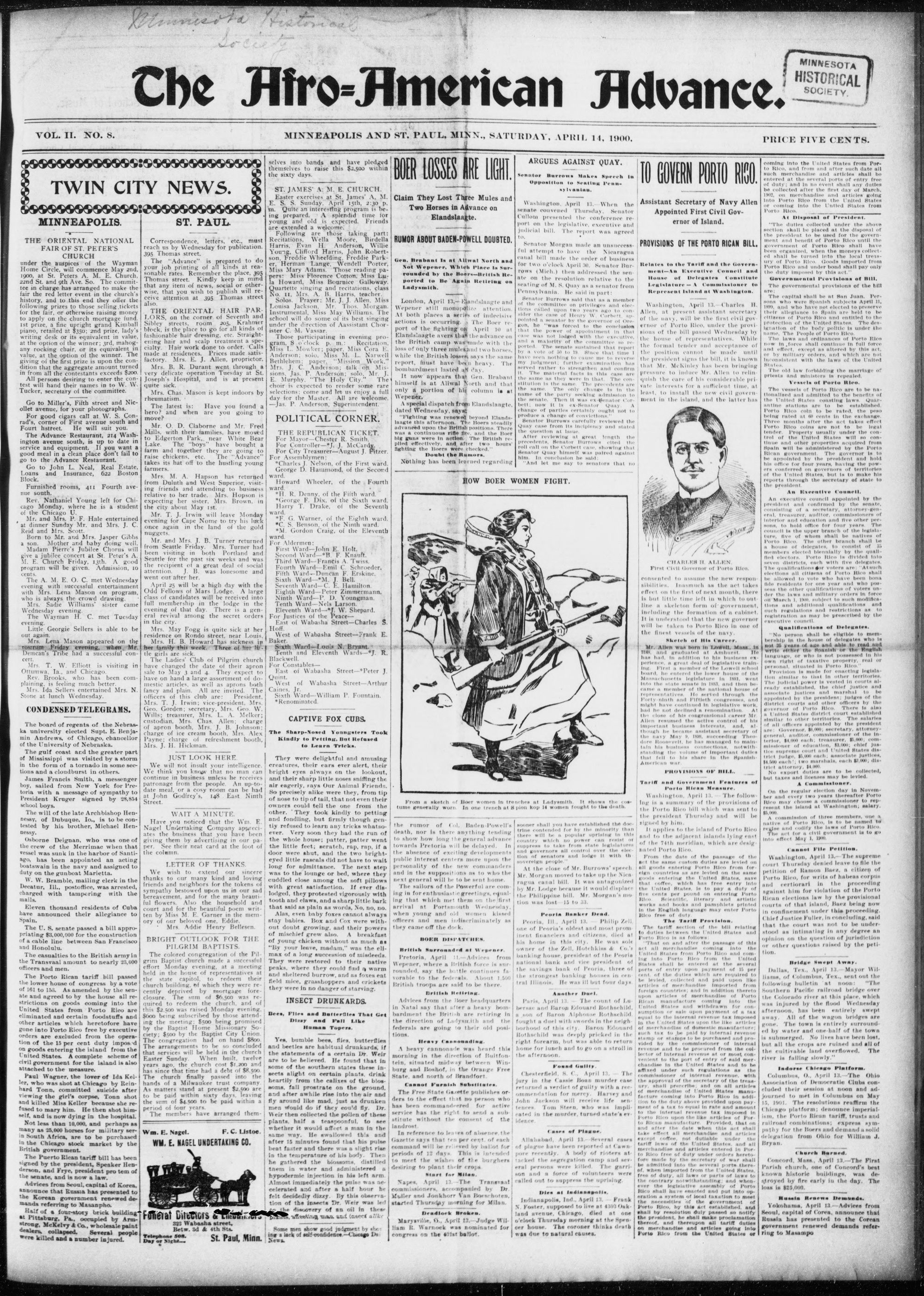
HOW BOER WOMEN FIGHT.
From a sketch of Boer women in trenches at Ladysmith. It shows the costume generally worn. In one trench at 5 pionk kop 14 women fought to the death.
BOER LOSSES ARE LIGHT
Claim They Lost Three Mules and Two Horses in Advance on Elandslaagte.
RUMOR ABOUT BADEN-POWELL DOUBTED
Gen. Brabant Is at Alliwal North and
Not Wepener, Which Place Is Surrounded by the Boers—British Reported to Be Again Retiring on Ladysmith.
London, April 13. Elandslangte and Wepener still monologue attention. At both places a series of indecisive actions is occurring. The Boer report of the fighting on April 10 at Elandslangte avers that the advance on the British camp was made with the loss of only three mules and two horses, while the British losses, says the same report, must have been heavy. The bombardment lasted all day. It now appears that Gen. Brabant himself is at Alliwal North and that only a portion of his column is at Wepener.
A special dispatch from Elandslangte, dated Wednesday, says
"Fighting was renewed beyond Elandala-
lagite this afternoon. The Boers steadily
advanced upon the British positions. There
was a continuous rifle fire, and the Boer
troops were moving in a British re-
plied effectively, and after two hours
lighting the Boers were checked."
Doubt the Remora.
Nothing has been learned regarding
HOW BOER W
From a sketch of Boer women in tre
tume generally worn. In one trench at S
the rumor of Col. Baden-Powell's death, nor is there anything tending to show how long the general advance towards Pretoria will be delayed. In the absence of exciting developments public interest centers more upon the personality of the new commanders and in the suppositions as to who the next general will be to be sent home. The sailors of the Powerful are coming in for enthusiastic greetings, equaling that which met them on the first arrival at Portsmouth Wednesday, when young and old women kissed officers and men indiscriminately as they came off the dock.
BOER DISPATCHES
British Surrounded at Wepener.
Pretoria, April 11—Advice from
Wepener, where a British force is
surrounded, say the battle continues
favorable to the federalists. About 1500
British troops are said to be there.
British Hertiring.
Advices from the loeer headquarters in Natal say that after a heavy bombardment the British are retiring in the direction of Ladysmith and the federales are going to their old positions.
Heavy Cannonading.
A heavy cannonade was heard this morning in the direction of Bultofftein, situated midway between Winburg and Boshof, in the Orange Free State, and north of Brandfort.
Cannot Furnish Substitutes.
The Free State Gazette publishes orders to the effect that no person who has been commanded for active service has the right to send a substitute without the consent of the landrost.
In reference to leaves of absence, the Gazette says that ten per cent of each command will be relieved by bailout for periods of 12 days. This is intended to meet the wishes of the burghers desiring to plant their crops.
Start for Milan.
Napes, April 12- The Transvaal commissioners, accompanied by Dr Muller and Jonkhorn Vans Roeschoten started Thursday morning for Milan.
Deadlock Broken.
Marysville, O., April 13.—Judge William R. Warnock was nominated for congress on the 401st ballot.
ARGUES AGAINST QUAY.
Senator Burrows Makes Speech In Opposition to Seating Pennsylvanian.
Washington, April 13.—When the senate convened Thursday, Senator Cullom presented the conference report on the legislative, executive and judicial bill. The report was agreed to.
Senator Morgan made an unsuccessful attempt to have the Nieagara canal bill made the order of business for two o'clock April 30. Senator Burrows (Mich.) then addressed the senate on the resolution relative to the seating of M. S. Quay as a senator from Pennsylvania. He said in part:
Senator Burrows said that as a member of the committee on privileges and elections called upon two years ago to consider a petition to elect a senator a politician a senator by the governor of Oregon, he "was forced to the conclusion that the power of appointment in that jurisdiction and a majority of the committee are ported. The senate sustained that report by a vote of 50 to 19. Since that time I have never nothing to cause me to reverse my judgment in the case served rather than strengthen and confirm it. The material facts in this case are the same as they were in that. The committee on privileges and elections are the same. The only change is in the name of the party seeking admission to the senate. Then it was ex-Senator Corrigan who ex-Senator Quay. A change of parties was not to produce a change of convictions."
Senator Burrows carefully reviewed the Quay case from its inclpency and stated the question at issue.
After reviewing at great length the precedents, Senator Burrows cited the roll call on the Corbett case, showing that Senator Quay himself was paired against him. In conclusion he said:
"And let me say to senators that no
enches at Ladysmith. It shows the cos-
pion kop 14 women fought to the death.
sooner shall you have established the doctrine contended for by the minority than there will be a popular uprising in the minority to suppress to take from state legislatures and governors all control over the election of senators and lodge it with the sovereign people. Of Mr. Burrows' speech, Mr. Morgan moved to take up the Nicaa ruga canal bill. It was antagonized by Mr. Lodge because it would displace the Philippine bill. Mr. Morgan's motion was lost-15 to 33.
Peoria Banker Dead
Peoria, Ill., April 13. — Philip Zell one of Peoria's oldest and most prominent financiers and citizens, died at his home in this city. He was sold owner of the Zell, Hotkissk & Co.'s banking house, president of the Peoria national bank and vice president of the savings bank of Peoria, three of the strongest banking houses in central Illinois. He was ill but four days.
Another Duel.
Paris, April 13. — The count of Laurerae and Baron Edouard Rothschild a son of Baron Alphonse Rothschild fought a duel with swords in the neighborhood of this city. Baron Edouard Rothschild was deeply pricked in the right forearm, but was able to return home for lunch and to go on a stroll in the afternoon.
Found Guilty.
Chesterfield, S. C., April 13. — The jury in the Cassie Bonn murder case returned a verdict of guilt with a recommendation for mercy. Harvey and John Jackson will receive life sentences. Tom Steen, who was implicated in the murder, turned state's evidence.
Cases of Plague
Alahabad, April 13. Several cases of plague have been reported at Cawai-pore recently. A body of rioters attacked the segregation camp and several persons were killed. The garrison and a force of volunteers were called out to suppress the uprising.
Rice at Indianapolis
Indianapolis, Ind., April 13. - Frank N. Foster, supposed to live at 4303 Oakland avenue, Chicago, died at one o'clock Thursday morning at the Spencer house. The coroner thinks death was due to natural causes.
TO GOVERN PORTO RICO
TO GOVERN PORTO RICO
Assistant Secretary of Navy Allen Appointed First Civil Governor of Island.
PROVISIONS OF THE PORTO BICAN BILL.
Relates to the Tariff and the Government—An Executive Council and House of Delegates Constitute Legislature — A Commissioner to Represent Island at Washington.
Washington, April 13.—Charles H. Allen, at present assistant secretary of the navy, will be the first civil governor of Porto Rico, under the provisions of the bill passed Wednesday by the house of representatives. While the formal tender and acceptance of the position cannot be made until the president signs the bill, it is known that Mr. McKinley has been bringing pressure to induce Mr. Allen to relinquish the care of his considerable private interests for a sufficient time, at least, to install the new civil government in the island, and the latter has
CHARLES H. ALLEN.
First Civil Governor of Porto Rico.
consented to assume the new responsibilities. Inasmuch as the act takes effect on the first of next month, there is but little time left in which to outline a skeleton form of government, including the formation of a cabinet. It is understood that the new governor will be taken to Porto Rico in one of the finest vessels of the navy.
Sketch of His Career.
Mr. Allen was born in Tawoll, Mass. in 1848, and graduated at Amburst. He has had, in addition to his business experience, a great deal of legislative training. First a member of the Lowell school board, he entered the lower house of the state legislature in 1857 and went into the state legislature in 1858 then came a member of the national house of representatives. He served through the Forty-ninth and Fiftieth congresses, and might have continued in legislative work, had he not declined a renomination. At the congressional care of Mr. Allen resumed his important business interests, and, although he became assistant secretary of the navy May 9, 1898, succeeding Theodore Roosevelt, he has managed to maintain his business connections, notwithstanding the volume of important duties he has shared in the Spanish-American war.
PROVISIONS OF BILL
Tariff and Government Features of Porto Rica Measure.
Washington, April 13. — The following is a summary of the provisions of the Porto Rico bill which was sent to the president Thursday and will be signed by him.
It applies to the island of Porto Rico and to the adjacent islands lying east of the 74th meridian, which are designated Porto Rico.
From the date of the passage of the act the same custom duties are levied on all goods entering Porto Rico from foreign countries as are levied on the same goods entering the United States, which has free entry into the United States, is to pay a duty of five cents per pound on entering Porto Rico. Scientific, literary and artistic works and books and pamphlets printed in the English language may enter Porto Rico.
The Tariff Provision.
The tariff section of the bill relating
duties between the United States and
Ecuador is
MINNESOTA
HISTORICAL
SOCIETY.
PRICE FIVE CENTS.
coming into the United States from Porto Rico, and from and after such date all such merchandise and articles shall be entered at the several ports of entry free from charge. Merchandise collected after the first day of March, 1922, on merchandise and articles going into Porto Rico from the United States or coming into the United States from
At Disposal of President.
"The duties collected under the above section shall be placed at the disposal of the president to be used for the government and benefit of Porto Rico until the death of I. Porto Rico shall have been organized, when the moneys collected shall be turned into the local treasury of Porto Rico. Goods imported from Porto Rico and under bond pay only the amount of I. Porto Rico shall have been organized."<sup>1</sup> Governmental Provisions of Bill.
The governmental provisions of the bill are:
The capital shall be at San Juan. Persons who were Spanish subjects April 11, 1800, and who have not elected to preserve the constitution of the United States, citizens of Porto Rico and entitled to the protection of the United States. The designation of the body politic is under the jurisdiction of the United States. The laws and ordinances of Porto Rico now in force shall continue in full force and effect, except as altered by this act, or by military orders, and which are not consistent with the laws of the United States.
The old law forbidding the marriage of priests and ministers is repealed.
Vessels of Porto Rico.
The vessels of Porto Rico are to be nationalized and admitted to the benefits of the United States consisting laws. Quarantine stations are to be established. Porto Rico coin to be rated, the peso of the coin is to be determined. Three months after the act takes effect Porto Rico coins are not to be legal tender. Property usually under the control of the United States will so continue and other properties acquired from the United States will be under the Rican government. The governor is to be appointed by the president and hold his office for four years, having the powers conferred on governors of territories of the United States, but is to make his office through the secretary of state to the president.
An Executive Council.
An executive council appointed by the president and confirmed by the senate, consisting of a secretary, attorney-general, treasurer, auditor, commissioners of interior and education and five other persecuted groups, the executive council is the upper branch of the legislature, five of whom shall be natives of Porto Rico. The other branch shall be a house of delegates, to consist of 35 members, and a board of five federal electors. Porto Rico is divided into seven districts, each with five delegates. The qualifications or voters are: "Atusch elections all citizens of Porto Rico shall be allowed to vote who have been bona fide voters." The other districts seas the other qualifications of voters under the laws and military orders in force on March 1, 1903, subject to such modifications and additional qualifications and such regulations and restrictions as to registration as may be prescribed by the
Qualifications of Delegates.
"No person shall be eligible to membership in the house of delegates who is not 35 years of age and able to read and write either the Spanish or the English language in his own right of taxative property, real or personal, situated in Porto Rico." Provision is made for enacting legislation similar to that in other territories. The judicial power is vested in courts already established, the district court and marshal to be appointed by the president; judges of the district courts and other officers by the governor of Porto Rico. There is also a United States district court established similar to other territories. The asylum officers are Governor, $,0,000, secretary, attorney-general, auditor, commissioner of the interior, $,0,000 each, treasurer, $,0,000, commissioner of education, $,0,000; chief justice supreme court and United States district judge, $,0,000 each, associate justices, $,4,50 each' holding each, $,0,000, district judge, $,4,000.
No export duties are to be collected, but taxes and licenses may be levied.
A Commisstoner.
On the regular election day in November and every two years thereafter Porto Rico may choose a commissioner to represent the island at Washington; salary, a commission of three members, one a native of Porto Rico, is to be named to regise and codify the laws of Porto Rico. The act for a government is to go. (U.S. Code, 1, 1900)
Cannot File Petition.
Washington, April 13.—The supreme court Thursday denied leave to file the petition of Kannon Baez, a citizen of Porto Rico, for writs of habeas corpus and certiorari in the proceeding against him for violation of the Porto Rican elections law by the provisional courts of that island. Baez being now in confinement under this proceeding, Chief Justice Fuller, in concluding, said that the court was not to be understood as intimating in any degree an opinion on the question of jurisdiction or other questions raised by the petition.
Bridge Swept Away
Dallas, Tex., April 13.—Mayer Williams, of Columbus, Tex., sent out the following bulletin 'at noon: "The Southern Pacific railroad bridge over the Colorado river at this place, which was injured by the flood Wednesday afternoon, has been entirely swept away. All of the wagon bridges are gone. The town is entirely surrounded by water and one-half of the town is submerged. No lives have been lost, but all the crops are ruined and all of the cultivable land overflowed. The river is falling slowly."
Indoor Chicago Platform
Columbus, O., April 13.—The Ohio Association of Democratic Clubs concluded their session at noon and adjourned to met in Columbus on May 15, 1901. The resolutions reaffirm the Chicago platform; denounce imperialism, the Porto Rican tariff, trusts and railroad combinations; express sympathy for the Boers and demand a solid delegation from Ohio for William J. Bryan.
Church Burned.
Concord, Mass, April 13.—The First Parish church, one of Concord's best known historic buildings, was destroyed by fire early in the day. The loss is $25,000.
Huasia Renewa Remaná
Yokohama, April 13.—Advices from Seoul, capital of Corea, announce that Russia has presented to the Corean government renewed demands referring to Masampo
Published every Saturday by the
ADVANCE PUBLISHING CORPANY
Tel. Main 2415-L-3.
Minneapolis, - - - - - - Minnesota
Entered at the Post Office, at Minneapolis, Minn., as second-class matter.
Subscription Rates:
One Year - - - - - $1.00
Six Months - - - - .60
Three Months - - - .35
Special rates if ordered by the dozen
Orders for current issue should reach the
dozen rate.
Advertising Rates.
Local Reading Notices, 10c per line,
each insertion.
Religious Notices (not over five lines),
free.
"Want" and "To Let" advertisements,
8 cents per line for each insertion.
Display, 40 cents per inch each insertion.
Special rates will be given for space by
Editorial Announcements.
To secure the return of unsolicited manuscript postage should be enclosed by Wednesday morning, preceding the issue in which they are to appear. Send the manuscript to the news matter for publication, must bear the writer's name, not for publication, but as an evidence of good faith. If an evidence of news concerning the progress of the colored race are requested from our readers, we will send any communication unsuitable for publication. Subscribers ordering addresses of their paper changed are requested to give their address to the AFRO-AMERICAN CENTER for THE AFRO-AMERICAN CENTER 214 Washington Ave., South, Minneapolis, Minn.
MRS. J. B. KOGER, City Collector.
EDITORIAL.
We received at our office this week the Detroit Republican, a new negro journal. Judging from the editorials, the newspaper. We congratulate the management.
Enumerators in this district, as in every other district in the United States will collect among the many other things, statistics concerning the ownership and tenancy of homes. This will doubtless be one of the most interesting results of the census. The colored people, as a Minneapolis colored man remarked yesterday when he learned that provision was made in the enumerator's schedules for these figures will be especially interested in it. For the past five years, he said, many reports had been sent out about the wonderful progress of the colored race in the South, and the facts bearing on the ownership of homes would be a very interesting one. Mr. Cairns says that the county has a home is, and every hut, humble cabin or time-dense that is an abiding place of a family will be counted and a record entered by the enumerator. It will be gratifying if the tabulated report finally shows that there are any considerable number of colored people occupying their own homes.
EDITOR COOPER
The following leading negroes honored Editor E. E. Cooper, of the Colored American, Washington, D. C., at a recent banquet at the Capitol City: After the substantial menu the speaking began, toasts being responded to as follows: "Our Government," Hon. Judson W. Lyons; "The Negro as a Factor in Politics," "Education as a Leaver," Prof. R. H. Terrell; "The Negro as a Citizen," Hon. John P. Green; "Young Men the Hope of the Race," W. L. Pollard; "Leadership," Dr. C. C. Stewart; "Our Party," Recorder H. P. Cheatham; "Our Future," J. W. Patterson; "Our Guest, Wm. Murrell; "Our Schools," Prof. N. E. Weatherless; "Territorial Expansion," Prof. A. S. Richardson; "Our Medical Prolression," Dr. C. W. Childs. At 9 o'clock Samuel G. Thompson, Esq., chairman of the committee, assisted by Col. Wm. Murrell, requested the invited guests, who were detained in the annex to the banquet hall, to assemble in the banquet hall.
The guests of honor. Hon. Judson W Lyons, Hon. John P. Green, Recorder H. P. Cheatham, Dr. C. W. Childs Prof. Robert H. Terrell, followed by Mr. W. Calvin Chase, on the arm of Col. Murrell, and were seated at the head of the table which was arranged "T" shape.
L E HAWKINS
The supreme court has reversed Judge Jacebos, of the superior court, in the case of the state against Will Young, colored, who was convicted several months ago of assault with intent to commit murder, and sentenced to six years in the penitentiary. Young and another colored man had quarreled in a Tenderloin restaurant and wielded a razor. He all but cut out one of his antagonist's eyes. When the case was tried Attorney J. E. Hawkins, who defended Young, asked the court to instruct the jury that under the information Young could be convicted of assault with a deadly weapon. The court refused to give instruction, holding that the lesser offense was in the greater. Mr. Hawkins carried the case to the supreme court. A decision was handed down Wednesday reversing the lower court. Young will be held in the county jail pending a new trial. Seattle Post-Intelligencer
Mr. Stewart, when on a recent trip to Seattle, visited Mr. Hawkins. He says he enjoys a most flourishing practice. He has only been in actual practice for five years and besides having practiced in all the court of the state of Washington, has had several occasions to appear in the United States circuit court.
A dispatch from Elandslaagte says Fighting was renewed beyond Elandslaagte this afternoon (the 11th). The Boers steadily advanced upon the British positions. There was a continuous rifle fire and the Boer big guns were in action. The British replied effectively and after two hours' fighting the Boers were checked.
Mr. Burrows (Mich.) in the U. S. senate spoke in opposition to the seating of M. S. Quay, on the ground that to allow him to be seated under all the circumstances would be exceedingly dangerous as a precedent.
MOQUI SNAKE DANCE.
Grewzome Incantations of the Indians us to Placate the Scrent Dely.
Arizona is a region so vast, so overwhelming in its beauty and majesty that it seems to have been created for a Cyclopean race. It is a land of perpetual sunlight, of sapphire skies, of awful chasms, of painted rocks, mesas and buttes. Crowning one of these lofty butts, 70 miles to the north of Winslow Station, the fair white castles of the Moqui Indians stand. The Moquis are peaceable and pictureuses in their native costume. They are types of the always interesting Pueblo life. With them alone survive the weird and fantastic spectacle of the snake dance, once common to all the Pueblo tribes.
The serpent is singularly prominent in all human history. From the garden by the Euphrates to the deserts of New Mexico it stretches its slimy trail. The Aztecs sculptured the snake upon its ornamental stones, and the North American Indians indent their pottery with an imitation of its scales. The serpent is especially symbolic to the Indians, and in their quiet folklore it occupies about the same relation to other animals as does Brer Rabbit or Uncle Remus. In fact, the Pueblos call the rattlesnake "Little Brother." Mystic magical powers are ascribed to it, and the dance is a religious ceremony to propitiate the snake god.
The bite of the rattlesnake is supposed to be deadly and is universally feared, save by the Moquis at these dances, when they handle the reptiles with the most reckless familiarity and without the slightest evil results.
In vain have the authorities at Washington sent scientific men to discover the secret of this wonderful antidote of the Moquia. The revelation of the secret of this decoction, which appears to be a veritable neutralizer of the venom of a rattlesnake bite, is punishable by death. It is known only to three individuals of the tribe—the chief priest, the neophyte who is training to succeed him and the eldest woman.
Every year for several days before this grewsome ceremony those who intend to participate subject themselves to a strict fast, which is not broken until the conclusion of the rites. During this period the secret antidote is freely administered by the medicine man.
Meanwhile the dancers ate busily engaged in hunting and capturing hundreds of rattlesnakes on the desert below the cliffs. The way these reptiles are caught is most extraordinary.
The hunters are armed with wisps on Discovering a "little brother", coiled, angry, hissing, ready to strike they reduce him to quiescence by gently stroking him with these wisps. When these caresses have mollified the enraged reptiles they are dexterously thrust into a leather bag and imprisoned in a small corral, where they are kept to the day of the dance. The ceremonies last seven days. For the first three the dancers, famished and faint from their continual fasts, work themselves into an absolute frenzy of religious fervor. Their chantings and the doleful muscle of their barbarian instruments add to the mysticism and terror of the performance.
But the awful climax comes on the morning of the fourth day, when, rigid and well-nigh cataleptic, hargard staring, frothing at the mouth, the half-naked braves, with sinister and awful cries, rush into the mass of squirming, wriggling serpents, and selzing a fat, writhing body in each hand, leap forth and renew their dance.
Round and round in this demoniacal dance they circle, colling the snakes about their arms, their necks, their thighs. The serpents swing to and fro, twisting and curling in frantic endeavor to strike their captors with their wicked fangs.
Droning through this grisly spectacle goes the monotonous and m: dening tum-tum-tum of the strange, unearthly music, only accentuating and emphasizing the hideousness of the ceremony.
At last arrives the frightful finale. The serpents are cast upon the floor of the rocky cliff, where they coil and writhe and struggle to escape. Suddenly the bravest of the braves darts forward, and, bending down quickly catches a loathsome wriggling mass in his mouth. This is the signal for the others. The drums beat a pandemonium of herdish sounds, and with the yells of devils from the infernal regions on a furlough each dancer catches a serpent in his mouth and staggers to and fro, sickening and overwhelming the paleface lookers on
After the end of this spectacle is reached the snakes are carried down the cliff and set free to glide to their homes in the sandy desert, while the Indians, who have repeatedly been bitten during the performance, return to their homes, apparently none the worse for the marks of affection they have received from their "little brothers" of the plains, and confident that the great serpent delity is placated and that for the coming year the rain will descend and the sun will shine and the corn will grow.—N. Y. Herald
Good Gunery.
Some extraordinary shooting by the British gunners is recorded. The conditions of firing were that each gun's crew should score what it could in three minutes, beginning at 2,200 yards, diminishing to 1,000 yards and then increasing to 2,200 yards again. It is asserted that the Blakefire 148 shots from ten guns, hitting the target 110 times. The best crew fired 18 shots and made 15 hits. The Royal Arthur's best gun crew hit the target 14 times out of 18 shots.—N. Y. Sun.
Ancient Mines of Sinai
History furnishes records of the working of the copper mines of Sinai from about 5000 B. C. to 1200 B. C. These possessions brought on several bloody wars. The seperer of Pepl II of the sixth dynasty is preserved in the British museum. The entrance, the ruins of the furnace, the crucibles, the hats of the miners and some fragments of tools still exist. In the debris have been found remains of furnaces and crucibles, slag and cinders.—N. Y Sua.
LONG-DISTANCE MOVING.
A Common Thing to Move Household Goods a Hundred or a Thousand Miles, or More.
Every year there is in the United States more and more long distance moving of household effects, from one city or one part of the country to another. Such moving has increased tenfold in the past half a dozen years. There isn't a day in the year when the larger storage and van companies here in New York would not have one or two shipments of this sort of household goods coming in from, or going to, places 50 or 100 or 1,000 or more miles distant. Of course there has always been more or less of such moving. Some of the increase in it is due to the increase in population; but much the greater part of it is due to modern multiplied means of easy communication and to the systematizing of modern moving methods. So far as the actual moving is concerned, that need not be any annoyance to the mover in these modern times. If he does not want to bother about it himself he has only to put the key of his house into the hands of a concern that does this sort of business, and it will literally do the rest, down to and including the taking up of the carpets, attending to absolutely everything, and packing and shipping these goods and delivering them in Kamschatka or anywhere else in the Kamschatka, putting them into his house there if he so desires, without calling for any exertion whatever on the part of the owner except to pay the bill.
Various reasons lead people to this sort of moving, business reasons being the most common. A man may have business interests that will take him from here to Chicago for a year or ten years, or permanently. There are a dozen or twenty or more passenger trains daily between here and Chicago, and as far as distance is concerned the thousand miles is to the traveler practically nothing; it is a day's journey. The same idea holds with regard to the movement of goods.—N. Y. Sun.
Made Him Homesick
A tramp went along a dusty road and sat down on the steps of a house in a quiet village street. Through the windows the voices of a man and a woman in violent altercation were heard, and the tramp listened intently.
Angry words, and occasionally the sound of something thrown, reached his ears, and he could hardly sit still.
At last, evidently, the wife had taken a broom, and the blows fell fast and furious.
The tramp could stand it no longer, but, rushing to the side door, he darted in and, stepping between the pair, he cried, with a husky voice:
"Give us a clip or two with the broom, old woman; it seems just like old times!"—Collier's Weekly.
Havana's Public Conveyances.
The "buses" of Havana are odd-looking wagonettes, painted most in incongruously, some of them showing admixtures of green, blue, white, brown and yellow, with now and then a striping of red. The Cubans seem partial to a pea-green and bright blue, often associating these colors and yellow. There are buses which accommodate but four passengers, and others carrying six, eight and 12. The smaller ones are drawn by a single mule, the larger by two or three ponies, some of them by four, depending upon the routes and distances.—Chicago Record.
PATRONIZE . . .
W.I. JENKINS,
ROOMS FOR RENT
FIRST CLASS.
We Guarantee Superb Service. Prices moderate. Tel. 2737-L-3 Main.
No. 9 Second St. No. Minneapolis.
J. GARNER. W. H. WELLER.
The Elite Buffet
3030 STATE ST.,
FINE WINES,
LIQUORS
AND CIGARS. Chicago.
Cutting, Fitting and Making Over a Specialty. New York and Paris Fashions Always on Hand.
Pallars, 628 Fourteenth A. South.
DR. R. S. BROWN.
Physician and Surgeon.
Office: 405-6 Reeve Bldg., 408 Nicellet Av.
Telephone 2734-J-5.
Office Hours: 9:30 to 12:30; 2:00 to 4:00
p. m.; 5:30 to 7:00 p. m. Sundays: 9:30 to
11:00; 12:30 to 2:00.
Residence: 2839 Portland Ave.
Telephone 317-L-South.
MR. L. A. JOHNSON.
The gentlemanly and obliquing Porter
at R. De Leo's Barber Shop, 200 Washington Av. South, is
Always Ready to Dress Your Shoes
in a thoroughly artistic manner, that
is sure to win.
JAMES L. CURTIS
LAWYER
603 Northwestern Bldg., Minneapolis.
Cor. 4th St. and Hennepin Av.
Telephone, Main 2400-L-1.
DROPSY
Treated free.
Positively CURBED with Vegetal
Rheumatics. Have
needed hygeine. From four-time prognosis rapidly displease.
and in six days at least two thirds of all symptoms are FREE.
BOOK of treatment of minneapolis cases FREE.
TEN DAYS TREATMENT FURNISHED BY free mail
to 212-722-2222, Minneapolis, Atlantic, Ga.
$20 A hundred for your neighborhood' addresses.
For your convenience, please send sample copy.
ROMANCE MAGAZINE. NEW YORK
DROPSY NEW DISCOVERY. gives
quick relief and answers every
case. Read for book of testimonials and 10 days'
treatment Free. By R. H. GREEN'S BOX, altona, la
GET RICH QUICKLY. Read for Both. "Convenience Wanted.".
BROOK TAY & CO., 265 Broadway, New York,
THE ADVANCE CAFE 214 WASHINGTON AV. SOUTH. Restaurant and Lunch Counter
MANN & KOGER, Proprietors.
Officers and Standing Committees of the Most Worshipful Grand Lodge A. F. and A. G. of Minnesota and jurisdiction:
Grand Master-John L. Neal, Minneapolis
Apprentice Grand Master—Wade H. Hampton, West Warden-H. B. Howard, Grand Senior Warden-H. B. Howard, St. Paul, Paul
and Junior Warden-J. C. Garner, St. Paul
Grand Treasurer-Daniel Roy, St. Paul.
Grand Secretary-William R. Morris,
Minneapolis.
Grand Lecturer-G. W. Day (7), Minneapolis.
Deputy Grand Secretary-O. D. Howard (4), St. Paul
Grand Chaplain-Isaac Crawford (6), Minneapolis.
Grand Senior Deacon-John Martin (1), St. Paul.
Grand Junior Deacon-R. De Leo (7), Minneapolis.
Grand Senior Steward-J. H. Dillingham (2), St. Paul.
Grand Junior Steward-Wm. Stevens (3), St. Paul.
Grand Tyler-T. Bush (3), St. Paul.
Grand Marshall-H. H. McDonald (6), Duluth.
Grand Pursuitant-G. W. Duckett (4), St. Paul.
Grand Sword-Bearer-J. Adams (1), St. Paul.
Grand Standard-Bearer-G. J. Charleste (2), St. Paul.
Grand Register-G. G. Sterett (6), Minneapolis.
Deputy Grand Master-First District-Jane Woodfork (1), St. Paul.
District Deputy Grand Master-Second District-E. H. Hamilton (6), Minneapolis.
District-J. K. Fulk-Duluth.
St. Anthony Lodge, No. 2877.
Meets the first and third Wednesday in
business the transaction of business
last avenue. M. MYRICK
JAMES A. SCOTT No. 23
KNIGHTS OF PYTHIAS
Nat. Turner Lodge, No. 2, K. of P.
Meets the second and fourth Thurdays
in each month. Brothers in good standing
with the fourth and eighth avenue south.
RALPH WATSON, K. R. and K.
Pride of Minnesota, Lodge No. 1, K.
Meets first Tuesday in each month at
Windom Block, Second avenue South and
Windom Block, Second avenue West, go stargazing
always welcome. W. LILLIARD,
JASPER GIBBS, Sec. G, Guaranty, Loan
Restaurant.
Author Lodge, No. 7, A. F. and A. M.
Meets first and second Monday in each
month at Windom Block, Second avenue
South and Washington. Masons in
Windom Block, Second avenue South.
J. A. SCOTT, W. M.
A. B. LEE, 7701 Aldrich avenue South.
Meets second and fourth Wednesdays in
second and fourth Odd Fellows Hall, 55
Wabash Avenue, Chicago.
T. R. HICKMANN, P. S., 422 St. Anthony.
thony
D. PARKER N. G., 356 Edmund St.
Household of Ruth, 0th, 553, G. U. O.
of G. F.
Meets first and third Monday in each month for business, second Monday for business, at Odd Fellows Hall, 225 Wabasha.
MHS, SARAH C, KIRLT, M.N.G.
MHS, AJACKSON, W, R, 374
mitple place.
MOST WORSHIPFUL GRAND LODGE OF MINESOTA, A. F. and A. M.
J. L. NEAL, Grand Master.
J. L. NEAL, Grand Master.
M. GUARANTY Loan Bldg., Minneapolis.
ST. PETER CLAYER'S SODALITY.
Meets the first and third Mondays of each month.
Gardner, Pres., J. S. Harbord,
A. D. Harris.
Pioneer Lodge, No. 1, A. F. and A. M.
Meets the first Monday in each month at Mason's southwest corner Fifth and Mason's Masons in good standing always welcome.
H. HADLEY, W. M.
W. A. HILLIER, Sec. 12 Atwater.
Minnesota Lodge, No. 2, A. F. and A. M.
Meets on the first and third Tuesday in each month at Masonic Hall, southwest Mason's Fifth and Mason's Masons in good standing always welcome.
H. R. HOWARD, W. M.
J. S. STRONG, Sec. 12th and Robert at WM. STEVENS, No. 3, A. F. & A. M.
Meets second and fourth Monday in each month at Masonic Hall, southwest corner Mason's Fifth and Mason's Masons in good standing always welcome.
WM. JOHNSON, W. M.
D. E. BEASLEY, Sec. Ryan Hotel.
Perfect Ashler Lodge, No. 4, A. F.
Meets the second and fourth Tuesday in each month at Masonic Hall, southwest corner Fifth and Robert street. Master Welcome. Welcome. Welcome. B. K. DURANT, W. K.
J. H. SHERWOOD, Sec., 461 Carroll.
Bethel Chapter, No. 28, R. A. M.
Meets the first and third Thursday in each month of Fifth and Robert streets in Arch Arms Mosque in good standing always welcome.
DANIEL ROY, H. P.
W. T. GASSAWAY, Sec. Capital Capitol
CHURCH DIRECTORY.
ST. PETER A. M. E. CHURCH,
Rev. W. S. Brooks, Pastor.
Cor. 22d St. 9th ave. South
Sunday school. 12:30 a.m.
m.; Sunday school. 3:00 a.m.
evening services. 8:00 p.m. General prayer meeting.
Thursday evening. 8:00 p.m. Way-
ward residence. 8:00 p.m. different
residences. Parsonage. 220
Ninth street South.
BETHESDA BAPTIST CHURCH,
Bethlehem and Twelve Mile
Sunday service. Praying. 11:00 a.m.
m.; Sunday School. 12:30 p.m. m.; Christian
daycare. 8:00 p.m. Wednesday service.
8:00 p.m. Wednesday service.
prayer meeting. 8:00 p.m. Parsonage.
1120 Eighth street South.
ST. THOMAS MISSION,
Rev. J. W. King, in Charge.
615 Sixth avenue South.
Sunday service. 4:00 p.m.; Sunday
School. 8:00 p.m. M. E. CHURCH.
Rev. J. W. King, Pastor.
Between First avenue and Second street
Southeast. near Exposition Hide.
8:00 p.m.; Sunday School. 3:00 p.m. evening
services. 8:00 p.m. General prayer meet-
ing. Weekly meetings of the Debating Club.
ST. JAMES A. M. E. CHURCH.
Rev. C. Anderson, Pastor.
Sunday services; 11:30 a. m.; 7:30 p. m.
Wednesday meeting; 10:30 a. m.
ST. PETER CLAYERS'.
Cor. Farrington and Aurora avenues.
Sunday services; Mass; 8:00 a. m. High
m. a. m. Evening service at 1 o'clock
Sunday services: Preaching at 11:30 a.m.
m. and 7:45 p. m. Sunday School at 12:30
o'clock. Wednesday evening general
prayer meeting.
ST. PHILLIPS' EPISCOPAL MISSION.
63 Rice street, bet. Aurora and Univer-
sity.
Sunday services: Morning prayer, Lit-
MINNEAPOLIS
G. U. O. O. Q. F.
ST. PAUL.
ODD FELLOWS.
ST. PAUL.
any and Sermon, 11:00 a. m.; M. Sunday School and Children's Vespers 3:00 p. m.; E. Sunday Evening Fryer and Lecture, 8:00 p. m.; F. Friday, Choir Rehearsal and Brotherhood of St. Andrew, 8:00 p. m. All are cordially invited. Seats free.
NOTICE.—Changes and corrections will be made upon notifying the office. If we have neglected to place a notice of any society in the above directory it is be made upon notifying the office of any seen its officers. Send name of any Lodge, place and time of meeting, name of officers and it will be inserted.
OLSON EARL,
..UNDERTAKER..
Funeral Director and Embalmer.
Open Day and Night. Satisfaction Guaranteed.
1503 S. Franklin Ave. - Minneapolis.
PATRONIZE THE BEST!
The Fuller Laundry Co.
Free Delivery to All Parts of the City and Lake Minnetonka.
Our Motto: First-class Work and Moderate
Prices.
Crayon, Pastel and Water Colors a Speciality.
251-253 Cedar Avenue,
MINNEAPOLIS, MINNESOTA.
SEEDS OF FLOWERS Plants and Cut
soap Flower Telegraph on telegraph or mail
orders any time, day or night. Budding or
House Plants in their season. Cut Flowers,
fresh and fragrant. Seeds that are good and
marketed in a special pocket. Our catalogue is
FREE, send for it.
MENDENHALL, FLORIST,
414 Nicollet Av., Minneapolis, Minn.
KLAFFKE'S
WHITE SEAL
FLOUR.
119 Central Ave., Minneapolis.
TEL. 2701-J-3. NEXT TO YERKA'S.
WONDERFUL
DISCOVERY
Curly Hair Made Straight By
```markdown
```
This wonderful hair pomade is the only safe preparation in the world that makes kinky hair prevent the hair from falling out and makes it look straight. It is warranted harmless. Testimonials free on request straightening kinky hair. Beware of imitations of Omnipresentized OX Marrow, as the genuine hair fails to maintain its beauty and beautiful. A toilet necessity for ladies and men. A toilet necessity for vanage of this wonderful pomade is that by its superior and lasting quality it can be produced to its superior and lasting quality it can to produce a preparation equal to it. Full directions for use and instructions for use. Dressers or send us $1.40 Postal or Express Mail. Write your name and address plainly to
OZONIZED OX MARROW CO.,
76 Wabash Ave., Chicago, Ill.
Magic Seeds
A wonderful Nerve
Remedy, that
has no superior and
is unarrueable to
coussous diseases
as Nervous Prostration,
Weak Memory,
Lack of Confidence,
Nervousness, Headache,
Nervousness, Lost
Manhood, and all
drains and loss of
A wonderful Nerve Remedy, that has no superior and is guaranteed to cure all such nervous diseases as Nervous Prostasis, Weak Memory, Lack of Confidence, Wakefulness, Headache, Nervousness, Lost Manhood, and all drains and loss of power in generative organs of either sex, caused by Overexertion, Youthful Error, Excessive use of Tobacco, Opium, or Stimulants, which lead to Infirmity, Consumption, and Insanity.
Magic Seeds restore the nerve and vigor of youth. Easily carried in the vest pocket. Sent prepaid in plain box by mail to any address, for $1,000 six boxes for $1,000 with a written guarantee to cure or money refunded. Write for free circular.
MAGIC MEDICINE CO.,
MANSFIELD, OHIO.
VICTORINE
THE WONDERFUL NEW
WASHING COMPOUND
VICTORINE
TRADE MARK
RECISTERED.
THE GREATEST BLESSING TO
WOMANKIND
NO BOILING, NO RUBBING
OF CLOTHES REQUIRED.
PREVENTS SHRINKAGE OF WOOLENS.
Sc. a Package—Two Week's Washing.
BARBEAU & CALLAHAN,
BOLE MANUFACTURERS, CHICAGO U. S. A.
AGENTS WANTED WHERE NOT REPRESENTED.
Piano, Organ, Violin, Elocution, Vocal, Chorus Singing, Theory.
SPEND A PLEASANT EVENING AT THE
NORTH STAR SOCIAL CLUB
BILLIARD AND POOL TABLES.
Rooms, Second Floor, 202 Hennelin Avenue.
DR. THOS. S. COOK.
OFFICE HOURS:
10 TO 12 A. M.; 2 TO 4 F. M.; 7 TO 8 F. M.
TELEPHONE 386.
12TH AND ROBERT STS.
Office Telephone 1498-4.
VAL DO TU
PHYSICIAN A
Office Hours: 8 to 10 a. m.; 12 to 2 p. m.; 4
Office, 27 E. 7th St. Kendrick Blk. Res.
25 YEARS' EXPERIENCE.
JAS. AM
Practical Undertak
123 Washington Ave.
All our goods are first-class, and the
SMOKE THE SIGHT
W. S. CONRA
400 FIRST A
COX & HARRIS,
J. E. STEWART, SECY.
Twin City Club and
FURNISH
With the Most M
BARBER SHOP A
Where Meals are
BART STS., ST. PAUL, OVER DRUG STORE.
Residence Telephone Dale 410-5.
DO TURNER, M. D.,
PHYSICIAN AND SURGEON.
12 to 2 p.m.; 4 to 6 p.m.
Rick Blk. Res. 533 Shorburn Ave. ST. PAUL, MINN.
EXIENCE.
TELEPHONE 755.
S. AMOR & CO.
Undertakers and Embalmers.
Washington Ave. South, Minneapolis, Minn.
class, and the prices we guarantee will defy competition.
INSIGHT DRAFT 5-CENT CIGAR.
ZONRAD, Distributor,
100 FIRST AVENUE SOUTH.
AGENTS.
12TH AND ROBERT STS., ST. PAUL, OVER DRUG STORE.
VAL DO TURNER, M. D.,
PHYSICIAN AND SURGEON.
Office Hours: 8 to 10 a. m.; 12 to 2 p. m.; 4 to 6 p. m.
Office: 27 E. 7th St. Kendrick Bik. Res. 333 Sborburn Ave.
ST. PAUL, MINN.
25 YEARS' EXPERIENCE. TELEPHONE 755. JAS. AMOR & CO., Practical Undertakers and Embalmers. 123 Washington Ave. South, Minneapolis, Minn. All our goods are first-class, and the prices we guarantee will defy competition. SMOKE THE SIGHT DRAFT 5-CENT CIGAR.
club and Employment Bureau
URNISHED ROOMS
The Most Modern Conveniences.
SHOP AND RESTAURANT
Meals are Served at All Hours.
Twin City Club and Employment Bureau
Smoke "SUN
"BUCKIN
AND "PRIM
CHEW "PEACH A
STRICTLY UNION
MANUFACTURED BY J. J. B
PIPE FREE FOR "S
SUN CURED" Cut Plug,
BUCKINGHAM" Cut Plug,
PRIME MESS" Granu-
lated.
ACH AND HONEY" FINE CUT
TLY UNION LABEL TOBACCOS.
BY J. J. BAGLEY & CO., DETROIT, MICH.
E FOR "SUN CURED" LABELS.
CHEW "PEACH AND HONEY" FINE CUT STRICTLY UNION LABEL TOBACCOS. MANUFACTURED BY J. J. BAGLEY & CO., DETROIT, MICH. PIPE FREE FOR "SUN CURED" LABELS.
FOX $2.00 RAZOR is the best that experience and skill can pro-
FREE TRIAL AT YOUR HOME. For 250 we will send a Fox
your Express Agent, with instructions to allow you to take it home
or, if you send full amount with your order, we send Razor prepaid,
being satisfaction or money back, and a FOX STYPTIC PEN-
EE. State whether wide or narrow blade, square or round point.
Razor honed, stopped and set ready for use.
Fox CUTLERY Co., Mrs., 48 Center St., New York City.
for the West: 928 Main St., Dubuque, Iowa.
"The Fox Cutlery is perfectly reliable," Editor."
max Display Table
ING GOODS TO BEST ADVANTAGE
wickly obtained by turning a thumbscrew. Will pay for
thirty days. Valuable addition to any store. Nearly
The FOX $2.00 RAZOR is the best that experience and skill can provide. FREE TRIAL AT YOUR HOME. For 25c we will send a Fox Razor to your Express Agent, with instructions to allow you to take it to try. Or, if you send full amount with your order, we send Razor prepal, guaranteeing satisfaction or money back, and a FOX STYPTIC PEN-CIL FREE. State whether wide or narrow blade, square or round blade. Every Razor honed, stopped and set ready for use.
FOX CUTLERY CO. Mfrs, 48 Center St., New York City.
Address for the West: 925 Main St., Dubuque, Iowa.
The Climax FOR DISPLAYING GOOD Any desired angle is quickly obtained
The Climax Display Table
and well finished.
for circular and price list.
AGENTS WANTED.
IMAX TAG CO., Dayton, Ohio.
Manufactured by CLIMAX TAG C
Artistic Monuments
Cost No More than Plain Ones in
White Bronze
Marble is entirely cut of
date, granite soon gets
mosgrown, discolored,
requires constant ex-
pense and care, and
eventually crumbles back
to Mother Earth. Besides
it is very expensive.
White Bronze is strictly everlasting. It cannot crumble with the action of frost. Mosgrowth is an impossible. It is more artifician than any stone. Then why not investigate it? It has been adopted by hundreds public monuments, and by thousands of delighted customers in all parts of the country. It has been on the market over twenty years and is an established success. We have designs from $4.00 to $4,000.00. Write at even for free designs and information. It will not under no obligations. We deal direct and deliver everywhere.
The Monumental Bronze Co., 360 Howard Avenue, Bridgeport, Conn.
---
126 Hennepin Ave.
Miller
ST. PAUL, 171-173 E. 7th St.
Opposite Olympic.
THE FOX RAZOR
FOR
FREE
The Fox $2.25
duce. FREE TIP
Razor to your
to try. Or, if you
guarantee anti
CIL FREE. Stai
Every Fox hone
Address for the W
X
THE STATUE OF THE
QUEEN OF WALES
N. JOSEPH LLGYD, Sec'y.
```markdown
```
DR. J. E. PORTER.
OFFICE HOURS:
9 TO 10 A. M.; 1 TO 9 P. M.; 6 TO 7 P. M.
AND NIGHTS.
HENRY MOSLEY, PRES
Minneapolis, Minn.
PHOTOGRAPHER
Finest Work. Prices Right.
MINNEAPOLIS, 427-429 Nicollet Ave.
Over Yerxa's.
T
Dear Lord
AN EASTERN TALE.
A monarch died and left his heir
A thousand camel-loads of scroils.
A hundred Brahmins had their care-
Grave, learned men, with patient souls.
Philosophers the books had writ
Who every realm of thought surveyed,
And all the men who had writ
Was here assembled and displayed.
The new-made king, who loved not toll,
But this was wisdom, gave command,
convert it to sap to sugar! Boll
Till not a drop its bulk expand."
In smaller works, with labor vast,
His wise men pressed the volumes' lore,
Till all, when twenty years had passed,
A train of thirty camels bore.
With scant approval in his looks,
The king beheld the laden train.
What! thirty camel-loads of books?
I will not read them! Boll again!"
The Brahmins packed the volumes' thoughts
In terser style. It came to pass
That all, when ten years more they'd
wrought.
Was burden for a single ass.
Engrossed the cares of state,
The monarch mocked their learning's
And thrust them from his palace gate,
"No asses here! Go back and boll!"
The Brahmins burned their parchments
white.
And threw away their horns of ink.
And did what few men dare who write;
They bravely set themselves to think.
Returned at length. "A single word
The sum of human knowledge wraps,
Oh, mighty king," they all averted,
Then on his fan they wrote: "Perhaps.
—Book Lover.
The Greatest of Campaigns
IN THE middle of the month of October, 1805. Emperor Napoleon was with his magnificent army of Boulogne, preparing for the invasion of England. Secretly Austria and Russia entered into a coalition with England against him, and prepared to assail him in the rear. Five hundred thousand allied troops were immediately on the march, for the invasion of France, without any declaration of war. Of these, 250,000 were Austrians, 200,000 Russians, 50,000 English, Swedes and Neapolitans. There were also 200,000 Prussians, formidably armed and disciplined, eager to join the coalition upon the first reverse which should attend the French arms. To meet these armies of combined Europe, Napoleon had but 186,000 combatants, 38,000 of whom were horsemen.
The allies supposed that they were moving in secrecy, and that they were to strike their victim by surprise. But a vigilant eye was watching them. The moment the Austrian troops commenced their march, by the invasion of Bavaria, Napoleon's ally, he put the seal of silence upon all the avenues of information, and, by means of 20,000 carriages which he had in readiness, transported his army, with almost the speed of the whirlwind, across France passed both the Rhine and the Danube, and planted his batteries in the rear of the division of 80,000 Austrians who had entered the Bavarian kingdom. The retreat of the foe was thus cut off, and he was separated from his supplies and could hope for no aid. The Austrians could not have been more amazed had an army descended from the skies.
As Napoleon was thus rapidly concentrating his troops in the rear of the foe, he wrote to Talleverr:
"The Austrians are in the defiles of the Black Forest. God grant that they may remain there. My only fear is that we shall frighten them too much. If they allow me to gain a few more marches I shall have completely turned them. Forbid the newspapers to make any more mention of the army than if it did not exist."
Napoleon seemed to be omnipresent. Night and day, almost without food or sleep, he was on horseback, galloping from post to post. For eight days and nights of incessant rain, the emperor had not taken off his boots, or even thrown himself upon a couch of rest. One night Napoleon overtook a brigade of his soldiers on the march. Gathering them around him, as a father would assemble his children, he explained to them minutely the situation of the enemy, and the maneuvers by which he hoped to gain a triumphant and bloodless victory. He had no fear that there would be a single deserter to betray his trust. As he put spurs to his horse and disappeared in the darkness, a burst of irrepressible enthusiasm cheered him on his way.
In less than three weeks 20,000 of the Austrians were taken captive, and 20,000 more were trembling behind the ramparts of Ulm, all possibility of escape being cut off. The batteries of the French were placed upon the adjacent heights, and now and then a shell fell into the city, portentous of the approaching storm. Gen. Mack, in despair, sent Prince Maurice to the emperor with a flag of truce. The prince, as was customary on such occasions, was conducted through the lines of the French army to the emperor's headquarters, blindfolded. When the bandages were removed he found himself in the presence of Napoleon, in a storm-torn tent, through which the rain dripped freely. The emperor stood upon a loose board, which alone protected his feet from the water which deluged the plain. Nothing remained for the Austrians but unconditional surrender.
The next day was clear, cold and brilliant, when a scene was witnessed seldom paralleled in the annals of war. Thirty-six thousand Austrians marched out from the city and laid down their arms before the conqueror. Napoleon stood upon the hillside, before a camp-fire, as the melancholy procession defiled before him. In generous terms he said to the officers, humiliated and grief-stricken: "Gentlemen, war has its chances. Often victorious, you must expect sometimes to be vanquished. Your master wages against me an unjust war. I say candidly, I know not for what I am fighting."
The exultation of the French army was boundless. Sixty-six thousand prisoners, 200 pieces of cannon, 90 standards and an immense amount of military stores had been taken in a campaign of 20 days, and with the loss of but 1,500 men. A few thousands only of the great army of in-
vasion had escaped, in fugitive bands, through the defiles of the mountains. But astounding as was this success, the French army was still in imminent peril. But 80,000 of the 500,000 of their foes had been captured or dispersed. Alexander of Russia was hurrying down through the plains of Poland, at the head of 116,000 troops. Dense columns of Austrians, numbering 70,000, from Italy and the Tyrol, were making forced marches to combine with the Russians. A Hungarian army, 80,000 strong, was goaded forward to join the enemies of France. Thirty thousand English troops, landed in Hanover, united with Swedish and Neapolitan auxiliaries, were hastening to the scene of conflict. The queen of Prussia had also effected an interview between her husband, Frederick William, and the emperor of Russia.
These two sovereigns met at midnight, in the tomb of Frederick the Great at Potsdam, and over the remains of the great warrior pledged their mutual faith agnst France. Prussia placed her army of 200,000 men at the service of the allies. Napoleon was nearly 500 miles distant from his capital, and all Europe deemed him ruined beyond redemption. His only safety lay in attacking his vastly outnumbering foes before they could concentrate.
"Forward to Vienna," was the command. It was an audacious march of nearly 400 miles farther into the very heart of the enemies' country, regardless of impregnable fortresses and swarming armies upon his right and his left.
"If Napoleon," says his brother Louis, "in his bald and often hazardous actions, seemed to calculate wholly on his good fortune, no person seemed to leave less to accident in the conception of his plans. He always considered things under every imaginable aspect. And though he never, or scarcely ever, experienced reverses, he was in every enterprise prepared beforehand for whatever might happen."
At the command: "Forward to Vienna!" the whole French army moved resistlessly on, sweeping the valley of the Danube like an inundation. All Austria was terror-stricken. The panic in Vienna was dreadful, as each day the resistless host drew nearer. On the morning of the 13th of November the eagles of France glittered upon the heights which surroundd the Austrian capital. Resistance was hopeless. Emperor Francis, with a fragment of his army, had fled to the north, seeking the protection of Russia. A deputation of citizens waited upon Napoleon, imploring his clemency, and surrendering to him the keys of the city. No private property was allowed to be touched. But the government chests and arsenals, filled to repletion with the munitions of war, fell into the hands of the victor. One hundred thousand muskets, 2,000 cannon and military supplies of every kind replenished the stores of the French.
In 40 days the emperor had transported an army of 90,000 men from the shores of the ocean to the remote capital of Vienna. His descent of the Danube was a continued battle and a continued victory. But his situation now seemed more perilous than ever before. Detachments which he had been ford to leave by the way, to protect lines of communication, had dwindled his available troops, that he could lead into battle, to but 70,000 men. Armies in the vicinity, amounting to 350,000 men, were straining every nerve to concentrate and destroy him, but they did not know the strategic skill of their opponent. He paused for a moment to decide where to strike the first blow, and then fixing his eyes upon the legions of Alexander crowding down through the defiles of the Carpathian mountains, and who were soon to be joined by Emperor Francis and his routed troops, he gave again the order for the onward march.
The blasts of winter already swept the hills whitened with snow. But the indomitable host, eagerly following their leader, plunged into the wilderness of the north, until they disappeared from the observation of France. On the 1st of December, the French, 70,000 in number, met the Russians and Austrians, 100,000 strong, on the field of Austerlitz, more than a thousand miles from the capital of France. The conflict was short and terrible. Alexander and Francis, from an adjacent eminence, witnessed the discomfiture and almost the annihilation of their united army. Accompanied by a few guards, they joined the fugitives and fled from the gory field, depressed with the thought of their defeat.
A flag of truce, borne by the hand of Prince John of Austria, was sent to Napoleon, imploring an armistice. It was readily granted, and the next morning Emperor Francis required to an appointed place for an interview with Napoleon. He found the French emperor standing by a camp-fire built by the side of a wind-mill, which alone protected him from the wind which alone protected him from the wind which swept the frozen hills.
"I receive you," said Napoleon. "in the only palace which I have inhabited for the last two months."
"You have made such good use of that habitation." Francis replied, "that it ought to be agreeable to you."
The terms of peace were soon concluded both with Austria and Russia. When Emperor Francis had withdrawn, Napoleon, being in one of his reflective moods, walked for some time thoughtfully before the fire, and was heard reflectively to say
"I have acted very unwisely. I could have followed up my victory and have taken the whole of the Russian and Austrian armies. They are both entirely in my power. But—let it be. It will at least cause some less tears to be shed." Napoleon returned with the utmost rapidity to Paris, leaving the army to follow by easy marches, which occupied three months.—Ledger Monthly.
True to His Colors
Weary Walker — Dat's a mighty short stump yer smokin'.
Dusty Rhodes—Yep; I like 'em dat way. Yer don't have ter draw de smoke so far—Philadelphia Record.
Joke on LL
Li Hung Chang has acquired control of a newspaper in Peking, says the Chicago Times-Herald, and may hereafter be properly referred to as a yellow journalist.
OLD TIME CHURCH-GOING.
Sir Walter Besant writes whimsically, giving a glimpse of churchgoing a couple of hundred years ago. He says: "Did you ever go to a church in the year 1703? I have just come from a service at St. Stephen's, Walbrook, a Sunday morning service in that year. The congregation began to arrive a quarter of an hour or so before the service commenced. The ladies were dressed fine. A footman or a page or an apprentice walked behind them carrying their prayerbooks; he preceded them up the aisle, opened the door of their pew and placed the books on the desk before the seats. This done he retired to a place under the gallery, where the domestics sat.
"The women in the pew stood up and exchanged smiles of greeting with their acquaintances; with those in the pew before and behind they conversed openly; the church was filled with the buzz of conversation. When the services began a great many, to show their devoutness, repeated everything out aloud, even the absolution and the verses assigned to the clergymen. They even read obt aloud the lessons of the day and the gospel and the epistle. Some of the people continued to talk to each other from one pew to the other. A psalm, not a hymn, was sung, and only one.
"During the singing most of the people sat down. After the service was over the congregations renewed their civilities toward each other and their conversation on things of the most worldly kind. My companion lamented the tim-timed talk of the people and the foolish habit of repeating the whole service out loud; as for sitting while the psalm was sung he said it was to be excused on the ground that the version was miserable. Besides, it was a 'custom so inverteate' that there was no hope of getting it altered.
"Yet when I went to church with Hegarth 30 years later the people all stood up for the singing. How and when was the custom changed? How long did the people continue reading the service aloud? And when was the practice of conversation and the exchange of civilities before the service discontinued?"—N. Y. Times.
THE MAN WITH THE HOE.
But One Who Was Quite Different from the One in Markham's
He was an intelligent-looking man, well dressed, clean shaven, and seemed to be quite at home amid the handsome surroundings of the hotel in which the reporter met him. That he had had champagne for dinner was apparent in the sparkle of his eye and the superfluency of his speech. The clerk had told the reporter he was a prominent Illinois farmer, and might be a good party to interview.
"Do I," he said, when he had settled for a talk, "look like I had the emptiness of ages in my face?"
The reporter did not reply, because he thought the man was going on with his remarks.
"I ask you, do I?" he repeated.
The reporter hastened to assure him that as far as he could see he did not.
"Do I seem to be bearing on my back the burden of the world?"
"You carry it very lightly if you do," smiled the reporter.
"Would you say that I was dead to rapture and despair, a thing that grieves not and that never hopes?" "Not unless I was a liar," ventured the reporter.
"Would you think that anybody had loosened and let down my jaw?"
The reporter thought that perhaps the champagne might have done so, but he didn't say it. He merely shook his head.
"And has anybody slanted back my brow, that you notice?" the man went on.
"Not in the least."
"Or has anybody's breath blown out the light within my brain?"
"Never a blow," said the reporter.
"Do I strike you as stolid and stunned, a brother to the ox?"
"Anything but that," admitted the reporter. "But why are you asking me all these questions?"
"I'll tell you. I raised on my farm in Illinois last year 10,000 bushels of wheat, 12,000 bushels of oats, 40,000 bushels of corn and 1,000 head of cattle to say nothing of other stuff and stock, and I'm just back from a European trip. Now, what I want to know is if Markham knew what he was talking about when he wrote 'The Man with the Hoe'."—Washington Star.
BEAUTIFUL FONTAINEBLEAU.
The Old French Forest In Calm and Grand; the Palace Bewilderingly Gorgeous.
"We spent the night in Barbizon, paid a goodly bill, and set off in the company of our English friends for the town of Fontainebleau, lying at the center of 50 square miles of forest." writes a girl, from Paris. "It is never wild, never mysterious, this forest that thousands of artists have loved to paint, but it is calm and grand, and never tedious. For eight hours we wandered over plains covered with towering oaks, among rocky gorges out of which slender, graceful beechs rise, and through miles of fragrant, giant pines. And everywhere are feathery ferns and purple heather. There is not the slightest chance of losing one's way; every square inch of the forest has been mapped out, and at the intersection of every two avenues a red hand points to the town and a blue hand indicates the direction of one of the 'sights.' And Fontainebleau? We saw only the palace, a bewildering maze of magnificent rooms. Everywhere there was richness, everywhere wonderful frescoes, wonderful stairways, wonderful tapestry, wonderful inlaid furniture. The grandeur is oppressive, and we were glad to get out into the park, to wander about in the different courts." —Ladies' Home Journal
How She Was Landed
Beas—So Jeannette married a farmer. I thought she said she would marry only a man of culture? Nell—And so she did—a man of agriculture.—N. Y. World.
KEVY ATHUR C. MCGIFTY, B. D.
This well-known Presbyterian church, who since 1838 has been professed of church history at the Union theological seminary, is to be tried for heresy at the institution of Rev. Dr. Birch, stated clerk of the presbytery of New York. Dr. McMifferson, a Presbyterian minister, was convicted of heresy and based on a statement contained in one of his books that the Lord's supper was intended by Christ to have no paschal mourning, and was merely a social meal. The book in this sentiment is embodied is called "A History of Christianity in a Apocalyptic Age."
This well-known Presbyterian church, who since 1838 has been professed of church history at the Union theological seminary, is to be tried for heresy at the institution of Rev. Dr. Birch, stated clerk of the presbytery of New York. Dr. McMifferson, a Presbyterian minister, was convicted of heresy and based on a statement contained in one of his books that the Lord's supper was intended by Christ to have no paschal mourning, and was merely a social meal. The book in this sentiment is embodied is called "A History of Christianity in a Apocalyptic Age."
05
The bronze statue of Gen. Ulysses B. Grant, here illustrated, will soon be unveiled in the rotunda of the national capitol at Washington. It is one of four thou-honored. To the left of Grant stands the bronze representation of Thomas Jefferson. To the right is that of Alexander Hamilton, while nearly in front, but on the opposite side of the rotunda, is the statue of Abraham Lincoln, the first president of the United States, of the main entrance, and will be the first object to greet visitors to the nation's capitol.
The War Department Follows Movements of Officers with Great Accuracy.
A young army officer, who has seen service on the Arizona plains and on the Maine coast, and who is now in Cuba, tells two stories out of his own experience, to show the accuracy with which the war department follows the movements of officers.
"I was with a small scouting party in Arizona," he says, "and after two weeks in the desert my squad came to the railroad near a small station. Within ten minutes a dispatch from Washington was brought to me by the station agent. It asked if I wished to be transferred to one of the two new artillery regiments then forming.
"I answered by telegraph that I should be glad to enter either of them. Then we set up again across the desert.
"It was six days later when we again struck the railroad, this time
REV. ARTHUR C.
This well-known Presbyterian divine, history at the Union theological seminar of Rev. Dr. Birch, stated clerk of the trouble with the orthodox element in based on a statement contained in one tended by Christ to have no paschal book in which this sentiment is embodied the Apostolic Age."
80 miles from the point at which we had previously crossed it. But my reply from the department was awaiting me. It had been telegraphed to every station within 200 miles.
"A more striking instance of accuracy occurred after my transfer to the east. I was traveling home on leave, and, as the regulations require, I had notified the department of the day, hour and probable route of my journey. After I had been on the train for eight hours, at a small station the porter entered with a telegram, asking if anyone of my name was present. On opening the dispatch, I found that it was from the adjutant general's office, ordering me on detached duty.
"Exactness of detail could not be carried much farther. The department knew the whereabouts of an insignificant second lieutenant, even when he was traveling on leave of absence."
In the province of Matanzas, Cuba, at Ceiba Mocha, an industrial relief farm is carried on by a New England relief
The bronze statue of Gen. Ulysses K.
veiled in the rotunda of the national co-
honorate. To the left of Great stands the
son. To the right is that of Alexander F.
opposite side of the rotunda, is the sta-
tue will face the great bronze doors a
object to greet visitors to the nation's ca
society. Its first crop of early potatoes, planted last November, is reaching the markets, and is said to be practically the same as Bermudas. They are of a bright, rosy color and excellent flavor. Nearly all the cultivating and harvesting were done by war widows and orphans. During the insurrection 8,000 reconcentrados were crowded together at Ceiba Mocha. Eight hundred are left. Five thousand are in a cemetery near by.
Valuable Skills.
The director of the geological survey has had an appraisal made by experts to determine the value of the specimens of fossil dinosaurs belonging to the collection of the late Prof. O. C. Marsh, which have been turned over to the national museum in Washington. According to this estimate, the skulls of the monster triceratops, or "three-horned beast," are worth at least $5,000 spice, while other skulls vary in value from $50 to $250. The head and neck of the triceratops were covered by an enormous bony helmet seven or eight feet long.
HOW LUCK RUNS IN ALASKA
The I象y of Fate Is Nowhere Better
Shown Than in That
Trap
At first sight it would seem that the like good luck might fail to any man, but the reality runs much the other way, says Ainslee's Magazine. The man of quick intelligence, of judgment and decision is not the man who ordinarily achieves this sudden wealth. It is the man who is too stupid to know the risks he is taking, and it is the reckless man who plunges wildly and misses no desperate chance, who seem favorites of the god of chance. Nor do all good luck stories have pleasant endings. Often after the "pile" is made, accident, disease or death steps in to prevent its legitimate enjoyment. One man dropped dead when at the weighing of the first clean-up he found himself a rich man. There was something wrong with his heart. He had the physical strength to make the fight against bad food and water, to endure the
M'GIFFERT, D. D.
who since 1833 has been professor of church
ery. In to be tried for heresy at the instig-
ence presbytery of New York. Dr. McGiffert &
is church dates back several years, and is
of his books that the Lord's supper was be-
cording, and was merely a social meal. The
ed is called "A History of Christianity in
back-breaking toil of developing and working out, and all the strain of the uncertainty that went beore. The supreme moment of success was more than he could stand, and the use of the gold passed from him with its acquirement. A certain James Meade lay down with typhoid fever in an outlying camp just as he was starting for home with the accumulations of the year, and he and his bug of dust entered Dawson together on a litter. It took six men to bring blin in alternating four to carry and two to rest—and he paid each man $15 a day. Once in Dawson Meade seemed to grow better, and when his sailing day came he walked to the boat. He reached the wharf and fell dead as he was about to go aboard.
RUSSIAN PEASANTS.
Are Regarded as the Present Lowest Type of Modern European Civilization.
The lowest type of modern European civilization are probably the Russians. While writers and travelers vary as to
OF GEN. GRANT.
Grant, here illustrated, will soon be un-
pitol at Washington. It is one of four thou-
sse bronze representation of Thomas Jeffe-
son, while nearly in front, left on the
one of Abraham Lincoln. Gen. Grant's
of the main entrance, and will be the first
pitol.
the future of Russia, nearly all are agreed as to the utter degradation at present of the Russian peasant. He is always on the verge of starvation, and is absolutely improvident, while his gross and complete ignorance is combined with the most extravagant superstition. Like all low natures he is thoroughly distrustful of reform, and as a climax to his infirmities he is a confirmed drinker. Middle class in Russia is practically none. The small shopkeepers combine exorbitant charges with shameful usury; manufacturers and producers are nearly all foreigners, and the larger trade of the country is chiefly in German hands. Education may, after the lapse of several generations, remove the inherent dullness of the people, but it will be no easy matter to root out evils which are the growth of centuries of serfdom and distress.
The Dear Friends.
Maud—I'm so glad to see you, dear! Irene—O. yes. I don't doubt it! You can see that my new hat is a perfect fright.—Chicago Tribune.
A LITTLE NONSENSE.
"What is an unknown quantity, pa?" "A woman's heart, my son."—Town Topics.
Hewitt—"Gruet said he was just dying for a smoke, and so I gave him a cigar." Jewett—"And then what did he say?" Hewitt—"He said he wished he had died."—Town Topics.
Guest—"Ouch!' You've spilled some soup down my neck!" Waiter—"It's orful sorry, sah; but you see, sah, I's in so doubt if you is gwine to gub me a tip er not, it makes me nervous."—What to Eat.
"Your minister has very liberal ideas." "Think so?" "Yes, indeed. I heard his sermon last Sun."—"Oh, yes! It was a long one. But he can afford to be liberal that way considering the salary he gets."—Philadelphia Enquirer.
Miss Gushy—"Ah, professor, it was easy to see that your singing was from the heart!" Professor Von Growle—"No, madame, id iss dum der diaphragm. Der tones iss nod goot vien dey vrem der heart iss"—Baltimore American.
Wife—"Did you mail that letter I gave you this morning?" Husband—"Of course, I did." Wife—"How provoking! I wanted to add a postscript." Husband (producing the letter)—"Well, here it is. Why didn't you tell me that in the first place."—Boston Traveler.
Truth and the Censor had a few warm words. "Remember," said Truth, "that if I am crushed to death, I shall rise again!" "Then I shall throw you in the air!" said the Censor. From which it would appear that the resources of military art are very numerous and effective.—Detroit Journal.
DIARY OF A CONGRESSMAN.
It Did Not Take Long to Change His Opinion of Politics as a Profession.
Second week—I see a chance to right the wrongs of the oppressed. The notorious Universal Control company, the new syndicate of all the trusts, has a bill up, and what a warm wallop I am writing against it!
Third week—Great Scott! what it does cost to live in Washington! Rent alone $1,700. I see the early finish of my $5,000 per. An emissary of the Universal Control company hinted an infamous proposition to me to day.
Fourth week—Polities are rotten, but interesting. Wonder where all these fellows get their money? Went last night to a swell stag dinner given by the Universal Control man. Some regular tobacco-sauce vandille turns between the courses. Hope my constituents won't get on.
Fifth week—Senator —has been to see me about his bill. A man really ought to look at both sides of a question and stay by his party if possible.
Sixth week. - Ye gods! it does cost to live in Washington! I seem to be about the only lobster in my set. I don't hear any of the others worrying about money. They're all going to boost that bill, by the way. Politics is— Seventh week—I am afraid the wrongs of the oppressed are largely imaginary, Say, what Washington life does to 45,000 a year is a sin and a shame! That Universal Control man seems to be a very nice sort of a fellow. Eighth week—No man can live on his congressional salary. Wish my constituents wouldn't be so impatient. It takes time to right the wrongs of the oppressed. Am almost convinced the Universal Control company would prove their real benefactors in the end. Ninth week—Whatever I am I am not cheap. Shall battle against the infamous Universal Control company to the bitter end. The wrongs of the oppressed must be righted.
Tenth week—Voted for the Universal Control bill, after all. Think it will be for the real good of the downtrodden. Set up a stable and wired my wife to come on and open her social campaign. Guess I will manage to meet the expense. Did not deliver my ringing speech against the bill, but have had it printed in the Congressional Record and sent a marked copy to the Back Home Banner. Universal Control company composed of very nice gentlemen. Near the term's end—Politics is all right after you once learn the rules of the game. Washington is the only place of residence and living is comparatively cheap, too, considering. By the way, I must begin to get together some more of that old salve about the wrongs of the oppressed I want to come back—Puck.
Likely to Get Even.
Old Friend—What became of that beautiful full-length portrait of yourself and your first husband?
Mrs. Twotimes—It is hidden away in the garret. My second husband has never seen it yet. I'm keeping it for a surprise.
"A surprise?"
"Yes. If he ever again gives me a shilling bottle of perfumery for a Birthday gift, I'll give him that painting for his next birthday present."—etray Stories.
The World's Languages
German authority estimates that almost a third of humanity speak the Chinese language, and that the Hindu language is spoken by more than 100, 600,000, the Russian by 80,000,000, while the German is spoken by 57, 600,000 tongues and the Spanish by 48,000,000—Detroit Free Press.
CLEANSE
YOUR BLOOD
The thing most desired of a Spring Medicine is thorough purification of the blood. With this work of cleansing going on there is complete renovation of every part of your system. Not only is the corrupt blood made fresh, bright and lively, but the stomach also responds in better digestion, its readiness for food at proper times gives sharp appetite, the kidneys and liver properly perform their allotted functions, and there is, in short, new brain, nerve, mental and digestive strength.
SARSAPARILLA
Possesses the peculiar qualities—Peculiar to Iself—which accomplish these good things for all who take it. An unlimited list of wonderful cures prove its merit.
As Fate Would Have It:
Many years ago an Arkansas youth, on leaving the home of his sweetheart late at night, received a severe kick as he stepped out of the door. His beloved had not re-entered the village, ridge, and had assured him that she would soon let him know what she could do for him. He, unfortunately for two tender hearts, took the kick for an answer and departed for a far and wild country. Here he met his heart until his heard grew down to his knees and his nose became Roman. As fate would have it, as fate always has it, he turned up late one sad, and evening when he met his sister, the brindle cow is lowing mountfully for her hungry offspring. A young man some six feet tall met the lonely visitor. It was one of seven sons, born in the village, and the brindle cow is lowing mountfully. It was not the girl who kicked him 30 years before. Oh no! It was her angry girl. He went out to the horse lot, out of his beard with the sheep in his plains and down himself the hill—Galveston News.
Ghost of the Glacier
And Other Tales, including Making a Revolution, Suanquacha Trail, Sculpture of the Eits, One a Pillar of the World, Feathers of Fashion, and others. A delightful volume, beautifully illustrated. Ready for distribution about May 1. Send 10 cents to T. W. Lee, General Passenger Agent Lackawanna Railroad, 20 Exchange Place, New York City. Edition Limited.
"The caramels are coming! Ohi! Ohi!" softly hummed the maiden, as she heard her newest young man's ring at the doorbell—Ohio State Journal.
It is all right to change your mind when wrong, but don't get into the habit of being wrong—Chicago Democrat.
Nothing in the Wide World
has such a record for absolutely curing female illis and kidnip troubles as has Lydia E. Pinkham's Vegetable Compound.
Medicinlos that are advertised to cure everything cannot be spoofics for anything.
Lydia E. Pinkham's Vegetable Compound will not cure every kind of illness that may afflict men, women and children, but proof is monumental that it will and does cure all the illis peculiar to women.
This is a faot indisputable and can be verified by more than a million women.
If you are sick don't experiment, take the medicine that has the record of the largest number of oures. Lydia E. Pinkham Med. Co., Lynn, Mass.
ABSOLUTE SECURITY.
Genuine Carter's Little Liver Pills.
Must Bear Signature of
Russ Wood
See Pac-Simile Wrapper Below.
Very small and as easy to take as sugur.
CARTER'S LITTLE LIVER PILLS.
FOR HEADACHE.
FOR DIZZINESS.
FOR BILIOUSNESS.
FOR TOPPID LIVER.
FOR CONSTIPATION.
FOR SALLOW SKIN.
FOR THE COMPLEXION
Price 25 Cent. Pursue Vegetable. More Than
GENUINE MUST BE SIGNED.
CURE SICK HEADACHE.
W. L. DOUGLAS
$3 & 3.50 SHOES UNION MADE.
Worth $4 to $6 compared with a makes.
Indored by creams.
1,000,000 wearers.
The genuine Save W. L. Douglas name and price stamped on letter. No substitute claimed to be as good. Your dealer should keep a copy, not, we will send a paid receipt on receipt of price and spec.
Size, and shape, plain or cap. Cat. free.
W. L. DOUGLAS SHOE CO. Bremen, Mn.
AN OLD .....
EASTER BONNET
A
WISH the Easter days were now like those that once I knew.
When Jenny wore the bonnet plain, with ribbon-bows of blue;
When we walked to Sunday meetin' o'er the meadows green and sweet.
Where lilies waved in welcome, with violets at our feet.
It ain't the fancy fixin' s I mind so much—the bills.
For birds and fluffy feathers--all the new-fangled frills;
For her that fashionable changes--that it rulers the world complete;
But the old-time Easter bonnet was so simple and so sweet!
Its ribbons matched the color of the blue sky overhead.
"An' the lips that smiled beneath it seemed to mean the words they said!
to mean the words they said!
The lips that smiled so sweetly—never known' any art.
An' the sunny glances made a light around your heart!
I've noth' gainst the fashions—they've got to have their day;
But I love the simple bonnets of the far an' far away;
- F. L. Stanton, in Atlanta Constitution.
THUSA HILL'S EASTER BASKET.
T
HUSA HILL had come into the little front yard for a breath of fresh air, before putting on the kettle for tea. Her life was encircled by such a narrow horizon that this was the chief event of her day. She then took time to look up and down the long village street, to exchange greetings with passers, to inquire about the sick, and to receive the latest bit of village news.
She and her mother lived like two sparrows in the small, weather-brown house with the $300 mortgage on it. The debt had been incurred in "poor father's" time; and after his death the two patients, toiling women strove valyly to reduce it. Whenever they had saved a few dollars of the principal, sewing would be slack, coal and provisions higher, taxes increased, or Mrs. Hillwould have one of her "poor spells," and the money would melt like spring snow, leaving the debt no smaller. Thusa had tried working in the silk mill in the next village; but she was far past youth, her finger were too rough and awkward for the delicate winding and spooling, and her apprehension was slow. Her place was wanted for a younger, swiffer worker, and, with humiliation and secret tears, she took up again the making of sheets and pillow cases, or the fashioning of simple garments for children and unfastidious "help."
Standing at the gate, her faded blue eyes gazing into the perspective of the quiet street, Thusa Hill did not look like a subject for romance. The straight, scent folds of dark blue calico fell stiffly about her thin little figure, the sun of early April cast chilly gleams on the plain bands of ash-colored hair done up in a small knot, her shoulders were curved and her chest was hollow. Yet, in the years gone by, a lover's voice had whispered to her on long, sweet summer evenings, and a tender hand had stroked her brown, abundant hair.
How different life might have been if Henry Gleason had not misunderstood that ride with Nathar: Burnside! True, she had promised Henry that she would be at home that evening; and when he met her driving with Nathan—in answer to a sudden and urgent appeal from Nathan's sister—Henry had given her one swift look proud and stung, and had turned on his heel, following in the dust of Nathan's wheels.
His look had aroused her defiance, and she would not send a word of self-justification. He might have had more faith in her—she had expected to be home long before it was time for his visit. And so, as young hearts are prone to pride, the note was never written, the word was never spoken—justly as Henry was entitled to it—and weeks and months glided into years, till Thusa was 40.
Henry had married his cousin, a feather-brained, selfish creature, whose own folly and vanity brought on her death a few years later. Now he lived in his childless home, with a hired farm boy and a bustling housekeeper. On winter evenings, sitting alone by the fire, the thought of his early love sometimes flitted across his mind, and he felt sorry for her struggles, both before and after the death of her father. But a man's pride is a hard possession—say what you may about the obstinacy of a woman—and Henry Gleason's was like the granite of his native New England hills.
Thus went into the house, stirred the fire and filled the kettle. Her mother was hemming pillowcases in the tiny sitting-room beyond, and called out, as she heard her daughter's movements:
"There's a few of those stewed prunes in the buttery, Thusa. Couldn't we have them for supper instead of in a pie? I seem to crave something besides tea and bread and butter. But it's just as you say."
"Of course we will have them for supper, if you want them, mother," said Thusa. "I don't want as I want to spend time to-morrow rolling out a pie, anyway. There's that nightgown of Sally Myers' to be finished, for we need the money right away; and I promised to go and watch with Cynthia Warner to-morrow night. She's very bad, they say."
Her mother looked at her doubtingly.
"You don't look any too well your self, Thula. I don't believe you're strong enough to watch with the sick Folks that work hard's you do can't be broke of their night's rest without paying for it."
"I know it," was the answer, "but Cynthia would come and watch with me, if I was in her place."
She set the table in the little sitting-room—the they played at being well-to-do in numberless innocent, childlike ways, these two slim sparrows—and put on the two little brown-flowered plates, the two thin china cups and saucers with the tiny faded rosebuds and the almost invisible line of gift, and the worn illusion spoons, the last of the mother's wedding outfit. Thusa cut the bread and butter, set the tea to draw, then went to the buttery for the prunes. The window looked on a side lane, and Thusa was startled to see that it was open, while a white, wolfish, hungry face was framed in the aperture, and a desperate hand was emptying the bowl of prunes, scattering the purple juice recklessly over the snowy shelves. Thusa suppressed a little scream, that she might not startle her mother, and stared at the intruder. The creature, as if turned to stone, held its hand arrested midway from bowl to mouth. A childish terror began to overspread the sharp features, and Thusa stepped nearer to the window.
"Poor soul!" she said, gently. "Are you so hungry that you have to rob our shelves? Don't be frightened. I wouldn't hurt you for the world. Take this."
She quickly buttered a slice of bread, and the marasuer, clutching it, burst into tears, which she wiped away with her juice-stained fingers, creating a fearful effect.
"I never stolled!" she cried, "but I ain't had scarcely a bite for two days, an' when I see them things in the dish. I test had to take 'em."
"Come around to the kitchen door," said Thusa, pittingly. She spread a second slice of bread, and poured into a little pink-springed cup her own slender allowance of milk. In view of such a abject misery, what mattered milkless tea and a shortened ration of bread and butter? The girl slipped around to the kitchen door and stood there, ragged, unkempt, altogether wretched. Thusa watched her compassionately, as she ate and drank like a starved animal—for the time being she was little more. Tak-
1
Klein
"HE SAID YOU WOULD UNDERSTAND."
ing the cup from the grimy fingers, and going back to wipe the shelves, Thusa brought out a third slice of bread and butter.
By gentle questioning, she learned that the girl's name was Lill Burdell; that she was 13 years old; had lived with a woman in New York, who bested and abused her, trying to make her steal; and that she had run away; tramping and begging by day; sleeping in barns at night; honestly trying to get work at the farmhouses; and nervously warned off the premises of most, with a few cold pieces, as if she had smallpox, that dread of rural districts.
"Miss Thusy says let her have a day for Easter, an' she an' big."
Henry Gleason's little figure, who steered delivering her me Miss Thusy? Waiting to an end? The occurred to him. Sent this queer child neighbor, Mrs. Wills regularly, and the the house.
A sudden thought mind. Not being weets, the line
Her clothing was literally rags—fastened about her, heaven knows how! yet there was a certain frank and independent look about the small, sharp features, despite the stolen prunes. Thusa's starved maternal feelings yearned over the child. She brought her in to sit by the fire, then, softly closing the door between kitchen and sitting-room, she told her mother the pitiful story. Mrs. Hill let the tea grow cold in her cup as she listened.
"I was thinking," said Thusa, as she refiled her mother's cup, "that we might—if you are willing—take this poor child in, to help around the house, and give me a chance to do more sewing."
"If you think it would be best, Thusa. I should hate not to take her, if it wouldn't be flying in the face of Providence—with the interest money to meet, and all."
"The winter's about over. The Lord seemed to put it into my head. I believe He'll open the way for us to afford it. And I don't see how it can be flying in the face of Providence, to follow the verse that says: 'Feed my lambs.'"
"Well, you're the one that keeps things a going. Thusa. You've the best right to say," and the old lady drank the last of her tea, and ate the remainder of her bread and butter, looking fondly at her little brown-flowered plate as she did so.
It was long past the hour for steady-going villagers to be in bed. Lill Burdell, fed, washed, consolled, was sleeping like an infant, in one of Thusa's lavender-scented bedgowns. Her benefactress sat by the small window, gazing out across the fields. She was restless, and her thoughts were of her old lover. Ministering to the starved and homeless waif had set her thinking of what might have been, if she had not been so proud and defiant in those early days. Henry had surely been entitled to an explanation. Ah, but that bitter, reproachful look of his! She could not forget it. He might have had more faith in her, instead of marrying Cicely Mellen within a month. If he had waited, he would have seen that Nathan Burnside was nothing more than an ordinary friend. (Alas! he had seen it, after he had forged his own fetters.) So pride and regretful love battled in the lonely heart. The night wore on, and Lill Burdell dreamed lavender-sented dreams. It was halfway to down when Thusa, reproaching
---
herself for wasted time and strength, crept into bed beside her adopted child.
Henry Gleason was also keeping vigil with memory. A chance word with Nathan Burside had led to an explanation of that summer evening ride so long ago. Was it too late to sue for pardon? Would Thusa be deficient in proper pride, if she would listen to a second avowal? She still remained young and lovable in his eyes. Yet, after all, she had been to blame in not explaining the breaking of the appointment.
So pride and affection contended in the widower's heart also. The circles made in the ocean by the casting in of a pebble go on widening; and philosophers tell us that every physical movement produces never-ending vibrations in the cosmic ether. The thoughts set vibrating in those two practical, middle-aged hearts were to have swiffer results than either dreamed.
Two or three days later, just before Easter, Lill Burdell was carrying a basket along the village street. She wore a made-over calico gown of Miss Thusa's, shoes and stockings, warm underclothing, and a near straw hat on her smooth hair. Proud of her decent apparel and the trust reposed in her as represented by a "quarter" tightly cinched in one hand, she examined the houses along the street, and finally stopped hesitating before one.
"Miss Thusy said, 'a white house with green shutters,' but I can't remember whether she said the first or the second. I've forgot the name, too, so I must run my chances. There's some hens a-squawkin', anyway.
She opened the gate and walked boldly up the flagged walk to the front door. The true city gamin, male or female, is untroubled by bashfulness. Her ring was answered by a tall, thin, gray-haired man with melanoloy gray eyes. Lill held out the basket in one hand and the quarter in the other, saying:
Kidell
"Miss Thusy says will you please let her have a dozen fresh eggs for Easter, an' she wants 'em good an' big."
Henry Gleason stared at the odd little figure, who stood stock-still after delivering her message.
Miss Thusy! Was the world coming to an end? Then the explanation occurred to him. Thusa must have sent this queer child to his next neighbor, Mrs. Wilson, who sold eggs regularly, and the girl had mistaken the house.
A sudden thought whirled into his mind. Not being widely read in the poets, the line:
Take the goods the gods provide thee, did not occur to him, but he acted on the principle implied. He took the basket and the money, and bade the child come in. He was alone, the housekeeper having gone to the next town to do some "trading," and the hired boy was plowing.
Easter eggs! Thusa should have such an Easter basket as you no young girl in the village could boost. In the bottom of the basket, he arranged two dozen of the finest, freshest eggs he could find in the henhouse. Then he wrote a hurried note—not high-sounding, but with true love in every line. Truly he was making up for lost time. He slipped the money inside, sealed the letter and laid it on the eggs, folding a paper over all. Then he went to the housekeeper's chrissided window plants and loaded the basket to the very handle with Easter illies and roses.
"Ain't there no change from the quarter?" asked sharp, city-bred Lill, looking curiously from him to the flowers and back.
"Inside—in an envelope, Miss Thusa will understand."
"Did he spouse I'd lose it, if he gave it to me in my hand?" said Lill to her self rather scernfully, trudging off with her fragrant bag. A little later, the flower-laden basket was dumped on the Hills' kitchen table by breathless Lill, who had come as near to running as the safety of the eggs would permit. "He sent you all the these lots an' lots of flowers, Miss Thusy, an' the eggs an' change is at the bottom of the basket. He said you would understand." Hole. What would you tell him?
He! What was the child talking about?
"Didn't you go to Mrs. Wilson's, Lill?"
"I went to the first white house with green shutters"—Miss Thusa dropped white and trembling into the little kitchen rocker—"where the hens was a squawkkin, an' the man that come to the door give me the eggs an' the flowers. I didn't see no woman any-wheres."
Thusa sprang suddenly from the chair and lifteo out the flowers. Lill bringing water for them in an old-fashioned pitcher. When the note appeared, Thusa caught it up and fled to her room, scurrely glancing at the eggs. Kneeling beside her patchwork-covered bed, Thusa wept and smiled by turns over her old lover's in, which he told her he would be with her in an hour. Then, womanlike, she got up and began to freshen and improve her faded face and hair, her plain gar-
---
ments. But the greatest beauty was the soft light in her changed eyes.
On a lovely summer morning, Lil Burdell, plump and rosy from weeks oare and kindness, stood on the back porch of the Gleason farmhouse, scattering corn to a flock of hens. Mrs Hill sat near, shelling peas freshly picked in the morning dew; and Thus Hill Gleason, looking years younger and prettier, was stirring in a housewifely fashion about her spacious kitchen, getting ready a substantial breakfast.
"Look, grandma," said Lill, "tain they pretty? An 'squinkwin' jes' like they did the day I came for the eggs, 'an neither me nor them a-dreamin' how soon we'd all be livin' here to gether."
Ah, Lill, you little guessed what you were doing that day, when you stopped at the wrong house—the first house where the heres were "a-squawkin"". Nor did your Miss Thusy—who will always be "Miss Thusy" to you—realize that on cold spring evening, that the ragged, tempted little tramp, with whom she shared her own scanty meal, was an angel entertained unawares,—Leslie Dane, in Good Housekeeping.
AN EASTER MIRACLE
How It Saved a Little Austrian Town
from Destruction by
It was in the year 1799, when the armies of Napoleon were passing over the continent of Europe and conquering all that came in their way.
It was Easter morning, and the sun shone brightly on Feldkirch, a little town situated on the ill river, just within the borders of Austria. The ill flows into the Rhine.
Quite early on this morning there suddenly appeared on the heights above the town to the west the glittering weapons of 18,000 French soldiers, the division under the command of Gen. Massena.
There was a hasty assembling of the town council, and it was decided that a deputation be sent to Messena with the keys of the town and a petition for mercy.
In the midst of all the confusion of the hurrying to and fro and the anxious consultation the old dean of the church stood up serene as was the morning, with no thought of fear in his brave Christian heart.
"It is Easter day," he said. "We have been reckoning on our own strength, and it is but weakness. Let us ring the bells and have service as usual. We will leave our troubles in the hands of the Higher Power."
Soon from all the church spires of Peldkirch the bells rang out joyously. The street became thronged with worshipers on their way to church. Louder and more triumphant pealed the bells as they rang out the glad message, and the Hills putting on their new green echoed back: "Christ is risen. He is risen from the dead."
The French army heard the sounds of rejoicing, and Massena concluded there could be but one reason for it. He was sure that the Austrian army had arrived in the night.
He ordered his men to break up camp, and almost before the bells had ceased ringing—long before Easter services were over, the French army was in orderly retreat.
By noon, not a tent, not a soldier,
not a glittering bayonet was to be
seen on the heights above Feldkirch.
—Boston Globe.
Sunshine in Shady Places.
While Easter is for every age and condition, there are none to whom it can have deeper meaning than to the invalid and to the aged, and none to whom loving ministrations can bring truer joy. The beautiful lilies, the helpful Easter booklets, the appropriate pictures, the written verse, the bright greeting, are thrice welcome to the "shut-ins" who have less varied sources of happiness than have others. Let them not be forgotten, the aged mother in the neighbor's home—nor in one's own—the fever convalescent in the hospital, the cripple in the laundress' family, the suffering daughter in the house on the hill. The expression need not represent expenditure of money. It may take the form of a letter, dainty and cheerful, or of a short poem, pretty copied, delivered personally or by post, and if a flower go with the Easter message so much the sweeter is it.
The observance of Lowell's injunction, to "make sunshine in life's shady places," is never more fitting than at Easter-tide, when it is right that mind and heart sunshine should be the portion of all.—Chicago Standard.
AN EASTER SURPRISE.
"I'm waiting, my darling, for thee."
The Paschal candle is the name giver to the light which appears on the Gospel side of the altar during mass and vespers from Easter to Whit Sunday. It symbolizes the rising from the grave of Christ, the "Light of the World." In the year 1457 it was recorded that the candle used at Canterbury was of 300 pounds weight. There is also mentioned as a matter of history that on one occasion the Paschal candle in the church at Norwich, England, was so tall that it had to be lighted through an opening in the roof over the choir.
Bleeding of the House.
Among the aregiorian Armenians the periodical "blessing of the house" takes place at Easter: This conists of the repetition of a prayer by the priest, accompanied by the burning of incense, and the sprinkling with holy water in the "sala" or central room of the house.
BILE IN THE BLOOD
A
without them. You will find all your other disorders commence to get better at once, and soon you will be well by taking—
THE IDEAL LAXATIVE
Cascarets
CANDY CATHARTIC
BEST FOR THE BOWELS
10c.
25c. 50c.
ALL
DRUGGISTS
To any needy mortal suffering from bowel troubles and too poor to buy CASCARETS we will send a box free. Address
Sterling Remedy Company, Chicago or New York, mentioning advertisement and paper.
England's Armored Trains.
The magnificent armored trains used by England in her war with the Boers will transport her troops, protect bridges and telephone lines, and provide a way that Hostetter's Stomach Drivers drives dyspepsia from the human stomach and then mounts guard that it does not return. The hitters is known in every case of indigestion, and it is invaluable to post fifty years. It is invaluable at all times.
Getting At the Facts.
Wife (after the honeymoon)—Why did you deceive me about your income?
Husband—I didn't, my dear.
"Did you told me you were getting $20 a week when you asked me to marry you."
"You evidently misunderstood me. I said my position was worth $30—and so it is—but for some reason best known to the boss is worth ten dollars." — Chicago Evening News.
Ask Your Dealer for Allen's Foot-Ease, A powder to shake into your shoes. It rests the feet. Cures Curnes, Buonias, Swollen Stone, Hot Callous, Aching, Sweating feet and Ingrowing Nails. Allen's Foot-Ease makes new or tight shoes easy. Sold by all drugstores. Address Allen S. Olmsted, Le Roy N. X.
Not Intimate Enough.
Miss Maison- Excuse my ignorance, but sight I to call you Mr. Bones or Dr. Bones? The Doctor (irascibly) -Oh, call me anything you like. Some of my friends call me an old idiot. "Ah, but those are only people who know you intimately."-London Tit-Bits. Spelzus. Bromus. Rape. Corn. Oats.
Five remarkable things. Bound to make you rich, Mr. Farmer. Salzer's catalog tells the story. Send 5c. postage and this notice to John A. Salzer Seed Co., La Crosse, Wis.
Punishment.
"Did your wife scold when you came home so late last night?"
"You don't know what it is to have a wife who was once a school-teacher. She must write me write 100 times on a slate. I must be at home by ten o'clock."—N. Y. World.
Physical Reaction
Brown—How do you feel about Sunday golf?
Jones--Don't tell that I said so, but I have heard sermons so long lately that they made me want to go out and take a whack at something.-Indianapolis Journal.
We refuse Ice for every package of PUTNAM FADELESS DYES that fails to give satisfaction. Monroe Drug Co., Unionville, Mo. Sold by all druggists.
In the spring a man forgets where he puts things, and places the blame on the house-cleaning.-Atchison Globe.
Some men never realize how mean they have been until they run for office.-Chicago Daily News.
The source of many a large river is but a small spring.-Chicago Daily News.
He who does not love honesty is a thief at heart.-L. A. W. Bulletin.
Sound Judgment.-The bandmaster's.-Harlem Life.
HE LIKES WESTERN CANADA
Duhamel, Jan 24, 1900.
Dear Sir and Friend:
We had a lucky trip, made good connections and got to Wetaskiwin Monday afternoon, stayed there all night, bought a pony and saddle for the boy and hired a three-scaded rig for the balance of us and got home to dinner next day; caught the boys cleaning up and getting ready to come after us. Wednesday the snow was all gone and we had bare ground and bright sunshine for a month, and it has been pleasant weather ever since. The ground is frozen about two feet and about six inches of snow—just enough for sleighing. We had one cold spell in December. The thermometer went down to 32 below zero; but we did not suffer with the cold at all. We have worked every day all winter, are all well and feeling well. Have built a log house 18x18, two log stables 16x18, and are now busy on a well. We have ten cows, three other cattle and six head of horses. The boys send their best respects to Mr. Huchison, and say they will talk to him enough to pay for not writing when he gets up here. Will write you again next Spring and tell you all about the Winter. We all unite in sending you and family our best wishes and respects and hope this will find you all well.
Yours very respectfully,
(Signed)
DUHAMEL TATE,
THOMAS H. Baita, Canada.
P. S. It has been down to zero this
month; it is 22 above now.
No matter how pleasant your surroundings, health, good health, is the foundation for enjoyment. Bowel trouble causes more aches and pains than all other diseases together, and when you get a good dose of billious bile coursing through the blood life's a hell on earth. Millions of people are doctoring for chronic ailments that started with bad bowels, and they will never get better till the bowels are right. You know how it is—you neglect—get irregular—first suffer with a slight headache—bad taste in the mouth mornings, and general "all gone" feeling during the day—keep on going from bad to worse until the suffering becomes awful, life loses its charms, and there is many a one that has been driven to suicidal relief. Educate your bowels with CASCARETS. Don't neglect the slightest irregularity. See that you have one natural, easy movement each day. CASCARETS tone the bowels—make them strong—and after you have used them once you will wonder why it is that you have ever been
Denfness Cannot Be Cured by local applications, as they cannot reach the diseased portion of the ear. There is only one way to cure deafness, and that is by constitutive inflammation, in which the inflamed condition of the mucous lining of the Eustachian Tube. When this tube gets inflamed you have a rumbling sound or imperfect hearing, and when it is entirely closed deafness is the result, and unless the inflammation can be taken out and this tube restored to its normal condition, hearing will be destroyed forever; and if the inflammation is not which is nothing but an inflamed condition of the mucous surfaces.
We will give One Hundred Dollars for any case of Deafness (caused by catarrh that cannot be cured by Hall's Catarrh Cure. Send for catarrh prescriptions. F. J. Cheney & C. Tooleo, O. Sold by Druggists, 75c. Hall's Family Pills are the best.
Wise is the man who acts as if he expected to live a hundred years, but is prepared to shuffle off to-morrow.-Chicago Daily News.
I do not believe Piso's Cure for Consumption has an equal for coughs and colds.-John F. Boyer, Trinity Springs, Ind., Feb. 15, 1000.
In teaching the young, be careful not to detain them; they will catch you at it.-Aitchison Globe.
To Cure a Cold in One Day:
Take Laxative Bromo Quinine Tablets. All druggists refund money if it fails to cure. 25c.
The charms of solitude depend largely on the man who is to be charmed—Chicago Democrat.
A
LABASTINE is the original and only durable wall coating, entirely different from all kali-solutions. For white or fourteen beautiful tints by adding cold water.
A
ADIES naturally prefer ALA-BASTINE,dings, because it is pure, clean, durable. Put up in dry powder form, in five-pound packages, with full directions.
A
LL kali-solines are cheap, temporary preparations made from writing, chalking, and stuck on walls with de-caving animal oil. ALABASTINE is made kali-solines.
EWARE of the EWARE who says he can sell you the "same thing" as ALABASTINE or "something just as good." He either not posited or is trying to deceive you.
ND IN OFFERING something he has bought cheap and tries to handle the damage he may not realize the damage you will suffer by a kalsimone on your walls.
ENSIBLE dealers will not buy one selling and dealers one selling and infringement. Alabastine Co. own right to make wall coating to mix with cold water.
HE INTERIOR WALLS of every church and apartment with pure, durable ALABASTINE. It safeguards health. Hundreds of ones used yearly this week.
N Y ALABASTINE customers should avoid getting cheap kalsimines under different names. Insist on packages and properly labeled.
USANCE of wall panel is obviated by ALABASTINE. It can be used on plastered walls, wood ceilings, brick or canvases. It does not rub or scale off.
N
STABLISHED in favor. Shun all imitations. Ask paint deal, write for drama, but little art. Write for interesting booklet, free. ALASTINE CO., Grand Rapids, Mich.
Dr.Bull's the best remedy for wheeingoop-cough. Give the child Dr. Bull's Cough Syrup will come at once and the till soon be cured. Price only 25 cts.
Low Happy I am to BE FREE from
Is what Mrs. Archie Young of 1817 Oaks Ave. I am so thankful to be able to say that your N have ever taken in life. I sent for some last it he helped me from the first dose. Oh I cannot. It seemed that death was near at hand. I thought hardly expected to live to see my husband come from pain. I thought so surprised to see me looking so well that they RHEUMATISM "I have been aff with it when I was
try it. It has completed
more bottles for fear I
45 DROPS," writes
6th, 1900.
Is the most powerful spe-
cles given almost instantanou-
nates, Nouvelle in By-
tarh, La Grippie, Dr
Nurseries, Headache
Drops, Malaria, Cure
30 DAYS will en-
sample bottle will contain
Sold by us and agents. 400
SWANSON RHEUMATIC CURE CO.,
IN THE
Minor accidents are so frequent
and such hurts so troublesome
no household should be with-
on a bottle of
St. Jacobs Oil
for instant
use,
as the
world
knows
it is a
PERFECT
CURE
for
PAINS
and
ACHES
TRADE MARK
TOWER'S
FISH BRAND
POMMEL
SLICKER
The Best
Saddle Cont.
Keeps both rider and saddle per-
fectly dry in the hardest storms.
Substitutes will disappoint. Ask for
1899 Fish Brand Pommel Slicker—
It is entirely new. If not for sale in
your town, write for catalogue to
A. J. TOWER, Boston, Mass.
In 3 or 4 Years an Independence Is Assured
If you take up your home in
Canada the land of
tried paned
grips, grief
who have become weary
of delicate
delegates
who are in need of
railway
16 ACRE IN FARMS WESTERN CANADA FREE
Superintendent of Immigration, Department of Interior, Ottawa, Canada, or address the Under signed, who will mail you atlases, pamphlets, etc., free of cost. F. PEDLEY, Supt. of Immigration, Ottawa, Canada, or to BEN, DAVIER, 14th & Third Street, St. Paul, Minn.: W. BITCHIE, Griffin, D.; T. O. CURRIE, Stevens Point, Wis.
DROPSY NEW DISCOVERY: 60% quick relief and cure work cases. Book of testimonials and 10 days' treatment Free Dr. H. H. GREEN'S BONS, Box D. Atlanta
READERS OF THIS PAPER
DESIRED TO BUY ANYTHING
ADVERTISED IN ITS COLUMNS
SHOULD INSIST UPON HAVING
WHAT THEY ASK FOR, REFUSING
ALL SUBSTITUTES OR IMITATIONS.
PISO'S CURE FOR
CURES WHERE ALL ELSE FAULTS.
Best for coughs and colds. Use
In time. Sold by druggists.
CONSUMPTION
A. N. K.-G 1808
WHEN WRITING TO ADVERTISE
please state that you saw the Advertise
in this刊.
NEURGIA GLA
West Superior, Wis., writes us on Jan 25th, 1900
'ANNONS' 5 DROPS' is the best medicine
november and commenced using it right away and
plaia to you how I was suffering from neuraigia
no one could be worse. I was so weary that
back in a daily lab. But more than a
whole night through. Many of my friends are
will send for some of your '5 DROPS'
'acted with rheumatism for 2 years. I was in bed
your advertisement in a paper, recommending
it.'