The Afro-American Advance
Saturday, April 28, 1900
Minneapolis, Minnesota
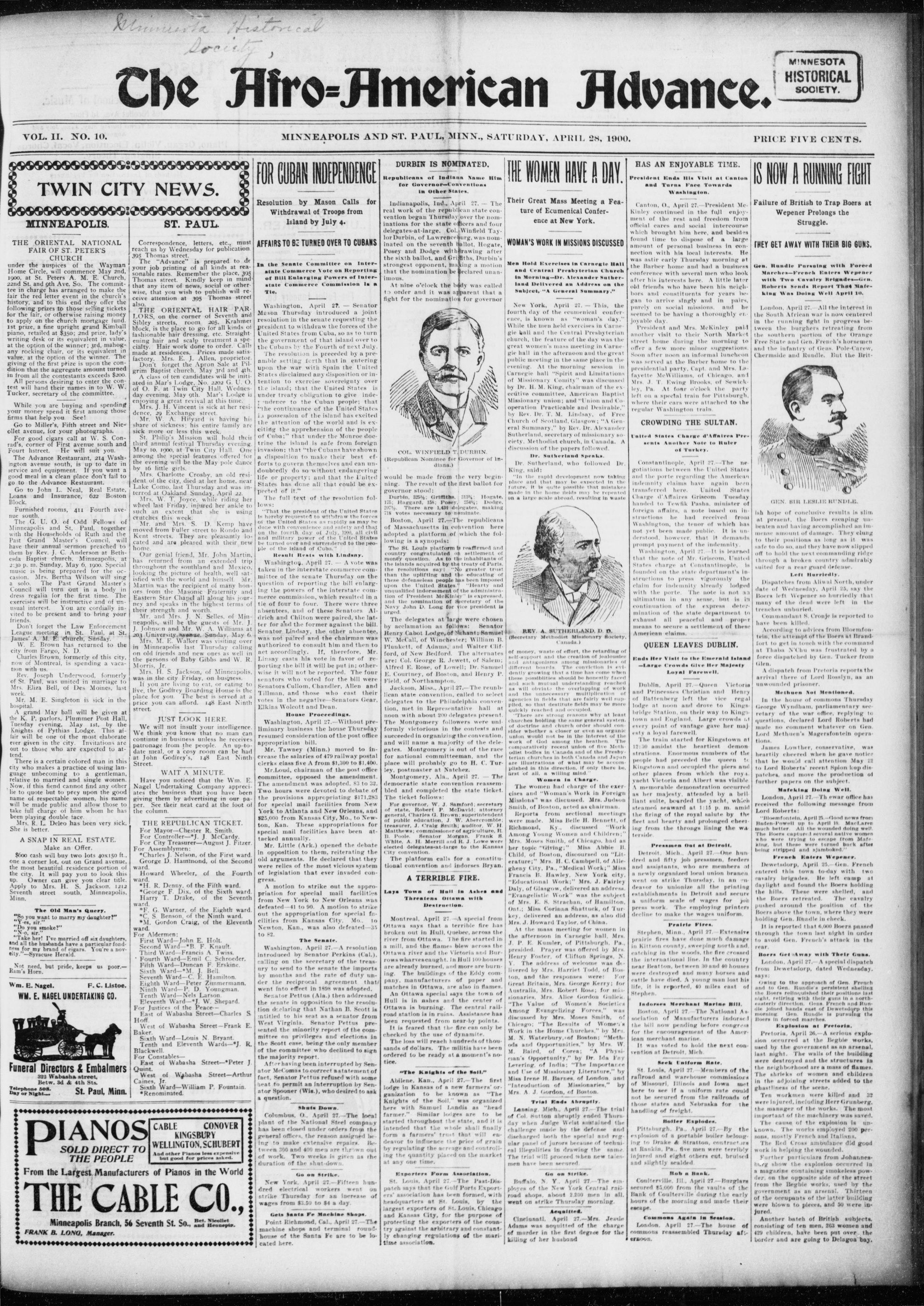
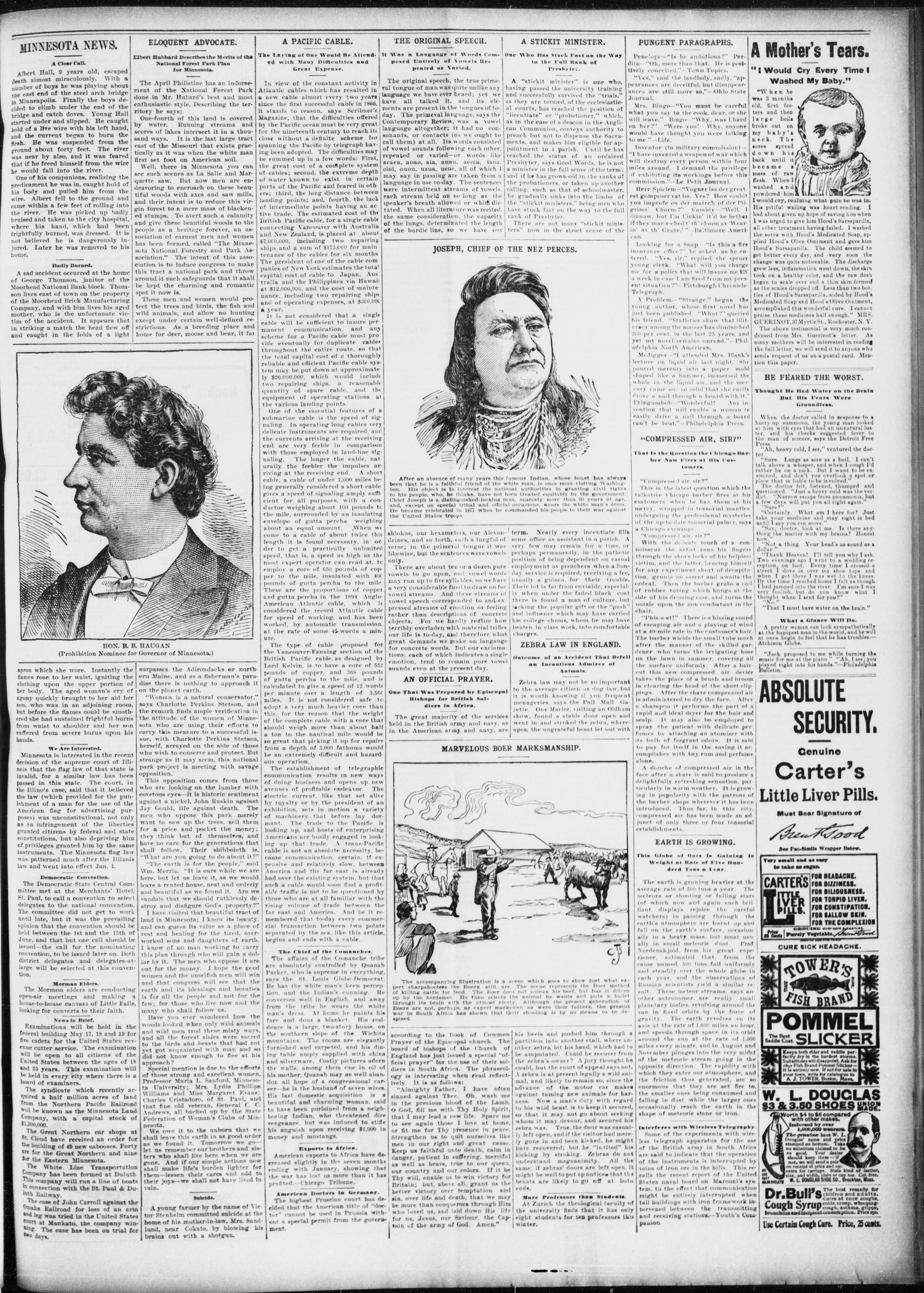
Page text (machine-generated)
TWIN CITY NEWS.
PIANOS
SOLD DIRECT TO
THE PEOPLE
CABLE CONOVER
KINGSBURY
WELLINGTON, SCHUBERT
And other Pianos less expensive
but good for prices asked.
From the Largest Manufacturers of Pianos in the World
THE CABLE CO.,
Minneapolis Branch, 56 Seventh St. So., Bet. Nicollet
and Heunepie.
FRANK B. LONG, Manager.
VOL. II. NO. 10.
TWIN CIT
MINNEAPOLIS.
THE ORIENTAL NATIONAL FAIR OF ST. PETER'S CHURCH
under the auspices of the Wayman Home Circle, will commence May 2nd, 1900, at St. Peters A. M. E. Church, 22nd St. and 9th Ave. So. The committee in charge has arranged to make the fair the red letter event in the church's history, and to this end they offer the following prizes to those selling tickets for the fair, or otherwise raising money to apply on the church mortgage fund. 1st prize, a fine upright grand Kimbal piano, reed at $350; 2nd prize, lavalier desk or desk at $250; 3rd prize, value at the option of the winner; 4th, mahogany rocking chair, or its equivalent in value, at the option of the winner. The giving of the first prize is upon the condition that the aggregate amount turned in from all the contestants exceeds $200.
All persons desiring to enter the contest will hand their names in to W. W. Tucker, secretary of the committee.
While you are buying and spending your money spend it first among those firms that help you. See! Go to Miller's, Fifth street and Nicollet avenue, for your photographs. For good cigars call at W. S. Conrad's, corner of First avenue south and Fourt堡 street. He will suit you. The Advance Restaurant, 214 Washington avenue south, is up to date in service and equipment. If you want a good meal in a clean place don't fail to go to the Advance Restaurant. Go to John L. Neal, Real Estate, Loans and Insurance, 622 Boston Block. Furnished rooms, 411 Fourth avenue south.
The G. U. O. of Odd Fellows of Minneapolis and St. Paul, together with the Households of Ruth and the Past Grand Master's Council, will have their annual sermon preached to them by Rev. J. C. Anderson at Bethesda Baptist church, Minneapolis, at 2:30 p. m. Sunday, May 6, 1900. Special music is being prepared for the occasion. Mrs. Bertha Wilson will sing a solo. The Past Grand Master's Council will turn out in a body in dress regalia for the first time. The exercises will be instructive and of unusual interest. You are cordially invited to be present and to bring your friends. Don't forget the Law Enforcement League meeting in St. Paul, at St. James' A. M. E. church, Sandy. Brown has returned to the city from Fargo, N. D. Charles Brown, formerly of this city, now of Montreal, is spending a vacation with us. Rev. Joseph Underwood, formerly of St. Paul, was united in marriage to Mrs. Eliza Bell, of Des Moines, last week.
Mr. M. E. Singleton is sick in the hospital.
A grand May ball will be given at the K. P. parlors, Plummer Post Hall, Tuesday evening, May 1st, by the Knights of Pythias Lodge. This affair will be one of the most elaborate ever given in the city. Invitations are made to those who are expected to attend.
There is a certain colored man in this city who makes a practice of using language unbecoming to a gentleman, relative to married and single women. Now, if this fiend cannot find any other he to quote to but prey upon the good name of respectable women, his name will be made public and allow those to take full charge of him whom he has being double face.
Mrs. R. E. Deleo has been very sick. She is better.
A SNAP IN REAL ESTATE.
Make an Offer.
$600 cash will buy two lots 60x150 ft.
one a corner lot, out on Grand avenue,
the most beautiful residence portion of
the city. It will pay you to look this
up. Owner can give you clear title.
Apply to Mrs. H. S. Jackson. 1212
Seventh street south, Minneapolis,
Minn.
"Take her! I've married off six daughters,
and all the husbands have a particular fondness for my brand of cigars. You're a novelty." "Syracuse Herald."
Not need, but pride, keeps us poor—Ram's Horn.
TOMB OF THE MAYOR
Funeral Directors & Embalmers
322 Wabasha street,
Betw. 3d & 4th Sts.
Telephone 508.
Day or Night.... St. Paul, Minn.
PIANO
SOLD DIRECT
THE PEOPL
From the Largest Manufact
The Afro-American Advance.
ST. PAUL.
Correspondence, letters, etc., must reach us by Wednesday for publication 395 Thomas street.
The "Advance" is prepared to do your job printing of all kinds at reasonable rates. Remember the place, 395 Thomas street. Kindly keep in mind that any item of news, social or otherwise, that you wish to publish will be attended at 395 Thomas street also.
THE ORIENTAL HAIR PAR-LORS, on the corner of Seventh and Sibley streets, room 205, Krahm block, is the place to go for all kinds of fashionable hair dressing, etc. Straightening hair and scalp treatment a specialty. Hair work done to order. Calls made at residences. Prices made satisfactory. Mrs. E. E. J. Allen, proprietor. Don't forget the Apron Sale at Pilgrim Baptist church, May 3rd and 4th. A class of ten candidates will be initiated in Mar's Lodge, No. 2202 G. U. O. of F. O. of Twin City Hall, Wednesday evening, May 9th. Mar's Lodge is enjoying a great revival at this time. Mrs. J. H. Vincent is sick at her residence. Elden street. Mr. W. A. H. A. having his share of sickness: his entire family are sick more or less this week. St. Philip's Mission will hold their third annual festival Thursday evening. May 10, 1900, at Twin City Hall. One among the special features offered for the evening will be the May pole dance by 16 little girls.
Mrs. Charlotte Crosby, an old resident of the city, died at her home, near Lake Como, last Thursday and was interred at Oakland Sunday, April 22.
Mrs. W. T. Joyce, while riding her wheel last Friday, injured her ankle to such an extent that she is using crutches this week.
Mr. and Mrs. S. D. Kemp have moved from Fuller street to Rondo and Kent streets. They are pleasantly located and are pleased with their new home.
Our genial friend, Mr. John Martin, has returned from an extended trip throughout the southland and Mexico, looking the picture of health, well satisfied with the world and himself. Mr. has the recipient of many honors from the Mission Fraternity and Eastern Star Chapel all along his journey and speaks in the highest terms of their strength and worth.
Mr. and Mrs. J. N. Selles, of Minneapolis, will be the guests of Mr. J. J. Johnson and Mr. W. A. Williams at 2013 University avenue, Sunday, May 6.
Mrs. M. E. Walker was visiting over in Minneapolis last Thursday calling on old friends and new ones as well in the persons of Baby Gibbs and W. R. Morris, Jr.
Mrs. H. S. Jackson, of Minneapolis, was in the city Friday, on business.
If you are living to eat, or eating to live, the Godfrey Boarding House is the place for you. The best is served at a price you can afford. 148 East Ninth street.
JUST LOOK HERE
We will not insult your intelligence. We think you know that no man can continue in business unless he receives patronage from the people. An up-to-date meal, or a cosy room can be had John Godrey's, 148 East Ninth Street
WAIT A MINUTE
Have you noticed that the Wm. E. Nagel Understaffing Company appreciates the business that you have been giving them by advertising in our paper. See their neat card at the foot of the column.
THE REPUBLICAN TICKET.
For Mayor—Chester R. Smith.
For Controller—J. J. McCardy.
For City Treasurer—August J. Fitzer.
For Assemblymen:
*Charles J. Nelson, of the First ward,
George D. Hammond, of the Second ward.
Howard Wheeler, of the Fourth ward.
*H. R. Denny, of the Fifth ward.
*George F. Dix, of the Sixth ward.
Harry T. Drake, of the Seventh ward.
*C. G. Warner, of the Eighth ward.
*C. S. Benson, of the Ninth ward.
*M. Gordon Craig, of the Eleventh ward.
For Aldermen:
First Ward—John E. Holt.
Second Ward—*B. F. Knaut.
Third Ward—Francis A. Twiss.
Fourth Ward—Emil C. Schroeder.
Fifth Ward—Duncan F. Erskine.
Sixth Ward—*M. J. Bell.
Seventh Ward—C. E. Hamilton.
Eighth Ward—Passer Zimmermann.
Ninth Ward—P. D. Youngman.
Tenth Ward—Nels Larson.
Eleventh Ward—*J. W. Shepard.
For Justices of the Peace—
East of Wabasha Street—Charles S. Hoff.
West of Wabasha Street-Frank E. Baker.
East of Wabasha Street—*Peter J
Quint,
MINNEAPOLIS AND ST. PAUL, MINN., SATURDAY, APRIL 28, 1900.
FOR CUBAN INDEPENDENCE
Resolution by Mason Calls for Withdrawal of Troops from Island by July 4.
AFFAIRS TO BE TURNED OVER TO CUBANS
In the Senate Committee on Interstate Commerce Vote on Reporting of Bill Enlarging Powers of Interstate Commerce Commission In a Tie.
Washington, April 27. — Senator Mason Thursday introduced a joint resolution in the senate requesting the president to withdraw the forces of the United States from Cuba, so as to turn the government of that island over to the Cubans by the Fourth of next July.
The resolution is preceded by a preamble setting forth that in entering upon the war with Spain the United States disclaimed any disposition or intention to exercise sovereignty over the island; that the United States is under treaty obligation to give independence to the Cuban people; that "the continuance of the United States in possession of the island has excited the attention of the world and is exciting the apprehension of the people of Cuba," that under the Monroe doctrine the island is safe from foreign invasion; that "the Cubans have shown a disposition to make their best efforts to govern themselves and can undoubtedly do so without endangering life or property; and that the United States has done all that could be expected of it."
The full text of the resolution follows:
"That the president of the United States is hereby requested to withdraw the forces of the United States as rapidly as may be necessary on the fourth day of July, 1993, all civilians and military power of the United States be turned over and surrendered to the prosecution."
Result Rests with Lindsny.
Washington, April 27. — A vote was taken in the interstate commerce committee of the senate Thursday on the question of reporting the bill enlarging the powers of the interstate commerce commission, which resulted in a tie of four to four. There were three absentees, and of these Senators Aldrich and Chilton were paired, the latter for and the former against the bill. Senator Lindsay, the other absentee, was not paired and the chairman was authorized to consult him and then to act accordingly. If, therefore, Mr. Linsay casts his vote in favor of reporting the bill it will be put in; otherwise it will not be reported. The four senators who voted for the bill were Senators Cullom, Chandler, Allen and Tillman, and those who cast their votes in the negative—Senators Gear, Elkins Wolcott and Dean.
House Proceedings.
Washington, April 27. -Without preliminary business the house Thursday resumed consideration of the post office appropriation bill.
Mr. Tawney (Minn.) moved to increase the salaries of 479 railway post clerks class five A from $1,300 to $1,400.
Mr. Loud, chairman of the post office committee, opposed the amendment.
The amendment was adopted. 83 to 32.
Two hours were devoted to debate of the provisions appropriating $171,283 for special mail facilities from New York to Atlanta and New Orleans, and $25,000 from Kansas City, Mo., to Newton, Kan. These appropriations for special mail facilities have been attacked annually.
Mr. Little (Ark.) opened the debate in opposition to them, reiterating the old arguments. He declared that they were relieds of the most vicious system of legislation that ever invaded congress.
A motion to strike out the appropriation for special mail facilities from New York to New Orleans was defeated—41 to 90. A motion to strike out the appropriation for special facilities from Kansas City, Mo., to Newton, Kan., was also defeated—35 to 83.
The Senate.
Washington, April 27.—A resolution introduced by Senator Perkins (Cal.), calling on the secretary of the treasury to send to the senate the imports by months and the rate of duty under the reciprocal agreement that went into effect in 1898 was adopted.
Senator Pettus (Ala.) then addressed the senate in opposition to the resolution declaring that Nathan B. Scott is entitled to his seat as a senator from West Virginia. Senator Pettus presented the minority report of the committee on privileges and elections in the Scott case, being the only member of the committee who declined to sign the majority report.
After having been interrupted by Senator McComas to correct a statement of fact, Senator Pettus refused with some heat to permit an interruption by Senator Spooner (Wis.), who desired to ask a question.
Shuts Down.
Columbus, O. April 21. The local plant of the National Steel company has been closed under orders from the general offices, the reason assigned being to make extensive repairs. Between 300 and 400 men are thrown out of work. Two weeks is given as the duration of the shut-down.
Go on Strike.
New York, April 27—Fifteen hundred electrical workers went on strike Thursday for an increase of wages from $2.50 to $4 a day.
Gets Santa Fe Machine Shops.
Point Richmond, Cal. April 27—The machine shops and terminal roundhouse of the Santa Fe are to be located here.
DURBIN IS NOMINATED.
Republicans of Indiana Name Him
for Governor-Conventions
in Other States.
Indianapolis, Ind., April 27. — The real work of the republican state convention began Thursday over the nominations for the state officers and four delegates-at-large. Col. Winfield Taylor Durbin, of Lawrenceburg, was nominated on the seventh ballot, Hogate, Posey and Dodge withdrawing after the sixth ballot, and Grithus, Durbin's strongest opponent, making a motion that the nomination be declared unanimous.
At nine o'clock the body was called to order and it was apparent that a fight for the nomination for governor
COL. WINFIELD T. DURBIN.
(Republican Nominee for Governor of Indiana.)
would be made from the very beginning. The result of the first ballot for governor stood:
Durbin, 2554; Grittis, 1673; Hogate, 1757; Huggard, 158; Posey, 2344; Dodge, 2075. There are 1,434 electors, making 718 votes necessary to nominate.
Boston, April 27. The republicans of Massachusetts in convention here adopted a platform of which the following is a synopsis:
The St. Louis platform is reaffirmed and country congratulated on settlement of money question. As to the inhabitants of the islands acquired by the treaty of Paris, the resolutions say: "No greater trust in the government and education of these defenseless people has been imposed upon the United States." "Hearty and unqualified endorsement of the administration of President McKinley" is expressed, and the nomination of Secretary of the John D. Long for vice president is urged.
The delegates at large were chosen by acclamation as follows: Senator Henry Cabot Lodge, of Shanty; Samuel W. McCall, of Winchester; William B. Plunkett, of Adams, and Walter Clifford, of New Bedford. The alternates are: Col. George R. Jewett, of Salem; Alfred E. Rose, of Lowell; Dr. Samuel E. Courtney, of Boston, and Henry P. Field, of Northampton.
Jackson, Miss., April 27. — The reublican state convention, to select delegates to the Philadelphia convention, met in Representative hall at noon with about 200 delegates present. The Montgomery followers were uniformly victorious in the contests and succeeded in organizing the convention, and will name a majority of the delegates. Montgomery is out of the race for national committeeman, and the place will probably go to H. C. Turley, postmaster at Nateche.
Montgomery, Ala., April 27. — The democratic state convention reassembled and completed the state ticket. The ticket follows:
For governor, W. J. Samford; secretary of state, Robert P. McDavid; attorney general, Charles G. Brown; superintendent of the school district, Terry treasurer, J. Craig Smith; auditor, W. H. Matthews; commissioner of agriculture, R. B. Poole; Senator Morgan, Frank S. White; Merrill and R. J. Lowe were delegates large-to the Kansas City convention. The platform calls for a constitutional convention and indores Bryan
A TERRIBLE FIRE.
Laya Town of Hull in Ashes and Threatens Ottawa with Destruction.
Montreal, April 27 —A special from Ottawa says that a terrible fire has broken out in Hull, Quebec, across the river from Ottawa. The fire started in a mill, and the flames blew across the Ottawa river and the Victoria and Burrows wharves caught. In Hull 100 houses are already burned, and more are burning. The buildings of the Eddy company, manufacturers of paper and matches in Ottawa, are also in flames. An Ottawa special says the town of Hull is in ashes and the center of Ottawa is burning. The central railroad station is in ruins. Assistance has been requested from near-by points. It is feared that the fire can only be checked by the use of dynamite. The loss will reach hundreds of thousands of dollars. The militia have been ordered to be ready at a moment's notice.
"The Knights of the Soil."
Ablene, Kan., April 27. The first lodge in Kansas of a new farmers' organization to be known as "The Knights of the Soil." was organized here with Samuel Landia as "head farmer." Similar lodges are to be started throughout the state, and it is intended that the whole shall finally form a farmers' trust that will endeavor to influence the price of grain by regulating the acreage and controlling the quantity placed on the market at any one time.
Esporters Form Association
St. Louis, April 27. The Fast-Distpatch says that the Gulf Ports Exporters' association has been formed, with headquarters at St. Louis, by the largest exporters of St. Louis, Chicago and Kansas City, for the purpose of protecting the exporters of the country against the arbitrary and constantly changing regulations of the maritime association.
THE WOMEN HAVE A DAY
Their Great Mass Meeting a Feature of Ecumenical Conference at New York.
WOMAN'S WORK IN MISSIONS DISCUSSED
Men Hold Exercises in Carnegie Hall and Central Presbyterian Church in Morning—Dr. Alexander Sutherland Delivered an Address on the Subject, "A General Summary."
New York, April 27. — This, the fourth day of the ecumenical conference, is known as "woman's day." While the men held exercises in Carnegie hall and the Central Presbyterian church, the feature of the day was the great women's mass meeting in Carnegie hall in the afternoon and the great public meeting in the same place in the evening. At the morning session in Carnegie hall "Spirit and Limitations of Missionary Comity" was discussed by Dr. H. M. King, chairman of the executive committee, American Baptist Missionary union; and "Union and Cooperation Practicable and Desirable," by Rev. Dr. T. M. Lindsay, of Free Church of Scotland, Glasgow; "A General Summary," by Rev. Dr. Alexander Sutherland, secretary of missionary society, Methodist church, in Canada. A discussion of the papers followed.
Dr. Sutherland Spenks.
Dr. Sutherland, who followed Dr. King, said:
"In the rapid development now taking place and that may be expected in the future, it is quite possible that mistakes made in the home fields may be repeated on a large scale abroad, resulting in waste
REV. A. SUTHERLAND, D. D.
(Secretary Methodist Missionary Society Canada.)
of money, waste of effort, the retarding of self-support and the creation of leaseless and antagonisms among missionaries of different boards. The conviction is evident that these possibilities should be honestly fared and such mutual understanding reached as will obviate the overlapping of work and the unnecessary multiplication of agencies in fields that are fairly well supported, and that work may be more quickly reached and occupied.
"There are strong reasons why at least churches holding the same general system of doctrine and church order should consider whether a closer or even an organic church would be more effective in the work of God among the heathen. The comparatively recent union of five Methystian churches in Canada and the Presbyterian churches in both Canada and Japan are illustrations of what may be accomplished first of all, a willing mind."
Women in Charge.
The women had charge of the exercises and "Woman's Work in Foreign Mission" was discussed. Mrs. Judson Smith, of Boston, acted as chairman. Reports from sectional meetings were made. Miss Belle H. Bennett, of Richmond, Ky., discussed "Work Among Young Women and Children," Mrs. Moses Smith, of Chicago, had as her topic "Giving": Miss Abbie B. Child, of Boston, discussed on "Literature," Mrs. H. C. Campbell, of Allegheny City, Pa., "Medical Work," Mrs. Francis B. Hawley, New York city, "Educational Work;" Mrs. J. Fairley Daly, of Glasgow, delivered an address, "Evangelistic Work" was the subject of Mrs. E. S. Strachan, of Hamilton, Ont.; Mrs. Corinna Shattuck, of Turkey, delivered an address, as also did Mrs. J. Howard Taylor, of China.
At the mass meeting for women in the afternoon in Carnegie hall, Mrs. J. P. E. Kumler, of Pittsburgh, Pa., presided. Prayer was offered by Mrs. Henry Foster, of Clifton Springs, N. Y. The address of welcome was delivered by Mrs. Harriet Todd, of Boston, and the responses were: For Great Britain, Mrs. George Kerry; for Australia, Mrs. Robert Rose; for missionaries, Mrs. Alice Gordon Guilic, "The Value of Women's Societies Among Evangelizing Forces," was discussed by Mrs. Moses Smith, of Chicago; "The Results of Women's Work in the Home Churches," by Mrs. M. N. Waterbury, of Boston; "Methods and Opportunities," by Mrs. W. M. Haird, of Corea; "A Physician's Opportunity," by Dr. Ida Fay Levering, of India; "The Importance and Use of Missionary Literature," by Miss Irene H. Barnes, of London, and "Introduction of Missionaries," by Mrs. A. J. Gordon, of Boston.
Trial Ends Abruptly.
Lanning, Mich., April 27—The trial of Col. Sutton abruptly ended Thursday when Judge Weist sustained the challenge made by the defense and discharged both the special and regular panel of jurors because of technical illegalities in drawing the same. The trial will proceed when new taimesmen have been secured.
Go on Strike.
Buffalo, N. Y. April 27—The employees of the New York Central railroad shops, about 2200 men in all went on strike Thursday morning.
Acquired.
Cineinnati, April 27—Mrs. Jeanie Adams was acquitted of the charge of murder in the first degree for the killing of her husband
HAS AN ENJOYABLE TIME.
President Ends His Visit at Canton and Turns Face Towards Washington.
Canton, O., April 27.—President McKinley continued in the full enjoyment of the rest and freedom from official cares and social intercourse which brought him here, and besides found time to dispose of a large amount of personal business in connection with his local interests. He was astir early Thursday morning at the Barber home and had a business conference with several men who look after his interests here. A little later old friends who have been his neighbors and constituents for years began to arrive singly and in pairs, purely on social missions, and he seemed to be having a thoroughly enjoyable day.
President and Mrs. McKinley paid another visit to their North Market street home during the morning to offer a few more minor suggestions. Soon after noon an informal luncheon was served at the Barber home to the presidential party, Capt. and Mrs. Lafayette McWilliams, of Chicago, and Mrs. J. T. Ewing Brooks, of Sewickley, Pa. At four o'clock the party left on a special train for Pittsburgh, where their cars were attached to the regular Washington train.
CROWDING THE SULTAN
United States Charge d'Affaires Presents Another Note to Ruler of Turkey.
Constantinople, April 27.—The negotiations between the United States and the porte regarding the American indemnity claims have again been transferred here. United States Charge d'Affaires Griscom Tuesday handed to Tewfik pasha, minister of foreign affairs, a note based on instructions he had received from Washington, the tenor of which has not yet been made public. It is understood, however, that it demands prompt payment of the indemnity. Washington, April 27.—It is learned that the note of Mr. Griscom, United States charge at Constantinople, is founded on the state department's instructions to press vigorously the claim for indemnity already lodged with the porte. The note is not an ultimatum in any sense, but is in continuation of the express determination of the state department to exhaust all peaceful and proper means to secure a settlement of these American claims.
QUEEN LEAVES DUBLIN.
Ends Her Visit to the Emerald Island
—Large Crowds Give Her Majesty
Loyal Farewell.
Dublin, April 27. - Queen Victoria and Princesses Christian and Henry of Battenberg left the vice regal lodge at noon and drove to Kingbridge Station, on their way to Kingstown and England. Large crowds at every point of vantage gave her majesty a loyal farewell.
The train started for Kingstown at 12:30 amidst the heartiest demonstrations. Enormous numbers of the people had preceded the queen to Kingstown and occupied the piers and other places from which the royals yacht Victoria and Albert was visible. A memorable demonstration occurred as her majesty, attended by a brilliant suite, bourded the yacht, which steamed seaward at 1:15 p. m. amid the firing of the royal salute by the fleet and hearty and prolonged cheering from the throngs lining the waterside.
Pressmen Out at Detroit
Detroit, Mich., April 27—One hundred and fifty job pressmen, feeders and assistants, who are members of a newly organized local union branched on strike Thursday, in an endeavor to unionize all the printing establishments in Detroit and secure a uniform scale of wages for job press work. The employing printers decline to make the wages uniform.
Prairie Fires.
Stephen, Minn., April 27. - Extensive prairie fires have done much damage in Kittson county, sweeping north and catching in the woods, the fire crossed the international line. In the country near Benton, between 30 and 40 houses were destroyed and many horses and cattle have died. A young man lost his life, it is reported, 40 miles east of Stephen.
Indorses Merchant Marine Bill
Boston, April 27. The National Association of Manufacturers indorsed the bill now pending before congress for the encouragement of the American merchant marine. It was voted to hold the next convention at Detroit, Mich.
Seek Uniform Rate.
St. Louis, April 27.—Members of the railroad and warehouse commissioners of Missouri, Illinois and Iowa met here to see if a uniform rate could not be secured from the railroads of those states and Nebraska for the handling of freight.
Boiler Explodes.
Pittsburgh, Pa. April 27. By the explosion of a portable boiler belonging to Drake & Stratton, contractors at Rankin, Pa. five men were terribly injured and eight others cut, bruised and slightly scaled.
Rob a Bank.
Coulterville, Ill., April 27—Burglaria secured $5,000 from the vaults of the Bank of Coulterville during the early hours of the morning and made their escape.
Comments Again In Session
London. April 27.—The house of commons reassembled Thursday afternoon.
MINNESOTA
HISTORICAL
SOCIETY.
PRICE FIVE CENTS.
Failure of British to Trap Boers at Wepener Prolongs the Struggle.
THEY GET AWAY WITH THEIR BIG GUNS.
Gen. Rundle Pursuing with Foreed Marches—French Enters Wepener with Two Cavalry Brigades—Gen. Roberts Sends Report That Mafe-king Was Doing Well April 10.
London, April 27.—All the interest in the South African war is now centered in the running fight in progress between the burghers retreating from the southern portion of the Orange Free State and Gen. French's horsemen and the infantry of Geus, Pole-Carew, Chermside and Rundle. But the Brit-
GEN. SIR LESLIE RUNDLE.
ish hope of conclusive results is slim at present, the Boers escaping unbeaten and having accomplished an immense amount of damage. They clung to their positions as long as it was safe to do so, and they have now slipped off to hold the next commanding ridge through a broken country admirably suited for a rear guard defense.
Left. Hurriedly.
Dispatches from Alwaii North, under date of Wednesday, April 25, say the Boers left Wepener so hurriedly that many of the dead were left in the trenches umburied.
Commandant S. Cronje is reported to have been killed.
According to advises from Bloemfontein, the attempt of the Boers at Brandon to get in touch with the command at Thaba N'Chu was frustrated by a force dispatched by Gen. Tucker from Glen.
A dispatch from Pretoria reports the arrival there of Lord Rosslyn, as an unwounded prisoner.
Methuen Not Mentioned.
In the house of commons Thursday George Wyndham, parliamentary secretary of the war office, replying to questions, declared Lord Roberts had made no comment whatever on Gen. Lord Methuen's Magerafonteln operations. James Lowther, conservative, was heartily cheered when he gave notice that he would call attention May 22 to Lord Roberts' recent Spion kop dispatches, and move the production of further papers on the subject.
Mafeking Doing Well.
London, April 27.—The ear office has received the following message from Lord Roberts: "Bloomfontein, April 25.—Good news from Dahlen-Powell up to April 10. MacLarren and the Boers captured several native women who were trying to escape from Mafeking, but these were turned back after the Boers' capture."
French Enters Wepener.
Dewetsdorp, April 25—Gen. French entered this town to daydose with two cavalry brigades. He left camp at daylight and found the Boers holding the hills. These were shelled, and the Boers retreated. The cavalry pushed around the position of the Boers above the town, where they were holding Gen. Rundle in check.
It is reported that 6,000 Boers passed through the town last night in order to avoid Gen. French's attack in the rear.
**Boers Get Away with Their Guns.**
London, April 27—A special dispatch from Dewetsdorp, dated Wednesday, says:
*Owing to the approach of Gen. French and to Gen. Rundle a persistent shelling was being performed the last night, retiring with their guns in a northeastern direction. Gen. French and Rundle joined hands east of Dewetsdorp this morning. Gen. Rundle is pursuing the
Explosion at Pretoria.
Pretoria, April 26. A serious explosion occurred at the Begbie works, used by the government as an arsenal, last night. The walls of the building were destroyed and the structures in the neighborhood are a mass of flames. The shrieks of women and children in the adjoining streets added to the ghastliness of the scene.
Ten workmen were killed and 32 were injured, including Herr Grunberg, the manager of the works. The most important of the machinery was saved. The cause of the explosion is unknown. The works employed 200 persons, mostly French and Italians. The Red Cross ambulance did good work in helping the wounded.
Further particulars from Johannesberg show the explosion occurred in a magazine containing smokeless powder, on the opposite side of the street from the Begbie works, used by the government as an arsenal. Thirteen of the occupants of the latter building were blown to pieces, and 50 were injured.
Another batch of British subjects, consisting of ten men, 63 women and 429 children, have been put over, the border and are going to Delaware bay.
a
AFRO-APMERICAN
ADVANCE.
Published every Saturday by the
ADVANCE PUBLISHING COMPANY
Office, 214 Washington Av. So.
Tel. Main 2415-L-8,
Minneapolis, - - = = = = - Minnesota.
Sedecription Rates:
One Year =~ - - - 1.09
‘Six Months = - - - - 60
Three Months - * zs +
Subseription Always Payable tm Aa-
pecat ratee i ana the, doen
orders Yor eutrent iene: shaia reach the
SR adc sant
gens stein Races Sper ne
beni
SRE ce (nt over 80 tne
4 cent pet ie Ty Yat Mase
MaBeEs icin Brain spc wy
arate
Mt ouncements.
ao, seu ne Aaa atte
Cee R ee at et oe aie
by Wednesday morning, preceding the ls
Bia eh "an a
ales aus, ag ase
BA Sind ee tog ee
Tpeideerreadt i
Riess AG AGI news co,
Pa a
Shans aaeat ease
Steet ike See any com.
mpcheign tants or pn a
plone chmod se tated it he
aan aati kaTadlnt reat adore
ahem hie" AP eRe
TAN Se
a areahte Ave., South,
inneapolis, Minn.
J.C REID, Bprron,
MRS, GEO, DUCKETT,
Muu. J. B. Koorn, City Collector,
EDITORIAL.
THE WAYS OF THE CANDI
DATE,
(Atlanta Constitetion.)
“Well, sub,” said the old time colored
voter, “de ways er de canderdate is past
findin’ out! All de year I been tak one
eryin’ in de wilderness, en no man
‘spon’ ter my ery. I holler fer bread,
en dey gigve me a Belgian block en
thirty days. En now look at ‘em!
"Luckshin time come on, en bless God
ef dey ain't pay my house rent, took de
mortgage off my mule, settle my street
tax and gimme enough of cloze ter
ter preachin't En all L got ter my nam
is one vote en de rheumatism!”
CAST OFF THE YOKE.
when it became a law (by circum-
stance), the first day of January. the
year, of, our Lord one thousand ight
jundred and sixty-three, for our people
to be free; to cast off the abontinable
chains of oppressive servitude, to think,
act and speak for themselves; to have
‘equal rights socially and otherwise, was
there a clause direct or indirect saying
that they should be under bonds of po
litical slavery, No, thank Heaven,
No! We, therefore, ‘say that ay a po:
litical factor of no mean ability. the
Afro-Americans should begin to realize
that they are no longer a solid mass of
Republicanism, Democratism, | Prohi.
bitionism, Populism, oF any other ism,
but are Sn, aguregniion ‘of tree think
ing, law-abiding American citizens
whom God has endowed with enough
intellect and have themselves cultivated
tuificient discretion to know right irom
wrong, and as near as possible deter
mine who is best suited to govern ir
respective of party affiliation. While
Wee may, make some mistakes, we il
have the satisfaction of knowing tha
Me are “not following, but advancing
With the front rank of civilization.
‘The greatest political trouble with us
has arisen from the extreme narrow
view we have taken of party and men
‘our obedience in the political world ha
caused us to be a drug on the market
If we disobey the self-elected leaders
we will demonstrate to the world tha
we are no longer a crowd of easily led
children (kept happy by promises), bu
fare a maturing race capable of thinking
for ourselves
Now, at the forthcoming municipal
election, there are men whose name
will be presented to you whose charac
ters are above reproach, men of ability
perfectly able to rule, or manage, no
alone from one party, but men of honor
from all parties
Will you use your judgment and sun
port the hest man for the place and
show that you are no longer the eas)
cajoled voter, but an independent fac
tor who has dared cast aside the polit
pros Genes oh
‘The New York Age published an ar-
ticle in last edition, {rom a Brooklyn
Rewapaper, concerning the cause of
MM. Cants) ‘Stewart's: departure trom
Brooklyn to Hanan, which was not
commendatory. Editor Fortune, in his
usual vigorous style, in a few words ot
defense, soon set_mattgs right Mr
Stewart is the father™ of “McCants
Stewart, Jr, who resides in this city
Will the Republicans of Minneapolis
give the negro something after the
pending election, or will they continue
to keep us deprived of representation
The National Organization of Rail
way Porters and the plan to establish
& school of technology demonstrates
the awakening of all classes of the race
to its interest,
The, legislature. of Mississippi hae
pases a Bil to remove, the remaing of
lm. James Lynch, colored, exsecre-
tary of state, from among the ariste
cratic dead. "What next?
Rew. RC. Ransom, of Chicago,
would make an able editor for the
Christian Recorder, to which honor he
aspires, We wish him success.
Hon. J. C. Leftwich and Editor A.
N. Johnson, of Mobile, Ala, will be
delewates to the Philadelphia’ national
Republican convention.
Hon, Henry Demas, of New Or-
leans, a noted politician, is dead. He
was the leading colored politician in
ee eee
Coleridge Taylor, a negro, is des.
tined t6 become a great leader in Lon.
Gon, England, susical circles
Ex D. Augustus Straker, of
Deroke Hicks te ntcandidate lor cir
eit ‘court commissioner.
Pinkney Pichback, son of ex-Gor
ciao of Leciinen, deed.
BRILLIANT THOUGHTS OF INTER-ST.
It seems that the blood of racts will
only harmonize with its own kind.
If you are persistent you cannot be
otherwise than successful
Think only of your task in life and
perform it well—the rest will come.
We extend our sympathy 10 the
“Georgia Baptist” in her recent loss by
fire
The women of the race seem to be
playing an important part in solving
the problem.
Without jealousy we wonld have
nothing to spur us on to higher
achievements.
A man carries his best friend withir
his breast when he feels that he is
Fight. He is omnipresent.
If you want to incur the hatred of
your fellowman, just speak or even
think of your own attainments
The stability of a man can be de-
termined by tis perseverance in tha
which is beneficial to progress.
No man knows what he will do an-
til forced into activity, then if he does
his best he is above all criticism.
In your own sphere you can give
to the world something to think about
otherwise it is useless to attempt
With all of the negro's ups and down:
he seems to enjoy Infe better than any
being om earth. God must be with the
negro!
A person ought to represent either
one thing or the other. The energy ex
pended in trying to be both will waste
to nothing,
Don't let your sense of pride run
away with your common sense. Mans
have suffered because of permitting. th
former to predominate,
It is the active interest manifested
in things that gives to the world great
thought, and not a recitation of pas
acts of great men.
Hf you want to know your duty ir
life, study that within you which give
you the greatest pleasure, at the sain
time benefits humanity.
Colored men say they believe ir
amalgamation until they see a whit
man with « colored woman, then ht
man nature boils away to damnation
No power of organization amon
men was, nor ever will be, sufficient
Kill the inborn ambition ‘of a huma
being, to attain the heights of man
hood,
Never mind whay this one or tha
‘one directs you to do, never fail to us
Your own common ‘sense which th
same God has given you, who gives t
the wise one,
It will not help your case by think
ing others have made the same mis
take you are making. ‘Learn to hat
everything which has any tendency t
entrap your mind.
1 you punch the devil fire will burs
forth, "If the white man suppress th
negro and the right, with all of hi
might, his (the wegro's) best qualitie
will surely glitter,
‘The race problem is in America t
stay, so long as there is a drop o
negro blood in any of its citizens. B
not worried, but take new life and figh
the battle of a hero,
Be true to yourself, with of withou
companionship. Tt is secret though
that moulds the character. ‘Therefore.
is very injurious to ourselves to de
clare one thing and think another
Fears are horn of timidity, thus de
Privine one of a fixed purpose in tie
Tt you want to know what you are liv
ing for, decide upon the highest in
centive which appeals to your person
al existence,
When one yields to. emotion ty
thinks as he never thought belore, th
monotony, of life becomes a new “in
| spiration.” Without it we could no
have variety of thought, but a tiresom
| same thing every day.
A man or woman without an ob
[jective point in life is to. be pities
| for life ts without charm. Decide to
|] day upon your ideal, and be faithful t
Tyour decision, The shadow. will i
due time become a reality.
| Mf you can't give to the world th
|} sentiments of an honest heart, it is bet
ter to keep your mouth closed, to
eater harm will be done than good
| Bie word of « person carries with |
Ja certain weight, and the intrinsi
‘| value will never prove false—be sur
that it is: measured.
|, Literature of fiction will never ad
Knowledge of worth to the reader
.] spontancous inquiries. The only tru
| answer to all problems can be foun
|| only in individual development, An
|] swers, even from the greatest amon;
jus, Will not appease the origina
queries into things we ought to knos
|| for our own benefit
| No persons can call themselves fre
except they dely the world in thei
| right to serutinize the acts and word
‘Jot the most learned “and profound
| Some great men become offende;
when small individuals question the
Utterances. They loruet that they onl
} speak whet a higher power bas give
COMMUNICATION,
Editor of the Afro-American Advance:
Please allow me space in your pa
pet to" fay 0 the. pic at Large a
especially intimately interested that
the lawsuit brought by Mr. A. W
Walker ageinst. the United Grand
Chapter ©. E.'S. of Missouri and Jur
isdiction, to restrain said organization
from ee under the name and title
of the United Grand Chapter, was de-
cided. by the circuit court at Lexing:
ton, Mo, April tt, rg00 The court
holds that the union being mutual
with all participating therein hax been
‘and are in peace and harmony; there.
Hfore the union. is legal and. gustained
‘by the court, Hence the verdict rests
in fayor of the United Grand Chapter
©, B.S of Misscurt and jurisdicton
We can’ be found at all times doing
Business at the old” stand
Hae, eet,
ROW. POSTER, ROG. P.
121g Paseo, Kansas City, Mo,
Scows That Pass im the Nant.
Jacques over the gunwale of the
actbeti's, 'aGoael ustyreves us De
Aroit river. He smoked hie pipe.
‘Pierre bung over the rail of the seow that
wae upaerd Boon. We cleo wos saveiopee
ima hasy smoke.
Tn the moonlight the two boatmen rec
oath Wire *
Sif ilo Beere. How you geet alone?”
wot geet along. How you geet
RAT beam geet alomg, too.”
gett, ma EASE geet alone
My fatair? Oh, she: alor She been
aor issey she are along. Sb
Hicks—"I wonder how the Toliers manage
tapetone, Wigs URelieye they ome every
in town.” Wicks "That's why they
get ‘along s0 well. “Toller bas a big tink
Svery morning. They are all duns, to be
tare: but the impremion wjon the newh:
bore i just the same as if they were ievita:
Hons to firstclass soriety functions. It ie
vhs aaanuty no Ube quality, that does the
business, you know.” Reston Transenipt.
x may bave defied the lightning, but
wASK een (eat be ever ree" fou
qeotgh to trile with a trolley car-—Rauea
ry Bag
‘ODD FACTS ABOUT ECLIPSES.
From the New York Journal.
An unnatural chill comes into the
air,
Chickens go to roost as the darkness
Approaches.
Birds flutter about in consternation
and seek their nests,
Beasts of prey grow ferorious and
attack human beings boldly.
People are nervous and excited,
while children cling to their mothers
in fright.
Dogs run to their masters and cower
and whine piteously between their
outbursts of yelping.
Such natural sounds as waterfalls
and the whistling of the wind seem
excessively loud and alarming.
Cows go home from pasture. They
stop chewing thelr cuds and sniff the
air an if fearing o great storm.
Ignorant and superstitious people
have an abject fear of some great ca:
lamity, they know not what,
Horses in harness are frightened at
familiar objects, and thore loose in
the fields run about distractedly.
‘Trees lone their uxual look and
color, and the light siftn down through
them in fantastic round blotehes,
‘The young of all creatures run to
their mothers in fear, while the males
among the animals seek their mates
to protect them.
‘The sudden changes of light and
heat make peculiar electrical condi:
tions which are probably the cause
of excitability in all living things.
In the total eclipse of July 20, 1878
In the United States a negro seized
with frenzy killed his wife and three
children,
During the eclipse of May 35, 1877
in Europe the Turks raised a riot and
fired guns and cannon at the sun te
deliver it from the claws of the sup
pored dragon,
While the darkness lasts there ix «
brooding of illness among all Iiving
things except dogs and wolves, ‘Thes
net up a snappish yelping quite dif
ferent from the ordinary bark ot
night howl,
At Peking, on January 28, 1888, a
the beginning of an eclipse, an uproai
occurred like that heard in Chinatows
on New Year's day. ‘The mandarin
ordered the drums to be beaten to pu
to flight the celestin! dragon that was
swallowing the sun.
SAYINGS OF SAGES.
A good Inugh ts sunshine in a house,
Thackeray,
Children have more need of models
than of erities.—Joubert.
Ho who believes in nobody knows
that he himself in not to be trusted.
Auerbach.
Drive prejudices out by the door,
they will reenter by the windows.—
Frederick the Great,
Let us be of good cheer, remember-
ing thas the misfortunes hardest to
bear are those which never happen.—
Lowell.
We are hunted by an ideal life, and
St in because we have within us the
beginning and the possibility of it—
Phillips Brooks.
All who have been great and good
without Christianity would have been
much greater and better with it, If
there be, amongst the sons of men,
& single exception to this maxim, the
divine Socrates may be allowed to
pub in the strongest claim, It was
Lin high ambition to deserve by deeds,
not by creeds, an unrevented heaven,
‘and by works, not by faith, to enter
‘an unpromised land.—Colton.
PATRONIZE...
WI. JENKINS,
FOR 3
ROOMS ©" RENT
FIRST CLASS,
We Guarantee Superb Service, Prices
moderate, ‘Tel. 3787-1-8 Main,
No. 9Second St. No. Minneapolin
4. GARNER, W.H. WELLER.
The Elite Buffet
3030 STATE ST.,
Fin wists, *
AND Cloans, Chicago.
MRS. J. B. WATSON,
Fashionable Dressmaker.
Cutting, Piting and Making Orer a
Specialty. New York and Paris Fash-
ions Always on Hand,
Partors, 028 Fourteenth Ay, South.
DR. R. S. BROWN,
Physician and Surgeon.
OMice: 408:0 Reeve Bldg, 408 Nicollet Av.
Telephone 4754-08.
Office Hours: 9:20 to 12:30; 8:00 to 4:00
m.: 5:0 to 7:00 p. ta, Sundays: 0:80
Bo 1100; 1290 to aba
Residence, 2889 Portland Ave, Tele:
phone 811-L-South,
MR. L. A. JOHNSON,
The gentlemanly and obliging Porter
at RDe Leo's Harber Shop, 200 Wash-
fngton Av. South, is
Always Ready to Dress Your Shoes
{ua thoroughiy artiatic manner, that
J4MnS &. CUNTIS,
—LAWYER—
603 Northwestern Bidg., Mianeapolts.
Cor, 440 and Hennepin Av.
Telephone, Main 2460-L-1
Treated tre,
D U eeee
Spee Oo
cretnrers fonts goren Seer
Soak Sr eas ee ree
Ree eee ieee
(creans run raven wen ore
MB'S Rivest. Sony. cette
LAN ~ SERS
20S
ACER REN ES A "youd:
DROPSY Sess
WMS Se
‘THE ADVANGE CAFE
214 WASHINGTON AV. SOUTH.
Restaurant and Lunch Counter
ne ee MANN & KOGER, Proprietors.
SOCIETY DIRECTORY. | 82%oct%2,c°2373ten'? Sectee™ sadtDaa?
| Officers and Standing Committees of the
Mont Wornhipful Grand Lodge A. fe and
AM. oi Blihnesotn apd furiedio
wataind Master" Sohn ke Neat, Minseapo-
Deputy Grand Master—Wade H. Hamp-
Grand Benton Warden—H. B. Howard,
8, Paul. fi r
parand Junlor Warden—J, C. Garner, Bt
‘Grind Treamurer—Dantel Roy, St, Paul.
adiranaHecretary Wiliam "K. Moers
Grand Lectarer-G. W. Duy (9, Minne-
Tepluty Grand Kecretary—O. D. Howard
6). Be aun an:
“irand "Chaplain—Isanc Crawford (6),
Minneapolix
Airaid Setitor Deacon—John Martin @),
Grand Junior Deacon—R. De Leo (1),
Minneapolis
‘Grand Senior Steward—J, H. Dillingham
oy Se Baur
‘Uirana Junior Steward—Wrm, Stevens (3),
“Grand ‘Tyler. Bosh, @, st. Paul
rand Tyler. Tow a
Grand MataballC. H iaeDionald” (8),
Duluth
rund Pursulvant—G. W. Duckett (,
st Pau,
Parana Bword-tearer—J. Adams (), 8
au
‘Grind tangard-Bearer—@. J. Charies-
tony ee Pat
‘Grank Rdgpeter J. G. Sterett @, Min-
"iatrict, Deputy Grand Master—Firat
DhurictsJemen Woodfork (ye Bt Baul
District Spa Grand” Master~Becond
Digtrct Bi Bh Tiamiiion (0. Minnenpole
ile aay ara, Mater ed
District-y. 4 Fok). Dututh,
MINNEAPOLIS.
Gv, 0.0.0. ¥.
t. Anthony Lodwe, No. 2877.
Meste the Ast ind third Wednesday In
Mich month far the traneaetion or bust:
hear, Tat avenue S. ‘and" Washington
AH MYRICK, NG,
James A. scott] boR EO boris.
KNIGHTS OF PYTHIAS.
Nat. Varner Lodge, No. 2, K. of P
Meets the second und fourth ‘Thursdays
In each month, Brothers, In. good gtand
Ing welcome. At Labor "Temple, Fourth
fand Eighth avenue south,
th PARKER, C. C.
RALPH WATSON, KK. Re and 8.
Pride of Minnenotn Loawe, No. 1, K.
Meets the firet und third ‘Thursdays tn
fach month. All brothers in good. mand:
Ine welcome. At Plummer ‘Post Hall
Fltat™ avenue north land. Washington,
JAMES ROBERTS, CC.
W. C. JEPFHY, Ke. He and 8.
‘J. K. Milyard Lodge.
Meets first ‘Tuesday in euch month at
Windom Mock, Second avenue South and
Warhingtcn, “Masons fn good standing
sivaye weer, W, LILLARD, W. M.
JASPER GIs, Bec, Guaranty Loar
Restaurant
Anchor Lodge, No. 7, A. F. and A. M
Mectarther tite’ and Second Monday
Sach month at Windom Hlock, Second av.
fhuse Routh hd Washinuton.” Masons i
ood standing welcome,
. Mn SCOTT, W. M.
A.B. LEE, 01 Alarlen avenue South,
‘ST. PAUL.
eno FELLows.
Mare todge, Ne. Seem.
a eee
90. PARKIN, 0, we mone 8
pecwrcucta ce Ruths far sun; Or Be
aes
Metin wacna sneuiy ore
eat ee ea Coenen
Reith dat, Sd “Fale Ha,
SEAeaY a ARAW C. RIRETRY, Mea
HE BATRA SEE Bn
Le esietn Gnale coeds
ae Siananera eon
a J MOAR tats Meee i
or Cavan canvas sonniarr:
Pionste inaph acta anaes
2 eNom Ww. i
pee eee eee oee
oe
vo HL. B. HOWARD, Ww. M.
5m wtnontd: Ric OU ARE nibartee
yu piivuie ie Rar x AM
Philp fps arse a Ngapior
BOR Heat and naar sete “Saat
insre smfaante esse
nist limtin kage sees kw
te
Saari wenatiey ator ae
mee eerie
eae ee
ee DANIEL ROY, UH. P.
W. T. GASSAWAY. Bec, State Capitol
HERG LOTORY.
CHURCH DIRECTORY.
MINNEAPOLIS.
at. PRreR Aw R. CHURCH.
Tiers W. S lirwots, Pastor.
Cor, 2a st, 9th ave, South
Sunday “scryieed: Preaching, 1130. 9
mn Bunday School, 200 pr im: evening
Rervigen ep me Generdl prayer Ret
man Home Cirle. Piesday” evening “ai
Miterent "residences. "Parsonage," 236
Ninth ‘avenve South
BETHESDA BAPTIST CHURCH.
Retwean Ecrenth ang Twoltth avenues
Munday “servicer. Preaching. 10m
me Burlay School, 12:50 he me Chrietinn
Fhosavor’™s p"heim. etonina ‘eercicen
Sa0"R tm Wedhotlay “event general
prayer meting. ctf. .
fisi"iiehth street South
en ea THOMAS SERMON.
ev. Jehu J. Paude. tm Charge.
a5 'Bikih avenue South
Sunday service, Cw Dm: Sunday
eho. 3.08 p.m
St, JAMES A.M. B. CHURCH.
Rey J. We Ring. Pastor.
Betgcctheest, neat -Rxposicien, Bg.
Sunday services, Preaching at 100 a,
me Suinagy” Sehoot 1108 pin evening
Rievigen ie 5 me General prayer meet
ine Thgradny evening. Weekly meetings
thine Bebeting Chase
ST. PAUL.
87. JauES Ae B. CHURCH,
T. JAMES A. M. &. CHURCH
_ Cor. Ba ae
Sunday services: 11:30am 7-8 p.m.
Wednenlay prayer meeting 4.0 p. 'm.
ST. PETER CLAVER’s.
— ee
eee Se. Se
Sunaay'porvices: “flass ‘Same. Hiteh
mass 10.0 a m. Evening service at 7
Flock:
PILGRIM BAPTIST CHURCH.
Ker. D. &Ormer, Pastor.
Sunday services” Preaching at 11.90
may and 7:0 pv me, Sunday Schou! at 12:35
Sacce. Woinesday evening guoerel
SY. PHILLIPS EPISCOPAL MIsstON.
6B Rice street, bet, Aurora and Univer:
f@uaday services: “Meruing prayer, Lit.
| PTUSIC ge.
Minneapolis School of Music.
408 Nicollet Ave., 3d Floor.
Special Reduced Terms During May, June, July and
August.
Piano, Organ, Violin, Elocution, Vocal, Chorus
Singing, Theory.
Thorough, Practical, Progressive
Methods of Instruction for Keginners
as well as Advanced Pupils.
LESSONS GIVEN DAY AND EVENING.
ANDREAS ROHNE, Musleal Director.
WILL J. PARRY, Manager and Secretary,
BEkoul "nnd Chliren's Vespern ii ham
Picea ca ata’ TEE aw
Ecaay'p uta trate: tis Eatine th
Botiansite a doate ta p.m
All are cordially Invited, Beats free.
NOTICR.-Channes nod corrections i
pcecuimencret at
Rescate agp Sct of
a a a AS
See tantet Renata tats Se
See it date PaaS Naseer" a
oid ite tel unre aoe ata
OLSON EARL,
Tanens Director and Eembalna,
nen Day aad Mig psc Got
eeen ellis ca seacean
gooveces evevecee__________ 090 90009 0000004
$ b.n. noose, Free. N. JOSEPH LLOYD, Sec,
$ SPEND A PLEASANT EVENING AT THE 3
$ NORTH STAR SOCIAL: CLUB }
BILLIARD AND POOL TABLES. .
; Rooms, Second Floor, 202 Hennepin Avenue. i.
0000000000000000 —__________________ 00000000 oeeeee?
PATRONIZE THE BEST!
The Fuller Laundry Co.
Free Delivery to All Parts of the
City ond Lake Minnetonka,
DR. THOS. S. COOK. DR. J. E. PORTER,
OFFICE HOURS: OFFICE HOURS:
107012. M2 TON. MT TOO. m 970104. M1 TOSP M: 6 TOTP M,
‘TELEPHONE 386. AND NioHTS.
12TH AND ROBERT STS., ST. PAUL, OVER DRUG STORE.
Our Motto: First-class Work and Moderate
Prices
Telephone 2700-J-8.>
S. P. EGGAN,
PHOTOGRAPHER.
Crayon, Pastel and Water Colors a Specialty
251-253 Cedar Avenue,
MINNEAPOLIS, MINNESOTA.
Ee ee ee eee
po'VAL DO TURNER, M.D,
; PHYSICIAN AND SURGEON. ‘
: See eet ee matiinth Sik? Hea‘a Sberbure ave. ST. PAUL, MINN. :
_papempilattab suis Tas too slau ain ee Sieh! Saale
: Plants and Cat
SEEDS OF FLOWERS Fiowit
$ioude PiZatn's'thelr season cut Flowers,
ieeres eet ear oe
/MENDENHALL, £FLorisT,
MENDENHALL, | E08
ee ee eee
3 28 YEARS’ EXPERIENCE cas OESEPHONE res, 3
:
7 :
; Practica) Undertakers and Embalmers. 3
: 128 Washington Ave. South, Minneapolis, Mon. 3
eS
| KLAFFKE’S
WHITE SEAL
FLOUR.
119 Central Ave., Minneapolis. :
“eset tata sa ean
— SMOKE THE SIGHT DRAFT 5-CENT CIGAR. §
; ~=W.S. CONRAD, Distributor,
> 400 FIRST AVENUE SOUTH. ‘
> COX & HARRIS, - : - AGENTS. §
8 pcnccceccceoecesenosoocoosoecece coeceeeocceocoecces:
Curly Hair Made Straight By
ee ..
im
os >
9 |
ae |
gone. La
OS) AT
fee ree ae
eats oe eee
(OZONIZED OX MARROW
ceo Cale
reparation ic the worth’ that mater biney iate
igntering Linky hale hicara of iritatons
esp e-eetaenl ened Se Besar
festonny aheewar Rivomed. PLR! te
Seaguntaet aarti
OZONIZED OX MARROW CO.,
70 Wabes Aver Chieege, B-
J. BE. STEWART, Sxc’y. HENRY MOSLEY, ?1:
<<<
FURNISHED ROOMS
With the Most Modern Conveniences.
BARBER SHOP AND RESTAURANT
Where Meals are Served at All Hours.
126 Hennepin Ave. Minneapolis, Minn.
Smoke “SUN CURED” §i,
“BUCKINGHATI” fit,
"?“PRITIE MESS" Cs"
cHew «PEACH AND HONEY"!
‘i STRICTLY UNION LABEL TOBACCOS.
MANUFACTURED BY J. J. BAGLEY & CO., DETROIT, MICH.
PIPE FREE FOR “SUN CURED" LABELS.
Magic Seeds
Cr ieee
RP acces
* tion, Weak Mem-
‘ setae
aE =H acto, eid all
: ee
Trae Mork Registered. Tits otesee ce
ee ee
ce
Se a etree
hos moe sn ae
oman
MACIC MEDICINE CO.,
ee
{ Moe PHOTOGRAPHER,
Finest Work. Prices Right.
PNP son. race vniac at-youn Wome, aoe woos '2
ee in ee eee br Yous oe ees a
o | guaranteeing satisfaction or money back, and a FOX STYPTIC PEN:
Pals Every Razor honed, stropped and set ready for use.
Ft, Fox CUTLERY Co,, Mtrs,, 48 Center St, New York (17,
es asses tn Yon w ss on Pesosen Soo
ee ae _SEbe ox Cottery bs pacteotty zellabie” ‘Elitor.”
PPP DPD DDD DD BE BALI DD BEB BI.
The Jake it Ezy Swing~-'
fs ae |
AA NO ROPES TO BREAK! ff Wt
[NN Strong and Durable! 7 i :
NN Flalshed in Red and Natural Wood i | Bel
yd) ‘end Fancy Striped Canvas, AWA
NRE tncrscremnn wr ups
\ Kets ClimaxTag Co. (Cla
ration \ ‘each. DAYTON,O, Qe ==" //| f
VIC TORINE
WASHING COMPOUND
Ea
@ a \\G
‘ <
ANS wg
ry)
ea a
sate a ms
Sa :
Artistic Monuments jie
Cost No More thaa Pain Oncs ia = my ;
Gee
White Bronze | yen
U eater on eee,
iY eile no ges ao
y fetes Si ees |
Z MO, re ae
cio nes oY
AGEN isvesrerreae eer: :
White Bronze Ssviritsmtie ss $
a Homeriets ban impomby iris wage are tes) §
e Senora nie arte BP Bicate sires f
eel foe csarly coe bcodred puthe Ssocumeats, and by ov-s=-* $
=F if Sttedeemc eat perwetaeney To §
Bed Conguecnes neyeecumcc car ¢
Soogt Wetec hea ies w= §
NSS tres anager se como. pr fou woe! §
GE) «Signs Wetelincadtivweteyece
| c—eoce) Che Monumental Bronze Co, }
; = 360 Howard Avenue, Bridgeport, Conn. ¢
J. A. B.
HON. B. B. HAUGAN
(Prohibition Nominee for Governor of Minnesota.)
MINNESOTA NEWS.
A Close Call.
Albert Hall, 9 years old, escaped death almost miraculously. With a number of boys he was playing about the east end of the steel arch bridge in Minneapolis. Finally the boys decided to climb under the end of the bridge and catch doves. Young Hall started under and slipped. He caught hold of a live wire with his left hand, and the current began to burn the flesh. He was suspended from the ground about forty feet. The river was near by also, and it was feared that if he freed himself from the wire he would fall into the river.
One of his companions, realizing the predicament he was in, caught hold of his body and pulled him from the wire. Albert fell to the ground and came within a few feet of rolling into the river. He was picked up badly bruised and taken to the city hospital, where his hand, which had been frightfully burned, was dressed. It is not believed he is dangerously injured. Later he was removed to his home.
Badly Burned.
A sad accident occurred at the home of George Thomson, janitor of the Moorhead National Bank block. Thomson lives east of town on the property of the Moorhead Brick Manufacturing Company, and with him lives his aged mother, who is the unfortunate victim of the accident. It appears that in striking a match the head flew off and caught in the folds of a light
HON. B. B.
(Prohibition Nominee for
apron which she wore. Instantly the flames rose to her waist, igniting the clothing upon the upper portion of her body. The aged woman's cry of agony quickly brought to her aid her son, who was in an adjoining room, but before the flames could be smothered she had sustained frightful burns from waist to shoulder and her son suffered from severe burns upon his hands.
We Are Interested.
Minnesota is interested in the recent decision of the supreme court of Illinois that the flag law of that state is invalid, for a similar law has been passed in this state. The court, in the Illinois case, said that it believed the law (which provided for the punishment of a man for the use of the American flag for advertising purposes) was unconstitutional, not only as an infringement of the liberties granted citizens by federal and state constitutions, but also depriving him of privileges granted him by the same instruments. The Minnesota flag law was patterned much after the Illinois law and went into effect Jan. 1.
Democratic Convention.
The Democratic State Central Committee met at the Merchants' Hotel, St. Paul, to call a convention to select delegates to the national convention. The committee did not get to work until late, but it was the prevailing opinion that the convention should be held between the 1st and the 15th of June, and that but one call should be issued—the call for the nominating convention, to be issued later on. Both district delegates and delegates-at-large will be selected at this convention.
Morman Elders.
The Mormon elders are conducting open-air meetings and making a house-to-house canvases of Little Falls, looking for converts to their faith.
News in Brief
Examinations will be held in the federal building May 17, 18 and 19 for five cadets for the United States revenue cutter service. The examination will be open to all citizens of the United States between the ages of 18 and 23 years. This examination will be held in every city where there is a board of examiners.
The syndicate which recently acquired a half million acres of land from the Northern Pacific Railroad will be known as the Minnesota Land Company, with a capital stock of $1,200,000.
The Great Northern car shops at St. Cloud have received an order for the building of 49 new cabooses. Forty are for the Great Northern and nine for the Eastern Minnesota.
The White Line Transportation Company has been formed at Duluth. This company will run a line of boats in connection with the St. Paul & Duluth Railway.
The case of John Carroll against the Omaha Railroad for loss of an arm and leg was tried in the United States court at Mankato, the company winning. The case has been on trial for two days.
ELOOUENT ADVOCATE.
Elbert Hubbard Describes the Merits of the National Forest Park Plan for Minnesota.
The April Philistine has an indorsement of the National Forest Park done in Mr. Hubbard's best and most enthusiastic style. Describing the territory he says:
One-fourth of this land is covered by water. Running streams and scores of lakes intersect it in a thousand ways. It is the last large tract east of the Missouri that exists practically as it was when the white man first set foot on American soil.
Well, there in Minnesota you can see such scenes as La Salle and Marquette saw. But now men are endeavoring to encroach on these beautiful woods with axes and saw mills, and their intent is to reduce this virgin forest to a mere mass of blackened stumps. To avert such a calamity and give these beautiful woods to the people as a heritage forever, an association of earnest men and women has been formed, called "The Minnesota National Forestry and Park Association." The intent of this association is to induce congress to make this tract a national park and throw around it such safeguards that it shall be kept the charming and romantic spot it now is.
These men and women would protect the trees and birds, the fish and wild animals, and allow no hunting except under certain well-defined restrictions. As a breeding place and home for deer, moose and bear, it far
B. HAUGAN
or Governor of Minnesota.
surpasses the Adilrondacks or northern Maine, and as a fisherman's paradise there is nothing to approach it on the planet carth.
"Woman is a natural conservator," says Charlotte Perkins Stetson, and the remark finds ample verification in the attitude of the women of Minnesota who are using their efforts to carry this measure to a successful issue, with Charlotte Perkins Stetson, herself, arrayed on the side of those who wish to conserve and protect. But strange as it may seem, this national park project is meeting with savage opposition.
This opposition comes from those who are looking on the lumber with covetous eyes—it is historic sentiment against a nickel, John Ruskin against Jay Gould, life against death. The men who oppose this park merely want to saw up the trees, sell them for a price and pocket the money; they think but of themselves, and have no care for the generations that shall follow. Their sibbibelhoe is, "What are you going to do about it?"
"The earth is for the people," said Wm. Morris. "It is ours while we are here, but let us leave it, as we would leave a rented house, neat and orderly and beautiful as we found it. Are we vandals that we should ruthlessly destroy and disfigure God's property?" I have visited that beautiful tract of land in Minnesota; I know its beauty, and can guess its value as a place of rest and healing for the tired, overworked sons and daughters of earth. I know of no man working to carry this plan through who will gain a dollar by it. The men who oppose it are out for the money. I hope the good women and the unselfish men will win and that congress will see that the earth and its blessings and beauties is for all the people and not for the few; for those who live now and the many who shall follow us.
Have you ever wondered how the woods looked when only wild animals and wild men trod these misty ways, and all the forest aisles were sacred to the birds and beasts that had not yet got acquainted with man and so did not know enough to flee at his approach?
Special mention is due to the efforts of those strong and excellent women, Professor Maria L. Sanford, Minnesota University; Mrs. Lydia Phillips Williams and Margaret Evans; Charles Cristadoro, of St. Paul, and that fine old veteran, General C. C. Andrews, all backed up by the State Federation of Woman's Clubs of Minnesota.
We owe it to the unborn that we shall leave this earth in as good order as we found it. Tomorrow we go—let us remember our brothers and sisters who shall live here when we are gone. And if our simple actions now shall make Life's burden lighter for them—lessen their cares and add to their joys—we shall not have lived in vain.
Sulicide.
A young farmer by the name of Victor Stenhelm committed suicide at the home of his mother-in-law, Mrs. Sandlund, near Cokato, by blowing his brains out with a shotgun.
A PACIFIC CABLE.
The Laying of One Would Be Attend ed with Many Difficulties and Great Expense.
In view of the constant activity in Atlantic cables which has resulted in a new cable almost every two years since the first successful cable in 1866, it stands to reason, says Scribner's Magazine, that the difficulties offered by the Pacific ocean must be very great for the nineteenth century to reach its close without a definite scheme for spanning the Pacific by telegraph having been adopted. The difficulties may be summed up in a few words: First, the great cost of a complete system of cables; second, the extreme depth of water known to exist in certain parts of the Pacific and feared in others; third, the long distance between landing points; and, fourth, the lack of intermediate points having an active trade. The estimated cost of the British Pacific cable, for a single cable connecting Vancouver with Australia and New Zealand, is placed at about $7,000,000, including two repairing ships and a sum of $175,000 for maintenance of the cables for six months. The president of one of the cable companies of New York estimates the total capital cost of cable to Japan, Australia and the Philippines via Hawaii at $12,000,000, and the cost of maintenance, including two repairing ship and of operating expenses, at $300,000 a year.
It is not considered that a single cable will be sufficient to insure permanent communication, and any scheme for a Pacific cable must provide eventually for duplicate cables throughout the entire route, so that the total capital cost of a thoroughly reliable and efficient Pacific cable system may be put down at approximately $26,000,000, which would include two repairing ships, a reasonable quantity of spare cable, and the equipment of operating stations at the various landing points.
One of the essential features of a submarine cable is the speed of signalling. In operating long cables very delicate instruments are required, and the currents arriving at the receiving end are very feeble in comparison with those employed in land-line signalling. The longer the cable, naturally the feebler the impulses arriving at the receiving end. A short cable, a cable of under 1,000 miles being generally considered a short cable, gives a speed of signalling amply sufficient for all purposes, with a conductor weighing about 100 pounds to the mile, surrounded by an insulating envelope of gutta perca weighing about an equal amount. When we come to a cable of about twice this length it is found necessary, in order to get that a practically unlimited speed, that is, a speed as high as the most expert operator can read at, to employ a core of 650 pounds of copper to the mile, insulated with 400 pounds of gutta perca to the mile. These are the proportions of copper and gutta perca in the 1894 Anglo American Atlantic cable, which is considered the record Atlantic cable for speed of working, and has been worked, by automatic transmission at the rate of some 45-words a minute.
The type of cable proposed for the Vancouver-Fanning section of the British Pacific cable, as designed by Lord Kelvin, is to have a core of 552 pounds of copper, and 368 pounds of gutta percha to the mile, and is calculated to give a speed of 12 words per minute over a length of 3,560 miles. It is not considered safe to adopt a very much heavier core than this, for the reason that the weight of the complete cable with a core that should weigh more than about half a ton to the nautical mile would be so great that picking it up for repairs from a depth of 3,000 fathoms would be an extremely difficult and hazardous operation.
The establishment of telegraphic communication results in new ways of doing business and opens up new avenues of profitable endeavor. The electric current, like that set alive by royalty or by the president of an exhibition, sets in motion a variety of machinery that before lay dormant. The trade to the Pacific is looking up, and hosts of enterprising Americans are busily engaged in looking up that trade. A trans-Pacific cable is not an absolute necessity, because communication, certain, if expensive and relatively slow, between America and the far east is already had over the existing system, but that such a cable would soon find a profitable traffic is not to be questioned by those who are at all familiar with the rising volume of trade between the far east and America. And it be remembered that to-day every commercial transaction between two polls separated by the sea, like this article, begins and ends with a cable.
The Chief of the Comanches.
The Chief of the Comanches.
The affairs of the Comanche tribe are absolutely controlled by Quanah Parker, who is supreme in everything, says the St. Louis Globe-Democrat. He has the white man's keen perception, and the Indian's cunning. He converses well in English, and away from the tribe he wears the white man's dress. At home he paints his face and dons a blanket. His residence is a large, two-story house, on the southern slope of the Wichita mountains. The rooms are elegantly furnished and carpeted, and his dining table amply supplied with china and silverware. Costly pictures adorn the walls, among them one in oil of his mother, Quanah as well abandon all hope of a congressional career—he is the husband of seven wives. His last domestic acquisition is a beautiful and charming woman, said to have been purloined from a neighboring Indian, who threatened dire vengeance, but was induced to stifle his anguish upon receiving $1,000 in money and mustangs.
Exports to Africa
American exports to Africa have decreased slightly in the seven months ending with January, showing that the war has lost us more than it has profited.—Chicago Tribune.
American Doctors in Germany. The highest Prussian court has decided that the American title of "doctor" cannot be used in Prussia without a special permit from the government.
JOSEPH, CHIEF OF THE NEZ PERCES.
After an absence of many years this famous Indian, whose boast has always been that he is a faithful friend of the white man, is once more visiting Washington. His object is to interest the national authorities in granting civil rights to African Americans. He is also a chief Joseph is a distinguished-looking man, scarcely more than 50 years of age, and, except on special tribal and official occasions, wears the white man's dress. He became celebrated in 1877 when he commanded his people in their war against
After an absence of many years this famous Indian, whose boast has always been that he is a faithful friend of the white man, is once more visiting Washington. His object is to interest the national authorities in granting civil rights to African Americans. He is also a chief Joseph is a distinguished-looking man, scarcely more than 50 years of age, and, except on special tribal and official occasions, wears the white man's dress. He became celebrated in 1877 when he commanded his people in their war against
MARVELOUS BOER MARKSMANSHIP.
The accompanying illustration is a scene which goes to show just what expert sharphooters the Boers still are. The scene represents the Boer method of opposing cattle for food for the Boers. He then selects the animal he wants and puts a bullet through its brain with the utmost neatty. Although the present generation of Boers are not, perhaps, as expert markmen as were their fathers, the present South Africa has shown that their shooting is by no means to be deplied.
THE ORIGINAL SPEECH.
It was a Language of Words Composed Entirely of Vowels Repeated or Varied.
The original speech, the true primal tongue of man was quite unlike any language we have ever heard; yet we have all talked it, and its elements are present in the tongues of today. The primal language, says the Contemporary Review, was a vowel language altogether; it had no consonants, or contacts (as we ought to call them) at all. Its words consisted of vowel sounds following each other, repeated or varied—or words like aeoa, aooa, aia, aaua, aiau, aiau, oiol, onou, uaua, unee, of which I may in passing are taken from a language in use to-day. The sentences were intermittent streams of vowels each stream held on so long as the speaker's breath allowed or which tated. When all literature was recited the same consideration, the capacity of the lungs, determined the length of the bardic line, so we have our
JOSEPH, CHIEF OF T
After an absence of many years this fa-
been that he is a faithful friend of the wif-
tory. His object is to interest the nation
to his people, who, he thinks, have not be-
Chief Joseph is a distinguished-looking man,
and, except on special tribal and official,
He became celebrated in 1871 when he co-
the United States troops.
shoklas, our hexameters, our Alexandrines, and so forth, each a lungful of verse; in the primeval tongue it was likewise, but the sentences were vowels only.
There are about ten or a dozen pure vowels to go upon, and vowel words may run up to five syllables, so we have a very considerable fund to draw on for vowel streams. And these streams of vowel speech corresponded to and expressed streams of emotion or feeling rather than descriptions of concrete objects. For we hardly realize how terribly overladen with material trifles our life is to-day, and therefore what great demands we make on language for concrete words. But our exclamations, each of which indicates a single emotion, tend to remain pure vowels sounds even at the present day.
AN OFFICIAL PRAYER.
One That Was Prepared by Episcopal
Bishops for British Soldiers in Afrien.
The great majority of the services held in the British army and navy, as in the American army and navy, are
MARVELOUS BOER
The accompanying illustration is a port sharpshooters the Boers still are of killing cattle for food. The Boer doe up by the herdman. He then selects a through its brain with the utmost nice Boers are not, perhaps, as expert mark war in South Africa has shown that the spised.
according to the Book of Common Prayer of the Episcopal church. The board of bishops of the Church of England has just issued a special "official prayer" for the use of their soldiers in South Africa. The phraseology is interesting when read reflectively. It is as follows:
"Almighty Father, I have often sinned against Thee. Oh, wash me in the precious blood of the Lamb, O God, fill me with Thy Holy Spirit, that I may lead a new life. Spare me to see again those I love at home, or fit me for Thy presence in peace. Strengthen us to quit ourselves like men in our right and great cause. Keep us in faithful unto death, calm in danger, patient in suffering, merciful as well as brave, true to our queen, our country and our colors. If it be Thy will, enable us to win victory for Britain; but, above all, grant us the better victory over temptation and sin, over life and death, that we may be more than conquerors through Him who loved us, and laid down His life for us, Jesus, our Saviour, the Captain of the army of God. Amen."
---
A STICKIT MINISTER.
One Who Has Stuck Fast on the Way to the Full Rank of Presbyter.
A "stickit minister" is one who, having passed the university training and successfully survived the "trials," as they are termed, of the ecclesiastical courts, has reached the position of "lientiate" or "probationer," which, as in the case of a deacon in the Anglican Communion, conveys authority to preach but not to dispense the Sacraments, and makes him eligible for appointment to a parish. Until he has reached the status of an ordained Presbyter, says Good Words, he is not a minister in the full sense of the term; and if he has grown old in the ranks of the probationers, or taken up another calling, such as that of schoolmaster, he gradually sinks into the limbo of the "stickit minister," being men who have stuck fast on the way to the full rank of Presbyter.
There are not many "stickit ministers" now in the strict sense of the
THE NEZ PERCES.
famous Indian, whose boast has always white man, is once more visiting Washing-ton, local authorities in granting civil rights been treated equitably by the government man, scarcely more than 50 years of age, local occasions, wears the white man's dress, commanded his people in their war against
term. Nearly every incentate fills some office as assistant in a parish. A very few may remain for a time, or perhaps permanently, in the pathetic position of being dependent on casual employment as preachers when a Sunday service is required, receiving a fee, usually a guinea, for their trouble. Their lot is far from enviable, especially when under the faded black coat there is found a man of culture, but lacking the popular gift or the "push" and influence which may have carried his college chums, whom he may have beaten in class work, into comfortable charges.
ZEBRA LAW IN ENGLAND.
Outcome of an Accident That Befe
In Incautious Admirer of
Aerial Vehicles
Zebra law may not be so important to the average citizen as dog law, but it is worth knowing if you frequent menageries, says the Pall Mall Gazette. One Marlor, visiting an Oldham show, found a stable door open and went in and stroked the zebra, whereupon the ungrateful beast let out with
a scene which goes to show just what ex-
re. The scene represents the Boer method
does not poleax his beef, but has it driven
is the animal be wants and puts it hollet
cely. Although the present generation of
kismen as were their fathers, the present
their shooting is by no means to be de-
his heels and pushed him through a partition into another stall, where another zebra bit his hand, which had to be amputated. Could he recover from the zebra's owner? A jury thought he could, but the court of appeal says not. A zebra is at present legally a wild animal, and likely to remain so, since the advance of the motor car makes against taming new animals for harness. Now a man's duty with regard to his wild beast is to keep it secured, so that it may not go about seeking whom it may devour, and secured his zebra was. True, the door was casually left open, and if the visitor had merely gone in and been kicked, he might have recovered; but he "invited" his kicking by stroking. Zebras do not understand magnanimity. All the same, if zebras' doors are left open, it might be well to put up notices that the beasts are likely to go off at both ends.
More Professors than Students.
At Zurich the theological faculty of the university finds that it has only eight students for ten professors this winter.
PUNGENT PARAGRAPHS.
Pene'lope—"Is he ambitions?" Perdita—"Oh more than that. He is positively connected." Town Topics.
"Yes," said the laudlady, sadly, "appearances are deceitful, but disappearances are still more so."—Ohio State Journal.
Mrs. Bingo—"You must be careful what you say to the cook, dear, or she will leave." Bingo—"Why, was I hard on her?" "Were you! Why, anyone would have thought you were talking to me."—Life.
Inventor (to military commission)—"I have invented a war of weapon which will destroy every person within four miles around. I demand the privilege of exhibiting its workings before this commission."—Le Petit Journal.
Herr Spielem—"Wogner iss der greatest gomper vat jess. Yes? How could you imprefe on der mairch of der Pilgrims' Chorus?" Cassidy—"Well, I dinnaw, but I'm 'cinn'it'd he bether if they mar r-eched't th'choon av Wearn' av th'grane."—Baltimore American.
Looking for a Snap. "Is this a fire insurance office?" he asked, as he entered. "Yes, six," replied the spruce young clerk. "What will you charge me for a policy that will insure my $20 a week in case I am fired from my present situation?"—Pittsburgh Chronicle-Telegraph.
A Problem. "Strange," began the young author, whose first novel has just been published. "What?" quered his friend. "Statistics show that illlilc eacy among the masses has diminished 200 per cent, in the last 25 years, and yet my novel remains unread."—Philadelphia North American.
Moligger—"I attended Mrs. Blunk's lecture on liquid air last night. She poured mercury into a paper mold shaped like a hammer, immersed the whole in the liquid air, and the mercury came on; so solid that she easily drove a nail through a board with it." Thingumumbob—"Wonderful!" Any in invention that will enable a woman to easily drive a nail through a board can't be beat." - Philadelphia Press.
"COMPRESSED AIR. SIR?"
That Is the Question the Chicago Barber Now Fires at His Customers.
"Compressed sir, sir?"
This is the latest question which the talkative Chicago barber fires at his customers when he has them at his mercy, wrapped in torsional mantles undergoing the professional mysteries of the up-to-date torsional palace, says a Chicago exchange.
"Compressed air, sir?"
With the delicate touch of a connoisseur the artist runs his fingers through the shorn locks of his helpless victim, and the latter, bracing himself for any experiment short of decapitation, grunts an assent and awaits the ordeal. Then the barber grabs a coil of rubber tubing which hangs at the side of his dressing case, and turns the nozzle upon the non-combatant in the chair.
"Phils-sett!" There is a blissful sound of escaping air and a playing of wind at a 40-mile rate in the customer's hair. The barber wields the small tube much after the manner of the skilled gardener who turns the irrigating hose on the lawn in summer, covering all the surface uniformly. After a haircut this new compressed air device takes the place of a brush and broom in clearing the head of the short clippings. After the shave compressed air is administered to dry the face. After a shampoo it performs the part of a rapid and ideal dryer for the hair and scalp. It may also be employed to spray the patient with delicate perfumes by attaching an atomizer with its bulb of fragrant odors. It is said to pay for itself in the saving it accomplishes with bay rum and perfume alone.
A douche of compressed air in the face after a shave is said to produce a delightfully refreshing sensation, particularly in warm weather. It is growing in popularity with the patrons of the barber shops wherever it has been introduced. Thus far, in this city compressed air has been made an adjunct of only three or four tonorsorial establishments.
EARTH IS GROWING.
This Globe of Ours Is Gaining In Weight at Rate of Five Hundred Tons a Year.
The earth is growing heavier at the average rate of 500 tons a year. The meteors or shooting or falling stars (of which now and again such brilliant displays rejoice the careful watchers) in passing through the earth's atmosphere are burnt up and fall on the earth's surface, occasionally in a heavy mass, but most usually in small meteoric dust. Prof Nordenskjold, from his great experience, estimated that, from the cause named, 500 tons fall uniformly and steadily over the whole globe in each year, and the observations of Russian scientists yield a similar result. These meteor streams, says another astronomer, are really small planetary bodies, revolving around the sun in fixed orbits by the force of gravity. The earth revolves on its axis at the rate of 1,000 miles an hour, and speeds through space in its orbit around the sun at the rate of 1,000 miles every minute, and in August and November plunges into the very midst of the meteoric stream going in the opposite direction. The rapidity with which they enter our atmosphere, and the friction thus generated, are so enormous that they are set fire to the smaller ones being consumed and falling in dust, while the larger ones occasionally reach the earth in the shape of meteoric stone or iron.
Interferes with Wireless Telegraphy
"I Would Cry Every Time I Washed My Baby."
"When he was 3 months old, first fes-ters and then large boils broke out on my baby's neck. The sores spread down his back until it became a mass of raw flesh. When I washed and powdered him
```markdown
```
I would cry, realizing what pain he was in. His pitiful wailing was heart-reading. I had about given up hope of saving him when I was urged to give him Hood's Sarsaparilla, all other treatment having failed. I washed the sores with Hood's Medicated Soap, applied Hood's Olive Ointment and gave him Hood's Sarsaparilla. The child seemed to get better daily, and very soon the change was quite noticeable. The discharge grew less, inflammation went down, the skin took on a healthy color, and the raw flesh began to scale over and a thin skin formed as the scales dropped off. Less than two bottles of Hood's Sarsaparilla, aided by Hood's Medicated Soap and Hood's Olive Ointment, accomplished this wonderful cure. I cannot prase these medicines half enough." MRS GUERINOT, 37MyrtleSt, Rochester, N.Y. The above testimonial is very much condensed from Mrs. Guerinot's letter. As many letters will be interested in reading the full letter, we will send it to anyone who sends request of us on a postal card. Mention this paper.
HE FEARED THE WORST.
Thought He Had Water on the Brain
But His Fears Were
Groundless.
When the doctor called in response to a hurry up summons, the young man looked at him with eyes that had an unnatural luster, and his cheeks suggested fever to the man of science, says the Detroit Free Press.
"Ah, heavy cold, I see," ventured the doctor.
"Sure. Lungs as sore as a boil. I can't talk above a whisper, and when I cough I rather be on a rack. But I want to be exerted, and I want to be in a spot or place that is liable to be involved.
The doctor felt, listened, thumped and questioned. "Just a heavy cold was the verdict. 'Narrow escape from pneumonia, but a few days will put you all right again.'"
"Certainly. What am I here for? Just take your medicine and stay right in bed until I say you can move."
"Say, doctor, look at me. Is there anything the matter with my brains? Honest now."
"Not a thing. Your head's as sound as a dollar."
"Thank Heaven! I'll tell you why I ask. Two evenings ago I went to a wedding reception, on foot. Every time I crossed a street I dove in over my shoe tops and when I got there I was wet to the knees. By the time I reached home I felt as though I jumped into the river. I'm sure I saw very many people. What I thought when I sent for you?" "No." "That I must have water on the brain."
What a Glance Will Do:
A pretty woman can look sympathetically at the happiest man in the world, and he will at once begin to feel that he has troubles.—Atchison Globe.
"Tack proposed to me while turning the music for me at the piano." "Ah, I see, you played right into his hands."—Philadelphia Bulletin.
ABSOLUTE
SECURITY.
Genuine
Carter's
Little Liver Pills.
Must Bear Signature of
Aust Wood
See Pac-Simile Wrapper Below.
Very small and as easy
to take as sugar.
CARTER'S
LITTLE
LIVER
PILLS.
FOR HEADACHE.
FOR BIZIZINESS.
FOR BILIOUSNESS.
FOR TONPID LIVER.
FOR CONSTIPATION.
FOR SALLOW SKIN.
FOR THE COMPLEXION
Price
$8 Cents
PURELY Vegetable.
CURE SICK HEADACHE.
TOWER'S
FISH BRAND
POMMEL
The First
Saddle Coat
SLICKER
Keeps both rider and taddle per-
fectly dry in the hardest storms.
Stimulated with diaper. Take care
that Fish Brand Wounded Slicker—
it is entirely new. If not for sale in
your town, write for catalogue to
A. J. TOWER, Boston, Mass.
W. L. DOUGLAS
$3 & 3.50 SHOES UNION
MADE.
Worth $4 to $6 compared
with indoles by over
1,000,000 wearers.
The genuine have W. L.
Douglas' name and price.
Stimulated with diaper. Take care
that no substitute claimed to be
as good. Your dealer
should keep them until it
not, we will send a pair
on receipt of price and size.
Your dealer will send a pair
on receipt of price and size.
Your dealer will send a pair
on receipt of price and size.
W. L. DOUGLAS SHOE CO. Brockton, Mass.
Dr. Bull's
Cough Syrup
Cures at childrens and adults.
Cures at cough coughs,
cough, asthma, gripe,
bronchitis and incipient consumption.
Use Certain Cough Cure. Price, 5 cents.
THE STORY TELLER
WHEN Toy Lung Lee arrived in Ciudad Junarez, via Mazatlan and Mexico City, it was with the intention of putting up and running, on the border, a first-class American restaurant. In hot, smelly Mazatlan, Toy had had some experience with restaurants; in Mexico City, quite a lot more. In both these places he had cleared a considerable amount of money, with which, had he been a wise Celestial, he would have remained content. But, no; Toy believed that on the Mexican side of the Rio Grande he could win out with at least two thousand a year. The "Meleans," as he well knew, pay any prices asked for clean beds at night and hot cakes in the early morn, with lardy, indigestible pies in the interim—"all right."
From the very first poor little Toy's restaurant was a howling success, as much with the Mexicans as with the Americans; this in spite of the fact that with a good knowledge of the Spanish tongue Toy combined a thorough ignorance of and dislike for the gringo language. Besides which, in his secret heart, Toy cherished a strong dislike for the American nation at large—the same being finally his undoing. This dislike was based principally upon the fact that while on the Mexican side of the bridge over the Rio Grande he was a man of might and weight, owing to his ten thousand Mexican dollars and his flourishing restaurant; on the other (or American) side, he was only a "slit-eyed Chinman," allowed therefore no rights or perquisites as a citizen—yen, hooted at and ridiculed by even the children playing in the streets. For all of which reasons Toy had never allowed to take out necessary papers permitting him to cross the bridge to the American side, nor had he even put his sabot-shod foot on American soil. A populous Chinatum had grown up quickly in Ciudad Junrez, even given to the great river that divides Mexico from the United States of America—which, river no Chinman must pass without his identification papers and passports, Chinatum jostled you in the aduana, in the hotels and in the very streets on the Mexican side; shy, narrow-eyed Chinese women, with plastered hair and native dress, pattered hurriedly by you when you made your way into Chinatum; roly-poly Chinese babies played their native games within a stone's throw of the Mexican "Eagle and Snake" over the aduana, or custom house, and any evening you could see lodge-dressed Chinamen hurrying to the "Native Lands" daily concise; in short, the "woods were full" of Chinmen. And of all these the head and front, the very moving spirit, was Toy Lung Lee, honorable possessor of ten thousand heavy Mexican dollars, head of the secret society, owner of the longest and most admired pigtail in Ciudad Juarez, and a great man generally.
Owing to all these facts, any unmarried female Celestial in Junez Chinntown would glually have taken Toy Lung Lee for better or worse, and until death did them part. Unfortunately, of these enterprising females Toy would have none. He had been married once before, in Canton, and of matrimony Toy had had a sufficiency. At present, as he confided to his cousin, Jim Sing, he was on what the Americans call "the makee," with which women interfere. No; of women, whether Chinese or otherwise, Toy Lung Lee wished none. As Confucius had said centuries ago, women were at the bottom of all evil, and provokers of mischief generally.
Any man of whatever color or nationality is inevitably paid out for speeches of the above sedentious sort, and Toy Lung did not escape the usual fate. One fine day when the Mexican sun was shining brightly overhead and the stars and stripes, just visible on the other side of the bridge, fluttered wildly in the November breeze, and the smell of hot breakfast cakes was giving place in the restaurant to savory whiffs of pies designed for the gringos' luncheon—on such a day and hour poor Toy fell wildly, unreasonably and irretrievably in love. Not with a demure, smooth-brained and tiny-footed Chinese maiden; not with an Alpine-hatted, bicycling American tourist girl, but with the black-eyed, rosy-mouthed, mantillaed Mexican senorita, Chona, whose one laughing glance, as she passed by, attended by her cousin, Juan Jimenez, had been the undoing of poor Toy Lung Lee, and, as a matter of natural sequence, the start on that downward road which leads to ruin.
He had already heard of Chona, the daughter of impecunious old Carlos, runner of the lottery on the other side of the street; she was the betrothed of Juan Jiminez, and the prettiest and wickedest flirt in three countries. Had she not already driven two men to the verge of distraction, one (more fortunate) to the other side of the river or gringo-land, and a fourth (Juan Jimenez himself) to drink and the lottery? Knowing all these things, Tay was yet powerless—totally unable to reatrain his love and admiration for the fair being who had on that fatal morning passed by, and in the passing had taken away on her careless smile the whole of his adoring Celestial heart.
Now, as a matter of fact, hard times were preparing themselves for poor Chona, who, even though she were a flirt, had a heart every bit of which was devoted to good-looking, unfortunate Juan Jimenez. What if the poor fellow were in bad luck, as her father groaned, and incapacitated for further bullfighting through a wound received in the ring? Was it not all the more obligatory upon her to stick to Juan, no matter whether he made money or not? And as for the horrible coolie, what mattered he? Rather Juan, dire poverty, and tortillas to eat, than the repulsive Toy, even with his restaurant and $10,000 thrown in. Unfortunately, just as women are women all the world over, so are fathers the same. In addition to which old Carlos was the most inveterate of gamblers, even in his own
lottery; never a month passed which did not leave him a heavy loser; time after time he had been on the point of disgrace with the lottery people. The gambling fever had for years been in his blood—and Toy Lung Lee had offered him a hundred dollars, cash down, in good, hard silver dollars, for Chona. There had been some wavering, for what most abandoned of men does not love his only daughter? But, after all, as old Carlos reasoned, what had Juan Jimenez? Not money enough even to pay for one try at the "colorado y negro." Not one centavol. As a son-in-law he would be undesirable. While, on the contrary, with $100 cash and prosperous Toy Lee to call upon occasionally for credit, what could not a man do?
In Mexico, the saying or mandate of a father generally goes. For which reason, after much expostulation, tears and prayers, with even petitions to in Virgen, Chonna finally became the unwilling and unloving bride of Toy Lee. as per the rites of the Romish church. This old Carlos, drunk on tequila, remorse, and the single of the unwonted hundred silver dollars in his pocket, had insisted upon.
Unhappily married, it is a tosse-up whether a woman will soace herself with religion or—flirtation. During the first three months of her married life, Chona inclined to the former. Given absolute carte blanche by her adoring husband, most of her time was spent in prostration and adoration before the Virgin; later on (because prayers for your husband's death are not always heard and answered by la Virgen) Chona waxed decidedly irreligious. Her rosary was neglected, her prayer-book tossed scornfully into the dry bed of the Rio Grande, her sober eburch tapalo and mantilla were bestowed upon an old servant, and her old flirtation started up again, in even more than its former force, with her ex-lover, Juan Jimenez.
Being merely a woman, Chonna soon wearied of her husband's indulgences. What cared she, after all, for American rocking-chairs, American organ pianos, or even American-made dresses, at which even the gringos laughed as she passed by in the street? What pleasure did these things give her? Rather, far, her old black skirt and mantilla, shabby as they were, with a rose at her throat and another in her hair, as she went to meet Juan with his guitar, and his love-lit eyes, and rollicking tenor voice. What mattered money and fine houses, and fine clothes as compared with love, and music, and words that thrilled and echoed; the bewitching moonshine of a Mexican night, where great stars blazed up from southern seas and the Southern Cross swung low overhead, the fragrance of heavily perfumed flowers of tropical lands, far away from the dusty, adobe countries that border the Rio Grande? Better to have this for a short while only, even if after it comes the purgatory that is meted out to thieves and sinful wives by in Virgen and Dios—who, after all, never listen to the prayers of heart-broken women.
In which frame of mind, as you will agree, Chona, the wife of Toy Lung Lee, was far from what her husband could have wished. Not that he knew or even suspected—poor little man! Happy in the thought that his beloved wife had all that the heart of woman could wish for, and in the running of his Mexican-American restaurant, Toy Lung Lee was happier than most men ever get to be, in this not always joyful world. Sooner would Toy have doubted his own senses, or the length of his precious pig-tail, than the truth and faith of his wife Chona. Everyone else, of course, saw how matters were, and one evening, just as supper was being prepared, Jim Sing, the cousin of Toy Lung Lee, unfolded to the latter his wife's unfaithfulness or indiscreet behavior—as you like to call it. Whereupon Toy Lee smote viciously the face of his kinsman, and retired, in a white fury, from the restaurant. It would soon be time for Chona to come home from her father's, for she visited old Carlos every afternoon, and then matters should be straightened out with her.
Now, whether or not Juan Jiminez was Chona's companion on her return from old Carlos' house that night, no one knows. Certain it is that Toy Lee impatiently awaited her somewhat delayed arrival, after which he proceeded to bestow upon her, with the aid of a bamboo cane, such a beating as Chona had never heard or dreamed of before. (Toy's Chinese wife in Canton had known them, but no matter.) For even a worm will turn, and Toy Lee, in spite of his infatuation for his pretty Mexican wife, was not quite a worm.
At the end of one day Chona's repentance had been profound; at the end of two days she had persuaded the distressed Toy Lee that his charges had been entirely unfounded; at the end of three days she had been released from durance vile, and Toy Lung Lee, with a rejoicing heart, was preparing a supper that would have made to water the hearts and mouths of both Mexican and American customers alike. For not only had Chona sworn that she cared for no man but her husband, that she had never cared for anyone but her husband, and never would care for anyone but her husband—not only this, but she had actually kissed him twice! For Chona this was a remarkable and unusual custom. No wonder little Toy's heart beat joyfully, as he bustled about with pots and pans; there never had been, and never would be such a woman as his wife Chona, he thought vain-gloriously.
The restaurant was all ready for the evening meal. Spotless were the tables and napkins, fresh green celery stood about in the tall glasses, and red, juicy tomatoes lay in transparent dishes on the white cloths. All around the huge room waited expectantly the white-aproned Chinamen, ready for super customers. In the tiny private room that opened off the general restaurant (devoted to the sole and exclusive use of a very swell American couple) fussed Toy Lung Lee; the American Mister was hard to please, and everything must be just so for him. On the table-cloth was a wee brown spot, brought about through Missie's carelessness in helping herself to gravy, and this Toy was endeavoring to hide when entered to him the Mister and Missie, very hungry and impatient after a long walk; likewise Jim Sing, the latter wearing a very white and dum-founded face and shaking hands. Some-
thing must be the matter, Toy thought, as he glanced at his cousin; doubtless a pie had burned or that careless Foo Chung had again ruined the fish—in vurgenza! But Missie wanted some hot tea "in a hurry" and Mister was cross about his soup — Jim Sing, in spite of his urgent, almost frantic gestures, would have to wait.
Twenty minutes later, Missie being fully appeased and enjoying highly her nice fried chicken and hot tea, Toy dared leave the room to speak for a moment with Jim Sing. What did he mean by his idiotic behavior? Surely, one would believe the restaurant on fire, or a man's wife on her death-bed—what in the name of Confucius was the matter?
Jim Sing, weeping indignantly in the midst of several white-faced Chinamen, explained brokenly that Chona and the buil-fighter Juan Jimenez had, half an hour earlier, been seen crossing the Rio Grande bridge; both were fitted out for traveling, both carried pistols, and were evidently prepared for "liberty or death." Two trains had since pulled out on the American side for Sierra Madre and Sonora, respectively, and the Central would also go out within another ten minutes. He (Toy Lee) was a dishonored man, along with his kindred, and all on account of the American Missee's teal. But for her there would have been time to stop the runaways. Now it would be too late, confusion to their souls. In some matters the Chinese have very nice and delicate feelings; otherwise any one of the dozen Chinamen who listened to Jim Sing's tale of woe could have gone after and overtaken, hail an hour ago, the erring and fleeing wife. As it was, only the aggrieved husband could avenge himself and the loss of the precious $10,000. For a hurried investigation showed that every cent of poor Toy's savings had been stolen.
In the confusion and bustle the American couple were forgotten, likewise the fish, likewise the milk-custard, likewise the fact that, never having taken out passports, Toy Lung Lee could not, according to the law, pass over the Rio Grande bridge into American territory. Up to the flagstaff that held proudly alloy the American stars and stripes he could walk—no further. With a faint thought of this, whirling though his brain and senses were, poor Toy hastily dressed himself in American clothes, with a tall silk hat crowning his flat, snub-nosed face—the sobbing Jim Sing had suggested "Melican" clothes and a tall hat as the most positive of disguises. Dressed as an American, he might perhaps elude the vigilance of the dreaded customs officer on the American side. During a part of the costuming Foo Chung had been present. He it was braced up Toy's trousers, and even pinned a McKinley button on his coat lapel before hastily departing to attend to the custard.
At about five minutes to eight the American customs officer at the bridge was preparing to turn over to his night relief, when quick, clattering footsteps were heard. Nearer and nearer they came until a man loomed up out of the gray adobe-ness of the night, and stood panting before him—a small man, dressed accurately in American clothes and a tail hat. His face did not show, but he looked American, and his carefully kept hand extended to the customs man an American coin, covering the bridge toll. At first the ginger thought of disputing this man's right to cross; it seemed, somehow, that something was wrong. But he was sleepy, and what did it matter after all? He took the coin and returned ten cents in change, upon which the man plunged hastily past him. To hastle the American was accustomed, but the feeling that something was wrong caused him to look after the stranger. What was that long, ropy thing dangling down from his silk hat? A pig-tail, and its owner must be a Chinaman trying to dodge the United States law.
In five seconds the customs man had caught the Celestial, knocked off his tall silk hat, and was staring scrutinizingly into a white, twitching Chinese face, with agonized eyes and cold, blue lips, that made supplications in a strange language. A Chinaman, sure enough. The disguise had been carefully gotten up, too, but for the forgotten pig-tail, which dangled inconcealed far below the waist-buttons of the American coat. Americans generally know only the American language, and Chinamen hardly ever know more than their own guttural tongue; there was, besides, no interpreter. Otherwise (for it was an important matter) the customs officer, in the goodness of his heart, might have allowed the passage into American territory of this trembling, imploring little John Chinaman. As it was, he only said, patronizingly, with a shove of his big, strong hand:
"No, no. Johnny. Heap good little man. Uncle Sam no want me. You go home—no have papers. Next timee have papers. Johnny sabe."
Jus then the southern passenger train whistled loudly, and through the dark stillness of the night the puffing of steam and clanking of heavy wheels could be heard. The train for the south had started, and it was too late! Truly Toy might as well go back home, for his wife, her lover, and the savings of ten years were all beyond recall now.
Next morning Toy Lung Lee was found strangled and dead. He had tightly twisted his own pig-tail about his neck, and tied the end of it to a heavy nail in the low ceiling. After that it was an easy matter to kick away the high chair from which he had made these preparations, and so swing out into eternity. Not to no avail had Toy possessed the longest queue in Juarez, even though, as some people might think, it had been the cause of his undoing—San Francisco Argonaut.
Here's a Flex Story
The best flax story is now reported from western Walsh county, says the Omemean (N. D.) Herald, where a farmer raised 2,500 bushels of flax from 100 acres of a $750 farm and is still selling it at home at $1.75 a bushel for seed. A $4,373 crop off a $750 farm is pretty swift farming.
A Human Pineushica.
"People are always wondering where all the pins go to."
"That's right. Do you know?"
"No, but some Baltimore surgeons can account for 11 of them. They found them in a "Human Ostric upon whom they were operating"—Cleveland Plain Dealer.
MISCELLANEOUS ITEMS.
A camel can easily carry a load of 1,500 pounds.
There are five automobile clubs in Belgium, and their combined membership is 740.
Infectious diseases are unknown in Greenland, on account of the dry, cold atmosphere.
Paper made from seaweed is so transparent that it is used for windows instead of glass.
Sacramento is to have a new mansion for the governor. It will be of granite and brick, and will cost $50,000.
An English scientific journal speaks of a couple of Japanese pigeons, one of which lived 23, the other 28 years.
Spurious mummies are made in France and shipped all over the world. Shrewd antiquarians, before purchasing, should examine the mummy with the X-ray, and in this light the sham article is readily discovered.
Enforced cleanliness prevails among the pupils in the public schools of Copehagen. Three times a week they must take baths in the schools, and while they are sporting in the swimming tank their clothes are purified in steam ovens. In Wankegon, Wis., there is an old church which for 38 years has been without a steepe. A storm struck the steeple in 1862, and it fell upon an adjoining house, wrecking it. The owner of the house obtained an injunction restraining the church trustees from erecting another spire.
ANESTHETIC REVELATION
The Young Bride Didn't Want Hubby to Know About Her False Teeth.
"Some of the queerest experiences of a doctor are pretty certain to be connected with the administration of anaesthetics," said a New Orleans physician, chatting the other day with a New Orleans Times-Democrat friend, "and apropos of the subject I recall a little story that I don't mind telling, as the incident occurred long since and in another city. A dozen years ago, when I was temporarily located in St. Louis, I was called one day to the old Lindell hotel to give chloroform to a young woman who was about to undergo a slight surgical operation to remove a morbid growth in the ear.
"The patient, as it developed on my arrival, had been married only a few days before and was in the city with her husband on a bridal tour. Although quite handsome, she was no longer exactly in her first youth, and she was very much averse to having her husband present at the operation. However, he insisted, and she finally agreed that he should stay, but I noticed that she seemed very nervous and prooccupied.
"The operation, as I said before, was trifling. She took the chloroform easily and all went well until she was just regaining consciousness, when she opened her mouth and out fell a set of false teeth. She had said nothing about that detail, and the truth was that she had hoped, poor woman, to pass through the ordeal without the fact of her wearing such things being known to her husband.
"But the effect on that individual was entirely unexpected. He gave one horrified glance and then rushed at the old surgeon and seized him by the throat. 'You infamous scoundrel!' he yelled. 'You have broken my poor darling's jaw!' At that stage of affairs I beat a retrent. I never did learn exactly what the husband thought had happened or what sort of explanation was offered."
How They Named Her.
Apropos of the woman whose name of Amazing Grace was mentioned in this column Sunday Deacon Flint, of the moonshine country, tells the following: "Jim Stahlons and his wife, Arimitta Measles, what was, came to my house for me to chisten that young kid. Says I to Jim: 'Name this baby' Jim, he 'lowed as how he an' Arimitta has had some trouble 'bout getting of a name for this gal baby. He said as how he wanted to git a Scriptural name, but thar wa'n none in the book from Genesis to the end of Revolutions what suited Arimitta. So we sot down to sarch the hymnbook. We come to 'Amazin' Grace,' and hit sounded powerful putty, 'but parson,' says Jim, thar is neighbor Lige Gailey—he has a gal named Grace! So thar we was. By and by we remembered that thar wan't any Ann gal in the settlement. So we cum to the konclusion to call the baby Amazin' Ann. And as such she was baptized in Mud creek by me."—Atlanta Constitution.
Bedstends.
The pendulum seems to be swinging back again as regards wooden bedsteads. When the French flat was introduced into this country it was soon discovered that the huge old-fashioned bedsteads had no place in it, and a substitute was found in those of brass and iron. The strength and cleanliness of the latter made them popular, and as their models were improved upon they found a place in the most expensive and artistic bedrooms. The auction room, that pulse of fashion in furniture, was piled with splendid bedsteads of solid mahogany and walnut that could hardly be given away. The furniture-makers, however, have noticed within the last year an increased demand for wooden bedsteads, and are putting out this spring many beautiful models, for which they predict a large sale.—N. Y. Post.
The Duke and the Dean
The late Prebendary Rogers used to tell how Lord Rosebery joined him in petitioning the duke of Wellington to open Apsley house on Sunday afternoon, so that the public might see the pictures. The duke and Mr. Rogers met in the park, and began to speak about the memorial. "Among all these signatures," said the duke, "I find only one respectable name, and that is your own." Mr. Rogers replied that Dean Stanley had signed. "Oh," sad the duke, "I don't call him respectable." "Well, but there is Lord Rosebery." "I don't think much of him," answered the duke; "but as you assure me it is all right, I will see what can be done." It was finally agreed that visitors should be admitted, on condition that they wiped their feet on the mats and did not sit down on the sofas... Westminster Gazette.
Spring Body Cleaning
A
surely, leaving your blood pure and nourishing, your stomach and bowels clean and lively, and your liver and kidneys healthy and active. Try a 10-cent box today, and if not satisfied get your money back—but you'll see how the cleaning of your body is
MADE EASY BY
Cascarets
CANDY CATHARTIC
BEST FOR THE BOWELS
10c.
25c. 50c.
ALL
DRUGGISTS
To any needy mortal suffering from bowel troubles and too poor to buy CASCARETS we will send a box free. Address
Sterling Remedy Company, Chicago or New York, mentioning advertisement and paper.
A SMART LAWYER'S MISTAKE.
Mulcted His Partners in a Deal But They Afterwards Got Even.
A well-known Maine attorney is especially noted for his keenness in looking out for the best end of every bargain—and for his ability in getting hold of that end. It has made him unpopular in some circles—has that trait of his!
On one deal not long ago he was in with a couple of friends—men of wealth and stand-up business. His business was good the first year. There was a generous division of profits. But the lawyer wasn't satisfied with what was coming to him, share and share alike with the others. After receiving his proper whack as a partner, he exacted $500 more for "council lee's." He was much more to the deal. This was a new way of looking at the matter, but the bill was resignedly allowed by the friends.
They were pretty good business men, understand. In a little while they saw that the venture wasn't panning out very well. So the altered men often quietly unload without saying anything to their partner. Then a little later came the crash.
The lawyer hurried around to hold a consolation meeting with the other two.
"Gracious, isn't this too bad," manheed me,
"I lost so-and-so. How much did you fellowls
drop. You must have been hit pretty
hard."
"You're wrong, old boy." came the cheerful
duet. "We never lost a dollar; no, we
never lost a cent. Tra la."
"What-t-t!"
"Never lost a dollar. We saw it coming
two months ago. Had a tip. Unloaded. All out."
Well, then, why in the name of all that's
square and above board, didn't you tell me?"
"Well, we could have, had you allowed us $500 counsel fees when you took yours. See?"
Millions for Baseball.
A million of dollars are spent every year upon the game of baseball, but as large as this sum is, it cannot begin to equal the amount spent by people in search of health. There is a sure method of obtaining strength, and it is not a costly one. We urge those who have spent much and lost hope to try Hostetter's stomach, makes digestion easy and natural, and cures dyspepsia, constipation, bivalence and weak kidneys.
Horrible Fate.
Mrs. Marryat.—We're thinking of naming the baby Mary, after John's mother. Mrs. Newitt—O! horrors! That would be awful.
"Why, what do you mean?" "Gracious! She'll be 'Mamed' for life."—Philadelphia Press.
Ask Your Dealer for Allen's Foot-Ease, a powder to shake in, 7 your shoes. It rests the foot. Cures Corma. Bunions. Swollen Sore, Stretching feet and ingrowing Nails. Allen's Foot-Ease makes now or tight shoes easy. Sold by all drugstores and shoe stores. 25c. Sample mailed FREE. Address Allen S. Olmsted, Le Roy, N. Y.
Sweet Labor.—"How is it you such a great worker?" asked the grasshopper. "Because I love work," replied the busy bee. "I couldn't be happy without it. In fact, you may have noticed, when my busiest season is on I'm in clover."—Philadelphia Press.
First Medical Student—"I believe in letting well enough alone." Second Medical Student—"Then you'll never make a successful doctor."—Philadelphia Record.
As a rule, when a man suffers from ennui he makes a lot of other people tired—Chicago Daily News.
in 5 lb. paper packages, made ready for use in white and fourteen beautiful tins by mixing with cold water. It is a cement that goes through a process of setting, hardens with age, and can be coated and recounted without washing off its old coats before renewing.
ALABASTINE In entirely different from all the various kalsomines on the market, being durable and not stuck on the wall with glue. Alabastine customers should insist on having the goods in packages properly labeled. They should reject all imitations. There is nothing "just as good."
ALABASTINE
Prevents much sickness, particularly throat and lung difficulties, attributable to unsanitary coatings on walls. It has been recommended in a paper published by the Michigan State Board of Health on account of its sanitary feature, which paper strongly condemned maintenance of plastered walls, wood ceilings, brick or cascars, and any one can be hit on. Deadmats of ripe tomatoes are secured at reasonable expense the latest and best effects. Alabastine is manufactured by the Alabastine Company of Grand Rapids, Michigan Instructors and interesting booklet was filled
Spring
Every spring you clean the house you live in, to get rid of the dust and dirt which collected in the winter. Your body, the house your soul lives in, also becomes filled up during the winter with all manner of filth, which should have been removed from day to day, but was not. Your body needs cleaning inside. If your bowels, your liver, your kidneys are full of putrid filth, and you don't clean them out in the spring, you'll be in bad odor with yourself and everybody else all summer.
DON'T USE A HOSE to clean your body inside, but sweet, fragrant, mild but positive and forceful CASCARETS, that work while you sleep, prepare all the filth collected in your body for removal, and drive it off softly, gently, but none the less
$100 Reward $100.
The readers of this paper will be pleased to learn that there is at least one dreaded disease that science has been able to cure in all its stages, and that is Catarrh. Hall's Catarrh is known to the medical fraternity. Catarrh being a constitutional disease, requires a constitutional treatment. Hall's Catarrh Cure is taken internally, acting directly upon the blood and mucous surfaces of the system, thereby destroying the foundation of the body. Catarrh strength by aiding up the constitution and assisting nature in doing its work. The proprietors have so much faith in its curative powers that they offer One Hundred Dollars for any case that it fails to cure. Send for list of testimonials. A Medical Co. & Co., Toledo, O. Sold by Druggists, 75c. Hall's Family Pills are the best.
Lucid Reasoning.
"Why Do Men Gambie?" is the title of a brochure now attracting attention. A lot of men gamble because a few men win—N. Y. Press.
818 Per Week.
A salary of $18 per week and expenses to man with rig to introduce our Poultry Compound. We will teach you the techniques with stamp, Acme Mfg. Co., Dear Muses, Ia. As we travel the path of life, we always fancy that the other fellow has the best side of the road.—Town Topics.
To Cure a Cold in One Day
Take Laxative Bromo Quinine Tablets. All druggists refund money if it fails to cure. 25c.
A Prudent Man, Ikey—"Do you believe in luck, fader?" His Father "Vell, yes; but I don't depend on it."—Brooklyn Life.
Piso's Cure for Consumption is an infallible medicine for coughs and colds. N. W. Samuel, Ocean Grove, N. J., Feb. 17, 1900.
Teacher—"Willie, where is the capital of the United States?" Willie—"In the trusts."—Buffalo News.
Each package of PUTNAM FADELESS DYES colors either Silk, Wool or Cotton perfectly. Sold by all druggists.
FOR WOMAN'S HEALTH
Earnest Letters from Women Relieved of Pain by Mrs. Pinkham.
"DEAR MRS. PINKHAM:—Before I commenced to take your medicine I was in a terrible state, wishing myself dead a good many times. Every part of my body seemed to pain in some way. At time of menstruation my suffering was something terrible. I thought there was no cure for me, but after taking several bottles of Lydia E. Pinkham's Vegetable Compound all my bad feelings were gone. I am now well and enjoying good health. I shall always praise your medicine."—Mrs. AMOS FESCHLER, Box 226, Romeo, Mich.
Female Troubles Overcome
Female Troubles Overcome
"DEAR MRS. PINKHAM: I had female trouble, painful menses, and kidney complaint, also stomach trouble. About a year ago I happened to pick up a paper that contained an advertisement of Lydia E. Pinkham's Vegetable Compound, and when I read how it had helped others, I thought it might help me, and decided to give it a trial. I did so, and as a result am now feeling perfectly well. I wish to thank you for the benefit your medicine has been to me."—MRS. CLARA STIEBER, Diller, Neb
No More Pain
"DEAR MRS. PINKHAM:—Your Vegetable Compound has been of much benefit to me. When my menses first appeared they were very irregular. They occurred too often and did not leave for a week or more. I always suffered at these times with terrible pains in my back and abdomen. Would be in bed for several days and would not be exactly rational at times. I took Lydia E. Pinkham's Vegetable Compound, and menses became regular and pains left me entirely."—Mrs. E. F. CUSTER, Brule, Wis.
In 3 or 4 Years an Independence Is Assured