The Afro-American Advance
Saturday, May 19, 1900
Minneapolis, Minnesota
Page text (machine-generated)
TWIN CITY NEWS.
PIANOS
SOLD DIRECT TO
THE PEOPLE
CABLE CONOVER
KINGSBURY
WELLINGTON, SCHUBERT
And other Pianos less expensive
but good for prices asked.
From the Largest Manufacturers of Pianos in the World
THE CABLE CO..
Minneapolis Branch, 56 Seventh St. So., Bet. Nicollet,
and Hennepin.
FRANK B. LONG, Manager.
VOL. II. NO. 13.
TWIN CIT
MINNEAPOLIS.
While you are buying and spending
your money spend it first among those
firms that help you. See!
Go to Miller's, Fifth street and Nic-
ollet avenue, for your photographs.
For good cigars call at W. S. Conrad's,
corner of First avenue south and
Fourth street. He will suit you.
The Advance Restaurant, 214 Washington avenue south, is up to date in service and equipment. If you want a good meal in a clean place don't fail to go to the Advance Restaurant.
Go to John L. Neal, Real Estate, Loans and Insurance, 622 Boston Block.
Prof. S. J. Hunter made quite an interesting talk Sunday evening that was helpful to all who heard him.
Rev. J. Will King will continue his series of sermons on the Churches of Asia Minor, as Compared to our Churches of Today. Subject for Sunday evening: "Remember Therefore." Church will sing.
Mr. Monroe is on the sick list this week, under the care of the doctor.
Little Eathel Holder who has been sick so long, died Monday night. She was laid at rest Wednesday evening at 3 o'clock, in woodland cemetery, Rev. J. Will King officiating.
Mr. J. T. Monroe and brother are to leave some time this week to visit their mother who lives in Baltimore, Md., to be gone a week or ten days.
St. James members are getting ready for the holiday; they are to sell 450 plates for one dollar.
Mr. Lizzy Gardner has been quite sick and yet unable to go about on the account of the rheumatic.
Preaching Sunday at 11 a.m. on East Side by the pastor. Class 12 m.
THE ORIENTAL FAIR
The great Oriental Fair, heid at St. Peters church last week, was more than a success. Mrs. W. W. Tucker, president of the Wayman home circle, under whose auspices the fair was given, deserves much credit for labor performed. Mrs. J. L. Neal solicited over $800, the largest sum ever collected by any individual of the church. Mrs. W. S. Brooks solicited over $500, graduating amounts by many other prominent members. The church clubs contributed over $300. The $1,500 debt was paid and a surplus over. Rev. Brooks is one of the most able financiers in the organization. He organized a larger charity his services in the near future; but live in home of retaining him.
ECHOES FROM THE ORIENTAL
NATIONAL FAIR
The happy consummation of the gigantic undertaking of St. Peters A. M. E. church to tree itself from debt, forces from the lips of a well wishing public, most cordial felicitation. All the auxiliaries of the church are receiving their pro rata. Of the total amount raised, the amount of cash turned in by the Wayman Home Circle as a result of the "Oriental National Fair," a feature of which was the contest for the piano by L. Neal, in round numbers $1,200 and about $250 in collectible subscriptions.
The delicate tact of Mrs. W. W. Tucker, the president of the circle, in harmonizing all discordant elements, and her unconquerable zeal which she lused into the hearts and minds of her co-laborers are largely responsible for the splendid results stated above. When the advisability of giving the piano as a prize was seriously questioned and its abandon advocated, she stood unshaken, though practically alone in her position favoring the piano as a prize, and the magnificent result is a convincing testimonial of her usefulness to St. Peter's church and a high compliment to the good judgment of the Wayman Home Circle in choosing her as its president.
A SNAP IN REAL ESTATE
Make an Offer.
$000 cash will buy two lots $105.10 it,
one a corner lot, on out Grand avenue,
the most beautiful residence portion of
the city. It will pay you to look this
up. Owner can give you clear title.
Apply to Mrs H. S. Jackson, 1212
Seventh street south, Minneapolis,
Minn.
"First come first served" isn't saying how
well "Chicago Dispatch.
WM. E. HAGUE UNDERWARDS CO.
Funeral Directors & Embalmers
322 Wabasha street,
Betw. 3d & 4th Sts.
Telephone 508.
Day or Night.... St. Paul, Minn.
PIANO
SOLD DIRECT
THE PEOPLE
From the Largest Manufact
The Afro-American Advance.
ST. PAUL
Correspondence, letters, etc., must reach us by Wednesday for publication. 395 Thomas street.
The "Advance" is prepared to do your job printing of all kinds at reasonable rates. Remember the place, 395 Thomas street. Kindly keep in mind that any item of news, society that you wish to publish will receive attention at 395 Thomas street also.
THE ORIENTAL HAIR PAR-LORS, on the corner of Seventh and Sibley streets, room 205, Krahmer block, is the place to go for all kinds of fashionable hair dressing, etc. Straightening hair and scalp treatment a specialty. Hair work done to order. Calls made at residences. Prices made satisfactory. Mrs. E. J. Allen, proprietor.
If you are living to eat, or eating to live, the Godfrey Boarding House is the price for you. The best is served at a price you can afford. 148 East Ninth street
Madam E. Luverne Adams' fashionable dress making parlors, 418 Wabasha street (upstairs). Henry G. Johnson, little son of Mr J. B. Johnson, is sick.
Mr. J. F. Smith came in off the road,
Sunday, siek.
Mr. W. E. Alexander has quit the
road to go into business in the city.
Mr. Geo. Duckett, on a recent trip
down east, stopped over in Chicago and
was the guest of his nephew Mr. G. T.
Duckett, Armour avenue. He reports a
fine time. Attended Quinn Chapel
Sunday evening and listened to Rev.
Cary.
Grand Redemption Rally, Sunday,
May 20th, Pilgrim Baptist church.
Special services all day.
1 a. m. preaching by Rev. O. A.
Williams, D. D. of Minneapolis.
2:30 p. m. Rev. H. F. Stilwell, of
First Baptist church.
8 p. m., Rev. E. R. Pope, of Minneapolis.
Report of clubs at all services.
Come! Come!! Come!!!
KING-HIGH WEDDING,
A Charming House Function.
The marriage of Miss Birdie Olivia King to Henry H. High was solemnized Wednesday evening at the home of the bride's mother, Mrs. Marie Patterson, 500 Fuller St. Rev. D. S. Orner, of the Pilgrim Baptist church, read the marriage service, the bridal henry hernandez canopy of maiden hair terms and nalms.
MINNEAPOLIS AND ST. PAUL, MINN., SATURDAY, MAY 19, 1900.
ror, Mr. W. H. Reynolds; bisque candelabra, Mrs. McCage and daughter, Minneapolis; 1 set silver knives, Mr. and Mrs. T. Rodney King; 1 silver bread tray, Mr. Bradley S. Walker and baby; 1 silver bread tray, Mr. and Mrs. J. B. Johnson; 1 silver bon bon spoon, Mr. and Mrs. Thos. J. Irwin; 1 silver sugar and butter knife, Mr. J. H. Dorsey, West Superior; 1 set after dinner coffee spoons, Miss Zelia M. Evans; 1 set after dinner coffee spoons, Mr. and Mrs. Wm. A. Jenkins; 1 silver souvenir spoon, Mr. Nelson G. Porter, Duluth; 1 silver cold meat fork, Mr. Harvey B. Burk, Minneapolis; 1 doz. pieces agate granite ware, Mr. and Mrs. J. C. Garner and Miss N. Johnson; 1 potted plant, Mrs. A. Slate; 1 jardiniere, Mr. and Mrs. W. Alexander; 1 gold fountain pen and ½ doz. oxidized silver tea spoons, Mrs. Lizzie Allen.
JUST LOOK HERE.
We will not insult your intelligence. We think you know that no man can continue in business unless he receives patronage from the people. An up-to-date meal, or a cosy room can be had John Godfrey's, 148 East Ninth Street.
WAIT A MINUTE
Have you noticed that the Wm. E. Nagel Undertaking Company appreciates the business that you have been giving them by advertising in our paper. See their neat card at the foot of the column.
TELEGRAPHIC BRIEFS.
At the instance of Rear Admiral Remey, in command of the naval forces on the Asiatic station, the navy department has reconsidered its decision to recall to the United States the gunboats Concord and Bennington.
More "boxer" outrages are reported sixty miles north of Tien Tsin, China, where a number of native Christians have been massacred.
The Hotel Helene, in Chicago, was destroyed by fire, causing the death of Charlotte Peterson, a dining room girl, and Lena Peterson, a domestic. Fifteen others were seriously injured. The building was three stories, containing 100 rooms, all of them occupied.
By offering liberal supplies of candies, ice cream and cake, a strike was averted among the female employees of a big cigar factory in New York.
The plant of the Canada Cycle and Motor company at St. Catherine, Ont., was burned, causing a loss of $300,000.
Secretary Hay has been advised by the French government that it cannot permit organized militia to visit the Paris exposition.
A new tobacco trust is to be organized in New York with a capital of $25,000,000.
James J. Carroll, the philistine, seriously contemplating running for congress on the democratic ticket in the Twelfth district of New York city.
Warrants were issued the 16th for the arrest of E. P. Thompson, the Havana postmaster; W. H. Reeves, deputy auditor of the island, and Edward Moya and Joerge Mascaro, Cuban clerks in the stamp department, and by 7 o'clock all were lodged in the Vivac, the tombs of Havana. This was done under the advice of the postal inspectors, who arrived during the day.
Fire destroyed the Grand Army Home for Soldiers' Widows at Hawkins Station, on the Pennsylvania railroad, near Pittsburgh, Pa. The 40 inmates, ranging in age from 50 to 55 years, escaped without injury. One old lady, Mrs. Tence aged 95 years, may die from shock.
Sixty men employed in the Pearl button factory at Guttenberg, Clayton county Iowa, struck because of a reduction in wages which they refused to accept.
The U. S. senate passed a bill allowing a pension of $100 per month to the widow of Gen. Lawton.
The total customs receipts in the island of Porto Rico for the three months ended March 31, 1900, were $197,832. The total customs receipts in the island for the same three months of 1899 was $354,822.
The president has signed the free homes bill.
The federalists have abandoned the Biggarsberg, and it is believed they also abandoned Newcastle, though their mounted men are still on the other side of the border, keeping the British at bay.
A court of inquiry has been appointed to investigate the killing of an unarmed Filipino by Capt. Metiovern when he was commanding officer of the Monadnock.
In an attempt to storm Mafeking the Boers fell into a trap and were allowed by Baden-Powell to capture one fort, whereupon they were subsequently surrounded and Sarel Eloff and seventy-five burgers were taken prisoners. Forty were killed.
All railroads have agreed to a rate of one fare for the round trip for the republican convention at Philadelphia.
Reports from southern Texas show another rise in the Brazos and Colorado rivers. People on farms and plantations near Navasota have moved to the highlands. Southern Pacific railroad operations are crippled.
Mrs. Florence Frost, a chambermaid in a Chicago hotel, has fallen heir to $200,000.
Charles W. Knapp was elected president of the Associated press.
The king of Italy contempates the ordering of a new election of deputies.
A. A. Wiley was nominated for congress by the democrats of the second district of Alabama.
Robert G. Consina, of Tipton, was nominated for congress by the Fifth district republicans of Iowa.
Re Knew.
"Now, boys," said the Sunday school teacher, "our lesson to teach us that if we are going to teach us that if we are going to go to class of everlasting boys, but suppose we are bad, then what becomes of us?" "We'll go to a place of everlasting boys," said the class - Yookers Natman.
IS REPORTED RELIEVED.
Member of Commons Announces That the Siege of Mafeking Has Been Raised.
GOVERNMENT UNABLE TO CONFIRM IT
Baden-Powell Repulses the Boers and Captains Kreuger's Grandson and 90 Men Mention, Roberts Getting His Forces Together Ready to Strike Enemy at Vaud River.
London, May 18. - In the committee room of the house of commons Thursday morning Sir James Kitson, liberal member for Yorkshire, West Riding, Colne Valley division, announced that Mafeking had been relieved. The war office, however, is unable to confirm the announcement.
Has No News from Mafeking.
Replying to a question in the house of commons, at 43:30 o'clock in the afternoon, the parliamentary secretary of the war office, Wynandham, said he regretted that he was not able to give any information in regard to Mafeking which would relieve the anxiety of the nation about that beleguered place
THE ADVANCE TO KROONSTAD.
POTCHEPSTROOM
JOHANNESBURG
TRANSW
VAA
RIVER
KEITZBURG
VALSCHE
ROONST
VALSCHE
BLOEM SPR
VENTERSBURG RD
VENTERSBURG
BOULELS TO
JOANNHELBURG
POTCHEFSTRO
TRANSWAAL
VAAL
RIVER
PARYS
VAL R.
WOLCLOE
VI EDEPORT
HEITZBURG
HEILBRON
BOULELS TO TALL V
PAARDE KRAAL
DAME FOURT
GROONSTAD
VALSCH RIVER
LINDLEY
BLUE H SPR
VENTERSBURG RD
VENTERSBURG
STATUTE OF MILES
The northward movement of Gen. Roberts' army began on April 20, and Brandtow, 85 miles from Kroonstad, was on the front line. The army had been beer-crossed, and on May 10 the Zand river was reached, and the final movement began which resulted in the occu-
He reminded the house that even if the desired relief of Mafeking had occurred, intelligence of the event could not arrive in England before two and possibly five days.
The latter part of Mr. Wyndham's reply is generally accepted as an intimation that the government expected the relief of Col. Baden-Powell and his garrison would occur at about the present time.
Kruger'a Grandson Captured.
Krugers Grandson captured.
Cape Town, May 18 — A dispatch from Lorenzo Marques, dated Thursday, says that Commander Elloff (grandson of President Kruger), with a patrol, entered Mafeking, whereupon Col. Baden-Powell opened fire on the burghers, killing 17 of them and taking Elloff and 90 of his men prisoners.
Pretoria Version of Engagement.
Pretoria, Tuesday, May 15 — An official bulletin announces that the federal troops stormed and occupied the forts around Mafeking on Saturday morning. The same night the federal were surrounded, losing, so far as known, seven killed, 17 wounded and a number taken prisoners. The British casualties are said to have been 50 killed or wounded.
It is reported that the advance guard of the force proceeding to the relief of Mafeking from the south was repulsed yesterday.
Eyes Centered on Mafeking.
London, May 18 — The closing days of the drama at Mafeking have been marked by intensity of dramatic interest, as unexpected as it is out of proportion with the forces engaged. The news that the half-famished garrison was not only able to repel an attack but to inflict such heavy loss in killed and prisoners as reported in the dispatch from Cape Town announcing the capture of Commandant Eloff, grandson of President Kruger, and 90 of his men, makes Great Britain more than ever proud of Col. Baden-Powell's little hand, and increases the national desire for their relief to a fever pitch. Lord Roberts and his large army at Kroonstad, and Gen. Buller's thousands forging over the biggargarser range, are almost entirely forgotten. Every one is thinking or talking of Mafeking, and the latest exploits of its defenders. Romans continue rife that the relief of the place has been accomplished, but all official confirmation of the reports was lacking at one o'clock Thursday afternoon. There was considerable speculation as to what Col. Baden-Powell would do with his 90 prisoners.
---
---
and whether the victory had not so depleted his force as to render him open to annihilation in the event of another attack by the superior Boer numbers.
But Lorenzo Marques already hears rumors that these have been cut off by the relieving column. According to general opinions news of the termination of the desperate struggle between the besieged and besiegers must reach England before Friday.
Gen. Buller is making good progress in recapturing the railroad and driving the Boers out of Natal. His occupation of Dannhanser shows that he is meeting with little resistance on the part of the burghers.
Lord Roberts is still gathering his forces together previous to striking the Vaal river.
Thaba N'Chu, Tuesday, May 13.—The British force advanced this morning 20 miles to the northwest and took possession of Maquatlings nek. Prisoners continue to be taken daily.
Dispatch from Roller
London, May 18.—The war office has received the followup dispatch from Gen. Buller: "Dambhauser, May 17.—The second division has reached Dambhauser and I hope that my advance patrols are at New Castle. Fifth division is echeloned from Elandblaegle to Glencoe, repairing the railway. The Fourth division is at Sundays river drift, on the old New Castle road. Several Natal farmers are banding over their arms.
SIMILES
OF
PRETORIA
VERMUNICING
WILLIAMS ORIET
VAL R.
PARYS
WOLVICHOE
HEILBRON
PAARDE KRAAL
DENE FOURRIE
LINDLEY
RIVER
KALFONTEIR
STATUTE OF MILES
pation of Kroonstad yesterday. From Kroonstad to the Vaal river is 80 miles, and Pretoria is 81 miles north of Viljoen's Ford on the Vaal, where the Boers are forced to make a final stand before falling back on the defenses of the capital.
"All reports agree that about 7,000 of the enemy passed north very hurriedly May 14 and 15."
Dispatch from Roberts.
The war office has received from Lord Roberts the following dispatch dated Kronstad, Wednesday May 16: "Tundle, yesterday, occupied Mattelings nck and Modderpoort without opposition. "Hunter has entered the Transvaal and has advanced within ten miles of Christiana. "Methuen has reached a point 12 miles on the Hoopstad road without seeing the enemy. "Methuen and local whites have confirmed the previous reports of the disorganization of the Free Staters.
Reports Advance.
London, May 18. — The war office has received the following dispatch from Lord Roberts: "Kroonstad, May 17.—Hunter has occupied Christiaan without opposition, the enemy having retired to Kerkedern, under the impression that the latter was threatened by a portion of this force from Parys. The force was close to Chocolat yesterday evening. The country was clear of the enemy. "The resident commissioner in Basautoland reports that a number of Boers living in the Flicksburg and Bethlehem districts have applied to him for advice and assistance of surrender. This is very satisfactory."
Kentucky Republicans.
Louisville, Ky., May 18—The republican state convention was called to order at two o'clock Thursday afternoon at the Auditorium by Chairman C. M. Barnett, the state central committee. The object of the convention is to elect delegates to the republican national convention. No action will be taken regarding the selection of candidates for governor and lieutenant governor, in view of the fact that the supreme court of the United States has not rendered a decision in the Kentucky contested election cases. Capt. H. S. Irwin, of Louisville, was elected temporary chairman.
Serious Trouble Threatens.
New York, May 18. It is feared that the arbitration committees of the National Metal Trades' association and of the International Association of Machinists, who have been in session for nearly a week, are hopelessly deadlocked. Much depends upon reaching an amicable adjustment, especially to manufacturers and machinists in the west. Unless matters are adjusted the country will witness one of the most serious disputes between capital and labor that has been seen in years.
SUDDEN GALL OF DEATH.
Commissioner to Presbyterian General Assembly Dies at the Church.
OPENING DAY OF GATHERING MARRED.
One-Hundred and Twelfth Annual Meeting of Church Opens at St. Louis—Southern General Assembly Meets at Alainu – Cumberland Presbyterians at Chstinbooga.
St. Louis, May 18—Rev. William A. Echols, of Middlesport, O., a commissioner to the Presbyterian general assembly, representing the Athens (O.) presbytery, dropped dead at 10:30 a.m. Thursday in the auditorium of the Washington and Compton Avenue Presbyterian church. He was seated in a pew in the rear of the church when attacked with heart disease. Three physicians who were hastily summoned did all in their power to resuscitate the minister, but without avail, for he died in ten minutes.
The deceased had arrived from home during the morning and was stopping at the Moser hotel. Before coming to the church he complained of being ill and consulted a physician, who prescribed for him.
Casts Gloom Over Gathering.
The church was crowded at the time of Rev Dr. Echols' death, there being nearly 2,500 persons present, and the sad incident cast a shadow of gloom over the assemblage and delayed the opening exercises. Of the commissioners and delegates, there were 800 present at the first session, the remainder of the audience being made up of ministers and members of churches of other denominations in St. Louis, and among them there was a fair sprinkling of ladies.
Preparations for the Assembly.
St. Louis, May 18.—The Presbyterian general assembly, the lawmaking body of that church, began its one hundred and twelfth annual meeting Thursday at the Washington and Compton Avenue Presbyterian church. Nearly 1,000 commissioners and delegates, representing all the northern and western states and territories, and many of those in the south with the synods of Central and South China, North China and India, are in attendance. Among them are many eminent divines and prominent laymen.
Washington and Compton avenue Presbyterian church, in which the main deliberations of the body are held, has been decorated and fitted with everything that will minister to the comfort and convenience of those in attendance. In the lecture-room there is a Presbyterian bookstore, a post office, a telegraph station, telephone connections, writing tables and stationery.
Matters of great importance are to be considered during the present gathering, and it will probably be two weeks before final adjournment is taken. At present special interest is centered in electing a successor to Rev. Robert F. Sample, D. D., LL D., moderator of the assembly. Rev. Dr. William McKibbon, of Cineinmati, and Rev Dr. Charles A. Dickey, of Philadelphia, two of the several candidates for the position, arrived Wednesday.
Selection of Permanent Clerk
Scarcely less interest is being taken in the selection of some one to take the office of permanent clerk of the assembly, recently made vacant by the death of Rev. Dr. William E. Moore, of Columbus, O., who filled the position for 16 years. There are eight or ten candidates for the position of permanent clerk, and they come from all parts of the country. California has one in Rev. Dr. William E. Noble, of Redlands, while New York presents the name of Rev. Dr. T. Kalston Smith, stated clerk of the Presbyterian synod of the Empire state. Pennsylvania has two candidates, Rev. Dr. B. G. Gimmel, of Cresson, and Rev. Dr. Charles S. McCeland, of Pittsburgh, stated clerk of the synod of that city. Other candidates are: Rev. Dr. Henry Branch, stated clerk of the presbytery of Baltimore, Md.; Rev. Dr. Edward T. Swiggett, stated clerk of the synod of Ohio, and also stated clerk for the presbytery of Cincinnati, and Rev. John H. Miller, D. D., who is the candidate of the synod of Missouri.
Only preliminary work was done Thursday, the real business of the assembly coming up Friday.
The Southern General Assembly.
Atlanta, Ga., May 18—Nearly 200 commissioners, representing every presbyterian included in the southern general assembly of the Presbyterian church, were present when the retiring moderator, Rev. J. F. Gannon, of St. Louis, opened the thirty-ninth annual session of the general assembly Thursday morning. The session was begun with devotional exercises, the feature of which was the eloquent sermon preached by Dr. Gannon.
Several important matters will come up before the general assembly for discussion, such as Christian education, the veto power of the general assembly, the compilation of another hymn book, the duties of the office of the elder of colored evangelization, and others. From present indications there will be no effort made to revise the creed of the church.
Rev. J. W. Martin, of Little Rock, Ark., was elected moderator. The election took place immediately after the devotional exercises and the calling of the roll of committees who have reported.
CUMBERLAND PRESBYTERIANS
Open Their General Assembly at Chattanooga, Tenn.
Chattanooga, Tenn., May 18.--The
PRICE FIVE CENTS.
general assembly of the Cumberland Presbyterian church convened in this city at 10:30 o'clock with about 200 of the 300 appointed commissioners present and many prominent men and women of the church who are not here in an official capacity. It is estimated that the attendance is over 400. The commissioners represent 126 presbyteries in the territory extending from Pennsylvania to California and from Iowa to Louisiana.
The opening sermon was preached Thursday morning by the retiring moderator, Dr. Halsell, and at Thursday afternoon's session the organization of the assembly was perfected and the roll made out. Assembly communion was held at night under the direction of the local pastors and the retiring moderator. The assembly will be in session one week.
Reports from the presbyteries will be the order of business for Friday morning's session.
CUBAN POSTAL FRAUDS.
Principal Charge Against E. P
Thompson Under Arrest at
Hayana Is Conspiracy.
Havana. May 18. The principal charge against the Havana postmaster E. P. Thompson, who, with W. H. Reeves, deputy auditor of the island, and Edward Moya and Jorge Mascaro Cuban clerks in the stamp department, was arrested Wednesday, will be that he entered a conspiracy with Carrydon Rich, the clerk who has confessed to a knowledge of many of the transactions and who will give evidence for the government, to shield C. F. W Neely, the arrested financial agent of posts. The prosecution says Thompson deliberately received vouchers and ordered that the changes be made in the books and accounts with the manifest intention of shielding Neely. Moya and Mascaro admit selling over $1,800 worth of an old issue of stamps, through the windows, which were not called for in the requisition.
Thompson says that though he ordered the alteration of certain figures at the request of Rich, still he did so without knowing that they were of a criminal nature. He thinks he might have been treated with more consideration—either dismissed or requested to resign.
Thompson's bail has been fixed at $10,000 cash, which is not yet forthcoming.
A BLOODY CRIME.
Man on Shipboard at Koping, Sweden, Kills Captain and Five Others and Wounds Six More.
Copenhagen, May 18. — A telegram from Koping, Sweden, reports that as the steamer Koping, Wednesday night, was passing the Prins Carl a man sprang upon the deck of the latter vessel and shouted: "If anyone comes near I will shoot." At the same moment a woman was seen hanging over the ship's side, shrieking for help. The man escaped in a boat. When the Prins Carl was boarded it was found that 12 men on board had been shot, six of whom, including the captain, were dead. The rest were found locked in their quarters. One of the wounded has since died. The murderer is being pursued.
POSTPONED ONE WEEK.
Hearing of the Case of Charles F. W.
Neely Again Put Off-Extra-
dition Proceedings.
New York, May 18.--The examination of the charges against Charles F. W. Neely, accused of embezzling $40,000 of the Cuban postal funds, which was set down for Thursday, has been postponed for one week by United States Commissioner Shields. The postponement was agreed upon by United States District Attorney Burnett and Mr. Lindsay, counsel for Neely.
The removal of Neely to Cuba will first be fought on the requisition proceedings to be held before Gov. Roaacvelt in Albany.
Speak Good Word for Beet Culture.
Speak Good Word for Beet Culture.
Washington, May 18. — J. C. Fish and Prof. Surley, of the Michigan agricultural college, appeared before the industrial commission. They testified in regard to the culture of sugar beets and the methods of manufacture and cost of beet sugar. Like previous witnesses on this subject they were of the opinion that this industry has a bright future in this country. They thought it would be a profitable investment for both the farmer and the manufacturer.
Army of Immigrants.
New York, May 18. — According to Acting Commissioner McSweeney, the largest number of immigrants ever received at an American port in one day arrived at the barge office. They came in six ships and numbered 5,582. The names of the ships and the number of those brought follow: Coser Kurturfer, 957; Victoria, 1,127; Westland, 997; Kaiserin Maria Theresa, 416; Masa-silica, 1,180; Teutonic 960. Total 5,582.
Business Houses Burned.
Grand Meadow, Minn., May 18.—Fire broke out in the business portion of this town shortly after midnight and the whole village was threatened. One side of the main street was entirely consumed and there seemed to be but little hope of saving the other. The loss is estimated at $50,000.
Indiana Getting Uneasy.
Washington, May 18. -- The secretary of the interior has received information that the Indians on Tongue river in Montana are becoming restless and that an incipient "Messiah craze" has made its appearance there.
Locomotive Explodes.
Bois, 111, May 18—A locomotive attached to an Illinois Central passenger train exploded here, probably fatally, injuring the engineer and fireman. None of the passenger coaches were derailed and no passengers were hurt.
THE AFRO-AMERICAN ADVANCE.
Published every Saturday by the ADVANCE PUBLISHING COMPANY
Office, 214 Washington Av. So.
Tel. Main 2415-L-3.
Minneapolis, . . . . . . Minnesota.
Entered at the Post Office, at Minneapolis, Minn., as second-class matter.
Subscription Rates:
One Year $1.00
Six Months $0.60
Three Months $0.32
Subscription Always Payable in Advance.
Special rates if ordered by the dozen Orders for current issue should reach the office by Wednesday evening.
Advertising Rates.
Local Reading Notices, 10c per line, each insertion.
Religious Notices (not over five lines), free.
"Want" and "To Let" advertisements, $100 per line for each insertion. Display, $0.40 per line per each insertion.
Special rates will be given for space by the year.
Editorial Announcements.
To secure the return of unsolicited manuscript postage should be enclosed.
Communications must reach the office by Wednesday morning, preceding the issue in which they are to appear.
All communications, enclosing news matter for publication, must bear the writer's name, not for publication, but as an evidence of good faith.
Contributions and items of news concerning the progress of the colored race are requested from our readers.
communication unsuitable to public use. Subscribers ordering addresses of their paper changed are requested to give their former as well as their present address, and make all remittances to the AFRO-AMERICAN ADVANCE. 214 Washington Ave., South. Minneapolis, Mn.
J. C. REID, EDITOR.
MRS. J. B. KOGER. City Collector.
EDITORIAL
On and after June 1st, 1900, the Advance will be $1.50 per year. Paper is advancing in price and we are compelled to advance.
The "White Supremacy" lie is simply to deceive the people. The people will not be deceived. Everybody knows that the negro is not looking for any "supremacy." He simply wants the common rights that any other citizen enjoys.
The conference now in session at Montgomery, Ala., composed of the white leaders, will be watched with interest. It matters not what they decide upon, they can't stop the negro's progress. Get the New York Age for particulars.
Mrs. T. H. Lyles of St. Paul, Mjnna, the national president of the John Brown Monument and "Memorial Association, has accepted an invitation to speak before one of the women's congresses at Paris, on "the life and deeds of John Brown." While abroad Mrs. Lyles will visit England and Scotland.
The general conference of the A. M. E. Church, now in session at Columbus O., has brought together Afro-American brain such as never before witnessed. Over four hundred men of culspiritual O and the mouldersolothecure, the moulders of moral and spiritual sentiment, demonstrating to the world in acts, what the negro is capable of doing. We must learn to observe the acts of our progressive brother then the ghost of negro haters will vanquish before us. Try it!
The open acknowledgment of the white people of the various northern states to disfranchise the negro in his right to 'vote', is partial evidence of the long since secret hatred which has long since been the prophets of the race. Now is the time for the race to unite and fight the energy unto death. No effort on the part of men, however powerful they be, can impede the progress of any race or person who persists in having liberty or death. The storms of negro haters can never frighten the brave and true among us.
What White Men Think of Us
It is necessary for the race to understand what southern white men think of us and what they propose as a solution of the race question. The New York Age, of Thursday, May 17, will contain a full report of the Montgomery conference, filling two pages, including opinions of the New York daily papers, articles by John E. Milholland Booker T. Washington, Judson W. Lyons, P. B. S. Pinchback and others. Single copies can be obtained by sending 5 cents to The Age, 4 Cedar street, New York.
All She Asked.
"And you say you would die for me
George
"Do for you? Yes, a thousand deaths."
"Do for you? Yes, a thousand deaths."
"My daring, you do not eat me yet."
"Well, dear, I do not wish you to die for me, but I will tell you what you can do for me to show your affection. I will take the stars from the cerulean dome! Shall I say to the sea—'Ha! cease to flow, for my love will it?' Shall I tell you bright and inconstant moon that is glinting hiltops with her light not alone on, thy face too rough—'ha!'
"No, George, no," she smiling said, "I do not wish you to attempt such impossibilities. All I ask of you is this—"
"All I ask of you is—don't call ain'
French by the Dictionary
Nobody who may be thinking of stopping in peace at the Grand hotel, in Paris, should ask the maire d'hôtel about the American woman who spoke French with the aid of a dictionary. Although there was a man who was perished in firing off Ollederfonfian French at the waiters every moment. One sad eyed knight of the apron came down one morning and asked for leave of absence and the maire Hotel himself went up to solve the inefficiency of the garoon she declared that his French was so frayed out at the edges that he did not understand what "a bottle of embonpont" was. And it took the man a minute to discover that she had intended to ask for about. -Chicago Evening Neas.
That Wasn't Much.
You—you were in the late war!" he questioned the battle and been telling about the battle of San Antonio. "Certainly," was the reply. "You were the only one and suffered and fought and was a hero."
"No, sir; nothing of the kind. I simply landed at Santiago; decimated the ranks of the enemy, forced him to surrender, and then brought about the end of the war."
"Oh, that was all, eh? Beg your pardon for the interruption."—Washington Post.
IN ONE HUNDRED YEARS.
In what are Illinois, Indiana, Michigan and Wisconsin now there lived 6,000 people in 1800, spread over that whole territory. The "far west" was then Kentucky, Ohio and western New York. Beyond the Alleghenies was practically a wilderness. Now 53,000,000 people live within the area that belonged to our nation in 1800. There was no such thing as a match in 1800. The flint and steel of the old family musket was the means of kindling a fire; or a live coal was brought from a neighbor's, sometimes many miles distant. When the friction match came, in 1827, people were afraid of it and would not have it in the house. To-day we in America alone use over 125,000,000,000 matches each year.
Not a castiron plow existed in 1800. The farmer used the sicle, the scythe and the flail. His plow was homemade—of wood covered with a thin sheet of iron. Seeds were scattered by hand; the hoe was the cultivator. Grain was gathered by hand, threshed on the floor during the winter and crushed beneath a stone pestle into flour, or ground in the neighboring flour mill. The mower, the reaper and the self-binder were unheard of.
No steamboat existed in the world a hundred years ago. Sailing vessels crossed the Atlantic ocean and took from two to three months for the voyage. Bullet-proof packet boats, propelled by sails, horses and poles, attended to most of the commerce between river towns. Passage from New Orleans to Louisville cost $125. It was not until 1807 that Robert Fulton built his "Clermont" and the first steam-propelled boat in the world steamed up the Hudson river.—George B Waldron, in Ladies' Home Journal.
Th Glasgow corporation, following the example of Liverpool, have decided to provide 500 window flower boxes for the purpose of brightening the city. These boxes are to be of an attractive design, and will be lent annually, for a period of about six months, to householders, preferably those residing along the main thoroughfares and in the poorer districts. A deposit of 1s. is required, but if the box be returned in good condition at the close of the season this will be refunded.
OF A SCIENTIFIC SORT.
No less than 112 families of injurious insects vex farmers. Silk of the great spider Madagascar is strong, fine and elastic. It is used by the natives for fastening flowers to sunshades. The spiders which produce it are busy spinners, and a spider has been known to produce two miles of it in 24 hours. Flowering plants are not certainly known to reach a greater height than 17,000 feet in the Alps. At least half a dozen species—including saxifrage, a mallow, a valerian and several compositave—have been brought by Sir Martin Conway from heights of 18,000 to 18,500 feet in the Bolivan mountains.
While excavating at Karnak M. Legrani has discovered the first city gate that has been found in Egypt. It was erected by Amenhotep II. of the eighteenth dynasty. At Thebes a large tomb of the eleventh dynasty has been found in a perfect state of preservation. Dr. Koldewey, director of the Babylonian excavation, has come upon three gates and a canal built with Aramean bricks, which is believed to be the long-sought-for East canal.
PATRONIZE . . .
WM. JENKINS,
ROOMS FOR RENT
FIRST CLASS.
We Guarantee Superb Service. Prices moderate. Tel. 2737-L-3 Main.
No. 9 Second St. No. Minneapolis.
J. GARNER. W. H. WELLER.
The Elite Buffet
3030 STATE ST.,
FINE WINES,
LIQUORS
AND CIGARS. Chicago.
MRS. J. B. WATSON.
Chicago
Fashionable Dressmaker.
Cutting, Fitting and Making Over a
Specialty. New York and Paris Fash-
lions Always on Hand.
Farlows, 628 Fourteenth Ave. South.
DR. R. S. BROWN.
Office: 405-6 Reeve Bldg., 408 Nicollet Av
Telephone 234-7J-5.
Office Hours: 9:30 to 12:30; 2:00 to 4:00
p. m.; 5:30 to 7:00 p. m. Sundays: 9:30
to 11:00; 12:30 to 3:00.
Telephone: 317-L.South.
MR. L. A. JOHNSON.
The gentlemanly and obliging Porter
at R. De Leo's Barber Shop, 200 Washington Av. South, is
Always Ready to Dress Your Shoes
in a thoroughly artistic manner, that is sure to win.
JAMES L. CURTIS
603 Northwestern Bldg., Mianapolis,
Cor. 4th St. and Hennepin Av.
Telephone, Main 2400-L-1
Treated free.
Positively curd with Teignin's
Brands.
Heard many th
and more pro-
sioned hope-on. From first dose symptoms recently diagnosed
and in the last three months of all symptoms are required.
BOOK of Intestins, and more than 100 people have been free.
TH DAYS TREATMENT FURNISHED FREE by mail
DR. H. M. GREEN and W. O. G.
G. GRAHER THIS PAID every time you see.
LAMB'S Throat Candy, one of the best Corrections for Vocalists,
Public Spokesman, the most well-known,
for sample box.
$20
A hundred for your neighbors' address.
HORMANCE MAGAZINE, NEW YORK.
DROPSY NEW DISCOVERY gives
quick-relief and even more
treatment for being or testimonials and 10 days
treatment. Free. Dr. H. GREEN'S DISS, Atlanta,
GET RICH QUICKLY. Send for Brak. 'Greenhouse Wander.'
---
FOLLOWED INSTRUCTIONS.
Newspaper Man Intended to Be Obliging, But Hatified the Wrong Woman.
There is a newspaper man in this town who in the future is going to feel certain that he has a cinch, as it were, before he permits the megaphonic attachment to his countenance to emit spoken words. He came near being pinched as a disorderly character at the Baltimore & Ohio station the other night because he didn't have this cinching habit with him at the time, says the Washington Post.
A newspaper friend of his in New York—the two had been pals on the Chicago papers a number of years ago—wrote to him about a week ago, asking him if he wouldn't meet his wife and little boy and put them up over night at his (the Washington newspaper man's) house, presided over by his own attractive young spouse. The New York newspaper man's wife and boy were to travel from Chicago to New York, and he didn't want them to unduly fatigue themselves on the way. The Washington man had never seen his old friend's wife; the marriage had taken place after the two men had separated company in Chicago. But the New York man wrote in his letter:
"The kid's got red hair, just like mine, and as for my wife, you'll know her as soon as you see her. Just pick out the prettiest woman of 25 that gets off that train, and if she's got a small boy with her, them are the ones."
So the Washington man went down to wait for the train from the west. Among the first of the passengers to debark was a charmingly pretty little woman of 25 or thereabouts, who answered in every detail, from a casual view, the description the Washington newspaper man had got of his friend's wife. She clutched a small, nice-looking red-haired boy by the arm.
"This is something easy," for a fact; first people off the train," muttered the Washington man to himself, and he got ready to be a whole lot courtly when the lady and the little boy passed through the gate. When they squeezed through he approached them, and raised his silk lid with all kinds of a sweep, he said, bantering: "Well, madam, Harry wrote that all I have to do would be to pick out the—er—most charming-looking lady to alight from this particular train, but I did not expect my task to be so overwhelmingly easy."
"Sir-r-r!"
"Why—er—Harry wrote—"
"Sir, how dare you take advantage of a lady traveling without an escort and—"
"Say, wouldn't this shrivel you?" the Washington man's suconciousness was saying to him in several languages. "I wonder if it can be possible that—"
"Why, my dear madam," he said, aloud, "I am sure I have no such an idea, but your husband—"
"My husband, sir, is several thousand miles away across the seas at this moment, or I feel very certain that he would chastise you within an inch of your—"
"Hey, look a-here, young feller, wot's a-nibblin' on you, anyhow?" the Washington man heard growled in a heavy voice behind him, and then he felt a strong clutch on his shoulder. He looked around, and the big cop had him nabbed. "Dye tirk ye know th' loidy or wot?" inquired the cop.
Meanwhile the good-looking young woman and the small boy had moved away, and, just getting off one of the far cars, the Washington man saw another young woman and a small boy. They proved to be the right ones, the cop was told about how it happened, and the newspaper man says that the next time he speaks to a woman he doesn't know, under any circumstances whatsoever, he'll buy for everybody that sees him do it.
BACTERIA IN THE RAILING.
It Is Dangerous to Grasp It When Ascending or Descending the Stairs.
"I have no doubt whatever," said a well-known Chicago physician, the other day, "that many contagious diseases are communicated through grasping the stair railings or banisters in our office buildings, and the theory certainly has common sense to back it. People who are in good health very seldom use the hand rail in mounting a flight of stairs, but those who are sick or weak are quite apt to need its assistance. If they happen to have some contagious disease, especially some form of eczema, the next person who comes in contact with the rail stands an excellent chance of catching it. I have treated several people for skin diseases in my private practice who first showed signs of the malady on the palms of their hands, and I am convinced that stair rails were the source of infection. Of course the janitors of all public buildings ought to see that the rails are frequently washed down, but janitors are like everybody else—the occasionally forget things. There is a historic example, by the way, of the readiness with which certain forms of eczema may be transferred through such an agency as I suggest. During the siege of Toulon Napoleon, who was then a sublieutenant of artillery, is said to have snatched the swabbing rod from a clumsy gun and helped serve the piece himself for several rounds. The gunner happened to have an unpleasant skin disease and the sublieutenant was an emperor before he got rid of it."
First Patent on Matches.
Before 1883, when wooden matches with phosphorus were made in Vienna, people were dependent upon flint and steel to secure a light. The first patent for a phosphorus match in the United States was taken out in 1836 by A. D. Phillips, of Springfield, Mass. For many years people refused to use them, but by 1845 the ill-smelling and clumy old tinder boxes were generally discarded and are preserved, like snuff-boxes, as curiosities.
Misapprehending Woman
"The Boers don't like to stand up in a fair fight."
"Well, Henry, fighting is tiresome work, and if you would rather sit down to it, whose business is it?"—Indianaapolis Journal
THE ADVANCE CAFE 214 WASHINGTON AV. SOUTH. Restaurant and Lunch Counter
MANN & KOGER, Proprietors.
SOCIETY DIRECTORY
Officers and Standing Committees of the Most Worshipful Grand Lodge A. F. and A. G. of Minnesota and jurisdiction:
Grand Master L. Neal, Minnesota
Apprentice Grand Master—Wade H. Hampton, West Superior.
Grand Senior Warden—H. B. Howard, G. Paul.
Grand Junior Warden—J. C. Garner, St. Paul
Grand Treasurer-Daniel Roy, St. Paul
Grand Secretary-William R. Morris,
Minneapolis
Grand Lecturer-G. W. Day (7), Minneapolis.
Grand Secretary-G. D. Howard (4), St. Paul
Grand Chaplain-Isaac Crawford (6), Minneapolis
Grand Senior Deacon-John Martin (1), St. Paul
Grand Junior Deacon-R. De Leo (7), Minneapolis
Grand Senior Steward-J. H. Dillingham (2), St. Paul
Grand Junior Steward-Wm. Stevens (3), St. Paul
Grand Tyler-T. Bush (3), St. Paul.
Grand Marshall-H. C. McDonald (5), Duluth
Grand Pursuitant-G. W. Duckett (4), St. Paul
Grand Sword-Bearer-J. Adams (1), St. Paul
Grand Standard-Bearer-G. J. Charles-2, St. Paul
Grand Stigater-J. G. Steret (6), Minneapolis
Grand Deputy Grand Master-First District-James Woodfork (1), St. Paul
District Deputy Grand Master-Second District-E. H. Hamilton (6), Minneapolis.
District-E. H. Hamilton (6), Minneapolis.
District-J. K. Peak (6), Duluth
St. Anthony Lodge, No. 2877.
Meets the first and third Wednesday in each month for the transaction of business.
M. HYRICK, N. G.
JAMES A. SCOTT
KNIGHTS OF PYTHIAS.
Nat. Turner Lodge, No. 2, K. of P.
Missouri, the second and fourth Thursdays
in August. At Labor Temple, Fourth
and Eighth avenue south.
RALPH WATSON K. R. and S.
Pride of Minnesota Lodge, No. 1, K.
S. C. W. J. FREYRE, K. R. and S. C. G. W. C. J. FREYRE, K. R. and S. C. G. J. K. HILLARD Lodge. Meets first Tuesday in each month at Windows Block, Second Monday in Washington. Masons in good standing always welcome. W. LILLARD, W. M. JASPER GIBBS, Sec. Guaranty Loan Restaurant. A. GIBBS, No. 7, A. F. and A. M. Meets the first and second Monday in each month at Windows Block, Second Avenue South and Washington. Masons in
J. A. SCOTT, W. M.
A. B. LEE, 2701 Aldrich avenue South.
Mars Lodge, No. 2202.
Meets each second and fourth Wednesdays in each month. Odd Fellows' Hall, 325 Wabasha street
T. R. HICKMAN, P. 4, 322 A. Anthro-
F. D PARKER, N. G. 325 Edmund St.
Household R. No. 553 Edmund St.
Of G. F.
Meets first and third Monday in each month for business, second Monday for instruction, at Odd Fellows' Hall, 325
MRS. SARAH C, KIRTLEY, M.N.G.
MRS. JACKSON, W. R., 374
8mpt place.
MOST WORSHIPFUL GRAND LODGE OF MINESOTA, A. F. and A. M.
J. L. NEAL, Grand Master.
WM. S. GRANT, Secretary.
S17 GRANTY Loan Bldg., Minneapolis.
ST. PETER CLAYER'S SODALITY.
Meets the first and third Mondays of each month.
J. Gardner Pres., J. S. Harrell,
Pioneer Lodge, No. 1, A. F. and A. M.
Meets the first Monday in each month at Mason Hall, southwest corner Fifth and street. Masonions in good standing always welcome.
H. H. HADLEY, W. M.
W. A. HILARDS, Sec. 124 Atwater.
Minnesota Lodge, No. 2, A. F. and A. M.
Meets on the first and third Tuesday in each month at Mason Hall, southwest corner Fifth and street. Masonions in good standing always welcome.
H. B. HOWARD, W. M.
J. S. STRONG, Sec. 12th and Robert at WM. STEVENS, No. 3, A. F. & A. M.
Meets second and fourth Monday in each month at Masonic Hall, southwest corner Fifth and street. Masonions in good standing always welcome.
WM. JOHNSON, W. M.
D. E. BEASLEY, Sec. Ryan Hotel.
Perfect Alder Lodge, No. 4, A. F.
Meets the second and fourth Tuesday in each month at Masonic Hall, southwest Mason's Hall in Burlington, Mason's Hall in good standing always welcome. J. H. SHENWOOD FOOD. Sec. 641 Carroll. Bethel Chapter, No. 28, R. A. M. Meets the first and third Thursday in each month at Masonic Hall, south corner of Fifth and Robert street. Rear Arch Mason's Hall in good standing always welcome. DANIEL ROY. H. P. W. T. GASSAWAY, Sec. State Capitol.
CHURCH DIRECTORY
**ST. PETER A. M. E. CHURCH.**
Rev. W. S. Brooks, Pastor.
Cor. 22 8th, st. 9th, South.
Sunday services: 11:00 a.m.
m.; Sunday School, 3:00 p.m.
services; 8:00 p.m. General prayer meet-
sion; 8:00 p.m. Evening services, 11:00 a.m.
Mahon Home Church, 3:00 p.m.
different residences, Parsonage, 220N
Nineveh South, SPTIST CHURCH.
BETHELSTOWN SPTIST CHURCH.
Between Eleventh and Twelfth avenues.
Sunday services: Freaching, 11:00 a.m.
m.; Sunday School, 3:00 p.m.
Endorsements; 8:00 p.m. General prayer
services, 8:00 p.m. Wednesday evening general
prayer services, 8:00 p.m. Parsonage,
120 Eighth street South.
**ST. THOMAS' MISSION.**
Rev. John J. Faude, in Charge.
Sixth 15th avenue South.
Sunday services, 4:00 p.m.
School, 3:00 p.m.
**ST. JAMES A. M. E. CHURCH.**
Rev. W. S. Brooks, Pastor.
# FACULTY
Between First Avenue and Broad Street,
Southeast, near Exposition Bldg.
Sunday services; Preaching at 11:00 a.m.
m.; Sunday School, 3:00 p. m., evening
services, $30 p. m. General prayer meet-
ing, $30 p. m. Weekly meetings of
the Debating Club.
Sunday services: 11:20 a. m.; 7:30 p. m.
Wednesday prayer meeting, 8:00 p. m.
ST. PETER CLAVERS.
Father Printing.
Cor. Farrarring and Aurora avenues.
Sunday services: Mass 8:00 a. m. High mass, 10:30 a. m. Evening service at 7 o'clock.
PILGRIM BAPTIST CHURCH.
Rev. D. S. Owner, Pastor.
Cor. 11th and Cedar.
Sunday service at 11:20 a. m. and 7:45 p. m. Sunday School at 12:30 e'clock. Wednesday evening general prayer meeting.
ST. PHILIPP EPISCOPAL MISSION.
63 Rice street, bet. Aurora and University.
Sunday services: Morning prayer, Lit-
MINNEAPOLIS.
G. U. O. O. O. P.
ST. PAUL.
ODD FELLOWS.
ST. PAUL.
any and Sermon. 11:0 a.m. m.; Sunday School and Children's Vespers 3:0 p.m. m.; Monday School and Children's Vespers 3:0 p.m. m.; Tuesday Evening Frayer and Lecture. 8:0 p.m. m.; Friday; Choir Rehearsal and Brotherhood of St. Andrew. 8:0 p.m. m. All are cordially invited. Seats free.
NOTICE.—Changes and corrections will be made upon notifyting the office. If we neglect to make corrections, we are subject to the above directory it is because we do not know of it or have not seen its officers. Send name of any officer to the above directory name of officers and it will be served
Funeral Director and Embalmer.
Open Day and Night. Satisfaction Guaranteed.
1503 S. Franklin Ave. - Minneapolis.
Free Delivery to All Parts of the City and Lake Minnetonka.
Our Motto: First-class Work and Moderate
Prices.
S. P. EGGAN,
Crayon, Pastel and Water Colors a Specialty.
251-233 Cedar Avenue.
MINNEAPOLIS, MINNESOTA.
SEEDS OF FLOWERS Plants and Cut Flowers of shipful Flowers on telegraph or mail orders any time, day or night. Budding or House Flowers in their season. Cut Flowers in flowers that are good and honest, at five cents per packet. Our catalog is FREE. Send for it.
MENDENHALL, FLORIST,
414 NICOLLET Av, Minneapolis, Minn.
119 Central Ave., Minneapolis.
TEL 721- J-3.
NEXT TO VENA'S
Curly Hair Made Straight By
This wonderful hair pomade is the only safe preparation in the world that makes kinky hair prevent the hair from falling out and makes it look straight. It is warranted harmless. Testimonials free on re-orders. straightening kinky hair. Beware of imitations. straightening kinky hair. Beware of imitations. the genius never fails to keep the hair and beautiful. A toilet necessity for ladies and men. The advantage of this wonderful pomade is that by its gentle handling it can be given to its superior and lasting quality it to produce a preparation equal to it. Fili direct-delivery or send us $1.40 Postal or Express dailers or send us $1.40 Postal or Express. Write your name and address plainly to
OZONIZED OX MARROW CO.,
76 Wabash Ave, Chicago, Ill.
Magic Seeds
Magic Seeds
A wonderful Nerve
Remedy, that
has no superior and
is guaranteed to
cure all such nervous diseases as
Nervous Prostration,
Weak Memory,
Lack of Confidence,
Wakefulness,
Headache,
Nervousness, Lost
Mind, Dizziness,
drains and loss of
power, in genera.
A wonderful Nerve Remedy, that has no superior and is guaranteed to cure all such nervous diseases as Nervous Prostataction, Weak Memory, Lack of Confidence, Wakefulness, Headache, Nervousness, Lost Manhood, and all drains and loss of power in generative organs of either sex, caused by Oversertition, Youthful Errors, Excessive use of Tobacco, Opium, or Stimulants, lead to Infinity, Consumption, and Inattention.
Magic Seeds restore the nerve and vigor of youth. Easily carried in the vest pocket. Sent prepaid in plain box by mail to any address, for $1,000, six boxes for $1,000, with a written guarantee to cure or money refunded. Write for free circular.
MAGIC MEDICINE CO.,
MANSFIELD, OHIO.
VICTORINE
TRADE MARK
REQUIRED.
THE GREATEST BLESSING TO
WOMANKIND
NO BOILING, NO RUBBING
OF CLOTHES REQUIRED.
PREVENTS SHRINKAGE OF WOOLENS.
5c. a Package—Two Week's Washing
BARBEAU & CALLAHAN.
Piano, Organ, Violin, Elocution, Vocal, Chorus, Singing, Theory.
Thorough, Practical, Progressive Methods of Instruction for Beginners as well as Advanced Pupils.
LESSONS GIVEN DAY AND EVENING.
ANDREAS ROHNE, Musical Director.
WILL J. PARRY, Manager and Secretary.
D. H. BOONE, Pres.
N. JOSEPH LLOYD, Sec.
SPEND A PLEASANT EVENING AT THE NORTH STAR SOCIAL CLUB
BILLIARD AND POOL TABLES.
Rooms, Second Floor, 202 Hennepin Avenue.
SONS GIVEN DAY AND EVENING.
HNE, Musical Director.
WILL J. PARRY, Manager and Secretary.
res. N. JOSEPH LLOYD, Sec'y.
PEND A PLEASANT EVENING AT THE
H STAR SOCIAL CLUB
BILLIARD AND POOL TABLES.
ems, Second Floor, 202 Hennepin Avenue.
D. H. BOONE, Pres. N. JOSEPH LLOYD, Sec'y. SPEND A PLEASANT EVENING AT THE NORTH STAR SOCIAL CLUB BILLIARD AND POOL TABLES. Rooms, Second Floor, 202 Hennepin Avenue.
DR. THOS. S. COOK.
OFFICE HOURS:
10 TO 12 A. M.; 2 TO 4 P. M.; 7 TO 8 P. M.
TELEPHONE 386.
12TH AND ROBERT STS.
Office Telephone 1498-4.
VAL DO TU
PHYSICIAN
Office Hours: 8 to 10 a. m.; 12 to 2 p. m.;
Office, 27 E. 7th St. Kendrick Blk. Res.
25 YEARS' EXPERIENCE.
JAS. AM
Practical Undertak
123 Washington Ave.
All our goods are first-class, and the
SMOKE THE SIGHT
W. S. CONRA
400 FIRST A
COX & HARRIS,
OBERT STS., ST. PAUL, OVER DRUG STORE.
1498-4. Residence Telephone Dale 410-5.
BELL DO TURNER, M. D.,
PHYSICIAN AND SURGEON.
D. m.: 12 to 2 p. m.: 4 to 6 p. m.
Kendrick Blk. Res. 333 Shorburn Ave. ST. PAUL, MINN.
EXPERIENCE.
AS. AMOR & CO.,
General Undertakers and Embalmers.
232 Washington Ave. South, Minneapolis, Minn.
Are first-class, and the prices we guarantee will defy competition.
THE SIGHT DRAFT 5-CENT CIGAR.
D. CONRAD, Distributor,
400 FIRST AVENUE SOUTH.
MERRIS, AGENTS.
T, SECY. HENRY MOSLEY, PRESS.
My Club and Employment Bureau
FURNISHED ROOMS
With the Most Modern Conveniences.
HER SHOP AND RESTAURANT
Where Meals are Served at All Hours.
Epin Ave. Minneapolis, Minn.
The "SUN CURED" Cut Plug,
BUCKINGHAM" Cut Plug,
"PRIME MESS" Granu-lated.
BEACH AND HONEY" FINE CUT.
DISTRICTLY UNION LABEL TOBACCOS.
URED BY J. J. BAGLEY & CO., DETROIT, MICH.
FREE FOR "SUN CURED" LABELS.
12TH AND ROBERT STS., ST. PAUL, OVER DRUG STORE
Office Hours: 8 to 10 n. m.: 12 to 2 p. m: 4 to 5 p. m.
Office, 27 E. 7th St., Kendrick Blk. Res. 333 Shorburn Ave.
ST. PAUL, MINN.
25 YEARS' EXPERIENCE. TELEPHONE 765. JAS. AMOR & CO., Practical Undertakers and Embalmers.
SMOKE THE SIGHT DRAFT 5-CENT CIGAR.
W. S. CONRAD, Distributor,
400 FIRST AVENUE SOUTH.
COX & HARRIS, AGENTS.
Twin City Club and
FURNISH
With the Most M
BARBER SHOP
Where Meals are
126 Hennepin Ave.
Smoke "SUN
"BUCKIN
AND "PRIN
CHEW "PEACH A
STRICTLY UNION
MANUFACTURED BY J. J. B
PIPE FREE FOR "S
Twin City Club and Employment Bureau
CHEW "PEACH AND HONEY" FINE CUT STRICTLY UNION LABEL TOBACCOS MANUFACTURED BY J. J. BAGLEY & CO., DETROIT, MICH. PIPE FREE FOR "SUN CURED" LABELS.
Miller
ST. PAUL, 171-173 E. 7th St.
Opposite Olympic.
THE FOX $2.00 RAZOR is the best that experience and skill can pro-
nce. FREE TRIAL AT YOUR HOME. For 25c we will send a Fox
razor to your Express Agent, with instructions to allow you to take it home
try. Or, if you send full amount with your order, we send Razor prepad,
guaranteeing satisfaction or money back, and a FOX STYPTIC PEN-
NI-FREE. State whether wide or narrow blade, square or round point,
every Razor honed, stopped and set ready for use.
Fox CUTLERY Co., Mrs., 48 Center St., New York City.
Address for the West: 928 Main St, Dubuque, Iowa.
"The Fox Cutlery is perfectly reliable." Editor."
Make it Ezy Swing
NO ROPES TO BREAK!
Strong and Durable!
Finished In Red and Natural Wood
and Fancy Striped Canvas.
MANUFACTURED BY
The Climax Tag Co.
$3.50
each.
DAYTON, O.
The FOX $2.00 RAZOR is the best that experience and skill can produce. FREEL TRIAL AT YOUR HOME. For 20c we will send a FOX Razor to your Express Agent, with instructions to allow you to take it to try. Or, if you send full amount with your order, we send Razor prepaid, guaranteeing satisfaction or money back, and a FOX STYPTIC PEN FREE. State whether wide or narrow blade, square or round point. Every Razor honed, stropped and set ready for use.
FOX CULVERLEY Co., Mfrs., 48 Center St., New York City.
Address for the West : 928 Main St., Dubuque, Iowa.
The Take it B
NO ROPES
Strong a
Finished In Red
and Fancy
MANU
The Clim
$3.50
each.
Artistic Monument
Cost No More than Plain Ones i
The Take it Ezy Swing
NO ROPES TO BREAK!
Strong and Durable!
Finished In Red and Natural Wood
and Fancy Striped Canvas.
MANUFACTURED BY
The Climax Tag Co.
$3.50
each.
DAYTON, O.
Marble is entirely out of date, granite soon gets mossgrown, discolored, requires constant care, and care and care, and eventually crumbles back to Mother Earth. Besides it is very expensive.
White Bronze is strictly everlasting. It cannot crumble with the action of frost. Mossgrowth is an impossibility. It is more artistic than any stone. Then why not investigate it? It has been adopted for on land buildings and commercials, and by thousands of delighted customers, in all parts of the country. It has been on the market over twenty years and is an established success. We have designs from $4.00 to $4,000.00. Write at once for free designs and information. It pays you under no obligations. We deal direct and deliver everywhere.
The Monumental Bronze Co., 360 Howard Avenue, Bridgeport, Conn.
---
```markdown
```
J. E. STEWART, SEC'Y.
THE FOX RAZOR FOR
FINE FOX RAZOR
FOR FINE FOX RAZOR
FOR FINE FOX RAZOR
DR. J. E. PORTER.
OFFICE HOURS:
9 TO 10 A. M.; 1 TO 3 P. M.; 6 TO 7 P. M.
AND NIGHTS.
PHOTOGRAPHER
Finest Work. Prices Right.
MINNEAPOLIS, 427-429 Nicollet Ave.
Over Yerxa's.
SOMERSET CEMETERY
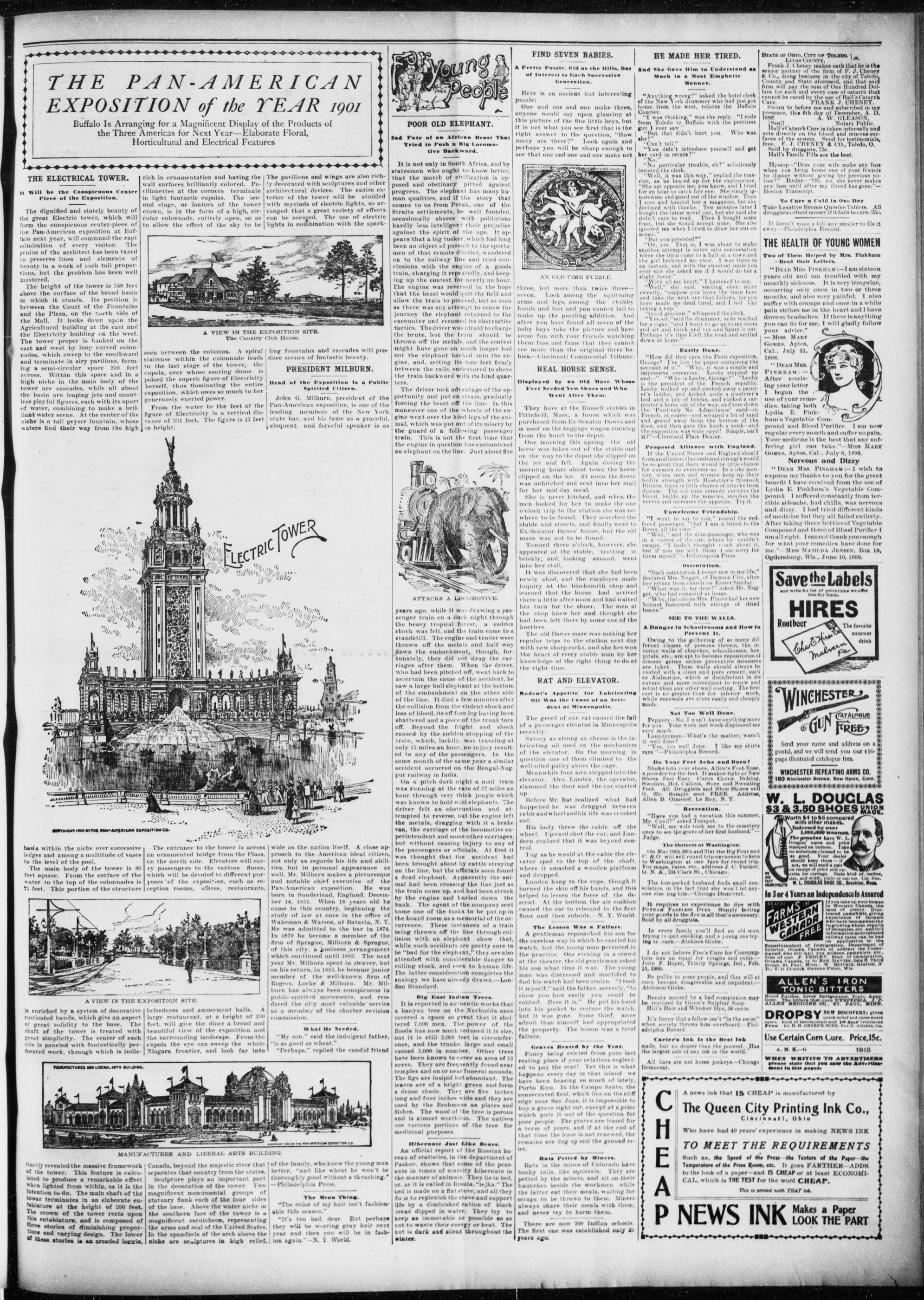
THE PAN-AMERICAN EXPOSITION of the YEAR 1901
Buffalo Is Arranging for a Magnificent Display of the Products of the Three Americas for Next Year—Elaborate Floral, Horticultural and Electrical Features
THE ELECTRICAL TOWER.
11 Will be the Consipuous Center
Piece of the Exposition.
The dignified and stately beauty of the great Electric tower, which will form the conspicuous center-piece of the Pan-American exposition at Buffalo next year, will command the rapt admiration of every visitor. The genius of the architect has been taxed to preserve lines and elements of beauty in a work of such tall proportions, but the problem has been well mastered.
The height of the tower is 348 feet above the surface of the broad basin in which it stands. Its position is between the Court of the Fountains and the Plaza, on the north side of the Mall. It looks down upon the Agricultural building at the east and the Electricity building on the west. The tower proper is fanked on the east and west by long curved colonades, which sweep to the southward and terminate in airy pavilions, forming a semi-circular space 200 feet across. Within this space and in a high niche in the main body of the tower are cascades, while all about the basin are leaping jets and countless playful figures, each with its spurt of water, combining to make a brilliant water scene. At the center of the niche is a tall geyser fountain, whose waters find their way from the high
COPYRIGHT 1900 BY THE PAN-AMERICAN EX
BY THE MAN-AMERICAN EXPOSITION CO.
ELECTRIC TOWER
COPYRIGHT 1800 BY THE PAN-AMERICAN EXPOSITION CO.
basis within the niche over successive
ledges and among a multitude of vases
to the level of the pool.
The main body of the tower is 80
feet square. From the surface of the
water to the top of the colonnades is
75 feet. This portion of the structure
A
A VIEW IN THE EXPOSITION SITE.
is enriched by a system of decorative rusticated bands, which give an aspect of great solidity to the base. The shaft of the tower is treated with great simplicity. The center of each side is paneled with fantastically perforated work, through which is indis-
belvederes and amusement halls. Large restaurant, at a height of 20 feet, will give the diner a broad and beautiful view of the exposition and the surrounding landscape. From the cupola the eye can sweep the whole Niagara frontier, and look far int
MANUFACTURES AND LIBERAL ARTS BUILDING
MANUF
AND LIBERAL ARTS BUILDING.
MANUFACTURES AND I
tinctly revealed the massive framework of the tower. This feature is calculated to produce a remarkable effect when lighted from within, as it is the intention to do. The main shaft of the tower terminates in an elaborate entablature at the height of 200 feet. The crown of the tower rests upon this entablature, and is composed of three stories of diminishing proportions and varying design. The lower of these stories is an arched loggia.
Canada, beyond the majestic river that separates that country from the states. Sculpture plays an important part in the decoration of the tower. Two magnificent monumental groups of statuary flank each of the four sides of the base. Above the water niche in the southern face of the tower is a magnificent escutcheon, representing the arms and seal of the United States. In the spandrels of the arch above the niche are sculptures in high relief, of the family, who knew the young better, "and like wheat he worn thoroughly good without a thrash—Philadelphia Press.
The Mean Thing.
"The color of my hair isn't fable this season."
"It's too bad, dear. But pee they will be wearing gray hair year and then you will be in ion again."—N. Y. World.
---
---
```markdown
```
rich in ornamentation and having the wall surfaces brilliantly colored. Pavilionettes at the corners terminate in light fantastic cupolas. The second stage, or lantern of the tower crown, is in the form of a high, circular colonnade, entirely open, so as to allow the effect of the sky to be
THE GOLF CLUB
seen between the columns. A spiral staircase within the colonnade leads to the last stage of the tower, the cupola, over whose soaring dome is poised the superb figure of Electricity herself, thus titloming the entire exposition, which owes so much to her generously exerted power. From the water to the feet of the figure of Electricity is a vertical distance of 331 feet. The figure is 17 feet in height.
ELECTRIC
EXPOSITION CO.
The entrance to the tower is across an ornamented bridge from the Plaza, on the north side. Elevators will carry passengers to the various floors, which will be devoted to different purposes of the exposition, such as reception rooms, offices, restaurants,
belvederes and amusement halls. A large restaurant, at a height of 200 feet, will give the diner a broad and beautiful view of the exposition and the surrounding landscape. From the cupola the eye can sweep the whole Niagara frontier, and look far into
FACTURES AND LIBERAL ARTS BUILT
Canada, beyond the majestic river that separates that country from the states.
Sculpture plays an important part in the decoration of the tower. Two magnificent monumental groups of statuary flank each of the four sides of the base. Above the water niche in the southern face of the tower is a magnificent escutcheon, representing the arms and seal of the United States. In the spandrels of the arch above the niche are sculptures in high relief.
A VIEW IN THE EXPOSITION SITE
The Country Club House.
ELECTRIC TOWER
LIBERAL ARTS BUILDING.
---
The pavilions and wings are also richly decorated with sculptures and other architectural devices. The entire exterior of the tower will be studded with myriads of electric lights, so arranged that a great variety of effects can be secured. The use of electric lights in combination with the spark-
ling fountains and cascades will produce scenes of fantastic beauty.
PRESIDENT MILBURN.
Head of the Exposition Is a Public Spirited Citizen.
John G. Milburn, president of the Pan-American exposition, is one of the leading members of the New York state bar, and his fame as a graceful, eloquent and forceful speaker is as
IC TOWER
wide as the nation itself. A close approach to the American ideal citizen, not only as regards his life and abilities, but in personal appearance as well, Mr. Milburn makes a picturesque and notable chief executive of the Pan-American exposition. He was born in Sunderland, England, December 14, 1851. When 18 years old he came to this country, beginning the study of law at once in the office of Wakeman & Watson, at Batavia, N. Y. He was admitted to the bar in 1874. In 1879 he became a member of the firm of Sprague, Milburn & Sprague, of this city, a business arrangement which continued until 1882. The next year Mr. Milburn spent in Denver, but on his return, in 1883, he became junior member of the well-known firm of Rogers, Locke & Milburn. Mr. Milburn has always been conspicuous in public-spirited movements, and rendered the city most valuable service as a member of the charter revision commission.
My son. "and the intelligent father,
"is as good as wheat."
"Perhaps," replied the candid friend
of the family, who knew the young man better, "and like wheat he won't be thoroughly good without a thrashing." —Philadelphia Press.
The Mean Thing.
"The color of my hair isn't fashionable this season."
"It's too bad, dear. But perhaps they will be wearing gray hair next year and then you will be in fashion again."—N. Y. World.
What He Needed.
The Mean Thing
ForYoung People POOR OLD ELEPHANT.
Sad Fate of an African Beast Than Tried to Push a Big Locomotive Backward.
It is not only in South Africa, and by statesmen who ought to know better, that the march of civilization is opposed and obstinacy pitted against progress. The elephant has many human qualities, and if the story that comes to us from Perak, one of the Straits settlements, be well founded, occasionally shares with politicians hardly less intelligent their prejudice against the spirit of the age. It appears that a big tusker, which had long been an object of pursuit to the sportsmen of that remote district, wandered on to the railway line and tried conclusions with the engine of a goods train, charging it repeatedly, and keeping up the contest for nearly an hour. The engine was reversed in the hope that the beast would quit the field and allow the train to proceed, but as soon as there was any attempt to renew the journey the elephant returned to the encounter and resumed its obstructive tactics. The driver was afraid to charge the brute, lest the train should be thrown off the metals, and the contest might have gone on much longer had not the elephant backed into the engine, and, setting its fore feet firmly between the rails, endearced to shove the train backward with its hind quarters.
The driver took advantage of the opportunity and put on steam, gradually forcing the beast on the line. In this maneuver one of the wheels of the engine went over the hind legs of the animal, which was put out of its misery by the guard of a following passenger train. This is not the first time that the engine in question has encountered an elephant on the line. Just about five
ATTACKS A LOCOMOTIVE
years ago, while it was drawing a passenger train on a dark night through the heavy tropical forest, a sudden shock was felt, and the train came to a standstill. The engine and tender were thrown off the metals and half way down the embankment, though, fortunately, they did not drag the carriages after them. When the driver who had been pitched off, went back to ascertain the cause of the accident, he saw a large bull elephant at the bottom of the embankment on the other side of the line. It died a few minutes after the collision from the violent shock and loss of blood, its offore leg having been shattered and a piece of the trunk torn off. Beyond the fright and shock caused by the sudden stopping of the train, which, luckily, was traveling at only 15 miles an hour, no injury resulted to any of the passengers. In the same month of the same year a similar accident occurred on the Bengal-Nagpur railway in India.
On a pitch dark night a mail train was running at the rate of 27 miles an hour through very thick jungle which was known to hold wild elephants. The driver felt an obstruction and attempted to reverse, but the engine left the metals, dragging with it a brake van, the carriage of the locomotive auspentendent and some other carriages, but without causing injury to any of the passengers or officials. At first it was thought that the accident had been brought about by cattle straying on the line, but the officials soon found a dead elephant. Apparently the animal had been crossing the line just as the train came up, and had been struck by the engine and hurled down the bank. The agent of the company sent home one of the tusks to be put up in the board room as a memorial of the occurrence. These instances of a train being thrown off the line through collision with an elephant show that, while such accidents are pretty sure to be "bad for the elephant," they are also attended with considerable danger to rolling stock, and even to human life. The latter consideration completes the analogy we have already drawn.—London Standard.
Big East Indian Trees.
It is reported in authentic works that a banyan tree on the Nerbudda once covered a space so great that it sheltered 7,000 men. The power of the floods has now much reduced it in size, but it is still 2,000 feet in circumference, and the trunks, large and small exceed 3,000 in number. Other trees have been known to cover an area of 12 acres. They are frequently found near temples and on or near mounda mounds. The figs are insipid but abundant. The leaves are of a bright green and form a dense shade. They are five inches long and four inches wide and they are used by the Brahmans as plates and dishes. The wood of the tree is porous and is almost worthless. The natives use various portions of the tree for medicinal purposes.
Hibernate Just Like Beans
An official report of the Russian bureau of statistics, in the department of Paskov, shows that some of the peasants in times of scarcity hibernate in the manner of animals. They lie in bed, or, as it is called in Russia, "jeeka." The bed is made on a flat stove, and all they do is to replenish the stove and support life by a diminished ration of black bread dipped in water. They try to keep as immovable as possible so as not to waste their energy or heat. The but is dark and silent throughout the winter.
FIND SEVEN BABIES.
A Pretty Puzzle, Old as the Hills, But of Interest to Each Successive Generation.
Here is an ancient but interesting puzzle:
One and one and one make three, anyone would say upon glancing at this picture of the fine little boys, but it is not what you see first that is the right answer to the question, "How many are there?" Look again and perhaps you will be sharp enough to see that one and one and one make not
AN OLD-TIME FUZZLE.
three, but more than twice three—seven. Look among the squirming arms and legs, among the chubby hands and feet and you cannot fail to make up the puzzling addition. And after you have found all seven of the baby boys take the picture and have some fun with your friends watching them fuss and fume that they cannot see more than the original three babies—Cincinnati Commercial Tribune.
REAL HORSE SENSE.
Displayed by an Old Mure Whose Feet Needed New Shoes and Who Went After Them.
They have at the Russell stables in Pittsfield, Mass., a horse which was purchased from Ex-Senator Dawes and is used on the baggage wagon running from the hotel to the depot.
One morning this spring the old horse was taken out of the stable and on the way to the depot she slipped on the ice and fell. Again during the morning hours about town the horse slipped on the ice. At noon the horse was unhitched and sent into her stall for her mid-day meal.
She is never hitched, and when the men looked for her to make the one o'clock trip to the station she was nowhere to be found. They searched the stable and streets, and finally went to Ex-Senator Dawes' house, but the old mare was not to be found.
Toward three o'clock, however, she appeared at the stable, trotting in briskly, and, looking around, went into her stall.
It was discovered that she had been newly shod, and the employees made inquiry at the blacksmith shop and learned that the horse had arrived there a little after noon and had waited her turn for the shoer. The men at the shop knew her and thought she had been left there by some one of the hostlers.
The old Dawes mare was making her regular trips to the station next day with new sharp corks, and she has won the heart of every stable man by her knowledge of the right thing to do at the right time.
RAT AND ELEVATOR.
Rodent's Appetite for Lubricating
Oil Was the Cause of an Acce-
lometer Break
The greed of one rat caused the fall of a passenger elevator in Minneapolis recently.
Savory as strong as cheese is the lubricating oil used on the mechanism of the elevator. On the morning in question one of them climbed to the well-oiled pulley above the cage.
Meanwhile four men stepped into the elevator. Alex, Lunden, the operator, slammed the door and the car started up.
Before Mr. Rat realized what had happened he was dragged between cable and wheel and his life was crushed out.
His body threw the cable off the wheel. Upward shot the car, and Lundeen realized that it was beyond control.
Tug as he would at the cable the elevator sped to the top of the shaft, where it smashed a wooden platform and dropped.
Lunden hung to the rope, though it burned the skin off his hands, and this helped to lessen the force of the descent. At the bottom the air cushion caused the car to rebound to the first floor and then subside. N. Y. World.
The Lesson Was a Failure
A gentleman reponched his son for the careless way in which he carried his watch, but the young man persisted in the practice. One evening in a crowd at the theater, the old gentleman asked his son what time it was. The young man was distressed and mortified to find his watch had been stolen. "I took it myself," said the father, severely "to show you how easily you could be robbed. Here it is." He put his hand into his pocket to restore the watch, but it was gone. Some thief, more adroit than himself, had appropriated the property. The lesson was a total failure.
Graves Rented by the Year
Fancy being evicted from your last resting place if your relatives neglected to pay the rent! Yet this is what happens every day in that island we have been hearing so much of lately, Porto Rico. In the Campo Santo, the consecrated field, which lies on the cliff edge near San Juan, it is impossible to buy a grave right out, except at a price which puts it out of the question for poor people. The graves are leased for a term of years, and if at the end of that time the lease is not renewed, the remains are dug up and the ground re-let.
Rate Petted by Miners.
Rats in the mines of Colorado have bushy tails, like squirrels. They are petted by the miners, and sit on their hannes beside the workmen while the latter eat their meals, waiting for scraps to be thrown to them. Miners always share their meals with them, and never try to harm them.
There are now 200 Indian schools. The first one was established only 20 years ago.
Who have had 40 years' experience in making NEWS INK
Such as, the Speed of the Press—the Texture of the Paper—the Temperature of the Press Room, etc. It goes FARTHER—ADDS to the look of a paper—and IS CHEAP or at least ECONOMICAL., which is THE TEST for the word CHEAP.
P NEWS INK Makes a Paper LOOK THE PART
HE MADE HER TIRED.
And She Gave Him to Understand as Much in a Most Emphatic Way.
"Anything wrong?" asked the hotel clerk of the New York drummer who had just got home from the west, relates the Buffalo Courier. He thought," was the reply, "I rode from Toledo to Buffalo with the prettiest girl I ever saw."
"But that didn't hurt you. Who was she?" "Can't tell."
"You didn't introduce yourself and get her card in return?" "No."
"No particular trouble, eh?" solicitously insisted the clerk.
"Well, it was this way," replied the traveler, as he braced up for the explanation.
"She sat opposite me, you know, and I tried for an hour to catch her eye. She simply ignored me, but out of the window, I handed her a magazine, but she declined with thanks. Ten minutes later I bought the latest novel out, but she said she didn't care to read. Then I bought some fruit, but she would accept none. She also met me when I tried to draw her out on music."
"But you persisted""
"Oh, yes. That is, I was about to make another attempt to enter into conversation when the train came to a halt at a town and the girl beckoned me over. I was there in an instant, and with the sweetest smile you ever saw she asked me if I would do her a favor. "With all my heart," I hastened to say. "Well," she said, smiling even more sweetly, "suppose you leave the train here and take the next one that follows, for you will be the dead tired, and I feel like taking a nap. "Good gracious," whispered the clerk. "Yes, air," said the drummer, as he reached for a cigar, "and I want to go up to my room and sit and think and try and figure it out. I will be the I left the road and settled down at home."
Fastly Done.
"How did they open the Paris exposition, George? I've lost the paper containing the account of it." "Why, it was a simple and impressive ceremony. Looby stepped up and—" "Who is Looby, George?" "Looby is the president of the French republic. He was a lawyer, a meritorious officer's ladder, and kicked aside a plasterer's hose and a pile of bricks, and yanked a carpenter's horse out of the way, and tore down the 'Positively No Admittance' card in French, of course—and scraped a lot of sand and gravel away from the bottom of the door, and then gave the knob a yank—and simply it? "Cleveland Plain Dealer.
Proposed Alliance with England.
If the United States and England should form a Alliance, the combined strength would be so great that there would be little chance for enemies to overcome us. In a like manner, if the United States and England body strength with Hostetter's Stomach Bitters, there is little chance of attacks from disease. The old time remedy entitles the nerves to a stronger appetite. Try it.
Unwelcome Friendship:
"I want to say to you," roared the red-faced passenger, "that I am a friend to the Boeing. All the time, the slim passenger, who was in a corner of the car, where he couldn't escape, "I hadn't thought much about it, but if you are with them I am sorry for you."
Ostentation.
"Such ostentation I never saw in my life," declared Mrs. Nugget, of Dawson City, after her return from church on Easter Sunday. "I was very proud of Mr. Nugget, who had remained at home." "Why, that colons Mrs. Placer had her new bonnet festooned with strings of dried bread."
SEE TO THE WALLS.
A Danger in Schoolrooms and How to Prevent It.
Owing to the gathering of so many different classes of persons therein, the interior walls of churches, schoolhouses, hospitals, and other buildings require disease germs unless preventive measures are taken. These walls should always be coated with a clean and pure cement, such as plaster or cemented plaster, nature and more convenient to renew and retaint than any other wall coating. The first cost is no greater than for interior work, while renewals are more easily and cheaply.
Not Too Well Done
Peppre-- No, I won't have anything more for our work our last week displeased me very much.
Laundryman—What's the matter, wasn't it well done?
"Yes, too well done! I like my shirts rare."—Philadelphia Record.
Do Your First Ache and Burn!
Shake into your shoes, Allen's Foot Ease, a powder for the feet. It makes tight or New Shoes Feel Easy. Cures Corns. Ichbing, Swollen, Hot, Callous, Sore and Swearing It is a Sample Sent FREE. Sore and Swelling It is 25. Sample sent FREE. Address, Allen B. Olmsted, L RoY, N. Y.
Recreation.
"Have you had a vacation this summer,
Mr. Cavil?" asked Tespot.
"Well, my wife took me to the cemetery once to see the grave of her first husband."
The Shrinkers at Washington.
On May 19th, 29th and 21st the Big Four and C & O. will sell round trip excursion tickets to Washington at one fare for round trip. For maps, rates, etc. address J. C. Tucker, G. N. A., 239 Clark St., Chicago.
The hen披肩 husband finds small consolation in the fact that she won't let any one else nag him. — Chicago Democrat.
It requires no experience to dye withPUTNAM FADLESS DYES. Simply boiling your goods in the dye is all that's necessary. Sold by all druggists.
In every family you'll find an old man trying to quit smoking, and a young one trying to carn. — Atchison Globe.
I do not believe Fuchs' Cure for Consumption has an equal for coughs and colds. John F. Boyer, Trinity Springs, Ind., Feb. 15, 1900.
Be polite to some people, and they will at once become disagreeable and impudent. — Atchison Globe.
Beauty marred by a bad complexion may be restored by Glenn's Sulphur Soap. Hill's hair and Whisker Dye, 50 cents.
It's funny that a follow is "in the swine" when society throws him overboard. — Philadelphia Record.
Carter's Ink Is the Best Ink made, but no dearer than the poorest. Has the largest sale of any ink in the world. All liars are not horse jockeys.—Chicago Democrat.
STATE OF OHIO, CITY OF TOLEDO. 18,
LUCAS COUNTY,
Frank J. Cheney makes oath that he is
the partner of the firm of F. J. Cheney
& Co. in building a Toledo
County and State aforesaid, and that said
firm will pay the sum of One Hundred Dollars
for each and every case of catarach that
cannot be cured by the use of Hall's Catarach
County and State aforesaid, and that said
firm will to before me and subscribed in my
presence, this 6th day of December, A. D.
1888.
A. W. GLEASON,
Neil.
Notary Public.
Hall's Catarach Cure is taken directly
and acts directly on the blood and mucous surfaces of the system. Send for testimonials,
free. F. J. CHENEY & CO., Toledo, O.
Sold by dugging, 756.
Hall's Family Pills are the best.
Hyssop — "Does your wife make my
fuse when you bring home one of your friends
to dinner without giving her previous
nose a fuss. Oh, no. she never makes
a fuss in after my friend has gone." — Boston Transcript.
To Cure a Cold in One Day
To Cure a Cold in One Day
Take a Druggy Bromo Quinine Tablets. All druggy tablets have a temperature to secure 300. It doesn't move billions to file it away. Philadelphia Record.
THE HEALTH OF YOUNG WOMEN
Two of Them Helped by Mrs. Pinkham
—Head their Letters.
"Dear Mrs. Pinkham:—I am sixteen
years old and am troubled with my
monthly sickness. It is very irregular,
occurring only once in two or three
months, and also very painful. I also
suffer with cramps and once in a while
pain strikes me in the heart and I have
drowsy headaches. If there is anything
you can do for me, I will gladly follow
e
h
ak-
e Com-
your advice:
—MISS MARY
GOMES, Aptos,
Cal., July 31,
1898.
"DEAR MRS.
PINKHAM:—
After receiv-
ing your letter
I began the
use of your reme-
dies, taking both
Lydia E. Pink-
ham's Vegetable Compound and Blood Purifier. I am now
regular every month and suffer no pain.
Your medicine is the best that any su-
fering girl can take."—MISS MARY
GOMES, Aptos, Cal., July 6, 1899.
Nervous and Dizzy
"DEAR MRS. PINKHAM: I wish to express my thanks to you for the great benefit I have received from the use of Lydia E. Pinkham's Vegetable Compound. I suffered constantly from terrible sideache, had chills, was nervous and dizzy. I had tried different kinds of medicine but they all failed entirely. After taking three bottles of Vegetable Compound and three of Blood Purifier I am all right. I cannot thank you enough for what your remedies have done for me."—MISS MATILDA JENSSEN, BOX 18, Ordenburg, Wils., June 10, 1899.
Save the Labels
and write for list of premiums we offer
free for them.
HIRES
Root beer
The favorite
summer
drink
Chas Hires
Malvern
Send your name and address on a postal, and we will send you our 156-page illustrated catalogue free.
WINCHESTER REPEATING ARMS CO.
180 Winchester Avenue, New Haven, Conn.
Worth $4 to $6 compared
in the market.
Indored by over
1,000,000 wearers.
The penetra have W. L.
Douglas, a former
stamped on bottom. Take
no substitute claimed to be
your penetra. You should
keep them — if
not, we will not.
Extra on price and xx.
extra for carriage. State kind of leather,
for carriage. W. L. DOUBLAIS SHOP, Brockton, Mass.
In 3 or 4 Years an Independence Is Assured
If you take up your home
and live in a place of
plenty, Illinois
experiences palliative
giving who have been
become wealthy
who have been able to
information to reduce
railway rates can be bad
FARMS IN
WESTERN
CANADA
FREE
Superintendent of Immigration. Department of
Interior, interior, airport, mail and postal
pamphlets, etc.
free of canada. CIDB Sept. 30 of immigration
St. Neal, St. Neal mail and postal pamphlets, etc.
Grafton, N. W. Post Office.
Blood Purifier, Liver Invitigator, Tonic Applicator. The mites that cause DYSPHENIA *PALLEN BEDGEON OD*, by PAUL, MINKIN.
**DROPSY** NEW DISCOVERY; given quick relief and cures warts cases. Book of testimonials. Box D, Atlanta, Ga. Dr. H. R. GREENE SON, box D, Atlanta, Ga.
WHEN WRITING TO ADVERTISERS
please state that you saw the Advertisement in this paper.
THE STORY TELLER
A LESSON OF TRUST.
When the dark days of winter are 'oer us
And the earth in her mantle of white
Is shaken and rocked by the tempest,
And scourge the storm, day and night.
We call the fullness of time shall disclose,
Which the fullness of time shall disclose,
Nor dream of the wonderful sweetness
Shut up in the heart of the rose.
We catch not the charm and the fragrance,
The bloom and the freshness of June;
The flush of the midsummer morning,
The glow of the midsummer noon,
We see the Wisteria, the mist,
Deep buried in darkness and cold,
Nor dream of the glory of autumn,
All radiant with crimson and gold.
Dot spring in her beautiful garments
Shall come with soft sunshine and show-
ers.
And crowned, arrayed in her glory,
And crowned with a crown of gladi flowers.
The branches with fruit shall be laden,
Which erst wavet so barren and dream,
And crowned with a corn of violet,
Comes, crowning the joy of the year.
Not only when song birds are singing, and nature seems smiling and bland. But when the fierce tempest is shrieking, and darkness hangs thick over the land, I find myself in the darkness. Still guiding wherever we go. For the Lord of the Harvest yet reigneth When the bread leth under the snow. O heart, in the night time of sorrow, Look upward, and do not despond. Though winter and darkness are 'round thee, The sunlight and summer beyond; The frost and the hail in their season. The snow that comes down from above, The winter, no less than the summer, Is the gift of an Infinite Love. It is love on the torrent that rageth. No less than the streamlet that flows. It is love in the whirlwind that smithen. No less than the zephyr that blows. It is love when thy heart sings with glad-
It is love when all gladness shall fall;
And if evil endure for a season,
It is only that good may prevail.
—Franc Remington, in Union Signal.
An Avenging Rescue
By Bourdon Wilson.
IN THOSE good old days when the Apache was yet lord of the Mexican Sierra Madre. I was commissary clerk in a grading outfit that was engaged in building a railroad in the state of Chihuahua. While this position was one that gave me constant opportunity for the study of multihiness, there having been 300 mules in the outfit, it was not one calculated to make me familiar with feminine nature, a grader's camp being no place for a woman; nevertheless, it was while so employed that my personal observation brought me to the conclusion that there is no creature more whimsical than a woman, unless it be a mule. Chihuahua was a wild bit of country in those days, an uninhabited desert of bare mountains and hills, and waterless valleys and plains for the greater part; as for that matter, it is still so, but the Apaches are not now, and Apaches are—well, there is nothing with which to compare an Apache—unless to the devil, of whose characteristics I have only a bearer knowledge.
The mules of the outfit were plain, every-day mules, sometimes sensible and tractable, at other times foolish and stubborn, but energetic kickers always. Their leader was not one of their own number, as one would naturally expect, but an old gray mare with a vicious temper—who hated them with all her heart, and who was continually fighting them, ever keeping them well beyond the reach of her heels and teeth—and her they reverenced, if ever mules can be said to reverence anything, never offering to return her kicks and bites, and they would have followed her into the very jaws of death. And because of this leadership the old gray was assigned as mount to the man who took the herd out every night to pasture, for with her under the control of an experienced man there was but little danger of the mules being stamped and run off by the Apaches.
With a few exceptions the men of the outfit were in keeping with their surroundings. Wild, rough fellows, whose only law was the dictate of the six-shooter held persuasively at "the drop," and the few orders by the "boss" of the outfit. Of these, none was wilder or rougher than one who was named Bill Smith. Physically, he was a giant, and he was an ideal laborer, but morally he was a weak laborer, and his great strength in connection with extraordinary quickness in drawing his gun, giving him unlimited confidence in himself, at the same time inspiring his comrades with fear of him, he became the bully of the camp, though he was not the coward that most bullies are. Among the few who were not of Bill's class was a young Mexican, whose name appeared on the books as Luis Montez, but who was known to the men as "Kid Cook," this nickname having come of his position as cook's assistant, and his smooth, headless face. He was a quiet fellow of about 19 years, given to blushing when roughly spoken to, and as was and timid as a girl; naturally he associated very little with the other men, and, disliking him because of this, they bullied him continually.
Part of Kid's duty was to help serve at table, and one day, while filling Bill's cup with coffee, some one struck his arm, and some, of the hot fluid fell on the bully's-hand. With a bellow of rage, Bill sprang to his feet and, with a sweeping blow, sent Kid staggering down in a corner of the tent, where he stood over him with drawn revolver, threatening to kill him in a dozen different ways if he should so much as but his eye. Nobody offered to intervene, for all knew that, if left alone, Bill would do the boy no further harm, but if interfered with might shoot him in a spirit of savage willfulness, and that, as he used his gun promiscuously when once started, somebody else would get hurt. Kid wisely made no protest, but lay still and quiet, covering his faming face with his hands and, after awhile, Bill put up his gun and went back to the table.
Anybody but a bully would have let that end the incident, but Bill seemed unable to forget his scalded hand, and never tired of badgering the timid cook. Kid avoided him as much as possible, but could not escape him at time three, when would pour from him a perfect
current of abuse. Watching Kid at these 'imes I would see that his eyes, usually soft and shy, would fairly blaze with venomous hatred, and knowing something of Mexican nature, and how handy they are with a knife, I came to the conclusion that if I were in Bill's place, I would do one of two things: apologize to the Kid and let him alone, or -kill him. I thought of speaking to Bill about it, but medding in another man's row was unhealthy business in those days, so I ended by keeping silent. Kid did not disappoint me. One night, as I sat reading in my tent, there came from the outside a sharp exclamation that was followed immediately by the sounds of a struggle, then a piercing scream, and I heard unmistakably in Bill's voice: "Yer mis rattle, sneak-in' little kyote! Put er knife in me in th' dark, would yer? Wail, I reckin not! An' now I'll just give you er taste of it, my little snake-in-th' grass."
Grabbing up my gun, knowing that nothing short of that would have any weight with Bill. I hurriedly threw open my tent, and, the bright light of my lamp flashing out, I saw Kid flat on his back with Bill kneeling on his chest, one hand gripping the boy's throat, and the other grasping a knife, upraised to strike. In Kid's face there was a look of horror that I will remember as long as I live. The sudden flood of light caused Bill to pause, and then his arm sank slowly to his side, the knife slipping from his hand. "Wall," he ejaculated, and letting go of Kid's throat he stood up. I could see nothing to justify such a change in his attitude, and I was unmazed to see him now reach down and take Kid's hand.
"Git up," he said, gruffly; "I 'nim i'goin' ter hurt hurt-never would a teched yer ef I'd known what I know now, an' I’m sorry I done it." He helped Kid to his feet and went on: "Now go back to yer tent; I sin’t a-goin’ter blow on yer, an’ I won’t bullyrug yer no more—sabe? I’ll keep the knife, though so’yer won’t git inter no more mischief with it."
Kid made no answer, and I could not see his face, but I did see his hands suddenly clinch as he went away into the darkness. Having watched him out of sight, Bill walked off without even a glance in my direction. I was greatly puzzled by what had occurred, and my curiosity being roused. I determined to find Bill the next morning and get him to tell me what it was that had caused his sudden change toward Kid; but that day was Sunday, and he left the camp at daybreak on an antelope hunt, so I did not see him. Turning the affair over in my mind that morning, I came to the conclusion that Bill's heart was too large for his judgment, and that Kid would yet avenge himself; and I was not wrong, though he did it in a way that I could not have expected.
Our camp was pitched on a low hill that rose island-like in the midst of a grassy valley. On the west side this valley was bounded by a range of rugged mountains that came down to within a mile of the camp, and on the east by a chain of high hills; to the north and south, where the railroad came in and went out, the grassy level stretched away farther than the eye could reach. To economize in feed it was the custom to pasture the mules in this valley whenever they were not at work, on Sundays and at night, and they went out as usual on the day following Kid's attempt to knife Bill. though not under charge of the night herder, he and the old gray mare having to remain in camp for rest and sleep. When the gong sounded for supper, about an hour before sunset, the herd was in plain view from camp, and not over half a mile away, so the herder galloped in to his supper, leaving them unguarded until the night herder should go out and take them.
As we were in the Apache country, it was a very foolish thing for him to do. He had scarcely unsaddled his horse and gone into the grub-tent, when shrill yells and whoops, mingled with the thunder of pounding hoofs coming from the valley brought every man running out. Watching their opportunity from their lurking-place in the mountains, a band of half-naked Apaches had slipped into the herd, and running about among the mules, lashing and striking, were trying to stampede them. They would have succeeded, mules being mortally afraid of Indians, but that the night herder, preparing to go on duty, had brought the old gray mare to the grub-tent to wait while he ate his supper, where she stood in plain sight from the valley. The mules were running away southward when the leading ones spied her, and, making a wide detour to avoid the Apaches who were galloping as fast as their legs could carry them, the entire herd came galloping in.
Yelling with rage and disappointment, the Apaches turned to go back to the mountains, when a white man rode out from the mountains before them and started the valley toward camp. By his horse, which we recognized, we knew him to be Bill Smith. The Apaches opened fire the moment they saw him, and, changing his course so as to avoid them, he as promptly spurred his horse into a gallop, and we thought he had got safely out of range, when the animal suddenly went down, falling on Bill, stunning, and pinning him to the ground. Instantly a yell of exultation went up from the Apaches, and they dashed toward him, racing with one another for his scalp. While the men occasionally killed one of their number themselves, it was quite another thing to see one butchered by the Apaches, and they groomed with horror, for they could do nothing but stand idly looking on.
Kid had run out of the tent with the others, and was standing near me when Bill went down. In the excitement of that moment I lost sight of him, and, when I saw him again, he had leaped astride the old gray mare, and, digging his heels into her flanks, started at a furious gallop toward the Apaches. At this another groan went up, for it seemed that the boy was only riding to his death. A moment later we saw 300 pairs of long ears cooked toward the old gray, 500 shaved tails flew upward, and the ground quivered beneath the pounding of 1,200 hoofs as the mules dashed away after their leader. Soon they overtook her, and, ranging themselves behind and at her sides, bore down in solid phalanx upon the Apaches, racing along as though for their lives.
Oh. what a howl of delight went up
when they saw through Kid's design!
The Apaches heard it, and, looking behind them, saw their peril. As one man they halted and fired into the mules, then scattered on the run, the greater number making for the mountains, the others still holding their course toward Bill—his scalp was too great a prize to be lightly given up. Stretched out flat on the old gray's back, Kid rode straight for these, and presently they dropped their rifles and ran for their lives, but it was too late. One after another they disappeared in a mass of switching tails and flashing heels, to go down under the herd, trampled and crushed into a bloody pulp of flesh and bone. When the last of them had fallen, Kid reined in, and, getting off his horse, started, staggering, toward Bill, but before going far he fell limply to the ground.
We saw this while running across the valley, for the moment we understood what Kid was doing every man in camp had started at the top of his speed for Bill. Those of us that went to where Kid lay, found him insensible and bleeding profusely from a ragged tear where an Apache bullet had plowed through his shoulder. Quickly I took him in my arms, and tearing open his shirt better to see the wound, I made a startling discovery—Kid was a woman.
Bill soon recovered sufficiently to ride the old gray back to camp, but we had to carry Kid, and never was babe held with tenderer care by a mother. When she regained consciousness she sent away all but the "boss" and me, and told us all about herself. Her right name was Luisa Montez. She was born and reared on a ranch back in the mountains, where the Apaches had killed her parents. Without a friend or relatives, compelled to earn her own living in a land where women are not supposed to do anything of the kind, she wandered up to Paso del Norte, and was almost starved when it occurred to her to pass herself as a man, and she was given a job in our outfit.
When we left her, Bill went in and had a long talk. What passed between them we never knew, but he immediately took charge of her, and, as carefully as a woman could have done, nursed her until she was sound and well again; and the next thing anybody knew she took him, unresisting, back to civilization and married him. Ten years afterward I ran across Bill in Santa Fe and he was a changed man. His overbearing manner was gone, leaving in its place the very spirit of meekness, and he was prosperous, owning a small grading outfit of his own. Kid and the children were well and happy, he told me—San Francisco Argonaut.
TESTED BY TRIFLES.
Man Makes an Idiot of Himself When He Upsets a Small Bottle of Ink.
Flies are great tests of character son. A man may be cool as an iceberg under extraordinary circumstances of danger or times of intense excitement; he may be calm when, at another man's order, he is facing a six-gun battery and getting ready to try if he can push a bayonet through a cannonner before the gunner shoves eight pounds of assorted ironmongery through him; he may assume command and act nobly and quietly when the ship is sinking; he may preserve an even mind when the hotel is on fire; he may even speak grammatically when the ghost enters his room at midnight.
But let that man upset a very small inkstand, says Robert J. Burdette in the Loa Angeles Times, with only very little ink in it, on his desk. He upsets his chair on the office cat as he leaps to his feet with a howl like a wild Indian or a baseball coach; he makes a desperate grab at the inkstand and swoops it half way across the desk before he sweeps it off into an open drawer full of unanswered letters; then he claws after his papers and drags them through a little puddle of ink that wasn't doing a bit of harm before he mopped it zigzag and crooked all over everything with his white handkerchief; and finally, after he has smeared the top of his desk, his hands and his gray pantaloons with ink, he discovers that at the first dash he had knocked a much larger bottle of red ink clear off the desk on to the floor, where it has lain, draining its crimson life away in the very heart of the lightest figure on a blue and white carpet.
Then he says things at the flies of life, and wonders why a man always makes an idiot of himself when he upsets a little bottle of ink. And he may keep on wondering. Because he will never know why. Nobody knows. He just does it; that is all.
How Perfectly Sweet.
"I want some very small cards engraved," said a fashionably attired woman in a Chestnut street stationer's establishment, says the Philadelphia Record. "Yes, madam," said the attendant; "about this size?" indicating a sample card. "No, no," replies the woman, "much smaller than that. I want them about the size of the baby cards that mothers used to send out several seasons ago when a new baby was born." She finally selected the size she wanted, and the attendant asked what name was to be used. "Fido Smith." was the reply. "And in addition to the address I want 'Wednesday' engraved on the opposite corner." "Did you say Fido?" asked the young man. "Yes," said the woman; "Fido Smith. You see, the cards are for my little dog. I don't know whether you know it or not, but it's quite the proper thing now for women who have dogs to take them calling upon other women who have dogs, and, of course, you couldn't do that without leaving the cards. Wednesday is my at home day, and Fido receives all his little dog friends with me on that day. Now you know all about it."
The Acme of Bias.
Cholly—My bwother is in luck. He's got a place as floor-walk in a dry goods store. He is there 16 hours a day. Awther—I cann't see the luck. Cholly—You can't? Why, his pawnts can nevah bag at the knees. —N. Y. Weekly.
A Food Metrimental Standard
WOMAN
AND
HOME
It Has Taken the Form of "Thirteen Charms" to Ward Off Evil and Unlucky Influences.
A fad of young women at present is the wearing of good luck charms on their lorgnette chains or watch fobs. They must number exactly 13, to counteract evil influences.
So popular have these become that all of the pet superstitions—which are not confined to the young, by any means—are considered by the ingenious jeweler, who makes a variety of collections with just 13 in every dangling bunch. Some of them are within reach
THIRTEEN LUCKY CHARMS.
of the moderate purse, but they are also to be found in more expensive sets, and special orders often call for still more costly talismans.
Some of these charms, with their special virtues, are as follows:
1. Split chestnut-Good morning.
2. Amethyst heart-Loyalty.
3. Owl-Wisdom.
4. Heather in glass-Eternal love.
8. Antique money—Luck at games.
9. Pine cone—Preserves from sickness.
9. Seaweed in glass—Preserves from acid dent.
10. Poppy—To forget grief.
11. Holly—Overcomes all obstacles.
12. Auvergne bell—Guide in the right path.
13. Hazelnut—Long life.
These are each attached by a little chain to a central ring. The flowers are encased in a glass locket, and the others are of silver or of gold in the forms given.
Another set of charms consists of tablets of a variety of shapes, heavily chased in ornamentation and set with gems, the sentiment of which is also engraved on the tablets just above the setting. These are:
12. A wire charm containing in a frame the figure "13."
The person wearing this set of charms is supposed to have all these wonderful qualities of character. The same gems and others as beautiful are also to be had in the rough uncut stones, inclosed in gold wire cages and hung imprisoned on little gold chains of varied lengths.—N. Y. Tribune.
BEST OF FUMIGANTS.
Sulphur Is Not Only a Powerful Disinfectant. But Sure Death to Moths and Ants.
The fumigating properties of sulphur have long made it a valuable household remedy, and the sulphur candles now on the market fill a long-felt want.
Not only are they a convenient disinfectant, but they are almost sure death to flies, red ants, roaches and moths.
The room to be fumigated must be tightly closed, even the keyholes stopped with paper; then closets, trunks, drawers and all infected receptacles must be opened, so the fumes of the sulphur can penetrate every nook and cranny.
The candle is put in a metal candle-stick and set in an earthen or iron vessel—a coal hot will answer quite as well as anything else.
The only requisite is that it shall be deep enough to prevent the flames setting fire to anything. Care must be taken not to inhale the flame when lighting the candle.
The room should be kept closed for about four hours, during which time the purifying fumes of the sulphur will thoroughly do their work. These candles must not be used where there is gilt paper, picture rails or picture frames, as they will be tarnished.—N. Y. World.
The Sleeveless Jacket.
One of the very latest Paris fashions in the black silk bolero, or "sleeveless jacket"—very much the same style of "sleeveless jacket" that was worn by our grandmothers over some of their best muslin bodices. This jacket comes to the waist line at the back and slopes down longer at the front to form pointed corners and give the desirable long front line. There is a narrow collar and revers rolling back and leaving the jacket open all the way down the front. The smartest of these jackets are of heavy corded black silk with designs done in jet spangles. Others of them are trimmed with appliques and edged with narrow silk fringe. They will be worn over the sheerest of gowns or with black silk and crepe skirts topped with bodices of plaited chiffon or those of muslin and lace.—Detroit Free Press.
Remnants and the Ladies
At Lawrence recently, says the Atchison Globe, it was decided that a woman was insane because after death her house was found to be so full of remnants of dry goods that there was barely a pathway left from the bed to the door, and from the table to the stove. If the judges were right, what woman can escape the charge of being, if not insane, at least slightly unbalanced? Every woman yields to the remnant habit. She buys remnants, though closets and bureau drawers at home are full of them. She has no use for them, but reasons that they will come in handy "some day." They include all kinds of material, from remnants of lace to remnants of bed tickling. If there is any cure for the remnant babit, no husband has yet found it out
TELLS HER OWN STORY.
Mrs. Nat Collins, the "Cattle Queen of Moutanna," Talks Interestingly of Her Early Life.
My life since childhood has been on the plains and in the mountains. My father was one of the first to visit the gold fields of Pike's peak. What is now the city of Denver, Col., was then a settlement of but two or three log cabins and a few tents. All provisions and merchandise at that time were carried across the plains on freighters wagons, the freighters traveling in large companies for protection against the Indians. My first adventure of note came while with one of these freighting trains on the way fr. Denver to the east, where I was j. neying to attend school at my old home in Iowa. The train was attacked by a band of hostiles, and I was captured.
I was taken to the main camp and presented to the chief's daughter as a playmate, or, more correctly, as a pet. I was compelled to witness the torture of prisoners almost daily, at one time being forced to behold the burning at the stake of a Mexican prisoner.
Again, with other prisoners, I was compelled to run the gantlet, and to this day I bear the scar from a wound inflicted by a tomahawk in the hand of a bloodthirsty Indian. But, having forced me to battle for life in an effort to run the gantlet, having inflicted a wound which was intended to produce death, their thirst for blood appeared satisfied, and every effort was made to nurse me back to health.
While with the Indians I learned to do bead work and decorations, obtained a knowledge of their medicines, witnessed the ceremony of selecting chiefs and medicine men, was taught their beliefs, their dances, sung their songs and spoke their language fairly well.
After several months of captivity, through the agency of United States troops I was exchanged for four Indian prisoners and returned to my home in Denver.
This adventure was unfortunate; it robbed me of an education, as from this time I never had another opportunity to return to the east, and there were then no schools in the west.
Following my captivity and return to my home I made 12 round trips from Denver to Missouri river points as cook for a freighting train, my
MRS. NAT COLLINS.
("Mother" of All the Ranchmen of the
Western Plains.)
brother being a wagon master. Wood and water were scarce, and many times our only fuel was dry buffalo chips. At times the dread sand storms would overtake us, when nothing could be cooked without its being unfit for food. During these storms travel was abandoned. Hardly a day passed without an Indian fight, for the savages were constantly swooping down upon the trains, killing the freighters or driving away the stock. Now the same journey can be accomplished in comparatively a few hours in the modern palace car.
In this way I earned my first money, and when the excitement occasioned by the discovery of rich gold fields at Alder Gulch, Mont., induced my relatives to decide upon that as their future home, we were among the first to go to Virginia City. The trip from our starting point on the Missouri river occupied nearly three months, and the greater part of that time I was employed as a scout for the train, because of my knowledge of scouting gained while with the Indians.
For three days and nights we were lost in the terrible "Bad Lands," without water or food, but finally continued, our route passing through a portion of what is now the great Yellowstone park.
Here was a sight that will never be witnessed again—the herds of buffalo that roamed the prairies of the Yellowstone. Nothing was more feared than a stampede of buffalo. With their heads down, for the buffalo does not look up, they would go pell-mell over the plains, and should even a high river bank be reached they would continue on their mud race, trampling to death all who fell beneath.
I have seen buffalo so thick that we would be compelled to stop our train and shoot among them to frighten and drive them away before we could camp. The earth at times seemed to tremble beneath their tread, but to-day all that remains as a reminder of those great herds of noble beasts are a few domestic herds. We went up the Gallatin valley, past where Bozeman now stands, to Virginia City.
There were no laws or courts in those days, only such as were made by the miners, who would gather at the stores and plan what they would do with the desperadoes. I have seen the bodies of men left hanging from the limbs of trees for days as a warning to criminals.
For the past 18 years I have been engaged in the cattle business in northern Montana, the first 18 months of which time I did not see the face of a white woman, as the only settlers were friendly Indians.
My first shipment of cattle was made nine years ago, and my journey to Chicago at that time was also my first visit east since leaving my old home in Iowa.
Each year since that time I have accompanied my annual shipment to Chicago.—Mrs. Nat Collins, in Chicago Democrat.
A LITTLE NONSENSE.
First Trooper—"What do you think of him?" Second Trooper—"Well, he may be French by name, but he's British by nature."—Fun
Trooper (who has caught a locust)—"Look 'ere, Bill! This is a rummy country. 'Ere's the bloomin' butterflies in khaki!!"—Punch.
Miss Pechis—"Everybody seems to think I'm the picture of mamma. Do you?" Mr. Gallandt—"Well, I should say a very flattering picture."—Philadelphia Press.
"I love you madly, devotedly," said the ancient millionaire. "I place my fortune and my heart at your feet." "Do you love me enough," asked the fair lady, who wasn't so romantic as her words would imply, "to die for me?"—Philadelphia North American.
"Old Snips is wild!" "Oh??" "Yes, he offered to make 100 khaki suits for as many officers among the volunteers, and charge nothing for them." "So I understood. Well?" "One suit went to a man who has owed him a pile of money for years; that's what caused h's dander to rise!" "Pick-Me-Up." "What's the charge?" asked the court. "The prisoner, your honor," replied the officer, "asked this man here what his father was doing, and when told that the latter was a spy in the mint, without provocation, called the father a minee pie." "Poor fellow!" said the court. "An examination into his sanity seems almost unnecessary."—Philadelphia, North American.
Mrs. Greene "They do say that Mr. Slyder gambles. Is it not哎!” Mrs. Gray "I should say it was. Why, it's almost as bad as stealing. If he wins he robs some other man; if he loses he robs his family." Mrs. Greene "At any rate, it is terribly wicked. By the way, I forgot to tell you. I won the first prize of the whist tournament last night—a beautiful silver cup." Mrs. Gray "Oh, you lucky woman! How I envy you!" -Boston Transcript.
FIREPROOF CLOTHING.
Tmid People in Germany May Array Themselves in Incombustible Ritment.
Consul Liefeld, writing to the state department from Freiburg, Germany, tells of a new fireproof material coming into use there. He says: "As is well known, the substance usually employed for the manufacture of fireproof clothing, paper, theater curtains, etc., is asbestos, a mineral silicate, a variety of hornblende, which can be woven or otherwise prepared, and is infusible at ordinary temperatures; hence soiled articles made of asbestos need only be thrown into a fire to be cleaned. Asbestos has, however, several great disadvantages, viz. its high price and its great weight, the specific gravity being about three.
"A new method has been introduced here by which goods are rendered fireproof when treated chemically by a very quick process, which does not act on the fiber, so the goods lose nothing in strength, nor does the treatment in any way affect the color or perceptibly increase the weight, and the advance in the price of the article is very little.
"I procured some samples and tried a few experiments with cloth which had been made fireproof by this new process, and found that no flame or fire is produced, as was the case with similar goods which had not been so treated. Only where the candle flame came into contact with the cloth was the fiber charred, but there was no spread of fire, and as soon as the flame was removed the charring ceased. I poured some kerosene oil on a piece of the cloth and ignited it; the oil burned vigorously, but the cloth was simply charred where it had been soaked with oil, and there was no spread of fire. A piece of wood wrapped in thick fireproof canvas was placed for a few moments on the red-hot anthracite coals of a furnace, and when examined was found to be uninjured, except where it had been in direct contact with the coal.
"There is one disadvantage connected with this discovery, which prevents the use of these fireproof articles for outdoor purposes, viz., that water can dissolve the chemicals and then the substance is no longer fireproof, but as such material can be washed and then relimpregnated very easily and cheaply, it would seem that this does not greatly depreciate its value. Steam and moisture do not affect the fireproof qualities, nor does the application of heat. It is also claimed that the manufactured article is not in the least poisonous.
"I have learned that the increase in price to the consumer of the fireproof article need not be more than about three cents per square yard over that of the unimpregnated, and in large quantities the difference would be even less, and the difference in weight is such that a piece of flag material weighing before treatment 134 grams per square meter would weigh after impregnation from 140 to 150 grams, which means only from ten to twenty grams per square meter more. If we consider 500 grams to the pound and one and one-fifth square yards to the square meter, this would mean an increase in weight of only one pound for about every 50 square yards of material. For other goods the average increase might be even less."
Where Happiness Perches.
"Happiness? Huh!" snorted the bunehroom growler. "There isn't any such thing as happiness; never was any such thing; never will be!" "Oh, I dunno," said the man with the square jaw, musingly. "If the black newsboy, with a bag of peanuts in his fist and a bunch of cigarettes in his pocket, occupying a rail seat in the gallery of a variety theater, isn't happy, then what the dickens is he!"
"You win, Bill," said the square jawed man's listeners.—Washington Post.
Ascending Cheops
Tourists ascend upon the outside of the summit of Cheops, the largest of the three pyramids of Ghizhe. The height of the stone blocks comprising the pyramids average three feet, and up them you clamber. An Arab is tugging at each hand an another assisting in the rear. You really do not climb, you are simply hoisted. It is a tiresome and dizzy performance. Next day you ache in every bone and sinew.
THE LETTER WAS GENUINE AND CONTAINED FACTS.
THE LETTER WAS GENUINE AND CONTAINED FACTS.
A Former American Settled in Canada. Flooded with Inquiries.
A short time since a letter appeared in these columns signed by Mr. W. H. Kinkade, of Alameda, Assiniboia, Western Canada, which caused that gentleman to receive a great many inquiries, most of them anxious to know if the letter was genuine. To a large number of the inquiries answers were sent, but it was impossible to reply to all. We take pleasure in submitting to our readers a specimen of replies sent by Mr. Kinkade:
"Yes, the letter dated December 1989, supposed to have been written by me which you saw in your local papers was genuine and contained facts. I will say of the information received from the Canadian Government agents prior to coming here. I did not find a single untrue statement. The Canadian government is an honorable one and its agents dare not misrepresent this country or they would lose their job. There is quite a bit of land for homeesteading yet, a very little close to market, but mainly from six to twenty miles from stations. The country hereabouts is a prairie, nearly level, slightly rolling not a rough country by any means. Homestead entries cost ten dollars on land that has been cancelled there is a five-dollar cancellation fee extra and in some cases an inspection fee of five dollars, and where the required occupant has made any substantial improvements there are small amounts to pay for improvements. This is a poor place for a poor man unless he has brains and muscle and "git and grit," but with these requisites he can succeed. The population of this part of Assiniboia has doubled during the past two years. There has been as much prairie broken the past two years as was already broken previous to 1898. C. P. R. land (odd section) joined homesteading at three dollars per acre. Improved quarters within four to five miles of town sell at $1,000 this spring. This is not a Garden of Eden at all. No man need think he can come here and get rich in a short time without much labor, but if he will work and be saving he can soon be an independent farmer tilling his own soil and getting good returns for his labor.
"We burn coal, which costs us $1.55 per load at the mines which are 20 miles southwest of us.
"People with stock and machinery should come in May, so as to have all June to break in. Those who expect to work for wages for the first year or two should come by the end of July to work through harvest and threshing and then go to the coal fields and work all winter, and by spring he could be ready to improve homestead.
"A quarter-section of railway land sells at three dollars per acre. The interest is all figured up and a man has about $71 to pay cash, and if he breaks at least ten acres first breaking season his $21 interest for the first year is thrown off and the second fall following purchase he has $60 to pay and then $60 to pay for eight more falls, which makes a total of $611 the quarter costs him, including all interest. Paying for a quarter of land that way is like keeping a life insurance policy paid, only it does not take so long to do it. By a man home steading one quarter and buying another quarter gives him a chance to have a 320-acre farm all his own and have it paid for in ten years and after that he is sure of an easy living if he is any good at all.
"SIGNED) W. H. KINKADE."
HIS TREASURE.
An Incident of City Life That Show Up a Masculine Failing That Is Universal.
Vanity seems to spring eternal in the man-cine breast, and the less it has to feed upon the more it thrives, apparently.
Oneday, says the Baltimore News, a tram of 10 women, a pregnancy before the window of a house which two young women were standing. He was tattered and torn and melancholy looking to such an extent that he aroused a feeling of deep sympathy in the hearts of the maddens in his hands. He intently at some object he held in his hand.
"I wonder what he has," said the sentimental one of the two, as she peered down on him; "a lock of some woman's hair. I shouldn't wonder. He coin's he found; he looks pleased," rejoined the practical one, so兴味ly, as she maneuvered for a position that would reveal the object to her.
But it was neither, they discovered. It was a man surveying his features with a sativa air that told of his entire contentment with his very rugged physiognomy.
Which shows, as was said at the beginning of this story, that vanity springs eternally in the feminine.
To Win Endying Fame
Some day, to shift the small boy to an earthly paradise, somebody will introduce a fencesel baseball park and his fame will last forever—Pittsburgh Times.
It is not considered good form for a rehaired girl to ride a white bicycle. This is important and should be remembered—Danville Commercial.
It sometimes happens that a man of resources is one who has ingenious methods of contracting liabilities—Chicago Daily News.
The only reason some persons pay their debts is so that they will feel free to borrow again—N. Y. Press.
In that tired feeling — blood lacks vitality and richness, and hence you feel like a lazy gard尔 all day and can't get rested at night. Hood's Sarsaparilla will cure you because it will restore to the blood the qualities it needs to nourish, strengthen and sustain the muscles, nerves and organs of the body. It gives sweet, refreshing sleep and imparts new life and vigor to every function.
Felt Tired — In the spring I would have no appetite and would feel tired and with out ambition. Took Hood's Sarsaparilla in small doses, increasing as I grew stronger. That tired feeling left me and I felt better in every way." W. E. Baker, Box 90, Millard, Ohio.
Be sure to get Hood's because Hood's Sarsaparilla
In the Best Medicine Money Can Buy. Prepared by C. I. Hood & Co., Lowell, Mass.
FISIO'S CURE FOR GUILLES WHERE MILK FLAILS Dose Hood's Sarsaparilla. Tastes Good. Use in time. Sold by druggists.
CONSUMPTION