The Afro-American Advance
Saturday, June 30, 1900
Minneapolis, Minnesota
Page text (machine-generated)
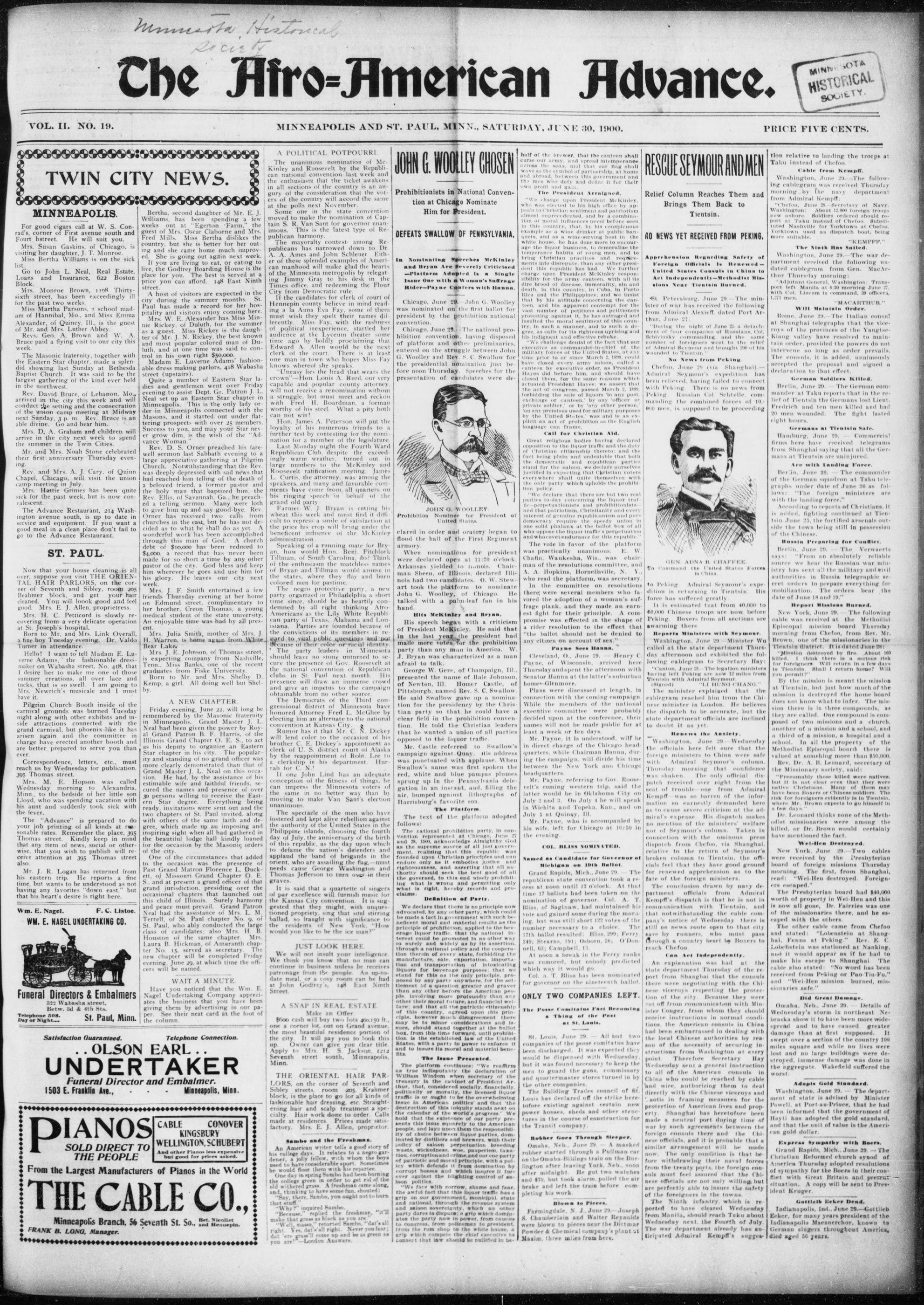
TWIN CITY NEWS.
PIANOS
SOLD DIRECT TO
THE PEOPLE
CABLE CONOVER
KINGSBURY
WELLINGTON, SCHUBERT
And other Pianos less expensive
but good for prices asked.
From the Largest Manufacturers of Pianos in the World
THE CABLE CO..
Minneapolis Branch, 56 Seventh St. So., Bet. Nicollet,
and Hennepin.
FRANK B. LONG, Manager.
VOL. II. NO. 19. TWIN CIT
MINNEAPOLIS
For good cigars call at W. S. Conrad's, corner of First avenue south and Fourt hstreet. He will suit you.
Mrs. Susan Gaskins, of Chicago, is visiting her daughter, L. T. Monroe.
Miss Bertha Williams is on the sick list.
Go to John L. Neal, Real Estate, Loans and Insurance, 622 Boston Block.
Mrs. Monroe Brown, 1108 Thirty-sixth street, has been exceedingly ill for the past two weeks.
Miss Martha Parsons, a school madam of Hannibal, Mo., and Miss Emma Alexander, of Quincy, Ill., is the guest of Mr. and Mrs. Luther Abbey.
Revs. Geo. A. Brown and W. A. Bruce paid a flying visit to our city this week.
The Masonic fraternity, together with the Eastern Star chapter, made a splendid showing last Sunday at Bethesda Baptist Church. It was said to be the largest gathering of the kind ever held in the northwest.
Revs. David Bruce of Lebanon, Mo., arrived at the city this week and will conduct the setting and the consecration of the union camp meeting at Midway next Sunday, 3 p. m. Rev. Bruce is an able divine. Go and hear him.
Mrs. D. A. Graham and children will arrive in the city next week to spend the summer in the Twin Cities.
Mr. and Mrs. Noah Stone celebrated their first anniversary Thursday evening.
Rev. and Mrs. A. J. Cary, of Quinn Chapel, Chicago, will visit the union camp meeting in July.
Mrs. Hattie Grimes has been quite clear for the past week, but is now concise.
The Advance Restaurant, 214 Washington avenue south, is up to date in service and equipment. If you want a good meal in a clean place don't fail to go to the Advance Restaurant.
ST. PAUL.
Now that your house cleaning is all over, suppose you visit THE ORIENTAL HAIR PARLORS, on the corner of Seventh and Sibley, room 205 Beahmer block, and get your hair cleaned. You will look good and feel good. Mrs. E. J. Allen, proprietress. Mrs. H. C. Petticard is slowly recovering from a very delicate operation at St. Joseph's hospital. Born to Mr. and Mrs. Link Overall, a fine boy Tuesday evening. Dr. Valdo Turner in attendance. Hello! I want to tell Madam E. Luverne Adams, the fashionable dressmaker on Wabasha street. No. 418, that desire her to make me one of those fashionable and nice face and tucks, that is so swell. I am going to Mrs. Newrich's musicale and I must have it.
Pilgrim Church Booth inside of the carnival grounds was burned Tuesday night along with other exhibits and inside attractions connected with the grand carnival, but phoenix-like it has arisen again and the committee in charge have erected another booth and are better prepared to serve you than ever.
Correspondence, letters, etc., must reach us by Wednesday for publication. 395 Thomas street.
Mrs. M. E. Hopson was called Wednesday morning to Alexandria, Minn., to the bedside of her little son Lloyd, who was spending vacation with his aunt and suddenly took sick with the fever.
The "Advance" is prepared to do your job printing of all kinds at reasonable rates. Remember the place, 395 Thomas street. Kindly keep in mind that any item of news, social or otherwise, that you wish to publish will receive attention at 395 Thomas street also.
Mr. J. J. R. Logan has returned from his eastern trip. He reports a fine time, but wants to be understood as not being a victim. But that his heart's desire is right there.
Funeral Directors & Embalmers
322 Wabasha street.
Betw. 3d & 4th Sts.
Telephone 508.
Day or Night... St. Paul, Minn.
Satisfaction Guaranteed.
.. OLSON
UNDER
Funeral Director
1503 E. Franklin Ave.,
PIANO
SOLD DIRECT
THE PEOPLE
The Afro=American Advance.
If you are living to eat, or eating to live, the Godfrey Boarding House is the place for you. The best is served at a price you can afford. 148 East Ninth street.
A host of visitors are expected in the city during the summer months. St. Paul has made a record for her hospitality and visitors enjoy coming here. Mrs. W. E. Alexander has Miss Minnie Riecky, of Duluth, for the summer as a guest. Miss Riecky is the daughter of J. N. Riecky, the best known and most popular colored man of Duluth, and at one time was said to control in his own right $50,000.
Madam E. Luverne Adams' fashionable dress making parlor, 418 Wabasha street (upstairs).
Quite a number of Eastern Star ladies and gentlemen went over Friday evening to assist Dept. Gr. Patron J. L. Neal set up an Eastern Star chapter in Minneapolis. This is the only lady order in Minneapolis connected with the Masons, and it started out under that paring program. The Masons to you, and may your Star never grow dim, is the wish of the "Advance Woman."
Rev. D. S. Orner preached his farewell sermon last Sabbath evening to a large appreciative gathering at Pilgrim Church. Notwithstanding that the Rev. was deeply depressed with sad news that had reached him telling of the death of a beloved friend, a former pastor and the holy man that baptized him, the Rev. Ellis, of Savannah, he preached a telling sermon. Many were loth to give him up and say goodbye. Rev. Ellis was a church church in the east, but he has not decided as to what he shall do as yet. A wonderful work has been accomplished through this man of God. A church debt of $10,000 has been reduced to $4,000, a record that has never been made for so short a time by any other pastor of the city. God bless and keep him wherever he goes and use him for his glory. He leaves our city next week.
Mrs. J. F. Smith entertained a few friends Thursday evening at her home on Edmund street, complimentary to her brother, Creon Thomas, a young medical student of the state university, who enjoyable time was had by all pres
Mrs. Julia Smith, mother of Mrs. J. H. Warren, is home again from White Bear Lake
Mrs. J. E. Johnson, of Thomas street, is expecting company from Nashville, Tenn. Miss Banks, one of the recent graduates from Fiske University.
Born to Mr. and Mrs. Shelby D. Kemp, a girl. All doing well but Shelby.
A NEW CHAPTER
Friday evening, June 22 will long be remembered by the Masonic fraternity in Minneapolis, Grand Master J. L. Neal had been given the power by Royal Grand Patron B. F. Harris, of the Illinois Grand Chapter O. E. S., to act as his deputy to organize an Eastern Star chapter in his city. The popularity and standing of no grand officer was clearly the key to his success. Grand Master J. L. Neal on this occasion. He had, by the assistance of his estimable wife and faithful friends, secured the names and presence of over 30 persons willing to receive the Eastern Star degree. Everything being ready, invitations were sent out and the two chapters of St. Paul invited, along with others of the same faith and degree, which made up an imposing and inspiring sight when all had gathered in the courtroom ledge hall kindly located for the occasion by the Masonic orders of the city.
One of the circumstances that added to the occasion was the presence of Past Grand Matron Florence L. Duckett, of Missouri Grand Chapter O. E. S. and at present a grand officer of that grand jurisdiction, presiding over the occasional chapters that launched out this child of Illinois. Surely harmony and peace must prevail. Grand Patron Neal had the assistance of Mrs. L. M. Terrell, of St. Paul chapter No. 9 of Paul, who only conducted the class class on Monday, also Mrs. L. B. Houston of the same chapter. Mrs. Laura B. Hickman, of Amaranth chapter No. 15, served as secretary. The new chapter will be completed Friday evening. June 20, at which time the officers will be named.
WAIT A MINUTE
Have you noticed that the Wm. E. Nagel Undertaking Company appreciates the business that you have been giving them by advertising in our paper. See their neat card at the foot of the column.
MINNEAPOLIS AND ST. PAUL, MINN., SATURDAY, JUNE 30, 1900.
A POLITICAL POTPOURRI.
The unanimous nomination of McKinley and Roosevelt by the Republican national convention last week and the enthusiasm that the ticket awakens in all sections of the country is an augury of the consideration that the voters of the country will accord the same at the polls next November. Since the convention moved to the nomination of Captain S. R. Van Sant for governor unanimous. This is the latest type of Republican harmony. The mayoralty contest among Republicans has narrowed down to Dr. A. A. Ames and John Schlenner. Either of these splendid examples of American manhood will make glad the hearts of the Minnesota metropolis by relegation to his desk in the Times office, and redeeming the Flour City from Democratic rule.
If the candidates for clerk of court of Henpennin county believe in mind reading a la Anna Eva Fay, some of them must wish they spelt their names differently. Miss Fay, with the rashness of political inexperience, startled her audience at the Lyceum theater some time ago by boldly proclaiming that Allen would be clerk of the court. There is at least one man in town who hopes Miss Fay knows whereof she speaks.
"Uneasy lies the head that wears the crown"—Hon. Louis A. Reed, our very capable and popular county attorney, will not receive a renomination without a struggle, but must meet and reckon with Fred H. Boardman, a foeman worthy of his steel. What a pity both can not win!
B. H. Peterson A. Peterson will put the loyalty of his numerous friends to a further test by contesting for the nomination for a member of the legislature
Last Monday night the Fourth Ward Republican Club, despite the exceedingly warm weather, turned out in large numbers to the McKinley and Roosevelt ratification meeting. James L. Curtis, the attorney, was among the speakers, and many and favorable comments have come from all quarters on his ringing speech in behalf of the grand old party.
Farmer W. J. Bryan is cutting his wheat this week and must find it difficult to repress a smile of satisfaction at the price his crop will bring under the beneficent influence of the McKinley administration.
Speaking at a running mate for Bryan, how would Hon. Benj. Pitchford Tillman, of South Carolina, do? Think of the enthusiasm the matchless names of Bryan and Tillman would arouse in the states, where they flay and burn colored men for pastime.
The negro protective party, a new party organized in Philadelphia a short time since, should be as heartily condemned by all right thinking Afro-Americans as the Lily White Republican party of Texas, Alabama and Louisiana. Parties are founded because of the convictions of its members in regard to vital public questions and not because of their color or racial identity. The party should leave no stone unturned to secure the presence of Gov. Roosevelt at the national convention of Republican clubs in St. Paul next month. His presence will draw an immense crowd and give an impetus to the campaign obtainable from no other source. The Democrats of the Third congressional district of Minnesota have honored Attorney Fred L. McGhee by electing him an alternate to the national convention at Kansas City. Rumor has it that Mr. C. N. Dickey will lend color to the occasion of his brother C. E. Dickey's appointment as U.S. U.S. court of Alaska by the reappointment of Robt Lee a clerkship in his department. Hurrah for C. N.'
If one John Lind has an adequate conception of the fitness of things, he can impress the Minnesota voters of the same in no better way than by moving to make Van Sant's election unanimous.
The spectacle of the men who have fostered and kept alive rebellion against the authority of the United States in the Philippine islands, choosing the fourth day of July, the anniversary of the birth of this republic, as the day upon which to defame the nation's defenders and applaud the band of brigands in the orient, who are assailing the flag,—must needs cause George Washington and Thomas Jefferson to turn over in their graves.
It is said that a quartette of singers of par excellence will furnish music for the Kansas City convention. It is suggested that they might, with unquestioned propriety, sing that soul stirring ballad, so fraught with significance to the residents of New York. "How would you like to be the ice man?"
JUST LOOK HERE
We will not insult your intelligence. We think you know that no man can continue in business unless he receives patronage from the people. An up-to-date meal, or a cosy room can be had from Godfrey's, 148 East Ninth Street.
A SNAP IN REAL ESTATE
$600 cash will buy two lots 405150 ft,
one a corner lot, out on Grand avenue,
the most beautiful residence portion of
the city. It will pay you to look this
up. Owner can give you clear title.
Apply to Mrs. H. S. Jackson, 1212
Seventh street south, Minneapolis,
Minn.
THE ORIENTAL HAIR PAR-
LORS, on the corner of Seventh and
Sibley streets, room 205, Krahmer
block, is the place to go for all kinds of
fashionable hair dressing, etc. Straight-
ening hair and scalp treatment a
speciality. Hair work done to order. Calls
made at residences. Prices made satisf-
actory. Mrs. E. J. Allen, proprietor.
Samba and the Freshman.
An American writer tells a good story of his college days. It relates to a negro gardener, a jolly fellow, with whom the boys used to have considerable sport. Sometimes he was a teacher, and sometimes a teacher. One day in spring Sambo had been burning the college green in order to get rid of the old withered grass. A freshman came along, and, thinking to have some fun, shouted: "Say, there, Sambo, you ought not to burn that stuff," and Sambo "invigorated Sambo."
Way: "quarrel," replied the freshman, "it'll "Because," replied the freshman, "it'll
make that grass as it grows as you do.
Well, massa, that grass "dat's all right."
It will always be right. Never your leaf;
not "ere grass'll come up and be as green as
sat."—London Answers.
In Nominating Speeches McKinley and Bryan Are Severely Criticised —Platform Adopted Is a Single Issue One with a Woman's Suffrage Rider—Payne Conferes with Hannah.
Chicago, June 29. —John G. Woolley was nominated on the first ballot for president by the prohibition national convention.
Chicago, June 29. —The national prohibition convention, having disposed of platform and other preliminaries, entered on the struggle between John G. Woolley and Rev. S. C. Swallow for the presidential nomination just before noon Thursday. Speeches for the presentation of candidates were de-
JOHN G. WOOLLEY.
Prohibition Nominee for President of
United States.
clared in order and oratory began to
flood the hall of the First Regiment
armory.
When nominations for president were declared open at 11:20 o'clock, Arkansas yielded toinois. Chairman Sheen, of Illinois, declared Illinois had two candidates. O.W. Stewart took the platform to nominate John G. Woolley, of Chicago. He talked with a palm-leaf fan in his hand.
Hits McKinley and Bryan.
His speech began with a criticism of President McKinley. He said that in the last year, the president had made more votes for the prohibition party than any man in America. W. J. Bryan was characterized as a man afraid to talk. George W. Gere, of Champaign, III, presented the name of Hale Johnson, of Newton, III. Homer Castle, of Pittsburgh, named Rev. S. C. Swallow. He said Swallow gave up a nomination for the presidency by the Christian party so that he could have a clear field in the prohibition convention. He told the Christian leaders that he wanted a union of all parties opposed to the liquor traffic.
Mr. Castle referred to Swallow's campaign against Quay, his address was punctuated with applause. When Swallow's name was first spoken the red, white and blue pampas plumes sprung up in the Pennsylvania delegation in an instant, and, filling the air, bumped against lithographs of Harrisburg's favorite son.
The Platform
The text of the platform adopted follows:
The national prohibition party, in convention represented at Chicago, June 27 and 28, 1900, acknowledge Almighty God as the supreme source of all law, and proves that God was founded upon Christian principles and can endure only as it embodies justice, and righteousness, and asserting that all authority should seek the best good for the governed, to this end wisely prohibiting what is wrong and permitting only what is right, hereby records and pro-
Definition of Party.
We declare that there is no principle now advocated, by any other party, which could be made a fact in government with such beneficent moral and material results as the principle of prohibition, applied to the bevy of the greatest interest could be promoted in no other way so surely and widely as by its assertion, through a national policy and the cooperation thersis of every state, forbidding the manufacture, sale, exportation, importation of any alcoholic liquors for beverage purposes, that we stand for this as the only principle, proposed by any party anywhere, for the settlement of a question greater and graver than any other before the American people, and for the other their moral future, and financial welfare; and that all the patriotic citizenship of this country, agreed upon this principle, however much disagreement there may be to minor considerations and less important box, from this time forward, until prohibition is the established law of the United States, with a party in power to enforce it and to insure its moral and material bene-
The Issue Presented
The platform continues: "We reaffirm as true indisputably the declaration of William Windom when secretary of the Treasury, Mr. Trump, thur, that, considered socially, financially, politically or morally, the licensed liquor traffic is or ought to be the overwhelming issue in American politics and that 'the liquor trade is the calendar of the world's progress.' We hold that the existence of our party presents this issue squerely to the American public, and that the choice of between liquor parties dominated by distillers and brewers, with their policy of saloon perpetuation breeding waste, hindering the puertorium, taxation, and morality of patriotic and moral principle, with a policy which defends it from domination by corrupt bosses and which insures it forrom the blighting control of saloon politics.
"We face with sorrow, shame and fear, the awful fact that this liquor traffic has a strong influence on the local and national, through the revenue system and saloon sovereignty, which no other party dares to dispute; a grip which dominates the congress, from policemen to president, from the rum shop to the white house, a grip which compels the chief executive to give up his power.
half of the brewer, that the canteen shall curse our army, and spread intemperance across the seas, and that our flag shall wave as the symbol of partnership, at home and abroad, between this government and others, to defend and define it for their own profit and benefit.
The President Arraigned.
President Arlington
"We charge upon President McKinley who was elected in 1876 by appeals to Christian sentiment and patriotism almost unprecedented, and by a combination of moral influences never before seen in this country, that, by his conscientious efforts, he will be able to quit, and as a wine-serving host in the white house, he has done more to encourage the liquor business, to demoralize the temperance habits of young men, and to encourage the young men to disrepute, than any other president this republic has had. We further charge upon President McKinley responsibility for the army canteen, with all its provisions, for the health of the dead, in this country, in Cuba, in Porto Rica and the Philippines; and we insist that by his attitude concerning the canteen, and his apparent contempt for the army, he will be prosecuting against it, he has outraged and insulted the moral sentiment of this country, in such a manner, and to such a degree, as calls for its righteous upbringing and
"We challenge denial of the fact that our executive as commander-in-chief of the military forces of the United States, at any time, has been denied the right to have closed every army saloon, called a canteen by executive order, as President Hayes did before him, and should have closed them, for the same reasons which actuated President Hayes; we assert that the United States should not forbidding the sale of liquors in any post, exchange or canteen, by any 'officer or private soldier', or by 'any other person, on any premises used for military purposes by the United States', was and is as ex-
Call for Christian Aid.
Great religious bodies having declared opposition to the liquor traffic and the duty of Christian citizenship thereto; and the fact being plain and undeniable that both the democratic and republican parties have been called upon to justify in expecting that Christian voters everywhere shall unite themselves with the only party which upholds the prohibition policy.
We are sure that there are but two real parties to day concerning the liquor traffic-perpetuationists and prohibitionists—and that patriotism, Christianity and every interest of genuine republicanism and pure democracy require the speedy union in the liquor traffic of those who oppose the liquor traffic perpetuation and who covet endurance for this republic."
The vote in favor of the platform was practically unanimous. E. W. Chafin, Waukesha, Wis., was chairman of the resolutions committee, and A. A. Hopkins, Hornellville, N. Y., who read the platform, was secretary.
In the committee on resolutions there were several members who favored the adoption of a woman's suffrage plank, and they made an earnest fight for their principle. A compromise was effected in the shape of a rider resolution to the effect that "the ballot should not be denied to any citizen on account of sex."
Payne Sees Hanna.
Cleveland, O., June 29. — Henry C Payne, of Windsor, arrived here Thursday and spent the afternoon with Senator Hanna at the latter's suburban home—Glennore.
Plans were discussed at length, in connection with the coming campaign. While the members of the national executive committee were probably decided upon at the conference, their names will not be made public for at least a week or ten days.
Mr. Payne, it is understood, will be in direct charge of the Chicago headquarters, while Chairman Hanna, during the campaign, will divide his time between the New York ano Chicago headquarters.
Mr. Payne, referring to Gov. Roosevelt's coming western trip, said the latter would be in Oklahoma City on July 2 and 3. On July 4 he will speak in Wichita and Topeka, Kan., and on July 5 at Quincy, Ill.
Mr. Payne, who is accompanied by his wife, left for Chicago at 10:50 in the evening.
COL. BLISS NOMINATED.
Named as Candidate for Governor of
Michigan on 19th Ballot.
Grand Rapids, Mich., June 29. — The republican state convention took a recess at noon until 12 o'clock. At that time 17 ballots had been taken on the nomination of governor, Col. A. T. Bliss, of Saginaw, had maintained his vote and gained some during the morning, but was still short 122 votes of the number necessary to a choice. The 17th ballot resulted: Bliss, 290; Ferry, 249; Stearns, 191; Osborn, 26; O'Donnell, 63; Campbell, 13. At noon a bench in the Ferry ranks was rumored, but nobody predicted which way it would go. Col. A. T. Bliss has been nominated for governor on the nineteenth ballot.
ONLY TWO COMPANIES LEFT.
The Poste Comitatus Fast Becoming a Thing of the Past at St. Louis.
St. Louis, June 29. — All but two companies of the posse comitatus have been discharged. It was expected they would be dispensed with Wednesday, but it was found necessary to keep the men to guard the guns, commissary and quartermaster stores turned in by the other companies.
The Building Trades council of St. Louis has declared off the strike hereof existing against certain new power houses, sheds and other structures in the course of construction for the Transit company.
Hobber Goes Through Sleeper
Omaba, Neb. June 29. — A masked robber started through a Pullman car on the Omaba-Hillings train on the Burlington after leaving York, Neb. soon after midnight. He got two watches and $70, but took alarm, polled the air brake and left the train before completing his work.
Blown to Pieces.
Parmigaleale, N. J., June 29.—Joseph S. Chamberlain and Walter Reynolds were blown to pieces near the Dittmar Powder & Chemical company's plant 21 Maxim. three miles from here.
RESCUE SEYMOUR AND MEN
Relief Column Reaches Them and Brings Them Back to Tientsin.
GO NEWS YET RECEIVED FROM PEKING.
Apprehension Regarding Safety of Foreign Officials Is Renewed—United States Consul in China to Act Independently—Methodist Missions Near Tientsin Burned.
St. Petersburg, June 29 — The minister of war has received the following from Admiral Alexieff, dated Port Arthur, June 27:
"During the night of June 25 a detachment of four companies of Russians, Col. Schilvowsky commanding, and the same number of foreigners went to the relief of the authorities and brought 200 of his wounded to Tientsin."
No News from Peking
Chefoo, June 29 (via Shanghai)—Admiral Seymour's expedition has been relieved, having failed to connect with Peking. There is no news from Peking. Russian Col Schtebler, commanding the combined forces of 10-000 men, is supposed to be proceeding
GEN. ADNA R. CHAFFEE
To Command the United States Forces
in China.
to Peking. Admiral Seymour's expedition is returning to Tientsin. His force has suffered greatly.
It is estimated that from 40,000 to 60,000 Chinese troops are now before Peking. Boxers from all sections are swarming there
Reports Ministers with Seymour.
Washington, June 29—Minister Wu called at the state department Thursday afternoon and exhibited the following cablegraph to Secretary Hay:
"Canton, June 28—The legation ministers having left Peking are now 12 miles from Tientsin with Admiral Seymour.
(Signed)
"LI HUNG CHANG."
The minister explained that the cablegraph reached him from the Chinese minister in London. He believes the dispatch to be accurate, but the state department officials are inclined to doubt it as yet.
Renews the Anxiety.
Washington, June 29 — Wednesday the officials here felt sure that the foreign ministers to China were safe with Admiral Seymour's column. Thursday morning that confidence was shaken. The only official dispatch received over night from the seat of trouble-one from Admiral Kempff was so barren of the information so earnestly demanded here as to cause severe criticism at the admiral's expense. His dispatch makes no mention of the ministers' welfare nor of Seymour's column. Taken in connection with the ominous press dispatch from Chefoo, via Shanghai, relative to the return of Seymour's broken column to Tientsin, the officials feel that they have good ground for renewed apprehension as to the fate of the foreign ministers.
The conclusion drawn by navy department officials from Admiral Kempff's dispatch is that he is not in communication with Tientsin, and that notwithstanding the cable company's notice of Wednesday there is still no news route open to that city save by runners, who must pass through a country beset by Boxers to reach Chefoo.
Can Act Independently.
An explanation was had at the state department Thursday of the report from Shanghai that the consuls there were negotiating with the Chinese viceroys respecting the protection of the city. Because they were cut off from communication with Minister Conger, from whom they should receive instructions in normal conditions, the American consuls in China had been embarrassed in dealing with the local Chinese authorities by reason of the necessity of securing instructions from Washington at every point. Therefore Secretary Hay Wednesday sent a general instruction to all of the American consuls in China who could be reached by cable and wire, authorizing them to deal directly with the Chinese viceroys and auxiliaries in framing measures for the protection of American lives and property. Shanghai has heretofore been made a neutral port during time of war by such agreements between the foreign consuls there and the Chinese officials, and it is probable that a similar arrangement will be made now. The only condition is that before withdrawing their naval forces from the treaty ports, the foreign consuls must feel assured that the Chinese officials are not only willing but are perfectly able to insure the safety of the foreigners in the towns.
The Ninth infantry, which is reported to have cleared Wednesday from Manila, should reach Taku about Wednesday next, the fourth of July. The war department already has anticipated Admiral Kempff's sugges-
MINNESOTA
HISTORICAL
SOCIETY.
tion relative to landing the troops at Taku instead of Chefoo.
Cable from Kemppf.
Washington, June 29—The following cablegram was received Thursday morning by the navy department from Admiral Kempf.
*Chefoe*, June 28—Secretary of Navy, Washington: About 12,000 foreign troops now ashore. Soldiers ordered should report at Taka instead of Chefoe. Substituted Nashville for Yorktown at Chefoe. Yorktown used as dispatch boat, being
The Ninth Hus Sailed.
Washington, June 29.—The war department received the following undated cablegram from Gen. MacArthur Thursday morning:
*Adultant General, Washington: Transport left Manila at $30 morning June 27, with Col. Lacum in command, 30 officers, 1,71 men.
WILL Maintain Order
Rome, June 29. The Italian consul at Shanghai telegraphs that the vicesroys of the provinces of the Yangtsei-Kiang valley have resolved to maintain order, provided the powers do not intervene so long as order prevails. The consuls, it is added, unanimously accepted the proposal and signed a declaration to that effect.
German Soldiers Killed.
Berlin, June 29. — The German commander at Taku reports that in the relief of Tientsin the Germans lost Lientz, Fredrich and ten men killed and had 20 men wounded. The fight lasted eight hours.
Germans at Tientsin Safe.
Hamburg, June 29. — Commercial firms here have received telegrams from Shanghai saying that all the Germans at Tientsin are punished.
Are with Landing Force
Berlin, June 29. — The commander of the German squadron at Taku telegraphs under date of June 26 as follows: "The foreign ministers are with the landing force." According to reports of Christians, it is added, fighting continued at Tientsin June 25, the fortified arsenals outside the town being still in possession of the Chinese.
Russia Preparing for Conflict
Berlin, June 29. — The Verwenners says: "From an absolutely reliable source we hear the Russian war ministry has sent all the military and civil authorities in Russia telegraphic secret orders to prepare everything for mobilization. The orders bear the date of June 18 and 19."
Report Missions Burned.
New York, June 29. — The following cable was received at the Methodist Episcopal mission board Thursday morning from Chefoo, from Rev. Mr. Brown, one of the missionaries in the Tientsin district. It is dated June 28: "Mission destroyed by fire. About 100 killed. I think there is a serious risk for foreigners. Will return in a few days for foreigners. Will return I return home. Will you permit?" By the mission is meant the mission at Tientsin, but just how much of the mission is destroyed the home board does not know what to infer. The mission there is in three compounds, as they are called. One compound is composed of two missions and a church, another of a mission and a school, and a third of a mission, a hospital and a school. In all the property of the Methodist Episcopal board there is valued at something more than $50,000. Rev. Dr. A. B. Leonard, secretary of the Missionary society, said:
"Presumably those killed were natives, but it is not clear even that they were native Christians. Many of them may have been Boxers or Chinese soldiers. The risk for foreigners evidently is in Tientian, but the brown people expect to go himself in a few days." Dr. Leonard thinks none of the Methodist missionaries were among the killed, or Dr. Brown would certainly have mentioned the fact.
Wet-Hen Destroyed.
New York, June 29.—Two cables were received by the Presbyterian board of foreign missions Thursday morning. The first, from Shanghai, read: "Wei-Hen destroyed. Foreigners escaped."
The Presbyterian board had $40,000 worth of property in Wei-Hen and this is now all gone. Dr. Fairries was one of the missionaries there, and he escaped with the others.
The other cable came from Chefoo and stated: "Lobenstein at Shanghai, Fenns at Peking." Rev. E. C. Lobenstein was stationed at Nanking, and it would appear as if he had to make his escape to Shanghai. The cable also stated: "No word has been received from Peking or Pao-Tiu-Fu," and "Wei-Hen mission burned, missionaries safe."
Did Great Damage.
Omaha, Neb., June 29. — Details of Wednesday's storm in northeast Nebraska show it to have been more widespread and to have caused greater damage than at first supposed. It swept over a section of the country 100 miles square and while no lives were lost and no large buildings were destroyed, immense damage was done in the aggregate. Wakefield suffered the worst.
Adentz Gold Standard
Washington, June 29. — The department of state is advised by Minister Powell, at Port-au-Prince, that he had been informed that the government of Hayti has adopted the gold standard, and that the unit of value is the American gold dollar.
Express Sympathy with Boers
Express sympathy with Boers.
Grand Rapids, Mich., June 29. — The Christian Reformed church synod of America Thursday adopted resolutions of sympathy for the Boers in their conflict with Great Britain and present situation. A copy will be sent to President Kroger.
Gottlieb Ecker Dead.
Indianapolis, Ind., June 29—Gottlieb Ecker, for many years president of the Indianapolis Maennerchor, known to German singers throughout America, died aged 56 years.
Entered at the Post Office, at Minneapolis, Minn., as second-class matter.
Subscription Rates:
One Year - - - - - - - $1.06
Six Months - - - - - - - .66
Three Months - - - - - - .32
**subscription Always Payable in Advance.**
Special rates if ordered by the dozen.
Offer for current issue should reach the offer date.
Advertising Rates.
"Want" and "To Let" advertisements
8 cents per line for each insertion. Display
60 cents per inch each insertion.
Rates will be given for space by the year.
Editorial Announcements.
To secure the return of unsatisfied mail postage shippers, the Communications Department must reach the office by Wednesday morning, preceding the issue in which they are to appear. The department must send news matter for publication, must bear the writer's name, not for publication, but as an evidence of good faith, and must send news concerning the progress of the colored race are requested from our readers. The department may any communication unsuitable for publication. Subscribers ordering addresses of their paper changed are requested to give their address to the office. Address all communications and make all remittances to THE AFRO-AMEITIC CAN ADVERT. 214 Washington Ave., South, Minneapolis, Minn.
MRS. GEO. DUCKETT,
PUBLISHER AND MANAGER.
MRS. J. B. KOOKR, City Collector.
For President ..... William McKinley
For Vice President ..... Theo. Roosevelt
In union there is strength, is a generalization from repeated observations, and to no people or class of people does it apply with so much force as to the Afro-American race. Ever and anon the public is informed of some new quondam organization among this race of people in this vicinity for the promotion of objects in every respect identical with other organizations already established. A political club is organized and exists through a campaign, and is forgotten until the approach of another campaign, and then a new club is launched; an industrial or moral or some other species of organization is brought into being and flourishes until the people cease to speak of it, and then gives way to another one of similar import but of different name. The crying need of the race is not in founding new organizations, but in evolving a profitable fraternity from those already existing. There is no necessity of two colored Republican clubs in Minneapolis. The two clubs should consolidate and make one organization among this class of voters that is worthy the name. There would, of course, be only one president, and the fell complement of officers would be correspondingly reduced, but as it is not individual laudation or personal aggrandizement that prompts men to band themselves together for political purposes, but the success and welfare of the party with which they affiliate, all considerations should be subordinated to this one purpose. Let the Afro-American McKinley Club and the Young Colored Men's Republic Club, both of Minneapolis, meet together and become one organization; let the two sets of officers submit their claims for election to the body, and thus demonstrate practically that the Afro-American voters of the Flour City are united for the fall campaign. Let the new "Moral Men's Club," recently organized, join hands with the "Law Enforcement League" and inst.ad of impressing the public as a mutual admiration society, help to make permanent and enduring the principles upon which this organization is founded. In this way as in no other can the Afro-Americans of this city seriously claim to be organized and so impress the public.
The time is now ripe for action along the lines indicated above. The admitted disaffection among the Afro-American voters of the state in the last gubernatorial campaign makes it eminently fit and proper that there shall be a meeting for the ratification of the splendid work done at St. Paul this week by the Republicans in naming Captain Van Sant for governor and the other stalwart Republicans associated with him on the ticket. Let a committee of conference be named by the two existing clubs with a view to arranging a monster Republican ratification meeting expressive of the loyalty of the masses of colored citizens to the principles of Republicanism and the nominees of national and state conventions. Let this meeting be no hastily prepared affair, but let all the details be arranged in advance and thoroughly impressed upon that class of citizens who pay but passing attention to politics, and in this wise a thoroughly representative meeting can be had. This done, do not rest on your oars, but having kindled the fires of enthusiasm, add fuel to the flame by calling meetings of the club from time to time, where the issues of the campaign can be expounded and made plain. Anything worth doing is worth doing well, and if the colored Republicans of Minneapolis and the state at large desire to assist the Republican state and county organizations in rolling up a good round majority for McKinley and Roosevelt and Van Sant and the entire ticket it is incumbent upon them to do well the work of preliminary preparation for the impending struggle in order that they properly seasoned and disciplined, may present a solid phalanx to the charge of the enemy in November.
VIRTUES OF TACT.
Women Endowed with the Quality
Aic Sure to Hold Their
Friends.
Tact is an indescribable art of saying
or doing the right thing in the right
place and in the right way, and it is an
instinct rather than a cultivated grace.
Tact seems Heaven-born. A veritable
woman of tact is the best type of a
Christian. She is unselfish and courteous
under all circumstances. Tact is
a most useful ally of truth. It prevents
the infliction of a wound, says the
Ledger Monthly.
How often we think of the story of the fairy. A fairy appeared to a young mother of three lovely little children—two girls and one boy. The fairy agreed to bestow with her fairy wand a gift upon each child upon one condition—that the mother should choose the gifts for the elder children, but she should be allowed to choose for the babe at the mother's breast. The mother consented. For her son she chose genius—for the elder daughter, beauty, "Now," said the fairy, "for the dear little babe I choose tact," "Ah!" says the young mother, with a clouded brown, "give her something better, I pray you," "Wait and see," said the fairy; "I consider hers the best choice." As years went by the mother found that little Grace had the priceless attraction—beauty and genius paled in contrast with the virtues of tact—which is a treasure that never loses luster, and adds so much to the sweetness and happiness of life.
A woman of tact whose watchword is unselfishness in thought and action, considers the feelings of others. She is agreeable to all in all conditions of life. She is a benediction in her home, and in the circle in which she moves. We are more and more convinced that we can meet with true social success only through consideration for others. The surest way to lose our friends and all in life that makes it worth the living is to try to grasp everything regardless of the rights and feelings of others.
When sympathy and tact are combined in the same person they give their possessor very great influence. Sympathy is the healing balm; tact, the dexterous hand that applies it. Tact depends upon sensitivity of temperament combined with observation. It tells one when a subject is unwelcome, when an inquiry is painful, when condolence or congratulations are ill-timed. It softens the rough edges of unpleasant truths. Many people are full of sympathy which they do not know how to express. Tact points out the way to show it. Real sympathy has a wonderful power of winning confidence. If you are forgetful of the joys and sorrows of others, listen indifferently to their recital of them, you will never win their confidence. Real sympathy gives its possessor a wonderful power for good. To do all the good we can is to make the most of life.
Women endowed by nature with the quality called taet are the flower of their kind. They have the secret of charm, and will hold undisputed sway over the hearts of men and women. Others may be more beautiful and brilliant and witty, but for consolation in moments of discouragement, for counsel in your difficulties, you will seek the unselfish friend who rejoices with you. In your good fortune and sympathizes earnestly in your misfortune, showing that gentle tact and innate refinement which is so beautiful.
THE LATEST SKIRTS.
Close at the Hips, Full In the Back and Very Wide About the Foot.
The latest news from Paris is rather startling as regards skirts. After having been told that the close-fitting habit skirts were to be fashionable no longer, and that only skirts with back breadth gathered or laid in single, double or triple box plaits were to be worn, some of the smartest gowns that have lately been seen have had plain backs, and many of the new costumes shown for summer are also provided, we are informed in Harper's Bazar. Where the entire back is not plain and the skirt has a deep apron yoke in front, the yoke at the back will be narrow, and the effect will be quite plain, with no fullness at all directly in the back or over the hips.
The habit skirts of last season were not, however, cut quite as are these skirts, the latter having more fullness, which begins, too, nearer the belt at the back. The truth of the matter is that the more successful dressmakers do not now follow lavishly any very marked fashion, but take some pretty design, and modify it or improve upon it, to suit the wearer, and in this way the gown is not simply a reproduction to the exact line of a style that fashion has dictated as correct. At a recent entertainment at which a number of new gowns were worn no less than five distinct styles of skirts were seen, alike only in that they all fitted close around the hips, were full at the back and very wide around the foot, with ruffles and flouncees and plaitings put inside as well as out, giving a finished look to the bottom of the skirt. Machine stitching is still a favorite trimming for cloth and heavier weight of materials, while lace, embroidery and open work checille net are used on the lighter fabrics like silk and mousseline de soie.
Merry Mount.
In the early colonial days of New England a district located in the neighborhood of the site of what is now Quinney, Mass., was populated by a settlement of Church-of-England men, whose laxity of manners deeply offended the straight-laced Puritans. The rigid doctrines and austere habits of the latter received little respect from the Church-of-England men, and an attack was made upon the settlement by the forces of the Plymouth colony in 1630. "Merry Mount" is the title of a romance written by Historian John Lothrop Motley in 1849.
Invalid's Soup.
Cut one-half pound of mutton and the same of beef in small pieces, add a quart of water and a tablespoonful of rice; boil slowly on the back of the stove several hours, adding more water if it becomes too thick. strain; season to taste, as desired by the patient. Serve in a dainty bouillon cup, with a wafer.—People's House Journal
PUNGENT PARAGRAPHS.
"Sure, Pat, and why are we wearin' yer cont buttoned up loike that on a warm day loike this?" "F faith, yer rivereance, to hoide the shirt Oi haven't got on."—Punch.
Judge—"Prisoner at the bar, stand up." "Prisoner (thickly)"—"Excuse me, your honor, but I've been standing up at so many bars that I am quite unable to compy with your request."—Baltimore American.
Mrs. Gallagher—"An' phwat'l Oi do at all. Moike? This machine only goes up to 15 shhte, an' Oi'm 16 shtone if Oi'm an ounce." Gallagher—"Get on twoce, Bridget, an' add up t' totals." Glasgow Evening Times.
A Falling Out—"And why did you leave your last place?" "Cook an' me had a fallin' out, mem." "I don't see why you should leave for a little thing like that." "But we fell out o' th' third-story window, mem."—Cleveland Plain-Dealer.
"What will I get here for lunch?" asked the man at the restaurant counter. "There's the bill of fire," answered the man in the white coat, "you can order what you want. I'm not saying what you will get."—Indianaapolis News. "Can you tell me which mushrooms are poisonous and which are not?" asked the young woman. "I can," answered the young man who never admits he doesn't know. "How?" "Ily reading the papers next morning."—Washington Star. Old Gentleman—"And have you any brothers or sisters, my little man?" Bobby—"Yes, sir. I got one sister one an an a half brothers." Old Gentleman—"What!?" Bobby—"Yes, sir. Two half-sisters and three half-brothers."—Philadelphia Press.
"Have you reason to think the prisoner drinks?" inquired the prosecutor. "I never saw him drink," replied the witness with engaging frankness, "but I remember he once asked me why I built my fence squarely across the sidewalk, and then immediately afterwards tried to walk over a two-story billboard."—Philadelphia Press.
PROFITS IN MARITIME TRADE.
Tramp Steemers Make More Money
Than the Finely Appointed
Manager
It is a fact worthy of note in English maritime experience that the great passenger steamship companies are not those which are the most profitable sea-going enterprises. The London Economist has recently given the net profits for several of these lines for last year and the year preceding. Thus the Cunard company paid in dividends to its stockholders in the year 1898 three and one-half per cent. and in 1899 five per cent. The Royal Mail paid in each of these two years five per cent., and we imagine that, if they had been given, the dividend showings of the P. and O. would not have been greatly better than this. The intimation is given that during the present year profits will be less, for the reason that there has been a great advance in the price of fuel sufficient in a large company to almost eat up a low rate of dividend.
The tonnage that has proved most profitable to British shipowners has been that of the tramp variety, where high speed is not an object, and where it is not necessary to employ and pay wages to those whose main duty it is to tidy up the ship and polish the brass work. There were quite a number of these English tramp steamers that paid last year to their owners 20 or 30 per cent. dividend on the cost of the same. Of course, a part of this income in shipping property has to be set aside for depreciation and repairs, but in the cases we have reference to these dividends were earned and paid after a seasonable amount had been deducted to make good these two charges.
Reflections of a Spinster.
Happiness is a matter of temperament rather than of circumstance.
A man who is impervious to tears and pleading will melt like wax at the touch of indifference.
A bohemian is a person to whom the luxuries of life are necessities and the necessities luxuries. People say that they know the world when their acquaintance is limited to the flesh and the devil.—Myrtle Reed, in Judge.
Waste Makes Want.
Maud—Very! She spends her money
so thoughtlessly that she is sometimes
obliged to be content with an inferior
complexion.—Puck.
PATRONIZE...
WM. JENKINS,
ROOMS FOR RENT
FIRST CLASS.
We Guarantee Superb Service. Prices
moderate. Tel. 2787-L-3 Main.
No. 9 Second St. No. Minneapolis.
J. GARNER. W. H. WELLER.
The Elite Buffet
3030 STATE ST.,
FINE WINES,
LIQUOR,
AND CIGARS.
Chicago.
Chicago
Fashionable Dressmaker.
Cutting, Fitting and Making Over a
Specialty. New York and Paris Fash-
ions Always on Hand.
Parlors 628 Fourteenth Ave. South.
DR. R. S. BROWN.
Physician and Surgeon.
Office: 405-6 Receive Blid., 408 Nicollet Ave.
Telephone 7124-J-5.
Office Hours: 9:30 to 12:30; 2:00 to 4:00
p. m.; 5:30 to 7:00 p. m. Sundays: 9:30
to 11:00; 12:30 to 2:30.
Residence, 2839 Portland Ave. Tele-
phone 317-L-South.
CARTERS INK
Is what the largest and best
school systems use.
$20 A hundred for your nichchors' addresses.
Send I LOVE YOU FIRST and another copy.
HOME LAVE ZAMALIKS, NEW YORK.
GET RICH QUICKLY. Send for Best. "Personalized Wanted."
REGULAR TATE & CO., 248 Broadway, New York.
THE ADVANCE CAFE
214 WASHINGTON AV. SOUTH.
Restaurant and Lunch Counter
MANN & KOGER, Proprietors.
SOCIETY DIRECTORY.
Officers and Standing Committees of the Most Worshipful Grand Lodge A. F. and A. G. of Minnesota and jurisdiction:
Grand Lodge L. N. Neal, Minneapolis.
Grand Master Mastier-Wade H. H. Hampton, West Superior.
Grand Senior Warden-H. B. Howard, St. Paul.
Grand Junior Warden-J. C. Garner, St. Paul.
Grand Treasurer-Daniel Roy, St. Paul.
Secretary-William R. Morris.
Minneapolis.
Grand Junior Deacon-R. De Leo (7),
Minneapolis.
Grand Senior Steward-J. H. Dillingham (2), St. Paul.
Grand Junior Steward-Wm. Stevens (3), St. Paul.
Grand Tytler-T. Bush (3), St. Paul.
Grand Marshall-C. H. McDonald (5), Duluth.
Pursuit-vant-G. W. Duckett (4), St. Paul.
Grand Sword-Bearer-J. Adams (1), St. Paul.
Grand Standard-Bearer-G. J. Charleston (2), St. Paul.
Grand Register-J. G. Sterett (6), Minneapolis.
District Deputy Grand Master-First District-James Woodford (1), St. Paul.
District Deputy Grand Master-Second District-E. H. Hamilton (5), Minneapolis.
District Deputy Grand Master-Third District-J. K. Polk (2), Duluth.
MINNEAPOLIS.
G. U. O. O. O. F.
St. Anthony Lodge, No. 2877.
Meets the first and third Wednesday in each month for the transaction of business, 1st avenue and Washington.
A. H. MEYKIP, N. G.
JAMES A. SCOTT, P. S. O. O. Box 33.
KNIGHTS OF PYTHIAS.
Nat. Turner Lodge, No. 2, K. of P.
Meets the second and fourth Thursdays in
weekend meetings. Welcome at Labor Temple, Fourth
and Eighth avenue south.
RALPH WATSON, K. R. and S.
Pride of Minnesota Lodge, No. 1, K.
Meets the first and third Thursdays in
each month. All brothers in good stand-
ing. First avenue north and Washington.
JAMES ROBERTS, C. G.
G. W. LILLARD, W. M.
JASPER PIBER, Sec. Guaranty Loan
Restaurant.
Anchor Lodge, No. 7, A. F. and A. M.
Meets the first and second Monday in
each month at Windom Block, Second
avenue South and Washington. Masons
in good standing welcome.
SCOTT, W. M.
A. B. LEE, 701 Aldrich avenue South.
ST. PAUL.
OOD FELLOWS.
Meets second and fourth Wednesdays in
counties at odd Fellows Hall 322
Wabasha County
Wabasha stucc
T. R. HICKMANN, P. S., 422 St. An-
thony.
F. D. PARKER, N. G., 256 Edmund St.
Household of Ruth, N. 553, G. U. O.
of G. F.
Meets first and third Monday in each
month for business second Monday for
weekends.
Wabasha.
MARAH C. KIRTLEY, M. N.
MRS. IDA JACKSON, W. R., 374 Summit
place.
MOST WORSHIPFUL GRAND LODGE OF MUSKETA, AND A M. A.
WM. M. RORMIS, Grand Secretary.
81 Guaranty Loan Bldg., Minneapolis.
ST. PETER CLAYER'S SODALITY.
Meets the first and third Mondays of each month.
B. Gardner, Pres. J. S. Harv.
Sec. A. Dawson.
Pioneer Lodge, No. 1, A. F. and A. M.
Meets the first Monday in each month at Masonic Hall, southwest corner Fifth and Sixth Street. We stand good standing always welcome.
H. H. HALEY, W. M.
W. A. HILYARL, 124 Atwater.
Minnesota Lodge, No. 2, A. F. and A. M.
Meets on the first and third Tuesday in each month at Masonic Hall, southwest corner Fifth and Sixth Street. We stand good standing always welcome.
H. B. HOWARD, W. M.
J. S. STRONG, 12th and Robert st.
WM. STEVENS, No. 3, A. F. & A. M.
Meets second and fourth Monday in each month at Masonic Hall, southwest corner Fifth and Sixth Street. We stand good standing always welcome.
WM. JOHNSON, W. M.
D. E. BEASLEY, Sec. Ryan Hotel.
Perfect Ashler Lodge, No. 4, A. F. M.
Meets the second and fourth Tuesday in each month at Masonic Hall, southwest corner Fifth and Robert street. Master Mason in good standing always welcome.
B. K. DURANT, W. M.
Bethel Chapter, No. 28, R. A. M.
Meets the first and third Thursday in each month at Masonic Hall southwest of Fifth and Mitham of Fifth and Mitham at Arcade. Masonism is good standing always welcome.
DANIEL ROY, H. P.
W. T. GASAWAY, Sec. State Capitol.
CHURCH DIRECTORY.
MINNEAPOLIS.
ST. PETER A. M. E. CHURCH.
Rev. W. S. Brooks, Pastor.
Cor. 221 st. 8th, street, South
Sunday School. 11:30 a.m.
; Sunday School. 3:00 p.m. ; evening
services. 8:00 p.m. General prayer meeting.
Thursday evening. 8:00 p.m. Way-
man Home. Tuesday evening at
residence. Parsonage. 220
Ninth avenue South.
BETHENSDA RAPISTT CHURCH.
Daven Eleventh avenue. Breaching. 11:00 a.
; Sunday School. 12:20 p.m. ; Christian
endeavor. 7:20 p.m. ; evening services.
8:00 p.m. evening general
meeting. 8:00 p.m. Parsonage.
12:00 Eighth street South.
ST. THOMAS' MISSION.
Rev. John J. Faude. In Charge.
Sunday avenue South. 4:00 p.m.;
Sunday service. 3:00 p.m.; Sunday
School. 3:00 p.m.
ST. JAMES A. M. E. CHURCH.
Between First avenue and Second street
Southeast, near Exposition Bldg.
s. Sunday School, 3:00 p. m. evening
services, $30 p. m. General prayer meet-
ing. Weekly meetings. The Lebanon
Debate.
ST. PAUL.
Cor. Fuller and Jay streets.
Sunday services 10 a.m. 8:30 p.m.
Wednesday prayer meeting. 8:30 p.m.
ST. PETER CLAYER'S.
Father Clinton.
Cor. Farrington and Aurora avenues.
Sunday services: Mass. 8:00 a.m. High
mass. 10:30 a.m. Evening service at 7
o'clock.
PILGRIM BAPTIST CHURCH.
Rev. D. S. Orner, Pastor.
Cor. Farrington and Aurora avenues.
Sunday services: Preaching at 11:30 a.m.
and 7:45 p.m. School School at 12:30
o'clock.
Wednesday evening general
prayer meeting.
ST. PHILIPS' EPISCOPAL MISSION.
65 Rice street, bet. Aurora and Univer-
sity.
Sunday services: Morning prayer, Lit-
any and Sermon. 11:0 a. m.; Sunday School and Children's Vespers 3:0 p. m.; Monday Evening Prayer and Lecture. 8:00 p. m.; Friday: Choir Rehearsal and Brotherhood of St. Andrew. 8:00 p. m. All are cordially invited. Seats free.
NOTICE...Changes and corrections will be made upon to place a notice if any society in the above directory it is bequested to. A notice of any seen its officers. Send name of any Lodge, place and time of meeting, name of officers and it will be inserted.
JAMES L. HURST
LAWYER
603 Northwestern Bldg., Minneapolis.
Cor. 4th St. and Hennepin Av.
Telephone, Main 2460-L-1.
PATRONIZE THE BEST!
The Fuller Laundry Co.
Free Delivery to All Parts of the
City and Lake Minnetonka.
Our Motto: First-class Work and Moderate Prices.
Crayon, Pastel and Water Colors a Specialty.
251-233 Cedar Avenue.
MINNEAPOLIS, MINNESOTA.
SEEDS OF FLOWERS Plants and Cut
Curtains. Cut flowers on
Flower Palettes on telegraphic or mail
orders any time, day or night. Budding or
House Plants in their season. Cut Flowers,
fresh and good. Wash and dry. Honest, at five cents per packet. Our catalogue is FREE. send for it.
MENDENHALL, FLORIST.
37 8. 6th St., Minneapolis, Minn.
KLAFFKE'S
WHITE SEAL
FLOUR.
119 Central Ave., Minneapolis.
TEL 2701-J-3. NEXT TO YERXA'S.
WONDERFUL
DISCOVERY
Curly Hair Made Straight By
THE STUDIO LADY
This wonderful hair pomade is the only safe preparation in the world that makes kinky hair prevent the hair from falling out and makes it look more manageable. It is warranted harmless. Testimonials free on re-orders. Straightening kinky hair. Beware of imitations. Get the Original Grouted Ox Marrow, and test it on your hair and ponytail. A toilet necessity for ladies and men. And test it on your vanage of this wonderful pomade is that by its ability to its superior and lasting quality it can be used to produce a preparation equal to it. Fill the cup with it and deliver it to your dealers or send us $1.40 Postal or Express Mail. Write your name and address plainly to
OZONIZED OX MARROW CO.,
76 Wabash Ave, Chicago, Ill.
Magic Seeds
A wonderful Nerve
Remedy, that
hasno superior and
is guaranteed to
cure all such nervous
diseases as Nervous
Prostration,
Weak Memory,
Lack of Confidence,
Wakefulness,
Nervousness,
Lost Manhood, and all
drains and loss of
power in genera
Awonderful Nerve
Remedy, that has no superior and
is guaranteed to cure all such ner-
tious diseases of Nervous Prostration, Weak Memory, Lack of Confidence, Wakefulness, Headache, Nervousness, Lost Manehood, and all drains and loss of power in genera-
tion either sex, caused by Overexertion, Youthful Errors, Excessive use of Tobacco, Opium, or Stimulants, which lead to Infirmity, Consumption, and Inanity.
Magic Seeds restore the nerve and vigor of youth. Easily carried in the vest pocket. Sent prepaid in plain box by mail to any address, for $1.00, six boxes for $5.00, with a written guarantee to cure or money refunded. Write for free circular.
MAGIC MEDICINE CO.,
MANSFIELD, OHIO.
VICTORINE THE WONDERFUL NEW WASHING GOMPOUND
VICTORINE
TRADE MARK
REGISTERED.
THE GREATEST BLESSING TO
WOMANKIND
NO BOILING, NO RUBBING
OF CLOTHES REQUIRED.
PREVENTS SHRINKAGE OF WOOLENS.
5c. a Package—Two Week's Washing.
BARBEAU & CALLAHAN.
HOLE MANUFACTURER, CHICAGO U. S. A.
AGENTS WANTED WHERE NOT REPRESENTED.
D. H. BOONE, Pres. N. JOSEPH LLOYD, Sec'y
SPEND A PLEASANT EVENING AT THE
NORTH STAR SOCIAL CLUB
BILLIARD AND POOL TABLES.
Rooms, Second Floor, 202 Hennepin Avenue.
DR. THOS. S. COOK.
OFFICE HOURS:
10 TO 12 A. M.; 2 TO 4 P. M.; 7 TO 8 F. M.
TELEPHONE 388.
12TH AND ROBERT STS., S.
Office Telephone 1498-4.
VAL DO TURPHY PHYSICIAN A
Office Hours: 8 to 10 a. m.; 12 to 2 p. m.; 4 to 6 p. m.
Office, 27 E. 71th St. Kendriek Blk. Res. 332
25 YEARS' EXPERIENCE.
JAS. AMC
Practical Undertake
123 Washington Ave. S.
All our goods are first-class, and the pr
SMOKE THE SIGHT D
W. S. CONRA
400 FIRST AVENUE
COX & HARRIS,
R
NO TURNER
MUSICIAN AND SUP
12 to 2 p. m. : 4 to 6 p. m.
Blk Blk. Res. 333 Sherburne
ENCE.
AMOR
undertakers and
Washington Ave. South, Mil-
pass, and the prices we gue
SIGHT DRAFT
MONRAD, I
O FIRST AVENUE
Y.
sub and Emp
PERNISHED R
the Most Modern O
SHOP AND R
Meals are Served at
Ave.
STTS., ST. PAUL, OVER DRUG STORE.
Residence Telephone Dale 410-5.
O TURNER, M. D.,
MUSICIAN AND SURGEON.
2 to 2 p. m.: 4 to 6 p. m.
Kirk Bld. Res. 333 Sherburn Ave. ST. PAUL, MINN.
ENCE.
AMOR & CO.,
Undertakers and Embalmers.
Bington Ave. South, Minneapolis, Minn.
Pass. and the prices we guarantee will defy competition.
SIGHT DRAFT 5-CENT CIGAR.
ONRAD, Distributor,
FIRST AVENUE SOUTH.
AGENTS.
Office Telephone 1498-4. Residence Telephone Dale 410-5.
VAL DO TURNER, M. D.,
PHYSICIAN AND SURGEON.
Office Hours: 8 to 10 a. m.; 12 to 2 p. m.; 4 to 6 p. m.
Office, 27 E. 7th St. Kendrick Blk. Res. 333 Sherrburn Ave.
ST. PAUL, MINN.
25 YEARS' EXPERIENCE. TELEPHONE 755.
JAS. AMOR & CO.
SMOKE THE SIGHT DRAFT 5-CENT CIGAR
Twin City Club and
FURNISH
With the Most Me
BARBER SHOP A
Where Meals are S
126 Hennepin Ave.
ub and Employment Bureau
ARNISHED ROOMS
The Most Modern Conveniences.
SHOP AND RESTAURANT
Meals are Served at All Hours.
Ave. Minneapolis, Minn.
Twin City Club and Employment Bureau
Miller
ST. PAUL, 171-173 E. 7th St.
Opposite Olympic.
FOX $2.00 RAZOR is the FREE TREAT AT YOUR SERVICE If your Express Agent, with or without if you send full amount of satisfaction or money State. whether wide or narrow honored, stripped and sainted for the West: 928 Main St. "The Fox Cutlery Fox CUTLERY Co. for the West: 928 Main St. "The Fox Cutlery be it Ezy and ROPES TO BE Strong and Durable finished in Red and Natural and Fancy Striped O MANUFACTURED BY The Climax T each. $3.50 DAYTO ornamentals Plain Ones in
FOX $2.00 RAZOR is the best that experience and skill can pro-
TEE TRIAL AT YOUR HOME. For 250 we will send a Fox
Your Express Agent, with instructions to allow you to take it home,
if you send full amount with your order, we send Razor prepaid,
satisfaction or money back, and a FOX STYPTIC PEN-
E. State whether wide or narrow blade, square or round point,
hornized, stopped and set ready for use.
FOX CUTLERY Co., Mrs., 48 Center St., New York City,
or the West: 928 Main St., Dubuque, Iowa.
"The Fox Cullery is perfectly reliable." Editor."
Be it Ezy Swing
ROPES TO BREAK!
Strong and Durable!
Finished in Red and Natural Wood
and Fancy Striped Canvas.
MANUFACTURED BY
The Climax Tag Co.
$3.50
each.
DAYTON, O.
The FOX $2.00 RAZOR is the best that experience and skill can produce. FREESTRIAT AT YOUR HOME. For 25c we will send a FOX Razor to your Express Agent, with instructions to allow you to take it home to try. Or, if you send full amount with your order, we send Razor prepare, guaranteeing satisfaction or money back, and a FOX STYPTIC CILF FREE. State whether wide or narrow blade, square or round point. Every Razor honed, stropped and set ready for use. **FOX CULVERLY CO., Mfr., 48 Center St., New York City.** Address for the West: *812 Main St., Dubuque, Iowa.* "The Fox Culverly is perfectely reliable.' Editor."
The Take it B
NO ROPES
Strong and
Finished in Red
and Fancy S
MANUFACT
The Cli
$3.50
each.
Artistic Monument
Cost No More than Plain Ones in
The Take it Ezy Swing
NO ROPES TO BREAK!
Strong and Durable!
Finished in Red and Natural Wood
and Fancy Striped Canvas.
MANUFACTURED BY
The Climax Tag Co.
$3.50
each.
DAYTON, O.
White Bronze
Marble is entirely out of date, granite soon gets more requirements constant ex. the country. It eventually crumples back to Mother Earth. Besides it is very expensive.
White Bronze is strictly everlasting. It cannot crumble with the action of fire. Mossgrowth is not a thing any stone. Then why not investigate it? It has been adopted for nearly one hundred public monuments, and by thousands of Old English churches. It has been on the market over twenty years and is an established successor. We have designs for the country. It is an offer for free designs and information. It puts you under our obligations.
The Monumental Bronze Co., 360 Howard Avenue, Bridgeport, Conn.
HEALTH AND PLEASURE RESORT
In Tennessee, North and South Carolina, Garrison and Nassau, are be most easily reached via the Nashville, Chattanooga & St. Louis
Over that line and its connections
NS,
RENT
HEALTH AND
PLEASURE RESORTS
In Tennessee, North and South Carolina, Georgia,
Florida, Cuba, Porto Rico and Nassau, are best and
most easily reached via the
Nashville, Chattanooga & St. Louis Ry.,
PATRONIZE...
WM. JENKINS,
ROOMS ... FOR RENT
FIRST CLASS.
We Guarantee Superb Service. Prices
moderate. Tel. 2737-L-3 Main.
No. 9 Second St. No. Minneapolis.
Chicago
Cutting, Fitting and Making Over a Specialty. New York and Paris Fashions Always on Hand. Farlons, 628 Fourteenth A. South.
Office: 405 6 Reeve Bldg., 408 Nicolet Av.
Telephone 2734-1-5.
Office Hours: 9:30 to 12:30; 2:00 to 4:00
p.m. : 5:30 to 7:00 p. m. Sundays: 9:30
to 11:30; 12:30 to 2:30.
Residence, 2839 Portland Ave. Tele-
phone 317-L-South.
CARTERSINK
Is what the largest and best
school systems use.
S20 A hundred for your neighbors' addresses.
Residence, 2839 Portland Ave. and Andover
HORRANCE MIDDLE. NEW YORK.
---
---
---
J. E. STEWART. SEC'Y.
THE
FOX RAZOR
FESTIVAL
THE
FOX
RAZOR
MOST DENIAL
FESTIVAL
THE
FOX
RAZOR
FESTIVAL
THE STATUE OF THE
MARTYR OF THE
WESTERN STATUE
OF THE
WESTERN STATUE
J. GARNER
3030 STATE ST..
FINE WINES,
LIQUORS
AND CIGARS.
DR. J. E. PORTER.
OFFICE HOURS:
8 TO 10 A. M.; 1 TO 3 P. M.; 8 TO 7 P. M.
AND NIGHTS.
PHOTOGRAPHER
Finest Work. Prices Right.
MINNEAPOLIS, 427-429 Nicollet Ave.
Over Yerra's.
with through 12 selection Puliman Palace, Rudys Resort
ing cars are run daily the year round, between Seth
and 12. The resort is located in a beautiful area and
are made at Nashville from Chicago, Chicagoinn,
Louisville, offering a delightful daytime ride to
Louisville, a scenic drive to the most historical and picturesque section of the South
Village in Mount Jackson, Cheap Homesteads,
and a beautiful daytime ride to the most
month. For full information, maps, folders and a
matter pertaining to Tourist Rates to these resorts.
Treated free. Positively
CURED. With vegeta-
tion. Remedies many
drug reactions.
Committed hospice. From first dose symptoms rapid regimen
days at least two weeks after first dose. FREE.
TEN DAYS TREATMENT FURNISHED FREE by
DR. H. K. MASON, SONS. Specialists. Attn: DR.
MASON THIN TAPE every time you use.
Weeks Scale Works,
HAY COAL STOCK, GRAUF, BUFFALO, N. Y.
AND COTTON SCALES.
LAMB'S Throat Candy, one of the
Best Collections for Vaccination
to LAB MG. CO., Ottawa, Canada, for sample包
RHEUMATISM Curved for BSC
Tablets. Not sold by dealers. Bests by mail MG.
Mg. CO., Rhinelander. Wits. 5 boxes. $1.00.
DROPSY NEW DISCOVERY: great
quick relief and cure of
drug reactions. Free. Dr. H. K. MASON, SONS. Attn: DR.
MASON THIN TAPE every time you use.
FREE A BOG TREATING ON CANCER
AND TUROR by absorption at hospital.
FREE. Dr. H. K. MASON, SONS. Attn: DR.
MASON CHATMAN, New York.
HENRY MOSLEY, Phrs.
Sussex Cemetery
OVER which the movie concludes
FAMOUS DIXIE FLYER.
R. C. COWARBIN, W. P. A.,
D. J. MULLANEY, N. P. A.,
D. J. MULLANEY, N. P. A.,
Treated free.
Positively EURR.
with potato.
Made in Britain.
Matured many
times.
Ours pre
The Joys and Sorrows of a Messenger Boy in CHICAGO
The modern messenger boy is the outcome of a startling metamorphosis.
There is cause for feminine exultation in the knowledge that his higher development is directly traceable to the versatile influence of the new woman. It is manifestly the new woman's privilege to smile in conscious superiority when she reflects
CAFE
have tried their hands at the cultivation of this one-time plodding and circumscribed carrier of bouquets and masculine explanations to expectant wives - messages affirming that their busy writers were absolutely obliged to stay down-town to meet a man! Under the compelling touch of feminine influence the messenger boy has emerged from this chrysalis state of servitude with swift, mercurial wings. His zone of usefulness now encircles a greater variety of accomplishments than does that of any other being on earth - save, of course, the new woman!
However, it is possible that the masculine mind may get a grain of consolation from the observation that, during the transforming process, the new woman has learned a few things, too. The recent experience of a fair matron of Lake View may be taken as a case in point. On a certain rainy, disagreeable day she sent in a hurried call for an A. D. T. messenger. Now it is well known that, in the downtown districts, this action is quickly awarded by the appearance of a messenger in uniform. He usually comes suddenly around the corner where he has apparently been lying in wait to do your particular errand. He approaches with more or less haste—according to the disposition of the boy—and is at your service for a trifling sum. This particular messenger, however, was long in reaching Chicago's northern suburb, and when he arrived he received his instructions with no apparent emotion beyond his accustomed stoicism save, indeed, a very slight quizzical puckering of the lips. The meaning of the puckering did not come to the mistress until she was asked to contribute 45 cents for the boy's services, and learned that he had come several miles to procure for her—a pint of cream!
The Boy and the Woman:
It is apparent that Chicago messenger boys as a class are creatures of
per boys as a car
the enamelled
sort. They evince
marked wisdom as
to which side of
their bread the
butter is on, when
there is any butter.
Having suffered many things
of many men they
turn only too willingly to the duties imposed upon them by the new
woman. As a rule they are loth to
co m p l a n i n, even
are chastened paved sort. They evince marked wisdom as to which side of their bread the butter is on, when there is any butter. Having suffered many things of many men they turn only too willingly to the duties imposed upon them by the new woman. As a rule they are loth to co mplain, even though some of their tasks are galling to inherited masculine prejudices. There are things, however, which no self-respecting messenger may continue indefinitely to endure. Such, we fancy, was the position of the hero of the following story, which is told at the A. D. T. headquarters:
It appears that a certain boy was once called out and did not return for several hours. When he put in his appearance, however, he produced the correct amount of money for his time, and no questions were asked. At the same hour on the following day, and, in fact, on several consecutive days he received other calls from the same party, and returned each day with pay for several hours' time. Finally there came a day when he rebelled. He went to the superintendent with the words: "Boss, I wish you'd send some other kid in my place." "Well, what's the matter now?" was the reply. "D want 'o go." The superintendent questioned him closely, but could get nothing further out of him, and said: "Guess you'll have to stand for it, somny." The reply was quick: "I won't go." Before the surprised official could sneak, he volunteered:
"I've been called out every day for a week to play with five rich little dollbaby girls. I'm up to wheeling babies and takin' pooldies for an airin', but when it comes to 't bein' 'It all the time—there's where I duck!"
Attends Theatres for Pay
Since the new woman came to the rescue of the city messenger there is no
messenger there is no mistake in the observation that the latter has lived upon "the fat of the land." Also, as concerning the new woman and the modern messenger, it is obvious that the arrangement is mutually agreeable. Now, the husband, who is too busy to go home nights and contribute to the pleasures of
He Is Working by the Hour.
the wife of his own bosom, is likely to find her, if he takes the trouble to look into the matter, at her favorite theater in company with the child of her latest adoption (or rather hire), who is no other than the inevitable messenger boy. The latter takes it all stoically. Long training in his profession enables him to absorb a good play, and even a hearty supper afterwards, with the air of a philosopher (or of a hackman accepting his fee), provided of course he
is assured of the full pay for his time. Work of this nature has not infrequently been taken for idleness by those not acquainted with the particular circumstances of the case. For example, a certain boy, who was called upon to attend a theater with one of our modern Eyes, concluded (quite naturally, it is conceded) that in order to meet the particular requirements of his position as theater escort, he should rigorously observe the popular custom by absenting himself during the periods between the acts. Unfortunately, the boy's superintendent chanced along during one of these "airings," and the boy was informed that he was not hired to "hang around theaters." The boy replied: "I'm working for the company now." "Who are you working for, may I ask?" replied the superintendent. "I'm workin'" responded the boy, with some spirit, "for a lady in here who's payin' by the hour."
Sure enough, the boy returned to the office with the correct change for his time, and delivered the money with a wink at a group of his colleagues.
Chicago's First Messengers.
It is in the memory of a few of our greatly respected "old settlers" that
It is in the best greatly respected the present site of Chicago formerly existed as a marshy waste threaded by Indian trails. Doubtless the messages and errands incident upon those early days were confined chiefly to such things as news concerning the movement of a herd of buffalo or the occasional delivery of belts of
A boy climbing a tree.
wampum, and these commissions were no doubt executed by native Indian scouts, who loped along the trails in a shockingly primitive way. But, in the words of our oldest inhabitants, "things as changed." At present the chief characteristic of the city messenger is omnipresence, for he has come into increasing evidence with the speeding of the years. Outside his desire to be a good messenger (which laudable yearning exists in various breasts in different degrees), the chief ambition of the modern messenger boy is divided between collecting numerous "tips" and running into "soft snaps." As to the latter, he usually considers the new woman his best friend. However, some of his masculine patrons have awakened, in a degree, to his possibilities. As a result, one boy found himself called upon to organize a baseball team among a crowd of boys who frequented a certain vacant lot. The messenger seemed to grasp the idea with surprising alacrity, and at the end of the week was captain of a flourishing nine. But the lawyer who hired him, having satisfied himself that a certain other boy, who claimed damages against the street railway corporation, was no invalid, and able to twirl the pigskin with vigor, discharged the messenger just before the day set for the great game with a competing team. This was heartless. He should have seen the boy through, thus rewarding faithfulness and encouraging the lad's talents as a "sleuth"—for the messenger is constantly called upon to serve (often unwittingly) in the capacity of a detective.
Has Many Duties
Practically speaking, there is not a nook in the city which the asvarn
thing, there is not which the average messenger boy does not know about. Were it not for him it is to be feared that our more unfortunate fellow - mortals—the passengers of the "hurry-up" wagons would rest unceasingly in their cells. Fortunately for them this blue-coated Mercury of the city streets knows where to find "in
messenger boy does not know about. Were it not for him it is to be feared that our more unfortunate fellow - mortals - the passengers of the "hurry-up" wagons - would rest uneasily in their cells. Fortunately for them this blue-coated Mercury of the city streets knows where to find "in flooence" and ball when they are to be had. As the immediate freedom of the prisoner very often depends upon the messenger's resourcefulness in this direction, the police stations seem veritable messenger-boy hives.
Now, it may be seen that there are few things which the messenger boy is not called upon to do. But through it all the new woman is his star patron. He delightts to pilot her about the crowded streets and to and from her trains. He is certainly an invaluable guide on bargain day. When the baby is teething this metropolitan youngster is more successful than the average nurse. It is rumored of one boy who had the occasional charge of a certain little tot, covering a period of several months, that he came to have a strange affection for the child; and the child certainly loved him in return. One morning when this boy came into the office he learned that his little charge had been taken away. He was seen hastily to brush his coat sleeves across his eyes, and perhaps there was a suspicious huskiness in his voice. The messenger boy may appear to be a mere automaton, but under neath his stoicism and swagger is a boy's heart. MILTON B. MARKS.
Plainly Impossible
Young Mr. Spoonamore (who has just been accepted.)-But what will your father say, darling? You know he doesn't like me any too well. The Young Woman-Well, you can't expect me to use the exact language in which papa will express himself when he hears of it.-Chicago Tribune
Entitled to It.
"Mrs. Brimberson always has such a chic look."
"I wonder if it's because her husband is in the wholesale egg business?" - Chicago Times Herald.
THE REPORT OF A MAN OF EXPERIENCE.
What He Found in Western Canids to Induce Him to Settle.
Sault Ste. Marle, Mich., Feb. 20, 1900. To whom it may concern, especially to those who are desirous of obtaining health and wealth for themselves and families, I wish to state a few facts in regard to the Canadian Northwest, where I went, leaving Sault Ste. Marle on May 2nd, 1899, for the purpose of seeking a better home for my family in the future. I got a special rate ticket for Ft. McLeod, Alberta. Through Manitoba and part of Assiniboia the farmers were busy employed ploughing and seeding. I found the farmers very kind and friendly, willing to talk and assist in giving me the particulars of the country. At McLeod I spent a few days looking over some ranchers' stock, which I was surprised to see looking so well; they were in better condition than any stock I ever saw in Michigan, even those that had been stabled, and most of these had never seen the inside of a shed or received any feed from the hands of man. But as I was looking for mixed farm land I found McLeod no place for me, it is only fit for ranching purposes.
Retracing my way back to Winnipeg,
I stopped off at Lethbridge where I
found some of the greatest horse-
ranches I ever had the pleasure of
looking at; it is a fine level country and
lots of water and good grazing.
At Medicine Hat, which is located in a valley, there were lots of sheep, cattle and horses in the surrounding country and all looking well.
On July 14th I went on to Regina; there I began to see mixed farming lands in abundance and the crops looking remarkably well, and as long as daylight lasted I saw the same all along the line, and on the 15th of July I arrived in Winnipeg, just in time for the Exhibition; there I met with one of the most beautiful pictures of the world's records, for as soon as I entered the grounds my eyes met with all kinds of machinery, all in motion, and the cattle, grain and produce of the country was far beyond my expe- tation, in fact it was beyond any industrial exhibition or agricultural fair I ever visited, and I have seen a good many.
From Regina to Prince Albert, a distance of 250 miles, it is all good for mixed farming, and well settled, with some thriving little towns. In some places the grain, just coming into head, would take a man to the waist, and the wild fruit along the line was good, rich and in great quantities; from Saskatoon on the south branch of the Saskatchewan river to Prince Albert on the north branch of the same river, is one of the best farming districts without any doubt that ever laid face to the sun, and everything to be found there that is necessary to make life comfortable; all that is required is labor. There is lots of wood, good water and abundant hay land, and the climate is excellent.
Prince Albert is a flourishing little place, situated on the north Saskatchewan river, having a population of about 1,800, with good streets and sidewalks and churches of nearly every denomination, three schoolhouses and another one to be built at once; also a Brewery and Creamery. Here I stayed for about four months, working at my trade of brick-laying, and met with farmers and ranchers with whom I made it my special business to talk in regard to the prospects. I also visited several farmers for some distance out in the country while crops were in full bloom and I may say that I never saw better crops in all my travels than I saw along the valley towards Stoney Creek and Carrot River. The garden there is grown currants, both red and black, and as fine a sample of roots and vegetables as ever went on a market. The soil in and around this district cannot be beaten for anything you may wish to grow, and besides the season is long, giving time for everything to mature. The cattle were looking as good as I saw anywhere, good pasture and hay land, and plenty of water wherever you go. The country is dotted all around like islands with timber fit for fuel and building purposes and within a day's walk of lumbering-woods, where lumbering and the-tie-making is carried on, in winter. Both large and small game is plentiful. There are two good sawmills in this district, with a good supply of all grades of lumber all the year round and also two good brickyards with an excellent quality of brick. There is no scarcity of building material and at a reasonable price. Clothing and living are no higher than I find in Michigan, and furthermore I wish to say that there is a great demand for laboring men all the year round and good wages ranging from $1.75 to $2.00 per day, and from $25.00 to $35.00 per month with board.
I wish to say that I am perfectly satisfied with the country and I intend to return to Prince Albert early in the spring of 1903. Any reasonable man can go there and in from five to ten years make a good and comfortable home for himself and family, and if any person into whose hand this letter should fall, desires more information, please write to me and I will freely give them my best opinion. I am writing this for the benefit of those who may want to make a better home for themselves and families or friends.
Trusting that this statement may be useful to you in the publication of your next pamphlet and be the means of guiding at least some of those who are in search of a home. I remain.
Your humble servant
(Signature)
The above letter was written to Mr. J. Grieve, Canadian Government Agent at Saginaw, Michigan. Information as to lands, etc., can be had from F. PEDLEY, Superintendent of Immigration. Ottawa, Canada, or BXN DAVIES, 15½% East Third St., St. Paul, Minn.; W. RITCHIE, Grafton, N. D.; T. O. CURRIE, Stevens Point, Wis.
Those Names.
A Regular Bird.
The burglar sometimes becomes a jail bird, because he's a robin. -Philadelphia Record.
It is hard for a crooked man to tell a straight story. -Chicago Dispatch.
Fishing is a matter of bait and wait. -Chicago Democrat.
This twine will be put on sale June 26th. There are seventeen cars of it and will be sold at 4% cents for Standard and 10% cents for Manila Mixed. This price is 14 cents a pound on tender twine less than was paid to the seller early in the season. Our twine is made by one of the best factories in the United States and satisfaction is guaranteed. Order at once. We will ship twine day the day of the order is received.
T. M. ROBERTS' SUPPLY HOUSE,
717-719-721 MCOLET AVENUE,
MINNEAPOLIS, MINNESOTA.
118-730-725 FIRST AVENUE.
ANSWERS FOR THE ANXIOUS.
Some Sapient Suggestions for the Edification of Unenlightened Inquirers.
Gloriana B., of Westport, writes: "I have a young gentleman caller who is always trying to kiss me. How shall I dissuade him? I should dissuade him with a hatim or an ax, Gloriana, but as an all around anti-kiss argument there is nothing so dissuading and at the same time painless as a large Bermuda onion, says the Baltimore University. You can wear it or three before the kissing bug ties around. "Musician," of Waverly, wants to know how to discover whether or not her piano keys are ivory or celluloid, with a lighted match. If they are celluloid you should then call the fire department.
"Housewife," of Roland Park, asks:
"How can I keep roaches out of lard?"
Place the butter near by. They prefer it, "Lucy F." of Highlandtown, says: "My hair brush shows a good many falling hairs every day. How can I stop them?" Soak the brush in glue over night. "Rube." It certainly was inhospitable of vowels and consonants, and fuse to allow you to use his toothbrush. However, we should cultivate a sweetness of disposition which will enable us to overlook such traits in others. "Worried," of Catonsville: The quickest way to remove indelible ink from a carpet is to pour muratic acid on the spot. Any way can mend the hole it will make in the floor.
TOO LITTLE DEBATE.
Senator Green's Opinion of the Serv-
ices Held in an Episcopal
Council
Senator Benton, of Missouri, one of the most conspicuous figures of the century in either house of congress, had a formidable antagonist in Senator James Neephan Green. He was a member of the Senate Chronicle, relates this anecdote of the two gladiators: "Senator Green was not only a man of骜id genus, but of charming manner. When he was popular with men and women. The latter found out that the senator was not much of a churchgoer and insisted that he should mend his ways in that regard. One woman asked him why. "I have been attending divine worship, replied the senator, gravely. "To what church did you go, ask?"
"I don't know," answered the courtly Missouriian. "I walked up the avenue, turned up Fourth street and entered a church on the left-hand side." This was an Episcopal church. "How did you like the services?" asked another woman. "I appealed to me," answered the senator, "that there was too much reading of the journal and too little debate."
THE REAL STORY
How Mr. Shakespeare's Poetic License Put a Twist in Julius Caesar.
Col. Julius Caesar, Maj. Brutus and Capt. Marc Anthony were sitting in Sextus Boozem's cafe one evening, discussing affairs of the Sixth ward, when a portly individual dropped a sesterte into the slot machine and strained the cue to fit his weight, then jumped in. After he had gone Col. Caesar remarked: "I like these fat guys. They can't get around fast enough to do any assassinating." "So do I like them," said Brutus. "A fat
man is a good fellow to go swimming with. "Well," said Marc. "I'm interested in a toga factory down here on the Appan Way, where I can buy togas to the fat man than to the skimmy ones." "I like 'em," interrupted Nectus Booem, who was wiping off the table with the skirt of his toga. "I like 'em, because they hold more than the other kind."
Of course, when Shakespeare dramatized the story he took libertie with it, just as the playwright did.
Lincoln Talk That Didn't Go.
That altruism has no place in end of the century politics was illustrated in the last adamianic campaign. One night it fell to the lot of William E. O. Nell, the young attorney who was recently honored with the third nomination for congress in the Third District of Ohio, ordered citizens in behalf of his friend, William Hale Thompson, who was running for alderman in the Second ward. During the course of his eloquent speech Mr. O'Nell took occasion to remind the brethren of the great debt they owed to the republican government, and to remind the president, who had struck the shackles from the limbs of their forebears. "Jes' stop right heah, Musth Sneakah," interrupted a man in the front row. "They's no doubt about the gemman bein' a powbah oratach, but I want to tell him this heath Lincoln talk doan' go; it doan' buy no shoes for de chillum."—Chicago Chronicle
To Meet the Scenery.
Mr. T. Eribleigh Swell told his stenographer to write a note to a friend of his, asking him to dine "al fresco." The young lady put her Liby novel where she could reach it, and tapped off. "You are requested to dine with Mr. Albert Fresco at my home tomorrow evening. Yours as ever." Mr. T. Eribleigh Swell. For she was a young woman who believed in being respectful, even when speaking of scenery.—Baltimore American.
A Purist.
A Purist.
"Meet me," he wrote, "on the korner at 8 this evening, without false!" And she replied: "There is no such word as 'false.' She was a purist—N. Y. World.
Tom—"Did you ask old Gliflowe's consent to your marriage with his daughter?" Dick—"Yes. Tom—"How did you come out?" Dick—"I really don't know. It all happened so sudden—"Town Topics.
She—"If it wasn't for the old bachelors there would be no firts." He—"If it wasn't for the firts there would be no old bachelors." Sydney Town and Country Journal.
"What an artistic pipe you have," said Miss Hicks to Barber. "Artistic?" returned Barber. "Not a bit of it. You can't make it draw."—Harlime Life.
Persons that fail to see a joke should not always be sure that the fault is with the joke.—Indianapolis News.
Many a supposed pewist is a man who hopes others will deny his gloomy assertions.—Indianapolis News.
Persistence in doing one's duty ends in liking it, something like acquiring a taste for olives.—Atchison Globe.
Remember that other people's business isn't any of yours.—Chicago Daily Democrat.
Don't try to condense the milk of human kindness.—Chicago Democrat.
Usually all we can be certain of is uncertainty.—Chicago Democrat.
True courtesy is of the heart. — Ram's Horn.
DOLLAR
This is uncertain. We supposed when we adve
NEW STANDARD T
This twine will be put on sale June 5th. The twine less than was paid to the penitentiary can ship twine day the order is received.
T. M. ROBY
615.77
ONLY 67 CENTS DOW
Grade 1 900 MODEL
and it is a questionable you ever may
more than any freight agent or bar
powered by a BIDD
been embezzled.
819.77 freight paid to ANY Mission arch cross, on the paddle, at Albemarle
NORTH EAST OF BOAKY
MOUNTAINS
on behalf of Order today. Bicycle catalogue free. T. M.
The new 1900 edition of “Shooting and Fishing Along the Line of the Great Northern Railway” is without an equal amongst books of this class. It is handsomely bound in colored covers, of new and attractive design. It is printed on fine plate paper, in two colors, is beautifully illustrated with photographs reproduced in half-tone, and is in all respects a magnificent specimen of the printer's art.
Complete information is given about all sorts and conditions of sport, from lion and grizzly bear to "cotton-tails," and including every fish that swifts in the many lakes and rivers of the wide Northwestern states.
All the little details of lakes, boats, bait, distances, etc. have been carefully compiled by practical sportsmen, and will be found a great convenience to anyone planning a trip. A new map of Minnesota in three colors is bound into each book.
The hunter or fisherman who is the fortunate possessor of this encyclopedia of sport in the Northwest needs no further guide to tell him where to go a fishing or shooting. By mail for two cents from F. L. Whitney. General Passenger Agent, St. Paul, Minn.
The Foolish Maiden.
"What is love?" asked the Maiden.
"Love is the most dangerous form of insanity, teaching its victim to disregard the first law of nature—self-preservation."
"What is love?" asked the Maiden, turning to the Child, which replied: "Love is that which leads my parents to bring me things home, and the regard I have for them."
"What is love?" asked the Maiden once more, this time of another Maiden of many years.
"It is," said she, "an unsatisfied longing for something you cannot get."
So the Maiden sighed and went into a convent
Foolish mad!
Had she asked me, I would have given her a few ideas on the subject. "Harper's Bazar."
Tickets on sale June 26-27.
Democracy at Kansas City, July 4, 1800.
The road to take to attend these Conventions is the Chicago Great Western Ry, the popular "Maple Leaf Route," with its vegetated trains, free chair cars, satisfactory dining car service, and its unsurpassed sleeping car accommodations.
Only One Fare for The Round Trip.
For the Round Trip to any Agent of the Chicago Great Western, or address F. H. Lord, G. P. & T. A., 113 Adams street, Chicago.
Bathing Without Shoulder Straps
The rank and file on the Modder river were a short time ago forbidded to bathe, and sentinels were posted on the banks to look for surreptitious swimmers. One of the sentinels caught sight of a swimmer, who persistently ignored his summons to surreptitious swimmers, and grabbed from the river; the furious sentinel advanced upon the dripping figure and claimed a prisoner. "Confound you!" was the reply, "can't you see I'm an officer?"—London Chronicle.
Fourth of July Rates
Be patriotic and take a holiday trip on Independence day. Cheap rates in every direction are offered by the Chicago Great Western railway. One fare and a third for round trips, children half rates. Tickets on sale July 3 and 4, good to return July 5. Agent C. G. W., or address F. H. Lough G. P. & T. A., 113 Adams street; Chicago
Maud Muller, raking hay one day,
was caught in a rainstorm, so they say;
she was in a perfect flood,
Said Muller. "I guess my name is Mud"
-Philadelphia University
FREE
Our 160 page
illustrated catalogue.
FREE
WINCH
SHOT
FACTORY LOADED
the winning combination
the trap. All dealers
WINCHESTER REP.
180 WINCHESTER AVE.
A DEA
A DEAD LIVER
```markdown
```
ready for the summer's trials with clear is dangerous and destructive unless use is to give new strength to the muscular life and work with CASCARETS, the Get a box to-day and see how quickly y BROUGHT B
GET ALL THE fifth
dials with clean, clear blood, body,
we unless used in a gentle persuas
the muscular walls of the bowels,
ARETS, the great spring cleaner,
now quickly you will be
BROUGHT BACK TO NEW LEN
OCAR
ANDY CATHART
FOR THE BOWEL troubles and too poor to buy CASCAR
company, Chicago or New York, mentioning advert
S PREDICTED
market value that twine had struck bottom, but our
NEW MANILLA MIXED
cents for Standard and 121 cents for Manilla Mi
best factories in the United States and assistac
DUSE, 718-719-721 NICOLLEY AVE.
718-730-725 FIRST AVENUE
SEND NO MONEY. We ask no money until you
ready for the summer's trials with clean, clear blood, body, brain free from bile. Force is dangerous and destructive unless used in a gentle persuasive way, and the right plan is to give new strength to the muscular walls of the bowels, and stir up the liver to new life and work with CASCARETS, the great spring cleaner, disinfectant and bowel tonic. Get a box to-day and see how quickly you will be
BROUGHT BACK TO NEW LIFE BY
Cascarets
CANDY CATHARTIC
BEST FOR THE BOWELS
10c.
25c. 50c.
ALL
DRUGGISTS
To any needy mortal suffering from bowel troubles and too poor to buy CASCARETS we will send a box free. Address
Sterling Remedy Company, Chicago or New York, mentioning advertisement and paper.
Mention No. 91 If you have any book or overstock gently and we will sell and this drop head in road station, Punjabirat 61 P.O. If every one predeceases in in every manner you are heard to pay free It is not perfectly satisfactory in $10.27 weight and collection the book. It is machine in our new colliage all previous attempts at the T. M. ROBEI
World to End This Year
This is the recent decision of one of the prominent societies of the world, but the exact day has not yet been fixed up, and while there are very few people who believe this prediction, there are thousands of others who not only believe, but know that Hossein's Stomach Bitters is the best medicine to treat dyspepsia, indigestion, constipation, biliousness or liver and kidney troubles. A fair trial will certainly convince you of its value.
The Round and the Square.
"Well, I've rounded you up at last!" she hissed. "I can square myself, all right!" exclaimed the man, with a thin accent of nonchalance. He even affected to laugh, which rendered her quite putiful spectacle than ever--Detroit alone.
The Right Spirit
"What did Col. Stillwell say about the brandied cherries sent to her his convalescence?" He said he was afraid he wasn't strong enough to eat the trut, replied the little girl, "but that he appreciated the spirit in which it was sent." -St Louis Republic
The Cornfed Philosopher.
"Woman," said the Cornified Philosopher, "never inversed in her demand for the same as man." The only way to get the same pay for the same work is to howt for more pay for less work.
第30.30.
N. E. A. Convention at Charleston, S. C. in July, tickets going good via Chattanooga, Knoxville, Asheville and Spartansburg, returning via Norfolk, Old Point Comfort, Richmond and White Sulphur Springs, Va. attending J.C. Tubker, 234 Clark street, Chicago
True State of His Mind
The Old Friend -Say, it looks to me as if you were putting on a lot of extra dignity of late. Recently Enriched Person -You are badly mistaken. I am now in a position to allow my inherent and native dignity to come to the surface.-Indianapolis Press.
Do Your Feet Ache and Burn
Shake into your shoes, Allen's foot Fuse, a powder for the feet. It makes tight or New Shoes Feel Easy, Cures Curses, Iching, Swollen, Hot, Catalls, Smarting, Sore and Slinging, Druggles, Shoe Stores well it, 26, Sample IRE, IRE, Address, Alien S, Olimated, Lee R, N Y.
When a rich man carries a poor girl, she likes to give the impression that, though only a wild flower gathered under a way, she puts it to disadvantage all the hothouse plants that now surround her. Atchison Globe.
I am sure Foo's Cure for Consumption saved my life three years ago. Mrs. Thomas Robbins, Maple Street, Norwich, N. Y., Feb 17, 1000.
The man who is too proud to beg isn't a way too proud to hunt or proud enough to refuse what may be offered. Someville Journal.
PUTNAM FADLESS DYES produces the fastest and brightest colors of any known dye stuff. Sold by all druggists.
A favorite gift in Ireland used to be, "May you live to eat the hen that scratches over your grave."
To Cure a Cold in One Day
Take Laxative Bromo Quinine Tablets. All druggists refund money if it fails to cure. 25c.
The veracity of figures often depends upon the honesty of the statistician—Chicago Daily News.
If you want "good digestion to wait upon your appetite" you should always chew a bar of Adams' Pepam Tutti Frutti.
The man who hesitates is lost, but the woman who hesitates is won. — Sydney Town and Country Journal.
Uncle Sam uses the best of everything. Uncle Sam uses Carter's Ink. He knows.
It is not work that hurts a man; it is worry—Atchison Globe.
He thinks he lives, but he's a dead one. No person is really alive whose liver is dead. During the winter most people spend nearly all their time in warm, stuffy houses or offices or workshops. Many don't get as much exercise as they ought, and everybody knows that people gain weight in winter. As a rule it is not sound weight, but means a lot of flabby fat and useless, rotting matter staying in the body when it ought to have been driven out. But the liver was overburdened, deadened—stopped work. There you are, with a dead liver, and spring is the time for resurrection. Wake up the dead! Get all the filth out of your system, and get
For Shooters and Fishermen
The Foolish Maiden
The National Conventions.
Fourth of July Rates.
Mandie Again.
Hall's Caterrh Cure
Is a Constitutional Cure. Price, 75c.
Some men are lions in society and bears at home.-Chicago Daily News.
TO WOMEN WHO DOUBT.
Every Suffering Woman Should Read this Letter and be Convinced that Lydia E. Pinkham's Vegetable Compound Does Cure Female Weakness.
"I have been troubled with female weakness in its worst form for about ten years. I had leucorrhea and was so weak that I could not do my housework. I also had falling of the womb and inflammation of the womb and ovaries.
nal
er-
y
and at menstrual periods I suffered tribly. At times my back would ache very hard. I could not lift anything or do any heavy work; was unable to stand on my feet. My husband spent hundreds of dollars for doctors but they did me no good. After a time
I concluded to try your medicine and I can truly say it does all that you claim for it to do.
Ten bottles of Lydia E. Pinkham's Vegetable Compound and seven packages of Sanitary Wash have made a new woman of me. I have had no womb trouble since taking the fifth bottle. I weigh more than I have in years; can do all my own housework, sleep well, have a good appetite and now feel that life is worth living. I owe all to Lydia E. Pinkham's Vegetable Compound. I feel that it has saved my life and would not be without it for anything. I am always glad to recommend your medicine to all my sex, for I know if they follow your directions, they will be cured."—Miss. ANNIE THOMpson, South Hot Springs, Ark.
Dessert for To-Day.
You need not worry about it if you have Burkham's Hasty Jellyicon in the cupboard. Only necessary to dissolve in hot water and stand away to cool to secure the most delicious jelly. Absolutely pure gelatine, sugar and fruit flavors. Flavors: Lemon, orange, peach, pear. Also flavored "calffoot" for wine and coffee jelly. Your grocery sells it.
PISO'S CURE FOR
CURSES WHERE ALL ELSE FAILS.
Heat Cough Bryp. Tastes Good. Use
In Dress. Both by Drugs.
CONSUMPTION
A. N. K. - G 1819
WHEN WRITING TO ADVERTISER PLEASE
state that you saw the Advertisement in this
page.
Factory loaded
shotgun shells,
"NEWRIVAL",
"LEADER",
"REPEATER."
A trial will prove
their superiority.
AN AMERICAN BOY.
YOU say you were "born here--that settles the matter."
Not quite; perhaps much as the marching and noise.
The burning of powder, the din and the clatter.
On Fourth of July makes soldiers of boys.
You see, the American standard was set Quite high at the first, and it's rising still higher;
No American boy is allowed to forget That he cannot be great through the fame of his sire.
The men who are great on our history's page
Whose fame is increasing as age after age
Rolls backward, to drown in the gulf of
the years.
Are great from the fact that they stood for
the right.
Regardless of person, of place, or of self.
They are each evil that rose into sight.
For the good of their fellows, forgetful of
self.
This is what is expected. You may have
been born
Or first saw the light where a king's golden crest
Overshadowed the land, where the poor turned, their eyes.
Being born an American, can't be denied.
Gives a man a fair start on the highway of fame.
Or of health, or whatever else he may decide.
To deserve, to achieve and attach to his name.
But whoever would win must be ready to work;
He must earn and secure before he may enjoy;
In all three fields there's no sheaf for the shirts—
It means this to be an American boy.
You may not be selected for perilous trips Over mountains and glaciers, or sail in the van
Of the fleet for entrapping an enemy's ships.
Then take to the waves on a catamaran.
But you must be ready, and stand by your guns.
Wherever you find them, as firm as the sails.
If you would be proved one of Uncle Sam's sons.
By lawful adoption or fortunate birth.
Then hold your head high, your eyes on the stars.
And stripes of our banner, your hand firm and sure;
You will win, though you carry an enemy's sails.
Like Galahad strong because you are pure.
Stand fast for the right. Look well to your ways;
Build your life of pure gold, with no grain of alloy;
Do your best if you'd win yourself loftiest praise;
And deserve to be called an American boy.
-Margaret Holmes Bates, in S. S. Times.
HOW WE DIDN'T CELEBRATE.
BURTH OF JULY
bade fair to be a
dull day. The
selectmen of our
town had refused
to appropiate
FOURTH OF JULY
bade fair to be a
dull day. The
selectmen of our
town had refused
to appropriate
any money for a celebration, as it
had been a very bad financial year,
and for the same reason our own
pocket money was in very limited
sums, and our fathers were loud in
the praise of the selectmen for not
increasing the taxes for what they
felt was a useless waste of money.
Had the times been good we knew our
parents would have given us a generous supply of pocket money, and
that they would have prevailed on the
selectmen to give us some kind of
celebration.
Thus the matter stood on the second of July, when we boys met in the scorn field to talk the matter over. None of us were disposed to take the same view of the matter as our parents, and we were open to any plan which would celebrate the day in a fitting manner. Plan after plan was proposed, only to be dropped for want of funds to carry it out. Finally one of the boys suggested that it would be a good idea to set fire to the old sawmill. That would make a splendid blaze, and as it was isolated from any other building, there would not be any danger of the fire spreading. The building was very old, and had not been used for many years, although the machinery was still in place. I am sorry to say that the idea was a catchy one, and was adopted by a unanimous vote, and four of us boys were elected a committee to put the matter through. When the committee met to talk the subject over, it was found that I was the only one who was thoroughly familiar with the building, and who therefore knew just where the best places were to fire the old ark, as it was commonly called.
I called the boys' attention to the fact that if we were caught setting fire to the building we would be put in jail, and that if I had anything to do with the thing, all the boys must be bound by cast-iron oath never to breathe a word of the matter. This was agreed to, and the following "oath" was written out and signed by all the boys who were in the secret, ten in number: "We, the undersigned members of the Celebration club, do hereby swear and affirm that we will never reveal any of the doings of this club, or of its various committees, under penalty of having our shoes filled with boiling oil, our ears cut off and our eyes burned out with a red hot wire." This was signed by every member of the club, and was certainly very binding, and horrible enough to suit the fancy of 14-year-old boys. After this was signed the committee appointed me chief of the four, and I arranged to explore the building that night alone, and make my report the next day as to the best places to start the fire. We then planned to set the
---
A
"AIN'T THIS JUST THE PLACE TO HIDE 'EM. JACK?"
fire in four places, each of the committee to apply the match just as the clock struck 12 on the night before the Fourth. I was to prepare my plans, and we were to meet at the acorn field at three o'clock on the afternoon of the third and hear my report of the whole plan.
At the age of 14 I think I must have been absolutely without a trace of fear in my make-up, for I never was known to hesitate to go into old buildings or on board old, deserted ships even when they were said to be haunted, in the middle of the night or at any time, and I had never seen anything to cause me to be afraid.
So it was arranged that I should make my plans that night, and I fully determined to do so. About one o'clock the next morning I stole out of the house and made my way to the old sawmill. It was a very dark night, not a star to be seen, and the whole sky hung with black clouds, while occasionally a distant roll of thunder could be heard. I reached the mill without meeting anyone and crawled into a window. In the cellar, where the boiler-room was situated, was an old lantern that I had used many times to explore the dark rooms in the mill, and finding this I was just about to light-it when I heard a noise that sounded like some one trying to force open the door where the logs used to be run in to the saw. Putting down my lantern I ran into the room where the door was situated, and sure enough there was a light shining through the
"AIN'T THIS JUST THE PI
crack of the door, showing that there was somebody at work in the old shoot. I ran noiselessly across the room and hid behind some old barrels which were piled up in the farther corner of the room. A moment later the old door swung in and two men came into the room. "Now, ain't this just the place to hide 'em, Jack?" asked the first man to enter the room. "Couldn't find a better, Jim," said his companion, looking around.
"Then let's bring the things in. They will be safe here, for I don't believe anyone has been in here for years except me. The place has the name of being haunted, but I guess I'm the only 'hamut' that ever was here," and the man laughed at his own joke, but his companion quickly held up the lantern which he carried, and as it flashed on his own face I could see that he was rather white. He did not say anything, however, and the two men went out, leaving the door open. In a few minutes they came back, bringing a bag, which they put down in the farther corner of the room and covered with rubbish, with which the floor was covered. Then they started for the door again and the one who answered to the name of Jack said: "Now we will go back to the boat, float down the river and stay on Crow island all night, and keep in the wood all day. Then to-morrow night at 12 we will come in the big boat and take the swag and by daylight we will be well on towards New York."
"That's the plan, I guess," said Jim, "but I wish we had the big boat up the river now so we could get away to night. They will be looking for us to tomorrow, and we may have some trouble to get away without being seen."
"That's all right," said Jack; "I'm glad we didn't, for they would have seen the boat come in and then if it had gone off the same night they would have mistrusted that she had some connection with the robbery.
"Guess you are right, as usual, Jack and your plan is the best. When the boat comes up to-morrow they will not of course suspect anything."
"No, that's just it. I have the plans all laid, as I told you before we cracked the erib. Johnson will sail up sometime to-morrow afternoon, go ashore in the city and buy some provisions, give out that he is a fisherman just put in for supplies, and say he will get away early next morning. They will suspect nothing there, and will be watching the depots and roads leading out of the city and this town. No one will think of our coming in a boat, and our leaving this side will throw off every suspicion. I pride myself that this is a well worked up job."
"Right you are, Jack," said Jim, and they went out shutting the door tight after them.
I ran up the stairs and to a window looking out on the water, and watched the boat as it went slowly down the river. I watched about half an hour, then I went downstairs, lighted my lantern, and pulled off the stuff from the bags and took them into the boiler room. On opening them I found them filled with watches, jewelry and silverware. They had evidently been robbing a jewelry store in the city, and after examining some of the boxes I found one with the mark of Paterson & Co., and I knew then that they had robbed the largest jewelry store in the city.
What to do I did not know, but I concluded to hide the stuff where they could not find it and then go home and think it over. I opened the old ash pit under the boiler and put both the bags carefully in the hole, then put out my lantern and went home. I got into the house just as the sun was rising, and I tumbled into bed, but
---
not to sleep till I had thought out a plan of action. After I had made up my mind what to do I went to sleep. I did not wake up the next morning till mother called me at nine o'clock, and then I made off as if I was mad to think I had slept so long. I tried to eat my breakfast as though nothing had happened, but I was so excited that I could swallow hardly anything. Then I put up a lunch and told mother I would not be back till night. This was nothing new for me, as I was often off all day fishing and gunning. Then I wrote this note to the committee of four:
"Dear Boys: Do not so near the mill if you shall keep out of trouble. The whole thing is keep out, and I am going to keep out of the way all day. Don't go to my house, and I advise you boys not to be seen about the streets. You won't see me till sometime during the day of the Fourth. Don't hold any meeting in the acorn field, and tell them not to be seen together."
I did not sign this, as I meant to give it to one of the boys. Leaving home I soon met one of the committee and I handed him the note, telling him not to read it till he was somewhere where no one could see him. Then I started for the woods. Going through the acorn field I crossed the railroad and went through the woods, coming to the river a mile below the town. Here I found a fellow just going over to the city in a row boat, and I gave him five cents to carry me over. Once in the city I proceeded to carry out my plan. I went to the
ACE TO HIDE 'EM. JACK?'
chief of police. I was shown into his room at once, but he was busy talking over the robbery with Mr. Paterson, and it was some time before he asked me what I wanted. I told him I wanted to see him alone on very important business and he told me he could not see me then, as there had been a big robbery in the city and he was very busy.
"That's just what I wanted to see you about," said I.
"Do you know anything about it?" he asked, in surprise.
"Yes, sir, I do, and if you will listen to me I will tell you where you can find the things that were stolen, and also tell you how you can catch the whole gang. I have got it all planned out."
Both the chief and Mr. Paterson were interested at once, but I refused to speak till Mr. Paterson was out of the way, for I was afraid he would be so anxious to get his things that he would spoil the plan, and after he left the room and I told my story to the chief, he said I was right. He told Mr. Paterson that I had a very important clew, and that he would follow it up at once.
My plan was this: No one was to go near the mill till after dark, when the chief, with four picked men, would go over the bridge in citizens' clothes, each one by himself, and come to my house. Then I was to take them to the mill and we were to hide till the men came for the goods. Then the police were to overpower them. Of course, I did not know whether there would be two or three men there, but I thought the four police would be enough, even if all three came.
The scheme was carried out and we all got to the mill without attracting any attention. The first thing to do was to see if the bags were safe. They were just as I had left them, and then the men were placed in position to watch for the robbers. Of course, the catching of them was planned by the chief, but he asked me what I thought of the plan before he carried it out, and I made one or two suggestions, which he adopted.
About midnight while I was watching at the upper window I saw three men in a boat coming up the river. I immediately ran to the cellar and told the chief. He placed his men at once, and I hid behind the barrels to see the fun. I had a big flash lantern, and I was to turn it on when the men started to remove the rubbish from where they had hidden the bags. Of course, they did not expect anything out of the way, and they all three came in. The two men who were called Jack and Jim came first, and the one whom they referred to as Johnson came last, with a lantern. As the two men leaned over the pile to clear away the rubbish I opened the lantern and the police jumped upon the men and secured them, while the chief put his pistol into the face of Johnson with the remark: "Throw up your hands, old man, if you don't want this bullet."
He dropped the lantern and put up his hands in a hurry, I can tell you. In less time than it takes me to write it, they were all handeuffed and taken out into the boat. Just as we were about to row off with the men, we saw a light in the cellar and I, with two of the police rushed back just in time to put out a fire that had started from the lantern that Johnson had dropped, and that we had failed to notice as we took the men out. We made sure there was no more fire and then rowed back to the city. The men were convicted, of course, and I was given a very handsome reward for my part in the discovery. None of the boys dared to say any-
thing about it for fear the townpeople would find out why I went to the mill, so to this day no one, not even the police, know how I knew about the robbery. We did not have our celebration, but we spent the whole day in the acorn field, talking over the robbery and the fact that I captured the robbers.
One thing more I want to say, and that is that from that time till now I am the greatest coward that ever lived, and no money would ever hire me again to go into any dark place alone. I can't say why, but such is the fact.—Jennie Jameson, in Farm and Home.
THE STARS AND STRIPES.
Origin of the Flag of the United States—Maker of the First "Old Glory."
On June 14, 1777, the continental congress in session in independence hall, Philadelphia, passed a resolution declaring that "the flag of the United States be 13 stripes, alternating red and white; that the union be 13 stars, white in a blue field, representing a new constellation." The origin of the stars is uncertain. It is said by some to have been due to three stars in Washington's coat-of-arms. More probably it arose from some patriotic speech or poem of the time, in which appeared the very natural comparison of the rising states with the stars of a new constellation.
The story of Betsy Ross has been often told, yet, says the Chicago Standard, it deserves to be remembered, as one of the great services rendered by women to the cause of liberty. The story goes—and it is probably authentic in its main features—that shortly after the passage of the resolution by congress a committee, appointed to attend to the manufacture of flags after the pattern adopted, sought the humble abode of Mrs. John Ross, familiarly known as "Betsy," for that purpose. The house is still standing in Arch street, Philadelphia. Mrs. Ross was flag-maker to the government; and as many important things were done, in those days, in low-ceiled rooms, with rag carpets and humble furniture, the committee, accompanied by Gen. Washington, probably felt no lessening of their dignity in this visit. They explained to "Betsy" she new design, which she readily comprehended, and then left her to her great task. Did Betsy know how great a thing she was making as she stitched the stripes and stars of hunting in their place? Was it just an ordinary job of sewing, or did she have a prophetic glimpse of far distant scenes of triumph where that flag and others like it were to float? Nobody knows. But the flag was soon made, and was hoisted on the flagstaff above old Independence hall. Our national fortunes were made. We had a flag.
The flag with the 13 stripes and the 13 white stars in a circle on a blue field was carried all though the war and for years afterward. When states began to be added to the union, however, the number 13 became less appropriate. It was felt that the new states might regard themselves as slighted if they had no recognition in the national colors. So in 1795 two new stars and stripes were added, for the new states of Vermont and Kentucky; and in following years the same process was continued as the nation grew, until in 1818 the flag had become somewhat distorted. It had 20 stripes as well as 20 stars; and its shape was therefore less graceful. Congress decided, therefore, by resolution approval by President Monroe, April 4, 1818, that the stripes should be reduced to the original 13, while the stars should be increased in number from time to time as new states were added. This arrangement was suggested by Capt. Samuel C. Reid, a veteran of the war of 1812. This flag was first displayed on the capitol at Washington April 13, 1818. The plan has been unchanged since that time, but stars have been rapidly added, until the number is now 45. After the admission of a new state, the addition of the star is made on the following Fourth of July; that is, it is on that day that all the army posts, the government vessels and the public buildings all over the country first hoist the new flag.
THE GENERAL POWM.
THE MORNING
An Unselfish Nature:
"When I get to be a man," said the boy, who has a good memory for phrases. "I'm going to strive to cultivate an unselfish nature."
"That's right," replied his father. "How are you going about it?"
"Well, in the first place, if I have any little boys, I'll let them shoot their own fireworks, instead of telling them they must let me do it, for fear they will hurt themselves." - Golden Days.
Of Interest to Women at the PARIS Exposition
The Woman of Advanced Ideas Is Not Altogether Satisfied with the Big Fair
PROGRESSIVE American women who have visited the Paris fair
have looked first for the Woman's building, and have found in it—a disappointment.
After all the controversy about the place women were to occupy at the Paris exposition it is hard to say just what our American women expected to find in the Woman's building, but from their comments it is implied that they did not expect to find it devoted almost exclusively to that side of the fair sex which revels in toilet preparations, hair dyes and the latest novelties in Parisian gowns.
True, on the main floor of the building there is a display of woman's work along the artistic and useful lines, such as embroideries, etc. But at no place in the building is there anything that would illustrate the new and advanced place women have taken in the world's affairs. The exposition authorities have preferred to consider the sex as simply the "adored charmer," the social butterfly or the thrifty housewife.
Of course, woman's work along the advanced lines is to be found in all departments of the exposition. The art buildings contain many paintings and bits of sculpture by women artists; throughout all the departments of liberal arts women have exhibits, and also in the agricultural departments, but they are not given an undue prominence because of the sex of the exhibitor, but must compete for prizes with the exhibits made by men in the various departments.
There are many who say this is as it should be; that the day is far past when women need any special consideration because of their sex along commercial and scientific lines; that it is fairer to the women themselves that
BELGRAVE
THE WOMAN'S PALACE. PARIS EXPOSITION.
her handiwork should be considered in the same class as that of men, and that a blue ribbon so won is far preferable to one won in a competition between women only. These may be right, but at the same time the progressive American loan woman has found in the Woman's building at the Paris exposition—a disappointment.
The exposition authorities call the building constructed for the use of women a palace. After one has looked at the building the word seems a missomner. The "Woman's palace" would be better suited, perhaps, for use as a well-appointed country house than for anything else one can imagine. Had the authorities called it a mansion no one would have disputed the appropriateness of the name.
It is situated on the Champ de Mars, between the Eiffel tower and the Iena bridge across the River Seine, and is in an ideal location. The style of architecture is modern French, the whole consisting of a main building and two attached pavilions which are used as restaurants, tearooms, lavatories, cloakrooms and dressing saloons. On the ground floor of the "palace" proper there is the display of embroideries, etc., referred to above, while in the basement is a display of all that relates to hygiene, toilette and feminine elegance, and this is what our American women are objecting to while in the French women it is one of the attractive features of the place. Such is the difference in the women of the two republics.
On the second floor of the main building there is a theater, a concert hall, a lecture room, a reading-room, a library and a drawing-room, all of which are reached by electric elevators. The theater on this floor offers to the progressive woman a grain of solace, for in it are presented plays written by women, but then, again, they are for women. The lecture hall she patronizes but little, for the lectures are upon subjects relating to the toilette, to home duties, to social etiquette, etc. There is practically nothing on higher education and kindred topics. In the reading-room one finds fashion and society journals, to the exclusion of all of the advanced reading.
There is one feature, however, which is attracting all classes of women from abroad, whether of advanced ideas or just "society butterflies." That is the course of lectures on the French language. Women of other nations who have found their supply of French deficient have taken to visiting these lectures during the moments, when they are too tired for sightseeing, and so improving their French.
But above all else the building is a beautiful retreat for tired women. Its vine-covered walls are inviting, and inside everyone finds a welcome, no matter what her station or nationality may be. Unlike the different national pavilions, it is a home for every woman where she may rest from the fatigue of sightseeing, and gossip in whatever tongue she speaks with the assurance that there will be some one to understand. The authorities who designed the building and designated its uses
---
may not have been so far wrong after all.
There is a building among the side-show features which has many charms for the woman of fashion. It is the Costume palace. In it the finest costumers of Paris have vied with each other in producing effects that are startling in their richness of cut and material. It contains, besides, a full display of the fashions of the time, exact reproductions of all ages, and here the ladies may study the gowns their ancestors wore thousands of years ago.
All of these are displayed in a historic panorama that never fails to interest. One scene illustrates an incident in ancient Byzance. From an elevated platform a resplendent goddess slowly ascends a sacred staircase while priests and other orientals worship her. It is a scene taken from the history of Byzance two centuries before its capture by the Turks.
Many such scenes illustrative of the costumes of the time are taken from ancient history, but what is probably more interesting are the scenes from French history. One of these is a reproduction of the Roman baths in Paris, in which a Roman matron is teaching a young Gaul woman to enter the baths. Another one shows the wicked Marguerite de Bourgogne, with her buffoon, standing near the fatal Tour de Nesle. The days of the tournaments of old Paris are illustrated by a procession of the cavaliers entering, while in an inclosure near by stands an assembly of dames watching the fetes. The famous meeting of the cloth of gold is illustrated gorgeously. French women of the court, all in gala attire.
M
stand upon a balcony watching the historical meeting, for which the French nobility had sold their domains to be sumptuously attired.
In the scenes from modern history none is more charming than that which shows Josephine trying on the court mantle on the day before her coronation. The real mantle which figured in this historic ceremony cost 1,000,000 francs, and the imitation cost 80,000 francs.
Other scenes depict the fashions of the years in which world's fairs have taken place in Paris.
These historic scenes and the fashions which they portray, together with the gorgeous display of the fashions of the day, form an exhibit that is well worth any woman's time to see.
WHITE OTTER SKIN DANCE.
Fecennial Ceremony Observed Among
the Sae and Fox Indiana
Indians
About 400 Sac and Fox Indians were assembled on their reservation in Oklahoma, a few days ago, daneing the religious otter skin dance. This is a ceremony observed by these Indians every ten years. It is a queer doctrine. The adherents trust all in the white otter. As they cannot get the animal alive in this country, they take his skin. This is placed on a high pole in the center of the excited Indians, and they go around it for hours at a time, never removing their gaze. Then when they are so tired they can go no farther the medicine man tosses them the otter skin, and they bury their face in it. While thus, situated they claim to see all their dead relations and get a glimpse of the happy hunting ground. The dance lasts a week.
During the first two days of the dance only 46 Indians received the otter skin. They are not given it until the great spirit so directs the medicine man, and hence there is weeping and walling at the dance. Those who have prayed for the otter skin and not yet received it think they are lost. They take this as an evil omen, and think the great spirit is angry with them.
There are two white girls taking part in the otter dance this year, having recently married Indians and become converted to the faith.
A great dog feast took place at night, and 142 dogs were killed and cooked. The Indians enjoyed their meat and are dancing hard, hoping to win back the will of their Great Spirit.
Poet's Trouble.
"The gas bill is twice what it was last month," said the poet's wife. "There must be something wrong with the meter."
"I wish I were a gas company," sighed the poet. "Every time my meter goes wrong I lose money." - Indianapolis Press.
Friend—I heard your wife giving you its again this morning
Jinks — That wasn't my wife. That was the servant girl.—N. X. Weekly.
SCHOOL AND CHURCH
The University of Berlin will soon have three chairs of anthropology and ethnology.
A training college for Sunday school teachers—the first of its kind in England—has been opened at Handsworth Birmingham.
In 1806 James Watt built an organ for St. Andrew's church, Glasgow, which he attended. There was considerable opposition to its use, and many curatures were published concerning it.
Women students are in future to be admitted to such courses in the medical department of Owens' college, Manchester, England, as will cause them to qualify for a medical degree.
Rev. T. H. James, who has been preaching in Oakley, Kan., on a salary, recently inherited a fortune from relatives in England, and intended to devote $50,000 to the endowment of a college and hospital in Oklahoma.
A school for employees has been started in one of the shops of the United States Cast-Iron Pipe & Foundry company, in Cincinnati. The company has fitted up a room with drawing apparatus, and instruction will be given in the company's time.
The total number of lockers in use in the men's gymnasium of the University of Michigan last year was 1,192. When the present year the number has increased to 1,330. These figures indicate the minimum number of students who use the gymnasium at least as often as once a week.
The Volta school, in Naples, has 40 scholars. They provide their own tool and go through courses in electricity chemistry and mechanics. The pupils pay a nominal fee, and the institution is assisted by the government and by the city. It is said that it is easy to obtain employment on leaving the schools.
GRAY WOLVES AS PETS
A Wyoming Man Finds That The Soon Become Affectionate and Tractable.
Gray wolves are the most favored domestic pets on the ranch of A.J. J. Doh well, on the Sweetwater river, Wyoming. The children romp with them and have taught them many of the amusing tricks that earn applause in denser centers of civilization when performed by French poules. There is never a thought of fear in the relationship.
These wolves, says the Chicago Chronicle, were captured as pigs a year ago. They were nearly two weeks old and their blue eyes had not long been open. From the sung den in which their wise old mamma was beginning their education they were dawn out by human hands and carried out to the ranch.
From the very first these wild foundlings exhibited lovable qualities. The repaid caresses and kind words with every demonstration of gratitude, and gambosed with their captors in a way that was irresistible.
Like more civilized puppies, they have a tendency to chew shoes and slippery drag tablecloths from their appointees and dig holes in treasured flower beds, but they never attempted to bite their friends.
As they grew bigger a playground was fenced in for them with stout netsting. There to this day they disport themselves, quite contented in captivity so long as the children of the ranch frequently go in to play with them and teach them new tricks. They are grown-up wolves now, with all the strength of their species. They have the gleaming eyes, the great fangs, the blood-red tongues, the speed and activity that have aroused the horror of mankind from Little Red Riding Hood time to this, but the eyes gleam with fangs the fangs are shown only in mirth the speed and activity are used in frills. In a word, these great hounds of the forest have exerted all their doggish gifts to prove that the wolf has from time immemorial suffered under the most unjust aspersions.
DIVORCE SIMPLE IN JAPAN.
Conjugal Partners May Be Exchanged with a Mere Show of Formality.
The following are the texts of wondrous letters says the Japan Times bearing a recent date, exchanged between an aggrieved husband and his delighted successor, both of Azuma mura, Ashikaga district, Tochigi prefecture;
Mr. Sokichi Yamanoto—Sir: You have been guilty of improper distortion with my wife, Tsune, and the afair fair has greatly grieved me. For this reason I have made various complaints against you for your offensives conduct, through the members of our communal bodies, and you have seen me endless apologies, but as I find them unsatisfactory, I have, like a man, decided to get rid of my wife and do herewith give and transfer hot to you. Henceforth I will not enter tain any lingering affection for the woman, and in proof thereof withes my signature, Kamekichi Fujikawa
Mr. Kamekichi Fujikawa - Sir Ita indisputably true that I have been guilty of intimacy with your beloved wife, and on that account I have sent you apologies through the members of our communal body. You have ever, steadfastly refused to forgive and instead forwarded your wife to me. As it is your will, I beg herewith to acknowledge receipt and transference of said wife, etc.
Chinese Women Soldiers.
The Boer war is not the first to list women to fight. There was a conflict some 50 years ago in which over 500,000 women took part and they were as active as men in all military duties. They were formed into brigades of 13,000 each, and had female officers. Ten thousand were picked women, drilled and garrisoned in Nankin. The rest dug moats and trenches, built breastworks, batteries, etc. The Tae-Ping rebellion was one of the most remarkable of modern wars.
A Bird of a Creditor.
"A man with a bill!" announced the court chamberlain.
The king was visibly startled.
"He must be a bird!" exclaimed his majesty, thinking of the rigorous measures he had taken to present creditors approaching the royal person.
-Detroit Journal.