The Afro-American Advance
Saturday, July 14, 1900
Minneapolis, Minnesota
Page text (machine-generated)
TWIN CITY NEWS.
Satisfaction Guaranteed. Telephone Connection.
.. OLSON EARL ..
UNDERTAKER,
Funeral Director and Embalmer.
1503 E. Franklin Ave., Minneapolis, Minn.
PIANOS
SOLD DIRECT TO
THE PEOPLE
CABLE CONOVER
KINGSBURY
WELLINGTON, SCHUBERT
And other Pianos less expensive
but good for prices asked.
From the Largest Manufacturers of Pianos in the World
THE CABLE CO.,
Minneapolis Branch, 56 Seventh St. So., Bet. Nicollet
and Hennepin.
FRANK B. LONG, Manager.
VOL. II. NO. 21.
ST. PAUL.
Now that your house cleaning is all over, suppose you visit THE ORIENTAL HAIR PARLORS, on the corner of Seventh and Sibley, room 205 Beahmer block, and get your hair cleaned. You will look good and feel good. Mrs. E. J. Allen, proprietress.
Hello! I want to tell Madam E. Luverne Adams, the fashionable dressmaker on Wabasha street. No. 418, that I desire her to make me one of those summer creations, all over lace and tucks, that is so swell. I am going to Mrs. Newrich's musicale and I must have it.
Correspondence, letters, etc., must reach us by Wednesday for publication. 305 Thomas street.
If you are living to eat, or eating to live, the Godfrey Boarding House is the place for you. The best is served at a price you can afford. 148 East Ninth street.
Madam E. Luverne Adams' fashionable dress making parlors, 418 Wabasha street (upstairs).
Have you attended the big Methodist camp meeting? If not, be sure and go out one evening.
Mrs. James B. White is at home with Mrs. Mary Elliott, 411 University avenue.
Miss Nellie Banks, of Kansas City, is a welcome guest in our city for the summer. She is at the Beasley home on Martin street.
Mrs. J. J. Johnson, of Omaha, Neb. is visiting her son and daughter, Mr. and Mrs. E. L. Johnson, of 774 Martin street.
Prof. C. W. Hauser is here from Louisville, Ky., to rest from his school duties and enjoy the society of his children and parents.
Mrs. Addie Bellesen, accompanied by Mrs. A. A. Cotton and children, leave the latter part of the week for Kendal, Mich., to visit relatives and friends on the beautiful Scott farm on Lake Michigan.
Mrs. S. S. Harris is entertaining her sister-in-law, Mrs. Bland, of Keokuk, Iowa.
The big union picnic at Minnehah Falls was a success. Did you go, if not you have our sympathy. Supt. Anderson, of St. James A. M. E. S. S., saw to it that every promise was verified and that no one went away dissatisfied with the day's program. The day was all that could have been hoped for and everybody took advantage of the occasion to enjoy this annual outing. We have been to picnics, but this was the most enjoyable on our list. The spirit of the gathering was sociability and hospitality. It was our good fortune to fare well all day, and if there was just one place where we lingered longer than another it must have been that long table over there near the center of the grounds, where Mrs. J. N. Sellers and Mrs. T. V. Parker, of Minneapolis, were the charming hostesses.
Mrs. M. J. Leavett, of 651 Mississippi street, accompanied by her children, have gone out west for a six weeks' visit.
Amaranth Chapter, No. 15, O. E. S. held a very interesting business meeting Wednesday evening, getting ready their report to be sent to the annual sitting of the grand chapter, which will convene in St. Louis July 18-20. The year's work was very flattering. Ten new members; no deaths; a splendid financial standing, while the sick and distressed ones have been cared for with a liberal hand. Mr. and Mrs. T. H. Lyles have renewed their membership and the chapter has a prosperous year to look forward to. Mrs. W. E. Alexander will entertain Friday evening in honor of Miss Rickey, of Duluth. St. James A. M. E. church rally at the camp meeting Sunday last was a success from the point of numbers present as well as from a money consideration. We are not prepared to give the exact figures of dollars collected, but the collection was satisfactory in every way. Rev. Anderson will continue the rally Sunday morning and evening of Aug. 12 at St. James A. M. E. church corner Fuller and Jay.
LORIS, on the corner of Seventh and Sibley streets, room 205. Krahmber block, is the place to go for all kinds of fashionable hair dressing, etc. Straightening hair and scalp treatment a special. Hair work done to order. Calls made at residences. Prices made satisfactory. Mrs. E. J. Allen, proprietor. An Ohio genius has invented a chair that can be adjusted to 1,000 different positions. It is designed for the small boy to sit in when he goes to church.-Buffalo Express.
The Afro=American Advance.
MINNEAPOLIS.
For good cigars call at W. S. Conrad's, corner of First avenue south and Fourt hstreet. He will suit you.
Go to John L. Neal, Real Estate, Loans and Insurance, 622 Boston Block.
The Advance Restaurant, 214 Washington avenue south, is up to date in service and equipment. If you want a good meal in a clean place don't fail to go to the Advance Restaurant.
There seems to be no change in the condition of Mrs. Mary Johnson, who has been sick for more than five months.
The Blakes chicken dinner served at the camp meeting every Sunday has been a winner.
Mr. Frederick Lee died at the Swedish hospital last Tuesday evening, friendless and homeless.
Mrs. Monroe Brown was stricken down with a paralytic stroke some four weeks ago, and has never been able to speak again.
Mrs. L. B. Noel, after a two weeks' visit in Chicago, returned home last Saturday.
The Eighth Wonder of the World The Boy Preacher.
Harry Killibrew, eight years of age, is a preacher of great force. He was born in Kentucky eight years ago and began preaching at the age of six years. He is now in New York state, where he has created a profound sensation. He will preach at the camp meeting at the University of New York coming Sunday. No one should miss the opportunity of hearing the religious prodigy.
JUST LOOK HERE
We will not insult your intelligence. We think you know that no man can continue in business unless he receives patronage from the people. An up-to-date, or a cozy room can be had at John Godrey's, 148 East Ninth Street.
A SNAP IN REAL ESTATE.
Make an Offer.
$600 cash will buy two lots 40x150 ft. one a corner lot, out on Grand avenue, the most beautiful residence portion of the city. It will pay you to look this up. Owner can give you clear title. Apply to Mrs. H. S. Jackson, 1212 Seventh street south, Minneapolis, Minn.
A POLITICAL POTPOURRI.
To a man up a tree it looks very much as if Dr. A. A. Ames is to be the republican nominee for mayor. The Ames workers, nothing daunted by the apparent strength of other candidates, have never stopped their zealous work for their favorite since the petitions for him were placed in circulation. One prominent citizen opposed to Dr. Ames nomination voiced his sentiments as to the district, "At first Dr. Ames was looked upon as strong only in the district between Fifth street and the river, the district that supported him when he made his famous campaign as the 'dinner pail' candidate, but now he has a following in other districts and unless some popular favorite is sprung against him he promises to be the candidate of the republican party." Frank D. Larrabe, the express chief of the Hennessey county fusionists for congress, has seen the hand writing on the wall and declares that the fusionists must find some one with more temerity than he to do battle in the Fifth district with "Uncle Loren."
The committee in charge of the arrangements for the republican gatherings in St. Paul next week have arranged for an overflow meeting which will be held at the Metropolitan theater Thursday evening. Gov. Roosevelt will speak there as well as at the Auditorium.
The announced candidacy of C. N. Dickey to succeed himself as clerk of the court of Hemepeau county has caused considerable speculation as to the effect his candidacy will have on the chances of the other aspirants. The general opinion seems to be that Mr. Dickey's candidacy will weaken Altnow and enure to the benefit of E. A. Allen.
The rumored plot to assassinate President McKinley has dwindled down from the proportions of a mountain to a mole hill. In the meantime the American voters are sharpening their pioniads in order to speedily and assuredly assassinate popocracy in November. Why have the Afro-American republican clubs of Minneapolis not elected
MINNEAPOLIS AND ST. PAUL, MINN., SATURDAY, JULY 14, 1900.
delegates to the national convention of republican clubs that convenes in St. Paul next week?
The advent of Bryan to the forefront of political prominence gave birth to several political paradoxes. We now have silver republicans, and Lincoln democrats, and gold populists, and the appearance of local option prohibitionists are hourly looked for. Just as consistent as A. P. A. Catholics.
It is whispered around that the democratic national committee are making strenuous efforts to procure the presence of "George Washington" Aguinaldo for a series of speeches during the campaign with his friend and champion "Wm. J. Brennings" (Bryan).
It seems that Matt Gallagher will have to submit to the plan of nominating candidates in this county, or move out, for the supreme court will not pass upon the new primary law before the ensuing election. A man who wants to represent the people should favor giving them the amplest opportunity to express themselves in regard to the fitness of the aspirant to so represent them. A vote for Van Sant is a vote to restore Minnesota to its pristine glory. Hon. J. Frank Wheaton will stump the state for Van Sant. George Vasonh, the colored democratic orator of St. Louis, will expound the doctrine of 16 to 1 and berate the administration in good old Bryan style throughout Minnesota in the impending Eagan, Farwell and Megaarden, the sheerivaly possibilities, are walking up and down the earth, and going to and fro, and you may be sure that the one that is nominated for sherif by the republicans will have an excellent opinion of the running ability of the others.
The latest is that Al Smith thinks he is about the proper person to succeed Judge Kerr. This makes the 'steenth candidate for special municipal judge. It is rumored that there is a dark horse being groomed and trained to be trotted out at the last moment for legislative honors. Watch for the petition
A HORSE'S STRANGE DIET.
When Fodder Gave Out In Ladysmith She Ate the Stuffing of a Mattress.
An amusing and at the same time pathetic story is told of a horse that survived the terrible siege at Ladysmith. This particular mare was a great favorite with her master, and the first three weeks of the siege fared not so badly considering the peculiar circumstances; but, alas, Mary's master was called away, as an engineer, to erect a bridge, and during his absence from home his valued friend was stolen. Five and weeks passed, and he began to think she must have fallen into the hands of the Boers. However, on reaching home one evening there she was waiting outside her stable, thin and tired, but delighted to be home again, little dreaming what anxious times were still in store for her.
One fateful day the authorities give orders that no more "messies" must be given to the stock. Folder was commandeered for the military horses, and the day broke at last when there was absolutely not a mouthful for poor Mary. Her master arose that morning sad and perplexed for her breakfast. But he suddenly remembered that his wife had made new straw mattress and two pillows just before the siege began. No sooner said than done. The latter were ripped open and Mary had her novel breakfast. Later on the bed met with the same fate, and they saved Mary's life, or probably "Chevreuil" would have been her end. She is now well and lively.
NEW ZEALAND LEADS.
It Is the First of Great Britain's Colonies to Grant Female Suffrage.
New Zealand has been the first of her majesty's colonies to grant to women the right to vote. The bill for female suffrage passed one house in 1892, but made no further progress. In 1893, however, it passed both houses and received the royal assent in September of the same year. Since this time it has not been "one man one vote," but "one person one vote." The qualifications for electors—applicable to whites and Maories alike—are a residence of at least one year in the colony and three months in the district, or the possession of a freehold property worth £25. Of this experiment much has been said on both sides, but neither its opposers nor most ardent advocates can as yet speak authoritatively as to the final result, says the Philadelphia Times.
Lady Stout, than whom no more enthusiastic suffragist exists, said; "The women here were not prepared for it." To this Sir Roberts adds: "It may take us 50 years before we see the results of our various experiments," while Mr. Lloyd sums up the situation: "New Zealand has reached no final social solutions, and no New Zealander, citizen or official, can be found who would pretend that it had. All they claim is that they have tried to find solutions, and they believe the fair-minded observer will declare that they are entitled to report progress to the rest of us."
Timber Barges in the North Sea. Quite a stir is being made in Europe about what is called a new method of transporting timber across the North sea. The statement is made with quite a flourish of trumpets that a cargo recently arrived at Wisheeh in towed barges, and this is noted as the first attempt to transport timber by means of barges. Some enterprising American should go over and show them how to do without barges now.
Some Comet Pacts
No comet, so far as is known, has ever come in contact with the earth or mingled its surface with our atmosphere. The nearest approach ever observed was the comet of 1770, which approached to within 1,400,000 miles of our planet.
ARE FORMALLY NOTIFIED.
President McKinley and Gov. Roosevelt Told of Their Nominations by Republicans.
BOTH OF THE CANDIDATES ACCEPT.
The Interesting Ceremonies Take Place at Canton, O., and at Oyster Bay N. Y.-Synopsis of Speeches of Senator Lodge, President McKinley and Gov. Roosevelt.
一
Canton, O., July 23. "Real McKinley weather" is what the good people of Canton said Thursday morning when the day dawned bright and clear with a crisp breeze and a warm sun dispelling all evidences of the night's severe storm. The speech of Senator Lodge and the response of Mr. McKinley were intended to be more than formal and to a certain extent formed the basis upon which the campaign is to be fought this year, and for that reason especial attention was given to their utterances by the many prominent republicans who were present. Chairman Lodge and the members of the notification committee, together with Chairman Hanna and members of the national committee, arrived on a special train from Cleveland at 11 o'clock.
Senator Lodge followed by Senator Hanna, was in the lead of the notification party. Both entered the house and had a few moments' chat with President McKinley and then returned to the porch, when the president came upon the porch. Mrs. McKinley was upon his arm. Their appearance was the signal for a cheer from all who could see them.
There were a number of distinguished men on the porch, among them being Senator Hanna, Postmaster General Smith, Cornellus S. Bliss, Henry C. Payne, Judge Day, R. C. Kerens, Representative Taylor. With Mrs. McKinley were Mrs Barber, Mrs Mary Saxton, Mrs. Judge Day and Mrs. Charles Dawes.
Senator Lodge's Speech.
Senator Lodge immediately mounted a small staid block and delivered his speech.
"Mr. President: This committee, representing every state in the union and the organized territories of the United States, was duly appointed to announce to you, the results of the national convention, which met in Philadelphia on June 19 last, as the candidate of the republican party for president of the United States for the term beginning March 4, 1888, to announce to you, str, under circumstances which give it a higher significance and make it an even deeper expression of honor and trust than usual. With the exception of the period in which Washington organized the nation, the other two years when Lincoln led his people through the agony of civil war, and saved from destruction the work of Washington, there never has been a presidential term in our history so crowded with great
Made a New Policy.
"Congress declared war, but you, as commander in chief, had to carry it on. You did so, and history records unbroken victory from the first shot of the Nashville attack, and the Americans signed. The peace you had to make alone. Cuba, Porto Rico, the Philippines—you had to assume alone the responsibility of taking them all from Spain.
"Thus you framed and put in place the conditions that made us at once masters of the Antilles and a great eastern power, holding firmly our possessions on both sides of the Pacific. A great departure and a new policy were made. We were in session of the Philippines rests the admirable diplomacy which warned all nations that American trade was not to be shut out from China. It is to Manila that we are going to be in session in this time of stress to the defense of our ministers, our missionaries, our consuls and our merchants in China. Instead of being compelled to leave our citizens to the casual protection of other
"It is to Manila again, to our fleet in the bay, and our army on land, that we shall give power when these scenes bloom. The Chief of Staff will reparation and to insist, in the final settlement, upon an open door to all that vast market for our fast-growing com-
The Policy Adopted.
"The Philadelphia convention has adopted your policy and has made it their own and that of the republican party. Your election, str. next November, assures to us the continuance of that policy abroad and in our new possession."
The President's Response.
The senator's remarks were frequently interrupted with applause. When Senator Lodge closed and President McKinley mounted the stand the whole vast concourse of people arose and cheered heartily and enthusiastically. It was some moments before the president could begin his remarks. He had a manuscript of his speech in his hand, but he referred to it only at long intervals. When he mentioned the "new peoples under our care" there was a hearty burst of applause. The audience appreciated the def turn which Mr. McKinley gave to imperialism and cheered most heartily. A synopsis of his speech follows:
President McKinley accepted the nomination as "a summons to duty," adding: "I anything exceeds the honor of the president, and I am not responsible if it is the responsibility which attaches to it. Having been invested with both, I do not under-appraise either. s anyone who has borne the anxieties and burdens of the presidential office, especially in time of national trial, cannot contemplate assuming the second time without prosecution, realization of the charges and the solemn obligations which it imposes, and this feeling is accentuated by the momentous problems which now press for settlement."
The president referred to the notification of four years ago and to his reply that he had taken on the financial, industrial and tariff questions.
International Affairs.
Reviewing briefly the democratic platform, the president cited its main points of opposition to the republican declaration, then turning his attention to international affairs, he said: "Our platform of 1896 declared: The
Hawaiian islands should be controlled by the United States and no foreign power should be permitted to interfere with them. This purpose has been fully accomplished through the delegates from those beautiful islands participated in the convention for which you peak today. In the great conference of nations at the Hague we reaffirmed before the world the Monroe doctrine and our adherence to it and our determination not to participate in the complications of Europe. We have happily ended the EU treaties and we ourselves one of the most valuable harbors in the Pacific ocean, while the open door in China gives to us fair and equal competition in the vast trade of the
Unexpected Happens.
"Some things have happened which were not promised, or even foreseen, and our purposes in relation to them must not be left in doubt. A just war has been waged for humanity and with it have come new problems and responsibilities. Spain has been ejected from the western hemisphere and our flag floats over her waters and we have also stated and our guarantees to her people will be sacredly executed. A beneficent government has been provided for Porto Rico. The Philippines are ours and American authority must be supreme throughout the archipelago. There will be amnesty broad and liberal, but no abatement of our rights, no abandonment of our duty.
Power of Congress.
"We reassert the early principle of the republican party, sustained by unbroken judicial precedents, that the representatives of the people in congress assembled have full legislative power over territory and resources, and that they are to the fundamental safeguards of liberty, justice and personal rights, and are vested with ample authority to act for the highest interests of our nation and the people intrusted to its care." This does not mean that the freedom, will never be used as a weapon of oppression. I am glad to be assured by you that what we have done in the far east has the approval of the country.
Situation in China.
"The sudden and terrible crisis in China calls for the gravest consideration and you will not expect from me now any further expression than to say that my country is in peril. We have a date purpose of protecting the lives of our citizens who are in peril, with the ultimate object of the peace and welfare of China, the safeguarding of all our treaty rights and the maintenance of our security. We are to which the civilized world is pledged.
"I cannot conclude with congratulating my countrymen upon the strong national sentiment which finds expression in every part of our common country and the increase of our security. Our home is greeted throughout the world. We have been moving in untried paths, but our steps have been guided by honor and duty. There will be no turning aside, no wavering, no retreat. No blow at the enemy, no violence and humanity and none will be. We will perform without fear every national and international obligation.
Liberation of Filipinos.
"The republican party was dedicated to freedom 44 years ago. It has been the party of liberty and emancipation from that hour; not of profession but of perseverance. It has been the party of slaves and made them free, and to the party of Lincoln has come another supreme opportunity, which it has bravely met, in the form of a reunion, and firmly from the sake of imperialism. In its solution of great problems, in its performance of high duties, it has had the support of millions of all patriots, and the confidence of all invokes their cooperation in the future."
Others Speak.
When the president closed there were loud calls for Hanna, but Col. Grant, chairman of the local committee, introduced Senator Fairbanks, of Indiana, who declared that McKinley would be reelected. Fairbanks pledged the vote of Indiana for McKinley. There were renewed calls for Hanna and the national chairman appeared with a beaming smile on his face. He said that the republican party of Ohio and the United States expected every man to do his duty and do it earnestly. Hanna caused a great laugh when he said that the republican party at Philadelphia had done its duty and "McKinley had concluded to accept" and "the party must do the rest."
Mr. Hanna was followed by Charles Emory Smith, postmaster general, who said it was evident that this gathering was entirely satisfied with their candidate and their national chairman. He went on to say that four years ago the battle lines were drawn as they were to-day. He spoke sarcastically of the Kansas City platform, charging it with being full of inconsistencies. He also paid a high tribute to President McKinley.
ROOSEVELT NOTIFIED
The Format Exercises Take Pince at
His Home at Gister Bay.
Oyster Bay, N. Y., July 13. — Gov. Roosevelt was officially notified of his nomination for the vice presidency at his country home, Sagamore, near Oyster Bay. The notification committee appointed by the republican convention at Philadelphia left New York on a special train at 10:30 o'clock, and made a quick run to Oyster Bay, where carriages were in waiting to convey them to Sagamore. There were a number of the members of the notification committee not present. A number of invited guests accompanied the party, most of them prominent New Yorkers.
Senator Wolcott's address was frequently applauded, his reference to Gov. Roosevelt's hunting stories evoking a hearty laugh. When he stepped forward he stood in a clear space on the crowded porch, facing the doorway of a reception-room in front of which the governor stood in erect military attitude. To the left were a number of ladies and other guests of the house, while Mrs. Roosevelt stood among them, the three children of the governor looking on with wide-eyed interest.
When Senator Wolcott concluded Gov. Roosevelt stepped a pace forward and replied. His voice was clear and firm, and as he proceeded there were several interruptions of applause. In accepting he pledged himself to do everything in his power to secure the reelection of President McKinley, and expressed the confident expectation of success next November and asked "all men to whom the well-being of the country and the honor of the national name are dear to stand with us as we fight for prosperity at home and the honor of the flag abroad."
Sorry to Leave State Politics.
A round of applause broke out as the
governor concluded, but he checked if instantly, saying:
"Gentlemen, one moment, please. Here, Ned." he cried to Senator Wolcott. "This is not to the national committee, but I want to say to my friends, friends of my own state who are here. Just let me say what I want to say. I am made of here to-day. I want to say I am more than honored and pleased at having been made a candidate for vice president on the national ticket, but you cannot imagain ready I feel at leaving the men with whom I have endeavored and worked for civic decency and righteousness and honesty in New York."
This little postscript to his formal speech was heartily applauded, and the governor remarked:
"I shall ask you gentlemen, please, to step this way, as some misguided photographers wish to take our pictures."
The crowd followed to the east veranda, where the photographs were taken.
Refreshments were then served on the porches and in the dining-room, and a half hour of general conversation followed.
At 11:15 p. m. the party left and started on the return drive to Oyster Bay where the special train awaited them.
Telegram Sent to McKinley:
On reaching the railway station, the following telegram was sent to President McKinley:
The committee appointed to notify Roosevelt of his nomination to the vice president that pleasant duty, and join in this message of congratulation and good will.
TELEGRAPHIC BREVITIES
OF ALL SORTS:
By October 1 only 1,000 troops will be in Cuba.
A total of @ dead bodies were taken from the burned steamer Saale.
The taking of testimony in the Jester
murder trial at New London, Mo., has
begin.
Forty-six disappointed fortune hunters
cape Nome have arrived at San
Fernando.
FINANCIAL AND INDUSTRIAL
Illinois live stock board found tubercle bacilli in 29.02 per cent. of milk examined.
Price of cotton has advanced materially owing to Chinese war and scarcity of corn.
Merchants and manufacturers of Chicago, St. Louis, Kansas City and other places are planning big trade boom business meetings.
A street car striker at St. Louis in a statement declare that fair settlement of differences is impossible while Mr. Baumhoff is general manager.
CASUALTIES:—
Plant of Cumberland (O.) Dhydraulica
Cement company burned loss $150,000.
Girl's effort to row in a Chicago park lake capsized boat and drowned two boys and a girl.
A million and a half feet of logs belonging to Red Cliff Lumber company burned near Duluth, Minn.
Republican leaders regard over-condidence as greatest difficulty before them. Maine democrats have nominated S. L. Lord, of Saco, for governor and indored the Kansas City platform. It is not the intention of the president to speak speeches to the delegations that may visit Canton, O., during the campaign.
FOREIGN GRIST
German meat inspection bill published.
Severe cold weather and snowstorms are reported in the Havarian Alps.
A 2,000 Armenian refugees to return to Turkey.
Salaries of nearly all employees of American commission to Paris exposition were cut.
Lord Methuen will return from South Africa because of differences with officers.
International sporting contests at Paris have been so arranged that American college men will not have to compete on Sunday.
DEATHS =
Isaac Weddes, wholesale Chicago grocer, is dead.
Judge Irvine Halsey, of Lexington, Ky., died at Battle Creek, Mich.
died at Battle Creek, Mich.
Adam Fuchs, leading St. Louis milliner,
has failed, with liabilities of $48,000.
Capt. Porter Conder, veteran Mississippi river boatman, died at St. Louis, and 30.
Herrie Joseph Hann, of Hamburg, well-known in musical circles, was frozen to death while climbing the Schneeberg.
Francis Marion Slively, aged 65, dry goods merchant of Cuba, Ill., was killed at Perea while alighting from an elec-
tor.
CHINA!
Li Hung Chang has been summoned to Peking.
America may send two more regiments to China. It is said Germany intends to send from 10,000 to 15,000 men to China.
10,000 to 15,000 men to China.
New York Methodists received telegram stating their missionaries at Peking are engaged.
Alleged plans to divide China between Germany, Russia, Great Britain and Japan are published in Germany.
Catholic legation at Washington issues list of church missions in China, showing that it is in Washington that the readjustment of Chinese affairs will be undertaken by an international congress.
Secretary Hay has demanded of China that the United States in immediate communication with Minister Conger at Peking.
Jury Selected.
Georgetown, Ky., July 13.—In the Powers trial Thursday morning at 11:30 o'clock 12 jurors had been selected temporarily. Of the six selected Thursday morning four are democrats and two republicans. The judge ordered the commonwealth to make its peremptory challenges and the attorneys are now consulting as to who will be challenged.
A Fiendish Crime.
Williamamburg, O., July 13. — Unknown persons placed dynamite under one corner of the residence of Henry Wilson, just west of here, early in the morning. The room above was wrecked by the explosion and William Wilson, a ten-year-old boy, killed, and Miss Kate Tucker painfully injured. The other occupants of the house escaped without injury.
Strike Leader Arrested.
St. Johns, N. F. July 13. — The leader of the Belle Island strikers was arrested at midnight by police, with fixed bayonets, and conveyed to St. Johns by armed guards.
MINNESOTA
HISTORICAL
SOCIETY.
PRICE FIVE CENTS.
PARTIES AGREE TO FUSE.
Democrats, Free Silver Republicans and Populists Divide Offices in Nebraska.
GOVERNOR POYNTER IS RENOMINATED.
Democrats Get Two Offices, Silver Republicans One and the Populists the Rest-Mr. Brynn Makes His Last Speeches Until After Notification at Indianapolis.
Lincoln, Neb., July 13.—William A. Poynter was nominated for governor of Nebraska by the populist wing of the fusion state conventions. That, with an agreement between the three conventions as to a division of the remaining state offices and presidential electors, is the net result of the second day's work. At 12:30 the conventions took a recess until 1:30.
The conference committee reported to the three state conventions an agreement to give the silver republicans the office of lieutenant governor, the democrats the offices of treasurer and commissioner of public lands and buildings and the populists the remainder of the ticket. This division was acceptable to the democratic convention. W. D. Oldham, the leading democratic candidate for attorney general, is sacrificed by this arrangement at the behest of the populists, who charge that he worked secretly against Towne at Kansas City.
The democrats on reconvening, ratified the nomination of Gov. Poynter and then nominated W. D. Oldham for attorney general. The populists in turn nominated Oldham, and, taking the initiative, named E. A. Gilbert, a silver republican, by acclamation.
This left the remainder of the ticket under the agreement, to be completed by the populists.
Bryan to Keep Silent.
Lincoln, Neb., July 13. — His speeches to the three fusion conventions Wednesday night are expected to be the last public utterances Mr. Bryan will make for several days. Mr. Bryan is anxious to get all the rest he can between now and the time when he goes to Indianapolis to receive the official notification of his nomination. Thursday saw the departure of nearly all the prominent politicians who have been here since Sunday, and few if any other visitors are expected this week.
Sharp Contests in West Virginia.
Charleston, W. Yaa, July 13. The republican state convention reconvened here Thursday for its second day's session under peculiar circumstances. Usually the interest lags after the head of the ticket has been named. The contests just began at this convention after A. B. White was nominated without opposition Wednesday night for governor. White was the only candidate before the convention for governor and there were many contestants for all the other places. The names of James K. Hall, Arnold C. Scherr and C. W. Swisher were presented for auditor of state. La Follette, Getzendanner and others having withdrawn. Scherr had a majority when the call of the counties was completed. Confusion reigned for a long time in dispute over the rules. The nomination of Scherr was made unanimous on motion of Hubbard, of Wheeling, the leader of the Hall forces before the ballot was announced. The vote on auditor was not announced.
At 12:40 the convention adjourned
(ii) 2:30 p. m.
IN TENTH ANNUAL SESSION.
Baptist Young People's Union of
America Begin Enthusiastic Con-
vention at Cincinnati.
Cincinnati, July 13. — The tenth annual convention of the Baptist Young People's Union of America held its first session Thursday in Music hall with a large attendance. Owing, however, to a misunderstanding as to railroad rates, some of the largest delegations will be delayed until Friday in reaching Cincinnati. President John H. Chapman called the convention to order. The address of welcome from the Baptists of Cincinnati was delivered by Rev. Waren G. Partridge, of the Ninth Street Baptist church. Col. William B. Mellish extended a welcome on the part of the citizens in general. Dr. A. Gaylord Slocum, of Kalamazoo, Mich., president of the board of managers, responded. President Chapman then announced the various committees after which Rev. Dr. E. E. Chivers, of Chicago, read the annual report of the board of managers.
To Carry Freight to Manila.
San Francisco, July 13.--The new freight steamer California, with a capacity of 8,000 tons, has been chartered by the United States government to carry freight to Manila. The Strathyle, a vessel of equal size, will also be loaded at once with stores for the Philippines.
Eaten by Cannibals
Victoria, B. C., July 13.—Bushman from Cape Oxford, according to a letter received by the Mlowera from Sydney, were killed and eaten by cannibals on the coast of New Britain, The German government is taking steps to punish the cannibula.
Decide on Milwaukee.
Detroit, Mich., July 13.—The Wholesale Saddliery Men's association elected as president Col. T. S. Gordon, of Indianapolis, and selected Milwaukee as the place for the next meeting.
Sick Aked.
Paris, July 13. — The premier, M. Waldeck-Rousseau, is confined to his bed by sickness.
Minneapolis, - - - - - - Minnesota.
Entered at the Post Office, at Minneapolis, Minn., as second-class matter.
Subscription Rates:
One Year - $1.00
Six Months - .60
Three Months - .35
Subscription Always Payable in Advance.
Special rates if ordered by the dozen.
Ordera for current issue should reach the office by Wednesday evening.
Advertising Rates.
Local Reading Notices, 16c per line,
each insertion.
Religious Notices (not over five lines),
five cents per line for each insertion.
"Want" and "To Let" advertisements,
8 cents per line for each insertion.
Commissions must reach the office
by Wednesday morning, preceding the issue
in which they are to appear.
All communications, enclosing news matter for publication, must bear the writer's name, not for publication, but as a signature. Contributions and items of news concerning the progress of the colored race are requested from our readers.
reserve the right to reject any commu-
nication unsuitable for publication.
Subscribers ordering addresses of their
paper changed are requested to give their
former as well as their present address.
Address all communications and make
all remittances to THE AFRO-AMERICAN
ADVANCE.
214 Washington Ave., South,
Minneapolis, Minn.
MRS. GEO. DUCKETT,
PUBLISHER AND MANAGER.
MRS. J. B. KOGER, City Collector.
National Republican Ticket.
FOR PRESIDENT:
WILLIAM McKINLEY,
OF OHIO.
FOR VICE PRESIDENT:
THEO. ROOSEVELT,
OF NEW YORK.
OUR STATE TICKET.
Governor . . . S. R. Van Sant
Lieutenant Governor . . . L. H. Smith
Attorney General . . . W. B. Douglass
Attorney State . . . P. E. Hawkins
Chief Justice . . . C. M. Start
Associate Justice . . . L. W. Collins
Railroad Commissioner, O. S. Miller
and I. B. Mills (four years) and C. F.
Staples (two years).
EDITORIAL
We acknowledge among our many exchanges this week the "Cotton Ball," of Concord, N. C., Roscoe C. Murray Simmons, editor. An old paper with a new editor. We certainly wish the Cotton Ball a long, prosperous existence. There is always room for a good paper. We also find another exchange that is doubly welcome from the face that it is a brand new paper, very first issue, formed by our friend J. M. Griffin, formerly of Minneapolis, Minn., now of Albuquerque, N. M. Friend J. M. has named his paper the "Albuquerque American," and we will allow him to speak his own little piece:
Owing to the pressure of business demands, the editor has been forced to neglect the most of his correspondence during the last month or two. And for the benefit of his many personal friends, particularly Minnesota friends, he will state that his health continues to improve. The climate of New Mexico has the potential for health, and as evidence of his gratitude and devotion that brought him out here, also of his faith in the future of New Mexico, he has concluded to remain in the "land of sunshine" and cast his lot with the people of the "woolly wild west." Mr. J. M. Griffin was one of the founders of The Afro-American Advance, and we have been praying for his health to be restored so that we could have his support once again. He has the a new sweetheart, we regretfully and wish for him a world of success and satisfaction in his "land of sunshine."
IS BOOKER T. WASHINGTON
AN ICONOCLAST?
Booker T. Washington, principal of Tuskegee Industrial School, has for years been accepted by the American people as a wise and conservative leader of the negro race in this country. He has repeatedly, in season and out of season, dilated upon the absence of the spirit of co-operation among us. He has advised us to study American business methods and ally ourselves together for the promotion and establishment of business enterprises among us. All these things come within the scope of the first American Council, which is a national organization with a wide scope in the different cities and towns throughout the country. They deal with the status of the race in the different localities from an educational, moral, political and business point of view, under the supervision of the national body. These things are known to Mr. Washington, and if he is sincere in his protestations, he can show it in no better way than by helping to keep alive and make strong and useful an organization three or four years old and having among its list of members the best brains of the race, rather than by starting a new organization for the accomplishment of our own needs. Washington has issued a call for a meeting of the business and professional colored men of the country at Boston Aug. 24 to organize a business men's association.
It is a strange coincidence that the date for this meeting is only four days before the meeting of the Afro-American Council. When we remember that at the last meeting of the Council in Chicago last summer Mr. Washington did not once cross the threshold of Bethel church, where its sessions were held, but attempted to control its deliberations from his rooms in the Palmer House, we are constrained to believe against our inclination that the Boston movement is antagonistic to the Council. In Afro-American Council, while Mr. Washington will at all times be accorded a respectful hearing, he must reckon with men in every respect his peers, but it seems that he would like to be supreme dictator, and finding in the Council a disposition not in conso-
nance with his ambition, has decided to make and fashion an organization where he will be all in all, "with none to molest or make afraid." It augurs ill for the race when so distinguished a leader displays such selfishness as tear down an institution that has passed through the experimental stage because forsooth he is not all powerful in its counsels. No leader is too great to follow in quest of that object to which he professes to have consecrated his life. It were well for Mr. Washington and the future of the negro race that he lose sight of self and fix his eyes upon the larger and broader idea of the greatest good to the greatest number of his race, whether the plan by which this purpose is sought to be subserved is launched by others who invite his cooperation, or whether he is the originator and the sine qua non.
RICH GOLD BEDS IN NICARAGUA
Flattering Reports of the Country Made by Charles Lobner Just Returned.
"The gold fields of Nicaragua are just as rich as those of the Kliendike, and when more is known of the riches of the Central American country the rush to the Nicaragua gold fields will be as great as it ever was to California or the Black hills." This is the statement made by Charles Lobner, of Cape Gracias, Nicaragua, the other day at the Leland hotel, Chicago.
With a gold nugget weighing 6½ ounces and worth in the neighborhood of $120, in his pocket, Mr. Lobner came to Chicago to look after machinery for some owner's of that country. He is an American, has lived in Nicaragua for ten years, and is enthusiastic over the climate and the possibilities of the country. In speaking of the prospects, Mr. Lobner said that with the building of the Nicaragua canal an era of prosperity unprecedented in the history of the country would set in. The Nicaraguans, both in private and in official life, are anxious for the construction by the United States of the interoceanic waterway, and the foreigners will welcome the day when the first ahoovel of earth is turned in the commencement of the work.
"With the construction and operation of the canal by the United States," said Mr. Lobner, "will come an era of peace and good times that the country has never hitherto enjoyed. Political differences and devastating rebellions and Central American wars would be done away with to a great extent by reason of the United States' influence." Contrary to the general belief, Mr. Lobner asserts that Nicaragua is one of the most healthy countries on the globe. Fevers practically are unknown, and malaria is the only alliment that is at all prevalent.
LION BREAKS FROM ITS CAGE.
Animal Causes a Panic Among Spee-tators at a Pleasure Resort Near Milwaukee.
A lion in a menagerie at Coney Land, a resort on the river at Milwaukee. Wis., broke from its cage the other evening and caused a panic among a large number of pleasure seekers. The lion has the reputation of having killed a keeper in England and a few days a griock struck Mme. Hilda, the performer who goes into the cage with the lions. One of the attractions of the show is the feeding of the animals. The other evening the keeper teased the lion by placing large pieces of meat on a long pole and then pulling it away before the lion could get at the meat. This caused the beast to become furious. He tipped over the cage, and the bara broke.
The lion started on a tour of the park. A kangaroo was in his way, and he killed it. The crowd vanished. Some climbed the trees, but the majority fortified themselves in a house. The killing of the kangaroo aroused the animal more than ever. When he saw the park clear of people he killed a Shetland pony and had started to feed on his prey when some of the attendants lazzed him. After a struggle they got him into a cage. No one was seriously injured.
BOY FINDS GOLD IN CELLAR.
A ClineinnafI Mother Turns the Money Over to the Police Officers.
A woman excitedly entered Bremen street police station at ClineinnafI the other day, and, turning over $230 in gold to Sergt. Jueggling, informed him that her little boy, George Kramer, had found it in a cellar in Wade street, near Plum.
The boy and two companions, Alfonso Churarch and Ruby Hera, were in the rear of No. 213 Wade street Sunday afternoon, and Kramer, espying a lot of gold pieces, suggested playing marbles, using the gold as chips. They played and Kramer won all the money. When he took it to his mother she nearly had hysterics. She is poor, and at first, she says, thought of keeping the money, but later concluded to give it to the police.
PUTS BAN ON SPOONING.
Search-Lights Introduced on Famous Board Walk at Asbury Park, Much to Discomfort of Young People.
Founder Bradley has decided that he will have no more "spooning" on the famous board walk at Asbury Park, N. J. Not a dark nook is to be left to Cupid's slaves. At various points commanding the walk workmen are putting up searchlights. These machines can be turned in any direction, lighting up at night with fatal clearness all the lovers' most favored nooks. Founder Bradley is triumphant, the summer girls are despondent and the programme for the camp meeting was issued the other day.
A University's Forest.
The University of the South, at Sewance, Tenn., has placed its 8,000-acre tract of hardwood timber near that town under the management of the division of forestry. An official of the division will mark all trees to be cut, and will draw up the logging contracts to provide for the preservation of young growth. It is intended to make the forest yield a permanent annual revenue to go toward the support of the college.
He who does not love honesty is a thief at heart. I. A. W. Bulletin.
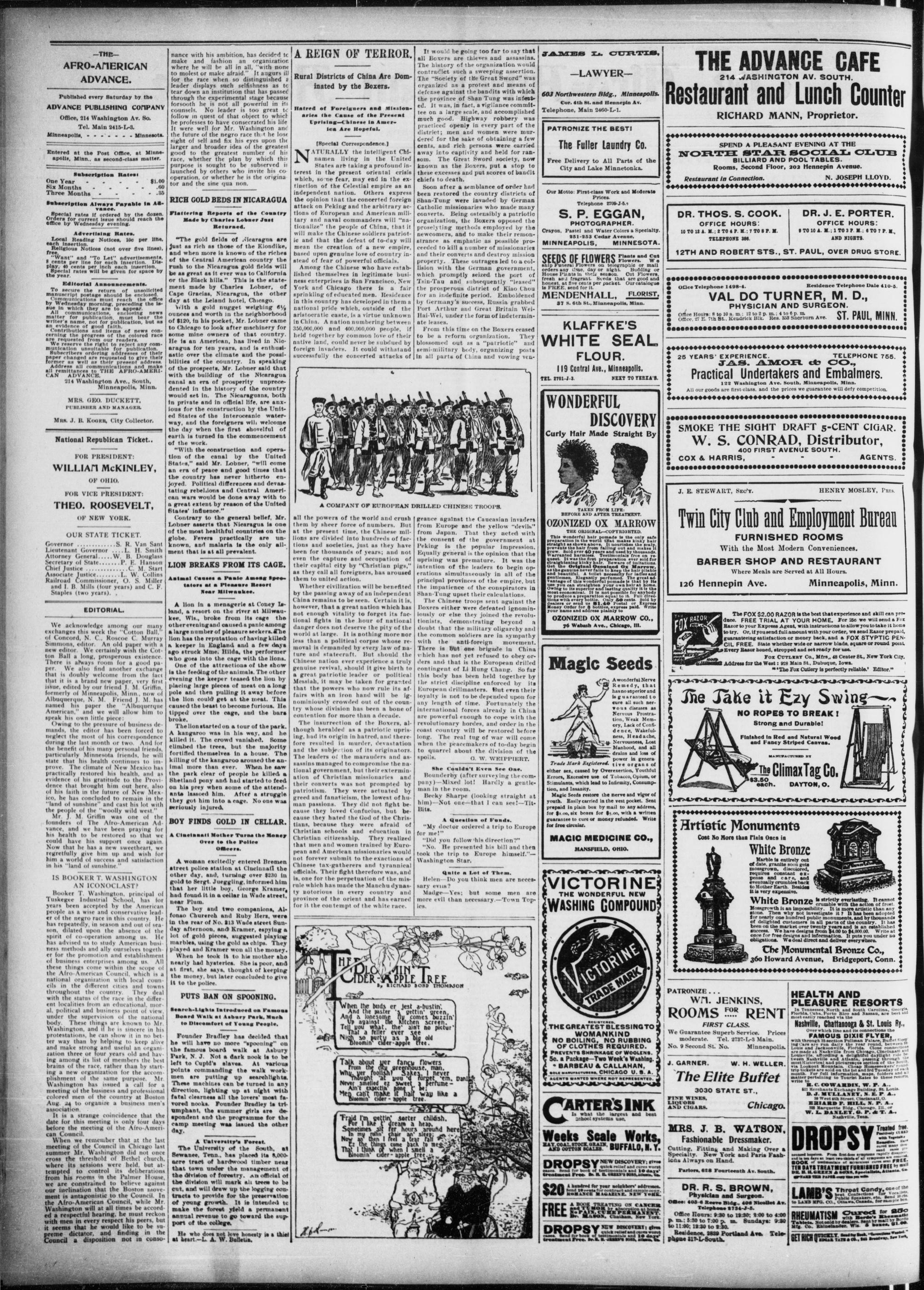
A COMPANY OF EUROPEAN DRILLED CHINESE TROOPS.
THE BLOOMIN' CIDER-APPLE TREE
BY RICHARD BORD THOMASON
When the birds er jest a-bustin',
And the passer a gettin' green,
And a longtime Dy comes buzzin'
Up against the Kitchen screen,
Tell you what, the aint no pictur'
That a feller ever see
Nish so purty as a big old
Bloomin' cider-apple tree.
Talk about yer fancy flowers
From the dill greenhouse, man,
Why yer foolish? Sakes I never
thought at you I'd forget 'em, Dan!
Never smelled ez sweet a perfume-
Ain't expectin' none it be;
Men can't make it half way like a
Bloomin' cider-apple tree.
Fraid I'm gettin' sorter childish,
For I like I dream a heap,
Sometimes sit fer hours around here
In my rellin' chair an sleep;
Now an then I feel a tear fall
If the things come back to me,
That I think of when smell a
Bloomin' cider-apple tree.
Rural Districts of China Are Dominated by the Boxers.
Hatred of Foreigners and Missionaries the Cause of the Present Uprising-Chinese in American Are Hopeful.
[Special Correspondence.]
NATURALLY the intelligent Chinamen living in the United States are taking a profound interest in the present oriental crisis which, some fear, may end in the extinction of the Celestial empire as an independent nation. Others express the opinion that the concerted foreign attack on Peking and the arbitrary actions of European and American military and naval commanders will "nationalize" the people of China, that it will make the Chinese soldiers patriotic and that the defeat of to-day will mean the creation of a new empire, based upon genuine love of country instead of fear of powerful officials.
Among the Chinese who have established themselves in legitimate business enterprises in San Francisco, New York and Chicago there is a fair sprinkling of educated men. Residence in this country has developed in them a national pride which, outside of the aristocratic caste, is a virtue unknown in China. A nation numbering between 350,000,000 and 400,000,000 people, if held together by common love of their native land, could never be subdued by foreign invaders. It could withstand successfully the concerted attacks of
A COMPANY OF EUROPEAN
all the powers of the world and crush them by sheer force of numbers. But at the present time, the Chinese millions are divided into hundreds of factions and societies, just as they have been for thousands of years; and not even the capture and occupation of their capital city by "Christian pigs," as they call all foreigners, has aroused them to united action.
Whether civilization will be benefited by the passing away of an independent China remains to be seen. Certain it is, however, that a great nation which has not enough vitality to forget its factional fights in the hour of national danger does not deserve the pity of the world at large. It is nothing more nor less than a political corpse whose removal is demanded by every law of nature and statecraft. But should the Chinese nation ever experience a truly genuine revival, should it give birth to a great patriotic leader or political Messiah, it may be taken for granted that the powers who now rule its affairs with an iron hand will be ignominiously crowded out of the country whose division has been a bone of contention for more than a decade.
The insurrection of the Boxers, although heralded as a patriotic uprising, had its origin in hatred, and therefore resulted in murder, devastation and the subjection of its originators. The leaders of the marauders and assassins managed to compromise the national government, but their extermination of Christian missionaries and their converts was not prompted by patriotism. They were aetuated by greed and fanaticism, the lowest of human passions. They did not fight because they loved Confucius, but, because they hated the God of the Christians, because they were afraid of Christian schools and education in Christian citizenship. They realized that men and women trained by European and American missionaries would not forever submit to the exactions of Chinese tax-gatherers and tyrannical officials. Their fight therefore was, and is, one for the perpetuation of the misrule which has made the Manchu dynasty notorious in every country and province of the orient and has earned for it the contempt of the white race.
THE DIPLOMIN
CIDER-APPLE
BY RICHARD
When the buds er jesse
And the paster 'a gue
And a lonesome by e
Against the Mitch
Tell you what the a
That a teller ever
It would be going too far to say that all Boxers are thieves and assassins. The history of the organization would contradict such a sweeping assertion. The "Society of the Great Sword" was organized as a protest and means of defense against the bandits with which the province of Shan Tung was infested. It was, in fact, a vigilance committee on a large scale, and accomplished much good. Highway robbery was practiced openly in every part of the district; men and women were murdered for the sake of obtaining a few cents, and rich persons were carried away into captivity and held for ransom. The Great Sword society, now known as the Boxers, put a stop to these excesses and put scores of bandit chiefs to death.
Soon after asemblance of order had been restored the country districts of Shan-Tung were invaded by German Catholic missionaries who made many converts. Being ostensibly a patriotic organization, the Boxers opposed the proselytizing methods employed by the newcomers, and to make their remonstrance as emphatic as possible proceeded to kill a number of missionaries and their converts and destroy mission property. These outrages led to a collision with the German government, which promptly seized the port of Tsin-Tau and subsequently "leased" the prosperous district of Kiao Chou for an indefinite period. Emboldened by Germany's success, Russia grabbed Port Arthur and Great Britain Wei-Hal-Wei, under the form of indeterminate leases. From this time on the Boxers ceased to be a reform organization. They blossomed out as a "patriotic" and semi-military body, organizing posts in all parts of China and vowing ven-
DRILLED CHINESE TROOPS.
geance against the Caucasian invaders from Europe and the yellow "devil" from Japan. That they acted with the consent of the government at Peking is the popular impression, Equally general is the opinion that the uprising was premature. It was the intention of the leaders to begin operations simultaneously in all of the principal provinces of the empire, but the impatience of the conspirators in Shan-Tung upset their calculations.
The Chinese troops sent against the Boxers either were defeated ignominiously or else they joined the revolutionists, demonstrating beyond a doubt that the military oligarchy and the common soldiers are in sympathy with the anti-foreign movement. There is but one brigade in China which has not yet refused to obey orders and that is the European drilled contingent of Li Hung Kong. So far this body has been held together by the strict discipline enforced by its European drillmasters. But even their loyalty is not to be depended upon for any length of time. Fortunately the international forces already in China are powerful enough to cope with the revolutionary hordes, and order in the coast country will be restored before long. The real tug of war will come when the peacemakers of to-day begin to quarrel about the division of the spoils. G. W. WEIPIERT.
Bounderby (after surveying the company)—Mixed lot! Hardly a gentleman in the room.
Becky Sharpe (looking straight at him)—Not one—that I can see!—Tit-Bits.
A Question of Funds.
"My doctor ordered a trip to Europe for me!"
"Did you follow his direction?"
"No. He presented his bill and then took the trip to Europe himself."—Washington Star.
Quite a Lot of Them.
Helen—Do you think men are necessary evisus?
Madge—Yes; but some men are more evil than necessary.—Town Topics.
THE TREE
BORD THOMPSON
JAMES L. CURTIS
—LAWYER—
603 Northwestern Bldg., Minneapolis.
Cor. 4th St. and Hennepin Av.
Telephone, Main 2460-L-1.
PATRONIZE THE BEST!
Free Delivery to All Parts of the City and Lake Minnetonka.
Our Motto: First-class Work and Moderate
Prices
Telephone: 2789-165-16
Crayon, Pastel and Water Colors a Specialty,
251-253 Cedar Avenue,
MINNEAPOLIS, MINNESOTA.
SEEDS OF FLOWERS Plants and Cut Flowers. We
ship Funeral Flowers on telegraphic or mail
mail. We ship flowers to House Plants in their session. Cut Flowers, fresh and fragrant. Seeds that are good and
hones at five cents per packet. Our catalogue
MENDENHALL FLORIST,
MENDENHALL, FLORIST,
37 S. 6th St., Minneapolis, Minn.
KLAFFKE'S
WHITE SEAL
FLOUR.
119 Central Ave., Minneapolis.
TEL. 2701-J-3.
NEXT TO PERKA'S.
WONDERFUL
DISCOVERY
Curly Hair Made Straight By
BANKS FROM LINCOLN
This wonderful hair pomade is the only safe preparation in the world that makes kinky hair straight as shown above. It nourishes the scalp, prevents the hair from falling out and makes it grow. Sold over 40 years and used by thousands. Warranted harmless. Testimonials free on request. It was the first preparation ever sold for straightening kinky hair. Beware of imitations. Get the Original Ozonized Ox Marrow, as the genuine never fails to keep the hair plable and beautiful. A toilet necessity for ladies and gentlemen. Elegantly perfumed. The great advantage of this wonderful pomade is that by its use you can straighten your own hair at home. Owing to its superior and lasting quality it is the most economical. It is not possible for anybody to produce a preparation equal to it. Full directions with every bottle. Only 50 cents. Sold by dealers or send us 51.40 Postal or Express Money Order for 3 bottles, express paid. Write your name and address plainly to
OZONIZED OX MARROW CO.,
76 Wabash Ave., Chicago, Ill.
Magic Seeds
A wonderful Nerve
Remedy, that
hasno superior and
is guaranteed to
cure all such nervous diseases as
Nervous Prostration,
Weak Memory,
Lack of Confidence,
Messiness,
Headache,
Nervousness, Lost Manhood, and all drains and loss of power in genera
Awonderful Nerve
Remedy, that
has no superior and
is guaranteed to
cure all such ner-
tive diseases
Nervous Prostration, Weak Mem-
ory, Lack of Confidence, Wakefulness, Wakefulness, Headache, Nervousness, Lost
Manhood, and all drains and loss of
power in generative organs of
either sex, caused by Overexertion, Youthful
Errors, Excessive use of Tobacco, Opium, or
Simulants, which lead to Infirmity, Consumption,
and Insanity.
Magic Seeds restore the nerve and vigor of
youth. Easily carried in the vest pocket. Sent
prepaid in plain box by mail to any address,
for $, six boxes for $, with a written
guarantee to cure or money refunded. Write
for free circular.
MAGIC MEDICINE CO.
MANSFIELD, OHIO.
VICTORINE
THE WONDERFUL NEW
WASHING GOMPOUND
VICTORINE
TRADE MARK
NO BOILING, NO RUBBING
OF CLOTHES REQUIRED.
PREVENTS SHRINKAGE OF WOOLENS.
So. a Package—Two Week's Washing.
* BARBEAU & CALLAHAN,
BOLE MANUFACTURERS, CHICAGO U. S. A.
AGENTS WANTED WHERE NOT REPRESENTED.
CARTER'S INK
Is what the largest and best
school systems use.
Weeks Scale Works,
MAX COAL STOCK GRAIN - BUFFALO, H. Y.
AND COTTON SCALES.
DROPSY NEW DISCOVERY; gives
quick relief and cures worst
cancer. Used for back and arm
treatment Free. Dr. H. K. 6349 800 800, alton.
$20 A hundred for your necklace' address,
every example in
ROMANCE MAGAZINE. NEW YORK.
FREE A BONE TREATING ON CANCER
NO PAIN, CUREM PERMISSIBLE.
Dr. MASON, Chatham, New York.
DROPSY NEW DISCOVERY; gives
quick relief and cures worst
cancer. Used for back and arm
treatment Free. Dr. H. K. 6349 800 800, alton.
THE ADVANCE CAFE 214 WASHINGTON AV. SOUTH. Restaurant and Lunch Counter
RICHARD MANN, Proprietor.
SPEND A PLEASANT EVENING AT THE
NORTH STAR SOCIAL C
BILLIARD AND POOL TABLES.
Rooms, Second Floor, 202 Hennepin Avenue
Restaurant in Connection. N. JOSEP
SPEND A PLEASANT EVENING AT THE
FTH STAR SOCIAL CLUB
BILLIARD AND POOL TABLES.
Rooms, Second Floor, 202 Hennepin Avenue.
at in Connection. N. JOSEPH LLOYD.
NORTH STAR SOCIAL CLUB
BILLIARD AND POOL TABLES.
Rooms. Second Floor, 202 Hennepin Avenue.
DR. THOS. S. COOK.
OFFICE HOURS:
10 TO 12 A. M.; 2 TO 4 P. M.; 7 TO 9 P. M.
TELEPHONE 386.
12TH AND ROBERT STS., S.
Office Telephone 1498-4.
VAL DO TURPHY PHYSICIAN A.
Office Hours: 8 to 10 a.m.; 12 to 2 p.m.; 4 to 7 p.m.
Office: 27 E. 7th St. Kendrick Blk. Res. 300
25 YEARS' EXPERIENCE.
JAS. AMO
Practical Undertake
122 Washington Ave. S.
All our goods are first-class, and the pr
SMOKE THE SIGHT D.
W. S. CONRA
400 FIRST AVE.
COX & HARRIS,
J. E. STEWART, Sec'y.
Twin City Club and
FURNISHES
With the Most Meals
BARBER SHOP A
Where Meals are S
126 Hennepin Ave.
ROBERT STS., ST. PAUL, OVER DRUG STORE.
Phone 1498-4. Residence Telephone Dale 410-5.
RAL DO TURNER, M. D.,
PHYSICIAN AND SURGEON.
to 10 a. m.; 12 to 2 p. m.; 4 to 6 p. m.
St. Kendrick Blk. Res. 338 Sherburn Ave. ST. PAUL, MINN.
EXPERIENCE.
JAS. AMOR & CO.,
Physical Undertakers and Embalmers.
122 Washington Ave. South, Minneapolis, Minn.
Ads are first-class, and the prices we guarantee will defy competition.
THE SIGHT DRAFT 5-CENT CIGAR.
S. CONRAD, Distributor,
400 FIRST AVENUE SOUTH.
HARRIS, AGENTS.
12TH AND ROBERT STS., ST. PAUL, OVER DRUG STORE
VAL DO TURNER, M. D., PHYSICIAN AND SURGEON.
25 YEARS' EXPERIENCE. TELEPHONE 755. JAS. AMOR & CO., Practical Undertakers and Embalmers. 122 Washington Ave. South, Minneapolis, Minn. All our goods are first-class, and the prices we guarantee will defy competition.
SMOKE THE SIGHT DRAFT 5-CENT CIGAR.
W. S. CONRAD, Distributor,
400 FIRST AVENUE SOUTH.
COX & HARRIS, AGENTS.
City Club and Employment Bureau
FURNISHED ROOMS
With the Most Modern Conveniences.
BER SHOP AND RESTAURANT
Where Meals are Served at All Hours.
Annepin Ave. Minneapolis, Minn.
The FOX $2.00 RAZOR is the best that experience and skill can produce. FREE TRIAL AT YOUR HOME. For 22c we will send a Fox Razor to your Express Agent, with instructions to allow you to take it home to try. Or, if you send full amount with your order, we send Razor prepaid, guaranteeing satisfaction or money back, and a FOX STYPTIC PEN-CIL FREE. State whether wide or narrow blade, square or round point. Every Razor honed, stopped and set ready for use.
FOX CUTLERY Co., Mfrs., 48 Center St., New York City.
Address for the West: 92 Main St., Dubuque, Iowa.
"The Fox Cutlery is perfectly reliable." Editor."
Take it Ezy Swing
NO ROPES TO BREAK!
Strong and Durable!
Finished in Red and Natural Wood and Fancy Striped Canvas.
MANUFACTURED BY
The Climax Tag Co.
$3.50 each.
DAYTON, O.
The FOX $2.00 RAZOR is the best that experience and skill can produce. FREE TRIAL AT YOUR HOME. For 2$ we will send a Fox Razor to your Express Agent, with instructions to allow you to take it to try. Or, if you send full amount with your order, we send Razor prepaid, guarantizing satisfaction or money back, and a FOX STYPTIC PEN-CIL FREE. State whether wide or narrow blade, square or round point. Every Razor housed, stropped and set ready for use.
FOX CULLEY CO. Mrr., 48 Center St., New York City.
Address for the West: 929 Main St., Dubuque, Iowa.
The Take it B
NO ROPES
Strong and
Finished in Red
and Fancy S
MANUFA
The Cli
$3.50
each.
Artistic Monument
Cost No More than Plain Ones in
The Take it Ezy Swing
NO ROPES TO BREAK!
Strong and Durable!
Finished in Red and Natural Wood
and Fancy Striped Canvas.
MANUFACTURED BY
The Climax Tag Co.
$3.50
each.
DAYTON, O.
Marble is entirely out of date, soon gets mossgrown, discolored, requires constant exertion, perhaps even eventually crumbles back to Mother Earth. Besides it is rare.
White Bronze is strictly everlasting. It cannot Mossgrowth is an impossible task and the action of frost stone. Then why not investigate it? It has been adopted for nearly one hundred public monuments, and by thousands been on the market over twenty years and is an established success. We have designs from $4.00 to $4,000.00. Write at once for free designs and information. It puts you under no obligation. We seal direct and deliver everywhere.
The Monumental Bronze Co., 360 Howard Avenue, Bridgeport, Conn.
PATRONIZE... W.M. JENKINS,
ROOMS FOR RENT
FIRST CLASS.
We Guarantee Superb Service. Prices
moderate. Tel. 2757-L-9 Main.
No. 9 Second St. No. Minneapolis.
J. GARNER. W. H. WELLER.
The Elite Buffet
3030 STATE ST.,
FINE WINES,
LIQUORS
AND CIGARS.
Chicago.
MRS. J. B. WATSON,
Fashionable Dressmaker.
Fashionable Dressmaker.
Cutting, Fitting and Making Over a Specialty. New York and Paris Fashions Always on Hand.
Parlors, 628 Fourteenth Av. South.
DR. R. S. BROWN,
Physician and Surgeon.
Office: 403-6 Reeve Bldg. 406 Nicollet Av.
Telephone 2734-J-5.
Office Hours: 9:30 to 18:30; 3:00 to 4:00
p.m.; 5:30 to 7:00 p. m. Sundays: 9:30
to 11:30; 12:30 to 2:30.
Residence, 2839 Portland Ave. Telephone 317-L-South.
---
THE FOX RAZOR
FOR THE
MEN
WITH
BOWS
AND
HANDS
WITH
THE
RAZOR
THE STATUE OF THE MAYOR OF THE CITY OF NEW YORK
DR. J. E. PORTER.
OFFICE HOURS:
6 TO 10 A. M.; 1 TO 3 P. M.; 6 TO 7 P. M.,
AND NIGHTS.
HENRY MOSLEY, PARS.
SAMUEL L.
HEALTH AND PLEASURE RESORTS
In Tennessee, North and South Carolina, Georgia, Florida, and Mississippi, and Nassau, are best and most easily reached via the
Nashville, Chattanooga and St. Louis Ry.
Over which line and its connections the
FAMOUS DIXIE FLYER,
with three lions, runs the year round, between St. Louis and Jacksonville, Florida. Close connection
and lions are run daily the day round, between Louisville, affording a delightful daylight ride to
the most historical and picture section of the South,
via Lookout Mountain. Cheap Homeaway is
of each month. For full information, maps, folders and a
write to
N. C. COWARBIN, W. P. A.,
$11 Merchant Exchange Building, St. Louis.
D. J. MULLANEY, N. E. P. A.,
BRIANE D. FILL, N. P. A.,
$25 Marquette Bldg, Chicago, Ill. or
W. L. DANLEY, G. P. & T. A.
in two days at our location.
BOOK of testimonials of miracles of瘀痕 are returned.
TEN DAYS TREATMENT FORMIDABLE FOR DAILY DURATION
WITH MASKS. MAKE AN OFFER TO ATTENDEE AT Atlanta, Ga.
HAVE TAKEN THEM AROUND YOU WITH.
LAMB'S Threat Candy, one of the best Confections for
wounds. Perfect for to LANE MFG. CO., Ottawa, Canada, for sample bites.
TAKE YOUR CHOICE.
Around this land no man should roam
With discontented mind.
For every class a fitting home
With great ease can find.
The mining class would find in Ore.
A chance to raise the wind.
And, as you may have guessed before,
The rich should go to Ind.
Religious folk should go to Mass.,
And bunko men to Conn.,
And lovers who would win a lass
Should find a home in Mon.
The bachelors should go to Miss.,
I'm sure you will agree.
And every maiden who reads this
Should take a train for Me.
There is a home for farmer men
In Idaho, b/gosh.
And money for the broke in Tenn.,
And room for tramps in Wash.
The sick should be at home in ill.,
And drinking men in Kan.
While Ark, no doubt, with joy would fill
The ancient river man.
All other persons, near and far,
Whatever their age or sex is.
Where there they are
Will find there's room in Texas.
-St Louis Post-Dispatch.
Marble Falls, Tex., a few days ago the fortunes of two lovers were united by matrimonial ties in a den of lions. The ceremony which made Ramon Angle and Nada Dore man and wife was performed in the presence of many friends of the high contracting parties and numerous patrons of a traveling menagerie. The bride, who is beautiful, entered the den of the lions with a stout whip in her hands and drove the savage beasts to the further end from the door, and then held one delicate little palm invitingly towards Mr. Ramon Angle, an ex-cowboy, who has recently developed into a prosperous and popular cattle man of southern Texas. Looking a little nervous, the man sprang lightly through the door, that was barely swung ajar, while the animals showed their white teeth and quickly entered a growling protest against the intrusion.
A minister, who was standing on the ground at a safe distance, made assurance doubly sure by stepping back a little further from the cage.
"Are you not coming inside?" said the smiling bride.
"It is not at all necessary," replied the preacher as he opened the Bible. "You see, my dear young lady," he added, manifesting a surprising disposition to be facetious, "lions don't seem to take kindly to me. Can't you see that old king of the desert licking his lips every time he looks over this way? Thank you. I am well off out here. The iron bars of the den will in no wise affect the legality of the ceremony. Please join your hands." The bride laughed and the old lion roared. The lioness looked knowing and sat up in her corner—a model of propriety—as if she had witnessed hundreds of weddings and was fully impressed with the importance of the occasion and the honor conferred upon her and her companion as witnesses of the ceremony.
The minister did not detain them long, and when he had finished the lions set up a roar. The bridegroom walked slowly backwards over the floor of the den to the door, which was quickly opened by an attendant.
"Somehow," said he, "the air is rather oppressive in there. I should not mind being in a corral with those brushes if I were mounted on a good mustang and had my irons and a rope, but I did not feel as comfortable as you might suppose with the door locked and my guns as good as 40 miles away."
The little bride played and romped with the two old monsters for several moments, smacking their jaws and pulling their tails after the manner of a child engaged in teasing kittens. When she retired from the den and joined her happy husband and friends the romance which led to the strange wedding was told.
Four years ago this same menagerie made a tour of western Texas. An attractive feature of the street parade consisted of an open den of lions drawn by four white horses. Old Joe Crawford, an accomplished animal trainer, always occupied the den with the savage kings of the desert during the grand march through the streets of a town. When the show reached the little city of Marble Falls Mr. Crawford found himself full of southern malaria, which incapacitated him for service. In this emergency Miss Nada Dore, a Texas girl, who was eager to master some profession to make a living, offered to take his place. The position was not entirely new to the young lady, for she had formed the acquaintance of the lions on a previous occasion and they had regarded her with manifestations of friendliness. Miss Dore was raised on a ranch in the western part of the state, and she is a devoted lover of animals. In her girlhood she had collected a little menagerie of her own, composed of pet coons, wildcats, squirrels, prairie dogs and deer. It was her ambition to become an animal trainer, and she never lost an opportunity to pet and caress the animals in the menagerie. The young lady was a great favorite with the show People as well as the general public.
Mr. Crawford thought the daring girl would incur little danger from the lions, for they were old denizens of the menagerie and dooile, but he rather reluctantly granted her permission to take his place, prophetically remarking: "It is always the unexpected that happens in affairs of this kind." No one would have ever guessed what really did happen.
Miss Dore had no fears. Dressed in the brilliant costume of a Spanish shepherdess, with a whip in her hand, she sprang lightly into the den and took her seat between two lions. The cage was drawn by four white stallions of great beauty and apparently dooile. The first little tremor of nervous emotion had passed as the caravan began to move through the crowded streets to the music of the circus band, and the anathema lion tamer, more interested in the novelty of her position than the applause of the multitude, was about to try the effect of a kindly menace upon one of her pets, when she heard
unusual shouting and the car gave a great lurch. The next instant she saw two white horses turning in a furious gallop across the street, and she realized that the span of leaders attached to the car had become frightened. Before she had time to move, the whole team turned away from the procession and started on a run down a cross street, closely followed by the van behind. The lions set up a terrible roaring as the ponderous car bounded over the rough pavement, throwing the animals against the bars with great violence. The girl held her whip threatening towards the terrorized beasts, managing to keep on her fact by holding fast with one hand to an iron rod. She had hoped that the driver would regain control of the frightened horses, but a jolt more violent than those she had already experienced threw the man from his seat and she saw him fall under the wheels. One of the horses fell, and the other maddened brutes dragged the car over him, stripping the harness from his body.
The lions were now furious with rage. Their eyes were glaring balls of fire and foam was flying from their gleaming white teeth. Miss Dore realized that the car was passing down a steep hill, and, glancing ahead as best she could, she caught sight of a bridge. Another instant of horror passed, and the roaring waters of the Colorado river, seemingly hundreds of feet below the iron banisters of the bridge, swirled in the shadow depth between great walls of rock. One of the lions fell against the despairing girl, throwing her across the cage, and as she struggled to her feet she saw a man on a black horse fairly whiz by the car. She heard the hoofs of the horses strike the floor of the bridge.
"I lost all hope," says Miss Dore, "and I anticipated a horrible death in the water with the maddened lions struggling over my body." There was a sudden crash, which threw both animals sprawling against the forward end of the cage, and the frightened girl fell across them. Quickly regaining her feet, she was in the act of grasping the iron bars, when a collection of reptiles crashed against the side of the car of lions. This cage was made of glass, protected by iron rods. The wheels of both cages interlocked and the glass was shivered to 6 atoms. The lions sprang to their feet, roaring and grashing their teeth. Miss Dore stood in front of them with her wip, but she expected them to spring upon her and tear her flesh to fragments.
The cages were motionless. She moved backwards slowly towards the door, not daring to take her eyes from the lions. A monster semi-negro, who occupied the den with the reptiles, howled in little less lower tones than the lions. The terror-streiken girl heard a hiss, and then she saw the head and red, forked tongue of the African anaconda swaying between her and the lions. They were mad enough before; now they were insane with rage. The snake was 17 feet long, and at least half of the repulsive monster was already inside the cage, seemingly just in the act of striking. "My heart beat and thumped," says Miss Dore, "as if it were about to burst. A minute had not passed since the cage stopped, but it seemed like a year. I prayed out loud for help, and was surprised when I heard a voice saying: 'The door is nearly open. I can wrench it loose.' I heard the noise of creaking iron and felt something take hold of my dress behind. 'Step right back, young lady,' said the voice, 'it will open enough for you to squeeze through.' I kept my eyes on the lions and slid back through the door. I heard the awful roar of the lions and the hissing of the anaconda as they all rolled upon the floor of the den struggling in battle. My eyes were closed, but my ears were open to catch the words of the multitude.
"One foot more and we would have crashed over the bridge. He caught the horses with his lariat and the cage killed his pony as it fell against the rail. 'Bravest cowboy ever lived'—And he with one arm broke. 'I heard all of that and more.' says Miss Dore, "and I realized that some brave man had risked his life to save me from a horrible death. I opened my eyes and I looked into the face of the brave young man whom I married in the lion's den a few moments ago."—Chicago Tribune.
Specter of the Brocken
The summit of the Broken, or Blocksberg, the highest of the Hartz mountains, in Prussian Saxony, presents a singular optical phenomenon eight or nine times during the year. It is usually seen at sunrise or sunset, and consists of a gigantic projection of the observer, or observers, upon mixty clouds, which rise out of the valley on the side of the mountain opposite to the sun. Sir Walter Scott wrote of it: "Among the vavorous legends current in that wild country there is a favorite one, which supposes the Hartz to be haunted with a kind of tutelar demon, in the shape of a mild man, of huge stature, his head wreathed with oak leaves and his middle cinctured with the same, bearing in his hand a pine torn up by the roots. It is certain that many profess to have seen such a form, traversing with huge strides, in a line parallel to their own course, the opposite ridge of a mountain, when divided from it by a narrow glen; and, indeed, the fact of the apparition is so generally admitted that modern skepticism has only found refuge by ascribing it to optical deception."—Detroit Free Press.
Generous Formen
Soult, the historian Napier tells us, with a noble feeling of regard for Sir John More's valor, raised a monument to his memory. It has been stated that Romana, and not the French marshal, did the grateful act; but the story is too pretty to spoil. Lord Methuen has repaid the act in a graceful manner, which our gallant but fractious neighbors across the channel will appreciate keenly. On the stone which has been erected at the expense of the commander of the Kimberley force it is recorded that Count de Villebore Mareuif, colonel of the foreign legion and general of the Transvaal, died on the field of honor. The count left as a charge in his will that if he was killed his body should be buried where he fell, and not removed to France. Knowing well and honoring Englishmen as he did, though he died fighting against us, he felt he could trust what was left of him in the hands of our soldiers, and his trust has not been in vain—London Telegraph.
OWEN LANGDON'S Gossip of GREATER NEW YORK
In arranging that no women servants
are to set foot within Rocky hall, the
batchelor's quarters which he is setting up at considerable expense in Newport, Mr. Alfred Vanderbilt is following, not setting, a fashion.
C. W.
In the smart world women are being ousted from their domestic domain. In a fashionable household the menservants far outnumber those of the ono-
The Typical New those of the oppo-
York Servant. site sex, even
where the family is well provided with
laughters. The door is opened by a man, instead of a neat maid. The windows are washed by men. The master has a valet and the grown son may have another. There will be errand boys and chore boys, a man cook almost certainly, and, of course, the groomes, stable boys and coachmen. In the country the disproportion is even more marked.
Society below stairs has its caretfully marked gradations as has society above stairs. The butler is the head of the servants' hall community, unless there is an officer of the rank of steward or superintendent. Even in such a case, the steward may not dine with the servants, so that the butter retains his traditional seat at the head of the table, with the housekeeper in the opposite place of honor. The table waiters—men always—come pretty high in the scale of rank, the chambermaids rather low. One of the waiters in a very large house usually has rank as an assistant butler. The assistant cook may be a man or a woman. Accomplished pastry cooks in private houses are apt to be women. French cooks, like the famous chef whom the late Cornelius Vanderbilt hired away from Duc de Broglie for 50,000 francs a year salary, would be insulted at the suggestion that they should make pies and puddings.
As to wages: Menservants get more than women, but not so much more as might be supposed. Many of them are direct importations, and have the European preference for permanence of term rather than high wages. A butler is an expert; he gets a fair salary. A cook is an artist. He gets all that you care to pay; usually much more than his superior officer, the butler. But the ordinary run of menservants get anywhere from $20 or $30 upwards, not always so far upwards. Their hire, considering their superior strength, is not always strictly extravagant. But that's not the reason they're wanted. It's the style.
Mr. Morgan's Library:
the pyramids, made of granite which cracks badly in extreme heat, are not
eracks badly in
half so nearly fire-
proof as the new
library which J.
Pierpoint Morgan
is having built,
M. H. H.
Behind his city house, and rather at one side of it, so that it may be entered only by a door in one corner, the great railroad juggler is putting up a solid structure 100 feet by 75, of most peculiar appearance. Its massive walls are pierced by few windows; the light coming mostly from a great skylight in the roof. It is of but a single very high story, the walls and alcove partitions lined with shelves of glass and iron, and boxes and safes of fire brick. There is not a stick of wood in the place.
Mr. Morgan's library is not larger as such things go, but is immense rich in rare books and manuscripts. He has a Bible which is called worth $10,000 though many times that money would not buy it. He has rare manuscripts relating to early American history though not making a specialty of that or any other period. Most of his manuscripts are now in London, where Mr. Morgan spends much of his time; others are scattered about in different storage deposit vaults and warehouses. When the new building is completed there will be brought together under one roof probably the most remarkable collection of manuscripts owned by any private person in the world.
Books and Their Lovers.
Books and manuscripts are a fad
with many city men of wealth and
of wealth and quiet tastes. Mr Morgan is easily the prince of collectors, but Brayton Ives' books have been for years at least as familiar as his Wall street deals.
BOOKS
Robert Hoe, the great builder of printing presses, who uses machines print more newspapers in England itself than those of any one English builder, has magnificent, library
A Fad of Wealthy or any one English Men. builder, has a magnificent library, rich in early Americana and in books about pirates, sailors and adventures. And he loves his books, as a printer should. George Vanderbilt's bookish tastes are well known. Perhaps it would be more correct to say "were" well known, for since his marriage to the beautiful Miss Dresser his fads have taken a back seat. The late Mr. Constable, the dry goods man, had an enormous private library. President Seth Low, of Columbia, does not care a button for books just because they are scarce, but his collection of volumes relating to municipal affairs includes almost everything that has ever been printed upon that subject, and some of his treasuries are very rare. DeVine, the
printer and type founder, who prints the Century Magazine, has a very rare collection. Ex-Judge Daly, that old man marvelous, has hosts of volumes on historical matters relating to America. Judge Gaynor, the terror of corrupt politicians, has a big library, part of it in his Brooklyn house, part in his summer home in Great Barrington, Mass.
Tennis and Crosnet
Queer are the shifts and changes in sports. Croquet has never lost its
fts and changes in
as never lost its
vogue altogether.
Now it is becom-
ing fashionable
again. Tennis does
not have to regain
standing, which it
never entirely
lost; but it will be
played this year
by twice as many
smart people as
handled the
request last season.
A
Golf has been hit by the inevitable difficulty. Exit Is Now His Time on a very few Again. links the committees are confronted by growing expenses and by the necessity of either raising dues to a ruinous figure or admitting a social element distasteful to the early members.
I know men who belong to three or four golf clubs each, besides one or two country clubs which maintain links. Their complaint is that they can't go anywhere to play without getting "milled up with a lot of kids or duffers, or queer people, you know. The links are crowded. Two years ago you could take any old pasture lot and call it a golf course, but players are getting more particular. It takes money to keep greens in condition. And so society, as always, makes a quick change from the game that everybody is just beginning to play to something else. The very smart set are not playing golf this year. They are not playing tennis, for that matter; they are too lazy; but they are watching others play it. The games at the Newport Casino are a tower of social strength to the game. Also the very elect play "squash"—I haven't the remotest idea what it is like—and play with automobiles. To be modish, get a mobe.
The croquet of the present is a wonder. You don't go out and whack a gibbous, chipped ball that has lain soaking in the rain through a hoop a foot or more wide. The association hoops are just a quarter of an inch wider than the balls themselves. It takes accurate driving to get a ball through such wickets as that. A championship game of croquet is as pretty a sight as an expert game of billiards. Society will always demand some new thing just about as the average man gets ready to play the fashionable game of last season. That's what's the matter with golf.
The San Juan Case Again.
"If Maj. Smith had gone to war with the intention of fighting he could have
33
This is a sentence from the report of a commission appointed by Gov. Black away back in 1898 to try Lieut. Col. Smith, of the Seventy-first New York, for his conduct at Santiago.
Mr. Smith has At the Battle of been fighting the San Juan, inevitable ever since, with much more courage and much less discretion than he displayed at San Juan hill, but the sentence has been practically affirmed. Gov. Roosevelt has agreed with Gov. Black. He was on the ground. He knew plenty of men who knew personally how the three senior officers of the regiment hid at the foot of the hill while a few of the captains and Maj Keck, of the Third battalion, took most of the men up the slope after a period of demoralization that was excusable under the circumstances.
So Smith, like Col. Downs and Maj. Whittle, goes from the national guard Kicked out.
Famous Thief Taker Byrnes once said to me: "There are practically no cowards on the police force. Every man knows what's in him; if he doesn't think he would make good at a pinch, he doesn't try to get on the force. He knows he can't patrol for a single year without having to fight his way out of some tight place." He doesn't look for trouble unless he has pluck.
Apparently some men join the militia who are not so sure of themselves. Doubless they think that drill, state camp, a little riot duty now and then and the army dances will be their most dangerous duty. These men are few. I believe they will be fewer than ever in New York, now that everyone knows what becomes of a man who does not "make good." OWEN LANGDON
Envy.
"I found a four-leaf clover yesterday while out walking with a young woman," said the breezy young person "Do you consider that a sign of luck?" "Emphatically," answered the man who had his coat off and was toiling "If being able to wander around hunting four-leaf clovers with a pretty girl isn't luck, I don't know what is"—Washington Star.
Very Spacious.
Mrs. Brown—I must be going back to the city at once. I've had three letters from my husband in two days. Mrs. Gray—Why, you poor dear! I know just how you feel. Two would be suspiciously attentive—but three! I really am afraid he has been doing something very reprehensible—Brooklyn Life.
FUNNY FOLKS
Going It Too Fast.
Guest—Now I'll take some ice cream
to top off with, three flavors.
Waiter—Your bill is 75 cents al-
ready, sir.
Guest—What of that?
Waiter- Why, you see, sir, mixed lee cream is 20 cents, and you'll probably give me a dollar to pay the check, and that'll leave only five cents for me.— N. Y. Weekly
Her Body Day
Not much good gold did she disburse,
Yet well she spent each golden minute.
She had a precious little purse,
And there was previous little in it.
That was before she started out
Must shop to shop; her means were
ample.
When she got back that purse was stout.
For it was stuffed with many a sample.
—Chicago Record.
HE WAS AT THE FRONT.
Wouldn't Work—Can't yer give a poor man what's been to de front some-thin' to eat?
Housekeeper—Have you really been to the front?
Wouldn't Work—Well, I was around to de front an' couldn't get in, so I come to de back—Chicago Inter Ocean.
The Ice Test.
I want no face hermione.
To tell me of the other.
I have a rule that's better than
All others put together.
I simply note what's left by me
The iceman—haughty ruler—
If small, the day will warmer be,
the cooler.
—Washington Star.
Equally Unfortunate.
"The trouble with that singer," Mr. Lettigoe said, grabbing his hat as the first act of the opera came to an end, "is her loud gasping. She doesn't know how to manage her breath." "You don't know how to manage yours, either," his wife remarked, after he had come back and taken his seat again.—Chicago Tribune.
Sometimes desirable.
"I have made up my mind never to lend money," said the young man who is learning politics.
"Well," said Senator Sorghum, "you want to think it over again. Some times it comes in very handy when you want a man's influence to offer a loan instead of insulting him with a cash proposition." - Washington Star.
His Reason for Gratulation
His Reason for Gratitude.
"It's very fortunate," remarked Mr. Grady, wisely, "that they be not as hiv as coal."
"For whoy?" Pat.
"Shure, a ton av the shtuff would weigh so much that a poor man couldn't afford to kape a cow." - Judge.
Domestic Politics
Jasper—I say, Bill, which of those young fellows is going to win out with your daughter?
Politician—Well, personally, I wanted to indorse young Sparling, but my wife has instructed for young Money-bags—Town Topics.
No Remarks.
And passionately wrote
Of rocy cheeks, with heartful sighs
Vowed lily-white her throat.
Her lips, why, any honey-bee-
cheek?
She peach—
The maid said: "You can't fatter me.
Though flowery be my speech!"
—Detroit Free Press.
ALL THE THINK ABOUT.
Stoneybroke—My dear, the wolf is at the door.
Mrs. Stoneybroke—Is he? Well, tell him to wipe his feet.—Ally Sloper.
Not for Her
Not for Her.
He fell beside her on his knees
before the passing crowd,
but not
she gave her heart that but not
because her heart was proud!
He made no plea designed to win
The lady's love, alas!
He stepped upon an orange peel
from the door of an orange peel.
—Chicago Times-Herald.
An Object in View
He—She says she likes to have me call on her.
She—What's the name of the fellow she is trying to hurry up?—Harlem Life.
A Man's Idea.
Altitude.
"That plain little Miss Bullion made a queer match. She married a man nearly six feet and a half tall."
"He must have been the highest bidder."—Chicago Tribune
Suburban Life
Mrs. Meadow — I hate to tell you,
Mrs. Suburb, but, really, you ought to
know it. Every time I've run into the
city lately, I've met your husband on
the return train; and every time he was
paying marked attentions to some
woman by his side, and every time it
was a different woman, I've seen him
with a dozen of em.
Mrs. Suburb (quietly) — We have been
trying to get a servant girl who would
stay — N. Y. Weekly.
Only If Necessary.
The engagement had just been announced, and the girl in blue was piqued.
"I wouldn't marry for money," she announced, thereby intending to score one on the prospective bride.
The girl in pink merely shrugged her shoulders.
"Neither would I—if I could get it any other way," she answered.—Chic cago Post.
Concerning the Dog.
A dog is man's devoted friend, Your property he will defend, In talking he will not persist, In hunting he was an amateur. Mixed drinks he has not tackled yet; He never smokes a cigarette, Yet, by fate's trony so grim, Events conspire to muzzle him. (Chic cago Post.)
Correction:
"Allthough," read the gentleman who was getting written up for the paper, "he has never held public office, he commands the esteem and respect of the entire community," "I wish," he said to the reporter, "I wish you would change the 'although' in that sentence to 'as.' Don't you think it would be nearer right?"—Indianapolis Press.
Where It Was Finally
"No," said the magazine editor, "we cannot use your poem. The sentiment is beautiful and the meter and rhyming is perfect, but nevertheless it is not suited to a high-class literary magazine."
"What's the matter with it?" asked the poet, in not unnatural surprise.
"Anyone can understand it."—Chicago Post.
Alack! Alack!
Girls, since first the world began,
Have often dreamed of a man ideal;
But when at last they get a man,
They have dreamed of a realem.
—Chicago Daily News.
Green—There is no use in arguing with that fellow Gilper. He reasons like a woman. Lane—Gets the better of you every time, eh?—Cigarette.
A Word to Brides.
One little simple song we sing,
To bride songs.
Just make the best of everything--
Expecially of bread.
Carriage Talk.
"I'm glad to hear your husband is better," said the sympathetic neighbor.
"Thank you," replied the haughty Mrs. Parvin-New.
"I understand," continued the other, "that he was at death's door."
"Pardon me. No. The porte-
cochere." -Philadelphia Press.
Appropriate.
The visitor finally found the dramatic editor's sanctum. It was a small and extremely stuffy room.
"Phew!" exclaimed the visitor. "It's insufferably hot in here. It's like an oven."
"Of course," the dramatic editor replied. "This is where I do my roasting." Philadelphia Press.
Prohibition That Prohibits
Miss Flicker—Miss Kristin says she will never marry a man who drinks.
Miss Caustique—Then she'll be a stunner.
Mies Caustique—No, but no sober man would ever propose to her—Har
One Exercise.
"One of the deprivations of gold miners is the lack of proper facilities for exercise," said Mr. Gazzam.
"Why, I read that there is usually a good deal of claim-jumping on," added Mrs. Gazzam.-Detroit Free Press.
Transition:
How swift are things which we reverse
To lower levels sunk!
It was a bicycle last year,
And this year it is junk.
—Washington Star.
MEMELY A LITTLE PASSE.
"It's all very well to talk, Mrs. Murphy. I may be one of the 'Have-Beens', but you can't call me one of the 'Never Wakes.'" — Ally Sloper.
SOCIETY DIRECTORY
ODD FELLOWS.
Mars Lodge, No. 2262.
Meets first and fourth Wednesday in each second and odd Fellows' Hall, 328 Wabasha street
R. HICKMAN, P. S., 422 St. Anthony
F. D. PARKER, N. G., 395 Edmund St.
Household of Ruth, P., 535 G. U. of O. F.
Meets first and third Monday in each month for business and Monday for instruction, at Odd Fellows' Hall, 328 Wabasha
SARAH C. KIRTLEY, M.N.G.
MRR. IDA JACKSON, W. R., 374 Summit place.
MOST WORSHIPFUL GRAND LODGE OF MINNESOTA, A. F. and A. M.
J. L. NEAL, Grand Master.
W. L. GARDNER, Secretary.
S. 13 GUARANTEE Loan Bldg., Minneapolis,
ST. PETER CLAYER'S SODALITY.
Meets the first and third Mondays of each month.
J. H. GARDNER, Pres. J. S. HARRIS,
A. D. AWAY, Treasurer.
Pioneer Lodge, No. 1, F. A. and A. M.
Meets the first Monday in each month at Mason Hall, southwest corner Fifth and at other Masons in good standing always welcome.
H. H. HADLEY, W. M.
W. A. HILARY, 12 Atwater.
Minnesota Lodge, No. 2, A. P. and A. M.
Meets on the first and third Tuesday in each month at Mason Hall, southwest corner Fifth and at other Masons in good standing always welcome.
H. H. HOWARD, W. M.
J. S. STRONG, 12th and Robert s.
WM. STEVENS, No. 3, A. F. & A. M.
Meets second and fourth Monday in each month at Mason Hall, southwest corner Fifth and at other Masons in good standing always welcome.
WM. JOHNSON, W. M.
D. E. DEASLEY, Sec. Ryan Hotel.
Perfect Ashler Lodge, No. 4, A. F. & A. M.
Meets the second and fourth Tuesday in each month at Mascone Hall, southwest Mascone in good standing always welcome. H. K. DURANT, W. M. MEETS the first and third Thursday in each month at Mascone Hall, southwest corner of 10th and Roy-roy Street in good standing always welcome. DANIEL ROY H. P. W. T. GASSAWY, Sec. State Capitol.
MINNEAPOLIS
G. U. O. O. O. F.
St. Anthony Lodge, No. 2877.
Meets the first and third Wednesday in
the month, and the fourth in the
less, 1st avenue N. and Washington,
J. M. RYCK, G.
JAMES A. SCOTT, No. 33.
KNIGHTS OF PYTHIAS.
Nat. Turner Lodge, No. 2, K. of P.
Meets the second and fourth Thursdays in each month. Brothers in good standing Fourth and Eighth avenue south.
RALPH WATSON, K. R. and B. C.
Pride of Minnesota Lodge, No. 1, K. of P.
Meets the first and third Thursdays in each month. All brothers in good standing welcome. At Flummer Post Hall, First avenue north and Washington, JAMES A. JAMES, C. C. W. C. JEFFRIEY, K. R. and B.
J. K. HILYD Lodge.
Meets first and second Monday at Window Block, Second avenue South and Washington. Masons in good standing always welcome.
A. W. LILLARD, W. M. JARPER GIBUS, Sec. Guaranty Loan Restaurant
A. W. LILLARD, No. 7, A. F. and A. M. Meets the first and second Monday in each month at Window Block, Second avenue South and Washington. Masons in good standing every week.
J. A. SCOTT, W. M. A. B. LEE, 701 Aldrich avenue South.
Offices and Standing Committees of the Most Worshipful Grand Lodge A. F. and A. M. of Minnesota and joridification: Grand Master-John L. Neal, Minnesota
Deputy Grand Master—Wade H. Hampfort
West Superior
Grand Senior Warden—H. B. Howard,
St. Paul,
Grand Junior Warden—J. C. Garner, H.
Grand Treasurer-Daniel Roy, St. Paul.
Grand Secretary-William B. Morris,
Mortgage.
Grand Lecturer--G. W. Day (7), Minneapolis.
Deputy Grand Secretary—O. D. Howard
(4). St. Paul
Josephine I. Crawford. (5)
(Grand Junior Steward—Wm. Stevensa (2),
Bt. Paul)
Grand Tyler-T. Bush (3) St. Paul.
Grand Marshall-C. H. McDonald (5).
Grand Mammoth-Bearer—J. Charles (6),
Grand Register-J. J. G. Sterett (6), M.
District Deputy Grand Master—First
District Deputy Grand Master—Second
District Deputy Grand Master—Second
District—E. H. Hamilton (6), Minnesota.
Third District—J. K. Cock (6), Duluth.
CHURCH DIRECTORY.
ST. JAMES A. M. E. CHURCH,
Rev. J. C. Anderson, Pastor,
Sunday services; 11:30 a.m.; 7:30 p.m.
Wednesday prayer meeting; 8:00 p.m.
ST. JAMES A. M. E. CHURCH,
Father Priston
Cor. Farrington and Aurora avenues.
Sunday services; Mass 8:00 a.m. High
m. a.m. Evening service at 1'clock.
PILGRIM BAPTIST CHURCH,
Rev. J. C. Anderson,
Cor. 12th and Cedar.
Sunday services; Preaching at 11:30 a.m.
and 14:00 p.m. School day at 12:00 a.m.
prayer meeting
EPISCOPAL MISSION
484 Ike street, bet. Aurora and Uni-
city.
Sunday services; Liturgy prayer
Litany and Sermon; 11:00 a.m.; Sunday
School and Children's Vespers 2:00 p.m.
Eveening and Sermon 8:00 p.m.
Sunday services; 12:00 p.m.
Friday; Choir Rehearsal and
Choir Rehearsal; All are cordially invited. Seattle tree.
MINNEAPOLIS:
**ST. PETER A. M. E. CHURCH**
Rev. W. S. Brooks, Pastor.
Cor. 22d at. 9th ave. South
Sunday; 3:00 at. 11:30 a.m.
; Sunday School; 3:00 p.m.; evening
services; 8:00 p.m. General prayer meet-
ing, Thursday; evening, 8:00 p.m. Way-
ward Church; City of Brooklyn, different
residences. Parsonage, 205
Ninth avenue South.
BETHESIA BAPTIST CHURCH,
Sunday; services: Preaching, 11:00 a.m.
; Sunday School; 12:30 p.m. Christian
Daycare; services: Preaching, 11:00 a.m.
; Wednesday evening, prayer meet-
ing, 8:00 p.m. Parsonage,
1730 Eighth street South.
VISION.
Rev. John J. Faude, in Charge.
615 Sixth avenue South.
Sunday; service: 4:00 p.m.; Sunday
School; 5:00 p.m.
ST. JAMES A. M. E. CHURCH.
Rev. J. W. King, Pastor.
Between First avenue and Second street
Southeast, near Exposition Bldg.
Sunday; service: 4:00 p.m.; Sunday
School; 3:00 p.m., evening
services; 8:00 p.m. General prayer meet-
ing, Weekly meetings of the Debating Club.
NOTICE...Changes and corrections will be made upon notifying the office. If we have suspected to place a notice of any society in the above directory it is because we do not know of it or have not sent the officer and name of any lodge, place and time of meeting name of officers and it will be inserted.
THE STORY TELLER
I'm tired of urban clang and show of gold.
Here's ease that witches weary hearts to rest,
And room for poor cramped souls, too low to express;
No high-walled streets to dim God's sunlight fair,
No Fashion's pomp with supercillious stare;
But winding tracks o'er stones and stubble brown,
And creaking, swaying hayracks, laden and ploiding horses, faithful, strong and staid.
Unknown to style, left just as wisdom made.
Above are stretched the heavens, vast, aloof—
No strip of blue enforced by towering blue.
To tautilize. Can hearts to love be dead 'Mid these great gifts of beauty, freely spread?
In this hard work, take honest, hearty pride;
For should Fame's sons in grand procession ride
In whichever insults of their birth.
The homely hayrack soon would seem of worth.
Why does the world forever venture so,
With high bus loads to pass through
low bus loads?
A preacher? No. A farmer's boy as you
I am again; and see, I'll prove it, too.
A pitchfork, please—I'll help you mow
away;
For those who ride, their fare must al-
way pay.
-Marion McArthur, in Ohio Farmer.
MR. LIMKINS' TOAST
(From the Wassan, Wm. Philosopher, Re-
printed by special Permission.)
"SILAS," said Mrs. Limkins, as she
gave her chair a hitch to bring
herself face to face with Mr. Limkins;
"I have something to say to you. Put
down that paper; I want your whole attention."
Mr. Limkins reversed the cross of his
legs, and shifting his paper slightly so
as to cover his face, continued to read.
"I want you to wake up a little," continued Mrs. Limkins. "You are the most stupid man in this town. You come home from the office at night, eat your supper, smoke, read your paper and go to bed; eat your breakfast in the morning and go to the office. You come home again at night, eat your supper, smoke, read your paper, go to bed; and so it goes day after day. I don't get a dozen words out of you, day in and day out, and you do not even want to listen to me, when I talk. If I want to go out anywhere in the evening, I have to go alone. You have always some excuse for staying at home. If I invite my friends here, you have usually some business that takes you out. My friends never see you with me, and hardly I have a husband.
"This sort of life may suit you, but it does not suit me. You have your business and other things to interest you during the day, I suppose, while I am shut up here in the house; and when you come home in the evening I want something else besides supper, smoke and Tribune. Now I intend to make a change." Here Mrs. Limkins defyly took the paper from Mr. Limkins, and rolling it up in her hands, proceeded to use it to point off her remarks.
Mr. Limkins yawned submissively, dumped the ashes from his cigar into the silver card tray, and settled himself as comfortably as possible to wait for the end. Mr. Limkins had heard these remarks many times before; he knew the story from beginning to end, and also knew it was useless to try to escape any part or defend himself in any way. Experience had taught him that it was beat to sit quietly and take it—remaining silent to the end.
"Silas," continued Mrs. Limkins, shaking the crumpled Tribune at him viciously. "I have made up my mind not to stand this sort of thing any longer; all my friends take their husbands around with them and I have decided to bring you out."
Mr. Limkins said: "Oh," and grew nervous. Mrs. Limkins was evidently more determined than usual, and he began to fear that she had some sort of a scheme up her sleeve that would disturb his comfort.
"The Daughters of the Revolution and their husbands are going to have a banquet next week," said Mrs. Limkins. "There will be several toasts and I have arranged to have you respondTo the toast 'Our Sons.'"
"Great Scott," exclaimed Mr. Limkins, waking up and staring helplessly at her.
"I will write out your speech," said Mrs. Limkins, paying no attention to his interruption; "all you will have to do will be to commit it to memory and repeat it at the banquet."
"No, by thunder," said Mr. Limkins, with considerable heat. "If I make a speech to your Daughters of the Revolution it will not be any woman's makeup, I can tell you. To begin with, I haven't time to monkey with any such nonsense; but if I did I would make my own speech—and I wouldn't have to write it out first, either. Do you think I can't make a speech? Why, I could make a speech that would knock out anything any of your Revolution Daughters' husbands could do—just off-hand—Jim Perkins, Lem Stubbins or any of the rest of them. Mebby, you think because there are a lot of stuck-up lawyers and professors in your set, that I can't trot in their class. Some day I'll fool you, Mrs. Limkins." And putting on his hat, Mr. Limkins blustered out of the house leaving Mrs. Limkins in doubt as to whether he would, or would not, carry out her plans.
This was just the sort of impression Mr. Limkins wanted to make on Mrs. Limkins, for from the very first mention of it, he was rather taken with the idea of making that speech but did not want to appear too willing. Mr. Limkins belonged to a class of men who go through life with an idea that they are born for better things. Ever-
lastingly thinking that they could have shone in some other fellow's place if they had had the opportunity. Mentally sure that they have a natural talent for some calling of which they know absolutely nothing.
Mr. Limkins welcomed this opportunity as something he had always longed for; but he wanted Mrs. Limkins to think he was doing it under protest.
As Mr. Limkins strode along in the moonlight, he felt particularly satisfied with himself and he made up his mind that his speech should be a masterpiece. He would make Stubbins and Perkins turn green with envy. With that speech he would make a lasting reputation. Mrs. Limkins should know nothing about it in advance; he would make it a complete surprise to her. And then how proud she would be of him; and how much it would add to his advantage with her.
He decided to tell Mrs. Limkins in the morning that he would make a speech just to please her, and as though it were a matter of no consequence to him. He would then spend the rest of his time before the banquet in arranging that speech, and fire it off as an entirely "extemporaneous" affair. The very thought of the glory awaiting him as the result had an exhilarating effect, and Mr. Limkins raised his chin in the air, clenched his fingers, and pranced along like a "three-year-old." The next morning as Mr. Limkins was leaving the house for his office, he said to his wife as he patted her on the head in a fatherly way: "Now, little woman, if it will please you I will make a few remarks at your banquet." "That's a dear, good boy," said Mrs. Limkins, "and you will let me write out something for you, won't you?"
"No, little woman," he replied, "I can't come down to that, you know; but you shall not be ashamed of me." And Mr. Limkins went off, leaving Mrs. Limkins with some misgivings as to the final outcome of her plans. For when a woman has been the constant companion of a man for 11 years, she is very apt to have a fair idea of this mental capacity.
During the next few days Mr. Limkins devoted the greater part of his time to the preparation of his "extemporousale" speech. It was a matter of so much importance to him that he even neglected his business to a considerable extent; and when the morning of the day of the banquet arrived, Mr. Limkins had written out and committed to memory a speech that he considered very high-class. However, he felt that he needed a little practice in delivery and determined to let his clerks go home early in the afternoon, in order to have the office all to himself for rehearsal. By three o'clock the last clerk had gone, and Mr. Limkins, after locking all the doors, began his recitation. However, he did not find this sort of practice at all satisfactory at first. The dead, bare walls of his office did not give back any encouragement, and he tried again and again some particular sentences, with the same unfavorable results. He felt that he could do better if he had some living thing to speak to—even if only a dog or a cat. He needed a living pair of eyes that he could fix with his eyes, in order to concentrate his attention and properly reach his climax.
Now, in the shuffle of the closing out of the world's fair, among other oda and ends that had been sold at auction, Mr. Limkins had come into possession of a small white donkey that had been used in the Streets of Cairo. Mr. Limkins made this purchase for Silas, Jr., and Silas, Jr., boy-like, had, for the first few weeks of his possession, enjoyed the donkey to the fullest extent; but the novelty had worn off. The donkey was now an old story, and was allowed to fall into a state of innocuous desuetude—so far as Silas, Jr., was concerned.
Silas, Jr., who had tired of riding and driving the donkey, now seldom thought of him, and when he did think of him it was usually during one of those fits of ennui—which boys will have—and on these occasions, Silas, Jr., had for some time past been in the habit of going into the barn, accompanied by a long sharp pointed stick, with which he would prod the donkey into giving a first-class exhibition in high kicking. This sort of thing had been going on long enough to give the donkey considerable practice and he had already attained a very high record for so small a donkey. Silas, Jr., had not, however, thought it necessary to take anyone into his confidence regarding his late achievements with the donkey.
When Mr. Limkins felt the need of some living thing to inspire his eloquence, this living relic of the "Midway" very naturally came into his mind. He knew the donkey was at leisure, in the barn at home, and he at once decided the donkey should have the benefit of his rehearsal. A few minutes later Mr. Limkins entered his barn, closed and locked the doors behind him—and was alone with the donkey.
Mr. Limkins prefaced his remarks with a few kind soothing words to his donkeyship, and taking a position immediately in front of him, began his oration. The donkey was standing in the middle of the barn chewing some scraps of straw that were scattered about, and paled but little attention to his visitor at first; but as Mr. Limkins got well into his subject and began to throw in a Delaarte movement here and there, he raised his head and seemed to take considerable interest. He peeked his long cars forward over his head in an inquiring way and eyed the speaker narrowly. This inquisitive attitude encouraged Mr. Limkins to still further effort and he became thoroughly warmed up.
The donkey laid back his left ear. Mr. Limkins was nearing his elkmax, the donkey was nearing his. Those gestures became more and more familiar and reminded him of other things. Mr. Limkins closed an eloquent period, shaking his fat right in the face of the donkey. Now, the donkey was of foreign birth, and could not be expected to appreciate an American speech anyhow—even under the most favorable circumstances.
He laid back the other ear; suddenly changed ends and landed fairly on Mr. Limkins' seat of utterance. Mr. Limkins sat down violently on a pile of old tomato cans and other rubbish in a remote corner of the barn, silently, but rapidly opening and shutting his mouth in a vain attempt to cry out; but for the moment he lacked the
necessary amount of air pressure to the square inch to produce sound. When he had taken In a sufficient amount to proceed out loud, his next few remarks were made without notes, and were of an/entirely personal nature; relating especially to the donkey and his donkey mothers for several generations back.
Mr. Limkins then proceeded to be very mean to the donkey and ended up by incasing him in a coll of clothes-line, which he found in the barn. Around and around he wounded the clothes-line until there was nothing of the donkey left visible but his head and ears. With the donkey in this helpless condition, Mr. Limkins took a fresh start at the beginning of his speech and recited it over and over again several times. Every time Mr. Limkins reached that particular climax, and made those magnificent gestures, there was a perceptible quiver in the bundle of clothes-line, which always caused a slight break at that particular part, in the otherwise easy flow of Mr. Limkins' speech.
At last Mr. Limkins felt that he could not improve by further practice, and, giving the bundle of clothes-line a parting kick, closed the interview.
That night Mr. Limkins listened to the several speakers that preceded him, his heart swelled with pride as he thought how favorably his speech would compare with any that had been delivered. It may be that it is impossible to impress a man that is so thoroughly interested in himself as was Mr. Limkins; but be that as it may, Mr. Limkins failed to find anything worth noting. As he arose in his place to respond to "Our Sons," he felt confident that he would take his seat the hero of the evening.
A slight nervousness, together with some impatience to reach his most impressive periods, made him talk rapidly at first; and he also had some little difficulty in controlling his eyes, which showed a decided tendency towards a fixed stare. However, he managed to vary the stare to some extent, and continued to do fairly well until he reached that particular part which the donkey had pointed off so persistently. At this point Mr. Limkins made a slight pause and could not recall his next few lines—although he made a heroic effort to do so.
The picture of the donkey suddenly filled his mind to such an extent as to drive out everything else. For a moment it seemed impossible for him to get away from the scenes in the barn. One view after another swiftly chased each other through his mind. He wondered if anyone had found the donkey and set him free; or whether he was still embalmed in the clothes-line. He wondered who would be the one to find him—whether the cook, Silas, Jr., or one or the neighbors. He speculated on the chances of having been seen entering the barn in the afternoon, and what explanation he would make if questioned about it. He thought it would have been wiser to have restored the donkey his liberty before he left him. He could see the sad, lonesome look in his face as it protruded from the bundle of clothes-line; lying there through the long night on the cold floor of the barn.
All this was but a few lightning flashes through Mr. Limkins' mind, and he was vainly trying to fix his thoughts on his subject. From this point Mr. Limkins was obliged to proceed in a truly "extemporaneous" manner. He wandered on tremulously—sometimes on the track, sometimes off, and sometimes partly on and partly off. Occasionally he would get glimpses of his prepared speech; and when he did, he would eagerly fire them off—whether they fitted the place where they occurred to him, or not—sometimes getting things considerably mixed.
For instance, referring to Mr. Limkins' notes at one place, he should have said: "Who can tell how great our sons may be, or what grand thoughts the fathers of." and Mr. Limkins, as he caught this on the fly, challenged the company with: "Who-who can tell whose son he may be, or who his father was?" Again, in another place, according to the notes that were stowed away in his inside pocket, he should have said: "Our forefathers, who for eight long years daily drank the bitter cup of want, that we might now ne free — they never hoped for such development as this." And Mr. Limkins waylaid this as it went by, and waving his glass of wine before him, said: "Our forefathers, who for eight long years daily drunk—on that bitter cup that is now so free—they never dreamed—of any anything like this."
All things must have an end; and when the marks of approval, which Mrs. Limkins had been administering from beneath the table, became too pointed to longer overlook, Mr. Limkins came to an end—abruptly.
Side by side Mr. and Mrs. Limkins silently walked to their home that night; and to Mr. Limkins there was an ominous sound in the steady, determined grinding of the snow and ice beneath Mrs. Limkins' feet. Occasionally he stole a humble glance in her direction, but found nothing in the steady, sober face to give him hope.
Sadly he turned into his street; and as he still more sadly turned beneath an avenue of trees leading to his own door the moon came out in all her gentle glory; the stars looked down and through the leadless branches the light of heaven shone bright and merciful. The wretched man turned back with a last longing look at the free, beautiful world without, and then with head humbly bowed to meet the torrent of just wrath, which he knew was sure to fall upon him, he entered his cheerless home.
As the door was closing behind him a peculiar, mocking rang out on the clear, frosty air—that imitable combination of sounds which only members of the donkey tribe can produce.
More Than She Hargained For.
Foreign Nobleman—Do you think you can learn to love me, darling?
American Heiress-What do you care? Isn't it enough that I have promised to marry you? - Chicago Evening News.
Purple Hair.
From Paris comes the news that purple hair will be the vogue this year.
We Have Sold MORE STEEL RANCES to the but year than all other dealers common. The reason for this is that we will The GERT RANCE sold in Minneapolis, as we can get the results of people using it to testify, and sell it for less money than other dealers sold for an inferior mark of lixpre. These Ranges are no expert with to, as we have sold this one make for more than 10 Years and our
No. 125-4-hole RANGE over 14x20-814-10
The customary who have used them the world of lixpre in their praise. We will be a hole range, even 14x10, high shelf. No. 125-4-hole range, even 14x10, high shelf.
We have sold them in every unperடி condition; we do not ask for no help, but help. If they do not work perfectly, we will take them back and refund for the price of $10 per hole range over $100, high closed.
Specialty. Store catalogues free. No. 125-4-hole range, reserve offer, plus a log.
CURRENT TOPICS.
Horses in their wild state live to the age of 36 normally. The Boston poor department expended last year $178,430.
The muscles of the human jaw exert a force of 534 pounds.
A ten-story office building is to be erected in Birmingham, Ala.
A big portion of the Georgia fruit erop is to be canned this year.
The citizens of Calhoun, Ga., have subscribed $100,000 for a cotton mill.
In Illinois during the last fifteen years birds have decreased 38 per cent.
The Russian people are only beginning to realize the advantages of life insurance.
Munster, Germany, has a high school which has been in existence 1,100 years.
London newsboys are now prohibited from yelling forth the contents of their wares.
New Zealand has now sent nearly two thousand men to the front in South Africa.
Public story-tellers still earn a good livelihood in Japan. In Tokyo 600 of them ply their trade.
A sign outside a Lombard street (Philadelphia) restaurant reads: "Pigs' feet. Walk in." In China, twelve miles from Lion Chek, there is a mountain of alum, which yields 100 tons yearly. In 1870 there were 9,000 Shakers in the United States. At present they do not number more than 1,000. The catalogue of the Paris exposition contains the names of nearly 90,000 exhibitors of all nations. According to the School Review only 41.51 per cent. of the pupils in American high schools are boys. Louise Chandler Moulton, the poet, has just sailed for Europe, where she will spend the summer in travel. In Kansas it is proposed to start a magazine which shall be contributed to only by residents of Kansas. The aging of timber, which formerly required long storage, is now completed by electricity in a few hours.
Twelve dollars and thirty cents is the annual allowance of 7,051 pensioners of the state of South Carolina. Twelve women out of sixteen were successful candidates at an examination for sanitary instructors in London.
The last descendant of John Bunyan has just died in Lincoln, England. She was Mrs. T. M. Keyworth, and was 90 years old.
Lord Roberts has been in the British army for forty-nine years, having started in the service when he was twenty years old.
The franchises of nearly 1,000 corporations in Texas have been revoked recently because of their failure to pay the state taxes.
The British government expects a drought in India about twice in every nine years—and a great famine like the present about twice a century.
In Indiana there are 14,902 miles of telephone and telegraph wires, valued for taxation at $4,995,650, and 6,399 miles of railway, assessed at $153,659,348.
Stephen Crane used to do nearly his writing very late at night, frequently working until 8 or 9 o'clock and then sleeping for eight hours.
As there is very little cold weather in Mexico, no necessity exists for laying in winter stores of honey, and the bees is, therefore, as lazy as a grasshopper.
There were 1,057,938 acres seeded to sugar beets in Germany last year. The yield is about eleven and a quarter tons per acre of beets, containing 1.7 per cent. of sugar.
Li Hong Main maintains at his own expense a force of 9,000 soldiers as a bodyguard. They are no part of the Chinese army and are the best paid soldiers in the empire.
American lard sells in Singapore at 24 cents a pound in ten-pound cans. American canned fruits, vegetables and meats, as well as American buggies, are also sold there.
Cups and saucers are never used for tea anywhere in Russia. The teacup is an unknown article. The drinking vessel for tea is the "stakan," a glass tumbler in a silver holder. No Russian ever drinks milk in his tea.
Brazil has practically a monopoly of the carbonado or black diamond, which is used in diamond drills and for other abrasive purposes. It is found in Cape Colony and some other places, but is commercially important only in Brazil.
The number of Mohammedans has been estimated at 196,500,000. Of these 18,000,000 are under the rule of the Turkish government, 23,000,000 are ruled by other Musselman sovereigns, 36,500,000 are subject to African princes, 20,000,000 live in China, and 99,000,000 are under other rulers. Of these last about 58,000,000 belong to India and Beloochistan.
Mrs. Kruger says in an interview that she has fifty-three relatives in the field in the Boer war—four sons, six sons-in-law and forty-three grand-sons.
Twain at the Telephone.
While living at his home in Hartford, Conn., Mark was mourning deep in the composition of some humorism from which he expected a good deal, when he was called to the telephone. He told the servant to receive the message and bring it to him, but in a few moments was informed that the party at the other end of the wire wanted him. Provoked at the door, he said, "Hello! for some time without an answer, he used some language not generally seen in print, but which was certainly picturesque. While thus engaged he heard an answer in astonished tones and recognized the voice of an eminent divine whom he knew very well, and who, as doctor, was what you said. My burger has been at the telephone and said he couldn't understand you."
Alwaya Dressed Up.
If all were rich, no doubt 'tweer best, in some ways, we suppose; but, oh, how sad to lose that nest we feel in Sunday clothes.—Indianapolis Journal.
No place is so worthless that it has not some loafers.—Washington (Ia.) Democrat.
We Have Sold ROBE STEEN not one thousand of people using it to an investigator tasks of lice. These men, the customary who have used them, will Quarantine them in every war, stage infections, we do not ask, maybe we will take them back and reyaham prince. Hotel RANGE Specialist T. M. ROBERTS*
We do not sell merchandise from wagons in exchange for butter and eggs; but we operate entirely on a catalogue cash basis. We will pay a suitable reward to anyone aiding us in prosecuting and convicting those who are showing a copy of our catalogue, selling goods from wagons, representing themselves as our authorized agents.
CREDIT SHE DIDN'T SEEK.
Embarrassing Position of an Absent Minded Woman Who Had Made a Mistake.
A lady who keeps a summer boarding-house at the seashore near Boston went down the other day to look the house over and found a large number of found numerous umbrellas left by former boarders, says the Boston Transcript, and tying them together, she took the bundle to Boston to have them repaired. She found it on the floor at her feet at the counter. When she had made her purchase, she forgot her umbrellas, and absent-mindedly picked up an umbrella lying on the counter at all, and started off.
Then the owner of the umbrella, a woman standing next her, seized her and said very sharply: "You have taken my umbrella!" Of course she apologized, feeling much hurt, and went on forgetting in her flurish the umbrella she lashed the next day, on her way to Cambridge, she went to Hovey's and readily recovered her lost package of umbrellas, which had been kept for her. On the car for Cambridge she noticed a lady eyeing her closely. Presently this lady leaned forward and said to her, with elegant emphasis.
"You seem to have been more fortunate to-day!" It was the lady whose umbrella she had taken the day before.
CHOATE AND THE BABY.
The American Ambasador's Nail
Head Wit in an Address in
England.
Lately, at the opening of a free library at Acton, England. Hon. Joseph H. Chateau, the American ambassador to Great Britain, delivered an address, and caused much laughter by his impromptu references to a tentation of the audience by making its voice heard at the most inconvenient moments, says the San Francisco Argonaut. The first interruption occurred early in the speech. The special provision for children in your library, and I think when men come to make a choice of a residence in Acton they will not forget that fact." Here the baby was disturbed by the words of the speaker. There was some disturbance, but Mr. Chateau said: "Don't be disturbed by the baby. Nobody knows better than my Lord Bishop that out of the mouths of babies and sucklings cometh wiser." The baby appearing to be flattered by the reference, until Mr. Chateau was saying: "There is a book with which all of you-" Here the baby wailed loudly. "Except, post-darwinian," he added. "The baby went on; "it is Ecclesiastes, and it says that of the making of books there is no end."
War Notes from China.
The imperial arsenal at Sing Hui is run nightly, making metal shields with scare bands.
Prince Bung is buying up all the two-handed wooden swords for the use of the royal guard.
Twenty stands of firecracker guns have been seized in the province of Taka-Nip.
Handles are being fitted to a thousand dozen enameled toasting forks.
Two hundred assorted kites in the shape of demoniac dragons are to be sent up to frighten away the foreign dogs.
Twenty-five thousand war gongs are being lacquered in colors and provided with bamboo thumpers. These will be beaten upon as soon as the white devils appear and are expected to throw them into a blue panic.
There is a brisk demand for Canton matting bombproofs with rice paper prayers gummed on them. These are certain to turn aside the shell from the invaders' heavy siege guns. —Cleveland Plain Dealer.
Her Tip of No Avail.
A determined woman from the west visited Washington not long ago for the purpose of interviewing a member of the cabinet on a subject of interest to her. She was the captain of the ship, just at the time when the frauds in the Cuban postal department were made public, and the majority of the president's advisers, absorbed in considering the matter, had given instructions that they were not to be disturbed. The president's card to the secretary? asked the determined lady of the messenger. "It would be against my orders, and I don't dare to," replied the messenger, pointing to the visitor turned away in high duggeon, but a happy thought occurred to her and she retraced her steps. "Here my man," she said, insinuatingly, "here is 50 cents. Now will you take my card in?" and that to keep your card out, madam," responded the darky, shaking his head—N. Y. Tibure.
Japan Anxious.
Japan has become alarmed over the emigration of many of her residents to this country. It is stated that they are lured by mere mirepresentation and then turned adrift. This is like the misrepresentations which delude people into believing that any other person may be lost if not letter's Stomach Bitters for stomach disease and letter's lies lie safety and surety. It is worth its weight in all cases of indigestion, constipation, dyspepsia, malaria, fever and ague.
Metamorphosed.
It takes only a little thing in a translation to make it go wrong. The missionary who asked the clerk to put into the Indian ages, the clerk to put into the ages,龄, the clerk for me, let me hide myself in thee," was taken off his feet when he heard his converts singing with pious fervor: "Very oil stone, split for my benefit, let me hear of your fragments."—San Francisco Wave.
Resenting an Insult.
Mars, searching among the stars for one who would love him for himself alone, had taken the helm of the ship he wooed Vesus, and took her his love. "Are you serious?" she asked, cautiously. "Madam, he cried, 'you insult me.' Madam, you insults, is the Dog star—Cincinnati Enquirers
Best for the Bowels.
No matter what ails you, headache to a cancer, you will never get well until your bowels are put right. Cascarets help nature, cure you without a gripe or pain, produce easy natural movements, cost you just 10 Cascarets. Cascarets Candy Cathartic, the genuine, put in metal boxes, every tablet has C. C. C. stamped on it. Beware of imitations.
Hia Sole Object.
Native (disgustedly)—That 'pears ter be
the only thing he did liv fur, doggone it.—
Philadelphia Record.
REWARD!
We do not sell men
eggs; but we operate ent
We will pay a suit
convicting those who are
wagons, representing the
Established 1867.
Do Your Feet Ache and Burn?
Shake into your shoes, Allen's Foot-Ease, a powder for the feet. It makes tight or new Shoes Feel Easy, Cures Corns, Itching, Swollen, Hot, Callous, Smarting, Sore and Dumpy. All the Difficulties and Shoes sell it, 25c. Sample sent FREE. Address, Allen S. Olmsted, Le Roy, N. Y.
"Well," said the street car conductor, as he rang up another fare. "I'm not much of a politician, but I'm generally for the ticket." -Indianapolis News.
Piso's Cure is the best medicine we ever used for all affections of the throat and lungs. -Wm. O. Endsiey, Vanburen, Ind, Feb. 10, 1900.
One of the funniest things at an amateur concert is the sad faced girl in a clinging black dress who waits a comic song. -Atchison Globe.
Indigestion is a bad companion. Get rid of it by chewing a bar of Adams' Pepsin Tutti Frutti after each meal.
It's when a man is completely down that he is really up against it. -Indianapolis News.
Carter's Ink Is Fused by the
"I don't enjoy my meals any more," an old fellow said to day, "I ate up all the good things 25 years ago." -Atchison Globe.
PUTNAM FADLESS DYES do not stain the hands or spot the kettle. Sold by all druggista.
In politics, the wise man layhye pipes, while the fool only spouts. -Detroit Journal.
To Cure a Cold in One Day
Take Laxative Bromo Quinine Tablets. All druggists refund money if it fails to cure 20s.
The circulation of the blood is an affair of the heart. -Chicago Daily News.
Do not stone the baby when you rock the cradle.—Chicago Daily News.
The crowbar opens but it never closes.—Chicago Daily News.
ALLEN'S IRON
TONIC BITTERS
Blood Purifier, Liver Invigorator, Tonic, Appe-
tion. The American House of Dyspeclia.
ALLEN MEDICINE CO., ST. PAUL, MINN.
PISO'S CURE FOR
SURGERY WHILE ALL LIES AWAY.
Best Cough Syrup. Tastes Good. Use
in time. Sold by drugslugs.
CONSUMPTION
WALTHAM
The Waltham W was the first comp make watches; the organized (half a is the first at the in the quality and product.
Waltham Watches are for
CLOSING O
BINDER
We quote as follows, or MINNEAPOLIS, in 50-po
Manila Twine
On board cars at Omaha
Our Manila Twine run pound, is fresh from the mill 1st, 1900, and we are sure th
This twine is our well k guaranteed, as it always ha the user or purchase price Can you get as strong a gua
Order at once, as our su
Montgomery
WALTHAM WATCH COMPANY
The Waltham Watch Company
is the first company in America
to watches; the first to be
organized (half a century ago), and
the first at the present time
the quality and volume of its
product.
Closing Out Sale Of
BINDER TWINE
We quote as follows, on board cars at CHICAGO
NEAPOLIS, in 50-pound bales only:
Manila Twine, per pound, 11 1/2
On board cars at Omaha, 5/4 cent per pound higher.
Our Manila Twine runs from 585 to 615 feet to
d, is fresh from the mill, having been made since
1900, and we are sure that it will please users.
This twine is our well known Blue Label Brand a
anteceded, as it always has been, to give satisfaction
user or purchase price and freight will be reufu
you get as strong a guaranty as this anywhere else.
Order at once, as our supply will not last long.
Montgomery Ward & Co.
WALTHAM WATCHES
WALTHAM WATCHES
The Waltham Watch Company was the first company in America to make watches; the first to be organized (half a century ago), and is the first at the present time in the quality and volume of its product. Waltham Watches are for sale by all retail jewelers.
BINDER TWINE
We quote as follows, on board cars at CHICAGO or MINNEAPOLIS, in 50-pound bales only:
On board cars at Omaha, ¼ cent per pound higher.
Our Manila Twine runs from 585 to 615 feet to the pound, is fresh from the mill, having been made since June 1st, 1900, and we are sure that it will please users.
This twine is our well known Blue Label Brand and is guaranteed, as it always has been, to give satisfaction to the user or purchase price and freight will be refunded.
Can you get as strong a guaranty as this anywhere else?
ORIGINATORS OF THE MAIL ORDER BUSINESS
CHICAGO
WINCHESTER
GUN CATALOGUE FRI
Tells all about Winchester Rifles, Shotguns, and
Send name and address on a postal now. Don't delay if you are
WINCHESTER REPEATING ARMS CO.
WINCHESTER AVENUE . . . NEW HAVEN
We do not employ agents in this state
not employ agents anywhere
WINCHESTER
GUN CATALOGUE FREE
Tells all about Winchester Rifles, Shotguns, and
address on a postal now. Don't delay if you are
WINCHESTER REPEATING ARMS CO.
WINCHESTER AVENUE . . . NEW HAVEN
not employ agents in this state
agents anywhere
Send name and address on a postal now. Don't delay if you are interested.
WINCHESTER REPEATING ARMS CO.
WINCHESTER AVENUE . . . . NEW HAVEN, CONN.
We do not employ agents in this state. We do not employ agents anywhere.
150 to 166 and 287 to 289 W. Madison Street, CHICAGO.
TENTS. New tents complete with poles and pla SEND BETS, AND GUN AND we are sale for this one from 82.00 to 100.00 FISHING OUTFITS AND ALL kinds of BE GUN TO YOU FREE.
KINGDOM OF EQUESTRIES FISHING OUTFITS AND ALL costs and have us mail you FREE our complete gun catalogue. The Gun Catalogue, containing 11 pages, and the Lowest Wholesale ammunition and tests to ALL THE REST OF THE HOUSES ammunition and tests to ALL THE REST OF THE HOUSES make the price on them. If you have not one of our gun catalogue, send for 10 at once.
T. H. Roberts' Sample House, Minneapolis, Minn.
The Pinkham Record
Is a proud and peerless record. It is a record of oure, of constant conquest over obstinate ills of women; ills that deal out despair; suffering that many women think is woman's natural heritage; disorders and displacements that drive out hope.
oures these troubles of women, and robs menstruation of its terrors.
No woman need be without the safest and surest advice, for Mrs. Pinkham counsels women free of charge. Her address is Lynn, Mass.
Can any woman afford to ignore the medicine and the advice that has cured a million women?
Cream Custard Free.
All Grocers are giving, with a package of Burnham's Hasty Jellycon, a 10c. package of Burnham's Cream Custard. Hasty Jellycon is the finest Jellycon preparation. No cooking or baking. Dissolve in hot water and set away to harden. Flavors: Orange, Lemon, Raspberry, Strawberry, Wild Cherry and Peach. Order to-day.
A. N. K.-G 1821
WHEN WRITING TO ADVERTISERS PLEASE state that you saw the Advertisement in this paper.
WATCHES
Watch Company
company in America to
the first to be
century ago), and
present time
volume of its
sale by all retail jewelers.
OUT SALE OF
TWINE
in board cars at CHICAGO or
round bales only:
per pound, 1 1/2 cts.
% cent per pound higher.
s from 585 to 615 feet to the
having been made since June
it will please users.
own Blue Label Brand and is
been, to give satisfaction to
and freight will be refunded.
anty as this anywhere else?
apply will not last long.
Ward & Co.,
WHESTER
Catalogue FREE
Mchester Rifles, Shotguns, and Ammunition
Now. Don't delay if you are interested.
WEATING ARMS CO.
NEW HAVEN, CONN.