The Afro-American Advance
Saturday, July 28, 1900
Minneapolis, Minnesota
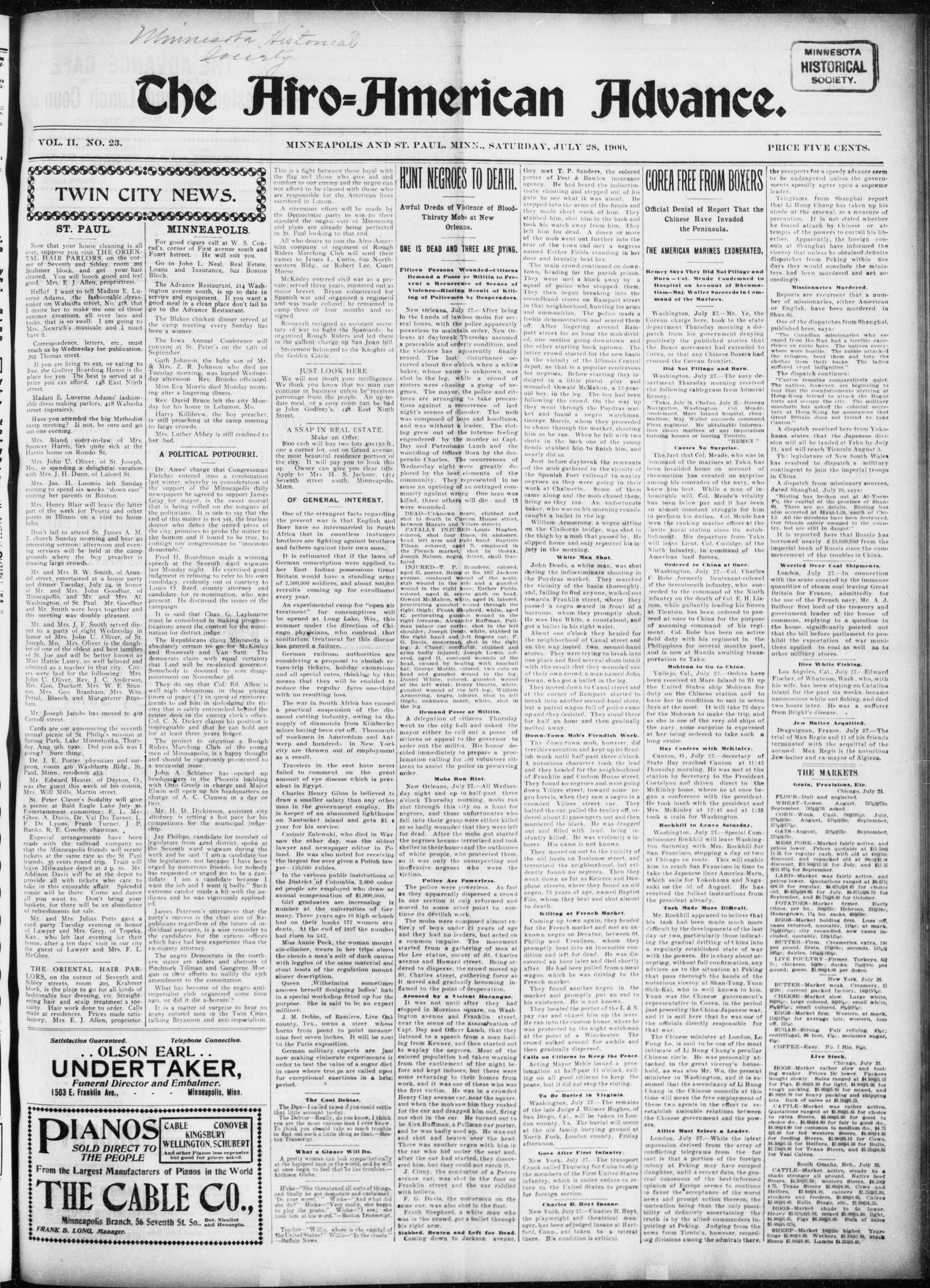
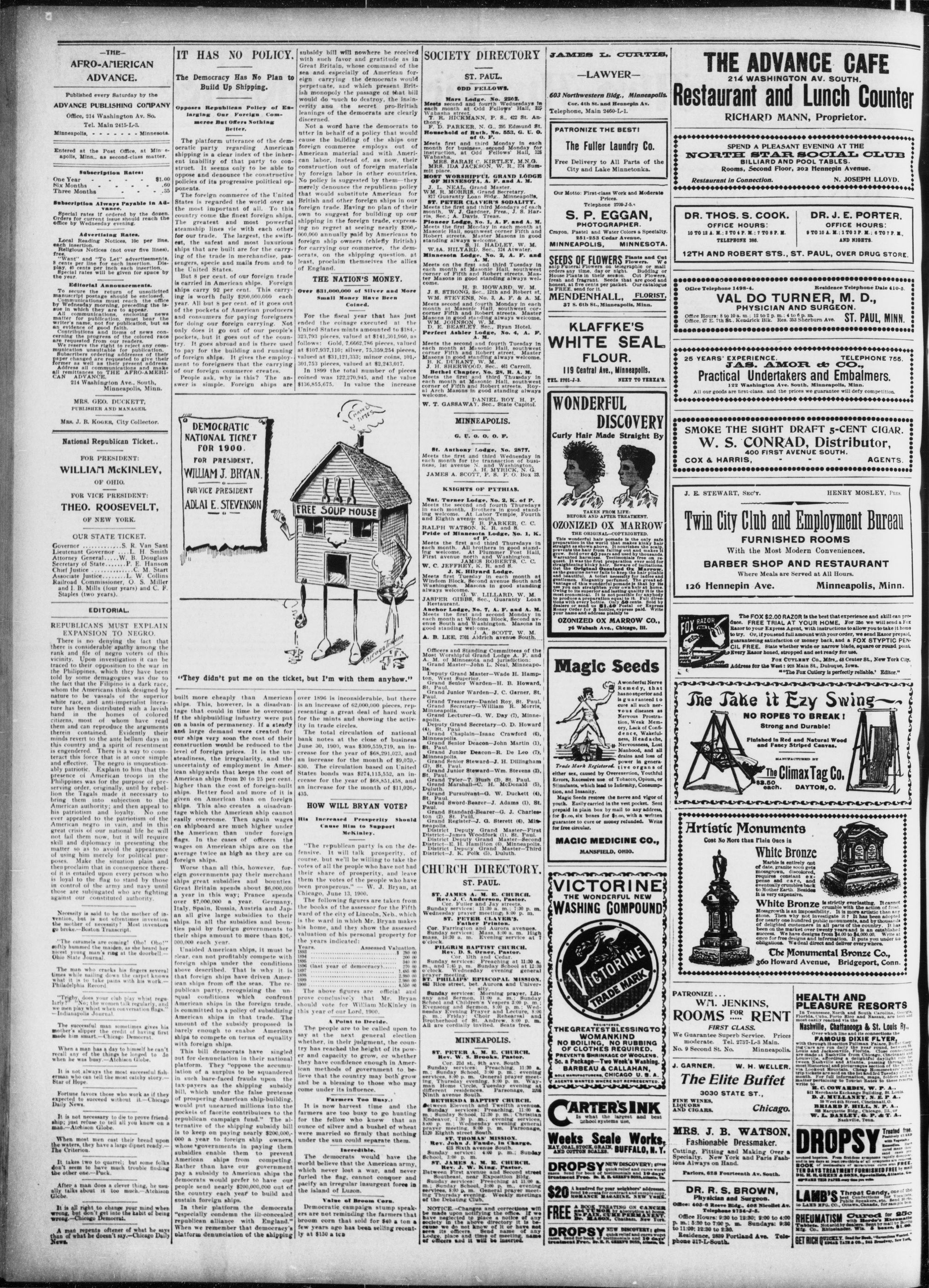
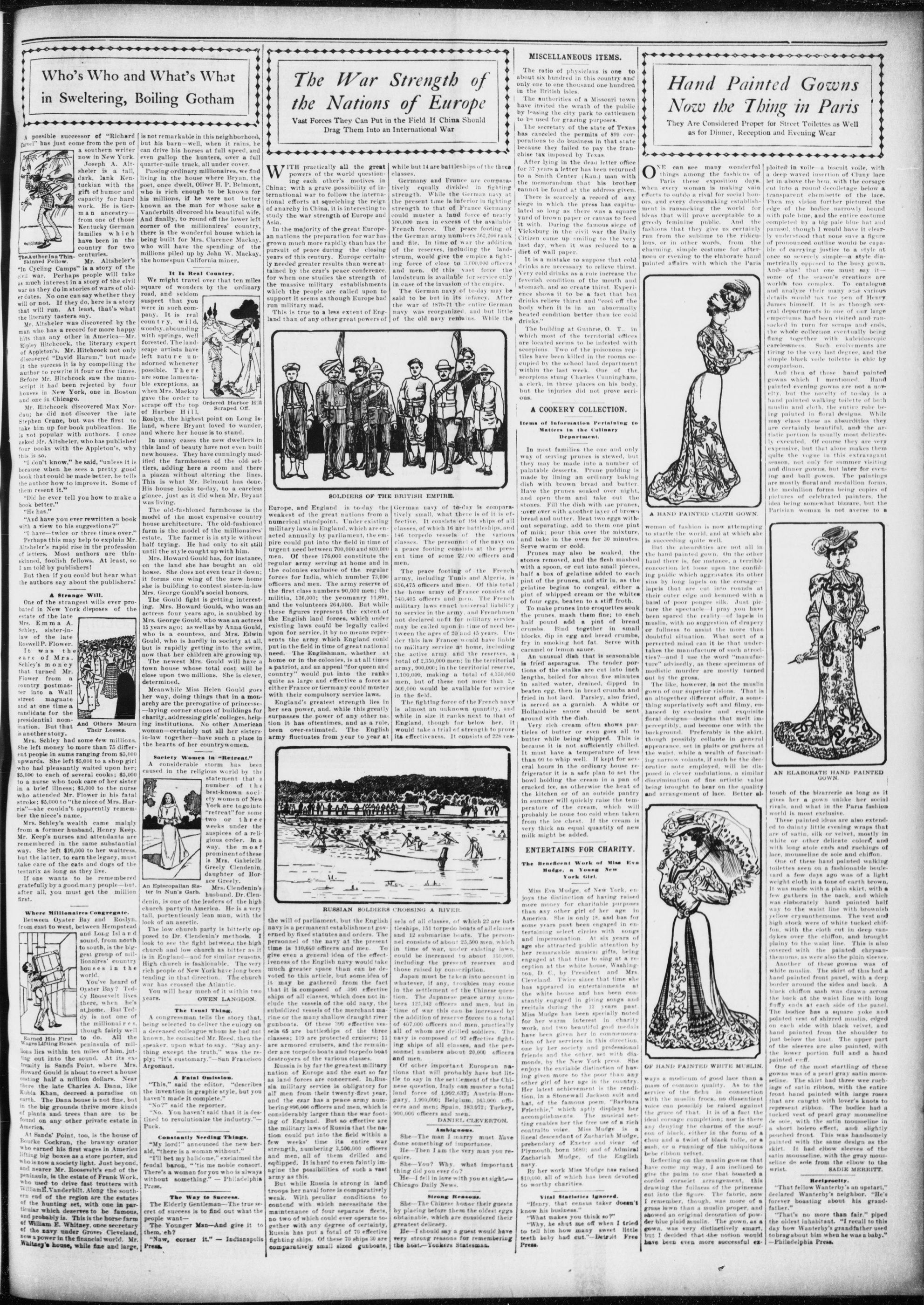
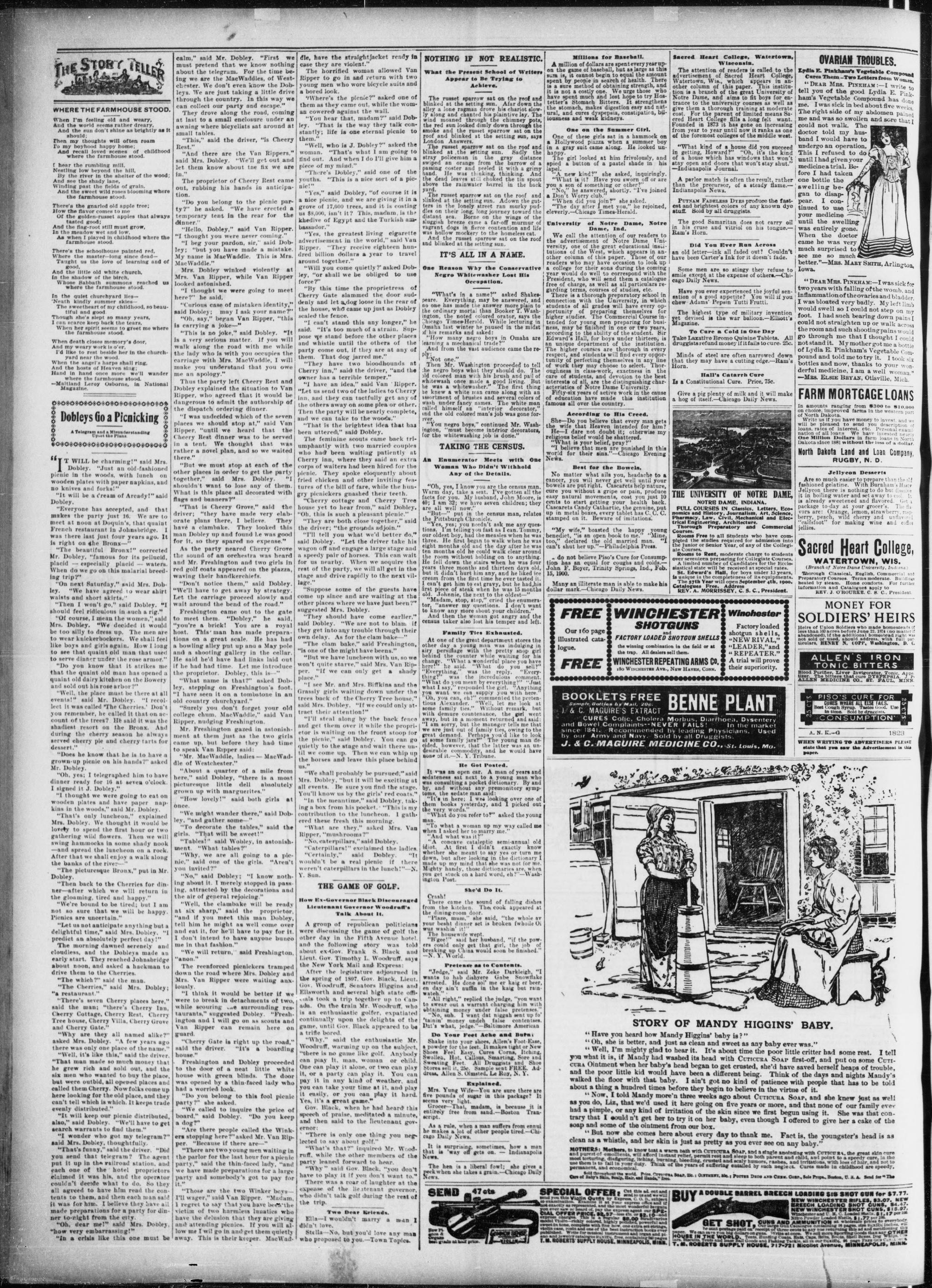
Page text (machine-generated)
TWIN CITY NEWS.
Satisfaction Guaranteed. Telephone Connection.
.. OLSON EARL ..
UNDERTAKER,
Funeral Director and Embalmer.
1503 E. Franklin Ave., Minneapolis, Minn.
PIANOS
SOLD DIRECT TO
THE PEOPLE
CABLE CONOVER
KINGSBURY
WELLINGTON, SCHUBERT
And other Pianos less expensive
but good for prices asked.
From the Largest Manufacturers of Pianos in the World
THE CABLE CO.,
Minneapolis Branch, 56 Seventh St. So., Bet. Nicollet
and Hennepin.
FRANK B. LONG, Manager.
VOL. II. NO. 23.
TWIN CIT
ST. PAUL.
Now that your house cleaning is all over, suppose you visit THE ORIENTAL HAIR PARLORS, on the corner of Seventh and Sibley, room 205 Beahmer block, and get your hair cleaned. You will look good and feel good. Mrs. E. J. Allen, proprietress.
Hello! I want to tell Madam E. Luverne Adams, the fashionable dressmaker on Wabasha street, No. 418, that I desire her to make me one of those summer creations, all over lace and tucks, that is so swell. I am going to Mrs. Newrich's musicale and I must have it.
Correspondence, letters, etc., must reach us by Wednesday for publication, 305 Thomas street.
If you are living to eat, or eating to live, the Godfrey Board House is the place for you. The best is served at a price you can afford. 148 East Ninth street.
Madam E. Luverne Adams' fashionable dress making parlors, 418 Wabasha street (unstairs).
Have you attended the big Methodist camp meeting? If not, be sure and go out one evening.
Mrs. Bland, sister-in-law of Mrs. Spencer Harris, lies quite sick at the Harris home on Rondo St.
Mrs. John U. Oliver, of St. Joseph Mo., is spending a delightful vacation with Mrs. J. H. Dunn, of Lafond St.
Mrs. Jas. H. Loomis left Sunday evening to spend six weeks "down east" visiting her parents in Boston.
Mrs. Henry Blair will leave the latter part of the week for Peoria and other points in Illinois on a visit to home folks.
Don't fail to attend St. James A. M. E church Sunday morning and hear an interesting sermon; afternoon and evening services will be held at the camp grounds where the boy preacher is drawing large crowds.
Mr. and Mrs. B. W. Smith, of Arundel street, entertained at a house party and dinner Tuesday, July 24, in honor of Mr. and Mrs. John Goodbar, of Minneapolis, and Mr. and Mrs. Al Washington, of St. Paul. Mr. Goodbar and Mr. Smith were boys together and this meeting was doubly pleasant.
Mr. and Mrs. J. F. Smith served dinner to a party of eight Wednesday in honor of Mrs. John U. Oliver, of St Joseph, Mo. Mrs. Oliver is the daughter of one of the oldest and best families of St. Joe and will be better known as Miss Mattie Lauray, so well beloved and admired as a teacher in that city. Covers were laid for the following: Mrs John U. Oliver, Rev. J. C. Anderson Mrs. Geo. Duckett, Mrs. W. E. Stanton, Mrs. Geo. Branham, Mrs. Wm Pettel, Blanch and Margarette Branham.
Mr. Joseph Jacobs has moved to 410 Carroll street.
Cards are out announcing the seventh annual picnic of St. Philip's mission at Spring Park, Lake Minnetonka, Thursday, Aug. 9th, 1900. Did you ask was I going? Sure thing.
Dr. J. E. Porter, physician and surgeon, room 410 Washburn Bldg., St. Paul, Minn., residence 453.
Mr. Edward Heater, of Dayton, O., was the guest this week of his cousin, Mrs. Will Mills, Martin street.
St. Peter Claver's Sodality will give a picnic at Bald Eagle Lake, July 10th, on Eagle Lake. Dr. Ghee, A. Davis, Dr. Val Do Turner, L. F. De Lyons, Frank Turner, J. P. Banks, R. E. Consy, chairman.
Especial arrangements have been made with the railroad company so that the Minneapolis friends will secure tickets at the same rate as the St. Paul friends, 35 cents round trip. Train will leave Milwaukee depot at 2 p. m. m. Addison Davis will be at the depot to provide all with tickets who care to take in this enjoyable affair. Splendid music will be there. Come and dance all you want to. Don't bring your baskets, for there will be an abundance of refreshments for sale.
Mr. and Mrs. Julius Petts gave a card party Tuesday evening in honor of Lawyer and Mrs. Grey, of Topeka Kan., who left last evening for their home, after a ten days' visit in our city the guest of Lawyer and Mrs. F. L. MeGhee.
THE ORIENTAL HAIR PAR-LORS, on the corner of Seventh and Sibley streets, room 205. Krahmer block, is the place to go for all kinds of fashionable hair dressing, etc. Straightening hair and scalp treatment a specialty. Hair work done to order. Calls made at residences. Prices made satisfactory. Mrs. E. J. Allen, proprietor.
Satisfaction Guaranteed.
.. OLSON
UNDER
Funeral Director
1503 E. Franklin Ave.,
PIANO
SOLD DIRECT
The Afro-American Advance.
MINNEAPOLIS
For good cigars call at W. S. Conrad's, corner of First avenue south and Fourt hstreet. He will suit you.
Go to John L. Neal, Real Estate, Loans and Insurance, 622 Boston Block.
The Advance Restaurant, 214 Washington avenue south, is up to date in service and equipment. If you want a good meal in a clean place don't fail to go to the Advance Restaurant.
The Blakes chicken dinner served at the camp meeting every Sunday has been a winner.
The Iowa Annual Conference will convene at St. Peter's on the 12th of September.
Gath Johnson, the baby son of Mr. & Mrs. Z. R Johnson who died on Tuesday morning, was buried Wednesday afternoon. Rev. Brooks officiated.
Miss Eva Morris died Monday morning after a lingering illness.
Rev David Bruce left the city Monday for his in Lebanon, Mo.
Harry Killibrew, the boy preacher, is still preaching at the camp meeting to large crowds. Mr. Luther Abbey is still confined to her bed.
A POLITICAL POTPOURRI.
Dr. Ames' charge that Congressman Fletcher entered into a combination last winter, whereby in consideration of the support of the Minneapolis daily newspapers he agreed to support James Gray for mayor, is the sweet morsel that is being rolled on the tongues of the politicians. It is safe to say that the end of this matter is not yet, the fearless doctor who defies the united press of the city, promises to probe the matter to the bottom and if found to be true, to consign our congressman to "inocuous desuetude."
Fred H. Boardman made a winning speech at the Seventh ward wigwam last Monday night. He exercised good judgment in refusing to refer to his own candidacy.毅然ly out of courtesy to the Red County attorney, and candidate for re-nomination, who was present. He discussed the issues of the campaign.
It is said that Chas, G. Laybourne must be considered in making prognostications anent the contest for the nomination for district judge.
The Republican's claim Minnesota is absolutely certain to go for McKinley and Roosevelt and Van Sant. The democrats claim with equal certainty that Lind will be re-elected governor. Somebody is doomed to sore disappointment on November 3d. They do say that Col. Ed. Allen is well nigh obliquous in these piping times of peace (?) in quest of reinforcements to aid him in dislodging the enemy that is safely entrenched behind the center desk in the county clerk's office. Col. C. N. Dickey claims his position is impregnable and that he can hold out for at least three years longer. The project to organize a Rough Riders Marching. Club of the young men of Minneapolis, is a happy thought and should be vigorously prosecuted to a successful issue. John A. Schleiber has opened up headquarters in the Phoenix building with Otto Greely in charge and Major Elwin will open up his headquarters in charge of A. C. Clausen in a day or two.
Mr. H. D. Dickinson, assistant city attorney, is setting a hot pace for his competitors for the municipal judge-ship.
Jay Phillips, candidate for member of legislature from 42nd district, spoke at the Seventh ward wigwam during the week and he said "I am a candidate for the legislature, not because I have been urged by numerous friends, for nobody has requested or urged me to be a candidate. I am a candidate because I want the job and I want it badly." Such extreme candor made a hit with the audience and he was vigorously applauded.
James Petersen's utterances that the party's success is the chief aim of Republicans regardless of the future of individual aspirants, is a wise reminder to the candidates for the various offices which have had less experience than the ex-county attorney.
The negro Democrats in the northern states are aiders and abettors of Pitchford Tillman and Gangrene Morgan in their efforts to nullify the 15th amendment to the constitution.
What has become of the negro anti-imperialist club organized some time ago, or did it die a-bornin'? It is a matter of surprise to hear so many colored men in the Twin Cities talking Bryanism and anti-imperialism.
MINNEAPOLIS AND ST. PAUL, MINN., SATURDAY, JULY 28, 1900.
This is a fight between those loyal with the flag and those who give aid and comfort to our enemy and the negro can not afford to be classed with those who are responsible for the American lives sacrificed in Luzon.
A strenuous effort will be made by the Democratic party to win to their standard the negro vote of Minnesota and plans are already being perfected in St. Paul looking to that end.
All who desire to join the Afro-American company of regiment of Rough Riders Marching Club will send their names to James L. Curtis, 010 Northwestern Bldg., or Robert Lee, Court House.
McKinley entered civil war as a private; served three years, mustered out as major brevet. Bryan volunteered for Spanish war and organized a regiment and was made colonel; he remained in camp three or four months and resigned.
Roosevelt resigned as assistant secretary of war to fight the Spaniards; he organized Rough Riders and led them in the gallant charge up San Juan hill. Stevenson belonged to the Knights of the Golden Circle.
JUST LOOK HERE
We will not insult your intelligence. We think you know that no man can continue in business unless he receives patronage from the people. An up-to-date meal, or a cosy room can be had in John Godrey's, 148 East Ninth Street
$000 cash will buy two lots 60x10 ft.
one a corner lot, on out Grand avenue
the most beautiful residence portion of
the city. It will pay you to look this
up. Owner can give you clear title
Apply to Mrs. H. S. Jackson, 1214
Seventh street south, Minneapolis
Minn.
OF GENERAL INTEREST.
One of the strangest facts regarding the present war is that English and Boer have so intermarried in South Africa that in countless instances brothers are fighting against brothers and fathers against their own sons.
It is estimated that if the laws of German conscription were applied to her East Indian possessions Great Britain would have a standing army of 2,500,000 soldiers, and about 800,000 recruits coming up for enrollment every year.
An experimental camp for "open air treatment" for consumptives will be opened at Long Lake, Wis., this summer under the direction of Chicago physicians, who contend that sanitarium treatment for this disease has proved a failure.
German railroad authorities are considering a proposal to abolish return-trip tickets, holiday excursions and all special rates, thinking by this means that they will be enabled to reduce the regular fares one-third with no resulting loss.
The war in South Africa has caused a practical suspension of the diamond cutting industry, owing to the supply of diamonds from Kimberley mines having been cut off. Thousands of workmen in Amsterdam and Antwerp and hundred; in New York city are thrown out of employment as a result.
Travelers in the east have never failed to comment on the great amount of eye disease which is prevalent in Egypt.
Charles Henry Gibbs is believed to draw a smaller salary than any other man in the government employ. He is keeper of an abandoned lighthouse on Nantucket island and gets $1 a year for his service.
Casimir Zalewski, who died in War saw the other day, was the oldest lawyer and newspaper editor in Poland. He was also noted for receiving the largest fee ever given a Polish lawyer—150,000 rubles.
In the various public institutions of the District of Columbia, 2,000 colored people are employed who draw an annual compensation of $1,000,000.
Girl graduates are increasing in number at the universities of Germany. Three years ago 10 high school had on their books 177 women students. At the end of 1897 the number had risen to 347.
Miss Annie Peck, the woman mount an爬樑, wears in her trips above the clouds a man's suit of duck canvas with leggins of the same material and stout boots of the regulation mountaineer description.
Queen Wilhelmina sometimes amuses herself designing ladies' hats in a special workshop fitted up for the purpose. She is said to be an expert milliner.
J. M. Dobie, of Ramires, Live Oak county, Tex., uses a steer whose horns from point to point measure nine feet seven inches. It will be sent to the Paris exposition. German military experts are just now making elaborate experiments in order to test the value of a sugar diet in cases where troops are called upon for exceptional exertions in a brief period.
The Cool Debtor
The Dun—I called to see if you could settle that little account to-day.
The Debtor—Really, do you know, I think you are the most curious man I ever knew. To think you should take so much trouble you should take a little thing as that—Boston Transcript.
What a Glance Will Do
HJNT NEGROES TO DEATH.
Awful Deeds of Violence of Bloods Thirsty Mobs at New Orleans.
ONE IS DEAD AND THREE ARE DYING.
Fifteen Persons Wounded-Citizens Demand a Posses or Militia to Prevent a Recurrence of Scenes of Violence-Rioting Result of Killing of Policemen by Desperadoes.
New Orleans, July 27.—After being in the kands of lawless mobs for several hours, with the police apparently powerless to maintain order, New Orleans at daybreak Thursday assumed a peaceable and orderly condition, and the violence has apparently finally ceased. The last disturbance occurred about five o'clock when a white baker, whose name is unknown, was shot in the leg, while a crowd of rioters were chasing a gang of negroes. The mayor, the police and citizens are arranging to take precautions against a recurrence of last night's scenes of disorder. The mob was composed of boys andoodlums, and was without a leader. The rioting grew out of the intense feeling engendered by the murder of Capt. Day and Patrolman Lamb and the wounding of Officer Mora by the desperado Charles. The occurrences of Wednesday night were greatly deplored by the best elements of the community. They represented in no sense an uprising of an outraged community against wrong. One man was killed, three others will die and 15 were wounded.
DEAD-Unknown hero, clubbed and shot to death in Custom House street, between Marais and Villemer streets, in the 18th century. Colored, shot four times, in abdomen, head, left arm and right hand, Baptiste Filean, colored, aged 75, employed in the French market, shot in thorax Joseph Nelson, negro, driver, skull fracture.
INJURED-T. P. S. Paunders, colored, aged 35, porter, living at No. 1927 Jackson avenue, contused wound of the scab, stab wound in the side and a gunshot colored, aged 43, severe wound on head, colored, aged 43, severe wound on head, Oswald McMahon, white, aged 16, laborer, penetrating gunshot wound through the right thigh; Frank Shepherd, white, aged 16, laborer, right forearm; Alexander Ruffman, Pullman palace car porter, shot in the left shoulder; Joseph Deeds, white, stabbed in the right hand and left fingers cut; P. Davie motorman, shirt, aged 16, clubbed and arms badly injured; Joseph Lewis, colored, aged 11, contused wounds of the head, caused by beating with baseball bat; George Morris, colored, two cuts on arm; Clive McGee, clubbed and arms badly injured; Joseph Lewis, colored, aged 11, contused wounds of the head, caused by beating with baseball bat; George Morris, colored, two cuts on arm; Clive McGee, clubbed and arms badly injured; Joseph Lewis, colored, gunshot wound of the left wrist; Henry Daurin, white, gunshot wound of the left leg; William Armstrong, negro, laborer, shot in left thigh; unknown baker, white, shot in
Demand Posse or Militia.
A delegation of citizens. Thursday went to the city hall and asked the mayor either to call out a posse of citizens or appeal to the governor to order out the militia. His honor decided immediately to prepare a proclamation calling for 1,000 volunteer citizens to assist the police in preserving order.
Mobs Run Riot.
New Orleans, July 27.—All Wednesday night and up to half-past three o'clock Thursday morning, mobs ran riot through this city on a hunt for negroes, and those unfortunate who fell into their grasp were either killed or so badly wounded that they were left for dead. After the mobs got started the negroes became terrorized and took shelter in their homes and the outhouses of white people, who protected them, so it was only the unsuspecting and inoffensive negroes who were the victims.
Police Are Powerless.
The police were powerless. As fast as they apparently dispersed a crowd in one section it only reformed and moved to some other point to continue its devilish work. The mobs were composed almost entirely of boys under 21 years of age and they had no leaders, but acted on a common impulse. The movement started from a gathering of men at the Lee statue, corner of St. Charles avenue and Howard street. Being ordered to disperse, the crowd moved up St. Charles street, gathering force as it moved and gradually becoming inflamed to the point of desperation.
Aroused by a Violent Harangue.
It was not until after they had stopped in Morrison square, on Washington avenue and Franklin street near the scene of the assassination of Capt. Day and Officer Lamb, that they listened to a speech from a man hailing from Kenner, and then started out to waylay the negroes. Most of the colored population had taken warning from the excitement of the night before and kept indoors, but there were some returning to their homes from work, and it was one of these who was the first victim. He was in a crowded Henry Clay avenue car, near the square, and when the mob saw him they rushed for the car and dragged him out, firing one shot in the car. He turned out to be Alex Ruffman, a Pullman car porter, and he was badly used up. He was cut and shot, and beaten over the head. There was another negro with him in the car who hid under the seat and, after the car had started, they discovered him, but they could not catch it.
J. Cluny, the conductor of a Peters avenue car, was shot in the foot on Franklin street and the car riddled with bullets.
F. G. Davis, the motorman on the same car, was also shot in the foot.
Frank Shepherd, a white man who was in the crowd, got a bullet through his right arm.
Stabbed, Beaten and Left for Dead.
Coming down to Jackson avenue.
they met T. P. Sanders, the colored porter of Fost & Bowles insurance agency. He had heard the indiscriminate shooting and stepped out of his gate to see what it was about. He stepped into the arms of the friends and they made short work of him. They stabbed him, shot him in the back and took his watch away from him. They left him for dead. A dozen or more of the mob went out further into the rear of the town and met a negress named Esther Fields standing in her door and brutally beat her.
The main crowd continued on downtown, heading for the parish prison. They were met a block away by a squad of police who stopped them. They then began breaking into the secondhand stores on Rampart street in that neighborhood, hunting for arms and ammunition. The police made a feeble demonstration and scared them off. After lingering around Rampart street for an hour the mob divided, one section going downtown and the other starting back uptown. The latter crowd started for the new basin in the vicinity of the Illinois Central depot, as that is a popular rendezvous for negroes. Before starting they indulged in a little pistol play and wounded Oswald McMahon, a 12-year-old boy, in the leg. The boy had been following the crowd. On the way up they went through the Poydras market and found a negro watchman, George Morris, whom they proceeded to chase through the market, shooting him as he ran. When he fell with two shots in the back one of the young friends stabbed him to finish him, and nearly did so.
Just before daybreak the remnants of the mob gathered in the vicinity of the Spanish Fort railroad to waily negroes as they were going to their work at Chalmette. Some of them came along and the mob chased them, firing as they ran. An fortunate baker, who was on his morning rounds, caught a bullet in the leg. William Armstrong, a negro sitting on the Claiborne bridge, was shot in the thigh by a mob that passed by. He slipped home and only reported his injury in the morning.
White Man Shot.
John Deeds, a white man, was shot during the indiscriminate shooting in the Poydras market. They searched the vicinity of the basin thoroughly, and, failing to find anyone, walked out towards Franklin street, where they passed a negro seated in front of a barroom, whom they promptly shot. He was Dan White, a rostabout, and got a bullet in his right wrist.
About one o'clock they headed for the neighborhood of Canal street and on the way looted two second-hand stores. They were trying to break into one place and fired several shots into it with the result that they wounded one of their own crowd, a man named John Doran, who got a bullet in the leg.
They moved down to Canal street and at the corner of Rampart started to break into another second-hand store, but a patrol wagon full of police came up and they desired. They stood there for half an hour and then gradually melted away.
Down-Town Mob's Fendish Work.
The down-town mob, however, did terrible execution and kept up its fendish work until half-past three o'clock. A notorious character took the lead and they headed for the neighborhood of Franklin and Custom House street. They found no negroes and were going down Villere street, toward some negro hovels, when they saw a negro in a crowded Villere street car. They halted the car, pulled the trolley off, ordered about 22 passengers out and then murdered the black. He was dragged out and filled with lead, being instantly killed. He was evidently a laborer. His name is not known.
They moved on out to the vicinity of the old basin on Toulouse street, and terrorized the neighborhood, but evidently found no negroes. Then they went down as far as Kelleerce and Dauphine streets, where they found an old negro, 75 years of age, named Baptist Filo, whom they beat and shot almost to death.
Killing at French Market
Coming up town again, they headed for the French market and met an unknown negro on Decatur, between St. Phillip and Ursulines, whom they promptly beat into an insensible condition and left for dead. He was discovered an hour later and died shortly after. He had been pulled from a meat wagon which he was driving to the French market. They found another negro in the market and promptly put an end to his existence. He is not known. They located the porter of the L. & N pay car and chased him up the levee. He ran into the custom house, where he was protected by the night watchman at the point of a Winchester. The crowd sulked around for awhile and then gradually dispersed.
Calls on Citizens to Keep the Peace
Acting Mayor Mchel issued a proclamation at half-past 11 o'clock, calling on all good citizens to keep the peace, but it did not stop the rioting.
To Be Buried in Virginia
Washington, July 27. The remains of the late Judge J. Wilmer Hughes, of San Diego, Cal., will be taken to London county, Va. The burial will occur at the old family burial ground at North Fork, Loudon county. Friday afternoon.
Gone After First Infantry.
New York, July 27.—The transport Crook sailed Thursday for Cuba to ship the members of the First United States infantry, which is under orders to return to the United States to prepare for foreign service.
Charles H. Hoyt Insane.
New York, July 27. - Charles H. Hoyt, the playwright and theatrical manager, has been adjudged insane at Hartford, Conn., and taken to a retreat there. His condition is critical.
GOREA FREE FROM BOXERS
Official Denial of Report That the Chinese Have Invaded the Peninsula.
THE AMERICAN MARINES EXONERATED.
Remey Says They Did Not Pillage and Burn—Col. Mende Condemned to Hospital on Account of Rheumatism—Maj. Walter Succeeded in Command of the Marines.
Washington, July 27.—Mr. Ye, the Corean charge here, took to the state department Thursday morning a dispatch from his government denying positively the published stories that the Boxer movement had extended to Korea, or that any Chinese Boxers had crossed the Corean frontier.
Did Not Pillage and Burn.
Washington, July 27.—The navy department Thursday morning received the following cablegram from Admiral Remey:
"Taku, July 24, Chefoa, July 25, Bureau Navigation, Washington; Col. Moade, condemned, Mare Island hospital, rheumatism; Maj. Walter succeeds command First regiment, obtainable informa- tions; Marines, matrics of any imputation burning houses or looting Teentus.
Causes No Surprise.
The fact that Col. Meade, who was in command of the marines at Taku, has been invalided home on account of rheumatism has created no surprise among his comrades of the navy, who knew him best. While a man of indomitable will, Col. Meade's vitality has been below par and it has been an almost constant struggle for him to perform his duties. Col. Meade has been the ranking marine officer at the Cavite naval station since its establishment. His departure from Taku will leave Lieut. Coulidge, of the Ninth infantry, in command of the American land forces.
Washington, July 27.—Col. Charles F. Robe, formerly lieutenant colonel of the Seventeenth infantry, who succeeded to the command of the Ninth infantry on the death of Col. E. H. Lipsum, while gallantly leading his forces at Tientsin, has been ordered to proceed at once to China for the purpose of assuming command of his regiment. Col. Robe has been on active field duty with his regiment in the Philippines for several months past, and is now at Manila awaiting transportation to Taku.
Mohlean to Go to China
Vallejo, Cal., July 27. Orders have been received at Mare Island to fit up the United States ship Mobican for duty on the Chinese station and to have her in condition to sail in seven days at the most. It will take 72 days for the Mobican to make the trip, and as she is one of the very old ships of the navy, some surprise is expressed at her being ordered to take such a long cruise.
Hay Confers with McKinley
Canton, O., July 27—Secretary of State Hay reached Canton at 11:45 Thursday morning. He was met at the station by Secretary to the President Cortelyon and driven direct to the McKinley home, where he at once began a conference with the president. He took bunch with the president and Mrs. McKinley at 12:45 and at 1:35 took a train for Washington.
Rockhill to Leave Saturday.
Washington, July 27—Special Commissioner Rockhill with Washington Saturday with Mrs. Rockhill for San Francisco, stopping a day or two at Chicago en route. This will enable him to reach San Francisco in time to take the Japanese liner Amer-Maru, which sails for Yokohama and Nagasaki on the 3d of August. He has received the fullest instructions from the president already.
Task Made More Difficult.
Mr. Rockhill appeared to believe that his task had been made much more difficult by the developments of the last day or two, particularly those indicating the gradual drifting of China into a regularly established state of war with the powers. He is chary about accepting, without full confirmation, any advice as to the situation at Peking that pass through the hands of the notorious viceroy at Shan-Tung, Yuan Shih-Kai, who is well known to him. Yuan was the Chinese government's representative in Corea, in the period just preceding the China-Japanese war, and it is said here that he was one of the officials directly responsible for that war.
The Chinese minister at London, Lon Fung Lou, is said to be one of the most intimate of Li Hung Chang's peculiar Chinese circle. He was personally attached to the great viceroy's household, as was also Mr. Wu, the present minister to Washington, and it is assumed that the ascendancy of Li Hung Chang in the Chinese councils at this time will mean the free employment of these two agents in the effort to reestablish amicable relations between the Chinese government and the powers.
Allies Must Select a Leader.
London, July 27- While the latest impression derived from the array of conflicting telegrams from the far east is that a portion of the foreign colony at Peking may have escaped daughter, until a recent date, the general consensus of the best-informed opinion of Europe seems to continue to favor the acceptance of the worst news and prompt action thereon, the contention being that the only possibility of definitely ascertaining the truth is by the allied commanders inquiring at Peking. Judging from the news from Tientsai, however, recording divisions among the admirals there.
MINNESOTA
HISTORICAL
SOCIETY.
PRICE FIVE CENTS.
the prospects for a speedy advance seem to be endangered unless the governments speedily agree upon a supreme leader.
Telegrams from Shanghai report that Li Hong Chang has taken up his abode at the arsenal, as a measure of precaution. It is not stated whether he feared attack by Chinese or attempts of the powers to curtail his liberties. Apparently, the foreign consuls at Shanghai have informed the viceroy that unless he obtained definite dispatches from Peking within five days they would conclude the ministers had been murdered and act accordingly.
Missionaries Murdered.
Reports are recurrent that a number of missionaries, either American or English, have been murdered in Shan-Si.
One of the dispatches from Shanghai, published here, says:
"The Canadian missionaries who escaped from Ho-Nan had a terrible experience on route here. The natives everywhere were hostile. The rabble attacked them, beet them and tore the clothes from their backs. The ladies suffered cruel indignities."
The dispatch continues:
"Canton remains comparatively quiet. The natives, however, are beginning to fend off Hong-Kong. Hong-Kong intend to attack the Bogue forts and occupy the city. The military mandarin has asked the colonial secretary at Hong-Kong for assurances that certain does not intend to take Canton."
A dispatch received here from Yokohama states that the Japanese division will all be landed at Taku by July 31, and will reach Tientsin August 3.
The legislature of New South Wales has resolved to dispatch a military contingent to join the imperial troops in China.
A dispatch from missionary sources, dated Shanghai, July 26, says:
"Rioting has broken out at Al-Yuuen Fu, the capital of the province of Shan St. There are no details. Rioting has also occurred at Haasi-Lih, south of Chili. All the missions have been destroyed, the safety escaped to the country, but are still in danger."
It is reported here that Russia has borrowed nearly £19,000,000 from the imperial bank of Russia since the commencement of the troubles in China.
Worried Over Cool Shipments
London, July 27—In connection with the scare created by the immense quantities of steam coal leaving Great Britain for France, admittedly for the use of the French navy, Mr. A. J. Balfour first lord of the treasury and government leader of the house of commons, replying to a question in the house, significantly pointed out that the bill before parliament to prohibit the exportation of war munitions applied to coal as well as to other military stores.
Dies While Fishing.
Los Angeles, Cal., July 27. - Edward Fischer, of Whatecum, Wash., with his wife, has been staying on Catalina island for the past six weeks, became unconscious while out fishing, and died two hours later. He was a sufferer from Bright's disease.
Jew. Butter. Acquitted.
Draguignan, France, July 27.-The trial of Max Regis and 11 of his friends terminated with the acquittal of the accused. Max Regis is the notorious Jew-baiter and ex-mayor of Algiers.
THE MARKETS
PLOUR-Dull and neglected.
WHEAT-Lower, August, 73%@75%c
September, 74%@75%c asked
WEEK-Work, Cash, 28%@25%c, July,
73%@75%c, August, 73%@75%c, September,
73%@75%c,
OATS-August, 22%@23%c, September,
22%@23%c,
MESS BORK-Market fairly active, and
prices lower. Prices quotable at $1.500
11% for regular cash, with old at 40%@25%
discount, and repacked old at 90%@11% for
July, and $1.55@11% for September.
LARD-Market was fairly active, and
prices lower. Quotations rated at 6.67%@6.70 for regular, 6.67%@6.75 for choice
old, 6.62%@6.75 for July, 6.67%@6.75 for
September, and 6.75%@6.70 for October.
Early Ohls, per bu. 30%@30%; Hebrons, 35%@35%;
Homgrown, 1% bu. sacks, 40%@40%.
EGG-Market holding firm. Loss off,
cases returned, quotably, 11%c; at mark,
10%@10%; city recalled, new cases
included, quotably, 124%@124%.
BUTTER-Firm, Creameries, extra, 13%c;
13%@13%; seconds, 15%@15%; dairies, 14%@14%;
LIVE PUFT-Firm, Turkeys, 60%c;
chickens, 50%c; ducks, 70%c per
pound, geese, 3.00%@4.00 per dozen.
92%c; current packed factory, 145%c!,
CHEESE-Market slow. Large white,
92%c!; large colored, 92%c!; small white,
94%c!; small colored, 92%c!;
EGG8-Market firm. Western, at mark,
114%c!; for average lots, western, loss
of fruit.
SUGAR-Strong. Fair refining, 4%c;
centrifugal, 9% test, 4%c; molasses sugar,
4%c;
COFFEE-Easy. No. 7 Rio, 9%c.
Live Stock.
Chicago, July 21
HOGS-Market rathers, larger weaker. Prices less lower. Packers bought slowly. Sales ranged at $4.5095.15 for Pigs, $6.0945.15 for light, $6.0945.15 for rough packing, $6.0945.15 for mixed, and rough packing. Bulk of sales at $4.5945.15.
CATTLE-Market was rather active. Quotations ranged at $2.9095.15 for choice to extra Steers, $3.0095.15 for good to excellent Steers, $3.0095.15 for common to medium do. $4.795.15 for fed western Steers, $4.0094.15 for feeding Steers, $4.0094.15 for Cows, $3.0945.15 for Heifers, $6.0945.15 for Bulls, $6.0945.15 for Texas Steers, and $5.2595.15 for Valcal Caves.
North Omaha
South Omaha, Neb. July 25.
CATTLE-Market active, steady to a shade stronger all around. Native beef Steers $3.99, 4.75, Texas Steers $3.99, 4.04, Cows and Heifers, $4.99, 4.40, canners, $7.59, 30 stockers and feeders, $6.99, 4.45, Calves $6.99, 0.00, Bags, etc., $6.99, 0.25, Market-Buy Steers $6.99, 0.10, Market-Buy Heavy $6.99, 0.10, mixed $6.99, 0.15, light, $4.99, 0.05, Pigs $4.99, 0.00, Bulk of sales $4.99, 0.02, SHEEP-Market 100%c Higher, Year-earned $4.99, 0.00, stock Sheep $4.99, 0.00, Lamb $4.99, 0.00
_gempnetenn cane pai ign TS
—THr—
AFRO-ATERICAN
ADVANCE.
Published every Saturday by the
ADVANCE PUBLISHING COMPANY
Office, $14 Washington Av. So.
Tel. Main 2415-L-3,
‘Minneapolis, - = - - - + - Minnesota.
Entered at the Post OMce, at Min e-
‘apolls, Minn... ax second-class matter.
Sabseription Rates:
OneYear = = = = $1.00
Bix Months =. = + 60
‘Three Months cote 88
Subscription Always Payable in Ad-
Special rates tf ordere he dozen.
ondera tor eusrrent ‘ewue'snowia' reach, the
omice by Wednesday evening.
Advertising Rates,
en jo ine,
og anane Notices, ie per 1!
qrlisioun Notices (not over five tines)
Want" and “To Let’ advertisements,
8 cents per line for ‘each insertion. Dis=
wlay, Wo ‘cents per inch each insertion,
‘Special rates wil be given for space by
the year.
Wetisieis haaieanements:
secure the return of unsolicited
manutcript portage should be eneloned
Rear et te ot tee oe
of Walaa eertag:prestaae ie
Catrneiet’ gerne crate
ic cee Ee
wees Re, et Mg
SA eater soe la a
Eetaragmame, eat tere
ere Beet LO os wsrs ton
Pe Oy Ng pe
TE aeaee Ee dey com.
Rieter ah etn ea
Rebeeenarend ats raged toa tha
RT ae a
hr eette pean
214 Washington Ave., South,
Minneapolis, Minn.
MRS. GEO. DUCKETT,
Mna, J. B. Koon, City Collector.
icon dithaiae ee Saaedle
National Republican Ticket...
FoR PRESIDENT:
WILLIAM McKINLEY,
OF O10.
FOR VICE PRESIDENT:
THEO. ROOSEVELT,
OF NEW YORK.
heceatieadibach Saisie titled
Governor .......2..2.8 R. Van Sant
Lieutenant Governor ....L, H. Smith
Attorney General.....W. i. Douglass
Secretary of State.......P. EB. Hanson
Chie Justice». cessesven «GM. Start
Associate Justice... W; Calling
Railroad Commissioner, O. S. Miller
and |. B. Mills (four years) and C. F.
Staples (two years).
EDITORIAL.
REPUBLICANS MUST EXPLAIN
EXPANSION TO NEGRO.
There is no denying the {act that
there is considerable apathy among the
rank and file of negro voters of this
vicinity, Upon investigation it can be
traced (o their opposition to the war in
the Philippines, which they have been
told by some demagogues was due to
the fact that the Filipino is a dark face,
whom the Americans think designed by
nature to be vassals of the peneone
white race, and anti-imperialist htera-
tare has been distributed with a lavish
band in the homes of colored
citizens, most of whom have read
them and can reproduce the arguments
therein contained, Evidently their
minds revert to the ante bellum days in
this country and a spirit of resentment
is engendered, There is a way to coun,
teract this force that is at once simple
and effective. The negro is unquestion
ably patriotic, “Explain to him that the
resence of American troops in the
Philippines ‘was for the purpose of pres
fears order, originally, until by rebel-
lion the Tagals made it necessary to
bring them into subjection to the
American authority; and then appeal to
hhis patriotism and loyalty. No-one
‘ever appealed to the patriotiem of the
American ere, m vain, and in’ this
great crisis of our national life he will
not tail them now, but it will require
skill and diplomacy in fromames the
matter so as to avoid the appearance
of using him merely for political pur
poses. Make the situation plain. and
then proclaim that in consequence there-
‘of it is entailed men every person who
is loyal to the flag to stand by those
in control of the army and navy until
those are subjugated who are fighting
against our constituted authority
Meseoalty i maid to be the mother of in-
enon Bat ce atte tat
the mother of necessity’ Most inventors
& brvke.—Boston Transcript
“Tae crane aecominat_ Oe! Oba ™
Fad bummed the maiden, ar Seneeae’ bee
Soe as peat aes oe
The map hg cake Uy frets sro
odpe Mh htaaits Mtoe reat
Foe Rc te sole wtuKa sate
Philadelphia Record
“rg on yn sah ay whi
uate ree ak ey
ee
‘The successful man sometines gives hie
Mother's slipper the credit of having frst
made bim smart. —Chicago Democrat
yeep Aa da tg homie
lt any of tl thi he long to fo
Sin SS Sater,
Is at ala the et svn
— Sho can tell the most catchy story.
ot Hope.
Fortune favors thor who work as if they
gies oat ate,
Bay New.
net pees gd oper nt
Peo ey
mabe ison Globe.
When most men cart their bread upon
Heaters, her ‘have a lange dipnet ready. —
takes two to quarrel; but rome folks
gen een to fave mack trouble Goding
aiip tite about ie “io""toch“tAtchinn
Pa hoa hv
oftener of what be
ie ANT doce ay Ces Dally
Co
4 fr,
DEMOCRATIC 257
NATIONAL TICKET :
FOR 1900. y A *
FOR PRESIDENT, i — SR
WILLIAM J. BRYAN. Se
PUR VICE PRESIDENT et ECS
ADLATE. STEVENSON [FREE SOUP HOUSE jel
6 Tf | — iP ia
SU
ul (rege ——— —/ ~"e
i = = iy
a et 2
, ee)
eee en ee eT ie ' ies
| aig t
“They didn’t put me on the ticket, but I’m with them anyhow.”
IT HAS NO POLICY,
The Democracy Has No Plan to
Build Up Shipping.
cag ae ree
The platform utterance of the dem-
ceratic party regarding American
shipping in @ clear index of the inher-
ent inability of that party to con-
struct. It seems only to be able to
oppose and denounce the constructive
policies of its progressive political op-
ponents, .
‘The foreign commerce of the United
States is regarded the world over as
the most important of all, To this
country come the finest foreign ships.
The greatest and most powerful
steamship lines vie with each other
for our trade. ‘The largest, the swift.
est, the safest and most luxurious
ships that are built are for the carry-
Ing of the trade In merehandixe, pas-
sengers, specie and mails from and to
the United States
But 8 per cent. of our foreign trade
in carried in American ships. Foreign
ships carry 92 per cent. This carry-
ing is worth fully $200,000,000 each
yeur. All but & per cent. of it goes out
of the pockets of American producers
‘and consumers for paying foreigners
for doing our foreign carrying. Not
only does it go out of our people's
pockets, but it goes out of the coun-
try. It goes abroad and ix there used
to pay for the building and running
of foreign ships. It gives the employ-
ment to foreigners that the carrying
of our foreign commerce creates
People axk, why ix this? ‘The an-
ewer is simple. Foreign ships are
built more cheaply than American
ships. This, however, ix disadvan:
tage that could in time be overcome
Mf the shipbutiding industry were put
‘on a basis of permanency, If a ateady
and large demand were crented for
Our ships very kon the cost of their
construction would be reduced to the
level of foreign prices. It ix the un-
steadiness, the irregularity, and the
uncertainty of employment in Amer-
fean shipyards that keeps the cost of
American ships from 20 to 25 per cent
higher than the cost of foreign-bullt
ships, etter food and more of it is
given on American than on foreign
ships, ‘Thin also creates a wisadvan-
tage which the American ship cannot
easily overcome, ‘Then again wages
on shipboard are much higher under
the American than under foreign
fings. In the cases of officers the
‘wages on American ships are on the
average twice ax high as they are on
foreign ships.
Worse than all this, however, for:
eign governments pay their merchant
ships great subsidies and bounties
Great Britain apende about $6,000,000
a year in this way; France spends
over $7,000,000 a year, Germany,
Italy, Spain, Russia, Avateta and Jap:
fan all give large subsidies to thelr
ships In all the subsidies and bown-
ties paid by foreign governments to
their ships amount to more than $26,-
000,000 each year,
Unaided American ships, it must be
lear, can not profitably compete with
foreign ships under the conditions
above deseribed, ‘That ie why it. is
that foreign ships have driven Amer:
ean ships trom off the seas, ‘The re.
publican party, recognizing the un
tual conditions which — confront
American ships in the foreign trade,
Is committed to a polley of aubsidizing
American ships in that trade. ‘The
amount of the subsidy proposed Is
harely enough to enabie American
thipa to compete on terms of equality
with foreign ships
‘This bill democrats have singled
out for denunciation in their national
platform. ‘They “oppoxe the accumu:
lation of a surplus to be squandered
in euch bare-faced frauda upon the
taxpayers as the shipping subsidy
bill, which under the false pretense
of prospering American ship-building,
‘would put unearned millions into the
pockels of faorite contributors to the
republican campaign fund.” The al:
ternative of the shipping subsidy bill
is to keep on paying nearly $200,000,
000 a year to foreign ship owners
whose "governments in paying them
subsidies enable them to prevent
American ships from competing,
Rather than have our government
pay A subsidy to American ships the
democrats would prefer to have our
people send nearly $20,000,000 out of
the country each year to build and
sustain foreign ships,
In their platform the democrats
“expecially condemn the ili-conceaied
Tepablican alliance with | England.”
we remember that democracy’s
platform denunciation of the shipping
subsidy bill will nowhere be received
with such favor and gratitude as im
Grent Britain, whose command of the
sea and especially of American for-
eign carrying the democrats would
perpetuate, and which present Brit-
ish monopoly the passage ot that bill
would do vauch to destroy, the inxin-
cerity ana the secret pro-British
leanings of the democrats are clearly
discerned.
Not a word have the democrats to
ntter in behalf of a policy that would
cause the building of the ships our
foreign commerce employs out of
American material and with Ameri-
can labor, instead of, ax now, their
construction out of foreign materials
by foreign labor in other countries.
No policy is suggested by them—they
merely denounce the republiean policy
that would substitute American for
British and other foreign ships in our
foreign trade. Having no plan of their
own to suggest for building up our
shipping in the foreign trade, express.
ing no regret at seeing nearly $200,
40,000 annually paid by Americans to
foreign ship owners (chiefly British)
for carrying our commerce, the dem-
cerate, on the shipping question. at
least, proclaim themselves the allies
of England,
THE NATION’S MONEY.
Over 431,000,000 of Silver and More
Sinai! Money Have Been
Gained,
For the fiseal year that has just
ended the coinage executed at the
United States mints amounted to $184,-
423,792 pieces, valued at $141,301,960, as
follows: Gold, 7.0662.786 pieces, valued
at $107.097,110; silver, 75.59.2546 pieces,
valued at $31,121,232; minor coins, 101,
001,753 pieces, valued at $2,243,017,
In 1890 the total number of pieces
coined wax 122,270,045, and the value
$136,855,675. In value the increase
over 1896 is inconsiderable, but there
is an Increane of 62,000,000 pieces, rep.
resenting a great deal of hard work
for the mints and showing the actly.
ity in trade circles.
‘The total circulation of national
bank notes at the close of business
June 30, 1909, was $209,559,719, an in-
crease for the year of $08,201,023, and
an increase for the month of $9,070,
4800, ‘The circulation based on United
States bonds was $274,115,552, an in-
crease for the year of 868,531,455, and
an increase for the month of $11,026,
435.
HOW WILL BRYAN VOTE?
Wis Increased Prosperity Shonta
Cause Him (0 Support
Metintey.
“The republican party is on the de
fensive. It will talk prosperity, of
course, but we'll be willing to take the
votes of all the people who have not had
their share of prosperity, and leave
them the votes of the people who have
been prosperous.” — W. J. Bryan, at
Chicago, June 13, 1900.
‘The following figures are taken from
the books of the assessor for the Fifth
ward of the city of Lincoln, Neb. which
is the ward in which Mr. Bryan makes
hia home, and they show the asseased
valuation of his personal property for
ee ate Ree ae
Years, Anseaned Valuation.
OD -ortcarncienet 0 0
tt eee Se
tise ins’ f democracy: ew
BES Cinai Year oF Wemocracysio.) | Hy
PBR Sscasiugscbanannersiecconcaenpce cee A
IB, scccysettuntcoassasneee Rae
i SNEIIN, Ge
‘The above figures are official aud
Prove conclusively that Mr. Bryan
should vote for Wiltiam MeKinley: in
this year of our Lord, 1900.
A Yoimt to Deelde.
‘The people are to be called upon to
say at the next general election
whether, in thelr judgment, the coun-
try has reached the height of its pow:
er and capacity to grow, or whether
they have confidence enough in Amer-
fcan methods of government to, be-
lieve that the country may both’ grow
and be a blessing to those who may
come under its influence.
Farmers Too Masry
It is now harvest time and the
farmers are too busy to go hunting
for the fellow who knew that an
‘ounce of silver and « bushel of wheat
were married so firmly that nothing
under the sun could separate them,
Imcredibte,
‘The democrats would have the
world believe that the American army,
which never lost a war, and never
furled the flag, cannot conquer and
pacify an irregular insurgent force im
the island of Tason,
‘Veetetes te oie Dae
Democratic campaign stump speak-
ers are not reminding the farmers that
broom corn that sold for $40 9 tons
few years ago bas been selling recent-
ly at $190 a ten
ll Malin AES a
SOCIETY DIRECTORY
ST. PAUL.
opp reLLows.
aaa GE ates Ohad
Meets second and “ourth’ Wednesdays tn
Farce
GER HICKMAN, P. 8, 42 8. Am
en
FD. PARKER, N. G.. 86 Edmund Bt.
Household of Ruth, No. 553, G. U. 0.
wor
Meets teat and tird| Mond in each
month ifr vuninetneegend Monday fa
Eentruction, “at "Od “Peilows’ Mall,
MES. SARAH © KIRTLEY, MN.G.
MiE IDA JACKSON. We He, 1 Bow
mt pince
‘Mos? WORSHIPYCE GRAND LODGE
‘OF MINAESOTA, A- Fv and A: M.
JL. NEAL, Grand Master.
wir Sie MOMS Senn Secrotary.
1S Guaranty Loan Aide. Minneapotie,
ST. PETER CLAVER'S SODALITY.
Meria!tbesaret andra Mandape.g1 cfch
Month. W. J. Gardner. Pres d. 8. Hare
Fin, Bee.) A. Davis. ‘Treas.
Pioneer No. 1, A. Fan A. 9.
Meets tine Arai Rlcnaay"in cach month mi
Masonic Salt southwest corner Firth and
Robert‘ streetar Mutter Masone in good
Standing always welcome
33 Huey, w. a.
W.HA. HILYARL. Sec tit Aiwater
Minnesota Leds, \No. % A. P. and
Meets on the first and third Tuesday in
AER oonth at Masonle ah seachgent
Sorner"of Pitth and Wobert streets. Mar:
{er'Masona in good standing always wel
Come.
H.R. HOWARD, w. a.
J. 8. STRONG, Sec.. 12th and Robert st,
WM. STEVENS, No AF. & A.M.
Meets second and fourth Monday in each
Month at Masonic Hall southorent ‘cor:
Cornet Fitth and Tobert streets’ Master
Sigeci in poh standing always weltome,
We efRion Whe
D. EB. BEASLEY. Sec., Ryan Hotel.
Perfect Ashler Lodge, No. 4, A. F
ont
Meets the second and fourth Tuesday 1
Mich month at Masonic Han, pouhwest
gerner” Filth ‘ana. iebere sired” Matter
favors in good standing always welcome.
Bk DURANT WM i
JH. SHERWOOD. Bec,. #1 Carrol.
Reinet Chapter, No. 28, R.A. M.
Mertn the ‘frst ignd third "Thugsday” In
tach month at: Masonic: Mall” south went
corner of Fitth ani Robert ntiectar Noy:
eiTAre Masons!in good standing alwads
DANIEL, ROY, H. P.
W. T. GABBAWAY) Ber atate CaniedT:
MINNEAPOLIS.
©. U. 0. 0. 0. F.
ft. Anthony Lodme, No. 2877.
Meets the frst and third Wednesday In
Sach forthe teaneastion ot Want
: Aoi MyRICK, WG,
games a. scott, BR PO! Box ia
KAMIGHTS OF PYTHIAS.
Nat. Turner Lodge, No. 2, K. of P.
Meets the ascond snd’ fourth "Thureauys
In‘suen month Bruthers in good stant.
the Weehina “AU Catar emble, Fourth
oy inate 8 PARKER, ©. C.
RALPH WATSON. 'K. und
Pride of Minnesotn Lodue, Ne I.
Metta the frat and third Thursdays tn
gach inentn’ Au "roghers in aged stand
Ing welcome. At’ Flurnmet “Rest Vial,
Fifat” avenue notin and: Washington
JKals" ROBERTS. CC,
W. ©. JEFFREY, Ko and 8
J. K; Hityard Lodge.
Mee, tin Mwegtay gn Meueh month ag
Tidom lock, Bectnd avenue Routh an
Werthinntam: Marcus: in ood stundtng
mews welcont W. LILLARD, W. M.
JASPER bie, Bec, Guaranty Loan
Nertaurant,
Anchor Logue, Xo. 7, A. F. and A. M.
Siecte the met! and tecond Monday th
euch month at Windom iicck, Second av-
nue Bouth and Washington” ‘Masons to
00d standing wel:ome,
1" SCOTT, W. M.
A. B. LEE, 701 Aldrich avenue South.
OMcers and Standing Committees of the
Mont Worshipful Grand Lodge A. Fang
A, phyatinnenata. and jurledision
pita MunterJoho Ly Neu Minneapo
Deputy Grand Master—Wade H. Hamp-
ton Wert Buventor,
stand, Benier: Warden—11, B. Howard
Start Sunlor Warden-3. C. Garner, 8
Grind Treararer—Daniet Roy; Bt, Paul
Grand “Aecretary—-Willan HR.” Morris
Minneapolis;
Grand Lecturer, W. Day (), Minne.
‘Deputy Grand Secretary-O, D. Howard
4 Be eau
siirana "haptain—teane Crawford ©,
MiMi? Weior Deacon—Jonn Martin a)
NGrand_ Junior Deacon—R. De Leo (,
Minneapeli
Crane ketior Steward—J. 1, Duingham
pLiTRna Junior Steward—Wm, Stevens (,
at
‘Grand ‘Tyler—T. Bush @, St. Paul,
parane Matshahi2e. Bh heebonald
eonan’, Pursulvant-G. W. Duckett (),
pureed ‘Sword-Bearer—J. Adams (1), St
{aPnd Standatd-Bearer—G. J. Charlee
‘Grand Reguler“J. @. Sterett ©, Mim
neapolin
Dhetriet Deputy Grand | Magter-Firat
Dintrict-Jamen Woodfork @). Rte Baul
Bisisict Dupuy Grand. Magier_Becong
Dptricts € HE Hamilton (O innenpolte
District Depuly Grand Master~Third
Districtey. ke Polk Ge Duluth
a 7 5
CHURCH DIRECTORY,
ST. PAUL.
ST. JAMES Aw. CHURCH,
%. JANES A. M. B. CHURCH
Bunday services: 11:30 a. m.. 1:30
tupday services: 1120 a. im.
weutteley ster mena
or pete Ch atans
Face gare
Sesto aa oil
pare 2 4, m. Evening service at
Pijania saprier cucace.
neue earn pene
ete oat ee aa
amy apd 72, p, me Sunday School wt 12:3
Sane “Gtiaatrenee” see
BE FMTCUEY: metscoran. wisston.
Cee arene
re
Sunday services: Morning prayer, Lit-
eee teen Poe ee
Siete Sita Veeet tae
Peet ren ae an
cee fey cae nue
A
Pree eer ee
MINNEAPOLIS.
a
BETS, eee
cor, Sunes Pyar, oath
Seer ce ea:
By a
i
Eerineer ete tn Se Wet
Se beer Gee Mice eee
a oe
Beyngsbe barrie cnvncn.
eee ee ee
Fe tS CSE
priate eit unioee ctu
Sore ge ees ee
ake Scent. one eee
ee,
BSE tink
Set molest nator.
a EE
ew ani weer
eet Sa sony
een ees
OF. JAMES A. M.D. CHURCH.
Mviesn a. We Rima. Pastor:
Devgole Dan Sees tee Reset
OS Routheast. near Exposition Bldg.
| quate rest Becton if leo
daly Weheon "Tae" pa veum
Beare oes Fee Wie blero ae
STs Botating Sane
| NOTICE. -Cha: and win
phoned oes atigine oie fe ee
Soles Ere Stoke Senate’ © be
Seaway tel Kage gl oe Saye as
Erdea ace toa umms'se meeting’ ‘aes
Eeceg. piace god time’ of mocting
JAMES Is. CUMTIS,
—LAWYER—
603 Northwestern Bidg., Minneapolis.
| ae: Sth taal Bosmegin Av,
‘Telephone, Main 2460-L-1.
[eee ee
PATRONIZE THE BEST!
The Fuller Laundry Co.
Free Delivery to All Parts of the
City and Lake Minnetonka.
(Our Motto: First-class Work and Moderate
Prices
Teiephone 103.
S. P. EGGAN,
PHOTOGRAPHER.
Crayon, Pastel and Water Colors s Spectatty
ss1-203 Cedar Avenue,
MINNEAPOLIS, MINNESOTA.
Punts and Ont
SEEDS OF FLOWERS Fre
Bedere or me” Say or tent tudo oe
Piste Pidatsta' uncle ‘Seesea™ On Ses
Ersoy dietary persatust ut crsbres
Driketaal!
MENDENHALL, FLoRist,
phen oy
- KLAFFKE'S
WHITE SEAL
FLOUR.
119 Central Ave., Minneapolis,
Curly Hair Made Straight By
5 3 ,
BEFORE AND ATTEN TREATICENT,
OZONIZED OX MARROW!
Tau casita ner goede tthe, eny. gat
Reeeteteareeecers eter
Wienapes beater neem
irsigntontng tinuy ale oware of ustatione
Este eer brevis ce Aes |
Fseseee encanta Re tec
Seah euemte nme ten beset
Pesneae eeneeianey na
toke with every bottie. ‘Only 8G conta. Bold by|
OZONIZED OX MARROW CO.,
176 Wabash Aves, Chleage, Ul
Coy Brest Nerve
@ Remeay, that
é anno sapere and
Kec becwaraneed te
core al ech owe
Sone diese es
Bevon Prosee:
tise, Weak Mem-
ory, Lack of Conte
Gence Waketub
SL ic \\_. seen Headache,
MN» Nerromeons,
TT icchood, and all
= ee Sees
Trade Mark Regiotered. i vetntee ct
itor en, couend by Overeneron, Foetal
Errory Racenlve toe of Tobacco, Opum, of
Stiaulanty which lead to Tairmity, Cooma
tice, and Tenant.
‘Magic Sede rettore the nerve and vigor of
youth, Besly carried lathe vest pockets Seat
ropa In plain Box by mail to aay adreay
Tor Sree eit Donen for Oran with writen
frunranee to cure or money feluadeds “Write
fortes creuar,
MAGIC MEDICINE CO.,
MANSFIELD, OM10. :
VICTORINE
WASHING COMPOUND
Mile
La es mY
oe
Ce
oe
ett SMAN
CARTERSINK
ey
etna
Weeks Scale Works,
MAYS unten soasts” BUFFALO, W. Y.
DROPSY Sse:
Secemcnt Free Be ee Sea ee OSS
$20 See
EU Seu isvea ian Ne eM:
2 wis0 on cancun
FREE §eSSzit Scie
PSY sree
DROP SY eee
7 VAN S
R 214 WASHINGTON AV. SOUTH.
RICHARD MANN, Proprietor.
aumsanananeeearapestseresaiestsrenees?aaazasmaae
SPEND A PLEASANT EVENING AT THE 3
NORTH STAR SOCIAL CLUB }
BILLIARD AND POOL TABLES. ’
Rooms, Second Floor, 202 Hennepin Avenue. $|
Restaurant in Connection. N. JOSEPH LLOYD.
9040000000000000 0000000900000 00F 00000009 0000000000005
DR. THOS. S. COOK. DR. J. E. PORTER.
OFFICE HOURS: OFFICE HOURS:
107012 A. M2706 P. M1 TO 8P. I 970104 M:1T03P.M: 6TOTP
TELEPBONE 386 AND mons.
12TH AND ROBERT STS., ST. PAUL, OVER DRUG stone.
eee ee en ree ee ne a eee Mire ree eee Meee ee
$ Ocice Telephone 1408-4 Restheece Telophens Dale sie-0, §
: VAL DO TURNER, M. D., :
PHYSICIAN AND SURGEON. :
Sree Toure eo raaitk'Bik? Hea's3'sberborn ave. ST. PAUL, MINN. $
Secencccccececocccos cose coveecoececsecsooooocoeees:
$ 25 YEARS’ EXPERIENCE. TELEPHONE 755. $
JAS. AMOR w& CO., 3
Practical Undertakers and Embalmers.
182 Washington Ave. South, Minneapolis, Minn. :
S Atl ourgoodeare tratclass: and the peices wo guarantee willdefy competition, —$
Seccoceososcosecoooeeoneees soeeeesoonoooooooooooees
pooccccecoceccoccccooosooeses covcceoceocoeoooecsccces
= SMOKE THE SIGHT DRAFT 5-CENT CIGAR. 3
; «6 W. S. CONRAD, Distributor, 3
; 400 FIRST AVENUE SOUTH. e
s COX & HARRIS, . . = AGENTS. $
Bcoeeccccccceccoecceccoscoccooces cocceeceeoeocccecees
J. E. STEWART, Sec’y. HENRY MOSLEY, Prox
———
FURNISHED ROOMS
With the Most Modern Conveniences.
BARBER SHOP AND RESTAURANT
Where Meals are Served at All Hours.
126 Hennepin Ave. Minneapolis, Minn.
wep] _ Te FOX $2.00 RAZOR ts the best thatexperience and skill can pro
i Lay V4 Jauce. FREE TRIAL AT YOUR HOME, For 20 wo will send a Fox
0 Pea GE tacor to your Expreas Agent, with instructions toallow youtotake it hom»
— ey otry. Or, it yousend full amount with your order, we send Razor preps,
J | guaranteeing satisfaction or money back, and » FOX STYPTIC PEN:
CIL FREE. State whether wide or narrow blade, aquare oF round poust
Kae Prise eseasrae me
bao as Fox CUTLERY Co,, Mire, 48 Center St, New York Ciy.
ELLE Address tor the West : 28 Main 8t., Dubuque, Iowa.
a* *The Fox Cutlery is perfectly reliable.’ Editor.”
| Tie Jake it Ezy Swing~-
f a re |
| omar ne Hi] i !
ese, | Pee
2S soi [BE
Artistic Monuments gape.
Cost No More than Fiaia Oacs ia ‘7 e By
White Bronze fgpeyiely
iy ee
ee Freed ieccucset eae: §
: Excise 9 ee
AG, an er |
gee = White Bronze ssiivamee i 3
Sere
ee Renae career cn |
a, Se eenrmenepee es curs |
ns RES SE
| Feros The Monumental Bronze Co, |
aie} 360 Howard Avenue, Bridgeport, Conn. §
Tcsssastarcasaseceeas PPOPPPSSODOOOOSEEOOSOOOOOO SO:
patina il 2 —
PATRONIZE... | HEALTH AND
WI. JENKINS, | PLEASURE RESORTS
ROOMS °° RENT |2s2SS8e eg rhc
FIRST CLASS. Nash, Chattanooga & St, Louis 8
"efnolerate, ToL FE Male, | cangiPAMOUS PIXE FLYER,
No. 9 Second St. No. Minneapolis, | [uleand Jacusonritie, Plofiae, "Chose cons
4. GARNER. W. H. WELLER.
The Elite Buffet
3030 STATE ST.,
vine wines,
Nb Cleans, Chicago.
MRS. J. B. WATSON,
Fashionable Dressmaker.
Guiting. Fitting and Making Over 0
Specialty. New York and Paris Fash-
ous Always on Hand.
Partors, 628 Fourteenth Av. South.
DR. R. S. BROWN,
Physician and Surgeoo.
OWice: 408-4 Reeve Bidg.. 408 Nicollet Av.
Tetephone 2134-5-8.
OfSce Hours: 9:30 to 18:30; 8:00 to 4:00
biseescke om
Bestienes, 2880 Portland Ave. Tele
!
‘HEALTH AND
|/PLEASURE RESORTS
GaSe Areas
Nash, Chattanooga & St, Louis #1.
Peierls ecaiee
FAMOUS DIXIE FLYER,
sn bananas pate CER
ES pam
“E c.cowampex, wr a.
Ba wencante ee F
Sveraseersenss
ane ett
wilsinve rer a.
oa
ir ag Feet fo
ores
=
Reve ee,
TER DAYS TREATMENT FORMISHED FREE —”
SESEATSIMUAT AGRI cUneugReay
aces
LAMB'S fee! Sooers
Se LAMB MPG. CO., Oviews Canads, forsee’ ©"
Ourea ace
RHEUMATISM Soest mea
ies nent ret
= eS
NESS
Who's Who and What's What in Sweltering, Boiling Gotham
A possible successor of "Richard Curve" has just come from the pen of a southern writer now in New York. Joseph A. Altsheler is a tall, dark, lank Kentuckian with the gift of humor and capacity for hard work. He is German ancestry—from one of those Kentucky German families which have been in the country for two
Joseph A. Altsheler is a tall, dark, lank Kentuckian with the gift of humor and capacity for hard work. He is German ancestry—from one of Kentucky German families which have been in the country for two centuries.
Mr. Altsheler's "In Cycling Camps" is a story of the civil war. Perhaps people will take as much interest in a story of the civil war as they do in stories of wars of older dates. No one can say whether they will or not. If they do, here is a story that will run. At least, that's what the literary tasters say.
Mr. Altsheler was discovered by the man who has a record for more happy hits than any other in America—Mr. Ripley Hitchcock, the literary expert of Appleton's. Mr. Hitchcock not only discovered "David Harum," but made it the success it is by compelling the author to rewrite it four or five times. Before Mr. Hitchcock saw the manuscript it had been rejected by four houses in New York, one in Boston and one in Chicago.
Mr. Hitchcock discovered Max Nordau; he did not discover the late Stephen Crane, but was the first to take him up for book publication. He is not popular with authors. I once asked Mr. Altsheler, who has published four books with the Appleton's, why this is so.
"I don't know," he said, "unless it is because when he sees a pretty good book that could be made better, he tells the author how to improve it. Some of them resent it."
"Did he ever tell you how to make a book better."
"He has."
"And have you ever rewritten a book with a view to his suggestions?"
"I have—twice or three times over."
Perhaps this may help to explain Mr. Altshleer's rapid rise in the profession of letters. Most authors are thin-skinned, foolish fellows. At least, so I am told by publishers!
But then if you could but hear what the authors say about the publishers!
A Strange Will.
One of the strangest wills ever probated in New York disposes of the
estate of the late Mrs. Emma A. Schley. sister-in-law of the late Roswell P. Flower. It was the care of Mrs. Schley's money that turned Mr. Flower from a country postmaster into a Wall street magnate and at one time a candidate for the presidential nomination. But that is another story.
And Others Mourn Their Losses.
Mrs. Schley had some few millions. She left money to more than 75 different people in sums ranging from $5,000 upwards. She left $5,000 to a shop girl who had pleasantly waited upon her; $5,000 to each of several cooks; $5,000 to a nurse who took care of her sister in a brief illness; $5,000 to the nurse who attended Mr. Flower in his fatal stroke; $5,000 to the "niece of Mrs. Harris"—she couldn't apparently remember the niece's name.
Mrs. Schley's wealth came mainly from a former husband, Henry Keep. Mr. Keep's nurses and attendants are remembered in the same substantial way. She left $10,000 to her waitress, but the latter, to earn the legacy, must take care of the cats and dogs of the testarix as long as they live.
If one wants to be remembered gratefully by a good many people—but, after all, you must get the million first.
Where Millionaires Congregate.
Between Oyster Bay and Roslyn.
between Hempstead and Long Island and sound, from north to south, is the biggest group of millioniaries' country houses in the world.
A man carrying a large box.
You've heard of Oyster Bay? Teddy Roosevelt lives there, when he's at home. But Teddy is not one of the millionaires, though fairly well to do. All the
Earned His First to do. All the Wages Lifting Boxes, peninsula of millions lies within ten miles of him, jumping out into the sound. At its extremity is Sands Point, where Mrs. Howard Gould is about to erect a house costing half a million dollars. Near there the late Charles A. Dana, like Kubla Khan, decreed a paradise on earth. The Dana house is not fine, but in the big grounds thrive more kinds of plants and trees than are to be found on any other private estate in America.
At Sands' Point, too, is the house of Bourke Cockran, the brawny orator who earned his first wages in America lifting big boxes as a store porter, and who is now a society light. Just beyond, and nearer Mr. Roosevelt's end of the peninsula, is the estate of Frank Work, who used to drive fast trafters with William H. Vanderbilt. Along the southern end of the region are the estates of the hunting set, with one in particular which deserves to be famous, and probably is. This is the horse farm of William E. Whitney, once secretary of the navy under Grover Cleveland, now a power in the financial world. Mr. Whitney's house, while fine and large
is not remarkable in this neighborhood,
but his barn—well, when it rains, he
can drive his horses at full speed, and
evern gallop the hunters, over a full
quarter-mile track, all under cover.
Passing ordinary millionaires, we find
living in the house where Bryan, the
poet, once dwelt, Oliver H. P. Belmont,
who is rich enough to be known for
his millions, if he were not better
known as the man for whose sake a
Vanderbilt divorced his beautiful wife.
And finally, to round off the lower left
corner of the millionaires' country,
there is the wonderful house which is
being built for Mrs. Clarence Mackay,
who will have the spending of the
millions piled up by John W. Mackay,
the homespun California miner.
It Is Real Country.
We might travel over that ten miles square of wonders by the ordinary
square of wonder road, and seldom suspect that you were in such company. It is real country, wild, woodsy, abounding with springs, well forested. The landscape artists have left nature unadorned whenever possible. There are some lamentable exceptions, as when Mrs. Mackay gave the order to scrape off the top of Harbor Hill.
A Woman in a Hat and a Boy in a Hat
scrape off the top Ordered Harbor Hill of Harbor Hill, Scraped off. Roslyn, the highest point on Long Island, where Bryant loved to wander, where her house is to stand. In many cases the new dwellers in this land of beauty have not even built new houses. They have cunningly modified the farmhouses of the old setters, adding here a room and there a piazza without altering the lines. This is what Mr. Belmont has done. His house looks to-day, to a careless glance, just as it did when Mr. Bryant was living. The old-fashioned farmhouse is the model of the most expensive country house architecture. The old-fashioned farm is the model of the millionaires' estate. The farmer is in style without half trying. He had only to sit still until the style caught up with him.
Mrs. Howard Gould has, for instance, on the land she has bought an old house. She does not even tear it down; it forms one wing of the new home she is building to contest sister-in-law Mrs. George Gould's social honors. The Gould fight is getting interesting. Mrs. Howard Gould, who was an actress four years ago, is snubbed by Mrs. George Gould, who was an actress 15 years ago; as well as by Anna Gould, who is a countess, and Mrs. Edwin Gould, who is hardly in society at all, but is rapidly getting into the swim, now that her children are growing up. The newest Mrs. Gould will have a town house whose total cost will be close upon two millions. She is clever, determined.
Meanwhile Miss Helen Gould goes her way, doing things that in a monarchy are the prerogative of princesse—laying corner stones of buildings for charity, addressing girls' colleges, helping institutions. No other American woman—certainly not all her sisters—in-law together—have such a place in the hearts of her countrywomen.
Society Women in "Retrent"
A considerable storm has be-
caused in the, religious world, by the
world by the statement that a number of the best-known society women of New York are to go into "retreat" for some two or three weeks under the auspices of a religious order. In a way, the most prominent of them is Mrs. Gabrielle Greely Clendenin, daughter of Horace Greely.
An Episcopallian Sister in Nun's Garb.
An Episcopalian Sister. Mrs. Clendinen's in Nun's Garb. husband. Dr. Clendinen, is one of the leaders of the high church party in America. He is a very tall, portentiously lean man, with the look of an ascetic. The low church party is bitterly opposed to Dr. Clendinen's methods. I look to see the fight between the high church and low church as bitter as it is in England—and for similar reasons. High church is fashionable. The very rich people of New York have long been tending in that direction. The church war has crossed the Atlantic. You will hear much of it within two years. OWEN LANGDON.
The Usual Thing.
A congressman tells the story that being selected to deliver the eulogy on a deceased colleague whom he had not known, he consulted Mr. Reed, then the speaker, upon what to say. "Say any thing except the truth," was the reply: "it's customary"—San Francisco Argonaut.
A Fatal Omission:
"This," said the editor, "describes the invention in graphic style, but you haven't made it complete." "No!" said the reporter. "No. You haven't said that it is destined to revolutionize the industry."—Puck.
Constantly Needing Things.
"My lord!" announced the new herald, "there is a woman without." "I'll bet my halome," exclaimed the feudal baron, "tis me noble consort. There's a woman for you who is always without something." — Philadelphia Press.
The Way to Success
The Elderly Gentleman—The true secret of success is to find out what the people want—
The Younger Man—And give it to them, eh?
"Naw, corner it." — Indianapolis Press.
The War Strength of the Nations of Europe
Vast Forces They Can Put in the Field If China Should Drag Them Into an International War
WITH practically all the great powers of the world questioning each other's motives in China; with a grave possibility of international war to follow the international efforts at squelching the reign of anarchy in China, it is interesting to study the war strength of Europe and Asia.
In the majority of the great European nations the preparation for war has grown much more rapidly than has the pursuit of peace during the closing years of this century. Europe certainly needed greater results than were attained by the czar's peace conference, for when one studies the strength of the massive military establishments which the people are called upon to support it seems as though Europe had run military mad.
This is true to a less extent of England than of any other great powers of
SOLDIERS OF THE BRITISH EMPIRE.
Europe, and England is to-day the weakest of the great nations from a numerical standpoint. Under existing military laws in England, which are enacted annually by parliament, the empire could put into the field in time of urgent need between 700,000 and 800,000 men. Of these 176,000 constitute the regular army serving at home and in the colonies exclusive of the regular forces for India, which number 73,000 officers and men. The army reserve of the first class numbers 90,000 men; the militia, 136,000; the yeomanry 11,891 and the volunteers 264,000. But while these figures represent the extent of the English land forces, which under existing laws could be legally called upon for service, by it no means represents the army which England could put in the field in time of great national need. The Englishman, whether at home or in the colonies, is at all times a patriot, and an appeal "for queen and country" would put into the ranks quite as large and effective a force as either France or Germany could muster with their compulsory service laws.
England's greatest strength lies in her sea power, and, while this greatly surpasses the power of any other nation it has oftentimes, and as a rule, been over-estimated. The English army fluctuates from year to year at
14
RUSSIAN SOLDIERS CROSSING A RIVER.
the will of parliament, but the English navy is a permanent establishment governed by fixed statutes and orders. The personnel of the navy at the present time is 110,660 officers and men. To give even a general idea of the effectiveness of the English navy would take much greater space than can be devoted to this article, but some idea of it may be gathered from the fact that it is composed of 390 effective ships of all classes, which does not include the vessels of the old navy, the subsidized vessels of the merchant marine or the many shallow draught river gunboats. Of these 390 effective vessels 65 are battleships of the three classes; 169 are protected cruisers; 119 are armored cruisers, and the remainder are torpedo boats and torpedo boat destroyers of the various classes.
Russia is by far the greatest military nation of Europe and the east so far as land forces are concerned. In Russia military service is obligatory for all men from their twenty-first year, and the earzar has a peace army numbering 896,000 officers and men, which is considerably larger than the war footing of England. But so effective are the military laws of Russia that the nation could put into the field within a few weeks' time its entire war strength, numbering 3,500,000 officers and men, all of them drilled and equipped. It is hard to even faintly imagine the possibilities of such a vast army as this.
But while Russia is strong in land troops her naval force is comparatively weak. With peculiar conditions to contend with which necessitate the maintenance of four separate fleets, no two of which could ever operate together with any degree of certainty, Russia has put a total of 75 effective fighting ships. Of these 70 ships 50 are comparatively small sized gunboats,
while but 14 are battleships of the three classes.
Germany and France are comparatively equally divided in fighting strength. While the German navy at the present time is inferior in fighting strength to that of France Germany could muster a land force of nearly 300,000 men in excess of the available French force. The peace footing of the German army numbers 362,260 rank and file. In time of war the addition of the reserves, including the landstrum, would give the empire a fighting force of close to 3,000,000 officers and men. Of this vast force the landstrum is available for service only in case of the invasion of the empire.
The German navy of to-day may be said to be but in its infancy. After the war of 1870-71 the entire German navy was reorganized, and but little of the old navy remains. While the
German navy of today is comparatively small, what there is of it is effective. It consists of 194 ships of all classes, of which 16 are battleships, and 146 torpedo vessels of the various classes. The personnel of the navy on a peace footing consists at the present time of some 22,000 officers and men.
The peace footing of the French army, including Tunis and Algeria, is 616,475 officers and men. Of this total the home army of France consists of 540,405 officers and men. The French military laws enact universal liability to service in the army, and Frenchmen not declared unfit for military service may be called upon in time of need between the ages of 20 and 45 years. Under this law France would have liable to military service at home, including the active army and the reserves, a total of 2,350,000 men; in the territorial reserve, 900,000; in the territorial reserve, 1,100,000; making a total of 4,350,000 men, but of these not more than 2,500,000 would be available for service in the field.
The fighting force of the French navy is almost an unknown quantity, and while in size it ranks next to that of England, though far below her, it would take a trial of strength to prove its effectiveness. It consists of 228 ves-
A
sels of all classes, of which 22 are battleships, 113 torpedo boats of all classes, and 12 submarine boats. The personnel consists of about 25,500 men, which in time of war, under existing laws, could be increased to about 150,000, including the present reserves and those raised by conscription. Japan must be taken into account in whatever, if any, troubles may come in the settlement of the Chinese question. The Japanese peace army numbers 125,342 officers and men, but in time of war this can be increased by the addition of reserve forces to a total of 407,000 officers and men, practically all of whom are drilled soldiers. The navy is composed of 97 effective fighting ships of all classes, and the personnel numbers about 20,000 officers and men.
Of other important European nations that will probably have but little to say in the settlement of the Chinese question. Italy can muster a land force of 1,992,637; Austria-Hungary, 1,990,600; Belgium, 163,000 officers and men; Spain, 183,972; Turkey, 900,000 officers and men.
She—The man I marry must have done something of importance.
He—Then I am the very man you require.
She—You? Why, what important thing did you ever do?
He—I fell in love with you at sight—Chicago Daily News.
Strong Reason.
She—The Chinese honor their guests by placing before them the oldest eggs obtainable, which are considered their greatest delicacy.
He—I should say a guest would have very strong reasons for remembering the host—Yonkers Statesman.
Ambigone
MISCELLANEOUS ITEMS.
The ratio of physicians is one to about six hundred in this country and only one to one thousand one hundred in the British isles.
The authorities of a Missouri town have invited the wrath of the public by leasing the city park to cattlemen to be used for grazing purposes.
The secretary of the state of Texas has canceled the permits of 899 corporations to do business in that state because they failed to pay the franchise tax imposed by Texas.
After lying in the dead letter office for 35 years a letter has been returned to a Smith Center (Kan.) man with the memorandum that his brother cannot be found at the address given.
There is scarcely a record of any siege in which the press has capitulated so long as there was a square yard of brown paper or canvas to feed it with. During the famous siege of Vicksburg in the civil war the Daily Citizen came up smiling to the very last day, when it was reduced to a diet of wall paper.
It is a mistake to suppose that cold drinks are necessary to relieve thirst. Very cold drinks as a rule increase the feverish condition of the mouth and stomach, and so create thirst. Experience shows it to be a fact that hot drinks relieve thirst and "cool off the body when it is in an abnormally heated condition better than ice cold drinks."
The building at Guthrie, O. T., in which most of the territorial offices are located seems to be infested with scorpions. Two of the poisonous reptiles have been killed in the rooms occupied by the school land department within the last week. One of the scorpions stung Charles Cunningham, a clerk, in three places on his body but the injuries did not prove serious.
A COOKERY COLLECTION.
Items of Information Pertaining to Matters in the Culinary Department.
In most families the one and only way of serving prunes is stewed, but they may be made into a number of palatable desserts. Prune pudding is made by lining an ordinary baking dish with brown bread and butter. Have the prunes soaked over night, and open them and take out the stones. Fill the dish with use prunes, over over with another layer of brown bread and nutter. Beat two eggs without separating, add to them one pint of milk; pour this over the mixture, and bake in the oven for 30 minutes. Serve warm or cold.
Prunes may also be soaked, the stones removed, and the flesh mashed with a spoon, or cut into small pieces, half a box of gelatin added to each pint of the prunes, and stir in, as the gelatin begins to congeal, either a pint of whipped cream or the whites of four eggs, beaten to a stiff froth.
To make prunes into croquettes soak the prunes, mash them fine; to each half pound add a pint of bread crumbs. Bind together in small blocks, dip in egg and bread crumbs, fry in smoking hot fat. Serve with caramel or lemon sauce.
An unusual dish that is seasonable is fried asparagus. The tender portions of the stalks are cut into inch lengths, boiled for about five minutes in salted water, drained, dipped in beaten egg, then in bread crumbs and fried in hot lard. Parsley, also fried, is served as a garnish. A white or Hollandaise sauce should be sent ground with the dish.
Very rich cream often shows particles of butter or even all go to butter while being whipped. This is because it is not sufficiently chilled. It must have a temperature of less than 60 to whip well. If kept for several hours in the ordinary house refrigerator it is a safe plan to set the bowl holding the cream in a pan of cracked ice, as otherwise the heat of the kitchen or of an outside pantry in summer will quickly raise the temperature of the cream, which will probably be none too cold when taken from the ice chest. If the cream is very thick an equal quantity of new milk might be added.
ENTERTAINS FOR CHARITY.
The Beneficent Work of Miss Eva
Mudge, a Young New
York Girl.
Miss Eva Mudge, of New York, enjoys the distinction of having raised more money for charitable purposes than any other girl of her age in America. She is only 18, and has for some years past been engaged in entertaining select circles with songs and impersonation. At six years of age she attracted public attention by her remarkable musical gifts, being engaged at that time to sing at a reception at the white house. Washington, D. C., by President and Mrs. Cleveland. Twice since that time she has appeared in entertainments at the white house and has been constantly engaged in giving songs and recitals during the 12 years past. Miss Mudge has been specially noted for her warm interest in charity work, and two beautiful good medals have been given her in commemoration of her services in this direction. one by her society and professional friends and the other, set with diamonds, by the New York press. She enjoys the enviable distinction of having given more to the poor than any other girl of her age in the country. Her latest achievement is the rendition, in a Stonewall Jackson suit and hat, of the famous poem, "Barbara Frietie," which aptly displays her accomplishments. The musical setting enables her the free use of a rich contralto voice. Miss Mudge is a linear descendant of Zachariah Mudge, prebendary of Exeter and viar of Plymouth, born 1680; and of Admiral Zachariah Mudge, of the English navy.
By her work Miss Mudge has raised $10,000, all of which has been devoted to worthy charities.
Vital Statistics Ignored.
"Henry, that eensus taker doesn't know his business."
"What makes you think so?"
"Why, he shut me off when I tried to tell him how many sweet little teeth baby had cut."—Detroit Free Press.
Hand Painted Gowns Now the Thing in Paris
They Are Considered Proper for Street Toilets as Well as for Dinner, Reception and Evening Wear
ONE can see many wonderful things among the fashion of Paris these exposition days, when every woman is making vain efforts to outdo a rival for social honors, and every dressmaking establishment is ransacking the world for ideas that will prove acceptable to a greedy feminine public. And the fashions that they give us certainly run from the sublime to the ridiculous, or in other words, from the charming, simple costume for afternoon or evening to the elaborate hand painted affairs with which the Paris
```markdown
```
A HAND PAINTED CLOTH GOWN.
woman of fashion is now attempting to startle the world, and at which she is succeeding quite well.
But the absurdities are not all in the hand painted gown. On the other hand there is, for instance, a terrible concoction let loose upon the confiding public which aggravates its other sins by long lapels on the corsage—lapels that are cut into rounds at their outer edge and hemmed with a band of poor ponge silk. Just picture the spectacle—I pray you have been spared the reality—lapels in muslin, with no suggestion of drapery or fullness to assist the more than doubtful situation. What sort of a perverted mind can it be that undertakes the manufacture of such atrocieties?—and I use the word "manufacture" advised, as these specimens of modistic murder are mostly turned out by the gross.
The like, however, is not the muslin gown of our superior visions. That is an altogether different affair, a something superlatively soft and filmy, enhanced by exclusive and exquisite floral designs - designs that melt imperceptibly, and become one with the background. Preferably is the skirt, though possibly collante in general appearance, set in plains or gathers at the waist, while a wealth of fascinating narrow volants, if such be the decorative note employed, will be disposed in clever undulations, a similar discrimination of fine artistic value being brought to bear on the quality and arrangement of lace. Better al-
```markdown
```
OF HAND PAINTED WHITE MUELIN.
ways a modicum of good lace than a mass of common quality. As to the service of the feshu in connection with the muslin frock, no dissentient voice can possibly be raised against the grace of that. It is of a fact the ideal corsage completion; nor is there any denying the charms of the souffon of black, either in the form of a chou and a twist of black tulle, or a sash, or a running of the ubiquitous bebe ribbon velvet.
Reflecting on the muslin gowns that have come my way, I am inclined to give the palm to one that boasted a corded corseat arrangement, this drawing the fullness of the princess cut into the figure. The fabric, now I remember, though, was more of a grass lawn than a muslin proper, and showed an original decoration of powder blue plaid muslin. The gown, as a gown, was very distinctively ex-
#
ploited in voile—a biscuit voile, with a deep waved insertion of Cluny lace let in above the hem, with the corsage cut into a round decoulette below a transparent chemisette of the lace. Then my vision further pictured the edge of the bodice narrowly bound with pale blue, and the entire costume completed by a big pale blue hat and parasol, though I would have it clearly understood that none save a figure of pronounced outline would be capable of carrying justice to a style at once so severely simple—a style diametrically opposed to the bony gown. And-alas! that one must say it—some of the season's creations are worldly too complex. To catalogue and analyze their many and various details would tax the pen of Henry James himself. It is as though several departments in one of our large emporiums had been visited and ransacked in turn for seraps and ends, the whole collection eventually being tung together with kaleidoscopic carelessness. Such evolvements are tiring to the very last degree, and the simple black volle toilette is chic by comparison.
And then of those hand painted gowns which I mentioned. Hand painted evening gowns are not a novelty, but the novelty of today is a hand painted walking toilette of both muslin and cloth, the entire robe being painted in floral designs. While may class these as absurdities they are certainly beautiful, and the artistic portion is usually most delicately executed. Of course they are very expensive, but that alone makes them quite the vogue in this extravagant season, not only for summer visiting and dinner gowns, but later for evening and ball gowns. The paintings are mostly floral and medallion forms, the medallion forms being copies of pictures of celebrated painters, the idea being somewhat bizarre, but the Parisian woman is not averse to a
```markdown
```
AN ELABORATE HAND PAINTED GOWN.
touch of the bizarreir as long as it gives her a gown unlike her social rivals, and what in the Paris fashion world is most exclusive.
the painted ideas are also extended to dainty little evening wraps that are of satin, silk or velvet, mostly in white or other delicate colors, and with long stole ends and ruchings of lace, mousseline de sole and chiffon.
One of these hand painted walking toilette seen on a fashionable boulevard a few days ago was of a light weight cloth in a tone of earth brown. It was made with a plain skirt, with a few gathers in the back, and which was elaborately hand painted half way to the waist line with brownish yellow crysanthemums. The vest and high stock were of white tucked chiffon, with the cloth cut in deep vinders over the chiffon, and brought plainly to the waist line. This is also covered with the painted chrysanthemums, as were also the plain sleeves.
Another of these gowns was of white muslin. The skirt of this hud a hand painted front panel, with a deep border around the sides and back. A black chiffon sash was drawn across the back at the waist line with long fluffy ends at each side of the panel. The bodice has a square yoke and pointed vest of shirred muslin, edged on each side with black velvet, and hand painted from the shoulder to just below the hust. The upper part of the sleeves are also painted, with the lower portion full and a hand painted cuff.
One of the most startling of these gowns was of a pearl gray satin mousseline. The skirt had three wee rucklings of satin ribbon, with the entire front hand painted with large roses that are caught with lover's knots to represent ribbon. The bodice had a tucked vest of pearl gray mousseline de sole, with the mousseline in a short bolero effect, and slightly pouched front. This was handsomely painted with the same design as the skirt. It had elbow sleeves of the satin mousseline, with the gray mousseline de sole from the elbow to the wrist. SADIE MERRITT.
Reciprocity.
"That fellow Wanterby's an upstart," declared Wanterby's neighbor. "He's forever boasting about his grandfather."
"That's no more than fair," piped the oldest inhabitant. "I recall to this day how Wanterby's grandfather used to brag about him when he was a baby." —Philadelphia Press.
THE STORY TELLER
WHERE THE FARMHOUSE STOOD.
When I'm feeling old and weary,
And the world seems rather dreary,
And the sun don't shine as brightly as it
should;
Then my thoughts will often roam
through the fields.
By the river in the shelter of the wood;
And see the shady lane,
Winding past the fields of grain.
And the sweet wild roses blooming where
the farmhouse stood.
There's the gnarled old apple tree;
How the flavor comes to me
Of the golden-russet apples that always
tasted good;
And the flag-foot still must grow,
In the moss that love and low.
As when I played in childhood where the
farmhouse stood.
There's the schoolhouse painted red,
Where the master-long since dead—
Taught us the master-of learning and of
good.
And the little old white church,
In the shadow of the birch,
Whose Sabbath summons reached us
where the farmhouse stood.
tiful and good.
Though she's slept to many years,
I can recite keep back the tears.
When her spirit seems to greet me where
the farmhouse stood.
When death closes memory's door,
And my weary work is o'er,
I'd like to rest beside her in the church-
yard near the wood.
When the angel's harps shall ring,
And the horns of heaven sing;
Hand in hand once more we'll wander
where the farmhouse stood.
-Mattiel Leroy Osborne, in National
Magazine.
Dobleys Go a Picnicking
A Telegram and a Misunderstanding
Upset the Plans.
"It WILL be charming!" said Mrs.
Dobley. "Just an old-fashioned
picnic in the woods, with lunch on
wooden plates with paper napkins, and
no knives and forks!"
"It will be a cream of Arecady!" said Dobley.
"Everyone has accepted, and that makes the party just 16. We are to meet at noon at Doquin's, that quaint French restaurant in Johnhbridge. I was there last just four years ago. It is right on the Bronx—"
"The beautiful Bronx!" corrected Mr. Dobley, "famous for its pellucid, placid — especially placid — waters. When do we go on this malarial breeding trip?"
"On next Saturday," said Mrs. Dobley. "We have agreed to wear shirt waists and short skirts."
"I then I won't go," said Dobley. "I should feel ridiculous in such a rig."
"Of course, I mean the women," said Mrs. Dobley. "We decided it would be too silly to dress up. The men are to wear knickerbockers. We shall feel like boys and girls again. How long to see that quaint old man that used to serve dinner under the rose arm."
"Do you know that it strikes me that the quaint old man has opened a quaint old dairy kitchen on the Bowery and sold out his rose arbor?"
"Well, the place must be there at all events!" said Mr. Dobley. "I recollect it was called "The Cherries." Don't you remember, he called it that on account of the trees?" He said it was the shadiest resort on the Bronx. And during the cherry season he always served cherry pie and cherry tarts for dessert."
"Does he know that he is to have a grown-up picnic on his hands?" asked Mr. Dobley.
"Oh, yes; I telegraphed him to have dinner ready for 16 at seven o'clock. I signed it J. Dobley."
"I thought we were going to eat on wooden plates and have paper napkins in the woods," said Mr. Dobley.
"That's only luncheon," explained Mrs. Dobley. We thought it would be lovely to spend the first hour or two gathering wild flowers. Then we will swing hammocks in some shady nook—and spread the luncheon on a rock. After that we shall enjoy a walk along the banks of the river—
"The picturesque Bronx," put in Mr. Dobley.
"Then back to the Cherries for dinner—after which we will return in the gloaming, tired and happy."
"We're bound to be tired; but I am not so sure that we will be happy. Picnics are uncertain."
"Let us not anticipate anything but a delightful time," said Mrs. Dobley. "I predict an absolutely perfect day."
The morning dawned serenely and cloudless, and the Dobles made an early start. They reached Johnabridge about noon, and asked a hackman to drive them to the Cherries.
"The which?" said the man.
"The Cherries," said Mrs. Dobley; "a restaurant."
"There seven Cherry places here," said the man; "there's Cherry Inn, Cherry Cottage, Cherry Rest, Cherry Tree house, Cherry Villa, Cherry Grove, and Cherry Gate."
"Why are they all named allike?" asked Mrs. Dobley. "A few years ago there was only one place of the name."
"Well, it's like this," said the driver.
"That man made so much money that he grew rich and sold out, and the six men who wanted to buy the place, but were outbid, all opened places and called them Cherry. Now folks come up here looking for the old place, and they can't tell which is which. It keeps trade evenly distributed."
"It will keep our picnic distributed, also," said Dobley. "We'll have to get search warrants to find them."
"I wonder who got my telegram?" said Mrs. Dobley, thoughtfully.
"That's funny," said the driver. "Did you send that telegram? The agent put it up in the railroad station, and each one of the hotel proprietors claimed it was his, and the operator couldn't decide what to do. So they all agreed to have him read the contents to them, and then each man said it was for him. I believe they have all made preparations for a party for dinner to-right from the city.
"Oh, dear me!" said Mrs. Dobley, "how very embarrassing!"
"In a crisis like this one must be
calm," said Mr. Dobley. "First we must pretend that we know nothing about the telegram. For the time being we are the MacWaddles, of Westchester. We don't even know the Dobleys. We are just taking a little drive through the country. In this way we can collect our party and escape." They drove along the road, coming at last to a small enclosure under an awning where bicyclists sat around at small tables. "This," said the driver, "is Cheery Rest." "And there are the Van Rippers," said Mrs. Dobley. "We'll get out and let them know about the fix we are in." The proprietor of Cheery Rest came out, rubbing his hands in anticipation. "Do you belong to the picnic party?" he asked. "We have erected a temporary tent in the rear for the Dinner."
"I beg your pardon, sir," said Dobley; "but you have made a mistake. My name is MacWaddle. This is Mrs. MacWaddle."
Mrs. Dobley winked violently at Mrs. Van Riper, while Van Riper looked astonished.
"I thought we were going to meet here?" he said.
"Curious case of mistaken identity," said Dobley; "may I ask your name?" "Oh, say," began Van Riper, "this is carrying a joke—"
"This is no joke," said Dobley. "It is a very serious matter. If you will walk along the road with me while the lady who is with you occupies the carriage with Mrs. MacWaddle, I will make you understand that you owe me an apology.
Thus the party left Cheery Rest and Dobley explained the situation to Van Riper, who agreed that it would be dangerous to admit the authorship of the dispatch ordering dinner.
"I was undeiced which of the seven places we should stop at," said Van Ripper. "until we heard that the Cheery Rest dinner was to be served in a tent. We thought that was rather a novel plan, and so we waited there."
"But we must stop at each of the other places in order to get the party together," said Mrs. Dobley. "I shouldn't want to lose any of them. What is this place all decorated with flags and banners?"
"That is Cheery Grove," said the driver; "they have made very elaborate plans there. I believe. They have a clambake. They looked this man Dobley up and found he was good for it, so they spared no expense." As the party neared Cherry Grove the sound of an orchestra was heard and Mr. Freshington and two girls in red golf coats appeared on the plaza, waving their handkerchiefs.
"Don't notice them," said Dobley. "We'll have to get away by strategy. Let the carriage proceed slowly and wait around the bend of the road."
Freshington came out to the gate to meet them. "Dobley," he said, "you're a brick! You are a royal host. This'man has made preparations on a great scale. He has had a bowling alley put up and a May pole and a shooting gallery in the cellar. He said he'd have had links laid out if he had had time. Let me introduce the proprietor. Dobley, this is—"
"What name is that?" asked Dobley, stepping on Freshington's foot. "I have seen it on a tombstone in an old country churchyard."
"Surely you don't forget your old college chum, MacWaddle," said Van Ripper, nudging Freshington.
Mr. Freshington gazed in astonishment at them just as the two girls came up, but before they had time to speak Van Ripper said:
"Mr. MacWaddle, ladies — MacWaddle of Westchester."
"About a quarter of a mile from here," said Dobley, "there is a most picturesque little dell absolutely grown up with marguerites."
"How lovely!" said both girls at once.
"We might wander there," said Dobley, "and gather some—"
"To decorate the tables," said the girls. "That will be sweet!"
g. "We will win sweet."
"Tables!" said Wobley, in astonishment.
"What tables?"
"Why, we are all going to a picnic," said one of the girls. "Aren't you invited?"
"No," said Dobley: "I know nothing about it. I merely stopped in passing, attracted by the decorations and the air of general rejoicing."
"Well, the clambake will be ready at six sharp," said the proprietor, "and if you meet this man Dobley, tell him he might as well come over and eat it, for he'll have to pay for it. I don't intend to have anyone bounce me in that fashion."
"We will return," said Freshington.
"anon."
The reenforced picnickers trumped down the road where Mrs. Dobley and Mrs. Van Ripper were waiting anxiously.
"I think it would be better if we were to break in detachments of two, while scouring the surrounding restaurants," suggested Dobley. "Freshington and I will go on as scouts and Van Ripper can remain here on guard.
"Cherry Gate is right up the road," said the driver. "It's a boarding house."
Freshington and Dobley proceeded to the door of a neat little white house with green blinds. The door was opened by a thin-faced lady who had a worried look.
"Do you belong to this fool picnic party?" she asked.
"We called to inquire the price of board," said Dobley. "Do you keep a dog?"
"Are there people called the Winkers stopping here?" asked Mr. Van Ripper. "Because if there are..."
"There are two young men waiting in the parlor for the last hour for a picnic party," said the thin-faced lady, "and we have made preparations for a large party and somebody's got to pay for it."
"Those are the two Winker boys—I'll wager," said Van Ripper. "Madam, I regret to say that you have been the victim of two harmless lunatics who have the delusion that they are giving and attending picnics. If you will allow me I will go in and get them quietly away. This is their keeper. MacWad-
die, have the straightjacket ready in case they are violent."
The horrified woman allowed Van Ripper to go in and return with two young men who wore bicycle suits and a bored look.
"Where's the picnic?" asked one of them as they came out, while the woman cowered against the wall.
"You hear that, madam?" said Dobley. "That is the way they talk constantly; life is one eternal picnic to them."
"Well, who is J. Dobley?" asked the woman. "That's what I am going to find out. And when I do I'll give him a piece of my mind."
"There's Dobley," said one of the youths. "This is a nice sort of a picnic!"
"Yes," said Dobley, "of course it is a nice picnic, and we are giving it in a grove of 17,000 trees, and it is costing us $8,000, isn't it? This, madam, is the khelde of Egypt and the Turkish ambassador."
"Yes, the greatest living cigarette advertisement in the world," said Van Ripper. "They receive eighteen hundred billion dollars a year to travel around together."
"Will you come quietly?" asked Dobley, "or shall we be obliged to use force?"
"By this time the proprietress of Cherry Gate slammed the door suddenly and let a dog loose in the rear of the house, who came up just as Dobley scaled the fence.
"I can't stand this any longer," he said. "It's too much of a strain. Suppose we stand before the other places and whistle until the others of the party come out, if they are at any of them. That dog jarred me."
"They have two bloodhounds at Cherry inn," said the driver, "and the owner has a terrible temper."
"I have an idea," said Van Ripper. "Let us send two of the ladies to Cherry inn, and they can tautfully get any of the others away on some plea or other. Then the party will be nearly complete, and we can take to the woods."
"That is the brightest idea that has been uttered," said Dobley. The feminine scouts came back triumphantly with two married couples who had been waiting patiently at Cherry inn, where they said an extra corps of waiters had been hired for the picnic. They spoke eloquently about fried chicken and other inviting features of the bill of fare, while the hungry picnickers gnashed their teeth. "Cherry cottage and Cherry Tree house yet to hear from," said Dobley. "Oh, this is such a pleasant picnic." "They are both close together," said the driver; "the grounds adjoin."
"I'll tell you what we'd better do," said Dobley. "Let the driver take his wagon off and engage a large stage and a speedy pair of horses. This can wait for us nearby. When we acquire the rest of the party, we will all get in the stage and drive rapidly to the next village."
"Suppose some of the guests have come up since and are waiting at the other places where we have just been" suggested Mrs. Dobley.
"They should have come earlier," said Dobley. "We are not to blam if they get into any trouble through their own delay. As for the clam bake—"
"The clam bake," said Freshington, "is one of the might have been."
"But we have luncheon with us, so we won't quite starve," said Mrs. Van Ripper. "If we can only get a shady place."
"I see Mr. and Mrs. Biffkins and the Grassly girls waiting down under the trees back of the Cherry Tree house," said Mrs. Dobley. "If we could only attract their attention!"
"I'll steal along by the back fence and get them over it while the proprietor is waiting on the front stoop for the picnic," said Dobley. You can go quietly to the stage and wait there until we come up. Then we can whip up the horses and leave this place behind us."
"We shall probably be pursued," said Mrs. Dobley. "but it will be exciting at all events. Be sure you find the stage. You'll know us by the girls' red coats." "In the meantime," said Dobley, taking a box from his pocket. "This is my contribution to the luncheon. I gathered these fresh this morning.
"What are they," asked Mrs. Van Ripper, "mushrooms."
"No, caterpillars," said Dobley. "Caterpillars!" exclaimed the ladies. "Certainly," said Dobley. "It wouldn't be a real picnic if there weren't caterpillars in the lunch!"—N. Y. Sun.
THE GAME OF GOLF.
How Ex-Governor Black Discourage
Licentiant Governor Woodwuff"a
A group of republican politicians were discussing the game of golf the other day in the Fifth Avenue hotel and the following story was told about ex-Gov. Frank S. Black and Lieut. Gov. Timothy L. Woodruff, says the New York Mail and Express: After the legislature adjourned in the spring of 1807, Gov. Black, Lieut. Gov. Woodruff, Senators Higgins and Ellsworth and several high state officials took a trip together up to Canada. On the train Mr. Woodruff, who is an enthusiastic golfer, expatiated continually upon the delights of the game, until Gov. Black appeared to be a trifle bored. "Why," said the enthusiastic Mr. Woodruff, warming up on the subject, "there is no game like golf. Anybody can play it, man, woman or child. One can play it alone, or two can play it, or a party can play it. You can pay it in any kind of weather, and you can take your time at it, and play it easily, or you can play it hard. Yes, it's a great game."
Gov. Black, when he had heard this speech of praise, meditated a minute, and then said to the lieutenant governor:
"There is only one thing you neglected to say about golf."
"What's that?" inquired Mr. Woodruff, while the other members of the party leaned forward to hear.
"Why" said Gov. Black. "you don't have to play it if you don't want to."
There was a roar of laughter at the expense of the lieutenant governor, who didn't talk golf during the rest of the trip.
Two Dear Friends
Ella—I wouldn't marry a man I didn't love.
Stella—No, but you'd love any man who proposed to you.—Town Topics.
NOTHING IF NOT REALISTIC.
What the Present School of Writers Appear to Be Teying to
IT'S ALL IN A NAME.
One Reason Why the Conservative Negro Whitewasher Lost His Occupation.
“What’s in a name?” asked Shakespeare. Everything, may be answered, and no one has made the answer more plain to the ordinary mortal than Booker T. Washington, the noted colored orator, says the Chicago Times-Herald. While lecturing in Omaha last winter he passed in the midst of his remarks and asked:
Then Mr. Washington proceeded to tell the negro boys what they should do. The old colored man with his brush and pail of whitewash once made a good living. But he was a whitewasher." The first thing he knew a white man came along with an old colored man and wash under fancy names. The white man called himself an "interior decorator," and the old colored man's job was gone for forever. On non grey boys," continued Mr. Washington, "must become interior decorators, for the whitewashing job is done."
TAKING THE CENSUS.
An Enumerator Meets with One
Woman Who Didn't Withhold
Any of the Details.
"Oh, yes, I know you are the census man. Warm day, take a seat. I’ve gotten all the facts for you. My husband, John Moore, is seven children; they are all well now." "But—" put in the census man, relates the Pittsburgh Chronicle. "Yes, yes; you needn’t ask me any question, if anything you find as I can. Tommy, our oldest boy, is seven years old. He first began to walk when he was eight months old and the day after he was ten months old he could walk clear around the room without holding on to anything, and the stairs when he was four years three months old, and seven days old, but it didn’t hurt him any, and he liked ice cream from the first time he ever tasted it. I can’t get him to eat gravy, but he had his first piece of steak when he was fifteen months old. He was seven days old. “Madam, stop, stop,” cried the enumerator, "answer my questions. I don’t want to know any more about your children." And then the woman got angry and the
Family Ties Exhausted.
At one of the great department stores the other day a young man was inuding in airy persiflage with the pretty anop girl behind the counter while waiting for his change. "What a wonderful place you have in the store," she said. "Everything," was the reply, "Everything" was the incredulous comment. "What do you mean by everything?" "Just what I say," responded the girl. "Anything you want we can supply you with here." "Oh, you can, eti," commented the pretender. "You can buy some family ties." Without remark, but with demure countenance, the girl went away, but in a moment returned and said: "I am sorry, but the manager tells me that we are just out of family ties, owing to the great demand. Perhaps you'd like to look for a family ties, but the young man decided, because it is desirable commodity, and he would have none of it.—N. Y. Tribute.
He Got Posted.
It was an open car. A man of years and sedateness sat next to a young man who was consulting a pocket dictionary. By and by, and without any premonitory sympathy, it "it's in here; I was looking over one of them books yesterday, and I picked out the very words."
"What do you refer to?" asked the young man.
"What a woman up my way called me when I asked her to marry me."
"And what was it?
"A concave catalytic semi-annual old idiot. At first I didn't exactly know whether she meant to say yes or turn me down, but after looking in the dictionary I made up my mind that she was not for me, and those dictionaries are, when you get stuck on a hard word, eh?" - Washington Post.
She'd Do It.
There came the sound of falling dishes from the kitchen. The cook appeared at the dining-room door. "Plaze, mum," she said, "the whole av your besit dream set is broken fwhole Oi wusin wash' it!" The housewife wept. "He got her husband, 'if the powers could only get that girl, the job of breaking up China would soon be finished." —N. Y. World.
Pretense as to Contents.
"Judge," said Mr. Zeke Darkleigh, "I wants to hab dhaby腐 Gabe Snowflake arrested. He done so! me er kag er beer, en day an' nuffin in the kag but rain-water." "All right," replied the judge, "you want to swear out a warrant charging him with obtaining money under false pretenses." "tainin' money undeh fainter contents. Dat's what, jeep." "Baltimore American Do Your Feet Ache and Butu: Shake into your shoes, Allen's Foot-Ease, a powder for the feet. It makes tight or New Shoes Feel Easy, Cures Corns, Iching, Swollen, Hot, Cotton, Smarting, Sore and Sweating, Pruggles, Sore and Sweating it 2x. Sample FREE. Address, Allen S, Olimated, Le Roy, N, Y."
Explained.
Mrs. Yung Wife--You are sure there are five pounds of sugar in this package? It seems very light. Chloe--That, madam, is because it is entirely free from sand.—Boston Transcript.
As a rule, when a man suffers from ennui he makes a lot of other people tired—Chicago Daily News.
It is surprising, sometimes, how a man that is 'way off gets on. — Indianapolis News.
The hen is a liberal fowl; she gives a peck when she takes a grain.—Chicago Daily News.
SEND 47 ots
New Pa. groom & bride
Boston grads at half price.
CURES Colic Cholera Morbus, Diarrhoea, Dysentery and Bacterial Infections in the market since 1841. Recommended by leading Physicians. Used by our Army and Navy. Sold by all Druggists. J. & J. MAGUIRE MEDICINE St. Louis, Mo
A woman in a dress and apron stands in front of a wooden door, holding a large metal grinder. A woman sits on a bench, wearing a dress and apron, with a cat sitting beside her. The background features a wooden house with a window and a chair.
STORY OF MANDY HIGGINS' BABY.
"Oh, she is better, and just as clean and sweet as any baby ever was."
"Well, I'm mighty glad to hear it. It's about time the poor little critter had some rest. I tell you what it is, if Mandy had washed its head with CUTICURA SOAP first-off, and put on some CUTICURA Ointment when her baby's head began to get crusted, she'd have saved herself heaps of trouble, and the poor little kid would have been a different being. Think of the days and nights Mandy's walked the floor with that baby. I ain't got no kind of patience with people that has to be told about a thing a hundred times before they begin to believe in the virtue of it.
"Now, I told Mandy more'n three weeks ago about CUTICURA SOAP, and she knew just as well as you do, Liz, that we'd used it here going on five years or more, and that none of our family ever had a pimple, or any kind of irritation of the skin since we first begun using it. She was that contrary that I couldn't get her to try it on her baby, even though I offered to give her a cake of the soap and some of the ointment from our box.
"But now she comes here about every day to thank me. Fact is, the youngster's head is as clean as a whistle, and her skin is just as pretty as you ever see on any baby."
MOTHERS: Mothers, to know that a warm bath with CUTICURA SOAP, and a single anointing with CUTICURA, the great skin cure for small, emollients, will afford instant relief, permit rest and sleep to both parent and child, and point to a speedy cure, in the most torturous of bursing, bleeding, crusted and scaly humors, rashes, and irritations, with loss of hair, and not to use them is to fall in your duty. Think of the years of suffering entailed by such neglect. Cures made in childhood are speedy, permanent, and economical.
Send throughout the world. Price: CUSTOMER SOAP, $2c. | CENTHENE, $3c. | PORTER DRUG AND CHEM. CORP., Sole Propa., Boston, U. S. A. Send for "The Care of Baby's Skin, Scalp, Hair, and Hands." free.
Millions for Baseball.
A million of dollars are spent every yearupon the game of baseball, but as large as this sum is, it cannot begin to equal the amount spent by people in search of health. There is a sure method of obtaining strength, and it is not a costly one. We urge those who have been struck by a disease Howtetter's Stomach Bitters. It strengthens the stomach, makes digestion easy and natural, and cures dyspepsia, constipation, biliousness and weak kidneys.
One on the Summer Girl.
One of these girls sat in a hammock on a Hollywood pizza when a summer boy in a gray suit came along. He looked unhappy. girl looked at him frivolously, and spied a button of a pastel shade in his lapel.
“A new kind?” she asked, inquiringly,
or are you a son of something or other?
"No," he answered, shortly. "I've joined
a Don't Worry club."
University of Notre Dame, Notre Dame, Ind.
We call the attention of our readers to the advertisement of Notre Dame University, one of the great educational institutions of the West, which appears in another column of this paper. Those of our readers who may have occasion to look up information on Notre Dame year would do well to correspond with the President, who will send them a catalogue free of charge, as well as all particulars regarding terms, courses of studies, etc. There is a thorough preparatory school in connection with the University, in which students of all grades will have every opportunity to study in higher studies. The Commercial Course intended for young men preparing for business, may be finished in one or two years, according to the ability of the student. Sir Edward's Hall, for boys under thirteen, is an unique department of the institution, respect and students will find every opportunity of perfecting themselves in any line of work they may choose to select. Thoroughness in class-work, exactness in the care of students, and devotion to the best interests of all, are the distinguishing characteristics of Notre Dame University. In the cause of education have made this institution famous all over the country.
According to His Creed:
She—Do you believe that every man gets the wife that Heaven intended for him? Must you believe my religious belief would be shattered? “What is your belief, pray?” “What is that men are punished in this world for their sins.”—Chicago Evening News.
Best for the Bowels.
No matter what ails you, headache to a cancer, you will never get well until your bowels are put right. Cascarets help nature, cure you without a gripe or pain, produce food you can eat, move your movements, can you start getting your health back. Cascarets Candy Cathartic, the genuine, put up in metal boxes, every tablet has C. C. C. stamped on it. Beware of imitations.
"My wife," boasted the happy young benedict, "is an open book to me." "Mine, too," declared the old married man. "I can't shut her up."-Philadelphia Press.
do not believe Piso's Cure for Consumption has an equal for coughs and colds.-John F. Boyer, Trinity Springs, Ind., Feb. 15, 1900.
Many an illiterate man is able to make his dollar mark.-Chicago Daily News.
FREE
Our 160 page illustrated catalogue.
FREE
WINCHER SHOT
FACTORY LOADED
the winning combination the trap. All dealers WINCHESTER REP.
180 WINCHESTER AVENUE.
BOOKLETS FREE
Sample Bottles by Mail, 20c.
J. & C. MAGUIRE'S EXTRACT
CURES Colic, Cholera and Bowel Complaints--NEW since 1841. Recommended by our Army and Navy. Soil J. & C. MAGUIRE MED.
STORY
"Have you heard how M. Oh, she is better, and j. Well, I'm mighty glad to you what it is, if Mandy had u cura Ointment when her baby and the poor little kid would walked the floor with that ba about a thing a hundred times.
"Now, I told Mandy more as you do, Liz, that we'd used had a pimple, or any kind of i trary that I couldn't get her soap and some of the ointment.
"But now she comes her clean as a whistle, and her skin.
MOTHERS: Mothers, to know that a and purer of smalllata will kill most torturing, disgusting, itching, bur use them is to fall in your duty. Think permanent, and economical.
Call the above the world. Price: Cura of Baby's Skin, Soap, Hair, and Hands."
SPECIAL OFFER! Cut this ad out and send you this Violin Offer by Express. You can send your express once and if you wish to represent us as representative, and express our SPECIAL OFFER price, $8.00 per instrument, express charges. This is a popular $8.00 Bandwavr express charge. This is a popular $8.00 Bandwavr express charge. This is a popular $8.00 Bandwavr express charge. Write for musical instruments and organ and piano. M.T. ROBERTS SUPPLY HOUSE, MINNEAPOLIS, MN 55211.
BUY A DOUBLE BARREL BREECH LOADING SIS SHOT CUNS for $7.77.
NEW WINCHING SHOT CUNS, $0.97.
NEW BREECH LOADING SHOT CUNS, $4.77.
NEW WINCHING SHOT CUNS, $1.07.
GET SHOT, CUNS AND AMMUNITION at wholesale prices to everybody
Our large Kauai Catalogue containing 16 pages, size 8½in. (20cm) in
paper. We can save you big dollars on paper. Write at us. We sell more good-looking goods than any OTHER
IN THE WORLD. Tentas, Handling Cunts, Hats, Caps, Bottles, Block Shell Bottles, Ice Cream,
Ice Cream Trucks, Ice Cream Trucks, Ice Cream Trucks, Ice Cream Trucks, Ice Cream Trucks, Ice Cream Trucks,
T. M. ROBERTS SUPPLY HOUSE, 712-221-6100, Nineapolis, MNINAPOLIS, MNIN.
Sacred Heart College, Watertown Wisconsin.
The attention of readers is called to the advertisement of Sacred Heart College, Watertown, Wis., which appears in another column of this paper. This institution is a branch of the great University of Washington, and it offers for entrance to the university courses as well as give them a thorough training at moderate cost. For the parent of limited means Sacred Heart College fills a long felt want. Founded in 1873 it has gone on increasing from the Darden School to ranks as one of the foremost colleges of the middle west.
"What kind of a house did you succeed in getting, Howard?" "Oh, it's the kind of a house which has windows that won't stay open and doors that won't shut." —Indianapolis Journal.
A parlor match is often the result, rather than the precursor, of a steady flame. —Indianapolis News.
PUTNAM FADLESS DYES produce the fastest and brightest colors of any known dye stuff. Sold by all drugstiffs.
The good Samaritan does not carry oil in his crusse and vitriol on his tongue. —Ram's Horn.
Did You Ever Run Across
an old letter—ink all faded out? Couldn't
have Carter's ink for it doesn't fade.
Some men are so stingy they refuse to
smile except at the expense of others.—Chicago Daily News.
Have you ever experienced the joyful sensation of a good appetite? You will if you chew Adams' Pepam Tutti Frutti.
The highest type of military invention yet devised is the war balloon.—Elliott's Magazine.
To cure a Cold in One Day
To Cure a Cold in One Day
Take Laxative Bromo Quinine Tablets. All druggists refund money if it fails to cure .25c.
Minds of steel are often narrowed down that they may have a cutting edge.—Ram's Horn.
Give a pig plenty of milk and it will make a hog of itself.—Chicago Daily News.
FULL COURSES IN Classics, Letters, Economics and History, Journalism, Art, Science, Physical Education, Mechanical and Electrical Engineering, Architecture. Through Preparatory and Commercial Courses. Free to all Students who have completed the studies required for admission into the Junior or Senior Year, of any of the College Applications. Room to Rent, moderate charge to students over seventeen preparing for Collegiate Courses. A limited number of Candidates for the Ecological state will be received at under 12 years. is unique in the completeness of its equipments. The 7th Year will open September 4th, 1900. College Requirements. REV. A. MORRISSEY, C. S., President.
GUNS
SHOTGUN SHELLS
on in the field or at
sell them.
BEATING ARMS CO.
NEW HAVEN, CONN.
Factory loaded
shotgun shells,
"NEWRIVAL"
"LEADER,"and
"REPEATER."
A trial will prove
their superiority.
BENNE PLANT
Morbus, Diarrhoea, Dysentery
ER FAILS!
In the market
by leading Physicians. Used
by all Druggists.
DICINE CO.
St. Louis, Mo.
OVARIAN TROUBLES.
Cures Them - Two Letters from Women.
"DEAR MRS. PINKHAM: I write to tell you of the good Lydia E. Pinkham's Vegetable Compound has done me. I was sick in bed about five weeks. The right side of my abdomen pained me and was so swollen and sore that
could not walk. The doctor told my husband I would have to undergo an operation. This I refused to do until I had given your medicine a trial. Before I had taken one bottle the swelling began to disappear. I continued to use your medicine until the swelling was entirely gone. When the doctor came he was very much surprised to see me so much
could not walk. The doctor told my husband I would have to undergo an operation. This I refused to do until I had given your medicine a trial. Before I had taken one bottle the swelling began to disappear. I continued to use your medicine until the swelling was entirely gone. When the doctor came he was very much surprised to see me so much better."—MRS. MARY SMITH, Arlington Iowa.
"DEAR MRS. PINHAM: I was sick for two years with falling of the womb, and inflammation of the ovaries and bladder, I was bloated very badly. My left limb would swell so I could not step on my foot. I had such bearing down pains I could not straighten up or walk across the room and such shooting pains would go through me that I thought I could not stand it. My mother got me a bottle of Lydia E. Pinkham's Vegetable Compound and told me to try it. I took six bottles and now, thanks to your wonderful medicine, I am a well woman" — MRS. ELISE BRYAN, Otisville, Mich.
FARM MORTGAGE LOANS
Write us if you have money to invest and we will be pleased to send you description of loan we have made to nation of all loans. We have invested nearly $100 million in Dakota since 1881 without the loss of a dollar.
North Dakota Land and Loan Company
RUGBY, N. D.
Jellycon Desacerts
Are so much easier to prepare than the milk-fashioned gelatine. With Burkham's Hair Jellycon there is nothing to do but dissolve the gelatine and add the milk. It is already sweetened and flavored. Get a package to-day at your grocer's. The flavors are: Orange, lemon, strawberry, raspberry, peach, wild cherry and unhaskered for *making wine* and coffee jellies.
Sacred Heart College.
(Brandish of Notre Dame University, Indiana)
Thorough Classical, English, Commercial and
Preparatory Courses. Terms moderate. Buildings
are well equipped. For further information and Catalogues apply to.
Houses of Union Soldiers who made homesites of less than 100 acres before June 22, 1854 (no matter abandoned), if the additional homeites were not included in the particulars, HENRY N. OPP, Washington, D. C.
PISO'S CURE FOR
CURSES WHERE ALL ELSE FAILS.
Best Cough Syrup. Good. Use
in those. Soil by spray.
CAMPION
A. N. K.-G 1823
WHEN WRITING TO ADVERTISERS PLEASE
state that you saw the Advertisement in this
paper.