The Afro-American Advance
Saturday, August 4, 1900
Minneapolis, Minnesota
Page text (machine-generated)
TWIN CITY NEWS.
Satisfaction Guaranteed. Telephone Connection.
.. OLSON EARL ..
UNDERTAKER,
Funeral Director and Embalmer.
1503 E. Franklin Ave., Minneapolis, Minn.
PIANOS
SOLD DIRECT TO
THE PEOPLE
CABLE CONOVER
KINGSBURY
WELLINGTON, SCHUBERT
And other Pianos less expensive
but good for prices saked.
From the Largest Manufacturers of Pianos in the World
THE CABLE CO.,
Minneapolis Branch, 56 Seventh St. So., Bet. Nicollet
and Hennepin.
FRANK B. LONG, Manager.
VOL. II. NO. 24.
TWIN CIT
ST. PAUL.
Now that your house cleaning is all
over, suppose you visit THE ORIEN-
TAL HAIR PARLIORS, on the cor-
ner of Seventh and Sibley, room 205
Beahmer block, and get your hair
cleaned. You will look good and feel
good. Mrs. E. J. Allen, proprietress.
Hello! I want to tell Madam E. Luverne Adams, the fashionable dressmaker on Wabasha street. No. 418, that I desire her to make me one of those summer creations, all over lace and tucks, that is so swell. I am going to Mrs. Newrich's musicale and I must have it.
Correspondence, letters, etc., must reach us by Wednesday for publication. 395 Thomas street.
If you are living to eat, or eating to live, the Godfrey Boarding House is the place for you. The best is served at a price you can afford. 148 East Ninth street.
Madam E. Luverne Adams' fashionable dress making parlor, 418 Wabasha street (upstairs).
Have you attended the big Methodist camp meeting? If not, be sure and go out one evening.
Cards are out announcing the seventh annual picnic of St. Philip's mission at Spring Park, Lake Minnetonka, Thursday, Aug. 6th, 1900. Did you ask was I going? Sure thing.
Mr. and Mrs. Will Martin accompanied by Miss Belle Clay made a flying trip to Duluth Sunday.
Mrs. Milton Fogg has been seriously ill for the past three weeks at her residence. 427 Rondo street.
Died. In St. Paul, Minn., July 29, 1900. Florence Davis, aged seventeen, beloved daughter of Mr. and Mrs. Owen Davis. Funeral was from Pilgrim Baptist church, Tuesday. 10:30 a.m.
Mr. and Mrs. Geo. B. Lowe lost their little son Freddie, aged 10 years, after a ten days' illness of typhoid fever, last Saturday. July 28. Funeral from the house Monday. 2 p. m., Rev. J. C. Anderson officiating.
Mr. J. B. Taylor died Monday, July 30, from consumption. Mr. Taylor was employed by the American Furniture Company, and was held in high esteem by all who knew him. The funeral was held from St. Philip's Mission, at 3 p. m. Wednesday afternoon. Mr. Taylor leaves a widow, daughter and brother to mourn his death.
Carrie Mills and Carrie Douglas, both so sick last week, are up again.
Mr. and Mrs. Geo. Patterson are nicely situated at 348 University avenue, where they will be pleased to meet their friends.
The Missess Claudia and Josephine Waugh, of West Superior, are the guests of Mrs. A. S. Weber, 369 Aurora avenue.
Mrs. John U. Oliver was suddenly called home Sunday by a telegram announcing the death of her brother's wife.
Mrs. J. H. Dunn will have with her as a summer guest in a few days Mrs. Monroe, a former teacher of Quincy.
Mrs. M. D. Dettis has with her again the charming Mrs. Phelps, who was the recipient of so much social attention last summer.
Mr. H. B. Howard is able to be out again after a severe attack of the summer rheumatism.
Mrs. H. C. Petticord, after six weeks illness at St. Joseph's Hospital, is able to be at home again, but is far from well; her case was of a serious nature and it will take a long time to gain all that was lost.
Dr. J. E. Porter, physician and surgeon, room 410 Washburn building, St. Paul, Minn., residence 453 Carroll st.
News reaches us of the serious sickness of Mr. Timothy Howard, of this city, now visiting Conger, Iowa. As soon as he is able to travel he contemplates returning to New Mexico. The dry air of that climate will do him good, so he has been informed. The best wishes of the Advance go with him.
Mrs. Joseph Adams is entertaining Mr. and Mrs. William McKnight, of Chicago.
Mrs. N. C. Bass, of St. Louis, will be in the city this week, the guest of Mrs. I. P. Anderson.
THE ORIENTAL HAIR PAR-LORS, on the corner of Seventh and Sibley streets, room 205, Krahm block, is the place to go for all kinds of fashionable hair dressing, etc. Straightening hair and scalp treatment a special service is made at residences. Prices made satisfactory. Mrs. E. J. Allen, proprietor.
Satisfaction Guaranteed.
.. OLSON
UNDER
Funeral Director
1503 E. Franklin Ave.,
PIANO
SOLD DIRECT
The Afro-American Advance.
MINNEAPOLIS
For good cigars call at W. S. Conrad's, corner of first avenue south and Fort hstreet. He will suit you.
Go to John L. Neal, Real Estate, Loans and Insurance, 622 Boston Block.
The Advance Restaurant, 214 Washington avenue south, is up to date in service and equipment. If you want a good meal in a clean place don't fail to go to the Advance Restaurant.
The Blakes chicken dinner served at the camp meeting every Sunday has been a winner.
The Iowa Annual Conference will convene at St. Peter's on the 12th of September.
Mrs. J. L. Sweres, of Chicago, and Mrs. J. Washington, of Little Rock, Arl., are the guests of Mrs. L. B. Noel, Miss Lena McCage is visiting friends
Miss Lena McCage is visiting friends in St. Paul.
A POLITICAL POTPOURRI
The campaign of 1900 in Minnesota was opened by Capt Van Sant on Tuesday evening, at the Normal school building in the Eleventh ward, under auspicious conditions. The hall was full to overflowing and the vast audience hung on the lips of the speaker with transport. James A Peterson, ex-county attorney, and candidate for representative from the 42nd legislative district, made a set speech replete with stubborn facts, and oratorical flights. John A Schleener and Maj Elwin, candidates for the Republican nomination for the mayoralty, made short addresses and the inimitable J. Adam Bede followed the next governor in a humorous vein, but withal in a forceful manner gave some valuable suggestions to those who will attempt to enlighten the populace on the issues of the campaign as well as to the campaign managers.
There is a rumor aftow to the effect that Gen. L. A. Grant will be a candidate for the Republican nomination for congress from the Fifth district against Hon. Loren Fletcher and that a petition in his behalf will be circulated by his friends very soon. At this writing it does not appear that "Uncle Loren" is losing any sleep over the matter.
What is the matter with one of the candidates for county attorney discreetly giving the Airo-Americans of this county to understand that in the event of his success at the polls he will appoint Wm. R. Morris as one of his assistants. It is up to Reid and Boardman.
They do say that Dr. Ames is exhibiting some most wonderful post mortem demonstrations.
Capt. Loomis is out again. He is on crutches, but says he is still able to give the boys who want to succeed Judge Kerr a race and strongly intimates that he may make a Garrison finish.
The candidates' meeting was called at the municipal court rooms last Friday night, and like "the brave soldiers who marched up the hill and then marched down again," they met and adjourned. The meeting was called by Jas. Ege to devise ways and means to protect themselves from ward heelers and leg pullers, and after some discussion they decided that they were not afraid of the leg pullers and adjourned. Some people want to know the cause of that confident smile that bewreathes the brow of Judge Steele. The American boxers in New Orleans who shot, maimed and killed every person suspected of being a negro he suppressed by the U. S. government, if the viceroy (governor) of Louisiana is not equal to the emergency. It is safe to say that the peaceful Chinese in this country would favor such action.
The result of the election in North Carolina on the proposed amendment to the state constitution abridging the right of negroes to vote in the state is in doubt, but it is safe to say when the North Carolina gentlemen get through counting the majority in favor of the amendment will be so large that a colored man must know trigonometry and speak pure Athenian Greek before he can vote, and yet the constitution of the U. S. guarantees to the inhabitants of each of the several states a republican form of government.
JUST LOOK HERE
We will not insult your intelligence.
We think you know that no man can continue in business unless he receives patronage from the people. An up-to-date meal, or a cosy room can be had at John Godrey's, 148 East Ninth Street.
Some people have faith in odd numbers—and the favorite is number one. Chicago Daily News.
MINNEAPOLIS AND ST. PAUL, MINN., SATURDAY, AUG. 4, 1900.
THE CZAR'S TURN NEXT.
Bresci, the Assassin of King Humbert, Predicts the Fall of Russia's Ruler.
ATTEMPT MADE ON LIFE OF THE SHAH.
Munaffer-ed-Din of Persia Narrowly
Escapeasinas Asnasin's Bullet in Paris
—His Purpose Was Divined Before
Shot Could Be Fired—The Shah Had
Been Forewarned.
Rome, Aug. 3. —The regicide, Bersci,
maintains his excited demeanor and
has to be dressed forcibly. Thursday
he exclaimed to the warden:
"It will be the czar's turn next."
Bersci has been removed from Monza
to Milan.
The police have found evidence that
Bresci acted in collusion with others,
and numerous arrests have been made.
Bresci's brother, a shoe dealer, another
kisman named Maroza and several
anarchists have been arrested at Prato.
Natalie Possanzi, who was arrested at
Ancona, admits traveling with Bresci
from Milan to Monza.
ATTEMPTS MADE ON SHAH
Persian Ruler Narrowly Escapes As-
assin's Bullet in Paris.
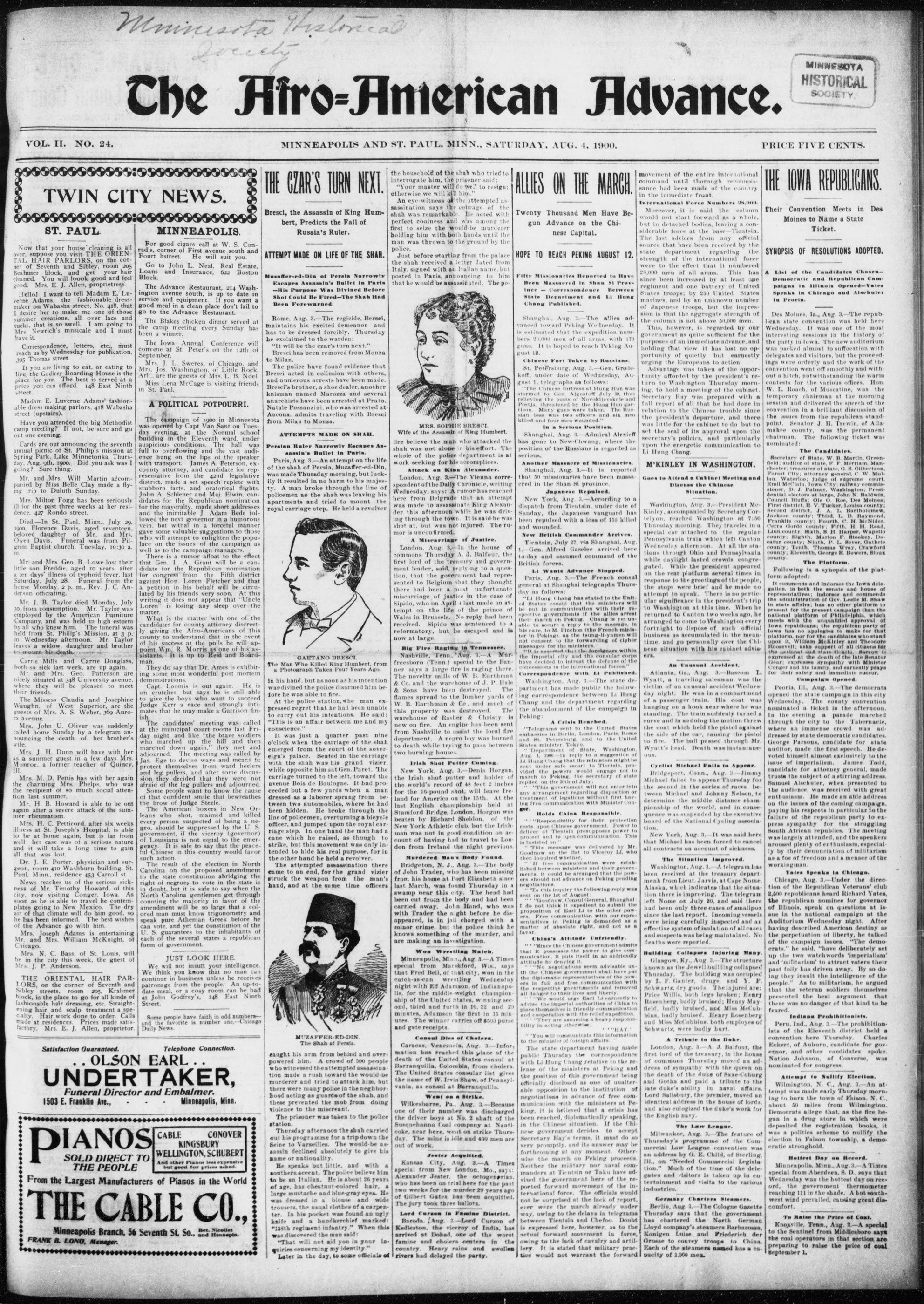
Paris, Aug. 3.—An attempt on the life of the shah of the shah Muazer, ed-Din, was made Thursday morning, but luckily it resulted in no harm to his majesty. A man broke through the line of policemen as the shah was leaving his apartments and tried to mount the royal carriage step. He held a revolver
GAETANO BRESCI
The Man Who Killed King Humbert, from
a Photograph Taken Four Years Ago.
In his hand, but as soon as his intention
was divined the police disarmed him be-
fore he was able to fire.
At the police station, the man expressed regret that he had been unable to carry out his intentions. He said: "This is an affair between me and my conscience."
It was just a quarter past nine o'clock when the carriage of the shah emerged from the court of the sovereign's palace. Seated in the carriage with the shah was his grand vizier, while opposite him sat Gen Paret. The carriage turned to the left, toward the avenue Bois de Boulogue. It had proceeded but a few yards when a man dressed as a laborer sprang from between two automobiles, where he had been hidden. He broke through the line of policemen, overturning a bicycle officer, and jumped upon the royal carriage step. In one hand the man had a cane which he raised, as though to strike, but this movement was only intended to hide his real purpose, for in the other hand he held a revolver.
The attempted assassination there came to an end, for the grand vizier struck the weapon from the man's hand, and at the same time officers
MUZAFFER-ED-DIN.
The shah of Persia.
eaught his arm from behind and overpowered him. A crowd of 500 people who witnessed the attempted assassination made a rush toward the would-be murderer and tried to attack him, but there were many police in the neighborhood acting as guards of the shah, and these prevented the mob from doing violence to the miscreant.
The prisoner was taken to the police station.
Thursday afternoon the shah carried out his programme for a trip down the Seine to Varselles. The would-be assassin declined absolutely to give his name or nationality.
He speaks but little, and with a southern accent. The police believe him to be an Italian. He is about 26 years of age, has chestnut-colored hair, a large mustache and blue-gray eyes. He was dressed in a blouse and wide trousers, the usual clothes of a carpenter. In his pocket was found an ugly knife and a handkerchief marked: "12th regiment infantry." When this was discovered the man said: "That will not aid you in your inquiries concerning my identity."
Later in the day, to some officials of
the household of the shah who tried to interrogate him, the prisoner said: "Your master will do well to resign; otherwise we will kill him." An eye-witness of the attempted assassination says the courage of the shah was remarkable. He acted with perfect coolness and was among the first to seize the would-be murderer holding him with both hands until the man was thrown to the ground by the police. Just before starting from the palace the shah received a letter dated from Italy, signed with an Italian name, but posted in Paris, announcing to him that he would be assassinated. The po
MRS. SOPHIE BRESCI.
Wife of the Assassin of King Humbert.
lice believe the man who attacked the
shah was not alone in his effort. The
whole of the police department is at
work seeking for his accomplices.
Attack on King Alexander
London, Aug. 3.—The Vienna correspondent of the Daily Chronicle, writing Wednesday, says: A rumor has reached here from Belgrade that an attempt was made to assassinate King Alexander this afternoon while he was driving through the town. It is said he was shot at, but was not injured. The rumor is unconfirmed.
A Miscarriage of Justice.
London, Aug. 3. In the house of commons Thursday A. J. Balfour, the first lord of the treasury and government leader, said, replying to a question, that the government had represented to Belgium that they thought there had been a most unfortunate miscarriage of justice in the case of Sipido, who on April 4 last made an attempt on the life of the prince of Wales in Brussels. No reply had been received. Sipido was sentenced to a reformatory, but he escaped and is now at large.
Big Fire Raging in Tennessee.
Nashville, Tenn. Aug. 3. A Murfreesboro (Tenn.) special to the Banner says a large fire is raging there. The novelty mills of W. B. Earthman & Co. and the warehouse of J. P. Hale & Sons have been destroyed. The flames spread to the lumber yards of W. B. Earthman & Co., and much of this property was destroyed. The warehouse of Rasher & Christy is now on fire. An engine has been sent from Nashville to assist the local fire department. A negro boy was burned to death while trying to pass between two burning houses.
Irish Shot Putter Coming.
New York, Aug. 3—Dennis Horgan, the Irish shot putter and holder of the world's record of 48 feet 2 inches for the 16-pound shot, will leave Ireland for America on the 15th. At the last English championship held at Stamford Bridge, London, Horgan was beaten by Richard Sheldon, of the New York Athletic club, but the Irishman was not in good condition on account of having had to travel to London from Ireland the night previous
Murdered Man's Body Found.
Bridgeton, N. J. Aug. 3.—The body of John Trader, who has been missing from his home at Port Elizabeth since last March, was found Thursday in a swamp near this city. The head had been cut from the body and had been carried away. John Hand, who was with Trader the night before he disappeared, is in jail charged with a minor crime, but the police think he knows something of the murder, and are making an investigation.
Won Wrestling Match.
Minneapolis, Minn., Aug. 3. A Times special from Marshall, Wis., says that Fred Bell, of that city, won in the catch-as-can wrestling Wednesday night with Ed Adamson, of Indianapolis, for the middle-weight championship of the United States, winning second, third and first in 10.22 and 22 minutes. Adamson the first in 15 minutes. The winner carries off $500 purse and gate receipts.
Consul Dies of Cholera.
Caracas, Venezuela. Aug. 3. Information has reached this place of the death of the United States consul at Barranquilla, Colombia, from cholera. The United States consular list gives the name of W. Irvin Shaw, of Pennsylvania, as consul at Barranquilla.
Went on a Strike.
Wilkesbarre, Pa., Aug. 3.—Because one of their number was discharged the driver boys at No. 2 shaft of the Susquehanna Coal company at Nanti-coke, near here, we went on strike Thursday. The mine is idle and 499 men are out of work.
Jester Acquitted
Kansas City, Aug. 2.—A Times special from New London, Mo., says Alexander Jester, the octogenarian, who has been on trial here for the part two weeks for the murder 29 years ago of Gilbert Gates, has been acquitted. The jury took three ballots.
Lord Curzon in Femine District.
Baroda. [Aug. 2.—Lord Curzon of Kedleston, the viceroy of India, has arrived at Dohad, one of the worst famine and cholera centers in the country. Heavy rains and swollen rivers had delayed the party.
ALLIES ON THE MARCH.
Twenty Thousand Men Have Begun Advance on the Chinese Capital.
HOPE TO REACH PEKING AUGUST 12.
Fifty Missionaries Reported to Have Been Massacred in Shan St Province — Correspondence Between State Department and Li Hung Chang Published.
Shanghai, Aug. 3.—The allies advanced toward Peking Wednesday. It is estimated that the expedition numbers 20,000 men of all arms, with 170 guns. It is hoped to reach Peking August 12.
Chinese Fort Taken by Russians.
St. Petersburg, Aug. 3.—Gen. Grolekoff, under date of Wednesday, August 1, telegraphs as follows:
"The Chinese fortress at Hung Hun was stormed by Gen. Algustoff July 20, thus relieving the posts of Novaklevskje and Postja, threatened by the Hung Hun garlion. Many guns were taken. The Russians was taken and six men killed and four men wounded."
In a Serious Position:
Shanghai, Aug. 3.—Admiral Alexieff has gone to New-Chwang, where the position of the Russians is regarded as serious.
Another Massacre of Missionaries.
Shanghai, Aug. 3.—It is reported that 50 missionaries have been massacred in the Shan Si province.
Japanese Repulsed.
New York, Aug. 3.—According to a dispatch from Tientsin, under date of Sunday, the Japanese vanguard has been repulsed with a loss of 150 killed and wounded.
New British Commander Arrives.
Tientsin, July 27, via Shanghai, Aug. 1.
Gen. Alfred Gasele arrived here to-day and assumed command of the British forces.
LJ Wants Advance Stopped.
Paris, Aug. 3.—The French consul general at Shanghai telegraphs Thursday as follows:
"Li Hung Chang has stated to the United States consul that the ministers will be put in communication with their respective governments if the allies arrest their march on Peking. The consul will reply to the message, in his care, to M. Pinchon (the French minister in Peking), as the tsung-li-yamen will not consent to the forwarding of cipher messages for the ministers. The consular officers within the imperial city and the consular corps have decided to intrust the defense of the concessions to the international forces."
Correspondence with Li Published.
Washington, Aug. 3.—The state department has made public the following correspondence between Li Hung Chang and the department regarding the abandonment of the campaign in Peking.
A. Crisis Renched.
"Telegrams sent to the United States embassies in Berlin, London, Paris, Rome and St. Petersburg, and to the United States embassies in Tokyo, Washington, Miami, and State, Washington, Aug. 1, 1900—in reply to a suggestion of Ld Hung Chang that the ministers might be sent under safe conditions, the ministers would engage in march to marching, the secretary of state replied on the 20th of July, that they would not enter into any arrangement regarding disposition or treatment of legations without first having free communication with Minister Con
Holds China Responsible.
" "Responsibility for their protection rests upon Chinese government. Power to deliver at Tientsin presupposes power to protect and to open communication. This is important.
" "This message was delivered by Mr. Goodon on the stair to Victerry LY, who then inquired whether.
" "If free communication were established and their governments, it could be arranged that the powers should not advance on Peking pending negotiations.
" "To this inquiry the following reply was sent on the lst of August 1987 to General, Shanghai; I do not think it expedient to submit the proposition of Earl LY to the other powers. Free communication with our representatives in Peking is demanded as a matter of absolute right, and not as a
China's Attitude Unfriendly
"'Since the Chinese government admits that it possesses the power to give communication, it puts itself in an unfriendly attitude by denying it. No negotiating seems advisable until the diplomatic government shall have put the diplomatic representatives of the powers in full and free communication with the respective governments and removed all danger to their lives and liberty. We would urge the authorities to advise them of the authorities of China to place themselves in friendly communication and cooperation with the relief expedition. "'They are assuming a heavy responsibility in acting otherwise. "'HAY.'
"You will communicate this information to the minister of foreign affairs."
The state department having made public Thursday the correspondence with Li Hung Chang relative to the release of the ministers at Peking and the position of this government being officially disclosed as one of unalterable opposition to the institution of negotiations in advance of free communication with the ministers at Peking, it is believed that a crisis has been reached, diplatically speaking, in the Chinese situation. If the Chinese government decides to accept Secretary Hay's terms, it must do so very promptly, and its answer may be forthcoming at any moment. Otherwise the march on Peking proceeds. Neither the military nor naval commanders at Tientsin or Taku have advised the government here of the reported forward movement of the international force. The officials would not be surprised at the lack of report, ever were the march already under way, owing to the delays in telegrams between Tientsin and Chefoo. Doubt is expressed here, however, as to the actual forward movement in force, owing to the lack of cavalry and artillery. It is stated that military practice would not warrant the forward
movement of the entire international command until thorough reconnaissance had been made of the country in the immediate front.
International Force Numbers 28,000.
Moreover, it is said the column would not start forward as a whole, but in detached bodies, leaving a considerable force at the base—Tientsin. The last advises from any official source that have been received by the state department regarding the strength of the international force were to the effect that it numbered 28,000 men of all arms. This has since been increased by at least one regiment and one battery of United States troops; by 250 United States marines, and by an unknown number of Japanese troops, but the impression is that the aggregate strength of the column is not above 50,000 men.
This, however, is regarded by our government as quite sufficient for the purposes of an immediate advance, and holding that view it has lost no opportunity of quietly but earnestly urging the Europeans to action.
Advantage was taken of the opportunity afforded by the president's return to Washington Thursday morning, to hold a meeting of the cabinet. Secretary Hay was prepared with a full report of all that he had done in relation to the Chinese trouble since the president's departure, and there was little for the cabinet to do but to set the seal of its approval upon the secretary's policies, and particularly upon the energetic communication to Li Hune Chang.
M'KINLEY IN WASHINGTON.
Goes to Attend a Cabinet Meeting and
Discuss the Chinese War
Washington, Aug. 3- President McKinley, accompanied by Secretary Cortelyou, reached Washington at 7:50 Thursday morning. They traveled in a special car attached to the regular Pennsylvania train which left Canton Wednesday afternoon. At all the stations through Ohio and Pennsylvania while daylight lasted crowds congregated. While the president appeared on the rear platform several times in response to the greetings of the people, the stops were brief and he made no attempt to speak. There is no particular significance in the president's trip to Washington at this time. When he returned to Canton two weeks ago, he arranged to come to Washington every fortnight to dispose of such official business as accumulated in the meantime, and go personally over the Chinese situation with his cabinet advisers.
An Unwanted Accident
Atlanta, Ga., Aug. 3.—Bascom L. Wyatt, a traveling salesman, was the victim of an unusual accident Wednesday night. He was in a compartment of a passenger train. His coat was hanging on a hook near where he was standing. The train suddenly turned a curve and in so doing the motion threw the coat which held the pistol against the side of the car, causing the pistol to fire. The ball passed through Mr. Wyatt's head. Death was instantaneous.
Scottlet Michael Fallis to
Bridgeport, Conn., Aug. 3.—Jimmy Michael failed to appear Thursday for the second in the series of races between Michael and Johnny Nelson, to determine the middle distance championship of the world, and in consequence was suspended by the executive board of the National Cycling association.
New York, Aug. 3.—It was said here that Michael has been forced to cancel all contracts on account of sickness.
The Situation Improved.
Washington, Aug. 3.—A telegram has been received at the treasury department from Lieut. Jarvis, at Cape Nome, Alaska, which indicates that the situation there is improving. The telegram left Nome on July 20, and said there had been only three cases of smallpox since the last report. Incoming vessels were being carefully inspected and an effective system of isolation of all cases and suspects was being maintained. No deaths were reported.
Building Collapses Injuring Many
Glasgow, Ky., Aug. 3.—The structure known as the Jewell building collapsed Thursday. The building was occupied by L. F. Ganter, drugs, and Y. F. Schwartz, dry goods. The injured are: Price Willis, both legs broken; Henry Rosenberg, badly bruised; Henry Mayfield, badly bruised, and Miss McCubbins, badly bruised. Henry Rosenberg and Miss McCubbins, both employers of Schwartz, were badly hurt.
A Tribute to the Duke.
London, Aug. 3.—A. J. Balfour, the first lord of the treasury, in the house of commons Thursday moved an address of sympathy with the queen on the death of the duke of Saxe-Coburg and Gotha and paid a tribute to the late duke's ability in naval affairs. Lord Salisbury, the premier, moved an identical address in the house of lords, and also eulogized the duke's work for the English navy.
The Law League
Milwaukee, Aug. 3.—The feature of Thursday's programme of the Commercial Law League convention was an address by O. E. Child, of Sterling, Ill., on "Needed Commercial Legislation." Much of the time of the delegates and visitors is taken up in entertainment and visits to the various industries.
Germany Charleroi Steamery
Berlin, Aug. 3.—The Cologne Gazette Thursday says that the government has chartered the North German Lloyd company's steamers Barbarosa, Konigen Louise and Friedrich der Grosse to convey troops to China. Each of the steamers named has a capacity of 2,000 men.
PRICE FIVE CENTS.
THE IOWA REPUBLICANS.
Their Convention Meets in Des Moines to Name a State Ticket.
SYNOPSIS OF RESOLUTIONS ADOPTED.
A List of the Candidates Chosen-Democratic and Republican Campaigns in Illinois Opened-Yatea Spenks in Chicago and Alschuler in Poorin.
Des Moines, Ia., Aug. 3.—The republican state convention was held here Wednesday. It was one of the most interesting sessions in the history of the party in Iowa. The new auditorium was packed almost to suffocation with delegates and visitors, but the proceedings were orderly and the work of the convention went off smoothly and without a hitch, notwithstanding the warm contests for the various offices. Hon. W. L. Roach, of Muscatine, was the temporary chairman at the morning session and delivered the speech of the convention in a brilliant discussion of the issues from the republican standpoint. Senator J. H. Trewin, of Alamakee county, was the permanent chairman. The following ticket was nominated:
The Candidates.
Secretary of State, W. B. Martin, Greenfield; auditor of state, F. W. Friar, Manchester; treasurer of state, G. S. Gilbertson, Forest City; attorney general, C. W. Mulholland, Emil McClain, Iowa city; railway commissioner, D. J. Palmer, Washington; presidential electors at large, John N. Baldwin, Council Bills; O. E. Oo, Des Moines; Council Bills; O. E. Oo, Second district; J. A. L. Bartholomew, Jackson county; Third, L. B. Raymond, Franklin county; Fourth, C. H. McNider, Lincoln county; Fifth, C. H. McNider, Lincoln county; Sixth, S. H. Harper, Wapelo county; Eighth, Marion F. Stookey, Decatur county; Ninth, P. L. Sever, Gulver county; Tenth, Thomas Wray, Crawford eleventh, George E. Bowe, Blox county
The Platform.
Following is a synopsis of the platform adopted:
It commends and indorses the Iowa delegation, in both the senate and house of representatives; Indorses and commends the administration of Gov. Leslie M. Shaw in state affairs; has no other platform to present for the present campaign than the national platform of Philadelphia, which meets with the unqualified approval of Iowa republicans; the republican party of Iowa has no apologies to make for that platform, nor for the candidates who stand upon it, William McKinley and Theodore Roosevelt; asks support of all citizens for the national and state tickets. Sovereign is expressed at the death of the late Senator Gear; expresses sympathy with Minister Conger and his family, and earnestly prays for their safety and immediate success.
Campaign Opened.
Peoria, Ill., Aug. 3.—The democratics opened the state campaign in this city Wednesday. The county convention nominated a ticket in the afternoon. In the evening a parade marched through the city to the Tabernacle, where an immense crowd was addressed by state democratic candidates. George Parsons, candidate for state auditor, made the first speech. He devoted himself almost exclusively to the issue of imperialism. James Todd, candidate for attorney general, made trust the subject of a stirring address. Samuel Alschuler, when presented to the audience, was received with great enthusiasm. He made an able address on the issues of the coming campaign, paying his respects in particular to the failure of the republican party to express sympathy for the struggling South African republics. The meeting was largely attended, and the speakers aroused plenty of enthusiasm, especially by their denunciation of militarism as a foe of freedom and a menace of the workingman.
Yates Speaks in Chicago.
Chicago, Aug. 3.—Under the direction of the Republican Veterans' club 2,500 republicans heard Richard Yates, the republican nominee for governor of Illinois, speak on questions at issue in the national campaign at the Auditorium Wednesday night. After having described American destiny as the perpetuation of liberty, he talked of the campaign issues. "The democrats," he said, "have deliberately set up the two watchwords 'imperialism' and 'militarism' to attract voters their past folly has driven away. By so doing they insult the intelligence of the people." As to militarism, he argued that the veteran soldiers themselves presented the best argument that there was no danger of that kind to be feared.
Indiana Prohibitionists.
Peru, Ind., Aug. 3.—The prohibitionists of the Eleventh district held a convention here Thursday. Charles Eckert, of Auburn, candidate for governor, and other candidates spoke. Nation Johnson, of Converse, was nominated for congress.
Attempt to Nullify Election.
Wilmington, N. C., Aug. 3.—An attempt was made early Thursday morning to burn the town of Faison, N. C., about 50 miles from Wilmington. Democrats allege that, as the fire began in a drug store in which were deposited the registration books, it was a politics scheme to nullify the election in Faison township, a democratic stronghold.
Hottest Day on Record.
Minneapolis, Minn., Aug. 3.—A Times special from Aberdeen, S. D., says that Wednesday was the hottest day on record, the government thermometer reaching 111 in the shade. A hot southwest wind prevailed, causing great discomfort.
To Raise the Price of Cotl.
Knoxville, Tenn., Aug. 3.—A special to the Sentinel from Middlesboro says the coal operators in that section are preparing to raise the price of coal September 1.
Minneapolis, . . . . . . . . . Minnesota.
Entered at the Post Office, at Minneapolis, Minn., as second-class matter.
Subscription Refresh
One Year - - - - $1.00
Six Months - - - - .60
Three Months - - - .55
Subscription Always Payable in AD-
Special rates if ordered by the dozen, the current issue should reach the office by May 15.
Advertising Heter
"Want" and "To Let" advertisements, 8 cents per line for each insertion. Display, 40 cents per inch each insertion, rates will be given for space by the year.
Editorial Announcements
To secure the return of unsolicited manuscript postage should be enclosed by a letter addressed by Wednesday morning, preceding the issue in which they are to appear. In cases where news matter for publication, must bear the writer's name not for publication, but as evidence of publication.
Contributions and items of news concerning the progress of the covered race
We reserve the right to reject any communication unsuitable to publication. Subscissors ordering addresses of their paper changed are requested to give their former as well as their present address. Addresses communicated to THE AFRO-AMERICAN ADVANCE.
214 Washington Ave., South, Minneapolis, Minn.
MRS. GEO. DUCKETT,
PUBLISHER AND MANAGER.
National Republican Ticket...
FOR PRESIDENT:
WILLIAM McKINLEY,
OF OHIO.
FOR VICE PRESIDENT:
THEO. ROOSEVELT,
OF NEW YORK.
OUR STATE TICKET.
Governor ..... S. R. Van Sant
Lieutenant Governor ..... L. H. Smith
Attorney General ..... W. B. Douglass
Secretary of State ..... P. E. Hanson
Chief Justice ..... M. C. Start
Associate Justice ..... L. W. Collins
Representative Commissioner, O. S. Miller and I. B. Mills (four years) and C. F. Staples (two years).
EDITORIAL
The Boston "Courant" has the following to say relative to Mr. William E. Macdonald, formerly of Boston now running for register of deeds of Hennepin county on the Republican ticket: "Mr. Macdonald was born and raised in our midst and has the confidence of the colored people of our city. We heartily wish him success in his political undertaking."
HAS THE NEGRO A RIGHT TO
BE A DEMOCRAT
The above question was propounded to the editor by a representative citizen of this city a few days ago in all seriousness. We think there is no doubt about the affirmative side of the proposition. It is axiomatic that a man has a right to do anything that does not infringe upon the rights of others. The possession of a right in the abstract, however, is no argument in favor of its exercise. A man has a right to refuse to shave his face or cut his hair or to pare his finger nails, but the exercise of that right might be the height of folly. So in the matter of party affiliation for the negro, while he has the unquestioned right to support the Democratic nominees in the present campaign or any other campaign, we have the exercise of that right would be at the expense of blotting out the brightest hope for the amelioration of the condition of the race in this country. The success of McKinley and a Republican congress means a reduction of the number of congressmen from the south, by making a certain number of votes cast for president the basis of fixing congressional representation. It also means the federal supervision of elections for president and vice-president. While the success of Bryan means the elevation to power of the men who favor and have brought about the dischernishment of the negroes in the southern states. The question of the right to vote the Democratic ticket pales into insignificance when compared with many good reasons why the negro vote is more likely to be practically unanimous for the Republican party in this campaign. The Republican party in this campaign, stands for plenty of work at good wages, loyalty to the flag and a 100-cent dollar. The Democratic party stands for closed workshops and factories and starvation wages, hauling down the flag and a goose dollar.
There should, therefore, be no hesitation on the part of the negroes as to what course to pursue in the premises. They, in common with all wage earners and all patriots, should support the Republican party from the president to the lowest office on the city ticket. If this is done every doubt of President McKinley's election is removed and his party holds the date of a better day for the distressed blacks to the south. The cutting down of the congressional representation of the southern states, means the repeal of the disfranchising acts, that disregue those states, for upon the number of votes cast depends their representation in Congress. Hence there is every reason why in this election the Afro-American citizens everywhere should remain steadfast in the Republican faith and strike a blow at the revolutionary tactics in the state to by the southern states and that have the sanction if not the overt aid of the national Democracy. Vote for McKinley and Roosevelt, for they are the embodiment of Republicanism, which stands for the amplest freedom and the greatest advancement.
Naturally a man commences to go to the dogs when he begins to growl.—Chicago Democrat.
Foolish compliments are as unworthy of notice as secreal abuse.—Atchison Globe.
"When is a pun not a pun?" "Usually."—Harvard Lampoon.
ANTI-SUPER SUPER
ANTI-APERITY
ANTI-ARPASSION
ANTI-ARMY
ANTI-MAN
ANTI-EVERYTHING
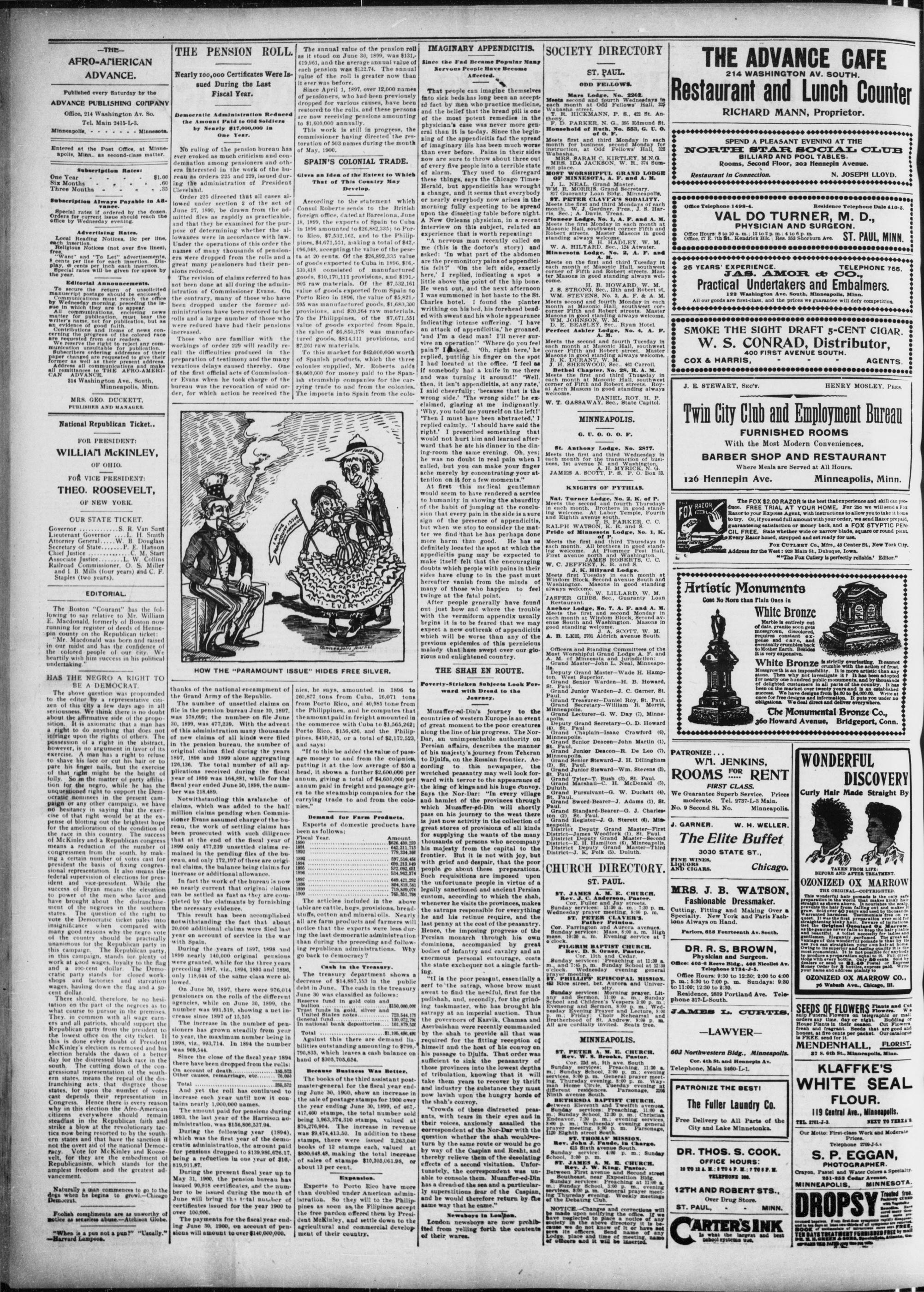
HOW THE "PARAMOUNT ISSUE" HIDES FREE SILVER.
Democratic Administration Reduced the Amount Paid to Old Soldiers by Nearly $17,000,000 in One Year.
No ruling of the pension bureau has ever evoked as much criticism and condemnation among pensioners and others interested in the work of the bureau as orders 225 and 229, issued during the administration of President Cleveland.
Order 225 directed that all cases allowed under section 2 of the act of June 27, 1890, be drawn from the admitted files as rapidly as practicable, and that they be examined for the purpose of determining whether the allowances were in accordance with law.
Under the operations of this order the names of many thousands of pensioners were dropped from the rolls and a great many pensioners had their pensions reduced.
The revision of claims referred to has not been done at all during the administration of Commissioner Evans. On the contrary, many of those who have been dropped under the former administrations have been restored to the rolls and a large number of those who were reduced have had their pensions increased.
Those who are familiar with the workings of order 229 will readily recall the difficulties produced in the preparation of testimony and the many vexations delays caused thereby. One of the first official acts of Commissioner Evans when he took charge of the bureau was the revocation of said order, for which action he received the
HOW THE "PARAMOUNT IS
thanks of the national encampment of the Grand Army of the Republic.
The number of unsettled claims on file in the pension bureau June 30, 1897 was 578,099; the number on file June 30, 1899 was 477,239. With the advent of this administration many thousands of new claims of all kinds were filed in the pension bureau, the number of original claims filed during the years 1897, 1898 and 1899 alone aggregating 126,136. The total number of all applications received during the fiscal year of 1899 was 164,881, while for the fiscal year ended June 30, 1898, the number was 218,489.
Notwithstanding this avalanche of claims, which was added to the half million claims pending when Commissioner Evans assumed charge of the bureau, the work of settling claims has been prosecuted with such diligence that at the end of the fiscal year of 1899 only 477,239 unsettled claims remained in the pending files of the bureau, and only 172,197 of these are original claims, the balance being claims for increase or additional allowance. In fact the work of the bureau is now so nearly current that original claims can be settled as fast as they are completed by the claimsmen by furnishing the necessary evidence. This result has been accomplished notwithstanding the fact that about 20,000 additional claims were filed last year on account of service in the war with Spain.
During the years of 1897, 1898 and
1899 nearly 140,000 original pensions
were granted, while for the three years
preceding 1897, viz., 1894, 1895 and 1896,
only 11,844 of the same class were allowed.
On June 30, 1897, there were 975,014
pensioners on the rolls of the different
agencies, while on June 30, 1899, the
number was 991,519, showing a net increase since 1897 of 15,505.
The increase in the number of pensionsers has grown steadily from year to year, the maximum number being in 1898, viz., 993,714. In 1894 the number was 969,344.
Since the close of the fiscal year 1894 there have been dropped from the rolls: On account of death.....188,572
Other causes, remarriage, etc.....70,003
Total.....255,572
And yet the roll has continued to increase each year until now it contains nearly 1,000,000 names.
The amount paid for pensions during 1893, the last year of the Harrisco administration, was $156,806,337.94.
During the following year (1894), which was the first year of the democratic administration, the amount paid for pensions dropped to $139,986,626.17, being a reduction in one year of $168,919,118.87.
During the present fiscal year up to May 31, 1900, the pension bureau has issued 90,918 certificates, and the number to be issued during the month of June will bring the total number of certificates issued for the year 1900 to over 100,000.
The payments for the fiscal year ending June 30, 1900, on account of pensions will amount to over $140,000,000.
The annual value of the pension roll as it stood on June 20, 1899, was $131,619,961, and the average annual value of each pension was $122.74. The annual value of the roll is greater now than it ever was before.
Since April 1, 1897, over 12,000 names of pensioners, who had been previously dropped for various causes, have been restored to the rolls, and these persons are now receiving pensions amounting to $1,600,000 annually.
This work is still in progress, the commissioner having directed the restoration of 503 names during the month of May, 1900.
SPAIN'S COLONIAL TRADE.
Gives an Idea of the Extent to Which That of This Country May Develop.
According to the statement which Consol Robert sends to the British foreign office, dated at Barcelona, June 18, 1899, the exports of Spain to Cuba in 1896 amounted to $26,882,335; to Porto Rico, $7,523,162, and to the Philippines, $4,671,551, making a total of $42,096,648, accepting the value of the peseta at 20 cents. Of the $26,892,335 value of goods exported to Cuba in 1896, $16,303,418 consisted of manufactured goods, $10,170,111 provisions, and $191,805 raw materials. Of the $7,532,161 value of goods exported from Spain to Porto Rico in 1896, the value of $5,821,595 was manufactured goods, $1,680,360 provisions, and $20,264 raw materials. To the Philippines, of the $7,671,551 value of goods exported from Spain, the value of $6,850,178 was manufactured goods, $814,111 provisions, and $7,261 raw materials.
To this market for $42,000,000 worth of Spanish products, which the three colonies supplied, Mr. Roberts, adds $4,600,000 for money paid to the Spanish steamship companies for the carrying trade to and from the colonies. The imports into Spain from the colo-
FREE SILVER LOSS
ANTI-JIMBERLIN
ANTI-APARTMENT
ANTI-ARMY ARTIFACT
ANTI-EVERYTHING
Impeach Journal
ISUE" HIDES FREE SILVER.
nies, he says, amounted in, 1806 to 200,877 tons from Cuba, 26,071 tons from Porto Rico, and 40,985 tons from the Philippines, and he computes that the amount paid in freight amounted in the commerce with Cuba to $1,565,262; Porto Rico, $156,426, and the Philippines, $450,835, or a total of $2,172,523, and says:
"If to this be added the value of passage money to and from the colonies, putting it at the low average of $50 a head, it shows a further $2,600,000 per annum, giving a total of $4,600,000 per annum paid in freight and passage given to the steamship companies for the carrying trade to and from the colonies."
been as follows:
Fiscal Year. Amount
1820 820,803,550
1821 824,311,713
1822 779,334,360
1823 597,516,456
1824 696,213,849
1825 658,213,849
1826 514,962,971
1827 649,421,929
1828 804,818,581
1829 718,809,076
1830 765,351,788
The articles included in the above
table are cattle, hogs, provisions, bread-
stuffs, cotton and mineral oils. Nearly
all are farm products and farmers will
notice that the exports were less dur-
ing the last democratic administration
than during the preceding and follow-
ing republican administrations. Why
go back to democracy?
. Cash in the Treasury.
The treasury department shows a decrease of $14,897,553 in the public debt in June. The cash in the treasury June 30 was classified as follows: Reserve fund in gold coin and billion $150,000,000 The funds in gold, silver and United States notes 722,544,178 General fund 130,972,786 In national bank depositories 101,879,528 Total $1,106,496,490 Against this there are demand liabilities outstanding amounting to $799,790,835, which leaves a cash balance on hand of $305,705,654.
Because Business Was Better.
The books of the third assistant postmaster-general for the fiscal year enduring June 30, 1900, show an increase in the sale of postage stamps for 1900 over the year ending June 30, 1899, of 467, 417,460 stamps, the total number sold being 3,963,374,310 stamps, valued at $76,276,940. The increase in revenue was $9,474,413.50. In addition to these stamps, there were issued 2,263,304 books of 12 stamps each, valued at $830,648.48, making the total increase of sales of stamps $10,305,061.98, or about 13 per cent.
Expansion.
Exports to Porto Rico have more than doubled under American administration. So they will to the Philippines as soon as the Filipinos accept the free pardon offered them by President McKinley, and settle down to the agricultural and commercial development of their country.
IMAGINARY APPENDICITIS.
Since the Fad Becomes Popular Many Nervous People Have Become Affected.
That people can imagine themselves into sick beds has long been an accepted fact by men who practice medicine, and the belief that the bread pill is one of the most potent remedies in the physician's case was never more general than it is to-day. Since the beginning of the appendicitis fad the spread of imaginary lilies has been much worse than ever before. Pains in their sides now are sure to throw about three out of every five people into a terrible state of alarm. They used to disregard these things, says the Chicago Time-Herald, but appendicitis has wrought a change, and it seems that everybody or nearly everybody now arises in the morning fully expecting to be spread upon the dissecting table before night. A New Orleans physician, in a recent interview on this subject, related an experience that is worth repeating:
"A nervous man recently called on me (this is the doctor's story) and asked: 'In what part of the abdomen are the premonitory pains of appendicitis felt?' 'On the left side, exactly here,' I replied, indicating a spot a little above the point of the hip bone. He went out, and the next afternoon I was summoned in hot haste to the St Charles hotel. I found the planter writhing on his bed, his forehead beaded with sweat and his whole appearance indicating intense suffering. 'I have an attack of appendicitis, he groused, 'and I'm a dead man! I never survive an operation!' 'Where do you feel pain?' I asked. 'Oh, right here,' he replied, putting his finger on the spot I had located at the office. 'I feel as if somebody had a knife in me there and was turning it around!' 'Well, then, it isn't appendicitis, at any rate,' I said cheerfully; 'because that is the wrong side.' 'The wrong side!' he exclaimed, glaring at me indignantly. 'Why, you told me yourself on the left!' 'Then I must have been abstracted.' I replied calmly. 'I should have said the right.' I prescribed something that would not hurt him and learned afterward that he ate his dinner in the dining-room the same evening. Oh, yes; he was no doubt in real pain when I called, but you can make your finger ache merely by concentrating your attention on it for a few moments."
At first this medical gentleman would seem to have rendered a service to humanity in showing the absurdity of the habit of jumping at the conclusion that every pain in the side is a sure sign of the presence of appendicitis, but when we stop to consider the matter we find that he has perhaps done more harm than good. He has so definitely located the spot at which the appendicitis pang may be expected to make itself felt that the encouraging doubts which people with pains in their sides have clung to in the past must hereafter vanish from the minds of many of those who happen to feel twinge at the fatal point.
After people generally have found out just how and where the trouble with the vermiform appendix usually begins it is to be feared that we may expect a new outbreak of appendicitis which will be worse than any of the previous epidemics of this pernicious malady that have swept over our glorious and enlightened country.
THE SHAH EN ROUTE.
Foverty-Stricken Subjects Look Forward with Dread to the Journey.
Muzaffer-ed-Din's journey to the countries of western Europe is an event of great moment to the poor creatures along the line of his progress. The Nor-Dar, an unimpeachable authority on Persian affairs, describes the manner of his majesty's journey from Tehran to Djilfa, on the Russian frontier. According to this newspaper, the wretched peasantry may well look forward with terror to the appearance of the king of kings and his huge envoy. Says the Nor-Dar: "In every village and hamlet of the provinces through which Muzaffer-ed-Din will shortly pass on his journey to the west there is just now activity in the collection of great stores of provisions of all kinds for supplying the wants of the many thousands of persons who accompany his majesty from the capital to the frontier. But it is not with joy, but with grief and despair, that the poor people go about these preparations. Such requisitions are imposed upon the unfortunate people in virtue of a legally sanctioned and ancient Persian custom, according to which the shah, whenever he visits the provinces, makes the satraps responsible for everything he and his retinue require, and the last penny at the cost of the peasantry. Hence, the imposing progress of the Persian monarch through his own dominions, accompanied by great bodies of infantry and cavalry and an enormous personal entourage, costs the state exchequer not a single farthing.
"It is the poor peasant, essentially a serf to the satrap, whose brow must sweat to find the needful, first for the padishah, and, secondly, for the grinding taskmaster, who has brought his satrap at an imperial auction. Thus the governors of Kazvik, Chamsa and Aserbaishan were recently commanded by the shah to provide all that was required for the fitting reception of himself and the host of his convoy on his passage to Djulfa. That order was sufficient to sink the peasantry of those provinces into the lowest depths of tribulation, knowing that it will take them years to recover by thrift and industry the substance they must now lavish upon the hungry horde of the shah's convoy.
"Crowds of these distracted peasants, with tears in their eyes and in their voices, anxiously assailed the correspondent of the Nor-Dar with the question whether the shah would return by the same route or would he go by way of the Caspian and Reeh, and thereby relieve them of the decoating effects of a second visitation. Unfortunately, the correspondent was unable to console them. Muzaffer-ed-Din has a dread of the sea and a particularly superstitious fear of the Caspian, and he would therefore return by the same way that he came."
**Newshows in London.**
London newsboys are now prohibited from yelling forth the contents of their wares.
SOCIETY DIRECTORY
ODD FELLOWS.
Mara Lodge, No. 2202.
Meets second and fourth Wednesdays in each month at Odd Fellows' Hall, 322 Wakabusa street.
T. R. HICKMANM, P. S., 422 A. Anthon
D. PARKER, N. G., 355 Edmund U.
Household of Ruth, N. G., U. O. of F.
Meets first and third Monday in each month for business, second Monday for instruction, at Odd Fellows' Hall, 322
MRS. SARAH C. KIRTLEY M.NG.
A JACKSON, W. R. R. 54
mount place.
MOST WORSHIPFUL GRAND LODGE OF MINNESOTA, A. F. and A. M. J. WM. R. MORISI, Grand Secretary. 817 Guaranty Loan Bldg., Minneapolis, PETT. R. MORISI, SODALITY Meets first and third month, W. J. Gardner, Pres. J. S. Harris, Sec.; A. Davis, Trees. F. and A. M. Meets the first Monday in each month at Masonic Hall, southwest corner Fifth and A. M. Meets the Masons in good standing always welcome.
Meets on the first and third Tuesday in each month at Masonic Hall, southwest corner of Fifth and Robert streets. Massasons in good standing always welcome.
H. B. HOWARD, W. M.
J. S. STRONG, 12th and Robert st.
WM. STEVENS, No. 3, A. F. & A. M.
Meets second and fourth Monday in each
corner Fifth and Robert streets. Master
Masons in good standing always welcome.
WM. JOHNSON, W. M.
D. E. BEASLEY, Ryan Hotel.
Perfect Ashler Lodge, No. 4, A. F.
A. M.
Meets the second and fourth Tuesday in
each corner at Masonic Hall, southwest
corner Fifth and Robert street. Master
Masons in good standing always welcome.
J. H. SHERWOOD, Sec. 461 Carroll.
Bethel Chapter, No. 28, H. A. M.
Meets the first and third Tuesday in
each corner at Masonic Hall, southwest
corner of Fifth and Robert streets. Royal
Arch Masons in good standing always
welcome.
DANIEL ROY, H. P.
W. T. GASSAWAY, Sec. State Capitol.
MINNEAPOLIS.
G. U. O. O. O. F.
St. Anthony Lodge, No. 2877.
Meets the first and third Wednesday in each month for the transaction of business at the Lodge. M. MYRICK, N. G.
JAMES A. SCOTT, No. 2873
KNIGHTS OF PYTHIAS.
Nat. Turner Lodge, No. 2, K. of P.
Meets the second and fourth Thursdays in each month. Lovers in good standing meet at Lodge Temple, Fourth and Eighth avenue south.
T. B. PARKER, C. C.
RALPH WATSON, K. R. and S.
Pride of Minnesota Lodge, No. 1, K. of P.
Meets the first and third Thursdays in each month. All brothers in good standing welcome. Plummet to Hall, First avenue north W. Holliday. JAMES ROBERTS, C. C.
W. C. JEFFREY, K. R. and S.
J. K. Hilary Lodge.
Meets first and second month at Window Block, Second avenue South and Washington. Masons in good standing always welcome.
W. L. WILLARD, W. M.
G. W. LILLARD, W. M.
JASPER GUBBS, Sec., Guaranty Loan
Restaurant.
Anchor Lodge, No. 7. A. F. and A. M.
Meets the first and second Monday in
each month at Windom Block. Second
day is in Washington. Masons in
good standing welcome.
J. A. SCOTT, W. M.
A. B. LEE, 771 Aldrich avenue South.
Officers and Standing Committees of the
Most Recently Graduated F. and
A. M. of Minnesota and jurisdiction:
Grand Master-John L. Neal, Minneapo
Deputy Grand Master—Wade H. Hampton, West Superior.
Grand Senior Warden—H. B. Howard, St. Paul.
Grand Junior Warden—J. C. Garner, St. Paul.
Grand Treasurer—Daniel Roy, St. Paul.
Grand Secretary—William R. Morris, Minneapolis.
Grand Lecturer—G. W. Day (7), Minneapolis.
Deputy Secretary—O. D. Howard (6), St. Paul.
Grand Claplain—Isaac Crawford (6), Minneapolis.
Grand Senior Deacon—John Martin (1), St. Paul.
Grand Junior Deacon—R. De Leo (7), Minneapolis.
Grand Steward—J. H. Dillingham (2), St. Paul.
Grand Junior Steward—Wm. Stevens (3), St. Paul.
Tyler—T. Bush (3), St. Paul.
Marshall—H. C. McDonald (5), Duluth.
Grand Pursuitant—G. W. Duckett (4), St. Paul.
Grand Sword-Bearer—J. Adams (1), St. Paul.
Grand Standard-Bearer—G. J. Charleston (2), St. Paul.
Grand Register—J. G. Sterett (6), Minneapolis.
District Deputy Grand Master—First District District Deputy Grand Master—Second District E.-H. Hamilton (6). Minneapolis District Deputy Grand Master—Third District J.-K. Kellogg (5). Doluth.
CHURCH DIRECTORY.
ST. PAUL.
Sunday services: 11:30 a.m. m; 7:30 p.m.
Wednesday prayer meeting. 8:00 p.m.
ST. JOHN'S CATHOLIC SCHOOL.
Saint Jude's Father Printon.
Cor. Farrington and Aurora avenues.
Sunday services. Mass 8:00 a.m. High
mass 8:30 a.m. m. evening service at
o clock.
PILGRIM WEST PRIEST CHURCH.
HARVARD SCHOOL, O'Shea Avenue.
Cor. 13th and Cedar.
Sunday services: Preaching at 11:30 a.m.
m; Sunday service at 11:30 a.m.
o clock. Wednesday evening general
prayer meeting
EPISCOPAL MISSION.
463 Rice street, bet. Aurora and Uni-
sity.
Sunday services: Preaching prayer. Lit-
tany and Sermon. 11:30 a.m. m; Sunday
School and Children's Vespers 3:00 p.m.
m; Sunday Service. Wednesday Evening Prayer and Lecture. 8:00 p.m.; Friday. Choir Rehearsal and
Prayer. Sunday Service. All are cordially invited. Seats free.
MINNEAPOLIS.
**ST. PETER A. M. E. CHURCH.**
Rev. W. S. Brooks, Pastor.
Cor. 22d st. 9th ave. South
Sunday school, 12:30 p.m.; 11:30 a.m.
; Sunday School, 3:00 p.m.; evening
services, 8:00 p.m. General prayer meet-
ing, 8:00 p.m. Sunday School, 9:00 p.m.
Wayman Home Church, 3:00 p.m. evening
different residences. Parsonage, 206
Ninth avenue South.
BETTESDAA BAPTIST CHURCH.
Rev. John J. Faudé, in Charge.
Sunday services: Preaching, 11:30 a.m.
; Sunday School, 12:30 p.m.; Christian
services, 8:00 p.m. Wednesday evening
prayer meeting, 8:00 p.m. Parsonage,
1200 Eighth street South.
MISSION.
Rev. John J. Faudé, in Charge.
615 Sixth avenue South.
Sunday service, 4:00 p.m.; Sunday
school, 206 Eighth street South.
**ST. JAMES A. M. E. CHURCH.**
Rev. J. W. King, Pastor.
Between First avenue and Second street
year expiration Bldg.
Sunday service, 3:00 p.m.; evening
a.m.; Sunday School, 3:00 p.m. evening
prayer meeting, 8:00 p.m. General prayer meet-
ing Thursday of the Weekly meetings
of the Debating Club.
NOTICE...Changes and corrections will be made upon notifying the office. If we have made corrections to place a office of any society in the above directory it is because we do not know of it or have not sent the officers. Send name of any Lodge, place and time of meeting, name of officers and it will be inserted.
THE ADVANCE CAFE 214 WASHINGTON AV. SOUTH. Restaurant and Lunch Counter
RICHARD MANN, Proprietor.
SPEND A PLEASANT
NORTH STAR
BILLIARD AND
Rooms, Second Floor
Restaurant in Connection.
Office Telephone 1498-4.
VAL DO TU
PHYSICIAN A
Office Hours: 8 to 10 a. m.; 12 to 2 p. m.; 4
Office, 7 E. 7th St., Kendrick Blk. Res. 8
25 YEARS' EXPERIENCE.
JAS. AMO.
Practical Undertak
122 Washington Ave.
All our goods are first-class, and the p
SMOKE THE SIGHT
W. S. CONRA
400 FIRST A
COX & HARRIS,
J. E. STEWART, Sec'y.
Twin City Club and
FURNISH
With the Most M
BARBER SHOP A
Where Meals are
SPEND A PLEASANT EVENING AT THE
TH STAR SOCIAL CLUB
BILLIARD AND POOL TABLES.
Rooms, Second Floor, 202 Hennepin Avenue.
In Connection. N. JOSEPH LLOYD.
Phone 1498-4. Residence Telephone Dale 410-5.
VAL DO TURNER, M. D.,
PHYSICIAN AND SURGEON.
10 to 10 a.m.; 12 to 2 p.m.; 4 to 6 p.m.
St. Kendrick Blk. Res. 353 Shorburn Ave. ST. PAUL, MINN.
EXPERIENCE.
JAS. AMOR & CO.,
Medical Undertakers and Embalmers.
122 Washington Ave. South, Minneapolis, Minn.
Jobs are first-class, and the prices we guarantee will defy competition.
THE SIGHT DRAFT 5-CENT CIGAR.
S. CONRAD, Distributor,
400 FIRST AVENUE SOUTH.
HARRIS, AGENTS.
SPEND A PLEASANT EVENING AT THE NORTH STAR SOCIAL CLUB BILLIARD AND POOL TABLES. Rooms, Second Floor, 202 Hennepin Avenue. Restaurant in Connection. N. JOSEPH LLOYD.
Office Hours: 8 to 10 a. m.; 12 to 10 p. m.; 16 to 6 p. m.
Office, E. 7th St., Kendrick Blk. Res. 333 Shorburn Ave. ST. PAUL, MINN.
SMOKE THE SIGHT DRAFT 5-CENT CIGAR
City Club and Employment Bureau FURNISHED ROOMS With the Most Modern Conveniences. RBER SHOP AND RESTAURANT Where Meals are Served at All Hours.
Twin City Club and Employment Bureau
126 Hennepin Ave. Minneapolis, Minn.
The FOX $2.00 RAZOR is the best that experience and skill can produce. FREE TRIAL AT YOUR HOME. For 250 we will send a FOX Razor to your Express Agent, with instructions to allow you to take it home to try. Or, if you send full amount with your order, we send Razor prepaid, guaranteeing satisfaction or money back, and a FOX STYPTIC PEN-CIL FREE. State whether wide or narrow blade, square or round point. Every Razor honed, stopped and set ready for use.
FOX CULVER CO. Mfr., 48 Center St., New York City.
Address for the West: 928 Main St., Dubuque, Iowa.
The FOX $2.00 RAZOR is the best that experience and skill can produce. FREEL TRIAL AT YOUR HOME. For 250 we will send a Fox Razor to your Express Agent, with instructions to allow you to take it to try. Or, if you send full amount with your order, we send Razor prepaid, guarantee satisfaction or money back, and a FOX STYPTIC PEN CILLE FREE. State whether wide or narrow blade, square or round point. Every Razor honed, stropped and set ready for use.
FOX CULVERLY CO., Mrs. 48 Center St., New York City.
Address for the West: 928 Main St., Dubuque, Iowa.
Artistic Monumen Cost No More than Plain Ones i
White Bronze
Marble is entirely out of date, granite soon gets mossgrown, decorated, requires constant expense and care, and eventually crumbles best to Mother Earth. Besides it is very expensive.
White Bronze is strictly everlasting. It cannot crumble with the action of frost. Mossgrowth is an impossible thing. It is more artist than any stone. Then why not investigate it? It has been adopted for nearly one hundred public monuments, and by thousands of civilized citizens is all part of the country. It has been on the market over twenty years and is an established success. We have design from $4.00 to $4,000.00. Write at once for free design and information. It puts under no obligations. We deal direct and deliver everywhere.
The Monumental Bronze Co., 360 Howard Avenue, Bridgeport, Conn.
JENKINS,
FOR
RENT
WONDERFUL
DISCOVERY
ST CLASS.
PATRONIZE.... WM. JENKINS,
ROOMS FOR RENT
FIRST CLASS.
We Guarantee Superb Service. Prices
moderate. Tel. 2737-L-3 Main.
No. 9 Second St. No. Minneapolis.
J. GARNER. W. H. WELLER.
The Elite Buffet
3030 STATE ST.,
FINE WINES.
MRS. J. B. WATSON.
Cutting, Fitting and Making Over a Specialty. New York and Paris Fashions Always on Hand.
Parlors, 628 Fourteenth Av. South.
DR. R. S. BROWN,
Physician and Surgeon.
Office: 405-8 Reeve Bldg. 408 Nicollet Av.
Telephone 2784-J-8.
Office Hours: 9:30 to 12:30; 2:00 to 4:00
p. m.; 5:30 to 7:00 p. m. Sundays: 9:30
to 11:00; 12:30 to 2:30.
JAMES L. CURTIS
—LAWYER—
603 Northwestern Bldg., Minneapolis.
Cor. 4th St. and Hennepin Av.
Telephone, Main 2460-Lr.
PATRONIZE THE BEST!
Free Delivery to All Parts of the City and Lake Minnetonka.
DR. THOS. S. COOK.
OFFICE HOURS:
10 TO 12 A. M.; 8 TO 4 P. M.; 7 TO 8 P. M.
TELEPHONE 386.
CARTER'S INK
Is what the largest and best
school systems use.
THE FOX RAZOR FOR
HUNTING
BOWING
HUNTING
HUNTING
1009
ALFRED M. MURRAY
Buddha Statue
Chicago.
HENRY MOSLEY, PRES.
Minneapolis, Minn.
"The Fox Cutlery is perfectly reliable." Editor."
Namaste Grace
THE NEW YORK TIMES
This wonderful hair pomade is the only safe preparation in the world that makes kinky hair grow back. It prevents the hair from falling out and makes it durable for 10 years and used by thousands. Warranted hardwearing for 10 years and used by thousands. It was the first preparation ever sold by Georgette Original Goneoxed Ox Marrow, the Original Goneoxed Ox Marrow, and beautiful. A toilless necessity for ladies and gentlemen. Mightily perfumed. The great beauty and comfort of this pomade for you can straighten your own hair at home. Use it on your hair and most economical. It is not possible for anybody to use it without a bottle. Only 60 cents. Sold by dealers or seers. Or express for 8 bottles expired. Write your name and address plainly to OZONIZED OX MARROW CO., 56 Wabash Ave., Chicago, Ill.
MENDENHALL FLORIST
87 S. 60th St. Minneapolis, Minn.
KLAFFKE'S
WHITE SEAL
FLOUR.
119 Central Ave., Minneapolis.
TEL. 2701-J-3.
NEXT TO YERKA'S
Our Motto: First-class Work and Moderate
Prices.
Telephone 2700-J-6.
S. P. EGGAN,
PHOTOGRAPHER.
Crayon, Pastel and Water Colors a Specialty.
281-283 Cedar Avenue.
MINNEAPOLIS, MINNESOTA.
DROPSY
Treated true.
Patiently.
Resistant.
Hardened.
Resistant.
Resistant.
In two days most new colors disappear.
In ten days most new colors disappear.
Free.
TEN DAYS TREATMENT FURNISHED FREE by mail
DR. H. E. GREEN & WORKS, Specialties, Atlanta, Ga.
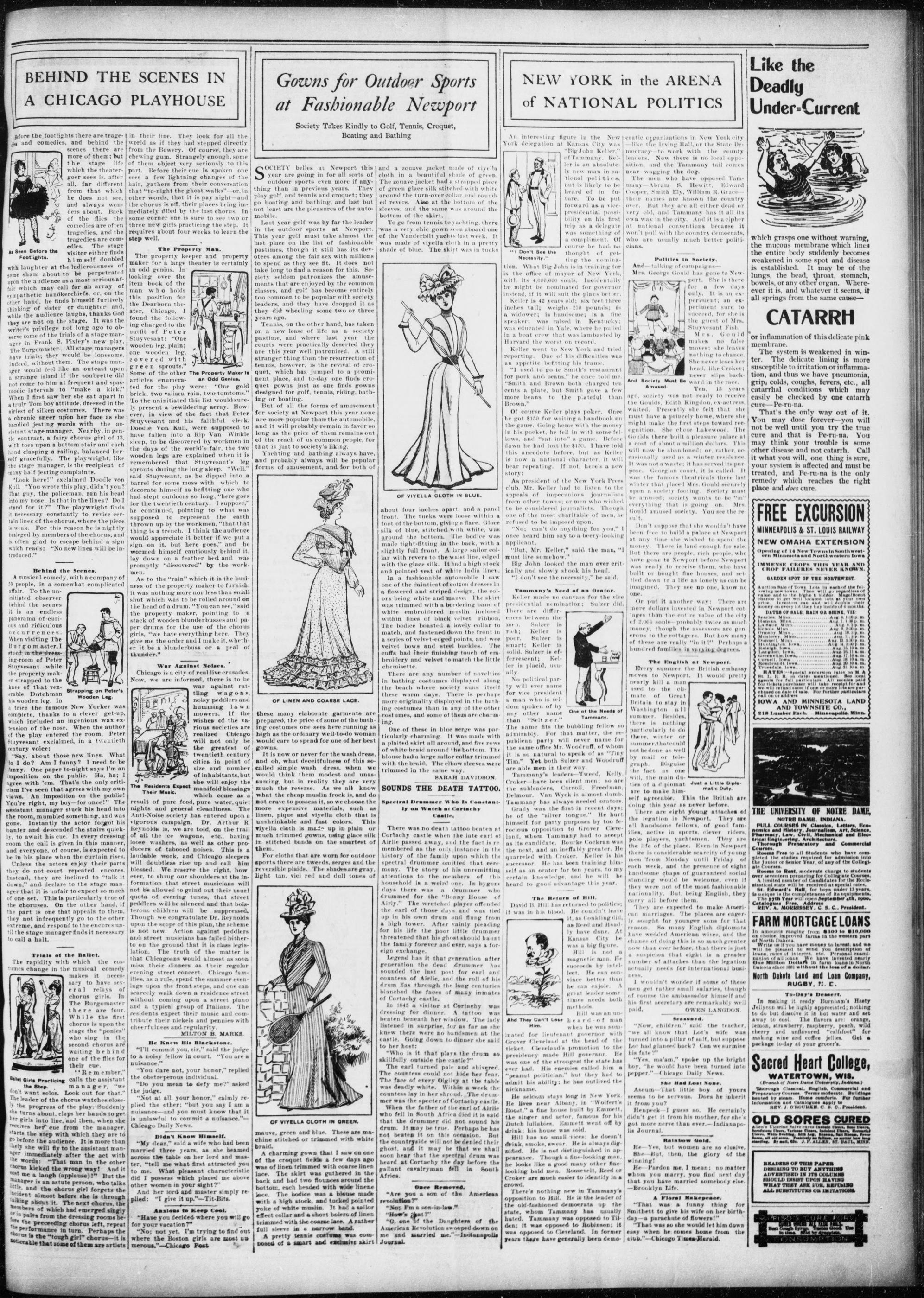
BEHIND THE SCENES IN A CHICAGO PLAYHOUSE
before the footlights there are tragedy and comedies, and behind the
and behind the scenes there are more of them; but the stage life which the theatergoer sees is, after all, far different from that which he does not see and always wonders about. Back of the flies the comedies are often tragedies, and the tragedies are comedies. The stage visitor either finds him self doubled
As Seen Before the Footlights.
with laughter at the ludicrousness of some sham about to be perpetrated upon the audience as a most serious affair which may call for an array of sympathetic handkerchiefs, or, on the other hand, he finds himself furtively thinking of sister or daughter and, while the audience laughs, thanks God they are not on the stage. It was the writer's privilege not long ago to observe some of the trials of a stage manager in Frank S. Pixley's new play, the Burgemaster. All stage managers have trials; they would be lonesome indeed, without them. The stage manager would feel like an outcast upon a strange island if the soubrette did not come to him at frequent and spasmic intervals to "make a kick." When I first saw her she sat apart in a truly Tom boy attitude, dressed in the airiest of silken costumes. There was a chronic sneer upon her face as she banded jesting words with the assistant stage manager. Nearby, in gentle contrast, a fairy chorus girl of 13 with toes upon a bottom stair and each hand clasping a railing, balanced herself gracefully. The playwright, like the stage manager, is the recipient of many half jesting complaints.
"Look here!!" exclaimed Doodle von
Kull. "You wrote this play, didn't you?
That guy, the policeman, ran his head
into my nose. Is that in the lines? Do I
stand for it??" The playwright finds
it necessary constantly to revise certain
lines of the chorus, where the piece
is weak. For this reason he is nightly
besieged by members of the chorus, and
is often glad to escape behind a sign
which reads: "No new lines will be
introduced."
Behind the Scenes.
A musical comedy, with a company of 50 people, is a somewhat complicated affair. To the uninitiated observer behind the scenes it is an endless panorama of curious and ridiculous occurrences. When visiting the Burgomaster, I stood in the dressing-room of Peter Stuyvesant while the property maker strapped to the knee of that venerable Dutchman his wooden leg. In
man. To the uninitiated observer behind the scenes it is an endless panorama of curious and ridiculous occurrences. When visiting The Burgomaster, I stood in the dressing-room of Peter Stuyvesant while the property maker strapped to the knee of that venerable Dutchman his wooden leg. In a trice the famous New Yorker was complete, thanks to a clever get-up, which included an ingenious wax extension of the nose. When the author of the play entered the room, Peter Stuyvesant exclaimed, in a twentieth century voice:
"Say, about those new lines. What do I do? Am I funny? I need to be funny. One paper to night says I'm an imposition on the public. Ha, ha; I agree with 'em. That's the only criticism I've seen that agrees with my own views. An imposition on the public! You're right, my boy—for once!" The assistant manager stuck his head into the room, mumbled something, and was gone. Instantly the actor forgot his banter and descended the stairs quickly, to await his cue. In every dressing room the call is given in this manner, and everyone, of course, is expected to be in his place when the curtain rises.
Unless the actors enjoy their parts they do not court repeated encores. Instead, they are inclined to "talk it down," and declare to the stage manager that it is unfair to expect so much of one set. This is particularly true of the choruses. On the other hand, if the part is one that appeals to them, they not infrequently go to the other extreme, and respond to the encores until the stage manager finds it necessary to call a halt.
Trials of the Ballet.
The rapidity with which the costumes change in the musical comedy makes it necessary to have several relays of chorus girls. In The Burgomaster there are four. While the first chorus is upon the stage the "ponies" who sing in the second chorus are waiting behind one of the flies for their cue. "A member."
sary to have several relays of chorus girls. In The Burgmaster there are four. While the first chorus is upon the stage the "ponies" who sing in the second chorus are waiting he hind one of the flies for their cue. "Remember," calls the assistant "WANGER."
the Step. manager r. "we don't want solos. Look out for them." The leader of the chorus watches closely the progress of the play. Suddenly she turns about, claps her hands to get her girls into line, and then, when she receives her cue from the manager, starts the step with which they are to go before the audience. It is more than likely she will fly to the assistant manager immediately after the act with the words: "That man in the other chorus kicked the wrong way! And it cost me a laugh (applause)." But the manager is an astute person, who talks little, and the chorus girl forgets the incident almost before she is through talking about it. The next chorus, the members of which had emerged singly in palms from the dressing rooms before the preceding chorus left, repeat the performance in turn. Perhaps the chorus is the "tough girl" chorus—it is noticeable that some of them are artists
in their line. They look for all the world as if they had stepped directly from the Howery. Of course, they are chewing gum. Strangely enough, some of their object very seriously to this part. Before their cue is spoken one sees a few lightning changes of the hair, gathers from their conversation that "to-night the ghost walks"—or, in other words, that it is pay night—and the chorus is off, their places being immediately filled by the last chorus. In some corner one is sure to see two or three new girls practicing the step. It requires about four weeks to learn the step well.
The Property Man
the property keeper and property maker for a large theater is certainly
maker for a large
an odd genius. In looking
over the
item book of the
man who holds
this position for
the Dearborn the-
ater, Chicago, I
found the following
charged to the
outfit of Peter
Stuyvesant: "One
wooden leg, plain;
one wooden leg,
covered with
green sprouts."
Some of the other
J
articles enumerata an Odd Genius, ted for the play were: "One gold brick, two valises, rain, two tomtoms. To the uninitiated this list would surely present a bewildering array. However, in view of the fact that Peter Stuyvesant and his faithful clerk, Doodle Von Kull, were supposed to have fallen into a Rip Van Winkle sleep, to be discovered by workmen in the days of the world's fair, the two wooden legs are explained when it is remembered that Stuyvesant's leg sprouts during the long sleep. "Well," said Stuyvesant, as he dipped into a barrel for some moss with which to decorate himself as beffiting one who had slept outdoors so long, "here goes for the twentieth century. I suppose," he continued, pointing to what was supposed to represent the earth thrown up by the workmen, "that that thing is a trench. I think the audience would appreciate it better if we put a sign on it, but here goes," and he wormed himself cautiously behind it, lay down on a feather bed and was promptly "discovered" by the workmen.
As to the "rain" which it is the business of the property maker to furnish, it was nothing more nor less than small shot which was to be rolled around on the head of a drum. "You can see," said the property maker, pointing to a stack of wooden blunderbusses and paper drums for the use of the chorus girls, "we have everything here. They give me the order and I make it, whether it be a blunderbuss or a peal of thunder."
War Against Noises.
Chicago is a city of real live crusades. Now, we are informed, there is to be
war against rattling wagons, noisy peddlers and humming lawn mowers. If the wishes of the various societies are realized Chicago will not only be the greatest of twentieth century cities in point of size and number of inhabitants, but she will enjoy the manifold blessings which come as a
The Residents Expect
Their Music
result of pure food, pure water, quiet nights and general cleanliness. The Anti-Noise society has entered upon a vigorous campaign. Dr. Arthur R. Reynolds is, we are told, on the trail of all the ice wagons, etc., having loose washers, as well as other producers of tabooed noises. This is a laudable work, and Chicago sleepers will doubtless rise up and call him blessed. We reserve the right, however, to shrug our shoulders at the information that street musicians will not be allowed to grind out their usual use of evening tunes, that street peddlers will be silenced and that boisterous children will be suppressed. Though we congratulate Dr. Reynolds upon the scope of this plan, the scheme is not new. Action against peddlers and street musicians has failed hitherto on the ground that it is class legislation. The truth of the matter is that Chicagoagers would almost as soon miss their dinners as their regular evening street concert. Chicago families, as a rule, spend the summer evenings upon the front steps, and one can scarcely walk down a residence street without coming upon a street piano and a typical group of Italians. The residents expect their music and contribute their nickels and pennies with cheerfulness and regularity.
He Knew His Blackstone
"I'll commit you, sir," said the judge to a noisy fellow in court. "You are a nuisance." "You dare not, your honor," replied the obstreperous individual. "Do you mean to defy me?" asked the judge. "Not at all, your honor," calmly replied the other; "but you say I am a nuisance—and you must know that it is unlawful to commit a nuisance."—Chicago Daily News.
Didn't Know Himself
"My clear," said a wife who had been married three years, as she beamed across the table on her lord and master, "tell me what first attracted you to me. What pleasant characteristic did I possess which placed me above other women in your sight"? And her lord and master simply replied: "I give it up." -Tit Bits.
Ansions to Keep Cool
"Have you decided where you will go for your vacation?" "No; not yet. I'm trying to find out where the Boston girls are most numerous." -Chicago Post
Gowns for Outdoor Sports at Fashionable Newport
Society Takes Kindly to Golf, Tennis, Croquet, Boating and Bathing
SOCIETY belles at Newport this year are going in for all sorts of
outdoor sports even more if anything than in previous years. They play golf, and tennis and croquet; they go boating and bathing, and last but not least are the pleasures of the automobile.
Last year golf was by far the leader in the outdoor sports at Newport. This year golf must take almost the last place on the list of fashionable pastimes, though it still has its devotees among the fair sex with millions to spend as they see fit. It does not take long to find a reason for this. Society seldom patronizes the amusements that are enjoyed by the common classes, and golf has become entirely too common to be popular with society leaders, and they have dropped it as they did wheeling some two or three years ago.
Tennis, on the other hand, has taken on a new lease of life as a society pastime, and where last year the courts were practically deserted they are this year well patronized. A still stranger thing than the resurrection of tennis, however, is the revival of croquet, which has jumped to a prominent place, and to-day one finds croquet gowns just as one finds gowns designed for golf, tennis, riding, bathing or boating.
But of all the forms of amusement for society at Newport this year none are more popular than the automobile, and it will probably remain in favor so long as the price of them remains out of the reach of us common people, for that is just to society's liking.
Yachting and bathing always have, and probably always will be popular forms of amusement, and for both of
1
OF LINEN AND COARSE LACE.
these many elaborate garments are prepared, the price of some of the bathing costumes one sees here running as high as the ordinary well-to-do woman would care to spend for one of her best gowns.
It is now or never for the wash dress, and oh, what deceitfulness of this so-called simple wash dress, when we would think them modest and unassuming, but in reality they are very much the reverse. As we all know what the cheap muslin frock is, and do not crave to possess it, so we choose the more expensive materials, such as linen, pique and viyella cloth that is unshrinkable and fast colors. This viyella cloth is made up in plain or much trimmed gowns, using glace silk in stitched bands on the smartest of them.
For cloths that are worn for outdoor sports there are tweeds, serges and the reversible plaids. The shades are gray, light tan, vici red and dull tones of
TENNIS
OF VIVELLA CLOTH IN GREEN.
manue, green and blue. These are machine stitched or trimmed with white braid.
A charming gown that I saw on one of the croquet fieldis a few days ago was of linen trimmed with coarse linen lace. The skirt was gathered in the back and had two twoples around the bottom, each headed with wide linen lace. The bodice was a bibie made with a high stock, and tucked pointed yoke of white muslin. It had a sailor effect collar and a short bolero of linen trimmed with the coarse lace. A rather full sleeve in a narrow band.
A pretty tennis costume was composed of a smart and exclusive skirt
and a zonave jacket made of vixelia cloth in a beautiful shade of green. The zonave jacket had a strapped piece of green glaze silk stitched with white around the turn-over collar, and rounded revers. Also at the bottom of the sleeves, and the same was around the bottom of the skirt.
To go from tennis to yachting, there was a very chic gown seen aboard one of the Vanderbilt yachts last week. It was made of vixelia cloth in a pretty shade of blue. The skirt was in tucks
1
OF VIYELLA CLOTH IN BLUE.
about four inches apart, and a panel front. The tucks were loose within a foot of the bottom, giving a flare. Glace silk of blue, stitched with white, was ground the bottom. The bodice was made tight-fitting in the back, with a slightly full front. A large sailor collar with revers to the waist line, edged with the glace silk. It had a high stock and pointed vest of white Indian linen.
In a fashionable automobile I saw one of the dainiest of cotton dresses in a flowered and striped design, the colors being white and mauve. The skirt was trimmed with a bordering band of white embroidered muslin inclosed within lines of black velvet ribbon. The bodice boasted a lovely collar to match, and fastened down the front in a series of velvet-eged points, and wee velvet bows and steel buckles. The cuffs had their finishing touch of embroidery and velvet to match the little chemise.
There are any number of novelties in bathing costumes displayed along the beach where society suns itself these warm days. There is perhaps more originality displayed in the bathing costumes than in any of the other costumes, and some of them are charming.
One of these in blue serge was particularly charming. It was made with a plaited skirt all around, and five rows of white braid around the bottom. The blouse had a large sailor collar trimmed with the braid. The elbow sleeves were trimmed in the same way.
SARAH DAVIDSON.
SOUNDS THE DEATH TATTOO
Spectral Drummer Who Is Constantly on Watch at Cortachy Castle.
There was no death tattoo beaten at Cortachy castle when the late earl of Airlie passed away, and the fact is remembered as the only instance in the history of the family upon which the spectral drummer omitted that ceremony. The story of his unremitting attentions to the members of this household is a weird one. In bygone days there was a drummer who drummed for the "Bonny House of Airly." The wretched player offended the earl of those days and was tied up in his own drum and flung from a high tower. After vainly pleading for his life the poor little drummer threatened that his ghost should haunt the family forever and ever, says a foreign exchange.
Legend has it that generation after generation the dead drummer has sounded the last post for earl and countess of Airlie, and the roll of his drum has through the long centuries blanched the faces of many inmates of Cortachy castle.
In 1845 a visitor at Cortachy was dressing for dinner. A tattoo was beaten beneath her window. The lady listened in surprise, for as far as she knew there were no bandsmen at the castle. Going down to dinner she said to her host:
"Who is it that plays the drum so skillfully outside the castle?" The earl turned pale and shivered. The countess could not hide her fear. The face of every Oligity at the table was deadly white. Within a week the countess lay in her shroud. The drummer was the specter of Cortachy castle. When the father of the earl of Airlie who fell in South Africa died it is said that the drummer did not sound his drum. It may be true. Perhaps he has not beaten it on this occasion. But the countryside will not be denied their ghost, and it may be that we shall soon hear that the spectral drum was heard at Cortachy the day before the gallant cavalryman fell in South Africa.
Once Removed.
"Are you a son of the American revolution?"
"Not I'm a son-in-law."
"How's that?"
"O, one of the Daughters of the American Revolution awooed down on me and married me."—Indianapolis Journal.
NEW YORK in the ARENA of NATIONAL POLITICS
An interesting figure in the New York delegation at Kansas City was
"Kansas City was "Big John Keller," of Tammany. Keller is an absolutely new man in national politics, but is likely to be heard of in future. To be put forward as a vicepresidential possibility on his first trip as a delegate was something of a compliment. Of course he had no thought of getting the nomina-
big John Keller, of Tammany. Keller is an absolutely new man in national politics, but is likely to be heard of in future. To be put forward as a vice-presidential possibility on his first trip as a delegate was something of a compliment. Of course he had no thought of getting the nomination. What Big John is in training for is the office of mayor of New York, with its 4,000,000 souls. Incidentally he might be nominated for governor instead, if it will suit the plans better.
Keller is 42 years old; six feet three inches tall; weighs 250 pounds; is a widower; is handsome; is a fine speaker; was raised in Kentucky; was educated in Yale, where he pulled in a boat crew that was lambasted by Harvard the worst on record.
Keller went to New York and tried reporting. One of his difficulties was an appetite befitting his frame.
"I used to go to Smith's restaurant for pork and beans," he once told me.
"Smith and Brown both charged ten cents a plate, but Smith gave a few more beans to the plateful than Brown."
Of course Keller plays poker. Once he got $150 for writing a handbook on the game. Going home with the money in his pocket, he fell in with some fellows, and "sat into" a game. Before dawn he had lost the $150. I have told this anecdote before, but as Keller is now a national character, it will bear repeating. If not, here's a new story:
As president of the New York Press club, Mr. Keller had to listen to the appeals of impeccable journalists from other towns; or men who wished to be considered journalists. Though one of the most charitable of men, he refused to be imposed upon. "No; can't do anything for you." I once heard him say to a beer-looking applicant, "But, Mr. Keller," said the man, "I must live somehow." Big John looked the man over critically and slowly shook his head. "I can't see the necessity," he said.
Tammany's Need of an Orator
Keller made no canvass for the vice
presidential nomination; Sulzer did.
*
There are differences between the men. Sulzer is rich; Keller is poor. Sulzer is smart; Keller is solid. Sulzer is effervescent; Keller is placid, usually.
日
No political party will ever name for vice president a man who is seldom spoken of by any other name then "Selt z e r."
One of the Needs of Tarmady.
can speak of it any other name One of the Needs of than "Selt zer." Tammány. The name fits the bubbling fellow so admirably. For that matter, the republican party will never name for the same office Mr. Woodruff, of whom it is so natural to speak of as "Tiny Tim." Yet both Sulzer and Woodruff are able men in their way. Tammány's leaders—Tweed, Kelly, Croker—have been silent men; so are the subleaders, Carroll, Freedman, Delmour, Van Wyck is almost dumb. Tammany has always needed orators, Grady was the first in recent days; he of the "silver tongue." He hurt himself for party purposes by too ferocious opposition to Grover Cleveland, whom Tammany had to accept as its candidate. Bourke Cockran was the next, and an ineffably greater. He quarreled with Croker. Keller is his successor. He has been training himself as an orator for ten years, to my certain knowledge, and he will be heard to good advantage this year.
The Return of Hill.
David B. Hill has returned to politics; it was in his blood. He couldn't leave it, as Conkling did, as Reed and Hoodly have done. At Kansas City he was a big figure.
A
Hill is not a magnetic man. He succeeds by intellect. He can convince better than he can cajole. A great leader needs both methods. Hill was an unheard-of man he was nonm
And They can't Lose the head of a man Him.
when he was nominated for lieutenant governor with Grover Cleveland at the head of the ticket. Cleveland's promotion to the presidency made Hill governor. He was one of the strongest the state has ever had. His enemies called him a "peanut politician," but they had to admit his ability; he has outlived the nickname.
He sleemon stays long in New York. He lives near Albany, in "Wolffert's Roost," a fine house built by Emmett, the singer and actor, famous for his Dutch lullabies. Emmett went off by drink; his house was sold.
Hill has no small vices; he doesn't drink, smoke, swear. He is always dignified. He is not distinguished in appearance. Though a fine-looking man, he looks like a good many other fine-looking bald men. Roosevelt, Reed or Croker are much easier to identify in a crowd.
There's nothing new in Tammany's opposition to Hill. He is the leader of the old-fashioned democrats up the state, whom Tammany has usually hated. Tammany was opposed to Tilden; it was opposed to Robinson; it was opposed to Cleveland. In former years there have generally been demo-
cratic organizations in New York city—like the Irving Hall, or the State Democracy—to work with the county leaders. Now there is no local opposition, and the Tammany tail comes near wagging the dog.
The men who have opposed Tammany—Abram S. Hewitt, Edward Cooper, Smith Ely, William R. Grace— their names are known the country over. But they are all either dead or very old, and Tammany has it all its own way in the city. And it is a cipher at national conventions because it won't pull with the country democrats, who are usually much better politicians.
d has gone to Newport.
She is there for a few days
only. It is an experiment;
an experiment sure to
succeed, for she is
the guest of Mrs.
Stuvesant Fish.
A
Mrs. Gould
makes no false
moves; she leaves
nothing to chance.
She never loses
head, like Croker;
never skids backward
in the race.
ago, society was not ready to receive the Goulds, Edith Kingdon, ex-actress, waited. Presently she felt that she must have a princely home, where she might make the first steps toward recognition. She chose Lakewood. The Goulds there built a pleasure palace at a cost of about a million dollars. This will now be abandoned; or, rather, occasionally used as a winter residence. It was not a waste; it has served its purse. Georgian court, it is called. It was the famous theatricals there last winter that placed Mrs. Gould securely upon a society footing. Society must be amused; society wants to be "in" everything that is going on. Mrs. Gould amused society. You see the result.
Don't suppose that she wouldn't have been free to build a palace at Newport at any time she wished to spend the money. There is land enough for sale. But there are people, rich people, who have gone to Newport before Newport was ready to receive them, who have built or bought fine houses, and settled down to a life as lonely as can be imagined. They see no one, know no one.
Or put it another way: There are more dollars invested in Newport cottages than the entire value of the city of 2,000 souls—probably twice as much money, though the assessors are generous to the cottagers. But how many of these are really "in it?" Perhaps a hundred families, in varying degrees.
The English at Newport
Every summer the British embassy moves to Newport. It would pretty
moves to Newport
nearly kill a man
used to the climate
of Great Britain to stay in
Washington a 11 summer. Besides,
there is nothing
particularly to do
there, winter or
summer, that could
not be done as well
by mail or telegraph.
Disguise the fact as one
will, the main duties
of a diplomat
are to make him-
used to the climate of Great Britain to stay in Washington all summer. Besides, there is nothing particularly to do there, winter or summer, that could not be done as well by mail or telegraph. Diguisse the fact as one will, the main duties of a diplomat are to make himself agreeable. This the British are doing this year as never before.
There are eight young attaches of the legation in Newport. They are all handsome fellows, of good families, active in sports, clever riders, polo players, yachtmen. They are the life of the place. Even in Newport there is considerable scarcity of young men from Monday until Friday of each week, and the presence of eight handsome chaps of guaranteed social standing would be welcome, even if they were not of the most fashionable nationality. But, being English, they carry all before them.
They are expected to make American marriages. The places are eagerly sought for younger sons for that reason. So many English diplomats have wedded American wives, and the chance of doing this is so much greater now than ever before, that there is just a suspicion that eight is a greater number of attaches than the legation actually needs for international business.
I wouldn't wonder if some of these men get rather small salaries, though of course the ambassador himself and his first secretary are remarkably well paid. OWEN LADODON.
Seasoned.
"Now, children," said the teacher,
"we all know that Lot's wife was
turned into a pillar of salt, but suppose
Lot had glanced back? Can we surmise
his fate?"
"Yes, ma'am," spoke up the bright
boy, "he would have been turned into
pepper."—Chicago Daily News.
She Had Lost None.
Aseum—That little boy of yours seems to be nervous. Does he inherit it from you?
Henpeck—I guess so. He certainly didn't get it from his mother, for she's got more nerve than ever.—Indianapolis Journal.
Rainbow Gold.
He—Yes, but women are no elusive.
She—But, then, the glory of the winning!
He—Pardon me, I mean: no matter whom you marry, you find next day that you have married somebody else.
—Brooklyn Life.
A Floral Makepace
"That was a funny thing for Smithett to give his wife on her birthday—a parachute of flowers!" "That was so she would let him down easy when he comes home from the club."—Chicago Times-Herald.
Like the Deadly Under-Current
which grasps one without warning, the mucous membrane which lines the entire body suddenly becomes weakened in some spot and disease is established. It may be of the lungs, the head, throat, stomach, bowels, or any other organ. Wherever it is, and whatever it seems, it all springs from the same cause
CATARRH
CATARRH
or inflammation of this delicate pink membrane.
The system is weakened in winter. The delicate lining is more susceptible to irritation or inflammation, and thus we have pneumonia, grip, coughs, fevers, etc., all catarrhal conditions which may easily be checked by one catarrh cure—Pe-ru-na.
That's the only way out of it. You may dose forever—you will not be well until you try the true cure and that is Pe-ru-na. You may think your trouble is some other disease and not catarrh. Call it what you will, one thing is sure, your system is affected and must be treated, and Pe-ru-na is the only remedy which reaches the right place and does cure.
FREE EXCURSION
MINNEAPOLIS & ST. LOUIS RAILWAY
NEW OMAHA EXTENSION
Opening of 14 New Towns in Southwest-
ern Minnesota and Northwestern Iowa
IMMENE CROPS THIS YEAR AND
CROP FAILURES NEVER KNOWN.
GARDEN SPOT OF THE NORTHWEST
Auction Sale of Town Lots in each of the following new towns. They will go regardless of value and to the highest t bidder. Magnificent price. Invoices can and will double their value. Price investors can and will double their value.
**DATES OF SALE, RAIN OR SHINE, VIE**
Pearls, Minn. Aug 6, 10 p.m.
Kanaka, Minn. Aug 7, 10 p.m.
Kebola, Minn. Aug 9, 10 p.m.
Grosse Mine. Aug 9, 10 p.m.
Dunnell, Minn. Aug 11, 10 p.m.
Dunnell, Minn. Aug 13, 10 p.m.
Raleigh, Iowa. Aug 15, 10 a.m.
Langton, Iowa. Aug 18, 11 a.m.
Cornell, Iowa. Aug 18, 10 a.m.
Tromsø, Iowa. Aug 21, 10 a.m.
HATES...Special excursion rates on M. A.
M. A. It is for on dates mentioned. See local
agencies for on dates mentioned. All mailing and
for tickets purchaser will take receipt for and
we will refine sales if one or more package
purchased on date of sale. For further particulars
on advertisers.
IOWA AND MINNESOTA LAND
AND TOWNSITE CO.,
218 Lumber Each. Minneapolis, Minn.
FULL COURSES IN Classics, Letters, Economics and History, Journalism, Art, Science, Engineering, Electrical Engineering, Architecture.
Through Preparatory and Commercial Courses.
Rooms Free to all Students who have completed the studies required for admission into these courses. Students may take courses at Rooms Free. Best, moderate charge to students on rosters preparing for Collegiate Courses.
A limited number of Candidates for the Recruiting St. Edward's Hall, for boys under 13 years, is unique in the completeness of its equipments.
Catalogue Free, Open on September 4th, 1900.
REV. A. MORRISSEY. C. S. C., President.
In amounts ranging from $300 to $10,000 on choice improved farms in the western part of the country, we write to you if you have money to invest, and we will be pleased to send you description of your investment and the nation of all loans. We have invested nearly One Million Dollars in farm loans in North Carolina.
North Dakota Land and Loan Company,
BUGBY, J. E.
In making it ready Burham's Hasty Jellycon will be highly appreciated; nothing to do but dissolve it in hot water and set away to cool. The flavor are: orange, lemon, strawberry, raspberry, peach, wild cherry and unflavored "calffoot" for making wine and coffee jellies. Get a package to day at your grocer's.
Sacred Heart College,
(Branch of Nature Dame University, India.)
Tucorough Classical, English, Commercial and Preparatory Courses. Terms moderate. Buildings heated by steam. Home comforts. For further information and Catalogues apply to
REV. J. O'BOURKE, C. S. C., President.
OLD SORES CURED
Alien's Ulcerine Salve enrous Ch艮ie Eles, Bono Eles, Herodian Eles, Vartone Eles, Indolent Eles, Herogural Eles, White Breiling, hilt Leg, Expense, Sail Rheum, Fever Bore, all sid serre. Positively no fallen, no matter how long standing. By moll, 6fe. J. F. ALLEN, ST. FAUL, MIN.
READERS OF THIS PAPER
DESIRED TO BUY ANYTHING
ADVERTISED IN ITS COLUMNS
SHOULD INSIST UPON HAVING
WHAT THEY ASK FOR, REFUING
ALL SUBSTITUTES OR IMITATIONS.
FISCH TURE FOR
CHEESE WHEN IN THE TAIL.
Exp. 100 Cents. Use
in time. Sold by druggers.
CONSUMPTION
THE STORY TELLER
THE MEADOW LARK.
Minstrel of melody,
How shall I chant of thee,
Floating in meadows atrill with thy
song?
Teach me to keep my wing
Close to the breast of our mother, the ground!
Soon shall my fleeting lay
Fade from the world away—
Thine, ever-during, shall thrill through the
Soft through the summer float
Far o'er the fields where the wild grasses
wave.
Then, when my day is done,
Oh, at the set of sun,
Pour out thy spirit anear to my grave!
-Lloyd Mifflin, in N. Y. Independent.
Sol Tomlinson's Falconry
By Edwin J. Webster.
"COL TOMLINSON says it was a
SOL TOMLINSON says it was a Sunday school book that caused him to be nursing an injured spirit and mourning the loss of the finest collection of fancy breeds of chickens ever seen in Pike county." observed Deacon Todgers to the crowd at the corner grocery. "But I tell him it was his own foolishness in trying middle age notions in this closing year of the nineteenth century, and also in trusting too far to the loving kindness and forgiving nature of hawks. "One Sunday afternoon Sol went out to the woodshed and found his boy Tom reading a book he had drawn from the Sunday school library. Sol cracked the boy over the head for reading novels on Sunday, gave him some chores to do, and then sat down to read the book himself. It was all about knights and how they rode about the country fighting for the color of their ladies' eyebrows and how they went hawking and all such foolishness. But it seemed to impress Sol mightily.
"And are you, with your blue jeans and bald pate and white whiskers, going to ride around Pike county on a "prancing palfrey," and fight for the honor of your lady, also?" I asked him. "Or what particular kind of foolishness has that book inspired you to?"
"Sol looked hurt.
"Fudge, deacon,' he said to me. 'I'm a respectable married man without any "lady loves," as you call them, and my rheumatism wouldn't allow me to ride "prancing palefreys" any way. The plan I am thinking of is a practical one, and one that will bring money to a worthy old man without his working for it. Dill you read what that book said about falconry, and how all those old coves used to catch heron and ducks and other kinds of birds by the use of falcones? Well, that's what I'm going to do, he says, earnestly.
"But you haven't any falcones,' I objected
"Tush, deacon.' Sol retorted, sort of impatient. Of course, I sinn't got any falcones. But what's a falcon except a hawk, anyway, and it will be easy enough for me to get a few young hawks and train them to catch ducks and other birds which sell well, but are a good deal of trouble for a tired old man to shoot."
"Well, the first thing Sol did was to get his boys to work gathering in young hawks. That was considerable of a contract for the boys, as neither the young hawks nor the old birds took kindly to having their nests robbed, but the boys gathered in about a dozen young birds.
"Sol had a lot of chickens of his own, and every time he killed one he would feed the young hawks a bit of liver. Then he would buy up the livers whenever any of the neighbors killed chickens, and feed them to the hawks. 06 course he fed the hawks other things, but pretty soon those birds had as well developed a taste for liver as some men have for 'paty de foy gran,' or whatever it is called.
"Then Sol began the second part of the training. He would put a dead duck on the ground, and carry one of his hawks over to it, go off a ways, and sort of indicate to the bird that he wanted the dead duck brought to him. Hawks are pretty intelligent birds, and it wasn't long before they appreciated the fact that every time one of them brought Sol a duck there was a big piece of liver coming.
"By the time the duck season opened all but six of Sol's hawks had died, but he certainly did have that half dozen trained down to a fine point. Their appetite for liver had gotten to be like that of a man's for drink, and they understood that ducks and only ducks were what Sol wanted, so they never interfered with his chickens. By and by the ducks began flying south. Then Sol started out to gather in his harvest.
"For months," he said to me 'these hawks of mine have enjoyed fatherly care and lived on the fat of the land and the livers of several hundred chickens. Now is the time for them to repay my devotion. And, by gum, they will do it or get in trouble."
"That afternoon Sol got a couple of long sticks, and carrying them over his shoulders with three hawks perched on them, started after ducks. Pretty soon along came a flock of ducks, flying pretty low. Sol untied his hawks and pointed at the ducks. It wasn't half a minute before those trained hawks understood what was wanted of them, and off they went at full tilt after the ducks. Each hawk grabbed a duck, started back with it toward Sol and dropped it at his feet.
Then came the first of Sol's actions.
which turned aside the hearts of his faithful duck hunter. When the hawks delivered up their ducks to Sol they began to look for some liver as a reward. But Sol didn't see it that way.
"Those ducks are still in sight," he says to the hawks, as if they could understand him. 'And duty calls on you to go after them. Now is your chance to repay a little of my care and affection. This is no time to be looking for liver.'
"Sol kept pointing at the rapidly disappearing flock of ducks, and as his hawks didn't seem to understand what he meant, he grabbed a stick and began pounding them with it. It was plain that the hawks were grieved and mystified, rather than angry. They had each of them brought in a duck, why didn't they get their liver? And why did Sol, the man who had fed them and whom they had looked up to and venerated, beat them with a stick?
"Finally they gave it up as a bad job trying to figure out what it all meant, and seeing that Sol wanted more ducks, off the hawks started, but acting in a patient, puzzled sort of way that was really pathetic.
"Those birds of yours are faithful and well trained," I observed to Sol, "but loving kindness isn't the strongest quality of any hawk, even an educated one. If you beat them about once more they will try to get even with you. And from what I know of hawks, I'm betting they will succeed."
"But Sol only grunted out that it was ducks and not tokens of esteem that he wanted from those hawks.
"After quite a wait we saw the hawks coming back. They had had a long chase after the ducks and were pretty weary when they reached us, but each faithful hawk was' bringing back a duck, and laid it in front of Sol. Then every bird looked up in an expectant sort of way as if he now felt certain of getting his liver. And it was here that the real meanness of Sol's nature showed up.
"Sol was just going to reward his hard-working birds, when away off to the north another flock of ducks showed up. Then Sol wanted to start his hawks right after the new flock.
"Don't you do it, I" warned him. "These faithful birds of yours are pretty nearly worn out, and if you don't"
OUT FOR DUCKS.
give the liver they expect they will lose faith in human nature. A trained hawk who has lost faith in human nature is an ugly animal. I said, solently.
"But Sol was set on starting his hawks after this particular flock of ducks. The patient birds, instead of going just loitered around, waiting for their reward. Then Sol grabbed his stick and began pounding them worse than before. For about a minute the birds stood it, then it seemed to come over them all at once that they were being beaten and cheated after they had done their duty. Each bird gave a sort of queer little cry, in which there was more disappointment at the way Sol had treated them than anger, and then rose in the air and turned, not in the direction of the ducks, but toward Sol's barnyard.
"It's fancy chickens and revenge your birds are looking for," I warned Sol.
"Sol looked at the hawks and then began running home as fast as his legs would carry him. But it was too late. The six hawks swooped down among Sol's chickens, and by the time Sol arrived on the scene all that was left of the best collection of fancy breed of chickens ever seen in Pike county was a mass of feathers and dead fowls.
"What heartless ingratitude, says Sol, almost crying. 'I fed and trained and cared for those birds, and then they turn and read me, or rather my innocent and best breeds of fancy chickens.' "But I did not give him any comfort. 'It was all your own fault, Sol Tomlinson,' I told him. "If you had treated those hawks halfway decently they would have cheered your declining years and gathered in ducks by the bushel." "—Boston Globe.
Half-Deaf
James Payn says, in "The Backwater of Life," that as soon as he became deaf, his friends tried to hearten him by collecting anecdotes of those who have made humorous mistakes through suffering a like infirmity. The efficacy of that method may be doubted, but such as it is, many have had to endure it.
One story is indeed to be tolerated, because it refers to a gentleman who, although deaf, was not so much so as he pretended to be. A friend came to him one day and shouted:
"Will you lend me half a sovereign?"
"What?"
"Will you lend me half a sovereign? was the still louder petition.
"What was that?"
"Will you lend me a sovereign?"
"You said half a sovereign before!"—
"Youth's Companion."
Old Signs on Staten Island
A bicyclist who has been making runs in the neighborhood of New York reports that he found the most unanimous and impartial slaughter of English in a sign posted on a Staten Island windmill. It reads:
DIS VIND MILL FER SAIL
At a rude wash of the Staten Island sound this greeted his eyes:
BOATS TO HIER
Another sign showed this legend:
WE LIVE TO DYE and DYE TO LIVE.
Can Buy Another Name
Can Buy Another Name.
A Kansas man named K. Gaza Dome has fallen heir to a $3,000,000 estate. He can surely now afford to hire a cheap lawyer, says the Denver Post, and have the name legally exchanged for one that will look better on aristocratic pink-blue embossed letter paper.
A LITTLE NONSENSE.
Teacher (suspiciously)—"Who wrote your composition, Johnny?" Johnny—"My father." "What, all of it?" "No'm; I helped him."—Truth. "We intend to hold a lawn fete," said Miss Beechwood to Miss Bellefield. "What kind of a lawn fete?" asked the latter. "A rainless one, we hope."—Pittsburgh Telegraph. Rose—"I would never marry a man without principle." Lily—"Nor L. And I should want his principal to be big enough to allow us to live well on the interest, too."—Philadelphia Bulletin. Billings—"You are the last man to play the races. What do you know about horse-flesh, anyway?" Stillson—"I ought to know a good deal about it. I was in the army and lived on salt horse for months at a time."—Boston Transcript.
Early Ambition—“O, mah goodness!” exclaimed little Abe Lincoln Snow. “I wist I wuz laik de little boy in di hayr story book.” “Whuffer?” asked his mother. “Kase hit sez he went to bed wif d翼 chickens.”—Philadelphia Press.
The Astronomer—“The presence of an inner planet is suspected from certain perturbations of the planet Mercury.” The Other—“But of course these might be due to the people of Mercury being engaged in learning to play golf.”—Detroit Journal.
Indelibly Impressed—Brown—“Current items seem to make a lasting imprint on your memory.” Jones—“Well, my wife reads the news out to me before I get the paper; and often my daughter reads it out to me after I've read it.”—Indianapolis Journal.
Getting His Properties.—"Gimme a pair of long, yellow chin-whiskers," said the man with the sun-burned face and slightly rural air. "Detective, eh?" asked the costumer. "Naw. Summer boarders are coming next week, and I've got to git on a make-up for my part."—IndianaPress.
"OLD CHAW" IN MISSOURI
How the Settlers of Saline County Made the Real Old "Home-spun Terbaker."
An old Missouriian from one of the brush districts of Saline county was a witness in the circuit court in Marshall recently. The Index says: While waiting in an anteroom he pulled from his pocket a chunk of tobacco six inches long, two inches in diameter and perfectly round and smooth, and as hard almost as flint. After he had cut off a chew a man who had watched him asked him what it was. "Terbaker," he answered. "Yes. I know, but what kind is it? " "My own kind." "Where do you buy it? " "Don't buy it. It's homepun terbaker. I made it myself." In response to a good deal of questioning the old man told his story how the roll of tobacco was made. "Fust and fo'most," he said, "you must have good upland home-grown leaf terbaker and cure it in the sun. Then you stem it, takin' out all the stalks. When you're ready in the fall to make up you you're supply of chawin' terbake, you saw off a hickory log and bore a hole in one end about a foot deep with a two-inch auger. You have your leaf soaked in honey and peach brand, or if you haven't any peach brand, apple brand will do. You put your soaked terbake leaves into the two-inch auger hole in the hickory log and ram it down tight an' keep puttin' in the leaf and rammin' it down till the hole is nearly full. Then you take a hickory plug made to fit the hole and drive it in as tight as you can with a maul. This mashes the terbake into a solid chunk. Then you put the green hickory log on the fire and let it burn slow till it is heated all through and the sap begins to sizzle out of the ends. You take the log off then and put it out of doors to cool over night. The next morning you split the log open and there's your chunk of chawin' terbaker that will keep as hard as leather in any climate, but it's the sweetest chaw in the world. There never was no store terbaker to hold a candle to it for a sweet, juicy, lastin' chaw."
Several tobacco chewers standing around sampled the old man's homemade plug and declared that it was the best they had ever tasted. "In the old days that's the way the fust settlers in Missouri made their chawin' terbaker," the old man said.
JAPANESE WEDDING STAMPS.
They Commemorate the Recent Marriage of the Prince Imperial.
Japan has recently issued a new series of postage stamps that will be of great interest to philatelists. They commemorate the recent marriage of the prince imperial. In the oval frame is pictured a low table spread with paper, the place where all Japanese marriages are solemnized. The table is decorated with bamboo stalks and plum twigs and blossoms, and at each corner rises a spray of pines. The pine and the bamboo, being evergreens, represent that in which there is neither variability nor shadow of turning; the pum, on the other hand, stands for that which buds, blossoms and fruits for the good of man. The decorations of the paper table cover are the crane and the tortoise; of these the bird is symbolic of 1,000 years and the turtle of 10,000 years. Here sit the bride and the bridegroom and pass each other cups of saki to the number of nine and so they are married, for the nine drinks together symbolize the perfect Japanese marriage.
This in Japan is the emblem of wedlock and for that reason it has been reproduced in the commemorative stamp issue on the wedding of the crown prince. At just such a table sat he his and his bride, and the stalks of hamboo and sprays of pine and the blooms of the plum all joined in wishing them both all health, wealth and happiness without changing, and the crane and the turtle fixed a sort of generous time limit to all the good wishes by suggesting that it might possibly come to an end 5,000 or 19,000 years hence.
This is the way the Japanese set forth the meaning of the picture on the new stamp and for confirmation they point to the legend, which they stoutly aver is a statement of the name o. the prince and the princess and the date when they slipped the nine cups of sake.
A RESCUE AT SEA.
Berilious Situation Relieved by the Timely Utterances of Spell-Binder.
"Help! Help!"
In a panic the passengers rushed to the side of the ship, and gazed helplessly at those struggling in the waves, says Harper's Bazar.
It was indeed a perilous situation.
What was to be done? There seemed to be no rope at hand, and there was trouble in lowering the lifeboat, and, as usually the case, none of the sailors could swim.
A lawyer suggested a writ of habeas corpus, and there was not a judge on board, and no one to serve such a writ, anyway.
At that instant a man of commanding presence pushed into the frenzened crowd and struck an attitude, close to the rail.
Drowning ones recognized him as a famous political orator, and their spirits rose:
"Fellow citizens," he began, "we face a crisis. The next moment a joy of joy went up. For the people in the water were hanging on his words, in the way they conjoined themselves." (WEST COUNTY)
O--I--C
When a preparation has an advertised reputation that is world-wide, it means that preparation is meritorious. If you go into a store to buy an article that has achieved universal popularity like Cascareta Candy or Cascareta Candy Cream, the endorsement of the world. The judgement of the people is infallible because it is impersonal. The retailer who wants to sell you "something else" in place of the article you ask for has ask to a grind. Don't it stand to reason? It doesn't matter if not what he represents it to be. Why? Because he expects to derive an extra profit out of your creditability. Don't you see through his little game? The man who will ask for a credit is a fraud. Barew of him! He is trying to steal the honestly earned benefits of a reputation which another business man has paid for, and if his conscience will allow him to go so far, he will go farther. He cheats, he steals, he is not safe to do well with business. Barew of the Cascareta substitutitor Remember Cascareta are never sold in bulk but in metal boxes with the long tailed every box and each tablet stamped C, C, C.
Housewife and Burglar.
The burglar had entered the house as quietly as possible, but his shoes were not padded and they made some noise. He had just reached the door of the bedroom when he heard some one moving in the bed as if about to get up, and he paused. The sound of his footsteps echoed. "If you don't take off your boots when you come into this house," it said, "there's going to be trouble, and a whole lot of it. Here it's been raining for three hours, and you dare to tramp over my carpets with your muddy shoes." He went downstairs without a word, but he didn't take off his boots. Instead he went out into the night again, and the "pal" who was waiting for him saw a tear glisten in his eye. "I can't rob that house," he said. "I'm home of me."—Lewiston (Mc.) Journal.
Homekeepers' Excursions Yla Chicago & Eastern Illinois Railroad.
On the first and third Tuesdays of June, July and August the Chicago & Eastern Illinois Railroad will place on sale Homekeepers' Excursion tickets to various points in Alabama, Arkansas, Florida, Georgia, Kentucky, Louisiana, Mississippi, Missouri, Carolina, South Carolina, Tennessee, Texas.
One Fare (plus $2.00) for the Round Trip. Tickets are limited on going trip fifteen days from date of sale with stop-over times. The seekers Territory. Returning tickets are limited twenty-one days from date of sale. Remember that we now have in service a new wide vestibilised train between Chicago and Cleveland. Chicago daily at 1:50 P. M. Through Pullman Sleeping Cars and Free Recching Chair Cars. For further particulars call on or address any agent Chicago & Eastern Illinois or C. L. Stone, G. P. and T. A. Chicago.
He Wouldn't Tell.
The argument by analogy or hypothetical case is often dangerous. A very stately and dignified clergyman used to tell a story illustrative of the risk of this method. One of the most common ways to drink and one night the viser met him coming home in such a condition that he remonstrated with him on the spot, and by way of clinching his argument, asked: “What is the reason you are meeling down the street in a state of hopeless intoxication?” The offender appeared to be deeply impressed and an aweed, fervently: “I wouldn’t tell a soul, str.”—San Francisco Argonaut.
The preparations of the J. and C. Maguire Medicine Company of St. Louis, Mo., are beyond all question. This firm has succeeded in furnishing the medicine in 1889 and have steadily grown in favor with the public, not having one failure to report in 90 years! Their Bene Plant, Cundurang, etc., have become a household word. They have been free, and if you ever get Diarrhea, Dysentery or Cholera-Morbus, give the Bene Plant a trial, and you will be convinced. Every article made by the Maguire Medicine Company is guaranteed to do what is claimed
These Loving Girls
Maude- If I only had my life to live over again-
Clara (interrupting)-Why, I thought that what's your you were doing.
What do you want?
"I heard you tell the census man you would be 22 your next birthday."-Chicago Evening News.
Do Your Foot Ache and Burn!
Shake into your shoes, Allen's Foot-Ease, a powder for the feet. It makes tight or New Shoes Feel Easy, Cures Corns, Itching, Swollen, Hot, Callous, Smarting, Sore and Swelling Feel. Druggets and Shoe Problems. Easily, Sample w/ FEER.
Address, Allen S. Glimsted, Le Roy, N. Y.
Love does not usually laugh at a parrot who doesn't want you to laugh" although to our mind this is much funnier than the average locksmith.-Detroit Journal
ABSOLUTE
SECURITY.
Genuine
Carter's
Little Liver Pills.
Must Bear Signature of
Bruce Good
See Foam-Simple Wrapper Below.
Very small and as easy
to take as regular.
CARTER'S
LIVER
PILLS.
FOR HEADACHE.
FOR DIZZINESS.
FOR BILIOUSNESS.
FOR TORPID LIVEN.
FOR CORN PATION.
FOR BALLOW SKIN.
FOR THE COMPLEXION
Price
10 Cents
Purveyor
CURE BICK HEADACHE.
900 DROPS
CASTORIA
A Vegetable Preparation for Assimilating the Food and Regulating the Stomachs and Bowels of
INFANTS & CHILDREN
Promotes Digestion, Cheerfulness and Rest. Contains neither Optum, Morphine nor Mineral. NOT NARCOTIC.
Purpose of Old Dr. SAMUEL PITCHER
Pumpkin Seed
Lemon Juice
Lemon Salt
Amino Acid
Pepersnuts
Lemon Balm
Wine Seed
Cinnamon Sugar
Walnutmilk Powder.
A perfect Remedy for Constipation, Sour Stomach, Diarrhoea, Worms, Convulsions, Feverishness and LOSS OF SLEEP.
Fac Simile Signature of
Chat H. H. Hitchens
NEW YORK.
A 16-months old
35 Doses - 35 CENTS
EXACT COPY OF WRAPPER.
CASTORIA
For Infants and Children.
The Kind You Have Always Bought
Bears the Signature of
Chat H. H. Hitchens
In Use
For Over Thirty Years
CASTORIA
THE GENTAUR COMPANY, NEW YORK CITY.
This is the recent decision of one of the prominent societies of the world, but the exact day has not yet been fixed upon, and while there are very few people who believe this prediction, there are thousands of others who not only believe, but know that Hostetler's Stomach Bitters is the best medicine to cure dyspepsia, indigestion, constipation, and other digestive troubles. A fair trial will certainly convince you of its value.
An Insignation.
The Plumber—I believe that we will all follow the same vocation in the next world as we do in this.
The Carpenter—Well, if that is true, you will be out of a job.
"Why so?"
"What use will they have for plumbers where there is no water?"—Cleveland Plain Dealer.
"Yes, indeed. Why he rented a parrot for the summer just to have it swear at the heat for him."—Baltimore American.
I am sure Piso's Cure for Consumption saves my life three years ago.—Mrs. Thos. Robbin, Maple Street, Norwich, N. K., Feb 17, 1900.
Just about seven-eighths of the people should cut out that part about forgiving one's enemies before they repeat the Lord's prayer.—Atchison Globe.
Each package of FUTNAM's FADLESS Dress colors more goods than any other dye and colors them better too. Sold by all druggists.
The oldest of a crowd of girls, though she may be only 18, is always made to feel as if she is a wrinkled spinster—Atchison Globe.
If you want "good digestion to wait upon your appetite" you should always chew a bar of Adams' Pepin Tutti Frutti.
Max O'Rell is so fast that they use quicksand in the hour glasses! Max is a dazzy joker, but time flies all the same.
To Cure a Cold in One Day
Take Laxative Bromine Quinine Tablets. All drugstores refund money if it fails to cure. 25c.
Fortunate is the liar who loses his reputation.—Chicago Daily News.
Hall's Catarrh Cure
Is taken Internally. Price 75c.
The retired actor is naturally played out.—Chicago Daily News.
WALTHAM WATCHES
Lydia E. Pinkham's
Before 1854 there were no Waltham Watches nor any American Watches. To-day the tradition that one must go abroad for a good watch has been exploded by the American Waltham Watch Company.
Vegetable Compound oures the llls peculiar to women. It tones up their general health, eases down overwrought nerves, oures those awful backaches and regulates menstruation.
"The Perfected American Watch", an illustrated book of interesting information about watches, will be sent free upon request. American Waltham Watch Company, Waltham, Mass.
It does this because it acts directly on the female organism and makes it healthy, relieving and curing all inflammation and displacements.
WINCHESTER
FACTORY LOADED SHOTGUN SHELLS
"NewRival,""Leader,"and"Repeater"
Insist upon having them, take no others and you will get the best shells that money can buy.
ALL DEALERS KEEP THEM.
Nothing else is just as good and many things that may be suggested are dangerous. This great medicine has a constant record of cure. Thousands of women testify to it. Read their letters constantly appearing in this paper.
BOOKLETS FREE
Sample Bottles by Mail. 21c.
J & C. MAGUIRE'S EXTRACT
CURES Colic, Cholea Morbus, Diarrhea, Dysentery and Bowel Complaints—NEVER FAILS!
In the market since 1841. Recommended by leading Physicians. Used by our Army and Navy. Sold by all Druggists.
J. & C. MAGUIRE MEDICINE CO., St. Louis, Mo.
A. N. K.-G 1824
WHEN WRITING TO ADVERTISERS PLEASE
state that you saw the Advertisement in this
paper.
SUNSTROKE
A man falls from a building.
The summer's awful heat will kill those not fit to resist it—those whose bodies are full of poison because they have neglected their bowels.
The victims of sunstroke, or of any of the other terrible dangers of summer—diarrhoea, dysentery, cholera morbus—are always those who have been careless about keeping clean inside, and as a result have their blood full of rotten filth breeding disease germs and their bodies ready with weakness to succumb to the hot spell. Dizziness, heat headaches, sick stomachs, sticky oozing ill-smelling sweats, restless nights, terrible pains, gripes and cramps in the bowels, sudden death on the street, all result from this neglect.
Keep yourself clean, pure and healthy inside, disinfected as it were, with CASCARETS CANDY CATHARTIC, the greatest antiseptic bowel tonic ever discovered and you will find that every form of summer disease will be effectively
PREVENTED BY
Cascarets
CANDY CATHARTIC
BEST FOR THE BOWELS
THIS IS
CCC
THE TABLET.
10c. 25c.
50c.
ALL DRUGGISTS
CASCARETS are absolutely harmless, a purely vegetable compound. No mercury, or other mineral pill-polens in CASCARETS. CAS-
CARETS promptly, effectively and permanently cure every disorder of the Stomach, Liver and intestine. They not only cure constipation,
but correct any and every form of irregularity of the bowels, including diarrhea and dysentery. Flowered, palatable, potent. Taste good, do
good. Beer sticks, weaken or gripe. Write for booklet and free sample. Address STERLING BEMEDY CO., CHICAGO or NEW YORK. (3)