The Afro-American Advance
Saturday, August 11, 1900
Minneapolis, Minnesota
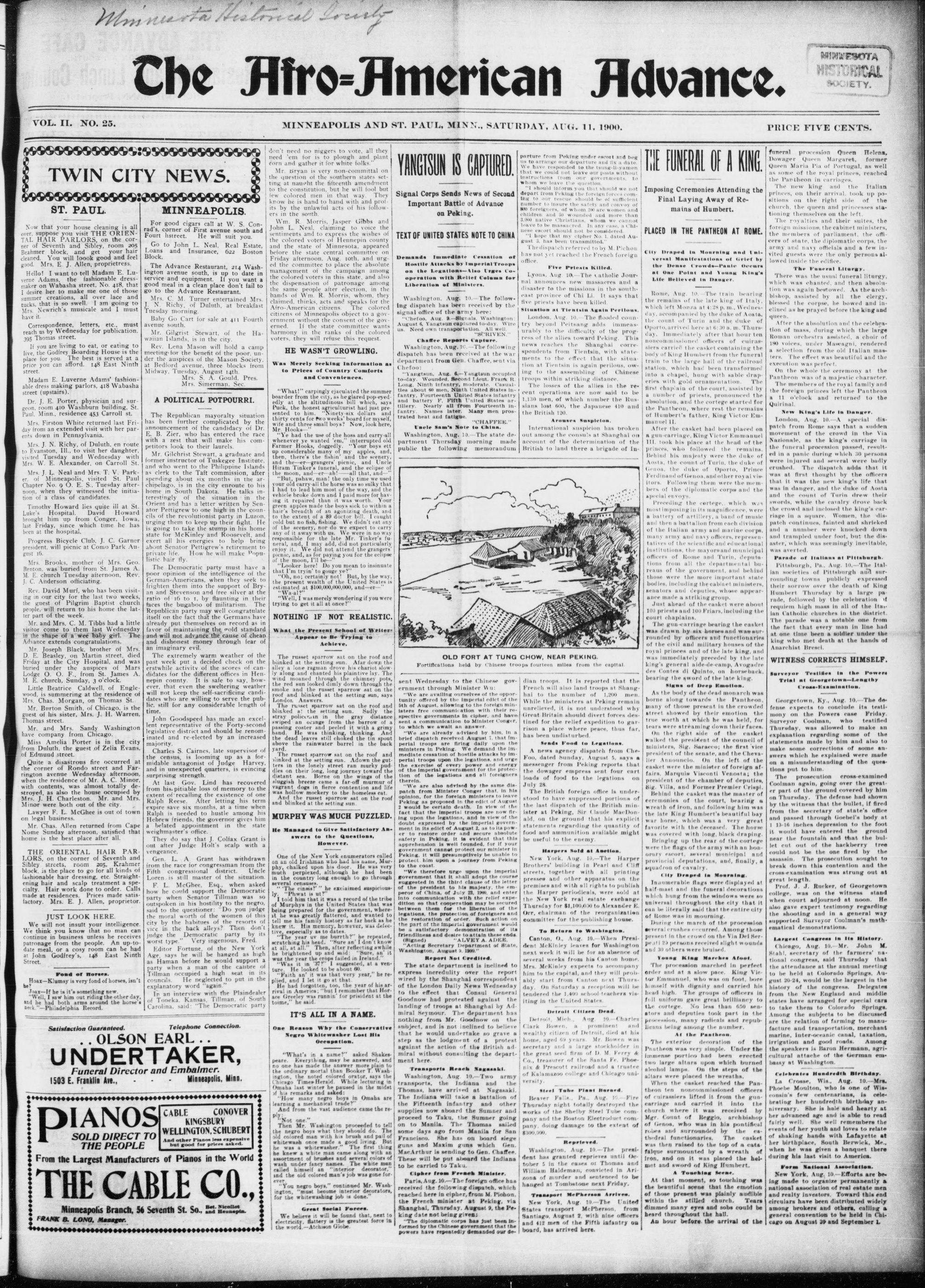
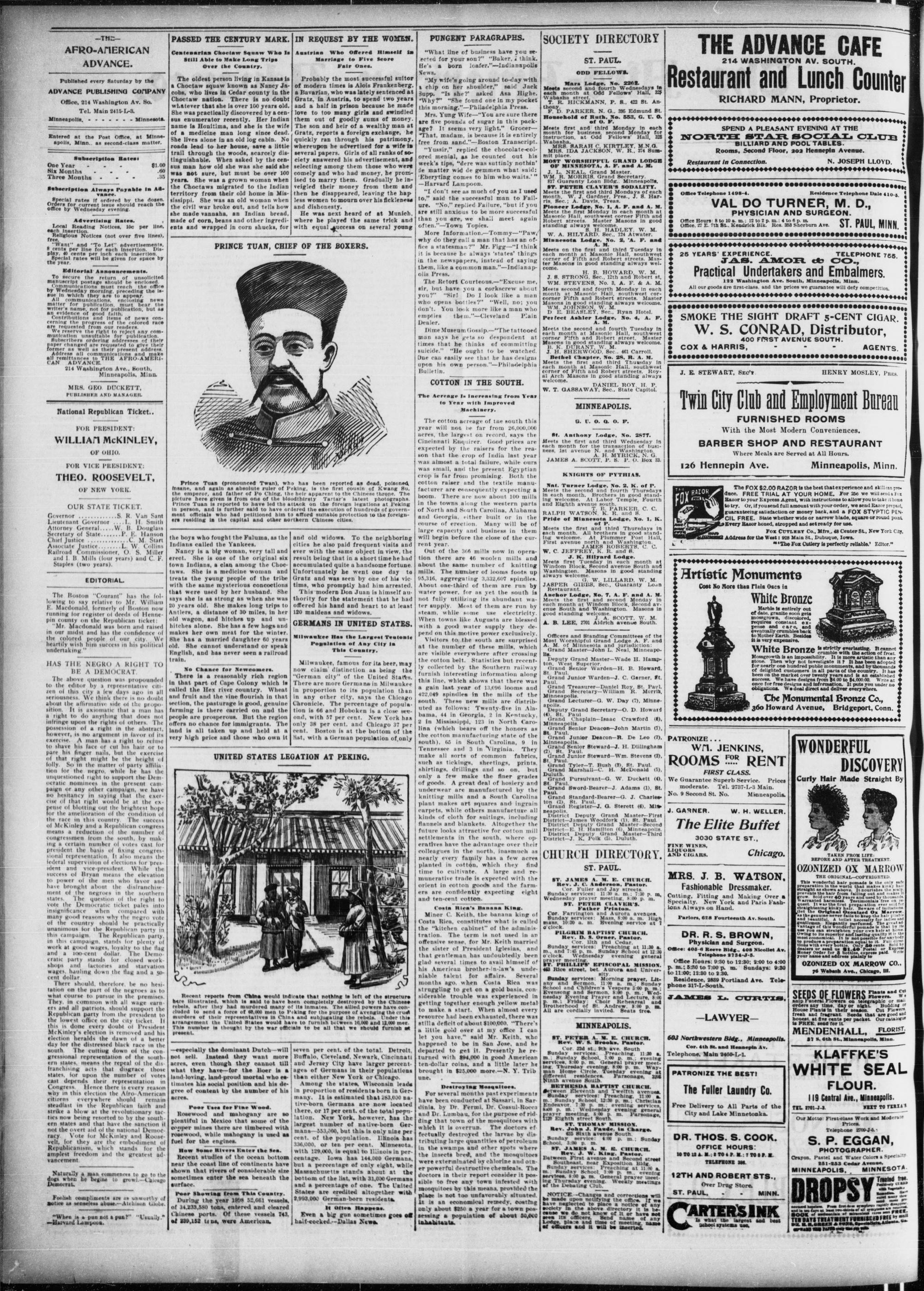
Page text (machine-generated)
TWIN CITY NEWS.
Satisfaction Guaranteed. Telephone Connection.
.. OLSON EARL ..
UNDERTAKER,
Funeral Director and Embalmer.
1503 E. Franklin Ave., Minneapolis, Minn.
PIANOS
SOLD DIRECT TO
THE PEOPLE
CABLE CONOVER
KINGSBURY
WELLINGTON, SCHUBERT
And other Pianos less expensive
but good for prices asked.
From the Largest Manufacturers of Pianos in the World
THE CABLE CO.,
Minneapolis Branch, 56 Seventh St. So., Bet. Nicollot
and Hennapin.
FRANK B. LONG, Manager.
VOL. II. NO. 25.
TWIN CIT
ST. PAUL.
Now that your house cleaning is all over, suppose you visit THE ORIENTAL HAIR PARLORS, on the corner of Seventh and Sibley, room 205 Beahmer block, and get your hair cleaned. You will look good and feel good. Mrs. E. J. Allen, proprietress.
Hello! I want to tell Madam E. Luverne Adams, the fashionable dressmaker on Wabasha street. No. 418, that I desire her to make me one of those summer creations, all over lace and tucks, that is so swell. I am going to Mrs. Newrich's musical and I must have it.
Correspondence, letters, etc., must reach us by Wednesday for publication. 395 Thomas street.
If you are living to eat, or eating to live, the Godfrey Boarding House is the place for you. The best is served at a price you can afford. 148 East Ninth street.
Madam E. Luverne Adams' fashionable dress making parlors, 418 Wabasha street (upstairs).
Dr. J. E. Porter, physician and surgeon, room 410 Washburn building, St. Paul, Minn. residence 453 Carroll st.
Mrs. Firston White returned last Friday from an extended visit with her parents down in Pennsylvania.
Mrs. J. N. Richy, of Duluth, en route to Evanston, Ill., to visit her daughter, visited Tuesday and Wednesday with Mrs. W. E. Alexander, on Carroll St. Mrs. J. L. Neal and Mrs. T. V. Parker, of Minneapolis, visited St. Paul Chapter No. 9 O. E. S. Tuesday afternoon, when they witnessed the initiation of a class of candidates. Timothv Howard lies quite ill at St. Luke's Hospital. David Howard brought him up from Conger, Iowa, last Friday, since which time he has been at the hospital. Progress Bicycle Club, J. C. Garner president, will picnic at Como Park August 16. Mrs. Brooks, mother of Mrs. Geo. Benton, was buried from St. James A. M. E. Church Tuesday afternoon, Rev. J. C. Anderson officiating. Rev. David Murf, who has been visiting in our city for the last two weeks, the guest of Pilgrim Baptist church people, will return to his home the latter part of the week.
Mr. and Mrs. C. M. Tibbs had a little visitor come to them last Wednesday in the shape of a wee baby girl. The Advance extends congratulations.
Mr. Joseph Black, brother of Mrs. D. E. Beasley, on Martin street, died Friday at the City Hospital, and was buried under the auspices of Mars Lodge O. O. F., from St. James A. M. E. church, Sunday, 3 o'clock.
Little Beatrice Caldwell, of Englewood, is summering at the residence of Mrs. Chas. Morgan, on Thomas St.
Mr. Burton Smith, of Chicago, is the guest of his sister, Mrs. J. H. Warren, Thomas street.
Mr. and Mrs. Sandy Washington have company from Chicago.
Miss Amelia Porter is in the city from Duluth, the guest of Zelia Evans, of Edmund street.
Quite a disastrous fire occurred at the corner of Rondo street and Farrington avenue Wednesday afternoon, when the residence of Mr. A. C. Minor, with contents, was almost totally destroyed, as also the house occupied by Mrs. J. H. Charleston. Mr. and Minor were both out of the city.
Lawyer F. L. McGhee is out of town on legal business.
Mr. Chas. Allen returned from Cape Nome Sunday afternoon, satisfied that home is the best place after all.
THE ORIENTAL HAIR PAR-LORS, on the corner of Seventh and Sibley streets, in 205, Krahmer block, is the place to go for all kinds of fashionable hair dressing, etc. Straightening hair and scalp treatment a special. Hair work done to order. Calls made at residences. Prices made satisfactory. Mrs. E. J. Allen, proprietor.
JUST LOOK HERE
We will not insult your intelligence.
We think you know that no man can continue in business unless he receives patronage from the people. An up-to-date meal, or a cosy room can be had at John Godfrey's, 148 East Ninth Street.
Fond of Horses.
Hoax—Klumsy is very fond of horses, isn't it he?
Joax—If he is it's something new.
"Well, I saw him out riding the other day, and he had both arms around the horse's neck."—Philadelphia Record.
Satisfaction Guaranteed.
.. OLSON
UNDER
Funeral Director
1503 E. Franklin Ave.,
PIANO
SOLD DIRECT
THE PEOPLE
The Afro=American Advance.
MINNEAPOLIS
For good cigars call at W. S. Conrad's, corner of First avenue south and Fourt hstreet. He will suit you.
Go to John L. Neal, Real Estate, Loans and Insurance, 622 Boston Block.
The Advance Restaurant, 214 Washington avenue south, is up to date in service and equipment. If you want a good meal in a clean place don't fail to go to the Advance Restaurant.
Mrs. C. M. Turner entertained Mrs. J. N. Rich, of Duluth, at breakfast Tuesday morning.
Baby Go Cart for sale at 411 Fourth avenue south.
Mr. Gilgrist Stewart, of the Hawaiian Islands, is in the city.
Rev. Lena Mason will hold a camp meeting for the benefit of the poor, under the auspices of the Mason Society, at Bedford avenue, three blocks from Midway, Tuesday, August 14th.
Mrs. S. A. Gould. Press.
Mrs. S. Simerman. Sec.
A POLITICAL POTPOURRI
The Republican mayoralty situation has been further complicated by the announcement of the candidacy of Dr. E. B. Zier, who has entered the race with a zest that will make his competitors look to their laurels.
Mr. Gilchrist Stewart, a graduate and former instructor of Tuskegee Institute, and who went to the Philippine Islands as clerk to the Taft commission, after spending about six months in the archipelago, is in the city enroute to his home in South Dakota. He talks interestingly of the situation in the Orient and has a letter written by Senator Pettigrew to one high in the councils of the revolutionist party in Luzon, urging them to keep up their fight. He is going to take the stump in his home state for McKinley and Roosevelt, and exert all his energies to help bring about Senator Pettigrew's retirement to private life. How he will make Populistic hair fly.
The Democratic party must have a poor opinion of the intelligence of the German-Americans, when they seek to frighten them into the support of Bryan and Stevenson and free silver at the ratio of 16 to 1, by flaunting in their faces the bugaboo of militarism. The Republican party may well congratulate itself on the fact that the Germans have already put themselves on record as in favor of maintaining the gold standard and will not advance the cause of chean and dishonest money through fear of an imaginary evil.
The extremely warm weather of the past week put a decided check on the erstwhile activity of the scores of candidates for the different offices in Hennepin county. It is safe to say, how many swollen hearts will not keep the self-sacrificing candidates who are willing to serve the public, still for any considerable length of time.
John Goodspeed has made an excellent representative of the Forty-second legislative district and should be renominated and re-elected by an increased majority.
Charles S. Cairns, late supervisor of the census, is looming up as a formidable antagonist of Judge Harvey, and in unexpected quarters, is evincing surprising strength. At last Gov. Lind has recovered from his pitiable loss of memory to the extent of recalling the existence of one Ralph Reese. After letting his term expire save six months, at a time when Ralph is needed to hustle among his Hebrew friends, the governor gives him a related appointment in the state weighmaster's office. They do say that J. Colax Grant is out after Judge Holt's scalp with a vengeance.
gen. L. A. Grant has withdrawn from the race for congressman from the Fifth congressional district. Uncle Loren is still master of the situation. F. L. McGhee, Esq., when asked how he could support the Democratic party when Senator Tillman was so outspoken in his hostility to the negro, said to the questioner: "Do you judge the moral worth of the women of this city by the habitues of the resorts of vice in the back alleys? Then don't judge the Democratic party by its worst type." Very ingenious, by Fred. Editor Fortune, of the New York Age, says he will be hanged as high as Haman before he would support a party when a man of the canbre of Tillman occupied a high seat in its councils. He neglected to put in the explanatory word "again."
In an interview with the Plaindealer of Toonek, Kansas, Tillman, of South Carolina, said: "The Democratic party
MINNEAPOLIS AND ST. PAUL, MINN., SATURDAY, AUG. 11, 1900.
don't need no niggers to vote, all they need 'em for is to plough and plant corn and gather it for white folks." Mr. Bryan is very non-committal on the question of the southern states setting at naught the fifteenth amendment to the constitution, but he will fool but few colored men in that way. They would not hand with and profits by the unlawful acts of his followers in the south.
Wm. R. Morris, Jasper Gibbs and John L. Neal, claiming to voice the sentiments and to express the wishes of the colored voters of Hennepin county and the state of Minnesota, appeared before the state central committee on Friday afternoon, Aug. 10th, and urged the committee to place the absolute management of the campaign among the colored voters in this state, and also the dispensation of patronage among the same people after election, in the hands of Wm. R. Morris, whom, they claimed, thinks, acts and speaks for the Airo-American citizens. The colored citizens of Minneapolis object to a government without the consent of the governed. If the state committee wants harmony in the ranks of the colored voters, they will refuse this request.
HE WASN'T GROWLING.
Was Merely Seeking Information as to Prices of Country Comforts and Conveniences.
"What!" carpingly ejaculated the summer boarder from the city, as he glared pop-eyedly at the altitudinous bill which, says Puck, the honest agriculturist had just presented to him. "Ninety-six dollars and thirty cents for two weeks' board for my wife and all three small boys? Now, look here. "Me" had the use of the hoss and carry all whenever ye wanted 'em," interrupted old Farmer Hooks, doggedly. "You boyt ess up considerable many of my apples, and, then, there's the fishin' and the scenery, and the—er—grangers' picnic, and Uncle the moon, and—er—ah'—all that, and—" "But, pahaw, man! the only time we used your old carry all the horse was so sulky that I had to lead him most of the way, and the vehicle broke down and I paid more for having it repaired than it was worth. Your green apples made the boys sick to waken a child, and the vehicle broke down to the extent of a $9 doctor bill. I caught cold but no fish, fishing. We didn't eat any of the scenery, nor do we expect to carry any of it away with us. We were in no way responsible for the late Mr. Tinker's funeral, and I may add, did not particularly appreciate the summer picnic, and, as for paying you for the eclipse of the moon, I'll be—"
"Looker here! Do you mean to insinuate that I'm tough to gouge you? But, by the way, the present wealth of the United States is estimated at $100,000,000, and—er—" "Well, I was merely wondering if you were trying to get it all at once?"
NOTHING IF NOT REALISTIC.
What, the Present School of Writers
Appear to Be Trying to
The russet sparrow sat on the roof and blinked at the setting sun. Afar down the alley a long ragman drove his charist slowly a long and chanted his plaintive lay. The wind moaned through the chimney pots, the red sun looked dimly down through the roof and blinked at the setting sun, says London. Answers.
The russet sparrow sat on the roof and blinked at the setting sun. Sadly the stray policeman in the gray distance swiped an orange from the barrow of a passing coster and peeled it with a grimy dead leaves still choked the tin spout above the rainwater barrel in the back yard.
The russet sparrow sat on the roof and blinked at the setting sun. Adown the gutters in the lonely street run murky paddies on their long, long journey toward the sluggish breeze came a far-off murmur of vagrant dogs in fierce contention and life was hollow mockery to the homeless cat.
And the russet sparrow sat on the roof
MURPHY WAS MUCH PUZZLED.
He Managed to Give Satisfactory Answers to the Questions, However.
One of the New York enumerators called on an old Irishman who had his name, Murphy, chalked upon his door. He was very proud, though, and had been in the country long enough to go through several censuses.
"The census?" he exclaimed suspiciously.
jy. "Phat is it?" I to him it was: a record of the tribe of Murray in the United States that was being prepared for the government, where it he was greatly flattered, and wanted to tell me his family history, as far back as he knew it. His memory, however, was defective, especially as to dates.
"The year uv me burth?" he repeated, scratching his head. "Sure I am. I fancied you. I was detecting while he brightened up and said: 'Sure, an' it wuz the year the crops failed in Ireland." "Was it in 37?" I suggested, at a venture. He looked to be about 60. "Faith an' it was that very year," he re-
plied, and I let it go at that.
He had forgotten, too, the year of his arrival in America, "but I remember that Horace was imprisoned for president at the tome, he said.
IT'S ALL IN A NAME.
One Reason Why the Conservative
Negro White waner Lost His
Bloody
"What's in a name?" asked Shakespeare. Everything, may be answered, and no one has made the answer more plain to the ordinary mortal than Booker T. Washington, the noted colored orator, says the Chicago Times Herald. While lecturing in Omaha last winter he paused in the midst of his remarks and asked:
"How many negro boys in Omaha are learning a mechanical trade?"
learning a mechanical trade:
And from the vast audience came the reply.
"Not one."
Then Mr. Washington proceeded to tell the negro boys what they should do. The old colored man with his brush and pail of whitewash once made a good living. But he was a whitewasher." The first thing he knew a white man came along with an assortment of brushes and several colors of wash under fancy names. The white man himself was an interior artist and the old colored man's job was gone forever.
"You negro boys," continued Mr. Washington, "must become interior decorators, for the whitewashing job is done."
Great Social Forces.
We believe it will be found that, next to the world, Atchison Globe
[Illustration of a village with a river, houses, and a fortress in the background].
OLD FORT AT TUNG CHOW, NEAR PEKING.
Fortifications held by Chinese troops fourteen miles from the capital
YANGTSUN IS CAPTURED
YANGTSUN IS CAPTURED
Signal Corps Sends News of Second Important Battle of Advance on Peking.
TEXT OF UNITED STATES NOTE TO CHINA
Demands Immediate Cessation of Hostile Attacks by Imperial Troops on the Legations—Also Urges Cooperation with Relief Column for Liberation of Ministers.
Washington, Aug. 10.—The following dispatch has been received by the signal office of the army here:
Chefoo, Aug. 9.—Signals, Washington: August 8 Yangtseum captured to-day. Wires us. Need own transportation. All well.
Chafee Reports Capture.
Washington, Aug. 10.—The following dispatch has been received at the war department from Gen. Chaffee, sent via Chefoo:
"Yangtung, Aug. 6.—Yangtung occupied to-day. Wounded. Second Lieut. Frank R. Long. Ninth infantry, moderate. Casualties of 60 men. Ninth United States infantry. Fourteenth United States infantry and battery F. Fifth United States artillery. Nearly all from Fourteenth infantry. Many men pro-cessed to bear and fatten.
"CHAFFEE."
Uncle Sam's Note to China.
Washington, Aug. 10.—The state department Thursday morning made public the following memorandum
OLD FORT AT TUNG
Fortifications held by Chinese tro
sent Wednesday to the Chinese government through Minister Wu: "We are availing ourselves of the opportunity offered by the imperial edict of the 5th of August, allowing to the foreign ministers free communication with their representatives, and presenting a communication to Minister Conger, to which we await an answer. "We are already advised by him, in a brief dispatch received August 5, that imperial troops are firing daily upon the Chinese people, in a mediate cessation of hostile attacks by imperial troops upon the legations, and urge the exercise of every power and energy of the imperial government for the protection of the legations and all foreigners
"We are also advised by the same dispatch from Minister Conger that, in his opinion, for the foreign ministers to leave Japan, the foreign ministers should 2 would be certain death. In view of the fact that the imperial troops are nowiring upon the legations, and in view of the doubt expressed by the imperial government that it should be possible to assist it to restore order and secure absolute safety in Peking, it is evident that this apprehension is well founded, for if your government cannot protect our minister in Peking, we presumptively protect him upon a journey from Peking to the coast.
"We therefore urge upon the imperial government that it shall adopt the course suggested in the third clause of the Act of Union 1837, to protect him upon a journey from Peking to the coast, of July 23, 1900, and enter into communication with the relief expedition so that cooperation may be secured between the imperial government and legations, the protection of foreigners and the restoration of order. Such action on the part of the imperial government would be a satisfactory demonstration of its firmness and desire to attain those ends (Bigrams).
"Acting Secretary Department of State Washington, August 9, 1990."
Report Not Credited.
The state department is inclined to express incredulity over the report wired by the Shanghai correspondent of the London Daily News Wednesday to the effect that Consul General Goodnow had protested against the landing of troops at Shanghai by Admiral Seymour. The department has nothing from Mr. Goodnow on the subject, and is not inclined to believe that he would undertake so grave a step as the lodgment of a protest against the action of the British admiral without consulting the department here.
Transporte Reach Nagasaki.
Washington, Aug. 19.—Two army transports, the Indiana and the Thomas, have arrived at Nagasaki. The Indiana will take a battalion of the Fifteenth infantry and other supplies now aboard the Sumner and proceed to Taku, the Sumner going on to Manila. The Thomas sailed some days ago from Manila for San Francisco. She has on board siege guns and Maxim guns which Gen. MacArthur is sending to Gen. Chaffee. These will be put aboard the Indiana to be carried to
Cipher from French Minister.
Paris, Aug. 10.—The foreign office has received the following dispatch, which reached here in cipher, from M. Pichon, the French minister at Peking, via Shanghai, Thursday, August 9, the Peking date not being given:
"The diplomatic corps has just been informed by the Chinese government that the powers have repeatedly demanded our de-
parture from Poking under escort and beg us to arrange our departure and fix a date. We have responded to the tung-i-yamen that we could not leave our posts without instructions from our governments, to whom we leave the question. We could not inform them should we not depart from Poking the foreign forces coming to our rescue should be of sufficient number to insure the safety and convoy of 80 foreigners, of whom 20 are women and children and 50 wounded and more than 3,000 native Christians, whom we cannot leave to be massacred. In any case, a Childs Trust would inform them. "I hope that my cipher 1. 1 dated August 3. has been transmitted." The dispatch referred to by M. Pichon has not yet reached the French foreign office.
Five Priests Killed
Lyons, Aug. 10.—The catholic Journal announces new massacres and a disaster to the missions in the southeast province of Chi Li. It says that five priests have been killed Situation at Tientsin Again Perilous London, Aug. 10.—The flooded country beyond Peitsang adds immeasurably to the difficulty of the progress of the allies toward Peking. This news reaches the Shanghai correspondents from Tientsin, with statements to the effect that the situation at Tientsin is again perilous, owing to the assembling of Chinese troops within striking distance. The losses of the allies in the recent operations are now said to be 1,130 men, of which number the Russians lost 600, the Japanese 410 and the British 120.
Arouses Suspicion
International suspicion has broken out among the consuls at Shanghai on account of the determination of the British to land there a brigade of In-
CHOW, NEAR PEKING.
Hops fourteen miles from the capital.
dian troops. It is reported that the French will also land troops at Shanghai to the number of 1,200 men. While the ministers at Peking remain unrelieved, it is not understood why Great Britain should divert forces destined for the relief expedition to garrison a place where peace, thus far, has been undisturbed.
Sends Food to Legations.
A news agency dispatch from CheeFoo, dated Sunday, August 5, says a messenger from Peking reports that the dowager empress sent four cart loads of food to the legations on July 28.
The British foreign office is understood to have suppressed portions of the last dispatch of the British minister at Peking, Sir Claude MacDonald, on the ground that his explicit statements regarding the quantity of food and ammunition available might be useful to the enemy.
Harpers Sold at Apetion.
New York, Aug. 10.—The Harper Brothers' building in Pearl and Cliff streets, together with all printing presses and other apparatus on the premises and with all rights to publish the Harper periodicals, were sold at the New York real estate exhange Thursday for $1,100,000 to Alexander E. Orr, chairman of the reorganization committee for the publishing house.
To Return to Washington.
Canton, O., Aug. 10.—When President McKinley leaves for Washington next week it will be for an absence of several weeks from his Canton home. Mrs. McKinley expects to accompany him to the capital, and they will probably start from Canton next Thursday. On Saturday a reception will be tendered the 1,400 school teachers visiting in the United States.
Detroit Citizen Dead.
Detroit, Mich., Aug. 19-Charles Clark Bowen, a prominent and wealthy citizen of Detroit, died at his home, aged 69 years. Mr. Bowen was secretary and a large stockholder in the great seed firm of D. M. Ferry & Co., treasurer of the Santa Fe, Phoenix & Prescott railroad and a trustee of Kalamazoo college and Chicago university.
Steel Tube Plant Hurred
Beaver Falls, Pa., Aug. 10—Fire
Thursday night totally destroyed the
works of the Shelby Steel Tube company
and the Boston Electroduct company,
doing damage to the extent of
£900,000.
Reprieved.
Washington, Aug. 10—The president has granted reprieves until October 5 in the cases of Thomas and William Haldeman, convicted in Arizona of murder and sentenced to be hanged at Tombatone next Friday.
Transport McPherson Arrives
New York, Aug. 19—The United States transport McPherson, from Santiago, August 2, with nine officers and 412 men of the Fifth infantry on board, has arrived here.
Imposing Ceremonies Attending the Final Laying Away of Remains of Humbert.
PLACED IN THE PANTHEON AT ROME
City Draped in Mourning and Universal Manifestations of Grief by the Dense Crowds-Panic Occurs at One Point and Young King's Life Believed in Danger.
---
Rome, Aug. 10. — The train bearing the remains of the late king of Italy, which left Monza at 4:28 p.m., Wednesday, accompanied by the duke of Aosta, the count of Turin and the duke of Oporto, arrived here at 6:30 a.m. Thursday. Immediately after that hour two noncommissioned officers of eurassiers carried the casket containing the body of King Humbert from the funeral train to the large hall of the railroad station, which had been transformed into a chapel, hung with sable draperies with gold ornamentation. The first chaplain of the court, assisted by a number of priests, pronounced the absolution, and the cortege started for the Pantheon, where rest the remains of Humbert's father, King Victor Emmanuel II.
After the casket had been placed on a gun-carriage, King Victor Emmanuel III, took his place at the head of the princes, who followed the remains. Behind his majesty were the duke of Aosta, the count of Turin, the duke of Genoa, the duke of Oporto, Prince Ferdinand of Genoa, and other royal advisors. Following them were the members of the diplomatic corps and the special envoys.
Preceding the cortege, which was most imposing in its magnificence, were a battery of artillery, a band of music and then a battalion from each division of the Italian army and marine corps, many army and navy officers, representatives of the scientific and educational institutions, the mayorand municipal officers of Rome and Turin, deputations from all the departmental bureau of the government, and behind those were the more important state bodies, including the cabinet ministers, senators and deputies, whose appearance made a striking group.
Just ahead of the casket were about 100 priests and 100 Friars, including the court chaplains.
The gun-carriage bearing the casket was drawn by six horses and was surrounded by officers and functionaries of the civil and military houses of the royal princes and of the late king, and was immediately preceded by the late king's general aide-de-camp, Avogadre des Contes di Quinto, on horseback, bearing the sword of the late king.
Signs of Deep Emotion.
As the body of the dead monarch was borne along towards the Pantheon, many of those present in the crowded street showed by their emotion the true worth at which he was held, for tears were streaming down their faces. On the right side of the casket walked the president of the council of ministers, Sig. Saracco; the first vice president of the senate, and the Chevalier Announcio. On the left of the casket was the minister of foreign affairs, Marquis Visconti Venosta; the president of the chamber of deputies, Sig. Villa, and Former Premier Crisp. Behind the casket was the master of ceremonies of the court, bearing a wreath of iron, and following him was the late King Humbert's beautiful bay war horse, which was a very great favorite with the deceased. The horse was covered with long, black draping. Bringing up the rear of the cortegue were the flags of the army with an honorary escort, several municipal and provincial deputations, and, finally, a squadron of cavalry.
City Draped in Mourning.
Inumerable flags were displayed at half-mast and the funeral decorations which hung from the windows were so universal throughout the city that it can be literally said that the entire city of Rome was in mourning. During the march of the procession several crushes occurred. Among those present in the crowd on the Via Del Serpente 20 persons received slight wounds and 30 others were bruised.
Young King Marches Afoot.
The procession marched in perfect order and at a slow pace. King Victor Emmanuel, who was on foot, bore himself with dignity and carried his head high. The groups of officers in full uniform gave great brilliance to the cortege. No less than 650 senators and deputies took part in the procession, many radicals and republicans being among the number.
At the Pantheon.
The exterior decoration of the Pantheon was very simple. Under the immense portico had been erected two large altars upon which burned alcohol lamps. On the steps of the altars were placed the wreaths. When the casket reached the Pantheon ten noncommissioned officers of cuirassiers lifted it from the gun-carriage and carried it into the church where it was received by Mgr. Count of Hegglo, archbishop of Genoa, who was in his pontifical robes and surrounded by the cathedral functionaries. The casket was then raised to the top of a catafalque surmounted by a wreath of iron, and on it was placed the helmet and sword of King Humbert.
A Touching Scene
At that moment, so touching was the beautiful scene that the emotion of those present was plainly audible within the stilled church. Tears dimmed many eyes and sobs could be heard throughout the hall.
An hour before the arrival of the
MINNESOTA
HISTORICAL
SOCIETY.
PRICE FIVE CENTS.
funeral procession Queen Helena, Dowager Queen Margaret, former Queen Maria Pia of Portugal, as well as some of the royal princes, reached the Pantheon in carriages. The new king and the Italian princes, on their arrival, took up positions on the right side of the church, the queen and princesses stationing themselves on the left. The royalties and their suites, the foreign missions, the cabinet ministers, the members of parliament, the officers of state, the diplomatic corps, the army and navy officials and a few invited guests were the only persons allowed inside the edifice.
The Funeral Liturgy.
There was the usual funeral litterry, which was chanted, and then absolution was again bestowed. As the archbishop, assisted by all the clergy, blessed the corpse, he bowed and inclined as he prayed before the king and queen.
After the absolution and the celebration of mass, during which the large Roman orchestra assisted, a choir of 180 voices, under Maseagni, rendered a selection from the old Italian masters. The effect was beautiful and the execution was perfect.
On the whole the ceremony at the Pantheon was of a majestic character. The members of the royal family and the foreign princes left the Pantheon a 11 o'clock and returned to the Quirinal.
New King's Life in Danger.
London, Aug. 10.—A special dispatch from Rome says that a sudden movement of the crowd in the Via Nazionale, as the king's carriage in the funeral procession passed, resulted in a panic during which 30 persons were injured and several were badly crushed. The dispatch adds that it was at first thought by the officers that it was the new king's life that was in danger, and the duke of Aosta and the count of Turin drew their swords, while the cavalry drove back the crowd and inclosed the king's carriage in a square. Women, the dispatch continues, fainted and shrieked and a number were knocked down and trampled under foot, but the disaster, which was seemingly inevitable, was averted.
Parade of Italiana at Pittsburgh.
Pittsburgh, Pa. Aug. 10.—The Italian societies of Pittsburgh and surrounding towns publicly expressed their sorrow over the death of King Humbert Thursday by a large parade, followed by the celebration of requiem high mass in all of the Italian Catholic churches in the district. The parade was a notable one from the fact that every man in line had at one time been a soldier under the king who met death at the hands of Anarchist Bresel.
WITNESS CORRECTS HIMSELF.
Surveyor Testifies in the Powers Trinal at Georgetown—Lengthy Cross-Examination.
Georgetown, Ky., Aug. 10.—The defense expects to conclude its testimony on the Powers case Friday. Surveyor Coolman, who testified Thursday, was allowed to make an explanation regarding some of the statements made by him and also to make some corrections of some answers which he explained were made on a misunderstanding of the questions put to him.
The prosecution cross-examined Coolman again, going over the greater part of the ground covered by him on Thursday. The defense had shown by the witness that the bullet, if fired from the secretary of state's office and passed through Goebel's body at 11:36 inches depression to the foot it would have entered the ground near the fountain and that the bullet cut out of the hackberry tree could not be the one fired by the assassin. The prosecution sought to break down this contention and the cross-examination was stung out at great length.
Prof. J. J. Rucker, of Georgetown college, was on the witness stand when court adjourned at noon. He also gave expert testimony regarding the shooting and in a general way supported Surveyor Coolman's mathematical demonstrations.
Largest Congress in Its History.
Chicago, Aug. 10.—Mr. John M. Stahl, secretary of the farmers' national congress, said Thursday that the attendance at the annual meeting to be held at Colorado Springs. August 20-24, would be the largest in the history of the congress. Delegates from the New England and middle states have arranged for special cars to take them to Colorado Springs. Among the subjecta to be discussed are the relation of farming to manufacture and transportation, merchant marine, Inter-oceanic canal, taxation, irrigation and good roads. Among the speakers is Baron Hermmann, agricultural attachc of the German embassy at Washington.
Celebrates Hundredth Birthday
La Crosse, Wis., Aug. 10.—Mrs. Phoebe Moulton, who is one of Wisconsin's few centenarians, is celebrating her hundredth birthday anniversary. She is haile and hearty at her advanced age and is able to read fairly well. She well remembers the events of her youth and loves to relate of shaking hands with Lafayette at her birthplace, South Berwick, Me., when he was given a banquet there during his last visit to America.
Form National Association.
New York, Aug. 10—Efforts are being made to organize permanently a national association of real estate men and reality investors. Toward this end circulars have been distributed widely among brokers and others, calling a general convention to be held in Chicago on August 29 and September 1.
Published every Saturday by the
ADVANCE PUBLISHING GOTIPANY
Minneapolis, . . . . . . Minnesota
Entered at the Post Office, at Minneapolis, as second-class matter.
One Year - - - - $1.00
Six Months - - - - .60
Three Months - - - .55
Special rates if ordered by the dozen.
The office will reach the office by Wednesday evening.
Advertising Keeps:
"Want" and "To Let" advertisements, 8 cents per line for each insertion. Dispense cents per inch each insertion. Special rates will be given for space by the year.
Editorial Announcements.
All communications, enclosing news for publication, must bear the writer's name and publication, but as an evidence of good faith, contributions and items of news concerning the request of the honored race are requested from our readers. We reserve the right to reject any communication unavailable to subscribers ordering addresses of their paper changed are requested to give their forms as well as their present address. Address all requests to THE AFRO-AMERICAN ADVANCE 214 Washington Ave., South, Minneapolis, Minn.
MRS. GEO DUCKETT, PUBLISHER AND MANAGER.
National Republican Ticket..
FOR PRESIDENT:
WILLIAM McKINLEY,
OF OHIO.
FOR VICE PRESIDENT:
THEO. ROOSEVELT,
OF NEW YORK.
OUR STATE TICKET.
Governor ..... S. R. Van Sant
Lieutenant Governor ..... L. H. Smith
Attorney General ..... W. B. Douglass
Secretary of State ..... P. E. Hanson
Chief Justice ..... C. M. Start
Associate Justice ..... L. W. Collins
Railroad Commissioner, O. S. Miller
and I. B. Mills (four years) and C. F.
EDITORIAL
The Boston "Courant" has the following to say relative to Mr. William E. Macdonald, formerly of Boston now running for register of deeds of Hennepin county on the Republican ticket: "Mr. Macdonald was born and raised in our midst and has the confidence of the colored people of our city. We heartily wish him success in his political undertaking."
HAS THE NEGRO A RIGHT TO
BE A DEMOCRAT.
The above question was propounded to the editor by a representative citizen of this city a few days ago in all seriousness. We think there is no doubt about the affirmative side of the proposition. It is axiomatic that a man has a right to do anything that does not infringe upon the rights of others. The possession of a right in the abstract, however, is no argument in favor of its exercise. A man has a right to refuse to shave his face or cut his hair or to pare his finger nails, but the exercise of that right might be the height of folly. So in the matter of party affiliation for the negro, while he has the unquestioned right to support the Democratic nominees in the present campaign or any other campaign, we have the right to say in saying that the exercise of that right is the expense of blotting out the brightest hope for the amelioration of the condition of the race in this country. The success of McKinley and a Republican congress means a reduction of the number of congressmen from the south, by making a certain number of votes cast for president the basis of fixing congressional representation. It also means the federal supervision of elections for president and vice-president. While the success of Bryan means the elevation to power of the men who favor and have brought about the dischernishment of the negroes in the southern states. The question of the right to vote the Democratic ticket pales into insignificance when compared with many good reasons why the negro vote of the country should be practically necessary for the negroes to play in this campaign. The Republican party in this campaign, stands for liberty, work at good wages, loyalty to the flag and a 100-cent dollar. The Democratic party stands for closed workshops and factories and starvation wages, hauling down the flag and a so-cent dollar.
There should, therefore, be no hesitation on the part of the negroes as to what course to pursue in the premisses. They, in common with all wage earners and all patriots, should support the Republican party from the president to the lowest office on the city ticket. If this is done every doubt of President Clinton's election is removed and his election fails the drama, better day for the distressed black race is south. The cutting down of the congressional representation of the southern states, means the repeal of the disfranchising acts that disgrace those states, for upon the number of votes cast depends their representation in Congress. Hence there is every reason why in this election the Afro-American citizens everywhere should remain steadfast in the Republican faith and strike a blow at the revolutionary tacitities in the southern states and that have the situation not the overt aid of the national Democracy. Vote for McKinley and Roosevelt, for they are the embodiment of Republicanism, which stands for the amplest freedom and the greatest advancement.
Naturally a man commences to go to the dogs when he begins to growl.—Chicago Democrat.
Foolish compliments are as unworthy of notice as senseless abuse.—Atchison Globe.
"When is a pun not a pun?" "Usually."
—Harvard Lampoon.
PRINCE TUAN, CHIEF OF THE BOXERS.
Prince Tuan (pronounced Twan), who has been reported as dead, poisoned, insane, and again as absolute ruler of Peking, is the first cousin of Kwang Su, the emperor, and father of Yo Ching, the heir apparent to the Chinese throne. The emperor, who was a member of the Chinese imperial family, Prince Tuan is reported to have led the attack on the foreign legations at Peking in person, and is further said to have ordered the execution of hundreds of government officials who had petitioned him to afford suitable protection to the foreign legations.
THE BAR
Recent reports from China would indicate that nothing is left of the structure here illustrated, which is said to have been completely destroyed by the Chinese authorities. The United States would be obliged to send a force of 60,000 men to Peking for the purpose of avenging the cruel murders of their representatives in China and subjugating the rebels. Under this arrangement the United States would have to furnish between 10,000 and 12,000 mer. The number is thought by the war officials to be all that we should furnish at present.
Recent reports from China would indicate that nothing is left of the structure here illustrated, which is said to have been completely destroyed by the Chinese authorities. The United States would be obliged to send a force of 60,000 men to Peking for the purpose of avenging the cruel murders of their representatives in China and subjugating the rebels. Under this arrangement the United States would have to furnish between 10,000 and 12,000 mer. The number is thought by the war officials to be all that we should furnish at present.
PASSED THE CENTURY MARK.
Centenarian Choctaw Squww Who Is Still Able to Make Long Trips Over the Country.
The oldest person living in Kansas is a Choctaw squaw known as Nancy Jacobs, who lives in Cedar county in the Choctaw nation. There is no doubt whatever that she is over 100 years old. She was practically discovered by a census enumerator recently. Her Indian name is Honitima, and she is the wife of a medicine man long since dead. She lives alone in an old log cabin. No roads lead to her house, save a little trail through the woods, scarcely distinguishable. When asked by the census man how old she was she said she was not sure, but must be over 100 years. She was a grown woman when the Choctaw migrated to the Indian territory from their old home in Mississippi. She was an old woman when the civil war broke out, and tells how she made vanilla, an Indian bread, made of corn, beans and other ingredients and wrapped in corn shucks, for
PRINCE TUAN, CHINA
Prince Tuan (pronounced Twan), who insane, and again as absolute ruler of Peking, emperor, and father of Ye Ching, the picture here given is from one of the bloody Prince Tuan is reported to have led the siege in person, and is further said to have ornament officials who had petitioned him to reside in the capital and other no
the boys who fought the Faluma, as the Indians called the Yankees. Nancy is a big woman, very tall and erect. She is one of the original six town Indians, a clan among the Choetaws. She is a medicine woman and treats the young people of the tribe with the same mysterious concoctions that were used by her husband. She says she is as strong as when she was 20 years old. She makes long trips to Antlers, a distance of 30 miles, in her old wagon, and hitches up and unhitches alone. She has a few hogs and makes her own meat for the winter. She has a married daughter 60 years old. She cannot understand or speak English, and has never seen a railroad train.
No Chance for Newcomers
There is a reasonably rich region in that part of Cape Colony which is called the Hex river country. Wheat and fruit and the vine flourish in that section, the pasturage is good, genuine farming is there carried on and the people are prosperous. But the region offers no chance for immigrants. The land is all taken up and held at a very high price and those who own it
UNITED STATES LE
Recent reports from China would in be illustrated, which is said to have be rebels, after they had murdered many cluded to send a force of 60,000 men to be murders of their representatives in China arrangement the United States would have This number is thought by the war office present.
—especially the dominant Dutch—will not sell. Instead they want more acres, even though they cannot till what they have—for the Boer is a land-loving, land-proud mortal who estimates his social position and his degree of content by the number of his acres.
Poor Faca for Fine Wood
Rosewood and mahogany are so plentiful in Mexico that some of the copper mines there are timbered with rosewood, while mahogany is used as fuel for the engines.
How Some Rivers Enter the Sea.
Recent studies of the ocean bottom near the coast line of continents have shown that rivers of considerable size sometimes enter the sea beneath the surface.
Poor Showing from This Country.
During the year 1698 52,661 vessels, of 34,233,580 tons, entered and cleared Chinese ports. Of these vessels 743, of 230,152 tons, were American.
IN REQUEST BY THE WOMEN.
Austrian Who Offered Himself in Marriage to Five Score Fair Ones.
Probably the most successful suitor of modern times is Alois Frankenberg, a Bavarian, who was lately sentenced at Gratz, in Austria, to spend two years and a half in prison because he made love to too many girls and swindled them out of goodly sums of money. The son and heir of a wealthy man at Gratz, reports a foreign exchange, he quickly ran through his patrimony, whereupon he advertised for a wife in several papers. Girls of all ranks of society answered his advertisement, and selecting among them those who were comely and who had money, he promised to marry them. Gradually he inveigled their money from them and then he disappeared, leaving the hapeless woman to mourn over his fickleness and dishonesty.
He was next heard of at Munleh, where he played the same trick and with equal success on several young
REF OF THE BOXERS.
so has been reported as dead, poisoned
Peking, is the first cousin of Kwang Su,
heir apparent to the Chinese throne. The
oddhirrty Tartar's latest photographs.
attack on the foreign legations at Peking
derived the execution of hundreds of govern-
no afford suitable protection to the foreign-
northern Chinese cities.
and old widows. To the neighboring cities he also paid frequent visits and ever with the same object in view, the result being that in a short time he had accumulated quite a handsome fortune. Unfortunately he went one day to Gratz and was seen by one of his victims, who promptly had him arrested.
This modern Don Juan is himself authority for the statement that he had offered his hand and heart to at least 120 maidens and widows.
GERMANS IN UNITED STATES.
Milwaukee Has the Largest Teutonic Population of Any City in This Country.
Milwaukee, famous for its beer, may now claim distinction as being the "German city" of the United States. There are more Germans in Milwaukee in proportion to its population than in any other city, says the Chicago Chronicle. The percentage of population is 66 and Hoboken is a close second, with 57 per cent. New York has only 38 per cent and Chicago 37 per cent. Boston is at the bottom of the list, with a German population of only
GATION AT PEKING.
dicate that nothing is left of the structure been completely destroyed by the Chinese of its inmates. The allied powers have con-
eking for the purpose of avenging the crusta and subjugating the rebels. Under this have to furnish between 16,000 and 12,000 mer-
ials to be all that we should furnish at
seven per cent of the total. Detroit, Buffalo, Cleveland, Newark, Cincinnati and Jersey City have larger percentages of Germans in their populations than either New York or Chicago. Among the states, Wisconsin leads in proportion of residents born in Germany. It is estimated that 283,000 native-born Germans are now located there, or 17 per cent. of the total population. New York, however, has the largest number of native-born Germans—353,000, but this is only nine per cent. of the population. Illinois has 336,000, or ten per cent. Minnesota, with 129,000, is equal to Illinois in percentage. Iowa has 144,000 Germans, but a percentage of only eight, while Massachusetts stands about at the bottom of the list, with 31,000 Germans and a percentage of one. The United States are credited altogether with 2,993,000 German-born residents.
It Often Happens.
Even a big gun sometimes goes off half-cocked.--Dallas News.
PUNGENT PARAGRAPHS.
"What line of business have you selected for your son?" "Baker, I think. He's a born loafer."—Indianapolis News.
"My wife's going around to-day with a chip on her shoulder," said Jack Supp. "Is she? asked Asa Highe. Why? "She found one in my pocket this morning."—Philadelphia Press.
Mery. Yung Wife="You are sure there are five pounds of sugar in this package. It seems very light." Grocer="That, madam, is because it is entirely free from sand."—Boston Transcript.
"Ussir," replied the chocolate-colored menial, as he counted out his week's tips, "dere was suttinly nothin' de matter wid de gemmen what said; 'Eberytting comes to him who waits.'"—Harvard Lampoon.
"I don't see as much of you as I used to," said the successful man to Failure. "No," replied Failure, "but if you are still anxious to be more successful than you are, we shall meet again often."—Town Topics.
More Information—Tommy—"Paws, why do they call a man that has an office a statesman?" Mr. Gigg—"I think it is because he always 'states' things in the newspapers, instead of saying them, like a common man."—Indianapolis Press.
The Retort Courteous—"Excuse me, sir, but you have a corkscrew about you?" "Sir! Do I look like a man who opens bottles?" "Well, no; you don't. You look more like a man who empties them."—Cleveland Plain Dealer.
Dime Museum Gossip—"The tattooed man says he gets so despondent at times that he thinks of committing suicide." "He ought to be watched.
One can easily see that he has designs upon his own person."—Philadelphia Bulletin.
COTTON IN THE SOUTH.
The Aerenge Is Increasing from Year to Year with Improved Machinery.
The cotton acreage of the south this year will not be far from 26,000,000 acres, the largest on record, says the Cincinnati Enquirer. Good prices are expected by the raisers for the reason that the crop of India last year was almost a total failure, while ours was small, and the present Egyptian crop is far from promising. Both the cotton raiser and the textile manufacturer are consequently expecting a boom. There are now about 100 mills in the towns along the western parts of North and South Carolina, Alabama and Georgia, either built or in the course of erection. Many will be of large capacity and business in them will begin before the close of the current year.
Out of the 366 mills now in operation there are 46 woken mills and about the same number of knitting mills. The number of looms foots up 95,316, aggregating 3,332,607 spindles. About one-third of them are run by water power, for as yet the south is not fully utilizing its abundant water supply. Most of them are run by steam, while some use electricity. When towns like Augusta are blessed with a good water supply they depend on this motive power exclusively. Visitors to the south are surprised at the number of these mills, which are visible everywhere after crossing the cotton belt. Statistics but recently collected by the Southern railway furnish interesting information along this line, which shows that there was a gain last year of 13,096 looms and 422,049 spindles in the mills of the south. These new mills are distributed as follows: Twenty-five in Alabama, 44 in Georgia, 2 in Kentucky, 2 in Mississippi, 123 in North Carolina (which bears off the honors as the cotton manufacturing state of the south), 65 in South Carolina, 9 in Tennessee and 3 in Virginia. They make all sorts of common fabrics, such as tickings, sheetings, prints, shirting, drillings and so on, but only a few make the finer grades of goods. A great deal of hosiery and underwear are manufactured by the knitting mills and a South Carolina plant makes art squares and ingrain carpets, while others manufacture all kinds of cloth for suitings, including flannels and blankets. Altogether the future looks attractive for cotton mill settlements in the south, where operatives have the advantage over their colleagues in the north, inasmuch as nearly every family has a few acres planted in cotton, which they find time to cultivate. A large and remunerative trade is expected with the orient in cotton goods and the farmers are confidently expecting eight and ten-cent cotton.
Costa Rica's Banana King.
Minor C. Keith, the banana king of Costa Rica, constitutes what is called the "kitchen cabinet" of the administration. The term is not used in an offensive sense, for Mr. Keith married the sister of President Iglesias, and that gentleman has undoubtedly been glad several times to avail himself of his American brother-in-law's undeniable talent for affairs. Several months ago, when Costa Rica was struggling to get on a gold basis, considerable trouble was experienced in getting together enough yellow metal to make a start. When almost every resource had been exhausted, there was still a deficit of about $100,000. "There's a little gold over at my office I can let you have," said Mr. Keith, who happened to be in San Jose, and he departed to be in San Jose, and he returned with $94,000 in good American ten-dollar coins, and a little later he brought in $25,000 more.—N. Y. Tribune.
Destroying Mosquitoes.
For several months past experiments have been conducted at Sassari, in Sardinia, by Dr. Fermi, Dr. Cossul-Rocca and Dr. Lumbau, for the purpose of ridding that town of the mosquitoes with which it is overrun. The doctors effectually destroyed the larvae by distributing large quantities of petroleum in the swamps and other spots where the insects breed, and the mosquitoes were exterminated by chlorine and other powerful destructive chemicals. The doctors in their report consider it possible to free any town infested with mosquitoes by this means, provided the place is not too unfavorably situated. it is an economical remedy, costing only about $250 a year for a town possessing a population of about 50,000 inhabitants.
SOCIETY DIRECTORY
ST. PAUL.
ODD FELLOWS.
Mars Lodge, No. 2202.
Meets second and fourth Wednesdays in
each month at Odd Fellows' Hall, 22
Wabasha street.
Meets first and third Monday in each month for business, second Monday for instruction, at Odd Fellows' Hall, 223 Wabasa.
MRS. SARAH C. KIRTLEY. M.N.G.
A JACKSON, W. R. R. 74
mount place.
MOST WORSHIPFUL GRAND LODGE OF MINESOTA, A. F. and A. M.
J. L. NEAL, Grand Master.
J. W. JARDNER, Pres., J. S. Har-
lton, 87 Guaranty Loan Bldg. Minneapolis.
ST. PETER CLAYER'S SODALITY.
Meets the first and third Mondays of each month.
W. J. Gardner, Pres., J. S. Har-
lton, 87 Guaranty Loan Bldg. Minneapolis.
ST. PETER CLAYER'S SODALITY.
Meets the first and third Mondays of each month at Masonic Hall, southwest corner Fifth and standing always welcome.
S. H. HADLEY, W. M.
W. A. HILYARDS, 224 Atwater.
Minnesota Lodge, No. 2 'A. F. and A. M.
Meets on the first and third Tuesday in September corner of Fifth and Robert streets. Master Masons in good standing always welcome.
H. B. HOWARD, W. M.
J. S. STRONG, Sec., 12th and Robert st.
WM. STEVENS, No. 3, A. F. & A. M.
Meets second and fourth Monday in each corner Fifth and Robert streets. Master Masons in good standing always welcome.
WM. JOHNSON, W. M.
D. E. HEASLEY, Ryan Hotel.
Perfect Ashler Lodge, No. 4, A. F. A. M.
Meets the second and fourth Tuesday in
corner Fifth and Robert street. Master
Masons in good standing always welcome.
J. H. SHERWOOD, Sec. 461 Carroll.
Bethel Chapter, No. 28, R. A. M.
Mason in each month at Masonic Hall, southwest
corner of Fifth and Robert streets. Roy-
less Masons in good standing always
welcome.
DANIEL ROY, H. P.
W. T. GASSAWAY, Sec., State Capitol.
MINNEAPOLIS.
G. U. O. Q. O. F.
St. Anthony Lodge, No. 2877.
Meets the first and third Wednesday in
each month for the transaction of business,
1st avenue and Washington.
A. H. MEYER, N. G.
JAMES A. SCOTT, P. S. P. O. Box 33.
KNIGHTS OF PYTHIAS
Nat. Turner Lodge, No. 2, K. of P.
Meets the second and fourth Thursdays in each month, including welcome. At Labor Temple, Fourth and Eighth avenue south.
RALPH WATSON, K. R. and C.
Pride of Minnesota Lodge, No. 1, K.
Meets the first and third Thursdays in each month. All brothers in good standing attend. First avenue north and Washington.
JAMES ROBERTS, C. C.
W. C. JEFFREY, C. C.
J. K. Hilyard Lodge.
Meets first Tuesday in each month at Windom Block, Second avenue South and Washington. Masons in good standing
G. W. LILLARD, W. M.
JASPER GUESS, Sec. Guaranty Loan
Restaurant.
Anchor Lodge, No. 7. A. F. and A. M.
Meets the first and second Monday in
each week. Block, Second Avenue
South and Washington. Mansions
in good standing welcome.
J. A. SCOTT, W. M.
A. B. LEE, 761 Aldrich avenue South.
Officers and Standing Committees of
the Most Worshipful Grand Lodge A. F. and
A. M. of Minnesota and jurisdiction:
Grand Master-John L. Neal, Minneapolis
Deputy Grand Master—Wade H. H. Hampton West Superior.
Grand Senior Warden—H. B. Howard, St. Paul.
Grand Junior Warden—J. C. Garner, St. Paul.
Grand Treasurer—Daniel Roy, St. Paul.
Grand Secretary—William R. Morris, Minneapolis.
Grand Lecturer—G. W. Day (7), Minneapolis.
Deputy Grand Secretary—O. D. Howard (4), St. Paul.
Grand Chaplain—Isaac Crawford (4), Minneapolis.
Grand Senior Deacon—John Martin (1), St. Paul.
Grand Junior Deacon—R. De Leo (7), Minneapolis.
Grand Steward—J. H. Dillingham (2), St. Paul.
Grand Junior Steward-Wm. Stevens (3), St. Paul.
Grand Tyler—T. Bush (3), St. Paul.
Grand Marshall—C. H. McDonald (5), Minneapolis.
Grand Pursulvant—G. W. Duckett (4), St. Paul.
Grand Sword-Bearer—J. Adams (1), St. Paul.
Grand Standard-Bearer—J. Charleston (2), St. Paul.
Grand Register—J. G. Sterett (6), Minneapolis.
District Deputy Grand Master—First District Deputy Grand Master—Second District Deputy Grand Master—Second District—E. H. Hamilton (6) . Minneapolis. Third District—K. K. Polk (5) . Duluth.
CHURCH DIRECTORY.
ST. JAMES A. M. E. CHURCH, Rev. J. C. Anderson, Pastor.
Cor. Fulier and Jay streets.
Sunday services: 11:30 a. m.; 7:30 p. m., Wednesday prayer meeting, 8:00 p. m.
ST. PETER CLAVER'S, Father Printon.
Cor. Farrington and Aurora avenues.
Sunday services: Mass, 8:00 a. m. High mass, 10:30 a. m. Evening service at 7 o'clock.
PILGRIM BAPTIST CHURCH, Rev. D. S. Orner, Pastor.
Cor. 13th and Cedar.
Sunday services: Preaching at 11:30 a. m., and 7:45 p. m. Sunday School at 12:30 o'clock. Wednesday evening general prayer meeting.
ST. PHILLIPS' EPISCOPAL MISSION, 463 Rice street, bet. Aurora and University.
Sunday services: Morning prayer, Litany and Sermon, 11:00 a. m.; Sunday School and Children's Vespers, 3:00 p. m.; Evening and Sermon, 8:00 p. m.; Wednesday Evening Prayer and Lecture, 8:00 p. m.; Friday: Choir Rehearsal and Brotherhood of St. Andrew, 8:00 p. m. All are cordially invited. Seats free.
MINNEAPOLIS.
ST. PETER A. M. E. CHURCH
Rev. W. S. Brooks, Pastor.
or, 282 p. m.; Shave, South
Sunday school, 12:30 p. m.;
m.; Sunday School, 5:00 p. m.;
m.; evening services, 8:00 p. m. General prayer meeting,
Thursday evening, 8:00 p. m. Way-
wardness, 8:00 p. m. Evening meeting at
different residences. Parasonage, 288
Ninth avenue South. BETHESDA BAPTIST CHURCH.
between Eleventh and Twelfth avenues.
m.; Sunday School, 12:30 p. m.; Christian
Endeavor, 7:30 p. m.; evening services,
8:00 p. m. Wednesday evening general
m.; Sunday School, 12:30 p. m.; Parsonage,
120th Eighth street South.
ST. JOHN'S CHURCH
Rev. J. W. King, Pastor
Between First avenue and Second street
Southeast, near Exposition Bldg.
Sunday services, 5:00 p. m.
m.; Sunday School, 5:00 p. m.
evening services, $30 p. m. General prayer meet-
ing Thursday evening. Weekly meetings of
the Debating Club.
NOTICE...Changes and corrections will be
made upon notify the office. If we
have neglected to place a notice of any
secondary service, Production it is be-
cause we do not know of it, we have
seen its officers. Send name of any
Lodge, place and time of meeting, name
of officers and it will be inserted.
THE ADVANCE CAFE 214 WASHINGTON AV. SOUTH. Restaurant and Lunch Counter
RICHARD MANN, Proprietor.
SPEND A PLEASANT
NORTH STAR
BILLIARD AND
Rooms, Second Floor
Restaurant in Connection.
Office Telephone 1498-4.
VAL DO TU
PHYSICIAN A
Office Hours: 8 to 10 a.m.; 12 to 2 p.m.; 4
Office, 27 E. 7th St. Kendrick Blk. Res.
25 YEARS' EXPERIENCE.
JAS. AMO.
Practical Undertak
122 Washington Ave.
All our goods are first-class, and the
SMOKE THE SIGHT
W. S. CONRA
400 FIRST A
COX & HARRIS,
SPEND A PLEASANT EVENING AT THE
TH STAR SOCIAL CLUB
BILLIARD AND POOL TABLES.
Rooms, Second Floor, 202 Hennepin Avenue.
Put in Connection. N. JOSEPH LLOYD.
Phone 1408-4. Residence Telephone Dale 410-5.
VAL DO TURNER, M. D.,
PHYSICIAN AND SURGEON.
8 to 10 a. m.; 12 to 2 p. m.; 4 to 6 p. m.
St. Kendrick Blk. Res. 353 Sherburn Ave. ST. PAUL, MINN.
EXPERIENCE.
JAS. AMOR & CO.,
Critical Undertakers and Embalmers.
122 Washington Ave. South, Minneapolis, Minn.
Jobs are first-class, and the prices we guarantee will defy competition.
THE SIGHT DRAFT 5-CENT CIGAR.
S. CONRAD, Distributor,
400 FIRST AVENUE SOUTH.
HARRIS, AGENTS.
SPEND A PLEASANT EVENING AT THE NORTH STAR SOCIAL CLUB BILLIARD AND POOL TABLES. Rooms, Second Floor, 202 Hennepin Avenue. Restaurant in Connection. N. JOSEPH LLOYD.
SMOKE THE SIGHT DRAFT 5-CENT CIGAR.
Twin City Club and
City Club and Employment Bureau
Twin City Club and Employment Bureau
FURNISHED ROOMS With the Most Modern Conveniences.
126 Hennepin Ave. Minneapolis, Minn.
The FOX $2.00 RAZOR is the best that experience and skill can produce. FREE TRIAL AT YOUR HOME. For 25c we will send a Fox Razor to your Express Agent, with instructions to allow you to take it home to try. Or, if you send full amount with your order, we send Razor prepared, guaranteeing satisfaction or money back, and a FOX STYPTIC PENCIL FREE. State whether wide or narrow blade, square or round point. Every Razor honed, stopped and set ready for use.
Fox CUTLERY Co., Mire, 45 Center St., New York City.
Address for the West: 928 Main St., Dubuque, Iowa.
"The Fox Cutlery is perfectly reliable.' Editor."
The FOX $2.00 RAZOR is the best that experience and skill can produce. FREE TRIAL AT YOUR HOME. For 25c we will send a Fox Hazor to your Express Agent, with instructions to allow you to take home to try. Or, if you send full amount with your order, we send Hazor prepaid, guaranteeing satisfaction or money back, and a FOX STYPTIC PEN-CIL FREE. State whether wide or narrow blade, square or round point. Every Hazor honed, stopped and set ready for use.
Fox CUTLERY Co., Mrs., 48 Center St., New York City.
Address for the West: 928 Main St., Dubuque, Iowa.
"The Fox Cutlery is perfectly reliable." Editor."
Artistic Monuments
Cost No More than Plain Ours in
White Bronze
Marble is entirely out of date, granite soon gets mossgrown, discolored, required, contained, its pense and care, and eventually crumbles back to Mother Earth. Boulders is a very expensive.
White Bronze is strictly everlasting. It cannot crumble with the action of frost. Mossgrowth is an impossibility. It is more artistic than any stone. Then why not investigate it? It has been adopted for nearly one hundred public monuments, and by thousands of delighted customers in all parts of the country. It has been on the market over twenty years and is an established success. We have designs from $4.00 to $4,000.00. Write at once for free design and information. It puts you under no obligations. We deal direct and deliver everywhere.
The Monumental Bronze Co., 360 Howard Avenue, Bridgeport, Conn.
JENKINS, S FOR RENT
ST CLASS.
WONDERFUL DISCOVERY
PATRONIZE...
W.M. JENKINS,
ROOMS FOR RENT
FIRST CLASS.
We Guarantee Superb Service. Prices
moderate. Tel. 2737-L-3 Main.
No. 9 Second St. No. Minneapolis.
J. GARNER. W. H. WELLER.
The Elite Buffet
3030 STATE ST.,
FINE WINES.
MRS. J. B. WATSON,
Fashionable Dressmaker.
Cutting, Fitting and Making Over a
Specialty. New York and Paris Fash-
ions Always on Hand.
Parlors, 628 Fourteenth Av. South.
DR. R. S. BROWN,
Physician and Surgeon.
Office: 408-6 Reeve Bldg., 408 Ncollet Av.
Telephone 2734-J-8.
Office Hours: 9:30 to 12:30; 2:00 to 4:00
p. m.; 5:30 to 7:00 p. m. Sundays: 9:30
to 11:00; 12:30 to 2:30.
Residence, 2889 Portland Ave. Tele-
phone 317-L-South.
JAMES L. CURTIS.
—LAWYER—
603 Northwestern Bldg., Minneapolis.
Cor, 4th St. and Hennepin Av.
Telephone, Main 9400-L-1.
PATRONIZE THE BEST!
The Fuller Laundry Co.
PATRONIZE THE BEST!
The Fuller Laundry Co.
Free Delivery to All Parts of the City and Lake Minnetonka.
WHITE SEAL
FLOUR.
119 Central Ave., Minneapolis.
TEL 2701-J-3.
NEXT TO TERRA
DR. THOS. S. COOK.
OFFICE HOURS:
10 TO 12 A. M.; 2 TO 4 P. M.; 7 TO 8 P. M.
TELEPHONE 386.
CARTERS INK
Is what the largest and best
school systems use.
---
J. E. STEWART, SEC'T
THE FOX RAZOR
FOR THE
NEW YORK
MARKET
FOR
THE
NEW YORK
MARKET
THE STATUE OF THE
MARTYR OF THE
WESTERN UNION
COLLEGE
Chicago.
HENRY MOSLEY, PRES.
Minneapolis, Minn.
THE MEMORIAL
TAKEN FROM LIFE
BEFORE AND AFTER TREATMENT.
OZONIZED OX MARROW
THE ORIGINAL-COPYRIGHTED.
This wonderful hair pomade is the only safe preparation in the world that makes kinky hair breakable. It is the only way to prevent the hair from falling out and makes it grow. It was the first preparation ever on the quaint,纤细, light, natural hair. Testimonials from one of the most brilliant kinky hair. Beware of imitations. Get the Original Ozonized Ox Marrow as the genuine never fails to keep the hair plated and beautiful. A secret necessary for the hair and gentlemen. Elegantly perfumed. The great vantage of this wonderful pomade is that by use you can straighten your own hair at once. Owing to the imperfection and hashing cause, it is the most economical. It is not possible for anybody to produce a preparation equal to it. Full directions with every bottle. Only 60 cents. Sold by dealers or salesmen. B.L. 4.00 Postal or Express Money Order for 3 bottles, express paid. Write your name and address plainly to
OZONIZED OX MARROW CO.,
76 Wabash Ave., Chicago, Ill.
SEEDS OF FLOWERS Plants and Cut
ship Flower. Flowers on telephone or mall
orders any time, day or night. Budding or
House Plants in their season. Cut Flowers
fresh and fragrant. Seeds that are good and
beautiful for the packet. Our catalogue
is FREE, seed for in
MENDENHALL FLORIST.
MENDENHALL FLORIST
37 S. 6th St. Minnesota. Mine.
I am tired of the city, with its bustle, drift, and din,
truth
I am wery of the squalor, of the poverty,
the sin.
And I turn from trade's activity delightedly
to dream
I am again a barefoot rover 'long the margin
of a stream.
land-of-long-age,
I dream of that low cottage, weather-
beaten, out-of-date,
and that that huddled 'round
the old front gate.
Memory paints for me a picture of a sapp-
ing for a pole,
A linen cord, hooks, bobbers, and the
shaded fishing-hole.
shaded lifting-hole.
A crook of the gallus—always twt-
ted, by the by-
And torn straw-hat--that care-free, happy-
hearted boy was I!
Is one corner of the picture water-lilies add the chrome
Of their hearts, a small reminder of the sunshine of that home.
Where to vine-wreathed porch, low door-step, flowered pathways lead you straight
From the hollyhocks that huddled round the old front gate.
As I dreaming view the picture I can hear the mellow tone
Of the cow-bells clanging vespers in the clearing alder-grown,
And added that dog's mooring, just
Ah. to be a child of Nature once again
I'd glad resign
The all that fame has brought me; ye, the sordid wealth that mine. Go on, I applaud the apprehension forth to make my peace with Fate. Neath the hollyhocks that huddle 'round
the old front gate.
-Roy Farrell Greene, in Ladies' World,
New York.
Wanted No More Science
The World Would Rather Turn Honest Than Go
Through Such an Experience Again.
MY RESPECTABLE friend, Mr.
Simbell, who had left the skilled
profession of housebreaking for the
more humdrum but safer occupation
of coal dealer, is a man with a considerable sense of humor.
"Ever heard of Sir Miles Harold, sir? O, you have. Well, then, you know that he was nearly a millionaire, if not quite. His father was a big contractor, but Miles was one of them scientific gents, always bothering with chemicals and things of that sort. "Patsy came down with the news that it was a place worth cracking. Sir Miles had got some splendid gold and silver plate, and, as the house wasn't well guarded, it was an easy job. "You crack it, then, Patsy,' see I. "I'm a bit superstitious about scientific gents.' "It's as easy as winkin',' he sees. "The old fool thinks nothing but about his playthings.' "Andy looked at me and winked, and then told Patsy to dry up while him and me talked it over. At last we decided that Andy should go down and have a look at the job himself, and if it was all right we should go in partnership over it.
"He went the next day. He was there a day or two and came back quite enthusiastic, and we set to work at once.
"We hired a greengrocer's cart, with a fast pony, to do the job with. Patsy drove down to Leatherhead, and Andy and me went by train. Patsy was to look after the cart while Andy and me got the swag, but the programme had to be altered. The morning we set out I slipped on the wet pavement, and came down on my arm. It wasn't broken, but it was badly bruised and my wrist was sprained, and I had to be odd man out 'stead of Patsy.
"I drew up outside the house as near to the grounds as I could get, and my chums went on. It was a capital night, no moon, but starlight.
"Patsy had marked a swing window to the larder, and, being a slim chap, he wrigled through and went round to the dining-room window and let Andy in.
"The best of the plate was kept in a cabinet in the dining-room. It only took Patsy a minute or two to pick the lock, and Andy sucked in his breath at the sight inside. They were busy storing it in the big, when suddenly the room blazed with light—electric light, of course—and a quiet voice said: 'Please put your hands above your heads, or I must shoot.' "It was such a knockdown surprise that their hands went up almost by themselves, and they screwed round their heads to see Sir Miles—a pale, dreamy-looking gent, with a big forehead—standing in a doorway with a revolver covering them.
"Don't give me the trouble to shoot, gentlemen; it would make such a nasty mess on the carpet," sees he. "Carruthers, bring me some cord."
"A big young fellow stepped forward with a laugh and began fastening their hands and elbows together, after which he hobbled their feet."
"When they were trussed up Sir Miles commanded them to follow him, and they shuffled along, with the young chap behind. He led them into the workshop and made them sit down.
"Very interesting capture. Caruthers, mild Sir Miles. 'Burglars?'
"Yes, sir, see Carruthers.
"You are not very intelligent members of your profession," he sees to Andy and Pat, 'or you would not have come here. Carruthers, oblige me by going outside and coming in by the window as these gentlemen did. I want to show them how stupid they were.
"Yes, sir, he see, and he went out, and presently a bell close to them began ringing softly. 'He is getting through the window now,' see Sir Miles. 'And this bell—pointing to another—rang when you opened the cabinet. You were exceedingly foolish.'
"If you'll let us go, air,' see Andy, speaking his let us polit, 'we'll never be foolish no more. You're too clever a agent for us, sir."
"Carruthers,' he sees when his man came in again, 'this foolish person suggests that I should let them go. He does not know how well timed this visit is. A capital opportunity for trying my new battery, Carruthers."
"Carruthers screwed up his face."
"I don't think I should, sir,' sees he.
"Why not?"
"It might kill them, sir."
"O.' see Sir Miles, as careless as you please, 'they're lusty fellows; and, besides, they broke into my house."
"Poor Andy and Patsy, sir, were in a bad way. Andy sees he was sweating till it trickled down him, and Patsy was taken different, for he was shivering till his teeth chattered. What it was they didn't know, but it was plain it was something awful. They begged Sir Miles again and again—Patsy was crying—to have mercy and let 'em go. When that did no good they fell to swearing awful, and threatened Sir Miles, but it didn't make a ha-porth of difference. He only smiled and said it was too good an opportunity to be lost."
"He and Carruthers cleared the bottles and things off two tables, and lifted Patsy on one and Andy on the other."
"I'm afraid, sir," Carruthers began, as he got out some awful-looking instrument, but Sir Miles sees:
"O, they are strong—they'll stand it. And, anyway, I don't care."
"They touched Andy with the instrument in the back. A terrible pain darted through him, he said; the worst he had ever suffered, and he couldn't help screaming. Then they tried it on Patsy, and he suffered the same.
"Acts beautifully, doesn't it? see Carruthers.
"Too!' ses Sir Miles; 'turn on a stronger current. I'm deeply indebted to these gentlemen for this opportunity."
"And that fiend,' went on Andy, 'gave us another dose worse than the other. The pain was something awful.
"How long it lasted they couldn't say; but at last the two torturers whispered together and then went to the groaning men and examined their backs.
"Good heavens, sir—look!' ses Carruthers. 'We'd better send for the doctor, or—"
"No," ses Sir Miles; 'I'll give them a note to take to one of the hospitals in town. They're in no danger for another six hours, and they can almost walk it in the time.'
"He sat down and wrote it, and then Patsy and Andy were set loose. They looked awful, they snid, and Sir Miles gave them a stiff dose of brandy."
"Now, gentlemen," he sees to 'em. I'm very much obliged to you for coming here. I have been enabled to carry out an experiment that will make me famous. Hurry off to London as quick as you can, and give this note to one of the 'opportunity surgeons. The doctor you give it to will understand from my letter how to cure you; but if you don't want to be paralyzed for life, you'd better get to London in less than six hours.'
"Now, I'd been getting in a funk, sir, waiting for 'em. I expected them back inside half an hour, and they'd been gone more than an hour. My nerves were like a jelly, and I was just ready for a bolt when I heard a door slam. I knew then there was something wrong, and started off, but before I could get into the road my two chums came down the drive. You never saw anything like their faces, sir!
"We're done for!' see Andy. 'If we can't reach the 'orspital in three hours we're dead men!'
"Bit by bit, sir, as we flew along I got the story out of 'em. It made me feel quite sick, sir, and thankful I was that I'd hurt my hand and wasn't there.
"I got 'em to town in about two hours, but that didn't comfort 'em. The pain was something awful, they said.
"I told 'em at the 'orspital that my two mates were in a bad way and wanted attending to immediate, and I'd a note about them for the head doctor. There was very little delay, for everybody who saw their faces knew they must be pretty bad.
"They were taken into the receiving ward, and the doctor came, and I gave him the note. He read it more than once, it seemed, and he pulled some of the wristies I've ever seen.
"Let me see your backs,' he sees at last. 'So you fell into Sir Miles Harold's clutches, did you? Lucky to be alive!'
"He examined their backs careful, and it made them breathe free when he said: 'Well, you came in time. I'll just put a blister on you, and you'll be all right in a day or two.'
"He put on the blisters, and then put Sir Miles' note in an envelope and sealed it.
"It is not necessary to come here again," he see; 'but to-morrow you can go to the nearest chemist, give him this letter, and he'll know what to do for you.'
"We all thanked him, and then went to Andy's place. When the whisky bottle was on the table we felt better. We relieved our feelings for a good half-hour by threatening how we'd be revenged on Mr. Miles.
"And then Patty proposed we should see what he said in the letter. I can't remember it now word for word, but it was something to the effect that the writer, Sir Miles Harold, had caught the bearers in the act of stealing his plate, and had determined to frighten them.
"It was a great success, for, though all he did was to prick their backs with a bundle of needles, and then reden the skin with some carbolic acid, they believed their life was in jeopardy unless they hastened to a hospital. Would the doctor who read it carry the joke a little farther and blister them?
"I wanted to laugh, but I was afraid. At last Andy jumped up suddenly, cussing something awful, and pulled off that blister; and Patty did the same. And then I laughed (till I nearly killed myself, and at last they laughed too.
"I've never heard anything to equal it, sir; but I know to this day Andy and Patty couldn't see the humor of it. There's one thing I know—neither of 'em will try for the plate of an scientific gents. Andy's said many a time he'd rather turn honest."—London Answers.
HOUSEHOLD WIVES OF PRESIDENTS.
Personal Appearance of the Charming American Women Who Have Ruled the White House.
Of mistresses of the white house one of the most popular was Mrs. James K. Poik. Like Mrs. Cleveland, she was a brunette, and of fine presence; it was often remarked that not a crowned head in Europe could queen it more royally than the wife of the republican president. Poets penned verses in her honor, and on the last Sunday of her stay in Washington a clergyman addressed her from the pulpit. She was treated with great distinction, and after leaving the white house was visited every New Year's day by the legislature in a body.
Mrs. George Washington also had dark hazel eyes and brown hair. She was not a beauty, but she had a good form, rather below middle weight, and her manners were frank and engaging. She dressed plainly, and at a ball given in her honor she wore a simple russet gown and white handkerchief about her neck. One of her dresses, which she herself manufactured, was of cotton, striped with silk, which she obtained from ravelings of brown silk stockings and old crimson chair covers.
Mrs. Monroe was considered a beauty. She was tall and gracefully formed, polished and attractive in society. Mrs. John Adams was never beautiful, but she was of imposing appearance and very intellectual.
Mrs. John Quincy Adams was famed for her charming manners, and Mrs. Andrew Jackson for her amiable temper and kind heart. Mrs. Martin Van Buren, who died before her husband became president, was a pretty woman, with modest, unassuming manners and gentle disposition.
The first Mrs. Tyler was one of the belles of eastern Virginia, and was most attractive in her striking loveliness of person and character. The second Mrs. Tyler was the first woman to marry a president. Before her marriage she was, for the one season she spent there, the belle of Washington. A sparkling brunette was Mrs. William Henry Harrison. She was very handsome, with a face full of anima
MRS. ULYSSES S. GRANT.
MRS. ULYSSES S. GRANT.
tion, and her health, which was robust,
added a glow to her features, which
increased her charms. "Upon her countenance," it is recorded, "nature had been profusely liberal."
Mrs. Thomas Jefferson was remarkable for her beauty. Her complexion was brilliant; her large, expressive eyes of "the richest tinge of auburn." A little above medium weight, she was slightly and delicately formed. She danced, sang, played the spinet and harpsichord and rode with great skill.
Mrs. James Madison was a pretty, buxom woman, with a smile and a pleasant word for everyone. She had regular features and sparkling eyes.
Mrs. Zachary Taylor was a quiet woman, but had great strength of character and the true spirit of the American heroine, enduring patiently privation incident to life on the frontier, where her husband, as Maj. Taylor, was stationed. She had no ambition beyond making her home happy.
A blond of rare beauty was Mrs. Millard Fillmore, with a skin of dazzling whiteness and auburn hair. She was quite tall, with a fine figure and of commanding presence. She is ranked with the wives of the two Adamsmen as a learned woman, and it was through her that her husband asked for and obtained an appropriation of congress to buy books for the white house. Up to that time there had been a Bible there, and little more.
Another woman of rare beauty was Mrs. Franklin Pierce. She also had many accomplishments. She was very refined and quiet, shunning society.
Mrs. Abraham Lincoln as a girl was very attractive and she had many suitors. When she became the mistress of the white house she was "fair and forty." That she was the successor of the popular and accomplished Miss Lane was not a point in her favor. At the first levee she appeared in pink silk, decollette, short-sleeved dress and a floral headaddress, which ran down to her waist and destroyed what comeliness simplicity might have given her. Mrs. Andrew Jackson possessed the beauty of face and form which rendered her mother one of the most beautiful of women. Mrs. Grant was a blond of delicate figure, rather below middle stature. Mrs. Hayes was of very attractive appearance. Mrs. Garfield was noted for her tact, and her husband once said that he never had to explain away any words of his wife. Mrs. Arthur, who died before her husband became president, was known as "the beautiful Miss Herndon with the marvelous voice" before her marriage.
Mrs. Harrison was fair as a girl and possessed the blond style of beauty, which also belongs to Mrs. McKinley.—M. Y. Sun.
Adjuncts to Fruit Course.
Fruit napkins and finger bowls are the proper adjuncts to the fruit course. Every housekeeper realizes the extra work entailed in removing fruit stains from her white table linen, and it is the wise woman who minimizes this necessity.
Care of the Bread Box
Do not "air" your bread boxes after they have been scrubbed and sealed; dry and close them. Dust frequently carries germs of mold, which grow and contaminate the bread.
HAD HER OWN WAY.
Lucia di Lammermoor Impersonated by Little Adelina Pattil in Haven Tresca.
Quite recently, at her dainty little theater at Craigy N. Nos, Matti appeared as Lucia di Lammermoor. She dispensed with a wig in this part, for she has bleached her own.aven locks a fiery gold. This fact is significant and recalls this same Lucia, these same "raven hocks" and a rare performance of "The Bride of Lammermoor" in New Orleans one night in the early 60s. In the autumn of 1869 Adela Patti, then a slip of a girl barely 16 years of age, with ropes of jet black tail and the throat of a nightingale—the throat which has since made her rich and famous—sang for the first time in public the part of Lucia in that fine old opera, "The Bride of Lammermoor," to a New York audience. As the Scottish heroine, of course, Adela was compelled to cover up her ebon braids with a wig of flaxen hair. Later on she reached New Orleans. In that city Patti, with her sister Carlotta and her brother Carlo, had spent her early childhood, and she knew and loved nearly all of
"OH, NO; IT IS NOT ABSURD."
those who came to greet her as an operatic star at the French opera house
Just before the curtain rose on the opening night Mr. Strakose, who was to conduct the opera, appeared in the greenroom and was an amazed to find the bride of Lammermoor waiting to go on the stage with her own black tresses waving down her back, instead of the pale, corn-colored locks of the Scottish lassie.
"Why, Addie, what does this mean?" excitedly inquired the great impresario.
"That I am going to wear my own hair to night," answered the budding prima donna.
"But you must not. It is inartistic, inaccurate, absurd."
"Oh, no. it is not absurd," calmly responded Patti. "My old friends in New Orleans only know me as a black-haired, skinny little Italian, and not as a golden-crowned Scotch girl. Besides, I will not disguise myself to-night to please anyone."
The distracted manager argued, protested, threatened and cailed, but "Addie" stood firmly to her purpose. A tremendous welcome was accorded the youthful diva, and the audience greeted Lucia not as a fair-polled bride, but as their own "black-haired, skinny little Italian."—Chicago Chronicle.
PRESERVING SEASON.
Suggestion Regarding Putting Up Fruit That Should Be Regarded by Wise Housekeepers.
In putting up fruit see that all the essentials are on hand before beginning work. Don't wait until the fruit is in the preserving kettle before running to the corner grocery for sugar. It is economy of time to buy sugar in 25 or 50-pound bags, for you will need it right along, suggests a writer in the Washington Star. See that all utensils are in perfect order, that a supply of new rubber bands is on hand and that the cans and glasses are as clean and sweet and clear as soap and water can make them. If every time a can has been emptied it has been carefully washed and dried and put away with its own top screwed on this part of the work will be greatly simplified. Yet, even if cleaned before putting away, they will need to be scalded just before using. Have ready a small sharp-pointed knife for paring; a silver-plated fruit knife ground to a fine edge and kept expressly for this purpose is heat. Have a half pound of paraffin on hand for covering jellies, several long-handed wooden spoons, a ladle, a colander, a bright tin strainer, a small skewer or silver nutpick, several large bowls and platters and a couple of large porcelain or granite kettles. Never use tin vessels for cooking fruit, nor yet iron. Brass, when thoroughly cleaned, is pleasant to use, but its expense and the labor necessary to keep it in good condition preclude its adoption in the ordinary kitchen. A plentiful supply of cheesecloth and towels, and a large-mouthed funnel to use in filling jars should also be in readiness.
The size of the cans to be used may depend largely on the size of the family. For a small family the pint-sized jar is best for nearly everything, taking pains to select those with wide-mouthed tops. Half gallon jars will be found useful for large whole fruits.
The Toothache in Summer
Warm weather is trying enough in itself without the extra annoyance of toothache, and it is well to have a reliable remedy at hand. Even the most troublesome tooth may have the pain almost instantly stopped by the use of a little of the common compound tincture of benzoin, sold everywhere in the drug stores. Put a few drops on cotton and place it in or around the tooth.
Healthful and Delicious.
A most healthful dish is hasty pudding. It is made by mixing enough water with a pint of Indian meal to take out all the lumps. Add the mixture, a tablespoonful at a time, to a quart of water, kept at boiling point. When this has been thoroughly dissolved, add a sufficient quantity of dry meal to thicken, season with salt and serve.
How to Make French Toast.
To make French toast plunge a slice of bread into milk and then into an egg, the white and yolk of which have been beaten together thoroughly and seasoned with salt. Fry a golden brown in butter.
A man kneels in front of a woman sitting in a bed, who is laughing. The man is wearing a hat and a shirt. The bed is decorated with floral patterns and curtains.
happen. The way to make the body ache-proof is to use CASCARETS, gentle, sweet, fragrant CASCARETS, the perfect system cleaners and bowel strengthensers. For fear that anybody in the family should ever be attacked by belly-ache, keep a box of CASCARETS in the house always, and remember that all pains and troubles in your inside are
QUICKLY CURED BY
Cascarets
CANDY CATHARTIC
BEST FOR THE BOWELS
10c.
25c. 50c.
ALL
DRUGGISTS
To any ncedy mortal suffering from bowel troubles and too poor to buy CASCARETS we will send a box free. Address
Sterling Remedy Company, Chicago or New York, mentioning advertisement and paper.
THERE EVEN DEATH IS SLOW.
Where Insurance Agents Are Willing to Take All Kinds of
**Riksa.**
Everybody in the oilcloth and linoleum of the Potter boys, of Philadelphia and New York, who got his title through the former city, who got his title through a firm appointment of a former governor of Pennsylvania, is a through Philadelphia, a firm believer in that town—in all her institutions, big and little, and in her magnificence. He also has the policy to minimize a good story on Philadelphia, just the same, says the New York Commercial.
A hustling "free lance" in the life insurance business was over there the other day trying to write policy in a New York company for a rising young man who holds an important position with the Potter company. This was his third or fourth call, and he had his intended victim almost worked up to the point of signing the application.
"I'll take the policy," he said, "but I don't want it just yet. Wait a few weeks."
"No time like the present time," exclaimed the agent. "Delays are particularly dangerous when I want what I do in your case—if you'll make the application I will carry the policy myself for you for 30 days."
"Oh, I wouldn't have you do that," the young man protested. "I might die within 30 days when where would you and your profit be?"
"Oh, that's all right, my boy! I'll take
him to Philadelphia in 80 days!"
"Philadelphia ever died in 80 days!"
The American Working Man
The American Working Man.
Much comparison has been made between the endurance of the Chinese and the American in the work of the American, a speak say that the average working man of America is as superior to the Chinese as Hosetton's stomach Bitters is to any other dyspepsia cure. The Bitters does not claim to cure everything, but it does cure constipation, dyspepsia, bilianness, liver and kidney troubles, and prevents malaria, liver and ague.
An Eye for Realism
The new reporter in his story of the wedding wrote: "The floral display stretched from the chancel rail to the door of the church."
The city editor, in a mild manner, as is the custom of city editors with new reporters, suggested: "Couldn't you have used a better word than 'stretched'? Say the floral display 'nodded,' or 'twined,' or something like that—some word more suggestive of flowers."
"Stretched" is all right, replied the new reporter, with the stubborn courage of a six-footed plant, its decorations consisted of six rubble plants. "Go to the distance," Baltimore American
O=-I=-C
When a preparation has an advertised reputation that is world-wide, it means that preparation is meritorious. If you go into a store to buy an article that has achieved a reputation, you can sell it. Catharanthine for example, you can sell it had endorsement of the world. The judgment of the people is infallible because it is impersonal. The retailer who wants to sell you "something else" in place of the article you want to sell you is the game" who will sell you "what you want to sell you" is a fraud. Beware of him! He is trying to steal the honestly earned benefits of a reputation which another business man has paid for, and if his conscience will allow him to do so, he will go far. He cheats his customer in one way, he will cheat it and it is not safe to do business with him. Beware of the Cascaret substitutor. Remember Cascaret are never sold in bulk but in metal boxes with the long failed version every box and each tablet stamped C.C.C.
Sarcastle.
Myer—Have you noticed what a lot of new houses are being put up all over the city?
Gyer—Yes; and I've been wondering why they don't put up a few old ones just for a change—Indiana Journal.
ST. MARY'S ACADEMY.
Notre Dame, Indiana.
We call the attention of our readers to the advertisement of St. Mary's Academy which appears in another column of this paper. The 40th year opens September 4th, 1900. We do not need to exaplate upon the history of the school a catalogue of the school shows the scope of work included in its curriculum, which is of the same high standard as that of Vassar and Bryn Mawr, and is carried out faithfully in the class rooms. We simply empha- mize the importance of the work makes every teacher at St. Mary's loyalty strive to develop each young girl attendant there into the trust, noblest, and most intelligent womanhood. Every advantage of equipment in the class rooms, laboratories, and classrooms is provided for the food and clothing, and exceptional excellence of climatic conditions—all of these features are found at St. Mary's, in the perfection of development only to be obtained by the consecration of devoted lives to education and spirit of the school favored by the Lord.—The Fine Arts Journal.
"Have your summer vacation plans matured yet,illy?" "Oh, yet; but they have been locked on an easel and a must- tured summer notes that also matured"—Indianapolis Journal.
If a man is industrious and frugal, he can acquire a good deal more without the expense of a globe.
Do Your Feet Ache and Burn!
Shake into your shoes, Allen's Foot-Ease,
a powder for the feet. It makes tight or new
Shoes Feel Easy, Cures Corns, Iching,
Swollen, He Calls, Smarting, Sore and
Sweating Feet. It all Drummets. Shoe
Stores sell it, 25c. Sample sent FREE.
Address, Allen S. Olmsted, Le Roy, N. Y.
The Point of View.
The Optimist—There's nothing like hope.
The Pessimist—There certainly isn't—for
fooling a person—Chicago Evening News.
To Cure a Cold in One Day
Take Laxive Bromo Quinine Tablets. All
druggets refund money if fails to cure, 25c.
"Papa, what is the difference between a
professional and an amateur golf player?"
"Oh, about $5,000 a year." — Town Maps.
Carter's Ink
is so good and so cheap that no family can
afford to be without it. Is yours Carter's?
When a guest refuses dessert, the applause
of the children at the table is sincere, though
it may be silent. Atchison Globe.
A Colonel in the British South African
Army says that Adams' Tutti Frutti was a
blessing to him while marching.
Man's inhumanity to man enables the policeman to draw his salary—Chicago Daily News.
Piao's Cure for Consumption is an infallible medicine for coughs and colds—N. W. Samuel, Ocean Grove, N. J., Feb. 17, 1900.
One reason that women are successful in the legal profession is that their word is law—Indianapolis News.
PUTRAM FADLESS DYES are fast to sunlight, washing and rubbing. Sold by all drugstores.
Black cigars are the very latest in widowers' weeds—Chicago Daily News.
Hall's Catnatch Cure Is a Constitutional Price. Price, 75c.
"MY OWN SELF AGAIN."
Mrs. Gates Writes to Mrs. Finkham,
Follows Her Advice and is Made Well.
"DEAR MRS. PINKHAM:—For nearly
two and one-half years I have been in
feeble health. After my little child came
it seemed I could not
get my strength
again. I have
chills and the
severest pains in
my limbs and top
of head and am
almost insensible at times. I
also have a pain
just to the right of
breast bone. It is
so severe at times
that I cannot lie on
my right side. Please
write me what you
think of my case."
MRS. CLARA GATES,
Johns P. O., Miss.
April 25, 1898.
Dear MRS. PINKHAM:
I have taken Lydia E. Pinkham's Vegetable Compound as advised and now send you a letter for publication. For several years I was in such wretched health that life was almost a burden. I could hardly walk across the floor, was so feeble. Several of our best physicians attended me, but failed to help. I concluded to write to you for advice. In a few days I received such a kind, motherly letter. I followed your instructions and am my 'old self' again. Was greatly benefited before I had used one bottle. May God bless you for what you are doing for suffering women." — Mrs. CLARA GATES, Johns P. O., Miss., Oct. 6, 1899.
ALLEN'S IRON TONIC BITTERS
Bled Purchaser, Live Inspector, Tonic Apothecary, Tonic Pharmacy, Motherly Co., ST. PAUL, MINN.
LADIES! When doctors and others fail to relieve you try to never fall. When you fail
READERS OF THIS PAPER
DESIRED TO BUY ANYTHING
ADVERTED IN THE COLLINS
SHOULD INSTEAD UPON HAVING
WHAT THEY ASK FOR, REFURING
ALL SUBMITTERS OR IMMITATIONS
# CURES Colic, Cholera Morbus, Diarrhoea, Dysentery
and Diarrhoea since 1841. Recommended by leading Physicians, Used
by our Army and Navy. Sold by all Druggists.
J. & C. MAGUIRE MEDICINE CO., St. Louis, Mo.
POOR LITTLE JOHNNY!
AND HIS "TUMMY"!
Small boys, and many times large ones, and occasionally girls, too, big and little, suffer terribly from convulsive pains or "cramps" in the bowels and stomach—pain so violent that it "doubles up" the ones attacked, and makes it impossible for them to stand up.
Some people call it colic, but most honest, plain-spoken people call it "belly-ache" and very properly, for the seat of the trouble is in the bowels, and caused by the violent efforts of the bowels to rid themselves of something which doesn't belong there. The small boy usually gets it from over-eating or from eating forbidden fruit, and suffers mostly in the summer time.
It's spring now, and "in times of peace, prepare for war." Let the boys and girls and the big folks, too, for that matter, clean out the clogged channels filled with winter bile and putrid undigested food, strengthen the 30-feet of bowel canal, liven up the liver, and "summer belly-ache" will have no terror, because they won't
The Point of View.
Carter's Ink
it is
a j b c o t h m y w r t h i j k l m n o p q r s t u v w x y z
TOWER'S
FISH BRAND
POMMEL
The Best
Saddle Coat.
SLICKER
Keeps both rider and saddle perfectly dry in the hardest storms. Substitutes will disappoint. Ask for the New Fish Brand Promotional Sale. It is entirely new. It not for sale in your town, write for catalogue to
A. J. TOWER, Boston, Mass.
A Quick Dessert.
Get a package of Burnham's Hasty Jellycon at your grocer's, dissolve it in a pint of boiling water and let it cool. The result is a delicious and healthful dessert. The flavors are: lemon, orange, raspberry, strawberry, peach, wild cherry and the unflavored "calfsfoot" for wine and coffee jelly. All grocers sell it.
FULL COURSES IN CLASS. Letters, Economics and History, Journalism, Art, Science, Pharmacy, Law, Civil, Mechanical and Elec- trical. Through, Preparatory, and Commercial
Thorough Preparatory and Commercial Courses.
Rooms Free to all Students who have completed the studies required for admission into college courses. Students must complete the Rent, moderate charge to students over seventeen preparing for Collegiate Courses. A limited number of Candidates for the Ecclesiastical state will be received as special interns. Students are unique in the completeness of its equipments. Catalogues Free. Address
REV. A. MORRISSEY. C. S. C., President.
ST. MARY'S ACADEMY
NOTRE DAME, INDIANA.
Conducted by the Sisters of the Holy Cross, Chartered 1855. Thorough English and Classical education. Regular Collegiate Degrees.
In Preparatory Department students carefully prepared for Collegiate course. Physical and Chemical Laboratories well equipped. Conducted by the University of Missouri under direction of graduate of Boston Normal School of Gymnastics. Catalogue free. The 40th year opens Sept. 4, 1900. Address, DIRECTRESS OF THE ACADEMY,
St. Tarys's Academy, - Notre Dame, Indiana.
Sacred Heart College,
(Branch of Notre Dame University, Indiana)
Thorough Classical, English, Commercial and
Preparatory Courses. Terms moderate. Buildings
are furnished. Students are offered further
information and Catalogues apply to.
in amounts ranging from $300 to $10,000 on choice, improved farms in the western part
of North Dakota. We have money to invest, and we will be pleased to send you description of loans, rates of interest, etc. Personal examination of all loans. We have investment nearly One Million Dollar in farm loans in North Dakota since 1881 without the loss of a dollar.
North Dakota Land and Loan Company,
RUGBY, N. C.
MONEY FOR SOLDIERS'
-HEIRS-
Hefa of Union Soldiers who made homeless of
less than 30 acres before June 22, 1894, no master
was not sold or used, should address, with full
particulars, HENRY N. COPP, Washington, D. C.
PISO'S CURE
FOR CURES WITH HILLIER
Bone Dryp. Tastes Good. Use
in time. Fold by druggist.
CONSUMPTION
A. N. K.-O 1828
WHEN WRITING TO ADVERTISERS PLEASE
state that you saw the Advertisement in this
paper.
BENNE PLANT
Morbus, Diarrhoea, Dysentery
ER FAILS! In the market
by leading Physicians. Used
by all Druggists.
DICINE CO., St. Louis, Mo.
and many times large ones, bly girls, too, big and little, from convulsive pains or the bowels and stomach—that it "doubles up" the and makes it impossible for up. call it colic, but most honest, people call it "belly-ache" and very seat of the trouble is in the sed by the violent efforts of the themselves of something which there. The small boy usually eating or from eating forbidden mostly in the summer time.
THE STORY TELLER
'CROSS LOTS.
Across the upland pasture zone
With fringe of spiring pines.
From stile to stile by dune and stone,
The well-worn foot-path winds.
And dwellers on the windy waste,
To lowlands wending down.
Will take for ease, or eager haste,
The by-path way to town.
So passed the early settlers through
the season, for snow
When all the land was wild and new,
A hundred years ago.
Across the knolls of leaching sand,
Through valleys green it leads—
And reaches of fair pasture land—
Beside a pool with reeds.
And over it his rocky crown
The mountain lifts beyond,
Whose shaggy image softened down
Lies in the illied pond.
What throngs of wayward feet have passed
These barren fields across,
To meet the broad highway at last,
Where woven shadows toss!
Here passed the lover in his pride
On business to the town.
And he will be a bride
To buy her wedding gown.
The spendthrift to his folly sped—
The reveller to his wine.
And he who went as honor led
In wisdom's ways divine;
And homeward when they took their
ways
Across the foot-path field.
The sober sang their songs of praise,
The tipplers cursed and reeled.
A beaten course their steps have made;
The path that winds and veers
Shows how the weary feet have strayed
Through all the hundred years!
And on and on the pilgrims go,
Though shadowds gather fast,
To meet beyond life's sunset glow
The broad highway at last!
-Benjamin F. Loggett, in Ladies' World,
New York.
Paul's Honor
By A. B. de Mille.
THEY still tell the story at Tennant's when the fleet is home in summer or when the cargo hunters are stormbound in winter. What chiefly puzzles me is how first it got abroad, for Paul Fraile was lost, and the other two were most like to keep the matter hid. But I set it down here—not in the picturesque fisher speech, which is goodless and unrefined—as it was told me one summer twilight with the sky like flaming gold and all the hills asleep
Be it known that the south coast of Nova Scotia is a rampart of solid rock fronting the Atlantic surges. Sometimes the fog vells its stern precipices and gray-backed waves beat in from the shrouded sea, and sometimes great calms descend, when the headlands glass themselves all day in the quiet water. There are huge cliffs cropping up out of the deep and sunken rocks where the surf takes on a heavier note, and mile on miles of cliffing cliffs where an owls lie strangely white in winter. But there are also broad harbors and sheltered coves where the fishermen find shelter in time of storm.
The place called Tennant's is a good example of the latter. It is wide and deep, with a narrow entrance and a girding of rocky hills. At its mouth stands a fat white lighthouse, put there, not for the importance of the place, but because Tennant Cap sticks far out into the Atlantic and the light guides coastwise vessels to the town 20 miles away. Seaward, east of the entrance, lies a rock on which many a tall ship has come to grief. The charts mark it by a cross and the legend: "Breaker nearly always shows." The fisher folk call it "The Bull," because hours before a storm rolls up, its hoarse complaining can be heard alone near coast. Currents which know no law beat upon it in stormy weather, and of all the seafarers who there have met their doom not one has ever reached the shore, alive or dead. The Bull claims its own and guards its secret well.
At the head of Tennant Harbor there is a small village—two or three streets of whitewashed houses, with a few slim wharves thrust out into the still waters beneath. During certain seasons of the year the place is lively enough—when the little fleet of bankers is fitting out, for example, and the harbor is astil with the passage of loaded dories; or when the schooners return deep laden, and the gaunt fish skids creak beneath their whitening burden. But ordinarily all is quiet; the men are absent half the year, while the women and children till the rough farms or tend the cows and goats which find scant pasturing on the stormy hills.
Tennant's impressed something of its own character upon the early generations of its settlers. Of former days it was secluded from the world—with drawn among its granite rock and somber pine scrub. The life and environment bred a sturdy class; fishermen who plied their trade from Labra-dor to Cape Ann, from the Grand Banks to the Georges; sailors who built their own ships and took them round the world. There still survives a certain capability of heroism—rough, often uncoath, but none the less genuine.
For many years the place retained its quaint customs and modes of living. The house of a former day, grammed with relics of ancient voyages, suffixed the fisherfolk. The women enclung to their huge hand looms and wore the strong gray and blue cloth of their own weaving. The schooling of the children consisted of what they could pick up from the old Catholic priest, who taught them their letters as the spirit moved him or the rheumatism permitted, and of much unholy lore gathered along the water front. But in course of time the government decided that the place required the blessings of modern education. So a school was organized and the primal chamber of Tennant's vanished away. Thus, one summer, the white and red schoolhouse stood finished. A alim young man, with a beautiful training arrived from the city to take charge, gather in recruits and generally to modify the opinion of Tennant's that teaching and teachers were the direct agents of the devil.
The fishing fleet had come home earlier than usual that season; by the end of July all the schooners were
lying at anchor with boarded sighing and sides weathered to a silver gray, their flat-bottomed dories mocred in long rows behind them. The skids were spread with fish, cleaned and split, drying under the hot sun, and in the pleasant northern twilight the fishermen foregathered to smoke and talk.
Sometimes the young schoolmaster smoked and talked with them, in pursuance of a wise pedagogical policy. Far more frequently, however, he went to a large house which stood apart from the village. And thereby hangs this tale.
It was because of the girl—the brown-eyed daughter of old John Shea. Her natural cleverness attracted him, just as her simplicity and straightforwardness were considerably more than all the world to the young fisherman, Paul Fraile.
Paul Fraile was a handsome man and a strong, with the roughness of his kind, but with much of its tenderness as well. He had loved old Shea's daughter as long as he had been able to love anything, and Tennant's conceded his position by calling her "Paul's girl." The more so as he sailed his own schooner—which signified much. And that very summer, he—with a tremor in his deep voice—asked the girl to help him "run" a little cottage that was rising near the harbor. Then the schoolmaster came, and before long Paul found the maiden was less eager to listen to his sea tales or to admire the new cottage, where the smell of fresh-cut timber lays sweet on the air.
And the summer wore away. Paul was absent for days at a time, fishing on the off-shore soundings. At each return he found more to anger him, but never a chance to clear up his doubts. When he visited the big house it was to sit outside with the father, smoking in black silence—while the schoolmaster read or talked to the girl.
Paul was a man of few words, but his heart was brave. Therefore he went down one day to the cottage. It was nearly completed and he looked it over grimly. Then he addressed the carpenter who had sauntered up.
"Guess you needn't finish this yer shack jest yet, Sam. Mebbe I won't want it so soon, arter all."
"What's up now?" asked Sam, who was also a fisherman, and had rejoiced in Paul's good luck.
"Wal, I'm a-goin' to take the schooner out Boston way, 'n try for a cargo this winter. An' I guess you can leave the house wait a bit now."
The other man stared, but Paul turned away, walking slowly toward the village, and the cottage was left to the sun by day and the moon by night, and always to the moaning wind.
The year grew on to autumn, and the school was in full swing. Paul never went to the big house. He was fitting out the schooner for the winter. In the intervals of work he sought the bluff at the harbor mouth that watched the troubled waters round the Bull. "Kinder cranky," said the village fishermen. Once he saw in the distance the schoolmaster approaching with the girl. After that he went there no more.
It was a week later that the first of the autumn gales swept in from the Atlantic. Now, on the day that the storm was getting up to seaward Paul Fralle went to his schooner early in the morning to prepare for a start when the weather moderated. Gray was the sky in the offing, with patches of flying cloud-rack, while the ground swell grumbled all along the coast, sending great smooth waves to rock the vessels anchored at Tennant's. There was no cause for anyone to leave the harbor; yet, as day brightened over the water Paul saw a small rowboat put out from one of the wharves and head for the open sea. He looked at it curiously, knowing that all the fishermen were busy on shipboard and that none of them had any business at the harbor mouth in the face of a big storm.
The boat—a light thing with a single occupant—kept well under the shore, and it was with difficulty that Paul recognized the tall, slim figure of the oarman. When he did, three things came to his remembrance. That old John Shea had treated the schoolmaster with oaths and contumely and finally had flatly refused him as a son-in-law; that it was only six miles coastwise to the next village, where the railroad ran to the city; and lastly, that the youth himself was hot headed and impulsive. Also, there was a hidden path by which anyone—even a girl—could go from the big house to the shore outside the village.
To these thoughts seems to have succeeded a very logical conclusion. Paul's reasoning may have been primitive, but a duty lay upon him. He cherished no illusions in his heart; what he did know was the impossibility of any rower reaching the next village before the storm smashed him against the granite cliffs. Therefore said rower must be brought back—and his companion likewise. As the strange craft rounded the lighthouse point Paul jumped into the boat lying astern of his chooner.
"Goin' out ter the light," he explained to the heads that looked over from above. "Keep to work on them sails."
At the harbor mouth he rested on his oars for a moment and gazed along the coast. The surf was leaping full thirty feet up the face of the grim rock wall. The Bull was a smother of seething foam and its voice came deep and hollow. Paul took this in at a glance. But his keen eye caught something more. In the distance, over near the surf, was a boat with two occupants.
He overtook them, it is said, two miles down the coast. In shore the heights were already swathed in fog, and the furious breakers forbade any landing. By a mighty effort he put behind him the impulse to settle forever the claims of his rival, there in the lonely sea—perhaps the white, beautiful face of the girl stayed his hand.
Ranging alongside without a word, he tossed his oars into the other boat and then stepped in himself, spurring his own away with a shove of his foot. The same instant a sudden lurch threw him heavily across the forward seat with his right arm doubled under him. He sprang up.
ignoring a fierce pain his wrist, and shouting, "Now! pull fer yer life!" headed the boat for Tennant's.
"Look thar!" he cried again. "An' pull!"
They were within 50 yards of the shore and driving nearer on the lift of every wave. Even as they looked, the other boat, which had drifted in more rapidly, rolled over and melted away on the rocks.
The skiff, lighter than the workaday flats of the fishermen, sheared fast through the water. But the sky grew always darker, and when they had covered half the return a flurry of snow came over the water.
By this time Paul's right wrist was nearly useless. He pulled bitterly, but was losing his grip on the oar handle. Still he struggled on in spite of pain that increased to agony, and now they were—how slowly!—passing between The Bull and the entrance to Tennant's, the boat half full of water. Then Paul's swollen arm dropped powerless. He glanced toward the stern of the tossing craft, but the girl had fainted from cold or terror. "Say!" he cried, fiercely. "You can git ashore from here—that's ef you ain't got my dead weight in the boat. My wrist's gone. I ain't no good no more. I'll swim. Git that gal ashore safe!"
With a snarling oath Paul Frailic struck the other man across his half-turned face and leaped into the sea. The currents at the harbor mouth were setting strongly on The Bull—they say who tell the story—and it was an hour before the boat made shelter, its occupants sleet shrouded and nearly dead.
But Paul Fraile did not reach the shore alive or dead, and no one ever knew what became of him, for The Bull claims its own and guards its secret well—N. Y. Independent.
INFLAMMATORY RHEUMATISM
Its Beginning and Symptoms and the Uncertainty of Its Re-
The name rheumatism is applied to a great variety of affections accompanied with pain in the joints or muscles, some of them more of a gouty or uric-acid nature, others probably of infections origin, and others still the expression of some disease of the nervous structures.
Acute articular, or inflammatory, rheumatism is a disease characterized by pain and swelling in one or more of the joints, usually the larger ones, such as the knee, together with fever of more or less intensity. It is a disease of temperate climates, especially in cold and damp regions, being very seldom seen in the tropics. It occurs in this country chiefly in late winter and early spring, although it may occur, particularly on the seacoast, at any time of the year. In England it is said to be most frequent in the autumn, says Youth's Companion.
It attacks persons between the ages of 15 and 40 more commonly than those who are older or younger.
Physicians are not yet agreed as to its nature, although many now incline to regard it as a germ disease. It begins gradually with slight aching in the limbs, sore throat and a general feeling of depression. The appetite fails, the tongue is heavily coated, often there is complaint of headache, and the sufferer is generally "out of sorts." There is feverishness, and as this increases, pain and swelling appear in one or more of the large joints. The joints attacked are hot, red and exquisitely painful, and have every appearance of being severely inflamed.
All these symptoms may disappear in a single night from one joint, and appear at the same time in another; and so the disease may go on, attacking one joint after another, those first affected recovering much of their tone and function. One of the characteristic symptoms is profuse perspiration; the skin is not red and dry, as in most fevers, but cool, moist, and sometimes actually dripping with sweat.
The disease may come to an end in a week or ten days, or it may go on attacking joint after joint, and when all have suffered it may begin over again and go on indefinitely. As long as the rheumatism is confined to the joints there is little danger, although occasionally death results from excessive fever; but there is always danger that it may attack the lining membrane of the heart and cripple the organ permanently. Rarely it attacks the membrane of the brain, causing violent delirium or death.
Remembers the Universities
Probably few people know that at one time there was some talk of the German emperor becoming a student for a term or two at Oxford university. When he was a young lad he paid a visit to Oxford with his father, then the crown prince, and the prince of Wales. They tasted the old ale brewed at All Souls, visited the different buildings of interest and saw something of river life, which interested Prince William immensely. Although he would have liked to spend a short time at one of the colleges, it was decided that this was out of the question, but the telegrams which the emperor sends to winning crews on boat race days show that he has not forgotten his visit to Oxford.-Chicago Times-Herald.
Bad for Golfers
The steady rise in the price of gutta percha is likely to continue, and the outlook is serious for the users of gutta-percha golf balls. Whereas various trees yielding the india rubber of commerce are found growing pretty well over all the tropical parts of the globe, the area of the distribution of the gutta percha tree is much more circumscribed, the trees, of which there are several species, being found in Ihorne, Sumatra and the Malay archipelago generally. Moreover, it is a regrettable fact that the careless and destructive method of collection adopted by the natives who commenced the business is being followed with hardly any limitation by their successors of the present day.-London Engineering.
A Sad Fate.
Dora (at the seaside)—Aren't you engaged yet?
Clara (disconsolately)—Indeed I'm not, and I won't ever be if I stay in this foggy place.
"Why not?"
"I can't keep my bangs in curl long enough for a man to propose."—N. Y. Weekly.
FUNNY FOLKS
The Don's Revenge.
Puffer—Is this one of the cigars you bought from that Cuban?
Weed—Yes. You needn't say anything; I know they are pretty rank.
Puffer—Well, I should say! That Cuban was a fake, sure enough.
Weed—Yes, I've come to the conclusion that he was a Spaniard, Philadelphia Press.
A Musical Flatter
"T-h-e-r-e's a l-e-t-e-r i-n t-h-e c a-n-d-l-e!"
She sung with all her might;
The Flatters could not rest by day.
They could not sleep by night.
So when they'd stood it long enough,
wrote in their notebook.
They posted up this monograph:
"Please-do that-letter-burn"
"Please-do-that-letter-burn"
-Chicago Times-Herald.
HE GOT THE JOB.
"So you want a job, eh? Ever done
any thrashin?"
"I should say so. I'm the father of 11 children."—Chicago Inter Ocean.
Miss Rouge.
She longs for a dip in the ocean wave,
But she knows very well she would
would it?
Her reason is not that she isn't brave,
But she wasn't the face to do it.
- 'To cry.'
Net Anxions.
Mr. Slimpurse—I'm afraid if you marry you will want to begin where your parents left off.
Miss De Rich—Mercy, no! They fight like cats and dogs.—N. Y. Weekly.
A. Very Small Target
McJigger—Did you hear about Dumley? He came near having his brains kicked out by a mule. Thingumbob—Whew! That mule must have been a particularly good shot.—Philadelphia Press.
Sounds Natural
"The department stores are now selling Angora cats at so much per cat," said Mrs. Darley.
"At so much purr. I suppose you mean." added Mr. Darley. — Philadelphia Inquirer.
A Genius.
Bramble—They say Skinner is the best corporation lawyer in New York. Thorne—Yes, I understand he got damages for the company from a man who was knocked down by a trolley car.—N. Y. Journal.
The Hardest Censor
The man who tells and does his best
May make the world his debtor;
May simply swell his chest
And says: 'I should do better'
—Washington Star.
WELL PARRIED:
WELL PARRIED.
Mrs. X.—Just look at that lovely hat
in there! That would make me look
ten years younger!
Mr. X.—O. then I can't buy it for you!
It would make you altogether too
young for me.—Flegende Blaetter.
Boastful Ancestors.
When you at a father scoff
For bragging on his baby.
Just you start a grandpa off-
You'll live to tell it—may be!
—Puck.
Sometimes the Case.
Sometimes the Case.
Stranger—What do you understand here by?
Native—Well, as the machine controls this town, the straight ticket is the one that's made up of crooked candidates.—Philadelphia Press.
Front Porch Repairer
"Do you expect to go anywhere this summer, Mrs. Hood?" "Well, I'm afraid I'll go crazy unless something happens to that parrot of yours, Mrs. Ayers."—Chicago Inter Ocean.
"Yes; he used to be a piano-tuner,"
-Cleveland Plain Dealer.
It All Depends.
Oh, warm is hubby's welcome when
He comes home to rest contented;
But hot his greeting if, perchance,
cloves if cloves is scented.
-Chicago Record.
Too Long.
Catterson — When your wife gets your new house arranged to suit her we're coming to see you.
Hatterson—All right! Come around in four or five years!-Puck.
Two Versions
Mr. Sourweed—So was I—that blissful daze!—Puck.
Still Unsettled.
"Briggray is an old settler, isn't he?"
"I think not. He has owed me seven dollars for eight years."—Cleveland Plain Dealer.
Generosity.
"Charley, dear," said young Mrs. Torkins, "politicians are real uniselfish people, aren't they?" "They don't enjoy any such reputation." "Then they are misunderstood. I never saw anything like the way one side gets up and warns the other that it is making a mistake in its candidate and its platform instead of letting it rush on to disaster and defeat. It is positively noble."—Washington Star.
Made Due Preparation.
"Do you believe that Lusher really saw a sea serpent on his last yachting trip?"
"I have no doubt of it at all. I was with him when he was purchasing his supplies, and I know that he made ample preparations to see one."—Chicago Post.
Utterly Ridiculous
May—These post office clerks are just simple. I gave one a letter to-day, and he said it needed another stamp because it was over-weight.
Fay—Well?
May—Goodness! don't you see? Another stamp would make it still heavier.—Catholic Standard and Times.
A New Trouble.
Little three-year-old Bessie was trying to dress ierself one morning, and managed to get her clothes badly mixed. Calling to her mother, she said:
"Oh, mamma, come and help me! I'm all up-side out!" -Cincinnati Enquirer.
The Bottled Article:
"Corkins, I'm about to strike old Spoteach for a raise in salary. Let's step in here and Jrink to my success." "Going to screw your courage up to the sticking p.oint, are you?" "No, I'm going to try to float it up."—Chicago Tribune.
And they heard his despairing tone:
"Girls, yet your 'dic'
And tell me quick!
The French for Eau de Cologne!"
—Chicago Times-Herald.
MOTHER HUBBARD UP TO DATE.
Old Mother Hubbard
She went to the cupboard
To eat some peach marmalade;
cupboard. For her mother she had just made a raid - Louisville's courier-Journal.
A Half-Hearted Effort
Daughter—Yes, I know Mr. Staylate
comes very often, but it isn't my fault.
I do everything I can to drive him
away.
Old Gentleman—Fudge! I haven't
heard you sing to him once.—N. Y
Weekly.
Extreme Causes
"Bredren," said Parson Black, earnestly, "dere am some folks in which de still, small voice ob conscience keeps a-gettin' stiller an' smaller until at las' d' hab tarn' larn de deef' an dum langwidge if it wants ter attrack dir attention!"—Puck.
Thoughtful.
Nervous Lady—Have you killed many snakes around here this summer?
Farmer Hayseed—No, I allers leaves 'em for summer boarders to kill. You'll find plenty o' sport, mum.—N. Y Weekly.
Unreasonable Expectations
Irate Housewife—You said those colors were fast, young man, and here they have run all over my wash tubs. Corpilacent Clerk—My dear madam how do you expect anything fast not to run?—Yonkers Herald.
A Foreign Devil's Plaint.
I fear no "Boxer" uncontrolled. The man who most my feelings hurts is that "celestial" traitor bold. Who ever said all my shirts.—Washington Star.
"Why, Tommy, you are putting on your stockings wrong side out."
"I know it, mamma. There's a hole on the other side." — Chicago Inter Ocean.
A Possible Explanation.
If love is blind, may we not rise
With condidence, and say.
It is the scales upon his eyes
That helps him find the weight?
—Philadelphia Press.
By Any Other Name.
"Don't you see that sign: 'Book
Agents Not Allowed in This Building'"
"I'm not a book agent, sir. I'm a literature promoter."—Chicago Tribune.
Justifiable Speed
"Why did the police let that scorcher go?"
"He proved that he was taking a brick of ice cream home to his wife."
—Chicago Record.
```markdown
```
Itching Burning Scaly Blotchy Humors Instantly Relieved and Speedily Cured by Cuticura
The itching and burning I suffered in my feet and limbs for three years were terrible. At night they were worse and would keep me awake a greater part of the night. I consulted doctor after doctor, as I was travelling on the road most of my time, also one of our city doctors. None of the doctors knew what the trouble was. I got a lot of the different samples of the medicines I had been using. I found them of so many different kinds that I concluded I would have to go to a Cincinnati hospital before I would get relief. I had frequently been urged to try CUTICURA REMEDIES, but I had no faith in them. My wife finally prevailed upon me to try them. Presto! What a change! I am now cured, and it is a permanent cure. I feel like kicking some doctor or myself for suffering three years when I could have used CUTICURA remedies. H. JENKINS, Middleboro, Ky.
Complete Treatment $1.25.
Constitute of CUTICURA SOAP (50c), to cleanse the skin of crusts and scales and soften the thickened cuticle, CUTICURA OINTMENT (50c), to instantly allit itching, irritation, and inflammation, and soothe and heal, and CUTICURA RESOLVERT (50c), to cool and clean the blood. A SINGLE SET is often sufficient to cure the most torturing, disfiguring skin, scalp, and blood humors, rashes, and irritations, with loss of hair, when physicians, hospitals, and all else fail. Sold throughout the world. POTTER DRUG AND CURE. CORP., Sole Props. Boston. "How to Cure Itching Humors," free.
Millions of Women Use Cuticura Soap
Exclusively for preserving, purifying, and beautifying the skin, for cleaning the scalp of crusts, scales, and dandruff, and the stopping of falling hair, for softening, whitening, and cleaning the skin, and soothing hands, in the form of baths for annoying irritations, mations, and changes. It is also useful for treating ulcers and other ulcerative weaknesses, and for many sanative antiseptic purposes which readily suggest themselves to women, and especially mothers, and for all the purposes of the toilet, bath, and nursery. No amount of percussion can induce those who have once used it to use any especially for preserving and purifying the skin, scalp, and hair of infants, children, and adults. It is the most efficient property of CUTICURA, the great skin cure, with the purpose of cleaning and the most refreshing of flower odors. No other medicated or soap everCompounded with it for preserving, purifying, and beautifying the skin, scalp, and hair. No other foreign or domestic toilet soap, however expensive, is to be compared with it for preserving of the toilet, bath, and nursery. Thus it combines in Orr Scalp Orr Pince, and the inner skin and compilation soap, and the best baby soap in the world.
A fair young girl, perplexity written on her countenance, confronted the pale young man. He returned her gaze with the impassive stare of one who had never seen her before. Had he? Listen, says the Baltimore American. In a low, well-modulated voice, without the tightest trace of emotion or excitement, she said: "I want you, dear heart. I love you, my honey. Come back, my baby. Why did you throw me down? The latch string's always hanging out for you. I've shook that other man. You're the only fellow I love. I don't like no cheap man. I ain't seen no messenger boy. Oh, promise me, and I'll be true to you. As he moved? No. His face took on a bored expression, and in a careless tone he asked:
"Is that all?"
"Yes," she half whispered.
"Two dollars and ten cents, please. We are having a special sale on sheet music today, and they are reduced in price. Thank you."
when they drifted apart, she to practice rag dance and he to flit from Beethoven to Williams-and-Walker all for the same salary per week.
Four to One.
An English officer in Malta stopped, in riding, to ask a native the way. He was answered by a shrub of the shoulders and a "No speak English." "No, it is not," he said the officer: But the man knew enough English to ask: "Do you understand Maltese?" "No." "Do you know Arabic?" "No." "Do you know Italian?" "No." "Do you know Greek?" "No." "Then you four fools. I only one!"—N. Y. Sun. Mr. Gump (to teacher)—"No, I don't want you to teach my son any grammar. Not a bit of it." Teacher—"But—but—this is unusual, sir. May I inquire your reasons?" Mr. Gump—I intend that he shall be a writer of popular songs."—Baltimore American.
Coffee resembles the earth when it is ground—Chicago Daily News.
Requisites of a Competent Copperware Understood by One of the Fittest.
Imagine a class of about 40 stalwart men each dressed in a blue uniform and attire that emanate from the words of wisdom that emanate from the lips, and you will have some idea of one of the Chief Police Board Harrison's school classes. Many curious answers are given to questions and some of them cause roars of laughter. At a recent class meeting Officer Den Tschernow describes the requisite of a good man. The answer was honesty, solitude, truthfulness, intelligence and several virtues, all of which are noticeable in members of the police force, says the Cincinnati Enquirer.
After Tehan had been asked the question he chested out and answered in a soaring voice. "Hobbie! Sobriete! Troop! Dinner! Gude mor-ruls! Impar-ritalized! Gude mor-ruls! Impar-ritalized—an ironic! A plaazin扩领! keep his face oh! a civil's own slew av'tings besides. A roar followed the answer, and Cork Harrison, endeavoring to keep his face straight, told: "Officer Blanchard, his extortion is xtortion."
And the class broke up when Blanchard answer smote the air.
It was:
"Extortion is an overloaded stomach."
At the Restaurant
First Man (excitedly)—Our restaurant is on fire.
Second Man (calmly)—Come, then, hurt up and perhaps at last we may be able to get something hot.—Pearson's Weekly.
An English tourist, who had left a waist-proof on a train, went back to look for it. On asking the occupants of a third-class carriage compartment whether they had been of them replied, "We're a Maccherison here."—Glasgow Evening Times.
Tears stood in my wife's great, gray eyes "I am dying to go to the Paris exposition" I asked. "What do you foolish it," I striving to be calm. "If you go to Heaven!" Recuba bit her lip. It was impossible, of course, to gainst my logo—Detroit Journal.
Money talks, but unless you have plenty of it, it ittresses—N. Y. Press.