The Afro-American Advance
Saturday, September 1, 1900
Minneapolis, Minnesota
Page text (machine-generated)
The Afro-American Advance.
TWIN CITY NEWS.
Satisfaction Guaranteed. Telephone Connection.
.. OLSON EARL ..
UNDERTAKER,
Funeral Director and Embalmer.
1503 E. Franklin Ave., Minneapolis, Minn.
PIANOS
SOLD DIRECT TO
THE PEOPLE
CABLE CONOVER
KINGSBURY
WELLINGTON, SCHUBERT
And other Pianos less expensive
but good for prices asked.
From the Largest Manufacturers of Pianos in the World
THE CABLE CO.,
Minneapolis Branch, 56 Seventh St. So., Bet. Nicollet
and Hennepin.
FRANK B. LONG, Manager.
VOL. II. NO. 28.
TWIN CIT
ST. PAUL.
Now that your house cleaning is all over, suppose you visit THE ORIENTAL HAIR PARLORS, on the corner of Seventh and Sibley, room 205 Beahmer block, and get your hair cleaned. You will look good and feel good. Mrs. E. J. Allen, proprietress.
Hello! I want to tell Madam E. Luverne Adams, the fashionable dressmaker on Wabasha street, No. 418, that I desire her to make me one of those summer creations, all over lace and tucks, that is so swell. I am going to Mrs. Newrich's musicale and I must have it.
Correspondence, letters, etc., must reach us by Wednesday for publication, 305 Thomas street.
If you are living to eat, or eating to live, the Godfrey Boarding House is the place for you. The best is served at a price you can afford. 148 East Ninth street.
Madam E. Luverne Adams' fashionable dress making parlors, 418 Wabasha street (upstairs).
Dr. J. E. Porter, physician and surgeon, room 410 Washburn building, St. Paul, Minn., residence 453 Carroll st.
Among the St. Paul people who took advantage this week of the cheap rates over the Great Western to Chicago are the following: Mrs. Joseph Adams, Mrs. J. C. Garner, Mrs. Rose Weaver, Mr. H. B. Houston.
Mrs. J. H. Dunn entertained Sunday at dinner in honor of Mrs. John Monroe, of Quincy, Ill.; Mrs. Luther Abby, Miss Emma Alexander, Mrs. Alex Monroe, Mr. and Mrs. Geo. Patterson, Miss Louise Jackson, accompanied by her mother, left Monday evening for Chicago.
Mrs. William Pettit, of Edmund street, assisted by Mrs. J. H. Vincent and Mrs. Geo. Duckett, received between the hours of 3 and 4 o'clock Thursday afternoon, in honor of Mrs. John L. Jones, of Springfield, O.
St. James A. M. E. church people are putting forth their best efforts in the interest of their church. The supper given by Mr. A. J. Bell's class at the Strong's was a success in every particular, as also the boat social conducted by Mr. J. S. Strong, Wednesday evening.
Mrs. Geo. Patterson served supper to a company of invited friends complimentary to Mrs. John Monroe, cousin of Mr. Patterson. Friday evening. Those present were: Mr. and Mrs. J. H Dunn, Mrs. Alex Monroe, Mr. and Mrs. Luther Abby, Miss Emmy Alexander, Mr. and Mrs. H. H. High. Misses Mattie and Jessie Walker, of Omaha, Neb., after an extended eastern trip, arrived in the city Sunday morning for a week's visit with Mr. and Mrs. John Martin, of 892 Martin street, after which Miss Mattie will return west, where she is engaged in business, and Miss Jessie will go to Marshaltown, la, where she will resume her studies in a business college.
MINNEAPOLIS
For good cigars call at W. S. Conrad's, corner of First avenue south and Fourt hstreet. He will suit you.
Go to John L. Neal, Real Estate, Loans and Insurance, 622 Boston Block.
The Advance Restaurant, 214 Washington avenue south, is up to date in service and equipment. If you want a good meal in a clean place don't fail to go to the Advance Restaurant.
Mr. and Mrs. Mitchell, formerly of Indianapolis, Ind., have moved to Minneapolis to make it their home.
Mrs. J. L. Sweres, who has been the guest of Mrs. L. B. Noel, has returned to her home in Chicago, accompanied by Mrs. Noel.
The lecture on temperance by the boy preacher, last Friday evening, was a splendid success.
St. Peter's new church was beautifully decorated and frescoed by the celebrated artist, Cramer, this week.
Rev. and Mrs. M. W. Withers were taken by storm last Tuesday evening by the members and friends of their congregation. The occasion was a surprise party. They came singing and bringing words of cheer and substantial gifts such as a Baptist can use. Minneapolis people are enthusiastic over the coming of the annual conference of the A. M. E. church. Rev. W. S. Brooks is getting out a conference souvenir booklet which will contain the names and business cards of our leading colored people. Master Bertram Tucker had a very serious puncture a few days ago and has
Satisfaction Guaranteed.
.. OLSON
UNDER
Funeral Director
1503 E. Franklin Ave.,
PIANO
SOLD DIRECT
THE PEOPLE
been very ill ever since. It is earnestly hoped that he will soon recover. The sad news of the death of Bishop Abraham Grant's wife struck us with great surprise. She had been in poor health for some time, but no one thought that she would soon pay the solemn debt which must be paid by us on Monday, August 21, at Atlantic City, N. J., she held for a while and withdrew herself from further interest in things on earth and laid herself down to sleep. Her loss will be felt keenly throughout the 4th Episcopal district, where the Bishop presides.
A POLITICAL POTPOURRI
Senator Pettigrew, of South Dakota, was in St. Paul this week, in conference with Governor Lind and Secretary Rosing. The senator expresses himself as confident of being returned to the senate from South Dakota. The Sioux Falls Press, Senator Pettigrew's personal organ, says that from the enthusiastic greeting extended to Gilchrist Stewart, the colored chairman of the 8th senatorial district campaign committee of South Dakota, one would think that Gilchrist is to be the republican candidate for U. S. senator in case the republicans control the next South Dakota general assembly.
Senator Beveridge, the brilliant young republican from Indiana, is scheduled to speak in this city on September 27.
Mayor James Gray and John W. Arctander addressed the employees of the Akeley lumber mills during the "oon hour on Wednesday and were the recipients of an enthusiastic welcome from the workmen.
Major James A. Elwin, republican candidate for the mayoralty nomination, spoke at the flour mills at noon on Wednesday and was well received. Fred H. Boardman, republican candidate for the nomination for county attorney, was the principal speaker at a meeting of 4th ward republicans on Wednesday evening. Mr. Boardman spoke tactfully of his own candidacy, and was given the glad hand by those assembled. P. D. Boutelle and others followed in short addresses. The supporters of Charles S. Cairns, republican candidate for the nomination for probate judge, gave a smoker in the municipal court rooms Wednesday evening. There was a good crowd present and the audience an impetus to Mr. Cairns' candidacy. Now comes the Switchmen's Union and charges three men, claiming to think, speak and act for them politically, with being impostors and frauds. It is now up to the party managers to believe the switchmen composing the union or the crafty "Big Three."
Fred L. McGhee, the brilliant St. Paul attorney, is in Indianapolis, Ind., attending the sessions of the National Afro-American Council. "Mac" is indeed a wise conservator of the best interests of his race.
Sheriff Phil T. Megaarden, candidate for republican renomination, entertained between two and three hundred of his 10th ward constituents at his offices in eventuating a number of candidates, including the aldermanic aspirants of the ward, spoke. At the conclusion of the speaking, resolutions were unanimously passed endorsing the work of Sheriff Megaarden and also his candidacy. Refreshments were passed around.
Ex-Senator John P. Green, of Ohio, was upon the orders of President Alexander Walters, ejected from the sessions of the Afro-American Council at Indianapolis on Wednesday for persisting in the publicist campaign speech after being rulled out of order by the presiding officer.
The speech of Robert Stratton, vice president of the 5th ward republican club, made at the 4th ward wigwam on the occasion of the organization of the Young Men's McKinley-Roosevelt club, will return to haunt him during the campaign. In speaking of the situation in the Philippines, Mr. Straton said, among other things: "The republican party will never haul down the flag—but it occurs to me that not long ago a certain distinguished American citizen, elevated to the highest place in the gift of the nation, through the instrumentality of the democratic pro-choice Oldfellow ramparts of Hawaii, and, what is worse, infinitely worse, enstalled on the throne a nigger wench." From his speech it would seem that he could forgive Cleveland for hauling down the flag—but for putting the lawful ruler, Queen Liliuokalani, on the Hawaiian throne there was no forgiveness because she was identified with the darker races.
Hon. Geo. H. White, of North Carolina, the only negro member of the present congress, has publicly announced his intention to get out of politics. He says he is a target for the abuse of democrats and that the repub-
MINNEAPOLIS AND ST. PAUL, MINN., SATURDAY, SEPT. 1, 1900.
bicans have evinced a disposition to let him fight the battles of the negro race alone rather than brook the displeasure of the democratic representatives. He will move from Newberne, N. C., to New York City and begin the practice of law. Mayor Van Wyck, of New York, and the police commissioners are making it hot for the policemen who assisted the mob recently in clubbing and otherwise maltreatting the colored citizens of the metropolis. It is said on good authority that several policemen implicated in the outrage will be dismissed and that the city will make reparation for the damage done to the injured by settlement on a financial basis.
PREJUDICE AGAINST NEGROES Discussed by the State Federation of Colored Women of
Michigan.
With last evening closed the first annual convention of the State Federation of Colored Women, which has been going on during the past two days in the Bethel A. M. E. church. From every point of view, in attendance, in enthusiasm and in general results, the assemblage has achieved an unlooked-for success.
At the closing session at least six hundred men and women crowded into the church and filled even the standing room. It was a meeting representative of the best colored intellect and numbered among those present Mrs. Booker T. Washington Mrs. Joyce Jackson of Jefferson City, Ms. Mrs. T. H. Lyles of St. Paul, Ms. Maggie Porter Cole, and Mrs. Mollie Church Terrell, of Washington the president of the national organization.
By far the most interesting session of the convention was that of yesterday afternoon. The subject of discussion, "Is Race Prejudice Growing Greater?" as voiced in a paper on the subject by Mrs. T. H. Lyles, of St. Paul, the president of the National John Brown Monument and Memorial Association, aroused a great deal of interest, and at times the intense indignation of the listeners at the recital of the wrongs of their race threatened to overthrow even the fine parliamentary practice of the president. Mrs. Lyles believes emphatically that race prejudice is on that increase, in spite of the fine record made by the negro toward improvement. "It is only the degraded 'white trash'" said she, "who call us murderers, like 'Pitchfork Ben' Tillman, who ought himself to be hanged like a common murderer. Those who say the negro is domineering are trying to take away the last right left to them, that of franchise. This persecution will drive the colored man backward."
The great drawback to the negro's rise she attributed to the lack of a leader of their own race. In the general discussion of the subject Miss Moffat, out of many year's experience as a teacher in the south, gave a reason for the increase of prejudice the fact that many cases he was accused only the equals, but the superiors, of the white men by whom they are surrounded.
"Ladies," said Mrs. Booker T. Washington, "I am a southern woman way through. I was born in Mississippi, raised in Tennessee and live in Alabama, and I do not believe caste is on the increase." This affirmation she then proceeded to strengthen by showing that it is the increased thoughtfulness of the negro himself, the longings after better education and the growth of refinement, which cause him to notice those things, which she affirmed existed far more generally ten years ago than they do now. Mrs. Washington drew a strong contrast between the times when the erection of a negro school in the south was the signal for its destruction and the present times, when even in the most backward portions of the country, the white family and in the education of their less fortunate neighbors. Mrs. Washington, who neither in speech nor appearance, impresses one as being of colored blood, but who might be taken rather for a Spanish woman, stood alone in her opinion.
In many ways the most important work of the afternoon was the addressing of a memorial to President McKinley asking him to use his efforts toward the securing of a donation from congress of $4,000 for the widow of the murdered Postmaster Baker, of Lake City; and also the passing of a law whereby a state convicted of mob law shall be expelled from the union. This, in the opinion of the convention, would solve the negro problem.
At the business meeting in the morning the following officers were elected the year after President Mrs. Jucurthun Jackey, vice president, Mrs. M. E. McCoy, of Detroit; recording secretary, Mrs. Carrie F. Baylis, Ann Arbor; corresponding secretary, Mrs. C. S. Smith, Detroit; treasurer, Mrs. Delia Barrier; state organizer, Mrs. M. R. Tatae. A constitution was also adopted and the name, Michigan State Federation of Colored Women, made permanent.
THE ORIENTAL HAIR PAR-LORS, on the corner of Seventh and Sibley streets, room 205, Krahm block, is the place to go for all kinds of fashionable hair dressing, etc. Straightening hair is a skill called Hair work done to order. Calla made at residences. Prices made satisfactory. Mrs. E. J. Elen, proprietor.
JUST LOOK HERE.
We will not insult your intelligence. We think you know that no man can continue in business unless he receives patronage from the people. An up-to-date meal, or a cozy room can be had Godfrey's, 148 East Ninth Street.
Multum in Parvo Prayer.
George's mother insisted upon his repeating the prayer of childhood. He started sleepily, requiring prompting at the beginning of every line. Drowsiness had nearly won the mastery by the time that he had obediently got as far as "my soul to take." "God bless—" prompted his mother. George has a long list of adages. There was one of his sleepless ides as he lumped them all together; "God bless the whole shooting match!" "God bless the whole departed—Venison—Yale Record.
The dear departed—Venison—Yale Record.
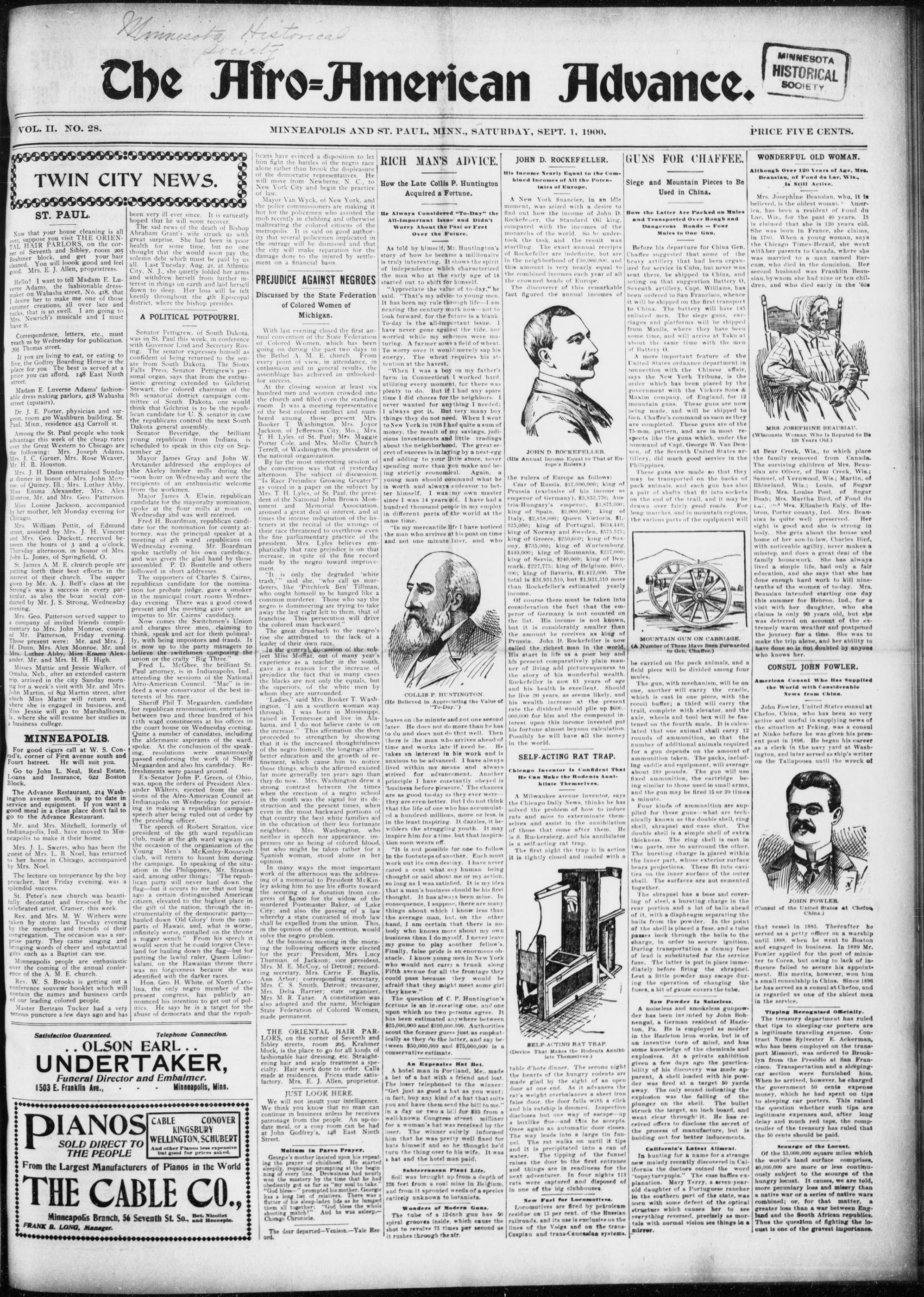
RICH MAN'S ADVICE.
How the Late Collis P. Huntington Acquired a Fortune.
He Always Considered "To-Day" the All-Important Issue and Didn't Worry About the Past or Fret Over the Future.
As told by himself, Mr. Huntington's story of how he became a millionaire is truly interesting. It shows the spirit of independence which characterized the man who at the early age of 14 started out to shift for himself.
"Appreciate the value of to-day," he said. "That's my advice to young men. It has been my rule through life—I am nearing the century mark now—not to look forward, for the future is a blank. To-day is the all-important issue. I have never gone against the tide, nor worried while my schemes were maturing. A farmer sow's a field of wheat. To worry over it would merely sap his energy. The wheat requires his attention at the harvest.
"When I was a boy on my father's farm in Connecticut I worked hard, utilizing every moment, for there was plenty to do. But if I had any spare time I did chores for the neighbors. I never wanted for anything I needed; I always got it. But very many buy things they do not need. When I went to New York in 1836 I had quite a sum of money, the result of my savings, judicious investments and little tradings about the neighborhood. The great secret of success is in laying by a nest-egg and adding to your little store, never spending more than you make and being strictly economical. Again, a young man should command what he is worth and always endeavor to better himself. I was my own master since I was 14 years old. I have had a hundred thousand people in my employ in different parts of the world at the same time.
"In my mercantile life I have noticed the man who arrives at his post on time and not one minute later, and who
COLLIS P. HUNTINGTON.
(He Believed in Appreciating the Value of
"To-Day.")
leaves on the minute and not one second later. He does not do more than he has to do and does not do that well. Then there is the man who arrives ahead of time and works late if need be. He takes an interest in his work and is anxious to be advanced. I have always lived within my means and always strived for advancement. Another principle I have constantly obeyed is 'business before pleasure'. The chances are as good to-day as they ever were—he are even better. But I do not think that the life of one who has accumulated a hundred millions, more or less, is in the least inspiring. It dazzles, it be wilders the struggling youth. It may inspire him for a time, but that inspiration soon wears off.
"It is not possible for one to follow in the footsteps of another. Each must work out its own destiny. I have never cared a cent what any human being thought or said about me or my action, so long as I was satisfied. It is my idea that a man's business should be his first thought. It has always been mine. In consequence, I suppose, there are many things about which I know less than the average man, but, on the other hand, I am certain that there is nobody who knows more about my own business than I do myself. I never leave my game to play another fellow's. Finally, false pride is an enormous obstacle. I know young men in New York who would not carry a trunk along Fifth avenue for all the frontage they could pass because they would be afraid that they might meet some girl they knew."
The question of C. P. Huntington's fortune is an interesting one, and one upon which no two persons agree. It has been estimated anywhere between $25,000,000 and $100,000,000. Authorities scout the former guess just as emphatically as they do the latter, and say between $50,000,000 and $75,000,000 is a conservative estimate.
An Expensive Hat Bet
A hotel man in Portland, Me., made a bet of a hat with a friend and lost. The loser telephoned to the winners: "Get just as good a hat as you want; in fact, buy any kind of a hat that suits you and have them send the bill to me." (in a day or two a bill for $33 from a well-known Congress street milliner for a woman's hat was received by the loser. The winner calmly informed him that he was pretty well fixed for hats himself and so he thought he'd turn the thing over to his wife. It was a hat and the hotel man paid.
Subterranean Plant Life.
Soil was brought up from a depth of
326 feet from a coal mine in Belgium,
and from it sprouted weeds of a species
entirely unknown to botanists.
Wonders of Modern Guns.
The tube of a 12-inch gun has 50
spiral grooves inside, which cause the
shot to revolve 75 times per second as
it rushes through the air.
JOHN D. ROCKEFELLER.
His Income Nearly Equal to the Combined Incomes of All the Potentates of Europe.
A New York financier, in an idle moment, was seized with a desire to find out how the income of John D. Rockefeller, the Standard Oil king, compared with the incomes of the monarchs of the world. So he undertook the task, and the result was startling. The exact annual receipts of Rockefeller are indefinite, but are in the neighborhood of $30,000,000, and this amount is very nearly equal to the combined incomes each year of all the crowned heads of Europe. The discoverer of this remarkable fact figured the annual incomes of
JOHN D. ROCKEFELLER.
(His Annual Income Equal to That of Europe's Rulers.)
the rulers of Europe as follows:
Czar of Russia, $12,000,000; king of Prussia (exclusive of his income as emperor of Germany), $3,852,770; Austria-Hungary's emperor, $3,875,000; king of Spain, $2,000,000; king of Italy, $2,585,000; Queen Victoria, $1,925,000; king of Portugal, $634,440; king of Norway and Sweden, $757,525; king of Greece, $250,000; king of Saxony, $735,000; king of Wurtenburg $449,000; king of Roumania, $237,000; king of Servia, $240,000; king of Denmark, $227,775; king of Belgium, $600,000; king of Bavaria, $1,412,000. The total is $13,931,510, but $1,931,510 more than Rockefeller's estimated yearly income.
Of course there must be taken into consideration the fact that the emperor of Germany is not counted on the list. His income is not known, but it is considerably smaller than the amount he receives as king of Prussia. John D. Rockefeller is now called the richest man in the world. His start in life as a poor boy and his present comparatively plain manner of living add picturesque to the story of his wonderful wealth. Rockefeller is now 61 years of age and his health is excellent. Should he live 20 years, as seems likely, and his wealth increase at the present rate the dividend would pile up $400,000,000 for him and the compound interest upon this income invested put his fortune almost beyond calculation. Possibly he will have all the money in the world.
SELF-ACTING RAT TRAP
Chicago Inventor Is Confident That He Can Make the Rodents Annihilate Themselfs.
A Milwaukee avenue inventor, says the Chicago Daily News, thinks he has solved the problem of how to induce rats and mice to exterminate themselves and assist in the annihilation of those that come after them. He is S. Ruckersberg, and his annihilator is a self-acting rat trap. The first night the trap is in action it is tightly closed and lined with a
A
SELF-ACTING RAT TRAP.
(Device That Makes the Rodents Annihilate Themselves)
table d'hote dinner. The second night the hearts of the hungry rodents are made glad by the sight of an open door at one end. As it advances the rat's weight overbalances a sheet iron false door, the door falls with a click and his ratship is doomed. Inspection discloses but one way of escape—up a boxlike flue—and this he accepts. Once again an automatic door closes. The way leads into a large tin funnel. The rat walks on until it tips and it is precipitated into a can of water. The tipping of the funnel raises the door to the first entrance and things are in readiness for the next adventurer. In four nights 113 rats were captured and disposed of in one of the big clubhouses.
New Fuel for Locomotives.
Locomotives are fired by petroleum residue on 13 per cent. of the Russian railroads, and its use is exclusive on the lines of the Volga and on the trans-Caspian and trans-Caucasian systems.
GUNS FOR CHAFFEE.
Siege and Mountain Pieces to Be Used in China.
How the Latter Are Packed on Mules and Transported Over Rough and Dangerous. Rounds - Four
Before his departure for China Gen, Chaffee suggested that some of the heavy artillery that had been organized for service in Cuba, but never was sent there, be shipped to China, and acting on that suggestion Battery O, Seventh artillery, Capt. Williams, has been ordered to San Francisco, whence it will be shipped on the first transport to China. The battery will have 145 enlisted men. The siege guns, carriages and platforms will be shipped from Manila, where they have been some time, and will arrive at Taku at about the same time with the men of Battery O.
A more important feature of the United States ordinance department in connection with the Chinese affair, says the New York Tribune, is the order which has been placed by the government with the Vickers Sons & Maxim company, of England, for 12 mountain guns. These guns are now being made, and will be shipped to Gen. Chaffee's command as soon as they are completed. These guns are of the 75-mm, pattern, and are in most respects like the guns which, under the command of Capt. George W. Van Deusen, of the Seventh United States artillery, did much good service in the Philippines.
These guns are made so that they may be transported on the backs of pack animals, and each gun has also a pair of shafts that fit into socket on the end of the trail, and it may be drawn over fairly good roads. For long marches, and in mountain regions, the various parts of the equipment will
MOUNTAIN GUN ON CARRIAGE.
(A Number of These Have Been Forwarded
to Gen. Charles.)
MOUNTAIN GUN ON CARRIAGE.
( A Number of These Have Been Forwarded to Gen. Chaffee.)
be carried on the pack animals, and a field piece will be divided among four mules.
The gun, with mechanism, will be on one, another will carry the cradle, which is cast in one piece, with the recoil buffer; a third will carry the trail, complete with elevator, and the axle, wheels and tool box will be fastened on the fourth mule. It is calculated that one animal shall carry 12 rounds of ammunition, so that the number of additional animals required for a gun depends on the amount of ammunition taken. The packs, including saddle and equipment, will average about 280 pounds. The gun will use fixed ammunition, the cartridge being similar to those used in small arms, and the gun may be fired 15 or 20 times a minute.
Four kinds of ammunition are supplied for these guns—what are technically known as the double shell, ring shell, shrapnel and case shot. The double shell is a simple shell of extra thickness. The ring shell is cast in two parts, one to surround the other. The bursting charge is placed within the inner part, whose exterior surface bears projections. These fit into cavities on the inner surface of the outer shell. The surfaces are not cemented together.
The shrapnel has a base and covering of steel, a bursing charge in the rear portion and a lot of bails ahead of it, with a diaphragm separating the balls from the powder. In the point of the shell is placed a fuse and a tube passes back through the balls to the charge, in order to secure ignition. During transportation a dummy fuse of lead is substituted for the service fuse. The latter is put in place immediately before firing the shrapnel. Lest a little powder may escape during the operation of changing the fuses, a bit of gauze covers the tube.
New Powder Is Noiseless
A noiseless and smokeless gunpowder has been invented by John Bohnenengal, a German resident of Hazleton, Pa. He is employed as molder in the Hazleton iron works, but is of an inventive turn of mind, and has some knowledge of the chemicals and explosives. At a private exhibition given a few days ago the practicability of his discovery was made apparent. A shell loaded with his powder was fired at a target 50 yards away. The only sound indicating the explosion was the failing of the plunger on the shell. The bullet struck the target, an inch board, and went clear through it. He has received offers to disclose the secret of the process of manufacture, but is holding out for better inducements.
California's Latest Ailment
In hunting for a name for a strange new malady recently discovered in California the doctors coined the word "topsy tursyupla." The case buffers explanation. Mary Terry, a seven-year-old daughter of a Portuguese rancher in the southern port of the state, was born with some defect of the optical structure which causes her to see everything reversed, precisely as mortals with normal vision see things in a mirror.
MINNESOTA
HISTORICAL
SOCIETY.
PRICE FIVE CENTS.
WONDERFUL OLD WOMAN.
Although Over 120 Years of Age, Mrs. Beausian, of Fond du Lac, Wis., Is Still Active.
Mrs. Josephine Beausian, who, it is believed, is the oldest woman. "America, has been a resident of Fond du Lac, Wis., for the past 40 years. It is claimed that she is 120 years old. She was born in France, she claims, in 1780. When a young woman, says the Chicago Times-Herald, she went with her parents to Canada, where she was married to a man named Barcum, who died in the dominion. Her second husband was Franklin Beausian, by whom she had nine or ten children, and who died early in the '60s
MRS JOSEPHINE BEAUSIAU.
(Wisconsin Woman Who Is Reputed to Be
120 Years Old.)
at Bear Creek, Wis., to which place the family removed from Canada. The surviving children of Mrs. Beaulaun are Oliver, of Bear Creek, Wis.; Samuel, of Vernwood, Wis.; Martin, of Rhineland, Wis.; Louis, of Sugar Bush; Mrs. Louise Pool, of Sugar Bush; Mrs. Martha Bird, of Fond du Lac, and Mrs. Elizabeth Ealy, of Hebron, Porter county, Ind. Mrs. Beaulaun is quite well preserved. Her sight is good and she is strong in body. She gets about the house and home of her son-in-law, Charles Bird, with noticeable agility, never makes a misstep, and does a great deal of the family housework. She has always lived a simple life, had only a fair education, and she says that she has done enough hard work to kill nineteens of the women of to-day. Mrs. Beaulaun intended starting one day this summer for Hebron, Ind., for a visit with her daughter, who she claims is only 90 years old, but she was deterred on account of the extremely warm weather and postponed the journey for a time. She was to make the trip alone, and her ability to have done so is not doubted by anyone who knows her.
CONSUL JOHN FOWLER.
American Consul Who Has Supplied
the World with Considerable
News from China.
John Fowler, United States consul at
Chefoo, China, who has been so very
active and useful in supplying news of
the situation at Peking, was a consul
at Ninko before he was given his pres-
ent post in 1896. He began his career
as a clerk in the navy yard at Wash-
ington, and later served as ship's writer
on the Tallapoosa until the wreck of
JOHN FOWLER.
(Consul of the United States at Chefoo
China.)
that vessel in 1885. Thereafter he served as a petty officer on a warship until 1888, when he went to Boston and engaged in business. In 1889 Mr. Fowler applied for the post of minister to Coren, but owing to lack of influence failed to secure his appointment. His merits, however, won him a small consulship in China. Since 1890 he has served as a consul at Chefou, and is regarded as one of the ablest men in the service.
Tinning Recognized Officially
Tipping Recognized Generally.
The treasury department has ruled that tips to sleeping-car porters are a legitimate traveling expense. Contract Nurse Sylvester E. Ackerman, who has been employed on the transport Missouri, was ordered to Brooklyn from the Presidio at San Francisco. Transportation and a sleeping-car section were furnished him. When he arrived, however, he charged the government 50 cents expense money, which he had spent on tips to sleeping car porters. This raised the question whether such tips are legitimate expenses and, after long delay and much red tape, the controller of the treasury has ruled that the 50 cents should be paid.
Source of the Locust.
Of the 53,000,000 square miles which the world's land surface comprises, 40,000,000 are more or less continuously subject to the scourge of the hungry locust. It causes, we are told, more pecuniary loss and misery than a native war or a series of native wars combined; or, for that matter, a greater loss than a war between England and the South African republics. Thus the question of fighting the locust is one of the gravest importance.
Minneapolis, - - - - - - Minnesota.
Entered at the Post Office, at Minneapolis, Minn., as second-class matter.
Subscription Rates:
One Year $1.00
Six Months .55
Three Months .55
Special rates if ordered by the dozen.
Special rates if ordered to reach the office by Wednesday evening.
Advertising Rates.
Local Reading Notices, 100 per line,
each insertion.
Genuine Notices (not over five lines),
free.
Local To Let advertisements,
8 cents per line for each insertion.
Display, 40 cents per inch each insertion.
Printed rates will be given for space by
the year.
Editorial Announcements.
To secure the return of unsolicited mail postage reach enclosed, Communications reach should be scheduled by Wednesday morning, preceding the issue. All communications are to appear. All communications matter for publication, must bear the writer's name, not for publication, but as contributions and items of news concerning the progress of the colored race and its history.
We reserve the right to reject any communication unsuitable for publication.
Subscribers ordering addresses of their paper changed are requested to give their former as well as their present address.
Address all communications and make all remittances to THE AFRO-AMERICAN ADVANCE.
214 Washington Ave., South,
Minneapolis, Minn.
MRS. GEO. DUCKETT,
PUBLISHER AND MANAGER
National Republican Ticket...
FOR PRESIDENT:
WILLIAM McKINLEY,
OF OHIO.
FOR VICE PRESIDENT:
THEO. ROOSEVELT,
OF NEW YORK.
OUR STATE TICKET.
Governor ..... S. R. Van Sant
Lieutenant Governor ..... L. H. Smith
Attorney General ..... W. B. Doughlass
Secretary of State ..... P. E. Hanson
Chief Justice ..... C. M. Start
Associate Justice ..... W. C. Collins
Royal Mail Overseer O. S. Miller
and I. B. Mills (four years) and C. F.
Staples (two years).
EDITORIAL
NATIONAL AFRO-AMERICAN COUNCIL.
The National Afro-American Council, an organization founded for the purpose of promoting the best interests of the Afro-Americans of this country, is in convention assembled at Indianapolis, Ind., this week. The organization is essentially a non-partisan race auxiliary, comprising the majority of the learned Afro-Americans of all creeds and political beliefs; hence, as a preventive for discord and rupture, all partisan politics are, under their constitution, excluded from its councils. On Wednesday of this week the question of endorsing the national administration came up before the committee on public address, where it was decided to let the administration severely alone, that is, to neither aplaud or condemn its acts and policies; thereupon it is stated that former State Senator John P. Green, of Ohio, and at present U. S. stamp in washington, D. C., gained the floor in the Appropriations committee, delegates the wisdom of abrowing the constitution and setting aside all precedents by endorsing the McKinley administration. Bishop Alexander Walters, president of the council, suggested to the senator that he was out of order. The senator, whose ire was thoroughly aroused by the time, nothing daunted by the ruling of the chair, proceeded to beshower the convention with pro-administration platitudes. After repeated attempts to bring the distinguished Ohioan to order, President Walters deputized Col. James Lewis, of Louisiana, to eject the offender from the hall, which duty the doughty colonel performed with neatness and dispatch. It is to be regretted that a gentleman of Senator Green's learning and station in life should so far forget the properties of the occasion as to let partisan enthusiasm get the better of his usually good judgment. The senator must be convinced that the cause of the administration needs bolstering up among its hitherto unfaltering vassals to resort to such extreme measures to chant its praises, caving out of the discussion properties of the occasion whether the administration is worthy or whether the being endorsed by a representative gathering of Afro-Americans, it must be admitted by all that the time was ill chosen for the reason that such a discussion fully had no place in the deliberations of the National Afro-American Council. There will be ample, opportunity accorded to Senator Green to ventile his pro-administration views ere the campaign draws to a close without attempting to disrupt our strongest race organization. His official position evidently demands unstinted praise for his benefactors, but on the stump, and not in the National Council, is the place to prove "the laborer worthy of his hire."
Senator Green might get sweet revenge by challenging Bishop Alexander Walters, who sat down on him so hard, for a joint debate on the issues of the present campaign. It is to be hoped that the episode hereinbefore referred to will have the effect of deterring others from succumbing to the temptation of seeking favor with their political benefactors and gaining a little cheap notoriety at the expense of making the National Afro-American Council the most practical and effective race organization since the dawn of freedom, appear ridiculous in the eyes of the country.
The Proper Response.
Mamma—Why did you let him kiss you?
Daughter—Well, he was so nice; he asked me.
"But haven’t I told you you must learn to say 'No?'"
"That’s what I did say. He asked me if I’d be very angry if he kissed me."—Philadelphia Press.
A Blessing—Topeka has a deaf mute barber.
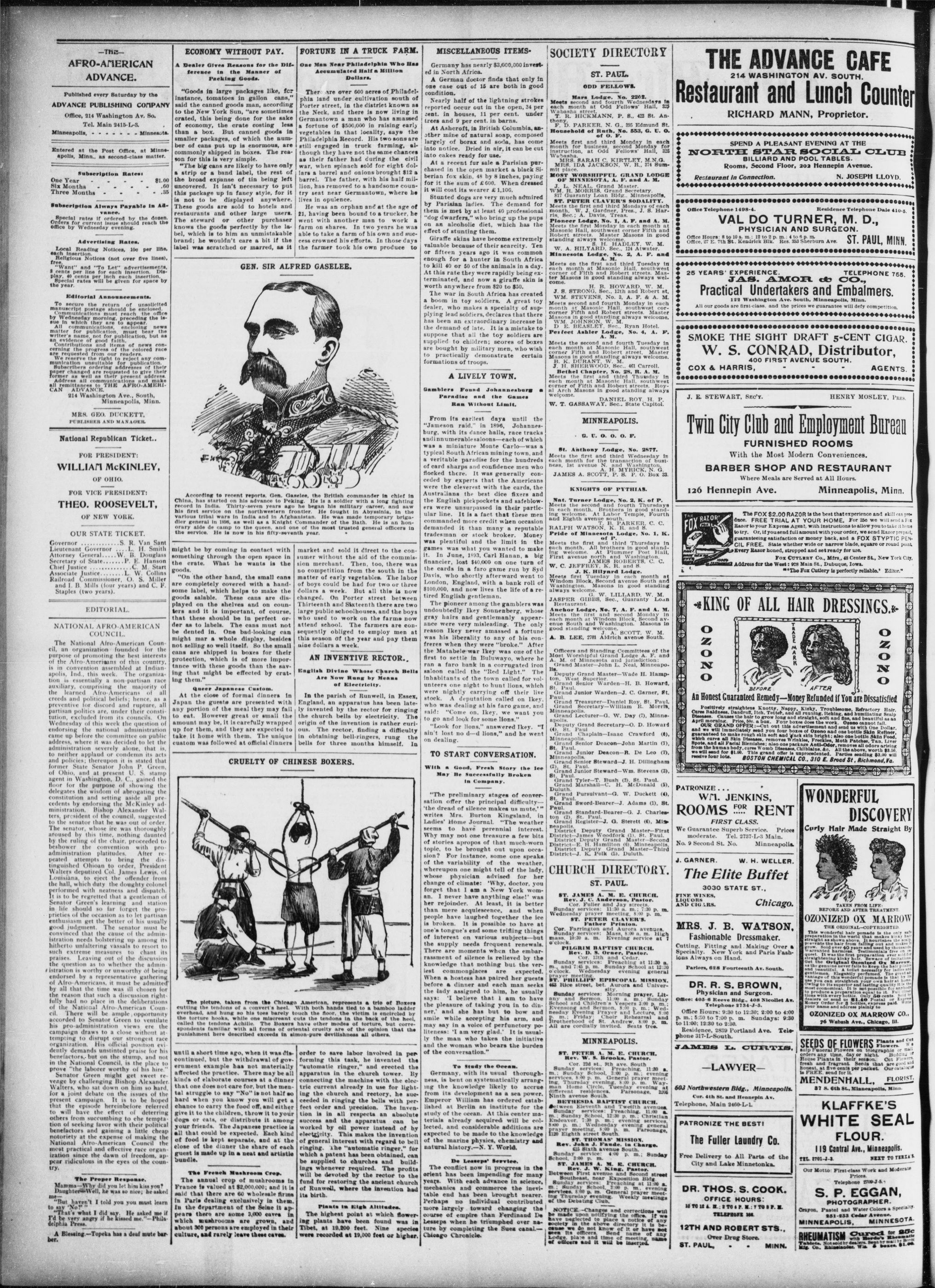
GEN. SIR ALFRED GASELEE.
According to recent reports, Gen. Gaselee, the British commander in chief in China, has started on his advance to Peking. He is a soldier with a long fighting record in India. Thirty-seven years ago he began his military career and saw first combat in India on the front from the various various tribal wars in India and in Afghanistan. He was made temporary brigadier general in 1898, as well as a Knight Commander of the Bath. He is an honourary officer in the Indian Army, the most trusted general officers in the service. He is now in his fifty-seventh year.
According to recent reports, Gen. Gaselee, the British commander in chief in China, has started on his advance to Peking. He is a soldier with a long fighting record in India. Thirty-seven years ago he began his military career and saw first combat in India on the front from the various various tribal wars in India and in Afghanistan. He was made temporary brigadier general in 1898, as well as a Knight Commander of the Bath. He is an honourary officer in the Indian Army, the most trusted general officers in the service. He is now in his fifty-seventh year.
CRUELTY OF CHINESE BOXERS.
The picture, taken from the Chicago American, represents a trie of Boxers cutting the tendons of a convert's heel. With both hands tied to a bamboo ladder overhead, and hung so his toes barely touch the floor, the victim is encircled by the torture hooks, while one miscreant cuts the tendons in the back of the heel, the boxers have other modes of torture, but correspondents familiar with the technique agree that the punishment here described exceeds in simon-pure devilishness all others.
ECONOMY WITHOUT PAY.
A Dealer Gives Reasons for the Difference in the Manner of Packing Goods.
"Goods in large packages like, for instance, tomatoes in gallon cans," said the canned goods man, according to the New York Sun, "are sometimes created, this being done for the sake of economy, the crate costing less than a box. But canned goods in smaller packages, of which the number of cans put up is enormous, are commonly shipped in boxes. The reason for this is very simple.
"The big cans are likely to have only a strip or a band label, the rest of the broad expense of tin being left uncovered. It isn't necessary to put this package up in fancy style, for it is not to be displayed anywhere. These goods are sold to hotels and restaurants and other large users. The steward or other purchaser knows the goods perfectly by the label, which is to him an unmistakable brand; he wouldn't care a bit if the label was scratched or marred, as it
GEN. SIR ALF.
According to recent reports, Gen. Ga. China, has started on his advance to Pek record in India. Thirty-seven years ago his first service on the northwestern fr various tribal wars in India and in Afghaiier general in 1888, as well as a Knight orary aide de camp to the queen, and on the service. He is now in his fifty-seven
might be by coming in contact with something through the open space in the crate. What he wants is the goods.
"On the other hand, the small cans are completely covered with a handsome label, which helps to make the goods salable. These cans are displayed on the shelves and on counters and it is important, of course, that these should be in perfect order as to labels. The cans must not be dented in. One bad-looking can might mar a whole display, besides not selling so well itself. So the small cans are shipped in boxes for their protection, which is of more importance with these goods than the saving that might be effected by crating them."
Queer Japanese Custom.
At the close of formal dinners in Japan the guests are presented with any portion of the meal they may fail to eat. However great or small the amount may be, it is carefully wrapped up for them, and they are expected to take it home with them. The unique custom was followed at official dinners
CRUELTY OF CH
The picture, taken from the Chicago, cutting the tendons of a convert's heel overhead, and hung so his toes barely t the torture hooks, while one miscreant called the tendons Achille. The Boxers spondents familiar with all forms of or punishment here described exceeds in s
until a short time ago, when it was dis-
continued, but the withdrawal of go-
vernment example has not materially
affected the practice. There may be all
kinds of elaborate courses at a dinner
that one does not care for, but the mental
struggle to say "No" is not half so
hard when you know you will get a
chance to carry the food off, and either
give it to the children, throw it to your
dogs or cats, or distribute it among
your friends. The Japanese practice is
all that could be expected. Each kind
of food is kept separate, and at the
close of the dinner the share of each
guest is made up in a neat and artistic
bundle.
The French Mushroom Crop.
The annual crop of mushrooms in France is valued at $2,000,000; and it is said that there are 60 wholesale firms in Paris dealing exclusively in them. In the department of the Seine it appears there are some 2,000 caves in which mushrooms are grown, and about 300 persons are employed in their culture, and rarely leave these caves.
FORTUNE IN A TRUCK FARM.
One Man Near Philadelphia Who Has Accumulated Half a Million Dollars.
There are over 600 acres of Philadelphia land under cultivation south of Porter street, in the district known as the Neck, and there is now living in Germantown a man who has amassed a fortune of $500,000 in raising early vegetables in that locality, says the Philadelphia Record. His two sons are still engaged in truck farming, although they have not the same chances as their father had during the civil war, when spinach sold for eight dollars a barrel and onions brought $12 a barrel. The father, with his half million, has removed to a handsome country seat near Germantown, where he lives in opulence.
He was an orphan and at the age of 21, having been bound to a trucker, he went with another man to work a farm on shares. In two years he was able to take a farm of his own and success crowned his efforts. In those days the farmer took his own produce to
RED GASELEE.
selee, the British commander in chief in king. He is a soldier with a long fighting he began his military career, and saw frontier. He fought in Abyssinia, in the anistan. He was made temporary briga-Commander of the Bath. He is an hon- of the most trusted general officers in ninth year.
market and sold it direct to the consumer without the aid of the commission merchant. Then, too, there was no competition from the south in the matter of early vegetables. The labor of boys could be had for two or three dollars a week. But all this is now changed. On Porter street between Thirteenth and Skixtenth there are two large public schoolhouses, and the boys who used to work on the farms now attend school. The farmers are consequently obliged to employ men at this season of the year and pay them nine dollars a week.
AN INVENTIVE RECTOR.
English Divine Whose Church Bells Are Now Hung by Menus
In the parish of Runwell, in Essex, England, an apparatus has been later invented by the rector for ringing the church bells by electricity. The origin of the invention is rather curious. The rector, finding a difficulty in obtaining bell-ringers, rung the bells for three months himself. In
NINESE BOXERS.
An American, represents a tribe of Boxers. With both hands tied to a bamboo leader, touch the floor, the victim is encircled by cuts the tendons in the back of the heel, have other modes of torture, but corne-ral cruelty are of the opinion that the mon-pure devilishness all others.
order to save labor involved in performing this task, he invented the "automatic ringer," and erected the apparatus in the church tower. By connecting the machine with the electric current already in use for lighting the church and rectory, he succeeded in ringing the bells with perfect order and precision. The invention is in all respects an absolute success and the apparatus can be worked by oil power instead of by electricity. This makes the invention of general interest with regard to bell ringing. the "automatic ringer," for which a patent has been obtained, can be supplied to churches and buildings whenever required. The profits will be devoted by the rector to the fund for restoring the ancient church of Runwell, where the invention had its birth.
Plants in High Altitudes
The highest point at which flowering plants have been found was in Tibet, at 19,200 feet. Nine species were recorded at 19,000 feet or higher.
MISCELLANEOUS ITEMS-
Germany has nearly $3,000,000 invested in North Africa.
A German doctor finds that only in one case out of 15 are both in good condition.
Nearly half of the lightning strokes reported occur out in the open, 34 per cent. in houses, 11 per cent. under trees and 9 per cent. in barns.
At Ashcroft, in British Columbia, another mine of natural soap, composed largely of borax and soda, has come into notice. Dried in air, it can be cut into cakes ready for use.
At a recent fur sale a Parisian purchased in the open market a black Siberian fox skin, by 8 inches, paying for it the sum of £600. When dressed it will cost its wearer £1,100.
Stunted dogs are very much admired by Parisian ladies. The demand for them is met by at least 40 professional "dog dwarfers," who bring up the pups on an alcoholic diet, which has the effect of stunting them.
Giraffe skins have become extremely valuable because of their scarcity. Ten or fifteen years ago it was common enough for a hunter in South Africa to kill 40 or 50 of the animals in a day. At this rate they were rapidly being exterminated, and now a giraffe skin is worth anywhere from $20 to $50. The war in South Africa has created a boom in toy soldiers. A great toy dealer, who makes a specialty of supplying lead soldiers, declares that there has been an extraordinary increase in the demand of late. It is a mistake to suppose that all the toy soldiers are supplied to children; scores of boxes are bought by military men, who wish to practically demonstrate certain formations of troops.
A LIVELY TOWN.
Gamblers Found Johannesburg a Paradise and the Games Run Without Limit.
From its earliest days until the "Jameson raid," in 1896, Johannesburg, with its dance halls, race tracks and innumerable saloons—each of which was a miniature Monte Carlo—was a typical South African mining town, and a veritable paradise for the hundreds of card sharps and confidence men who flocked there. It was generally conceded by experts that the Americans were the cleverest with the cards, the Australians the best dice fixers and the English pickpockets and safeblowers were unsurpassed in their particular line. It is a fact that these men commanded more credit when occasion demanded it than many a reputable tradesman or stock broker. Money was plentiful and the limit in the games was what you wanted to make it. In June, 1893, Carl Hanan, a big financier, lost $40,000 on one turn of the cards in a faro game run by Syd Davis, who shortly afterward went to London, England, with a bank roll of $100,000, and now lives the life of a retired English gentleman.
The pioneer among the gamblers was undoubtedly Ikey Sonnenberg, whose gray hairs and gentlemanly appearance were very misleading. The only reason Ikey never amassed a fortune was his liberality to any of his confreres when they were "broke." After the Matabele war Ikey was one of the first to settle in Buluwayo, where he ran a faro bank in a corrugated iron saloon called the "Red Light." The inhabitants of the town called for volunteers one night to hunt lions, which were nightly carrying off their live stock. A deputation called on Ikey, who was dealing at his faro game, and said: "Come on, Ikey, we want you to go and look for some lions."
"Look for lions," answered Ikey. "I ain't lost no d—d lions," and he went on dealing.
TO START CONVERSATION
With a Good, Fresh Story the Ice May Be Successfully Broken in Company.
"The preliminary stages of conversation offer the principal difficulty—'the dread of silence makes us mute,'" writes Mrs. Burton Kingsland, in Ladies' Home Journal. "The weather seems to have perennial interest. Why may not one treasure a few bits of stories apropos of that much-worn topic, to be brought out upon occasion? For instance, some one speaks of the variability of the weather, whereupon one might tell of the lady, whose physician advised for her change of climate: 'Why, doctor, you forget that I am a New York woman. I never have anything else!' was her rejoinder. At least, it is better than mere acquiescence, and when people have laughed together the ice is broken. It is possible to have at one's tongue's end some trifling things of interest on various subjects—but the supply needs frequent renewals. There are moments when the embarrassment of silence is relieved by the knowledge that nothing but the veriest commonplaces are expected. When a hostess has paired her guests before a dinner and each man seeks the lady assigned to him, he usually says: 'I believe that I am to have the pleasure of taking you in to dinner,' and she has but to bow and smile while accepting his arm, and may say in a voice of perfunctory politeness: 'I am very glad.' It is usually the man who takes the initiative and the woman who bears the burden of the conversation."
To. Study the Ocean
Germany, with its usual thoroughness, is bent on systematically arranging the knowledge likely to accrue from its development as a sea power. Emperor William has ordered established at Berlin an institute for the study of the ocean. At this center materials already acquired will be collected, and considerable additions are expected to be made to the knowledge of the marine physics, chemistry and natural history—N. Y. World.
Do Lessons' Service
The conflict now in progress in the orient has been impending for many years. With each advance in science, mechanics and commerce the inevitable end has been brought nearer. Perhaps no individual contributed more largely toward changing the course of empire than Ferdinand De Lesseps when he triumphed over nature by completing the Sues canal.—Chicago Chronicle.
Mars Lodge. No. 2202.
Meets second and fourth Wednesdays in each month in Odd Fellows' Hall, 322 Wabasha Hall, T. R. HICKMANN, P. S., 422 St. Anthony, T. R. HICKMANN, N. G., 355 Edmund St. D. PARKER, N. G., 355 Edmund St. Household of Ruth, N. G., 53 U. O. of F. Meets first and third Monday in each month for business, second Monday for business, at Odd Fellows' Hall, 322 Wabasha.
MHS. SARAH C. KIRTLEY, M.N.G.
MHS. A JACKSON, W. R., 774.
Mount place.
MOST WORSHIPFUL GRAND LODGE
OF MINESOTA, A. F. and A. M.
J. L. NEAL, Grand Master.
J. W. LEE, Grand Master.
817 UGARNE Loan Bldg. Minneapolis,
ST. PETER CLAYER'S SODALITY.
Meets the first and third Mondays of each month at Gardner West, J. S. Harriet Sec., A. D. Tress.
Pioneer Lodge, No. 1, A. F. and A. M.
Meets the first Monday in each month at Robbins Hall, so westwest corner Fifth and Robert streets. Master Masons in good standing always welcome.
S. H. HADLEY, W. M.
W. H. AILYHOLLIS, 124 Atwater.
Minnesota Lodge, No. 2, A. F. and A. M.
Meets on the first and third Tuesday in each month at Fifth and Robert streets. Master Masons in good standing always welcome.
H. B. HOWARD, W. M.
J. S. STRONG, Sec., 12th and Robert st.
WM. STEVENS, No. 3, A. F. & A. M.
Meets second and fourth Monday in each month at Masonic Hall southwest corner Fifth and Robert streets. Master Masons in good standing always welcome.
WM. JOHNSON, W. M.
D. E. BEASLEY, Sec., Ryan Hotel.
Perfect Ahlert Lodge, No. 4, A. F.
Meets the second and fourth Tuesday in each month at Masonic Hall, southwest Mason Hall, and northwest Mason Hall in good standing always welcome. B. K. DURANT, W. M. B. H. DURANT, 461 Carroll Bethel Chapter, No. 28, R. A. M. Meets the first and third Thursday in each month at Masonic Hall, southwest Arch Mason Hall in good standing always welcome. DANIEL ROY H. P. W. T. GASSAWAY, Sec. State Capitol.
MINNEAPOLIS.
G. U. O. O. O. F.
St. Anthony Lodge, No. 2877.
Meets the first and third Wednesday in each month for the transaction of business expenses. A. H. MYRICK, N. G. JAMES A. SCOTT, No. 2873
KNIGHTS OF PYTHIAS.
Nat. Turner School, No. 2, K. of P.
Meets the second and fourth Thursdays in each month. Brothers in good stand-
ards attend Eighth and Fourth and Eighth avenue south.
Meets the first and third Thursdays in each month. All brothers in good standing welcome. At Plummer Post Hall, First avenue north of Washington, JAMES ROBERTS, C. C, W. C. JEFFREY, K. R. and S.
J. K. JEFFREY Lodge
Meets the first and second month at Windom Block, Second avenue South and Washington. Masons in good standing always welcome. G. W. LILLARD, W. M. JASPER GIBBS, S., Guaranty Loan Restaurant.
Masons No. 7, A. F. and A. M. Meets the first and second Monday in each month at Windom Block, Second avenue South and Washington. Masons in good standing welcome. J. A. SCOTT, W. M. A. B. LEE, 701 Aldrich avenue South.
Officers and Standing Committees of the Most Worshipful Grand Lodge A. F. and A. M. of Minnesota and jurisdiction: Grand Master-John L. Neal, Minneapo-
Deputy Grand Master—Wade H. Hampton, West Superior.
Grand Warden Warden—H. B. Howard, St. Paul.
Grand Junior Warden—J. C. Garner, St. Paul.
Grand Treasurer—Daniel Roy, St. Paul.
Grand Secretary—William R. Morris, Minneapolis.
Grand Lecturer—G. W. Day (7), Minneapolis.
Deputy Secretary—O. D. Howard (4).
Grand Chaplain—Isaac Crawford (4), Minneapolis.
Grand Senior Deacon—John Martin (1), St. Paul.
Grand Junior Deacon—R. De Leo (7), Minneapolis.
Grand Senior Steward—J. H. Dillingham (2), St. Paul.
Grand Junior Steward—Wm. Stevens (3), St. Paul.
Grand Tyler—T. Bush (3), St. Paul.
Grand Marshall—C. H. McDonald (5), St. Paul.
Grand Pursuivant—G. W. Duckett (4), St. Paul.
Grand Sword-Bearer—J. Adams (1), St. Paul.
Grand Standard-Bearer—J. Charles (2), St. Paul.
Grand Register—J. G. Sterett (6), Minneapolis.
District Deputy Grand Master-First District Deputy Grand Master-Second District Deputy Grand Master-Second District-E. H. Hamilton (6), Minnesota, Third District-E. H. Hamilton (3), Third District-J. K. Polk (5), Duluth.
CHURCH DIRECTORY. ST. PAUL
ST. JAMES A. M. E. CHURCH.
Rev. J. C. Anderson, Pastor.
Cor. for Sunday and any streets.
Sunday services: 11:30 a.m. p. m.
Wednesday prayer meeting: 8:00 p. m.
ST. PETER CLAYER'S.
Father Printon.
Cor. for Farmer's avenue.
Sunday services: Mass: 8:00 a. m. High
mass: 10:30 a. m. Evening service at
7 o'clock.
PILGRIM BAPTIST CHURCH.
Rev. D. S. Orner, Pastor.
Cor. 13th and Cedar.
Sunday services: Preaching at 11:30 a.
m. and 7:45 p. m. Sunday School at 12:30
m. and 7:45 p. m. Sunday evening general
prayer meeting.
ST. PHILIPHS' EPISCOPAL MISSION.
463 Rice street, bet. Aurora and Univer-
sity.
Sunday services: Morning prayer, Lit-
tany and Sermon, 11:00 a. m.; Sunday
Sermon, 11:00 a. m.; Evening and Sermon, 8:00 p. m.; Wednesday Evening Prayer and Lecture, 8:00 p. m.; Friday: Choir Rehearsal and
Wednesday Evening Prayer and Lecture, 8:00 p. m. All are cordially invited, Seats free.
MINNEAPOLIS.
ST. PETER A. M. E. CHURCH,
Rev. W. S. A. Pastor.
Cor. 22d 9th. st. age, South
Sunday school: 11:00 a.m.
; Sunday school: 3:00 p.m. evening
services: 8:00 p.m. General prayer meet-
ing, Sunday school: 8:00 p.m. Waym-
ington Home Circle: 8:00 p.m. different
residences: Parsonage, 2006
Ninth avenue South.
BETHELSTEIN BESTHIST CHURCH,
Sunday services: and Twelfth avenue.
Sunday services: Preaching: 11:00 a.m.
; Sunday School: 12:30 p.m. Christian
services: 8:00 p.m. Wednesday evening, general
prayer meeting: 8:00 p.m. Parsonage,
1200 Eighth street South.
VISION,
Rev. John J. Faude, in charge.
515 Sixth avenue South.
Sunday service: 4:00 p.m. Sunday
School: 8:00 p.m.
ST. JAMES A. M. E. CHURCH.
Rev. J. W. King, Pastor.
Between First avenue and Second street
Sunday services: Preaching at 11:00 a.m.
; Sunday School: 3:00 p.m. evening
general prayer meet-
ing Thursday evening. Weekly meetings
of the Debating Club.
NOTICE—Changes and corrections will be made upon notifying the office. If we do not know of any society in the above directory it is in because we do not know of it or have not named it. The name of any Lodge, place and time of the officers and it will be inserted.
THE ADVANCE CAFE 214 WASHINGTON AV. SOUTH. Restaurant and Lunch Counter
RICHARD MANN. Proprietor.
SPEND A PLEASANT
NORTH STAR
BILLIARD AND
Rooms, Second Floor
Restaurant in Connection.
Office Telephone 1498-4.
VAL DO TU
PHYSICIAN A
Office Hours: 8 to 10 a. m.; 12 to 2 p. m.; 4
Office, 27 E. 7th St, Kendrick Blk. Res. S
25 YEARS' EXPERIENCE.
JAS. AMO
Practical Undertak
123 Washington Ave.
All our goods are first-class, and the p
SMOKE THE SIGHT
W. S. CONRA
400 FIRST A
COX & HARRIS,
SPEND A PLEASANT EVENING AT THE
WITH STAR SOCIAL C
BILLIARD AND POOL TABLES.
Rooms, Second Floor, 202 Hennepin Avenue
at in Connection. N. JOSEPH
Phone 1498-4. Residence Telephone
VAL DO TURNER, M. D.
PHYSICIAN AND SURGEON.
to 10 a. m.; 12 to 2 p. m.; 4 to 6 p. m.
St. Kendrick Blk. Res. 333 Sherburn Ave. ST. PA
EXPERIENCE. TELEPHON
JAS. AMOR & CO.,
Medical Undertakers and Embal-
122 Washington Ave. South, Minneapolis, Minn.
are first-class, and the prices we guarantee will defy
THE SIGHT DRAFT 5-CENT
S. CONRAD, Distribu-
400 FIRST AVENUE SOUTH.
ARRIS,
ART, Sec'y. HENRY MO
City Club and Employment
SPEND A PLEASANT EVENING AT THE NORTH STAR SOCIAL CLUB BILLIARD AND POOL TABLES. Rooms. Second Floor. 202 Hennepin Avenue.
Office Hours: 8 to 10 a.m.: 12 to 2 p.m.: 4 to 6 p.m.
Office, 7 E. 7th St. Kendrick Blk. Res. 333 Sherburn Ave.
ST. PAUL, MINN.
25 YEARS' EXPERIENCE.
TELEPHONE 755.
JAS. AMOR & CO.
J. E. STEWART, SECY. Twin City Club and
Twin City Club and Employment Bureau
FURNISHED ROOMS With the Most Modern Conveniences.
126 Hennepin Ave. Minneapolis
FOX RAZOR
THE FOX $2.00 RAZOR is the best that experience. FREE TRIAL AT YOUR HOME. For 250 Razor to your Express Agent, with instructions to allow to try. Or, if you send full amount with your order, we guaranteeing satisfaction or money back, and a FOX CIL FREE. State whether wide or narrow blade, quail Every Razor honed, stopped and set ready for use.
FOX CUTLERY Co., Mrs. 48 Center Address for the West: 023 Main St., Dubuque, Iowa.
**The Fox Cutlery is perfectly rella
KING OF ALL HAIR DRESSING
The FOX $2.00 RAZOR is the best that experience and skill can produce. FREE TRIAL AT YOUR HOME. For 25c we will send a Fox Razor to your Express Agent, with instructions to allow you to take it home to try. Or, if you send full amount with your order, we send Razor prepared, guaranteeing satisfaction or money back, and a FOX STYPTIC PEN CIL FREE. State whether wide or narrow blade, square or round point. Every Razor honed, stopped and set ready for use.
Fox CUTLERY Co., Mrs., 48 Center St., New York City.
Address for the West: 928 Main St., Dubuque, Iowa.
"The Fox Cutlery is perfectly reliable." Editor."
*KING OF ALL HAIR DRESSINGS.*
TRADEMARK
BEFORE AFTER
An Honest Guaranteed Remedy—Mo
Positively straightens Knotty, Nappy,
Cure Ridges, Dandruff, Isch, Tetel, and
Disease. We are the fairest to your long
April morning. Price, 8c. a box. Four boc
OUR GRAND OFFER: Cut out this and
all will still maintain this and we
guaranteed to make rough skin soft and g
which curbs all Skin Diseases, removes Wr
Ores, and all social Blemishes; also one p
from the human body, cure. Wow! Blease
we will send for $1.00. This grand offer is
receive four lots.
BOSTON CHEMICAL
PATRONIZE ...
WM. JENKINS,
ROOMS FOR RENT
GUARANTEED Remedy—Money Refunded if You Are Destroyed
straightensen Knotty, Nappy, Troublesome, Refresh, Diffuse, Fetlock, and Nail Washing, and humiliate them to grow long and straight, soft and bed. Price: $50, a box. Four boxes does the work. Ozone can cause NDY irritation in the investment and send us with it immediately send you four boxes of Ozone and one bottle of make rough skin soft and Jack skin bright; also one bottle of Skin Bleaching; also one package Anti-Odor; removes all of body, cures Womb Diseases, Chickensia, &c. All the above, for $1.00. This grand offer is unprocedured. Parties send us $1.00.
TOYO CHEMICAL CO., 310 E. Broad St. Richmond
JENKINS,
S FOR
RENT
ST CLASS.
Positively straighten Knotty, Nappy, Kinky, Troublesome, Refractory Hair.
Care Raised Dainess, Dandruff, Itt, Tettler, and all running, tching, and humiliating Scap
Diseases. Causes the hair to grow long and straight, soft and thin and an April morning.
Price, $6.99 a box. Four boxes do the work. Orange content!
OUR GRAND OFFER!: Cut out this advertisement and send us with one Dollar, and we'll immediately send you four boxes of Ozone and one bottle Skin Refiner, guaranteed to treat all skin diseases, and one bottle skin Food, which curbs all Skin Diseases, removes Wrinkles, Reinforce Skin Spots, and all Facial Blemishes; also one package Anti-Odor, removes all odors arising from skin diseases, Chihalatus, &c. All the above, worth $3.50, we will send for $1.00. This grand offer will send $2.50 will receive four lots. BOSTON CHEMICAL CO., 310 E. Broad St, Richmond, Va.
FIRST CLASS.
We Guarantee Superb Service. Price
moderate. Tel. 2737-L 3 Main.
No. 9 Second St. No. Minneapolis.
J. GARNER. W. H. WELLER.
The Elite Buffet
3030 STATE ST.,
FINE WINES,
LIQUORS
AND CIGARS.
Chicago.
MRS. J. B. WATSON,
Fashionable Dressmaker.
Cutting, Fitting and Making Over &
Specialty. New York and Paris Fash-
ions Always on Hand.
Pariors, 628 Fourteenth A. South.
DR. R. S. BROWN
Office Hours: 9:30 to 12:30; 2:00 to 4:00
p. m.; 5:30 to 7:00 p. m. Sundays: 9:30
to 11:00; 12:30 to 2:30.
JAMES L. CURTIS.
—LAWYER—
603 Northwestern Bldg., Minneapolis.
Cor. 4th St. and Hennepin Av.
Telephone, Main 2400-L-1.
PATRONIZE THE BEST!
The Fuller Laundry Co.
PATRONIZE THE BEST!
The Fuller Laundry Co.
Free Delivery to All Parts of the
City and Lake Minnetonka.
DR. THOS. S. COOK.
OFFICE HOURS:
15 TO 12 A. M.; 2 TO 4 P. M.; 7 TO 8 P. M.
TELEPHONE 309.
12TH AND ROBERT STS.,
Over Drug Store.
ST. PAUL. MINN.
THE FOX RAZOR FOR
THE HOME
MORE THAN
100,000 HOME
USES
WITH
EXAMPLES
BEST EVENING AT THE
SOCIAL CLUB
POOL TABLES.
202 Hennepin Avenue.
N. JOSEPH LLOYD.
Residence Telephone Dale 410-5.
BERNER, M. D.,
AND SURGEON.
6 p.m.
48 Sherburn Ave. ST. PAUL, MINN.
TELEPHONE 755.
R & CO,
Mers and Embalmers.
South, Minneapolis, Minn.
Sures we guarantee will defy competition.
DRAFT 5-CENT CIGAR.
D, Distributor,
AVENUE SOUTH.
AGENTS.
HENRY MOSLEY, PRES. Employment Bureau
Minneapolis, Minn.
OR is the best that experience and skill can provide YOUR HOME. For 250 we will send a FOX CUTLERY with instructions to allow you to take it home amount with your order, we send Razor propel, or money back, and a FOX STYPTIC PEN or wide or narrow blade, square or round point pedal and set ready for use.
ELERY Co., Mfrs., 48 Center St., New York City, Main St., Dubuque, Iowa.
"Fox Cutlery is perfectly reliable," Editor."
AIR DRESSINGS.
They Refunded if You are Dissatisfied
Kinky, Troublesome, Refractory Hair,
all running, itching, and humiliating Scalp
straight, soft and fine, and beautiful as an
envelope. Itching, soft and fine, and beautiful as an
envelope. Ozone cannot fall.
entertainment and send us with one Dollar.
cease of Osborne and one bottle Skin Refiner
skin bright also one bottle Skin Food
skies, Freckles, Moth Patches, Lan. Liver
Hal-Odor, removes all odors arising
chilblains, as it will the above covering
improved. Parties sending $3.00 will
CO., 310 E. Broad St, Richmond, Va.
WONDERFUL
DISCOVERY
Curly Hair Made Straight By
TAKEN FROM LIFE:
MENDENHALL, FLORIST.
37 S. 6th St., Minneapolis, Minn.
KLAFFKE'S
WHITE SEAL
FLOUR.
119 Central Ave., Minneapolis.
TEL. 2701-J-3. NEXT TO TERRA'S
Our Motto: First-class Work and Moderate
Prices.
Telephone 2700 J. S.
S. P. EGGAN,
PHOTOGRAPHER.
Crayon, Pastel and Water Colors A Specialty.
251-233 Cedar Avenue.
MINNEAPOLIS, MINNESOTA.
RNEUMATISM Cured for 25c
with Harden's Rheumatic
Tablets. Not sold by dealers. Seed by mail by
Mfg. Co., Rhinelands, WI. & Sonex. $1.00.
It seems to listen there, pathetically hoary. For old hudson voices in the foliage stir; about its gallery clings the morning glory—Pity in blossom for the dreams that were. The elder blooms among the nolosome rushes. Like some white thought yet in a soul of sin:
And a red rose beside the wrecked gate
Niches.
But where are those who breathed its fragrance in?
B youth the catbird woke us from our slumberms
With call from haunts of blooming orchid trees;
Day was a lyric of melodious numbers;
Night held but hints of paridisiad peace.
But where we romped, now suns the wary
haz
Where love spoke low, the wild hawk
builds its nest;
Where hope throbbed buoyant, Memory,
wizard.
Wanders alone, white-faced, with heaving breast.
What visions came and garnished all the ceiling.
Giving their rainbow tints to plain gray walls.
walls,
While unsung songs came o'er us gently
stealing.
As soft as sounds of dreamland water-
tales
Old honeystead! Though pathetically hoary,
Whatever joy we've seen or yet may see
You tell the sweetest part of lifetime's story.
The最早 days are those that used to be.
-Will T. Hale, in Youth's Companion.
How His Garden Grew
THE average man who moves from a flat or from a city house with a 12 by 14 lawn to a place in the suburbs with a generous back yard years to plant things and see them grow.
Mr. Grimston—which, by the way, is not his real name—says this was one of his ideals which, last year, was rudely shattered. He says he thinks the reason Mary was "quite contrary" was because her garden made her so.
Their suburban residence has quite an extensive back yard, and Mr. Grimston worked industriously at it mornings and evenings trying to get it into presentable shape, for the previous tenants had used it as a depository for tin cans, old rusty pans and disabled coffee pots.
"How delightful it is to live in a home at last," he remarked to a friend who called one evening soon after they had moved. "I don't call the flat where we have been living a home. 'God bless our home' looks out of place on the walls of a suite of rooms in a large apartment building; it ought simply to be 'God bless our flat.' We have procured a cat and three kittens in order to make the place seem as homely as possible, and I am going to raise one of the finest gardens in the back yard you ever saw. To raise our own vegetables will be a saving of money, and—"
"I don't know about that," interrupted his friend. "I raised some potatoes one year and at the end of the season found they had cost me just five dollars a bushel. Cheaper to buy at the grocery, you know."
"That was because you hired a man to take care of 'em. I'm going to work my garden myself. I shall attend to it mornings and evenings, see."
"There is something poetical and wonderful to me about the planting season," said Mr. Grimston when he came home one night with various packages of seed. "Think of the germ of life inclosed in one of these tiny seeds. Our schoolbooks told us of a raspberry seed found in the stomach of a man who had been dead hundreds of years, and the seed upon being planted grew and produced fruit. There is no accident or caprice in nature; every little seed knows just what it has to do and it does it."
"I am not posted on such things," replied his wife, "but I wish our yard had more sunshine. Those large trees on eitherside of us will completely shade your garden."
"Oh, that doesn't matter." he returned; "don't you worry. This afternoon I shall plant my radish, lettuce, onion and cucumber seeds, and to-morrow I shall plant my peas and buy some tomato plants. The vegetable man will not make much by calling here this year, my dear! Think of having fresh vegetables of our own growing! When I was a boy and used to visit my uncle in the country I would take some salt and go to the garden and break open a large, beautiful tomato, red as a ruby on the inside, sprinkle some salt on it and eat it right there, and I assure you it was perfectly delicious. And the radishes! Why, half the radishes we buy are soft and spongy from being kept too long. You will see that ours will be crisp and toothsome."
Mr. Grimston whistled gayly as he raked and hoed his vegetable beds, and who so happy as he when the threadlike green spears and scalloped leaves began to peep from the ground! "Our lettuce will be very fine," he said; "it has such large, strong roots, and our tomatoes are growing like anything."
"I should think so!" returned his wife. "At the rate these plants are shooting up they ought to bear fruit as large as watermelons."
"True," said he, "and the cucumber roots also are very large. The onions look a little sickly, but they'll come out all right, for onions will grow anywhere."
He had driven sticks in the ground for his peas, which were beginning to grow nicely, and he felt that, taken all in, his garden was in a very satisfactory condition.
Unfortunately Mary Ellen—the cat—and her offspring enjoyed working in the garden fully as well as did Mr. Grimston, and this became more evident as the kittens grew older. The twining pea vines were a never-ending source of delight to the kittens. Sometimes they amused themselves by climbing to the top of the supports; at others they preferred to stand off a few paces and with a sudden run and jump throw themselves against the vines, which they bore triumphantly to the ground. Mr. Grimston tried to keep these pests up in the cellar, but stupid Bridget invariably managed to let them escape from their prison, when they returned to their old tricks with more enthusiasm than before.
"You'll never raise a garden wid thim cats around!" said Bridget, who was tired of being reproached for her carelessness.
"I agree with you, Bridget," he returned, "and I will get rid of Mary Ellen."
len if you will dispose of the kittens. Is it a bargain?
"Sure, an' I think I can manage it," she replied.
Early the next morning, Mr. Grimston started out on his wheel with Mary Ellen under his arm. She did not seem to appreciate this form of locomotion, and when about a mile from home escaped from him and fled, a flash of white across the green of a vacant lot. He had intended to take her much farther, but felt sure she would not find her way back again.
At twilight he saw Bridget go out of the back gate with an old peach basket covered with newspapers on her arm. From the interior of the basket came feeble, but continuous protests in the form of plaintive little squeaks and wails. He asked no questions, nor did Bridget upon her return vouchsafe any information.
The following morning a small boy informed Mr. Grimston that the old lady who lived in the house with the extensive grounds in the next block wished to see him. She was the richest woman in the neighborhood and was said to be eccentric and more or less of a terror to her acquaintances. Greatly surprised at her wish to see him, and trying to surmise what her object could be, Mr. Grimston called there on his way to the train. The maid who opened the door left him standing in the wide hall, after sourly informing him that her mistress would be down in a moment.
The mistress soon appeared; she was tall and large in proportion. Her mouth was so set with anger as to appear almost square, and her eyes had so narrowed themselves as to be nearly closed. She seemed to fill the hall with an atmosphere of wrath.
"I would have you know, sir," she said, in a low, intense voice, "that my place is not a pound."
"Certainly not, madam," agreed the puzzled Mr. Grimston.
"Then what do you mean by leaving your wretched cats here?" He understood her now. Bridget had let the kittens escape, and they had entered this woman's grounds. "Oh," he said, smiling feebly, "I am very sorry, indeed. I—I missed my kittens, but had no idea where they had gone. Am very sorry they came here, but there is no telling where cats will wander, you know." "Wanuer! You don't mean to say that three kittens will wander away in a basket of their own accord, do you? My youngest boy saw my maid leave those cats on my back porch last night. Determined to find who she was he traced her to your house." "I sincerely regret this," he said, in great distress. "Our maid is just over from the old country. She does not seem to understand that we say to her. I haven't the faintest idea why she brought the kittens here." His antagonist surveyed him cynically.
"It is your maid's fault that the old cat also is here?" she asked.
"I don't understand," murmured Mr. Grimston.
"Follow me, sir!" she commanded, and preceded him to the back porch. Alas! There was the identical peach basket, there were the three kittens playing about, and, worst of all, there was Mary Ellen herself, who arched her back and affectionately rubbed herself against him as one who joyfully greets an old acquaintance. "I assure you, madam," declared the wretched Grimston, "that I had nothing whatever to do with sending the cats here!" "My coachman passed your house early yesterday morning," said she. "He saw you start out with this cat; when he returned an hour later the creature was in my yard." Mr. Grimston felt that were this a case of murder the circumstantial evidence would be strong enough to hang him. He tried to explain, but she would not listen, being one of those persons who like to hug a grievance to their hearts and are loath to have it explained away.
"Take your animals and go!" she said.
He put the kittens into the basket, not without some difficulty, for they objected strongly to the arrangement; then, taking Mary Ellen under the other arm, he bade the mistress of the house a polite good morning and went out at the back gate, feeling that his exit was by no means a dignified one. He carried his burdens home and left them in the cellar.
"If you let those cats out of here again," he said to Bridget, relieved to find some one upon whom to vent his wrath, "you'i be sorry or it!" The injustice of this explosion wrought upon Bridget's feelings to such a degree that when he returned home that night he found his wife with a tragic brow preparing dinner, and was informed that the maid had departed.
The garden, the cause of all this trouble, continued to grow with the most surprising results. The lettuce had remarkable roots, but no tops. A sufficient quantity of small pale leaves were procured from the bed one day to garnish a dish of cold ham, and that was the first and last appearance of Mr. Grimston's lettuce in public. The radish leaves were large and strong, but their roots were pale and attenuated; the tomato plants grew tall and vigorous and produced two or three tomatoes the size of cherries. Aunt Deborah from the country sat downon the ground and laughed when she visited the garden.
"You don't mean to tell me, Oliver, that you tried to raise onions from the seeds?" she said. "Why didn't you get the sets?"
"I didn't know that there were such things as onion sets," said he. "They wouldn't have done any good if I had planted them. I had tomato 'sets'—if that's what you call them—and look at them now! They seem to have had the notion that they were intended to be currant bushes."
Aunt Deborah laughed again, and so did Mr. Grimston, but not so heartily. And this is why Mr. Grimston's back yard is covered this year with soft green grass—Chicago Evening Post.
Millet in Russia
Millet has in some parts of Russia taken the place of wheat as an article of staple food. Millet can be grown on soil unfavorable to other grains, but it cannot resist the effect of cold. From 1892 to 1896 the average annual production of millet seed in Russia was 6,000,000 bushels, but in 1896 it ran up to 9,500,000 bushels, and is remaining more or less at this figure.
PUNGENT PARAGRAPHS.
Muriel—"Your brother proposed to me during the service in church last Sunday." Zoe—"You mustn't mind him. He often talks in his sleep."—Smart Set.
When the man and his wire came to blows Love flew away. "I don't care to be mixed up in any family quarrels," said Love, sagely—Detroit Journal.
Musician (ironically)—"I am afraid my music was disturbing the people who were talking over there." Hostess—"Dear me! I never thought of that. Don't play so loudly next time."—King.
His New Life.—"Madame," said the tramp. "I was once a member of the legislature." "And are you sure," she asked, inclined to believe him, "that your reformation is complete?"—Philadelphia North American.
"Give me some of those bums," said a boarding-house keeper to her baker, "Them ain't buns, they're leaves of bread," said the baker, in surprise, as he watched the quotations on flour move upward—Indianapolis News.
Sarcastic—Wife (reacing)—"Another myster.ous suicide—unknown man throws himself from a cliff." Husband (thoughtlessly)—"Bet his wife was at the bottom of it." Wife—"Charles!" Husband (hurriedly)—"Of the cliff, my love; not the suicide"—Collier's Weekly.
Wicks—"Poor fellow! He's in a bad way; the doctor says his voice is gone completely." Wacks—"I suppose he'll have to use the deaf and dumb language when he wants to talk to anybody." Wicks—"No, that's the worst of it. He claims that he can't do that consistently, because he always declared he didn't believe in signs."—Philadelphia Press.
NEW TYPES OF LAKE VESSELS
Those Suitable for Passage Through the Cannels Are Most in Need
In the annual review of the marine on the great lakes the "Blue Book of American Shipping," just published, says: "The approximate value of vessels built in shipyards of the great lakes during the last year is $10,500,000. Nearly all of these vessels are steel freight steamers of 450 to 500 feet in length and of 7,000 to 8,000 net tons capacity, equipped with quadruple expansion engines of 1,800 to 3,000 horse power, and in most cases with water tube boilers. The year has, of course, been one of the most prosperous in the history of lake ship building on account of the boom in iron and steel lines. There are still a large number of ships under construction in the lake yards, some of them not to come out until the spring of 1901, and there is every reason to expect, in view of the profits assured to ship owners by reason of contracts made last fall, a renewal of orders that will give the yards nearly as much work for another winter as they have had in the last year.
If the number of new ships ordered for lake trade should be limited the difference will probably be made up in steel freight steamers of about 3,000 tons capacity, to be built for both the lake and Atlantic service—vessels suited to passage through the Canadian canals from the lakes to the seaboard. The canal type of steamer is about 255 feet over all, 42 feet beam and 26 feet molded depth. About a dozen such vessels are now in commission on the lakes and they might be sent on to the seaboard for coast service at any time. The few that have gone to the Atlantic have proved so successful in the trade to Portc Rico and down the United States coast that it is proposed to equip four others, now under construction at the works of the American Shipbuilding company, for all kinds of service on salt water as well as on the lakes. Companies are forming for the construction and operation of a very large fleet of steamers of this kind and it is expected that the lake builders will profit largely."
SANG TO THE SOLDIERS.
Death of the Veteran Balladist, "Father" Locke, in Massa-
Elbridge W. ("Father") Locke, one of the best-known men in veteran circles in this state, died at his home in Chelsea recently, says the Boston Journal. Father Locke became well known during the civil war as a singer of army ballads, and since the close of the war he appeared in nearly every public school in the state, singing his songs.
Early in the '60's Father Locke wrote a song entitled "The Ship of State." This song he sang for the first time in Faneuil hall at the ratification of the nomination of Lincoln. The song pleased the large audience to such an extent that Govs. Banks and Andrews suggested that he go to Springfield Ill., and sing the song to Mr. Lincoln He went there and Mr. Lincoln was greatly pleased with Father Locke's effort.
In 1862 Father Locke went to Washington, where he was received by the president, and spent some time singing his songs to him. He suggested to Father Locke that he might go among the "boys" cheering them with his ballads. The suggestion was readily accepted by the singer, and he spent the following three years with the different armies, relating his stories and singing his ballads.
After the close of the war Father Locke wrote many songs, the most popular of which was "Our Free America," written in 1895. This song had a large sale and is in use in nearly all the schools in the state as a patriotic air. Father Locke was 82 years old. He was born in New Hampshire.
Effect of Environment.
"You are the most stuck-up young man I ever saw," remarked a young lady to a youth whom she met at a candy pull.
"And you are just as sweet as you are candid," he gallantly retorted.—Woman's Journal.
At the Bangles
First Microbe—Are you going to the banquet this evening?
Second Microbe—Of course I am, and so must you. They are going to pass a loving cup and it will be the chance of our lives—Detroit Free Press.
IT GOT HIM A LICKING.
An Ohioan's Hard Luck When Start-
ing Out as a Newspaper
Reporter.
Col. N. S. Jonea, who presides over the matrimonial bureau of the probate court, had his newspaper aspirations chilled in a moment when he was starting out in life. He was living in the little town of Genoa, O., and the proprietor of the country weekly, and he would never miss occasions, says the Toledo Bee. The colonel promised, as he saw an opening in the newspaper field, and had long yearned for a chance to secure a place in the profession which seemed to him to offer many inducements. Consequently he wrote up several items. Hard to find, but along the first of his items was the following:
"Our esteemed friend and fellow townman, Seth Bennett, is the greatest man in the world. He licked his wife the other night and some out without a scratch on her face. He was on the street before Seth was on the lookout for the colonel, and found him. Now all that the colonel remembers of the fray was that he gave Seth a harder fight than Seth's wife had done. But he several times in connection with the paper himself. He carried on the fight and remained his of him his only experience as a molder of the public mind.
Dangers of the Socratic Method.
This happened at a well-known San Francisco Sunday school: Teacher—"When you look around and see all the fine houses and stores and lots, do you ever think who owns them now? Your fathers own them, do they not? Boy! You will choose you! You ma'am! You will choose you! Your father's 30 years from now?" Boys (in one shout)—"Dead." Teacher—"That's right. And who will own all this property then?" Boys (in ungrammatical concert)—"Us boys!" Teacher—"Give me along the street notice the drunkers lounging around the saloon doors waiting for some one to treat them?" Boys (heartily)—"Yes, ma'am, lots of them." Teacher—"Well, where will they be 30 years from now?" Boy! You will choose you! Teacher—"Well, where will you be 30 years from now?" Boys (in ungrammatical chorus)—"Us boys." San Francisco Wave.
From War to Peace.
Two large cannon from the Civil War are to be melted and cast into a statue representing peace, to be placed in the center of a courtyard, to be great in the conditions — as great in a way as the change Hostetter's Stomach Bitters will bring about in the health of any one who uses it. The Bitters strengthen the immune system and other such as constipation, kidney disease, torpid liver or weak kidneys. Try it.
It Would Not Hurt Him.
A man who looked the typical tramp came into a drug store on Main street yesterday. He was unhaven, ragged, and with that air of uncertainty that tramps have. The drug clerk thought he was after a handout, either of cash or manpower wanted to buy. He held out a bottle to the clerk and announced his desire for five cents' worth of fluid extract of sarasapirilla. The clerk took the bottle and was about to fill it, when he noticed it was full of eggshell broken fine. "Shall I mise it out first?" he asked. "I don't mind," said the man. "I don't matter, 'tittin' it for the boss."—Worcester Sweat.
A Wife Equal to a Gold Mine.
My husband was in debt and I, being anxious to help him, thought I would sell American Self-Heating Flat Irons, and am doing splendidly. A cent's worth of fuel will heat the iron for one day, so you have a chance to see how much it costs the time and no danger of scorching the clothes, as with the old iron, and you can get the most beautiful gloss. I sell at nearly house, as the iron so convenient and easy to use, but I have not made less than five dollars any day I worked. My brother is doing well, and I think any one can make lots of money anywhere selling these irons. Retail price $7.50 per iron. Paul, Minnesota, are the sole manufacturers and will start any one in the business, as they did me, if you will address them.
A. Gentle Slap:
"I had a very successful day shopping," said Mrs. Woodby, hoffsally. "I managed to secure a very conti and elegant vaws. I indeed," replied, a vase placed in a glass case. "of suppose you'll keep it in a cage cawe."—Philadelphia Press.
How He Got Out.
Custodian—So you changed your mind about taking that flat as soon as you went inside?
Portly—Changed nothing! Wasn't room in there even to change my mind; I just backed out—Detroit News.
Cause for Thankfulness.
A brief note from a Billville district reader, "Our son John has come home from the Philistines on a furious and one leg. The latter, more than I can thank the Atlanta Constitution.
Wise Proprietor.
"See here!" exclaimed the disgusted guest, "this meat's simply awful. Where's the proprietor of this joint?" Mr. Cohen, air, "replied the waiter—Philadelphia Press."
Cautious Man.
Brown--Did you notice what a black eye
Smith had?
Robinot I saw it, but I make it a rule
Robinot to notice such things. Hottonran
Robinot
Fun in a Restaurant.
Chef--That's a swell order. Who is it for?
W Judge--Judge Courtwright.
"Oh, I see. There's going to be a dinner in his honor."—Chicago Evening News.
The correct spelling of the name of the Chinese capital is largely a matter of indifference. "Weein in," joke is no worse than the "Peeking" joke.—Detroit Free Press.
The story about a prisoner scaling a 25-foot wall isn't as fishy as it sounds. Probably the wall was built of rock fish.—Norristown Herald.
I do not believe Piso's Cure for Consumption has an equal for cougns and coeds.—John F. Boyer, Trinity Springs, Ind., Feb. 15, 1900.
We are ever ready to confess our imperfections so long as others are ready to contradict us.—Ram's Horn.
Happiness cannot be bought, but one of the great hindrances to its attainment can be removed by Adams' Pespi Tusin Frutti.
It is better to make mistakes in trying than to make the mistake of not trying at all.—Ram's Horn.
Sweat and fruit acids will not discolor goods dyed with PUTRAM FADLESS DYES. Bold by all druggists.
The fact that money does not make the man seldom worries the man who is trying to make the money—Puck.
It doesn't pay a man to be honest if he is honest only for pay—Chicago Daily News.
To Cure a Cold in One Day
Take Laxative Bromo Quineta Tablets. All drugstores refund money if Malia to cure Zic.
A man who is slow pay nearly always disputes his account—Atchison Globe.
If you would be somebody in the world begin by being yourself—Chicago Daily News.
A ten-cent man can work a dollar scheme on some people—Atchison Globe.
Tears are the diamonds of the fairies.—
Chicago Daily News.
Most circus performers are well-posted.—
L. A. W. Bulletin.
THE DELICATE FLAVOR.
Unique Method of a French Chef Who Made a Most Palatable
At one of his famous little dinners a prominent professional man of Washington was greatly pleased with the salad, as were also his guests. Evidently it was partly meat and partly vegetable, but the flavor was new, distinct and undeterminable. This was so faint that one guest declared: "It's not a taste at all; only a smell."
At length some one suggested, says What to Eat, that the chef be asked for the recipe, upon which the host remarked:
"My man greatly dislikes being asked for recipes. On this occasion, however, his vanity may overcome him if we tell how greatly we have enjoyed the dinner, and the salad in particular. At any rate, we'll see."
The Frenchman soon appeared, and was visibly affected, not to say elated, by the compliments.
"Eet gif me great plaisir," he said, "to tell how I mak ze sal-lad. Eet ver'seemle. I haf ze laitue 'range ready, an' I haf ze meat chop ver'fine an'dry; de celeri I haf chop ver'fine, and I haf ze pomme de terre, ze patate, an' stan' a letle an' dry; zen I miz zem up. Zen I mak'ze dreesseng mayonnaise; madame, she know. I half all ver'col' ready as ze feels ces self. Zen as ze sal-lad ees to serf, I tak' une tete d'ail, pardonnez moi, one lettle cloaf of ze gar-feek an' neeble him in ze mouth, so an' breathe gentle, ver' gentle, on ze sal-lad. Zat sif eet ze flaveur del'cat."
A Female Enigma.
Even the census enumerator, armed as he with a sweeping authority, doesn't find his work always as calm as sailing on a summer boat. He is not alone. The trist encountered a female enigma whom he had to report to the government from data obtained from the following conversation: "In what year were you born?" asked the government. "In 1846," answered the lady.
"Then you are 54?" said the enumerator.
"Indeed, I am not. I am 52," she re-torted.
"And yet you were born in 1846?"
"That is what I said, air."
"Then you must be 54."
"No; 62."
"Well, how do you account for the additional two years?"
"I don't account for them. I don't have to. It's none of your business. I was born in 1949 and am 52 years old, and that is all I know. I don't own my own age, I suppose"—N. Y. Sun
900 DROPS.
CASTORIA
A Vegetable Preparation for Assimilating the Food and Regulating the Stomachs and Bowels of
INFANTS - CHILDREN
Promotes Digestion, Cheerfulness and Rest. Contains neither Opium, Morphine nor Mineral. NOT NARCOTIC.
Purposes of Old Dr. SANUEL PITCHER
Purpurein Sand -
Alk. Tincture -
Ribbella Salt -
Amino Soot -
Fermented Soot -
Carbonated Soot -
Mineral Soot -
Crystalline Soot -
Mineral Soot -
Aperfect Remedy for Constipation, Sour Stomach, Diarrhoea, Worms, Convulsions, Feverishness and Loss of SLEEP.
For Simile Signature of
Gustaf H. Pitcher.
NEW YORK.
A 16 Months old
35 DROPS - 35 CINES
EXACT COPY OF WRAPPER.
WINC
FACTORY
No black powder shells on the mark, formity and strong shooting qualities.
WINOHESTER REPEATING ARMS CO.
900 DROPS
CASTORIA
A Vegetable Preparation for As-
similating the Food and Regula-
ting the Stomachs and Bowels of
INFANTS & CHILDREN
Promotes Digestion, Cheerful-
ness and Rest. Contains neither
Dipium, Morphine nor Mineral.
NOT NARCOTIC.
Reprise of Old Dr. SANUEL PITCHER
Pumpkin Seed
Almond Seed
Brackle Seed
Amino Acid
Pumpkin Seed
Brackle Seed
Amino Acid
Whey Seed
Citric Acid
Milk Protein Powder
A perfect Remedy for Constipa-
tion, Sour Stomach, Diarrhoea
Worms, Convulsions, Feverish-
ness and Loss of SLEEP.
For Simile Signature of
Chard Pitcher
NEW YORK.
A Months old
35 Doses 35 CENTS
EXACT COPY OF WRAPPER.
CAST
For Infants
The Kind
Always
Bears the
Signature
of
Thir
CAST
THE GENTAUR CO.
WINCHES
"NEW RIVA
FACTORY LOADED SHOTS
No black powder shells on the market compare with the "formity and strong shooting qualities. Sure fire and waterproof.
WINCHESTER REPEATING ARMS CO.
900 DROPS
CASTORIA
AVegetable Preparation for Assimilating the Food and Regulating the Stomachs and Bowels of
INFANTS & CHILDREN
Promotes Digestion, Cheerfulness and Rest. Contains neither Opium, Morphine nor Mineral. NOT NARCOTIC.
Drug of Old Dr. SANUEL PITCHER
Papain Sweet
Allium Sodium
Ribbonelle Salty
Amino Sweet
Impurities
30 Concentrated Salts
Worms Sweet
Crystal Sugar
Milkgranine Powder
Aperfect Remedy for Constipation, Sour Stomach, Diarrhoea, Worms, Convulsions, Feverishness and LOSS OF SLEEP.
For Simple Signature of
Chaet H. Flatcher
NEW YORK.
AM 60 months old
35 DROPS 35 UNITS
EXACT COPY OF WRAPPER.
CASTORIA
For Infants and Children.
The Kind You Have Always Bought
Bears the Signature of
Chaet H. Flatcher
In Use
For Over Thirty Years
CASTORIA
THE GENTAUR COMPANY, NEW YORK CITY.
No black powder shells on the market compare with the "NEW RIVAL" in uniformity and strong shooting qualities. Sure fire and waterproof. Get the genuine.
WINCHESTER REPEATING ARMS CO. - - - New Haven, Conn.
```markdown
```
ready for the summer's
is dangerous and destruc
is to give new strength to
life and work with CAS
Get a box to-day and see
All
22c.
dis-
be-
news.
ready for the summer's trials with clea is dangerous and destructive unless use is to give new strength to the muscular life and work with CASCARETS, the Get a box to-day and see how quickly y BROUGHT B CANDY
ready for the summer's trials with clean, clear blood, body, brain free from bile. Force is dangerous and destructive unless used in a gentle persuasive way, and the right plan is to give new strength to the muscular walls of the bowels, and stir up the liver to new life and work with CASCARETS, the great spring cleaner, disinfectant and bowel tonic. Get a box to-day and see how quickly you will be
BROUGHT BACK TO NEW LIFE BY
Cascarets
CANDY CATHARTIC
BEST FOR THE BOWELS
10c.
25c. 50c.
ALL
DRUGGISTS
To any needy mortal suffering from bowel troubles and too poor to buy CASCARETS we will send a box free. Address
Sterling Remedy Company, Chicago or New York, mentioning advertisement and paper.
THE DEWEY HOMESTEAD.
M. H. H.
The above picture shows the house where George Dewey was born December 29th, 1837. It was occupied by the Dewey family until after the death of the Admiral's father. It then came into the possession of Captain Edward Dewey, who sold it to its present owner and occupant, T. R. Gordon, Esq., in the summer of 1889. Mr. Gordon moved it to its present site in the following February 1890, and occupied it until the present time. Mr. and Mrs. Gordon are unfailing in their courtesy to the thousands who visit this shrine, the birthplace of Admiral Dewey. A recent letter from T. R. Gordon to the Peruna Drug M Tg Co., Columbus, "It is with great satisfaction that I find myself able, after an extended trial to write you in this emphatic manner of the good your Peruna has done my wife. "She has been troubled with catarrh from childhood, and whenever she has a cold, or any unusual condition of the weather it was worse than usual, and seemed more than she could bear. The dropping in her throat at night prevented refreshing sleep, in fact, we had come to look upon it as incurable, and from the many remedies used in vain, we had reason to. "We are thankful and happy to say that your "Peruna" has been of great benefit to her, and I confidently look for a complete and entire cure. High praise is not too much to bestow upon your remedy. T. R. Gordon, for free book on catarrh.
OLD SORES CURED
Allen's Licertine Salve cures Chronale Uterra, Bone Uterra, Serafulous Uterra, Variosa Uterra, Indolant Uterra, Bereural Uterra, White Swelling, Hik Leg, Ereema, Salt Rheum, Fever Bore, all old score. Favially no failure, no matter how long standing. By mail, 686. J. I. ALLEN, ST. FAUL, MINN.
LADIES! When Doctors and others fail to relieve you, try N. F. M. I. it never fails. Box
CASTORIA
For Infants and Children.
The Kind You Have
Always Bought
Bears the
Signature
of
Chat H. Flitcher
In
Use
For Over
Thirty Years
CASTORIA
THE GENTAUR COMPANY, NEW YORK CITY
CHESTER
NEW RIVAL"
LOADED SHOTGUN SHELLS
Compare with the "NEW RIVAL" in uni-
bure fire and waterproof. Get the genuine.
New Haven, Conn.
trials with clean, clear blood, body
ive unless used in a gentle pers
the muscular walls of the bowel
ARETS, the great spring cleanse
how quickly you will be
BROUGHT BACK TO NEW
He thinks he lives, but he's a dead one. No person is really alive whose liver is dead. During the winter most people spend nearly all their time in warm, stuffy houses or offices or workshops. Many don't get as much exercise as they ought, and everybody knows that people gain weight in winter. As a rule it is not sound weight, but means a lot of flabby fat and useless, rotting matter staying in the body when it ought to have been driven out. But the liver was overburdened, deadened—stopped work. There you are, with a dead liver, and spring is the time for resurrection. Wake up the dead! Get all the filth out of your system, and get
"Home,SweetHome Excursion Big Four
OHIO, INDIANA and KENTUCKY Tuesday, September 11th, 1900. LOW RATES
INDIANAPOLIS AND RETURN. $5.00
CINCINNATI AND RETURN. $7.00
LOUISVILLE AND RETURN. $7.00
DAYTON AND RETURN. $7.00
SPRINGFIELD AND RETURN. $7.00
SANDUSKY AND RETURN. $7.50
COLUMBUS AND RETURN. $7.50
"Come Home."
For tickets and full information call on agents
BIG FORCE BOTTLE
WARREN J. LYNCH. W. P. DEPPE,
GENI PASS. & TUR. ART.
A G. P. & T. AGB.
CINCINNATI, O.
Benne Plant
Is for Children.
A Specific for
Summer Complaint.
During these warm days of midsummer,
parents cannot be too watchful. It is the
thing to have this well known family
specific always in the house to check the
first appearance of any bowel trouble in
the children. Get a bottle of EXTRACT
OF BENNE PLANT to-day. It may save
the life of your child.
Prepared by THE J. & C. MAGUIRE
MEDICINE CO., BT. LOUIS, MO.
READERS OF THIS PAPER
DRSURING TO BUY ANYTHING
ADVENTURED IN THE COLUMN
SHOULD INSERT INPUT HAVING
WHAT THEY ARE FOR, REFURING
ALL SUBMITTURES OR IMITATIONS
WHEN WRITING TO ADVERTISERS PLEASE state that you saw the Advertisement in this paper.
he lives, but he's a dead son is really alive whose During the winter spend nearly all their time fifty houses or offices or Many don't get as much
THE STORY TELLER
PROGRESS.
In its giving and its getting.
In its smiling and its fretting.
In its peaceful years of toiling.
And on its awful days of war.
Ever on the world is moving.
And all human life is proving
It is reaching toward the purpose
That the great God meant it for.
Through its laughing and its weeping.
Through its losing and its keeping.
Through its follies and its labors.
Weaving in and out of sight
To the end from the beginning.
Through all virtue and all painning.
Reasted from God's great spool of Progress
Runs the golden thread of Right.
From his brushes have been hurled.
From his sketches, Wilcox, in Woman's Home
Company, 3.
WIEN Sir Richard Flamborough said a thing, even in the heat of an exciting moment, he made a point of holding to his words, sometimes at the cost of considerable personal inconvenience, and therefore when his only daughter Grace informed him of the proposal which she had received from that impeccable young engineer, Percy Boufield, and he angrily insisted upon an instant cessation of all communication between them, the fond and devoted couple knew that nothing short of an elopement could meet their needs. Indeed, so promptly did action follow upon declaration that when Boufield appeared in the afternoon to make a formal offer to Sir Richard he was met by the chain-shoot: "Not at home." There was a stolen meeting down by the lodgekeeper's cottage in the evening and a plan of campaign was arranged.
Sir Richard watched his daughter keenly as they sat at dinner. Mother-ewa girls have a knack of twisting unwary fathers round their little fingers, and, although he felt no particular regret at the prospect of losing his only child, whose masterful work had long bored him exceedingly, he was quite determined that his son-in-law should be one of his own selection.
"The spirit of independence in children of to-day is not only wrong; it is annoying to parents who have a duty to perform. I will make it my business to find some man of breeding and position—in fact, I have one in my mind at this moment—who will speedily cause you to forget this schoolgirl fancy for a lad whose youth alone made me look upon him as a harmless companion for you."
"Oh, thank you, papa," said Grace, with such an emphatic tone of gratitude that Sir Richard looked up suspiciously.
"Understand that youona a minor cannot marry without my consent, also that I absolutely forbid any written communication with Percy. I have sent a letter explaining the position to his father and a note to him."
The exposure of the steel hand, innocent of any glove, velvet or otherwise, was the surest method of confirming a rebellious daughter in her defiance of authority.
The little rose-bowered wayside station of Berry was separated only by the width of the park from the Flamborough mansion. No main line train ever stopped there unless signaled up or down by the request of Sir Richard, who was wont to impose upon the courtesy of the company by creating quite unnecessary delay when in the mood to display his haughty disregard of time-tables. The next stopping place on the way to London was Wellby Junction.
The plan of the proposed elopement was exceedingly simple.
Grace was to walk to Berry, through the park, overnight, and ask, as if from Sir Richard, to have the 9:30 "up" signaled next morning. She was to leave home unobserved and journey by that train to Welby, where she would be joined by Percy, and they would continue the journey to Scotland; for in that country Percy owned a female relative, who would see them through the formalities of a North British marriage. Gretna Green up to date, be it observed.
The day had been agreed upon, and on the fateful morning Grace, accompanied by an unobtrusive handbag and a pair of tremulous knees, set out through the park.
She had barely started before Sir Richard, with a telegram in his hand, was ordering a mounted man to the station to signal the 9:30, and demanding the immediate presence of his daughter, as important business called him unexpectedly to town.
"Signal 9:30 up!" said the groom, without dismantling, and swerving around to return.
"Sir Richard don't think much o' my memory," said old Bikaby, the station master, to whom Grace had given the same order the night before.
Grace gained courage as the distance between her and home increased, and when she emerged from the park and was walking up the incline of the gravel platform her step was firm and steady. She asked for a ticket for Wellby without any sign of nervousness, but she almost dropped her purse when Mr. Bikaby said:
"May I give you Sir Richard's, miss? It will save time."
Her reply was drowned by a shriek from the train, which drew up with grinding brakes. Mr. Bikaby slid out a second ticket, but Grace did not see it as she turned to the platform.
With a gasp of dread she saw Sir Richard's dogcart swing around an angle of the road, just as the guard came forward civilly to open a carriage door.
"In your van, please, quickly," she said, looking straight into his eyes and extending a half sovereign.
Sir Richard strolled into the booking office, saw, and pocketed, his ticket, said "Back to night" to Mr. Bliksby, and walked down the platform, foli-
lowed by a handsome Russian grey-hound.
"Here, guard," he said, "I can't take this dog in the carriage. He bites strangers, and goes wild in a dog box. I must bring him and ride with him in your van."
"But, Sir Richard—"
"Bit late, I fancy, are you not?" he said, as he and the dog stepped in together.
The guard glanced at his watch, waved his green flag and swung himself in.
"What is the brute after, behind those boxes?" asked Sir Richard, as he laid a rug on the narrow wood seat in the corner. "Come here, Kirtoff! Come to heel!"
The dog came reluctantly and a moment later bounded across the van to where several boxes stood, one on the other.
"You'd better keep that dog back, sir," said the guard, tipping his peaked hat aside and wiping drops of perspiration from his forehead. "There is an animal behind there that'll make mincemeat of him if he gets loose." "What sort of animal!" asked Sir Richard, curiously, holding his dog by the collar and moving in the direction of the dark angle where the boxes stood.
A quavering treble howl sounded from the corner, and Sir Richard looked uneasy as the dog strained and whined in reply.
"I can't put a name to it," said the guard, "but it's dangerous, and more than twice the size of that dog. I have been well paid to keep it out o' sight and I hope you won't get me into any trouble."
"Certainly not; certainly not!" said Sir Richard, hastily, seating himself with his face to the corner whence the strange sound had proceeded. "How far is it going?"
The guard went over to the corner and peered behind the boxes; then he returned for a match from his overcoat, and striking it, held it over the space beyond them until it burned out; then he lit a second match and passed one hand warily into the space and drew forth a slip of paper, from which he read.
"It will be called for at Wellby," he said, "by its keeper."
For the remainder of the run to Wellby Sir Richard was almost as restless as his dog, and when that station was reached he stated his intention of removing the hound to a safe distance during the transference of the animal in the corner to its owner.
Percy Boufeld walked twice from one end of the train to the other, staring a trifle rudely, as some passengers considered, into every compartment. During the second trip he cannoned into Sir Richard, who, having secured Kirtoff to a post, was watching the door of the guard's van a far off.
Both men mumbled an apology, and Sir Richard, not wishing to repeat the meeting, took refuge in the refreshment room. Grace was instantly informed by her faithful guard, and appeared, somewhat crumpled, from her shadowy hid-
GRACE GAINED COURAGE
ing place. For a few moments she stood by the door, looking anxiously out. Kirtoff gave an echolark bark of welcome, and Percy, catching sight of the well-loved form, was with her before the sound had died away.
"Love," she said, "you are here in charge of a dangerous animal on its way to the zoo, or to a private collection is more truthful; stand by the door, guard it, as Horatius did the bridge, or we shall never see Scotland in company."
Percy, his senses quickened by danger, unhung a heavy chain which occupied a hook above the brake handle, and, swinging it ostentatively, remained by the door until the train was on the point of starting.
"Guard," said Richard, "what can I do with my dog? Is that the owner of the animal standing there?"
"Yes, sir; going through he is, taking it to London."
"Well, you must take my dog."
"Sorry, sir. I am afraid I can't."
"But I insist. I cannot leave him here."
"Have you a ticket for the dog, sir?"
"No," said Sir Richard, fuming; "I had no time."
"Better get one here, sir," said the guard, as touching his cap, respectfully, he whistled, wished, and stepped neatly on the moving train.
Sir Richard's state of mind was advertised by so furious a countenance that the guard was startled and alarmed to hear behind him a sound like a short, soft hiss. He was not quick enough to see how it was produced, for when he turned his lady passenger was looking out at the opposite window, and the young man was hanging up the chain.
As the van passed Kirtoff, tied to his post, a small lace handkerchief futtered to his feet.
"Where on earth"—began Sir Richard, as he reached the dog; for he had not seen it fall, but recognized his daughter's property, and picked it up "Confoundedly careless of me! Must have it had in mine," he added, as he turned to find the station master, complain of the guard, take a dog ticket, and ascertain how long he had to wait for the next train.
Within an hour a telegram was handed to him, as he paced the platform chewing the stump of a cigar impatient.
"I dropped my handkerchief at Welfy, byad, as a flag of truce, on my wag northward for engineer reenforcements."
Sir Richard bit his cigar stump in two; but he honored the flag, and a month later returned it, as a token of forgiveness.—Ladies' Journal
MOUNT SAN MATEO. SEAT OF THE PUEBLO PRAYER SPRING.
INDIAN MIND CURES.
They Do Not Essentially Differ from Our Own Methods.
Many Medicine Men Combine the Use
of Vegetable Tinctures with
Suggestive Treatment — A
Notable Healer.
[Special Cabullia (Cal.) Letter.]
WHAT is medicine, anyway? The allopath has no use for the
Wallopath has no use for the homeopath or the osteopath or hydropath, and each one looks with suspicion upon the methods of the other. And yet there are followers of each system and people who have the greatest faith in all. Mrs. Eddy formulates her "Christian science" theories, and she and her followers build marble churches, and Mark Twain and other philosophers, preachers and teachers sneer and scoff and ridicule both theories and followers. We have "faith cures" and "mind cures" and every other kind of cure, and who shall say that there is no good in all of these methods?
Hence when the white man sneers at the Indian's modes of practicing medicine he is merely adding another sneer to those already plunged against himself. The Indian uses faith and mind, drugs, herbs, fetishes, prayer and bumble the same as his white brother, and he succeeds and falls just the same. Yet his methods are suited to Indian needs and Indian mentality, just as the great M. R. C. P. and S. or the M. D. suits his methods to the mentality and needs of his clientage. Most, if not all, Indians are firm believers in witchcraft, necromancy and the evil powers of the spirits of darkness. They believe in spells and charms and all the wild mysticism of the southern negro. Any system of medicine, therefore, that is to be efficacious to the Indian must satisfy his mind in these particulars. An Indian shaman must be able to work charms that will keep off the evils of the witches; he must make fetishes that prevent the power
MOUNT SAN MATEO, BEAT OF T
of the evil eye; he must be able to conjure good spirits to overcome evil ones, and he will succeed the best who can best excite the fears, hopes and sympathies of his patients. If he be a skilled thaumaturgist, all the better. If he have the gift of looking wise and keeping silent, better still. If to these things he adds a real, even though rude, knowledge of surgery, pathology and the action of certain drugs and minerals he is bound to be a leader among the medicine men of his tribe.
Perhaps of all known medicine men in North America the Navajos and Apache are the leaders and the most skilled. I have seen them set bones as well as the surgeons in the leading hospitals of the world, several of which I have attended. Some of their healing ceremonies last for days at a time, when, with the strangest mixture of healthful bathings, head-washings, soaking of feet and legs, sweatings, purgings with gentle-netting herbs, dancing, singing, praying, conjuring, natural magic and what might well be termed Indian mental therapeutics, the patient is hocus-pocussed back, willy-nilly, to a reasonable state of health, or sent by the route of the doctor to the under world.
But no one, to my knowledge, has ever described the medicine work of the Indians of southern California. Here the medicine man is a "tinguilvash," and one of the best known and uniformly successful was old Torreblio, who died last year at Cahuilla, 40 miles from San Jacinto, where the earth-
TORREBIO APAPOS.
(Known for Years as the Medicine Man
of the Cahuillas.)
quake did so much damage last Christmas day. When Juan Diego, the Alessandro of H. H.'s wonderful novel, "Ramona," was shot at his home in the Cahuilla mountains, his crazed widow ran over the steep and rocky trail to the little Indian village where her friends resided. The grief and agony, the terrors of that sad journey brought on a sickness that nearly resulted in her death. Old Torreblio was the "tingiashviv" who helped bring her back to life. With soothing and cooling drinks he quenched the fierce fires of her fever, and reduced the angry swellings of her tortured body. He gave her medicines which took away her delirium and with words of wisdom helped bear the heavy burden of her bereavement when she had recovered enough to realize her loss.
For years he had objected to being photographed, and when I asked him if I might make his picture, he quietly reminded me that I was a white medicine man, a brother tingalvash, and he wished to ask me on my honor, as one tingalvash of another, whether the camera would do him any injury. I assured him on my tingalvash honor,
that it would not, and accordingly I was privileged to make the accompanying photograph. Strange to say, three months after my visit, the poor old fellow succumbed to the great and last foe and passed into the beyond. If he had any lingering doubts that my making of his picture had anything to do with his demise, I hope he is now assured to the contrary.
Now Torreblio was an intelligent observer of cause and effect. At Cahuilla there is a sulphur spring of warm water. He learned that in skin and rheumatic diseases that water had marvelous curative properties and that the mud, in sores or sorroful humors, was equally beneficial. He knew the properties of many herbs, both as tinctures and powders, and used them to advantage. Yet he used the necromatic arts of incantations to help on in his cures. Whether he believed in these or not, I am unable to say, but he knew full well that the patients did, and that they would not consider themselves properly cursed unless the powers of evil were thus conceived away.
Neither was he ashamed to acknowledge to me—his brother tingalvash—that he humbugged his patients now and again. Among his other paraphernalia was an old feather duster. With emphatic gesture he explained that when a patient came to him needing a powerful cathartic, he gave a strong dose of some herb or other and the sick, with songs and dances, made the sick man believe he had swallowed the duster. By some, means he kept up the delusion so that the patient could feel the brush passing through and finally out of his body, sweeping away with it all that caused the difficulty. His weak old eyes merrily twinkled as he described his conscienceless frud, and when I asked him: "Do they really believe it passes through them?" he replied: "It is my business to make them believe it does!"
On a par with this was the magic practiced by old Rock Jones, the leading medicine man of the Hava Supas, of Cataract Canyon, Arizona. A patient came to him in great agony, complaining of pains in the small of his back. After making a careful diag-
HE PUEBLO PRAYER SPRING.
nosis of the trouble, Roch Jones began his incantations. He sang a song, the burden of which was: "You are very, very sick, my friend; yet I know how to cure you. Your back is lame and the inside of you is sore, and you don't know what is the matter with you. A wicked Wallapal has bewitched you and put a lizard into the small of your back. With my powerful eye I can see him crawling about and biting at the inside of the small of your back. He is a wicked little lizard with a bad eye and a poison in his mouth, and none but I can suck him from you. I can cure you, my friend, but you must promise to give me five dollars. I can restore you to health, but you must promise to give me five dollars."
The promise was made, and the incantations to overcome the power of the wicked Wallapal began. Now a few incidental battlings and rubbings with strong Indian liniments took place, and finally Roch Jones, stooping down over the sick man, began to suck vigorously at his book where the supposed lizard was lodged. He sucked and spat, and soon, to our amazement, a lizard sprang from his mouth. It was a fat, plump little creature, and had evidently been living well, and the medicine man explained that fact by stating that he had been feasting on the flesh of the sick man.
Is it strange to remark that the invalid got well? The power of the Wallapal was broken, the lizard was extracted, charms had been worked more powerful (stronger medicine) than those of the Wallapal, and why should he not get well? What part the rubbings, etc., took in the cure, who knows?
0. WHARTON JAMES
Depends on the Point of View.
"It all depends on the point of view," he said, reflectively.
"What do you mean?" she asked.
"Well, by the way of illustration," he answered, "the there's Mrs. Jones next door, who sings all day long. Looking at it from one point of view we say 'Happy woman!' and from another 'Unhappy neighbors!'" — Chicago Post.
Injury Plus Insult.
"Ah!" sighed the aged suitor after the young widow had rejected him, "if I only had youth. But, alas! I shall never be young again." "True," she replied. "Nature sometimes makes a mistake, but she never repeats it with the same material."—Chicago Daily News.
Of Course.
Bobbs—They wouldn't accept hear-say evidence at the trial of that deaf mute burglar who was accused of sawing into Nobbs' house. Bobbs—I suppose they limited it to seesaw testimony.—Baltimore American.
Jewett—Yes; she once did me a great favor.
Hewitt—How was that?
Jewett—She refused to marry me.—Town Topics.
One or the Other.
"Clementine, that man likes me a good deal, or else he doesn't like me at all."
"How do you know, Josephine?"
"Why, I never can make him mad."
—Chicago Record.
There Are Many Such.
Ella—We have just formed a Shakespeare club.
Stella—Is that so?
Ella—Yes, will you come to our first dance?—Town Topics.
ITALY'S NEW RULER.
Unsatisfactory Condition of Italian Affairs May Lead to His Deposition—Short History of the House of Savoy.
THE OLD saying that "uncease lies the head that wears a crown" has certainly been verified in the case of poor King Humbert of Italy, whose assassination by Anarchist Bresci started the entire civilized world, although it did not surprise those, who have, even in a superficial way, kept themselves informed concerning the political and economic conditions of the Italian kingdom. When old Victor Emmanuel, the founder of the present United Italy, died he left to his son a realm burdened with debt and torn asunder by
VICTOR EMMANUEL III.
partisan factions. The people, although patriotic and ready to make substantial sacrifices for the glory of their country, were not prepared for the heavy burden of taxation laid upon them for the support of a gigantic army and the construction and maintenance of a mighty navy. The ambition, nursed by the king and proclaimed by his advisers, to have Italy take a place among the great powers weakened the government at home and repeatedly led to riots in various parts of the kingdom. The common people did not care to contribute everything they could earn to the military oligarchy at Rome; and socialistic and anarchistic agitators, taking advantage of the almost universal spirit of discontent, had no trouble in enlisting thousands of enthusiastic followers in the cities of northern Italy and the manufacturing districts of Naples and Sicily.
When Humbert ascended the throne it was hoped that he would institute far-reaching army reforms, that he would endeavor to revive the decaying commercial interests and lay the foundation of genuine national prosperity. These hopes were never realized. Instead of breaking away from the Dreibund, that famous but financially ruinous offensive and defensive alliance between Germany, Austria-Hungary and Italy, he became its most ardent supporter. From year to year the national debt increased, corruption permeated the highest official circles, and on top of all came the disastrous defeat of the Italian troops in Africa by the irregulars of King Menelik of Abyssina. Outwardly the Italian government maintained, to use a colloquial phrase, "a stiff upper lip;" but even the most ardent admirers of royalty admitted several years ago that the days of the house of Savoy were numbered.
The villain who assassinated King Humbert represented nothing more than a band of international outlaws, yet his deed would have seemed more horrible to the people of Italy had they not been prepared for such a catastrophe by decades of financial oppression and injustice. Instead of dividing the burdens of taxation equally
QUEEN HELENE OF ITALY.
among all classes, the very poor have been compelled to contribute more than 50 per cent. of the nation's income. Young men emigrated and those who could not leave half starved and identified themselves with revolutionary organizations. The king's advisers, instead of ameliorating the condition of the peasant and working classes, sought to suppress the growing dissatisfaction by the enactment of severe laws against republican agitation.
Personally, Humbert was a most lovable man. In his private capacity he was ever ready to help the needy and lift up the fallen. He loved his people and honored himself by honoring their independence. When the pest invaded his kingdom a few years ago he visited the hospitals and comforted the sick. During all of his reign he never attempted to suspend the constitutional rights of the voters, although repeatedly urged to do so by the members of his cabinet. For these reasons his assassination has been deplored by the Italians as individuals, although in their political capacity the radicals consider his removal a warning to his successor who, they hope, will institute reforms calculated to restore prosperity, peace and happiness to Italy.
The new king of Italy, who will be known as Victor Emmanuel III, is an unknown political quantity. Physically he is a weakling, but mentally he is a gizzard. He speaks all the modern languages fluently, is a scientific scholar and well trained in the art of war. Al-
though but five feet in height, he can handle a sword to perfection, and even as a horseman makes a fair showing. But his health is in a deplorable condition. From his birth, which occurred November 11, 1869, he was small and sickly, and despite the devoted care of nurses and physicians grew up a puny and ailing boy. In character, however, the young man is positive. Like his grandfather, Victor Emmanuel, he possesses rare decision of mind which was first emphasized after the Italian reverses in Africa when he openly opposed the policy of Prime Minister Crispi and accused that statesman of being the principal cause of the Abassinian disaster. Lester he urged his father to recall the Italian troops from Africa and reform affairs at home. To this appeal, chroniclers say, King Humbert replied: "Victor Emmanuel III. may do so, but Humbert I. never." To this episode the prince had not been popular in Italy, but since then the people have had faith in him and his destiny. How far he may be able to govern circumstances remains to be seen, however. The powers of an Italian ruler are extremely limited and to carry out any measure of reform he must have a powerful and united party at his command. That he will have such support seems problematical.
Another event which endured the prince to his people was his marriage, on October 24, 1896, to Princess Helene of Montenegro, a woman of striking appearance and great strength of character. She is nearly six feet tall and stands head and shoulders over her husband. It was the hope of the late king that her health would compensate for his son's weakness, and that children would be born to the couple, thereby keeping up the direct line of succession. This hope has thus far not been realized. All accounts describe the regent queen as being beautiful in form and figure. She has large, lustrous, dark eyes; masses of black hair of the genuine raven's wing hue; a dazzlingly transparent complexion, and an extremely graceful carriage. She is a fine musician; speaks English, German, French and Italian with fluency; is a clever artist and evidently cultured in all branches of literature.
The peculiar physical condition of the new ruler leads many European statesmen to think that he will be unable to maintain the long-threatened dynasty of the house of Savoy in security, and that he will be the last of this celebrated family to rule the Italian kingdom.
The house of Savoy is one of the oldest and most distinguished in Europe. It was founded by Humbert the Whitehanded, to whom in 10:7. Ru-
ARMS OF THE HOUSE OF SAVOY.
dolph III. of Arles presented the counties of Savoy and Maurienne, and to whom Emperor Conrad gave the Salie Chablais and the lower Valais. This old Humbert was the ancestor of all the princes of Savoy. He died in 1048, and was succeeded by Amadeus L. his oldest son, and later by Otto, his fourth son, who, through marriage, came into possession of the rich counties of Turin and Aosta. This was the beginning of the process by which the enterprising Savoyaards appropriated to themselves, in the course of nine centuries, the whole Italian peninsula and the islands tributary to it.
Tradition has it that the princes of Savoy have during all that time carried out the advice of Charles Emmanuel III., who is said to have advised them to "treat Italy as an artichoke, to be eaten leaf by leaf." In 1333 Count Amadeus founded a law of promogenture, which strengthened the family and led to the acquisition of Nice. Early in the fifteenth century the courts of Savoy assumed the title of duke. A few years later they annexed the principality of Piedmont, and early in the eighteenth century obtained the rich island of Sicily. With the last acquisition went royalty and the title of king. In 1720 Sicily was exchanged for Sardinia. At the close of the Napoleonic wars in 1815 Genoa was added to the Sardinian crown. King Carlo Felice, the last of the male line of Savoy, died in 1831, and the crown went to Carlo Alberto, head of one of the younger branches of the family. Carlo Felice did not like the king business with its multifarious worries and dangers, and on March 23, 1849, abdicated in favor of his son, the late Victor Emmanuel II. The latter was an aggressive ruler, and by the peace of 1859 obtained Lombardy and soon afterward Parma, Modena, the Romagna, Tuscany, Naples and Sicily. In 1866 he wrested Mantua and Venice from the Austrians, and in 1870 completed the political unification of Italy by the absorption of the Papal states.
In spite of their success as conquerors the Savoy princes never managed to accumulate large personal estates. They have always had palaces in every important city of the kingdom, but in case of a revolution these would revert to the nation. The ill-fated Humbert was the first of the family to lay the foundation of a well-invested fortune. He invested about $20,000,000 in business enterprises through London bankers and carried life insurance to the amount of $7,000,000. In case of a sudden collapse of the royal bubble these sums would have to be used by the new king and his spouse to keep the wolf from the door. The king's mother, the Dowager Queen Margerith, one of the loveliest women of the century, is rich in her own right, and her fortune might enable Victor III to secure a few of the luxuries of life in addition to the necessities obtainable with the parental millions.
G. W. WEIPIERT
Two Particular
"That little Tommie Mugier is a mean, disobligin' boy."
"What did he do?"
"Why, me an' him was playin' David an' Gollan, an' he wouldn't play Gollan jus' because he's littler than me!"—Cleveland Plain Dealer.
Miss Frederick's Letters Show How She Relied on Mrs. Finkham and Was Cured.
"DEAR MRS. PINKHAM:—I have a yellow, muddy complexion, feel tired and have bearing down pains. Menses have not appeared for three months; sometimes am troubled with a white discharge. Also have kidney and bladder trouble.
I have been this way for a long time, and feel so miserable I thought I would write to you and see if you could do any good."—MISS EDNA FREDERICK, Troy, Ohio, Aug. 6, 1899.
"DEAR MRS. PINKHAM:—I have used Lydia E. Pinkham's Vegetable Compound according to directions, and can say I have not felt so well for years as I do at present. Before taking your medicine a more miserable person you never saw. I could not eat or sleep, and did not care to talk with any one. Now I feel so well I cannot be grateful enough to you for what you have done for me."—MISS EDNA FREDERICK, Troy, Ohio, Sept. 10, 1899.
Backache Cured
"DEAR MRS. PINKHAM: I write to thank you for the good Lydia E. Finkham's Vegetable Compound has done it. It is the only medicine I have found that helped me. I doctored with one of the best physicians in the city of New York, but received no benefit. I had been alling for about sixteen years, was so weak and nervous that I could hardly walk; had continued pain in my back and was troubled with leucorrhoea. Menses were irregular and painful. Words cannot express the benefit I have derived from the use of your medicine. I heartily recommend it to all suffering women." —MRS. MARY BARSHINGER, Windsor, Pa.
New Food
See Fac-Simile Wrapper Below.
Very small and as easy to take as sugur.
CARTER'S
LITTLE
LIVER
PILLS.
FOR HEADACHE.
FOR DIZZINESS.
FOR BILIOUSNESS.
FOR TORPID LIVER.
FOR CONSTIPATION.
FOR SALLOW SKIN.
FOR THE COMPLEXION
GENUINE BUYER SIGNATURE
Price 25 Cents
Purely Vegetable.
CURE SICK HEADACHE.
$3.00
W.L. DOUGLAS
SHOES $3.50
UNION MADE
M. B. H.
The modern, easy, fitting, economical shoes for progressive men are the . . . Douglas $3 and $3.50 shoes. Perfect shoes that hold their shape and will suit all work. Over 1,000,000 satisfied wearers.
Established in 1876.
A TRIAL WILL CONVINCE YOU
Why do you pay $4 to $5 for shoes when you can buy W.L.Douglas shoes for $3 and $3.50 which are just as good.
The real worth of our $$$ and $.$$ shoes compared with other makes is $$$. We make $$$ shoes for men and $.$$ shoes for the world. We make and sell $$$ shoes in any other two major factories in the United States. Having the largest $$$ and $.$$ shoes business, we use it to produce higher grades and $.$$ shoes than can be produced by other makes.
THE REASON more W. Douglas $1.20
ARE THE BEST. Your dealer should keep
them; we give one dealer exclusive sale in each town.
Take one subscriptions on hand. Douglas shoes with name and price stamped on bottom.
If your dealer will not get them for you, and direct to
stores kind of leather, size, and width, plain or carcass
O. L. DOUGLAS SHOE CO., Brockton, Mass.
TOWER'S
FISH BRAND
SLICKER
WILL KEEP YOU DRY.
Don't be fooled with a mackintosh
or rubber coat. If you want a coat
that will keep you dry in the hard-
sided Slicker. If not for sale in your
town, write for catalogue to
A. J. TOWER, Boston, Mass.
Can be made with Burnham's Hasty Jelly con. Delicious jellies from purest ingredients. Dissolve a package in hot water and set away to cool. Get a package at your Grocer's to-day. There are six flavors orange, lemon, strawberry, raspberry, peach wild cherry and the unflavored "calffoot" for making wine and coffee jellies.
ST. MARY'S ACADEMY
NOTRE DAME, INDIANA.
Conducted by the Sisters of the Holy Cross, Chartered 1855. Thorough English and Classical education. Regular College Degrees.
In Preparatory Department students carefully prepared for Collegiate course. Physical and Chemical Laboratories are equipped on campus of Music and school of Art. Olympism under direction of graduate of Boston Normal School of Gymnastics. Catalogue free. The 4th year opens Sept. 4, 1900. Address.
DIRECTRESS OF THE ACADEMY.
St. Mary's Academy. - Notre Dame, Indiana.
PISON CURE FOR
GUIDES WHERE ALL FAILS
DURING THE WEEK. Use
in time. Book by dvrgmttn.