The Afro-American Advance
Saturday, September 8, 1900
Minneapolis, Minnesota
Page text (machine-generated)
Minnesota Historical
TWIN CITY NEWS.
Satisfaction Guaranteed. Telephone Connection.
OLSON EARL
UNDERTAKER,
Funeral Director and Embalmer.
1503 E. Franklin Ave., Minneapolis, Minn.
PIANOS
SOLD DIRECT TO
THE PEOPLE
CABLE: CONOVER
KINGSBURY
WELLINGTON, SCHUBERT
And other Pianos less expensive
but good for prices naked.
From the Largest Manufacturers of Pianos in the World
THE CABLE CO.,
Minneapolis Branch, 56 Seventh St. So., Bet. Nicollet,
and Hennepin.
FRANK B. LONG, Manager.
VOL. II. NO. 29.
TWIN CITY
ST. PAUL.
Hello! I want to tell Madam E. Lu-
verne Adams, the fashionable dress-
maker on Wabasha street, No. 418, that
I desire her to make me one of those
summer creations, all over lace and
tucks, that is so swell. I am going to
Mrs. Newrich's musicale and I must
have it.
Correspondence, letters, etc., must
reach us by Wednesday for publication.
305 Thomas street.
If you are living to eat, or eating to live, the Godfrey Boarding House is the place for you. The best is served at a price you can afford. 148 East Ninth street.
Madam E. Luverne Adams' fashionable dress making parlors, 418 Wabasha street (upstairs).
Dr. J. E. Porter, physician and surgeon, room 410 Washburn building, St. Paul, Miln., residence 453 Carroll st.
Mr. W. A. Williams left Tuesday to visit his parents in Richmond, Va.
Miss Mildred Pattner, of Detroit, Mich., and Mr. William Steele, of this city, quietly married at 43 S. St. Truss, Tuesday, Sept. 4, by Rev. J. A. Anderson, of St. James A. M. E. church, the "Advance" extends best wishes.
The residence of Mr. and Mrs. Turner, 452 St. Anthony Ave., was the scene of a pretty wedding Tuesday evening, Sept. 4, when Mr. Geo. Sleets and Miss Birtha W. Williams were made man and wife by the Rev. J. C. Anderson, of St. James A. M. E. church. A few friends of the groom witnessed the happy occasion, and they were: Mr. and Mrs. H. H. High, Mr. and Mrs. Sherwood, Mr. S. Cuthbert, H. G. Johnson, Allen Brock, Judge Johnson, Mrs. Phil Anderson and daughter, Mr. Chas. Fogg.
Mr. J. S. Strong, leader of Class No. 6 and Mr. M. D. Pettis and Mr. Thomas Morgan desire to thank their many friends who helped them make the boat concert such a signal success last Wednesday evening.
Rev. J. C. Anderson will preach his last sermon to his flock at St. James A. M. E. church this conference year, Sunday, Sept. 9th. Don't fail to hear him. He will also make a general report of all monies collected during the year.
Mrs. B. W. Smith is the recipient of a box of lovely trinkets from Honolulu, Hawaiian Islands. Among the beads is a beautiful string of native beads and a lot of lovely coral and shells sent to her by her friends, Mr. and Mrs. E. L. Brent, traveling in the islands with the Neill Stock Company.
MINNEAPOLIS
For good cigars call at W. S. Conrad's, corner of First avenue south and Fourth hstreet. He will suit you.
Go to John L. Neal, Real Estate, Loans and Insurance, 622 Boston Block.
The Advance Restaurant, 214 Washington avenue south, is up to date in service and equipment. If you want a good meal in a clean place don't fail to go to the Advance Restaurant.
Mr. Scott, 2527 30th Ave. S., an old resident of Minneapolis, is lying very ill at his home.
Mrs. Thirza Storms, the noted evangelist of Boston, Mass, has been a very welcome guest of the people of Minneapolis. She preached a most touching sermon at St. Peters last Sunday evening. So favorably did she impress her hearers that she was especially requested to remain in the city and preach next Sunday night at the same church.
Mr. George Burkes, a young man of 25, died last Sunday morning at the home of his mother on 9th Ave. S. His funeral was well attended. Rev. W. S. Brooks officiated.
After eight months' visit in Pittsfield, Ill., Mrs. Amanda Brown returned to the city much improved in health. Her many friends were prepared to welcome her home.
Alas! Next week the conference will convene in our city at 9 o'clock sharp on the morning of Wednesday, Sept. 12. Bishop Grant will let the gavel fall for the first time in the Iowa Conference calling together his brothers, many of whom have never seen his face before. In the evening at 8 o'clock his Honor Mayor Gray and Dr. William Fielder, together with other distinguished persons will welcome the conference to the freedom of the city.
Mr. and Mrs. J. T. Monroe have moved to 2107 9th Ave. S.
Satisfaction Guaranteed.
.. OLSON
UNDER
Funeral Director
1503 E. Franklin Ave.,
PIANO
SOLD DIRECT
The Afro-American Advance.
A POLITICAL POTPOURRI
Hon. J. Frank Wheaton, representative from the 42nd Legislative District of Hennepin county and Imperial Organizer of the United Brotherhood, a fraternal insurance company, with headquarters in Chicago, is in the city. It is expected that Mr. Wheaton will, in his own inimical style, give a jest to the campaign in Hennepin county not bribing him from any other source. It is said that it is the expressed desire of Capt. Van Sant and Chairman Bixby that the brilliant attorney and forceful orator, stump the state for the Republican nominees. For the enlightenment of the colored voters of the Twin Cities on the issues of the present campaign, it has been suggested that Hon. J. Frank Wheaton has a series of joint debates with Hon. F. F. McCormick, well known St. Paul attorney and orator.
The Ames and Schlenner meetings in the same hall, on Wednesday evening, was a novelty in Hennepin county politics. It is the general opinion of those present that the meeting will redown to the advantage of Dr. Ames, who very courteously offered to allow Mr. Schlenner to address the meeting called in by Mayor James Gray addressed the employees of the flour mills at the foot of Sixth avenue Wednesday noon and was enthusiastically received. A. B. Chote, Democratic candidate for district judge, made a very instructive address on the primary election law. Both gentlemen were then compelled to run the gauntlet of a protracted handshaking. At the time of going to press the Democratic state convention was in session at the Auditorium, at St. Paul and every indication points to the nomination of the following ticket subject to one or two revisions: Governor—Iohn Lind.
Lieut. Governor—Jas. J. McHale
Sec. of State—Wilhelm Petterson
Atty General—T. D. O'Brien.
R. R. and Warehouse Commissioners—T. J. Knox, P. M. Ringdal and M. E. Neary.
Chief Justice and Associate Justice of the Supreme Court—Frank C. Brooks and S. H. Moer.
Arthur E. Sewell, the Democratic nominee for vice president in 1896, died at his summer home, Small Point, Me, on Wednesday 2:30 a.m. of apoplexy. He suffered the stroke which resulted in his death on last Sunday. The deceased was sixty-four years of age.
The republican county committee has opened its headquarters in the Oneida building.
Indications point to the nomination of Judge Chas. B. Elliot by the Republican or district judge and to the nomination of John W. Alexander by the Democrats for the same office. Should these indications be verified, the people of Heinemp county are sure of an able and conscientious judge, regardless of which party is successful at the polls.
W. D. Washburn, Jr., has at the 11th hour announced himself a candidate for the Republican nomination for the legislature and his friends and supporters were busy until a late hour Wednesday night getting the required number of names to insure the presence of his name on the official ballot.
The result of the election in Vermont seems to offer a satisfaction to both parties. The Republicans claim the Vermont election is some indication of the attitude of New England anent the issues of the present campaign while the Democrats claim that the desire of Republican majority points to a growth of Democratic sentiment. It is evident that the two great parties will not come to blows over the result in Vermont.
Gilchrist Stewart, the Republican politician of South Dakota, is making Rome howl in his native heath. Well might Senator Pettigrew have been disturbed about his home coming.
JUST LOOK HERE
We will not insult your intelligence.
We think you know that no man can continue in business unless he receives patronage from the people. An up-to-date meal, or a cosy room can be had at John Godfrey's, 148 East Ninth Street.
"Grafton has a barber who gives him a good, quick shave and never bores him with his talk." "Deaf and dumb!"—Indianapolis Sun.
In every family you'll find an old man trying to quit smoking, and a young one trying to carn.—Atchison Globe.
It's funny that a fellow isn't "in the swim" when society throws him overboard.—Philadelphia Record.
Be polite to some people, and they will at once become disagreeable and impudent.—Atchison Globe.
MINNEAPOLIS AND ST. PAUL, MINN., SATURDAY, SEPT. 8, 1900.
A THIRD PARTY TICKET.
National Convention at New York Nominates Mr. Caffery for President.
PARTY NAME AND EMBLEM ARE CHOSEN.
To Be Known as National Party with
Statue of Liberty as Emblem-
Platform Adopted Opposes Imper-
ristism and Declares for a Single
Gold standard.
New York, Sept. 7.—The national
party—the official name of the third
party—met in convention Wednesday
in Carnegie hall, this city, and nomi-
nated candidates for president and
vice president of the United States.
A platform was adopted and a title
and emblem chosen. These are the
candidates:
For president, Donaldson Caffery, of
Louisiana.
For vice president, Archibald Murray Howe, of Cambridge, Mass. There were no other candidates for the positions and the nominations were received with hearty applause.
The platform adopted says:
"We, citizens of the United States of America, assembled for the purpose of defending the wise and conservative principle of the Constitution, thus declare our aims and purposes: "We find the country threatened with alternative perils. On one hand is a public mercy that has perverted the mercialism that have perverted a war intended by the people to be a war of humanity into a war of conquest. On the other hand is a mercy that has demagogic appeals to factional and class
DONELSON CAFFERY.
(National Party Candidate for President.)
passions; the most fatal diseases of a republic. We believe that either of these influences, if unchecked, would ultimately compass the downfall of our country, but we also believe that neither represents the other country.
"Convinced that the extension of the jurisdiction of the United States for the purpose of holding foreign people as colonial dependencies is an innovation dangerous to our liberties and repugnant to our national interests, upon which our government is founded, we pledge our efforts through all constitutional means—
"First, to procure the renunciation of all imperial or colonial pretensions with regard to foreign countries claimed to have been defeated through or in consequence of military naval operations of the last two years.
"Second, we further pledge our efforts to secure a single gold standard and a sound banking system.
"Third, we secure a public service based on merit only."
"Fourth, secure the abolition of all corrupting special privileges, whether under the guise of subsidies, bounties, undeserved pensions or trust-breeding tariffs."
The Proceedings.
The convention was called to order by Thomas M. Osborne, of Auburn, N. Y., who presided at the Indianapolis preliminary meeting a month ago. Everett V. Abbott was secretary. There was no roll call. All the delegates were volunteers who had replied by their presence to the invitations issued to all persons in sympathy with the objects of the party.
Chairman Osborne's speech in calling the meeting to order followed the lines which are expressed in the platform. Speeches were also made by John Jay Chapman and Archibald Murray Howe.
It was decided that the party be known as the national party and that its emblem be the statue of liberty on the capitol dome at Washington.
A resolution was passed instructing the campaign committee when it shall be appointed to provide pasters for voters who wish to cross out any name on the democratic or republican electoral ticket, the pastor to have on it the name of some citizen known to stand for "peace, liberty and sound money." This is to be done in any state in which the committee finds such a movement is practical.
Object to Paying Bond Issue
Chattanooga, Tenn., Sept. 7. 7-Proceedings have been instituted here to enjoin the city of Chattanooga from paying the bond issue of $100,000, which will soon be due the Cincinnati Southern Railway company. The grounds of the injunction are that according to the state constitution the bonds were illegally issued.
Depth Very Near
Springfield, Ill., Sept. 7—Gen. John A. McClerand is reported weaker and gradually growing worse. Death seems to be a matter only of time. He rested some at night, but is still unable to retain nourishment. The attending physician gives but slight encouragement for his recovery.
Operating in Small Columns.
Kumassi, Ashanti, Sept. 7—Col. Willocks' forces are operating in small columns in all directions, breaking up war camps and destroying stockades and towns. Col. Brake and 20 men were wounded at the storming of the Fetish town of Ojus.
Body of Woman Fused.
New York, Sept. 7. The body of a woman supposed to be the Mrs. Amanda Bunte, of Medford, Wix., was found in the bay off the Battery Thursday. It is supposed the woman committed suicide
SEEK A FEDERATION.
Most Important Meeting of Catholic Societies to Be Held at Washington September 17.
Washington, Sept. 7.—Advices received here indicate that one of the most important meetings of Catholic priests and laymen ever held in this country will convene at Philadelphia under Archbishop Ryan's auspices, on September 17. This meeting will be attended by delegates representing every section of the United States and from all the Catholic benevolent and fraternal societies under the guidance of episcopal authority, which, it is estimated, embraces a membership of fully 150,000 souls. The object in view is to form a federation of these associations if possible, for the good of them all. It is understood that the order known as the "Catholic Knights of America" has initiated the movement looking to the annalgamation, in this respect following the suggestions recently given by Bishop McFaul, of Trenton, N. J.
ATTENDS COUNTY FAIR.
Secretary of Agriculture Addresses Farmers of Ohio on Agricultural Topics.
Canton, O. Sept. 7.—Secretary of Agriculture Wilson, of President McKinley's cabinet, was the guest of honor at the Stark county fair Thursday. In his address Secretary Wilson referred to the new markets being opened up to the farmers of the United States, including the territory in the mining states west of the prairie country, the orient and the West Indies, quoting freely figures to illustrate the increase in exports in recent years.
"The United States buys $200,000,000 worth of tropical products annually. It will be our policy in future to educate the brown man in the world about this vast amount of material. The receipt of this amount of money will enable them to set better tables, cloth themselves better, live in better houses and do more for
POPULATION OF CITIES.
Batch of Census Returns Made Public by the Bureau Wash-
Washington, Sept. 7. —The census bureau announces the population of the following cities:
Trenton, N. J., 73,367, against 54,458 in 1890, an increase of 18,314, or 27.58 per cent.
Trenton, Ill., 15,100, against 40,124 in 1890, an increase of 15,078, or 36.75 per cent.
Lincoln, Neb., 40,169, against 55,154 in 1890, a decrease of 14,988, or 27.17 per cent.
Mobile, Ala., 38,409, against 31,059 in 1890, a decrease of 14,988, or 27.17 per cent.
Galveston, Tex., 37,789, against 29,084 in 1890, an increase of 8,756, or 29.93 per cent.
Teachers Wanted for Manila.
St. Paul, Minn., Sept. 7. - A Winona (Minn.) special to the Dispatch says: Prof. Atkinson, superintendent of instruction in the Philippines, has written to Secretary Shepard, of the National Educational association, asking him to send normal graduates as teachers for the Philippines. On three-year contracts, primary and grammar grade teachers are offered $75 to $100 per month and superintendents $2,000 to $2,500 per year. In addition to salaries all expenses to Manila are to be paid.
In Twenty-Sixth Annual Session.
Philadelphia, Sept. 7.—The first business session of the twenty-sixth annual meeting of the German Reformed Synod of the East was held here. The synod of braces the churches of New York, Massachusetts, Connecticut, New Jersey, Pennsylvania, Virginia and the District of Columbia. Fifty-seven congregations having 15,266 communicants and 10,500 unconfirmed are represented in the synod. Rev. Valentine Rittig, of Buffalo, was elected president.
Train Wrecked by Cattle.
Clearfield, Pa., Sept. 7.—Engineer James Barrett, Fireman Edward Schearer and a brankman whose name was not learned were killed by the wrecking of a freight train on the Beech Creek division of the New York Central railroad at Forge Run. A number of cars were crossing the track and the engine dashed into them, jumped the track and rolled over the embankment, carrying several cars with it.
Regret the Prayer Chain.
Chicago, Sept. 7. —The general officers of the National W. C. T. U. met at their headquarters at Rest cottage Evanston. Among other matters discussed was the prayer chain inaugurated by the members of the Indiana W. C. T. U. for the defeat of President McKinley at the coming election. They were unanimous in regretting this action and will not cooperate with the plan.
Formally Notified.
Columbus, O., Sept. 7.-At the jubilee banquet by the union reform party of Ohio at Franklin park Hon. Seth W. Ellis was formally notified of his nomination as the union reform party's candidate for president of the United States. National Chairman R. R. Thompson made the speech of notification, to which Mr. Ellis responded in the happy speech of acceptance.
Trial of Train Robber Began.
Clayton, N. M., Sept. 7. The trial of Thomas Ketchum, known as "Black Jack," charged with train robbery, was begun in the territorial court before Chief Justice Mills. Ketchum has confessed that his band held up the Colorado & Southern passenger train at Folsom, N. M., September 3, 1997, and July 11, 1999, each time blowing open and rifting the express safe.
To Next Next of Milwaukee.
Atlantic City, N. J., Sept. 7. The convention of post office clerk's of the United States have elected William T. Agnew, of Cleveland, president and decided to meet on next Labor day in Milwaukee.
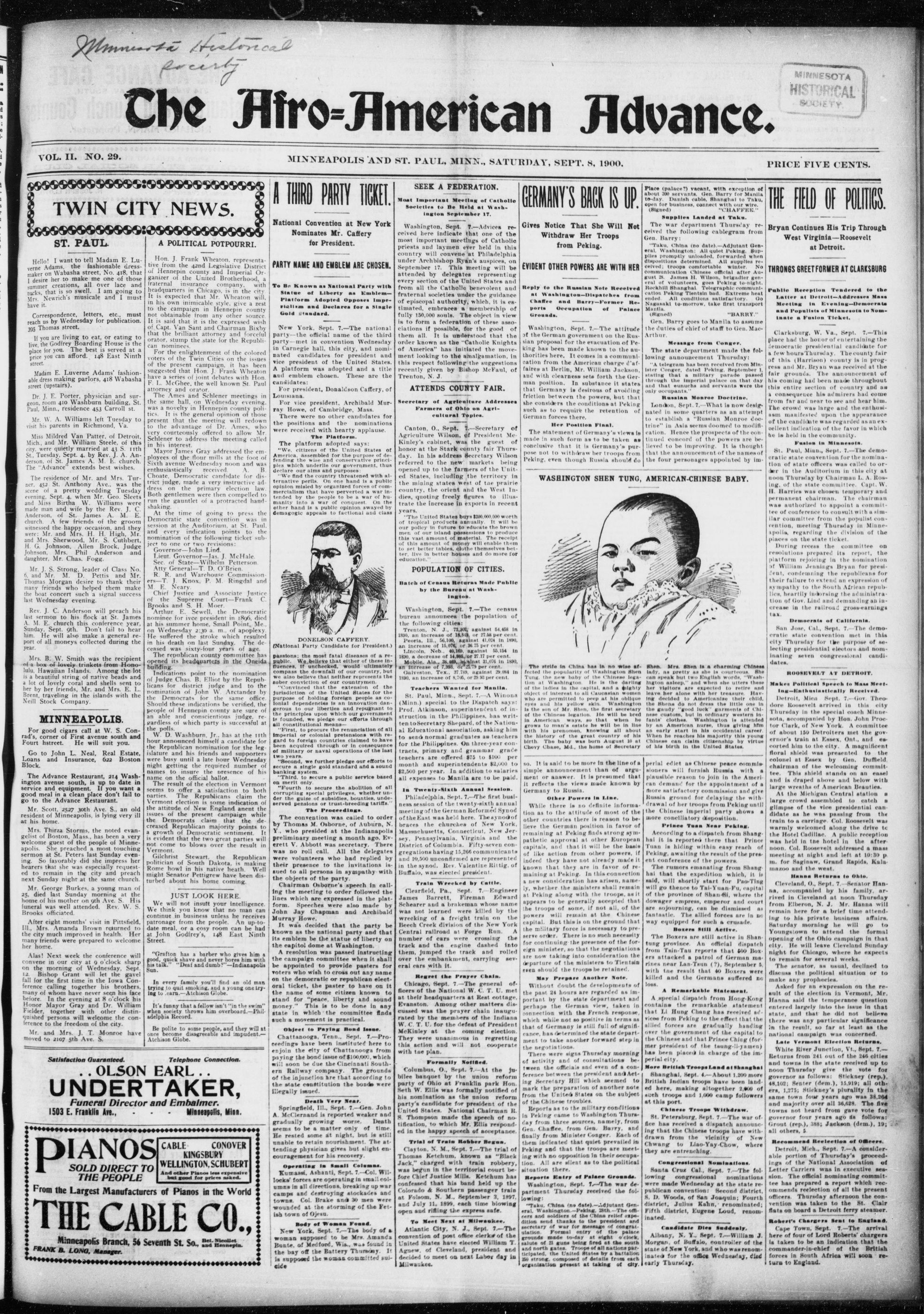
WASHINGTON SHEN TUNG. AMERICAN-CHINESE BABY.
1
GERMANY'S BACK IS UP.
Gives Notice That She Will Not Withdraw Her Troops from Peking.
EVIDENT OTHER POWERS ARE WITH HER
Reply to the Russian Note Received at Washington—Dispatches from Chaffee and Barry—Former Reports Occupation of Prince Grounds.
Washington, Sept. 7. The attitude of the German government on the Russian proposal for the evacuation of Peking has been made known to the authorities here. It comes in a communication from the American charge d'affaires at Berlin, Mr. William Jackson, and with clearness sets forth the German position. In substance it states that Germany is desirous of avoiding friction between the powers, but that she considers the conditions at Peking such as to require the retention of German forces there.
Her Position Final.
The statement of Germany's views is made in such form as to be taken as conclusive that it is Germany's purpose not to withdraw her troops from Peking, even though Russia should do
WASHINGTON SHEN TUNG,
the stifle in China has in no wise affected the popularity of Washington Shen Tung, the new baby of the Chinese legation at Washington. He is the darling of the American way, the object of interest to all Caucasian women who are permitted to peep at his oblique eyes and his yellow skin. Washington is the son of Mr. Shen, the first secretary of the Chinese legation. He will be bred American ways, so that he grows to man's estate he will be in line with his prenomen, knowing all about the history of the great country of his birth. The baby was born August 10 at Chey Chase, Md., the home of Secretary so. It is said to be in the line of a simple announcement than of argument or answer. It is presumed that it reflects the views made known by Germany to Russia.
Other Powers in Line.
While there is no definite information as to the attitude of most of the other countries there is reason to believe the German position in favor of remaining at Peking finds strong sympathetic approval at other European capitals, and that it will be the basis of like action from other powers, if indeed they have not already made it known that they are in favor of remaining at Peking. In this connection a new consideration has arisen, namely, whether the ministers shall remain at Peking along with the troops, as it appears to be generally accepted that the troops of some, if not all, of the powers will remain at the Chinese capital. But this is on the ground that the military force is necessary to preserve order. There is no such necessity for continuing the presence of the foreign minister, so that the negotiations are now taking into consideration the departure of the ministers to Tientsin even should the troops be retained.
May Prepare Another Note.
Without doubt the developments of the past 24 hours are regarded as important by the state department and perhaps the German view, taken in connection with the French response, which while not so positive in terms as that of Germany is still full of significance, has determined the state department to take another forward step in the negotiations.
There were signs Thursday morning of activity and of consultations between the officials and even of a conference between the president and Acting Secretary Hill which seemed to mark the preparation of another note from the United States on the subject of the Chinese troubles.
Reports as to the military conditions in Peking came to Washington Thursday from three sources, namely, from Gen. Chaffee, from Gen. Barry, and finally from Minister Conger. Each of them indicated that quiet prevailed in Peking and that the troops are meeting with no opposition in their occupation. All are silent as to the political situation there.
Reports Entry of Palace Grounds.
Washington, Sept. 7.—The war department Thursday received the following:
—Taku, China (no date).—Adjutant General, Washington—Peking. 26th.—The officers and soldiers of the China relief expedition send thanks to the president and secretary of war for message of congratulations on the details of detainment grounds made to-day at sight of clock, salute of 21 guns being fired at the south and north nets. Troops of all nations participated, the United States by a battalion of 100 soldiers, and the organization present at taking of city.
---
Place (palace?) vacant, with exception of about 300 servants. Gen. Barry for Manila 10-day. Danish cable, Shanghai to Taku, business, connect "CHAFFEE" (Signed)
Supplies Landed at Taku.
Supplies Landed at Taku.
The war department Thursday received the following cablegram from Gen. Barry:
"Taku, China (no date).—Adjutant General, Washington: All quiet Peking. Supplies promptly unloaded, forwarded when needed. All volunteers received; troops comfortable winter. No communication Chinese official after August 2. James H. Wilson, brigadier general of volunteers, goes Peking to-night. All conditions for Shanghai Telegraphic communication Peking Tientain bad. Extreme heat ended. All conditions satisfactory. Go Nagasaki to-morrow, take first transport Matilda (signed)
"BARRY."
Gen. Barry goes to Manila to assume the duties of chief of staff to Gen. MacArthur.
Meaange from Conger.
The state department made the following announcement. Thursday:
lowing announcement Thursday:
"A telegram has been received from Minister Conger, dated Peking, September 1 stating that a military parade passed through the imperial palace on that day and servants were the only occupants."
Russian Monroe Doctrine.
London, Sept. 7. - What is now designated in some quarters as an attempt to establish a "Russian Monroe doctrine" in Asia seems doomed to modification. Hence the prospects of the continued concord of the powers are believed to be improving. It is thought that the announcement of the names of the four personages appointed by im-
AMERICAN-CHINESE BABY.
Shen. Mrs. Shen is a charming Chinese lady, as pretty as she is courteous. She can speak but two English words, "Washington aseep," and when she utters these words she leaves her alone with her treasure. Having decided to Americanize their child, the Shena does not dress the little one in the gaudy "good luck" garments of Chinese infants in inordinate western infants' clothes. Washington is attended by an American nurse, thus giving him an early start in his occidental career. When he reaches his majority this young Chinese can claim citizenship by virtue of his birth in the United States.
perial edict as Chinese peace commissioners will furnish Russia with a plausible reason to join in the American demand for the appointment of a more satisfactory commission and give Russia ground for delaying the withdrawal of her troops from Peking until the Chinese imperial party shows a more conciliatory disposition.
Prince Tuan Near Peking
According to a dispatch from Shanghai it is reported there that Prince Tuan is hiding within easy reach of Peking, awaiting the result of the present conference of the powers.
The rumors emanating from Shanghai that the expedition which, it is said, will shortly start for Pao-Tong will go thence to Tai-Yuan-Fu, capital of the province of Shan-61, where the dowager empress, emperor and court are sojourning, can be dismissed as fantastic. The allied forces are in no way equipped for such a crusade.
Boxers Still Active.
The Boxers are still active in Shantung province. An official dispatch from Tain-Tau reports that 400 Boxers attacked a patrol of German marines near Lan-Tsun (7), September 5, with the result that 40 Boxers were killed and the Germans suffered no loss.
A Remarkable Statement.
A special dispatch from Hong-Kong contains the remarkable statement that Li Hong Chang has received advices from Peking to the effect that the allied forces are gradually handling over the government of the capital to the Chinese and that Prince Ching (former president of the tung-li-yuan) has been placed in charge of the imperial city.
More British Troops Land at Shanghai Shanghai, Sept. 4. About 1,200 more British Indian troops have been landed here, making altogether 2,000 of such troops and 1,000 camp followers at this port.
Chinese Troops Withdraw.
St. Petersburg, Sept. 7.—The war office has received a dispatch announcing that the Chinese troops have withdrawn from the vicinity of New Chwang to Liao-Yay-Chow, where they are entrenching.
Congressional Nominations
Santa Cruz Cal, Sept. 7. The following congressional nominations were made Wednesday at the state republican convention: Second district, S. D. Woods, of San Joaquin; Fourth district, Julius Kahn; renominated; Fifth district, Eugene Loud, renominated.
Candidate Dilea Suddenly
Albany, N. Y. Sept. 7.—William J. Morgan, of Buffalo, controller of the state of New York, and who was renominated for the office Wednesday, died early Thursday.
MINNESOTA
HISTORICAL
SOCIETY
PRICE FIVE CENTS.
Bryan Continues His Trip Through West Virginia—Roosevelt at Detroit.
THRONGS GREET FORMER AT CLARKSBURG
Public Reception Tendered to the Latter at Detroit—Addresses Mass Meeting in Evening—Democrate and Populists of Minnesota to Nominate a Fusion Ticket.
Clarksburg, W. Va., Sept. 7.—This place had the honor of entertaining the democratic presidential candidate for a few hours Thursday. The county fair of this (Harrison) county is in progress and Mr. Bryan was received at the fair grounds. The announcement of his coming had been made throughout this entire section of country and as a consequence his admirers had come from far and near to see and hear him. The crowd was large and the enthusiasm manifested upon the appearance of the candidate was regarded as an excellent indication of the favor in which he is held in the community.
Fusion in Minnesota.
St. Paul, Minn., Sept. 7.—The democratic state convention for the nomination of state officers was called to order in the Auditorium in this city at noon Thursday by Chairman L. A. Rosing, of the state committee. Capt. W. H. Harries was chosen temporary and permanent chairman. The chairman was authorized to appoint a committee of conference to consult with a similar committee from the populist convention, meeting Thursday in Minneapolis, regarding the division of the places on the state ticket.
During recess the committee on resolutions prepared its report, the platform rejoicing in the nomination of William Jennings Bryan for president, condemning the republicans for their failure to extend an expression of sympathy to the South African republics, heartily indorsing the administration of Gov. Lind and demanding an increase in the railroad gross-earnings tax.
Democrata of California.
San Jose, Cal., Sept. 7. The democratic state convention met in this city Thursday for the purpose of selecting presidential electors and nominating seven congressional candidates.
ROOSEVELT AT DETROIT.
Makes Political Speech to Maa Meeting—Enthusiasmically Received.
Detroit, Mien Sept. 7,—Gov. Theodore Roosevelt arrived in this city Thursday in the special coach Minnesota, accompanied by Hon. John Proctor Clark, of New York. A committee of about 159 Detroiters met the governor's train at Essex, Ont., and escorted him to the city. A magnificent floral shield was presented to the colonel at Essex by Gen. Duffield, chairman of the welcoming committee. This shield stands on an easel and is draped above and below with large wreaths of American Beauty.
At the Michigan Central station a large crowd assembled to catch a glimpse of the vice presidential candidate as he was passing from the train to a carriage. Col. Roosevelt was warmly welcomed along the drive to the Hotel Cadillac. A public reception was held in the hotel in the afternoon. Col. Roosevelt addressed a mass meeting at night and left at 10:30 p.m. for Saginaw, Grand Rapids, Kalamazoo and the west.
Hanna Returns to Ohio.
Cleveland, O., Sept. 7.—Senator Hanna, accompanied by his family, arrived in Cleveland at noon Thursday from Eiberon, N. J. Mr. Hanna will remain here for a brief time attending to his private business affairs. Saturday morning he will go to Youngsown to attend the formal opening of the Ohio campaign in that city. He will leave Cleveland Sunday night for Chicago, where he expects to remain for several weeks. The senator, as usual, declined to discuss the political situation or to make any prophecies. Asked for an expression on the result of the election in Vermont, Mr. Hanna said the temperance question entered largely into the issue in that state, and that he did not believe there was any particular significance in the result, so far at least as the national campaign was concerned.
Late Vermont Election Returns.
White River Junction, Vt. Sept. 7.
Returns from 241 out of the 246 cities
and towns in the state received up to
noon Thursday give the vote for
governor as follows: Stickney (rep.)
48,102; Senter (dem.), 15,919; all others,
1,275; Stickney's plurality in the
same town four years ago was 38,264
and majority over all 36,628. The five
towns not heard from gave vote for
governor four years ago as follows:
Grout (rep.), 388; Jackson (dem.), 19;
all others, 5.
Recommend Resection of Officers.
Detroit, Mich., Sept. 7.—A considerable portion of Thursday's proceedings of the National Association of Letter Carriers was in executive session. The official nominating committee has prepared a report which recommends reelection of all the present officers. Thursday afternoon the convention was taken to the St. Clair flats on board a Detroit ferry steamer.
Robert's Chargers Sent to England.
Robert's charge went to England.
Cape Town, Sept. The arrival
half of four Roberts on board
will be an indication that the
commander-in-chief of the British
forces in South Africa will soon
return to England.
Minneapolis, - - - - - Minnesota
Entered at the Post Office, at Minneapolis, Minn., as second-class matter.
Subscription Rates:
One Year - - - - - $1.00
Six Months - - - - - .66
Three Months - - - - .33
Special rates if ordered by the dozen
the office by Wednesday evening.
Advertising Rates.
Local Reading Notices, 10c per life
each insertion.
Religious Notices (not over five lines)
free.
Want? "And To Let" advertisements
8 cents each insertion.
Display, 40 cents per inch each insertion.
Special rates will be given for space by
the publisher.
Editorial Announcements.
To secure the return of unsolicited manuscript postage should be enclosed by Wednesday morning, preceding the issue in which they are to appear. Each manuscript should be received news matter for publication, must bear the writers name not or not publication, but as such contributions and items of news concerning the progress of colored race and the progress of our readers. We reserve the right to reject any communication unauthorized or publication, Authorized or unauthorized on our paper changed are requested to give their former as we in their present address. All remittances to THE AFRO-AMERICAN ADVANCE. 214 Washington Ave., South, Minneapolis, Minn. MRS. GEO. DUCKETT, PUBLISHER AND MANAGER
National Republican Ticket..
FOR PRESIDENT:
WILLIAM McKINLEY,
OF OHIO.
FOR VICE PRESIDENT:
THEO. ROOSEVELT,
OF NEW YORK.
OUR STATE TICKET.
Governor ..... S. R. Van Sant
Lieutenant Governor ..... L. H. Smith
Attorney General..... W. B. Douglass
Secretary of State..... P. E. Hanson
Chief Justice ..... C. M. Start
Associate Justice ..... L. W. Collins
Railroad Commissioner, O. S. Miller
and I. B. Mills (lour years) and C. F.
Staples (two years)
- EDITORIAL
PAUL LAWRENCE DUNBAR
COMING
The information is given out by one high in the councils of the Minnesota Law Enforcement League that under the auspices of this organization the poetic genius of the negro race, Paul Lawrence Dunbar, is coming to the city to deliver a lecture. It speaks of a good judgment, the promoters of the race that they chosen one of the young men of the race for such a purpose. As an object lesson to colored youths of what can be accomplished by perseverance and patience, the appearance of the sweet singer will be of invaluable service. No man ever started to rise in the world from a more humble station or with more obstacles astride his pathway, and achieved more splendid results. Only the young man with an elevator boy in a hotel and from depth to the glorious heights to which he has since attained there seemed an impassible gulf. But the soul within him, throbbing' with the impulse of genius, transcended in its aspiration all mundane proscription and barriers, and spurred him toward the goal of his high ambition. Today he is known and respected wherever the English language is to be hoped that there will be no more Law Enforcement League to make his stay in the Twin Cities pleasant and to assure him a large audience.
In doing honor to Paul Lawrence Dunbar we but honor ourselves. May the poet laureate of the Afro-American race live to grace the city of Minneapolis many more times with his distinguished presence.
Hurt Him Professionally
A New York barkeeper who was spending his vacation in Maine found himself one evening in a hotel in Portland. While he lingered a terrible storm took place. The windows of the room in which he was sitting were broken by hailstones "almost as big as eggs". The proprietor of the hotel noticed that the barkeeper turned aside to do that. "Does the storm scare you?" he ventured to ask his guest.
"It isn't that," replied the barkeeper, "but I can't bear to see so much cracked ice wasted in a prohibition state."—N. Y. Mail and Express.
Noncommittal
Mrs. Slowpay—A girl formerly in your employ answered my advertisement for a maid. Is she honest? Dressmaker—That is more than I can see. "Why, what do you mean?" "Well, you see, I have no positive proof but honesty, but every time I sent her to me, I would say, 'I am not me the money.'"—Chicago Evening News.
Accommodating.
"I am a British subject," he said, as he signed the register with a flourish. "All right," replied the hotel clerk, "if I notice any Boers lurking about I'll give you the tip to rush to cover." Philadelphia North American.
To Win Undying Fame.
Some day, to shift the small boy to an earthly paradise, somebody will introduce a fenced baseball park and his fame will last forever. - Pittsburgh Times.
Lucid Mapping
"Why Do Men Gamble?" is the title of a brochure now attracting attention. A lot of men gamble because a few men win—N. Y. Press.
Quite a Toot.
Forty-five trumpeters accompany the king of Abyssinia wherever he goes. Here is one man at least who doesn't have to toot his own horn to be heard of.—San Francisco Eulletin.
Once Enough.—"I notice that lightning struck the Chicago river last Thursday." "I'll bet that's a case where lightning never strikes twice in the same place."—Cleveland Plain Dealer.
AMERICA AND CHINA.
Secretary Evans's Letter of December
$0, 1880, to the Peking Government
May Prove Itself a Dipl-
omatic Booerang.
THERE is considerable talk in the newspapers about "indemnity" for the outrages which have been committed in China against foreigners temporarily resident in that empire. At the department of state the officials express the belief that there will be no other indemnity, separation nor retribution for anything which has been done. Of course these officials do not talk for publication, because that would be contrary to the rules and precedents of the department, but in private conversation with personal friends they say that "indemnity" is practically out of the question.
Li Hung Chang spoke for the imperial government when he said that the treasury of China is so depleted that no cash indemnity can be paid, and that the people of China will not permit any further concessions of territory to the countries interested. The word "indemnity" covers a great deal of ground in international law. It means a complaisant, friendly, fraternal effort on the part of the country in which the outrages have been committed to bring the criminals to justice and retribution; an effort to indemnify the sufferers for their wrongs, or to indemnify their heirs if human lives have been sacrificed; or reparation in the form of abject apology. If the national honor has been specifically involved.
The utterances of Li Hung Chang indicate that the Chinese government does not intend to do any of these things, and the eminent oriental statesman speciously pleads the utter inability of the government of Peking to do anything more than publicly express regret for the consequences of the alleged insurrection. Present indications are that there will be no recognition of the fact that the national honor of any country has been involved.
What other nations may do under these circumstances can only be conjectured. It is well known that all of the powers of the world cannot demand an eye for an eye and a tooth for a tooth, because the invasion and destruction of the Chinese empire would be impossible. The reasons for this conclusion have heretofore been given with some degree of elaboration.
This republic is very unfortunately circumstanced in the matter. It has always fought off the payment of indemnities, and the admission of national responsibility for outrages committed in violation of treaty stipulations. There is one specific case in point which the Chinese government may well cite, and which it will undoubtedly cite. On December 30, 1880, William M. Evarts, our secretary of state, wrote officially to the Chinese minister in Washington as follows:
"I know of no principle of national obligation, and there is certainly none arising from treaty stipulation, which renders it incumbent upon the government of the United States to make indemnity to the Chinese residents of Denver who, in common with the citizens of the United States, mob. Whatever remedies may be offered to the citizens of Colorado, or to the citizens of the United States from other states in the union resident in Colorado, for losses resulting from that occurrence are equally open to the Chinese residents of Denver who may be suffered from the lawlessness of the mob."
Twenty years ago China was a small factor in international affairs, and every nation snubbed her in diplomatic correspondence. The Chinese minis-
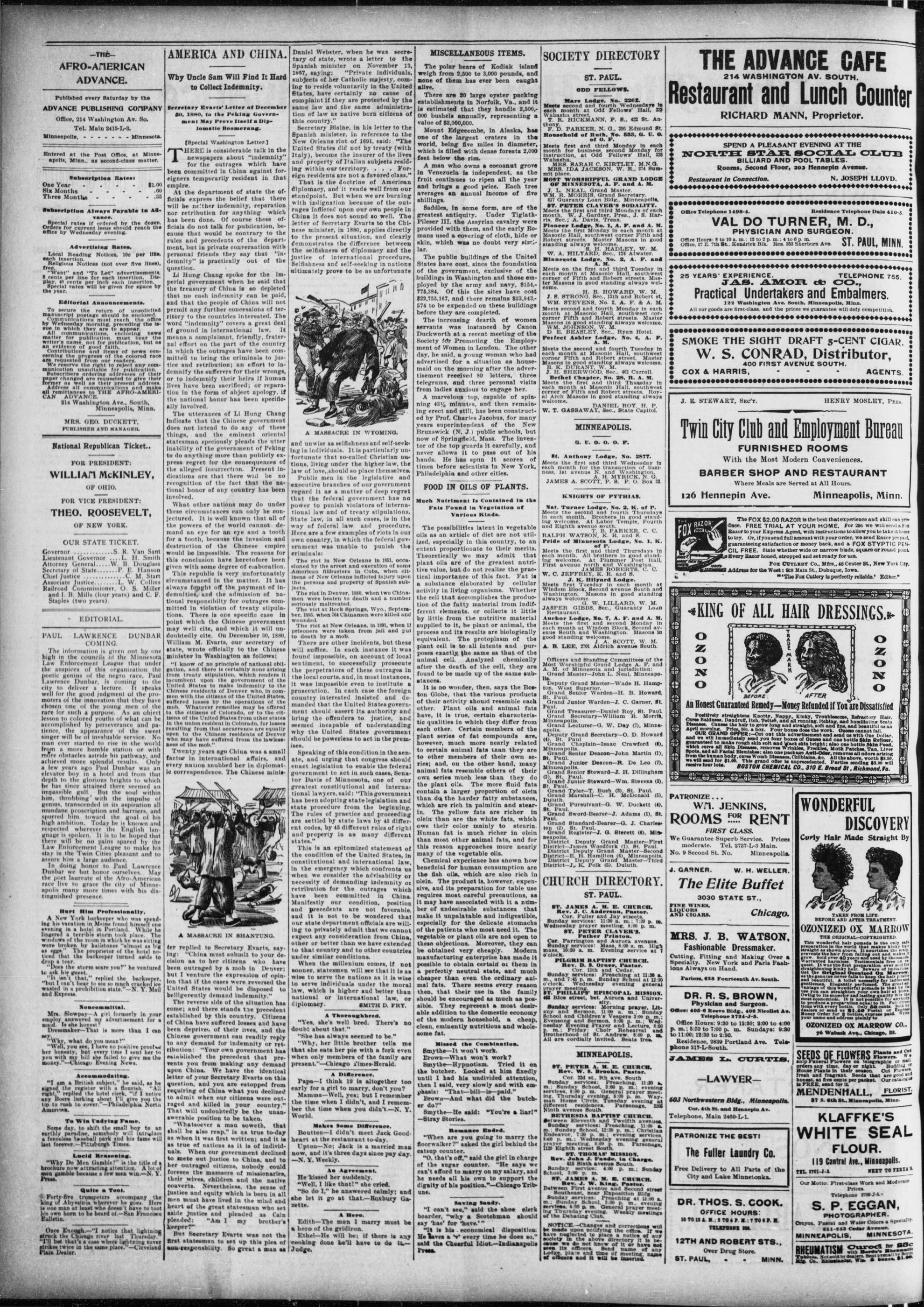
A MASSACRE IN SHANTUNG.
replied to Secretary Evarts, saying: "China must submit to your decision as to her citizens who have been outraged by a mob in Denver; but I venture the expression of opinion that if the cases were reversed the United States would be disposed to beligerently demand indemnity."
The reverse side of the situation has come; and there stands the precedent established by this country. Citizens of China have suffered losses and have been deprive, of their lives, and the Chinese government can readily reply to any demand for indemnity or retribution: "Your own government has established the precedent that prevents you from making any demand upon China. We have the identical letter of your Secretary Evarts on this question, and you are estopped from requiring of China what you declined to admit when our citizenes were outraged and killed in your country." That will undoubtedly be the unanswerable position to be taken.
"Whatsoever a man soweth, that shall he also reap," is as true to-day as when it was first written; and it is as true of nations as it is of individuals. When our government declined to mete out justice to China, and to her outraged citizens, nobody could foresee the massacre of missionaries, their wives, children and the native converts. Nevertheless, the sense of justice and equity which is born in all men must have lived in the mind and heart of the great statesman who set aside justice and pleaded as Cain pleaded: "Am I my brother's keeper?" But Secretary Evarts was not the first statesman to set up this plea of non-responsibility. So great a man as
Daniel Webster, when he was a secretary of state, wrote a letter to the Spanish minister on November 13, 1857, saying: "Private individuals, subjects of her Catholic majesty, coming to reside voluntarily in the United States, have certainly no cause of complaint if they are protected by the same law and the same administration of law as native born citizens of this country." Secretary Blaine, in his letter to the Spanish minister, in reference to the New Orleans riots of 1891, said: "The United States did not by treaty (with Italy), become the insurer of the lives and property of Italian subjects residing within our territory. . . . Foreign residents are not a favored class."
That is the doctrine of American diplomacy, and it reads well from our standpoint. But when we are burning with indignation because of the outrages inflicted upon our own people in China it does not sound so well. The letter of Secretary Evarts to the Chinese minister, in 1880, applies directly to the present situation, and clearly demonstrates the difference between the selfishness of diplomacy and the justice of international procedure, Selfishness and self-seeking in nations ultimately prove to be as unfortunate
A MASSACRE IN WYOMING.
and unwise as selfishness and self-seeking in individuals. It is particularly unfortunate that so-called Christian nations, living under the higher law, the law of love, should so place themselves. Public men in the legislative and executive branches of our government regard it as a matter of deep regret that the federal government has no power to punish violators of international law and of treaty stipulations. State law, in all such cases, is in the way of federal law and procedure. Here are a few examples of riots in our own country, in which the federal government was unable to punish the criminals:
The riot in New Orleans in 1851, occasioned by the arrest and execution of some American filibusters in Cubs, when citizens of New Orleans inflicted injury upon the person and property of Spanish subjects.
The riot in Denver, 1880, when two Chinamen were beaten to death and a number seriously maltreated.
The riot at Rock Springs, Wyo., September, 1885, when 764 Chinamen were killed and wounded. The riot at New Orleans, in 1891, when 11 pirates were taken from jail and put to death by a mob. There are other incidents, but these will suffice. In each instance it was found impossible, on account of local sentiment, to successfully prosecute the perpetrators of these outrages in the local courts, and, in most instances, it was impossible even to institute a prosecution. In each case the foreign country interested insisted and demanded that the United States government should assert its authority and bring the offenders to justice, and seemed incapable of understanding why the United States government should be powerless to act in the premises.
Speaking of this condition in the senate, and urging that congress should enact legislation to enable the federal government to act in such cases, Senator Davis of Minnesota, one of our greatest constitutional and international lawyers, said: "This government has been adopting state legislation and state procedure from the beginning. The rules of practice and proceeding are settled by state laws by 45 different codes, by 45 different rules of right and property in as many different states."
This is an epitomized statement of the condition of the United States, in constitutional and international law, in the emergency which confronts us when we consider the advisability or necessity of demanding indemnity or retribution for the outrages which have been committed in China. Manifestly our condition, position and precedents are not favorable, and it is not to be wondered that our state department officials are willing to privately admit that we cannot expect any consideration from China, other or better than we have extended to that country and to other countries under similar conditions.
When the millennium comes, if not sooner, statesmen will see that it is as wise to serve the nations as it is wise to serve individuals under the moral law, which is higher and better than national or international law, or diplomacy. SMITH D. FRY.
A Thoroughbred.
"Yes, she's well bred. There's no doubt about that."
"She has always seemed to be."
"Why, her little brother tells me that she eats her pie with a fork even when only members of the family are present." -Chicago Times-Herald.
A Difference.
Papa—I think 19 is altogether too early for a girl to marry, don't you? Mamma—Well, yes; but I remember the time when I didn't, and I remember the time when you didn't.—N. Y. World.
Makes Some Difference.
Boutton—I didn't meet Jack Good-heart at the restaurant to-day.
Upton—No; Jack is a married man now, and it's three days since pay day.—N. Y. Weekly.
An Agreement.
He kissed her suddenly.
"Well, I like that!" she cried.
"So do I," he answered calmly; and she let it go at that.—Roxbury Gazette.
A Hero.
Edith—The man I marry must be a hero of the gridiron.
Ethel—He will be; if there is any cooking done he'll have to do it—Judge.
MISCELLANEOUS ITEMS.
The polar bears of Kodiak island weigh from 2,500 to 3,000 pounds, and none of them has ever been caught alive.
There are 20 large oyster packing establishments in Norfolk, Va., and it is estimated that they handle 2,500-000 bushels annually, representing a value of $2,000,000.
Mount Edgecombe, in Alaska, has one of the largest craters in the world, being five miles in diameter, which is filled with dense forests 2,000 feet below the rim.
A man who owns a cocoanut grove in Venezuela is independent, as the fruit continues to ripen all the year and brings a good price. Each tree averages an annual income of five shillings.
Saddles, in some form, are of the greatest antiquity. Under Tiglath-Pileser III. the Assyrian cavalry were provided with them, and the early Romans used a covering of cloth, hide or skin, which was no doubt very similar.
The public buildings of the United States have cost, since the foundation of the government, exclusive of the buildings in Washington and those employed by the army and navy, $154-755,384. Of this the sites have cost $22,755,167, and there remains $23,843-574 to be expended on these buildings before they are completed.
The increasing dearth of women servants was instanced by Canon Duckworth at a recent meeting of the Society for Promoting the Employment of Women in London. The other day, he said, a young woman who had advertised for a situation as housemaid on the morning after the advertisement received 80 letters, three telegrams, and three personal visits from ladies anxious to engage her.
A marvelous top, capable of spinning 43% minutes, and then remaining erect and still, has been constructed by Prof. Charles Jacobus, for many years superintendent of the New Brunswick (N. J.) public schools, but now of Springfield. Mass. The inventor of the top guards it carefully, and never allows it to pass out of his hands. He has spun it scores of times before scientists in New York, Philadelphia and other cities.
FOOD IN OILS OF PLANTS.
Much Nutrient Is Contained in the Fats Found in Vegetation of Various Kinds.
The possibilities latent in vegetable oils as an article of diet are not utilized, especially in this country, to an extent proportionate to their merits. Theoretically we may admit that plant oils are of the greatest nutritive value, but do not realize the practical importance of this fact. Fat is a substance elaborated by cellular activity in living organisms. Whether the cell that accomplishes the production of the fatty material from indifferent elements, or collects it little by little from the nutritive material supplied to it, be plant or animal, the process and its results are biologically equivalent. The protoplasm of the plant cell is to all intents and purposes exactly the same as that of the animal cell. Analyzed chemically after the death of the cell, they are found to be made up of the same substances.
It is no wonder, then, says the Boston Globe, that the various products of their activity should resemble each other. Plant oils and animal fats have, it is true, certain characteristic qualities in which they differ from each other. Certain members of the plant series of fat compounds are, however, much more nearly related to certain animal fats than they are to other members of their own series; and, on the other hand, many animal fats resemble others of their own series much less than they do the plant oils. The more fluid fats contain a larger proportion of olein than do the harder fatty substances, which are rich in palmitin and stearin. The yellow fats are richer in olein than are the white fats, which owe their color mainly to stearin. Human fat is much richer in olein than most other animal fats, and for this reason approaches more nearly many of the vegetable oils.
Chemical experience has shown how beneficial for human consumption are the fish oils, which are also rich in olein. The product is, however, expensive, and its preparation for table use requires most careful precautions, as it may have associated with it a number of undesirable substances that make it unpalatable and indigestible, especially for the delicate stomachs of the patients who most need it. The vegetable or plant oils are not open to these objections. Moreover, they can be obtained very cheaply. Modern manufacturing enterprise has made it possible to obtain certain or them in a perfectly neutral state, and much cheaper than even the ordinary animal fats. There seems every reason then, that their use in the family should be encouraged as much as possible. They represent a most desirable addition to the domestic economy of the modern household, a cheap, clean, eminently nutritious and wholesome fat.
Missed the Combination.
Smythe—It won't work.
Brown—What won't work?
Smythe—Hypnotism. Tried it on the butcher. Looked at him fixedly until I had his undivided attention, then I said, very slowly and with emphasis: "That—bill—is—paid."
Brown—And what did the butcher do?"
Smythe—He said: "You're a liar!"
—Stray Stories.
Romance Ended.
"When are you going to marry the floorwalker?" asked the girl behind the catsup counter.
"O, that's off," said the girl in charge of the sugar counter. "He says we can't afford to marry on my salary, and he needs all his own to support the dignity of his position."—Chicago Tribune
Saving Sandy.
"I can't see," said the shoe clerk boarder, "why a Scotchman should say 'hae' for 'have.'"
"It is his .economical disposition. He have a 'w' every time he does so," said the Cheerful Idiot—Indianapolis Press.
SOCIETY DIRECTORY
ST. PAUL.
ODD FELLOWS.
Mars Lodge, No. 2202.
Meets second and fourth Wednesdays in each month at Odd Fellows' Hall, 323 Wabasha street.
T. R. HICKMANN, P. S., 422 St. Anthony.
P. D. PARKER, N. G., 365 Edmund St.
Household of Ruth, No. 553, G. U. O. of O. F.
Meets first and third Monday in each month for business, second Monday for instruction, at Odd Fellows' Hall, 323
MRS. SARAH C. KIRTLEY, M.N.G.
MRS. IDA JACKSON, W. R. 744
Summit place.
MRS. MORSHIPFUL GRAND LODGE
OF MINNESOTA A. F. and A. M.
J. L. NEAL, Grand Master.
WM. R. MORRIS, Grand Secretary.
81 Guaranty Loan Bldg., Minneapolis.
ST. PETER CLAYER'S SODALITY.
Meets the first and third Mondays of each
month. Sec. J. H. BARRIS,
Sec. A. D. Davis, Treas.
Pioneer Lodge, No. 1, A. F. and A. M.
Meets the first Monday in each month at
Rasineau, southwest Fifth and
St. Augustine street. Corns in good
standing always welcome.
S. H. HADLEY, W. M.
W. A. HILYARD, Sec. 124 Atwater.
Minnesota Lodge, No. 2, A. F. and A. M.
Meets on the first and third Tuesday in each month at Masonie Hall, southwest corner of Fifth and Robert streets. Master Masons in good standing always welcome.
H. B. HOWARD, W. M.
J. S. STRONG, Sec. 12th and Robert st, WM. STEVENS, No. 2, A. F. & A. M.
Meets second and fourth Monday in each month at Masonie Hall, southwest corner Fifth and Robert streets. Master Masons in good standing always welcome.
W. M. JOHNSON, W. M.
D. E. BEASLEY, Sec., Ryan Hotel.
Perfect Ashler Lodge, No. 4, A. F.
A. M.
Meets the second and fourth Tuesday in each month at Masonie Hall, southwest corner Fifth and Robert street, Master Masons in good standing always welcome.
B. K. DURANT, W. M.
J. H. SHERWOOD, Sec. 461 Carroll.
Bethel Chapter, No. 2S, R. A. M.
Meets the first and third Thursday in each month at Masonie Hall, southwest corner of Fifth and Robert streets. Royal Arch Masons in good standing always welcome.
DANIEL ROY, H. P.
W. T. GASSAWAY, Sec. State Capitol.
MINNEAPOLIS.
G. U. O. O. O. F.
St. Anthony Lodge, No. 2877.
Meets the first and third Wednesday in
ninth week of school, in the
ninety, first avenue N. and Washington,
JAMES A. SCOTT, H. MYRICK, G.
JAMES A. SCOTT, Rox. 23
KNIGHTS OF PYTHIAS.
Nat. Turner Lodge, No. 2, K. of P.
Meets the second and fourth Thursdays in each month. Standing at Lakeside Temple, and Eighth avenue south.
RALPH WATSON, K. R. and S.
Pride of Minnesota Lodge, No. 1, K.
Meets the first and third Thursdays in each month. All brothers in good standing welcome. Flummer at Hollaston. First avenue north Hollaston.
JAMES ROBERTS, C. C.
W. C. JEFFREY, K. R. and S.
Meets first Tuesday in each month at Windom Block, Second avenue South and Masons in good standing always welcome.
G. W. LILLARD, W. M.
JASPER GIBBS, Sec. Guaranty Loan Restaurant.
B. LEE, 721 Aldrich avenue South.
SCOTT, W. M.
A. B. LEE, 721 Aldrich avenue South.
Officers and Standing Committees of the Most Worst Personnel F. and A. M. of Minnesota and jurisdiction:
A. Grand Master-John L. Neal, Minneapolis
Deputy Grand Master—Wade H. Hampton, West Superior.
Deputy Senior Warden—H. B. Howard, St. Paul.
Grand Junior Warden—J. C. Garner, St. Paul.
Grand Treasurer—Daniel Roy, St. Paul.
Grand Secretary—William R. Morris, Minnesota.
Grand Lecturer—G. W. Day (7), Minnesota.
Grand Secretary—O. D. Howard (4).
Grand Chaplain—Isaac Crawford (4), Minnesota.
Grand Senior Deacon—John Martin (1), St. Paul.
Grand Junior Deacon—R. De Leo (7), Minnesota.
Grand Steward—J. H. Dillingham (3), St. Paul.
Grand Junior Steward—Wm. Stevens (3), St. Paul.
Grand Tyrler—T. Bush (3), St. Paul.
Grand Marshall—C. H. McDonald (6), Duluth.
Grand Pursulvant—G. W. Duckett (4).
Grand Sword-Bearer—J. Adams (1), St. Paul.
Grand Standard-Bearer—G. J. Charleson (2), St. Paul.
Grand Register—G. S. Gerster (6), Mis-
District Deputy Grand Master-First
District Deputy Grand Master-Second
District Deputy Grand Master-Second
District-E. H. Hamilton (6). Minneapolis.
District-F. Hamilton. Third-Third
District-J. K. Folk (4). Duluth.
CHURCH DIRECTORY.
Sunday services: 11:30 a.m. m; 7:30 p.m.
Wednesday prayer meeting, 8:00 p.m.
**ST. PETER CLAYER'S**
Prayer Room.
Cor. Parrington and Aurora avenues.
Sunday services: Mass, 8:00 a.m. High
mass, 10:30 a.m. Evening service at
7 o'clock
**PILGRIM BAPTIST CHURCH**
Rev. D. S. Orner, Pastor.
Cor. 13th and Cedar.
Sunday services: Preaching at 11:30 a.m.
m; 7:30 p.m. Evening service at
7 o'clock
Wednesday evening general
prayer meeting.
483. PHILIP'S EPISCOPAL MISSION.
Rice street, bet. Aurora and Universi-
Sunday services: Morning prayer, Litt-
any and Sermon, 11:00 a. m.; m. Sunday
School and Children's Veepers 3:00 p. m.; m.
School and Children's Veepers 3:00 p. m.
needy Evening Prayer and Lecture, 8:00
p. m.; Friday: Choir Rehearsal and
Sermon, 8:00 p. m.
All are cordially invited. Seats free.
MINNEAPOLIS.
ST. PETER A. M. E. CHURCH
Rev. W. S. Brooks, Pastor.
Cor. 22d st. 9th ave. South
Sunday services: 11:00 a.m.;
m; Sunday School, 3:00 p.m.;
evening services, 8:00 p.m. General prayer meet
meeting, 8:00 p.m. Wayman Home Circle, jesus evening
different residences. Parsonage, 205
Ninth avenue south.
ST. PETER A. M. E. CHURCH
Between Eleventh and Twelfth avenue.
Sunday services: Preaching, 11:00 a.m.;
m; Sunday School, 12:00 p.m.; Christian
preaching, 11:00 p.m.; Wednesday evening general
prayer meeting, 8:00 p.m. Parsonage,
120 Eighth street.
ST. TOMAS'S MISSION.
Rev. John J. Faude, in Charge,
615 Sixth avenue South.
Sunday services, 4:00 p.m.; Sunday
School, 3:00 p.m.
ST. JAMES A. M. E. CHURCH.
Rev. J. W. King, Pastor.
Between Eleventh and Twelfth street
Southeast, hear evening Sunday services: Preaching at 11:00 a.m.;
m; Sunday School, 3:00 p.m. evening prayer meet
meeting Thursday evening. Weekly meetings of
the Debating Club.
NOTICE—Changes and corrections will be made upon notify the office. If we have requested to notify the notice of any society in the above directory it to be because we do not know of it or have not seen its officers. Send name of any lookup place and time of meeting, name of officers and it will be inserted.
THE ADVANCE CAFE 214 WASHINGTON AV. SOUTH. Restaurant and Lunch Counter
RICHARD MANN, Proprietor.
SPEND A PLEASANT
NORTH STAR
BILLIARD AND
Rooms, Second Floor,
Restaurant in Connection.
Office Telephone 1498-4.
VAL DO TUR
PHYSICIAN A
Office Hours: 8 to 10 a.m.; 12 to 2 p.m.; 4 to
Office, 27 E. 7th St.; Kendrick Blk. Res. 33
25 YEARS' EXPERIENCE.
JAS. AMO
Practical Undertake
122 Washington Ave. S.
All our goods are first-class, and the pr
SMOKE THE SIGHT B
W. S. CONRA
400 FIRST AVE.
COX & HARRIS,
SPEND A PLEASANT EVENING AT THE WITH STAR SOCIAL CENTER BILLIARD AND POOL TABLES. Rooms, Second Floor, 202 Hennepin Avenue. In Connection. N. JOSEPH.
Phone 1498-4. Residence Telephone.
VAL DO TURNER, M. D. PHYSICIAN AND SURGEON. to 10 a.m.; 12 to 2 p.m.; 4 to 6 p.m. St. Kendrick Bik. Res. 253 Sherburn Ave.
EXPERIENCE. TELEPHONE JAS. AMOR & CO., Medical Undertakers and Embalers. 122 Washington Ave. South, Minneapolis, Minn. Ises are first-class, and the prices we guarantee will defy.
THE SIGHT DRAFT 5-CENT U.S. CONRAD, Distrib. 400 FIRST AVENUE SOUTH. HARRIS,
ART, Sec'y. HENRY MO.
City Club and Employment FURNISHED ROOMS With the Most Modern Conveniences. BER SHOP AND RESTAURANT Where Meals are Served at All Hours.
SPEND A PLEASANT EVENING AT THE NORTH STAR SOCIAL CLUB BILLIARD AND POOL TABLES. Rooms, Second Floor, 202 Hennepin Avenue. Restaurant In Connection. N. JOSEPH LLOYD.
Office Hours: 8 to 10 a. m.; 12 to 2 p. m.; 4 to 6 p. m.
Office, 27 E. 7th St., Kendrick Blk. Res. 833 Sherburn Ave.
ST. PAUL, MINN.
25 YEARS' EXPERIENCE.
TELEPHONE 755.
JAS. AMOR & CO.,
Practical Undertakers and Embalmers.
122 Washington Ave. South, Minneapolis, Minn.
J. E. STEWART, SECY.
Twin City Club and
FURNISH
With the Most Mo
BARBER SHOP A
Where Meals are S
126 Hennepin Ave.
Twin City Club and Employment Bureau
The FOX $2.00 RAZOR is the best that experience. FREE TRIAL AT YOUR HOME. For 20c Razor to your Express Agent, with instructions to allow to try. Or, if you send full amount with your order, we guarantee satisfaction or money back, and a FOX CIL FREE. State whether wide or narrow blade, sq. Every Razor honed, stripped and set ready for use.
FOX CUTLERY Co. Mfrs., 48 Center Address for the West : 928 Main St., Dubuque, Iowa.
**The Fox Cutlery is perfectly reliable.**
G OF ALL HAIR DRESSING
The FOX $2.00 RAZOR is the best that experience and skill can produce. FREE TRIAL AT YOUR HOME. For 250 we will send a Razor to your Express Agent, with instructions to allow you to take it to try. Or, if you send full amount with your order, we send Razor prepaid, guaranteeing satisfaction or money back, and a FOX STYPTIC PEN-CIL FREE. State whether wide or narrow blade, square or round point. Every Razor honed, stopped and set ready for use.
Fox CUTLERY Co., Mrs., 48 Center St., New York City.
Address for the West 128 Main St, Dubuque, Iowa.
"The Fox Cutlery is perfectly reliable.' Editor."
*KING OF ALL HAIR DRESSINGS.*
TRADEMARK
BEFORE AFTER
An Honest Guaranteed Remedy—Mo
Positively straightens Knotty, Nappy
Curly Hair, Wet Hair, Gray Hair, and
Disease. Causes the hair to grow long and
April morning. Price $20. a box. Four b
boxes. We will immediately send you four b
boxes guaranteed to make rough skin soft and g
which covers all Hair. Free Shipping. S
Spots, and all Facial Hiemes; also one pas
from the human body, curse Womb Diseases,
we are for you for this. This grand offer is
received from Boston Chemical
BOSTON CHEMICAL
PATRONIZE . . .
WJ. WENKINS,
ROOMS FOR .... RENT
FIRST CLASS.
**GUARANTEED Remedy—Money Refunded if You Are D**
straightens Knotty, Nappy, Kinky, Troublesome, Retra-
tions, and more. We specialize in healing, rejuveni-
ing, and hair care to hair grow long and straight, fine hair, and
Pricy. $50. a box. Four boxes does the work. Ozcano can
instruct you how to grow hair. We also provide immediate
medications you four boxes of Ozcano and one bottle
make rough skin soft and 'gack skin bright'; also one bottle
skin Moisture; also one package Anti-Oder; remove all
body, cures Womb Diseases, Chiblains, &c. All the above.
$1.00. also one package Anti-Oder. Send please
MOTOWN CHEMICAL CO., 310 E. Broad St., Rica-
town, NJ 07301.
Positively straighten Knotty, Nappy, Kinky, Troublesome, Refractory Hair, Curse Baldness, Dandruff, itch, Tester, and all running, tching, and humming Skin Diseases. Causes the hair to grow long and straight, soft and fine, and beautiful as an April morning. Price, $6.00, a box. Four boxes do the work. Ozone cannot fall.
OUR GRAND OFFER! Cut out this advertisement and send us with One Dollar, and we will send you four boxes of Ozone and one bottle Refiner, guaranteed to make rough cuts, which curves all 8in Disease, removes Wrinkles, Freckles, Moth Patches, Tan Liver Spots, and all Facial Blemishes; also one package Anti-Odor, removes all odors arising from our products. Comb Diseases, Chilblains, &c. All the above, worth $3.50 we will send for $1.00. This offer only applies. Parties sending $3.00 will receive four lots. BOSTON CHEMICAL CO., 310 E. Broad St., Richmond, Va.
We Guarantee Superb Service. Prices
moderate. Tel. 2737-L-3 Main.
No. 9 Second St. No. Minneapolis.
J. GARNER. W. H. WELLER.
The Elite Buffet
3030 STATE ST.,
FINE WINES,
LIQUORS
AND CIGARS. Chicago.
MRS. J. B. WATSON,
Fashionable Dressmaker.
Cutting, Fitting and Making Over a
Specialty. New York and Paris Fash-
lons Always on Hand.
Parlom, 628 Fourteenth Av. South.
Office Hours: 9:30 to 12:30; 2:00 to 4:00
p. m.; 7:00 to 5:00 p. m. Sundays: 9:30
to 11:00; 12:30 to 2:30.
Residence: 2839 Portland Ave. Tele-
phone 317-L.South.
JAMES L. CURTIS
LAWYER
603 Northwestern Bldg., Minneapolis.
Cor. 4th St. and Hennepin Av.
Telephone, Main 2460-L-1.
PATRONIZE THE BEST!
The Fuller Laundry Co.
PATRONIZE THE BEST!
The Fuller Laundry Co.
Free Delivery to All Parts of the
City and Lake Minnetonka.
DR. THOS. S. COOK.
OFFICE HOURS:
10 TO 12 A. M. 2 TO 6 P. M. 7 TO 8 P. M.
TELEPHONE 106.
12TH AND ROBERT STS.,
Over Drug Store.
ST. PAUL
ST. PAUL. MINN.
THE FOX RAZOR
FOR THE
AMUSEMENT
MUSEUM THEN TO
10000
LANDS
AT EVENING AT THE
SOCIAL CLUB
POOL TABLES.
202 Hennepin Avenue.
N. JOSEPH LLOYD.
Residence Telephone Dale 410-5.
BURNER, M. D.,
AND SURGEON.
9 p.m.
Sherburn Ave. ST. PAUL, MINN.
TELEPHONE 755.
R & CO.,
Lers and Embalmers.
South, Minneapolis, Minn.
We guarantee will defy competition.
DRAFT 5-CENT CIGAR.
D, Distributor,
ENUE SOUTH.
AGENTS.
HENRY MOSLEY, PRES.
Employment Bureau
D ROOMS
Modern Conveniences.
D RESTAURANT
served at All Hours.
Minneapolis, Minn.
OR is the best that experience and skill can pre-
YOUR HOME. For 25c we will send a Fox
print, with instructions to allow you to take it hone
amount with your order, we send Razor prepaid,
or money back, and a FOX STYPTIC PEN-
or wide or narrow blade, square or round point
and set ready for use.
LERY Co., Mrs., 48 Center St., New York City.
Main St, Dubuque, Iowa.
Fox Cullery is perfectly reliable.' Editor."
FAIR DRESSINGS.
They Refunded if You are Dissatisfied
Kinky, Troublesome, Refractory Hall, Grosse Pointe, and cumulating Scalp Straight, soft and smooth hair that does the work. Ozone cannot fail. Ozone is combined with One-polar, one of Ozone and one of Ozone Ringer, skin skin bright; also one bottle Skin Food, Mage Ant-Odor, removes all odors arising from chilblains, &c. All the above, worth $3.50, unprecedented. Parties sending $3.50 will CO., 810 E. Broad St, Richmond, Va.
WONDERFUL DISCOVERY
Curly Hair Made Straight By
THE ORIGINAL-COPYRIGHTED
This wonderful hair pomade is the only safe preparation in the world that makes kinky hairق prevent the hair from falling out and makes it grow. Sold over 40 years and used by thousands of Warranted hairers. Testimonials free on the market. Forgotten, perfumed. The great advantage of this wonderful pomade is that by use you can straighten your own hair at home. Owing to its superior and lasting quality it is most useful for hair care. It is a very easy to produce a preparation equal to it. Full direction to the end of the hair. Only 40 cents sold by dealers or send us $1.40 Postal or Express. Be sure your name and address plainly to OZONIZED OX MARROW CO., 76 Wabash Ave., Chicago, Ill.
SEEDS OF FLOWERS Plants and Cut
seep Funeral Flowers on telegraphic or mail orders any time, day or night. Budding or House Plants in their season. Cut Flowers fresh and fragrant. Seeds that are good and honest, as five cents per packet. Our catalog is FREE, send for it.
MENDENHALL,
37 S. 6th St., Minneapolis, Minn.
KLAFFKE'S
WHITE SEAL
FLOUR.
119 Central Ave., Minneapolis.
TEL. 2701-J-3.
NEXT TO VERIA A
Our Motto: First-class Work and Moderate
Prices.
Telephone 7200-J-4
S. P. EGGAN,
PHOTOGRAPHER.
Crayon, Pastel and Water Colors a Specialty.
251-283 Cedar Avenue.
MINNEAPOLIS, MINNESOTA.
RHEUMATISM
Ourec for 28c
with Bard's Rheumatic
Tablets. Notebook with Rheumatic
Tablets. Wipe. $1.00
SOME DAY.
Through old Japan you'll idly roam,
Bide down old Fuji-Yama's dome,
And see the gishaes in their home,
Some day.
You will go to Egypt, see the Sphinx,
Some day.
You will climb the Fyramids, metbinks,
Sail up the vast, mysterious Nile,
Shoot at the festive crocodile,
And kodak everything the while,
Some day.
To Italy's classic shores you'll hit,
Some day.
See Naples' Bay and refuse to die,
Along the tourist's usual groove
Entranced, with dreamful eyes, you'll for
move.
See old Pompeii and climb Vesoov,
Some day.
You'll do old Rome, and the Holy Land,
Some day.
Pick shells on India's coral strand,
Some day.
Explore the islands of the ocean,
With naught to stay your locomotion
Wherever you take the notion,
Some day.
Ah, trusting brother, you will find,
Some day.
You've done this only in your mind,
Some day.
But when life's journey's over, and
On Jordan's stormy banks you stand,
Maybe you'll see the Promised Land,
Some day.
-Chicago Tribune.
A PRAIRIE QUEEN
"NOW'S your chance, Deronda!"cried the agent's hearty voice.When he had carried the mail bags up from the depot he had waited until their contents were distributed. That was not a long time. It never was in Excelsior. And to-night the sacks had not been of sufficient weight to tax his strong shoulders. But out of their lankness had come a surprise for him, and an opportunity for Deronda.
"I can guess. It's a letter from Uncle Donald. A check?"
Once in awhile, at Christmas always, a letter inclosing a check arrived from Donald Bertram, of New York. And his brother, who found his petty salary as station master of the insignificant Nebraska town quite incommensurate with the needs of a large and increasing family, hailed the advent of each inclosure with gratitude and elation.
"N-o. It's a letter from Donald—but there's no check." He looked across at his best loved and eldest child with a smile brighter than even the welcome check had ever summoned. "Guess again."
She looked at him from her opposite end of the table where she presided, her mother in true western fashion still being busied at the kitchen stove until the remainder of her family had eaten. Between Deronda and her father a noisy and voracious young brood intervened—eight or ten of them. Deronda was kept busy attending to their needs. She and her mother "did" for the rest. They ate as their portion whatever was left. And neither dreamed of complaining. Labor and service were their ethics of domesticity. But now Deronda paused in her task of pouring out the numerous cups of milk.
"Father! It's good news! Keep still, Flora! What is it?"
The tidings came out in a rush. "If you will go to New York for a visit the check will follow your letter of acceptance. There!"
Deronda was the healthiest girl in town, but for the moment she felt positively weak. She set down the pitcher. The children clamored unheeded. "O!" she gasped, "I must tell mother!"
Then she was gone, and the overworked man with the kindly face waited on the children himself.
Those that followed were exciting days. The little, straggling, low rooms over the depot were the scene of many confabulations, much scheming, many glorious hopes, innumerable pleasant prophecies. 'Ronda, as the children called her, was going away—away into some vast and mystic fairyland, which their vivid imaginations merged in the triple ecstasy of Yuletide, Heaven and the Fourth of July. But one day order was born of confusion—sobriety of hysterical anticipation. That was the day Deronda's trunk stood labeled and corded on the platform—the day Deronda's self freshly and becomingly garbed, stood beside it. The day that Agent Bertram, and Mrs. Bertram, and all the numerous young Bertrams listened for the whistle of the train at the depot eight miles west; hung around her with growing excitement as the black column of smoke came down like the guide of those fleeing from Pharaoh, and clung around her in an adoring farewell, which was detrimental to her finery if flattering to her sensibility.
Then the iron beast was upon them. A few passengers alighted. Some express packages were handed off. These the agent mechanically received. Then Deronda's foot was on the first step of the Pullman. The engineer was looking back to see that the agent's pretty daughter got on safely before he pulled the throttle. The brakeman stood irresolute. The conductor loitered along, deferring the signal to start, because the departure of Deronda for the east was public property all along the line, and the men who had known her since she wore short dresses and waved them a welcome when their train went by were interested in this young bird-flight of hers from the overflowing family nest.
A sentitive whistle quivered in the air.
"Gued-by, Deronda! Have a good time!" Deronda's father gave her a hard squeeze of the hand. There was the peck of a kiss between these two who loved each other so clearly.
And the train was speeding east-
ward.
Ah, that was a marvelous world into
which Deronda went—a world where
one wore dainty clothes from dawn
till dawn! A world where the chief
function of the women was to charm—
that of the men to serve with the most
exquisite courtesy. And the meed of ad-
miration she received, when her west-
ern dresses had been discarded for
beautiful gowns, was new to her. Very
swift it was, too. To be sure, she had
known what it was to have young men
besiege her for dances and hang upon her words. But in one case those who had given her tribute were clumsy and rough-handed country boys. The men to whom her later environment introduced her possessed that indefinable air of breeding, of culture, of distinction which can be neither bought nor acquired. And she found the melody of trained voices at the opera sweeter than the triple note of the meadow lark—the scent of hothouse roses more delicious than the perfume of wild clover.
And so, too, she discovered entrance in the homage of Eldred Wier. Not that in his case there was the possibility of comparison. She had never been touched by the attentions of her former acquaintances. There had not been one who attracted her. When she came cast she was quite heart whole and fancy free. But missiles—the gentlest of missiles—well directed, did their deadly and delicious work. Perhaps these would not have been so promptly effective, even if hurled by Dan Cupid's unerring hand, had Dora realized that she was the bright particular star of the season. Had anyone told her that piquant, golden-brown beauty, her unconscious air of aloofness, her repose, begotten of prairie life and placid daily duty, had won for her a higher need of approbation than was usually accorded to a newcomer in an exclusive coterie, she would have opened her serene gray eyes wide in smiling incredulity. All the girls had admirers. Almost all the girls had lovers. But—not one of them had such a lover as Eldred Wier.
One month passed—two—three! And always there were the same tributes—always there was the same direct personal deference. Theaters, dinners, flowers, bonbons, gloves, afternoon visits, rides and drives! Always the same low, intimate tones, lingering hand-pressure, the magnetic allure of impassioned eyes! Then suddenly it seemed—it was time to go home. Time to go back to the dull little town, to the rooms over the depot, to the horde of clamorous children. Eldred Wier was the last to leave the Pullman. His worshiping eyes devoured the beauty of the shy, expectant face. His hand held hers in a close and tender clasp. He bent his head. He spoke in a tone that thrilled her.
"You know—you must know that I love you! You know, could I have my way. I would never let you go!" Then the train began to move. He was gone.
Five years later there was a tremendous rush of travel westward. The Nebraska town of Wymore was one of those caught in the vortex of impetuous pleasure seekers. Although there were many health seekers, too, bound for the soacing serenity of Colorado or the golden glory of California. A splendid summer day was waning when a snorting train disgorged its myriads on the depot platform. A young man, nervous and haggard of aspect, helped an elderly-woman to alight. With scant show of patience he hurried her into the waiting-room.
"I tell you I've got to leave you for awhile," he declared, testily. "I've a letter to present to one of the eastern officials of the road. His private car is due here now. I'll be back as soon as I can." Heedless of her whimpered objections he hurried off. A tall, beautiful young woman, most charmingly gowned, attracted the observation of the throng as she came down the waiting-room. She noticed the woman sitting alone, and evidently in distress.
"Can I be of service?" she inquired, pausing.
The traveler, in apparel too elaborate and youthful for her years, looked up into the gentle face of the speaker.
Her wrinkled cheeks were chalky under their rouge, and her false curls and bonnet were awry.
"No," she shrilled, heedless of her arers. "No one can help me. I brought it on myself. Me. worth half a million, to go and marry that young whispersnapper, that leaves me here like a bale of goods! Not even a drink of water—" The young woman brought her a glass of water, set straight the disordered hair and bonnet, and fanned the agitated old face, talking pleasantly the white.
"I am here," she said, "to meet my husband. He is one of the directors of the road. There—his special has just come in! He is coming this way." She rose eagerly. "There is some one with him." She took a step forward. "Welcome. Will!" as the stately man who had hastened to her side bent and kissed her.
"If it wasn't for this young lady, Eldred—" The resentful wail was cut short by a sharp exclamation. White as death Eldred Wier stared at Deronda Leighton. She looked from him to the shriveled old creature on the seat. So this was why he had never written—had never come! This was why she had fancied her heart was broken, until "a better man drew nigh!"
"Mr. Wier!" The glimmering smile in her radiant eyes maddened him. "I have been making the acquaintance of your wife." "Mr. Wier," she explained to her handsome husband, "is an old acquaintance of mine. But it is meet and part. Good-by." She swept the travelers with a graceful bow. "We really must go now, Will, dear, the carriage is waiting."—Chics go Tribune.
Harnessing the Wolf.
How many men and women owe fame, fortune and success to the wolf which they were obliged to keep away from the door and from the little ones! The best possible use to make of this ravenous beast is to harness him and compel him to work. Make him help pull the load. How many people, from sudden loss of wealth, have been forced to develop latent energies and potent forces which they never dreamed they possessed! How many have been forced into close and painful economies by having incomes suddenly cut off, and have developed faculties and inventive qualities in consequence! It is difficult, if it is even possible, for any human being to develop his highest faculties, to raise himself to his highest power, until he is thrown absolutely upon his own resources. It is hard for a boy to learn to swim until he is thrown overboard where the water is over his head. —Success.
Aluminum in the Army.
Cooking utensils made of aluminum instead of tin are coming into use in the French army.
A Canine Town.
The census of White Plains, N. Y., shows more dogs than people.
Wilhelm
The news has just come from St. Petersburg that this distinguished statesman has been appointed permanent secretary of foreign affairs by the caar of Russia. Count Lamsdorf entered the ministry in 1811 and was appointed by Prince Charles with Chancellor Prince Gortschakoff and came into close association with Caar Alexander II, whom he thenceforward accompanied every summer to Layida. After the present emperor ascended the throne Lamsdorf was counselor in the foreign office. He was a close friend of
The news has just come from St. Petersburg that this distinguished statesman has been appointed permanent secretary of foreign affairs by the caar of Russia. Count Lamsdorf entered the ministry in 1811 and was appointed by Prince Charles with Chancellor Prince Gortschakoff and came into close association with Caar Alexander II, whom he thenceforward accompanied every summer to Layida. After the present emperor ascended the throne Lamsdorf was counselor in the foreign office. He was a close friend of
WAVE
BEACH
Mrs. Twing, a Boston lady, was struck by a wave and suffered concussion of the spine while bathing in the surf at Asbury Park, a week or two ago. A show position in the water positioned her face on the net. In places where she was thrown forward on her face, bruising it. C shows how she was rolled about in the water and caught in the undertow. The physicians who attended Mrs. Twing pronounced her accident the strangest ever such vindictive and dangerous force.
HOW SECRECY IS OBTAINED.
One Objection to the Use of Wireless Telegraphy Is Being Overcome.
The difficulty of sending messages by wireless telegraphy which shall not be legible by the whole world seems to have been solved by a most ingenious device presented by M. Tommasi to Academie des Sciences at their recent meeting, says the Pall Mall Gazette. He uses at the sending station not one but two transmitters. One of these transmits the real dispatch by the usual code, while the other sends only a series of meaningless dots and dashes produced by a mechanical process. The range of this last transmitter is kept always rather less than other, so that at the receiving station only the code signals will be received. If, however, an attempt be made to intercept the signals by means of a receiver interposed between the sending and receiving stations both the real message and the meaningless clicks will ap
COUNT VLADIMIR NICOLAI
The news has just come from St. Peter's has been appointed permanent secretary of Count Lamsdorff entered the ministry in tary. Soon after this he was connected w came into close association with Cast Ale companioned every summer to Lavida. At throne Lamsdorff was counselor in the for Count Mouravieff, his predecessor.
pear together, with the result that the message will be utterly unintelligible. This must be almost as irritating to the would-be "tapper" as Lord Woleyschel's plan of splicing a piece of blind wire (that is, insulating material with no metallic core) at intervals between the posts of an enemy's telegraph. He says this is much more effective than the ordinary plan of cutting the wire merely, because in that case, when he recovers the line, the enemy knows where the break is and has only to repair it. By his plan the owner of the line has to test from post to post to discover and eliminate the obstruction.
THE LAW AND THE LADY.
An Indian Princess Finds That the Law Is Not for Her Protection.
Princess Sororu Jugar Begum, grand daughter of the late king of Oude, no doubt thinks—if a lady of regal rank may so far permit herself—that the "law is an hass," says a London paper. The princess was married some little time ago to Prince Fardhun
ONE OF THE STRANGEST
WAVE
Mrs. Twing, a Boston lady, was str of the spine while bathing in the surf g shows the position in which the lady in the neck. B indicates where she was. C shows how she was rolled about in the physicians who attended Mrs. Twing pro reported, no bather, to their knowledge, such vindictive and dangerous force.
Jah and in the marriage agreement, among other clauses, was one stipulating that the lady might go on a visit to her father when she pleased, and another binding the prince not to marry a second wife without the consent of the princess. Recently her bighness visited her people and during her absence the prince conceived the idea of marrying another. Thereafter the princess would not return to him and he has just succeeded in an action in the Calcutta high court for the restitution of conjugal rights. It was pleaded that he had not asked for consent to take a second wife, but the prince was apparently anxious to obtain this, only the princess was not to be found. As the lady was away of her own impulse, the prince was unable to put the question to her, and the second lady could not reasonably be kept waiting, so he married her.
Long Before the Suez.
A canal connected the Mediterranean with the Red sea as early as 600 years before the Christian era. Its length was 92 miles.
LADY CHO ON ETIQUETTE.
China's Polite Code Was Written
2,700 Years Ago by a Learned
Woman.
The standard book of etiquette in China was written by Lady Cho 2,700 years ago. Lady Cho was the widow of a distinguished Literary man of north China and after his death was faithful to his memory. Her husband's brother was historian of that dynasty, but when his work was half completed he lost his sight. The emperor sent a messenger to him asking him who could finish his book, and the reply was returned that only his brother's wife was capable of doing it. The emperor sent for Lady Cho and she was conducted in the greatest state to the emperor's palace. There she completed her brother-in-law's work so satisfactorily that it is impossible to tell where the man left off and the woman began. Lady Cho afterward wrote "Instruction for Women and Girls," which has even yet no rival. In the book she gave the
LAIEVITCH LAMSDORFF
Petersburg that this distinguished statesman
ry of foreign affairs by the czar of Russia.
in 1866, and in 1875 was made a first secre-
d with Chancellor Prince Gortschakoff and
Alexander II, whom he chose forward as
After the present emperor ascended the
foreign office. He was a close friend of
duty of women from birth to death. There are chapters on "Instruction of Children by Mothers." "Duty of Daughters to Parents." "Duty of Children to Teachers." "Filial Piety." "Hospitality and How to Receive Women Guests," and directions for caring for clothing, how to put it away at various seasons, how to prepare their husbands' food, reverencing their husbands and reverencing their mothers-in-law.
KING IS A COIN COLLECTOR.
Victor Emmanuel, Italy's New Monarch, Has a Great Liking for Numismatics.
Numismatists will be interested to learn that the prince who has succeeded King Humbert on the throne of Italy is one of their guild. A private collector says that Victor Emmanuel began two or three years ago the compilation of a monograph entitled "Corpus Numorum Italicorum," containing an account, with illustrations, of the coinage of his native country from the beginning of history to the present era. As there have been at least 280 different mints
struck by a wave and suffered concussion
rally at Asbury Park, a week or two ago. A
ly was standing when the wave struck her
was thrown forward on her face, brushing it
the water and caught in the undertow. The
pronounced her accident the strangest ever
age, ever having been struck by a wave with
in operation at various times in the little states and principalities into which Italy has been divided, and the number of separate issues have been roughly estimated at 60,000, this is an undertaking which might well appall even an enthusiast and expert. It is understood that the prince himself had collected for his cabinet some 16,000 coins of all dates and superscriptions, which had come to him from all parts of the world. He had attracted to cooperation with him a large number of private collectors and many who were not willing to part with their treasures permanently have consented to lend them to him till they could be properly classified in his work or have sent him complete descriptions and photographs of them.
Why have you never married?
"I have always been afraid that I would get for a wife one of those women who like to travel with newspaper bundles tied on their satchels."—Chicago Daily News.
A
gives them new life; then they act regularly and naturally; that is what you want—it is guaranteed to be found in—
THE IDEAL LAXATIVE
Cascarets
CANDY CATHARTIC
BEST FOR THE BOWELS
10c.
25c. 50c.
ALL
DRUGGISTS
To any needy mortal suffering from bowel troubles and too poor to buy CASCARETS we will send a box free. Address
Sterling Remedy Company, Chicago or New York, mentioning advertisement and paper.
Russia's New Calendar.
It is said that Russia is about to adopt a new calendar. Each year contains 13 months of twenty-eight days each, and begins on Monday and ends on Saturday. The main feature of this calendar is its apparent stability, and in this it resembles the sovereign remedy Hustetter's *Stomach Bitters*, which is a popular remedy in ancient century. Try it for indigestion, dyspepsia, constipation, nervousness, or insomnia, but be sure you get the genuine.
Easily Made.
Troublesome Voter—I must say, sir, that I consider you have broken your promise to your constituents.
Congress legalists—Really, Mr. Banks, I awake today you know, but (amably) I think I can make another just as good!—Chicago Inter Ocean.
A Wife Equal to a Gold Mine
My husband was in debt and I, being anxious to help him, thought I would sell American Self Heating Flat Icons, and am doing splendidly. A cent's worth of fuel will heat the iron for one day, so you have a chance to see the time and no danger of scorching the clothes, as with the old iron, and you can get the most beautiful gloss. I sell at nearby every house, as the iron is so convenient and easy to use, but I have not made less than five dollars any day I worked. My brother is doing well, and I think any one can make lots of money anywhere selling these irons. Retail price $7.75 per iron. I have sold Paul, Minnesota, are the sole manufacturer and will start any one in the business, as they did me, if you will address them.
And Willie knew:
Little Willie—Paw, is a ma microbe
Mr. Henpeck—Why, no, Willie. What
makes Willie—Paw, is a microbe
"Well, the teacher told us that baldness was caused by a microbe." Baltimore Amer-
LOW-RATE EXCURSIONS.
Vin Missouri Pacific Railway and Iron Mountain Route.
To points in the West, Southwest and Southeast, at half rates (plus $2.00) for the round trip from the West to the East, 4th and 4th and 18th, October 2d and 16th, November 6th and 20th, and December 4th and 18th, 1900. For full information, hand folders, and copies, call G. P. T. Agent, St. Louis, Mo. C. Townsend, G. P. & T. Agent, St. Louis, Mo.
Part of the Cure:
Mr. Henpeck—The doctor says I absolute
I must go away next week for a rest.
Mrs. Henpeck - Goodness! I can't possibly manage to get away to go with you then. "U'mm! I guess the doctor must have known that." - Philadelphia Press.
I am sure Piso's Cure for Consumption saved my life three years ago—Mrs. Thos. Robbins, Maple Street, Norwich, N. X., Feb 17, 1900.
"Do Ruyter sent his daughter abroad to be polished," "Well, I can see her finish." — Town Topics.
Cortex's Ink Is Scientifically
Carter's Ink Is Scientifically compounded of the best materials. If your dealer does not keep it he can get it for you.
Customer—"What would the price of a ring like this?" Jeweler—"The buying or selling price?"—Town Topics.
Have you ever experienced the joyful sensation of a good appetite? You will if you chew Adams' Pepsin Tutti Fruitt.
Some lawyers receive a larger fee for keeping quiet than others do for talking—Chicago Daily News.
Dyeing is as simple as washing when you use FUTNAM FADKLESS DYES. Sold by all druggists.
The person who lives on hope is seldom troubled with obesity—Puck.
To Cure a Cold in One Day
Take Lakene Bromo Quinine Tablets. All druggists are fond money if it fails to cure. 25c.
Very few people do well in an emergency. —Atchison Globe.
Hall's Caterchure Cure
Is a Constitutional Cure. Price, 75c.
TOWER'S
FISH BRAND
POMMEL
The Best
Saddle Coat.
SLICKER
Keeps both rider and saddle perfectly dry in the hardest storms. Substitutes will disappoint. Ask for your Ibiza Brand Womens Slicker. It is entirely new. If not for sale in your town, write for catalogue to
A. J. TOWER, Boston, Mass.
Delicious Deaserts.
Burnham's Hasty Jellycon makes the finest dessert jellies, clear and sparkling and deliciously flavored. Prepared in a minute. It is only necessary to dissolve in hot water and set away to cool. Flavors: orange, lemon, strawberry, raspberry, peach, wild cherry and unflavored 'calffoot' for wine and coffee jellies. All groceries sell it.
Our Mammoth Fall and Winter Catalogue will be sent to you on return to us of this blank properly filled out. Order from this Catalogue everything you need for yourself and family.
Fight on for wealth, old "Money Bags," your liver is drying up and bowels wearing out, some day you will cry aloud for health, offering all your wealth, but you will not get it because you neglected Nature in your mad rush to get gold. No matter what you do, or what ails you, to-day is the day—every day is the day—to keep watch of Nature's wants—and help your bowels act regularly—CASCARETS will help Nature help you. Neglect means bile in the blood, foul breath, and awful pains in the back of the head with a loathing and bad feeling for all that is good in life. Don't care how rich or poor you are, you can't be well if you have bowel trouble, you will be regular if you take CASCARETS—get them to-day—CASCARETS—in metal box; cost 10 cents; take one, eat it like candy and it will work gently while you sleep. It cures; that means it strengthens the muscular walls of the bowels and
Medal Awarded Walter Baker & Co.
Paris, Aug. 20.—The judges of the Paris Exposition have just awarded a gold medal to Walter Baker & Co., Ltd., Dorchester, Mass., U. S. A., for their preparations of Cocoa and Chocolate. This famous company, now the largest manufacturers of Cocoa and Chocolate in the World, have received the highest awards from the great International and other expositions in Europe and America; this is the third award from a Paris Exposition.—New York Tribune.
Some wires, like watches, have pretty faces, delicate hands, and are good to look upon—but somewhat difficult to regulate. Chicago Daily News.
"Among the Ozarks."
The Land of Big Red Apples, is an attractive and interesting book, with views of South Missouri scenery. It pertains to fruit-raising in that great fruit belt of America, the southern slope of the banks, and is of interest to fruit growers and to every farmer and home-seeker looking for a farm and a home. Mailed free. Address J. E. Lockwood, Kansas City, Mo.
Women Think About This
In addressing Mrs. Pinkham you are communicating with
A Woman
A woman whose experience in treating female ills is greater than that of any living person, male or female.
She has fifty thousand such testimonial letters as we are constantly publishing showing that Lydia E. Pinkham's Vegetable Compound is daily relieving hundreds of suffering women.
Every woman knows some woman Mrs. Pinkham has restored to health.
Mrs. Pinkham makes no statements she cannot prove. Her availoe is free.
Lydia E. Pinkham
Med. Co., Lynn, Masa
THIS OFFER IS ABSOL
...AND WILL...
SAVE YOU
DOLL
Home,Sweet Home Excursion Big Four
OHIO, INDIANA and KENTUCKY Tuesday, September 11th, 1900. LOW RATES
INDIANAPOLIS AND RETURN. $5.00
CINCINNATI AND RETURN. $7.00
LOUISVILLE AND RETURN. $7.00
DAYTON AND RETURN. $7.00
SPRINGFIELD AND RETURN. $7.00
SANDUSKY AND RETURN. $7.50
COLUMBUS AND RETURN. $7.50
Corresponding Rates to Intermediate Points.
Return Limit 30 Days
"Come Home."
For tickets and full information call on agent
Bio FOUR ROUTE
WARREN J. LYNCH. W. P. DEPEP,
Gen I Pass & The All A G P. & T. Ag-
CINCINNATI. O.
Dr. Williams Indian Pillow
treatment will cure Bland,
Bleeding, and Itching
and aid pain from
tumors, allows the Itching
at once, provides the Itching
given instant relief. Prepared for Pillow
and ticing of the private
mail on receipt of price. 50 cents and $1.00.
WILLIAMS MFG. CO. Props. CLEVELAND, OH.
MONEY FOR SOLDIERS'
-HEIRS-
Hire of Union Soldiers who made homemade of less than 160 acres before June 22, 1874 (no matter if abandoned or used, should address, full particulars, HENRY N. COPP, Washington, D. C.
ALLEN'S IRON
TONIC BITTERS
Blood Purifier, Liver Invigorator, Tonic App.
User. The bittern that cure
ALLEN MEDICINE ST. PAUL, MINN.
LADIES! Doctors and others fail to restore free. B.M. A. A. Rowan, Milwaukee, Wis.
25 CTS
PISO'S CURE FOR
CURSES WHILE ALL ELSE FAILS.
Bost Cough Syrup by manufacturer.
Used in time, sold by druggists.
CONSUMPTION
A. N. K. - O 1829
WHEN WRITING TO ADVERTISERS PLEASE
state that you saw the Advertisement in this
paper.
SOLUTELY FREE
U HUNDREDS OF
LLARS A YEAR.
THE STORY TELLER
God made the mothers, and His projects vast.
Which span futurity and all the past.
Have motherhood for stars from rim to of destiny's horisdom domed and dim.
Which arches o'er the ages and uprears Its mighty structures over countless spheres.
For who may measure what the mother can
Accustom in the making of the man
For powers and purposes which span all time
Winning great triumphs over death and dearth.
dearth,
Linking with tireless trust and endless love
These mother worlds to radiant worlds
above.
The mother shapes the little man or
maid
Into great souls in which by love inlaid
Are possibilities of untold joys
Blossoming toth in other girls and boys,
Whose mission shall project thoughts wide
and free
Into the laps of centuries yet to be.
Be careful, then, lest warping these they
fall
Into the vile vice beyond recall.
Weigh well your mission, mothers of the race.
Who demand your babes to grandeur or disgrace;
Priestesses are ye, worshiping in deeds
Far mighter than world-worst words,and
them.
Ye are the arbiterts of faiths and fates,
Custodians of Heaven and hell's barred
Makers of manhood, womanhood, and ways
Which lead souls on through endless deeds
Romance of Two Widowers
EMUEL BICKETTS was a widower. So also was Emanuel Croster. It was but natural that there should exist between the two a fellow feeling. The wife of Lemuel had arise one day in a fit of ill temper—justified, perhaps, so far as ill temper is ever justified—and repaired to a lawyer's office, where she stated her complaint. Lemuel had not treated her with due consideration. He had expected too much of her. He was old enough to be her father. No woman, she said, could prepare from nothing three meals a day and still retain her self-respect. The lawyer admitted the truth of the statement. He inquired whether or not Lemuel had ever treated her with physical cruelty. Yes; he had made her split the wood. Very good. At the next term of the district court she was declared free of the bonda which had bound her to Lemuel.
But the case of the wife of Emanuel was a sadder one. She was of a long-suffering sort, and the thought of divorce had never entered into her blunted mind. She did the best she could for Emanuel. When nothing to eat was forthcoming she boiled dandelion greens and endured the harsh criticisms of Emanuel in silence. In the end she stretched herself upon the bedding which had constituted her dowry and peacefully repaired to another world; it was a severe shock to Emanuel. When the funeral had been over for several hours, and the two children had been fed upon milk furnished by a kind neighbor, Emanuel strolled over to condo with Lemuel and to be condoled with. He found Lemuel sitting disconciously upon the front step of his residence. The two older children were beside him. His wife had taken the baby. "Good evenin'," said Emanuel in a tone of sorrow.
"Sane to you," said Lemuel. He arose to the full limit of his awkward, ungainly six feet four inches and extended his hand—he had but one, the other having been removed with the arm at a Fourth of July demonstration. "Glad to see you. How're you feel?" "Bad—bad," said Lemuel, hollowly. "How're you?" "Bout the same," replied Lemuel. "The world looks mighty glum to aeller that hain't got a woman." "It does that," said Emanuel. "What're you gain' to do?" "Dunno. What're you?" "Dunno." Nothing more was said for a time. Then Lemuel cast off the abstraction which was upon him and apoke. "I reckon somethin' it to be dfil for the kids; they've to have somebody to look after 'em." "You're right," agreed Emanuel; "the—the kids must be took care of."
"And nothin' but a woman can do it," said Lemuel.
"Nothin' but a woman," repeated Emanuel.
"Then—"
"Yeah?"
"The thing to do's to get a woman."
"I reckon."
"Women is plenty enough in the world. We'd have no trouble, you and me, gettin' one if we was pretier, I'm loopedal, and you've got a Impediment in your gait."
This was very near the truth. Emanuel by some prank of nature had been gifted with knee action at the hips and with hip action at the knees, producing an effect at which some people laughed. It was a tender point with Emanuel, and he flared up a bit at Lemuel's words.
"You're a ill—" he began, but Lemuel held up his great, over-developed hand.
"Don't get excited, Man," he said.
"Don't forget that she's only been dead a little while. You owe some respect to her memory—though I s'pose," he added, reflectively, "she's bout as dead as she ever will be."
"I s'pose," sighed Emanuel.
Then Lemuel sent the children into the shanty and approached Emanuel, glancing about him cautiously as he did so.
"Man," he said, in a whisper, "I've got the—the dangdost be thing you ever seen."
"What is it?" asked Emanuel, suspiciously.
Lemuel drew a dirty, wrinkled paper from his pocket and unfolded it. "Look at that!" he said, triumphantly, holding up the sheet. "Cupid's Dart. More'n a hundred beautiful, wealthy ladies wants husbands—dyin' for 'em, Man, dynin' for 'em."
Emanuel gasped. "D-do they mean it?" he asked, incredulously.
"Why, o' course they mean it—anyway as much as any woman ever means anything. I found this here paper kickin' round in the road yesterday. Dropped out o' some wagon, I s'pose. I never known before that such things was printed. It's like—like manners from Heaven, ain't it? "Kind o'. Are you goin' to write to one of 'em" "Am it? Well you bet your life I'm goin' to write to one of 'em. I've got her picked out." "How're you goin' to do it? Goin' to learn how to write?" Lemuel smiled shrewdly. "No, I ain't goin' to learn how to write, but I've got it figured out clear enough. You know young Spriggs—him that pulled out o' the crick last spring, just when he was goin' down the last time?"
"He's the slution of it. He can write like a house afire, that boy, and can spell like a almanac. I'm goin' to have him do the writing for pay in part o' what he's own' me. He can do it for you, too, if you want, Man. Hey? What do you say, old feller?" Lemuel slapped the mourning Emanuel on the back and chuckled. Something suspiciously like a chuckle came from Emanuel in return.
"I—I's pose somethin' got to be did for the kids," he said, "and a woman's the only thing that can do it proper." "You're right," said Lemuel. "Now, look here, Man." He spread the paper upon the ground and indicated a dirty spot in one column with a dirty forefinger. "Here's the one I've chose. 'A young lady called pretty by her friends, and possessed of $150, would like to correspond with some honest man—no dude. Object, matrimony. Address B1722, Cupid't Dart.' You see, that hits me to a dot, Man. I ain't no dude."
"No, you ain't, that's a fact," said Emanuel, promptly.
"It costs only ten cents to get started. The letter goes to the paper and they send it on to the young lady, and she answers back, and there you be, slicker'n grease."
"Looks all right," said Emanuel.
"Tis all right," said Lemuel. "Now, Man, you take thish ere paper home with you and pick out one for yourself. I ain't no hog. I feel real sorry for you, Man. She—she was a fine woman."
Emanuel gulped. He felt that it was incumbent upon him to say something—something to show his friend that his kindness was not unappreciated.
"S—so was yours, Lem," he said, softly.
"Don't you b'live it," said Lemuel with sudden gruffness. "Mine's a vile snake, Man. But never mind; I know how you meant it. Good night."
He sat late that night spelling out laboriously the advertisements in Cupid's Dart, but found none that satisfied him—none excepting the one chosen by Lemuel. None of the others appealed to him. Most of them were impossible. They laid down conditions to which he was quite unable to conform. They insisted unreasonably that the gentleman have wealth or good looks or brilliance of mind. The few exceptions insisted that the gentleman be willing to work hard in return for the affection of an honest, earnest heart. This was not impossible, but it was unpleasant. Emmanuel shuddered at the suggestion.
Time after time his finger returned to the advertisement of the "lady who was called pretty by her friends and who was possessed of $150." She yearned for an honest man—no dude, and Emanuel's heart was drawn to her. It pained him to think that Lemuel had chosen her first. Lemuel had treated him with great consideration. It was not entirely right for him to covet Lemuel's choice, but he could not help it. Finally he went to sleep.
In the morning he returned the paper to Lemuel, but his eyes fell before those of his friend and he talked mostly in monosyllables.
"Find one?" inquired Lemuel, with a wink.
"No."
"Aln't you goin' to get one?"
"Can't."
"Why?"
"Aln't none to suit."
"Sho, now! Well, I'll tell you: I couldn't find none either, but the one I picked out. Still, I done the best I could for you, Man."
"Uh—huh."
"And I've been figgerin' some. I reckon I'll tell her she's got to take me quick if she wants me, 'cause there's a great demand for me. I ain't goin' to sign my name to the letter. I don't want to get into the breach o' promise suit. Course, the lady's probably all right, but there's nothing like bein' on the safe side."
"Uh—huh."
"So I'm just goin' to have young Spriggs write me down as a gentleman who's honest as daylight and who ain't no nudge. I'm goin' to have him tell her 'bout my bein' a property owner and all that and explain that I don't give no name 'cause I want to be dead sure she's square. I reckon she'll be reasonable if she means business."
"Yeah." Emanuel shifted uneasily from one foot to the other. "Guess your head's level. Hope you have luck, Lem." "Thanks," said Lemuel. "I'm goin' down to see young Spriggs now." He turned into the shanty to get his hat, and Emanuel spring-halted away down the road to attend to a little business matter of his own. The friends, for some reason, did not see each other again for a week. At the end of that time Lemuel appeared at the shanty of Emanuel. His face was flushed by excitement. He held a letter in his hand.
"I've got her, Man," he called. "I've got her!" Emanuel quickly stowed a letter into his trousers pocket. "Have, hey?" said he. "Yeah. Got this to-day through the office of Cupid's Darr. She says for me to come up, to Tunkerton—lives up to Tunkerton, Man, where I grew up—the first o' next month. She says to come by the Milwaukee road, so she's'll know I'm comin' when she hears the train whistle. She tells me how to find the house where she's stayin'. She says she known I'm a good business man 'cause
I'm so cautious. She says she dote—what whatever that is—on good business men. Congratulate me, old feller!" "Wait till you get her," said Emanuel dryly. When Lemuel had gone he drew the letter from his pocket and spelled it over carefully. A friend had read it to him that afternoon, and he was able to follow it with something approaching accuracy. He had done little else but study it since its receipt. It was from a young kid at Tunkerton. It told him that she believed he was precisely the sort of a man she wanted. It told him to come to Tunkerton on the first day of the next month over the St. Paul road, so that she would know he was coming when she heard the train whistle, and gave him careful directions for finding the house where she was staying.
"I a*pose," thought Emanuel, "that she wants to compare us and take her pick. It *pears* we've both struck her pretty favor*ble*. Well, I reckon"—arising to look at himself in a cracked mirror—"that I can hold my own, and more, too, with Lem."
On the last day of the month Lemuel came over to say good-bye. He found Emanuel washing his neck.
"Goin', are you?" said Emanuel. "Well, good luck to you."
"Thanks," said Emanuel. "I wish you was goin' to get a wife—some sweet creature to love, cherish and protect. I wish—"
"O, don't mind me," said Emanuel, scrubbing hard, his face well down toward the basin. "I'll make out to get along. Good-by to you."
In the village of Tunkerton there is a long street running from one end of the village to the other. At one extreme of this street is the station of the Milwaukee railway; at the other extreme is the station of the St. Paul. At a point nearly midway between the stations is a small brown house.
Lemuel knew the place well. As a boy and as a young man he had visited it often, and he was much impressed by the coincidence that was bringing him to visit it again. He stopped behind a tree at the corner to wipe his face upon a bandanna handkerchief and to draw a long breath before taking the final plunge. He wondered if she was peeping coily from the window, and peered furtively around the tree. There was no sign of life about the small brown house. But beyond the house, down the street where the heat was rising and falling in waves, he saw that which caused him to catch his breath sharply. He dashed his hands across his eyes, and looked again. It was no delusion. Emanuel Croster, gently springing up and down, was coming from the opposite direction. There was a smile upon his face, and a white stand-up collar upon his neck. His eyes were upon the small brown house. There was no doubt as to his purpose.
It came to Lemuel like a flash that Emanuel had been false to him. Emanuel had repaid his kindness by vile treachery. Lemuel's blood bloomed within him. He went forward quickly, his face darkened by a frown, his huge fist doubled. At the gate they met. Lemuel spoke not a word. Emanuel opened his lips as if to speak, but Lemuel's fist chugged the words down his throat. The blow was sufficient, had the distance been better judged, to have sent Emanuel into a long sleep. As it was, it merely jarred him. He grunted, and raised one of his feet, implanting a kick upon Lemuel's Sunday trousers. Then they clinched, rolling in a cloud of dust.
The door of the small brown house opened suddenly, and a woman ran to the gate.
"Gentlemen!" she called to the twisting widowers. "Gentlemen!"
The dust settled gradually. There was a sound of puffing and blowing. Then two perspiring, dust-smeared, bloody faces became visible, each smiling grotesque. Lemuel retained his hold upon the collar of Emanuel. Emanuel's hand was clutching Lemuel's heir.
"Gentlemen, I—"
The woman was unable to control herself longer. She broke into a laugh that sounded in the dust-filled ears of the two widowers like the cracking of a number of dooms. They sat as if paralyzed, their mouths open. At length the woman spoke.
"Gentlemen—O, you fools! Didn't you think I knew 'twas you, Lem Bicketts, and you, Man Croset? Bill Spriggs told me all about it. Him and me's goin' to be married next week. O—you—foos!"
She laughed again, and Lemuel arose dazedly to his feet. Emanuel arose also. They gazed speechlessly at Lemuel's divorced wife for one long minute. Then they gazed at each other. Involuntarily their hands met.
"Come on, Man," said Lemuel.
"You bet!" said Emanuel.
And they trudged briskly away through the dust, the sound of laughter following them. In a secluded place near the railroad they stopped, and threw themselves upon the ground Lemuel broke the silence.
"Her," he groaned. "O, Lord! She's got $150, made while she was subsistin' on my bounty. She's a thief, Man. She stole the money she got for washin' and ironin'—stole it from me."
Emanuel groaned sympathetically.
"Woman is a delusioner and a anarer."
"She are," affirmed Emanuel.
A frog crawled from a puddle at a little distance from them, and blinked wisely.
"chump!" he croaked, "ckump,
chump!"
"He means us," said Lemuel.
"I understand," remarked the unscrupulous poet, "that you were pleased to say I used a great deal of gray matter in composing my elegant poem on "The Rustic Graveyard"."
"Not exactly," replied the editor. "I said you used a great deal of Gray's matter."—Philadelphia Press.
Her Reply.
The Husband (sourly)—You ought to know better how to use money
The Wife (sweetly) — Perhaps I could learn if I had a little more to practice with.—Puck.
HIS EXCELLENCY, KOGORO TAKAHIRA.
The appointment of this well-known Japanese diplomat as the mikado's envoy at Washington has given pleasure to President McKinley and Secretary Hay. Mr. Washington began his domestic career in Japan in 1809, then transferred from this post to the foreign office of his own country, he was returned here as consul general in New York in 1801. Later he was sent as minister to Rome and thence to Vienna, his last detail until accredited United States to succeed Mr. Komura, who was transferred to St. Petersburg in the early 1810s.
The appointment of this well-known Japanese diplomat as the mikado's envoy at Washington has given pleasure to President McKinley and Secretary Hay. Mr. Washington began his domestic career in Japan in 1809, then transferred from this post to the foreign office of his own country, he was returned here as consul general in New York in 1801. Later he was sent as minister to Rome and thence to Vienna, his last detail until accredited United States to succeed Mr. Komura, who was transferred to St. Petersburg in the early 1810s.
Z
As preparing the way for the horeless funeral, a Philadelphia undertaker is running an automobile wagon in the conduct of his business. It was built especially for this purpose, and is unobtrusive in outline, and declared to be superior in the country. It is noiseless, unobtrusive in outline, and declared to be drawn hearses. The vehicle is run by electricity and is capable of a speed of ten miles an hour. With one charging it will run 25 miles, climbing the steepest hills and reaching the bottom, so compact as to be scarcely noticeable. Moreover, the car is virtually noiseless.
As preparing the way for the horeless funeral, a Philadelphia undertaker is running an automobile wagon in the conduct of his business. It was built especially for this purpose, and is unobtrusive in outline, and declared to be superior in the country. It is noiseless, unobtrusive in outline, and declared to be drawn hearses. The vehicle is run by electricity and is capable of a speed of ten miles an hour. With one charging it will run 25 miles, climbing the steepest hills and reaching the bottom, so compact as to be scarcely noticeable. Moreover, the car is virtually noiseless.
ECONOMY WOULDN'T PAY.
Why Some Canned Goods of Commerce Are Shipped Crated and Others Are Boxed.
"Goods in large packages, like, for instance, tomatoes in gallon cans," said the canned goods man, according to the New York Sun, "are sometimes crated, this being done for the sake of economy, the crate costing less than a box. But canned goods in smaller packages, of which the number of cans put up is enormous, are commonly shipped in boxes. The reason for this is very simple.
"The big cans are likely to have only a strip or a band label, the rest of the broad expanse of tin being left uncovered. It isn't necessary to put this package up in fancy style, for it is not to be displayed anywhere. These goods are sold to hotels and restaurants and other large users. The steward or other purchaser knows the goods perfectly by the label, which is to him an unmistakable brand; he wouldn't care a bit if the label was
HIS EXCELLENCY,
The appointment of this well-known at Washington has given pleasure to Pre Takahira began his diplomatic career in Japanese location. Transferred from the country, he was returned here as consul was sent as minister to Rome and thence to the United States to succeed Mr. Komu in the early spring.
serateched or marred, as it might be by coming in contact with something through the open space in the crate. What he wants is the goods.
"On the other hand the small cans are completely covered with a handsome label, which helps to make the goods salable. These cans are displayed on the shelves and on counters and it is important, of course, that these should be in perfect order as to the labels. The cans must not be dented in. One bad-looking can might mar a whole display, besides not selling so well itself. So the small cans are shipped in boxes for their protection, which is of more importance with those goods than the saving that might be effected by crating them."
WHEN PAPER WAS INVENTED.
Chinamen Made It from Bamboo in the First Century of the Christian Era.
Paper was first manufactured by the Chinese in the first century A. D. Up to that time they wrot on thin slips of bamboo, the instrument employed being not a pen or brush.
AUTOMOBILE
As preparing the way for the horse, running an automobile wagon in the co-ordinately for the purpose and is said to be the it is soberless, unobtrusive in outline, drawn hearse. The vehicle is run by ele-miles an hour. With one charging it will with ease. The battery department is Moreover, the car is virtually noiseless.
but a pointed tool. The books of those ancient days were made by cutting the bamboo, after removing the bark, into thin sheets, which were strung together so as to compose a fairly compact, though clum- volume.
Later on it was found better to pound bamboo to a paste in a mortar together with water and the resulting substance was spread upon a flat surface to dry. This, in fact, was the first paper, in the modern acceptance of the term, though the Egyptian papyrus, made from a kind of reed that grew along the banks of the Nile, antedated it by several centuries. After awhile the manufacture of this paper was improved by adding to it silk and other materials. The Tartars borrowed the art, substituting cotton, which was plentiful in their country, and from them the Arabs acquired it, using linen instead of cotton. It was in this way that paper-making was first brought into Europe, being introduced to the Araba.
CHAFFEE'S BLUNTNESS.
Astonished the Minister Who Was
Praying at His Supposed
Deathbed.
Gen. Chaffee, who has been placed in command of the American forces in China, has a brusque way about him. He was once stationed in Mississippi, and while at Oxford was quite popular, says a Chicago paper. Going to Jackson while the yellow fever was raging there, he was stricken with the plague. He and his friends thought the disease would have a fatal termination. An Episcopal minister, Rev. Mr. Carnahan, was sent for to make the dying soldier's peace with the world.
The minister read several Scriptural passages and then knelt beside the sick officer's cot in prayer. At that juncture several soldiers outside the tent engaged in a quarrel and became so boisterous that the minister's invocation was interrupted.
The supposedly dying soldier raised himself on one elbow and ripping out
KOGORO TAKAHIRA.
Japanese diplomat as the mikado's envoy
ident McKinloy and Secretary Hay. Mr.
t Washington in 1879 as attache of the
post to the foreign office of his own
general in New York in 1891. Later he
to Vienna, his last detail until accredited
ra, who was transferred to St. Petersburg
an emphatic oath, demanded of one of the subalterns in waiting that he maintain quiet while the parson was praying. Rev. Mr. Carnahan had been scarcely as much astonished by the noise outside as he was by the robustness of Chaffee's oath. The minister finished his prayer and, receiving the thanks of Chaffee, left him, apparently dying.
But the galant officer did not die. He regained his health and made a host of friends among the best citizens of Mississippi by the justice and fairness of his course.
MANY CAVES CONTAIN ICE.
Huge Quantities of It Are Being Found in Subterranean Caverns in This and Other Countries.
Comparatively few freezing caves are known as yet west of the Mississippi, but there is no doubt that many will be discovered in time, as freezing caverns are not an uncommon phenomenon, says an exchange.
Some of these freezing caverns—incorrectly termed ice caves—are very large. In the one at Dobbsina, Hun-
less funeral, a Philadelphia undertaker is
product of his business. It was built espe-
cially vehicles of its kind in the country.
declared to be superior to any horse-
electricity and is capable of a speed of ten
run 25 miles, climbing the steepest hills
no compact as to be scarcely noticeable.
gary, there is a mass of ice about 110 yards long. 65 yards wide and at least 15 yards deep.
The formation and retention of subterranean ice always seems mysterious at first, but it is in reality a simple matter. In freezing cases the entrance is always above the body of the hollow and the cold air of winter sinks down into the hollow, and on account of its weight is not easily displaced by the lighter warm air of spring or summer. The cold of winter thus permeates the hollow, and when thawing snows or spring rains supply drip water to the cave the cold within freezes the drip into a mass of ice, in some cases large enough to last through the following summer. There are at least four other theories in regard to the formation of underground ice, but they do not stand the test of observations.
The optician is a toller of the see. Chicago Daily News.
HOUSEHOLD
AN INDIAN HEIRESS.
Little Kiowa Girl Inherits the Fortune of a Millionaire Whose Life She Once Saved.
Annie Trueheart Dillion, a pretty Kiowa girl, about 14 years old, daughter of black Wolf, a noted chief of his tribe, is sole heiress to the entire fortune of $1,000,000 and more left by John Dillion, a rich cattle man, who about seven years ago was saved from death at the nands of a half-breed assassin by this little girl. The girl's education is to be begun at once under the care of the bishop of Monterey. Dillon was born and reared in Ireland, and when he came to America he went to Texas and worked on a ranch in that state as laborer and cowboy. By careful management he became rich.
One night he attend 1 an Indian dance and drank more than was good for him. He had a treat deal of money with him, and about all he remembered afterward was that late in the night he was seized with a sudden desire to lie down in some secluded spot, where he could enjoy a night's rest undisturbed. He supposes that he went to his buggy and got a blanket and sought a place that pleased him. Late in the night the old Texan felt something pulling at his arms, and when he opened his eyes he found that a little Indian girl was trying to wake him. As soon as the child saw that his eyes were open she whispered:
"Dillion, now you go putty quick. Hawk heap bad man. Putty soon he come. Him got big knife—kill white man—take hoss—take heap money. Me hear him talk. Him heap drunk. You go now."
The child ran away, and Dillion slipped from under his blankets and rolled them together. After placing
ANNIE TRUEHEART DILLION.
his hat at one end of the roll and his boots at the other he crawled away a short distance and laid down under a tree to watch for further developments. He did not wait long before he saw a man cautiously approach the pile of blankets. The drunken assassin was deceived by the hat and boots. He thought that his victim was at his mercy, and he drew a big knife from his belt and drove it into the roll of blankets with all his strength. The next instant Hawk sprang into the air with a wild yell and fell dead across the blankets, with a bullet in his heart. Dillion had killed him.
The old Texan never afterward was the same man. He continued to attend to his business and make money, but it was easy to see that there was a cloud on his mind. He never suspected his friend, Black Wolf, or any of the Indians of the village of having aided or abetted the assassin. He became attached devotedly to the Indian girl who had saved his life, and he finally got the chief's consent to let him educate her and make her his heir. She was to be given to him when she became 14 years old, but he dled a short time ago, and now the girl's future and fortune are in the hands of important persons. John Rodgers, of Presidio, who was in the millionaire's employ for nearly a quarter of a century, is the executor of the will, and he says that the Indian girl will inherit a fortune of $1,000,000 in cash that is with a safe deposit company in New Yo: , and, besides th.s, when she is of legal age, or when she marries, she will come into possession of a fine ranch in the Rio Grande that is well stocked with cattle, and one of the bestiest haciendas in old Mexico.—Cincinnati Commercial Tribune.
To Restore Faded Stilks.
Faded silks can be restored by being sponged with weak ammonia water and afterwards rubbed with a soft cloth. Old black silks are improved by a sponge bath of spirit and water, and cloth dresses by being brushed with blue water. After the gown has been beaten and dusted thoroughly, dip the bristles of a clothesbrush into blue water and brush the dress quickly. To remove grease spots from a skirt of woolen or other material use benzine. Unpack the hem or band of the skirt and lay a piece of flannel or blotting paper beneath the soil; above it put a second piece of blotting paper, and on this rest a hot iron until the stain is removed. -St. Louis Republic.
How to Keep Tina Bright
When tins are hard to wash, where food has burned on, like baked fish or oatmeal, put the dish on the stove, filled with cold water and a half-tea舔poonful of baking powder, and let it boil, and your dish will wash readily and the oder of fish will be gone.
How to Eradicate Stains.
Grass stains should be rubbed well with molasses, then washed. Mildew: Cut common soap fine and cook with water; spread paste on spots and sprinkle with fine powdered potash; spread on grass in sun one day.
That Good Teacher Experience.
Miss Pecks—Johny, dear, do you think I am the best teacher you ever had?
Johny—No, ma'am. Experience is the best teacher—Philadelphia Bulletin.
This simple and inexpensive but effective fireplace was built by a country mason out of common brick, those making the arch being knocked out to a point before placing them in position. The projections on either side serve as seats when the fireplace is used by placing cushions upon them, or they hold tall jars of flowers in the summer. The upper part of the chimney, which shows in the room of the ceiling, is con
INEXPENSIVE FIREPLACE
ical in form, with a three-sided projection just back of a broad wooden mantel, which extends around it. The bricks were first painted an artistic sage green with common paint, and afterward finished with the same color in enamel, while the wooden mantel was stained the same shade of green—N. Y. Tribune.
DAINTY SUMMER DISH
Full Directions for Preparing Tomato Salad Parisienne, a New Hot Weather Delicacy.
Scald six round, ripe tomatoes of equal size, and remove the skin. Cut from the stem side a round piece two inches in diameter; scoop out the seeds, dust the shells with a pinch of salt, fill with cracked ice and leave on ice for three hours.
For the filling, boil a live lobster, weighing about two pounds, for fifteen minutes in a court buillon made with four quarts of water, one gill of vinegar, one sliced onion, four sprigs of parsley, two cloves and one bayleaf. This must boil ten minutes before the lobster is put in. Allow an extra five minutes if the lobster weighs over three pounds. When cooked split the shell, remove the meat, cutting the latter in pieces a quarter-inch thick. Slin thin enough sour pickles to make two tablespoonfuls. Cut in small pieces the bottom of two artichokes which have previously beer cooked for 40 minutes in plenty of salted boiling water and cooled. Have at hand also one quart cooked string beans. Cut in small pieces enough for four tablespoonfuls reserving the balance with which to garnish. Put the four articles in a bowl and season with a half-teaspoonful salt, two pinches pepper, one salad-spoonful vinegar, two of olive oil. Mix gently, put on ice for an hour, then turn the salad into a strainer to drain, and put on ice for thirty minutes before returning to a cold bowl. Make with the yolk of an egg and two gills of olive oil a good stiff mayonnaise. Put aside two tablespoonfuls for the top of tomatoes and mix the rest with the salad. Empty the tomatoes, drain, fill with the force meat, add the reserved mayonnaise and put on each a shrimp or lobster claw. Serve with the string beans dressed with a French dressing around them. Cold chicken or ham may be used instead of the lobster--Harper's Bazar.
IT WAS THE WOMAN'S WAY.
How a Scheming Housewife Saved Money While Her Husband Was Absent.
There is really no use of having a man about the house. At least that is the opinion of many members of the fair sex. There is a Detroit woman and her cook, however, who have learned the fallacy of such an idea, says the Free Press.
The other day the head of the house hold was suddenly called away from town. When he was gone his wife decided to look after the barn herself and put the money thus saved into a beautiful summer dress that she did not need. That evening it rained, and she tripped to the stables in a machin-tosh that she tossed on the nearest part of the nearest horse, in lieu of a convenient peg, and was immediately kicked a dozen feet in a straight line. The cook ran out and displayed her presence of mind by turning the hose on her mistress and playing it on her until she had to revive in order not to drown.
When it came to putting hay down into the mangers the cook fell headfirst into the funnel-shaped chute made for this purpose, and most of her blood had gravitated to her brain be fore the people in the block—two policemen, a contractor and a veterinary surgeon—had rescued her. She in bed under medical care, the wife is being treated for general contusion of the body, and the returned coachman is under extra pay to assure the husband that everything went off nicely.
Prescribing a Remedy
The young aspirant for literary honors took his first story to his uncle, the old doctor, and asked his opinion of it.
"Doesn't it show some originality uncle?" he said.
"Y-yes," replied the doctor, reluctantly.
"There is some originality about it, but I don't like its more tone. The sewers of your fancy young man, need flushing."—Chicago Tribune.
Wooden Protect
"Ah," quoth an Edinburgh gentle man to a manufacturer of artificial limbs, as he was being shown over the latter's busy factory the other day "these pieces of timber"—"pointing to a lot of wooden legs"—"are but so many eloquent protests against the horrors of war." "Excetzy," answered the manufacturer — "stump apeeschei!" — London Answers.