The Afro-American Advance
Saturday, September 29, 1900
Minneapolis, Minnesota
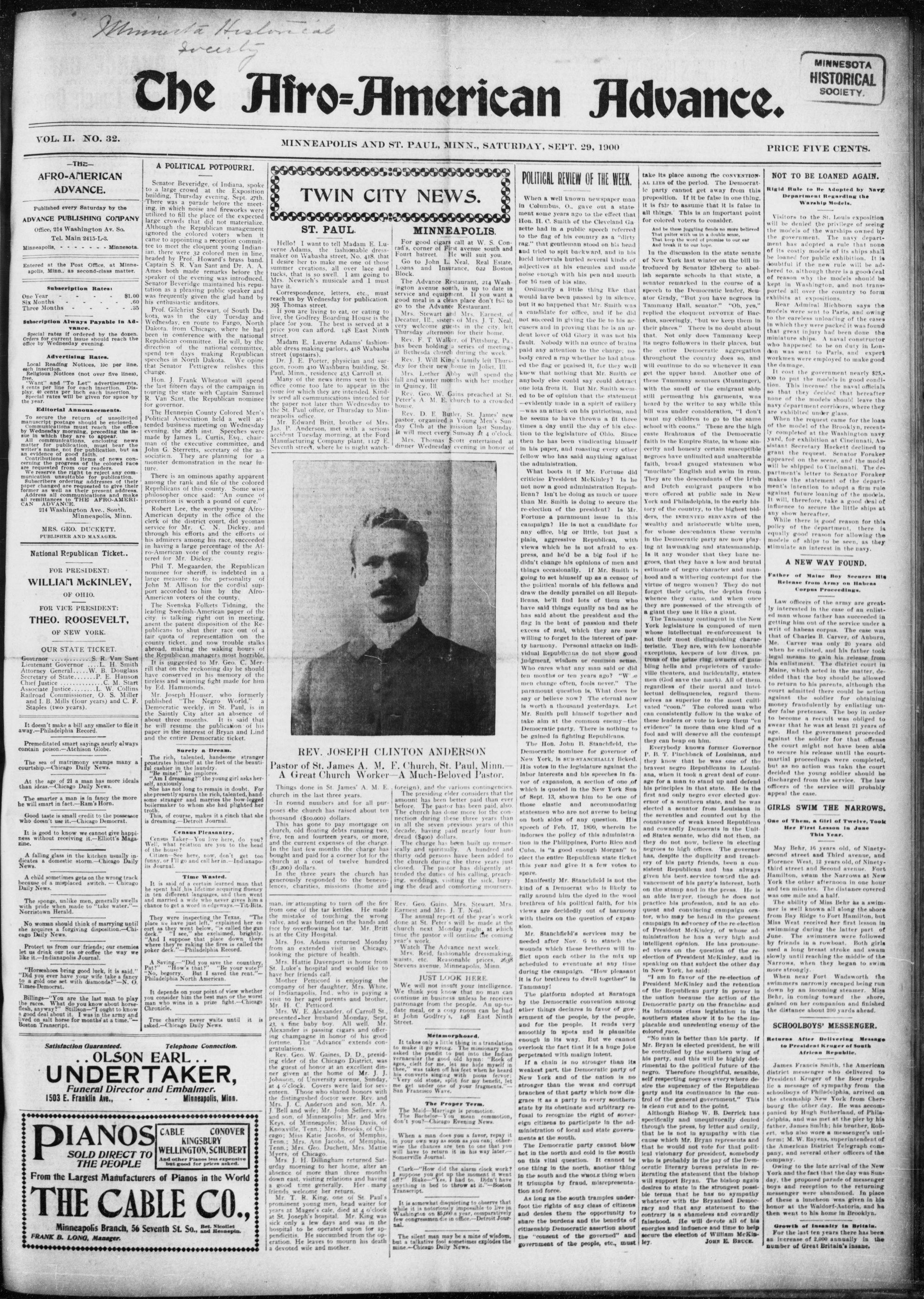
Page text (machine-generated)
Satisfaction Guaranteed. Telephone Connection.
.. OLSON EARL ..
UNDERTAKER,
Funeral Director and Embalmer.
1503 E. Franklin Ave., Minneapolis, Minn.
PIANOS
SOLD DIRECT TO
THE PEOPLE
CABLE CONOVER
KINGSBURY
WELLINGTON, SCHUBERT
And other Pianos less expensive
but good for prices asked.
From the Largest Manufacturers of Pianos in the World
THE CABLE CO.,
Minneapolis Branch, 56 Seventh St. So., Bet. Nicollet
and Hennepin.
FRANK B. LONG, Manager.
VOL. II. NO. 32.
AFRO-AMERICAN ADVANCE.
Published every Saturday by the
ADVANCE PUBLISHING COOPANY
Minneapolis, - - - - - - Minnesota.
Entered at the Post Office, at Minneapolis, Minn., as second-class matter.
Subscription Rates:
One Year - - - - - $1.00
Six Months - - - - - .60
Three Months - - - - .35
Subscription Always Payable in Advance.
Special rates are ordered by the dosen.
Orders for current issue should reach the
office by Wednesday evening.
Advertising Rates.
Local Reading Notices, 10c per line,
each insertion.
Notices (not over five lines),
free.
Want ' and To Let ' advertisements,
8 cents per line for each insertion.
Display, 40 cents per inch each insertion.
Rates will be given for space by
the year.
Editorial Announcements
To secure the return of unsolicited manuscript postage enclosures must reach the office by Wednesday morning, preceding the issue in which they will appear. Manuscripts enclosures, including news matter for publication, must bear the writer's name for publication, but as a means of going public. Contributions and items of news concerning the prize received race cards from our readers. We reserve the right to reject any community submission. Subscribers ordering addresses of their paper changed are requested to give their former as well as their present address. All remittances to THE AFRO-AMERICAN ADVANCE 214 Washington Ave., South, Minneapolis, Minn.
MRS. GEO. DUCKETT
PUBLISHER AND MANAGER
National Republican Ticket..
FOR PRESIDENT:
WILLIAM McKINLEY,
OF OHIO.
FOR VICE PRESIDENT:
THEO. ROOSEVELT,
OF NEW YORK.
OUR STATE TICKET.
Governor ..... S. R. Van Sant
Lieutenant Governor ..... L. H. Smith
Attorney General ..... W. B. Douglass
Secretary of State ..... P. E. Hanson
Chief Justice ..... C. M. Start
Assoc. Justice ..... L. W. Collins
Railroad Commissioner, O. S. Miller
and I. B. Mills (four years) and C. F.
Staples (two years).
It doesn't make a bill smaller to file it
away.-Philadelphia Record.
Premeditated smart sayings nearly always contain poison.—Atchison Globe.
The sea of matrimony swamps many a courtship.—Chicago Daily News.
At the age of 21 a man has more ideals than ideas.—Chicago Daily News.
The smarter a man is in fancy the more he will smart in fact.—Ram's Horn.
Good taste is small credit to the possessor who doesn't use it.—Chicago Democrat.
It is good to know we cannot give happiness without receiving it.—Elliott's Magazine.
A falling glass in the kitchen usually indicates a domestic storm.—Chicago Daily News.
A child sometimes gets on the wrong track because of a misplaced switch. —Chicago Daily News.
The sponge, unlike men, generally swells with pride when made to "take water."—Norristown Herald.
No woman should think of marrying until she acquires a forgiving disposition—Chicago Daily News.
Protect us from our friends; our enemies let us drink our tea or the coffee we way like it. Indianapolis Journal.
"Horseshoes bring good luck, it is said." "Did you ever have your wife take a fancy to a gold set with diamonds?"—N. O. Times-Democrat.
Billings—"You are the last man to play the races. What do you know about horsefish, anyway?" Stillson—"I ought to know about it." I was in the army and lived on salt horse for months at a time."—Boston Transcript.
Satisfaction Guaranteed.
.. OLSON
UNDER
Funeral Director
1503 E. Franklin Ave.,
PIANO
SOLD DIRECT
The Afro=American Advance.
A POLITICAL POTPOURRI.
Senator Beveridge, of Indiana, spoke to a large crowd at the Exposition building, Thursday evening, Sept. 27th. There was a parade before the meeting, in which noise and fireworks were utilized to fill the place of the expected large crowds that did not materialize. Although the Republican managers ignored the colored voters, when it came to appointing a reception committee to meet the eloquent young Indianian, there were 32 colored men in line, headed by Prot. Howard's brass band, Captain S. R. Van Sant and Dr. A. A. Ames both made remarks before the speaker of the evening was introduced. Senator Beveridge maintained his reputation as a pleasing public speaker and was frequently given the glad hand by his enthusiastic auditors.
Prof. Gilchrist Stewart, of South Dakota, was in the city Tuesday and Wednesday, en route to Fargo, North Dakota, from Chicago, where he had been in conference with the national Republican committee. He will, by the direction of the national committee, spend ten days making Republican speeches in North Dakota. We opine that Senator Pettigrew relishes this change.
Hon. J. Frank Wheaton will spend the last fifteen days of the campaign in touring the state with Captain Samuel R. Van Sant, the Republican nominee for governor.
The Hennepin County Colored Men's Political Association held a well attended business meeting on Wednesday evening, the 20th inst. Speeches were made by James L. Curtis, Esq., chairman of the executive committee, and John G. Sterretts, secretary of the association. They are planning for a monster demonstration in the near future.
There is an ominous apathy apparent among the rank and file of the colored Republicans of this county. Some wise philosopher once said: "An ounce of prevention is worth a pound of cure."
Robert Lee, the worthy young Afro-American deputy in the office of the clerk of the district court, did yocan service for Mr. C. N. Dickey, and through his efforts and the efforts of his admirers among his race, succeeded in having a large percentage of the Afro-American vote of the county registered for Mr. Dickey.
Phil T. Megaarden, the Republican nominee for sheriff, is indebted in a large measure to the personality of John M. McIlion for the cordial support he received from the Afro-American voters of the county.
The Svenska Folkets Tidig, the leading Swedish-American paper of the city is talking right out in meeting, anent the patient disposition of the Republicans to shut their race out of a fair quota of representation on the county ticket, and now trouble stalks abroad, making the waking hours of the Republican managers most horrible.
It is suggested to Mr. Geo. C. Merrill that on the reckoning day he should have conserved in his memory of the tireless and winning fight made for him by Ed. Hammonds.
Mr. Joseph Houser, who formerly published "The Negro World," a democratic weekly, in St. Paul, is in the Saintsly City after an absence of about three months. It is said that still remains publication of paper in the interest of Bryan and Lind and the entire Democratic ticket.
Surely a Dream
The rich, talented, handsome stranger
tinsel umbrains the feet of the beautiful
casher she launches.
"Be mine!" he implores.
"farming!" the young girl asks herself,
amphibious.
She has not long to remain in doubt. For she presently spurs the rich, talented, handed, some stranger and marries the bow-legged boilermaker to whom she had plighted her troth. Of course, makes it a cinch that she is dreaming.—Detroit Journal.
Census Pleasantry.
Census Taker - You live here, do you? Well, what relation are you to the head of the house? Citizen - See here, now, don't get too funny, or I'll go and call her in. - Indianapolis Journal.
Time Wasted.
It is said of a certain learned man that he spent half his lifetime acquiring fluency in ten different languages, and then went and married a wife who never gives him a chance to get a word in edgeways.—Tit.Bits.
They were inspecting the Texas. "The place we have just left," explained her escort as they went below, "is called the gun house." "By the And I suppose that place down there where they are raking the fires is called the poker deck."—Philadelphia Record.
A Saving.—"Did you save the country, Papa? How's that?" "Be your vote?" "No, beggary. But I saved the rent."—Philadelphia North American.
It depends on your point of view whether you consider him the best man or the worst man who wins in a prize fight.—Chicago Chronicle.
True charity never waits until it is asked.—Chicago Daily News.
MINNEAPOLIS AND ST. PAUL, MINN., SATURDAY, SEPT. 29, 1900
TWIN CITY NEWS.
Hello! I want to tell Madam E. Luverne Adams, the fashionable dressmaker on Wabasha street. No. 418, that I desire her to make me one of those summer creations, all over lace and tucks, that is so swell. I am going to Mrs. Newrich's musical and I must have it.
Correspondence, letters, etc., must reach us by Wednesday for publication. 395 Thomas street.
If you are living to eat, or eating to live, the Godfrey Boarding House is the place for you. The best is served at a price you can afford. 148 East Ninth street.
Madam E. Luverne Adams' fashionable dress making parlor, 418 Wabasha street (upstairs).
Dr. J. E. Porter, physician and surgeon, room 410 Washburn building. St. Paul, Minn., residence 453 Carroll st.
Of the news items sent to this office, one to residence 453 is the issue for which they are intended. Kindly send all communications intended for the paper not later than Wednesday to the St. Paul office, or Thursday to Minneapolis office.
Mr. Edward Britt, brother of Mrs. Jas. P. Anderson, met with a serious accident Tuesday morning, at the Ford Manufacturing Company plant, 1127 E. Seventh street, where he is night watch-
REV. JOSEPH CL
Pastor of St. James A. M.
A Great Church Worker
Things done in St. James' A. M. E. church in the last three years.
In round numbers and for all purposes the church has raised about ten thousand ($10,000) dollars.
This has gone to pay mortgage on church, old floating debts running two, five, ten and fourteen years, or more, and the current expenses of the charge. In the last few months the charge has bought and paid for a corner lot for the church at a cost of twelve hundred ($1,200) dollars.
In the three years the church has generously responded to the benevolence, charities, missions (home and man, in attempting to turn off the fire from one of the tar kettles. He made the mistake of touching the wrong valve, and was burned on the hands and face by overflowing hot tar. Mr. Britt is at the City Hospital.
Mrs. Jos. Adams returned Monday from an extended visit in Chicago, looking the picture of health.
Mrs. Hattie Davenport is home from St. Luke's hospital and would like to have her friends call.
Mother Petticord is enjoying the company of her daughter, Mrs. White, of Indianapolis, Ind., who is paying a visit to her aged parents and brother, Mr. H. C. Petticord.
Mrs. W. E. Alexander of Carroll St., presented her husband Monday, Sept. 24, for all well. Mr. Alexander is passing cigars and offering champagne in honor of his good fortune. The "Advance" extends congratulations.
Rev. Geo. W. Gaines, D. D., presiding elder of the Chicago District, was the guest of honor at an excellent dinner given at the home of Mr. J. J. Johnson, of University avenue, Sunday, at 4 o'clock. Covers were laid for seventeen. Those who shared honors with the distinguished doctor were. Rev. and Mrs. J. C. Anderson and son, Mr. A. J Bell and wife; Mr. John Sellers, wife and son, of Minneapolis; Mr. and Mrs. Keys, of Minneapolis; Miss Davis, of Knoxville, Tenn. Mrs. Brooks, of Chicago; Miss Katie Jacobs, of Memphis, Tenn.; Mrs. Ann Jacobs, of Memphis, Tenn.; Mrs. Geo. Duchett, Mrs. Mattie Tenn.; Mrs. J. H. Dillingham returned Saturday morning to her home, aiter an absence of more than three months down east, visiting relations and having a good time generally. Her many friends welcome her return.
Mr. T. R. King, one of St Paul's prominent young men, head waiter for years at Magee's cale, died at 4 o'clock at St Joseph's hospital. Mr. King was sick only a few days and was in the hospital to be operated upon for appendicitis. He succumbed from the operation. He leaves to mourn his death a devoted wife and mother.
MINNEAPOLIS
For good cigars call at W. S. Conrad's, corner of First avenue south and Fourth hstreet. He will suit you.
Go to John L. Neal, Real Estate, Loans and Insurance, 622 Boston Block.
The Advance Restaurant, 214 Washington avenue south, is up to date in service and equipment. If you want a good meal in a clean place don't fall to go to the Advance Restaurant.
Mrs. Stewart and Mrs. Earnest, of Decatur, Ill., sisters of Mrs. J. T. Neal, very welcome guests in the city, let Thursday afternoon for their home.
Mrs. Luther Abbey will spend the fall and winter months with her mother in Quincy, Ill.
Rev. Geo. W. Gains preached at St. Peter's A. M. E. church to a crowded house.
Rev. D. E. Butler, St. James' new pastor, organized a Young Men's Sunday Club at the mission last Sunday. it will meet every Sunay 8t 4 o'clock
Mrs. Thomas Scott entertained at dinner W. W.
Mrs. Thomas Scott entertained at dinner Wednesday evening in honor of
INTON ANDERSON
E. Church, St. Paul, Minn.—
—A Much-Beloved Pastor.
foreign), and the various contingencies. The presiding elder considers that the amount has been better paid than ever before. The pastor has been paid, also. The church has done more for the connection during these three years than in all the seven previous years of this decade, having paid nearly four hundred ($400) dollars. The charge has been built up numerically and spiritually. A hundred and thirty pastors have been added to the church during the three years just closed. The pastor has diligently attended the duties of his calling, preaching, weddings, visiting the sick, burying the dead and comforting mourners.
Rev. Geo. Gains, Mrs. Stewart, Mrs. Earnest and Mrs. J. T. Neal. The annual report of the year's work done at St. Peter's will be made at the church next Monday night, at which time pastor will outline the coming year's work. Watch The Advance next week. Mrs. Reid, fashionable dressmaking, waists, etc. Reasonable prices, 20,98 Stevens avenue, Minneapolis, Minn.
JUST LOOK HERE
We will not insult your intelligence. We think you know that no man can continue in business unless he receives patronage from the people. An up-to-date meal, or a cozy room can be had at John Godrey's, 148 East Ninth Street.
Metamorphosed
It takes only a little thing in a translation to make it go wrong. The missionary who asked the pundit to put into the Indian language the hymn 'manko of age, cleft for me, let me sing of thee,' was taken off his feet when he heard his converts singing with pious fervor. Very old stone, spilt for my benefit, let me sing of your fragments. — San Francisco Wave.
The Proper Term
The Maid-Marriage is promotion.
The Bachelor-You mean motion,
don't you?-Chicago Evening News.
When a man does you a favor, repay it in your own way as soon as you can; otherwise the chances are ten to one that you will have to return it in his way later.—Somerville Journal.
Clark—"How did the alarm clock work? I suppose you got up the moment it went off. Bake—"Yes, I had to. Didn't have anything in bed to throw at it."—Hoston Transcript.
It is somewhat disquieting to observe that while it is notoriously impossible to live in Washington on $5,000 a year, comparatively few congressmen die in office.—Detroit Journal.
The silent man may be a mine of wisdom, but a talkative fool sometimes explodes the mine.—Chicago Daily News.
POLITIGAL REVIEW OF THE WEEK
When a well known newspaper man in Columbus, O., gave out a statement some years ago to the effect that Hon. H. C. Smith of the Cleveland Gazette had in a public speech referred to the flag of his country as a "blitty rag," that gentleman stood on his head and tried to spit backward, and in his held intervals hurled several kinds of adjectives at his enemies and made noise enough with his pen and mouth for 16 men of his size.
Ordinarily a little thing like that would have been passed by in silence, but it so happened that Mr. Smith was a candidate for office, and if he did not succeed in giving the lie to his accusers and in proving that he is an ardent lover of Old Glory it was not his fault. Nobody with an ounce of brains paid any attention to the charge, nobody cared a rap whether he had abused the flag or praised it, for they well knew that nothing that Mr. Smith or anybody else could say could detract one lot from it. But Mr. Smith seemed to be of opinion that the statement—evidently made in a spirit of rallery—was an attack on his patriotism, and he seems to have thrown a fit three times a day until the day of his election to the legislature of Ohio. Since then he has been vindicating himself in his paper, and roasting every other fellow who has said anything against the administration.
What boots it if Mr. Fortune did criticise President McKinley? Is he not now a good administration Republican? Isn't he doing as much or more than Mr. Smith is doing to secure the re-election of the president? Is Mr. Fortune a paramount issue in this campaign? He is not a candidate for any office, big or little, but just a plain, aggressive Republican, with views which he is not afraid to express, and he'd be a big fool if he didn't change his opinions of men and things occasionally. If Mr. Smith is going to set himself up as a censor of the political morals of his fellows and draw the deadly parallel on all Republicans, he'll find lots of them who have said things equally as bad as he has said about the president and the flag in the heat of passion and their excess of zeal, which they are now willing to forget in the interest of party harmony. Personal attacks on individual Republicans do not show good judgment, wisdom or common sense. Who cares what any man said or did ten months or ten years ago? "We men change often, fools never." The paramount question is, What does he say or believe now? The eternal now is worth a thousand yesterday. Let Mr. Smith pull himself together and take aim at the common enemy—the Democratic party. There is nothing to be gained in fighting Republicans.
The Hon. John B. Stanfield, the Democratic nominee for governor of New York, is SUB-STANCHIALLY licked. His votes in the legislature against the labor interests and his speeches in favor of expansion, a section of one of which is quoted in the New York Sun of Sept. 13, shows him to be one of those elastic and accommodating statesmen who are not averse to being on both sides of any question. His speech of Feb. 17, 1809, wherein he indoles the policy of this administration in the Philippines, Porto Rico and Cuba, is "a good enough Morgan" to elect the entire Republican state ticket this year and give it a few votes to spare.
Manifestly Mr. Stanchfield is not the kind of a Democrat who is likely to rally around him the dyes in the wool brethren of his political faith, for his views are decidedly out of harmony with theirs on the question of expansion.
Mr. Stanchfield's services may be needed after Nov. 6 to stanch the wounds which these brethren will inflict upon each other in the mix up scheduled to eventuate at any time during the campaign. "How pleasant it is for brethren to dwell together" in Tammany!
The platform adopted at Saratoga by the Democratic convention among other things declares in favor of government of the people, by the people, and for the people. It reads very smoothly in spots and is plausible enough in its way. But we cannot overlook the fact that it is a huge joke perpetrated with malign intent.
If a chain is no stronger than its weakest part, the Democratic party of New York and of the nation is no stronger than the weak and corrupt branches of that party which now disgrace it as a party in every southern state by its obstinate and arbitrary refusal to recognize the right of sovereign citizens to participate in the administration of local and state governments at the south.
The Democratic party cannot blow hot in the north and cold in the south on this vital question. It cannot be one thing in the north, another thing in the south and the whole thing when it triumphs by fraud, misrepresentation and force.
As long as the south tramples underfoot the rights of any class of citizens and denies them the opportunity to share the burdens and the benefits of citizenship Democratic assertion about the "consent of the governed" and government of the people, etc., must
take its place among the CONVENTIONAL LIES of the period. The Democratic party cannot get away from this proposition. If it be false in one thing, it is fair to assume that it is false in all things. This is an important point for colored voters to consider.
And be these juggling flends no more believed. That palter with us in a double sense. That keep the word of promise to our ear. And be these flends no more believed.
In the discussion in the state senate of New York last winter on the bill introduced by Senator Elsberg to abolish separate schools in that state, a senator remarked in the course of a speech to the Democratic leader, Senator Grady, "But you have negroes in Tammany Hall, senator." "Oh, yes," replied the eloquent DEVOTE of Bacchus, suceeled, "but we keep them in their places." There is no doubt about that. Not only does Tammany keep its negro followers in their places, but the entire Democratic aggregation throughout the country does so, and will continue to do so whenever it can get the upper hand. Another one of these Tammany senators (Munzinger), with the smell of the emigrant ship still permeating his garments, was heard by the writer to say while this bill was under consideration, "I don't want my children to go to the same school with coons." These are the high caste Brahmans of the Democratic faith in the State State, in whose sincerity and honesty certain susceptible negroes have unlimited and unalterable faith, broad gauged statesmen who "muculate" English and swim in rum. They are the descendants of the Irish and Dutch emigrant paupers who were offered at public sale in New York and Philadelphia, in the early history of the country, to the highest bidders, the INDENTED SERVANTS of the wealthy and aristocratic white men, for whose descendants these vermin in the Democratic party are now playing at lawmaking and statemanship. Is it any wonder that they hate negroes, that they have a low and brutal estimate of negro character and manhood and a withering contempt for the virtue of negro women? They do not forget their origin, the depths from whence they came, and when once they are possessed of the strength of a giant they use it like a giant.
The Tammany contingent in the New York legislature is composed of men whose intellectual re-enforcement is not their most distinguishing characteristic. They are, with few honorable exceptions, keepers of low dives, patrons of the prize ring, owners of gambling hells and proprietors of vaudeville theaters, and incidentally, statesmen (God save the mark). All of them, regardless of their moral and intellectual delinquencies, regard themselves as superior to the most cultivated "coon." The colored man who can consistently follow in the wake of these leaders or vote to keep them "evidence" is more than one kind of a fool and will deserve all the contempt they can heap on him.
Everybody knows former Governor P. B. T. Pinchback of Louisiana, and they know that he was one of the bravest negro Republicans in Louisiana, when it took a great deal of courage for a man to stand up and defend his principles in that state. He is the first and only negro ever elected governor of a southern state, and he was elected a senator from Louisiana in the seventies and counted out by the convince of weak kneed Republican and cowardly Democrats in the United States senate, who did not then, as they do not now, believe in electing negroes to high offices. The governor has, despite the duplicity and treachery of his party friends, been a consistent Republican and has always given his best, service toward the advancement of his party's interest, both on the stump and in the press. He is an able lawyer, though he does not practice his profession, and is an eloquent and convincing campaign orator, who may be heard in the present campaign in advocacy of the re-election of President McKinley, of whose administration he has a very high and intelligent opinion. He has pronounced views on the question of the re-election of President McKinley, and in speaking on that subject the other day in New York, he said:
"I am in favor of the re-election of President McKinley and the retention of the Republican party in power in the nation because the action of the Democratic party on the franchise and its infamous class legislation in the southern states show it to be the implacable and unreleasing enemy of the colored race.
"No man is better than his party. If Mr. Bryan is elected president, he will be controlled by the southern wing of his party, and this will be highly detrimental to the political future of the negro. Therefore thoughtful, sensible, self respecting negroes everywhere desire the supremacy of the Republican party and its continuance in the control of the general government." This is clean cut and to the point.
Although Bishop W. B. Derrick has specifically and unequivocally denied through the press, by letter and orally, that he is not in sympathy with the cause which Mr. Bryan represents and that he would not vote for that political visionary for president, somebody who is probably in the pay of the Democratic literary bureau persists in reiterating the statement that the bishop will support Bryan. The bishop again desires to state in the strongest possible terms that he has no sympathy whatever with the Bryanized Democracy and that any statement to the contrary is a shameless and cowardly falsehood. He will devote all of his energies and influence and time to help secure the election of William McKinley. JOHN E. BRUCE.
MINNESOTA HISTORICAL SOCIETY.
PRICE FIVE CENTS.
NOT TO BE LOANED AGAIN.
Rigid Rule to Be Adopted by Navy Department Regarding the
Visitors to the St. Louis exposition will be denied the privilege of seeing the models of the warships owned by the government. The navy department has adopted a rule that none of its costly models of its ships shall be loaned for public exhibition. It is doubtful if the new rule will be adhered to, although there is a good deal of reason why the models should be kept in Washington, and not transported all over the country to form exhibits at expositions.
Rear Admiral Hichborn says the models were sent to Paris, and owing to the careless unloading of the cases in which they were packed it was found that great injury had been done the miniature ships. A naval constructor who happened to be on duty in London was sent to Paris, and expert workmen were employed to make good the damage.
It cost the government nearly $230,000 to put the models in good condition. This incensed the naval officials so that they decided that hereafter none of the models should leave the navy department corridors, where they are exhibited under glass.
When the request came for the loan of the model of the Brooklyn, recently completed at the Washington navy yard, for exhibition at Cincinnati, Assistant Secretary Hackett declined to grant the request. Senator Foraker appeared on the scene, and the model will be shipped to Cincinnati. The department's letter to Senator Foraker makes the statement of the department's intention to adopt a firm rule against future loaning of the models. It will, therefore, take a good deal of influence to secure the little ships at any show hereafter.
While there is good reason for this policy of the department, there is equally good reason for allowing the models of ships to be seen, as they stimulate an interest in the navy.
A NEW WAY FOUND.
Father of Maine Boy Secures His
Release from Army on Habeas
Corpus Proceedings.
Law officers of the army are greatly interested in the case of an enlisted man whose father has succeeded in getting him out of the service under a writ of habeas corpus. The case was that of Charles R. Carver, of Abunh, Me. Carver was only 20 years old when he enlisted, and his father took legal means to gain his release from his enlistment. The district court in Maine, which acted in the matter, decided that the boy should be allowed to return to his parents, although the court admitted there could be action against the soldier for obtaining money fraudulently by enlisting under false pretenses. The boy in order to become a recruit was obliged to swear that he was at least 21 years of age. Had the government proceeded against the soldier for that offense the court might not have been able to secure his release until the court-martial proceedings were completed, but as no action was taken the court decided the young soldier should be discharged from the service. The law officers of the service will probably appeal the case.
GIRLS SWIM THE NARROWS.
One of Them, a Girl of Twelve, Took
Her First Lesson in June
This Year.
May Behr, 16 years old, of Ninety-second street and Third avenue, and Florence West, 12 years old, of Ninety-third street and Second avenue. Fort Hamilton, swam the Narrows at New York the other afternoon in one hour and ten minutes. The distance covered was one mile and a half.
The ability of Miss Behr as a swimmer is well known all along the shore from Bay Ridge to Fort Hamilton, but Miss West received her first lesson in swimming during the latter part of June. The swimmers were followed by friends in a rowboat. Both girls used a long breast stroke and swam slowly until reaching the middle of the Narrows, when they began to swim more strongly.
When near Fort Wadsworth the swimmers narrowly escaped being run down by an incoming steamer. Miss Behr, in coming toward the shore, gained on her companion and finished the distance about 200 yards ahead.
SCHOOLBOYS' MESSENGER
Returns After Delivering Message
to President Kruger of South
Africa
James Francis Smith, the American district messenger who delivered to President Kruger of the Boer republic a message of sympathy from the schoolboys of Philadelphia, arrived on the stewardship New York from Cherbourg the other day. He was accompanied by Hugh Sutherland, of Philadelphia, and was met at the pier by his father, James Smith; his brother, Robert, who also wore a messenger's uniform; M. W. Rayens, superintendent of the American District Telegraph company, and several other officers of the company.
Owing to the Inte arrival of the New York and the fact that the day was Sunday, the proposed parade of messenger boys and reception to the returning messenger were abandoned. In place of these a limcheon was given in his honor at the Waldorf-Astoria, and he then went to his home in Brooklyn.
Growth of Insecurity in Britain.
For the last ten years there has been an increase of 2,000 annually in the number of Great Britain's insane.
EDITORIAL
Some insects, so Rev. Theodore Wood says in his recent book on the subject, have families of 40,000 children, for whom life is simply one long, unbroken dinner time. We are all regarded by a mosquito simply in the light of a full meal.
A western dramatic company has made a striking change in their "Uncle Tom's Cabin." Where Eliza goes across the ice pursued by blood-hounds, the new version has her going across in an automobile, pursued by Boxers.
According to the Sioux Indian weather prophets it's going to be a hard winter. These predictions are based on the fact that the buffalo grass shows a heavy crop of seeds, which, the rikins declare, is a sure sign of a severe winter and deep snow.
The secretary of the interior has issued an order withdrawing from entry at the land office some 300 square miles of territory in New Mexico. The land contains many of the old ruins left by the cliff dwellers, and it is the intention to make a national park out of it.
It is a curious and interesting coincidence that while the old confederate cruiser Alabama was for a long time known as "No. 200," the new battleship Alabama was numbered "200" at the builder's yard before her name was decided upon, and without any thought of the original.
In answer to a statement by an alleged scientist to the effect that the petroleum wells of the world will soon cease to flow, some knowing eastern traveler calls attention to the fact that in Zante, one of the Ionian isles, there is a petroleum spring which has been known for 3,000 years. The well is mentioned by Herodotus.
At a gathering of old folks in the town of Charlemont, Mass., the chairman called for all present over 70 years to rise, and 72 responded. He then asked all those who were over 80 to rise, and there were 12 who had passed the limit. A similar call for all over 90 brought four members of the gathering to their feet.
The coldest temperature experienced by Sir George Newnes' expedition to the south pole was 52 degrees below zero, and occurred in August. The party discovered near Robertson bay mountains exceeding 12,000 feet in height, and penetrated farther to the south (78 degrees 50 minutes) than any previous expedition.
A Kansas City Chinaman paid $600 for a wife. Poor, benighted heathen! He does not realize how out-of-date it is to buy wives. If he had only made a study of advanced civilization exemplified by the swagger set in some cities he would have known that the modern method is for the girl to pay a million or so for a mighty poor article of a husband.
A Swiss genius has invented a pith cloak weighing about one pound, which will hold up a fully equipped soldier on the surface of the water. Successful experiments were made recently on the lake of Zurich. The cloak is provided with water-proof pockets in which food and drink may be carried as well as blue lights in case the wearer is shipwrecked in the night.
The Germans have set to work to develop their East African territory with their usual thoroughness. The measures which they have taken to counteract the effects of the climate are very elaborate and include substantial stone houses, hospitals, an ample medical staff, inspection of the meat sold, carefully sunk and covered wells, vaccination, examination of native houses in the towns, drainage and finally a careful study of the black water fever by Dr. Koch.
---
The large bronze clock used by Admiral Montejo in his cabin on the Reina Christina has come into the possession of Dr. G. W. Roberts, of Chattanooga, after a series of interesting adventures. After the battle of Manila bay the natives looted the ship, and among other things took the clock, giving it to Aguinaldo. The Filipino leader gave the clock to his mother, and when she was taken, in Cavite, she turned it ever to Dr. Roberts, who is with the American army.
An Austrian inventor has patented a speaking clock which he claims will be of the greatest value to persons of forgetful and irregular habits. It consists of a clock-phonograph combination. In place of the usual striking attachment is a phonograph which can be set to speak a sentence at any time desired, thus becoming an unfalling reminder to its owner of the duties of each successive hour. There is no mechanical difficulty in the way of charging this moral timepiece with any number of daily exhortations.
Col. Le Grande B. Cannon has arranged for the preservation of the grave of John Brown near North Elba, N. Y., it having been almost not sight of. The grave is situated in the open field which John Brown cleared for the use of the negroes before he made his raid upon Harper's Ferry, and is close to the shingled cottage he built. Recently Col. Cannon sent a force of men with a landscape gardener to grade and terrace the plot of land, and he will build an iron fence 75 feet square around the grave. The inclusion will be known as John Brown park.
Evidences of the sprouting of seeds swallowed by human beings and animals are not uncommon. A Cleveland boy died suddenly and it was discovered that his death had been caused by a kernel of corn which he had swallowed some time ago and which had taken root and grown so that it choked up his organs. A man in Chicago swallowed a melon seed and afterward declared that it abode with him. His friends used to laugh and ask how his melon crop was coming on. He died the next year and an autopsy proved he was right.
A WEEK'S HISTORY
IN ALL PARTS OF THE UNION
All the Latest News of Interest from Washington, From the East, the West and the South.
THE LATEST FOREIGN DISPATCHES
FROM WASHINGTON.
Numerous applications for teachers' positions in the Philippines are being made to the war department.
In August the internal revenue receipts from all sources amounted to $25,595,716, an increase over the month of August last year of $1,174,751.
THE EAST.
After three months of idleness 60,000 iron and steel workers have resumed labor.
In the National league the percentages of the baseball clubs for the week ended on the 23d were: Brooklyn, .598; Pittsburgh, .584; Philadelphia, .537; Boston, .500; Chicago, .473; St. Louis, .447; Cincinnati, .432; New York, .431.
The coilieries around Shenandoah, Pa., will try to resume operations under military guard and the result is likely to settle the strike if the mines are successfully worked.
The death of George D'Vys, the last survivor of the polar expedition in 1855 that rescued Dr. Kane, occurred at Worcester, Mass.
In Beaufort county, N. Y., Adam Giles and his wife and daughter were murdered by Joseph Smalls, a negro.
In the United States the visible sup-
ply of grain on the 24th was: Wheat
54,993,000 bushels; corn, 7,322,000 bushels;
oats; oats, 11,659,000 bushels; rye, 869,
000 bushels; barley, 784,000 bushels.
At Elizabeth N.J., the tornado hea
At Elizabeth, N.J. the torpedo boat O'Brien was launched.
The lines of strikers remain unbroken and the second week of the strike in the anthracite field in Pennsylvania opened with the tie-up of the mines as complete at as any time since the strike began. Reports indicate that 130,000 of the 142,000 miners are now out.
In October the official trial trip of the battleship Wisconsin will be made. Sheriff Harvey telegraphed to Gov. Stone asking that troops be sent to Hazleton on the ground that the Sheriff cannot guarantee the safety of persons or property during the night marches of the strikers.
WEST AND SOUTH
Judge O. W. Powers, appointed United States senator by the acting governor of Utah, has declined the place.
The democrats and populists fused in Montana and nominated Joseph K. Tole, of Helena, for governor.
At Mansfield, O., two Dowie elders were coated with tar and driven out of town.
In the United States over 500,000,000 bushels of wheat, nearly 800,000,000 bushels of oats and fully 2,000,000,000 bushels of corn will be the result of this season's harvesting of these cereal products.
In Texas heavy storms caused the Colorado, Concho and Nueces rivers to overflow. Several towns were flooded and loss of life was feared.
In an interview Gen. Lee expressed fear for Cuba if an absolute independent government is established.
In Idaho highwaymen held up a Northern Pacific train and secured $300 in cash and a variety of watches and jewelry.
A storm destroyed the "Grand Portal," nature's artwork on Lake Superior.
Near Lincoln, Neb., four men robbed a Burlington express car, but got little booty.
The president returned to Canton, O., from Washington.
From Manila the transport Grant arrived at San Francisco with 68 prisoners on board.
The death of Cornelius Sullivan occurred in Toledo, O., at the age of 101 years.
In the vicinity of Occidental, Cal., forest fires raged over 100 square miles, holding damage to the amount of over $400,000.
James Chapman and Frank Davis, rivals for the favor of a young country girl near Birmingham, Ala., killed each other in a duel.
After voting $54,000 in benefits to disabled members the convention of locomotive firemen adjourned at Des Moines, Ia.
In a cyclone at Morristown, Minn., eight persons were killed. Fire swept away nearly the entire business portion of the village of Omer, Mich.
At the age of 83 years Gen. John M. Palmer, civil war veteran and once United States senator from Illinois and candidate of the gold democracy in 1896 for president, died suddenly in Springfield.
In Munice, Ind., William Driscoll and wife, an aged couple, were killed by the cars at a crossing.
In a waterspout and tornado at Ferguson, Ia., four persons were killed and several severely injured.
At Terre Haute, Ind., The Abbot troted a mile in 2:034, setting a new world's mark.
Advices from various points in the Rocky mountains show that there has been a heavy snowfall.
At Johnson City, Ill., an engine on the Eastern Illinois road blew up, killing Engineer Doggett and Fireman Rains.
At Hancock, Mich., burglars robbed the post office of $700 in money and stamps.
The commission merchant license law has been declared void by the Michigan supreme court.
Flames destroyed the Iron Mountain railway shops at Baring Cross, Ark., the loss being $400,000.
Lives were lost and property destroyed in a storm at Nome, Alaska.
Engineer Ryan and Fireman Hall were killed in a train wreck at Springfield, Ill.
FOREIGN INTELLIGENCE
The president of France gave a dinner to 22,000 persons in Paris, the tables extending a distance of nearly five miles.
Marsial de Campos, formerly captain general of Cuba, died at Zarauz, Spain.
Aguinaldo refused to consider peace proposals and has issued a proclamation offering $40 to each American soldier surrendering.
The London Chinese minister declares America's plan for settlement will be hailed with joy in China, and that all the powers will adopt a similar policy, thereby keeping peace. France, Russia and America hold a common policy opposed to that of Germany, Italy and Austria, and diplomats believe peace or war over China hinges on England's turn.
Over 50 French vessels from St. Pierre, N. F., were missing as the result of the recent gale.
The duke of Mariborough will be the new lord lieutenant of Ireland.
The duke of Abruzzi and Dr. Nansen have agreed to undertake a joint expedition into north polar regions.
The government of Canada will cooperate with the United States in excluding objectionable immigrants from this country.
Orders has been given to Gen. Chaffee to hold a legation guard of 1,400 men in Peking and to send all other troops at once to Manila. England's reply to Germany is identical with that of the United States, the terms named for China being rejected. Forty-five thousand native Catholics have been massacred during the uprising.
The Mexican congress declared the result of the presidential election, Gen. Porfrio Díaz was unanimously reelected.
The final collapse of the Boer army is said to have been brought about by diplomacy and without conflict.
LATER NEWS.
Gov. Stone declined to send troops to Hazleton at once, and Gobin at Shenandoh was watching that field. All mines in the Shenandoh region are now shut down.
A brick kiln at Edwardsville, Ill., was wrecked by lightning and four men were killed.
A mob attempted to break up a Roosevelt meeting at Victo. Col., and attacked the governor and escort on the way to the train. Bough riders held the mob in check.
James B. Howard was found guilty at Frankfort, Ky., of Goebbels's murder and condemned to death.
George F. Drew, the first democrite governor of Florida after the war, died at Jacksonville, aged 72 years. Two hours before his death his wife passed away.
Insurgents attacked the American outpost 12 miles from Manila and were dispersed with a loss of 12 men. The torpedo boat destroyer Decatur was launched at Richmond, Va. The republicans of the Tenth Iowa district have nominated J. P. Conner for congress. Lord Roberts at Pretoria reviewed the Canadian troops on the eve of their departure and complimented them upon their services. Felix Marchand, premier of Quebec, died in Montreal, aged 68 years.
national, aged 65 years.
Census statistics show that in 155 of the largest cities of the United States the increase in population during the last ten years has been 4,627,593.
In a jealous law Joseph Stoup fatally wounded his wife and killed himself in Chicago.
North Dakota republicans have nominated Frank White for governor in place of F. B. Fancher, who declined the renomination on account of bad health.
Revolution against President Jiminez is under way in Santo Domingo.
The administration at Washington is alarmed lest Germany's rush into war may turn all China against, all the powers, but it will go on with negotiations. Events as seen at Shanghai indicate almost surely the disruption of China. Italy and Austria are said to be the only two powers which have assented to Germany's note on China. Great Britain takes the same position as the United States.
MINOR NEWS ITEMS.
White blackberries and green roses have been propagated in Louisiana this year.
During the last two years Andrew Carnegie has given $4,560,450 to libraries.
Rev. George Willard, a noted divine of the Reformed church, died in Dayton, O., aged 82 years.
Road improvement has begun in the Philippines, with money collected from customs at Manila.
Two million residents of Boston availed themselves of the public batha during the last summer.
Admiral Watson, who recently was in command of the fleet at Manila, will make his home at Louisville, Ky.
Seventy-two new coal mines have been opened in Prussia this year, increasing the output for 1900 by 2,500,000 tons.
Lorin Pease, of Hadley, Mass., died at the age of 100. His father lived to be 99, and his six brothers and sisters all passed 70.
The most recent statistics show a decrease of the birth rate in every European country, the average decrease being three per cent, since 1891. What promises to be the best apple crop in the history of Canada — not merely in quantity, but quality—is now fast approaching the harvest season.
James Ellis Tucker has sailed for Honolulu to revive the customs law and service of the Hawaiian islands so as to bring them up to the standard of those at home.
The executive committee of the United Society of Christian Endeavor has decided that the twentieth international convention shall be held at Cincinnati in 1901.
Lord Averybury, speaking of England's increasing demand for American goods, paid a tribute to the commercial ingenuity of manufacturers of the United States.
Florida, according to local papers, is becoming one of the greatest tobacco-growing states, and the product has been pronounced in some respects equal to that of Cuba. The women of Wyoming have pledged themselves to raise $5,000 for the purchase of a solid silver service for the monitor Wyoming, recently launched at the Union Iron works in San Francisco.
COLORADO'S COYOTES.
A Big Round-Up of the Animals to Promised for This Season.
Eastern Colorado ranchmen value an ordinary coyote at $37.50. This seemingly extravagant price will result in another great hunt this fall, in which it is expected that thousands of the little animals will fall victims to the 444 of the cowboys or the hounds of the sports from the east. The plains country in eastern Colorado which was once the breeding ground and home of thousands of buffaloes, is now populated by thousands of coyotes, and so destructive have they become to stock that the state and cattle barons working together are offering $37.50 for every coyote scalp presented. This offer will attract in attracting hundreds of hunters from Nebraska, Kansas, Wyoming and western Colorado, and even now in the region infested many hunters are making big money.
For the past five years the ranchmen have admitted their inability to cope with the increasing numbers of wolves, but they have waited patiently in the hope that the animals might be successfully killed by poison. The wolves however, have been so well fed on veal and lambs from the herds that a piece of beef lying on the prairie has no attraction for their cultivated tastes, and they pass it by.
About a month ago Gardner Bross, ranchmen of Yuma county, lost 36 head of cattle, and for many days they could not account for the mortality. Large and small stock were suddenly attacked by a mad frenzy and would continue in that condition until death. The cattle would paw the earth and attempt to bite and hook everything in sight, whether animate or inanimate. Froth from the mouths of the beasts was scattered over the range. Ranchmen were alarmed and did not dare to attempt to quiet or corral the cattle either on foot or on horseback. After three days three dozen cattle were found dead.
Former State Veterinarian Greswell was called down to investigate the causes of the mortality, and he forwarded a complete diagnosis to Washington with the result that Dr. Salmon, of the department of agriculture, pronounced it rabies. Then the Gardner boys remembered that they had killed a coyote which had acted very strangely about two weeks previous to the death of the stock. It had included itself in a vacant ranch cabin and was nearly dead from exhaustion when one of the cowboys on the round-up dispatched it with a club.
The great stock region was alive to the danger by this time, and besides the regular $2.50 offered for every wolf scalp by the state of Colorado, two ranchmen offered ten dollars each for every wolf captured, and the Eastern Colorado Live Stock association, as a body, offered $15 for every animal killed. In Denver scores of sportsmen with dogs and guns are arranging to make an expedition to the range of sand hills in which the coyotes are breeding, and letters from Nebraska and Kansas indicate that hundreds will be on the ground from neighboring states. Many Wyoming people are already there. The sand hills break a monotonously level prairie, of plain, near the state line between Colorado and Nebraska, and it is here that the little animals breed by thousands every year.
Twelve years ago, when one of these big wolf hunts was held, it was believed that the coyote was a thing of the past because so many of the animals had been slaughtered. Eighteen hundred were killed at this time, but the mortality appears to have had little effect upon the coyotes. While the cowboys do not fear them, instances have been known where the children of ranchmen have been attacked by them and have narrowly escaped death.
DOG BARBERS AT WORK
Are Kept Bust During the Season
When Tower Is Shorn
of the Bust
This is the season of the year when the dog gets his annual hair cut. Some dogs—a great many, in fact—go without a hair cut altogether, but there are hygienic reasons why others are subjected to the capillary clipping. In the summer some dogs go to the seashore, where they take up a burden of sand fleas. Then they scratch, and in scratching make flesh wounds. Then the dog is taken to a veterinary, who takes off the hair, so that he may better treat the torn cuticle. Other dogs, with long, thick hair, have their hair cut in the summer for comfort, says the New York Times.
There is about the same amount of pain to the dog in having his hair cut as there is to the human being undergoing similar treatment, but the dog makes lots more fuss about it. In a veterinary establishment uptown the other day a French poodle was undergoing his yearly tonsorial operation, and he carried on over it as much as if he were having a tooth pulled. He protested with plaintive howls against the removal of his coat. "Ow, ow, ow!" he seemed to exclaim; "it isn't that this thing hurts, but it's the indignity of being held down and sheared like a sheep that I object to."
The hair came off in large, thick sections, and apparently there was enough of it to start a mattress factory when the job was finished. It took the poodle several minutes to realize that it was the same dog after the operation was over. The absence of weight puzzled him, and he wasn't sure whether he was a dog or half a dog. Also there was an unaccountable coolness about the sheared part of his anatomy. But after two or three sniffs of investigation he shook himself, whisked his tail and skipped about as if satisfied that it was all right.
"We average about two dog haircuts a day this time of year," said the veterinary in whose place the dog referred to parted from his shaggy locks. "What we do with the hair? Well, that's a funny part of it. There is a demand for the hair. People come here to get it, saying it's good for rheumatism. I don't know how they use it, but I believe they make some sort of covering out of it. Anyway, we find no trouble in disposing of the hair."
When a Hen Is Not a Hen.
A hen lays during the day, but at night she becomes a rooster—Chicago Daily News.
SOCIETY DIRECTORY
ODD FEI-LOWS.
Meets Lodge, No. 2202.
Meets second and fourth Wednesdays in each month at Odd Fellows' Hall, 32
T. R. HICKMANN, P. s., 422 St. Anthony.
P. PARKER, N. G., 325 Elmud St.
Household of Ruth, No. 553, G. U. o. of O. F.
Meets first and third Monday in each month for business, second Monday for instruction, at Odd Fellows' Hall, 322
MRS. SARAH C. KIRTLEY, M.N.G.
A JACKSON, W. R., K. 374
mount place.
MOST WORSHIPFUL GRAND LODGE
OF MINNESOTA, A. F. and A. M.
DANIEL ROY, H. P.
W. T. GASSAWAY, Sec., State Capitol.
MINNEAPOLIS.
G. U. O. O. O. F.
St. Anthony Lodge, Vo. 2877.
Meets the first and third Wednesday in each month for the transaction of business, 1st avenue in Jefferson A. A. H. MYRICK, N. G.
JAMES A. SCOTT, P. S. F. O. Box 33
KNIGHTS OF PYTHIAS.
Nat. Turner Lodge, No. 2. K. of P.
Meets the second and fourth Thursdays in each month. Brothers in good standing Fourth and Eighth avenue south.
RALPH WATSON, K. R. and S. C.
Pride of Minnesota Lodge, No. 1. K.
Meets the first and second Thursdays in each month. All brothers in good standing welcome. At Flummer Post Hail, First avenue north and Washington.
JAMES GIBBS, C. C. W. C. JEFFRIEY, K. R. and S.
K. J. HILKY Lodge.
Meets first and second Monday at Windom Block, Second avenue South and Washington. Masons in good standing always welcome. W. G. LILLARD, W. M. JASPER GIBBS, Sec. Guaranty Loan Restaurant.
A. LEE Lodge, No. 7. A. F. and A. M. Meets the first and second Monday in each month at Windom Block, Second avenue South and Washington. Masons in good standing always welcome. J. A. SCOTT, W. M. A. B. LEE, 7701 Aldrich avenue South.
Officers and Standing Committee of the Most Worshipful Grand Lodge A. F. and A. M. of Minnesota and jurisdiction: Grand Master-John L. Neal, Minneapolis
Grand Junior Warden-J. C. Garner, St. Paul.
Grand Treasurer-Daniel Roy, St. Paul.
Secretary-William R. Morr,
Minneapolis.
Grand Lecturer—G. W. Day (7), Minneapolis.
Grand Senior Deacon—John Martin (1)
St. Paul.
Junior Deacon—B. De Lee (2)
Grand Junior Deacon-R. De Leo (7).
Minneapolis.
Grand Tyler--T. Bush (3). St. Paul.
Grand Marshall-C. H. McDonald (2).
Grand Pursuilvant-G. W. Duckett (4),
St. Paul.
Grand Sword-Bearer-J. Adams (1),
St. Paul.
Grand Standard-Bearer-J. J. Charles-
ton (2), St. Paul.
Grand Register-J. G. Sterett (6),
Minneapolis.
District Deputy Grand Master—First District Deputy Grand Master—Second District Deputy Grand Master—Second District—E. H. Hamilton (6) Minneapolis. District—Third District—J. K. Folk (6) Duluth.
CHURCH DIRECTORY.
ST. JAMES A. M. E. CHURCH.
Rev. J. C. Anderson, Pastor.
Sunday services; 11:00 a.m. Jay streets.
Sunday services; 11:00 a.m. p.m.
Sunday prayer meeting 8:00 p.m.
ST. PETER CLAYERS' CHURCH.
Cor. Farrington and Avena avenues.
Sunday services; Mass; 8:00 a.m. High
masonry; a.m. m. Evening service at
o'clock.
PILGRIM BAPTIST CHURCH.
Cor. Farrington and Avena avenues.
Cor. 13th and Cedar.
Sunday services; Preaching at 11:30 a.m.
and 11:30 a.m. Sunday school at 12:30
a.m. Wednesday.
prayer meeting
EPIISCOPAL MISSION.
460 rice street, bet. Aurora and Uni-
city.
Sunday services; Preaching prayer, Lit-
ary and Sermon. 11:00 a.m. m.
School and Children's Vespers 3:00 p.m.
m. Evening prayer and Lecture.
8:00 p.m. Friday; Choir Rehearsal and
practice.
All are cordially invited. Seats a.
MINNEAPOLIS.
NOTICE---Changes and corrections will be made upon notifyin the office. If we have neglected to place a notice of any society in the above directory it is because we do not know of it or have not seen its officers. Read name if any Lodge, place and time of meeting, name of officers and it will be inserted.
THE ADVANCE CAFE 214 WASHINGTON AV. SOUTH. Restaurant and Lunch Counter
RICHARD MANN. Proprietor.
SPEND A PLEASANT
NORTH STAR
BILLIARD AND
Rooms, Second Floor
Restaurant in Connection.
Office Telephone 1498-4.
VAL DO TUR
PHYSICIAN A
Office Hours: 8 to 10 a. m.; 13 to 2 p. m.; 4:15
Office, 27 E. 7th St., Kendrick Blk. Res. 3
25 YEARS' EXPERIENCE.
JAS. AMO
Practical Undertake
123 Washington Ave.
All our goods are first-class, and the p
SMOKE THE SIGHT B
W. S. CONRA
400 FIRST A
COX & HARRIS,
SPEND A PLEASANT EVENING AT THE
WITH STAR SOCIAL CENTER
BILLIARD AND POOL TABLES.
Rooms, Second Floor, 202 Hennepin Avenue
at in Connection. N. JOSEP
phone 1498-4. Residence Telephone
CAL DO TURNER, M. D.
PHYSICIAN AND SURGEON.
to 10 a.m. to 12 p.m. to 4 to 6 p.m.
St. Kendrick Blk. Res. 333 Sherburn Ave.
ST. PA
EXPERIENCE. TELEPHONE
JAS. AMOR & CO.,
Physical Undertakers and Embal-
122 Washington Ave. South, Minneapolis, Minn.
Ids are first-class, and the prices we guarantee will defy
THE SIGHT DRAFT 5-CENT
U.S. CONRAD, Distribu-
400 FIRST AVENUE SOUTH.
HARRIS,
ART, Sec'y. HENRY MO
City Club and Employment
FURNISHED ROOMS
With the Most Modern Conveniences.
BER SHOP AND RESTAURANT
Where Meals are Served at All Hours.
NORTH STAR SOCIAL CLUB
BILLIARD AND POOL TABLES.
Rooms. Second Floor, 202 Hennepin Avenue.
Office Hours: 8 to 10 a.m.; 12 to 3 p.m. 4 to 6 p.m.
Office, 7 E. 717 St. Kendrick Blk. Res. 333 Sherburn Ave. ST. PAUL, MINN.
25 YEARS' EXPERIENCE. TELEPHONE 755. JAS. AMOR & CO., Practical Undertakers and Embalmers. 122 Washington Ave. South, Minneapolis, Minn.
J. E. STEWART, SECY.
Twin City Club and
FURNISH
With the Most M
BARBER SHOP A
Where Meals are S
126 Hennepin Ave.
Twin City Club and Employment Bureau
The FOX $2.00 RAZOR is the best that experience
dance. FREE TRIAL AT YOUR HOME. For 25c
Razor to your Express Agent, with instructions to allow
to try. Or, if you send full amount with your order, we
guaranteeing satisfaction or money back, and a FOX
CIL FREE. State whether wide or narrow blade, equi-
Every Razor honed, stopped and set ready for use.
FOX CUTLERY Co., Mfrs., 48 Center
Address for the West : 282 Main St., Dubuque, Iowa.
**The Fox Cutlery is perfectly rella-
G OF ALL HAIR DRESSING
The FOX $2.00 RAZOR is the best that experience and skill can produce. FREE TRIAL AT YOUR HOME. For 296 we will send a FOX Razor to your Express Agent, with instructions to allow you to take it home to try. Or, if you send full amount with your order, we send Razor prepail, guaranteeing satisfaction or money back, and a FOX STYPTIC PENIL FREE. State whether wide or narrow blade, square or round point. Every Razor honed, stopped and set ready for use.
Fox CUTLERY Co., Mrs., 48 Center St., New York City.
Address for the West: 923 Main St., Dubuque, Iowa.
KING OF ALL H
KING OF ALL HAIR DRESSINGS.
Positively straighten Knotty, Nappy, Kinky, Troublesome, Refractory Hair.
Curse Badness, Dandruff, Itt, Tetter, and all running, itching, and humiliating Scalp
Diseases. Causes the hair to grow long and straight, soft and fine, and beautiful an
April morning. Prices, $50, a box. Four boxes do the work. Oregon cannot fail.
OUR GRAND OFFER! - Cut out this advertisement and send us with One Dollar, and we will immediately send you four boxes of Ozone and one bottle Skin Refiner, guaranteed to last eight years. Buy it; one bottle Skin Food, which cures all Skin Diseases, removes Wounds, Fetals, Spots, and All Facial Blemishes; also one package Anti-Odor, removes all odors arising from our products; ours Womb Diseases, Chilliatas, &c. All the above, worth $3.50 we will send for $1.00. All the above, Parties sending $3.00 will receive four lots.
BOSTON CHEMICAL CO., 310 E. Broad St, Richmond, Va.
FIRST CLASS.
We Guarantee Superb Service. Prices
moderate. Tel. 2737-L 3 Main.
No. 9 Second St. No. Minneapolis.
J. GARNER. W. H. WELLER.
The Elite Buffet
3030 STATE ST.,
PINE WINES,
LIQUORS,
AND CIGARS.
Chicago.
MRS. J. B. WATSON.
Fashionable Dressmaker.
Cutting, Fitting and, Making Over a Specialty. New York and Paris Fashions Always on Hand.
Pallor, 628 Fourteenth Ave. South.
DR. R. S. BROWN.
Office Hours: 9:30 to 12:30; 2:00 to 4:00
p. m.; 5:30 to 7:00 p. m. Sundays: 11:00 to 12:30 to 2:30.
Residence: 2839 Portland Ave. Telephone 317-L-South.
JAMES I. CURTIS
LAWYER
603 Northwestern Bldd., Minneapolis.
Cor. 4th St. and Hennepin Av.
Telephone, Main 2460-L-1.
PATRONIZE THE BEST!
The Fuller Laundry Co.
Free Delivery to All Parts of the
City and Lake Minnetonka.
DR. THOS. S. COOK.
OFFICE HOURS:
10 TO 12 A. M.; 2 TO 6 P. M.; 7 TO 9 P. M.
TELEPHONE 308.
12TH AND ROBERT STS.,
Over Drug Store.
ST. PAUL, • • MINN.
THE FOX RAZOR FOR
MANY HOLIDAYS
MADE WITH TIME
GOOD FOR HOLIDAYS
PATRONIZE . . .
BET EVENING AT THE
SOCIAL CLUB
POOL TABLES.
202 Hennepin Avenue.
N. JOSEPH LLOYD.
Residence Telephone Dale 410-5.
BURNER, M. D.,
AND SURGEON.
6 p.m. Sherburn Ave.
ST. PAUL, MINN.
TELEPHONE 755.
DR & CO.,
Mers and Embalmers.
South, Minneapolis, Minn.
Services we guarantee will defy competition.
DRAFT 5-CENT CIGAR.
D, Distributor,
AVENUE SOUTH.
AGENTS.
HENRY MOSLEY, PRES.
Employment Bureau
ED ROOMS
Modern Conveniences.
ND RESTAURANT
served at All Hours.
Minneapolis, Minn.
ATOR is the best that experience and skill can pre-
ST YOUR HOME. For 230 we will send a Fox
rent, with instructions to allow you to take it home
amount with your order, we send Razor prepail,
or money back, and a FOX STYPTIC PEN-
er wide or narrow blade, square or round point
ped and set ready for use.
ELERY CO., Mfrr., 48 Center St., New York City.
Main St., Dubuque, Iowa.
Fox Cutlery is perfectly reliable.* Editor."
AIR DRESSINGS.
They Refunded if You are Dissatisfied
Kinky, Troublesome, Refractory Hair,
licking, itching, and humiliating Scalp
straightening with an anatomical
does the work. Ozone cannot fail.
vertirement and send us with One Dollar,
one Ozone. One Dollar, one Ozone.
skin bright; also one bottle Skin Food,
akes, Freckles, Moth Patches, Tan, Liver
Anti-Odor, wipe out all over with $10
Chiblainis, &c. All the above.
unprecedented. Parties sending $3.00 will
CO., 310 E. Broad St, Richmond, Va.
WONDERFUL DISCOVERY
Curly Hair Made Straight By
This wonderful hair pomade is the only safe preparation in the world that makes kink hair straight as shown above. It nourishes the scalp and grows. Sold over 40 years and used by thousands of guests. It was the first preparation ever sold by the Original Ozized Ox Marrow, as the genuine never fails to keep the hair pliable and gentlemen. Elegantly perfumed. The great advantage of Ozized Ox Marrow is you can straighten your own hair at home. Using it in its superior and lasting quality it will not damage your hair. It can be produced a preparation equal to it. Full coverage and design or send us $1.40 Postal or Express Mail to MENDENHALL, CO. Call your name and address plain to OZONIZED MARROW CO., 76 Wabash Ave., Chicago, IL.
SEEEDS OF FLOWERS Plants and Cat Furship Funeral Flowers on telegraphic or mail order. The time of use. House Plant Furship. Cut Flowers fresh and fragrant. Seeds that are good and honest, at five cents per packet. Our catalog MENDENHALL FLOORIST
MENDENHALL, FLORIST
87 & 68th St., Minneapolis, Minn.
KLAFFKE'S WHITE SEAL FLOUR.
119 Central Ave., Minneapolis.
TEL 2701-J-3. NEXT TO YERKA'S.
Our Motto: First-class Work and Moderate
Prices.
Telephone 2701-J-3.
S. P. EGGAN,
PHOTOGRAPHER.
Crayon, Pastel and Watercolors a Specialty.
221-253 Cedar Avenue.
MINNEAPOLIS, MINNESOTA.
RHEUMATISM Cured for 25c
with Bard's Rheumat
Brayer Misc. Co., Bardstown, W. 8x12, $1.99.
DON'T BEGIN.
Don't begin to grumble;
Don't begin to fret;
Things, maybe, are tires yet!
They'll be brighter yet!
Don't begin to fancy
Yours a grievous load;
There's a bigger burden
Just across the road.
Don't begin to worry
Over what they say."
Take your task and do it.
That's the better way.
Don't begin to envy;
Jealousy is bimble
Keep the smile before you.
Fold the scowls behind.
Don't begin to wander
From the arrow road;
The alone are happy
Who can walk with God.
Downward, ever downward
Mike the slope of sin;
Stopping is not easy;
Therefore don't begin.
-London S. S. Times.
THE tramp was different from the accepted type, inasmuch as his clothes were fairly respectable and whole, although they had been intended for a large man, and he was undersized and slightly built. He had evidently been shaved within the last three days. Not only had he been shaved, but his hair had been cut—very closely, indeed, and his face was leap and pale.
But with all this he was not much more pleasant to look at than any bearded, tattered and bulky members of the wandering fraternity would have been. His face had hard lines in it, and he was thin-lipped and ennakey-eyed, a down-looking man, with the true trumpish shamble in his gait and sneaking shoulders. Apparently he had been passing the night in the lee of a hay stack, for there were spears of timothy clinging to his coat and in the rolled fold of his trousers, and the sun was not yet high. Yet he already limped, and presently went over to the ditch in the shade of the osage hedge and sat down with his back to the road.
First he pulled a flat bottle from his pocket and swore, seeing that it was empty. Then he slowly took off his shoes and examined a blister that one of them had chafed on his heel. Its condition was evidently unsatisfactory, for he swore again, and then, feeling in his pocket, drew forth a dirty rag, which he tore into strips and bound on the afflicted foot. At last he rose slowly and reluctantly and slouched on. There was a hill to climb, and as he reached its crest he saw a short distance away a little farmhouse, with the smoke curling from the kitchen chimney in graceful wreaths.
The wanderer stopped and made a careful reconnoissance. He saw two or three fields away a man plowing corn, and still farther away another man boeing a row of something. He reasoned that two men were about all that were necessary to run a farm of that size, and the smoke seemed to promise a meal, so he cut: a stick from the hedge and advanced to the gate.
Here he stopped a moment and examined the gate posts, and something he saw there induced him to turn back for a few steps, but hunger was gnawing at his inwards, and he muttered: "I'll risk it."
Mrs. Sim Leacox was known throughout that neighborhood as a real good manager and a terror. She could get up such a thrashing good dinner that her fame as a cook had spread through three counties. Her pies, cakes, doughnuts and preserves were the envy of all the housewives far and near; her energy was supernatural, and her tongue was sharp and bitter, as Sam Leacox knew to his cost, and as the hired man knew almost as well. Mrs. Leacox was nearly six feet tall, muscular and long around. If Sim had ever shown any signs of insubordination she would have been perfectly capable of spanking him—and quite likely to have done so. It was Sim's thorough realization of this that kept his home peaceful to a certain extent. There was another thing about Mrs. Leacox—she hated tramps.
The most masculine-minded and muscled women have their little feminine weaknesses, however, and Mrs. Leacox was a firm believer in ghosts and signs and omens and dreams—more particularly dreams—because she usually slept too soundly and her digestion was too good for her to be bothered in that way very often. She generally went to bed at nine o'clock, and snored sonorously until four in the summer, or six in the winter, and as she expressed it, she "never knew nothin' from the time her head hit the pillar." But good digestion will not prevent the falling of dishrags or the thousand and one other little warnings vouchsafed by the powers of the middle air to apprise initiated mortals of coming good or evil fortune. On the same morning that the tramp crawled out of his nest by the timothy haysack something uncanny happened to Mrs. Leacox's coop-lid litter.
For the interpretation of signe Mrs. Leacox relied upon the "Gipsy Queen's Dream Book," a green-paper-covered brochure that she reverenced next to the family Bible and consulted far offener, it is to be feared. When the stove-lid lifter misconducted itself Mrs. Leacox hied in perturbation of spirit to her dream book, and found that her worst forebodings were more than confirmed. It betokened, the gipsy queen said, sudden death and loss of fortune, with the making of a powerful enemy, although she neglected to state in what order these misfortunes were to come. But there was still a chance. "If," continued the oracle, "this should happen on Friday and the dreamer feeds bountifully the first beggar who comes to the door the troubles may be averted."
"Small chance of that," thought Mrs. Leacox. "They ain't likely to come here any time, an' they'd natchly here think twice' before they took the rack of a Friday." The recollection of the last tramp who had visited her and of his hurried retreat to the road followed by Dentist and his fearful maledictions as he fled—all this rose up in judgment against
the farmer's wife and troubled her exceedingly. She laid her dish tewel down after she had wiped the last of her breakfast dishes and then went out and chained Dentist up. Most of the morning she brooded over the sign and tried to imagine what particular calamites were likely to befall her, and, at last, looking out of the window, saw the pale-faced tramp at the gate.
Her first impulse was to take down the big tin dipper and ladle out some scalding water from the iron kettle. Her next was to go to the pantry and take stock of the eatables there, but before she could do either the trump was knocking humbly at the door.
Oh, but he was an humble and soft-spoken man! A victim of a cruel and altogether undeserved fate, hungry with the hunger begotten of a three days' fast, just out of the hospital, and weak and weary. Trying to make his way back to Missouri, where his wealthy relatives would receive him with open arms.
"Just out o' jail, you mean," said Mrs. Leacox. "An' it won't be long after you're back there again, or I miss my guess. Well, if you want suthin' to eat, come in."
It was an ungrateful invitation, but the tramp wondered that it was given at all. He was still more surprised when the hostess set herself about the preparation for his meal. "Bountiful," the book says," thought Mrs. Leacox, and she had no intention of failing to carry out the instruction literally. Generous slices of ham began to hiss and splutter in the frying pan, the coffee pot sent forth a fragrant aroma and a pan of biscuits was slid into the oven. On the table Mrs. Leacox set a large dish of preserved peaches and a pie and fresh golden butter and pickles of appetizing appearance. Here was a feast to tempt the most jaded palate, and the tramp really had not eaten for 14 hours.
He looked around the kitchen and listened carefully to know whether any other creature stirred in the house. There was nobody else, apparently. It was clear that the woman was paralyzed with fear—that was the only reasonable explanation of her liberality. He thought that he would make a trial of it. "Haven't you any aigs to go with that ham?" he asked, roughly. There was warning enough for him in the flash of her eye if he had been quick enough to see it. She had been washing in the little frame shed adjoining the kitchen, and she instinctively moved toward the broom handle with which she lifted the clothes out of the boiler, but the words of the gipsy queen recurred to her: "Feed bountifully the first beggar," and the first beggar had not yet been fed. Fate waited upon the feeding. "I guess mebwe I've got an egg or two left," she said, in a choking voice. "Get 'em, then," commanded the tramp.
She obeyed and broke the eggs into the pan, and a few minutes later the tramp was eating ravenously, while the woman stood behind him, regarding him balefully with her teeth pressed tightly on her nether lip. After a little she moved toward the door, but the tramp shouted to her to stop where she was.
"Have you got any whisky?" he asked.
"You want whisky, do you?" she said. "You—well, there isn't any in the house, but you can have some n ore ham, if you want."
He swore at her viciously, and told her to sit down and stir at her peril. Then he once more applied himself to the food, until at last even his 14-hour appetite was satisfied, and he pushed back his chair.
"Now," he said, smiling in an ugly fashion, "I want a little financial assistance. You've got money in the house. Well, I need money. Bring it out, or—" and he made a furious gesture that rendered the completion of the sentence unnecessary.
Mrs. Leacox rose at the same time he did. "Have you had all you want to eat and drink?" she asked.
"I've had all the grub I need. Now bring out that money."
"Have you been fed bonuntifully?" persisted the woman.
"I tell you I've had all the grub I need," said the tramp. "Now bring—" He did not complete this sentence, either, because he found himself under the table, half-stunned, amid a wreck of crockery that he had pulled down with the cloth. Before he could recover from his surprise he was grasped by the coat collar, lifted to his feet, shaken and thrown violently against the door casing. He snarled, and, reaching in his pocket drew forth a clasp knife, but before he could raise his hand the woman closed with him, twisted the weapon from his grasp and drew her finger nails across his face so that the blood ran. Then she had him by the collar again and shook and buffeted him until he cried for mercy, upon which she opened the door and thrust him forth.
He ran down the path to the gate without a trace of a limp and never checked his pace until he was a good quarter of a mile up the road. Mrs. Leacox stood in the doorway panting from her recent exertion, but smiling grimly.
"Well, I fed him bountifully, anyway," she said. "Chicago Daily Record.
Cost of the War.
Ten months of war in South Africa will cost Great Britain $400,000,000, or about $40,000,000 per month, a sum far in excess of the estimate made when hostilities began, and there will still be a heavy expense incurred in the work of pacification. But the people out of whose pockets this money must come do not appear to be dismissed, and have evidently no intention of offering a rebate at the polls to those who have been intrusted with the conduct of the campaign. Few of them, however, know in what way this vast sum has been expended, and how stupendous has been the amount of material required for bringing the conflict to a successful issue. We in Canada know that in sending 2,000 men our outlay was $2,000,000, but for their maintenance after they reached the theater of the war we contributed almost nothing.—Toronto Mail and Express.
The Momentions Scheme
"Aren't you deeply interested in the burning question of the hour?"
"Do you mean the presidential election or the shirt-waist man?"—Indianapolis Journal.
GEN. RICHARD H. O'GRADY HALY.
The new commander in chief of Queen Victoria's military forces in Canada is a seasoned soldier of several hard campaigns, who has won the distinguished service and other honors. In the Egyptian campaign, he led a force in the Nile Valley, and in the Lancashire regiments. He also served in the Hazars expedition of 1888. He begins his regime in Canada entirely free from all prejudices and entanglements, such as made the recent command of Gen. Hutton disagreeable alike to that soldier and to the officers of the provincial
The new commander in chief of Queen Victoria's military forces in Canada is a seasoned soldier of several hard campaigns, who has won the distinguished service and other honors. In the Egyptian campaign, he led a force in the Nile Valley, and in the Lancashire regiments. He also served in the Hazars expedition of 1888. He begins his regime in Canada entirely free from all prejudices and entanglements, such as made the recent command of Gen. Hutton disagreeable alike to that soldier and to the officers of the provincial
日本会犯人看守
A citizen of Philadelphia, now in Shanghai, has forwarded to the Telegraph of his native city the photograph from which the above cut is made, and writes: "This horrible execution has just taken place in Shanghai. The man is in the stocks and the woman is in the bed. The bricks fitted closely about his neck. Under his feet were a number of bricks. Each day a few of the bricks were removed, until he was finally left hanging by the neck and strapped to a bed. It was little over three days, and during that time we allowed neither food nor drink."
SNAKES ON PICNIC GROUND.
Pleasure Resort Was Laid Out a Great Expense Over a Den of Reptiles.
"A few years ago," said Mr. Kepp, of Punxsutawney, Pa., to a Chicago Inter Ocean reporter, "a friend of mine, Maj. Powell, who was superintendent of a little railroad, built at considerable expense a fine picnic ground out among the rocks and trees of Bradford county. He thought it would help the road to have a fine rustic and romantic resort, where people could go to hold picnies, and anticipated that there would be one or two excursions every week to this cool sylvan retreat. And it was a mighty pretty place. When it was all fixed up and about 300 people, the majority of them children, went there to have their first picnic, Maj. Powell was there in all his glory to witness the opening of what was to be the most popular resort in Bradford county. Presently somebody saw a big rattle snake, which was duly dispatched Mr. Powell looked at it, and not wish
GEN. RICHARD H.
The new commander in chief of Queen's seasoned soldier of several hard campaigns, fee order and other honors. In the Egypt of the fighting officers in the Second York served in the Hazars expedition of 1888, free from all prejudices and entanglement. Gen. Hutton disagreeable alike to that so military organizations.
ing to injure the reputation of his sylvan paradise, said: 'Yes, that is a pretty fair sized milk snake,' and ordered it buried.
"But that snake had scarcely been buried when a man came in with six more big rattlers that had just been killed. And that was only the beginning. In a few moments it was discovered that the place was literally alive with rattlesnakes. Most everywhere you turned there was a big rattler, and you can guess that the women and children weren't long in getting out of that. The fact was that the picnic grounds were constructed right over a den of rattlesnakes. The major had spent nearly $300 in fixing up the grounds, and had named the place 'Paradise Glen,' but the people shunned it as a pestilence after that and changed the name to 'Rattlesnake Gulch.'"
Russia's Way of Raising Money.
The recent increase in Russia of all duties on imported goods is deserved. The Russian government, in addition, thus, says the Vienna Frem
CHINESE EXECUTION
A citizen of Philadelphia, now in Sha-
his native city the photograph from whi-
"This horrible execution has just taken p-
is a cold-blooded murderer. He was place-
mitted closely about his neck. Under his
a few of the bricks were removed, until
and strangled. The execution lasted a lit-
he he was allowed neither food nor drink."
denblatt, Russia defrays the expense of the alliance war out of the pockets of the allies. The cotton goods of England and Germany, the jewels and the wine of France, the products of America, Italy and Austria must make it possible for Russia to fight side to side with England, Germany, France, America, Italy and Austria. Perhaps the high duties will still remain when the last Boxer has yielded to the international forces. So Russia will be a winner, anyway. Wise Mr. Witte.
Humiliated
Van Tell—I dined with old Newriche last evening and it was really pitiful to watch him and his butler.
Van Pell—Was the old. fellow so afraid of him?
"No, indeed; but the butler was so embarrassed!"—Puck.
Listeners.
Listeners seldom expect to hear any good of themselves, but they are usually satisfied if they hear something bad of others.—Chicago Daily News.
DIVORCE IS TOO COMMON.
The Courts of England Are Granting
Them More Than Ever
Before.
Official figures show that the divorce court in England was not nearly so busy in 1898 as it had been in 1897. In the latter year 1832 and in 1898 43 marriages were dissolved. It is worthy of note that over 65 percent of the petitions presented to the divorce court had reference to marriages of from five to twenty years' standing. The majority of all the petitions presented were from husbands, but of those relating to marriages of 20 and more years' duration the larger number were from wives. An interesting feature of the figures of the English divorce court indicates the auspices under which the marriages it was in 1898 asked to annul were celebrated. About 70 percent are to be credited to the established church, about eight per cent to other denominations and about 20 per cent to the registry offices. The fact that two-fifths of all the mar
EN VICTORIA's military forces in Canada is a sign, who has won the distinguished serv- egyptian campaign of 1882 Gen. Haly was one work and the Lancashire regiments. He also. He begins his regime in Canada entirely, such as made the recent command of soldier and to the officers of the provincial
riages dissolved were childless leads to the reflection that absence of children from the fireside tends to the dissolution of the marriage tie. There is no doubt that the presence of children is a source of strength to the matrimonial bond, because it adds unspeakably to the happiness of the married couple.
GOOD BAPTISMAL STORIES.
One of the Twins Died and the Survivor Got Both of the Names.
A minister was baptizing a boy of six years, says the London Telegraph. The names given were Benjamin Joseph. After the ceremony he said to the boy: "You have two very good names and you ought to be a good boy; how did you come by them?" "Please, sir," said the boy, "we was twins, and the other died." Another correspondent says: "At Ramsbury manor there once resided a poulterer's family of the name of Duck. The third son was to be christened and the
NION OF A MURDERER.
hangal, has forwarded to the Telegraph of which the above cut is made, and writes: in place in Shanghai. The man in the stocks faced in this wooden cage, with a toy board his feet were a number of bricks. Each day till he was finally left hanging by the neck little over three days, and during that time
mother wanted the name to be William. Just before starting to church the nurse ran upstairs to the father, who was laid up with the gout, to tell him they were off. 'What be he they going to call un, nurse?' 'Missus says it's to be William,' was the reply, 'William be blowed,' said the invalid, 'call un plain Bill.' In accordance with these laconic instructions the nurse gave the name to the clergyman, and the infant was christened accordingly.' One Titchiner, of Peckham, was named under the following circumstances: On arriving at the church his name was not settled upon, and when the clergyman said: "Name this child," one of the friends said John, and another said: "Oh, no,," meaning not John; and as no one else spoke the clergyman thought that was his name, and baptized him One.
Oystera Must Have Salt.
Oysters cannot live in the Baltic sea. The reason is that it is not salty enough. They can only live in water that contains at least 37 parts of salt in every 1,000 parts of water.
HE EXPLAINED IT.
The Man Who Doesn't Know Anything About Golf Defines a
"What do they mean by 'two up' in golf?" she asked as she put down the paper she had been reading, says the Chicago Times. "When he knew about as much about golf as he did about throwing the boomerang. Still, no man is going to show his ignorance of sports to his wife.
"What do they mean by 'two up'?" she recalled.
"Two up," he returned. "Oh, yes, of course. Well, you've heard of 'topping' a ball, haven't you?"
"Certainly."
"Well, when you 'top' a ball, naturally it's up."
"Don't quite see—"
"He interrupted. 'The top is always up, isn't it? You never saw the top at the bottom, did you?'
"No-o-o."
"Well, there you are. It's plain as day. When you 'top' a ball it's one up, and when you top two balls, it's 'two up. Now, don't bother me any more."
"But what is 'topping' a ball?" she persisted.
"Good heavens! how ignorant you are!" he exclaimed. "Why, 'topping' a ball is knocking to right that it never comes back, should it think that 'one up' would make that clear to you."
Two Canals Dinding Atlantic.
It is asserted that the future will see two canals binding the Atlantic to the Pacific ocean. The value of such connection cannot be ignored. The prospect of prosperity to the nation, as surely as Hostetter's Stomach Bitters brings health to the dyspeptic. If you cannot get rid of your indigestion, constipation, dyspepsia or biliosis, you must take the thing in place of it if you wish to get well.
It Pugales Everybody.
"I can't understand it," he said, with a hopeless little quiver in his voice. "I can't understand it," he did do the women have to understand it, long and long, and hold them ten inches too high." For he had not yet learned the folly of attempting to uncover the eternal fates of angels. *Ancient Myths*
Best for the Bowels.
No matter what ails you, headache to a cancer, you will never get well until your bowels are put right. Cascarets help nature, cure you without a gripe or pain, produce easy natural movements, cost you just 10 cents to start getting health back. Books and magazines, the cheapest up in metal boxes, every tablet has C. C. G. stamped on it. Beware of imitations.
Safe There.
Goodheart—I think you labeled that friend of yours from Chicago. I took him out to lunch to day, and he didn't eat with his knife at all.
Sneerwell—That's strange. What did you have to eat?
"Oyster stew."—Philadelphia Press.
Sure of His Job
Magistrate-What is your business?
Witness-Matrimonial agent for my eight grown up daughters!-Fliegende Blaetter.
824.00 PER WEEK
to men with rigs to introduce our Poultry Compound among farmers. Address with stamp. Acme Mtg. Co., Kansas City, Mo.
"Pa what is the gage of war?" "The gage of war? Well, it is the first chunk of mud you throw at that little Jones boy that you say is always picking a fuss with you." -Indianaapolis Journal.
Pio's Cure cannot be too highly spoken of as a cough cure—J W. O'Brien, 322 Third Ave, N., Minneapolis, Minn., Jan. 6, 1900.
It is a mystery to us where all the bad cigars were smoked before the days of the open trolley cars—Detroit Journal.
To Cure a Cold in One Day
Take Laxative Bromo Quinine Tablets. All druggists refund money if it fails to cure 200.
Ida—"Isn't she a bare faced soubrette?" May—"No, dear; her face is covered with paint." N. O. Times Democrat.
Each package of PUTNAM FADLESS DYS color either Silk, Wool or Cotton perfectly. Sold by all druggists.
The wise man, under the impulse of remorse, kicketh himself; the fool soaketh himself—Puck.
Don't drink too much water when cycling
Adams' Tutti Frutti is an excellent substi-
tute.
The trouble with the collar button is that
it is such an upstart—it won't keep in its
place—Puck.
**Hall's Catarrh Cure**
Is taken internally. Price, 75c.
He natural: borrowed garments seldom
fit well—Chicago Daily News.
A
Every mother possesses information of vital value to her young daughter. That daughter is a precious legacy, and the responsibility for her future is largely in the hands of the mother. The mysterious change that develops the thoughtless girl into the thoughtful woman should find the mother on the watch day and night. As she cares for the physical well-being of her daughter, so will the woman be, and her children also.
When the young girl's thoughts become sluggish, when she experiences headaches, dizziness, faintness, and exhibits an abnormal disposition to sleep, pains in the back and lower limbs, eyes dim, desire for solitude, and a dislike for the society of other girls, when she is a mystery to herself and friends, then the mother should go to her aid promptly. At such a time the greatest aid to nature is Lydia E. Pinkham's Vegetable Compound. It prepares the young system for the coming change, and is the surest reliance in this hour of trial.
The following letters from Miss Good are practical proof of Mrs. Pinkham's efficient advice to young women.
Miss Good asks Mrs. Pinkham for Help.
"DEAR MRS. PINKHAM:—I have time with my monthly periods being it. and put myself in your care, for I month menstruation would become less for six months, and now it has stopped vous and of a very bad color. I am a
HAM: I have been very much bothered for some periods being irregular. I will tell you all about your care, for I have heard so much of you. Each could become less and less, until it entirely stopped it has stopped again. I have become very ner-color. I am a young girl and have always had to
"DEAR MIS. PINKHAM: I have been very much bothered for some time with my monthly periods being irregular. I will tell you all about it, and put myself in your care, for I have heard so much of you. Each month menstruation would become less and less, until it entirely stopped for six months, and now it has stopped again. I have become very nervous and of a very bad color. I am a young girl, and have always had to wear a bracelet. I would have never worn it, you would tell me what to do." -Miss PINKHAM, Good, Cor. 29th Avenue and Yeslar Way, Seattle, Wash.
MISS PEARL GOOD
"Dear Mrs. Pinkham: I cannot praise Lydia E. Pinkham's Vegetable Compound enough. It is just simply wonderful the change your medicine has made in me. I feel like another person. My work is now a pleasure to me, while before using your medicine it was a burden. To-day I am a healthy and happy girl. I think if more women would use your Vegetable Compound there would be less suffering in the world. I cannot express the relief I have experienced by using Lydia E. Pinkham's Vegetable Compound."—Miss EAHL Good, Cor. 29th Avenue and Yeslar Way, Seattle, Wash.
WALTHAM
THAM WATCHES
WALTHAM WATCHES
The Waltham Watch Company was the first company in America to make watches; the first to be organized (half a century ago), and is the first at the present time in the quality and volume of its product.
The Happy Result.
Ougain to the fact that some skeptical people have from time to time questioned the genuineness of the testimonial letters of the prominent City Bank, of Lynn, $M., $500,000 person who can show that the above or was published before obtaining the testimony.
Easy and Delicious Desserts.
Burnham's Hasty Jellycon makes delicious desserts. You have nothing to do but dice dessert in it, hot water and set it away to cool it makes a delicious transparent and delightful jelly dessert. Flavors: orange, lemon strawberry, raspberry, peach, wild cherry and unflavored "calffoot" for making jelly desserts. Get a package day at your grocery.
A. N. K.-G. 1832
PISO'S CURE FOR
CURSES WHILE ALL ELSE FAILS.
Heat wet bread all ELSE FAILS. Use the bread dough by druggings.
COOSUMPTION
June 13th 1899
February 10th, 1900.
THE STORY TELLER
THE SCIENCE OF THE CRADLE
Cradles coming back, you say?
Bless me! when did cradles go?
Ask of Sleepy Head, who may
Surely be supposed to know.
What is Science, that it thinks
it can have, the upper hand.
In the Realm of Forty Winds.
Forming part of Babyland?
Science says they may, indeed!
When was motherhood for aught
But to furnish every need
E'er conceived in baby thought?
Pillow soft of mother love.
Where dimped form may lie;
Mother's tender face above,
Follow back, above.
What does Science know about
Baby ways to Land of Nod,
That it tries to place in doubt
Paths the baby feet have trod?
Paths adown the Cradle Road,
Paths the baby feet;
Poppy-lined and overflowed,
Leading out of Drowsy Street
Cradles! Men of apes and brain,
Yours the province broad may be
Ooze and land; and brain
Steam and land; and sky,
Yours the sea and earth and sky;
Ooze and star and gas and stone;
When you get to cradles--why.
That is mother's sphere-alone.
- Edie L. Sabin, in Woman's Home Company.
The Coming of Guiseppa
EARLY on the third morning of Milton Wakes, William Eyre, of Scarapelowe, was awakened by his wife suddenly sitting up in bed and laughing with glee odd in a woman of 65, who had for 12 months labored under great trouble. He turned on his pillow, and saw her rubbing her eyes with the back of her hand. Her white nightcap had fallen loosely back to her shoulders; her hair, still black and heavy, was slightly disordered, a pink flush warmed her thin cheeks.
"Such a dream, lad!" she cried, in a voice whence all the sleepiness had not departed. "Darrand were I' flood, an' big ships, such as one sees' i pictures, were sailin' up, easy as maybe, to th' New Brig. An' I stood at th' wayter side an' watched an' th' first soul I saw aboard were our lad, comin' home to you an' me."
William's own eyes glistened; it was good to see her roused from her long apathy. "It means luck," he said. "The Lord knows as yo' luck, we must want badly enoug, though the money as we had to find for Tom Hasker's surety be all paid. We'll pull through, I make no doubt, an'—happen—happen our lad's safe an' sound somewhere."
Then he rose and dressed himself, and went out to the shipper, for it was nigh milking-time. When he returned with his two pails brimming with snowy foam and odorous as wild flowers, he, found, to his great surprise, that Mary was kneeling on the hearth, bowing a newly-lighted fire with an ancient pair of bellows. "Well!" he said, somewhat crossly. "Why couldn't stop I bed till I brought your tea upstairs? You know as the doctor said you were to rest fro' morn to night."
She turned her face towards him, sweet laughter still curved her lips. "Bark at him!" she exclaimed. "I might be a naughty bairn."
Then she worked the bellows until the blaze leaped up the chimney and the kettle that swung from a great pot-hook began to sing stentorously. As soon as she had lifted it to the hob she began to lay the breakfast table, for the first time since her health had given way. The oatcake toaster was hung upon the bars; from the oven came the crackling sound that accompanies the frying of bacon. William watched her like one bewitched; he had never dared to hope that she would take an active part in the work again. But as they shared that meal she seemed as sprightly as in the days of her young wifehood.
When they had finished eating, she went to the window and looked down the hillside to Milton. The Nether End was full of caravans and stalls; already one might hear the crack-crust of the shooting galleries, where assembled such holiday-makers as wished to make the most of their time before, in another hour, they departed townward in the carrier's old yellow omnibus.
"Why, William," said Mary, "I feel that young to-day. It all puts me I mind o' when you were courtin' me . . . I'm just thinkin', lad, as this even when th' work's done I'd like you and me to go down to th' Wakes together."
The farmer slapped his knee. "Ay, that will we," he said. "I'd have profered it myself, but for fear o' yo'none bein' able to walk."
So they made up their minds, and William's heart grew glad within him to see how much of her old bed had returned. She laughingly forbade him to help with the household duties, made pointed remarks concerning his bewildered face, and finally she kissed him from her presence while she put the place in order. And when evening had come and they went arm-in-arm to the nether end, which they just reached as the sun was concentrating his strength for a golden glory, the first and most notable sight they beheld was young Guiseppa with her wheeing hurdy-gurdy and cage of Java sparrows.
The girl was standing on the green, near the forcecourt of the Bold Cloudesley, turning the handle of the antiquated music box. Such of the notes as came belonged to some fragment of a long-forgotten opera—only now and again could one hear anything—and that was in the interval when the galloping horses winded for the gathering of new riders. Guisepa ground away bravely, but her face was troubled, for her little show had no attraction for the village folk, and not more than thrice the livelong day had her plump little hands revealed the secret of anyone's future.
Mary was touched by her loneliness; she drew William toward the place where she waited.
"I'm sorry for you, poor wench," she said in a low voice. "Hoo seems to be doin' but little business wi' that concertina thing."
When they had reached the cage she cried out with pleasure as she saw the Java sparrows:
"Lord ha' mercy! Birds as green as
grass!" Then she spelled slowly the legend attached to the wires. "Your fortune told for a penny. Dear heart, I must have it done! Dost remember, Will, lad, how you an' me an' th' owman townd as we should marry happy?
"Ay," said William, "I do that. An' now one o' these little green birds shall tell you again."
He cropped a penny into Guiseppa's palm; at her signal one of the sparrows partly lifted a folded scrap of paper and pushed it between the bars. Mary donned her spectacles and unfolded it and read in silence. The message affected her strangely; she staggered a little and would have fallen had not William caught her in time. One hand pressed the paper against her bosom.
"It says good news comin' fro' across the sea," she whispered, faintly. "An' now I know for sure as th' lad is safe."
Then she fumbled in her skirt-pocket and took out a little molekiel pouch, so worn that the hair only showed in patches. She untied the string and shook out the contents—a sixpence, a threepenny piece, and some half-pence—into Guisepa'a hand.
"It's all I've gotten, wench," she said, "but you're kindly welcome to it." Guisepa'a big black eyes had filled with tears; one or two trickled slowly down the smooth olive cheeks.
"I thank you, ma'am," she said, in a broken English hard for these old folk to understand. "It will find me room and food for night."
Some young men from the neighboring village of Greenlow-in-the-Water strolled up to the cage, and William and Mary moved away.
"Poor soul!" sighed the wife. "She canna be more than 15, an she looks nearly starved. It's a cruel work—a pretty lass like that—a black un, maybe, but as comely as ever I did see—"
"Come, loove," said William. "Thou'r always findin" pity for something, even though it be a lame duckling. Where be'est thou, for nowb. Howd Cloudesley or th' Bull's Yead?"
"I be for home," she replied. "I dunna feel as if I could talk to anybody to-night. My heart's so full o' what's comin'. Go you to where you please. I'll be safe enow gettin' back."
William pinched her arm slightly. "I ne'er were one o' that sort," he said, merrily. "You canna bowt it againn' me as I e'er neglected you. I'm for home wi' you; we'll keep our Wakes indoors."
So they crossed the green and returned without seeing Guiseppa again, choosing a different way through the Hollow Wood and along the Moor Edge. For the rest of the evening they sat and talked of their lad's childhood—of his pranks and his rogues. They made surmises concerning the changes in his appearance since he went to sea five years ago; they pictured him with a long beard of ruddy hue, like the moustache that had sprouted on his upper lip. When they retired beard they did not toss unceasily as they had done since the post had ceased to bring his letters, but fell asleep at once and did not waken till sunrise.
Mary was astir first; the new strength made her resolved upon taking up all her old duties. Before William had come downstairs she had "redded up" the house-shape. As she heard his stockinged foot on the landing she took a basket of corn and opened the door, so that she might feed the poulty. A sharp cry, however, brought William to her side in a moment. He found her on the threshold, gazing bewildered at the sleeping figure of Guseppa, who reclined in a corner of the porch. A broken hurdy-gurdy and a cage crushed out side, and in a hollow of her gaudily-of all shape lay on the flags at her side, and in the hollow of her gaudily-aprone lap lay two poor stiff Java sparrows.
"Its th' foreign wench," said William. "Mercy on us, how came she here, wi' her music box all smashed, an' her little birds are dead as stones!"
Mary lifted the girl's head dress, which had fallen forward. The dark face was all stained with tears. The old woman's touch, gentle as it was, wakened a plaintive little moun. Guiseppa's eyes opened, and she began to sob so bitterly that William stole away on tiptoe.
"You'd best manage her yourself, Mary, love," he said. "I cannot bear to hear it."
Then he hurried away, with his hands pressed to his ears, whilst Mary knelt beside Guiseppa, and, putting her arm around her waist, she drew her gently to the house.
"What is it, my pretty?" she said, soothingly. "How came you here, an what's happened to your birds?"
Guisseppa's tumultuous weeping ceased soon, and she told the old woman a piteous story of how some drunken men from Greenlow-in-the-Water had taken her hurdy-gurdy and kicked it over the green, and when she had striven to recover it they had fallen upon the cage and beaten it with their sticks until the wires were crushed together and the little fortune tellers died of fright. Mary's hands clenched as she listened; she was a pucky soul, and had any of the miscreants come her way they would not have passed unmolested. But she knew that angry outcries were not to be compared with practical sympathy, and she led Guiseppa up the stairs and made her lie down on the bed in the little chamber on the lauding, while she hurriedly prepared a cup of tea. The girl drank thirstily, but ate nothing, and when Mary bade her rest quietly she sank back among the pillows and closed her eyes.
William heard the story from his wife at breakfast. "Poor wrench," he said, "it were cruel hard to take away her means o' livin'. Did she say as how she found her way up hither?" "Ay," said Mary, "she had watched th' way we went—sura were th' first kind words she'd heard for many a day, an' she were a bit touched like. You see, lad, her mother died a month ago, an' her father she can scarce re-lect, for he only lived till she were a year owl. She's had to support herself wi' fortune tellin', an' as there were naught doin' i' town, she thought she might rake sumatn i' th' country. Half-starved she has been; Lord! there's scarce a scrap o' deah on her bones!"
"Well," said William, "I reckon she must stop here till her strength comes back, anyhow."
"I knew you'd say that, Will," responded the old woman, "for you were neer one to shirk doin' a kind deed. Ay, we'll look after her; you see, th' little birds as good as said fine news were comin', an' it 'ld be ungrateful none to reward her."
Later in the day Guiseppa's talk became so wild and unintelligible that William was dispatched to the village for Dr. Hatterayle. When he came and found that the girl was in high fever he suggested that the workhouse ambulances should be fetched. Mary heard him with some impatience and flatly refused to take his advice.
"Th' poor thing's goin' to bide here till she's better," she said. "I've always been reckoned a decent nurse, an' I can look after her as well as any young madm wi' a white cap."
"Eh!" said the doctor, with a grimace. "I suppose you'll have your own way. But you must know that it will be a great responsibility. You're far from strong yourself."
"O, I'm right enow at last, doctor," replied Mary. "You, see, it's come to me as our ind's alive after all and so I've gotten summat to look forward to. It 'd be unlucky, besides bein' wrong, to turn away Guiseppa, when she made her way here, Lord knows how, because she thought we'd help her."
The kindly doctor had nothing more to urge, and so Guiseppa became an inmate of Scraperlowe. She was seriously ill for several weeks, but her constitution was good (she came of fine Tuscan peasant stock), and before the time of the first snowstorm she was able to be moved downstairs and to sit in a big armchair by the fire. As she grew stronger she began to speak of her departure, but Mary always silenced her tenderly.
"It's for you to choose, wench," she said at last. "My master an' I'd be main sorry if you left us, for we've come to care for you more than a little. Why none stay wi' us for good?—there's many an' many a thing as you can help wi'. You see, Guiseppa, I be gettin' owd."
The girl thanked her with luminous eyes and from that day began to work in the place as if it were her own home, taking such an active interest that the old folk could scrure express their admiration. The healthy life developed her southern beauty until she was regarded as the loveliest woman of the countryside. The respect and devotion which she showed toward her protectors was really touching, and as the months passed they began to look upon her as their own flesh and blood. She had the daintiest imaginable hand for butter making, and the poultry under her care was reared with admirable success.
Mary's idea of her having brought luck was confirmed in the following spring, when William received a letter from a London lawyer, declaring him heir to the property of an almost forgotten kinsman. The fortune was large enough to keep them for the rest of their lives without working; but neither cared to give up the life on the old farm, and they resolved to leave it untouched till Will came back. Their faith in his existence was rewarded at mowing time by a letter addressed in the lad's own bold handwriting. In it they found that he had been cast ashore on the South American coast, and that he had lain some months in hospital. He had written as soon as he was able, but he feared that his letters had miscarried. His left arm, shattered in the shipwreck, had been amputated, and even if he had desired it he was no longer fit for a seafaring life. In short, he was longing to see his old father and mother again and to work on the little farm with all his might.
After that, not a day passed without their expecting his arrival. It was not, however, until the harvest that he appeared at Scaperlorew. On the third night of the Wakes, just a year since Mary had dreamed of his return, as they sat together at supper, she heard his hand upon the latch. She rose and ran tremblingly to throw her arms around his neck, and clung to him so fervently that William was obliged at last to beg for a sight of his son. Ano Guiseppa, when her eyes fell on the comely young man, felt her heart be gan to beat very wildly; whilst Will after embracing his father, thrilled with the curious pang that comes to a traveled man when he sees the most wonderful woman he has ever met.
The long and the short of it was that they fell in love at first sight, and that to-day, with their robust bantings, they are the happiest couple in Peakland. They do not live at Scaper lowe, but William bought the next farm for a wedding present and gave him his own land to work, so that the old folk have naught to do save to delight themselves with looking on.—Black and White.
OXFORD'S WITTY BISHOP.
Instances of the Utility of a Ready
Command of One's
Ready
Two stories are attributed in Railway Magazine to the witty bishop of Oxford. He was once talking to some boys in a school, and said to them: "Now, my boys, I dare say you think it's a very fine thing to be a bishop. But I assure you I'm a very busy man. I have to go about all over my diocese, and I haven't time to study like you have. In fact, nearly all my study has been confined to only one book. It begins with a 'B'. Do you know what it is. "The Bible, sir the Bible," shouted the boys all together "No," replied the Bishop, with a merry twinkle in his eye. "It's called Brad shaw!"
The other story is still better. On one occasion, when he alighted on the train at Wheatley, the station for Cuddesden palace, an officious porter dashed up to him and asked: "Any articles in the van, my lord?" "Articles," said the bishop, grimly. "Yes, 39 articles." Off hurried the porter, and worried the guard almost out of his senses by the way he searched the van and detained the train. Presently he came back to the bishop with a crestfallen expression of countenance. "There are only seven, my lord." Only seven? Ah, you're a disseater, then, I should think."
Marvelous Woman.
"Is Mrs. Newleigh such a wonderful cook as is rumored?"
"is she? Why, she can please her husband."—Town Tonto
IRVING M. SCOTT.
This gentleman is destined to go down in history as the "man who built the Oregon." It was his success as a ship builder that gave the Pacific coast new prestige, and made it certain that warship building could be made as legitimate and profitable. He also made it possible that the Oregon is the crack ship of her class in our navy, and Mr. Scott is personally responsible for the vessel's perfection. His fellow citizens of California have urged his nomination for vice president before the republican convention decided for him.
This gentleman is destined to go down in history as the "man who built the Oregon." It was his success as a ship builder that gave the Pacific coast new prestige, and made it certain that warship building could be made as legitimate and profitable. He also made it possible that the Oregon is the crack ship of her class in our navy, and Mr. Scott is personally responsible for the vessel's perfection. His fellow citizens of California have urged his nomination for vice president before the republican convention decided for him.
NEW BRIDGE FOR THE HUDSON RIVER.
Secretary of War Root has just signed an official document approving the plans for a new $30,000,000 double-deck bridge across the Hudson river at West. New bridge structure when our trolley tracks, a roadway such pedestrian and cycle paths. The latter are on the upper deck, constituting the most complete bridge structure ever planned. The bridge will be a combination of the suspension and canclever principles estimated at more than $1,000,000 of ornamentations and approved.
Secretary of War Root has just signed an official document approving the plans for a new $30,000,000 double-deck bridge across the Hudson river at West. New bridge structure when our trolley tracks, a roadway such pedestrian and cycle paths. The latter are on the upper deck, constituting the most complete bridge structure ever planned. The bridge will be a combination of the suspension and canclever principles estimated at more than $1,000,000 of ornamentations and approved.
PHOTOGRAPHS ON THE SKIN.
One May Carry a Picture of a Friend Upon His Flesh Perpetually.
A scientific discovery is bound to be picturesque and interesting, and must attract universal attention. A Roumanian chemist named Dinkeresco discovered a means of combining the substances which are used in sensitizing paper for photographic purposes so that they can be applied to the human cuticle without injuring it, and the skin thus be made a sensitive plate for the printing of photography. Dinkeresco's remarkable discovery is a combination of photography and the etching process, and that to some extent the image is "bitten" into the cuticle. At any rate the impression is permanent, the image is clear and distinct, and the skin is not made a negative, but really a sort of sensitized paper. The impression does not wear away with the change of the tissues and the renewal of the sur-
IRVING I
This gentleman is destined to go down Oregon." It was his success as a ship, prestige, and made it certain that warship and profitable an industry at San Francisco that the Oregon is the crack ship of her personally responsible for the vessel's perfect appreciate what he has done for the Pacific vice president before the republican conven-
face of the skin because the substances or changes which have been produced by the process of photography are renewed according to the modifications produced by the "biting" process, just as those of a tattooed outline are. And whatever the mechanical means employed, the results are remarkable. By this means every human being becomes a sort of photograph album. The likenesses of his friends, landscape views associated with his childhood or with significant events in his life, portraits of the great men and heroes whom he admires and many other things may be reproduced beautifully and permanently on his surface.
DREADED THE CHINESE.
Wife of the Italian Minister at Peking Did Not Wish to Go There.
The Italian minister in Peking, Marquis Salvaggo Raggi, has with him his wife and only child, Paris, a boy eight years old. He is a handsome man, about 35 years old,
NEW BRIDGE FOR T
Secretary of War Root has just signed for a new £50,000,000 double-deck bridge York. The structure, when completed, will one main level and four trolley traps. The latter are on the upper deck structure ever planned. The bridge will canilierer principles. The cost of const 000 per mile, exclusive of ornamentations
while his wife is beautiful to an unusual degree. She was always called "La Bella Palvalicini" before her marriage. She was extremely reluctant to go to China when her husband was appointed minister in 1898, having already been there when the marquis was attach at the leagion. Being timid and nervous by disposition, she was in continual fear because she could not bring herself to trust the natives. She was not with her husband when his appointment was decided upon and, seeing the announcement in the newspaper, telegraphed: "I hope the horrible news is not true." In fact, the new minister left Italy for China alone, to be greeted on his arrival by the news of his father's death. After that the marcheioness joined him at once.
France Taking to Cheap Liquor. A comparatively sober country not so very long ago. France has become the prey of the cheapest and most deleterious forms of alcohol.
DOES NOT COME WITH AGE.
Wisdom Is Not Always One of the
Accompaniments of
A medical man has discovered that neither in youth nor old age is a man likely to make the biggest fool of himself, remarks the New York Press. Extreme youth usually is considered not to have arrived at the dignity of years of discretion, yet a homely proverb would have us believe that "there is no fool like an old fool." This medical observer has broached the theory that there is an "aberration period of middle life" between the ages of 57 and 62. "If," he says, "a careful examination be made to the preventable disasters of the last 20 years and of the ages of those who were held responsible by the verdict of mankind for such lamentable issues there will be found a strange coincidence in the range of their ages."
Here is an interesting and practically inexhaustible field for investigation. Politicians who are "ag'in the
in history as the "man who built the builder that gave the Pacific coast new ship building could be made as legitimate vice as in the east. Everybody knows class in our navy, and Mr. Scott is perfection. His fellow citizens of Californiaific coast, and urged his nomination forention decided for Roosevelt.
government" may trace the blunders of an administration to the sinister influence of some boss who was passing through the fatal period at the time, and "regrettable incidents" of all kinds, in war or peace, may be traced to their true origin. In time, no doubt, we shall appreciate the necessity of requiring all public men, on entering the fatal period, to take a five years' holiday and to resume work only when they have passed the age of aberration.
TRIED BY HIS PEERS.
Stinging Rebuke to a Jury That Had Reached an Outrageous
one member of the Massachusetts bar stood higher than the late Harry W. Paine. He was absolutely fearless, and occasionally trampled upon the traditions of the courts with the utmost recklessness. On one occasion he was defending a charity case in which a boy of 15 was charged with arson. He made a strong case to prove the defendant an idiot.
THE HUDSON RIVER.
An official document approving the plans across the Hudson river at West New York will have six trucks for steam railroads, a roadway and pedestrian and cycle park, constituting the most complete bridge to be a combination of the suspension and construction is estimated at more than $1,000,- and approaches.
After a charge from the judge, which was practically an order for acquittal, the jury brought in a vexet of guilty. The judge asked Paine if he would move for a new trial. "I thank you for your suggestion." was the answer. "but I am oppressed with the gravest doubts whether I have the right to move for a new trial. Your honor, I have already asked, for and received for my idiot client the most precious heritage of our English and American common law—a trial by a jury of his peers." Paine had an old quarrel with the supreme court, and never lost an opportunity of showing his contempt for that body. Once, riding from Boston to Cambridge with a load of law books, he was accosted by a young Harvard man with the remark: "You have quite a load, Mr. Paine. Law books, I suppose?" "Oh, no." was the answer, "only supreme court reports."
Honest ducks dip their heads under water in order to liquidate their little bills.—Chicago Daily News
900 DROPS
CASTORIA
A Vegetable Preparation for Assimilating the Food and Regulating the Stomachs and Bowels of
INFANTS, CHILDREN
Promotes Digestion, Cheerfulness and Rest. Contains neither Opium, Morphine nor Mineral.
NOT NARCOTIC.
Purpose of Old Dr. SAVEL PITCHER
Pumpkin Seed
Alk. Strawberry
Rockell's Salad
Asparagus
Dill
Lemonade
Wine, Food,
Cinnamon, Ginger
Purple Pear
Aperfect Remedy for Constipation, Sour Stomach, Diarrhoea, Worms, Convulsions, Feverishness and LOSS OF SLEEP.
Fac Simile Signature of
Charles H. Flitcher
NEW YORK.
At 10am old
35 DROPS = 35 CINES
EXACT COPY OF WRAPPER.
CASTORIA
For Infants and Children.
The Kind You Have
Always Bought
Bears the
Signature
of
Charles H. Flitcher
In Use
For Over
Thirty Years
CASTORIA
THE CENTAGE COMPANY, NEW YORK CITY.
Gets a Letter, and, Opening It, Proceeds to Literally Devour the Contents.
"I have a cat that can read," declared a lady. "At any rate she knows when a letter comes for her."
"A letter!" exclaimed her friend, in astonishment, renting the Buffalo Enquirer. "It matters, you deserve it. I will prove it to you. Just wait a moment while I direct one."
She left the room and presently returned with a sealed envelope, addressed "Miss Pussy, No. — Blank street, City." The letter was sent.
The next morning the postman came and soon after the servant entered with a bundle of letters, among which was that for Miss Pussy. Pacing them near her leline highness on floor, ouyet u mistress said: "Surprising enough, Pussy, at once showed an interest, and in a moment had pushed aside with her paws the envelope addressed to her.
"Write a moment," said the mistress, "and she open it."
she open.
She had she said this when Miss
Pussy tore open the envelope, and in a moment was literally devouring its contents—
catnip!
FELT HIS SUPERIORITY.
Considered Himself Far Ahead of the Police in One Respect at Least.
"This man, your honor, was abusing every policeman he came across," testified an officer before Justice Martin in prosecuting a man who had been taken into custody the previous evening. We tried to avoid placing him under arrest, but he continued his abuse until it could not be endured any longer."
"He said, your honor," was the officer's reply, that he was so much superior to any man that had ever seen that he would not notice them. The justice looked at the hungry-apparring individual before him and asked if he was a police officer, says the Chicago Chronicle.
"Yes, your honor," said the prisoner, "and I repeat it. I never knew a police officer who respects me. I respect I am superior to all of them. I can give them all cards and spades when it comes to separating an individual from his money." I paid $1.25 for one dollar and costs against the prisoner.
Post-Mortem.
Rubble tipped his chair back from the ticket-office stove in the station and read the express agent the following from the Arizona Arrow, to show what the new linotype machines are doing for western journalism, and to indicate in what manner the own-folk amuse themselves. A rare trait of the programmer was a cool woman's relief corpse gave a box-super last night at the Methodist church south. An excellent programme was rendered by the ladies of the corpse and their children and a number of old soldiers. The first woman in the programmer was a sorrowful Hot Time Girl of Old Time, by a number of corpse ladies. Suppers were served in boxes which were auctioned. Col. Cane said he would take his on his trip to the Klondike to remind him of friends far away, and particularly of the woman's recollection of her life with him en as his text, and said it was a grand thing for this nation to have them to-day in the form of a relief corpse. He closed by saying that 'it takes the woman's relief corpse to make things go, and long may it live!' At the close of the entertaining session of her new homes, wishing the corpse success in all its undertakings."—Judge.
What a Mogul Can Do.
That was a remarkable demonstration of what a Mogul can do, that occurred on the New York Central the other day, when engine No. 948, one of the new Moguls, hauled out train No. 11, the Southwestern Limited, made up of two mail cars, five passenger cars, and two freight cars, in all. The total weight of the train was 1,832,000 pounds, or 916 tons, and the length of the train, including the engine, was 1,212 feet, or nearly a quarter of a mile. This engine made the running time of the train between New York and Albany, 143 miles, and the train was built to carry the passengers. There is no railroad in the world which has a better roadbed, more skillful engineers, or better equipment, backed by loyal menn always alert for the safety of their passengers, than the New York Central and Hudson River railroad. What road can be built to carry the train away down the long line of employees, to the humble and faithful trackman who watch their sections of rail through the long hours of the night and day, in order to safeguard the lives of the travelers on trains whirling by their humble shanties, many of them, in closely to the rails under their guardianship—Editorial from the Albany Times-Union.
To Be Concise
"Young man," said the editor to the budding journalist, who brought him a column story which could have been told better in ten lines, "when a man discovers his mother takes the doctor to the hospital and tell the passers-by that half an hour ago what threatened to be a terrible conflagration broke out in the upper story of the palatial mansion occupied by Mr. Jeremiah and shouts: 'Fire!' Be concise, young man." - St. Louis Republic.
"This month I celebrate my twenty-fourth birthday, 'That's odd—so do I.'" - But "I am mine for the first time." He reiterates.
PERU NA
Many a woman, sick and weary of life, dragged down by weakening drains, painful irregularities, depression, and the hundred and one ailments which affect women only, has found in Pe-ru-na a bright star of hope, which has changed her misery to joy, her suffering to health.
No woman need suffer from the derangements peculiar to her sex, if she will give Pe-ru-na a fair trial.
The majority of weaknesses which make woman's life a burden, spring from a simple cause. The mucous membrane which lines the pelvic organs becomes weakened and inflamed owing to strain, cold, overwork, etc. This causes catarral congestion, infarction, irregularities, depression of spiral muscles, weakness and suffering shows in the haggard lines of the face, the dull eyes, the sallow complexion and angular form.
For the prompt cure of such ad- ments try Pe-ru-na. It drives away *the bliss,' cleares the complexion, brightens the eyes, changes tinn- ness to plumpness, and cures pains, aches and strains because of imme- diately strikes at the poor of such troubles and removes the cause.
W.L.DOUGLAS
SHOES $3.50
UNION MADE
M. B. B.
The wealth of our $8.00 and $8.50 shoes compared with the many pairs of shoes to $5.00. We are the largest makers and retailers of footwear in the world. We make and sell $8.50 shoes than any other two manufacturers in the U.S. by Excelsior in 1874.
Why do you pay $4 to $5 for shoes when you can buy W.L. Douglas shoes for $3 and $3.50 which are just as good.
A TRIAL WILL CONVINCE YOU
THE REASON MORE W. L. Douglas $4 and $5 shoes are good other brands are not. THEY ARE THE BEST FOR MEN.
THE BEST $3.50 SHOE.
Made of the best imported and immortal shoes is unrevised. The style is equal to W.L. Douglas shoes of immortal made shoes. They will cut out the price, that we have not reputation. You can safely recommend these shoes, please everybody that wore them.
exclusive sale in each town. nmnt; we give one clearer
exclusive sale in each town. nmnt! Please order on brownt
Douglas's new collection! nmnt! Please order on brownt
your dealer will not get them for you, send direct to
State kind of leather, size, and width, or place on box.
W. L. DOUGLAS SHOE CO., Brockton, Mass.
OLD SORES CURED
Allen's Ultrasonic Salve curets Charles Ulmer, Buse Ulmer,
White Brelling, Milk Ulmer, Salt Ulmer, Buse Ulmer,
all old sores. "satisfy your needs, no matter the
size."
BREADERS OF THIS PAPER
DESIRING TO BUY ANYTHING
ADVERTISING IN ITS COLLEENS
SHOULD INSIST UPON HAVING
WHAT THEY ASK FOR. REFUSING
ALL SUBSTITUTES OR IMITATIONS