The Afro-American Advance
Saturday, November 3, 1900
Minneapolis, Minnesota
Page text (machine-generated)
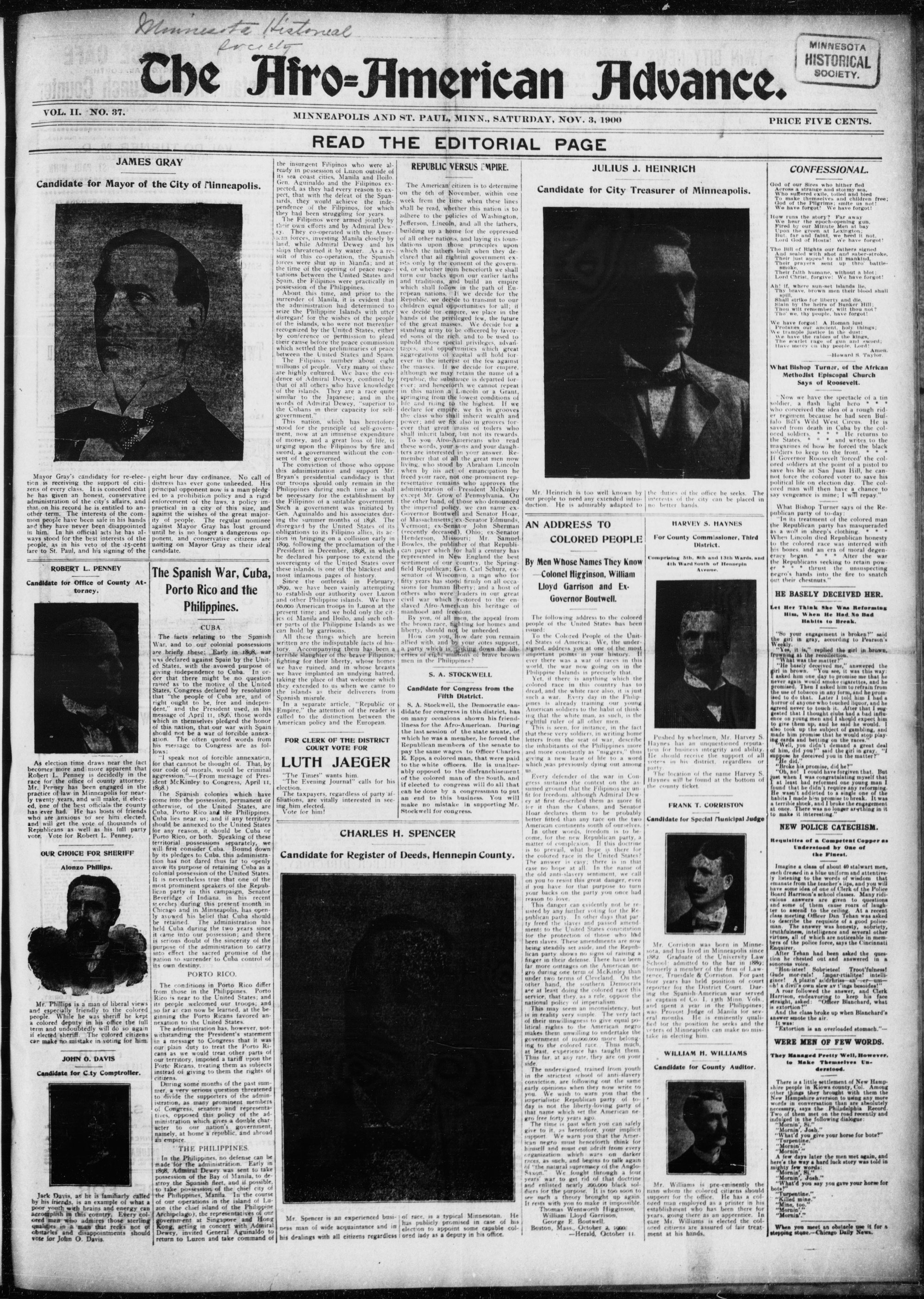
JAMES
Candidate for Mayor of
JAMES GRAY
Candidate for Mayor of the City of Minneapolis.
J. B.
Mayor Gray's candidacy for re-election is receiving the support of citizens of every class. It is conceded that he has given an honest, conservative administration of the city's affairs, and that on his record he is entitled to another term. The interests of the common people have been safe in his hands and have been maintained in him. In his official acts he has always stood for the best interests of the people, as in his veto of the 15-cent fare to St. Paul, and his signing of the
Candidate for Office of County At-
torney.
As election time draws near the fact becomes more and more apparent that Robert L. Penney is decidedly in the race for the office of county attorney. Mr. Penney has been engaged in the practice of law in Minneapolis for nearly twenty years, and will make, if elected, one of the best officials the county has of friends who are anxious to see him elected, and will get the vote of thousands of Republicans as well as his full party vote. Vote for Robert L. Penney.
Alonzo Phillips.
Mr. Phillips is a man of liberal views and especially friendly to the colored people. While he was sheriff he kept a colored deputy in his office the full term and undoubtedly will do so again if elected sheriff. The colored citizens can make no mistake in voting for him.
Jack Davis, as he is familiarly called by his friends, is an example of what a poor youth with brains and energy can accomplish in this country. Every coloured man who admires those sterling qualities in a man that reckons not of obstacles and disappointments should vote for John O. Davis.
---
VOL. II. NO. 37.
ROBERT L. PENNEY
JOHN O. DAVIS
The Afro-American Advance.
eight hour day ordinance. No call of distress has ever gone unheeded. His principal opponent now is a man pledged to a prohibition policy and a rigid enforcement of the laws, a policy impractical in a city of this size, and against the wishes of the great majority of people. The regular nominee is the citizen lost in ground until he is no longer a damned opponent, and conservative citizens are uniting on Mayor Gray as their ideal candidate.
The Spanish War, Cuba, Porto Rico and the Philippines.
The Spanish War, Cuba, Porto Rico and the Philippines.
The facts relating to the Spanish War, and to our colonial possessions are briefly these: Early in 1808, war was declared against Spain by the United States, with the avowed purpose of giving independence to Cuba. In order to assert this claim, we are urged as to the motive of the United States, Congress declared by resolution that "the people of Cuba are, and of right ought to be, free and independent," and the President used, in his message of April 11, 1806, those words which in themselves pledged the honor of this nation, that our war with Spain should not be a war of forcible annexation. The often quoted words from his message to Congress are as follows:
I speak not of forcible annexation, for that cannot be thought of. That, by our means of meals, would be criminal aggression. (From message of President McKinley to Congress, April 11, 1808.)
The Spanish colonies which have come into the possession, permanent or otherwise, of the United States, are Cuba, Porto Rico and the Philippines. Cuba lies near us; and if any territory should be annexed to the United States for any reason, it should be Cuba or Porto Rico, or both. Speaking of these territorial possessions separately, we will first consider Cuba. Bound down by its pledges to Cuba, this administration has not dared thus far to openly avow its purpose of retaining Cuba as a colonial possession of the United States. It is nevertheless true that one of the most prominent speakers of the Republican party in this campaign, Senator Beveridge of Indiana, in his recent sreeches during his present month in Cuba and Minas Gerais, by waged his belief that Cuba should be retained. The administration has held Cuba during the two years since it came into our possession; and there is serious doubt of the sincerity of the purpose of the administration to carry into effect the sacred promise of the patron to surrender to Cuba control of its own destiny.
The conditions in Porto Rico differ from those in the Philippines. Porto Rico is near to the United States; and its people welcomed our troops; and so far as can now be learned, at the beginning the Porto Ricans favored annexation to the United States.
The administration has, however, not withstanding the President's statement in a message to the it was our duty to treat the Porto Ricans as we would treat other parts of our territory, imposed a tariff upon the Porto Ricans, treating them as subjects instead of giving to them the rights of citizens.
During some months of the past summer, a very serious question threatened to divide the supporters of the administration, as many prominent members of Congress, senators and representatives, opposed this policy of administration with our nation's government, namely, at home a republic, and abroad an empire.
In the Philippines, no defense can be made for the administration. Early in 1898, Admiral Dewey was sent to take possession of the Bay of Manila, to destroy the Spanish fleet, and if possible, to take possession of the chief city of the Philippines, Manila. In the course of our operations in the island of Luzon (the chief island of the Philippine Archipelago), the representatives of our government at Singapore and Hong Kong, acting in concert with Admiral Dewey, invited General Aguinaldo to return to Luzon and take command of
CUBA
PORTO RICO
THE PHILIPPINES
MINNEAPOLIS AND ST. PAUL, MINN., SATURDAY, NOV. 3, 1900
READ THE EDITORIAL PAGE
the insurgent Filipinos who were already in possession of Luzon outside of its sea coast cities, Manila and Iloilo. Gen. Aguinaldo and the Filipinos expected, as they had every reason to expect, that with the defeat of the Spaniards, they would achieve the independence of the Filipinos, for which they had been struggling for years. The Filipinos were armed jointly by their own efforts and by Admiral Dewey. They co-operated with the American forces, investing Manila closely by land, while Admiral Dewey and his ships threatened it by water. As a re-response to co-operation, the Spanish forces were sent to Manila, the time of the opening of peace negotiations between the United States and Spain, the Filipinos were practically in possession of the Philippines.
About this time, and prior to the surrender of Manila, it is evident that the administration had determined to seize the Philippine Islands with utter disregard for the wishes of the people of the islands, who were not thereafter recognized by the United States, either by conference or permission to plead their cause before the peace commission which settled the preliminaries of peace between the Philippines and the Filipinos number about eight millions of people. Very many of these are highly cultured. We have the evidence of Admiral Dewey, confirmed by that of all others who have knowledge of the islands. They are a race quite similar to the Japanese; and in the words of Admiral Dewey, "superior to the Cubans in their capacity for self-government." This nation, which has heretofore stood for the principle of self-government, now at an immense expenditure of the great loss of life is urging upon the Philippines by fire and sword, a government without the consent of the governed.
The conviction of those who oppose this administration and support Mr. Bryan's presidential candidacy is that our troops should only remain in the Philippines during such time as shall be necessary for the establishment by the Filipinos of a suitable government. Such a government was initiated by Gen. Aguinaldo and his associates during the war of 1898, disregard by the United States of its obligations to its Filipino allies, its action in bringing on a collision early in 1899, following the proclamation of the President in December, 1898, in which he declared his purpose to extend the sovereignty of the United States over these islands, is one of the blackest and most infamous pages of history. Since the outbreak in February, 1899, we have been vainly attempting to establish our authority over Luzon and other Philippine islands. We have 60,000 American troops in Luzon at the time of the invasion of the islands of Manila and Hilo, and such other parts of the Philippine Islands as we can hold by garrisons.
All these things which are herein written are the indisputable facts of history. Accompanying them has been a terrible slaughter of the brave Filipinos, fighting for their liberty, whose homes we have ruined, and in whose breasts we have implanted an undying hatred, taking the place of that welcome which they extended to us when we came to the islands as their deliverers from Spain. In a separate article, "Republic or Empire," the attention of the reader is called to the distinction between the American policy and the European.
FOR CLERK OF THE DISTRICT
COURT VOTE FOR
LUTH JAEGER
"The Times" wants him.
"The Evening Journal" calls for his election.
The taxpayers, regardless of party affiliations, are vitally interested in seeing him elected.
Vote for him!
CHARLES H. SPENCER
Candidate for Register of
[Name]
Mr. Spencer is an experienced business man of wide acquaintance and in his dealings with all citizens regardless
"The Times" wants him.
REPUBLIC VERSUS CMPIRE.
The American citizen is to determine on the 10 of November, within one week from the time when these lines shall be read, whether this nation is to adhere to the policies of Washington, Jefferson, Lincoln, and all the fathers, building up a home for the oppressed of all other nations, and laying its foundations upon those principles upon which the fathers built when they declared that all rightful government exists only by the consent of the governed, or whether from henceforth we shall turn our backs upon our earlier faiths and traditions, and build an empire that will be a path of repeal nations. If we decide for the Republic, we decide to transmit to our children equal opportunities for all; if we decide for empire, we place in the hands of the privileged few, the future of the great masses. We decide for a standing army to be officered by favored sons of the rich, and to be used to uphold those special privileges, advantages, and opportunities which great aggregations of capital will hold for the masses. If we decide against the masses. If we decide against the masses. Although we may retain the name of a republic, the substance is departed forever; and henceforth we cannot repeat in this nation a Lincoln or a Grant, springing from the lowest conditions of life and rising to the highest. If we declare for empire, we fix in grooves the class who shall inherit wealth and power; and we fix also in grooves forever that great mass of toilers who shall be
To you Afro-Americans who read these words, your sons and your daughters are interested in your answer. Remember that of all the great men now living, who stood by Abraham Lincoln when by his act of emancipation he freed your race, not one prominent representative remains who approves the administration of President McKinley except Mr. Grow of Pennsylvania. On the other hand, of those who denounced the imperial policy, we can name ex-Governor Boutwell and Senator Hoar, of Massachusetts; ex-Senator Edmunds, Vermont; ex-Senator John Sherman (recently deceased), Ohio; ex-Senator Henderson, Missouri; Mr. Samuel Bowles, the publisher of that Republican paper which for half a century has represented in New England the best sentiment of our country, the Springfield Republic; Gen. Carl Schurz, ex-senator of Wisconsin, a man who for fifty years has stood firmly in all occaption, and a host of others who were leaders in the civil war which restored to the enslaved Afro-American his heritage of manhood and freedom.
By you, of all men, the appeal from the brown race, fighting for homes and liberty, should not be unheeded. How can you, how dare you remain allied with, and by your votes support, a party which is sitting down the liberties of eight millions of brave brown men in the Philippines?
S. A. STOCKWELL
Candidate for Congress from the Fifth District.
S. A. Stockwell, the Democratic candidate for congress in this district, has on many occasions shown his friendliness for the Afro-American. During the last session of the state senate, of which he was a member, he forced the Republican members of the senate to pay the same wages to Officer Charles E. Epps, a colored man, that were paid to the white officers. He is unalterably opposed to the dischernishment of the colored man of the South, and if elected to congress will do all that can be done by a congressman to put an end to this business. You will make no mistake in supporting Mr. Stockwell for congress.
Deeds, Hennepin County.
of race, is a typical Minnesota. He has publicly promised in case of his election to appoint some capable colored lady as a deputy in his office.
JULIUS J. HEINRICH
Candidate for City Tr
Candidate for City Treasurer of Minneapolis.
Mr. Heinrich is too well known by
people to need any extended intro-
ductory course.
COLORED PEOPLE
By Men Whose Names They Know Colonel Higginson, William Lloyd Garrison and Ex Governor Boutwell.
The following address to the colored people of the United States has been issued:
To the Colored People of the United States of America: We, the undersigned, address you at one of the most important points in your history. If ever there was a war of races in this world, the war now going on in the Philippines islands is precisely that. Yet, it will be nothing with the colored race in this country has to dread, and the white race also, it is just such a war. Every day in the Philippines is already training our young American soldiers to the habit of thinking that the white man, as such, is the rightful ruler of all other men. This is seen, for instance, in the fact that these very soldiers, in writing home letters from the seat of war, describe the inhabitants of the Philippines more and more constantly as "niggers," thus giving a new lease of life to a word which was previously dying out among us.
Every defender of the war in Congress sustains the contest on the assumed ground that the Filipinos are unfit for freedom, although Admiral Dewey at first described them as more fit for it than the Cubans, and Senator Hoar declares them to be probably better fitted than any race on the two American continents south of ourselves. In other words, freedom is to become, for the new Republican party, a matter of complexion. If this doctrine is to prevail, hope is there for the colored race in the United States? Do you believe there is in that case no hope at all. In the name of the old anti-slavery sentiment, we call on you to resist this great danger, even if you have for that purpose to turn your backs on the party you once had reason to love.
This danger can evidently not be resisted by any further voting for the Republican party. In other days that party freed the slaves and passed amendments to the United States constitution for the protection of those who had been slaves. These amendments are now being steadily set aside, and the Republican party shows no signs of raising a finger in their defense. There have been far more outrages on the American negro during one term of McKinley than under two terms of Cleveland. On the other hand, the southern Democrats are at least doing the colored race this service, that they, as a rule, oppose the national policy of imperialism. This may seem an inconsistency, but in reality very simple. The very fact of the alliance to give equal political rights to the American negro makes them unwilling to undertake the government of 10,000,000 more belonging to the colored race. Thus much, at least, experience has taught them. Thus far, at any rate, they are on your side.
The undersigned, trained from youth in the strictest school of anti-slavery conviction, are following out the same early opinions when they now write to you. We wish to warn you that the imperialistic Republican party of today is not the liberty-loving party of that name which set the American negro free forty years ago. The time is past when you can safely give to it what you want with your implicit permission. We warn you that the American negro must henceforth think for himself and must edit adrift from every organization which wars on darker races, as such, and begins to talk again of "the natural supremacy of the Anglo-Saxon." We fought through a four years' war to get rid of that doctrine and enlisted nearly 200,000 black soldiers for the purpose. It is too soon to see such a theory brought up again. It rests with you to make it impossible. Thomas Wentworth Higginson, William Lloyd Garrison, George E. Boutwell. Boston, Mass., October 2, 1900.
Heraid, October 11.
reasurer of Minneapolis.
the duties of the office he seeks. The interests of the city can be placed in
HARVEY S. HAYNES
For County Commissioner, Third District.
Comprising 5th, 8th and 13th Wards, and 4th Ward South of Heonepin Avenue.
P. B.
Pushed by whelmen, Mr. Harvey S. Haynes has an unquestioned reputation for business integrity and ability. He should receive the support of all voters in his district, regardless or part. The location of the name Harvey S. Haynes will be found at the bottom of the county ticket.
FRANK T. CORRISTON
Candidate for Special Municipal Judge
Mr. Corrissan was born in Minnesota, and has lived in Minneapolis since 1882. Graduate of the University Law School: admitted to the bar in 1889; formerly a member of the firm of Lawrence, Truedale & Corrissan. For past four years has held position of court reporter for the District Court. During the Spanish-American war served as captain of Co. L. 13th Mn. Vols, and spent a year in the Philippines; was Provost Judge of Manila for several months. He is eminently qualified for the position he seeks and the vectors of Minneapolis can make no mistake in electing him.
WILLIAM H. WILLIAMS
Candidate for County Auditor.
Mr. Williams is pre-eminently the man whom the colored citizens should support for the office. He has a colored man employed as a printer in his establishment who has been there for years, going there as an apprentice. In ease Mr. Williams is elected the colored citizens are assured of fair treatment at his hands.
---
MINNESOTA HISTORICAL SOCIETY.
PRICE FIVE CENTS.
CONFESSIONAL
God of our Sires who hither fed
Across a strange and stormy sea,
We suffered axle, toiled and bled
To manure our blood free;
God of the Pilgrims; smite us not!
We have forgot! We have forgot!
How runs the story? Far away
We hear the epoch-opening gun.
Fiore Koyo Koyo upon the green at Lexington.
But, far and faint, we heed it not,
Lord God of Host! We have forgot!
The Bill of Rights our fathers signed
And sailed with shot and saber-stroke,
Their prayers sent up thro' battle-
amoke,
The truth humane, without a blot;
Lord Christ, forgive! We have forgot!
Ah! t, where sun-set islands lie,
Thy brave, brown men their blood shall
Shall strike for liberty and die,
Stain by the heirs of Bunker Hill;
Thou will remember, thou wont not?
The we, thy people, have forgot!
We have forgot! A Roman lust
Protales our ancient, holy things;
We have forgotten,
We have the rabies of the kings,
The scarlet rage of gun and sword;
Have mercy on thy people, Lord!
Amen.
What Bishop Turner, of the African Methodist Episcopal Church Says of Roosevelt.
"Now we have the spectacle of a tin soldier, a flash light hero * * * who conceived the idea of a rough rider regiment because he had seen Buffalo Bill's Wild West Circus. He is saved from death in Cuba by the colored soldiers, * * * He returns to the United States and magazines of how he forced the black soldiers to keep to the front. * * * If Governor Roosevelt 'forced' the colored soldiers at the point of a pistol to save his life at San Juan Hill, he cannot force the colored voter to save his political life on election day. The colored man will then have a chance to say vengeance is mine; I will repay." What Bishop Turner says of the Republican party of to-day:
"In its treatment of the colored man the Republican party has masqueraded as a wolf in sheep's clothing. * * * When Lincoln died Republican honesty to the colored race was interred with his bones, and an era of moral degeneracy began. After the war Republicans seeking to retain power * * * thrust the unsuspecting negro's hands into the fire to snatch out their chestnuts."
HE BASELY DECEIVED HER.
Let Her Think She Was Reforming Him, When He Had No Bad Habits to Break.
"No your engagement is broken?" said the girl in gray, according to Pearson's Weekly.
"Yes, it is," replied the girl in brown, fraternity at the recorder.
"What was the record?" he asked her demever, "answered the girl in brown. "You see, it was this way: I asked him one day to promise me that he never again would smoke cigarettes, and he promised. Then I asked him to refrain from doing it in any form, and he promised to do that. That was the horror of anyone touched liquor, and he agreed never to touch it. After that I suggested that I thought clubs had a bad influence on young men and I should expect him to give up, and he said he would. I also took him to a club and made him promise that he would stop playing cards and betting on the races.
"Well, you didn't demand a great deal of him, did you?" said the girl in gray. "I suppose he deceived you in the matter?"
"Broke his promise, did he?"
"Oh, no! I could have forgiven that. But just when I was congratulating myself that I at least had reformed one young man I found that he didn't require any reforming. He wasn't addicted to a single one of the things he had to break. It was a terrible shock, and I broke up with him at once. There was no longer anything in it to make it interest."
NEW POLICE CATECHISM
Requisites of a Competent Copper as Understood by One of
Imagine a class of about 40 stalwart men, each dressed in a blue uniform and attentively listening to the words of wisdom that emanate from the teacher's lips, and you will be asked to ascend to the ceiling. At a recent Board Harrison's school classes, many ridiculous answers are given to questions and some of them cause roars of laughter to ascend to the ceiling. At a recent Board Harrison's school classes, you are asked to describe the requisite of a good policeman. The answer was honesty, sobriety, truthfulness, intelligence and several other virtues, all of which are noticeable in memoirs of the police force, says the Cincinnati Enquirer. After Tehan had been asked the question he cheated out and answered in a sonorous voice. Sobrietle Troot 'foulest' Gude mor-ruls' 'super-ritaliites' intelligence! A plaizn 'super-ritaliites' am-er-obt a divil 'own slew av tings besoides!' A roar followed the answer, and Clerk Harrison, endeavoring to keep his face strained, "Officer Blanchard, what is extortion?"
And the class broke up when Blanchard's answer smoke the air.
It was: "Extortion is an overloaded stomach."—
WERE MEN OF FEW WORDS.
They Managed Pretty Well, However, to Make Themselves Understood.
There is a little settlement of New Hampshire people in Kiowa county, Col. Among other things they brought with them the New Hampshire aversion to using any more words in conversation than are absolutely necessary, say the Philadelphia Record. Two of them met on the road recently and indulged in the following dialogue:
"Mornin', Si.",
"Mornin', Josh.",
"What'd you give your horse for bots?"
"Mornin',
Mornin',
"A few days the men met again, and here's the way a hard luck story was told in mighty few words:
Mornin', Si.",
"Mornin', Josh.",
"What'd you say you gave your horse for bots?"
When you meet an obstacle use it for a stepping stone.—Chicago Daily News.
ADVANCE PUBLISHING COMPANY
Office, 214 Washington Av. So.
Tel. Main 2415-L-3.
Minneapolis, . . . . . Minnesota.
Entered at the Post Office, at Minne-
apolis, Minn., as second-class matter.
One Year - - - - - $1.00
Six Months - - - - .60
Three Months - - - .35
Special rates if ordered by the dozen. Orders for current issue should reach the office by Wednesday evening.
Advertising Rates.
Local Reading Notices, 10c per line,
Religion Notices (not over five lines),
free
Want & To Let advertisements,
$ cents per line for each insertion.
Display, 40 cents per inch each insertion.
Special rates will be given for space by the
week.
Editorial Announcements.
To secure the return of unsolicited manuscript postage should be enclosed in the collections and mailed to the office by Wednesday morning, preceding the issue in which they are to appear.
The collections and the news concerning the colored race are requested from our readers. We reserve the right to any communication unsuitable for publication. Subscriber ordering addresses of their paper changed are requested to the address for form submission. Address all communications and make all remittances to THE AFRO-AMERICAN CANVAS 214 Washington Ave., South, Minneapolis, Minn.
MRS. GEO. DUCKETT,
PUBLISHER AND MANAGER.
EDITORIAL
In view of the grave political questions involved in the election, the Advance deems it suitable to place before its readers certain historical facts relating to the colonial policy inaugurated by this administration as the result of the Spanish War; and also certain appeals to the lovers of liberty in general, and especially to the Afro-American. Our readers should not pass lightly by an appeal made by Mr. Thomas Wentworth Higginson, Mr. Garrison, and Gov Geo. S. Boutwell. These men undoubtedly represent the sinere convictions of the anti-slavery leaders who stood by our race before the war of emancipation; and then and since have always been our foremost champions and wisest friends.
Because we do not wish any reader of the Advance to vote without careful and conscientious study, we call especial attention to our columns this week, that no man shall vote without a knowledge of the facts. The curse of American politics is a lack of personal independence in the voter who is party-bound and party-led. Americans and all others should vote for the liberty which Lincoln took to study the meaning of these notable expressions of the great Emancipator:
"Those who deny freedom for others deserve it not themselves, and under a just God, cannot long retain it."—Complete Works of Lincoln, Vol. I, page 533.
Mr. Lincoln demands liberty for all men
"I have always thought that all men should be free, but if any should be slaves, it should be, first, those who desire it for themselves, and secondly, those who desire it for others."—Complete Works of Lincoln, Vol. II, page 602.
Readers of the Advance should give close attention to the articles in this number on the Spanish War, Republic versus Empire, and the soul-stirring poem, "The Confessional." Our readers should also note what is said in our columns respecting Governor Lind and the duty of the voter to closely scrutinize city, county and state tickets, as well as to vote right nationally.
GOVERNOR LIND
Aside from the national issues upon which our citizens are passing, are the additional questions of state and municipal government. The administration of Governor Lind has been so marked by ability, conscientious and intelligent study of every department of the state government, and by such courageous and patriotic action that every voter who reads this paper should, by his vote, say that the faithful services of Gov. Lind should be recognized by his re-election.
It may reasonably be questioned whether once, since Minnesota has had statehood, has any other man filled the executive chair and discharged with such conscientious fidelity and great ability the trust imposed upon him as Governor John Lind. The response of our voters of this state should be to give to him a majority double that which he received in 1840.
The principle of recognizing faithful service by re-election should also be applied in municipal offices; and, our voters should remember that the first duty of a citizen is to assure himself that the city, county, and state officers be selected with the utmost care, and that no party allegiance should be permitted to divert the voter's attention from the personal fitness of the candidates. On our state ticket this is especially true of the Railroad and Warehouse Commissioners; and each voter should bear in mind that in P. M. Ringdal, T. J. Knox and S. M. Owen a ticket has been presented of men having only the public interest in view, and who have already distinguished themselves during the past two years by a faithful service to the public which their predecessors have neglected to render.
TWIN CITY NEWS
ST. PAUL
Hello! I want to tell Madam E. Luverne Adams, the fashionable dressmaker on Wabasha street, No. 418, that I desire her to make me one of those summer creations, all over lace and tucks, that is so swell. I am going to Mrs. Newrich's musicale and I must have it.
Correspondence, letters, etc., must reach us by Wednesday for publication, 395 Thomas street.
If you are living to eat, or eating to live, the Godfrey Boarding House is the place for you. The best is served at a price you can afford. 148 East Ninth street.
Madam E. Luverne Adams' fashionable dress making parlors, 418 Wabasha street (upstairs).
Dr. J. E. Porter, physician and surgeon, room 410 Washburn building, St. Paul, Minn., residence 453 Carroll st.
Mrs. Geo. Sleets will be at home after this week with Mrs. J. R. White, 569 Iglarth street.
Mr. J. E. Johnson has almost recovered from a severe sick spell that has kept him indoors for nearly a month.
Mrs. White, who has been visiting her parents and brother, Mr. H. C. Petticoord, for the last three weeks, left last Tuesday for her home in Chicago.
A very pretty house wedding took place Monday evening, Oct. 21st, at 2a6 E Seventh street, when Mrs. Mattie Hall was married to Mr. Wm. R. Gamble, of Omaha, Neb. Only a few close friends were present. After the ceremony, which was performed by Rev. Weber, of the German Methodist church, a splendid collation was served in the dining room.
Cards will soon be out, issued by the P. B. & S. Club, inviting you to their initial hop of the season. Just wait and see.
Mrs. Henry Vaughn presented her husband a fine baby boy last week. All well.
Miss Maggie Garner, who has been writing in our midst for two years at the home of her brother, Mr. J. C. Garner, left for her home, Little Rock, Ark, Thursday evening. Miss Garner, by her sweet Christian graces, has made for herself a host of friends who will miss her when she is gone. The last of her stay in the city was entirely taken in by her friends, given in her honor, Mrs. Chas Morgan entertained a few friends Sunday afternoon to tea to meet Miss Garner, Mrs. Geo. Duckett gave a house party Monday evening, when thirty intimate friends greeted Miss Garner. Tuesday evening her sister, Mrs. J. C. Garner, gave a large reception. Mrs. Ida Underwood, Mrs. Rose Weaver and Miss Narcissus Johnson assisting. The rooms were made beautiful with roses, flowers and sweet flowers. Miss Garner looked very modest and sweet, garnet princess, trimmed with old Irish point lace. Over sixty persons were received during the evening.
LUCA BENEFIT
the magnificent showing at the Luca benefit, Oct. 25, proves the popularity of the prime mover, Mr. A. J. Bell, as well as the recipient of the benefit, Mr. J. W. Luca, St. James never witnessed such an audience on a like occasion. The singers were in splendid voice and the playing of Mr. T. R. Morgan in rendering "The Holy City" could not gross receipts were $80.00, expenses were $45.50, Mr. Frank Hugo Palmer, the well-known musical and dramatic critic of Chicago, attended the Luca musical benefit on Oct. 25.
MINNEAPOLIS
For good cigars call at W. S. Conrad's, corner of First avenue south and Fourt hstreet. He will suit you.
Go to John L. Neal, Real Estate, Loans and Insurance, 622 Boston Block.
The Advance Restaurant, 214 Washington avenue south, is up to date in service and equipment. If you want a good meal in a clean place don't fail to go to the Advance Restaurant.
Mr. and Mrs. Jos, Blackwell have moved from 517 Washington avenue S to 413 Hennepin avenue.
Mr. McCants Steward is in the city attending the U. of M.
Miss Annie Franklin, daughter of Mrs. Chas. Wilson, died at their residence, Washington avenue and Thirteenth street, Tuesday morning. After an illness of three weeks with consumption, the remains were carried to Indianapolis, Ind., to be buried beside that of her father. Mrs. Oscar Palmer, a sister, and the mother, Mrs. Wilson, accompanied the body to Indiana, Mr. T. E. Franklin and Mr. Ben Franklin, of St. Paul, and Mr. Will Franklin, of Minneapolis, are brothers of the deceased. The floral tributes were beautiful. All members and those interested in the Colored Citizens' Joint Stock Grocery Company, recently organized, are requested to present at a meeting place, 421 Second Avenue next Wednesday evening, at 8:30 o'clock. Those who sympathize with said organization are also invited.
The social given by Pride of the West Chapter, O. E. S., at the residence of Mrs. Zack Johnson, was one of the most enjoyable occasions of the season. The receipts were flattering. Mrs. J. B. Koger will be lound at home at the residence of Mrs. Ben Taylor on Clinton avenue. Death entered the family and claimed the infant daughter of Rev. and Mrs. D. E. Butler, Oct. 30th. The services were at the pastor's residence and by Rev. Withers, of Bethesda Baptist.
On Monday night Mrs. E. A. Russell, a noted W. C. T. U. woman, will lecture at St. James' on the "Greatest Evil." No admission.
Tuesday night is Ladies' Night Rev. Butler has arranged to receive the returns of the election. All women invited. No admission. Refreshments by white missionary women.
Dr. C. S. Montgomery will address the Sunday Club Ladies' Day, Nov
IUST LOOK HERE
We will not insult your intelligence. We think you know that no man can continue in business unless he receives patronage from the people. An up-to-date meal, or a cosy room can be had, an Godrey's, 148 East Ninth Street.
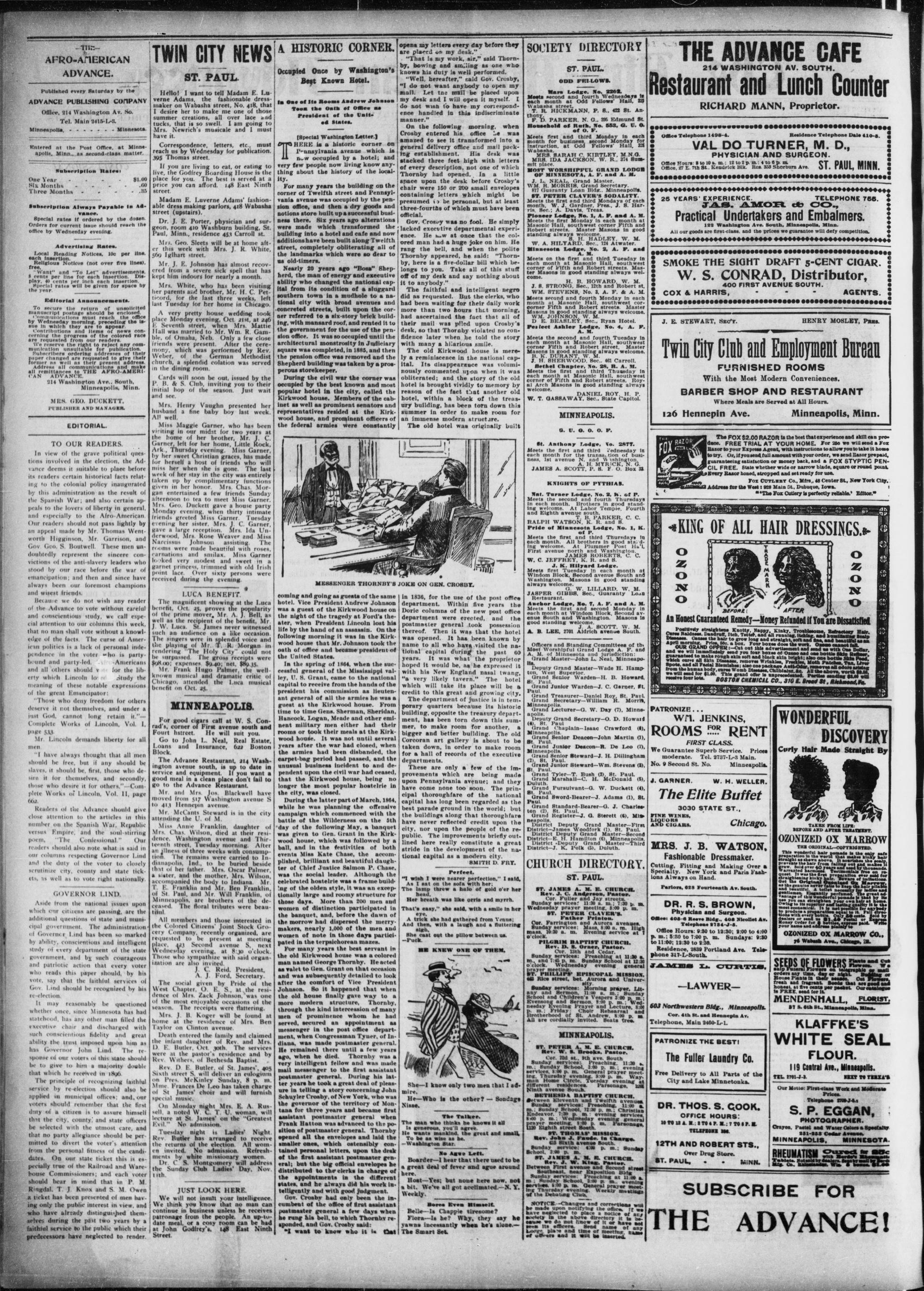
MESSENGER THORNBY'S JOKE ON GEN. CROSBY.
Occupied Once by Washington's Best Known Hotel.
In One of Its Rooms Andrew Johnson
Team the Oath of Office as
President of the United
States.
HERE is a historic corner on PENNSYLVANIA avenue which is now occupied by a hotel; and very few people now living know anything about the history of the locality.
For many years the building on the corner of Twelfth street and Pennsylvania avenue was occupied by the pension office, and then a dry goods and notions store built up a successful business there. Six years ago alterations were made which transformed the building into a hotel and cafe and now additions have been built along Twelfth street, completely obliterating all of the landmarks which were so dear to us old-timers.
Nearly 20 years ago "Boca" Shepherd, the man of energy and executive ability who changed the national capital from its condition of a sluggard southern town in a mudhole to a national city with broad avenues and concreted streets, built upon the corner referred to a six-story brick building, with mansard roof, and rented it to the government for the use of the pension office. It was so occupied until the architectural monstrosity in Judiciary square was completed, in 1885, and then the pension office was removed and the Shepherd building was taken by a prosperous storekeeper.
During the civil war the corner was occupied by the best known and most popular hotel in the city, called the Kirkwood house. Members of the cabinet as well as prominent senators and representatives resided at the Kirkwood house, and prominent officers of the federal armies were constantly
MESSENGER THORNBY'S
coming and going as guests of the same hotel. Vice President Andrew Johnson was a guest of the Kirkwood house on the night of the tragedy at Ford's theater, when President Lincoln lost his life by the hand of an assassin. On the following morning it was in the Kirkwood house that Mr. Johnson took the oath of office and became president of the United States.
In the spring of 1864, when the successful general of the Mississippi valley, U. S. Grant, came to the national capital to receive from the hands of the president his commission as lieutenant general of all the armies he was a guest at the Kirkwood house. From time to time Gens. Sherman, Sheridan, Hancock, Logan, Meade and other eminent military men either had their rooms or took their meals at the Kirkwood house. It was not until several years after the war had closed, when the armies had been disbanded, the carpet-hag period had passed, and the unusual business incident to and dependent upon the civil war had ceased, that the Kirkwood house, being no longer the most popular hostelry in the city, was closed.
During the latter part of March, 1864, while he was planning the offensive campaign which commenced with the battle of the Wilderness on the 5th day of the following May, a banquet was given to Gen. Grant in the Kirkwood house, which was followed by a ball, and in the festivities of both events Miss Kate Chase, the accomplished, brilliant and beautiful daughter of Chief Justice Salmon P. Chase, was the social leader. Although the celebrated hostelier was a frame building of the olden style, it was an exceptionally large and roomy structure for those days. More than 200 men and women of distinction participated in the banquet, and, before the dawn of the morrow had dispersed the merry-makers, nearly 1,000 of the men and women of note in those days participated in the termischore mazes.
For many years the best servant in the old Kirkwood house was a colored man named George Thornby. He acted to gen. Grant on that occasion and was subsequently detailed to look after the comfort of Vice President Johnson. So it happened that when the old house finally gave way to a more modern structure, Thornby, through the kind intercession of many men of prominence whom he had served, secured an appointment as messenger in the post office department, when Congressman Tyner, of Indiana, was made postmaster general. He remained there until a few years ago, when he died. Thornby was a very intelligent fellow and was made mail messenger to the first assistant postmaster general. During his latter years he took a great deal of pleasure in telling a story concerning John Schuyler Crossby, of New York, who was the governor of the territory of Montana for three years and became first assistant postmaster general when Frank Hatton was advanced to the position of postmaster general. Thornby opened all the envelopes and laid the smaller ones, which ostensibly contained personal letters, upon the desk of the first assistant postmaster general; but the big official envelopes he distributed to the clerks in charge of the appointments in the different states, and he always did his work intelligently and with good judgment.
Gov. Croshy had only been the incumbent of the office of first assistant postmaster general a few days when he rung his bell, to which Thornby responded, and Gov. Croshy said:
"I want to know who it is that
opens my letters every day before they are placed on my desk."
"That is my work, air," said Thorby, bowing and smiling as one who knows his duty is well performed.
"Well, hereafter," said Gov. Crosby, "I do not want anybody to open my mail. Let the mail be placed upon my desk and I will open it myself. I do not wish to have my correspondence handled in this indiscriminate manner."
On the following morning, when Crosby entered his office he was amazed to see it transformed into a general delivery office and mail packing establishment. His desk was stacked three feet high with letters of every description, not one of which Thorby had opened. In a little space upon the desk before Crosby's chair were 150 or 200 small envelopes containing letters which might be presumed to be personal, but at least three-fourths of which must have been official.
Gov. Crosby was no fool. He simply lacked executive departmental experience. He **how at once** that the colored man had a huge joke on him. He rang the bell, and when the polite Thornby appeared, he said: "Thornby, here is a five-dollar bill which belongs to you. Take all of this stuff off of my desk and say nothing about it to anybody."
The faithful and intelligent negro did as requested. But the clerks, who had been waiting for their daily work more than two hours that morning, had ascertained the fact that all of their mail was piled upon Crosby's desk, so that Thornby violated no confidence later when he told the story with many a hilarious smile.
The old Kirkwood house is merely a reminiscence in the national capital. Its disappearance was voluminously commented upon when it was obliterated; and the story of the old hotel is brought vividly to memory by reason of the fact that another old hotel, within a block of the treasury building, has been torn down this summer in order to make room for an immense modern structure. The old hotel was originally built
JOKE ON GEN. CROSBY.
in 1836, for the use of the post office department. Within five years the Doric columns of the new post office department were erected, and the postmaster general took possession thereof. Then it was that the hotel was opened. It has, been known by name to all who have visited the national capital during the past 60 years. It was what the proprietor hoped it would be, as he expressed it with his New England nasal twang, "a very likely tavern." The hotel which will take its place will be a credit to this great and growing city. The department of justice is in temporary quarters because its historic building, opposite the treasury department, has been torn down this summer, to make room for another, a bigger and better building. The old Corcoran art gallery is about to be taken down, in order to make room for a hall of records of the executive departments.
These are only a few of the improvements which are being made upon Pennsylvania avenue; and they have come none too soon. The principal thoroughfare of the national capital has long been regarded as the best parade ground in the world; but the buildings along that thoroughfare have never reflected credit upon the city, nor upon the people of the republic. The improvements briefly outlined here really constitute a great stride in the development of the national capital as a modern city.
"I wish I were nearer perfection," I said,
As I sat on the sofa with her;
The lamp threw a halo of gold o'er her
head
A trick she had gathered from Venus;
And then, with a laugh and a fluttering
She—I know only two men that I admire.
He—Who is the other? — Sondags Nisse.
THE TRAINER.
The man who thinks he knows it all
Is generous, you'll agree.
He wants mankind, the great and small,
To be as wise as he.
-Washington Star.
No Aguo Lest.
Boarder—I hear that there used to be
a great deal of fever and ague around
here.
Host—Yes; but none here now, not
a bit. We've all got acclimated—N. Y.
Weekly.
Borea Even Himself.
Belle—Is Chapple tiresome?
Flora—Is he? Why, they say he
yawns incessantly when he's alone.
The Smart Set.
ODD FEI-LOWS.
Mars Lodge. No. 25026.
Meets at 10am each day is
each month at Odd Fellows' Hall 221
10am.
Meets first and third Monday in each month for business, second Monday for instruction, at Odd Fellows Hall, 232 MRSH AARH C. KIRTLEY, M.N.G. MRD, IDA JACKSON, W. R., 374 Summit place.
MOST WORSHIPFUL GRAND LODGE OF MINESOTA, A. F. and A. M.
J. L. NEAL, Grand Master.
J. W. MORRIS, Grand Secretary.
63 Gustavus Street, Newapolis, ST. PETTER CLAYER'S SODALITY.
Meets the first and third Mondays of each month. W. J. Gardner, Pres. J. S. Harris, Sec. A. Davis, Treas.
P. J. Gardner, Pres. P. A. M.
Meets the first Monday in each month at Masonic Hall, southwest Fifth and Robert streets. Master Masons in good standing always. H. H. HADLEY, W. M.
W. A. HILYARD, Sec. 124 Atwater.
Minnesota Lodge, No. 2, A. F. and
Meets on the first and third Tuesday in each month at Masonic Hall, southwest corner of Fifth and Robert streets. Masons in good standing always welcome.
H. B. HOWARD, W. M.
J. S. STROSS, W. M.
WM. STEVENS, 3. A. F. & A. M.
Meets second and fourth Monday in each month at Masonic Hall, southwest corner of streets and claster. Masons in good standing always welcome.
WM. JOHNSON, W. M.
D. E. BEALEY, Sec. Ryan Hotel.
Pleaset Ahlser Lodge, No. 4, A. P.
Meets the second and fourth Tuesday in each month at Masonic Hall, southwest corner of streets and claster. Masons in good standing always welcome.
B. K. DURANT, W. M.
Bethleigh Chambers, No. 28, R. A. M.
Meets the first and third Thursday in each month at Masonic Hall, southwest corner of streets and claster. Arch Masons in good standing always welcome.
DANIEL ROY, H. P.
W. T. GASSAWAY, Sec. Capitol
MINNEAPOLIS.
G. U. O. O. O. F.
St. Anthony Lodge, Vo. 2877.
Meets the first and third "Wednesday in
ness," 1st avenue N. and W. Washington,
1st avenue N. and W. Washington,
JAMES A. SCOTT, S. P. F. O. Box 32
KNIGHTS OF PYTHIAS.
Nat. Turner Lodge, No. 2, K. of P.
Meets the second and fourth Thursdays in each month. Brothers in good standing each month. Students in fourth and eighth avenue south.
RALPH WATSON, K. R. and S.
Pride of Minnesota Lodge, No. 1, K.
Meets the first and third Thursdays in each month. All brothers in good standing welcome. At Plummer Post Ha'li. First avenue north of James JAMES JOBERTS, C. C.
W. C. JEFFREY, K. R. and S.
K. J. HILZY Lodge.
Meets the first and second month at Windom Block, Second avenue South and Washington. Masons in good standing always welcome.
W. LILLARD, W. M.
JASPER GIBBS, Sec. Guaranty Loan Restaurant.
A. Lodge, No. 7, A. F. and A. M.
Meets the first and second Monday in each month at Windom Block, Second avenue South and Washington. Masons in good standing welcome.
J. A. SCOTT, W. M.
A. B. LEE, 701 Aldrich avenue South.
Offices and Standing Committee of the Most Worshipful Grand Lodge A. F. and A. M. of Minnesota and jurisdiction: Grand Master-John L. Neal, Minnesota
Deputy Grand Master—Wade H. Hampton West Superior.
Grand Warden Warden—H. B. Howard, St. Paul.
Grand Junior Warden—J. C. Garner, St. Paul.
Grand Treasurer—Daniel Roy, St. Paul.
Grand Secretary-William R. Morrish, Minneapolis.
Grand Lecturer—G. W. Day (7), Minneapolis.
Deputy Secretary—O. D. Howard (4).
Grand Chaplain-Isaac Crawford (6), Minneapolis.
Grand Senior Deacon-John Martin (1), St. Paul.
Grand Junior Deacon—R. De Leo (7), Minneapolis.
Grand Senior Steward—J. H. Dillingham (2), St. Paul.
Grand Junior Steward-Wm. Stevens (3), St. Paul.
Grand Tyler—T. Bush (3), St. Paul.
Grand Marshall—H. C. McDonald (4), Duluth.
Grand Pursuitant—G. W. Duckett (4), St. Paul.
Grand Sword-Bearer-J. Adams (1), St. Paul.
Grand Standard-Bearer-J. Charleston (2), St. Paul.
Grand Register—J. G. Sterett (6), Minneapolis.
District Deputy Grand Master—Firms
District Deputy Grand Master—Second
District Deputy Grand Master—Second
District—E. H. Hamilton (6). Minneapolis.
District—Third District—J. K. Folk (4). Duluth.
ST. PAUL.
ST. JAMES A. M. E. CHURCH.
Rev. J. C. Anderson, Pastor.
Sunday services; 12:10 a.m.; 7:30 p.m.
Wednesday meeting; 8:00 p.m.
ST. PETER CLAYER'S.
Pastor.
Cor. Farrington and Aurora avenues.
Sunday services; Mass; 8:00 a.m. High
mass; 12:10 a.m. Evening service at
1 o'clock.
PILGRIM BAPTIST CHURCH.
Rev. D. S. Orner, Pastor.
18th and 22nd Cedar.
Sunday services: Morning prayer at 11:30 a.m., and 7:45 p.m. Sunday School at 12:30 o'clock. Wednesday evening general prayer meeting.
EPISCOPAL MISSION.
Rice street, bet. Aurora and University.
Sunday services: Morning prayer, Liturgy, Sunday School and Children's Vespers 8:30 a.m. Evenings and Sermon 8:30 p.m.: Wednesday Evening Prayer and Lecture, 8:30 a.m. Brotherhood of St. Andrew's shearal and Brotherhood of St. Andrew's shearal and All are cordially invited. Scae tree
MINNEAPOLIS
ST. PETER A. M. E. CHURCH.
Rev. W. S. Brooks, Pastor.
Cor. 22d at 9.th ave. South
Sunday school; 11.20 p.m.
; Sunday School, 3:00 p.m.
services; 8:30 p.m. General prayer meet-
ing. Thursday evening, 8:30 p.m. Way-
ning service; 8:30 p.m. General prayer meet-
ing at different residence. Parsonage, 200
Ninth avenue South.
BETHESDA BAPSTEST CHURCH.
Rev. John J. Fauce, in Charge.
Sunday services; Preaching, 11:40 p.m.
; Sunday School, 12:30 p.m. m. Christian
service; 8:30 p.m. Wednesday services,
8:30 p.m. Wednesday services, general
prayer meeting, 8:30 p.m. Parsonage,
1120 Eighth street South.
VISION.
Rev. John J. Fauce, in Charge.
Gls Sixth avenue South.
Sunday service; 4:30 p.m. m.; Sunday
school; 200
ST. JAMES A. M. E. CHURCH.
Rev. J. W. Kling, Pastor.
Between First avenue and Second street
Sunday services; Preaching at 11:40 p.m.
; Sunday School, 3:00 p.m. m. evening
general prayer meet-ing. General prayer meet-
ing Thursday evening. Weekly meetings of
the Debating Club.
NOTICE.—Changes and corrections will be made upon notifying the office. If we have respected to place a notice of any moiety in the above directory it is because we do not know of it or have not given its officers. Dead name of any loane place and time of meeting, name of officers and it will be inserted.
THE ADVANCE CAFE 214 WASHINGTON AV. SOUTH. Restaurant and Lunch Counter
RICHARD MANN, Proprietor.
Office Telephone 1498-4.
VAL DO TUR
PHYSICIAN A
Office Hours: 8 to 10 a.m.; 12 to 2 p.m.; 4 to
Office, 7 F. L. 7th St. Kendrick Blk. Res. 38
26 YEARS' EXPERIENCE.
JAS. AMC
Practical Undertake
182 Washington Ave. S.
All our goods are first-class, and the p
SMOKE THE SIGHT B
W. S. CONRA
400 FIRST A
COX & HARRIS,
Residence Telephone
RVAL DO TURNER, M. D.
PHYSICIAN AND SURGEON.
8 to 10 a. m.; 12 to 2 p. m.; 4 to 6 p. m.
St. Kendrick Blk. Res. 359 Sherburn Ave.
ST. P.
EXPERIENCE.
JAS. AMOR & CO.,
Medical Undertakers and Embal-
123 Washington Ave. South, Minneapolis, Minn.
dies are first-class, and the prices we guarantee will defy.
THE SIGHT DRAFT 5-CENT
U.S. CONRAD, Distribu-
400 FIRST AVENUE SOUTH.
HARRIS,
WART, SECY.
HENRY MO
City Club and Employment
FURNISHED ROOMS
With the Most Modern Conveniences.
BER SHOP AND RESTAURANT
Where Meals are Served at All Hours.
J. E. STEWART, SECY.
Twin City Club and
FURNISHING
With the Most M
BARBER SHOP A
Where Meals are
126 Hennepin Ave.
Twin City Club and Employment Bureau
The FOX$2.00 RAZOR is the best that experience does. FREE TRIAL AT YOUR HOME. For 25c. Razor to your Express Agent, with instructions to allow to try. Or, if you send full amount with your order, we guarantee satisfaction or money back, and a FOX CIL FREE. State whether full amount or narrow blade, square. Every Razor honed, stopped and set ready for use.
Fox CUTLERY Co., Mrs. 48 Center Address for the West 1 929 Main St. Dubuque, Iowa.
**The Fox Cutlery is perfectly reliable.
GUARANTEED Remedy—Money Refunded if You Are Dressed straighten Knotty, Nappy, Kinky, Troublesome, Retro, Dandruff tech, Peter, and all running, itching, and humming the hair to grow long and straight. Price, $6c. a box. Four bores does the work. Open can with a fork. Cut out this advertisement and send us with immediately. You four bores of Groom and a bores make rough skin soft and black skin bright; also one bottle of Rit Dilusease, remove Wrinkles, Freshies, Moth Patches, Fetal Hemolysis; also one package, Acid-Care, as body, curse Womb Disease, Chibalbias, $6c. All the above, or $1.00. This grand offer is unprecedented. Parties satisfied.
BOSTON CHEMICAL CO., 316 E. Broad St., Rink JENKINS, FOR RENT
WONDERFUL DISC ST CLASS.
THE FOX $2.00 RAZOR is the best that experience and skill can produce. FREE TRIAL AT YOUR HOME. For 250 we will send a Fox Razor to your Express Agent, with instructions to allow you to take it home to try. Or, if you send full amount with your order, we send Razor prepaid, guaranteeing satisfaction or money back, and a FOX STYPTIC PEN-CILF FREE. State whether wide or narrow blade, square or round point. Every Razor hound, stropped and set ready for use.
FOX CULVERLY C. Mfr., 48 Center St., New York City.
Address for the West: 929 Main St., Dubuque, Iowa.
KING OF ALL H
OZONO
BEFORE
An Honest Guaranteed Remedy—Mo
Positively straightens Knotty, Nappy
Cures Ridness, Dandruff, Itch, Tetel, and
Bleach. Cures blemishes, blemishes, blemishes.
April morning, Price, $60, a box. Four b
OUR GRAND OPERATOR: Cut out blemish
and we will immediate it for you. We
guarantee to make rough skin soft and bl
which curse all Skin Disease, removes Wr
Rope, and all Fever Illnesses. Also pa
from the human body, curse Womb Disease.
we will send for $1.00. This grand offer is
receive four lots.
BOSTON CHEMICAL
KING OF ALL HAIR DRESSINGS.
OZONO
TRADE MARK
BEFORE
AFTER
An Honest Guaranteed Remedy—Money Refunded if You are Dissatisfied
Positively straightens Knotty, Nappy, Kinky, Troublesome, Rebentory Hair. Curse, Malfunction Destroyer, Itech, Tetotet, and all running, itching, and humiliating Scalp Diseases. Guess the battle to keep long hair as natural as an April morning. Price, see, a box. Four bores does the work. Ozone should feel
OUR GRAND OFFER! - Cut our this advertisement and send us with one Dollar, our two Dollar, our four Dollar or one bottle skin Refill, guaranteed to make rough skin soft which curts all skin Disease, removes Wrinkles, Freckles, Patchches, Treas, Blemishes; also one package Anti-Itch, removes all odors arising from the human body. We will send for $1.00. This grand offer is unprecedented. For more details, receive four lots. BOSTON CHEMICAL CO., 310 E. Broad St., Richmond, Mass.
We Guarantee Superb Service. Prices
moderate. Tel. 2737-L-3 Main.
No. 9 Second St. No. Minneapolis.
J. GARNER. W. H. WELLER.
The Elite Buffet
3030 STATE ST..
FINE WINES.
LIQUORS
AND CIGARS.
Chicago.
MRS. J. B. WATSON.
Fashionable Dressmaker.
Cutting, Fitting and Making Over a Specialty. New York and Paris Fashions Always on Hand.
Farlons, 624 Fourteenth Av. South.
DR. R. S. BROWN,
Physician and Surgeon.
Office: 405-8 Revue Bldg., 408 Nicollet Av.
Telephone 9734-0-6.
Office Hours: 9:30 to 12:30; 9:00 to 4:00
p.m.; 5:30 to 7:00 p.m. Sundays: 9:30 to
11:00; 12:30 to 2:30.
Residence, 2839 Portland Ave. Telephone 317-L-South.
JAMES L. CURTIS
LAWYER
603 Northwestern Blvd., Minneapolis
Cor. 4th St. and Hennepin Av.
Telephone, Main 2460-L-L
PATRONIZE THE BEST!
The Fuller Laundry Co.
Free Delivery to All Parts of the
City and Lake Minnetonka.
DR. THOS. S. GOOK.
OFFICE HOURS:
10 TO 12 A. M.; 2 TO 4 P. M.; 7 TO 6 P. M.
TELEPHONE 186.
12TH AND ROBERT STS.,
Over Drug Store.
ST. PAUL. MINN.
SUBSCRIBE
THE AD
SUBSCRIBE FOR
E ADVAN
FOX RAZOR
123 WEST
MONTANA
MONTANA
90909
123 WEST
MONTANA
PATRONIZE...
Residence Telephone Dale 410-8.
BURNER, M. D.,
AND SURGEON.
p.m.
Sherburn Ave. ST. PAUL, MINN.
TELEPHONE 755.
R & CO.,
Lers and Embalmers.
South, Minneapolis, Minn.
Does we guarantee will defy competition.
CRAFT 5-CENT CIGAR.
D, Distributor,
VENUE SOUTH.
AGENTS.
HENRY MOSLEY, PRESS.
Employment Bureau
AND ROOMS
Modern Conveniences.
AND RESTAURANT
served at All Hours.
Minneapolis, Minn.
ORIS is the best that experience and shall can pro-
vide YOUR HOME. For 25c we will send a Fox
mount, with instructions to allow you to take it home
amount with your order, we send Eazer prepail,
or money back, and a FOX STYPTIC PEN-
warmment and/or narrow blade, square or round point
seed and set ready for use.
LERY Co., Mrs. 45 Center St., New York City.
Main St., Dubuque, Iowa.
Fox Cutlery is perfectly reliable.' Editor."
HAIR DRESSINGS.
OZONO
AFTER
They Relunded if You are Dissatisfied.
Kinky, Troublesome, Retroductory Hair.
A manning, hairstyling, and hairstyling help
straight, soft and fine, and beautiful seam
does the work. Ozone cannot fall.
The use of Ozone and one bottle Skin Retarder,
skin bright; also one bottle Skin Food,
Liver, Mouth, Atachie, Tan, Liver
stage Anti-Odor, improves all colors using
hiblabs, &c. All the above, worth $4.60
precedented. Parties sending $4.60 will
CO., 910 E. Broad St., Richmond, Va.
CITY OF NEW YORK
THE ORIGINAL-COPRIGBYED.
This wonderful hair pomade in the only cats preparation is the world that makes him a straight as shown above. It noartables the goodwill to be made to be a good one. It is the most beautiful of the world. It was the best to prepare the you should be. I was the dret preparation ever sold for the straight-shiny hair. Bovare of imitations. Get the Original. Omnimedde On. I have you as the genuine never fails to keep the hair pl�ible and beautiful. In a toilet necessary for ladies and gentlemen. Eligantily performed my great ad. vanage of this wonderful pomade in that by the uncl. can straighten your own hair at home. Owing to an old and old one, I am most economical. It is not possible for anybody to produce a preparation equal to it. Full directs to the other side of the work. I am a good deal of me and I am a money Order for $1.00 Potial or Express. Money Order and address plaint to your name and address plaint to OZONIZED OX MARROW CO.,
76 Wabash Ave., Chicago, IL
SEEDS OF FLOWERS
Plants and Cut
Flowers. We
are the only unair.
Flowers on take
orders any time, day or night.
Bowing or
House Plants in their season. Cut Flowers
fresh and fragrant. Seeds that are good and
home at five cents per pocket. Our catalogue
is FREE and for $1.00.
MENDENHALL, FLORIST,
37 S. 6th St., Minneapolis, Minn.
KLAFFKE'S
WHITE SEAL
FLOUR.
119 Central Ave., Minneapolis.
TEL 2701-J-3.
KEY TO THEREA'S
Our Motto: First-class Work and Moderate
Prices.
Telephone 2701-J-4.
S. P. EGGAN,
PHOTOGRAPHER.
Crayon, Pastel and Water Colors a Specialty.
251-853 Cedar Avenue.
MINNEAPOLIS, MINNESOTA.
RHEUMATISM Cured in 85c
Tablets. Noted by designer. Signed by Burk
Mrg. Co. Rhinelander, Wig. 6 boxes, $1.40
BE FOR
Not All Who Come to Our Shores Are
Permitted to Land-Work of
the Commissioner of Im-
migration
(Special New York Letter.]
GREAT crowd of people is pushing against the rope that has been stretched along the outer edge of the walk in front of the large office on the Battery. Men and women are struggling with one another in their endeavor to get to the front. Policemen parade up and down the line, swinging little canes in a vain attempt to keep order. From the door of the building a stream of immigrants is pouring. There are men clad in clothing made of quer cloth and cut in quaint shapes. There are women—mostly without head covering—dressed in the pictureque costumes of the far-away countries. Some are leading by the hands
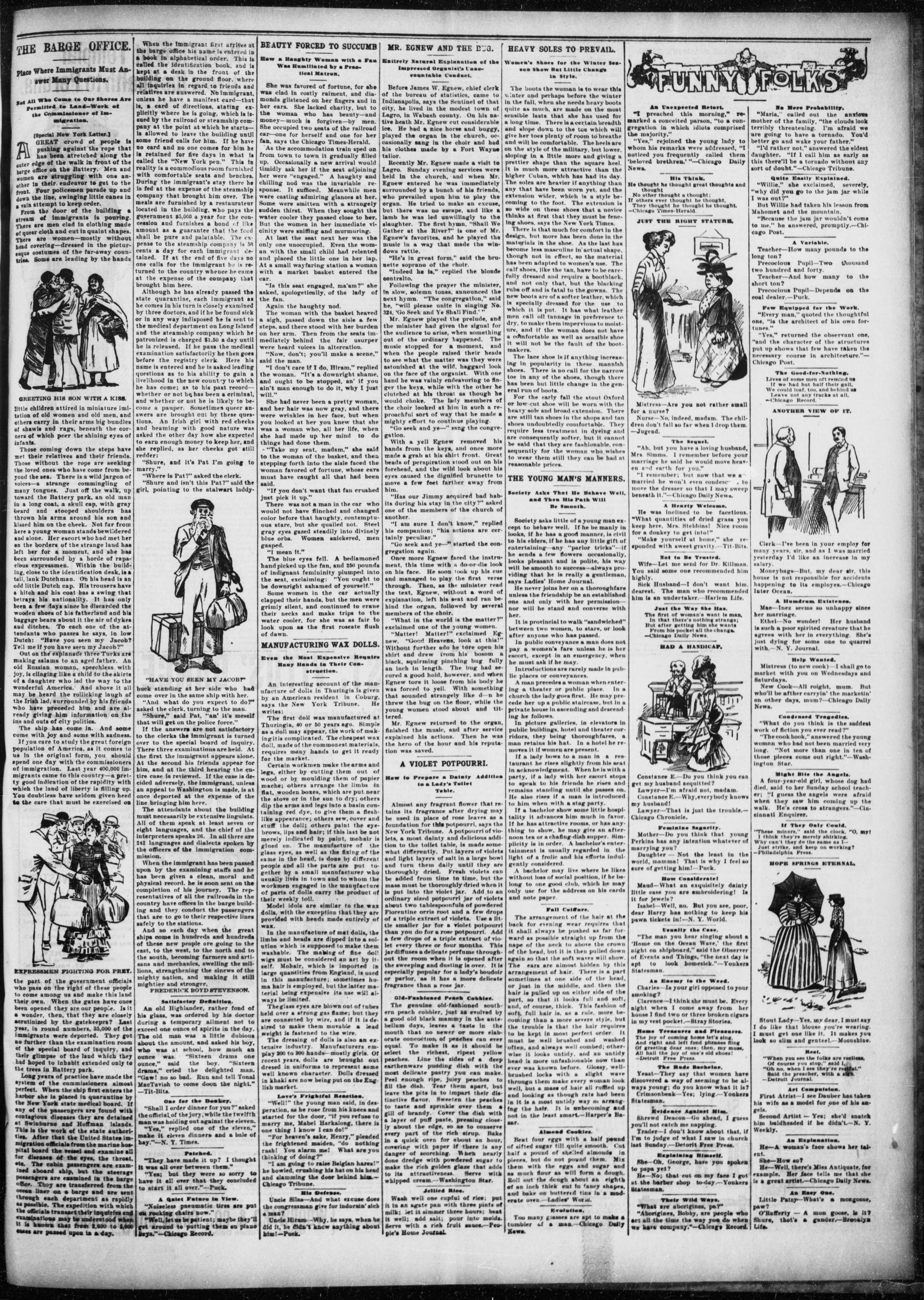
GREETING HIS SON WITH A KISS.
little children attired in miniature imitation of old women and old men, and others carry in their arms big bundles of shawls and rags, beneath the corners of which peer the shining eyes of infants.
Those coming down the steps have met their relatives and their friends. Those without the rope are seeking the loved ones who have come from beyond the sea. There is a wild jargon of voices—a strange commingling of many tongues. Just off the walk, up toward the Battery park, an old man in a long coat, a skull cap, with gray beard and stooped shoulders has thrown his arms around his son and kissed him on the cheek. Not far from here a young woman stands bewildered and alone. Her escort who had met her on the borders of the strange land has left her for a moment, and she has been surrounded by a horde of rapacious expressmen. Within the building, close to the identification desk, is a tall, lank Dutchman. On his head is an odd little Dutch cap. His trousers have a hitch and his coat has a swing that betrays his nationality. It has only been a few days since he discarded the wooden shoes of his fatherland and his baggage bears about the air of dykes and ditches. To each one of the attendants who passes he says, in low Dutch: "Have you seen my Jacob? Tell me if you have seen my Jacob?"
Out on the esplanade three Turks are making salamats to an aged father. An old Russian woman, speechless with joy, is clinging like a child to the skirts of a daughter who led the way to the wonderful America. And above it all may be heard the rolling laugh of the Irish lad, surrounded by his friends who have preceded him and are already giving him information on the ins and outs of city politics. The ship has come in. And some come with joy and some with sadness. If you care to study the great foreign population of America, as it comes to us in the original form, you should spend one day with the commissioners of immigration. Last year 400,000 immigrants came to this country—a pretty good indication of the rapidity with which the land of liberty is filling up. You doubtless have seldom given heed to the care that must be exercised on
EXPRESSMEN FIGHTING FOR PREY
the part of the government officials who pass on the right of these people to come among us and make this land their own. When the gates have once been opened they are our people. Is it a wonder, then, that they are closely scrutinized by the gatekeeps? Last year, in round numbers, 35,000 of the immigrants were deported. They got no further than the examination room of the special board of inquiry, and their glimpse of the land which they had hoped to inhabit extended only to the trees in Battery park.
Long years of practice have made the system of the commissioners almost perfect. When the ship first enters the harbor she is placed in quarantine by the New York state medical board. If any of the passengers are found with contagious diseases they are detained at Swinburne and Hoffman islands. This is the work of the state authorities. After that the United States immigration officials from the marine hospital board the vessel and examine all for diseases of the eyes, the throat, etc. The cabin passengers are examined aboard ship, but the steerage passengers are examined in the barge office. They are transferred from the ocean liner on a barge and are sent through each department as rapidly as possible. The expedition with which the officials transact their inquiries and examinations may be understood when it is known that from 2,000 to 5,000 cases are passed upon in a day.
When the immigrant first arrives at the burge office his name is entered in a book in alphabetical order. This is called the identification book, and is kept at a desk in the front of the building on the ground floor, where all inquiries in regard to friends and relatives are answered. No immigrant, unless he have a manifest card—that is, a card of directions, stating explicitly where he is going, which is issued by the railroad or steamship company at the point at which he starts—is allowed to leave the building until some friend calls for him. If he have no card and no one comes for him he is retained for five days in what is called the "New York pen." This is a commodious room furnished with comfortable seats and benches. During the immigrant's stay there he is fed at the expense of the steamship company that brought him over. The meals are furnished by a restaurateur located in the building, who pays the government $5,000 a year for the concession and furnishes a bond of like amount as a guarantee that the food shall be pure and palatable. The expense to the steamship company is 50 cents a day for each immigrant detained. If at the end of five days no one calls for the immigrant he is returned to the country whence he came at the expense of the company that brought him here.
Although he has already passed the state quarantine, each immigrant as he comes in his turn is closely examined by three doctors, and if he be found sick or in any way indisposed he is sent to the medical department on Long Island and the steamship company which he patronized is charged $1.50 a day until he is released. If he pass the medical examination satisfactorily then he goes before the registry clerk. Here his name is entered and he is asked leading questions as to his ability to gain a livelihood in the new country to which he has come; as to his past record—whether or not he has been a criminal, and whether or not he is likely to become a pauper. Sometimes queer answers are brought out by these questions. An Irish girl with red cheeks and beaming with good nature was asked the other day how she expected to earn enough money to keep her, and she replied, as her cheeks got still redder: "Shure, and it's Pat I'm going to marry."
"Shure and isn't this Pat?" said the girl, pointing to the stalwart laddy-
"HAVE YOU SEEN MY JACOB?"
buek standing at her side who had come over in the same ship with her. "And what do you expect to do?" asked the clerk, turning to the man. "Shure," said Pat, "an' it itself that will get on the police force." If the answers are not satisfactory to the clerks the immigrant is turned over to the special board of inquiry. There three examinations are held. At the first the immigrant appears alone. At the second his friends appear for him, and at the third hearing the entire case is reviewed. If the case is decided adversely, the immigrant, unless an appeal to Washington is made, is at once deported at the expense of the line bringing him here. The attendants about the building must necessarily be extensive linguists. All of them speak at least seven or eight languages, and the chief of the interpreters speaks 26. In all there are 242 languages and dialects spoken by the officers of the immigration commission.
When the immigrant has been passed upon by the examining staffs and he has been given a clean, moral and physical record, he is soon sent on the completion of his journey. The representatives of all the railroads in the country have offices in the barge building and they conduct the passengers that are to go to their respective lines safely to the stations.
And so each day when the great ships come in hundreds and hundreds of these new people are going to the east, to the west, to the north and to the south, becoming farmers and artisans and mechanics, swelling the millions, strengthening the sinews of the mighty nation, and making it still mightier and stronger.
Satisfaction Definition
An old Highlander, rather fond of his glass, was ordered by his doctor during a temporary alliment not to exceed one ounce of spirits in the day. The old man was a little dubious about the amount, and asked his boy, who was at school, how much an ounce was. "Sixteen drams one ounce," said the boy. "Sixteen drams," cried the delighted man. "Gaw! no so bad. Run and tell Tonal MacTavish to come doon the night."—Tit-Bits.
One for the Banker
"Shall I order dinner for you?" asked the official of the jury, while the twelfth man was holding out against the eleven. "Yes," replied one of the eleven, "make it eleven dinners and a bale of hay."—N. Y. Times.
Patched.
"They have made it up? I thought it was all over between them." "Yes; but they were so sorry to have it all over that they concluded to start it all over."—Puck.
A Quiet Entrance in View
BEAUTY FORCED TO SUCCUMB
How a Haughty Woman with a Fax Was Humiliated by a Practical Matron.
She was favored of fortune, for she was clad in costly raiment, and diamonds glistened on her fingers and in her ears. She lacked charity, but to the woman who has beauty—and money—much is forgiven—by men. She occupied two seats of the railroad car—one for herself and one for her fan, says the Chicago Times-Herald. As the accommodation train sped on from town to town it gradually filled up. Occasionally a new arrival would timidly ask her if the seat adjoining her were "engaged." A haughty and chilling nod was the invariable response. It suffaced. Meanwhile men were casting admiring glances at her. Some were smitten with a strangely sudden thirst. When they sought the water cooler they passed close to her. But the women in her immediate vicinity were sniffing and murmuring.
At last the seat next her was the only one unoccupied. Even the woman with the small child had relented and placed the little one in her lap. At a small wayfaring station a woman with a market basket entered the car.
"Is this seat engaged, ma'am?" she asked, apologetically, of the lady of the fan.
Again the haughty nod.
The woman with the basket heaved a sigh, passed down the aisle a few steps, and there stood with her burden on her arm. Then from the seats immediately behind the fair usurper were heard voices in altercation.
"Now, don't; you'll make a acene," said the man.
"I don't care if I do, Hiram," replied the woman. "It's a downright shame, and ought to be stopped, an' if you ain't man enough to do it, why I just will."
She had never been a pretty woman, and her hair was now gray, and there were wrinkles in her face, but when you looked at her you knew that she was a woman who, all her life, when she had made up her mind to do things had done them.
- "Take my seat, madam," she said to the woman of the basket, and then stepping forth into the aisle faced the woman favored of fortune, whose ears must have caught all that had been said.
"If you don't want that fan crushed just pick it up." There was not a man in the car who would not have flinched and changed color before that haughty, contemptuous stare, but she quailed not. Steel gray eyes gazed steadily into divinely blue orbs. Women snickered, men gasped.
"I mean it."
The blue eyes fell. A bedlamoned hand picked up the fan, and 250 pounds of indignant femininity plumped into the seat, exclaiming: "You ought to be downright ashamed of yourself." Some women in the car actually clapped their hands, but the men were grimly silent, and continued to crane their necks and make trips to the water cooler, for she was as fair to look upon as the first rosette flush of dawn.
MANUFACTURING WAX DOLLS.
Even the Most Expensive Require Many Hands in Their Construction.
An interesting account of the manufacture of dolls in Thuringia is given by an American resident in Coburg, says the New York Tribune. He writes:
The first doll was manufactured at Thuringia, 40 or 50 years ago. Simple as a doll may appear, the work of making it complicated. The cheapest wax doll, made of the commonest materials, requires many hands to get it ready for the market.
Certain workmen make the arms and legs, either by cutting them out of wood or by moulding them of papier mache; others arrange the limbs in flat, wooden boxes, which are put near the stove or in the sun to dry; others dip the arms and legs into a basin containing red dye, to give them a flesh-like appearance; others sew, cover and stuff the doll; others paint the eyebrows, lips and hair; if this last be not merely indicated by paint, mohair is glued on. The manufacture of the glass eyes, as well as the fixing of the same in the head, is done by different people and all the parts are put together by a small manufacturer who usually lives in town and to whom the workmen engaged in the manufacture of parts of dolls carry the product of their weekly toll.
Model idols are similar to the wax dolls, with the exception that they are provided with heeds made entirely of wax.
In the manufacture of mat dolls, the limbs and heads are dipped into a solution which is supposed to make them washable. The making of fine dolldigs must be considered an art by itself. Mohair, which is imported in large quantities from England, is used in this manufacture; sometimes huma hair is employed, but the latter material being expensive its use will always be limited. The glass eyes are blown out of tubes held over a strong gas flame; but they are connected by wire, and if it is desired to make them movable a lead weight is fastened to the wire. The dressing of dolls is also an extensive industry. Manufacturers employ 200 to 300 hands—mostly girls. Of recent years, dolls are brought out dressed in uniforms to represent some well known character. Doll dresses in khaki are now being put on the English market.
Love's Frightful Reaction.
"Well!" the young man said, in desperation, as he rose from his knees and started for the door, "if you refuse to marry me, Mabel Harkalong, there is one thing I know I can do!"
"For heaven's sake, Henry," pleaded the frightened misdeen, "do nothing rash! You alarm me! What are you thinking of doing?"
"I am going to raise Belgian hares!" he howled, crushing his hat on his head and slamming the door behind him.—Chicago Tribune.
Hia Defense.
Uncle Silas—And what excuse does the congressman give for indoriness' sich a man?
Uncle Hiram—Why, he says, when he did it, he didn't know anything about him—Puck.
MR. EGNEW AND THE DUG.
Entirely Natural Explanation of the Impressed Organic's Unaccountable Conduct.
Before James W. Egnew, chief clerk of the bureau of statistics, came to Indianapolis, says the Sentinel that of city, he lived in the modest town of Lagro, in Wabush county. On his native heath Mr. Egnew cut considerable ice. He had a nice horse and buggy, played the organ in the church, occasionally sang in the choir and had his clothes made by a Fort Wayne tailor. Recently Mr. Egnew made a visit to Lagro. Sunday evening services were held in the church, and when Mr. Egnew entered he was immediately surrounded by a bunch of his friends, who prevailed upon him to play the organ. He tried to make an excuse, but there was no escape, and like a lamb he was led unwillingly to the slaughter. The first hymn, "Shall We Gather at the River?" is one of Mr. Egnew's favorites, and he played the music in a way that made the windows rattle. "He's in great form," said the brunette sonoque of the choir.
"Indeed he is," replied the blonde contralto.
Following the prayer the minister, in slow, solemn tones, announced the next hymn. "The congregation," said he, "will please unite in singing No. 324, 'Go Seek and Ye Shall Find.'"
Mr. Egnew played the prelude, and the minister had given the signal for the audience to arise, when something out of the ordinary happened. The music stopped for a moment, and when the people raised their heads to see what the matter was they were astonished at the wild, haggard look on the face of the organist. With one hand he was vainly endeavoring to finger the keys, while with the other he clutched at his throat as though he would choke. The lady members of the choir looked at him in such a reproachful sort of way that he made a mighty effort to continue playing.
"Go seek and ye—" sang the congregation.
With a yell Egnew removed his hands from the keys, and once more made a grab at his shirt front. Great beads of perspiration stood out on his forehead, and the wild look about his eyes caused the dignified brunette to move a few feet farther away from him.
"Has our Jimmy acquired bad habits during his stay in the city?" asked one of the members of the church of another.
"I am sure I don't know," replied his companion; "his actions are certainly peculiar."
"Go seek and ye—" started the congregation again.
Once more Egnew faced the instrument, this time with a do-or-die look on his face. He soon took up his cue and managed to play the first verse through. Then, as the minister read the text, Egnew, without a word of explanation, left his seat and ran behind the organ, followed by several members of the choir.
"What in the world is the matter?" exclaimed one of the young women. "Matter! Matter!" exclaimed Egnew. "Good Heavens, look at this!" Without further aid he tore open his shirt and drew from his bosom a black, squirming pinching bug fully an inch in length. The bug had secured a good hold, however, and when Egnew tore it loose from his body he was forced to yell. With something that sounded strangely like d—n he threw the bug on the floor, while the young women stood about and tittered. Mr. Egnew returned to the organ, finished the music, and after service explained his actions. Then he was the hero of the hour and his reputation was saved.
A VIOLET POTPOURRI.
How to Prepare a Dainty Addition to a Lady's Toilet Table.
Almost any fragrant flower that retains its fragrance after drying may be used in place of rose leaves as a foundation for this potpourri, says the New York Tribune. A potpourri of violets, a most dainty and delicious addition to the toilet table, is made somewhat differently. Put layers of violets and light layers of salt in a large bowl and turn them daily until they are thoroughly dried. Fresh violets can be added from time to time, but the mass must be thoroughly dried when it is put into the violet jar. Add to an ordinary sized potpourri jar of violets about two tablespoonfuls of powdered Florentine orris root and a few drops of a triple extract of violets. Use a little smaller jar for a violet potpourri than you do for a rose potpourri. Add a few drops of a triple extract of violet every three or four months. This jar diffuses a delicate perfume throughout the room when it is opened after the sweeping and dusting is over. It is especially popular for a lady's bourdou or parlor, as it has a more delicate fragrance than a rose jar.
G!d-Fashioned Peach Cobbler
The genuine old-fashioned southern peach cobbler, just as evolved by a good old black mummy in the antebellum days, leaves a taste in the mouth that no newer or more elaborate concoction of peaches can ever equal. To make it as it should be select the richest, ripest yellow peaches. Line the sides of a deep earthwaren pudding dish with the most delicate pastry you can make. Peel enough ripe, juicy peaches to fill the dish. Tear them apart, but leave the pits in to impart their distinctive flavor. Sweeten the peaches to taste and sprinkle over them a gill of brandy. Cover the dish with a layer of puff paste, pressing closely about the edge, so as to conserve every part of the rich sirup. Bake in a quick oven for about an hour, covering with paper if there is any danger of scorching. When nearly done dredge with powdered sugar to make the rich golden glaze that adds to its attractiveness. Serve with whipped cream—Washington Star.
Jellied Rice.
Wash well one cupful of rice; put it in an agate pan with three pints of milk; let it simmer three hours; beat it well; add salt; put into molds. Serve with a rich fruit sauce.—People's Home Journal
HEAVY SOLES TO PREVAIL.
Women's Shoes for the Winter Season Show But Little Change in Style.
The boots the woman is to wear this winter and perhaps before the winter in the fall, when she needs heavy boots quite as much, are made on the most sensible lasts that she has used for a long time. There is a certain breadth and slope down to the toe which will give her toes plenty of room to breathe and will be comfortable. The heels are on the style of the military, but lower, sloping in a little more and giving a prettier shape than the square heel. It is much more attractive than the higher Cuban, which has had its day. The soles are heavier if anything than any that have been worn yet, and the extension wider, which is a style becoming to the foot. The extension is so wide on these shoes that a notice thinks at first that they must be bending shoes, says the New York Times.
There is that much for comfort in the design, but more has been done in the materials in the shoe. As the last has become less masculine in actual shape, though not in effect, so the material has been adapted to women's use. The calf shoes, like the tan, have to be carefully dressed and require a bootblack, and not only that, but the blacking rubs off and is fatal to the gowns. The new boots are of a softer leather, which is specially dressed for the use to which it is put. It has what leather men call oil tannage in preference to dry, to make them impervious to moisture, and if the woman does not have a comfortable as well as sensible shoe it will not be the fault of the bootmakers.
The lace shoe is if anything increasing in popularity in these mannish shoes. There is no call for the narrow toe in any of the shoes, though there has been but little change in the general run of boots.
For the early fall the stout Oxford or low-cut shoe will be worn with the heavy sole and broad extension. There are still tan shoes in the shops and tan shoes undoubtedly comfortable. They require less treatment in dyeing and are consequently softer, but it cannot be said that they are fashionable, consequently for the woman who wishes to wear them still they can be had at reasonable prices.
THE YOUNG MAN'S MANNERS.
Society Asks That He Behave Well and Then His Path Will Be Smooth.
Society aksls little of a young man except to behave well. If he be manly in looks, if he has a good manner, is civil to his elders, if he has any little gift of entertaining—any "parlor tricks"—if he sends a few flowers occasionally, looks pleasant and is polite, his way will be smooth to success—always providing that he is really a gentleman, says Ladies' Home Journal.
He never joins her on a thoroughfare unless the friendship be an established one and only with her permission—nor will he stand and converse with her.
It is provincial to walk "sandwiched" between two women, to stare, or look after anyone who has passed.
In public conveyance a man does not pay a woman's fare unless he is her escort, except in an emergency, when he must ask if he may.
Introductions are rarely made in public places or conveyances.
A man precedes a woman when entering a theater or public place. In a church the lady goes first. He may precede her up a public staircase, but in a private house in ascending and descending he follows.
In picture galleries, in elevators in public buildings, hotel and theater corridors, they being thoroughfares, a man retains his hat. In a hotel he removes it if women are present.
If a lady bows to a man in a restaurant he rises slightly from his seat in acknowledgment. When he is with a party, if a lady with her escort stops to speak to his friends he rises and remains standing until she passes on. He also rises if a man is introduced to him when with a stag party.
If a bachelor show some little hospitality it advances him much in favor. If he has attractive rooms, or has anything to show, he may give an afternoon tea or a chafing-dish supper. Simplicity is in order. A bachelor's entertainment is usually regarded in the light of a frolic and his efforts indulgently considered. A bachelor may live where he likes without loss of social position, if he belong to one good club, which he may only use for the address on his cards and note paper.
Fall Culture.
The arrangement of the hair at the back for evening wear requires that it shall always be pushed as far forward as possible straight up from the nape of the neck to above the crown of the head, but it is then pulled down again so that the soft waves will show. The ears are almost hidden by this arrangement of hair. There is a part sometimes at one side of the head, or just in the middle, and then the hair is pulled up on either side of the part, so that it looks full and soft, and, of course, thick. This fashion of soft, full hair is, as a rule, more becoming than a more severe style, but the trouble is that the hair requires to be kept in most perfect order. It must be well brushed and washed often, and always well combed; otherwise it looks untidy, and an untidy head is more unfashionable now than ever was known before. Glossy, well-brushed locks with a slight wave through them make every woman look well, and a mass of hair all ruffled up and looking as though rats had been in it is a most untidy way or arranging the hair. It is unbecoming and not in the least smart.—Harper's Basar.
Almond Cookies.
Beat four eggs with a half pound of sifted sugar till quite smooth. Cut half a pound of shelled almonds in pieces, but do not pound them. Mix them with the eggs and sugar and as much flour as will form a dough. Roll out the dough about an eighth of an inch thick in fancy shapes, and bake on buttered tin in a moderate oven—Ladles' World.
Evolution.
Too many glasses are apt to make a tumbler of a man.—Chicago Daily News.
FUNNY FOLKS
An Unexpected Retort.
"I preached this morning," remarked a conceived parson, "to a congregation in which idiots comprised the majority."
"Yes," rejoined the young lady to whom his remarks were addressed, "I noticed you frequently called them 'beloved brethren.'"—Chicago Daily News.
His Think.
He thought he thought great thoughts and
wondered. No other thought. No
other thought a thought;
if others ever thought he thought,
They thought he thought he thought.
—I thought He-her.
A woman in a long dress stands facing a child in a dress with a hat. They are in a room with a desk and a window.
Mistress—Are you not rather small for a nurse?
Nurse—No, indeed, madam. The children don't fall so far when I drop them.
-Jugend.
The Sequel.
"Ah, but you have a loving husband, Mr. Sims. I remember before your marriage he said he would move heaven and earth for you."
"I remember; but now that we a married he won't even condense to more the dresser so that I may sweep beneath it."—Chicago Daily News.
A. Hearty Welcome.
He was inclined to be facetious.
"What quantities of dried grass you keep here, Mrs. Stebbina! Nice room for a donkey to get into!"
"Make yourself at home," she responded with sweet gravity.—Tit-Bits.
Not to Be Trusted:
Wife—Let me send for Dr. Killman
You said some one recommended him
highly.
Sick Huaband—I don't want him
dearest. He who recommended
him is an undertaker—Harlem Life.
Just the Way She Has.
The first of woman's want is man,
In that there's nothing strange;
But after getting him she wants
pole to the change.
-Chicago Daily News.
Constance E.—Do you think you can get my husband acquitted?
Lawyer—I'm afraid not, madam.
Constance E.—Why, everybody knows my husband!
Lawyer—That is just the trouble.—Chicago Chronicle.
Mother—Do you think that young Perkins has any intention whatever of marrying you?
Daughter — Not the least in the world, mamma! That is why I feel so sure of getting him!—Puck.
How Considerate!
Maud—What an exquisitely dainty little case you are embroidering! Is it for jewels? Isabel—Well, no. But you see, poor, dear Harry has nothing to keep his pawn tickets in!—N. Y. World.
Usually the Case.
"The man you hear singing about a "Home on the Ocean Wave," the first night on shipboard," and the Observer of Events and Things," the next day is apt to look homesick."—Yonkers Statesman.
**An Enquiry to the Weed.**
Charles—Is your girl opposed to your smoking?
Clarence—I think she must be. Every night when I come away from her house I find two or three broken cigars in my vest pocket.—Stray Stories.
**Home Treasures and Pleasures.**
The joy of coming home let's sing. And right and left fond phrases fling of greeting dear ones; then, my muse, All of joy of joy of one old shoes!—Detroit Free Press.
The Rude Bachelor
Yeast—They say that women have discovered a way of seeming to be always young; do you know what it is? Crimsonbeak—Yes; lying—Yonkers Statesman.
Evidence Against Him.
Shrewd Deacon—Go ahead, I guess you'll not catch me napping.
Trader—I don't know about that, if I'm to judge of what I saw in church last Sunday—Detorit Free Press.
Explaining Himself
EXPLAINING HIMSELF.
She—Oh, George, have you spoken to papa yet?
He—No; that cut on my face I got at the barber shop to-day.—Yonkers statesman.
"Abortines, Bobby, are people who act all the time the way you do when we have company."-Chicago Record.
No Mere Probability.
"Maria," called out the anxious mother of the family, "the clouds look terribly threatening. I'm afraid we are going to have a tornado. You'd better go and wake your father." "I rather not," answered the eldest daughter. "If I call him as early as this there be a tornado without any sort of doubt." -Chicago Tribune.
Quite Easily Explained.
"Willie," she exclaimed, severely,
"why did you go to the jam jar while
I was out?" But Willie had taken his lesson from
Mahomet and the mountain.
"Because the jam jar wouldn't come
to me," he answered, promptly--Chicago Post.
A. Variable.
Teacher—How many pounds to the long ton?
Precocious Pupil—Two Thousand two hundred and forty.
Teacher—and how many to the short ton?
Preocious Pupil—Depends on the coal dealer.—Puck.
Few Equipped for the Work.
"Every man," quoted the thoughtful one, "is the architect of his own fortunes."
"Yes," returned the observant one, "and the character of the structures up put shows that few have taken the necessary course in architecture."—Chicago Post.
The Good-for-Nothing.
Lives of some men oft remind us
if we had but half their gall,
We could loot, too, and behind us
we could not any tracks at all.
—Chicago Record.
Clerk—I've been in your employ for many years, sir, and as I was married yesterday I'd like an increase in my salary.
Moneybags—But, my dear sir, this house is not responsible for accidents happening to its employees.—Chicago Inter Ocean.
A. Humdrum Existence.
Mae—Inez seems so unhappy since her marriage.
Ethel—No wonder! Her husband is such a poor spirited creature that he agrees with her in everything. She's just dying for some one to quarrel with.—N. Y. Journal.
Help Wanted.
Mistress (to new cook)—I shall go to market with you on Wednesdays and Saturdays.
New Cook—All roight, mum. But who'll be a father carryin' the marketin' on other days, mum?—Chicago Dally News.
Condensed Tragedies
"What do you think is the saddest work of fiction you ever read?" "The cook book," answered the young woman who had not been married very long. "Not more than one in ten of those pieces come out right."—Washington Star.
Might Bite the Angels.
A four-year-old girl, whose dog had died, said to her Sunday school teacher: "I guess the angels were afraid when they saw him coming up the walk. He's cross to strangers." -Cincinnati Enquirer.
If They Only Could
"These miners," said the clock, "O, my
I think they're merely shirking.
Why can't they do the same as I—
Just strike, and keep on working?
-Philadelphia Press.
HOPE SPRINGS ETERNAL.
Stout Lady—Yes, my dear, I must say I do like that blouse you are wearing. I must get one like it. It makes you look so slim and genteel—Moonshine.
Rest.
"When you see the folks are restless, Of course you stop," said I.
"Oh no, when I see they're restful." Faulkner a preacher, with a sigh.
—Detroit Journal.
Art Computation.
First Atrist—I see Dauber has taken his wife as a model for one of his angels.
Second Artist—Yes; she'd snatch him baldheaded if he didn't.—N. Y. Weekly.
An Explanation.
He—A woman's face shows her talent.
She—How so?
He—Well, there's Miss Antiquate, for example. Her face tells me that she is a great artist.—Chicago Daily News.
An Easy One.
Little Patyne—What's a mongoose, paw?
O'Rafferty — A mon goose, is it?
Shure, that's a gander,—Brooklyn Life.
To Mothers of Large Families.
In this workday world few women are so placed that physical exertion is not constantly demanded of them in their daily life.
Mrs. Pinkham makes a special appeal to mothers of large families whose work is never done, and many of whom suffer, and suffer for lack of intelligent aid.
To women, young or old, rich or poor, Mrs. Pinkham, of Lynn, Mass., or Mrs. Pinkham, of New York, Oh, women do not let your lives be sacrificed when a word from Mrs. Pinkham, at the first approach of
A. B.
MRS. CARRIE BELLEVILLE.
weakness, may fill your future years with healthy joy.
"When I began to take Lydia E. Pinkham's Vegetable Compound I was not able to do my housework. I suffered terribly at time of menstruation. Several doctors told me they could do nothing for me. Thanks to Mrs. Pinkham's advice and medicine I am now able to do the work for eight in the family.
"I would recommend Lydia E. Pinkham's Vegetable Compound to all mothers with large families."—Mrs. CARRIE BELLEVILLE, Ludington, Mich.
A TRIAL BOTTLE FREE.
The letters pour in. Yes, simply pour in upon us in our daily mail, in a food which is surprising. It seems as if every person in the United States had a physical trouble and knew "5 DROPS" would make the cure. Everybody suffering from ill health has the inclination to write for a bottle of "5 DROPS."
Our enormous mail is the wonder of the age.
We are flooded—simplly flooded each morning with letters containing $1.00 for a bottle of "5 DROPS," the wondrous cure for the terribly painful diseases, Rheumatism, Sciatica, Neuralgia, Rheumatism, Sciatica, Neuralgia, and all other medicines, until the instant to "5 DROPS." Within a day of getting "5 DROPS" and using it, your disease begins to disappear. Thousands of men and women, who see their suffering on every side gladly relieved of their suffering, write us in haze. Hundreds of testimonials from grateful correspondents reach us daily.
To enable all sufferers to test this wondrous cure, free a trial bottle on receipt of two $20.00 must pay for mailing. Large bottles of $300 dreses $1.00, sent贿倍 to mail or exchange.
"5 DROPS" is a preventive as well as a curative, for the following diseases Rheumatism, Sciatica, Neuralgia, Gout, Dyspepsia Backache, Asthma, Hay
DROPS
tive as well as a curative,
for the following diseases:
Rheumatism, Sciatica, Neura-
rgia, Gout, Dyspepsia,
Backache, Asthma, Hay
Fever, Catarrh, Liver and
Kidney Troubles, Sleeplessness,
Nervousness, Nervous and Neuratic
Headaches, Earache, Toothache,
Heart Weakness, LaGrippie, Malaria,
Paralysis, Creeping Numbness and
kindred diseases.
Write us in haste and stop your suffering.
Agents wanted.
SWANSON RHEUMATIC CURE CO.
100 Lake Street, Chicago, Ill.
$3.00
W.I. DOUGLAS
SHOES $3.50
UNION MADE
If you have been paying $4 to $8 for shoes,
a trial of W. L. Doug-
glas $4.50 shoes will convince you that
they are just as good
in every way and cost
from $4 to $3.00 less.
We are the largest makers of men's $ and $3.50 shoes in the world. We make and sell more $ and $3.50 shoes than any other two manufacturers in the U. S.
more W. L. Baskerville & Co. $1,000
sales are sold here. Your dealer should keep
AME THE BEST. Your dealer should keep
Take no substitute! Insist on having W. L.
if you desire it but will not get them. You
if your dealer will not get them. You direct
if your dealer will not get them. You direct
Kind of reader, size, and width, plots, on paper,
W. L. Baskerville & Co. $1,000
sales are sold here. Your dealer should keep
AME THE BEST. Your dealer should keep
The Question of Dessert
In easily and simply solved with a package of Burnham's Hasty Jellycon. It is only necessary to dissolve a package of it in boiling water and set away to cool. The result is a delightfully pure jelly, and an ideal dessert of jellys are orange, lemon, strawberry, raspberry, muscovado and unfavored "calffoot" for making wine and coffee jellies. All grocers sell it.
TOWER'S
FISH BRAND
POMMEL
The Best
Saddle Coat
SLICKER
Keeps both rider and saddle perforated
for maximum comfort. Substituies will disappear. Ask for
rider's brand Pommel Slicker—
it is entirely new. I will not sale in
your town, write for catalogue
A.J. TOWER, Boston, Mass.
ALLEN S. IRON
TONIC BITTERS
Blood Turdier, Liver Sauvageur, Tonic Appe-
tray, the bitters that cure catarrh.
MAKER, MEMBER OF CO., N.Y. BANK.
DROPSY NEW DISCOVERY; gives
quick relief and curves worm
guess. Book of testimonial and reviews
Free. Dr. H. E. GREEN BOSS, New D. Atlanta, Ga.
DID THE HANDSOME THING.
A Marrying Minister Who Found Ne
In a volume of reminiscences just published entitled: "The Wedding Day in Literature and Art" a minister relates his experience with two weddings in the same town on the same day, one in the morning, one in the afternoon. "The first wedding day was a large remuneration for the place and people. After the second wedding the best man called me into a private room and thus addressed me:
"What's the tax, person?"
"Anything you like, or nothing at all," I
answered. (I have frequently received both
questions.)
'Now,' said he, 'we want to do this thing up in style, but I have had no experience with it. Now, you know it is proper. You name your figure.' 'I suggested that the legal charge was
"I suggested that the legal charge was two dollars."
" 'Pshaw, he said, 'This ain't legal. We want to do something handsome.'
want to do something handsome.
"Go ahead and do it," I said. Whereupon he went to the kitchen and then asked me how much I had received for the wedding of the morning.
"Ten dollars, I replied, "his face brightened at once. Here was a smile."
we came back. "I'll see him," he remarked, "raise
his hand," and call, "Whereupon he
handed me $15."
How's This?
We offer One Hundred Dollars Reward for any case of Catarrh that cannot be cured by Hall's Catarrh Cure.
F. J. Cheney & C. Props, Toledo, O.
We, the undersigned, have known F. J. Cheney and C. Props, perfectly honorable in all business transactions and financially able to carry out any obligations made by their firm.
West & Trunx, Wholesale Druggists, Toledo, O.
Walding, Kinnan & Marvin, Wholesale Druggists, Toledo, O.
Hall's Catarrh Cure is taken internally, acting directly upon the blood and mucous surfaces of the system. Price 75c. per bottle. Sold by all Druggists. Testimonials
Hall's Family Pills are the best.
Fate of His Legments
"Yes," said Mrs. Brown, "my son Thomas has had an awful time playing football. But Tom's quite a hero. He wrote me all about it. He said the professor at his college told him he had only three ligaments in his leg. They three ligaments are what he said. He said that a year ago he bruk his first ligament, that's the outside one, in playin' that game with Purdoe. Then in playing the Shampain university he broke the second ligament right short off. And jest last week he broke the third ligament, and now there ain't anything on airth holdin' that foot on except skin."—Chicago Tribune.
Personally Conducted Tours To California
In Fullman Tourist, Florida
In Putnam Tourist Sleepers Cars
Via Chicago Great Western Ry to Kansas City, and Santa Fe Route to Los Antepeques, having new Pullman Tourist Sleepers equipped with wide vestibules, steam heat and gas light. One of these new Sleepers leaves St. Paul at 8:10 a.m. every Monday, via Chicago Great Western for Los Angeles and Southern California, reaching Los Angeles the following Friday morning. These Sleepers are experienced official who accompanies the train to its destination. The cars are well equipped for a long journey and are as comfortable as the standard sleepers, while the price for a double berth is only Six Dollar. Information furnished by any Great Western Agent Passenger Department, 5th & Robert Streets, St. Paul, Minn.
Too Much Imagination
She is a woman much given to romancing, and while she is never intentionally made to kiss, that often makes trouble. They were disduring her the other night at supper and somebody was telling of the wonderful endings, always talking of giving and never giving.
"She has so much—imagination," said the head of the table. "Imagination," remarked the man who sings, "why, that woman has an imagination that ten consciences couldn't keep up with." —Washington Post.
When You Go to Florida
you enhance the pleasure of the trip by going over the Queen & Crescent Route and its connections via Cincinnati. Careful attention is given to our meals (a in a carte) are not surpassed in hotels. Your rest is unbroken on the smooth, rock-ballasted roadway. You are not annoyed by change of care. Fatigue vanishes before some of the finest natural waters of America. Your Tickets are sold at reduced rates. Why not write us about it? Only 24 hours Cincinnati to Florida. Direct connections at Port Tampe and Miami at Steamers Wharf for Key West, Nassau and Havana. We quote rates gently. Handlers matter sent free to inquiries. W. C. Rinearson, Genl Passegrat Ague, Cincinnati, O.
The Dashing Explorer
Polar Explorer—What shall I call my new book? "A Dash for the Poise!" Publisher—No, Call it "A Dash for the Lecture Platform."—Baltimore American.
An Atchison man has been refusing for years to get any new furniture, because the old was not worn out. His wife stopped coaxing, and invited his three nephews to spend the summer. The new furniture he brought the day they left—Atchison Globe.
"He insulted me!" she exclaimed. "He contradicted me in a most brutal way. What have you to say to that?" he yelled, I-er—I-er—I-er. The admired Mr. Weekly—Chicago Post.
Two Big Pains
seem to be the heritage of the human family everywhere, viz:
Rheumatism
and
Neuralgia
but there is one sure and prompt cure for both, viz:
St. Jacobs Oil
Dr. Williams' Indian Piles Treatment and cure Blessing and joking Piles. It absorbs the irritation which the treating at once, acts as a lubricant, moistens, prepares for Piles and locking of the private pail on receipt of price. 60 qante and 60 c. WILLIAMS MPU. CO. Prices. CLEVERLAND, ONTO.
RISD'S CORE FOR
WASHINGTON MILITARY MILLS
New York County, New York. Use in time. Send by draught. CONSUMER
MY LITTLE BOY AND L
We've found a city, wonderful!
No clouds o'erspread its sky;
Tis peopled with the ones we love,
My little boy and I.
Within its walls no sorrow reigns.
Bright birds so joyous fly.
Oh, tender are the songs we hear,
My little boy and I.
Amid the roses beautiful
And streamlets gliding by.
We lose all time in golden dreams.
My little boy and I.
Our friends are ever fond and true.
Our loved ones never die.
In this fair land wherein we dwell,
My little boy and I.
If time too long and dreary grows,
Or drags too slowly by.
We'll haste away at eventide.
My little boy and I.
All care we'll leave far, far behind.
On Fancy's wings we'll fly.
To our dear land of Make-believe.
My little boy and I.
When his bright hair is snowy white.
And dimmed his laughing eye.
We'll go no more to Make-believe.
My little boy and I.
But when life's day is waning fast.
Shal we insult thier lands,
My little boy-and I!
And in a home forever blest,
Easily spared by death.
With all our dreams come true at last,
My little boy and I!
-Dora Annis Chase, in Boston Budget.
A War Office Secret
"WALLINGFOD shoot?" said
WXILLEGOD shoot? said Wergt. Harding. "Of course he can. A man on the staff at Hythe has a rifle in his hand all day and every day. Even you could shoot under such-well, perhaps not you, for you never know what you can't do until you try. Do I know the school of muskety? I do know it—ock, stock, barrel and cleaning rod, or, I should say, in these Lee-Metford days, clearing rod, for the cleaning rod's as dead as Queen Anne or the pigtails for which the Welsh fuseliers still wear the 'flash', though the powder and pomatum from which the 'flash' protected the coatte has been gone for the best part of a century.
"Now, you all know why foreign military attaches are in England. They are here to see the riggits of all improvements in the army—in men, in tools, in the handling of either. They notice a new explosive or a new drill movement, and if the horse guards gave me a commission I reckon they would notice that, and would tell their respective war offices that they had better look out now. Our military attaches are abroad for the same purpose. They're just spies in peace time. Why, I remember when cordite came out how one of the continental war offices sent a gunner officer over—they said to learn English. I know the man at Woolwich who found the man at Woolwich who would do the job. I know how much he got for it. I know the Englishman who found the man at Woolwich who would do the job. But would I breathe the name of that continental complications? Not me. I know better what's due to my country. All which leads up to this: When I was at Hytale qualifying for two guns and a crown over my three stripes there was a great mystery about the Maxim; in fact, we who were undergoing instruction as instructors were never shown the mechanism of the block. The instructor of the Hythe staff used always to take that out of the gun and hold it behind him while he explained the other parts. And that was what made me curious to see the block. I was working very hard in the evening;—t for my health's sake I had to walk now and then into Folkstone and along the Leans. And there I met a young foreign person, who told me she was a lady's maid. How did I make her acquaintance? If you don't know a simple little thing like that, you ought to. We learn in the army the art of mixing gracefully in female society. And the young foreign person, who spoke English beautifully, said to me one evening as we were sitting in a quiet spot away from other people and from gas lamps:
"I do love to hear about all that concerns you. Tell me all about what you do at the school of musketry."
"Oh, it's all very simple, ma'melle', said I. Then, just to show her what a clever fellow I was. I began to give her a full account of all the difficult things we had to do. And, of course, among other things I spoke of the machine guns.
"Those are the horrid things that go erk-erk-erk-erk, are they not?' asked she, as she imitated perfectly the venomous split of the beasts.
"That's it."
"Tell me about them. I think they are wonderfully interesting. How well educated a soldier has to be nowadays to understand such things!"
"It's quite true that a first-class certificate of education, which a sergeant is now bound to have, is not got for the asking.' Then I went on to tell her of the mechanism of the Maxim.
"But the funniest thing about it all is that they won't let us see the works of the block, although we are to qualify for muskety instructors."
"And of the most important part of the gun you know nothing?"
"I have a general idea."
"A man who is as clever as you in mechanics and mathematics ought to know all about it. I should be curious to know if I were you."
"I could easily find out a. about it if I cared to take the trouble."
"Trouble! What is trouble to a scientific man? If I were you I should think nothing of any little trouble. Now, I will spur you for your own good and to advance you in the services. I am curious, for your sake, to know about this gun. I'll be: you what you like you don't explain the mechanism of the block to me within a month. Your explanations make even dry old figures interesting."
"I can't bet you that?"
"But I was to name the stakes."
"Oh, I couldn't think of it."
"There's no need for you to think of it, ma'mselle. You've only to do it. I have your word, you know. If you are honorable—"
"Sir!"
"Then the bet is off?"
"No, I give you my word. It is amazing. But I will keep my word."
"And I can give you my word that I shall snail win. So, perhaps, in case you change your mind, I had better have the kiss now."
"The rest of the evening has nothing to do with the story.
"Now, I had been working hard at the mechanics of guns before I went to the school of musketry, so that I might do well. And I had a natural taste for such things in the blood; probably because my aunt married a smith, to whom I was to have been bound apprentice, only I would none of him and his amity. So you only had to show me the coconut in gunnery mechanics, and I tumbled to what kind of milk was inside. The next Maxim Jay we were gathered round the instructor, who was reeling out his Maxim yarn. He had taken out the block, and was holding it in his fingers behind his back. I had my notebook in my hand, and I slipped behind him. In a very few moments I had a sketch of all that appeared on the surface, and a very good idea of what was beneath it.
"That very evening I was sitting among a lot of other men who were swotting for exam. I had a sheet of foolscap and was busy making a sketch of the action in Indian ink.
"Hallo, young man," said the instructor, who had been looking over my shoulder, unbeknown to me, "what have you got there?"
"That's my business."
"Well, you must give it up."
"Oh, no, I shan't."
"But you must."
"It's mine, and you can't take it from me."
"We'll see what Lieut. Brown says about that."
"If I Leut. Brown says I must give it up, I will. But not unless."
"Come along, then, to his quarters."
"This is Sergt. Harding, duke of Cornwall's light infantry, sir," said the sergeant-instrutor, when we reached Leut. Brown's room. "He has a sketch of the Maxim secret action and refuses to give it up."
"How's this, Sergt. Harding?" asked Leut. Brown.
"The sketch is my own, sir. I refused to give it up to the sergeant-instrutor, but said I would give it up at once, if you ordered me. But I have made one sketch, and if you take that away from me, I have the action in my mind, and can always make another sketch."
"That's quite true. Yet such things had better not be knocking about. You will destroy the sketch, Sergt. Harding?
"Yes, thought I, when I have known it and won my bet."
"And how did you get hold of it?"
"Must I tell you, sir?"
"Yes."
"I took it down in my notebook while the sergeant-instructor held the block behind his back."
"The sergeant-instructor looked foolish, and Lieut. Brown drawed:"
"I think, sergeant-instructor, you had better have settled this little matter without appealing to me. Good night, both."
"The sergeant-instructor was too upset to want to see the sketch destroyed, I lost very little time in strolling down to that quiet spot where I might light on manm'selle. Not that, in view of what is to come, I wish in any way, to say or to hint, or to imply that she was French. Far from it. I used the name 'Mam'selle' as meaning young foreign person, as a sailor uses 'Dutchman' to mean a foreign sailor, usually a Norwegian or a Swede. She was there.
"Good evening, mam'selle," said I. "Had you any idea of going on the pier this evening, or do you prefer to stop quietly here?"
"To stop here, I think; that is, she said hurriedly—I—wonder why—if you're going to behave yourself properly."
"Well, said I, 'am I've won my bet. I think I may as well collect the stakes."
"You've won? You know all about the Maxim?" asked she so excitedly that her words tumbled one over the other.
"I have told you so."
"Yes; you are quite sure?"
"Quite. I have an Indian ink sketch of it on me."
"Let me see it—let me see it," she repeated, and her eyes gleamed.
"Quite so," said I. "Seeing her believing; but—I should like to collect my stakes."
"No longer coy, she flung her arms around my neck and kissed me till I had no breath with which to repay her kisses." But she herself had breath enough to gasp:
"Give me the paper."
"I put my hand in the breast pocket of my serge, which I always used to wear under my greatcoat. I began to pull out the drawing. Just then I heard the drawingling voice of Lieut. Brown come from the darkness—for we were in a very quiet and cozy corner:
"I thought as much, Sergt. Harding. You are under arrest. Follow me to quarters."
"I turned toward the voice, and then toward mam'selle—or toward where she had been, for she was gone.
"I rose and saluted.
"May I ask you, air—"
"You're a lucky man that I had a suspicion of the facts. You're fool enough to do a lot of harm, but too big a fool to know you're doing it. You Cornish chough, do you believe one of the prettiest women in Folkstone and one of the cleverest women in the world is in love with you? You were just on the point of giving a drawing of the secret action to the smartest unofficial military attaché—and that is a spy—of—"
"Shall I name the country which he named to me? Not I. No strained relations, no wars and rumors of wars, shall come upon England through me. I want no secret dossier — whatever that may be. But so long as I live it shall be a secret for which war office mam'selie was collecting information.
"Her profession was bad, but her kisses!-ah, they were good."-Cornhill Magazine.
Hard to Ober.
Willie—Oh, wow! boo-boo! I want dessert now. I don't want any old meat an'-
Father (sternly)—Keep your mouth shut and eat your dinner!—Philadelphia Press.
ST. VITUS' DANCE
Nervura Blood and Nerve Remedy.
LULU FERRE
CORA LEARMONTH
GRACIE BAILEY
Still Move Counterfeiting.
The Secret Service has unearthed another band of counterfeiter and secured a large quantity of bogus bills, which are no cleverly executed that the average person would know. Things of great value are always selected for imitation, notably Huntley's Stomach Bittern, which has many imitators but no equals for disorders like indigestion, dyspepsia, constipation, nervousness and genital irritation, always go to relish what people who have the reputation of giving what you ask for.
Cruel Parent.
Mother—Is that all you have to do on wash-day—sit around and read? "I was just reading about the hanging gardens." "Well, if you are interested in that kind of stuff there is a garden back of the house for hanging clothes." "Indiana-Paige Press."
Try Grain-01 Try Grain-01
Akour the Grocer to-day to show you a package of GRAIN-O, the new food drink that takes the place of coffee. Children may drink it without injury, as well as adults. All who want it like it, GRAIN-O has that rich flavor. It is made from pure grains, and the most delicate stomach receives it without distress. *the price of coffee.* 15c. and 25c. per package. *All groceries.*
Too Much for Him.
Doctor—What? Your dyspepsia no bette-
d hot water an hour before breakfast!
Patient — I tried to doctor, but I was un-
motioned at a stretch — Chicago Daily News
Best for the Bowels.
No matter what ails you, headache to a cancer, you will never get well until your bowels are put right. Cascareta help nature, cure you without a gripe or pain, produce a cure without a gripe, cures cents to start getting your health back. Cascareta Candy Cathartic, the genuine, put in metal boxes, every tablet has C. C. C. stamped on it. Beware of imitations.
It is said that an ordinary brick weighs about four pounds. Nevertheless, the man who gets hit with one imagines it to weigh about four tons. Norristown Herald.
$24.00 PER WEEK
to men with rigs to introduce our Poultry Compound among farmers. Address with stamp, Acme Mfg. Co., Kansas City, Mo.
An iceman was the only person who possessed sufficient coolness to meet and dispatch a mad dog on a Pittsburgh street the other day.
To Cure a Cold in One Day
Take Laxative Bromo Quinine Tablets. All druggists refund money if fails to cure. 25c.
Other people don't amount to much when you use yourself as a standard of comparison—Chicago Daily News.
Piso's Cure cannot be too highly spoken of a cough cure.—J. W. O'Brien, 322 third Ave., N., Minneapolis, Minn., Jan. 6, 1900.
Returns—"Does he get any returns from his poetry?" "An he does get."—Philadelphia Evening Bulletin.
Like Oil Upon Troubled Waters is Hale's Honey of Horecar and Toundar upon a cold. Pike's Toothache Drops Cure in one minute.
No man appreciates poetry unless he has a little of it in his make-up—Chicago Daily News.
A Colonel in the British South African Army says that Adams' Tutti Frutti was a blessing to his men while marching.
There is only one place where gold rusts, and that is in the heart. -Rum's Horn.
PUTAM FADDERS DYES are fast to sunlight, washing and rubbing. Sold by all druggists.
When a man is looking for trouble he never loses his way. -Town Topics.
Carter's Ink is just as cheap as poor ink and is the best ink made. Always use Carter's.
A Noted Knight Templar Owes His Health to Peruna.
Colonel T. P. Moody, a prominent Knight Templar, is well known in every city in the United States west of Buffalo, N. Y., as a Jeweler's Auctioneer. In the city of Chicago, a prominent lodge being a member of the K. T.'s and also of the Masons. The cut shows Colonel Moody in the costume of the Oriental Consistory Masons, 32nd degree.
In a recent letter from 5900 Michigan avenue, Chicago, Ill., Mr. Moody says the following:
"For over twenty-five years I suffered from catarrh, and for over ten years I suffered from catarrh of the stomach terribly.
"I have taken all kinds of medicines and have been treated by all kinds of doctors, as thousands of my acquaintances are aware in different parts of the United States, where I have traveled, but my relief was only temporary, until a little over a year ago I started to take Peruna, and at the present time I am better than I have been for twenty years.
"The soreness has left my stomach entirely and I am free from indigestion and dyspepsia and will say to all who are troubled with catarrh or stomach trouble of any kind, don't put it off and suffer, but begin to take Peruna right away, and keep it up until you are cured, as you surely will be if you persevere.
"My wife, as many in the southwest can say, was troubled with a bad cough and bronchial trouble, and doctors all over the country gave her up to die, as they could do without it, but they began Peruna with the result that she is better now than she has been in years, and her cough has almost left her entirely. The soreness has left her lungs and she is as well as she ever was in her life, with thanks, as she says, to Peruna. Yours very truly.
T. P. Moody.
Catarrh in its various forms is rapidly becoming a general curse. An undoubted remedy has been discovered by Dr. Hartman. This remedy has been thoroughly tested during the past forty years. Prominent men have come to know of its virtues, and are now used to cultivate it with respect to save the country we must save the people. To save the people we must protect them from disease. The disease that is at once the most prevalent and stubborn of cure is catarrh. If one were to make a list of the different names that have been applied to catarrh in different locations and organs, the result would be a list of the names, lished a partial list of these names, and the surprise caused by the first publication of it to all people, both professional and nonprofessional, was amusing. And yet
Homesekers' Excursion Tickets.
To all very all points in the United States on sale at all ticket offices of the Chicago Great Western Railway on the first and third Tuesdays of October, November and December, at the very low housekeepers' rate, at the very low ticket trip. Tickets good for return within 21 days from date of sale. Persons contemplating a trip will save money by calling on any western Agent and obtaining such information. Seekers rates, or addressing F. H. Lord, G. P. & T. A., 113 Adams St., Chicago.
Man's inhumanity to man enables the policemen to draw his salary. -Chicago Daily News
[Illustration of a soldier in uniform, holding a sword and wearing a large hat with a plume.]
Colonel T. P. Moody, of Chicago, Had Catarrh Twenty-five Years and Was Cured by Peruna.
have never enumerated all of the diseases which are classed as catarrh. It must be confessed, however, to see even this partial list drawn up in battle array is rather apalling. If the reader desires to see this list, together with a short exposition of each sent from our free catarrh book. Address The Peruna Medicine Co., Columbus, Ohio.
What Shall We Have for Dessert?
This question arises in the family every day. Let us answer it to-day. Try
Jell-O,
a delicious and healthful dessert. Prepared in two minutes. No boiling! no baking! add boiling water and set to cool. Flavors:—Lemon, Orange, Raspberry and Strawberry. Get a package at your grocers to-day. 10 cts.
The Great Northern Railway will run Homeseekers' Excursions to all Western points, beginning Tuesday, October 16th, 1900, and every Tuesday thereafter until November 27th, 1900.
Rates from Chicago to all points in Washington, one way, $30.00; round trip, $50.00. From St. Paul or Minneapolis, one way, $25.00; round trip, $40.00. To points in Minnesota, North Dakota, Montana, Idaho, at equally low rates. Round trip tickets are good 30 days, and allow stopover of 20 days.
FARMERS.
Should take advantage of this opportunity to investigate the fine climate, fertile soil and inexhaustible resources of the Great Northern Country, the richest undeveloped section of North America.
Further information from all railway ticket agents, or from
F. I. WHITNEY,
Gen'l Pass. and Ticket Agent,
ST. PAUL, MINN.
LOW RATES SOUTH
Winter Tourist Tickets are on sale daily via the above lines to all the winter resorts in the South and Southeast. These tickets are sold at very low rates and are limited for return until May 31, 1901.
Homesteaders' Tickets are on sale on first day of the holiday each month, to all the principal points South and Southeast, at one fare plus $2.00 for the round trip. Tickets are limited for return 21 days from date of sale.
One-Way Settlers' Tickets are on sale first and Third Tuesday each month, to many points in the South and Southeast at greatly reduced rates.
If you are contemplating a trip to the South or Southeast advise any of the Chicago Railroad, who will be pleased to quote you rates, send you time tables, make sleeping car reservation and give you any further information you may desire.
WHEN WRITING TO ADVERTISEMENTS
You've been your new the Advertiser
in the press.