The Afro-American Advance
Saturday, November 17, 1900
Minneapolis, Minnesota
Page text (machine-generated)
VOL. II. NO. 39.
AFRO-AMERICAN ADVANCE.
Published every Saturday by the
ADVANCE PUBLISHING COMPANY
Office, 914 Washington Av. So.
Tel. Main 2415-L-3.
Minneapolis, - - - - - - Minnesota.
Entered at the Post Office, at Minne-
apolis, Minn., as second-class matter.
Subscription Rates;
One Year - - - - $1.00
Six Months - - - - .60
Three Months - - - - .35
Subscription Always Payable in Ad
Special rates if ordered by the dozen Orders for current issue should reach the office by Wednesday evening.
Advertising Rates.
Local Reading Notices, 10c per line,
Religious Notices (not over five lines),
'Great' and 'To Let' advertisements,
$ cents per line for each insertion. Display,
40 cents per inch each insertion.
Rates will be given for space by the year.
Editorial Announcements.
To secure the return of unsolicited manuscript postage should be enclosed. Communications must reach the office by Wednesday morning, preceding the issue in which they are to appear.
Communications, enclosures, news matter and enclosures, enclose the writer's name, not for publication, but as an evidence of good faith, for news concerning the progress of the colored race are requested from our readers.
Subscribers ordering addresses of their race may pay their former as well as their present address. Address all communications and make all remittances to THE -AFRO-AMERICAN CANVAS AUCTION.
214 Washington Ave. South, Minneapolis, Minn.
MRS. GEO. DUCKETT,
PUBLISHER AND MANAGER.
Eighteen states and one territory now have valued policies laws—that is, laws requiring fire insurance companies to pay the face of the policy, no matter what may be the actual value of the property burned.
Miss Georgie Glass, of Bunkie, La., a school teacher at New Orleans, drowned herself after reading a letter from home. An fortunate love affair is said to have inspired the act. France this year is short 10,000,000 tons of coal.
A German syndicate has just made arrangements whereby it secures all the timber on a large strip of land in the mountains in eastern Kentucky. It is estimated that this strip contains about 800,000 of the finest specimens of oak trees.
After keeping a cylinder of gold and one of lead together for four years at about 65 deg. F.—that is, a comparatively cold temperature—Sir W. Roberts-Austen found that the gold had slowly but surely made its way into or mixed with the lead.
Venezuelan government has annulled the concession of 10,000,000 acres of land to the Orinoco company, with headquarters at Fairbaird, Minn., and capitalized at $30,000,000, on the ground of non-execution of contract. olution at Cape Town favoring,a bot The annual crop of mushrooms in France is valued at $2,000,000, and there are 60 wholesale firms in Paris dealing exclusively in them. In the department of the Seine, it appears, there are 3,000 caves, and about 300 persons are employed in their culture. Justice was cheap in Wales 250 years ago. In 1676 the salary of a justice of the great sessions of Anglesey, Carnarvon and Merioneth was £50 a year. But a Welsh "judge" of those days was allowed to practice in the superior courts at Westminster. The advocate paid the judge. The rajah of Matlan owns the largest diamond in the world. It weighs 367 carats, and is shaped like an egg, with a queer little dented hollow at the smaller end.
If a spray of liquid air is applied to the skin the part is frozen as hard as ice, but in a few minutes circulation returns without injury, providing the part is not at some extremity. Ginders from the forest fires on Cape Cod were carried by the wind as far as Boston, a distance of almost fifty miles, falling in the streets and the waters of the harbor in considerable showers. A life-size marble statue of Apollo with the head wonderfully well preserved has been dug up near Athens. The workmanship is the fifth century before Christ. Kansas, in celebration of the fifteenth anniversary of her admission into the union as a territory, purposes to hold, in 1904, at Topeka, her capital city, an interstate exposition. Berlin pays a salary to a professional bird catcher, who keeps scientific and educational institutions supplied with birds, birds' nests and eggs, and he is the only man in the empire permitted to do so.
A Canadian oil expert has discovered oil in paying quantities near Port-au-Prince, Newfoundland, and is now importing machinery from Petrolia, 0, to work the wells. The total value of the 17 events secured by five American jockeys during Ascot week in England was $110,000, while the 13 races won by English jockeys were worth only $65,000. A stranger in Salina, Kan., had the local police hunt all one day to recover a $4 bill he claimed to have lost. When the guilty man was located the officers learned that no $40 bills are printed.
The Afro-American Advance.
ST. PAUL
Hello! I want to tell Madam E. Luverne Adams, the fashionable dressmaker on Wabasha street. No. 418, that I desire her to make me one of those summer creations, all over lace and tucks, that is so swell. I am going to Mrs. Newrich's musicale and I must have it.
Correspondence, letters, etc., must reach us by Wednesday for publication. 395 Thomas street.
If you are living to eat, or eating to live, the Godfrey Boarding House is the place for you. The best is served at a price you can afford. 148 East Ninth street.
Madam E. Luverne Adams' fashionable dress making parlors, 418 Wabasha street (upstairs).
Dr. J. E. Porter, physician and surgeon, room 410 Washburn building, St. Paul, Minn., residence 453 Carroll st.
The Ladies' Sewing Club of Pilgrim Baptist church will hold a sale at the church Dec. 24-26.
Mrs. W. T. Joice has moved from Western avenue to 405 Charles street, with her parents, Mr. and Mrs. Joseph Adams.
We learn with regret of the removal from our city of Mr. and Mrs. A. M. Lee, to Montana in the near future.
St. James A. M. E. church people under the leadership of Mr. A. J. Bell have inaugurated a SELF SUSTAINING PLAN, by with the running expenses of the church will be kept up with the membership and stop this business of the church. That expenses; is a splendid idea and Sunday. Dec. 2, is set aside for this self offering, at which time nearly every member of the church has pledged Mr. A. J. Bell to meet him at the collection table at morning service or evening service with the amount of his pledge. Let every one aid in this progressive movement.
Sunday, Nov. 18th, 2 o'clock p. m., will be Educational or Endowment Day, with St. James A. M. E. S. S. A cordial invitation is extended to the public to be in large numbers. A very pleasant program is in preparation, and a good time is promised. You will have a treat, by hearing the little folks speak and sing; also we are promised an address by ex-Gov. A. R. McGill, which will be a treat in itself. There is contemplated a feature of music which will in itself prove a pleasing feature. Come and bring your friends. Exercise will begin at 2 o'clock p. m. James P. Anderson, Supt.
JUST LOOK HERE.
We will not insult your intelligence. We think you know that no man can continue in business unless he receives patronage from the people. An up-to-date meal, or a cozy room can be had Godrey's, 148 East Ninth Street.
QUIETED THE INDIANS.
Bishop Whipple's Method of Sub-
duing Refractory and Re-
bellious Braves.
Most interesting is Bishop Whipple's account of the manner in which he once prevented an Indian outbreak, says H. B. Merwin, in Atlantic "Courteousness of speech," he says, "is a marked characteristic of the Indian. It is an act of great rudeness to interrupt another, and the last words of every speech are: 'I have done.' Knowledge of this fact once enabled me to settle a serious difficulty. The Indians at Leech Lake had heard—as was the fact—that the government had sold all their pine without their knowledge and consent." An uprising was imminent, and the Indians had already killed the government cattle. Bishop Whipple was requested by the president to go to Leech Lake and negotiate with the Indians. "It was in the dead of winter, the thermometer below zero, and the snow deep. It was a journey of 75 miles through the forest, and it took us three days to reach the lake. The Indians came to their council in paint and feathers, angry and turbulent." Flatmouth, their chief, made a violent speech, to which the bishop replied briefly, as follows: "I shall tell you the truth. It will not be pleasant to my red brother. When you killed those cattle, you struck the Great Father in the face. When you stole those goods, you committed a crime. I am not here to tell you what the Great Father will do. He has not told me. He does what he ought to do, he will arrest those who have committed this crime, if it takes 10,000 men."
"As I expected," the bishop relates, "the chief was very angry, and, springing to his feet, began to talk violently. I folded my arms and sat down. When he paused, I said quietly: 'Flatmouth, are you talking, or am I talking? If you are talking, I will wait till you have finished; if I am talking, you may wait till I have finished.' The Indians all shouted: 'Hi! ho!' Their chief had committed a great breach of courtesy toward me, their friend.
"Overwhelmed with confusion, Flatmouth sat down, and I knew that the ground was mine. I then told them that when I heard of the pine sale I wrote to Washington and protested against it; that I went to the man who bought the pine, and told him that I should oppose the sale and carry the matter into the courts."
Explained.
Mery. Yung Wife—You are sure there are five pounds of sugar in this package? It seems very light. Grover—That, madam, is because it is entirely free from sand—Boston Transcript.
MINNEAPOLIS AND ST. PAUL, MINN., SATURDAY, NOV. 17, 1900
MINNEAPOLIS.
For good cigars call at W. S. Conrad's, corner of first avenue south and Fourt hstreet. He will suit you.
Go to John L. Neal, Real Estate, Loans and Insurance, 622 Boston Block.
The Advance Restaurant, 214 Washington avenue south, is up to date in service and equipment. If you want a good meal in a clean place don't fail to go to the Advance Restaurant.
St. James A. M. E. church is now located at 405 Sixth avenue south. Rev. Mrs. Ragan will preach to St. James' church, Sunday night.
Mrs. Monroe, mother of the Monroe boys, Md., in company of her youngest son arrived in Minneapolis this week to make it her home.
The Freeman sisters entertained Rev. and Mrs. Brooks, in company with Miss Dodson, of Evanston, Ill., last Wednesday evening at dinner.
Many of the friends of all classes will be sorry to learn of the departure of Mr. Thomas Scott, who for some time has been failing in health, and has been compelled this week to leave for Albuquerque, N. M., on the other hand, will be pleased to learn that he was converted and joined St. Peter's church last Monday night.
Mrs. Ella Day, who has been visiting her relations in Milwaukee, returned home this week.
St. Peter's A. M. E. church will hold a union Thanksgiving service. Bethesda Baptist church and Swedish M. E. churches will unite for the purpose of making it a glorious day. Rev. Withews will preach the Thanksgiving sermon. Mr. Yohannan, the Persian missionary, will speak in the afternoon. At night the Lyric Club will give a grand concert.
ST. JAMES' A. M. E. CHURCH NOTES.
St. James A. M. E. Church, 405 sixth avenue south. Rev. D. E. Butler, pastor. Residence, 1125 Third avenue south Tel. 2458 L-2 Main.
Rev. D. E. Butler will preach a special sermon to the hotel men Sunday night, Nov. 18th. He will conduct a revival service until 9 p. m. as a postlude after which he will speak to the hotel men. A special invitation is extended to all whom he did personally invite; 100 seats will be reserved.
The Thanksgiving Fair which begins at St. James' Monday, Nov. 20th, from a musical and literary point of view promises to outstrip anything heretofore given in Minneapolis. Monday night's program will consist of a band concert. Music will be rendered by two different bands.
Tuesday night, the vowel talent of Minneapolis will make music as never before. This night will be called ALL STAR NIGHT. Nothing but solos will be rendered. The artists are Mesdames Frances De Leo, who is the directress of St. James College, will be colored of the Thursday May 13 city; Madam Sylvester, the peerless contralto and who has a wonderfully low register will make her first appearance before the people of this city. Mesdames J. T. Monroe, Fannie Lillard and Kate Smith, whose voices have a very rare and peculiar sweetness, will render solos, and Mrs. Fannie Pierce, whose voice for depth and mellowness needs no introduction to the people of the Twin Cities. Mr. James W. Williams, who has a tenor voice of superior height and clearness, will sing, as well as Mr. Edward Truesdale. Mr. J. T. Monroe, the celebrated baritone seize, will then come to basson on the Mr. H. J. Ford, who so splendidly rendered "Calvary" at the Men's Sunday Club, Nov. 11th. On Wednesday night, Nov. 28th, the Rev W. S. Brooks, of St. Peter's, Rev. Withers, of Bethesda, and Rev D. E. Butler, of St. James, will meet in a declaration contest. The one declared winner will carry back to his church the banner. Each night is equal to a month's instruction, amusement and entertainment. Admission, each night, to cents, or a 25-cent season ticket, will admit you every night and entitle you to a complimentary tickets extended to all pastors and their wives, and news.
Complimentary tickets extended to all pastors and wives, and newspaper editors.
BETHESDA BAPTIST CHURCH
NOTES
The ladies of the church will give a bazaar, beginning Dec. 4th, and continuing four nights.
Madames Anna Parker and Ellen Brown gave Rev. Withers a benefit last Friday evening, at his residence, 1117 Sixth street south. It was a Turkey dinner, 25 cents a plate. The following were the guests present: Mesames Pope, Amos, Williams, Medley, Rice, Goodbard, Holmes, Gorrell, Thompson, Helm, Holmes, L. LeCelier, Morrison, Scott, Brock, White, Lewis, Baker, Walker, Aylor, Richardson, Helm, Washington and McNistoch, Misses Mand and Helen Rice, Gertrude and Grace Walker, Dutton, Frazier, White, Messars, Wedley, Cheatham, Dill, Baker, Lewis, Gibbs, Watson, Alison, Combs.
They are having good Sunday services now at Bethesda. You are cordially invited to come and join them. Specially those who are Baptists and have no home church in the city.
Rev. Withers is not leaving a stone church to build up the spiritual interests, and increase his congregation. Please come and help him, in the name of the Great Head of the Church.
Sunday, Nov. 12, Pastor will preach from the following subiects: Morning, 11 a. m., The Power of the Gospel, Evening, 7 p. m., The Good and Bad Choice, Young People's Meeting, Special meeting. You are invited.
OI SOMETHING NEW
Twin City Dancing Academy. Plummer Post Hall, 28 Washington avenue north, Minneapolis.
Every Friday night—All the latest dances taught. Mrs. W. H. Keys, the well known and competent teacher, will give instructions from 8 to 10 a.m. Dancing from 10 p. m. to 1 a.m. Refreshments served by first class caterer. Good music and good order. Admission 25 cents.
Lew Johnson, Manager.
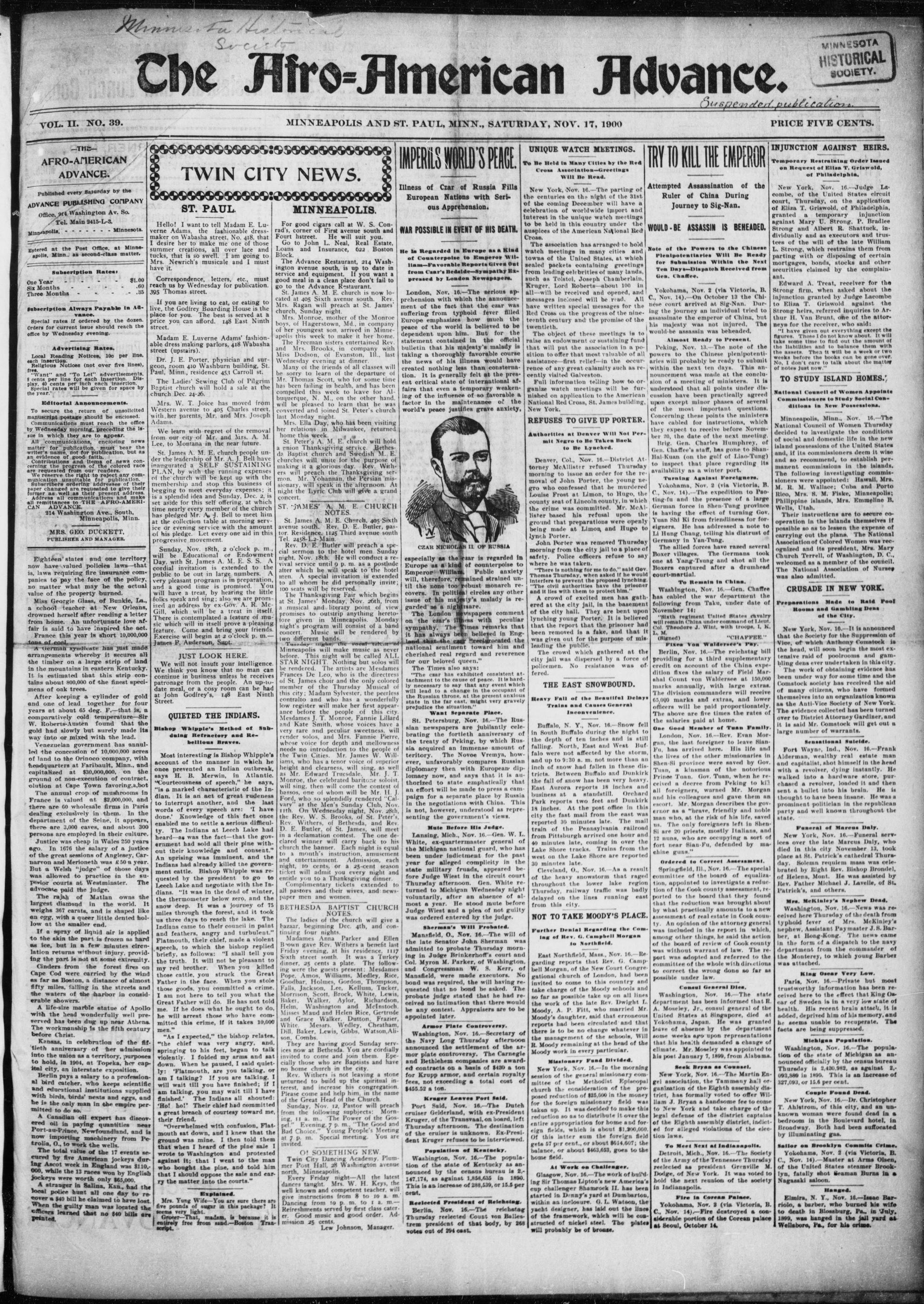
IMPERILS WORLD'S PEACE.
Illness of Czar of Russia Fills European Nations with Serious Apprehension.
WAR POSSIBLE IN EVENT OF HIS DEATH.
He Is Regarded in Europe as a Kind of Counterpulse to Emperor William—Favorable Reports Gave Out from Caar's Bedside—Sympathy Expressed by London Newspapers.
London, Nov. 10.—The serious apprehension with which the announcement of the fact that the caar was suffering from typhoid fever filled Europe emphasizes how much the peace of the world is believed to be dependent upon him. But for the statement contained in the official bulletin that his majesty's malady is taking a thoroughly favorable course the news of his illness would have created nothing less than consternation. It is generally felt at the present critical state of international affairs that even a temporary weakening of the influence of so favorable a factor in the maintenance of the world's peace justifies grave anxiety,
CZAR NICHOLAS II OF RUSSIA
especially as the earar is regarded in Europe as a kind of counterpoise to Emperor William. Public anxiety will, therefore, remained strained until the none too robust monarch recovers. In political circles any other issue of his majesty's malady is regarded as a nightmare. The London newspapers comment on the earar's illness with peculiar sympathy. The Times remarks that it has always been believed in England that the earar "reincarcoated the national sentiment toward him and cherished real regard and reverence for our beloved queen."
The Times also says:
"The carar has exhibited consistent attachment to the cause of peace. It is hardly necessary to say that any event which will lead to a change in the occupant of the Russian throne, at the present anointment, will very gravely preclude the situation."
Want Separate Place.
St. Petersburg, Nov. 16.—The Russian newspapers are jubilantly celebrating the fortieth anniversary of the treaty of Peking, by which Russia acquired an immense amount of territory. The Novoe Vremya, however, unfavorably compares Russian diplomacy then with European diplomacy now, and says that it is authorized to state emphatically that an effort will be made to press a campaign for a separate place by Russia in the negotiations with China. This is not, however, understood as representing the government's views.
Mute Before His Judge.
Lansing, Mich., Nov. 16—Gen. W, L. White, ex-quartermaster general of the Michigan national guard, who has been under indictment for the past year for alleged complicity in the state military frudges, appeared before Judge Wiest in the circuit court Thursday afternoon. Gen. White returned to Michigan Wednesday night voluntarily, after an absence of almost a year. He stood mute before Judge Wiest and a plea of not guilty was ordered entered by the judge.
Sherman's Will Probated
Mansfield, O., Nov. 16.—The will of the late Senator John Sherman was admitted to probate Thursday morning in Judge Brinkerhoff's court and Col. Myron M. Parker, of Washington, and Congressman W. S. Kerr, of Mansfield, were made executors. No bond was required, the will having requested that no bond be asked. The probate judge stated that he had received no intimation that there would be any contest. Appraisers are to be appointed later.
Armer Plate Controversy
Washington, Nov. 16.—Secretary of the Navy Long Thursday afternoon announced the settlement of the armor plate controversy. The Carnegie and Bethlehem companies are awarded contracts on a basis of $420 a ton for Krupp armor, and certain royalty fees, not exceeding a total cost of $455.52 a ton.
Kruger Leaves Port Said.
Port Said, Nov. 16. -The Dutch cruiser Gerdelander, with ex-President Kruger, of the Transvaal, on board, left Thursday afternoon. The destination of the cruiser is unknown. Ex-President Kruger refuses to be interviewed.
Population of Kentucky.
Washington, Nov. 16.—The population of the state of Kentucky as announced by the census bureau is 2,147,174, as against 1,558,635 in 1890. This is an increase of 288,539, or 15.5 per cent.
Reselected President of Reheating.
Berlin, Nov. 16.—The reeating of Thursday reelected Count von Ballastrem president of that body, by 265 votes out of 294 cast.
UNIQUE WATCH MEETINGS.
To Be Held in Many Cities by the Red Cross Association—Greetings Will Be Read.
New York, Nov. 16.—The parting of the centuries on the night of the 31st of the coming December will have a celebration of worldwide import and interest in the unique watch meetings to be held in this country under the auspices of the American National Red Cross.
The association has arranged to hold watch meetings in many cities and towns of the United States, at which sealed packets containing greetings from leading celebrities of many lands, such as Tolstoi, Joseph Chamberlain, Kruger, Lord Roberts—about 100 in all—will be received and opened, and messages inclosed will be read. All have written special messages for the Red Cross on the progress of the nineteenth century and the promise of the twentieth.
The object of these meetings is to raise an endowment or sustaining fund that will put the association in a position to offer that most valuable of all assistance—first relief—in the occurrence of any great calamity such as recently visited Galveston.
Full information telling how to organize watch meetings will be furnished on application to the American National Red Cross, St, James building, New York.
REFUSES TO GIVE UP PORTER.
Authorities at Denver Will Not Permit Negro to Be Taken Back to Be Lynched.
Denver, Col., Nov. 16—District Attorney McAllister refused Thursday morning to issue an order for the removal of John Porter, the young negro who confessed that he murdered Louise Frost at Limon, to Hugo, the county seat of Lincoln county, in which the crime was committed. Mr. McAllister based his refusal upon the ground that preparations were openly being made at Limon and Hugo to lynch Porter.
John Porter was removed Thursday morning from the city jail to a place of safety. Police officers refuse to say where he was taken.
"There is nothing for me to do," said Gov. Thomas Thursday, when asked if he would answer the proposed lynching. "The civil authorities have the prisoner and it lies with them to protect him."
A crowd of excited men has gathered at the city jail, in the basement of the city hall. They are bent upon lynching young Porter. It is believed that the report that the prisoner had been removed is a fake, and that it was given out for the purpose of misleading the public. The crowd which gathered at the city jail was dispersed by a force of policemen. No resistance was offered.
THE EAST SNOWBOUND.
Heavy Fall of the Beautiful Delays Trains and Causes General Inconvenience.
Buffalo, N. Y., Nov. 16.—Snow fell in South Buffalo during the night to the depth of ten inches and is still falling. North, East and West. Buffalo were not affected by the storm, and up to 9:30 a. m. not more than an inch of snow had fallen in these districts. Between Buffalo and Dunkirk the fall of snow has been very heavy. East Aurora reports 18 inches and business at a standstill. Orchard Park reports two feet and Dunkirk 18 inches. At the post office in this city the fast mail from the east was reported 30 minutes late. The mail train of the Pennsylvania railroad from Pittsburgh arrived one hour and 40 minutes late, coming in over the Lake Shore tracks. Trains from the west on the Lake Shore are reported 30 minutes late.
Cleveland, O., Nov. 16.—As a result of the heavy snowstorm that raged throughout the lower lake region Thursday, railway traffic was badly delayed on the lines running east from this city.
NOT TO TAKE MOODY'S PLACE.
Further Denial Regarding the Coming of Rev. G. Campbell Morgan to Northfield.
East Northfield, Mass., Nov. 16.—Re-garding reports that Rev. G. Campbell Morgan, of the New Court Congregational church of London, had been invited to come to this country and take charge of the Moody schools and so far as possible take up on all lines the work of the late Rev. Dwight L. Moody. A. P. Fitt, who married Mr. Moody's daughter, said that erroneous reports had been circulated and that there is to be no change whatever in the management of the schools. Will R Moody remaining at the head of the Moody work in every particular.
Missionary Fund Divided.
New York, Nov. 16.—In the morning session of the general missionary committee of the Methodist Episcopal church the consideration of the proposed reduction of $25,000 in the money for the foreign missionary field was taken up. It was decided to make this reduction so as to distribute it over the entire appropriation for home and foreign fields, which is about $1,300,000. Of this latter sum the foreign field gets 57 per cent., or about $643,607; the balance, or about $463,653, goes to the home field.
A4 Work on Challenger
Glasgow, Nov. 16.—The work of building Sir Thomas Lipton's new America's cup challenger Shamrock II. has been started in Denny's yard at Dumbarton, within an inclosure. G. L. Watson, the yacht designer, has laid out the lines of the framework, which will be constructed of nickel steel. The plates will probably be of bronze.
TRY TO KILL THE EMPEROR
Attempted Assassination of the Ruler of China During Journey to Sig-Nan.
WOULD - BE ASSASSIN IS BEHEADED.
Note of the Fowers to the Chinese Plenipotentiaries Will Be Ready for Submission Within the Next Ten Days—Dispatch Received from Gen. Chaffee.
Yokohama, Nov. 2 (via Victoria, B. C., Nov. 14).—On October 13 the Chinese court arrived at Sig-Nan. During the journey an individual tried to assassinate the emperor of China, but his majesty was not injured. The would-be assassin was beheaded.
Almost Ready to Present.
Almost Ready to Present.
Nov. 13.—The note of the powers to the Chinese plenipotentiaries will probably be ready to submit within the next ten days. This announcement was made at the conclusion of a meeting of ministers. It is understood that all points under discussion have been practically agreed upon except minor phases of several of the most important questions. Concerning these points the ministers have cabled for instructions, which they expect to receive before November 20, the date of the next meeting. Brig. Gen. Charles Humphrey, of Gen. Chaffee's staff, has gone to Shan-Hai-Kuan (on the golf of Liao-Tung) to inspect that place regarding its availability as a winter port.
Turning Against Foreigners.
Yokohama, Nov. 2 (via Victoria, B.
C., Nov. 14).—The expedition to Pao-ting-fu and the presence of a large German force in Shen-Tung province is having the effect of turning Gov.
Yuan Shi Ki from friendliness for foreigners. He has addressed a note to Li Hung Chang, telling his distrust of Germany in Yan-Tung.
The allied forces have razed several Boxer villages. The Germans took one at Yang-Tung and shot all the Boxers captured after a drumhead court-martial.
To Remain in China.
Washington, Nov. 16.—Gen. Chaffee has capped the war department the following from Taku, under date of November 14:
*With engagement United States cavalry with whom China under command of Leut. Col. Theodore J. Wint, with troops, I, K. L, M.
(Signed)
"CHAFFEE."
*Fixes Von Waldersee's Pay.*
Berlin, Nov. 16.—The reckishing bill providing for a third supplementary credit on account of the China expedition fixes the salary of Field Marshal Count von Waldersee at 150,000 marks annually, with large expenses. The division commanders will receive 65,000 marks and extras, and lower officers will be paid proportionately. The above are five times the rates of the salaries paid at home.
One Good Member of Tuan Family
London, Nov. 16.—Rev. Evan Morgan,
the last foreigner to leave Sian-Fu,
has arrived here. His life and
the lives of the other missionaries in
Shen-Si province were saved by Gov.
Tuan, a kinsman of the notorious
Prince Tuan. Gov. Tuan, when he
received a decree from Peking to kill
all foreigners, warned Mr. Morgan
and his colleagues and gave them an
escort. Mr. Morgan describes the governor as a "brave, friendly and noble man who, at the risk of his life, saved us. The only foreigners left in Shen-Si are 20 priests, mostly Italians, and 12 nuns, who are occupying a sort of fort near Sian-Fu, defended by machine guns."
Ordered to Correct Assessment.
Springfield, Ill., Nov. 16.—The special committee of the board of equalization, appointed to investigate a reduction of the Cook county assessment, reported to the board that they found that the reduction was brought about by what practically amounts to a new assessment of real estate in Cook county. An opinion of the attorney general was included in the report in which, among other things, he said the action of the board of review of Cook county was without warrant of law. The report was adopted and referred to the committee of the whole with directions to correct the wrong done so far as possible under law.
Consul General Dice.
Washington, Nov. 16.—The state department has been informed that R. A. Moseley, Jr., consul general of the United States at Singapore, died at Yokohama, Japan. He was granted leave of absence by the department some weeks ago upon representations that his health demanded a change of climate. Mr. Moseley was appointed to his post January 7, 1899, from Alabama
Seek Bryan as Counsel.
New York, Nov. 16.—The Martin Engel association, the Tammany hall organization of the Eighth assembly district, has formally voted to offer William J. Bryan a handsome fee to come to New York and take charge of the legal defense of the district captains of the Eighth assembly district, indicted for alleged violations of the election laws.
To Next Next of Indianapolis
Detroit, Mich., Nov. 16.—The Society of the Army of the Tennessee Thursday relected as president Grenville M. Dodge, of New York. It was voted to hold the next reunion of the society in Indianapolis.
Fire in Korean Palace
Yokohama, Nov. 2 (via Victoria, B.
C., Nov. 14) - Fire destroyed a
considerable portion of the Corenan
palaces at Seoul. October 14.
MINNESOTA
HISTORICAL
SOCIETY.
PRICE FIVE CENTS.
INJUNCTION AGAINST HEIRS.
Temporary Restraining Order Issued on Request of Eliza T. Griswold, of Philadelphia.
New York, Nov. 16. Judge Lacombe, of the United States circuit court, Thursday, on the application of Eliza T. Griswold, of Philadelphia, granted a temporary injunction against Mary U. Strong. P. Bradlee Strong and Albert R. Shattuck, individually and as executors and trustees of the will of the late William L. Strong, which restrains them from parting with or disposing of certain mortgages, bonds, stocks and other securities claimed by the complainant.
Edward A. Treat, receiver for the Strong firm, when asked about the injunction granted by Judge Lacombe to Eliza T. Griswold against the Strong heirs, referred inquiries to Arthur H. Van Brunt, one of the attorneys for the receiver, who said:
"I have given out everything except the figures. Those I do not know about. It will be hard to come to terms with the liability to balance them with the assets. Then it will be a week or two weeks before the books can be gone over. No, I don't care to talk about the matter."
TO STUDY ISLAND HOMES.
National Council of Women Appoints Commissioners to Study Social Conditions in New Possessions.
Minneapolis, Minn. Nov. 16.—The National Council of Women Thursday decided to investigate the conditions of social and domestic life in the new island possessions of the United States and, if its commissioners deem it wile and so recommend, to establish permanent commissions in the islands. The following investigating commissioners were appointed: Hawaii, Mrs. M. R. M. Wallace; Cuba and Porto Rico, Mrs. S. M. Fiske, Minneapolis; Philippine islands, Mrs. Emmeline B, Wells, Utah. Their instructions are to secure cooperation in the islands themselves if possible so as to lessen the expense of carrying out the plans. The National Association of Colored Women was recognized and its president, Mrs. Mary Church Terrell, of Washington, D. C., welcomed as a member of the council. The National Association of Nurses was also admitted.
CRUSADE IN NEW YORK.
Preparations Made to Raid Poof Rooms and Gambling Dens of the City.
New York, Nov. 16.—It is announced that the Society for the Suppression of Vice, of which Anthony Comstock is the head, will soon begin the most extensive raid of poolrooms and gambling dens ever undertaken in this city. The work of obtaining evidence has been under way for some time and the Comstock society has received the aid of many citizens, who have formed themselves into an organization known as the Anti-Vice Society of New York. The evidence collected has been turned over to District Attorney Gardiner, and it is said Mr. Comstock will get out a large number of warrants.
Seventhational Suicide.
Fort Wayne, Ind., Nov. 10.—Frank Alderman, wealthy real estate man and capitalist, shot himself in the head with a revolver, dying instantly. He walked into a hardware store, purchased a revolver, loaded it and then sent a bullet into his brain. He is thought to have been insane. He was a prominent politician in the republican party and well known throughout the state.
Federal of Marcus Daly.
New York, Nov. 16.—Funeral services over the late Marcus Daly, who died in this city November 13, took place at St. Patrick's cathedral Thursday. Solemn requiem mass was celebrated by Right Rev. Bishop Brondel, of Helena, Mont. He was assisted by Rev. Father Michael J. Laveille, of St. Patrick's, and others.
Mrs. McKinley's Nephew Dead.
Washington, Nov. 16.—News was received here Thursday of the death from typhoid fever of Mrs. McKinley's nephew, Assistant Paymaster J. S. Barber, at Hong-Kong. The news came in the form of a dispatch to the navy department from the commander of the Monterey, to which young Barber was attached.
King Oscar Very Low.
Paris, Nov. 16.—Private but most trustworthy information has been received here to the effect that King Osar of Sweden is in a very low state of health. His recent brain attack, it is added, deprived him of his memory, and he seems unable to recuperate. The facts are being suppressed.
Michigan Population.
Washington, Nov. 16.—The population of the state of Michigan as announced officially by the census bureau Thursday is 2,420,982, as against 2,093,889 in 1890. This is an increase of 327,093, or 15.6 per cent.
Couple Found Dead
New York, Nov. 16.—Dr. Christopher T. Ahlstrom, of this city, and an unknown woman were found dead in a bedroom in the Boulevard hotel, in Broadway. Both had been suffocated by illuminating gas.
Sailor on Brooklyn Commits Crime.
Yokohama, Nov. 2 (via Victoris, B.
C., Nov. 14.)—Master at Arms Olsen,
of the United States steamer Brooklyn,
fatally shot Seaman Burns in a Nagasaki saloon.
Hanged.
Elimira, N. Y., Nov. 16.—Issac Barriolo, a burber, who burned his wife to death in Biossburg, Pa., in July, 1899, was hanged in the jail yard at Wellabore, Pa. for his crime.
EDITORIAL
NOVEMBER—1900.
Sun. Mon. Two. Wed. Thur. Fri. Sat.
... ... ... ... 1 2 3
4 5 6 7 8 9 10
11 12 13 14 15 16 17
18 19 20 21 22 23 24
25 26 27 28 29 30 ...
The German mails have been closed to sausages; so you will be no longer able to write to your friend in Berlin: "Inclosed find four sausages."
Mark Twain certainly is a delicious humorist. He must have been laughing to himself when he gave out an extended interview in order to assert that he would decline to be interviewed.
A London magazine has been discussing the question: Should literary men marry? A contemporary suggests that the point is of no more importance than these: Should publishers prosper? Should critics keep cool? Should poeta sleep on mantel pieces? Should electors keep hems?
Train robberies have become so frequent in the west that one railroad, the Oregon Hailroad & Navigation company, regards an investment in bloodhounds advisable. A litter of the puppies has been distributed among the agents along the line, with instructions to rear them for the sole purpose of man-catching.
According to the New York papers, Charles Alvord, the man who stole $700,000 from the First national bank, was one of the committee of three experts appointed by the directors of the bank to devise a system of bookkeeping that would make stealing impossible. He would be much more capable of writing a book on "Stealing Made Easy."
The cotton crop of this country amounted to only 5,000,000 pounds in 1793; last year it was about 5,500,000 pounds, representing about three-fourths of the entire crop of the world, and valued at $350,000,000. It filled 9,500,000 bales, and the loss by waste incidental to the process of taking samples was not less than $7,000,000.
The census shows that the United States stands fourth in population among the great peoples of the world. The following table shows the relative positions:
China, 366,553,029; India (British), 221,172,952; Russia, 118,041,197; United States of America, 76,226,298; Germany, 62,279,901; Austro-Hungary, 41,231,542; Japan, 40,435,816; Britain and Ireland, 38,104,978; Italy, 38,450,639; Turkey, 27,694,600; Spain, 17,166,632.
Devotees of golf are fond of referring to it as "the ancient and royal game." It is probably more royal and certainly far more ancient than most of them have any idea of. At all events a pictured tablet was recently unearthed at Carchemish, the old capital of the Hittites, where are depicted men and women engaged in a pastime, which, if not exactly golf as played at present, is something extraordinarily like it.
Charles R. Flint's Arrow, under contract to be the fastest ship ever launched, has been pushed into the water at New York. It has been guaranteed by the builder that the boat will easily make 42 miles an hour, and in an emergency can be pushed up to 50 miles an hour. This seems to be about the limit in speed at sea, but then we thought that limit was reached 15 years ago when an 18-mile-an-hour vessel was built.
There are millions of people in China who do not yet know and may never know that the Americans and the powers drove the Chinese horde before them in retreat and captured the imperial city of Peking. The late mala from China brought copies of a Chinese poster which has been tacked up in conspicuous places in most of the Chinese towns, in which the representatives of the various powers are shown praying to Prince Ching for the cessation of hostilities.
The total cost of the Pan-American exposition to be held in Buffalo, N.Y., next year is estimated at $10,000,000, and John N. Scatcherd, who is chairman of the executive committee, says that the resources now in sight amount to about $60,000,000. Progress on the work of construction is proceeding rapidly, nearly 5,000 workmen now being employed. The "Midway" at the exposition will cost $3,000,000. The exposition grounds will be half a mile wide and a mile and a quarter long, and will comprise 350 acres. It will open May 1, 1901.
According to the most recent census the population of Belgium is 6,750,000, which for its 11,378 square miles of territory gives 593 inhabitants a square mile, making Belgium the most thickly populated country on the globe. Holland's population is 5,145,000, which gives for the 12,582 square miles of Dutch territory 408 inhabitants a square mile, making the land of dikes and windmills the second most densely populated country. In 1875 Holland had but 3,767,000 inhabitants. The present population shows a steady increase of 35,120 inhabitants a year.
Molten wood is a new invention by Mr. De Gall, inspector of forests at Lemur, France. By means of dry distillation and high pressure the escape of developing gases is prevented, reducing the wood to a molten condition. After cooling off the mass assumes the character of coal, yet without showing a trace of the organic structure of that material. This new body is hard, but can be shaped and polished at will; is impervious to water and acids, and is a perfect electrical nonconductor, qualities which should make it especially suitable for many commercial purposes.
A WEEK'S HISTORY
The Important Happenings of a Week Briefly Told.
IN ALL PARTS OF THE UNION
All the Latest News of Interest from Washington, From the East, the West and the South.
THE LATEST FOREIGN DISPATCHES
FROM WASHINGTON.
Ellis H. Roberts, treasurer of the United States, in his annual report shows that the net ordinary revenues of the government for the fiscal year were $667,240,852, the largest in the history of the country, and the deficiency of $89,111,560 in 1899 was converted into a surplus of $79,527,060.
For the fiscal year ending in 1902 the navy will ask for $87,172,631.
The secretary of war has abolished the military department of Porto Rico and ordered part of the troops home December 15.
Honorable discharge has been granted Lieut. Col. Russell B. Harrison, son of the ex-president, from the army.
On November 30 the national convention of the Wcman's Christian Temperance union meets in Washington.
It is shown by the annual report of the life saving service that 2,607 persons were saved and 48 lost on wrecked vessels the past year.
The president formally asked his cabinet to remain with him during his second term. In the past year the dead letter office in Washington received 7,536,168 pieces of matter, against 6,855,983 the preceding year.
THE EAST.
At the age of 48 years Frank Jarris Patten, inventor of the multiplex telegraph system, died in New York. P. J. Fitzgerald, a former champion pedestrian of the world, died at Long Island City, N. Y. aged 53 years.
In New York Judge Brown, of the federal court, in a case concerning platoon decided that Porto Rico is not a foreign country.
The Montana copper king, Marcus Daly, died in New York, aged 60 years. A way has been devised by Thomas A. Edison to save nearly all the present waste of energy in converting coal into power.
The great railroad magnate and financier, Henry Villard, died at his summer home, Thornwood Park, near Dobbs Ferry, N. Y., aged 65 years.
In New York two Mexicans were arrested having in their possession the famous Maximilian crown diamonds, worth $40,000, and other jewels, which they smuggled into the country.
The death of Capt. John D. Hart, of Cuban filibustering fame in 1896, occurred in Philadelphia.
The defaulcation of $190,000 by an employee caused the failure of Grant Bros., New York brokers.
Yale college has offered free scholarships to five Filipino youths.
The Dowie colony of 25 lacemakers, bound for Chicago, were barred from landing at Philadelphia by the immigration commissioner.
WEST AND SOUTH.
In Logansport, Ind., Patrick Burk celebrated his one hundred and first birthday. At Indianapolis John Gunn, aged 62, and his mother, aged 86, were suffocated by gas. In Alaska hundreds of Indians are dying of cold and starvation.
Latest returns from Nebraska show that all republican candidates, state and national, were victors.
The population of Colorado is 539,700, an increase of 127,502 in ten years.
In Toledo, O., Amos Dice shot his wife and himself fatally. Domestic trouble was the cause.
In a fire 15 valuable horses and six stables were burned at the Louisville (Ky.) Driving and Fair Association grounds.
The Gifford house, the leading hotel at Poplar Bluff, Mo., was burned, four persons were cremated and many others were injured.
Thus far this year two killed and two badly injured is the record of football in Chicago.
W. H. Rosentengel, one of the foremost German-American educators of America, died of apoplexy during a meeting of the faculty of the University of Wisconsin in Madison.
An explosion of gas in a Baltimore (Md.) subway partly wrecked 14 buildings.
An increase in wages has been granted engineers and firemen of the Chicago, Milwaukee & St. Paul system. In Indiana 7,000 coal miners went out on a strike because operators refused to sign the scale. Flames destroyed the Brookings lumber mill at San Bernardino, Cal., the loss being $400,000. Amzi W. Freeman, aged 79, for 30 years pastor of the First Presbyterian church at Aurora, Ill., was found dead in a chair. Zeralda James, widow of Jesse James, the noted southwestern band, died in Kansas City, Mo. P. S. Batchelor killed J. A. Williams and F. F. Welbourn his partners in business, in a quarrel at Bonita, La.
J. W. Hoot was convicted at Waterloo, In., of attempting to kill his wife by sending her an infernal machine. In Cedar Falls, In., the corner stone of the new state normal school building was laid. In a collision between trains near Kalamazoo, Mich., ten persons were injured. In the lower house of the Georgia legislature a bill to disfranchise the negro was introduced.
FOREIGN INTELLIGENCE.
In the Bay of Fundy the steamer City of Monticello foundered and 33 persons were drowned. North of Feking 6,000,000 natives are threatened with death by famine.
In Manila the news of McKinley's election was received quietly. No result is expected until the insurgents are informed. In recent fighting Gen. Fouri and Commandant Prinsloo, Boer leaders, were among the killed. The envoys in Peking have drawn up a joint note fixing preliminary conditions to peace negotiations, among them being a statue to Von Ketteler, a personal apology to Emperor William by a native prince, and execution of 11 guilty high officials. The exposition in Paris, now closed, was attended by over 50,000,000 persons. The expenses of Great Britain in the South African campaign are estimated at $500,000,000.
Advices say China seems to be willing to accede to all the terms of the conjoint note now ready to be presented subject to the approval of the home governments, except the demand for the death penalty against princes and officials, which it is impossible to fulfill while the court is in the hands of these accused officials.
Transports Grant and Port Albert arrived at Manila with six officers and 615 men.
In an explosion in a mine at Wiosa, Germany, 13 persons were killed and 19 injured.
The mail service in the Philippines earned a surplus of $19,628 in the past fiscal year.
Records have been found in Peking that prove conclusively that Chinese discovered America in 409 A. D.
In Montreal A. S. & A. H. Masterman, one of the oldest and best known Canadian packing firms, failed for $300,000.
LATER NEWS
A protracted conference of the foreign ministers was held in Peking, at the conclusion of which there was a general expression of gratification at the progress made toward reaching a settlement.
Virginia college, a girls' school near Rosnoke, Va., was destroyed by fire.
The official vote of Illinois gives McKinley for president a plurality of 95-515 and Yates for governor 63,618. The total vote was 1,121,469.
The thirty-fourth annual session of the National Grange, Patrons of Husbandry, began in Washington.
The census gives the population of Alaska at 12,652.
The complete official vote of Delaware for president is: McKinley, 22,457; Bryan, 18,856. McKinley's plurality, 3,601.
The grand stand at a bull fight in Pedreguer, Spain, collapsed, killing 12 persons and injuring 200.
Students of the military academy at Kearney, Neb., revolted, and a part of the faculty and 200 cadets left in a body.
William M. White, implicated in the Michigan military frauds, returned to Grand Rapids to plead guilty.
Commissioner of Immigration Fitch says immigrants have arrived in this country at the rate of 1,000 per day since July last.
The recent earthquake in Colombia destroyed 15,000 buildings at Caracas and vicinity.
During the ten months ended October 31 the fire losses in the United States amounted to $143,423,500, against $111,654,800 in 1899.
The census count gives Ohio a population of 4,137,543, a gain of 485,229; Georgia, 2,216,331, an increase of 278,978.
A London paper says Gen. Botha is willing to surrender.
The balance of trade in favor of the United States for the past ten months was $499,667,936, or $129,358,545 greater than in the same months of 1899.
The executive committee of the National Business league wants a cabinet office of commerce and industries established.
Postmaster General Smith will ask an aggregate of about $121,000,000 as the appropriation for the entire service for the fiscal year ending June 30, 1902.
MINOR NEWS ITEMS.
There are to-day in all countries more than 3,000,000 Italian emigrants.
There are only about 189 living soldiers who are entitled to wear the British Victoria cross.
Dr. Leopold Kahn, the arctic explorer, is certain that Lieut. Peary is wintering at Fort Conger.
Unsatisfactory rate arrangements with railroads may prevent the G. A. R. encampment in Denver.
The man who built the city hall of Denver is now selling cigars and tobacco at a stand in the corridor of the building.
The yellow book on Chinese affairs published by the French foreign office shows close relations between France and the United States.
Elbridge T. Gerry resigned the presidency of the New York Society for Prevention of Cruelty to Children, which he founded 21 years ago.
There are 141 theological schools in the United States, 52 law schools, 92 regular medical schools, 9 ecteic medical schools and 14 homoeopathic.
Paper money is at a premium at Atome. Miners find it more convenient than gold and pay as much as two per cent. in excess of its face value for it.
Col. Benjamin West Blanchard, once one of the most widely known railroad men in the country, died at his residence in Washington, aged 74 years.
The will of Frank Williams, late of Johnstown, Pa., makes a bequest of $300,000 to the Lehigh university at South Bethlehem, Pa., for the benefit of worthy students.
Admiral Dewey's collection of gifts, temporarily on exhibition in the National museum at Washington, has been removed to his residence in Rhode Island avenue.
Only eight states have been uniformly republican in presidential years since 1860—Maine, New Hampshire, Vermont, Massachusetts, Rhode Island, Pennsylvania, Iowa and Minnesota.
C. Oliver Iselin will manage the old defender Columbia in the trial races next summer with the new yacht now being built at the Herreshoff shops in Bristol, R. I., to defend the America's cup against Sir Thomas Lipton's challenge
London Toy Merchants Complain of Too Much War for Their Business.
In anticipation of the demand which will set in with the coming of Santa Claus, manufacturers of toys in Germany and France are engaged in turning out novelties for the Christmas season, and the wholesale merchants of London are laying up huge stocks of goods, says the Mail.
For a forecast of the toy of 1900-01 a representative of the Daily Mail sought in the busy quarter of Houndsditch, where a member of Fraenkel Bros. was found behind the ramparts of novelties for the coming season.
"Let me tell you one thing," said he; "before I begin to talk about Christmas goods. The Chinese war is an absolute failure from the toy seller's point of view. Those who imagined that the success of the South African war toy would be repeated in the case of China have fallen in badly. There is a mechanical Boxer, for instance. You wind him up and he swishes an ax around, but no one wants him, and although the Boer war toys are dying slowly there's more life in them yet than ever there will be in any of those designed specially for the China business. Even an ash tray braying Admiral Seymour's likeness was an utter failure.
"In buttons there has been an awful slump, one merchant of my acquaintance having no less than 800,000 of them in stock, without the faintest prospect of a clearance. And stocks elsewhere throughout the United Kingdom are equally large.
"In spite of these evidences of winning popularity, however, I still think that the war toy will figure largely this Christmas, and I know that swords, guns, helmets and soldiers are asked for in such quantities that manufacturers are having to refuse further orders.
"The ingenious mechanical toy will, I think, fall off in the market for the coming season, but dolls, especially the 'coon' ones, will be unprecedently brisk.
"Among the novelties will be found the 'choral top,' which on being set going plays a variety of melodies. Magic lanterns, with war slides, will be in great favor, and for those who can afford a high-class toy here is the smoking 'coon' gentleman, who puffs most naturally at his cigarette. That will cost you five pounds, but that excellent imitation of Cinquavalli's umbrella and ball trick may be had for one shilling.
"It will certainly be a season of good toys at a moderate figure."
OLDEST OF LIVING THINGS.
Great Trees of California That Are Said to Antedate the Glacial Period.
Clifford Pinchot, the forester of the department of agriculture, has compiled a pamphlet on the big trees of California, which has just been issued from the government printing office. It is handsomely illustrated with a number of fine pictures of the great trees, showing their size as compared with that of other conifers. Mr. Pinchot presents the following salient facts regarding big trees:
The dimensions of the big tree are unequaled. Its age makes it the oldest living thing. The majestic beauty of the big tree is unique and world renowned. It exists only in ten isolated groves on the west slope of the Sierra Nevada mountains and nowhere else in the world. The Mariposa grove is the only one of consequence which is completely protected. Most of the scattered groves of big trees are privately owned, and are, therefore, in danger of destruction. Lumbering is rapidly sweeping them off. Forty mills and logging companies are now at work wholly or in part upon big tree timber. The southern groves show some reproduction, through which there is some hope of perpetuating these groves. In the northern groves the species hardly holds its own. The big tree and the smaller coast redwood represent a surviving prehistoric genus of trees once widely distributed over the globe."
Mr. Pinchot says that before the glacial period the genus of big trees, called sequia, flourished widely in the temperate zones of three continents, and Europe, Asia and America each had its share. But when the ice fields moved down out of the north the luxuriant vegetation of the age declined, and one after another the different kinds gave way until only the big trees and the redwood survived. These trees have come down to us through the vicissitudes of many centuries, solely because of its superb qualifications. Its bark is often two feet thick and almost non-combustible. The oldest specimens felled are still sound at heart and fungus is an enemy unknown to it. Yet the big trees have not increased their range since the glacial period, and have just managed to hold their own on the little strip of country where the climate is locally favorable.
The finest of all groves, the Calaveras grove, with the biggest and tallest trees, came into the possession of a lumberman on April 1, 1900; in short, the majority of the big trees of California, certainly the best of them, are owned by people who have every right and, in many cases, every intention of cutting them down for lumber. Many of the notable trees in the Calaveras grove are 300 feet in height and 20 to 23 feet in diameter. The Stanislaws, or South Calaveras grove, contains 1,380 big trees. The Mariposa grove has 125 trees over 40 feet in circumference.
Made Desolate by Winds.
Between Formosan and the coast of China lies a group of 21 islands, interspersed with innumerable reefs and ledges, which are called the Pescadores islands. According to the investigations of a Japanese geologist these islands have suffered in a remarkable manner from the northeast winds, which blow with savage violence there during nine months of the year. The original area of the islands has been greatly reduced by erosion, and their surfaces are barren and desolate, so that the wind-whipped group forms "a quasid-desert amidst the green island world of southeastern Asia."—Youth's Companion.
His First Mustache.
When it comes to wrestling with his first mustache the yout is apt to get it down.-Chicago Daily News.
SOCIETY DIRECTORY
Mara Lodge. No. 2202.
Meets second and fourth Wednesdays in each month at Odd Fellows' Hall. 23E East Seventh St.
T. R. HICKMANN, P. S., 422 St. Anthony.
J. S. STRONG, N. G., 220 Full St.
Household of B. F., 353, G. U. G. of O. F.
Meets first and third Monday in each month for business, second Monday for instruction, at Odd Fellows Hall, 225 W. 10th St. MRS. SARAH C. KIRLTLE, M.N.G. MRS. IDA JACKSON, W. R., 374 Summit.
MOST WORSHIPFUL GRAND LODGE OF MINESOTA, A. F. and A. M.
J. L. NEAL, Grand Master.
W. J. LEE, Grand Master.
B. UGUARY Loan Bldg. Minneapolis.
ST. PETER CLAYER'S SODALITY.
Meets the first and third Mondays of each month. Mason Pres. J. S. Har- Sec. A. D. Desner. Minneapolis.
Pioneer Lodge, No. 1, A. F. and A. M.
Meets the first Monday in each month at Masonic Hall, southwest corner Fifth and Ritual Masons in good standing always welcome.
S. H. HADLEY, W. M.
W. A. HILLYER, Sec. 124 Atwater.
Minnesota Lodge, No. 2, A. F. and A. M.
Meets on the first and third Tuesday in each month at Masonic Hall, southwest corner of Fifth and Robert street. Master Masons in good standing always welcome.
H. B. HOWARD, W. M.
J. S. STRONG, Sec. 12th and Robert st.
WM. STEVENS, No. 3, A. F. & A. M.
Meets second and fourth Monday in each month. Mason Pres. southwest corner Fifth and Robert street. Master Masons in good standing always welcome.
WM. JOHNSON, W. M.
D. E. BEASLEY, Sec. Ryan Hotel.
Perfect Ashler Lodge, No. 4, A. F.
Meets the second and fourth Tuesday in each month at Masonic Hall, southwest Masons in good standing always welcome. B. K. DURANT W. M. Masons in good standing always welcome. Bethel Chapter, No. 28, R. A. M. Meets the first and third Thursday in each month at Masonic Hall, southwest Masons with a Robert Street street always welcome. DANIEL ROY H. P. W. T. GASSAWAY, Sec. State Capitol
MINNEAPOLIS.
G. U. O. O. O. F.
St. Anthony Lodge, No. 2877.
Meets the first and the third Wednesday in each month for the transaction of business, 1st avenue in Washington.
A. H. MYTHRICH, N. G.
JAMES A. SCOTT, P. S. P. O. Box 32.
KNIGHTS OF PYTHIAS.
Nat. Turner College, No. 2, K. of P.
Meets the second and fourth Thursdays in each month. In good stand and Eighth avenue south. At Lost River, Fourth and Eighth avenue south. BAKER, C. C. RALPH WATSON, K. R. and Pride of Minnesota College, No. 1, K. of P.
Meets the first and third Thursdays in each month. All brothers in good standing welcome. At Plummer Post Hall, First avenue north and Washington.
W, C. JEFFREY, K. R. and S. C.
W, C. JEFFREY, K. R. and S. C.
J. K. Hilary Lodge.
Meet first Tuesday in each month at
Washington Block, Second avenue South and
Washington Block, second avenue
always welcome. W. LILLARD, M. Y.
JASPER GIBBS, Sec. Guaranty, M. L
Restaurant.
Anchor Lodge, No. 7, A. F. and A. M.
Anchor Lodge, No. 7, A. F. and A. M.
each month at Windom Block, Second avenue
South and Washington. Masons in
good standing welcome. S.COTT, W. M.
A. B. LEE, 7201 Aldr avenue South.
Officers and Standing Committees of the
Most Relevant Grand Lodge, A. F.
A. M. of Minnesota and jurisdiction:
Grand Master-John L. Neal, Minneapolis.
Deputy Grand Master-Wade H. Hampton,
West Superior.
Senior Warden-H. B. Howard
St. Paul
Grand Junior Warden-J. C. Garner, St. Paul
Grand Treasurer-Daniel Roy, St. Paul
Grand Secretary-William R. Morris, Minnesota.
Grand Lecturer-G. W. Day (7), Minnesota.
Deputy Grand Secretary-O. D. Howard (4), Minnesota.
Chaplain-Issac Crawford (4), Minnesota.
Senior Deacon-John Martin (1), St. Paul
Junior Deacon-R. De Leo (7), Minnesota.
Senior Steward-J. H. Dillingham (2), St. Paul
Junior Steward-Wm. Stevens (3), St. Paul
Tyler-T. Bush (3), St. Paul.
Grand Marshall-C. H. McDonald (4), Grand Pursuitant-G. W. Duckett (3), St. Paul
Sword-Bearer-J. Adams (1), St. Paul
Grand Standard-Bearer-J. G. Charles, Minnesota.
Grand Register-J. G. Sterett (6), Minnesota.
District Deputy Grand Master-First District-James Woodfork (1), St. Paul
District Deputy Grand Master-Second District-James Woodfork (1), Minnesota.
District Deputy Grand Master-Third District-J. K. Polk (5), Duluth.
CHURCH DIRECTORY.
ST. PAUL.
ST. JAMES A. M. E. CHURCH
Rev. J. C. Anderson, Pastor.
Sunday services: 11:30 a.m. m.; 12:30 p.m.
Wednesday prayer meeting: 8:00 p.m.
ST. PETER CLAYER'S
Hospital.
Cor. Farrington and Aurora avenues.
Sunday services: Mass. 8:00 a.m. m. High
morning. 8:00 a.m. Evening service at 7 o'clock
Sunday services: Preaching at 11:30 a.m.
and 11:35 p.m. Sunday School at 11:30 a.m.
and 11:35 p.m. Sunday School prayer meeting.
EPISCOPAL MISSION
463 Rice street, bet. Aurora and University.
Sunday services: Liturgy prayer, Litany and Sermon; 11:30 a.m.; m.; Sunday School and Children's Vespers 3:00 p.m.; m.; Named Evening prayer and Lecture, 8:00 p.m.; Friday, Choir Rehearsal and Mass, 8:00 p.m. All are cordially invited. Seats free.
MINNEAPOLIS.
ST. PETER A. M. E. CHURCH
Rev. W. S. Brooks, Pastor.
Cor. 22d st. 8th ave. South
Sunday School, treaching, 11:30 a.m.
m.; Sunday School, 8:30 a.m.
services, 8:30 p. m. General prayer meeting,
Thursday evening, 8:30 p. m. Way-
home Home, Tuesday evening at dif-
ferent residence, Parsonage, 220
Ninth avenue South.
BETHESDA BAPSTEST CHURCH.
Between Eleventh and Twelfth avenues.
Cor. 22d st. 8th ave. South
m.; Sunday School, 12:30 p. m.; Christian
Eleanor, 7:30 p. m.; evening services,
evening general prayer meeting, 8:30 p. m. Parsonage,
1210 Eighth street South.
Rev. J. W. Kling, Pastor.
Between First avenue and Second street
Southeast, near Exposition Bldg.
Sunday morning, Teaching at 11 a.m.
m.; Sunday School, 5:30 p.m. evening
services, 8:30 p.m. General prayer meeting
Thursday evening. Weekly meetings of
the Debating Club.
NOTICE.—Changes and corrections will be
made upon publication of office. If we
have neglected to place a notice of any
nociety in the above directory it is
been known that of it or have not
seen its officers. Send name of my
Lodge, date and time of meeting, name
of officers and it will be inserted.
THE ADVANCE CAFE 214 WASHINGTON AV. SOUTH. Restaurant and Lunch Counter
RICHARD MANN, Proprietor.
Office Telephone 1405-4.
VAL DO TURPHY PHYSICIAN A
Office Hours: 8 to 10 a. m.; 12 to 2 p. m.; 4 to 7 p. m.
Office, 7 E. 7th St. Kendrick Blk. Res. 30
25 YEARS' EXPERIENCE.
JAS. AMC
Practical Undertake
123 Washington Ave. S.
All our goods are first-class, and the p.
SMOKE THE SIGHT B
W. S. CONRA
400 FIRST AVE.
COX & HARRIS,
Residence Telephone
1498-4.
VAL DO TURNER, M. D.
PHYSICIAN AND SURGEON.
to 10 a. m.; 12 to 2 p. m.; 4 to 6 p. m.
St. Kendrick Blk. Res. 259 Sherburn Ave.
ST. PA.
EXPERIENCE.
TELEPHONE
JAS. AMOR & CO.
Medical Undertakers and Embal-
122 Washington Ave. South, Minneapolis, Minn.
dies are first-class, and the prices we guarantee will defy.
THE SIGHT DRAFT 5-CENT
S. CONRAD, Distribu-
400 FIRST AVENUE SOUTH.
HARRIS,
WART, Sec'y.
HENRY MO
City Club and Employment
FURNISHED ROOMS
With the Most Modern Conveniences,
BER SHOP AND RESTAURANT
Where Meals are Served at All Hours.
nepin Ave. Minneapolis
The FOX $2.00 RAZOR is the best that experience.
FREE TRIAL AT YOUR HOME. For 250
Razor to your Express Agent, with instructions to allow
to try. Or, if you send full amount with your order, we
guarantee satisfaction or money back, and a FOX
COL. FREE. State whether wide on narrow blades, squ
Every Razor housed, stopped and set ready for use.
Fox CUTLERY Co., Mrs. 45 Center
Address for the West: 929 Main St., Dubuque, Iowa.
"The Fox Cutlery is perfectly reliable."
VAL DO TURNER, M. D.,
PHYSICIAN AND SURGEON.
Office Hours: 8 to 10 a. m.; 12 to 2 p. m.; 4 to 5 p. m.
Office, 27 E. 7th St., Kendrick Blk. Res. 359 Shorburn Ave.
ST. PAUL, MINN.
25 YEARS' EXPERIENCE.
JAS. AMOR & CO.,
Practical Undertakers and Embalmers.
J. E. STEWART, SECY.
Twin City Club and
FURNISH
With the Most Me
DARBER SHOP A
Where Meals are $
126 Hennepin Ave.
Twin City Club and Employment Bureau
126 Hennepin Ave. Minneapolis, Minn.
The FOX $2.00 RAZOR is the best that experience and skill can provide. FREEL TRIAL AT YOUR HOME. For 250 we will send a Razor to your Express Agent, with instructions to allow you to take it to try. Or, if you send full amount with your order, we send Razor prepal, or CIL FREE. State whether wide or narrow blade, square or round point. Every Razor hasted, stopped and set ready for use.
KING OF ALL H
KING OF ALL HAIR DRESSINGS.
TRADE MARK
BEFORE AFTER
An Honest Guaranteed Remedy—Move
Positively straighten Knotty, Nappy
Curse Haldane, and Dizziness. Causes the hair to grow long and
Away. Our GARDEN OPEN. Cut out this a
and we will immediately send you four bows
even when a facial Blemish; also one pane of
which causes all Skin Diseases, remove Wr
Spots, and a facial Blemish; one pane of
the human skin, give Noth Diseases
we will send for $1.00. This grand offer is
receive four lots. BOSTON CHEMICAL
PATRONIZE.
WM. JENKINS,
ROOMS FOR RENT
Guaranteed Remedy—Money Refunded if You are D
straightens Knotty, Nappy, Kinky, Troublesome, Redu
s. Dandruff, Itch, Tetter, and all running, itching, and hum
s. the hair to grow long and straight, soft and fine, and be
and off the top of the head. For some to be used on
immediately, send you four boxes of Ozone and one bottle of
smoke through skin soft and black skin bright; also one both
of 6k in Dianese, removes Wrinkles, Predict, Moth Patches
Facial Blemishes, also one package Anti-Odor, reserves all
body, cures Womb Diseases, Chilabs, etc. All the above,
or $1.00. This grand offer is unprecedented. Parties send
BOSTON CHEMICAL CO., 310 E. Broad St, Rice
JENKINS,
WONDERFUL
FOR
RENT DIS
ST CLASS.
Superb Service. Price. Curly Hair Made
Positively straightens Knotty, Nappy, Kinky, Troublesome, Retractory Hair. Cures Raldness, Dandruff, Itch, Tettier, and all running, itching, and humiliating Soap. Diseases. Causes the hair to grow long and straight, soft and fine, and beautiful as an ant's.
OUR CHILD AND POMPIER: A lot out this advertisement and send us with One Dollar, and we will immediately send you four boxes of Ozone and one bottle Skin Refiner, guaranteed to make rough skin soft and black skin bright; also one bottle Skin Food, which cures all Skin Diseases, removes Wrinkles, Freezles, Meth Patches, Tan, Liver Spots, and all Facial Blemishes; also one package Anti-Odor, removes all odors arising from the human body, cures Womb Diseases, Chifblains, &c. All the above, worth $2.50, we will send for $1.00. This grand offer is unprecedented. Parties sending $8.00 will receive four lots.
BOSTON CHEMICAL CO., 310 E. Broad St., Richmond, Va.
FIRST CLASS.
We Guarantee Superb Service. Prices
moderate. Tel. 2737-L-3 Main.
No. 9 Second St. No. Minneapolis.
J. GARNER. W. H. WELLER.
The Elite Buffet
3030 STATE ST.,
FINE WINES.
LIQUORS
AND CIGARS.
Chicago.
MRS. J. B. WATSON,
Fashionable Dressmaker.
Cutting, Fitting and Making Over a
Specialty. New York and Paris Fash-
lons Always on Hand.
Parlors, 618 Fourteenth Av. South.
DR. R. S. BROWN,
R. Physician and Surgeon.
Office: 408-6 Reeve Ridge, 408 Nicollet Ave.
Telephone 2734-J-8.
Office Hours: 9:30 to 12:30; 2:00 to 4:00
p.m. 5:30 to 7:00 p. m. Sundays: 9:30
to 11:30; 12:30 to 2:30.
Residence: 2880 Portland Ave. Telephone 317-L-South.
-LAWYER-
603 Northwestern Blvd., Minneapolis.
Cor. 4th St. and Hennepin Av.
Telephone, Main 2460-L-L
PATRONIZE THE BEST!
The Fuller Laundry Co.
PATRONIZE THE BESTI
Free Delivery to All Parts of the City and Lake Minnetonka.
DR. THOS. S. COOK.
OFFICE HOURS:
10 TO 12 A. M.; 1 TO 4 P. M.; 7 TO 8 P. H.
TELEPHONE 386.
12TH AND ROBERT STS.,
Over Drug Store.
ST. PAUL. MINN.
SUBSCRIBE
THE AD
ROBERT STS., Drug Store. MINN.
MINNEAPOLIS.
RHEUMATISM Our Tablets. Not sold by donslur Mtg. Co. Rhinelandes, Wint
SUBSCRIBE FOR E ADVANCE
FOX RAZOR
THE MASTER OF
THE RAZOR
THE MASTER OF
THE RAZOR
Residence Telephone Dale 410-8.
BURNER, M. D.,
AND SURGEON.
6 P. m.
Sherburn Ave. ST. PAUL, MINN.
TELEPHONE 755.
R & CO,
Mers and Embalmers.
South, Minneapolis, Minn.
Secs we guarantee will defy competition.
DRAFT 5-CENT CIGAR.
D, Distributor,
VENUE SOUTH.
AGENTS.
HENRY MOSLEY, PRES.
Employment Bureau
RED ROOMS
modern Conveniences.
END RESTAURANT
served at All Hours.
Minneapolis, Minn.
FOR is the best that experience and skill can pro-
duce YOUR HOME. For 250 we will send a Fox
bank, with instructions to allow you to take it home
amount with your order, we send Eazor prepaid,
or money back, and a FOX STYPTIC PEN-
er wide or narrow blade, square or round point
and set ready for use.
CLERY Co., Mfr., 48 Center St., New York City,
Main St., Dubuque, Iowa.
Fox Cutlery is perfectly reliable.' Editor."
AIR DRESSINGS.
Hey Refunded if You are Dissatisfied
Kinky, Troublesome, Refractory Hair,
straight, soft and Spa, and beautiful as an
overlainment and seascape. Owner: John
overlainment and seascape. Owner: John
of Ozone and one bottle Skin Refiner,
this is also one bottle Skin Food,
like, Prickly, Knot, Odor, Tan, Luv
rare Anti-Adher, removes all ozone ariing
improved. Fartion sending $4.95 will
CO., 310 E. Broad St., Richmond, Va.
WONDERFUL
DISCOVERY
Curly Hair Made Straight By
TAKEN FROM LIFE: BEFORE AND AFTER TREATMENT.
OZONIZED OX MARROW
THE ORIGINAL-COPYRIGHTED.
This wonderful hair pomada is the only safe preparation in the world that makes it a hair straight as shown above, is nortriakes the scalp, prevents the hair from falling out and makes it grew. Bold over 60 years and used by thousands of warranted harnesses. Testimonial free on request. It was the first preparation ever sold for straightening stinty hair. Because of limitations. Get the Original Omnilated Gz Harry. Get the Original Omnilated Gz Harry and beautiful. A toilets becomely for sales and testemens. Elegantly perfumed. The great adage of this wonderful pomada is that by its very care straightening or our own hair at home. Owing to its superior and lasting quality it is the most economical. It is not possible for a body to produce a concentration when it is. Full direction with every bottle. Only 40 cents. Gold by the same size. For the best use. Exposure of the same kind. For the same period. Write your name and address minimally to
OZONIZED OX MARROW CO.,
76 Wahill Ave., Chicago, Ill.
SEEDS OF FLOWERS Plants and Cut
Flowers. In high quality paper.
Mail orders any time, day or night.
Mail orders any time, day or night.
Budding of
House Plants in their season. Cut Flowers.
House Plants that are good and
hotest. Five cakes per peder. Our catalogue is
FREE. Send for it.
MENDENHALL FLOORIST
37 S. 6th St., Minneapolis, Minn.
KLAFFKE'S
WHITE SEAL
FLOUR.
119 Central Ave., Minneapolis.
TEL. 2701-J-3.
NEXT TO YERKA'S
Our Motto: First-class Work and Moderate
Prices.
Telephone 2700-J-5.
S. P. EGGAN,
PHOTOGRAPHER.
Crayon, Pastel and Water Colors A Specialty
251-253 Cedar Avenue,
MINNEAPOLIS, MINNESOTA
When I list to the various people on earth,
Who talk in to careless a style,
I cease to be moved by sensations of mirth,
And am wearing a cynical smile.
Mendacity's progress you cannot restrain,
Mendacity it wherever you stray.
Mendola
meet it wherever you stray.
And I murmur in sorrow and murmur in
vain;
"Oh, what would George Washington say?"
When the man who wants office stands up and declares
That he knows an infallible plan
For freeing this life from its unnatural
And enriching each woman and man;
When he has his tricks which will guide fortune's star,
With assurance untramimed and gay;
When he scatters strange arguments here and afar,
"Oh, what would George Washington say?"
When a lady says: "Howdo, dear! I'm so sad.
You came—you are looking so well.
This gown—is the smartest by far, hat
you've had, but you've played for you, truth to tell?" I've been two nours: "What? You're going sooon! Dear me how the time slips away! I wish you might visit the whole afternoon!" "Oh, what would George Washington
IT WAS hard to decide between them—at least Lilia thought so. She found both charming in such opposite, such contrasting ways. It was Max Clarendon, her father's private secretary, who had seen sent to bring her home the day she graduated. Like a true woman the opinion of other women influenced her.
"He isn't really handsome," her companion had declared. "He is too angular—and just a little awkward." "Then there's his hair. He ought to wear that long—or at least as long as living wears his—if he is really a poet."
For Max Clarendon had published some really remarkable verse in the leading magazines. "O, he isn't to be compared to your father's partner—Burton Dillidine!" decided Lila's bosom friend. "He is so big and broad—he has such a look of bravery. And it's plain to be seen he adores you, Lila!"
But Lila only laughed, and said that all this talk was nonsense. She declared she was a girl who was *only in the knowledge of how ignorant she really was*. And that she was going home to keep house for *or father*, and that it would be many a year before she left him for—anyone. Nevertheless, in the year that followed, and the next, she found herself forced to consider the assiduities of her ardent if repressed suitors. For she could not conceal from herself—and perhaps would not if she could—the fact that both men loved her. Though, indeed, they showed it in vastly different ways. One might have fancied that it was only her feminine intuition which made plain to her the fact that Max Clarendon loved her at all. He was occupied with her father's interests. He was consumed by the unwavering passion of his own entrenching literary labor. And he did not pay her the pronounced and open homage of Dildine, who besieged her with invitations and bombarded her with flowers.
But when they met by chance there was a sudden lightning flash in his dreamy eyes, a swift compression of the sensitive, beardless lips, a quick irradiation of countenance which betrayed the ecstatic thrill the mere sight of her had given him. "That secretary of your father's is a queer chap," remarked Dildine one day. Some late verses of Clarendon's had been hugely praised by the critics and he was absurdly irritated there. "I don't believe he has the nerve of a cat. We happened to meet the other day just as an accident occurred on Washington street. A ragged little devil of a newsboy slipped, fell under the wheels of a carbed car, and was horribly injured. 'Pon my word, Clarendon went white as a ghost. I thought he would have fainted. He's a good bit of a coward. I take it."
A coward! The term rankled in the girl's mind. It unconsciously influenced her, as had the remark of her nearest friend. She had a woman's admission of bravery. The great man was to her the man of heroism—of daring.
When that evening Max Clarendon brought her a little gift she was perhaps less pleased by the offering than she would have been before her father's partner had reflected upon his courage. The gift was a slim volume of verse, written by a brilliant and unhappy poet of the Pacific coast—a man whose self-inflicted death was only less and than his life. She had expressed a desire to read the poems. Max was quite exhilarated at having secured such an exquisite edition.
"You will find many lines as delightful as those I quoted," he assured her. "in those you I quoted," he assured her. "the pathos—the beauty of his work!" "Thank you," she said, a tricolor coldly, "you are good. Pray do not exert yourself again to humor my fancies."
The glow and light went out of his face. He staid but a short time, murmured a few perfunctory words of leave-taking, and went away with a manner which seemedullen, but was merely the cloak of despair.
And Lila—sitting with slim, idle hands clasped behind her head—remembering the remorse she strove to stifle, the pained look upon his countenance, saw before her as plainly as though in the flesh those two lovers of hers. One so slender, grave, reticent, unassertive—the other, so strong, massive, florid, powerful. What a man to have for a life defender—for a pillar of granite upon which to lean—Burton Dildine. No wonder he had spoken of this timid stripling with disdain. Her thoughts recurred to her the next day, as—kitting beside Dildine, in his high rig, behind spirited horses—they whirled southward on Michalgan avenue.
“Aren't we going rather fast?” she asked.
He looked down upon her with eyes of tender reproach.
"You, "significantly, "are not afraid with me?"
"I am never afraid," she returned,
"but I don't like the thought of taking unnecessary risks. Supposing something should break!"
"Even so—you could trust me," he declared, confidently.
His dominating vitality, his cellpoise, his vain, vivid, impregnable conceit compelled admiration. The golden afternoon was waning as they passed from the more populous part of the residence portion of the south side. Along the smooth, hard road rang the horses' hoofs. On the left the lake rippled sapphire and alumbrous. Here and there on either side were sweeps of bronze-brown grass and clover which would nevermore be crimson. Ahead—like the rules of an old-world city—stretched that graveyard in which are buried more memories than in all the cemeteries of chicago—the crumbling landmarks of the world's fair. "Wait!" screamed Lila. "Wait! Something is wrong!"
Wrong decidedly. The horse on the left, swerving with fright at some object—possibly the gaunt, rotting caravels of Columbus—had cowered down, had shied sideways. In struggling up the pole was thrown over his back. Frantic with terror at his efforts to free himself, he reared, heaved, plunged. "Give me the reins!" cried the girl. "I'll hold them. You get out and lift the pole. Quick." There was no answer.
She looked hastily around. Dildine sat stirless. His face was ghastly. His heavy lower jaw had fallen. A bewildered terror glared from his set eyes. "Quick!" she cried again. "The reins!"
They fell from his nerveless fingers. At the same instant the maddened beast freed itself from its unaccustomed incumbrance, scrambled to its feet, and then—its furious fright communicated to its mate—dashed wildly south. Lila had grasped the reina—was straining at them with all the vigor and tension of her strong young body. But it would have taken more muscular arms than hers to have arrested that headlong flight. Then—just as her脐 began to relax ever so slightly—an obstacle ahead in the shape of a temporarily abandoned buggy—brought a surge of fear. Dildine saw it and scrambled to his feet. The next instant he had leaped. He landed in a mass of dank leaves at the roadside. And Lila—deserted—still holding fast to the reins —sat stone still, resolute, waiting for death.
they were close upon the buggy now. Her arms seemed to be wrenched from their sockets. She shut her eyes. A prayer of her babyhood days came to her lips.
"Dear God—" she began.
Then she was dimly conscious that the speed was less rapid. The strain on her wrists was not so agonizing. She opened her eyes. Something black was hanging from the head of the horse on the left—was swaying back and forth.
Fierce fear seized her for the first time.
"You will be killed!" she tried to shriek. "You are mad! Let go! You will be killed!" But she knew that no word passed her dry lips.
Ten feet—fifteen—twenty!
Snorting, sweating, trembling, the conquered beasts stood still. And the men who had risked his life to save a woman's looked beweriled into that woman's face.
"Lila!" he panted. "Lila—is it you?"
He was covered with dust. His clothes were torn. His hands were bleeding. She dropped to the ground — came and stood beside him. Her lips quivered. Still she could not speak.
"I was wandering over there," he said, indicating the desolate fair grounds. "I often come here. I have no home, you know." The simplicity of the bitter confession hurt her. "No home—and but few friends. I saw the runaway. I did not dream you were the woman. Wno was with you? Where is he?" She found voice fast enough then—voice and indignant utterance.
"Burton Dildine was with me. And he jumped to save himself—the coward!" "Hush! Here he is now!" He came up, begrimed as to attire, solicitous, apologetic, explanatory, but unhurt.
Lila turned from his self-exculpatory torrent of words with unconcealed disgust.
They had to walk quite a distance to get a carriage. Lilia noticed that several times he winced and hesitated. She noticed, too, that he used only his left arm in helping her into the vehicle. But it was not until—refusing to come in and allow her father to thank him—not indeed, until the next day did she learn that in his desperate struggle his right arm had been broken.
That he should act as her father's secretary for some time to come was obviously impossible. But one may fancy that those days of helplessness which followed were the happiest Max Clarendon had ever known.
When he was able to resume his duties he found that Burton Dildine was no longer a partner of John Wilsberg.
"Papa bought out his interest," Lilia explained. "My father could not forgive him—and I would not receive him."
The routine of life seemed to have settled down into its old groove. But withal there was a difference. Clarendon was made much of y the master of the house, who daily came to depend more and more upon him. It was he who broke down the barriers which pride had erected.
"Lad," he asked, "am I mistaken in thinking you love my girl!" "I have loved her since the first hour I saw her, sir."
"Then, why don't you say so? Your—what? Poverty? The partner of John Wilberg cannot speak of poverty. And that is what you will be, by Jove! I have never had a son. I'll take you for one if—remember I say if—she cares for you. Ask her!" "Whatever are you two talking about?" cried a gay voice. Radiant in fall finery. Lila came flashing its. "Tell me!" John Wilaberg rose with a quizzical smile. "Max will tell you, my dear!" he said.
Max told her. And he found his happy answer in the fact that she—like Lowell's "Huddy"—listened—
All kind of amity round the lips
And teary round the lashes
-Chicago Tribune.
PUNGENT PARAGRAPHS.
Taking Risks.—Towson.—"Is your daughter a finished musician?" Yorkrode.—"Not yet, but the neighbors are making threats."—Baltimore American.
"If I get the office," says a political aspirant, "I guarantee to perform its duties faithfully, and to stay in it until it please Providence to call me higher!"—Atlanta Constitution.
Hoax.—"Borrowell gets a lot of credit for the way he keeps his family dressed." Joax.—"Yes; they tell me there's two or three collectors at the house every day."—Philadelphia Record.
"Fine patriotic fellow, that Watkins! When he heard of the Chinese war he cut off the heads of all his prize chickens." What had they to do with it?" "They were Shanghais." — Buffalo News.
Miss Yellowleaf (copy)—"I never saw anyone so foolish as Mr. Sophie when he's alone with a girl." Miss Pepery—"Alone with a girl. How could you ever see him under such circumstances."—Philadephia Press.
First Citizen—"Mike O'Conologue says he has got you fixed sure for Tim Murphy." Second Citizen—"He's a liar. No man can control my vote. Besides, Conny O'Shane's committee have promised me a fine job with no work in it if I vote for Conny."—Boston Transcript.
Coming in on the train the other day was a family with a little, nervous mother and a flock of children. As we neared Boston the mother began to question if everything was all right "Have you got all the umbrellas, Johnny?" "I should say I had. I had four when I started, and now I've got six!"—Boston Beacon.
ELIXIR OF YOUTH FOUND.
This Time It Consists of Distilled Water and Olive Oil—Used by a Californian.
Sanford Bennett, one of the Enclina city's wealthiest and best citizens, has discovered, so he declares, the way to secure lasting youth. As evidence of the worth of his find Mr. Bennett offers his magnificently preserved physique, his clear eye and his muscular development, says the San Francisco Call.
The articles which have accomplished so much for this experiment are distilled water and olive oil.
Mr. Bennett has decided to let the world know how he has made use of his secret and has actually, he believes, found that which Ponce De Leon searched in vain for centuries ago.
Mr. Bennett is 52 years old. His appearance is that of a man of 22 years. He has builted hopes of reaching 108 years before he dies. A few years ago the discoverer of the vehicles of perpetual youth was as bald as a billiard ball. The oil, applied to the top of his head, restored the hair so that now there is a flowing shock, covered by an enlarged hat. It is his purpose to give a public lecture soon on "How Not to Grow Old and How to Live Long." Mr. Bennett will give the lecture as a matter of self-protection, for of late he has been pestered by hundreds of the aged and infirm who want to get instructions first-hand in the matter of the use of "Dr. Sanford Bennett's Youth Restorer."
It is Mr. Bennett's theory that old age and ill health are caused by the collection in the arteries and about the joints of lime and clay sediments contained in drinking water. This mineral coating, he believes, interrupts the proper circulation of the blood, prevents the necessary irrigation of the skin, produces stiffness of the joints and dulls the action of the brain.
"Distilled water and olive oil, one used internally, the other externally, are my elixirs of youth," declared Mr. Bennett. "They will counteract the decaying conditions in the body. You must drink large quantities of distilled water and rub yourself with pure California olive oil and take a moderate amount of exercise. That is the secret which my friends have so long wished to learn."
PAYS TUITION WITH HONEY.
Young Woman Raises Bees and Is Going to College on Their Product.
Syracuse university has a student this fall who pays for her tuition and for all her other expenses while taking the course by her own industry and that of the buys bees she impressed into her service during the summer. At the state fair recently held she received the first prize for bees and several prizes for honey, says a New York exchange.
Miss Mary Mills has 80 swarms and takes entire charge of them herself. They are kept in a vineyard on her father's farm, not far from Syracuse, as they can be captured more easily on the vines than on trees when they swarm. The working costume of the young woman is simple, but sufficient, consisting of denim bloomers, waist and short skirt. The color chosen is brown, as bees are supposed to have a special liking for it and are less likely to attack people who wear it. With it she wears a farmer's straw hat, enveloped in a brown silk veil tucked carefully into the waist of her gown. Sometimes she wears kid gloves when the bees are swarming, but frequently works without them and is seldom stung. One is quite safe, she says, when perfectly calm and self-possessed, but the bees are keenly alive to nervousness and quickly resit it.
Miss Mills does all the carpenter work required, extracts the honey, much of which is sold as a sirup, and manages the business from start to finish. The care of her bees occupies about three days o. the week and the remainder of the time in summer she devotes to jelly making and fruit canning, in which she does a brisk "order" business. Her skill in these branches won several prizes at the fair.
The money earned by Miss Mills has been saved for the study of music, which she intends to make her special study in college. Her business will be continued, as it requires little time in winter, and the Saturday holidays will enable her to do all that is necessary.
WITH THE
FUNNY
FELLOWS
His Opinion.
Do you think that it is a man's duty to acknowledge always he is in the wrong when he has a difference of opinion with his wife?"
"Well," answered Mr. Meekton, reflectively, "better late than never. But it really seems to me he ought to have had sufficient perception to know that he was in the wrong before there was any discussion of the matter whatever." - Washington Star.
His Sense of Pride
"Henrietta," said Mr. Meckton, "there is one request which I should like to make of you." "What is it?" "If I get to acting a little bit overbearing don't notice it. At any rate, don't hold it up against me. You see, every once in awhile I get to thinking of the fact that I am Henrietta Meckton's husband, and I can't help feeling just a mite naughty."—Washington Star.
Brevity.
"Why is brevity considered the soul of wit?" asked the man who asks foolish questions.
"Because," answered the man who makes foolish answers, "when a man is short he is much more likely to be acute. Nothing stimulates mental activity like needing the money." - Washington Star.
The Good Time in the Morning.
No use weepin' wen'de sun don't shine;
Keep all de m'enners in de hopeful line;
Good time comin' on de road we gin;
Good time comin' in de mawnin'.
No use in weepin' on de rocky way;
Black sky showin' er de rainbow ray;
Light is a-breakin'; hilt ill soon be day—
Good time comin' in de mawnin'
FEMININE LOGIC.
He—Alreadyanothernewdress? And I've been losing so much money in my business!
She—Just for that reason, dear! You told me not to let anybody notice that you're in trouble—Filegende Elaetter.
Man thinks the same old thoughts in some new way. —Chicago Record.
**Where It Ended.**
"The man who wrote 'Home, Sweet Home,' was a bachelor, I believe," she said.
"Yes," he replied, "what a beautiful thing would have been lost to the world if he had married before he wrote it."
Then they came out from behind the palms. —Chicago Times-Herald.
**More Serious.**
Askit—What ever became of that patient of yours you were telling me about last spring?
Dr. Sokum—Oh, he's got a complaint now that's giving me a great deal of trouble.
Askit—Indeed? What is it?
Dr. Sokumit's a complaint about the amount of my bill. —Philadelphia Press.
Not So Strange.
"Plano music by the pound," Exclaimed the music buyer.
"O! well, we never can. I've found, Expect it by the choir."
—Philadelphia Press.
WHY BE LOST THE SALE.
Miss Oldham—I want a birthday cake sent up to the house to-morrow with eight candles on it.
Baker (slightly deaf)—Did you say 80 candles—Chicago Chronicle.
The Prudent Lover
I'd serenade you, love, but 'twas not do:
Good sleep I'd have to lose and so would
you.
-Chicago Record.
Unlimited.
"Eliffkins seems to be a pretty self-
confident sort of a fellow."
"Self-confident? Why, he's got
more confidence in himself than a
woman has in her family physician!"
-Puck.
Mr. Broadway—Then you are widow.
Mrs. Gay-Wabash — Why do you think so?
Mr. Broadway—You spoke just now or your "late husband." Mrs. Gay-Wabash—O, you are mistaken. I spoke of my latest husband. —Harlem Life.
WHAT SPURRED HIM ON.
WHAT SPURRED HIM ON.
"Hay! I thought the doctor had forbidden your beer drinking!"
"Yes, so he thought. But he didn't know the kind of a man he was dealing with. Opposition brings out all my latent determination." - Meggendorfer Blatter.
This Is True.
Some have no respect for truth,
And frequently abuse it;
While others have all due respect,
But very seldom use it.
Dare Not.
A Musical Instrument
"Tin Peddler (who has met with an accident) - What vill I do now? Effy wheel of my wagon is broke.
Boarder (conservingly) - Leave the time in the wagon just as it is and perhaps you can sell it to one of the boarding-house keepers for a piano.—N. Y. Weekly.
This Comes from England.
"Walter, bring me a couple of soft-bolled eggs."
Voice (at next table)—The same for me. But, wait, be sure they are fresh.
"All right."
Walter's voice in the distance—Four soft-bolled eggs; two must be fresh.
Tit-Bits.
Unsympathetic.
He complained of a terrible, ghastly pain
In his stately dome of thought,
And he knew that her sympathy he would
gain.
If she loved him as she ought.
But, alas, for the throbbing in his head,
Its horrors were not alloyed.
When that unsympathetic maiden said:
"Tis nought but an aching void."
—Harlem Life.
ANOTHER VIEW OF IT.
Woman (asking alms)—Please, almity a poor woman, the mother of ten children.
Man—Pity you! Mother of ten children! Why, woman, in this age that is something to be proud of—Hariem Life.
An Grantor's Impression.
A sense of pride my soul enfoils,
I smile with kindling eye
To think my one small largex holds
The whole vox popuil!
—Washington Star.
Where He Sold Them.
Mr. Raisem—Yes, we get good prices for our cabbages, but we have to haul them so far there is no money in it.
Mr. Quizzit—But I thought you were within a square of the market.
Mr. Raisem—The market? Oh, yes. But the tobacco factory is two miles away—Baltimore American.
Deceived.
"I hear that you bought a gold brick down to the city, Uncle Reuben," said a resident of Clover township to a returned traveler. "That's what the feller said it was," replied Uncle Reuben, ruefully, "but it turned out to be brass."—Pittsburgh Chronicle-Telegraph.
Evidently.
Warwick-Mohammed's idea was that the church should advance by means of warfare.
Wickwire-Ah, he'd have the choir and minister quarreling all the time, would he?-Judge.
An Unfailing Test.
Foreign visitor—is that college a really fine educational institution? American (proudly)—is it? I should say it was. They've got the most idiotic college yell to be heard in the whole country, sir—yes, sir.—N. Y. Weekly.
PROMISED TO OBEY HER.
PROMISED TO OBEY HER.
How a Sharp Minister Got the Better
of a Smart Bride-
ence
The groom entered alone and said confidentially:
"Do you use the word 'obey' in your marriage service? My wife, the minister, relates the Woman's Journal, 'I do not usually.'
"Well," said the expectant beneficiet, "I have come to ask you to marry me now, and I want it used."
"Certainly," replied the other, "it shall be married and presently the couple stood solemnly before him."
"James T——" said the clergyman, "de you take this woman to be your wedded wife."
"Do you."
"Do you solemnly promise to love, honor and obey her so long as you both shall live?"
Horror and rebellion struggled with the annexes of the occasion on the bridegroom's face, but he chokingly responded to the neuk bride decorously promised in her turn.
After the ceremony was over the bridegroom said excitedly aside to the grave minister:
"I misunderstood me, sir, you misunderstood me! I referred to the woman's promise to obey."
"Ah, did you, indeed?" arsenely answered his recurrence. "But I think what is good for one side is good for the other, don't you? And, my friend, it is my advice to you to marry me, and it, for me, is old married man I can tell you you'll have to obey anyhow."
A New Fire-Extinguisher.
A scientist suggests that milk be used to extinguish the flames of burning kerosene, because "milk forms an emulsion with the oil, which makes it accomplish its object more quickly." The best medicine to quickly cure constipation, indigestion, dyspepsia, biliolness or flatulence, is Hossetter's stomach remedy, and has a record of over 100 years of cure. A similarity of years of cure. Try it also for malaria, fever and ague, and be convinced.
Friendly Criticism.
Artist—I painted that picture to keep the wolf from the door.
Friend—Well, hang it on the outside doorknob, and the wolf won't trouble you.—Chicago Daily News.
There is more Catarin in this section of the country than all other diseases put together, and until the last few years was supposed to be incurable. For a great many years doctors pronounced it a local disease, and prescribed local remedies, and by conjunction with local treatment, pronounced it incurable. Science has proven catarin to be a constitutional disease, and therefore requires constitutional treatment. Hall's Catarin Cure, manufactured by F. J. Carrion, is now being used with constitutional cure on the market. It is taken internally in doses from 10 drops to a teaspoonful. It acts directly on the blood and mucous surfaces of the system. They offer one hundred dollars for any case it is necessary to treat. Address F. J. Cheney & Co., Toledo, O. Sold by Druggings, 75c. Hall's Family Pills are the best.
Doing His Best.
Mrs. Fadalby—Yes; I'm going to the club.
Her Husband—As you please, Maud; but
I attractive!—all but I can make home
attractive!
Does Coffee Agree with You?
If not, drink Grain O—made from pure grains. A lady writes: "The first time I made Grain O I did not like it, but after using it one week nothing would induce me to go back to coffee." It nourishes and feeds the system. Children can drink it freely with great benefit. It is the strengthening substance from your grocery, follow directions in making, and you will have a delicious and healthy table beverage for old and young. 18c and 25c.
Testimony to Fit.
"You ought to be able to tell a straight story about the affair," said the lawyer to a witness in an embezzling case. "I don't know about that," replied the witness. "It was a very crooked proceeding." -Dietrich Free Press.
Best for the Bowels.
No matter what all you headache to a cancer, you will never get well until your bowels are put right. Cascarets help nature, cure you without a gripe or pain, produce easy natural movements, cost you just 10 cents to tie up your bowels. Cascarets Candy Cathartic, the genuine, put up in metal boxes, every tablet has C. C. C. stamped on it. Beware of imitations.
A chorus girl is like a house—the older she gets the more paint she needs.—Town Topics.
I am sure Pico's Cure for Consumption saves my Mice three years ago. Mr. Thos. Maples Maple Street, Norwich, N. X. Feb 17, 1900.
In politics, the wise man layhay pipes, while the fool only spouts.—Detroit Journal.
Dropins treated free by Dr. H. H. Green's Sons, of Atlanta, Ga. The greatest droopy specialists in the world. Read their advertisement in another column of this paper.
There are three ways of getting out of a scrape—push out, back out and keep out—Chicago Daily News.
All goods are alike to FUTNAM FADLESS. Dress, as they color all fibers at one boiling. Gold by all druggists.
The rudder of a ship is a stern necessity.—Chicago Daily News.
There is no other ink "just as good" as Carter's Ink. There is only one ink that is best of all and is Carter's Ink. Use it.
True courtesies are the flowers on life's dining table.—Ram's Horn.
If you want to be cured of a cough use Hale's Honey of Horehound and Tar. Pike's Toothache Drops Cure in one minute.
Vengeance—Stabbing yourself to scratch some one else.—Judge.
To Cure a Cold in One Day
Take Laxative Bromo Quinine Tablets. All druggists refund money if it fails to cure. 236.
How well some ugly men marry!—Atchison Globe.
Indigestion is a bad companion. Get rid of it by chewing a bar of Adams' Pepain Tutti Frutti after each meal.
Beware of Them
There are two afflictions which
perhaps give the most pain
and trouble, viz:
Sciatica
and
Lumbago
Both disable and cripple,
but
St. Jacobs Oil
is their best care.
WOMEN MUST SLEEP
Avoid Nervous Prostration.
If you are dangerously sick what is the first duty of your physician? He quiet the nervous system, he decends the pain, and you sleep well. Friends ask, "what is the cause?" and the answer comes in pitying tones, nervous prostration. It came upon you so quietly in the beginning, when you were sleeping, your sleep deserted you night after night until your eyes fairly burned in the darkness, then you tossed in nervous agony praying for sleep.
MRS. A. HARTLEY.
You ought to have known that when you ceased to be regular in your courses, and you grew irritable without cause, that there was serious trouble somewhere.
You ought to know that indigestion, exhaustion, womb displacements, fainting, dizziness, headache, and backache send the nerves wild with affright, and you cannot sleep.
Mrs. Hartley, of 221 W. Congress St., Chicago, Ill., whose portrait we publish, affords all these agonies, and was entirely cured by Lydia E. Pinkham's Vegetable Compound; her case should be a warning to others, and her cure carry conviction to the minds of every suffering woman of the unfalling efficiency of Lydia E. Pinkham's Vegetable Compound.
$3.00 DOUGLAS W. DOUGLAS SHOES $3.50 UNION MADE
The real worth of W. L. Douglas $3.00 and $3.50 shoes compared with other makes is $4.00.
Our $8 Gill Edge Line cannot be equalled at any time, 1,200,000 satisfied weavers.
WE USE FAST COLOR EYELETS
FACTORY, BROCKTON, MASS.
One pair of W. L. Goulds $3 or $3.50 shoes will positively wear two pairs of ordinary $3 or $3.50 shoes.
We are the largest makers of men's $3 and $3.50 shoes in the world. We make and sell more $3 and $3.50 shoes than any other two manufacturers in the U. S.
BEST $3.50 SHOE.
The reputation of W. L. Goulds is that he and his team are known for their craft, comfort, and wear in women's shoes. They have to give better attention to their shoes because the shoes are always placed as high that the wearers can get closer.
BEST $3.00 SHOE.
THE BAGAGER MORE W. L. Dupuis $10.00 and $15.00
ARE THE BEST. Your dealer should keep
the bagagger in the bag. Your dealer should keep
Take an substitute! Insist on having W. L.
Dupuis. If your dealer does not give you the bag,
if your dealer will not give you the bag, and direct
to the bagagger's store. The bagagger's store
kind of height, size, and width, plus or less.
Gray shoes will reach you anywhere. Catalogue for
the bagagger.
CHICAGO & EASTERN ILLINOIS
RAILROAD.
Winter Tourist Tickets are on sale daily via the above line to all the winter resorts in the South and Southeast. These tickets are sold at very low rates and are limited for return until May 31, 1901.
Homeschoolers' Tickets are on sale on First and Third Tuesday each month, to all the Southeast, at one fars plus $2.00 for the round trip. Tickets are limited for return 21 days from date of sale.
One-Way Settlers' Tickets are on sale First and Third Tuesday each month, to many points in the South and Southeast at greatly reduced rates.
If you are contemplating a trip to the South of Georgia, visit any agent of the Chicago & Eastern Illinois Railroad, who will be pleased to quote you rates, send you time tables, make sleeping car reservation and give you any further information you may desire.
C. L. STONE,
Gen. Pass. & Tkt. Art., Chicago
What Shall We Have for Dessert?
This question arises in the family every day. Let us answer it to-day. Try Jell-O,
a delicious and healthful dessert. Prepared in two minutes. No boiling! no baking! add boiling water and set to cool. Flavors: Lemon, Orange, Raspberry and Strawberry. Get a package at your grocer to-day. to cts.
Delicious Desserts.
Burnham's Hasty Jellyson makes the finest dessert jellies, clear and sparkling and deliciously flavored. Prepared in a minute. It is only necessary to dissolve in hot water and set away to cool. Flavors: orange, lemon, strawberry, raspberry, peach, orange and caramel. All can be made wine and coffee jellies. All grocers sell it.
PILES
Dr. William's Indian Pile
Ostomann will cure Blind
Candling, Allergy, and
Piles. Allows the tommers, allows the itchers, allows the itchers, gives instant relief, provides pain, and lifting of the private peria. Adhesions or by mail on receipt of prior mail. Do not mail to WILLIAMS MFG. CO. Props. CLEVELAND, OHIO.
ALLEN'S IRON
TONIC BITTERS
Blood Purifier, Liver Invagation, Tonic Appetite. The bitterns that cure DYSPHRAIA, E. P. ALLEN REMEDICINE CO., ST. PAUL, MN.
DROPSY
NEW DISCOVERY; gives quick relief and cures worse cases of lactatism and 10 dayy treatments. Dr. R. H. L. KORKS, Bristol, l. al., Manchester.
PISO'S CURE FOR
CURES WHERE ALL ELSE FAILS.
Best results in all cases. Use in item, sold by druggist.
CONSUMPTION
A. N. K. G 1830
WHEN WRITING TO ADVERTISERS PLEASE state that you saw the Advertisement in this paper.
THE STORY TELLER
For love and for life you have left me but
this:
And speech was immortal! When the rise
and the fall
Of a flower on your beautiful bosom said
all!
And earth moved in music and Love was
Love's thrall.
For love and for life you have left me but
this:
All gold to my glance, dear, but cold to my kiss!
You have left me but this, and to feel,
and to know
The dear brow that wore it lies dreamless
below
The green o' the meadow—the white o'
the snow.
But over my point, in the night of despair,
I shall tear the soft fall of your beautiful
"TWOULD BE A PITY
So She Made Up Her Mind Not to
Spell Her Holiday.
"The IMPUDENT young scoundrel," eried Mr. Morgan Welch, pushing back his spectacles and glaring ferociously at the letter he held in his hand. "Many thanks for berth. Am coming down by 2:30 train to have a look round, if you will allow me.-Yours, respectfully. Leo Tunbridge. That's a fine letter for a secretary to write to his new master! I'll see him hanged before I'll let him look round. It's monstrous."
"Perhaps he only wants to see what the village is like, uncle," suggested Amy Welch, diffidently. "Being a Londoner, he is sure to think it quiet."
"I don't care a button what he thinks, and I'm not going to alter the village to please anybody, least of all a private secretary. I dare say you'd like me to get a switchback railway and a big wheel down, just to make the poor young man feel more at home. Bah! I've no patience with you."
"But you don't understand me, uncle," protested Amy. "It is natural that Mr. Tunbridge should wish to look around before settling down. There are such a lot of curious places to see, and young Londoners—"
"I want a secretary, not a land surveyor," interrupted Mr. Welch, refusing to be pacified. "You get your hat on, Amy, and run down to the station. You'll be in good time to send him back."
"To send him back," gasped Amy. "Impossible, uncle. You've engaged him."
"Tell him," went on the old man, obstinately, "that I have changed my mind, and that he is perfectly welcome to sue me for compensation. I won't have him in here at any price." It was a very timid, shrinking figure which stood on the platform of Easby Station as the 2:30 train steamed boisterously in. The girl's first impulse when she saw the door of a third-class compartment opening to the grip of a bronze hand, was to rush to the notice board and pretend to be studying the time table, but an officious porter was just wheeling a heavy truck behind her, and she was obliged to stand her ground, and strive to look dignified and businesslike. This was an uphill task, seeing that her cheeks were already glowing with a most unprofessional color.
"Mr. Leo Tunbridge, I presume?" she said, bravely confronting the tall, handsome young man who had jumped out of the carriage. "I—I have come to meet you."
He lifted his cap and smiled at her with every feature of his good-humored boyish face.
"That is very kind of you," he said, at his ease in a moment. "Really, it is quite a novelty to find anyone waiting for me when I get out of a train. All my life I've been accustomed to meeting other people and helping them to unearth their boxes from overerowed vans, and no one ever thought of doing the same for me until now. I haven't any baggage this time, though; it's coming on by a later train. Is your father quite ready for me?
"Mr. Welch is my uncle," stammered poor Amy, bewildered by the stranger's flow of language. "My father's out in India."
"How charming! So is mine," went on Leo Tunbridge, determined to be agreeable. "I shouldn't be at all surprised to hear that they know each other by sight. It's an awfully small world, and I'm told that everybody is on nodding terms with everybody else out there. Shall we go out now? I'm just longing to get a look at your beautiful village. Let me see, wasn't Lord Byron born here? No? I was always given to understand—"
"Please wait a moment until I ask the porter what time you can go back," interrupted Amy, in desperation. "I'm afraid you will have to wait for an hour or two, but there's a copy of Addison's Spectator in the gentlemen's room, and a few odd volumes of Whittaker's Almanac. You'll find a lot of pages torn out, and some of them are scribbled on, but you won't mind that, will you?"
"I don't gather what you're talking about in the least," said the mystified young man. "Go back! Why, I came down here to stop. Your uncle engaged me to be his secretary, and told me I could start when I liked. There's nothing about Whittaker's Almanac and waiting roams in the contract." "Go back while there is time," she pleaded, "and don't ask me any questions. Believe me, I am advising you for the best. My uncle is such a queer old man, and he will hurt your feelings terribly. You will never know
when you are safe with him—he acts so strangely sometimes."
"Bless my soul, is he mad?" eried Leo, opening his eyes to their wide/extent.
"No, not."
"Then I don't see why I should go back. Thanks, ever so much. Miss Welch, but I couldn't think of 'urning tail now. Come along, please; there's no room to talk in this station."
He moved briskly toward the exit, and the only course she could take was to follow him. After all, she thought, it would be easier to tell him the bad news later on, and there was no reason why he should not be allowed a glimpse of the village before he went.
So she led the way into the hay-seented lane, and laughed in spite of herself at the quint remarks he made. Everything seemed to afford Jim delight.
"Mr. Tunbridge," cried Amy, in the midst of one of his rhapsodies, "hide somewhere, quick! O, oo look sharp! Uncle is coming down the lane."
"Let him," said Leo, tranquilly. "I don't care."
"But he mustn't see you, he really mustn't! O, don't stand there like a dummy!"—with a petulant stamp of her dainty toot. "Hide, I beseech you!
"But why in the name of goodness should I—"
"Quick!" whispered Amy, gripping his arm in determined fashion, and pushing his reluctant body to the hedge. "Jump into the ditch, and don't come out until I give the word." "Miss Welch—"
"I shall get into trouble if you don't," she urged, giving him a glance from her violet eyes which made his heart beat a little faster.
Without another word he jumped into the ditch and melted out of sight, and a few moments later old Welch came panting along.
"Have you sent him back, Amy?" he asked, excited.
"Encoude, uncle, I—"
"Answer me!" he cried, in a fierce bellow.
"Have—you—sent—him—back?"
"No," she answered, setting her lips tightly and preparing herself for the worst.
"Then-heaven be praised!" cried the old man, in a tone of such intense relief that Amy was trunk dumb with natonishment. "I can't manage without a secretary another hour, and even a scoundrel like Tumbridge will be better than nobody. Where is the cheeky young blackguard?"
There was · rustle in the ditch, and Leo, alert and smiling, sprang up like a Jack-in-the-box.
"Here, sir, at your service," he said, cheerfully.
Mr. Welch blinked furiously, choked a little, and then not a piercing glance at Amy. She met it without
SHOT A PIERCING GLANCE AT AMY. flinching, and he turned with a jerk to Leo.
"Are you hungry, young man?" he asked.
"Just a little, sir."
"Too hungry to work?"
"Not at all. Could work for hours without a morsel."
"Then come to the manor at once. I've lost my spectacles, and I want you to find 'em for me."
"I believe the old man is getting quite fond of me," remarked Leo Tumbridge, a year later. "He doesn't throw his penwiper at me half so often as he used to."
"That's because you're not afraid of him," answered Amy, with a laugh. "If you jumped every time he shouted, or made blots when he kicked your leg under the table, as your unfortunate predecessor had a habit of doing, he would simply delight in torturing you."
"He actually wanted to send me away yesterday," said Leo.
"To send you away!' cried Amy, in sudden alarm. "O. surely not!"
"Only for a holiday, Amy," explained the young man, coming near her to her and quietly capturing her hand. "Of course, I shan't go—at least, not unless you go, too." She blushed furiously, and made a feeble attempt to withdraw her hand. "Don't be absurd!" she cried. "How can I go with you?" "You can make it a honeymoon, dear, he whispered. "What do you say?" Just for a moment she hesitated. "It would be a pity to spoil your holiday, Leo," she murmured, happily. "I will go!"—London Telegraph.
That Boy Again.
Mrs. Billkins—Cousin John, do have another piece of cake.
Cousin John—Why, really, I've already had two, but it is so good I believe I will have another.
Little Johnnie—Ma's a winner! Ma's a winner! She said she bet you'd make a pig out of yourself!—Metropolitan Magazine.
Didn't Ask Much.
Her Father--And I s'pose you expect if I consent to let you have my daughter that I will set you up in business and make you rich?
Mr. Sapleigh--No, I really haven't any such, extravagant expectations as that. I'm willing to take her just for my board and clothes.—Spare Moments.
Lucky Man.
Re-That's Mr. Naggum. Hla wite died quite recently.
She-Yes, and they say he is very well off.
"Ah! you knew Mrs. Naggum, then?"-Philadelphia Press.
WILLIAM PAUL DILLINGHAM.
This well-known New England politician has just been elected United States senator by the legislative bodies of Vermont. He was born at Waterbury, Vt., in 1843, and after receiving a thorough education went to Wisconsin, where he read a book on the history of Vermont. He was elected Vermont in 1867. In 1872 he was elected state's attorney; in 1874 he was appointed secretary of civil and military affairs by Gov. Peck, and in 1876 was elected a memorial commissioner to 1884 he was state tax commissioner, and in 1888 was elected governor of Vermont.
THE WORLD'S SMALLEST CONSTABLE.
Thomas Bonham, living near Wilkesbarre, Pa., is the smallest constable in the United States. He is not as large as the average boy of 12, but he is blucky and has muscles of steel and an indomitable will. Thomas bonham was a farm and before he was a teacher, he was a lawyer. He said: "It isn't a man's size, its grit that counts. I'm not afraid of a big man when it's my duty to arrest him. My size was never any great hindrance to me. He would keep just as busy." His neighbors are very proud of their little peace officer.
Thomas Bonham, living near Wilkesbarre, Pa., is the smallest constable in the United States. He is not as large as the average boy of 12, but he is blucky and has muscles of steel and an indomitable will. Thomas bonham was a farm and before he was a teacher, he was a lawyer. He said: "It isn't a man's size, its grit that counts. I'm not afraid of a big man when it's my duty to arrest him. My size was never any great hindrance to me. He would keep just as busy." His neighbors are very proud of their little peace officer.
HOME FOR SCHOOL-TEACHERS.
Swissland Will Found a Place Where They Can Spend Their Vacations.
The Swiss educators are taking active measures looking toward the founding of a lehrerheim, or home for school-teachers during their holidays, upon the model of the admirable eisenbahner-helm, or home for railway workers on the Grubbalm, upon the slopes of the Rigi, midway between Vitznau and the Kaltbad, says a foreign correspondent of the Chicago Chronicle. The hotel on the Grubbalm, which owes its initiative entirely to a committee of workers on the Swiss railways, has now been open for three or four years. Any railway man, or member of a railway man's family, may be excellently lodged and boarded there at a cost of three to three and one-half francs a day. The economical question is exhaustively treated in a little pamphlet circulating amongst the teachers in the Swiss common schools. If the railway workers can
WILLIAM PAUL
This well-known New England politician senator by the legislative bodies of Vermont 1843, and after receiving a thorough education law in the office of Senator Matt H. Gray Vermont in 1867. In 1872 he was elected a secretary of civil and military affairs by Governor of the legislature. From 1882 to 1884 he was elected governor of Vermont.
"help themselves" to so successful a cooperative hotel and pension, why cannot their educators do the same? asks Herr Walt, the writer of the pamphlet. The railway workers' home on the Rigi not only pays its expenses, but at the end of the last season showed a profit of 1,300 francs, which is expected to increase as it becomes more widely used. The German school-masters in Silesia have already provided themselves with a similar cooperative hotel and pension in the Schreiberhau.
ALL WANT TO BE HEROES.
Rivalry Among British Soldiers Upon the Veldt in South Africa.
A great rivalry exists among the private soldiers in South Africa for the honor of performing the most heroic deed of the campaign. The most dramatic feat of the war, perhaps, was the hoisting of the union jack over Pretoria, and it is interesting to note that this was done by a man who is often described as the richest man in England—the duke of Westminster. It is the first notable thing the young duke has done since his accession, and he
THE WORLD'S SMAL
Thomas Bonham, living near Wilkesboro, United States. He is not as large as the has muscles of steel and an inbondable he became constable of Hemlock township he said: "It ain't a man's size, it's grit when it's my duty to arrest him. My si I couldn't lift as much as some men, but bors are very proud of their little peace
well deserved his reward—a cigar handed to him by Lord Roberts on behalf of a lover of the weed at home. The flag at Kempton-fontein was hoisted by Viscount Ackerman, son of Lord Gosport, though the honor has been claimed for Lord Robert Scott. The first man to enter Matching on its relief was "Karril" Davies, who received £50 from a Liverpool merchant as his reward. It is pleasing to know that Davies is an Australian, as was the first man to enter Bloemfontein. Mr Donohoe, a correspondent. The first colonial V. C. was Trooper Morris. So far nobody has succeeded in winning the £25 offered in Melbourne to the man who would first lay his hands on President Kruger.
Designating the Married.
The married and unmarried women of the United States of Colombia, South America, are designated by the manner in which they wear flowers in their hair, the senoras wearing them on the right side and senoritas on ti. left.
CHINESE CIVIL SERVICE.
Positions in the Customs Service Are Attractive and Are Eagerly Sought.
There is no fixed limit to the length of time which a Chinese customs assistant may spend at a port, says H. C. Whittlesey, in Atlantic. The average period is about three years. The chances then are that a man in a southern port will be ordered north, or that one on the Yangtse will be sent south. Promotion to the next higher grade often accompanies a transfer, and there is also the change of climate and the opportunity to see and learn more of the land, its customs and people. In the north the foreigner has an excellent chance to collect a variety of curios consisting of old coins, pieces of porcelain, antique bronze, and choice bits of embroidery, while on the Yangtse and in the south he can suit a critical taste in selecting silk piece goods, silver and gold articles of native workmanship, and wood and ivory carvings.
MAN has just been elected United States
cont. He was born at Waterbury, Vt., in
presentation went to Wisconsin, where he read
papers. He was admitted to the bar in
state's attorney; in 1874 he was appointed
Jov. Peck, and in 1876 was elected a mem-
e was state tax commissioner, and in 1888
At the end of seven years a member of the indoor staff completes his first period, as it is called, and is entitled to go home for a two years' holiday, and also to receive one year's full pay as a gratuity. Upon his going back to China for further service the customs pay one half-of the cost of his return fare. He then serves five years more, when he completes his second period, and can again go home on two years' leave and receive a second gratuity—and so on for as long as health and inclination may permit. . . . The conditions of an engagement in the customs are considered usually attractive on account of the generous salary, security of position, and prospect of sure advancement. Resignations rarely occur, and there are always more applicants than there are vacancies.
BRITISH LIKE CHEAP PAPERS
The Increasing Popularity of Haltz
Penny Sheets May Abolish
Reading Rooms.
The revolution which the half-penny
newspaper has wrought in this country
MILLEST CONSTABLE.
barre, Pa., is the smallest constable in the average boy of 12, but he is plucky and will. Boham was a farm hand before up. To a New York World correspondent that counts. I'm not afraid of a big man else was never any great hindrance to me. I could keep just as busy." His neigh- officer.
was one of the questions raised at the Library association's meeting held in Bristol recently. Sir Edward Fry gave the presidential address and urged those who have the control of libraries to discourage the frivolous use of books and to stimulate serious effort in the pursuit of knowledge.
During a discussion on the subject of lectures in public libraries, which are at present regulated by act of parliament, it was urged that the time had come to liberate library authorities from the restrictions at present imposed upon them, says the London Mail. The half-penny newspaper topic was broached by Sir William Bailey, of Salford, who said that in these days of cheap half-penny papers reading-rooms might very well be dispensed with in public libraries and their space utilized for lecture purposes. His experience showed that in many cases news rooms were the resort of men who went there with the object of reading nothing but betting intelligence.
```markdown
```
HOW A PRETTY SOCIETY GIRL ESCAPED DREADED CONSUMPTION. Peruna Used in Time Saved Her Life.
Minneapolis. {WOODWARD & CO., GRAIN COMMISSION} BULUTE. Orders for Future Delivery Executed in All Markets.
All's Well That Ends Well.
It is the same old story of exposure to cold. The cold passing down the bronchial tubes to the lungs; the developing of a settled cold on the lungs, cough, expectoration. This is a short road to consumption. The cold is more difficult to sands more will travel it and the coming winter will develop an untold multitude of new cases.
In the case of Helen Murphy, the ending was a happy one. She started on the road to consumption after catching cold at a reception. Instead of waiting until she became incurable, Peruna was resorted to and her life was saved.
It is a pity that everyone else in this wide land could not know of this very effective remedy in such cases. The news is spreading fast but a great many people have not yet heard that Peruna is a sure cure in these cases.
Peruna cures acute catarrh and chronic catarrh; catarrh of the head and catarrh of the lungs; catarrh of the throat and catarrh of the stomach. Wherever catarrh may appear, organ, kidneys or pelvic organs, Peruna is sure to eradicate the disease promptly.
Another case where consumption was cheated of its prey occurred in the state of Iowa. The report of the case created concern in the air, and it was unmissed us unsolicited by Mr. Henrickson. In a letter to Dr. Hartman he sets forth some interesting details of his rescue from consumption. He made use of the following language:
"I have been for years a constant sufferer from chronic catarrh of the head and air, which finally worked down into the air, and we have been in severe cold and coughed all summer. I thought I had consumption. Then I had a bad attack of lappa. After taking a course of Peruna I feel cured of all these troubles.
"Whenever any of our children get sick we give them Peruna, and it never fails to cure us in the air. We have been in the case of Peruna in cases of catarrh and lappa. I hope this may be the means of others suffering as I did to take Peruna and be cured. We would not be without it in the house."
Henry Henrickson.
Generally the first cold of the season is caught in November. With some people this last all winter and lays the foundation of Peruna in cases of catarrh. In the beginning a few doses of Peruna is sufficient to make a permanent cure.
Send for Dr. Hartman's latest book or
issue of *Peruna Medica*尝 Co. Columbus, Ohio
CHEAPER THAN A FUNERAL
A well-known North Dakota magistrate tells the following story, for the truth of which he vouches: At a small town in the state there were two doctors, one of whom had a great reputation for the cures he offered, and another who said "much good." The favored doctor found his services in great request, but as payment was not always forthcoming he made a rule that a certain class of his patients should attend. One winter's night he was roused by two farmers from a hamlet ten miles away, the wife of one of whom was seriously ill. He told them to go to the other doctor, but the farmer was not interested in services. "Very well," replied the medic, "in that case my fee is ten dollars, the money to be paid now." He amputated, but the doctor was obdurate, and shut down his window. He waited, however, to hear what they would say. "Well, what will we do now?" asked the farmer whose wife was ill. And the reply that was given must have been as gratifying as amusing to the listening doctor. It was:
"I think you would better give it. The funeral would coat you more."
The Nickel Plate Road.
Diring Car Road on American Railroads has undergone a number of changes in the method of serving meals in dining cars. Many leading roads are now serving cards a-la-carte, whilst on the other great trunk lines the popular American plan of enjoying anything on the bill of fare and paying the usual price of one dollar. In many cases, the bill of fare comes to the front, by which guests may choose from a dozen or more bills of fare, neatly arranged in booklet form, ranging in price from 35 cents to $1.00. This latter plan is adopted by the Nickel Plate Road on its through express trains between Chicago, New York and Boston, for dining car of that line, a choice may be made from various club menus, or a selection may be made from them all, at the price of the higher. In fact, it is claimed for the Nickel Plate Road that its passenger train service is equal to the best, and that the nickel plate road provides an exclusive advantage to patron of the Nickel Plate Road.
Be Spored in Two Keys
The night clerk of a leading hotel of Washington, D. C., says that last winter a southern congressman came to him and demanded that his room be changed. When asked what displeased him, he replied, angrily: "Well, that German musician in the next room and I don't get along well. Last night he tooted away on his caronones so that I could go to sleep. I had caught a few winks I was awakened by a pounding at my door. 'What's the matter?' I asked. If you please, please, the German, 'dot you would sechore of the same key. You vas去 from B flat to G, and it spoils the moose.'"
Through Tourist Sleeping Car Service to Texas, old Mexico and California.
Texas, Old Mexico and California
Visa Chicago Great Western Dr to Kansas City
City of Kansas Dr to Kansas City
San Antonio & Arkansas Park and Southern Pacific railways through Dallas, San Antonio
El Paso and Los Angeles to San Francisco.
Connect to Texas Parks and Connecting at Spoford Junction for all points in Old Mexico.
These cars are in charge of an experienced official and leave St. Paul every Friday at the Sunday, San Antonio on Monday, El Paso on Tuesday. Los Angeles at noon Wednesday and San Francisco early Thursday morning. These are Pullman Tourist Cars, buses, trains, and the charges for berths are about half those regularly charged. To persons who have made the trip to California via a most delightful change, and to persons contemplating a trip to Texas or Mexican points, it furnishes facilities heretofore unoffered. Full information furnished by any person who wishes to Elmer, G.A.F.D., cor. 5th and Robert St., St. Paul, Minn.
Her Biscuits.—“These aren't the kind of biscuits my mother used to bake,” he said. “Oh, George,” she faltered on the verge of tears. “Well, they're not!” he repeated emphatically. “They're enough sight better.” And then the sun came out again.—Philadelphia Evening Bulletin.
Mrs. Snaggs—“Old Closelist to dead, I see,” Mr. Snaggs—“Yes,” “What did he die of?” “He died of enlargement of the heart.” “That old miser! What a jokery you are, Frank.”—Pittsburgh Chronicle-Telegraph.
Caught cold at a reception
My Cold developed into serious illness
Relief came after taking Peruna
Peruna gave me the health I now enjoy.
MISS HELEN MURPHY.
Oshkosh, Wis.
Miss Helen Murphy, a popular society woman of Oshkosh, Wis., is an ardent friend to Peruna. The following is a letter written by Miss Murphy, and gives her opinion of Peruna as a preventive as well as cure for catarrh alliments: The Peruna Medicine Company, Columbus, Ohio: Gentleman…"About three months ago I contracted a severe cold at an evening reception, which settled on my lungs and threatened to be very serious. As my mother has used Peruna with good results, she sent for a bottle for me and I found that it gave me blessed relief. Before the second bottle was consumed I was well. "We keep a bottle of it on hand all the time and when I have been out in inclement weather, I take a dose or two of Peruna and it prevents my taking any cold and keeps me perfectly well." You're very truly,
PURE B AND STRONG
PURE BLOOD AND STRONG NERVES
With glowing health all things are possible, small annoyances fade into nothingness and real troubles are battled with successfully. Women who are
With glowing health all things are possible nothingness and real troubles are battled with blessed with perfect health are a constant joy to themselves and all around them. The beauty which health alone can make permanent is a crown which raises a woman above other women. Such beauty is always accompanied by a sweet disposition, for snappishness is a sure sign of ill-heath and leaves its mark quickly on the features.
Trials and troubles are easily overcome by the women whose strength is the genuine strength of perfect health. Dr. Greene's Nervura blood and nerve remedy, bridges the chasm that separates the sickly woman from happiness. It fills her veins with blood that is pure and clean.
Mrs. WM. E. Bosse, of 85 Farrington St., Flushing, L. I., says:
"In regard to myself, I have suffered for years with disease, having been troubled with great nervousness, female complaints, indigestion, and great pain and prostration. I did not have strength to do much of anything. Knowing the great value of health and strength I consulted doctors and took many medicines, but they all failed to cure me, and grew worse rather than better. I happened to have suffered much good Dr. Greene's Nervura blood and nerve remedy, was doing in restoring to health everybody who took it.
I thought I would buy a bottle. I used it and I knew I had to train it every day. It is certainly the most excellent tonic and strength and wish that other people who are troubled in any way TO PRESERVE WOMAN At all the stages of a woman's life Dr. Gre remedy, is shown to be efficient to ward off the work, or impure blood. From early girlhood renowned medicine builds up the forces destr exertion, and the effects of this great medicine is retained. Let women guard well their health
it and to my surprise I began to gain strength every day. I am so thankful that I tried it! It is certainly the most excellent tonic and strength give! recommend me to try it! I will use it and use it!
TO PRESERVE WOMANLY BEAUTY
At all the stages of a woman's life Dr. Greene's Nervura blood and nerve remedy, is shown to be efficient to ward off the results of nervousness, or overwork, or impure blood. From early girlhood to advanced years, this world-renowned medicine builds up the forces destroyed by disease, grief, or overexertion, and the effects of this great medicine are quickly felt and permanently retained. Let women guard their health, and consult Dr. Greene freely. Nothing they can possibly do will so surely keep them strong and well, or repair the exhaustion from acute illness, nothing will work so continually to the preservation of beauty as the great health-giving Nervura. Dr. Greene's office is at 35 West 14th Street, New York City, where he may be consulted either by personal call or by letter. Women may write in perfect confidence, and get Dr. Greene's advice free.
When You Go to Florida
you enhance the pleasure of the trip by going over the Queen & Crescent Route and its connections via Cincinnati. Careful attendants look to your comfort. Your meals are served in the hotel's rooms. Your rest is unbroken on the smooth, rock-ballasted roadway. You are not annoyed by change of cars. Fatigue vanishes before some of the finest natural landscapes.
Winter Tourist Tickets are sold at reduced rates. Why not write us about it? Only 24 hours Cincinnati to Florida. Direct connections at Port Tampa and Miami at Steamers Wharf for Key West, Nassau and Havana. We quote rates gladly. Handsome printed matter sent free to inquirers. W. C. Rinearson, Gen'l Pass'gr Agent, Cincinnati, O.
“I don't enjoy my meals any more,” an old fellow said to-day. “I ate up all the good things 25 years ago.” — Atchison Globe
It seems to be the fashion for women to ignore health and sacrifice it to the little every-day trials, or offer it up on the altar of devotion to daily tasks. Then again the nervous organization of women is constantly attacked by woman's natural experiences, so that it is practically impossible for her to retain the beauty which nature gave her, unless she has discriminating advice and right support.
Dr. Greene's Nervura for the Blood and Nerves.
HELEN MURPHY.
P. of H.-National Genge, Washington, D. C.
The Big Four will sell tickets to Washington at one and one-third fare for round trip on account of the national Grange November 14th, 22nd. This is the scenic and historic line to Washington via Cincinnati and the Chesspeake and Ohio R. C. Tacker, G. N. A., 224 Clark St. Chicago.
No Place Like Home.
An Atchison man took sick Saturday and decided to stay home till he got rested. He was back at work Monday. His wife had asked him within a few hours to take care of the baby, to chop onions for pickles, to grind the coffee, to dress the children, and to milk the cow "while he was resting." Atchison Globe.
No man should complain if measured with his own vardetick—Chicago Daily News.
BLOOD
NG NERVES
We possible, small annoyances fade into bed with successfully. Women who are
y eardak
with every day. I am so thankful that I tried it strength giver. I recommend it very highly in any way would take warning and use it."
**WOMANLY BEAUTY**
Life Dr. Greene's Nervura blood and nervurad off the results of nervousness, or over girlhood to advanced years, this world faces destroyed by disease, grief, or over medicine are quickly felt and permanently its health, and consult Dr. Greene freely.
W. S. QUIGLEY FOR CLERK OF THE PEACE
When you begin to call the roll of good Republicans in Wilmington commence with the name of Winfield S. Quigley. Not a Republican for office, but a stalwart lover of his party and its principles when there was no office for such men in sight; when his party in Delaware was "a forlorn hope" and a hopeless minority. Steady and calm and determined he stood by his convictions, stood up for the colored man and his protection in the enjoyment of his citizenship, so unfalteringly that his neighbors noted him as "the black Republican." To-day he refers to those times with pride, and in surveying his political history recalls with exulting satisfaction his many sacrifices for the cause of his party and the advancement of the Negro.
Winfield S. Quigley has in him the elements of the true man and the devoted adherent to principle. He is popular because he is considerate and impartial. The excitement will have to be great, indeed, that unbalances him. He moves in the even tenor of his way, neither turning to the right nor to the left, until the end in view is accomplished.
He manifests deep sympathies for the down trodden, and no deserving man can appeal to him with a just cause without meeting a kindly response. There is nothing hard in his nature.
His business career has been that of an honest and reliable man, as all will tell you who have dealt with him. There is no hurry nor furry but promptness, order and ease in his manner of attending to duties and discharging obligations. Among the excellent list of Republican candidates the Negro can find no better friend than Winfield S. Quigley, and they all know it just as they know him.
The one safest conclusion of the present primary contest is that Mr. Quigley will get very nearly the solid vote of the Negro for the nomination and also for his election as Clerk of the Peace.
In fact Mr. Quigley is a man of large calibre and fine fibre, and is fitted for some high and responsible position in the affairs of the state or nation.
The office of Clerk of the Peace is one of much consequence and in this gentleman you have a man who can fill it to the letter, with credit to himself and honor and interest to the county. Ask any well-informed colored man and he will tell you to vote for Winfield S. Quigley, because, when elected, his influence will be given unhesitatingly, just as always, towards whatever is just and proper, in securing recognition and advancement for the colored man.
In the battle for the political recognition of the Negro in Delaware it is always safe to count on the friendship of Winfield S. Quigley.
S. H. BAYNARD
The candidacy of Mr. S. H. Baynard, for Representative to the Legislature from the Second Representative District, comprising the Sixth and Eighth Wards lying above Eighth street, and all of the Ninth Ward is a most popular one. He has always taken an active interest in all public matters, and necessarily is well known to the people of this city. In the days when the brutal rule of the tax collectors and the Democratic inspectors was in vogue; he was in the foremost rank, demanding justice to each and all and he was always ready to lend a helping hand to those trying times.
His public life has been an open record. As City Councilman, having represented the Sixth Ward for two terms, he was always an advocate of such measures that tended toward making our city better and greater. In the long and desperate struggle to purchase the lands that form our beautiful parks, he was an earnest advocate and by his help and influence the land was purchased and our people are now enjoying the blessing of these breathing places.
He also served the people in the capacity as member of the Board of Education from the same ward for nine years and during that time he was chairman of the building committee that had charge of the erection of some of the finest school buildings that our city contains. He was always strictly impartial. He aimed to build the best school that the means at hand would warrant and to serve all alike.
We all remember the magnificent fight he made to improve the Howard School and when the Board of Education approved of the building committee's plan, he as chairman, gave the work his personal supervision and the result was a school for colored pupils, as fine as any in our city. His unselfish attention to these duties make his candidacy so popular.
R. L. Rider, at 1119 Walnut street makes carpets to order, takes up, cleans, relays or packs, ships and moves, window shades fitted to order. Call and see him.
A sample copy is an invitation to subscribe.
16 TO 1
FREE RIGHTS
CIVIL SERVICE MARKET
CIVIL SUPREME
RIGHTS
FREE DAPPERAGE
Here is one of our well-chosen candidates. He is what you might call in political parlance a winner. His popularity will add strength to the ticket. Everything he touches turns to gold of success. He is full of perseverance and dispatch. No namby pamby Republicanism in him. He is not a rough rider but a speedy one, though. He hits the nail on the head with a smart rap. Such men are worth something to the party and worth a grear deal to our race. His promise is performance and the colored man may rely that he will act for their interest without a profusion of meaningless promises. It is a delight to vote and work for the election of men like Mr. Kelley.
He comes of excellent stock and is an enthusiastic Republican. His first term as Comptroller is just closing and he has discharged the duties of that office in such an efficient and conscientious manner that he is entitled to re-election. There is scarcely any doubt of his re-election. The business men as well as all who have dealing with his office say that he is perfectly competent and reliable as a comptroller. For years Mr. Kelley has been active in bringing around Republican victories. His time and his means to the extent of his capacity are at the service of his party. The good Republicans know this and that accounts for the reason of his great popularity.
He has made a thorough canvass of the County of New Castle and is gratified with the many assurances he is receiving from every hundred of his success. Mr. Kelley lives in Middletown and anyone who goes there and inquires, especially of the colored people, will find that he ranks among the grandest friends of the Negro in the state. We have letters from 20 colored men of Middletown telling us to support Geo. D. Kelley for Comptrollet, because the colored people of that town, who are acquainted with him, say that he is all right and a noble friend of our race.
GALLAGHER FOR THE
SECOND DISTRICT
J. J. Gallagher, the candidate for Levy Court Commissioner for the Second District of New Castle County, is a life long Republican and has since attaining his majority been active in furthering the interests of the party. He has been Commissioner and has performed the duties pertaining to the office well and acceptably and his many friends consider him the right man in the right place and are earnestly looking to have him re-elected; having hopes that the Court to be elected this fall will contain a majority of his party associates and that by reason of his experience he will be of use in shaping the policy of said majority.
He has never held but this one office, having been content to aid by his work, tme and money the cause of the party in his ward and district. A native of this city he feels a commendable pride in the growth and advancement of it and is anxious to have a share in the making of it a better and more beautiful place as well as to improve the condition of all its citizens.
RECEPTION TO
On the evening of September 17, 1900, a grand reception was given to the Allen A. Anderson by the lodge of the Charles Summer Circle of the G. A. R. at their hall, Tenth and Tatnall streets. After speeches by the comrades and the delegate refreshments were served by the ladies and a very enjoyable time to place. They were the recipients of a very beautiful Bible presented to them by the Wilde Circle of Ladies of Chester, Pa.
209 Market Street 706 French Street Friend of the People
Misrepresentation
At our establishments, is a thing entirely unknown, and the remarkable progress which we have made in the 14 years of our business career is in its sufficient evidence that every person who has ever purchased from us is entirely convinced that our reliability is unquestionable, and our terms of credit most reasonable.
At 209 Market Street
you find the largest assortment of ready-made and Made-to-order Clothing Men's Suits and Overcoats for
Men's Suits and Overcoats for
$5, $7-50, $10, $12, $15 to $25
Youth's Suits and Overcoats from
$4 to $12
Children's Suits and Reefer Coats or
small Overcoats from $1.50 to $C
A large Assortment in Shoes, Hats
and Gent's Furnishing Goods.
Made-to-order
$15, $18, $20 to $65.
Wholesale Notions at the basement.
Prices below Philadelphia or New York
goods. Delivered free.
You will find a large assortment of Ladies and Misses' Ready-made Coats and
Dresses, Separate Skirts or Waists, Collarettes, Dry Goods, Dress Goods, Trimmed
Hats,Misses' and Children's, Shoes,
Lamps, Carpets and Furniture. Prices
lower than elsewhere. Quality in every
instance guaranteed.
At the French Street Store
Samuel Slesinger
Open till 9 p.m. Saturday till 11 p.m.
All Orders For
COAL
COAL are delivered promptly and carefully.
Geo. W. Bush & Sons
Company,
FRENCH STREET WHARF
Wilmington, Delaware
Charles P. Harvey,
DEALER IN
Tobacco, Cigars, Pipes, Etc.
Wholesale and Retail,
NO. 5 EAST THIRD STREET.
Smoke "Uncle Bennie" 5c Cigar.
```markdown
```
Catharine F. Trusty,
1033 ORANGE STREET.
Home-Made Bread, Pies and Roll
Crabs fresh every day. Call.
ohn M. Harvey
PHARMACIST
107 Delaware Ave. Wilmington, Del
W. N. HOLLEY,
N. E. Cor. Tenth and Pine
Dealer in Groceries,
Fresh and Salt Meats.
FRESH MEAT A SPECIALTY.
908 FRENCH STREET.
Sandwiches, Hot Coffee and Ice Cream
always on hand. Oysters in every style.
Families Supplied with Oysters. Special
meals at all hours by giving short notice.
GEORGE W. JOHNSON,
DEALER IN
New and Second Hand
Furniture ane Stoves.
Bought, Sold and Exchanged,
120 TATNALL ST.
For Choice Fresh and Salt
MEATS.
...Butter and Eggs...
WHY NOT TRY
419 KING STREET.
DELMARVIA PHONE 274.
The Best of Goods Guaranteed.
ELLIS F. BANKS
—LIVERY STABLE—
All kinds of HAULING Done at
short notice.
Phone 399 A. NEWPORT, DEL
Royal Mutual Aid
Association
5 EAST SEVENTH STREET.
R. H. HILL, General Manager
Henry Snyder
LEHIGH & SCHUYLKILL COAL
FLOUR.
DEALER IN
Fresh and Salt Meats,
Groceries and Provisions,
Cigars and Tobacco.
PHONE 383. Fourth & Rodney St
JAMES JOHNSON
213 West Eighth Street,
D. & A. Phone 1188, Delmarvia 509,
Residence, Phone 1503
ROOFING
BY
G. I. SPEER
Slate, Slag and Plastic Slate.
And Dealer in
All Kinds of Roofing Material.
FOURTH AND PINE STS.
Wilmington, Del.
KNOTT'S
Lunch Parlor
209 and 219 East Front Street.
Wilmington, Del.
Sandwiches, Pie, Hot Soup and Coffee
Lunch Cafe
209 W. 8th.
—BOARDING AND LODGING—
Miss Kate Bostick.
T. BLEST,
Ice Cream,
STALLS 84, 86 and 88.
Second Street Market House.
John Braun.
Bread and
Cake Baker,
7 EAST SECOND STREET.
Delmarvia Phone 788.
The Hartmann & Fehrenbach BREWING CO.
Wilmington, Del.
Brewers of Celebrated Stout. On draught at all fings are strictly pure, because best Hops and Malt to be Vienna Export excels all of use.
of Celebrated Beer, Porter, Ale and draught at all first class Hotels. Actly pure, because we use noth and Malt to be had in the cuir port excels all other beer for family
Brewers of Celebrated Beer, Porter, Ale and Brow Stout. On draught at all first class Hotels. Our brewings are strictly pure, because we use nothing but the best Hops and Malt to be had in the country. Our Vienna Export excels all other beer for family and table use.
OUR MALT TONIC
is a health producer and will strength
mended by physicians. Use none other.
PRINCIPAL OFFICE
Lovering Ave. and Scott St
Both phones No. 446.
Sporty
ROBERT
Sporty Boy
ROBERT KENYON.
et.
James Belt
Husses, Braces, Suspensory
Raches, Etc.
Department for Ladies, with competent Lady Atten-
Market Streets,
Wilmi
is a health producer and will strengthen the weak and convalescent. Recommended by physicians. Use none other. Ask your druggist for it.
Sporty Boy
Z. JAMES
Trusses, Braces
Crutches, Etc.
Private Department for Ladies,
Sixth and Market Streets,
Trusses, Braces, Suspensory Bandages
Crutches, Etc.
Private Department for Ladies, with competent Lady Attendants.
Sixth and Market Streets,
Wilmington, De
THE
OLIVER
Typewriter
It took twenty-five years to find our DOWN. The visible-writing OLIVER sight. A light, compact, simply construct double type-bar, (used only on the Olive blanks or dates. For manifolding, tabul horizontal lines and writing in colors, it KEY-BOARD, it is without obstacles to the OLIVER has been adopted by the clusion of all other machines. Illustrated catalogue and testimonial Joseph FIFTH and SHIPLEY STREETS,
n-five years to find out that Typewriters were possible-writing OLIVER is built UP-SIDE UP impact, simply constructed machine, effective for all (used only on the Oliver) secures permanent align. For manifolding, tabulating and billing. For running writing in colors, it has no equal. Having the is without obstacles to operators on old-style types it has been adopted by the United States Census For machines, catalogue and testimonials on application.
Joseph DeGodt
IPLEY STREETS, WILMINGTON
It took twenty-five years to find out that Typewriters were built UP-SIH-DOWN. The visible-writing OLIVER is built UP-SIDE UP with the work sight. A light, compact, simply constructed machine, effective for all purposes. A double type-bar (used only on the Oliver) secures permanent alignment. For fill blanks or dates. For manifolding, tabulating and billing. For ruling vertical horizontal lines and writing in colors, it has no equal. Having the UNIVER: A1 KEY-BOARD, it is without obstacles to operators on old-style typewriters.
The OLIVER has been adopted by the United States Census Bureau to the clusion of all other machines. Testimonial on application
Fels-Naptha soap
won't make wash-day a joy, but it will make better—because it does directions. No hot please. Fels-Naptha clothes—from women to workmen's roughes it better and easier the good in hard water.
Removes stains blood—all stains and Fels-Naptha does follow directions.
If your grocer does not keep it, write for sample to F
SEN AU
5¢ C
S.H.DURSTEIN.
STORES 5 EAST SECOND
make wash-day a picnic, nor so
but it will make both easier,
because it does the work if y
s. No hot water, no wash
Fels-Naptha washes cloth
—from women's and babies' c
men's roughest and dirtiest—
and easier than other soaps.
hard water.
moves stains of fruit, coffee
all stains and spots.
-Naptha does more than soa
directions.
does not
write for sample to Fels & Co., makers, Ph
EN AUBEN
5¢ CIGAR
RSTEIN, Mfr. Wilmington
S 5 EAST SECOND ST. AND 313 MARKET
won't make wash-day a picnic, nor scrubbing a joy, but it will make both easier, quicker, better—because it does the work if you follow directions. No hot water, no wash boiler, please. Fels-Naptha washes clothes—an clothes—from women's and babies' daintiest to workmen's roughest and dirtiest—and does it better and easier than other soaps. Just as good in hard water.
Removes stains of fruit, coffee, wine, blood—all stains and spots.
Fels-Naptha does more than soap, if you follow directions.
If your grocer does not keep it, write for sample to Fels & Co., makers, Philadelphia
SEN AUBEN
59 CIGAR
S.H.DURSTEIN, Mfr. Wilmington Del.
STORES 5 EAST SECOND ST. AND 313 MARKET ST.
Buy Your Clothing, Hats,
Furnishings, Dry Goods,
Notions and Trimmings
At ROSS'S
210 MARKET St. 13 E. 2nd St.
At Lowest Prices.
Denial v.2, 337.
1g E. Front Street.
Beer, Porter, Ale and Brew. First class Hotels. Our brew use we use nothing but the had in the country. Our her beer for family and tabl
in the weak and convalescent. Recor
Ask your druggist for it.
DEPOT
No. 405 Orange Street.
Both phones No. 557.
Boy
KENYON.
BELT
, Suspensory Bandages
with competent Lady Attendants,
Wilmington, Dc
THE OLIVER
Typewriters
that Typewriters were built UP-SIDE UP with the world
machine, effective for all purposes. They
secures permanent alignment. For filling
writing and billing. For ruling vertical
has no equal. Having the UNIVERSAL
operators on old-style typewriters.
the United States Census Bureau to the
on application.
DeGodt
WILMINGTON, DEL.
a picnic, nor scrubbing
e both easier, quicker,
es the work if you follow
water, no wash boiler,
washes clothes—an
's and babies' daintiest
t and dirtiest—and does
an other soaps. Just as
of fruit, coffee, wine,
spots.
more than soap, if you
& Co., makers, Philadelphia
UBEN
GAR
Mir. Wilmington Del.
ST. AND 313 MARKET ST.
Second-Hand Machinery.
If you have for sale or wish anything in the line of second machinery, boilers, engines, tanks, boilers, shafting, pipe and fittings, iron and metals, estimates furnished mails and railways, address
STIRLITH BROS.
WILMINGTON, D. V.
Phones—D. & A. Long Distance, 1: 1
Delmarvia, 537.
Sold everywhere
REV. DR. TALMAGE.
THE EMINENT DIVINE'S SUNDAY
DISCOURSE.
Subject: Nations Are Judged—God Rewards and Punishes Them on Earth—God's Judgments Likened to the Swift Sweep of a Razor.
[Copyright 1996]
WASHINGTON, D. C.-Dr. Talmage, in his journey westward through Europe, has really witnessed scenes of thrilling histories. He writes, "In the empire which he shows that nations are judged in this world, and that God rewards them for their virtues and punishes them for their crimes. The next is Isaiah vii, 20. In the same day shall the Lord shave with his sword, and the hired, namely, by them beyond the river, by the king of Assyria."
The Bible is the oldest book ever written. There are 30 similitudes in Ossian or the Iliad or the Odyssey so daring. Its imagery sometimes sees on the verge of the reckless, but only seems so. The fact that God would turtle and arouse and plant him would fail to accomplish similitude would fail to accomplish the object. While there are times when He employs to the Bible the gentle dew, and the morning cloud, and the dove and the daybreak in the presentation of truth, we often find the iron chariot, the lightning, the earthquake, the spray, the fire, the wind, the snow, the keen bladed instrument has advanced in usefulness with the ages. In Bible times and lands the beard remained uncut save in the seasons of mourning and humiliation, but the razor was always a suggestive symbol. David said of Doe's, his anointing tongue as is sharp razor working deceitful, that it is to oar the face, but is really used for deadly incision.
In this striking text this weapon of the toilet appears under the following circumstances: Judea needed to have some of its prosperities cut off, and God sends against it three Assyrian kings—first Senmacherib, then Esarhaddon and after Nebuchadnez Yazar. These three sharp invasions cut down the glory of Judea and the Assyrian king of Assyria across the face of the land. And these devastations were called a hired razor because God took the kings of Assyria, with whom He had no sympathy, to do the work he paid them in palaces and spoils in invasions. These kings were hired to execute the divine behests, and now in which on its first readiness he gave life to them, charged with momentous import, "In the same day shall the Lord shave with a razor that is hired, namely, by them beyond the river, by the king of Assyria."
Let us be careful how we shoot at others, lest we take down the wrong one, remembering the servant of King William Rufus who shot at a deer, but the arrow glanced against a tree and killed the king. Instead of going out with shields to pierce the tree, he shot at the friend the friend of Richard Coeur de Lion. Richard; in the war of the Crusades, was captured and imprisoned, but none of his friends knew where, so his loyal friend went around the land from stronghold to stronghold and sang at each window a song. He was killed by Lion had taught him in other days. And one day coming before a jail where he suspected his king might be incarcerated, he sang two lines of song and immediately King Richard responded from his cell with the other two lines, and so his friend was sent to prison. A successful movement was at once made for his liberation. So let us go up and down the world with the music of kind words and sympathetic hearts, sending the fortunate and trying to get out of trouble men who had noble natures, but were incarcerated, thus liberating kings. More hymn-book and less razor.
and mercurial toward those who while they 'a great fools have also great virtues, and great fools have also great virtues, and no verity, but no flowers. I must not too much enraged at a nettle along the fence if it be in a field containing forty acres of rice Michigan wheat. Some time ago naturalists told us there was on the sun a spot 20,000 miles long, but from the brightness and warmth I concluded it was a good deal of a sun still. The sun can be very hot, but it can be very cold, though it be 20,000 miles long, and I am very apologetic for those men who have great fants while at the same time they have magnificent virtues.
Again, when I read in my text that the Lord shaves with the hired razor of Assyria the land of Kudu I think myself of the precision of God's providence. A razor swung the tenth part of an inch out of the right line means either failure or
leceration, but God's dealings never elm- and they do not miss by the thousandth part of an inch the right direction. People talk as though things in this world were at hoos ends. Cholera sweeps across Marseilles and Madrid and Palermo, and we watch anxiously. Will the epidemic sweep Europe and America, or will it depend on whether the inoculation is a successful experiment; that will depend entirely on quarantine regulation; that will depend on the early or late appearance of frost; that epidemic is pitched into the world, and it goes blundering across the continents, and it is all guesswork and all appalling perma- thing thinks perma- thing to be the reason that His mercy may have in some way protected us; that He may have done as much for us as the quarantine and the health officers. It was right and a necessity that all caution should be used, but there have come enough macaroni from Italy and enough grape grapes from the south of Italy and enough grapes from the north of Italy and hidden in these arti-cles of transportation enough choleraic germs to have left by this time, all the cities mourning in the cemeteries. I thank all the doctors and quarantines, but more than all and first of all and last of all and all the time I thank God. For the 6000 years of the 2000 year existence there has not one thing merely "happened" but is not an anarchist, but a King, a Father.
When little Tad, the son of President Lincoln, died, all America sympathized with the sorrow in the White House. He used to rush into the room where the Cabinet was in session and while the most eminent men of the land were discussing the questions of national existence. But the child had no care about those questions. No God the Father and God the Son and God the Holy Ghost are in perpetual session in regard to this world and kindred worlds. Shall you, His child, rush in to criticise or arraign or condemn the divine government? No. The cabinet of the eternal three can govern and will govern in the wisest and best way, and there never will be a mistake and, like razor skillfully swung, shall cut that which ought to be avoided. Precision to the very hairbreadth. Earthly timepieces may go out of order and strike wrong, saying it is 1 o'clock when it is 2 or 2 when it is 3. God's clock is always right, and when it is 1 it strikes 1, and when it is 12 it strikes 12, and the second hand is as accurate as the minute hand.
Further, my text tells us that God sometimes shaves nations: "In the same day shall the Lord shave with a razor that is hired." With one sharp sweep He went across judea, and down the river, and shaved the American nation. We had allowed to grow Sabath desecration and oppression and blasphemy and fraud and impurity and all sorts of turpitude. The South had its sins and the North had its sins and the East its sins and the West its sins. The North did not need. At length the sword of war cut from the St. Lawrence to the Gulf and from Atlantic seaboard to Pacific seaboard. The pride of the land, not the cowards, but the heroes, on both sides went down. And that which we took for the sword @ war was the Lord razor. In 1803 again, at 1803 again, in 1803 again, in 1804 again. Then the sharp instrument was incased and put away.
One would think that our national symbol of the eagle might sometimes suggest another eagle, that which ancient Rome carried. In the talons of that eagle were clutched at one time Britain, France, Spain, Japan, Russia, North America, Poland, Mexico, Dacia, Thrace, Macedonia, Greece, Asia Minor, Syria, Phoenicia, Palestine, Egypt and all northern Africa and all the islands of the Mediterranean—indeed all the world that was worth having; 120,000,000 of people under the wings of that one, one million of them, the historian, in his most poetic the "Decline and Fall of the Roman Empire." Ask her gigantic ruins, bemoaning their sadness through the ages, the screech owl at windows out of which worldwide conquerors looked. Ask the day of judgment, when her crown debauched her, when her crown debauched her, when her crown debauched her, and Drooliet, shall answer for their infamy. As man and nations let us repent and have our trust in a pardoning God rather than depend on former successes for immunity. Out of thirteen of the greatest battles of the world Napoleon had lost but one before he had defeated destruction often rode in the same saddle.
But notice once more and more than all in my text that God is so kind and loving that when it is necessary for Him to cut He has to go to others for the sharp edge weapon. "In the same day shall the Lord shave with a razor that is hired." God is love. God is pity. God is help. God is shelter. God is rescue. God is thriving points, no instruments of laceration. If you want balm for wounds, He has that. If you want divine salve for eyesight. He has that. But if there is sharp and cutting work to do which requires a razor, that He hires. God has nothing about Him that saves when dire necessity demands, and then He has to go clear off to some one else to get it. God has nothing about Him that will be no novelty to those who have pondered the Calvarcean massacre, where God submerged Himself in human tears and crimsoned Hims if from punctured arteries and let the terrestrial and infernal worlds maul Him until the chandeliers of the sky had to be turned out because the universe could not endure the outrage. Illustrious for love He must have been to take care of you, paying out of His own heart the price of our admission at the gates of heaven.
King Henry II. of England crowned his son as king, and on the day of coronation put on a servant's garb and waited, he, the king, at the son's table, to the astonishment of all the princes. But we know of a more wondrous scene, the King of Heaven and earth office, of the life and in the form of a servant waiting on you with blessing. Extol that love, all painting, all sculpture, all music, all architecture, all worship! In Dresdenian gallery let Ralphahold Him up as a child, and in Antwerp cathedral let Rubens hand Him the keys to the altar. In Delmold make all his oratorio vibrate around that one chord—"He was wounded for our transgressions, brushed for our iniquities." But not until all the redeemed get home and from the countenances in all the galleries of the ransomed shall be revealed the wonders of redemption and archangel know the height and depth and breadth of the love of God.
At our national capital a monument in honor of him who did more than any one to achieve our American independence was for scores of years in building, and most of us were discouraged and said it never would be completed. And how much of the highest officials of the nation the work was done! But will the monument to Him who died for the eternal liberation of the human race ever be completed? For ages the work has been going up. Evangelists and apostles and martyr have been adding to the heavenly pile, and every one of the millions of redeemed going up from earth has made to it contribution of gladiators and soldiers to the top of other weight of glory, higher and higher as the whole millennium roll, saphire on the top of jasper, sardonyx on the top of chalcedony and chrysoprasus above tops, until far beneath shall be the walls and towers and domes of our earthly capital, a monument forever and for ever rising and laying us and washed us Him from our sins in His own blood and made us kings and priests forever." Alleluia, amen.
RACE GLEANINGS.
RACE GLEANINGS.
Now in New York.
As we have said time and again, we repeat that no one is more opposed to mob and rioting than we are. And we shall be quick to speak out and condemn it no matter in what section of the country it occurs. It was not with hate, that a few weeks ago we denounced the lawlessness that was rampant in New Orleans, in which the legally constituted authorities were powerless to suppress until a dozen lives had been sacrificed and much valuable property, including the public school building, had been destroyed.
The law-abiding people of the Union had but scarcely recovered from the effects of the reign of terror in New Orleans, when they were brought face to face with another riot and blood had in the city of New York.
Here, as in New Orleans, the Negro had killed a policeman, and because for the time being he had made good his escape, policemen, the sworn guardians of the peace, aided and abetted by irresponsible white men, attempted to wreak vengeance upon every Negro they could lay hands upon. In New York, as in New Orleans, scores of innocent Negroes, many of whom knew nothing of the trouble which Policeman Thorpe had with the Negro Harris, were mobbed in the most inhuman manner, and for no other reason than a Negro had killed a white man and had escaped, and that some Negro must be punished for it.
There is not a word which New York can say that will extenuate the matter. Like New Orleans, she has shown herself unable to apprehend and punish according to law, those who violate the law of the land.
New York City has disgraced herself and her State, she has shown herself a twin city in injustice to mob law and violence. We condemn her and her police discipline in as strong terms as we did New Orleans and her police authorities. Lawlessness is but lawlessness, and should be condemned and repudiated wherever it shows its head, whether north, east, south, or west.
Doings and Savings of the Race.
"By their fruits ye shall know them," sayeth the Good Book. But if we are to judge some of the men of God by their weekly utterances we shall be forced to the conclusion that some of the brethren are dealing in fruits of the canned variety, or the refrigerated process. Cold storage and canned goods may do for some, but the need for a live, active Christian is pure, wholesome fruit now.
The total expenditure of public schools of the South for the year 1897-98 was $31,217,479. The estimated cost of schools for the colored children was about $6,575,000.
The total enrollment in the public schools of the South for the year 1837-98 including the District of Columbia, was 5,620,553. The number of white children being 4,113,811, and the number of colored children 1,506,742.
Prof. G. F. T. Cook, after 25 years of faithful and efficient service as superintendent of the Washington public schools, has resigned, and as a tes-Imonial of their esteem the teachers gave him a fine watch valued at $150.
The first game of draughts lost in this country by F. J. Freeman, of Edinburg, Scotland, champion checker player of the world, was at Columbia, O. His opponent was Z. R. Jackson, an expert colored player, who is employed as a clerk in the office of the State treasurer.
Quite a colony of colored people has sailed for Cape Nome this year, and before the season shall have closed not less than 500 Negroes will be in Nome, with equally as many in Dawson City. The icebergs of the North no longer have terrors for the Negro.
The first colored dent's to successfully pass the rigid examination of the State board of Virginia is a Kentuckian in the person of Dr. D. A. Ferguson, of Bowling Green. Dr. Ferguson is a graduate of the dental department of Howard University, Washington, D. C.
Anderson Ferguson, of Topeka, Kan., is a first class tile and marble setter, making a salary of $21 per week.
The Mobile, Ale., Shoe and Department store is an enterprise owned and controlled by colored men.
The Frederick Douglass Memorial Association of Baltimore) Md., propose to erect a memorial window in the Centennial M. E. Church of that city in honor of Frederick Douglass. Mr. Douglass was, we learn, once a member and an exhorter or local preacher of Centennial.
Illiteracy in North Carolina is increasing, particularly among the whites. By the census of 1870 there were 38,111 illiterate white voters in North Carolina; in 1880, 44,420; in 1890, 49,570-an average increase of 800 illiterate voters a year, and a total of 21 per cent. of the entire white voting population.
Ghastly Dream Which Camo True
Chastity Dream When Camp True.
After having his rest disturbed by troubling dreams his thought being that his wife was dead, Edward M. Powell of Camden, N. J., awakened the other morning to find her hanging by the neck from the bedpost in the room and cold in death. The dream seemed so vivid that Powell, gazing at the corpse, hardly knew whether he was awake or still dreaming and it was necessary for him to touch the body to dispel his doubts.
"NewRival," "Leader," and "Repeater"
Insist upon having them, take no others and you will get the best shells that money can buy.
ALL DEALERS KEEP THEM.
A
—that means sweet breath, quick brain, swift moving feet. You can't feel well and act well with your bowels clogged, sending poison all through your system. Clean them out gently but thoroughly and keep them clean with CASCARETS Candy Cathartic. Be sure you get the genuine. CASCARETS are never sold in bulk. Look for the trade-mark, the long-tailed "C" on the box. You will find that all bowel ills and the nasty symptoms that go with them are quickly and permanently
CURED BY
Cascarets
Get the genuine if you want results! Tablet is marked "CCC." Cascarets are never sold in bulk, but only and always in the light blue metal box with the long-tailed "C." Look for the trade-mark—the C with a long tail—on the lid!
BEST FOR THE BOWELS
10c.
25c. 50c.
ALL DRUGGISTS
This is the genuine tablet, never sold in bulk.
To any needy mortal, who can't afford to buy, we will mail a box free.
Address Sterling Remedy Company, Chicago or New York.
How News Will Travel.
"While on a visit to the south recently I obtained a box of your Teterine, recommended for all skin diseases. I find it to be a marvelously good thing. I wish to get some more, and would like to establish an agency here for its sale. Please let me know the price of one dozen boxes. W. C. McCall, Granville, Ohio." At drugists or by mail for 50c. from J. T. Shniptrine, Savannah, Ga.
New Orleans' Proposed Dispensary.
New Orleans Proposed Dispensary.
New Orleans received in 1864 as a bequest from Simon V. Sickles, a drugst. a fund of $16,844 for the establishment of a dispensary to furnish drugs and medical advice free to the poor of the city. Until 1877 the income was used for this purpose, but the city council finding that the expense much exceeded the receipts, voted to stop the disbursements until the time when the fund should have so increased that the city could equip a free dispensary and thus carry out the testator's desire to the letter. The amount of the fund is now $83.033.61. When it has reached $100,000 the plan will be carried out.
Sir Charles Tupper.
Sir Charles Tupper, perhaps the most distinguished of Canada's statesmen, has no doubt inherited much of his ability from his father. It is related of the latter, who was a Baptist clergyman, that by the time he was 65 years old he had read the whole Bible in eight different tongues. He died in 1831 at the advanced age of 87.
SUFFERING AND RELIEF
Three Letters from Mrs. Johnson,
Showing that Lydia E. Pinkham's Vegetable Compound
Cures the Ils of Women
Wrote for Mrs. Pinkham's Advice
November, 1897
"DEAR MRS. PINKHAM: I am a great sufferer, have much trouble through the lower part of my bowels, and I am writing to you for advice. Menses are irregular and scanty, am troubled with leucorrhoea, and I ache so through my back and down through my loins. I have spells of bloating very badly, sometimes will be very large and other times very much reduced." -Mrs. CHAS. E. JOHNSON, Box 33, Rumford Center, May, Nov. 20, 1897.
Improvement Reported December, 1897
"DEAR MRS. PINKHAM:—I wish to tell you that I am improving in health. I am ever so much better than when I wrote before. The trouble through the lower part of bowels is better and I am not bloated so badly. I was very much swollen through the abdomen before I took Lydia E. Pinkham's Vegetable Compound. I still have a feeling offulness across my chest. I have used three bottles of it and am on the fourth."—MRS. CHAR. E. JOHNSON, Box 23, Rumford Center, Maine, Dec. 13, 1897.
Enjoying Good Health June, 1899
"DEAR MRS. PINKHAM:—Since a year age I have been taking your medicine, and am now strong and enjoying good health. I have not been so well for three years, and feel very thankful to you for what Lydia E. Pinkham's Vegetable Compound has done for me. I would advise all who suffer with female troubles to try your medicine."—MRS. CHAR. E. JOHNSON, Box 33, Rumford Center, Maine, June 1, 1899.
There is more Catarrch in this section of the country than all other diseases put together, and until the last few great many years doctors pronounced it a local disease and prescribed local remedies, and by constantly failing to cure with local treatment, pronounced it a constitutional disease and therefore requires constitutional treatment. Hall's Catarrch, manufacture of Purgatory Flower, is noted to be the only constitutional cure on the market. It is taken internally in doses from 10 drops to a teapoonful. It acts directly on the blood and mucous sacs of the throat and dollars for any case it fails to cure. Send for circulars and testimonials. Address F.J. CHENRY & Co., Toledo, O. Halls' Family Fills are the best.
The Spanish import duties paid during the first six months of the current year exceeded 55,000,000 pesetas those for the corresponding period of 1899.
Drying is as simple as washing when you use PUTNAM FADLESS DIES. Sold by all druggists.
Most counterfeit documents are detected through some individual peculiarity of the counterfeiter of which he himself is not aware.
The Best Prescription for Chills and Fever is a bottle of Grove's TASTELESS CHILL TONIC. It is simply iron and quinine in a tasselless form. No cure—no pay. Price $60.
In Salt Lake City there are three Presbyterian churches, viz., the First, the Westminster and the Third.
If you want "good digestion to wait up on your appetite" you should always chew a bar of Adams' Pepsin Juti Frutti.
The Russian Church has a rule against the publication of the Old Testament without the Aporpha.
Mrs. Winslow's Soothing Symptom children teaching, soften the gums, treating inflammation, allays pain, cures wind colic. 5cc a bottle.
Everything points to one of the largest apple crops this season in the history of Nova Scotia.
Piso' Care is the best medicine we exercised for all affections of throat and lungs. Wm. O. ENDSLEY, Vanburen, Ind., Feb. 10, 1900.
The mackerel fishing on the south and southwest coasts of Ireland has been a failure this year.
To Cure a Cold In One Day.
Take LAXATIVE BROMO QUININE TABLETS. All drugs refund the money if it fails to cure. E. W. GROW's signature is on each box. 225. Chicago has taken to eating frogs with unbound enthusiasm.
FITS permanently cured. No fits or newborn fits. No Kidney fits. No Nerve Restorer $1瓶 bottle and treatise free D.K. R. In KLINE, Ltd., 413 Arch St., Philadelphia. The population of Zululand is 150,000, of whom only 500 are European.
The Manufacturers of Cakes's Ink have had forty years' experience in making it and they certainly know how. Send for "inkings," free
One of the chief subjects of the discussion among the captains and masters of vessels is the difference between the Canadian and American marine rules which govern navigators in Canadian water during foggy weather. The signal used, according to the Canadian rules during fog, is one long blast of the whistle, to be blown at short intervals, or the ringing of a bell. The American signal is three short blasts. With this difference in the law captains and masters find some difficulty during foggy or bad weather, especially when vessels are passing one another in the Wellland canal and such places. During the recent foggy weather much difficulty was experienced in this respect at the entrance of the Wellland canal at Port Dalhousie. Navigators of both countries recognize the great disadvantage they are at with this difference in their danger signals, and do not hesitate to say that a uniform code of signals should be adopted by both countries making it an international law.
You can always smell a "dead one."
one."
He has a costive-looking face.
His breath knocks you down.
He drags his feet.
Listeners to his talk turn their heads the other way.
His breath poisons God's pure air.
He ought to keep clean inside:
Trouble with the Signals.
Mary
If a woman's crown of glory is her hair, Jessie Fraser, of Fine, N.Y., must be a queenly woman. She wrote us, last January, that her hair was nearly 64 inches long and very thick.
And she gave Ayer's Hair Vigor all the credit for it. Ayer's Hair Vigor may do this for you.
We don't claim the 64 inches every time, though.
J. C. AYER COMPANY,
Practical Chemists,
Lowell, Mass.
Ayer's Sarsaparilla Ayer's Hair Vigor
Ayer's Fills Ayer's Cherry Pectoral
Ayer's Ague Cure Ayer's Comatone
NATIONAL BUSINESS COLLEGE,
ROANOKE, VA.
MORE CALLS FOR GRADUATES
THAN IT CAN SUPPLY.
Send for Catalogue.
Enter Sept. 4.
CHAS E. ECKERLE. President.
Meetus where you saw notice of School.
H. L. GRUBE,
COMMISSION OF THE
J. S. HOSKINS LUMBER CO. OF BALTIMORE
ROLEST SHIPPERS OF
PINE and OAK PILING, R. R. TIES,
TELEGRAPH POLES, POPLAR WOOD,
And LUMBER of all Kinds.
Will also carry on a General Commission
Business of
Hardwoods
WRITE OR CALL
Room 24, Marine Bank Building,
33 S. GAV ST., BALTIMORE, MD.
WILLS PULLS--BIGGEST OFFER EVER MADE
For only 10 Cents we will send you a P.O. c.
dress, 10 days' treatment of the best medicine x
earth, and pain on the back of your knee.
Mary K. Williams Medicine Company. 23 Elizabeth
189 Indiana Ave. Washington, D.C.
DROPSY NEW DISCOVERY; great
treatment. Book of testimonials and 10 days' treatment
Free. Dr. H. E. GREEN SONS, Box E, Atlanta, Ga.
as second class
the cities are, at any their theory of "hot during the course of regularly trying heated term they count with certainty upon a notable increase of murders, suicides and assaults deadly in intent. They are not often mistaken in their calculations.
People who have been hammering the cliff dwellings of Arizona to pieces to show little pieces of stone to their afflicted friends when they return to their homes must refrain from that amusement hereafter. The region is to become a public park, and our most important ruins are to be preserved from vandals by force of arms
The Rev. Abraham Tris, of Howard, Kan., expostulates with the Kansas City Star for reporting some rainmaking experiments on the ground that such experiments are contrary to the Bible, which declares that "He sendeth rain on the just and on the unjust." He says that for man to usurp one of the prerogatives of God is blasphemy.
British fish dealers as well as British anglers have become alarmed at the rapid diminution of the catch of salmon in British rivers. They have petitioned the Board of Trade to investigate the causes of the decrease of the salmon and to find some method for increasing the supply, and a royal commission has been appointed to look after the whole matter.
One of the devices adopted in England to make club championships interesting and at the same time speedy is the sealed handicap, whereby all the starters, although starting together, ostensibly for the club championship, are in reality contesting a handicap in which their starts are unknown to them. The sealed handicap in a measure prevents loafing.
Of the graduates of Yale University from 1805 to 1830 only twenty-nine per cent. were from New England, while thirty-eight per cent. were from the Middle Atlantic States, twenty-two per cent. from the North Central States and seven per cent. from the South. It is also a striking fact that a large proportion of the graduates adopt business careers. At the beginning of the century a mere handful became business men, while now the percentage is one-third, another third entering the law.
According to the London Law Journal it is not safe for an English or American woman to marry even a distinguished Frenchman without making proper inquiries and taking legal advice. A marriage valid under the laws of another country will not be recognized under the laws of France unless the husband has complied with all the formalities required by the personal law. The result is too many English and American women find themselves in the equivocal position of being wives in their own country, but not in that of their husbands.
It is evident from articles lately published in the Pall Mall Gazette and other London newspapers that a great many Englishmen are haunted with the belief that the French will attempt to invade their island at no distant date. The theory of the alarmists is that, after the Paris Exposition is closed, the Waldeck-Rousseau Ministry will be succeeded by a Cabinet representing the so-called Nationalists, who are bitter haters of their neighbors across the Channel, and who are convinced that their country's prestige can be best retrieved at England's expense.
It has been noted that the men who are demonstrating that a man can live well on fifteen cents a day are generally the men who can afford to. That is to say, they have leisure and money to experiment. They can afford to hire a good cook and to pay a buyer for time spent in scouring the neighborhood searching for places where the prices of provisions can be scaled down a fraction of an inch. To reduce anything to a science—even the question of eating—requires time and study. The poor man cannot afford this. He must buy where it is handy and cook how he can. And it costs him more than fifteen cents a day. The workman who will not spend more than fifteen cents a day on his food will not do this country much good. The less we have of them the better. It snacks too Chinese.
I thought of my love in the distance;
Silent and wild was the place;
In a moment her voice lent its music,
And around shone the light of her fa
AN ENFORCED CONCESSION.
By Carl Louis Kingsbury.
RISSY ANN cowered, whimpering behind the kitchen stove, while little Sam, who was her shadow, clutched her short skirt with one chubby brown hand and glared defiance at the enemy who had brought Trissy Ann to bay. Abby, the older sister, was the enemy; she towered above them both, anxious but determined.
"You's got to go to. Trissy Ann!" Abby declared, vehemently. "So just stop your fussing and go right along; it's nigh eight o'clock now! If I was in your place I'd be ashamed to be tardy to school—"
"Weren't you ever late when you went to school?" queried Trissy Ann, maliciously.
Now Abby, chief counselor and prop of the Fenton family, had had small opportunity to obtain the education which she craved for her young sister and brother, and so Trissy Ann had given a cruel thrust. But Abby ignored it with the patience of one accustomed to self-abnegation.
"You and I can't be passing words this time of day." she said. "You march right straight along to school, you and Sammy! Stop your crying, Sammy, and if you're a good boy sister'll make you a pot of cantaloup jam for supper."
Sammy's loyalty to Trissy Ann was not to be shaken: "I don't want jam; I want to stay home with Tsan."
Abby's black eyebrows knit in a sudden frown; she stamped her foot. "Go this minute, both of you!" she cried.
When Abby spoke like that, Trissy Ann and Sam knew there was nothing left but to obey. Trissy Ann snatched up her sunbonnet and started for the door. Sam, whose outdoor toilet was already complete—as he never took off his hat except on compulsion—snatched the tin dinner-pall that Abby had filled with their nonday lunch and followed. He and Trissy Ann were on the door-step when a feeble voice from the adjoining bedroom arrested their progress.
"Wait a minute, children!" it said. Trissy Ann stopped, and stealing a defiant glare at Abby, turned and walked into the bedroom, followed, as a matter of course, by Sam.
Mrs. Fenton was an invalid and seldom interfered with her oldest daughter's conduct of affairs, but to-day, as Trissy Ann approached her bedside, she inquired, solicitously: "Why don't you like to go to school, Trissy Ann?"
Trissy Ann, who had pondered on the subject, instantly offered the excuse that seemed to her likely to receive the most toleration: "Cause I'm afraid of the range cattle, ma." Abby, who was standing in the doorway, sniffed the more scornfully because she scented something distinctly personal in the excuse. "It's a likely story that you're afraid of the cattle!" she snapped. "What are you afraid of, Sammy?" "Fraid of cattle," responded the six-year-old, loyally. "The cattle are getting fractions, since the long dry spell has nigh burned up all the grass over the ditch line, and they're coming into the farming lands thicker and thicker every day. Abby," said the mother. "You know yourself it's no joke to meet a herd of wild range cattle whilst you're on foot. Abby."
Abby knew—she had good cause to know—but she replied perversely: "I reckon the cattle don't trouble 'em much in the schoolhouse."
"No. They might trouble 'em on the way there, or coming back, though."
Trissy Ann did not seem greatly alarmed by this forecast, but she continued to gaze hopefully at her mother. Mrs. Feenon put out a thin hand and brushed the chestnut hair back from the child's forehead as she continued: "Where you at in 'rithmicne now, Trissy Ann?"
The hopeful expression on the little girl's face gave way to one of genuine distress as she answered: "Why, we're in compound fractures, ma, and it's awful hard, so it is!"
"I should think it would be!" returned her mother, awed by the strange terms. "I should think the teacher oughtn't to put such a little girl in such hard sums."
"She just keeps punching me up about them all the time!" cried Trissy Ann, with starting tears, and the observant Abby fully understood her sister's objection to attending school.
"Are those children going to school to-day?" Abby broke in suddenly on Trissy Ann's laborious attempt to explain the mysteries of compound fractions to her mother.
"I guess they better." Mrs. Fenton conceded, unexpectedly. She had been puzzled, and her curiosity was aroused.
"Yes, you better go, Trissy Ann, honey, and find out all you can about those arithmetic sums. Maybe Abby and I would like to learn them, too."
"Oh, Abby, she can't learn 'em!" retorted Trissy Ann, spitefully. "You have to be taught abstraction and multification 'fore you can understand them. Come on, then, Sammy."
Abby went out on the steps to watch the little pair for a moment as they patterned down the lonely road. There were no cattle to be seen in the direction in which they were going; and
I stood in my love's sweet presence,
But a mood wrapped her soul from all
view;
We spake, but on flowed the silence,
And deeper the solitude grew—
How deep and how lonely!
with a sigh of relief Abby returned to her indoor tasks. It was wash-day, and she had on the bench by the door with fresh water, when her mother called: "Set the outside door open again, won't you Abby? It's so hot in here with the steam and all, it seems as if I should smother." As Abby compiled she went on: "Come in here and sit down a minute, Abigail. I want to talk to you." Abby glanced at the stove. "I must go and cut some wood pretty soon, ma. Pa didn't have time to cut any this morning."
"It's too bad. John does have to work so hard!" said John's wife, as Abby took the seat that Trissy Ann had so lately vacated. "And, Abigail, I do feel real troubled about the children in this neighborhood that have to walk so far to school when the cattle are getting so fractions. You heard tell the other day how one of them run Mis' Staples clean out of her own yard and into the house? She said she'd have been killed, sure. If she hadn't streaked it for the house, and even then, she was no nigh caught that the steer hung his head against the door after her."
"I heard Mis' Staples telling that," Abby acknowledged briefly. "But there's no alfalfa field down round the schoolhouse, so there's nothing to tell them that way."
"No, but there's lots of fields on the way. Why, those children have to walk nearly two miles to school! Think of that!"
"Twon't hurt 'em!" muttered Abby, rather sullenly.
Mrs. Fenton stifled a sigh that was almost a groan. "I hate to think you are selfish, Abigail," she said, slowly. "But we all know that the folks round here got up a petition asking the county superintendent to form a new district, so the children wouldn't have to go so far, and he came out here and looked the ground over, and said he'd grant the petition if the folks could get an acre of land for school ground in a central location, and they couldn't, so the plan all fell through." "Well, you don't need to tell me all that. I guess I knew it before," replied her daughter, ungraciously.
replied her daughter, ungrateful.
"I reckon that nobody knows about it better than you do. Abby, but if your grandma had willed that forty to me instead of you, the schoolhouse would be standing over there in that little grove on the corner, just across the road—so handy!—instead of where it is. And the district was ready and willing to pay you a good price for the land, Abby."
"It all out to alfalfa, and alfalfa's five dollars a ton," objected Abby.
"How much do you suppose is raised in that acre in the grove, anyway?"
queried Mrs. Fenton, sharply.
Abby did not reply, but after a little she said, slowly: "You think I'm selfish, don't you, ma?"
It was Mrs. Fenton's turn to reflect. Week in, week out, month in month out, for five long years this girl beside her, with a face too old and hands too worn for her years, had borne the heavy burden of care for a household which comprised an invalid mother and rebellious, growing children. Perhaps she herself had not always done what she could to make the girl's burden lighter. And she resented her mother's willing the bit of land to Abby instead of to herself.
"No, you ain't selfish. Abby," she said, at last. "I reckon maybe you're contrary sometimes, though."
"I am," Abby admitted, candidly. "I'm just ugly that way. The more anybody urges me the more set I get. Laud, what's that?"
Something in the kitchen had fallen to the floor with a resounding crash; the crash was followed by a splash as of a miniature tidal wave. Abby, springing to the door, stifed a scream at what she saw.
"What is it, child?" demanded her mother, struggling to rise.
"Lie still, ma!" Abby commanded.
"It's that old white cow of the Triangle Bar outfit."
"What!" Mrs. Fenton's face grew a shade whiter. "Why, she's the most dangerous critter in the whole country. Can you see any more of 'em'?
"No; I reckon she's alone. I expect she was after the water in the up. She's standing in the doorway yet, and with this explanation. Abby begged to wave her arms. "Shoo, Whyy. Get out!" she commanded, shrilly.
The cow, with a low bellow of defiance, stood her ground. Mrs. Fenton, who had succeeded in sitting up, whispered fearfully: "What if she should take a notion to come in here, Abby?" "She'd take a notion to go out again!" declared Abby. The girl seized a stick of firewood and hurled it at the brute's head. The cow acknowledged the attention with another omnious bellow, and put one hoof on the door-sill. Abby glanced quickly round in search of some weapon of defense. The only thing at hand was a chair, which she caught up. Swinging it above her head, she advanced upon the enemy. "Get out, Whey! Scat!" she screamed. The cow managed to put the other front hoof on the door-step and gave
an upward lujh, as if to plunge bodily into the room.
"I hate to injure an animal," thought Abby, now cool enough to plan as well as act, "but it's her or me, sure!" With the thought, she seized the big dipper from the water-pail, filled it with boiling water from the wash-boller on the stove, and fang the contents full in the threatening face.
With a bellow of rage and pain the cow retreated, but not far. Maddened and vindictive, she charged wildly upon anything that attracted her attention, and it happened that her attention was attracted by the squeal in inmates of the pig-pen. There was a great crashing and splintering of wards as she promptly demolls sheet the pen. The liberated pigs fled with frightened squaws in the direction of the melon-patch, where they speedily found solace in destroying the crop.
The pain caused by the hot water douche rendered the already dangerous and ill-tempered animal crazy. Having razed the pig-pen, she turned her attention to a wagon load of hay that stood in the yard. To scatter the hay and finally overturn the wagon itself was the work of but a few moments; to annihilate the wagon took time, but the white cow of the Triangle Bar had not acquired her reputation in vain. Again and again did she charge on the wagon-wheels, getting her long horns entangled in the spokes, only to become the more engaged thereby, until to Mr. Fenton, rising in unexpectedly at the open gate, she looked a veritable demon of destruction. "Hey, you!" he shouted, angely.
The cow, desisting from her struggles with the wagon, whirled around and instantly charged the ranchman, thereby sealing her own doom. Mr. Fenton had ridden out in search of some stray cattle of his own that morning, and a shotgun swung at his saddle-bow. Because of a report that had drifted down to the settlement, the gun was loaded with buckshot, for antelopes, instead of the lighter shot that the farmer usually carried for the killing of ducks, rabbits and such small game
"Hey, you brute!" cried the farmer as the white invader came at him with lowered horns and bloodshot eyes. "You've lived long enough, you have!" The gun spoke once, twice! and Mr. Fenton's assertion as to the cow's length of life was verified.
A moment after, as he stood on the ground beside his horse, surveying the dead animal, Abby came to his side; she was trembling. "I was scared for you, pa!" she said.
"I've been feeling kind of scared for you folks," the ranchman returned, "but there wasn't any danger for me, so long as I had the gun. Children gone to school?"
"Yes; and—pa. I want you to ride round and tell the school directors that that land they wanted to put the schoolhouse on its neatly for 'em now." Mr. Fenton looked from his daughter to the dead cow and back again. "That's a good idea!" he said, heartily. "I'll ride right round and tell 'em." He swung himself into the saddle.
"Do you reckon they'll be hard on you for killing the cow?" Abby asked, laying a detaining hand on his arm.
"No, they can't be; she was known to be a dangerous critter. It was the Triangle Bar that was to blame for letting her run at large. How much do you think you ought to be asking for the land?" Abby turned away her face. "I've been real ugly and selfish about it," she said, brokenly. "Maybe I was getting to think to much of making money—and if the children had met the cow, she'd have killed 'em. And it would have been all my fault. If you don't mind, pa. I—I'd like to give the land to the district, 'count of my being so ugly.'"
"All right, daughter!" Mr. Fenton responded; but his voice was husky, and as he rode away he pulled his hat down over his eyes.
"I do hope pa hasn't been and taken cold!" thought the unsuspicious Abby, with anxiety, as she turned back into the house to tell her mother what she had done—Youth's Companion.
A Novel Clock.
In the exhibition of clocks and bronzes at the Paris Exposition was a very curious and unique timepiece devised by M. Passerat. On a square pedestal of wood covered with bronze decorations rests a plate of ordinary size. The plate has marked on its upper surface a clock dial, and there is a small figure of a swan lying on the bottom. If a little water is poured into the plate (enough to float the swan) the latter immediately swims to the edge of the plate and indicates the hour with its beak. The mechanism is very simple. In the interior of the box is a clock movement acting on a vertical pivot, to which is attached a horizontal arm. On the end of this arm is a powerful magnet. As the arm is revolved, just under the upper side of the box, by the clock mechanism, the swan, which has a piece of soft iron concealed in its beak, closely follows the magnet, when it is felt free to move by the presence of water in the plate, and thus the contrivance makes a practical timepiece. A slight mark on the upper surface of the pedestal and a corresponding one on the edge of the plate serve to determine the correct placing of the latter.
Marriage and Tristan.
After a rehearsal of "Tristan and isolde" at Bayreuth, Hans Richter was asked if he had been satisfied, to which he replied: "The love motif, which the 'cellos have to give out, was played with too little fire. Evidently they must all be married men who executed it so plagiatically." And Richter was right, for there was not a single bachelor among them.—Argonaut.
INDUSTRY STIMULATED BY THE COLD STANDARD.
A Reign of Confidence Has Brought About Unexamplified Prosperity and Brilliant Prospects For All-We Are the Most Prosperous Nation To-Day.
Driven to admit that the country is prospering as it never prospered before, the Democratic-Populist party replies that the Republican party is "simply lucky."
Nature has been bountiful, and would have been so if Bryan had been elected President. But the Democrats deny that McKinley's election in 1896 either strengthened private credit or enabled people to take better advantage of nature's kindness.
The campaign of 1896 was fought on two great issues—sound money vs. a debased currency and a protective tariff vs. free trade. These are still live issues, and, in fact, the issues.
Mr. Bryan, in addition to the declaration of his party platform, stood then, as he does now, pre-eminent personally for both.
Even on the day after election in 1892, when it was known that the protective tariff would be repealed, credit began to grow weak. In 1893 578 banks failed, and failures among business men and manufacturers reached the high-water mark in the country's history of 15,560, with total liabilities of 4402,427,818.
That Mr. McKinley's election strengthened private credit by reaffirming and reinstating the protective tariff principle is shown by the fact that Bradstreet's reports for the first six months of this year, 1900, record the reewest number of failures in the United States within eighteen years in spite of the fact that we now have a national bankruptcy law. In 1803 the bank clearings, the great barometer of the country's credit and business, were smaller than in any year since 1888. The total bank clearings of the country for the entire year of 1803 were $33,830,993,522. In the first six months of this year, 1900, they were $42,857,201,316, almost as much as for the entire year of 1803, while the grand total of the bank clearings for the year 1880 were $93,507,000,000.
The private credit of the men and firms of the country had been so strengthened by the election of Mr. McKinley that they were able to do nearly $40,000,000,000 more business through the banks in 1890 than they did in 1893 under the Wilson policy, for which Mr. Bryan stood.
But it was the election of Mr. McKinley and the victory for sound money that, equally with the assured repeal of the Wilson tariff bill, strengthened private credit and enabled the people to take full advantage of nature's bounty. It has also strengthened the national credit, and made it the highest in the world. Our 2 per cent. bonds are eagerly sought after, and are commanding a premium. The money market is the index of private credit, and the changes therein immediately following Mr. McKinley's election were most significant.
Despite the prevalence of a belief that the free silver candidate was doomed to defeat, the feeling of apprehension was most acute during the few days preceding the election. The preparation on every hand against a possible mischance, the locking up of gold, curtailed the supply of money and seriously impaired credits. Money was only loaned at the highest rates. Brokers in New York City dealing on the Stock Exchange could only borrow money at $1/4 per cent, commission and legal interest for the three days from Friday to Monday before the election, and the two days from Monday to Wednesday, the day after the election. On this basis the rate per annum for call loans was equivalent to 25 per cent. The present easy money market and low rate on loans in New York, as reported in the Tribune to-day, shows how private credit has been strengthened under the gold standard and Mr. Bryan's defeat.
The whole situation of credits and the money market put before election day, 1886, represented the culmination of the distrust created by the mere possibility that the country might go upon a silver basis. On Wednesday morning Mr. McKinley's election was announced and credits were so strengthened that the rate for call loans in New York, which I take as a basis in the cooling in the money market, promptly dropped to 6 per cent, with the opening of the day's business, and before the day ended money was freely okered at as low as 3½ and 4 per cent.
Immediately the large amount of gold that had been hoarded, estimated by leading bankers to have been over $50,000,000, was released. For two months before the election there was a premium of ½ per cent, on gold among the brokers, such was the demand for hoarding purposes. One leading broker sold in a single day, the week before election, $2,000,000 of gold in amounts which ranged from a few hundred dollars up to large sums. This showed that all classes were putting it away for the future.
With credit strengthened because the protective tariff would give them a market for their goods, the manufacturers of all classes of goods starved new enterprises of all kinds, and labor is now fully employed. I have at hand the figures of an industrial census taken by the American Protective Tariff League in 1957 industrial establishments. It shows that these establishments in March, 1895, employed 191,732 hands. In March, 1899, they employed 267,486. In March, 1895, these establishments paid out in wages $6,338,044.53. In March, 1899, they paid $39,369,280.36.
It has been rising ever since. The circulation is greater than ever before, increasing 25 per cent, in three years. This is not nature's bounty, but the strengthening of credit under the gold standard, making the money of the land immense in volume, and all good as gold.
One cannot but conclude from these observations that the assurance to every one investing a dollar in labor or capital by Mr. McKinley's election that he will get that dollar back in the same 100-cent money which he put in has so strengthened credit, public and private, that we are to day the most prosperous nation in the world. To vote for a money system that would utterly ruin that high credit would be a most calamitous thing for the country and for every individual citizen living in it. - Perry S. Health.
OUR TROUBLES NOT NEW.
There Were Difficulties in Texas and New Mexico.
In the estimation of thinking people, living in a territory once under Spanish control, Mr. Bryan, in the language of the late Artemus Ward, is an "amosco" cuss," when he talks of "the consent of the governed." Texas was admitted as a State in 1845, and immediately after a controversy arose over the boundary line, Mexico claiming the Nueces River as the boundary and Texas the Rio Grande. President Polk, a Democrat, ordered General Taylor, who was at Corpus Christi, to move to Brownsville, on the Rio Grande, and take possession of the disputed territory. War was declared against Mexico. Colonel Kearney was sent to Mexico and captured Santa Fe, the capital. John C. Fremont, in California at the time, took possession of numerous Mexican villages and seized Monterey, the capital, and a few American settlers then proceeded to declare the independence of California. The United States was success in the war and in the treaty of mandated the territory now in California, Nevada. Utah and ports of New Mexico, Wyoming, Colorado and Kansas, paying Mexico $15,000,000. At the time of the declaration of war no one dreamed of taking possession of this vast territory. It was not the intention of the Government to do so. The consent of the Mexicans and Spaniards, with their towns, villages, schools, churches, farms, mines and 1 stock ranches, was not asked. In 1853 the Mesilla Valley south of the Gila River, New Mexico, with its population, was purchased from Mexico for the sum of $10,000,000, without the consent of the people living within the territory. There are people living in Texas and the territory ceded to-day who took part in the war with Mexico. They remember how wily politicians stalked all over the States just as they are now doing denouncing them as "filibusters" crying "mutilarism" and asking, "Shall we bring into the body politic mexicans and Spaniards, different from us in race and history that amalgamation is impossible?" They remember the cry of "imperialism." They heard Mr. Bryan's plaintive and borrowed cry. "Imperialism finds no warrant in the Bible." Dire predictions rang out then as well. "But a war of conquest is unrighteous," says Mr. Bryan. The same thing was said in 1845. Kearney and Fremont crushed Spanish imperialism in New Mexico and California and by treaty cession to the United States followed, the Government, as stated, paying $15,000,000.
Dewey crushed Spanish imperialism at Manila. The islands by treaty wereced to the United States, the Government paying $20,000,000. In both cases we received Spanish laws, Spanish customs, Spanish money, wild and savage tribes, Spanish duplicity and cunning, together with a comparatively few alleged educated Spaniards and natives. The people brought under the control of Uncle Sam in 1845-6 have been unspeakably blessed and they are contented, prosperous, happy. The people brought under our control by the Spanish war will receive the very same blessing.-Texas Ranger.
Filipinos Are Given Comfort in Firing on the Country's Flag. The Filipinos are now in revolt against the United States, and Mr. Bryan encourages them in their revolt and inspires them to maintain their hostility to the American flag. This is sailing very close to the crime of treason, which is defined in the Constitution to be levying war against the United States, or in adhering to their enemies, giving them aid and comfort.
The Filipinos are most assuredly our enemies at the present time, and are doing their best to destroy our army. They are shooting down our soldiers whenever they can. Is not Mr. Bryan giving them aid and comfort by saying to them, and to the world, that he will give them their independence if he is elected President of the United States? Does not that promise inspire them to continued resistance against the authority and flag of the United States?
Railroad Workers Share prosperity.
During the year ending June 30,
1865, the railway companies of the
United States paid out $5,785,
in wages. In the year ending Ju-
1899, the same companies paid $52,
967,890, an increase of $77,459,635. Of
this enormous increase only $729,750
was paid to the general officers of
the companies. The rest of it, nearly
$77,000,000, went to clerks, station
agents, train men, track employees
and skilled and unskilled laborers
generally.
Prophecies That Never Gave True.
Mr. Bryan shows a distressing lack
of interest in what he said four years
ago. But could you blame him?