The American Citizen
Friday, January 19, 1900
Topeka, Kansas
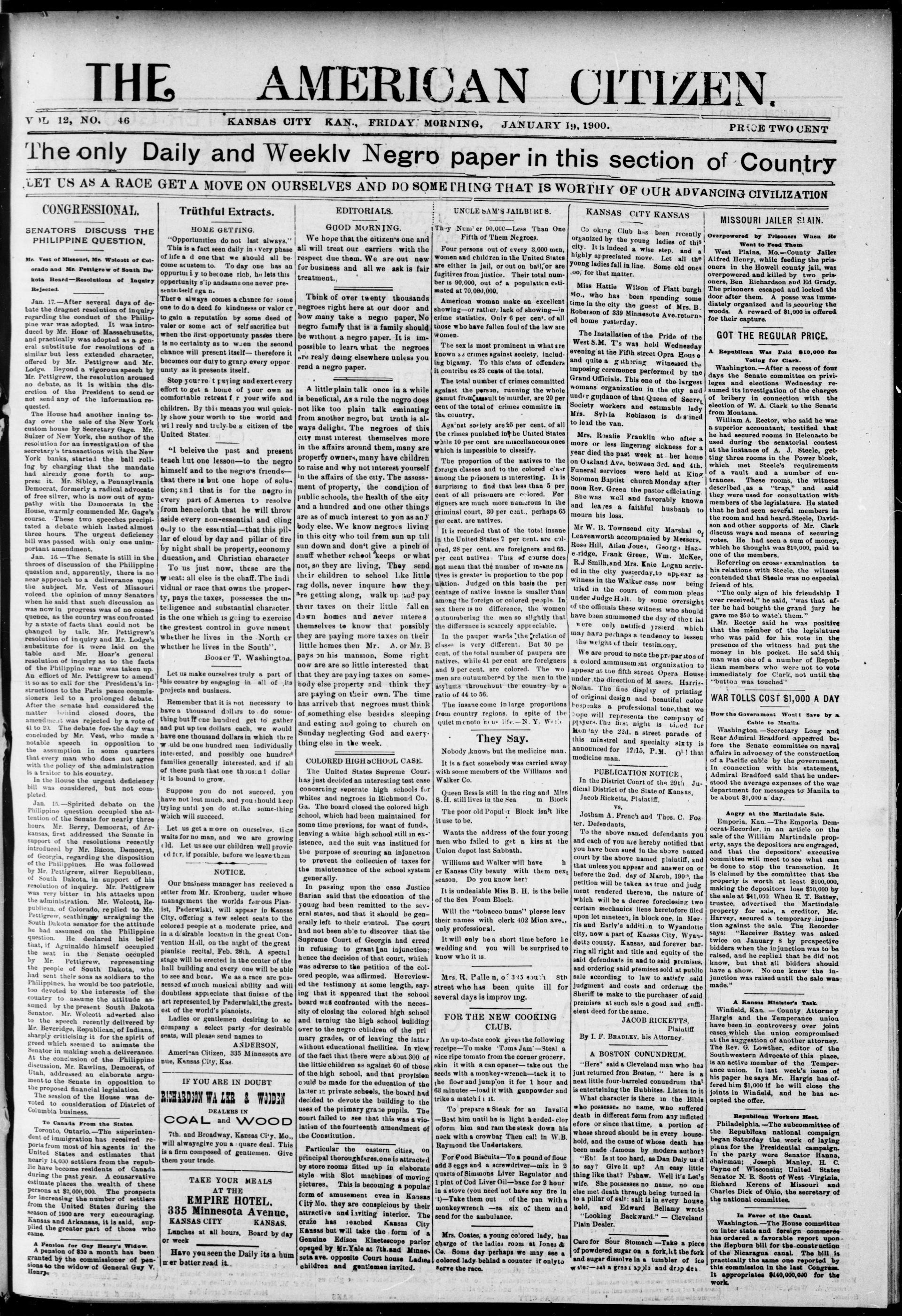
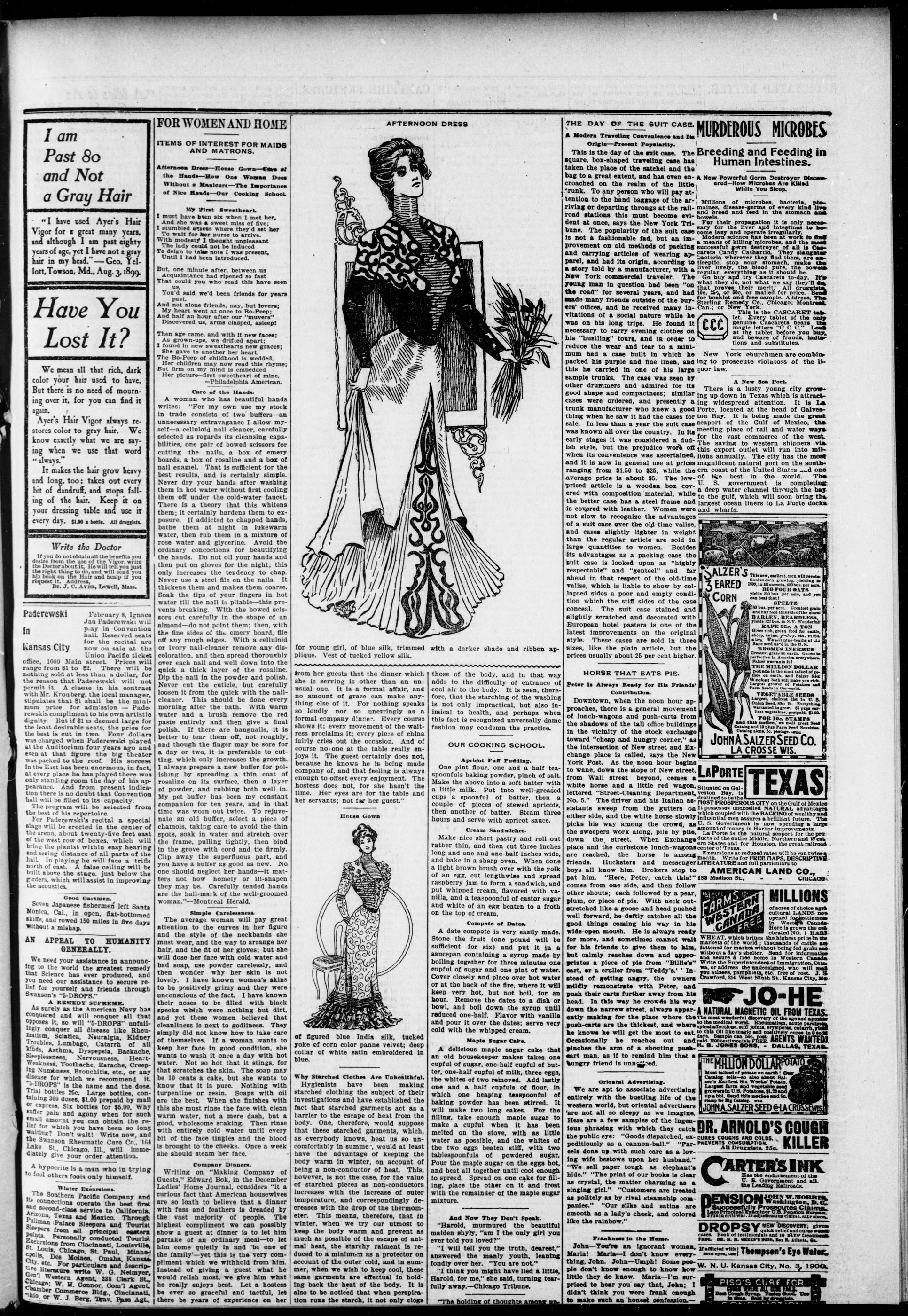
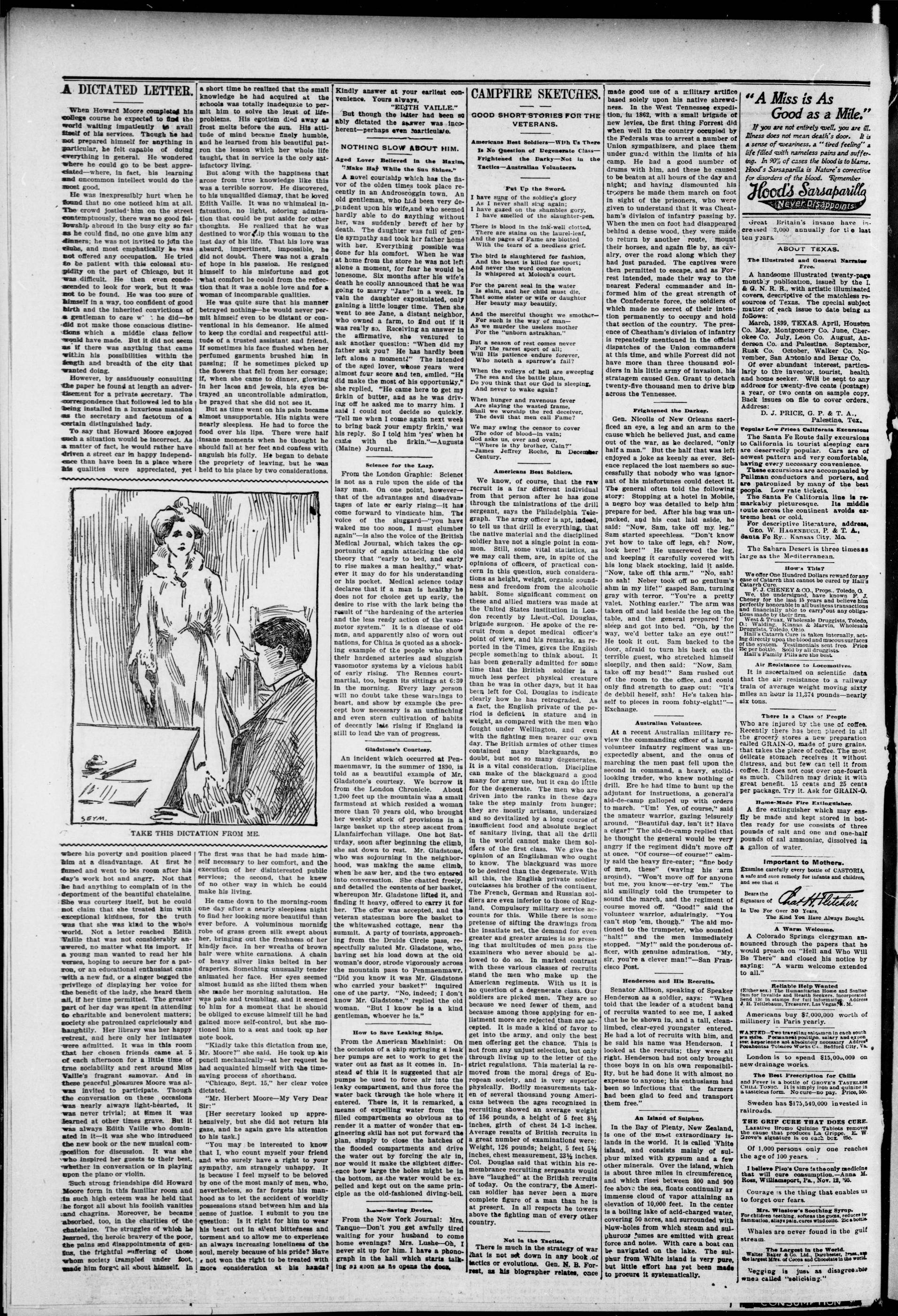
Page text (machine-generated)
AMERICAN CITIZEN.
The only Daily and Weeklv Negro paper in this section of Country
LET US AS A RACE GET A MOVE ON OURSELVES AND DO SOMETHING THAT IS WORTHY OF OUR ADVANCING CIVILIZATION
VOL 12, NO. 46
CONGRESSIONAL
SENATORS DISCUSS THE PHILIPPINE QUESTION.
Mr. Vest of Missouri, Mr. Wolecott of Colorado and Mr. Pettigrew of South Dakota Heard—Resolutions of Inquiry Rejected.
Jan. 17.—After several days of debate the dragnet resolution of inquiry regarding the conduct of the Philippine war was adopted. It was introduced by Mr. Hoar of Massachusetts, and practically was adopted as a general substitute for resolutions of a similar but less extended character, offered by Mr. Pettigrew and Mr. Lodge. Beyond a vigorous speech by Mr. Pettigrew, the resolution aroused no debate, as it is within the discretion of the President to send or not send any of the information requested.
The House had another inning today over the sale of the New York custom house by Secretary Gage. Mr. Sulzer of New York, the author of the resolution for an investigation of the secretary's transactions with the New York banks, started the ball rolling by charging that the mandate had already gone forth to suppress it. Mr. Sibley, a Pennsylvania Democrat, formerly a radical advocate of free silver, who is now out of sympathy with the Democrats in the House, warmly commended Mr. Gage's course. These two speeches precipitated a debate which lasted almost three hours. The urgent deficiency bill was passed with only one unimportant amendment.
Jan. 16.—The Senate is still in the throes of discussion of the Philippine question and, apparently, there is no near approach to a deliverance upon the subject. Mr. Vest of Missouri voiced the opinion of many Senators when he said that such discussion as was now in progress was of no consequence, as the country was confronted by a state of facts that could not be changed by talk. Mr. Pettigrew's resolution of in quiry and Mr. Lodge's substitute for it were laid on the table and Mr. Hoar's general resolution of inquiry as to the facts of the Philippine war was taken up. An effort of Mr. Pettigrew to amend it so as to call for the President's instructions to the Paris peace commissioners led to a prolonged debate. After the senate had considered the matter behind closed doors, the amendment was rejected by a vote of 41 to 23. The debate for the day was concluded by Mr. Vest, who made a notable speech in opposition to the assumption in some quarters that every man who does not agree with the policy of the administration is a traitor to his country.
In the House the urgent deficiency bill was considered, but not completed.
Jan. 15.—Spirited debate on the Philippine question occupied the attention of the Senate for nearly three hours. Mr. Berry, Democrat, of Arkansas, first addressed the Senate in support of the resolutions recently introduced by Mr. Bacon, Democrat, of Georgia, regarding the disposition of the Philippines. He was followed by Mr. Pettigrew, silver Republican, of South Dakota, in support of his resolution of inquiry. Mr. Pettigrew was very bitter in his attacks upon the administration. Mr. Wolcott, Republican, of Colorado, replied to Mr. Pettigrew, seathing arraigning the South Dakota senator for the attitude he had assumed on the Philippine question. He declared his belief that, if Aguinaldo himself occupied the seat in the Senate occupied by Mr. Pettigrew, representing the people of South Dakota, who had sent their sons as soldiers to the Philippines, he would be too patriotic, too devoted to the interests of the country to assume the attitude assumed by the present South Dakota Senator. Mr. Wolcott adverted also to the speech recently delivered by Mr. Beveridge, Republican, of Indiana, sharply criticising it for the spirit of greed which seemed to animate the Senator in making such a deliverance. At the conclusion of the Philippine discussion, Mr. Rawlins, Democrat, of Utah, addressed an elaborate argument to the Senate in opposition to the proposed financial legislation.
The session of the House was devoted to consideration of District of Columbia business.
To Canada From the States
10 Canais From the States.
Toronto, Ontario.—The superintendent of immigration has received reports from most of his agents in the United States and estimates that nearly 14,000 settlers from the republic have become residents of Canada during the past year. A conservative estimate places the wealth of these persons at $2,000,000. The prospects for increasing the number of settlers from the United States during the season of 1900 are very encouraging. Kansas and Arkansas, it is said, supplied the greater part of those who came.
A Pension for Guy Henry's Widow.
A pension of $30 a month has been granted by the commissioner of pensions to the widow of General Guy V. Henry.
KANSAS CITY KAN., FRIDAY MORNING, JANUARY 19, 1900.
Truthful Extracts
HOME GETTING
"Opportunities do not last always."
This is a fact seen daily in every phase of life a d one that we should all become acustom to. To day one has an opportunity to become rich, he lets this opportunity sip andsame one never presents itself a gn.
There always comes a chance for some one to do a deed to kindness or valor to gain a reputation by some deed of valer or some act of self sacrifice but when the first opportunity passes there is no certainty as to when the second chance will present itself—therefore it becomes our duty to grasp every opportunity as it presents itself.
Stop youre't paying and exert every effort to get a home of your own as comfortable retreat for your wife and children. By this means you will quickly show your worth to the world and will really and truly be a citizen of the United States.
"I believe the past and present teach but one lesson—to the negro himself and to the negro's friends—that there is but one hope of solution; and that is for the negro in every part of America to resolve from henceforth that he will throw aside every non-essential and cling only to the essential—that this pillar of cloud by day and pillar of fire by night shall be property, economy education, and Christian character
To us just now, these are the wheat: all else is the chaff. The individual or race that owns the property, pays the taxes, possesses the intelligence and substantial character. is the one which is going to exercise the greatest control in government whether he lives in the North or whether he lives in the South".
Booser T. Washington.
Let us make ourselves truly a part of this country by engaging in all of its projects and business.
Remember that it is not necessary to have a thousand dollars to do something but if one hundred get to gather and put up ten dollars each, we would have one thousand dollars in which there would be one hundred men individually interested, and possibly one hundred families generally interested, and if all of these push that one thousand dollar it is bound to grow.
Suppose you do not succeed, you have not lost much, and you should keep trying until you do stike something which will succeed.
Let us get a move on ourselves, time waits for no man, and we are growing old. Let us see our children well provided for, if possible, before we leave them
NOTICE.
Our business manager has recieved a letter from Mr. Kronberg, under whose management the worlds famous Pianist, Paderwiski, will appear in Kansas City, offering a few select seats to the colored people at a moderate price, and in a desirable location in the great Convention Hall, on the night of the great pianiste recital, Feb. 28th. A special stage will be erected in the center of the hall building and every one will be able to see and hear. We as a race are possessed of much musical ability and will doubtless appreciate that finishe of the art represented by Paderwiski, the greatest of the world's pianists. Ladies or gentlemen desiring to ac company a select party for desirable seats, will please send names to ANDERSON.
American Citizen, 335 Minnesota ave
nue, Kansas City, Kas
IF YOU ARE IN DOUBT
RICHARDSON WA LER & WOJDEN
COAL and WOOD
7th. and Broadway, Kansas City. Mo. will alwaysgive you a square deal. This is a firm composed of gentlemen. Give them your trade.
TAKE YOUR MEALS
AT THE
EMPIRE HOTEL.
335 Minnesota Avenue,
KANSAS CITY KANSAS.
Lunches at all hours. Board by day or week
Have you seen the Daily its a hummer better read it.
Mary, Martha Custard Ave
EDITORIALS.
GOOD MORNING
We hope that the citizen's one and all will treat our carriers with the respect due them. We are out new for business and all we ask is fair treatment.
Think of over twenty thousands negroes right here at our door and how many take a negro paper. No negro family that is a family should be without a negro paper. It is impossible to learn what the negroes are really doing elsewhere unless you read a negro paper.
A little plain talk once in a while is beneficial, As a rule the negro does not like too plain talk eminating from another negro, but truth is always delight. The negroes of this city must interest themselves more in the affairs around them, many are property owners, many have children to raise and why not interest yourself in the affairs of the city. The assessment of property, the condition of public schools, the health of the city and a hundred and one other things are as of much interest to yon as any body else. We know negroes living in this city who toil from sun up till sun down and don't give a pinch of snuff whether school keeps or what not, so they are living. They send their children to school like little rag dolls, never inquire how they are getting along, walk up and pay their taxes on their little fall on down homes and never interest themselves to know that possibly they are paying more taxes on their little homes then Mr. A. or Mr. B pays on his mansion. Some right now are are so little interested that that they are paying taxes on somebody else property and think they are paying on their own. The time has arrived that negroes must think of something else besides sleeping and eating and going to church on Sunday neglecting God and everything else in the week.
COLORED HIGH SCHOOL CASE.
The United States Supreme Court has just decided an interesting test case concerning separate high schools for whites and negroes in Richmond Co. Ga. The board closed the colored high school, which had been maintained for some time previous, for want of funds, leaving a white high school still in existence, and the suit was instituted for the purpose of securing an injunction to prevent the collection of taxes for the maintenance of the school system generally.
In passing upon the case Justice Barian said that the education of the young had been remitted to the several states, and that it should be generally left to their control. The court had not been able to discover that the Supreme Court of Georgia had erred in refusing to grant Lan injunction; hence the decision of that court, which was adverse to the petition of the colored people, was affirmed. Hereviewed the testimony at some length, saying that it appeared that the school board was confronted with the necessity of closing the colored high school and turning the high school building over to the negro children of the primary grades, or of leaving the latter without educational facilities. In view of the fact that there were about 300 of the little children as against 60 of those of the high school, and that provision could be made for the education of the latter in private schools, the board had decided to devote the building to the uses of the primary grade pupils. The court failed to see that this was a violation of the fourteenth amendment of the Constitution.
Particular the eastern cities, on principal thoroughfares, one is attracted by store rooms fitted up in elaborate style with Slot machines of moving pictures. This is becoming a popular form of amusement even in Kansas City Mo. they are conspicuous by their attractive and lavishing interior. The craze has reached Kansas City Kansas but will take the form of a Genuine Edison Kinetescope parlor opened by Mr.Yale at 7th. and Minnesota ave. opposite Court house Ladies children and gentlemen invited.
UNCLE SAM'S JAILBURS.
They Number 90,000—Less Than One Fifth of Them Negroes.
Four persons out of every 3,000 men, women and children in the United States are either in jail, or out on bail, or are fugitives from justice. Their total number is 90,000, out of a population estimated at 70,000,000.
American woman make an excellent showing—or rather, lack of showing—in crime statistics. Only 6 per cent. of all those who have fallen foul of the law are women.
The sex is most prominent in what are known as crimes against society, including bigamy. To this class of offenders it contribues 25 ceats of the total.
The total number of crimes committed against the person, running the whole gamut from assault to murder, are 20 per cent of the total of crimes committee in the country.
Against society are 25 per cent. of all the crimes punished in the United States while 10 per cent are miscellaneous ones which is impossible to classify.
The proportion of the natives to the foreign classes and to the colored class among the prisoners is interesting. It is surprising to find that less than 5 per cent of all prisoners are colored. For signers are much more numerous in the criminal court, 30 per cent., perhaps 65 per cent. are natives.
It is recorded that of the total insane in the United States 7 per cent. are colored, 28 per cent. are foreigners and 65 per cent natives. This of course does not mean that the number of insane natives is greater in proportion to the population. Judged on this basis the percentage of native insane is smaller than among the foreign or colored people. In sex there is no difference, the women outnumbering the men so slightly that the difference is scarcely appreciable.
In the pauper wards the inclation of class is very different. But 50 percent, of the total number of paupers are natives, while 41 per cent are foreigners and 9 per cent. are colored. The women are outnumbered by the men in the asylums throughout the country by a ratio of 44 to 56.
The insane come in large proportions from country regions, in spite of the quiet monoto rous life - N. Y. World
They Say.
Nobody knows but the medicine man.
It is a fact somebody was carried away with some members of the Williams and Walker Co.
Queen Bess is still in the ring and Miss S.H. still lives in the Sea m Block
The poor old Populr Block isn't like it use to be.
Wants the address of the four young men who failed to get a kiss at the Union depot last Sabbath.
Williams and Walker will have her Kansas City beauty with them next season. Do you know her?
It is undeaiable Miss B. H. is the belle of the Sea Foam Block.
Will the "tobacco bums" please leave their names with clerk 402 Minn ave., only professional.
It will only be a short time before he wedding and you will be surprised to know who it is.
Mrs. R. Palle n, of 345 south 8th street who has been quite ill for several days is improving.
FOR THE NEW COOKING CLUB.
An up-to-date cook gives the following recipe—To make 'Toms Jam'—Steal a nice ripe tomato from the corner grocery, skin it with a can opener—take out the seeds with a monkey-wrench—tack it to the floor and jump on it for 1 hour and 63 minutes—load it with gunpowder and trike a match it.
To prepare a Steak for an Invalid—Bast him until he is light headed-clor oform him and ram the steak down his neck with a crowbar Then call in W.B. Raymond the Undertakers.
For Good Biscuit's—To a pound of flour add 3 eggs and a screwdriver—mix in 2 quarts of Simmons Liver Regulator and 1 pint of Cod Liver Oil—bake for 2 hour in a stove (you need not have any fire in t)—Take them out of the pan with a monkeywrench—sa six of them and send for the ambulance.
Mrs. Coates, a young colored lady, has charge of the ladies room at Jones & Co. Some day perhaps we may see a colored lady behind a counter if only to serve the race.
KANSAS CITY KANSAS
Go oking Club has been recently organized by the young ladies of this city. It is indeed a wise step, and a highly appreciated move. Let all the young ladies fall in line. Some old ones, too, for that matter.
Miss Hattie Wilson of Platt burgh Mo., who has been spending some time in the city the guest of Mrs. B. Roberson of 339 Minnesota Ave.returned home yesterday.
The Installation of the Pride of the West S.M. T.'s was held Wednesday evening at the Fifth street Opra House and quite a gathering witnessed the imposing ceremonies performed by the Grand Officials. This one of the largest womans organization in the city and under guidance of that Queen of Secrecy Society workers and estimable lady Mrs. Sylvia Robinson is destined to lead the van.
Mrs. Rosalie Franklin who after a more or less lingering sickness for a year died the past week at her home on Oakland Ave, between 3rd. and 4th. Funeral services were held at King Solomon Baptist church Monday after noon Rev. Green the pastor officiating. She was well and favorably known and leaves a faithful husband to mourn his loss.
Mr W. B. Townsend city Marshal of Leavenworth accompanied by Messers. Rose Hill, Alian Joues, George Haze-ridge, Frank Greer, Wm. McKee, RJ Smilh, and Mrs. Kate Logan arrived in the city yesterday, to appear as witness in the Walker case now being tried in the court of common pleas under Judge Holt. by some oversight of the officials these witness who should have been summoned the day of the trial were only notified yrserd which may have perhaps a tendency to lessen the weight of their testimony.
We are proud to note the preparation of a color armuseum organization to appear at the fifth street Opera House under the direction of M ssers. Harris-Notan. The fine display of printing of original design and beautiful color bespeaks a professional tone, that we hope will represent the company of priers. The first night is billed for Monday the 22d. a street parade of this minstrel and specialty sixty is announced for 12:15, P.M. O!! that medicine man.
PUBLICATION NOTICE,
In the District Court of the 29th Judicial District of the State of Kansas,
Jacob Ricketts, Plaintiff,
vs.
Jotham A. French and Thos. C. Foster, Defendants.
To the above named defendants you and each of you are hereby notified that you have been sued in the above named court by the above named plaintiff, and that unless you appear and answer on or before the 2nd. day of March, 100', the petition will be taken at true and judgment rendered thereon, the nature of which will be a decree foreclosing two certain mechanics liens heretofore died upon lot nineteen, in block one, in Morris and Early's addition to Wyandotte city, now a part of Kansas City, Wyandotte county, Kansas, and forever barring all right and title and equity of the said defendants in and to said premises, and ordering said premises sold at public sale according to law to satisfy said judgment and costs and ordering the Sheriff to make to the purchaser of said premises at such sale a good and sufficient deed for the same.
JACOB RICKETTS.
By I. F. BRADLEY, his Attorney.
A BOSTON CONUNDRUM
"Here" said a Cleveland man who has just returned from Boston, "here is a neat little four-barreled conundrum that is entertaining the Bubbites. Listen to it. What character is there in the Bible who possesses, no name, who suffered death in different form from any inflictedefore or since that time, a portion of whose shroud should be in every household, and the cause of whose death has been made famous by modern author? "Eh! Is it too hard, as Dana Dai us d to say? Give it up? An easy little thing like that? Pshaw. Well it's Lot's wife. She possesses no name, no one else met death through being turned in to a pillar of salt: salt is in every house hold, and Edward Bellamy wrote "Looking Backward." — Cleveland Plain Dealer.
Cure for Sour Stomach —Take a piece of powdered sugar on a fork,let the fork and sugar dissolve in a tumbler of ice water;—set a great apple and drop de
PRICE TWO CENT
MISSOURI JAILER SLAIN.
Overpowered by Prisoners When He
Went to Feed Them.
West Plains, Mo.—County Jailer Alfred Henry, while feeding the prisoners in the Howell county jail, was overpowered and killed by two prisoners, Ben Richardson and Ed Grady. The prisoners escaped and locked the door after them. A posse was immediately organized and is scouring the woods. A reward of $1,000 is offered for their capture.
GOT THE REGULAR PRICE.
A Republican Was Paid $10,000 for Voting for Clark.
Washington. After a recess of four days the Senate committee on privileges and elections Wednesday resumed its investigation of the charges of bribery in connection with the election of W. A. Clark to the Senate from Montana.
William A. Rector, who said he was a superior accountant, testified that he had secured rooms in Helena to be used during the senatorial contest at the instance of A. J. Steele, getting three rooms in the Power block, which met Steele's requirements of a vault and a number of entrances. These rooms, the witness described as a "trap," and said they were used for consultation with members of the legislature. He stated that he had seen several members in the room and had heard Steele, Davidson and other supports of Mr. Clark discuss ways and means of securing votes. He had seen a sum of money, which he thought was $10,000, paid to one of the members.
Referring on cross-examination to his relations with Steele, the witness contended that Steele was no especial friend of his.
"The only sign of his friendship I ever received," he said, "was that after he had bought the grand jury he gave me $50 to watch them."
Mr. Rector said he was positive that the member of the legislature who was paid for his vote in the presence of the witness had put the money in his pocket. He said this man was one of a number of Republican members who were not to vote immediately for Clark, not until the "buttoa was touched"
WAR TOLLS COST $1,000 A DAY
How the Government Would Save by a Cable to Manila
Washington.-Secretary Long and Rear Admiral Bradford appeared before the Senate committee on naval affairs in advocacy of the construction of a Pacific cable' by the government.
In connection with his statement,
Admiral Bradford said that he understood the average expenses of the war department for messages to Manila to be about $1,000 a day.
Angry at the Martindale Sale.
Emporia, Kan. —The Emporia Democrat-Recorder, in an article on the sale of the William Martindale property, says the depositors are engraged, and that the depositors' executive committee will meet to see what can be done to stop the transaction. It is claimed by the committee that the property is worth at least $100,000, making the depositors lose $50,000 by the sale at $41,000. When R. T. Battey, trustee, advertised the Martindale property for sale, a creditor, Mr. Harvey, secured a temporary injunction against the sale. The Recorder says: "Receiver Battey was asked twice on January 8 by prospective bidders when the injunction was to be raised, and he replied that he did not know, but that all bidders should have a show. No one knew the injunction was raised until the sale was made."
A Kansas Minister's Task
Winfield, Kan. — County Attorney Hargis and the Temperance union have been in controversy over joint cases which the union compromised at the suggestion of another attorney. The Rev. G. Lowther, editor of the Southwestern Advocate of this place, is an active member of the Temperance union. In last week's issue of his paper he says Mr. Hargis has offered him $1,000 if he will close the joints in Winfield, and he has accepted the offer.
Republican Workers Meat.
Philadelphia.—The subcommittee of the Republican national campaign began Saturday the work of laying plans for the Presidential campaign. In the party were Senator Hanna, chairman; Joseph Manley, H. C. Payne of Wisconsin; United States Senator N. B. Scott of West Virginia, Richard Kerens of Missouri and Charles Dick of Ohio, the secretary of the national committee.
In Favor of the Canal
Washington.—The House committee on inter state and foreign commerce has ordered a favorable report upon the Hepburn bill for the construction of the Nicaragua canal. The bill is practically the same one reported by this commission in the last Congress. It appropriates $140,000,000 for the
MERICAN CITIZEN PUBLISHING
AND PRINTING CO.
Daily and Weekly 235 Minnesota Ave.
KANSAS CITY KANSAS
TERMS OF SUBSCRIPTION
Daily delivered by carrierper week. 10c.
Weekly one year..... $1 50
Entered at the postoffice at Kansas City
Kans as second class matter.
LET US.
Let us then be up and doing,
With a heart for any fate.
Throw away the rag you are chewing
Either fish or cut the bait.
—Chicago Tribune.
Everybody should subscribe for the AMERICAN CITIZEN, daily and weekly.
The American Citizen.
Of
KANSAS CITY, KANSAS
AND
KANSAS CITY, MO.
Church Directory.
BAPIST CHURCHES.
African 3914 East 15 h Street
Greenwood, 2005 Maderson Avenue,
Highland Avenue, 1119 Highland Ave.
Macedonian
Mission § 216 East 21th Street.
Missionary, 2005 Madison Avenue.
Mt. Calvary, 15 N.E. Cor. Norton Ave.
Mt. Gay, 2100 Wyoming Avenue.
Mt. Moriah, 933 Bluff Street.
Mt. Olive, Villa, S. E. cor. Garnett.
Mt. Zion, 3rd, N.W. Cor. Gillis.
Mt. Zion, 908 Hickory Avenue.
Mt. Zion, Primitive, 2815 Garnett st.
Pilgrim, 705 Charlott street.
Pilgrim, Charlott between 6th and 7th
Pleasant Green, East Forest.
Round Top, Norton near 28th street.
St. James, 1411 East 18th street.
St. James Chapel, 518 High street.
St. Marks, 1019 East 4th street.
St. Pauls, 510 East 4th street.
Second Baptist, Charlott, cor. 10th.
Vine Street, 1825 Vine street.
Campbellite, 21st between Summit and Madison.
St. Augustine Mission, 1025 Troost ave
METHODIST EPISCOFAL.
METHODIST BAPTIST
Asbury Chapel, 1620 Cherry street
Burns, 11th S. W. Cor, Highland ave.
Clark's Chapel, 819 S. W. Boulevard.
Westport W. Prospect Place Cor, 23rd.
King Solomon Mission 4th and Locust
Colored Schools.
Attacks 2108 East 18th street.
Bruce 3914 East 15th street.
Douglass 27th N. E. Cor. N. Prospect Place.
Garrison Forest S. W Cor. 4th street,
Lincoln School 11th N W. Cor Campbell street.
Lincoln High School 816 East 11th st.
Page Rochester N.E. Cor. Prospect Avenue.
Penn 4241 Shaunne.
Business Directory.
J. A. Wilson Jeweller 1616 W. 9th st. Chandler's Barber shop, Samuel Chandler Prop. S. LClewens Mgr. 112 East 6th street.
Restaurant Mrs Amus Prop. 114 East 6th street.
Field Barber Shop 102 East 6:h street
Miller's Barber Shop 118 East 6th sq
Midland Barber Shop Harsey Parsons
Proprietor 115 East 6th street.
Pace Barber Shop Oarth & Warfield,
Proprietors 550 Grand Avenue.
O' Bannon' Barber Shop W.T. O Bannon
Proprietor 560 Grand Avenue.
Proprietor 819 Independence avenue.
Langston 'Barber Shop 718 East 8th st
Walter's Barber Shop 806 East 12th st
Cowden,s Barber Shop 704 East 12th st
Restaurant J.W Gordon Prop. 554
Grand avenue.
Restaurant H Powel Proprietor 572
Grand avenue.
Restaurant Andrew Clark Proprietor
723 Independence ave.
Saratoga Cafe L Mason Proprietor
805 Independence ave.
800 Independence
Chicago Cafe H Compton Proprietor
706 Independence avenue.
Maupin's Barber Shop 1332 E 18th st.
Brown's Barber Shop 1329 E 18th st.
Berry's Barber Shop 1432 E. 18th st
Grocer, George Grear, Prop. 1211 E.
18th st.
Physicians and Surgeons.
Drs. Shannon and Lambright 1215 E.
18th st.
Dr. J.N. Birch 1339 E. 18th st.
Dr. T.C. Unthank 1233 Independence
Ave.
Dr. L.J.Holly 1112 Campbell st.
Rising Sun J.F. Cole, Editor, L. W
Wood. Manager 117 W. 6th st.
Coal Yard, Lock
Main st.
Grecery, A. Wekb, Prop. 19th and
Holmes.
KANSAS CITY, KANSAS.
Enterprises.
A.C.L. Coal Co. Main Office 402 Minn.
Ave. E.F. Henderson, Mgr.
D. W. White Furniturestore, 420 Minn.
Ave.
J. W. Jones Grocery 400. Oakland Ave.
M. Gordon Department store 1605 N.
0th st.
C. E. Cannon Butcher 1609 N. 10 st.
Clark and Lee Junk Store, 1180 3rd st.
Hotels
The Empire House 335 Minnesota Ave.
Dyson House 440 Minnesota Ave.
Jamison House 417 Minnesota Ave.
Restaurants.
J. W. Johnson's 6th and State.
Mrs. Hall 507 Minn. Ave.
Mrs. Sarah Thurston 1414 5th st.
Mc Gees 448 Minn. Ave.
Mrs. R. P. Tyler 10 Joy st.
E. Stoakes 1510 N. 3rd st.
BARBERS
J. T. Roberts & Tucker, 507 Minnesota
stcca avenue.
J, Gross, 412 Minnesota avenue.
G. McClellan, 613 Minnesota ave.
M.T. Comer, 608 Minnesota ave.
Robt. Keith, 315 Minnesota ave.
M. Pattison, 1603 north 3rd. st.
SHOEMAKERS.
Lon McAdams, 348 Minnesota ave.
D. W. Wynne, 369 Minnesota ave.
Lewis Blanchard, North 6.h., State Line.
Wilson, 5th. st. beween Nebraska and State.
HALLS.
M & O., 1306 north 8.h. street.
ons o. Protection, State and 6th.
DRUGS.
Wyandotte Drug Store, 1512 north 5th. street.
S. H. thompson, 151 north 5th, st.
Harvey, 440 Minnesota ave.
G. H Brown, 1010 Freeman ave.
Jordan, 610 Minnesota ave.
ARTISTS.
O. J. Brooks, 70, New York Life
Building.
TEACHERS OF FRENCH AND ELOCUTION.
Arthur A. Anderson, 541 State Ave.
In the District Court of Wyandotte
County, Kansas.
The Bellows Falls Savings Bank. Paint
tiff, vs. Willie H. Consaul, Effle Consaul,
Fred A. Miller & Company, New England
Loan & Trust Company, Otto T. Bannard,
Receiver of the New England
Loan & Trust Company, the Real Estate
Trust Company, of Philadelphia, Penn.
Trustee, The Quivira Investment
Company; John, T. Parks and Eleanor T.
Parks, Minors, Wm L Priestly, Guardian
of John T. Parks and Eleanor T.
Parks, Minors.
State of Kansas to Willie H. Consaul,
Effle Consaul, Fred A. Miller & Co., New
England Loan & Trust Company, Otto
T. Bannard, Receiver of New
England
Loan and Trust Co., The Real Estate
Trust Company of Philadelphia, Penn.,
Trustee, John T. Parks and Eleanor
o T. Parks, minors.
You are hereby notified that the plaintiff above named has brought suit against you, and filed his petition against you together with other defendants in the entitled court, and that you must answer the petition aforesaid filed against you, on or before the 16th day of February, 1900, or said petition will be taken as true and judgment accordingly rendered against you as follows:
First. A personal judgment against Willie H. Consal and Effie Consal upon the note and mortgage set out in plaintiff's petition, for $4,000 with interest at the rate of 6 per cent. per annum from the first day of August, 1896.
Second—7 that the mortgage set out in plaintiff's petition be declared a lien upon the south half of the following described tract of land in Wyandotte County, Ks., to-wit:
Commencing at the southeast corner of lot "A" in Irving Place, an addition to Wyandotte City, now Kansas City, Kansas, as shown by the record plat thereof, and running thence west one hundred and twenty (120) feet, thence north ninety seven (97) feet, thence east one hundred and twenty feet, thence south ninety-seven feet to the place of beginning. The same being forty-eight and one half (48½) feet by one hundred and twenty (120) feet in the southeast corner of said lot "A," of Irving Place, for the amount of the aforesaid judgment, prior and superior to the lien or interest of any on the above named defendants, and that the mortgage set out on plaintiff's petition be foreclosed, and the aforesaid lands and tenements be sold without appraisement, according to law, and the proceeds of said sale be brought into court and applied, first, to the payment of the costs of said sale and this suit. Second, the paym out of the aforesaid judgment, together with interest thereon, and the residue, if any, be held subject to the further order of said Court in the premises, and that from and after said sale and the confirmation thereof, all the above named defendants and each of them, or any person or persons claiming under, by or through them, or any of them, be forever barred and foreclosed from any right, title or interest in or to the aforesaid premises, or any part thereof.
JOHN C. HALL,
Attorney for Plaintiff.
When wanting something to eat and a place to rest your weary bones call at the Empire House $35 Minn.
Perfumes, Soaps, Stationary, Hot Sodas, Everything to be found in first class house. See our Holiday display. Northeast Corner Sixth St. and Minnesota Ave.
elephone West 122. KANSAS CITY, KANSAS
FRANK GARNER
welery' and Loan Office
Avenne. Branch Store. 631 B
Watch and Jewelry Work Done and Guaranteed,
dmonds, Watches and all kinds of Uredeeened F
iolins, &c.
Big Machines, Revo-
Pocket Knives, Catridges, Gun
—ALSO—
ammings for dll String Instruments at the
ED TRADE SOLICITED. Mention American C
THE AMERICAN
Restaurant and Boarding Hour
. P. TYLER, --
he best 10c Meals in the city. She also
Board and Lodging $3, and $3,50 per week
are nice and clean. She is a fine cook
Street, Kansas
EAGERS
m Drug St
Jewelery and Loan Office
536 Minnesota Avenne. Branch Store. 631 Kansas Avenue.
Watch and Jewelry Work Done and Guaranteed.
Bargains in Diamonds, Watches and all kinds of Uredeeued Pledges also Guitars, Mandolins, Violins, &c.
Sewing Machines, Revolvers,
Guns, Pocket Knives, Catridges, Gun Shells;
ALSO
Strings and Trimmings for dll String Instruments at the Lowest Pricen.
COLORED TRADE SOLICITED. Mention American Citizen.
THE AMERICAN
Restaurant and Boarding House
MRS. R. P. TYLER, -- PKOP
gaurantees the best 10c Meals in the city. She also boards by day or week. Board and Lodging $3, and $3,50 per week. Her bed and rooms are nice and clean. She is a fine cook a l a No. 1. House Keeper
No. 10 Joy Street, Kansas City Kan
MINNESOTA AVENUE
DEALER IN,
DRUGS, MEDICINES, CHEMICAL
et Soaps, Brushes, Combs, Et
ERY AND FANCY TOILET ART
B. RAYMO
DRUGS, MEDICINES, CHEMICALS, Fine Toilet Soaps, Brushes, Combs, Etc., PERFUMERY AND FANCY TOILFT ARTICLES.
W. B. RAYMOND.
W. B. RAYMOND.
Manufacturer of and Wholesale dealer in
RTAKERS * SUPPLIES
MARRIAGES FOR ALL PURPOSES AT ALL HOURS
FOR THE CONVEYANCE OF THE SICK AND
Rooms, 431 Minnesota ave. Telephone W
factory Cor st St., and Riverview Ave.
CITY.
GO TO THE
AT JUNK SH
Holesale and Retail
Hickory Street,
Kansas
IRON YARDS CORNER 8th. AND HICKORY
Rags, Bottles and M
scrap iron, rags, bottles and metals. Who
Here's the place where you can get correct we
SAM'L. D.
Street.
UNDERTAKERS * SUPPLIES
FIRST-CLASS CARRIAGES FOR ALL PURPOSES AT ALL HOURS.
AMBULANCE FOR THE CONVEYANCE OF THE SICK AND WOUNDED
Undertaking Rooms, 431 Minnesota ave. Telephone West 32.
Factory Cor st St., and Riverview Ave. Telephone 26
KANSAS CITY. KANSAS.
GREAT JUNK SHOP.
Wholesale and Retail.
Office 811 Hckory Street, Kansas City, Mo.
IRON YARDS CORNER 8th. AND HICKORY.
Iron, Kags, Bottles and Metals.
Cash paid for scrap iron, rags, bottles and metals. Wholesale and Reta
dealer in junk. Here's the place where you can get correct weight and square
dealing.
SAM'L. DIGGS.
American Citiz Dailly and Weekly
The only Ice Cream Parlors in the two Kansas Cities where you can get the BestIce Cream Soda, and Ice Creams, Fine Lunch, Pies, Cakes AND Confectionaries
Special attention paid to Churches, Lodges and parties.
Ice Cream, wholesale, 75 to 90 cts. per gallon. Don't fail to give us a call. Corner 6th, and State streets,
KANSAS CITY KANS
Jewelery
536 Minnesota Avenue.
Watch a
Barrains in Diamonds,
Rrs. Mandoline, Violins, &
Sewing M.
Guns, Pocket
strings and Trimming
COLORED TRA
THE
Restaurant
MRS. R. P.
gaurantees the best
day or week. Board a
nd and rooms are nice
House Keeper
No. 10 Joy Street
E.
Gem
MIN.
DRUGS
Fine Toilet Soil
PERFUMERY
W. B.
Manu
UNDERTA
FIRST-CLASS CARRIAGE
AMBULANCE FOR THE
Undertaking Rooms,
Factory
KANSAS CITY.
GREAT
Whole
Office 811 H ekory S
IRON, Kag
Cash paid for scrap
dealer in junk. Here's
dealing.
811, Hickory Street. Ame
READ THE
Kansas City, Mo.
WINTER GOODS MUST GO.
We intend to smash the prices for three days and see how much we can sell.
A. C. L. COAL CO.
The Best Goods, the Quickest Sales, the Smallest Profits and the promptest deliveries.
GET THEIR PRICES ON
COAL, WOOD, TEED, FLOUR, and BUILDIN
STONE,
Wholesale and Retail. Office 402, Minnesota Ave. Tel. 152 West.
Yard and Storage 917 and 919 North 3rd. St.
Ladies Wool Hose,
9c,
Men's 50c Fleeced Underwear.
37 1-2c.
Boys' $3.00 Suits,
$1:00
Boys' Winter Caps,
17c,
Beauty Rings, 10et.
Bottles Perfumes,
8c.
THE SUNFL BENNET 435, MINNEOTA AVE.
A. C. L. O.
- IS HEADQUARTER
THE CHEAPEST
"The Best Goods, the Quickest
and the priciest"
GET THE
COAL, WOOD, FEED,
S
Wholesale and Retail. Office 402
Yard and Storage 917 and 919 No
SPRANGLE & RICHARDSON,
COAL, WOOD AND ICE.
All orders filled promptly. Patronage solicited. No 929 Independence ave.
KANSAS CITY. MO
BUHLINGOLON ROUTE.
UNION
PACIFIC
THE
OVERLAND
BRUTE
WORLD'S PICTORIAL LINE.
SHORT LINEA CROSS THE COUNTRY.
The Union Pacific 'The Original Overland Route' always was, and is to-day, the shortest and best Line to the west. Two splendid fast trains leave Kansas City daily over this old established line. No change of cars between Kansas City and Denver, Ogden or San Francisco. All trains solidly vestibulied and fully equipped with latest improved Reclining Chair Cars free and Pullman Palace sleeping cars. Meals served in Pullman Palace dining cars on the restaurant plan at prices most reasonable. All cars lighted with the celebrated Pintsch Lil, it only line running two trains without change from KansasCity to Denver Low excursion rates on sale to Colorado-Utah Idaho, Oregon, Washington and California. Don't complete your arragements for a trip west until you have learned all about special inducements and attractions offered by the Union Pacific. For full information in regard to low rates time, etc., call on or address J. B. FRAWLEY
Gt. Agt., Uilda P. pacific, 1000 Main
eg., Kirkland City. M o
Stringer Lodge No. 14 meets on the
14. and 3rd. Thu sunday nights of each
month, at the M. & O. hall, at eight
o'clock p. m
N. OSCAR BRYANT, C. C.
MOSES BALARD, K. of R. & S
Lincoln Lodge No. 9, o K. P., meets
on the second and fourth Monday night
at their hall, 1734 Grand avenue, at 8
o'clock p. m. Visiting brethren welcome.
JOHN S CANNON,
J. W. WHEELER. C C.
Queen Ester Court No. 43. I. O. I Kansas City Mo., meets at their Hali no 9th. and Main streets at 2 o'clock p.m., on the 1st and 3rd Mondays of each month. Mrs. Julia Smith M. B R Davies Chron.
MASONIC LODGES
Golden Leaf No. 6 Regular sessions first and third Tuesday of each Month at 2 P. M. Mrs: Annie Madison M. A. M. Mrs. Bertha Carroll See.
Boys' 25 cents Underwear,
20c.
Men's 50 cent Underwear,
35c.
Ladies' Trimmel Hats, $1 to $1.00
kinds, choice
75c.
Men's Winter Caps
25c
O N T Thread,
4c
Ladies Heavy Shoes,
$1.00
POWER STORE,
T & CO.,
GOAL CO.,
ARTERS FOR—
BEST PRICES
t Sales, the Smallest Profits
aptest deliveries.
OUR PRICES ON
FLOUR, and BUILDIN
TONE,
Minnesota Ave. Tel. 152 West.
rth 3rd. St.
E F. HENDERSON Manager.
Finest Barber Shop in the City,
Hair Cutting, 25 cents. Baths, 15 cents,
Shaving, 10 cents.
NEFLY REMODLED BATH ROOMS,
PORCELAIN TUBS.
GEO. McClelland
612 Minnesota Ave.,
KANSAS CITY, KAS
Lewis Blandchard
No. 6, State Line, K.C.K.
Does all kinds of Boot and Shoe work. He does first class hand work, and also has one of the very latest and best Shoemaker's machine and guarantees the best and the cheapest work in the quickest time. Give him a trial and see for you elf.
Secure Tickets
...VIA TRE...
Chicago, Milwaukee &St. Paul Ry AND YOU GET.... Sleepers. & Ghair Cars
CH1CAGO
and all intermediate points The shortest,
quickest and bine tine to Chilocothe, Otumwa, Cedar Rapids, Dubque, and La Crosse and Cedar Rapids, Rockford and Freeport:
...Passenger Station at...
22nd St. and Grand Ave.
Take Westport Cable.
City Ticket Office, 915 Main street,
Ridge Building.
A. B. BRIDGES Gen'l. Southwester Agent
F. J. LERCH Passenger Agent.
Office 915Main St. Kansas Citv
S. M, T. Gilbert Temple, No. 97.
Meets at 6th and Charlott streets the
1st and 3rd Saturdays of each month
at 1:30 p. m.
MRS. A. THATCHER, M. W
MRS. L. COLEMAN, V. P.
MISS O. THATCHER, See'y
Lilly of the Valley Tabernacle No. 56 meets at 6th and Charlott streets every 1st and 3rd Friday each month
M. E. BROWN C. P.
MARY McEARLY, V. P.
A. McCAMPBELL C. N.
Queen Esther Tabernacle, Independent Order of Knights of Tabor and Daughters of Tabernacle No. 62. Meets every first and third Tuesday nights corner 5th and Main streets, Cusin Ci Mo.
MRS. R. P. TYLER, C. P.
"I have used Ayer's Hair Vigor for a great many years, and although I am past eighty years of age, yet I have not a gray hair in my head." — Geo. Yellott, Towson, Md., Aug. 3, 1899.
We mean all that rich, dark color your hair used to have. But there is no need of mourning over it, for you can find it again.
Ayer's Hair Vigor always restores color to gray hair. We know exactly what we are saying when we use that word "always."
It makes the hair grow heavy and long, too; takes out every bit of dandruff, and stops falling of the hair. Keep it on your dressing table and use it every day. $1.00 a bottle. All drummists.
If you do not obtain the benefits you desire from the use of the Vigor, write the Doctor about it. He will tell you just the right thing to do, and will send you the instructions, and Scalp if you request it. Address, Dr. J. C. AVER, Lowell, Mass.
February 8, Ignace Jan Paderewski will pay in Convention hall Reserved seats for the recital are now on sale at the Pacific ticket
Kansas City
office, 1000 Main street. Prices will range from $1 to $2. There will be nothing sold at less than a dollar, for the reason that Paderewski will not permit it. A clause in his contract with Mr. Kronberg, the local manager, stipulates that $1 shall be the minimum price for admission — Paderewski compliment to his own artistic dignity. But if $1 is deemed large for the least desirable seats, the price for the best is cut in two. Four dollars was charged when Paderewski played at the Auditorium four years ago and even at that figure the big theater was packed to the roof. His success in the East has been enormous, in fact, at every place he has played there was only standing room the day of his appearance. And from present indication there is no doubt that Convention hall will be filled to its capacity.
The program will be selected from the best of his repertoire. For Paderewski's recital a special stage will be erected in the center of the arena, about twenty-five feet east of the west row of boxes, which will bring the pianist within easy hearing and seeing distance of all parts of the hall. In addition, from a north of east. A false ceiling will be built above the stage, just below the girders, which will assist in improving the acoustics.
Good Garamen
Seven Japanese fishermen left Santa Monica, Cal., in open, flat-bottomed skiffs, and rowed 150 miles in five days without a mishap.
AN APPEAL TO HUMANITY
GENERALLY.
We need your assistance in announcing to the world the greatest remedy that Science has ever produced, and you need our assistance to secure relief for yourself and friends through Swanson's "5-DROPS."
A REMEDY SUPREME.
REMEDY SUPEMRE.
As surely as the American Navy has conquered and will conquer all that opposes it, so will "5-DROPS" unfallingly conquer all disease like Rheumatism, Sciatica, Neuralgia, Kidney Troubles, Lumbago, Catarrh of all kills, Asthma, Dyspepsia, Backache, Sleeplessness, Nervousness, Heart-Weakness, Earache, Creeping Numbness, Bronchitis, etc., or any disease for which we recommend it. "5-DROPS" is the name and the dose. Trial bottles 25c. Large bottles, containing 300 doses, $1.00 prepaid by mail or express. Six bottles for $5.00. Why suffer pain and agony when for such small amount you can obtain the relief for which you have been so long waiting? Don't walt! Write now, and the Swanson Rheumatic Cure Co., 164 Lake St., Chicago, Ill., will immediately give your order attention.
A hypocrite is a man who in trying to fool others fails only himself.
Winter Excursions
The Southern Pacific Company and its connections operate the best first and second-class service to California, Arizona, Texas and Mexico. Through Pullman Palace Sleepers and Tourist Sleepers from all principal eastern points. Personally conducted Tourist Excursions from Cincinnati, Louisville, St. Louis, Chicago, St. Paul, Minneapolis, Des Moines, Omaha, Kansas City, etc. For particulars and descriptive literature write W. G. Netmyer, G'Western Agent, 238 Clark St., Chicago; W. H. Connor, Co.'l Agent, Chamber Commerce Bldg., Cincinnati, -ho, or W. J. Berg, Tray, Pass Agt.
FOR WOMEN AND HOME
ITEMS OF INTEREST FOR MAIDS
AND MATRONS.
Afternoon Dress—House Gown—Case of
the Hands—How One Woman Does
Without a Maidcourt—The Importance
of Nice Hands—Our Cooking School
My First Sweetheart
I must have been six when I met her,
And she was a sweet miss of five;
I stumbled across where they'd set her
To wait for her nurse to arrive.
With modesty I thought unpleasant
The lady could not be induced
To deign to take note I was present,
Until I had been introduced.
But, one minute after, between us
Acquaintance had ripened so fast
That you who read this have seen
us.
You'd said we'd been friends for years
past.
And not alone friends, nay, but lovers;
My heart went at once to Bo-Peep;
And half an hour after our "muwers"
Discovered our, arms clasped, asleep!
Then age came, and with it new faces;
As grown-ups, we drifted apart;
I found in new sweathearts new graces;
She gave to another her heart.
The Bo-Peep of childhood is wedded,
Her children may now read this rhyme;
But firm on my mind is embedded
Her picture-first sweetheart of mine.
Care of the Hands.
A woman who has beautiful hands writes: "For my own use my stock in trade consists of two buffers—an unnecessary extravagance I allow myself—a celluloid nail cleaner, carefully selected as regards its cleansing capabilities, one pair of bowed scissors for cutting the nails, a box of emery boards, a box of rosaline and a box of nail enamel. That is sufficient for the best results, and is certainly simple. Never dry your hands after washing them in hot water without first cooling them off under the cold-water faucet. There is a theory that this whitens them; it certainly hardens them to exposure. If addicted to chapped hands, bathe them at night in lukewarm water, then rub them in a mixture of rose water and glycerine. Avoid the ordinary concoctions for beautifying the hands. Do not oil your hands and then put on gloves for the night; this only increases the tendency to chap. Never use a steel file on the nails. It thickens them and makes them coarse. Soak the tips of your fingers in hot water till the nail is pliable—this prevents breaking. With the bowed scissors cut carefully in the shape of an almond—do not point them; then, with the fine sides of the emery board, file off any rough edges. With a celluloid or ivory nail-cleaner remove any discoloration, and then spread thoroughly over each nail and well down into the quick a thick layer of the rosaline. Dip the nail in the powder and polish. Never cut the cuticle, but carefully loosen it from the quick with the nail-cleaner. This should be done every morning after the bath. With warm water and a brush remove the red paste entirely and then give a final polish. If there are hangnails, it is better to tear them off, not roughly, and though the finger may be sore for a day or two, it is preferable to cutting, which only increases the growth. I always prepare a new buffer for polishing by spreading a thin coat of rosaline on its surface, then a layer of powder, and rubbing both well in. My pet buffer has been my constant companion for ten years, and in that time was worn out twice. To rejuvenate an old buffer, select a piece of chamois, taking care to avoid the thin spots, soak in water and stretch over the frame, pulling tightly, then bind in the grove with cord and tie firmly. Clip away the superfluous part, and you have a buffer as good as new. No one should neglect her hands—it matters not how homely or ill-shapen they may be. Carefully tended hands are the hall-mark of the well-groomed woman."—Montreal Herald.
Simple Carelessness.
The average woman will pay great attention to the curves in her figure and the style of the neckbands she must wear, and the way to arrange her hair, and the fit of her gloves; but she will dose her face with cold water and bad soap, use powder carelessly, and then wonder why her skin is not lovely. I have known women's skins to be positively grimy and they were unconscious of the fact. I have known their noses to be filled with black specks which were nothing but dirt, and yet these women believed that cleanliness is next to godliness. They simply did not know how to take care of themselves. If a woman wants to keep her face in good condition, she wants to wash it once a day with hot water. Not so hot that it stings, for that scratches the skin. The soap may be 10 cents a cake, but she wants to know that it is pure. Nothing with turpentine or resin. Soaps with oil are the best. When she finishes with this she must rinse the face with clean warm water, not a mere dash, but a good, wholesome scaking. Then rinse with entirely cold water until every bit of the face tingles and the blood is brought to the cheeks. Once a week she should steam her face.
Company Dinners.
Writing on "Making Company of Guests," Edward Bok, in the December Ladies' Home Journal, considers "it a curious fact that American housewives are so loath to believe that a dinner with fuss and feathers is dreaded by the vast majority of people. The highest compliment we can possibly show a guest at dinner is to let him partake of an ordinary meal—to let him come quietly in and 'be one of the family'—yet this is the very compliment which we withhold from him. Instead of giving a guest what he would relish most, we give him what he really enjoys best. Let a hostess be ever so graceful and tactful, let there be years of experience on her
AFTERNOON DRESS
for young girl, of blue silk, trimmed with a darker shade and ribbon aplique. Vest of tucked yellow silk.
from her guests that the dinner which she is serving is other than an unusual one. It is a formal affair, and no amount of grace can make anything else of it. For nothing speaks so loudly nor so unerringly as a formal company dinner. Every course shows it; every movement of the waitress proclaims it; every piece of china fairly cries out the occasion. And of course no one at the table really enjoys it. The guest certainly does not, because he knows he is being made company of, and that feeling is always enough to offset every enjoyment. The hostess does not, for she hasn't the time. Her eyes are for the table and her servants; not for her guest."
those of the body, and in that way adds to the difficulty of entrance of cool air to the body. It is seen, therefore, that the starching of the washing is not only impractical, but also inimical to health, and perhaps when this fact is recognized universally dame fashion may condemn the practice.
OUR COOKING SCHOOL.
Apricot Puff Pudding.
One pint flour, one and a half tea, spoonfuls baking powder, pinch of salt. Make the above into a soft batter with a little milk. Put into well-greased cups a spoonful of batter, then a
House Gown
of figured blue India silk, tucked
yoke of corn color panne velvet; deep
collar of white satin embroidered in
blue.
of figured blue India silk, tucked
yoke of corn color panne velvet; deep
collar of white satin embroidered in
blue.
Why Starched Clothes Are Unhealthful.
Hygienists have been making starched clothing the subject of their investigations and have established the fact that starched garments act as a barrier to the escape of heat from the body. One, therefore, would suppose that these starched garments, which, as everybody knows, heat us so uncomfortably in summer, would at least have the advantage of keeping the body warm in winter, on account of being a non-conductor of heat. This, however, is not the case, for the value of starched pieces as non-conductors increases with the increase of outer temperature, and correspondingly decreases with the drop of the thermometer. This means, therefore, that in winter, when we try our utmost to keep the body warm and prevent as much as possible of the escape of animal heat, the starchy raiment is reduced to a minimum as a protector on account of the outer cold, and in summer, when we wish to keep cool, these garments are effectual in holding back the heat of the body. It is also to be noticed that when perspiration runs the starch, it not only clogs
those of the body, and in that way adds to the difficulty of entrance of cool air to the body. It is seen, therefore, that the starching of the washing is not only impractical, but also inimical to health, and perhaps when this fact is recognized universally dame fashion may condemn the practice.
OUR COOKING SCHOOL.
Apricot Puff Pudding:
One pint flour, one and a half teaspoonfuls baking powder, pinch of salt. Make the above into a soft batter with a little milk. Put into well-greased cups a spoonful of batter, then a couple of pieces of stewed apricots, then another of batter. Steam three hours and serve with apricot sauce.
Cream Sandwiches.
Make nice short pastry and roll out rather thin, and then cut three inches long and one and one-half inches wide, and bake in a sharp oven. When done a light brown brush over with the yolk of an egg, cut lengthwise and spread raspberry jam to form a sandwich, and put whipped cream, flavored with vanilla, and a teaspoonful of castor sugar and white of an egg beaten to a froth on the top of cream.
Compete of Dates.
A date compote is very easily made. Stone the fruit (one pound will be sufficient for six) and put it in a saucepan containing a syrup made by boiling together for three minutes one cupful of sugar and one pint of water. Cover closely and place over hot water or at the back of the fire, where it will keep very hot, but not boll, for an hour. Remove the dates to a dish or bowl, and boll down the syrup until reduced one-half. Flavor with vanilla and pour it over the dates; serve very cold with the whipped cream.
A delicious maple sugar cake that an old housekeeper makes takes one cupful of sugar, one-half cupful of butter, one-half cupful of milk, three eggs, the whites of two removed. Add lastly one and a half cupfuls of flour, in which one heaping teaspoonful of baking powder has been stirred. It will make two long cakes. For the filling, take enough maple sugar to make a cupful when it has been melted on the stove, with as little water as possible, and the whites of the two eggs beaten stiff, with two tablespoonfuls of powdered sugar. Pour the maple sugar on the eggs hot, and beat all together until cool enough to spread. Spread on one cake for filling, place the other on it and frost with the remainder of the maple sugar mixture.
And Now They Don't Speak
"Harold, murmured the beautiful malden shyly, 'am I the only girl you ever told you loved?"
"I will tell you the truth, dearest," answered the manly youth, leaning fondly over her. "You are not."
"I think you might have lied a little, Harold, for me," she said, turning tearfully away.—Chicago Tribune.
Millions of microbes, bacteria, pstmaines, disease-germs of every kind live and breed and feed in the stomach and bowels. For their propagation it is only necessary to live in the liver and intestine to become leavy and operate irregularly.
cocoon and open it irregularly. I frequently find a Modern sex life be the key to find a means of killing microbes, and the most successful germ destroyer of all in *Cassia* is *Bacteria*. The bacteria in *Cacteria* wherever they find them, are antiseptic, stop sour stomach, make the skin more supple, and keep your bowels regular, everything as it should be.
THE DAY OF THE SUIT CASE.
A Modern Travelling Convenience and Its
This is the day of the suit case. The square, box-shaped traveling case has taken the place of the satchel and the bag to a great extent, and has even encroached on the realm of the little trunk. To any person who will pay attention to the hand baggage of the arriving or departing throngs at the railroad stations this must become evident at once, says the New York Tribune. The popularity of the suit case is not a fashionable fad, but an improvement on old methods of packing and carrying articles of wearing apparel, and had its origin, according to a story told by a manufacturer, with a New York commercial traveler. The young man in question had been "on the road" for several years, and had made many friends outside of the buyers' offices, and he received many invitations of a social nature while he was on his long trips. He found it necessary to carry evening clothes on his "hustling" tours, and in order to reduce the wear and tear to a minimum had a case built in which he packed his purple and fine linen, and this he carried in one of his large sample trunks. The case was seen by other drummers and admired for its good shape and compactness; similar cases were ordered, and presently a trunk manufacturer who knew a good thing when he saw it had the cases for sale. In less than a year the suit case was known all over the country. In its early stages it was considered a dour style, but the prejudice wore off when its convenience was ascertained, and it is now in general use at prices ranging from $1.50 to $25, while the average price is about $5. The low-priced article is a wooden box covered with composition material, while the better case has a steel frame and is covered with leather. Women were not slow to recognize the advantages of a suit case ever the old-time valise, and cases slightly lighter in weight than the regular article are sold in large quantities to women. Besides its advantages as a packing case the suit case is looked upon as "highly respectable" and "gentle" and far ahead in that respect of the old-time valise, which is liable to show by collapsed sides a poor and empty condition which the stiff sides of the case conceal. The suit case stained and slightly scratched and decorated with European hotel pasters is one of the latest improvements on the original style. These cases are sold in three sizes, like the plain article, but the prices usually about 25 per cent higher.
HORSE THAT EATS PIE.
Peter Is Always Ready for His Friends' Contribution.
Downtown, when the noon hour approaches, there is a general movement of lunch-wagons and push-carts from the shadows of the tall office buildings in the vicinity of the stock exchange toward "cheap and hungry corner," as the intersection of New street and Exchange place is called, says the New York Post. As the noon hour begins to wane, down the slope of New street, from Wall street beyond, comes a white horse and a little red wagon, lettered "Street-Cleaning Department, No. 5." The driver and his Italian assistants sweep from the gutters on either side, and the white horse slowly picks his way among the crowd, as the sweepers work along, pile by pile, down the street. When Exchange place and the curbstone lunch-wagons are reached, the horse is among friends. Hucksters and messenger boys all know him. Brokers stop to pat him. "Here, Peter, catch this!" comes from one side, and then follow other shouts; each followed by a pear, plum, or piece of pie. With neck out-stretched like a goose and head pushed well forward, he deftly catches all the good things coming his way in his wide-open mouth. He is always ready for more, and sometimes cannot wait for his friends to give them to him, but calmly reaches down and appropriates a piece of pie from "Bill's cart," or a cruller from "Teddy's." Instead of getting angry, the owners mildly remonstrate with Peter, and push their carts further away from his head. In this way he crowds his way down the narrow street, always apparently making for the place where the push-carts are the thickest, and where he knows he will get the most to eat. Occasionally he reaches out and pinches the arm of a shouting push-art man, as if to remind him that a hungry friend is unnerved.
Oriental Advertising.
We are apt to associate advertising entirely with the bustling life of the western world, but oriental advertisers are not all so sleepy as we imagine. Here are a few samples of the ingenious phrasing with which they catch the public eye: "Goods dispatched, expeditiously as a cannon-ball." "Parcels done up with such care as a loving wife bestows upon her husband." "We sell paper tough as elephant's hide." "The print of our books is clear as crystal, the matter charming as a singing girl." "Customers are treated as politely as by rival steamship companies." "Our silks and satins are smooth as a lady's cheek, and colored like the rainbow."
Frankness in the Home
John—You're an ignorant woman, Maria! Maria—I don't know everything, John. John—Umph! Some people don't know enough to know how little they do know. Maria—I'm surprised to hear you say that, John; I didn't think you were frank enough to make such an honest confession—
MURDEROUS MICROBES
Breeding and Feeding in Human Intestines.
A New Powerful Germ Destroyer Discovered—How to Kill the Worried While You Sleep.
Go buy and try Cascarets to-day. It's what we call "Cascarets," but that preves their merit. All druggist 10c, 25c, or 50c, or mailed for price. Bend for booklet and free sample. Address, The Harold E. Bentley, Chicago; Montreal Can.; or New York.
This is the CASCARET table. This is the genuine Cascarets bears the magic letters "C C C." Look at the table before you buy, and be sure to imitate, imitations and substitutes.
let. Every tablet of the only genuine Cascarole bears the same angle between VC and at the tablet before you buy and beware of frauds, imitations and substitutes.
New York churchmen are combining to prosecute violators of the liquor law.
A New Sea Part.
There is a lusty young city growing up down in Texas which is attracting widespread attention. It is La Porte, located at the head of Galveston Bay. It is being made the great seaport of the Gulf of Mexico, the meeting place of rail and water ways for the vast commerce of the west. The saving to western shippers via this export outlet will run into millions annually. The city has the most magnificent natural port on the southern coast of the United States and one of the best in the world. The U. S. government is completing a deep water channel through the bay to the gulf, which will soon bring the largest ocean liners to La Porte docks and wharfs.
SALZERS
ZEARED
CORN
This new, earlest, corn will revitalize corn growing, yielding to 1599, in Minnesota, 400 bus. per acre. MARBAT BATS yields 225 bus. per acre, and you can beat that!
80 bus. per acre. Greatest grain and hay feed this side of the stars in BEARLESS, yields 125 bus. per acre. RAPE Sce. A TON Gives rich, green food for cattle, sheep, chickens, and a cow. We sell nine-tenths of 44 Rape seed acre in the U.S. BROMINE SEEDS Greatest grass on earth. Grown to perfection in America everywhere. Better grown in A.V. Woodcock.
THE MILLION DOLLAR potato is the most talked of potato on earth. We Weeks both will make you rich. Largest grower of Potatoes and FARM SEEDS in the world.
VEGETABLE SEEDS Largest, choicest list in U.S. Onion Seed, 80; lb. Everything warranted in the largest vegetables, postpaid, $1.00.
FOR 10c. STAMPS and this year’s Great Seed Catalog and 10 farm Seed Novelties. Catalog alone, 5c. postage, www.
JOHN A. SALZER SEED CO.
LA CROSSE WIS.
LA PORTE
Situated on Galveston Bay, is
HOST PROSPEROUS CITY on the Gulf of Mexicos
it possesses unexcelled NATURAL advantages
and is the most prosperous of the wealth and
influential men assists a brilliant U. S. Government is now spending a large amount of money in Harbor improvements.
It is a major port for the import of the entire Middle, Northern and Western States and for Houston, the great railroad of exas.
Excavation reduced rates will be run twice a month. Write for FREE APS, DESCRIPTIVE LITERATURE and full particiaries to
AMERICAN LAND CO.,
188 Madison St.,
CHICAGO
FARMS WESTERN CANADA FREE
MILLIONS
of acres of choice agriculture cultural LANDS not cultivated in Western Canada. Here is grown the cedar WHEAT, which brings the thistle to the market of the world; thousands of cattle may fattened for market without being fed grain and without a day's shelter. Send for information on market for market without being fed grain and without a day's shelter. Write the Superintendent of Immigration wa, or address the undersigned, who will mail you atashes, pamphlets, etc. free of cost. J. S. Crawford, 214 West Ninth St. Kansas City, Mo.
JO-HE
A NATURAL MAGNETIC OIL FROM TEXAS. The most wonderful discovery of the age and apprehension to the medical knowledge. Write the agents WANTED. H. B. JONES SONS, - DALLAS, TEXAS.
THE MILLION DOLLAR POTATO
Most talked of potato on earth! Our Catalog tells so about Salad and Cream. Largest farm and vegetable seed grower in U.S. Potatoes, $1.29 and up a bbl. Send this notice and co. JOHN A SALZER SEED © LA CROSSWIS.
DR. ARNOLD'S COUGH
CURES COUGHS AND COLDs. PREVENTS CONSUMPTION. All Drugsists, 25c.
CARTER'S INK
Has the endorsement of the U. K. Government and all the Leading Railroads.
DENSION JOHN W. MORRIS Washington, D. C. Successfully Prosecutes Claims. Dyna in civil war. Is adulting claims, attrite.
DROPSY NEW DISCOVERY, gives quick relief and 10 days' treatment FREE. DR. H. H. GREEN'S SONS, Bex, Atlanta, Ga.
I afflicted with Thompson's Eye Water.
W. N. U. Kansas City, No. 3, 1900.
PISO'S CURE FOR WORLD WHILE ALL YEARS. Best Oough Syrup. Tastes good. Use in time. Sold by drugs.
A DICTATED LETTER
When Howard Moore completed his college course he expected to find the world waiting impatiently to avail itself of his services. Though he had not prepared himself for anything in particular, he felt capable of doing everything in general. He wondered where he could go to be best appreciated—where, in fact, his learning and uncommon intellect would do the most good.
He was inexpressibly hurt when he found that no one noticed him at all. The crowd jostled him on the street contemptuously, there was no good fellowship abroad in the busy city so far as he could find, no one gave him any dinners; he was not invited to join the clubs, and most emphatically he was not offered any occupation. He tried to be patient with this colossal stupidity on the part of Chicago, but it was difficult. He then even condescended to look for work, but it was not to be found. He was too sure of himself in a way, too confident of good birth and the inherited convictions of a gentleman to care w' he did—he did not make those conscious distinctions which a middle class fellow would have made. But it did not seem as if there was anything that came within his possibilities within the length and breadth of the city that wanted doing.
However, by assiduously consulting the paper he found at length an advertisement for a private secretary. The correspondence that followed led to his being installed in a luxurious mansion as the secretary and factotum of a certain distinguished lady.
To say that Howard Moore enjoyed such a situation would be incorrect. As a matter of fact, he would rather have driven a street car in happy independence than have been in a place where his qualities were appreciated, yet
SEYM.
SEYM.
TAKE THIS DICTATION FROM ME
where his poverty and position placed him at a disadvantage. At first he fumed and went to his room after his day's work hot and angry. Not that he had anything to complain of in the deportment of the beautiful chatelaine. She was courtesy itself, but he could not claim that she treated him with exceptional kindness, for the truth was that she was kind to the whole world. Not a letter reached Edith Vaillle that was not considerably answered, no matter what its import. If a young man wanted to read her verses, hoping to secure her for a patron, or an educational enthusiast came with a new fad, or a singer begged the privilege of displaying her voice for the benefit of the lady, she heard them all, if her time permitted. The greater part of her day was spent in attending to charitable and benevolent matters; society she patronized capriciously and haughtily. Her library was her happy retreat, and here only her intimates were admitted. It was in this room that her chosen friends came at 5 of each afternoon for a little time of true socialability and rest around Miss Vaillle's fragrant samovar. And in these peaceful pleasures Moore was al- was invited to participate. Though the conversation on these occasions was nearly always light-hearted, it was never trivial; at times it was learned at other times grave. But it was always Edith Vaillle who dominated in it—it was she who introduced the new book or the new musical composition for discussion. It was she who inspired her guests to their best, whether in conversation or in playing upon the piano or violin.
Such strong friendships did Howard Moore form in this familiar room and in such high esteem was he held that he forgot all about his foolish vanities and chagrins. Moreover, he became absorbed, too, in the charities of the chateaine. The struggles of whom he learned, the heroic bravery of the poor, the pains and disappointments of genius, the frightful suffering of those whom society trampled under foot, made him forget all about himself. In
a short time he realized that the small knowledge he had acquired at the schools was totally inadequate to permit him to solve the least of life problems. His egotism died away as frost melts before the sun. His attitude of mind became finely humble, and he learned from his beautiful patron the lesson which her whole life taught, that in service is the only satisfactory living.
But along with the happiness that arose from true knowledge like this was a terrible sorrow. He discovered, to his unqualified dismay, that he loved Edith Vaille. It was no whimsical infatuation, no light, adoring admiration that could be put aside for other thoughts. He realized that he was destined to worship this woman to the last day of his life. That his love was absurd, impertinent, impossible, he did not doubt. There was not a grain of hope in his passion. He resigned himself to his misfortune and got what comfort he could from the reflection that it was a noble love and for a woman of incomparable qualities.
He was quite sure that his manner betrayed nothing—he would never permit himself even to be distant or conventional in his demeanor. He almed to keep the cordial and respectful attitude of a trusted assistant and friend. If sometimes his face flushed when her perfumed garments brushed him in passing; if he sometimes picked up the flowers that fell from her corsage; if, when she came to dinner, glowing in her laces and jewels, his eyes betrayed an uncontrollable admiration, he prayed that she did not see it.
But as time went on his pain became almost unsupportable. His nights were nearly sleepless. He had to force the food over his lips. There were half insane moments when he thought he should fall at her feet and confess with anguish his folly. He began to debate the propriety of leaving, but he was held to his place by two considerations.
A
The first was that he had made himself necessary to her comfort, and the execution of her disinterested public services; the second, that he knew of no other way in which he could make his living.
He came down to the morning-room one day after a nearly sleepless night to find her looking more beautiful than ever before. A voluminous mornings robe of grass green silk swept about her, bringing out the freshness of her kindly face. In her wreathes of brown hair were white carnations. A chain of heavy silver links belted in her draperies. Something unusually tender animated her face. Her eyes seemed almost humid as she lifted them when she made her morning salutation. He was pale and trembling, and it seemed to him for a moment that he should be obliged to excuse himself till he had gained more self-control, but she motioned him to a seat and took up her note book.
"Kindly take this dictation from me, Mr. Moore?" she said. He took up his pencil mechanically—at her request he had acquainted himself with the time-saving process of shorthand.
"Chicago, Sept. 15," her clear voice dictated.
"Mr. Herbert Moore—My Very Dear Sir:"
[Her secretary looked up apprehensively, but she did not return his gaze, and he again gave his attention to his task.]
"You may be interested to know that I, who count myself your friend and who surely have a right to your sympathy, am strangely unhappy. It is because I feel myself to be beloved by one of the most manly of men, who, nevertheless, so far forgets his manhood as to let the accident of worldly possessions stand between him and his sense of justice. I submit to you the question: Is it right for him to wear his heart out in silent bitterness and torment and to allow me to experience an always increasing loneliness of the soul, merely because of his pride? Have it not won the right to be treated with more consideration at his hands?
Kindly answer at your earliest convenience. Yours always,
"ELTH VAILLE."
But though the letter had been so ably dictated the answer was incoherent—perhaps even articulise.
NOTHING SLOW ABOUT HIM.
Aged Lover Believed in the Maxim
"Make Hak While the Sail Shield
A novel courtship which has the flavor of the olden times took place recently in an Androscoggin town. An old gentleman, who had been very dependent upon his wife, and who seemed hardly able to do anything without her, was suddenly bereft of her by death. The daughter was full of gentle sympathy and took her father home with her. Everything possible was done for his comfort. When he was at home from the store he was not left alone a moment, for fear he would be lonesome. Six months after his wife's death he coolly announced that he was going to marry "Jane" in a week. In vain the daughter expostulated, only gaining a little longer time. Then she went to see Jane, a distant neighbor, who owned a farm, to find out if it was really so. Receiving an answer in the affirmative, she ventured to ask another question: "When did my father ask you? He has hardly been left alone a moment!" The intended of the aged lover, whose years were almost four score and ten, smiled. "He did make the most of his opportunk." she replied. "He came here to get my firkin of butter, and as he was driving off he asked me to marry him. I said I could not decide so quickly. 'Tell me when I come again next week to bring back your empty firkin,' was his reply. So I told him 'yes' when he came with the firkin."—Augusta (Maine) Journal.
Science for the Lazy.
From the London Graphic: Science is not as a rule upon the side of the lazy man. On one point, however—that of the advantages and disadvantages of late or early rising—it has come forward to vindicate him. The voice of the sluggard—"you have waked me too soon, I must elumber again"—is also the voice of the British Medical Journal, which takes the opportunity of again attacking the old theory that "early to bed, and early to rise makes a man healthy," whatever it may do for his understanding or his pocket. Medical science today declares that if a man is healthy he does not for choice get up early, the desire to rise with the lark being the result of "the hardening of the arteries and the less ready action of the vasomotor system." It is a disease of old man, and apparently also of worn out nations, for China is quoted as a shocking example of the people who show their hardened arteries and sluggish vasomotor systems by a vicious habit of early rising. The Rennes court-martial, too, began its sittings at 6:30 in the morning. Every lazy person will no doubt take these warnings to heart, and show by example the precept how necessary is an unfinching and even stern cultivation of habits of decently late rising if England is still to lead the van of progress.
Gladstone's Courtesy.
An incident which occurred at Penmaenmawr, in the summer of 1890, is told as a beautiful example of Mr. Gladstone's courtesy. We borrow it from the London Chronicle. About 1,200 feet up the mountain was a small farmstead at which resided a woman more than 70 years old, who brought her weekly stock of provisions in a large basket up the steep ascent from Llanfairfechan village. One hot Saturday, soon after beginning the climb, she sat down to rest. Mr. Gladstone, who was sojourning in the neighborhood, was making the same climb, when he saw her, and the two entered into conversation. She chatted freely, and detailed the contents of her basket, whereupon Mr. Gladstone lifted it, and finding it heavy, offered to carry it for her. The offer was accepted, and the veteran statesman bore the basket to the whitewashed cottage, near the summit. A party of tourists, approaching from the Druids Circle pass, respectfully saluted Mr. Gladstone, who, having set his load down at the old woman's door, strode vigorously across the mountain pass to Penmaenmawr. "Did you know it was Mr. Gladstone who carried your basket?" inquired one of the party. "No, indeed; I don't know Mr. Gladstone," replied the old woman. "But I know he is a kind gentleman, whohe is."
How to Save Leaking Sbips.
From the American Maehnist: On the occasion of a ship springing a leak her pumps are set to work to get the water out as fast as it comes in. Instead of this it is suggested that air pumps be used to force air into the leaky compartment, and thus force the water back through the hole where it entered. There is, it is remarked, a means of expelling water from the filled compartments so obvious as to render it a matter of wonder that engineering skill has not put forward the plan, simply to close the hatches of the flooded compartments and drive the water out by forcing the air in, nor would it make the slightest difference how large the holes might be in the bottom, as the water would be expelled and kept out on the same principle as the old-fashioned diving-bell.
Labor-Saving Device.
From the Now York Journal: Mrs. Tanque—Don't you get awfully tired waiting for your husband to come home evenings? Mrs. Lushe—Oh, I never sit up for him. I have a phonograph in the hall which starts talking as soon as he opens the door.
CAMPFIRE SKETCHES.
GOOD SHORT STORIES FOR THE VETERANS.
Americans Best Soldiers—With Us There
Is No Question of Degenerate Class—
Frightened the Darky—Not in the
Tactics—Australian Volunteers.
Put Up the Sword.
I have sung of the soldier's glory
As I never shall shag again;
I have gazed on the shambles gory,
I have smelled of the slaughter-pen.
There is blood in the ink-well clotted,
There are stains on the laurel-leaf,
And the pages of Fame are blotted
With the tears of a needless grief.
The bird is slaughtered for fashion,
And the beast is killed for sport;
And never the word compassion
Is whispered at Moloch's court.
For the parent seal in the water
Is slain, and her child must die.
That some slister or wife or daughter
Her beauty may beautify.
And the merciful thought we smother-
For such is the way of man-
As we murder the useless mother
For the "unborn astrakhan."
But a season of rest comes never
For the rarest sport of all;
Will His patience endure forever,
Who noteth a sarrow's fail?
When the volleys of hell are sweeping
The sea and the battle plain,
Do you think that our God is sleeping,
And never to wake again?
When hunger and ravenous fever
Are slaying the wasted frame.
Shall we worship the red deceiver,
The devil that men call Fame?
-James Jeffrey Roche, fn December
Century.
Americans Best Soldiers.
We know, of course, that the raw recruit is a far different individual from that person after he has gone through the ministrations of the drill sergeant, says the Philadelphia Telegraph. The army officer is apt, indeed, to tell us that drill is everything, that the native material and the disciplined soldier have not a single point in common. Still, some vital statistics, as we may call them, are, in spite of the opinions of officers, of practical concern in this question, such considerations as height, weight, organic soundness and freedom from the alcoholic habit. Some significant comment on these and allied matters was made at the United States institution in London recently by Lieut-Col. Douglas, brigade surgeon. He spoke of the recruit from a depot medical officer's point of view, and his remarks, as reported in the Times, gives the English people something to think about. It has been generally admitted for some time that the British soldier is a much less perfect physical creature than he was in other creatures, but it has been left for Col. Douglas to indicate clearly how he has retrograded. As a fact, the English private of the period is deficient in stature and in weight, as compared with the men who fought under Wellington, and even with the fighting men nearer our own day. The British armies of other times contained many blackguards, no doubt, but not so many degenerates. It is a vital consideration. Discipline can make of the blackguard a good many for army use, but it can do little for the degenerate. The men who are driven into the ranks in these days take the step mainly from hunger; they are mostly artisans, undersized and so devitalized by a long course of insufficient food and absolute neglect of sanitary living, that all the drill in the world cannot make them soldiers of the first class. We give the opinion of an Englishman who ought to know. The blackguard was more to be desired than the degenerate. With all this, the English private soldier outclasses his brother of the continent. The French, German and Russian soldiers are even inferior to those of England. Compulsory military service accounts for this. While there is some pretense of sifting the drawings from the insatiate net, the demand for even greater and greater armies is so pressing that multitudes of men pass the examiners who never should be allowed to do so. In marked contrast with these various classes of recruits stand the men who make up the American regiments. With us it is no question of a degenerate class. Our soldiers are picked men. They are so because we need fewer of them, and because among those applying for enlistment more are rejected than are accepted. It is made a kind of favor to get into the army, and only the best men offering get the chance. This is not from any unjust selection, but only through living up to the letter of the strict regulations. This material is removed from the moral dregs of European society, and is very superior physically. Bodily measurements taken of several thousand young Americans between the ages recognized in recruiting showed an average weight of 156 pounds, a height of 5 feet 8½ inches, girth of chest 34 1-3 inches. Average results of British recruits in a great number of examinations were: Weight, 126 pounds; height, 5 feet 5½ inches, chest measurement, 33½ inches. Col. Douglas said that within his remembrance recruiting sergeants would have "laughed" at the British recruits of today. On the contrary, the American soldier has never been a more complete figure of a man than he is at present. In all respects he towers above the fighting man of every other country.
Not in the Tactics
There is much in the strategy of war that is not set down in any book of tactics or evolutions. Gen. N. B. Forrest, as his biographer relates, once
made good use of a military artifice based solely upon his native shrewdness. In the West Tennessee expedition, in 1862, with a small brigade of new levies, the first thing Forrest did when well in the country occupied by the Federals was to arrest a number of Union sympathizers, and place them under guard within the limits of his camp. He had a good number of drums with him, and these he caused to be beaten at all hours of the day and night; and having dismounted his troopers he made them march on foot in sight of the prisoners, who were given to understand that it was Cheatham's division of infantry passing by. When the men on foot had disappeared behind a dense wood, they were made to return by another route, mount their horses, and again file by, as cavalry, over the road along which they had just paraded. The captives were then permitted to escape, and as Forrest intended, made their way to the nearest Federal commander and informed him of the great strength of the Confederate force, the soldiers of which made no secret of their intention permanently to occupy and hold that section of the country. The presence of Cheatham's division of infantry is repeatedly mentioned in the official dispatches of the Union commanders at this time, and while Forrest did not have more than three thousand soldiers in his little army of invasion, his stratagem caused Gen. Grant to detach twenty-five thousand men to drive him across the Tennessee.
Frightened the Darkey.
Gen. Nicolls of New Orleans sacrificed an eye, a leg and an arm to the cause which he believed just, and came out of the war, as he declared, "only half a man." But the half that was left enjoyed a joke as keenly as ever. Science replaced the lost members so successfully that nobody who was ignorant of his misfortunes could detect it. The general often told the following story: Stopping at a hotel in Mobile, a negro boy was detailed to help him prepare for bed. After his bag was unpacked, and his coat laid aside, he said: "Now, Sam, take off my leg." Sam started speechless. "Don't know yet how to take off legs, eh? Now, look here!" He unscrewed the leg, and keeping it carefully covered with his long black stocking, laid it aside. "Now, take off this arm," "No, sah! no sah! Neber took off our gentium's alm in my life!" gasped Sam, turning gray with terror. "You're a pretty valet. Nothing easier." The arm was taken off and laid beside the leg on the table, and the general prepared for sleep and got into bed. "Oh, by the way, we'd better take an eye out!" He took it out. Sam backed to the door, afraid to turn his back on the terrible guest, who stretched himself sleepily, and then said: "Now, Sam take off my head!" Sam rushed out of the room to the office, and could only find strength to gasp out: "It's de debbil herself, sah! He's taken hisself to pieces in room fohty-eight!"—Exchange.
Australian Volunteer.
At a recent Australian military review the commanding officer of a large volunteer infantry regiment was unexpectedly absent, and the onus of marching the men past fell upon the second in command, a heavy, stolid-looking trader, who knew nothing of drill. Ere he had time to hunt up the adjutant for instructions, a general's aid-de-camp galloped up with orders to march. "Um! Yes, of course," said the amateur warrior, gazing lelsurely around. "Beautiful day, isn't it? Have a cigar?" The aid-de-camp replied that he thought the general would be very angry if the regiment didn't move off at once. "Of course—of course!" calmly said the heavy fire-cater; "fine body of men, these" (waving his arm around). "Won't move off for anyone but me, you know—er-try 'em." The aid smilingly told the trumpeter to sound the march, and the regiment of course moved off. "Good!" said the volunteer warrior, admiringly. "You can't stop 'em, though." The aid motioned to the trumpeter, who sounded "halt!" and the men immediately stopped. "My!" said the ponderous officer, with genuine admiration. "My, sir, you're a clever man!"—San Francisco Post.
Henderson and His Recruits
Senator Allison, speaking of Speaker Henderson as a soldier, says: "When told that the leader of a student band of recruits wanted to see me, I asked that he be shown in, and a tall, clean-limbed, clear-eyed youngster entered. He had a lot of recruits with him, and he said his name was Henderson. I looked at the recruits; they were all right. Henderson had not only brought those boys in on his own responsibility, but he had done it with almost no expense to anyone; his enthusiasm had been so infectious that the farmers had been glad to feed and transport them free."
An Island of Sulphur
In the Bay of Plenty, New Zealand, is one of the most extraordinary islands in the world. It is called White island, and consists mainly of sulphur mixed with gypsum and a few other minerals. Over the island, which is about three miles in circumference, and which rises between 800 and 900 feet above the sea, floats continually an immense cloud of vapor attaining an elevation of 10,000 feet. In the center is a boiling lake of acid-charged water, covering 50 acres, and surrounded with blow-holes from which steam and sulphurous gases are emitted with great force and noise. With care a boat can be navigated on the lake. The sulphur from White island is very pure, but little effort has yet been made to procure it systematically.
1
If you are not entirely well, you are all ill. Illness does not mean death's door. It is a sense of weariness, a "tired feeling" a life filled with nameless pains and suffering. In 90% of cases the blood is to blame. Hood's Sarsaparilla is Nature's corrective for disorder of the blood. Sometimes
for disorders of the Blood. Remember
Hood's Sarsaparilla
Never Disappoints
Great Britain's insane have increased 2,000 annually for the last ten years.
ABOUT TEXAS.
The Illustrated and General Narrator Free.
A handsome illustrated twenty-page monthly publication, issued by the L. & G. N. R. R., with artistic illuminated covers, descriptive of the matchless resources of Texas. The special subject matter of each issue to date being as follows:
March, 1899, TEXAS. April, Houston Co. May, Montgomery Co. June, Cherokee Co. July, Leon Co. August, Anderson Co. and Palestine. September, Rusk Co. October, Walker Co. November, San Antonio and Bexar Co.
Of ever abundant interest, particularly to the investor, tourist, health and home seeker. Will be sent to any address for twenty-five cents (postage) a year, or two cents on sample copy. Back issues on file to cover orders.
Address:
D. J. PRICE, G. P. & T. A.,
Palestine, Tex.
Popular Low Price California Excursions
The Santa Fe Route daily excursions to California in tourist sleeping cars are deservedly popular. Cars are of newest pattern and very comfortable, having every necessary convenience.
These excursions are accompanied by Pullman conductors and porters, and are patronized by many of the best people. Low rate tickets.
The Santa Fe California line is remarkably picturesque. Its middle route across the continent avoids extreme heat or cold.
For descriptive literature, address, Geo. W. HAGENBUCH, P. & T. A., Santa Fe Ry., Kansas City, Mo.
The Sahara Desert is three times as large as the Mediterranean.
How's This?
We offer One Hundred Dollars reward for any case of Catarbath that cannot be cured by Hall's Catarbath F. J. CHENEY & CO., Props. Toledo, O. W. We, the undersigned, have known P. J. Catarbath, the undersigned, and believe him perfectly honorable in all but the most difficult and financially able to carry out any obligations made by their firm. Druggists, Toledo, O.: Walding, Kinnan & Marvin, Wholesale Druggists, Toledo, Ohio. We have taken internally acting directly upon the blood and mucous surfaces of the system. Testimonials sent free. Price varies by all drugsters. Hall's Family Pharmacy.
Air Resistance to Locomotives
It is ascertained on scientific data that the air resistance to a railway train of average weight moving sixty miles an hour is 11,374 pounds—nearly six tons.
There Is a Class of People
Who are injured by the use of coffee. Recently there has been placed in all the grocery stores a new preparation called GRAIN-O, made of pure grains, that takes the place of coffee. The most delicate stomach receives it without distress, and but few can tell it from coffee. It does not cost over one-fourth as much. Children may drink it with great benefit. 15 cents and 25 cents per package. Try it. Ask for GRAIN-O.
Home-Made Fire Extinguisher
A fire extinguisher which may easily be made and kept stored in bottles ready for use consists of three pounds of salt and one and one-half pounds of sal ammoniac, dissolved in a gallon of water.
Important to Mother.
Examine carefully every bottle of CASTORIA
a safe and sure remedy for infants and children,
and see that it
Bears the
Signature of
Charles H. Mitchell.
In Use For Over 30 Years.
The Kind You Have Always Bought.
A Warm Welcome:
A Colorado Springs clergyman announced through the papers that he would preach on "Hell and Who Will Be There" and closed his notice by saying: "A warm welcome extended to all."
Reliable Help Wanted
(Either sex.) The Immaculate Heart and Sanctuary for Invalids and Health Seekers, incorporated Send 12c in stamps for full information. Address J. H. Tettlebaum, Treasurer, Las Vegas, M. M.
Americans buy $7,000,000 worth of millinery in Paris yearly.
WANTED—Two traveling saloons in each south penna place. Porcanneat position, salary and exp. Send to: Porcanneat, 1200 N. 12th St., Ponchatoua Tobacco Works Co., Bedford City, Va.
London to spend $15,000,000 on new drainage works.
The Best Prescription for Chills
And Power is a bottle of Grove's TASTLESS CHILL TOMMY. It is simply iron and quinine in a tasteless form. No pay. Price $60.
Sweden has $175,540,000 invested in railroads.
THE GRIF CURE THAT DOES CURE.
Laxative Bromo Quinine Tablets removes
the cause that produces La Gripe. E. W.
Grove's signature is on each box 850.
Of 1,000 persons only one reaches
the age of 100 years.
I believe Pia's Cure is the only medicine
that will cure consumption—Anna M.
Ross, Williamsport, Pa., Nov. 12, '95.
Courage is the thing that enables us
to forget our fears.
Mrs. Winslow's Soothing Syrup.
For children teething, softens the gums, reduces
fumination, allays pain, cures wind colic. 25c a bottle.
Whales are never found in the gulf
stream.
The Largest in the World.
Walter Bromo & Co. Ltd., Durchester, bruss., am
the largest Mrs. of Cocos and Chocolate in the world.
Legging is just as disagreeable
wnea called "selicising."
CONSUMPTION