The American Citizen
Friday, June 1, 1900
Topeka, Kansas
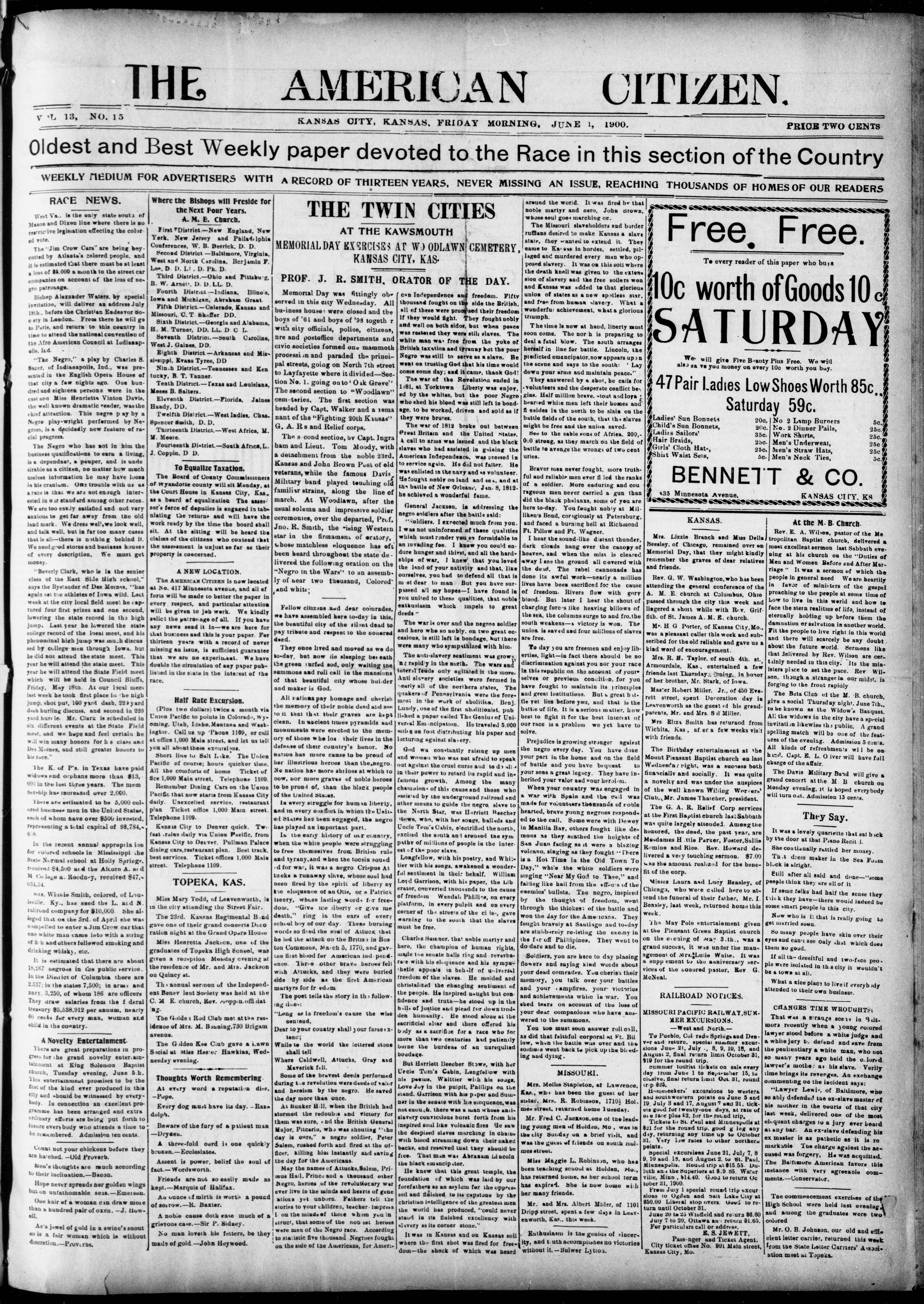
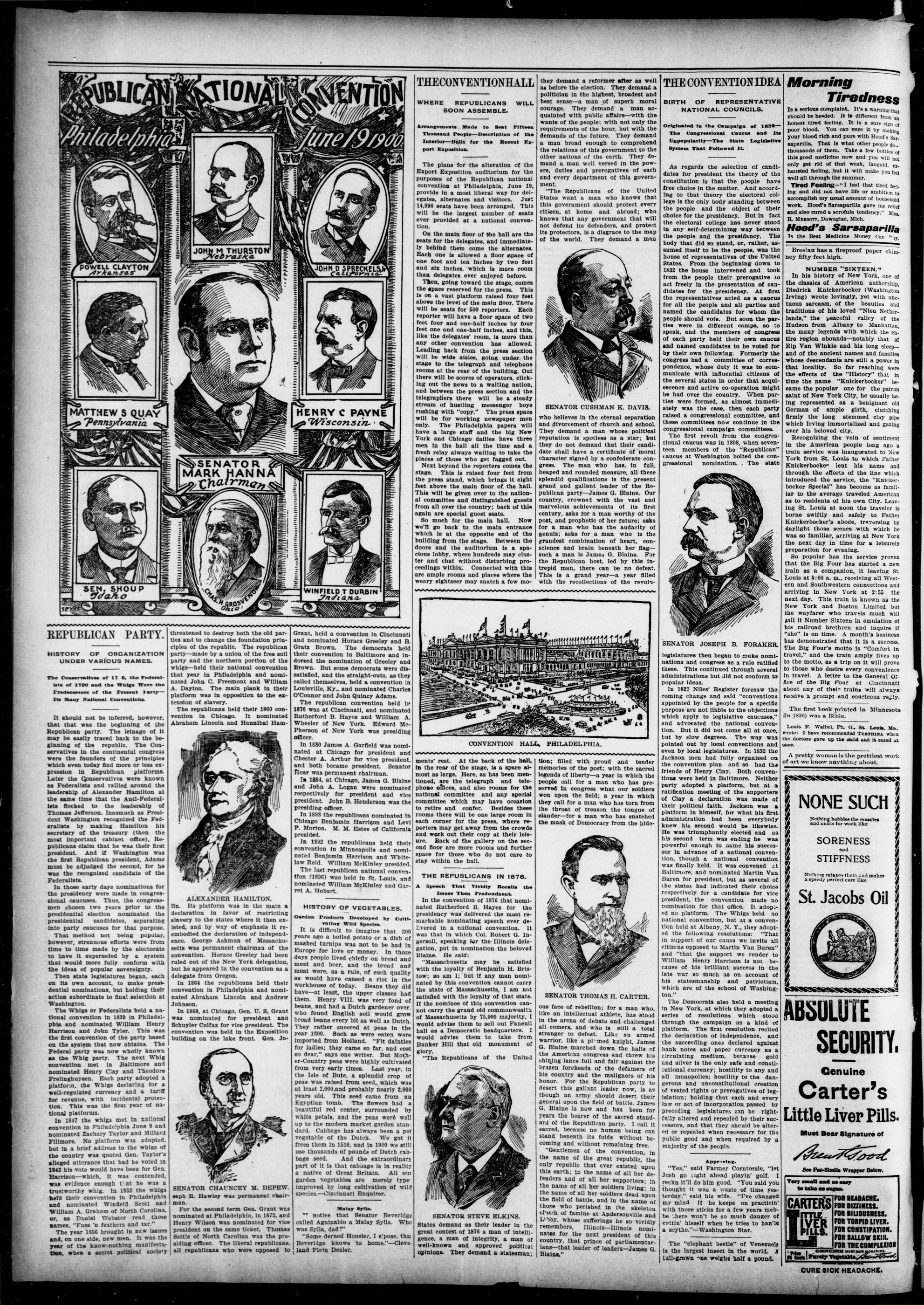
Page text (machine-generated)
Oldest and Best Weekly paper devoted to the Race in this section of the Country
West Va.. is the only state south of Mason and Dixon line where there is no restrictive legislation effecting the colored vote.
The "Jim Crow Cars" are being boycotted by Atlanta's colored people, and it is estimated that there must be at least a loss of $5,000 a month to the street car companies on account of the loss of negro patronage.
Bishop Alexander Waters, by special invitation, will deliver an address July 18th, before the Christian Endesvor Society in London. From there he will go to Paris, and return to this country in time to attend the national convention of the Afro American Council at Iudianapolis, Ia.
"The Negro," a play by Charles 8. Sacer, of Indianapolis, Ind., was presented in the English Opeta House of that city a few nights ago. One hundred and eighteen persons were in the cast and Miss Henrietta Vinton Davis, the well known dramatic reader, was the chief attraction. This negro pay by a Negro play-wright performed by Negroes, is a decidedly new feature of racial progress.
The Negro who has not in him the business qualifications to earn a living, is a dependant, a pauper, and is undesirable as a citizen, no matter how much useless information he may have loose in his cranium. One trouble with us as a race is that we are not enough interested in or standard among other races. We are too easily satisfied and not very anxious to get far away from the old land mark. We dress well, we look well, and talk well, but in far too many cases that is all—there is nothing behind it. We need good stores and business houses of every description. We must get money.
"Beverly Clark, who is in the senior class of the East Side High school," says the Bystander of Des Moines, "has again set the athletes of Iowa wild. Last week at the city local field meet he captured four first prizes and one second, lowering the state record in the high jump. Last year he lowered the state college record of the local meet, and his phenomenal high jump was much discussed by college men through Iowa, but he did not attend the state meet. This year he will attend the state meet. This year he will attend the State Field meet which will be held in Council Bluffs, Friday, May 18th. At our local meet last week he took first place in the high jump, shot put, 100 yard dash, 229 yard dash hurling discuss, and second in 230 yard hurlee. Mr. Clark is scheduled in six different events at the State Field meet, and we hope and feel certain he will win many honors for his class and Des Moines, and still greater honors to his race."
The K. of Ps. in Texas have paid widows and orphans more than $13,000 in the last three years. The membership has increased over 2,000. There are estimated to be 5,000 colored business men in the United States, each of whom have over $500 invested, representing a total capital of 98,784,68.
In the recent annual appropriation for colored schools in Mississippi the State Normal school at Holly Springs-received $4,500 and the Alcorn A. and M College n. Roodnay, received $47,044.54.
Mrs. Wainie Smith, colored, of Louisville, Ky., has sued the L. and N. railroad company for $10,000. She alleged that on the 3rd, of April she was compelled to enter a Jim Crow car that one white man came into with a string of fish and others followed smoking and drinking whisky, etc.
It is estimated that there are about 18,267 negroes in the public service. In the District of Columbia there are 2,537; in the states 7,500; in army, and navy, 3,250, of whom 186 are officers. They draw salaries from the f deral treasury $5,588,912 per annum, nearly 60 cents for every man, woman and child in the country.
There are great preparations in progress for the grand novelty entrainment at King Solomon Baptist church, Tuesday evening, June 5. h. This entertainment promises to be the first of the kind ever produced in this city and should be witnessed by everybody. In connection an excellent programme has been arranged and extraordinary efforts are being put forth to insure every body who attends a time to be remembered. Admission ten cents.
Count not your chickens before they are hatched. —Old Proverb.
Men's thoughts are much according to their inclination. —Bacon.
Hope never spreads nor golden wings but on unfathomable seas. —Emerson.
One hair of a woman can draw more than a hundred pair of oxen. —J. Howell.
As a jewel of gold in a swine's snout so is a fair woman which is without discretion.—Covr. rubs.
V L 13, NO.15
RACE NEWS.
A Novelty Entertainment.
THE
d Best W
M FOR ADVERTI
Best Weekly FOR ADVERTISERS WITH
Where the Bishops will Preside for the Next Four Years.
A. M. E. Church.
First "District"—New England, New York. New Jersey and Philadelphia Conferences, W. B. Berrick, D. D. Second District—Ballimore, Virginia, West and North Carolina, Berjamin F. Lee, D. D. Ll., D. Ph. D. Third District—Ohio and Pittsburgh, B. W. Arnet, D. D. LL. D. Fourth District—Indiana, Illinois, Iowa and Michigan, Abraham Grant. Fifth District—Colorado, Kansas and Missouri, C. T. Shaffer DD.
Seventh District:—South Carolina,
West J. Gaines, DD.
Eighth District.—Arkansas and Missi-
sippi. Evans Tyree, DD
Ninch District.—Tennessee and Ken
tucky, B. T. Tanner.
Teenth District.—Texas and Louisiana,
Moses B. Salters.
Eleventh District.—Florida, Jaines
Handy, D.D.
Twelfth District.—West Indies, Chas.
Spencer Smith, D.D.
Thirteenth District.—West Africa, M.
M. Moore.
Fourteenth District.—South Africa, L.
J. Coppin, D.D.
To Equalize Taxation.
The Board of County Commissioners of Wyandotte county will sit Monday, at the Court House in Kansas City, Kansas, as a board of equalization The assessor's force of deputies is engaged in tabulating the returns and will have the work ready by the time the board shall sit. At the sitting will be heard the claims of the citizens who contend that the assessment is unjust so far as their property is concerned.
A NEW LOCATION
The AMERICAN CITIZEN is now located at No. 417 Minnesota avenue, and all of forts will be made to better the paper in every respect, and particular attention will be given to job work. We kindly select the patronage of all. If you have any news send it in—we are here for that business and this is your paper. For thirteen years with this of never missing an issue, is sufficient guarantee that we are no experiment. We have double the circulation of any paper published in the state in the interest of the race.
Half Rate Excursion
(Plus two dollars) twice a month via Union Pacific to points in Colorado, Wyoming, Utah, Idaho, Montana and Washington. Call us up Phone 1109, or call at office 1,000 Main street, and let us tell you all about these excursions. Short line to Salt Lake. The Union Pacific of course; hours quicker times. All the comforts of home Ticket of fice 1,000 Main street. Telephone 1109. Remember Dining Cars on the Union Pacific that now stars from Kansas City daily. Uaexcelled service, restaurant plan Ticket office 1,000 Main street. Telephone 1109. Kansas City to Denver quick. Twast. raius daily via Union Pacific, from Kansas City to Denver. Pullman Palace dining cars, restaurant plan. Best track. best services. Ticket offices 1,000 Main street. Telephone 1109.
TOPEKA, KAS
Miss Mary Todd, of Leavenworth, is in the city attending the Street Fair.
Miss Honretta Jackson, one of the graduates of Topeka High School, was given a reception Monday evening at the residence of Mr. and Mrs. Jackson on Quincy st.
The annual sermon of the Independent Benevent lent Society was held at the C. M. E. church, Rev. Hoppen, officiating.
The Golden Rod Club met at the residence of Mrs. M. Banning, 730 Brigam avenue.
The Golden Kee Club gave a lawn Social at Miss Hester Hawkkins, Wednesday evening.
Thoughts Worth Remembering.
At every word a reputation dies.
-Pope.
Every dog must have its day. -Rana dolph.
time to
events.
we they
ording
wings
person.
more
how-
snout
without
Beware of the fury of a patient man
—Dryden.
A three-fold cord is one quickly
broken.—Ecclesiates.
Assent is power, belief the soul of
fact.—Wordsworth.
Friends are not so easily made as
kept.—Marquis of Halifax.
An ounce of mirth is worth a pound
of sorrow.—R. Baxter.
A noble cause doth ease much of a
grievous case.—Sir P. Sidney.
No man loveth his fetters, be they
made of gold.—John Heywood.
---
AMERICAN C KANSAS CITY, KANSAS, FRIDAY MORNING, JUNE 1, 1900.
THE TWIN CITIES
THE TWIN CITIES
PROF. J. R. SMITH, ORATOR OF THE DAY.
Memorial Day was fittingly observed in this city Wednesday. All business house were closed and the boys of '61 and boys of '93 together with city officials, police, citizens, nre and postoffice departments and civic societies formed one mammoth procession and paraded the principal streets, going on North 7th street to Layfayette where it divided—Section No. 1. going on to 'Oak Greve' The second section to "Woodlawn" cemeteries. The first section was headed by Capt. Walker and a remnant of the "Fighting 20th Kansas" G. A. Rs and Relief corps.
The's cond section, by Capt. Ingram ham and Lieut. Tom Moody, with a detachment from the noble 23rd, Kansas and John Brown Post of old veterans, while the famous Davis Military band played teaching old familiar strains, along the line of march. At Woodlawn, after the usual solemn and impressive soldier ceremonies, over the departed, Prof. Jno. R. Smith, the 'vising Western star in the firmament of oratory, whose matchless eloquence has of been heard throughout the state delivered the following oration on the "Negro in the Wars" to an assembly of near two thousand, Colored and white;
Fellow citizens and dear coirrades, we have assembled here to-day in this, the beautiful city of the silent dead to pay tribute and respect to the nonered dead.
They once lived and moved as we do to-day, but now lie sleeping be cath the green turfed sod, only waiting the summons and roll call in the mansions of that beautiful city whose builder and maker is God.
All nations pay homage and cherish the memory of their noble dead and so to it that their graves are kept clean. In ancient times pyramids and monuments were erected to the memory of those who los their lives in the defense of their country's honor. No nation has more cause to be proud of her illustrious heroes than the negro. No nation has more shrines at which to oow, nor more graves of noble heroes to be proud of, than the black people of the United States.
In every struggle for human liberty, and in every conflict in which the United States has been engaged, the negro has played an important part.
In the early history of our country, when the white people were struggling to free themselves from British rule and tyranny, and when the toosin sounded for war, it was a negro Crispus Attucks a runaway slave, whose soul had been fired by the spirit of liberty by the eloquence of an Otis, or a Patriotic theory, whose lasting words for freedom, "Give me liberty or give me death," ring in the ears of every school boy of our day. These burning words so fired the soul of Attuck that he led the attack on the Brits in Boston Commons, March 5, 1770, and gave the first blood for American indifference. Three other brave heroes fell with Attucks, and they were buried side by side as the first American martyrs for freedom.
The poet tells the story in the following lines:
"Long as in freedom's cause the wise contend,
Dear to your country shall your fame extend;
While to the world the lettered stone shall tell
Where Caldwell, Attucks, Gray and Maverick fell.
Some of the bravest deeds performed during the revolution were deeds of valor and heroism by the negro. He saved the day more than once.
At Bunker Hill, when the British had stormed the redoubts and victory for them was sure, and the British General Major, Pitcairn, who was shouting "the day is ours," a negro soldier, Peter Salem, rushed forth and fired at the officer, killing him instantly and saving the day for the Americans.
May the names of Attucks, Salem, Primus Hall, Prince and a thousand other Negro, heroes of the revolutionary war ever live in the minds and hearts of generations yet unborn. Fathers tell the stories to your children, teacher-imprress on the minds of those whom you instruct, that some of the nobest heroes were men of the Negro race. According to statistic five thousand Negroes fought on the side of the Americans, for America.
can Independence and freedom. Fifty thousand fought on the side the British, all of these were promised their freedom if they would fight. They fought nobly and well on both side, but when peace was rested they were still slaves. The white man was free from the yoke of British taxation and tyranny but the poor Negro was still to serve as a slave. He went on trusting God that his time would come some day; and it came, thank God! The war of the Revelation ended in 1818, at Yorktown Liberty was enjoy, ed by the whites, but the poor Negro who shed his blood was still left in bondage, to be worked, driven and sold as if they were brutes.
The war of 1812 broke out between Great Britain and the United States. A call to arms was issued and the black slaves who had assisted in gaining the American Independence, was pressed in to service again. He did not falter. He was enlisted in the navy and as volunteer. He fought nobly on land and sea, and at the battle of New Orleans, Jan. 8, 1812 he achieved a wonderful fame.
General Jackson, in addressing the negro soldiers after the battle said:
"soldiers. I expected much from you. I was not uninformed of these qualities which must render you so formidable to an invading foe. I knew you could endure hunger and thirst, and all the hardships of war. I knew that you loved the land of your nativity and that, like ourselves, you had to defend all that is mst dear to man. But you have surpassed all my hopes—I have found in you united to these qualities, that noble enthusiasm which impels to great deeds."
The war is over and the negro soldier and hero who so nobly, on two great occasions, is still left in bondage, but there were many who sympathized with him.
The anti-slavery sentiment was growing rapidly in the north. The wars and interfaith feuds only agitated it the more. Anti slavery societies were formed in nearly all of the northern states. The quakers of Pennsylvania were the foremost in the work of abolition. Benj. Lundy, one of the first abolitionist, published a paper called The Genius of Universal Emancipation. He traveled 5,000 miles on foot distributing his paper and lecturing against slavery.
God was constantly raising up men and women who was not afraid to speak out against the cruel curses and to do all in their power to retard its rapid and infamous growth. Among the many champions of this cause and those who assisted by the underground railroad and other means to guide the negro slave to the North Star, was Harriett Reecher stowe, who, with her songs, ballads and Uncle Tom's Cabin, electrified the north, excited the south and aroused the sympathy of millions of people in the interest of the poor slave. Longfellow, with his poetry, and Whittier with his songs, awakened a wonderful sentiment in their behalf. William Loyd Garrison, with his paper, the Liberator, converted thousands to the cause of freedom Wendal Phillips, on every platform, in every pulpit and on every corner of the streets of the cities, gave warning to the south that the slaves must be free.
Charles Sumner, that noble martyr and hero, the champion of human rights, made two senate halls rieg and reverbae with his elquence and his sympathetic appeals in behalf of universal freedom of the slaves. He molded and christalized the changing sentiment of the people. He inspired naught but confidence and truta—he stood up in the halls of justice and plead for down trodden humanity. He stood alone at the sacrificial alar and there offered his body as a sacrifice for a race who for more than two centuries had patiently borne the burdens of an unrequited boudage.
But Harriett Jeecher Stowe, with her Urcie Tom's Cabin, Longfellow with his poems. Whittier with his sougs, Love Joy in the pupit, Phillips on the stand, Garrison with his paper and Sumner in the senate with his soquence, was not enough, there was a man whose ansi-slavery convictions burst forth from his inspired soul like volcanic fires. He saw the despised slaves marching in chance with blood streaming down their naked backs, and received that they should be free. That man was Abrasam Lincoln the black emancipator.
He knew that this great temple, the foundation of which was laid by our forefathers as an asylum for the oppressed and finished to its capstone by the christian intelligence of the greatest men the world has produced, "could never stand in its finished excellency with slavery as its corner stone."
It was in Kansas and on Kansas soil where the first shot was fired for freedom—the shock of which was heard
CITIZEN
around the world. It was fired by that noble martyr and nero, John crown, whose soul goes marching or.
The Missouri slaveholders and border ruffians desired to make Kansas a slave state, they wanted to extend it. They came to Kansas in hordes, settled, pillaged and murdered every man who opposed slavery. It was on this soil where the death knell was given to the extension of slavery and the free soilers won and Kansas was added to that glorious union of states as a new spirit star, and free from human slavery. What a wonderful achievement, what a glorious triumph.
The time is now at hand, liberty must soon come. The north is preparing to deal a fatal blow. The south arranges herself in line for battle. Lincoln, the predicted emancipator, now appears up in the scene and says to the south: "Lay down your arms and maintain peace."
They answered by a shot, he calls for volunteers and the desperate conflict begins. Half million brave, -tout and loyals hearted white men left their homes and fl esides in the north to be slain on the battle fields of the south, that the slaves might be free and the union saved.
See to the sable sons of Afrika, 200, 0.0 strong, as they march on the field of battle to awege the wrongs of two cent uries.
Braver men never fought, more truthful and reliable men ever fl ed the ranks of a soldier. More enduring and cou rgeous men never carried a gun than did the black phalanx, some of you are here to-day. You fought nobby at Milliken's Bend, corgiously at Petersburg, and faced a burning hell at Richmond Ft. Pillow and Ft. Wagner.
I hear the sound-like distant thunder, dark clouds hang over the canopy of heaven, and when the mist is cleared away I see the ground all covered with the dead. The rebel cannonade has done its awful work—nearly a million lives have been sacrificed for the cause of freedom. Rivers flow with gory blood. But later I hear the shout of charging forces like heaving billows of the sea, the columns surge to and fro, the south weakens—a victory is won. The union is saved and four millions of slaves are free.
To day you are freemen and enjoy liberties, light—in fact there should be no discrimination against you nor your race in this republic on the account of yourselves or previous condition, for you have fought to maintain its principles and great institutions. But a great battle yet lies before you, and that is the battle of life. It is a serious matter, how best to fight it for the best interest of our race is a problem we yet have to solve.
Prejudice is growing stronger against the negro every day. You have done your part in the home and on the field of battle and you have bequeat to your sons a great legacy. They have inherited your valor and your heroism.
When your country was engaged in a war with Spain and the call was made for volunteers thousands of robe hearted, brave young negroes responded to the call. Some were with Dewey in Manilla Bay, others fought like demons as they scathed the heights of San Juan facing as it were a blazing volcano, singing as they fought. "There is a Hot Time in the Old Town To Day," while the white soldiers were singing "Near My God to Thee," and falling like hail from the effaces of the enemies' bullets. The negro, inspired by the thought of freedom, went through the thickes of the battle and won the day for the Americans. They fought bravely at Santiago and to-day are stubbornly re-storing the enemy in the far off Philippines. They went to do dare and to die.
Soldiers, you are here to day placing flowers and saying kind words about your dead comrades. You cherish their memory, you talk over your battles and your campfires, your victories and achievements which in war. You shed tears on account of the loss of your dear companions who have answered to the summons. You too must soon answer roll call, as did that faithful corporal at ft. Billow, when the battle was over and the soldiers went back to pick up the bleeding and dying.
MISSOURI.
Mrs. Mollie Stapleton, of Lawrence, Kas., who has been the guest of her sister, Mrs. R. Robinson, 17101 Holmes street, returned home Tuesday.
Mr. Fred C. Jackson, one of the leading young men of Holden, Mo., was in the city Sunday on a brief visit, and was the guest of friends on south Holmes street.
Miss Maggie L. Robinson, who has been teaching school at Holden, Mo., has returned home, as her school term has expired. She is now home with her many friends.
Mr. and Mrs. Albert Miller, of 1101 Dripp street, spent a few days in Leavenworth, Kas., this week.
Enthusiasm is the genius of sincerity, and truth accomplishes no victories without it. - Bulwer Lytton.
10c worth of Goods 10c SATURDAY
We will give Five B-any Plus Free. We will also so we money you on every 100 worth you buy.
135 Minnesota Avenue. KANSAS CITY, KS
Ladies' Sun Bonnets
Child's Sun Bonnets,
Ladies Sailors'
Hair Braids,
Girls' Cloth Hat-,
Shiit Waist Sets,
KANSAS.
Mrs. Lizzie Branch and Miss Della Beesley, of Chicago, remained over on Memorial Day, that they might kindly remember the graves of dear relatives and friends.
Rev. G. W. Washington, who has been attending the general conference of the A. M. E. church at Columbus, Ohio passed through the city this week and lingered a short while with Rev. Griffith, of St. James A. M. E. church.
Mr. H G Porter, of Kansas City, Mo., was a pleasant caller this week and subscribed for the old reliable and gave us a kind word of encouragement.
Mrs. R. H. Taylor, of south 4th. st., Armourdale, Kas., entertained a few friends last Thursday, ning, in honor of her brother, Mr. Stark, of Iowa.
Master Robert Miller, Jr., of 450 Everett street, spent Decoration day in Leavenworth as the guest of his grandparents, Mr. and Mrs. Sol Miller.
Mrs Eliza Smith has returned from Wichita, Kas, after a few weeks visit with friends.
The Birthday entertainment at the Mount Pleasant Baptist church on last Wednesday, right, was a success both financially and socially. It was quite a novelty and was under the auspices of the well known Willing Workers Club, Mr. James Thatcher, president.
The G. A. R. Relief Corp services at the First Baptist church last; Sabbath was quite largely attended. Among the honored, the dead, the past year, are Meodames H. Hittie Partner, Foster, Sallie Romine and Rice. Rev. Howard delivered a very touching speech. $7.00 was the amount realized for the benefit of the corp.
Misses Laura and Lucy Beasley, of Chicago, who were called here to attend the funeral of their father, Mr. I. Beasley, last week, returned home this week.
The May Pole entertainment given at the Pleasant Green Baptist church on the evening of May 3. th., was a grand success, it was under the management of Mrs. Lulie White. It was a supplement to the anniversary services of the honored pastor, Rev G. McNeal.
RAILROAD NOTICES
MISSOURI PACIFIC RAILWAY,SUM
MER EXCURSIONS.
To Pueblo, Colo. radio Springs and Denver and return, special summer excursions June 21, July 7, 8, 9, 10, 18, and August 2, final return limit October 31, $19 for the round trip.
Summer tourist tickets on sale every day from June 1 to September 15, inclusive, final return limit Oct. 31, round trip $25.
Homeseekers' excursions to western and southwestern points on June 5 and 19. July 3 and 17. August 7 and 21, tickets good for twenty-one days, at rate of one race plus $2, for the round trip.
Tickets to St. Paul and Minneapolis at $21 for the round trip, good g log any day, returning any time up to October 31. Very low rates to other northern points.
Special excursions June 21, July 7, 8, 9, 10 and 18, and August 2, to St. Paul, Minneapolis. Round trip at $15.55. Duluth and the Superiors at $9.85. Waterville, Minn., $14.40. Good to return October 31, 1900.
From July 1 special round trip excursions to Ogden and Salt Lake City at $50.00. Liberal stop orders. Good to return until October 31.
June 20 to 25 Winfield and return $6.60
July 7 to 20, Ottawa and return $1.65.
For particular calls or address,
E. S. JEWETT,
Pass-nger and Ticket Agent.
City ticket office No. 901 Main street,
Kansas City, Mo.
PRICE TWO CENTS
the Country
HOMES OF OUR READERS
Free.
of this paper who buys
of Goods 10 c
URDAY
beauty Pius Free. We will
every 10c worth you buy.
Snow Shoes Worth 85c...
urday 59c.
20c. No 2 Lamp Burners 5c.
20c. No. 2 Dinner Pails, 25c.
35c. Work Shirts, 25c.
25c. Men's Underwear, 25c.
25c. Men's Straw Hats, 25c.
5c. Men's Neck Ties, 5c.
TT & CO.
KANSAS CITY, KS
At the M. B. Church:
Rev. E. A. Wilson, pastor of the Metropolitan Baptist church, delivered a most excellent sermon last Sabbath evening at his church on the "Duties of Men and Women Before and After Marriage." It was a sermon of which the people in general need. We are heartily in favor of ministers of the gospel preaching to the people at some time of how to live in this world and how to face the stem realities of life, instead of eternally holding up before them the damnation or salvation in another world. Fit the people to live right in this world and there will scarcely be any doubt about the future world. Sermons like that delivered by Rev. Wilson are certainly needed in this city. Its the ministers place to set the pace. Rev Wilson, though a stranger in our midst, is forging to the front rapidly
The Beta Club of the M. B. church, give a social Thursday night, June 7th, to be known as the Widow's Banquet. All the widows in the city have a special invitation likewise the public. A grand spelling match will be one of the features of the evening. Admission 5 cents. All kinds of refreshments will be on hand. Capt. E. L. O liver will have full charge of the affair. The Davis Military Band will give a grand concert at the M. B church on Monday evening, it is hoped everybody will turn out. Admission 13 cents.
They Say.
It was a levyel quarrette that sat back by the door at that Piano Recit l.
She contiually rattled her money.
That dress maker in the Sea Foam block is alright.
Still after all said and done—"some people think they are all of it.
If some folks had half the sense they think they have—there would indeed be some smart people in this city.
Now who is it: that is really going to get married soon.
So many people have skin over their eyes and can see only that which does them no good.
If all the deceitful and two-face people were isolated in this city it wouldn't be a town at all.
What a nice place to live if everybody attended to their own business.
CHANGES TIME WROUGHTS
That was a strange scene in Baltimore recently when a young coerced lawyer stood before a white judge and a white jury to defend and save from the penitentiary a white man, who not so many years ago held the colored lawyer's mother; as his slave. Verily time brings its revenues. An exchange commenting on the incident says: "Lawyer Lewi; of Baltimore, who so ably defended the ex-slave master of his mother in the courts of that city last week, delivered one of the most element charges to a jury ever heard at any bar. An ex-slave defending his ex master is as pathetic as it is remarkable. The charge against the accused was forgery. He was acquitted. The Baltimore American favors this instance with very agreeable comments.—Conservator.
The commencement exercises of the High School were held last evening, and among the graduates were two colored
Mr. O. B. Johnson, our old and efficient letter carrier, returned this week from the State Letter Carriers' Association meet at Topeka.
American Citizen.
ear
AMERICAN CITIZEN PUBLISHING
AND PRINTING CO.
| sists
Daily and Weekly 335 Minnesota Ave
KANSAS CITY KANSAS
nana ee
TERAS OF SUBSCRIPTION
ally Aclivered by carrierper week. 10¢
‘Weekly one year.......... ... 8150
eg
‘Satered at the postoffice at Kansas City
‘Kane , a6 second class matter.
This paper or some Negro paper
should be in overy Negroes home
to keep posted on what the race is
doing. As this is the only Negro
Daily in this part of the country it
‘ought to receive hearty su port.
NEGRU LAD INVENTS NEW GUN.
Bogone Barkis, of Chicago, Constructs
Rapid-Fire Machine Weapen.
Eugene Burkis. a colored boy ef 19
‘Years, who lives in Chicago, is the in~
Yenter of a rapid fire machine gun
which he claims is the most effective
‘weapon of its kind in the world, apd is
destined 10 throw the inyentiens of
Maxim and Nordeateldt,2ow in geners]
vse io the armaments of the world, into
the scrap hesp. Several experts who
have seen the model of Borkin’s gun
Pronounce it s marvel of ingenuity aod
Sterrible weapon. The boy is -sid to
have refused an offer of 850,000 for his
invention.
‘The boy ba never bad any mechani-
eal training, yet all the work on his
model has been his own. The firat idea
‘of the weapon came to bim during the
Spsoish American war, when the mag-
miftcent work of the Awerican guopers
directed bis thoughts to guosand their
improvement. He constructed bis tirst
model of wood, bis only tool being a
jack-knife.
‘The lack cf funds then threatened to
Put » stop to the young inventor's
wort, dut he finslly obtainei enoogh
money to ge into aa iron works on the
Wout Side, which gave him the use of
ite tools and machinery for $5.» day.
Hore he constructed ths model, which
he sent tu the prtent office et Wash-
ington, which bas already allowed sey-
eu een rf his claims on tne Weapon.
MONEY
FOR OLD SOLDIERS
z Reis BUY
‘The additioval Ponestead Claims of
all Soldiers er Sailors who servod ia the
Union army or savy, their widows or
minor heirs.
Who filed a Hom stead claim of less
than 160 acres of sand prior to June
22nd., 1874?
Such persons ure entiled to enongh
more lard, including the number ot
acres embraced in their origioxl entry,
without living upon it, to make 160
acres. If ther homesteaded 80 acres,
hey ure entitled to 80 more, sf 40 acres
120 more, if 129 acres, one sere more,
‘or any other number as it may a pear.
By Iate rulings and de:isions its not
necessary that final proof shonld have
been made on their original entry. that
is, they are now entitled to such addi-
tional rights if their homestead was
Aabacdoned. canceled or relinquished,
and all “ransfers cna be made at their
homes, before a Notary Public. All
fuch cisims Iam prepared to buy and
Nill pay, the highest market | price in
ash, AT ONCE. | Will buy fractional
‘elainis even if not more than one acre
each. If you did not make » home-
‘stead fing you bave no claim to sell.
Tis land is vours and don’t wait but
‘come to this office at once and get full
particulars concerning this land. It is
tw your own interest to do so.
AMERICAN CrTizeN OFFICE,
335 Minnesota Avenue.
A COMMENDABLE CLUB.
‘It seareely ever becomes within our
Jurisdiction to speak a good word for
clubs, because tney have in latter days
become more of a curse thas a plessure,
and instead of commending the highest
prawe from the community at Inrge,merit
oftimes, and receives the basest condem
mation. ‘There is no reason why negroes
cvmnot conduct a place of social reerea-
tion on as elite, business and strictly first
lass principles as any set of white men.
At 1009 St. Louis »veoue, is lecated the
P and W. Musical Clad, of which Mr.
Marshal H. Shelton is ianager—whe
seems to be in his make-up a geo-
temaa of rare business toct, push and
‘energy. cepable of managing ans busi
ness underteken by him. Mr. Rober
Cox, our esteemed vld fellow townsmen,
Dale aud hearty gentleman well met, i
secretory, bis long.years of service i
‘various organizations for Caue wisns em
imently fits him, to fill his preseat pl-c
with. that degree of satisfaction whie
conquers the most fastidious when tbe;
come in contact with the “real thing.
‘Phe establishment of the P. and W. mu
nical club is conducted on business prin
ciples and is fitted up in modern sty
Ttesteers to those of the racs who ar
gentlemen, who respect themselves an
other peeple likewiss—who can »ppre
eiate courtesies shown-thers by gentle
men of their own race when in Kanss
City, Mo., give them «call, There is n
place fitted up in more modern sty]
-tas‘ily arrapgcd and managed by mor
‘congenial people than the headquerte
‘of the P. and W. Mus'cal Ciub. W
have m) hesitation in saying it is one o
the fins, uoequalled, in Kansas City
Me. Givethemac ll.
The American Citizen
Directory
OF KANSAS CITY, KANS«S,
AND
KANSASCITY, MO.
Church Directury.
BAPTIST CHURCHES.
African 3914 Hast 15tb. street.
Greenwood, 2005 Mederson Avenue.
Highland Aveoue, 1119 Highiaod Ave.
Mrordonian }
Mission 218 Enst 21st. street.
Missiooary, 2605 Madison Avenue,
Mt. Calvary, 15 northeast cor. Norton
Avenue.
Mount Gay, 2100 “ voming Avenue.
‘Mount Noriad, 933 Bluff Street.
Mount Olive, Villa. s e. cor. Garnett.
Mount Zion, 908 Hickory Avenue.
Mount Zion. Primitive, 2815 Garnett
street.
Pilgrim, 705 Chariott. street.
Pilgrim, Charlott between 6th and 7th
Pleasant Green, East Forest.
Round Top, Norton near 28th street.
St James, 1411 East 18th street,
St James Chapel, 518 High street.
81, Marke,1019 East 4th street.
8t. Pauls, $10 East 4th street,
Second Baptist, Charlott, cor. 10th.
Vine Street, 1825 Vine,street.
CHRISTIAN CHURCH
2ist between Kummit and Madison,
su Augus ine Mission, 1025 Troost ave.
METHODIST PISCOPAL.
Asbury Chapel, 1620 Cherry street
Barve, 11th S W. Cor, Highland ave
Clark's Chspel, 819.8. W. Boulevard
Westport W, Prorpect Place Cor. 23rd.
Kiog Solomon Mission 4th and Locust
Colored Schools.
Attu: ee 2108 East 18th street.
Bruce 3914 Esst 15th street.
Douglass 27th N. £. Cor. N. Prospect.
Place.
‘Garrison Forest S. W Cor. 4th street,
Lineoin School 11th NW. Cor Camp:
bell street.
Lincoln High School 816 Bast 11th st
Page Rochester N.E. Cor. Pro:pect
Avenue.
Penn 4241 Shay ne,
Phillips 1917 Cherry street,
Round Top 2817 Norton Avenue,
Business Directory.
‘J. A. Wilson Jeweller 1616 W. 9th st.
Chsndler’s Berber shop,Semuel Chand-
ler Prop. 8 LCien ens Mgr 112 East 6th
stre t.
Restaurant Mrs Awus Prop. 114 East
6th : treet.
Fields Barber Shop 102 East 6:b stree
Miller’s Barber Shop 113East 6th
Midland Barber Sbop Hersy Parson
Proprietor 115 East 6tn street,
Pssoe Barber Shop Oarth & Wurfeld
Proprietors 580 Grand Avenue.
0" Bannon’ Burber Shop W.T 0 Ban’
on Proprietor 500 Grand Avenue.
Manila Barber Shop Madison Bros.
Proprietors 709 Independence avenue.
McRay's Barber chop Ben McRay
Proprietor 819 Independence avenue.
Maupin’s Barber Shop 1832 E 18th st.
Brown's Barber Shop 1920 & 18th st.
Berry's Barber Shop 1482} E. 18th st
Grocer, George Grear, Prop. 1211 E.
Brbst,
D. M. Mitcbell, Barber Shop, 576
Grand ave.
Langston’ Barber Shop 718 East Sth st
Walker's Parber Shop 806 East 12th st
H. J. George, ba: ber shop, 1307 w.
Ob. st.
‘Cow ders Barber Shop 704 East 12thst
Restaurant J. W, Gordoa Prop. 554
Grand avenue.
Restaurant H Powel Proprietor 572
Grand avenue.
Restaurant Azdsew Cluk Proprietor
723 Independence ave.
Saratoga Cafe L. Mason I roprictor
805 Independence av.
Chicago Cafe H Compton Proprieto
706 east 12th street ’
Physicians and Surgeons.
Drs. Shannon and Lambright 1215 E.
18th st.
Dr. J.N. Birch 1339 E. 18th st.
Dr. T.©, Unthank 1288 Independence
Ave.
Dr. L.J.flolly 1112 “ampbell st.
Rising Suu J.F. Cole, Editor, L. Ww.
Wood. Mane ger 117 W. 6th st.
Grocery, A. Wetby Pro, “ath ard
Holmes .
spdsBeITz9ET Fe
‘The State of Kansas, County of Wy-
andotte, #.
Iu the matter of the estate of Taylor
McDonald, deceased. In the Protate
Court in and for said County.
"Notice is hereby given that letters of
administration have been granted to the
undersigned, on the estate of Tsylor
WeDouald, lite of said county, deceas
ed, by the Honorable, the Probate Coer
of the County snd State sforesaid, dated
the 3rd. day of Marcb.a. .. 1900, Now,
all persons having claims ageinst tbe
sad estate, are hereby notified that they
sanst present the same tothe undersigr
el for allowance wi hin ove yerr from
the date of said letters or they muy be
precluded from any benefit of such es
Rite. and thet if such claims be mot ex-
hbited within three years after the dat
of sid Iettere, they shell be foreve
darred.
1 F. BRADLEY.
Administrator of the estate of Tasio
McDonald, deceased.
Kansas City, Kas., March 20th., 1900,
To witness whcreof the undersigned
Probate suder in @ d for the County o!
Wyandotte, State of Kansas, have beret
set my hand, and aTixed the seal of th
ssid Probate Cour , tnie 18th. dey a
Mareb, ad, 1900," K. P. SNYDER
‘Probs:e Judg:
KANSAS CITY, KANSAS
Enterprises.
| A.C.L. Coal Co. Main Office 492 Minn.
Ave. E.F. Henderson, Mgr.
D, W. White Furniturestore, 420 Minn.
Ave.
J. W Jones Grocery 400. Oakiand Ave.
M. Gordon Department stire 1605. N
Oth
Clark & Lee, junk store, 1104 nerth
3rd. st.
Kansas City Kavses Soap Works, 4th.
st., between Oakland ard Freeman,
JR. McClain, Grocer,1700 n 5th, st-
J-R, Rocker, Buteher, 1609 n 16th, st
Doaglses Hospital, 812 Washington
ave., Miss L. V. Ashton, Matron.
CHURCHES,
METHODIST.
St. James A, M. B., cor. 7th. and Ann.
St. James M. E., Freeman ave., be
tween 9th and 10th,
©.M.E. Oakland ave., bet, 4th. an¢
5th.
cumeriax,
Sth. St. Christian, cor. Everett anc
8th.
9th. St. Christian, cor. 9th. and Ne
braska.
artist. i
Ist. Baptist, corner 5:h. and Nebraska
avenue.
Metropolitan Baptist, cor, 9th, and
Washington.
Mt. Zion Baptist, Virginia eve,, be
tween 4th. and 5.b.
Mt. Pleasant, 8rd. af., between Oak
land ana Jersey.
Rose Hill, Jerrey ave. bet 9th. anc
10th.
Pleasant Green, Wood St. and Split
log ave.
King Solomon Baptist, 8rd. and State
avenue.
‘The Empire House $85 Minnesota Ave.
Dyson House 440 Minvesota Ave.
Jamison House 417 Minnesota Aye.
Restaurants,
J.W. Jobuson's 6th and State,
‘Mrs. Hall 507 Minn. Ave.
‘Mrs. Sarah Thurston 1414 Sth st.
Mc Gees 448 Minn. Ave,
E. Stoakes 1510 N. 3rd st,
BARBERS
J.T. Roberts lucker, 507 Minne-
sota avenve.
J, Gross, 412 Afionesota avenue.
G. McClellun, 613 Minnesota ave.
M.T. Comer, 608 Minnesota ave.
Robt. Keith, 315 Minnesota ave.
M. Pattison, 1603 north 3rd. st.
SHOEMAKERS,
Lon McAdams, 348 Mipnesota ave,
D. W. Wynne, 309 Minnesota ave.
Lewis Blonchard, North 6th., Siate
Line.
Wilson, Sth. st, between Nebraska
and State.
J. W. Ready, No. 1609} n 10th. st.
MALLS.
M. & U.,1806 north 8:b. street.
Sons 01 Protection, State nd 6th.
prves.
Wyandotte Drug Store, 1512 north
Sib. sireot.
pocrora.
S. H. Phompson, 181: north Sth. st.
- G. H. Brown, 1010 Freeman ave.
Jordan, 610 Minnesota ave.
anrists.
©. J, Brooks, 70, New York Lite
Building.
‘TEACHERS OF FRENCH AND ELOCUTION.
Arthur A, Anderson, 541 State Ave.
at) teh
Aig
ATES ||
UE
“0's picror™
SHORTFST LINE
ACRUSS ™* CONTINENT
‘The Union Pacitic “The Original Over-
land Route’ always was, and is tomday.
the shortest and best Line to the west.
‘Two splendid fast trains leave Kannas
City daily over this old established line.
No chunge of cars between Kansas City
and Denver, Ogden or San Francisco.
All trans solidly vestibuled sad tully
equipped with latest improved Reclining
Chair Cars free and Pullman Palace
sleeping cars. Meals served in Pullman
Palace diving cars on the restaurant pian
‘at prices most reasonable. All cars light-
ed with the celebrated Pintsch Light
Only line ruoning two train with:
out change from KansasCi'y to Denver
Low excursion rates on sale to Colorado-
Utah Idaho, Oregon, Washington and
California. Don’t complete your ars
rangements for « trip west until you hav.
Tearned all about special inducements
and attractions offered by the Union Pa
cite. For full informs ion in regard tc
Jow -rates time. etc., call on or address
J. B. FRAWLEY.
Gen. Agt., Union Pacific, 1000 Mair
street, Kansas Citv. Mo
AN EVENING
OF RECREATION AT THE
MODERN UP TO DATs
MUSICAL CLUB,
1009 St. Lows Avenur,
KANSAS CITY, MISSOURI
' 1 .
Finest Barber Shop in the ity
Hair Cutting, 25¢, Baths, 15c., Shaving, 10c., New-
ly Remodeled Bath Kooms, Porcelain Tubs |
_—_>
GEO. McCLELLAND,
SOLE AGENT FOR .
Crane's Toilet Soap
OF WYANDOTTE CO. KS.
6 Minnesota Aveuue, = — — Kansas City, Ke
Gem DrugStore
MINNESOTA AVENUE
DEALER IN.
DRUGS, MEDICINES, CHEMICALS,
Fine Toilet Soaps, Brushes, Combs, Etc.,—=—>
| PERFUMERY AND FANCY TOILFT ARTICLES
W. B. RAYMOND,
Manufacturer of and Wholesale dealer in
UNDERTAKERS * SUPPLIES
FIRST-CLASS CARRIAGES FOR ALL PURPOSES AT ALL HOURS
AMBULANCE FOR THE CONVEYANCE OF THESICK AND WOUNDED
Undertaking kvoms, 431 Minnesota ave. ‘lelepnone West 32.
Factory Lor st St., and Riverview Ave. Telepehone 26
KANSAS CIT* KANSAS.
-— PG
“Well, this is the first \ as
deily Negre paper I've) cy
tvet_ceen realy eaioy \_
teading it, Everybody oughty ———} By ,)
sant ie “Only 10 ean /
Sper week. GATE
a a
ba AZAE
Ay Ls =
Has if Sy
Vt A =a
Ni <<
READ THE
American
Citizen,
DAILY and WEEKLY.
HOUSE -- CLEANING.
- HOLZMARK
Furniture Company,
Pianos. Qarpets and Draperies:
.
Lewis Blandchard
No. 6, Sta e Line, K.C. k*
Does all kinds of Boot and Shee
work. He does first class hana
work, and also has one of the very
latest and best Shoemaker’s machine
and guarantees the best and the
sheapest work in the quickest trme
Give kim a trialand see for you
elf.
McKAY’S
RESTAURANT,
At No, 6, State Line, can be found ene
of the best Restaurants in the Twin
Cities. Meas served on short notice
to order, board and lodging $3 00 per
week. Ice Cream.Cakes. and Pies every
Sunday. The resacrant is in a splendid
eaton for the convenience of its pa-
trons t0 any part of the two cities.
‘MRS, McKAYS, Proprietress.
= LZ
pS yf
® Lf J
ZEN
Oy. 3
Ss i, =
E We'll admit that shoes are a pretty bard article of merchandise to
judge unless you are an expert in the basinest. (At
YOU can buy with SAFETY and CONFIDENCE, for we carry not).
ing but good dependable shoes, and all of them at
pricesyouCannot Duplicate
Elsewhere. All our Shoes are guaranteed. One hundred and fi'ty
pairs Ladies’ tan aad Black Oxfords, coin toe, light sole, $2.00 shoe.$1.50,
100 pairs Bond’s Jadies tan and black Oxford's latest ‘styles, good value at $2 50,
our price $2.00,
Bonds, Men's tan and black, $5.00, 8 50 and 23.00 shoe, at $2.75, $295 and
$2 00, at
N ELSON’S SHOEMAKER AND SHOE DEALER,
' 515 Minnesota Ave.
{@r-sole Leatber and Wholesale and Retail Prices.
—WHOSE REPUTATION AS—
5
Has been established through these many years of prosperous business
in this city, have
Resumed Business
—AT THEIR OLD STAND.—
542 Minnesota Ave.
and invite the publie to call and examine their stock. ‘They now have in
STAPLE AND ‘FANCY GROCERIES, FRUITS AND
EARLY VEGETABLE
At prices to compete with any house in the two cities, Give thema
call ana you will never regret 1t,
A. C.L. COAL CO.,
~IS HEADQUARTERS FOR—
‘The Best Goode, the Quickest Sales, the Smallest Profits
and the promptest deliveries,
EE
GEC THEIR PRICES ON
COAL, WOOD, fEED, FLOUR, asv BUILDING
STONE,
Wholesale and Retail. Offiee 42, Minnesota Ave. Tel. 152 West.
se-Yard and Storage 917 and 919 No:th 3rd. St.
E F. HENDERSON Manager.
A MODERN
Restaurant,
Good Meals Cooked to Order.
COLD LUNCHES ON FHORT NOTICE,
THR BESTHO E MADK PIES IN THE CITY,
CAKES AND CONFECTIONARIES,
‘When you want good Ice Cream go to the
Modern Restaurant Ice Gream Parlors
Where you can always fin delicious Ice Creams, Kemember the
number, 504 Nobraska Avenue,
MRS. H. M. G. SPENCER, Propriatress.
KANSAS CITY, _- : —_ KANSAS.
2 RG
Secure Tickets
«++ WIA TBE...
Chicago, Milwaukee
&St, Paul Ryn,
«+». AND YOU GET... Bs
Sleepers: & Ghair
Cars
ooeeTO...
| CHICAGO
and all intermedsate points The shortest,
quickest and bes tline to Chilocothe, Ot
tumwa, Cedar Rapids, bubnque, and La
Grosse and Cedar Kepide, Heckiord and
=
«+ +Possenger Station at....
22nd St. and Grand Ave,
‘Take Westport Cable.
anne om 915 Maia stree,,
A. B. BRIDGES Gen’). Southweste
Agent :
Ea nag ea
Go To
’
J. W. JOHNSON’S
‘The only Ice Cream Parlors in the two Kansas Cities where you can
get the
Besilce Cream Soda, and Ice Creams, Fine ‘unch,
Pies, Cakes 2 Confectionaries
Special attention paid to Churches, Lodges and;parties.
Ie Cream, wholesale, [75 10 90 cts. per gallon. Don’tfiail to give ue
acall. Corner 6th. and State streets,
KANSAS CITY — a = KANS
REWARDS OF ENDEAVOR SUN-
DAY'S SUBJECT.
From the Following Text—"I Have
Finished the Work Which Thou Gavest
Me to Do"—John XVII, 4—The Fruits
of Well Won Victory.
[Copyright, 1590, by Louis Klopech.]
There is a profound satisfaction in the completion of anything we have undertaken. We lift the capstone with exultation, while, on the other hand, there is nothing more disappointing than after having toiled in a certain direction to find that our time is wasted and our investment profitless. Christ came to throw up a highway on which the whole world might, if it chose, mount into heaven. He did it. The foul mouthed crew who attempted to tread on him could not extinguish the sublime satisfaction which he expressed when he said, "I have finished the work which thou gavest me to do."
Alexander the Great was wounded, and the doctors could not medicate his wounds, and he seemed to be dying, and in his dream the sick man saw a plant with a peculiar flower, and he dreamed that that plant was put upon his wound and that immediately it was cured. And Alexander, waking from his dream, told this to the physician, and the physician wandered out until he found just the kind of plant which the sick man had described, brought it to him, and the wound was healed. Well, the human race had been hurt with the ghastliest of all wounds—that of sin. It was the business of Christ to bring a balm for that wound—the balm of divine restoration. In carrying this business to a successful issue the difficulties were stupendous.
The Spiritual Upbuilding:
In many of our plans we have our friends to help us; some to draw a sketch of the plan, others to help us in the execution. But Christ fought every inch of his way against bitter hostility and amid circumstances all calculated to degress and defeat.
In his father's shop no more intercourse was necessary than is ordinarily necessary in bargaining with men that have work to do; yet Christ, with hands hard from use of tools of trade, was called forth to become a public speaker, to preach in the face of mobs, while some wept and some shook their fists and some grashed upon him with their teeth and many wanted him out of the way. To address orderly and respectful assemblages is not so easy as it may seem, but it requires more energy and more force and more concentration to address an exasperated mob. The villagers of Nazareth heard the pounding of his hammer, but all the wide reaches of eternity were to hear the stroke of his spiritual up-building.
So also the habits of dress and diet were against him. The mighty men of Christ's time did not appear in apparel without trinkets and adornments. None of the Caesars would have appeared in citizen's apparel. Yet here was a man, here was a professed king, who always wore the same coat. Indeed, it was far from shabby, for after he had worn it a long while the gamblers thought it worth raffling about, but still it was far from being an imperial robe. It was a coat that any ordinary man might have worn on an ordinary occasion.
Neither was there any pretension in his diet. No cupbeater with golden chalice brought him wine to drink. On the seashore he ate fish, first having broiled it himself. No one fetched him water to drink; but, bending over the well in Samarla, he begged a drink. He sat at only one banquet, and that not at all sumptuous, for to relieve the awkwardness of the host one of the guests had to prepare wine for the company.
Man Without a Diploma.
All this was against Christ. So the fact that he was not regularly graduated was against him. If a man come with the diplomas of colleges and schools and theological seminaries, and he has been through foreign travel, the world is disposed to listen. But here was a man who had graduated at no college, had not in any academy by ordinary means learned the alphabet of the language he spoke, and get he proposed to talk, to instruct in subjects which had confounded the mightiest intellects. John says: "The Jews marveled, saying, How hath this man letters, having never learned?" We in our day, have found out that a man without a diploma may know as much as a man with one and that a college can not transform a slug-gard into a philosopher or a theological seminary teach a fool to preach. An empty head after the laying-on of hands of the presbytery is empty still. But it shocked all existing prejudices in those old times for a man with no scholastic pretensions and no graduation from a learned institution to set himself up for a teacher. It was against him.
So also the brevity of his life was against him. He had not come to what we call mid-life. But very few men do anything before 33 years of age, and yet that was the point at which Christ's life terminated. The first 15 years you take in nursery and school. Then it will take you six years to get into your occupation or profession. That will bring you to 21 years. Then it will take you ten years at least to set established in your life work, correcting the mistakes you have made. If any man at 33 years of age gets fully established in his life work he is the exception. Yet that he is the point at which Christ's life terminated.
"Blessed Are the Poor."
Popular opinion declared in those days, "Blessed is the merchant who has a castle down on the banks of Lake Tiberias." This young man said, "Blessed are the poor." Popular opinion said in those days, "Blessed are those who live amid statuary and fountains and gardens and congratulations and all kinds of festivity." This young man responded, "Blessed are they that mourn." Public opinion
in those days said, "Blessed is the Roman eagle, the flap of whose wing startles nations and the plunge of whose iron beak inflicts cruelty upon its enemies." This young man responded, "Blessed are the merciful." Popular opinion said, "An eye for an eye, a tooth for a tooth." In other words, if a man knocks your eye out knock his out. If a man breaks your tooth break his. Retort for retort, sarcasm for sarcasm, irony for irony, persecution for persecution, wound for wound. Christ said, "Pray for them that despetely use you." They looked at his eye. It was like any other man's eye, except perhaps more speaking. They felt his hand, made of bone and muscle and nerves and flesh, just like any other hand. Yet what bold treatment of subjects, what supernatural demands, what strange doctrine! They felt the solid earth under them, and yet Christ said, "I bear up the pillars of this world." They looked at the moon. He said, "I will turn it into blood." They looked at the sea. He said, "I will hush it." They looked at the stars. He said, "I will shake them down like untimely figs." Did ever one so young say things so bold? It was all against him.
After the battle of Antietam, when a general rode along the lines, although the soldiers were lying down exhausted, they rose with great enthusiasm and huzzed. As Napoleon returned from his captivity his first step on the wharf shook all the kingdoms, and 250,000 men flocked to his standard. It took 3,000 troops to watch him in his exile. So there have been men of wonderful magnetism of person. But hear me while I tell you of a poor young man who came up from Nazareth to produce a thrill which has never been excited by any other. Napoleon had around him the memories of Marengo and Austerlitz and Jena, but here was a man who had fought no battles, who wore no epaulets, who brandished no sword. He had probably never seen a prince or shaken hands with a nobleman. The only extraordinary person we know of as being in his company was his own mother, and she was so poor that in the most delicate and solemn hour that comes to a woman's soul she was obliged to lie down among drivers grooming the beasts of burden.
The Question of Lineage.
I imagine Christ one day standing in the streets of Jerusalem. A man descended from high lineage is standing beside him, and says: "My father was a merchant prince. He had a castle on the beach in Galliee. Who was your father?" Christ answers, "Joseph, the carpenter." A man from Athens is standing there unrolling his parchment of graduation and says to Christ, "Where did you go to school?" Christ answers, "I never graduated." Aha, the idea of such an unheralded young man attempting to command the attention of the world! As well some little fishing village on Long Island shore attempt to arraign New York. Yet no sooner does he set foot in the towns or cities of Judaea than everything is in commotion. The people go out on a picnic, taking only food enough for a day, yet are so fascinated with Christ that at the risk of starving they follow him out into the wilderness. A nobleman falls down flat before him and says, "My daughter is dead." A beggar tries to rub the dimness from his eyes and says, "Lord, that my eyes may be opened." "A poor, sick, panting woman presses through the crowd and says, "I must touch the hem of his garment." Children who love their mother better than any one else struggle to get into his arms, and to kiss his cheek, and to run their fingers through his hair, and for all time putting Jesus so in love with the little ones that there is hardly a nursery in Christendom from which he does not take one, saying, "I must have them. I will fill heaven with these, for every cedar that I plant in heaven I will have 50 white lilies. In the hour when I was a poor man in Judaea they were not ashamed of me, and now that I have come to a throne I do not despise them. Hold it not back, O weeping mother! Lay it on my warm heart. Of such is the kingdom of heaven."
Victory Over Nature.
See him victorious over the forces of nature. The sea is a crystal suepcher, it swallowed the Central American, the President and the Spanish armada as easily as any fly that ever floated on it. The inland lakes are fully as terrible in their wrath. Some of us who have sailed on it know that Lake Galilee, when aroused in a storm, is overwhelming, and yet that sea crouched in his presence, and licked his feet. He knew all the waves and the wind. When he beckoned they came. When he frowned, they fleed. The heel of his foot made no indentation on the solidified water. Medical science has wrought great changes in rheumatic limbs and diseased blood, but when the muscles are entirely withered no human power can restore them, and when a limb is once dead it is dead. But here is a paralytic—his hand lifeless. Christ says to him, "Stretch forth thy hand," and he stretches it forth.
In the eye infirmary how many diseases of that delicate organ have been cured? But Jesus says to one blind, "Be open!" and the light of heaven rushes through gates that have never before been opened. The frost or an ax may kill a tree, but Jesus smites one dead with a word. Chemistry may do many wonderful things, but what chemist at a wedding when the wine gave out could change a pail of water into a cask of wine? What human voice could command a school of fish? Yet here is a voice that marshals the scaly tribes, until in a place where they had let down the net and pulled it up with no fish in it they let it down again, and the disciples lay hold and began to pull, when by reason of the multitude of fish the net broke. Nature is his servant. The flowers—twisted them into his sermons; the winds—they were his nulliy when he slept in the boat; the rain—it hung glitteringly on the thick foliage of the parables; the star of Bethlehem—it sang a Christmas carol over his birth; the rocks—they beat a dirge at his death. Behold his victory over the grave! The hinges of the family vault become very rusty because they are
neveropened except to take another in.
There is a knob on the outside of the door of the pulsher, but none on the inside. Here comes the conqueror of death. He enters that realm and says, "Daughter of Jalrus, sit up!" and she sits up. He to Lazarus, "Come forth!" and he came forth. To the widow's son he said, "Get up from that bier!" and he goes home with his mother. Then Jesus snatched up the keys of death and hung them to his girdle and cried until all the graveyards of the earth heard him, "O Death, I will be thy plague! O Grave, I will be thy destruction!"
The Supernatural Nature.
No man could go through all the obstacles I have described, you say, without having a nature supernatural. In that arm, amid its muscles and nerves and bones, were intertwisted the energies of omnipotence. In the syllables of that voice there was the emphasis of the eternal God. That foot that walked the deck of the ship in Gennesaret shall stamp kingdoms of darkness into demolition. This poverty struck Christ owned Augustus, owned the sanhedrin, casted Tiberias, all the castes on its beach and all the skies that looked down into its water, owned all the earth and all the heavens. To him of the plain coat belonged the robes of celestial royalty. He who walked the road to Emmau the lightnings were the fire shod steeds of his chariot. Yet there are those who look on and see Christ turn water into wine, and they say, "It was sleight of hand!" And they see Christ raise the dead to life, and they say, "Easily explained; not really dead; playing dead." And they see Christ giving sight to the blind man, and they say, "Clairvoyant doctor." Oh what shall they do on the day when Christ rises up in judgment and the hills shall rock and the trumpets shall call, peal cn peal?
Christ a Sympatilizer.
My subject also reassures us of the fact that in all our struggles we have a sympathizer. You cannot tell Christ anything new about hardship. I do not think that wide ages of eternity will take the scars from his punctured side and his lacerated temples and his sore hands. You will never have a burden weighing so many pounds as that burden Christ carried up the bloody hill. You will never have any suffering worse than he endured, when with tongue hot and cracked and inflamed and swollen, he meaned, "I thirst." You will never be ...纲ed by worse hostility than that which stood around Christ's feet, foaming, reviling, livid with rage, howling down his prayers, and snuffing up the smell of blood. O ye faint hearted, O ye troubled, O ye persecuted one, here is a heart that can sympathize with you!
Styli Hairdressing.
While fashionable women are wearing their hair carelessly disposed about the face and drawn to a high knot atop the head, there is talk of a return of the Mme. de Maintenon cofure. This will bring down the locks to curve about temples and cheeks in, let us hope, becoming ringlets, says the Pittsburg Dispatch. Something is sure to happen to make women cut their hair, now that it has grown long and even. Women with whom time and money are a-plenty give much attention to their hair. One week it is washed, the next it is singed, then it is brushed, and next it is treated with tonic or again brushed. After a few months of such care the hair becomes shining, pliable and greatly improved in color. Hair thoroughly washed, dried and immediately waved will keep its wave for two weeks. A late notion is to confine the freshly dried hair in a loose silk mop-cap lined with cheese cloth. A layer of cotton between cheese cloth and silk is thick with violet sachet. An hour's wear suffices to impart to the hair a delicate perfume. The same cap may be donned at night. Such caps may be bought, made and perfumed, but it is much cheaper to make them, and the homemade ones are sure to be prettier.
Ahead of America.
I know it would be wrong to explain our being three years ahead of a New England boy merely from the scholarly preparation of our teachers, says Professor Hugo Munsterberg. A second factor, which is hardly less important, stands clear before my mind, too; the help which our school found in our homes. I do not mean that we were helped in our work, but the teachers were silently helped by the spirit which prevailed in our homes with regard to the school work. The school had the right of way, our parents reinforced our belief in the work and our respect for the teachers; a reprimand in the school was a shadow on our home life; a word of praise in the school was a ray of sunshine for the household. The excellent school books, the wise plans for the upbuilding of the ten years' course, the hygienic care, the external stimulations, have all, of course, helped toward the results; and yet I am convinced that their effect was entirely secondary compared with those two features, the scholarly enthusiasm of our teachers, and the respect for the school on the part of our parents. —Atlantic Monthly.
Help Wanted to Use the Seeds.
A member of congress from an agrilultural district in the west read a letter recently received from one of his people. It read thus: "To the Very Honorable Mr. Blank: Kind sir and esteemed friend—I have the seeds. They came this morning and suit very well, specially the cabbage seed which grows well in this soil. pleas send me 2 loads of fertiliser and a new harrier (mine is broke so it ain't no good) and if you could send me a man for a couple of days I would be obliged. With this help I know the garden stuff will turn out al rite and I will send some to you and the president. Your grateful well wisher and Supporter."—New York Tribune.
Power of the Bluff.
It is surprising how a man's self- respect increases when he carries a checkbook, even though he has but $7 in the bank—Lincoln (Neb.) News.
Wanted Stretching.
She had shown her friend over the bijou villa, which she had just taken, and which was very much like a somewhat enlarged doll's house.
"And now, dear, what do you think of it? Isn't it sweet?"
"Yes, indeed," replied the friend; "but what are you going to do with all those little rooms?"
"Oh! I shall let them out, dear."
"Oh! that will be all right, then, for I'm sure they want it."—Ally Sloper's.
Behind Ma's Back
"Pa," said little Harry, "after ma hit her thumb with the hammer today she says she suffered untold agony for ten minutes."
"My, my, my!" exclaimed the boy's father. "Wonders'll never cease." That's the first time she ever let anything go untold that long."—Chicago Times-Herald.
Consolation.
Jennie (to her aunt, who is grieving over the loss of her pet canary)—"Well, auntie, there's one comfort, anyhow, we know he's much better off where he is."
Something Wrong.
Mr. Benny Benedict had been reading his paper in quietude for almost five minutes. Presently he looked up at his wife with an agonized expression of fear and dread.
"What's the matter with the baby?" he cried.
Mrs. Benedict jumped up like a bucking mule. "Good gracious, nothing I hope!"
"There must be. I feel inwardly that there is something grievously wrong with the pet."
"Why, Benny—oh, why?"
"He isn't howling!"—Ally Sloper.
Willing to Show 'Em
An honest young man who had escaped a great peril by an act of heroism, was much complimented for his bravery.
One lady said: "I wish I could have seen your feat."
Whereupon he blushed and stammered, and finally pointing to his pedal extremities, said: "Well, here they be, mum."
Father—Where is your mother, Johnny?
Johnny—She's out in the back yard whittling.
Father—Are you sure she is whittling?
Johnny—Yes, sir; she's trying to sharpen a lead pencil—Chicago News.
Mere Matter of Figures
He entered the cheap restaurant and took a seat at one of the tables. "Wil you have a 25 cent dinner or a 50 cent one, sir?" inquired the waiter.
"Is there any real difference?"
"Certainly, sir."
"What is it?"
"Twenty-five cents, sir."
At the Wrong Door.
"Madam, I am soliciting for home charities. We have hundreds of poor, ragged children like those at your gate, and____"
"Sir, those children are mine!" and the slamming of the door could be heard in the next street.
"Well, the honeymoon is the only period in a man's life during which he considers it funny to come home and find that his dear little wife hasn't dinner ready on time."—Detroit Free Press.
Recognized His Opportunity.
Ada (penisively)—I hope you'll invite me to the wedding when you get married.
Jack (boldly)—I'll invite you before I ask any one else, and if you don't accept there won't be any wedding."
A Dog's Life.
Brown—Yes, Jones married a rich wife; he leads a dog's life.
Smith—Is that so?
Brown—Yes; he doesn't do a blessed thing but lay around the house and go out for an airing between meals.
An Impossible Husband.
"I can't imagine a woman marrying a prize fighter."
"Too brutal?"
"I should say. Why, he would never give her a chance to talk!"—Philadelphia North American.
Got Even with Them.
Novelist—Those confounded critics slated my new novel most unmercifully.
Friend—Well, you have your revenge. They had to read the book.
It Glides Her Charms.
"They say the Philadelphia stenographer who has just inherited $50,000 is very plain."
"She can't be with all that money."—Cleveland Plain Dealer.
Purely Ornamental
Mr. Henpeck—Yes; if I only were allowed to smoke in it!
The Beloved Color.
Lenny—Ye have a frog in ye'er throat
Denry—Yis, but he is grane.
FERTILE COLORADO
The Denver & Rio Grande railroad has just published a second edition of "THE FERTILE LANDS OF COLORADO," which gives a concise description of the vast area of agricultural, horticultural and grazing lands located on its line in the state of Colorado and the Territory of New Mexico, and full information as to the stock interests, the sugar beet industry and farming by irrigation. It is a truthful representation of the numerous and wonderful products of the soil in that portion of the country and is of especial interest to all who are interested in agriculture or kindred pursuits.
Copies of this book will be sent free on application to S. K. Hooper, G.P.A., D. & R. G. R. R., Denver, Colo, or any official of the Denver & Rio Grande railroad.
Give your friends credit for most any good thing—but money.
Binder Twine at Low Prices.
If you want a special inside price on binder twine, either SisaL Standard or Manlla, cut this notice out and mail to SEARS, ROEBUCK & CO. (Binder Twine Department), Chicago, stating about how much twine you will require and how soon you will want it, and they will save you money by quoting you a price that will either secure your order or compel the party who supplies you to sell to you at a lower price than he otherwise would.
Children Play Chess
Every inhabitant of the Austrian village of Storebeck is a chess player. The children are taught to play chess just as they are taught to read and write.
Do Your Best Ask and Be
Do Your Feet Achie and Burn!
Shake into your shoes Allen's Foot-Ease, a powder for the feet. It makes tight or New Shoes feel easy. Cures Corns, Bunions, Swollen, Hot and Sweating Feet. At all Druggists and Shoe Stores, 25c. Sample sent FREE. Address Allen S. Olmsted, RoY. N. Y.
Dancing the Lancers
Leuttenant—These Boers are leading us a pretty dance. Captain—H'm! But there's rather too much reversing about it to suit me—Collier's Weekly.
Luxurient hair with its youthful color assured by using PARKER's HAIR BALSAM. HINDERCORN, the best cure for corns. 15cts.
The physician is compelled to give the patient up when he gets well.
It gives a person a creepy sensation to be asked to admire a coffin.
FITS Permanently Cured. No fire or nervousness after first day's use of Dr. Kline's Great Nerve leucorin. Send for FREE $2.00 trial bottle and treatise. Dr. H. H. Klux, Ltd., 931 Arch St., Philadelphia, Pa.
Man thinks his community is bothered with old barnacles.
Send for "Choice Recipes," by Waltie Baker and Ld. Dobrusher, Mass. malled free. Mention this paper.
China's minister at Washington uses an automobile.
Mrs. Winslow's Soothing Syrup.
For children teething, softens the gums, reduces inflammation, pain, aches, wind cools. See a bottle.
It takes a successful artist to draw a large bank check.
Love Acec's Make Big Profit
selling our 35 card item, Cinderella and Skirt
Supporter - read it for sample. UNIQUE SUPPORTER CO. Box 15, Station A, Indianapolis, Ind.
There are times when the corkscrew is mightier than the typewriter.
Hall's Catcarrh Cure
Is taken internally. Price, 750.
One woman seldom calls on another unless she has a secret to tell.
The Best Prescription for Chills and Fever is a bottle of GROVE'S TASTELESS CHILD TONER. It is simply oil and quinine in a tasteless form. No cure—no pay. Price, 500.
Foolish compliments are as unworthy of notice as senseless abuse.
If you wish to have beautiful white clothes ask for Red Cross Ball Blue.
A defective stomach keeps more people awake than a guilty conscience.
Pisso's Care for Consumption is an infallible medicine for coughs and colds. N. W. SAMUEL, Ocean Grove, N. J., Feb. 17, 1600.
Dignity always begins where beasting ends.
If You Have Dandruff please try Coke Dandruff Cure. Money refunded if it fails. At Drugget's, $1.00.
The average man is either too brilliant or too stupid to become famous.
The Pinkham Record
Is a proud and peorless record. It is a record of cure, of constant conquest over obstinate ills of women; ills that deal out despair; suffering that many women think is woman's natural heritage; disorders and displacements that drive out hope.
Lydla E. Pinkham's Vegetable Compound cures those troubles of women, and rubs man-instruction of its terrors.
No woman need be without the safest and surest advice, for Mrs. Pinkham counsels woman free of charge. Her address is Lynn, Mass.
Can any woman afford to ignore the medicine and the advice that has cured a million woman?
For the Ladies.
PRIESMEYER SHOE CO.
SHOES THAT WEAR.
Ask Your Dealer for Them.
$5.00 A DAY! We pay $5.00 a day to Man or Woman with rig to introduce our goods in the country. Write International Co., Presswood, NY.
FOR MALARIA, CHILLS AND FEVER.
The Best Prescription Is Grove's Tasteless Chill Tonic.
The Formula Is Plainly Printed on Every Bottle. So That the People May Know Just What They Are Taking.
Imitators do not advertise their formula knowing that you would not buy their medicine if you knew what it contained. Grove's contains Iron and Quinine put up in correct proportions and is in a Tasteless form. The Iron acts as a tonic while the Quinine drives the malaria out of the system. Any reliable druggist will tell you that Grove's is the Original and that all other so-called "Tasteless" chill tonics are imitations. An analysis of other chill tonics shows that Grove's is superior to all others in every respect. You are not experimenting when you take Grove's—its superiority and excellence having long been established. Grove's is the only Chill Cure sold throughout the entire malarial sections of the United States. No Cure, No Pay. Price, 50c
WINCHESTER
FACTORY LOADED SHOTGUN SHELLS
"NewRival," "Leader," and "Repeater"
Insist upon having them, take no others and you will get the best shells that money can buy.
ALL DEALERS KEEP THEM.
DR. MOFFETT'S
TEETHINA
(Teething Powders)
Costs only 25 cents at Druggists,
Or mail 25 cents to C. J. MOFFETT, M. D., ST. LOUIS, MO.
Allays Irritation, Aids Digestion,
Regulates the Bowels,
Strengthens the Child,
Makes Teething Easy.
TEETHINA Relieves the Bowels
Troubles of Children of
ANY AGE.
Pure-Blooded Against Exported
Pure-Blooded Arabs Exported.
It is stated the sultan has authorized to be sent to the Paris exposition sixteen pure-blooded Arabian horses from Turkey-in-Asia, and the director of the imperial stables has been personally charged with the choice of these horses and of their care while in France. This will be sensational news to horsemen, for it is the first time that the exportation into Europe, even temporarily, of these horses, has ever been authorized; the Arabian "pure-bloods" which Europeans believe they possess being no more than half-bloods.
MUST NOT IMITATE CURE
Joseph W. Burgess of the firm of Burgess & Van Horn, chemists, and Harry Lay and W. T. Fuge, barbers, were arraigned in the criminal court at Kansas City, May 2, on the charge of refilling bottles which originally contained Coke's dandruff cure with a spurious article and passing it off for the genuine. They pleaded not guilty and were released on bonds of $500 each to appear for trial May 24. It is understood that other arrests will follow and that the cases now pending will be vigorously prosecuted.
In the course of time we will all get the earth.
Are You Using Allen's Foot-Ease?
It is the only cure for Swollen, Smarting, Burning, Sweating Feet, Corns and Bunions. Ask for Allen's Foot-Ease, a powder to be shaken into the shoes. At all Druggists and Shoe Stores, 25c. Sample sent FREE. Address Allen S. Gimsted, LeRoY, N. Y.
Remember that other people's business isn't any of yours.
You Will Never Know
what good ink is unless you use Carter's. It costs no more than poor ink. All dealers.
The sea of matrimony swamps many a courtship.
Please Try Faultless Starch
once and you will never use any other. All grocers sell it—large package 10c.
If a man has sufficient brass in his make-up he is capable of polish.
W. L. DOUCLA
$3 & 3.50 SHOES UNION MADE.
Worth $4 to $6 compared with other makes.
Indoor wearer. Over $100,000 wearers.
The ginette have W. L. Douglas' names and price. Both machines take no substitute cloud to as good. Your dealer should keep them — if not we will sell them on receipt of price and as extra for carriage. State kind of leather, designed to wear we can too. Cat free. W. L. DOUCLA SHOE CO., BROOKLYN, N.Y.
JUST FAULTLESS THE BEST STARCH FOR LAUNDRY WORK FOR SHIRTS, COLLARS, CUFFS, AND FINE LINEN.
PENSIONS Get Your Pension DOUBLE QUICK
Write CAPT. O'FARRELL, Pension Agent,
1425 New York Avenue, WASHINGTON, D.C.
Kangaroo farming is to be an established institution in Australia.
WESTFIELD, Mass., Nov. 27, 1909.
THE GENEEN RIVER FLOOR, No. 1, New York.
THE GENERES PURE FOOD CO., LE ROU, N.
Theorem: Having used your GRAIN-0) for the
gym, I would write and let you know how much good it has done
me. When I was away on my vacation last
summer, the people I visited asked me to try
some GRAIN-0, and I drank some, but I didn't
like it all, but the more I drank it I better
liked it, and now I wouldn't drink anything
else. I never weighed over 105 pounds, and last
winter I was down to 108 pounds; now I weigh
just 120, and I never felt better in my life.
I even use an awful appetite, and madness
strong. It is doing me more good than anything
I ever took, and I would recommend it to every-
body. Very truly, MHS. GEO B. BROWN.
Patience is a plant of slow growth,
but its fruit is priceless.
Red Cross Ball Blue is the best in
the world. Large 2-oz. package 5c.
A man can talk as he likes when his
wife is away on a visit.
Try Grain=0!
Try Grain=0!
Ask you Grocer to day to show you a package of GRAIN-O, the new food drink that takes the place of coffee. The children may drink it without injury as well as the adult. All who try it, like it. GRAIN-O has that rich seal brown of Mocha or Java, but it is made from pure grains, and the most delicate stomach receives it without distress. $ \frac{1}{4} $ the price of coffee. 15 cents and 25 cents per package. Sold by all grocers.
Tastes like Coffee
Looks like Coffee
Insist that your grocer gives you GRAIN-O
Accept no imitation.
A DAY SAVED.
WABASH
FAST MAIL
New York in 36 hours.
Boston in 39 hours.
Leaves Kansas City every day at
6:15 p.m.
Sleepers and Chair Cars
Kansas City to Buffalo and
Niagara Falls without
Change.
DROPSY NEW DISCOVERY, gives
outside relief and curses word
cases. Book of testimonials and 10 DAY treatment
PRIOR. DR. K. H. GREEN'S SONS, Buc K. Allanth, Co.
Unha Answering Advertisements Kindly
Mention This Paper.
W. N. U. Kansas City, No. 22, 1900
RISO'S CURE FOR
CURSES WHERE ALL ELSE FAILS.
Best Cured Food, Use
in time. Sold by drupe.
CONSUMPTION
REPUBLICAN NATIONAL CONVENTION
Philadelphia
June 191900
POWELL CLAYTON
Arkansas
JOHN M THURSTON
Nebraska
JOHN D SPRECKELS, M.
California
MATTHEW S QUAY
Pennsylvania
HENRY C PAYNE
Wisconsin
SENATOR
MARK HANNA
Chairman
SEN. SHOUP
Idaho
CHAS. N. GROSVENOR
Ohio
WINFIELD T. DURBIN
Indiana
REPUBLICAN PARTY.
HISTORY OF ORGANIZATION UNDER VARIOUS NAMES.
The Conservatives of 17 6, the Federalists of 1790 and the Whigs Were the Predecessors of the Present Party—Its Many National Conventions.
It should not be inferred, however, that that was the beginning of the Republican party. The leilage of it may be easily traced back to the beginning of the republic. The Conservatives in the continental congress were the founders of the principles which even today find more or less expression in Republican platforms. Later the Conservatives were known as Federalists and rallied around the leadership of Alexander Hamilton at the same time that the Anti-Federalists flocked to the leadership of Thomas Jefferson. Inasmuch as President Washington recognized the Federalists by making Hamilton his secretary of the treasury (then the most important cabinet office), Republicans claim that he was their first president. And if Washington was the first Republican president, Adams must be adjudged the second, for he was the recognized candidate of the Federalists.
In those early days nominations for the presidency were made in congressional caucuses. Thus, the congressmen chosen two years prior to the presidential election nominated the presidential candidates, separating into party caucuses for that purpose.
That method not being popular, however, strenuous efforts were from time to time made by the electorate to have it superseded by a system that would more fully conform with the ideas of popular sovereignty.
Then state legislatures began, each on its own account, to make presidential nominations, but holding their action subordinate to final selection at Washington.
The Whigs or Federalists held a national convention in 1839 in Philadelphia and nominated William Henry Harrison and John Tyler. This was the first convention of the party based on the system that now obtains. The Federal party was now wholly known as the Whig party. The next Whig convention met in Baltimore and nominated Henry Clay and Theodore Frelinghuysen. Each party adopted a platform, the Whigs declaring for a well-regulated currency and a tariff for revenue, with incidental protection. This was the first year of national platforms.
In 1847 the whigs met in national convention in Philadelphia June 9 and nominated Zachary Taylor and Millard Fillmore. No platform was adopted, but in a brief address to the whigs of the country was quoted Gen. Taylor's alleged utterance that had he voted in 1845 his vote would have been for Gen. Harrison—which, it was contended, was evidence enough that he was a trustworthy whig. In 1852 the whigs held their convention in Philadelphia and nominated Winfield Scott and William A. Graham of North Carolina, or, as Daniel Webster read those names, "Fuss n' feathers and tar." The year 1856 brought in new issues and, on one side, new men. It was the year of the know-nothing manifestation, when a secret political society
threatened to destroy both the old parties and to change the foundation principles of the republic. The republican party—made by a union of the free soil party and the northern portion of the whigs—held their national convention that year in Philadelphia and nominated John C. Freemont and William A. Dayton. The main plank in their platform was in opposition to the extension of slavery. The republicans held their 1860 convention in Chicago. It nominated Abraham Lincoln and Hannibal Ham-
ALEXANDER HAMILTON
Iln. Its platform was in the main a declaration in favor of restricting slavery to the states where it then existed, and by way of emphasis it reimbodied the declaration of independence. George Ashmun of Massachusetts was permanent chairman of the convention. Horace Greeley had been ruled out of the New York delegation, but he appeared in the convention as a delegate from Oregon. In 1864 the republicans held their convention in Philadelphia and nominated Abraham Lincoln and Andrew Johnson. In 1868, at Chicago, Gen. U. S. Grant was nominated for president and Schuyler Colfax for vice president. The convention was held in the Exposition building on the lake front. Gen. Jo-
SENATOR CHAUNCEY M. DEPEW
seph R. Hawley was permanent chair-
man.
For the second term Gen. Grant was nominated at Philadelphia, in 1872, and Henry Wilson was nominated for vice president on the same ticket. Thomas Settle of North Carolina was the presiding officer. The liberal republicans, all republicans who were opposed to
Grant, held a convention in Cincinnati and nominated Horace Greeley and B. Gratz Brown. The democrats held their convention in Baltimore and indored the nomination of Greeley and Brown. But some democrats were dissatisfied, and the straight-outs, as they called themselves, held a convention in Louisville, Ky., and nominated Charles O'Connor and John Quinney Adams. The republican convention held in 1876 was at Cincinnati, and nominated Rutherford B. Hayes and William A. Wheeler of New York. Edward McPherson of New York was presiding officer. In 1880 James A. Garfield was nominated at Chicago for president and Chester A. Arthur for vice president, and both became president. Senator floar was permanent chairman.
In 1854, at Chicago, James G. Blaine and John A. Logan were nominated respectively for president and vice president. John B. Henderson was the presiding officer. In 1888 the republicans nominated in Chicago Benjamin Harrison and Levi P. Morton. M. M. Estee of California presided. In 1892 the republicans held their convention in Minneapolis and nominated Benjamin Harrison and Whitehall Reid. William McKinley presided. The last republican national convention (1896) was held in St. Louis, and nominated William McKinley and Garret A. Hobart.
HISTORY OF VEGETABLES
Garden Products Developed by Cultivating Wild Sugars
wating Wild Species.
It is difficult to imagine that 300 years ago a boiled potato or a dish of mashed turnips was not to be had in Europe for love or money. In those days people lived chiefly on bread and meat and beer, and the bread and meat were, as a rule, of such quality as would have caused a riot in the workhouse of today. Beans they did have—at least, the upper classes had them. Henry VIII was very fond of beans, and had a Dutch gardener over, who found English soil would grow broad beans every bit as well as Dutch. They rather sneered at peas in the year 1000. Such as were eaten were imported from Holland. "Fit dainties for ladies; they came so far, and cost so dear," says one writer. But Mother-Country peas were highly cultivated from very early times. Last year, in the Isle of Bute, a splendid crop of peas was raised from seed, which was at least 2,000 and probably nearly 3,000 years old. This seed came from an Egyptian tomb. The flowers had a beautiful red center, surrounded by white petals, and the peas were well up to the modern market garden standard. Cabbage has always been a pet vegetable of the Dutch. We got it from them in 1510, and in 1900 we still use thousands of pounds of Dutch cabbage seed. And the extraordinary part of it is that cabbage is in reality a native of Great Britain. All our garden vegetables are merely type improved by long cultivation of wild species.—Cincinnati Enquirer.
Malay Sylla.
"notice that Senator Beveridge called Aguinaldo a Maly Sella. Who was Sylla, dad?" "Some derived Hoosler, I's pose, that Beveridge knows to home."—Cleveland Plain Dealer.
THECONVENTIONHALL
WHERE REPUBLICANS WILL SOON ASSEMBLE.
Arrangements. Made to Seat Fifteen Thousand People—Description of the Interior—Built for the Recent Export Exposition.
The plans for the alteration of the Export Exposition auditorium for the purposes of the Republican national convention at Philadelphia, June 19, provide in a most liberal way for delegates, alternates and visitors. Just 14,998 seats have been arranged. This will be the largest number of seats ever provided at a national convention.
On the main floor of the hall are the seats for the delegates, and immediately behind them come the alternates. Each one is allowed a floor space of one foot and ten inches by two feet and six inches, which is more room than delegates ever enjoyed before.
Then, going toward the stage, comes the space reserved for the press. This is on a vast platform raised four feet above the level of the main floor. There will be seats for 500 reporters. Each reporter will have a floor space of two feet four and one-half inches by four feet one and one-half inches, and this, like the delegates' room, is more than any other convention has allowed. Leading back from the press section will be wide siles, going under the stage to the telegraph and telephone rooms at the rear of the building. Out there will be scores of operators, clicking out the news to a waiting nation, and between the press section and the telegraphers there will be a steady stream of hustling messenger boys rushing with "copy." The press space will be for working newspaper men only. The Philadelphia papers will have a large staff and the big New York and Chicago dalles have three men in the hall all the time and a fresh relay always waiting to take the places of those who get fagged out.
Next beyond the reporters comes the stage. This is raised four feet from the press stand, which brings it eight feet above the main floor of the hall. This will be given over to the national committee and distinguished guests from all over the country; back of this again are special guest seats.
So much for the main hall. Now we'll go back to the main entrance which is at the opposite end of the building from the stage. Between the doors and the auditorium is a spacious lobby, where hundreds may cluster and chat without disturbing proceedings within. Connected with this are ample rooms and places where the weary sightseer may snatch a few mo-
M
CONVENTION HALL, PHILADELPHIA
ments' rest. At the back of the hall, in the rear of the stage, is a space almost as large. Here, as has been mentioned, are the telegraph and telegram rooms for the national committee and any special committee which may have occasion to retire and confer. Besides these rooms there will be one large room in each corner for the press, where reporters may get away from the crowds and work out their copy at their leisure. Back of the gallery on the second floor are more rooms and further space for those who do not care to stay within the hall.
A Speech That Vividly Recalls the Issues Then Predominate
In the convention of 1876 that nominated Rutherford B. Hayes for the presidency was delivered the most remarkable nominating speech ever delivered in a national convention. It was that in which Col. Robert G. Ingersoll, speaking for the Illinois delegation, put in nomination the beloved Blaine. He said:
"Massachusetts may be satisfied with the loyalty of Benjamin H. Bristow; so am I; but if any man nominated by this convention cannot carry the state of Massachusetts, I am not satisfied with the loyalty of that state. If the nominee of this convention cannot carry the grand old commonwealth of Massachusetts by 75,000 majority, I would advise them to sell out Faneulh hall as a Democratic headquarters. I would advise them to take from Bunker Hill that old monument of glory.
"The Republicans of the United
SENATOR STEVE ELKINS.
States demand as their leader in the great contest of 1876 a man of intelligence, a man of integrity, a man of well-known and approved political opinion. They demand a statesman;
they demand a reformer after as well as before the election. They demand a politician in the highest, broadest and best sense—a man of superb moral courage. They demand a man acquainted with public affairs—with the wants of the people; with not only the requirements of the hour, but with the demands of the future. They demand a man broad enough to comprehend the relations of this government to the other nations of the earth. They demand a man well versed in the powers, duties and prerogatives of each and every department of this government.
"The Republicans of the United States want a man who knows that this government should protect every citizen, at home and abroad; who knows that any government that will not defend its defenders, and protect its protectors, is a disgrace to the map of the world. They demand a man
SENATOR CUSHMAN K. DAVIS.
who believes in the eternal separation and divorcement of church and school. They demand a man whose political reputation is spotless as a star; but they do not demand that their candidate shall have a certificate of moral character signed by a confederate congress. The man who has. in full heaped and rounded measure, all these splendid qualifications is the present grand and gallant leader of the Republican party—James G. Blaine. Our country, crowned with the vast and marvelous achievements of its first century, asks for a man worthy of the post, and prophetic of her future; asks for a man who has the audacity of genius; asks for a man who is the greatest combination of heart, conscience and brain beneath her flag—such a man is James G. Blaine. For the Republican host, led by this intrepid man, there can be no defeat. This is a grand year—a year filled with the recollections of the revolu-
THE EXPO CENTER
tion; filled with proud and tender memories of the post; with the sacred legends of liberty—a year in which the people call for a man who has who served in congress what our soldiers won upon the field; a year in which they call for a man who has torn from the throat of treason the tongue of slander—for a man who has snatched the mask of Democracy from the hide.
SENATOR THOMAS H. CARTER
ous face of rebellion; for a man who, like an intellectual athlete, has stood in the arena of debate and challenged all comers, and who is still a total stranger to defeat. Like an armed warrior, like a pli-med knight, James G. Blaine marched down the halls of the American congress and threw his shining lance full and fair against the brazen foreheads of the defamers of his country and the maligners of his honor. For the Republican party to desert this gallant leader now, is as though an army should desert their general upon the field of battle. James G. Blaine is now and has been for years the bearer of the sacred standard of the Republican party. I call it sacred, because no human being can stand beneath its folds without becoming and without remaining free.
"Gentlemen of the convention, in the name of the great republic, the only republic that ever existed upon this earth; in the name of all her defenders and of all her supporters; in the name of all her soldiers living; in the name of all her soldiers dead upon the field of battle, and in the name of those who perished in the skeleton church of famine at Andersonville and Lilyby, whose sufferings he so vividly remembers, Illinois—Illinois nominates for the next president of this country, that prince of parliamentarians—that leader of leaders—James G. Blaine."
BIRTH OF REPRESENTATIVE
NATIONAL COUNCILS.
Originated in the Campaign of 1832—
The Congressional Caucus and Its
Unpopularity—The State Legislative
System That Followed It.
As regards the selection of candidates for president the theory of the constitution is that the people have free choice in the matter. And according to that theory the electoral college is the only body standing between the people and the object of their choice for the presidency. But in fact the electoral college has never stood in any self-determining way between the people and the presidency. The body that did so stand, or, rather, assumed itself to be the people, was the house of representatives of the United States. From the beginning down to 1832 the house intervened and took from the people their prerogative to act freely in the presentation of candidates for the presidency. At first the representatives acted as a caucus for all the people and all parties and named the candidates for whom the people should vote. But soon the parties were in different camps, so to speak, and the members of congress of each party held their own caucus and named candidates to be voted for by their own following. Formerly the congress had a committee of correspondence, whose duty it was to communicate with influential citizens of the several states in order that acquence and active co-operation might be had over the country. When parties were formed, as almost immediately was the case, then each party raised a congressional committee, and these committees now continue in the congressional campaign committees.
The first revolt from the congressional caucus was in 1808, when seventeen members of the "Republican" caucus at Washington bolted the congressional nomination. The state
SENATOR JOSEPH B. FORAKER
legislatures then began to make nominations and congress as a rule ratified these. This continued through several administrations but did not conform to popular ideas.
In 1827 Niles' Register foresaw the coming change and said "conventions appointed by the people for a specific purpose are not liable to the objections which apply to legislative caucuses," and advocated the national convention. But it did not come all at once, but by slow degrees. The way was pointed out by local conventions and even by local legislatures. In 1832 the Jackson men had fully organized on the convention plan and so had the friends of Henry Clay. Both conventions were held in Baltimore. Neither party adopted a platform, but at a ratification meeting of the supporters of Clay a declaration was made of their political faith. Jackson was a platform in himself, for what his first administration had been everybody knew his second would be likewise. He was triumphantly elected and as his second term was ending he was powerful enough to name his successor in advance of a national convention, though a national convention was finally held. It was convened at Baltimore, and nominated Martin Van Buren for president, but as several of the states had indicated their choice respectively for a candidate for vice president, the convention made no nomination for that office. It adopted no platform. The Whigs held no national convention, but at a convention held at Albany, N. Y., they adopted the following resolutions: "That in support of our cause we invite all citizens opposed to Martin Van Buren" and "that the support we render to William Henry Harrison is not because of his brilliant success in the late war so much as on account of his statesmanship and patriotism, which are of the school of Washington."
The Democrats also held a meeting in New York, at which they adopted a series of resolutions which stood through the campaign as a kind of platform. The first resolution recited the declaration of independence, and the succeeding ones declared against bank notes and paper currency as a circulating medium, because gold and silver is the only safe and constitutional currency; hostility to any and all monopolies; hostility to the dangerous and unconstitutional creation of vested rights or prerogatives of legislation; holding that each and every law or act of incorporation passed by preceding legislatures can be rightfully altered and repealed by their successors, and that they should be altered or repealed when necessary for the public good and when required by a majority of the people.
Approving.
"Yes," said Farmer Cortnoset, "let Josh go right ahead playin' golf. I reck it'll do him good. "You said you thought it was a waste of time yesterday," said his wife. "I've changed my mind. If he keeps on practicin' with those sticks for a few years mebble there won't be so much danger of cuttin' himself when he triles to han'le a scythe."—Washington Star.
The "elephant beetle" of Venezuela is the largest insect in the world. A tall-grown 'near weights' half a pound.
Is a serious complaint. It's a warning that should be headed. It is different from an honest tired feeling. It is a sure sign of poor blood. You can cure it by making your blood rich and pure with Hood's Sarsaparilla. That is what other people do—thousands of them. Take a few bottles of this good medicine now and you will not only get rid of that weak, languid, exhausted feeling, but it will make you feel well all through the summer.
Tired Feeling—"I had that tired feeling and did not have life or ambition to accomplish my usual amount of household work. Hood's Sarsaparilla gave me relief and also cured a scrofa tendency." Mas. R. MERRITT, Dowagiac, Mich.
Hood's Sarsaparilla is the Best Medicine Money Can Pay.
Breslau has a fireproof paper chimney fifty feet high.
In his history of New York, one of the classics of American authorship, Diedrick Knickerbocker (Washington Irving) wrote lovingly, yet with unctuous sarcasm, of the beauties and traditions of his loved "Nleu Netherlands," the peaceful valley of the Hudson from Albany to Manhattan, the many legends with which the entire region abounds—notably that of Rip Van Winkle and his long sleep—and of the ancient names and families whose descendants are still a power in that locality. So far far reached were the effects of the "History" that in time the name "Knickerbocker" became the popular one for the patron saint of New York City, he usually being represented as a benign old German of ample girth, clutching firmly the long stemmed clay pipe which Irving immortalized and gazing over his beloved city.
Recognizing the vein of sentiment in the American people long ago a train service was inaugurated to New York from St. Louis to which Father Knickerbocker lent his name and through the efforts of the line which introduced the service, the "Knickerbocker Special" has become as familiar to the average traveled American as to residents of his own City. Leaving St. Louis at noon the traveler is borne swiftly and safely to Father Knickerbocker's abode, treversing by daylight those scenes with which he was so familiar, arriving at New York the next day in time for a leisurely preparation for evening.
So popular has the service proven that the Big Four has started a new train as a companion, it leaving St. Louis at 8:00 a.m., receiving all Western and Southwestern connections and arriving in New York at 2:55 the next day. This train is known as the New York and Boston Limited but the wayfarer who travels much will gall it Number Sixteen in emulation of his railroad brethren and inquire if "she" is on time. A month's business has demonstrated that it is a success. The Big Four's motto is "Comfort in travel," and the train amply lives up to the motto, as a trip on it will prove to those who desire every convenience in travel. A letter to the General Office of the Big Four at Cincinnati about any of their trains will always receive a prompt and courteous reply.
The first book printed in Minnesota (in 1830) was a Bible.
Louis F. W. Walbel, Ph. G. S. St. Louis, Mo.
wrote: I have recommended TESTINA when
the doctors gave up the oldid and it cured at
once.
A pretty woman is the prettiest work
of art we know anything about.
NONE SUCH
Nothing hobbles the muscles and units for work like
SORENESS and STIFFNESS
Nothing relaxes them and makes a speedy perfect care like
St. Jacobs Oil
ABSOLUTE SECURITY.
Genuine Carter's Little Liver Pills.
Must Bear Signature of
See Fac-Simile Wrapper Below.
Very small and as easy to take as sugar.
CARTERS LITTLE LIVER PILLS.
FOR HEADACHE.
FOR DIZZINESS.
FOR DILLOUSNESS.
FOR TORPID LIVER.
FOR CONSTIPATION.
FOR SALLOW SKIN.
FOR THE COMPLEXION
Prices 25 Cents
Purple Vegetable
GENERAL MUST KEEP SIGNATURE.
CURE SICK HEADACHE.