The American Citizen
Friday, June 22, 1900
Topeka, Kansas
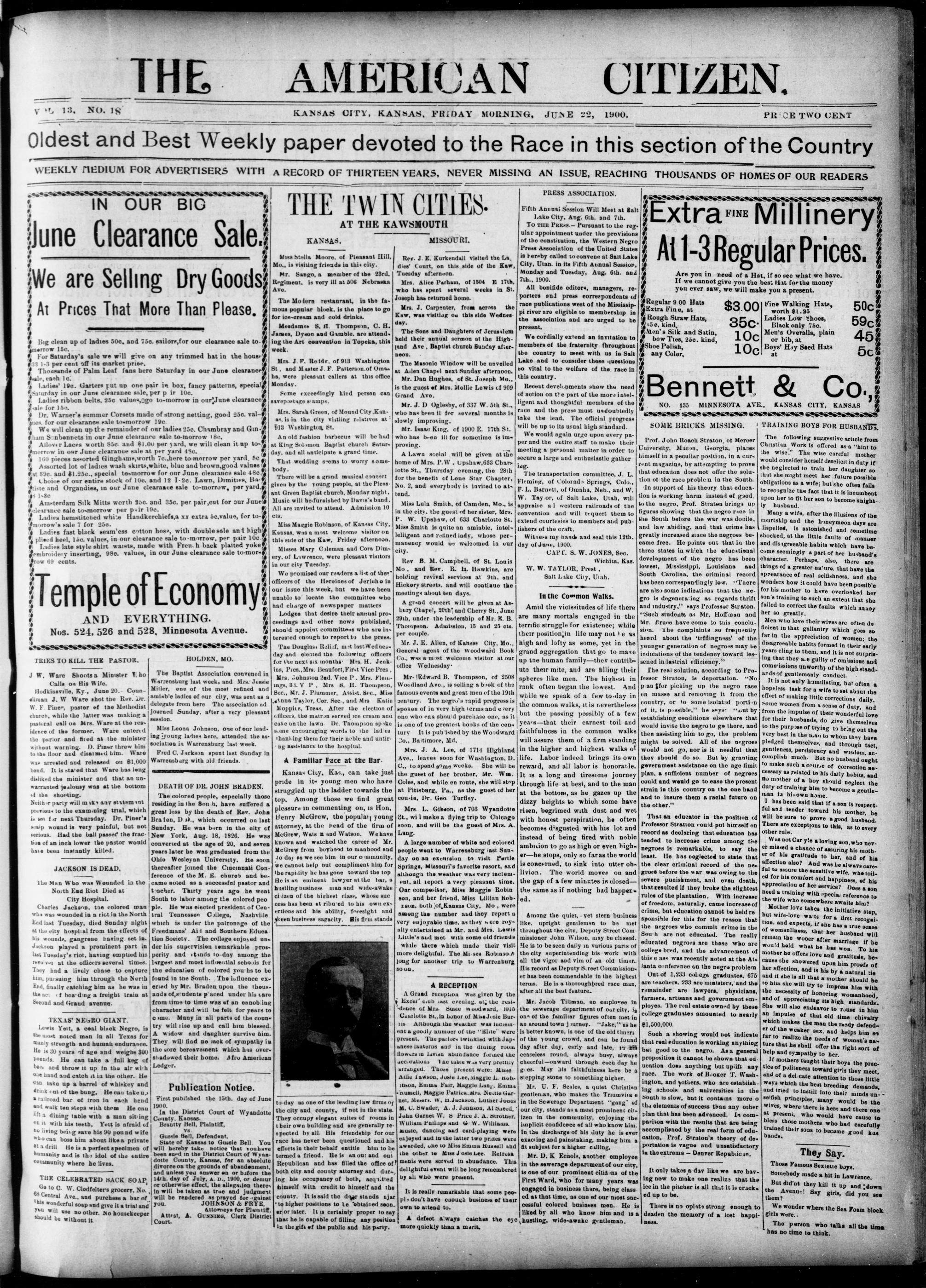
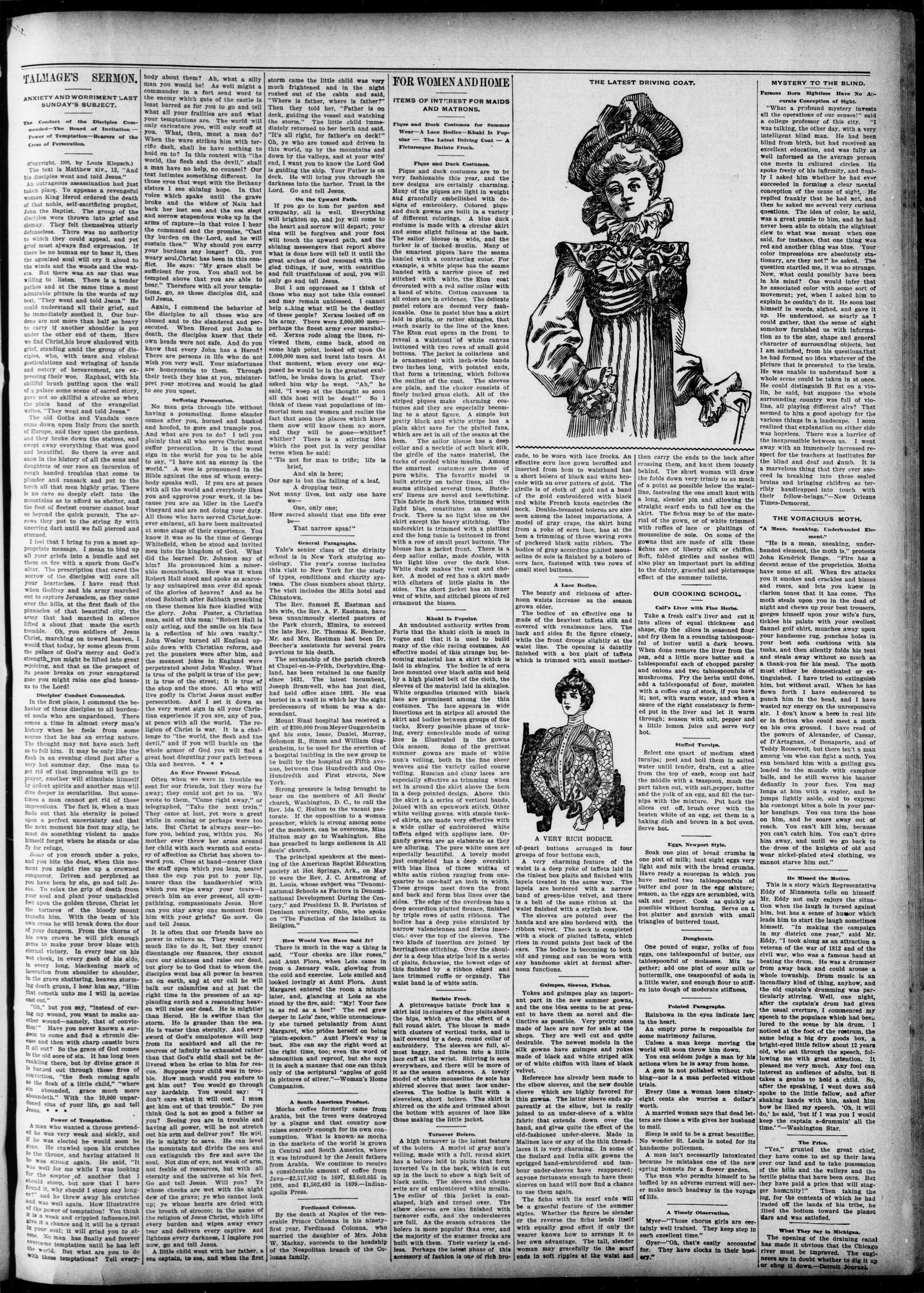
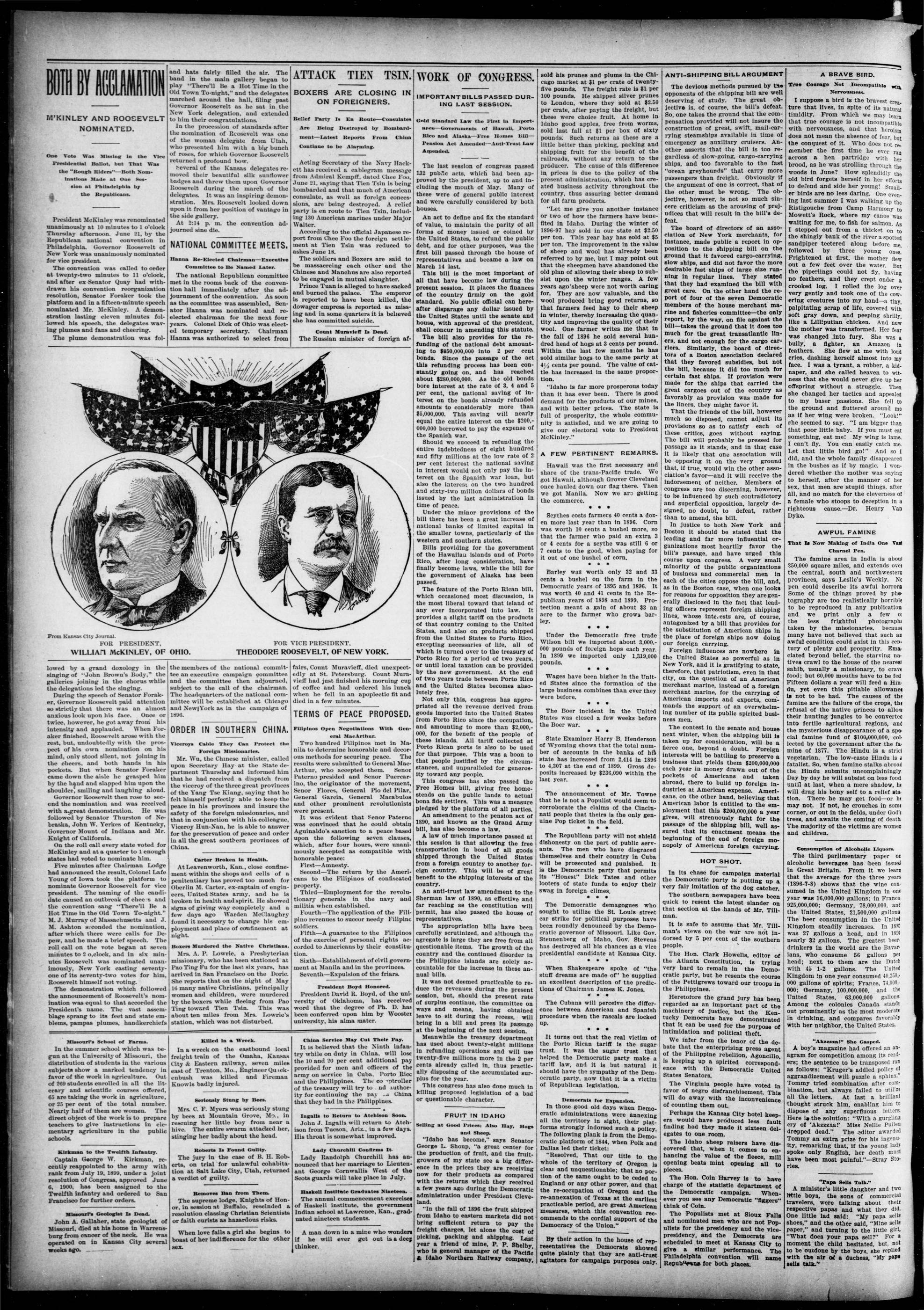
Page text (machine-generated)
Oldest and Best Weekly paper devoted to the Race in this section of the Country
WEEKLY MEDIUM FOR ADVERTISERS WITH A RECORD OF THIRTEEN YEARS, NEVER MISSING AN ISSUE, REACHING THOUSANDS OF HOMES OF OUR READERS
Big clean up of ladies 50c, and 75c. sailors, for our clearance sale to
morrow 15c.
For Saturday's sale we will give on any trimmed hat in the house
33 1-3 per cent off its market price.
Thousands of Palm Leaf fans here Saturday in our June clearance
sale, each 1c.
Ladies' 19c. Garters put up one pair in box, fancy patterns, special
Saturday in our June clearance sale, per p ir 10c.
Ladies ribbon belts, 25c values, go to-morrow in our June clearance
sale for 15c.
Dr. Warner's summer Corsets made of strong netting, good 25c. val-
ues, for our clearance sale to morrow 19c.
We will clean up the remainder of our ladies 25c. Chambray and Gun-
ham Sennbennets in our June clearance sale to morrow 18c.
Allover Laces worth 85c. and $1.00 per yard, we will clean it up to-
morrow in our June clearance sale at per yard 49c.
160 pieces assorted Ginghams, worth 7c., here to-morrow per yard. 5c.
Assorted lot of ladies wash skirts, white, blue and brown, good values
at 8c. and $1.25c., special to-morrow for our June clearance sale 48c.
Choice of our entire stock of 19c. and 12 I-2c. Lawn, Dimitres, Bastiste and Organdies, in our June clearance sale to-morrow, per yard.
$1-8c.
Amsterdam Silk Mitts worth 25c. and 35c. per pair, cut for our June
clearance sale to-morrow per pair 19c.
Ladies hemstitched white Handkerchiefs, axx extra 5c,value, for to-morrow's sale 7 for 25e.
Ladies fast black seamless cotton hose, with double sale and high plied heel, 15c,values, in our clearance sale to-morrow, per pair 10c.
Ladies late style shirt waists, made with French back plaited yoke embroidery inserting, 98c,values, in our June clearance sale to-morrow 69 cents.
temple of Economy
---
V. L 13, NO. 18
Oldest and I
WEEKLY MEDIUM FOR
June Clear
We are Sellin
At Prices That M
Big clean up of ladies 50c, and 75
merrow 15c.
For Saturday's sale we will give
33 1-3 per cent off its market price.
Thousands of Palm Leaf fans her
sale, each 1c.
Ladies' 19c. Garters put up one p
Saturday in our June clearance sale,
Ladies ribbon belts, 25c values, 6
sale for 15c.
Dr. Warner's summer Corsets mac
ues, for our clearance sale tomorrow
We will clean up the remainder of
ham Sunbennets in our June clearance
Allover Laces worth 85c and $1
morrow in our June clearance sale,
160 pieces assorted Gingham, wor
Assorted lot of ladies wash skirts,
at 95c. and $1,250c., special to morrow
Choice of our entire stock of 10c.
tiste and Organdies, in our June clear
1-3c
Amsterdam Silk Mitts worth 25c.
clearance sale to morrow per p in
Ladies hemstitched white Handk
Morrow's sale 7 for 250.
Ladies fast black seamless cotton
plied heel, 15c. values, in our clear
Ladies late style shirt waists, mac
embroidery inserting, 98c. values,
row 69 cents.
Temple of
AND EVER
Nos. 524, 526 and 52
TRIES TO KILL THE PASTOR.
J W. Ware Shoots a Minister Who Calls on His Wife.
Hodkinsville, Ky., June 20.—Counsman J. W Ware shot the Rev. Dr. W. F. Piner, pastor of the Methodist church, while the latter was making a pastoral call on Mrs. Ware at the residence of the former. Ware entered the pastor and fired at the minister without warning. D. Piner threw him to the floor and disarmed him. Ware was arrested and released on $1,000 bond. It is stated that Ware has long disliked the minister and that an unwarranted jealousy was at the bottom of the shooting.
Neither party will make any statement
previous to the examining trial, which
is set for next Thursday. Dr. Piner's
saup hand is very painful, but not
serious. Had the ball passed the fraction
of an inch lower the pastor would
have been instantly killed.
JACKSON IS DEAD.
Charles Jackson, the colored man who was wounded in a riot in the North End last Tuesday, died Sunday night at the city hospital from the effects of his wounds, gangrene having set in. Jackson played a prominent part in last Tuesday's riot, having emptied his revoiver at the officers several times. They had a lively chase to capture him, pursuing him through the North End, finally catching him as he was in the act of boarding a freight train at Second and Grand avenue.
TEXAS' NEIGRO GIANT
Lewis Yett, a coal black Negro, is the most noted man in all Texas for many strength and human endurance. He is 30 years of age and weighs 300 pounds. He can take a full keg of beer and throw it up in the air with one hand and catch it in the other. He can take up a barrel of whiskey and drink out of the bung. He can take up a railroad bar of iron in each hand and walk ten steps with them. He can lift a dining table with a man sitting on it with his teeth. Yett is afraid of no living being save his 90 pound wife who can boss him about like a private at a drill. He is a perfect specimen of humanity and is the idol of the entire community where he lives.
THE CELEBRATED BACK SOAP,
Go to C. W. Clodfelters grocery, No.
68 Central Ave., and purchase a bar of
this wonderful soap and give it a trial and
you will use no other. No housekeeper
should be without it.
THE
DUR BIG
clearance Sale.
Selling Dry Goods
at More Than Please.
and 75c. sailors, for our clearance sale to
give on any trimmed hat in the house
rise.
as here Saturday in our June clearance
one pair in box, fancy patterns, special
sale, per p ir 10c.
mes, go to-morrow in our June clearance
made of strong netting, good 25c. val-
morrow 19c.
order of our ladies 25c. Chambray and Gun-
clearance sale to-morrow 18c.
and $1.00 per yard, we will clean it up to
sale at per yard 48c.
s, worth 7c., here to-morrow per yard, 5c.
skirts, white, blue and brown, good values
morrow for our June clearance sale 48c.
10c. and 12 I-2c. Lawn, Dimities, Bac-
une clearance sale to-morrow, per yard.
25c. and 35c. per pair, cut for our June
p ir 19c.
landkerchiefs, a xx extra 5c.value, for to-
cotton hose, with double sale and high
clearance sale to-morrow, per pair 10c.
s, made with French back plaited yoke
values, in our June clearance sale to-more
of Economy
EVERYTHING.
d 528, Minnesota Avenue.
OR. HOLDEN, MO.
The Baptist Association convened in Warzensburg last week, and Mrs. Jessie Miller, one of the most refined and amiable ladies of our city, was sent as a delegate from here. The association adjourned Sunday, after a very pleasant session.
Miss Leona Johnson, one of our leading young ladies here, attended the association in Warzensburg last week.
Fred C. Jackson spent last Sunday in Warzensburg with old friends.
DEATH OF DR. JOHN BRADEN.
The colored people, especially those residing in the South, have suffered a great loss by the death of Rev. John Braden, D.D., which occurred on last Sunday. He was born in the city of New York, Aug. 18, 1826. He was converted at the age of 20, and seven years later he was graduated from the Ohio Wesleyan University. He soon thereafter joined the Cincinnati Conference of the M. E. churub and became noted as a successful pastor and teacher. Thirty years ago he went South to labor among the colored people. He was elected president of Central Tennessee College, Nashville which is under the patronage of the Freedmans' Aid and Southern Education Society. The college enjoyed under his supervision remarkable prosperity and stands to-day among the largest and most influential schools for the education of colored youths to be found in the South. The influence exerted by Mr. Braden upon the thousands of students placed under his care from time to time was of an enobbing character and will be felt for years to come. Many in all parts of the country will rise up and call him blessed. A widow and daughter survive him. They will find no lack of sympathy in the sore bereavement which has overshadowed their home. Afro American Ledger.
Publication Notice
First published the 15th day of June
1900.
In the District Court of Wyandotte
County, Kansas.
Braid of wife
private men of entire
bar of office
keeper
Branty Bell, Plaintiff,
vs.
Gussie Bell, Defendant.
State of Kansas to Gussie Bell You will hereby take notice that you have been sued in the District Court of Wyandotte County, Kansas, for an absolute divorce on the grounds of abandonment, and unless you answer on or before the 14th day of July, A. D., 1900, or demur or otherwise effect, the allegation therein will be taken as true and judgment will be rendered as prayed for against you.
JOHNSON & FRYE,
Attorneys for Plaintiff.
Attest, A. GUNNING, Clerk District Court.
AMERICAN
KANSAS CITY, KANSAS, FRIDAY MORNING, JUNE 22, 1900.
THE TWIN CITIES AT THE KAWSMOUTH
KANSAS.
Miss Stella Moore, of Pleasant Hill, Mo., is visiting friends in this city.
Mr. Sango, a member of the 23rd, Regiment, is very ill at 506 Nebraska Ave.
The Modern restaurant, in the famous popular block, is the place to go for ice-cream and cold drinks.
Mesdames S. H. Thompson, C. H. James, Dyson and Gamble, are attending the Art convention in Topeka, this week.
Mrs. J. F. Reidv, of 913 Washington St., and Master J. F. Patterson of Omaha, were pleasant callers at this office Monday.
Some exceedingly kind person can save pictures stamps.
Mrs. Sarah Green, of Mound City, Kansas, is in the city visiting relatives at 913 Washington St.
An old fashion barbecue will be had at King Solomon Baptist church Saturday, and all anticipate a grand time.
That wedding seems to worry somebody.
There will be a grand musical concert given by the young people, at the Pleasant Green Baptist church, Monday night.
Music will be furnished by Davis's band. All are invited to attend. Admission 10 cts.
Miss Maggie Robinson, of Kansas City, Kansas, was a most welcome visitor on this side of the Kaw, Friday afternoon.
Misses Mary Coleman and Cora Dimery, of Lawrence, were pleasant visitors in our city Tuesday.
We promised our readers a list of their officers of the Heroines of Jericho in our issue this week, but we have been unable to locate the committee who had charge of newspaper matters.
Lodges that desire their annual proceedings and other news published, should appoint committees who are interested enough to report to the press.
The Douglas Relief, met last Wednesday and elested the following officers for the next six months: Mrs. H. Jenkins, Pres., Mrs. Beaufort, First Vice Pres. Mrs. Johnston 2nd. Vice P. Mrs. Fleuings, 81 V. P. Mrs. S. H. Thompson, Sec., Mr. J. Plummer, Assist. Sec., Miss Anna Taylor, Cor. Sec., and Mrs Katie Moppis, Treas. After the election of officers, the matron served ice cream and cake on the lawn. Dr. Thompson spoke some encouraging words to the ladies thanking them for their noble and untiring assistance to the hospital.
A Familiar Face at the Bar
Kansas City, Kas, can take just pride in it- young men who have struggled up the ladder towards the top. Among those we find great pleasure in commenting on, is Hon, Henry McGrew, the popular young attorney, at the head of the firm of McGrew, Wats n and Watson. We have known and watched the career of Mr. McGrew from boyhood to manhood and, so day as we see him in our community, we cannot help but compliment him for the rapidity he has gone toward the top. He is an eminent lawyer at the bar, a hustling business man and wide-awake citizen of the highest class, whose success has been at ribued to his own exertions and his ability, foresight and keen business sagacity. His firm stands
M.
to day as one of the leading law firms or the city and county, if not in the state. They occupy elegant suites of rooms in their own building and are generally respected by all. His friendship for our race has never been questioned and his efforts in their bebelief entitle him to be termed a friend. He is an out and out Republican and has filled the office of both city and county attorney and during his occupancy of both, acquired himself with credit to himself and the county. It is said the door stands ajar to higher positions to be obtained sooner or later. It is certainly proper to say that he is capable of filling any position in the gift of the public and his party.
MISSOURI.
Rev. J. E. Kurkendall visited the Ladies' Court, on this side of the Kaw Tuesday afternoon.
Mrs. Alice Parham, of 1504 E 17th who has spent several weeks in St Joseph has returned home.
Mrs. J. Carpenter, from across the Kaw, was visiting on this side Wednesday.
The Sons and Daughters of Jerusalem held their annual sermon at the Highland Ave. Baptist church Sunday afternoon.
The Masonic Window will be unveiled at Allen Chapel next Sunday afternoon.
Mr. Dan Hughes, of St. Joseph Mo., is the guest of Mrs. Mollie Lewis of 909 Grand Ave.
Mr. J. D Oglesby, of 337 W. 5th St., who has been ill for several months is slowly improving.
Mr. Isaac King, of 1900 E. 17th St. who has been ill for sometime is improving.
A Lawn social will be given at the home of Mrs. P.W. Upshaw,633 Charlotte St., Thursday evening, the 28th for the benefit of Lone Star Chapter, No. 2, and everybody is invited to attend.
Miss Lula Smith, of Camden, Mo., is in the city, the guest of her sister, Mrs. P. W. Upshaw, of 633 Charlotte St. Miss Smith is quite an amiable, intelligent and refined lady, whose permanency would be welcomed in our city.
Rev B. M. Campbell, of St. Louis Mo., and Rev. R. H. Hawkins, are holding revival services at 9th and Hickory streets, and will continue the meetings about ten days.
A grand concert will be given at Asbury Chapel, 20th' and Cherry St. June 29th, under the leadership of Mr. E. B. Thompson. Admission, 15 and 25 cts. per couple.
Mr. J. E. Allen, of Kansas City, Mo., General agent of the Woodward Book Co., was a most welcome visitor at our office Wednesday.
Mr.-Edward B. Thompson, of 2508 Woodland Ave., is selling a book of the famous events and great men of the 19th century. The negro's rapid progress is spoken of in very high terms and every one who can should purchase one, as it is one of the greatest books of the century. It is published by the Woodward Co. Baltimore, Md.
Mrs. J. A. Lee, of 1714 Highland Ave., leaves soon for Washington, D.C., to spend some weeks. She will be the guest of her brother, Mr. Wm. Coles, and while en route, she will stop at Pittsburg, Pa., as the guest of her cousi, Dr. Geo. Turfley.
Mrs. L. Gibson, of 703 Wyandotte St., will make a flying trip to Chicago soon, and will be the guest of Mrs. A. Lang.
A large number of white and colored people went to Warensburg last Sunday on an excursion to visit Pertle Springs, Missouri's favorite resort, and although the weather was very inclement, all report a very pleasant time. Our compositor, Miss Maggie Robinson, and her friend, Miss Lillian Robinson, both of Kansas City, Mo., were among the number and they report a very enjoyable time, as they were royally entertained at Mr. and Mrs. Lewis Little's and met with some old friends while there which made their visit more delightful. The Miss Robinson jong for another trip to Warrenburg soon.
A RECEPTION
A Grand reception was given by the Excer "cub last evening, at the residence of Mrs. Susie woodward, 1015 Charlotte St., in honor of Miss Josie Murrell. Although the weather was inclement a goodly number of the "Elite" were present. The patrons twinkled with Japanese tauterns and in the dining room flowers in lavin abundance formed the decorations. The table was very prettily arranged. Those present were: Miss Allie Lawson, Josie Lee, Maggie L. Robinson, Emma Fair, Maggie Lang, Emma Russell, Maggie Patricia, Mrs. Nettie Garner, Messrs. W. t. Jackson, Luther Jones M. C. Swader, A. J. Johnson, Al Saeed, John Garnet W. S Price J. A. Strother, William Phillips and G. W. Williams, musc, dancing and card-playing were enjoyed and in the latter two prizes were awarded, one to Miss Emma Russell and the other to Miss Josie Lee. Retreat men were served in abundance. This delightful event will be long remembered by all who were present.
It is really remarkable that some people don't have enough business of their own to attend to.
A defect always catches the eye more quickly than a marig.
CITIZEN.
PRESS ASSOCIATION.
Fifth Annual Session Will Meet at Salt Lake City, Lake, Ang. 6th, and 7th.
Lake City, Aug. 6th. and 7th.
TO THE PRESS.—Pursuant to the regular appointment under the provisions of the constitution, the Western Negro Press Association of the United States is hereby called to convene at Salt Lake City, Utah. in its Fifth Annual Session, Monday and Tuesday, Aug. 6th. and 7th., 1900.
All bonifide editors, managers, reporters and press correspondents of race publications west of the Mississippi river are eligible to membership in the association and are urged to be present.
We cordially extend an invitation to members of the fraternity throughout the country to meet with us in Salt Lake and to consider these questions so vital to the welfare of the race in this country.
Recent developments show the need of action on the part of the more intelligent and thoughtful members of the race and the press must undoubtedly take the lead. The official progress will be up to its usual high standard.
We would again urge upon every paper and the entire staff to make their meeting a personal matter in order to secure a large and enthusiastic gathering.
The transportation committee, J. L. Fleming, of Colorado Springs, Colo., F. L. Barnett, of Omaha, Neb., and W. W. Tayor, of Salt Lake, Utah, will appraise a western railroads of the convention and will request them to extend courtesies to members and publishers of the craft.
Witness my hands and seal this 12th day of June, 1900.
CAP F. S. W. JONES, Sec.
Wichita, Kas.
W. W. TAYLOR, Prest,
Salt Lake City, Utah.
In the Common Walks.
Amid the vicissitudes of life there are many mortals engaged in the terrific struggle for existence; while their position in life may not be as high and lofty as some, yet in the grand aggregation that go to make up the human family—they contribute their mite, and are filling their spheres like men. The highest in rank often began the lowest. And while we speak of a few to-day in the common walks, it is nevertheless but the passing possibly of a few years—that their earnest toil and faithfulness in the common walks will assure them of a firm standing in the higher and highest walks of life. Labor indeed brings its own reward, and all labor is honorable. It is a long and tiresome journey through life at best, and to the man at the bottom, as he gazes up the dizzy heights to which some have risen, begrimed with dust and wet with honest perspiration, he often becomes disgusted with his lot and instead of being fired with noble ambition to go as high or even higher—he stops, only so faras the world is concerned, to sink into utter oblivion. The world moves on and the gap of a few minutes is closed—the same as if nothing had happened.
Among the quiet, yet stern business like, upright gentlemen to be met throughout the city, Deputy Street Commissioner John Wilson, may be classed. He is to be seen daily in various parts of the city superintending his work with all the vigor and vim of an old timer. His record as Deputy Street Commissioner has been commendable in the highest terms. He is a thoroughbred race man, after all the best feature.
Mr. Jacob Tillman, an employee in the sewerage department of our city, is one of the familiar figures often met in an around town journey. "Jake," as he is better known, is one of the old timers of the young crowd, and can be found day after day, early and late, in his ceaseless round, always busy, always cheerful—onward through each day he goes. May his faithfulness here be a stepping stone to something higher.
Mr. U. F. Scales, a quiet Christian gentleman, who makes the Trumvina e in the Sewerage Department "gang" of our city, stands as a most prominent citizen in the community, enjoying the implicit confidence of all who know him. In the discharge of his duty he is ever exacting and painstaking, making him a fit subjugant for a higher calling.
Mr. D. K Echols, another employee in the sewerage department of our city, is one of our promineat citiz-ons of the First Ward, who for many years was engaged in business there, being classed at that time, as one of our most successful colored business men. He is liked by all who know him and is a hustling, wide-awake gentleman.
Extra FINE Millinery At1-3Regular Prices.
Are you in need of a Hat, if so see what we have. If we cannot give you the best Hat for the money you ever saw, we will make you a present.
Bennett & Co.
NO. 135 MINNESOTA AVE., KANSAS CITY, KANSAS
Regular 9 00 Hats
Extra Fine, at
Rough Straw Hats,
15c, kind,
Men's Silk and Satin,
bow Ties, 25c, kind.
Shoe Polish,
any Color.
SOME BRICKS MISSING.
Prof. John Roach Straton, of Mercer University, Macon, Georgia, places himself in a peculiar position, in a current magazine, by attempting to prove that education does not offer the solution of the race problem in the South.
In support of his theory that education is working harm instead of good, to the negro, Prof. Straten brings up figures showing that the negro race in the South before the war was doosile, and law abiding, and that crime has greatly increased since the negroes became free. He points out that in the three states in which the educational development of the negro has been lowest, Mississippi, Louisiana and South Carolina, the criminal record has been correspondingly low. "There are also some indications that the negro is degenerating as regards thrift and industry," says Professor Straton. "Such students as Mr. Hoffman and Mr. Erwee have come to this conclusion. The complaints so frequently heard about the 'triflingness' of the younger generation of negroes may be indications of the tendency toward lessened industrial efficiency."
The real solution, according to Professor Straton, is deportation. "No plan for picking up the negro race on masse at removing it from the country, or to some isolated portion of it, is possible," he says: "but by establishing conditions elsewhere that would invite the negro to go there, and then assisting him to go, the problem might be solved. All of the negroes would not go, nor is it needful that they should do so. But by granting government assistance on the age limit plan, a sufficient number of negroes could and would go to ease the present strain in this country on the one hand and to insure them a racial future on the other."
That an educator in the position of Professor Stratton could put himself on record as declaring that education has tended to increase crime among the negroes is remarkable, to say the least. He has neglected to state that the clear criminal record of the negroes before the war was owing to the severe punishment, and even death, that resulted if they broke the slightest rules of the plantation. With increase of freedom, naturally, came increase of crime, but education cannot be held responsible for this for the reason that the negroes who commit crime in the South are not educated. The really educated negroes are these who are college bred, and the advancement of this class was recently noted at the Atlanta conference on the negro problem. Out of 1,233 college graduates, 675 are teachers, 233 are ministers, and the remainder are lawyers, physicians, farmers, artisans and government employees. The real estate owned by these college graduates amounted to nearly $1,500,000.
Such a showing would not indicate that real education is working anything but good to the negro. As a general proposition it cannot be shown that education does anything but upift any race. The work of Booker T. Washington, and others, who are establishing schools and universities in the South is slow, but it contains more o the elements of success than any other plan that has been advanced. In comparison with the results that are being accomplished by the real form of education, Prof. Straton's theory of deportation is vague and unsatisfactory in the extreme - Denver Republican.
It only takes a day like we are having now to make one realize that the ice in the pitcher is all that it is cracked up to be.
There is no opiate strong enough to deaden the memory of a lost happiness.
PRICE TWO CENT
the Country
MES OF OUR READERS
Millinery
ular Prices.
at, if so see what we have.
best: Hat for the money
like you a present.
Fine Walking Hats,
worth $1.25
50c
Ladies Low shoes,
Black only 75c.
59c
Men's Overalls, plain
or bib, at
45
Boys' Hay Seed Hats
at
5c
& Co.,
E., KANSAS CITY, KANSAS
TRAINING BOYS FOR HUSBAND
The following suggestive article from Christian Work is offered as a "hint to the wise." The wise careful mother would consider herself derelah in duty if she neglected to train her daughter so that she might meet her future possible obligations as a wife; but she often fails to recognize the fact that it is incumbent upon her to fit her son to become knightly husband.
Many a wife, after the illusions of the courtship and the honeymoon days are mispelled, is astonished and sometimes shocked, at the little faults of manner and disgraceable habits which have become seemingly a part of her husband's character. Perhaps, also, there are things of a greater nature, that have the appearance of real selfishness, and she wonders how it could have been possible for his mother to have overlooked her son's training to such an extent that she failed to correct the faults which annoy her so greatly.
Men who love their wives are often deficient in that gallantry which goes so far in the appreciation of women; the disagreeable habits formed in their early years cling to them, and it is not surprising that they a.e. guilty of omissions and commissions unworthy of the high standards of gentlemanly conduct.
It is not only humiliating, but often a hopeless task for a wife to set about the effort of making little corrections daily. Some women from a sense of duty, and from the impulse of their wonderful love for their husbands, do give themselves to the purpose of trying to bring out the very best in the man to whom they have pledged themselves, and through tact, gentleness, persistence and wisdom, accomplish much. But no husband ought to make such a course of correction necessary as related to his daily habits, and no mother of a boy should neglect the duty of training him to become a gentleman in his own home.
I has been said that if a son is respectful and tender toward his mother, he will be sure to prove a good husband. There are exceptions to this, as to every other rule.
Was not Car pley a loving son, who never missed a chance of assuring his mother of his gratitude to her, and of his affection also? And was he always careful to assure the sensitive wife, who trolled for his comfort and happiness, of his appreciation of her service? Does a son need a training with special reference to the wife who somewhere awaits him?
Mother love takes the initiative step, but wife loves watts for a first recognition, and expects, if she has a true sense of womaniness, that her husband will remain the wooer after marriage if he would hold what he has won. To his mother he offers love and gratitude, because she showered upon him proofs of her affection, and is his by a natural tie and if she is all that a mother should be to him she will try to impress him with the necessity of honoring womanhood, and of appreciating its high standards. She will also endeavor to rouse in him an impulse of that old time chivalry which makes the man the ready defender of the weaker sex, and helps him so far to realize the needs of woman's nature that he shall offer the right sort of help and sympathy to her.
If mothers taught their boys the practice of politeness toward girls they meet, and of a del cat attention to those little ways which the best breeding demands, and tried to instill in their minds unsefish principles, many would be the wives, where there is here and there one at present, who would have cause to bless those mothers who had carefully trained their sons to become good has bands.
They Say.
Those Famous Sexuelle hays
Somebody made a hit in Lawrence.
But didn't they kill it up and down
the Avenue! Say girls, did you see
them?
We wonder where the Sea Foam block
girls were.
The person who talks all the time
has no time to think.
AMERICAN CITIZEN PUBLISHING
AND PRINTING CO.
Daily and Weekly 417 Minnesota Ave.
KANSAS CITY KANSAS
TERMS OF SUBSCRIPTION
Daily delivered by carrierper week. 10c.
Weekly one year..... $1.50
Entered at the postoffice at Kansas City
Kans., as second class matter.
This paper or some Negro paper
should be in overy Negroes home
to keep posted on what the race is
doing. As this is the only Negro
Daily in this part of the country it
ought to receive hearty support.
MONEY
I WILL BUY
The additional Homestead Claims of all Soldiers or Sailors who served in the Union army or navy, their widows or minor heirs.
Who filed a Homestead claim of less than 160 acres of land prior to June 22nd., 1874?
Such persons are entitled to enough more land, including the number of acres embraced in their original entry, without living upon it, to make 160 acres. If their homesteaded 80 acres, they are entitled to 80 more, if 40 acres 120 more, if 159 acres, one more, or any other number as it may a pear.
By late ruling, and decisions its not necessary that final proof should have been made on their original entry, that is, they are now entitled to such additional rights if their homestead was abandoned, canceled or relinquished, and all transfers can be made at their homes, before a Notary Public. All such claims I am prepared to buy and will pay the highest market price in cash, AT ONCE. Will buy fractional claims even if not more than one acre each. If you did not make a homestead filing you have no claim to sell.
This land is yours and don't wait but come to this office at once and get full particuliers concerning this land. It is to your own interest to do so.
AMERICAN CITIZEN OFFICE,
335 Minnesota Avenue.
A COMMENDABLE CLUB
I it scarcely ever becomes within our jurisdiction to speak a good word for clubs, because they have in latter days become more of a curse than a pleasure, and instead of commending the highest praise from the community at large, merit oftimes, and receives the baset condemnation. There is no reason why agrobes cannot conduct a place of social recreation on as elite, business and strictly first class principles as any set of white men. At 1000 St. Louis avenue, is located the P and W. Musical Club, of which Mr. Marshall H. Shelton is manager—who seems to be in his make-up a gentleman of rare business tect, push and energy, capable of managing any business undertaken by him. Mr. Robert Cox, our esteemed old fellow townman, hale and hearty gentleman well met, is secretary, his long years of service in various organizations for Caucusians eminently fit him, to fill his present place with that degree of satisfaction which conquers the most fastidious when they come in contact with the "real thing". The establishment of the P. and W. musical club is conducted on business principles and is fitted up in modern style. It cateres to those of the race who are gentlemen, who respect themselves and other people likewise—who can appreciate courtesies shown them by gentlemen of their own race when in Kansas City, Mo., give them a call. There is no place fitted up in more modern style, tastily arranged and managed by more congenial people than the headquarters of the P. and W. Musical Club. We have no hesitation in saying it is one of the finest, unequalled, in Kansas City, Mo. Give them a call.
They Say.
How about the Derby?
And the dancing master is gone now.
What about it?
There is but ore thing that women are
more apt to discover than the faults of
men—and that is the faults of other
women.
That wedding is supposed to be not far
off. Can it be true.
The "make haste" wagon came right
up the avenue Monday morning.
Miss Ann Avenue has quit serving four o'clock Sabbath evening lunches.
The Famous Sextette and the Sea Foam block girls were in the push Monday evening. Didn't we kill it up the avenue.
The "little gnat" and pretty "Buby" are rather hard to locate.
Wonder where Miss 12th Street was when "Queen Bess" was on the turf?
J. H. and A. R. or T., eut a great dash up the avenue Monday night.
Two prominent young ladies find it quite sociable at the Dug store on Fifth street.
She looked and waited for him long and patiently at the dance Monday night—Wonder if he come.
Little Gnat and Big Mr. R. will hold forth at the Armory.
KANSAS CITY, MO
Church Directory
BAPTIST CHURCHES.
African 3014 East 15th. street.
Greenwood, 2005 Maderson Avenue.
Highland Avenue, 1119 Highland Ave.
Macedonian}
Mission { 116 East 21st. street.
Missionary, 2005 Madison Avenue.
Mt. Calvary, 15 northeast cor. Norton
Avenue.
Mount Gay, 2100 Wyoming Avenue.
Mount Norlain, 933 Bluff Street.
Mount Olive, Villa, s e. cor. Garnett.
Mount Zion, 908 Hickory Avenue.
Mount Zion, Primitive, 2815 Garnett
street.
Pligrim, 705 Charlott street.
Pligrim, Charlott between 6th and 7th
Pleasant Green, East Forest.
Round Top, Norton near 28th street.
St. James, 1411 East 18th street.
St James Chapel, 518 High street.
St. Marks, 1019 East 4th street.
St. Pauls, 510 East 4th street.
Second Baptist, Charlott, cor. 10th.
Vine Street, 1825 Vine street.
CHRISTIAN CHURCH
21st between Summit and Madison,
s. Augus'ine Mission, 1025 Troost ave.
METHODIST EPISCOPAL.
Ashbury Chapel, 1620 Cherry street.
Burns, 11th S W. Cor, Highland ave
Clark's Chapel, 819 S. W. Boulevard
Westport W. Prospect Place Cor, 32rd
King Solomon Mission 4th and Locust
Colored Schools.
Attucks 2108 East 18th street.
Bruce 3914 East 15th street.
Douglass 27th N. E. Cor. N. Prospect Place.
Garrison Forest S. W Cor. 4th street,
Lincoln School 11th N W. Cor Campbell street.
Lincoln High School 816 East 11th st.
Page Rochester N.E. Cor. Prospect Avenue.
Penn 4241 Shawne.
Phillips 1917 Cherry street.
Round Top 2817 Norton Avenue.
Business Directory.
J. A. Wilson Jeweller 1616 W. 9th st.
Chandler's Barber shop, Samuel Chandler Prop. S LClemens Mgr 112 East 6th street.
Restaurant Mrs Amus Prop. 114 East 6th street.
Field's Barber Shop 102 East 6th street
Miller's Barber Shop 113 East 6th
Midland Barber Shop Harsey Parson Proprietor 115 East 6th street.
P. Joe Barber Shop Oarth & Warfield Proprietors 550 Grand Avenue.
O 'Bannon' Barber Shop W.T. O 'Ban' on Proprietor 560 Grand Avenue.
Maupin's Barber Shop 1832 E 18th st.
Brown's Barber Shop 1339 E 18th st.
Berry's Barber Shop 1432 $\textcircled{4}$ E. 18th st
Grocer, George Grear, Prop. 1211 E.
8th st.
D. M. Mitchell, Barber Shop, 576
Grand ave.
Langston's Barber Shop 718 East 8th st
Walkers' Barber Shop 806 East 12th st
H. J. George, barber shop, 1307 w
9th st.
Cowdens Barber Shop 704 East 12th st
Restaurant J. W, Gordon Prop. 554
Grand avenue.
Restaurant H Powel Propnetor 572
Grand avenue.
Saratoga Cafe L. Mason I proprietor
805 Independence ave.
Chicago Cafe H Compton Proprietor,
706 est 12th street
Physicians and Surgeons.
Drs. Shannon and Lambright 1215 E.
18th st.
Dr. J.N. Birch 1339 E. 18th st.
Dr. T.C. Unthank 1233 Independence
Ave.
Dr. L.J.Holly 1112 Campbell st.
Rising Suu J.F. Cole, Editor, L. W.
Wood, Manager 117 W. 61st.
The State of Kansas, County of Wyandotte, ss.
In the matter of the estate of Taylor McDonald, deceased. In the Probate Court in and for said County.
Notice is hereby given that letters of administration have been granted to the undersigned, on the estate of Taylor McDonald, late of said county, deceased, by the Honorable, the Probate Court of the County and State aforesaid, dated the 3rd. day of March A. D. 1900. Now, all persons having claims against the said estate, are hereby notified that they must present the same to the undersigned for allowance wi him one yer from the date of said letters or they may be precluded from any benefit of such estate, and that if such claims be not exhibited within three years after the date of said letters, they shall be forever barred.
I. F. BRADLEY.
Administrator of the estate of Taylor McDonald, deceased.
Kansas City, Kas., March 20th, 1900.
In witness whereof the undersigned,
Probate Judge in and for the County of
Wyandotte, State of Kansas, have hereto
set my hand, and affixed the seal of the
said Probate Court, this 18th. day of
March, A.D., 1900. K. P. SNYDER,
Probate Judge
KANSAS CITY, KANSAS
Enterprises.
A.C.L. Coal Co. Main Office 402 Minn.
Ave. E.F. Henderson, Mgr.
D.W. White Furniturestore, 420 Minn.
Ave.
J.W. Jones Grocery 400. Oakland Ave.
M. Gordon Department store 1605 N
0th
Clark & Lee, junk store, 1104 ncrth
8rd. st.
Kansas City Kansas Soap Works, 4th.
st. between Oakland and Freeman.
J.R. McClain, Grocer, 1700 n 5th. st.
J·R. Rucker, Butcher, 1609 n 16th, st
Douglas Hospital, 312 Washington
ave. Miss L. V. Ashton, Matron.
CHURCHES
METHODIST.
St. James A. M. E., cor. 7th. and Ann.
St. James M. E., Freeman ave., be tween 9th and 10th.
C. M. E. Oakland ave., bet. 4th. and 5th.
CHRISTIAN.
8th. St. Christian, cor. Everett and 8th.
9th. St. Christian, cor. 9th. and Nebraska.
BAPIST.
1st. Baptist, corner 5th. and Nebraska avenue.
Metropolitan Baptist, cor. 9th. and Washington.
Mt. Zion Baptist, Virginia ave., between 4th and 5th.
Mt. Pleasant, 3rd st., between Oakland and Jersey.
Rose Hill, Jersey ave. bet. 10th.
Pleasant Green, Wood St. and Split-log ave.
King Solomon Baptist, 3rd. and State avenue.
HOTELS.
Dyson House 440 Minnesota Ave.
Restaurant.
J. W. Johnson's 6th and State.
Mrs. Hall 507 Minn. Ave.
Mrs. Sarah Thurston 1414 5th st.
Mc Gees 448 Minn. Ave.
E. Stoakes 1510 N. 3rd st.
BARBERS
J. T. Roberts & Tucker, 507 Minnesota avenue.
J. Gross, 412 Minnesota avenue.
G. McClellan, 613 Minnesota ave.
M.T. Comer, 608 Minnesota ave.
Robt. Keith, 315 Minnesota ave.
M. Pattison, 1603 north 3rd st.
SHOEMAKERS.
Lon McAdams, 348 Minnesota ave.
D. W. Wynne, 809 Minnesota ave.
Lewis Blenchard, North 6th., State Line.
Wilson, 5th. st. between Nebraska
and State.
J. W. Ready, No. 1609 $ \frac{1}{4} $ n 10th. st.
HALLS.
M. & O..1806 north 8th. street.
Sons of Protection, State and 6th.
DRUGS.
Wyandotte Drug Store, 1512 north
5th. street.
DOCTORS.
S. H. Thompson, 1512 north 5th. st.
G. H. Brown, 1010 Freeman ave.
Jordan, 610 Minnesota ave.
ARTISTS.
O. J. Brooks, 70, New York Life
Building.
TEACHERS OF FRENCH AND ELOCUTION:
Arthur A. Anderson, 541 State Ave.
UNION
PACIFIC
OVERLAND
ROUTE
WORLD'S PICTORIAL LINE
SHORTFST LINE ACROSS THE CONTINENT
The Union Pacific 'The Original Overland Route' always was, and is to-day, the shortest and best Line to the west. Two splendid fast trains leave Kansas City daily over this old established line. No change of cars between Kansas City and Denver, Ogden or San Francisco. All trans solidly vestibulated and fully equipped with latest improved Recycling Chair Cars free and Pullman Palace sleeping cars. Meals served in Pullman Palace dining cars on the restaurant plan at prices most reasonable. All cars lighted with the celebrated Pintch Light Only line running two trains without change from KansasCity to Denver Low excursion rates on sale to Colorado Utah Idaho, Oregon. Washington and California. Don't complete your ars rangerhips for a trip west until you have learned all about special inducements and attractions offered by the Union Pacific. For full information in regard to low-rates time. etc., call on or address
Gen. Agt., Union Pacific. 1000 Main street, Kansas City, Mo
Publication Notice.
State of Kansas. } as
Wyandotte County. Ks. } said
In the Distic Court of said County.
Joelson County, Plaintiff, vs. Maria Law,
F defendant.
The above named defendant, Maria Law, will take notice that she has been sued by the above named plaintiff, Jos. Law, in the above named court, where the petition of the said plaintiff is now on file, praying for a divorce against you, the above named defendant, for course not in said petition, and that unless you answer petition on or before the 7th day of August, A D. 1900, the same will be taken as true and judgment thereon rendered accordingly, divorcing you from said plaintiff, and dissolving the toads of matrimony now existing between you
B. S. SMITH,
Attorney for Plaintiff.
Finest Barber Shop in the City.
Finest Barber Shop in the City.
Hair Cutting, 25c, Baths, 15c., Shaving, 10c., Newly Remodeled Bath Rooms, Porcelain Tubs
Crane's Toilet Soap OF WYANDOTTE CO, KS 6 Minnesota Avenue, Kansas City, Ks
EAGERS
Gem Dru
MINNESOTA
DEAL
DRUGS, MEDICI
Fine Toilet Soaps, Brus
PERFUMERY AND FANG
W. B. RA
Gem Drug Store
W. B. RAYMOND.
Manufacturer of and Wholesale dealer in
UNDERTAKERS * SUPP
FIRST-CLASS CARRIAGES FOR ALL PURPOSES AT AN
AMBULANCE FOR THE CONVEYANCE OF THE SICK A
Undertaking Rooms, 431 Minnesota ave. Telephone W
Factory Cor st St., and Riverview Ave.
KANSAS CIT!
UNDERTAKERS * SUPPLIES
FIRST-CLASS CARRIAGES FOR ALL PURPOSES AT ALL HOURS
AMBULANCE FOR THE CONVEYANCE OF THE SICK AND WOUNDED
Undertaking Rooms, 431 Minnesota ave. Telephone West 32.
Factory Cor st St., and Riverview Ave. Telephone 28
KANSAS CIT! KANSAS
Lewis Blandchard
No. 6, Sta e Line, K.C. K'
No. 6, Sta e LINE, K. C. K.
Does all kinds of Boot and Shoe work. He does first class hand work, and also has one of the very latest and best Shoemaker's machine and guarantees the best and the cheapest work in the quickest time.
Give him a trial and see for you elf.
McKAY'S
At No. 6. State Line, can be found one of the best Restaurants in the Twice Cities. Meals served on short notices to order, board and lodging $30 per week. Ice Cream, Cakes, and Fries every Sunday. The restaurant is in a splendid location for the convenience of its patrons to any part of the two cities.
RAILROAD NOTICES.
To Pueblo, Colo. radio Springs and Denver and return, special summer excursions June 21, July 4, 8, 9, 10, 18, and August 2, final return limit October 31, $19 for the round trip.
Summer tourist tickets on sale every day from June 1 to September 15, inclusive, final return limit Oct. 31, round trip $25.
Homeseekers' excursions to western and southwestern points on June 5 and 19, July 3 and 17, August 7 and 21, tickets good for twenty-one days, at rate of one fare plus $2, for the round trip.
Tickets to St. Paul and Minneapolis at $21 for the round trip, good gelg any day, returning any time up to October 1. Very low rates to other northern points.
Special excursions June 21, July 7, 8, 9 and 10, and August 2 to St. Paul, Minneapolis. Round trip at $15.50. Duluth to the Superiors at $9.85. Waterville, Minneapolis, $14.40. Good to return October 31, 1900.
From July 1 special round trip excursions to Ogden and Salt Lake City at $30.00 Liberal stop orders. Good to return until October 31.
June 20 to 25 Winfield and return $6.60
July 7 to 20, Ottawa and return $1.65
For particular call or address.
E. S. JACKSON,
ATT.
Passinger and Ticket Agent.
City ticket office No. 901 Main street,
Kansas City, Mo.
Women Not Cowardly.
When cowardice is described as a leading feminine attribute somebody makes a huge mistake. Women do the most daring things on record—take chances which would appeal a man. They may jump at the sight or mere mention of a harmless mouse, but they court death several times a year. It is one of the traits which makes femir the nature so puzzling. I have known women who were timid to a degree, under ordinary circumstances, come forth as heroes under the pressure of occasion. A woman who shudders at the sight of a small cut from which blood oozes will often exhibit a marvellous courage in a shocking accident. It is beautiful to think that dependence can be placed upon that species of recklessness which leads us into unnecessary trouble.
Great Honor For German Crown Prince.
Great Honor For German Crown Prince.
It is a great honor which the queen of Spain is paying to the young crown prince of Germany by investing him with the collar of the Order of the Golden Fleece. The order is one of the oldest in Europe. It was founded in 1426 by Phillip the Good, Duke of Burgundy, to commemorate his good fortune in "cleaning up" a large sum of money in a deal in wool. The uniform of the order is a cloak of scarlet, lined with ermine, and open at the throat to display the golden fleece and the motto of the order, which ornaments the collar. The order belongs of right to all the princes of Spain and Austria.
Bug Store
AVENUE
CALLER IN.
ONES, CHEMICALS,
ches, Combs, Etc.,
EY TOILET ARTICLES
RYMOND,
SUPPLIES
ALL PURPOSES AT ALL HOURS
ANCE OF THE SICK AND WOUNDED
ave. Telephone West 32.
and Riverview Ave. Telephone 28
KANSAS.
Secure Tickets
...VIA THE....
Chicago, Milwaukee
& St. Paul Ry
...AND YOU GET...
Sleepers: & Chair
Cars
...TO....
CHICAGO
and all intermediate points the shortest,
quickest and bes liline to Chiloocothe, Ot
umtwa, Cedar Rapids, Bubnque, and La
Crosse and Cedar Rapids, Rockford and
Freeport:
.....Passenger Station at....
22nd St. and Grand Ave.
Take Westport Cable.
City Ficket Office, 915 Main stree,
Ridge Building.
A. B. BRIDGES Gen'l. Southweste
Agent
F. J. LERCHPassenger Agent.
Office 915Main St.. Kansas City
NEGRO LAD INVENTS NEW G UN
Engene Borkin, of Chicago, Constructs
a Rapid-Fire Machine Weapon.
Eugene Burkin, a colored boy of 19 years, who lives in Chicago, is the inventor of a rapid fire machine gun which he claims is the most effective weapon of its kind in the world, and is destined to throw the inventions of Maxim and Nordenfeldt, now in general use in the armaments of the world, into the scrap heap. Several experts who have seen the model of Burkin's gu pronounce it a marvel of ingenuity an a terrible weapon. The boy is said to have refused an offer of $50,000 for his invention.
The boy ha never had any mechanical training, yet all the work on his model has been his own. The first idea of the weapon came to him during the Spanish American war, when the magnificent work of the American gunners directed his thoughts to guns and their improvement. He constructed his first model of wood, his only toolboxing aack-knife.
The lack of funds then threatened to put a stop to the young inventor's work, but he finally obtained enough money to go into an iron works on the West Side, which gave him the use of its tools and machinery for $5 a day. Here he constructed the model, which he sent to the patent office at Washington, which has already allowed seventeen of his claims on the weapon.
Half Rate Excursion.
(Plus two dollars) twice a month via Union Pacific to points in Colorado, Wyoming, Utah, Idaho, Montana and Washington. Call us up 'Phone 1100, or call at office 1,000 Main street, and let us tell you all about these excursions. Short line to Salt Lake. The Union Pacific of course; hours quicker time. All the comforts of home. Ticket of office 1,000 Main street. Telephone 1109. Remember Dining Cars on the Union Pacific that now starts from Kansas City daily. Unexcelled service, restaurant plan g Ticket office 1,000 Main street. Kansas City, Mo.
Oom Paul's Pajamas
From the London Globe: An informing story is being told of Mr. Kruger. Returning home from one of his journeys to England, he brought with him a pair of pajamas, and his appearance at night in this clothing nearly frightened the life out of the good Tante, his wife. "What's that?" she demanded. "Sleeping clothes from England," said Mr. Kruger, with misgiving. "Then take them off," responded Tante, "and come to bed in your veldtshoen (shoes)." Can it be Mr. Kruger's habit to go to bed in his boots?
SIMPLY GRAND!
Is the exclamation of all who have reviewed the latest designs and patterns in
WALL PAPER.
WALL PAPER.
527 Minnesota Avenue. LEINBACH. 527 Minnesota Avenue.
Where Moulings, Oils and Glass can also be found and at the most reasonable prices. When you wish Wall Paper of the best quality at the lowest prices, don't fail to call on Leinbach, he will treat you all ight.
For an Evening of Recreation
VISIT THE MODERN AND UP-TO-DATE.
Porters and Waiters Musical
CLUB!
1009. ST. LOUIS AVENUE. 1009. Kansas City. Missouri. It is the swellest place in the city
A. C. L. COAL CO.,
THE CHEAPEST PRICES
The Best Goods, the Quickest Sales, the Smallest Profits and the promptest deliveries.
GET THEIR PRICES ON
COAL, WOOD, FEED, FLOUR, AND BUILDING
STONE,
Wholesale and Retail. Office 402, Minnesota Ave. Tel. 152 West.
Yard and Storage 917 and 919 North 3rd. St.
E F. HENDERSON Mansger.
Restaurant
Good Meals Cooked to Order.
COLD LUNCHES ON SHORT NOTICE,
THE BEST HOME MADE PIES IN THE CITY,
CAKES AND CONFECTIONARIES.
When you want good Ice Cream go to the
Modern Restaurant Ice Cream Parlors
Where you can always find delicious Ice Creams. Remember the number, 504 Nabraska Avenue,
MRS. H. M. G. SPENCER, Proprietress.
KANSAS CITY, — — KANSAS
J. W. JOHNSON'S ICECREAMPARLOR
The only Ice Cream Parlors in the two Kansas Cities where you can get the BestIce Cream Soda, and Ice Creams, Fine lunch, Pies, Cakes AND Confectionaries
Special attention paid to Churches, Lodges and parties.
Ice Cream, wholesale, 175 to 90 cts. per gallon. Don't fail to give us a call. Corner 6th, and State streets,
KANSAS CITY KANS
HOUSE + CLEANING
Time has arrived if you are not satisfied with the interior of your house—SEE HOLZMARK
Pianos. Carpets and Draperies
TALMAGE'S SERMON.
ANXIETY AND WORRIMENT LAST
SUNDAY'S SUBJECT.
The Conduct of the Disciples Commended—The Board of Invitation—Power of Temptation—Bearers of the Cross of Persecution.
(Copyright, 1900, by Louis Klopsch.)
The text is Matthew xiv., 12, "And his disciples went and told Jesus."
his disciples went and told Jesus." An outrageous assassination had just taken place. To appease a revengeful woman King Herod ordered the death of that noble, self-sacrificing prophet, John the Baptist. The group of the disciples were thrown into grief and dismay. They felt themselves utterly defenseless. There was no authority to which they could appeal, and yet grief must always find expression. If there be no human ear to hear it, then the agonized soul will cry it aloud to the winds and the woods and the waters. But there was an ear that was willing to listen. There is a tender pathos and at the same time a most admirable picture in the words of my text, "They went and told Jesus." He could understand all their grief, and he immediately soothed it. Our burdens are not more than half so heavy to carry if another shoulder is put under the other end of them. Here we find Christ, his brown shadowed with grief, standing amid the group of disciples, who, with tears and violent gesticulations and wringing of hands and outcry of bereavement, are expressing their woe. Raphael, with his skilful brush putting upon the wall of a palace some scene of sacred story, gave not so skillful a stroke as when the plain hand of the evangelist writes, "They went and told Jesus."
The old Goths and Vandals once came down upon Italy from the north of Europe, and they upset the gardens, and they broke down the statues, and swept away everything that was good and beautiful. So there is ever and anon in the history of all the sons and daughters of our race an incursion of rough handed troubles that come to plunder and ransack and put to the torch all that men highly prize. There is no cave so deeply cleft into the mountains as to afford us shelter, and the foot of fleetest courser cannot bear us beyond the quick pursuit. The arrows they put to the string fly with unnering dart until we fall pierced and stunned.
I feel that I bring to you a most appropriate message. I mean to bind up all your griefs into a bundle and set them on fire with a spark from God's altar. The prescription that cured the sorrow of the disciples will cure all your heartaches. I have read that when Godfrey and his army marched out to capture Jerusalem, as they came over the hills, at the first flash of the pinnacles of that beautiful city, the army that had marched in silence lifted a shout that made the earth tremble. Oh, you soldiers of Jesus Christ, marching on toward heaven, I would that today, by some gleam from the palace of God's mercy and God's strength, you might be lifted into great rejoicing, and that as the prospect of its peace breaks on your enraptured gaze you might raise one glad hosanna to the Lord!
Disciples' Conduct Commended
Disciples Conduct Commended.
In the first place, I commend the behavior of these disciples to all burdened souls who are unpardoned. There comes a time in almost every man's history when he feels from some source that he has an erring nature. The thought may not have such heft as to fell him. It may be only like the flash in an evening cloud just after a very hot summer day. One man to get rid of that impression will go to prayer, another will stimulate himself by ardent spirits and another man will dive deeper in secularities. But sometimes a man cannot get rid of these impressions. The fact is, when a man finds out that his eternity is poised upon a perfect uncertainty and that the next moment his foot may slip, he must do something violent to make himself forget where he stands or else fly for refuge.
Some of you croust under a yoke, and you bite the sin, when this moment you might rise up a crowned conqueror. Driven and perplexed as you have been by sin, go and tell Jesus. To relax the grip of death from your soul and plant your unshackled feet upon the golden throne, Christ let the tortures of the bloody mount transix him. With the beam of his own cross he will break down the door of your dungeon. From the thorns of his own crown he will pick enough gems to make your brow blaze with eternal victory. In every tear on his wet cheek, in every gash of his side, in every long, blackening mark of laceration from shoulder to shoulder, in the grave shattering, heaven storming death groan, I hear him say, "Him that cometh unto me I will in nowise cast out."
"Oh," but you say, "instead of curing my wound, you want to make another wound—namely, that of conviction!" Have you never known a surgeon to come and find a chronic disease and then with sharp caustic burn it all out? So the grace of God comes to the old sore of sin. It has long been ranking there, but by divine grace it is bursed out through these fires of conviction, "the flesh coming again as the flesh of a little child," "where sin abounded, grace much more abounded." With the 10,000 unparodoned sins of your life, go and tell Jesus. . . .
Power of Temptation:
Power of Temptation.
A man who wanted a throne pretended he was very weak and sickly, and if he was elected he would soon be gone. He crawled upon his crutches to the throne, and having attained it he was strong again. He said, "It was well for me while I was looking for the scooper of another that I should soop, but now that I have found it, why should I stoop any longer?" and he threw away his crutches and was well again. How illustrative of the power of temptation! You think it is a weak and crippled influence, but give it a chance and it will be a tyrant in your soul; it will grind you to atonia. No man has finally and forever overcome temptation until he has left the world. But what are you to do with these temptations? Tell every
body about them? Ah, what a silly man you would be! As well might a commander in a fort send word to the enemy which gate of the castle is least barred as for you to go and tell what all your frailities are and what your temptations are. The world will only caricature you, will only scout at you. What, then, must a man do? When the wave strikes him with terrific dash, shall he have nothing to hold on to? In this contest with "the world, the flesh and the devil," shall a man have no help, no counsel? Our text intimates something different. In those eyes that wept with the Bethany sisters I see shining hope. In that voice which spake until the grave broke and the widow of Nain had back her lost son and the sea sleep and sorrow stupendous woke up in the arms of rapture—in that voice I hear the command and the promise, "Cast thy burden on the Lord, and he will sustain thee." Why should you carry your burdens any longer? Oh, you weary soul, Christ has been in this conflict. He says: "My grace shall be sufficient for you. You shall not be tempted above that you are able to bear." Therefore with all your temptations, go, as these disciples did, and tell Jesus.
Again, I command the behavior of the disciples to all those who are abused and to the slandered and persecuted. When Herod put John to death, the disciples knew that their own heads were not safe. And do you know that every John has a Herod? There are persons in life who do not wish you very well. Your misfortunes are honeycombs to them. Through their teeth they hiss at you, misinterpret your motives and would be glad to see you upset.
Suffering Persecution:
Suffering Persecution.
No man gets through life without having a pummeling. Some slander comes after you, horned and husked and hoofed, to gore and trample you. And what are you to do? I tell you plainly that all who serve Christ must suffer persecution. It is the worst sign in the world for you to be able to say, "I have not an enemy in the world." A woe is pronounced in the Bible against the one of whom everybody speaks well. If you are at peace with all the world and everybody likes you and approves your work, it is because you are an idler in the Lord's vineyard and are not doing your duty. All those who have served Christ,however eminent, all have been maltreated at some stage of their experience. You know it was so in the time of George Whitefield, when he stood and invited the kingdom of God. What did the learned Dr. Johnson say of him? He pronounced him a miserable mountbank. How was it when Robert Hall stood and spoke as scarcely any uninspired man ever did speak of the glories of heaven? And as he stood Sabbath after Sabbath preaching on these themes his face kindled with the glory. John Foster, a Christian man, said of this man: "Robert Hall is only acting, and the smile on his face is a reflection of his own vanity." John Wesley turned all England upside down with Christian reform, and yet the punsters were after him, and the meanest jokes in England were perpetrated about John Wesley. What is true of the pulpit is true of the pew; it is true of the street; it is true of the shop and the store. All who will live godly in Christ Jesus must suffer persecution. And I set it down as the very worst sign in all your Christian experience if you are, any of you, at peace with all the world. The religion of Christ is war. It is a challenge to "the world, the flesh and the devil," and if you will buckle on the whole armor of God you will find a great host disputing your path between this and heaven. * * *
An Ever Present Friend.
Often when we were in trouble we sent for our friends, but they were far away; they could not get to us. We wrote to them. "Come right away," or telegraphed, "Take the next train." They came at last, yet were a great while in coming or perhaps were too late. But Christ is always near—before you, behind you, within you. No mother ever threw her arms around her child with such warmth and ecstasy of affection as Christ has shown toward you. Close at hand—nearer than the staff upon which you lean, nearer than the cup you put to your lip, nearer than the handkerchief with which you wipe away your tears—I preach him an ever present, all sympathizing, compassionate Jesus. How can you stay away one moment from him with your griefs? Go now. Go and tell Jesus.
It is often that our friends have no power to relieve us. They would very much like to do it, but they cannot disentangle our finances, they cannot cure our sickness and raise our dead, but glory be to God that to whom the disciples went has all power in heaven an on earth, and at our call he will balk our calamities and at just the right time in the presence of an aplauling earth and a resounding heaven will raise our dead. He is mighter than Herod. He is switer than the storm. He is grander than the sea. He is vaster than eternity. And every sword of God's omnipotence will leap from its scabbard and all the resources of infinity be exhausted rather than that God's child shall not be delivered when he cries to him for rescue. Suppose your child was in trouble. How much would you endure to get him out? You would go through any hardship. You would say: "I don't care what it will cost. I must get him out of that trouble." Do you think God is not so good a father as you? Seeing you are in trouble and having all power, will he not stretch out his arm and deliver you? He will. He is mighty to save. He can level the mountain and divide the sea and can extinguish the fire and save the soul. Not dim of eye, not weak of arm, not feeble of resources, with all eternity and the universe at his feet. Go and tell Jesus. Will you? Ye whose cheeks are wet with the night dew of the grave; ye who cannot look up; ye whose hearts are dried with the breath of sirocco; in the name of the religion of Jesus Christ, which lifts every burden and wipes away every tear and delivers every captive and lightens every darkness, I implore you now, go and tell Jesus.
A little child went with her father, a sea captain, to sea, and when the first
storm came the little child was very much frightened and in the night rushed out of the cabin and said, "Where is father, where is father?" Then they told her, "Father is on deck, guiding the vessel and watching the storm." The little child immediately returned to her berth and said, "It's all right, for father's on deck!" Oh, ye who are tossed and driven in this world, up by the mountains and down by the valleys, and at your wits end, I want you to know the Lord God is guiding the ship. Your Father is on deck. He will bring you through the darkness into the harbor. Trust in the Lord. Go and tell Jesus.
On the Upward Path.
If you go to him for pardon and sympathy, all is well. Everything will brighten up, and joy will come to the heart and sorrow will depart; your sins will be forgiven and your foot will touch the upward path, and the shining messengers that report above what is done here will tell it until the great archs of God resound with the glad tidings, if now, with contrition and full trustfulness of soul, you will only go and tell Jesus.
But I am oppressed as I think of those who may not take this counsel and may remain unlessed. I cannot help a sizing what will be the destiny of these people? Xerxes looked off on his army. There were 2,000,000 men—perhaps the finest army ever marshaled. Xerxes rode along the lines, reviewed them, came back, stood on some high point, looked off upon the 2,000,000 men and burst into tears. At that moment, when every one supposed he would be in the greatest exultation, he broke down in grief. They asked him why he wept. "Ah," he said, "I weep at the thought so soon all this host will be dead!" So I think of these vast populations of immortal men and women and realize the fact that soon the places which know them now will know them no more, and they will be gone—whither? whither? There is a stirring idea which the poet put in very peculiar verse when he said:
"Tis not for man to trifle; life is brief,
And sin is here:
Our age is but the falling of a leaf,
A dropping tear.
Not many lives, but only one have
we—
One, only one;
How sacred should that one life ever
be—
That narrow span!"
General Paragraphs.
Yale's senior class of the divinity school is in New York studying sociology. The year's course includes this visit to New York for the study of types, conditions and charity systems. The class numbers about thirty. The visit includes the Mills hotel and Chinatown.
The Rev. Samuel E. Eastman and his wife, the Rev. A. F. Eastman, have been unanimously pastors of the Park church, Elmira, to succeed the late Rev. Dr. Thomas K. Beecher. Mr. and Mrs. Eastman had been Dr. Beecher's assistants for several years previous to his death.
The sextonship of the parish church at Chapel-le-Frith, Derbyshire, England, has been retained in one family since 1631. The latest incumbent, Joseph Bramwell, who has just died, had held office since 1893. He was buried in a vault in which lay the eight predecessors of whom he was a descendant.
Mount Sinai hospital has received a gift of $200,000 from Meyer Guggenheim and his sons, Isaac, Daniel, Murray, Solomon R., Simon and William Guggenheim, to be used for the erection of a hospital building in the new group to be built by the hospital on Fifth avenue, between One Hundredth and One Hundredth and First streets, New York.
Strong pressure is being brought to bear on the members of All Souls' church, Washington, D. C., to call the Rev. Ida C. Hulton to the vacant pastorate. If the opposition to a woman preacher, which is strong among some of the members, can be overcome, Miss Hulton may go to Washington. She has preached to large audiences in All Souls' church.
The principal speakers at the meeting of the American Baptist Education society at Hot Springs, Ark., on May 10 were the Rev, J. C. Armstrong of St. Louis, whose subject was "Denominational Schools as Factors in Denominational Development During the Century," and President D. B. Purinton of Denison university, Ohio, who spoke on "The Function of the Intellect in Religion."
How Would You Have Said It?
There is much in the way a thing is said. "Your cheeks are like roses," said Aunt Flora, when Lois came in from a January walk, glowing from the cold and exercise. Lois smiled and looked lovingly at Aunt Flora. Aunt Margaret entered the room a minute later, and, glancing at Lois as she stood by the fire, said: "My! Your face is as red as a bee!" The red grew deeper in Lois's face, while unconsciously she turned petulantly from Aunt Margaret, who prides herself on being "plain-spoken." Aunt Flora's way is best. She can say the right word at the right time, too; even the word of admonition and reproof, but she says it in such a manner that one can think only of the scriptural "apples of gold in pictures of silver."—Woman's Home Companion.
A South American Product
Mocha coffee formerly came from Arabia, but the trees were destroyed by a plague and that country now raises scarcely enough for its own consumption. What is known as mocha in the markets of the world is grown in Central and South America, where it was introduced by the Jesuit fathers from Arabia. We continue to receive a considerable amount of coffee from Java-$2,517,892 in 1897, $3,603,055 in 1898, and $1,502,493 in 1899.-Indianapolis Press.
Ferdinand Colonna.
By the death at Naples of the venerable Prince Colonna in his ninety-first year, Ferdinand Colonna, who married the daughter of Mrs. John W. Mackay, succeeds to the headship of the Neapolitan branch of the Colonna family.
FOR WOMEN AND HOME
ITEMS OF INTEREST FOR MAIDS
AND MATRONS.
Fique and Duck Costumes for Summer
Wear—A Lace Bodice—Khaki Is Popular — The Latest Driving Coat — A Picturesque Batiste Frock.
Ploue and Duck Costumes
Pique and Duck Costumes.
Pique and duck costumes are to be very fashionable this year, and the new designs are certainly charming. Many of the pliques are light in weight and gracefully embellished with designs of embroidery. Colored plique and duck gowns are built in a variety of different colorings. A blue duck costume is made with a circular skirt and some slight fullness at the back. The sailor blouse is wide, and the tucker is of tucked muslin. Many of the smartest pliques have the seams banded with a contrasting color. For example, a white plique has the seams banded with a narrow piece of red stitched with white, the Eton coat decorated with a red sailor collar with a band of white. Cotton canvases in all colors are in evidence. The delicate pastel colors are deemed very fashionable. One in pastel blue has a skirt in plaid, or rather shingles, that reach nearly to the line of the knee. The Eton coat opens in the front to reveal a waistcoat of white canvas buttoned with two rows of small gold buttons. The jacket is collarled and is ornamented with inch-wide bands two inches long, with pointed ends, that form a trimming, which follows the outline of the trimming, which follows the sleeves are plain, and the choker consists of fine tucked grass cloth. All of the striped pliques make charming costumes and they are especially becoming to a stout figure. A simple but pretty black and white stripe has a plain skirt save for the plained fans, which are set in all of the fans at the hem. The sailor blouse has a deep collar and a necktie of soft black silk, the girdle of the same material, the tucks of corded muslin. Among the smartest costumes are those of pure white. The favorite model is built stricly on tailor lines, all the seams stitched several times. Butchers' linens are novel and bewitching. This fabric in dark blue, trimmed with light blue, constitutes an unusual frock. There is no light blue on the skirt except the heavy stitching. The underskirt is trimmed with a plaiting and the long tunic is buttoned in front with a row of small pearl buttons. The blouse has a jacket front. There is a deep sailor collar, made double, with the light blue over the dark blue. White duck makes the vest and choker. A model of red has a skirt made with clusters of little plains in the sides. The short jacket has an inner vest of white, and stitched pieces of red ornament the blouses.
Khakl Is Popular.
An undoubted authority writes from Paris that the khaki cloth is much in vogue and that it is used to build many of the chile racing costumes. An effective model of this strange but becoming material has a skirt which is laid in shingles. The bodice is of ecru lace mounted over black satin and held by a high plaited belt of the cloth, the sleeves of the material laid in shingles. White organdies trimmed with black lace are prominent among the thin costumes. The lace appears in wide insertions set in stripes all around the skirt and bodice between groups of fine tucks. Every possible phase of tucking, every conceivable mode of using lace is illustrated in the gowns this season. Some of the prettiest summer gowns are made of white nun's velling, both in the fine sheer weavings and the variety called course velling. Russian and clunky laces are especially effective as trimming when set in around the skirt above the hem in a deep pointed design. Above this the skirt is a series of vertical bands, joined with an openwork stitch. Other white velling gowns, with simple tucked skirts, are made very effective with a wide collar of embroidered white taffeta edged with applique lace. Organdy gowns are as elaborate as they are alluring. The pure white ones are especially beautiful. A lovely model just completed has a deep overskirt with bias lines of three widths of white satin ribbon ranging from one-quarter to one-half an inch in width. These groups meet down the front and back and form bias lines over the sides. The edge of the overdress has a deep accordion plaited flounce, finished by triple rows of satin ribbons. The bodice has a deep yoke simulated by narrow velencencles and Swiss insertions over the top of the sleeves. The two kinds of insertion are joined by herringbone stitching. Over the shoulder is a deep bliss stripe laid in a series of plaits, schweiz, the lowest edge of this finished by a ribbon edged and lace trimmed ruffle or organy. The waist band is of white satin.
Batiste Frock.
A picturesque batiste frock has a skirt laid in clusters of fine plains about the hips, which gives the effect of a full round skirt. The blouse is made with clusters of vertical tucks, and is half covered by a deep, round collar of embroidery. The sleeves are full, almost baggy, and fasten into a little lace cuff at the wrist. Shirring is seen everywhere, and there will be more of it as the season advances. A lovely model of white mousseline de sole has shirred sleeves that meet lace under sleeves. The bodice is built with a sleeveless, short bolero. The skirt is shirred on the side and trimmed about the bottom with squares of lace like those making the little jacket.
Turnover Bolero.
A high turnover is the latest feature of the bolero. A model of gray nun's velling, made with a full, round skirt has a boloro laid in plats that form inverted Vs in the back, which is cut up in the back to show a high belt of black satin. The sleeves and chemisette are of embroidered white muslin. The collar of this jacket is coat-shaped, high and turned over. The elbow sleeves are also finished with turnover cuffs, and the undersleeves are full. As the season advances the bolero is more popular than ever, and the majority of the summer frocks are built with them. Their variety is endless. Perhaps the latest phase of this accessory of fashion is one of rich bro-
THE LATEST DRIVING COAT.
THE LATEST DRIVING COAT.
cade, to be worn with lace frocks. An effective ecru lace gown beruled and inserted from hem to waistband has a short bolero of black and white brocade with an over pattern of gold. The girdle is of cloth of gold and a band of the gold embroidered with black and white French knots encircles the neck. Double-breasted boleros are also seen among the latest importations. A model of gray crape, the skirt hung from a yoke of ecru lace, has at the hem a trimming of three waving rows of puckered black satin ribbon. The bodice of gray accordion paited mousseline de soie is finished by a bolero of ecru lace, fastened with two rows of small steel buttons.
The beauty and richness of afternoon waists increase as the season grows older. The bodice of an effective one is made of the heaviest tafeta silk and covered with renaissance lace. The back and sides fit the figure closely, while the front droops slightly at the waist line. The opening is daintily finished with a box plait of tafeta which is trimmed with small mother-
A VERY RICH BODICE
of-pearl buttons arranged in four groups of four buttons each.
A very charming feature of the waist is a deep voke of taffeta laid in the tiniest box plats and finished with lapels treated in the same way. The lapels are bordered with a narrow band of green-blue velvet, and there is a belt of the same ribbon at the waist finished with a stylish bow.
The sleeves are pointed over the hands and are also bordered with the ribbon velvet. The neck is completed with a stock of plaited taffeta, which rises in round points just back of the ears. The bodice is becoming to both old and young and can be worn with any handsome skirt at formal afternoon functions.
Gulmpes, Sleeves, Flchus.
Yokes and guilms play an important part in the new summer gowns, and the one idea seems to be at present to have them as novel and distinctive as possible. Very pretty ones made of lace are now for sale at the shops. They are well cut and quite desirable. The newest models in the silk gowns have guilms and yokes made of black and white striped silk or of white chiffon with lines of black velvet.
Reference has already been made to the elbow sleeves, and the new double sleeve which are highly favored for thin gowns. The latter sleeve ends apparently at the elbow, but is really joined to an under-sleeve of a white fabric that extends down over the hand, and gives quite the effect of the old-fashioned under-sleeve. Made in Malines lace or any of the thin thread-laces it is very charming. In some of the foulard and India silk gowns the sprigged hand-embroidered and tambour under-sleeves have reappeared; anyone fortunate enough to have these sleeves on hand will now find a chance to use them again.
The fichu with its scarf ends will be a graceful feature of the summer styles. Whether the figure be slender or the reverse the fichu lends itself with equally good effect if only the wearer knows how to arrange it to her own advantage. The tall, slender woman may gracefully tie the scarf ends in soft ripples at the waist and
A Lace Bodice.
A
then carry the ends to the back after crossing them, and knot them loosely behind. The short woman will draw the folds down very trimly to as much of a point as possible below the waistline, fastening the one small knot with a long, slender pin and allowing the straight scarf ends to fall low on the skirt. The fuchsia may be of the material of the gown, or of white trimmed with ruffles of lace or plaitings of mousseline de soie. On some of the gowns that are made of silk these fuchs are of liberty silk or chiffon. Soft, folded girdles and sashes will also play an important part in adding to the dainty, graceful and picturesque effect of the summer toilette.
OUR COOKING SCHOOL,
Calca Liver with Fluo Herbs
Take a fresh calf's liver and cut it into slices of equal thickness and shape, dip the slices in seasoned flour and fry them in a rounding tablespoonful of butter until a dark brown. When done remove the liver from the pan, add a little more butter and a tablespoonful each of chopped parsley and onions and two tablespoonfuls of mushrooms. Fry the herbs until done, add a tablespoonful of flour, moisten with a coffee cup of stock, if you have it; not, with warm water, and when a sauce of the right consistency is formed put in the liver and let it warm through; season with salt, pepper and a little lemon juice and serve very hot.
Select one quart of medium sized turnips; peel and boil them in salted water until tender, drain, cut a slice from the top of each, scoop out half the middle with a teaspoon, mash the part taken out, with salt, pepper, butter and the yolk of an egg, and fill the turnips with the mixture. Put back the slices cut off, brush over with the beaten white of an egg, set them in a baking dish and brown in a hot oven. Serve hot.
Eggs, Newport Style.
Soak one pint of bread crumbs in one pint of milk; beat eight eggs very light and mix with the bread crumbs. Have ready a soucepan in which you have melted two tablespoonfuls of butter and pour in the egg mixture; season, as the eggs are scrambled, with salt and pepper. Cook as quickly as possible without burning. Serve on hot platter and garnish with small triangles of buttered toast.
One pound of sugar, yolks of four eggs, one tablespoonful of butter, one tablespoonful of molasses. Mix together; add one pint of sour milk or buttermilk, one teaspoonful of soda in a little water, and enough flour to stiffen into dough of moderate stiffness.
Pointed Paragraphs.
Rainbows in the eyes indicate levit in the heart.
An empty purse is responsible for some matrimony failures.
Unless a man keeps moving the world will soon throw him down.
You can seldom judge a man by his actions when he is away from home.
A gem is not polished without rubbing—nor is a man perfected without trials.
Every time a woman loses ninety-eight cents she worries a dollar's worth.
A married woman says that dead letters are those a wife gives her husband to mail.
Sleep is said to be a great beautifier.
No wonder St. Louis is noted for its handsome policemen.
A man isn't necessarily intoxicated because he mistakes one of the new spring bonnets for a flower garden.
The man who permits himself to be baffled by an adverse current will never make much headway in the voyage of life.
A Timely Observation
Myer—"Those chorus girls are certainly well trained. They keep step in such excellent time." Gyer—"Oh, that's easily accounted for. They have clocks in their hostel."
Stuffed Turpins.
Doughnuts.
```markdown
```
Persons Born Sightless Have No Alc
ocrate Conception of Sight
curate Conception of Sight.
"What a profound mystery invests all the operations of our senses?" said a college professor of this city. "I was talking, the other day, with a very intelligent blind man. He had been blind from birth, but had received an excellent education, and was fully as well informed as the average person one meets in cultured circles. He spoke freely of his infirmity, and finally I asked him whether he had ever succeeded in forming a clear mental conception of the sense of sight. He replied frankly that he had not, and then he asked me several very curious questions. The idea of color, he said, was a great puzzle to him, and he had never been able to obtain the slightest clew to what was meant when one said, for instance, that one thing was red and another thing was blue. Your color impressions are absolutely stationary, are they not? he asked the question startled me, it was so strange. Now, what could possibly have been in his mind? One would infer that he associated with some sort of movement; yet, when I asked him to explain he couldn't do it. He soon lost himself in words, sighed, and gave it up. He understood, as nearly as I could gather, that the sense of sight somehow furnished us with information as to the size, shape and general character of surrounding objects, but I am satisfied, from his questions, that he had formed no idea whatever of the picture that is presented to the brain. He was unable to understand how a whole scene could be taken in at once. He could distinguish B flat on a violin, he said, but suppose the whole surrounding country was full of violins, all playing different airs? That seemed to him a good apology for the various things in a landscape. I soon realized that explanation on either side was hopeless. There was a barrier of the inexpressible between us. I went away with an immensely increased respect for the teachers at institutes for the blind and deaf and dumb. It is a marvelous thing that they ever succeed in breaking into these sealed brains and bringing children so terribly handicapped into touch with their fellow-beings."—New Orleans Times-Democrat.
THE VORACIOUS MOTH
"A Mean, Sneaking, Underkanded Element."
"He is a mean, sneaking, underhanded element, the moth is," protests John Kendrick Bangs. "Fire has a decent sense of the proprieties. Moths have none at all. When fire attacks you it smokes and crackles and hisses and roars, and lets you know in clarion tones that it has come. The moth steals upon you in the dead of night and chews up your best trousers, gorges himself upon your wife's furs, tickles his palate with your sweetest flannel golf shirt, munches away upon your handsome rug, punches holes in your best sofa cushions with his tusks, and then silently folds his tent and steals away without so much as a thank-you for his meal. The moth must either be domesticated or extinguished. I have tried to extinguish him, but without avail. When he has flown forth I have endeavored to punch him in the head, and I have wasted my energy on the unresponsive air. I don't know a hero in real life or in fiction who could meet a moth on his own ground. I have read of the powers of Alexander, of Caesar, of D'Artagnan, of Bonaparte, and of Teddy Roosevelt, but there isn't a man among 'em who can fight a moth. You can bombard him with a gatling gun loaded to the muzzle with camphor balls, and he still waves his banner defiantly in your face. You may lunge at him with a rapiper, and he jumps lightly aside, and to express his contempt bites a hole in your parlor hangings. You can turn the hose on him, and he soars away out of reach. You can't kill him, because you can't catch him. You can't drive him away, and until we go back to the dress of the knights of old and wear nickel-plated steel clothing, we cannot starve him out."
He Missed the Motive
This is a story which Representative Eddy of Minnesota tells on himself. Mr. Eddy not only enjoys the situation when the laugh is turned against him, but has a sense of humor which leads him to start the laugh sometimes himself. "In making the campaign in my district one year," said Mr. Eddy, "I took along as an attraction a veteran of the war of 1812 and of the civil war, who was a famous hand at beating the drum. He was a drummer from away back and could arouse a whole township. Drum music is an incendiary kind of thing, anyhow, and the old captain's drumming was particularly stirring. Well, one night, after the captain's drum had given the usual overture, I commenced my speech to the populace which had been lured to the scene by his drum. I noticed at the foot of the roostrum, the same being a big dry goods box, a bright-eyed little fellow about 12 years old, who sat through the speech, following me with great attention. It pleased me very much. Any fool can interest an audience of adults, but it takes a genius to hold a child. So, after the speaking, I went down and spoke to the little fellow, and after shaking hands with him, asked him how he liked my speech. 'Oh, it will do,' he said, 'but if I was you I would keep the captain a drummin' all the time.'"—Washington Star.
The Price
"Yes," grunted the great chief, they have come to set up their laws over our land and to take possession of the hills and the valleys and the fertile plains that have been ours. But they have paid a price that will stagger humanity!" Then taking the lug, for the contents of which he had traded off the lands of his tribe, he lifted the bottom toward the planet Mars and was satisfied.
What They Say in Michigan
The opening of the draining canal has made it obvious that the Chicago river must be improved. The engineers are in doubt whether to dig it up or chop it down—Detroit Journal.
From Kansas City Journal.
BOTH BY AGGLAMATION
M'KINLEY AND ROOSEVELT
NOMINATED.
One Vote Was Missing in the Vice Presidential Ballot, but That Was the "Rough Riders"—Both Nominations Made at One Session at Philadelphia by the Republicans.
President McKinley was nominated unanimously at 10 minutes to 1 o'clock Thursday afternoon. June 21, by the Republican national convention in Philadelphia. Governor Roosevelt of New York was unanimously nominated for vice president.
The convention was called to order at twenty-two minutes to 11 o'clock, and after ex Senator Quay had withdrawn his convention reorganization resolution, Senator Foraker took the platform and in a fifteen-minute speech nominated Mr. McKinley. A demonstration lasting eleven minutes followed his speech, the delegates waving plumes and fans and cheering.
The plume demonstration was fol-
W. H.
From Kansas City Journal.
FOR PRESIDENT,
WILLIAM McKINLEY, OF OHIO.
lowed by a grand doxology in the singing of "John Brown's Body," the galleries joining in the chorus while the delegations led the singing.
During the speech of Senator Foraker, Governor Roosevelt paid attention so strictly that there was an almost anxious look upon his face. Once or twice, however, he got away from his intensity and applauded. When Foraker finished, Roosevelt arose with the rest, but, undoubtedly with the prospect of his own nomination on his mind, only stood silent, not joining in the cheers, and both hands in his pockets. But when Senator Foraker came down the aisle he grasped him by the hand and slapped him upon the shoulder, smiling and laughing aloud.
the mee tree an and the subject
The he mittee and Ne 1896.
ORDE
Viceroy
Mr. upon a partner that he the view
Governor Roosevelt then rose to second the nomination and was received with a great demonstration. He was followed by Senator Thurston of Nebraska, John W. Yerkes of Kentucky, Governor Mount of Indiana and Mr. Knight of California. On the roll call every state voted for McKinley and at a quarter to 1 enough states had voted to nominate him.
Five minutes after Chairman Lodge had announced the result, Colonel Lafe Young of Iowa took the platform to nominate Governor Roosevelt for vice president. The naming of the candidate caused an outbreak of cheeses and the convention sang “There’ll Be a Hot Time in the Old Town To-night.” M. J. Murray of Massachusetts and J. M. Ashton seconded the nomination, after which there were calls for Dewep, and he made a brief speech. The roll call on the vote began at seven minutes to 2 o.clock, and in six minutes Roosevelt was nominated unanimously, New York casting seventy-one of its seventy-two votes for him, Roosevelt himself not voting.
The demonstration which followed the announcement of Roosevelt’s nomination was equal to that accorded the President’s name. The vast assemblage sprang to its feet and state emblems, pamps plumes, handkerchiefs
Missouri's School of Farms.
In the summer school which was begun at the University of Missouri, the distribution of students in the various subjects show a marked tendency in favor of the work in agriculture. Out of 269 students enrolled in all the literary and scientific courses offered, 65 are taking the work in agriculture, or 25 per cent of the total number. Nearly half of them are women. The direct object of the work is to prepare teachers to give instructions in elementary agriculture in the public schools.
Kirkman to the Twelfth Inf
Captain George W. Kirkman, recently reappointed to the army with rank from July 19, 1899, under a joint resolution of Congress, approved June 6, 1900, has been assigned to the Twelfth infantry and ordered to San Francisco for further orders.
Misnerel's Geologist Is Dead
John A. Gallaher, state geologist of Missouri, died at his home in Warrensburg from cancer of the neck. He was operated on in Kansas City several weeks ago. _____ or faith When boast sex.
and hats fairly filled the air. The band in the main gallery began to play "There'll Be a Hot Time in the Old Town To-night," and the delegates marched around the hall, filing past Governor Roosevelt as he sat in the New York delegation, and extended to him their congratulations.
In the procession of standards after the nomination of Roosevelt was one of the woman delegate from Utah, who presented him with a big bunch of roses, for which Governor Roosevelt returned a profound bow.
Several of the Kansas delegates removed their beautiful silk sunflower badges and threw them upon Governor Roosevelt during the march of the delegates. It was an inspiring demonstration. Mrs. Roosevelt looked down upon it from her position of vantage in the side gallery.
At 2:14 p. m. the convention adjourned sine die.
NATIONAL COMMITTEE MEETS.
Hanna Re-Elected Chairman—Executive Committee to Be Named Later.
The national Republican committee met in the rooms back of the convention hall immediately after the adjournment of the convention. As soon as the committee was assembled, Senator Hanna was nominated and re-elected chairman for the next four years. Colonel Dick of Ohio was elected temporary secretary. Chairman Hanna was authorized to select from
THE EAGLE AND THE SHIELD
FOR VICE PRESIDENT.
THEODORE ROOSEVELT, OF NEW YORK.
the members of the national committee an executive campaign committee and the committee then adjourned, subject to the call of the chairman. The headquarters of the national committee will be established at Chicago and New York as in the campaign of 1896.
ORDER IN SOUTHERN CHINA.
Viceroys Cable They Can Protect the Foreign Missionaries. Mr. Wu, the Chinese minister, called upon Secretary Hay at the State department Thursday and informed him that he had received a dispatch from the viceroy of the three great provinces of the Yang Tse Kiang, saying that he felt himself perfectly able to keep the peace in his provinces and insure the safety of the foreign missionaries, and that in conjunction with his colleague, Viceroy Hun-Nan, he is able to answer for the preservation of peace and order in all the great southern provinces of China.
At Leavenworth, Kan., close confinement within the shops and cells of a penitentiary has proved too much for Oberlin M. Carter, ex-captain of engineers, United States army, and he is broken in health and spirit. He showed signs of giving way completely and a few days ago Warden McClaughry found it necessary to change his employment and place of confinement at night.
Boxers Murdered the Native Christians. Mrs. A. P. Lowrie, a Presbyterian missionary, who has been stationed at Pao Ting Fu for the last six years, has arrived in San Francisco on the Doric. She reports that on the night of May 16 many native Christians, principally women and children, were murdered by the boxers while fleeing from Pao Ting toward Tien Tsin. This was about ten miles from Mrs. Lowrie's station, which was not disturbed.
In a wreck on the eastbound local freight train of the Omaha, Kansas City & Eastern railway, seven miles east of Trenton, Mo., Engineer Quickebush was killed and Fireman Knowls badly injured.
Mrs. C. F. Myers was seriously stung by bees at Mountain Grove, Mo., in rescuing her little boy from near a hive. The entire swarm attacked her, stinging her badly about the head.
Roberts Is Found Gulity.
The jury in the case of B. H. Roberts, on trial for unlawful cohabitation at Salt Lake City, Utah, returned a verdict of guilty.
The supreme lodge, Knights of Honor, in session at Buffalo, rescinded a resolution classing Christian Scientists or faith curists as hazardous risks.
When love fails a girl she begins to boast of her indifference for the other sex.
Carter Broken in Health.
Killed in a Wreck
Seriously Stung by Bees
Roberta Is Found Gullity
Removes Ban from Them
BOXERS ARE CLOSING IN ON FOREIGNERS.
Relief Party Is En Route—Consulates Are Being Destroyed by Bombardment—Latest Reports From China Continue to be Alarming.
Acting Secretary of the Navy Hackett has received a cablegram message from Admiral Kempp, dated Chee Foo, June 12, saying that Tien Tsin is being bombarded and that much of American consulate, as well as foreign concessions, are being destroyed. A relief party is en route to Tien Tsin, including 130 American marines under Major Walter.
According to the official Japanese report from Chee Foo the foreign settlement at Tien Tsin was reduced to ashes June 18.
The soldiers and Boxers are said to be massacreing each other and the Chinese and Manchus are also reported to be engaged in mutual slaughter.
Prince Tuan is alleged to have sacked
and burned the palace. The emperor
is reported to have been killed, the
dowager empress is reported as missi-
ing and in some quarters it is believed
she has committed suicide.
Count Muravlevi Is Dead. The
Russian minister of foreign af-
fairs, Count Muravieff, died unexpectedly at St. Petersburg. Count Muravieff had just finished his moring cup of coffee and had ordered his lunch when he fell in an apoplectic fit and died in a few minutes.
TERMS OF PEACE PROPOSED.
Filipinos Open Negotiations With General MacArthur.
Two hundred Filipinos met in Manila to determine honorable and decorous methods for securing peace. The results were submitted to General MacArthur, who accepted them. Senor Paterno presided and Senor Puercarino, the originator of the movement, Senor Flores, General Pio del Pilar, General Garcia, General Macabulos and other prominent revolutionists were present.
It was evident that Senor Paterno was convinced that he could obtain Aguinaldo's sanction to a peace based upon the following seven clauses, which, after four hours, were unanimously accepted as compatible with honorable peace:
First—Amnesty.
Second—The return by the Americans to the Filipinos of confiscated property.
Third—Employment for the revolutionary generals in the navy and militia when established.
Fourth—The application of the Filipino revenues to succor needy Filipino soldiers.
Fifth—A guarantee to the Filipinos of the exercise of personal rights accorded to Americans by their constitution.
Sixth—Establishment of civil government at Manila and in the provinces.
Seventh—Expulsion of the friars.
President Boyd Honored.
President David R. Boyd, of the university of Oklahoma, has received word that the degree of Ph. D. has been conferred upon him by Wooster university, his alma mater.
China Service May Cut Their Pay.
It is believed that the Ninth infantry while on duty in China, will lose the 10 and 20 per cent additional pay provided for men and officers of the army on service in Cuba, Porto Rice and the Philippines. The co-controller of the treasury will try to and authority for continuing the pay in China that they had in the Philippines.
Ingalls to Return to Aitchison Soon.
John J. Ingalls will return to Aitchison from Tueson, Ariz., in a few days. His throat is somewhat improved.
Lady Churchill Confirms It
Lady Randolph Churchill has announced that her marriage to Lieutenant George Cornwallis West of the Scots guards will take place in July.
Haskell Institute Graduates Nineteen.
The annual commencement exercises of Haskell institute, the government Indian school at Lawrence, Kan., graduated nineteen students.
A man down in a mine who wonder if he will ever get out is a deep thinker.
WORK OF CONGRESS.
IMPORTANT BILLS PASSED DURING LAST SESSION.
Gold Standard Law the First in Importance—Governments of Hawaii, Porto Rico and Alaska—Free Homes Bill—Pension Act Amended—Anti-Trust Law Amended.
The last session of congress passed 132 public acts, which had been approved by the president, up to and including the month of May. Many of these were of general public interest and were carefully considered by both houses.
An act to define and fix the standard of value, to maintain the parity of all forms of money issued or coined by the United States, to refund the public debt, and for other purposes, was the first bill passed through the house of representatives and became a law on March 14 last.
This bill is the most important of all that have become law during the present session. It places the finances of the country firmly on the gold standard. No public official can hereafter disparage any dollar issued by the United States until the senate and house, with approval of the president, shall concur in amending this statute. The bill also provides for the refunding of the national debt amounting to $850,000,000 into 2 per cent bonds. Since the passage of the act this refunding process has been constantly going on, and has reached about $280,000,000. As the old bonds bore interest at the rate of 3, 4 and 5 per cent, the national saving of interest on the bonds already refunded amounts to considerably more than $5,000,000. This saving will nearly equal the entire interest on the $200,000,000 borrowed to pay the expense of the Spanish war.
Should we succeed in refunding the entire indebtedness of eight hundred and fifty millions at the low rate of 2 per cent interest the national saving in interest would not only pay the interest on the Spanish war loan, but also the interest on the two hundred and sixty-two million dollars of bonds issued by the last administration in time of peace.
Under the minor provisions of the bill there has been a great increase of national banks of limited capital in the smaller towns, particularly of the western and southern states.
Bills providing for the government of the Hawaiian islands and of Porto Rico, after long consideration, have finally become laws, while the bill for the government of Alaska has been passed.
The feature of the Porto Rican bill, which occasioned most discussion, is the most liberal toward that island of any ever incorporated into law. It provides a slight tariff on the products of that country coming to the United States, and also on products shipped from the United States to Porto Rico, excepting necessities of life, all of which is turned over to the treasury of Porto Rico for a period of two years, or until local taxation can be provided by the new government. At the end of two years trade between Porto Rico and the United States becomes absolutely free.
Not only this, congress has appropriated all the revenue derived from goods imported into the United States from Porto Rico since the occupation, and amounting to more than $2,000,-000, for the benefit of the people of these islands. All tariff collected at Porto Rican ports is also to be used for that purpose. This was a boon to that people justified by the circumstances, and unparalleled for generosity toward any people. This congress has also passed the Free Homes bill, giving free home-steads on the public lands to actual bona fide settlers. This was a measure pledged by the platform of all parties. An amendment to the pension act of 1890, and known as the Grand Army bill, has also become a law.
A law of much importance passed at this session is that allowing the free transportation in bond of all goods shipped through the United States from a foreign country to another foreign country. This will be of great benefit to the shipping interests of the country.
An anti-trust law amendment to the Sherman law of 1890, as effective and far reaching as the constitution will permit, has also passed the house of representatives.
The appropriation bills have been carefully scrutinized, and although the aggregate is large they are free from all questionable items. The growth of the country and the continued disorder in the Philippine islands are solely accountable for the increase in these annual bills.
It was not deemed practicable to reduce the revenues during the present session, but, should the present rate of surplus continue, the committee on ways and means, having obtained leave to sit during the recess, will bring in a bill and press its passage at the beginning of the next session.
Meanwhile the treasury department has used about twenty-eight millions in refunding operations and will use twenty-five millions more in the 2 per cent already called in, thus practically disposing of the accumulated surplus for the year.
This congress has also done much in killing proposed legislation of a bad or questionable character.
FRUIT IN IDAHO
Selling at Good Prices; Also Hay, Hogs and Sheep.
"Idaho has become," says Senator George L. Shoup, "a great center for the production of fruit, and the fruit-growers of my state see a big difference in the prices they are receiving now for their products as compared with the returns which they received a few years ago during the Democratic administration under President Cleveland.
"In the fall of 1896 the fruit shipped from Idaho to eastern markets did not bring sufficient return to pay the freight charges, let alone the cost of picking, packing and shipping. Last year a friend of mine, P. P. Shelby, who is general manager of the Pacific & Idaho Northern Railway company.
sold his prunes and plums in the Chicago market at $1 per crate of twenty-five pounds. The freight rate is $1 per 100 pounds. He shipped silver prunes to London, where they sold at $2.50 per crate, after paying the freight, but these were choice fruit. At home in Idaho good apples, free from worms, sold last fall at $1 per box of sixty pounds. Such returns as these are a little better than picking, packing and shipping fruit for the benefit of the railroads, without any return to the producer. The cause of this difference in prices is due to the policy of the present administration, which has created business activity throughout the country, thus assuring better demand for all farm products.
"Let me give you another instance or two of how the farmers have benefited in Idaho. During the winter of 1896-97 hay sold in our state at $2.50 per ton. This year hay has sold at $5 per ton. The improvement in the value of sheep and hay has already been referred to by me, but I may point out that the sheepmen have abandoned the old plan of allowing their sheep to subsist upon the winter ranges. A few years ago sheep were not worth caring for. They are now valuable, and the wool produced bring good returns, so that farmers feed hay to their sheep in winter, thereby increasing the quantity and improving the quality of their wool. One farmer writes me that in the fall of 1896 he sold several hundred head of hogs at 3 cents per pound. Within the last few months he has sold similar hogs to the same party at 4½ cents per pound. The value of cattle has increased in the same proportion.
"Idaho is far more prosperous today than it has ever been. There is good demand for the products of our mines, and with better prices. The state is full of prosperity, the whole community is satisfied, and we are going to give our electoral vote to President McKinley."
A FEW PERTINENT REMARKS.
Hawaii was the first necessary and share of the trans-Pacific trade. We got Hawaii, although Grover Cleveland once hauled down our flag there. Then we got Manila. Now we are getting the commerce.
---
Scythes costs farmers 40 cents a dozen more last year than in 1896. Corn was worth 10 cents a bushel more, so that the farmer who paid an extra 3 or 4 cents for a scythe was still 6 or 7 cents to the good, when paying for it out of one bushel of corn.
---
Barley was worth only $2 and 33 cents a bushel on the farm in the Democratic years of 1895 and 1896. It was worth 40 and 41 cents in the Republican years of 1898 and 1899. Protection meant a gain of about $3 an acre to the farmer who grows barley.
---
Under the Democratic free trade Wilson bill we imported about 3,000.000 pounds of foreign hops each year. In 1899 we imported only 1,319,000 pounds.
---
Wages have been higher in the United States since the formation of the large business combines than ever they were before.
The Boer incident in the United States was closed a few weeks before the Boer war.
State Examiner Harry B. Henderson of Wyoming shows that the total number of accounts in the banks of his state has increased from 2,414 in 1896 to 4,307 at the end of 1899. Gross deposits increased by $236,090 within the last year.
The announcement of Mr. Towne that he is not a Populist would seem to corroborate the claims of the Cincinnati people that theirs is the only genuine Pop ticket in the field.
The Republican party will not shield dishonesty on the part of public servants. The men who have disgraced themselves and their country in Cuba will be prosecuted and punished. It is the Democratic party that permits its "Honest" Dick Tates and other looters of state funds to enjoy their swag in foreign climes.
The Democratic demagogues who sought to utilize the St. Louis street car strike for political purposes have been roundly denounced by the Democratic governor of Missouri. Like Gov. Steenberg of Idaho, Gov. Stevens has destroyed all his chances as a vice presidential candidate at Kansas City.
When Shakespeare spoke of "the stuff dreams are made of" he supplied an excellent description of the predictions of Chairman James K. Jones.
The Cubans will perceive the difference between American and Spanish procedure when the rascals are locked up.
---
It turns out that the real victim of the Porto Rican tariff is the sugar trust. It was the sugar trust that helped the Democratic party make a tariff law, and it is but natural it should have the sympathy of the Democratic party, now that it is a victim of Republican legislation.
Democrats for Expansion
In those good old days when Democratic administrations were annexing all the territory in sight, their platforms strongly indoors such a policy. The following plank is from the Democratic platform of 1844, when Polk and Dallas led their ticket:
"Resolved, That our title to the whole of the territory of Oregon is clear and unquestionable; that no portion of the same ought to be ceded to England or any other power, and that the re-occupation of Oregon and the re-annexation of Texas at the earliest practicable period, are great American measures, which this convention recommends to the cordial support of the Democracy of the Union."
By their action in the house of representatives the Democrats showed quite plainly that they are anti-trust agitators for campaign purposes only.
ANTI-SHIPPING BILL ARGUMENT
The devious methods pursued by the opponents of the shipping bill are well deserving of study. The great objective is, of course, the bill's defeat. So, one takes the ground that the compensation provided will not insure the construction of great, swift, mall-carrying steamships available in time of emergency as auxiliary cruisers. Another asserts that the bill is too regardless of slow-going, cargo-carrying ships, and too favorable to the fast "ocean greyhounds" that carry more passengers than freight. Obviously if the argument of one is correct, that of the other must be wrong. The objective, however, is not so much sincere criticism as the arousing of prejudices that will result in the bill's defeat.
The board of directors of an association of New York merchants, for instance, made public a report in opposition to the shipping bill on the ground that it favored cargo-carrying, slow ships, and did not favor the more desirable fast ships of large size running in regular lines. They stated that they had examined the bill with great care. On the other hand the report of four of the seven Democratic members of the house merchant marine and fisheries committee—the only report, by the way, on file against the bill—takes the ground that it does too much for the great transatlantic liners, and not enough for the cargo carriers. Similarly, the board of directors of a Boston association declared that they favored subsidies, but not the bill, because it did too much for certain fast ships. If provision were made for the ships that carried the great cargoes out of the country as favorably as provision was made for the liners, they might favor it.
That the friends of the bill, however much so disposed, cannot adjust its provisions so as to satisfy each of these critics, goes without saying. The bill will probably be pressed for passage as it stands, and in that case it is likely that one association will be opposing it on the very ground that, if true, would win the other association's favor—and it will receive the indorsement of neither. Members of congress are too discerning, however, to be influenced by such contradictory and superficial opposition, largely designed, no doubt, to defeat, rather than to amend, the bill.
In justice to both New York and Boston it should be stated that the leading and far more influential organizations most heartily favor the bill's passage, and have urged this course upon congress. A very small minority of the public organizations of business and commercial men in each of the cities oppose the bill, and, as in the Boston case, when one looks for reasons for opposition they are generally disclosed in the fact that leading officers represent foreign shipping lines, whose inte.ests are, of course, antagonized by a bill that provides for the substitution of American ships in the place of foreign ships now doing our foreign carrying.
Foreign influences are nowhere in the United States so powerful as in New York, and it is gratifying to state, therefore, that patriotism, even in that city, on the question of an American merchant marine, instead of a foreign merchant marine, for the carrying of American imports and exports, commands the support of an overwhelming number of its public spirited business men.
The contest in the senate and house next winter, when the shipping bill is taken up for consideration, will be a fierce one, beyond a doubt. Foreign interests will be battling to preserve a business that yields them $200,000,000 each year in money drawn out of the pockets of Americans and taken abroad, there to build up foreign industries at American expense. Americans, on the other hand, believing that American labor is entitled to the employment that this $200,000,000 a year gives, will strenuously fight for the passage of the shipping bill, well assured that its enactment means the beginning of the end of foreign monopoly of American foreign carrying.
HOT SHOT.
In its chase for campaign material the Democratic party is putting up a very fair imitation of the dog catcher. The southern newspapers have been quick to resent the latest slander on that section at the hands of Mr. Tillman. It is safe to assume that Mr. Tillman's views on the war are not indorsed by 5 per cent of the southern people. The Hon. Clark Howells, editor of the Atlanta Constitution, is trying very hard to remain in the Democratic party, but he resents the course of the Pettigrews toward our troops in the Philippines. Heretotore the grand jury has been regarded as an important part of the machinery of justice, but the Kentucky Democrats have demonstrated that it can be used for the purpose of intimidation and political theft.
We infer from the tenor of the debate that the enterprising press agent of the Philippine rebellion, Agoncillo, is keeping up a spirited correspondence with the Democratic United States Senators.
The Virginia people have voted in favor of negro disfranchisement. This will do away with the inconvenience of counting them out.
Perhaps the Kansas City hotel keepers would have produced less fault finding had they made it sixteen delegates to one room.
The Idaho sheep raisers have discovered that, when it comes to enhancing the value of the fleece, mill opening beats mint opening all to pieces.
The Hon. Coin Harvey is to have charge of the statistic department of the Democratic campaign. Whenever you see any Democratic "floggers" think of Coin.
The Populists met at Sioux Falls and nominated men who are not Populists for the presidency and the vicepresidency, and the Democrats are scheduled to meet at Kansas City to give a similar performance. The Philadelphia convention will name Republicans for both places.
A BRAVE BIRD.
True Courage Not Incompatible with Nervousness.
I suppose a bird is the bravest creature that lives, in spite of its natural timidity. From which we may learn that true courage is not incompatible with nervousness, and that heroism does not mean the absence of fear, but the conquest of it. Who does not remember the first time he ever ran across a hen partridge with her brood, as he was strolling through the woods in June? How splendidly the old bird forgets herself in her efforts to defend and side her young! Smaller birds are no less daring. One evening last summer I was walking up the Ristigouche from Camp Harmony to Mowtown's Rock, where my canoe was waiting for me, to fish for salmon. As I stepped out from a thicket on to the shingly bank of the river a spotted sandpiper teetered along before me, followed by three young ones. Frightened at first, the mother flew out a few feet over the water. But the piperlings could not fly, having no feathers, and they crept order a crooked log. I rolled the log over very gently and took one of the covering creatures into my hand—a tiny, palpating scrap of life, covered with soft gray down, and peeping shrilly, like a Lilliputian chicken. And now the mother was transformed. Her fear was changed into fury. She was a bully, a fighter, an Amazon in feathers. She flew at me with loud cries, dashing herself almost into my face, I was a tyrant, a robber, a kidnaper, and she called heaven to witness that she would never give up her offspring without a struggle. Then she changed her tactics and appealed to my baser passions. She fell to the ground and fluttered around me as if her wing were broken. "Look!" she seemed to say. "I am bigger than that poor little baby. If you must eat something, eat me! My wing is lame. I can't fly. You can easily catch me. Let that little bird go!" And so I did, and the whole family disappeared in the bushes as if by magic. I wondered whether the mother was saying to herself, after the manner of her sex, that men are stupid things, after all, and no match for the cleverness of a female who stoops to deception in a righteous cause.—Dr. Henry Van Dyke.
AWFUL FAMINE
That Is Now Making of India One Vast
Charcel Peel
The famine area in India is about $350,000 square miles, and extends over the central, south and northwestern provinces, says Leslie's Week. No pen can describe its awful horrors. Some of the things proved by photography are too realistically horrible to be reproduced in any publication and we print only a few of the less frightful photographs taken by the missionaries, because many have not believed that such an awful condition could exist in this century of plenty and prosperity. Emaciated beyond belief, the starving natives crawl to the house of the nearest sahib, usually a missionary, to crave food; but 60,000 mouths have to be fed. Fifteen dollars a year will feed a Hindu, yet even this pittable allowance is not to be had. The causes of the famine are the failure of the crops, the refusal of the native princes to allow their hunting jungles to be converted into fertile agricultural regions, and the mysterious disappearance of a special famine fund of $100,000,000, collected by the government after the famine of 1877. The Hindu is a strict vegetarian. The low-caste Hindu is a fatalist. So, when famine stalks abroad the Hindu submits uncomplainingly Day by day he will subsist on less food until at last, when a mere shadow, he will drag his bony self to a relief station. There he may get food—or he may not. If not, he crouches in some corner, or out in the fields, under God's trees, and awaits the coming of death. The majority of the victims are women and children.
Consumption of Alcoholic Liquor
Consumption of Alcoholic Liquors.
The third parishary paper on alcoholic beverages has been issued in Great Britain. From it we learn that the average for the three years (1896-7-8) shows that the wine consumed in the United Kingdom in one year was 16,000,000 gallons; in France 925,000,000; Germany, 78,000,000, and the United States, 21,500,000 gallons. The beer consumption in the United Kingdom steadily increases. In 1883 was 27 gallons a head, and in 1889 nearly 32 gallons. The greatest beer-drinkers in the world are the Bavarians, who consume 56 gallons per head; next to them are the Dutch with 45 1-2 gallons. The United Kingdom in one year consumed 40,250,000 gallons of spirits; France, 74,000,000; Germany, 100,000,000, and the United States, 63,000,000 gallons. Among the colonies Canada stands out prominently as the most moderate in drinking, and compares favorably with her neighbor, the United States.
"Akzzzxa!" She Gasped.
A boy's magazine had offered an anagram for competition among its readers; the sentence to be transposed ran as follows: "Kruger's added policy of aggrandizement will puzzle a sphinx." Tommy tried combination after combination, but always failed to utilize all the letters. At last a brilliant thought struck him, enabling him to dispose of any superfluous letters. Here is the solution: "With a gurgling cry of 'Akzzzxaal' Miss Nellie Pullen dropped dead." The editor awarded Tommy an extra prize for his ingenuity, remarking that, if the young lady spoke only English, her death must have been most painful."—Stray Stories.
"Papa Sells Talk."
A minister's little daughter and two little boys, the sons of commercial travelers, were talking about their respective papas and what they did. One little lad said: "My papa sells shoes," and the other said, "Mine papa paper," and turning to the little girl, "What does your papa sell?" For a moment the child hesitated, but not to be outdone by the boys, she replied with the air of a duchess, "My papa sells talk."