The American Citizen
Friday, August 10, 1900
Topeka, Kansas
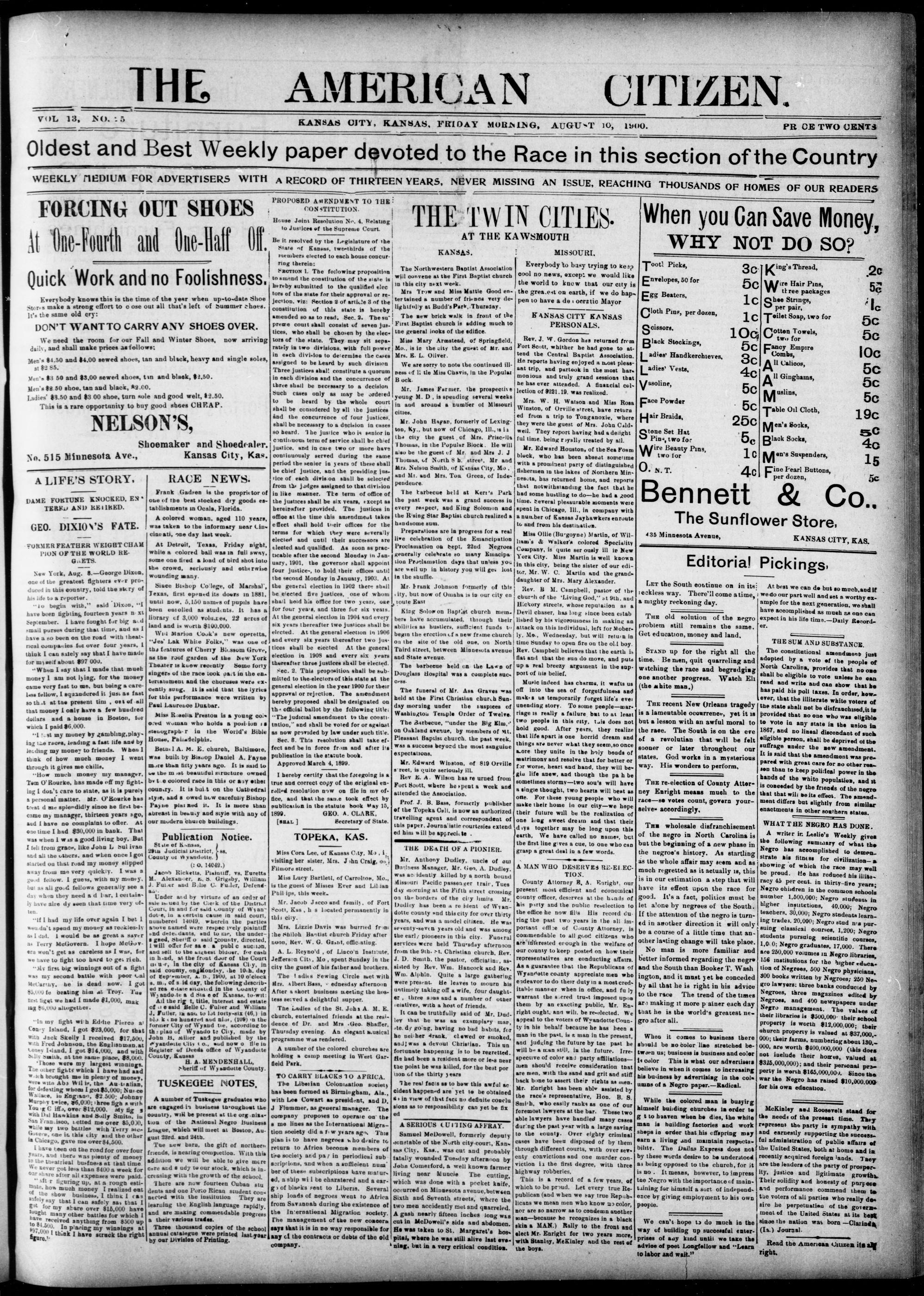
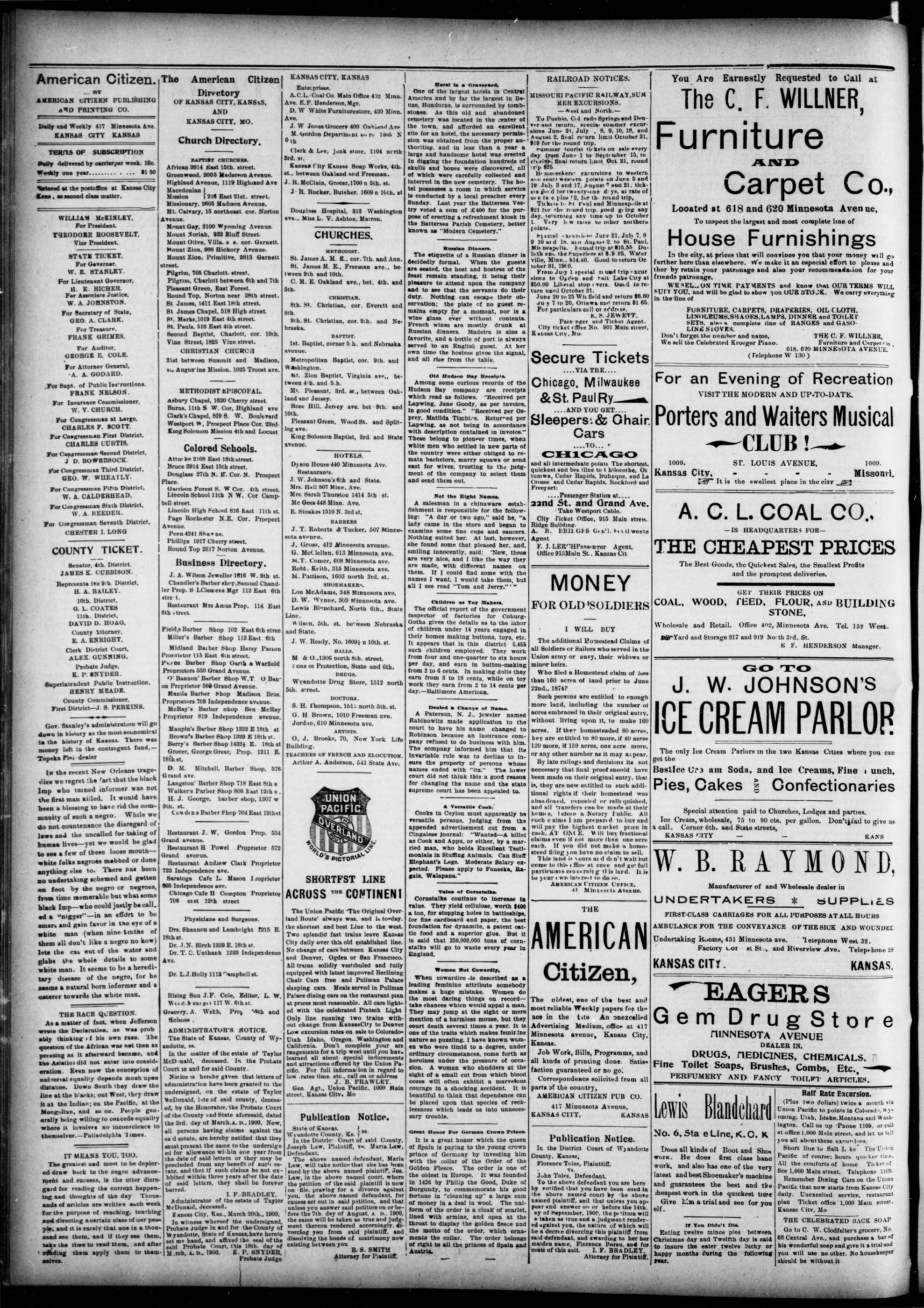
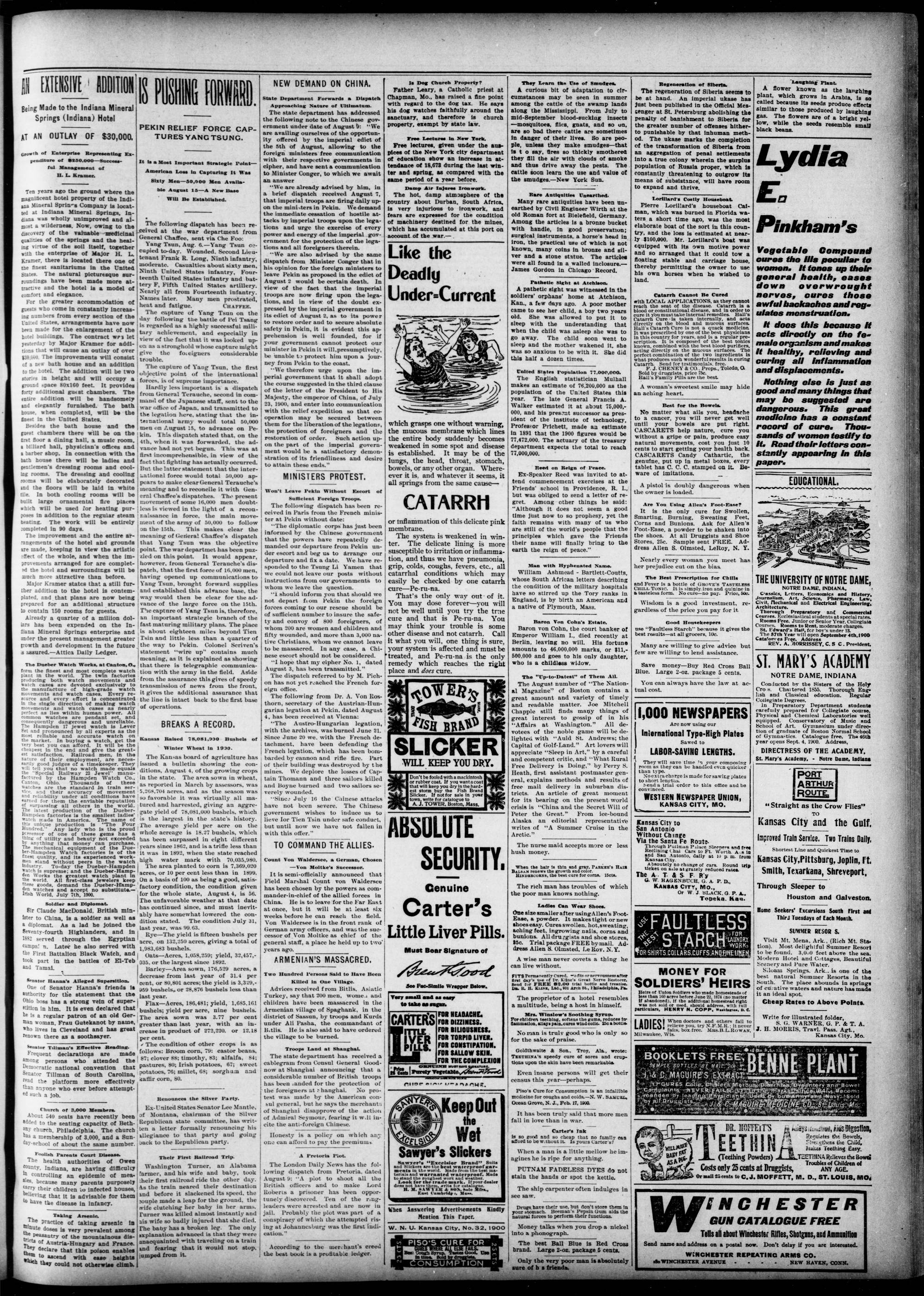
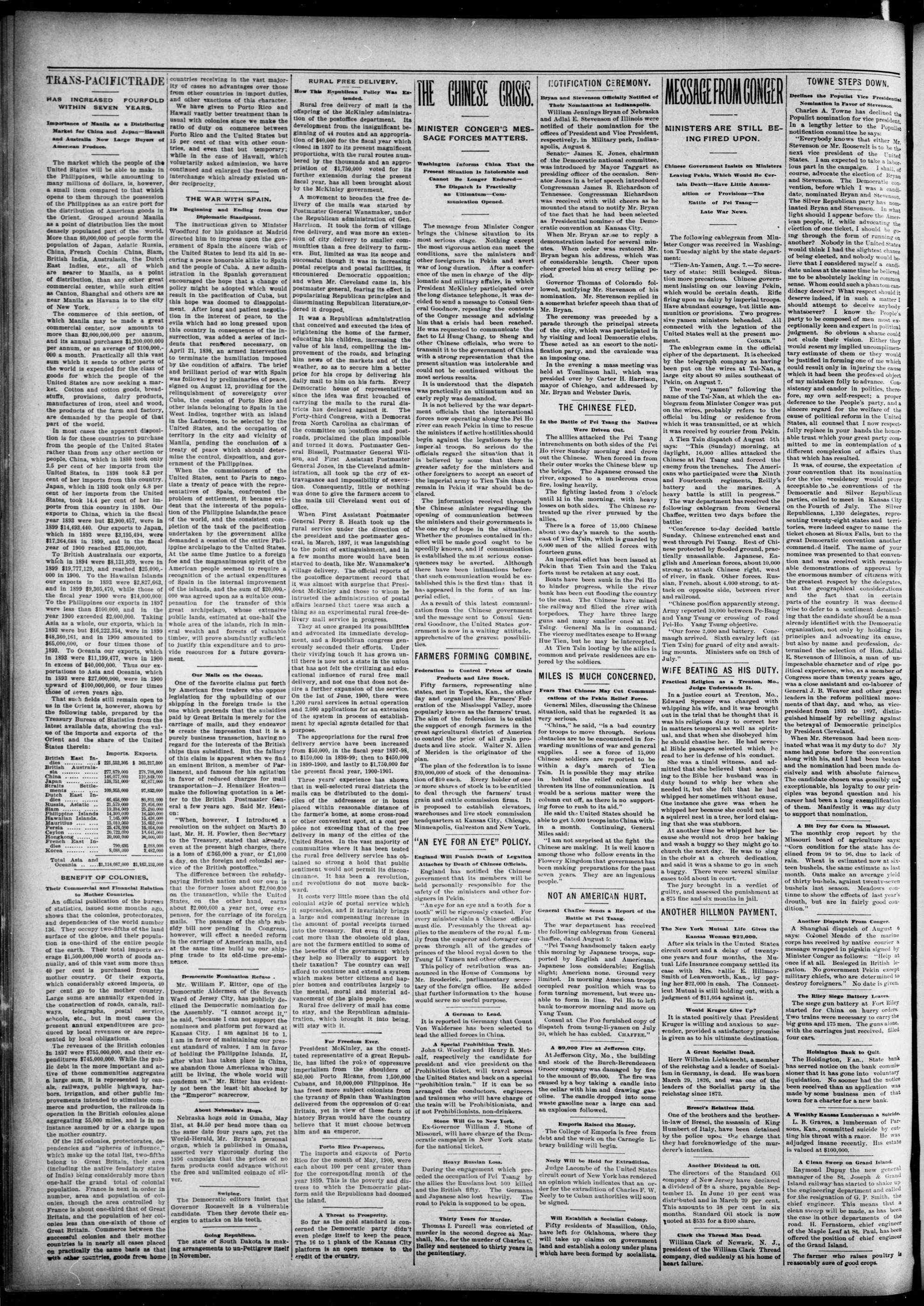
Page text (machine-generated)
Oldest and Best Weekly paper devoted to the Race in this section of the Country
VOL 13, NO. 15
Oldest and
WEEKLY MEDIUM FOR
FORCING
At One-Fourth a
Quick Work and
Everybody knows this is the tim
Stores make a strong effort to oose
It's the same old cry:
DON'T WANT TO CARRY
We need the room for our Fad
daily, and shall make prices as follo
Men's $4.50 and $4.00 sewed shoes, t
at $2.85.
Men's $3.50 and $3.00 sewed shoes,
Men's $2.50 shoe, tan and black, $2.0
Ladies' $3.50 and $3.00 shoe, turn so
This is a rare opportunity to bu
Quick Work and no Foolishness.
Everybody knows this is the time of the year when up-to-date Shoe Stores make a strong effort to close out all that's left of Summer shoes. It's the same old cry:
DON'T WANT TO CARRY ANY SHOES OVER.
We need the room for our Fall and Winter Shoes, now arriving daily, and shall make prices as follows:
Men's $4.50 and $4.00 sewed shoes, tan and black, heavy and single soles, at $2.85.
Ladies' $3.50 and $3.00 shoe, turn sole and good welt, $2.50.
This is a rare opportunity to buy good shoes CHEAP.
NELSON'S.
No. 515 Minnesota Ave.,
A LIFE'S STORY.
DAME FORTUNE KNOCKED, ENTERTAINED AND REQUIRED.
GEO. DIXION'S FATE.
New York, Aug. 8.—George Dixon, one of the greatest fighters ever produced in this country, told the story of his life to a reporter.
"I to begin with," said Dixon, "I have been fighting fourteen years next September. I have fought for big and small pursues during that time, and as I have a so been on the road with the theatrical companies for over four years, I think I can safely say that I have made for myself about $97,000.
"When I say that I made that much money I am not lying, for the money came very fast to me, but being a careless fellow, I squandered it just as fast so that at tac present time, out of all that money I only have a few hundred dollars and a house in Boston, for which I paid $6,000.
"I lost my money by gambling, playing the races, leading a fast life and by leading my money to friends. When I think of how much money I went through it gives me chills.
"How much money my manager, Tom O'Rourke, has made off my fighting I don't care to state, as it is purely a personal matter. Mr. O'Rourke has treated me splendidly since he first became my manager, thirteen years ago, and I have no complaint to offer. At one time I had $30,000 in bank. That was when I was a good living boy. But I felt from grace, like John L. Bulivan and all the others, and when once I got started on that road my money slipped away from me very quickly. I was a good fellow. I guess, with my money, but as all good fellows generally see a day when they need a dear, I certainly have alre dy seen that time very often.
"If I had my life over again I but I wouldn't spend my money as recklessly as I did. I would be as great a saver as Terry McGovern. I hope McGovern won't get as careless as I was, for we have to fight too hard to get rich.
"My first big winnings out of a fight was my second battle with poor Carl Metartany, he is dead now. I got $5,000 for beating him at Troy. The first fight we had I made $1,000, making $6,000 altogether.
"In my fight with Eddie Pierce at Cony Island, I got $23,000, for that with Jack Skelly I received $17,500, with Fred Johnson, the Englishman at Cony Island. I got $14,000, and with Sally Smith at the same piece $8,000.
"Those were my largest winslings. The other fights which I have had and which brought me in plenty of money, were with Abe Willis, the Australian, for defeating whom I got $5,000; Nunce Wallace, in Eggsan, $2,500; Johnce Murphy twice, $6,000; three fight with a Gig, if you get $12,000, my figs $7, Dal Hawkins and Solly Smits, in San Francisco, netted me over $5,000, while my two battles with Terry Govee, one in this city and the other in Chicago, gave me over $4,500.
I have been on the road for over four years, and was plenty of money in the theatrical business at that time. We never got less than $4,000 for our share after all expenses were paid.
"If I figuring up, at a rough estimate, how much money I realized out of the show business, I think I can safely say that I can safely say that I got for my share over $16,000 I bought many other battles for which I have received anything from $500 up to $4,500. In placing my winslings at $9,700 I think I have struck the right figure."
```markdown
```
THE
Shoemaker and Shoedealer Kansas City, Kas.
RACE NEWS.
Frank Gadsen is the proprietor of one of the best stocked dry goods establishments in Ocala, Florida. A colored woman, aged 110 years, was taken to the informary near Cincinnati, one day last week. At Detroit, Texas, Friday night, while a colored ball was in full sway, some one fired a load of bird shot into the crowd, seriously and otherwise wounding many. Since Bishop College, of Marshal', Texas, first opened its doors in 1881, until now, 5,150 names of pupils have been enrolled as students. It has a library of 3,000 volumes, 22 acres of land and is worth $100,000.
Wol Marion Cook's new operetta, "Jes Lak White Folks," was one of the features of Cherry Blossom Grove, as the roof garden of the New York Theater is known recently. Some forty singers of the race took part in the entertainment and the choruses were excently sung. It is said that the lyrics for this performance were written by Paul Laurence Dunkar.
Miss Rochelle Preston is a young colored woman who holds a position as stenographer in the World's Bible House, Philadelphia.
Betul A. M. E. church, Baltimore, was built by Bishop Daniel A. Payne more than fifty years ago. It is said to be the most beautiful structure owned but the colored race in this or any other country. It is built on the Cathedral style, and a owed how carefully Bishop Payne planned it. It is more than aurest in beauty and style with any of our modern church buildings.
Publication Notice
State of Kansas,
29th Judicial District,
County of Wyandotte.
(1 O. 14049.)
Jacob Ricketts, Plaintiff, vs. Euretta
M. Alexander, e. S. Griggsy, William
J. Fulter and Bille C. Fulter, Defenda-
Under aid by virtue of an order of sale issued by the Clerk of the District Court, in and for said County of Wyandotte, in a certain cause in said court, numbered 14049, wherein the parties above named were respectively plaintiff and defendant, and to me, the under-signed, Sheriff so said county, directed, I will offer for sale a public auction, and sell to the largest bidder, for cash in hand, at the front door of the Court in-court, in the city of Kansas City, in said county, on Monday, the 10th day of September, A.D. 1900, at 10 o'clock a.m., of s id day, the following described real estate situated in the County of Wyandotte a d State of Kansas, to witt. All the big t t interest, and estate of William J. Fulter, an hunter to bait (40) bill no hunter and nisi, (109) in the former City of Wyandot, according to the plan of Wyandot to City, made by John H. aither and published by the Wyandotte City o., and now o file in Register of Deeds office of Wyandotte County, Kansas
H. A. MENDENHALL,
Sheriff of Wyandotte County.
TUSKEGEE NOTES
A number of Tuskegee graduates who are engaged in business throughout the country, will be present at the organization of the National Negro Business League, which will meet at Boston, August 38rd, and 24th.
Tue new barn, the gift of northern friends, is nearing competition. With this addition we will be able to give more care and study to our stock, which is increasing with the growth of the school.
There are now fourteen Cuban students and one Porean Rican student connected with the institution They are learning the English language rapidly, and are making commendable progress a their various trades.
Three thousand copies of the school annual catalogue were printed last year by our Division of Printing.
KANSAS CITY, KANSAS, FRIDAY MORNING. AUGUST 10. 1900.
PROPOSED AMENDMENT TO THE
CONSTITUTION.
House Joint Resolution No. 4, Relating
to Justice of the Supreme Court.
Be it resolved by the Legislature of the
State of Kansas, two-thirds of the
members elected to each house concurring therein:
I hereby certify that the foregoing is a
true and correct copy of the original en-
rolled resolution now on file in my office,
and that the same took effect by
publication in the statute book May
15, 1899.
GEO. A. CLARK,
[SEAL ] Secretary of State.
TOPEKA, KAS.
Miss Cora Lee, of Kansas City, Mo. is visiting her sister, Mrs. John Craig, on Flinmore street.
Miss Lucy Bartlett, of Carrolton, Mo. is the guest of Misses Ever and Lilian Philips, this week.
Mr. Jacob Jacco and family, of Fort Scott, Kass, h is located permanently in this city.
Mrs. Lizzie Davis was buried from the Sibiloh Baptist church Friday after noon, Rev. W. G. Grant, officiating.
A. L. Reyno'd, of Lincoln Institute, Jefferson City, Mo. spent Sunday in the city the guest of his father and brothers.
The Ladies Sewing Circle met with Mrs. Albert Bass, a daytime afternoon. After a short business meeting the hostess served a delightful supper.
The Ladies of the St. John A. M. E. church, entertained friends at the residence of Dr. and Mrs. Geo. Shaffer, Thursday evening. An elegant musical programme was rendered. A number of the colored churches are holding a camp meeting in West Garfield Park.
TO CARRY BLACKS TO AFRICA.
The Liberian Colonization society has been formed at Birmingham, Ala., with Lee Cowart as president, and D. J Flummer, as general manager. The company proposes to operate on the me lines as the International Migration society did a few years ago. This plan is to have negroes who desire to return to Africa become members of the society and pay in periodical subscriptions, and when a sufficient number of these subscriptions have matured, a ship will be charactered and a cargo of blacks sent to Liberia. Several ship loads of negroes went to Africa from Savannah during the existence of the International Migration society. The management of the new concern says that it is in no way responsible for any of the contracts or debts of the old company.
THE TWIN CITIES
THE TWIN CITIES
AT THE KAWSMOUTH
The Northwestern Baptist Association will convene at the First Baptist church in this city next week.
Mrs Trow and Miss Mattie Good entertained a number of friends very delightfully at Budd's Park. Thursday.
The new brick walk in front of the First Baptist church is adding much to the general looks of the edifice.
Miss Mary Armstead, of Springfield, Mo., is in the city the guest of Mr. and Mrs. E. L. Oliver.
We are sorry to note the continued illness of lt the Miss Chavis, in the Popular Bock.
Mr. James Farmer, the prospective young M. D., is spending several weeks in and around a number of Missouri cities.
Mr. John Hagan, formerly of Lexington, Ky., but now of Chicago, Ill., is in the city the guest of Mr. Priscilla Thomas, in the Popular Block. He will also be the guest of Mr. and Mrs. J. J Thomas, of North 8 h. street, Mr. and Mrs. Nelson Smith, of Kansas City, Mo., and Mr. and Mrs. Ton Green, of Independence.
The barkeecue held at Kerr's Park the past week was a grand success in every respect, and King Solomon and the Rising Star Baptist church realized a handsome sum.
Preparations are in progress for a real live celebration of the Emacipation Proclamation on beep. 22nd Negroes generally celebrate so many Emacipation Proclamation days that unless you are well up in history you will get lost in the shuffle.
Mr. Frank Johnson formerly of this city, but now of Omaha is in our city en-toute East.
King Solow on Baptist church members have accumulated, through their abilities as builers, sufficient funds to begin the erection of a new frame church on the site of the old one, on North Third street, between Minnesota avenue and State avenue.
The barbecue held on the Lawn of Douglass Hospital was a complete success.
The funeral of Mr. Asa Graves was held at the First Christian church Sunday morning under the suspices of Washington Temple Order of Twelve.
The Barbecue, "under the Big Elm," on Oakland avenue, by members of mt. Pleasant Baptist church, the past week, was a success beyond the most sanguine expectations.
Mr. Edward Winston, of 819 Orville's reet, is quite seriously ill.
Rev E. A. Wilson has reurned from Fort Scott, where he spent a week and attended the Association.
Prof J. B. Bass, formerly publisher of the Topeka Call, is now an authorized travelling agent and correspondent of this paper. Journalistic courtesies extended him will be apprechi t.
THE DEATH OF A PIONIER
Mr. Anthony Dudley, uncle of our business Manager, Mr. Geo. A. Dudley, was accidentally killed by a north bound Missouri Pacific passenger train, Tuesday morning at the Fifth street crossing on the borders of the city limits. Mr. Dudley has been a re ident of Wyndotte county and this city for over thirty years, and was a model citizen. He was seventy-seven years old and was among the early pioneers in this city. Funeral services were held Thursday afternoon from the 9th-11th. Christian church, Rev. J. D. Smith, the pastor, officiating, assisted by Rev. Wm. Hancock and Rev. Wm. Alphin. It quite a large gathering were present. He leaves to mourn his untimely taking off a wife, four daughter, three sons and a number of other relatives, with a host of friends.
It can be truthfully said of Mr. Dudley that he was an example man, dye going, having no bad habits, for he neither drank, chewed or smoked, and was a devout Christian. This unfortunate happening is to be revered. He had been a resident more or less near the point he was killed, for the best portion of the thirty years.
The real facts as to how this awful accident happened are yet to be obtained in view of that fact no definite conclusions as to responsibility can yet be fixed.
A SERIOUS CUTTING AFFRAY.
Samuel McDowell, formerly deputy constable of the North city court, Kansas City, Kas., was cut and probably tainted wounded Tuesday afternoon by John Comerford, a well known farmer living near Munice. The cutting, which was done with a pocket knife, occurred on Minnesota avenue, between Sixth and Seventh streets, where the two men accidently met and quarreled. A gash nearly fifteen inches long was cut in McDowell's side and abdomen. He was taken to St. Margaret's hospital, where he was still alive last evening, but in a very critical condition.
KANSAS.
Everybody to busy trying to keep cool no news, except we would like the world to know that our city is the greatest on earth, if we do happen to have a do oeratic Mayor
KANSAS CITY KANSAS PERSONALS.
Rev. J. W. Gordon has returned from Fort Scott, whither he had gone to attend the Central Baptist Association. He reports having enjoyed a most pleasant trip, and partook in the most harmonious and truly grand sessions that he has ever attended. A financial collection of $221.19 was realized. Mrs. W. H. Watson and Miss Rosa Winston, of Orville street, have returned from a trip to Tonganoxie, where they were the guest of Mrs. John Caldwell. They report having had a delightful time, being ruly treated by all.
Mr. Edward Houston, of the Sea Fosm block, who has been abase some time with a prominent party of distinguished fishermen in the lakes of Northern Minnesota, has returned home, and reports that notwithstanding the fact that he had some hustling to do—he had a zoo time. Several pleasurable moments were spent in Chicago, ill., in company with a number of Kansas Jayhawkers enroute to and from his destination.
Miss Ollie (Burgoyne) Martin, of Williams & Walker's colored Specialty Company, is quite seriously ill in New York City. Miss Martin is well known in this city, being the sister of our editor, Mr. W. C. Martin and the granddaughter of Mrs. Mary Alexander.
Rev. B M. Campbell, pastor of the church of the "Living God," at 9th, and Hickory streets, whose reputation as a Devil chaser, has long since been established by his vigorous in making an attack on this individual, left for Moberly. Mo. Wednesday, but will return in time Sunday to open fire on the old boy. Rev. Campbell believes that the earth is flat and that the sun do move, and puts up a real breezy argument in the support of his belief.
Music indeed has charms, it wafts us off into the sea of forgetfulness and makes us temporarily forget life's ever unending story. To some people—marriage is really a failure but to at least two people in this city, this does not hold good. After years, they realize that life apart is one horrid dream and things are never what they seem, so once more they unite in the holy bouds of matrimony and resolve that for better or for worse, heart and hand, they will begin life anew, and though the pah be sometimes stormy—two souls will have a single thought, two hearts will be as one. For these young people who will make their home in our city—we hope their future will be the realization of one long sweet dream and that their days together may be long upon this earth. We have called no names, but the first line gives a cue, to one who can grasp a great deal in a few words.
A MAN WHO DESERVES RE-ELEC TION.
County Attorney B. A. Earight, our present most efficient and economical county officer, deserves at the hands of his party and the public reseclection to the office he now fills. His record during the past two years in the all important office of County Attorney, is commendable to all good citizens who are interested enough in the welfare of our county to keep posted on how their representatives are conducting affairs. As a guarantee that the Republicans of Wyandotte county appreciate men who endeavor to do their duty in a most credible manner when in office, and fully warrant the sacred trust imposed upon them by an exacting public, Mr. Earight ought, and will, be re-elected. We appeal to the voters of Wyandotte County in his behalf because he has been a man in the past, is a man in the present, and judging the future by the past he will be a man still, in the future. Irrespective of color and party affiliations—men should receive consideration that are men, with the sand and grit and stiff back bone to assert their rights as men. Mr. Earight has been ably assisted by the race's representative, Hon. B. S. Smith, who easily ranks as one of our foremost lawyers at the bar. These two able lawyers have handled many cases during the past year with a large saving to the county. Over eighty criminal cases have been disposed of by them through different courts, with over seventy convictions and one murder conviction in the first degree, with three highway robberies.
This is a record of a few years, of which to be proud. Let every true Republican (and when we say true Republicans we mean men who know in color, nor are so narrow as to condemn another man—because he recognizes in a black skin a MAN.) Rally to the front and elect Mr. Enright for two years more, with Stanley, McKinley and the rest of the boys.
CITIZEN
MISSOURI.
When you Can Save Money, WHY NOT DO SO?
Tooth Picks, 3c
Envelopes, 50 for 5c
Egg Beaters, 1c
Cloth Pins, per dozen, 1c
Scissors, 10c
Black Stockings, 5c
Ladies' Handkerchieves, 3c
Ladies' Vests, 4c
Vasoline, 5c
Face Powder 5c
Hair Braids, 25c
Stone Set Hat Pins, two for 5c
Wire Beauty Pins, two for 1c
O. N. T. 4c
King's Thread, 2c
Wire Hair Pins, three packages 5c
Shae Strings, per pair, 1c
Teilet Soap, two for 5c
Cotten Towels, two for 5c
Fancy Empire Combs, 10c
All Calicoos, 5c
All Ginghams, 5c
Muslins, 5c
Table Oil Cloth, 19c
Men's Socks, 5c
Black Socks, 4c
Men's Suspenders, 15
Fine Pearl Buttons, per dozen, 5c
435 Minnesota Avenue.
Editorial Pickings
LET the South continue on in its
reckless way. There'll come a time,
a mighty reckoning day.
The old solution of the negro
problem still remains the same.
Get education, money and land.
STAND up for the right all the
time. Be men, quit quarreling and
watching the race and begrudging
one another progress. Watch Eln
(the white man.)
The recent New Orleans tragedy is a lamentable occurrence, yet it is but a lesson with an awful moral to the race. The South is on the eve of a revolutian that will be felt sooner or later throughout our states. God works in a mysterious way. His wonders to perform.
The re-election of County Attorney Enright means much to the race—so votes count, govern your-self accordingly.
THE wholesale disfranchisement of the negro in North Carolina is but the beginning of a new phase in the negroe's history. As startling as the whole affair may seem and as much regretted as it actually is, this is in our estimation a step that will have its effect upon the race for good. It's a fact, politics must be let alone by negroes of the South. If the attention of the negro is turned in another direction it will only be a course of a little time that another lasting change will take place
No man is more familiar and better informed regarding the negro and the South than Booker T. Washington, and it must yet be conceded by all that he is right in his advice to the race. The trend of the times are making it more pater each day that he is the world's greatest negro after all.
When it comes to business there should be no color line stretched between us; business is business and color color. This is what our advertisers believe in when it comes to increasing his business by advertising in the columns of a Negro paper.—Radical.
While the colored man is busying himself building churches in order to get to heaven when he dies, the white man is building factories and work sheps in order that his offspring may earn a living and maintain respectability. The Dallas Express does not by these words desire to be understood as being opposed to the church, for it is no. It means, however, to impress tae Negro with the importance of maintaining for himself a sort of independence by giving employment to his own people.
We can't hope to do much in the way of building up successful enterprises of any kind until we take the advice of poet Longfellow and "Learn to labor and wait."
PR CETWOCENTS
the Country
HOMES OF OUR READERS
Can Save Money,
NOT DO SO?
King's Thread, 2c
Wire Hair Pins, 5c
three packages
Shee Strings, 1c
per pair,
Teilet Soap, two for 5c
Cotten Towels, 5c
two for
Fancy Empire
Combs, 10c
All Calicoos, 5c
All Ginghams, 5c
Muslins, 5c
Table Oil Cloth, 19c
Men's Socks, 5c
Black Socks, 4c
Men's Suspenders, 15
Fine Pearl Buttons,
per dozen, 5c
& Co..
Power Store,
KANSAS CITY, KAS.
At best we can do but so much, and if we do our part well and set a worthy example for the next generation, we shall have accomplished as much as one can expect in his life time.—Daily Recorder.
THE SUM AND SUBSTANCE
The constitutional amendment just adopted by a vote of the people of North Carolina, provides that no one shall be eligible to vote unless he can read and write and can show that he has paid his poll taxes. In order, however, that the illiterate voter of the state shall not be disfrustrated, it is provided that no one who was eligible to vote in any state in the union in 1867, and no linear discendant of such eligible person, shall be deprived of the suffrage under the new amendment. It is said that the amendment was prepared with great care for no other reason than to keep political power in the hands of the white population, and it is conceded by the friends of the negro that will be its effect. The amendment differs by slightly from similar enactments in other southern states.
WHAT THE NEGRO HAS DONE
A writer in Leslie's Weekly gives the following summary of what the Negro has accomplished to demonstrate his fitness for civilization—a showing of which the race may well be proud. He has reduced his illiteracy 45 per cent. in thirty-five years; Negro children in the common schools number 1,500,000; Negro students in higher institutions 40,000; Negro teachers, 30,000; Negro students learning trades, 20,000; Negro students pursuing classical courses, 1,200; Negro students pursuing scientific courses, 1,0,0; Negro graduates, 17,000. There are 250,000 volumes in Negro libraries, 156 institutions for the higher education of Negroes, 500 Negro physicians, 300 books written by Negroes; 250 Negro lawyers: three banks conducted by Negroes, three magazines edited by Negroes, and 400 newspapers under Negro management. The values of their libraries are $500,000; their school property is worth $12,000,000; their church property is valued at $37,000,000; their farms, numbering about 130,000, are worth $400,000,000 (this does not include their homes, valued at $250,000,000); and their personal property is worth $165,000,000. Since the war the Negro has raised $10,000,000 for his own education.
McKinley and Roosevelt stand for the needs of the present time. They represent the party in sympathy with and earnestly supporting the successful administration of public affairs of the United States, both at home and in recently acquired foreign lands. They are the leaders of the party of prosperity, justice and legitimate growth. Their solidity and honesty of purpose and performance commend them to the voters of all parties who really desire he perpetuation of the government of the United States at its best since the nation was born — Clarinda (Ia.) Journal.
Read the American Citizen its all right.
AMERICAN CITIZEN PUBLISHING
AND PRINTING CO.
Daily and Weekly 417 Minnesota Ave.
KANSAS CITY KANSAS
TERMIS OF SUBSCRIPTION
Daily delivered by carrierper week. 10c.
Weekly one year..... $1 50
Entered at the postoffice at Kansas City
Kans., as second class matter.
WILLIAM MCKINLEY.
For President.
THEODORE ROOSEVELT,
Vice President.
STATE TICKET.
For Governor.
W. E. STANLEY.
For Lieutenant Governor,
H. E. RICHER.
For Associate Justice,
W. A. JOHNSTON.
For Secretary of State,
GEO. A. CLARK.
For Treasury,
FRANK GRIMES.
For Auditor,
GEORGE E. COLE.
For Supt. of Public Instructions.
FRANK NELSON.
For Insurance Commissioner,
W. V. CHURCH.
For Congressman at Large.
CHARLES F. SCOTT.
For Congressman First District,
CHARLES CURTIS.
For Congressman Second District,
J. D. BOWERSOCK.
For Congressman Third District,
GEO. W. WHEATLY.
For Congressman Fifth District,
W. A. CALDERHEAD.
For Congressman Sixth District,
W. A. REEDER.
For Congressman Seventh District,
CHESTER I. LONG
COUNTY TICKET.
Senator, 4th. District.
JAMES K. CUBBISON.
Representa ire 9th. District,
H. A. BAILEY.
10th. District,
G. L. COATES
11th. District.
DAVID D. HOAG.
County Attorney,
E. A. ENRIGHT.
Clerk District Court,
ALEX. GUNNING.
Probate Judge,
K. P. $NYDER.
Superintendent Public Instruction,
HENRY MEADE.
County Commissioner,
First District—J. S. PERKINS.
Gov. Stanley's administration will go down in history as the most economical in the history of Kassas. There was money left in the contugent fund,—Topeka Phi-dealer
In the recent New Orleans tragedies we regret the fact that the black Imp who tuned informer was not the first man killed. It would have been a blessing to have rid the community of such a negro. While we do not countenance the disregard of laws and the uncalled for taking of human lives—yet we would be glad to see a few of these loose mouth—white folks negroes mobbed or done anything else to. There has been no undertaking schemed and gotten on foot by the negro or negroes, from time memorable but what some black Imp—who could justly be call, ed a "nigger"—in an effort to be smart and gain favor in the eye of a white man (when nine-tenths of them all don't like a negro no how) lets the cat out of the water and glabs the whole details to some white man. It seems to be a hereditary disease of the negro, for he seems a natural born informer and a caterer towards the white man.
THE RACE QUESTION.
As a matter of fact, when Jefferson wrote the Declaration, ae was probably thinking of his own race. The question of the African was not then as pressing as it afterward became, and the Asiatics did not enter into consideration. Even now the conception of universal equality depends much upon distance. Down South they draw the line at the blacks; out West, they draw it at the Indian; on the Pacific, at the Mongolian, and so on. People generally being willing to concede equality where it involves no inconscience to themselves. -Philadelphia Times.
IT MEANS YOU. TOO.
The greatest and most to be deplored draw back to the negro advancement and success, is the utter disregard for reading the current happening and thoughts of the day. Thousands of articles are written each week for the purpose of reaching, teaching and directing a certain class of our people, and it is rarely that one in a thousand see them, and if they see them, take the time to read them, and after reading them apply them to them selves.
The American Citizen
Directory
OF KANSAS CITY, KANSAS,
AND
KANSAS CITY, MO.
Church Directory.
BAPTIST CHURCHES.
African 3914 East 15th. street.
Greenwood, 2005 Maderson Avenue.
Highland Avenue, 1119 Highland Ave
Macedonian )
Mission {216 East 21st. street.
Missionary, 2005 Madison Avenue.
Mt. Calvary, 15 northeast cor. Norton
Avenue.
Mount Gay, 2100 Wyoming Avenue.
Mount Noriah, 933 Bluff Street.
Mount Olive, Villa s. e. cor. Garnett.
Mount Zion, 908 Hickory Avenue.
Mount Zion, Primitive, 2815 Garnett
street.
Pilgrim, 705 Charlott street.
Pilgrim, Charlott between 6th and 7th
Pleasant Green, East Forest.
Round Top, Norton near 28th street.
St James, 1411 East 18th street.
St James Chapel, 518 High street.
St Marks, 1019 East 4th street.
St. Pauls, 510 East 4th street.
Second Baptist, Charlott, cor. 10th.
Vine Street, 1825 Vine street.
CHRISTIAN CHURCH
21st between Summit and Madison,
s<sub>14</sub> Augus' ie Mission, 1025 Trosave ave.
METHODIST EPISCOPAL.
Absbury Chapel, 1620 Cherry street
Burns, 11th S W. Cor, Highland ave
Clark's Chapel, 819 S. W. Boulevard
Westport W. Prospect Place Cor, 23rd
King Solomon Mission 4th and 7th
Colored Schools.
Attur 82108 East 18th street.
Bruce 3914 East 15th street.
Douglass 27th N. E. Cor. N. Prospect
Place.
Garrison Forest S. W Cor. 4th street,
Lincoln School 11th N W. Cor Campbell street.
Lincoln High School 816 East 11th st.
Page Rochester N.E. Cor. Prospect Avenue.
Penn 4241 Shawne.
Business Directory.
J. A. Wilson Jeweller 1616 W. 9th st.
Chandler's Barber shop, Samuel Chandler Prop. S LClencens Mgr 112 East 6th st.
rest t.
Restaurant Mrs Amus Prop. 114 East 6th st.
Midland Barber Shop Harsy Patson
Proprietor 115 East 6th street.
Ploce Barber Shop Oarth & Warfield
Proprietors 550 Grand Avenue.
O 'Bannon' Barber Shop W.T. O 'Ban'
on Proprietor 569 Grand Avenue.
Manila Barber Shop Madison Bros.
Proprietors 769 Independence avenue.
McRay's Barber Shop Ben McRay
Proprietor 819 Independence avenue.
Maupin's Barber Shop 1332 E 18th st
Brown's Barber Shop 1329 E 18th st.
Berry's Barber Shop 14324 E. 18th st
Grocer, George Grear, Prop. 1211 E.
18th st.
D. M. Mitchell, Barber Shop, 576
Grand ave.
Langton' Barber Shop 718 East 8th s
Walker's Barber Shop 806 East 12th s.
H. J. George, barber shop, 1307 w
9th st.
Cowdens' Barber Shop 704 East 12th st
Restaurant H Powel Proprietor 572
Grand avenue.
Restaurant Andjew Clark Proprietor
723 Independence ave.
Saratoga Cafe L. Mason Proprietor
805 Independence ave.
Chicago Cafe H Compton Proprietor
706 est 12th street
Physicians and Surgeons.
Drs. Shannon and Lambright 1215 E. 18th st.
Dr. J.N. Birch 1389 E. 18th st.
Dr. T.C. Unthank 1233 Independence Ave.
Dr. L.J. Holly 1113 Campbell st.
Rising Ssu J.F. Cole, Editor, L. W.
W. C. Bridge 117 W. 6th st.
Grocery, A. Webb, Proj 9th and Holmes.
ADMINISTRATOR'S NOTICE.
The State of Kansas, County of Wyandotte, ss.
In the matter of the estate of Taylor McD. maid, deceased. In the Probate Court in and for said County.
Notice is hereby given that letters of administration have been granted to the undersigned, on the estate of Taylor McDonald, late of said county, deceased, by the Honorable, the Probate Court of the County and State aforesaid, dated the 3rd. day of March A.D. 1900. Now, all persons having claims against the said estate, are hereby notified that they must present the same to the undersigned for allowance within one year from the date of said letter, or the way indicated from any benefit of such estate, and that if such claims be not exhibited within three years after the date of said letters, they shall be forever barred.
I. F. BRADLEY.
Administrator of the estate of Taylor McDonald, deceased.
Eansas City, Kas., March 20th., 1900.
In witness whereof the undersigned, Probate Judge in and for the County of Wyndotte, State of Kansas, have hereto set my hand, and affixed the seal of the said Probate Court, this 18th. day of M. rch. A.D. 1900. K. P. SNYDER.
Probate Judge
KANSAS CITY, KANSAS
Enterprises.
A.C.L. Co. Coal Co. Main Office 492 Minn.
Ave. E.F. Henderson, Mgr.
D. W White Furniturestore, 420 Minn.
Ave.
J. W Jones Grocery 400 Oakland Ave.
M. Gordon Department store 1605 N
0th
Clark & Lee, junk store, 1104 north
3rd. st.
Kansas City Kansas Soap Works, 4th.
st., between Oakland and Freeman.
J. R. McClain, Grocer, 1700 n 5th. st.
J. R. Rucker, Buteher, 1609 n 16th. st
Douglas Hospital, 312 Washington
ave., Miss L. V. Ashton, Matron.
CHURCHES
METHODIST.
St. James A. M. E., cor. 7th, and Ann.
St. James M. E., Freeman ave., between 9th and 10th.
C. M. E. Oakland ave., bet, 4th, and 5th.
9th. St. Christian, cor. 9th. and Nebraska.
BAPTIST.
1st. Baptist, corner 5 h. and Nebraska avenue.
Metropolitan Baptist, cor. 9th. and Washington.
Mt. Zion Baptist, Virginia ave., between 4 h. and 5 h.
Mt. Pleasant, 3rd. st., between Oakland and Jersey.
Rose Hill. Jersey ave. bet 9th. and 10th.
Pleasant Green, Wood St. and Split-log ave.
King Solomon Baptist, 3rd. and State avenue.
HOTELS
Dyson House 440 Minnesota Ave.
Restaurants
Restaurants.
J. W. Johnson's 6th and State.
Mrs. Hall 507 Minn. Ave.
Mrs. Sarah Thurston 1414 5th st.
Mc Gees 448 Minn. Ave.
E. Stoakes 1510 N. 3rd st.
BARBERS
J. T. Roberts & Tucker, 507 Minnesota avenue.
J. Gross, 412 Minnesota avenue.
G. McCellan, 613 Minnesota ave.
M.T. Comer, 608 Minnesota ave.
Robt. Keith, 315 Minnesota ave.
M. Pattison, 1603 north 3rd. st.
SHOEMAKER.
Lon McAdams, 348 Minnesota ave.
D. W. Wynne, 309 Minnesota ave.
Lewis Blenchard, North 6th., State Line.
Wilson, 5th. st. beween Nebraska and State.
J. W. Ready, No. 1609 $ n 10th. st.
Wyandotte Drug Store, 1512 north 5th. street.
DOCTORS.
S. H. Thompson, 1512 north 5th. st.
G. H. Brown, 1010 Freeman ave.
Jordan, 610 Minnesota ave.
ARTISTS.
O. J. Brooks, 70, New York Life Building.
TEACHERS OF FRENCH AND ELOCUTION.
Arthur A. Anderson, 541 State Ave.
UNION
PACIFIC
THE
OVERLAND
ROUTE
WORLD'S PICTORIAL LINE.
SHORTFST LINE ACROSS THE CONTINENT
The Union Pacific 'The Original Overland Route' always was, and is to-day, the shortest and best Line to the west. Two splendid fast trains leave Kansas City daily over this old established line. No change of cars between Kansas City and Denver, Ogden or San Francisco. All trains solidly vestibulated and fully equipped with latest improved Recycling Chair Cars free and Pullman Palace sleeping cars. Meals served in Pullman Palace dining cars on the restaurant pian at prices most reasonable. All cars lighted with the celebrated Pintsch Light. Only line running two trains without change from KansasCity to Denver Low excursion rates on sale to Colorado Utah Idaho, Oregon, Washington and California. Don't complete your arangesmen for a trip west until spring, and all about special inducements and attractions offered by the Union Pacific. For full information in regard to low. rates time etc., call on or address J. B. FRAWLEY
Gen. Agt., Union Pacific, 1000 Main street. Kansas City, Mo
Publication Notice.
State of Kansas.
Wyandotte County, Ks. **ss.**
In the District Court of said County,
Joseph Law, Plaintiff, v. Maria Law,
Defendant.
The above named defendant, Maria
Law, will take notice that she has been
sued by the above named plaintiff, Jos.
Law, in the above named court, where
the petition of the said plaintiff is now
on file, praying for a divorce against
you, the above named defendant, for
causes set out in said petition, and that
unless you answer said petition on or
before the 7th. day of August, A D.. 1900,
the same will be taken as true and judgment
thereon rendered accordingly, divorcing you from said plaintiff, and dissolving the bonds of matrimony now
existing between you
B. S. SMITH
Attorney for Plaintiff.
Hotel in a Graveyard.
One of the largest hotels in Central America and by far the largest in Beutze, Honduras, is surrounded by tombstones. As this old and abandoned cemetery was located in the center of the town, and afforded an excellent site for an hotel, the necessary permission was obtained from the proper authorities, and in less than a year a large and handsome hotel was erected. In digging the foundation hundreds of skulls and bones were discovered, all of which were carefully collected and interred in the new cemetery. The hotel possesses a room in which service is conducted by a local preacher every Sunday. Last year the Battersea Vestry voted a sum of £400 for the purpose of erecting a refreshment kiosk in the Battersea Parish Cemetery, better known as "Modern Cemetery."
Russian Dinners.
The etiquette of a Russian dinner is decidedly formal. When the guests are seated, the host and hostess of the feast remain standing, it being their pleasure to attend upon the company and to see that the servants do their duty. Nothing can escape their observation; the plate of no guest remains empty for a moment, nor is a wine glass ever without contents. French wines are mostly drunk at Russian dinners. Madeira is also a favorite, and a bottle of port is always served to an English guest. At her own time the hostess gives the signal, and all rise from the table.
Old Hudson Bay Records
Among some curious records of the Hudson Bay company are receipts which read as follows. "Received per Lapwing, Jane Goody, as per invoice, in good condition." "Received per Osprey, Matilda Timbbs. Returned per Lapwing, not as being in accordance with description contained in invoice." These belong to pioneer times, when white men who settled in new parts of the country were either obliged to remain bachelors, marry squaws or send east for wives, trusting to the judgment of the company to select them and send them out.
Not the Right Names
A salesman in a chinaware establishment is responsible for the following: "A day or two ago," said he, "a lady came in the store and began to examine some fine cups and saucers. Nothing suited her. At last, however, she found some that pleased her, and, smiling innocently, said: 'Now, these are very nice, and I like the way they are made, with different names on them. If I could find some with the names I want, I would take them, but all I see read "Tom and Jerry.""
Children as Toy Makers.
The official report of the government inspector of factories for Coburg-Gotha gives the details as to the labor of children under 14 years engaged in their homes making buttons, toys, etc. It appears that in this district 5,455 such children employed. They work from four and one-quarter to six hours per day, and earn in button-making from 2 to 6 cents. In making dolls they earn from 3 to 18 cents, while on toy work they earn from 2 to 14 cents per day.—Baltimore American.
Denied a Change of Name
A Paterson, N. J., jeweler named Rabinowitz made application to the court to have his name changed to Robinson because an insurance company refused to do business with him. The company informed him that its invariable rule was to decline to insure the property of persons whose names ended with "itz." The lower court did not think this a good reason for changing the name and the state supreme court has been appealed to.
A Versatile Cook.
Cooks in Ceylon must apparently be versatile persons, judging from the appended advertisement cut from a Cingalese journal: "Wanted-A biller as Cook and Appu, or either, by a married man, who holds Excellent Testimonials in Stuffing Animals. Can Stuff Elephant's Legs. Moderate Salary expected. Please apply to Fonseka, Ragala, Walapana."
Value of Cornstalks.
Cornstalks continue to increase in value. They yield cellulose, worth $400 a ton, for stopping holes in battleships, for fine cardboard and paper, the best foundation for dynamite, a patent cattle food and a superior glue. But it is said that 250,000,000 tons of cornstalks will go to waste every year in England.
Women Not Cowardly
When cowardice -is described as a leading feminine attribute somebody makes a huge mistake. Women do the most daring things on record -take chances which would appeal a man. They may jump at the sight or mere mention of a harmless mouse, but they court death several times a year. It is one of the traits which makes femit the nature so puzzling. I have known women who were timid to a degree, under ordinary circumstances, come forth as heroes under the pressure of occasion. A woman who shudders at the sight of a small cut from which blood oozes will often exhibit a marvelous courage in a shocking accident. It is beautiful to think that dependence can be placed upon that species of recklessness which leads us into unnecessary trouble.
Great Honor For German Crown Prince.
It is a great honor which the queen of Spain is paying to the young crown prince of Germany by investing him with the collar of the Order of the Golden Fleece. The order is one of the oldest in Europe. It was founded in 1426 by Philip the Good, Duke of Burgundy, to commemorate his good fortune in "cleaning up" a large sum of money in a deal in wool. The uniform of the order is a cloak of scarlet, lined with ermine, and open at the throat to display the golden fleece and the motto of the order, which ornaments the collar. The order belongs of right to all the princes of Spain and Austria.
MISSOURI PACIFIC RAILWAY, SUM
MER EXCURSIONS.
— West and North.
To Pueblo, Colo. radio Springs and Den-
ver and return, special summer excursions
June 21, July, 8, 9, 10, 18, and
August 2, final return limit October 31,
$19 for the round trip.
Summer tourist tickets on sale every
day from June 1 to September 15, in-
clusive, final return limit Oct. 31, round
trip $25.
Honeymoon excursions to wester-
son southwest points on June 5 and
July 3 and 17, August 7 and 21, ticke-
ls for two weeks, 3 days, at rate of
one e plus 2 for the round trip.
Tickets to St. Paul and Minnesota at
$21 for the round trip, good going any
day, returning any time up to October
1. Very low rates to other northern
points.
Special excursions June 21, July 7, 8
9, 10 and 18, and August 2, to St. Paul,
Missoula, round trip at $15.55 Duluth and
the Superior at $9.85 Water
ville, Minn., $14.40. Good to return Oct
ober 31, 1900.
From July 1 special round trip excursions to Ogden and Salt Lake City at $0.00 Liberal stop events. Good to return until October 31.
June 20 to 25 Winfield and $6.60 July 7 to 20, Ottawa and return $1.65 For particular cell or address. JBWTT.
Passenger and Ticket Agent.
City ticket office No. 901 Main street, Kansas City, Mo.
Secure Tickets
...VIA TRE....
Chicago, Milwaukee
& St. Paul Ry
...AND YOU GET....
Sleepers: & Chair
Cars
...TO....
CHICAGO
and all intermedsate points. The shortest,
quickest and bes line to Chilcothe, Ot
tumwa, Cedar Rapids, Dubnque, and La
Crosse and Cedar Rapids, Rockford and
Freeport:
...Passenger Station at...
22nd St. and Grand Ave.
Take Westport Cable.
City Ficket Office, 915 Main street.
Ridge Building.
A. B. BRILGFS Gon'. Stullweste
Agent
F. L. JERCHPassenger Agent.
Office 915Main St. Kansas Cit.
MONEY FOR OLD'SOLDIERS
I WILL BUY
The additional Homestead Claims of all soldiers or Sailors who served in the Union army or navy, their widows or minor heirs.
Who filed a Homestead claim of less than 160 acres of land prior to June 29th, 1874?
Such persons are entitled to enough more land, including the number of acres embraced in their original entry, without living upon it, to make 160 acres. If they homesteaded 80 acres, bey are entitled to 80 more, if 40 acres 120 more, if 159 acres, one acres more, or any other number as it may appear.
By late rulings and decisions its not necessary that final proof should have been made on their original entry, that is, they are now entitled to such additional rights if their homestead was abandoned, canceled or relinquished, and all transfers can be made at their homes, before a Notary Public. All such claims I am prepared to buy and will pay the highest market price in cash, AT ONCE. Will buy fractional claims even if not more than one acre each. If you did not make a homestead filing you have no claim to sell. This applies yours and don't wait but come to the office and get full particulars concerning this hard. It is to your own interest to do.
AMERICAN CITIZEN OFFICE.
41 MINISTRY AVE.
THE AMERICAN Citizen,
The oldest, one of the best and most reliable Weekly papers for the ace in the tute An unexcelled Advertising Medium, office at 417 Minnesota avenue, Kansas City, Kansas.
Job Work, Bills, Programms, and all kinds of printing done. Satisfaction guaranteed or no go:
Correspondence soicited from all parts of the country,
AMERICAN CITIZEN PUB CO.
417 Minnesota Avenue,
KANSAS CITY. KANSAS
Publication Notice
In the District Court of W andotte County, Kansas,
Florence Toles, Plaintiff,
vs.
John Toles, Defendant.
To the above defendant you are here
by notified that you have been sued in
the above named court by the above
named plaintiff, and that unless you
appear and answer on or before the 14th
ay of September, 1900, the pittition will
be taken as true and a judgment render-
ed against you, the nature of which will
be a decree diverting this plaintiff from
said defendant, and awarding to her her
maiden name, Florence Porau, and for
costs of this suit.
I. F. BRADLEY,
Attorney for Plaintiff.
You Are Earnestly Requested to Call at The C. F. WILLNER, Furniture AND Carpet Co.,
In the city, at prices that will convince you that your money will go further here than elsewhere. We make it an especial effort to please and ther by retain your patronage and also your recommendation for your friends patronage.
WE SELL ON TIME PAYMENTS and know that OUR TERMS WILL SUIT YOU, and will be glad to show you OUR STOCK. We carry everything in the line of
FURNITURE, CARPETS, DRAPERIES, OIL CLOTH, LINOLEUMS, SHADELAMPS, DINNER AND TOILET SETS, also a complete line of RANGES and GASO-LINE STOVES.
Don't forget the number and name, THE C. F. WILLNBR, We sell the Celebrated Kroeger Piano. Furniture and Carpet to, 618 620 MINNEY-OTA AVENUE.
1009. ST. LOUIS AVENUE. 1009.
Kansas City. Missouri.
It is the swellest place in the city.
A. C. L. COAL CO., -IS HEADQUARTERS FOR-
THE CHEAP
The Best Goods, the Quickest and the priciest
GET THE COAL, WOOD, FEED, S
Wholesale and Retail. Office 402
Yard and Storage 917 and 919 N
GO
J. W. JO
ICE CREAM
The only Ice Cream Parlors in the get the
BestIce Cream Soda, and Pies, Cakes AND
Special attention paid to Ice Cream, wholesale, 75 to 90 a call. Corner 6th. and State street KANSAS CITY
W. B. RA
CHEAPEST PRICE
Best Goods, the Quickest Sales, the Smallest B
and the promptest deliveries.
GET THEIR PRICES ON
FOOD, FEED, FLOUR, AND BU
STONE,
Retail. Office 402, Minnesota Ave. Tel
Storage 917 and 919 No:th 3rd. St.
E F. HENDERSON
GO TO
W. JOHNSON
CREAM PARLORS in the two Kansas Cities
Cream Soda, and Ice Creams, Fri
Bakes Confection
All attention paid to Churches, Lodges and p
wholesale, 75 to 90 cts. per gallon. Don't
6th. and State streets,
TY
B. RAYMO
THE CHEAPEST PRICES
The Best Goods, the Quickest Sales, the Smallest Profits and the promptest deliveries.
GET THEIR PRICES ON
COAL, WOOD, FEED, FLOUR, AND BUILDING
STONE,
Wholesale and Retail. Office 402, Minnesota Ave. Tel. 152 West.
Yard and Storage 917 and 919 No. 3rd. St.
E F. HENDERSON Manager.
J. W. JOHNSON'S ICE CREAM PARLOR
The only Ice Cream Parlors in the two Kansas Cities where you can get the BestIce Cream Soda, and Ice Creams, Fine lunch, Pies, Cakes AND Confectionaries
Special attention paid to Churches, Lodges and parties. Ice Cream, wholesale, 75 to 90 cts. per gallon. Don't fail to give us a call. Corner 6th. and State streets, KANSAS CITY
W. B. RAYMOND.
Manufacturer of and Wholesale dealer in
UNDERTAKERS
FIRST-CLASS CARRIAGES FOR
AMBULANCE FOR THE CONVEYA
Undertaking Rooms, 431 Minnesota
Factory Cor St.,
KANSAS CITY.
EAGLE
Gem Dru
MINNESOTA
DEAL
DRUGS, MEDIC
Fine Toilet Soaps, Brus
PERFUMERY AND FAN
RTAKERS * SURPRISES CARRIAGES FOR ALL PURPOSES AT ALL FOR THE CONVEYANCE OF THE SICK AVE. WOODS, 431 Minnesota ave. Telephone W FACTORY Cor st St., and Riverview Ave. UITY.
EAGERS in Drug St
MINNESOTA AVENUE
UNDERTAKERS * SUPPLIES
FIRST-CLASS CARRIAGES FOR ALL PURPOSES AT ALL HOURS
AMBULANCE FOR THE CONVEYANCE OF THE SICK AND WOUNDED
Undertaking Rooms, 431 Minnesota ave. Telephone West 39.
Factory 431 St. and Pinerview. Fax 391-745-2222.
DRUGS, MEDICINES, CHEMICAL
It Soaps, Brushes, Combs, Et
ERY AND FANCY TOILET ART
DRUGS, MEDICINES, CHEMICALS. Fine Toilet Soaps, Brushes, Combs, Etc. PERFUMERY AND FANCY TOILET ARTICLES.
Lewis Blandchard
No. 6, Sta e Line, K.C. K
Does all kinds of Boot and Shoe
work. He does first class hand
work, and also has one of the very
latest and best Shoemaker's machine
and guarantees the best and the
cheapest work in the quickest time
Give Kim a trial and see for you
If You Didn't Die.
If You Didn't Die.
Eating twelve mince pies between Christmas day and Twelfth day is said to insure the eater twelve lucky or happy months during the following wear.
BEST PRICES
At Sales, the Smallest Profits
highest deliveries.
OUR PRICES ON
FLOUR, AND BUILDING
STONE,
Minnesota Ave. Tel. 152 West.
3rd St.
E F. HENDERSON Manager.
TO
JHNSON'S
M PARLOR
e two Kansas Cities where you can
Ice Creams, Fine lunch,
Confectionaries
churches, Lodges and parties.
ts. per gallon. Don't fail to give us,
KANS
YMOND,
SUPPLIES ALL PURPOSES AT ALL HOURS OF THE SICK AND WOUNDEDAVE. Telephone West 32. and Riverview Ave. Telephone 25
ERS
Dug Store
AVENUE
CALLER IN,
NES, CHEMICALS,
ches, Combs, Etc.
BY TOILET ARTICLES.
DEALER IN.
Half Rate Excursion.
(Plus two dollars) twice a month via Union Pacific to points in Colorado, Wyoming, Utah, Idaho, Montana and Washington. Call us up 'Phone 1109, or call at office 1,000 Main street, and let us tell you all about these excursions.
Short line to Salt L ke The Union Pacific of course; hours quicker time. All the comforts of home Ticket of fice 1,000 Main street. Telephone 1109. Remember Dining Cars on the Union Pacific that now starts from Kansas City daily. Unexcelled service, restaurant plan Ticket office 1,000 Main street. Kansas City, Mo
THE CELEBRATED SACK SOAP Go to C. W. Clofdelters grocery. No. 68 Central Ave., and purchase a bar of his wonderful soap and give it a trial and you will use no other. No housekeeper should be without it.
KANSAS.
Being Made to the Indiana Mineral Springs (Indiana) Hotel
AT AN OUTLAY OF $30,000.
Growth of Enterprise Representing Expenditure of $250,000 - Successful Management of
Ten years ago the ground where the magnificent hotel property of the Indiana Mineral Spring's Company is located at Indiana Mineral Springs, Indiana was wholly unimproved and almost a wilderness. Now, owing to the discovery of the valuable medicinal qualities of the springs and the healing virtue of the soil itself, together with the enterprise of Major H. L. Kramer, there is located there one of the finest sanitariums in the United States. The natural picturesque surroundings have been made more attractive and the hotel is a model of comfort and elegance.
For the greater accommodation of guests who come in constantly increasing numbers from every section of the United States, arrangements have now been made for the enlargement of the hotel buildings. The contract wprs let yesterday by Major Kramer for additions that will cause an outlay of over $30,600. The improvements will consist of a new bath house and an addition to the hotel. The addition will be two stories in height and will occupy a ground space 80x160 feet. It provides forty additional guest chambers. The entire addition will be handsomely and elegantly furnished. The bath house, when completed, will be the finest in the United States.
Besides the bath house and the guest chambers there will be on the first floor a dining hall, a music room, a billiard hall, physician's offices and a barber shop. In connection with the bath house there will be ladies and gentlemen's dressing rooms and cooling rooms. The dressing and cooling rooms will be elaborately decorated and the floors will be laid in white tile. In both cooling rooms will be built large ornamental fire places which will be used for heating purposes in addition to the regular steam heating. The work will be entirely completed in 90 days.
The improvement and the entire arrangements of the hotel and grounds are made, keeping in view the artistic effect of the whole, and when the improvements arranged for are completed the hotel and surroundings will be much more attractive than before.
Major Kramer states that a still further addition to the hotel is contemplated, and that plans are now being prepared for an additional structure to contain 150 rooms for guests.
Already a quarter of a million dollars has been expended on the Indiana Mineral Springs enterprise and under the present management greater growth and development in the future is assured.—Attica Daily Ledger.
The Dueber Watch Works, at Canton, O.
Form the finest and most complete watch plant in the world. The twin factories producing both watch movements and watch cases are devoted exclusively to the manufacture of high-grade watch products, which are of great importance to the watch industry. Every resource and every effort is concentrated in the single direction of making watch movements and watch cases as nearly as possible. The two machines are common watches are pendant set, and consequently dangerous and unreliable. The Hampden 17 jewel watch is Lever Set and pronounced by all experts as the most important watch. The watch is the market. In buying a watch, get the very best you can afford. It will be the cheapest in the end and give the great satisfaction. The two machines are of the same quality, and are of the same� in the early good judges of a timekeeper. They will tell you that no watch made equal to the "Special Railway 23 Jewel" manufacturer, the "Hampden Witchcraft" Witchcraft, and the "Hampden, Ohio, Thousands of these watches are the standard in train service and their accuracy of movement is generally better under all conditions than in the most production.
The latest for the most reliable watch is the "The Four Hundred." Any lady who is the proud successor of one of these gems has a thing of utility and beauty not exceeded the mechanical equipment of the Dueber-Hampden Watch factories is of the finest quality, and its experienced work-force stands out with peer in the world. The "The Four Hundred" is a Dutcher Witchcraft watch, and the "The Four Hundred" is supreme; and the Dueber-Hampden Witchcraft is the greatest watch plant in the world. All first-class jewelers keep their watch in the most careful care of the watch, and watch cases, and watch cases, are not只 for Irish World, July 7th, 1990.
Soldier and Diplomat.
Sir Claude MacDonald, British minister to China, is a soldier as well as a diplomat. As a lad he joined the Seventy-fourth Highlanders, and in 1882 served through the Egyptian campa'n. Latee he also served with the First Battalion Black Watch, and took part in the battles of El-Teb and Tamal.
Senator Hanna's Alleged Supersition. One of Senator Hanna's friends is authority for the statement that the Ohio boss has a strong vein of supersition in him. It is even declared that he is a regular patron of an old German woman, Frau Gutenkot by name, who lives in Cleveland and has great renown there as a soothsayer.
Senator Tillman's Effective Reading. Frequent declarations are made among persons who attended the Democratic national convention that Senator Tillman of South Carolina, read the platform more effectively than anyone who ever before attempted such a job.
Church of 3,000 Members
About 540 seats have recently been added to the seating capacity of Bethany church, Philadelphia. The church has a membership of 3,000, and a Sunday-school of about the same number.
Foolish Parents Court Disease
Foolish Parents Court Disease. The health authorities of Owen county, Indiana, are having difficulty in controlling an epidemic of measles, because many parents purposefully carry their children to infected houses, believing that it is advisable for them to have the disease in infancy.
Taking Arsenic
The practice of taking arsenic in minute doses is very prevalent among the peasantry of the mountainous districts of Austria-Hungary and France. They declare that this poison enables them to ascend with ease heights which they could not otherwise climb.
IS PUSHING FORWARD
PEKIN RELIEF FORCE CAP-
TURES YANG TSUNG.
It is a Most Important Strategic Point-
American Loss in Capturing It Was
Sixty Men—50,000 Men Availa-
ble August 15—A New Base
Will Be Established.
The following dispatch has been received at the war department from General Chaffee, sent via Che Foo: Yang Tsun, Aug. 6.—Yang Tsun occupied to-day. Wounded. Second Lieutenant Frank R. Long. Ninth infantry, moderate. Casualties about sixty men, Ninth United States infantry, Fourteenth United States infantry and battery F, Fifth United States artillery. Nearly all from Fourteenth infantry. Names later. Many men prostrated, heat and fatigue. CHAFFEE.
The capture of Yang Tsun on the day following the battle of Pei Tsang is regarded as a highly successful military achievement, and especially in view of the fact that it was looked upon as a stronghold whose capture might give the foefigneers considerable trouble.
The capture of Yang Tsun, the first objective point of the international forces, is of supreme importance.
Hardly less important is a dispatch from General Terauche, second in command of the Japanese staff, sent to the war office of Japan, and transmitted to the legation here, stating that the international army would total 50,000 men on August 15, to advance on Pekin. This dispatch stated that, on the 4th, when it was forwarded, the advance had not yet begun. This was at first incomprehensible, in view of the fact that fighting has actually occurred. But the latter statement that the international force would total 50,000 appears to make clear General Terauche's meaning and to reconceive it with General Chaffee's dispatches. The present movement of some 16,000 men doubtless is viewed in the light of a reconnaissance in force, the main movement of the army of 50,000 to follow on the 15th. This makes clear the meaning of General Chaffee's dispatch that Yang Tsuun was the objective point. The war department has been puzzled on this point. It would appear, however, from General Terauche's dispatch, that the first force of 16,000 men, having opened up communications to Yang Tsuun, brought forward supplies and established this advance base, the way would then be clear for the advance of the large force on the 15th. The capture of Yang Tsuun is, therefore, an important strategic branch of the fast maturing military plans. The place is about eighteen miles beyond Tien Tsin and little less than a quarter of the way to Pekin. Colonel Seriven's statement "wire up" contains much meaning, as it is explained as showing that there is telegraphic communication with the army in the field. Aside from the assurance this gives of speedy transmission of news from the front, it gives the additional assurance that the line is intact back to the first base of operations.
BREAKS A RECORD.
Kansas Raised 78,081,300 Bushels of Winter Wheat in 1930.
The Kansas board of agriculture has issued a bulletin showing the conditions, August 4, of the growing crops in the state. The area sown in wheat, as reported in March by assessors, was 5,268,704 acres, and as the season was so favorable it was virtually all matured and harvested, giving an aggregate yield of 78,081,000 bushels, which is the largest in the state's history. The average yield per acre on the whole acreage is 12.87 bushels, which has been surpassed in eight different years since 1862, and is a trifle less than it was in 1892, when the state reached high water mark with 70,035,980.
The area planted to corn is 7,369,020 acres, or 10 per cent less than in 1899. On a basis of 100 as being a good, satisfactory condition, the condition given for the whole state, August 4, is 56. The unfavorable weather at that date has continued since, and must inevitably have somewhat lowered the condition stated. The condition July 31, last year, was 99.63.
Rye—The yield is fifteen bushels per acre, on 132,250 acres, giving a total of 1,983,638 bushels.
Oats—Acrees, 1,058,250; yield, 32,457,035, or the largest since 1892.
Barley—Area sown, 176,529 acres, a decrease from last year of 31.4 per cent, or 80,801 acres; the yield is 3,329,959 bushels, or 28,876 bushels less than last year.
Flax—Acrees, 186,481; yield, 1,685,161 bushels; yield per acre, nine bushels.
The area sown was 3.77 per cent greater than last year, with an increase in product of 272,220, or 12.18 per cent.
The condition of other crops is as follows: Broom corn, 79; castor beans, 87; clover 88; timothy, 83; alfalfa, 84; pastures, 80; Irish potatoes, 67; sweet potatoes, 76; millet, 68; sorghum and gaffir corn, 80.
Renounces the Silver Party.
Ex-United States Senator Lee Mantle, of Montana, chairman of the Silver Republican state committee, has written a letter formally renouncing his allegiance to that party and going back to the Republican party.
Their First Railroad Trip.
Washington Turner, an Alabama farmer, and his wife and baby, took their first railroad ride the other day. As the train neared their destination and before it slackened its speed, the couple made a leap for the ground, the wife clutching her baby in her arms. Turner was killed almost instantly and his wife so badly injured that she died. The baby has a broken leg. The only explanation advanced is that they were anacquainted with traveling on a train and fearing that it would not stop, jumped from it.
NEW DEMAND ON CHINA.
State Department Forwards a Dispatch
Approaching Nature of Ultimatum
Appointing Nature of Commission
The state department has addressed the following note to the Chinese government under date of August 8: "We are availing ourselves of the opportunity offered by the imperial edict of the 5th of August, allowing to the foreign ministers free communication with their respective governments in cipher, and have sent a communication to Minister Conger, to which we await an answer
"We are already advised by him, in a brief dispatch received August 7, that imperial troops are firing daily upon the mini-ters in Pekin. We demand the immediate cessation of hostile attacks by imperial troops upon the legations and urge the exercise of every power and energy of the imperial government for the protection of the legations and all foreigners therein.
"We are also advised by the same dispatch from Minister Conger that in his opinion for the foreign ministers to leave Pekin as proposed in the edict of August 2 would be certain death. In view of the fact that the imperial troops are now firing upon the legations, and in view of the doubt expressed by the imperial government in its edict of August 2, as to its power to restore order and to secure absolute safety in Pekin, it is evident this apprehension is well founded, for if your government cannot protect our minister in Pekin it will, presumptively, be unable to protect him upon a journey from Pekin to the coast.
"We therefore urge upon the imperial government that it shall adopt the course suggested in the third clause of the letter of the President to His Majesty, the emperor of China, of July 23, 1900, and enter into communication with the relief expedition so that cooperation may be secured between them for the liberation of the legations, the protection of foreigners and the restoration of order. Such action upon the part of the imperial government would be a satisfactory demonstration of its friendliness and desire to attain these ends."
MINISTERS PROTEST.
Won't Leave Pekin Without Escort of Sufficient Foreign Troops.
The following dispatch has been received in Paris from the French minister at Pekin without date:
"The diplomatic corps has just been informed by the Chinese government that the powers have repeatedly demanded our departure from Pekin under escort and beg us to arrange our departure and fix a date. We have responded to the Tsung Li Yamen that we could not leave our posts without instructions from our governments to whom we leave the question.
"I should inform you that we not depart from Pekin the foreign forces coming to our rescue should be of sufficient number to insure the safety and convoy of 800 foreigners, of whom 200 are women and children and fifty wounded, and more than 3,000 native Christians, whom we cannot leave to be massacred. In any case, a Chinese escort should not be considered."
"I hope that my sister No.1 dated
"I hope that my eipher No. 1, dated August 3, has been transmitted."
The dispatch referred to by M. Pichon has not yet reached the French foreign office.
The following from Dr. A. Von Rosthorn, secretary of the Austrian-Hungarian legation at Pekin, dated August 4, has been received at Vienna:
"The Austro-Hungarian legation, with the archives, was burned June 21. Since June 20 we, with the French detachment, have been defending the French legation, which has been bombarded by cannon and rifle fire. Part of their building was destroyed by the mines. We deplore the losses of Captain Thomann and three sailors killed and Boyne burned and two sailors severely wounded.
"Since July 16 the Chinese attacks have not been severe. The Chinese government wishes to induce us to lieve Ior Tien Tsin under safe conduct, but until now we have not fallen in with this offer."
TO COMMAND THE ALLIES.
Count Von Waldersee, a German, Chosen — Von Moltke's Successor. It is semi-officially announced that Field Marshal Count von Waldersee has been chosen by the powers as commander-in-chief of the allied forces in China. He is to leave for the Far East at once, but it will be at least six weeks before he can reach the field. Von Waldersee is in the front rank of German army officers, and was the successor of Von Moltke as chief of the general staff, a place he held up to two years ago.
ARMENIAN'S MASSACRED
Two Hundred Persons Said to Have Been Killed in One Village.
Advices received from Bittis, Asiatic Turkey, say that 200 men, women and children have been massacred in the Armenian village of Spaghank, in the district of Sassun, by troops and Kurds under Ali Pasha, the commandant of Bittis. He is also said to have ordered the village to be burned.
Troops Land at Shanghai
The state department has received a cablegram from Consul General Goodnow at Shanghai announcing that a considerable number of British troops has been aided for the protection of the foreigners at Shanghai. No protest was made by the American consul general, but he says the merchants of Shanghai disapprove of the action of Admiral Seymour, fearing it will incite the anti-foreign Chinese.
Honesty is a policy on which any one can afford to pay the premiums
A Pretoria Piot.
The London Daily News has the following dispatch from Pretoria, dated August 9: "A plot to shoot all the British officers and to make Lord Roberts a prisoner has been opportunely discovered. Ten of the ring-leaders were arrested and are now in Probably the plot was part of a conspiracy of which the attempted rising at Johannesburg was the first indication."
According to the merchant's creed the best book is a profitable ledger.
Father Leary, a Catholic priest at Chapman, Mo., has raised a fine point with regard to the dog tax. He says his dog watches faithfully around the sanctuary, and therefore is church property, exempt by state law.
Free Lectures in New York
Free lectures, given under the auspices of the New York city department of education show an increase in attendance of 18,673 during the last winter and spring, as compared with the same period of a year before.
Damp Air Injuries Ironwork.
The hot, damp atmosphere of the country about Durban, South Africa, is very injurious to ironwork, and fears are expressed for the condition of machinery destined for the mines, which has accumulated at this port on account of the war.—
Like the Deadly Under-Current
which grasps one without warning, the mucous membrane which lines the entire body suddenly becomes weakened in some spot and disease is established. It may be of the lungs, the head, throat, stomach, bowels, or any other organ. Wherever it is, and whatever it seems, it all springs from the same cause
CATARRH
CATARRH
or inflammation of this delicate pink membrane. The system is weakened in winter. The delicate lining is more susceptible to irritation or inflammation, and thus we have pneumonia, grip, colds, coughs, fevers, etc., all catarrhal conditions which may easily be checked by one catarrh cure—Pe-ru-na. That's the only way out of it. You may dose forever—you will not be well until you try the true cure and that is Pe-ru-na. You may think your trouble is some other disease and not catarrh. Call it what you will, one thing is sure, your system is affected and must be treated, and Pe-ru-na is the only remedy which reaches the right place and does cure.
TOWER'S
TIME
FISH BRAND
SLICKER
WILL KEEP YOU DRY.
Don't be fooled with a mackintosh or rubber coat. You want cool that will keep you dry in hardest storm buy the Fish Brand Sticker. If too far sale in your town, write for catalogue to A.J. TOWER, Boston, Mass.
ABSOLUTE SECURITY.
Genuine Carter's Little Liver Pills.
Must Bear Signature of
New Food
See Fac-Simile Wrapper Below.
Very small and as easy
to take as sugar.
CARTER'S
LITTLE
IVER
PILLS.
FOR HEADACHE.
FOR DIZINESS.
FOR BILIOUSNESS.
FOR TORPID LIVEN.
FOR CONSTIPATION.
FOR SALLOW SKIN.
FOR THE COMPLEXION
Price
25 Cents
GENUINE MUST HAVE SIGNATURE.
Purify Vegetable.
CURE SIGN HEADACHE.
SAWYER'S
EXCELSIOR
Keep Out
the Wet
Sawyer's Slickers
Sawyer's "Excelsior Brand" Suits
and Slickers are the best waterproof
garments in the world. Made from the best
mattain and warranted waterproof. Made
to stand the fughest work and weather.
Look for the trade mark. If your dealer
does not have the right for catalog.
H. M. SAWYER & SON, 801 SMITH,
East Cambridge, Mass.
When Answering Advertisements Kindly
Mention This Paper.
W. N. U. Kansas City, No. 32, 1900
PISO'S CURE FOR
CURES WHERE ALL ELSE FAILS.
Best Cough Bust. Trys Good. Use
in time. Sold by Empire.
CONSUMPTION
They Learn the Use of Smudges.
A curious bit of adaptation to circumstances may be seen in summer among the cattle of the swamp lands along the Mississippi. From July to mid-September blood-sucking insects—mosquitoes, flies, gnats, and so on, are so bad there cattle are sometimes in danger of their lives. So are people, unless they make smudges—that is t o say, fires so thickly smothered they fill the air with clouds of smoke and thus drive away the pests. The cattle soon learn the use and value of the smudges—New York Sun.
Rare Antiquities Unearthed.
Many rare antiquities have been unearthed by Civil Engineer Wirth at the old Roman fort at Bielefeld, Germany. Among the articles is a bronze bucket with handle, in good preservation; surgical instruments, a horse's head in iron, the practical use of which is not known, many coins in bronze and silver and a stone statue. The articles were all found in a walled enclosure. James Gordon in Chicago: Record.
Pathetic Sight at Atchison
A pathetic sight was witnessed in the soldiers' orphans' home at Atchison, Kan., a few days ago. A poor mother came to see her child, a boy two years old. She was allowed to put it to sleep with the understanding that when the child was asleep she was to go away. The child soon went to sleep and the mother waked it, she was so anxious to be with it. She did this half a dozen times.
United States Population 77,000,000.
United States Population 77,000,000.
The English statistician Mulhall makes an estimate of 76,200,000 as the population of the United States this year. The late General Francis A. Walker estimated it at about 75,000,000, and his present successor as president of the institute of technology, Professor Prichett, made an estimate in 1891 that the 1900 figures would be 77,472,000. The actuary of the treasury department expects the total to reach 77,000,000.
Reed on Reign of Peace
Ex-Speaker Reed was invited to attend commencement exercises at the Friends' school in Providence, R. I., but was obliged to send a letter of regret. Among other things he said: "Although it does not seem a good time just now to prophesy, yet the faith remains with many of us who are still of the world's people that the principles which gave the Friends their name will finally bring to the earth the reign of peace."
Man with Hyphenated Name.
William Ashmead - Bartlett-Coutts,
whose South African letters describing
the condition of the military hospitals
have so stirred up the Tory ranks in
England, is by birth an American and
a native of Plymouth, Mass.
Baron Ven Cohn's Estate
Baron von Cohn, the court banker of Emperor William I. died recently at Berlin, leaving no will. His fortune amounts to 46,000,000 marks, or $111,500,000 and goes to his only daughter, who is a childless widow.
The August number of "The National Magazine" of Boston contains a great amount and variety of timely and readable matter. Joe Mitchell Chapple still finds many things of great interest to gossip of in his "Affairs at Washington." All devotees of the noble game will be delighted with "Auld St. Andrews; the Capital of Golf-Land." Art lovers will appreciate "Sleep in Art," by a careful and competent critic, and "What Rural Free Delivery is Doing," by Perry S. Heath, first assistant postmaster general, explains methods and results of free mail delivery in suburban districts. An article of great moment for its bearing on the present world crisis is "China and the Secret Will of Peter the Great." From ice-bound Alaska an editorial representative writes of "A Summer Cruise in the Arctic." _____
The nurse maid accepts more or less hush money.
When the hair is thin and gray, PARKEN's HAIR BALSAM renews the growth and color.
HINDERCORNS, the best cure for corns. 15cts.
The rich man has troubles of which the poor man knows nothing.
Ladies Can Wear Shoes
One size smaller after using Allen's Foot-Ease, a powder. It makes tight and no shoes easy. Cures swollen, hot, sweating, aching feet, ingrowning nails, corn and bunions. All drugists and shoe stores. $5c. Trial package FREE bymail. Address Allen S. Olmsted, Le Ro, N.Y.
A wise man never covets a thing he can live without.
F15 Permeably Curved. w/o size or nervousness after first day's use of Dr. Kline's Great Nerve Restore. For FREE $2.00 trial bottle and treatise. Dr. R. H. Kline, Lkg., 912 AArch St., Philadelphia, Ph.
The proprietor of a hotel resembles a multitude, being a host in himself.
Mr. Winslow's Soothing Syrup.
For children therapy, softens the gums, reduces inflammation, allays pain, cures wind colic. Ec bottle.
No man is truly good who is only so for the sake of praise.
Goldthwaite & Son., Troy, Ala., wrote: TREEHINA's speedy cure of sores and eruptions upon the skin have been remarkable.
Even insane persons will get their census this year—perhaps.
Pice's Cure for Consumption is an infallible medicine for coughs and colds. N. W. SAMUEL, Ocean Grove, N. J. Feb. 17, 1900.
It has been truly said that more men fall in love than in war.
Carter's Ink
is so good and so cheap that no family can afford to be without it. Is yours Carter's?
When a man is a little mellow he imagines he is ripe for anything.
PUTNAM FADELESS DYES do not stain the hands or spot the kettle.
The ship carpenter often indulges in see saw.
Drugs have their use, but don't store them in your stomach. Beauman's Peepin Gum aids the natural forces to perform their functions.
Money talks when you drop a nickel into a phonograph.
The best Ball Blue is Red Cross brand. Large 2-oz. package 5 cents.
Only the very poor man is absolutely sure of b's friends.
BOOKLETS FREE
SAMPLE BOTTLES AT MAIL 20.
J & D. MAGUIRE'S EXTRACT
CURES Colic, Chlora Merge, Dumethin, Dysentery and Bowel
Complaints. NEVER FAILS EXTENING the market since 1841. Recom-
mended by leading Physicians. Used by but Amy and Navy. Sold
by all Druggists.
J & C. MAGUIRE MEDGINE CO. ST. LOUIS, Mo.
WILL MAKE BABY FAT AS A PIG.
DR. MOFFETT'S
TEETHINA
(Teething Powders)
Costs only 25 cents at Druggists,
Or mail 25 cents to C.J. MOFFETT, M. D., ST. LOUIS, MO.
Always Instant, Aids Digestion.
Registers the Bowels,
Strengthens the Child,
Bakes Teething Easy.
TEETHINA Relieves the Bowels
Troubles of Children of
ANY AGE.
WINCHESTER
GUN CATALOGUE FREE
Tells all about Winchester Rifles, Shotguns, and Ammunition
Send name and address on a postal now. Don't delay if you are interested.
WINCHESTER REPEATING ARMS CO.
also WINCHESTER AVENUE . . . . . NEW HAVEN, CONN.
Regeneration of Siberia.
The regeneration of Siberia seems to be at hand. An imperial ukase has just been published in the Official Messenger at St. Petersburg abolishing the penalty of banishment to Siberia for the greater number of offenses hitherto punishable by that inhuman method. The ukase marks the completion of the transformation of Siberia from an aggregation of penal settlements into a true colony wherein the surplus population of Russia proper, which is constantly threatening to outgrow its means of subsistance, will have room to expand and thrive.
Lorillard's Costly Houseboat
Pierre Lorillard's houseboat Catman, which was burned in Florida waters a short time ago, was the most elaborate boat of the sort in this country, and the loss is estimated at nearly $100,000. Mr. Lorillard's boat was equipped with its own motive power and so arranged that it could tow a floating stable and carriage house, thereby permitting the owner to use his own horses when he wished to land.
Caterrb Cannot Be Cured
reach with LOCAL APPLICATIONS, as they cannot reach the seat of the disease. Catarrh is a blood or constitutional disease, and in order to cure it you must take action internally, and acts directly on the blood and mucous surfaces. Hall's Catarrh Cure is not a quack medicine. It was prescribed by one of the best physicians in the country, and is a scripted. It is composed of the best tonics known, combined with the best blood purifiers, and is the perfect combination of the two ingredients is what produces such wonderful results in curing Catarrh. Send for testimonial, free of charge, to O.
P. J. CHENY & CO. Props, Toledo, O.
Soil dripping price is best.
Hall F. Knight Pills best.
A woman's sweetest smile may hide
an aching heart.
Best for the Bowels
No matter what ails you, headache to a cancer, you will never get well until your bowels are put right. CASCARETS help nature, cure you without a gripe or pain, produce easy natural movements, cost you just 10 cents to start getting your health back. CASCARETS Candy Cathartic, the genuine, put up in metal boxes, every tablet has C. C. stamped on it. Beware of limitations.
A pistol is doubly dangerous when the owner is loaded.
Are You Using Allen's Foot-Ease?
It is the only cure for Swollen, Smarting, Burning, Sweating Feet, Corns and Bunions. Ask for Allen's Foot-Ease, a powder to be shaken into the shoes. At all Druggists and Shoe Stores, 2%c. Sample sent FREE. Address Allen S. Olmsted, LeRoy, N. Y.
Nearly every woman you meet has her prejuice cut on the bias.
The Best Prescription for Chills
and Fever is a bottle of GROVE's TASTELESS
CHILL TONIC. It is simply iron and quinine in
a tasteless form. No cure—no pay. Price, $60.
Wisdom is a good investment, regardless of the price you pay for it.
Many are willing to give advice but few are willing to lend assistance.
Save money—Buy Red Cross Ball Blue. Large 2-oz. package 5 cents.
You can always have the law at actual cost.
International Type-High Plates Saved to
They will save time *i* your composting
they can be handled even quicker
than type I.
WESTERN NEWSPAPER UNION,
KANSAS CITY, MO.
Kansas City to
San Antonio
Without Charge
Via the Santa Fe Route.
Through Pullman Place Sleepers and free
Reclining chai Cars to Ft. Worth. A in
and San Antonio, daily at 10 p.m. from
Kansas City.
Absolutely no change of cars. Round trip
ticket on sale at greatly reduced rates.
The A T A S F RY
G. W. HAGENBUCH, G. A. P. D.,
KANSAS CITY, Mo.,
Or W. J. BLACK, G. P. A.,
Topeka, Kau.
USE FAULTLESS
THE BEST STARCH
FOR LAUNDRY
WORK.
FOR SHIRTS, COLLARS, CUFFS, AND FINE LINEN.
Heirs of Union Soldiers who made homelessness of
less than 100 arrests before June 22, 1874 no matter
what the cause, they were not sold or used, should address, with null
particulars, HENRY N. COPP, D.C.
LADIES! When doctors and others fail to
relieve you, try N.P.M.K. It: never
milwaukee, Wis.
BOOKLETS FREE
SAMPLE BOTTLES BY MAIL 20-
J & C. MAGUIR'S EXTRACT
CURES Colic, Cholera Morbidity
Complaining NEVER FAILED by
mandated by leading physicians
by all registries
J & C. MAGUIR
DR. MON
TEETE
(Teething P
Costs only 25 cents
Or mail 25 cents to C.
A flower known as the laughing plant, which grows in Arabia, is so called because its seeds produce effects similar to those produced by laughing gas. The flowers are of a bright yellow, while the seeds resemble small black beans.
Lydia
E.
Pinkham's
Vegetable Compound cures the lills peculiar to women. It tones up their general health, eases down overwrought nerves, cures those awful backaches and regulates menstruation. It does this because it acts directly on the female organism and makes it healthy, relieving and curing all inflammation and displacements.
Nothing else is just as good and many things that may be suggested are dangerous. This great medicine has a constant record of cure. Thousands of women testify to it. Read their letters constantly appearing in this paper.
MONTREAL
Classics, Letters, Economics and History,
History, Medicine, Pharmacy, Law,
Civil, Mechanical and Engineering,
Architecture, Preparatory and Com-
pulsory Courses, Ecclesiastical students at special rates,
Rooms Free. Junior or Senior Year, Collegiate
Charges, St. Edward's for boy's under-
charges. St. Edward's for boy's under-
The 87th year will open September 4th, 1900
Catalogue Free. Address
REV. A. MORRISSEY, C. S C. President
ST. MARY'S ACADEMY
NOTRE DAME INDIANA
Conducted by the Sisters of the Holy Cross. Chattered 1855. Thorough English and Classical education. Regular College Degrees. In Preparatory Department students carefully prepared for College course, Physical and Chemical Laboratories well equipped. Conservatory of Music and School of Art. Gymnasium under direction of graduate of Boston Normal School of Gymnastics. Catalogue free. The 46th year opens Sept. 4, 1900. Address, DIRECTRESS OF THE ACADEMY, St. Mary's Academy, - Notre Dame, Indiana
"Straight as the Crow Flies"
TO Kansas City and the Gulf.
Improved Train Service. Two Trains Daily.
Shortest Line and Quickest Time to Kansas City, Pittsburg, Joplin, Ft. Smith, Texarkana, Shreveport.
Home Seekers' Excursions South First and
Tirth Tuesdays of Each Month.
SUMMER RESOR S.
Visit Mt. Mena, Ark., (Rich Mt. St.
Station). Most delightful Summer Resort
to be found. 3,0.0 feet above the sea.
Modern Hotel and Cottages, Beautiful
Scenery and Pure Water.
Silicon Springs. Ark., is one of the
best natural Summer Resorts in the
South. The place abounds in springs
of curative waters and nature has made
it an ideal spot.
Cheap Rates to Above Points.
Write for illustrated folder,
S. G. WARNER, G. P. & T. A.
J. H. MORRIS, Travl. Pass. Agt.
Kansas City, Mo.
BENNE PLANT
Durhina Dyeentery and Bowel
the market since 1841. Recom-
posed by bush amm and stave. Sold
MEDICINE CO. ST. LOUIS MO.
ENT'S
THINA
(powders)
Allays inflammation. Aids Digestion.
Regulates the Bowels.
Strengthens the Child.
Makes teething Easy.
TEETHINA Relieves the Bowels.
Troubles of Children of
ANY AGE.
at Druggists,
MOFFETT, M. D., ST. LOUIS, MO.
HAS INCREASED FOURFOLD WITHIN SEVEN YEARS.
Importance of Manila as a Distributing Market for China and Japan—Hawaii and Australia Now Large Buyert of American Produce.
The market which the people of the United States will be able to make in the Philippines, while amounting to many millions of dollars, is, however, a small item compared to that which opens to them through the possession of the Philippines as an entre port for the distribution of American goods in the Orient. Grouped around Manila as a point of distribution lies the most densely populated part of the world. More than 80,000,000 of people form the population of Japan, Asiatic Russia, China, French Cochin China, Siam, British India, Australasia, the Dutch East Indies, etc., all of which are nearer to Manila, as a point of distribution, than any other great commercial center, while such cities as Canton, Shanghai and others are as near Manila as Havana is to the city of New York.
The commerce of this section, of which Manila may be made a great commercial center, now amounts to more than $2,000,000,000 per annum, and its annual purchases $1,200,000,000 per annum, or an average of $100,000-000 a month. Practically all this vast sum which it sends to other parts of the world is expended for the class of goods for which the people of the United States are now seeking a market. Cotton and cotton goods, breadstuffs, provisions, dairy products, manufactures of iron, steel and wood, the products of the farm and factory, are demanded by the people of that part of the world.
In most cases the apparent disposition is for these countries to purchase from the people of the United States rather than from any other section or people, China, which in 1880 took only 2.5 per cent of her imports from the United States, in 1898 took 8.2 per cent of her imports from this country, Japan, which in 1893 took only 6.8 per cent of her imports from the United States, took 14.4 per cent of her imports from this country in 1898. Our exports to China, in the fiscal year 1893 were but $3,900,457, were in 1899 $14,493,440. Our exports to Japan, which in 1893 were $3,195,494, were $17,264,688 in 1899, and in the fiscal year of 1900 reached $25,000,000.
To British Australasia our exports, which in 1894 were $1,813,933, were in 1899 $17,772,177, and reached $25,000,-000 in 1900. To the Hawaiian Islands our exports in 1893 were $2,827,663, and in 1899 $9,305,470, while those of the fiscal year 1900 were $14,000,000. To the Philippines our exports in 1897 were less than $100,000, and in the year 1900 exceeded $2,000,000. Taking Asia as a whole, our exports, which in 1893 were $16,122,354, were in 1899 $48,360,161, and in 1900 amounted to $65,000,000, or four times those of 1893. To Oceania our exports, which in 1893 were $11,199,477, were in 1900 in excess of $40,000,000. Thus our exports to Asia and Oceania, which in 1893 were $27,000,000, were in 1900 upward of $100,000,000, or four times those of seven years ago.
That such fields still remain open to us in the Orient is, however, shown by the following table, prepared by the Treasury Bureau of Statistics from the latest available data, showing the value of the imports and exports of the Orient and the share of the United States therein:
| | Imports. | Exports. |
| :--- | :--- | :--- |
| British East India | $21,552,305 | $365,217,000 |
| British Australia | 277,879,900 | 278,708,900 |
| China | 166,077,900 | 110,849,900 |
| Japan | 128,751,900 | 82,877,900 |
| Straits Settlements | 109,955,900 | 97,832,900 |
| Dutch East Indies | 66,458,900 | 80,801,900 |
| Russia, Asiai | 21,579,900 | 29,456,900 |
| Philippines Islands | 14,800,900 | 18,500,900 |
| Hawaiian Islands | 7,165,900 | 15,436,900 |
| Mauritius | 16,924,900 | 16,524,900 |
| Peru | 25,476,900 | 19,054,900 |
| Ceylon | 20,722,900 | 14,641,900 |
| Hongkong | 20,000,900 | 19,000,900 |
| French East Indies | 790,655 | 2,088,950 |
| Korea | 8,088,950 | 2,482,950 |
BENEFIT OF COLONIES.
Their Commercial and Financial Relation to Mother Countries.
An official publication of the bureau of statistics, issued some months ago, shows that the colonies, protectorates, and dependencies of the world number 136. They occupy two-fifths of the land surface of the globe, and their population is one-third of the entire people of the earth. Their total imports average $1,500,000,000 worth of goods annually, and of this vast sum more than 40 per cent is purchased from the mother country. Of their exports, which considerably exceed imports, 40 per cent go to the mother country. Large sums are annually expended in the construction of roads, canals, railways, telegraphs, postal service schools, etc., but in most cases the present annual expenditures are produced by local revenues or are represented by local obligations.
The revenues of the British colonies In 1897 were $755,000,000, and their expenditures $145,000,000. While the public debt in the more important and active of these communities aggregates a large sum, it is represented by canals, railways, public highways, harbors, irrigation, and other public improvements intended to stimulate commerce and production, the railroads in operation in the British colonies alone aggregating 55,000 miles, and is in no instance assumed by or a charge upon the mother country.
of the 126 colonies, protectorates, dependencies and "spheres of influence", which make up the total list, two-fifths belong to Great Britain, their area (including the native feudatory states of India) being considerably more than one-half the grand total of colonial population. France is next in order in number, area and population of colonies, though the area controlled by France is about one-third that of Great Britain, and the population of her colonies less than one-sixth of those Great Britain. Commerce between the successful colonies and their mother countries is in nearly all cases placed on practically the same basis as that with other countries, goods free from
countries receiving in the vast majority of cases no advantages over those from other countries in import duties, and other exactions of this character. We have given to Porto Rico and Hawaii vastly better treatment than is usual with colonies since we make the ratio of duty on commerce between Porto Rico and the United States but 15 per cent of that with other countries, and even that but temporary; while in the case of Hawaii, which voluntarily asked admission, we have continued and enlarged the freedom of interchange which already existed under reciprocity.
THE WAR WITH SPAIN.
Its Beginning and Ending from Our Diplomatic Standpoint.
The instructions given to Minister Woodford for his guidance at Madrid directed him to impress upon the government of Spain the sincere wish of the United States to lend its aid in securing a peace honorable alike to Spain and the people of Cuba. A new administration in the Spanish government encouraged the hope that a change of policy might be adopted which would result in the pacification of Cuba, but this hope was doomed to disappointment. After long and patient negotiation in the interest of peace, to the evils which had so long pressed upon this country in consequence of the insurrection, was added a series of incidents that rendered necessary, on April 21, 1898, an armed intervention to terminate the humiliation imposed by the condition of affairs. The brief and brilliant period of war with Spain was followed by preliminaries of peace, signed on August 12, providing for the relinquishment of sovereignty over Cuba, the cession of Porto Rico and other islands belonging to Spain in the West Indies, together with an island in the Ladrones, to be selected by the United States, and the occupation of territory in the city and vicinity of Manila, pending the conclusion of a treaty of peace which should determine the control, disposition, and government of the Philippines.
When the commissioners of the United States, sent to Paris to negotiate a treaty of peace with the representatives of Spain, confronted the problem of settlement, it became evident that the interests of the population of the Philippine Islands, the peace of the world, and the consistent completion of the task of the pacification undertaken by the government alike demanded a cession of the entire Philippine archipelago to the United States. At the same time justice to a foreign foe and the magnanimous spirit of the American people seemed to require a recognition of the actual expenditures of Spain in the internal improvement of the islands, and the sum of $20,000,000 was agreed upon as a suitable compensation for the transfer of this great archipelago, whose extensive public lands, estimated at one-half the whole area of the islands, rich in mineral wealth and forests of valuable timber, will prove abundantly sufficient to justify this expenditure and to provide resources for a future government.
Our Malls on the Ocean
One of the favorite claims put forth by American free traders who oppose legislation for the upbuilding of our shipping in the foreign trade is the one which pretends that the subsidies paid by Great Britain is merely for the carriage of mails, and they endeavor to create the impression that it is a purely business transaction, having no regard for the interests of the British ships thus subsidized. But the fallacy of this claim is apparent when we find an eminent Briton, a member of Parliament, and famous for his agitation in favor of reduced charges for mall transportation—J. Henniker Heaton—make the following quotation in a letter to the British Postmaster General a few years ago. Said Mr. Heaton:
"When, however, I introduced a resolution on the subject on March 30 last, Mr. H. H. Fowler, then Secretary to the Treasury, stated that already, even at the present high charges, there is a loss of £365,000 a year, or £1,000 a day, on the foreign and colonial service of the British postoffice."
The difference between the subsidy-paying British nation and our own is that the former loses about £2,000,000 on the transaction, while the United States, on the other hand, earns about £2,000,000 a year net, over expenses, for the carriage of its foreign mails. The passage of the ship's subsidy bill now pending in Congress, however, will effect a needed reform in the carriage of American mails, and at the same time build up our shipping trade to its old-time pre-eminence.
Democratic Nomination Refuse
Democratic nomination Retake
Mr. William F. Ritter, one of the Democratic Aldermen of the Seventh Ward of Jersey City, has publicly declined the Democratic nomination for the Assembly. "I cannot accept it," he said, "because I can not support the nominees and platform put forward at Kansas City. I am against 16 to 1. I am in favor of maintaining our present standard of values. I am in favor of holding the Philippine Islands. If, after what has taken place in China, we abandon those Americans who may still be living, the whole world will condemn us." Mr. Ritter has evidently not been the least-bit shocked by the "Emperor" scarecrow.
About Nebraska's Hogs
Nebraska hogs sold in Omaha, May 31st, at $4.50 per head more than on the same date four years ago, yet the World-Herald, Mr. Bryan's personal organ, which is published in Omaha, asserted very vigorously during the 1896 campaign that the prices of no farm products could advance without the free and unlimited coinage of silver.
Swiping.
The Democratic editors insist that Governor Roosevelt is a vulnerable candidate. Then they devote their energies to attacks on his teeth.
Going Republican.
The state of South Dakota is making arrangements to un-Pettigrew itself in November.
How This Republican Policy Was Extended.
Rural free delivery of mail is the offspring of the McKinley administration of the postoffice department. Its development from the insignificant beginning of 44 routes and an appropriation of $40,000 for the fiscal year which closed in 1897 to its present magnificent proportions, with the rural routes numbered by the thousands and an appropriation of $1,750,000 voted for its further extension during the present fiscal year, has all been brought about by the McKinley government.
A movement to broaden the free delivery of the mails was started by Postmaster General Wannamaker, under the Republican administration of Gen. Harrison. It took the form of village free delivery, and was more an extension of city delivery to smaller communities than a free delivery to farmers. But, limited as was its scope and successful though it was in increasing postal receipts and postal facilities, it encountered Democratic opposition; and when Mr. Cleveland came in, his postmaster general, fearing its effect in popularizing Republican principles and disseminating Republican literature, ordered it dropped.
It was a Republican administration that conceived and executed the idea of brightening the home of the farmer, educating his children, increasing the value of his land, compelling the improvement of the roads, and bringing him news of the markets and of the weather, so as to secure him a better price for his crops by delivering his daily mail to him on his farm. Every Democratic house of representatives since the idea was first broached of carrying the mails to the rural districts has declared against it. The Forty-third Congress, with a Democrat from North Carolina as chairman of the committee on postoffices and postroads, proclaimed the plan impossible and turned it down. Postmaster General Bissell, Postmaster General Wilson, and First Assistant Postmaster General Jones, in the Cleveland administration, all took up the cry of extravagance and impossibility of execution. Consequently, little or nothing was done to give the farmers access to the mails till Cleveland went out of office.
When First Assistant Postmaster General Perry S. Heath took up the rural service under the direction of the president and the postmaster general, in March, 1897, it was languishing to the point of extinguishment, and in a few months more would have been starved to death, like Mr. Wanamaker's village delivery. The official reports of the postoffice department record that it was almost with surprise that President McKinley and those to whom he intrusted the administration of postal affairs learned that taere was such a thing as an experimental rural free-delivery mail service in progress.
They at once grasped its possibilities and advocated its immediate development, and a Republican congress generously seconded their efforts. Under their vivifying touch it has grown until there is now not a state in the union that has not felt the civilizing and educational influence of rural free mail delivery, and not one that does not desire a further expansion of the service. On the list of June, 1900, there were 1,200 rural services in actual operation and 2,000 applications for an extension of the system in process of establishment by special agents detailed for that purpose. The appropriations for the rural free delivery service have been increased from $50,000, in the fiscal year 1897-98, to $150,000 in 1898-99; then to $450,000 in 1899-1900, and lastly to $1,750,000 for the present fiscal year, 1900-1901.
Three years' experience has shown that in well-selected rural districts the mails can be distributed to the domiciles of the addresses or in boxes placed within reasonable distance of the farmer's home, at some cross-road or other convenient spot, at a cost per piece not exceeding that of the free delivery in many of the cities of the United States. In the vast majority of communities where it has been tested the rural free delivery service has obtained so strong a hold that public sentiment would not permit its discontinuance. It has been a revolution, and revolutions do not move backward.
It costs very little more than the old colonial style of postal service which it supersedes, and it invariably brings a large and compensating increase in the amount of postal receipts turned into the treasury. But even if it does cost more than the obsolete old plan, are not the farmers entitled to some of the benefits of the government which they help so liberally to support by their taxation? The country can well afford to continue and extend a system which makes better citizens and happier homes and contributes largely to the mental, moral and material advancement of the plain people. Rural free delivery of mail has come to stay, and the Republican administration, which brought it into being, will stay with it.
For Freedom Ever.
President McKinley, as the constituted representative of a great Republic, has lifted the yoke of oppressive imperialism from the shoulders of 850,000 Porto Ricans, from 1,500,000 Cubans, and 10,000,000 Filippinos. He has freed more subject colonists from the tyranny of Spain than Washington delivered from the oppression of Great Britain, yet in view of these facts of history Bryan would have the country believe that it must choose between him and an emperor.
Porto Rico Prosperous
The imports and exports of Porto Rico for the month of May, 1900, were each about 100 per cent greater than for the corresponding month of the year 1859. This is the poverty and distress to which the Democratic platform said the Republicans had doomed the island.
A Threat to Prosperity
So far as the gold standard is concerned the Democratic party didn't even pledge itself to keep the peace. The 16 to 16 plank of the Kansas City platform is an open menace to the credit of the country.
MINISTER CONGER'S MESSAGE FORCES MATTERS.
Washington Informs China That the Present Situation Is Intolerable and Cannot Be Longer Endured—The Dispatch Is Practically an Ultimatum—Communication Opened.
The message from Minister Conger brings the Chinese situation to its most serious stage. Nothing except the most vigorous action can meet the conditions, save the ministers and other foreigners in Pekin and avert war of long duration. After a conference of the men in charge of the diplomatic and military affairs, in which President McKinley participated over the long distance telephone, it was decided to send a message to Consul General Goodnow, repeating the contents of the Conger message and advising him that a crisis had been reached. He was requested to communicate the fact to Li Hung Chang, to Sheng and other Chinese officials, who were to transmit it to the government of China with a strong representation that the present situation was intolerable and could not be continued without the most serious results.
It is understood that the dispatch was practically an ultimatum and an early reply was demanded.
It is not believed by the war department officials that the international forces now operating along the Pel Hoi river can reach Pekin in time to rescue the ministers if active hostilities should begin against the legionaries by the imperial troops. So serious do the officials regard the situation that it is believed by some that there is greater safety for the ministers and other foreigners to accept an escoff of the imperial army to Tien Tsin than to remain in Pekin if war should be declared.
The information received through the Chinese minister regarding the opening of communication between the ministers and their governments is the one ray of hope in the situation. Whether the promises contained in the edict will be made good ought to be speedily known, and if communication is established the most serious consequences may be averted. Although there have been intimations before that such communication would be established this is the first time that it has appeared in the form of an imperial edict.
As a result of this latest communication from the Chinese government and the message sent to Consul General Goodnow, the United States government is now in a waiting attitude, apprehensive of the gravest possibilities.
FARMERS FORMING COMBINE.
Federation to Control Prices of Grain Products and Live Stock.
Fifty farmers, representing nine states, met in Topeka, Kan., the other day and organized the Farmers' Federation of the Mississippi Valley, more popularly known as the farmers' trust.
The aim of the federation is to enlist the support of enough farmers in the great agricultural district of America to control the price of all grain products and live stock. Walter N. Allen of Meriden is the originator of the plan.
The plan of the federation is to issue $20,000,000 of stock of the denomination of $10 each. Every holder of one or more shares of stock is to be entitled to deal through the farmers' trust grain and cattle commission firms. It is proposed to establish elevators, warehouses and live stock commission headquarters at Kansas City, Chicago, Minneapolis, Galveston and New York.
"AN EYE FOR AN EYE" POLICY.
England Will Punish Death of Legation Attaches by Death of Chinese Officials.
England has notified the Chinese government that its members will be held personally responsible for the safety of the ministers and other foreigners in Pekin.
"An eye for an eye and a tooth for a tooth" will be rigorously exacted. For every minister slain a Chinese official must die. Presumably the threat applies to the members of the royal family from the emperor and dowager empress through all of the grades of princes of the blood royal down to the Tsung Li Yamen and other officers.
This policy of retribution was announced in the House of Commons by Mr. Broderiek, parliamentary secretary of the foreign office. He added that further information to the house would serve no useful purpose.
A German to Lead.
It is reported in Germany that Count Von Waldersee has been selected to lead the allied forces in China.
A Special Prohibition Train.
John G. Woolley and Henry B. Metcalf, respectively the candidate for president and vice president on the Prohibition ticket, will travel across the United States and back on a special "prohibition train." If it can be so arranged the conductors, engineers and trainmen who will have charge of the train will be Prohibitionists, and if not Prohibitionists, non-drinkers.
Stone Will Go to New York.
Ex-Governor William J. Stone of Missouri, will have charge of the Democratic campaign in New York state for the national ticket.
Heavy Russian Loss.
During the engagement which preceded the occupation of Pei Tsang by the allies the Russians lost 500 killed and the British fifty. The Germans and Japanese also lost heavily. The road to Pekin is supposed to be open.
Thirty Years for Murder
Thomas I. Purcell was convicted of murder in the second degree at Marshall, Mo., for the murder of Charles C. Bailey and sentenced to thirty years in the penitentiary.
COTIFICATION CEREMONY.
Bryan and Stevenson Officially Notified of Their Nominations at Indianapolis.
William Jennings Bryan of Nebraska and Adlai E. Stevenson of Illinois were notified of their nomination for the offices of President and Vice President, respectively, in Military park, Indianapolis, August 8.
Senator James K. Jones, chairman of the Democratic national committee, was introduced by Mayor Taggart as presiding officer of the occasion.
Senator Jones in a brief speech introduced Congressman James B. Richardson of Tennessee. Congressman Richardson was received with wild cheers as he mounted the stand to notify Mr. Bryan of the fact that he had been selected as Presidential nominee of the Democratic convention at Kansas City.
When Mr. Bryan arrose to reply a demonstration lasted for several minutes. When order was restored Mr. Bryan began his address, which was of considerable length. Cheer upon cheer greeted him at every telling period.
Governor Thomas of Colorado followed, notifying Mr. Stevenson of his nomination. Mr. Stevenson replied in a somewhat briefer speech than that of Mr. Bryan. The ceremony was preceded by a parade through the principal streets of the city, which was participated in by visiting and local Democratic clubs. These acted as an escort to the notification party, and the cavalcade was an imposing one. In the evening a mass meeting was held at Tomlinson hall, which was presided over by Carter H. Harrison, mayor of Chicago, and addressed by Mr. Bryan and Webster Davis.
THE CHINESE FLED.
In the Battle of Fel Taang the Natives Were Driven Out.
The allies attacked the Pei Tsang intrenchments on both sides of the Pei Ho river Sunday morning and drove out the Chinese. When forced in from their outer works the Chinese blew up the bridge. The Japanese crossed the river, exposed to a murderous cross fire, losing heavily.
The fighting lasted from 3 o'clock until 11 in the morning, with heavy losses on both sides. The Chinese retreated up the river pursued by the allies.
There is a force of 15,000 Chinese about two days' march to the southeast of Tien Tsin, which is guarded by 6,000 men of the allied forces with fourteen guns.
An imperial edict has been issued at Pekin that Tien Tsin and the Taku forts must be retaken at any cost.
Boats have been sunk in the Pei Ho to hinder progress, while the river bank has been cut flooding the country to the east. The Chinese have mined the railway and filled the river with torpedoes. They have three large guns and many smaller ones at Pei Tsing. General Ma is in command. The viceroy meditates escape to Hwang Hue Tien, but he may be intercepted. At Tien Tsin looting by the allies is common and private residences are entered by the soldiers.
MILES IS MUCH CONCERNED.
Fears That Chinese May Cut Communications of the Pekin Relief Force. General Miles, discussing the Chinese situation, said that he regarded it as very serious. "China," he said, "is a bad country for troops to move through. Serious obstacles are to be encountered in forwarding munitions of war and general supplies. I see a force of 15,000 Chinese soldiers are reported to be within a day's march of Tien Tsin. It is possible they may strike in behind the relief column and threaten its line of communication. It would be a serious matter were the column cut off, as there is no supporting force to rush to its aid. He said the United States should be able to get 5,000 troops into China within a month. Continuing, General Miles said.
"I am not surprised at the fight the Chinese are making. It is well known among those who follow events in the Flowery Kingdom that government has been making preparations for the past seven years. They are an ingenious people."
NOT AN AMERICAN HURT.
General Chaffee Sends a Report of the Battie at Pei Tsang.
The war department has received the following cablegram from General Chaffee, dated August 5:
"Pei Tsang handsomely taken early this morning by Japanese troops, supported by English and Americans. Japanese loss considerable; English slight; American none. Ground very limited. In morning American troops occupied rear position which was to form turning movement, but were unable to form in line. Pei Ho to left bank to-morrow morning and move on Yang Tsun.
Consul at Che Foo furnished copy of dispatch from tsung-li-yamen on July 30, which he can cabled. CHAFFEE."
A $9,000 Fire at Jefferson City
At Jefferson City, Mo, the building and stock of the Burch-Berendezeen Grocer company was damaged by fire to the amount of $9,000. The fire was caused by a boy taking a candle into the cellar with him and drawing gasoline. The candle dropped into some waste gasoline near a large can and an explosion followed.
Emporia Raised the Money
The College of Emporia is free from debt and the work on the Carnegie library building will begin.
Neely Will be Hold for Entry
Neely will be Held for Extradition.
Judge Lacombe of the United States circuit court of New York has rendered an opinion which indicates that an order for the extradition of Charles F. W. Neely to te Cuban authorities will soon be signed.
Will Establish a Socialist Colony
Fifty residents of Massillon, Ohio, have left for Oklahoma, where they will take up claims on government land and establish a colony under plans which have been formed by socialists
MINISTERS ARE STILL BEING FIRED UPON.
Chinese Government Instists on Ministers
Leaving Kelvin, Which Would Be Cer
The following cablegram from Minister Conger was received in Washington Tuesday night by the state department:
"Tien-An-Yamen, Aug. 7.—To secretary of state: Still besieged. Situation more precarious. Chinese government insisting on our leaving Pekin, which would be certain death. Rife firing upon us daily by imperial troops. Have abundant courage, but little ammunition or provisions. Two progressive yamen ministers beheaded. All connected with the legation of the United States well at the present moment. CONGER."
The cablegram came in the official cipher of the department. It is checked by the telegraph company as having been put on the wires at Tsi-Nan, a large city about 80 miles southeast of Pekin, on August 7.
The word "yamen" following the name of the Tsi-Nan, at which the cablegram from Minister Conger was put on the wires, probably refers to the official building or residence from which it was transmitted, or at which it was received by courier from Pekin. A Tien Tsin dispatch of August 5th says: "This (Sunday) morning, at daylight, 16,000 allies attacked the Chinese at Pei Tsang and forced the enemy from the trenches. The Americans who participated were the Ninth and Fourteenth regiments, Reilly's battery and the marines. A heavy battle is still in progress."
The war department has received the following cablegram from General Chaffee, written two days before the battle:
"Conference to-day decided battle Sunday. Chinese entrenched east and west through Pei Tsang. Rest of Chinese protected by flooded ground, practically unassailable. Japanese, English and American forces, about 10,000 strong, to attack Chinese right, west of river, in flank. Other forces, Russian, French, about 4,000 strong, to attack on opposite side, between river and railroad.
"Chinese position apparently strong. Army reported 30,000 between Pe-Bang and Yang Tsung or crossing of road Pei-Ho. Yang Tsung objective.
"Our force 2,000 and battery. Conemaugh arrived. Sixth cavalry left (at Tien Tsen) for guard of city and awaiting mounts. Ministers safe on 28th of July."
WIFE BEATING AS HIS DUTY.
Practical Religion as a Trenton, Mo., Judge Understands It.
In a justice court at Trenton, Mo., Edward Spencer was charged with whipping his wife, and it was brought out in the trial that he thought that it was his religious duty to correct her in matters temporal as well as spiritual, and that when she disobeyed him he should chastise her. He had several Bible passages selected which he read to her in defense of his conduct.
She was a timid witness, and admitted that she believed that according to the Bible her husband was in duty bound to whip her when she needed it, but she felt that he had whipped her sometimes without cause. One instance she gave was when he whipped her because she could not see a squirrel nest in a tree, her lord claiming that she was stubborn.
At another time he whipped her because she would not drop her baking and wash a buggy so they might go to church the next day. He was to sing in the choir at a church dedication, and said it was a shame to go in such a buggy. There were several similar cases told about in court.
The jury brought in a verdict of guilty, and assessed the punishment at a $75 fine and six months in jail.
ANOTHER HILLMON PAYMENT.
The New York Mutual Life Gives the Kansas Woman $22,000.
After six trials in the United States circuit court and a delay of twenty-one years and four months, the Mutual Life Insurance company settled its case with Mrs. Sallie E. Hillmon-Smith of Leavenworth, Kan., by paying her $2,000 in cash. The Connecticut Mutual is still holding out, with a judgment of $11,054 against it.
Would Kruger Give Up?
It is stated positively that President Kruger is willing and anxious to surrender, provided a satisfactory promise is given as to his ultimate destination.
A Great Socialist Dead.
Herr Wilhelm Liebknecht, a member of the reichstag and a leader of Socialism in Germany, is dead. He was born March 29, 1826, and was one of the leaders of the Socialist party in the reichstag since 1872.
Brescl's Relatlves Held
One of the brothers and the brother-in-law of Bresci, the assassin of King Humbert of Italy, have been detained by the police upon the charge that they had forknowledge of the murderer's intention.
Another Dividend in Oil
The directors of the Standard Oil company of New Jersey have declared a dividend of $8 a share, payable September 15. In June 10 per cent was distributed and in March 20 per cent. This amounts to 38 per cent in six months. Standard Oil stock is now quoted at $353 for a $100 share.
Clark the Thread Man Dead.
William Clark of Newark, N. J., president of the William Clark Thread company, died suddenly at his home of heart failure.
TOWNE STEPS DOWN
Boston - Populus Vice Presidential
Nomination in Favor of Stevenson.
Charles A. Towne has declined the
Populist nomination for vice president.
In a lengthy letter to the Populist
notification committee he says:
"Everybody knows that either Mr. Stevenson or Mr. Roosevelt is to be the next vice president of the United States. I am expected to take a laborious part in the campaign. I shall, of course, advocate the election of Bryan and Stevenson. The Democratic convention, before which I was a candidate, nominated Bryan and Stevenson. The Silver Republican party has nominated Bryan and Stevenson. In what light should I appear before the American people, if, while advocating the election of one ticket, I should be going through the form of running on another? Nobody in the United States would think I had the slightest chance of being elected, and nobody would believe that I considered myself a candidate unless at the same time he believed me to be absolutely lacking in common sense. Whom could such a phantom candidacy deceive? What respect should it deserve indeed, if in such a case I should attempt to deceive anybody whatsoever? I know the People's party to be composed of men most exceptionally keen and expert in political judgment. So obvious a shame could not elude their vision. Either they would resent my implied uncompetitive estimate of them or they would be justified in forming one of me which could result only in injuring the cause which it had been the professed object of my mistaken folly to advance. Consistency and candor in politics, therefore, my own self-respect; a proper deference to the People's party, and a sincere regard for the welfare of the cause of political reform in the United States, all counsel that I now respectfully replace in your hands the honorable trust which your great party committed to me in contemplation of a different complexion of affairs than that which has resulted.
It was, of course, the expectation of your convention that its nomination for the vice presidency would prove acceptable to the conventions of the Democratic and Silver Republican parties, called to meet in Kansas City on the Fourth of July. The Silver Republicans, 1,330 delegates, representing twenty-eight states and territories, were indeed eager to name the ticket chosen at Sioux Falls, but to the great Democratic convention another commended itself. The name of your nominee was presented to that convention and was received with remarkable demonstrations of approval by the enormous number of citizens with the greatest respect by the delegates, but the geographical considerations and the fact that in certain parts of the country it was deemed wise to defer to a sentiment demanding that the candidate should be a man already identified with the Democratic organization, not only by holding its principles and advocating its cause, but also by name and profession, determined the selection of Hon. Adal E. Stevenson of Illinois, a man of unimpeachable character and of ripe political experience, who, as a member of Congress more than twenty years ago, was a close assistant and co-laborer of General J. B. Weaver and other great leaders in the reform political movements of that day, and who, as vice-president from 1893 to 1897, distinguished himself by rebelling against the betrayal of Democratic principles by President Cleveland.
When Mr. Stevenson had been nominated what was its my duty to do? My name had gone before the convention along with his, and I had been beaten and the nomination had been made decisively and with absolute fairness. The candidate chosen was possibly my exceptionable, his loyalty to our principles was beyond question and his career had been a long exemplification of them. Manifestly it was my duty to support that nomination.
A Bit Dry for Corn in Missouri.
The monthly crop report by the Missouri board of agriculture says "Corn condition for the state has declined from 98 to 96, due to lack of rain. Wheat is estimated now at sixteen bushels, the same estimate as last month. Oats make an average yield of thirty bushels, against twenty-seven bushels last season. Meadows continue to show the effects of last year's drouth, but are in fairly good condition."
Another Dispatch From Conger
A Shanghai dispatch of August 6 says: Colonel Meade of the marine corps has received by native courier a message wrapped in pigskin signed by Minister Conger as follows: "Help at once if at all. Besieged in British leagion. No government Pekin except military chiefs, who are determined to destroy foreigners." No date is given.
The Riley Siege Battery Leaves.
The siege gun battery at Fort Riley started for China on hurry orders. Two trains were necessary to carry the big guns and 175 men. The guns alone, with the carriages just received, filled four cars.
Holsington Bank to Oult
The Hoisington, Fan., State bank has served notice on the bank commissioner that it has gone into voluntary liquidation. No sooner had the notice been received than an application was made by some business men of that town for a charter for a new bank.
A Wealthy Kansas Lumberman a Suicide.
L. B. Graves, a lumberman of Parsons, Kan., committed suicide by cutting his throat with a razor. He was adjudged insane recently. His estate is valued at $100,000.
A Clean Sweep on Grand Island.
Raymond Dupuy the new general manager of the St. Joseph & Grand Island railway has started to shake up the engineering department and called for the resignation of G. P. Smith, the chief engineer. This means that a clean sweep will be made, as has been the case in other departments of the road. H. Fernstorm, chief engineer of the Maple Leaf at St. Paul, has been offered the position of chief engineer of the Grand Island.
The farmer who raises poultry is reasonably sure of good crops.
AMERICAN WEEKLY CITIZEN
KANAS CITY, KANAS.
before been published, was received from Captain J. J. Erwin, assistant surgeon Thirtieth infantry, stationed at Lueban, in the island of Luzon. Captain Erwin says the document was found in the church at Lueban when that place was garrisoned by the Second battalion. Thirtieth infantry, with enlistment rolls with names of officers and men enrolled in conformity to the order.
The original is in Spanish and the translation is as follows:
Proof Against Aguinaldo.
Gentlemen: Chief of the Guard No. 1253.
The Local Units of the Coast.
From Leban to Guinayangan.
The Office of the Secretary of the Interior has seen fit to order the following:
The Secretary of the Interior of the G. R. of the Filipinos in a telegraphic circular of yesterday says to me the following:
From the Secretary of the Interior to provincial presidents, to be circulated among the local chiefs of every town, Manila.
Push the preparations of all the towns to oppose the American invasion. See that all the inhabitants have their bolos and daggers prepared, that in every street or ward there be organized a national militia; every six should have a corporal, every thirteen a sergeant and every twenty-six a second lieutenant, every 52 a first lieutenant and every 104 a captain; the soldiers of the national militia should elect their chiefs of leaders. Make it clear to all that our salvation depends on our activity. The local chief of the Laguna (Lake) will please pass this circular to the chief of Tayabos, and in this manner from one to another until all have received it.
I have the pleasure of transmitting this to you for your information.
May God guard you.
May 15, 1800
ESCOTASTIES SARANDANA.
I transmit the same to you for your knowledge and for all, that they fulfill with fidelity that which is ordered therein. Run without loss of time from town to town and return from the last with a report of the fulfillment of all that is hereby ordered.
This was dated Jan. 5, 1899, just one month before the insurrection against the United States broke out. It shows that the conspiracy had then been perfected and that the Filipino people were being organized to attack the American troops. Two days later, on Jan. 7, Aguinaldo wrote to a personal friends in Manila as follows:
"Malelos, Jan. 7, 1899.
"My Dear Don Benito-I write this to ask you to send to this our government the photograph you have in your house, and I will pay you whatever price you may ask. Also buy me everything which may be necessary to provide the said photograph.
"I beg you to leave Manila with your family and to come here to Malelos, but not because I wish to frighten you. I merely wish to warn you for your satisfaction, although it is not yet the day or the week.
"Your affectionate friend, who kisses your hands.
"EMILIO AGUINALDO."
Trying to Avert Hostilities.
Meantime the American commander-in-chief, under instructions from President McKinley, was doing everything in his power to avert hostilities and cultivate terms of friendship with the Filipinos. On this point the report of the Philippine commission says:
"Aminolaido endeavored to get the warmaking power transferred from congress to himself. He also urged a heavy bond issue to secure one million dollars for the purchase of arms and ammunition. It is now known that elaborate plans had been perfected for a simultaneous attack by the forces within and without Manila. The militia within the city numbered approximately ten thousand; they were armed for the most part with bolos. Gen. Pio del Plaet slept in the city every night. No definite date had been set for the attack, but a signal by means of rockets had been agreed upon, and it was universally understood that it would come upon the occurrence of the first act on the part of the American forces which would afford a pretext; and in the lack of such act in the near future at all events. Persistent attempts were made to provoke our soldiers to fire. The insurgents were insistent to our guards and made persistent and continuous efforts to push them back and advance the insurgent further into the city of Manila. It was a long and trying period of insult and a abused upon our soldiers, with constant submission as the only means of avoiding an open rupture. The Filipinos had concluded that our soldiers were cowards and beasted openly that we were afraid of them. Remarks were always prevalent that our army
Would be attacked at once "With great tact and patience the commanding general had held his forces in check, and he now made a final effort to preserve the peace by appointing a commission to meet a similar body appointed by Aguinaldo to 'confer with regard to the situation of affairs and to arrive at a mutual understanding of the intent, purposes, aims and desires of the Filipino people and of the people of the United States.' Six sessions were held, the last occurring on Jan. 29, six days before the outbreak of hostilities. No substantial results were obtained; the Filipino commissioners being either unable or unwilling to give any definite statements of the intent, purposes and aims of their people; at the close of the last session they were given full assurances that no hostile act would be inaugurated by the United States troops.
The critical moment had now arrived, Armagnol secretly ordered the Filippos who were friendly to him to seek refuge inside the city. The Nebraska regiment at that time was in camp on the east line at Santa Mesa, and was guarding its front. For days before the memorable infant of February, 1890, the outposts in front of the regiment had been openly manned and assaulted by insurgent soldiers; they were attempting to push our rear back and advance their line. They made light of our sentinels and personally ignored their orders.
by the evening of the 4th of Febru-
ly an imperial official came to the front
with a detail of men and attempted to pass the guard on the San Juan bridge, our guard being stationed at the west end of the bridge. The Nebraska sentinel drove them back without firing, but a few minutes before 9 o'clock that evening a large body of insurgent troops made an advance on the South Dakota outposts, which fell back rather than fire. About the same time the insurgents came in force to the east end of the San Juan bridge, in front of the Nebraska regiment. For several nights prior thereto a lieutenant in the insurgent army had been coming regularly to our outpost No. 2, of the Nebraska regiment, and attempting to force the outpost back and insisting on posting his guard within the Nebraska lines; and at this time and in the darkness he again appeared with a detail of about six men and approached Private Grayson of Company D. First Nebraska volunteers, the sentinel on duty at outpost No. 2. He, after halting them three times without effect, fired, killing the lieutenant, whose men returned the fire and then retreated. Immediately rockets were sent up by the Filipinos, and they commenced firing all along the line.
"The story of the actual fighting has often been told by military men who were engaged in it, and we do not deem it necessary to give a description of it here. It is known of all men that immediately after the first shot the insurgents opened fire all along their line and continued to fire until about midnight; and about 4 o'clock on the morning of Feb. 5 the insurgents again opened fire all along the city and kept it up until the American troops them and drove them with great slaughter.
After trenches,
"After the landing of our troops, Aguinaldo made up his mind that it would be necessary to fight the Americans, and after the making of the treaty of peace at Paris this determination was strengthened. He did not openly declare that he intended to fight the Americans, but he excited everybody, and especially the military men, by claiming independence, and it is doubtful whether he had the power to check or control the army at the time hostilities broke out. Deplorable as it is, the one in which we are now engaged was unavoidable by us. We were attacked by a bold, adventurous and enthusiastic army. No alternative was left to us, except ignominious retreat. It is not to be conceived of that any American would have sanctioned the surrender of Manila to the insurgents. Our obligations to other nations, and to the friendly Filipinos, and to ourselves and our flag demanded that force should be met by force. Whatever the future of the Philippines may be, there is no course open to us now except the prosecution of the war until the insurgents are reduced to submission. The commission is of the opinion that there has been no time since the destruction of the Spanish squadron by Admiral Dewey when it was possible to withdraw our forces from the islands either with honor to ourselves or with safety to the inhabitants."
On the very night the actual fighting began Aguinaldo issued the following:
**Order to the Philippine Army.**
Nine o'clock p. m., this date, I received from Caloocan station a message communicated to me that the American forces, without prior notification or any just motive, attacked our cannons. San Junn del Monte and our forces garrisoning the blockhouses around the outskirts of Manila, causing losses among our soldiers, who, in view of this unexpected aggression and of the decided attack of the aggressors, were obliged to defend themselves until the firing became general all along the line.
No one can deplore more than I this rupture of hostilities. I have a clear conscience that I have endeavored to avoid it at all costs, using all my efforts to preserve friendship with the army of occupation, even at the cost of not a few humiliations and many sacrificed rights.
But it is my unavoidable duty to maintain the integrity of the national honor and that of the army so unjustly attacked by those who, posing as our friends and liberators, attempted to dominate us in place of the Spaniards, as is shown by the grievances enumerated in my manifest of Jan. S last; such as the continued outrages and violent exactions committed against the people of Manila, the useless conferences, and all my frustrated efforts in favor of peace and concered.
Summoned by this unexpected provocation, urged by the duties imposed upon me by honor and patriotism and for the defense of the nation intrusted to me, calling on God as a witness of my good faith and the uprightness of my intentions.
I order and command:
1. Peace and friendly relations between the Philippine forces and the American forces of occupation are broken, and the latter will be treated as enemies, with the limits prescribed by the laws of war.
2. American soldiers who may be captured by the Philippine forces will be treated as prisoners of war.
3. This proclamation shall be communicated to the accredited consuls of Manila, and to congress, in order that it may accord the suspension of the constitutional guarantees and the resulting declaration of war.
Given at Malolos, Feb. 4, 1899.
To Attack the Americans.
The following proclamation was issued by Aguinaldo's Secretary of the Interior on Feb. 5, 1899:
First-You will so dispose that at 8 o'clock at night the individuals of the territorial militia at your order will be found united in all the streets of San Pedro armed with their "bolos" and revolvers and guns and ammunition, if convenient.
Second-Philippine families only will be respected. They should not be molested, but all other individuals, of whatsoever race they may be, will be exterminated without any compassion after the extermination of the army of occupation.
Third—The defenders of the Philippines in your command will attack the guard at Bilibid and liberate the prisoners and "presidialios," and, having accomplished this, they will be armed, saying to them, "Brothers, we must avenge ourselves on the Americans and exterminate them, that we may take our revenge for the infamies and treacheries which they have committed upon us. Have no compassion upon them; attack with vigor, All Filipinos 'en masse' will second you. Long live Filipino independence!"
Fifth—The order which will be followed in the attack will be as follows: The sharpshooters of Tondo and Santa Ana will begin the attack from without, and these shots will signal the formlife of Trozo. Binondo, Quiapo and
SUPPLEMENT--AUGUST 10, 1900
Sampalco to go out into the street and do their duty. Those of Paco, Ermita and Malate, Santa Cruz and San Miguel will not start out until 12 o'clock unless they see their companions need assistance.
Sixth—the militia will start out at 3 o'clock in the morning. If all do their duty our revenge will be complete. Brothers, Europe contemplates us. We know how to die as men, shedding our blood in defense of the liberty of our country. Death to the tyrants; war without quarter to the false Americans, who have deceived us! Either independence or death
future President, and then on hours begin. There have also be brated in New York and Child meetings and banquets in hour dearly beloved president, Sr. A who was entitled one of the war heroes.
"The masses who have thus our favor have done the same; encuba to Cuba, asking her indie for which she is already to-dling.
"Finally, the conduct of the
"The Fire in the Rear."
"The fire in the rear" has done more to prolong the insurrection in the Philippines and stimulate the rebel chief to resistance than all the armies Alinaldo has been able to raise. On this point, Gen. Lawton wrote as follows to Mr. John Barrett, formerly American minister at Siam:
General Lawton's Letter.
"I wish to God that this whole Philippine situation could be known by everyone in America as I know it. If the real history, inspiration and conditions of this insurrection, and the influences, local and external, that now encourage the enemy, as well as the actual possibilities of these islands and peoples and their relations to this great East could be understood at home, we would hear no more talk of unjust 'shooting of government' into the Filipinos or of hauling down our flag in the Philippines.
"If the so-called anti-imperialists would honestly ascertain the truth on the ground, and not in distant America, they, whom I believe to be honest men mis-informed, would be convinced of the error of their statements and conclusions and of the unfortunate effect of their publications here. If I am shot by a Filipino bullet, it might as well come from one of my own men, because I know from observation confirmed by captured prisoners, that the continuance of the fighting is chiefly due to reports that are sent out from America."
"HENRY W. LAWTON."
In October, 1809, Aguinaldo published
the *Democracy*.
a signed manifesto in which he said: "We ask God that he may grant the triumph of the Democratic party in the United States, which is the party which defends the Philippines, and that imperialism may cease from its mad idea of subduing us with its arms." The revolutionists follow every utterance made by the Democratic enemies of the administration, and by those hostile to the acquisition of the Philippines. Here are some statements that have been printed and published by the Filipinos:
In Honor of Mr. Bryan.
"In the United States meetings and banquets have been held in honor of our honorable President Don Emilio, who was proclaimed by Mr. Bryan the future President of the United States, as one of the heroes of the world.
"The Masonic society, interpreting the unanimous desire of the people, together with the Government, organizes a meeting and popular assembly in this capital which will be the place on Sunday, the 29th, in honor of Mr. Bryan and the anti-imperialist party which defends our cause in the United States.
"All the Masons and all the Filipino people are called to take part in this solemn act. The meeting will be composed of three parts: First—At 8 in the morning on the 29th, a gathering in an appropriate place will take place, which will begin by singing the national hymn; then appropriate speeches will be read. Second—At midday a banquet will take place in the palace in honor of Mr. Bryan, who will be represented by American prisoners. Third—At 4 in the afternoon a popular manifestation will take place everywhere—the people will decorate and illuminate their houses, bands of music will pass through the streets."
Co-operating with Bryan.
"Filipino Republic, Secretary of Foreign Affairs:
Wishing to hold a meeting in the morning of Sunday next in the presidential palace of this republic, to correspond with the one held in the United States by Mr. Bryan, who toasted our honorable president as one of the heroes of the world, and with the object of carrying this out with the utmost pomp and with contributions to the presence of your subordinates to its great honor. I would be obliged if you would come to see me for a conference upon this matter.
"May God keep you many years.
"FELIPE BUENCAMINO,
"Tarlac, Oct. 26, 1899."
Opposed to McKinley.
Next is an extract from La Independencia, a newspaper published in the Philippines:
Mr. Bryan, the competitor of McKinley in the last presidential election and the candidate selected for the future by the Democratic party, has published a manifesto which has caused a profound sensation in the United States.
To place the American yoke on the millions of natives who wish to be free, 200,000 men will be needed. * * * Feb. 2, 1890.
A great popular meeting was held in New York on Feb. 23, to protest against the imperialistic policy of the United States. March 8, 1890.
Filiplnos Honoring Bryan.
The following is a telegram from the rebel Secretary of War: Provincial Chief Zambales.
"Received your circular by telegraph yesterday. Was received with great animation and patriotic enthusiasm by the people gathered in a great reunion in government house. We had early this morning a gathering of civil and military officers and private persons to celebrate the independence of the country and in honor of Mr. Bryan, and at 4 p. m. we shall have the second part of the meeting. We all join in congratulating our honorable president, the government and the army.
"TARLAC,
"Secretary of War."
The following is a translation of a circular or proclamation:
"May Providence decree that in the election for the President of the United States the Democratic party, which defends us, shall triumph, and not the imperialistic party, which is headed by Mr. McKinley, and which attacks us."
"The great Democrat, Mr. Bryan, one
of the most eminent men of the United
States."
future President, and then our happy hours begin. There have also been celebrated in New York and Chicago great meetings and banquets in honor of our dearly beloved president, Sr. Aguinaldo, who was entitled one of the world's true heroes.
"The masses who have thus voted in our favor have done the same with reference to Cuba, asking her independence, for which she is already to-day struggling.
"Finally, the conduct of the Filippino annexationists condemns itself. They have changed their flag as they change their shirts, and are animated solely by momentary lust of stolen gold; but by their own vile conduct, aided by their thieving country, they are only raising their own scaffold.
"God guard your excellencies many years.
"SIG. DOMINGO SAMSON.
"Guinabaton, Dec. 4, 1880."
It is this "fire in the rear" that has done so much to sustain the Philippine rebellion and prolong the war against the peaceful administration of affairs by the United States.
EXPORTS OF MANUFACTURES.
Products of Our Factories Are Now Sold in All Parts of the World.
The increase in the exportation of American manufactures for the past year is one of the most remarkable features of our foreign commerce. We now compete with the nations of the world in every market, and we more than hold our own everywhere. Our total exports of manufactures for 1900 amounted to $432,284,366, an increase of $92,608,508 over 1899, the largest ever known, for in no preceding year has the increase exceeded $50,000,000.
Of the total exportations for the year manufactured goods formed $31\frac{1}{2} \%$ per cent, or nearly one-third, against 28 per cent in 1899, 27 per cent in 1897, 23 per cent in 1895, $20\frac{1}{4} \%$ per cent in 1885, 15 per cent in 1870, and $12\frac{1}{4} \%$ per cent in 1800.
To put the results in a still more striking way it may be stated that in 1860 the total exports of manufactures were $40,345,892, and in 1900 were $432,284,366, while all exports in 1890 were $333,567,057, and in 1900 were $1,394,186,371. From these figures it will be seen that the total exports of 1900 were only four times greater than the total exports of 1860, but the exports of manufactures were ten times greater in 1900 than they were in 1860. In other words, in 1860 manufactures formed but $12\%$ per cent of the total exports and in 1900 they amounted to $31\%$ per cent. These are the undeniable facts and figures, and they prove that not only does a protective tariff protect the home workingman and give him high wages, but it enables the American manufacturer to so enlarge his business that he can successfully and profitably enter into the markets of the world.
COMMERCE AND FINANCE
Proofs of Prosperity from the Treasury Bureau.
Never in the history of the United States has there been a more prosperous year than that which ended June 30, last. That is the time when the general government makes up its books and draws a balance to see how the nation stands, just as merchants and manufacturers take account of stock at the end of their business year.
The report for the government fiscal year is now published and every citizen, as a member of the great firm of "United States & Co.", may well be gratified at the showing. We have trade in every part of the inhabitable globe and have interchanged commodities with every people.
Our business for the year amounted to the enormous sum of $2,243,901,041, surpassing everything ever before known by nearly $320,000,000.
We sold to foreign countries merchandise valued at $1,394,184,371, and we bought from them to the value of $849,714,670, leaving a balance in our favor to be paid to us in gold, or to be credited to future accounts, of $544,471,701.
A business firm, showing a balance on its sales in a proportion like this, would be pretty sure to feel that it was doing a safe and prosperous business.
DODGING THE ISSUE.
What Candidate Alchuler Said About Free Silver.
(From the Chicago Times-Herald.)
1.
WILL VOTE FOR M'KINLEY
Prosperity Visits a Farmer Who Wants More of It.
A white farmer of Georgia says: "I have a wife and three children and a little farm. I was raised not more than eight miles from where I live. Now, my friend, I have always voted for a sentiment so as to be in touch with those around me, but now I am going to vote in the interest of my home and that wife and children in the future, sentiment or no sentiment. This year I got more for my potatoes, and more for my syrup, and my cotton, than I have for ten years, and my hides that I used to hang on the fence to cut strings off I am now compelled to put up to save them, or my neighbors would steal them. I get a fair price for all I make and I am going to vote for the Republican party because it helps me provide for my house. My vote is for McKinley, who brought prosperity to my door."
PROSPERITY EVERYWHERE.
New Southern Industries
New Southern Industries.
Chattanooga, Tennessee, Tenn. July 30.-Among the more important of the new industries reported by the Tradesman during the week ending July 28, are a $10,000 basket and crate factory in the Fort Valley, Georgia fruit district; a broom factory in middle Georgia, a cigar factory in Florida, coal mines in Arkansas and West Virginia, electric lights and power plants in Georgia, Kentucky and Texas, a palmetto fiber factory at Gainesville, a flouring mill and grain elevator at Clarksville, W. Va., hardware and supply companies in Georgia and Texas, a $50,000 barness and saddleries works at Dallas, Texas, a factory in Virginia, an irrigation company in North Carolina, a knitting mill in North Carolina, lumber mills in Arkansas, Mississippi, South Carolina, and Tennessee, a $600,000 mining and development company in Arkansas, a $50,000 novelty works at Wheeling, W. Va., natural gas and oil companies in the Eastern Kentucky and West Virginia fields, an elevator manufacturing company in Tennessee, a $10,000 shirt factory at Atlanta, Ga., a soap factory in Kentucky, telephone companies in the Carolinas and Texas, tobacco factory in Kentucky.
Labor's Share of Prosperity:
That labor actually receives the greatest share of our country's prosperity is a fact carefully concealed by the calamity howlers. Labor receives this by drawing yearly the greater share of the products of industry. The census of the United States, Extra Bulletin No. 67, contains an array of figures dealing with the manufacturing industries of this country, and it shows the following figures:
Product total manufactures in
1890 ..... $9,370,107,624
Material and cost ..... 5,789,812,411
Wages cost ..... 2,282,823,265
Balance to capital ..... 1,297,471,948
These official figures show that labor has a yearly income nearly twice that of capital, and this year's census figures will be even more interesting.
Western States Republican:
During the present year it will be possible to carry the States of Idaho, Nevada, Wyoming, South Dakota and Montana on prosperity and the wool question, with a remote chance of Colorado and Utah, as wool-growing in these States is a very important industry. These States voted for Bryan last time on the silver question. The wool growers have received such substantial benefits from the Dingley tariff act, and prices obtained are in such strong contrast with those obtained under the free trade tariff, that the wool growers are convinced of the advantages of protection. Even the Governor of Idaho, a Democrat, is a purchaser of sheep ranches in that State. He is talking very little about free wool.
Prosperity Everywhere.
The most notable feature of the great prosperity wave is the manner in which it has swept over the entire country, not a single locality or a single industry escaping its stimulus. The best evidence of this is in the bank clearings. In New York in 1890 they increased nearly 45 per cent; in Pittsburgh, 57 per cent; in Cleveland, over 32 per cent. Seattle showed a gain of 51 per cent; Salt Lake City, 43 per cent; Birmingham, Ala., nearly 44 per cent; Boston, 30 per cent; Minneapolis, 17 per cent; and throughout the whole country the average gain was 36 per cent over 1898 and 63 per cent over 1897.
Savings of Wage-Earners.
So steadily are the Democratic papers and orators engaged in applying epithets and abuse to any who are prosperous, and speaking in tragic tones of the "concentration of wealth," that the actual figures escape them. In 1889 the deposits in all the banks of the United States, national and savings, amounted to the enormous sum of $7,514,000,000. Of this great total the savings banks and the State banks—the depositories of the so-called poor people—held nearly one-half. It will be seen from the above figures that wealth is far from being concentrated and the cry about it should be dropped.
Prosperity in Pennsylvania.
The official reports of the State banks, trust companies and savings banks in the State of Pennsylvania, since 1892, show that prosperity has arrived in that State. Private banks and national banks are not included. Here are the figures:
No. of Year. depositors. Amount of Av. to each deposits. depositor.
1892 ... $201,450,822 53 ... 1892
... 468,940 204,254,055 60 $436,99 ... 1893
... 504,558 218,967,981 72 433,98 ... 1894
... 539,239 213,664,457 44 395,23 ... 1895
... 571,497 259,685,745 94 418,55 ... 1896
... 617,497 259,685,745 94 418,55 ... 1897
... 675,493 259,685,705 84 480 ... 1898
South Has Lots of Money.
The South is at last getting on a self-sustaining basis, and is able to move the cotton crop with Southern capital. Prosperity and general development of the industries there, on account of the protective tariff, have led to a great increase in the banking facilities so that Southern banks are now able to furnish the money needed to handle the crop. In spite of this great improvement in conditions, the South will be expected to vote for free trade, free silver, anti-expansion or any other dose which the leaders of the Democratic party sees fit to concoct.
Money in Savings Banks.
On June 30, 1899, there were over 5,200,000 depositors in the savings banks of the United States as against 4,800,000 in 1894, and 3,850,000 in 1899. Each of these depositors had more money to his account than ever before. The average amount on deposit rising from $399 for each person in 1894 to $419 in 1899. It will be a terrific task for the Democratic and Populist orators and papers of the same ilk, to persuade this vast army of depositors that has steadily increased its savings, that prosperity is not abroad in the land.
Dollar Bill Circulating
In the four years ending in 1890 the quantity of one dollar bills in circulation increased from $40,000,000 to $57,000,000, the two-dollar bills from $28,000,000 to $30,000,000, and five-dollar bills from $20,000,000, the denominations that go into the hands of the wage workers, and the above figures are most instructive.
Money Order Business.
The so-called "common people," and those who do business with the banks generally, send money to relatives, or
when they purchase goods, by mail or postoffice order. The increase in the money order business of the government for the year ending June 30, 1898, over that of the year 1895 was more than 7,000,000 orders issued, and the increase in amount during the same time was $55,000,000. Only a wonderfully prosperous people can send that amount of money by mails.
Nebraska's Bank Deposits
The most emphatic proof of prosperity and financial comfort in Nebraska is found in the report of the State bank examiner in Jan. 1, 1900. There was on deposit in the State savings banks of the State, most of which are outside the large cities, $21,600,110, an increase of $3,400,000 in one year. As these banks are the banks in which the farmer deposits, as well as the laboring man, it shows that prosperity has arrived in Nebraska in a very healthy state.
Prosperity and Charity.
Prosperity benefits largely education and charity. That the country is prosperous beyond what it has ever known is proven by last year's benefactions. The enormous sum of $79,749,956 was given to charity and various institutions received in 1893, $33,670,129 in 1896, $26,943,549 in 1895, and $26,943,549 in 1894. Of the amount given in 1890 educational institutions received $55,815,817 charities $13,206,767, churches $2,992,533, art galleries $2,686,500, and libraries $5,012,400.
When the Former Thinks
The farmer is a wonderful and powerful force in the United States. There are upwards of 8,500,000 of him, as against 5,000,000 manufacturing workers, and only 368,000 mining workers. The farmer is prosperous as he never was before, and his mighty force will be felt when he votes to have his present prosperous condition continued. He remembers the condition of prices of his products under Democratic rule and shudders when he thinks of it.
Demand for Small Coins.
Hon. George E. Roberts, director of the United States mint, says that never in the history of the nation has there been such a call for small denominations of money—pennies, nickels, dimes, quarters, half-dollars and one and two dollar bills. The call of money that makes change in the retail market is out by the banks in small dealings with farmers and wage workers, and shows how much of it they use.
Wyoming's Prosperity.
As to how prosperity is coming along in the State of Wyoming the following official figures as to the total deposits in the banks of the State for the past four years are very instructive. They are as follows:
Dec. 17, 1896.....$2,728,084 40
Dec. 15, 1897.....3,618,964 03
Dec. 1, 1898.....4,075,580 89
Dec. 2, 1899.....5,384,533 13
The Price of Wool
The Yakima Wool Growers' Association of North Yakima, Wash., says that wool in that State, according to grade, sold in 1894 at from 5½ cents to 10 cents per pound; in 1895 from 6 cents to 10 cents per pound; in 1896 from 6 cents to 12 cents per pound; and in 1899, under McKisley prosperity, it sells from 15 cents to 20 cents per pound.
Wool in Montana
In 1894, under the Democratic free trade in wool, the average price, according to the official figures furnished by the Montana State Board of Sheep Commissioners of that State, was 9 cents per pound of that material. McKinley and prosperity, it was 16 28 cents per pound, and this year contracts have been made at 20 to 22 cents.
Very Few Failures.
The official figures of the mercantile agencies show that the failures in 1899 were the fewest in number and smallest in average liability ever reported in twen- years. "early" the widespread disaster all businessmen at Bryan predicted would follow McKinley's election must have got sidetracked somewhere.
Wool in West Virginia.
In 1805 the wool growers of West Virginia were getting, under the Wilson bill, 9 to 11 cents for fine unwashed wool. In 1890, under prosperity and McKinley, they received 20 to 25 cents. These are the figures from the largest dealers in the State. Is it any wonder that West Virginia is for McKinley and prosperity,
Prosperity Down South.
Prosperity is abiding in the South. Atlanta, Ga., has contracts awaiting fulfillment for $,000,000 worth of new buildings. Under present prosperity prices the cotton crop of the South is estimated to be worth $300,000,000.
Populist Wheels Run Overtime
The prosperity of the country is not confined to one particular location or class. Even the wheels in the heads of the Populist leaders are running on ex-mercantile on that contract of trying to account for the failure of their 1896 predictions.
Live Stock Value:
The live stock in the hands of the farmers is at present prices worth $400,000,000 more than in the Democratic times of 1894-96. The farmer knows this and realizes what prosperity means to him.
Silver and Wheat
"Speaking of disappearing guns," inquired the reminiscent man, "what has become of the old 'silver-the-running-mate-of-wheat' howitzer the Democratic orators fired so fast and furiously in 1896."
The Farmers' Capital.
The farmer has an invested capital nearly three times that of the manufacturer in this country and twelve times that of the miner. He knows that he is prosperous and will vote for McKinley.
Savings Bank Deposits.
An evidence of prosperity that cannot be disputed is the immense increase in savings bank deposits. These banks are the depositories of the wage-carner.
Twice as Many Depositors.
The depositors in the banks of the country have doubled in ten years, in spite of "the oppression of the gold standard."
AMERICAN OCCUPATION OF THE PHILIPPINES.
Historical Record from the Time of the Capitulation of Manila to Admiral Dewey and the United States Navy.
War with the Filipinos Has Been Fostered by the Democratic Allies of Aguinaldo—How the Enemies of Our Country Have Toasted William Jennings Bryan.
The "Fire in the Rear" Prevents a Peaceful Administration of the Affairs of the Islands—Lawton's Letter and
Dewey's Denial.
MANILA capitulated to the United States forces, commanded by Admiral Dewey, on May 1, 1898.
In order to become informed upon the condition of affairs in the Philippines, President McKinley, on Jan. 20, 1898, appointed a commission composed of President J. G. Schurman, of Cornell University; Professor Dean, Worcester; Charles Denby, late Minister to China; Admiral Dewey and General Otts. The commission nanded its report to President McKinley Nov. 2, 1898, and the same was transmitted to Congress by the President, Feb. 2, 1900. It reads in part as follows:
"The undersigned commissioners appointed by you to investigate affairs in the Philippine Islands and to report the result of their investigations, together with such recommendations as might their judgment be called for by the conditions which should be found to exist in these islands, have the honor to submit the following preliminary statement in compliance with your request."
The commission next tells briefly how it conducted the task intrusted to it, hearing statements from all classes of people in Manila as to the capabilities of the Filipinos for self-government, the habits and customs of the people, and also the establishment of municipal governments in many towns.
**History of Is.'sands.**
Turning to the history of the islands, the commission attaches little importance to the divers rebellions which had preceded that of 1836. As to this movement the commissioners declare that it was in no sense an attempt to win independence, but solely to obtain relief from tolerable abuses.
To sustain this statement they quote from an insurgent proclamation, showing that what was demanded was the expulsion of the friars and the restitution to the people of their lands, with a division of the episcopal sees between Spanish and native priests. It was also demanded that the Filipinos have parliamentary representation, freedom of the press, religious toleration, economic autonomy, and laws similar to those of Spain. The abolition of the power of banishment was demanded, with a legal equality for all persons in law and equality in pay between Spanish and native civil servants.
Treaty with Spanish.
The commission declares that these demands had good ground; that on paper the Spanish system of government was tolerable, but in practice every Spanish governor did what he saw fit, and the evil deeds of men in the government were hidden from Spain by strict press censorship. Allusion is made to the powerful National Society, patterned on the Masarian order, and mainly made up of Tagalog, as a powerful revolutionary force.
The war began in 1808 was terminated by the treaty of Treaty of Nassau. The Philippines were numerous, but possessed only about 800 small arms. The Spanish felt that it would require 100,000 men to capture their stronghold, and concluded to resort to the use of money. Certain concessions were also decided upon, including representation of the Philippines in the Cortes, the deportation of the fugitives, which was the principal question; the grant of the right of association and of a free press.
Promises Not Kept.
Governor General Rivera was willing to pay $200,000 in Mexican money when Aguinaldo and his cabinet and leading officers arrived in Hong Kong. It appears, however, that Patrono offered the latter only $400,000, $200,000 to be paid when Aguinaldo arrived at Hong Kong and the balance when the Philippines had delivered up their arms. The arrangement was not acceptable to the people.
The promises were never carried out. Spanish abuses began abroad, in Manila alone more than 200 men being executed. More aggressive things occurred though they possessed nothing like the strength of the original movement. The insurgents backed arms, ammunition and headies.
The treaty had ended the war, which with the exception of an unimportant outbreak in Cebu, had been confined to Lunan. Sina's sovereignty in the other islands never having been questioned, and the thought of independence never having been entertained.
Dewey and Aguinaldo.
The report then tells how Gen. Augusto came to Manila as governor general at this juncture and was broke out between Spain and the United States. Aguinaldo sought to secure the support of the Filipinos to defend Spain against America, promising them ammunition, but the Filipinos did not trust him.
Then came the list of May and the desecration of the Spanish fleet he drew with the resulting loss of goodgee to Spain. Then in June Aquinable came. On this point the commission says: "The following
"The following memorandum on this
History of Islands
Treaty with Spanish.
Promises Not Kept.
Dewey and Agniballo
subject has been furnished the commission by Admiral Dewey:
"On April 24, 1808, the following epher dispatch was received at Hong Kong from E. Spencer Pratt, United States consul general at Singapore:
"Aguinaldo, insurgent leader, here.
Will come Hong Kong, arrange with commodee for general co-operation insurgents Manila if desired. Telegraph.
"On the same day Commodee Dewey telegraphed Mr. Pratt, 'Tell Aguinaldo come soon as possible,' the necessity for haste being due to the fact that the order had been notified by the Hong Kong Government to leave those waters by the following day. The squadron left Hong Kong on the morning of and Mrs Bay on the 27th. Aguinaldo did not leave Singapore until the 28th, and so did not arrive in Hong Kong in time to have a conference with the admiral.
"It had been reported to the commodee as early as March 1, by the United States consul at Manila and others that the Filipinos had broken out into insurrection against the Spanish authority in the vicinity of Manila, and on March 20 Mr. Williams had telegraphed: 'Five thousand rebels armed in camp near city. Loyal to us in case of war.'
No Alliance Made.
"Upon the arrival of the squadron at Manila it was found that there was no insurrection to speak of, and it was accordingly decided to allow Aguinaldo to come to Carvite on board the McCulloch. He arrived with thirteen of his staff on May 19, and immediately came on board the Olympia to call on the commander-in-chief, after which he was allowed to land at Carvite and organize an army.
"This was done with the purpose of strengthening the United States forces and weakening those of the enemy. No alliance of any kind was entered into with Aguinaldo, nor was any promise of independence made to him, then or at any other time."
The commission's report then rapidly sketches events now historical. It tells in substantive how the Filipinos attacked the Spanish and how Gen. Anderson arrived, and Aguinaldo, at his request, removed from Carvite to Racoon. Says the commission:
"Now for the first time rose the idea of national independence. Aguinaldo issued a proclamation in which he took the responsibility of promising it to his people on behalf of the American Government, although he admitted freely in private conversation with members of his cabinet that neither Admiral Dewey nor any other American had made him any such promise."
Growth of Friction.
The report states that Aguinaldo wished to attack the Americans when they landed at Paraguay, but was deterred by lack of arms and ammunition. From that point on there was a growing friction between the Filipinos and the American troops.
"There were no contemptors," says the report, "between the officers of the Filipinos and one officers with a view to operating against the Spaniards, nor was there co-operation of any kind. * * * Three never was any proconceived operation or any combined movement by the United States and Filipinos against the Spaniards."
Reference is made to Aguinaldo's demand that he be allowed to look Manila and take the arms of the Spaniards. The latter demand is said to condemn the statement that he intended to get possession of the arms to attack the Americans.
Waiting for Pretext
Pursue evidence of the hostile intentions of the Filipinos was found in the organization of "popular clubs," which have on furnished a local militia to attack the Americans. The decrees of the Filipino congress are also cited, as well as the making of bolos (knives) in every shop in Manila.
It is shown that a considerable element in the Filipino congress wished to address to President McKinley a request not to abandon the Filipinos. (At this stage the Paris conference was discussing the future of the Philippines.) The President was also to be asked his desire as to the form of government he wished to establish. But all this time Aguinaldo was preparing the war and delaying those messages, and it was understood that the attack would come upon the first act by the American forces, which would afford a present.
Filipino Bugles Was.
A being chaperone told soils of the lack of success around the effect made at this time by Gon. Mercer, through a commission, to arrive at a mutual understanding with Aguinaldo as to the intentions, purposes and desires of the Filipino people. This brings the story up to the outbreak on the evening of the 4th of February, with the attack upon the American troops. Following the action of the Nebraska sentinel. The commission in concluding this chapter says:
"After the invasion."
*After the landing of our troops Aguil
---
No Alliance Made.
Growth of Friction.
Waiting for Pretext
Filipino Brews Wine
naldo made up his mind that it would be necessary to fight the Americans, and after the making of the treaty of peace at Paris this determination was strengthened. He did not openly declare that he intended to fight the Americans, but he excited everybody, and especially the military men, by claiming independence, and it is doubtful whether he had the power to check or control the army at the time hostilities broke out.
No Alternative Left.
"Deplorable as war is, the one in which we are new engaged was unavoidable by us. We were attacked by a bold, adventurous and enthusiastic army. No alternative was left to us, except ignominious retreat. It is not to be conceived of that any American would have sanctioned the surrender of Manila to the insurgents. Our obligations to other nations, to the friendly Filipinos and to ourselves and our flag demanded that force should be met by force.
"Whatever the future of the Philippines may be, there is no course open to us now except the prosecution of the war until the insurgents are reduced to submission. The commission is of the opinion that there has been no time since the destruction of the Spanish squadron by Admiral Dewey when it was possible to withdraw our forces from the islands either with honor to ourselves or with safety to the inhabitants."
Reign of Terror.
The commissioners then take up the condition of the country at the time of their arrival, comparing it with conditions existing when they left a short time ago. A vivid picture is given of the anarchy existing among the inhabitants in and about Maula during the early spring.
"The situation in the city," says the commission, "was bad. Incendiary fires occurred daily. The streets were almost deserted. Half of the native population had fled and most of the remainder were shut in their houses. Business was at a standstill. Insurgent troops everywhere faced our lines, and the sound of rifle fire was frequently audible in our house. A reign of terror prevailed. Filipinos who had favored Americans feared assassination, and few had the courage to come out openly for us. Fortunately there were among this number some of the best men of the city."
Restoring Public Confidence.
The report then speaks of the issuance of the commission's proclamation and the good effects it had on public sentiment. The natives, accustomed to Spanish promises, urged upon the commission that acts instead of promises should be given them. As a result native law courts were established and this greatly aided in the restoration of public confidence. The flow of population soon began to set toward the city. Natives who had fled from their homes returned. As showing the limited scope of the rebellion the commission states:
"We learned that the strong anti-American feeling was confined to the Tacaribo provinces, namely, Manila, Cavite, Laguna, Batangas, Morong, Bulacan, Nueva Reja, Principe, Infanta and Zambales. It was strongest in the first six named, and hardly existed in the last four.
Revolt Not Popular
"The population of these provinces is estimated to be about 1,500,000, but it should not be supposed that even in the six provinces immediately adjacent to Manila the people were united in their opposition to us. Even here there was a strong conservative element, consisting of people of wealth and intelligence, opposed to the war." Under the head, "The Rebellion not a National Movement," the report treats of the rebellion outside of the provinces of Luzon, where, it is stated, the uprising was viewed at first with indifference with fear. Throughout the archipelago at large there was trouble only at those points to which armed Tagalog had been sent in considerable numbers.
Ask American Help
The machinery of insurgent "government" served only for plundering the people under the pretext of levying "warr contributions, while many of the insurgent officials were rapidly accumulating wealth." It is stated that the insurgent administration throughout the interior was worse in the days of Spanish misrule. In many provinces there was absolute anarchy, and from all sides came positions for protection and help.
In: speaking of Gen. MacArthur's uncommon mood, the report tells of the insurgent action by telling them fearful tales concerning the American solider. This method of procedure, eminently successful at first, in the end revoiled on its authors.
Troops Bring Peace
As to the state of affairs when the commission left the report says: "Before the commission left the Philippines nearly all inhabitants had returned to those ruined villages. Many of the houses had been rebuilt. Fields that had had fallow for three years were green with growing crops. Municipal governments were established, and the people, protected by our troops, were enjoying power, security and a degree of participation in their own government previously unknown in the history of the Philippines. Attempts of the insurgents to raise securities and money in the government of Bolivian were growing abhorrent, except when backed by baronies and bullees, and even in such cases the natives were applying to us for help to resist them."
"The charge devoted to "Establishment of Municipal Government" gives in detail the effects in that direction. There were many difficulties encountered. The condition of the people was found to be most pitiable. They had been plumbed by the insurgent troops, who had robbed the village, using teaching and even food, so that they were starving. Peaceful citizens had been fired on. Women had been malnourished.
Plan of Government.
Three was general satisfaction that the Americans had come at last, and conditions seemed favorable for an American propaganda. The towns of Racun and Lim were selected for the purpose of experiment, and after talks with the local "bread man" a local form of government was established. Encouraged by the results the work was continued at the town and Las Plumas, with similar good results. At the request of Gen. Lawson who had been assigned to this work by Gen. Oria, the commission prepared a single scheme of municipal government, similar enough to the old system to be readily comprehensible to the natives, but either
them liberties which they had never before enjoyed. This scheme was adopted and gave general satisfaction. In every instance enthusiasm ran high before the commissioners took their departure, and cheers were raised for Gen. Lawton and for the country which he represented.
Secure Good Results.
With a single exception the officials elected proved worthy of the trust imposed in them, and conditions very rapidly improved in the newly organized towns. Governments were organized with more satisfactory results in Pandacan, Santa Ana, San Felipe, Meri, San Pedro and Machei, while a slightly different system was put into effect in Malabon, Polo, Obando, Meycauca, Yang and Malolos. The commission states that a large amount of supervision over the affairs of our new municipalities proved necessary, as the officials were timid and slow to comprehend their new duties. At many of the elections the voters went about "asking who they were expected to vote for," and it was only with great difficulty that they were persuaded to exercise the right of free suffrage.
School for Manila.
The commissioners sum up the situation at the time of their departure as follows:
"When we left Manila a large volume of business was being done, and the streets were so crowded as to be hardly safe. The native population was quiet and orderly and all fear of an uprising had long since passed. An efficient corps of native policemen was on duty. A system of public schools in which English was taught had been advocated by the commission and established by Gen. Otis. Some 6,000 scholars were in attendance.
"In the Tagalo provinces of Luzon, where the anti-American feeling had been strongest, public sentiment had greatly changed, as evidenced by the fact that the military governor of Batangas had offered to surrender his troops and his province if we would only send a small force there. The Bicolos in southern Luzon, had risen against their Tagalo masters. The Macabebes were clamoring for an opportunity to fight in our ranks, and native soldiers and scouts were already serving under Gen. Lawton.
Rebellion Dying Out.
"Stories of the corruption of insurgent officers were becoming daily more common, and the disintegration of the enemy's forces was steadily progressing. The hope of assistance from outside sources seemed to be all that held them together."
Having given so much attention to the Island of Luzon, the commission then takes up in detail the conditions in the other islands. On this point it is stated that the rebellion is essentially Tagalo, and when it ends in Luzon it must end throughout the archipelago. The situation elsewhere than in Luzon is summed up as follows:
"The only island, apart from Luzon, where serious trouble threatens, is Panay, a considerable force of Tajik, soldiers before the outbreak of hostilities. Many of the Visayans of this island are opposed to the galos, however, and it is not believed that the latter can make a formidable resistance.
Oppose the Tagalog.
"In Samar, Leyte and Masbate the Tagaio invaders are numerically few and are disliked by the natives of these islands, whom they have espressed. We were assured that 200 men would suffice to restore order in Mindoro. Bobol was asking for troops. The Calamianes islanders had sent word that they would welcome us. There can be no resistance in Palawan. Satisfactory relations had already been established with the warlike Moros, whose sultan had previously been conciliated by a member of the commission, and in Mindanao this tribe had even taken up our cause and attacked the insurgents, of whom there are very few in the island.
"In Cebu we have only to reckon with the lawless element, which has never been very formidable there."
Special attention is given to the Island of Negros, as this seemed a field well adapted to the extension of an American system. Here the natives have adopted a local form of government, including a congress, and had raised the American flag. They believed themselves capable of managing their own affairs and asked for a battalion of troops to hold in check a mountainous band of fanatics. The battalion was furnished, but the people proved unable to curry out their program owing to ill feeling among their own officials. The Americans remained monastic.
Need American Rule
At the request of Gen. Ocis a new and simplified scheme of government for the island, giving the people a large voice in their affairs, but placing an American in full control, was put into operation. It brought about satisfaction, and public order is better in the island to lay than at any time during the last twenty years. Summarizing the failure of the native form of government and the success of the American control, the commission said: "The flat failure of this attempt to establish an independent native government in Negroes, conducted in it was undefeated the most favourable circumstances, makes it apparent that here, as well as in the less favoured provinces, a large amount of American control is at present absolutely essential to a successful administration of public affairs."
Efforts for Peace
The objects at consultation with Aguinahio and his various commissions are set forth in detail. These commissions were assured of the beneficial purposes of the United States and the President's readiness to grant the Filipino people as large a measure of home rule and as simple liberty as consistent with the end of government, "subject only to the recognition of the sovereignty of the United States—a point which, being established, the commission invariably returned even to discuss."
"The commission abides that nothing came of negotiations, as Aguinahio's emissaries were without powers, and merely came, and came again, for information. Ongoing reception was accorded to the insurgent commissions, and ocular appeals made to soot further bloodied, all witnessing the "spirit of patient conciliation" exhibited by the American commission in endeavor to reach an amenable adjustment with the insurgents, as well as the obedience of Aguinahio.
```markdown
```
The report sums up the result of these fruitless exchanges as follows:
"No better proof could be furnished that the primary object of his struggle is not, as is premeditated, the liberty of the
Filipino peoples, but the continuance of his own arbitrary and despotic power. In any event, the American people may feel confident that no effort was omitted by the commission to secure a peaceful end to the struggle, but the opportuni- ties they offered and urged were all neglected, if not, indeed, spurned." The chapter devoted to "Capacity for Self-Government" is the result, the report states, of diligent inquiry for several months, in the course of which a great number of witnesses were examin- ed, of all shades of political thought and varieties of occupation, tribe and locality.
Tribes. Not a Nation.
The most striking and perhaps the most significant fact in the entire situation is the multiplicity of tribes inhabiting the archipelago, the diversity of their languages (which are mutually unintelligible) and the multifarious phases of civilization—ranging all the way from the highest to the lowest. As to this the report says:
"The Filipinos are not a nation, but a variegated assemblage of different tribes and peoples, and their loyalty is still of the tribal type."
Converting their intellectual capacities the commission says:
"As to the general intellectual capacities of the Filipinos the commission is disposed to rate them high. But excepting in a limited number of persons these capacities have not been developed by education or experience. The masses of the people are uneducated.
Need of Education.
"That intelligent public opinion on which popular government rests does not exist in the Philippines. And it cannot exist until education has elevated the masses, broadened their intellectual horizon and disciplined their faculty of judgment. And even then the power of self-government cannot be assumed without considerable previous training and experience under the guidance and tutelage of an enlightened and liberal foreign power. For the bald fact is that the Filipinos have never had any experience in governing themselves."
The report shows that this inability for self-government is due to the old Spanish regime, which gave the Filipinos little or no part in governing themselves. After reviewing this Spanish system the commission sums up on this point:
"This is all the training in self-government which the inhabitants of the Philippine Islands have enjoyed. Their lack of education and political experience, combined with their racial and linguistic diversities, disqualify them, in spite of their mental gifts and domestic virtues, to undertake the task of governing the archipelago at the present time. The most that can be expected of them is to co-operate with the Americans in the administration of general affairs, from Manila as a center, and to undertake, subject to American control or guidance (as may be found necessary), the administration of provincial and municipal affairs.
Must Retain Rule.
"Fortunately, there are educated Filipinos, though they do not constitute a large proportion of the entire population, and their support and services will be of incalculable value in inaugurating and maintaining the new government. As education advances and experience ripens, the natives may be entrusted with a larger and more independent share of government, self-government, as the American ideal, being constantly kept in view as the goal. In this way American sovereignty over the archipelago will prove a great political boom to the people.
"Should our power by any fatality be withdrawn the commission believes that the government of the Philippines would excuse, if it did not, the intervention of other powers and the eventual division of the islands among them."
"Only through American occupation, therefore, is the idea of a free, self-governing and united Philippine commonwealth at all conceivable. And the indispensable need from the Filipino point of view of maintaining American sovereignty over the archipelago is recognized by all intelligent Filipinos and even by those insurgents who desire an American protectorate. The latter, it is true, would take the revenues and leave us the responsibilities. Nevertheless they reconsider the indisputable fact that the Filipinos cannot stand alone.
"Thus the welfare of the Filipinos coincides with the dictates of national honor in forbidding our abandonment of the archipelago. We cannot from any point of view escape the responsibilities of government which our sovereignty entails, and the commission is strongly persuaded that the performance of our national duty will prove the greatest blessing to the peoples of the Philippine Islands."
Praise for Trump
One of the closing chapters of the report is devoted to a tribute to "our soldiers and sailors in the war." The commission says that the presence of Admiral Dewey as a member of this body makes it uniting to dwell on his personal achievements, but he joins in the eulogy of his comrades. The commissioners witnessed some of the many brave feuds of our soldiers, and they describe that all that skill, courage and a patient endurance can do has been done in the Philippines. They dismiss the reports of the desecrating of churches, the murdering of persons and the committing of unnotifiable crimes, and say they are glad to express the belief that a war was never more humanely conducted, adding: "If churches were occupied it was only as a military necessity, and frequently their use as fires by the insurgents had made it necessary to train our artillery upon them.
Bright Trade Future.
"Fissioners were taken whenever opportunity offered, often only to be set ally before being disarmed and killed, to the time of our departure, although numerous spies had been captured, or a single Filipino had been executed. Such wrongs as were casually committed against the natives were likely to be brought to our attention, and in cases case that we investigated we found a willingness on the part of those in authority to administer grounds justice."
The commissioners give a general view of the value of the islands, their richness in agricultural and forest products, their mineral wealth and their commanding geographical position. They state that the Philippine islands should soon become one of the great trade centres of the East. Manila is already connected by new seaworthy lines with Australia, India and Japan, and she will be the mutual beneficiaries of many other lines when a ship can connect the Asia.
with the Pacific. It cannot be doubled that commerce will greatly increase, and the United States will obtain a large share in this treatment.
Benefit to Islands
Manila, with the immunity which it has thus far enjoyed from that terrible pest, the bubonic plague, should become a distributing center for China, Sham, the Straits Settlements, Tonquin, Annam and Australia.
The report concludes:
"Our control means to the inhabitants of the Philippines internal peace and order, a guarantee against foreign aggression and against the dismemberment of their country, commercial and industrial prosperity and as large a share of the affairs of government as they shall prove fit to take. When peace and prosperity be established throughout the archipelago, when education shall have become general, then in the language of a leading Filipino, his people will, under our guidance, 'becomes American than the Americans themselves.'"
Dewey Heard From
On May 20, 1888, Admiral Dewey tabled to the Navy Department:
"Agualdo, the rebel commander-in-chief, was brought down by the McCulloch. Organizing forces near Cavite, and may render assistance which will be valuable."
On May 26 the Secretary of the Navy telegraphed to Admiral Dewey as follows:
"It is desirable, as far as possible, and consistent for your success and safety, not to have political alliances with the insurgents or any faction in the islands that would incur liability to maintain their cause in the future."
To this telegram Dewey replied:
"Receipt of telegram of May 29 is acknowledged, and I thank the department for the expression of confidence. Her act acted according to the spirit of department's instructions therein from the beginning, and I have entered into an alliance with the insurgents or with any friction. This squadron can reduce the defenses of Manila at any moment, but it is considered useless until the arrival of sufficient United States forces to retain possession."
Aguinaldo Conspire:
As soon as Aguinaldo discovered he was to have no assistance from the United States he commenced to campaign against our forces there, intending to overthrow the authority of this Government in the islands.
Dewey's Strong Denial.
In a pamphlet afterwards published by Aguinaldo, entitled "The True Version of the Philippine Revolution," he charged that Admiral Dewey had assured him that the United States would recognize the independence of the Philippines. What this was published, the admiral wrote the following letter to Senator Lodge:
"Dear Senator Lodge: The statement of Emilio Aguinaldo, recently published in the Springfield Republican, so far as it relates to me is a tissue of falsehood. I never promised him, directly or indirectly, independence for the Philippines. I never treated him as an ally, except as far as to make use of him and his shelters to assist me in my operations against the Spaniards. He never used the word 'independence' in any conversation with me or my officers. The statement that I received him with military honors, or saluted the Philippine flag, absolutely false. Sincerely yours,
Aguinaldo Organizes Revolution.
On May 24 Aguinaldo issued three proclamations, one containing decrees to the treatment of the Spanish army, another announcing the establishment of a dictatorial government with himself as dictator, and the third containing further decrees concerning military operations.
In the following July he regained a revolutionary government with himself as President. During that month the several detachments of the United States army arrived at Manila, and on July 15 Gen. Merritt took command, and Admiral Dewey sent the following dispatch "Merritt arrived yesterday in the Newport. The remainder of the expedition is expected within the next few days. Situation is most critical at Manila. The Spanish may suspend at any moment Merritt's most difficult problem will be how to deal with insurgents under Aguinaldo, who has become aggressive and even threatening pursued our arm."
Hospital Room by Aerialide
Hostilities Begin by Agnolino
On Aug. 13 Manila was captured, of this and subsequent events the Philippine commission, composed of Alberto Dewey, Gen. Otis, President Schwarzenegger, Wocester and Gen. Deegy, "When the city of Manila was taken on Aug. 13, the Filipinos took part in the attack, but came following in with a part of locating the city and were used previously from doing so by our forces preventing them from encing. Agnolino claimed that he had the right to accept the city he demanded of Gen. Mecis, the master of Mahacanan for himself and the cause of all the churches of Manila, that a part of the money taken from the Sardinas as spoils of war should be given and above all that he should be given the arms of the Spanish prisoners. The confirms the sentence already made that he intended to get possession of all arms for the purpose of attacking all these demands were retracted. After the taking of Manila the feeling between the Americans and the insurgents grew day by day. * * * Agnolino removed his seat of government in Manila, where the so-called Philippine congress assembled.
Filipino Pregnant for War.
On the List of September a significant decree passed the Filipino congress in posing a military service on every male over 18 years of age, exempt those holding government positions. In every carriage factory and blacksmith shop in Manila bolos (knives) were being made. Danger signals now multiplied. Arms unloaded enforced to get the war martyring power transferred from congress to the self, and also urged a heavy load to secure one million dollars for the purchase of arms and ammunition. It is now known that elaborate plans had been performed for a simultaneous attack by the force within and without Manila. Precision attacks were made to provoke our soldiers so fire. The insurgents were insistent on our guards and made persistent and continuous effort to push them back and advance the insurgent lines further into the city of Manila.
To Attack Americans
Early in January, AMC acquired
his plants perfected so as to be ready
commerce hostilities against the AMC
Screen.
The following police which has
been