The American Citizen
Friday, September 21, 1900
Topeka, Kansas
Page text (machine-generated)
Oldest and Best Weekly paper devoted to the Race in this section of the Country
WEEKLY MEDIUM FOR ADVERTISERS WITH A RECORD OF THIRTEEN YEARS, NEVER MISSING AN ISSUE, REACHING THOUSANDS OF HOMES OF OUR READERS
Oldest and
WEEKLY MEDIUM FOR
Why do P
That the Big Houses
Their rent and expenses is enorm
is their big assortment to select from
Sell Cheaper tha
All the best Calicoes, 5c.
Apron Cheek Gingham, 5c.
Bleached Muslin, 5c.
Tennis Fla nel, 5c.
Cups and Saucers, 5c.
Pint Tin Cups, 4 for 5c.
Plates, each, 6c.
Tar Soap, two cakes for 5c.
Fancy Elastic, 59.
Matting, per yard, 15c.
Lamp Chimneys, 5c.
Bennett
The Sunflower
Their rent and expenses is enormous. The only advantage they have is their big assorment to select from. No house will
All the best Calicoes, 5c
Apron Check Gingham, 5c
Bleached Muslim, 5c
Tennis Fla nel, 5c
Cups and Saucers, 5c
Pint Tin Cups, 4 for
Plates, each, 6c
Tar Soap, two eakes for
Fancy Elastic, 59
Matting, per yard, 15c
Lamp Mimneys, 15c
Ladies' Hose, 5c
Children's Hose, 5c
Ladies' Corsets, 25c
Misses Waists, 25c
Table Oil Cloth, 19c
Ladies' Fleeced Lined Hose. 10c
Boys' Winter Caps, 25c
Men's Winter Caps, 25c
Men's White Handkerchiefs, ♀
for 5c
Men's Socks, heavy, 5c
Red or Blue Handkerchiefs, 5c
Bennett & Co. The Sunflower Store
Colored people are not allowed to reside in or near Waveria, Ohio.
The North Texas colored fair held at Dallas recently, had a "white folks" day.
The Constitutional amendment of North Carolina, aimed at the disfranchisement of the negro, does not go into effect until July, 1902.
Recently a Louisiana mob shot a black man to death, then sewed him in a sack, tied weights to it, and threw the whole ghastly burden into the dark waters of the Mississippi river.
Sol Watson, colored, of Atlantic City, N. J., held a 25 cent place in his mouth for one year (Sept. 4, 1899, to Sept. 4, 19.0) on a wager of $20.00.
He was offered $5 more for the quarter which had been worn smooth by his mouth.
Albert Faxon, colored, aged 22, married a wealthy white widow of Portland, Ind., aged 52 And although Faxon is only one-eighth colored, he has been arrested under the laws of that state for marrying the woman of his choice.
Wilcox is a new town situated in the southern portion of Burleson county, Texas. Threes-fourths of the population are colored people. Mrs. Amanda Brooks, colored, is postmistress, and all the business concerns are owned and operated by negroes.
The Independent Democratic Baltimore Sun says: "The elimination of the ignorant and vicious element among the negress as a tactor in politics is regarded, after long and painful experience, as a vital necessity in the South." To which the Independent Democrat, New York Herald, makes pertinent and fitting response after this wise: "That is all very well as far as it goes. Ignorance and our Republic makes no better matched team than a thoroughbred and a spavined plug. But you are mistaken in supposing that an ignorant block is all wrong, and an ignorant white is all right. Let us have fair play."
Mme. Sissieretta Jones, the "Black Patti," appeared in a New York police court recently as complainant against her former husband, Richard Jones, of Newark, N. J., whom she charged with annoying and threatening her with bodily harm. Jones went to the Star Theatre where Mme. Jones was singing, and acted in a disorderly manner, after waiting at the stage entrance and threatening his wife. She then had him arrested. Mme. Jores says she secured a divorce a year ago. Jones has since written her threatening letters and declared he would beat her. She said this was the result of her refusal to give him any more money. Jones was shabbily dressed. He has a catract in one of his eyes. He denied that he had threatened his wife, but Magistrate Flammer, after Mme. had expressed the opinion that ten days on the island would do Jones good, committed him for that length of time.
At the home of Mrs. M. J. Reed, the doors were thrown open Friday evening for a grand lunch for the benefit of Mrs William Tait, of St. Louis. She is visiting Kansas City, also Topaka, after which abe will return home.
Ler us as a race never forget a friend. Those who have stood by us let us now stand by them. Vote for E. A. Enright for County Attorney, and you will do the right thing.
VOL 13, NO.31
435 Minnesota Avenue.
RACE NEWS.
THE
d Best W
FOR ADVERTISE
No People Thin
uses in Mo., So
is enormous. The only ad
it from. No house will
than These
5c. Ladies' Hose,
5c. Children's Hose,
5c. Ladies' Corsets,
5c. Misses Waists,
5c. Table Oil Cloth,
5c. Ladies' Fleeced L
5c. Boys' Winter Cap,
6c. Men's Winter Cap,
6c. Men's White Hane
for
15c. Men's Socks, heav-
Red or Blue Hane
Best Weekly
FOR ADVERTISERS WITH
People Think
Is in Mo., Sell Cheap?
nous. The only advantage they have.
No house will
Can These Prices:
Ladies' Hose, 5c.
Children's Hose, 5c.
Ladies' Corsets, 25c.
Misses Waists, 95c.
Table Oil Cloth, 19c.
Ladies' Fleeced Lined Hose. 10c.
Boys' Winter Caps, 25c.
Men's Winter Caps, 25c.
Men's White Handkerchiefs, 9
for 5c.
Men's Socks, heavy, 5c.
Red or Blue Handkerchiefs, 5c.
& Co..
Power Store
KANSAS CITY, KAS.
NEGRO LYNCHED AT TUNICA.
Masked Mob Avenges a Murder in a Mississippi Town.
Memphis, Tenn., Sept. 14 — A masked mob of between sixty and one hundred men, broke into the jail at Tunica, Miss., early to-day and took out three negroes, whom they strung up to a tree within 100 yards of the jail. Not a fire was shot.
The dead negroes are Frank Brown, who shot Frak k Chesire, a prosperous planter, of Oak Lauding, six months ago; David Moore, who shot Dan Bosewell ten days ago, and William Brown, who with confederates shot and cut to death a young white man at State Leve one month previous. The lynching is the climax of the intense feeling against-desperate negroes which has been brewing in the neighborhood of Tunica for months.
BOARD DRAWS COLOR LINE
Negro Takes Legal Steps to Get His Children in High School
Topeka, Ks., sept. 14. —A suit was commenced in the supreme court today by George Jones, a negro, against the board of education of Oskaloosa, to force the admission of his children into the high school there. He represents that his children have graduated from the grammar schools and are eligible to the high school but admission is denied them on account of the color line, in violation of the constitution. Justice Johnson mandamused the school board and made the writ returnable October 5. The case will be watched with interest by the entire state.
SIX NEGROES DROWNED AT SAVANNAH, GA.
Savannah, Ga., at. 18.—Six negroes, labors at the Seaboard Air Line terminals, were drowned while crossing the river to the city last night. They were in a hurry and did not wait for the ferry boat. Their skiff was capsized by the swell caused by a passing steamer.
TUSKEGEE NOTES
The Twentieth Annual Session of the Tuskegee Institute opens Tuesday, Sept. 11th., with an increase attendance as compared with the opening in former years. Teachers and students have entered upon the years work with that energy and determination which insures a profitable session for all concerned. Tuskegee is very fortunate in the addition of some of the ablest men and women of the race as teachers and instructors in the academic and industrial departments. With these additions much good will be accomplished by the students.
Principal Washington was the recipient of a beautiful gold pen, presented him as a souvenir of the organization of the National Negro Business League at Boston, by the delegates representing Alabama in the convention. He was also presented a bell by a delegation engaged in the manufacture of bells a East Hampden, Conn.
AGENTS WANTED.
GERMAN
ELECTRIC RAZOR HONE.—Guaranteed equal to the best Hone made. Can use water, oil or lather. Will last a life time. Each Hone packed in neat card-board case. Every one perfect Just the thing for private use. Price, 75c. We want an agent in each township to whom exclusive sale will be given. Write for sable and agent's outfit. Sent by mail. A Money Loiter. Address, MARSH MFG., CO..
No. 542 West Lake St., Chicago.
CYRUS CAMPFIELD
AMERICAN CITY KANSAS CITY, KANSAS, FRIDAY MORNING, SEPTEMBER 21, 1900.
THE FINEST FALL FESTIVAL EVER
GIVEN IN THE WEST.
An Entire Week of Glittering Grandeur,
Fun and Folly—Two Immense
Parades, Two Brilliant
Social Functions.
Kansas City is preparing a great program for the entertainment of the people during Carnival week, the first week in October. Four great attractions are being prepared under the direction of the Karrival Krewe and the Priests of Pallas. 'The big program for the week is as follows:
Tuesday evening, Oct. 2. — Priests of Pallas Parade.
Wednesday evening, Oct. 3 — Priests of Pal as Ball in Convention Hall.
Thursday afternoon, Oct. 4. — Karnival Krewe's grotesque and trades parade.
Friday evening. Oct. 5.—Karnival Krewe's grand mask ball in Convention Hall.
It was the Karnival Krewe which conducted the big street fair in last fall's festival and incidentally entertained hundreds of visiting newspaper men so royally. The Krewe this year has charge of two of the big events of Carnival week and that they will be a glittering success goes without saying. The great day parade by the Krewe on Thursday afternoon. Oct. 4, will undoubtedly be the best ever given by the organization, or indeed by any such organization in the West. The parade will consist of two divisions, a gretesque or comic parade and a trades parade. For each of these divisions the Krewe is offering numerous cash prizes aggregating thousands of dollars.
Prizes in the comic division will be given for he best costumes, the largest organized body of marchers, the best characterization, the fanciest, the prettiest, the largest, the smallest and so on in endless detail. So in the trades parade, the best showing of any kind, the biggest showing by one firm, showing of manufacturing in operation, largest showing of free samples, largest showing of agricultural products, etc., will get prizes ranging from $50 to $150 in cash. Nearly all of these contests will be open to all sections of the country and competition is looked for from all over Missouri, Kansas, Oklahoma and other states.
Carnival week's festivities will close with the grand mask ball of the Karnival Krewe in Convention Hall. Last year's masquerade was a most brilliant one. pronounced by all who saw it the finest masquerade ever given in the West. In this, too, the Krewe will offer several hundred dollars in cash prizes, and confidently expect the most comic, the most brilliant characterization and costumes ever seen in a great public function.
TOPEKA KANS.
Mrs. Lizzie Spaulding has returned home after spending a few days in Chicago.
Mr. and Mrs. John Wright has returned from Colorado Springs and Manitou. They are home to friends on Lincoln street.
Mrs. Leon Jordon, of Kansas City, Mo., is visiting her sister. Mr. Josie Wright.
Mr. John L. Harrison, who has been in Washington all summer, has returned to Topeka, where he will take his school.
Mr. Nick Chiles left Monday for Lawrence.
Capt. Reynolds and Jasper Childs has opened up a tailor shop at 8101 Kansas Avenue.
Miss Georgia Hamilton and Peer Roundtree will be married soon.
The 23rd. Kansas Band will give a concert at the Auditorium on the 15:1 h. on this month, and a chorus of 75 votes will assist the 23rd. Kansas Band.
Prof. Jackson, who was the leading violin player in Richards & Pringles Minstrels, has resigned and is getting up a band of small boys. He is a fine music cloner himself and he will also give a concert on next Thursday evening at St. Johns' A. M. E. church.
The Republican party, our guide in years passed, must still be the same in years to come. God grant that no sable hued son of the down trodden race will be so ungrateful and short sighted as to go back on a friend.
We join the Topeka Plaindealer in its invitation to Congressman White, who proposes locating 50,000 negroes in the East from his state North Carolina. Let them come west, the great prairies of the growing and fertile west welcome them. Several thousand more thrifty citizens can be taken care of with just pride in glorious old Kansas.
Watch for and don't fail to read the weekly AMERICAN CITIZEN NEXT week.
OUR PRESENT AND FUTURE REPRESENTATIVE OF THE 11TH. DISTRICT.
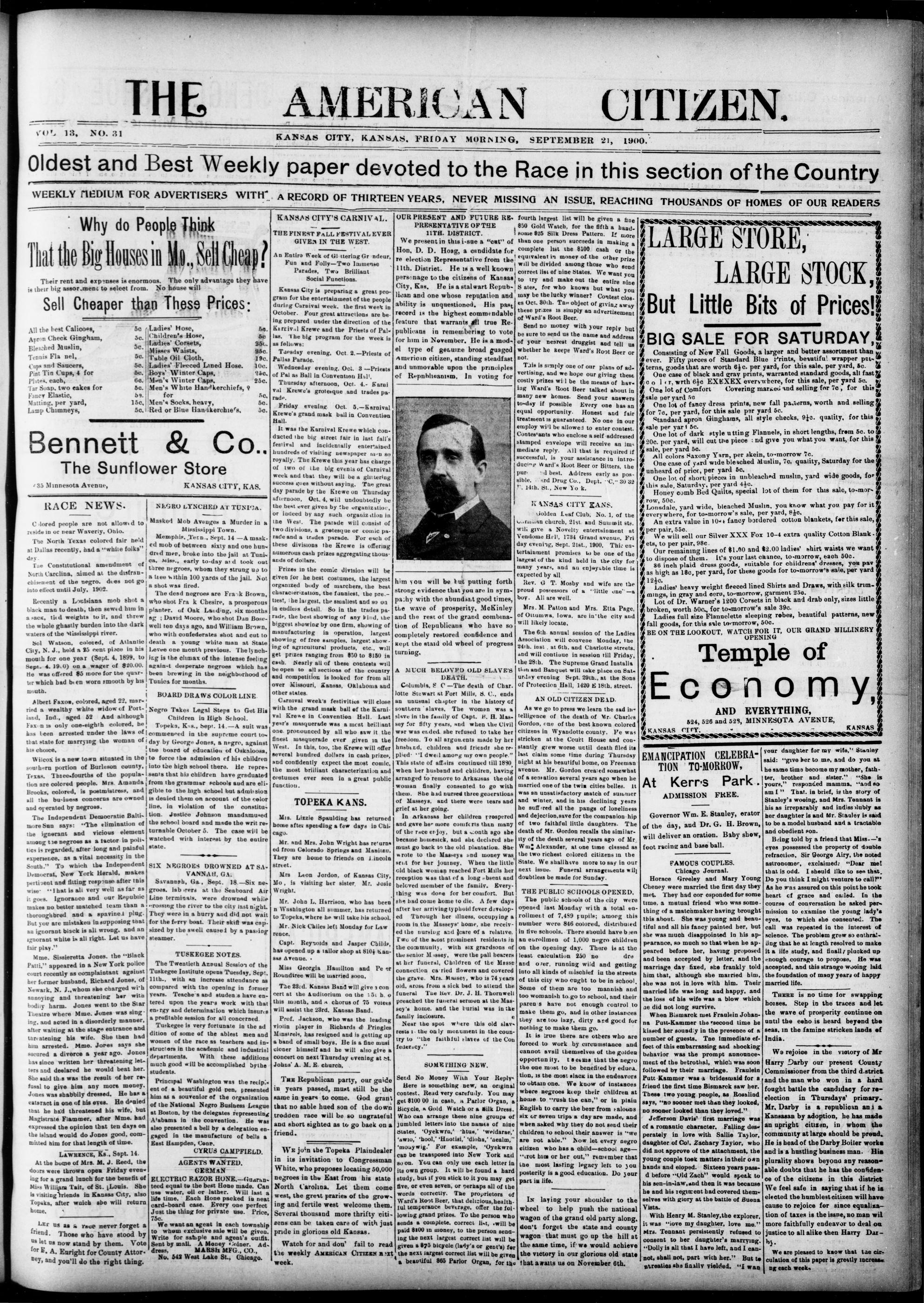
We present in this issue a "cut" of Hon. D. D. Hosg, a candidate for re election Representative from the 11th. District. He is a well known personage to the citizens of Kansas City, Kas. He is a stalwart Republican and one whose reputation and ability is unquestioned. His pass record is the highest commendable feature that warrants all true Republicans in remembering to vote for him in November. He is a model type of gelume broad guaged American citizen, standing steadfast and unmovable upon the principles of Republicanism. In voting for
M. B.
him you will be but putting forth strong evidence that you are in sympathy with the abundant good times, the wave of prosperity, McKinley and the rest of the grand combination of Republicans who have so completely restored confidence and kept the staid old wheel of progress turning.
A MUCH BELOVED OLD SLAVES
DEATH
Columbia, S. C.—The death of Charlotte Stewart at Fort Mills, S. C., ends an unusual chapter in the history of southern slaves. The women was a slave in the family of Capt. E. H. Massey for fifty years, and when the Civil war was ended she refused to take her freedom. To all arguments made by her husband, children and friend she replied: "I dwell among my own people." This state of affairs continued till 1890, when her husband and children, having arranged to remove to Arkansas the old woman finally consented to go with them. She had nursed three generations of Masseys, and there were tears and grief at her going.
In Arkansas her children prospered and gave her more comforts than many of the race enjoy, but a month ago she became homeschool, and she declared she must go back to the old plantation. She wrote to the Masseys and money was sent for her journey. When the little old black woman reached Fort Mills her reception was that of a long absent and beloved member of the family. Everything was done for her comfort. But she had come home to die. A few days after her arriving typhoid fever developed. Through her illness, occupying a room in the Masseys' home, she received the nursing and care of a relative. Two of the most prominent residents in the community, with six grandons of the senior Massey, were the pall bearers at her funeral, Children of the Messe connection carried flowers and covered the grave. Mrs. Massey, who is 74 years old, arose from a sick bed to attend the funeral. The Rev Dr. J. H. Thornwell preached the funeral sermon at the Massey's home, and the burial was in the family incclosure.
Near the spot where this old slave rests, the only monument in the country to "the faithful slaves of the Cor federacy."
SOMETHING NEW
Send No Money With Your Reply.
Here is something new, an original contest. Read very carefully. You may get $100 00 in cash, a Parlor Organ, a Bicycle, a Gold Watch or a Silk Dress. Who can arrange these nine groups of jumbled letters into the names of nine states, 'Oyekwn,' 'htus,' 'wildaar,' 'awio,' 'hoool,' 'Hoostil,' 'dihoa,' 'nealm,' 'mouywig.' For example, 'Oyekwn can be transposed into New York and so on. You can only use each letter in its own group. It will be found a hard study, but if you stick to it you may get five, or even seven, or perhaps all of the words correctly. The proprietors of Ward's Root Beer, that delicious, healthful temperance beverage, offer the following grand prizes. To the person who sends a complete, correct list, will be paid $100 in money, to the person sending the next largest correct list will be given a $75 bicycle (lady's or gents)' for the next largest correct list will be given a beautiful $65 Parlor Organ, for the
CITIZEN.
fourth largest list will be given a fine $50 Gold Watch, for the fifth a handsome $25 Silk Dress Pattern. If more than one person succeeds in making a complete list the $100 cash or the equivalent in money of the other prize will be divided among those who send correct list of nine States. We want you to try and make out the entire nine States, for who knows but what you may be the lucky winner? Coutest closes Oct. 30th. The object of giving away these prizes is simply an advertisement of Ward's Root Beer.
Send no money with your reply but be sure to send us the name and address of your nearest druggist and tell us whether he keeps Ward's Root Beer or not.
This is simply one of our plans of advertising, and we hope our giving these costly prizes will be the means of having Ward's Root Beer talked about in many new homes. Send your answers to-day if possible. Every one has an equal opportunity. Honest and fair treatment is guaranteed. No one in our employ will be allowed to enter contest. Contestants who enclose a self addressed stamped envelope will receive an immediate reply. All that is required if successful, is your assistance in introducing Ward's Root Beer or Bitters, the pure best. Address early as possible, and Drug Co., Dept., C., 30 32 14th. St., New York.
KANSAS CITY KANS
Golden Leaf Club, No.1, of the Christian church, 21st and Summit sts, will give a Novelty entertainment at Vendome Hall, 1734 Grand Street, Friday evening, Sept. 21st, 1900. This entertainment promises to be one of the largest of the kind held in the city for many years, and an enjoyable time is expected by all. Rev. G. T. Mosby and wife are the proud possessors of a "little one"—a boy. All are well. Mrs. M. Patton and Mrs. Etta Page, of Otumwa, lows, are in the city and will likely locate. The 6th annual session of the Ladies Association will convene Monday, the 24th. inst. at 6th and Charlotte streets, and will continue in session till Friday, the 28th. The Supreme Grand Installation and Banquet will take place on Saturday evening Sept. 29th, at the Sons of Protection Hall, 1420 E 18th street.
AN OLD CITIZEN DEAD.
As we go to press we learn the sad intelligence of the death of Mr. Charles Gordon, one of the best known colored citizens in Wyandotte county. He was stricken at the Court House and constantly grew worse until death filed its last claim some time during Thursday night at his beautiful home, on Freeman avenue. Mr. Gordon created somewhat of a sensation several years ago when he married one of the twin cities belles. It was an unsatisfactory match of summer and winter, and in his declining years he suffered all the pangs of loneliness and dejection, save for the companion hip of two faithful little daughters. The death of Mr. Gordon recalls the similarity of the death several years ago of Mr. Wm. Alexander, at one time classed as the two richest colored citizens in the State. We shall have more to say in our next issue. Funeral arrangements will doubtless be made for Sunday.
THE PUBLIC SCHOOLS OPENED
THE PUBLIC SCHOOLS OPENED.
The public schools of the city were opened last Monday with a total enrollment of 7,489 pupils; among this number were 846 colored, distributed in five schools. There should have been an enrolmen of 1,000 negro children on the opening day. There is at the least calculation 250 ne dree and over, running wild and getting into all kinds of mischief in the streets of this city who ought to be in school. Some of them are too mannish and too womanish to go to school, and their parents have not enough control to make them go, and in other instances they are too lazy, dirty and good for nothing to make them go.
It is true there are others who are forced to work by circumstance and cannot avail themselves of the golden opportunity. it means that the negro the one most to be benefited by education, is the most slack in the endeavors to obtain one. We know of instances where negroes keep their children at home to "rush the can," or in plain English to carry the beer from saloons six or seven trips a day are made, and when asked why they do not send their children to school their answer is "we are not able." Now let every negro citizen who has a child—school age—"rot him or her out," remember that the most lasting legacy left to you posterity is a good education. Do your part in life.
In laying your shoulder to the wheel to help push the national wagon of the grand old party along, don't forget the state and county wagon that must go up the hill at the same time, if we would achieve the victory in our glorious old state that awaits us on November 6th.
LARGE STORE, LARGE STOCK, But Little Bits of Prices!
Constasting of New Fall Goods, a larger and better assortment than ever. Fifty pieces of Standard Blue Prints, beautiful wrapper patterns, goods that are worth 6½ c. per yard, for this sale, per yard, 5 c.
One case of black and gray prints, warranted standard goods, all fast co lor, wrth 6½ c. EXEXEX everywhere, for this sale, per yard 5 c.
One lot of Comfort Covering marked and selling for 7 c., for this sale per yard 5 c.
One lot of fancy dress prints, new fall patterns, worth and selling for 7 c., per yard, for this sale per yard 5 c.
Standard apron Ginghams, all style checks, 940. quality, for this
sale. $60.00.
sale per yard 5c.
One lot of dark style utting Flannels, in short lengths, from 5c. to
20c. per yard, will cut the piece and give you what you want, for this
sale, per yard 5c.
all colors Saxony Yarn, per skein, to-morrow 7c.
All colors. Acknowledgement
On case of ward wide bleached Muslin, 7c. quality, Saturday for the
unbeard of price, per yard 8c.
One lot of short pieces in unbleached muslin, yard wide goods, for this sale, Saturday, per yard 410.
this sale, Saturday, per yard
Honey comb Bed Quilts, special lot of them for this sale, to-morrow, 50c.
Lonsdale, yard wide, bleached Muslin, you know what you pay for it everywhere, for to-morrow's sale, per yard, 83c.
An extra value in 10+ fancy bordered cotton blankets, for this sale, per pair, 55c.
We will sell our Silver XXX Fox 10-4 extra quality Cotton Blankets, to per pair, 98c.
Our remaining lines of $1.00 and $2.00 ladies' shirt waists we want to dispose of them. It's your last chance, to-morrow, each 50c.
86 inch plaid dress goods, suitable for children's dresses, you pay as high as 18c, per yard, for these goods for to-morrow's sale, per yard 124c.
Ladies' heavy weight fleeced lined Shirts and Draws, with silk trimmings, in gray and ceru, to-morrow, garment 25c.
Lot of Dr. Warner's 1200 Corsets in black and drab only, sizes little broken, worth 50c., for to-morrow's sale 39c.
Ladies full size Flannelette sleeping robes, beautiful patterns, new fall goods, for this sale to-morrow, 50c.
BE ON THE LOOKOUT, WATCH FOR IT, OUR GRAND MILLINERY OPENING
Temple of Economy
KANSAS CITY. KANSAS
Governor Wm. E. Stanley, erator of the day, and Dr. G. H. Brown, will deliver an oration. Baby show, foot racing and base ball.
FAMOUS COUPLES.
Chicago Journal.
Horace Greeley and Mary Young Cheney were married the first day they met. They had cor sponded for some time. a mutual friend who was something of a matchmaker having brought this about. She was young and beautiful and all his fancy painted her, but she was much disappointed in his appearance, so much so that when he appeared before her, having proposed and been accepted by letter, and the marriage day fixed, she frankly told him that, although she married him, she was not in love with him. Their married life was long and happy, and the loss of his wife was a blow which he did not long survive.
When Bismarck met Fraulein Johanna Putt-Kammer the second time he kissed her soundy in the presence of a number of guests. The immediate effect of this embarrassing and shocking behavior was the prompt announcement of the betrothal, which was soon followed by their marriage. Fraulein Putt-Kammer was a bridesmaid for a friend the first time Bismarck saw her. These two young people, as Rosslind says, "no sooner met than they looked, no sooner looked than they loved."
Jefferson Davis' first marriage was of a romantic character. Falling desperately in love with Sallie Taylor, daughter of Col. Zachary Taylor, who did not approve of the attachment, the young couple took matters in their own hands and eloped. Sixteen years passed before "Old Zach" would speak to his sen-in-law, and then it was because he and his regiment had covered themselves with glory at the battle of Buena Vista.
With Henry M. Stanley, the explorer, it was "iove my daughter, love me." Mrs. Tennant persistently refused to consent to her daughter's marrying. "Dolly is all that I have left, and I cannot, shall not, part with her." But to nreatures she finally yielded. "I wan
your daughter for my wife," Stanley said: "give her to me, and do you at he same time become my mother, father, brother and sister." "She is yours," responded mamma, "and so am I" That, in brief, is the story of Stanley's wooing, and Mrs. Tennant is his as irreparable and indissolubly as her daughter is and Mr. Stauley is said to be a model husband and a tractable and obedient son.
Being told by a friend that Miss.—'s eyes possessed the property of double refraction, Sir George Airy, the noted astronomer, exclaimed: "Dear me that is odd. I should like to see that. Do you think I might venture to call?" As he was assured on this point he took heart cf grace and called. In the course of conversation he asked permission to examine the young lady's eyes, to which she consented. The call was repeated in the interest of science. The problem grew so enthralling that he at length resolved to make it a life study, and finally plucked up enough courage to propose. He was accepted, and this strange wooing laid the foundation of many years of happy married life.
THERE is no time for swapping houses. Step in the traces and let the wave of prosperity continue on until the echo is heard beyond the seas, in the famine stricken lands of India.
We rejoice in the victory of Mr Harry Darby our present County Commissioner from the third district and the man who won in a hard fought battle the candidacy for reelection in Thursdays' primary. Mr. Darby is a republican and a Kansasan by adoption, he has made an upright citizen, in whom the community at large should be prend. He is head of the Darby Boiler works and a hustling business man. His plurality shows beyond any reasonable doubts that he has the confidence of the citizens in this district We feel safe in saying that if he is elected the humblest citizen will have cause to rejoice for since equalization of taxes is the issue, no man will more faithfully endeavor to deal on justice to all alike then Harry Darby.
We are pleased to know that tae circulation of this paper is greatly increasing each week.
AMERICAN CITIZEN PUBLISHING
AND PRINTING CO.
Daily and Weekly 417 Minnesota Ave.
KANSAS CITY KANSAS
W. C. MARTIN, EDITOR.
TERMS OF SUBSCRIPTION
Daily delivered by carrierper week. 10c.
Weekly one year..... $1 50
Entered at the postoffice at Kansas City
Kans., as second class matter.
WILLIAM McKINLEY,
For President.
THEODORE ROOSEVELT,
Vice President.
STATE TICKET.
For Governor.
W. E. STANLEY.
For Lieutenant Governor.
H. E. RICHER.
For Associate Justice
W. A. JOHNSTON
For Secretary of State,
GEO. A. CLARK.
For Treasury,
FRANK GRIMES.
For Auditor,
GEORGE E. COLE.
For Supt. of Public Instructions.
FRANK NELSON.
For Insurance Commissioner,
W. V. CHURCH.
For Congressman at Large.
CHARLES F. SCOTT.
For Congressman First District,
CHARLES CURTIS.
For Congressman Second District,
J. D. BOWERSOCK.
For Congressman Third District,
GEO. W. WHEATLY.
For Congressman Fifth District,
W. A. CALDERHEAD.
For Congressman Sixth District,
W. A. REEDER.
For Congressman Seventh District,
CHESTER I. LONG.
COUNTY TICKET.
Senator, 4th. District.
JAMES K. CUBBISON.
Representa.ive 9th. District,
H. A. BAILEY.
10th. District,
G. L. COATES.
11th. District,
DAVID D. HOAG,
County Attorney,
E. A. ENRIGHT.
Clerk District Court,
ALEX. GUNNING.
Probate Judge,
K. P. SNYDER.
Superintendent Public Instruction,
HENRY MEADE.
County Commissioner.
First District—J. S. PERKINS.
McKinley, Stanley and Prosperity should be the cry throughout the State
The Seventeenth Annual State Reunion of the Grand Army of the Republic, department of Kansas, will be held in Auchison, September 24-29, 1900. The 20th. and 21st. Kansas Regiments of the Spanish-American war will meet at the same time. One fare for the round trip. A partial list of the speakers: Governors Roosevelt and Stanley; Generals John C. Black and J. M. Longuecker, Past Department Commander Illinois G. A. R.; Hon. Leo Rassi-ur, Commander in Chief G. A. R.; Hon. J. W. Preideentalh Col. U. B. Pearsall, Mayor Wm. Warner, Hon. Chas. Curtis, Hon. Chester I. Long, and a score of others of equal ability and of national reputation.
For information or privileges, address G. O. BOU2.NE, Sec.
Half Rate Excursion.
Plus two dollars) twice a month via Union Pacific to points in Colorado, Wyoming, Utah, Idaho, Montana and Washington. Call us up - Phone 1109, or call at office 1,000 Main street, and let us te you all about these excursions.
Short line to Salt Lake. The Union Pacific of course; hours quicker time. All the comforts of home Ticket of office 1,000 Main street. Telephone 1109. Remember Dining Cars on the Union Pacific that now starts from Kansas City daily. Unexcelled service, restaurant plan Ticket office 1,000 Main street. Kansas City, Mo
Lewis Blandchard
No. 6, Sta e Line, K.C. K
Does all kinds of Boot and Shee
work. He does first class hand
work, and also has one of the very
latest and best Shoemaker's machine
and guarantees the best and the
cheapest work in the quickest time
Give him a trial and see for you
elf.
Eating twelve mince pies between Christmas day and Twelfth day is said to insure the eater twelve lucky or happy months during the following year.
BAPTIST CHURCHES.
African 3914 East 15th street.
Greenwood, 2005 Madison Avenue.
Highland Avenue, 1119 Highland Ave
Macedonian )
Mission 216 East 21st. street.
Missionary, 2605 Madison Avenue.
Mt. Calvary, 15 northeast cor. Norton
Avenue.
Mount Gay, 2100 Wyoming Avenue.
Mount Norlash, 933 Bluff street.
Mount Zion, Vita. a e. cor. Garnett.
mount Zion, 908 Hickory Avenue.
Mount Zion. Primitive, 2815 Garnett
street.
Pilgrim, 705 Charlottet street.
Pilgrim, Charlott between 6th and 7th
Pleasant Green, East Forest.
Round Top, Norton near 28th street.
St James, 1411 East 18th street.
St James Chapel, 518 High street.
St Marks, 1019 East 4th street.
St Pauls, 510 East 4th street.
Second Baptist, Charlott. cor. 10th.
Vine Street, 1825 Vine street.
CHRISTIAN CHURCH
21st between Summit and Madison,
s. Augustine Mission, 1025 Troost ave.
METHODIST EPISCOFAL.
Asbury Chapel, 1620 Cherry street
Burna, 11th S. W. Cor, Highland ave
Clark's Chapel, 819 S. W. Boulevard
Westport W. Prospect Place Cor. 23rd.
King Solomon Mission 4th and Locust
Colored Schools.
Attack s 2108 East 18th street.
Bruce 3914 East 15th street.
Douglass 27th N. E. Cor. N. Prospect
Place.
Garrison Forest S. W Cor. 4th street.
Lincoln School 11th N W. Cor Campa-
bell street.
Lincoln High School 816 East 11th st.
Page Rochester N.E. Cor. Prospect
Avenue.
Penn 4241 Shawne.
Business Directory.
J. A. Wilson Jeweller 1616 W. 9th st.
Chandler's Barber shop, Samuel Chandler
Prop. S LClemens Mgr 112 East 6th st.
trest.
Restaurant Mrs Amus Prop. 114 East 6th st. trest.
Field's Barber Shop 102 East 6th st.
Miller's Barber Shop 113 East 6th
Midland Barber Shop Harry Parson
Prostrict 115 East 6th street.
Manila Barber Shop Madison Bros
Proprietora 709 Independence avenue.
McRay's Barber shop Ben McRa;
Proprietor 819 Independence avenue
Maupin's Barber Shop 1332 E 18th st
Brown's Barber Shop 1329 E 18th st.
Berry's Barber Shop 1432 $\frac{1}{2}$ E. 18th st
Grocer, George Grear, Prop. 1211 E.
8th st.
D. M. Mitchell, Barber Shop, 576
Grand ave.
Langton' Barber Shop 718 East 8th st.
Walker' Barber Shop 806 East 12th h.
H. J. George, barber shop, 1307 w
21st
901 st.
Cowden's Barber Shop 704 East 12th st
Restaurant H Powel Proprietor 572
Grand avenue.
Restaurant Andrew Clark Proprietor
723 Independence ave.
Saratoga Cafe L. Mason Iroprietor
805 Independence ave.
Chicago Cafe H Compton Pr rieto
706 est 12th street
Physicians and Surgeons.
Dr. Shannon and Lambight 1215 E.
18th st.
Dr. J.N. Birch 1399 E. 18th st.
Dr. T. C. Unthank 1233 Independence
Ave.
Dr. L.J. Holly 1112 Campbell st.
Rising Sun J.F. Cole, Editor, L. W.
W. W. Manager 171 W. 6th st.
Grocery, A. Webb, Prop 9th an
Holme
Phillips 1917 Cherry street.
Round Top 2817 Norton Avenue
Administrator's Notice.
In the Probate Court in and for said County.
In the matter of the estate of Howard Jordan, deceased. Notice is hereby given that letters of administration have been granted to the undersigned, on the estate of Howard Jordan, late of said county, deceased, by the Honorable, the Probate Court of said county and state aforesaid, dated the 7th day of September, A. D. burying them against the said estate he relied not that they must present the same for allowance within one year from the date of said letters, or they may be precluded from my benefit of such estate, and that if such claims be not exhibited within three years after the date of said letters, they shall be forever barred. L. W. JOHNSON. Administrator of the estate of Howard
ONE OF THE BEST RESTAURANTS
ONE OF THE BEST RESTAURANTS
In this city can be found at
No. 25 Central Avenue,
KANSAS CITY, KANSAS.
Everything in the line of eatables is
cooked and served in first class style.
Splendid meals served on short notice.
Mrs. Annie Sewell is well experienced in
restaurant business and knows how to
treat her many customers. Don't forget
the No., 25 Central avenue.
MRS. ANNIE SEWELL,
Proprietress.
Go to C. W. Clodfelters grocery, No 68 Central Ave., and purchase a bar of his wonderful soap and give it a trial and you will use no other. No housekeepa- should be without it.
KANSAS CITY, KANSAS
Enterprises.
A.C.L. Coal Co. Main Office 492 Minn.
Ave. E.F. Henderson, Mgr.
D.W White Furniturestore, 420 Minn.
Ave.
J.W Jones Grocery 400. Oakland Ave.
M. Gordon Department store 1605 N
4th
Clark & Lee, junk store, 1104 north
3rd, st.
Kansas City Kansas Soap Works, 4th.
st., between Oakland and Freeman.
J. R. McClain, Grocer, 1700 n 5th. st.
J·R. Rucker, Butcher, 1609 n 16th. s
Douglass Hospital, 312 Washington
ave., Miss L. V., Ashton, Matron.
CHURCHES
METHODIST.
St. James A. M. E., cor. 7th. and Ann.
St. James M. E., Freeman ave., bet
tween 9th and 10th.
C. M. E. Oakland ave., bet, 4th. and
5th.
CHRISTIAN.
8th. St. Christian, cor. Everett and
8th.
9th. St. Christian, cor. 9th. and Nebraska.
BAPTIST.
1st. Baptist, corner 5th. and Nebraska
avenue.
Metropolitan Baptist, cor. 9th. and
Washington.
Mt. Zion Baptist, Virginia ave., bet
tween 4th. and 5th.
Mt. Pleasant, 3rd. st., between Oak
land and Jersey.
Pleasant Green, Wood St. and Split-
log ave.
King Solomon Baptist, 3rd. and State
avenue.
HOTELS.
Dyson House 440 Minnesota Ave.
Restaurants.
J. W. Johnson's 6th and State.
Mrs. Hall 507 Minn. Ave.
Mrs. Sarah Thurston 1414 5th st.
Mc Gees 448 Minn. Ave.
E. Stoakes 1510 N. 3rd st.
BARBERS
J. T. Roberts & Tucker, 432 Minnesota avenue.
J. Gross, 412 Minnesota avenue.
G. McClellan, 613 Minnesota ave.
M.T. Comer, 608 Minnesota ave.
Robt. Keith, 315 Minnesota ave.
M. Pattison, 1603 north 3rd. st.
SHOEMAKERS.
Lon McAdams, 348 Minnesota ave.
D. W. Wynne, 309 Minnesota ave.
Lewis Blenchard, North 6th., State Line.
Wilson, 5th. st. between Nebraska and State.
J. W. Ready, No. 1609½ n 10th. st.
M. & O.1306 north 8th. street.
Sons of Protection, State and 6th.
DRUGS.
Wyandotte Drug Store, 1512 north
5th. street.
DOCTORS.
S. H. Thompson, 151 north 5th. st.
G. H. Brown, 1010 Freeman ave.
Jordan, 610 Minnesota ave.
ARTISTS.
O. J. Brooks, 70, New York Life
Building.
TEACHERS OF FRENCH AND ELOCUTION:
Arthur A. Anderson, 541 State Ave.
UNION PACIFIC
TEC
RIVERLAND
ROUTE
WORLD'S PICTORIAL LINE.
SHORTFST LINE ACROSS THE CONTINENT
The Union Pacific The Original Overland Route' always was, and is to-day, the shortest and best Line to the west. Two splendid fast trains leave Kanas City daily over this old established line. No change of cars between Kansas City and Denver, Ogden or San Francisco. All trans solidly vestibulated and fully equipped with latest improved Recycling Chair Cars free and Pullman Palace sleeping cars. Meals served in Pullman Palace dining cars on the restaurant plan at prices most reasonable. All cars lighted with the celebrated Pintshi Li, t Only line running two trains without change from KansasCity to Denver Low excursion rates on sale to Colorado Utah Idaho, Oregon Washington and California. Don't complete your ars rampages for a trip west until you have learned all about special inducements and attractions offered by the Union Pacific. For full information in regard to low. rates time. etc., call on or address
Gen. Ag., Union Pacific, 1000 Main street, Kakas City, Mo
PUBLICATION NOTICE.
In the District Court of Wyandotte County, Kansas.
Anna Brown, Plaintiff,
vs.
William Brown, Defendant.
To the above named defendant, you are hereby notified that you have been sued by the above named plaintiff in the above named court, and that unless you appear and answer on or before the 12th. day of October, 1900, the petition filed in court against you will be taken as true and a judgment rendered against you, the nature of which will be a decree dissolving the bonds of matrimony now existing between plaintiff and defendant, and forever divorcing plaintiff from said defendant, and awarding to her her maiden name, as prayed for in the petition, and for cost of this suit. I. F. BRADLEY,
AUCLEY for Paintuff
PROPOSED AMENDMENT TO THE
CONSTITUTION.
House Joint Resolution No. 4, Relating
to Justices of the Supreme Court.
Be it resolved by the Legislature of the
State of Kansas, two-thirds of the
members elected to each house concurring
therein:
Sec. 3. This resolution shall take effect and be in force from and after its publication in the statute book.
Approved March 4, 1899.
I hereby certify that the foregoing is a true and correct copy of the original enrolled resolution now on file in my office, and that the same took effect by publication in the statute book May 15, 1899.
GEO. A. CLARK.
[eEAL.]
Secretary of State.
Publication Notice.
State of Kansas,
29th Judicial District,
County of Wyandotte.
(NO. 14049.)
Jacob Rickett, Plaintiff, vs. Euretta M. Alexander, E. S Grigsby, William J. Fuller and Belle C. Fuller, Defenance.
Under and by virtue of an order of sale issued by the Clerk of the District Court, in and for said County of Wyandotte, in a certain cause in said court, numbered 14049, wherein the parties above named were respectively plaintiff and defendants, and to me, the undersigned, Sheriff of said county, directed, I will offer for sale, at public auction, and sell to the highest bidder, for cash in hand, at the front door of the Court House, in the city of Kansas City, in said county, on Monday, the 10th day of Sep ember, A.D. 1900, at 10 o'clock a m., of said day, the following described real estate situated in the County of Wyandotte and State of Kansas, to witt. At the time of the interest and estate of the Belle C. Fulcher, am J. Fuller, and to lot forty-six (48) block one hundred and ninety (10) in the former City of Wyandotte, according to the plan of Wyandotte City, made by John H. Miller and published by the Wyandotte City Co., and now o'file in Register of Deeds office of Wyandotte County, Kansas
H A. MENDENHALL,
Sheriff of Wyandotte County.
Publication Notice.
State of Kansas.
Wyandotte County, Ks. <sup>as</sup>
The District Court of said County
Joseph L. Plaintiff, vs. Maria Law,
Defendant.
The above named defendant, Maria Law, will take notice that she has been sued by the above named plaintiff, Jos. Law, in the above named court, where the petition of the said plaintiff is now on file, praying for a divorce against you, the above named defendant, for causes set out in said petition, and that unless you answer said petition on or before the 7th day of August, A. D. 1900, the same will be taken as true and judge there for the cause of divorce, divulge you from said plaintiff, and dissolving the bonds of matrimony now existing between you
B. S. SMITH
Attorney for Plaintiff
Publication Notice
In the District Court of W andotte County, Kansas.
Florence Toles, Plaintiffi
vs.
John Toles, Defendant
To the above defendant you are here
by notified that you have been sued in
the above named court by the above
named plaintiff, and that unless you ap-
pose to the notice before the 14th
day of September, 1900, the petition
will be taken as true and a judgment render-
ed against you, the nature of which will
be a decree divorcing this plaintiff from
said defendant, and awarding to her her
maiden name, Florence Borsan, and
for costs of this suit. I. F. BRADLEY.
Try attending to your own business letting other folks business alone, see how easy life will be.
RAILROAD NOTICES.
To Pueblo, Colorado Springs and Denver and return, special summer excursions June 21, July 7, 8, 9, 10, 18, and August 2, final return limit October 31, $19 for the round trip.
Summer tourist tickets on sale every day from June 1 to September 15, inclusive, final return limit Oct. 31, round trip $25
Homeeekers' excursions to western and southwestern points on June 5 and 19 July 3 and 17 August 7 and 21, tickets good for twenty-one days, at rate of one fare plus $2, for the round trip.
Tickets to St. Paul and Minneapolis at $21 for the round trip, good g.ig at any day, returning any time up to October 1. Very low rates to other northern points.
Special excursions June 21, July 7, 8, 9 and 10, and August 2, to St. Paul, Minneapolis. Round trip at $15.55. Duluth ana, the Superiors at $9.85. Water ville, Minn., $14.40. Good to return October 31, 1900.
From July 1 special round trip excursions to Ogden and Salt Lake City at $50.00 Liberal stop orders. Good to return until October 31.
June 20 to 25 Winfield and return $6.60
July 7 to 20, Ottawa and return $1 65.
For particulars call or address.
E. S. JEWETT,
Passenger and Ticket Agent.
City ticket office No. 901 Main street,
Kansas City, Mo.
Secure Tickets
...VIA THE...
Chicago, Milwaukee
& St. Paul Ry
...AND YOU GET...
Sleepers: & Ghair
Cars
...TO...
CHICAGO
and all intermediate points The shortest,
quickest and besiline to Chilocothe, Ot
tumwes, Cedar Rapids, Dubnque, and La
Crosse and Cedar Rapids, Rockford and
Freeport:
....Passenger Station at....
22nd St. and Grand Ave.
Take Westport Cable.
City Ficket Office, 915 Main street,
Ridge Building.
A. B. BRILGES Gen'l. Southwest
Agent
F. L. JERCHPassenger Agent.
Office 915Main St. Kansas Cit
MONEY
FOR OLD'SOLDIERS
I WILL BUY
The additional Homestead Claims of all Soldiers or Sailors who served in the Union army or navy, their widows or minor heirs.
Who filed a Homestead claim of less than 160 acres of land prior to June 22nd, 1874?
Such persons are entitled to enough more land, including the number of acres embraced in their original entry, without living upon it, to make 160 acres. If they homesteaded 80 acres, they are entitled to 80 more, if 40 acres 120 more, if 159 acres, one acre more, or any other number as it may a near
By late rulings and decisions is not necessary that final proof should have been made on their original entry, that is, they are now entitled to such additional rights if their homestead was abandoned, canceled or relinquished, and all transfers can be made to their homes, before a Notary Public. All such claims I am prepared to buy and pay the highest market price in cash, AT ONCE. Will buy fractional claims even if not more than one acre if you did not make a home-steed thing you have no claim to sell. This filing costs and don't wait but come to this office, and get full particulars concerning this land. It is to your own interest to do so.
AMERICAN CITIZEN OFFICE,
41 Minnesota Avenue.
THE AMERICAN Citizen,
The oldest, one of the best and most reliable Weekly papers for the ace in the State An unexcelled Advertising Medium, office at 417 Minnesota avenue, Kansas City, Kansas.
Job Work, Bills, Programms, and all kinds of printing done. Satisfaction guaranteed or no go.
Correspondence solicited from all parts of the country,
AMERICAN CITIZEN PUB CO.
417 Minnesota Avenue,
KANSAS CITY, KANSAS
PUBLICATION NOTICE.
In the District Court of Wyandotte
County, Kansas.
William March, Plaintiff,
vs.
Julia March, Defendant.
To the above named defendant, you
are hereby notified that you have been
sued by the above named plaintiff in
the above named court, and that unless
you appear and answer on or before
the 12th, day of October, 1900, the petition
filed in court against you will be
taken as true and a judgment: rendered
against you, the nature of which
will be a decree dissolving the bonds of
matrimony now existing between plaintiff
and defendant, and forever divorcing
plaintiff from said defendant, and
for cost of this suit.
I. F. BRADLEY,
Attorney for Plaintiff.
DENGLE SHOE CO.
The Dengel Shoe Co, has now had its doors open to the public for the past three weeks, and we wish to say that our business has far exceeded our expectations, and we hope to continue it so, and if fair dealing and honesty will please the people, we feel satisfied our small Shoe Store will become the Rapid Shoe Growing House of Kansas City, Kas.
Our stock is all new and I just from the factories. Our styles are strictly up to eat. Our store is neat, and our corks are always ready to serve you with the best of service.
See that NAME and DEMON are stamped on soles
W. L. DOUGLAS'
Union Shoes,
Also the Strongest and Best Line of
BOYS' SHOES,
In the two Cities,
If your boys' Shoes have not been giving satisfaction give us a call and we will guarantee that
THIS IS THE BEST-$3. SHOE IN THE WORLD
HAND-SEWED
PROCESS
You will be well pleased with our SHOES. We cannot only give you the BEST SHOE for the money, but we can save you money.
Thanking you for your past favors, and sincerely soliciting your future patronage, we
Remain Very Pruly,
DENGLE SHOE COMPANY
7th. and Minnesota Avenue,
Kansas City, Kas.
You Are Earnest
The C.
Furniture
Ca
Looated at 618 and
To inspect the large
House F
In the city, at prices that we
would here than elsewhere. We
wher by retain your patronage
friends patronage.
WE SELL ON TIME PAYMENT
SUIT YOU, and will be glad to sell
in the line of
FURNITURE, CARPET,
LINOLEUMS, SHADE
SETS, also a complete
LINE STOVES.
Don't forget the number and m
We sell the Celebrated Kroeger
For an Event
VISIT THE MO
Porters and
C
1009. ST. L.
Kansas City.
It is the su
A. C. L.
IS HE
THE CHEA
The Best Goods, the Qui
and the
GET
COAL, WOOD, FEE
Wholesale and Retail. Offi
Yard and Storage 917 and
N. B. MARSHALL, Agent, H
W. B. R
You Are Earnestly Requested to Call at
The C. F. WILLNER Furniture AND Carpet Co.
In the city, at prices that will convince you that your money will go further here than elsewhere. We make it an especial effort to please and ther by retain your patronage and also your recommendation for your friends patronage.
WE SELL ON TIME PAYMENTS and know that OUR TERMS WILL SUIT YOU, and will be glad to show you OUR STOCK. We carry everything in the line of
FURNITURE, CARPETS, DRAPERIES, OIL CLOTH, LINOLEUMS, SHADES, LAMPS, DINNER and TOILET SETS, also a complete line of RANGES and GASO-LINE SLAVES.
For an Evening of Recreation VISIT THE MODERN AND UP-TO-DATE.
1009. ST. LOUIS AVENUE. 1009.
Kansas City. Missouri.
It is the swellest place in the city.
A. C. L. COAL CO., -IS HEADQUARTERS FOR-
CHEAPEST PRICES
at Goods, the Quickest Sales, the Smallest Profits
and the promptest deliveries.
GET THEIR PRICES ON
FOOD, FEED, FLOUR, AND BUILDING
STONE,
Retail. Office 402, Minnesota Ave. Tel. 152 West.
Storage 917 and 919 North 3rd. St.
E F. HENDERSON Manager.
ALL, Agent, Headquarters, 19½ Central Avenue
B. RAYMOND,
THE CHEAPEST PRICES
The Best Goods, the Quickest Sales, the Smallest Profits and the promptest deliveries.
COAL, WOOD, FEED, FLOUR, AND BUILDING STONE.
E F. HENDERSON Manager.
N. B. MARSHALL, Agent, Headquarters, 19th Central Avenue
W. B. RAYMOND
Manufacturer of and Wholesale dealer in
UNDERTAKEN
FIRST-CLASS CARRIAGES
AMBULANCE FOR THE CON
Undertaking Krooms, 431 Minne
Factory Corst
KANSAS CITY
DRUGS, MEDICINES, CHEMICALS. Fine Toilet Soaps, Brushes, Combs, Etc. PERFUMERY AND FANCY TOILET ARTICLES.
Kansas.
KANSAS.
PRESIDENT TYLER'S DAUGHTER.
A Venerable Lady of Noble Lineage Speaks a Timely Word.
WHITE HOUSE, WASHINGTON, D. C.
"One of the most aristocratic faces so daugher of President Tyler. She has passed lagy youthful complexion. Personally she out of the European courts." so says the No Sidelights at the Capital."
The following is a letter from this inter Washington, D.C., to the Peruna Medicin great aurirrh Conto Peruna. Mrs. Semple
Gentlemen—"Your Peruna is my friends have used it with the commend it to all who need a s remarkable medicine." Sincere
Peruna is a specific to counteract the entitled "Summer Catarrh" sent by the Peruna
ABSOLUTE SECURITY.
Genuine Carter's Little Liver Pills.
Must Bear Signature of
"One of the most aristocratic faces seen in Washington is that of Mrs. Semple daughter of President Tyler. She has passed her 80th year and yet retains an exceedingly youthful complexion. Personally she is charming, and impresses us as stepping into the open courts," so says the National Magazine, under the heading "Socia tiealsights at the national." The following is a letter from this interesting lady, written from the Louise Home Washington, D.C., to the Peruna Medicine Co., of Columbus, Ohio, concerning their great catarrh tonic, Peruna. Mrs. Semple writes:
Gentlemen—"Your Peruna is a most valuable remedy. Many of my friends have used it with the most flattering results and I can commend it to all who need a strengthening tonic. It is indeed a remarkable medicine." Sincerely,
Letetia Tyler Semple.
Peruna is a specific to counteract the depressing effects of hot weather. A free book entitled "Summer Catarrh" sent by the Peruna Medicine Co., Columbus, Ohio.
Aunt Food
See Puc-Simile Wrapper Below.
Very small and as easy
to take as sugar.
CARTERS
LITTLE
LIVER
PILLS.
FOR HEADACHE.
FOR DIZZINESS.
FOR BILIOUSNESS.
FOR TORPID LIVER.
FOR CONSTIPATION.
FOR SALLOW SKIN.
FOR THE COMPLEXION
Price
28 Cents
GENELEMEN MUST HAVE SIGNATURE.
Purely Vegetable.
CURE SICK HEADACHE.
Sawyer's Pommel Slickers
Warranted Waterproof.
Sawyer's Excelcelor Brand Pommel Slickers afford complete protection to both rider and handle. Make extra hardwear for the tearing a dry seater rider. Easily converted to waterproof. Every garment warranted waterproof. If your dealer does not have Excelcelor Brand, write for catalogue.
H. M. SAVYER & SON, Sole Mira, East Cambridge, Mass.
1,000 NEWSPAPERS
Are now using our International Type-High Plates Sawed to
LABOR-SAVING LENGTHS.
They will save time in your composing room as they can be handled even quicker than you. Extra charge is made for sawing plates to short lengths. Send a trial order to this office and be convinced. WESTERN NEWSPAPER UNION, KANSAS CITY, MO.
through Pulman Palm City Sleepers and
through Palm City Mall at 10 p.m. from
Antonio, Antonio, at 10 p.m. from
Absolutely no change of cars. Round trip ticket on sale at gratefully reduced rates. The A. T. & S. F. R. Ry. G. W. HAGENBUCH, G. A. P. D.,
WEDDING INVITATIONS.
Printed in the most artistic manner from milti-
ture preserved type on the finest Hurub paper.
The paper is acid-free. It has had an air-
proof. Fifty invitations with inside and
outside envelopes complete, delivered free
and in value. $1. One hundred $2. Announcements
of the event. $3. HASTINGS PRINTING CO., Milton, Penn
DON'T STOP TOBACCO SUDDENLY
In injuries nervous system to do so. BACO-
CUO is the only cure that REALLY CURES
in injuries and can help to soothe a pain.
garantee that three boxes will cure any case.
BACO-CUO is vegetable and harm-free. It has
curved thousands. It will cure.
At all drugstores or by mail prepaid. 41 a box;
62 a booklet. Write
EUREKA CHEMICAL CO., La Crossie, Wise
USE
FAUL LESS
THE BEST
STARCH
FOR LAUNDRY
WORK
FOR SHIRES, COLLARS, CUFFS, AND FINE LINEN
British of Union Soldiers who made homelesses of
British troops before June 22, 1874 (no matter
if M abandoned) are not sold or used, should address, with full
participants, **HENRY N. P.C.**, Washington, B. C.
PISO'S CURE FOR
BESTS WHERE ALL ELSE FAILS.
Bests Where Syrup. Tastes Good. Use
in time. Sold by druggists.
CONSUMPTION
Via the Santa Fe Route
seen in Washington is that of Mrs. Semple. She her 80th year and yet retains an exceedance in charming, and impresses one as stepping national Magazine, under the heading "Social resting lady, written from the Louise Home, Co., of Columbus, Ohio, concerning their writes: a most valuable remedy. Many of our most flattering results and I can strengthenening tonic. It is indeed a ly, Letetia Tyler Semple. Expressing effects of hot weather. A free book orna Medicine Co., Columbus, Ohio.
- LOW RATE EXCURSIONS.
Via Missouri Pacific RY., and Iron Mountain Route.
To points in the West, Southwest, and Southeast at half-rates (plus $2) for the round trip. Tickets on sale Tuesday, September 4 and 18, October 2 and 16, November 6 and 20, and December 4 and 18, 1900. For full information, land folders, etc., address any agent of the above lines, or H. C. Townsend, G. P. & T. Agent, St. Louis, Missouri. _____
When a man gets rattled he probably has a screw loose somewhere.
WONDERFUL DISCOVERY
WONDERFUL DISCOVERY!
Ray's Eureka Ontment Remedies—It is astonishing how quickly these remedies cure all diseases, by anointing—enters at once into the circulation. They should be in every house in case of Colds, Croup, Burns or any other accident. Retails at $c; $ per doz. E. R. Ray & Co., Eureka Springs, Ark. Agents wanted.
The memory of a past happiness is a wrinkle on the face of time.
Mrs. A. G. Russell, Nashville, Tenn., wrote: Dr. Mofet's TEETHINA (Teething Powders) is the greatest blessing to teething children that the world has ever known.
A women with a scrawny neck doesn't approve of accolate gowns.
Wanted.
A traveling salooner in each southern state; $50 to $80 per month and expenses; experience not absolutely necessary. For particular addresses Penichella Tobacco Works, Penichella, Va.
The nation that produces the most marriages is fasci-net.
Best for the Bowels
No matter what ails you, headache to a cancer, you will never get well until your bowels are put right. CASCARETS help nature, cure you without a gripe or pain, produce easy natural movements, cost you just 10 cents to start getting your health back. CASCARETS Candy Carthart, the genuine, put up in metal boxes, every tablet has C. C. stamped on it. Beware of imitations.
When a man looks in a mirror he knows how it is himself.
The Best Prescription for Chills and Fever is a bottle of GROVE'S TASTELESS CHILL Tonic. It is simply iron and quinine in a tasteless form. No cure—no pay. $900.
Fools acquire wisdom and loafers go to work tomorrow.
All goods are alike to PUTNAM FADELESS DYES, as they color all fibers at one boiling.
Many a poor bootblack has managed to shine in society.
Hall's Catarrh Cure
is taken internally. Price, 75c
High water doesn't necessarily raise the price of milk.
FITS Permanently Cured. warts or nervousness after first day's use of Bite King's Great Restorizer. Best for children. Dr. R. H. Kins, Ltd., 821 Arch St., Philadelphia, Pa.
A fish isn't necessarily crazy when it is insine.
Piso's Cure is the best medicine we ever used for all infections of the throat and lungs—W.K. O'ENDSLEY, Van Buren, Ind, Feb. 10, 1900.
Keep looking young and save your hair, its color and beauty with PARKER'S HAIR BALM. HINDENBORN, the best cure for corn. 18cts.
The most profitable style is the turn-stile.
Dreppepain is the bane of the human system. Protect yourself against its ravages by the use of Beemman's Pepsin Gum.
Mixed all causes many serious ailments.
The Manufacturers of Carter's Ink have had forty years' experience in making it and they certainly know how. Send for "Inklings," free.
An engagement ring is the advance guard.
Please Try Faultless Starch once and you will never use any other. All grocers sell it—large package 10c.
Some people who think themselves original are not even good imitations.
Mrs. Winslow's Soothing Syrup. For children teething, softens the gums, reduces inflammation, pain, pain winds colic. Eca bottle.
Common sense shines with increased luster when set in humility.
To be always happy, use Red Cross Ball Blue. 5c. Refuse imitations.
It doesn't pay for a man to be honest if he is honest only for pay.
Farms for sale on easy terms, or exchange, in La. Reb., min. or S. D. J. Muhall, Sioux City, Iowa.
If you would be somebody in the world begin by being yourself.
Home-Grown Tobacco.
In Quebec the citizens solace themselves with home-grown tobacco. They have a patriotic idea that it is superior to the plant raised in any other nation of the universe.
Wanted.
FED BY THE ANGELS.
FED BY THE ANGELS.
CHRISTIAN HEALER HAS ASTONISHED JAILERS.
Has Fasted for Thirty-Seven Days and Is Still Strong and Confident—Laughs at the "Ignorance of the World"—Claims to Be Gifted with Divine Power.
Here is a picture of Dr. Henry Reuel Wallace, who is now incarcerated in a Chicago jail as a defendant in a breach of promise case. He claims to be observing an ordinance of God, and is fasting for forty days. Up to date he has passed into his thirty-seventh day, subsisting solely on coffee, sugar and water and salt. The doctor began his strange trial in good health, and has continued in the same condition. In
DR. R. H. WALLACE
fact, it is said by Cook County Jail Physician Francis W. McNamara that the doctor is even in better health than when he began his self-imposed task. He has fallen away somewhat in weight, going from 150 pounds to 125, and losing about six inches of girth. But his health has kept excellent. The endurance of the doctor is looked upon as remarkable by the jail officials, who, despite a sharp watch constantly kept up, have failed to discover the prisoner partaking of any food except such as has been named above. The doctor says he has absolutely touched nothing in the way of food but sugar and salt dissolved in water and coffee, except what angels bring him at night. The doctor claims to be gifted with divine power and that he is fed by angels who bring him food at night and sing to him.
ENGLISH DOCTOR'S FEE3
Larger than in Other Countries and Fortunes Haven Been Amassed
Perhaps the physicians of England receive larger fees than their brother practitioners in other countries of the world. The greatest medical feature of the century, as might have been expected, has fallen to the lot of Sir William Jenner, who died a short time ago at the ripe old age of 83 years. Sir William, who was always liberal in his expenditure and his charities, left a personal estate of the value of £395,000. In his palmiest days Sir William more than once made £2,000 by a single week's work, although naturally his average earnings were much below this amount. He himself, however, estimated his aggregate professional income for the last 30 years of his active life at over half a million pounds sterling, and yet this king of doctors has been known to travel to a distant suburb and take a two-guinea fee with a smile and a "Thank you." Some of the largest recorded medical fees, however, fall to his lot, and he is said to have received £20,000 for his attendance on the late prince consort and the Prince of Wales during their two serious, in one case fatal, illnesses. Sir William Gull, who had nine years less of life, amassed £344,023, the second medical fortune of the century; Sir Andrew Clark, with a still shorter life, accumulated £146,746. It is significant that some of the medical men who have reaped the largest harvests have been proprietors of private asylums. Dr. proprietor of the Camberwell House Private Asylum, amassed over £100,000, and Dr. William Wood, of the Priory Private Asylum, Roehampton, left £67,000. Fifteen physicians who have died quite recently left behind them an aggregate fortune of £2,000,000, or the gratifying average savings of £133,000. Sir Morell Mackenzie is said to have received £20,000 for attending Frederick the Noble, but at his death left only £21,953. These fortunes become intelligible when we consider that a fashionable physician frequently earns from 100 to 200 guineas in a couple of hours' morning consultations, and that there are many days on which his fees amount to 300 guineas or more. An ordinary fee for attending a patient at a distance of 200 miles from town would be 250 guineas, and for an operation at this distance a fashionable surgeon would get considerably more...Utica Globe.
Eskimo Seal Hunting
Most savage and semi-civilized folks are keen hunters. The Eskimo are by no means an uncivilized race, and they show great skill in chasing the seal. Their method of drawing near to the animal needs much patience and is really very tiring. The hunter lies down on his face or his side, and in this position approaches the seal by a series of jerks not unlike the movements made by the creature when on land or ice. He may have to cover hundreds of yards in this fatiguing fashion, but he is so clever at it that he can reach to within a few feet of his victim without the cheat being detected. An onlooker would then find it hard to say which was the man and which the seal. Generally the silly seal comes to meet the man, and when it is far enough out of its hole in the ice the hunter jumps up, cuts off its retreat and spears or clubs it. The women, too, are very smart at this kind of hunting.
Hamburg had eighty-two days in 1889 when the sun was not visible at all. There were in all 1,367 hours of sunshine, or 400 hours less than in Heligoland.
The LADIES Home Journal.
"One Hundred Years in the White House," opening the September Ladies' Home Journal, gives some highly interesting glimpses of the social life of the century, and of the home life of our Presidents since the Adamses moved into the Executive mansion as its first occupants, in November, 1800. The "Romances of Some Southern Homes," in the same issue, pictures the most notable historic mansions of the South, and recalls the incidents which made them famous—their brave men and beautiful women. Some new anecdotes attract further interest to the beloved Phillips Brooks, as a man and as a preacher. They are characteristic and exceedingly well told. Anticipating the rather radical change that fashion has decreed in women's attire, ten special articles are devoted to the fall and winter modes. The pictorial features of the September Journal include a page drawing of "Lolters at the Railroad Station," as A. B. Frost sees them; "The Wonders of California Gardens," and the beauties of Yellowstone Park. There are numerous practical articles and much else that is helpful in the departments. By The Curtis Publishing Company, Philadelphia.
Ainslee's Magazine
Trusts still remain a problem the most vital and far-reaching that has puzzled the generation of to-day. With excellent, clear vision Ainslee's Magazine for September has seized the idea of a study of "Trusts in Europe," by Cyrus C. Adams, to serve as a comparison with our conditions at home. "Cattlemen and Sheepmen," by Captain James H. McClintock, late of the Rough Riders, is a fascinating narrative of the universal melodrama of the Far West—the war of the cattlemen against the sheep owners. The most highly colored romance of our history is attractively told in "Fifty Years of the Golden Sta e," by Arthur I. Street, Dr. W. T. Harris, director of the United States Board of Education, gives some very curious information about our efforts in "Civilizing the Natives of Alaska." John Gilmer Speed, in "Romances of the Immigrant Depot," has collected some stories of the ways of the human heart from the matron of the Barge Office at New York. Of stories Ainslee's for September contains a wide range. "The Anarchist" is a strong story by Wolcott Le Clear Beard, and is laid in Texas. "The Raid at Blazing Star," by Marois Maris, is a tale of adventure in the Klondyke.
Gen. Chaffee, not having the advantage of a military education before he became a soldier, has taken every opportunity presenting itself to become proficient in his profession. He has completed courses in law and military tactics.
New York's Free Lectures
Free lectures given under the auspices of the New York city department of education show an increase in attendance of 18,673 during the last winter and spring, as compared with the same period of a year before.
Ladies who take pride in clear, white clothes should use Real Cross Ball Blue.
Rice and Population.
In deciding whether China's population is dense or sparse it ought to be remembered that the country produces rice. Countries which produce rice yield at least two crops a year. Countries which produce corn, on the other hand, only yield one crop a year. Therefore, apportionment to its extent, a country which produces rice ought to support at least twice as large a population as a country which produces corn.
Haye Held High Office
Three former members of the New Jersey state senate have held high office with the present national administration. Garret A. Hobart, the late vice-president, was a member of the body named for six years, and was its president one session. Attorney General Griggs is another, and William H. Johnson, the new first assistant postmaster general, represented Hackensack until he resigned to take office in Washington.
Future of Bloomfontein
Bloemfontein, which under British rule, after reorganization is complete, d. will be the capital city of all the South African states, may be waited on by high municipal and historic destinies. At present it is rather a small town, but larger than Washington, or Melbourne was a century ago, and is handsomely and healthfully situated. It has room to spread into a fair city and a dignified seat of magistracy.—New York Tribune.
Mexico's Interest in China
The neighboring republic of Mexico would probably view with some complacency a war which would involve China deeply and for some time. The former country some ten years ago endeavored to establish a silk industry, but found it impossible to make headway against its oriental competitor. Should war upset things in the far east Mexico might still be able to get a foothold in the direction indicated.
Girl Lost Her Fellow:
A Topeka girl went to law in order to secure payment of a claim on an accident insurance company. The company brought out the fact that the girl had corna. This was such a shock to her best fellow that he ceased his visits, and now the girl wonders whether the $47 she got from the company is sufficient compensation for the loss of her beau.
Tomtits in a LetterBox
At Cranborne, Dorsey, a pair of tom-
tits have been nesting in the private
letter box of a farm house. Letters
have been placed in the box almost
daily without the birds being disturbed
and nine eggs have been laid and
hatched. The same letter box was
utilized as a nest last year.
For the Ladies.
PRIESMEYER SHOE
CO.
SNOES THAT WEAR.
Ask Your Dealer For Them.
The output of oil in Kansas last year was 468,657 barrels.
The prairie chicken crop of Graham county is the largest in the state.
All that is left of Bogue, a boom town in Graham county, is a postoffice.
An Indian on the Pottawatomie reservation rejoices in the name of Tom Cat.
A Troy blacksmith, in an advertisement, says his "cold tire setter is hot stuff."
Eight men by the name of Jones cut the cheese in the Lebo creamery company.
Miss Ella Funston, a sister of General Fred, has entered the Kansas university.
The street cars of Wichita are to be run by the women for one day for charity.
A peddler who has "done" Miami county finds the city residents easier than the farmers.
A doctor is the owner of the first automobile that has wobbled over the streets of Arkansas City.
The score of the marriage and birth notices in Lyons last week was five to six in favor of the latter.
The prairie dogs in Western Kansas will be fed next winter on strychnine and cyanide of potassium.
Wichita has established a good precedent by admitting its school children to its fair without charge.
An endowment of $100,000 is expected by Baker university from the settlement of the Christian estate.
Ex-Governor Lewelling left his family several valuable pieces of real estate and $11,000 in life insurance.
In a cake sent to a prisoner in the Iola jail was a file which the recipient used with telling effect on the prison bars.
Several Kansans who went to Cape Nome are now taking advantage of the government's homeseekers' excursion.
The Abilene man who has made a fortune in the manufacture of merry-go-rounds has applied for membership in the Sons of the Revolution.
The minister who married Mr. Head and Miss Foote of Cowley county recently gave a practical illustration of the method of making both ends meet.
All of the churches in Emporia give receptions for the normal students at the beginning of the school year. The Methodists usually make the biggest haul.
Morris Abeles, the Eldorado man who is touring Europe, writes that about the only difference he can notice is that the foreign barber never asks if the razor hurts.
The Wellington presbytery recently expelled a minister on the ground that his mind turned to sinful and ignoble things. At once he secured a job as a brakeman on the railroad.
There will be as many flower queens in Kansas this year as there are colonels in Kentucky. Of course this is an honor but men prefer "flour queens" for wives. -Iola Register.
People north of El Dorado dined off of free turkey one day last week. A Santa Fe train ran into and killed seven out of nine turkeys who hadn't sense enough to get off the track.
The Parsons Sun notes the fact that all of the men who have filled the office of sheriff for the past 33 years are still living. Yet there is one county in Kansas where the first five sheriffs were killed.—Arkansas City Traveler.
Kin complications from Southern Kansas: In Harper county last week the brothers Moore married the mother and daughter Denison, the event being a double wedding. J. L. Moore, aged 31, married Mrs. Denison, aged 45, and E. E. Moore, aged 23, married Miss Myrtle Denison, aged 16.
The corn-cutting machine has opened 2 new field in which Kansas men are struggling for the championship. In Osborne county the other day R. A. and J. S. Caruthers, two young farmers, cut and shocked twenty acres in nine hours.
D. W. Little, assistant state superintendent, has completed the tabulation of statistics of interest concerning the teachers' institutes he d in Kansas this year. In the state the total attendance was 8,114. The total expenses amounted to $33,792.08, an average of $331.29 per county. There were 361 instructors engaged in the work and 165 evening lectures were delivered during the total of 2,121 days which the institutes were in session.
Last April a man stopped at the Bennett house, Anthony, and told Myrtle Meade that he was collecting the autographs of all the waitresses of the United States. She signed up. Last week she received notice that the Bank of Topeka held her note for $32 for bail insurance on 160 acres of wheat. She owns no farm or wheat, and never did. But she now knows what that autograph was for.
From every educational institution in the state comes the report that the attendance this year will be largely in excess of any previous year in their history. This means that the farmers of Kansas are able to give their children that education which is the ambition of every Kansas parent. When times are hard the young men and young women must remain at home and assist their parents with the work in the kitchen and on the farm, but they are not slow to take advantage of the opportunity to secure that education that is the desire of almost all Kansas young men and women. Hutchinson News.
A Kansas Farmer correspondent at Russell estimates that over 250,000 bushels of wheat has been shipped from that point, and not one-fourth of the crop has yet been threshed. He further remarks that there are seven other shipping points in Russell county with good facilities for handling grain, and points to the fact that the wheat business in that part of Kansas is one of magratude. The shipment of grain is restricted at present on account of the inability of the railroads to furnish cars. Stockmen are doing a good business shipping stockers and feeders to Iowa and Illinois.
How Mothers may Help their Daughters into Womanhood
A
Every mother possesses information of vital value to her young daughter. That daughter is a precious legacy, and the responsibility for her future is largely in the hands of the mother. The mysterious change that develops the thoughtless girl into the thoughtful woman should find the mother on the watch day and night. As she cares for the physical well-being of her daughter, so will the woman be, and her children also.
When the young girl's thoughts become sluggish, when she experiences headaches, dizziness, faintness, and exhibits an abnormal disposition to sleep, pains in the back and lower limbs, eyes dim, desire for solitude, and a dislike for the society of other girls. when she Is a mystery to herself and friends, then the mother should go to her aid promptly. At such a time the greatest aid to nature is Lydia E. Pinkham's Vegetable Compound. It prepares the young system for the coming change, and is the surest reliance in this hour of trial.
The following letters from Miss Good are practical proof of Mrs. Pinkham's efficient advice to young women.
Miss Good asks Mrs. Pinkham for Help.
"Dear Mrs. Pinkham: I have time with my monthly periods being it, and put my in your care, for my medication would become like for six months now, has stopped yous and of a very bad color.
June 12th, 1899.
MRS. PINKHAM:—I have been very much bothered for some monthly periods being irregular. I will tell you all about myself in your care, for I have heard so much of you. Each reaction would be less and less, until it entirely stopped and has stopped again. I have become very nervy very bad color.
June 12th, 1899.
"Dear Mrs. Pinkham: I have been very much better time with my monthly periods being irregular. I will tell you all about it, and put myself in your care, for I have heard so much of you. Each month menstruation would become less and less, until it entirely stopped for six months, and now it has stopped again. I have become very nervous and of a very bad color. I am a young girl and have always had to wear a bra. My period would be very much pleased if you would tell me what to do. Miss Pinkham, Cor. 29th Avenue and Yesler, Wax, Seattle."
February 10th, 1900.
"Dear Mrs. Pinkham: I cannot praise Lydia E. Pinkham's Vegetable Compound enough. It is just simply wonderful the change your medicine has made in me. I feel like a person. My work is now a pleasure to me, while using your medicine it was a burden. To-day I healthy and happy girl. I think if more women would use your Vegetable Compound there would be less suffering in the world. I cannot express the relief I have experienced by using Lydia E. Pinkham's Vegetable Compound."—Miss PEAKH, Good. Cor. 29th Avenue and Yeslar Wash, Seattle, Wash.
$5000 REWARD
deposited with the
which will be paid
testimonial in no
writer's special p
WINCH
FACTORY LOADER
"NewRival," "Lead"
Insist upon having them, take no others and
ALL DEALERS
TEETHINA was a
gia, in overcoming the tremb, as incident in
TEETHINA (Teething Powder) counteracting
organs in a healthy condition, and has saved the
native state, where physicians prescribe and all of our section to allow their babies and little
and perhaps die when relief can be so easily o
Costs 25 cents at Druggists, or mail 25c to C.
WHY SUFFER FRE
Jos, F. Ervin, Fort Wayne, Ind., writes us of a
Catarh or Hay Fever this summer, the first so
Allegane Cure did it, and we have taken only half
Trial Bottle by Express
Address: PRESCRIPTION PHARMACAL
The Topper
Business
LEADING SCHOOL OF BUSINESS
REWARD
INCHESTER R
FACTORY LOADED SHOTGUN SHELLS
Rival," "Leader," and "Repeater"
having them, take no others and you will get the best shells that money can buy.
ALL DEALERS KEEP THEM.
THINA was first used by Dr. Charles J. Moffett, a graduate of Jefferson Academy College, Philadelphia, Pa., in his extensive and successful treatment of children in Georgetown the troubles incident to teaching and the hot summers.
Thinking Powder) counteracts the effect of hot weather and keeps the digestive condition, and has saved the lives of thousands of children in the doctor's physicians prescribe and all mothers give it, and it is criminal in mothers' allow their babies and little children to suffer.
TEETHINA can be so easily obtained by giving druggists, or mail 25c to C. J. MOFFETT. M. D., St. Louis, Mo.
BUFFER FROM RHEUMATISM ASTHMA HAY FEVER
Wayne, Ind., writes us of a friend's report to him as follows: "I have no ever this summer, the first summer, have missed it in 6 years. Guess that and I have taken only half a bottle. This treatment was like mine."
Trial Bottle by Express, prepaid, 25 Cents
IPTION PHARMACAL CO., Dept. M., KANSAS CITY, MO.
The Topeka Business College
CATALOG FREE TOPMAN MAN
LEADING SCHOOL OF BUSINESS, SHOREAND PENMANSHIP & TELEGRAPHY
Earn its Fund.
WINCHESTR
FACTORY LOADED SHOTGUN SHELLS
"NewRival,""Leader,"and "Repeater"
Insist upon having them, take no others and you will get the best shells that money can buy.
ALL DEALERS KEEP THEM.
TEETHINA (Teething Powder) counteracts the effect of hot weather and keeps the digestive organs in a healthy condition, and has saved the lives of thousands of children in the doctor's native state, where physicians prescribe and all mothers give it, and it is criminal in mothers of our section to allow their babies and little children to suffer TEETHINA and perhaps die when relief can be so easily obtained by giving Costs 25 cents at Druggists, or mail 25c to C. J. MOFFETT, M. D., St. Louis, Mo.
The Topeka Business College
EXCLUSIVE FREE
TOPEKA MAN
LEADING SCHOOL OF BUSINESS, SHOREHAND PENNANSHIP & TELEGRAPHY
Made It Earn Its Fowl.
A Lowell woman who found a young robin on her doorstep took it in and tenderly cared for it. She has brought it up to be a self-reliant, independent bird by burying worms in a pot of earth and compelling the robin to do its digging for a living. The bird is said to be a great pet and has learned to come to his mistress when she calls, though he will have nothing to say to straggers.
HO! FOR OKLAHOMA
5,000,000 acres new lands to open to settlement.
Subscribe for the KIowa CHAIER, devoted to information about these lands. One year later. Single copy, 10c. Subcribers receive one free illustrated book on Oklahoma. Morgan's Manual (219 page Setters' Guide) with free section map, 10c. Map Sec. All above, $1.75. Address, Dick T. Morgan, Kerry, O. T.
TOWER'S FISH BRAND
SLICKER
WILL KEEP YOU DRY.
Don't be fooled with a mackitosh or rubber coat. If you want coat that will keep you dry in the storm buy the Fish Brand Slicker. If not for sale in your town, write for catalogue to A.J. TOWER, Boston, Mass.
MISS PEARL GOOD
The Happy Result.
Home Seekers' Excursions South First and
Third Tuesdays of Each Month.
SUMMER RESOR S.
Visit Mt. Mena, Ark. (Rich Mt. Station). Most delightful Summer Resort to be found, 3,000 feet above the sea. Modern Hotel and Cottages, Beautiful Scenery and Pure Water. Siloam Springs, Ark., is one of the best natural Summer Resorts in the South. The place abounds in springs of curative waters and mature has made it an ideal spot.
Cheap Rates to Above Points.
Write for illustrated folder,
S. G. WARNER, G. P. & T. A.
J. H. MORRIS, Travl. Pass. Agt.
Kansas City, Mo.
A COUNTRY COUSIN
THE MEADOW LARK.
Minstrel of melody,
How shall I chant of thee,
Floating in meadows athrilla with thy song?
Fluting anear my feet,
Plaintive, and wildly-sweet—
Oh, could thy spirit to mortal belong!
Flock to the sweet ear,
How thou dost touch the heart,
Hinting of happiness still unpossessed;
Say, doth thy bosom burn
Vainly, as mine, and yearn
Sadly for something that leaves it unblessed?
Doth not that tender tone,
Over the clover blown,
Flow from a sorrow—a longing in vain?
Oasis of sorrow,
So like a sang, the sense
Hears in thy sweetest song something of pain?
Had you ever a cousin, Tom? Did your cousin happen to sing? There are brothers and sisters by dozens, Tom. But a cousin's a different thing! —Anon. The news and the dessert were served simultaneously. "By George, if I hadn't nearly forgotten!" quoth Stafford pere. He rummaged in an inner pocket. "Can't find the letter. Must have left it at the office. Anyhow, it's from my cousin, Godfrey Chester——" "Now, Henry!" interrupted the mild voice of Mrs. Stafford in amused expostulation. "Why will you keep up that fiction about the cousinship? It is mythical, and you know it!"
"It's certainly remote," conceded the beaming paterfamilias at the opposite end of the table, "but there once was a relationship—a long time ago, I admit. But Chester and I have taken the world as we found it. He's a good fellow and I've always been urging him to manage that our young people may become acquainted. He writes that his daughter will pass through Chicago tomorrow on the way to New York, and will spend a few days with us. He says he wishes one of my family would meet her. Bless my soul, there's the letter after all!" He put on his spectacles—read aloud: "You can't mistake her. She's a curly-headed little girl, in a gray gown and a hat with gray feathers. She's a nice child, and I'll be glad to have her meet your youngsters." "There!"
"A child!" groused Ralph, who was 22 and studious.
He swallowed his cafe noir at a gulp and rose disgustedly.
"Youngsters, indeed!" cried Dick disdainfully. "Does he take us for kindergarteners?" Ross, who was the eldest, smiled in quite a superior and disinterested fashion. He boasted a flourishing mustache. He was studying law. Plainly, the subject had no interest for him. "Eh, but one of you must meet the child!" cried the head of the house. "You'll go, Ralph?" "Can't, sir. I'm doing an article on the architecture of the tenth century. It takes a lot of research. I'll be all morning in the Newberry Library." Henry Stafford, huge of girth, roseate of visage, and twinkling of eye, turned his harvest moon face imploringly toward his youngest son. "You, Dick?" "Got a golf match on. Can't make it, sir."
"Dear, dear! If your sister were only at home—"
"She'll be back tomorrow after breakfast," in Mrs. Stafford.
"But the little girl gets here in the morning. She must be met. She is from a comparatively small town. She would be quite bewildered were she to find herself alone in Chicago. Besides, I'm under several obligations to Chester in a business way." He sent the good-looking young fellow with the mustache an appealing glance. "I wonder now, Ross, if you——" Ross laughed leniently. "You poor, perplexed old chap! Yes, I'll see that the child gets here all right!" "Good!" said Henry Stafford, with a stef of relief. "Good."
But when the Western train disgorg its jostling multitude in the Union Depot the following morning Ross Stafford, standing close by the iron gates, found that he had undertaken a task of greater magnitude than he had at the time imagined. There was such a crush of people, stout and thin, tall and short, big and little. There were children—processions of them. But they all seemed to belong to the folks who hurried them along. Never a glimpse could he catch of a curly-headed little girl in a gray gown wearing a hat with gray features. Or—was the dress brown? By Jove! He wasn't even sure of that. The last laggard group trickled away, Ross knew the conductor of the Denver train—spoke to him as he came hurrying along.
"All off your train, Brigham?"
"Sure!"
"There was a little girl coming to Chicago—had curly hair—a blue dress—a green hat—blest if I remember! Won't she on?"
"Alone, was she?"
"Yes."
"No, sir. Didn't come. Sure? Course I am."
Ross wheeled around. "Well! I'll telephone the folks that she wasn't on. Dad can wire her people and find out—I beg your pardon!"
And he suddenly found himself bowling profoundly, hat in hand, before a young woman with whom he had almost collided in his haste, a slender young woman, a graceful young woman, a lovely young woman, as his susceptible heart instantly acknowledged.
She accepted his apology with a slight bend of the head—a vivid blush. Half way up the stairs he glanced back, saw her standing where he had left her. He hesitated—went back.
"You are waiting for some one? Can I be of service?"
"Thank you!' Ye gods, what a sweet voice. 'I am afraid there has been a mistake. No one has come to meet me. May I ask you to call a cab?"
And when he had done so, when she had thanked him, when he stood bareheaded on the curbstone as the vehicle rolled away, he recooled that he had not listened to the address she had given the driver, and he walked off in a towering rage at his own imbecility.
Others may cleave the steeps,
Soar, and in upper deepes
Sing in the heaven's blue arches proloud;
But, thou most lowly Thing,
Teach me to keep my wing
Close hath bracted of our Mother, the
ground!
Soon shall my fleeting lay
Fade from the world away—
Thine, ever-during, shall thrill through
the years:
Love who once gladdened me,
Surely hath saddened thee—
Half of the music is made of his tears!
Long may I list thy note
Soft through the summer float
Far over the fields where the wild grasses
wave:
Then, when my day is done,
Oh, at the set of sun,
Pour out thy spirit anear to my grave!
—Lloyd Mifflin in Independent
Never was there so dreary a day, although the late August sunshine found its way into his office. Never had the reading of the law seemed such a dull and tiresome drudgery. Never before had the pages blurred into a mass of meaningless black marks. But, then—never before had a betwitching young face come between him and his books, a face with reddish-gold ringles clustering around a white forehead, and shy eyes the color of woodland violets!
He leaped from his seat as a bright thought struck him. He would hunt up the cabman. That was the thing to do! But, although he hung around the Union Depot for two whole hours, and questioned every jehu within reach, he could not find the man he sought. It was evidently that particular cabman's busy day.
Tired and disgusted, Ross Stafford took a plunge at the Athletic club, got himself home, shrugged himself into his evening clothes, for he was going out after dinner, and went down to the parlor to find himself face to face with the divinity of the red-gold ringlets and the violet eyes!
"Ross, my dear," cooed Mrs. Stafford, "let me introduce you to Miss Chester, whom somehow you managed to miss this morning. Why, you—" For they were smiling at each other—merrily, spontaneously.
"Indeed, no, mother!" Perhaps he held the pretty hand she gave him a little longer than was necessary. "I met Miss Chester this morning. Did she not tell you I put her in a cab?"
Miss Chester laughed. Ross Stafford laughed. And the bewilderment of the head of the house of Stafford, of the golfing son, and the studious son, as they in turn presented, set them laughing again.
"Lord bless me!" cried Stafford senior ruffling his hair, "your father said you were a little girl!" "O, I shall never be grown up to papa!" cried Miss Chester. "He said," stammered the young gentleman who was getting up an arti-
cle on the architecture of the tenth century, "that—that you were a nice child!" "Don't you think," queried Adele Chester mischievously, "that I'm nice?" Whereat Ralph grew guiltily red.
"A gray gown!" gasped Dick. "And
—and a hat with gray feathers!"
"My traveling costume. Don't you," with sparkling eyes, "find this becoming?"
"This" was a trailing, foamy, berried robe, all delicately green and white as the crest of a breaker, a dress that revealed while concealing the snow-leses of arms and bosom. Becoming! Ross told her then and then how becoming. Not in words—dear no! But words are so stuold—sometimes.
Helen Stafford reached home before dinner was over. Her brothers' rupturous reception amazed her. Never had she known how they missed her! Nor could she dream that each of three young hypocrites was saying to him: "She won't go East in such a hurry if she and Helen take to each other."
They did take to each other. Ross found it was not necessary to keep his engagement that evening and permitted his friend to cool his heels alone at their appointed rendezvous. Rajin learned his tenor went wonderfully well with the pure soprano of their guest. And Dick was so anxious to initiate Miss Chester into the mysteries of flashlight pictures that he made himself no end of a bore. The country cousin of the Staffords did not go East that week—nor the next. When she did go all the mirth and laughter of the Stafford domicile to go with her. One morning a week after her departure Ralph and Dick said some bitter things when they discovered that Ross had found out he must attend to business in New York, and had left for that city on the midnight train. And when Ross returned, silent, but smiling and exultant, they were not at all backward about telling him with true fraternal frankness their opinion of his conduct.
"You were awfully good to go to meet that little country lassie!" commented Ralph witheringly. "I believe you knew all the time she was the prettiest kind of a young girl!" "Kindness—sheer kindness on my part, dear boy! But, as I have striven to impress on you, virtue is ever its own reward." "O, come off!" entreated Dick. "You just got the inside track, and you kept it." "I assure you in taking my late hasty trip I had only the best interests of my brothers at heart. My sole ambition was to secure you the most charming sister-in-law in the world!"
Helen jumped up.
"O Ross. Did you—did she—
He laughed quizzically. "Adele gave
me a message for you, my dear. She
said to tell you that you are to be—"
"What- Ross!"
"Bridemaid!"—Chicago Tribune.
FORESTS FOR CONSUMPTIVES
Pennsylvania Mountains May Be Changed to Resorts
Stats Forestry Commissioner Bothrock, who, with other members of the commission has completed an inspection of the forests of Luzerne County, Pennsylvania, has outlined in brief the purpose of the state in acquiring large tracts, says the Philadelphia Ledger. He said: "The duty of the commission is to purchase three timber reservations of 40,000 acres each at the headwaters of the three principal rivers, the Delaware, Susquehanna and Ohio. The idea of these forest preserves is to raise timber on ground that will not produce anything else. The state wants to put the timber back, and cultivate and rear forests of the same order as the extensive Black Forest in Germany was started. The culmination in our present ideas may not be in this generation. It took Germany 200 years to make the famous Black Forest what it is now. But the United States will probably make as much progress in that line in fifty years as Germany has done in two centuries. The climate of Pennsylvania is far more healthful than that of any other state in the Union, but the people do not know it. Besides, they can not enjoy outdoor life at present without trespassing on some one's or some corporation's domains. There will be no need for our citizens to go to the Adirondacks, to Colorado, California, Florida or elsewhere when we once get these timber preserves in full operation, for healthful outdoor recreation. One out of every 1,000 persons dies of pulmonary consumption in the Adirondacks region, while in the Keystone State the rate is only one in every 1,330 persons. It is only a question of time when Pennsylvania will be called upon to take care of its consumptives, and find a way to prevent the spread of that dreaded disease. Our state timber reservations will be the remedy to help the state out of that dilemma."
Rich Men Too Greedy
If I had my way there would be a law requiring men to retire from business as soon as they gain a competency, says a writer in the New York Press. Our population is increasing so rapidly that there is nothing for the newcomers to do. The aged encumber the ground. We don't want the dear old veterans to die, but to retire to ease and comfort on the interest of their investments. What a happy jolly, contented world this would be if the successful man should step down and out at 50 and give the boys a chance. But he will never do it. He works harder at 60 than at 40, harder at 70 than at 30. It is a kind of insanity. The poor, starved, friendless creature is obliged to toil on and die in his poverty, but the rich man, the fortunate millionaire, toils on because his soul is filled with greed for gold and dies in his riches poorer than the other.
Growth of the Button Industry
Growth of the Button Industry.
The shell or button industry on the upper Mississippi river is growing to enormous proportions. The crew of the Gen. Barnard have had occasion to observe this. They report that on their down trip between La Crosse, Wis., and Clarkesville, Mo., they counted 1,627 men and women in the main channel of the river engaged in getting out shells from the stream. About a year ago they counted only 716. Of course there are a great many in the sloughs behind the islands, etc., that were not counted. They estimate that no less than 5,000 people earn a living gathering shells. Just below Dubuque 120 were counted in one patch. Button factories have been established in every town along the river and in Muscatine there are twenty-two. Five or six steamboats of 100 tons capacity do nothing else but tow shells.
A Tale of Two Shirts.
A discharged soldier, lately returned from the Philippines, tells a tale of a shirt which is too good to be lost. His company was returning from a long and tiresome scouting trip, in which most of the men had parted with the greater part of their wearing apparel, when he saw on a clothes-line in the grounds of a residence adjoining a big stone church two very good shirts, hung out to dry. As he had at the time only half a shirt to his back, he proceeded to help himself to a whole one. Whereupon a woman came out of the house and said to him, in passable English: "You will pay for that on the judgment day." "Madam," he replied, "If you give such long credit, I will take both shirts," which he proceeded to do.—The Argonaut.
Aged Bellringer.
Mr. W. Allen of Trowbridge, England, has just attained his 80th birthday, and is probably, if not the oldest, one of the oldest, bellringers in that country. This veteran was baptized by the poet Crabble, who was then rector of Trowbridge, and began his bellringing career when quite young. He rang at the Queen's coronation, and at all great events since, including the Jubilee periods, and, after ringing at the Diamond Jubilee celebrations, Her Majesty accepted his photograph. He has been connected with the ringers in Trowbridge belfry for 66 years.
Yale Graduates.
Of the graduates of Yale university from 1895 to 1899 only 29 per cent were from New England, while 38 per cent were from the middle Atlantic states 22 per cent from the north central states and 7 per cent from the South. It is also a striking fact that a large proportion of the graduates adopt business careers. At the beginning of the century a mere handful became business men, while now the percentage is one-third, another third entering the law.
STRIKE IS HAVING MARKED EFFECT.
Disorder is Looked for—Officers and Operators Preparing for Possible Clash
—Operators Declare That They Will Never Give in. And Predict the Men Will Soon Return to Work.
"Everything quiet and orderly," is the report that comes from the Pennsylvania coal strike region. The temper of the mine owners on the question of arbitration is very much against the proposition. Coal scarcity is keenly felt, and although the Reading company is mining and shipping its usual quota of anthracite, dealers are finding it hard to get as much as they need. The tonnage of the other great coal carrying companies is gradually diminishing, however, and, in the natural order of things, unless the strike is settled, will soon cease altogether from some districts.
Somewhat vague reports are coming in of preparation on the part of the sheriffs and coal companies for a possible clash with the reckless element among the strikers. Nearly everybody believes that trouble must come, yet there has been no sign of an outbreak and the men appear to be well handled by their leaders.
BOERS IN CONFUSION.
Lord Roberts Says There Is Little Left of Their Army but Marauding Bands. Lord Roberts telegraphs under date of September 19: "Of the 3,000 Boers who retreated from Kooomatiport before the British advance from Machado-dorp, 700 have entered Portuguese territory and the others have deserted in various directions. A general tumult seems to have occurred when they recognized the hopelessness of their cause. Their long toms and field guns have been destroyed and nothing is left of the Boer army but a few marauding bands."
NAMED A SENATOR.
Utah's Republican Governor Met Roosevelt and left a Democrat in Power. While Governor Wells and Mr. Hammond, the secretary of state of Utah, were in Idaho last week to meet Governor Roosevelt and escort him to Salt Lake city, judge O. W. Powers of Salt Lake, a Democrat, was appointed United States senator. The appointment was made by Aquila Nebeker, president of the senate, who was acting governor according to the constitution. It was signed a little while before midnight, at which time the train bearing Governor Wells was expected to cross the line into Utah.
Got Away With $25,000.
Joseph Arnheim, prominently known in Kansas City and throughout this section as a heavy dealer in horses and mules, was arrested in the little town of Random Lake, Wis., upon the charge of having secured from Kansas City and Iowa horse commission firms about $25,000. The heaviest loser in Kansas City is the firm of Wolcott, Beers & Co., of the stock yards horse and mule market, and the Stock Yards Horse and Mule company also lost quite heavily. The losses in Kansas City will aggregate at least $10,000. Other losers are commission firms in Clarinda and Shenandoah, Iowa.
Big Telegraph Consolidation.
There have been numerous rumors of late concerning the probable amalgamation of all the telephone and telegraph companies of the United States. It is predicted by those in position to know that these interests will be consolidated into one big company to be known as the National Telephone and Telegraph company and that such consolidation will be accomplished before the end of the present year.
Reward for Liquor Sellers.
The temperance people of Burlington, Kan., have raised some more money and again offer a reward of $50 for the conviction of anyone selling liquor. The offer of this reward this spring secured the conviction of one man and closed the town up tight. The new reward is offered in the hope of catching some bootleggers who are now the principal violators.
A Cherokes Off for Yale
J. M. Riley, a young Cherokee Indian of Muskogee, Ind. Ter., has left for New Haven, Coun., where he will take the examination to enter Yale college.
Postoffice Now at Tlen Tsln.
A United States postoffice has been opened at Tien Tsin, China, to facilitate the handling of mail matter for the troops in China.
It Was Such a Bare Loot. To
1861, 1868. The revenue officers have brought down from the Mare island navy yard to San Francisco on a government tug 154 cases of rare Oriental goods which had been smuggled into this country upon the hospital ship Solace. The articles seized would net a small fortune. The duty is nearly 63 per cent of the value of the goods and, on this account, most of the stuff, which includes loot from Tien Tsin, will probably be abandoned to the government. The cases of silks and curios are addressed to persons all over the United States.
Peltang Forts Taken.
The Tien Tsin correspondent of the London Daily Mail, referring to the attack on the Peitang and Lutal forts, already captured by the allies after having losses, according to advises received at Berlin, says: "The surrender of the forts was demanded at 2 o'clock on Tuesday, with the threat of immediate attack by the Germans and Russians in the event of refusal."
San Antonio's Big Gain.
The census bureau announces that the population of San Antonio, Texas, is 53,321, against 37,573 in 1890.
DISPATCH FROM CHAFFEE.
Says the Foreign Commanders Expect to Winter Some Troops in Pekin.
The war department has received the following cablegram from General Chaffee, dated Pekin, September 16: "To avoid further crowding Pekin have had in mind a division of force between Pekin, Yang Tsun, Tien Tsi; at the latter place leaving one battalion only, because ground Tien Tsi low, damp unsuitable. Other commanders no instructions, but they assume at least some of their troops remain in Pekin during winter. I state this as indicating what is to be ascertained here, not knowing of course, the action being taken by the powers and the United States.
"Only one regiment Russian troops retired toward Tien Tsin yet moved. (Have troops of other powers done so?) Condition of Chinese some better, gardeners entering the city freely, relieving the distress prevailing some days ago. Slight resumption trade, other conditions very fair, rendering the situation quiet. Expedition to day, Wilson commanding, expelled Boxers to the westward in order to free the country for coal supply mine, Pekin. Headquarters one squadron Sixth cavalry Yang Tsun to camp. Telegraphed you thirtieth railroad to be repaired. Li Hung Chang left Shanghai 14th. Remey reports Rockhill expected Taku 14.—Chaffee."
A portion of this dispatch is unintelligible to the department officials and they have asked the telegraph company for a correction on it.
CROWDS GPEET WOOLLEY.
Prohibition Presidential Party on Their Western Tour.
One thousand persons greeted John G. Woolley and Henry B. Metcalf, candidates on the prohibition ticket for president and vice president, at Omaha September 20. The spec. arrived early in the evening and a rousing rally was held in a large open tent at Eighteenth and Dougless streets, Volney B. Cushing was the first speaker, being followed by Messrs. Metcalf and Woolley, all meeting with a hearty ovation.
After leaving Creston, Iowa, the first stop of the special was at Clarinda, where an hour's meeting was held, Oliver W. Stewart made a short opening address to the 500 people present, being followed by Mr. Metcalf, who pointed out the object and aims of the Prohibition party. Mr. Woolley, in his address, stated that he would rather be sure of 500,000 honest votes in the coming election than to have a dead sure thing of being the next President and be compelled to bow his knee to the Honor traffic.
A number of stops were made between the two cities, and most of the short speeches made to good skied crowds.
5.000 CHINESE MASSAGRED
Russians Said to Have Driven Them to a River and Forced Them In.
"Authentic accounts have been received here," says the Moscow correspondent of the London Standard, "of a horrible massacre at Blagovestensk, which was undoubtedly carried out under direct orders from the Russian authorities and which then let loose the tide of slaughter through Amur.
"The entire Chinese population of 5,000 souls was escorted out of town to a spot five miles up the Amur, and then, being led in batches of a few hundred to the river bank, was ordered to cross over to the Chinese side. No boats were provided and the river is a mile wide. The Chinese were flung alive into the stream and were stabbed or shot at the least resistance, while Russian volunteers, who lined the bank, clubbed or shot any who attempted to land. Not one escaped alive. The river bank for miles was strewn with corpse."
Kansas Coal Scarcer
Early fall coal deliveries, beginning the latter part of last month, have been unusually heavy, and the Santa Fe is pressed for coal cars for immediate haults. It is the season for laying in winter's stores by schools, public buildings and public works, as well as for the forehanded householder. Business conditions have been such that mill and factory orders are heavier than in past years in many instances. Besides, the road finds its own consumption a big factor in bringing about this condition of affairs. Increase in traffic and activity in its shops has made itself felt to the extent of putting an unexpected burden on this class of car equipments.
Use the Whipping Post.
A negro footpad held up and robbed the wife of Colonel R. E. Lear at Monroe City. Mo. He was afterward captured by the authorities and turned over to a delegation of citizens that was searching for him. The vigilantes tied the negro to a post and a severe whipping was administered to him upon his bare back. After this he was permitted to go and he made a hurried retreat from the town.
Mexico, Mo., Editor Dead.
Benjamin Jassett Runkle, the well known manager of the Mexico, Mo. Daily Ledger, died September 20 of Bright's disease, after an illness of about two weeks. Mr. Runkle was quite well known as a horseman as well as a newspaper man. He was 50 years old.
Won't Be Ambassador to Italy
Ex-Governor Roger Wolcott, of Massachusetts will not accept the post of ambassador to Italy, tendered him by President McKinley.
McCarthy to Retire from Parliament.
Justin McCarthy, the novelist and historian, who has been a member of parliament for North Longford since 1892, and who was formerly chairman of the Irish parliamentary party, announces his retirement from parliamentary life on account of failing health.
Mrs. Lease as a Republican
Mrs Mary E. Lease will stump Nebraska and the West under the direction of the Republican national committee.
THEY ARE LINED UP ON
OPPOSING SIDES.
France and Russia Opposed to Germany and England—Ready to Negotiate Now—Do Not Accede to Germany's Punishment Proposition—What Will the United States Do?
The first definite determination to begin peace negotiations with China seems to have been reached by the French and Russian governments, which have made known their purpose to proceed with negotiations with Li Hung Chang and Prince Ching as soon as feasible. The powers are divided, and at present Germany and Great Britain stand aligned against France and Russia, while both sides are ardently seeking the adherence of the United States government.
The general impression in Washington is that the German note demanding the punishment of the Chinese officials responsible for the outrages upon foreigners as a condition precedent to peace negotiations has brought the Chinese troubles to an acute crisis, so far as the United States government is concerned. This conclusion is based upon the belief in official circles that the Chinese government cannot accept the German proposal, so that it is now for the United States government either to withdraw its forces from China immediately or to join Germany and England and perhaps some other of the allied powers in a prolonged war in China.
Minister Wu Ting Fang, when seen at the Chinese legation, had before him a copy of the published text of the note from Germany. He said:
"I can hardly believe that this step has been taken, and if it has it has been so unfortunate in its effect, upon the general question that I am greatly in hopes that Germany will reconsider. The condition imposed upon China would be very hard.
"It would amount to determining one of the subjects of negotiation before negotiations had commenced. The Chinese envoyes are invested with complete power to make terms with the powers, so that when the negotiations are opened this question and all others will be proper subjects for consideration and final settlement by those having complete authority to deal with them. But to take one subject up in advance, settle it, and make its execution an indispensable preliminary to negotiations is extremely hard. But more than this, such a condition, if impo-ed, is simply impossible, and being impossible, the effect would be to bring the peace negotiations to a complete standstill."
LOST 50 PER CENT.
American Command In Philippines has Bloody Battle.
A Manila dispatch of September 19, says there has been a distinct increase of insurgent aggression, particularly near Manila, along the railroad and in the provinces of Laguna, Morong, Bulucan, Nueva Ecija and Pampanga, culminating in an engagement near Sini loan, at the east end of Laguna de Bay, in which detachments of the Fifteenth and Thirty-seventh United States infantry regiments, ninety men all told, met 1,000 insurgents, armed with rifles and entrenched. The American loss was twelve killed, including Captain David D. Mitchell and Second Lieutenant George A. Cooper, both of the Fifteenth infantry, twenty-six wounded and five missing, who are probably dead. There are rumors of attacks on the railroad and of trouble in Manila. Refugees are arriving from Laguna, Morong and Pampanga provinces. The natives of Manila are restless and many are leaving the city.
A Sea-Food Trust Planned.
An organization has been formed to control sea food. It will be incorporated under the laws of the state of New Jersey and is becked by New York, Minneapolis and Berlin capital. The name of the company will be the National Sea Food company. All the largest packing concerns in the country that deal in sea food have entered the combination, which will commence operations as soon as the next lobster and soft-shell crab season opens. For a year or two the corporation will not attempt to control the oyster and clam output.
Says Dewey Didn't Do It.
In an interview with Lieutenant R. P. Hobson, Hobson is quoted as saying that Admiral Dewey did not sink the Spanish ships at Manila, but that the Spanish opened the valves and scuttled the ships, themselves. He said, according to the interview, that our shell fire did very little damage.
To Raise Medicine Prices
The Proprietary Association of America has united with the Wholesale Druggists' association, the National Retail Druggists' association and the American Pharmaceutical association, in a close agreement to uphold the retail prices of proprietary medicines and drugs. As a result of this action all proprietary medicines will be put upon the market at the prices listed and not at a reduction of from 20 to 40 per cent, as department stores and distributing concerns are in the habit of doing.
A Nebraska Trust Flight
A suit against the United Starch company of New Jersey, more commonly styled the Starch trust, has been filed before the supreme court of Nebraska by Attorney General Smyth on behalf of the state. The Argo Starch company of Nebraska City, Neb., is also made a defendant. The chief stockholders in the Argo company, both before and after its absorption by the New Jersey combination, are generally reputed to be J. Sterling Morton, Secretary of Agriculture in Cleveland second administration, and his on
Returns to His Lincoln Home After a Long Campaign Home.
Mr. Bryan addressed three immerse audiences after leaving Kansas City September 19. The first was at Leavenworth, where Mr. Bryan spoke for 45 minutes to a crowd of 8,000 people on the depot platform. The second address was an hour later in Atchison to a crowd of about the same proportion.
In the afternoon Mr. Bryan was welcomed in St. Joseph by one of the greatest assemblages ever known there. The meeting was in the base ball park; all the uptown shops were closed and the event was made a holiday. There were not less than 30,000 people packed into the enclosure.
After his speech at St. Joseph Mr. Bryan left for his home at Lincoln Neb., from which he had been absent since August 29. This ended his first campaign tour.
CUBAN ELECTION RESULTS.
The Convention Will Probably Be Against
Any Form of a Protectorate.
The results of the elections of delegates to the forthcoming constitutional convention are being freely discussed by the Havana delegates and other prominent Cubans. The conclusion reached is that the convention will be controlled by the revolutionary element.
In the main the delegates are capable men. Most of them, it is said, are in favor of immediate and absolute independence, without the intervention of a protectorate.
The defeated Republicans and fusionists have raised the cry of fraud and have already held a mass meeting to protest against alleged illegal practices.
WOOLLEY ON HIS CAMPAIGN.
The Prohibition Train Leaves Chicago for a Tour of Central States.
The Prohibition rear-platform campaign began at half-past 8 o'clock Wednesday morning, when a special train of a baggage car and two Pullman pulled out of the Chicago Union depot over the Chicago, Burlington and Quincy railroad. Among those aboard were John G. Woolley, candidate for President; Henry B. Metcalfe, candidate for vice president; Volney B. Cushing of Bangor, Maine, and Oliver W. Stewart of Chicago, chairman of the national executive committee. The train will run through Illinois, Iowa, Wisconsin and other Central and Western states.
A KANSAS BANK ROBBED.
More Than $5,000 Taken From a Vault at Bushton.
John W. Breidenthal, Kansae state bank commissioner, has received notice of the robbery of the State Bank of Bushton Sunday night, September 17. The robbers made a clean sweep of it, taking $5,004 in money and $20,000 of discounts. The bank is insured against robbery in the sum of $5,000. George F. Hause, the cashier, gives no particulars. Bushton is a small town in Rice county on the Missouri Pacific railroad and near the Ellsworth county line.
ROBBERS LOOT THE BANK.
Three Masked Men Hold Up Officers
Take Awake $15,000.
The First National bank of Winnemucca, Nev., was robbed at noon Sept. 19, by three desperate men, who entered the front door of the building, and with revolvers made all present throw up their hands. There were five people in the bank at the time. The amount secured by the robbers is not known to a certainty, but it is in the neighborhood of $15,000. They made their escape on horseback.
WANT EVERY MAN OUT.
Strikers Will Not Attempt Settlement Until Mines Are Deserted.
The third day of the great anthracite strike passed off as quietly as the first two days. The United Mine Workers are confining their efforts to getting the men to quit work everywhere, believing that they cannot successfully carry on the contest unless every operation in the three districts is tied up completely. The operators appear to be doing nothing toward a settlement of the trouble.
Solace Officers to Pay Fines on their Silks.
The officers of the United States hospital ship Solace will pay duty on the goods they brought over from China after all, but they will make their payments in the shape of fines instead of customs duties. The goods consist of 135 packages of silks, chinaware and other articles. The Solace brought over twenty Chinese without certificates, who will not be permitted to land.
Four Bridgemen are Killed.
By the caving in of a bank upon bridge builders working near Osgood, Ind., four men were killed and one fatally injured.
Boer Forces Going Forward.
General Viljoen, who succeeded Louis Botha in the supreme command of the Transvaal forces, is reported to be moving northward in the direction of Hectorspruit, with 3,000 men and thirty men. He is known as "the fire brand," and will endeavor to protract the war.
Minister Conger's Opinion
Mr. Conger, the United States minister, says that Pekin must be occupied by foreign troops until some settlement is effected, as otherwise all the value of the expedition will be lost.
Big Fire at Marshall
Big Fire at Marshall
Fire at Marshall, Mc. destroyed the clothing stock of Tibbitts & Hawkins loss $7,000, insurance $5,000; O. L. Hutchings' gallery, loss $2,200, insured for $800; Mrs. O'Dwyer, on building loss $1,500, no insurance; L. P. Viley, real estate office, loss $100, no insurance.
General McClernand Dead.
General John A. McClernand, the last of the civilians appointed to high command as generals in the Federal army during the civil war, died September 19, at his residence in Springfield, Ill. 183
PRESIDENT M'KINLEY'S LETTER ACCEPTING THE
PRESIDENT M'KINLEY'S letter of acceptance is probably the most important unofficial document issued in this country in a quarter of a century. The President takes the country into his confidence and throws a new light upon the history of the past two years. Irrespective of its caustic arraignment of the critics of the administration and its forceful clinching of the fact that Bryanism means the "immediate" destruction of the gold standard and substitution thereof for free silver coinage at the ratio of 15 to 1, the letter is important in the historic sense because it gives the American people their first knowledge of the statesmanship and conditions connected with recent epoch-making events.
The President, although by nature a mild and conciliator man, can be aroused to a point of dangerous combativeness, and when the mood is on him he becomes one of the most effective debaters we have had in this country for many years. In his letter he wastes no time in what might be called preliminary sparring, but, having definitely located the enemy's vital spot, which is the free silver heresy, he strikes at it with force and precision. The financial question, he says, may not be the paramount issue, but it is the immediate issue. "It will admit of no delay and will suffer no postponement." For has not the Democratic party declared for the "immediate" coinage of silver at a ratio of 16 to 1? And is there any doubt that Mr. Bryan, who insisted upon the insertion of the silver plank in the platform, against the advice of the best men in the party, will use every means, if he is elected, to carry his principles into practice?
After paying the tribute of his regret that the Democratic party by its nominee and its reiteration of the free silver plank of 1896 has made it necessary for the voters to reaffirm their decision of four years ago in favor of the existing gold standard, President McKinley boldly picks up the gage of battle on the issue of imperialism. What that issue is he states most happily in a single paragraph near the end of his letter. After he has marshaled the facts which place the whole controversy in the clearest possible historical light before the reader, he says:
The American question is between duty and desertion—the American verdict will be for duty and against desertion, for the Republic against both anarchy and imperialism.
As a campaign document the letter is regarded as phenomenally strong. But it is more than a campaign document. It is a contribution to history. The President deals candidly with the American people. He is not afraid to tell them what he has done or why he did it. He deals in facts rather than in arguments.
TEXT OF THE LETTER.
President's Views on Free Silver and the Philippine Question.
Executive Mansion, Washington, D. C. Sept. 8. To the Hon. Henry Cabot Lodge, Chairman Notification Committee—My Dear Sir: The nomination of the Republican national convention of June 19, 1900, for the office of President of the United States, which, as the official representative of the convention, you have conveyed to me, is accepted. I have carefully examined the platform adopted and give it my heavy approval. Upon the great issue of the last national election it is clear. It upholds the gold standard and indores the legislation of the present Congress by which that standard has been effectively strengthened. The stability of our national currency is therefore, secure so long as those who adhere to this platform are kept in control of the government.
Same Issues Involved.
In the first battle, that of 1896, the friends of the gold standard and of sound currency were triumphant and the country is enjoying the fruits of that victory. Our antagonists, however, are not satisfied. They compel us to a second battle upon the same lines on which the first was fought and won. While regretting the reopening of this question, which can only disturb the present satisfactory financial condition of the government and visit uncertainty upon our great business enterprises, we accept the issue and again invite the sound money forces to join in winning another and we hope a permanent triumph for an honest financial system which will continue inviolable the public faith.
All Loyal to Silver.
As in 1896, the three silver parties are united under the same leader, who, immediately after the election of that year, in an address to the bimetallists, said:
"The friends of bimetallism have not been vanquished; they have simply been overcome. They believe that the gold standard is a conspiracy of the money changers against the welfare of the human race—and they will continue the warfare against it."
The policy thus proclaimed has been accepted and confirmed by these parties. The silver Democratic platform of 1900 continues the warfare against the so-called gold conspiracy when it expressly says:
"We reiterate the demand of that (the Chicago) platform of 1896 for an American financial system made by the American people for themselves, which shall restore and maintain a bimetallic price level; and as part of such system the immediate restoration of the free and unlimited coinage of silver and gold at the present ratio of 16 to 1, without waiting for the aid or consent of any other nation."
The Paramount Issue.
So the issue is presented. It will be noted that the demand is for the immediate restoration of the free coinage of silver at 16 to 1. If another issue is amount, this is immediate. It will admit of no delay and will suffer no postponement.
Turning to the other associated parties, we find 11 the Populist national platform adopted at Sloux Falls, S. D., May 10, 1900, the following declaration:
"We pledge anew the People's party never to cease the agitation until this financial conspiracy is blotted from the statute book, the Lincoln greenback restored, the bonds all paid and all corporation money forever retired. We reaffirm the demand for the reopening of the mints of the United States for the free and unlimited colage of silver and gold at the present legal ratio of 16 to 1, the immediate increase in the volume of silver coins and certificates thus created to be substituted, dollar for dollar, for the bank notes issued by private corporations under special privilege, granted by law of March 14, 1900, and prior national banking laws."
Declare Their Hostility:
The platform of the silver party adopted at Kansas City, July 6, 1800, makes the following announcement:
"We declare it to be our intention to lend our efforts to the repeal of this currency law, which not only repudiates the ancient and time-honored principles of the American people before the Constitution was adopted, but is violative of the principles of the Constitution itself; and we shall not cease our efforts until there has been established its place a monetary system based upon the treasury and unlimited collage of silver and gold in money at the present legal ratio of 16 to 1 by the independent action of the United States under which system all paper money shall be issued by the government, and all such money coined or issued shall be a full legal tender in payment of all debts, public and private, without exception."
Combine Against Gold
In all three platforms these parties announce that their efforts shall be unceasing until the gold act shall be blotted from the sturtec books and the free and unlimited colouge of silver at 16 to 1, shall take its place.
The relative importance of the issues I do not stop to discuss. All of them are important. Whichever party is successful will be bound in conscience to carry into administration and legislation its several declarations and doctrines. One declaration will be as obligatory as another, but all are not immediate.
It is not possible that these parties would treat the doctrine of 16 to 1, the immediate realization of which is demanded by their several declarations as void and inoperative in the event that they should be cloaked with power. Otherwise their profession of faith is insincere. It is therefore the imperative business of those opposed to this financial heresy to prevent the triumph of the parties whose union is only assured by adherence to the silver issue.
Facing Grave Peril.
Will the American people, through indifference or fancied security, hazard the overthrow of the wife financial legislation of the last year and revive the danger of the silver standard, with all of the inevitable evils of shattered confidence and general disaster which justly alarmed and aroused them in 1896? The Chicago platform of 1896 is reaffirmed in its entirety by the Kansas City convention. Nothing has been omitted or recalled; so that all the perils then threatened are presented anew with the added force of a deliberate reaffirmation. Four years ago the people refused to place the seal of their approval upon these dangerous and revolutionary policies, and this year they will not fail to record again their earnest dissent.
Faithful to Pledges.
The Republican party remains faithful to its principle of a tariff which supplies sufficient revenues for the government and adequate protection to our enterprises and producers, and of reciprocity, which opens foreign markets to the fruits of American labor and furnishes new channels through which to market the surplus of American farms. The time-honored principles of protection and reciprocity were the first pledges of Republican victory to be written into public law.
The present Congress has given to Alaska a territorial government for which it had waited more than a quarter of a century; has established a representative government in Hawaii; has enacted bills for the most liberal treatment of the pensioners and their widows; has revived the free homestead policy.
In its great financial law it provided for the establishment of banks of issue with a capital of $25,000 for the benefit of villages and rural communities, bringing the opportunity for profitable business in banking within the reach of moderate capital. Many are already availing themselves of this privilege.
Some Convincing Figures.
During the past year more than $19,000,000 of United States bonds have been paid to the surplus revenues of the treasury, and in addition $25,000,000 of 2 per cents matured, called by the government, are in process of payment. Pacific Railroad bonds issued by the government in aid of the roads in the sum of nearly $44,000,000 have been paid since Dec. 31, 1897. The treasury balance is in satisfactory condition, showing on Sept. 1 $133,419,000, in addition to the $150,000,000 gold reserve in the treasury. The government relations with the Pacific railroads have substantially closed, $124,421,000 being received from these roads, the greater part in cash and the remainder with ample securities for payments deferred.
Instead of diminishing, as was predicted four years ago, the volume of our currency is greater per capita than it has ever been. It was $21.10 in 1896. It had increased to $26.50 on July 1, 1900, and $26.53 on Sept. 1, 1900. Our total money on July 1, 1896 was $1,506,434,006; on July 1, 1900, it was $2,062,425,400, and $2,096,683,042 on Sept. 1, 1900.
Prosperity in General.
Our industrial and agricultural conditions are more promising than they have been for many years; probably more so than they have ever been. Prosperity abounds everywhere throughout the republic. I rejoice that the Southern as well as the Northern States are enjoying a full share of these improved national conditions and that all are contributing so largely to our remarkable industrial development.
The money lender receives lower rewards for his capital than if it were invested in active business. The rates of interest are lower than they have ever been in this country, while those things which are produced on the farm and in the workshop, and the labor producing them, have advanced in value.
Our foreign trade shows a satisfactory and increasing growth. The amount of our ex-
PRESIDENT M'KINLEY.
ports for the year 1900 over those of the exceptionally prosperous year of 1899 was about half a million dollars for every day of the year, and these sums have gone into the homes and enterprises of the people. There has been an increase of over $50,000.00 in the exports of agricultural products, $92,692.220 in manufactures and in the products of the mines of over $10,000.000.
Big Gains in Trade.
Our trade balances cannot fall to give satisfaction to the people of the country. In 1898 we sold abroad $615,432,676 of products more than we bought abroad, in 1890 $529,874,813 and in 1900 $544,471,701, making during the three years a total balance in our favor of $1,689,779,190—nearly five times the balance of trade in our favor for the whole period of 108 years from 1790 to June 20, 1897 inclusive.
Four hundred and thirty-six million dollars of gold have been added to the gold stock of the United States since July 1, 1896. The law of March 14, 1900, authorized the refunding into 2 per cent bonds of that part of the public debt represented by the 2 per cents due in 1908, the 4 per cents due in 1907 and the 5 per cents due in 1904, aggregating $840,000,000. More than one-third of the sum of these bonds was refunded in the first three months after the passage of the act, and on Sept. 1 the sum had been increased more than $33,000,000, making in all $330,578,508,resulting in a net saving of over $8,797,520.
Government Saving Money.
The ordinary receipts of the government for the fiscal year 1900 were $79,527,000 in excess of its expenditures. While our receipts both from customs and internal revenue have been greatly increased, our expenditures have been decreasing. Civil and miscellaneous expenses for the fiscal year ending June 30, 1900, were nearly $14,000,000 less than in 1896, while on the war account there is a decrease of more
PRESIDENT
than $55,000,000. There was required $8,000,000 less to support the navy this year than last, and the expenditures on account of Indians were nearly two and three-quarter million dollars less than in 1899. The only two items of increase in the public expenses of 1900 over 1859 are for pensions and interest on the public debt. For 1899 we expended for pensions $139,394,929, and for the fiscal year 1900 our payments on this account amounted to $140,877,316. The net increase of interest on the public debt of 1900 over 1859 required by the war loan was $263,468.25.
Bonds Speedily Taken.
While Congress authorized the government to make a war loan of $400,000,000 at the beginning of the war with Spain, only $200,000,000 of bonds was issued, bearing 3 per cent interest, which were promptly and patrolitically taken by our citizens.
Unless something unforeseen occurs to reduce our revenues or increase our expenditures, the Congress at its next session should reduce taxation very materially.
Fifty years ago we were selling government bonds bearing as high as 5 per cent interest. Now we are redeeming them with a bond at par bearing 2 per cent interest. We are selling our surplus products and lending our surplus money to Europe.
Europe In Our Debtor:
One result of our selling to other nations so much more than we have bought from them during the past three years is a radical improvement of our financial relations. The great amounts of capital which have been borrowed of Europe for our rapid, material development have remained a constant drain upon our resources for interest and dividends and made our money markets liable to constant disturbances by calls for payment or heavy sales of our securities whenever money stringency or panic occurred abroad. We have now been paying these debts and bringing home many of our securities and establishing countervailing credits abroad by our loans and placing ourselves upon a sure foundation of financial independence.
In the unfortunate contest between Great Britain and the Boer states of South Africa the United States has maintained an attitude of neutrality in accordance with its well-known traditional policy. It did not hesitate, however, when requested by the governments of the South African republics, to exercise its good offices for a cessation of hostilities.
Did What We Could.
It is to be observed that while the South African republics made like request of other powers, the United States is the only one which compiled. The British government declined to accept the intervention of any power.
Ninety-one per cent of our exports and imports are now carried by foreign ships. For
ocean transportation we pay annually to foreign ship owners over $165,000,000. We ought to own the ships for our carrying trade with the world, and we ought to build them in American shipyards and man them with American sailors. Our own citizens should receive the transportation charges now paid to foreigners.
I have called the attention of Congress to this subject in my several annual messages. In that of Dec. 6, 1897, I said:
"Most desirable from every standpoint of national interest and patriotism is the effort to extend our foreign commerce. To this end our merchant marine should be improved and enlarged. We should do our full share of the carrying trade of the world. We do not do it now. We should be the laggard no longer."
In my message of Dec. 5, 1899, I said: "Our national development will be one-sided and unsatisfactory so long as the remarkable growth of our inland industries remains uncompanied by progress on the seas. There is no lack of constitutional authority for legislation which shall give to the country maritime strength commensurate with its industrial achievements and with its rank among the nations of the earth.
"The past year has recorded exceptional activity in our shipyards, and the promises of continual prosperity in shipbuilding are abundant. Advanced legislation for the protection of our seamen has been enacted. Our coast trade, under regulations wisely framed at the beginning of the government and since, shows its results for the past fiscal year unequaled in our records or those of any other power.
Need of the Canal.
"We shall fall to realize our opportunities, however, if we complacently regard only matters at home and blind ourselves to the necessity of securing our share in the valuable carrying trade of the world. "I now reiterate these views.
M'KINLEY.
"A subject of immediate importance to our country is the completion of a great waterway of commerce between the Atlantic and Pacific. The construction of a maritime canal is now more than ever indispensable to that intimate and ready communication between our eastern and western seasports, demanded by the annexation of the Hawaiian Islands and the expansion of our influence and trade in the Pacific.
"Our national policy more imperatively than ever calls for its completion and control by this government, and it is believed that the next session of Congress, after receiving the full report of the commission appointed under the act approved March 3, 1890, will make provisions for the sure accomplishment of this great work.
Would Restrict Trusts.
Combinations of capital which control the market in commodities necessary to the general use of the people by suppressing natural and ordinary competition, thus enhancing prices to the general consumer, are obnoxious to the common law and the public welfare. They are dangerous conspiracies against the public good, and should be made the subject of prohibition or penal legislation.
Publicity will be a helpful influence to check this evil. Uniformity of legislation in the different States should be secured. Discrimination between what is injurious and what is useful and necessary in business operations is essential to the wise and effective treatment of this subject.
Honest co-operation of capital is necessary to meet new business conditions and extend our rapidly increasing foreign trade, but conspiracies and combinations intended to restrict business, create monopolies and control prices should be effectively restrained.
Best Friends of Labor.
The best service which can be rendered to labor is to afford it an opportunity for steady and remunerative employment and give it every encouragement for advancement. The policy that subserves this end is the true American policy. The past three years have been more satisfactory to American workingmen than many preceding years. Any change of the present industrial or financial policy of the government would be disastrous to their highest interests.
With prosperity at home and an increasing foreign market for American products employment should continue to wait upon labor, and with the present gold standard the workingman is secured against payment for his labor in a depreciated currency. For labor a short day is better than a short dollar. One will lighten the burdens, the other lessens the rewards of toil. The one will promote contentment and independence, the other penury and want.
Speaks for Good Wages.
The wages of labor should be adequate to keep the home in comfort, educate the chil-
dren, and, with thrift and economy, lay something by for the days of infirmity and old age. Practical civil service reform has always had the support and encouragement of the Republican party. The future of the merit system is safe in its hands. During the present administration as occasions have arisen for modification or amendment in the existing civil service law and rules. they have been made. Important amendments were promulgated by executive order under date of May 29, 1889, having for their principal purpose the exception from competitive examination of certain places involving fiduciary responsibilities or duties of a strictly confidential, scientific or executive character, which it was thought might better be filled by noncompetitive examination or by other tests of fitness in the discretion of the appointing officer.
Value of Merit System:
It is gratifying that the experience of more than a year has vindicated these changes in the marked improvement of the public service.
The merit system, as far as practicable, is made the basis for appointments to office in our new territory.
The American people are profoundly grateful to the soldiers, sailors and marines who have in every time of conflict fought their country's battles and defended its honor.
The survivors and the widows and orphans of those who have fallen are justly entitled to receive the generous and considerate care of the nation.
Few are now left of those who fought in the Mexican war, and while many of the veterans of the Civil War are still spared to us their numbers are rapidly diminishing and age and infirmity are increasing their dependence. These, with the soldiers of the Spanish war, will not be neglected by their grateful countrymen. The pension laws have been liberal. They should be justly administered, and will be. Preference should be given to the soldiers, sailors and marines, their widows and orphans, with respect to employment in the public service.
Kept Faith with Cuba.
We have been in possession of Cuba since the first of January, 1899. We have restored order and established domestic tranquility. We have fed the starving, clothed the naked, and ministered to the sick. We have improved the sanitary condition of the island. We have stimulated industry, introduced public education, and taken a full and comprehensive enumeration of the inhabitants.
The qualification of electors has been settled and under it officers have been chosen for all the municipalities of Cuba. These local governments are now in operation, administered by the people. Our military establishment has been reduced from 43,000 to less than 6,000.
An election has been ordered to be held on the 16th of September under a fair election law already tried in the municipal elections, to choose members of a constitutional convention, and the convention, by the same order, is to assemble on the first Monday of November to frame a constitution upon which an independent government for the island will rest. All this is a long step in the fulfillment of our sacred guarantees to the people of Cuba.
Plans for Porto Rico.
We hold Porto Rico by the same title as the Philippines. The treaty of peace which ceded us the one conceived to us the other, Congress has given to this island a government in which the inhabitants participate, elect their own legislature, enact their own local laws, provide their own system of taxation, and in these respects have the same power and privileges enjoyed by other territories belonging to the United States and a much larger measure of self-government than was given to the inhabitants of Louisiana under Jefferson. A district court of the United States for Porto Rico has been established and local courts have been inaugurated, all of which are in operation.
The generous treatment of the Porto Ricans accords with the most liberal thought of our own country and encourages the best aspirations of the people of the island. While they do not have instant free commercial intercourse with the United States, Congress compiled with my recommendation by removing, on the 1st day of May last, 85 per cent of the duties and providing for the removal of the remaining 15 per cent on the 1st of March, 1902, or earlier if the legislature of Porto Rico shall provide local revenues for the expenses of conducting the government.
Island Is Profited.
During this intermediate period Porto Rican products come into the United States pay a tariff of 15 per cent of the rates under the Dingley act and our goods go to Porto Rican pay a like rate. The duties thus paid and collected both in Porto Rico and the United States are paid to the government of Porto Rico and no part thereof is taken by the national government. All of the duties from Nov. 1, 1898, to June 30, 1900, aggregating the sum of $2,250,523,221, paid at the custom houses in the United States upon Porto Rican products, under the laws existing prior to the above mentioned act of Congress, have gone into the treasury of Porto Rico to relieve the destitute and for schools and other public purposes. In addition to this, we have expended for relief, education and improvement of roads the sum of $1,513,064.95.
Military Force Cut Down.
The United States military force in the islands has been reduced from 11,000 to 1,500 and native Porto Ricans constitute for the most part the local constabulary. Under the new law and the inauguration of civil government there has been a gratifying revival of business. The manufactures of Porto Rico are developing; her imports are increasing; her tariff is yielding increased returns; her fields are being cultivated; free schools are being established. Notwithstanding the many embarrassments incident to a change of national conditions, she is rapidly showing the good effects of her new relations to this nation. For the sake of full and intelligent understanding of the Philippine question and to give to the people authentic information of the acts and aims of the administration, I present at some length the events of importance leading up to the present situation. The purposes of the executive are best revealed and can best be judged by what he has done and is doing.
Every Move for Peace.
It will be seen that the power of the government has been used for the liberty, the peace and the prosperity of the Philippine peoples, and that force has been employed only against force which stood in the way of the realization of these ends.
On the 25th day of April, 1888, Congress declared that a state of war existed between Spain and the United States. On May 1, 1888, Admiral Dewey destroy the Spanish fleet in Manila Bay. On May 19, 1888, Maj. Gen. Merritt, U. S. A., was placed in command of the military expedition to Manila and directed among other things to immediately "publish a proclamation declaring that we come not to make war upon the people of the Philippines nor upon any part or faction among them, but to protect them in their homes, in their employments, and in their personal and religious rights. All persons who, either by active aid or by honey submission, co-operate with the United States in its efforts to give effect to the beneficent purpose will receive the reward of its support and protection."
Some Fortunes of War:
On July 3, 1888, the Spanish fleet in attempting to escape from Santiago harbor was destroyed by the American fleet, and on July 17, 1888, the Spanish garrison in the city of Santiago surrendered to the commander of the American forces. Following the brilliant victories, on the 12th day of August, the initiative of Spain, hostilities were suspended, and a protocol was signed with a view to arranging terms of peace between the two governments. In pursuance thereof I appointed as commissioners the following distinguished citizens to conduct the negotiations on the part of the United States: Hon. William R. Day of Ohio, Hon. William P. Frye of Minnesota, Hon. George Gray of Delaware and Hon. Whitaleaw Reid of New York.
Forced Into Conflict
In addressing the peace commission before its departure for Paris, I said: "It is my wish that throughout the negotiations intrusted to the commission the purpose and spirit with which the United States accepted the unwelcome necessity of war should be kept constantly in view. We took up arms only in obedience to the dictates of humanity and the fulfilment of high public and moral obligations. We had no design of aggrandizement and no ambition of conquest. Through the long course of repeated representations which preceded and aimed to avert the struggle and in the final arbitration of this country was impelled solely by the pressure of grievous wrongs and removing long existing conditions which disturbed its tranquility, which shocked the moral sense of mankind and which could no longer be endured.
High Sense of Duty.
"It is my earnest wish that the United States in making peace should follow the same high rule of conduct which guided it in facing war. It should be as scrupulous and magnanimous in the concluding settlement as it was just and humane in its original action. * * * Our aim in the adjustment of peace should be directed to lasting results and to the achievement of the common good under the demands of civilization rather than to ambitious designs. * * * "Without any original thought of complete or even partial acquisition, the presence and success of our arms at Manila impose upon us obligations which we cannot disregard. The march of events rules and overrules our actions. We have never purpose which has animated all our efforts, and still solicits to adhere to it, we cannot be unmindful that without any desire or design on our part the war has brought us new duties and responsibilities which we must meet and discharge as becomes a great nation on whose growth and care, from the beginning, the Ruler of Nations has plainly written the high command and pledge of civilization."
thirked No Responsibility.
On Oct. 28, 1890, while the peace commission was continuing its negotiations in Paris, the following additional instruction was sent:
"It is imperative upon us that as victors we should be governed only by motives which will exalt our nation. Territorial expansion should be our least concern; that we shall not shirk the moral obligations of our victory is of the greatest.
"It is undisputed that Spain's authority is permanently destroyed in every part of the Philippines. To leave any part in her feeble control no longer increase our discourses and imposed to the Philippines humanity. * * * Nor can we permit Spain to transfer any of the islands to another power. Nor can we invite another power or powers to join the United States in sovereignty over them. We must either hold them or turn them back to Spain.
Oaly One Honorable Course.
"Consequently, grave as are the responsibilities and unforeseen as are the difficulties which are before us, the President can see but one plain path of duty, the acceptance of the archipelago. Greater difficulties and more serious complications—administrative and international—would follow any other course.
"The President has given to the views of the commissioners the fullest consideration, and in reaching the conclusion above announced, in the light of information communicated to the commission and to the President since your departure, he has been influenced by the singie consideration of duty and humanity. The President is unmindful of the distressed financial condition of Spain, and whatever constrain the United States may show me from its sense of generosity and once rather than from any real or obligation."
Could Not Abandon Them? Again, on Nov. 13, I instructed the mission:
"From the standpoint of indemnity for the archipelagoes (Porto Rico and the Ippines) are insufficient to pay our vows, penses, but aside from this, we do not an obligation to the people of the pines which will not permit us to them to the sovereignty of Spain? Consider justify ourselves in such a course, or we permit their barter to some other power." "Willingly or not, we have the responsibility of duty which we cannot escape." The President cannot believe any division between us can bring us away thing but embarrassment the trade and commercial side, as well as indemnity for the cost of the war, are questions we might yield. They might be waived or compromised, but the questions of duty and humanity appeal to the President so strongly that he can find no appropriate answer but the one he has here marked out."
Terms of the Treaty.
The treaty of peace was concluded on Dec. 10, 1898. By its terms the archipelago, known as the Philippine Islands, was ceded, by Spain to the United States. It was also provided that "the civil rights and political
NOMINATION OF THE REPUBLICAN PARTY. SEPT. 8.
of the native inhabitants of the terri-
bery hereby ceded to the United States
the determined by the Congress."
Even days thereafter, on Dec. 21, the fol-
lowing direction was given to the command-
of our forces in the Philippines:
the military commander of the United States is enjoined to make known to the inhabitants of the Philippine Islands that, in preceding to the sovereignty of Spain, in preceding the former political relations of the inhabitants and in establishing a new political power, the authority of the United States is to be exerted for the securing of the persons and property of the people of the islands and for the condemnation of all their private rights and relations. It will be the duty of the commander of the forces occupation to announce and proclaim in the most public manner that we come not invaders or conquerors, but as friends, to protect the natives in their homes, in their employments and in their personal and religious rights."
Sent a Commission.
In order to facilitate the most humane, pacific and effective extension of authority throughout these islands, and to secure, with the least possible delay, the benefits of a wise and generous protection of life and property to the inhabitants, I appolated in January, 1850, a commission consisting of Jacob Gould Schurman of New York, Admiral George Dewey, U. S. N.; Charles Denby of Indiana, Professor Dean C. Worcester of Michigan, and Major General Elwell S. Otis, U. S. A. Their instructions contained the following:
"In the performance of this duty the commissioners are enjoined to meet at the earliest possible day in the city of Manila, and to announce by public proclamation their presence and the mission intrusted to them, carefully setting forth that, while the military government already proclaimed is to be maintained and continued so long as necessity may require, efforts will be made to alleviate the burden of taxation, to establish industrial and commercial prosperity, and to provide for the safety of persons and of property by such means as may be found conducive to these ends.
Given Careful Instructions.
"The commissioners will endeavor, without interference with the military authorities of the United States now in control of the Philippines, to ascertain what amelioration in the condition of the inhabitants and what improvements in public order may be practicable, and for this purpose they will study attentively the existing social and political state of the various populations, particularly as regards the forms of local government, the administration of justice, the collection of customs and other taxes, the means of transportation, and the need of public improvements. They will report . . . the results of their observations and reflections, and will recommend such executive action as may from time to time seem to then wise and useful.
"The commissioners are hereby authorized to confer authoritatively with any persons resident in the islands from whom they may believe themselves able to derive information or suggestions valuable for the purposes of their commission, or whom they may choose to employ as agents, as may be necessary for this purpose. . . .
Avoided Harsh Measures.
"It is my desire that in all their relations with the inhabitants of the islands the commissioners exercise due respect for all the ideals, customs and institutions of the tribes which compose the population, emphasizing upon all occasions the just and beneficent intentions of the government of the United States.
"It is also my wish and expectation that the commissioners may be received in a manner due to the honored and authorized representatives of the American Republic, duly commissioned on account of their knowledge, skill and integrity as bearers of the good will, the protection and the richest blessings of a liberating rather than a conquering nation."
On the 6th of February, 1899, the treaty was ratified by the Senate of the United States, and the Congress immediately appropriated $20,000,000 to carry out its provisions. The ratifications were exchanged by the United States and Spain on the 11th of April, 1899.
As early as April, 1859, the Philippine commission, of which Dr. Schurman was president, endeavored to bring about peace in the islands by repeated conferences with leading Tagalogs representing the so-called insurgent government, to the end that some general plan of government might be offered them which they would accept.
Pleased the Natives.
So great was the satisfaction of the insurgent, commissioners with the form of government proposed by the American commissioners that the latter submitted the proposed scheme to me for approval, and my action thereon is shown by the cable message following:
"May 5, 1880. Schurman, Manila: Yours 4th received. You are authorized to propose that, under the military power of the President, spending action of Congress, government of the Philippine Islands shall consist of the governor general appointed by the Interior cabinet appointed by the governor general a general advisory council elect people, the qualifications of elect carefully considered and deter the governor general to have abolished, principal judges appointed by the president. The cabinet and judges to be taken from natives or Americans, or both, are regard to fitness.
President earnestly desires the cessation bloodshed and that the people of the one Islands at an early date shall be the largest measure of local self-government consistent with peace and good
Signs of Treachery.
the latter part of May another group of representatives came from the insurgent leader. The whole matter was fully discharged with them and promise of acceptance near at hand. They assured our commissioners they would return after concluding with their leader, but they never did. It was a result of the views expressed by the best Tragalog representative favorable to the man of the commission, it appears that he was, by military order of the insurgent leader, stripped of his shoulder straps, discharged from the army and sentenced to twelve years' imprisonment. The views of the commission are best set forth in their own words: "Deplorable as war is, the one in which we are now engaged was unavoidable by us. We were attacked by a bold, adventurous
and enthusiastic army. No alternative was left to us except ignomious retreat.
Had to Remain:
"It is not to be conceived of that any American would have sanctioned the surrender of Manila to the insurgents. Our obligations to other nations and to the friendly Filipinos and to ourselves and our flag demanded that force should be met with force. Whatever the future of the Philippines may be, there is no course open to us now except the prosecution of the war until the insurgents are reduced to submission.
"The commission is of the opinion that there has been no time since the destruction of the Spanish squadron by Admiral Dewey when it was possible to withdraw our forces from the islands ether with honor to ourselves or with safety to the inhabitants."
After the most thorough study of the peoples of the archipelago the commission reported, among other tibues:
"Their lack of education and political experience, combined with their racial and linguistic diversities, disqualify them, in spite of their mental gifts and domestic virtues, to undertake the task of governing the archipelago at the present time. The most that can be expected of them is to co-operate with the Americans in the administration of general affairs, from Manila as a center, and to undertake, subject to American control or guidance (as may be found necessary) the administration of provincial and municipal affairs. * * *
Would Invite Anarchy:
"Should our power by any fatality be withdrawn, the commission believes that the government of the Philippines would speedily lapse into anarchy, which would excuse, if it did not necessitate, the intervention of other powers, and the eventual division of the islands among them. Only through American occupation, therefore, is the idea of a free, self-governing and united Philippine commonwealth at all conceivable. * * * "Thus the welfare of the Philippines coincides with the dictates of national honor in forbidding our abandonment of the archipelago. We cannot from any point of view escape the responsibilities of government which our sovereignty entails, and the commission is strongly persuaded that the performance of our national duty will prove the greatest blessing to the people of the Philippine Islands." Satisfied that nothing further could be accomplished in pursuance of their mission until the rebellion was suppressed, and desiring to place before the Congress the result of their observations, I requested the commission to return to the United States. Their most intelligent and comprehensive report, was submitted to Congress.
Duties of the Commission:
In March, 1900, believing that the insurrection was practically ended and earnestly desiring to promote the establishment of a stable government in the archipelago, I appointed the following civil commission: William H. Taft of Ohio, Professor Dean C. Worcester of Michigan, Luke I. Wright of Tennessee, Henry C. Ide of Vermont, and Bernard Moses of California. My instructions to them contained the following:
"You (the Secretary of War) will instruct the commission * * * to devote their attention in the first instance to the establishment of municipal governments, in which the natives of the islands, both in the cities and in the rural communities, shall be afforded the opportunity to manage their own local affairs to the fullest extent of which they are capable and subject to the least degree of supervision and control which a careful study of their capacities and observation of the workings of native control show to be consistent with the maintenance of law, order and loyalty. * * *
Awaits the Report.
"Whenever the commission is of the opinion that the condition of affairs in the islands is such that the central administration may safely be transferred from military to civil control they will report that conclusion to you (the Secretary of War), with their personal recommendations as to the form of central government to be established for the purpose of taking over the control. * * *
"Beginning with the 1st day of September, 1800, the authority to exercise, subject to my approval through the Secretary of War, shall be set a steal of the military governor in the Philippine Islands which is of a legislative nature is to be transferred from the military governor of the islands to this commission, to be thereafter exercised by them governor, under such rules and regulations as you (the Secretary of War) shall prescribe, until the establishment of the civil central government for the islands contemplated in this commission or until Congress shall otherwise provide.
Legislative Authority.
"Exercise of this legislative authority will include the making of rules and orders having the effect of law for the raising of revenue, the appropriation of expenses, the appropriation and expenditure of public funds of the islands; the establishment of an educational system throughout the island; the establishment of a system to ensure an efficient civil services organization and establishment of courts; the organization and establishment of municipal and departmental governments; and all other military governor offices. The military governor is now competent to provide by rules or orders of a legislative character to commission a power during a period to appoint to office such officers under the judicial, educational and civil service systems and in the municipal and departmental governments as required."
Rules for the Interim.
Until Congress shall take action I directed that:
"Upon every division and branch of the government of the Philippines must be imposed these involuntable ruses." That no perjury without due process of law; that private property shall not be taken for public use without just compensation; that in all cases the right to a speedy and public trial, to be informed of the nature and cause of the accession, to be confronted with the witnesses against him, to have compulsory testimony, to have the assistance of counsel for his defense; that excessive bail shall not be required, nor excessive fines imposed, nor cruel and unusual punishment; that no noon shall be put twice in apparently same offence, or be compelled in any criminal case to be a witness against himself; that the right to be secure against unreasonable demands or demands not put twice in apparently same offence, or be compelled in any criminal case shall exist except as a punishment for crime; that no bill of attainter or ex post facto demand shall be passed abiding the freedom of speech or of the press, or the rights of the people to peaceably assemble and petition the government; that no person shall be made respecting the establishment of religion or prohibiting the free exercise thereof, and that the free exercise and enjoyment of profession and the freedom of discrimination or preference shall forever be allowed.
Extending Education.
"It will be the duty of the commission to promote and extend, and, as they occur, to ensure that the commission already inaugurated by the military authority is not bound to first importance the extension of a system of
Striking Phrases from President McKinley's Letter.
It will be noted that the (Democratic) demand is for the immediate restoration of the free coinage of silver at 16 to 1. If another issue is paramount, this is immediate. It will admit of no delay and will suffer no postponement.
We accept the issue and again invite the sound money forces to join in winning another and we hope a permanent triumph for an honest financial system which will continue inviolable the public faith.
It is our purpose to establish in the Philippines a government suitable to the wants and conditions of the inhabitants, and to prepare them for self-government, and to give them self-government when they are ready for it, and as rapidly as they are ready for it.
There has been no time since the destruction of the enemy's fleet when we could or should have left the Philippine archipelago. After the treaty of peace was ratified no power but Congress could surrender our sovereignty or alienate a foot of the territory thus acquired.
Every effort has been directed to their (Filipinos) peace and prosperity, their advancement and well-being, not for our aggrandisement or for pride of might, not for trade or commerce, not for exploitation, but for humanity and civilization.
The American question is between duty and desertion. The American verdict will be for duty and against desertion, for the republic against both anarchy and imperialism.
Honest co-operation of capital is necessary to meet new business conditions, and extend our rapidly increasing foreign trade, but conspiracies and combinations intended to restrict business, create monopolies and control prices should be effectively restrained.
Unless something unforeseen occurs to reduce our revenues or increase our expenses, the Congress at its next session should reduce taxation very materially. We ought to own the ships for our carrying trade with the world, and we ought to build them in American shipyards and man them with American sailors.
of primary education which shall be free to
all, and which shall tend to fit the people
for the duties of citizenship, and for the
ordinary avocations of a civilized community.
The duties of citizenship should be at once
given to affording full opportunity to all
people of the islands to acquire the use of
the English language. * * *
Upon all officers and employees of the
United States, both civil and military,
should be impressed that they observe not merely the material but the personal and social rights of the people of the islands, and to treat them with the same courtesy and respect for their personal dig-
gression, and for the people of the United States are accustomed.
All Pledges Kent
"The articles of capitulation of the City of Manila on the 13th of August, 1808, concluded with these words: "This city, its inhabitants, its educational establishments and its private property of all descriptions, are placed under the special safeguard of the United States, the national manners and the belief that this place may be faithfully kept. As high and sacred an obligation rests upon the government of the United States, the protection for property and life, civil and religious rights, the firm and unselfish guidance in the paths of peace and prosperity to all the people of the Philippine Islands." I charge this commission, the obligation, which concerns the honor and conscience of their country, in the firm hope that through their labors all the inhabitants of the islands may come to look back with gratitude that the protection gave victory to American arms at Manila and set their land under the sovereignty and the protection of the people of the United
Amnesty Proclaimed.
That all might share in the regeneration of the islands and participate in their government. The military governor of the Philippines, to issue a proclamation of amnesty, which contained among other statements the following: "Manila, P. I, June 21, 1900.—By direction of the President of the United States the undersigned announces amnesty, with compliance. For the purpose of liberty of action for the future, to all persons who are now, or at any time since the insurrection against the United States in either tertiary or civil capacity, and who shall, within a period of ninety days from the date thereafter, announce all connection with such insurrection."
Striking Phrases from Prison
It will be noted that the (Democratization of the free coinage of silver at 16 cents is immediate. It will admit of no delay.
We accept the issue and again inviting another and we hope a permanent which will continue inviolate the public.
It is our purpose to establish in the wants and conditions of the uninhabitant, and to give them self-government rapidly as they are ready for it.
There has been no time since the d could or should have left the Philippines was ratified no power but Congress could foot of the territory thus acquired.
Every effort has been directed to the advancement and well-being, not for our not for trade or commerce, not for exploitation.
The American question is between duty will be for duty and against desertion, in imperialism.
Honest co-operation of capital is need and extend our rapidly increasing fortifications intended to restrict business, creat be effectively restrained.
For labor a short day is better than unless something unforeseen occurs a pendures, the Congress at its next materially.
We ought to own the ships for our ought to build them in American shipyards.
ration acknowledging and accepting the
overweight of the State of Florida
State and in over the Phillipine Islands.
“The privilege herewith published is extended to all concerned without any reservation whatever, excepting that persons who have violated the laws of war during the period of active hostilities are not embraced within the scope of this amnesty.
Pax wifere for Rifler
"In order to mitigate as much as possible consequences resulting from the various disturbances which since 1856 have succeeded each other so rapidly, and to provide for the prevention of such disturbances during the transitory period which must inevitably succeed a general peace, the military authorities of the United States will present a man who presents a rine in good condition." Under their instructions the commission, concerned with different sections of the country and from different political parties, whose character and ability guarantee the most faithful influence in the administration to establish stable government under civil control, in which the inhabitants shall participate, giving them opportunity to demonstrate how far they are prepared to work.
Quotes the Commission.
This commission, under date of Aug. 21, 1900, makes an interesting report, from which I quote the following extracts: the officers originally aroused by absurd fiascuos of unscrupulous leaders. The distribution of troops in 300 posts has by contact largely dispelled hostility, and steadily improved relations with the authorities. They were tutored by abuses of insurgents. Large numbers of people long for peace and are willing to accept government under the United States. "Insurgents not surrendering after defeat divided into small guerrilla bands under general officers or became robbers. Nearly all of the insurgents were under the insurrection, except Agunaldo, who have since been captured or have surrendered and taken the oath of allegiance. Two of the insurgents two provinces, substantially free from insurgents, People busy planting, and asking for municipal organization. Railway and telegraph lines from the city extend 122 miles, not modeled for five months.
Plana Native Militia.
"Tagalog alone active in leading guerrilla warfare. In Negros, Cebu, Romblon, Masate, Siupayan, Tablas, Tablas and other philippine islands, and civil government eagerly awaited.
"Four years of war and lawlessness in parts of islands have created unsettled conditions. Native constabulary and police, which should be trained and will end this and the terrorism to which defenseless people are subjected. The natives desire to enlist in these organizations. If they are not trained and equipped for efficient forces for maintenance of order, and will permit early material reduction of United States troops.
"Turning islands over to cocoa of Tagalog, enormous improvement, drive out capital, make life and property secular and religious most insecure; banish by fear of cruel prosecution considerable body of conservatism, well-founded belief that their people are not now fit for self-government, and reintroduce same oppression and corruption which has plagued the insurgent government during the eight months of its control. The result will be factional strife between jealous leaders, chaos and anarchy, and will require and justify active intervention of our government or some
Trade Follows Peace
"Business interrupted by war much improved as peace extends. * * * In Negros more sugar in cultivation than ever before.
New forestry regulations give impetus to timber trade and reduce high price of lumber. The customs collections for last quarter of 2015, history, and August collections show further increase. The total revenue for same period one-third greater than in any quarter under Spain, though cedula tax chief source of Irish revenue, practically abolished. "Economic development of the government have created surplus funds of $6,000,000, which should be expended in much needed public work, notably improvement of Manila harbor. "With proper tariff on Manila will become great port of Glent." The commission is confident that "by a judicious customs law, reasonable land tax and proper corporation franchise tax, imminent changes in the average American State will give less annoyance and with peace will produce revenues sufficient to pay expenses of efficient government, including militia and constabu
No Sign of Alliance.
They "are preparing a stringent civil service law giving equal opportunity to Filipinos, Americans, with preference or order, to enter the lowest rank and by promotion reach the head of the department. An extension under negotiation will give access to a large province rich in valuable minerals, a mile high, with strictly temperate climate. The province will provide employment to many and communication will furnish a market to vast stretches of rich agricultural lands. We report that there are "calls from all parts of the islands for public schools, school supplies and English teachers, greater than the commission provides until a new school system is installed. Night schools for teaching English to adults are being established in response to popular New York City school system in leaming English. Spanish spoken in a small fraction of the people, and in a few years the medium of communication in the courts, public offices and between different
Working for Humanity.
"Creation of central government within eighteen months, under which substantially all powers of the state are vested in the federal constitution are to be secured to the people of the Philippines, will bring to them contentment, prosperity, education and peace. This shows to my countrymen what has been and is being done to bring the benefits of the nation to all the wards of the nation. Every effort has been
President McKinley's Letter.
(1) The demand is for the immediate restoration to 1. If another issue is paramount, this and will suffer no postponement.
(2) The money forces to join in winntrump for an honest financial system of faith.
(3) The government suitable to the states, and to prepare them for self-government when they are ready for it, and as construction of the enemy's fleet when we armenhipelago. After the treaty of peace and surrender our sovereignty or alienate a their (Filipinos) peace and prosperity, their argrandement or for pride of might,itation, but for humanity and civilization.
(4) City and desertion. The American verdict for the republic against both anarchy and necessary to meet new business conditions, trade, but conspiracies and combinate monopolies and control prices should a short dollar.
(5) To reduce our revenues or increase our ex-cession should reduce taxation very much.
(6) Carrying trade with the world, and we hands and man them with American sailors.
directed to their peace and prosperity, their advancement and well-being, not for our aggrandizement nor for pride of might, not for our humanity, not for humanity and civilization, and for the protection of the vast majority of the population who welcome our sovereignty against the terrorists. Whose first demand after the surreptitious army was to enter the city that they might loot it and destroy those not in sympathy with their selfish and treacherous end.
Civil Service to Rule.
Nobody who will avail himself of the facts will longer hold that there was any alliance between our soldiers and the insurgents or between our independence was made to them. Long before the reached Manila they had resolved. If the commander of the American navy would give them arms with which to fight the insurgents in the Philippines upon us, which they did murderously and without the shadow of cause or justification. There may be those without the means of fact information who believe that we were allied with the insurgents and assured them that they should have independence. To such let me repeat the facts: On the 26th of May, 1888, Admiral Dewey was sent to make no alliance with any party or faction that would incur liability to maintain their cause in the future, and he repulsed under date of June 6, 1888, bringing to spirit of department's instructions from the beginning, and I have entered into no alliance with the insurgents or with any faction. This squadron can reduce the defenses of Manila at any time, and consider useless until the arrival of sufficient United States forces to retain possession."
Denies Any Compact.
In the report of the first Philippine commission, submitted on Nov. 2, 1838, Admiral Dewey of its many ships was entered into with Aguinaldo nor was any promise of independence made to him at any time." The insurgents under Aguinaldo on July 25, 1838, and a dispatch from Admiral Dewey to the government at Washington said: "I arrivedived yesterday. Sitzation is most critical at Manila. The Spanish may surrender at any moment. Merritt's most difficult problem will be how to deal with the insurgents under Aguinaldo, who have become more active and even threatening toward our army." Here is revealed the spirit of the insurgents as early as July, 1838, before the prosecution of the insurgents engaged in active war with Spain. Even then the insurgents were threatening our army.
Filipino* Took No Part.
On Aug. 13 Manila was captured, and of this and subsequent events the Philippine commission
"When the City of Manila was taken, Aug. 13, the Filipinos took no part in the attack, but came following in with a view to looting the city and were only present from the outside, entering. Agalnulo claimed that he had the right to occupy the city. He demanded of General Merritt the palace of Malacanan he himself and the session of all the members of the palace and the money taken from the Spanishas as spoils of war should be given up, and, above all, that he should be given the arms of the Spanish prisoners. All these demands were
No Promises Made.
Generals Merritt, Greene and Anderson, who were in command at the beginning of our occupation and until the surrender of Mania, state that there was no alliance with the insurgents and no promise to them of independence. On Aug. 17, 1888, General Merritt was instructed that there must be no joint occupation of Mania with the insurgents. General Anderson, under date of
Feb. 10, 1900, says that he was present at the interview between Admiral Dewey and the Colonel Cader, and that in this interview Admiral Dewey made no promises whatever. He adds:
He (Agimardo) asked me if my government was in agreement with the government. I answered that I was there simply in a military capacity; that I could not accuse him of government, because I had no authority to do so.
Easy to Find Fault.
Would not our adversaries have sent Dewey's fleet to Manila to capture and destroy the Spanish sea power there, or, dismayed by the loss, drawn it after the destruction of the Spanish fleet; and if the latter, whither would they have directed to sail? Where could we go? What port in the Orient was opened to it? Do our adversaries condemn the expedition under the command of General Merritt to strengthen Dewey in the distant ocean where we were to attack, which nation we were at war? Was it not our highest duty to strike Spain at every vulnerable point, that the war might be concealed at the earliest practicable moment?
Asks for Honest Opinion.
And was it not our duty to protect the lives and property of those who came within our control by the fortunes of war? Could we have come away at any time between May 1, 1898, and the conclusion of peace without a stain upon our good name? Could we have come away without dishonor at any time after the ratification of the peace treaty by the Senate of the United States?
There has been no time since the destruction of the enemy's fleet when we could or should have left the Philippine archipelago. After the treaty of peace was ratified no power but Congress could surrender our sovereignty or alienate a foot of the territory thus acquired. The Congress has not seen fit to do the one or the other, and the President had no authority to do either, if he had been so inclined, which he was not.
So long as the sovereignty remains in us it is the duty of the executive, whoever he may be, to uphold that sovereignty, and if it be attacked to suppress its assaults. Would our political adversaries do less?
Begun by Insurgents
It has been asserted that there would have been no fighting in the Philippines if Congress had declared its purpose to give indictments to the insurgents did not wait for the action of Congress. They assumed the offensive, they opened fire on our army, and we were responsible for the beginning of the conflict have forgotten that before the treaty was ratified in the Senate, and while it was being debated in the Senate, the insurgents was under discussion, on Feb. 4, the insurgents attacked the American army, after being previously advised that the attack would be upon them except in defense. The papers found in the recently captured archives of the insurgents demonstrate that this attack that had been carefully planned for weeks before.
Only One Course Open.
Their unprovoked assault upon our soldiers at a time when the Senate was deliberating upon the treaty shows that no acceptance of the document would have prevented the fighting, and leaves no doubt in any fair mind where the responsibility rests for the shedding of Armor. With all the exaggerated phrasemaking of this electoral contest, we are in danger of being diverted from the real contention. We have been told that the war has supported the war with Spain, and also with those who counseled the ratification of the treaty there. There are no scandal steps there to be no issue, and out of these came all of our responsibilities. If others would shirk the obligations imposed by the war and the treaty, we must decline to cooperate with them, and here the issue was made. It is our purpose to establish in the Philippines a government suitable to the wants and needs of the people, and prepare them for self-government, and to give them self-government when they are ready for it. That I am aiming to do under my constitutional authority, and will continue to do until Congress shall determine the political status of the inhabitants of the Philippines.
Plea for Consistency.
Are our opponents against the treaty? If so, they must be reminded that it could not be assumed that they would not assist the Senate which ratified the treaty and the Congress which added its sanction by a large appropriation comprised of all parties. Representatives of the people of all parties. Would our opponents surrender to the insurgents, abandon our sovereignty or cede it to the government? If so, it should be promptly disclaimed, for only evil can result from the hopes raised by our opponents in the minds of the people, that there will be a withdrawal of our army and of American sovereignty over the archipelago. If so, the archipelago people recognized and the powers of government over all the other peoples of the archipelago conferred upon the Tagalog
Prolongs the Rebellion.
The effect of a belief in the minds of the insurgents that this will be done has already prepared the coalition and increases its intensity for the combat in the army. It is now delaying full peace in the archipelago and the establishment of civil governments, and has influenced many of the insurgents to abandon terms of amnesty offered by Gen. MacArthur under my direction. But for these false hopes a considerable reduction could have been made. The sovereignty of the Philippines and the realization of a stable government would be already at hand. The American people are asked by our opposition to take sovereignty of the United States in the Philippines to a small fraction of the population, a single tribe out of eighty or which inhabiting the archipelago, a faction which wantonly attacked the United States in the Philippines, to a full possession under the protocol with Spain, awaiting the ratification of the treaty of peace by the Senate, and which has since been defeated. We are asked to transfer our sovereignty to a small minority in the islands without consulting the majority and the rest of the population, which has been loyal to us, to the cruelties of the guerrilla insurgent bands.
Demands Cannot Be Met.
More than this, we are asked to protect this minority in establishing a government, and to this end repress all opposition of the minority in the government in the interest of those who have assailed our sovereignty and dred upon our soldiers, and then maintain it at any cost or sacrifice against its enemies within those whose having ambitious designs from without. This would require an army and navy far larger than is now maintained in the Philippines and still more in excess of what will be required by our sovereignty. A military support of authority not our own, as thus proposed, is the very essence of militarism, which our opponents in their plattform oppose, but which by their own means be established in its most offensive form.
No Premium on Murder.
The American people will not make the murderers of our soldiers the agents of the republic to convey the blessings of liberty and order to the Philippines. They will not commit the treason of the Philippines to wealth. Such a course would be a betrayal of our sacred obligations to the peaceful Filipinos, and would place at the mercy of danger the natives and foreigners. It would make possible and easy the commission of such atrocities as were secretly planned, to be carried out by the insurgent City of Manila, when only the vigilance of our army prevented the attempt to assassinate our soldiers and all foreigners and destroy the city and its surroundings.
In short, the proposition of those opposed to us to continue all the obligations in the government, only changing the relation to the principal, now exists, to that of surety. Our responsibility is to remain, but our power is to be less, but our title is to be no less, but our title
to another power, which is without experience or training, or the ability to maintain a stable government at home and absolutely independent international obligations with the rest of the world.
Will Defend Our Title.
To this we are opposed. We should not yield our title while our obligations last, and we must not platform, "our authority should not be our platform, our authority should not be our platform, our authority should not be our platform, our authority should not be our authority in every part of the islands. Our government can so certainly preserve the peace, restore public order, establish law, justice and stable conditions as ours. Our Congress nor the Executive can establish law, justice and stable conditions as ours except under our right of sovereignty authority and our flag. And this we are doing. We could not do it as a protectorate power so completely or so successfully as we are doing it now. As the sovereign power we can initiate action and shape means to ends, we can initiate action and shape means to self-development and self-government. As a protectorate power we could not initiate action, but would be compelled to follow a people with no capacity yet to hold us in place, to protect both ourselves and the Filipinos from being involved in dangerous complications; and we would not protect even the Filipinos until after these.
Consent of the Governed.
Besides, if we cannot establish any government of our own without the consent of the people, we cannot establish a single government, then we could not establish a single government for them or make ours a protectorate without the like consent, and neither the people nor a minority of the people have invited us to govern. We could not maintain a protectorate even with the consent of the governed without giving provocation for conflict and possibly costly war. Our rights in the Philippines are now free from outside interference and will continue so in our present relations. They would not give up our own rights, nor not give up our own to guarantee another sovereignty. We are good. Our peace commissioners believed they were receiving the treaty. The executive believed it was a good title when he United States for its ratification. The Congress believed it was a good title when they gave it their constitutional assent, and the Congress seems not to have doubted its compliance with the appropriated $20,000,000 provided by the treaty.
Title Is Unquestionable.
If any who favored its ratification believed it gave us a bad title they were not sincerely, but rather a bad title they were not sincerely, under which we hold our territory acquired since the beginning of the government, and under which we have exercised full sovereignty, established government for the inhabitants. It is worthy of note that no one outside of the United States disputes the fullness and the real issue or this real issue or this subject? Whether it is paramount to any other or not. It is whether we shall be responsible for the government, whether we shall be responsible for the authority which enables us to guide them to regulated liberty, law, safety and progress, or whether we shall be responsible for the morality, without sovereignty and authority on our part, and with only the embarrassment of a protectorate, which draws us into trouble without the power of preventing them.
Obligations of War:
There were those who two years ago were rushing us on to war with Spain who are unwilling now to accept its clear consequences, as there are those among us who advocated the ratification of the treaty of peace, but now protest against its obligations. Nations which go to war must be prepared to accept its resultant obligations, and when they make treaties must keep them.
Those who profess to distrust the liberal and honorable purposes of the administration in its treatment of the Philippines are not justified. Imperialism has no place in its creed or conduct. Freedom is a rock upon which the Republican party was bullied and now rests. Liberty is the great Republican doctrine for which the people went to war and for which a million lives were offered and billions of dollars expended to make it a lawful legacy of all without the consent of master or slave.
Strain of Hypocrisy.
There is a strain of ill-concealed hypocrisy in the anxiety to extend the constitutional guarantees to the people of the Philippines, while their nullification is openly advocated at home. Our opponent may distrust themselves, but they have no right to discredit the good faith and patriotism of the majority of the people who are opposed to them. They may fear the worst form of imperialism with the helpless Filipinos in their hands, but if they do it is because they have parted with the spirit and faith of the fathers and have lost the virility of the founders of the party which they profess to represent.
The Republican party doesn't have to assert its devotion to the Declaration of Independence. That immortal instrument of the fathers remained unexecuted until the people, under the lead of the Republican party in the awful clash of battle, turned its promises into fulfillment. It wrote into the Constitution the amendments guaranteeing political equality to American citizenship, and it has never broken them or counselled others in breaking them. It will not be guided in its conduct by one set of principles at home and another set in the new territory belonging to the United States.
Costrine of Lincoln'n
If our opponents would only practice as well as preach the doctrines of Abraham and the nature of our institutions at home or their feightful influence in any territory over which our flag floats, we has been expelled from Porto Rico and the Philippines by American freemen. The flag of the republic now floats over these islands as an emblem of rightful sovereignty and the rights of their inhabitants the blessings of liberty, education and free institutions, or steal away, leaving them to anarchy or imperialism. The American question is between duty and desertion. The American verdict will be for duty and against desertion, for the Republic against both anarchy and imperialism. The country has been fully advised of the purposes of the United States in China, and will be faithfully adhered to as already defined.
Sufferers in Pekin.
The nation is filled with gratitude that the little band, among them many of our own brothers, has been subjected to privations and peril by the attacks of pitiless hordes at the Chinese capital, exhibiting supreme courage in the face of despair, have been enabled by God's favor to recruiters and find shelter under their own flag. The people not alone of this land, but of all lands, have watched and prayed through the helpless sufferers in Pekin; and while at times the dark tidils seemed to make all the helpless sufferers in Pekin; and while at times the dark tidils seemed to make all the helpless sufferers in Hochelaga fulfillment of their noble task. We are grateful to our own soldiers and sailors and marines, and to all the brave men who, representing peoples and muses strangers in country and speech, were yet united in the sacred mission of carrying succor to the beaches that is now the cause of a world rejoicing.
Passing of sectionalism.
Not only have we reason for thanksgiving for our material blessings, but we should rejoice in the complete unification of the people of the world. We have so happily developed in the last few years and made for us a more perfect union. The obliteration of old differences, the common misunderstandings, the rufes for its honor, so conspicuously shown by the men of the North and South in the Middle Ages, and the friendship and mutual respect that nothing can ever again divide us. We can gratefully and hopefully, with increasing love of country, with firm faith in its free institutions, and with high resolve that they "shall be grateful to God" by yours. WILLIAM M.KINLEY.
ryan's Pretensions Dissected by a Former Supporter.
mocracy's Death Is a Prerequisite to Any Political Reform, Says George Kutherford, the Populist.
Geo. W. Rutherford, one of the pioneers of the Populist party in Marios County, Ill., Bryan's home county, is out against Bryan.
Mr. Rutherford has been a Populist ever since that party was formed and has quite a following in this State, as he is well and favorably known as a man of high integrity. When giving his reasons for not voting for Bryan this year, as he did in 1896, Mr. Rutherford said:
"I severed my connection with the publican party solely on the question of finance, voting for Peter Cooper in 1876. Since then, till 1896, I uniformly voted, when voting at all, for the presidential candidate of the third party.
"I supported W. J. Bryan four years ago; because:
"1. He stood for bimetallism at the ratio of 16 to 1, demanding also in the platform 'that the standard silver dollar should be a full legal tender, equal with gold, for all debts public and private.'"
"2. The Democratic party, for the first time since the Civil War, took the affirmative side of the live issues, and we Populists duped ourselves into the belief that Mr. Bryan and his party really meant it for, at least, as many years as five.
"3. That party actually named a candidate for President outside of New York, a political heresy they had not dared to be guilty of but twice in thirty-six years.
"I cannot support Bryan and Stevenson this year for various reasons, some of which are:
"1. They stand for a 45-cent silver dollar. By purposefully leaving out of their silver plank at Kansas City the legal tender clause, their so-called silver dollar shrinkings to its bullion value.
"2. Mr. Bryan said in accepting the Populist nomination: 'It is true that the Populists believe in an irredeemable greenback, while the Democrats believe in a greenback redeemable in coin.'
"Tom Merritt of Salem says: 'In fishing for Populists you need no bait. Instead throw in the naked hook; they will bite at anything.' Bryan and Tom attended the same school.
"3. Bryan's party relegated to the rear silver question by 'paramounting' the key 'imperialism,' which is a child of Bryan's beeteting, he acting as accoucheur in securing the one majority for the Spanish-American treaty. Then he took the place of wet nurse, having the child dressed at Kansas City, afterwards carried to Indianapolis, and holding the public weakling up before the gaze of his auditors, he attempts to justify his liaison by the following self-convicting testimony:
"I believe that we are now in a better position to wage a successful contest against imperialism than we would have been had the treaty been rejected."
"He, not like St. Paul, would do evil that good to his party might come."
"His actions in urging the members of his party in the Senate to vote for the ratification of that treaty, and his language in justification convicts him beyond doubt, to say the least, of duplicity. That treaty provided for the payment of $20,000,000 to Spain for the Philippines, the United States agreeing to certain stipulations, the performance of which requires ten years from the date of the ratification of the treaty. A fight had occurred between the American soldiers and the Filipinos two days before the treaty was ratified; and that treaty contains the following section: 'The civil rights and political status of the native inhabitants of the territory herein ceded to the United States shall be determined by Congress.' "All of this Mr. Bryan knew, yet he poses as the champion of the ratification that spawned imperialism as well as the champion anti-imperialist.
"4. The Kansas City platform characterizes the Philippine war as a 'war of criminal aggression.' Mr. Bryan running upon that platform said in substance at Indianapolis: 'If elected President, my first act after inauguration will be to convene Congress in extraordinary session and give to the Filipinos a stable and independent government.' "5. If Bryan is a friend of the American leader, as well as a friend to the Filipino show can he be consistent in the moment of that clause of his plight, knowing, as he does, that it can have a greater effect than the encouragement latter to fight on till after he is able to reconcile it with abundant love for humanity, eschewing Democratic portion of it, on that it puts him and them in position to wage a successful most imperialism than if it was the platform.
democratic party has the bold ef-
fense to talk about 'the consent of the
people when they are the only party
united States that has been and
of governing people without
resent, and not long since believed
to divine right of one man to own
her.
It had it not been for the transfusion
oxidized Populist blood into the veins
the Democratic party in 1896 the 'old
science' would have ceased cheating
biddertaker, and a sandstone slab
and now be marking the spot of its
exclosing home. Its death is prerequisite to any political reform. It is the
table dog in the manger. It stands
ready as it has always stood, asinily
stubbornly across the pathway of
progress.
"The party with which I have been
identified for nearly twenty-five years has
committed suicide, and I am, metaphor-
continued at bottom of second column.)
Warmly Supported Expansion in the New York Journal.
Views of the Tammany Leader—"Ar Insult to Suggest that We Abandon the Peoples Rescued from Bondage.
Every man, in my opinion, should express himself clearly on the great question of the day. That question is national expansion, which has been the mainspring of this nation and the policy of the Democracy since the nation's birth. The views which follow are mine personally, and I write them as a private individual:
I believe in expansion; I believe in holding whatever possessions we have gained by annexation, purchase, or war. This policy is not only patriotic, but it is the only safe one to pursue. Any other policy would show weakness on the part of the United States and invite foreign complications. This must be avoided, hence our policy must be vigorous. Every patriotic American, and every Democrat in particular, should favor expansion.
Jefferson was an expansionist, otherwise he would not have favored the acquisition of Louisiana, with its foreign population, which in Jefferson's time was quite as remote as the Philippines. In this age of steam and electricity, distance is no argument against expansion
We spend millions annually for missionary work in foreign countries. Now we have a chance to spend this money in our own possessions, and make the people of our new lands good, law-abiding citizens, who in time will be loyal to our Constitution and our flag. Take England, for example. The people of this little island come pretty near owning the universe. Are not our people as intelligent, as powerful and as patriotic as the English people? The United States is the only country on earth superior to the English. Why not illustrate to the world that we are fully able to cope with greater problems than we have had occasion to in the past, and in the future dominate any emergency?
We have a population of eighty millions of people; the country teems with young men full of life, hope and ambition. Why not give these young men a chance to develop our newly acquired possessions, and build up a country rivaling in grandeur and patriotism our own United States?
I say by all means hold on to all that rightfully belongs to us.
If the great country west of the Rocky Mountains was filled with wild Indians at the present moment, how long would it take us to suppress them and make them respect our laws and our Constitution? The same thing applies to the Philippines and any other country that may fall into our hands by the province of peace or war.
It is an insult to the American people and to our flag even to suggest that we abandon the peoples we have released from bondage, or, what would be more disgraceful, that we should offer to sell them to the highest bidder.
Such a proposition places the American people in the same category with the Chinese, who have neither patriotism nor a foreign policy, and are in consequence utilized as a doormat by the powers of the world.
This is too great a question to be considered as a mere matter of dollars and cents. Our people want their rights protected; they will not figure on the cost. Bring it down to local government—in the case of street cleaning—the cry is, "We want clean streets," regardless of the cost. They demand them as their right. Just so with our possessions—the people want the properties acquired by war protected. They will pay for a standing army, a powerful navy, and the protection of our flag the world over regardless of any monetary consideration. They have proved their willingness to sacrifice their blood for the honor of their country and their flag; and when the question is brought to an issue they will arise as one man and demand expansion as a citizen's sacred right!
RICHARD CROKER.
New York, Jan. 6, 1890.
POPULIST.
(Continued from first column.)
ically speaking, a political orphan. As an American citizen I claim the right to do my own thinking and to cast my ballot for the right as I conceive it to be. I am not in accord with the Republican party on the finance question. In thinking that other people are mistaken I have on all questions thought that I, too, being human, was liable to err.
"I have never claimed that the kind of money which should be coined and used by the people of the United States is specified in the 'Bill of Rights', but is a question of expediency. The gold standard has been adopted and is on trial. If it proves to be the best for us, well and good. If not, our only appeal is to the people. I consider that question settled for the time being.
"It therefore becomes me, as an American citizen, to put my vote where I think, all things considered, it will do the most good. I shall therefore support the party of emancipation and progress."
"Who dare say that the inhabitants of Hawaii and the territory ceded by Spain to the United States are not on the high road to education and civilization, and even now enjoying a greater degree of freedom than they ever dreamed of while under the domination of Spanish rule and that of Queen Lilloukalani?
"President McKinley's administration has received no word of commendation from the Democratic party for its exalted statesmanship in our critical complication with China. For that, if for nothing more, he deserves the everlasting gratitude of all true Americans."
No Thoughtful and Responsible Man Can Hesitate.
John S. Williams, a Virginia Democrat, Fearfully Rends the Dangerous Platform and Program of the Bryan-Demo-Popcocracy.
The word "Democrat" with us has covered all shades of opinion among responsible people, and has meant, generally, opposition to negro rule and social equality. Outsiders can never know the losses, humiliations and outrages to which we have been subjected in our struggles to regain our rights and to reestablish white supremacy. We have been, politically, under virtual martial law; and means and methods have been resorted to and made familiar which only the exigency of our situation could justify. At last white dominion is being effectually established in the South, and we will have the ways of peace and free government.
The present phase of the negro problem is convincing the North, and the whole world, of the folly and direfulness of the effort to place the negro above or on an equality with the white. Sufficient amends can never be made for the insult and harm done to brothers of a common stock and household. But those who committed it are dead and dying; and a new race and a new era of Americanism is upon us. Forgetting and forgiving are the order of the day.
We of the South have reached our level of citizenship. Absolute unity is no longer necessary to avert a dire danger. We can participate in public questions, and share in government for the common good.
Moreover, with our minds and muscles and manhood, we have in spite of dangers, in every department of human effort and industry in our land, brought forth wonderful resources and achieved wonderful results.
For agricultural, mineral, manufacturing and commercial advantages and promise, our section stands as the favored land of the world; and our domestic and social standards and ideals are of the best and highest. With our history in the past and latest present, from our immediate standpoint, and with our bright outlook, what we want most is peace and stability in our public affairs. And this is the want of our whole country. Uncertainty in our standards of value, diversity in our obligations, want of character of men, and mere strife for party supremacy and apologize elections, must, each and all, point the way to general confusion and ruin. Under such conditions our best hopes and promises may come to nothing. That's the lesson of history.
As between the present administration and a possible Bryan administration, I can hardly see how a thoughtful and responsible man can hesitate. Those of us who still cherish old sectional animosities have but one old idea, that of opposition to Republicanism, and they go for Bryan. On the other hand, men of business and enterprise, responsible and thoughtful, are almost unanimous against him.
To me, Mr. McKinley represents, largely, stability in general management, and improving financial conditions and sound principles. He is trying to do his duty. Under his administration our country has encountered problems and difficulties of immense importance. The Spanish war was against his will. Both parties rushed into it and he could not withstand them. But in that our country, under the guidance of himself and his cabinet, organized a great army, and, by the favor of heaven, achieved a speedy and overwhelming triumph over a great empire, to the admiration of the world. We were at once approved as a great power among nations. Cuban and Filipino entanglements are unhappy consequences. They can be settled only by experiment and in time. The Chinese difficulties have been managed with temperance and wisdom and general credit.
Our financial matters are progressing without panic or trouble. Time and experience will cure them. Free banking alone will settle the currency question.
As things are, it is plain wisdom to let well enough alone. Our case calls for temperance.
As to imperialism, that is nothing but a party cry. We have ten thousand times more to fear from the despotism of party leaders and the demoralizing means and methods of Tammany and the minor clubs throughout the country, and political machinery generally, than from the enlargement or expansion or exertion of the strong arm of our government following and protecting the enterprise of our citizens.
In Mr. Bryan I can only recognize the champion of change, the leader of the outs against the ins, the mouthpiece of fault-finders, the head center of malcontents, the mirror and kodak of every phase of politics and fanaticism, an India rubber man, and an infant phenomenon.
In his last canvass he spent six months in scattering heresies and kindling social antagonisms, and feeding envy, hatred, malice and all uncharitableness.
I regard him as a very apostle of confusion. He has covered up free silver, with which he was identified, because it did not seem to take. What else he has reserved in his pandora's box—no one knows.
I am no Republican. I claim my right to think for myself, and own my responsibility to vote for the best interests of the commonwealth. And I think the safety of our country depends on every man claiming that right and owning that responsibility, JOHN S. WILLIAMS, Richmond, Va., Aug. 20, 1900.
Gen. Anderson on the Character of Our Filipino Allies.
Theodore Sandico Issued the Proclamation Ordering the Extermination of All Foreigners and Filipinos Started Fires.
Were any confirmation needed that the Aguinaldo party intended the massacre of all non-Filipinos in Manila and to burn the city itself, it has been supplied by Gen. Thomas M. Anderson (retired). He was in command of the troops at that critical time in Manila, and in regard to the wild statements of Senators Pettigrew and Allen he says in a signed communication:
"Sir—In the report of Senator Spooner's speech in relation to the suppression of the Philippine insurrection, it appears that Senator Pettigrew denied that Theodore Sandico issued a proclamation ordering the extermination of all inhabitants of Manila—men, women and children—except Filipino families. I was then in command of the district south of the Pasig river, and found the proclamation posted in conspicuous places in my part of the city. I had them torn down and one translated. They were signed by Sandico.
"I had received letters from him and knew his signature. Moreover, soldiers of my command arrested two Filipino men in women's clothes setting fire to the houses in the city. They were brought to me and I had them turned over to the provost marshal general.
"Senator Allen also asserted that Senor Torres came into the city under a flag of truce to ask for a suspension of hostilities. As I know that Torres was within our lines when the fighting began it is not apparent how he came in, when it seems almost impossible for him to have gotten out. On the 5th of February white flags were hung out from every Filipino house in Manila, and the few Filipinos who ventured into the streets carried little white flags as an evidence of submission. Senator Allen's reliable informant seems to have forgotten to mention this circumstance in saying that he saw Torres going to headquarters under a flag of truce. Torres naturally inferred, without consultation, that Aguinaldo would like a suspension of hostilities, for in front of our first division alone the insurgents had lost in one day 700 killed and drowned, 400 prisoners and seven cannon.
"I send this communication to correct, so far as my testimony is relevant, a very erroneous impression.
"THOMAS M. ANDERSON."
EX=CONFEDERATE.
Thos. H. Baker on Moral Support in Modern Warfare.
Aguinaldo Would Have Been a Peaceful Citizen but for the Encouragement Given H.m by Sentimental Traitors.
I do not believe that the Southern border States would have seceded from the Union in 1861 but for the aid and comfort given them by the Copperheads of the North. When one distinguished orator declared that the Union army would have to march over the dead bodies of 40,000 Indiana Democrats before they reached the South, the magnificent utterance electrified Tennessee with hope.
Thousands of men hesitated upon the brink of the awful abyss. They loved the Union and hated the Abolitionists. The Union was a "theory" entwined with beautiful and patriotic sentiments. Slavery was a "condition" in which was invested the hard earnings of a lifetime. At the supreme crisis came the promise of Northern Democrats that they would not let us be hurt: their bitter denunciations of the Republican party. The South made the leap. During the war we saw Indiana regiments and brigades march through the State of Kentucky, "Trump," "Trump," "Trump," they passed through Tennessee, Georgia and South Carolina. We never did learn how the poor fellows got over those 40,000 dead bodies of their Democratic friends and neighbors. We were fully persuaded they killed and made a corduroy road of them, because the anti-imperialists of Indiana said they would.
Our next hope after we got mixed up together was that England and France would help us for commercial reasons. Vallandigham, Stevenson and a thousand other Copperheads like the good brethren who held up Joshua's arms, held ours up by encouraging us to hold out a little longer, by denouncing the war a "failure" and keeping us posted as to the movements of our enemies.
This is all ancient history, but I, an old Confederate, can see very readily how the anti-imperialist league can materially aid Aguinaldo and his crowd. Every old soldier, North and South, understands the force of moral support. Our war would not have lasted three months but for Northern Democratic encouragement, and I believe Aguinaldo would have been as peaceful a citizen as Gomez but for the encouragement he has received from the sentimental traitors of the Anti-Imperial League.
THOMAS H. BAKER
United States Marshal Western District of Tennessee.
Memphis, Tenn., Aug. 27, 1900.
"God Has Expanded Us," Says Bishop C. H. Fowler.
A Powerful Sermon on Expansion and the Duties of the Hour, Preached by the Noted Methodist Divine.
All men now begin to recognize the providential character of Abraham Lincoln. We see him as one of God's prophets.
History repeats itself. One generation stones the prophets, and the next, their children, build them monuments. Only a few souls have the intuition to recognize a living prophet. These prophets neither dress nor act like the old prophets; that would be mere charlatanism. Every prophet must be fitted into his own time, suit his own environment. One comes as a pilgrim, like Abraham; another as a hired man and herdsman, like Jacob; another as a leader and lawgiver, like Moses. Another as a warrior, like Joshua; another as an executioner, like Elijah; another as a scholar, like Paul; each man fitting his own age.
To find a prophet, we must not take the grave clothes of the dead seers, and run through the mart, trying to find some man whom they will fit. We must so read events as to recognize the man who fits and fills his time. He must be in league with events. Napoleon on St. Helena said: "At Waterloo events desertered me." He dropped out of the nick of time. The prophet must be a history maker. To find our prophet, we must find the trend of events; then we can easily find the hand that is making the bend in the stream of history. This hand we find in the White House. President McKinley may not fit the clothes of the old prophets, but he is fitting the trend of events in this age.
He so stands in the midst of the world's forces that he reaches results in civilization. He is bending the streams of history in the right direction. Sink down into the undercurrent, down below the party strife on the surface, down into the great stream that sweeps on through the sea of the centuries bearing the races up to higher latitudes and levels, and catch the moral forces that are evolving the world's destiny, and you will find that this statement is not politics, but religion—God's religion, that moves always on in one direction.
The three greatest missionary events of the Christian era since the crucifixion of Jesus are: First, the conversion of St. Paul. This opened the door to the Gentiles; this was our chance. Second, the firing on Fort Sumter. This made the Saxon race fit for evangelical uses. Third, the blowing up of the Maine. This unified the nation and sent us out about our work.
It melted the American elements in the furnace of war, and made all Americans one. The son of Gen. Grant and the nephew of Gen. Lee marched side by side under one flag and against a common enemy. These Saxons are said to be bad neighbors. We have some dark spots in our history. The Saxon sometimes has made a bad record. Yet it must also be said that we have never enslaved a race, without leaving it freer than it was before we enslaved it. For the ages through and the world around, there can be found no such liberties anywhere else as are found under the Stars and Stripes.
The blowing up of the Maine was an eye-appear to us, and soon to all the world. Our great Washington (we should never speak his name but to honor it), our great Washington said to us, as a little strip of Atlantic colonies, "Beware of foreign entanglements." It was the height of wisdom. It suited our infancy like a bib. He pinned this bib upon us and said, "Keep in the middle of the lot, or the boys on the next lot will throw mud on your bib." So we kept in the middle of the lot, and grew till we outgrew the lot. We grew from three millions to seventy-five millions. The bib was too small for us. It looked like a cotton patch on the breast of our uniform. We had more beefsteaks and silk dresses, more spelling books and New Testaments, to the thousand people, than could be found anywhere else in the world.
We were as much under obligations to help the poorer and more ignorant races as ever. St. Paul was to go "far hence to the Gentiles"; but we stuck to our Atlantic waters, coasted by our shores, we held on to our little big, contented, expecting to stay always in our western waters.
But one day the Spanish touched off a magazine under us. Then the gig was up. Come what might, we must fight to the finish. We went up into the air, and came down everywhere—to stay.
This sent us out about our providential job; this made missionaries of us. We are in Manila. We are ready to help China.
God has expanded us; we can't help it. You might as well try to catch yonder eagle perched on a crag of the mountains, pluming his pinions to wrestle with the whirlwind, and then try to crowd him back into the little eggshell out of which he has broken, as to try to throttle this American race and crowd it back into the thirteen original colonies. Some of the old gentlemen on that old soil of some of those old thirteen colonies, who have never left it, may think it would be a good thing for our great continent-embracing people to come back home. But it is impossible.
God has expanded us.
You has expanded us:
Long years ago, back in the forties,
Thomas H. Benton, United States Senator
from Missouri, standing in his place
in the Senate, pleading for a Pacific railroad,
pointed toward the setting sun and
cried: "See there, gentlemen, there is
the East!"
To-day we catch up our papers and
(Continued at bottom of sixth column.)
IS BEATEN BRYAN
Will Destroy Gold Standard at First Opportunity.
He Is Not Begging or Votes of Those Who Believe Gold standard Essential to Welfare of This Country.
They say I am begging for votes.
Not at all. I never asked a man to vote for me. In fact, I have told some people to vote against me. That is more than most candidates do. I have said that if there was anybody who believed in the maintenance of the gold standard until foreign nations came to us and graciously permitted us to abandon it, I said that if anybody should believe that the gold standard was absolutely essential to the welfare of this country, he ought not to vote for me at all. I do not want any man to vote for me and then object to my doing what I expect to do if you elect me, and if I can prevent the maintenance of the gold standard you can rely upon my doing it the very first possible opportunity given me.
WILLIAM JENNINGS BRYAN.
Philadelphia, Sept. 23, 1896.
'DEARBOY' LETTERS—NO.5
My Dear Boy—You ask why the Democrats insist that imperialism and militarism are the "paramount issues of this campaign."
The reason, my son, is very plain. Our Democratic friends are pushing these things to the front because there isn't anything else for them to talk about this year. All the rest of their powder has been burnt once and won't even fizzle this year. Their platform denounces the Dingley tariff bill, but they do not wish to meet us before the people on that issue. The hard times under the Wilson bill and the present prosperity under our protective tariff furnish an object lesson which makes it uphill business to argue free trade this year.
Their platform also denounces the gold standard legislation and demands free coinage of silver at the ratio of 16 to 1. But that powder was burnt four years ago and events have shown the falsity of their predictions.
They are like the boy who when beaten playing marbles says, "Let's play something else." Beaten on tariff and the money question, they want to play "militarism" awhile. Their lack of any other issue is responsible for the conjuring up of the spectre of "imperialism." But while they are not talking about free trade or free silver, the people are not going to forget that they are the free trade and free silver party. And, as Mr. Lincoln used to say, that reminds me of a little story.
One of our excellent missionaries and his good wife went to an island in Polynesia about fifty years ago. They stayed there sixteen years and their work was wonderfully successful. They found a tribe of savages. They left a tribe of civilized, Christian people, industrious and temperate, "clothed and in their right minds."
The incident which illustrates my point occurred during the first year of their residence on the island. A chief clothed in sunshine and nothing else called on the missionaries. They treated him politely, but as he left the house the missionary followed him and said: "Chief, we are glad to see you and want you to come again, but in my country men wear clothes and my wife is not accustomed to see men without clothing. The next time you come to see us, won't you please put on a little clothing, one or two garments at least?" The chief promised compliance. A few days after, he entered the missionaries' home with a satisfied smile on his face, sizing, "Me all right now." He had on a shirt collar and a pair of socks.
My son, Mr. Bryan and his friends are badly deceived if they think that their "imperialism" collar and "militarism" socks will hide the free trade and free silver nakedness of the Democratic party from the gaze of the American people.
By the way, speaking of "militarism," I advise you always to watch with suspicion any man or any party that is afraid of the United States ar my. Our army is a volunteer army of as gallant men as the sun ever shone on. They are our defenders and the protectors of our persons and property. Hard-working, uncomplaining, brave and faithful, they follow the flag through summer's sun and winter's storms, through tropical jungles and the dangers of fever and of battle for you and me and for their country's sake. If a man is a good, law-abiding citizen he has no reason to be afraid of an American soldier.
I was one, my father was one, my grandfather was one, and my great-grandfather was one, and I feel like taking off my hat to every soldier I meet. And whenever I find a man who is afraid of the "tyranny" of our gallant little army, I feel like asking him what he has been doing. It is a small army for so great a nation, and the introduction of "militarism" in this campaign shows that our Democratic friends are hard up for an issue.
YOUR FATHER.
CLERGYMAN.
(Continued from fifth column.)
look through the Golden Gate for the East, the far East. The ages are rolled together at our feet.
We are standing by the cradle of China; she is asking us for deliverance. She has caught the vision of a Northern Bear "that walks like a man," and she is asking America to save her.
CHARLES H. FOWLER, D. D.
Buffalo, N. Y.
Speen EE EEE EEE SS
AMERICAN WEEKLY CITIZEN
KANSAS fe KANSAS,
NO FALTERING UNDER
THE RATIONS DUTY.
Silver and Expansion Are the
Paramount Issues.
‘iM. E. Ingalls, a Life-Long Sound Money
Democrat, Writes of the Neces+
sity for Assuming a Larger
National Life.
One of the most successful, distin-
fuished and popular railway presidents
in the United States is the Hon, Mel-
Ville E. Ingalls of Cincinnati. From the
‘Yery ground of railroad construction he
has worked his-way up to the presidency
gt the Chesapeake ‘and Ohio and Big
Four railway systems, among the most
Prosperous of our great trunk lines. Mr.
Ingalls is one of the people, and is prac-
tical in every idea. He is a lifelong Dem-
ocrat, and from the September issue of
the North American Review the follow:
ing extracts are made from Mr. Ingalls’
Advice to Gold Democrats:
What has happened since November,
1896, to warrant # reversal of the judg:
ment which the American people then
Pronounced at the polls? Under what
conditions have we entered on the pres
‘ent presidential campaign, and what, in
this regard, is the duty of patriotie citi
zens, independent of partisan affiiation?
To the Democrat who voted for Palmer
and Buckner, as well as to the Democrat
who voted for MeKinley four years ago,
the situation today presents peculiar
embarrassments. Preferring to act with
his party, when possible, the patriotic
Democrat must, nevertheless, answer the
call of duty, no matter in what direction
it leads him.
The second and supreme trial of the
great financial issue, which never should
have been dragged into partisan polities,
will be made at the polls in November,
1900. This test will, T believe, be con-
clusive. What are the conditions under
which it is to be made?
‘There is in the United States at the
THE PATENT LAWS
BREED fidiOPOLIcS.
A Drummer Continues His Chats
on Trade Changes.
Reorganization of Employing Companies
Affords Larger Opporiunities io the
Men — Expansion Gives Drummers
New Fields.
(Concluded from last week.)
Monopolies in this country are due
more to the patent system than any oth-
‘er cause; the average trust could not mo-
nopolize its product, and it will not try.
If it does, there is the same old remedy
which we free American citizens, who
are supposed to have something to say
In the election of our State legislatures,
can apply. We can pass State laws for
the regulation of those monopolies. And,
by the way, speaking of politics, the Re-
publican national platform declares
against monopolies and would propose
national legislation against them.
Gor. Roosevelt, a singularly clear-
headed public man on civie questions, let
me tell you, sees the point, He would
legislate against monopolies. 1 firmly
believe that this legislation will come,
‘and with it other laws intended to regu-
late industrial corporations, a good deal
as railroads and banks are regulated now.
‘Why not? When the trusts really get to
going so that they themselves know what
they can do, and so that thes won't be
ashamed to show in what a cheap, prim-
itive, experimental stage most of theit
methods now are, then, like the banks
and the railroads, they ought to be made
te obae: Grea: SDE teey wit Be,
‘Then the Wall street investor—for
whom we don’t care ansthing in particu-
lar—will be protected from making bad
investments, and the unwary investors,
the widows and the orphans, whom cer-
tain sand-bagging plutocrats like to tell
us about with so many tears, will be
doubly protected. Moreover, the em-
ployes of the trusts, the clerks in the
ices and the hands in the mills, ean buy
trust stocks, and they will want to.
[spoke about the Wall street investor.
He hasn't been making so very much
mouey in industrial stocks of late. He
got caught lots of times. Perhaps you
recall the case of the biescle trust. ‘The
promoters of that scheme went to cer-
tain bankers in New York on an eighty
million dollar basis. It wouldn't go. Te
wasn't worth the money. There wasn't
the property in plants, good will, ete.
About # year later the promoters, the
same promoters, uo doubt, who had learn-
ed a good deal in the meantime, came
back with the bieycle trust proposition on
a forty million dollar basis, and it went
at that; could earn dividends on the forty
millions. It is probably true that the
American Bicycle Company is not fully
satisfied with every single one of the mill
fon details of its business, but doubtless
it will get there. Other manufacturers,
and big manufacturers, in the bicycle
business will also get there; and other
big trusts in the bicycle business are
bound to get there, too. You can't keep
8 good man down—or a good proposition.
You can't corner all the capital and
brains in the country. Remember that.
But I was speaking about the investor,
‘the wary one, not the widow or the or
phan. He has suffered on account of the
Preseut day unparalleled prosperity, in
which every citizen has a right to share,
If any citizen is prevented trom sharing
in that prosperity, be is the victim of
‘conditions which cannot be righted by
the election of Bryan, strongly as he may
be tempted to trust in that remedy. Un-
der the gold standard we have become
the leading creditor mation, and we are
financing the world. We have produced
three great crops in succession, and we
are feeding Europe. We have had three
Fears of unexcelied manufacturing in-
dustry, and we are finding a prompt and
generons market all over the world. ‘The
American farmer, the American laborer
and the American business man were
never as prosperous as they are to-day.
It is by their suffrages that this presiden-
tial election must be decided. In what
direction do their interests lie?
‘The American farmer is selling for
87% cents a bushel corn which it costs
him 15 cents to produce. His wheat and
cotton, his beef and pork are selling at
profitable prices. He is spending his
money in luxuries and enjoying himself.
He is riding in railroad trains, and, as he
looks from the car windows over the
bountiful harvests, he is taking a new
view not only of his native land, which
was never fairer or happier, but is also
thinking of his new mikets and new
“possessions” across the seas.
‘The laborer is to-day receiving more
wages than he ever received before, and
he is receiving them in a currency that is
good all over the world. Im many in-
stances, undoubtedly, there must be a
readjustment of wages, and the sporadic
strikes now reported in various manufac-
turing centers point probably to the be-
sinning of this readjustment. In my opin-
Jon, these and kindred difficulties wiil be
safely and speedily settled. * * *
Now, can any sane man tell me how
the laborer will help his condition, or the
solution of the problems so vital to him,
by voting to debase our standard of value
and thereby reducing his own wages?
What has labor to hope from Bryan,
ostensibly the friend of the dissatisfied,
the champion of the aggrieved, and the
chosen candidate of all the long-haired
reformers in the United States? Does
not the supreme salvation of labor de-
pend, after all, upon preserving our
standard of value, upon the non-partisan
regulation of trusts, and upon the appli-
cation to those great commercial aggre-
gations, which are so peculiarly a pro-
duct of this age, of a system of license
and taxation? Is it not idle to denounce
the trust as an evil, a menace to the na-
tional welfare? Ts not the trust a nat-
ural and essential development of our
time? A quarter of a century ago the
word “corporation” implied an inherent
reproach in the minds of exactly those
citizens who today regard the trust,
which is the incorporation of corpora:
tions, with the #ame disfavor. Yet it is
to the solution of the trast problem that
the American business man, as well as
stock-watering evil along with the trust
“magnate” and the promoter. He is get-
ting down on the earth axain. Some of
the trusts in which he invested have even
gone to pleces. They were badly con-
ceived and badly managed. They couldn't
hold together. ‘They didn’t “do business”
on a business basis.
‘There was no reason why they should
expect to hold together. Perhaps there
were too many purely ornamental per
sons in the offices with high salaries.
Perhaps there were too many sons and
nephews of “the president,” who sat
aronnd looking handsome—and thinking
that there was no other task of impor-
tance connected with their job. What:
ever the cause. the badly organized and
badly managed trust has gone to pleces—
or is going. Nothing can help it, if it
can't help itself. So, too, the people are
realising that the problem is economic
after all, that no person, nor any party,
is to blame for this condition of things;
nor, in fact, that any person, or party,
or policy ean prevent the good ones from
succeeding, can prevent the bad ones
from failing.
‘That suggests another thing. I spoke
of the more or less handsome nephew of
“the president.” He has got to be up to
his job or he can't stag. It isn’t enough
for him to succeed in his new position in
doing the same old things that he used
to do in the old one. There is new study
for him, new problems: buying, handling
the labor situation, selling the product
at a profit, studying the world’s mar-
kets.
All this he has got to do because it has
got to be done; and if he hasn't the in-
clination or the brains to do it, sou can
wager your last dollar at the risk of
walking from Kokomo to Kankakee that
neither the “President nor any one else
will keep him in, That is why it is the
worst kind of fol-de-rol, unworthy of
anybody as intelligent ‘ns the Great
American Traveler, to pretend that there
are no opportunities in manufacturing
and trade now, and especially none for
young men,
Fudge!
‘There was never so good a chance for
brains, and good health, and sobriety,
and acumen, and vitality. Have these
things and capital must have you. And
if it must have you it must pay you. ‘The
larger the corporation, the more impor-
tant in it is the man. ‘There are just as
many large corporations now as there
were small ones before. As many big
men are required as there were small
ones required before, What these so-
called magnates want is somebody who
can do the work. Price is no object if
they can depend upon you. You can’t
strike a $10,000 position all at once. You
have got to show that you are worth $1,
000, oF $2,000, or $3,000. It is the same
old climb as it always has been; there is
the same old ladder to go up by, and the
same old persimmon when you get to the
top round—and the same old persimmons,
too, all the way up at all the rounds.
All this seems pretty long unless it
also seems to have some bearing upon
the drammer question. I don't know
whether you ever thought of it or not,
Wat many different causes have been op-
erating in the last few sears to throw
commercial travelers out of work. Man-
ufacturers have sought to eliminate com-
mission men, who must have laid off a
good many of their travelers, ‘The cata-
Togtie houses. so-called, those doing busi:
ness direct with the consumer by means
of catalogues and other printed matter,
have grown enormously, ‘They have laid
off drummers—if they ever had them: and
one of the reasons why they can sell s0
cheaply to the consumer is that one ele-
‘ment of selling expense, the drumming,
is eliminated. Any house that corre-
sponds extensively, that takes care with
its correspondence, by just so much
makes the selling easy; and if the pro
cess were kept up long enough, this
SUPPLEMENT-~SEPTEMBER 21. 1900
the American farmer and laborer, must
address himself. And in the solution of
that problem he will find the present goa
of patriotism.
‘The business man who does not inquiré
into the politics of his bookkeeper i
asked by the supporters of Mr. Bryan te
allow partisan polities to be injected inte
the circulating medium through which he
carries on his business. He refused it
1806, as he will refuse, I believe, in 1900
to impute either Democracy or Republi
canism to the dollar. He will say that
it is not a political question, and that it
should not be made such. ‘Asking him
self where he shall seek guidance in the
casting of his ballot, he, like the labore
and the farmer, looks out upon prosper:
ity unprecedented. He sees trade follow:
ing the fag all around the world, and
new markets opening to him under new
national responsibilities. He realizes, as
@ business man, that these responsibil
ties must be grappled with and adjusted
on a business basis. No policy of evasion
or retreat can commend itself to him,
Yet, into the field of partisan discussion
he finds these responsibilities dragged,
like the dollars from his counting room,
by the politicians who seek his vote. And,
like the farmer and the laborer, he finds
his next national ballot invested with
unique imnortance.
‘What will be the reply of the American
patriot, who is now asked to believe that
his home and his pocketbook are staked
on the next turn of the ballot, that a
wrong decision spells ruin, and that he
must decide issues of such moment as
were never before subinitted to the Amer-
ican electorate?
* * * Bryan's election appears to
me Impossible. * * * Good citizens,
irrespective of party, should vote for Me
Kinley in November. That it is the duty
of patriots to do so I have no doubt.
The safety of the American republic is
not menaced by a bogey. crowned with an
imperial dindem of straw. The cry of
imperialism is simply a pretext of the
Democratic leaders to save themselves
from the fatal blunder they made In
1896, the blunder of dragging the dollar
to the polls and endeavoring to degrade
it, Imperialism is not the paramount
issue, despite all efforts to make it so.
Nowy as in 1896, the real isaue is the
Silver Danger. That is the peril threat-
ening this country, not the imaginary
evils attendant on the acquisition of new
territory, which was the inevitable re-
sult of a war for which the shriekers
against imperialism were largely respon-
sible. The only peril now threatening
the United States is ruin and retrogres-
sion under silver, the turning back of
the wheels of progress and prosperity
to the standards of China and Mexico,
and the abandonment of our position as
the greatest country in the civilized
world.
Shall we xo forward or shall we turn
back? ‘That is the question: for the vot-
ers in November. Under McKinley we
would cause drummers to lose hei
places.
‘Then consider that millions and mill:
ions of dollars are spent in this country
for advertising purposes, not merely in
the newspapers and the magazines, but
om the fences and the bill boards, in
signs, in distributions of printed mat-
ter, and what not.
What jis all this money spent for?
To sell goods.
And the study of hundreds of the
brightest men in the country is devoted
to making advertising more and more
effective, so that a given expenditure will
result in greater and greater sales at a
lower and lower expense. Why do the
advertisers want to fell more and more
cheaply? So that they can beat their
competitors—by giving the consumer bet-
ter things for the same money, or just
| #8 good things for less money. "All this
effort to sell things cheaper means that
drummers are going to be Inid off if they
by their methods have been selling things
more expensively,
There is another thing that we owe it
to ourselves to look fairly in the face.
Many drummers in the past have consid-
ered that the business that they helped
their houses to do belonged to them and
not to the houses. Others, surely all the
houses, used to take a contrary view;
and of late years they have resorted to
the various more or less direct methods
of selling in order to get their business
back into their own hands. No doubt
about it! No doubt about itt
One of the things which a trust alms
to do is to reduce its selling expense. If
four manufacturers making the same ar-
ticle are drumming Indiana, and their
|four able and persuasive representatives
light into Indianapolis some day, they
[at go around among the trade doing lit-
tle except nentralize one another. About
| four times the talk, nerve force and
money are spent to sell only as many
| goods as Indianapolis wants that day,
as needs be spent. This is ove of the
‘many things that the trusts have fotind
out—that they knew before they started
in.
Now, it is inevitable in the very econ:
| omics,'in the very natural law of the
;situation, that some of those drummers
j must go some time; they may be sent
into new territory, they may be recalled
ito work in the office at home, or they
may be dismissed entirely. Just so much
of their work as has been unnecessary
| will surely be dispensed with in time.
Competition does that, and we couldn't
have any better illustration of the fact
that competition is always active. Here
it is potent, actually. Tn the ease of the
glucose trust that was afraid to encour
age too much competition (of other capi:
tal and brains) by making more than sev:
en per cent, it was active potentially.
It Is preposterous to sas that fifty
thousand commercial travelers. or thirty-
five thousand, have been thrown out of
work by the trusts. There are probably
not sixty thousand of them in the whole
country. Besides, if ten per cent of
them have been thrown out of work by
the various changes in producing and dis:
tributing that have come about in the last
few years, other causes have probabls
contributed equally with the combination
movement. Even so, and putting the
case at its very worst, the general im-
provement in business, the wide expan-
sion of trade at home and abroad, which
all of our producers, manufacturers and
traders have helped to bring about, and
by which they bave ali inevitably proit:
ed—this has put all of those commercial
travelers back into places just as_good,
or better, or will do so. It is inevitable.
‘More people were employed after ma-
chinery was introduced—simply because
the wants of the human race became
greater and wider every year, and these
wants had to be supplied, and could be,
because things were so much cheaper.
‘We have taken over Porto Rico, Ha-
go forward, under Bryan we turn back
‘Yhe coming test of the silver questio:
at the polls must, in all human proba
bility, be the final one. The will of th
Voters twice registered will not be th
third time disputed, Each year that
Preserve our present money _standar
gives it additional security. ‘The Amer
ican people do not like experiments wit
their curreney, their school houses, thei
churches or their savings banks. A re
versal of the popular verdict of 18%
would mean a reversal of all the achieve
ments that make up our national pros
verity. Bryan's election would mean tha!
the sovereign people had decreed that out
laborers shall be paid in silver, while
our foreign debts must still be paid i
gold,
Convinced as I am that the financial
question is the paramount issue in No
yember, 1900, as it was in November,
1896, it is worth while for Democrats
who supported McKinley, as I did, four
Fears ago, to ask what are the issues
upon which our party could have appeal
ed to the American people with fair pros:
pects of success, and what we can con-
tend for in future contests, after this
economic and financial question is finally
settled. To my mind these define them-
selves as reform in governmental admin-
istration, economy in governmental ex-
penditure, the taxation and regulation of
oppressive trusts and combinations, and
the immediate enactment of a just and
honest scheme of colonial government.
‘These would have been issues upon which
every patriot could have been honestly
asked to vote. Why should we not set
fairly about a reform in our old system
of taxation, and, at the same time, initi-
ate a departure which might well ‘result
in throwing the cost of government upon
‘those who can best afford it? * * *
‘The silver problem solved once for all, as
it will be in November, the colonial prob-
Jem at once becomes paramount. We
must either give up Hawaii, Porto Rico
and the Philippines, haul down our flag,
and shamefully abandon the righteous
fruits of our prowess by land and sea,
or we must prepare to govern these dis:
tant additions to our country fairly and
honestly and capably. * * * A per-
petual, constitutional barrier must be
erected against the statehood of all our
non-contiguous possessions. ‘That su-
premely important problem is to be met
and overcome, not by cowardly evasion
or disgraceful retreat, for the American
people will tolerate no such course. We
must institute honestly and wisely and
administer economically an American co-
lonial system, worthy alike of our new
possessions and of their mother country.
We are not ineapable of governing them.
We are, as a nation, incapable of nothing.
I fully believe in the future of the
American republic, and that we are wise
and brave enough to bear the burdens
and fulfill the task Providence has allot-
ted us. Let us not falter at the thresh-
old. M. FE. INGALLS.
waii and the [’hilippines, and have sue
interest in Cuba; and T venture to ~y
that the increased und increosing but
ness in those distant islands has already
more than absorbed the work of all the
drummers in the country who have lost
their positions through industrial com-
binations. If that is true, and I believe
it is, consider what a chance there is for
ten per cent of our commercial travelers,
or for fifty per cent of them, in time in
foreign lands or at home here, helping
their new employers, or their old ones,
to meet all the numberless new and in:
creasing demands of our prosperous and
proud American men, women, sweet-
hearts, wives, cousins, aunts and chil
dren, and all the countiess millions, who,
as we can be certain, are going to want
our American products more and more
because the counted millions that we
know of have begun to take them now
almost faster than we can supply them.
‘That is expansion.
You catinot stop it in @ million years!
It has been going on since the world
began, and it will continue to go on,
faster than ever, I guess, to the end of
time. It happens when a people fairly
bursts its manufacturing and commercial
bounds. ‘There must be an outlet for the
products of our farms and factories, for
the capital and talents of our business
men and hustlers.
Sometimes this expansion of new
strength, which amounts to an explosion
of new strength, must be preceded by a
battleship, even by a part of a standing
army, or a permanent garrison, as in
Porto Rico or the Philippines. At other
times the battleship and the standing
army, or a part of it, just enough to hold
our own and make no doubt of it, must
follow.
‘The missionaries (who typify in a way
the advance of civilization into heathen
lands, as we enll them) are best of all the
daring forerunners of the commerce and
the progress that have to get there too
The human race, especially the Anglo
| Saxons, are always wanting -more and
| hetter things; they are climbing, climbing
| climbing, always upon a higher plane of
living. ‘These things they work for, and
fight for, and die for. So long as that
restless, world-conquering sentiment ex
ists, there will be expansion. So long,
too, the races of the earth which have
found themselves, and are still. finding
themselves, unequal to the tradiug. and
selling, and fighting, and civiliking capac
ity of the Anglo-Saxons, must step aside:
they must learn to fight and to trade, and
to trade and to fight, much better; that i
all.
T try to say these things thoughtfully,
as a drummer. notorious ax he is for talk
ing, may sometimes do. This expansior
that I speak of is what we optimist
mean by destiny: we are not afvaid of it
we welcome it. We have done in the Iasi
three years a hundred years of work
which, however, we couldn't have done,
if we hadn't been prepared, if we hadn't
been that kind of people.” ~
‘There is not a true American man it
these United States that is not better off
in his patriotism or his pecuniary pros:
pects, for the tasks of war and of states
manship that have been undertaken and
discharged in the last three years. You
are better off, whoever you are; and I ami
better off. Even if T had not been nec
essary to my employer in the field anc
had not been kept on the pay-roll, ther
there would have been ten times the
freedom of opportunity, which is all any
gooil man can want. There is freedom of
opportunity for everybody; but opportu
nity won't come looking for us. We must
go ruming for it, watching every open:
Ing. looking for improvement, looking for
the way which our employer must find if
we do not make his capital and his ef,
forts pay him a little better. In that
way our efforts, which are our capital,
will pay us better and better.
A DRUMMER,
Synonymy)
SSIMON GREY'S FAMILY. j
: ADE
= Se =
= A Story or Country Lire. a
ence J
BY ALMA L. PARKER, GUIDE ROCK, NEB. 2
CHAPTER II.
Simon's Fight for His Honor.
attraction being the place where they
were to vote.
Political Simon seemed everywhere
at once, with a smulle of satisfaction ot
his face. It seemed to him that he ha¢
great deal to be thankful for. Ezrs
had visited at his place for over a
month, and yet no one In Boonsvitl
had ever learned his politics, whict
‘Simon considered a blessing to. the
Grey family. Now the time of danger
had passed, for Ezra had gone back
to his home in Pennsylvania.
Simon fitted from person to person
informing everybody of the way they
should vote. Everyone that was ru:
mored to be “doubtful,” Simon Grey
would corner, and address as follows
in a familiar way: “My good fellow,
I hope you are on the right side. |
trust that you will cast your ballot In
such a way that you may clalm a share
of the honor of Bryan's victory. Here
isa cigar, my good fellow. Smoke It It
remembrance of my daughter Vinnie
who is running for County Superinten-
dent. You know her educational qual
ities; not bragging at all, but really
she Is as smart a gal as there Is In
Warble County. Glen Harrington,
though Professor of the High School
here in Boonsville, hasn't near the tal
ent Vinnie has for school teaching ot
the managing of the schools In the
county. Then he's Republican and
that’s agin his character. He's a soft.
head or he'd know better than that. If
he does know better. and still vates that
Infernal tleket. he's a scocndrel, ond
for stich hypoeritieal men, [ have great
contempt.”
Then somebody remarked: | “Yeu'd
better be careful, Simon. how you rid:
Jeule yonr future son-in-law."
“Son-indaw!" Sinen dfawled ont.
“He'll never be a son-in-law of mine
till _he leaves that d— party and joins
the Farmers’ Alliance. I have this
much to say, though, in Glen Harring.
ton's favor. He's young yet. aud he
may reform. But one thing s sure; |
shall never allow a daughter of ming
to marry a Republican.”
One of the men, to whom Simon wa:
‘giving advice. asked him what his
brother's politics were.
| “O, Ezra's gone home,” replied St
mon, rather uneasily. “I told him te
-£o home, where he could vote. for we
didn’t want to miss a single Free Sil
ver vote.”
“He's a Popullst, then, is he?”
Simon hesitated. Should he tell a li
te protect the honor of the Grey fam
ily? Certainly, if it were necessary.
“Well, I guess so,” he said. earnestly
“V'd be ashamed if there was a Grey
outside of the Populist party.”
“Your brother isn’t as much of a poll
ticlan as you are, is he? No one seem:
to have heard him talk politics.”
“No, he is not. I wanted him to giv
a serles of lectures In favor of Free
Silver while he was in Boonsville, bu
he wouldn't exert himself that much.’
“Wonder, Simon,” the fellow sald
chuckling, “why he had a McKinley
button on the lapel of hls coat th
morning he went away.”
“Great heavens, man!” exclatmes
Simon, with a horrified expression o
his face. “He wouldn't be caught deac
with a McKinley button on! Are yor
crazy?”
“No, sir, I'm not crazy. It 1s an ac
tual fact, for I saw it myself when hi
was standing in the depot awaitin;
the train. What's more, I wasn't th
only one that noticed it. Unele Jo
Harrington and Bill White remarke
to me concerning It.”
“Hold your tongue, young fellow!
interrupted Simon. “It can’t be post
ble. I shallgnever allow such an out
landish le to circulate! Tam here t
protect my rights, and I swear to pro
tect the honor of the Grey family a
long as there Is breath In my body an
mind in my cranium!” And Simo
Grey, of political fame, straightene
up to his full six feet. and threw bi
shoulders back. He looked powerfu
indeed, compared with the small mat
he was addressing. As the small mat
walked away, smiling to himself 2
frasqible Simon, our hero clenched bi
teeth in rage.
“I've got you spotted.” he muttere
to himself. “If that fellow, or Joe Hat
rington, or Bill White tells in Boons
ville to-day that Ezra wore a McKinle
button, Tl down ‘em. No doubt bu
what it’s true, though It Is strange
falled to notice it. but supposin’ It 1
the truth?” Simon argued to himsel
“It’s none of their business if he wor
a dozen McKinley buttons. Darn Ezra
If he did do such a thing as that, afte
promising me that he wouldn't tell m,
neighbors that he was Republican, b
has disgraced my family; that is, if th
people of Boonsville hear it, but they-
shall—not—know—it!” he slowly mut
tered.
“I will keep my eyes open and se
that no report as that circulates. I hat
to fight, but my honor must be de
fended.”
While Simon was entertaining suet
thoughts as these, Cynthia, alone a
home, wondered as the hours wor
Sway waat would be the result of el
tion. It was a dreary day for her. Shel
tried to knit, read or sew, to pass th
hours away, but {t seemed as thoug!
she could not get interested in her wo!
Noon-hour arrived and Simon had
come home, as he had promised. Cy1
thia was disappointed. One o'clock
rived, and still he did not appear.
o'clock and Cynthia could endure hi
lonely anxiety no longer; so, putting
her bonnet, went over to her neigh!
Qlrs. Blank) to spend the afternoon.
It was getting late in the afternoop,
when thelr conversation was Interrupt
ed by a knock at the kitchen door. Mrs.
| Blank, excusing herself from Cynthia's
presence, went to open the door.
Cynthia could not see the caller) but
recognized the voice of Mrs, ane
other neighbor.
“O Mrs, Blank,” she said, “have you
heard about the awful fight down in
Boonsville?” (
“No, Mrs. Bogg. Who's had a fight?*
“Simon and Uncle Joe Hartington,
and I guess Harrington most killed Si=
mon.” 1
“What's that?” sald Cynthia, as sho
hastily entered the kitchen.
“Beg pardon, Mrs. Grey,” sald Sarah
Bogg. “I didn't know you were here.”
“I thought I heard you say,” said
Cynthia, “that Simon has had a fight
with Joe Harrington.”
“Yes, that’s what I'sald. I just heard
about it.”
“O my! What shall I do? Where is
Simon?”
“Oh, I guess he's all right now, Mrs.
Grey. Some men standing near by
took Harrington off of him, and some
of ‘ems goin’ to bring him home right
|iwny. 1 guess he'll live.”
| “Oh, oh! Was he hurt so bad? I do
wonder what enused the trouble.”
“I heard that Joe Harrington told
[around Roonsville that Mr. Ezra Grey
[was Re publican, and when S mon heard
‘it he got ravin’ mad, and told Unele Joe
that he lied. ‘That was the beginning
af the trouble.”
Just then the sound of carriage
wheels were heard, and Cynthia, look~
Ing up the road leading to Boonsville,
saw a carriage coming occupied by two |
gentlemen. One was driving and th
other sat with his head all bandag
with a white cloth,
“it's Simon,” said Cynthia with
sigh.
se ee ew ee
‘The election was now over; the polls
had closed, and the counting of votes
began.
Political Slmon was not, however,
present to witness the counting. With
his sealp sewed up and his head well
bandaged, the doctor said he thought
he woutd get along all right If he lay
quietly In bed for a few days.
It was a sad, anxious night for the
Greys. All but Mary were humiliated
because of the fight. Mary sald If she
was pa she'd get even with old man)
Harrington yet, and if Vinnle ever was
friends with Glen again pa ought to
disown her, Vinnte did not say muchy
but {t was plain to see by her pale face
that she was much affected. She loved!
Glen Harrington, yet it seemed that
fate was against her.
Many unpleasant thoughts surged
through her troubled brain, disturbing
her slumber, and when morning came:
her pillow was damp with tears,
When she walked from her room Jim~
mie said he believed she was powdered.,
“Gee whiz! Ain't she white?”
Just then a weak voice was heard inj
the adjoining room,
“Is Vinnle out there?” came in feeble,
accents,
“Yes, pa.” sald Jimmie.
“Then tell her to come here, please.
(To be continued.)
RAW MATERIAL IMPORTS.
Make More Finished Goods.
One of the most interesting portl
of the annual report of the treasur
reaa for 190) concerns the iinpor
of manufacturers’ materials,
Crnde and raw materials w
largely imported than ever bet:
formed a large share of the total
Those included unmanufactui
raw silk, wool, erude India rabl
skins, pig tin, and chemicals. ‘The
portations of these articles amounted
the sum of $02,264,106, which was
per cent greater than in any precedj
year. Then there were “articles w]
or partially manufactured, for use ai
terials in manufacturing,” which in|
ed wood, leather, furs, cement, ya
oils, dyes, dye woods and certain che}
cals, amounting to $88,433,549. ‘Tal
together, these materials for use in
manufactures show an increase of $1
‘375,098 over those of the year 1809,
‘All these imports were taken by
manufacturers to be worked over and
sold, and the returns indicate in the ele
est manner the prosperity of the mai
facturing business. Some of these ai
cles were free from customs duty, whi
others were datiable, showing how. the
wise discrimination of the Dingley tarift
law promoted both the interests of the
manufacturers and the interests of the
people, The share which articles in the
raw form for manufacturing purposes
have in the imports is constantly increas-
ing, and in the year just ended make by
far the largest total iu the history of our
foreign commerce. All of this means the
better employment of American labor,