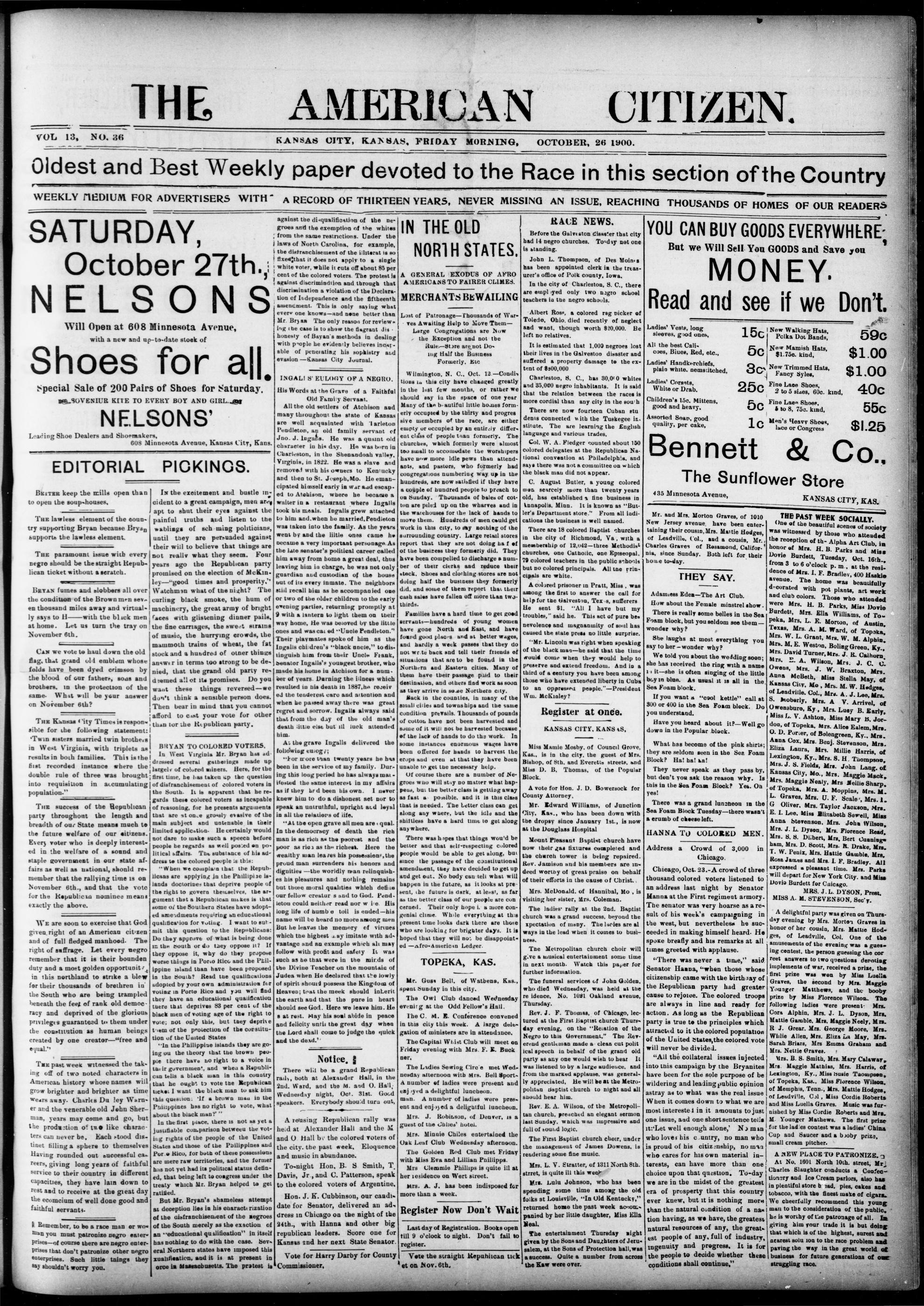
The American Citizen
Friday, October 26, 1900
Topeka, Kansas
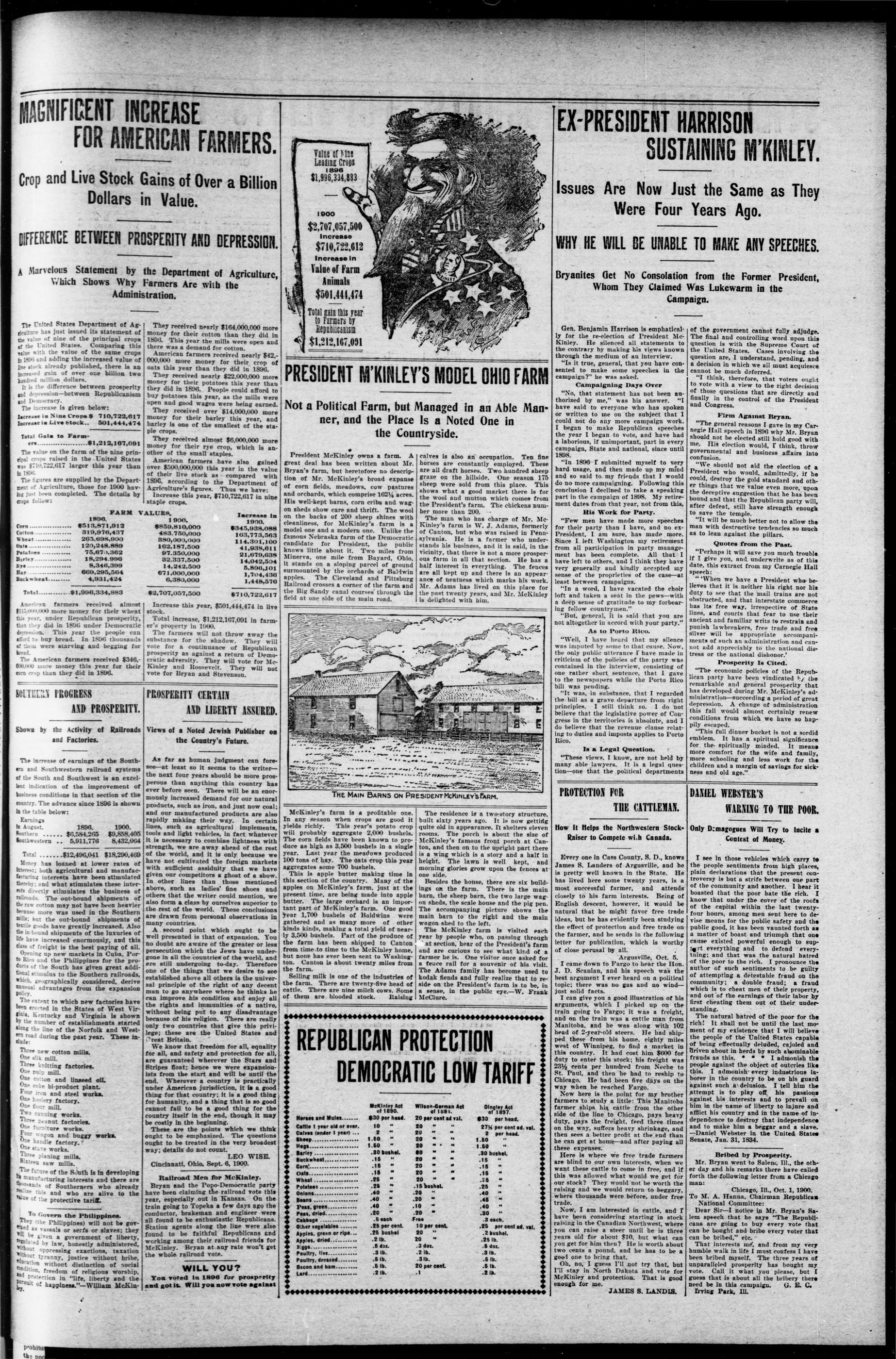
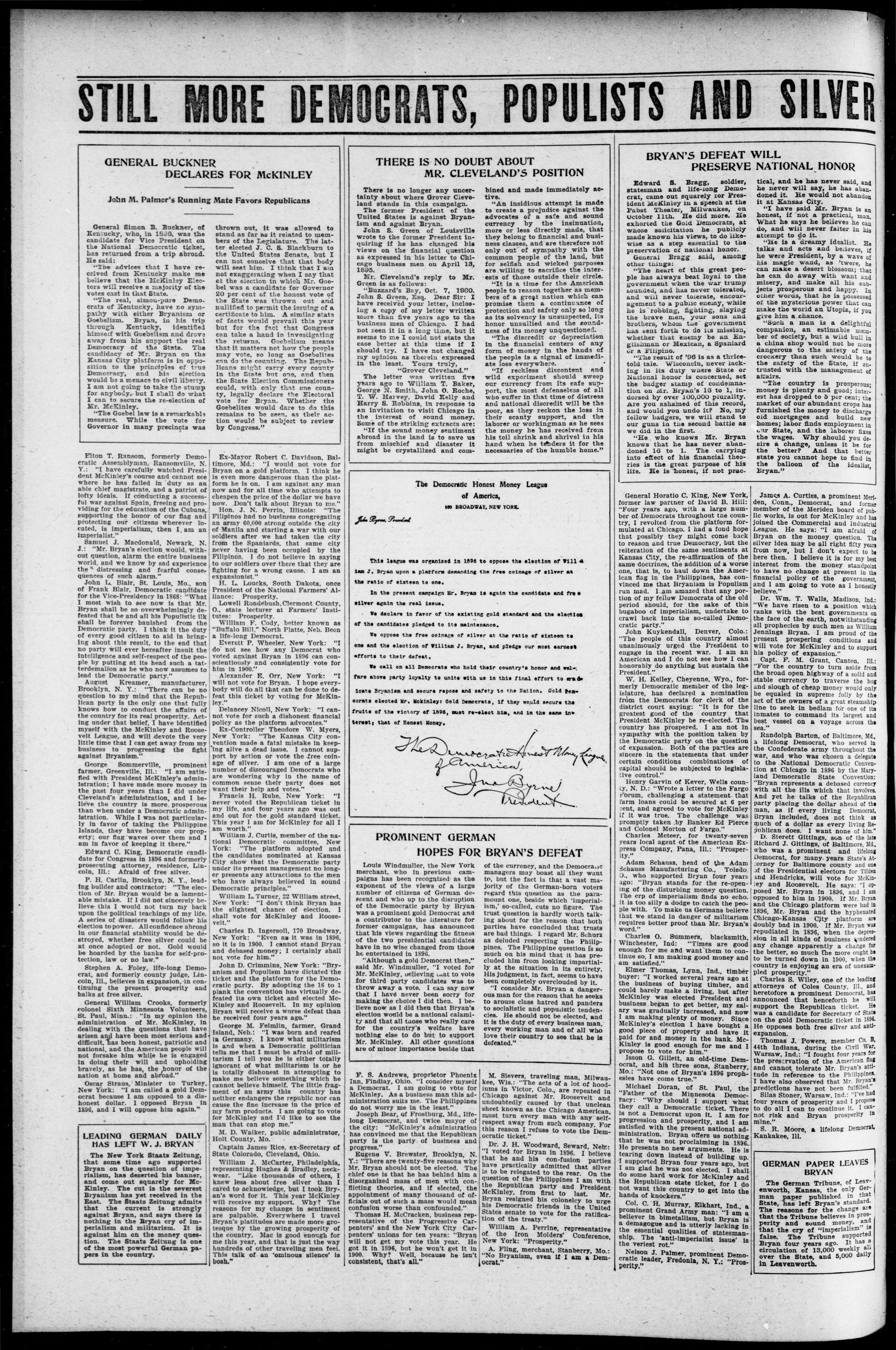
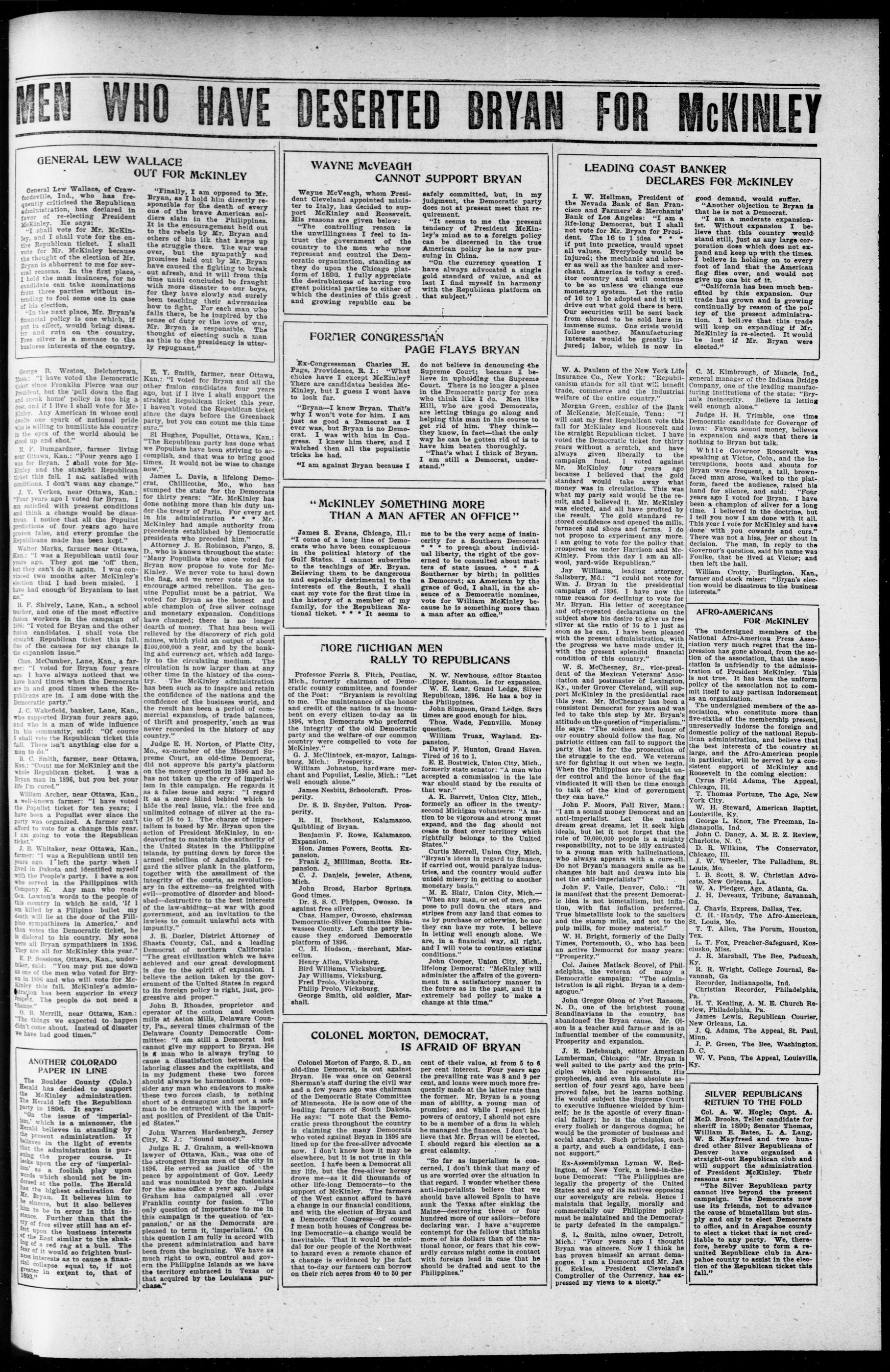
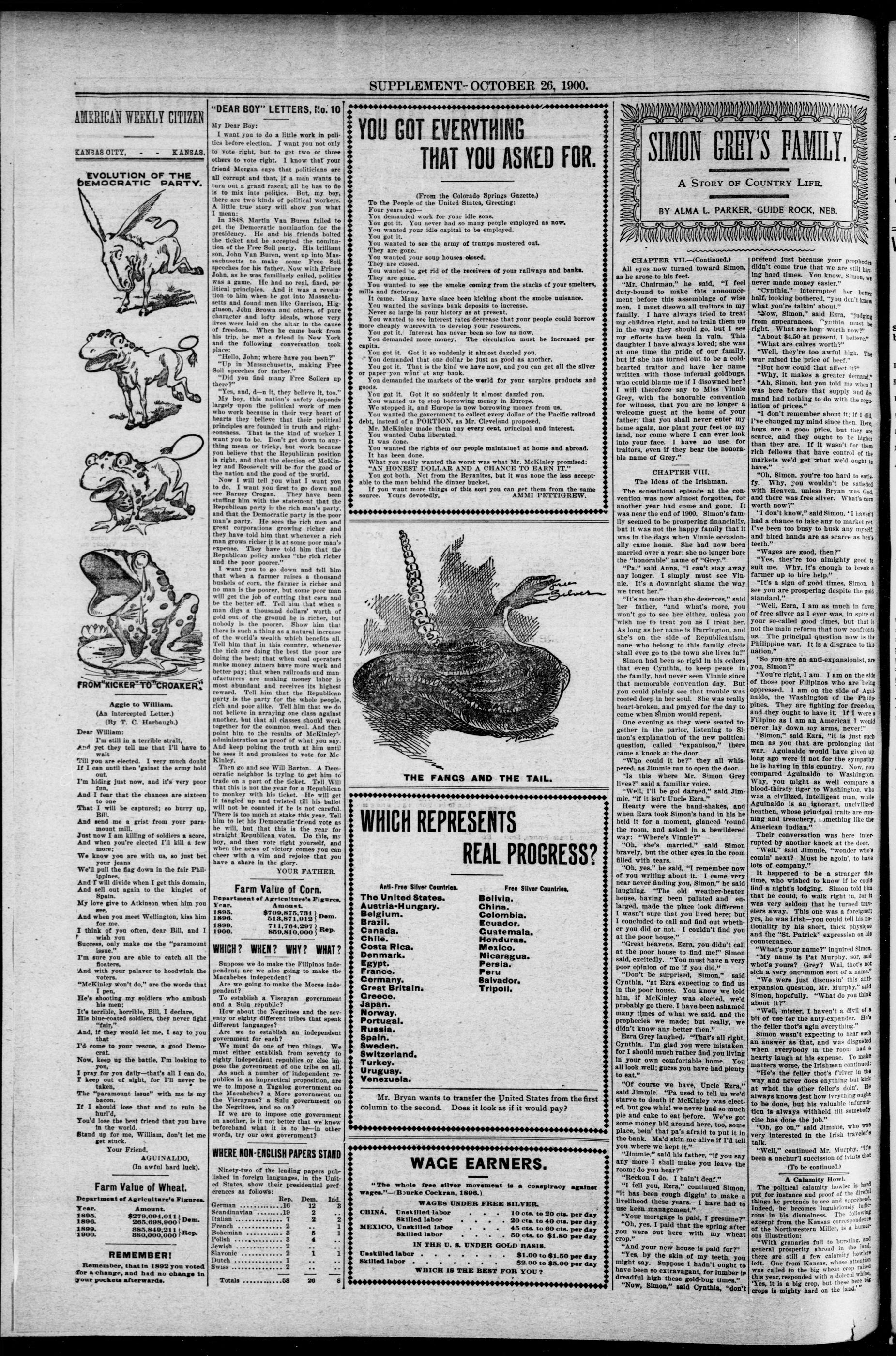
Page text (machine-generated)
Oldest and Best Weekly paper devoted to the Race in this section of the Country
WEEKLY MEDIUM FOR ADVERTISERS WITH A RECORD OF THIRTEEN YEARS, NEVER MISSING AN ISSUE, REACHING THOUSANDS OF HOMES OF OUR READERS
Oldest and
WEEKLY MEDIUM FOR
SATURDAY
October
NELS
Will Open at 608
with a new and up
Shoes
Special Sale of 200 Pair
SOVENIUR KITE TO E
NELS
Leading Shoe Dealers and Shoemaker
608 M
EDITORIAL
SATURDAY, October 27th. NELSONS
Special Sale of 200 Pairs of Shoes for Saturday. SOVENIUR KITE TO EVERY BOY AND GIRL. NELSONS' Leading Shoe Dealers and Shoemakers, 608 Minnesota Avenue, Kansas City, Kans
EDITORIAL PICKINGS.
BEATER keep the mills open than to open the soup-houses.
THE lawless element of the country supporting Bryan because Bryan supports the lawless element.
THE paramount issue with every negro should be the straight Republican ticket without a scratch.
BRYAN fumes and slobbers all over the condition of the Brown men seven thousand miles away and virtually says to H——with the black men at home. Let us turn the tray on November 6th.
THE Kansas city Times is responsible for the following statement: 'Twin sisters married twin brothers in West Virginia, with triplets as results in both families. This is the first recorded instance where the double rule of three was brought into requisition in accumulating population."
The past week witnessed the taking off of two noted characters in American history whose names will grow brighter and brighter as time wears away. Charles Du ley Warner and the venerable old John Sherman, years may come and go, but the production of two like characters can never be. Each stood distinct filling a sphere to themselves Having rounded out successful careers, giving long years of faithful service to their country in different capacities, they have lain down to rest and to receive at the great day the ecomcium of well done good and faithful servants.
Remember, to be a race man or woman you must patronize negro enterprises—of course there are negro enterprises that don't patronize other negro enterprises. Such little things they say shouldn't worry you.
VOL 13, NO.36
CAN we vote to haul down the old flag, that grand old emblem whose folds have been dyed crimson by the blood of our fathers, sous and brothers, in the protection of the same. What will be your answer on November 6th?
THE success of the Republican party throughout the length and breadth of our State means much to the future welfare of our citizens. Every voter who is deeply interested in the welfare of a sound and staple government in our state affairs as well as national, should remember that the rallying time is on November 6th., and that the vote for the Republican nominee means exactly the above.
We are soon to exercise that God given right of an American citizen and of full fledged manhood. The right of suffrage. Let every negro remember that it is their bounded duty and a most golden opportunity in this northland to strike a blow for their thousands of brethren in the South who are being trampled beneath the feet of rank old democracy and deprived of the glorious privileges guaranteed to them under the constitution as human beings created by one creator—"free and equal."
THE
d Best W
FOR ADVERTISE
SATDAY,
October 27
608 Minnesota Ave
and up-to-date stock of
s for
Pairs of Shoes for
TO EVERY BOY AND G
LSONS'
makers,
608 Minnesota Avenue, K
AL PICKING
Best Weekly
FOR ADVERTISERS WITH T
DAY,
ber 27th.
SONS
Minnesota Avenue,
-to-date stock of
for all.
s of Shoes for Saturday.
VERY BOY AND GIRL.
SONS'
ers,
Minnesota Avenue, Kansas City, Kansas.
PICKINGS.
In the excitement and bustle incident to a great campaign, men are apt to shut their eyes against the painful truths and listen to the wablings of schming politicians, until they are persuaded against their will to believe that things are not really what they seem. Four years ago the Republican party promised on the election of McKinley—"good times and prosperity." Watchman what of the night? The curling black smoke, the hum of machinery, the great army of bright faces with glistening dinner pails, the fine carriages, the sweet strains of music, the hurrying crowds, the mammoth trains of wheat, the fat stock and a hundred of other things answer in terms too strong to be denied, that the grand old party redeemed all of its promises. Do you want these things reversed—we don't think a sensible person does. Then bear in mind that you cannot afford to cast your vote for other than for the Republican party.
BRYAN TO COLORED VOTERS.
In West Virginia Mr. Bryan has addressed several gathering made up largely of colored miners. Here, for the first time, he has taken up the question of distranchisement of colored voters in the South. It is apparent that he regards these colored voters as incapable of reasoning, for he presents arguments that are at one grossly evasive of the main subject and untenable in their limited application. He certainly would not dare to make such a speech before people he regards as well posed on political affairs. The substance of his address to the colored people is this:
"When we complain that the Republicans are applying in the Phillipine islands doctorates that deprive people of the right to govern themselves, the argument that a Republican makes is that some of the Southern States have adopted amendments requiring an educational qualification for voting. I want to submit this question to the Republicans: Do they approve of what is being done in the South or do they oppose it? If they oppose it, why do they propose worse things in Poro Rico and the Philippine island than have been proposed in the South? Read the qualifications adopted by your own administration for voting in Porto Rico and you will find they have an educational qualification tuere that deprives 83 per cent of the black men of voting age of the right to vote; not only this, but they deprive them of the protection of the constitution of the United States
"In the Philippine islands they are going on the theory that the brown people there have no right to a voice in their government," and when a Republican tells a black man in this country that he ought to vote the Republican ticket I want the black man to ask him this question: "If a brown man in the Philippines has no right to vote, what about the black man?" In the first place, there is not as yet a justifiable comparison between the voting rights of the people of the United States and those of the Philippines and Por Rico, for both of these possessions are mere raw territories, and the former has not yet had its political status defined, that being left to congress under the treaty which Mr. Bryan helped to get ratified.
But Mr. Bryan's shameless attempt at deception lies in his characterization of the disfranchisement of the megroes of the South merely as the exaction of an "educational qualification" in itself has nothing to do with the case. Several Northern states have imposed this xualification, and it is at present in force in Massachusetts. The protest is
AMERICAN
KANSAS CITY, KANSAS, FRIDAY MORNING, OCTOBER, 26 1900.
against the disqualification of the negroes and the exemption of the whites from the same restrictions. Under the laws of North Carolina, for example, the distranchisement of the illiterate is so fixed that it does not apply to a single white voter, while it cuts off about 85 per cent of the colored voters. The protest is against discrimination and through that discrimination a violation of the Declaration of Independence and the fifthenth amendment. This is only saying what every one knows—and none better than Bryan. The only reason for reviewing the case is to show the flagrant dishonesty of Bayan's methods in dealing with people he evidently believes inable of generating his sophistry and evasion—Kansas City Journal.
His Words at the Grave of a Faithful Old Family Saved.
All the old settlers of Atchison and many throughout the state of Kansas are well acquainted with Iarleton Pendleton, an old family servant of Jno. J. Ingalls. He was a quaint old character in his day. He was born in Charleston, in the Shenandoah valley, Virginia, in 1822. He was a slave and removed with his owners to Kentucky and then to St. Joseph, Mo. He emancipated himself early in war and escaped to Atchison, where he became a waiter in a restaurant where Ingalls took his meals. Ingalls grew attached to him and, when he married, Pendleton was taken into the family. As the years went by and the little ones came he became a very important personage. As the late senator's political career called him away from home a great deal, thus leaving him in charge, he was not only guardian and custodian of the house out of its every inmate. The neighbors still recall him as he accompanied one or two of the older children to the early evening parties, returning promptly at 9 with a intern to light them on their way home. He was beloved by the little ones and was called "Uncle Pendleton." Their playmates spoke of him as the Ingalls children's "black uncle," to distinguish him from their Uncle Frank, senator Ingalls's youngest brother, who made his home in Atchison for a number of years. Durning the illness which resulted in his death in 1887, he received the tenderest care and attention and when he passed away there was great regret and sorrow. Ingalls always said that from the day of the old man's death little else but ill luck attended him.
At the grave Ingalls delivered the following eugogy;
"for more than twenty years he has been in the service of my family. During this long period he has always manifested the same interest in my affairs as if they had been his own. I never knew him to do a dishonest act nor to speak an untruthful, upright and loyal in all the relations of life.
"At the open grave all men are equal. In the democracy of death the rich man is as rich as the poorest and the poor as rich as the richest. Here the wealthy man leaves his possessions, the proud man surrenders his honors and dignities—the worldly man relinquishes his pleasures and nothing remains but those moral qualities which define our fellow creator s and to God. Pendleton could neither read nor write. His long life of humble toil is ended—his name will be heard no more among men. But he leaves the memory of viruses which the highest may imitate with advantage and an example which all may follow with profit and safety. It was such as he that were in the miards of the Divine Teacher on the mountain of Judea when He declared that the lowly of spirit should possess the Kingdom of Heaven; that the meek should inherit the earth and that the pure in heart should see God. Here we leave him. He is at rest. May his soul abide in peace and felicity until the great day when the Lord shall come to judge the quick and the dead."
Notice. $
There will be a grand Republican rally, both at Alexander Hall, in the 2nd. Ward, and the M. and O. Hall, Wednesday night, Oct. 31st. Good speakers. Everybody should turn out.
A rousing Republican rally was held at Alexander Hall and the M and O Hall by the colored voters of the city, the past week, Eloquence and music in abundance.
To-night Hon. B. S Smith, T. Davis, Jr., and C. Patterson, speak to the colored voters of Argentine.
Hon. J. K. Cubbinson, our candidate for Senator, delivered an address in Chicago on the night of the 24th, with Hanna and other big republican leaders. Score one for Kansas and her next State Senator.
Vote for Harry Darby for County Commissioner.
IN THE OLD NOR1H STATES.
A GENERAL EXODUS OF APRO
AMERICANS TO FAIRIE CLIMES.
MERCHANTS BEWAILING
Lost of Patronage—Thousands of War-
ves Waiting Help to Move Them—
Large Congregations are Now
the Exception and not the
Rule—Store are not Do-
ing Half the Business
Formerly, Etc
Wilmington, N. C., Oct. 12. —Conditions in this city have changed greatly in the lost few mouths, or rather we should say in the space of one year. Many of the beautiful little houses formerly occupied by the thirty and progressive members of the race, are either empty or occupied by an entirely different class of people than formerly. The churches, which formerly were almost too small to accommodate the worshipers have now more idle pews than attendants, and pastors, who formerly had congregations numbering way up in the hundreds, are now satisfied if they have a couple of hundred people to preach on Sunday. Thousands of bales of cotton are piled up on the wharves and in the watchouses for the lack of hands to move them. Hundreds of men could get work in this city, to say nothing of the surrounding country. Large retail stores report that they are not doing haf of the business they formerly did. They have been compelled to discharge a number of their clerks and reduce their stock. Shoes and clothing stores are not doing half the business they formerly did, and some of them report that their cash sales have fallen off more than two-thirds.
Families have a hard time to get good servants—hundreds of young women have gone North and East, and have found good places and at better wages, and hardly a week passes that they do not wre back and tell their friends of situations that are to be found in the Northern and Eastern cities. Many of them have their passage paid to their destination, and others find work as soon as they arrive in so-called Northern city. Back in the counties, in many of the small cities and townships and the same condition prevails. Thousands of pounds of cotton have not been harvested and some of it will not be harvested because of the lack of hands to do the work. In some instances enormous wages have been offered for hands to harvest the crops and even at that they have been unable to get the necessary help.
Of course there are a number of Negroes who will stay no matter what happens, but the better class is getting away as fast a possible, and it is this class that is needed. The better class can get along any where, but the idle and the shiftless have a hard time to get along anywhere.
There was hopes that things would be better and that self-respecting colored people would be able to get along, but since the passage of the constitutional amendment, they have decided to get up and get out. No body can tell what will happen in the future, as it looks at present, the future is dark, at least, as far as the better class of our people are concerned. Their only hope is a more congenial clime. While everything at this present time looks dark there are those who are looking for brighter days. It is hoped that they will not be disappointed — afro-American Ledger.
TOPEKA. KAS.
Mr. Guss Bell, of Watbena, Kas, spent Sunday in this city. The Owl Club danced Wednesday evening at the Odd Fellow's Hall. The C. M. E. Conference convened in this city this week. A large delegation of ministers are in attendance. The Capital Whist Club will meet on Friday evening with Mrs. F. E. Buckner.
The Ladies Sewing Circle met Wednesday afternoon with Mrs. Bell Sport-A number of ladies were present and enjoyed a delightful luncheon. man. A number of ladies were present and enjoyed a delightful luncheon. Mrs. J. Robinson, of Denver, is a guest of the Chies' hotel. Mrs. Minnie Chiles entertained the Oak Leaf Club Wednesday afternoon. The Golden Red Club met Friday with Miss Eva and Lillian Phillipps. Mrs Clemmie Phillips is quite ill at her residence on Wert street. Mrs. A. J. has been indisposed for more than a week.
Register Now Don't Wait
Last day of Registration. Books open till 9 o'clock to night. Don't fail to register.
Vote the straight Republican ticket on Nov. 6th.
CITIZEN.
RACE NEWS.
Before the Galveston disaster that city had 14 negro churches. Today not one is standing.
John L. Thompson, of Des Moines has been appointed clerk in the treasurer's office of Polk county, Iowa.
In the city of Charleston, S. C., there are emplied yed only two negro school teachers in the negro schools.
Albert Ross, a colored rag picker of Toledo, Ohio, died recently of neglect and want, though worth $20,000. He left no relatives.
It is estimated that 1,000 negroes lost their lives in the Galveston disaster and suffered a property damage to the extent of $900,000.
Charleston, S. C., has 30,000 whites and 35,000 negro inhabitants. It is said that the relation between the races is more cordial than any city in the south
There are now fourteen Cuban students connected with the Tuskegee institute. The are learning the English language and various trades.
Col. W. A. Flieder counted about 150 colored delegates at the Republican National convention at Philadelphia, and says there was not a committee on which the black man did not appear.
C. August Butler, a young colored man secrely more than twenty years old, has established a fine business in Annapolis, Minn. It is known as "Butler's Department store." From all indications the business is well named.
There are 18 colored Baptist churches in the city of Richmond, Va., with a membership of 12,042—three Methodist churches, one Catholic, one Episcopal, 79 colored teachers in the public schools but no colored principals. All the principals are white.
A colored prisoner in Pratt, Miss, was among the first to answer the call for help for the Galveston, Tex.-s. sufferers He sent $1. "All I have but my troubles," said he. This act of pure benvolence and magnanimity of soul has caused the state press no little surprise. "Mr. Lincoln was right when speaking of the black man—he said that the time would come when they would help to preserve and extend freedom. And in a third of a century you have been among those who have extended liberty in Cuba to an oppressed people."—President Wm. McKinley?
Register at once.
Miss Mamie Mosby, of Council Grove, Kas., is in the city, the guest of Mrs. Bishop, of 5th, and Everett streets, and Miss D. B. Thomas, of the Popular Block.
A vote for Hon. J. D. Bowersock for County Attorney.
Mr. Edward Williams, of Junction City, Kas., who has been down with the dropsy since January 1st., is now at the Douglass Hospital.
Mount Pleasant Baptist church have now their gas fixtures completed and the church tower is being repaired. Rev. Jamison and his members are indeed worthy of great praise on behalf of their efforts in the cause of Christ.
Mrs. McDonald, of Hannibal, Mo., is visiting her sister, Mrs. Coleman.
The ladies rally at the 2nd. Baptist church was a grand success, beyond the expectation of many. The ladies are all ways in the lead when it comes to business.
The Metropolitan church choir will give a musical entertainment some time in next month. Watch this paper for further information.
The funeral services of John Golden, who died Wednesday, was held at the reidence, No. 1021 Oakland avenue, Thursday.
Rev. J. F. Thomas, of Chicago, lectured at the First Baptist church Thursday evening, on the "Reation of the Negro to this Government." The Reverend gentleman made a clean political speech in behalf of the grand old party as any one would wish to hear. It was listened to by a large audience, and from the marked applause, was generally appreciated. He will be at the Metropolitan baptist church to night and all should hear him.
Rev. E. A. Wilson, of the Metropolitan church, preached an elegant sermon last Sunday, which was impressive and full of sound logic.
The First Baptist church choir, under the management of James Dowens, is rendering some fine music.
Mrs. L. V. Stratter, of 1311 North 8th st., is quite ill this week.
Mrs. Lulu Johnson, who has been spending some time among the old folks at Louisville, "In Old Kentucky," returned home the past week accompanied by her little daughter, Miss Ella Neal.
The entertainment Thursday night given by the Sons and Daughters of Jerusalem, at the Sons of Protection hall, was a success. Quite a number from across the Kaw were over.
YOU CAN BUY GOODS EVERYWHERE But we Will Sell You GOODS and Save you MONEY. Read and see if we Don't.
435 Minnesota Avenue,
Mr. and Mrs. Morton Graves, of 1010 New Jersey avenue, have been entertaining their cousin, Mrs. Mattie Hodges, of Lesdville, Col., and a cousin, Mr. Charles Graves of Resamond, California, since Sunday. Both left for their home to-day.
THEY SAY.
There is really some belles in the Sea Foam block, but you seldom see them—wonder why?
She laughs at most everything you say to her—wonder why?
We told you about the wedding soon; she has received the ring with a name; it—she is often singing of the little boy in blue. As usual it is all in the Sea Foam block.
If you want a "cool kettle" call at 300 or 400 in the Sea Foam block. Do you understand.
Have you heard about it?—Well go down in the Popular block.
What has become of the pink shirts; they are seldom seen in the Sea Foam Block? Ha! ha! ha!
They never speak as they pass by, but don't you ask the reason why. Is this in the Sea Foam Block? Yes. On yes!
There was a grand luncheon in the Sea Foam Block Tuesday—there wasn't a crumb of cheese left.
Address a Crowd of 3,000 in Chicago.
Chicago, Oct. 23.-A crowd of three thousand colored voters listened to an address last night by Senator Manna at the First regiment armory. The senator was very hoarse as a result of his week's campaigning in the west, but nevertheless he succeeded in making himself heard. He spoke breafly and his remarks at all times greeted with applause.
"There was never a time," said Senator Hanua, "when those whose citizenship came with the birthday of the Republican party had greater cause to rejoice. The colored troops are always in line and ready for action. As long as the Republican party is true to the principles which attracted to it the colored population of the United States, the colored vote will never be divided.
"All the collateral issues injected into this campaign by the Bryanites have been for the sole purpose of be wildering and leading public opinion astray as to what was the real issue. When it comes down to what we are most interested in it amounts to just one issue, and one short sentence tells: 'Let well enough alone.' No man who loves his country, no man who is proud of his citizenship, no man who cares for his own material interests, can have more than one choice upon that question. To-day we are in the midst of the greatest era of prosperity that this country ever knew, but it is nothing more than the natural condition of a nation having, as we have, the greatest natural resources of any, the greatest people of any, full of industry, ingenuity and progress. It is for the people to decide whether these conditions shall continue."
KANSAS CITY, KAS.
THE PAST WEEK SOCIALLY.
One of the beautiful scenes of society was witnessed by those who attended the reception of th- Alpha Art Club, in honor of Mrs. H. B. Parks and Miss Dovie Burdett, Tuesday, Oct. 16th. from 3 to 6 o'clock p. m., at the residence of Mrs. I. F. Bradley, 400 Haskell avenue. The home was beautifully d-corated with pot plants, art work and club colors. Those who attended were Mrs. H. B. Parks, Miss Dovie Burdett, Mrs. Ella Williams, of Topeka, Mrs. L. E. Morton, of Austin, Texas, Mrs. A. M. Ward, of Topka, Mrs. W. L. Grant, Mrs. W. M. Alphin, Mrs. M. E. Weston, Boling Green, Ky., Mrs. David Turner, Mrs. J. K. Calhorn, Mrs. E. A. Wilson, Mrs. J. C. Owens, Mrs. J. W. Braxton, Mrs. Anna McA, Mrs. Miss Stella May, of Kansas City, Mo., Mrs. M. W. Hedges, of Leadville, Col., Mrs. A. J. Lee, Mrs. S. Moberly, Mrs. A. V. Arrival, of Owenburro, Ky., Mrs. Luay B. Early, Miss L. V. Ashton, Miss Mary B. Jordon, of Topeka, Mrs. Alice Ealem, Mrs. O. D. Porter, of Bolengreen, Ky., Mrs. Anna Coa, Mrs. Bojp, Stevenson, Mrs. Eliza Laura, Mrs. Mille Harris, of Lexington, Ky., Mrs. S. H. Thompson, Mrs. J. S. Fields, Mrs. John Lang, of Kansas City, Mo., Mrs. Maggie Mack, Mrs. Maggie Nealy, Mrs. Mellie Sharp, of Topeka, Mrs. A. Moppins, Mrs. M. L. Graves, Mrs. U. F. Scale, Mrs. I. G Oliver, Mrs. Taylor Jackson, Mrs. E. I. Lee, Miss Elizabeth Sowell, Miss Anna Stevenson, Mrs. John Wilson, Mrs. J. L. Dyson, Mrs. Florence Read, Mrs. S. S. Dibert, Mrs. Bert Cauniingham, Mrs. D. Scott, Mrs. R. Drake, Mrs. T. Wenik, Mrs. Hattie Gamble, Mrs. Rosa James and Mrs. I. F. Bradley. All expressed a pleasant time. Mrs. Parks will depart for New York City, and Miss Dovie Burdett for Chicago.
MRS. J. L. DYSON, Prest,
MISS A. M. STEVENSON, Sec. v
A delightful party was given on Thursday evening by Mrs. Morton Graves in honor of her cousin, Mrs. Mattie Hodges, of Leadville, Col. One of the amusements of the evening was a guessing contest, the person guessing the correct answers to two questions denoting implements of war, received a prize, the first prize was won by Miss Luciola Graves, the second by Mrs. Maggie Younger Matthews, and the booby prize by Miss Florence Wilson. The following ladies were present: Mrs. Cora Alphin, Mrs. J. L. Dyson, Mrs. Mattie Garuble, Mrs. Maggie Neely, Mrs. R J. Greal, Mrs. George Moore, Mrs. While Allen, Mrs. Eliza La May, Mrs. Sarah Briars, Mrs Emma Graham and Mrs. Nettie Graves.
Mrs. B. S. Smith, Mrs. Mary Calaway,
Mrs. Maggie Mathias, Mrs. Harris,
of Lexington, Ky., Miss Susie Thompson,
of Topeka, Kas., Miss Florence Wilson,
of Memphis, Tenn., Mrs. Mattie Hodges,
of Lesville, Col., Miss Cordie Roberts
and Miss Luella Grau. Music was furnished by Miss Cordie Roberts and Mrs.
M. Younger Mathews. The first prize for the ladies contest was a ladies' China Cup and Saucer and a bobby prize,
small cream pitcher.
A NEW PLACE TO PATRONIZE.
At No. 1601 North 10th street, Mr.
Charles Slaughter conducts a Confectionery and Ice Cream parlors, also has in plentiful store head, pies, cakes and tobacco, with the finest make of cigars.
We cheerfully recommend this young man to the consideration of the public, he is worthy of the patronage of all. In giving him your trade it is but doing that which is of the highest, surest and nearest solu ion to the race problem and paving the way in the great world of business for future generations of our struggling race.
AMERICAN CITIZEN PUBLISHING
AND PRINTING CO.
Daily and Weekly 417 Minnesota Ave.
KANSAS CITY KANSAS
W. C. MARTIN, EDITOR.
TERMS OF SUBSCRIPTION
Daily delivered by carrier per week. 10c.
Weekly one year. $1 50
Entered at the postoffice at Kansas City
Kans., as second class matter.
WILLIAM MCKINLEY,
For President.
THEODORE ROOSEVELT,
Vice President.
STATE TICKET,
For Governor.
W. E. STANLEY.
For Lieutenant Governor,
H. E. RICHER.
For Associate Justice
W. A. JOHNSTON
For Secretary of State,
GEO. A. CLARK.
For Treasury,
FRANK GRIMES.
For Auditor,
GEORGE E. COLE.
For Attorney General,
A. A. GODARD.
For Supt. of Public Instructions
FRANK NELSON.
For Insurance Commissioner,
W. V. CHURCH.
For Congressman Second District,,
J. D. BOWERSOCK.
For Congressman Third District,
GEO. W. WHEATLY.
For Congressman Fifth District,
W. A. CALDERHEAD.
For Congressman Sixth District,
W. A. REEDER.
For Congressman Seventh District,
CHESTER I. LONG.
COUNTY TICKET.
Senator, 4th. District.
JAMES K. CUBBISON.
Representative 9th. District,
H. A. BAILEY.
10th. District,
G. L. COATES.
11th. District,
DAVID D. HOAG,
County Attorney,
E. A. ENRIGHT.
Clerk District Court,
ALEX GUNNING.
Probate Judge,
K. P. SNYDER.
Superintendent Public Instruction,
HENRY MEADE.
County Commissioner,
First District—J. S. PERKINS.
Do any of us recognize how unmettied discredit crushes timid people? Who will ever picture the sorrows of timidity?
To forget is the greatest secret of strong and creative natures—to forget after the manner of nature herself, who knows no past, who begins afresh at every hour the must-ries of her unweary travail.
If the human heart pauses to rect as it scales the heights of affection, it rarely stops when it stops on the rapid slope of hate.
Be not too confiding nor frivolous, nor over enthusiastic—three reefs on which youth often strikes.
To worship the fool who succeeds and not mourn the failure of an able man is the result of our education, of our manners, of our customs, which drive men of intelligence to disgust and genius to despair.
Bonds that some times must be severed should never be woven.
We spend the greater part of our lives in weeding from our hearts what was allowed to grow there in youth. This operation is called "acquiring experience."
Vote for E. A. Enright for County Attorney.
CHURCHES
METRODIST.
St. James A. M. E., cor. 7th. and Ann.
St. James M. E., Freeman ave., be
tween 9th and 10th.
C. M. E. Oakland ave., bet. 4th. and
5th.
CHRISTIAN.
8th St.' Christian, cor. Everett and
8th.
9th St. Christian, cor. 9th. and Nebraska.
BAPTIST.
1st. Baptist, corner 5th. and Nebrask
avenue.
Metropolitan Baptist, cor. 9th. and
Washington.
Rose Hill, Jersey ave. bet 9th. and 10th.
Pleasant Green, Wood St. and Split-
og ave.
King Solomon Baptist, 3rd. and State
avenue.
Douglass Hospital, 312 Washington
ave., Miss L. V. Ashton, Matron.
Remember Judge K. P. Snyder for
Probate Judge.
IS A GIRL WITH NERVE.
How Athletics Saved a Young Woman's Pocketbook—Landed on the Robber's Jaw.
It happened out on a suburban boulevard last Saturday night and the heroine is an athletic girl out of high school only a year. The girl was turning to her home a little later than is customary for young women to be on the streets and when she was within a block of her house a man sprang out from behind and demanded her pocketbook. Upon the girl's hesitation to give up her money the man stepped nearer and growled:
"Hand me your pocket book, and be quick about it and don't make any fuss."
Now the pocket book that the girl carried was the kind that has a strap which slips over the owner's hand and when it is worn it lies over the back of the fingers.
When the man made a second demand or the pocketbook the girl stepped close to him and "handed" it to him, but not in the manner expected. She just landed ones on the jaw with the hand that carried the pocketbook. The leather spread out over the little fist, and, as there was considerable silver in it, the blow was a vicious one. The robber went down in a heap.
He was on his feet in a second and came back at the girl with a look of the greatest surprise on his face.
"Hand me that pocketbook," he growled.
"All right," answered the girl, striking him again in the side of the jaw. This time the man did not get up so quickly, but lay a moment grooming on the ground. This was the advancing; the girl was looking for, and s.e took to her heels and was soon within her own home. And here follows another queer part of this true tale. When she flew through the doors of her home and was met by her mother and sisters this strange gril didn't faint, but she just sat down and aughed aloud, ringing, wholesome laugh, and made light of her adventure, thus further shattering the traditions of her sex.
CHICAGO HERO KILLED
Shot Down while Trying to Protect a Young Woman From Attack.
Chicago, Oct. 21. Thomas J. Griffith, a clerk employed by N. K. Fairbank & Co., was shot to-day and instantly killed while trying to protect Miss Fay Gilbert from the attack of a strange man in front of No. 2220 States street. When the stranger saw that Griffith was about to interfere with his designs on Miss Gilbert, he drew his revoler. Unmindful of the threatening muzzle of the weapon, the shipping oler grappled with the assault. In a moment he felt to the sidewalk with a bullet through his heart. The murderer escaped.
Vote for D. D. Hoag for Representative.
DEAD AS A PREFERNECE
Life Term Convict kills Himself at Lawsing Prison.
Leavenworth, Kan., Oct. 22 Samuel Lewis, colored, a life convict in the Kansas state penitentiary, committed suicide by drinking a solution of caustic soda. He had become despondent on account of being exchanged from yard work to the kitchen. After drinking the solution he was found by Willie Se la, who summoned medical assistance, which proved unavailing, and he died after great suffering.
Lewis was sent up from Wyandotte county in 1889, for the murder of his wife.
BUT PRESIDENT HE'LL
NEVER BE.
Tune—Boom-deay
There lives a man in Lincoln Town
He left his home to stump the country round,
Imperialism to you, and Free Silver to me.
But President he'll never be.
(Chorus)
See Billy Brayan coming down the street,
A Democratic head and Populist feet;
All over the country talking free.
But president he'll never be.
2.
He talks to the labor as he stands in the door;
Says Free silver will help the poor
Take warninw, listen, not one word of it so.
its a double headed serpent, bites behind and before.
Four years talking is to long
And the votins i'll show you've bin
talking wrong,
Imperialism, Free Silver and the
trust you sse,
But president you'll never be.
A Bad Reputation.
In Bloomsbury, London, was formerly a region known as the Field of Forty Footsteps. It was frequented by rough characters, and it is related that a struggle between two brothers took place there. The footprints of the men were indelibly impressed in the sod and no grass would ever grow there. The place was built upon at the beginning of the century.
EXECUTOR'S NOTICE.
State of Kansas, Wyaudotte Coun-
ty, ss.
In the Probate Court in and for
County. In the matter of the Estate
of Jesse Pope, Deceased,
Notice is hereby given that L litters
Testament have been granted the
undersigned on the Last Will and Tet-
ment of Jesse Pope, is of said county,
deceased, by the honorable, the Probate
dated the 2nd, and State Aforesaid,
dated the 2nd, and State Aforesaid,
1900 Now, all persons having claims
against the said estate, are hereby notified
that they must present the same to
the undersigned for allowance within
one year from the date of said Leters,
or they may be precluded from any benefi-
t of such estate, and that if such
claims be not exhibited within three
years after the date of said Letters, they
shall be deemed to have been Executor of the last Will and Testament of Jesse Pope Deceased.
AGENTS WANTED
GERMAN
EI ECIRTC RAZOR HONE.—Guaranteed equal to the best Hone made. Can use water, oil or lather. Will last a life time. Each Hone packed in neat card-board case. Every one perfect the thing for private use. Price. 75c.
We want an agent in each township to when exclusive sale will be given. Write for sample and agent's outfit. Sent by mail. A Money 7 ciner. Address. MARSH MFG. CO.,
No. 542 West Lake St., Chicago.
Enterprises.
A.C.L. Coal Co. Main Office 492 Minn.
Ave. E.F. Henderson, Mgr.
D. W. White Furniturestore, 420 Minn.
Ave.
J. W Jones Grocery 400. Oakland Ave.
M. Gordon Department store 1605 N
6th
Clark & Lee, junk store, 1104 ncrth
3rd, st.
Kansas City Kansas Soap Works, 4th
st., between Oakland and Freeman.
J. R. McClain, Grocer, 1700 n 5th. st.
J. R. Rucker, Butcher, 1609 n 16th s
CANCER
Home Treatment that
cures Cancers and Tumors
Used with perfect safety
harmless, soothing, non-irriti
TURKEY MAJOR
We prefer to have patients come to the Sanitarium for speedy cure. Cases that come
come to the Santarium for a
estab. 21. 19s. to our Santarium need not
pay until curved. Write to day for our 36 page book.
It contains much valuable information and
hundreds of testimonials from patients we have
brought in by our staff. In consultation by
mail or in person, free. Address.
DR. E. Q. HAMILTON, MANTARIUM,
Rooms 6 to 11, R. E. cor. and Stats.
McCLEARY, M. E. cor.
UNION
PACIFIC
THE
OVERLAND
ROUTE
WORLD'S PICTORIAL LINE.
SHORTFST LINE ACROSS THE CONTINENT
The Union Pacific 'The Original Overland Route' always was, and is to-day, the shortest and best Line to the west. Two splendid fast trains leave Kan-as City daily over this old established line. No change of cars between Kansas City and Denver, Ogden or San Francisco. All trans solidly vestibulated and fully equipped with latest improved Recycling Chair Cars free and Pullman Palace sleeping cars. Meals served in Pullman Palace dining cars on the restaurant plan at prices most reasonable. All cars lighted with the celebrated Pintch Pintch Light. Only line running two trains without change from Kansas City to Denver Low excursion rates on sale to Colorado Utah Idaho, Oregon Washington and California. Don't complete your ars rampages for a trip west until you have learned all about special inducements and attractions offered by the Union Pacific. For full information in regard to low-rates time etc., contact address FRAWLE.
Gen. Agt., Union Pacific, 1000 Main street, Kagawa City, Mo
Administrator's Notice.
In the Probate Court in and for said County.
In the matter of the estate of Howard Jordan, deceased. Notice is hereby given that letters of administration have been granted to the undersigned, on the estate of Howard Jordan, late of said county, deceased, by the Honorable, the Probate Court of said county and state aforesaid, dated the 7th day of September, A.D. 1900. Now, all persons having claims against the said estate are hereby notified that they must present the same for allowance within one year from the date of said letters, or they may be precluded from any beetle of such estate, and that if such claims be not exhibited within one year or more their letters they shall be forer barred. L W. JOHNSON. Administrator of the estate of Howard
Administrator of the estate of Howard
Jordor deceased.
November 1, 1900.
PUBLICATION NOTICE.
In the District Court of Wyandotte County, Kansas.
Ana Brown, Plaintiff,
vs.
William Brown, Defendant.
To the above named defendant, you are hereby notified that you have been sued by the above named plaintiff in the action against that unless you appear and answer on or before the 12th, day of October, 1900, the petition filed in said court against you will be taken as true and a judgment rendered against you, the nature of which will be a decree dissolving the bonds of matrimony now existing between plaintiff and defendant, and forever divorcing plaintiff from said defendant, and awarding to her her maiden name, as prayed for in the petition, and ost of this suit. I F. BRADLEY
PROPOSED AMENDMENT TO THE CONSTITUTION.
House Joint Resolution No. 4. Relating to Justices of the Supreme Court.
Be it resolved by the Legislature of the State of Kansas, two-thirds of the members elected to each house concurring therein:
SECTION 1. The following proposition to amend the constitution of the state is hereby submitted to the qualified electors of the state for their approval or rejection, viz: Section 2 of article 3 of the constitution of this state is hereby amended so as to read. Sec. 2. The supreme court shall consist of seven justices, who shall be chosen by the electors of the state. They may sit separately in two divisions, with full power in each division to determine the cases assigned to be heard by such division. Three justices shall constitute a quorum in each division and the concurrence of three shall be necessary to a decision. Such cases only as may be ordered to be heard by the whole court shall be considered by all the justices and the concurrence of four justices, shall be necessary to a decision in cases so heard. The justice who is senior in continuous term of service shall be chief justice, and in case two or more have continuously served during the same period the senior in years of these shall be chief justice, and the presiding justice of each division shall be selected from the judges assigned to that division in like manner. The term of office of the justices shall be six years, except as hereinafter provided. The justices in office at the time this amendment takes effect shall hold their offices for the terms for which they were severally elected and until their successors are elected and qualified. As soon as pre
Sec. 3. This resolution shall take effect and be in force from and after its publication in the statute book.
Approved March 4. 1e99.
I hereby certify that the foregoing is a true and correct copy of the original enrolled resolution now on file in my office, and that the same took effect by publication in the statute book May 15, 1899.
GEO. A. CLARK,
[SEAL]
Secretary of State
No. 6, Sta e Line, K.C. K
Does all kinds of Boot and Shoe
work. He does first class hand
work, and also has one of the very
latest and best Shoemaker's machine
and guarantees the best and the
cheapest work in the quickest time
Give him a trial and see for you
elf.
Half Rate Excursion
Plus two dollars) twice a month via Union Pacific to points in Colorado, Wyoming, Utah, Idaho, Montana and Washington. Call us up - Phone 1109, or call at office 1,000 Main street, and let us te you all about these excursions.
Short line to Salt Lake. The Union Pacific of course; hours quicker time. All the comforts of home Ticket of office 1,000 Main street. Telephone 1109. Remember Dining Cars on the Union Pacific that now starts from Kansas City daily. Unexcelled service, restaurant plan Ticket office 1,000 Main street. Kansas City, Mo
ONE OF THE BEST RESTAURANTS
In this city can be found at
Everything in the line of eatables is cooked and served in first class style. Splendid meals served on short notice. Mrs. Annie - well is well experienced in restaurant business and knows how to treat her customers. Don't forget the No., 29 Central avenue. MRS. ANNIE SEWELL, Proprietress
Borrowed Baby
A young colored woman in Kentucky, bv name, Mayme Taylor, wearing a paper hat of purple and white, was presented in the Police Court of Louisville on a charge of malicious cutting. In his arms was a small baby, apparently about five months old. The charge was amended to disorderly conduct, and she was fined $10. Lawyer Mershon* who was defending, asked Judge Buckley to suspend the fine, saying that it was a shame to send a woman with so young a baby to the workhouse. "Let the judgment stand," said Judge Buckley, who is on to all the tricks of the prisoners before the Police Cour bar.
A few moments after Mayme had been pitted a big fat woman edged up to the cage and said, "Look heah. Mayme ma baby's done done you as much good as he ca., so give him back.
RAILROAD NOTICES.
MISSOURI PACIFIC RAILWAY, SUMMER EXCURSIONS.
— West and North.
To Pueblo, Colorado Springs and Denver and return, special summer excursions June 21, July 7, 8, 10, 18, and August 2, final return limit October 31, $19 for the round trip.
Summer tourist tickets on sale every day from June 1 to September 15, inclusive, final return limit Oct. 31, round trip $25
Homesekers' excursions to western and southwestern points on June 5 and 19 July 3 and 18 August and 23, tickets good for twenty-one days, at rate of one face plus $2, for the round trip.
Tickets to St. Paul and Minneapolis at $21 for the round trip, good g ing any day, returning any time up to October 1. Very low rates to other northern points.
Special excursions June 21, July 7, 8, 9 and 10, and August 2, to St. Paul, Minneapolis. Round trip at $15.55. Duluth an the Superiors at $9.85. Water at $14.40. Good to October 31, 1990.
From July 1 special round trip excursions to Ogden and Salt Lake City at $50.00. Liberal stop overs. Good to return until October 31.
June 20 to 25 Winfield and return $6.60
Juy 7 to 20. Ottawa and return $1.65.
For particular calls or address.
E. S. JEWETT.
Passenger and Ticket Agent.
City ticket office No. 001 Main street,
Kansas City, Mo.
Secure Tickets
...VIA THE...
Chicago, Milwaukee
& St. Paul Ry
...AND YOU GET...
Sleepers: & Ghair
...TO...
CH1CAGO
and all intermedsate points The shortest,
quickest and bes tine to Chloocothe, Otumwa,
Cedar Rapids, Bubbue, and La Crosse and Cedar Rapids, Rockford and Freport:
Passenger Station at ...
22nd St. and Grand Ave.
Take Westerville, Cali
F. J. LERCHPassenger Agent
Office 915Main St. Kauai Cit
MONEY
FOR OLD SOLDIERS
I WILL BUY
The additional Homestead Claims of all Soldiers or Sailors who served in the Union army or navy, their widows or minor heirs.
Who filed a Homestead claim of less than 160 acres of land prior to June 22nd, 1874?
Such persons are entitled to enough more land, including the number of acres embraced in their original entry, without living upon it, to make 160 acres. If they homesteaded 80 acres, they are entitled to 80 more, if 40 acres 120 more, if 159 acres, one acre more, or any other number as it may a peer.
By late rulings and decisions its not necessary that final proof should have been made on their original entry. that is, they are now entitled to such additional rights if their homestead was abandoned, canceled or relinquished, and all transfers can be made t their homes, before a Notary Public. All such claims I am prepared to buy and will pay the highest market price in cash, AT ONCE. Will buy fractional claims even if not more than one acre each. If you did not make a homestead filing you have no claim to sell.
This land is yours and don't wait but come to this office at once and get full particulars concerning this land. It is to your own interest to do so.
AMERICAN CITIZEN OFFICE,
AMERICAN Citizen,
The oldest, one of the best and most reliable Weekly papers for the ace in the State An unexcelled Advertising Medium, office at 417 Minnesota avenue, Kansas City, Kansas.
Job Work, Bills, Programms, and all kinds of printing done. Satiss faction guaranteed or no go.
Correspondence solicited from all parts of the country,
KANSAS CITY, KANSAS
PUBLICATION NOTICE.
In the Di-strict Court of Wyandotte
Countv, Kansas.
William March, Plaintiff,
VS.
Julia March, Defendant.
To the above named defendant, you
are hereby notified that you have been
sued by the above named plaintiff
in the above named court, and that unless
you appear and answer on or before
the 12th, day of October, 1900, the po-
tition filed in said court against you will
be taken as true and a judgment render-
ed against you, the nature of which
will be a decree dissolving the bonds of
matrimony now existing between plaintiff
and defendant, and forever divo-
cing plaintiff from said defendant, and
for cost of this suit.
I. F. BRADLEY,
Attorney for Plaintiff
You Are Earnestly Requested to Call a
The C. F. WILLNER Furniture AND Carpet Co.
Looated at 618 and 620 Minnesota Avenue
To inspect the largest and most complete line of
House Furnishings
In the city, at prices that convince you that your money will go further here than elsewhere. We make it an especial effort to please and thereby retain your patronage and also your recommendation for your friends patronage.
WE SEL: ON TIME PAYMENTS and know that OUR TERMS WILL SUIT YOU, and will be glad to show you OUR STOCK. We carry everything in the line of
FURNITURE, CARPETS, DRAPERIES, OIL CLOTH, LINOLEUMS, SHADES, LAMPS, DINNER and TOILET SETS, also a complete line of RANGES and GASO-LING SLOWS.
1009. ST. LOUIS AVENUE. 1009.
Kansas City, - - - - Missouri.
It is the swelliest place in the city.
THE CHEAPEST PRICES
The Best Goods, the Quickest Sales, the Smallest Profits and the promptest deliveries.
GET THEIR PRICES ON
COAL, WOOD, FEED, FLOUR, AND BUILDING
STONE,
Wholesale and Retail. Office 402, Minnesota Ave. Tel. 152 West.
Yard and Storage 917 and 919 North 3rd. St.
E. F. HENDERSON Manager.
W. B. RAYMOND
Manufacturer of and Wholesale dealer in
UNDERTAKERS * SUPP
FIRST-CLASS CARRIAGES FOR ALL PURPOSES AT AN
AMBULANCE FOR THE CONVEYANCE OF THE SICK A
Undertaking Krooms, 431 Minnesota ave. Telephone W
Factory Cor st St., and Riverview Ave.
ARTAKERS * SUPPLIES CARRIAGES FOR ALL PURPOSES AT ALL FOR THE CONVEYANCE OF THE SICK AROMS, 431 Minnesota ave. Telephone W. Factory Cor st St., and Riverview W.ITY.
EAGERS in Drug St.
MINNESOTA AVENUE
DEALER IN,
DRUGS, MEDICINES, CHEMICAL Soaps, Brushes, Combs, EtTERY AND FANCY TOILET ARTIC
H. HENDERSO
West 9th St., Kansas City, Mo. (Op. Near reliable Doctor. Oldest in Age and Longest in Graduate in Medicine, Over 27 Years in Practice.--22 Years in Kansas City. Authorized by the state to treat Chronic, Nervous and Systolic guaranteed or money refunded. All insureds furnished mercury or injurious medicines used. No detention fees at a distance treated by mail and express. Medicines sent at a distance treated by mail and express. Medicines sent C. O. D., on urgles low. Over 60,000 cases cured. State your case and consultation free and confidential, personally or by letter.
UNDERTAKERS * SUPPLIES
EAGLE
Gem Drugs
MINNESOTA
DEAL
DRUGS, MEDICINE
Fine Toilet Soaps, Brushes
PERFUMERY AND FANG
DR. HENN
101 & 103 West 9th St., Kansas
The Old Reliable Doctor, Older
A Regular Graduate in Medical
Practice.--22 Yrs.
Authorized by the state to
Cure guarment or money re-
no-maturity or impurities med-
iations at a distance treated by
from gaze or breakage. N
Charges low. Over $100,000 cases
Consultation free and consider
Seminal Weakness and
DRUGS, MEDICINES, CHEMICALS. Fine Toilet Soaps, Brushes, Combs, Etc., PERFUMERY AND FANCY TOILET ARTICLES.
The Old Reliable Doctor, Oldest in Age and Longest Located.
A Regular Graduate in Medicine, Over 27 Years Special
Practice.---22 Years in Kansas City.
Authorized by the state to treat Chronic, Nervous and Special Diseases. Care guaranteed or money refunded. All medicines furnished ready for use—no medication required—makes patients at a distance treated by mail and express. Medicines sent everywhere from gaze or breakage. No medicines sent C. O. D., only by agreement. Charges not included. Send for terms Consultation free and confidential, personally or by letter. pain and no exposure. No caustics, cutting or staining, or excesses—causing losses on the skin or with urine, pimples and blotches on the skin. Thousands cured. A permanent guarantee or money refunded. Send stamper or with urine, pimples and blotches on the skin in back, confused ideas and forcible actions, unmishfulness, aversion to society, loss of sex or life. I can stop night lights, restore lost power, nerve and brain power, enlarge my power, weak parts and make you fit for marriage.
Seminal Weakness and Sexual Debility, the results of youthful folly and excesses—causing losses on the skin or with urine, pimples and blotches on the skin in back, confused ideas and forcible actions, unmishfulness, aversion to society, loss of sex or life. I can stop night lights, restore lost power, nerve and brain power, enlarge my power, weak parts and make you fit for marriage.
Varicose cele—enlarged veins in the skin, veins in the skin, veins in the skin, etc., permanently cured without pain. You veil, weakness, cures without pain. Hydrocele—drops of the scrotum, power, nerve and brain power, enlarge my power, weak parts and make you fit for marriage.
Phimosis—see book—cured in a few days without pain.
Syphilis that terrible disease, in all cases, for life. Blood Poisoning, skin Diseases, Gleit, and all forms of Gonorrhoea and Gleit, and all forms of money refunded, positively cured or money refunded.
Stricture radically eured without the use of instruments. A New and Infallible Home Treatment. No The Citizen Better keep you
Citizen is in the keep your Eyes op
The Citizen is in the Push. Better keep your Eyes open.
PILES NO MONEY
TILL CURED.
All diseases of the rectum treated on a positive Guarantee, and no money accepted until patient is cured. Each free 04 page book: a treaties on rectal diseases, and histories of testimonial letters, valuable to anyone admitted. Also 04 page book: for women, both sent free. Address, Drs. THORNTON & MINOR, 10th & Oak Sts., Kansas City, Mo.
KANSAS CITY
C
* SUPPLIES
ALL PURPOSES AT ALL HOURS
PACE OF THE SICK AND WOUNDER
ave. Telephone West 32.
and Riverview Ave. Telephone 28
ERS
Pug Store
AVENUE
COLLEGE IN,
LINES, CHEMICALS.
Lines, Combs, Etc.,
BY TOILET ARTICLES.
DERSON.
Kansas City, Mo. (Opposite New
York Life Bldg.)
In Age and Longest Located.
June, Over 27 Years Special
ers in Kansas City.
Great Chronic, Nervous and Special Diseases.
An incident furnished solely for
lines used. No denomination from business. Pam-
nal and express. Medicines sent everywhere
m medicines sent C. O. D., only by agreement.
Cured. State your case and send for terms.
Personal, personally or by letter.
pain and no exposure. No caustics, cutting, ougles or sounds, a hood of the scrub. Buses, Thousands cured. A permanent cure guaranteed or money refunded. Send stamp for book, which fully explains this disease. Varicoccele = a hood of the scrub—causing nervous debility, weakness of the sexual system, etc., permanently cured without pain. Hydrocele = cured without pain. Phimosis = days without pain. Book for both sexes, 66 pages, 27 pictures true to life, with full description of above diseases, the effects and cure, sent sealed in plain wrapper for six cents in stamps.
Free Museum of Anatomy for men. Thousands of curiosities. A sermon without words.
OFFICE HOURS: 8 a. m. to 8 p. m. Sundays, 10 to 12
KANSAS.
LIBBY'S FOOD PRODUCTS LEAD
The Grand Prix d'Honneur and two gold medals have been awarded by the International Jury of Awards at the Paris Exposition, to Libby, McNelli & Libby, of Chicago, for the purity, excellence and superiority of their canned foods. In America, the "Libby" Brand has always been recognized as typical of the highest standard of excellence attained in the preservation of meats, and it is a noticeable fact that the products of Libby, McNelli & Libby have received the highest awards at every Exposition held in the United States during the past two decades. This firm issues a book "How to Make Good Things to Eat." which will be mailed free on request. Drop a postal to Libby, McNelli & Libby, Chicago, Ill., for it.
Sarah Bernhardt's Daily Life.
Madame Bernhardt is one of the popular advocates of fresh air and outdoor exercise. She says: "I live in the open air. From early morning I am up. Some days spending the entire day in hunting or driving, to get glimpses of new country. Plenty of fresh air! That gives vigor! Exercise! Walking out of doors in the sunshine invariably. There is no such thing as genuine health without it."
Love's Little Home World.
A married man falling into misfortunes is more apt to retrieve his situation in the world than a single one, chiefly because his spirits are scouted and retrieved by domestic endeavors, and his self-respect kept alive by finding that, although all aboard be darkness and humiliation, yet there is a little world of love at home over which he is a monarch.—Jeremy Taylor.
DRUNKENNESS CURED.
Dr. Keeley's Famous Care for the Liquor and Morphine Cravings in Kansas City.
That drunkenness and the morphine habit are thoroughly cured by the treatment originated by Dr. Keeley has long since been proven beyond a peradventure. Dr. Keeley's theory that alcohol and narcotic drugs affect the nerve cells in such a manner that the drug finally becomes a necessity to them in order that they may perform their functions, is now generally accepted by the medical profession. The Keeley treatment restores the nerve cells to a healthy condition, in which alcohol is not required for alcohol or narcotics, and the craving which the patient experienced disappears.
The Keeley Institute of Kansas City, Mo. has administered this treatment for nearly ten years, and there are, in nearly every town in the southwest, living examples of the transformations brought about by the Keeley treatment as administered at this institution. Hundreds of men and women have been placed under treatment as a last resort, their condition having become such that their friends and family have been subjected nothing else but that they must soon be confined in an asylum or laid in the grave, and they have, after a few weeks' treatment, been restored to a surprisingly good condition of health, every vestige of the craving for stimulants gone, and self-respect and self-confidence restored.
This Institute has for many years enjoyed the reputation of being one of the best appointed and most successful great system of Institutes administered its location on the bluff overlooking the union depot is certainly an ideal one. It is convenient to the business center of the city, and at the same time retired and quiet.
NEW OFFICIAL OF THE ST. PAUL.
F. A. Miller Appointed General Passenger
Award of the Big System
Per Agent of the Big System.
F. A. Miller, a brother of Roswell P. Miller, chairman of the board of directors of the Chicago, Milwaukee & St. Paul Railroad company, has been appointed general passenger agent of that system (effective Oct. 15, 1900) to succeed George H. Heafford, recently resigned. The appointment of Mr. Miller to the head of the St. Paul passenger department was not unexpected, as he has been for several years the principal assistant general passenger agent of the company, making his headquarters in the Marquette building. There will be no assistant appointed to succeed Mr. Miller. The two other assistants, Messrs. Marsh and Merrill, will continue in their old positions.
General Passenger Agent Miller is widely known in the railway world, and is one of the most popular of passenger officials. He began his railroad career in 1874, and his good nature, character and ability have steadily advanced him in the service of the St Paul system since 1883, when he entered the company's employ as a clerk in the passenger department, of which he now becomes the head, Mr. Miller was born at Hartford, Pa.
My Dear Mr. Editor:
The Passenger Department of the Missouri, Kansas & Texas Railway begs leave to present to you under separate cover, by mail, a little souvenir, gotten up to remind our friends that our fast train, the "Katy Flyer," is still a flyin' between St. Louis and the Gulf of Mexico. Best up-to-date equipment, and short hours to and from the cities of St. Louis, Kansas City, Hammad, Sedalia, Ft. Scott, Nevada, Parsons, Denison, Dallas, Ft. Worth, Waco, Houston, Galveston and San Antonio.
Should our friend, the Editor, feel disposed to make mention of the souvenir in his paper, (a unique penknife), he will please say that the cost of the souvenir prevents its general free distribution. We shall, however, send a souvenir to any of your readers on receipt of twenty-five cents, being less than its cost. Very truly, James Barker, G. P. & T. A., St. Louis, Mo.
Homeseekers' Excursion Tickets
To nearly all points in the United States on sale at all ticket offices of the Chicago Great Western Ry. on the first and third Tuesdays of October, November and December, at the very low homeseeker's rate of one fare plus $2 for the round trip. Tickets good for return within 21 days from date of sale. Persons contemplating a trip will save money by calling on any Great Western agent and obtaining detail information regarding the homeseeker's rates, or addressing F. H. Lord, G. P. & T. A., 113 Adams St., Chicago
PROSPERITY GALORE
PROSPERITY GALORE
ALL CLASSES THRIVING AS NEVER BEFORE.
The Re-Clevelandized Democracy Has No Argument That Is Not Shattered by the Happy Conditions Now Prevailing —Signs of the Times.
Mr. Bryan and his followers are having a hard time to convince the farmers that they are worse off in 1900 with protection and sound money than they were in 1896 with the shadow of free silver impending and a free trade law in operation.
A general comparison of articles of farm consumption and farm production between the two years completely disproves the Bryan theory.
In the item of farm animals alone
the farmers are worth five hundred
million dollars more than they were in
Democratic days. The table printed
below, which is from the reports of
the United States Department of A-
griculture, is worth study:
TOTAL VALUE OF FARM ANIMALS.
1896..... $1,727,926,684
1900..... 2,212,756,878
The difference is apparent in every
class of animals. Divided into approp-
riate groups, the increase is strikingly shown:
VALUE OF HORSES AND MULES.
1896..... $603,344,643
1900..... 715,686,534
VALUE OF ALL CATTLE.
1896..... $ 872,883,961
1900..... 1,204,298,366
VALUE OF SHEEP.
1896..... $65,167,735
1900..... 122,665,913
With all grain, animals, and other farm products higher in price, it is no wonder that the farmers of this country have little use for Bryanism.
CHEAPENING OF "CATTLE" LOANS.
The feeding of hogs and cattle with corn, or the conversion of corn into hog and cattle flesh, has developed remarkably the last three years as a feature of farming, and it is responsible for a large share of the increased consumption of corn. The individual stimulating cause has been the cheapening of money due to the sound money victory of 1896.
This has enabled farmers to make loans secured by their cattle or hogs, and by use of such funds to keep their corn for feed and for raising hogs, instead of selling it. Four years ago this cattle paper was not looked on with any favor in the east. Now from forty to fifty million dollars annually are loaned on it by eastern brokers. The abundance of money in the western banks seeking investment has forced competition in the placing of these cattle paper loans until now they are taken at three to four per cent less than formerly. Of course this both tends to increase the demand for corn and to render its price more stable; for instead of throwing corn on the market at the harvest season, the farmer can now keep it on the farm to feed to cattle and hogs all the year around. Cattle loans were difficult, if not impossible to negotiate in the democratic days of 1893-1896.
PROTECTION IN FRANCE.
The industrial development of France from the close of the Napoleonic wars to 1860, says Mr. Curtiss, is without parallel in any continental country. Under the protection which then existed the growth of manufactures was rapid and successful in every particular. In 1860, however, a commercial treaty was entered into between England and France, by which France removed all prohibitions from imports and substituted duties ranging from 20 to 30 per cent on competing manufactures. The experiment of this duty, which continued until 1882, was unsatisfactory, and the French government refused to renew it in that year, and a more vigorous protective policy was restored. In 1885 the duties on foreign products were raised, and in 1891 a thoroughly protective tariff was enacted, under which the great prosperity and industrial activity which now exist have come to that country.
THAT TAMMANY ICE TRUST.
To questions from his audiences about the Tammany ice trust, Mr. Bryan has repeatedly made this answer in the last ten days: "There are a Republican governor and legislature in New York, and what have they done to throttle the ice trust? The Republican governor of New York has not time to bother with the ice trust, for he is too busy out here telling you about it." Governor Theodore Roosevelt of New York, months before the Tammany ice trust became notorious, sent a message to the New York legislature advising action against trusts. The legislature passed and Governor Roosevelt signed an anti-trust act. Under this law the Republican attorney general of New York is now proceeding against the ice trust. This action the Tammany stockholders are fighting at every point.
The principal stockholders of the ice trust are Richard Croker, Mr. Bryan's eastern manager; John F. Carroll, Mr. Croker's chief lieutenant; Hugh J. Grant and Thomas F. Gilroy,Tammany ex-mayors; Augustus Van Wyck, Tammany candidate for governor in 1889; Robert Van Wyck, Tammany mayor of New York; Randolph Guggenheimer, Tammany's president of the council; J. Sergeant Cram and Charles F. Murphy, Tammany dock commissioners, etc., etc., etc.
It is these trust beneficiaries and supporters of Mr. Bryan who are rending the heavens with their denunciations of trusts. As Governor Roosevelt well says: "Hypocrisy could be carried no further than it is by these men and their defenders." They charged the poor of New York 60 cents per 100 pounds for ice which cost them not over 15 cents per 100 pounds delivered, and with their 400 per cent trust profits are supporting Bryan's ant-trust campaign.
Mr. Bryan's zeal in defense of the lee trust may be due merely to a sense of
social decey toward Mr. Croker and others whose guest he is today. Or it may be due to a lively sense of gratitude for favors received and expected. But whatever the motive may or may not be, the facts recorded above condemn him as a hypocritical demagogue before the people—Chicago Inter Ocean.
TRADE EXPANDING,
There is, in the United States at the present time, unparalleled prosperity, in which every citizen has a right to share. If any citizen is prevented from sharing in that prosperity he is the victim of conditions which cannot be righted by the election of Bryan, strongly as he may be tempted to trust in that remedy. The American farmer is selling for 21½ cents a bushel of corn it costs him 15 cents to produce. His wheat and cotton, his beef and pork, are selling at profitable prices. HE IS RIDING IN RAILROAD TRAINS, AND AS HE LOOKS FROM THE CAR WINDOW OVER THE BOUNTIFUL HARVESTS HE IS TAKING A NEW VIEW NOT ONLY OF HIS NATIVE LAND, WHICH WAS NEVER FAIRER AND HAPPIER, BUT IS ALSO THINKING OF HIS NEW MARKETS AND NEW "POSSESSIONS" ACROSS THE SEA. The laborer is today receiving more wages than he ever received before, and IN A CURRENCY THAT IS GOOD THE WORLD OVER
The business man sees trade following the flag all around the world and new markets opening to him under national responsibilities. He realizes as a business man that THESE RESPONSIBILITIES MUST BE GRAPPED WITH AND ADJUSTED ON A BUSINESS BASIS. The only peril now threatening the United States is RUIN AND RETROGRESSION UNDER SILVER TURNING BACK OF THE WHEELS OF PROGRESS AND PROSPERITY TO THE STANDARDS OF SPAIN AND MEXICO, AND THE ABANDONMENT OF OUR POSITION AS THE GREATEST COUNTRY IN THE CIVILIZED WORLD—Helveline E. Ingalls, President of Chesapeake & Ohio Railroad Company, in September North American Review.
OUR ARMY COMPARED.
"We oppose militarism. . . . It will impose upon our free people a large standing army and unnecessary burden of taxation, and a constant menace to their liberties."—Democratic National Platform, 1900.
Our "large standing army," exclusive of the Philippine volunteers, consists of 65,000 men. In 1867, with a population only half as great, it was 54,000. This "large standing army" is relatively the smallest army in the world, as these figures show:
| Country— | Army | Soldiers per 1000 population. |
| :--- | :--- | :--- |
| France | 500,000 | 14.05 |
| Germany | 600,000 | 11.05 |
| Austria-Hungary | 280,000 | 6.07 |
| Russian Empire | 700,000 | 6.01 |
| Turkey | 240,000 | 7.01 |
| Great Britain | 210,000 | 5.06 |
| Italy | 210,000 | 7.01 |
| Switzerland | 148,000 | 47.00 |
| United States | 65,000 | 0.86 |
Even Switzerland keeps 148,000 soldiers in compulsory, active military training, exclusive of the 361,000 men in the Landwehr and Landsturm (reserves). This is forty-seven soldiers in active training for every one thousand of the population. The United States has less than one soldier for every thousand. Is our republic forty-seven times as afraid of its protectors as Switzerland?
Shall we wipe out the army and leave American ministers, merchants and missionaries to be murdered without redress or appeal?
Mr. Bryan wants to cut down our little army to the vanishing point. Do you?
KNOW PROSPERITY.
The telegraphers of the United States, an army in numbers, have joined the McKinley-Roosevelt Telegraph League, which has its headquarters in New York. The telegraphers say: "The question which confronts the telegraph profession is, whether through the re-election of McKinley we shall continue to be blessed with steady employment and satisfactory wages, or whether on the other hand we shall invite by our own acts, business stagnation, financial depression and scant employment for us and return to the conditions existing previous to 1897."
DEMOCRATIC PROSPERITY.
(Omaha Bee, Dec. 22, 1883.)
Knights of Labor assembly, No. 374,
composed of upholsterers and mattress
makers, held a regular meeting last
night. It developed at the meeting
that about one-half of the membership
is at present without anything to do
and unable to find work in their line
in Omaha. It has been the practice of
tradesmen in this line of work to go
on to Chicago when work was slack
in Omaha, but their fellow workers in
Chicago inform them that it is even
worse there, so there is nothing for
them to do but do the best they can
at home.
COMMERCIAL EXPANSION.
Count Louis Vierce, who has taken the stump in Minnesota, Iowa and the Dakotas, for the republican ticket, was formerly a member of the German reichstag, but left Germany because of the militarism of that government, but he sees nothing of that tendency in this country. He says: "As a matter of fact, the issue is one of commercial expansion, and has nothing whatever to do with imperialism."
SATISFACTORY IN COLORADO.
Returns received from a preliminary canvass of Colorado, by Chairman Ford of the Republican State committee, indicate that the gains made by the Republicans in 1898 will be more than maintained this year. Chairman Ford expects that the state will give a Republican majority of 20,000 this year.
ALTGELD'S GREAT DISCOVERY.
John P. Altgeld has made a great discovery. It is that if you sell more than you buy you are growing poorer. Mr. Altgeld revealed his discovery last Thursday at New Haven, Conn. In a speech there he said:
This country is being drained to pay tribute to foreigners. By establishing the gold standard it takes twice as much of our products to pay that tribute. During this administration we have parted with over $1,500,-000,000 worth of goods more than we received in return, and we have only $137,000,000 to show for it. How long can we stand an annual loss of nearly $500,000,000? This amount of goods abroad every year and disappears.
Mr. Altgeld's figures are apparently derived from the statistics of our foreign commerce. In the fiscal years 1897, 1898, 1899, and 1900, we sold to other countries goods valued at $4,903,685,559, and bought from other countries goods valued at $2,927,643,225, leaving a balance or credit in our favor of $1,976,042,334. During the same period we exported $371,639,493 and imported 464,563,275 in gold and silver, an excess of precious metal imports over exports of $192,923,782.
The Altgeld theory is plain. For our $1,976,042,334 excess of merchandise exports we have nothing to show but our $132,923,782 excess of precious metal imports, and so have grown poorer by the difference between these sums, which is $1,783,118,552. Dividing this by four we have $445,779,638. Altgeld's "annual loss of nearly $500,000,000," the "amount of goods" which he says "goes abroad every year and disappears."
Mr. Altgeld's neighbors in Chicago, however much as they have differed from his (Altgeld's) opinions hitherto, have considered him a man of intelligence. But his New Haven speech must force a reversal of that judgment. To show the ineffable silliness of Altgeld's "annual loss of nearly $500,000,000" assertion we have but to take the commonest concrete individual case.
Farmer John Smith, after selling his crops, paying his bills, and setting aside enough for next year's expenses, finds that he has $1,000 left. He might convert that $1,000 into gold coin and bury it in his cow stable. Being a sensible man, he looks about for an investment. He may lend his $1,000 to a neighbor on a mortgage, or he may buy a railroad, a United States, or even an English government bond. Now, Smith has "parted with $1,000 worth of goods more than he received," and has "only a piece of paper to show for it." But is Smith poorer? Is his British bond, if he choose that investment, "tribute to foreigners"? Smith knows it is not, for whenever he cashes a coupon he knows the British taxpayer gives gift to him.
Democratic stump speakers have emitted many lunatic assertions, but Aligeld's discovery that our favorable trade balance of $1,783,118,552 is not gain but loss certainly caps the climax of folly. His doctrine that men or nations grow poorer whenever they sell more than they buy is the most ludicrous "argument" that this campaign has produced—Chicago Inter Ocean.
VALUES IN NEBRASKA
Values have increased in Nebraska since 1896, as follows:
Per cent.
Hogs, increase ..... 45
Beef, increase ..... 60
Corn, increase ..... 15
Land, increase ..... 20
Household goods, increase ..... 20
Savings bank deposits, increase ..... 35
All property, increase ..... 75
On the other hand there has been
On the other hand there has been the following reduction:
Per cent.
Mortgages decreased .....40
And the record runs the same through all states under McKinley's Protection and Prosperity.
WORKS ARE BUSY.
Four years ago the Culter Hammer company of Milwaukee, Wis., laid off about one-half of their men, on account of insufficient business, and the other half were employed only six hours with six hours pay. Today, every man is working full time and receiving ten hours' pay for nine and a quarter hours' work. The company's condition is similar to that of all other electrical manufacturing concerns.
The electrical workers know a good thing—know how to continue prosperity by voting the Republican ticket.
BUSINESS DOUBLED.
Activity at the mines, factories and furnaces is best shown by the following exhibit of pig-iron production of the United States—thus:
Republican increase..... 6,363,315
While the output of pig iron doubled,
those manufacturing interests which
used pig iron or its products in
any shape must have doubled their
business within the five years.
PROSPERITY REACHES CHURCH
The Rock River conference of the Methodist church has just completed its labors at Chicago. During the past year five churches have been erected, at a total cost of about $100,000, and $13,800 indebtedness has been paid off. The church has had an era of prosperity like everybody else.
AN ADVANCE IN PRICE.
Rye was worth 25 $ \frac{1}{2} $ cents to 30 cents in Chicago in June, 1896. It was worth 53 cents in June, 1900.
Odd English Laws
Lord Russell was the first Roman Catholic who held the post of chief justice since the Reformation. Statutory disabilities barred the way to a wool-sack. A papist can be prime minister but he can not be a lord chancellor.
Best for the Bowels.
No matter what ails you, headache to a cancer, you will never get well until your bowels are put right. CASCARETS help nature, cure you without a gripe or pain, produce easy movements, cost you just 10 cents to start, you health back CASCARETS Candy Cake Cream, the genuine, put up in metal boxes, every tablet has C. C. C. stamped on it. Beware of imitations.
Successful Inscription Hunters
The Revue Biblique Internationale of Jerusalem, gives an account of the adventures of the French explorers, Rene Dussand and Frederic Maclair, who spent a month in the inhospitable interior of the Safah. They brought back more than five hundred inscriptions in Arabic and several hundred in Greek and other languages.
Are You Using Allen's Foot-Ease?
Are You Using Allen's Foot-Ease?
It is the only cure for Swollen,
Smarting, Burning, Sweating Feet,
Corns and Bunions. Ask for Allen's
Foot-Ease, a powder to be shaken into
the shoes. At all Druggists and Shoe
Stores, 25c. Sample sent FREE. Address
Allen S. Olmsted, LeRoy N. Y.
Roberts an Episcopallan.
Lord Roberts' denial that he is a Baptist and his declaration that he is a member of the English Established church recalls the fact that his grandfather, the Rev. John Roberts, was one of the minor canons of St. Patrick's Cathedral, Dublin, toward the close of the last century.
Important to Mother
Examine carefully every bottle of CASTORIA
a safe and sure remedy for infants and children,
and see that it
Bears the
Signature of
Chas H. Fletcher
In Use For Over 30 Years,
The Kind You Have Always Bought
Unusual Conduct Between Acts
Quite a commotion was caused in New York city the other evening when nearly the entire audience that had assembled at the Lycceum theater left their seats between acts and strolled in couples along the Fourth avenue sidewalk. Oppressive heat caused the oxodus, and the curious sight attracted hundreds of wondering idlers.
PROFITABLE EMPLOYMENT
A permanent paying position for ladies or gentlemen at or near home. It costs $1,000 a month. Employment is wanted at once at employment is wanted at Purdue Co., 415 Dearborn Street, Chicago, Ill.
An Alligator Farm
A Florida man has purchased 300 acres of swamp land near Swan Bridges and will turn it into a breeding place for alligators. Alligators are becoming scarce, owing to the activity of the northern hunters, and there is a steady demand for alligator skin.
NEW COLONY.
A new colony to furnish homes to thousands of people. The Georgia colony, now being organized by the founder of Georgia colony, Mr. P. H. Fitzgerald of Indianapolis, Indiana, is backing it. Information free shows, how to get good homes. Good farmers wanted.
Watches and rivers seldom run long without winding.
TO CURE A COLD IN ONE DAY.
Take LAXATIVE BROMO QUININE TABLETS. All drugs refuse the money if it fails to cure. E. W. Grove's signature is on the box. 250.
A naked fact should be clothed in appropriate language.
The Best Prescription for Chills and Fever is a bottle of Grove's TASTELESS CHILL TONIC. It is simply iron and quinine in a tasteless form. No cure—no pay. Price: 500.
One good action is worth more than a hundred good intentions.
SALESMEN WANTED
two honest, reliable man; experience not absolutely necessary; salary and expenses paid. Poachonius Tobacco Works Co., Bedford City, Va.
When a man invests in mines he sometimes comes out minus.
Each package of PUTNAM FADLESS DYES colors either Silk, Wool or Cotton perfectly.
Jonah was a conundrum and the whale had to give him up.
I do not believe Pice's Cure for Consumption has an equal for coughs and colds. JOHN F BOYER Trinity Springs, Ind., Feb. 15, 1900.
The forger goes wrong when he begins to write.
Dreppelea is the bank of the human system. Protect yourself against its ravages by the use of Beeman's Pepsin Gum.
It stands to reason that the court room is a fine place.
Beautiful hair is always pleasing, and PARKER's HINDMORES, the best cure for corn.
Not even the shoemaker can measure time with a foot rule.
Mrs. Winslow's Soothing Syrup.
For children teaching, softens the gums, reduces inflammation, allays pain, cures wind colic. Eca bottle.
One of the troubles we can not make light of is the gas bill.
If you wish to have beautiful white clothes ask for Red Cross Ball Blue.
Some folks are so refined that they object to common sense.
Experience has established beyond all question the effectiveness of Garfield-Tee Syrup in the cils which result from poor digestion; it has been shown that acts gently on the liver and CURRs constipation. Equally good for Infants and Adults.
The baggage man doesn't stop a trunk when he checks it.
TOWER'S
FISH BRAND
POMMEL
The Best Saddle Coat.
Keeps both rider and saddle per-
fectly dry in the hardest storms.
Substitute with slippoint work for
38 yr Fish Brand Normal Slider-
it is entirely new. If not for sale in
your town, write for catalogue to
A.J. TOWER, Boston, Mass.
When Answering Advertisements Kindly
Mention This Paper.
W. N. U. Kansas City, No. 43, 1900
PISO'S CURE FOR
CURES WHERE ALL ELSE FAILS.
Best for kayaks. Use in
time. Sold by drogests.
CONSUMPTION
Who are injured by the use of coffee. Recently there has been placed in all the grocery stores a new preparation called GRAIN-O, made of pure grains, that takes the place of coffee. The most delicate stomach receives it without distress, and but few can tell it from coffee. It does not cost over one-fourth as much. Children may drink it with great benefit. 15 cents and 25 cents per package. Try it. Ask for GRAIN-O.
Penny Bathing Insurance.
Insurance for bathers is the newest enterprise in the insurance line in England. Penny-in-the-slot machines are to be erected at the popular bathing resorts. Before entering the water you drop in your copper, and out comes a policy good for the time of bathing.
There is more Cauarr in this section or one country than all other diseases put together, and because of the increased incarcerable. For a great many years doctors pronounced it a local disease, and prescribed local medicines, and by constant use the treatment pronounced it incurable. Science has proven catarrh to be a constitutional disease, and therefore requires constitutional treatment. A Cheney & Co. Toledo, Ohio, is the only constitutional cure on the market. A Cheney & Co. Toledo, Ohio, is the only constitutional cure on the market. It acts directly upon the blood and mucous surfaces of the system. They offer one hundred dollars for any case it fails to cure. Send for circuiters and testimonials. Address: P. H. GHEYEN & CO., Toledo, Ohio. Sold by Dr. Sledge, 75c.
Harsh Criticism Is Blighting
Harro Urtellism is Blighting.
Many an irritating fault, many an unlovely oddity, has come of a hard sorrow which has crushed and malmed the nature just when it was expanding with plenteous beauty, and the trivial erring life which we visit with our harsh blame may be but as the unsteady motion of a man whose best limb is withered. George Eliot.
You Can Get Allen's Foot-Ease Free
Write today to Allen S. Olimsted, Le Roy, N. Y., for a free sample of Allen's Foot-Ease, a powder. It cures sweating, damp, swollen, aching feet. Makes new hair. A certain cure for Corns and Bunions. All drugdrists and shop stores sell it; 250.
Honor to Noblest Ambition
I honor that man whose ambition it is, not to win laurels in the state or the army, not to be a jurist or a naturalist, not to be a poet or a commander, but to be a master of living well, and to administer the offices of master or servant, of husband, father and friend. —Domestic Life.
Garfield-Tea Syrup is effective in all cases where a mild laxative is required; the "evil" laxative is infants, children and adults yield to its magnificent children in man from Pure Sugar, Fruit and Simple Herts.
Swiss Military System.
There is a strong movement in Greece in favor of the Swiss military system in place of the German. The latter absorbs three entire years of the life of the young men, whereas the Swiss system calls for only 100 days of drilling in the first year, and twenty days every second year thereafter, until the age of 32 is reached.
Red Cross Ball Blue is the best in
the world. Large 2-oz. package 5c.
Dallas, Han, Good, Credit
Dallas, Tex., has floated a loan of $150,000 at 4 per cent interest the lowest rate ever obtained by any southern city of the second class.
HO! FOR OKLAHOMA!
HO! FOR OKLAHOMA!
$3,000 acres new lands to open to settlement.
Seller: NEW MAPA GHEE, devoted to information about these lands. One year $4.00. Studio copy 106. Subscribers receive free illustrated book of Oklahoma. Morgan's Manual GU page Settler's Guide with fine sertorial insert. $4.00. Magazines above. $1.75. Address Dick T. Morgan. Perry. O. T.
What Shall We Have for Dessert?
This question arises in the family every day. Let us answer it to-day. Try Jell-O, a delicious and healthful dessert. Prepared in two minutes. No boiling! no baking! add boiling water and set to cool. Flavors:—Lemon, Orange, Raspberry and Strawberry. Get a package at your grocers to-day. to cts.
Keep Out
the Wet
Sawyer's Slickers
Sawyer's "Excelsior Brand" Suits
and Slickers are the best waterproof gar-
ments made from the best materials
and warranted work waterproof. Made
to stand the roughest work and weather.
Look for a trade mark. Your dealer
does not have the trade mark. Sale Mits,
H. M. M. M., Sale Mits,
Cumbridge.
Through Pulliman School Sleepers and free
Recycling that Cars to FL Place. W.A. is a
and San Antonio, daily at 10 p.m from
Kansas City.
Absolutely no change of cars. Round trip
reduced rates.
The A. T. & S. F. RY.
G. W. BAGENDUCH, A. G. P.D.
KANSAS CITY, Mo.
OR W. J. BLACK, G. P.A.
Topeka, Kau.
WANTED I want a representative in this
county for home work evenings.
No experience necessary, but must have
experience, and be over 18 years. Good pay.
NoSchools required. Address at once.
K. S. ROYS, Palmyra, N. Y.
H affiliated with Thompson's Eve Water
as a rule find it very difficult to get up their linen in a satisfactory manner, chiefly owing to the
of inferior starches. By using Magnetic Starch you will find it a simple matter to turn out as good work as the best steam laundries. Your grocer sells it. Try it once. It costs only 10c a package. Insist on getting MAGNETIC STARCH
To Mothers of Large Families
To Mothers of Large Families
In this workaday world few women are so placed that physical exertion is not constantly demanded of them in their daily life.
Mrs. Pinkham makes a special appeal to mothers of large families whose work is never done, and many of whom suffer, and suffer for lack of intelligent aid.
To women, young or old, rich or poor, Mrs. Pinkham, of Lynn, Mass., of need, of fear, of abuse. Oh, women do not let your lives be sacrificed when a word from Mrs. Pinkham, at the first approach of
M.
MRS. CARRIE BELLEVILLE.
weakness, may fill your future years with healthy joy.
"When I began to take Lydia E. Pinkham's Vegetable Compound I was not able to do my house work. I suffered terribly at time of menstruation. Several doctors told me they could do it for me, to make it to Mrs. Pinkham's advice and medicine I am now well, and can do the work for eight in the family.
"I would recommend Lydia E. Pinkham's Vegetable Compound to all mothers with large families."—Mrs. CARRIE BELLEVILLE, Ludington, Mich.
Cures a Cough or Cold at once.
Conquers Croup, Whoooping-Cough, Brochitis,
Gripe and Consumption. Quick, sure results.
Dr. Bull's Pills cure Constipation. 50 pills 10c.
$3.00 W.L.DOUGLAS
SHOES $3.50
UNION MADE
M. B. BURGESS
If you have been paying $4 to $10 for shoes, W. L. Broughes $3 or $3.50 shoes will convince you that you will find in every way and cost from $1 to $1.50. Over 1,000,000wearers.
WE USE FAST COLOR EYELETS
FACTORY, BROCKTON, MASS.
One pair of W. L. Douglas $3 or $3.50 shoes will qualify you for two pairs of ordinary $3 or $3.50 shoes.
We are the largest makers of men's $3 and $3.50 shoes in the world. We make and sell more $3 and $3.50 shoes than any other two manufacturers in the U.S.
BEST $3.50 SHOE.
The reputation of W. L. Douglas $3.50 and $5.50 shoes for style, comfort, and wear is known as the one dealer exclusive sale of them. They have to give better satisfaction than other makes because the standard has always been placed at high cost. They are in each town, except more for their money than they can get elsewhere.
THE REASON more W. L. Douglas $3.50 and $5.50 shoes are sold than any other make is because THEY ARE THE BEST. Your dealer should keep them we give one better satisfaction than we give one. They are in each town, except more for their money than they can get elsewhere.
Take no substitute! Instead on having W. L. Douglas shoes with name and price stamped on bottom. If your dealer will not get them for you, send direct to factory, enclosing price and $50 extra for carriage. State kind of VAT.
Our shoes will reach you anywhere. Catalogues, P.W. L. Douglas Shoe Co. Brockton, Mass.
THE KANSAS CITY SOUTHERN RAILWAY.
Double daily train service. Shortest line and quickest time to Pittsburgh, Km., Joplin, Mo., Ft. Smith, Ark. Texarkana, Texas, Shreveport, La., Baumont, Texas and Lake Charles, La.
Through Pullman sleeper to Houston and Galveston
Direct connections for through business to
Visit the famous Arkansas health resorts, Siloam Springs and Sulphur Springs.
Cheap rates to above resorts all the year. Homeseekers' excursions south first and third Tuesdays of each month.
For further information apply to H. D. DUTTON, S. G. WARNER, Trav. Pass. Agt., G. P. & T. A. Kansas City, Mo. Kansas City, Mo.
DENSION JOHN W. MORRIS, Washington, D.C. Successfully Proven Latest Principal Exam U.S. Pension Bureau 3 yrs in civil war 15 adjudicating claims, attysince
DROPSY NEW DISCOVERY, gives quick relief and cures worst cases. Book of testimonials in BAR, E. H. ALLEGRO, Dr. H. L. GREEN'S SOS, Box E, Atlanta, Ga.
TOE-GUM Cures Corme 156; all Drugsista (if it fails - it is free).
MAGNETIC
LASTEST
TRADE MARK
IMPROVED
STARCH
REQUIRES NO COOKING
MAKES COLLARS AND CUFFS
STIFF AND NICE AS WHEN
FIRST BOUGHT NEW
ONE POUND OF THIS STARCH
VILLO GOES AS FAR AS A POUND
AND A HALF OF ANY OTHER
PREPARED FOR LAUNDRY PURPOSES ONLY
MANUFACTURED ONLY BY
MAGNETIC STARCH MANUFACTURING CO.
OMAHA, NEB.
JUDGE NOT.
How do we know what hearts have vilest sin?
How do we know?
Many, like sepulchres, are foul within.
Many outward garb is spotless as the snow.
And many may be pure, we think not so,
And near to God the souls of such have
been.
What mercy secret penitence may win--
How do we know?
How can we tell who sinned more than
we?
How can we tell?
We think our brother walked guiltily,
Judging him in self-righteousness. Ah,
well!
Perhaps had we been driven through
the hell
Of his untold temptations, we might be
Less upright in our daily walk than he—
How can we tell?
Dare we condemn the lills that others do?
Dare we condemn?
Their strength is small, their trials not a few.
The tide of wrong is difficult to stem.
And if to us more clearly than to them
Is given knowledge of the great and true,
more they they our help and plty too—
Dare we condemn?
God help us all, and lead us day by day—
God help us all!
We cannot walk alone the perfect way,
All willures us, tempts us, and we fall.
We can but human, and our power is small.
Not one of us may boast, and not a day
Rolls o'er our heads but each hath need
to say,
God bless us all!
The Ring's Victory.
BY Q. K. UNDERWOOD.
Author "Black John," Etc.
(Copyright 1900. Dally Story Pub. Co.)
It was only a speckled shote, but the cream-colored pony thought it was a bear or something even more dreadful.
He was a city-trained pony and was without fear of steam engines, electric cars and other urban nerve wreckers, but he had never had any experience with the bogies of plantation life. So when the speckled shote darted across the path with a terrifying "hough! hough!" the cream-colored pony shiled, and threw the girl who was riding him, then tore off down the narrow road through the cotton field at top speed.
Being a robust young person with a good deal of pluck and a sense of humor, however, she laughed almost as soon as the first tears started down the sides of her nose, and satisfying herself that no bones were broken she shook the dust from her riding habit, and gave her hat a touch with her gloved fingers to make it sit straight on her brown locks.
The big white mansion where she lived was a mile and a half away. The sun was behind a bank of black clouds in the west, and the rich purple of the cotton blooms, which were a pearly white in the morning, and a delicate pink at noon, bore evidence that the day was dying all too fast for the quiet of a maid with a weary hour of walking ahead of her.
"I went down the new-cut road, She went down the lane, And she promised to meet me, Good-bye, 'Lizs Jane.'"
The sound of this classic, sung in a melodious, though untrained voice, and accompanied by the rhythmic beat of a horse's hoops on the sunbaked road, caused the girl to draw to one side and look back. It was the voice of a white man and welcome, for the girl did not relish the long walk home through the lonely plantation.
The man on the gray horse eyed the girl curiously and respectfully. He was sunburned and stalwart, and sat in his saddle as one at home. He would have passed without speaking his is the custom in the home of King Cotton, but for the evidence of the girl's apparel that she should be on horseback.
"Beg pardon, ma'am," he said, raising his hat. "Can I do anything to assist you?"
"You are Mr. Bradley, are you not?" said the girl.
"Yes m."
"I am Jane Apperson."
The young man said he would be pleased to be of service to Miss Apperson.
"My pony threw me and ran away," said the girl.
"Do you think you could ride my horse?" said Bradley, who had dismounted.
"I couldn't think of depriving you. Maybe the pony has stopped. Would you mind riding ahead and looking for him?"
"Certainly not," and Bradley galloped away on the gray horse.
Old Mr. Apperson was the richest person in that section of the state, and probably the most unpopular. Why a man of his temperament and prejudices ever essayed to make his home on an Arkansas plantation was a local mystery. His political faith was a grievous offense to his neighbors and his cold, insistence that all men should live within their incomes and abjure light pleasures was regarded with deep disapproval by the hospitable, sport-loving planters. He lived aloof and his only child, the brown-eyed, brown-haired Jane, knew none of her neighbors. Occasionally the Appersonals would be visited by severely-looking women and men of clerical aspect from the East, but these never fraternized with the community.
Ben Bradley wasn't a bad fellow. Some dare-devil feats of his youth had given him a reputation for recklessness that he had not quite lived down, but the worst that could be truthfully said of him now was that he kept fighting cocks and evinced a more intelligent interest in a dog or a horse or a gun than he did in improved farm machinery, or experiments in the line of introducing white labor in the South. Ben Bradley came back to her without the cream-colored pony. "I'm afraid there's nothing for it but for you to ride my horse," he said. "Do you think you can manage him?" "He looks rather wild," said the girl, with a doubtful glance at the high-headed, spirited gray gelding. "I am not much of a horsewoman." "He's not the easiest brute in the world to handle," admitted Bradley, depressingly. "I might lead him, though." he added.
The sky which had become overcast was suddenly rent by a zig-zag streak of fire, and a crash of thunder shook the earth. Big drops of rain pattered on the road and the horse frightened by the thunder tried to break away from Bradley
"It's going to be a hard storm," said the planter, soothing the horse, "and you must get home at once. There is only one way. You must ride behind me."
"But Mr. Bradley——"
"Pardon me, Miss Apperson. It is the only way."
Jane Apperson felt that she was doing something desperately unconventional, but, obeying Bradley, she mounted a convenient stump and then sprang on the gray's crupper.
"Hold tight," said Bradley, with grave courtesy. "Now we're off." The gray bounded forward and by the time the rain began to fall in earnest was galloping swiftly. It was a new sensation for Miss Apperson, this feeling a powerful, running horse beneath her and holding fast to a man—one of those reckless roysterers her father disapproved of so sternly. She was a good deal troubled about what her father would say, still the situation had its charm.
There was a commotion when they reached the house. The cream-colored pony had come home without a rider and servants were being sent out to find Jane. Slipping to the ground before Bradley could assist her, the girl ran to her father and hurriedly told him of her adventure.
The old man eyed Bradley coldly and said: "My daughter tells me you were of service to her. At any time I can reciprocate you may command me."
"Don't mention it," said the young planter. "It was a pleasure to me."
"Won't you come in and wait until the rain is over?"
"No, thanks; the rain won't hurt me."
Ben Bradley called several times at
CALLEW
"What was your mother's maiden name?" the Apperson place and was received with the frosty politeness that was Mr. Apperson's nearest approach to friendliness, but he never managed to see Miss Apperson alone. She always spoke cordially to him but there was a reserve in her manner. Bradley felt that she regarded him as a wicked person.
"The little Puritan!" said he, after one of these visits. "She thinks I have horns and hoofs. I'll keep away from her."
But he didn't. He took to hunting the roads about the Apperson place for the mere chance of seeing her as she rode, attended by a pale young man who acted as secretary to her father. Sometimes he managed to find an excuse to ride a short distance at her side. The presence of the pale young man was a bar to confidential discourse, but when a man and a maid are so minded they can come to a fairly good understanding without plain speech, and Bradley began to hope that "the little Puritan" did not think so badly of him after all.
"What's the use, though," he thought, "I don't want to marry her father's daughter, and her father wouldn't let her marry me. But she's a bonny little Puritan."
And the next time he rode at her side he so managed that the gray golding and the cream-colored pony crowded the pale young man's horse out of the road and then they set off at a pace that the pale young man's steed could not keep.
"Don't pull up," said Bradley, as Miss Apperson started to check the pony. "I must say it. Give me two minutes. I love you, and if you will marry me I will join the church and try to be good." "Aren't you good now?" said the "little Puritan," with a demure smile.
"You know I ain't. Please give me a chance."
"What would father say?"
"May I ask him?"
"Yes. Now we must wait for Mr. Hawkins."
Before they parted Bradley found an opportunity to slip a curiously carved old ring from his little finger and give it to Miss Apperson.
He found Mr. Apperson next morning looking colder than ever and very thoughtful. The old man opened the conversation. "You gave my daughter a ring yesterday," he said.
"Yes, sir, and I asked her to marry me. Now I have come to ask——"
"Is this the ring?"
Bradley's heart was cold as the old man held up the ring he had given Jane Apperson.
"Yes. How did you get it?"
"From whom did you get it?"
"From my mother. But I did not come here to be catechized, sir. It is my ring and I hoped that your daughter would wear it as my first love token."
"What was your mother's maiden name?"
"Jane Beauchamp. Why?"
"Of Kentucky?"
"Yes; but why?"
"Mr. Bradley, I gave your mother that ring before she was married. When we parted, because her parents would not suffer her to wed a Yankee abolitionist, I asked her to keep it till she died."
"She told me never to part with it except to the woman I gave my first love to," said Bradley musingly.
"Mr. Bradley," said the old man, "it was my hope that my daughter should wed a man more in sympathy with my views than you are, but the ring is your advocate. Be good to her." Then Jane Apperson came into the room and Ben Bradley kissed her, and the pale-faced secretary, who wasn't
bad fellow at all, peeped in and told Mr. Apperson that he would like to consult with him about the account of one of the tenants.
RIVAL SPORTSMEN:
Big Crabs Promptly Grab Hunters
Slaughtered Birds
Slaunted Birds.
A writer in Travel says that the Island of Sokotra is one of the least known portions of the British Empire, although thousands of Englishmen sight it every year from the decks of steamers running to Indian and Australian ports. When the southwest monsoon blows, its iron-bound coast is cut off for months from the rest of the world, because no vessel dares to venture near. In gunning near the coast, where the various streams watering the broad plain of Tamarida terminate in three lagoons, the Englishman found himself checkmated by another kind of sportsman. The lagoons swarmed with fish and formed the resort of large flocks of duck and teal; but one of the greatest difficulties in procuring this game arose from the presence of enormous crabs. These hideous creatures seemed to be amphibious, for they excavated tunnels through the banks of the lagoon, and then lay at the dry end of the opening to watch. They were unpleasant looking animals, thus engaged, some of them measuring a foot across, and all of a sickening greenish yellow. One could imagine that the victim forced to lose its life in their clutches might easily die of fright at their terrifying appearance. If a bird dropped anywhere near, it was at once seized and dragged into the tunnel; and when the hunter had a successful shot, he was by no means allowed to reap the benefit of it. Punctual as the report, Sir Scorpio appeared and claimed the bird, the whole, and never a part. When one was depending on one's gun for dinner, it was maddening to see a beautiful fat mallard embezzled by a crab. At one time the sportsman dropped a big sandpiper in the water, some twenty yards from the opposite bank, and a crab rose from the bottom and dragged the bird down. Then the sandpiper escaped and came bobbing up again, but a shot was ready for his pursuer's appearance. The minute that ugly form arose to regain its quarry, the sportsman let it have the other barrel. Bits of crab and bits of bird fluttered in the breeze, and on securing the mangled remains of the sandpiper, it was found that the crab had eaten away nearly all the head and neck; this in less than five minutes.
FLOWERS IN ENGLAND.
The Average Englishwoman Is Not Artistic.
This is without doubt the month of flowers in England and this year they seem more abundant than ever. The observer knows this by the flowers he sees for sale in the shops and streets. Those who are fortunate enough to possess gardens of their own and always have a profusion of flowers will scarcely notice the more than usually gorgeous display in the florists' and the baskets of the flower girls. But, notwithstanding the fact that flowers are now almost universally in vogue for decoration and that of late years people have made great strides in the direction of the more skillful arrangement and blending of colors, they have yet a great deal to learn.
The average Englishwoman is not artistic and she is apt to rely too much upon the efforts of her florist to achieve anything at all striking or perfectly satisfactory in the way of decoration. The florist is, as a rule, a painstaking person, possessed of a few good decorative schemes, but originality seldom, if ever. Wherever you go in London you see the same "arrangements" and can almost tell at a glance to which of the various establishments in Bond street or Regent street the hostess has handed over the floral dressing of her dinner table or ballroom. In Japan, where the arranging of flowers is undertaken in the most serious manner and considered an indispensable branch of art, they could teach westerners many things in the direction of greater simplicity and observation of nature's methods. Flower arrangement is taught there just as cookery is in England and some wonderful and beautiful books are published on the subjects, illustrated by a famous Japanese artist, setting forth the different methods, the appropriate kind of vase for each arrangement being specified. This book is published in England and is a revelation of the possibilities of flowers as a decorative medium.—Chicago News.
By the Sheet.
In the early days of the government letters were charged for by the sheet, the rate in 1792 being twenty-five cents for all distances over 450 miles and six cents under thirty. So late as 1845 we find congress passing an act establishing a general rate of five cents a single sheet for distances under 300 miles. We used to pay postage with "shinplasters," a sort of half discredited subsidiary paper currency, and the whole people evaded prepayment, because afraid their letters might never reach their destination, in which event not only the communication but the money would be lost. Postage stamps did not come into use until 1847, and envelopes for letters were not employed until 1839.
Fishes Prove a Theory.
Among the papers presented before the section of zoology at a recent meeting of the American association was one on "The Fishes of Africa as Exponents of Former Geological Conditions," by Theodore Gill, of the Smithsonian institution. These fishes, it seems, represent two very different elements. One is composed of Aslatic types, the other of South American types. The testimony of these fishes is corroboratory of other evidence that has been accumulating in the last decade of the former existence of a vast southern continent which united by their southern extremities Africa, South America and Australia, and to which the name Antarctic has been given
THE BANK WAS AN EASY VICTIM.
Comptroller of the Currency Explains
the system by Which the First Nat-
ional Bank of New York Was
Looted of $700,000 by One
of Its Trusted Employees
—Many Rumors.
In spite of many rumors, some of them very circumstantial, it may be positively stated that officials of the New York First National bank have no definite idea just what Note Teiler Alvord did with the $700,000 he stole. That much of it went in high living and luxuries for his family is clear, but the bank officials believe that less than one-fourth of his filerings went in that way. Wall street is full of stories telling how the defaulter was a heavy loser in the stock market, and, although the bank officers refuse to discuss that phase of the matter, there is no doubt that their detectives are looking into it, and if Alvord's broker or brokers can be found they will be made to disgorge, if that should be possible.
In Wall street, the opinion prevails that Alvord was a superior defaulter—that is to say, that he was cleverer than the average of his kind. He probably realized that the majority of his rivals of the past got away with very little money. Banking men are disposed to believe that probably Alvord managed to make his escape with several hundred thousand dollars. T. P. Kane, the acting comptroller of the treasury, has given out the following statement regarding the defaulcation in the First National bank of New York: "During the progress of the examination by Bank Examiner Hanna, October 15, of the First National bank, Assistant Cashier Backus declared that the note and exchange teller, Alvord, was short in his cash to an amount which has since been found to be $690,000.
"His thefts have been going on for a long time. The plan of concealing them and making the cash on hand agree with the amount for which he was accountable, as shown by the books, was to take out of the morning mail, of which he was in charge, a sufficient number of cash items to cover the aggregate amount of his defaulation and add them to the exchanges for the clearing house received for the preceding day. The execution of the exchanges at the time of the examination showed the total amount correct, but $690,000 of the items had been taken from the morning receipts and listed with previous day's exchanges, the amount of morning additions being reduced that much so that the sum of two aggregated the correct amount.
"A change in the slip by Alvord later in the day caused inquiry and comparison to be made at the clearing house when it was discovered that the two items of previous days' exchanges, and morning additions did not correspond with the list checked by the examiner, and a count of the current day's cash and checks in the hands of the third teller, revealed a shortage of $690,000.
"The shortage seems to have been about $100,000 two years ago, and has been increased gradually since that time, the teller concealing the same in the morning additions, which always amount to much more than the amount of his shortage, and never enter into the count of the preceding day's cash.
"There is no way to have a check on the morning additions to the exchanges except by counting the note teller's cash and checks twice, or to begin examinations of cash in the evening, which is otherwise objectionable.
"The bank has charged out the amount of the shortage without impairing its surplus or undivided profits account."
Blackbirds Damaging Apple Crop
Secretary Barnes, of the Kansas State Horticultural society, has received reports from various sections of the apple district to the effect that blackbirds are doing great damage to the apple crop. At Kirwin the orchardists are gathering their apples somewhat too early on account of the operations of the birds. The apple men say that there are three times as many blackbirds in the state this year as usual.
Clara Barton Taken Ill.
Clara Barton is dangerously ill at her apartments at the Tremont hotel, Galveston, Texas. ever since her arrival in the city, about six weeks ago, she has been in ill health, and at intervals, upon the advice of her physician, was compelled to remain indoors. Of late her illness has assumed a serious phase.
Minnelska Has a Big Fire
The entire business part of Minnesota. Minn., was burned Wednesday, including the postoffice. The Farmers' elevator and several loaded cars were also burned. The tracks of the Chicago, Milwaukee and St. Paul road were blocked with debris. The estimated damage is $75,000.
Dropped Dead in a Pulpit
Rev. Dr. J. N. Craig, of Atlanta, dropped dead in the pulpit at Newport News, Va., while addressing the Presbterian synod of Virginia.
Will Require 275,300 Ballots.
The election to be held in Oklahoma territory this fall will require ballots to the number of 575,000 to be sent to the various counties to comply with the requirements of law. This is a good index to the growth of Oklahoma in population, as one-half this number has suffered in past territorial elections.
California's Population.
The population of California by the new census is 1,485,053, against 1,208,-130 in 1890.
WORK OF THE ARMY LAWYER.
Judge Advocate General Says 6,689 Were Tried in "Courts-Martial"
General Lieber, judge advocate general of the army, in his annual report says there were 6,690 trials by general court-martial during the past fiscal year, of which number thirty-five were commissioned officers—eleven regulars and twenty-four volunteers—four cadets, 6,618 enlisted men—5,424 regulars and 1,194 volunteers—and twenty-three civilians with the army. Of the commissioned officers twenty-six, and of the enlisted men, 6,020 were convicted. A total of 2,580 men were sentenced to dishonorable discharge, of whom 2,270 were in the regular army and 315 in the volunteers.
Death sentences were imposed by sentence of court martial in six cases of enlisted men—one for murder, four for assault and one for striking a superior officer. The death sentences in the cases were commuted by the President to dishonorable discharge, for forfeiture of all pay and allowances and imprisonment at hard labor for twenty years in five cases and for three years in one case—that of striking a superior officer.
WOULD RESTRICT SUFFRAGE.
Georgia's Governor Recommends Educational and a Property Qualification.
In his message to the general assembly of Georgia, Governor Chandler says: "In the interest of good government, and in the interest of the negro race, I recommend that an amendment to the constitution be submitted to the people providing for a qualified suffrage, based on an educational or a property qualification or both. A man who has by integrity and frugality acquired a little home and is a taxayer should be allowed to vote, whe he he can read and write or not; but he who has for the last thirty years had the opportunity of free schools and cannot read and write and who has had an equal chance for the acquisition of property, and yet has, through indulgence or profligacy or vice, failed to become a taxpayer, contr buting nothing to the support of the state, should have no voice in makig its laws."
Indians Boycott a School.
The government has built a $50,000 school for the Nett Lake, Minn., Indians, but the latter refuse to allow their children to attend it because it was not built on their reservation. There is no law by which the Indians can be compelled to send their children to a school off the reservation, and the officials are nonplussed. The school is one of the best in the service, but is filled with children for whom it was never intended. The Nett Lake Indians are among the wildest of the Chippewa band, and cling tenaciously to old customs and traditions.
Dowleites Appeal for Protection
Mr. William Hamner Piper, on behalf of the Zion church, has sent telegrams to President McKinley and Governor Nash, of Ohio, protesting against the treatment of the representative of the denation at Mansfield, O., and appealing for their protection. Mr. Piper says in the telegrams that the ministers have not broken a single statute of the state, and that the right to preach the gospel of Jesus Christ is vouchsafed to them by the laws of Ohio and the constitution of the United States.
Rock Island Will Build.
It is stated by a prominent official of the Rock Island road that it is the intention of the company to extend its Southwestern division and absorb a line that will give it its own trackage into El Paso, Texas, where connection is made with the Mexican Central and Southern Pacific railroads. Work is to begin shortly on an extension of the Rock Island's Liberal branch and will run from that place through the Texas panhandle and Northeast New Mexico to White Oaks, N. M.
The End of an Alms Thief
At Minneapolis, Minn., the priest of the church of Notre Dame des Lourdes, Father G. Andre, fitted a burglar alarm to the poor box in his church, which was being systematically robbed. When the alarm rang the other day the priest dashed into the church and then down the street after the thief, whom he finally caught and handed over to the police. The thief was M. Landry, a cigarmaker. An hour after he was looked up his dead body was found hanging in his cell.
Soldiers Soon to Return
It is said at the war department that no plans have yet been made for bringing home the volunteer troops in the Philippines preparatory to their discharge June 30 next, in accordance with law, but that it is probable the homeward movement will begin on the 15th proximo and be continued until all the volunteers have been landed in the United States. There are nearly 33,500 of these troops, and their transportation across the Pacific will be an immense undertaking.
Nearly 17,000,000 Pupils
The annual report of the United States commissioner of educat on shows that the grand total of pupils in all schools, elementary, secondary and higher, public and private, for the year ended July 1, 1899, was 16,738,362, of which the number enrolled in the common schools, elementary and secondary was 15,138,715.
Oklahoma Quarantine Raised
Governor Barnes of Oklahoma has raided the quarantine on Southern cattle.
More Than 30,000 Sealskins
During the season just closed thirty-four sealing schooners took 16,000 skins in Bering sea, which is 8,000 less than taken by twenty-five schooners last year. The spring schooners took 16,517 skins on the coast, bringing the total for the season up to 32,517.
Beckham Signs the Bill
Governor Beckham approved the non-partisan election bill passed at the extra session of the Kentucky legislature.
There are 11,000 insurance men in Kansas.
An Ottowa man raised $200 worth of tobacco this year.
There are 2,554 old soldiers in the Leavenworth home.
The Christian Scientists at Topeka have opened a free reading room.
The familiar cry continues to go up for more teachers and school buildings in Kansas.
The government has allowed the Kansas national guard $27,000 worth of supplies.
A Topeka woman in suing for divorce prays for the custody of the family cow.
Drill men have struck oil and gas at Peru. The flow of oil is about thirty barrels a day.
The new bridge at Atchison will open up the greatest pawpaw country in the United States.
The Topeka Commercial club won a prize at the Paris exposition for an exhibit of Kansas corn.
Wilder S. Metcalf, colonel of the Twenteth Kansas, has been commissioned a notary public.
Nearly 2,500 bridges on the lines of the Santa Fe railroad have been rebuilt in the last four years.
More wheat is being sown in Western Kansas this fall than ever before in the history of the country.
Index lays claim to the oldest mule on earth. The animal reached the age of thirty-seven October 1.
The Kansas soldiers in the volunteer regiments in the Philippines will be given an opportunity to vote this fall.
A baseball league that will include Kansas City, Salina, Topeka, Wichita, Hutchinson, Winfield and Arkansas City is proposed.
Waverly's council has passed an ordinance imposing a license of $200 a year on slot machines. A fine of from $10 to $25 a day may be imposed for running one without a license.
S. S. Bandy, colored, said to have been a preacher at one time and wanted for assault on a 14-year-old girl in Arkansas City, Kan., cut his throat from ear to ear with a penknife in Chicago, and it is said he will die. Bandy was arrested recently and made the attack on his life in a cell in the city prison.
Some time ago J. S. McCord, a hermit at Fort Scott, died. He was not supposed to have money. It developed after his death that he was worth in the neighborhood of $200,000. He never paid taxes on his wealth. Suit has now been instituted against his estate by Bourbon county and the state to recover $59,000 due for taxes for the past seven years.
The first plow used in Ford county was owned by Colonel Young, who brought it here in 1873. It is a 24-inch plow and was taken by John Rinye to Adobe Walls, Tex., where it was used in the building of the walls. It is owned by Archie Keech, who has placed it on exhibition at the City hardware store. Six yoke of cattle pulled the big plow. It is quite a curiosity.—Dodge City Globe-Republican.
The amendment of the state constitution which will be voted on at the coming election provides for increasing the number of judges of our supreme court from three to seven and dispensing with the appellate courts. If the amendment carries, one of the first acts of the new governor will be to appoint four judges who shall hold office until the second Monday in January, 1903. The amendment requires that the governor shall appoint these four justices as soon as practicable after he is inaugurated. The man whom the people elect governor next month will have the appointment of these additional members of the highest tribunal in the state.
At Ottawa a row of flats had been supplied with a row of coal sheds at the rear, each coal shed locking with an ordinary key. It was discovered by the lodgers that all the locks could be opened with one key. Thereupon each quietly fitted his own shed with a padlock. Then it was discovered that one key would open all of the padlocks, and each lodger looks reproachfully at another when they pass.
Governor Stanley has raised the tuberculosis quarantine, which has been effective since March 1, against cattle from the Eastern states. It was necessary to vaccinate cattle with tuberculin, and it generally required ten days or two weeks to determine whether or not cattle were affected. The delay caused by this restriction was the main objection to the quarantine.
In the usually peaceful town of Hiawatha, there is a family of seven, each member of which belongs to a different church.
Paul Hale, one of the heaviest cattle feeders in Greenwood county, has disappeared. It is alleged he owes $10,000 to banks and business men of the county.
Representatives of the Atchison Keg Association called on Charley Conard and Fred Worrell, bridegrooms, in East Atchison, last night, and were well received. The Keg association was organized to exact a keg of beer from every newly married man, on pain of a "chivarize."—Atchison Globe.
William H. Barnes, secretary of the state board of horticulture, is preparing to issue a report on cherries. His annual report will be issued after the meeting of the society in December.
A blind man never sees anything he wants.
For Laplanders' Welfare
Prince Oscar Bernadotte, a second son of King Oscar of Norway and Sweden, has just returned home from his tour of inquiry into the welfare of the Laplanders. Twice a year he makes this trip, accompanied by a clergyman of the Lutheran church.
English Votes 83 Cents Aplace
At the last general election in Great Britain 3,867,000 votes were cast at an average cost of eighty-two cents per vote for legitimate expenses. There were 1,181 candidates for 670 seats in the house of commons.
THE GRIMES CASE.
It Has Proven a Boomerang—The Fits
Crowd Bind the Fermentation of a
Blooming Fruit
the democratic state central committee has fallen down completely in its suit against State Treasurer Frank E. Grimes to recover interest on state deposits which it accused him of collecting from the Topeka banks. It is thoroughly understood by the people in all parts of the state now that the suit was started for political purposes purely; that it was simply persecution of an efficient and obliging state officer. The scheme has proven a boomerang. The democrat expected it to do Mr. Grimes and the republican ticket in general much damage in the coming election. But it has not had that effect. On the other hand it has done just the contrary thing. It is helping Mr. Grimes and his associates. The people of Kansas believe in fair play. They despise a man or political organization that will endeavor to smirch an honest and efficient official for political advantage. This is why Mr. Grimes and his associates will be benefited by the unjust and unwarranted attack by the democrats right in the heat of a political campaign. Scarcely a mail arrives in Topeka but what brings the state treasurer a dozen or more letters from democrats and populists throughout the state denouncing the persecution and giving him assurances that they now propose to vote for him although they had not intended to do so until the political suit was filed.
The democrats realize that they have got hold of the hot end of the poker and they are trying to loose. They have dismissed the injunction feature of the case and have quit taking depositions in the case.
Treasurer Grimes in his deposition denied point blank that he had ever received a cent as interest on state funds. He swore that he had no arrangement whereby he is receiving or is to receive in the future any money for making the Topeka banks his collection agencies. He was corroborated in every detail by the officers of all the Topeka banks. Every one of them testified that they had not given Grimes a cent, and that there is no agreement or arrangement whereby they are to pay him anything in the future.
The prosecution, like a drowning man grabbing at a straw, has laid great stress on the absence of F. G. Willard, ex-cashier of the Merchants' National bank. They claim that Willard would give testimony if he could be got at that would prove the charge. Willard is now in New York on business. He has telegraphed two different times that he never paid Mr. Grimes a cent or entered into a deal whereby he was to pay him a cent, while cashier of the bank. In spite of his telegraphic declarations the prosecution still attempts to mislead the public by declaring that Willard will testify the other way. Such conduct on the part of the attorneys for the democrats is contemptible in view of Willard's voluntary declarations. Mr. Grimes knows that Mr. Willard will give testimony in line with that of the other bankers when he is put on the stand, because there is nothing else for him to say truthfully.
A. B. Crum, the populist county attorney of Osage county, in whose name the suit was instituted, has not shown up during the taking of the depositions. He is so busy at home defending himself at the hands of the people in his own party that he hasn't had time to take a hand in the case. His conduct has aroused the better element of the populists and democrats of Osage, more especially the taxpayers, and he has written here that the case will cause his defeat for re-election as county attorney.
For some time the attorneys for the prosecution tried to conceal the democratic state committee in the plot. They would not tell who hired them to prosecute the case. Mr. Grimes and his attorney, D. R. Hite, kept nagging them so industriously that they admitted in open court that they were employed by Frank S. Thomas, treasurer of the democratic state committee.
Kansas City, Mo. Oct. 25.—The certificates for the purchase of the property in Penn Valley park, amounting to $703,668, were sold to the Travelers' Insurance company of Hartford, Conn. The entire issue of certificates brought five per cent, premium and accrued interest.
Beckham Signs New Election Law
Beckham Signs New Election Law
Frankfort, Ky., Oct. 25.—Gov. Beckham Wednesday approved the nonpartisan election bill passed at the extra session of the legislature, which adjourned Monday. The law does not go into effect for 90 days and the approaching election must be held under the Goebel law.
Printers' Home Treasurer's Report.
Indianapolis, Ind., Oct. 25.—The report of the treasurer of the Union Printers' home for the six months ended August 31, 1900, shows a balance in the treasury of $16,098.72. The expenditures in the six months were $22,156.
Banpa to Speak in Indiana.
Chicago, Oct. 25.—The republican national committee announced that Senator Hanna will speak in Indiana on October 31 at the following points: South Bend, Goshen, Warsaw, winding up with an evening address at Fort Wayne.
Less Sealskins Than Last Year
Victoria, B. C., Oct. 25.—During the season just closed 324 seals schooners took 16,000 skins in B-ring sea, which is 8,000 less than last year, taken by 25 schooners. The spring schooners took 16,517 skins on the coast.
Train Run into a Landslide
Seattle, Wash., Oct. 25.—Train No. 16, 31 freight cars, on the Great Northern railroad, ran into a landslide near Ballard. Two men were killed and three badly injured. Ten cars were burned up and the locomotive demolished.
Famous Race-Horse Trainer a Suicide, San Rafael, Cal., Oct. 25.—Patrick Rice, formerly one of the most famous of American race-horse trainers, committed suicide near this city. Rice was the trainer of the celebrated Ten Broeck.
MAGNIFICENT INCREASE FOR AMERICAN FARMERS.
Crop and Live Stock Gains of Over a Billion Dollars in Value.
DIFFERENCE BETWEEN PROSPERITY AND DEPRESSION
A Marvelous Statement by the Department of Agriculture, Which Shows Why Farmers Are with the Administration.
The United States Department of Agriculture has just issued its statement of the value of nine of the principal crops of the United States. Comparing this value with the value of the same crops in 1886 and adding the increased value of live stock already published, there is an increased gain of over one billion two hundred million dollars. It is the difference between prosperity and depression—between Republicanism and Democracy. The increase is given below:
Increase in Nine Crops $ 710,722,617
Increase in Live Stock.. 501,444,474
Total Gain to Farm-
ers.....$1,212,167,091
The value on the farm of the nine principal crops raised in the United States was $710,722,617 larger this year than in 1806.
The figures are supplied by the Department of Agriculture, those for 1900 having just been completed. The details by crops follow:
**FARM V**
1896.
Corn.....$513,871,912
Cotton.....319,776,437
Wheat.....265,698,900
Oats.....120,248,889
Potatoes.....75,677,962
Barley.....18,294,996
Hay.....8,346,399
Hay.....669,295,564
Buckwheat.....4,931,424
Total.....$1,996,334,883
American farmers received almost $115,000,000 more money for their wheat this year, under Republican prosperity, than they did in 1896 under Democratic depression. This year the people can afford to buy bread. In 1896 thousands of them were starving and begging for bread. The American farmers received $346,000,000 more money this year for their corn crop than they did in 1896.
SOUTHERN PROGRESS
AND PROSPERITY.
Shown by the Activity of Railroads and Factories.
The increase of earnings of the Southern and Southwestern railroad systems of the South and Southwest is an excellent indication of the improvement of business conditions in that section of the country. The advance since 1896 is shown in the table below:
Earnings
In August. ..... 1896. ..... 1900.
Southern ..... $6,584,265 $8,858,405
Southwestern ..... 5,911,776 8,432,004
Money has loaned at lower rates of interest; both agricultural and manufacturings interests have been stimulated thereby; and what stimulates these interests directly stimulates the business of railroads. The out-bound shipments of the raw cotton may not have been heavier because more was used in the Southern mills; but the out-bound shipments of textile goods have greatly increased. Also the in-bound shipments of the luxuries of life have increased enormously, and this class of freight is the best paying of all. Opening up new markets in Cuba, Porto Rico and the Philippines for the products of the South has given great additional stimulus to the Southern railroads, which, geographically considered, derive unusual advantages from the expansion policy.
The extent to which new factories have been erected in the States of West Virginia, Kentucky and Virginia is shown by the number of establishments started along the line of the Norfolk and Western road during the past year. These include:
Three new cotton mills.
One silk mill.
Three knitting factories.
One pulp mill.
One cotton and linseed oil.
One coke bi-product plant.
Four iron and steel works.
One hosiery factory.
One flour mill.
Two canning works.
Three peanut factories.
One furniture works.
Four wagon and buggy works.
One handle factory.
One stave works.
Three planing mills.
Sixteen saw mills.
The future of the South is in developing its manufacturing interests and there are thousands of Southerners who already realize this and who are alive to the value of the protective tariff.
between the Philippines.
They (the Philippines) will not be governed as vassals or serfs or slaves; they will be given a government of liberty, regulated by law, honestly administered, without oppressing exactions, taxation without tyranny, justice without bribe, education without distinction of social condition, freedom of religious worship, and protection in "life, liberty and the pursuit of happiness."—William McKinley.
Increase in
1900.
$345,938,088
163,773,563
114,301,100
41,938,611
21,679,638
14,042,504
5,896,101
1,704,436
1,448,576
$2,707,057,500
$2,707,057,500 $710,722,617
Increase this year, $501,444,474 in live stock.
Total increase, $1,212,167,091 in farmer's property in 1900.
The farmers will not throw away the substance for the shadow. They will vote for a continuance of Republican prosperity as against a return of Democratic adversity. They will vote for McKinley and Roosevelt. They will not vote for Bryan and Stevenson.
Views of a Noted Jewish Publisher on the Country's Future.
As far as human judgment can foresee—at least so it seems to the writer—the next four years should be more prosperous than anything this country has ever before seen. There will be an enormously increased demand for our natural products, such as iron, and just now coal; and our manufactured products are also rapidly making their way. In certain lines, such as agricultural implements, tools and light vehicles, in fact whatever it is necessary to combine lightness with heat, are away ahead of the rest of the world, is only because we have not cultivated the foreign markets with sufficient assiduity, that we have given our competitors a ghost of a show. In other lines than those mentioned above, such as ladies' fine shoes and others that the writer could mention, we also form a class by ourselves superior to the rest of the world. These conclusions are drawn from personal observations in many countries.
A second point which ought to be well presented is that of expansion. You no doubt are aware of the greater or less persecution which the Jews have undergone in all the countries of the world, and are still undergoing to-day. Therefore one of the things that we desire to see established above all others is the universal principle of the right of any decent man to go anywhere where he thinks he can improve his condition and enjoy all rights and immunities of a native, without being forced to believe because of his religion. There are really only two countries that give this privilege; these are the United States and Great Britain.
We know that freedom for all, equality for all, and safety and protection for all, are guaranteed wherever the Stars and Stripes float; hence we were expansionists from the start and will be until the end. Wherever a country is practically under American jurisdiction, it is a good thing for that country; it is a good thing for humanity, and a thing that is so good cannot fall to be a good thing for the country itself in the end, though it may be costly in the beginning.
These are the points which we think ought to be emphasized. The questions ought to be treated in the very broadest way; details do not count.
LEO WISE.
Cincinnati, Ohio, Sept. 6, 1900.
Bryan and the Popo-Democratic party have been claiming the railroad vote this year, especially out in Kansas. On the train going to Topeka a few days ago the conductor, brakeman and engineer were all found to be enthusiastic Republicans. Station agents along the line were also found to be faithful Republicans and working among their railroad friends for McKinley. Bryan at any rate won't get the whole railroad vote.
WILL YOU?
You voted in 1806 for prosperity and got it. Will you now vote against
Value of Nine
Leading Crops
1896
$1,996,334,883
1900
$2,707,057,500
Increase
$710,722,612
Increase in
Value of Farm
Animals
$501,444,474
Total gain this year
to Farmers by
Republicanism
$1,212,167,091
Not a Political Farm, but Managed in an Able Manner, and the Place Is a Noted One in the Countryside.
President McKinley owns a farm. A great deal has been written about Mr. Bryan's farm, but heretofore no description of Mr. McKinley's broad expanse of corn fields, meadows, cow pastures and orchards, which comprise 162¼ acres. His well-kept barns, corn cribs and wagon sheds show care and thrift. The wool on the backs of 200 sheep shines with cleanliness, for McKinley's farm is a model one and a modern one. Unlike the famous Nebraska farm of the Democratic candidate for President, the public knows little about it. Two miles from Minerva, one mile from Bayard, Ohio, it stands on a sloping parcel of ground surmounted by the orchards of Baldwin apples. The Cleveland and Pittsburgh Railroad crosses a corner of the farm and the Big Sandy canal courses through the field at one side of the main road.
BARN
THE MAIN BARN OF BROOKLYN WAYNE
THE MAIN BARNS ON PRESIDENT McKINLEY'S FARM.
McKinley's farm is a profitable one. In any season when crops are good it yields richly. This year's potato crop will probably aggregate 2,000 bushels. The corn fields have been known to produce as high as 3,500 bushels in a single year. Last year the meadows produced 100 tons of hay. The oats crop this year aggregates some 700 bushels. This little butter buring time in this section of the country. Many of the apples on McKinley's farm, just at the present time, are being made into apple butter. The large orchard is an important part of McKinley's farm. One good year 1,700 bushels of Baldwins were gathered and as many more of other kinds, making a total yield of nearly 3,500 bushels. Part of the produce of the farm has been shipped to Canton from time-to-time to the McKinley home, but none has ever been sent to Washington. Canton is about twenty miles from the farm.
The residence is a two-built sixty years ago. It quite old in appearance. I rooms. The porch is all McKinley's famous front ton, and then on to the top is a wing which is a stop height. The lawn is w morning glories grow up one side.
Besides the house, thenings on the farm. The barn, the sheep barn, the on sheds, the scale house. The accompanying picture main barn to the right wagon shed to the left. The McKinley farm year by year, who, on at section, who of the and are curious to see a farmer he. One visitor a feace rail for a souvenir. The Adams family has.
Selling milk is one of the industries of the farm. There are twenty-five head of cattle. There are nine milch cows. Some of them are blooded stock. Raising
REPUBLICAN PR
DEMOCRAT
McKinley Act
of 1890.
REPUBLICAN PROTECTION DEMOCRATIC LOW TARIFF
---
Horses and Mules.....
Cattle 1 year old or over.
Calves (under 1 year)
Sheep.....
Hogs.....
Barley.....
Buckwheat.....
Corn.....
Oats.....
Wheat.....
Potatoes.....
Onions.....
Beans.....
Peas, green
Peas, dried
Cabbage
Other vegetables
Apples, green or ripe
Apples, dried
Eggs.....
Poultry, live.
Poultry, dressed
Bacon and ham.....
Lard....
calves is also an occupation. Ten fine horses are constantly employed. These are all draft horses. Two hundred sheep graze on the hillside. One season 175 sheep were sold from this place. This shows what a good market there is for the wool and mutton which comes from the President's farm. The chickens number more than 200. The man who has charge of Mr. McKinley's farm is W. J. Adams, formerly of Canton, but who was raised in Pennsylvania. He is a farmer who understands his business, and it is said, in the vicinity, that there is not a more prosperous farm in all that section. He has a half interest in everything. The fences are all kept up and there is an appearance of neatness which marks his work. Mr. Adams has lived on this place for the past twenty years, and Mr. McKinley is delighted with him.
THE FARM
The residence is a two-story structure, built sixty years ago. It is now getting quite old in appearance. It shelters eleven rooms. The porch is about the size of McKinley's famous front porch at Canton, and then on to the upright part there is a wing which is a story and a half in height. The lawn is well kept, and morning glories grow upon the fences at one side.
Besides the house, there are six buildings on the farm. There is the main barn, the sheep barn, the two large wagon sheds, the scale house and the pig pen. The accompanying picture shows the main barn to the right and the main wagon shed to the left.
The McKinley farm is visited each year by people who, on passing through
each year by people who, on passing through at section, hear of the President's farm and are curious to see what kind of farmer he is. One visitor once asked for a fence rail for a souvenir of his visit. The Adams family has become used to kodak fiends and fully realize that to reside on the President's farm is to be, in a sense, in the public eye.—W. Frank McClure.
一
EX-PRESIDENT HARRISON SUSTAINING M'KINLEY.
Issues Are Now Just the Same as They Were Four Years Ago.
WHY HE WILL BE UNABLE TO MAKE ANY SPEECHES
Bryanites Get No Consolation from the Former President, Whom They Claimed Was Lukewarm in the
Gen. Benjamin Harrison is emphatically for the re-election of President McKinley. He silenced all statements to the contrary by making his views known through the medium of an interview. "Is it true, general, that you have consented to make some speeches in the campaign?" he was asked.
Campaigning Days Over
"No, that statement has not been authorized by me," was his answer. "I have said to everyone who has spoken or written to me on the subject that I could not do any more campaign work. I began to make Republican speeches the year I began to vote, and have had a laborious, if unimportant, part in every campaign, State and national, since until 1898.
"In 1896 I submitted myself to very hard usage, and then made up my mind and so said to my friends that I would do no more campaigning. Following this conclusion I declined to take a speaking part in the campaign of 1898. My retirement dates from that year, not from this,
His Work for Party.
"Few men have made more speeches for their party than I have, and no ex-President, I am sure, has made more. Since I left Washington my retirement from all participation in party management has been complete. All that I have left to others, and I think they have very generally and kindly accepted my sense of the proprieties of the case—at least between campaigns.
"In a word, I have vacated the choir loft and taken a seat in the pews—with a deep sense of gratitude to my forbearing fellow countrymen."
"But, general, it is said that you are not altogether in accord with your party."
As to Porto Rico.
"Well, I have heard that my silence was imputed by some to that cause. Now, the only public utterance I have made in criticism of the policies of the party was contained in the interview, consisting of one rather short sentence, that I gave to the newspapers while the Porto Rico bill was pending.
"It was, in substance, that I regarded the bill as a grave departure from right principles. I still think so. I do not believe that the legislative power of Congress in the territories is absolute, and I do believe that the revenue clause relating to duties and imposts applies to Porto Rico.
Is a Legal Question.
"These views, I know, are not held by many able lawyers. It is a legal question—one that the political departments
How It Helps the Northwestern Stock-
Raiser to Compete w/iH Canada.
Every one in Cass County, S. D., knows James S. Landers of Argusville, and he is pretty well known in the State. He has lived here some twenty years, is a most successful farmer, and attends closely to his farm interests. Being of English descent, however, it would be natural that he might favor free trade ideas, but he has evidently been studying the effect of protection and free trade on the farmer, and he sends in the following letter for publication, which is worthy of close perusal by all.
Argusville, Oct. 5.
I came down to Fargo to hear the Hon. J. D. Scanlan, and his speech was the best argument I ever heard on a political topic; there was no gas and no wind—just solid facts.
I can give you a good illustration of his arguments, which I picked up on the train going to Fargo; it was a freight, and on the train was a cattle man from Manitoba, and he was along with 102 head of 2-year-old steers. He had shipped these from his home, eighty miles west of Winnipeg, to find a market in this country. It had cost him $000 for duty to enter this stock; his freight was 23½ cents per hundred from Neche to St. Paul, and then he had to reship to Chicago. He had been five days on the way when he reached Fargo.
Now here is the point for my brother farmers to study a little: This Manitoba farmer ships his cattle from the other side of the line to Chicago, pays heavy duty, pays the freight, feed three times on the way, suffers heavy shrinkage, and then sees a better profit at the end than he can get at home—and after paying all these expenses.
Here is where we free trade farmers are blind to our own interests, when we want these cattle to come in free, and if this was allowed what would we get for our stock? They would not be worth the raising and we would return to beggary, where thousands were before, under free trade.
Now, I am interested in cattle, and I have been considering starting in stock raising in the Canadian Northwest, where you can raise a steer until he is three years old for about $10, but what can you get for him then? He is worth about two cents a pound, and he has to be a good one to bring him. Oh no, I guess I will not try that, but I'll stay in North Dakota and vote for McKinley and protection. That is good enough for me.
JAMES S. LANDIS.
of the government cannot fully adjudge. The final and controlling word upon this question is with the Supreme Court of the United States. Cases involving the question are, I understand, pending, and a decision in which we all must acquiesce cannot be much deferred. "I think, therefore, that voters ought to vote with a view to the right decision of those questions that are directly and finally in the control of the President and Congress.
Firm Against Bryan.
"The general reasons I gave in my Carnegie Hall speech in 1896 why Mr. Bryan should not be elected still hold good with me. His election would, I think, throw governmental and business affairs into confusion.
"We should not aid the election of a President who would, admittedly, if he cannot destroy the gold standard and other things that we value even more, upon the desire we suggest that he has been bound and the Republican party will, after defeat, still have strength enough to save the temple.
"It will be much better not to allow the man with destructive tendencies so much as to lean against the pillars."
Quotes from the Past.
"Perhaps it will save you much trouble if I give you, and underwrite as of this date, this extract from my Carnegie Hall speech:
"When we have a President who believes that it is neither his right nor his duty to see that the mail trains are not obstructed, and that interstate commerce has its free way, irrespective of State lines, and courts that fear to use their ancient and familiar writs to restrain and punish lawbreakers, free trade and free silver will be appropriate accompaniments of such an administration and cannot add appreciably to the national distress or the national dishonor."
Prosperity Is Cited.
"The economic policies of the Republican party have been vindicated $h_2$ the remarkable and general prosperity that has developed during Mr. McKinley's administration—succeeding a period of great depression. A change of administration this fall would almost certainly renew conditions from which we have so happily escaped.
"This full dinner bucket is not a sordid emblem. It has a spiritual significance for the spiritually minded. It means more comfort for the wife and family, more schooling and less work for the children and a margin of savings for sickness and old age."
Only D:magogues Will Try to Incite a Contest of Money.
I see in those vehicles which carry to the people sentiments from high places, plain declarations that the present controversy is but a strife between one part of the community and another. I hear it boasted that the poor hate the rich. I know that under the cover of the roofs of the capital within the last twenty-four hours, among men sent here to devise means for the public safety and the public good, it has been vaunted forth as a matter of boast and triumph that one cause existed powerful enough to support everything and to defend everything; and that was the natural hatred of the poor to the rich. I pronounce the author of such sentiments to be guilty of attempting a detestable fraud on the community; a double fraud; a fraud which is to cheat men of their property, and out of the earnings of their labor by first cheating them out of their understanding.
The natural hatred of the poor for the rich! It shall not be until the last moment of my existence that I will believe the people of the United States capable of being effectually deluded, cajoled and driven about in herds by such abominable frauds as this. * * * I admonish the people against the object of outcries like this. I admonish every industrious laborer in the country to be on his guard against such a delusion. I tell him the attempt is to play off his passions against his interests and to prevail on him in the name of liberty to injure and afflict his country and in the name of independence to destroy that independence and to make him a beggar and a slave.—Daniel Webster in the United States Senate. Jan. 31, 1834.
Bribed by Prosperity.
Mr. Bryan went to Salem, Ill., the other day and his remarks there have called forth the following letter from a Chicago man:
Chicago, Ill., Oct. 1, 1900.
To M. A. Hanna, Chairman Republican National Committee:
Dear Sir—I notice in Mr. Bryan's Salem speech that he says "The Republicans are going to buy every vote that can be bought and bribe every voter that can be bried," etc.
That interests me, and from my very humble walk in life I must confess I have been bribed myself. The three years of unparalleled prosperity has bought my vote. Call it what you please, but I guess that is about all the bribery there need be in this campaign. G. E. C. Irving Park, Ill.
STILL MORE DEMOCRATS, POPULISTS AND SILVER
GENERAL BUCKNER
DECLARES FOR McKINLEY
John M. Palmer's Running Mate Favors Republicans
General Simon B. Buckner, of Kentucky, who, in 1836, was the candidate for Vice President on the National Democratic ticket, has returned from a trip abroad. He said:
"The advices that I have received from Kentucky make me believe that the McKinley Electors will receive a majority of the votes cast in that State.
"The real, simple-pure Democrats of Kentucky, have no sympathy with either Bryanism or Goebelism. Bryan, in his trip through Kentucky, identified himself with Goebelism and drove away from his support the real Democracy of the State. The candidacy of Mr. Bryan on the Kansas City platform is in opposition to the principles of true Democracy, and his election would be a menace to civil liberty. I am not going to take the stump for anybody, but I shall do what I can to secure the re-election of Mr. McKinley.
"The Goebel law is a remarkable measure. While the vote for Governor in many precincts was
Elton T. Ransom, formerly Democratic Assemblyman, Ransomville, N.Y.: "I have carefully watched President McKinley's course and cannot see where he has failed in duty as an able chief magistrate, and a patriot of lofty ideals. If conducting a successful war against Spain, freeing and providing for the education of the Cubans, supporting the honor of our flag and protecting our citizens wherever located, is imperialism, then I, am an imperialist." Samuel J. Macdonald, Newark, N. J.: "Mr. Bryan's election would, without question, alarm the entire business world, and we know by sad experience the distressing and fearful consequences of such alarm."
John L. Blair, St. Louis, Mo., son of Frank Blair, Democratic candidate for the Vice-Presidency in 1888: "What I must wish to see now is that Mr. Bryan shall be so overwhelmingly defeated that he and all his Populistic lilk shall be forever banished from the Democratic party. I think it the duty of every good citizen to aid in bringing about this result, to the end that no party will ever hereafter insult the intelligence and self-respect of the people by putting at its head such a tattered malion as he who now assumes to lead the Democratic party." Amos Kreamer, manufacturer, Brooklyn, N.Y. "There can be no question to my mind that the Repunican party is the only one that knows how to conduct the affairs of the country for its real prosperity. Acting under that belief, I have identified myself with the McKinley and Roosevelt League, and will devote the very little time that I can get away from my business to progressing the fight against Bryanism."
George Sommerville, prominent farmer, Greenville, Ill.: "I am satisfied with President McKinley's administration; I have made more money in the past four years than I did under Cleveland's administration, and I believe the country is more prosperous than when under a Democratic administration. While I was not particular over voyages to the Philippine Islands, they have become property; our flag waves over them and I in am favor of keeping it there." Edward C. King, Democratic candidate for Congress in 1896 and formerly prosecuting attorney, residence, Lincoln, Ill.: Afraid of free silver.
P. H. Carlin, Brooklyn, N. Y., leading builder and contractor: "The election of Mr. Bryan would be a lamentable mistake. If I did not sincerely believe this I would not turn my back upon the political teachings of my life. A series of disasters would follow his election to power. All confidence abroad in our financial stability would be destroyed, whether free silver could be at once adopted or not. Gold would be hoarded by the banks for self-protection, law or no law." Stephen A. Foley, life-long Democrat, and formerly county judge, Lincoln, Ill., believes in expansion, in continuing the present prosperity and balks at free silver.
General William Crooks, formerly colonel Sixth Minnesota Volunteers, St. Paul, Minn.: "In my opinion the administration of Mr. McKinley, in dealing with the questions that have arisen and have been most serious and difficult, has been honest, patriotic and national, and the American people will not forsake him while he is engaged in doing their will and upholding the Constitution, he the honor of the nation at home and abroad."
Oscar Straus, Minister to Turkey, New York: "I am called a gold Democrat because I am opposed to a dishonest dollar. I opposed Bryan in 1896, and I will oppose him again."
LEADING GERMAN DAILY
HAS LEFT W. J. BRYAN
The New York Staats Zeitung, that some time ago supported Bryan on the question of imperialism, has deserted his banner, and come out squarely for McKinley. The cut is the severest Bryanism has yet received in the East. The Staats Zeitung admits that the current is strongly against Bryan, and says there is nothing in the Bryan cry of imperialism and militarism. It is against him on the money question. The Staats Zeitung is one of the most powerful German papers in the country.
thrown out, it was allowed to stand as far as it related to members of the Legislature. The latter elected J. C. S. Blackburn to the United States Senate, but I can not conceive that that body will seat him. I think that I am not exaggerating when I say that at the election in which Mr. Goebel was a candidate for Governor 20 per cent of the honest vote of the State was thrown out and nullified to permit the issuing of a certificate to him. A similar state of facts would prevail this year but for the fact that Congress can take a hand in investigating the returns. Goebelism means that it matters not how the people may try to convince Goebelics can do the counting. The Republicans might carry every county in the State but one, and then the State Election Commissioners could, with only that one county, legally declare the Electoral vote for Bryan. Whether the Goebelites would dare to do this remains to be seen, as their action would be subject to review by Congress."
Ex-Mayor Robert C. Davidson, Baltimore, Md.: "I would not vote for Bryan on a gold platform. I think he is even more dangerous than the platform he is on. I am against any man now and for all time who attempts to cheapen the price of the dollar we have now. Don't talk about Bryan to me." Hon. J. N. Perrin, Illinois: "The Filipinos had no business congregating an army 60,000 strong outside the city of Manila and starting a war with our soldiers after we had taken the city from the Spaniards, that same city never having been occupied by the Filipinos. I do not believe in saying to our soldiers over there that they are fighting for a wrong cause. I am an expansionist." H. L. Loucks, South Dakota, once President of the National Farmers' Alliance: Prosperity. Lowell Rondebush, Clermont County, O. state lecturer at Farmers' Institutes: Prosperity. William F. Cody, better known as "Buffalo Bill." North Platte, Neb. Been a life-long Democrat.
Everett P. Wheeler, New York: "I do not see how any Democrat who voted against Bryan in 1896 can consciously and consistently vote for him in 1800."
Alexander E. Orr, New York: "I will not vote for Bryan. I hope everybody will do all that can be done to defeat this ticket by voting for McKinley."
Delancey Nicoll, New York: "I cannot vote for such a dishonest financial policy as the platform advocates."
Ex-Controller Theodore W. Myers, New York: "The Kansas City convention made a fatal mistake in keeping alive a dead issue. I cannot support by action or vote the free coinage of silver. I am one of a large number of discouraged Democrats who are wondering why in the name of common sense their party does not wipe their help and votes."
Francis H. Ruhe, New York: "I never voted the Republican ticket in my life, and four years ago was out and out for the gold standard ticket. This year I am for McKinley for all I am worth."
William J. Curtis, member of the national Democratic committee, New York: "The platform adopted and the candidates nominated at Kansas City show that the Democratic party under its present management no longer presents any attractions to the men who have always believed in sound Democratic principles."
William L. Turner, 22 William street, New York: "I don't think Bryan has the slightest chance of election. I shall vote for McKinley and Roosevelt."
Charles D. Ingersoll, 170 Broadway, New York: "Even as it was in 1896, so it is in 1900. I cannot stand Bryan and debased money; I certainly shall not vote for him."
John D. Crimmins, New York: "Bryanism and Populism have dictated the ticket and the platform for the Democratic party. By adopting the 16 to 1 plank the convention has virtually defeated its own ticket and elected McKinley and Roosevelt. In my opinion Bryan will receive a worse defeat than he received four years ago."
George M. Felmilin, farmer, Grand Island, Neb.: "I was born and reared in Germany. I know what militarism is and when a Democratic politician tells me that I must be afraid of militarism I tell you he is either totally ignorant of what militarism is or he is totally dishonest in attempting to make me believe something which he cannot believe himself. The little fragment of an army this country has neither endangers the republic nor can cause the fine increase in the price of my farm products. I am going to vote for McKinley and I'd like to see the man that can stop me." M. D. Walker, public administrator, Holt County, Mo. Captain James Rice, ex-Secretary of State Colorado, Cleveland, Ohio.
William J. McCarter, Philadelphia, representing Hughes & Bradley, neckwear. "Like thousands of others, I knew less about free silver than I cared to acknowledge, but I took Bryan's word for it. This year McKinley will receive my support. Why? The reasons for my change in sentiment are palpable. Everywhere I travel Bryan's platitudes are made more grotesque by the growing prosperity of the country. Mac is good enough for me this year, and that is just the way hundreds of other traveling men feel. This talk of an 'ominous silence' is bosh."
THERE IS NO DOUBT ABOUT MR. CLEVELAND'S POSITION
This league was organized in 1896 to oppose the election of William J. Bryan upon a platform demanding the free coinage of silver at the ratio of sixteen to one.
In the present campaign Mr. Bryan is again the candidate and free silver again the real issue.
We declare in favor of the existing gold standard and the election of the candidates pledged to its maintenance.
We oppose the free coinage of silver at the ratio of sixteen to one and the election of William J. Bryan, and pledge our most earnest efforts to their defeat.
icate Bryanism and secure repose and safety to the Nation. Gold Democrats elected Mr. Mokinley; Gold Democrats, if they would secure the fruits of the victory of 1896, must re-elect him, and in the same interest; that of Honest Money.
The Democrats Ahnest Mary Kegue
of America,
Joa Byrne
President.
There is no longer any uncertainty about where Grover Cleveland stands in this campaign.
The former President of the United States is against Bryanism and against Bryan.
John S. Green of Louisville wrote to the former President inquiring if he has changed his views on the financial question as expressed in his letter to Chicago business men on April 13, 1895.
Mr. Cleveland's reply to Mr. Green is as follows:
*Buzzard's Bay, Oct. 7, 1900.* John S. Green, Esq. Dear Sir; I have seen your letter, indoling a copy of your letter, written more than five years ago to the business men of Chicago. I had not seen it in a long time, but it seems to me I could not state the case better at this time if I should try. I have not changed my opinion as therisin expressed in the least. Yours truly.
The letter was written five years ago to William T. Baker, George N. Smith, John O. Roche, T. W. Harvey, David Kelly and Harry S. Robbins, in response to an invitation to visit Chicago in the interest of sound money. Some of the striking extracts are: "If the sound money sentiment abroad in the land is to save us from mischief and disaster it might be crystallized and com-
The Democratic Houses of A
100 BROADWAY
John Bryan, President
This league was organized in 1896
iam J. Bryan upon a platform demanding
the ratio of sixteen to one.
In the present campaign Mr. Bryan
silver again the real issue.
We declare in favor of the existi-
tion of the candidates pledged to its maint
We oppose the free coinage of sil-
one and the election of William J. Bryan
efforts to their defeat.
We call on all Democrats who hold
fare above party loyalty to unite with
estate Bryanism and secure repose and a
corals elected Mr. Mokinley: Gold Democ
fruits of the victory of 1896, must re-
terest; that of Honest Money.
PROMINENT GERM
HOPES FOR
Louis Windmuller, the New York merchant, who in previous campaigns has been recognized as the exponent of the views of a large number of citizens of German descent and who up to the disruption of the Democratic party by Bryan was a prominent gold Democrat and a contributor to the literature for former campaigns, has announced that his views regarding the fitness of the two presidential candidates have in no wise changed from those he entertained in 1896.
"Although a gold Democrat then," said Mr. Windmuller, "I voted for Mr. McKinley, believing that to vote for third party candidates was to throw away a vote. I can say now that I have never been sorry for making the choice I did then. I believe now as I did then that Bryan's election would be a national calamity and that all those who really care for the country's welfare have nothing else to do but to support Mr. McKinley. All other questions are of minor importance beside that
F. S. Andrews, propletor Phoenix Inn, Findlay, Ohio. "I consider myself a Democrat. I am going to vote for McKinley. As a business man this administration suits me. The Philippines do not worry me in the least." Joseph Bear, of Frostburg, Md., lifelong Democrat, and twice mayor of the city: "McKinley's administration has convinced me that the Republican party is the party of business and progress." Eugene V. Brewster, Brooklyn, N.Y. There are twenty-five reasons why Mr. Bryan should not be elected. The chief one is that he has behind him a disorganized mass of men with conflicting theories, and if elected, the appointment of many thousand of officials out of such a mass would mean confusion worse than confounded."
Thomas H. McCracken, business representative of the Progressive Carpenters' and the New York City Carpenters' unions for ten years: "Bryan will not get my vote this year. He got it in 1896, but he won't get it in 1900. Why? Well, because he isn't consistent, that's all."
bined and made immediately active.
"An insidious attempt is made to create a prejudice against the advocates of a safe and sound currency by the insinuation, more or less directly made, that they belong to financial and business classes, and are therefore not only out of sympathy with the common people of the land, but for selfish and wicked purposes are willing to sacrifice the interests of those outside their circle.
"It is a time for the American people to reason together as members of a great nation which can promise them a continuance of protection and safety only so long as its solvency is unsuspected, honor unsullied and the soundness of its money questioned. It is difficult or depreciation in the financial centers of any form of money in the hands of the people is a signal of immediate loss everywhere.
"If reckless discontent and wild experiment should sweep our currency from its safe support, the most defenseless of all who suffer in that time of distress and national discredit will be the poor, as they reckon the loss in their scanty support, and the laborer or workingman as he sees it for the necessity of his toll shrink and shrivel in his hand when he tenders it for the necessaries of the humble home."
to oppose the election of Will at the free coinage of silver at
is again the candidate and free
ing gold standard and the election enance.
ver at the ratio of sixteen to an, and pledge our most earnest
their country's honor and wel-
us in this final effort to eradicate safety to the Nation. Gold Pem-
rats, if they would secure the elect him, and in the same in-
eratic Anest Mary League,
America,
na Byrne
President
of the currency, and the Democracie managers may boast all they want to, but the fact is that a vast majority of the German-born voters regard this question as the paramount one, beside which 'imperialism', so-called, cuts no figure. The trust question is hardly worth talking about for the reason that both parties have concluded that trusts are bad things. I regard Mr. Schurz as deluded respecting the Philippines. The Philippine question is so much on his mind that it has precluded him from looking impartially at the situation in its entirety. His judgment, in fact, seems to have been completely overclouded by it. "I consider Mr. Bryan a dangerous man for the reason that he seeks to arouse class hatred and panders to socialistic and populistic tendencies. He should not be elected, and it is the duty of every business man, every working man and of all who love their country to see that he is defeated."
M. Sievers, traveling man, Milwaukee, Wis.: "The acts of a lot of hoodlums in Victor, Colo., are repeated in Chicago against Mr. Roosevelt and undoubtedly caused by that unclean sheet known as the Chicago American, must turn every man with any self-respect away from such company. For this reason I refuse to vote the Democratic ticket."
Dr. J. H. Woodward, Seward, Nebr.: "I voted for Bryan in 1896. I believe that he and his con-fusion parties have practically admitted that silver is to be relegated to the rear. On the question of the Philippines I am with the Republican party and President McKinley, from first to last. Mr. Bryan resigned his colonelcy to urge his Democratic friends in the United States senate to vote for the ratification of the treaty."
William A. Perrine, representative of the Iron Molders' Conference, New York: "Prosperity."
A. Fling, merchant, Stanberry, Mo.: "No Bryanism, even if I am a Democrat."
BRYAN'S DEFEAT WILL PRESERVE NATIONAL HONOR
Edward S. Bragg, soldier, statesman and life-long Democrat, came out squarely ior President McKinley in a speech at the Pabst Theater, Milwaukee, on October 11th. He did more. He exhorted the Gold Democrats, at whose solicitation he publicly made known his views, to do likewise as a step essential to the preservation of national honor.
General Bragg said, among other things:
"The heart of this great people has always beat loyal to the government when the war trump sounded, and has never tolerated, and will never tolerate, encouragement to a public enemy, while he is robbing, fighting, slaying the brave men, your sons and brothers, whom the government has sent forth to do its mission, whether that enemy be an Englishman or Mexican, a Spanlord or a Filipino.
"The result of '96 is as a thrice-tale. Wisconsin, never lacking in its duty where State or National honor is concerned, set the badger stamp of condemnation on Mr. Bryan, 16 to 1, indorsed with 10,000 punishal, you ashamed of this record, and would you undo it? No, my fellow badgers, we will stand to our guns in the second battle as we did in the first."
"He who knows Mr. Bryan knows that he has never abandoned 16 to 1. The carrying into effect of his financial theories is the great purpose of his life. He is honest, if not prac-
General Horatio C. King, New York, former law partner of David B. Hill: "Four years ago, with a large number of Democrats throughout the country, I revolted from the platform formulated at Chicago. I had a fond hope that possibly they might come back to reason and true Democracy, but the reiteration of the same sentiments at Kansas City, the re-affirmation of the same doctrines, the addition of a worse one, that is, to haul down the American flag in the Philippines, has convinced me that Bryanism is Populism run mad. I am amazed that any portion of my fellow Democrats of the old period should, for the sake of this bugaboo of imperialism, undertake to crawl back into the so-called Democratic party."
John Kuykendall, Denver, Colo.: "The people of this country almost unanimously urged the President to engage in the recent war. I am an American and I do not see how I can honorably do anything but sustain the President."
W. H. Kelley, Cheyenne, Wyo., formerly Democratic member of the legislature, has declared a nomination from the Democrats for clerk of the district court saying: "It is for the greatest good of the country that President McKinley be re-elected. The country has prospered. I am not in sympathy with the position taken by the Democratic party on the question of expansion. Both of the parties are sincere in the statements that under certain conditions combinations of capital should be subjected to legislative control." Henry Garvin of Kever, Wells county, N. D.: "Wrote a letter to the Fargo Forum, challenging a statement that farm loans could be secured at 6 per cent, and agreed to vote for McKinley if it was true. The challenge was promptly taken by Banker Ed Pierce and Colonel Morton of Fargo." Charles Meteer, for twenty-seven years local agent of the American Express Company, Pana, Ill.: "Prosperity."
Adam Schauss, head of the Adam Schauss Manufacturing Co., Toledo O., who supported Bryan four years ago: "Bryan stands for the re-opening of the disturbing money question. The crp of imperialism finds no echo. It is too silly a dodge to catch the people with. To make us Germans believe that we stand in danger of militarism requires better proof than Mr. Bryan's word." Charles O. Summers, blacksmith, Winchester, Ind: "Times are good enough for me and want them to continue so. I am making good money and am satisfied."
Elmer Thomas, Lynn, Ind., timber buyer: "I worked several years ago at the business of buying timber, and could barely make a living, but after McKinley was elected President and business began to get better, my salary was gradually increased, and now I am making plenty of money. Since McKinley's election I have bought a good piece of property and have it paid for and money in the bank. McKinley is good enough for me and I propose to vote for him." Isson G. Gillett, an old-time Democrat, and his three sons, Stanberry, Mo.: "Not one of Bryan's 1896 prophesies have come true."
Michael Doran, of St. Paul, the "Father of the Minnesota Democracy: "Why should I support what they call a Democratic ticket. There is not a Democrat upon it. I am for progression and prosperity, and I am satisfied with the present national administration. Bryan offers us nothing that he was not proclaiming in 1896. He presents no new arguments. He is tearing down instead of building up. I supported Bryan four years ago, but I am glad he was not elected. I shall do some hard work for McKinley and the Republican state ticket, for I do not want this country to get into the hands of knockers."
Col. C. H. Murray, Elkhart, Ind., a prominent Grand Army man: "I am a believer in bimetallism, but Bryan is a demagogue and is utterly lacking in the essential qualities of statesmanship. The 'anti-imperialist issue' is the verlest rot."
Nelson J. Palmer, prominent Democratic leader, Fredonia, N. Y.: "Prosperity."
tical, and he has never said, and he never will say, he has abandoned it. He would not abandon it at Kansas City.
"I have said Mr. Bryan is an honest, if not a practical, man. What he says he believes he can do, and will never falter in his attempt to do it.
"He is a dreamy idealist. He talks and acts and believes, if he were President, by a wave of his magic wand, as 'twere, he can make a heart blossom; that he can do away with war and misery, and make all his subjects prosperous and happy. Other words, that he is possessed of the mysterious power that can make the world an Utopia, if you give him a chance.
"Such a man is a delightful companion, an estimable member of society, but a wild bull in a china shop would not be more dangerous to the safety of the crockery than such would be to the safety of the State, if untrusted with the management of affairs.
"The country is prosperous; money is plenty and good; interest has dropped to 5 per cent; the market of our abundant crops has furnished the money to discharge engagements to build new homes; labor finds employment in our State, and the labor fixes the wages. Why should we desire a change, unless it be for the better? And that better state you cannot hope to find in the balloon of the idealist, Bryan."
James A. Curtiss, a prominent Meriden, Conn., Democrat, and former member of the Meriden board of public works, is out for McKinley and has joined the Commercial and Industrial League. He says: "I am afraid of Bryan on the money question. The silver idea may be all right fifty years from now, but I don't expect to be here then. I believe it is for my best interest from the money standpoint to have no change at present in the financial policy of the government, and I am going to vote as I honestly believe."
Dr. Wm. T. Walls, Madison, Ind.: "We have risen to a position which ranks with the best governments on the face of the earth, notwithstanding all prophecies by such men as William Jennings Bryan. I am proud of the present prospering conditions and will vote for McKinley and to support his policy of expansion."
Capt. F. M. Grant, Canton, Ill.: "For the country to turn aside from the broad open highway of a solid and stable currency to traverse the bog and slough of cheap money would only be equaled in supreme folly by the act of the owners of a great steamship line to seek in bedlam for one of its inmates to command its largest and best vessel on a voyage across the sea."
Randolph Barton, of Baltimore, Md., a lifelong Democrat, who served in the Confederate army throughout the war, and who was chosen a delegate to the National Democratic Convention at Chicago in 1896 by the Maryland Democratic State Convention: "Bryan represents a debaused currency with all the ills which that involves. And yet he talks of the Republican party placing the dollar ahead of the man, as if every living Democrat, Bryan included, does not think as much of a dollar as every living Republican does. I want none of him."
D. Sterett Gittings, son of the late Richard J. Gittings, of Baltimore, Md., who was a prominent and lifelong Democrat, for many, years State's Attorney for Baltimore county and one of the Presidential electors for Tillie and Hendricks, will vote for McKinley and Roosevelt. He says: "I opposed Mr. Bryan in 1896, and I am opposed to him in 1900. If Mr. Bryan and the Chicago platform were bad in 1896, Mr. Bryan and the hyphenated Chicago-Kansas City platform are doubly bad in 1890. If Mr. Bryan was repudiated in 1896, when the depression in all kinds of business added any change apparently a change for the better, so much the more ought he to be turned down in 1900, when the country is enjoying an era of unexampled prosperity."
Charles S. Wiley, one of the leading attorneys of Coles County, Ill., and heretofore a prominent Democrat, has announced that henceforth he will support the Republican ticket. He was a candidate for Secretary of State on the gold Democratic ticket in 1896. He opposes both free silver and ant-expansion.
Thomas J. Powers, member Co. B, 44th Indiana, during the Civil War, Warsaw, Ind.: "I fought four years for the preservation of the American flag and cannot tolerate Mr. Bryan's attitude in reference to the Philippines. I have also observed that Mr. Bryan's predictions have not been fulfilled." Silas Stoner, Warsaw, Ind.: "I've had four years of prosperity and I propose to do all I can to continue it. I cannot risk and Bryan prosperity in mine."
S. R. Moore, a lifelong Democrat, Kankakee, Ill.
GERMAN PAPER LEAVES
BRYAN
The German Tribune, of Leavenworth, Kansas, the only German paper published in that State, has left Bryan's standard. The reasons for the change are that the Tribune believes in prosperity and sound money, and that the cry of "imperialism" is false. The Tribune supported Bryan four years ago. It has a circulation of 13,000 weekly all over the State, and 5,000 daily in Leavenworth.
MEN WHO HAVE DESERTED BRYAN FOR McKINLEY
GENERAL LEW WALLACE
OUT FOR McKINLEV
General Lew Wallace, of Crawfordsville, Ind., who has frequently criticised the Republican administration, has declared in favor of re-electing President McKinley. He says:
"I shall vote for Mr. McKinley, and I shall vote for the entire Republican ticket. I shall vote for Mr. McKinley because the thought of the election of Mr. Bryan is abhorrent to me for several reasons. In the first place, I hold the man insincere, for no candidate can take nominations from three parties without intending to fool some one in case of his election.
"In the next place, Mr. Bryan's financial policy is one which, if put in effect, would bring disaster and ruin on the country. Free silver is a menace to the business interests of the country.
George B. Weston, Belchertown,
Mass.: "I have voted the Democratic
ticket since Franklin Pierce was our
President, but the 'pull down the flag
and sneak home' policy is too big a
dose and if I live I will vote for McKinley. Any American in whose soul
deals one spark of national pride
who is willing to humiliate his country
in the eyes of the world should be
stood up and shot."
M. F. Bumgardner, farmer living
near Ottawa, Kan.: "Four years ago I
was for Bryan. I shall vote for McKinley and the straight Republican
ticket this fall. I am satisfied with
conditions. I don't want any change."
J. T. Yerkes, near Ottawa, Kan.: "Four years ago I voted for Bryan. I am satisfied with present conditions
and think a change would be disastrous. I notice that all the Populist
predictions of four years ago have
proven false, and every promise the
Republicans made has been kept."
Walter Marks, farmer near Ottawa, Kan.: "I was a Republican until four years ago. They got me me 'off' then, but they can't do it again. I was convinced two months after McKinley's election that I had been misled. I have had enough of Bryanism to last me."
H. F. Shively, Lane, Kan., a school teacher, and one of the most effective fusion workers in the campaign of 1856: "I voted for Bryan and the other fusion candidates. I shall vote the straight Republican ticket this fall. One of the causes for my change is the expansion issue."
Chas, McCumbern, Lane, Kan., a farmer: "I voted for Bryan four years ago. I have always noticed that we have hard times when the Democrats are in and good times when the Republicans are in. I am done with the Democratic party."
J. C. Wakefield, banker, Lane, Kan,
who supported Bryan four years ago,
and who is a man of wide influence
in his community, said: "Of course
I shall vote the Republican ticket this
fall. There isn't anything else for a
man to do."
B. C. Smith, farmer, near Ottawa,
Kan: "Count me for McKinley and the
whole Republican ticket. I was a
Bryan man in 1896, but you bet your
life I'm cured."
William Archer, near Ottawa, Kan,
a well-known farmer: "I have voted
the Pogallst ticket for ten years; I
have been a Populist ever since the
party was organized. A farmer can't
afford to vote for a change this year.
I am going to vote the Republican
ticket."
J. B. Whitaker, near Ottawa, Kan. farmer; "I was a Republican until ten years ago. I left the party when I lived in Dakota and identified myself with the People's party. I have a son who served in the Philippines with Company K. Any man who reads Gen. Lawton's words to the people of this country in which he said, "If I am killed by a Filipino bullet my death will lie at the door of the Filipino sympathizers in America," and then votes the Democratic ticket, he is disloyal to his country. My sons were all Bryan sympathizers in 1896. They are all for McKinley this year. E. P. Sessions, Ottawa, Kan., undertaker, said: "You may put me down as one of the men who voted for Bryan in 1896 and who will vote for McKinley this fall. McKinley's administration has been superior in every respect. The people do not need a change." O. B. Merrill, near Ottawa, Kan.: "The things we expected to happen didn't come about. Instead of disaster we have had good times."
ANOTHER COLORADO
PAPER IN LINE
The Boulder County (Colo.)
Herald has decided to support
the McKinley administration.
The Republican
party in 1896.
"On the issue of 'imperialism', which is a misnomer, the Herald believes in standing by the present administration. It believes in the light of events that the administration is pursuing the proper course. It looks upon the cry of 'imperialism' as a foolish play upon words which should not be indented at the polls. The Herald the highest admiration for Mr. Bryan. It believes him to be sincere, but it also believes him to be in error in this instance. Further than that the cry of free silver still has an effect upon the business interests of the East similar to the shaking of a red rat at the door. The fear of it might frighten business interests as to cause a financial collapse equal to, if not greater in extent to, that of 1683."
"Finally, I am opposed to Mr. Bryan, as I hold him directly responsible for the death of everyone of the brave American soldiers slain in the Philippines. It is the encouragement held out to the rebels by Mr. Bryan and others of his ilk that keeps up the struggle there. The war was over, but the sympathy and promises held out by Mr. Bryan have caused the fighting to break out afresh, and it will from this time until concluded be fraught with more disaster to our boys, for they have slowly and surely been teaching their adversaries how to fight. For each man who falls there, be he inspired by the sense of duty or the love of war, Mr. Bryan is responsible. The thought of electing such a man as this to the presidency is utterly repugnant."
E. Y. Smith, farmer, near Ottawa, Kan.: "I voted for Bryan and all the other fusion candidates four years ago, but if I live I shall support the straight Republican ticket this year. I haven't voted the Republican ticket since the days before the Greenback party, but you can count me this time sure."
Sl Hughes, Populist, Ottawa, Kan.: "The Republican party has done what we Populists have been striving to accomplish, and that was to bring good times. It would not be wise to change now."
James L. Davis, a lifelong Democrat, Chillicothe, Mo., who has stumped the state for the Democrats for thirty years: "Mr. McKinley has done nothing more than his duty under the treaty of Paris. For every act in his administration * * * Mr. McKinley had ample authority from precedents established by Democratic presidents who preceded him."
Attorney J. E. Robinson, Fargo, S. D., who is known throughout the state: "Many Populists who once voted for Bryan now propose to vote for McKinley. We never vote to haul down the flag, and we never vote so as to encourage armed rebellion. The genuine Populist must be a patriot. We voted for Bryan as the honest and able champion of free silver coinage and monetary expansion. Conditions have changed; there is no longer dearth of money. That has been well relieved by the discovery of rich gold mines, which yield an output of about $100,000,000 a year, and by the banking and currency act, which add larger to the circulating medium. The circulation is now larger than at any other time in the nation. The McKinley administration has been such as to inspire and retain the confidence of the nations and the confidence of the business world, and the result has been a period of commercial expansion, of trade balances, of thrift and prosperity, 'such as was never recorded in the history of any country.'
Judge E. H. Norton, of Platte City, Mo., ex-member of the Missouri Supreme Court, an old-time Democrat, did not approve his party's platform on the money question in 1896 and he has not taken up the ery of imperialism in this campaign. He regards it as a false issue and says: "I regard it as a mere blind behind which to hide the real issue, viz.: the free and unlimited coinage of silver at the ratio of 16 to 1. The charge of imperialism is based by Mr. Bryan upon the action of President McKinley, in endeavoring to maintain the authority of the United States in the Philippine islands, by putting down by force the armed rebellion of Aguinaldo. I regard the silver plank in the platform, together with the assailment of the integrity of the courts, as revolutionary in the extreme—as freighted with evil—promotive of disorder and blood-shed—destructive to the best interests of the law-abiding—at war with good government, and an invitation to the lawless to commit unlawful acts with immunity."
J. B. Dozier, District Attorney of Shasta County, Cal., and a leading Democrat of northern California: "The great civilization which we have achieved and our great development is due to the spirit of expansion. I believe the action taken by the government of the United States in regard to its foreign policy is right, just, progressive and proper." John B. Rhoades, proprietor and operator of the cotton and woolen mills at Aston Mills, Delaware County, Pa., several times chairman of the Delaware County Democratic Committee: "I am still a Democrat but cannot give my support to Bryan. He is a man who is always trying to cause a dissatisfaction between the laboring classes and the capitlists, and in my judgment these two forces should always be harmonious. I consider any man who endeavors to make these two forces clash, is nothing short of a demagogue and not a safe man to be entrusted with the important position of President of the United States."
John Warren Hardenbergh, Jersey City, N. J.: "Sound money."
Judge R. J. Graham, a well-known lawyer of Ottawa, Kan., was one of the strongest Bryan men of the city in 1896. He served as justice of the peace by appointment of Gov. Leedy and was nominated by the fusionists for the same office a year ago. Judge Graham has campaigned all over Franklin county for fusion. "The only question of importance to me in this campaign is the question of 'expansion,' or as the Democrats are pleased to term it, 'imperialism.' On this question I am fully in accord with the present administration and have been from the beginning. We have as much right to own, control and govern the Philippine islands as we have the territory embraced in Texas or that acquired by the Louisiana purchase."
WAYNE McVEAGH
CANNOT SUPPORT BRYAN
FORMER CONGRESSMAN
PAGE FLAYS BRYAN
"McKINLEY SOMETHING MORE THAN A MAN AFTER AN OFFICE"
MORE MICHIGAN MEN RALLY TO REPUBLICANS
COLONEL MORTON, DEMOCRAT, IS AFRAID OF BRYAN
Wayne McVeagh, whom President Cleveland appointed minister to Italy, has decided to support McKinley and Roosevelt. His reasons are given below:
"The controlling reason is the unwillingness I feel to intrust the government of the country to the men who now represent and control the Democratic organization, standing as they do upon the Chicago platform of 1896. I fully appreciate the desirableness of having two great political parties to either of which the destinies of this great and growing republic can be
FORMER CONGRESS
Ex-Congressman Charles H. Page, Providence, R. I.: "What choice have I except McKinley? There are candidates besides McKinley, but I guess I wont have to look far.
"Bryan—I know Bryan. That's why I won't vote for him. I am just as good a Democrat as I ever was, but Bryan is no Democrat. I was with him in Congress. I knew him there, and I watched then all the populistic tricks he had.
"I am against Bryan because I
"McKINLEY SOMET THAN A MAN A
James S. Evans, Chicago, Ill.: "I come of a long line of Democrats who have been conspicuous in the political history of the Gulf States. I cannot subscribe to the teachings of Mr. Bryan. Believing them to be dangerous and especially detrimental to the interests of the South, I shall cast my vote for the first time in the history of a member of my family, for the Republican National ticket. * * * It seems to
MORE MICHIGAN
RALLY T
Professor Ferris S. Fitch, Pontiac, Mich., formerly chairman of Democratic county committee, and founder of the Post: "Bryanism is revolting to me. The maintenance of the honor and credit of the nation is as incumbent on every citizen to-day as in 1896, when Democrats who preferred the integrity of the old Democratic party and the welfare-of our common country were compelled to vote for McKinley." G. J. McClintock, ex-mayor, Laingsburg, Mich.; Prosperity.
William Johnston, hardware merchant and Populist, Leslie, Mich.: "Let well enough alone."
James Nesbitt, Schoolcraft. Prosperity.
Dr. S. B. Snyder, Fulton. Prosperity.
R. H. Buckbout, Kalamazoo.
Quibbling of Bryan.
Benjamin F. Rowe, Kalamazoo.
Expansion.
Hon. James Powers, Scotts. Expansion.
Frank J. Millman, Scotts. Expansion.
C. J. Daniels, jeweler, Athens, Mich.
John Broad, Harbor Springs.
Good times.
Dr. S. S. C. Phipen, Owosso. Is against free silver.
Chas. Hamper, Owosso, chairman Democratic-Silver Committee Shawnee County. Left the party because they endorsed Democratic platform of 1896.
C. H. Hudson, merchant, Marcellus.
George Smith, old soldier, Marshall.
COLONEL MORTON IS
Colonel Morton of Fargo, S.D., an old-time Democrat, is out against Bryan. He was once on General Sherman's staff during the civil war and a few years ago was chairman of the Democratic State Committee of Minnesota. He is now one of the leading farmers of South Dakota. He says: "I note that the Democratic press throughout the country is claiming the many Democrats who voted against Bryan in 1896 are lined up for the free-silver advocate now. I don't know how it may be elsewhere, but it is not true in this section. I have been a Democrat all my life, but the free-silver heresy drove me—as it did thousands of other life-long Democrats—to the support of McKinley. The farmers of the West cannot afford to have a change in our financial conditions, and with the election of Bryan and a Democratic Congress—of course I mean both houses of Congress being Democratic—a change would be inevitable. That it would be suicidal for our people of the Northwest to hazard even a remote chance of a change is evidenced by the fact that to-day our farmers can borrow on their rich acres from 40 to 50 per
---
safely committed, but, in my judgment, the Democratic party does not at present meet that requirement.
"It seems to me the present tendency of President McKinley's mind as to a foreign policy can be discerned in the true American policy he is now pursuing in China.
"On the currency question I have always advocated a single gold standard of value, and at last I find myself in harmony with the Republican platform on that subject."
do not believe in denouncing the Supreme Court; because I believe in upholding the Supreme Court. There is no longer a place in the Democratic party for men who think like I do. Men like Hill, who are good Democrats, are letting things go along and helping this man in his course to get rid of him. They think—they know, in fact—that the only way he can be gotten rid of is to have him beaten thoroughly. "That's what I think of Bryan. I am still a Democrat, understand."
THING MORE FTER AN OFFICE"
me to be the very acme of insincerity for a Southern Democrat * * * to preach about individual liberty, the right of the governed to be consulted about matters of state issues. * * * A Southerner by birth; in politics a Democrat; an American by the grace of God, I shall, in the absence of a Democratic nominee, vote for William McKinley because he is something more than a man after an office."
MEN TO REPUBLICANS
N. W. Newhouse, editor Stanton Clipper, Stanton. Is for expansion, W. E. Lear, Grand Ledge, Silver Republican, 1896. He has a boy in the Philippines.
John Simpson, Grand Ledge. Says times are good enough for him.
Thos, Wade, Fennville. Money question.
William Truax, Wayland. Expansion.
David F. Hunton, Grand Haven. Tired of 16 to 1.
E. E. Bostwick, Union City, Mich., formerly state senator: "A man who accepted a commission in the late war should stand by the results of that war."
A. R. Barrett, Union City, Mich., formerly an officer in the twenty-second Michigan volunteers: "A nation to be vigorous and strong must expand, and the flag should not cease to float over territory which rightfully belongs to the United States."
Curtis Morrell, Union City, Mich., "Bryan's ideas in regard to finance, if carried out, would paralyze industries, and the country would suffer untold misery in getting to another monetary basis."
M. E. Blair, Union City, Mich.—"When any man, or set of men, propose to pull down the stars and stripes from any land that comes to us by purchase or otherwise, he nor they can have my vote. I believe in letting well enough alone. We are, in a financial way, all right, and I will vote to continue existing conditions." John Cooper, Union City, Mich., lifelong Democrat: "McKinley will administer the affairs of the government in a satisfactory manner in the future as in the past, and it is extremely bad policy to make a change at this time."
DEMOCRAT,
AFRAID OF BRYAN
cent of their value, at from 5 to 6 per cent interest. Four years ago the prevailing rate was 8 and 9 per cent, and loans were much more frequently made at the latter rate than the former. Mr. Bryan is a young man of ability, a young man of promise; and while I respect his powers of oratory, I should not care to be a member of a firm in which he managed the finances. I don't believe that Mr. Bryan will be elected. I should regard his election as a great calamity.
"So far as imperialism is concerned, I don't think that many of us are worried over the situation in that regard. I wonder whether these anti-imperialists believe that we should have allowed Spain to have sunk the Texas after sinking the Maine-destroying three or four hundred more of our sailors—before declaring war. I have a supreme contempt for the fellow that thinks more of his dollars than of the national honor, or fears that his cowardly carcass might come in contact with foreign lead in case that he should be drafted and sent to the Philippines."
---
LEADING COAST BANKER
DECLARES FOR McKINLEY
I. W. Hollman, President of the Nevada Bank of San Francisco and Farmers' & Merchants' Bank of Los Angeles: "I am a life-long Democrat, but I shall not vote for Mr. Bryan for President. The 16 to 1 idea * * * if put into practice, would upset all values. Everybody would be injured; the mechanic and laborer as well as the banker and merchant. America is today a creditor country and will continue to be so unless we change our monetary system. Let the ratio of 16 to 1 be adopted and it will drive out what gold there is here. Our securities will be sent back from abroad to be sold here in immense sums. One crisis would follow another. Manufacturing interests would be greatly injured; labor, which is now in
W. A. Paulson of the New York Life Insurance Co., New York: "Republicanism stands for all that will benefit trade, commerce and the industrial welfare of the entire country."
Morgan Green, cashier of the Bank of McKenzie, McKenzie, Tenn; "I will cast my first Republican vote this fall for McKinley and Roosevelt and the straight Republican ticket. I have voted the Democratic ticket for thirty years without a scratch, and have always given liberally to the campaign fund. I voted against Mr. McKinley four years ago because I believed that the gold standard would take away what money was in circulation. This was what my party said would be the result, and I believed it. Mr. McKinley was elected, and all have profited by the result. The gold standard restored confidence and opened the mills, furnaces and shops and farms. I do not propose to experiment any more. I am going to vote for the policy that prospered us under Harrison and McKinley. From this day I am an all-wool, yard-wide Republican."
Jay Williams, leading attorney, Salisbury, Md.: "I could not vote for Wm. J. Bryan in the presidential campaign of 1896. I have now the same reason for declining to vote for Mr. Bryan. His letter of acceptance and oft-repeated declarations on the subject show his desire to give us free silver at the ratio of 16 to 1 just as soon as he can. I have been pleased with the present administration, with the progress we have made under it, with the present splendid financial condition of this country."
W. S. McChesney, Sr., vice-president of the Mexican Veterans' Association and postmaster of Lexington, Ky., under Grover Cleveland, will support McKinley in the presidential race this year. Mr. McChesney has been a consistent Democrat for years and was led to take this step by Mr. Bryan's attitude on the question of "imperialism." He says: "The soldiers and honor of our country should follow the flag. No patriotic citizen can fail to support the party that is for the prosecution of the struggle to the end. We veterans are for fighting it out when we begin. When the Philippines are brought under control and the honor of the flag vindicated it will then be time enough to talk of the kind of government they can have."
John F. Moors, Fall River, Mass.: "I am a sound money Democrat and an anti-imperialist. Let the nation dream great dreams, let it seek high ideals, but let it not forget that the rule of 70,000,000 people is a mighty responsibility, not to be idly entrusted to a young man with hallucinations, who always appears with a cure-all. Do not Bryan's managers smile as he changes his bait and draws into his net the anti-imperialists?" John F. Vaile, Denver, Colo.: "It is manifest that the present Democratic idea is not bimetallism, but inflation, with flat inflation preferred. True bimetallists look to the smelters and the stamp mills, and not to the pulp mills, for money material." W. H. Bright, formerly of the Daily Times, Portsmouth, O., who has been an active Democrat for many years: "Prosperity." Col. James Matlack Scovel, of Philadelphia, the veteran of many a Democratic campaign: "The administration is all right. Bryan is a demagogue."
John Gregor Olson of Fort Ransom, N. D., one of the brightest young Scandinavians in the country, has abandoned the Bryan cause. Mr. Olson is a teacher and farmer and is an influential member of the community, Prosperity and expansion.
J. E. Defebaugh, editor American Lumberman, Chicago: "Mr. Bryan is well suited to the party and the principles which he represents. His prophecies, and even his absolute assertion of four years ago, have been proved false, but he learns nothing. He would subject the Supreme Court to executive influence wielded by himself; he is the apostle of every financial fallacy; he is the champion of every foolish or dangerous dogma; he would be the promoter of business and social anarchy. Such principles, such a party, and such a candidate, I cannot support."
Ex-Assemblyman Lyman W. Redington, of New York, a bred-in-the-bone Democrat: "The Philippines are legally the property of the United States and any of its natives opposing our sovereignty are rebels. Hence I maintain that legally, morally and commercially our Philippine policy must be maintained and the Democratic party defeated in the campaign." S. L. Smith, mine owner, Detroit, Mich.: "Four years ago I thought Bryan was sincere. Now I think he has proven himself an arrant demagogue. I am a Democrat and Mr. Jas. H. Eckles, President Cleveland's Comptroller of the Currency, has expressed my views to a nicety."
good demand, would suffer. "Another objection to Bryan is that he is not a Democrat. "I am a moderate expansionist. Without expansion I believe that this country would stand still, just as any large corporation does which does not expand and keep up with the times. I believe in holding on to every foot of land that the American flag flies over, and would not give up one bit of it. California has been much benefited by this expansion. Our trade has grown and is growing continually by reason of the policy of the present administration. I believe that this will keep on expanding if Mr. McKinley is re-elected. It would be lost if Mr. Bryan were elected."
C. M. Klmbrough, of Muncle, Ind., general manager of the Indiana Bridge Company, one of the leading manufacturing institutions of the state: "Bryan's insincerity. Believe in letting well enough alone." Judge H. H. Trimble, one time Democratic candidate for Governor of Iowa: Favors sound money, believes in expansion and says that there is nothing to Bryan but talk.
While Governor Roosevelt was speaking at Violet, Colo., and the interruptions, hoots and shouts for Bryan were frequent, a tall, brown-faced man arose, walked to the platform, faced the audience, raised his hand for silence, and said; "Four years ago I voted for Bryan. I have been a champion of silver for a long time. I believed in the doctrine, but I tell you now I am done with it all. This year I vote for McKinley and have done with you cowards and curs." There was not a hiss, jeer or shout in derision. The man, in reply to the Governor's question, said his name was Foulke, that he lived at Victor; and then left the hall.
William Crotty, Burlington, Kan., farmer and stock raiser; "Bryan's election would be disastrous to the business interests."
AFRO-AMERICANS
FOR McKINLEY
The undersigned members of the National Afro-American Press Association very much regret that the impression has gone abroad, from the action of the association, that the association is unfriendly to the administration of President McKinley. This is not true. It has been the uniform policy of the association not to commit itself to any partisan indorsement as an organization. The undersigned members of the association, who constitute more than five-sixths of the membership present, unreservedly indorse the foreign and domestic policy of the national Republican administration, and believe that the best interests of the country at large, and the Afro-American people in particular, will be served by a consistent support of McKinley and Roosevelt in the coming election: Cyrus Field Adams, The Appeal, Chicago, Ill.
T. Thomas Fortune, The Age, New York City.
W. H. Steward, American Baptist,
Louisville, Ky.
George L. Knox, The Freeman, Indianapolis, Ind.
John C. Dancy, A. M. E. Z. Review, Charlotte, N. C.
D. R. Wilkins, The Conservator, Chicago, Ill.
J. W. Wheeler, The Palladium, St. Louis, Mo.
I. B. Scott, S. W. Christian Advocate, New Orleans, La.
W. A. Pledger, Age, Atlanta, Ga.
J. H. Deveaux, Tribune, Savannah, Ga.
J. Chavis, Express, Dallas, Tex.
C. H. Handy, The Afro-American, St. Louis, Mo.
T. T. Allen, The Forum, Houston, Tex.
L. T. Fox, Preacher-Safeguard, Kosciusko, Miss.
J. R. Marshall, The Bee, Paducah, Ky.
R. R. Wright, College Journal, Savannah, Ga Recorder, Indianapolis, Ind. Christian Recorder, Philadelphia, Pa. H. T. Kealing, A. M. E. Church Review, Philadelphia, Pa.
James Lewis, Republican Courrier, New Orleans, La.
J. Q. Adams, The Appeal, St. Paul, Minn.
J. P. Green, The Bee, Washington, D. C.
W. V. Penn, The Appeal, Louisville, Ky.
SILVER REPUBLICANS
RETURN TO THE FOLD
Col. A. W. Hogle; Capt. A. McD. Brooks, Teller candidate for sheriff in 1899; Senator Thomas, William E. Bates, L. A. Lang, W. S. Mayfreed and two hundred other Silver Republicans of Denver have organized a straight-out Republican club and will support the administration of President McKinley. Their reasons are: "The Silver Republican party cannot live beyond the present cannon. The Democrats now use its friends, not to advance the cause of bimetallism but simply and only to elect Democrats to office, and in Arapahoe county to elect a ticket that is not creditable to any party. We, therefore, hereby unite to form a reunited Republican club in Arapahoe county to assist in the election of the Republican ticket this fall."
"DEAR BOY" LETTERS, No.10
My Dear Boy:
I want you to do a little work in politics before election. I want you not only to vote right, but to get two or three others to vote right. I know that your friend Morgan says that politicians are all corrupt and that, if a man wants to turn out a grand rascal, all he has to do is to mix into politics. But, my boy, there are two kinds of political workers. A little true story will show you what I mean:
In 1848, Martin Van Buren failed to get the Democratic nomination for the presidency. He and his friends bolted the ticket and he accepted the nomination of the Free Soil party. His brilliant son, John Van Buren, went up into Massachusetts to make some Free Soil speeches for his father. Now with Prince John, as he was familiarly called, politics was a game. He had no real, fixed, political principles. And it was a revelation to him when he got into Massachusetts and found men like Garrison, Higginson, John Brown and others, of pure character and lofty ideals, whose very lives were laid on the altar in the cause of freedom. When he came back from his trip, he met a friend in New York and the following conversation took place:
"Hello, John; where have you been?"
"Up in Massachusetts, making Free Soil speeches for father."
"Did you find many Free Soilers up there?"
"Yes, and, d-n it, they believe it, too." My boy, this nation's safety depends largely upon the political work of men who work because in their very heart of hearts they believe that their political principles are founded in truth and right-consness. That is the kind of worker I want you to be. Don't get down to anything mean or tricky, but work because you believe that the Republican position is right, and that the election of McKinley and Roosevelt will be for the good of the nation and the good of the world. Now I will tell you what I want you to do. I want you first to go down and see Barney Crogan. They have been stuffing him with the statement that the Republican party is the rich man's party, and that the Democratic party is the poor man's party. He sees the rich men and great corporations growing richer and they have told him that whenever a rich man grows richer it is at some poor man's expense. They have told him that the Republican policy makes "the rich richer and the poor poorer."
I want you to go down and tell him that when a farmer raises a thousand bushels of corn, the farmer is richer and no man is the poorer, but some poor man will get the job of cutting that corn and be the better off. Tell him that when a man digs a thousand dollars' worth of gold out of the ground he is richer, but nobody is the poorer. Show him that there is such a thing as a natural increase of the world's wealth which benefits all. Tell him that in this country, whenever the rich are doing the best the poor are doing the best; that when coal operators make money miners have more work and better pay; that when railroads and manufacturers are making money labor is most abundant and receives its highest reward. Tell him that the Republican party is the party for the whole people, rich and poor alike. Tell him that we do not believe in arraying one class against another, but that all classes should work together for the common weal. And then point him to the results of McKinley's administration as proof of what you say. And keep poking the truth at him until he sees it and promises to vote for McKinley.
Then go and see Will Barton. A Democratic neighbor is trying to get him to trade on a part of the ticket. Tell Will that this is not the year for a Republican to monkey with his ticket. He will get it tangled up and twisted till his ballot will not be counted if he is not careful. There is too much at stake this year. Tell him to let his Democratic friend vote as he will, but that this is the year for straight Republican votes. Do this, my boy, and then vote right yourself, and when the news of victory comes you can cheer with a vim and rejoice that you have a share in the glory.
Department of Agriculture's Figures
Year. Amount.
1895. $709,875,731 Dem.
1896. 513,871,912 Rep.
1899. 711,764,297 Rep.
1900. 859,810,000 Rep.
WHICH? WHEN? WHY? WHAT?
Suppose we do make the Filipinos independent; are we also going to make the Macabehes independent?
Are we going to make the Moros independent?
To establish a Viscayan government and a Sulu republic?
How about the Negroites and the seventy or eighty different tribes that speak different languages?
Are we to establish an independent government for each?
We must do one of two things. We must either establish from seventy to eighty independent republics or else impose the government of one tribe on all.
As such a number of independent republics is an impractical proposition, are we to impose a Tagalog government on the Macabebes? a Moro government on the Viscayans? a Sulu government on the Negroites, and so on?
If we are to impose one government on another, is it not better that we know beforehand what it is to be—in other words, try our own government?
WHERE NON-ENGLISH PAPERS STAND
Ninety-two of the leading papers published in foreign languages, in the United States, show their presidential preferences as follows:
EVOLUTION OF THE
DEMOCRATIC PARTY.
FROM "KICKER" TO "CROAKER"
FROM "KICKER" TO "CROAKER."
Dear William:
I'm still in a terrible strait,
And yet they tell me that I'll have to wait
Till you are elected. I very much doubt
If I can until then 'gainst the army hold out.
I'm hiding just now, and it's very poor fun,
And I fear that the chances are sixteen to one
That I will be captured; so hurry up, Bill.
And send me a grist from your paramount mill.
Just now I am killing of soldiers a score,
And when you're elected I'll kill a few more;
We know you are with us, so just bet your jeans
We'll pull the flag down in the fair Phillippines.
And I will divide when I get this domain,
And sell out again to the kinglet of Spain.
My love give to Atkinson when him you see,
And when you meet Wellington, kiss him for me.
I think of you often, dear Bill, and I wish you
Success, only make me the "paramount issue."
I'm sure you are able to catch all the floaters,
And with your palaver to hoodwink the voters.
"McKinley won't do," are the words that I pen.
He's shooting my soldiers who ambush his men:
It's terrible, horrible, Bill, I declare,
His blue-coated soldiers, they never fight "fair."
And, if they would let me, I say to you that
I'd come to your rescue, a good Democrat.
Now, keep up the battle, I'm looking to you,
I pray for you daily—that's all I can do.
I keep out of sight, for I'll never be taken.
The "paramount issue" with me is my bacon.
If I should lose that and to ruin be hurl'd.
You'd lose the best friend that you have in the world.
Stand up for me, William, don't let me get stuck.
Your Friend.
Farm Value of Wheat.
Year. Amount.
1895. $279,094,011 Dem.
1896. 265,698,900
1899. 885,849,211 Rep.
1900. 880,000,000
REMEMBER!
Remember, that in 1892 you voted for a change, and had no change in your pockets afterwards.
YOUR FATHER.
Farm Value of Corn.
SUPPLEMENT-OCTOBER 26.1900.
YOU GOT EVERYTHING THAT YOU ASKED FOR.
You wanted to see the army of tramps mustered out.
You wanted to see the smoke coming from the stacks of your smelters, mills and factories.
You wanted to see interest rates decrease that your people could borrow more cheaply wherewith to develop your resources.
You got it. Interest has never been so low as now.
You demanded more money. The circulation must be increased per capita.
You got it. Got it so suddenly it almost dazzled you.
You demanded that one dollar be just as good as another.
You got it. That is the kind we have now, and you can get all the silver or paper you want at any bank.
You demanded the markets of the world for your surplus products and goods.
You wanted the government to collect every dollar of the Pacific railroad debt, instead of a PORTION, as Mr. Cleveland proposed.
You wanted the rights of our people maintained at home and abroad. It has been done.
If you want more things of this sort you can get them from the same source. Yours devotedly. AMMI PETTIGREW.
THE FANGS AND THE TAIL
WHICH REPRESENTS REAL PROG
H REPRESENTS REAL PROG
WHICH REPRESENTS REAL PROGRESS?
Anti-Free Silver Countries
The United States.
Austria-Hungary.
Belgium.
Brazil.
Canada.
Chile.
Costa Rica.
Denmark.
Egypt.
France.
Cermany.
Great Britain.
Greece.
Japan.
Norway.
Portugal.
Russia.
Spain.
Sweden.
Switzerland.
Turkey.
Uruguay.
Venezuela.
Mr. Bryan wants to the column to the second. D
ryan wants to transfer the United States to
the second. Does it look as if it would p
Mr. Bryan wants to transfer the United States from the first column to the second. Does it look as if it would pay?
WAGE EARNERS.
"The whole free silve wages."—(Bourke Cockran, WAGES U CHINA, Unskilled labor Skilled labor MEXICO, Unskilled labor
whole free silver movement is a consip-
pureke Cockran, 1896.)
WAGES UNDER FREE SILVER.
nskilled labor . . . 10 cts. to 20
skilled labor . . . 20 cts. to 40
nskilled labor . . . 45 cts. to 60
Bolivia.
China.
Colombia.
Ecuador.
Cuatemala.
Honduras.
Mexico.
Nicaragua.
Persia.
Peru
Salvador.
Tripoli.
```markdown
```
SIMON GREY'S FAMILY.
BY ALMA L. PARKER, GUIDE ROCK, NEB.
CHAPTER VII.—(Continued.) All eyes now turned toward Simon, as he arose to his feet.
"Mr. Chairman," he said, "I feel duty-bound to make this announcement before this assemblage of wise men. I must disown all traitors in my family. I have always tried to treat my children right, and to train them up in the way they should go, but I see my efforts have been in vain. This daughter I have always loved; she was at one time the pride of our family, but if she has turned out to be a cold-hearted traitor and have her name written with those infernal goldbugs, who could blame me if I disowned her? I will therefore say to Miss Vinnie Grey, with the honorable convention for witness, that you are no longer a welcome guest at the home of your father; that you shall never enter my home again, nor plant your feet on my land, nor come where I can ever look into your face. I have no use for traitors, even if they bear the honorable name of Grey."
CHAPTER VIII.
The Ideas of the Irishman.
The sensational episode at the convention was now almost forgotten, for another year had come and gone. It was near the end of 1900. Simon's family seemed to be prospering financially, but it was not the happy family that it was in the days when Vinnie occasionally came home. She had now been married over a year; she no longer bore the "honorable" name of "Grey." "Pa," said Anna, "I can't stay away any longer. I simply must see Vinnie. It's a downright shame the way we treat her." "It's no more than she deserves," said her father, "and what's more, you won't go to see her either, unless you wish me to treat you as I treat her. As long as her name is Harrington, and she's on the side of Republicanism, none who belong to this family circle shall ever go to the town she lives in!"
Simon had been so rigid in his orders that even Cynthia, to keep peace in the family, had never seen Vinnie since that memorable convention day. But you could plainly see that trouble was rooted deep in her soul. She was really heart-broken, and prayed for the day to come when Simon would repent.
One evening as they were seated together in the parlor, listening to Simon's explanation of the new political question, called "expanison," there came a knock at the door.
"Who could it be?" they all whispered, as Jimmie ran to open the door.
"Is this where Mr. Simon Grey lives?" said a familiar voice.
"Well, I'll be gol darned," said Jimmie, "if it isn't Uncle Ezra."
Hearty were the hand-shakes, and when Ezra took Simon's hand in his he held it for a moment, glanced 'round the room, and asked in a bewildered way: "Where's Vinnie?"
"Oh, she's married," said Simon bravely, but the other eyes in the room filled with tears.
"Oh, yes," he said, "I remember now of you writing about it. I came very near never finding you, Simon," he said laughing. "The old weather-heaten house, having been painted and enlarged, made the place look different. I wasn't sure that you lived here; but I concluded to call and find out whether you did or not. I couldn't find you at the poor house."
"Great heavens, Ezra, you didn't call at the poor house to find me!" Simon said, excitedly. "You must have a very poor opinion of me if you did."
"Don't be surprised, Simon," said Cynthia, "at Ezra expecting to find us in the poor house. You know we told him, if McKinley was elected, we'd probably go there. I have been ashamed many times of what we said, and the prophecies we made; but really, we didn't know any better then."
Ezra Grey hugged. "That's all right, Cynthia. I'm glad you were mistaken, for I should much rather find you living in your own comfortable home. You all look well; guess you have had plenty to eat."
"Of course we have, Uncle Ezra," said Jimmie. "Pa used to tell us we'd starve to death if McKinley was elected, but bee whiz! we never had so much ple and cake to eat before. We've got some money hid around here, too, some place, bein' that pa's afraid to put it in the bank. Ma'd skin me alive if I'd tell you where we kept it."
"Jimmie," said his father, "if you say any more I shall make you leave the room; do you hear?"
"Reckon I do. I hain't deaf."
"I fell you, Ezra," continued Simon, "it has been rough diggin' to make a livelihood these years. I have had to use keen management."
"Your mortgage is paid, I presume?"
"Oh, yes. I paid that the spring after you were out here with my wheat crop."
"And your new house is paid for?"
"Yes, by the skin of my teeth, you might say. Suppose I hadn't ought to have been so extravagant, for lumber is dreadful high these gold-bug times."
"Now, Simon," said Cynthia, "don't
pretend just because your prophecy didn't come true that we are still having hard times. You know, Simon, we never made money easier." "Cynthia," interrupted her better half, looking bothered, "you don't know what you're talkin' about." "Now, Simon," said Ezra, "judging from appearances, 'ynthia must be right. What are hog: worth now?"
"About $4.50 at present, I believe."
"What are calves worth?"
"Well, they're too awful high. The war raised the price of beef."
"But how could that affect it?"
"Why, it makes a greater demand."
"Ah, Simon, but you told me when I was here before that supply and demand had nothing to do with the regulation of prices."
"I don't remember about it; if I did, I've changed my mind since then. Here, hogs are a good price, but they are scarce, and they ought to be higher than they are. If it wasn't for them rich fellows that have control of the markets we'd get what we'd ought to have."
"Oh, Simon, you're too hard to satisfy. Why, you wouldn't be satisfied with Heaven, unless Bryan was God, and there was free silver. What's corn worth now?"
"I don't know," said Simon. "I haven't had a chance to take any to market yet. I've been too busy to husk any myself, and hired hands are as scarce as hen's teeth."
"Wages are good, then?"
"Yes, they're too almighty good to suit me. Why, it's enough to break a farmer up to hire help."
"It's a sign of good times, Simon. I see you are prospering despite the gold standard."
"Well, Ezra, I am as much in favor of free silver as I ever was, in spite of your so-called good times, but that is not the main reform that now confronts us. The principal question now is the Philippine war. It is a disgrace to this nation."
"So you are an anti-expansionist, are you, Simon?"
"You're right, I am. I am on the side of those poor Filipinos who are being oppressed. I am on the side of Aguinaldo, the Washington of the Philippines. They are fighting for freedom, and they ought to have it. If I were a Filipino as I am an American I would never lay down my arms, never." "Simon," said Ezra, "it is just such men as you that are prolonging that war. Aguinaldo would have given up long ago were it not for the sympathy he is having in this country. Now, you compared Aguinaldo to Washington. Why, you might as well compare a blood-thirsty tiger to Washington, who was a civilized, intelligent man, while Aguinaldo is an ignorant, un civilized heathen, whose principal traits are cunning and treachery, something like the American Indian." Their conversation was here interrupted by another knock at the door.
"Well," said Jimmie, "wonder who's comin' next? Must be again', to have lots of company."
It happened to be a stranger this time, who wished to know if he could find a night's lodging. Simon told him that he could, to walk right in, for it was very seldom that he turned travelers away. This one was a foreigner; yes, he was Irish--you could tell his nationality by his short, thick physique and the "St. Patrick" expression on his countenance.
"What's your name?" inquired Simon. "My name is Pat Murphy, sor, and whot's yours? Grey? Wal, that's not sich a very one common sort of a name." "We were just discussin' this anti-expansion question, Mr. Murphy," said Simon, hopefully. "What do you think about it?"
"Well, mister, I haven't a divil of a bit of use for the anty-expander. He's the feller that's adn everything."
Simon wasn't expecting to hear such an answer as that, and was disgusted when everybody in the room had a hearty laugh at his expense. To make matters worse, the Irishman continued: "He's the feller that's 'friver in the way and never does anything but kick at what the other feller's doin'. He always knows jest how everything ought to be done, but his valuable information is always withheld till somebody else has done the job." "Oh, go on," said Jimmie, who was very interested in the Irish traveler's talk. "Well," continued Mr. Murphy, "it's been a nachur' succession of twins that
The political calamity howler is hard put for instance and proof of the direful things he pretends to see and apprehend. Indeed, he becomes lugubriously indoorous in his dismalness. The following excerpt from the Kansas correspondence of the Northwestern Miller, is a humorous illustration:
"With granaries full to bursting, and general prosperity abroad in the land, there are still a few calamity howlers left. One from Kansas, whose attention was called to the big wheat crop raised this year, responded with a dobtol white, Yes, it is a big crop, but these here big crops is mighty hard on the land."