The American Citizen
Friday, January 4, 1901
Topeka, Kansas
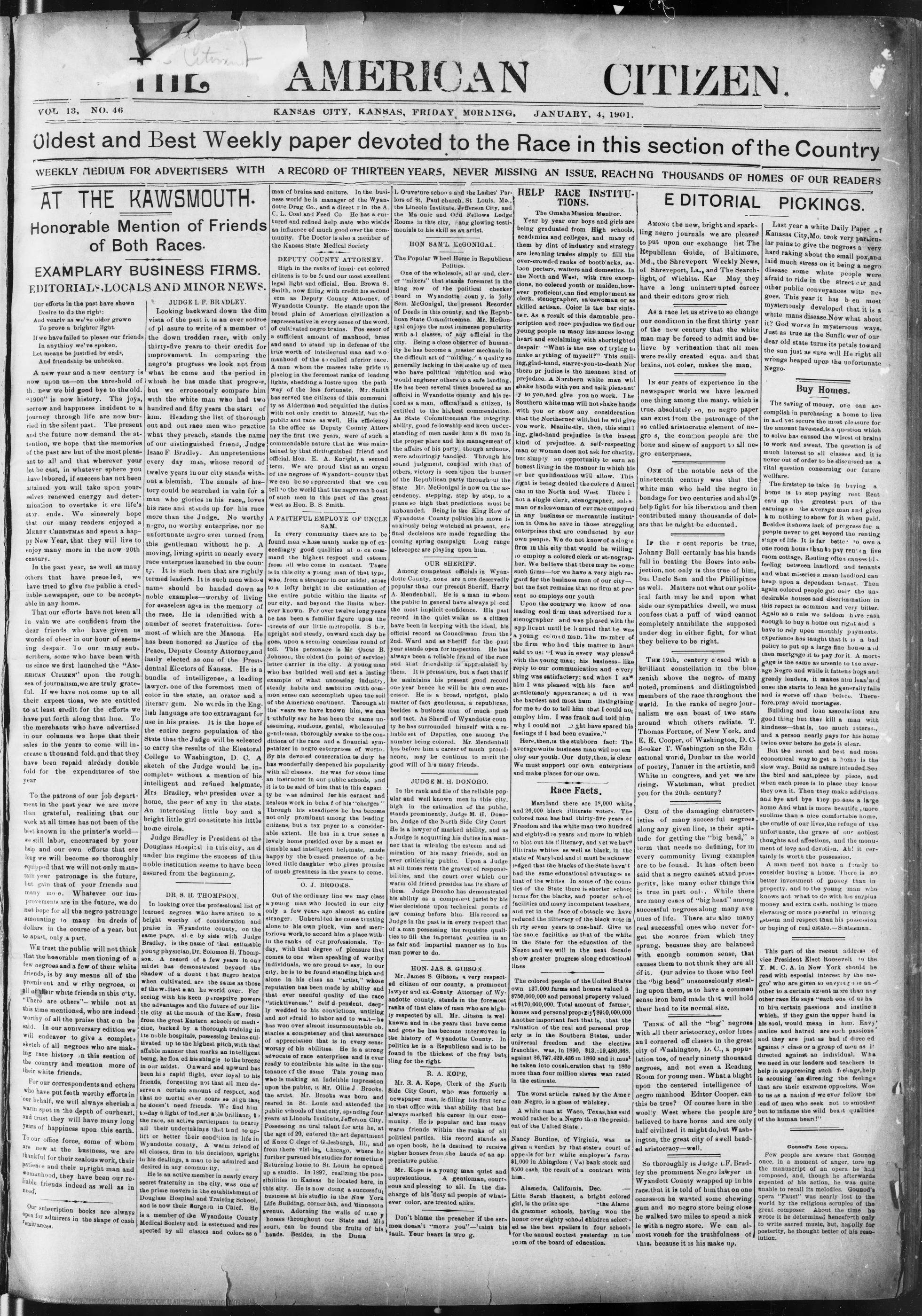
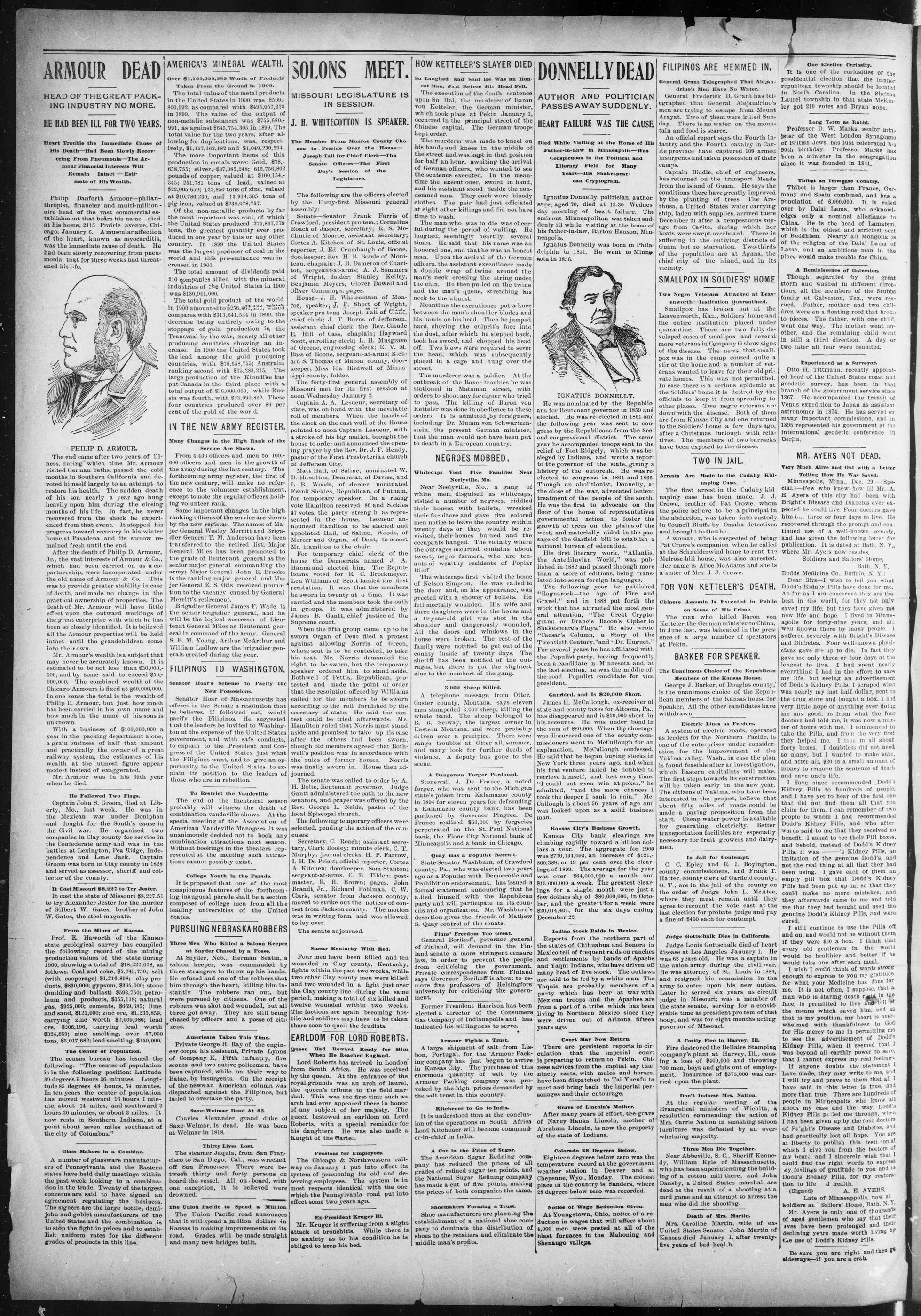
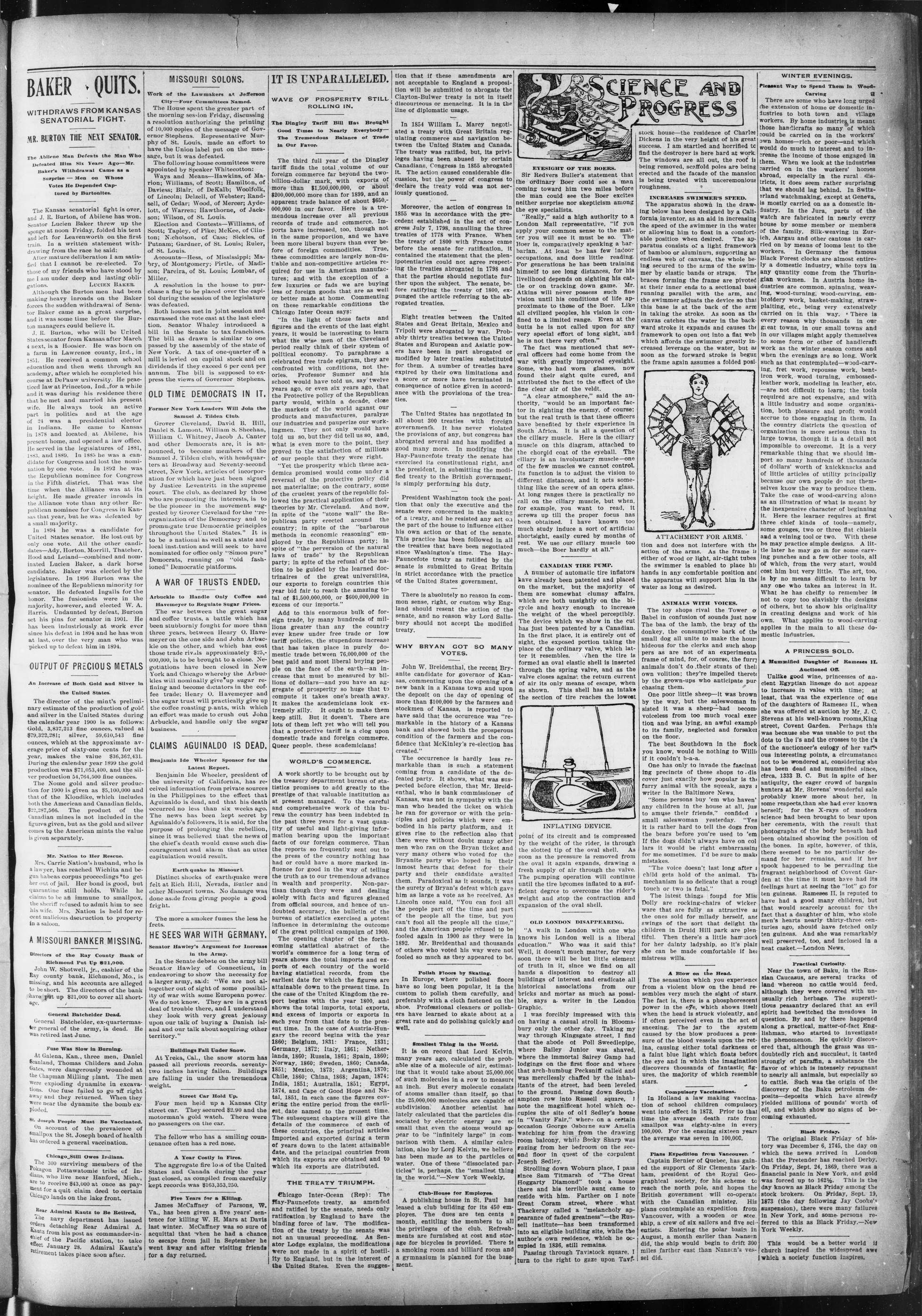
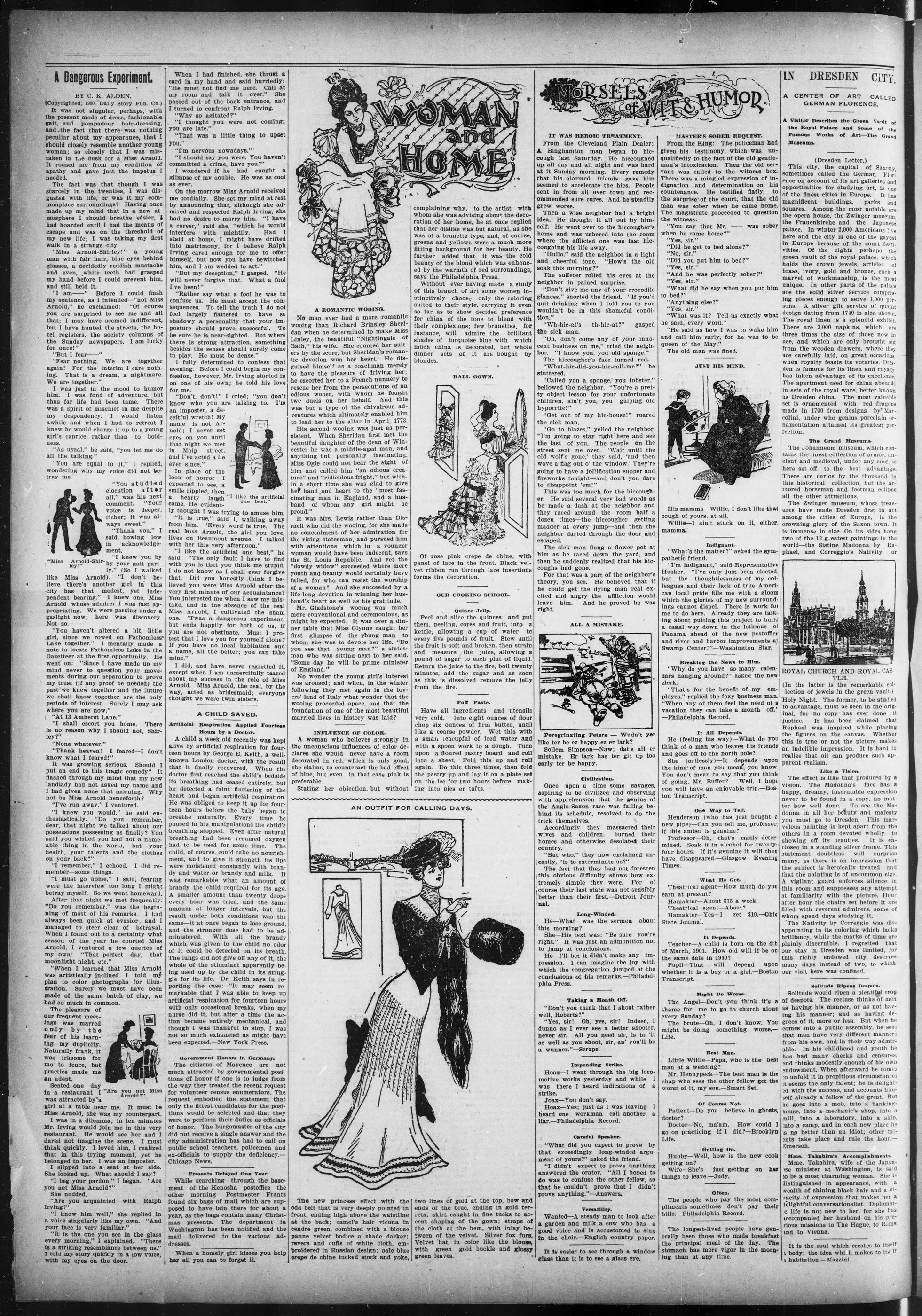
Page text (machine-generated)
Oldest and Best Weekly paper devoted to the Race in this section of the Country
WEEKLY MEDIUM FOR ADVERTISERS WITH A RECORD OF THIRTEEN YEARS, NEVER MISSING AN ISSUE, REACHING THOUSANDS OF HOMES OF OUR READERS
AT THE KAWSMOUTH. Honorable Mention of Friends of Both Races.
EDITORIALS, LOCALS AND MINOR NEWS.
VOL 13, NO.46
Oldest and
WEEKLY MEDIUM FO
AT THE K
Honorable Me
of Both
EXAMPLARY BU
EDITORIALS, LOCAL
Our efforts in the past have shown
Desire to do the right:
And yearly as we've older grown
To prove a brighter light.
If we have failed to please our friends
In anythin we've spoken.
Let means be justified by ends,
And friendship be unbroken.
A new year and a new century is now upon us—on the threshold of the new we bid good bye to the old. "1900" is now history. The joys, sorrow and happiness incident to a journey through life are now buried in the silent past. The present and the future now demand the attention, we hope that the memories of the past are but of the most pleasant to all and that wherever your lot be cast, in whatever sphere you have labored, if success has not been attained you will take upon yourselves renewed energy and determination to overtake it ere life's stor ends. We sincerely hope that our many readers enjoyed a MERRY CHRISTMAS and spent a happy New Year, that they will live to enjoy many more in the new 20th century.
In the past year, as well as many others that have preceded, we have tried to give the public a creditable newspaper, one to be acceptable in any home.
That our efforts have not been all in vain we are confident from the dear friends who have given us words of cheer in our hour of seeming despair. To our many subscribers, some who have been with us since we first launched the "AMERICAN CITIZEN" upon the rough sea of journalism, we are truly grateful. If we have not come up to all their expect tions, we are entitled to at least credit for the efforts we have put forth along that line. To the merchants who have advertised in our columns we hope that their sales in the years to come will increase a thousand fold, and that they have been repaid already double fold for the expenditures of the year
To the patrons of our job department in the past year we are more than grateful, realizing that our work at all times has not been of the best known in the printer's world—we still labor, encouraged by your help and our own efforts that are long we will become so thoroughly equipped that we will not only maintain your patronage in the future, but gain that of your friends and many more. Whatever our improvements are in the future, we do not hope for all the negro patronage amounting to many hu dreds of dollars in the course of a year, but to apart, only a part.
We trust the public will not think that the honorable mentioning of a few negroes and a few of their white friends, is by any means all of the prominent and w rhy negroes, on all of their white friends in this city. "There are others"—while not at this time mentioned, who are indeed worthy of all the praise that can be said. In our anniversary edition we will endeavor to give a complete sketch of all negroes who are making race history in this section of the country and mention more of their white friends.
For our correspondents and others who have put forth worthy efforts in our behalf, we will always cherish a warm spot in the depth of our hearts, and trust they will have many long years of happiness upon this earth.
To our office force, some of whom are new at the business, we are thankful for their zealous work, their patience and their upright man and womanhood, they have been our reliable friends indeed as well as in need.
Our subscription books are always open for admirers in the shape of cash femittances.
8
111L
d Best Week
FOR ADVERTISERS WITH
KAWSMOUTH.
ention of Friends
th Races.
BUSINESS FIRMS.
LLS AND MINOR NEWS
JUDGE L. F. BRADLEY.
Looking backward down the dim vista of the past it is an ever source of pl asure to write of a member of the down tredden race, with only thirty-five years to their credit for improvement. In comparing the negro's progress we look not from what he came and the period in which he has made that progress but we erroneously compare him with the white man who had two hundred and fifty years the start of him. Heading the list of thorough out and out race men who practice what they preach, stands the name of our distinguished friend, Judge Isaac F Bradley. An unpretentious every day man, whose record of twelve years in our city stands without a blemish. The annals of history could be searched in vain for a man who glories in his race, loves his race and stands up for his race more than the Judge. No worthy negro, no worthy enterprise, nor no unfortunate negro ever turned from this gentleman without he p. A moving, living spirit in nearly every race enterprise launched in the country. It is such men that are rightly termed leaders. It is such men whose name should be handed down as noble examples—worthy of living for ceaseless ages in the memory of the race. He is identified with a number of secret fraternities, foremost of which are the Masons. He has been honored as Justice of the Peace, Deputy County Attorney, and lastly elected as one of the Presidential Electors of Kansas. He is a bundle of intelligence, a leading lawyer, one of the foremost men of color in the state, an orator and a literary gem. No words in the English language are too extravagant for use in his praise. It is the hope of the entire negro population of the State that the Judge will be selected to carry the results of the Electoral College to Washington, D. C. A sketch of the Judge would be incomplete without a mention of his intelligent and refined helpmate, Mrs Bradley, who presides over a home, the peer of any in the state. An interesting little boy and a bright little girl constitute his little home circle.
Judge Bradley is President of the Douglass Hospital in this city, and d under his regime the success of this noble institution seems to have been assured from the beginning.
DR. S. H. THOMPSON
In looking over the professional list of learned negroes who have arisen to a height worthy of consideration and praise in Wyandotte county, on the same page, side by side with Judge Bradley, is the name of that estimable young physician, Dr. Solomon H. Thompson. A record of a few years in our midst has demonstrated beyond the shadow of a doubt that negro brains when cultivated, are the same as those of the wrist man he world over. For seeing with his keen perceptive powers the advantages and the future of our little city at the mouth of the Kaw, fresh from the great Eastern schools of medicine, backed by a thorough training in its noble hospitals, possessing brains cultivated up to the highest pitch, with that affable manner that marks an intelligent being, he floated his shingle to the breeze in our midst. Onward and upward has been his rapid flight, ever loyal to his friends, forgetting not that all men deserve a certain amount of respect, and that no mortal ever soars so aigh that he doesn't need friends. We find him to-day a light of indus aile brilliance, to the race, an active participant in nearly all their undertakings that tend to upplift or better their condition in life in Wyandotte county. A warm friend of all classes, firm in his decisions, upright in his dealings, a man to be admired and desired in any community.
He is an active member in nearly every secret fraternity in the city, was one of the prime movers in the establishment of Douglass Hospital and Training School, and is now their Surgeon in Chief. He is a member of the Wyandotte County Medical Society and is esteemed and respected by all classes and colors as a
AMERICAN
man of brains and culture. In the business world he is manager of the Wyandotte Drug Co., and a direct r in the A. C. L. Coal and Feed Co. He has a cultured and refined mate who wields an influence of much good over the community. The Doctor is also a member of the Kansas State Medical Society
DEPUTY COUNTY ATTORNEY.
High in the ranks of immigrant citizens is to be found our most excellent legal light and official. Hon. Brown S. Smith, now filing with credit his second term as Deputy County Attorney, or Wyandotte County. He stands upon the broad plain of American civilization a representative in every sense of the word of cultivated negro brains. Possor of a sufficient amount of manhood, brass and sand to stand up in defense of the true worth of intellectual man and woman of the so called inferior race. A man whom the masses take pride in placing in the foremost ranks of leading lights, shedding a lustre upon the path way of the less fortunate. Mr. Smith has served the citizens of this community as Alderman and acquitted the duties with not only credit to himself, but the public and race as well. His efficiency in the office as Deputy County Attorney the first two years, were of such a commendable nature that he was maintained by that distinguished friend and official. Hon. E. A. Enuright, a second term. We are proud that as an organ of the negroes of Wyandotte county that we can be so appreciated that we can tell to the world that the negro can boast of such men in this part of the great west as Hon. B. S. Smith.
A FAITHFUL EMPLOYE OF UNCLE
SAM
In every community there are to be found men whose many make up of exceedingly good qualities at to be command the highest respect and esteem from all who come in contact. There is in this city a young man of that type, who, from a stranger in our midst, arose to a lofty height in the estimation of the entire public within the limits of our city, and beyond the limits wherever known. For over twelve long years he has been a familiar figure upon the streets of our little metropolis. S. burr-upright and steady, onward each day he goes, upon a seeming ceaseless round of toil. This personage is Mr. Oscar B. Johnson, the oldest (in point of service) carrier in the city. A young man who has built well and set a lasting example of what unceasing industry, steady habits and ambition with common sense can accomplish upon the soil of the American continent. Through all the years we have known him, we can tuthfully say he has been the same unseasoned, studious, genial, wholesomed gentleman, thoroughly awake to the conditions of the race and a financial sympathizer in negro enterprises of work. By his devoted consecration to duty he has wonderfully deepened his popularity with all classes. He was for some time an instructor in our public schools, and it is to be said of him that in this capacity he was admired for his earnest and zealous work in beha f of his "charges". Through his steadiness he has become not only prominent among the leading citizens, but a tax payer to a considerable extent. He has in a true sense a lovely home presided over by a most estimable and intelligent helpmate, made happy by the blessed presence of a beloved little daughter who gives promise of much greatness in the years to come.
O. J. BROOKS
Out of the ordinary line we may class a young man who located in our city only a few years ago almost an entire stranger. Unheralded he come trusting alone to his own pluck, vim and memorious work, to accord him a place within in the ranks of our professionals. Today, with that degree of pleasure that comes to one when speaking of worthy individuals, we are proud to say, in our city, he is to be found standing high and alone in his class an "artist," whose reputation has been made by ability and that ever needful quality of the race "sticktiveness." Self d pendant, deeply wedded to his convictions, untiring and not afraid to labor and to wait—he has won over almost insurmountable obstacles a competency and that assurance of appreciation that is in every sensuory of his abilities. He is a strong advocate of race enterprises and is ever ready to contribute his mite in the sustenance of the same. This young man who is making an indeible impression upon the public, is Mr. Ollie J. Brooks, the artist. Mr. Brooks was born and attended the public schools of that city, spending four years at Lincoln Institute, Jefferson City, Possessing an艳 talent for art he, at the age of 20, entered the art department of Knox College of Galesburg, Ill., and from there visiting Chicago, where he further pursued his studies for sometime Returning home to St. Louis he opened up a studio. In 1897, realizing the possibilities in Kansas he located here, in this city. He is now doing a successful business at his studio in the New York Life Building, corner 5th, and Minnesota avenue. Adorning the walls of many homes throughout our State and Missouri, can be found the fruits of his hands. Besides, in the Duma
L Ouve'ture schools and the Ladies' Parlors of St. Paul church, St. Louis, Me., the Lincoln Institute, Jefferson City, and the Maonic and Old Fellows Lodge Rooms in this city, sang glowing testimonials to his skill as an artist.
HON SAM'L. LcGONIGAL
The Popular Wheel Horse in Republican Politics.
One of the wholesale, all ar und, clever "mixers" that stands foremost in the king row of the political checkerboard in Wyandotte county, is jolly Sem McGonigal, the present Recorder of Deeds in this county, and the Republican State Committeeman. Mr. McGonigal enjoys the most immense popularity with a classes, of any official in the city. Being a close observer of humanity he has become a master mechanic in the difficult art of "mixing," a quality generally lacking in the make up of men who have political ambition and who would engineer others to a safe landing. He has been several times honored as an official in Wyandotte county and his record as a man, official and a citizen, is entitled to the highest commendation. As State Committeeman the integrity, ability, good fellowship and keen understanding of men made him a fit man in the proper place and his management of the affairs of his party, though arduous, were admitingly handled. Through his sound judgment, coupled with that of others, victory is seen upon the banner of the Republican party throughout the State Mr. McGonigal is now on the ascendency, stepping, step by step, to a plane so high that predictions must be unbound. Being in the King Row of Wyandotte County politics his move is anxiously being watched at present, erfinal decisions are made regarding the coming spring campaign. Long range telescope are playing upon him.
OUR SHERIFF
Among competent officials in Wyandotte County, none are more deservedly popular than our present Sheriff, Harry A. Mendenhall. He is a man in whom the public in general have always placed the most implicit confidence. His past record in the quiet walks as a citizen have been in keeping with the ideal, his official record as Councilman from the 2nd. Ward and as Sheriff for the past year stands open for inspection. He has always been a reliable friend of the race and that friendship is appreciated by them. It is premature, but a fact that if he maintains his present good record one year hence he will be his own successor. He is a broad, upright, plain matter of fact gentleman, a republican, besides a business man of much push and tact. As Sheriff of Wyandotte county he has surrounded himself with a reliable set of Deputies, one among the number being colored. Mr. Mendenhall has before him a career of much prominence, may he continue to merit the good will of his many friends.
JUDGE M. H. DONQBO
In the rank and file of the reliable popular and well known men in this city, high in the estimation of the public, stands prominently, Judge M. H. Donoho, Judge of the North Side City Court. He is a lawyer of marked ability, and as a Judge is acquitting his duties in a manner that is winning the esteem and admiration of his many friends, and an ever criticizing public. Upon a Judge at all times rests the graves of responsibilities, and the court over which our warm old friend presides has its share of them. Judge Donoho has demonstrated his ability as a competent jurist by his wise decisions upon technical points of law coming before him. His record as Judge in the past is in every respect that of a man possessing the requisite qualities to fill the important position in an as fair and impartial manner as in his man power to do.
HON. JAS. & GIBSON
Mr. James S. Gibson, a very respected citizen of our county, a prominent lawyer and ex-County Attorney of Wyandotte county, stands in the foremost ranks of that class of men who are highly respected by all. Mr. Gibson is well known and in the years that have come and gone he has become interwoven in the history of wyandotte County. In politics he is a Republican and is to be found in the thickest of the fray batty ting for the right.
R. A. KOPE.
Mr. R. A. Kope, Clerk of the North Side City Court, who was formerly a newspaper man, is filling his first term in that office with that ability that has always marked his career in our community. He is popular and has many warm friends within the ranks of all political parties. His record stands as an open book, he is desired to receive higher honors from the hands of an appreciative public.
Mr. Kope is a young man quiet and unpretentious. A gentleman, courteous and pleasing to sill. In the discharge of his 'duty all people of whatever color, are treated alike.
Don't blame the preacher if the sermon doesn't "move you"—taint his fault. Your heart is wro g.
CITIZEN
HELP RACE INSTITUTIONS.
The Omaha Mission Monitor.
Year by year our boys and girls are being graduated from High schools, academics and colleges, and many of them by dint of industry and strategy are learning trades simply to fill the over-crowd-d ranks of bootbacks, sawhoon porters, waiters and domestics. In the North and West, with rare exceptions, no colored youth or maiden, however proficient, can find employment as clerk, stenographer, saleswoman or as skilled artisan. Color is the bar sinister. As a result of this damnable prosecution and race prejudice we find our young people in many instances looting heart and exclaiming with shortsighted despair. "What is the use of tryg to make anything of myself?" This smiling, glad-hand, stare-you-to-death Northern pr judice is the meanest kind of prejudice. A Northern white man will shake hands with you and talk pleasantly to you, and give you no work. The Southern white man will not shake hands with you or show any consideration that the Northerner will, but he will give you work. Manly-tie, then, this similar, glad-hand prejudice is the bossest kind of prejudice. A self-respecting man or woman does not ask for charity, but simply an opportunity to earn an honest living in the manner in which his or her qualifications will allow. This right is being denied the colder American can in the North and West. There is not a single clerk, stenographer, salesman or saleswoman of cur race employed in any business or mercantile institution in Omaha save in those struggling enterprises that are conducted by our own people. We do not know of a single firm in this city that would be willing to employ a colored clerk or stenographer. We believe that there may be some such firms—for we have a very high regard for the business men of our city—but the fact remains that no firm at present so employs our youth
Upon the courtyard we know of one leading coal firm that advertised for a stenographer and was pleased with the applicant to be learned that he was a young coiled man. The member of the firm who had this matter in hand said to us: "I was in every way pleased with the young man; his business—like reply to our communication and every thing was satisfactory; and when I saw him I was pleased with his face and gentlemanly appearance; and it was the hardest and most hum listing thing for me to do to tell him that I could not employ him. I was frank and told him why I could not $\rightarrow$ 2ht have spared his feelings if I had been evasive."
Here, then, is the stubborn fact: The average white business man will not emoloy our youth. Our duty, then, is clear. We must support our own enterprises and make places for our own.
Race Facts.
Maryland there are 18,000 whites and 26,000 black illiterate voters. The colored man has had thirty-five years of Freedom and the white man two hundred and eighty-five years and more in which to blot out his illiteracy, and yet we have illiterate whites as well as black, in the state of Maryland and it must be acknowledged that the blacks of the State haven't had the same educational advantages as that of the whites. In some of the counties of the State there is shorter school terms for the blacks, and poorer school facilities and many incompetent teachers, and yet in the face of obstacle we have reduced the illiteracy of the black vote in thirty seven years to one half. Give us the same facilities as that of the white in the State for the education of the Negro and we will in the next decade show greater progress along educational lines.
---
The colored people of the United States own 137,000 farms and homes valued at $750,000,000 and personal property valued at $170,000,000. Total amount of farmes, homes and personal property is $10,000,000. Another important fact that is, that the valuation of the real and personal property is in the Southern States, under universal freedom and the elective franchise, was, in 1890, $13,190,368, against $6,787,429,436 in 1860 and it must be taken into consideration that in 1860 more than four million slaves wan rated in the estimate.
The worst article raised by the American Negro, is a glass of whiskey.
A white man at Waco, Texas, has said would rather be a Negro than the president of the United State.
Nancy Burdine, of Virginia, was us given a verdict by that state's court of appeals for her white employer's farm $1,000 in Abingdom (VA) bank stock and $500 cash, the result of a contract with him.
Alameda, California, Dec.
Litte Sarah Hackett, a bright colored girl, is the prize spee the Alame da grammar schools, having won the honor over eighty school children selected as the best spellers in four schools for the annual contest yesterday in the room of the board of education.
AMONG the new, bright and sparkling negro journals we are pleased to put upon our exchange list The Republican Guide, of Baltimore, Md., the Shreveport Weekly News, of Shreveport, La., and The Searchlight, of Wichita, Kar May they have a long uninterrupted career and their editors grow rich
As a race let us strive to so change our condition in the first thirty year of the new century that the white man may be forced to admit and believe by verification that all men were really created equal and that brains, not color, makes the man.
In our years of experience in the newspaper world we have learned one thing among the many, which is true, absolutely no, no negro paper can exist from the patronage of the so called aristocratic element of negro s, the common people are the bone and sinew of support to all negro enterprises.
One of the notable acts of the nineteenth century was that the white man who held the negro in bondage for two centuries and ability help fight for his liberation and then contributed many thousands of dollars that he might be educated.
If the r cent reports be true, Johnny Bull certainly has his hands in full in beating the Boers into subjection, not only is this true of him, but Uncle Sam and the Phillipinos as well. Matters not what our political faith may be and upon what side our sympathies dwell, we must confess that a puff of wind cannot completely annihilate the supposed under dog in either fight, for what they believe to be right.
The 19th century closed with a brilliant constellation in the blue zenith above the negro, of many noted, prominent and distinguished members of the race throughout the world. In the ranks of negro journalism we can boast of two stars around which others radiate. T. Thomas Fortune, of New York, and E. E. Cooper, of Washington, D. C. Booker T. Washington in the Educational world, Dunbar in the world of poetry, Tanner in the artistic, and White in congress, and yet we are rising. Watchman, what predict you for the 20th century?
ONE of the damaging characteristics of many successful negroes along any given line, is their aptitude for getting the "big head," a term that needs no defining, for in every community living examples are to be found. It has often been said that a negro cannot stand prosperity, like many other things this is true in part only. While there are many cases of "big head" among successful negroes along many avenues of life. There are also many real successful ones who never forget the source from which they sprung, because they are balanced with enough common sense, that causes them to not think they are all of it. Our advice to those who feel the "big head" unconsciously stealing upon them, is to have a common sense iron band made that will hold their head to its normal size.
Think of all the "big" negroes with all their aristocracy, color lines and cornered off classes in the great city of Washington, D.C., a population too, of nearly ninety thousand negroes, and not even a Reading Room for young men. What a blight upon the centered intelligence of negro manhood Editor Cooper, can this be true? Of course here in the woolly West where the people are believed to have horns and are only half civilized it might do, but Washington, the great city of swell headed aristocracy—well.
So thoroughly is Judge L.F. Bradley the prominent Negro lawyer in Wyandott County wrapped up in his race, that it is told of him that on one occasion he waunted some chewing gum and no negro store being close he walked two miles to spend a nickle with a negro store. We can almost vouch for the truthfulness of this, because it is his make up.
Last year a white Daily Paper of Kanasas City, Mo. took very particular pains to give the negroes a very hard raking about the small pox, and laid much stress on it being a negro disease some white people were afraid to ride in the street car and other public conveyances with negoes. This year it has been most mysteriously developed that it is a white mans disease. Now what about it? God worrs in mysterious ways. Just as true as the Sunflower of our dear old state turns its petals toward the sun just as sure will He right all wrongs heaped upon the unfortunate Negro.
Buy Homes.
The saving of money, one oan accomplish in purchasing a home to live in and yet secure the most pleasure for the amount invested, is a question which to solve has caused the wisest of brains to work and sweat. The question is of much interest to all classes and it is never out of order to be discussed as a vital question concerning our future welfare.
The firststep to take in buying a home is to stop paying rent. Rent eats up the greatest part of the earnings o the average man and gives him nothing to show for it when paid. Besides it shows lack of progress for a people never to get beyond the renting stage of life. It is far better to own a one room house than to pay rent on a five room cottage. Renting often causes idle feeling between landlord and tenants and what miseries a mean landlord can heap upon a dependent tenant. Then again colored people get only the undesirable houses and discrimination in this respect is common and very bitter. Again as a rule we seldom have cash enough to buy a home outright and s have to rely upon monthly payments. experience has taught that it is a bad policy to put up a large fine house and then mortgage it to pay for it. A mortgage is the same as arsenic to the average Negro and while it fattens hogs and greedy lenders, it makes him lean and once the starts to lean he generally falls and is worse off than before. Therefore, pray avoid mortages.
Building and loan associations are good thing but they kill a man with kindness—that is, too much rateres, and a person nearly pays for his home twice over before he gets it clear.
But the surest and best and most economical way to get a home is the slow way. Build as nature intended. See the bird and ant, piece by piece, and when each piece is in place they know they own it. Then they make additions and bye and bye they possess a large home And what is more beautiful, more suoline than a nice comfortable home, the cradle of our lives, the refuge of the unfortunate, the grave of our noblest thoughts and affections, and the monument of love and devotion. Ah! it certainly is worth the possession.
A man need not have a family to consider buying a home. There is no better investment of money than in property, and to the young man who knows not what to do with his surplus money and extra cash, nothing is more elevating or more powerful in winning esteem and respect than his possession or buying of real estate.—Statesman.
This part of the recent address of vice President Elect Koosevelt to the Y. M. C. A. in New York should be read with especial interest by the negro who are given to envy, jealous and other to a certain extent more than any other race He says "each one of us has in him certain passions and instincts which, if they gain the upper hand is his soul, would mean in him. Envy malice and hatred are such passions" and they are just as bad if directed against a class or a group of men as it directed against an individual. What we need in our leaders and teachers is help in suppressing such feelings, help in arousing an directing the feelings that are their extreme opposites. Woe to us as a nation if we ever fellow the lead of men who seek not to smother but to infame the wild beast qualities of the human heart!
Gonnoa's Lost Herd
Few people are aware that Goundon once, in a moment of anger, tore up the manuscript of an opera he had composed, and, though he afterwards repented of his action, he was quite unable to recall its melodies. Goundon's opera "Faust" was nearly lost to the world by the religious scruples of the great composer. About the time he wrote it he determined henceforth only to write sacred music, but happily for posterity, he thought better of his resolution.
ina " p \ x
Leese yy One Eiection Curiosity. i
a J) JAMERICA'S MINERAL WEALTH. | SOLONS MEET HOW KETTELER'S SLAYER DIED) DONNELLY DEAD FILIPINOS ARE HEMMED IN, | EE uous ot dhe enteiier of tna
Bs —— S ee ees residential election that the banner
ae vs 3 hed ‘That Atejan- | Presidentia banne
op ARMOUR DEAD Over $1,109,099,900 Worth of Products | * | Su tanghed and Said He Was an Hon- General Grant Telegeephied Tint Alana |e er rahip should te ree
Pe seh RARE A Ute AER est Man, Just Before His Head Fell. sa ed tn aon have So Waters | EPANIEAT (OND shod be Les
He ‘aken From the Ground tn 1990, se ‘ ah sierra ; Pind Db GeaaPhartee (it ba
es ‘he total value of the metal prodvets | jgSOURI LEGISLATURE IS |," exeeution of the death sentence) aurioR AND POLITICIAN] General Frederick D, Grant hi Zancit tiwnship in that stats Monn
ae E PACK ce ‘ as $500,- | upon Su Hai, the murderer of Baron egraphed that General Alejandrino’s 210 votes:and' Bryan none
eee > OF THEGREAT P in the United States in 1900 was $500. IN SESSION. von Ketteler) the German. minister,| PASSES AWAY SUDDENLY. |<érathed that General Weland’in0® yey got 210 votes and eres
Spa ING INDUSTRY NO MORE. | 500,992, as compare writ 495,007,220 which tool place at Pekin January 1,| a Arayae, ‘iso GE Gace ects tied sur | co
pe _ in 1899. The value of the output of —— ene ee at v shot the Bankes : San Long Term es Rabtt.
: non-metalic substances was $753,050 | J, WHITECOTTON IS SPEAKER. oo Piinsipel streot of the/ HEART FAILURE WAS THE CAUSE,| das- a ene |. Protessor B. W. Mavs, senlor min.
Sey HE WAD BEEN ILL FOR TWO YEARS, | Ropmetatic rubstances was, #7 Me) hina capital Whe Oe | . [iis and od roel ae wee Mame or
By —- total value for the two years, after sl- = (itis tanidierge yenn Gunde vo kneel /ou Io Visiting at the Home of Hle| fantry and the Fourth cavalry in Cav. {of British Jews, has just celebrated his
SS ir lowing for duplications, was, respect- | the Member From Monroe County Cho-|| The murderer was made tc se Died While Visiting at the 1 tit| fantry and the Fourth cavalry gi soui Minhday. Frfeowe Macks ne
= eee te the Teemedinty Conse et | ly, a1,157,168,188 and 91,040,250,504. | son to.Freslde Over the HMouse— | his hands.and knees in the middle of] yather-tn-Law in Minneapolis—Was | ite province have captured 109 ee ie oe
Fe iw Death ied Been slowty Recor: |'“'The more important items of this | "“Jogeph ta for Cnet Clerk—ene | the stret and was kept in that position onspcaous in the Potties and | insurgents and taken possession oftheir Deen @ minister in the congregation
2 ering From Paeumonia—The Ar- RE WEES Oo SeS Seabee sata for half an hour, awaiting the arrival Fees wpe ee ce f since it was founded in 1841,
5 pe odoehins te neesais arene: Oia oot = of German officers, who wanted to see Copiain Biddle) chief! of euginesrs, ame
Se ODS PBB miner ANTICO OA8E C18 TOE | SS RRREG ICE: SENS: th te ited. In th a a eee has cetarned on the. port Meade ‘Thibet an 1 C
emain Intact — Estl- winds of copper, valued at $100,154,- he sentence exeeuted. In the mean- as pons has returned on the transport Meade an Immgase Country.
ss paeiees GEER a eeisde chic vad —. and his assistant stood beside the con. ae conditions there have greatly improved | many and Spain combined, and hers
, ‘at $10,786,230, and 13,014,505 tons of | The following are the officers elected | demned man. They each wore bloody) Ignatius Donnelly, politician, author | by the planting of trees. ‘The Are-| population ot 6.000000. Tei nck
F Philip Danforth Armour—philan- | St 810780220, and 13-01).505, by the Forty-Grst Missourl general /clottes ‘The pair had just oflcisted| ange, aged 70, died nt 12:30 Wednes | thasa, a United States water carrying [Dor ty paant fens whee core
2 Aopist, financier and multi-million | Pig iron, valued at g2sswove.737. | By, the, steight oftior Kilings and did nov have} dey morning of heart feilure. ‘The| ship, aden with oupplies, arrived there | geo gene Lame nee
Fe Bee pee Comer ae | iat ureoetct wad ool, of wach | Seusie-Geoator rank Warsia’ of | time to wast eminent Minneapolitan wastalen sud-| December 21 after tempestuous voy: |Ciiey iy fe tet weguanee
fe cetis ome, ois estes Shme Ut. | the Unitad States produced 214770 | Crawford, president protem.; Cornelius |” ‘Tho man who wns to die was cheor-| Seatt ii autie Ronen Shale hei] oecemmeer Halter 8 tempestuows roy- ore Ge oe
Ie Pinte rcs, NE ei eins Peres ee | noah of Jumper, sovciargy 6 Me liu dug ye pind OF Gale. tee ee Hanson, Min-| boats were swept overboard. ‘There is | op pragnieny, wea and stricto, sect
Geee Tanuary GA muscular affection | ree in ons vets by this On any other | Clintie of Monrve, assistant secretary; | laughed, seemingly heartily, sevoral| nenrelie suffering in the outlying districts of | Gr the religion of ike Dalek nan ce
. of the heart, known as myocarditis, | dueed in one year “he United States | Cortez A, Kitchen of St. Louis, offical | times, He said that his name was an Igaatus Donnelly was Horm in: Fhlle-| Guam, butnd starration, ‘Two-thirds |je.c. sud an enbidious man ie the
i was the immediate cause of death. He |ountry. | In 1800 the United ty eo eee EB Decale of Mout, | eouored one, and thathe was anhouest| deiphia in 181, He went to Minne |of the population are at Agana, the | tier woulg water oes ga
i‘ had been slowly recovering from pnen- | Was, the largest Veeerineues waste es keeper; Rev. H. B. Boude of Moni- | man. Upon the arrival of the German} gota in 1856. chief city of the island, and in its) aa
i monia for three weeks had threat- | World and this pre-eminence eau, chapiain; J. 8. Dameron of Chari- | officers, the assistant executioner made Hegeneee a
Ionia, thet forth creased in 1900. | tea, chapiain; J. B. Dameron of Chari- | officers, | un a ial ¥
Se |
b RS
MES
(
‘The end came after two years of ill-
ness, during which time Mr. Armour
visited German baths, passed the cold
months in Southern California and de-
voted himself largely to an attempt to
restore his health. ‘The sudden death
of his son nearly a year ago hung
heavily upon him duriag the closing
months of his life. In faet, he never
recovered from the shock he experi-
enced from that event. It stopped his
progress toward recovery in his winter
hhome at Pasadena and its sorrow re-
‘mained fresh until the end.
After the death of Philip D. Armour,
Jr., the vast interests of Armour & Co.,
which had been carried on as aco-
partnership, were incorporated under
the old name of Armour & Co. ‘This
was to provide greater stability in ease
of death, and made no change in the
practical ownership of properties. The
death of Mr. Armour will have little
effect upon the outward workings of
the great enterprise with whieh be has
‘been so closely identified. Itis believed
all the Armour properties will be held
intact until the grandchildren come
into theirown,
Mr. Armour's wealth isa subject that
may never be accurately known. It is
estimated to be not less than $30,0000,-
090, and by some said to exceed $50,-
000,000. ‘The combined wealth of the
Chicago Armours is fixed at $60,000,000.
In one sense the total is the wealth of
Philip D. Armour, but just how much
has been carried in his own name and
how much in the name of his sons is
unknown.
With a business of $100,000,000 a
year in the packing department alone,
grain business of half that amount
and practically the owner of a great
railway system, the estimates of his
wealth at the utmost figure appear
modest instead of exaggerated.
Mr. Armour was in his 6th year
when tie died.
He Followed Two Fings.
Captain John S, Groom, died at Lib-
erty, Mo., last week. | He was in
the Mexican war under Doniphan
and fought for the South's eause in
the Civil war. He organized two
companies in Clay county for service in
the Confederate army and was in the
battles at Lexington, Pea Ridge, Inde-
pendence and Loue Jack. Captain
Groom was born in Clay county in 1828
and served as assessor, sheriff and col-
lector of the county.
Tt Cost Missourt 88,227 to Try Jonter.
It cost the state of Missouri $3,227.51
to try Alexander Jester for the murder
of Gilbert W. Gates, brother of John
W. Gates, the steel magnate.
From the Mines of Kansas.
Prof. E, Haworth of the Kansas
state geological survey has compiled
the following record of the mining
production values of the state during
1900, showing a total of $18,222,028, as
follows: Coal and coke, $5,743,750; salt
(with cooperage) $1,216,898; clay pro-
duets, $830,000; gypsum, $365,000; stone
(building and ballast) $593,750; petro-
lenm and products, $955,118; natural
gas, $925,000; cements, $669,685; lime
and sand, $121,000; zine ore, $1,235,859,
carrying’ zine worth $2,009,986; lead
ore, $206,198, carrying lead worth
$324,859; zine smelting, over 57,000
tons, $5,017,682; lead smelting, $150,000,
nO ae ae
The census bureau has issued the
following: “The center of population
isin the following position: Latitude
89 degrees 9 hours 36 minutes. Longi-
tudes degrees 43 hours, 54 minutes,
In ten years the center of population
has moved westward 16 hours i min-
ute, about 14 miles, and southward 2
hours 20 minutes, or about 3 miles. It
now rests in Southern Indiana, at a
point about seven miles southeast of
the city of Columbus.”
Glass Makers ta = Combine.
A number of glassware manufactur-
ers of Pennsylvania and the Eastern
staves have held daily meetings within
the past week looking to a combina-
vionin the trade. Twenty of the largest
concerns are said to have signed an
agreement regulating the business.
‘The signers are the large bottle, demi-
jobn and goblet manufacturers of the
United States and the combination is
to stop the fight in prices and to estab-
lish uniform rates for the different
grades of products in this line.
AMERICA’S MINERAL WEALTH.
Over $1,109,999,900 Worth of Products
‘Taken From the Ground In 1900,
‘The total value of the metal products
in the United Statesin 1900 was $600,-
$00,992, as compared with $495,057,320
in 1809. ‘The value of the output of
non-metalic substances was, $755,680,
991, as against §645,754,305 in 1809. The
total value for the two years, after al-
lowing for duplications, was, respect
ively, $1,157,162,182 and $1,049,230,598.
‘The more important items of this
produetion in metals were: Gold, $78,-
658,755; silver-$97,085,248; 615,756,802
‘pounds of copper, valued at $100,154
‘845; 251,781 tons of lead, valued at
$22,005,050; 122,850 tons of zine, valued
at $10,780,230, and 13,914,503. tons of
pig fron, valued at $238,078,737.
Of the non-metallic produets by far
the most important was coal, of which
the Unitad States produced 274,847,779
tons, the greatest quantity ever pro-
duced in one year by this or any other
country, In’ 1899 the United States
was the largest producer of coal in the
world and this pre-eminence was in-
creased in 1900.
‘The total amount of dividends paid
210 companies allied with the mineral
industries of the United States in 1900
"was £130,041, 000.
| ‘The total gold product of the world
{n 1900 amounted to $356,402, 422, Which
‘compares with $313,641,534 in 1809, the
decrease being entirely owing to the
stoppage of gold production in the
‘Transvaal by the war, nearly all other
producing countries ‘showing an in-
crease. In 1900 the United States took
the lead among the gold producing
countries, with $78,653,755; Australia
ranking second with $75,283,215, The
large production of the Klondike has
pnt Canada in the third place with a
total output of $55,000,000, while Rus-
sia was fourth, with $23,090,802. ‘These
four countries produced over 8 per
esti? thé gold othe world:
IN THE NEW ARMY REGISTER,
Many Changes In the High Rank of the
Service Are Shown,
From 4,436 officers and men to 100,-
000 officers and men is the growth of
the army during the lasteentury. ‘The
forthcoming army register, the first of
the new century, will make no refer-
ence to the volunteer establishment,
except tonote the regular oticers hold-
ing volunteer rank.
Some important changes in the high
ranking officers of the service are shown
by the new register. ‘The names of Ma-
Jor General Wesley Merritt and Briga-
‘ier General P.M, Anderson have been
transferred to the retired list; Major
General Miles has been promoted to
the grade of licutenant general as the
senior major gene-al commanding the
army; Major General John R. Brooke
is the ranking major general and Ma-
jor General E. 8, Otis received prom -*
tion to the vaeaney cansed by General
‘Merritt's retiremen’.
Brigadier General James F. Wade is
the senior brigadier general, aad he
will be the logical successor of Liew
tenat General Miles as lientenant gen-
eral in command of the army. General
8. BM. Young, Arthur MeArthur and
William Ludlow are the brigadier gen-
erals created during the year.
FILIPINOS TO WASHINGTON,
Senator Hoar's Scheme to Pacity the
Seie: resins,
Senator Hoar of Massachusetts has|
offered in the Senate a resolution that
he Velieves. if followed out, would
pacify the Filipinos, He suggested
that the leaders be invited to Washing-
ton at the expense of the United States
government, and with safe conducts,
toexpluin to the President and Con-
gress of the United States just what
the Filipinos want, and to give an op-
portunity to the United States to ex-
plain its position to the leaders of
those who are in rebellion.
To Restelct the Vauderttie
The end of the theatrieal season
probably will witness the death of
combination vaudeville shows. At the
special meeting of the Association of
American Vaudeville Managers it was
unanimously decided not to book any!
combination attractions next season,
Without bookings in the theaters. rep-
resented at the meeting such attrac-
tions eannot possibly exist,
College Youth tn the Parade.
It is proposed that one of the most.
conspicuous features of the fortheom
ing inaugural parade shall be a section
composed of college men from all the
lesding universities of the United
States, |
PURSUING NEBRASKA ROBBERS:
‘Three Men Who Killed # Saloon Keeper
iat Snyder Chased by m Posse.
At Snyder, Neb., Herman Seatin, a
saloon keeper, was commanded by
three strangers to throw up his hands.
He refused and one of the robbersshot
him through the heart, killing him in-
stantly. The robbers ran out, but
were pursued by citizens. One of the
robbers was shot and wounded, but all
three got away. They are still being
chased by officers and a posse of citi
zens.
Americans Taken This Time.
Private George H. Ray of the engin
eer corps, his assistant, Private Lyons
of Company K, Fifth infantry, five
scouts and two native policemen, have
been captured, while on their way to
Batac, by insurgents. On the receipt
of the news an American column was
dispatched against the Filipinos, bat
failed to overtake the party.
Saxe-Welmar Dead At 83.
Charles Alexander, grand duke of
Saxe-Weimar, is dead. He was born
‘at Weimar in 1818,
‘Thirty Lives Lott.
‘The steamer Jaquia, from San Fran-
cisco to San Diego, Cal., was wrecked
off San Francisco. There were be-
tweeh thirty and forty persons on
board the vessel. All on-board, with
one exception, it is believed’ were
owen
‘The Unlos Pacific to Spend ® Million
‘The Union Pacific road announces;
that it will spend a million dollars 4n
‘Kansas in making improvements on its
road, Grades will be made straight
‘end many new: bridges built.
”
SOLONS MEET.
MISSOURI LEGISLATURE 1S
IN SESSION.
J. H. WHITECOTTON IS SPEAKER.
The Member From Monroe County Cho-
en to Preside Over the House—
Joueph Tall for Chief Clerk—The
Senate Ofilcers—The First
Day's Session of the
Saree
The following are the oticers elecved
by the Forty-first Missouri general
assembly:
‘Senate—Senator Frank Farris of
Crawford, president pro tem.; Cornelius
Roach of Jasper, secretary; B.S. Me-
Clintie of Monree, assistant secretary;
Cortez A. Kitchen of St. Louis, official
reporter; J. Ed Crumbaugh of Boone,
doo: keeper; Kev. H. B. Boude of Moni-
teau, chaplain; J, 18, Dameron of Chari-
ton, sergeantatarms; A. J. Sommers
ot Wright, foldes; Stanley" Kelley,
‘Benjamin Meyers, Glover Dowell and
Ohyer Cummings, pages
~ House—J, HI. Whitecotton of Mon-
tog, speaker; J. F. Short of Wright,
[speeker prdtems Joseph all of Cars,
ehiet clerk; J. ‘I. Burns of Jefferson,
‘assistant chief clerk; the Rev. Claude
E, Hill of Cass, chaplain; Hayward
‘Scott, enrolling clerk; L. H. Musgrave
of Greene, engrossing clerk; E. V. M.
‘Bass of Boone, sergeancat-arms; Rich-
ard S, Thomas of Macon county, door-
cae Miss Ida Birdwell of Missis-
sippi county, folder.
"The forty-lirst general assembly of
Missouri met for its first session at
noon Wednesday January 2
Captain A. A. Leseur, secretary of
state, was on hand with the inevitable
roll of members. When the hands of
the clock on the east wall of the House
pointed to noon Captain Lesuenr, with
a stroke of his big mallet, brought the
house to order and announced the open-
ing prayer by the Rev. Dr. J. F. Hendy,
pastor of the First Presbyterian chureh
0f Jefferson City.
Matt Mall, of Saline, nominated W.
D, Hamilton, Democrat, of Davies, and
LB. Woods, of atereer, nominated
Frank Sickles, Republiean, of Putnam,
for temporary speaker. On a rising
vote Hamilton received 86 and Sickles
AT votes, the party streng h as repre-
sented in the house, Lesueur an-
nounced Hamilton to be elected and
appointed Hall, of Saline, Woods, of
“Mercer and Organ, of Dent, to escort
Me. Hamilton to the ehair.
For temporary ehief clerk of the
house the Democrats named J. A.
Hanuaand elected him. ‘The Repub-
licans voted for E. C. Brockmeyer.
Len Williams of Scott landed the first
resolution, It was that the members
be sworn in twenty at a time. 1t was
earried and the members took the oath
in groups. It was administered by
James B. Gantt, ehiet justice of the
Supreme court.
When the fifth group came up to be
sworn Organ of Dent filed a protest
against allowing Norris of Green,
whose seat is tobe contested, to take
his seat. Mr. Norris demanded the
right to be sworn, but the temporary
speaker ordered him to stand aside,
Bothwell of Pettis, Republican, pro-
tested and made the point or order
that the resolution offered by Williams
called for the members to be sworn
according to the roll furnished by the
secretary of state. He said the con-
test could be tried afterwards. Mr.
| Hamilton ruled that Norris must stand
aside and promised to take up his ease
after the others had been sworn,
though old members agreed that Both:
well’s position was in accordance with
the rules of former houses. Norris
| was finally sworn in, House then ad-
journed.
‘The senate was called to order by A.
H. Bolte, lieutenant governor. Judge
Gantt administered the oath to the new
senators, and prayer was offered by the
Rev. George L. Neide, pastor of the
Joeal Episcopal chureh.
‘The following temporary officers were
selected, pending the action of the cau:
ccuses:
Secretary, ©. Roach; assistant seere-
tary, Clark Dooley; minute clerk, C. T.
Murphy; journal clerks, H. P. Farrow,
I. H. De Priest; official reporter, Cortez
A. Kitehen; doorkeeper, Sam Stanton:
sergeant-atarms, C. B, Tilden; post:
master, R. UH. Brown; pages, John
Brandt, Jr., Richard Polman,” C, W.
Clark, senator from Jackson county,
movei to strike out the notices of con:
test from Jackson county. ‘The motion
was in writing form and was allowed
to lay over.
‘The senate adjourned.
Smear Kentucky With Red.
Four men have been killed and ten
wounded in Clay county, Kentucky,
fights within the past two weeks, while
two other Clay county men were killed
and two wounded in a fight just over
the Clay county line during the same
period, making a total.of six killed and
twelve wounded within two weeks.
‘The factions are again becoming hos-
tile and soldiers may have to be taken
there soon to quell the feudists.
EARLDOM FOR LORD ROBERTS.
Queen Had Reward Ready for Him
When He Reached England.
Lord Roberts has arrived in London’
from South Africa, He was received
by the queen. At the entrance of the
royal grounds was an arch of laurel,
the queen's tribute to the field mar-
shal. This was the first time such an
arch had ever appeared there in honor
af any subject of her majesty. ‘The
queen bestowed an earldom on Lord
Roberts, with a special reminder for
his daughtere He was also made a
Knight of the tarter.
Penslons for Employees.
The Chicago & Northwestern rail-
way on January 1 put into effect its
system of pensioning its old and de-
serving employees. The system is in
most respects identical with the one
which the Pennsylvania road put into
effect some two years ago.
sy en Ne
‘Mr. Kruger is suffering from a slight
attack of bronchitis. While there is
a0 anxiety as to his condition he is
pbliged to keep his bed.
HOW KETTELER’S SLAYER DIED
Sa Laughed and Said He Was an Hon-
‘est Man, Just Before fis Head Fell
‘The execution of the death sentence
upon Su Hai, the murderer of Baron
von Ketteler, the German minister,
which took place at Pekin January 1,
occurred in the principal street of the
Chinese capital, The German troops
kept order.
‘The murderer was made to kneel on
his hands and knees in the middle of
the street and was kept in that position
for half an hour, awaiting the arrival
of German officers, who wanted to see
the sentence executed. In the mean-
time the executioner, sword in hand,
and his assistant stood beside the con-
demned man. They each wore bloody
clothes The pair had just officiated
at eight other killings and did nov have
time to wash.
‘The man who was to die was cheer-
ful during the period of waiting. He
laughed, seemingly heartily, several
times, He said that his name was an
honored one, and that he was an honest
man. Upon the arrival of the German
officers, the assistant executioner made
a double wrap of twine around the
man’s neck, crossing the string under
the chin, He then pulled on the twine
and the man's qneue, stretching his
neck to the utmost.
Meantime the executioner put a knee
‘between the man's shoulder blades and
his hands on his head. ‘Then he jumped
hard, shoving the eulprit’s face {nto
the dust, after which he siopped back,
tools his sword, and chopped his head
off. Two blows were required to sever
the head, which was subsequently
placed in’ a cage and hung over the
street,
‘The murderer was a soldier, At the
outbreak of the Boxer troubies he was
stationed in Mataman street, with
orders to shoot any foreigner who tried
to pass. The killing of Baron von
Ketteler was done in obedience to these
orders, It is admitted by foreigners,
including Dr. Mumm von Schwartzen-
stein, the present German minister,
that the man would not have been put
5S DARK a we oan ecoskeS.
NEGROES MOBBED.
Whitecaps Visit Five Families Near
Neclyviite, Mo.
Near Neelyville, Mo., a gang of
white men, disguised ‘as whitecaps,
visited a number of negroes, riddied
their houses with bullets, wrecked
their furniture and gave five colored
men notice to leave the conatry within
twenty days or they would be re-
visited, their homes burued and the
oceupants hanged. The vicinity where
the outrages occurred contains about
twenty negro farmers, who are ten-
ants of wealthy residents of Poplar
Blut.
‘The whiteeaps first_ visited the home
of Nelson Simpson. He was cailed to
the door and, on his appearance, was
greeted with a shower of bullets. He
fell mortally wounded. His wife and
three daughters were in the honse and
a l-year-old girl was shot in the
shoulder and dangerously wounded.
All the doors and windows in the
house were broken. ‘The rest of the
family were notitied to get out of the
county inside of twenty days. ‘The
sheriff has been notified of the out-
rages, but there is not the slightest
clue to the members df the gang.
Sa a anata
A telephone message from Otter,
Custer county, Montana, says eleven
men stampeded 8,000 sheep, killing the
whole band. ‘The sheep belonged to
R. i, Selway, the largest owner in
Eastern Montana, and were probably
driven over a precipice. There were
range troubles at Otter all, summer,
and many look for further deeds of
violence. A deputy has gone to the
seene.
A Dangerous Forger Pardoned.
Stonewall J. De Franee, a noted
forger, who was sent to the Michigan
state's prison from Kalamazoo county
in 1994 for eleven years for defrauding
@ Kalamazoo county bank, has been
pardoned by Governor Pingree. De
France realized $60,000 by forgeries
perpetrated on the St. Paul National
bank, the Flour City National bank of
Minneapolis and a bank in Chicago.
| Quay Has a Populist Reeralt,
State Senator Washburn, of Crawford
county, Pa., who was elected two years
ago as a Populist with Democratic and
Prohibition endorsement, has issued a
formal statement announcing that he
a.lied himself with the Republican
party and will participate in its coun-
cils and organization. Mr. Washburn’s
desertion gives the friends of Mathew
S. Quay control of the senate.
lh eee eS.
| General Borikoff, governor general)
of Finland, will demand in the ¥in-
land senate a more stringent censure
law, in order to prevent the people
from criticising the _ government,
Private correspondence from Finland
says Governor Borikoff is about to re-
move five professors of Helsingfors
university for criticising the govern
ment.
Former President Harrison has been
elected a director of the Consumers
Gas Company of Indianapolis and has
indicated his willingness to serve.
Armour Fights a Trust.
Alarge shipment of satt from Lis-
bon, Portugal, for the ‘Armour Pack-
ing company has just begun to arrive
in Kansas City. ‘The purchase of this
enormous quantity of salt by the
‘Armour Packing company was pro-
yoked by the high prices demanded by
the salt trust in this country.
Kitchener to Go toIndia.
It is understood that at the conclus-
ion of the operations in South Africa
Lord Kitchener will become command:
er-in-chief in India,
‘A Cat In the Price of Sugar.
‘The American Sugar Refining com
pany has reduced the prices of all
grades of refined sugar ten points, and
the National Sugar Refining company
has made a cut of five points, making
the prices of both companies the same,
a aa
Shoe manufacturers are plapning the
establishment of @ national shoe com-
pany to dominate the distribution of
shoes to the retailers and eliminate the
‘mtdale mha’s predia:
NELLY DEAD
AUTHOR AND POLITICIAN
PASSES AWAY SUDDENLY. |
HEART FAILURE WAS THE CAUSE,
Died While Visiting at the Home of mit
Father-in-Law In Minneapoits—Was
Consplewous tn the Polltieal and
Literary Fleld for Many
ears—Hls Shakespear-
‘ean Cryptogram.
Ignatius Donnelly, politician, author.
snge, aged 70, died ‘at 12:30 Wednes
day morning of heart failure. The
eminent Minneapolitan was taken sud-
denly ill while visiting at the home of
his father-in-law, Barton Hanson, Min-
neapolis.
Ignatus Donnelly was born in Phila
delphia in 1851. He went to Minne
acta i tana
Gfes
EA
# iy
es “3
FAY e
mas BY
= SN RO
spree ees
He was nominated by the Republic
ans for lieutenant governor in 1859 and
elected. He was re-elected in 1861 and
the following year was sent to con-
gress by the Republicans from the Sec-
ond congressional district. The same
year he accompanied troops sent to the
relief of Fort Ridgely, which was be-
sieged by Indians, and wrote a report
to the governor of the state, giving a
history of the ontoreak. He was re-
elected to congress in 1864 and 1866,
‘Though an abolitionist, Donnelly, at
the close of the war, advocated lenient
treatment of the people of the south,
He was the first to advocate on the
floor of the house of representatives
governmental action to foster the
growth of trees on the plains of the
west, and materially aided in the pas:
sage of the Garfield Dill to establish a
national burean of education.
His first literary worl, “Atlantis,
the Antedilnvian World,” was pub-
lished in 1882 and passed through more
than a score of editions, being trans:
lated into seven foreign languages.
‘The following year he published
“Ragnarock—the “Age of Fire and
Gravel,” and in 1883 put forth the
work that has attracted the most gen-
eral attention, “The Great Crypto-
gram; or Francis Bacon's Cipher in
Shakespeare's Plays.” He also wrote
“Caesar’s Column, a Story of the
‘Twentieth Century,"and “Dr. Huguet.”
For several years he has affiliated with
the Populist party, having frequently
been a candidate in Minnesota and, at
the last election, he was the middie-of-
the-road Populist candidate for viee
ae
Gam#bied, and Is $20,000 Short,
James H, MeCullough, ex-receiver of
state and county taxes for Altoona, Pa.,
hhas disappeared and is $20,000 short in
his accounts. He was under bond in
the sum of $50,000. When the shortage
was discovered one of the county com-
missioners went to MeCullowzh for an
explanation. McCullough confessed.
He said that he began buying stocks in
New York three years ago, and when
his first venture failed he doubled to
retrieve himself, and lost every time.
“I could not even win at poker,” he
admitted, “and the more chances 1
took the deeper I sank in ruin.” Me-
Cullough is about 55 years of age and
was looked upon as a solid business
man.
Kansas City's Business Growth.
Kansas City bank clearings are
climbing rapidly toward a billion dol-
lars a year. The aggregate for 1900
was $770,134,093, an increase of $121,-
860,389, or 19 per cent over the clear-
ings of 1500. ‘The average for the year
was over $64,000,000 a month and
$15,000,000 a week. The greatest clear-
ings for a siugle month were just a
few dollars shy of €80,000,000, in Octo-
ber, and the greate:t'for a week were
$20,014,401, for the six days ending
December 22.
en ee ee oe ae
Reports from the northern part of
the states of Chihuahua and Sonora in
Mexico tell of frequent raids on ranches
and settlements by bands of Apache
and Yaqui Indians, whohave driven off
many head of live stock. ‘The outlaws
are said to be led by a white man. The
Yaquis are probably members of a
party which has beer at war with
Mexican troops and the Apaches are
from a part of a tribe which has been
living in Northern Mexieo since they
were driven out of Arizona fifteen
years ago.
Court May Now Return.
‘There are persistent reports in cir-
culation that the imperial court
is preparing to return to Pekin. Chi-
nese advices from the capital say that
ninety carts, with mules and horses,
have been dispatched to Tai Yuenfu to
meet and bring back the imperial per-
sonages and their entourage.
Grave of Lincoln's Mother.
After many years of effort, the grave
of Nancy Hanks Lincoln, mother of
Abraham Lincoln, is now the property
of the state of Indiana.
Colorado 28 Degrees Below.
Eighteen degrees below zero was the
temperature record at the government
weather station in Denver and at
Cheyenne, Wyo., Monday. ‘The coldest
place in the country is Sanders, where
28 degrees below zero was recorded.
a
At Youngstown, Ohio, notive of a re-
duction in wages that will affect about
{,000 men were posted at all of the
blast furnaces in the Mahoning and
Shenango vallexa.
FILIPINOS ARE HEMMED IN,
General Grant Telegraphed That Alejan-
Arino’s Men Have No Water,
General Frederick D, Grant has tel-
egraphed that General Alejandrino’s
men are trying to escape from Mount
Arayat. ‘Two of them were kciled Sun-
day. ‘There is no water on the moun-
tain and food is scarce.
An official report says the Fourth in-
fantry and the Fourth cavalry in Cav-
ite province have captured 109 armed
insurgents and taken possession of their
camps.
Captain Biddle, chief of engineers,
has returned on the transport Meade
from the island of Guam. He says the
conditions there have greatly improved
by the planting of trees. ‘The Are-
thusa, a United States water carrying
ship, laden with supplies. arrived there
December 21 after © tempestuous voy~
age from Cavite, during which her
boats were swept overboard. ‘There is,
suffering in the outlying districts of
Guam, but no starvation, Two-thirds
of the populatioa are at Agana, the
chief city of the island, and in its
vicinity. Ma
SMALLPOX IN SOLDIERS’ HOME.
‘Two Negro Veterans Attacked at Lear
enworth—Tustitution Quarantined,
Smallpox has broken out at the
Leavenworth, Kaz., Soldiers’ home and
the entire institution placed under
quarantine. There are two fully de-
veloped cases of smallpox and several
more veterans in Company G show signs
of the disease. ‘The news that small-
pox was in the camp caused quite a
stir at the home and a number of vet-
erans wanted to leave for their old pri-
vate homes, ‘This was not permitted.
Incase there is a serious epidemic at
the Soldiers’ home it is desired by the
officials to keep it from spreading to
other places. ‘Two negro veterans are
down with the disease, Both of them
are from Kansas City and one returned
tothe Soldiers’ home a few days ago,
after a Christmas furlough with rela-
tives, The members of two barracks
have been exposed to the disease,
TWO IN JAIL,
SS aS ee ee
naping Case.
‘The first arrest in the Cudahy kid
naping: ease has been made. J. J.
Crowe, brother of Pat Crowe, whom
the police believe to be a prineipal in
the abduction, was taken into eustody
in Couneil Bluffs by Omaha detectives
and brought to Omaha.
‘A woman, who is suspected of being
Pat Crowe's companion when he called
fat the Schneiderwind home to rent the
Melrose hill house, was also arrested.
Her name is Alice MeAdams and she is
a sister of Mrs. J. J. Crowe.
FOR VON KETTELER’S DEATH,
Chinese Assussin Is Executed In Public
on Scene of Ils Crime.
‘The man who killed Baron von
Ketteler,the German minister to China,
in June last, was beheaded in the pres-
ence of a large number of spectators
at Pekin,
BARKER FOR SPEAKER.
The Unanimous Choice of the Republican
Members of the Kanans House.
George J. Barker, of Douglas county,
is the unanimous choice of the Repub-
liean members of the Kansas house for
Speaker. All the other eandidates have
withdrawn,
SSE a ea
A system of electric roads, operated
as feeders for the Northern Pacitic, ix
one of the enterprises under consider-
ation for the improvement of the
Yakima valley, Wash., in ease the plan
is found feasible after an investigation,
which Eastern capitalists will make.
‘The first steps towards its construction
will be taken early in the new year,
‘The citizens of Yakima, who have been
interested in the project, believe that
about fifty miles of roads could be
made a paying proposition from the
start, (heap water power is available
for generating electricity. Better
transportation facilities are especially
necessary for fruit growers aud dairy-
men.
In Jail for Contempt.
©. Epley and RI. Boyington,
county commissioners, and Frank T.
Hatter, county clerk of Garfield county,
©. T., are in the jail of the county on
the order of Judge John L. MeAtee,
where they must remain until they
agree to recount the vote cast at the
last election for probate judge and ray
a fine of $400 each for contempt.
Hednce Giaiackcaie Chae te Celene.
Judge Louis Gottschalk died of heart
disease at Los Angeles Jaquary 1. He
was 62 years old. He was a captain in
the union army during the civil war.
He was attorney of St. Louis in 1884,
and resigned his commission in the
army to enter upon his new auties,
Later he served six years. as circuit
judge in Missouri; was a member of
the state senate, serving for a consid:
erable time as president pro tem of that
body, and was for eight months acting
governor of Missouri
A Costly Fire in Harvey, Tl
Fire destroyed the Bellaire Stamping
company’s plant at Harvey, Il, caus
ing a loss of $400,000 and. throwing
700 men, boys and girls out of employ-
ment. Insurance of $375,000 was car-
ried upon the plant.
Don't Indorse Mrs. Nation.
At the regular meeting of the
Evangelical ministers of Wichita, a
resolution commending the action of
Mrs. Carrie Nation in smashing saloon
furniture was defeated by aa over-
whelming majority. »
‘Three Men Die Together.
Near Abbeville, 8. C., Sheriff Kenne-
ay, William Kyle of Massachusetts,
who has been superintending the build:
ing of a cotton mill there, and Jobn
Dansby, a United States marshal, are
dead as the result of a shooting at a
card game and an attempt to arrest the
men who did the shooting.
: leh) Sheet ee aL
Mrs. Caroline Martin, wife of exe
United States Senator John Martin of
Kansas died January. 1, after twenty:
Gen yeave-of bed heal.h.
ff —— One Eiection Curiosity.
Tt 1s one of the curiosities of the
presidential election that the banner
republican township should be locate
in North Carolina. In the Shelton
Laurel township in that state McKig.
ley got 210 votes and Bryan none.
Long Term as Kabt
Professor D. W. Marks, senfor min-
ister of the West London Synagogue
of British Jews, has just celebrated his
90th birthday. Professor Marks ha
been a minister in the congregation
since it was founded in 1841,
‘Thibet an Immgase Conntry.
‘Thibet is larger than France, Ger.
many and Spain combined, and has a
population of 6,000,000. It is ruled
over by Dalal Lama, who acknowl-
edges only a nominal allegiance to
China. He is the head of Lamaigzn,
which is the oldest and strictest sect
of Buddhism. Nearly all Mongolia is
of the religion of the Dalal Lama of
Lassa, and an ambitious man in the
place would make trouble for China,
a eamahataaasen GR Gia a
Though separated by the great
storm and washed in different diree-
tions, all the members of the Stubbs
family at Galveston, Tex., were res-
cued. Father, mother and two ch'l-
dren were on a floating roof that beoxo
to pieces. The father, with one child,
went one way. The mother went an-
other, and the remaining child went
in still a third direction. A day or
two later all four were reunited,
Experienced as a Surveyor
Otto H. Tittmann, recently appoint-
ed head of the United States coast ani
geodetic survey, has been in that
branch of ihe government service since
1867. He accompanied the transit of
Venus expedition to Japan as assistant
astronomer in 1874. He has served on
many Important commissions, and in
1895 represented his government at the
international geodetic conference in
Berjin,
MR, AYERS NOT DEAD,
Telling How Ho Was Saved.
Minneapolis, Minn., Dec. 29.—(Spe-
clal.)—Few who knew how {ll Mr. A.
E, Ayers of this city hac been with
Bright’s Disease and Diabetes ever ex-
pected he could live Four doctors gave
him Luc three or four days to live. He
Fecovered through the prompt and con-
tinued use of a well-known remedy,
and has given the following letter for
publication, It is dated at Bath, N. ¥.,
where Mr, Ayers now resides,
Soldiers and Sailors’ Home,
Bath, N.Y,
Dodds Medicine Co., Buffalo, N. Y
Dear Sirs—I wish to tei! you what
Doid’s Kidney Pills have done for me,
As far as I ara concerned they are the
ee in the world, for they not only
saved my life, but they have given mo
new life and hope, 1 lived in Minne«
apolis for forty-nine years, and at
well known there by many people. 1
suffered severely with Bright's Diseasa
and Diabetes. Four well-known physi-
clans gave me up to die, In fact they
gave me only three or four days at the
Jongest to live. I had spent nearly
everything I had in the effort to save
my life, but seeing an advertisement
of Dodd's Kidney Pills, I scraped what
was nearly my last halt dollar, sent to
the drug store and bought a box. 1 had
very little hope of anything ever doing
me any good, as from what the four
@octors had told me, it was now x mat~
ter of hours with me. I commenced to
take the Pills, and trom the very first
they helped me. 1 too: in all about
forty boxes. I doubtless did not need
s0 many, but I wanted to make sute,
and after all, $20 is a small amount of
money to remove the sentence of dea’h
and save one’s life,
I Have since recommended . Dotld’s
Kidney Pills to hundreds of people,
and I have yet to hear of the first one
that did not find them all that you
claim for them. I can remember of two
people to whom 1 had recommended
Dodd's Kidney Pills, and who after-
wards said to me that they received no
benefit, I asked to see thelr Pill boxes,
and behold, instead of Dodd's Kidney
Pills, it was ——'s Kidney Pills, an
imitation of the genuine Dodd's, and
not the real thing at all that they had
deen using. I gave each of them an,
‘empty pill box that Dodd’s Kidney
Pills had been put up in, so that they
could make no more mistakes, and
they afterwards came to me and told
me that they had bought and used the
genuine Dodd's Kidney Pills, end were
cured.
T still continue to use the Pills of
and on, and would not be without them
it they were $50 a box. I think that
every old gentleman in the worll
would be healthier and better it he
would take one after each meal.
T wish I could think of words strom
‘enough to express to you my gratitude
for what your Medicine has done for
me, It is not often, I suppose, that &
san who is staring death right in
face, 1s permitted to live angrtell of
the means which saved him, and a8
that is my position, my heart is ovr
whelmed with thankfulness to God
for His mercy to me in permitting mo
to see the advertisement of Dodd's
Kidney Pills, when it seemed that T
‘was beyond all earthly power to save,
that I cannot express my real feelings.
It anyone doubts the statement
have made, they may write to me, and
I will try and prove to them that all !
have said in this letter 1s true, and
more than true, There are hundreds ot
people in Mirneapolis who know all
aboux my case and the way Doit!’s
Kidney Pills polled me through, when
Thaa been given up by the four doctors
ot Br'ght’s Disease and Diabetes, ani
had practically lost all hope. You 2?
at Iberty to publish this test! voaia!
waich I give you from the bottom of
my heari, and I sincerely wish that !
could find the right words to expres
ay. ferlings of gratitude to you and ©
Dodd's Kidney Pilis, for my restore
tion to life 4 health,
(Signed) ‘A. EB, AYERS,
Late of Minneappolis, now at
soldiers ax.” Sailors’ Home, Bath, N. ¥-
‘Mr. Ayers is only one of thousands
of aged gentlemen who say that thelr
aves have been prolonged and thcir
declining years made worth living °F
tue use of Dodd's Kidney Pills.
peewee ee eee nee
sideways—if you are a crab.
BAKER QUITS.
WITHDRAWS FROM KANSAS
SENATORIAL FIGHT.
The Abilene Man Defeats the Man Who Defeated Him Six Years Ago—Mr. Baker's Withdrawal Came as a Surprise — Men on Whose Votes He Depended Captured by Burtonites.
The Kansas senatorial fight is over, and J. R. Burton, of Abilene has won. Senator Lucien Baker threw up the sponge at noon Friday, folded his tent and left for Leavenworth on the first train. In a written statement withdrawing from the race he said:
After mature deliberation I am satisfied that I cannot be re-elected. To those of my friends who have stood by me I am under deep and lasting obligations.
Although the Burton men had been making heavy inroads on the Baker forces the sudden withdrawal of Senator Baker came as a great surprise, and it was some time before the Burton managers could believe it.
J. R. Burton, who will be United States senator from Kansas after March 4 next, is a Hoosier. He was born on a farm in Lawrence county, Ind., in 1851. He received a common school education and then went through an academy, after which he completed his course at DelaPauw university. He practiced law at Princeton, Ind., for a while and it was during his residence there that he met and married his present wife. He always took an active part in politics and at the age of 24 was a presidential elector in Indiana. He came to Kansas in 1878 and located at Abilene, his present home, and opened a law office. He served in the legislatures of 1881, 1883, and 1889. In 1885 he was a candidate for Congress and lost the nomination by one vote. In 1892 he was the Republican nominee for Congress in the Fifth district. That was the time when the Alliance was at its height. He made greater inroads in the Alliance vote than any other Republican nominee for Congress in Kansas that year, but he was defeated by a small majority.
In 1894 he was a candidate for United States senator. He lost out by only one vote. All the other candidate—Ady, Horton, Morrill, Thatcher, Hood and Leland—combined and nominated Lucien Baker, a dark horse candidate. Baker was elected by the legislature. In 1896 Burton was the nominee of the Republican minority for senator. He defeated Ingalls for the honor. The fusionists were in the majority, however, and elected W. A. Harris. Undaunted by defeat, Burton set his pins for senator in 1901. He has been industriously at work ever since his defeat in 1894 and he has won at last, over the very man who was picked up to defeat him in 1894.
OUTPUT OF PRECIOUS METALS
An Increase of Both Gold and Silver in the United States.
The director of the mint's preliminary estimate of the production of gold and silver in the United States during the calendar year 1900 is as follows: Gold, 3,837,213 fine ounces, valued at $79,322,281; silver, 59,610,543 fine ounces, which at the approximate average price of sixty-one cents for the year, makes the value $36,362,431. During the calendar year 1899 the gold production was $71,053,400, and the silver production $47,764,500 fine ounces. The Nome gold and silver production for 1900 is given as $5,100,000 and that of the Klondike, which includes both the American and Canadian fields, $22,887,566. The product of the Canadian mines is not included in the figures given, but as the gold and silver comes to the American mines the value is given separately.
Mr. Nation to Her Rescue
Mrs. Carrie Nation's husband, who is a lawyer, has reached Wichita and begun habea corpus proceedings *to get her out of jail. Her bond is good, but quarantine still holds. While he claims to be an immune to smallpox, the sheriff refused to admit him to see his wife. Mrs. Nation is held for recent malicious desruction to property in a saloon.
A MISSOURI BANKER MISSING
Directors of the Ray County Bank of Richmond Put Up $21,000.
W. W. Shoellow, cp $21,000.
John W. Shoellow, cashier of the Ray县 bank, bank Mo, Mo, is missing, and his accounts are alleged to be short. The directors of the bank have put up $21,000 to cover all shortage.
General Batchelder Dead.
General Batcholder, ex-quartermaster general of the army, is dead. He was retired last June.
Fuse Was Slow in Burning
At Galena, Kan., three men, Daniel Scanland, Thomas Childers and John Gates, were dangerously wounded at the Chapman Milling plant. The men were exploding dynamite in excavations. One fuse failed to go $ \pi r^{2} $ right away and they returned. When they were near the dynamite the bomb exploded.
St. Joseph People Must Be Vaccinated.
On account of the prevalence of smallpox the St. Joseph board of health has ordered a general vaccination.
Chicago Still Owee Indians
The 300 surviving members of the Pokagon Pottawatomie tribe of Indians, who live near Nanford, Mich., are to receive $43,000 at once as payment for a quit claim deed to certain Chicago lands on the lake front.
Rear Admiral Kautz to Be Retired.
The navy department has issued orders detaching Rear Admiral A. Kautz from his post as commander-in-chief of the Pacific station, to take effect January 28. Admiral Kautz's retirement takes place soon after.
MISSOURL SOLONS
Work of the Lawmakers at Jefferson City—Four Committees Named.
The House spent the greater part of the morning session Friday, discussing a resolution authorizing the printing of 10,000 copies of the message of Governor Stephens. Representative Murphy of St. Louis, made an effort to have the Union label put on the message, but it was defeated.
The following house committee were appointed by Speaker Whitecott:
Ways and Means—Hawkins, of Marion; Williams, of Scott; Hamilton, of Davies; Blair, of DeKab; Woolfolk, of Lincoln; Delzell, of Webster; Randsell, of Cedar; Wood, of Mercer; Aydelott, of Warren; Hawthorne, of Jackson; Wilson, of St. Louis.
Election and Contests—Williams, of Scott; Tapley, of Pike; McKee, of Clinton; Nicholson, of Cass; Sickles, of Putnam; Gardner, of St. Louis; Ruler, of St. Louis.
Accounts—Hess, of Mississippi; Mary, of Montgomery; Pirtle, of Madison; Pareira, of St. Louis; Lombar, of Miller.
A resolution in the house to purchase a flag to be placed over the capitol during the session of the legislature was defeated.
Both houses met in joint session and canvassed the vote cast at the last election. Senator Whale introduced a bill in the Senate to tax franchises. The bill as drawn is similar to one passed by the assembly of the state of New York. A tax of one-quarter of a mill is levied on capital stock and on dividends if they exceed 6 per cent per annum. The bill is supposed to express the views of Governor Stephens.
OLD TIME DEMOCRATS IN IT.
Former New York Leaders Will Join the
Samuel J. Tilden Club.
Grover Cleveland, David B. Hill, Daniel S. Lamont, William S. Sheehan, William C. Whitney, Jacob A. Canter and other Democrats are, it is announced, to become members of the Samuel J. Tilden club, with headquarters at Broadway and Seventy-second street, New York, articles of incorporation for which have just been signed by Justice Leventritt in the supreme court. The club, as declared by those who are promoting its interests, is to be the pioneer in the movement suggested by Grover Cleveland for the "reorganization of the Democracy and to promougne true Democratic principles throughout the United States." It is to be a national as well as a state and local institution and will seek to have nominated for office only "Simon pure" Democrats, running on "old fashioned" Democratic platforms.
A WAR OF TRUSTS ENDED.
Havemeyer to Regulate Sugar Prices.
The war between the great sugar and coffee trusts, a battle which has been stubbornly fought for more than three years, between Henry O. Havemeyer on the one side and John Arbuckle on the other, and which has cost those trade rivals approximately $25,000,000, is to be brought to a close. Negotiations have been closed in New York and Chicago whereby the Arbuckles will nominally give up sugar refining and become dictators in the coffee trade; Henry O. Havemeyer and the sugar trust will practically give up the coffee roasting pants, with which an effort was made to crush out John Arbuckle, and handle only the sugar business.
CLAIMS AGUINALDO IS DEAD.
Benjamin Ide Wheeler Sponsor for the Latest Report.
Benjamin Ide Wheeler, president of the university of California, has received information from private sources in the Philippines to the effect that Aguinaldo is dead, and that his death occurred no less than six weeks ago. The news has been kept secret by Aguinaldo's followers, it is said, for the purpose of prolonging the rebellion, since it was believed that the news of the chief's death would cause such discouragement and alarm that an utter capitulation would result.
Earth quake in Missouri.
Distinct shocks of earthquake were felt at Rich Hill, Nevada, butter and other Missouri towns. No damage was done aside from giving people a good fright.
The more a smoker fumes the less he frets.
HE SEES WAR WITH GERMANY.
Senator Hawley's Argument for Increase in the Army.
In the Senate debate on the army bill Senator Hawley of Connecticut, in endeavoring to show the necessity for a larger army, said: "We are not altogether out of sight of some possibility of war with some European power. We do not know. They are in a great deal of trouble there, and I understand they look with very great jealousy upon our talk of buying a Danish island and our talk about acquiring other territory."
Buildings Fall Under Snow
At Treka, Cal., the snow storm has passed all previous records. seventy-two inches having fallen. Buildings are falling in under the tremendous weight.
Street Car Hold Up
Four men held up a Kansas City street car. They secured $2.90 and the motorman's gold watch. There were no passengers on the car.
The fellow who has a smiling countenance often has a red nose.
A Year Costly in Fires
The aggregate fire loss of the United States and Canada during the year just closed, as compiled from carefully kept records was $163,353,250.
Five Years for a Killing.
James McCaffrey of Parsons, W. Va., has been given a five years' sentence for killing W. H. Mars at Davis last winter. McCaffrey was so sure of acquittal that when he had a chance to escape from jail in September he went away and after visiting friends for a day returned.
IT IS UNPARALLELED.
WAVE OF PROSPERITY STILL
ROLLING IN.
The Dingley Tariff Bill Has Brought Good Times to Nearly Everybody—The Tremendous Balance of Trade in Our Favor.
The third full year of the Dingley tariff finds the total volume of our foreign commerce far beyond the two-billion-dollar mark, with exports of more than $1,500,000,000, or about $200,000,000 more than for 1899, and an apparent trade balance of about $650,000,000 in our favor. Here is a tremendous increase over all previous records of trade and commerce. Imports have increased, too, though not in the same proportion, and we have been more liberal buyers than ever before of foreign commodities. True, these commodities are largely non-durable and non-competitive articles required for use in American manufactures; and with the exception of a few luxuries or fads we are buying less of foreign goods that are as well or better made at home. Commenting on these remarkable conditions the Chicaco Inter Ocean says:
"In the light of these facts and figures and the events of the last eight years, it would be interesting to learn what the wise men of the Cleveland period really think of their system of political economy. To paraphrase a celebrated free trade epigram, they are confronted with conditions, not theories. Professor Sumner and his school would have told us, say twelve years ago, or even six years ago, that the Protective policy of the Republican party would, within a decade, close the markets of the world against our products and manufactures, paralyze our industries and pauperize our workingmen. They not only would have told us so, but they did tell us so, and, what is even more to the point, they proved to the satisfaction of millions of our people that they were right.
"Yet the prosperity which these academics promised would come under a reversal of the protective policy did not materialize; on the contrary, some of the cravest years of the republic followed the practical application of their theories by Mr. Cleveland. And now, in spite of the "stone wall" the Republican party erected around the country; in spite of the "barbarous methods in economic reasoning" employed by the Republican party; in spite of the "perversion of the natural laws of trade" by the Republican party; in spite of the refusal of the nation to be guided by the learned doctrinaires of the great universities, our exports to foreign countries this year bid fair to reach the amazing total of $1,500,000,000, or $600,000,000 in excess of our imports."
Add to this enormous bulk of foreign trade, by many hundreds of millions greater than any the country ever knew under free trade or low tariff policies, the stupendous increase that has taken place in purely domestic trade between 76,000,000 of the best paid and most liberal buying people on the face of the earth—an increase that must be measured by billions of dollars—and you have an aggregate of prosperity so huge that to compute it takes one's breath away. It makes the academicians look extremely silly. It ought to make them keep still. But it doesn't. There are lots of them left yet who will tell you that a protective tariff is a clog upon domestic trade and foreign commerce. Queer people, these academicians!
WORLD'S COMMERCE.
A work shortly to be brought out by the treasury department bureau of statistics promises to add greatly to the prestige of that valuable institution as at present managed. To the careful and comprehensive work of this bureau the country has been indebted in the past three years for a vast quantity of useful and light-giving information bearing upon the important facts of our foreign commerce. Than the reports so frequently sent out to the press of the country nothing has had or could have a more marked influence for good in the way of telling the truth as to our tremendous advance in wealth and prosperity. Non-partisan though they were and dealing solely with facts and figures gleaned from official sources, and hence of undoubted accuracy, the bulletin of the bureau of statistics exercised a potent influence in determining the outcome of the great political campaign of 1900.
The opening chapter of the forthcoming statistical abstract of the world's commerce for a long term of years shows the total imports and exports of each country of the world having statistical records, from the earliest date for which the figures are attainable down to the present time. In the case of the United Kingdom the report begins with the year 1800, and shows the total imports, total exports, and excess of imports or exports in each year from that date to the present time. In the case of Austria-Hungary the record begins with the year 1860, Belgium, 1831: France, 1831; Germany, 1872; Italy, 1861; Netherlands, 1860; Russia, 1861; Spain, 1860; Norway, 1860; Sweden, 1860; Canada, 1851; Mexico, 1873; Argentina, 1870; Chile, 1860; China, 1868; Japan, 1874; India, 1851; Australia, 1851; Egypt, 1874, and Cape of Good Hope and Natal, 1851, in each case the figures covering the entire period from the earliest date named to the present time. The subsequent chapters will give the details of the commerce of each of these countries, the principal articles imported and exported during a term of years down to the latest attainable date, and the principal countries from which its exports are obtained and to which its exports are distributed.
THE TREATY TRIUMPH.
Chicago Inter-Ocean (Rep): The May-Pauncefote treaty, as amended and ratified by the senate, needs only ratification by England to have the binding force of law. The modification of the treaty by the senate was not an unusual proceeding. As Senator Lodge explains, the modifications were not made in a spirit of hostility to England, but in the interest of the United States. Even the sugges-
tion that if these amendments are not acceptable to England a proposition will be submitted to abrogate the Clayton-Bulwer treaty is not in itself discourteous or menacing. It is in the line of diplomatic usage.
In 1854 William L. Marey negotiated a treaty with Great Britain regulating commerce and navigation between the United States and Canada. The treaty was ratified, but, its privileges having been abused by certain Canadians, Congress in 1855 abrogated it. The action caused considerable discussion, but the power of congress to declare the treaty void was not seriously questioned.
Moreover, the action of congress in 1855 was in accordance with the precedent established in the act of congress July 7, 1798, annulling the three treaties of 1778 with France. When the treaty of 1800 with France came before the senate for ratification, it contained the statement that the plenipotentiaries could not agree respecting the treaties abrogated in 1798 and that the parties should negotiate further upon the subject. The senate, before ratifying the treaty of 1800, expunged the article referring to the abrogated treaties.
Eight treaties between the United States and Great Britain, Mexico and Tripoli were abrogated by war. Probably thirty treaties between the United States and European and Asiatic powers have been in part abrogated or modified by later treaties substituted for them. A number of treaties have expired by their own limitations and a score or more have terminated in consequence of notice given in accordance with the provisions of the treaties.
The United States has negotiated in all about 300 treaties with foreign governments. It has never violated the provisions of any, but congress has abrogated several and has modified a good many more. In modifying the Hay-Pauceoffe treaty the senate has exercised its constitutional right, and the president, in submitting the modified treaty to the British government, is simply performing his duty.
President Washington took the position that only the executive and the senate were concerned in the making of a treaty, and he resisted any act on the part of the house to influence either his own action or that of the senate. This practice has been followed in all the treaties that have been negotiated since Washington's time. The Hay-Paucefence treaty as ratified by the senate is submitted to Great Britain in strict accordance with the practice of the United States government.
There is absolutely no reason in common sense, right, or custom why England should resent the action of the senate, and no reason why Lord Salisbury should not accept the modified treaty.
WHY BRYAN GOT SO MANY
VOTES.
John W. Breidenthal, the recent Bryan candidate for governor of Kansas, commenting upon the opening of a new bank in a Kansas town and upon the deposit on the day of opening of more than $100,000 by the farmers and stockmen of Kansas, is reported to have said that the occurrence was "remarkable in the history of a Kansas bank and showed both the prosperous condition of the farmers and the confidence that McKinley's re-election has created."
The occurrence is hardly less remarkable than is such a statement coming from a candidate of the defeated party. It shows, what was suspected before election, that Mr. Breidenthal, who is bank commissioner of Kansas, was not in sympathy with the man who headed the ticket on which he ran for governor or with the principles and policies which were embodied in his party platform, and it gives rise to the reflection also that there were without doubt many other men who ran on the Bryan ticket and very many others who voted for the Bryanite party who hoped in their inmost hearts that defeat for their party and their candidate awaited them. Paradoxical as it sounds, it was the surrety of Bryan's defeat which gave him as large a vote as he received. As Lincoln once said, "You can fool all the people part of the time and part of the people all the time, but you can't fool all the people all the time," and the American people refused to be fooled again in 1900 as they were in 1892. Mr. Breidenthal and thousands of others who voted his way were not fooled so much as they appeared to be.
Pollsh Floors by Skating
In Europe, where polished floors have so long been popular, it is the custom to polish them carefully, and preferably with a cloth fastened on the shoe. Professional cleaners or polishers have learned to skate about at a great rate and do polishing quickly and well.
Smallest Thing in the World.
It is on record that Lord Kelvin, many years ago, calculated the probable size of a molecule of air, estimating that it would take about 25,000,000 of such molecules in a row to measure an inch. But every molecule consists of atoms smaller than itself, so that the 25,000,000 molecules are capable of subdivision. Another scientist has lately calculated that the particles disassociated by electric energy are so small that even the atoms would apear to be "infinitely large" in comparison with them. A similar calculation, also by Lord Kelvin, we believe has been made as to the particles of water. One of these "dissociated particles" is, perhaps, the "smallest thing in the world."—New York Weekly.
Club-House for Employes.
A publishing house in St. Paul has leased a club building for its 450 employees. The dues are ten cents a month, entitleing the members to all the privileges of the club. Refreshments are furnished at cost and storage for bicycles is provided. There is a smoking room and billiard room and a gymnasium is planned for the basement.
SCIENCE AND PROGRESS
EYESIGHT OF THE BOERS. Sir Redvers Bullier's statement that the ordinary Boer could see a man coming toward him two miles before the man could see the Boer excites neither surprise nor skepticism among the eye specialists.
stock house—the residence of Charles Dickens in the very height of his great success. I am startled and horrified to find the destroyer is here hard at work. The windows are all out, the roof being removed, scaffold poles are being erected and the facade of the mansion is being treated with unceremonious roughness.
INCREASES SWIMMER'S SPEED. The apparatus shown in the drawing below has been designed by Gull
"Really," said a high authority to a London Mall representative, "if you apply your common sense to the matter you will see it must be so. The Boer is, comparatively speaking a barbarian. At least he has few indoor occupations, and does little reading. For generations he has been training himself to see long distances, for his livelihood depends on sighting his cattle or on tracking down game. Mr. Atkins will never possess such fine vision until his conditions of life approximate to those of the Boer. Like all civilized peoples, his vision is confined to a limited range. Even at the butts he is not called upon for any very special effort of long sight, and he is not there very often."
The fact was mentioned that several officers had come home from the war with greatly improved eyesight. Some, who had worn glasses, now found their sight quite cured, and attributed the fact to the effect of the fine clear air of the veldt.
"A clear atmosphere," said the authority, "would be an important factor in sighting the enemy, of course; but the real truth is that these officers have benefited by their experience in South Africa. It is all a question of the ciliary muscle. Here is the ciliary muscle on this diagram, attached to the choroid coat of the eyeball. The ciliary is an involuntary muscle—one of the few muscles we cannot control. Its function is to adjust the vision to different distances, and it acts something like the screw of an opera glass. At long ranges there is practically no call on the ciliary muscle, but when, for example, you want to read, it screws up till the proper focus has been obtained. I have known too much study induce a sort of artificial shortsight, easily cured by months of rest. We use our ciliary muscle too much—the Boer hardly at all."
CANADIAN TIRE PUMP.
A number of automatic tire inflators have already been patented and placed on the market, but the majority of them are somewhat clumsy affairs, which are both unsightly on the bicycle and heavy enough to increase the weight of the wheel perceptibly. The device which we show in the cut has just been patented by a Canadian. In the first place, it is entirely out of sight, the exposed portion taking the place of the ordinary valve, which latter it resembles. When the tire is formed an oval elastic shell is inserted through the spring valve, and as the valve closes against the return current of air its only means of escape, when as shown. This shell has an intake the section of tire reaches the lowest
INFLATING DEVICE
point of its circuit and is compressed by the weight of the rider, is through the slotted tip of the oval shell. As soon as the pressure is removed from the oval it again expands, drawing a fresh supply of air through the valve. The pumping operation will continue until the tire becomes inflated to a sufficient degree to overcome the rider's weight and stop the contraction and expansion of the oval shell.
OLD LONDON DISAPPEARING
"A walk in London with one who knows his London well is a liberal education." Who was it said this? Well, it doesn't much matter, for very soon there will be but little element of truth in it, since we find on all hands a disposition to destroy all buildings of interest and eradicate all historical associations from our bricks and mortar as much as possible, says a writer in the London Graphic.
I was forcibly impressed with this on having a casual stroll in Bloomsbury only the other day. Taking my way through Kingsgate street, I find that the abode of Poll Sweedlepipe, where Balley Junior was shaved, where the immortal Sairey Gamp had lodgings on the first floor and where that arch-humbug Pecksniff called and was mercilessly chaffed by the inhabitants of the street, had been leveled to the ground. Passing down Southampton row into Russell square, I note the magnificent hotel which occupies the site of o11 Sedley's house in "Vanity Fair," where on a certain occasion George Osborne saw Annelia watching for him from the drawing room balcony, while Becky Sharp was gazing from her bedroom on the second floor in quest of the corpulent Jesseh Sedley.
Strolling down Woburn place, I pass since Sam Titmarsh of "The Great Hoggarty Diamond" took a house there and his terrible aunt came to reside with him. Farther on I note Great Coram street, where what Thackeray called a "melancholy appearance of faded greatness"—the Russell institute—has been transformed into an eligible building site, while the author's own residence, which he occupied in 1886, still remains.
Passing through Tavistock square, I turn to the right to gaze upon Tavif.
stock house—the residence of Charles Dickens in the very height of his great success. I am startled and horrified to find the destroyer is here hard at work The windows are all out, the roof is being removed, scaffold poles are being erected and the facade of the mansor is being treated with unceremonious roughness.
INCREASES SWIMMER'S SPEED
INCREASES SWIMMERS SPEED
The apparatus shown in the drawing below has been designed by a Calloria inventor, as an aid in increasing the speed of the swimmer in the water or allowing him to float in a comfortable position when desired. The apparatus consists of a light framework of bamboo or aluminum, supporting an endless web of canvass, the whole being secured to the arms of the swimmer by elastic bands or straps. The braces forming the frame are pivoted at their inner ends to a sectional base running parallel with the arm, and the swimmer adjusts the device so that this base is at the back of the arm in taking the stroke. As soon as the canvas catches the water in the backward stroke it expands and causes the framework to open out into a flat web which affords the swimmer greatly increased leverage on the water, but as soon as the forward stroke is begun the frame again assumes a folded post.
ATTACHMENT FOR ARMS
tion and does not interfere with the action of the arms. As the frame is either of wood or light, air-tight tubes the swimmer is enabled to place his hands in any comfortable position and the apparatus will support him in the water as long as desired.
ANIMALS WITH VOICES.
The toy shops rival the Tower of Babel in confusion of sounds just now. The baa of the lamb, the bray of the donkey, the consumptive bark of the small dog all allure to make the hour hideous for the clerks and such shoppers as are not of an experimental frame of mind, for, of course, the furry animals don't their stunts of their own volition; they're impelled thereto by the grown-ups who anticipate purchasing them.
One poor little sheep—it was brown by the way, but the saleswoman insisted it was a sheep—had become voiceless from too much vocal exertion and was lying, an awful example to its family, neglected and forsaken on the floor.
The best Southdown in the flock you know, would be nothing to Willie if it couldn't b-a-a.
One has only to invade the fascinating precincts of these shops to discover just exactly how popular is the furry animal with the squeak, says a writer in the Baltimore News.
"Some persons buy 'em who haven' any children in the house at all, just to amuse their friends," confided a small saleswoman yesterday. "Yes it is rather hard to tell the dogs from the bears before you're used to 'em If the dogs didn't always have on collars it would be right embarrassing for me sometimes. I'd be sure to make mistakes.
"The voice doesn't last long after a child gets hold of the animal. The mechanism is so delicate that a rough touch or two is fatal."
The latest things found for Miss Dolly are rocking-chairs of wicker ware that are fully as attractive as the ones sold for milady herself, and swings of the sort that delight the children in Druid Hill park are plentiful. Then there's a little hammock for her dainty ladyship, so it's plain she can be made comfortable if her mistress wills.
A Blow on the Head.
The sensation which you experience from a violent blow on the head resembles very much the sight of stars. The fact is, there is a phosphorescent power in the eye, which shows itself when the head is struck violently, and if often perceived even in the act of sneezing. The jar to the system caused by the blow produces a pressure of the blood vessels upon the retina, causing either total darkness or a faint blue light which floats before the eye and in which the imagination discovers thousands of fantastic figures, the majority of which resemble stars.
Compulsory Vaccinations.
In Holland a law making vaccination of school children compulsory went into effect in 1873. Prior to that time the average death rate from smallpox was eighty-nine in every 100,000. For the ensuing sixteen years the average was seven in 100,000.
Plans Expedition from Vancouver.
Captain Bernier of Quebec, has gained the support of Sir Clements Markham, president of the Royal Geographical society, for his scheme to reach the north pole, and hopes the British government will co-operate with the Canadian minister. His plans contemplate an expedition from Vancouver, with a wooden or mite ship, a crew of six sailors and five scientists. Entering the polar basin in August, a month earlier than Nansen did, the ship would begin to drift 300 miles farther east than Nansen's vessel did.
Pleasant Way to Spend Them In Wood-
Carying
There are some who have long urged the extension of home or domestic industries to both town and village workers. By home industries is meant those handicrafts so many of which could be carried on in the workers' own homes—rich or poor—and which would do much to interest and to increase the income of those engaged in them. When we look at the industries carried on in the workers' homes abroad, especially in the rural districts, it does seem rather surprising that we should lag behind. In Switzerland watchmaking, except at Geneva, is mostly carried on as a domestic industry. In the Jura, parts of the watch are fabricated in nearly every house by some member or members of the family. Silk-weaving in Zurich, Aargau and other cantons is carried on by means of looms lent to the workers. In Germany the famous Black Forest clocks are almost entirely a domestic industry, while toys in any quantity come from the Thuringian workmen. In Austria home industries are common, spinning, weaving, wood-turning, wood-carving, embroidery work, basket-making, straw-plaiting, etc., being very extensively carried on in this way. There is every reason why thousands in our great towns, in our small towns and in our villages might apply themselves to some form or other of handicraft work as the winter season comes and when the evenings are so long. Work such as contemplated—wood-carving, fret work, repouse work, bent-iron work, wood turning, embossed leather work, modeling in leather, etc.—are not difficult to learn; the tools required are not expensive, and with a little industry and some organization, both pleasure and profit would accrue to those engaging in them. In the country districts the question of organization is more serious than in large towns, though it is a detail not impossible to overcome. It is a very remarkable thing that we should import so many hundreds of thousands of dollars' worth of knickknacks and of little articles of utility principally because our own people do not themselves know the way to produce them. Take the case of wood-carving alone as an illustration of what is meant by the inexpensive character of beginning it. Here the learner requires at first three chief kinds of tools—namely, some gouges, two or three flat chisels and a veining tool or two. With these he may practice simple designs. A little later he may go in for some carving punches and a few other tools, all of which, from the very start, would cost him but very little. The art, too, is by no means difficult to learn by any one who takes an interest in it. What he has chelfully to remember is not to copy too slavishly the designs of others, but to show his originality in creating designs and work of his own. What applies to wood-carving applies in the main to all these domestic industries.
A PRINCESS SOLD.
A Mummified Daughter of Rameses II
Auctioned Off
Unlike good wine, princesses of ancient Egyptian lineage do not appear to increase in value with time; at least, that was the experience of one of the daughters of Rameses II, when she was offered at auction by Mr. J. C. Stevens at his well-known rooms, King Street, Covent Garden. Perhaps this was because she was unable to put the dots to the i's and the crosses to the t's of the auctioneer's eulogy of her various interesting points, a circumstance not to be wondered at, considering she has been dead and mummified since, chra, 1333 B. C. But in spite of her antiquity, the eager crowd of bargain hunters at Mr. Stevens' wonderful sale probably knew more about her, in some respects, than she had ever known herself; for the X-rays of modern science had been brought to bear upon her ceremonies, with the result that photographs of the body beneath had been obtained showing the position of the bones. In spite, however, of this, there seemed to be no particular demand for her remains, and if her spook happened to be pervading the fragrant neighborhood of Covent Garden at the time it must have had its feelings hurt at seeing the "lot" go for ten guineas. Rameses II is reputed to have had a good many children, but that would scarcely account for the fact that a daughter of him, who stole men's hearts nearly thirty-three centuries ago, should have fetched only ten guineas. And she was remarkably well preserved, too, and inclosed in a neat casket—London News.
Practical Curiosity.
Near the town of Baku, in the Russian Caucasus, are several tracks of land whereon no cattle would feed, although they were covered with unusually rich herbage. The superstitious peasantry declared that an evil spirit had bewitched the meadows in question. By and by there happened along a practical, matter-of-fact Englishman, who started to investigate the phenomenon. He quickly discovered that, although the grass was undoubtedly rich and succulent, it tasted strongly of paraffin, a substance the flavor of which is intensely repugnant to nearly all animals, but especially so to cattle. Such was the origin of the discovery of the Baku petroleum deposits—deposits which have already yielded millions of pounds' worth of oil, and which show no signs of becoming exhausted.
Black Friday.
The original Black Friday of history was December 6, 1745, the day on which the news arrived in London that the Pretender has reached Derby. On Friday, Sept. 24, 1869, there was a financial panic in New York, and gold was forced up to $182\%$. This is the day known as Black Friday among the stock brokers. On Friday, Sept. 19, 1873 (the day following Jay Cooke's suspension), there were many failures in New York, and some persons referred to this as Black Friday.—New York Weekly.
This would be a better world if church inspired the widespread awe which a society function inspires.
A Dangerous Experiment.
(Copyrighted, 1900, Daily Story Pub. Co.) It was not singular, perhaps, with the present mode of dress, fashionable gait, and pompadour hair-dressing, and the fact that there was nothing peculiar about my appearance, that I should closely resemble another young woman; so closely that I was mistaken in *t.e.* dusk for a Miss Arnold. I roused me from my condition of apathy and gave just the impetus I needed. The fact was that though I was scarcely in the twenties, I was disgusted with life, or was it my commonplace surroundings? Having once made up my mind that in a new atmosphere I should breathe easier, I had hoarded until I had the means of escape and was on the threshold of my new life; I was taking my first walk in a strange city.
"Miss Arnold-Shirley!" a young man with fair hair, blue eyes behind glasses, a decidedly reddish mustache and even, white teeth had grasped my hand before I could prevent him, and still held it.
"I am——" Before I could finish my sentence, as I intended—"not Miss Arnold," he exclaimed: "Of course you are surprised to see me and all that; I may have seemed indifferent, but I have hunted the streets, the hotel registers, the society columns of the Sunday newspapers. I am lucky for once!"
"But I fear——"
"Fear nothing. We are together again! For the interim I care nothing. That is a dream, a nightmare. We are together."
"I was just in the mood to humor him. I was fond of adventure, but thus far life had been tame. There was a spirit of mischief in me despite my despondency. I would listen awhile and when I had to retreat I knew he would charge it up to a young girl's caprice, rather than to boldness.
"As usual," he said, "you let me do all the talking."
"You are equal to it," I replied, wondering why my voice did not betray me.
"You studied elocution aftor all," was his next comment. "Your voice is deeper, richer; it was always sweet."
A man and a woman dancing
"Thank you," I said, bowing low in acknowledgment.
"I knew you by by your gait partly." (So I walked like Miss Arnold). "I don't believe there's another girl in this city has that modest, yet independent bearing." I knew one, Miss Arnold whose admirer I was fast appropriating. We were passing under a gaslight now; here was discovery. Not so.
"You haven't altered a bit, little girl, since we rowed on Fathomless Lake together." I mentally made a note to locate Fathomless Lake in the Gazettette at the first opportunity. He went on: "Since I have made up my mind never to question your movements during our separation to prove my trust (if any proof be needed) the past we knew together and the future we shall know together are the only periods of interest. Surely I may ask where you are now."
"At 13 Amherst Lane."
"I shall escort you home. There is no reason why I should not, Shirley?"
"None whatever."
"Thank heaven! I feared—I don't know what I feared!"
It was growing serious. Should I put an end to this tragic comedy? It flashed through my mind that my new landlady had not asked my name and I had given none that morning. Why not be Miss Arnold henceforth?
"I've run away." I ventured.
"I knew you would," he said enthusiastically. "Do you remember, dear, that night we talked about our possessions possessing us finally? You said you wished you had not a nameable thing in the world, but your health, your talents and the clothes on your back?"
"I remember," I echoed. I did remember—some things.
"I must go home," I said, fearing were the interview too long I might betray myself. So we went homeward.
After that night we met frequently. "Do you remember," was the beginning of most of his remarks. I had always been quick at evasion, and I managed to steer clear of betrayal. When I found out to a certainty what season of the year he courted Miss Arnold, I ventured a few queries of my own: "That perfect day, that moonlight night, etc." "When I learned that Miss Arnold was artistically inclined I told my plan to color photographs for illustration. Surely we must have been made of the same batch of clay, we had so much in common.
The pleasure of our frequent meetings was marred only by the fear of his learning my duplicity. Naturally frank, it was irksome for me to fence, but practice made me an adept.
A
Seated one day
in a restaurant I "Are you not Miss
Arnold?"
was attracted by a
girl at a table near me. It must be
Miss Arnold, she was my counterpart.
I was in a dilemma; in ten minutes.
Mr. Irving would join me in this very
restaurant. He would see her and I
dared not imagine the scene. I must
think quickly. I loved him, I realized
that in this trying moment, yet he
belonged to her. I was an imposter.
I slipped into a seat at her side.
She looked up. What should I say?
"I beg your pardon," I began. "Are
"I beg your pardon," I began. "Are you not Miss Arnold?" She nodded. "Are you acquainted with Ralph Irving?" I know him well; she replied in a voice singularly like me can. "And your face is very familiar." "It is the one you see in the glass every morning" I explained. "There is a striking resemblance between us." I told my story quickly in a low voice, with my eyes on the door.
When I had finished, she thrust a card in my hand and said hurriedly; "He must not find me here. Call at my room and talk it over." She passed out of the back entrance, and I turned to confront Ralph Irving. "Why so agitated?" "I thought you were not coming; you are late." "That was a little thing to upset you." "I'm nervous nowadays." "I should say you were. You haven't committed a crime, have you?" I wondered if he had caught a glimpse of my oouble. He was as cool as ever.
On the morrow Miss Arnold received me cordially. She set my mind at rest by announcing that, although she admired and respected Ralph Irving, she had no desire to marry him. "I have a career," said she, "which he would interfere with mightily. Had I staid at home, I might have drifted into matrimony, for I believe Ralph Irving cared enough for me to offer himself, but now you have bewitched him, and I am wedded to art." "But my deception." I gasped. "He will never forgive that. What a fool I've been!" "Rather say what a fool he was to confuse us. He must accept the consequences. To tell the truth I do not feel largely flattered to have so shadowy a personality that your imposture should prove successful. To be sure he is near-sighted. But where there is strong attraction, something besides the senses should surely come in play. He must be dense."
I fully determined to confess that evening. Before I could begin my confession, however, Mr. Irving started in on one of his own; he told his love for me.
"Don't, don't!" I cried; "you don't know who you are talking to. I'm
know who you are an imposter, a deceitful wretch? My name is not an Arnold; I never set eyes on you until that night we met in Maip street, and I've acted a lie ever since."
A
In place of the look of horror I expected to see, a smile rippled, then a hearty laugh came. He evident-
a hearty laugh "I like the artificial came. He evidently thought I was trying to amuse him. "It is true." said 1, walking away from him. "Every word is true. The real Miss Arnold, the girl you love, lives on Beaumont avenue. I talked with her this very afternoon." "I like the artificial one best," he said. "The only fault I have to find with you is that you think me stupid. I do not know as I shall ever forgive that. Did you honestly think I believed you were Miss Arnold after the very first minute of our acquaintance? You interested me when I saw my mistake, and in the absence of the real Miss Arnold, I cultivated the sham one. "Twas a dangerous experiment, but ends happily for both of us, if you are not obstinate. Must I protest that I love you for yourself alone? If you have no local habitat and a name, all the better; you can take mine."
I did, and have never regretted it, except when I am unmercifully tailed about my success in the role of Miss Arnold. Miss Arnold, the real, by the way, acted as bridesmaid; everyone thought we were twin sisters.
A CHILD SAVED.
Artificial Respiration Applied Fourteen Hours by a Doctor.
A child a week old recently was kept alive by artificial respiration for fourteen hours by George E. Keith, a well-known London doctor, with the result that it finally recovered. When the doctor first reached the child's bedside its breathing had ceased entirely, but he detected a faint fluttering of the heart and began artificial respiration. He was obliged to keep it up for fourteen hours before the baby began to breathe naturally. Every time he paused in his manipulations the child's breathing stopped. Even after natural breathing had been resumed oxygen had to be used for some time. The child, of course, could take no nourishment, and to give it strength its lips were moistened constantly with brandy and water or brandy and milk. It was remarkable what an amount of brandy the child required for its age. A smaller amount than twenty drops every hour was tried, and the same amount at longer intervals, but the result under both conditions was the same—it at once began to lose ground, and the stronger dose had to be administered. With all the brandy which was given to the child no odor of it could be detected on its breath. The lungs did not give off any of it, the whole of the stimulant apparently being used up by the child in its struggle for its life. Dr. Keith says in reporting the case: "It may seem remarkable that I was able to keep up artificial respiration for fourteen hours with only occasional breaks, when my nurse did it, but after a time the action became entirely mechanical, and though I was thankful to stop, I was not so much exhausted as might have been expected.—New York Press.
Government Honors in Germany
The citizens of Mayence are not much attracted by governmental positions of honor if one is to judge from the way they treated the recent request for volunteer census enumerators. The request embodied the statement that only the fittest candidates for the positions would be selected and that they were to perform their duties as officials of honor. The burgomaster of the city did not receive a single answer and the city administration has had to call on public school teachers, policemen and ex-officials to supply the deficiency.—Chicago News.
Presents Delayed One Year
While searching through the base-
ment of the Kenosha postoffice the
other morning Postmaster Frantz
found six bags of mail which are sup-
posed to have lain there for about a
year, as the bags contain many Christmas
presents. The department in Washington has been notified and the mail delivered to the various ad-
dresses.
When a homely girl kisses you help
her all you can to forest it.
WOMAN and HOME
A woman in a long dress with a fur coat and a hat, holding a large hat. In the background, there is a sketch of a woman in a dress.
A ROMANTIC WOOING.
No man ever had a more romantic wooling than Richard Brinsley Sheridan when he determined to make Miss Linley, the beautiful "Nightingale of Bath," his wife. She counted her suitors by the score, but Sheridan's romantic devotion won her heart. He disguised himself as a coachman merely to have the pleasure of driving her; he escorted her to a French nunnery to rescue her from the persecutions of an odious wooer, with whom he fought two duels on her behalf. And this was but a type of the chivalrous adventures which ultimately enabled him to lead her to the altar in April, 1773.
His second wooing was just as persistent. When Sheridan first met the beautiful daughter of the dean of Winchester he was a middle-aged man, and anything but personally fascinating. Miss Ogle could not bear the sight of him and called him "an odious creature" and "ridiculous fright," but within a short time she was glad to give her hand and heart to the "most fascinating man in England, and a husband of whom any girl might be proud."
It was Mrs. Lewis rather than Disraeli who did the wooing, for she made no concealment of her admiration for the rising statesman, and pursued him with attentions which in a younger woman would have been indecent, says the St. Louis Republic. And yet the "dowdy widow" succeeded where mere youth and wonder would certainly have failed, for who can resist the worship of a woman? And she succeeded by a life-long devotion in winning her husband's heart as well as his gratitude.
Mr. Gladstone's wooing was much more conventional and ceremonious, as might be expected. It was over a dinner table that Miss Glynnne caught her first glimpse of the yung man to whom she was to devote her life. "Do you see that young man?" a statesman who was sitting next to her said. "Some day he will be prime minister of England." No wonder the young girl's interest was aroused; and when, in the winter following they met again in the lovers' land of Italy what wonder that the wooing proceeded apace, and that the foundation of one of the most beautiful married lives in history was laid?
INFLUENCE OF COLOR
A woman who believes strongly in the unconscious influences of color declares she would never have a room decorated in red, which is only good, she claims, to counteract the bad effect of blue, but even in that case pink is preferable. Stating her objection, but without
AN OUTFIT FOR
The new princess effect with the odd belt that is very deeply pointed in front, ending high above the waistline at the back; camel's hair vicuna in cendre green, combined with a blouse panne velvet bodice a shade darker; revers and cuffs of white cloth, embroidered in Russian design: pale blue erepe de chine tucked stock and yoke,
complaining why, to the artist with whom she was advising about the decoration of her home, he at once replied that her dislike was but natural, as she was of a brunette type, and, of course, greens and yellows were a much more fitting background for her beauty. He further added that it was the cold beauty of the blond which was enhanced by the warmth of red surroundings, says the Philadelphia Press. Without ever having made a study of this branch of art some women instinctively choose only the coloring suited to their style, carrying it even so far as to show decided preference for china of the tone to blend with their complexions; few brunettes, for instance, will admire the brilliant shades of turquoise blue with which much china is decorated, but whole dinner sets of it are bought by blondes.
BALL GOWN.
Of rose pink crepe de chine, with panel of lace in the front. Black velvet ribbon run through lace insertions forms the decoration.
OUR COOKING SCHOOL.
Ouince Jelly.
Peel and slice the quinces and put them, peeling, cores and fruit, into a kettle, allowing a cup of water to every five pounds of fruit. Stew until the fruit is soft and broken, then strain and measure the juice, allowing a pound of sugar to each pint of liquid. Return the juice to the fire, boil twenty minutes, add the sugar and as soon as this is dissolved remove the jelly from the fire.
Puff Paste.
Have all ingredients and utensils very cold. Into eight ounces of flour chop six ounces of firm butter, until like a coarse powder. Wet this with a small teacupful of ice water and with a spoon work to a dough. Turn upon a floured pastry board and roll into a sheet. Fold this up and roll again. Do this three times, then fold the pastry up and lay it on a plate set on the ice for two hours before making into pies or tafts.
CALLING DAYS.
two lines of gold at the top, bow and ends of the blue, ending in gold terrets; skirt caught in fine tucks to accent shaping of the gown; straps of the cloth at the hem, with iulay between of the velvet. Silver fox furs, Velvet hat, in color like the blouse, with green gold buckle and glossy green leaves.
MORSELS
of WIT & HUMOR
IT WAS HEROIC TREATMENT.
From the Cleveland Plain Dealer:
A Binghamton man began to hiccough last Saturday. He hiccoughed up all day and all night and was hard at it Sunday morning. Every remedy that his alarmed friends gave him seemed to accelerate the hics. People sent in from all over town and recommended sure cures. And he steadily grew worse.
Then a wise neighbor had a bright idea. He thought it all out by himself. He went over to the hiccougher's home and was ushered into the room where the afflicted one was fast hiccoughing his life away.
"Hullo," said the neighbor in a light and cheerful tone. "How's the old soak this morning?"
The sufferer rolled his eyes at the neighbor in pained surprise.
"Don't give me any of your crocodile glances," snorted the friend. "If you'd quit drinking when I told you to you wouldn't be in this shameful condition."
"Wh-hic-at's th-hic-at?" gasped the sick man.
"Oh, don't come any of your innocent business on me," cried the neighbor.
"I know you, you old sponge."
The hiccoughe face turned red.
"What-hic-did-you-hic-call-me?" he stuttered.
"Get out of my hic-house!" roared the sick man.
"Go to blazes," yelled the neighbor.
"I'm going to stay right here and see the last of you. The people on the street sent me over. 'Wait until the old wolf's gone,' they said, 'and then wave a flag out o' the window.' They're going to have a jollification supper and fireworks tonight—and don't you dare to disappoint 'em!"
This was too much for the hiccougher. He said several very bad words as he made a dash at the neighbor and they raced around the room half a dozen times—the hiccougher getting madder at every jump—and then the neighbor darted through the door and escaped.
The sick man flung a flower pot at him as he raced down the yard, and then he suddenly realized that his hiccoughs had gone.
For that was a part of the neighbor's theory, you see. He believed that if he could get the dying man real excited and angry the affliction would leave him. And he proved he was right.
ALL A MISTAKE.
Peregrinating Peters — Wudn't yer like ter he ez happy ez er lark?
Solem Simpson-Naw; dat's all er mistake. Er lark has ter git up too early ter be happy.
Civilization
Once upon a time some savages, aspiring to be civilized and observing with apprehension that the genius of the Anglo-Saxon race was falling behind its schedule, resolved to do the trick themselves.
Accordingly they massacred their wives and children, burned their homes and otherwise desolated their country.
"But who," they now exclaimed uneasily, "is to exterminate us?" The fact that they had not forseen this obvious difficulty shows how extremely simple they were. For of course their last state was not sensibly better than their first.—Detroit Journal.
Long-Winded.
He—What was the sermon about 'this morning?
She—His text was: "Be sure you're right." It was just an admonition not to jump at conclusions.
He—I'll bet it didn't make any impression. I can imagine the joy with which the congregation jumped at the conclusions of his remarks.—Philadelphia Press.
Taking a Month Off.
"Don't you think that I shoot rather well, Roberts?"
"Yes, sir! Oh, yes, sir! Indeed, I dunno as I ever see a better shooter, never sir. All you need sir, is to 'l' as well as you shoot, sir, an' you'll be a wunner." -Scraps.
Impending Strike
Hoax-I went through the big locomotive works yesterday and while I was there I heard indications of a strike.
Joax-You don't say.
Hoax-Yes; just as I was leaving I heard one workman call another a liar.-Philadelphia Record.
Careful Speaker.
"What did you expect to prove by that exceedingly long-winded argument of yours?" asked the friend.
"I didn't expect to prove anything answered the orator. "All I hoped to do was to confuse the other fellow, so that he couldn't prove that I didn't prove anything."—Answers.
Versatility.
Wanted—A steady man to look after a garden and milk a cow who has a good voice and is accustomed to sing 2n the choir—English country paper.
It is easier to see through a window glass than it is to see a glass eve.
From the King: The policeman had given his testimony, which was unqualifiedly to the fact of the old gentleman's intoxication. Then the old servant was called to the witness box. There was a mingled expression of indignation and determination on his countenance. He testified flatly, to the surprise of the court, that the old man was sober when he came home. The magistrate proceeded to question the witness:
"You say that Mr. —— was sober when he came home?"
"Yes, sir."
"Did he get to bed alone?"
"No, sir."
"Did you put him to bed?"
"Yes, sir."
"And he was perfectly sober?"
"Yes, sir."
"What did he say when you put him to bed?"
"Anything else?"
"Yes, sir."
"What was it? Tell us exactly what he said, every word."
"He said as how I was to wake him and call him early, for he was to be queen of the May."
The old man was fined.
JUST HIS MIND.
His mamma—Willie, I don't like that
cough of yours, at all.
Willie—I ain't stuck on it, either
mamma.
Indignant.
"What's the matter?" asked the sympathetic friend.
"I'm indignant," said Representative Husker. "I've only just been elected, but the thoughtlessness of my colleagues and their lack of true American local pride fills me with a gloom which the glories of my new surroundings cannot dispel. There is work for me to do here. Already they are talking about putting this project to build a canal way down in the lsthmus of Panama ahead of the new postoffice and river and harbor improvements at Swamp Center!"—Washington Star.
Breaking the News to Him
"Why do you have so many calendars hanging around?" asked the new clerk.
"That's for the benefit of my employees," replied the foxy business man "When any of them feel the need of a vacation they can take a month off." —Philadelphia Record.
It All Depends:
He (feeling his way)—What do you think of a man who leaves his friends and goes off to the north pole?
She (artlessly)—It depends upon the kind of man you mean, you know You don't mean to say that you think of going, Mr. Buffer? Well, I hope you will have an enjoyable trip—Boston Transcript.
One Way to Tell.
Henderson (who has just bought a new pipe)—Can you tell me, professor if this amber is genuine?
Professor—Oh, that's easily determined. Soak it in alcohol for twenty four hours. If it's genuine it wiH then have disappeared.—Glasgow Evening Times.
What. He Got:
Theatrical agent—How much do you earn at present?
Hamakter—About $75 a week.
Theatrical agent—About?
Hamakter—Yes—I get $10.—Ohie State Journal.
It Depends.
Teacher—A child is born on the 4th of March, 1901. How old will it be on the same date in 1940?
Pupil—That will depend upon whether it is a boy or a girl—Boston Transcript.
Might Do Worse.
The Angel—Don't you think it's a shame for me to go to church alone every Sunday?
The brute—Oh, I don't know. You might be doing something worse—Life.
Little Willie—Papa, who is the best man at a wedding?
Mr. Hennypeck—The best man is the chap who sees the other fellow get the worst of it, my son—Smart Set.
Of Course Not:
Patient—Do you believe in ghosts, doctor?
Doctor—No, ma'am. How could I go on practicing if I did?—Brooklyn Life.
Getting On.
Hubby—Well, how is the new cook getting on?
Wife—She's just getting on her things to leave—Judy.
Often
The people who pay the most compliments sometimes don't pay their bills.—Philadelphia Record.
The longest-lived people have generally been those who made breakfast the principal meal of the day. The stomach has more vigor in the morning than at any time.
A CENTER OF ART CALLED
GERMAN FLORENCE.
A Visitor Describes the Green Vault of
the Royal Palace and Some of the
Famous Works of Art—The Grand
Museums.
(Dresden Letter)
This city, the capital of Saxony, sometimes called the German Florence on account of its art galleries and opportunities for studying art, is one of the finest cities in Europe. It has magnificent buildings, parks and squares. Among the most notable are the opera house, the Zwinger museum, the Frauenkirche and the Japanese palace. In winter 2,000 Americans live here and the city is one of the gayest in Europe because of the court festivities. Of the sights perhaps the green vault of the royal palace, which holds the crown jewels, articles of brass, ivory, gold and bronze, each a marvel of workmanship, is the most unique. In other parts of the palace are the solid silver service comprising pieces enough to serve 1,000 persons. A silver gilt service of qualit designating from 1740 is also shown. The royal linen is a splendid exhibit. There are 3,000 napkins, which are three times the size of those now in use, and which are only brought out from the wooden drawers, where they are carefully laid, on great occasions, when royalty feasts its votaries. Dresden is famous for its linen and royalty has taken advantage of its excellence. The apartment used for china abounds in sets of the royal ware, better known as Dresden china. The most valuable set is ornamented with red dragons made in 1700 from designs by Marcolini, under who genius porcelain ornamentation attained its greatest perfection.
The Grand Museums.
The Johannneum museum, which contains the finest collection of armor, ancient and medieval, under any roof, is here set off to the best advantage. There are curios by the thousand in this historical collection, but the armored horseman and footman eclipse all the other attractions. The Zwinger museum, whose treasures have made Dresden first in art among the cities of Europe, is the crowning glory of the Saxon town. It is immense in size. On its sides hang two of the 12 g. eatest paintings in the world—the Sistine Madonna by Raphael, and Correggio's Nativity or
ROYAL CHURCH AND ROYAL CAS
TLE
(In the latter is the remarkable collection of jewels in the green vault.) Holy Night. The former, to be studies to advantage, must be seen in the original, for no copy has ever done it justice. It has been claimed that Raphael was inspired while placing the figures on the canvas. Whether this is true or not the picture makes an indelible impression. It is hard to realize that oil can produce such apparent realism.
Like a Vision.
The effect is like that produced by a vision. The Madonna's face has a happy, dreamy, inscrutable expression never to be found in a copy, no matter how well done. To see the Madonna in all her beauty and majesty you must go to Dresden. This marvelous painting is kept apart from the others in a room devoted wholly to showing off its beauties. It is enclosed in a standing silver frame. This statement doubleless will surprise many, as there is an impression that the subject is heroically treated and that the painting is of uncommon size. A vigilant guard enforces silence in this room and suppresses any attempt at familiarity with the picture. Hour after hour the chairs set before it are filled with reverent admirers, some of whom spend days studying it.
The Nativity by Correggio was disappointing in its coloring which lacks brilliancy, while the marks of time are plainly discernible. I regretted that our stay in Dresden was limited, for this richly endowed city deserves many days instead of two, to which our visit here was confined.
Solltude Ripens Despots
Solitude would ripen a plenitent crop of despots. The recluse thinks of men as having his manner, or as not having his manner; and as having degrees of it, more or less. But when he comes into a public assembly, he sees that men have very different manners from his own, and in their way admirable. In his childhood and youth he has had many checks and censures, and thinks modestly enough of his own endowment. When afterward he comes to unfold it in propitious circumstances it seems the only talent; he is delighted with the success, and accounts himself already a fellow of the great. But he goes into a mob, into a banking-house, into a mechanic's shop, into a mill, into a laboratory, into a ship, into a camp, and in each new place he is no better than an idiot; other talents take place and rule the hour—Emerson.
Mme. Takahira's Accomplishments.
Mme. Takahira, wife of the Japanese minister at Washington, is said to be a most charming woman. She is listinguished in appearance, with a wealth of shining black hair and a vibrancy of expression that makes her a delightful conversationalist. Diplomatic life is not new to her, for she has accompanied her husband on his previous missions to The Hague, to Rome and to Vienna.
It is the soul which creates to itself body; the idea what h makes to its life habitation — Mazzini.
Pablo Picasso
SKINTORTURES
And every Distressing Irritation of the Skin and Scalp Instantly Relieved by a Bath with
Cuticura SOAP
And a single anointing with CUTICURA, the great skin cure and purest of emollients. This treatment, when followed in severe cases by mild doses of CUTICURA RESOLVENT, to cool and cleanse the blood, is the most speedy, permanent, and economical cure for torturing, disfiguring, itching, burning, bleeding, scaly, crusted, and pimply skin and scalp humors with loss of hair ever compounded.
Millions of Women
USE CUTICURA SOAP, assisted by Cuticura Ointment, for preserving, purifying, and beautifying the skin, for cleansing the scalp of crusts, scales, and dandruff, and the stopping of falling hair, for softening, whitening, and soothing red, rough, and sore hands, for baby rashes, itchings, and chafings, in the form of baths for annoying irritations and inflammations, or too free or offensive perspiration, in the form of washes for ulcerative weaknesses, and many sanative antiseptic purposes which readily suggest themselves to women and mothers, and for all the purposes of the toilet, bath, and nursery. No amount of persuasion can induce those who have once used these great skin purifiers and beautifiers to use any others. CUTICURA SOAP combines delicate emollient properties derived from CUTICURA, the great skin cure, with the purest of cleansing ingredients and the most refreshing of flower odors. No other medicated soap ever compounded is to be compared with it for preserving, purifying, and beautifying the skin, scalp, hair, and hands. No other foreign or domestic toilet soap, however expensive, is to be compared with it for all the purposes of the toilet, bath, and nursery. Thus it combines in ONE SOAP at ONE PRICE_viz., TWENTY-FIVE CENTS, the BEST skin and complexion soap, the BEST toilet and BEST baby soap in the world.
**External and Internal Treatment for Every Humor.**
Consisting of CUTICURA SOAP (80c.), to cleanse the skin of crests and scales and soften the thickened cuticle. CUTICURA OINTER (80c.), to heal the skin of the face. CUTICURA RESOLVER (80c.), to cool and clean the blood. A SINGLE BAY is often sufficient to cure the most torrowing, disgirning, and irritating skin. A SINGLE BAY is also useful with loss of hair, when all else fails. Fill through the world.
An Illinois man has sued a woman who declined to marry him for the car fare he expended in going to see her. This is very small business. He should have walked and sued her for footwear and doctor's bills.—New York Press.
Emperor William's Beer Drinking.
Emperor William's belief in keeping up the customs of the fatherland extends to beer drinking. He 'has his beer every afternoon and evening, and, though fond of Rhine wine, has little taste for other liquors.
Distinguished Judges of Debate.
The judges of the recent Yale-Harvard debate held in Cambridge were William D. Hornblower of New York, Judge Addison Brown of the United States district court and Oscar S. Straus, United States minister to Turkey.
Hunting for Dark Side
More than half the unhappiness In this world has been computed by some ingenious mathematician, comes from a perverse unwillingness to look on the bright side so long as a dark side can be discovered—Exchange.
Dias Honors Cigarette Manufacturers.
A new cigarette factory was formally opened in the City of Mexico last month. President Diaz attended, with a great throng of distinguished guests. The police turned out in dress uniforms. A company of infantry paraded.
American Scientist's Prize
Prof. H. A. Rowland of the Johns Hopkins university carries away two grand prizes from the Paris expoitation, one for his spectroscopic apparatus and one for his multiplex telegraph printing machine.
Gubernatorial Candidate Picks Geese. Judge Holt, Democrat candidate for governor of West Virginia, in the course of his campaign arrived at the house of a farmer who had sixty sixtes ready to be picked. A number of country lasses were there to do the work, but Judge Holt entered the competition and "won with something to spare," as the racing reports have it.
Bridge Rapidly Replaced
A smart piece of work was recently accomplished on the railway at Street-ville, near Toronto, where an old bridge was replaced by a new steel lattice glider bridge of 130 feet span, the traffic being interrupted for forty minutes only.
Political Buttons in Canada
Political buttons cannot be worn in Canada during the heat of a campaign. This is due to a clause in the dominion franchise act which says that no person shall exhibit any sign of his political faith after the official nominations are made.
STOCK MEN ALL GOING.
The fourth annual convention of the National Live Stock Association at Salt Lake promises to be the largest and most interesting gathering of stockmen ever held in this country. Salt Lake City is going to cover itself with glory in the manner in which the visitors will be entertained. The convention will be held in the Assembly hall of the Mormon church and a grand concert will be tendered the delegates and visitors in the Tabernacle on the first evening. The programme of the entertainment committee contemplates events for each evening of the convention and after the convention adjourns, there are excursions to the mines and elsewhere. Colorado is going to send a large delegation and the Denver & Rio Grande railroad will run a special train, leaving Denver Sunday, January 13, which will reach Salt Lake City the next day in time for the committee meetings. The fare for the round trip will be $18 from Denver, Colorado Springs or Pueblo and one fare from other points in the state. Those contemplating going should engage sleeping car accommodations at once. Write to S. K. Hooper, general passenger agent, Denver, or see any Rio Grande ticket agent. It will be a delightful midwinter trip, and no stockman who is interested in the industry can afford not to attend the meeting.
Wit never killed any one, but many have died from the want of it.
Don't Get Footsore! Get FOOT-EASE.
A certain cure for Swollen, Smarting, Burning, Swearing Feet, Corns and Burntails. Ask for Allen's Foot-Ease, a powder, Cures Frost-bites and Chilblains. At all Drugstubs and Shoe Stores, 25c. Sample sent FREE. Address Allen S. Olmsted, LeRoy, N. Y.
The boy who has no skates cuts no ice.
If you have never used Garfield Tea, the original herb medicine, send to the Garfield Tea Co., Brooklyn, N. Y., for FREE SAMPLE. Garfield Tea cures.
"Fall in!" is the command of the thin ice.
The best Ball Blue is Red Cross brand. Large 2-oz. package 5 cents.
It's only natural for a bright man to reflect.
THE CHANGE OF LIFE
Is the most important period in a woman's existence. Owing to modern methods of living, not one woman in a thousand approaches this perfectly natural change without experiencing and sometimes painful symptoms. Those dreadful hot flashes, sending the blood surging to the heart until it seems ready to burst, and the faint feeling that follows, sometimes with chills, as if the heart were going to burst, is the most genous, nervous trouble. Those hot flashes are just so many calls from nature for help. The nerves are cry-
M.
MRS. JENNIE NOBLE.
ing out for assistance. The cry should be beed in time. Lydia E. Pinkham, Vegetable Compound was prepared to meet the needs of woman's system at this trying period of her life.
It builds up the weakened nervous system, and enables a woman to pass that grand change triumphantly.
"I was a very sick woman, caused by Change of Life. I suffered with hot flushes, and fainting spells. I was afraid to go on the street, my head and back troubled me so. I am entirely unhappy. Lydia E. Pinkham Vegetable Compound" — Mrs. JENNIE NOBLE, 5010 Keyser St., Germantown, Pa.
W. N. U. Kansas City, No. 1, 1901
When Answering Advertisements Kindly Mention This Paper.
PISO'S CURE FOR CURSES WHERE ALL ELSE FAILS.
Best Cough Syrup. Good. Use in time. Sold by drugstore.
CONSUMPTION
Kansas News Notes.
Kansas will be 40 years old January 29.
The Rev. Holler is a preacher in Hanover.
Sweet L. Apple is the probate judge of Ottawa county.
W. Y. Morgan will be re-elected state printer by acclamation.
Greelyis the Eden of Kansas. There hasn't been a lawsuit in the county for a year.
During December more than $100,000 in life insurance was written by agents in Ottawa.
The Kiowa Signal offers prizes to its country correspondents for the best news items.
The Howard Courant says that there has not been a joke in that place for 20 years.
A Coffeyville man received a Christmas present of a sawfish bill measuring 35 inches.
The Kansas wheat crop of 1900 exceeded by 23,000,000 bushels the entire wheat crop of the United Kingdom.
W. H. Morgan has published the Peabody Gazette for twenty years and has never been sued for libel nor cow-hided by an angry subscriber.
It is said that Congressman Ridgley will, upon the expiration of his term—March 4, leave Kansas for Alaska, where he will engage in the mining industry. Mr. Kidgley has owned interests there for the past few years.
W. H. Sears, commander of the state militia during the legislative war of 1883, and for four years private secretary to Senator Harris, is now the private secretary of Clara Barton, president of the Red Cross society.
W. E. Duke, a Hutchison boy who served in the Phillipines with the Fourth cavalry, has been granted a pension of $30 a month for half disability acquired through pulmonary troubles.
Eugene Ware wrote the first poem of the new century. He printed it on his New Year's calling card. Here it is: A ma who was hunting for fun Offered 65 cents for a pun. Then a man from Topeka He shouted "Eureka!" And said, "nineteen hundred—and won." Rothschild, of Leavenworth, claims to own the oldest store in Kansas. He established it in Leavenworth in the spring of 1856 and it has been in operation ever since. Bismarck Grove, east of North Lawrence, has been converted into a wholesale horse market, and the proprietors a few days ago received a cable order to rush 500 horses to South Africa for the British cavalry. The old soldiers of the state have lost out in their plan to have the position of pension commissioner created to look after pension matters of Kansas soldiers. Governor Stanley will not recommend such a measure to the legislature.
Alton is said to be one of the most law-abiding towns in Kansas. The town jail has never had an occupant, and the police judge had only two cases in four months. In the days when Alton was "Bull City" the town jail never was empty, and the police judge had to work overtime. Louis Ate, a well to do citizen of Wellington attempted suicide at Silver Cliff, Col., just fifteen minutes before he was to have been married to Miss Nora Stewart, a pretty young woman whom he had been engaged to before she left Wellington. He gashed his arms and wrists with a knife and then drank a solution of carbolic acid.
Secretary George W. Martin, of the State Horticultural society has appealed to the members of the Kansas Editorial association to contribute to a fund to provide a bronze tablet in memory of F. G. Adams so long the secretary of the State Horticultural society. The tablet is to be put on the walls of the rooms of the society.
The Kansas court of appeals will die on January 14. At that time the supreme court will be increased to seven members. The appellate court judges have turned over all their property to the secretary of state. All the cases remaining on their dockets will be certified up to the Supreme court.
In the annual contest in debate and elocation at the State Normal, Emporia, Albert Milliken won first prize in debate and C. M. McConkey second prize. The judges on debate were C. S. Gleed, Prof. E. M. Hopkins and State Superintendent Nelson.
There were 1,020 convicts in the Kansas penitentiary January 1. Of this number twenty-three were women.
Geary county sent the largest delegation to the state teacher's convention and carried home a $50 globe.
James L. King of Topeka has been elected president of the state association of librarians.
Jesse George, formerly a well known lawyer of Leavenworth is now superintendent of the public schools of Manila.
The Santa Fe will build additions to its shops plant in Topeka costing $350.-000. Topeka is furnishing the land.
Major J B Remington, representative from Miami county, is a nephew of old John Brown of Osawatomi.
Thomas Kemp moved to Jefferson county from Missouri in 1857, and has never left the county since.
The Kansas National bank building in Wichita, one of the most desirable sites in the city, was sold a few days ago for $3,000.
From Newsboy to Corner King
From Newbury to Copper King.
Henry H. Rogers, the New York million-
lion businessman, was on
years ago, selling newpapers on
the streets of New Bedford, Mass.
He then went into a grocery store, getting
$2 a week and board.
11
IN every county of the civilized world the Sisters of the Good Shepherd are known. Not only do they minister to the spiritual and intellectual needs of the charges committed to their care, but they also minister to their bodily needs.
With so many children to take care of and to protect from climate and disease, these wise and prudent Sisters have found Peruna a never-failing safeguard. Columbus, O., July 10, 1900.
The Peruna Medicine Co. City: Gentlemen—"A number of years ago our attention was called to Dr. Hartman's Peruna, and since then we have used it with wonderful results for grip, coughs, colds, and catarral diseases of the head and stomach.
"For grip and winter catarrh especially it has been of great service to the inmates of this institution."—Sisters of the Good Shepherd.
The following letter is from Congressman Meekison, of Napoleon, Ohio:
is often derived from an unlooked for source—the Kidneys. Odorous urine or that which scalds or stains is an infallible proof that you are progressing towards Bright's Disease or one of the other forms of Kidney Trouble all of which are fatal if permitted to grow worse.
$50
the great scientific discovery for shattered nerves and thin impoverished skin. KANSAS people cured by Kid-ne-oids. In writing them please enclose stamped addressed envelope. J. W. Powers, Laurel M. Moore, Mrs. A. R. Winters, 320 Porter M., Mobery M., Mohr, M. C. Martin, 819 E. 9th St., Sedalia M., Mrs. M. Christian, 819 E. 9th St., Sedalia M., Andrew Jacobson, 823 Lavine St., Atchison, Kan. Andrew Tedman, at the Soldiers Home, Leavenport, M. H. A. Willis, 82 E. 9th St., Topeka, Kan. Morrow's Kid-ne-oids are not pills, but Yellow Tablets and sell at fifty cents a box at drug stores. JOHN MORROW & CO. CHEMISTS, Springfield, O.
Cures a Cough or Cold at once.
Conquera Cough, Whooping-Cough, Bronchitis,
Gripe and Cor sumption. Quick, sure results.
Dr. Bull's pills are Constipation. 50 pills 10c.
DROPSY NEW DISCOVERY gives quick relief and cures worst cases. Book of testimonials and to DAVO treatment FREK. Dr. H. I. GREEN'S BONS, Box E, Atlanta, Ga.
LOW RATES TO THE SOUTH.
Excursion tickets at reduced rates are now being sold by the Chicago, Milwaukee & St. Paul Railway to the prominent resorts in the South, including Jacksonville, Fla., Mobile, Ala., New Orleans, La., Savannah, Ga., El Paso, Tex., which are good for return passage at any time prior to June 1st, 1901. Information regarding rates, routes, time, etc. can be obtained on application to any coupon ticket agent of the Chicago, Milwaukee & St. Paul Railway.
Germans Now Drink Whisky. Germany is rapidly becoming a nation of whisky drinkers, according to the report of Commissioner of Internal Revenue Wilson. More distilled spirits are exported from this country to Germany than to any other foreign country. The Germans, apparently, are partial to bourbon whisky in preference to rye. For the year ending June 30, 1900, 411,499 gallons of bourbon and 137,578 gallons of rye whisky were sent.
Estates Are White Elephant
The Duc d'Orleans wants to sell the Sicilian estates left him by the Duc D'Aumale. They comprise the Palals D'Orleans, near Palermo; the wine chateau of Palermo and Zucco, not far from that city. The Duc D'Aumale spent much money on agricultural improvements at Zucco, but as he was an excellent man of business they were remunerative. His nephew finds the place a white elephant.
Long Journeys to Wedding
Rev. L. S. Ingram, a Protestant missionary, located at Oxaca, Southern Mexico, went to Laredo, Tex., to be married to Miss Franc Battley of London, who came to this country to meet her flance. The ceremony was performed by Rev. Mr. Rommens of Loran Ill. The bride traveled 5,000 miles, the groom 1,200 miles and the clergyman 1,500 miles to the place of meeting.
The Siege of Klartoum.
The siege of Khartoum continued 317 days. Over 4,000 people, including Chinese Gordon and all his officers and all foreigners were stained. Only the black troops were saved. The city was pillaged and the women were distributed among the Arabs, and it has been described as one of the most horrible orgies of blood and lechery the century had known. This was in Jan. 1888—New York Weekly.
Where Harvard Students Come From
Thirty-nine states in all are represented by students in Harvard university, as are also Arizona, Oklahoma and the District of Columbia, Hawaii, Porto Rico, the Philippines, Cuba, Japan, the Canadian provinces of Nova Scotia and New Brunswick, Kamchatka, Paris, Heidelberg, London, Trinidad, Liverpool, Madrid, Samakoy, Bulgaria, Mazaggan, Morocco and Christiania, Norway.
Brokerage Office for Pulpits.
There is a brokerage office in Brooklyn where preachers and pullets are supplied. It is located at 30 Woodruff avenue, is known as the Metropolitan Ministerial bureau, and is in charge of Rev. J. N. Taft. Records of ministers wishing to be placed on the books are carefully looked up and as nearly as possible they will be sent to fields of operation suitable to their particular style of ability.
A HIGH MARK
The New York Almanac for 1901, issued by Chas. H. Fletcher of New York Publications during the new century, and shows remarkable enterprise on the part of the author, is intended solely for free distribution. The numerous publications of this character are usually gotten up with the thinness of the cover, and the expense has certainly been set aside in the case of the New York Almanac. The artistic colorings of the cover, the characterization of information all go to make it well worthy of perusal and preservation. It has in mind the care of children. A unique page is the "Baby's Record" page, which is in blank, to be filled in with baby's name, date, and place of birth. The whole is a very creditable piece of
The whole is a very credible piece of work. The morn should be procured at any drug store or direct on request. Rates
A wedding morn should have no mourning.
How's This?
We offer One Hundred Dollars reward for any client that cannot be cured by Halls' Catrich Curse.
F. J. CHENEY & CO. Props. Toleoq. O.
Cheney for the last 18 years and believe him perfectly honorable in all business transactions Cheney will carry out any obligations made by their firm.
West & Truax. Wholesale Drugs Drunks, Toledo,
Dallas. Wholesale Drugs & Marvin. Wholesale Drugs
Drunks, Toledo, Ohio
Hall's Catarra Cure is taken internally, actin-
lyzed in the poor the blood and mucous surfaces
of the system. Free tree. Price per bottle. Sold by all drugs.
Hall's Family Pills are the best.
It's a poor flower that never has a scent.
You Can Get Allen's Foot-Ease Free.
Write to-day to Allen S. Olmsted, Le Roy, N. Y., for a FREE sample of Allen's Foot-Ease, a powder. It cures sweating, damp, swollen, aching feet. Makes cure or tight shoes easy. A certain cure for Chilblains and Frost-bites. At all druggists and shoe stores; 25c.
Love in a cottage isn't all cottage pudding.
Garfield Tea has permanently cured countless cases of chronic constipation, and many diseases arising from a clogged system; it cleanses the system and purifies the blood.
Even a calendar is no good unless it's up to date.
TO CURE A COLD IN ONE DAY.
Take LAXATIVE BROON QUININE TABLETS. All drugstores refund the money if it fails to cure. E. W. Grove's signature is on the box. 25c.
Some actors appear at their best in a dying scene.
Thirty minutes is all the time required to dye with PUTNAM FADE-LESS DYES.
But for prejudice more opinions would become universal.
I do not believe Piso's Cure for Consumption has an equal for coughs and colds—JOHN F BOTHEK, Trinity Springs, Ind. Feb. 15, 1900.
Unless people swallow flattery it is apt to make them sick.
Dyspepsia is the bane of the human system. Protect yourself against its ravages by the use of Beeam's Pepain Gum.
Little sins are the eggs from which great sorrows are hatched.
A vigorous growth and the original color given to the hair by PARKER'S HAIR BALK. HAIDERBOURNS, the best coms for coms. 15cts.
Some female fools and their fathers' money acquire foreign titles.
C. H. Grabhauer, Des Molines, Iowa, will on request explain all about the Gladiator Gold-Mining company; extremely interesting; write me.
A miser is never contented until he is put to aid with a shovel.
Save money—Buy Red Cross Ball Large. Large 2-oz. no weight 5 cents.
One good way to derive an income from literature is to sell books.
SISTERS OF GOOD SHEPHERD
HOUSEKEEPERS
HOUSEKEEPERS
as a rule find it very difficult to get up their linen in a satisfactory manner, chiefly owing to the USE of inferior starches. By using Magnetic Starch you will find it a simple matter to turn out as good work as the best stock. Your grocer sells it. Try it once. It costs only 10c a package. Insist on getting
LOSS OF MEMORY
reward will be paid for a *cases of backache, nervousness, sleep-
talking, insomnia, malpractice, inpatient kidney, bladder
that cannot be cured by*
KID-NE-OIDS
KID-NE-OIDS
Gentlemen—I have used several bottles of Peruna and feel greatly benefited thereby from my catarrh of the head, and feel encouraged to believe
that its continued use will fully eradicate a disease of thirty years' standing. — David Meekison.
A. B.
Dr. Hartman, one of the best known physicians and surgeons in the United States, was the first man to formulate Pe-
the United States. was the first man to formulate Pe-ru-na. It was through his genius and perseverance that it was introduced to the medical profession of this country. Send to the Pe-ru-na Drug Manufacturing Company, Columbus, Ohio, for a free book written by Dr. Hartman.
MAGNETIC
LASTEST
TRADE MARK
IMPROVED
STARCH
REQUIRES NO COOKING
MAKES COLLARS & CUFFS
STIRF & WASH
FIRST BOUGHT NEW
ONE POUND OF THIS STARCH
GIVES TAN AS A BOUND
AND A HALF OF ANY OTHER
PREPARED FOR LAUNDRY PURPOSES ONLY
MANUFACTURED ONLY BY
MAGNETIC STARCH MANUFACTURING CO.
OMAHA, NEB.
THE KANSAS CITY
SOUTHERN RAILWAY.
PORT
ARTHUR
ROUTE
"Straight as the crqw flies," between
KANSAS CITY and the GULF.
Double daily train service. Shortest
line and quickest time to
Pittsburgh, K. n., Joplin, Mo., Ft. Smith, Ark.
Texarkana, ex.s., Shreveport, La.
Beaumont, Texas a.d. Lake Charles,La.
Through Pullman sleeper to
Houston and Galveston
Direct connections for through business to
Waco, El Paso, San An-
Visit the famous Arkansas health resorts, Siloam Springs and Sulphur Springs.
Cheap rates to above resorts all the year. Homesekers' excursions south first and third Tuesdays of each month. For further information apply to H. D. DUTTON, S. G. WARNER, Trav. Pass, Agt., G. P. & T. A., Kansas City, Mo. Kansas City, Mo.
IN 3 OR 4 YEARS
AN INDEPENDENCE ASSURED
If you take up your
land, you will be
the land of pigs.
Illustrated pamphlets,
and books, farmers who have
become wealthy in grow-
ing delegates, etc., and full
members of the land.
100 ACRE
FARMS IN
WESTERN
CANADA
FREE
If you take up your business in the land of plenty, the land of plenty, illustrated pamphlets, giving experiences of farming, some wealthy in growing wheat, reports of farming information as to reduced railway raa as can be had on application to the Superintendent of immigration, Department of Interior, Ottawa, Kansas City, Mo. Crawford, 214 W. Nail St., Kansas City, Mo.
American Citizen.
: ae
AMERICAN CITIZEN PUBLISHING
AND PRINTING CO.
eee
“Every Week at 417 Minnesota Ave
, KANSAS CITY KANSAS
Ww. C. MARTIN, EDITOR.
a
TERMS OF SUBSCRIPTION
Weekly one year.....---.-0+--* $150
——————
‘Gntered at the postoffice at Kansas City
Kens , 29 second class matter
ae
iRrom the London Globe; AD ti
forming story is being told ot MF.
Eroen Returning tome from ono of
his journeys to England, he brought
with bim a pair of pajamas, and his
‘appearance at mght in this clothing
sorely frightened. the life out of the
reed ante, ble wife. “What's that?”
Siedemanded. “Sleeping clothes from
Bogland;” sald Mr. Herager, with mis
Shing. “Then take thea: off” Te"
isa ‘Tunte, “and come to bed {a
Sar veldtahoen (aboes).” Can 1 bs
Sirycruger's habit to go to bed ia Ais
boots”
(eae eel ec iia cua ae eran oe
Fair-baired people have the best
heads of hair, 140,000 to 160,000 being
quite an ordinary crop of hairs oo the
‘head of a fair man or woman.
Moret tn 9! Gra reraca,
‘One of the largest hotels in Central
America and by far the largest in Be-
Yue, Honduras, is surrounded by tomb-
stones. As this old and alandoned
cemetery was located in tbe venter of
the town, and afforded ax excellent
site for an hotel, the necessary permis-
sion was obtained from the proper au-
thorities, and in less than a year a
Jarge and handsome hotel was erected
In digging the foundation hundreds of
skulls and bones were discovered, all
of which were carefully collected and
interred in the new cemetery. The ho-
tel possesses a room in which service
is conducted by a local preacher every
Sunday. Last year the Battersea Ves-
try voted a sum of £400 for the pur-
pose of erecting a refreshment klosk fn
the Battersea Parish Cemetery, better
Known as “Modern Cemetery.”
mere Thiet F
‘The etiquette uf a Russian dinner ts
decidedly formal. When the guests
are seated, the host and hostess of the
feast remain standing, it beng their
pleasure to attend upon the company
and to see that the servants do thelr
duty. Nothing can escap» thelr ob-
servation; the plate of no guest re-
mains empty for a moment, nor {s a
wine glass éver without contents.
‘French wines are mostly drurk at
Russian dinners. Madeira is also a
favorite, and a bottle of port is always
served to an English guest. At her
‘own time the hostess gives the signal,
‘and all rise from the table.
BEN, MORAY, Prest. MATT BOLEN, Sec'y, ani Pressure
We can fucnish you with from one to 100 Waiters, fur private
parties, banquets, dinning cars and buffets, ‘The enly place of
this kind in America. In connection our Barber Shop is one of
the
THEs FINEST IN THE CITY.
BARBERS, —
H, PATTON, CHRIS. FOSTER: J. L BUSH.
917 Balumore Avena, Kansas City, Mo
Old Hudson Bay Recetpin
Among some curious records of the
‘Hudson Bay company are receipts
which read as follows. “Received per
Lapwing, Jane Gooay, as per invotce,
4m good condition.” “Received per Os-
prey, Matilda Timbis, Returned per
Lapwing, as not being in accordance
with description contained in invoice.”
‘These belong to pioneer times, when
‘white men who settled in new parts of
the country were either obliged to re-
main bachelors, marry squaws or send
east for wives, trusting to the judg-
ment of the company to sei~* them
and send them out.
Not the Right Names.
A salesman in a chinaware estab-
lishment is responsible for the follow-
ing: “A day or two ago,” said he, “a
lady came in the store and began to
examine some fine cups aud saucers,
Nothing suited her. At last, however,
she found some that pleased her, and,
smiling innocently, said: ‘Now, these
are very nice, and I like the way they
are made, with different names on
them, If I could find some with tha
names I want, [ would take them, but
ail I see read “Tom and Jerry.”"*"
‘eipeitiste’ en: tue Seaweie.
The official report of the government
inspector of factories for Coburg-
Gotha gives the details as to the labor
of children under 14 years engaged in
their homes making buttons, toys, etc.
It appears that in this district 5,455
such children employed. They work
from four and one-quarter to six hours
per day, and earn in button-making
from 2 to 6 cents. In making dolls they
earn from 3 to 18 cents, while on toy
work they earn from 2 to 14 cents per
day.—Baltimore American.
Denied @ Chanze of Name
A Paterson, N. J., jeweler named
Rabinowitz made application to the
court to have his name changed to
Robinson because an insurance com-
pany refused to do business with him.
‘The company informed him that its
invariabie rule was to decline to in-
sure thé property of persons whose
names enged with “itz.” The lower
court did not think this a good reason
for changing the name and the state
supreme court has been appealed to.
A Versatite Cook
‘Cooks in Ceylon must apparently be
versatile persons, Judging from the
appended advertisement cut from 2
Cingalese journal: “Wanted—A bilfet
as Cook and Appu, or either. by a mar-
tied man, who holds Excellent Testl-
monials in Stufag Animals. Can Stuft
Elephant's Legs. Moderate Salary ex-
pected. Please apply to Fouseka, Ra-
eain. Walapena.”
Value of Corostalks.
Cornstalks continue to increase tm
value. They yield cellulose, worth $400
ton, for stopping holes in battleships,
for fine cardboard and paper, the best
foundation for dynamite, a patent cat-
tle food and a superior glue. But tt
4g sald that 250,000,000 tons of corn-
stalks will go to waste every year in
England.
TRADE MARK
REGISTERED 1692:
* U.S.PATENT OFFICE (=
ca WASHINGTON, 0.c. S= %
oa BZ =~) ee
fe Y ZA AR ENS)
i. LBD
| ft. 7D ~ THE GRANDEST OF ALL
2S ‘ Gn ees 6
2 WO ic P. ti f ‘
| ne Ky reparations tor the Hair
Fe Ps !
Sn ee UBS The Original and Only Hartona. :
ON Te y Ca. AY ) Matchless and Positively Unequaled for Straight-
WS ie €L, \\ ee Siew , i
\ Fe Oe LZ SSS Gl
| pS Sk ening all Kinky, Knotty, Stubborn,
'BEFOREUSING AFTER USING Harsh, Curly Hair
y i
| HARTONA HARTONA y
Hartona will make the hair grow long and soft, straight and beautiful. Makes the hair grow on bald and thin places. _ Restores GRAY
HAIR to its original color. Hartona cures Dandruff, Baldness, falling out of the hair, itching, and all scalp diseases. Hartona does not
have to be used all the time, as it straightens the hair and gives it fresh life and lustre, and the hair stays and grows naturally beautiful and
straight after the use of Hartona. No hot irons necessary. No pasting the hair down with grease. Hartona is positiveiy harmless—one
box can be used by everyone in the family. Benefits and improves children’s hair just the same as adults. To meet the popular and
ever-increasing demand for Hartona Hair-Grower and Straightener, we have placed it on sale in 2c. and Qc. sizes, in our special round,
patent box. See that the word Hartona is on every box.
Money positively refunded if you are not absolutely delighted with the Hartona remedies. Remember, we handle no fake goods, and you
are positively protected by our $100.00 guarantee to any one proving otherwise. All our remedies are trade-marked, registered and copy-
righted at United States Patent Office at Washington, D. C., in the years 1892 and 1900. We refer you, as to our responsibility, to the
City Bank of Richmond, Va., Adams and Southern Express Companies, and to the editor of this paper
We want lady and gentlemen agents, white or colored, in every city and town in the United States. Write to us to-day, no matter
if you are employed or not, and we will show you how to make a splendid living, with easy and pleasant work, and no risk of losing your
good money. Write to us and we will send you a book of over one hundred genuine testimonials in your own State of people who have
used and are using Hartona remedies. Is this not fair and honest enough ?
Hartona Face Wash will gradually turn the skin of a black person five or six shades lighter, and will turn the skin of a mulatto per-
son perfectly white. The skin remains soft and bright without continual use of the face wash. One bottle does the work.
Hartona Face Wash will remove wrinkles, dark spots, pimples, blackheads, freckles, and all blemishes of the skin. You can regu-
late the shade of skin on neck, face and hands to any shade you wish. Full directions with each bottle.
Hartona Face Wash is perfectly harmless, and is sent to any part of the United States on receipt of price, 50c. per bottle; securely
sealed from observation. It is your duty to look as beautiful as possible. Thousands of delighted patrons send us testimonials every year.
Please remember that your money is positively refunded if you are not perfectly satisfied and delighted with the Hartona remédies.
We want agents in every city in the United States, Write to us, no matter if you are employed or not, and we will show you how to
make money without risking any of your own money.
Hartona No-Smell will remove all smells and bad odors of the body; cures sore and aching feet, chafed limbs, etc.
Hartona No-smell is a God-send to all persons suffering from disagreeable odors caused by perspiration of the feet, arm-pits, ete.
Sent anywhere on receipt of price, 10 cents and 25 cents a package. Address all orders to
HARTONA REMEDY CO., 909 E. Main St., Richmond, Va.
SPECIAL GRAND OFFER.
Send us One Dollar, and mention this paper, and we will send you three large boxes of Hartona Hair-Grower and Straightener, two
large bottles of Hartona Face Wash, and one large box of Hartona No-Smell. Goods will be sent securely sealed from observation.
Write your name and post-office and express-office address very plainly. Money can be sent by post-office money order, or enclosed
in a registered letter, or by express. Address all Orders to
HARTONA REMEDY CO., 909 E. Main St., Richmond, Va.
Sige 2 Nese SOME TIP SELIR one sTa RNC ee eee B
BEN, MCRAY, Prest. MATT BOLEN, Sec'y, ani Pressure PATRONIZE
PALA Nee a ee
And the best of every thing in Paints, Glass and Wall Paper. Prescription:
carefully vo npounded; Prices always the LOWEST at our store. Open day
‘and Light, Riog night bell. B@-Phone W. 171 Medicines Delivered,
So
aah ublicat ice.
Publication Notice. | _ Publication Notice.
DON’T WATT
UNTIL THE
H | id H
OildayS are rere,
Before Selecting Your Gifts,
NOW IS THE TIME TO GET THE OHOICE OF THE
STOCK.
WE have on hand the largest up-to-date and most complete assort~
ment of goo s in the city.
Gold and Silver Watches, Diamond Ear Rings,
Searf rins, Necklace, Watch Chains, Charms,
Silver ‘lea Sets, Clocks, and angthing in the line of Jewelry. We
carry nothing bnt the best. Christmas ano Birthday Presents a specialty.
See us before purchasing,
B. J. DUNNING, Optician and Jeweler,
542 Minnesota Ave., Kansas City, Kansas.
Xs.
Annie Stratton, Defendant. .
(14428.)
‘The State of Kansas to Annie Stratton.
You wi! take notice that you have been
sued in the District Cour’ of Wyandotte
County, Kanses, for an absolute divorce,
and tbe petition in said case filed,charges
sou with aduliry with one ’ Virgen
Eoenb. and uniess vou on or before the
x8:b. day of December, 1900, answer de-
muror otberwise object, the allegation
oof said petition will be taken as true and
judgment rendered ax prayed tor
1. W. JQHNDON,
At orney for Plaintitt.
Attest
A. GUNNING, Clerk,
First published Nov. 15:h., 1900.
Publication Notice.
In the Distriet Court, Wy andotte Conn
ty, Kansus
Brantly Bell, Paintift,
Gussie Beil, Defendant.
14609.)
‘The State of Kaorns to Gussie Bell.
You will twke notice thar you have been
sed in the District Court of Wyandotte
County, Kungas, for am absolute divorce
nnd the petition of plaintiff in said case
filed charges of abandonment for more
[than ene year, and unless you, on or bex
fore December 28th., 1900, answer de-
our or otherwise object, the allegations
Of said petition will be take as true and
Judgwent rendered as prayed for.
L. W. JOHNSON,
Attorney for Plaintift.
Attest, ———— Clerk.
First Published Nov. 15, 1900.
PUBLISHING COMPANY,
Take great vleasure in snnouncing mony extra inducements to its read-
ers at the beginning of the :
The subseription price has_ now been reduced to 1.00, in advance, per
ear, cf fifty.two issues, ‘The e itor is preparing many new features. Av-
icles of much worth from the leading npgr» writers of the world on all
subjects of vital interest to the race, will appear frow time to time, Don’t
faul to get in the swim,
The AmugicaN CrtieN ia the oldest and best weekly negro paper in
Kansce, 1s has a record of thirteen years without missing a single issue.
Now is the opportunity of s life time. Wul you grap it? We want 5,000
new subscribers at the beginning of the 0th. century, January 1st., 1901.
Agents and Husulers Wanted at Once,
Write fir list of valuable Prizes and splendid inducements offered to
the persons sending in the largest list of subseribers by January 1st.
[AMERICAN CITIZEN PUBLISHING Co,,
“No. 417 Minnesota Avenue, Kansas City, Kansas.
. |
ew’ Blandehard
Ns
No. 6, Sta eLine, K.C. |
Does all kinds of Boot and Shoc
works. He does first class hana
work, and also has one of the very
latest and best: Shoemaker’s machine
‘and guaranteen the best and the
sheapest work ia the quickest ume
Give itm atrialand see for you
self.
Home Treatment that
2 A” curesCancersand Tumors.
CAPR) atta soothngs nome!
Ce a is bie ta nace tens
VEER) specay eure. Cases that come
ra ree eekuet na ey
aimee Gace te a ees
riled, Wee ga fe a oa
Korea, ace curate eases
= ‘of cancer. Sent free. ynsultation by
Sortecaees Ae Aetarates
er ee
mo: etre Samant
Sy aaa
KANSAS CITY, MISSOURI. :
: Publication Notice.
In the District Court of Wya
County, Kansas.
George Washington, Piaintil. — )
va.
Laura Washington, Defendant.
To the above named defendant, you
are hereby notified that you have been
sued in the above named court, and that
tuntess you sppear and answer on or be-
fore the 5th. day of January, 1901, the
petition will be taken as true, and a
judgment rendered thereon, the nature
of which will be a decree dissolving the
bonds of matrimony now existing be
tween the plaintiff and defendant, and
divorcing the plain tiff from the defend-
ast, and for such other and further re
lief as in equity she may be entitled and
for costs of this smt. |
I F. BRADLEY,
Attorney for Plaintiff.
F rst published Nov. 28, 1900.
*% A 5H) Te
art
Pasa)
MASS ‘
ere ee
pi ee
8's cieroR™
SHORTFST LINE
ACRUSS ™* CONTINENT
‘The Union Pacitic ‘The Original Over-
land Route’ always was, and is to-day,
the shortes: and best Line to the west.
Two splendid fast trains leave Kannas
City daily over this old established line.
No change of cars between Kansas City
and Denver, Ogden or San Francisco.
All trans. solidly yestibuled and tully
‘equipped with latest improved Reclining
Chair Cars free and Pauliman Palace
sleeping cars. Meals served"in Pullman
| Palace dining cars on the restaurant pian
at prices moat reasoouble. Il ears light-
fed with the celebrated Pintech Lig t
Only line Tuoning two trains with-
out charge from KarsasCity to Denver
Low excursion rates on sale to Colorado~
Utah Idaho, Oregon Washington and
California, Don't complete your. ars
raugements for a trip west until you hav.
learned all about special inducements
Hand attractions offered by the Union Pa
|cific. For full information in regard to
fow -rates time. ete. call on or aduiress
J. B. FRAWLEY.
“Gen. Agt., Union Pacific. 1000 Main
street. Kansas Citve Mo
CHURCHES,
| ae
St James A. M. E., cor. 7th, and Ann.
St. James M. E., Freeman ave., be
tween 9th. and 10th,
oe ‘M. E. Oakland ave., bet, 4th. and
For an Evening of Recreation
g n
| VISIT THE MODERN AND UP-TO-DATE,
Porters and Waiters Musical
1009. a LOUIS AVENUE, 1009.
Kansas City, : = = cs Missouri,
| {2F" It is the swellest place in the city get
f a
A. C. L. COAL CO.
~IS HEADQUARTERS FOR—
The Best Goods, the Quickest Sales, the Smallest Profits
and the promptest deliveries,
a eee
GEC THEIR PRICES ON
COAL, WOOD, FEED, FLOUR, as» BUILDING
STONE, :
Wholesale and Retail. Offiee 492, Minnesota Ave. Tel, 152 West.
n@p-Yard and Storage 917 and 919 North 8rd. St.
E F. HENDERSON Manager
W.B. RAYMOND
: c i
Manufa ‘urer of and Wholesale dealer in
UNDERTAKERS * SUPPLIES
FIRST-CLASS CARRIAGES FOR ALL PURPOSES AT ALL HUUKS
AMBULANCE FOR THE CONVEYANCE OF THESICK AND WOUNDE,
Undertaking Kwoms, 431 Minnesota ave. ‘Letepnone Went 32.
Factory Lor st St., and Riverview Ave. Telepehone 28
KANSAS CIT: KANSAS,
A
~ EAGERS
Gem Drug Store
TMNNESOTA AVENUE
DEALER IN.
DRUGS, MEDICINES, CHEMICALS, ~
Fine Toilet Soaps, Brushes, Combs, Etc., —=»>
PERFUMERY AND FANCY TOILFT ARTICLES.
DR. HENDERSON.
i oposite Now
101 & 103 West 9th St., Kansas City, Mo. (Paneiis 232)
The Old Reliable Doctor, Oideetin Age and Longest Located.
‘A Rogular Graduate in Mocicine, Over 27 Yeare Special
Practice.--22 Yeare in Kanoas Clty.
Authorized by the state treat Chronie, Nervous end Special Diseases
colettprteel i teestate tested cheat Noes frsiaae eae ters
Sar mlrery or iefaous Heston ied Noustenton trom busine
fanaa at lack aromas ett ctas edissica ent oreegwbar
Serer ee Seagate cared Besbocs an Oget Wali Et toner
PY sesstation ea and eosdendat pony or yas
Seminal Weakness and | Poviitsorsounss, Nodewention from bus.
Sexual Debility, Si*cuisia | fearantoed rmoney toned, Send stp
Aer ee | eee
face, rushes 6t’plood to the head, y ans ia | WAPICOCELE== scorn causing nes
feck coctuast does ond “seek. ceot || vous cig, wonkaces ot tee semcat ere
tatpowan loner weanbood ote, cores tor | Fived roc lene tionsy et weston
NigPTcah op migay oases rsiore test | H¥drocele= sich wichout pain”
Eeead irspthcn went parton ako Phimosis-Sviistian, %
Pee A: (aes. seriniodiseasa in att | BOOK f2e.2*s° Sue eh nen ae
Syphilis, {tetosmcinsstogee cured | scription of abeve diseases, the evfee sand
fo? ile Blood Felsceings Sein Mocence | cure cane senied iu plain weapper fora
Ulcers swelfngeMereeSsonetpicss an | Eantan taps
fyntieely coredoraptey rramieaeee™ | Fete MuUsewm Cree incom
Stricture weely cas selton | & Anean, ta ore, [2 m8 em
New and lafaibie Wane Presto | Avera witout movant Sudeyt, 10 72
The Citizen is in the Push.
Better keep your Eyes open..
LES TILL GURED.
nae te Se Pr 1 oe a ae ogc lx, andar
free. Address, Drs. THORNTON & MINOR, 10th & Oak Sts., Kansas City, Mo.
ONE OF THE BEST [a :
‘Secure Tickets
RESTAU Beg ae
In this city can be found at . . Re
ilwaukaa
. No. 25 eniral Avenue Chicago, M
&St. Paul Rye
KANSAS CI1Y, KANSA __... AND YOU GET.
anes mer nurses (Sleepers: Ohait
Geel ene i ht | Cars
MeN BRS ANNIESEWES | CELICAGO
Propeise x and all intermedsate points The shortes!
| quickest and bes tine to Chilocothe, (
Half Rate Excursion. tumwa, Cedar Rapids, Pubnque, ant |
Plus two doliurs) twice a month vie
Union Pacitic to points in Colorado, W y=
oming, Utab, Tasho, Montana aud Wash
ington. Callus up “Paone 1109 or cal
at office 1,000 Muin street, and let us te
you ail uboutthese excursions
Short line w Salt Lake. The Union
Pacific of course; hours qdicker time
‘All the comforts of home Ticket of
fice 1,000 Main street, ‘Telephone 1109.
Remember Dining Cars on the Union
Pacific that now starts from Kansas City
daily. Unexcelied service, restaurant
plan ‘Ticket office 1,000 Main street
Kansas City, Mo
can't Whistle on Sunday.
‘The trains are to be forbidden te
whistle within the limits of the city of
Toronto on Sunday.
a 1
Secure Tickets
«++ VIA THE.... =
Chicago, Milwaukaa
& St Paul Rye
.+..AND YOU GET.... 2
Sleepers: & Ghair
Cars
eenTO.en
CHICAGO
and all intermedsate points The shortes'
quickest and bes tine to Chilocothe, ("
tumwa, Cedar Rapids, Pubnque, ant Ls
tue’ aod Cedar Repide, Hockiord sd
Freeport:
...»Passenger Station at...
22nd St. and Grand Ave.
Take Westport Cable.
City Ticket Office, 915 Main stree»
Rigs Building
A. B, BRIDGES Gen’) cui) west
hom
T. J-LERCHPassonger Agent
Utica binbaia Se Ranses Cit
MISSJANE WaSHINGION
FASHIONABLE
DRESS MAKER
_ Plain, Fancy and other Sew.ns «
reasonable rates.
No. 1118 Barnett Avenue,
KANSAS CITY, KA Ns