The American Citizen
Friday, February 27, 1903
Topeka, Kansas
Page text (machine-generated)
LIBERAL COMMISSION PAID RELIABLE AGENTS FOR DAILY PAPER CALL HERE FOR TERM
PUBLIC OPINION.
WHAT OUR THOUGHTFUL EDITORS FIND TALK ABOUT.
A few seeks ago 25 white men near the town of Livington, Texas, met three Negroes and whipped them brutally. When asked by the Negroes the cause of this unexpected outrage, the white countryside with curses and impudence replied: "We do it because we want you to understand that this is a white man's country." Unless the best class or lawmaking white people of the South put a stop to this lawless element, the exodus of the Negroes to the North and West will increase in volume, and the farms of the South will suffer for the want of homes. And if tough and envious white men make it a business to emulate the example of those 25 highwaymen, there will be funerals on both sides.—Star of Zion.
A NEGRO WOMAN DROPS DEAD.
Her Pockets the Coroner Found
"Hoodoo Ball" to Guard
Against Ill Luck.
Battle Avent, a Negress, of 1327 Vine
floor, wife of Ira W. Avent, a coach-
er, fell dead at 7:30 o'clock yesterday
mining as she stepped through the
corner of a small grocery store at
Fortenth street and the Pascoe.
Deputy Coroner Claude T. Goble was
killed, and ordered the body taken to
Stewart's undertaking room. An autopsy
will be held this morning to deter-
mine the cause of death. Reports of domestic
troubles led to the belief last
night that the woman had taken poison.
An examination of the womans' clothing
at Stewart's undertaking room last
night revealed eight "hoodoo" balls,
which she had distributed about her
person for the purpose of driving away
"bad luck."
TOPEKA
Mr. J. Simpson of Ft. Scott Kas, was in the city this week on business.
William Todd is very sick with pneumonia at his home in North Topeka.
The Ladies Sewing Circle met with Mrs. Clarence Moss, Wednesday afternoon a delightful luncheon was served.
Rev Lane of the C. M.E. ohuroh will be able to fill his pulpit soon.
Mrs. D. Merritt entertained a fellow Monday eve for her daughter's birthday anniversary.
Mrs. Mollie Gray died at her home 11-13 Lane St. Friday night.
Mrs. Sadie McClain who has been confined to her room for seven months is slowly improving.
Miss Minta entertained the Golden Red art club Friday afternoon.
Mr. David DeFrautz, has returned home from Mehary Medical college.
Tales of Two Cities
Look out for the "Daily Citizen."
Mr C. Johnson, of Tuskegee Ala. will return home next month.
Mrs. Jennie Clemons of 213 Garfield ave. slowly improving after three weeks illness.
Mrs. Elisa Robinson of 1704 St. Louis has been sick for several months is slowly improving.
Prof. J. R. Smith a brilliant young man who was engaged in the practice of medicine and also pastoring at a church at Nashville Tenn. returned last Sunday seriously ill and is now at 924 Reynolds ave. it is hoped by his many friends that he will soon recover.
Mr. Will Harris one of our noted composers and writers who has been at work on the Indianopolis Freeman passed through our city enroute to Leavenworth Kas, his former home to the bed side of his mother who is quite sick.
The Model Steam Laundry has arranged to give Kansas City Kans., patrons the best service and prompt delivery. This is a laundry which is operated entirely by Negroes. Its work is strictly guaranteed. Courtesy, accuracy and satisfaction,' is our motto. Call 'phone 253 West, and our wagon will call for and deliver your laundry any place in the city. Leave parcels at our Kansas City, Kas., Office No. 1014 N. 5th St.
Laundry received Monday or Tuesday will be delivered Thursday.
Laundry room
Laundry received on or before Friday will be delivered Saturday
The Enterprise Grocery Co. 435 Minne
are. Is the best place in town to get groceries and county produce. Give them a call and be convinced.
Mrs. Jno. Bibb of 626 Cherry
St. does first class work in
Hair swiches, Wigs and etc.
Hair dressing a speciality.
give her a call.
THE AMERICAN CITIZEN.
---
THE PLACE FOR THE NEGRO.
The Atlanta (Ga.) Constitution says ediatorially. The proposal of Senator Morgan to people the Phillipines with the Negroes of the South is an unfortunate one—for him. It will not be considered seriously by any large part of the American public and will become quickly regarded as the vagary of a statesman. The southern Negro is at home where he is now and no other place on earth can be a better home for him.
He has here all the opportunities that he could got in the Philippines, if not more, and if he does not live peaceably prosperously and contendedly in his present environment he would not and any one, much less all, of those desirable things in Phillipines, in the West Indies or in Africa.
There is no Negro problem in this nation today that is not in the hands of the Negroes themselves. Their future and their fortunes are within their own control and they can make them good and sufficient if they will. The white people of the south are not only willing, but honestly anxious, that the colored people should remain with us and make the best of their unrivaled opportunities for good citizenship and profitable, self-serving development.
There are three lines of endeavor in which the Negroes of the South may establish for themselves almost indisputed monopolies.
In agriculture the field is ever widening for the thrifty home-seeking Negro farmer to become an independent producer. Lands are cheap, labor is easy obtainable, and the returns are sure and remunerative. As manufactures and kindred industries multiply in this section the fallow and fertile fields become more and more accessible to Negro enterprise in soil cultivation. It is a fixed fact, that if he will bend his efforts to the business he can soon be the paramount producer of agricultural stuffs in the south. The second field is covered by the simple trade of artisan vocations in these the Negro has free competition without prejudice even now with the white workingmen of this section, and he does not have it—nor even will have it—in any other section of the union.
Taking these facts for their full value he can, by the education of eyes a hand, and due intelligence and honesty, occupy for his own the greater part of this broad and profitable field of industry. Can the Negroes of the South then find better things than these offered them anywhere on earth? - Watchman.
A good position in business, a plenty of money, ease, and, perhaps luxury make up what most men call success and happiness, but, we find every now and again a ray of light shed upon a higher and nobler motive for living, it is rather living for others.
This is beautifully set forth by the refusal of Judge Taft to forsale the Philippines who are just entering civilization. He would rather stay with them and help them rise to the demands of the Twentieth Century than to return to his home in the United States and take a seat among men who are more like himself in education and refinement Rarely do we see a piece of genuine unselfishness as this. May his kind increase upon the face of all the earth, both among saints and sinners.—Ex.
Publication Notice
Ida Lafferty, plaintiff,
vs.
Benjamin Lafferty, defen ant.
To the above named defendant you are hereby ratified that you have been sued in the above named court by the above named plaintiff, who was sued in the same court on or before the last day of Feb. 1963, the petition filed against you will be taken as true and a judgment rendered the nature of which will be a degree dissolving the bond of matrimony existing between plaintiff and defendant and dividing plaintiff from said defendant and swearing to her, her maiden name defendant and to his, his maiden name defendant, for Plaintiff I. F. Bradley, adj. for Plaintiff.
THEY SAY
Why didn't you see after them
Its music in the air at the Rareback shop
He often thinks of her in the windy city.
Miss Sea Foam block and Mr. Sea Foam don't seem to be in it.
They killed it in the Sea Foam block this week.
Black Patti no we didn't go.
How about the man from Argentine.
Everybody was with Gilbert since he won.
What about the lady liked man.
He wants $3.00 out of $30.00.
At the Rareback on Saturday night.
Bozee was at the Rareback shop this week.
Armourdale or bust.
What was the matter with Tom Gilbert.
There is always something doing at the Rareback shop on the avenue.
She lives on North 5th St. and is very still about that quiet wedding.
---
KANSAS CITY, KANSAS FRIDAY MORNING,
THE MAN WHO WINS.
The clever man does not await his opportunity; but makes it like Napoleon. He is a man whose brain is clear, one who in this progressive age heeds not the pretty narrowness of same good old "has been," but has force and strength of speech and a subtle power of intellect that does not bewilder the less tutored, but who is able to bring to the surface the best that such minds contain. Such a man strikes usually from the shoulder, say what he means, and stands by what he says and has none of the charactetis tics of the weather cook.
CAN ANYONE IMAGINE.
(By S. G. Brown, Wash. D. C.)
Can any man conjecture
What strange things will appear,
E'en if he starts on New Year's day
And follows through the year?
Each day will bring new events
Which no one did expect—
If unpleasant to our sense,
We cannot well object.
Time will bring these things around;
Fix it as we may;
We cannot tell what we shall see,
Or who will go astray.
Time may introduce a play,
We all may take a part;
The deep impression by this play,
Will heal or wound some heart.
These things can never be explained;
They have no resting place;
They come in through eternal gates,
And enter into space.
Nothing can detain its move,
Or make it longer stay;
Time will change our childhood days.
Amp move our youth away.
Time will change our glossy lock—
Now sleek and black as night.
By brushing in a tinge of gray,
Thus next he'll paint it white;
He makes us feel so bright and strong
Our spirits young and bold;
He calls again—that spirit's gone;
Our face looks lean and old.
He makes one wrinkle in our brow—
He'll place another there
Steal the lusters from our eye
Which made it shine so fair.
He takes the quickness from our steps
and gives a tinge of pain—
We strive with all known human art,
to bring it back again.
So man start to go in time
Stopping by the way,
Alas! they turn to find their time
Has gently slipped away.
So common in our daily walks
To hear some neighbor say—
"We'll not perform this duty now—
But on some other day.
ho day old wisdom lifts its voice
Let it reach the heart.
Find out what your calling be
Come forth and take your part
Do not shift your duties on—
Some other friend to do.
You'll find it written all along.
You a man to writen in aming
"Friends to yourselves be true."
Solomon in his book has fixed—
A time for everything
A time to kill and make alive
A time to dance and sing;
A time to love a time to hate
He gives us time to cry,
A time to do each duty well
Give up the ghost and die.
A man who makes the move in time
Regardlass of the rest,
By keeping strictly up with time,
Will surely reach success,
Moving stealthily on his way
With full determined mind
He'll pass the slothful on the road,
And leave them far behind.
Time will surely change their views,
As we advance in years,
So many seeds we sow in youth
Will bring us fruit of tears;
Time will bring us all mistakes
To plague us when we are told,
Alas! "We die and be forgot"
Just as a tale is told.
The Reformer
STAND UP FOR THE FLAG.
The American flag we prize,
Lift her up to the skies:
Lie here up to the skies,
It must not trail.
Let every son that be.
Stand up for the land of the free.
For the home of liberty,
For the home we love.
Let Monroe Doctrine stand,
If it calls for every man
To protect the flag.
Let the President sound the call,
North, South, East, West and all;
Let Dawey and Schley not fall.
But let's be free.
The Monroe Doctrine we'll save,
If it takes every man to his grave;
And the flag will forever wave.
Till peace be had.
Send word also abroad;
Sound it in one plain word,
Venezuela on same noisy road;
Santiago once heard. →Ex.
-0, 0, I,
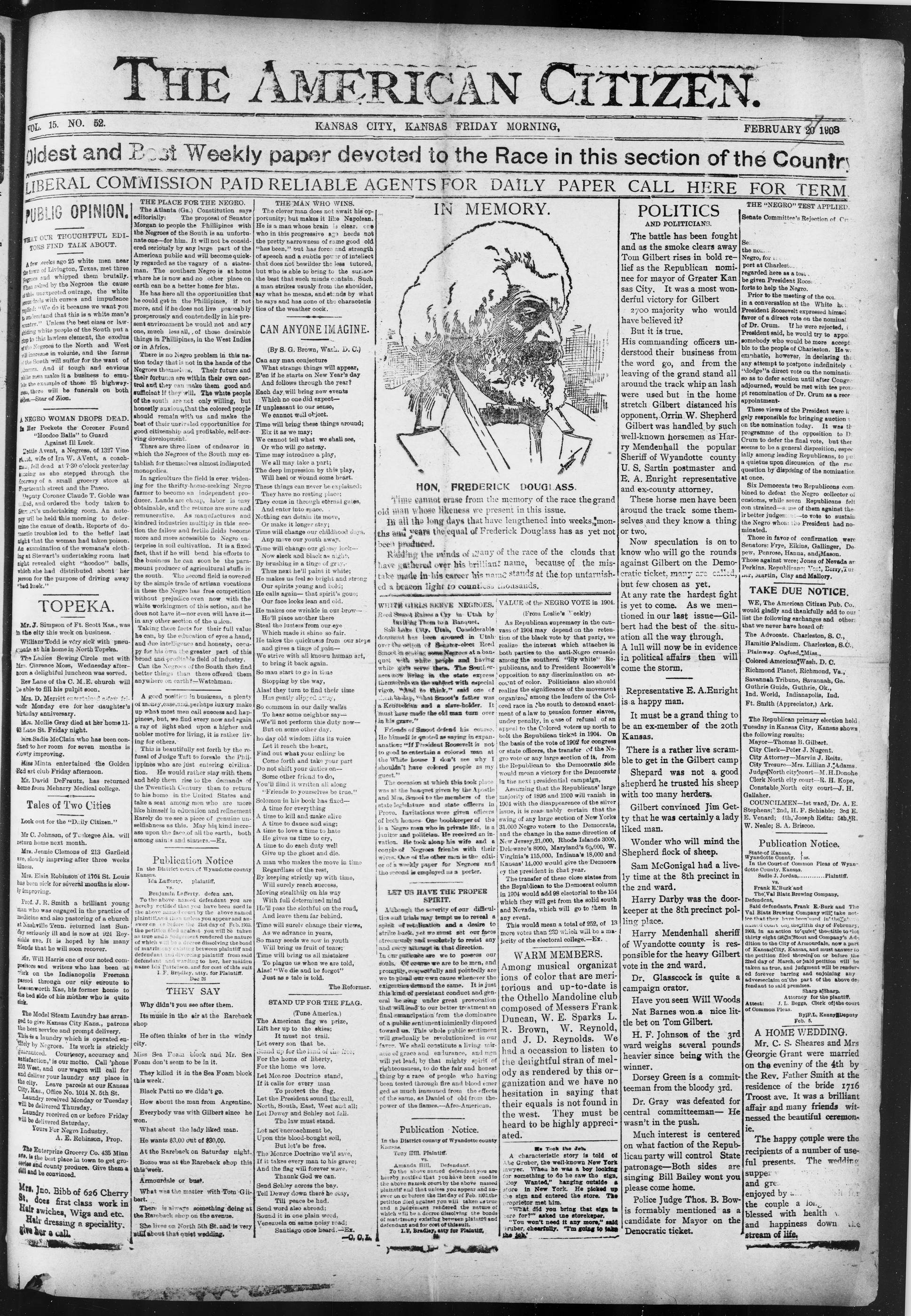
IN MEMORY.
HON, FREDERICK DOUGLASS.
Time cannot erase from the memory of the race the grand old man whose likeness we present in this issue.
In all the long days that have lengthened into weeks, months and years the equal of Frederick Douglass has as yet not been produced.
Raising the minds of many of the race of the clouds that have gathered over his brilliant name, because of the mistake made in his career his name stands at the top untarnished a beacon light to countless thousands.
WHITE GIRLS SERVE NEGROES. VALUE of the NEGRO VOTE in 1904.
Reed School Raises a City in Utah by
(From Leslie's Weekly)
Inviting them to a Banquet.
Sail Lake City, Utah. Considerable domain has been aroused in Utah over the notion of Greater-elect Reed Smoot in seating some Negroes at a banquet with white people and having white gates serve them. The Southernners now living in the state express themselves on the subject with especial vigor. "And to think," said one of him today, "what Smoot's father was a Kentuckyan and a slave-holder. It must have made the old man turn over in his grave."
Friends of Smoot defend his course. He himself is quoted as saying in explanation: "If President Roosevelt is not to good to entertain a colored man at the White house I don't see why I shouldn't have colored people as my guest."
The occasion at which this took place was at the banquet given by the Apostle and Ms. Simot to the members of the state legislature and state officers in Provo. Invitations were given officers of both houses. One bookkeeper of the is a Negro man who in private life, is a junitor and politician. He received an invation. He took along his wife and a couple of Negro friends with their wives. One of the other men is the editor of a weekly paper for Negroes and the second is employed as a porter.
LET US HAVE THE PROPER
SPIRIT.
Although the severity of our difficulties and trials may tempt us to reveal a spirit of realization and a desire to strike back, yet we must set our faces strewn with and resolute to resist any stress and encyter in that direction.
In our guilds are we to possess our souls. Of course we are to be men, and promptly, respectfully and pointedly are we to pledge our own cause whenever the exigencies demand the same. It is just this kind of persistent conduct and general beating under great provocation that will lead to our better treatment an final immaculation from the dominance of a public sentiment inimically disposed toward us. This whole public sentiment will gradually be revolutionized in our favor. We shall constitute a living mirage of grace and enurance, and men will yet lead, by that mighty spirit of righteousness, to do the fair and honest thing by a race of people who having been tested through fire and blood emerged as much immuned from the effects of the same, as Daniel of old from the power of the flames.—Afro-American.
Publication Notice.
In the District county of Wyandotte county Kansas.
Tony Hill. Plaintiff.
vs.
Amanda Hill. Defendant.
To the above named defendant you are hereby notified that you have been sued in the above namok court by the above named plaintiff and that unless you appear and answer on or before the first day of Feb. 1003, the petition died against you will taken as true and a judgment rendered the nature of which will be a decree dissolving the bonds of matrimony existing between plaintiff and defendant and for cost of this suit.
I.F. Bradley, atty for Plaintiff.
VALUE of the NEGRO VOTE in 1904.
(From Leslie's Weekly)
As Republican supremacy in the canvass of 1904 may depend on the retention of the black vote by that party, we realize the interest which attaches in both parties to the anti-Negro crusade among the southern "illy white" Republicans, and to President Roosevelt's opposition to any discrimination on account of color. Politicians also should realize the significance of the movement organized among the leaders of the Colored race in the south to demand enactment of a law to pension former slaves, under penalty, in case of refusal of an appeal to the Colored voters up north to bolt the Republican ticket in 1904. On the basis of the vote of 1902 for congress or state officers, the transfer of the Negro vote or any large section of it, from the Republican to the Democratic side would mean a victory for the Democrats in the next presidential campaign.
Assuming that the Republicans' large majority of 1896 and 1900 will vanish in 1904 with the disappearance of the silver issue, it is reasymably certain that the swing of any large section of New Yorks 31,000 Negro voters to the Democrats, and the change in the same direction of New Jersey, 21,000, Rhode Islands 3000, Delaware's 8000, Maryland's 60,000, W. Virginia's 115,000, Indiana's 18,000 and Kansas' 14,000 would give the Democracy the president in that year.
The transfer of these close states from the Republician to the Democrat column in 1904 would add 98 electorial to the 154 which they will get from the solid south and Nevada, which will go to them in any event.
This would mean a total of 252, of 15 more votes than 232 which will be a majority of the electoral college.—Ex.
WARM MEMBERS.
Among musical organizat ions of color that are meritorious and up-to-date is the Othello Mandoline club composed of Messers Frank Duncan, W. E. Sparks L. R. Brown, W. Reynold, and J. D. Reynolds. We had a occasion to listen to the delightful stran of melody as rendered by this organization and we have no hesitation in saying that their equals is not found in the west. They must be heard to be highly apprecii-
He Took the Job.
A characteristic story is told of Abe Gruber, the well-known New York lawyer. When he was a boy looking for something to do he saw the sign, "Boy Wanted," hanging outside a store in New York. He picked up the sign and entered the store. The acquaintor met him.
"You won't need it any more," said ruber, cheerfully. "I'm going to take the job."
The battle has been fought and as the smoke clears away Tom Gilbert rises in bold relief as the Republican nominee for mayor of Greater Kansas City. It was a most wonderful victory for Gilbert 2700 majority who would have believed it?
His commanding officers understood their business from the word go, and from the leaving of the grand stand all around the track whip an lash were used but in the home stretch Gilbert distanced his opponent, Orrin W. Shepherd Gilbert was handled by such well-known horsemen as Harry Mendenhall the popular Sheriff of Wyandotte county U. S. Sartin postmaster and E. A. Enright representative and ex-county attorney.
These horse men have been around the track some themselves and they know a thing or two.
Now speculation is on to know who will go the rounds against Gilbert on the Democratic ticket, many are called, but few chosen as yet.
At any rate the hardest fight is yet to come. As we mentioned in our last issue—Gilbert had the best of the situation all the way through.
A lull will now be in evidence in political affairs then will come the storm.
Representative E. A.Enright is a happy man.
It must be a grand thing to be an ex-member of the 20th Kansas.
There is a rather live scramble to get in the Gilbert camp
Shepard was not a good shepherd he trusted his sheep with too many herders.
Gilbert convinced Jim Getty that he was certainly a lady liked man.
Wonder who will mind the Shepherd flock of sheep.
Sam McGonigal had a lively time at the 8th precinct in the 2nd ward.
Harry Darby was the door- keeper at the 8th precinct polling place.
Harry Mendenhall sheriff of Wyandotte county is responsible for the heavy Gilbert vote in the 2nd ward.
Dr. Glasscock is quite a campaign orator.
Have you seen Will Woods
Nat Barnes won a nice little bet on Tom Gilbert.
H. F. Johnson of the 3rd ward weighs several pounds heavier since being with the winner.
Dorsey Green is a committeeman from the bloody 3rd. Dr. Gray was defeated for central committeeman—He wasn't in the push. Much interest is centered on what faction of the Republican party will control State patronage—Both sides are singing Bill Bailey wont you please come home. Police Judge Thos. B. Bowis formably mentioned as a candidate for Mayor on the Democratic ticket.
FEBRUARY 20 1908
the Country
FOR TERM
THE "NEGRO" TEST APPLIED.
Senate Committee's Rejection of
the no. Negro, for port at Charlest. regarded here as a test. be given President Roose forts to help the Negro. Prior to the meeting of the con. in a conversation at the White he President Roosevelt expressed himself favor of a direct vote on the nomination of Dr. Crum. If he were rejected, President said, he would try to appos somebody who would be more acceptable to the people of Charleston. He was emphatic, however, in declaring that any attempt to postpone indefinitely a "dodge"a direct vote on the nomination so as to defer action until after Congress, would be met with tee propt renomination of Dr. Crum as a recor appointment-
These views of the President were largely responsible for bringing auction on the nomination today. It was the programme of the opposition to Dr Crum to defer the final vote, but they seems to be a general disposition, especially among leading Republicans, to put a quistus upon discussion of the request by disposing of the nomination at once.
Six Democrats two Republicans combined to defeat the Negro collector of customs, while seven Republicans felt constrained—same of them against the it better judgement—to vote to sustain the Negro whom the President had nominated.
Those in favor of confirmation were Senators: Frye, Elkins, Gallinger, Depew, Penrose, Hanna, and Mason.
Those against were: Jones of Nevada as Perkins, Republicans, Vest, Dorry, Turner, Martin, Clay and Mallory.
TAKE DUE NOTICE
WE, The American Citizen Pub. Co,
would gladly and thankfully add to our
list the following exchanges and others
that we never have heard of:
Colored American, Wash. D. C.
Richmond Planet, Richmond, Va.,
Savannah Tribune, Savannah, Ga.
Guthrie Guide, Guthrie, Ok,,
Ind. World, Indianapolis, Ind.
Ft. Smith (Appreciator), Ark.
The Republican primary election held
Tuesday in Kansas City, Kansas shows
the following results:
Mayor—Thomas B. Gilbert.
City Clerk—Peter J. Nugent.
City Attorney—Marvin J. Reitz.
City Tresure—Mrs. Lillian J. Adams.
Judge North city court—M. H. Dohone.
Clerk North city court—R. H. Kope,
Constable North city court—J. H.
Gallaler.
COUNCILMEN—1st ward. Dr. A. E.
Stephens, 2nd, H. F. Schiable, 3rd E.
E. Venard, 4th, Joseph Reitz: 5th, R.
W. Neale; S. A. Briscoe.
Publication Notice
"State of Kansas.
Wyandotte County. iss.
In the Court of Common Pleas of Wyandotte County. Kansas.
The Val Blatz Brewing Company,
Defendent,
Sald defendants, Frank E. Burk and The
Val Blatz Brewing Company will take notice that they have been in the city
hamed court on the fifth day of February,
1903, in an action to 'quit' the title to this
thirty eight (38) Stout and Company's
Addition to the City of Armourdale, now a part of
Kansas City, Kansas, and must answer to
the petition filed there on February
22nd day of March, or said petition will be
taken as true, and judgment will be rendered
forever barring and enjoining any
adversal claim on the part of the above
defendant to said premises.
Sharp & Sharp,
Attorney for the plantiff.
Attest: J. L. Beggs, Clerk of the court
of Common Pieces.
ByF.L. Kenny Deputy
Feb. 5.
Mr. C. S. Sheares and Mrs Georgie Grant were married on the evening of the 4th by the Rev. Father Smith at the residence of the bride 1716 Troost ave. It was a brilliant affair and many friends witnessed the beautiful ceremonie.
The happy couple were the recipients of a number of useful presents. The wedding supper and greed enjoyed by the couple a long blessed with health and happiness down the stream of life.
THE PROBLEMS OF THE FUTURE
New York.—In a speech punctuated alternately by ringing cheers and chilling silence, Secretary of War Root, at the anniversary meeting of the Union League club, said that negro suffrage was a failure; that the growing divergence between the wealthy and the poor was finding a place in legislation, that every good citizen must set his face against the possibility of a war of classes, and thirdly, that the labor unions were setting a premium on slothfulness and stupidity. "There are great problems to-day calling for the best citizenship and the most devoted patriotism," he said:
"One is the tendency, growing, I fear, to dissensions between the wealthy and the poor, under which wealth tends constantly to endeavor to control matters generally through egalisation, thus stirring up a conflict and a war upon the wealthy, based upon envy and jealously. Every good citizen should make his protest and set his face against it and make it certain that in this country of ours we shall have no war of classes.
"A second problem is a tendency to check individual enterprise and development. The chance that every poor boy has by his own efforts, his industry, his energy and his courage, to rise as high has a man can rise is the very foundation of our liberty.
"Labor unions are increasing the prohibition against the better man making the most wages and doing the most work he is capable of, in favor of the poorer workman. This is putting a premium on sloth and stupidity. I make no war on labor organizations; I believe in them. I believe that in the struggle for life now with its growing riches the laboring man is bound to organize. I believe he is entitled to do so, and I am glad to see him organize to get his own. But let us set our faces against the tendency to say to any American boy, 'You shall not do the best you can.'
"A third problem is one with which this club might be concerned. You have heard the speakers tell to-night of the organization of negro regiments by this club and of their marching down broadway beside them. Within two years after the foundation of this club, the nation, by the thirteenth amendment, provided that slavery should not exist in this country. By the fourteenth amendment the nation recognized the black man and provided that all men born or naturalized in this country should be citizens. By the fifteenth amendment it declared that no man should be debarred from voting if he was a citizen and eligible. "Those he three amendments embodied
"Those three amendments embodied the scheme adopted by thoughtful men
PRINCESS AND GIRON PART.
Lawyers Were Present, Tears Shed, but She Will See Her Children.
Geneva.—The legal advisor of the former Crown Princess of Saxony has made the following announcement:
"M. Giron will leave Geneva for Brussels, where he will join his family. M. Giron has broken off all relations with the princess in order not to impede the reunion of the princess with her children."
Herr Zehme, the lawyer from Dresden, arrived at Geneva and went immediately to the Hotel Sulse, where the Crown Princess of Saxony, M. Giron and Mattre Lachenal awaited him. A long interview took place, in the course of which the princess, in a torrent of tears, cried: "I must see my poor children again."
Immediately after it was over Herr Zehme announced that all relations between the princess and M. Giron had been completely broken off and that M. Giron was returning to Brussels in the evening. He intends never to see the princess again. When asked who arranged this, the lawyer said that he and M. Lachenal had done so. M. Giron, he declared, was making a great sacrifice for the good of the princess. This was in reality the only possible solution, as the princess would not relinquish the liberty to see her children, which the crown prince insisted upon withholding unless she consented to separate from M. Giron. The parting between the princess and M. Giron was most touching. The princess wept and M. Giron was much affected. The princess will remain at the Hotel Suisse an indefinite time.
5.Million Dollar Deal.
Los Angeles, Cal.-The Montezuma group of gold mines, in the Popago district of Chihuahua, Mexico, has been bought by the United Mining and Exploration company of Los Angeles. The purchase price of the property is said to have been 5 million dollars, and it was stated at the company's office here that at least one-half million dollars will be expended in the development and equipment of the property.
Young Was Held to Be Sane.
Young War
New York—William Hooper Young, on trial for the murder of Mrs. Anna Kingston Pulitzer, has been declared sane, by a commission in lunacy, composed of three physicians appointed by Judge Herrick.
The Coal Famine is Ending.
Reading, Pa.—Officials of the Reading railway announce that they have the coal situation well in hand and that danger of fuel famine is over.
Latest photograph of the Marchioness of Anglesey, one of the most beautiful women of the English nobility.
The Marchioness is separated from her husband, who is the head of the noble House of Paget, and resides in Paris for the most part of the year.
EW YORK Letter: The fashionable girl of spring will be a pretty oat turtle. She will be severe, but feminine; simple, but elegant; her gowns will reveal the most delightful color schemes, but at all times will they be harmo-
gown is on the shirt-waist and skirt order, but made very simply and gracefully. Accompanying such a toilette is a smart toque of greevel. Its only trimming consists of a large blue and green bird which covers the left side and droops over the back of the toque. Desiring a touch of grey in the hat a
The spring novelties which now occupy the places of honor in the shops, having relegated winter fabrics to the bargain counters, are not necessarily expensive, though there are instances in which one might run the limit of extravagance. Happily, dress which for a short period is a sharply accounted dividing line between the rich and poor has today levelled all class lines, and some of the most beautiful materials are so cheap that they are easily within the reach of the woman with a limited dress allowance.
For instance, among the smart fabrics in which the newest shirt waists appear are mercerized cotton, madras, or a Naincoook Raye, which, by the way, is no more or less than a linen-finished cotton fabric with a high-sounding name.
The spring shirt waist, while it itags over the belt at the front, shows a square, rather than the rounded outline of previous years. This is a French garment that will become very popular in America, especially with slender, graceful women.
The shirt waist suit which appeals principally to women whose mornings are devoted to shopping is diversified this season by a few touches of color. An especially chic design is carried out in gobelin blue fondard embroidered in silk. The gobelin waist closes with an elastic oxplait and has two narrow plats at the shoulders intermingle gracefully with the folds of the blouse effect at the end of the stitching. The sleeves are in bishop pattern and have an inverted box-plait to the elbow. A novel idea is expressed in the hip-ripper, which is made in one piece the narrow the sleeves the skin and supports three wide floures which are unlined, but given support by a drop skirt of gobelin blue tintafta. Still another shirt waist frock is made of putty colored pongee and has the skirt shirred around the top in simulation of a hip-yoke. The waist is made in a gobelin blue tintafta and down the front with the Japanese alphabet in bright colored silks.
The new color schemes are to be recommended for their daintiness and general becomingness. Grey with shades of sage green, is a favorite combination, although it is often compelled to share with white cloth and ercu lace. Indeed there are but few combinations which do not include the lace, for, like the touch of black, it lends character to a gown when other trimmings fail. Brown and white, one of the most sought schemes of winter will be a heritage of spring fashions. A very smart street gown is of brown and white mix, but burnt orange mitered with black. The jacket has bishop sleeves and a loose plinted front, with a double collar and a stole which are piped with silk. The skirt has a habit back and is ornamented with wide straps of the material piped with silk. Dark brown crocheted ornaments form an effective finish. For something that is really smart and inexpensive nothing could be more satisfying than a gown in dark green velvet flecked with French gray. The
Theodore Hallam, one of the most celebrated of legal practitioners, once defended a burglar; and the case gave him a story that he never tired of telling. The prosecuting attorney was fighting vigorously, and had the defendant's wife on the stand.
"You are the wife of the prisoner?" he asked her.
"Yes," she replied.
"Did you know his mode of life when you married him?"
"I did, sir."
"Will you tell us, then," went on the prosecutor, surprised by this admission, "now you came to contract an
One of the largest barber "colleges" in New York is located in Canal Street. The customers of this school of instruction present a heterogeneous picture. The aggregation is truly grotesque in appearance. Only the "way down" brother is barred from availing of this opportunity of having his face and head operated on. No fee is charged for shaving, hair cutting, singeing, dyeing or shampooing. Even beard trimming is included in this free list. The students pay for tuition, and the student claims that more thor-
for uplifting those long held in slavery, Give him suffrage and citizenship and equal rights and he will rise, they thought.
"I fear we are compelled to face the conclusion that the experiment has failed. The suffrage has been taken away from the black man is most of the states in which he composes the larger part of the population. The black man in the South, generally, no longer has practically the right to suffrage.
"It is probably but a matter of time when the overwhelming dominant white opinion will succeed in excluding the black man from all offices in the Southern states.
"So, the country has to face the failure of the plan formulated at the close of the war to elevate the black man by conferring the suffrabe upon him.
"We can never throw up the responsibility for these people held in slavery for so many generations. The new question, What can be done for them, now that the first plan has failed is one that challenges the best thought and the best patriotism of our country."
"A curious development has been seen within the past year. President Roosevelt has appointed fewer black men than President McKinley, and there are to-day fewer black men holding office than when McKinley died. Yet loud outeries are to be heard in the South about President Roosevelt's policy of appointing black men to office in the South. Under previous Presidents, McKinley, Cleveland, Harrison and back to Hayes's time, more negroes were appointed to office and nothing was said.
"A black man attended an official reception in Washington at the White house a short time ago. The black man, as official of the government, had always attended these receptions. Yet the invitation of the President to these men was the signal for an outcry of a thousand papers in the South that the whites were being insulted. For an instant, after the Secretary of War had finished a hush fell upon the audience. Then the applause was fairly deafening. It continued for at least two minutes, swelling all the time, and finally broke out into voiceless cheers.
The occasion was the fortieth anniversary of the founding of the club. Around Mr. Root on the platform in the large hall of the club sat fifteen of the thirty-two survivors of the 534 men who joined the club in 1863. Four hundred members were present when the senior vice president. William E. Dodge, in the absence from the city of the president, Cornelius N. Bills, called the audience to order.
BRYAN WILL NOT ATTEND
Refuses to Be at Harmony Banquets With Cleveland.
Chicago.—William J. Bryan declares that he will refuse to attend any banquet to which Grover Cleveland is to be invited.
Mr. Bryan's declaration was made through an intimate friend to the officers of the Iroquis Club, which intended to invite Bryan, Cleveland and other Democratic leaders to a banquet to be held on Jackson's birthday, March 16.
It had been proposed to make this banquet the occasion for a national Democratic love feast. The banquet committee of the club had prepared a list of prominent Democrats to whom invitations to be present and deliver addresses were to be sent. The first name on the list was that of former President Grover Cleveland. The second was that of William J. Bryan.
Mr. Bryan passed through the city and saw the list of speakers at the Iroquis banquet that had been published and immediately declared that he would not attend the banquet.
"What need is there of inviting anyone else to a banquet at which Grover Cleveland is to be present?" he asked, and he requested a friend to have his name stricken off the list of those who were to be invited to the Iroquis Club banquet.
Among the men who are to be invited to attend the banquet are: Grover Cleveland, Horace Boise, David B. Hill, J. J. Hill, Richard Olney, William C. Whitney, Daniel Lamont, Don M. Dickinson, Henry Watterson, ex-Attorney General Harmon and Senator Bailey.
Roosevelt Is Confident.
Washington.—"I have quit worrying about my nomination," President Roosevelt said to a friend recently. "I consider that settled and I am quite sure that I will be the choice of the convention. "What I am worrying about now is whom the Democrats will nominate. From all I can learn and from the trend of things in general it seems to me that a man from my own state, Judge Parker, will be my opponent."
Brazil Wants No Meditation
Washington.—Senor Assiz Brazil, the minister from Brazilil called at the state department Saturday to talk with Secretary Hay over the threatening conditions in Acre. The secretary's efforts to prevent hostilities have not succeeded and he is restrained from tendering the good offices of the United States by an indisposition upon the part of Brazil to accept them.
Fashion Notes of Today.
BRITISH SOCIETY LEADER.
As to Two Exile
BARBER'S WORK GRATIS
gown is on the shirt-waist and skirt order, but made very simply and gracefully.
Accompanying such a toilette is a smart toque of gree velvet. Its only trimming consists of a large blue and green bird which covers the left side and droops over the back of the toque. Desiring a touch of grey in the hat a white wily feathers of this shade might be selected, but the blue and green is quite the most chic novelty of the day.
There are a thousand ways of employing tucks on suits and bodices and each is distinctive and pretty. Royal blue zibeline is selected for a dressy street suit for spring wear. The gown is decorated with narrow corded tucks and pipings of blue satin and was designed especially for the automobile show which is attracting considerable social attention. It is made with a pipelm and bell sleeves. It has a rolling collar and revers of blue satin applied with white lace. The finishing touches are gained through an imposing silk cord and ornaments matching the suit in color.
Beaver hats will be worn very late and becoming in apropos by the coming of spring weather will be supplanted by chiffon designs carrying out the same ideas in shape and trimming. One of the daintiest confections of the season is a hat of grey beaver trimmed with white pipelines that extends across the front and over the upturned brim on the left side, with a long grey and white plume.
A novelty that promises to be more than a passing fancy is shown in the new gloves. They are made of suede and widening with something of acircular flare above the last button are cuffs of the suede embroidered in silk in raised designs. This necessitates the wearing of the sleeve waistband beneath the glove, but as the embroidered shown on the gloves are in the season's popular shades it is an easy matter to select tints that will harmonize with the gown. The men has been impressed into service to provide a vaguely of fashion, just as towelling was employed last season. A fetching waist is designed of heavy satin damask, with a yoke back and front and a large box plait down the front, with immense pearl buttons. There is a plethora of novelities in the shops, though the majority are of the variety classed as transient. The varicolored silk buttons finished with cords and tassels will remain, because there is something of grace in the tassels as well as the richness of the body, and grace is an element today which all energies are concentrated.
A collarette really girlish in its attractiveness is of white satin and accordion plaited chiffon from a short cape below the stole of satin. Accompanying the collarette is a hat of white chiffon, finely shirred, with a cluster of velvet sleeves beneath the brim and close to the hait in front.
MAUDE GRIFFIN.
Mayor Hayes, of Baltimore, is endeavoring to have abolished the city's exaction of a fee of 15 cents from sightseers who go to the top of the Washington monument. There is a fine view from the top. The city now receives an average of $10 weekly from the fees, which are applied to the general fund for the maintenance of parks and squares.
One in 81 men employed on sailing ships was drowned last year, while of those employed on steamships the proportion was one in 343.
alliance with one of his kind?
"Well," she answered, ingeniously. "I was getting on the other ships had all been married, and I at last had no choice but between him and a lawyer who was courting me."—Philadelphia Ledger.
Derbyshire, Devonshire and Westmoreland provide the finest marbles found in England.
The record of timber produced from one tree was 80,000 feet from a redwood 30 feet in diameter, cut last year in California.
ough artists result from practical than theoretical training.
Bishop Conaty, rector of the Catholic university at Washington, according to a Rome dispatch, appears to have the best chance of appointment to the bishopric of Los Angeles, Cal. When the congregation of the propaganda meets on Jan. 19, the filling of this vacancy will come up.
Experiments in the use of electricity as an aesthetic are about to be made on human subjects by a French doctor at Nantes.
THE FEELINGS OF PLANTS.
They Have Electric Thrills and Sentient Impulses.
Long ago Sir J. Gordon Sanderson showed that electrical manifestations were capable of being demonstrated in the case of the movements of the fly-catching plant of North Carolina known as the Dionaea, or "Venus" fly trap. He deduced from his experiments a close analogy between the electrical reactions of the plant and the fly. This observation naturally leads to ward the recognition of a common basis for the movements of animal and plant life. More recently experiments seem to indicate that such electrical responses are possibly universal through the plant world. Bose has shown, for example, that in the case of the leaf stalk of the horse chestnut, or the root of the plant, a wound was noted in the stalk from a part which had been injured to the uninjured portion. This corresponds with what is known to occur in experiments on animal tissues. When the stimulation ceased and the tissue regained its normal state "a current of rest" was observed to be established, such as may be seen in the natural condition of the plant.
All such experimentation bears very directly on the question of plant sensitiveness. Most of us regard the plant as a purely vegetable thing, living, but incapable of reasoning, as does the animal, to stimul which affect a nervous system. This view is founded on a misconception of life's constitution at large. Plants live because they contain protein, and because they are sensitive to the latter, as regards sensitiveness at least, may be regarded as practically identical in the two great groups of living nature. Time was when the living matter of plants was regarded as being confined within cells, each of which was shut off from its neighbors. Now we know that delicate threads of living matter run from cell to cell. Hence it may be pre-defined in the organism on the protoplasm of one part of the plant it may be transmitted to distant parts of the organism. Some plants—sensitive in their nature—show the results of stimulation by the drooping of leaves and like actions. But even in plants w.hich do not exhibit such obvious results of stimulation we may postulate sensitiveness (accompanied by a wide range of other signs) and the ward sign of the irritation is manifested. It is because plants have immovable tissues, so to speak, that they do not exhibit movements as a rule. Yet when a daisy closes its petals under the influence of a cold wave on a summer's day we are surely in the region of sentient life, manifested by actions not far removed from those of the animal and specially from those of lower animal life. When a flower blooms the air it breathes" may, after all, be founded upon a scientific basis—London Chronicle.
TRICK ON THE MINISTER
Why His Congregation Occupied the Front Pews.
One of the ministers of the city—who for obvious reasons doesn't care to have his name mentioned in the matter—tells a story of a trick that one of his chums put up on him during the early days of his ecclesiastical career. The echum was on sociable terms with the officers of the church he attended and secured the appointment of his friend as supply on one of the Sundays during the summer vacation. "Now, Jim," the chum said, after the young minister had thanked him, "there is one thing I would like to have you remember when you preach at our church. Nearly all of our people are away, but, strange to say, the morpory that that one in them bear. They haven't been able to supplies we have had so far. So please do use every bit of voice you have to make those people hear what you have to say."
Accordingly, the minister, remembering his chum's instructions, let loose the full strength of his voice when he conducted the services of the church in question on the following Sunday, and the minister—let it be remarked here, while not of especially robust build, has been endowed by nature with vocal organs of a particularly powerful variety.
The minister said in telling the story, that he noticed, with both surprise and pleasure, that the greater part of the congregation was seated near the front, instead of off in the rear seats, as in most summer congregations. He didn't use all of his strength, he says, in the opening prayers, but waited for the congregation to come and all he was worth. At any sign of restlessness or unnessiness he redoubled his efforts.
When the service was over one of the officials went to the clergyman—the chum was out of town, by the way—and, after expressing his interest in the sermon, said he had been greatly surprised to find the preacher the possessor of such a powerful voice. "Your friend," he said, "told us that you were a good preacher, but that your voice was extremely weak, and that it was difficult to hear you unless one sat far up toward the front. So we brought everybody as near the pulpit as possible." But "understand," the minister said, "that, though some mysterious dispensation of Providence, nearly all your people were deaf."
Explanations followed, and it was well for the chum just then that he was spending Sunday out of town—Baltimore Sun.
Dr. Sewell, who has announced his intention of resigning the office of warden of New college, has long ago been the dean of the heads of houses at Oxford, and the last survivor of the dons of the old school. He came up from Winchester as a scholar of New college in 1827, and has ever since been a member of that society and in constant residence. He was an intimate friend of Dr. Routh, the celebrated friend of Magdalen college, who died in 1854, at the age of 100 years, and who had several times met Dr. Johnson during his frequent visits to Oxford.
A Rewriter from Bukharek says: The council of ministers is considering the question of the Second International Petroleum congress, which it is proposed to hold here. Although the council has moved towards the congress, it has yielded the insistence of M. Sturdy, premier, who says he fears the holding of the danger of Roumanian petroleum becoming monopolized by foreign capitalists, and may also entail large expenses. The total expenditure, how
L. S. Elmer, assistant chief clerk of the postoffice department, is known as an authority on the postal laws and regulations of this and other countries. He compiled the postal manual, which presents the salient points of the postal laws in concise form. Mr. Elmer has been in the service about 20 years.
The new archbishop of Canterbury will now have an income of 875,000 a year, besides fees and perquisites which may seem large to some Western country ministers.
OKLAHOMA BRIEFS.
Willis Griffin, the first white child born in Guthrie and the territory after the opening of old Oklahoma in April, 1889, is dead. His parents participated in the run, secured a claim and have lived there ever since.
Intense excitement prevails in Taloga and Dewey counties over the discovery of gold, copper and iron ore on the farm of R. M. Maloney, five miles northeast of Taloga. Business has been practically suspended there, so great is the excitement. Hundreds of people are flocking to the scene.
It is estimated that this season's cotton crop in Oklahoma will reach 175,000 bales, the greatest in the territory's history. Out of the twenty-six counties in the territory, twenty are cotton producers. Dealers state that the total acreage increases gradually each year. The ruling price during the season has been 8 cents.
The cost of care and maintenance of Oklahoma's deaf and dumb and insane as well as of the territory convicts, all of which is done under contract for two years, at shown by Territorial Auditor Baxter's statement recently made public, is: Insane, $122,757; convicts, $69,894; deaf and dumb, $28,675.
Oklahoma City was in danger of destruction one day last week. A blaze that started caused a loss of 1/4 million dollars. The wind was so strong that for a time it seemed as if the fire could not be checked. Calls for aid were sent to Guthrie, El Reno and Purcell. All three cities responded. Fire departments were sent by special trains. They got there in time to aid in stopping the flames.
At Mangum, even the electric light plant does not run on Sunday, because the manager was notified to keep it shut down, under penalty of prosecution for violating the Sunday law. Causing the electric light plant to shut down Saturday night at 12 o'clock and remain shut down until Monday morning is rather inconvenient for the townsmen of that city and they are trying to have the law changed.
Some weeks since an Oklahoma merchant ordered ten pounds of salt-peter from his jobber and received it immediately by fast freight. It was sold to farmers of the neighborhood, who used it in curing meat. Recently so many complaints came in of the aperient properties of the meat treated that the wholesaler was asked to look into the matter, and it was found that a careless packer had sent eposm salts.
Fifteen families passed through Shawnee the other day for South Pottawatamie county, where they will settle on lands recently purchased. Most of them were from Western Missouri and Eastern Kansas, although several were from Northern Iowa. Immigration to South Pottawatamie county is rapidly increasing and most of the incomers are prosperous and money farmers from the Northern states. In nearly every case they are inaugurating substantial improvements in the way of replacing pioneer houses with good frame houses and other improvements.
INDIAN TERRITORY
The Kiowa and Comanche Indians will be paid $200,000 within the next sixty days.
In Judge Gill's court, in the Northern district of the Indian Territory, the trial of Earl Holt, charged with the murder of James Holland, of Westville, was concluded last week and the jury returned a verdict of not guilty. The trial lasted a week and was bitterly contested by both sides.
Deputy marshals arrested Noah Hawkins, of Ada, a well-to-do fullblood Indian, charged with the recent murder of Stephen Huller. It is alleged that both were in love with the same Indian malden, and that Hawkins, in order to get rid of his rival, murdered him.
The Cherokee land office has been in operation at Vinita for one month, and the work of the month is as follows: Tickets of admission issued, 3,902; total number of tickets admitted during the month, 603; total number of individual allotments made during the month, 1,045; additional locating clerks have been added to the force and the allotments will be made a little faster. At this rate it is estimated it will require three or four years to allot the Cherokee nation.
Following an investigation by the chiefs of the Klowa, Comanche and Wichita affiliated tribes of Indians whose reservation in Oklahoma was recently opened to settlements, agents of immigrant land grants in Old Mexico are now with them to close, if possible, a deal by which the Indians take 1,780,000 acres of land asking the Rio Grande river, in the state of Chihuahua and Ahuila. The chiefs have reported favorably on the land to their tribes. It is claimed that 1,000,000 acres will cost 50 cents each and the remainder at $1 per acre.
Of the 12,398 Germen naval and military delinquents sentenced last year, forty-two were punished for duelling.
CANCER CURED
WITH SOOTHING, BALMY OILS.
Cancer, Tumor, Catarrh, Piles, Pistulia, Ulcera,
Ectomia and all Skin and Kneel Disease. Write
for Illustrated Book. Sent free Address
DR. BYE, Cor. 9th & Broadway, Kansas City, Mo.
PISO'S CURE FOR
CURES WHEN ALL ELSE FAILS
Best Cooling Syrup for
Good Sleep in time.
Solid by design.
CONSUMPTION
Over 300 Bismarck Monuments.
The number of Bismarck monuments
of all kinds in Germany and other
European countries now exceeds 90
by one.
Building a Movement
Building a Memorial Hall.
A number of citizens of Cambridge,
Mass., are planning to erect a $300,000
memorial hall as a meeting place for
patriotic and historical organizations.
The idea is to make it what Fancel
Hall is to Boston.
Insures Good Troubles
Treatment
Joseph Market, a citizen of Marion
Ind., aged 80, and said to be worth
$100,000, married Miss May Darv
aged 25. Market was a widower and
has four children. He did not wish to
marry a woman who wanted him only
for his estate and to insure he'd
good treatment made a contract with
the young woman setting forth that
she is not to get any of his estate
death, but is to receive $5,000 a year
as long as she keeps him alive.
Chinese Students Come Here. The two Chinese students who had been "held up" by the San Francisco immigration officials, under the interpretation of the Chinese exclusion law, and who were released recently by the decision of the treasury department, were the first of the number for which the Chinese government under an imperial decree issued last year, made provision to send to educational institutions in this country. The students are sent here at the expense of the Chinese government to take postgraduate courses, and upon their return to China those successful in the aminations will be appointed to government positions.
How's This?
We offer One Hundred Dollars in ward for any case of Catarra that cannot becured by Hall's Catarra Cure.
F. J. CHENEY & CO., Toledo 9
We, the undersigned, have known F. J. Cheney for the last 15 years and believe him perfectly honourable in all business transactions and financially able to carry out any obligations made by their firm.
West & Truax Wholesale Directs
West & Truax, Wholesale Druggist
Toledo, O.
Walding, Kinnan & Marvin, Whole sale Druggists, Toledo, O Hall's Caturbur Cure is taken internally acting directly upon the blood and mucous surfaces of the system Testimonials sent free Price No per bottle. Sold by all Druggists.
No Pension for Corns.
A veteran of the Spanish war recently applied to the secretary of the interior a case which he claimed a pension on account of corns that he had contracted by wearing army shoes. The department, after an exhaustive course of reasoning, comes to the conclusion corns are not a pensionable disability. The decision says: "Corns are inconvenient, but are seldom incapacitating, and when they are the remedy is simple and within easy reach of anyone. The soldier's patriotism ought not to terminate with his military service. It should prompt him to go to a chirpistologist rather than to the pension bureau.
An Important Discovery.
An Important Discover
Granton, Okla, Feb. 9th. Afterteen years E. H. Gosney of Granton has at last found a cure for Kidney Trouble. Mr. Gosney suffered very severely with Kidney Complaint and some teen years ago made up his mind to find a cure if one was to be had.
He has tried and tried and experimented with every kidney medicine he could hear of. Although he was all ways disappointed he kept on trying till at last his perseverance was rewarded and he found a complete cure.
He is a well man today and explains it as follows:
"Everything failed to cure me and I was growing worse and worse till I tried a new remedy called Dodd's Kidney Pills and I had not taken many of them before I knew I had at last found the right thing. I am entirely cured and I cannot say too much for Dodd's Kidney Pills."
A NEW KUNDERSTEIN
There is a rich gold field in New Mexico that is known to be ten miles square and the gravel is ten to 1000 feet thick, in which there is enough gold to pay the national debt.
This deposit of gravel has been formed by the action of water, cooling the tops of the many rich quartz veins on the Ortiz mountains, on which is located the Santa Fe Gold and Copper Co. mines, that have paid over $17,000,000 to the owners.
The famous Lincoln Lucky mine is also on this mountain and it has paid over $100,000 in one year to its holdholders.
SHOOTHOLDER
Adjoining Lincoln Lucky, on the
south side, is located the C. & C. Consolidated, with a rich body of ore that will net from $40 to $150 per ton. Within the next year this mine should be the largest producer and most profitable of any in the camp.
A small amount of money invested in it now will make you wealthy in a short time.
For the next 30 days you can some of its treasury stock at 50 per share, fully paid and non-assessed; it is being sold to equip the mine with heavier machinery than that now in use.
use.
Don't fail to get some of this stock
at this price. We want a few agents
in different localities to sell this stock
for the next 30 days. Cut this out and
write for them and prospectus to
for terms and conditions
Commercial Accommodation Co.
104 West 9th St. Kansas City, Mo.
KANSAS NEWS BRIEFS.
A Senate joint resolution was adopted
week authorizing the Secretary
to supply a condemned cannon
and life aide statue of General Henry
Greenvorth at Leavenworth, Kas.
The Bowersock bill providing for
holding of terms of the circuit
and district courts of the United
States at Kansas City, Kas, and for
purpose, has been reported
specially to the senate.
That new divorce bill before the
masse house has much to say about
the respective rights of husbands and
wives. But it is voiceless on the is-
sisted by a Horton preacher the
day when he spanked his wife
at the board.
One member of the legislature in the day last week asked one railroad company in Topka for twenty-seven passes, and got them. They were a total of 14,570 miles, and if paid for at regular rates would have amounted to $437.10.
In order to get all the old Price and claims in shape so that the state can determine what to do with them, monitor Porter introduced a bill pro-gram for the appointment of a commissioner to investigate the claims and file a report with the legislature two years hence.
Discussion on ex-Governor Stanley's "ward" has been renewed. It is proposed to make him a federal judge, which revives the old plan of dividing as state into two federal judicial districts. A federal judgeship is a job, and the most desirable place on the political calendar.
There are 138 employees about the dassas senate. Presuming that each paid $3 a day, each of the forty senators commands patronage to the amount of $10.35 a day. The senator himself is a $3 man. Therefore each senator is costing the state $13.35 a day. And some of them are cheap at the price.
The senate and the house differed in the question of the amount of postage necessary to send out Secretary Johnson's agricultural reports. The senate gave him $4,300 and the house it to $2,300. The senate refused to concur, and the house, refusing to exclude, the bill was sent to a conference committee.
A section hand working in Wallace county was killed by a train the other day. It was found that he had $2,056 in his person. It represented his earned earnings during sixteen years of working at the poorest paid job on railroad. It seems to prove that an can lay by something, no matter that his job may be.
W. S. Commers, a brother of the man's place by being thrown from a his pace by being thrown from a wadmill. Commers climbed upon the wadmill to oil it. A sudden gust of wind moved the wheel and brushed it off. He fell forty feet to the ground, striking on his face. He died while on the way to the hospital.
The surviving members of the Tenth Kansas cavalry want their regimental his placed with the other Kansas regimental flags in the adjutant general's office. It is now in the possession and beers of the late Governor Harvey. Senator Stewart has had the senate adopt a resolution, authorizing the executive department to negotiate for the flag.
James Uhl, who lived fifteen miles west of Leavenworth near Jarbalo, hanged himself in the barn of his grandmother, Mrs. Phoebe Porter last week. Uhl was 21 years old. He has been very dispondent and seemed to be amputated. The farmers living near refused to touch the body until the trooper arrived from the city and ordered it taken down.
Including Chester I. Long, Kansas has had fifteen United States senators. James H. Lane and Samuel C. Pomeroy were the first two. The successors of Lane have been Edward Ross, Robert Crozier, Alexander Caldwell, James H. Harvey, Preston B. Plumb, Bishop W. Perkins, John Martin, Lutes Baker and J. R. Burton. Pomeroy's successors have been John J. Inglis, William A. Peffer, William A. Harris and Chester I. Long.
W. E. Richey, of Harveyville, one of the directors of the State Historical Society, was in the southern part of Geary county last week to investigate the prehistoric camp that was unearthened near Skiddy two weeks ago. He secured several of the articles found in the old camp that was about eight feet underground, and expressed the belief that they were left at that place by members of Coronado's little army that is supposed to have made an expedition into this part of the country in 1541.
Last week Sheriff Roadhouse discovered that Charles Parmenter, a notorious character, who was to be tried in a few days for murder, was making a desperate effort to break jail. He had sawed two steel bars of his cell almost through, and had filled the spaces with soap to avoid detection. Three saws were found in Parmenter's neck, and two more and a large driver were found in his cell. Will Stoltzman, on trial for murder, gave the sheriff the information that led to the discovery. Parmenter has been placed in close confinement.
Convicts in the state penitentiary already mine coal and make binding twine, and it is proposed to make them build roads and manufacture brooms and other things.
Representative Jackson, of Kansas, presented to the house the resolution recently adopted by the Kansas legislature petitioning congress to name one of the new battleships recommended by Mr. Roosevelt, the "Kansas."
While Henry Weithorn, a prominent farmer living northwest of Seneca, was carrying a post behind one of his horses, the animal became frightened and kicked at the post, one end of which pierced Weithorn's side. From the effects of this he died.
The Orient railroad has won a valuable recruit in Frank Grimes, who has been appointed its Kansas reprepeka. Mr. Grimes is a clever politician, and his excellent record as state treasurer during the last four years is proof that he is a good business man.
Benjamin Knott, a man about 70 years old, was found dead in his room at Bird City. The coroner found that he had been murdered with some blunt instrument. He had sold his farm a few days before and had received $300 in part payment. He had $90 when found.
Of all the vagaries concocted in the mind of an insane person, that of a farmer in Osborne county is the strangest. He thinks he is on a railroad train bound for heaven, and that his dog, Ring, is the conductor. He beseches his friends to get aboard before Ring pulls out and leaves them.
B. P. Waggener has withdrawn his resolution to place a bust of John J. Ingalls in a niche of the rotunda of the national capitol. The ancient enemies of the late ex-senator served notice on Waggener that they were preparing to fight the measure, and rather than have a row Mr. Waggener decided not to press it.
The case against Mrs. Henry Lowry at Wellington charged with complicity in the murder of her infant son, was dismissed by the county attorney, Henry Lowry, who was found guilty of administering morphine to the child is now serving a sentence of twenty-five years in the penitentiary. The child was not Lowry's.
Senator Smith has introduced a bill providing for an indeterminate sentence for prisoners convicted of a felony. The bill gives the court the right to sentence prisoners to prison for an indefinite time. The present board is given authority to release when in its opinion the convict has served long enough.
J. M. Blackwell, a well-to-do Lyon county farmer, was adjudged insane in the Lyon county probate court. He is 46 years old and has a wife and nine children. His insanity is due to worry over his corn crop. He has 100 acres of corn not yet gathered and threatened to kill anyone who gathered it before corn raised to 50 cents a bushel.
Sometimes it is on the "side" products of the farm that Kansas farmers make the most money. Last summer Will Keller, near McLouth, in Jefferson county, planted twenty-eight acres in sorghum. From the crop he sold 3,500 gallons of syrup at 20 cents a gallon and 1,025 bushels of seed at 70 cents a bushel. The net return from both was $1,417.50.
The largest cash bond ever put up in Kansas in a criminal case was filed with the district clerk of Smith county. Albert Jordan and his wife were arrested some days ago, charged with beating an adopted son to death. They were farmers. Nobody would go on their bond, which was fixed at $18,000. They put up the cold cash and were released. Jordon said he could have put up a $150,000 cash bond if it was required.
Thomas Lawson, the millionaire horse breeder, has just announced the award of prizes in his contest for the best named trotting horses registered during the year 1902. E. N. Thomas, of Colony, Kas, was awarded a special prize for the name Aurelette, chestnut mare, sire Aurelian, dam Palizette, Mr. Lawson gives as his reason for the award: "Combination of Aurelian, the sire, and Palizetti, the dam, seemed very appropriate."
The State Society of Labor has concluded its annual meeting. These officers were elected for the coming year: President, George Brandon, Leavenworth; vice president, J. H. Campbell, Wichita; secretary, W. L. A. Johnson, Topeka; assistant secretary, W. D. Robinson, Pittsburg. By virtue of their offices Johnson is made state labor commissioner and Robinson assistant state labor commission-
A peculiar situation has come to light in Jewell county, where R. R. Skelcs has held the offices of county commissioner and member of the council of the city of Burr Oak for the last year. The constitution provides that a county commissioner shall hold no municipal office, but this was not discovered by the residents of the county until Mr. Skelcs had served a year. There is now a probability that the acts of the board of commissioners for the last year are illegal and Representative Bevington of that county has introduced a bill in the house legalizing them.
LITTLE VILLAGE OF CARPINETO; WHERE POPE LEO WAS BORN
IN this little village of Carpineto, Italy, Pope Leo XIV, made them. There he passed his boyhood. Of this fact the people of Carpineto are constantly boasting. When you enter the village the first person you encounter will tell you of its distinction.
Almost half a century has passed since the holy father looked upon the village, and he will never see it again. But his thoughts are ever turned toward it. How this wonderful man, who was born when the past century was in its swaddling clothes, finds time to devote so much attention to his birthplace is beyond the comprehension of those who are familiar with the vast amount of work he performs.
All of patience he performs about the people. All the stories are of him, and men of 70 tell tales which were handed down to them by their fathers and mothers.
Among all the millions of people the world over who give love and reverence to the holy father none enthrone him so high in their hearts as the 700 families in Carpinope. One can learn more about the personality of the man in the place of his birth than in the Vatican, yet few persons visit Carpinope. is only a few hours' journey all from Montalcino, where one takes a strongly built little stage drawn by four mules and guarded by two cabaliers armed with rifle, sword, revolver, and stiltetter. The Italian government doesn't care to have a foreigner abducted by bandittt if it can be avoided.
The road leads straight up and around the mountains for miles, and the cocked rifles and the sharp outlook maintained by the guard would indulge in a battle against a matter of form. But for an hour or two one will not see a bat or habitat, and more than likely not a human soul.
Suddenly, at a turning in the road, the driver points out a great country house, which he calls the Pecchi casino, and below it is "Carpineto, the birthplace of our holy father." The village was founded more than ten centuries ago by the warlike Volosci, the robber knights of the middle ages. These earliest settlers had to hew into the solid rock in order to build their houses, and at this day the total number of them is not more than 500.
One goes on foot through a stony back lane known as the Corso to the first, home of Leo XII, called, like every nobleman's home in Italy, a palace, than a stately residence. The house is now a and a half stories high, with a modest balcony in front. The lower row of windows is not more than four and one-half feet high and is guarded by iron gratings.
It was in this house that the holy father passed his childhood. Although the Peccles were nobles they were poor, and one may see the room where the holy father's mother kept the sild worms which furnished the money for his education and that of his brother, the late cardinal, which was the foundation for their success.
Everywhere one hears stories about him, the worms are a true son of the mountains, and it is said that no one in Carpinope could equal him in mountain climbing.
Father Salvagni is the only surviving schoolmate of the pope in Carpinope. He is a small, thicket man, who says he is at least 90 years old, and who is still proud of his muscle, even boasting of it like a youth in the first flush of manhood.
"Ser Nino Leo was the most courageous mountain climber I ever saw," said Father Salvagni, and we have long been famous for our skill in mountaineering. And at one time he was the best shot in these mountains. So great was his skill with the rife that he disdained to shoot a bird except on the wing.
"But study ruined his mankshipman. It is a great pity. I was ashamed of him the last time he visited us, in September, 1857. With other hunters I had gone out on the road near Montesquieu in the throng, and bagged me to lend him my rifle. I handed the weapon to him. He aimed at a bird and hit a tree. It cut me to the heart. He, the best rifleman in the mountains, to miss an easy shot! He never used a gun again. I suppose he felt the disgrace too keenly. He left us on Nov. 2 of that same year. In his youth the holy father was always called "Nino." and Father Salvagni so called him in speaking of their boyhood days. He walked over the grounds where he and the pope used to hunt. Here," he said, pointing to a grotto; "there we used to lie in ambush for rabbits more than seventy-five years ago."
The grotto is near the Celle Oreclec, or Hill of Ears. The name was given to it back in the middle ages, because it was on this bill that the men of Carpino cut off the ears of prisoners from the town of Bassiano. Twenty years late those of Bassiano had their revenge, for they captured many of the men, and on this same hill not only cut off their ears, but their noses as well. In the Pecci palace there stands in a corner of an upper room a flint lock with an excessively long barrel, while all about are the uniforms and costumes of the male Peccis, most of whom were in the service of the vatican as courtiers, councilors, jurists, prelates, or military officers, and the men of the crozers, episcopal rings, gloves, and slippers belonging to the holy father, as well as the first white cassock he wore when he became none.
It was with this riffe that the future pope won his fame as a marksman, and that its possession meant much to him in those days of poverty is indicated by a letter, carefully prepared, which shows how he came by it. Freely transmits, "Dear Brother Titta: My friend, Prelate L鸿宁, offers to let me have his gun cheap, for 8 scudi; he paid 16 for it. Think of some means to obtain the money for me. This is an opportunity which comes only once in a lifetime. Your loving brother. NINO."
In a gathering of leading citizens who had known the pope, the youngest, who was over 70, told a story that his mother had told him. He said, "and one day my mother brought the tax, consisting of cream and cheese. Nino, as the holy father was always called as a child, was so anxious to have a taste of the cream that he fell in his mad haste. When my mother picked him up she addressed him with a phrase much heard in Carpino:::
"Anything else wanted, brother?"
"Anything else in my own cholest-ter!" cried Nino.
"Cardinal,' said my mother, iron-cally.
"I want to be pope,' cried Nino, sternly. "Only one to be the holy father ever
N this little village of Carpino,
Italy, Pope Leo
himself hit boyhood
he passed his boyhood
this fact the people of Carpino
are constantly
boating. When you enter
the village the first
encounter will
its distinction.
beaten. That was when he was 12 years old. He and his brother, who was a year older, were so much excited when their mother, the Countess Anna, was born. He and his brother, that they went forth to have a good view of the robbers. In those days the banditti were picturequee-looking creatures, wearing velvet coats and trousers, with silver buttons, red shirts, and hand handkerchiefs, and carrying many things. They were the youngsters just in time, and then he thrashed them with much vigor.
To this day there is nothing the holy father loves better than to recall his youth in Carpinope. Notwithstanding the years that have passed since he was in his native village, he keeps close track of everything that goes on there, and he is always on the church in Carpinope, took to Rome members of eight or nine families, that the holy father might bless them in passing. They were boys and girls just confirmed. Leo stood still before the group, and, calling up one after another, he said: "Are you not old Peppo his or grandson? And you; are you not Sabina's daughter? And you must be married, and you are bringing the family of each, recognizing the traits and characteristics, and he made not a single mistake.
Nothing is more eloquent of the pope's love for his native village than the vast sums he has already expended for its regeneration, and the work is still going on. The works are under the care of Monslore Adami, whom he appointed papal protector for Carpino. The most important is the new waterworks, which will give an abundant and sorely needed supply. For the holy father was cheated when he had the first waterworks built. The supply falls during a part of the year, compelling the people to walk miles for a kind of exercise. The new works which include artificial lakes, voirs, and a conduit hewn partly through the esculid rock, will give an ample supply for Carpino and the neighboring villages as well.
The pope has already established an old people's home, which he maintains. It is a large, lofty building.
The pope also built and maintains the Pecel hospital, which is under the care of the French Sisters of the Holy Sacrament. It has a hundred beds, which seem too many for a town of 700 families, but those who benefit from it take care of the sick and the poor. The pope is having built two additional common schools, an agricultural academy, and a school for artisans and tradespeople. He pays for everything, buildings, furnishing, apparatus, and teachers. More than that, he provides breakfast for the scholars, because he knows how meager is the fare they have to pay. The holy father has also rebuilt and refurbished the church of St. John and the basilica of St. Jacob, which had been almost entirely destroyed. He has also built a third church, called the Collegiate church, and he gave a considerable sum to the church of St. Francis. Of the most interesting places in Carpineto will be the Le Pecel museum, which will be in the Pecel palace and where all the roles of the family and the pope will be shown.
A WESTERN WOLF DRIVE.
It Casts a Drag Net Over Twenty Square Miles of Territory.
Everything is big out here—the men, theranches, the aspects of the earth itself, says the Wahoo (Neb.) correspondent of the Buffalo Express. Hunting is big like the rest. It has a breadth that astonishes the Easterner. And, like everything else in the West, Wolves and wildcats kill the cattle, and so the men hunt them as a means of getting rid of them.
The average wolf drive takes in 20 square miles. Four captains take charge, each on one side of the big square. They set their men in motion at 9:30 o'clock in the morning, and all the animals simultaneously begin to push in toward the entrance. As they they drive along in front of them all the animals and birds in the square. The hounds were let loose in the center and drive the wolves to the sides, where they are shot down.
Only gunshots are used in the wolf drives. The closing scene is usually a large hay field, where the game has small chance to hide or escape. The hunters can see the wagons and the battle you can see the wagons roll along back home, carrying men and game.
BOUDOIR IRONING SETS.
Outfits for Ironing Small Articles Have Place in Many Rooms.
Nothing is more useful for the woman who irons her own dainty collars and ribbon and laces than an outfit in her own room all ready for the purpose. One of the little bosom boards, canton-fannel lined and covered with white muslin, is a convenient size. Then there is a little, steel flatiron that, considering its size, will do a surprising amount of work and hold the heat a remarkably long time. With it comes a little iron rest. The cost of both is 18 cents. At an adjoining counter there is an asbestos holder that will insure its user against burns and blisters. Bag, hat, gloves and a shirt should be of flower chinchz a little larger than the board. At the rounded end there should be a flap to button securely over the front and a strap by which to hang it. A couple of pockets in the front for flatiron, holder, wax, and rest will complete it. The edges may be bound with braid—Chicago Inter Ocean.
The kaiser's recent speeches against the Socialists have, remarks the Berlin correspondent of the London Morning Leader, not only been hung up in most of the great workshops of the country, but are being distributed in pamphlet form among the soldiers. A meeting of 1,600 metal workers, among them being from 700 to 800 employees of Kdupp's Gruson works, assembled at Magdeburg on Sunday, to protest the action of certain masters who made their men sign an address to the kaiser contrary to the dictates of their conscience. In many cases it was merely a question of signing or being dismissed at a time when it was practically impossible to obtain other employment.
Some of the greatest American financiers never became members of a stock exchange. J. Plerpent Morgan, John D. Rockefeller, James R. Keene and John W. Gates are concerned in vast Wall street operations, but none of them is a member of the New York exchange. Probably nobody in the country scrutinizes applicants for the institution named, though doubtless all the man mentioned would pass muster should they make the attempt.
A LAND OF VOLCANOES
TRAGEDIES IN GUATEMALA
FROM VOLCANIC CAUSES.
Republic Has an Area of Only 50,000 Square Miles, With More Than Thirty Volcanoes.
The recent volcanic disturbances in Guatemala recalls some interesting history in connection with volcanic disturbances in that republic—history which rivals the most dramatic and tragic inventions of the brain of the novelist and outrivals the conceptions of the most inventive playwright.
There are in the little republic of Guatemala with an area of but 50,000 square miles, volcanoes, the most remarkable of which volcanoes of Tacana and Tajumilco in San Marcos, Zunil, Santa Tomas, Santa Clara, Santa Maria, (11,374 feet high), Quezaltenango (10,104 feet high), Atitlan, San Pedro, Agua (12,197 feet high), Fuego (13,487 feet high, Pacay (8,287 feet high), and Acatenango, in the department of Chimatenango, which towers over all the others, having an altitude (907 feet) well. Agua (907 feet) and Fuego (fire) are twin peaks, and it was upon the breast of these dormant monsters that the ancient capital of the republic rested.
It will be remembered that the conquest of Guatemala was accomplished by that talented but cruel adventurer, Alvarado. Leaving Mexico on the 6th of December, 1523, with 300 infantry, cavalry, four cannon, several hundred warriors and thousands of slaves to treasure, he marched through the country, conquering all who opposed him, burning at the stake kings, and incinerating their towns, until, on July 25, 1524, the last foe had been subdued, and he proclaimed the sovereignty of the king of Spain over Guatemala and established his capital at the native town of Almolon, where he was the city of St. James, the Gentleman."
After the work of the improvement of his capital city was well under way, Alvarado returned to Mexico and thence to Spain, where he was loaded with honors, was made governor adelantado and captain general of Guatemala, and took to himself a wife in the person of Ona Beatrice de la Cueve, daughter of the king of Spain, and a woman as ambitious as was Alvarado himself.
Upon their return to Guatemala, they found things in a prospering condition, and Alvarado set out to win new laurels in the field of conquest. In 1541, while in Mexico, he heard of the fabled "Seven Cities of Chibola," and was planning to go northward in search of them, when he met with the accident which cost him his life. When the news of his death reached the widow, she summed up the tragedy in regard to the palace and proclaimed himself Governor. Then extensive preparations were made for a most spectacular ceremony in memory of her late husband
It was then that one of the sleeping volcanoes awoke and made for itself the first authentic history we have of disturbances of that nature in Guatemala. It also produced a most dramatic situation during the ostentatious ceremonies of the ambitious woman governor of the province. It was the evening of Sept. 8, 1541, and the obsequies were in progress, when the air became thick and heavy, and dense clouds gathered above the city, from which came the voice of thunders and fire and blinding flashes of lightning. Suddenly the earth heave and shake with terrible convulsions, a shower of rocks, sand, sticks and debris rained down upon the city, and the panic-stricken populace fed to the churches and chapels, hoping there to receive protection at the hands of the God they pretended to serve. Then came the crowning disaster. The great mountain vomited forth—not fire, smoke, lava and ashes, as a well-regulated volcano is supposed to do, but an avalanche of water, which tore down the mountain side. Carving a channel hundreds of feet deep, and bearing the water of the river, it dashed into the city, obliterating the streets, tearing down adifices and crushing and drowning hundreds of persons.
Dona Beatrice, when the first convulsions shook the city, forgot her ambitions and forsook the pomp and gorgousness of the palace and fled to the chapel near by, where, clinging to the crucifix, she was crushed beneath the城, the total loss of life was placed at 1,600. Not so picturesque in its details, but many times more disastrous, was the second destruction of the capital, which was removed, after the first disaster, to a point about three miles to the east streets, tearing down edifices and of the former site, at Antigua. More than a hundred of the 60,000 souls and a grandeur second to none of the cities of the New World, Fuego, twin to the volcano which wrecked the first capital, and which received the name of Agua because of the nature of its eruption, began to belch forth fire, and the earth shook with the violence of its retchings and a thousandfold more violently than it at the time of the eruption of Agua.
The great city crumbled beneath the tremblings of the earth like so much dust, and thousands upon thousands of her inhabitants were killed. A very small percentage of the population escaped. The dead were never counted or buried, except as they were buried beneath the debris of the ruined city; the wounded were never rescued, but perished of their injuries or else died from thirst and hunger. To be rebuilt, and to be 192 years afterward, the ruins lie almost unchanged, to tell the tale of the terrible catrophe. From the tower of the old cathedral may be counted the ruins of 45 churches. The general scene of desolation reminds one of the ruins of the Old World, and one feels like exclaiming, in the words of Kipling: "Lo, all our pomp of yesterday Is one with Nineveh and Tyre!"
The demolished city was one of pomp and glory, such as only the Spanish of that day were able to reach the churches, each with its convent and monastery, gorgeous palaces, the most celebrated university on this continent, the seat of the Inquisition—all went almost in an instant.
The present capital, Guatemala la Nueva, was founded shortly after this disaster, 30 miles to the eastward of the ruined one, where it has since stood unmolested till the recent disturbances. —Los Angeles Times.
The kalser has undertaken the patronage of the great international music festival to be held at Berlin shortly in conjunction with the unveiling of the Wagner monument. The German foreign office has received assurances that representative musicians of all leading countries will participate.
"Who won in the contest?" asked the friend, "Well," answered Senator Sorghum, "it's good to say, I hold my own, but I spent so much more money than he did that, strictly speaking he's ahead on the deal"—Washington
THE CELEBRATED STORY & CLARK PIANOS
for tone, touch and durability. They present the highest type of American piano manufacture, and are fully warranted for ten years by one of the oldest and most responsible industries in the land. When you buy a STORY & get in any other piano, you more actual value for every dollar you pay than you get in any other piano.
Western Salesrooms, 914 Walnut Street, Kansas City, Mo. General Offices and Salesrooms, Chicago, Ill. Established 1859. J. W. EATOR, Jr.-Mur.
CURE Horses of HEAVES, COUGH,
Distemper, Pink Eye or Indigestion. A great BLOOD PURIFIER AND CONDITIONER and a sure cure for all ailments from which heaves arise.
CURED 34 HORSES
I have been using Princess Heaven Powders the past eight months and in that time have cured 11 horses of Heaven, 14 of Distemper and 9 of Chronic cough. The Princess Remedies have gained a great reputation in this section. -Erasel Rehcke, Newark, N. Y.
PRICE: AT DEALERS, $0.99 by MAIL, 60c
EFE: 100%
are easy to start and, anyone can operate; use little gasoline; grinders, shredders, cutters threshers, etc. The "Weber Q" gasoline is 80% gas; 20% men pumping. Shipped erected. All sizes made free. Weber Gas and Cascade Engine Co. Gas City, Mo.
The Science of Cure
a beautiful illustrated medical treatise, showing an x-ray examination with full explanation. It should be in every home. Sent FREE to any party addressing The German-American Doctors, 812 Walnut street, Kansas City, Mo
VARICOCELE
A safe, painless, permanent cure guaranteed,
Twenty-fire years' experience. No money
accepted until patient is well. CONSULTATION
AND VALUABLE BOOK FREE, by mail or at
office. Write to
DR C M COF. 915. WALNUT ST.
DR.C.M.COE 915 WALNUT ST. KANSAS CITY, MO.
CANGER A Cure Guaranteed. No money accepted until patient is well. 100 page book sent free. Address, Dr.E.G.SMITH, 10th & Main St., Kansas City, Mo.
Volcano Under Paris?
Stanislaus Meunier, a scientistsit, analyzed soil thrown up from beneath the Place de la Republicue, in Paris, France, and found considerable deposits of sulphur. Now he tells the Academie des Science that it is really a budding volcano that runs underneath not only the Place de la Republicue, but also the Boulevard St. Martin.
CASTORIA
For Infants and Children.
The Kind You Have Always Bought
Bears the
Signature of
Charles H. Flitchie
Going to Argentine.
Albert Shields, principal of a New York public school, has been offered the principalship of the Normal school which the Argentine Republic is about to organize at one of its principal cities.
Labouchere, the London editor and wit, used to be a regular visitor to Monte Carlo, but that was a good many years ago. In the old days he used to follow a certain plan of play, which is known there to this day as "le system Labouchere." Not long ago someone asked him regarding this system, and he replied: "Ah, many millions have been won through it—mean by M. Blanc, owner of the gambling salon."
They had looked soulfully into each other's eyes for some time, but somehow he didn't seem to come to the point. Then suddenly he made a discovery. "You have your mother's beautiful eyes, dear," he said. She felt that the time had come to play her trump card. "I have also," she said, "my father's lovely checkbook." Within thirty minutes the engagement was announced.—Tit Bits.
ABSOLUTE
SECURITY.
Genuine
Carter's
Little Liver Pills.
Must Bear Signature
New Food
See Fac-Simile Wrapper Below.
Very small and as easy
to take as sugar.
CARTER'S
LITTLE
LIVER
PILLS.
FOR HEADACHE.
FOR DIZZINESS.
FOR BILIOUSNESS.
FOR TORPID LIVER.
FOR CONSTIPATION.
FOR SALLOW SKIN.
FOR THE COMPLEXION
Price
25 cents
GENUINE and HANDMADE
Purify Vegetable.
CURE SICK HEADACHE.
RUSSIAN
LEAVE
OWDERS
M.B.P.
Sacking main bearing
dilling main bearing
Volcano Under Paris?
A Splendid System.
The Winning Card.
From a Noted Pianist.
The following is from G. Liebling, one of the greatest living pianists. Hyde Park Mansions, W., July 8, 1899. Story & Clark Piano Co.
Gentlemen:—It gives me great pleasure to state, after a thorough test, that the "Story & Clark Pianos" are among all American and Continental instruments, I know already, one of the very best according to their perfect touch and beautiful tone, Believe me. Myours faithfully, G. Liebling. Pianist to the Court of Colobu
After Venice, Berlin has more bridges than any other town in Europe.
A liquid glue may be made by putting naphtha in a wide-necked bottle and dissolving shellac in it.
Hamlin's Wizard Oil will cure a larger number of painful ailments than anything which you can find.
Sweden sent three-quarters of the four million gross boxes of matches imported into this country last year.
A bottle of Hamlin's Wizard Oil is a medicine chest in itself; it cures pain in every form. 50 cents at druggists.
Nearly 600 missionaries of the British and Foreign Bible Society are at work in Australia and New Zealand.
Mothers will find Mrs. Winslow's Soothing Syrup the very best for their children during the teething period.
Foreign visitors to Japan's international exhibition, says a Kobe paper, will be well looked after in every way. A hundred and fifty students from the Foreign Language School are to act as guides.
It is not generally known that about twenty years ago Lord Milner, Schriener, and Steyn were embryo lawyers in London, struggling to obtain a footing in the law. Those days they used to dine together frequently. The position of each of these young law students is now too well established to need much comment. Milner now rules the Transvaal colony. Schriener is the former premier of Cape Colony, and Steyn the former president of the Orange River colony.
It is estimated that eight or ten thousand hunters from other states visited Mine during the hunting season, each of whom paid $2 or $3 a day to the licensed guides. The law compels persons from without the state to employ these guides, the object being the protection of game from reckless slaughter, and, incidentally, to bring money into the state. Including the guide fees, hotel bills, camp rentals and railroad fares, the hunters left probably a million dollars there.
It is being said in many Eastern journals and not a few Western ones that the day of the poor man in mining is gone by; that no one but a big corporation can succeed in mining any more; that it takes big capital to do anything; that most of the good mining propositions are controlled by trusts or millionaires and that there is no longer opportunity for a man with a little money. This is all a mistake. The day of the "poor" mining man was never brighter nor greater than right now.
The assertion that most of the good mines are owned by trusts or millionaires is heard most often, but there is least in that of any of the pessimistic utterances. One hears of the big millionaire owners more than he does of the thousands of substantial companies that go right on with little notoriety, paying good wages and monthly yielding dividends.
Finally, it may be justly said in answer to the assertion that opportunity no longer exists for the man with a little money, that never in the world's history were there fuer opportunities in mining for the man with a little money than in the west half of America today. Are you interested? Send for our Booklet, it will cost you nothing and will aid you in making money. H. A. RIEDEL & CO., Bankers and Brokers, Colorado Springs, Colorado
The "Weber Junior" Pumper
Can also be used
by other
power
pumpers
for fire
LITTLE ITEMS.
Poor Man's Chance.
BY
American Citizen Publishing and Printing Co.
VIRY·WEEK AT 417 MINNESOTA AVENUE
KANSAS CITY, KANSAS.
Telephone "375 Blue"
Terms Of Subscription.
eonly oneyear. $10.00
Interested at the post-office at Kansas City
EDITORIAL
The colored people in order to be progressive and intelligent must read and keep abreast of the times. There are thousands of families where a newspaper or book, never sheds the rays of intelligence. Is it any wonder then that the race is not making the desired advancement? It is not what has been but what he is today that we mutt know an under stand. Get in touch with the world and its affairs.-The Recorder.
An American scientist has come to the conclusion that the tendency of to much education or intellectual development in women is to make them lose their beauty. He instances the Zaro woman of India. They are supreme. They woo the men, control the affairs of the home and the nation, transmit property and leave the men nothing to do. The result is, says the scientist, that they are the ugliest women on earth.
The best citizens of any country are found among those who live in their own homes, who own the soil they cultivate, and one of the most hopeful signs of the progress of the Southern Negro is found in the fact that he is rapidly becoming the owner of his own home. He will naturally gain somewhat of the sturdiness of character that always comes with independence. The January number of the Southern Workman contains a valuable article by the Rev. G. S. Dickerson on the land tenure of the Negroes of the South. An excerpt from this article is doubly suggestive: "The most remarkable exhibit of Negro ownership of farms" says the writer, "is afforded by Virginia and Maryland. Virginia contains 100 counties, and only one, Accoma, has so small a population as 13.5 per cent of the owners and managers. Only 9 counties have less than 40 per cent, and only 70 less than 50 per cent. More than half of the counties have over 70 per cent, 33 over 80 and 12 over 90. Moreover, if we compare these figures with those for white farmers it will be found that in 39 counties a large per cent of the Negroes own their own farms than of white farmers. It is very much the same in Mary land." This shows the strength of a tendency on the part of the colored people to take root in the soil. With present reforms going on in the education of this people, this tendency is destined to be greatly strengthened. This is altogether wholesome. Does it not at the same time suggest the necessity for such rural schools for the white race as will install lessons of economy and thrift and will give that training which will enable the rural population, not only to possess the land, but to subdue it. A people can derive to live in the country only when capable of making the country a desirable place in which to live.—Southern Education Notes.
Publication Notice
In the Court of Common Pleas of Wyandotte County, Kansas.
Ralph Johnson, Plaintiff.
vs. No. 5563.
Ralph Johnson, Jr. and the heirs to law and devices of.
Julia Johnson. unknown, are.
Whose names a.
T. T. Crittenden, Jr. to the above nashville
The State of Kansas
durandt, Grace, and each of you will take notice that above named plaintiff has "died in the above named court against you, u and each of you, said petition in being filed on the 19th, day of January 1003 and that you must answer said petition on or before the 7th day of March 1003 or said petition will be taken as true and judgement will be rendered accordingly in said action against you and each of you quieting the title of the plaintiff to lot in 7 block 54 in Wyandotte City, now a part of the consolidated city of Kansas City Wyandotte County Kansas, and excluding you and each of you from any interest or estate in or claim to or lion upon said premises and any part thereof or any burden and enjoining you and each of you from over asserting any claim to, estate in, or lion upon said premises adverse to she plaintiff.
C. W. TRICKETT
Attorney for Plaintiff
Attest: James L. Beggs, Clerk
Jan. 38.
Stories were earned unto the shape of beetles by the eagle of Egyptians. They regard the beetle as an emblem of immortality, and hence it was the most popular in all forms of ornament. Counterfeit versions of common stones were o a mummy (married with good parents, as it was customary to engrave upon the expression of wishes for it to report and happiness dedicatio not the it to God and various hieroglyph. One of the latter was a hawk with a human head, symbolizing resurrection. Another, the vulture meant maternity. A goose was the son of a king.
"She had just refused a one worth million."
million, possibly, any national ex-
mation of her.
"Oh yes, you had just accepted another and worth a million."
Blobs—Do you consider it good luck to pick up a pin?
Blobs—Well, I guess it's better luck to pick up one than to sit down on it—Philadelphia Record.
We know this morning." What did it?
SOAP CHIPS
OF
DIAMOND C
C
SOAP
MAKE
WashingEasy
springing potatoes bought. d them to now your better
Sibilla Lugibihi, Mary Schuler, Frances Hinton
Executors.
Estate of Peter Lugibihi, Decased.
December 1st, A. D. 1902.
Dec. 12.
to than.
DIAMOND "O" SOAP
CO. THE BEST LANDBAY SOAP.
Complete catalogue
showing over . 200
premiere that may
be secured by saving
wrappers, furnished
free upon, request.
bend your name on
the postal card,
and we will mail you
the catalogue . . .
CURSES DIPLOMATIC AMBITION.
A Short Form in the Zanzikar Gen
Ursinhai Generally Sufficient. Undesirable consultations have long given rise to humorous incidents. But Zanzibar, to which the President has appointed Mason Mitchell, a rough rider, seems to be in the lead in intratractiveness, if the length of consultual terms proves any test, says the Washington correspondent of the New York Evening Post. Indiana has usually claimed the honor of furnishing candidates for this place, but after the resignation of a man named Rogers of Sheales, the Indiana senator notified the President that they were through with it. They had constituents who were willing to take chances, but the senators were not prepared to promise that these venerous individuals would stay more than a month. Before Rogers took the place it was held for nearly a year by "Bob" Mansfield, at one time private secretary to Senator Beveridge and now consult at Valparaiso. Mansfield came back, according to Indians descriptions, "as thin as a toothpill and as yellow as June butter." He said he had stuck it out as long as the insurance company would let him and that he returned to save his premiums. Before Mansfield, there was an Indian named Billehimer, described as a husky Hoosier, with a large nose and frame pickled in malaria. He was cured of diplomatic ambition in about two months, and has never asked for a place since Before Billehimer, Judge Riley of Virginia served; he remained as long as his assignment to the negroes would permit. Finally, he is said to have taken a gun and emptied a load of fire birdshot into the dusky natives who persisted in taking a daily bath in front of the American consulate, which, the Judge "allowed," was an indignity to be resented by this government's representative.
WE LIKES FRIED POTATOES.
Grand Duke Alexis Has, Favorite Dish, So They Say.
Grand Duke Alexis of Russia is very food of fried potatoes, and during his recent visit to Paris he was wont to buy a few every day from a woman in the street and to cat them beside her stall.
The woman did not know him, but as he paid her in princely fashion, she was very anxious to find out who he was.
"I can tell you who he is," said a neighbor one day. "He is Grand Duke Alexis, uncle of the car and one of the greatest men in Russia."
Utterly enazed, the woman asked: "In heaven's name, how should I address him!"
"Oh, call him, 'Your Excellency,' or Your Royal Highness," was the answer.
The woman resolved to do so, and the next day, as she was sprinkling some salt over the smoking potatoes which the grand duke had bought, she said: "I can recommend them to your royal highness, for I know your excellency has never tested better potatoes." The grand duke buret cut laughing, and paid more for the potatoes than he had ever paid before, but he was annoyed at finding himself recognised and never returned to buy another potato.
Girard Was Conuldorate
One of the see captains in the employ of Stephen Girard had a rural Tinkercoe's fondness for whittling with his jackknife, and on one trip succeeded in getting away with a large par of the rail, although, feeling that he was without the artistic sense he really regained, and the rail as greatly improved in appearance. When the vessel came to Philadelphia Girard went aboard, a general in location in the captain's absence, and, as he was about to return to shore, asked one of the seamen who had been cutting the rail. The seman told him the captain, and then, afraid his telling might have unpleasant consequences were the captain to learn of it in a roundabout way, informed that official of the interview with Girard. The captain was in terror of a reprand, but, hearing nothing from his employer, supposed the incident closed. As he was about weighing anchor ready to leave port, a dray leaded with shingles drove down to the wharf, and the driver hailed the vessel.
"There must be some mistaken shouted the captain. "Our bill of indictment doesn't mention shingles!" "This is where they belong!" song back the driver. "Mr. Girard, himself, told me to deliver them! He said they're for the captain to whitelist."
Gillette a Real Sherlock Holmes. William Gillette, whose impersonator of Sherlock Holmes has become so famous, has acquired much of the meaning of the character he portrays and on being interviewed by the news paper reporters extracts from them all they know without himself importing any information. On his return from Europe the other day all the Docs can sorries sought to learn of his fate but were obliged to abandon
Editor—American Citizen, we are glad to inform our many friends and readers of this paper, that we are up again in the name of our Redeemer, to pose our labors again after about a forty eight night's illness.
Revival meeting will begin at the Rose Hill Baptist church, between 8th and 9th St. on New Jersey Av. Kans City Kan, on Feb. 22. Rev J. H. Fulton, A Pastor of the First Baptist church of Brownsville, Teen, will engage in delivering the series of sermons.
Rev. Fulton is a College graduate of Roger Williams University, Nashville, Teen, and now of the best Schools in this county.
Respectfully invite all to attend these services.
D. Ballard Jackson.
Publication Notice
In the district court t of Wyandotte county
Kansas.
James N. Turner, plan
vs.
Josie Turner, defendant.
To the above amed defendant you are hereby notified that you have been sued in the above named court by the above named plaintiff, and that unless you appear and answer on or before the 23rd day of January 1633, the petition filed against you will be taken as true and a judgment rendered the bonds of matrimony to a decree dissolving the bonds of matrimony to a decree dissolving plaintiff and defendant, and for the drowning plaintiff from said, defendant and for cost of this suit.
L. F. Bradley, Atty. for plaintiff.
In the district court of Wyandotte County Kansas.
Edward Divers, plaintiff,
vs.
Anna Divers, defenda
To the above named defendant, that you are hereby notified that you have been sued in the above named court by the above named plaintiff, and that unless you appear and answer on or before the 16th day of January 1933, the court said case will be taken as true, and a judge renders against you a nature of which will render the following the bonds matrimony existing between plaintiff and defendant, and divorcing plaintiff from you, the said defendant, and for cost of said cost.
Executor's Notice.
State of Kansas, § 4
County of Wyandotte, § a.
(in the town of ford) sold County.
In the matter of the estate of Poter
Luglulh Deceased.
Creditors and all other persons interested
in the aforementioned estate are hereby
issued that the next regular form of the
Courtin and for said county, he be appointed
held at the courtroom in Kansas City County
of Wyandotte and State storeaid, on the first
Monday in the month, January S. A. D. 1906.
We shall apply to said Court for a full nomination.
Notice of Final Settlement.
TATE of RANSAS,
WY ANDDOTTE COUNTY.
In the Probate Court of Said County.
In the matter of the Estate of Mahala A. Robertson, deceased.
Notice is hereby given that letters sentimentary have been granted to the undersigned on the last will and testament of Mahala A. Robertson, late of sale County, deceased by the Honorable, the Probate Court of the state afterward, eased the 7th day of November, for persons having claims against said estate are assured that they must present the same to the undersigned for allowance within one year from the date of said letters, or they may be precluded from any benefit of such estate; and that if such claims be not exhibited within 3 years said letters, they shall be barred.
WILLIAM S. PATTERSON.
court of the Mahala A. Robertson.
seasoned.
Publicstion Notice
State of Kansas, County of Wyndcote, so,
In the Probate Court in and for said County
In the matter of the Estate of Anthony
Dudley, deceased.
Notice is hereby given that Letters of Administration have been granted to the undersigned, on the Estate Anthony Dudley, late of said County, deceased, by the Honorable, the Probate Court of the County and受理法院的第18th日 of November 102. Now, if you are against the said Estate are hereby notified that they must present the same to the under signed for allowance with one year from the date of said letters, or they may be precluded from any benefit of such estate; and that if such claim be exhibited within three years after the date of said Letters, they shall be forever barred.
ELIZA DUDLEY.
Administrator of the Estate of Anthony Dudley, deceased.
When you want Coal.
When you want ocepool work done
you can always find Patterson and Guydon
at the clock store.
ZOMODONE. THE NEWEST AND MOST RAPID HAIR GROWER IN EXISTENCE.
Makes the Hair grow with lightning-like rapidity. No waiting for results. ZOMODONE prevents Falling Hair, Grey Hair, Brittle Hair, Curly Hair, Harsh Hair, and Seurt. Cures Dandruff, Itch, Tetter, Eczema, and Ring-Worm. No more Bald Beard, Beauty Partings, Splitting Eyes, and Bald Temples. ZOMODONE growlong, luxuriant, fine, silky Hair. Makes the Hair grow down to and below the waist line in most every instance in which it is used. ZOMODONE is a direct Hair food, and softens and lengthens the Hair, so that it can be arranged in any style desired. Not a fraud or a fake, to get your money, but an honest remedy, tried and true. ZOMODONE acts quickly; results are seen at once. If you want Hair down to your waist, send in your order right now—do not delay. No free samples sent; a sample is not sufficient to do good. Price, 50c., or 3 bottles (a complete treatment) for $1.00, or will send four complete treatments for $3.00.
AGENTS WANTED. Everything is in favor of the Agent. LIBERAL CREDIT EXTENDED. This is an unprecedented chance to make money. Write quick for territory and particulars. Address
HARTONA makes the hair g
and glossy. Cures Dandruff. B
Scalp Diseases. Prevents Falli
ture Baldness. HARTONA FO
KINKIEST HAIR. Guaranteed
receipt of $25.00 and 60.00
HARTONA FACE BLEACH
black or dark person five or six
skin of a mulatto person and
BLEACH removes Wrinkles, Dark
heads, and call Blismishes of the
harmless. Sent to any ad-
per bottle.
Hartona Remedies are absolute
is painfully limited if you are
asked and we will send you a b
one hundred people in your ow
using Hartona Remedies.
SPECIAL GRAND OFF
we will send you three large box
AND STRAIGHTENER, two large
BLEACH, and one large box of
removes all disgraceable odors can
Arm-Pits, &c.
Goods will be sent securely
your name and post-office and e
money can be sent in Stamps or
enclosed in Registered Letter c
Address all orders to—
HARTONA makes the hair grow long, straight, beautiful, soft, and gloss. Cures Dandruff, Baldness, itching, Eczema, and all Scalp Diseases. Prevents Falling Out of the Hair and Premature Baldness. HARTONA POSITIVELY STRAIGHTENS THE KINKIEST HAIR. Guaranteed harmless. Sent anywhere on receipt of price—25c. and 50c. per box.
HARTONA FACE BLEACH will gradually turn the skin of a black or dark person five or six shades lighter, and will turn the skin of a mulatto person almost white. HARTONA FACE BLEACH removes Wrinkles, Dark Spots, Pimples, Freckles, Blackheads, and all Blossishes of the Skin. Guaranteed absolutely free. Sent to any address on receipt of price—25c. and 50c. per bottle.
Harttona Remedies are absolutely guaranteed, and your money is positively refunded if you are not perfectly satisfied. Write to us, and we will send you free a book of testimonials of more than one hundred people in your own State who have used and are using Harttona Remedies.
SPECIAL GRAND OFFER. Send us One Dollar and mention this paper, and we will send you three large boxes of HARTONA HAIR CROWER AND STRAIGHTENER, two large bottles of HARTONA FACE BLEACH, and one large box of HARTONA NO-SMELL, which removes all disagreeable odors caused by Perspiration of the Fect, Arm-Pits, &c.
Goods will be sent securely sealed from observation. Write your name and post-office and express office address very plainly. Money can be sent in Stamps or by Post-Office Money Order, or enclosed in Registered Letter or by Express.
AGENTS WANTED in Every Town and City. Liberal Salary Paid.
About twenty-five years ago government engineers decided to pave Pennsylvania avenues in Washington with asphalt. That was the beginning of the general use of the scientific mystery for street pavements. Today over 823,000,000 square feet of street pavements in the United States and Canada are covered with asphalt. This oneward twenty-six feet wide, two-vehicle pavement would now cover twenty-six feet wide, 1,100 miles long and would replace New York to New Orleans, and then have several miles for side streets.
"Chair-House" Lod-Tab
Known as "the chair house," a New York institution's title is derived from the fact that human beings so poor they can not buy a lodging at the cheapest Bowery resorts put up five cents for a chance to occupy a chair for the night. By 11 o'clock the night's contingent is fast asleep in the chairs, the usual number being twenty-five or thirty men, of all kinds and degrees of desertsit poverty.
OUR GREAT
To the Colored Pe
LUSTO
THE GREATEST OF
LUSTORONE No. 1.—To be used at bed-times every night. Straightens Knoty, Nappy, Kinky, Curly Hair. It acts quickly, taking only one box to thoroughly straighten the hair. Lustorone straightens by softening the hair. It acts instantly. You do not have to wait unless for the result. Lustorone is recognized as the Only True Hair Straightener. No hot irons are used. Lustorone straightens without any outside assistance.
LUSTORONE No. 2.—Must be used in connection with Lustorone No. 1. It is best applied to hair that is grown long, galsy and beautiful. Steps the hair from falling out, and causes the hair to grow on the barest head. Restores Grey hair to its Natural Color.
LUSTORONE FACE BLEACH.—Whitens the darkest skin, making it several shades lighter. Will bring the skin to any desired shade of color. Cures all Facial Blemishes, Pimples, Fink Heads, etc., also cuts all Skin Diseases and removes Small Fox Pits.
LUSTORONE SCALP.—SCAP is absolutely pure. It should be used with Lustorone No. 1. It also cuts hair from falling out. The regular price for the treatment is $5.00.
OUR GREAT OFFER!
Cut out this advertisement and mail to us with $1.00 and we will send you all of the goods as named above, in plain wrapper, so no one can know contents. This offer made to introduce Honest Goods. We can send to any place in the world. Full Directions with every treatment.
Actual Results from Baldness After Only 4 Months Use of ZOMUDONE.
TRADE MARK.
HARTOMA
AFTONSORA
VANTONA
low long, straight, beautiful, soft, long address, itching, Eczema, and all up Out of the Hair and Prematurely STRAIGHTENS THE harmless. Sent anywhere on will gradually turn the skin of a shagless lighter, and will turn the most white. HARTONA FACE Spota, Pimples, Freckles, Black-skin. Guaranteed absolutely on receipt of price—35c. and 50c.尤其 guaranteed, and your money not perfectly satisfied. Write to book of testimonials of more than one State who have used and are FER. Send us One Dollar and mention this paper, and of HARTONA HAIR CROWER bobbies of HARTONA FACE HARTONA NO-SMELL, which used by Perspiration of the Feet, sealed from observation. Write express office address very plainly. by Post-Office Money Order, or by Express.
Mr. Le Gallienne writes of Nature a lover, but his pietic fancy does not linger from us that he was bred in itites. In his chapter on what Nature brings to beautify the graves of the little dead, he writes :
"The wren will sometimes bring her sky-blue eggs for a gift. . . ."
Perhaps a wren may be permitted to take his sort of thing in a "tragic fairy tale." In every-day life she would have to punish them from a commercially minded ladiesparrow, for her eggs are a nearly white, with reddish brown spots.
In any memorial concerning Mr. Dick it is impossible to keep out some mention of Mr. Richard Le Gallienne's hair. Two literary friends of his were recently speaking of the disproportionate amount of adverse criticism he occasionally received. One said: "His work in often excellent; he is 'slated' because of the length of his hair. And you helped him at first."
"He said the other, 'it began as a book and ended as a boomerang.'
AT OFFER
people of the World.
TRADE-MARK.
OPTERUNG
MARICNA
THADDE MENK
BLOOMINGTON
MARTONA
SOLICIT YOUR PATRONAGE JONES, MARTIN&CO DEALERS IN Fancy and Staple Groceries
FEED AND CALT MEAT
Tobacco and Cigars. All kinds of untry Producein season. Goods delivered to any parce off the city.
Corner of 4th. and Oakland Ave. Kansas City
DEAFNESS OR HARD HEARING
ARE NOW CURABLE
by our new invention. Only those born deaf are incurable.
HEAD NOISES CEASE IMMEDIATELY.
F. A. WERNAN, OP BALTIMORE, BAYS:
Gentlemen: — Being entirely sure of deafness, thanks to your treatment, I will now put
full history of my case, to be used at your discretion.
About five years ago, my right ear began to stipe, and this kept on getting worse.
I then saw your advertisement accidentally in a New York magazine, and ordered custom-made eyeglasses. I was in New York, and I had been on vacation for a day, after five weeks, my hearing in the diseased ear has been constant since day one, heartily and beg to remain. Very timely. Your WERMAN, 70, S. Street, Baltimore, MD. Our treatment does not interfere with your usual occupation. Examination and YOU CAN CURE YOURSELF AT HOME as required. Cost. INTERNATIONAL AURAL COSMOS AND COSMAS AT HOME.
PATRONZE The Wyandotte Drug Store
Of the best of every thing in Paints, Glass and [Will Tapes. Descriptive
y compilace. Frices always the LOWEST at our store. Open day
night. Ring night bell. Phone W. 171. Medicines Delivered.
W.B. RAYMOND
UND RTAK R8 UPPLIES
FIRST-CLASS CARRIAGES FOR ALL PURPOSES. LL HOUR
AMBULANCE FOR THE CONVEYANCE OF THE SICK WOUNDER
Undertaking Rooms, 481 Minnesota ave. Telephone West 89.
Factory Cor 6 5t. and Reynolds Ave.
Kansas City Kansas
HARTONA makes the hair fair for gorgeous, beautiful, soft, and glossy. Other hair styles, Baldness, Hairbing, Eczema, and all Scalp Diseases. Hortonna making One of the Rhin and Premature Baldures. HARTONA MOISTURES THE KINKIEST HAIR. Generates Beautiful Hair where on receipt of price, 50c and 20c.
HARTONA PLASTIC will provide the skin of a black or dark hair with the skin of a skin of a moisturized hair. HARTONA FACE BLEACH removes Wetness. HARTONA FACE Black-heads, and all blondness of the Hair. HARTONA Guarantees absolutely harmless. Since to no extent is guaranteed absolutely per bottle.
Hartona Remedies offer guaranteed, and your money is positively refinanced and your money us, and we will send you free of testimonials or more than one hundred people in your own State who have used and are using Hartona Remedies.
SPECIAL GRAND OFFEE. Send us One Dollar and we will send you three Hundreds of Hartona Hair Power AND STRAIGHTENER, and the rest of Hartona FACE BLEACH, and one large box of Hartona FACE, which removes all disguiseable odors caused by Preparation of the Feet, Arm-Palm, etc.
Goods will be sent securely needed from observation. Write
your name and post-office and express office address very plainly.
Enclosed in registered letter or express.
Address of office.
THRACE-MARK. [
BEFORE USING
HARTONA
HARTON and glossy.
Scalp Disease
ture and KINNEY
receipt of pr
HARTON
black or dark
skin of a
BLEACH red
heads, and
harmless. S
per bottle.
Hartona
is poor twelve
us, and we
one hundred
using Hartona
SPECIAL
we will send
AND STRAIGHT
BLEACH, and
removes all
Arm-Pile,
Goods we
your money can be
enclosed in
Address
TRADE-MARK.
AFTER HOURS
HARTON
Buy Your Drugs at
Richmond, Va. LAKE
WE
IT YOUR PATRO
ES, MARTIN &
-DEALERSIN-
and Staple Gro
SEED AND CALT MEAT
Cigars. All kinds of untry Producein so
y partef the joity.
. and Oakland Ave.,
Kansas
LAKE & CO.
WE
R PATRONAGE
ARTIN&CO
LERSIN-
apple Groceries
CALT MEAT,
of untry Producein season. Goods
, Kansas City,
A
ALL CASES OF
ESS OR HARD HE ARE NOW OURABLE
BEY INVENTION. Only those born deaf are in NOISES CEASE. INMEDIA
F. A. WERNAN, OF BALTHENIA, BAYS,
has been born, and the only right car bogs to sing, and this kept on getting
to the market for catarch, for three months without anన్న
strong others, the most eminent on specialties of that of
could help me, and even that only two, or more,
that will help me, and even that only two, or more,
the advertisement societally in a new way, and
the advertising in the area, but the
ent does not interfere with your usual
YOU CAN GURE YOURSELF AT HOME
ONAL AURAL CLINIC, 596 LA SALLE AVE, CHI
PATRONZE
Wyandotte Drug
CASES OF
HARD HEARING
N CURABLE
ly those born deaf are incurable.
ASE. IMMEDIATELY.
OF BALTIMORE, SAYS:
News, thanks to your treatment, I will now go to sing and this kept on getting worn, until the three months without any success, consulted an eminent car specialist of this city, two told me that only temporarily, that the best news would be lost forever.
I am a new York. Taps, and ordered a new course at the New York City Center, according to your direct entry to the city. I think I'm going to your best time to go to New York.
A WERMAN, 78th Streetway, Baltimore, MD
Here with your usual occupation
YOURSELF AT HOME
as a small
cent.
596 LA SALLE AVE., CHICAGO-ILL.
ONZE
The Drug Store
15 2 North Fifth Street,
RUGS AND CHEMICALS
everything in Paints, Gloss and [Wall] Paper. Precipitates
acid. Fires always the LOWEST at our store. Open 4
night bell.
E-Phone W. 171. Medicines Delivered.
. RAYMOND
everything in Paints, Glass and [Wall] Paper. Precipitant
dice. Prices always the LOWEST at our store. Open at
night bell. Phone W. 171. Medicines Delivered.
RAYMOND
Manufacturer of and Wholesale dealer
RTAK R8 UPPLI
88 CARRIAGES FOR ALL PURPOSES
FOR THE CONVEYANCE OF THE SICK
Rooms, 481 Minnesota ave. Telephone W
factory Cor 6 St. and Reynolds Ave.
Kansas City Kansas
HARTONA
POSITIVELY STRAIGHTERS
8 UPPLIES
FOR ALL PURPOSES 11 HOUR
LANCE OF THE SICK WOUNDER
ta ave. Telephone West 82.
and Reynolds Ave.
city Kansas
TRADE-MARK
ly, Smooth, Stubborn
Jush, Garly Hair.
for large estates, beautiful, soft
dishwasher, lathing, Porcelain, and all
One of the Kid and Prams
OF THE WORKS THE
where on
will turn the skin of a
will turn the skin of a
MARTONA FACE
complex Deserts, Black-
these Deserts, Guaranteed absolutely
accept of price — and
guaranteed, and your money
you costly satisfied. Write to
the testimonials or more than
own States who have used and are
Send us One Dollar and
mention this paper, and
of MARTONA HAIR GROWER
bottles of MARTONA FACE
No SHELL, which
by Presentation of the Feet,
needed from observation. Write
press office address very plainly,
by Post Office Money Order, or
by Express.
(77) 494-211-2111 494-211-2111
NA prices the share over for each stock, because
Cuey, Bengal, Malawi, Italy, France,
see. Details on the price of the Adri
and Martana, Bengali, and the
HAIR. Government
NA prices and the price
for the price of the adri
is written to the market and will
move the price when the market
moves within the area of the
all Umbrella of the RCEP, which
must be provided on the price of price—
and to pay for the price of price—
Benefits are not the same as the guaranteed, and you
refused if you would be very satisfied
will send you free a lot of such monials of
people in your own state who have used
na Benzucas.
AL GRAND OFFER. Send me One D
for three hours before the RERTION the R
and the price of the price of RERTION
and one large box of RERTION NO-EMIL
le�egible colours cause it's the expiration of
it.
All be sent securely seeed from observation
and post-olives and express office address very
to sent in the states or by Post-Office Money
Registration Letter or by Express.
All orders for
HARTONA REMEDY CO.
200 E. Main Street,
RIOMMOND, VIRGINIA
AGENTS WANTED in Every Town and City. Liberal Salary Paid.
```markdown
```
MARY CATHERINE
TRADE-MARK'
FRENCH
ARTO.