The American Citizen
Friday, August 24, 1906
Topeka, Kansas
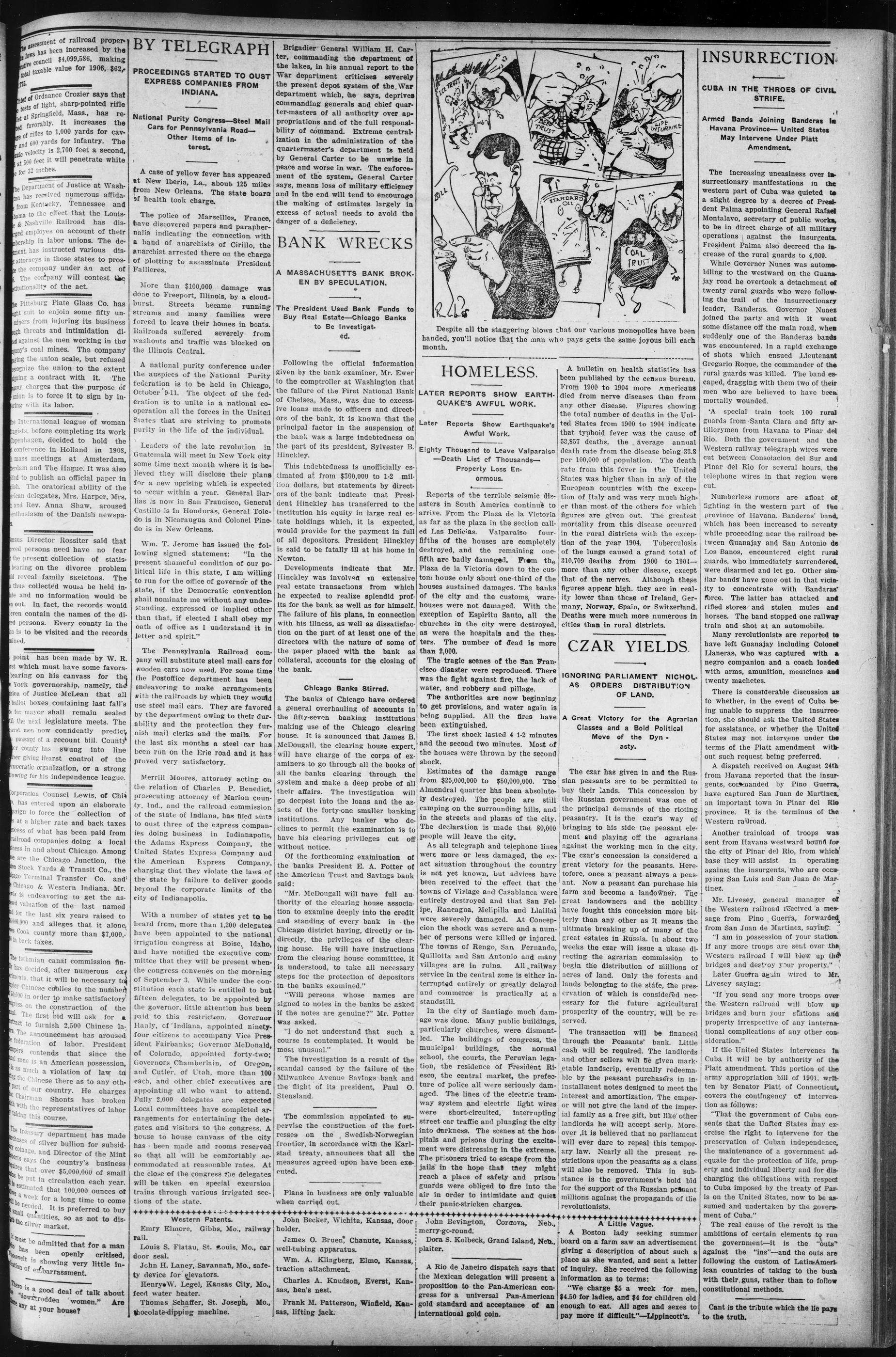
Page text (machine-generated)
THE AMERICAN CITIZEN.
IBERAL COMMISSION PAID RELIABLE AGENTS FOR THIS PAPER CALL HERE
POSE ROOSEVELT.
INSAS DEMOCRACY, WHILE EXPRESSING APPROBATION FOR PRESIDENT
ently is Bitterly Opposed to His Doctrines.
OTE GETTING DODGE
BRISEEKS THE SUPPORT OF
PREFERRED VOTERS.
Alleged Friendly Relations With the White House.
Kansas Republicans unquestionably urge the administration of Presi-
Roosevelt and repose implicit defence in the integrity and fore-
of the nation's chief executive. Democrats are mindful of this
in their campaign for Col. Harris
Chicago and have been taking pains
underse the things they think
sevelt stands for. The Democrats
worr to persuade the voters of
as that Harris is in entire hard-
with the President and a par-
favorite at the White House.
present letter written by President
revolt regarding the protective
policy gives the lie direct to the
critical claim of agreement with
revolt and exposes the utter insin-
and inconsistency of the Demic
pretense. The Democratic
term in Kansas this year declares
relict of Col. Harris and all his
asses on the Democratic state tick
the economic theory that all tar-
tire be laid for the sole and only
one of providing revenue. It is
old "tariff for revenue only" pol-
which proved so lamentable a fail-
in the last Cleveland administra-
view of the Democratic claim of resentment of Roosevelt the plate of the Kansas Democrats on the off question is interesting in coni- cation with President Roosevelt's ex- posed position.
Kansas Democrats declare for a fit for revenue only." Roosevelt says, "We stand unequivocally for a protective tariff." The Democratic form declares that a protective tar- ishe mother of trusts. Roosevelt:
"The question of revising the stands wholly apart from the notion of dealing with the so-called"
"s."
president Roosevelt's letter on the question makes the division between the Republican and Democratic sides more marked. It does more that for the reason that it exacerbates the hypocrisy of the Democratic tension of endorsement of Roosevelt. With Kansas this year it is simply a question of whether to follow Roosevelt with his record of accomplishing things or to follow the Democrats with their record of promulgating theories, promising much and publishing nothing.
in their eagerness to secure Repub-
sion support the Democrats are say-
that national issues are not at
least in Kansas this year. If that is
then why did the Democrats in-
corporate in their platform a plank on
tariff question exactly opposite
in the position the President has so
died taken and ably defended?
TALKING CALAMITY.
Campbell's Opponent Fears the Great Red Dragon Again.
Francis M. Brady of Oswego, who is running for congress in the Third district against Phillip P. Campbell, is asking the same speech to his audience that he made in the campaign 1956. He is holding up his hands and rolling his eyes over the danger is in from attacks by the best Red Dragon and Wall street, wildly gestures and declaims of the rich getting richer and the poor getting poor." He forgets that this is a bad phrase in Kansas this year the rich farmers are rapidly getting older in this state and when he talks poor people to a Kansas audience are talking for the benefit of a very minority. As for Wall street and
**Bush** Bush of 1001 N.3rd street
now in Des Moines, Ia., will re-
home next week Sunday.
source, this state could easily purchase Wall Street and donate it to New York for a public park. The farmers of Kansas have passed the stage where they devoted their nights to reading Coin's Financial School and their days to discussing what they learned while burning the midnight
The Race Question in the Constitution.
The race question is one which will not down in the making of a constitution, not even in the new state of Okla. There are something like 200,000 Negroes including the freedmen of Indian Territory, in the new state. This numbers are sufficient to justify the exercise of more then ordinary care in the selection of men to represent us in the constitutional convention, or we will find ourselves in the same codition as all of the republican states surrounding in the matter of mixed shools and the social status of travelers. Kansas, our republican neighbor on the north. Iowa, Nebraska and practically all the states controlled by that party have refused to enact laws for the separation of the races in traveling or segregate the whites from the blacks in the common schools.
It is reasonable to conclude, therefore, that what are republican policies in the states from which Oklahoma republicans have emigrated will also be republicans policies here, and that we may expect nothing from that party in dealing with the race question.
On this account considerable fear exists among even republicans that if their party is successful in the constitutional conventional campaign it will fail of meeting the demand of the people in this respect. For the reason they are expecting to join with the democrats in the selection of members of the convention in order the new state may have incorporated in its organic law provision against race mixture in schools or else where.
It is well known that if the democrats control the convention adequate provisions will be made against mixed schools and social equality in traveling, in keeping with the time-honored policy of the party and the demands of the people. Democrats and republicans alike recognize this, and will undoubtedly vote accordingly.
Publication Notice.
In the District Court of Wyandotte Covnty,
Kansas.
Birdie Smith, Plaintiff
vs.
Peter Smith, Desendant.
To the above named defendant, you are hereby notified that you have been sued in the above named court. by the above named plaintiff, and that unless you appear and answer on or before the 14th day of September, 1906, the petition filed against you will be taken as true and a judgement rendered against you the natre of which will be a decree dissolving the bonds of matrimony existing between plaintiff and defendant, and restoring plaintiff to her maiden name, Birdie Renick and for cost of this suit. I. F. BRADLEY, Atta. for Piff. Attest: Wm. Wne, Clerk
A BARGAIN.
For Sale—A No. one upright piano at the most reasonable figures. This is an exceptionable chance to secure one of the best "make" and highclass instrument of today. Call and examine and get terms. No. 411 Neb. ave. K. C. K.
Elder M. Phillips of Primitive Baptist church, the oldest preacher in the West asks all the colored preachers and white ones as well to give their appreciation to the American citizen by working this matter among the people in the church-
NOTE LETS
For Rent—To desirable parties(gen man perfered)well furnished rooms in one of the best families in the city, inquire at this office.
Mrs.S. T. Mitchell of 340 Minn.ave, is proprietress of one of the most desirable clean up-to date Rooming house in the city-charges always reasonable.
For Nice Furnished Rooms call on Mrs. Iday Easily at !107 N. 6th st., conveniently located only one block from the Minnesota ave, car line, Prices reason able.
They are fond of pet names.
B. and J. wonder which way.
KANSAS CITY, KANSAS FRIDAY EVENING.
DO NOT WANT BRYAN.
Kansas Democratic Managers Dislike the Presidential Possibility.
The Democrats have shown the white feather in the matter of inviting W. J. Bryan to come to Kansas and speak this year. They have said in private conversation that they are afraid that Bryan will declare that none but Democrats ought to vote the Democratic ticket in Kansas this year
Colonel W. A. Harris and his lieu-
rants, W. H. Ryan and Hugh P. Fara-
ly, are not on the most intimate
arms with W. J. Bryan and they hope
to keep him from securing the Kansas
delegation to the national convention
in 1908. Harris was directly opposed
two years ago to the very things that
Bryan was advocating. Bryan did not
want the Kansas delegation to vote
for Allon B. Parker for the presi-
dential nominee of the Democratic nation
convention, but so effectively did
Harris and his followers work that
eight of the twenty Kansas delegates
went to St. Louis and voted for the
New York candidate. Because Bryan
meddled in Kansas politics at this
time and tried to induce the Kansas
Democrats to support W. R. Hearst,
Bryan is to be opposed in the next
campaign and by all means kept out
of Kansas this year.
The Nebraska man believes in drawing party lines. he is of the opinion that if the Democrats ever win in the nation they must win by standing together and not with the assistance of any other party. He believes that he can convert Republicans into thinking like Democrats, but he is not to be trusted to begin his campaign of education in Kansas this year.
NOT REPRESENTATIVE.
Opinion of a Neighbor on the Harris Cattle Association.
Col. Harris of Chicago, the Illinois man the Democrats have nominated for Governor of Kansas, is going to meet with trouble in defending his connection with the big cattle shipping associations with headquarters in Chicago. The farmers do not yet understand what sort of a "breeders" association" it is that can afford to pay Harris $5,000 a year to stay in Chicago and look after its shipping interests. Some of the Populists are already looking up Harris' record as president of this shipping association and are proposing to make it hot for the man who betrayed them in their effort to enact a maximum freight rate law at the 1897 session of the legislature. Horace A. Keefer, a former neighbor of Col. Harris in Leavenworth county and now the Populist candidate for Governor, is making red hot charges against Harris alleging that Harris has betrayed the legitimate stockmen of the West and compelled them to organize a new association. Mr. Keefer says:
"Harris is so busy in Chicago attending to the business of the railroads in the cattle shipping business that he cannot spend as much time in the Kansas campaign as he would like. His work of manipulating the Western cattle shipments keeps him occupied and he also has to see that conventions of cattlemen are packed with railroad employes. The Denver convention a year ago was a fair example of the packing system. The bona fide cattlemen in attendance there became so disgusted that they bolted the convention and organized separate association."
KANSAS HAS MONEY.
Eastern Bankers Report No Demands From the West.
Congressman Charles Curtis who has returned from a consultation in New York with members of the National Republican congressional campaign committee, says that Kansas is counted on in national circles to send eight congressmen back to the lower house. Mr. Curtis also says that eastern bankers are not preparing to send any money to Kansas this year to move the crops. It has been the custom heretofore for the eastern financiers to send their spare money to the
Wedding bells will soon be ringing—you would be surprised to know.
The letter carrier and the widow—two hearts soon to beat as one.
as to assist in moving the wheat crop. There has been no call for this money this year and the bankers are finding other uses for it. Kansas farmers have enough money to move their own crops.
We may have wireless politics in the next world.
REPUBLICAN STATE TICKET.
Governor E. W. Hoch.
Lieutenant Governor — William J. Fitzgerald.
Secretary of State — C. E. Benton.
Autor James M. Nation
Attorney General — Frederick S. Jackson.
Treasurer — Mark Tully.
Superintendent of Schools—'E. T.
Fairchild.
Superintendent of Insurance — Chas. W. Barnes.
For Reiload Commissioner — Fran L. Ryan. George W. Kanavl. Charles A. Ryker.
City Locals
Mrs. W. H Watso and daughter Edith are spending the sulty Summers days in New Orleans, Mobile Ala. and other Southern points.
Mrs. S. T. Mitchell of 340 Minnesota ave. has returned from Clarksville, Mo. her old home also visited St. Louis, Mo. and attended the Baptist Association at Louisiana, Mo.
Mr. Robert Jones of K. C. Mo. was on this side of the Kaw Sunday the guest of Miss Mamie Jackson, of 366 Kimball.
Miss Minnie reme of the other side was the guest of Miss Willie Porter of 309 Oakland ave. Sunday.
Mr. Henry Douglas of 1609 n. 3rd St. who has been sick 2 weeks is improving.
Mr. John Gamble of Hiawatha, Kas. is in the city visiting his mother Mrs. Susan Gamble of 818 Freeman ave. who is very sick.
Mrs. Olie Douglass of 1609 N. 3rd St. leave on the 9th of next month for Sedalia, Mo. where she will teach at Geo. R, Smith college.
Mrs. M. C. Collier of 320 Oakland av. left this week for Topeka where she will spend two weeks visiting friends & Mrs. Lnlu Collier of 1607 north 2nd st.
Mr Will Everett of Ft. Smith, Ark. is in the city the guest of his brother, Joe, of 306 Kimball ave.
Miss Nettie Summers of Peoria Ill. who is visiting, her sister in—law Mrs. Lullu Summers of this city, was most agreeably serpised Friday evening of last week by a number of prominent young people, the affair was an enjoyable one Music, Dancing. Cards conversation were the features of the evening until a late hour when luncen was spread. About forty young people were in attendance.
It is reported that Justice John M. Harlan is to retire from the Supreme bench of the United States court. Judge Harlan is the finest type of Southern manhock and believes in "equal and exact justice to all." He is the Negro's friend, and with his passing so passes the Negro's hope for fair play before that August body.
That City Council Alderman at San Antonio, Tex., who refused to vote on an invitation to the Grand Lodge of Odd Fellows to meet in that city, gave as his objection: "This is a white man's country and we believe in Negroes keeping their places." Verily the braying of these foal jackasses is enough to sicken the stomach of a buzzard. The foolkiller would have his hands full if he went to Texas.
The Nation Medical Association of Negro Physician. Dentists and Phrmacists is in session at Odd Fellows Temple in Philadelphia, this week. Quite a number of delegatef from all section of the country will be in attendance..
According to press reports a police man at Hopkinsville Ky entered a Pull man Sleeper on an Illinois Central train last Monday night and compelled a colored mah and his wife to leave a berth which they were occupying, and forced them to the Jim Crow" car against their wish and under protest. They were enroute to Chicago and the train was decaned while they dressed and were removed
Administrator's Notice
State of Kansas
County of Wyandotte.
In the Probate court in and for said County.
In the matter of the Estate of Maria Hayden. Deceased.
Notice is hereby given that Letters of Administration have been granted to the undersigned on the Estate of Maria Hayden late of said County, deceased, by the Honorable the Probate Court of the County and State aforesaid, dated the 11th day of April A.D. 1906. Now, all persons having claims against the said estate, are hereby notified that they must present the same to the undersigned for allowance with one year from the date of said letters or they may be precluded from any benefit of such estate, and that if such claims be not exhibited within three years after date of said letters, they shall be for ever barred.
JESSE STANFORD. Administrator.
Of the Estate of Maria Hayden.
Kansas City, Kansas, April 11, 1906
In witness whereof, the undersigned Probate
Judge in and for the County of
(SEAL) Wyandotte. State of Kansas
have hereto set my hand, and
a affixed the seal of the said Probate Court
this 11th day of April, A. D. 1906.
Winfield Freeman. Probate Judge.
1st Pub. Apr. 30.
Publication Notice
In the court of Common Pleas, af Wyandotte County, Kansas.
Mary Bradley, Plaintiff.
vs.
Otis Divers, and
Ida Divers. Defendant.
To the above named defendants you are hereby notified that you have been sued in the above named court, by the above named plaintiff, and that unless you appear and a answer on or before the 20th day of January A.D. 1906, the petition filed a gainst you will be taken as true and a judgement rendered against you the nature of which will be a decree foreclosing a certain mortgage, given by the defendant Otis Divers, on the following described real property to-wit: —The south one half of the North-west quarter of the South-west quarter of section twenty of township eleven, of range twenty four, in Wyandotte County, Kansas and excluding you and each of you from all interest in said land, and ordering the sale of said land in persuance of said judgement and for costs of this action.
I. F. Bradley, Atty, for Pflf.
Attest: J. L. Beggs, Clerk.
In the Court of Common Pleas of Wyandotte County, Kansas.
H. S. Sykes, Plaintiff.
vs.
J. E. Bernheimer, Defendant.
The State of Kansas to J. E. Bernheimer Greeting;
You are hereby notified that you have been sued in the above named court, on the 2nd day of June 1906, by the above named plaintiff, and unless you answer on or before the 4th day of August. 1906 Judgment will be taken against you as prayed for.
The relief plaintiff is asking, is to quiet your title or claim. If any you have, in and to lots 32 and 33, in block 70. in Wyandotte City, for cost and such other relief that plaintiff is entitled to.
H. S. Sykes, by Chas. W. Frye, Atty.
Attest: J. L. Beggs, Clerk.
By F. L. Kenny, Deputy.
1st Pub. June 29, 1906.
Final Settlement.
In the Probate Court of Wyandotte county Kansas.
In the matter of the Estate of Isaac Hatton. Deceased.
Notice of Final Settlement
To whom it may concern. This is to notify all persons, that. I will on Monday the 4th day of Dec. 1905, make final settlement in the above entitled estate, or as soon thereafter as shall be contentible, all persons, interested take notice and govern yourselves accordingly.
JOHN BARNETT.
Administrator with will annexed.
1st Pub' Nov. 1905.
Sheriff's Sale.
In the court of Common Pleas of Wyandotte County, Kansas.
Mary Bradiey, Plaintiff,
vs.
Otis Divers and Ada Divers, Defendants.
Under and by virtue of an order of sale issued by the clerk of the court of Common Pleas in and for Wyandotte County, Kansas, in a certain cause in said court, numbered 7142, wherein the parties above named, were respectively plaintiff and defendant, and to me, the undersigned sheriff of said county directed.
I will offer for sale at public auction, and sell to the highest bidder for cash in hand, at the front door of the court house in the city of Kansas City, in said county, on Monday the 28th day of May A. D. 1906, at 10 o'clock a.m., of said day, the following described real property, situate in the county of Wyandotte and state of Kansas towit-
The undividedone seventh (1-7) interest and portion, more or less, in and to the following lands and tenements, which land are held by the said defendants, along with the heirs at law of Robert Divers, as tenants incommon, meaning hereby, all the right and interest that came to the defendant Otis Divers, as the heir at law of Robert Divers and Ellen Divers, deceased, in and to the following described real estate towit:—The South one half (1-2) of the North west (1-4) quarter of the South west quarters [1-4] of section twenty (20) of township eleven (11) of range twenty-four (24) in Wyandotte county Kansas.
Mrs. James Brown of Atchison, Kas.
is the guest of her niece Mrs. Anna
Farfax of 1102 N. 3rd street.
AUG.24, 1:06
hisSection
CALL HERE
Executors Notice
State of Kansas.
County of Wyandotte
In the Probate Court of Said County.
In the matter of the Estate of Anna Williams, deceased
Notice is hereby given that letters testamentary have been granted to the undersigned on the last will and testament of Anna Williams, late of said County, deceased, by the Honorable, the Probate Court of the County and State aforesaid, dated the 17 day of July, 1906. Now, all persons having claims against said estate are hereby notified that they must present the sane to the undersigned for the allowance within one year from the date of said letters, or they may be precluded from any benefit of such estate; and that if such claims be not exhibited within three years after the date of said letters, they shall be forever barred.
JAMES DOWNS
Executor of the last will and testament of Anna Williams deceased
Dated Aug. 14, 1906
Nice Furnished Rooms for rent with board or without, will be at home to friends on Thursday, 423 Oakl and ave Mrs.Annie Williams.
Mrs. Reed, 528 Neb. ave., has a few nicely furnished rooms to rent.
Publication Notice
In the District Court of Wyandotte County
kansas.
Frank Benton, Plaintiff.
vs.
Jane Benton, Defendant.
The above named defendant will hereby
take notice that she has been sued by the
above named plaintiff in the above hamed
court, and that unless you appear and
answer, on or before the 30th day of April
1906 the petition filed against her will
be taken as true and a judgement rendered the
nature of which will be a decree dissolving
the bond of matrimony existing between the
plaintiff and defendant, and divorcing him
from her the said defendant, and for cost o
this suit.
I. F. BRADLEY, Atty. for Pliff
Attest: Wm. Needles, Clerk.
July Its.
Publication Notice.
In the Court of Common Pleas of Wyandotte County, Kansas.
L. E. Hayes, Plaintiff, F.
Linus S. Wolcott. Frank E. Wolcott, Elizbeth Chapman and her husband J. P. Chapman, Evelyn Collar, F. T. Collar, John Miller W. T. Little and Company and S. F. Scott, et al. Defendants. John Miller, W. T. Little and company and S. F. Scott, non-resident defendants.
To you and each of you: You are hereby notified that you have been sued by the above named plaintiff in the entitled action, in the Court of Common Pleas of Wyandotte County Kansas, and that unless you answer the petition filed herein on or before Monday April 23rd, 1906, said petition will be taken as true, and a judgment will be rendered in said cause against you and each of you of the following nature to-wit: A judgment in favor of said plaintiff, quieting his title to the following described real estate, situated in Wyandotte City, now a part of Kansas, City Kansas, and more particularly described as lot 15 and 16 in Black 64 in Wyandotte City, now a part of Kansas City, Kansas, and restraining and enjoining you and each of you from claiming or attempting to claim any interest in or to, or title to said property or any part thereof, and a further judgment against you and each of you for the costs of said action.
L. E. HAYES, Plaintiff.
Mar. 9.
Publication Notice
In the District Court of Wyandotte County Kansas
George Waller, Plaintiff.
vs.
Anna Waller, Defendant.
To the above named defendant, you are hereby notified that you have been sued in the above named court, by the above named plaintiff and that unless you appear and answer on or before the 30th day of April, 1960, the petition will be taken as true and a judgement rendered, the nature of which will be a decree dissolving the bond of matrimony existing between plaintiff and defendant and divorcing plaintiff and defend ant and for cost of this suit.
1. F. Bradley, Atty. for Pliff.
Attest: Wm. Needios, Clerk.
March 2.
NOW IS
the time to
Subscribe
For the
Weeky
The Oldest Negro Journal Published Weekly in this part of the Country.
Published Weekly
W. C. Martin, Editor,
Geo. A Dudley, Publisher and
Business Manager.
Terms of Subscription in Advance.
One Year. $1.00
Six Months. 65c
Three Months. 40c
One Month. 15c
A Standing Display 'Ad' for 3 Months
or longer 15c per inch, each insertion
Grangemouth is the name of a Moscow editor. Evidently a farmer on the side.
Waldorf Astor has become so thoroughly anglicized that he is going to marry an American girl.
A clergyman says that bridge whistle leads to mental decline. Why doesn't he try poker for a change?
Senator Pettus is declared to be a poor man and fond of poker. The last explains the first, possibly.
Perhaps boys should be thankful for whippings, as somebody declares, but they seldom are before they are 45.
Sweet Spring is now approaching, and Summer with the rose, so poetry's encroaching upon the field of prose.
King Edward was "warmly received" in Paris, but not in the same way as when he used to be prince of Wales.
The czar will reserve the right to wield the big stick over the Douma, according to the latest advices from St. Petersburg.
We learn from the New York Mail that women are using garters to keep those long, arm-length gloves in place. But do they hold?
Manchuria will be finally evacuated by the Japanese in a few days. It has taken them longer to get out than it did to get in.
It is now believed that Anna Gould is going to give Boni one more chance, in spite of the fact that he has taken a great many already.
Uruguay should not be blamed for having a revolution. A review of recent South American history shows that it is Uruguay's turn.
Asks the editor of the Pittsfield Journal: "Are there four girls with gray eyes in Pittsfield?" Apparently ye scribe means to get busy.
Queen Maud of Norway is losing her health because she fears her husband will be killed. This queen business is not all pickles and ple.
It was not long ago that all the "success" magazines were pointing to the Pittsburgh millionaires as examples to the youth of the land.
With 10,000 doctors in convention in Boston next summer, the rest of the country ought to have a good opportunity to get well.—Boston Globe.
It is a pity that the great romancers of the sea did not live in a generation which affords such thrilling material as the log of the dry dock Dewey.
A Minnesota man says he has discovered the cause of the aurora borealis. But what bearing will this have on the price of coal this year?
Much to the surprise of everybody, some of the phenomenal ball players added to the leading nines as marvelous discoveries will probably make good.
Cheer up, mister! The president of the Dressmakers' National Protective Association says that women's dress will be less expensive this year than ever before.
The Japanese, says one of their statesmen, should adopt chairs and develop their legs. Well, short legs did not prevent them from "getting there" in the late war.
Portla, as quoted by the editor of a kind of society paper, is made to say: "How far that little scandal throws his beams! So shines a bad deed in this haughty world."
News comes from the east that the seventeen-year locusts will devastate the land this year. How many times in the course of a decade do the seventeen-year locusts come, anyhow?
As the last suffragist was detatched from the doorknob and put into the police wagon, the premier of the great British Empire crawled out from under his bed and sighed a sigh of relief
An actor has become a soldier in order to escape the adulation of matinee girls. We know several actors who should be driven from the stage with a club instead of soft
GREAT SINGER IS UNGRATEFUL.
Mme. Patti Criticises America, Whole Made Her Wealthy.
Confirmation of the report that Mme. Adelina Patti has made her final tour in the United States is found in her recent criticisms of the American people. This lady, who once lived down on Grand street West, but now dwells in a castle in Wales, largely owing to the generosity of the citizens of this city, has lately discovered that we haven't any appreciation of art, cookery, music or good manners. This is an ill return for all the complimentary words we have uttered about her, not to mention the dollars we have paid to hear her voice. Although she was born in Madrid in February, 1843, she came here with her parents as a child and grew up among the people of New York. Her brother, Carol, used to lead the orchestra at the Grand Opera House, during the Jim Fisk era of French opera-bouffe.
Mme. Patti's last tour of this country was not financially successful—a circumstance that may account for her change of heart. The lady, however, insisted upon receiving her contract money to the last dollar. The im presario was almost ruined, although the fault was the diva's own. She couldn't sing! Her voice had lost its fine quality. She wasn't a "diva" any longer. The American people found this out and refused to assist in maintaining Craig y Nos castle—Brooklyn Eagle.
Famous Actors as Negro Minstrels.
Jefferson said he thought he was one of the first men to black his face after the appearance and success of "Jim Crow" (T. D.) Rice.
"I suppose," said Mrs. Drew, "there are very few men in this company who have not at one time or another been associated with minstrel performances."
"I played Brudder Jones," said Mr. Jefferson.
"Everybody knows I was in the minstrel business," Goodwin exclaimed. "Yes," I remarked, "because we were there together. "Well," joined in Crane, "I was on the tambourine end with Campbell's minstrels." I remember telling this at Lawrence Barrett's house at Cohasset, where the rest of the party consisted of Edwin Booth and Stuart Robson, Booth then told how he and J. S. Clarke were minstrels in their younger days, and he followed this up by declaring that he used to "pick a little on the banjo." I laughed, and Booth inquired the reason, and I added, "Oh, nothing much, only Booth and the banjo seemed such an odd combination."—Francis Wilson in Scribner's Magazine
® Thou Compassionate.
How deeply comforting the tender phrase, Thy greater attribute seem merged in this—
Through all life's long and dark and weary maze, Thou art Compassionate.
To God of Justice and of Power we turn When wrong or devastating blow cuts deep;
And yet in daily struggle needs must yearn For one Compassionate.
In limits of our souls we live, alone, And e'en our nearest may not under stand But all who household jar within" is known To thee, Compassionate.
Thou know'st the many sorrows of the day; Wide longing, narrow opportunity—We bring life's broken toys, as children may, To one Compassionate.
We may have blundered grievously and long; Darkened Thy world we might have made so bright! Still Thou dost heal the heartache and the wrong Toe Thou Compassionate!
—May Ethelyn Bourne, in Overland Monthly.
Of No Importance.
Two men were standing together on an East River ferryboat when one pointed out a third man with the remark:
"I can't recall his name at this moment, but he writes for a number of the magazines."
His friend looked at the stranger with much interest.
"Oh, one of our frenzied finance captains, is he?" he asked.
"No, he—"
"Writes up trusts and things, then?"
"Oh, then he's a prizefighter or an actor—he is rather husky looking."
"No, no! He's just a plain author—writes stories."
"Oh!" the friend exclaimed, the look of interest suddenly dying out of his face—New York Journal.
True to His Promise
The other boy had called Tommy a liar, an 'a fightin' liar, and told him he'dassen't take it up.
Tommy's fists were clinched and his eyes were blazing, but he stood there rapidly repeating something to himself, in accordance with a long standing promise he had made to his mother.
"If you'll jist wait till I've finished sayin' it," he said, "I'll knock the tar out o' you, Dick Bunker, you ple faced slob! 'But children, you should never let your angry passions—'"
The other boy, however, disappeared around the corner while Tommy's lips were still moving.
Flying Wedge.
"Great Scott!" exclaimed the drummer who had put up in the old farm house over night. "What was that noise down below? Football rush?" "Worse than that, stranger," chuckled the old farmer, as he snuffed out the candle. "You see, I have eight darters an' each one of them has a bean who calls on Thursday nights. Wall, the first couple that gets the parlor can have it. That's why they are running."
LACE SCARF AS EAR TRUMPET.
Elderly Lady Has Discovered It Acts as Sounding Board.
With advancing years a dear old lady has found that her hearing has become somewhat affected. She has not found it necessary to use an ear trumpet as yet, but it is difficult at times to catch all that friends say. Anything said in an undertone is completely lost to her—that is, it was until she hit upon a novel idea.
While visiting a friend recently the hostess had pitched her voice almost to the straining point and her vocal organs were getting tired, when "Aunt Sis," as she is affectionately termed, interrupted her by saying: "Please, dearle, hand me my lace head scarf."
"Do you feel a draught?" anxiously inquired the hostess, handing over the mantilla.
"Not the slightest," said "Aunt Sis" as she adjusted the head covering. "Then why do you wear it? It will make your head tender."
"Oh, I think not. You see, the scarf acts as a sort of sounding board. It keeps out all other sounds except those of the human voice. When I wear this I can hear even a whisper I can't explain why it is, but it is so, nevertheless. I have had lots of fur over it, too. My boys have been taking advantage of my infirmity to whisper per to each other. I didn't hear them before I began to wear this scarf, but now I know lots of their secrets and they don't know it. It's a good joke on them."
'Fish Know Colors.
"Fish know colors," said a keeper at the New York Aquarium the other day. "They can distinguish between red and blue, or white and green, as well as you and I. Wait and I'll prove it."
He led the way to a tank in which were some red and some yellow and some green fish, and in it were artificial grottoes painted respectively red and yellow and green. The keeper rolled the water with his hand, and the fish fled, the red ones to the red grotto, the yellow ones to the yellow grotto, and the green ones to the green grotto.
"They know which color shields them from observation best," said he. "Now I'll change the grottoes, so as to prove my statement a second time."
He moved the grottoes to different places in the tanks and again rolled the water.
The same thing followed as before. Each fish darted like a shot to the grotto of its own color, where it knew it would be best concealed.
To the Beloved.
Everything that I made I used to bring you.
Was it a song, why, then 'twas a song to sing to you.
Was it a story, to you I was telling my story.
Ah, my dear, could you hear 'mid the bliss and the glory?
Did any one praise me, to you I said it all over:
My laughter for you: how we laughed in my days past; how covered?
My tears did my troubles were yours; did any one grieve me.
I carried it straight to the love that was sure to relieve me.
O my dear, when aught happens, to you I am turning.
Forgetting how far you have traveled this day from my yearning.
There is nobody now to tell things to you; so lonely.
And still I'm forgetting and bringing my tale to you only.
The old days are over; how pleasant they were to me.
When youth and my darling and I were at home and together!
And still I'm forgetting, ochone, that no longer you're near me.
And turn to you still with my tale, and there's no one to bear me.
*Pall Mall Gazette*
Fate of the Old Presidents:
In the autumn of 1901 Mrs. W. of Roxbury spent a few weeks with her daughter in Nova Scotia, returning home shortly before President McKinley was shot, bringing her niece, Bessie F., aged 6 years, home with her. Of course the child heard a good deal of talk in the house about the shooting of the president.
One day Bessie said to her aunt: "Aunt Minnie, who is king of the United States?" Her aunt replied: "We have no kings in the United States like you do in your British country. We have presidents. We have an election every four years and elect a new one."
"Oh, yes," the child replied; "and then they shoot the old ones, don't they?"—Boston Herald.
New City for Egypt
Suakin, on the Red sea, has proved an unsatisfactory port and is to be superseded by a brand-new rival which has been built up out of coral work and desert sand by the Egyptian authorities. The rival is Port, Sudan, the latest addition to the cities of the British empire, and an enthusiast says that it is destined to be a place of magnitude and importance in the days when cotton shall have made it the New Orleans of the east. The place has hitherto been called Mersa Sheikh Barud. It is about 680 miles south of Suez and is capable of holding a dozen vessels of moderate size. The entrance is 600 feet across, and the land around is six feet above sea level.
Posers for Scholars.
Twenty words submitted to a spelling bee in Springfield, Mass., in 1846 were given to the high school class at East Liverpool by Supt. Rayman, and it is reported not one in the class correctly spelled every word. Only ten had averages of over 90 per cent. The average of the 124 pupils was $73\frac{1}{2}$ per cent.
The words submitted were accidental, accessible, baptism, chirography, characteristic, deceitful, descendant, eccentric evanescent, fierce$^{3,4}$s, feignedly, ghastiliness, gnawed, heless, hysterics, imbecility, inconceivable, inconvenience inefficient, irresistible.
—Pittsburgh Dispatch.
SHIELDS FOR TROOPS IN WAR:
Their Use Urged by a German Military Writer.
A writer in the Militar-Wochenblatt raises anew the question of the use of portable shields for the protection of infantry in the attack, says the Broad Arrow. He writes approvingly of the Japanese spade work in the offensive, the more so because he mentions incidentally, as a matter regarding which there can be no dispute, that the German authorities have long since advocated the use of artificial cover in the attack, and points out that when the ground was frozen or rocky, and the spade could make no impression upon it, the attacking Japanese infantry not infrequently went forward, carrying with them filled sandbags weighing as much as forty pounds. He remarks that if the undoubtedly brave Japanese soldier found it necessary to load himself with so bulky and burdensome a protection when advancing in the open against an intrenched enemy it would seem far better to equip the infantry with a light, handy shield
Furnished with a handle by which to carry it, a loophole to fire through and some arrangement to prevent its falling down, the infantryman would then find himself, like his gunner comrade, protected by a bullet-proof shield. The writer in the Wochenblatt suggests that on the march the shield should be carried on the back, when going into action on the chest, and when advancing to the attack in the left hand, so as to be at once available for use when lying down to fire, both as head cover and rifle rest.
YOUR HAIR SHOULD BE DRAB
That is the Fashionable Color, So an Authority Says.
"Deep auburn and the drab shades are the fashionable colors in hair this season," said the woman who makes hair coloring a speciality, as placidly as though she were commenting on the state of the weather or the advance style in dress goods.
"One of my customers has to my knowledge worn five different colors or shades on her wavy tresses. Having been blessed with medium brown hair by nature she became a ravishing blonde when the fashion for bleaching first came in.
"Next she took to titian red after a trip to the art galleries of Europe. Then she thought she would be more attractive as a brunette, and now her hair is drab.
"The last is by far the most popular of all for the reason that is most difficult to obtain, and then it is pretty generally becoming, and it happens that women who are born with this particular color of hair are almost always clever.
"How is it done? Well, in case of a woman whose hair is dark a bleach must first be used before the dye is applied. With women whose hair has turned gray it is a still simpler problem. The color lasts a year, while the head can be washed and even salt water bathing does not affect it."—New York Sun.
What Money Will Do
What bought my private car? Just wealth
What bought my lovely yacht,
Which sails me to lands where health
Is found in every spot?
What bought the most delightful wife
A man could hope to win?
What buys her every wish in life—
he wants to learn in life.
And if her heart beats not for me,
And I am not adored, you see.
Well-I don't know!
And heaven? Oh, of course, I don't
Expect to get in free;
But if the Lord meant what he said
Concerning charity.
The tite I'll give before I die
Will slip me through the needle's eye,
Or-I don't know!
For happiness? Well, money bought
the cocoa that sugar.
It bought this cocoa which I loll.
It bought this private car;
It bought this cocoa—and I guess,
If all this is not happiness.
Not a Good Advertisement
A Welsh judge had before him a case in which a printer sued a pork butcher for the value of a large parcel of paper bags with the butcher's advertisement printed thereon.
The printer, having no suitable illustration to embellish the work, thought he improved the occasion by putting an elaborate royal arms above the man's name and address, but ultimately the latter refused to pay.
The judge, looking over a specimen, observed that for his part he thought the lion and the unicorn were much nicer than an old fat pig.
"O well," answered the butcher, "perhaps your honor likes to eat animal like that, but my customer's don't. I don't kill lions and unicorns—I only kill fat pigs!"
Verdict for defendant.—New York World.
Building Up to Requirements
A Kansas City man purchased a city lot with the restriction that he should not build a house on it to cost less than $2,500. After having paid for the lot he decided to build a $1,500 cottage.
Before he had completed it the real estate man from whom he had bought the lot threatened to sue him for breach of contract. "This little shack you are building," said the real estate man, "lacks a whole lot of being a $2,500 house such as you agreed to build."
"Don't form too hasty judgment," replied the owner. "True, it hasn't cost that much yet, but I intend to put a solid gold brick in the chimney."
—Kansas City Times
Telephone Bell W.32
W. B. R
FUNERAL
and Embalmer. The very best
for all Purpose
The Best Equipped White
sick and
on Short Notice. Charges R
sota Ave., Kansas
Western
B. Raymon
GENERAL DIRECTOR
er. The very best of Service, Fine
for all Purposes, at all Hours.
Equipped White Enameled Ambul
sick and wounded
tice. Charges Reasonable. Call at
sota Ave., Kansas City, Kansay.
tern Univer
W. B. Raymond FUNERAL DIRECTOR
and Embalmer. The very best of Service, Fine Carriages for alll Purposes, at all Hours.
The Best Equipped White Enameled Ambulance for sick and wounded
on Short Notice. Charges Reasonable. Call at 431 Minnesota Ave., Kansas City, Kansay.
Western University
THE GREAT EDUCATIONAL INSTITUTION
FOR KANSAS AND THE WEST
DEPARTMENTS:—Theological, College, Normal, Sub-Norm
Industrial.
COURSES:—Classical, College, Preparatory, Normal, Sub-
sical (Instrumental and Vocal), including piano, or
mony, Drawing (Fine Arts and Mechanical), Carpe-
and Book-Binding, Business Course, Stenography and
Talloring, Dressmaking and Plain Sewing, Cooking
Farming and Gardening.
ADVANTAGES:—Splendid Location, Healthful Climate,
ences and Thorough Teachers.
INFORMATION:—For terms, prices and all inducem-
write to
WILLIAM T. VERNON, A. M.,
PRESIDENT,
MENTS:—Theological, College, Normal, Sub-Norman.
—Classical, College, Preparatory, Normal, Sub-Instrumental and Vocal), including piano, or Drawing (Fine Arts and Mechanical), Carpet-Binding, Business Course, Stenography and Log, Dressmaking and Plain Sewing, Cooking and Gardening.
MES:—Splendid Location, Healthful Climate, and Thorough Teachers.
ION:—For terms, prices and all inducements.
IAM T. VERNON, A. M., PRESIDENT,
Phones
Office—Bell—"White" 4302.
Residence—Bell—"West" 15.
red people as well as uncolored people set in by a smoky poor light and drink. muddy bad water full of disease germs.
DEPARTMENTS:—Theological, College, Normal, Sub-Normal and State Industrial.
COURSES:—Classical, College, Preparatory, Normal, Sub-Normal, Musical (Instrumental and Vocal), including piano, organ and harmony, Drawing (Fine Arts and Mechanical), Carpentry, Printing and Book-Binding, Business Course, Stenography and Typewriting, Tailoring, Dressmaking and Plain Sewing, Cooking, Laundering, Farming and Gardening.
ADVANTAGES:—Splendid Location, Healthful Climate, Good Influences and Thorough Teachers.
Phones
Office—Bell—
Residence—B
Why does colored people as well as
by a smoky poor light
water full of
Why does colored people as well as uncolored people set in the dark of by a smoky poor light and drink. muddy bad water full of disease germs.
When they can get a first-class
Bright Gas Burner Light
Gas Burner Light
Bright Gas Burner Light
For 35 to 75 cents. And a
Self Clean
that makes the water clean
For 50 to
A. J. SH
ROC
Self Cleaner Water
makes the water clear as a Crystal and Health
For 50 to 75 cents.
A. J. SHERIDAN
ROOM 8,
VA AVE. KANSAS CITY
shade of the Old Apple Tree" is a very popular
regular by trading at a popular store?
L. J. MADDUX
Fruit and Fancy Grocer
Meats and all Kinds of Produce
that makes the water clear as a Crystal and Healthy. For 50 to 75 cents. A. J. SHERIDAN
"In the shade of the Old Apple not you be popular by trading at a p
L. J. M
Staple and Fa
Meats and all K
"In the shade of the Old Apple Tree" is a very popular song—Wh not you be popular by trading at a popular store?
L. J. MADDUX, Staple and Fancy Groceries Meats and all Kinds of Produce.
HOME PHONE 784 WEST.
Because its employees were late a London house provided a book in which the tardy ones were to write excuses. Reasons for lateness were not much varied. At the top of the page one would write "Train delayed," or "Omnibus horse died," as the case might be, and the rest fell into the habit of making ditto marks and letting it go at that. But not long ago one man had a new excuse. He wrote with pride: "Wife had twins." The second slow person that morning was in a great hurry, and did not notice the innovation, but made his customary ditto marks, and the rest of the men on that page followed suit. The excuse book was abolished.
Example of the Postage Stamp
Example of the Postage Stamp.
The late Judge Andrew Wylie, of Virginia, had a happy gift of illustration. The judge cast in 1860 the only vote for Lincoln that was given in Alexandria, Va. In an address on Lincoln he once illustrated in an odd way the power of perseverance. "Lincoln persevered," he said, "and it is only those who persevere, they who concentrate their energies, who succeed. Don't give three years to journalism and then, discouraged, try the law awhile. Don't learn the grocery business and in a little while take up placer mining or plumbing. Consider, rather, the postage stamp, whose useful depends on its ability to stick to one thing until it gets there."
"Well," said the first policyholder, throwing aside his paper, "there is at least one thing we can be thankful for concerning our Mutual friend, Mr. McCurdy."
"What's that?" inquired the second policyholder.
QUINDARO.
530 MINNESOTA AVE.
852 FREEMAN AVE.
Telephone Home W. 33
Raymond DIRECTOR
st of Service, Fine Carriage
s, at all Hours.
Enameled Ambulance for
wounded
reasonable. Call at 431 Minne
as City, Kansay.
University
College, Normal, Sub-Normal and State
Preparatory, Normal, Sub-Normal, Musical, including piano, organ and hand and Mechanical), Carpentry, Printing Course, Stenography and Typewriting, Plain Sewing, Cooking, Laundering,
On, Healthful Climate, Good Influence.
Services and all inducements offered.
NON, A. M., D. D.
DENT,
KANSAS.
"White" 4302.
All—"West" 15.
Uncolored peoplelet set in the dark and drink-muddy bad disease germs.
Her Light
Inner Water Eilter
as a Crystal and Healthy.
75 cents.
ERIDAN
M 8,
KANSAS CITY, KANSAS
Tree" is a very popular song—Wh
popular store?
ADDDUX,
ncy Groceries
inds of Produce.
KANSAS CITY, KANSAS
Res. 420 Nebraska ave. Tel. 383 WHITE
SOUTH AMERICAN MEDICAL INSTITUTE
Office Hours: From 10 a. m., till 4 p.m. and from 6 till 9 p.m. C. H. C. JORDAN, M. M., M. D. Here is the Place J. T. Roberts TONSORIAL PARLOR All the Latest Style Hair Cuts, Clear Shave strictly Up-to-Date 438 MINNESOTA AVE.
An Old French Sailor.
French seamen have a dozen in the person of a centenarian. The old sailor belongs alike to the navy and to the merchant service, for he served in both, and it would be difficult to say in which of the two his adventures were the most thrilling. His record includes three shipwrecks, the battle of Navarino, in which he won mention in orders, the blockade of Algiers, one capture by brigands, followed by himself and his companions seizing the Spanish ship which captured the corail which had captured them. After serving many years before the mass he became a master and small ship owner on his own account. His name is Pierre Loirat. He was born in November, 1805, and at 12 he went to sea.
ROOM 8.
KANSAS
The assessment of railroad property in Iowa has been increased by the courteous council $4,099,586, making a total taxable value for 1906, $62,775.
Chief of Ordnance Crozier says that the tests of light, sharp-pointed rifle set at Springfield, Mass., has relied favorably. It increases the age of rifles to 1,000 yards for cavalry and 600 yards for infantry. Theuzzle velocity is 2,700 feet a second, at 500 feet it will penetrate white fur for 32 inches.
The Department of Justice at Wash-
ton has received numerous affidavits
from Kentucky, Tennessee and
abama to the effect that the Louis-
se & Nashville Railroad has dis-
garded employees on account of their
membership in labor unions. The de-
ment has instructed various dis-
trict attorneys in those states to pro-
scribe the company under an act of
&. The company will contest the
stitutionality of the act.
The Pittsburg Plate Glass Co. has right suit to enjoin some fifty unimmers from injuring its business through threats and intimidation died against the men working in the company's coal mines. The company paying the union scale, but refused recognize the union to the extent signing a contract with it. The company charges that the purpose of union is to force it to sign by injuring with its labor.
The international league of woman magists, before completing its work Copenhagen, decided to hold the conference in Holland in 1908, which meetings at Amsterdam, Copenhag and The Hague. It was also used to publish an official paper in English. The oratorical ability of the american delegates, Mrs. Harper, Mrs. and Rev. Anna Shaw, aroused enthusiasm of the Danish newspa-
Census Director Rossiter said that agreed persons need have no fear at the present collection of statis-bearing on the divorce problem and reveal family skeletons. The thus collected wound be held inate and no information would be on out. In fact, the records would even contain the names of the dired persons. Every county in the town is to be visited and the records mined.
point has been made by W. R. first which must have some favor bearing on his canvass for the New York governorship, namely, the vision of Justice McLean that all ballot boxes containing last fall's vote for mayor shall remain sealed until the next legislature meets. The earst men now confidently predict the passage of a recount bill. County her county has swung into line either giving Hearst control of the democratic organization, or a strong blowing for his independence league.
Corporation Counsel Lewis, of Chicago has entered upon an elaborate design to force the collection of taxes at a higher rate and back taxes excess of what has been paid from railroad companies doing a local business in and about Chicago. Among these are the Chicago Junction, the Union Stock Yards & Transit Co., the Chicago Terminal Transfer Co. and the Chicago & Western Indiana. Mr. Lewis is endeavoring to get the assessed valuation of the last named land for the last six years raised to $800,000 and alleges that it alone owns Cook county more than $7,000,000 in back taxes.
The ishmian canal commission finally has decided, after numerous experiments, that it will be necessary to employ Chinese cobiles to the number 150,000 in order to make satisfactory progress on the construction of the canal. The first bid will ask for a contract to furnish 2,500 Chinese lagers. The announcement has aroused the federation of labor. President compers contends that since the canal zone is an American possession, he as much a violation of law to bring the Chinese there as to any other part of our country. He charges Chairman Shouts has broken with the representatives of labor by taking this course.
The treasury department has made purchases of silver bullion for subsidiary coinage, and Director of the Mint Roberts says the country's business requires that over $5,000,000 of small coins be put in circulation each year. It is estimated that 100,000 ounces of silver a week for a long time to come will be needed. It is preferred to buy small quantities, so as not to disguise the silver market.
It must be admitted that for a man who has been openly criticised, Rosevelt is showing very little indication of embarrassment.
There is a good deal of talk about the "downtrodden 'women." Are there any at your house?
BY TELEGRAPH
A case of yellow fever has appeared at New Iberia, La., about 125 miles from New Orleans. The state board of health took charge.
The police of Marseilles, France, have discovered papers and paraphernalia indicating the connection with a band of anarchists of Cirillo, the anarchist arrested there on the charge of plotting to assassinate President Fallieres.
More than $100,000 damage was done to Freeport, Illinois, by a cloudburst. Streets became running streams and many families were forced to leave their homes in boats. Railroads suffered severely from washouts and traffic was blocked on the Illinois Central.
A national purity conference under the auspices of the National Purity federation is to be held in Chicago, October 9-11. The object of the federation is to unite in a national cooperation all the forces in the United States that are striving to promote purity in the life of the individual.
Leaders of the late revolution in Guatemala will meet in New York city some time next month where it is believed they will disclose their plans for a new uprising which is expected to occur within a year. General Barlas is now in San Francisco, General Castillo is in Honduras, General Toledo is in Nicaragua and Colonel Pinedo is in New Orleans.
Wm. T. Jerome has issued the following signed statement: "In the present shameful condition of our political life in this state, I am willing to run for the office of governor of the state, if the Democratic convention shall nominate me without any understanding, expressed or implied other than that, if elected I shall obey my oath of office as I understand it in letter and spirit."
The Pennsylvania Railroad company will substitute steel mail cars for wooden cars now used. For some time the Postoffice department has been endeavoring to make arrangements with the railroads by which they would use steel mail cars. They are favored by the department owing to their durability and the protection they furnish mail clerks and the mails. For the last six months a steel car has been run on the Erie road and it has proved very satisfactory.
Merrill Moores, attorney acting on the relation of Charles P. Benedict, prosecuting attorney of Marion county, Ind., and the railroad commission of the state of Indiana, has filed suits to oust three of the express companies doing business in Indianapolis, the Adams Express Company, the United States Express Company and the American Express Company, charging that they violate the laws of the state by failure to deliver goods beyond the corporate limits of the city of Indianapolis.
With a number of states yet to be heard from, more than 1,200 delegates have been appointed to the national irrigation congress at Boise, Idaho, and have notified the executive committee that they will be present when the congress convenes on the morning of September 3. While under the constitution each state is entitled to but fifteen delegates, to be appointed by the governor, little attention has been paid to this restriction. Governor Hanly, of Indiana, appointed ninety-four citizens to accompany Vice President Fairbanks; Governor McDonald, of Colorado, appointed forty-two; Governors Chamberhain, of Oregon, and Cutler, of Utah, more than 100 each, and other chief executives are appointing all who want to attend. Fully 2,000 delegates are expected Local committees have completed arrangements for entertaining the delegates and visitors to the congress. A house to house canvass of the city has been made and rooms reserved so that all will be comfortably accommodated at reasonable rates. At the close of the congress the delegates will be taken on special excursion trains through various irrigated sections of the state.
Western Patents.
Emry Elmore, Gibbs, Mo., railway
rail.
Louis S. Flatau, St. Louis, Mo., car
door seal.
John H. Laney, Savannah, Mo., safety
device for elevators.
Brigadier General William H. Carter, commanding the department of the lakes, in his annual report to the War department criticises severely the present depot system of the War department which, he says, deprives commanding generals and chief quarter-masters of all authority over appropriations and of the full responsibility of command. Extreme centralization in the administration of the quartermaster's department is held by General Carter to be unwise in peace and worse in war. The enforcement of the system, General Carter says, means loss of military efficiency and in the end will tend to encourage the making of estimates largely in excess of actual needs to avoid the danger of a deficiency.
BANK WRECKS
A MASSACHUSETTS BANK BRCK EN BY SPECULATION.
The President Used Bank Funds to Buy Real Estate—Chicago Banks to Be Investigat-
Following the official information given by the bank examiner, Mr. Ewer to the comptroller at Washington that the failure of the First National Bank of Chelsea, Mass., was due to excessive loans made to officers and directors of the bank, it is known that the principal factor in the suspension of the bank was a large indebtedness on the part of its president, Sylvester B. Hinckley.
This indebtedness is unofficially estimated at from $300,000 to 1-2 million dollars, but statements by directors of the bank indicate that President Hinckley has transferred to the institution his equity in large real estate holdings which, it is expected, would provide for the payment in full of all depositors. President Hinckley is said to be fatally ill at his home in Newton.
Developments indicate that Mr. Hinckley was involved in extensive real estate transactions from which he expected to realize splendid profits for the bank as well as for himself. The failure of his plans, in connection with his illness, as well as dissatisfaction on the part of at least one of the directors with the nature of some of the paper placed with the bank as collateral, accounts for the closing of the bank.
Chicago Banks Stirred.
The banks of Chicago have ordered a general overhauling of accounts in the fifty-seven banking institutions making use of the Chicago clearing house. It is announced that James B. McDougall, the clearing house expert, will have charge of the corps of examiners to go through all the books of all the banks clearing through the system and make a deep probe of all their affairs. The investigation will go deepest into the loans and the assets of the forty-one smaller banking institutions. Any banker who declines to permit the examination is to have his clearing privileges cut off without notice. Of the forthcoming examination of the banks President E. A. Potter of the American Trust and Savings bank said:
"Mr. McDougall will have full authority of the clearing house association to examine deeply into the credit and standing of every bank in the Chicago district having, directly or indirectly, the privileges of the clearing house. He will have instructions from the clearing house committee, it is understood, to take all necessary steps for the protection of depositors in the banks examined."
"Will persons whose names are signed to notes in the banks be asked if the notes are genuine?" Mr. Potter was asked.
"I do not understand that such a course is contemplated. It would be most unusual."
The investigation is a result of the scandal caused by the failure of the Milwaukee Avenue Savings bank and the flight of its president, Paul O. Stensland.
The commission appointed to supervise the construction of the fortresses on the Swedish-Norwegian frontier, in accordance with the Karlstad treaty, announces that all the measures agreed upon have been executed.
Plans in business are only valuable when carried out.
ICE TRUST
LEEP TRUST
LIFE INSURANCE
BILL
STANDARD OIL
COAL TRUST
Despite all the staggering blows that our various monopolies have been handed, you'll notice that the man who pays gets the same joyous bill each month.
HOMELESS
LATER REPORTS SHOW EARTH-
QUAKE'S AWFUL WORK.
Later Reports Show Earthquake's
Awful Work.
Eighty Thousand to Leave Valparaiso
—Death List of Thousands—
Reports of the terrible seismic disasters in South America continue to arrive. From the Plaza de la Victoria as far as the plaza in the section called Las Delicias. Valparaiso four-fifths of the houses are completely destroyed, and the remaining one-fifth are badly damaged. From the Plaza de la Victoria down to the custom house only about one-third of the houses sustained damages. The banks of the city and the customs warehouses were not damaged. With the exception of Espiritu Santo, all the churches in the city were destroyed, as were the hospitals and the theaters. The number of dead is more than 2,000.
The tragic scenes of the San Francisco disaster were reproduced. There was the fight against fire, the lack of water, and robbery and pillage.
The authorities are now beginning to get provisions, and water again is being supplied. All the fires have been extinguished.
The first shock lasted 4 1-2 minutes and the second two minutes. Most of the houses were thrown by the second shock.
Estimates of the damage range from $25,000,000 to $50,000,000. The Almendral quarter has been absolutely destroyed. The people are still camping on the surrounding hills, and in the streets and plazas of the city. The declaration is made that 80,000 people will leave the city.
As all telegraph and telephone lines were more or less damaged, the exact situation throughout the country is not yet known, but advices have been received to the effect that the towns of Virgilage and Casablanca were entirely destroyed and that San Felipe, Rancagua, Melipilla and Llaillai were severely damaged. At Concepcion the shock was severe and a number of persons were killed or injured. The towns of Rengo, San Fernando, Quillotta and San Antonio and many villages are in ruins. All railway service in the central zone is either interrupted entirely or greatly delayed and commerce is practically at a standstill.
In the city of Santiago much damage was done. Many public buildings, particularly churches, were dismantled. The buildings of congress, the municipal buildings, the normal school, the courts, the Peruvian legation, the residence of President Riesco, the central market, the prefecture of police all were seriously damaged. The lines of the electric tramway system and electric light wires were short-circuited, interrupting street car traffic and plunging the city into darkness. The scenes at the hospitals and prisons during the excitement were distressing in the extreme. The prisoners tried to escape from the jails in the hope that they might reach a place of safety and prison guards were obliged to fire into the air in order to intimidate and quiet their panic-stricken charges.
John Bevington, Corcova, Neb. merry-go-round.
Dora S. Kolbeck, Grand Island, Neb. plaiter.
A Rio de Janeiro dispatch says that the Mexican delegation will present a proposition to the Pan-American congress for a universal Pan-American gold standard and acceptance of an international gold coin.
A bulletin on health statistics has been published by the census bureau. From 1900 to 1904 more Americans died from nerve diseases than from any other disease. Figures showing the total number of deaths in the United States from 1900 to 1904 indicate that typhoid fever was the cause of 53,857 deaths, the average annual death rate from the disease being 33.8 per 100,000 of population. The death rate from this fever in the United States was higher than in any of the European countries with the exception of Italy and was very much higher than most of the others for which figures are given out. The greatest mortality from this disease occurred in the rural districts with the exception of the year 1904. Tuberculosis of the lungs caused a grand total of 310,709 deaths from 1900 to 1904—more than any other disease, except that of the nerves. Although these figures appear high, they are in reality lower than those of Ireland, Germany, Norway, Spain, or Switzerland. Deaths were much more numerous in cities than in rural districts.
CZAR YIELDS
IGNORING PARLIAMENT NICHOL-
AS ORDERS DISTRIBUTION
OF LAND.
A Great Victory for the Agrarian
Classes and a Bold Political
Move of the Dyn -
The czar has given in and the Russian peasants are to be permitted to buy their lands. This concession by the Russian government was one of the principal demands of the rioting peasantry. It is the czar's way of bringing to his side the peasant element and playing off the agrarians against the working men in the city. The czar's concession is considered a great victory for the peasants. Heretofore, once a peasant always a peasant. Now a peasant can purchase his farm and become a landowner. The great landowners and the nobility have fought this concession more bitterly than any other as it means the ultimate breaking up of many of the great estates in Russia. In about two weeks the czar will issue a ukase directing the agrarian commission to begin the distribution of millions of acres of land. Only the forests and lands belonging to the stafé, the preservation of which is considered necessary for the future agricultural prosperity of the country, will be reserved.
The transaction will be financed through the Peasants' bank. Little cash will be required. The landlords and other sellers will be given marketable landscrip, eventually redeemable by the peasant purchasers in installment notes designed to meet the interest and amortization. The emperor will not give the land of the imperial family as a free gift, but like other landlords he will accept scrip. Moreover, it is believed that no parliament will ever dare to repeal this temporary law. Nearly all the present restrictions upon the peasants as a class will also be removed. This in substance is the government's bold bid for the support of the Russian peasant millions against the propaganda of the revolutionists.
A Little Vague.
A Boston lady seeking summer
board on a farm saw an advertisement
giving a description of about such a
place as she wanted, and sent a letter
of inquiry. She received the following
information as to terms:
"We charge $5 a week for men,
$4.50 for ladies, and $4 for children old
enough to eat. All ages and sexes to
pay more if difficult."—Lippincott's.
```markdown
```
INSURRECTION
CUBA IN THE THROES OF CIVIL STRIFE.
Armed Bands Joining Banderas in Havana Province—United States May Intervene Under Platt Amendment.
The increasing uneasiness over insurrectionary manifestations in the western part of Cuba was quieted to a slight degree by a decree of President Palma appointing General Rafael Montalavo, secretary of public works, to be in direct charge of all military operations against the insurgents. President Palma also decreed the increase of the rural guards to 4,000.
While Governor Nunez was automobiling to the westward on the Guanajay road he overtook a detachment of twenty rural guards who were following the trail of the insurrectionary leader, Banderas. Governor Nunez joined the party and with it went some distance off the main road, when suddenly one of the Banderas bands was encountered. In a rapid exchange of shots which ensued Lieutenant Gregario Roque, the commander of the rural guards was killed. The band escaped, dragging with them two of their men who are believed to have been mortally wounded.
A special train took 100 rural guards from Santa Clara and fifty artillerymen from Havana to Pinar del Río. Both the government and the Western railway telegraph wires were cut between Consoiacion del Sur and Pinar del Rio for several hours, the telephone wires in that region were cut.
Numberless rumors are afloat of fighting in the western part of the province of Havana. Banderas' band, which has been increased to seventy while proceeding near the railroad between Guanajay and San Antonio de Los Banos, encountered eight rural guards, who immediately surrendered, were disarmed and let go. Other similar bands have gone out in that vicinity to concentrate with Bandasar' force. The latter has attacked and rifled stores and stolen mules and horses. The band stopped one railway train and shot at an automobile.
Many revolutionists are reported to have left Guanajay including Colonel Llaneros, who was captured with a negro companion and a coach loaded with arms, amunition, medicines and twenty machetes.
There is considerable discussion as to whether, in the event of Cuba being unable to suppress the insurrection, she should ask the United States for assistance, or whether the United States may not intervene under the terms of the Platt amendment without such request being preferred.
A dispatch received on August 24th from Havana reported that the insurgents, commanded by Pino Guerra, have captured San Juan de Martinez, an important town in Pinar del Rio province. It is the terminus of the Western railroad.
Another trainload of troops was sent from Havana westward bound for the city of Pinar del Rio, from which base they will assist in operating against the insurgents, who are occupying San Luis and San Juan de Martinez.
Mr. Livesey, general manager of the Western railroad received a message from Pino Guerra, forwarded from San Juan de Martinez, saying: "I am in possession of your station. If any more troops are sent over the Western railroad I will blow up the bridges and destroy your property."
Later Guerra again wired to Mr. Livesey saying:
"If you send any more troops over the Western railroad will blow up bridges and burn your stations and property irrespective of any international complications of any other consideration."
If the United States intervenes in Cuba it will be by authority of the Platt amendment. This portion of the army appropriation bill of 1901, written by Senator Platt of Connecticut, covers the contingency of intervention as follows:
"That the government of Cuba consents that the United States may exercise the right to intervene for the preservation of Cuban independence, the maintenance of a government adequate for the protection of life, property and individual liberty and for discharging the obligations with respect to Cuba imposed by the treaty of Paris on the United States, now to be assumed and undertaken by the government of Cuba."
The real cause of the revolt is the ambitions of certain elements to run the government—it is the "outs" against the "ins"—and the outs are following the custom of Latin-American countries of taking to the bush with their guns, rather than to follow constitutional methods.
Cant is the tribute which the lie pays to the truth.
The Evening Story.
Spanish Revenge.
Along the Rio Grande a thousand tales of Mexico are told, but no romance can equal the adventures of a Texas youth who had been brought back to his home from the hospital at Monterey. During his visit to the southern republic he fell under the spell of a fair senorita, and afterwards became the victim of her fury. That he escaped with his life was due largely to the devotion of Cherry Mellnote, said to be one of the most beautiful girls in the world. She rescued him from the deadly clutches of the minstaur tree and nursed him back to life and love.
When Arno T. Savry, a handsome Texas youth of ample means, found himself ready to accept an invitation of a friend to visit Mexico, he recalled the stories of other gallant young Texans who had gone down into the land of the beautiful to find sweethearts—and return no more forever.
But I am not so soft as others," he said. This confident young man had a sweetheart in a cottage under the Lone Star, and he vowed over and over that there was not a girl in Mexico with eyes so bright or face so fair as his Texas beauty, nor one who could make him forget for a moment little Fanny Frayne. He had known Fanny all his life and loved her when they were schoolmates, and if there was a girl in all the world who could blot her name from his heart she would have to possess supernatural powers.
That was about the way this self-reliant youth talked when he had his boot in the stirrup and set out to visit Don Diego Montemoran at his hacienda near Sabinas, in the state of Nueva Leon, Republic de Mexico.
During unhappy days for his country Diego had suffered exile. He had spent five years in Texas. It was at this period that Arno and the banished Mexican became comrades and the warmest of friends. After a long period of waiting the edict of banishment was annulled through the influence of Diego's father—a rich and powerful senator—and the happy young man was invited to return to his home. Aided by his friend Arno, Diego had prospered in exile and he returned to his father's house not a prodigal son, but one upon whom fortune had showered favors.
Drawing near the hacienda of Montemoran, the youthful traveler recalled that his old comrade had several sisters. He wondered whether they were pretty and he hoped some of them could speak English. But one of his reasons for making the long journey was that the trip would bring him in daily contact with a people whose language he was anxious to learn. He reflected that if the ladies whose hospitality he was about to enjoy could not understand him he would be forced to learn their language and perhaps have the pleasure of being instructed by a fair teacher.
Senator Montemoran had anticipated the coming of his son's friend and he stood at the great front gate of the hacienda to welcome him. Arno was delighted with the warm reception extended by the fine looking old man. In another matter he was disappointed, for he soon learned that his friend was away from home. He had been summoned in an affair of law as far away as Chihuahua. "O, how he raved," said the senator, "for he was expecting you. He will soon return, however. We have written to him."
Everything amazed and entranced the young Texan. The hacleunda was a grand old castle, looking as if it had been constructed and furnished by an apulent knight of medieval Spain. As Arno entered one of the spacious apartments the fragrance of tropical flowers, the songs of birds, the laughter of maidens, the music of playing mountains greeted him. He began to bear that he was dreaming. He soon felt that he was in the presence of one destined to exert some strange influence over his career.
The daughters of the senator came hurrying to meet the young man, of whom their brother had told them so
Picture of Exploding Meteor. According to an officer connected with the naval observatory at Washington, one of the most remarkable photographs ever made by an astronomer was that obtained, quite by accident, by an exploding meteor. This photograph was secured by a Mr. Butler of Knightsbridge, England whilst he was testing a new camera as evening. The plate had been ex-
much, Selma, Leona, and Mercedes entered together with extended hands. "Three Graces" were the words uppermost in the mind of the astounded visitor. Never before had he looked upon such charming young girls. "Brother has told us about you, over and over," they said. "We know how kind you were to him when he was in exile, and we are eager to do any service. You must feel at home and all of us will try to make you enjoy yourself until Diego returns." At that moment Arno felt that nothing could be added to the environment that would increase his felicity. In the presence of these beautiful girls mere existence became bliss. The trials and sufferings of the past were buried deep and the future glowed with sunshine.
The evening was spent walking about the ground of the hacienda. The young Texan found something to admire and excite his curiosity at every step. For the first time he looked upon golden pheasants, birds of paradise strutting in magnificent plumage of every color, and the Quezel—the sacred bird of the old Aztecs—said to be the most beautiful living thing on earth.
When night came Savry was left alone in his room. He found his nerves shattered. Trembling, he threw himself into a great chair and buried his face in his hands. He was violently in love with Leona Montemoran and his heart smote him. He had lied and his solemn vows to Fanny Frayne no longer held him. The pleasures of the next day and the next added increased fervor to the passion of the recreant lover. He was not only rapidly forgetting his little sweetheart far away in Texas, but at the rate he was traveling he confessed to himself that home and native land would soon become no more than a dream.
It was no ordinary passion that possessed this unfortunate young man. Every hour was devoted to the darkly eyed beauty of the sun lands. He lived for her and acted as if it might give him pleasure to die for her. He followed her with his eyes during all the long hours of daylight, and it seemed to give him pain for other people to look at her.
At last an evening came when he went to his room so happy that he could not sleep. Leona had told him that he might hope.
"I think I love you a little," she said. Then she gazed fixedly at him and pointed towards Texas. He promptly placed his hand over his heart and shock his head. The little pantomime was full of meaning. She accused him of having a sweetheart at home and he lied with alacrity and without shame. The next day Selma said to him, "You are too rapid; you should have waited until Cherry comes." "Who is Cherry?" said Arno. "The most beautiful girl in the world!" was the reply. "Impossible! There can be no other like Leona." Selma laughed. "Leona could not hold a candle by the side of Cherry Meillnote," she said. "No matter, I shall not fall in love with her."
"Before she is here a week you will be rolling in the dust at her feet."
One evening as Arno walked alone through a little grove he met an old Aztec woman who was regarded as a witch. She hissed a string of words at him that he could not understand, but he caught enough to startle him.
"Americano, Americano," she shrieked, "beware, beware, a Mexican girl never forgives a false lover. The little stilletto at her throat flashes and the sting finds the heart of the betrayer."
How often had he seen Leona toying with a little dagger, the jeweled handle of which peeped from her bosom.
"Cherry Mellinote will arrive today," exclaimed Mercedes, clapping her hands. "I have a letter." This was at breakfast one morning.
"Pardon us," said the senator, turning to his guest. "You are in the dark, but be assured we have a pleasing surprise in store for you." "Tell him about Cherry, papa," said one of the girls.
"That I will with pleasure," said the old gentleman. "You must know Senor Savry that Senorita Mellnote, who is the most beautiful young lady in all the world, is an old friend of ours. She attended school with my girls. She is a living romance. She
posed to a definite region of the sky for about ten minutes. During that time, but unknown to Mr. Butler, all though noticed and recorded else where, a meteor appeared and exploded in the heavens. When Mr. Butler developed his plate he found upon it clearly the trail of light it had made as it shot through the atmosphere and the sudden outburst produced by the explosion.
has just returned from Madrid whence Her great beauty was recognized and her great beauty was recognized and she enjoyed the admiration of nobility and royalty without a rival. It is said that she refused dozens of counts, dukes, and lords, and even one prince of royal blood. Gen. Herara was her grandfather. He was the finest looking man in Santa Ana's army. An imitator of Murat, he always wore a uniform glittering with gold lace, and a plume that swept back over the tail of his horse. His coat buttons were gold and the hilt of his sword was decorated with diamonds. It was this dashing warrior with his carbinees who turned back your Indiana regiment at Buena Vista. He was slain in battle. His daughter, a woman of great beauty, married Col. Mellnote of Maximilian's army. Cherry, an only daughter, inherited his fortune. There is no other like her. She has yet to see the first man who did not instantly fall in love with her. You will see her today.
When Cherry Mellnote swept into the great hall of the hacienda glittering with jewels, compelling adoration in all eyes and scattering sunshine and joy in all hearts, the lover of Leona found himself rooted to one position and gasping for breath. He felt that they had hardly half described the beauty and charms of the young lady who was passing before him. He saw more of her during the day and every moment increased his admiration. Every glance at the young Texan and every word that dropped from her lips served to draw him nearer to hopeless slavery.
Scarcely a week had passed before Arno found himself devoting all his time to Cherry to the utter neglect of Leona. It was patent to all that Leona had lost her lover. As time passed the passion of the Texan verged upon madness.
He was treading upon dangerous ground, and one of the girls found an opportunity to warn him. Blinded by his infatuation he failed to see the look of burning hatred and thirst for revenge in Leona's sparkling eyes.
The devoted Mexican girl had loved and trusted him. Now she thirsted for his blood. Arno had no moments for the poor girl into whose pure heart he had thrust so much sorrow. From dawn until the stars twinkled he worshipped at the feet of one who had had a thousand lovers, not one of whom had ever quickened the beating of her heart.
Leona planned to be revenged. One bright morning there was a new look in the dark eyes of the girl whose sorrow all had noticed. Her pretty face sparkled with animation and she danced and sang as one who had always lived amidst scenes of pleasure. "Senor Arno," she said, "I have planned to make this a memorable day, one that we can never forget. I have sent some peons to Ave Silvestre springs bearing baskets of good things to eat and drink. It is not far. We will have a day long to be remembered."
Cherry appeared to be puzzled, for the first time. She looked grave and she had little to say. She tried to induce Arno to ride with Leona. "Mind, it is good advice I give you," she said. "Leona's joy is too pronounced. You don't know (these) hot blooded Mexican girls, Senor Arno," she added seriously. The Texan was too madly under the spell of the beauty to realize fear. He rode by her side to the springs, and he kept close to her every moment. Leona's animation did not abate. When the lunch had been spread under the shade of the trees, Leona said, "There is one thing lacking, but it is within easy reach. If Arno will come with me we will add flavor to the occasion."
Cherry signalled the Texan to sit still, but he either did not see or he thought to make reparation for his ingratitude by at least one little act of magnanimity.
The girl led the way, singing a love song, and Arno followed, almost by her side. Cherry Mellnote sat choking, and her pretty face was almost as white as her dress. Five minutes had passed when the party at the springs heard a shriek that caused them to spring to their feet.
This is what had happened. Approaching a peculiar looking plant resembling a large cactus with many long thorny arms, Leona said:
"There, cut a leaf of that. It has a delicious fragrance." The youth was standing by the terrible minotaur tree a carnivorous plant that lives upon the flesh of birds and animals.
He had no sooner touched one of the stems than a long arm, like the horrible tentacle of the octopus, hissed
The photograph also showed that after the explosion a remnant of the meteor continued to move on, but at an angle to the original direction if its motion.
The Unknown World
Notwithstanding the rapid advance of exploration in various parts of the globe, a recent estimate by a member of the American geographical society
through the air and wrapped about his body. He had only time to see the smile on Leona's face when other long thorny arms grasped him. They wrapped about his arms and around his legs. Powerless and screaming for help he felt himself being drawn into the awful tangle of crushing leaves. Cherry Mellnote was first to answer the cries for help. Others quickly followed, and fortunately a company of vaqueros who were passing galloped upon the scene.
"Yateveo, yateveo," they shouted, firing their guns at the main trunk of the plant, hoping to make it release its victim. Some slashed the leaves and others threw ropes to the struggling man. Arno managed to get a noose under his arms, and when a Mexican had caught one of his legs they all united their strength and the mangled youth was drawn from the embrace of the terrible plant.
The Mexicans declare that in its anger its swaying arms hiss the word "Yateveo," which means "I see you." The clothing of the unfortunate young man was torn to shreds and his body was covered with blood. At first it was thought that he was dying, but after some moments he breathed easier, and when Cherry raised his head he drank a little wine from her hands.
The vaqueros made a litter and Arno was hurriedly carried to the hacienda, where a physician was summoned. From the doctor Cherry learned that though the young man was badly hurt and poisoned with the juice of the minotaur it would be possible to save his life if he could be moved to the hospital at Monterey. She did not hesitate a moment. A carriage was ordered and only a few moments passed before the sufferer was on his way to the station. Leona's smile had passed. She looked on in silence. No one knew her feelings.
The unfortunate Texan lay for many weeks unconscious in the hospital. At last one of the doctors said: "He will open his eyes today and probably know you." Later in the day Cherry saw a look of intelligence in his face, and when Arno tried to sit up he saw some one disappearing from the room. Finding a note pinned to his bosom he read:
"The doctors say that you can get well. Profit by your awful experience and be true to your first love. From one who—well, it might have been—Cherry."
When the young Texan again opened his eyes after a long rest he looked into a sweet smiling face, and he heard the whispered words, "Arno, are you not glad to see me?" He struggled to hold out his arms, saying: "If you can forgive me I will love you forever." His eyes had illited with tears, but through them he recognized his first love—little Fanny Frayne.
SQUARE PUZZLE.
The lady is going to enter the door at the lower lefthand corner, pass through each square but once and jump out through the window at the right side.
Take a pencil and see if you can trace the course she takes. You must pass through each square but once.
Love Conquers.
Charles Dickens once received in his mail this question:
"After having read several of your books, I would like to hear from you how to bring up a child."
His answer was:
"If I can make my horse, my dog and my cat love me and obey through affection, how much more should I be able to make the child of my own blood love and follow me. My dear madam, rear a child through the respect which is born of mutual love."
Chainmaking Machines
Lelong, a Belgian inventor, has devised what is said to be the first successful apparatus with which, by the use of but one furnace and one machine, a continuous chain may be made and completely finished. The iron is fed into the machine in the shape of straight rods, and comes out a complete chain. Chains of any size may thus be made, from the smallest tackles up to the huge chains used in the navy.
shows that no less than 20,000,000 square miles of the earth's surface yet remain unexplored.
The largest unexplored area is in Africa, 6,500,000 square miles, but even North America contains 1,500,000 square miles of virgin territory. It is surprising to learn that there is three times as much land awaiting the foot of the pioneer in North America as in South America.
There are a great many grown up boys running about the business world who like to ask "the boss" a question once in a while that is a "stumper," says V. N. Mitchell in Chicago Tribune. It is a wise boss who takes a hint from the tactful teacher and never says, "I do not know." When he is dealing with a man who is his equal in rank or above him, the frank admission of knowledge of any given subject often gives a favorable impression, and is a greater help than any evasive reply or assumption of knowledge, but there is something in the nature of every boy in the world—be he 5 or 50—which demands an air of superiority and confidence in the man at the head.
This does not mean that a "know it all" air or bragging and boasting will carry a man through-subordinates are quick to see these evidences of a shallow mind and rank the boss accordingly—but the confidence that is born of an actual knowledge of his business and a full appreciation of the value of that knowledge never fails to inspire respect in the men who receive orders.
Special emphasis should be placed upon the appreciation of the value of this knowledge, for in that lies the greatest power.
It sometimes is a question whether the man with limited knowledge and much decision and tact is not better qualified to handle other men than the one who knows every detail of the work he wants accomplished but still lacks these other important qualifications.
As an illustration we might cite the case of a man who for many years was at the head of the agency force of one of the largest life insurance companies in the world and yet only had a general knowledge of insurance. He had a great insurance library behind him and when his agents came to him with a thousand and one questions concerning the limitless subjects of insurance he had a way of saying: "You will find that in volume 3 of the New York report of '98," or, "Sorry I haven't time to go into that in detail with you just now. I can explain it to you in five minutes when I have time, but I have an important appointment. Come in about 4 o'clock and I will take it up in detail with you."
It was done in a confident way that allowed no suspicion to enter the mind of the agent that the manager was as much at sea concerning the question as was he himself.
This man's ten-year record as director of agents was a matter of pride with his company and when he made a change it was after many flattering offers had been declined. His immediate successor was a man who knew insurance as thoroughly as any man in the country. He knew it from the standpoint of the actuary, from the side of the agent, and every phase of the policyholders' interest in it he had studied carefully; yet his hold on the agency force was feeble.
The forceful man at the head of affairs is the man of system. He makes blue prints of his plans, gives directions and instructions clearly, and then sees that they are followed to the letter. This applies to any man who has from one to a thousand or more under his direction. The business man who wants to dictate a letter to his stenographer should decide first of all what he wants to say, next how he wants to say it, and then he should discharge the stenographer who failed to write it as dictated.
Many an office has gone to. pieces for a whole day simply because "the boss" has failed to give his orders clearly, and then gone into a fit of anger when he found that things did not go as he expected.
A conversation overheard on the "L" a few nights ago sums the matter up pretty well.
"He's a crank, but I always liked to work for him," said Number One.
"Yes," responded the other, "no trouble to get along with him when once you understand him. He knows how he wants things done and all you have to do is to do as he tells you. He never has any kick coming if you follow his instructions. And if you don't you might as well quit before he fires you.
"After all, it's enough sight easier to work for a crank who knows what he wants than to try to work for a fellow that expects you to be a good guesser and then raises Cain because you didn't guess right."
And there is the whole story from the worker's standpoint.
Rural Excitement:
"Was there much life in the country town from which you came?"
"Well I guess ! You ought to have seen the gatherings in our cemetery of a Sunday."—Harper's Bazar."
The sweet woman is the salt of the earth. No taffy.
DR.COE'S
SANITARIUM.
LOCATED AT BROOK
AND
MILFORD
BEST INVALID'S HOME IN THE WEST
Organized with a full staff of physicians and surgeons for treatment of all Chronic Disorders INHIRT ROOMS for accommodation of patients
Difficult Surgical Operations performed
Skill and Success when Surgery is Necessary
DIESEASES OF WOMEN Well trained to treat diseases of women. Many who have suffered for yearsured at home. Special book for women FILES PERMANENT CURSE
Piles Positive or curse accepted until patient is well. Special FILES FOR VARIOCOLEE Radically Curved in a Suarantee. Send for a FILES Book. New restorative treatment for a Var Power, Hydrocele, Rapture, Stricture
CRIPPED CHILDREN CURSED methods. Trained attendants.
WRITE FOR FREE BOOK ON
Club Post Curvature of
Lung, Lung, Skin,
Spine, Hip, Knee,
Epiphys, Cataract,
Stemach Troubles,
Netvous Diseases
Patient's successfully treated at home
mail. Consultation Free and condition
office or by letter. Thirty years' experience
170 page Illustrated Book Face, giving much
variable information. Call office or address
DR. G. M. COE, KANSAS CITY, MO.
13 WEEKS FREE
Or 15 Months for Only $1.00
The Kansas Farmer
The "old reliable" KANSAS FARMER
established in 1863, the best genuine
agricultural weekly paper in the West.
It solves the problems for the bush farmer. It helps and interests every member of the farmer's family. It has 12 regular departments. Its controllers are expert authorities. It contains 24 to 32 pages each week. Sent in trial three months free. Test it. Call the coupon below.
THE KANSAS FARMER CO.
Topeka, Kansas.
I accept your trial offer to new subscribers to send me the KANSAS FARMER three months free. At the end of the three months I will either send $1.00 for a full year from that date or write you to stop the paper, and you are to make no charge for the three months' trial
Name. . . .
P. O. . . .
The American
Collection
Agency
No fee charge
unless collection is made.
ANTHONY P. WILSON, AITY.
We make collections in all
parts of the United States.
413 Kansas Avenue,
TOPEKA, KANSAS.
I can sell your Real Estate
Business do matter where local
Properties and Business of all kinds
due for cash in all parts of the
United States. Write today a
scribbling what you have to sell and
Cash price on same.
any kind of Business or Real Estate
where, at any price, write me your
quirements. I save you time and money.
DAVID P. TAFF,
THE LAND MAN,
415 Kansas Avenue, TOPEKA, KANSAS
The Publishers Newspaper Union
K. C. Mo., Lincoln, Neb., V. T. No. 14
TAPE-WORN
head, or noose. Notating, Large pamphlets, or
DR. M. NEY MEYR, specialist, 512 Pine, Neb.
PRIVATE HOME for condominiums.
Beautiful grounds and landscaping. Ridiculous very exclusive. Strictly private.
U.S. G. Hughes, M.D., KANSAS CITY, Neb.
VARICOCELE
A Sate, Painless, Permanent OUR CARE
80 years' experience. No money accepted
patient is well. CONSULTATION and
usable BOOK FREE, by mail or at other
DR. C. M. COE, 915 Wish 15, Kansas City, M
Upon a vain man's weakness the
scrupulously, clever can play and
tune they like.
How's This
We offer One Hundred Dollars Reward for any case of Catarrh that cannot be bured by Hall's Catarrh Cure.
F. J. CHENEY & CO. Toledo 0.
We, the undersigned, have known F. J. Cheney for the last 15 years, and believe him perfectly honorable in all business transactions, and financially able to carry out any obligations made by his firm.
WALDING, KINNAN & MARVIN
Wholesale Druggists, Toledo 0.
Hall's Catarrh Cure is taken internally, acting directly upon the blood and mucous surfaces of the system.
Testimonials sent free. Price for per bottle. Sold by all Druggists.
Take Hall's Family Pills for conditi
pation
Substitute for Gold.
In France a new substitute for gold has been formed by combining ninety four parts of copper with six parts of antimony, and adding a little magnesium carbonate to increase the weight. It is said that this alloy can be drawn wrought and soldered very much like gold and it also receives and retains golden polish. It is worth about cents a pound.