The American Citizen
Friday, October 12, 1906
Topeka, Kansas
Page text (machine-generated)
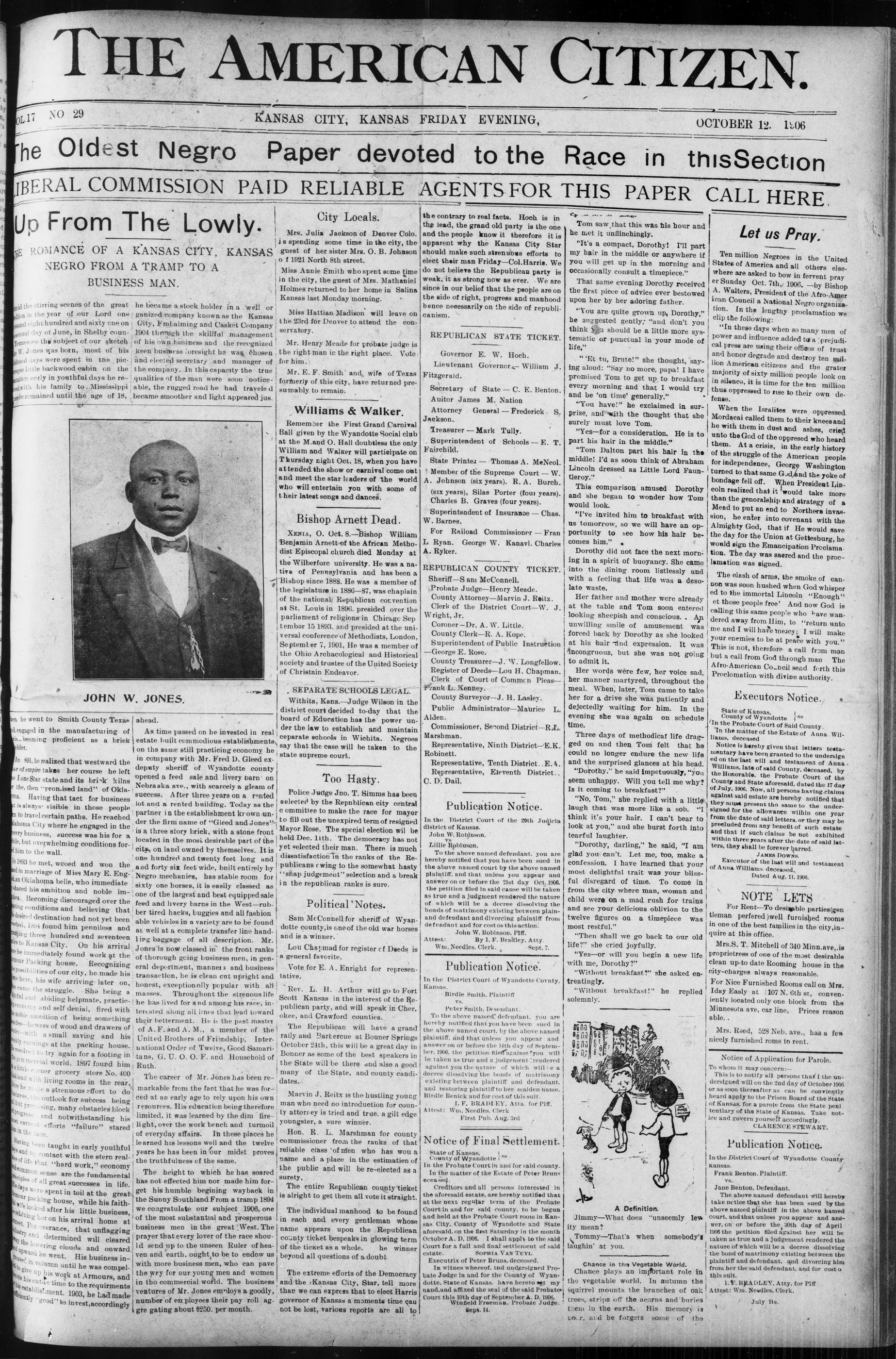
THE AMERICAN CITIZEN.
The Oldest Negro Paper devoted to the Race in thisSection
IBERAL COMMISSION PAID RELIABLE AGENTS FOR THIS PAPER CALL HERE
Up From The Lowly.
THE ROMANCE OF A KANSAS CITY, KANSAS NEGRO FROM A TRAMP TO A BUSINESS MAN.
mid the stirring scenes of the great million in the year of our Lord one second eight hundred and sixty one on second day of June, in Shelby county Tennessee the subject of our sketch of W. Jones was born, most of his childhood days were spent in the piccage little backwood cabin on the station early in youthful days he re-raised with his family to Mississippi he became a stock holder in a well or organized company known as the Kansas City, Fmbalming and Casket Company 1904 through the skillful management of his own business and the recognized keen business foresight he was chosen and elected secretary and manager of the company. In this capacity the true qualities of the man were soon noticeable, the rugged road he had traveled became smoother and light appeared jus.
1930
M.
JOHN W. JONES
then he went to Smith County Texas and engaged in the manufacturing of wines, becoming proficient as a brick welder.
In 891, he realized that westward the star of empire takes his course he left the Lone Star state and its brick kilns or the then "promised land" of Oklahoma. Having that tact for business it is always visible in those people on to travel certain paths. He reached Oklahoma City where he engaged in the very business, success was his for a while, but overwhelming conditions for him to the wall.
In 1863 he met, weeded and won the land in marriage of Miss Mary E. Englund an Oklahoma belle, who immediate shared his ambition and noble impulses. Becoming discouraged over the existing conditions and believing that the desired destination had not yet been reached, 1864 found him penniless and trapped three hundred and seventeen miles to Kansas City. On his arrival he immediately found work at the amour Packing house. Recognizing the possibilities of our city, he made his home here, his wife arriving later on, he came the struggle. She being a faithful and abiding helpmate, practical economy and self denial, fired with the noble amotion of being something besides—hewers of wood and drawers of money with a small saving and his weekly earnings at the packing house. He resolved to try again for a footing in the commercial world. 1897 found him a little corner grocery store No. 400 and with living rooms in the rear, he made a strenuous effort to do business, the outlook for success being all but promising, many obstacles block progress and notwithstanding his vast earnest efforts "failure" stared him in the face.
having been taught in early youthful age and to contact with the stern realities of life that "hard work," economy and common sense are the fundamental principles of all great successes in life. His days were spent in toil at the great armour packing house, while his faithfulness locked after his little business, or believing her on his arrival home at onset. Perseverance, that unflagging industry and determined will cleared away the lowering clouds and onward and upward he went. His business increased in volume until he was compelled to give up his work at Armours, and create his entire time to the requirements of his establishment. 1903, he had made efficiently "good" to invest, accordingly
---
he became a stock holder in a well or ganized company known as the Kansas City, Fimbalming and Casket Company 1904 through the skillful management of his own business and the recognized keen business foresight he was chosen and elected secretary and manager of the company. In this capacity the true qualities of the man were soon noticeable, the rugged road he had traveled became smoother and light appeared jus.
As time passed on he invested in real estate built commodious establishments on this same still practicing economy he in company with Mr. Fred D. Gleed ex deputy sheriff of Wyandotte county opened a feed sale and livery barn on Nebraska ave., with scarcely a gleam of success. After three years on a rented lot and a rented building. Today as the partner in the establishment brown under the firm name of "Gleed and Jones" is a three story brick, with a stone front located in the most desirable part of the city, on land owned by themselves. It is one hundred and twenty feet long and forty six feet wide, built entirely by Negro mechanics, has stable room for sixty one horses, it is easily classed as one of the largest and best equipped sale feed and livery barns in the West—rubber tired hacks, buggies and all fashion able vehicles in a variety are to be found as well at a complete transfer line handling baggage of all description. Mr. Jones is now classed in the front ranks of thorough gicing business men, in general department, manners and business transaction, he is clean cut upright and honest, exceptionally popular with all masses. Throughout the strenuous life he has lived for and among his race, interested along all lines that lead toward their betterment. He is the past master of A.F. and A.M., a member of the United Brothers of Friendship, International Order of Twelve, Good Samaritans, G. U. O. O.F. and Household of Ruth.
The career of Mr. Jones has been remarkable from the fact that he was forced at an early age to rely upon his own resources. His education being therefore limited, it was learned by the dim firelight, over the work bench and turmoil of everyday affairs. In these places he learned his lessons well and the twelve years he has been in our midst proves the truthfulness of the same.
The height to which he has soared has not effected him nor made him forget his humble begining wayback in the Sunny Southland From a tramp 1894 we coagratulate our subject 1906, one of the most substantial and prosperous business men in the great West. The prayer that every lover of the race should send up to the unseen Ruler of heaven and earth, ought to be to endow us with more business men, who can pave the way for our young men and women in the commercial world. The business ventures of Mr. Jones employs a goodly, number of employees their pay roll agre gating about $250. per month.
ahead.
KANSAS CITY, KANSAS FRIDAY EVENING,
City Locals.
Mrs. Julia Jackson of Denver Colo. is spending some time in the city, the guest of her sister Mrs. O. B. Johnson o f 1921 North 8th street.
Miss Annie Smith who spent some time in the city, the guest of Mrs. Mathaniel Holmes returned to her home in Salina Kansas last Monday morning.
Miss Hattian Madison will leave on the 23rd for Denver to attend the conservatory.
Mr. Henry Meade for probate judge is the right man in the right place. Vote for him.
Mr. E. F. Smith and wife of Texas formerly of this city, have returned presumably to remain.
Williams & Walker
Remember the First Grand Carnival Ball given by the Wyandotte Social club at the M.and O. Hall doubtless the only William and Walker will participate on Thursday night Oct.18, when you have attended the show or carnival come out and meet the star leaders of the world who will entertain you with some of their latest songs and dances.
Bishop Arnett Dead.
XENIA, O. Oct. 8. Bishop William Benjamin Arnett of the African Methodist Episcopal church died Monday at the Wilberforc university. He was a native of Pennsylvania and has been a Bishop since 1888. He was a member of the legislature in 1886-87, was chaplain of the national Republican convention at St. Louis in 1896. presided over the parliament of religions in Chicago September 15 1893. and presided at the universal conference of Methodists, London, September 7, 1901. He was a member of the Ohio Archacological and Historical society and trustee of the United Society of Christain Endeavor.
Withita, Kans.—Judge Wilson in the district court decided to day that the board of Education has the power under the law to establish and maintain separate schools in Wichita. Negroes say that the case will be taken to the state supreme court.
Too Hasty.
Police Judge Jno. T. Simms has been selected by the Republican city central committee to make the race for mayor to fill out the unexpired term of resigned Mayor Rose. The special election will be held Dec. 1th. The democracy has not yet selected their man. There is much dissatisfaction in the ranks of the Republicans cwing to the somewhat hasty "snap judgement" selection and a break in the republican ranks is sure.
Political Notes.
Sam McConnell for sheriff of Wyandotte county, is one of the old war horses and is a winner.
Lou Chapmad for register of Deeds is a general favorite.
Vote for E. A. Enright for representative.
Rev. L. H. Arthur will go to Fort Scott Kansas in the interest of the Republican party, and will speak in Cher, okee, and Crawford counties.
The Republican will have a grand rally and Bartercue at Bouner Springs October 24th, this will be a great day in Bonner as some of the best speakers in the State will be there and also a good many of the State, and county candidates.
Marvin J. Reitx is the hustling young man who need no introduction for county attorney is tried and true. a gilt edge youngster, a sure winner.
Hon. R. L. Marshman for county commissioner from the ranks of that reliable class of men who has wou a name and a place in the estimation of the public and will be re-elected as a surety.
The entire Republican county ticket is alright to get them all vote it straight.
The individual manhood to be found in each and every gentleman whose name appears upon the Republican county ticket bespeaks in glowing term of the ticket as a whole. he winner beyond all questions of a doubt
The extreme efforts of the Democracy and the Kansas City, Star, tell more than we can express that to elect Harris governor of Kansas a moments time can not be lost, various reports are all to
the contrary to real facts. Hooch is in the lead, the grand old party is the one and the people know it therefore it is apparent why the Kansas City Star should make such strenuous efforts to elect their man Friday—Col.Harris. We do not believe the Republican party is weak, it as strong now as ever. We are since in our belief that the people are on the side of right, progress and manhood hence necessarily on the side of republicanism.
REPUBLICAN STATE TICKET
Governor E. W. Hoch.
Lieutenant Governor — William J. Fitzgerald.
Secretary of State — C. E. Benton.
Autor James M. Nation
Attorney General — Frederick S. Jackson.
Treasurer — Mark Tully.
Superintendent of Schools — E. T. Fairchild.
State Printer — Thomas A. McNeol.
Member of the Supreme Court — W. A. Johnson (six years). R. A. Burch.
(six years), Silas Porter (four years).
Charles B. Graves (four years).
Superintsendent of Insurance — Chas. W. Barnes.
For Raiload Commissioner — Frank
L. Ryan. George W. Kanavl. Charles
A. Ryker.
REPUBLICAN COUNTY TICKET.
Sheriff—Sam McConnell.
Probate Judge—Henry Meade.
County Attorney—Marvin J. Roitz.
Clerk of the District Court—W. J.
Wright, Jr.
Coroner—Dr. A. W. Little.
County Clerk—R. A. Kope.
Superintendent of Public Instruction
—George E. Rose.
County Treasurer—J. W. Longfellow.
Register of Deeds—Lou H. Chapman.
Clerk of Court of Common Pleas—
Frank L. Kenney.
County Surveyor—J. H. Lasley.
Public Administrator—Maurice L.
Alden.
Commissioner, Second District—R.L.
Marshman.
Representative, Ninth District—E.K.
Robinett.
Representative, Tenth District..E.A.
Representative, Eleventh District..
C. D. Dail.
Publication Notice.
In the District Court of the 29th Judicia district of Kansas.
John W. Robinson.
vs
Lillie Roblson.
To the above named defendant, you are hereby notified that you have been sued in the above named court by the above named plaintiff, and that unless you appear and answer on or before the 21st day Oct. 1906, the petition filed in said cause will be taken as true and a judgment rendered the nature of which will be a decree dissolving the bonds of matrimony existing between plain and defendant and divoring plaintiff from defendant and for costs on this action.
John W. Robinson, Pliff.
Attest: By I. F. Bradley. Atty.
Wm. Needles. Clerk.
Sept. 7.
Publication Notice
In the District Court of Wyandotte Covnty
Kansas.
Birdie Smith. Plaintiff
vs.
Peter Smith. Desendant.
To the above named defendant, you are hereby notified that you have been sued in the above named court, by the above named plaintiff, and that unless you appear and answer on or before the 14th day of September, 1906, the petition filed against you will be taken as true and a judgement rendered against you the nature of which will be a decree dissolving the bonds of matrimony existing between plaintiff and defendant, and restoring plaintiff to her maiden name, Birdie Renick and for cost of this suit.
L. F. BRADLEY, Atta, for Pliff.
Attest: Wm. Needles, Clerk
First Pub. Aug. 3rd
Notice of Final Settlement.
State of Kansas,
County of Wyandotte
In the Probate Court in and for said county.
In the matter of the Estate of Peter Bruns
excased.
Creditors and all persons interested in
the aforesaid estate, are hereby notified that
at the next regular term of the Probate
Court in and for said county, to be begun
and held at the Probate Court room in
Kansas City, County of Wyandotte and State
aforesaid, on the first Saturday in the month
October A. D. 1906. I shall apply to the said
Court for a full and final settlement of said
estate.
SOPHIA VAN TUYL.
Executrix of Peter Bruns, deceased.
In witness whereof, tnd undersigned Probate Judge in and for the County of Wyandotte, State of Kansas, have hereto set my nand, and affixed the seal of the sald Probate Court this 10th day of September A. D. 1966.
Tom saw that this was his hour and he met it unflinchingly.
"It's a compact, Dorothy! I'll part my hair in the middle or anywhere if you will get up in the morning and occasionally consult a timepiece."
That same evening Dorothy received the first piece of advice ever bestowed upon her by her adoring father.
"You are quite grown up, Dorothy," he suggested gently; "and don't you think you should be a little more systematic or punctual in your mode of life,"
"Et tu, Brute!" she thought, saying aloud: "Say no more, papa! I have promised Tom to get up to breakfast every morning and that I would try and be 'on time' generally."
"You have!" he exclaimed in surprise, and with the thought that she surely must love Tom.
"Yes—for a consideration. He is to part his hair in the middle."
"Tom Dalton part his hair in the middle! I'd as soon think of Abraham Lincoln dressed as Little Lord Fauntleroy."
This comparison amused Dorothy and she began to wonder how Tom would look.
"I've invited him to breakfast with us tomorrow, so we will have an opportunity to see how his hair becomes him."
Dorothy did not face the next morning in a spirit of buoyancy. She came into the dining room listlessly and with a feeling that life was a desolate waste.
Her father and mother were already at the table and Tom soon entered looking sheepish and conscious. An unwilling smile of amusement was forced back by Dorothy as she looked at his hair and expression. It was incongruous, but she was not going to admit it.
Her words were few, her voice sad, her manner martyred, throughout the meal. When, later, Tom came to take her for a drive she was patiently and dejectedly waiting for him. In the evening she was again on schedule time.
Three days of methodical life dragged on and then Tom felt that he could no longer endure the new life and the surprised glances at his head
"Dorothy," he said impetuously, "you seem unhappy. Will you tell me why? Is it coming to breakfast?" "No, Tom," she replied with a little laugh that was more like a sob. "I think it's your hair. I can't bear to look at you," and she burst forth into tearful laughter.
"Dorothy, darling," he said, "I am glad you can't. Let me, too, make a confession. I have learned that your most delightful trait was your blissful disregard of time. To come in from the city where man, woman and child were on a mad rush for trains and see your delicious oblivion to the twelve figures on a timepiece was most restful."
"Then shall we go back to our old life?" she cried joyfully.
"Yes—or will you begin a new life with me, Dorothy?"
"Without breakfast?" she asked entreatingly.
"Without breakfast!" he replied solemnly.
A
B
A Definition.
Jimmy—What does "unseemly lew
ity mean?
Tommy—That's when somebody's
laughin' at you.
Chance plays an important role in the vegetable world. In autumn the squirrel mounts the branches of oak trees, strips off the acorns and buries them in the earth. His memory is poor, and he forgets some of the
thisSection CALL HERE
Let us Pray.
Ten million Negroes in the United States of America and all others elsewhere are asked to bow in fervent prayer Sunday Oct. 7th, 1906. —by Bishop A. Walters, President of the Afro-American Council a National Negro organization. In the lengthy proclamation we clip the following:
"In these days when so many men of power and influence added to a prejudicial press are using their offices of trust and honor degrade and destroy ten million American citizens and the grater majority of sixty million people look on in silence, it is time for the ten million thus oppressed to rise to their own defense.
When the Israilites were oppressed Mordacai called them to their knees and he with them in dust and ashes, cried unto the God of the oppressed who heard them. At a crisis, in the early history of the struggle of the American people for independence, George Washington turned to that same God and the yoke of bondage fell off. When President Lincoln realized that it would take more than the genoralship and strategy of a Mead to put an end to Northern invasion, he enter into covenant with the Almighty God, that if He would save the day for the Union at Gettesburg, he would sign the Emancipation Proclamation. The day was saered and the proclamation was signed.
The elash of arms, the smoke of cannon was soon hushed when God whispered to the immortal Lincoln "Enough" at those people free' And now God is calling this same people who have wandered away from Him, to "return unto me and I will have mercy; I will make your enemies to be at peace with you." This is not, therefore a call from man but a call from God through man The Afro-American Council send forth this Proclamation with divine authority
Executors Notice.
State of Kansas
State of Kansas, }ss
County of Wyandotte
In the Probate Court of Said County
In the matter of the Estate of Anna Williams, deceased
Notice is hereby given that letters testamentary have been granted to the undersigned on the last will and testament of Anna Williams, late of said County, deceased, by the Honorable, the Probate Court of the County and State aforesaid, dated the 17 day of July, 1906. Now, all persons having claims against said estate are hereby notified that they must present the same to the undersigned for the allowance within one year from the date of said letters, or they may be precluded from any benefit of such estate and that if such claims be not exhibited within three years after the date of said letters, they shall be forever barred.
JAMES DOWNS
Executor of the last will and testament of Anna Williams deceased.
NOTE LETS
For Rent—To desirable parties(gentleman perferred) well furnished rooms in one of the best families in the city,inquire at this office.
Mrs.S. T. Mitchell of 340 Minn.ave.,is proprietress of one of the most desirable clean up-to date Rooming house in the city-charges always reasonable.
For Nice Furnished Rooms call on Mrs. Iday Easily at 1107 N. 6th st, conveniently located only one block from the Minnesota ave, car line, Prices reason able..
Mrs. Reed, 528 Neb. ave., has a few nicely furnished roms to rent.
Notice of Application for Parole.
To whom it may concern:
This is to notify all persons that I the undersigned will on the 2nd day of October 1960 or as soon thereafter as can be convenient heard apply to the Prisen Board of the State of Kansas, for a parole from the State penitentiary of the State of Kansas. Take notice and govern yourself accordingly.
CLARENCE STEWART.
Publication Notice.
In the District Court of Wyandotte County kansas.
Frank Benton, Plaintiff.
vs.
Jane Benton, Defendant.
The above named defendant will hereby take notice that she has been sued by the above named plaintiff in the above hamed court, and that unless you appear and answer, on or before the 30th day of April 1906 the petition filed against her will be taken as true and a judgement rendered the nature of which will be a decree dissolving the bond of matrimony existing between the plaintiff and defendant, and divorcing him from her the said defendant, and for cost of this suit.
I. F. BRADLEY, Atty. for Piff
Attest: Wm. Needles, Clerk.
July Its.
American Citizen
The Oldest Negro Journal Published Weekly in this part of the Country.
Published Weekly
at 1510 North 3rd Street
KANSAS CITY . . . . . KANSAS.
W. C. Martin, Editor,
Geo. A Dudley, Publisher and Business Manager.
Terms of Subscription in Advance.
One Year.....$1.00
Six Months.....65c
Three Months.....40c
One Month.....15c
**Advertising** 25 cents per inch First Insertion.
**A Standing Display** 'Ad' for 3 Months or longer 15c per inch, each insertion.
Grangemouth is the name of a Moscow editor. Evidently a farmer on the side.
Waldorf Astor has become so thoroughly anglicized that he is going to marry an American girl.
A clergyman says that bridge whistle leads to mental decline. Why doesn't he try poker for a change?
Senator Pettus is declared to be a poor man and fond of poker. The last explains the first, possibly.
Perhaps boys should be thankful for whippings, as somebody declares, but *they seldom are before they are 45.
Sweet Spring is now approaching, and Summer with the rose, so poetry's encroaching upon the field of prose.
King Edward was "warmly received" in Paris, but not in the same way as when he used to be prince of Wales.
The czar will reserve the right to wield the big stick over the Douma, according to the latest advices from St. Petersburg.
We learn from the New York Mall that women are using garters to keep those long, arm-length gloves in place. But do they hold?
Manchuria will be finally evacuated by the Japanese in a few days. It has taken them longer to get out than it did to get in.
It is now believed that Anna Gould is going to give Boni one more chance, in spite of the fact that he has taken a great many already.
Uruguay should not be blamed for having a revolution. A review of recent South American history shows that it is Uruguay's turn.
Asks the editor of the Pittsfield Journal: "Are there four girls with gray eyes in Pittsfield?" Apparently ye scribe means to get busy.
Queen Maud of Norway is losing her health because she fears her husband will be killed. This queen business is not all pickles and pie.
It was not long ago that all the "success" magazines were pointing to the Pittsburg millionaires as examples to the youth of the land.
With 10,000 doctors in convention in Boston next summer, the rest of the country ought to have a good opportunity to get well—Boston Globe.
It is a pity that the great romancers of the sea did not live in a generation which affords such thrilling material as the log of the dry dock Dewey.
A Minnesota man says he has discovered the cause of the aurora borealis. But what bearing will this have on the price of coal this year?
Much to the surprise of everybody, some of the phenomenal ball players added to the leading nines as marvelous discoveries will probably make good.
Cheer up, mister! The president of the Dressmakers' National Protective Association says that women's dress will be less expensive this year than ever before.
The Japanese, says one of their statesmen, should adopt chairs and develop their legs. Well, short legs did not prevent them from "getting there" in the late war.
Portla, as quoted by the editor of a kind of society paper, is made to say: "How far that little scandal throws his beams! So shines a bad deed in this haughty world."
News comes from the east that the seventeen-year locusts will devastate the land this year. How many times in the course of a decade do the seventeen-year locusts come, anyhow?
As the last suffragist was detached from the doorknob and put into the police wagon, the premier of the great British Empire crawled out from under his bed and sighed a sigh of relief.
An actor has become a soldier in order to escape the adulation of matinee girls. We know several actors who should be driven from the stage with a club instead of soft glances.
GREAT SINGER IS UNGRATEFUL.
Mme. Patti Criticizes America, Which
Made Her Wealthy.
Confirmation of the report that Mme. Adelina Patti has made her final tour in the United States is found in her recent criticisms of the American people. This lady, who once lived down on Grand street West, but now dwells in a castle in Wales, largely owing to the generosity of the citizens of this city, has lately discovered that we haven't any appreciation of art, cookery, music or good manners. This is an ill return for all the complimentary words we have uttered about her, not to mention the dollars we have paid to hear her voice. Although she was born in Madrid in February, 1843, she came here with her parents as a child and grew up among the people of New York. Her brother, Carol, used to lead the orchestra at the Grand Opera House; during the Jim Fisk era of French opera-bouffe.
Mme. Patti's last tour of this country was not financially successful—a circumstance that may account for her change of heart. The lady, however, insisted upon receiving her contract money to the last dollar. The imprecarlo was almost ruined, although the fault was the diva's own. She couldn't sing! Her voice had lost its fine quality. She wasn't a "diva" any longer. The American people found this out and refused to assist in maintaining Craig y Nos castle—Brooklyn Eagle.
Famous Actors as Negro Minstrels.
Jefferson said he thought he was one of the first men to black his face after the appearance and success of "Jim Crow" (T. D.) Rice.
"I suppose," said Mrs. Drew, "there are very few men in this company who have not at one time or another been associated with minstrel performances."
"I played Brudder Jones," said Mr. Jefferson.
"Everybody knows I was in the minstrel business." Goodwin exclaimed. "Yes," I remarked, "because we were there together. "Well," joined in Crane, "I was on the tambourine end with Campbell's minstrels." I remember telling this at Lawrence Barrett's house at Cohasset, where the rest of the party consisted of Edwin Booth and Stuart Robinson, Booth then told how he and J. S. Clarke were minstrels in their younger days, and he followed this up by declaring that he used to "pick a little on the banjo." I laughed, and Booth inquired the reason, and I added, "Oh, nothing much, only Booth and the banjo seemed such an odd combination."—Francis Wilson in Scribner's Magazine
O Thou Compassionate.
How deeply comforting the tender phrase.
Thy greater attribute seem merged in this-
Through all life's long and dark and weary maze.
Thou Art Compassionate.
To God of Justice and of Power we turn
When wrong or devastating blow cuts deep.
And yet in daily struggle needs must yearn
For one Compassionate.
In limits of our souls we live, alone,
And e'en our nearest may not understand.
But all "the household jar within" is known
To thee, Compassionate.
Thou know'st the many sorrows of the day:
Wide longing, narrow opportunity—
We bring life's broken toys, as children may,
To one Compassionate.
We may have blundered grievously and long.
Darkened Thy world we might have made so bright.
Still Thou dost heal the heartache and the wrong
O Thou Compassionate!
—May Ethelyn Bourne, in Overland Monthly.
Of No Importance.
Two men were standing together on an East River ferryboat when one pointed out a third man with the remark:
"I can't recall his name at this moment, but he writes for a number of the magazines."
His friend looked at the stranger with much interest.
"Oh, one of our frenzled finance captains, is he?" he asked.
"No, he—"
"Writes up trusts and things, then?"
"Oh, then he's a prizefighter or an actor—he is rather husky looking."
"No, no! He's just a plain author—writes stories."
"Oh!" the friend exclaimed, the look of interest suddenly dying out of his face—New York Journal.
True to His Promise.
The other boy had called Tommy a liar, an 'a fightin' liar, and told him he dassen't take it up.
Tommy's fists were clinched and his eyes were blazing, but he stood there rapidly repeating something to himself, in accordance with a long standing promise he had made to his mother.
"If you'll jist wait till I've finished sayin' it." he said, "I'll knock the tar out o' you, Dick Bunker, you ple faced slob! 'But children, you should never let your angry passions—'"
The other boy, however, disappeared around the corner while Tommy's lips were still moving.
Flying Wedge.
"Great Scott!" exclaimed the drummer who had put up in the old farm house over night. "What was that noise down below? Football rush?" "Worse than that, stranger." chuckled the old farmer, as he snuffed out the candle. "Yeou see, I have eight darters on' each one of them has a bean who calls on Thursday nights. Wall, the first couple that gets the parlor can, have it. That's why they are running."
LACE SCARF AS EAR TRUMPET
Elderly Lady Has Discovered It Acts as Sounding Board.
With advancing years a dear old lady has found that her hearing has become somewhat affected. She has not found it necessary to use an ear trumpet as yet, but it is difficult at times to catch all that friends say. Anything said in an undertone is completely lost to her—that is, it was until she hit upon a novel idea.
While visiting a friend recently the hostess had pitched her voice almost to the straining point and her vocal organs were getting tired, when "Aunt Sle," as she is affectionately termed, interrupted her by saying: "Please, dearle, hand me my lace head scarf."
"Do you feel a draught?" anxiously inquired the hostess, handling over the mantilla.
"Not the slightest," said "Aunt Sle" as she adjusted the head covering.
"Oh, I think not. You see, the scarcity acts as a sort of sounding board. It keeps out all other sounds except those of the human voice. When I wear this I can hear even a whisper I can't explain why it is, but it is so nevertheless. I have had lots of fun over it, too. My boys have been taking advantage of my infirmity to whisper to each other. I didn't hear them before I began to wear this scarf, but now I know lots of their secrets and they don't know it. It's a good joke on them."
Fish Know Colors.
"Fish know colors," said a keeper at the New York Aquarium the other day. "They can distinguish between red and blue, or white and green, as well as you and I. Wait and I'll prove it."
He led the way to a tank in which were some red and some yellow and some green fish, and in it were artificial grottoes painted respectively red and yellow and green. The keeper rolled the water with his hand, and the fish fled, the red ones to the red grotto, the yellow ones to the yellow grotto, and the green ones to the green grotto.
"They know which color shields them from observation best," said he. "Now I'll change the grottoes, so as to prove my statement a second time."
He moved the grottoes to different places in the tanks and again rolled the water.
The same thing followed as before. Each fish darted like a shot to the grotto of its own color, where it knew it would be best concealed.
To the Beloved.
Everything that I made I used to bring to you.
Was it a song, why, then 'twas a song to sing to you.
Was it a story, to you I was telling my story.
Ah, my dear, could you hear 'mild the bliss and the glory?
Did any one praise me, to you I said it all over;
My lasted for you: how we laughed in the days past recover?
My tears and my troubles were yours; did any one grieve me.
I carried it straight to the love that was sure to relieve me.
O my dear, when aught happens, to you I am turning.
Forgetting how far you have traveled this day from my yearning.
There is nobody to tell things to; your house is so lonely;
And still I'm forgetting and bringing my tale to you only.
The old days are over; how pleasant they were, the fine weather.
When youth and my darling and I were at home and together!
And still I'm forgetting, ochone, that no longer I am me.
And turn to you still with my tale, and there's no one to hear me.
—Pall Mall Gazette.
Fate of the Old Presidents.
In the autumn of 1901 Mrs. W. of Roxbury spent a few weeks with her daughter in Nova Scotia, returning home shortly before President McKinley was shot, bringing her niece, Bessie F., aged 6 years, home with her. Of course the child heard a good deal of talk in the house about the shooting of the president.
One day Bessie said to her aunt: "Aunt Minnie, who is king of the United States?" Her aunt replied: "We have no kings in the United States like you do in your British country. We have presidents. We have an election every four years and elect a new one."
"Oh, yes," the child replied; "and then they shoot the old ones, don't they?"—Boston Herald.
New City for Egypt.
Suakin, on the Red sea, has proved an unsatisfactory port and is to be superseded by a brand-new rival which has been built up out of coral work and desert sand by the Egyptian authorities. The rival is Port Sudan, the latest addition to the cities of the British empire, and an enthusiast says that it is destined to be a place of magnitude and importance in the days when cotton shall have made it the New Orleans of the east. The place has hitherto been called Mersa Sheikh Barud. It is about 680 miles south of Suez and is capable of holding a dozen vessels of moderate size. The entrance is 600 feet across, and the land around is six feet above sea level.
Posers for Scholars
Twenty words submitted to a spelling bee in Springfield, Mass., in 1846 were given to the high school class at East Liverpool by Supt. Rayman, and it is reported not one in the class correctly spelled every word. Only ten had averages of over 90 per cent. The average of the 124 pupils was $73\frac{1}{2}$ per cent.
The words submitted were accidental, accessible, baptism, chirography, characteristic, deceitful, descendant, eccentric evanescent, fierceness, feignedly, ghastliness, gnawed, helness, hysterics, imbecility, inconceivable, inconvenience inefficient, irresistible.
-Pittsburgh Dispatch.
SHIELDS FOR TROOPS IN WAR
Their Use Urged by a German Military Writer.
A writer in the Militar-Wochenblatt raises anew the question of the use of portable shields for the protection of infantry in the attack, says the Bracad Arrow. He writes approvingly of the Japanese spade work in the offensive, the more so because he mentions incidentally, as a matter regarding which there can be no dispute, that the German authorities have long since advocated the use of artificial cover in the attack, and points out that when the ground was frozen or rocky, and the spade could make no impression upon it, the attacking Japanese infantry not infrequently went forward, carrying with them filled sandbags weighing as much as forty pounds. He remarks that if the undoubtedly brave Japanese soldier found it necessary to load himself with so bulky and burdensome a protection when advancing in the open against an intrenched enemy it would seem far better to equip the infantry with a light, handy shield.
Furnished with a handle by which to carry it, a loophole to fire through and some arrangement to prevent its falling down, the infantryman would then find himself, like his gunner comrade, protected by a bullet-proof shield. The writer in the Wochenblatt suggests that on the march the shield should be carried on the back, when going into action on the chest, and when advancing to the attack in the left hand, so as to be at once available for use when lying down to fire, both as head cover and rifle rest.
YOUR HAIR SHOULD BE DRAB.
That is the Fashionable Color, So an Authority Says.
"Deep auburn and the drab shades are the fashionable colors in hair this season," said the woman who makes hair coloring a speciality, as placidly as though she were commenting on the state of the weather or the advance style in dress goods.
"One of my customers has to my knowledge worn five different colors or shades on her wavy tresses. Having been blessed with medium brown hair by nature she became a ravishing blonde when the fashion for bleaching first came in.
"Next she took to titian red after a trip to the art galleries of Europe. Then she thought she would be more attractive as a brunette, and now her hair is drab.
"The last is by far the most popular of all for the reason that is most difficult to obtain, and then it is pretty generally becoming, and it happens that women who are born with this particular color of hair are almost always clever.
"How is it done? Well, in case of a woman whose hair is dark a bleach must first be used before the dye is applied. With women whose hair has turned gray it is a still simpler problem. The color lasts a year, while the head can be washed and even salt water bathing does not affect it."—New York Sun.
What Money Will Do
They say that money can not buy
these things for me. But I—
Well, I don't know.
What bought the most delightful wife
A man could hope to win?
What buys her every wish in life—
the clothes she dazzles in?
And if her heart beats not for me,
And I am adored, you see,
Well—I don't know!
And heaven? Oh, of course, I don't
Expect to get in free;
But I like Lord meant what he said
Concerning.
The tite I'll give before I die.
Will slip me through the needle's eye.
Or—I don't know!
For happiness? Well, money bought
This ninety-cent cigar;
It bought this cigar which I loll,
It bought this private car;
It bought this cognac—and, I guess,
If all this is not happiness.
Well—I don't know!
Not a Good Advertisement
A Welsh judge had before him a ease in which a printer sued a pork butcher for the value of a large parcel of paper bags with the butcher's advertisement printed thereon.
The printer, having no suitable illustration to embellish the work, thought he improved the occasion by putting an elaborate royal arms above the man's name and address, but ultimately the latter refused to pay.
The judge, looking over a specimen, observed that for his part he thought the lion and the unicorn were much nicer than an old fat pig.
"O well," answered the butcher, "perhaps your honor likes to eat animal like that, but my customer's don't. I don't kill lions and unicorns—I only kill fat pigs!"
Verdict for defendaht.—New York World.
Up to Requirements.
A Kansas City man purchased a city lot with the restriction that he should not build a house on it to cost less than $2,500. After having paid for the lot he decided to build a $1,500 cottage.
Before he had completed it the real estate man from whom he had bought the lot threatened to sue him for breach of contract. "This little shack you are building." said the real estate man, "lacks a whole lot of beating a $2,500 house such as you agreed to build."
"Don't form too hasty judgment," replied the owner. "True, it hasn't cost that much yet, but I intend to put a solid gold brick in the chimney."
-Kansas City Times
Telephone Bell W. 32
W. B. R
FUNERAL
and Embalmer. The very best
for all Purpos
The Best Equipped White
sick and
on Short Notice. Charges R
sota Ave., Kansas
Western
B. Raymo
GENERAL DIRECTOR
ner. The very best of Service, Fine
for alll Purposes, at all Hours.
Equipped White Enameled Ambul
sick and wounded
Notice. Charges Reasonable. Call at
sota Ave., Kansas City, Kansay.
W. B. Raymond FUNERAL DIRECTOR
and Embalmer. The very best of Service, Fine Carriages for all Purposes, at all Hours.
The Best Equipped White Enameled Ambulance for sick and wounded
on Short Notice. Charges Reasonable. Call at 431 Minne sota Ave., Kansas City, Kansay.
Western University
THE GREAT EDUCATIONAL INSTITUTION
FOR KANSAS AND THE WEST
DEPARTMENTS:—Theological, College, Normal, Sub-Nor-
工业rial.
COURSES:—Classical, College, Preparatory, Normal, Su-
sical (Instrumental and Vocal), including piano, on-
mony, Drawing (Fine Arts and Mechanical), Carpe-
and Book-Binding, Business Course, Stenography and
Tailoring, Dressmaking and Plain Sewing, Cooking,
Farming and Gardening.
ADVANTAGES:—Splendid Location, Healthful Climate,
ences and Thorough Teachers.
INFORMATION:—For terms, prices and all inducem-
write to
WILLIAM T. VERNON, A. M.,
PRESIDENT,
QUINDARO,
MENTS:—Theological, College, Normal, Sub-Nor-
mal.
—Classical, College, Preparatory, Normal, Sub-
Instrumental and Vocal), including piano, on
Drawing (Fine Arts and Mechanical), Carpe-
ook-Binding, Business Course, Stenography and
dog, Dressmaking and Plain Sewing, Cooking
and Gardening.
DES:—Splendid Location, Healthful Climate,
and Thorough Teachers.
ION:—For terms, prices and all induceme-
to
IAM T. VERNON, A. M., P
PRESIDENT,
DEPARTMENTS:—Theological, College, Normal, Sub-Normal and State Industrial.
COURSES:—Classical, College, Preparatory, Normal, Sub-Normal, Musical (Instrumental and Vocal), including piano, organ and harmony, Drawing (Fine Arts and Mechanical), Carpentry, Printing and Book-Binding, Business Course, Stenography and Typewriting, Tailoring, Dressmaking and Plain Sewing, Cooking, Laundering, Farming and Gardening.
ADVANTAGES:—Splendid Location, Healthful Climate, Good influences and Thorough Teachers.
INFORMATION:—For terms, prices and all inducements offered write to
Phones
Office—Bell+“White” 4302.
Residence—Bell—“West” 15.
Why does colored people as well as uncolored people by a smoky poor light and drink mud water full of disease germs.
When they can get a first-class
Bright Gas Burner Ligh
red people as well as uncolored peoplelet set in by a smoky poor light and drink muddy bad water full of disease germs.
get a first-class
Gas Burner Light
Why does colored people as well as uncolored people set in the dark by a smoky poor light and drink muddy bad water full of disease germs.
Bright Gas Burner Light
For 35 to 75 cents. And a
Self Cleaner W
that makes the water clear as a Crystal
For 50 to 75 cents.
A. J. SHERID
ROOM 8,
Self Cleaner Water
makes the water clear as a Crystal and Health
For 50 to 75 cents.
A. J. SHERIDAN
ROOM 8.
A AVE. KANSAS CITY
shade of the Old Apple Tree" is a very popular
sular by trading at a popular store?
L. J. MADDUX
梨 and Fancy Grocer
teats and all Kinds of Produce
that makes the water clear as a Crystal and Healthy. For 50 to 75 cents. A. J. SHERIDAN
"In the shade of the Old Apple not you be popular by trading at a L. J. M Staple and Fa Meats and all K
"In the shade of the Old Apple Tree" is a very popular song—When not you be popular by trading at a popular store?
L. J. MADDUX, Staple and Fancy Groceries Meats and all Kinds of Produce.
HOME PHONE 784 WEST.
Because its employees were late a London house provided a book in which the tardy ones were to write excuses. Reasons for lateness were not much varied. At the top of the page one would write "Train delayed," or "Omnibus horse died," as the case might be, and the rest fell into the habit of making ditto marks and letting it go at that. But not long ago one man had a new excuse. He wrote with pride: "Wife had twins." The second slow person that morning was in a great hurry, and did not notice the innovation, but made his customary ditto marks, and the rest of the men on that page followed suit. The excuse book was abolished.
Example of the Postage Stamp.
Example of the Postage Stamp.
The late judge Andrew Wylie, of Virginia, had a happy gift of illustration. The judge cast in 1860 the only vote for Lincoln that was given in Alexandria, Va. In an address on Lincoln he once illustrated in an odd way the power of perseverance. "Lincoln persevered," he said, "and it is only those who persevere, they who concentrate their energies, who succeed. Don't give three years to journalism and then, discouraged, try the law awhile. Don't learn the grocery business and in a little while take up placer mining or plumbing. Consider, rather, the postage stamp, whose useful depends on its ability to stick to one thing until it gets there."
What is a family then?
"Well," said the first policyholder, throwing aside his paper, "there is at least one thing we can be thankful for concerning our Mutual friend, Mr. McCurdy."
"What's that?" inquired the second policyholder.
"That he isn't a Mormon."
530 MINNESOTA AVE.
852 FREEMAN AVE.
Telephone Home W.32
aymond DIRECTOR
st of Service, Fine Carrriage
es, at all Hours.
Enameled Ambulance for
wounded
reasonable. Call at 431 Minne
as City, Kansay.
University
College, Normal, Sub-Normal and State
Preparatory, Normal, Sub-Normal, Musical), including piano, organ and harp and Mechanical), Carpentry, Printing Course, Stenography and Typewriting, Plain Sewing, Cooking, Laundering,
ion, Healthful Climate, Good Influences and all inducements offered.
NON, A. M., D. D.
DENT,
KANSAS.
uncolored people set in the dark or and drink muddy bad disease germs.
ner Water Eilter
as a Crystal and Healthy.
75 cents.
ERIDAN
M 8,
KANSAS CITY, KANSAS
Tree" is a very popular song—Wha popular store?
ADDUX,
ency Groceries
inds of Produce.
KANSAS CITY, KANSAS
Res. 420 Nebraska ave. Tel. 383 White
SOUTH AMERICAN MEDICAL INSTITUTE
Office Hours: From 10 a. m., till 4 p. m.
and from 6 till 9 p. m.
C. H. C. JORDAN, M. M., M. D.
Here is the Place
J. T. Roberts
TONSORIAL PARLOR
All the Latest Style Hair Cuts, Clean
Shave strictly Up-to-Date
438 MINNESOTA AVE
An Old French Sailor
French seamen have a dozen in the person of a centenarian. The old sailor belongs alike to the navy and to the merchant service, for he served in both, and it would be difficult to say in which of the two his adventures were the most thrilling. His record includes three shipwrecks, the battle of Navarino, in which he won mention in orders, the blockade of Algiers, one capture by brigands, followed by himself and his companions seizing the Spanish ship which captured the corail which had captured them. After serving many years before the mast he became a master and small ship owner on his own account. His name is Pierre Loirat. He was born in November, 1805, and at 12 he went to sea.
ROOM 8,
KANSAS.
DEMOCRATIC PLOT TO RAISE THE PRICE OF TEXT BOOKS.
Who Pays the Bill?—Real Reasons Why Mrs Ella S. Burton is Fighting Governor Hoch.
If the Democratic State committee is not paying the expenses of Mrs. Ella S. Burton, who is traveling over the state abusing Governor Hoch, Prof. A. B. Carney, Democratic candidate for state superintendent of public instruction, D. O. McCray and other members of the text book com- who is?
mission, who is the current gossip in Kansas that one branch of the book trust with headquarters at Boston and Chicago is behind this Democratic onslaught on the schools of Kansas. Governor Hoch and the text book commission, and that it has found in the Kansas City Star, Mrs. Burton, Colonel Harris and the Democratic committee, willing advocates. Certainly some "interest" is paying the bill, because the parties named have never been charged with working overtime on behalf of the "poor school children of Kansas." It is no longer a secret that the book trust firm referred to has announced its intention of coming to Kansas this winter to lobby through an amendment to the present law raising the maximum prices about 40 per cent so that they will be in harmony with Missouri prices. This same firm helped to kill uniformity in Missouri in order that it could go back to high prices, and the Kansas City Star refused to propose is campaign for plunder. In fact one of the managers has announced that such a fight will be made in Kansas. The charge by Democratic leaders and the Kansas City Star that the present books are "cheap trash" is but the paving of the way for an onslaught for high prices before the legislature.
With such advocates as Colonel Harriet Mrs. Burton, W. H. Ryan and the Kansas City Star, it really does look like a formidable movement. These modern "reformers" stood together in 1857, when the legislature struggled to enact the present law which saves the people of Kansas one hundred thousand dollars annually. Colonel Harris was then a member of the state senate, and in committee of the whole fought to exclude cities of the first class from its operation. Then when the roll was called on the final passage of the state uniformity bill he found it convenient to be "absent and not voting." During this fight in the legislature the Kansas City Star was absolutely silent. The people appealed for a reduction in the price of school books for their children, but that paper turned a deaf ear and offered no help in throttling the book trust. With Mrs. Burton, it was on the side of the trust. And when the bill was passed and signed by the Governor, the Kansas City Star published an editorial sheer at the law and the people of Kansas, declaring that the people and this law were very much alike in their "uniformity." A little later when the first text book commission must to put the new law into effect it faced infunction in proceedings brought by the book trust, through that other modern "reformer." David Overmyer, his attorney.
The text book campaign planned by this "reform" junta is deep laid. The plot was carefully thought out. Mrs. Burton had been connected with one branch of the book trust, and her secrets and punished letters would be valuable. Colonel Harris' record in the state senate was "right," and the Kansas City Star could be depended upon as in 1837 when it refused to help pry loose the book trust in Kansas. That amalgamation of interests was a nucleus that any book trust would welcome in a raid upon the legislature for higher prices and "business." So, the word went forth from Democratic headquarters at Topeka and in the Kansas City Star office to charge Governor Hoch and his text book commission with connivence with the book trust. It mattered not if Prof Carney, the Democratic candidate for state, superintendent of public instruction should be a victim—voters were necessary in the plot—and Carney must take his medicine.
Back of this text book commission "hine" plot is some guiding hand, some power, some "interest" that is paying the bills. It is unlike the Kansas City Star to work itself into a labor for the "poor school children of Kansas" unless there is something in line at the other end of the line. Colonel Harris stood for the interests of the book trust in 1837, and it is not probable that his long residence in Chicago and the trust influences that surround him there would tend to charge his attitude now. And, then there is Mrs. Burton who is traveling over the state making Democratic speeches in the name of Education, and in the "interest" of the "dear children." She says she would scorn to take nasty vaults. Democratic money from Bill Ryan in fighting for the noble cause of Education, but neither Mrs. Burton, the Kansas City Star or Colonel Harris have denied that they are in league with a branch of the book trust that has organized to "come back to Kansas and claim its own."
somebody is paying the bills. Who is it?
HAS HELD NO MEETINGS.
Hoch Explodes Another Democ-
rical First Book Issue."
Governor Hoch in a recent statement on the text book commission question exhled the whole fabrication created by the Democrats in their attempts to be bashed the character of the commission appointed by the Governor. He polled out that during the life of the present commission not a school book contract has been let, that not our meeting has been held by the commission, and that the board has transmitted no official business during its administration. In closing his statement governor Hoch asked the people to compare the character of the eight men appointed on the commission by him with the character
of any eight men on the editorial staff of the Kansas City Star, the paper that has made the most vicious attacks against the commission and Governor Hoch.
These are the men Governor Hoch selected as members of the state text book commission: President Joseph H. Hill of the State Normal school, Emporia; Frank Nelson, former state superintendent of schools, Lindsborg; Geo. W. Winans, former state superintendent of schools, Hutchinson; A. B. Carney, superintendent of schools, Concordia, and Democratic candidate for state superintendent of public instruction; W. B. Hall, superintendent of schools, Abilene; S. M. Nees, principal of Montgomery county high school, Independence; Willard S. Lyon, former county superintendent, Lincoln, and D. O. McCray, Topeka. Three things stand out prominent in the record of those who now profess so deep interest in the "poor school children of Kansas." When the state uniformity law was enacted by the legislature of 1897, after the people of Kansas had appealed for protection against the capacity of the book trust, Colonel Harris, then a member of the state state refused his aid and vote. He tried to have the cities of the first class excluded from the operation of the law, and failing in that he absented himself when the final roll call was had on the passage of the bill. The Kansas City Star also gave aid and comfort to the book trust and absolutely refused to aid the people in this demand for cheaper book books. Finally when the law was passed the Star expressed its disgust in an editorial squib which sneered at the law and the people of Kansas, declaring that they were very much alike, in their "uniformity." As a last effort to defeat the will of the people as expressed by the legislature, injunction suits were instituted against the first text book commission to prevent the adoption of any books whatever in the District court of Shawnee county by the book trust, through David Overmy, its attorney.
TRCUTMAN'S ADVICE.
URGES REPUBLICANS TO VOTE
STRAIGHT TICKET.
Says It Would Not Promote "Square
Deal" Cause for Republics to
Vote Democratic Ticket.
In a speech at Wellsville, Kansas, September 27, James A. Troutman, chairman of the Square Deal Republican club, told the voters to stand by the Republican ticket. Mr. Troutman declared that it was not the purpose of the Square Deal organization to repudiate the platform of the party, but to enlarge it so there will be room for all Republicans and good citizens of the state to stand upon it in the work of crystallizing into law) the reforms demanded by the people. He said the Republicans of Kansas can get the needed reforms from their own party, and that its congressional, state, legislative and judicial candidates can be depended upon to do the people's will. Mr. Troutman called attention to the fact that in this campaign no charge of personal dishonesty, or political venality has been lodged against any man on the Republican state ticket, and that the administration of the affairs of state had been so free from criticism that the Democrats in their platform found nothing to condemn.
Governor Troutman made it plain that it would not promote the Square Deal cause for Republicans to vote the Democratic ticket; the only result would be to weaken the power of the Republican party for good. As proof of this statement, he said:
In 1882, a good many Republicans thought the party deserved a lesson, and they helped elect a Democratic Governor. For two years we witnessed the humilating spectacle of a Governor prostituting the demands of the criminal state fast as Republican courts and Republican officers convicted violators of law, they were pardoned, and given permission, under the flat of a Democratic Governor, to go on violating the laws of the state. And the acts of nullification of this Democracy by the united voice of the party that is making a hypocritical pretense of standing for the enforcement of law.
"Ten years later some of you thought the party needed another chastisement, and you joined the opposition and helped. There is nothing left of the two years' history, now, but an oloriferous reminiscence.
"Again, in 1896, some of you helped to rebuke the party at the polls. And that two years constitutes an epoch of political deprivacy unparalleled in the state's history.
"With these three examples before you, do you think it pays to turn your own party down?"
Concluding his speech, Mr. Troutman pledged every candidate on the Republican ticket to stand for the reforms advocated by the Square Deal organization. "If it were a case in which a bond could be given," he said, "I would not hesitate to sign a bond to the people of Kansas for the full amount of my meager possessions, that these pledges will be sacredly kept."
"I embrace this first opportunity to say that every state, district and county candidate upon the Republican ticket will receive my vote this year. The Square Republican organization, the Republican organization, it condones no premeditated offenses committed by individual Republicans, but it absolves the great mass of the party from responsibility for those offenses. It is fundamentally the responsibility of the candidates and the enactment and enforcement of just laws. I am the keeper of no man's conscience, and the guardian of no man's ballot but my own. In my representative position, I have no candidate to defend their attitude upon these questions and they have done so. Believing that they are actuated by pure motives and patriotic desires, I personally, accept their demands. I have no candidate to defend loyal support. This is a campaign for principles, and not a crusade against men."
With the hope of injuring Governor Hoch with the people the Democratic managers and the Kansas City Star are accusing the Governor with being in league with Charlie Curtis and the railroads to elect Curtis senator. The best proof that the governor has formed no entangling alliances with anybody on the senatorial question is that he never consulted any politicians of any faction when he appointed Judge Benson as senator. Had he had an alliance such as the Democrats accuse him of he most certainly would have appointed the man in the alliance.
RIDICULED THE HOLY BIBLE
OVERMYER SAYS SACRED BOOK IS NOT OF DIVINE ORIGIN.
Made His Attack on the Bible in a Brief In the Supreme Court.
Ministers of the gospel in Kansas undoubtedly will be surprised to learn that it remained for David Overmyer, Democratic candidate for attorney general, to discover that the Bible is not of divine origin and that the stories told in it are no longer regarded "by an intelligent world" as true. Yet, this statement has been made by Mr. Overmyer in one of the briefs which he has filed in the Kansas supreme court. Mr. Overmyer at that time told the story of the 23rd Psalm and for the benefit of the little children of the state who recite this psalm every week he dissected it and told what the different words and sentences meant.
Mr. Overmyer contended that this Psalm, if read by a country school teacher to the pupils of the school, tended to form a union of church and state. This was in the case of J. B. Billard against the Board of Education of the city of Topeka. Billard objected to sending his boy to school because the Bible was read in the morning exercises. In his argument for Billard, Overmyer said in part in the brief he filed with the court:
"Let us analyze this Psalm. Take the first clause. 'The Lord is my shepherd.' What does that mean? That might be construction, but broadly speaking it is the Lord as described that the God of the Jews as described and recognized in the Bible, Jehovah, is the true, real and only God He is a person in the form of a man, a shepherd, a shepherd Him in the Bible and the claims that are made as to His interposition in the affairs of men and nations to be accepted as absolutely true; to repeat this easily is to accept Jehovah, and not only Jehovah, but also about Jehovah, by those who claim to interpret the scriptures religiously. 'I shall not want.' Why not? Why, because the Lord Jehovah of the Jews will feed and nourish me; that is what it means or it means nothing.
"He maketh me to lie down in green pastures." Here the child is represented as a little lamb, and the Lord is the shepherd taking care of the lamb, proclaiming the green pasture wherein the lamb may feed. "He leadeth me beside the still waters." This is substantially a repetition of the former phrase. It as well as the former phrase is either entirely allegorical or it is a literal reference to the form of a man actually leads the person no repeats it beside the still waters. The only reason that such literature does not introduce infinite confusion into the minds of men is because they let it pass without question. "And take the next phrase." He lewdeth me in the paths of righteousness for his name's sake. This is nothing more than an effort to magnify the Jewish God Jehovah and that too in contrast with other people who were supposed to exist at the time this passage was written. "The Jews were insisting that they had the real god and that they were his real and only people; and this if inculcated into the mind of the child is inclined to make him accept the theory. Why should he accept that theory?
"The latter part of this clause shows distinctly the purpose of it because it uses these words: 'For His name's sake,' and it implies that the reason and the cause of the person the Jew Go Josh leads the person supposed to be the God paths of righteousness is for His name's sake. Not for the sake of righteousness or justice among men, but in order to aggrandize and exalt and put above all other gods and all other things, the Jewish God." "The rod and Thy staff they comfort me." To a child such language is perfectly incomprehensible. How a rod and a staff could comfort anybody, a young child could not understand; such scripture, therefore, would require explana- tion to children and in any event the entire proceeding would be a mere travesty.
"Thou preparest a table for me in the presence of my enemies." What enemies has a little child, and why should the God of the Jews prepare a table before
FOR SCHOOL CHILDREN.
Hoch Administration Obtains Increases In School Fund Interest.
In its relation to the permanent school fund, the Hoch administration shows a superior record and has surpassed previous records as shown by the per capita and total disbursements of the state annual school fund.
The following table is a fine compliment to the present administration.
Year Per Capita Total
Disbursement Disbursement
1901 78 cents, $396,933.20
1902 83 cents, 421,649.13
1903 83 cents, 400,387.80
1904 84 cents, 408,120.38
1905 84 cents, 408,120.38
1906 84 cents, 447,949.46
It is shown by the foregoing table that the years 1905 and 1906 disbursed to the school districts of the state a total of $883,747.24, which is $75.239.08 more than the totals of 1903 and 1904, and $65,164.91 more than the total of 1901 and 1902.
During the period covered by 1905 and 1906, interest rates have been low compared to 1901-2 but so carefully and faithfully has this fund been invested, that no interest has defaulted and no bonds are past due. The result is that the common schools of the state have been able to have the benefit of all the income to which they are entitled from this fund. The record of the Hoch administration challenges comparison.
ABUSES ROOSEVELT.
The Star Joins Democratic Crowd In
Shipping, Mark the President
Singing Mud at the President.
Under the caption, "The Motive Behind the 'Big Stick'," it is charged that President Roosevelt favors big corporations in Porto Rico and the Philippines and that he would make laws advantageous for them; that he wants a big military and naval force, to include subsidized merchant marine, and that he has perverted the Monroe doctrine in the interest of the Asphalt trust in Venezuela. It is stated that not until he found it necessary to win Democratic support for his policy of imperialism did he ever say a word in praise of any Democratic statesman or Democratic achievement. Quotations follow from some of the President's books referring in alleged uncompensatory terms to Jefferson, Madison, Benton and others. The book then comments; The libelous and scandalous sayings reflect the true spirit of Theodore Roosevelt. What he now says is said only to win approval for the "big stick" policy,
by instruiting that such a policy was really inaugurated by Jefferson and Monroe and not by "the big American corporations," which he is serving and which he seeks to enthrone in the Philadelphia mingo. Even when he tells the truth he does so inorder to disguise an evil purpose or to justify by precedent the wicked policy. Surely, no one who values sincerity will be influenced by the utterances of Mr. Roosevelt.
The following charge is then made: The President favors certain railroads and railways from the interstate commerce law—demands and receives money in favored banks without interest—diverts funds appropriated for one purpose to another—allows public money to pay for a literary bureau to boom his policy.
Mr. Roosevelt has shown greater regard for the law than for the less regard for the law than any other executive the country has ever had."
ATTACKED HARRIS'S VIEWS.
Kansas City Star Says He is Inconsistent on the Tariff.
After his election as United States Senator and upon taking his departure from the State Senate, Senator Harris made a brief speech outlining his position on the tariff and other issues. Here is an editorial in the Kansas City Star of January 28th, 1897, the day after he made this speech showing what the Star thought of his position on the tariff bill.
Senator Harris' Views."
"On the tariff question the new Senator is either ambiguous or inconsistent. That is to say, he is opposed to protection, but he is early set to the Republican theory, which early protection is a story current in political circles of a cautious statesman in one of the eastern states who straddled a troublesome question of law but opposed to its enforcement. Senator Harris reverses that gentleman's position and practically states that he is opposed to a system but in favor of letting it at as early a period as possible."
HE IS A DEMOCRAT.
No Wonder Hq Wants Republican Judges
Defeated.
Cyrus Corning, who has been an opponent of the Republican party all his life, is one of the individuals who is urging old soldiers in their complaints about the action of the Supreme Court in selecting a reporter. The attacks on the Republican candidates have been made by Mr. Corning, who has during the past week been publishing and circulating, under the direction of the Democratic State Committee, such things as the managers of that campaign believe would damage the Republican ticket. Mr. Corning, and some of his friends, urge his responsibility as a member of the Republican party. He never has been a Republican and never will be and is entitled to no consideration as such.
PROHIBITION "HIDE BOUND"
SO CHARACTERIZED BY DAVID OVERMYER IN CAMPAIGN SPEECH.
Says No Real Friend of Liberty Would Put Prohibition Provision in the Constitution.
Colonel Harris, of Chicago, Democratic candidate for Governor of Kansas, says that he will compel the absolute enforcement of the prohibition law in every county of the state in the remote event of his election. Colonel Harris will rely on the co-operation of David Overmyer as attorney general to carry out this promise. A slight investigation of Overmyer's public record as a prohibitionist will afford some information as to the sort of a man on whom Harris is relying.
In 1894 Overmyer was the straight Democrat candidate for Governor. His candidacy accomplished the defeat of Governor Lewelling for re-election. Overmyer made his campaign on an anti-prohibition issue. Following are extracts from some of Overmyer's campaign utterances on prohibition in 1894:
"And no friend of liberty would ever undertake to put a provision of that kind (the prohibitory provision) in a constitution, no matter how much he might think it ought to be the law, because if we were to deny the liberty of the citizen he would be impressured the fact that a provision of this kind once in the constitution might not be removed for years and years after the wrong of it had become clearly apparent, and that is the very purpose of those who have defended against the liberty of the people. Their reason for doing so is that features in the constitution of the state where it cannot be removed even after the wrong of it has been discovered. I say to you now; I say it with a full sense of responsibility as an American citizen and a citizen of the state of Kansas, that no constitution should ever be permitted to be unlawful or unsafe or sale of any article which is universally merchantable in all the markets of the world.
"And it is coming, the great, the liberal, the unfettered gentus of America can never be permanently tied down to aatum and consipaled policy like that of the plank. It must die the death and it will be long."
And this is the same David Over myer upon whom Col. Harris would have the good people of the state rely for enforcement of the prohibitory law.
DEFINES PARTY TREASON.
Overmyer Says the Democrat Who Votes for Republicans is a Traitor to His Party.
The Democrats have absolutely no hope of success in Kansas this year unless they can secure the support of enough Republicans to overcome the 70,000 majority given Governor Hoch two years ago. When talking to Republicans the Democrats therefore advise "vote 'er straight." This is just a sample of Democratic inconsistency. David Overmyer is naturally a spokesman of his party in Kansas this year. What Overmyer thinks of the party man who opposes his party ticket and lends aid and comfort to the political enemy was shown in a speech made at Kansas City, Kansas:
"I say to you Democrats, vote your party ticket. The Democrat who votes any part of the Republican ticket this year is not a Democrat, but is a traitor to the Democratic party."
But now Ocermyer's only hope of success is based on the fond belief that he can induce a considerable number of Republicans to be guilty of what he would call treason on the part of a Democrat.
RAILROAD TAXES.
KANSAS RECEIVES MORE PER MILE
THAN ADJOINING SATTES.
In This as in Other Campaign Issues
Facts Prove Misrepresentation
by Democrats—Extract From
the Records.
There has been much discussion during the present campaign on the subject of assessment and taxation of property. It has been declared by some of those who are opposing the Republican ticket in Kansas that the party is shielding the railroads and not requiring them to pay their full share of taxes. Members of the present board of railroad assessors deny the truth of this statement and their figures, taken from the tax records of the state, seem to bear out their statements. T. T. Kelly, state treasurer and a member of the board of railroad assessors, has made a statement concerning the assessment of railroad property and has quoted figures to show that his statements are correct. He says:
"The illustration, as to how property is assessed in one county, will be sufficient to demonstrate that, if railroad property and other property is to be assessed on an equal basis, then the assessment of railroad property must be reduced.
"In Douglas county, which is an average county, land is assessed at $6.48 per acre; horses at $13.09 per head; cattle $3.66; mules $14.60; sheep 97 cents; hogs $2.04. These values are said to be one-fourth of the real value of this class of property in that county.
"It is not likely that the land in Douglas county can be bought for $25.92 per acre. It is not likely that horses six months old, or over, can be bought for $52.36 or cattle for $14.64
"This county returned in money for taxation $52,000.00. At the same time that this assessment was made, the Comptroller of Currency and the Bank Commissioner of this state issued a call for a statement of the conditions of banks, to the credit of individuals in that county, and it developed that there was on deposit in the banks at this time $2,500,000. But 5 per cent of it was listed for taxation. Douglas is taken as merely a sample. All other counties make practically the same showing. Discussing the matter relating to the assessment of Railroad property in the state of Iowa, a Kansas paper recently had this to say:
"But land is assessed in Iowa on an average of $41,000 an acre and railroads at $23,000,00 per mile." Again: "But if lands could be assessed at their actual selling value, so could railroad property be assessed at $10,000 a mile, its estimated value in this state, (Kansas) instead of $7,300, its assessed value."
"For the purpose of argument, I will admit for the time being that this statement that railroad property in Iowa is assessed at $23,000 a mile and that railroad property in Kansas is assessed at $7300 a mile is true. Had the paper been solicitous in its efforts to present the facts In this case, it would have inquired how much tax per mile the railroads of Iowa pay on this $23,000 assessed valuation, as compared with the amount of tax paid per mile by the railroads of Kansas, with its $7,300 assessed valuation.
"The Official Report of the Railroad Assessors of the state of Iowa for 1905 shows that the railroads of Iowa pay taxes on their mileage, per mile, $213.09; and the same year, it could have been ascertained that the railroads in Kansas paid taxes per mile $300.23; in other words, the railroads of Kansas, with one-third of the assessed value of the roads in Iowa, pay $87.14 more tax per mile than the railroads do in the state of Iowa.
"Now as to the valuation, on page 81 of the 34th annual report of the assessed value of railroad property in the state of Iowa, issued July 27, 1905, is shown that the assessed value of railroads in that state is $5937.00 per mile and not $23,000 as stated. Twenty-three thousand dollars is understood to be the actual cash value of railroads in Iowa, and under the laws of that state, property is assessed at one-fourth of its actual cash value.
"W. R. Stubbs, who is a railroad contractor, in an interview a short time ago, said he could reproduce, or rebuild the 890,000 miles of railroad in Kansas for $25,000 per mile and have millions left for his profit. If the rule applied in Iowa was applied to the assessed value of the roads in Kansas, by multiplying the assessed value per mile, $7300, by four, the actual value of these roads would be $29,200.00 per mile, or $4200.00 per mile more than Stubbs says they can be built for and $200.00 per mile more than they are valued at in Iowa.
"Frequent references have been made to the census report of 1900 and the Inter-State Commerce Commission report, as to the value of railroad property and the taxation of the same. I insist that the question has not been fairly presented and is a reflection on the Republican Board of Railway Assessors.
"It is shown by Official Reports that railroad property is assessed higher in the state of Kansas than other classes of property and assessed higher than the same class of property in other states. In the 1900 census report it is shown that the average tax paid per mile by railroads in the United States is $237.00. In Kansas last year the amount of taxes paid per mile by the six principal roads of this state was $300.23, or $63.23 more than the average tax paid per mile by the roads of the United States.
"In the states that adjoin Kansas the roads in 1905 paid as follows:
Nebraska.....$217.37 per mile
Missouri.....194.15 per mile
Colorado.....370.32 per mile
Oklahoma.....175.11 per mile
Kansas.....300.23 per mile
So that it it is seen that railroads in this state pay in tax $32.86 per mile more than our neighbor on the north, Nebraska; $106.08 per mile more than our neighbor on the east, Missouri; $115.11 per mile more than our neigh-
bor on the south, Oklahoma, and $70.09 per mile less than our neighbor on the west, Colorado.
"It is easy to explain why the taxes in Colorado should be higher than the taxes in Kansas. Thee are no branch lines in that state, and it is well known that tunnelling through the mountains and bridging over the canons and streams in Colorado is much more expensive than laying ties and rails on the plains of Kansas.
"In the same census reports of the United States you can take the thirteen contiguous states, representing a mileage of 65,734 miles of railroad, and the average tax paid per mile by these railroads in these thirteen states is $157.79, and by this report it is shown that the railroads in Kansas pay 68 per cent more in taxes than they do in these neighboring states."
FORCED TO RETREAT.
Democratic Candidates Dislodged by Republican Records
For probably the first time in the history of the party in Kansas, the Democratic State Convention could find nothing in the record of the Republican State Administration to attract their usual condemnation and denunciation. While the Democratic campaign must necessarily be one of condemnation, if the usual policy of the party is followed, yet the speakers and the leaders have been unable to find an issue upon which an aggressive fighting stand against the Republicans might be taken. The Democrats have been dislodged from their position which they have taken in this fight by the truth about the Republican State Administration furnished from the records of the various departments.
HARRIS MEETINGS SMALL.
TALKED TO ONLY 936 PEOPLE IN FIVE MEETINGS.
Hoch Had More People In Each Meeting During Week Than Harris Had In all Five.
A Missouri newspaper supporting Col. W. A. Harris, the Chicago man the Democrats have nominated for Governor of Kansas, is making a desperate effort to create the impression that Col. Harris is being greeted by tremendous crowds of enthusiastic supporters at his political meetings. The stories to this effect are willful and deliberate misrepresentations mad. out of whole cloth. The Democratic campaign in Kansas this year is really attracting little attention from the voters.
The last week in September, Col. Harris addressed five purely political meetings in the Sixth congressional district. The meetings were at Smith Center, Mankato, Colby, Oberlin and Norcatur. Col. Harris talked to a total of exactly 936 people, men, women and children, by actual count in the five meetings. Sixty people heard him at Norcatur, 76 at Colby, 140 at Smith Center and in the neighborhood of 300 at each of the other meetings. With this sort of material the staff correspondents of the Kansas City Star are writing wonderful bits of fiction regarding the tremendous enthusiasm for Harris.
During the same week Governor Hoch delivered addresses at Alma, Manhattan, Hope, Lindsborg and Junction City. There were 900 people in the smallest audience he addressed during the week. Governor Hoch has drawn good crowds at his meetings throughout his campaign while just the reverse has been true of his opponent. And Col. Harris is not the only Democratic spellbinder who is failing to draw crowds. David Overmyer, the nominee for attorney general, was billed for speeches both afternoon and evening at Council Grove only a week or so ago. The afternoon meeting was cancelled because no audience assembled to hear the "Brownie statesman." In the evening Overmyer addressed an audience of only a few more than 100 people. He came away from Council Grove disgusted and disappointed.
Judge Jas. Humphrey, of Junction City, one of the Democratic nominees for railroad commissioner, addressed a meeting at Junction City week before last. There were just eighteen people in the meeting when he began talking. Later the number was swollen to 37, but that was the limit. These are but illustrations of the apathy prevailing in Democratic ranks but they are convincing of the absolute and utter unreliability of the Kansas City Star in its reports of the progress of the campaign in Kansas
HYPOCRISY EXPOSED.
Tom McNeal Forced Harris to Quit Handing Out His Bunc on Roosevelt.
Colonel Harris, of Chicago, Democratic candidate for Governor of Kansas, has quit trying to fool Repubicans with insincere flattery of President Roosevelt since the exposure of his hypocrisy and inconsistency by T. A. McNeal at a political meeting in Douglas county a few weeks ago. In the fore part of the campaign Col. Harris in each of his speeches alluded to President Roosevelt in highly complimentary terms in the hope that Republican voters would draw the inference that he is half a Republican. Harris and McNeal were speakers at the same meeting in Douglas county. Harris spoke first and worked off his usual compliments to the Republican president. McNeal followed and took a fall out of the Chicago colonel that the latter will not soon forget.
"I am glad to hear a Democrat speak so highly of our Republican President," he said, and I infer from Col. Harris' statement that though he voted for Parker he is really glad Roosevelt was elected."
A laugh started and it was too much for the touchy Chicago man who jumped excitedly to his feet and shouted, "It's not so, said nothing of the sort. Can't you feel it?" "There is no intention on my part to be unfair," McNeal replied quietly. "If I misrepresented Col. Harris, I beg his pardon. I simply inferred from his speech that while he voted for Parker he is pleased at Roosevelt's election. Of course it is Harris is sorry that Roosevelt is elected, and his tribute to the President is therefore meaningless, I stand correct."
FOR THE BEEF TRUST.
COL. HARRIS SUPPORTS COMBINE AGAINST THE PRODUCERS.
Official Records of Denver Meeting of National Live Stock Association Show These Facts.
Colonel Harris the Democratic candidate for governor has very carefully avoided the charge that he is connected at Chicago with the most grasping and unconscionable trust that ever operated in this country. He is the general manager of the Short Horn Breeders' association with a spacious office in the Stock Yards Exchange building, but his chief work seems to be to look after the interests of the railroads and packing trust.
Colonel Harris in his Kansas speeches is just now out-Heroding David Overmyer and the other "reformers" in his assaults upon the railroads. He admits that he accepted passes from the railroads while in public office, but he tells his audiences that he quit this business as soon as he retired from the United States senate.
The evidence at hand does not bear out this claim of the Chicago candidate. During the past five years Colonel Harris has performed a greater service for the railroads and the packing trust than any other man in the Middle West. He is vice president and member of the executive committee of the National Live Stock association of the United States, with headquarters at Denver. In January 1905, Colonel Harris made the fight of his life at Denver to prevent this great association from eliminating the railroads and packing houses from membership. In speeches and in committee work Colonel Harris insisted that the railroads and packers, "titled interests," should retain membership in the National Live Stock association. He begged that the association place this whole matter in the hands of the "Central committee," composed of Harris, Nelson Morris, representing the packing trust, and other railroad representatives.
The great fight against the railroad and packing house domination of the National Live Stock association which was organized for the protection of the stock growers against these two combinations, occurred at Denver in January, 1905. Colonel Harris was aware of the fight of the stock growers at that meeting, and he went to Denver with the determination of protecting the interests of his friends, the railroads and packers. Preparatory for the campaign which he waged for these two combinations he organized his Chicago forces. He arrived in Denver on the evening of January 8th, and the Denver Republican of the 9th gives this account of Harris and his party.
"A train load of prominent cattlemen, railroad men, packers and others allied with the cattle raising industry arrived last night over the Union Pacific in two cars. His party consisted of Arthur G. Marshall, general manager of Union Stock Yards of Chicago; Senator W. A. Harris, Kansas; Dr. G. Howard Davison, Millbrook, N. J.; William E. Skinner, general manager International Live Stock Exposition; Mortimer Leaver-Lawrence Champion, J. E. Pool, Sanders, Lawrence Champion, J. E. Pool, James Brown, representing Armour & Co. R. C. McManus, attorney for Swift & Co.; T. W. Tomlinson, traffic manager Chicago, Burlington & Quincy Railway company; Ms. Bryan, attorney for Archer, Chicago, Moriah, Morris, Chicago, accompanied by his attorney Geo. Campbell." In his speech in defense of the packers, Colonel Harris said:
"First, let me say, as I happened to be one of the original committees that was selected by the National Live Stock association to consider this subject, that we have interests which now underlie your organization. Your constitution recommends the railroads with the right to delegates, the right to representation. We made no change when we discussed this question with the live stock exchanges, and the same with all other branches of industry. We did, however, add the packing house interests because that seemed to be one wholly identified with the live stock interests and thought we would bring them all together. Again in a speech before the association Colonel Harris made this plea for the packing trust:
"The packers of the country have occupied an isolated position, every man's hand was raised against them. We can bring them up before the Central committee, and, while they may file a protest, the majority of the committee can act and we can demand that we be a power by which we can get inside of their breastworks."
Here is a man going about the state denouncing railroads and trusts whose record in behalf of these combinations is written in every page of the official proceedings of the National Live Stock association of the United States. As he protected the railroads in the position of chairman of the senate railroad committee in 1897, so he has been their friend and champion before an organization which the stock growers of the west have determined to throw off. Colonel Harris's known friendship for the railroads could be in a measure palliated by the voters of Kansas, but when he appears as the advocate and champion of the packing trust which levies tribute on every man who raises live stock, as well as upon every citizen who buys a pound of meat, it appears to be time to call a halt on his hypocritical outcry against trusts and combinations.
The people of Kansas who have suffered from the outlawed and grasping packing trust will know, if they will but read the record, how this modern reformer has sought to tighten its grasp upon them. Analyze the party he accompanied in special cars from Chicago to Denver and then decide whether Colonel Harris's sympathies are with the farmers and stock growers of Kansas, or the railroad, stock yards and packing trust influences which surround and dominate him at his Chicago headquarters. If there is a farmer or stockraiser in Kansas who believes that the influences of the Armours, Swifts, Morris, and other packing trust magnates through their friend and champion Colonel Harris is a good thing for this state, let him rise and speak.
People are compelled to smother resentments at least a dozen times a day.
Facts Which Will Appeal to the Voters of Kansas.
The people of Kansas are no doubt interested in what has been accomplished under the present administration. In his message to the last legislature Governor Hoch declared that party promises were as sacred as business contracts, and that every promise made the people in that campaign should be fulfilled. He also urged the legislature to pass many other beneficial laws which had not been promised the people, and in nearly every instance the legislature followed his suggestion. There was not a single bill that would benefit the state and its people in any way but what the Governor used his influence to have passed. The following will show some of the most important things accomplished by Governor Hoch and the legislature:
First. The establishment of public depositories for state funds which is now yielding the state about $1000 per month profit. Second. The number of legislative employees was reduced greatly and the state saved more than $50,000 in this one item alone over that of the two years before. Third. The state was reapportioned into eight congressional districts. Fourth. The oil and gas interests were amply protected by legislation. This resulted in the establishment of independent refineries, 10 of which are now in operation. Fifth. The establishment of a state printing plant which is saving the state more than $20,000 a year over the old system, and which will pay for itself in less than three years.
Sixth. The enactment of the most advanced railroad law known to the States, far in advance of the law passed by the late Congress. In addition there was enacted twelve other bills regulating the various relations of the railroads with their employees, passengers and shippers. Seventh. The establishment of a juvenile court law which will save thousands of children from prison stain and from criminal careers. Eighth. A civil service law which is being conscientiously carried out and which forbids the removal of public servants for political causes. Ninth. The establishment of a school fund law which lifts the management of these funds into a realm absolutely above suspicion of graft or fraud. Tenth. Reducing the membership of the live stock board to one member while increasing its efficiency.
Eleventh. An anti-discrimination law which is saving the people vast sums of money, particularly in the price of oil.
Twelfth. A maximum freight rate law on oils which has made a market for crude oil for fuel purposes in remote parts of the state.
Thirteenth. A law regulating the working hours of railroad men.
Fourteenth. Laws for the special benefit of farmers and grain growers including warehouse and elevator laws, a reciprocal demurrage law, a law requiring construction of switches to independent warehouses and elevators, a law giving shippers return passes, a law requiring grain inspector to furnish weights to shippers, a law to prohibit grain dealers from deductin', 100 pounds to the car.
Fifteenth. A law to protect coal miners, whose lives and interests have been frequent subjects for Republican protective legislation and administrative concern.
Sixteenth. A law prohibiting the employment of children in packing houses and mines where their health and lives are in danger. Seventeenth. A law creating the Board of Control for the management of the various charitable institutions of the state. The people already know what this law has accomplished. Among other important laws which the Governor used his influence to pass was a negotiable instrument law, a good roads law, a law creating a state accountant, a law to tax pipe lines, a law to prevent desecration of the flag, and many others too numerous to mention.
One of the big problems which the Governor had to meet was the investigation of the state treasury. The party promised this investigation and the legislature made ample appropriation. It was a delicate and difficult devolving upon the administration. To assist him in its wise solution the Governor selected an advisory board, consisting of three gentlemen of the highest character and ability, viz: Judge A. W. Benson, now United States Senator; Judge Ansel C. Clark and Hon. Samuel T. Howe. The Governor, in connection with these gentlemen, selected a firm of accountants having a national reputation. Every step of the investigation was carefully directed and protected. The final submission of the accountants' report was summarized and given to the public, and the whole matter was turned over to the Attorney General for a final decision upon its merits in the courts. No step in this investigation can be justly criticised. The state has ample compensation for the cost of the investigation in the reforms in bookkeeping and systems of business management which will follow the results of this investigation. It should not be forgotten that this thorough investigation cleared up affairs to date of report, so that the State Accountant has a clear record of recent date upon which to base future examinations.
A FEW WORDS PERSONAL
Governor Hoch Discusses the Work of the Administration.
"My administration is the property of the public It is an open book. Upon its merits as a business administration I invite the scrutiny and solicit the support of the people."
WAS HARRIS GUILTY?
OFFICIAL CONDUCT QUESTIONED BY
THE KANSAS CITY STAR.
Harris Railroad Law of 1897 Declared
Worthless and the Motive of the
Senator In Forcing Its Pass-
sage Impugned.
In a statement, just Issued, Chairman Crummer, of the Republican State Committee shows how the Kansas City City星 denounced Col. W. A. Harris and his railroad record in 1897. The statement follows
"The most damaging charges lodged against Col. W. A. Harris by the Republicans this year in regard to his sell out to the railroads in the 1897 session of the legislature are extremely mild compared to the charges lodged against him in 1897 by the Kansas City Star, now his chief exponent and backer. One of the Star's choice jabs at Col. Harris was in an editorial which virtually accused him of crookedness in connection with the passage of his railroad bill. It follows:
"It is just such a bill as the railroad companies themselves might have pushed through the legislature by corrupt means to affect the success of rates which the state legislature ought to force them to make in the interests of the people of Kansas. There is no proof that corrupt methods were used to force the bill through the legislature, and yet it differs in effect in a need to pure stupidity, for Senator Harris is far from being a dull man."
"That charge was made by the Star when the railroad fight and its result was fresh in its memory.
"The Star evidently has forgotten what it said at that time, or hoped that the people had. But they had not. I want to call the attention of Kansas people to some of the Star's editorial utterances against Harris in 1897.
"It will be remembered that Harris had just been elected as state senator on a Populist platform declaring for a maximum freight rate law. The Populists were in absolute control of all branches of the state government at that time. Harris was named as chairman of the railroad committee in the senate. In return for railroad support for United States Senator he absolutely sold out his party on its platform promises concerning railroad legislation and forced through the Harris bill. This measure was prepared by a railroad attorney and after Harris had showed it through the legislature Governor Leedy vetoed it, claiming that it was "so rotten that it stunk." So much for the history of that sell out.
"Now as to what the Kansas City Star thought of that bill and Col. Harris who forced its passage. In order to show that the Star, itself, held Harris responsible for the measure the following editorial printed in the Star of February 8, 1897, is here given:
"Kansas Railroad Legislation."
"The bill for the reduction of railroad rates which has been adopted by the railroad committee of the Kansas Senate can be put on the statute books and enforced materially reducing the revenues of the state for the reason that the proposed law does not lower rates than are actually collected at the present time by the railroads * * * The Senate committee showed good judgment in supporting a provision for a two cent payment, and really is no call for a reduction in the passenger rates at the present time, when Kansas becomes more populous and the towns grow greater, a two cent rate may be imposed with the present volume of business the railroads cannot be justly called upon to reduce passenger rates. The Senate committee has really shown a good deal of benefit inism in constructing this bill and the credit. It seems is due to Senator Harris."
"The above editorial shows three important facts: First, That the Harris bill made no lower rates than collected by the roads at that time; Second, That Harris cut a two-cent passenger rate clause out of the measure and was applauded by the Star for so doing; Third, That the Star gave Harris full credit for the construction of the bill.
"That editorial, as stated, was printed the day after the Harris bill was reported by his committee. Harris fought for the bill like a Trojan. The records show that he opposed every amendment that was offered to make the bill conform to Populist promises. The bill was finally passed by the senate under Harris's whip on February 24.
About that time the Star evidently had scented a "nigger in the wood pile" for here is an editorial denouncing the bill in the Star of February 25. The editorial reads:
"A Worthless Railroad Bill."
"The railroad bill passed by the Kansas Senate. It is much like a bee without a sting. The maximum rate clause was stricken out and the railroad commissioners were empowered to fix and to enforce their ruling. It is not probable that Kansas ever will have railroad commissioners who will be able to argue the arguments and other influences of the attorneys representing the railroad commissioners and so it is doubtful whether this law any relief whatever to Kansas shippers. It is a long statute with a great many and embodying some apparently strict actions, but which, in fact, do not in any manner change the present status. It is a more severe interest to make the people of Kansas believe that something has been done for them but which is in fact a much more favorable to these railroadads than they had any reason to form from a legislature of professed reformers. It is just the sort of a law which former legislatures in Kansas have had the reputation of making under railroad influence."
"As will be remembered Governor Leedy vetowed the Harris bill. He said it did not meet Populist promise; that it was evidently drawn by the railroad lobby and that it was so rotten that it stunk. An official of the Leedy administration who stood close to the Governor said at the time that Leedy was offered $25,000 cash by the railroads to sign it.
"On March 10th the Kansas City Star contained another editorial ripping the bill up the back and insinuating that Senator Harris received pay from the railroads for pushing the bill through. The editorial reads:
"A Creditable Vato Message."
"There is much sound reasoning and considerable insight into corporation methods we use in Government Leedy's message to the Kansas legislature accompanying his veto road bill. The measure was an utterly dislikable one and the Governor has distrusted the reasons why it would be valueless. It is worse than no railroad legislation at all because we merely hold forth a false hope and lead men into a useless effort to obtain just
rates and fair railroad regulation. It is just such a bill as the railroad companies themselves might have pushed through the legislature by corrupt means to enable them to escape a readjustment of rates which the state legislature ought to force them to make in the interests of the people of Kansas. There is no proof that corrupt methods were used to force the bill through the legislature, and yet it is difficult to attribute its passage to pure stupidity, for Senator Harris is far from being a dull man."
In 1897 the Star was against anti-pass legislation, as the following editorial in that paper on January 16, of that year shows:
"Pills' to prohibit and punish a giving, granting, sending or issuing and the acceptance and using' of railroad passes be the appearance in the Kansas legislature. The national company (the parties it supposed, the party that desires in some manner to harass injured people) would be alone benefited by the passage of these measures. The railroad companies could have no earthly objection to relieve the gratuitous labor of carrying some handwoven thousands of legislative officials, their wives, relatives, friends and acquaintances. When a legislator introduces a bill to allow any power which the "power" might grant, he prefers for there is a strong presumption that the legislator makes believe and a humbug. A conscience objection to the use of passes would most naturally display itself in a refusal to act upon it, which none of these corporation reform groups have done up to date. The discount is not expected. The passage and enforcement of an act which should actually cut the passes would probably be followed by the introduction of another at the next regular session of the Kansas legislature—if an extra session is called for the purpose—which should make it obligatory on the railroads to transport all servants of the people engranted by the people's business free of charge, including free use of sleeping and dining cars."
"The only time that Senator Harris has ever had the opportunity to make a railroad record so far as state affairs are concerned was in that session of 1897 and the Star's editorials quoted above show where he stood. The people of Kansas will no doubt take the Star's utterances against Harris on his record in 1897 in preference to its utterances concerning his promise this year. It is shown by the Star itself that Col. Harris violated his party promise the only time he was in a position to fulfill them, and if he did it then, wouldn't he be, apt to do it again?"
SAVED KANSAS SHIPPERS BY FREIGHT RATE REDUCTIONS.
Railroad Commissioners Furnish the Official Figures—Above Amount Saved Producers on Commodities.
Within the last fifteen months the board of railroad commissioners have heard five important freight rate cases, the coal case, the salt case, the grain case, the hardware case and the grocery case. In every case passed upon by the board a reduction of rates was ordered ranging from 5 per cent on grain to 34 per cent on salt.
Coal produced in Kansas furnishes 20 per cent of the total tonnage of the state. The total freight receipts of the roads of Kansas for 1904 was $39,765,310.81. A reduction of 13 1-2 per cent was made on coal which amounts to $1,073,663.39 annually, a saving of that sum to the producer and consumer each year.
The grain shipped in Kansas amounts to 20 per cent of the tonnage of the state. A reduction of 5 per cent was ordered on all grain and grain products which amounts to $39,003.00 annually.
A reduction of 34 per cent on freight rates on salt was ordered which is a saving of $192,581.89 each year.
In the hardware case a reduction of 33 per cent was ordered and in the grocery case a 22 per cent reduction was made which amounts in these two cases to $800,000.00 per annum.
The roads have taken all of the cases into the courts except the salt and grocery cases and if the courts sustain the board in the reductions ordered the people of the state will save annually $2,454,249.00, all done by a Republican board, under a law made by a Republican legislature and signed by a Republican Governor, E. W. Hoch.
SUSTAINED BY CARB TAYLOR
Foregoing Freight Rate Reductions Explained by State's Attorney.
Carr W. Taylor, attorney for the Railroad board has issued a statement showing what has been accomplished in the way of reduction in freight rates under the new railroad law. On one item alone—coal rates—he says the people of Kansas have saved $1,000,000 a year. Other reductions are also effecting big savings. He suggests some amendments to the law to make it even more effective. He says in all his contests with the railroads before the board he has had the support and warm indorsement of Governor Hoch and that the Governor will urge the next legislature to enact the necessary amendments to make the law more effective.
Mr. Taylor's statement follows:
"Since the new law went into effect several cases have been commenced by the attorney for the board to reduce rates, viz. on hardware, groceries, paper, coal, grain, flour and salt; also a number of commissions made an order in each of the above cases reducing rates.
"A large reduction of the slush coal rates was made just prior to the trial of the coal case before the board. To illustrate the rate from the Frontenace commissions made an order was reduced from $1.02 per ton to 90c, a reduction of 22c per ton, and from the same Newton and Wichita, Kansas, from $1.25 to $1.00 per ton, a net reduction of 22c per ton. Similar or larger reductions were made into effect to nearly points in the steam steam or slush coal which includes pea and nut coal.
"It has been estimated that to steam users in Topeka and Wichita alone amounts to approximately $100,000, in the saving to the people of the state amounts approximately to $1,000,000."
"In all the contests I have had for the reduction of the costs, I have had the success and warm indulgence of the error Hoch. He has repeatedly expressed regret to me that the legislature failed to provide a contingent fund for the attorney, making proper investigations, and has recognized the fact that the attorney has been seriously handicapped for that reason in contending with the finely organiz- and traffic departments of the railroads."
COLONEL HARRIS LEAD POPULISTS
TO SLAUGHTER IN 1897.
Killed Rate Bill Which Sounded Death Knell of Populism—Reward by Railroad Support for Senator.
Colonel Harris has found it necessary within the past two weeks to begin denial of the charges that he betrayed the Populist party on maximum freight rate legislation at the 1897 session of the legislature. Previously, Col. Harris ignored the charges on the theory that the voters would not believe them. He has learned that the voters are well informed regarding his official record and that they understood his present pretensions to be absolutely opposed to his rong record of ultra friendship for railroad corporations.
In 1896 the Populist and Democratic parties, allied in fusion, made their campaigns in Kansas on a platform pledging the enactment of maximum freight rate legislation. Col. Harris was elected a member of the state senate on that platform. He was made chairman of the Senate railroad committee. Throughout the session the senate committee on railroads was the principle stumbling block in the way of maximum freight rate legislation.
Shortly after the beginning of the legislative session Col. Harris became a candidate for election as United States Senator. He wanted railroad support. He was in a position to pay for this support. Until after the election of W. A. Harris as United States senator, the senate committee made no reports, either favorable or unfavorable, on railroad legislation of material importance. Within one week of his election as United States Senator, Harris as chairman of the committee, presented adverse reports on three or four railroad bills to the passage of which the Populist party was pledged. Among these bills adversely reported were an anti-pass bill, a bill regulating Pullman charges and several others of minor importance. The authenticity of this statement can be positively established by reference to the Journal of Senate proceedings of the 1897 session of the legislature.
A maximum freight rate bill in accord with the platform promises was prepared and passed in the House. This bill was reported unfavorably by the Senate committee. Senator Harris opposed it and today acknowledges that he did so without explaining by what authority he opposed carrying out the promises of the platform on which he was elected. Harris, himself, prepared a railroad bill. This bill was reported favorably by Harris. The records show that he led the fight for the passage of that bill. He did not find fault with a single provision of the bill at the time it was pending before the legislature. The senate passed the bill and it went to the house. After long consideration and much grimacing the house passed the bill, not because it was good and adequate, or because the members favored it, but because the members feared to return home to their constituents without having passed some sort of a railroad law.
Thirty-nine Populist members of the House voted for the passage of this Harris bill after affixing their signatures to a written protest, afterward spread on the journal of the House, stating that they opposed the bill because it had enjoyed the full sup port of the railroad lobby and had been prepared at the suggestion of railroad attorneys. Governor Leedy vetoed the bill, finding seventeen reasons for so doing in the veto message which he sent to the legislature. In that message Governor Leedy declared that he believed the Harris bill would be worse than no law at all. These things are facts beyond controversy and Col. Harris will not attempt to publicly deny them.
With regard to the charge that the Harris bill was prepared at the suggestion of railroad attorneys a statement made by Horace A. Keefer of Leavenworth county, the Populist candidate for Governor, is ample. Keefer was a Populist member of the House in 1897. He and Harris were both elected legislators from Leavenworth county. Mr. Keefer tells his own story in a convincing way:
"In 1896 Harris wanted to be the fustom nominee for Governor," he says. "Harris has asked me to become a candidate for the senator from Leavenworth county. Harris defeated as a candidate for Governor and came from the Abilene convention and from a help him in his scheme to be elected United States senator I withdrew as a candidate for state senator in his favor. Through the sequence of myself and some of my Populist friends he was elected state senator and I was made a member of the house.
"After the election Harris asked me to come down to his house and participate in conference regarding proposed railroad action. I asked who would be there and he said 'Judge Robinson and a few of the boys.' "Do you mean Judge Ellen Robinson
"You mean Judge Elhhu Robinson, or Kanehiro," I asked. "Yes, he said. "Why, I replied, 'he is a Missouri Pacific attorney.'"
"I know that,' said Harris, 'but he is a good fellow and he is my brother-thaw. He will give us some good pointers about legislation next winter. You better come down."
"From here on I on became suspicious of Colonel Harris, I could not understand how he expected to profit or do the people good from 'pointers' he would receive from a Missouri Pacific a money. I watched the colonel from that and found that he was working entirely with a Judge Robinson, Blake Wanen, and Farrely and W. H. Ryan, Ryan, Harris a Farrely were in the senate that winter, and they worked together to fool the people. They succeeded fairly well in the railroad measure they put through, but they could not for the Governor Leedy. They came so near succeeding that time that they think they can fool the people his pear. They are mistaken."
HARRIS AGAIN REFUSES.
The Expected Harris-Hoch Joint Debate Not Pulled off at Holton.
Colonel W. A. Harris got "cold feet" again and as a result the Harris-Hoch joint debate was not pulled off at Holton Wednesday It had been widely advertised that the two candidates for Governor would meet on the platform at Holton to discuss political issues, Harris not only declined to debate, but
would not even agree to speak at all unless Governor Hoch stayed away from the meeting while he, Harris, made his speech.
Governor Hoch arrived shortly after noon. He was met by a committee at the depot and escorted to a hotel. Colonel Harris had arrived earlier and notified the Democratic committee that he would not participate in a debate under any circumstances. He said that he and Hoch would make nonpolitical speeches. When told that it had been extensively advertised that politics were to be discussed, he said some arrangement would have to be made to eliminate the debate feature, or he would take the first train out of town without making any speech at all. The Democratic committee carried the message to the Republican committee. When Governor Hoch reached the hall the situation was explained to him.
"We are advertised to talk politics," said the Governor, "and I am here to carry out my part. Colonel Harris can talk politics, religion or anything else he pleases, but I am going to talk politics."
The Republican committee carried the Governor's message to the Democratic committee. Colonel Harris was implored by his Democratic friends to face the music, but he would not do it. He was finally prevailed upon to divide time with the Governor, eliminating the debate feature.
"There is another proviso, also," said Harris, "and that is that the Governor shall not be present to listen to my speech. I will agree to remain away when he talks."
This most unusual proposition was carried to Governor Hoch.
"I am tired of this child's play," said the Governor. "Go back and tell Colonel Harris to make any arrangements he chooses. I will abide by them."
"I want to say," said the Governor, "that I am not opposed to Colonel Harris hearing what I have to say. I am as willing to talk it to his face as to his back. If he is still on the grounds or withfin reach I cordially invite him to take a seat on this platform or in the audience and listen to me."
CONDEMNS PENSIONS.
CONDEMNS PENSIONS.
DEMOCRATIC PLATFORM DENOUNCES ROOSEVELT'S ORDER NO. 78.
Col. Harris Urges Ex-Confederates to Observe Old Principles.
W. A. Harris, the ex-rebel colonel, and his campaign managers are advising ex-confederate soldiers to vote the way they shot. But the colonel's net will not catch the union soldiers. Not only did the ex-rebel colonel do everything possible to destroy the union, but he is actually running on a state platform which condemns President Roosevelt for authorizing pension order No. 78, which gives a liberal construction to the pension laws.
J. M. Dunsmore, the "Bald Hornet of the Neosoo," briefly reviews the effect of that order and shows exactly how the platform on which Col. Harris is now running condemns the President's order. He says:
"President Roosevelt authorized pension order No. 78 on March 15, 1904. This nothing more than a liberal construction, the acts of congress, and by its terms designated would be considered as an evidental fact where an applicant for pension has passed years of age he is disabled one-half in manual labor, and so by graduation to the years, when that fact was to be deemed sufficient for a rating of $12 per month. Democratic party met in St. Louis in July. True to the general attitude of the party, soldiers, it could not refrain from criticism, platform this very just order by the president as "an arbitrary executive order" and that of the convention, Judge Parker, in his letter of acceptance, referring to pensions and the Pension platform said. It denied the right of the executive to usurp the power of congress the pensions order was attempted by pension order 78 and effect has been given to it by a congress that dared not resent the usurpation.
Here we have Judge Parker charging Preston for an offense for which if guilty he should
"At that convention Mr. Harris was active supporter of Judge Parker, both before and after his nomination and was later a candidate for vice president as a Parker delegation brought the support of the Kansas delegation, which was turned down by that body, even Mr. Parker fusing to support him, and Mr. Johnson declared that 'he for one would vote forever and eternally against such a man,' leading to Mr. Harris' support of Judge Parker, and his very evident Wall street backing.
"The Democratic convention held at Topeka on April 25, of this year, by its platform indorsed every line of this soldier-hating platform of 1904. And now Parker Democrat from Chicago, Mr. Harris and the 'Brownie' statesman from Shawnee and the 'Over-merger, going about the state pollinating themselves special friends of the old soldiers and asking their votes."
ATTACKS TRUSTS.
Sult Brought Against Standard Oil and Implement Organizations.
Suits have been instituted in the state supreme court against the International Harvester company and the Standard Oil company on the ground that they are violating the antitrust laws of the state. These suits have been begun by Fred S. Jackson, assistant attorney general, who is acting under the direction of the attorney general, C. C. Coleman. It is charged that the Standard Oil company of New Jersey owns and operates the Kansas companies and that it is a trust. In the case of the International Harvester company it is alleged that the company operates a number of independent concerns in the state.
"These suits, said Fred S. Jackson, assistant attorney general, are not begun for the purpose of destroying an existing and established industry. They are for holding the law. Mainly representatives now maintain that they are obeying the laws of Kansas and that they are keeping their hands off the Kansas people.
We will make a test of this phase of the making of the courts, and if they are not behaving themselves we will force them out of the state."
Chairman Crummer of the Republican State Committee says the Republican majority will be so great the Democrat will be hopefully buried in November.
PRESENT ADMINISTRATION LOWERS
STATE TAXES 20 PER CENT.
How Republicans Practiced Economy and Saved Money.
The administration of Governor Hoch was able this year to reduce the levy of state taxes 20 per cent all over the state. This was made possible on account of the economy practiced in the following ways:
First. The legislature saved $40,000.00 In its own expenses by economy and the cutting out of useless employees, and although the legislature passed more general bills of benefit to the state than any other legislature in the last twenty-five years they saved money to the state by expediting business and adjourning at an early date.
Second. This administration saved at least $40,000.00 In the management of the charitable institutions, which was made possible by requiring the board of management to devote its entire time to its duties.
Third. This administration saved at least $40,000.00 in the cost of public printing. This was due to a complete change in the management of the state printer's office. Fourth. This administration saved at least $10,000.00 in the management of the state live stock sanitary commission by reducing the commission from three members to one. Fifth. This administration saved nearly $10,000.00 to the state in interest received on state deposits under the new depository law. It must also be borne in mind that this depository law is saving to the people of the state at least $50,000.00 a year additional interest on county deposits by allowing the counties to hold state taxes until actually needed by the state.
NEVER HELPED THE COUNTRY.
William Allen White Prints an Interest-
ing Editorial Advising Support of
Republican Ticket.
William Allen White of the Emporia Gazette has given some mighty good advice to Republicans. He advises Republicans to vote the straight Republican ticket in the following strong editorial printed in his paper;
"That looks fine on paper. It works out beautifully as a theory. There is not a flaw in the scheme. But the hard uncontrollable factors are that when the Democratic party is in power in this state or in the nation, it does not give the laws; it does not give the people our politics, and instead of these things it gives them confusion, bickering and the Democratic party in Kansas no sooner knows what to do than gains to quarrel. A Democratic administration in Kansas would set the state clock back a dozen years. Harris might mean well and of course he does mean well and of course he have to fight the hungry horde of offenders he wants to turn the state upside down to get at the crib. He would be able to do little or nothing. The Democratic party as a party offers little hope for Kansas and a Democratic candidate who is worthier than a clean candidate who is opposing him, and there is a place on the ticket where for the good of the party Republicans should rebuke their party, yet the fact that they are not the party never helped Kansas or the country and a Democratic victory would be a miserable mistake in Kansas at this time.
"It is all right to have a Democratic party. And it is all right to have it operated now with a gambler at the heart of a national committee and a false alarm at the state committee. For there are many citizens who are not moved by an appeal to their nobler instincts, and the Democracy and the army are related to good government that has fire and mation bears to religion. It scares a lot of naturally ornery citizens."
DEMOCRATIC ADVICE.
Missouri Democrats and The Kansas City
Star Advise Voting Straight Ticket.
Colonel Harris and his Missouri organ which assumes to dictate how Kansas Republicans shall vote, should explain why the medicine mixed for Kansas wouldn't be good for Missouri. A few days ago William J. Bryan made a speech in Kansas City in which he appealed to Democrats to stand by their ticket, and to vote it straight. Governor Folk of Missouri presided, and he plead with the Democrats to vote for every nominee of the party. Senator Stone was there too, and he told the Democrats to vote the ticket straight. The Kansas City Star which is proselyting for Republican votes in Kansas for Harris joined in the Missouri chorus for the straight Democratic ticket by declaring:
RAPS JOHN BREIDENTHAL.
Populist Editor Says He Was Party to
Sell Out In 1897.
Joseph Wright, editor of the Smith County Messenger (Populist) takes this shot at John W. Breidental, formerly a Populist leader, but now at the head of a banking trust in Kansas:
"John W. Breidentalh, who once ran for Governor on the Populist ticket has been "seen" by the Democratic trust managers and induced to give out an interview endorsing Harris. We were always loyal to Breidentalh as a Populist and yet many Pops would not support him when he ran for Governor because they said he was in the Harris senate sell out of '97, and his interview of last Tuesday is the first proof we have from John himself that such was the case. Breidentalh quit Populism years ago, and went into the business of organizing corporations and getting rich by the same process he denounced in others, thus showing that the people had him sized up right when they refused to elect him Governor. He is now one of the biggest corporation managers in the state and it is of course the natural thing that he should support the leading corporation candidate for Governor.
"As we have often repeated in these columns, if there is an absolutely unreliable, dangerous and hypocritical set of politicians in Kansas, it is the unholy fusion combination that took part in the deal in 1897 that betrayed Populism to the Democrats and sent Harris to the U. S. Senate and Mr. Breidenthal gives ample evidence in this interview that he was a party to it.
"Mr. Breidenthal would have saved his own reputation among Populists by keeping his mouth shut."
Some Republican Gospel Expounded by the State Printer.
Thomas
Thomas A. McNeal draws this pl
ture showing why Republicans are
standing by their party:
"For Fox News."
For when this Republican editor begins to turn his typewriter looses as it were, in the words of Robert Ingersoll, the past rises before him like a dream. He sees on the pictured camera of memory a nation divided and ready to fall. He sees the gathering storm, the dun war clouds that seem to obscure the sun of hope. He hears the roll of drums and the tramping of troops of young men going out to battle. He sees the worn haggard face of the first Republican president, Abraham Lincoln, bowed with the awful weight of his responsibilities; bearing on his shoulders the accumulated slim of the nation; treading the wine press of God's wrath. He sees in that hour of darkness and blood and storm the Democratic party assembling in national convention, denouncing the president and declaring the war a failure. He hears the cheers of the rebel hosts for a Democratic candidate and the Confederate government continuing the bloody struggle buoyed up by the hope that the Republican party might be defeated and democracy crushed. He sees Lincoln re-elected. The last hope of the Confederacy crushed and the sunshine of a glorious break through the clouds and light with new splendor the fields plowed by cannon wheels and drenched with the blood of brothers. He sees the gigantic task of reconstruction begin and the task of credit of the nation re-established under a Republican administration. He sees during this period the Democratic party continually opposing every movement in the way of restoration and impeding every step in the way of re-establishment of the credit of the nation. He hears the Democratic leaders denounce in unmeasured terms the second Republican president, Ulysses S. Grant. He sees the nation advance in power and influence in spite of opposition. He sees its enormous debt reduced at a rate unparalleled in the history of nations and its commerce extended in a way that excited the wonder and admiration of all civilized people. He sees the policy of the nation reversed at last and a Democratic president and Democratic congress installed in the nation's capital. He sees the highways filled with idle and ragged men looking vainly for employment. He sees the marching of Coxy armies toward Washington, demanding that Congress furnish them with employment and bread. He sees the national debt increased hundreds of millions and a long session of congress pass in fruitless discussion by men who are unable to formulate or agree on any line of policy. He sees the nation again reverse itself by an overwhelming majority and the Republican party again installed in power. He sees again the sun of prosperity burst forth in all its grandeur and power. He sees the smoke again belching from the tall chimneys of factories that had been closed and hears the mighty hum of the industries again set in motion by an exultant people. He sees wages raised and jobs hunting for men instead of men hunting for jobs. He sees the great apostle of protection, the beloved of his party and his nation stricken down by the bullet of an assassin and the people bowed with sorrow as the gentle spirit of McKinley goes out and up to meet his God. He sees the reins of government grasped by the firm hand of Roosevelt and under his magnificent leadership the nation rising to still greater heights of prosperity and glory. He sees our flag floating on every sea respected by every nation and our government recognized as the most potent force for peace. Is it any wonder as the vision widens, as the picture grows in magnificent beauty, as he listens to the swelling anthems of a happy people and the thundering chorus of industry, that he grows exultant and proud of the fact that he is a part of the Republican party?"
CARNEY SPEAKS
Democratic Candidate for State Superintendent Defends Governor Hoch and Text-Book Commission.
Prof. A. B. Carney, one of Governor Hoch's appointees on the Text Book commission and the nominee of the Democratic party for the office of State Superintendent of Schools is ready to defend the Text book commission which the Democratic leaders recently assailed. He says the commission which adopted the books now in use in the schools, and of which he was a member, is composed of honorable men and that the books now in use are first-class in character. Prof. Carney's endorsement of the books in use and his defense of the work of the commission, has caused conservation in the camp of the Democratic leaders who took up the foolish and silly charges of a woman who confessed that she had betrayed an employer who had for years kept her and her husband in bread and butter.
"I am not prepared," said Mr. Carney, "to go back and defend Republican records for past generations, but ready to defend the state textbook and the books and the books now in use in the schools. My record is all that I need concern my about, but I know that the records of the other members are such that the state
"Governor Hoch has suggested that I debate with Ella Burton, who is abusing the commission and the governor, on the subject of text toks. I will debate with anybody except a woman on the subject of text toks, a husband on the subject of text toks, a husband on the subject of text toks, himself to some of the things I know about this muddle. Mrs Burton incurred her dislike for this commission when we refused to adopt a set of readers which she presented to me by reading a type-written speech about the commission. This was a trifade of abuse in which she declared that she did expect fair treatment. She then presented the commission of unfair treatment. I still have the commission admitted. In spite of her abuse I tried to have two of these readers adopted. I was unsuccessful, the work of the commission was good and the state has good books. Governor Hoch not feel ashamed of that commission."
The Evening Story.
Broken Violin.
he had died. Died while her
music widely to his in vague, un-
dinged terror, her eyes sealed in
loss of eternal night, fastened
to her pleading voice ringing
to soffering ears! She was new-
in the presence of death; knew
of its cruel meaning; now for the
in her young life her soul was
to the Witter knowledge, to
of loss and desolation which
the wake of the grim Reaper!
her mind understood, her
not believe the truth, and in re-
ligious supplication.
on line. Don't leave us! ! It
initial here with you—so beauti-
culess, caressing the curling
that was streaked with the
fiercing and remorse. "Why
did I want you so, Arline, stay
with me!"
sid. I cannot!" whispered the deepest lips lighly. "But you will come and maybe we begin! In the gloom and darkies die. You—you, Leah, are not sunshine, but you are not Think not of me, but of him, whose whole world you are. You every right of God and man—all your heart, for he has lived I would not take you from if I could—play traitor to that friends—no—no!” He paused, or breath, then he continued had no right to love you—I I can to teach you the tragic lesbianed so long ago that drove and deed, made me a wanderer in an alien land! It is best I then you will forget Arline, to him for all your happiness as the old days before I came.” I could never forget you, nev I can love you both—I do love “Leah cried fervently, claspies to her bosom, trying to truth into them from her own las, poor emaculated fingers, gale touch had power to bring earth over the strings of a viovery would never be warm again! And over the pallid fea-dinating joy, and drawing one hand, our hug, he reached for the instrument at his side. Just go—must we up this form as commanded and I must obey!” the words coming with that though my body be dead, shall remain within this Strad you, and when you call—my—answer.”
only universes convulsively, then lies sudden cold sweeps over the girl in the blast of a chill her eyes distend in mute stricken questioning! Her eyes over his face, and its clammy sends a shiver through all her carries to her heart the dread it. She presses her palms to his chest — closer — it is motionless! Her throat, or stands up—she throats, for she soothed her every pain and ours she could remember; could help her now in her dir. She totters, sways, and falls sooming his name—"Edward."
the moon showered its mystic upon a still silent world. Not a flower or foliage, and even of oceans, stretching away into stupef, was like a sheet of unlucky, voiceless as if slumbering rest of nature. Nearby to the coast marking the shore stood a building old structure, built within those who had crossed west in a bound west in a new world, and in his sunny cime because it resembled the native land they were far belled.
detect the list of his race—Edwardian and his ward, Leah. The father dying in her infancy had his mother less little one to the pain of his schoolmate and friend, from her earliest babyhood he hered her, and to her every blindness had shut her out world that other children knew, of from the life following the schoolhood, alike from their crowns, and she grew up in this always dreaming dreams, of the bowers, the whispering commands, and him, her benches, and her was akin to who had taught her to understand the beauty and of the universe. Later had he the master art, and interpret for with the strains of his life and could not. And how well did learn! His own power and magism to her fingers, and he in him the sleeping passions of his soul. As the sun enters the rose, and day by day woes and petals to their lovely caresses, so Arline, all unconceived the heart of Leah from her in his genius, and wrapped her within his own.
CURRENT ITEMS.
Edward F. Dunne, of Chicago,
Friday elected president of the
of American Municipalities.
Methodist Book concern of Chi-
granted the demands of the
for the eight-hour day.
Cowe, prizefighter, died at
Wash., in his dressing room
of a knockout blow receiv-
e thirteenth round in a match
Everett Athletic Club with
william, of San Francisco. He
over the kidneys and stom-
did not recover consciousness,
and is under arrest.
Sixes an intoxication.
Senior Monet of Paris has re-
given an interesting answer to
question during the course of a
conference with a government sci-
tist Washington.
to the Frenchman, sleep
seemed as a kind of intoxicated
by carbonic acid. Expe-
with animals that hibernate
such as the marmot, for in-
```markdown
```
To Edward she gave the pure enduring affection of a child, a friend, clung to him with the instinctive confidence of a babe to its mother, but to Arline she gave all that was in her to give. She was beginning to realize this, noticing how each day he grew more sorrowful, and his manner more tender. How with blushing eyes he watched her, for her touch, Leah was susceptible to his every look, as she was to his tone and touch. The violin he shrank from in a species of fear, and the sound of it when she played was near to maddening him. He fought the feeling with all the strength that was in him, and told himself that in time she would forgive. Yet, as the months slipped away one after another, she became more fragile and etheral, more separated from him. She felt it, but could not help it. She had lost something, and only the violin satisfied the yearning for it.
She was sitting now at one of the open windows, waiting for him to come home, and playing as she always did when alone. It is not merely a violin she plays, but a spirit she invokes, that answers to the soul touch with all its sublime power of expression and portrayal. The exquisite melody drifts out upon the quiet evening air, and Edward, returning from that world of men and women into which he goes but seldom, hears it, and pauses in the shadow of the palms to listen. Rapt, entranced by the ravishing sweetness, it brings him naught save agony and despair.
"Ah, merciful heaven, can nothing make her forget him! Will her heart never be mine! Have I waited and loved her her these years in vain! he asks passionately but only the duet strains respond. "Always of him! Oh! God, if I could but sever the chain binding her to him! If memory of that past could be destroyed I know she would turn to me then! Ah! why did I bring him into her life with his fatal music! Leah, Leah, my beautiful darling, shall you never be released from his spell! Day by day he is drawing you away from me—away into that unknown over her he has gone himself! You are piling on her and denied sunshine, and I am powerless!" She could to play, and Edward smothers a cry upon his lips, as he sees her stretch out her arms lifting her mouth as for a kiss, murmuring in cestacy—"Arline—Arline." The man falls prostrate, face downward, on the ground, grooming.
"She will never be mine—never—never. How long he lies there he does not know. It has seemed ages. He had fought hard for calmness and resignation, but he had not won the victory. A madness was in his veins, else he could never have conceived the wild, fantastic idea that had suddenly leaped to his brain and set it on fire. He lifted his head and looked toward the window. The girl's head was bowed upon the sill; she was sleeping quietly, happily.
"Must I let it be so? Let her leave me? I have tried everything except that! If I break it will his power be broken with it. Will it force his spit to depart and release her? Yes—yes I will conquer destiny and win her back! If it is to be done, it must be done quickly!" He rose to his feet and went swiftly to the window; then he stopped irresolute, as she stirred unceased, as if in her dreams she had been warned. He bent over her, and raising a long dark tress of her hair, he kissed it, murmuring: "It is for the best. dear heart, it is for the best!"
Gently he loosened the clinging fingers from the polished shining case and taking the instrument in his hands, moved back into the shade of the drooping shrubbery. "Frail mechanism, would God I could know for one hour, the love, the passion she yields to you. Did he leave his soul within you as he said he would?" He gazed long and earnestly at it, as if fascinated, then to the sleeping child woman. A perverse feeling of remorse took possession of him. "It is cruel to take away any of her few joys, a crime! In her helplessness it is cowardly! I cannot! Through all these years I have sheilded you from pain, from sorrow, from heartache, as I promised him I would—I must not falter no! No, no Leah, your violin is safe—the sacrifice is mine!" "His eyes wandered off into the distance, where beneath 'ne magnolia, within sound of the lapping waves, was a lonely grave. 'Ah! Arlane, it were just as well I gave her to you—just as well!"
He started to the window; this time the battle had been won; but as if fate had decided against them both, she again whispered the name of the 'bad', and her hands grumped for the old Strand. Edward's resolution was swept to the winds by a mad, resistless impulse! It overpowered him like some frenzied demon, and the next moment there is a vibrating crash, a weird, quivering wall from the snapped strings, as the glorious Cremona is shattered, broken, irretrievably beyond the skill of human hands to repair, its alluring voice hushed forever!
But above the crash of wood and the moan of sinew, rings the dying scream of a woman—his idol—his all!
'Tis night again. The moon shines into the room and falls astwart a white casket, touching softly, mysteriously, the waxen face and folded hands of Leah. Above the bier bends the figure of a man, who lays upon the broken heart the fragments of a broken violin!
Beng refused an increase in wages from $3.50 to $4.50 a day, 1,200 mill men in Alameda county, Cal., walked out.
A cable message from Honolulu says that the United States army transport Sheridan has been floated and is proceeding to that port.
General C. H. Burton, inspector general of the army, retires at his own request. He is to be succeede by Colonel E. A. Garlington, inspector general.
Sir Thomas Lipton, who has arrived in New York says he will try again for the America's cup if it is to be raced for by "wholesome" yachts as opposed to the freaks of recent years.
stance, Prof. Munot has found that during the progress of hibernation there is an accumulation of carbonic acid in the blood of the unconscious animal. Further study has convinced him that the "winter sleep" of hibernating animals does not differ as far as its causes are concerned, for shorter periods, hull the senses and restore the strength of all animals, including man.
WHEN A MAN TRAVELS NOW.
It's "So Long, Fellows; See You Later," as He Starts on World Tour.
"Modern methods in travel have lessened distances materially," said a man who has visited places of interest in both hemispheres, "but I never realized how the world is growing smaller, as I did a few evenings ago.
"A man who is midway in the 30s was at a table of a dozen. He has already seen more than all the men together who were in the assembly. He drew a package of letters from a pocket and shuffled them hurriedly as he smoked and chatted.
"By thunder!" he exclaimed, 'here's a letter of introduction to the king of Siam that I forgot to use. I was in a devil of a hurry, though when I was in Bangkok. This letter was given to me through a friend who has quite a pull in England.
"Sounds big, eh?" Well, fellows, you don't know how these things are done now unless you go from pillar to post as I have been doing for eleven years. If you know the ropes you can get a letter to any potentate in Europe.
"You can get in on the ground floor of any palace, and get right up against the throne. I have smoked cigarettes with Peter of Servia. I have never been to Constantinople, but I have a friend in his country who is only a bit of common clay, as compared with the uneasy heads on the other side, who had a brief fifteen minutes with Abdul. It took him about eighteen months to land the wily sultan, but he made it."
"Just then somebody ordered up another quart. 'Count me out,' said the man who had failed to hand the Slam ruler his letter; 'I haven't the time. I love just fifteen minutes to make the train that will land me in Montreal. There I will have about ten minutes to make the Canadian Pacific, which will start me direct for Vancouver. I've got to be at that point prompt on a certain day to catch my steamer for Hong Kong. So long, fellows, I'm off. See you later, I hope."
"There wasn't time for a hand-shake. Although he went out in a hurry, as it would seem in telling about it, he really walked away as deliberately as if he were going to wait for a street car.
"I know something about what he had on his mind. He has a date in Pekin and then he is going to switch back to Tokio, where he is booked for a stay of a week. Then he is going to make a hurried trip to Dalny in the interest of a big American scheme.
"That done, he will hike out to Mukden, and is due to take a train on the Siberian railroad for St. Petersburg. He has to be in Berlin by October 15 and in London two weeks later. Barring sickness and breakdown incident to travel, he is due in New York November 15.
"He is used to it. He thinks no more of going on a jaunt like this than we would think of going from here to Chicago.
"Two years ago we were together in London. We had been dining. I asked him over the walnuts and wine if he would go with me to the theater. He lokoed at his watch and said: "Can't do it, old man. I'm off in ten minutes to take a train that will land me just in time to make the steamer for Cape Town. Good by." "Before I fairly caught my breath he was gone. That sort of thing would kill most any of us, but that fellow flourishes on it. He would pine away if he had to travel in the ordinary way. The world grows smaller every day." —New York Sun.
Healed by Bee's Sting.
J. N. Mosteller, a large bee raiser near Royersfeld, Pa., is being besieged by numerous persons for the use of his bees for the cure of rheumatism. Councilman Howard Buchanan was the first to try the new remedy, and the results were so satisfactory that a number of other persons have followed suit.
John Anthony has been given such great relief by being stung that he has dispensed with his crutches.
Lewis Deegan, another convert, has been given great relief.
A prominent business man of Potts-town who has suffered for years was stung eight times by Pratt's golden clover bees, which are the kind exclusively used for the rheumatic cure.
Mr. Mosteller says he will now begin to charge a fee for his bees' stings the same as regular doctors do for their services. He says it will be more profitable than raising honey.
True Alcohol.
The agitation in favor of using alcohol for automobiles is receiving help from unexpected quarters. This year's apple crop, from present indications, will be a record breaker, outstripping the crop of 1896, when 76,000,000 barrels were gathered. The huge crops will lower the price of alcohol and in this way there will be a wider application of it in the arts.
CRUDE OIL POWER CO.
Another Great Industry for the.
West—Steel and Malleable Iron
Castings.
An industry of great value to the West is rapidly nearing completion at Kansas City. Its capital is $1,000,000, but through a clerical error a previous announcement stated the amount at a different figure. This company is known as the Crude Oil Power company, and was originally formed for the purpose of making machinery for utilizing and refining crude oil.
Mr. A. A. Osborn, the general manager says:
"We found that in order to obtain castings necessary to manufacture our machinery we would have to either build and operate a foundry of our own or else purchase these castings from the eastern concerns, who are now six to nine months behind with their orders. After figuring closely the cost we find that with the wonderful cheap power of which we own and control the patents and the saving in freight it would pay us splendidly to start our own foundry. This, as you see, we have done, and we have the only one in the entire Southwest.
"Thus, you see, we will be absolutely without competition in any way. This plant will have an initial capacity of 30,000 pounds of steel castings per day, but our plant is being built large enough to double the capacity whenever this becomes necessary. We think this will be very soon, as Kansas City alone, not to speak of the territory southwest of us, is using over 300,000 tons of these castings annually. But what I wish to speak of particularly is our wonderful Crude Oil Engine and Portable Refiner.
"The engine is operated by crude oil just as a gasoline engine is operated by gasoline. The only difference is that a barrel of crude oil, which can be purchased for 65 cents, will create the same brake horsepower and do the same amount of work as a gasoline engine gets from a barrel of gasoline, which costs $6.50 per barrel. In other words, it operates at one-tenth of the cost of any other gas or spirit engine. It is bound to supersede any other forms of light engine power known, and provides a complete solution of the problem of cheap power for the railway motor cars, farm traction machinery, marine engines, and motors for commercial trucks, all of which this company will manufacture complete. For these it will provide an ideal and extraordinary cheap power. We are very enthusiastic about this engine, for we feel its possibilities are absolutely unlimited.
The portable refiner handles the oil as it flows from the well, automatically operates is a self cleaner, the cost of operation is ridiculously low and the price is within the reach of every independent oil producer. By enabling him to refine his oil himself at about 50 per cent less than it costs the Standard Oil company, with its network of million dollar pipe lines and its million dollar refineries, can possibly do, we feel that this portable oil refiner will be salvation to the independent oil producer. This company also has a great plant at Sour Lake, Texas, which will be identical to the Kansas city plant.
The company has developed an abundance of natural gas on its property, a fine flowing well pouring forth a million feet a day.
Advance orders are coming in rapidly and the company expects to be in full operation by January 1st.
The officers of the company are G. W. Fitzpatrick, president; E. E. Richarson, vice president; W. C. Howe, treasurer; A. A. Osborn, secretary and manager.
The company's offices are at 435 Gibraltar bldg., Kansas City, Mo., and are in charge of F. C. Vincent, who is acting as fiscal agent for the company.
By writing to him you can get full information regarding a stock proposition, which it will pay you to investigate.
Fatal Thirteen.
Near Bloomsburg, Pa., during an electrical storm, a cow owned by Frank Ciger, one of a herd, of thirteen standing in the barnyard, was struck by lightning and killed.
Neglected.
"Mamma," inquired an Erie, Kas,
youngster. "is God married?" "Why,
I don't know, dear, why'd you ask?"
"Cause I is just a-timkin!" if he wu
folks aint a-treatin." Mrs. God right."
Three-Inch Needle in Stomach
After complaining for a week of pains in his abdomen, 4-year-old Owen Wertz of Harrisburg, Pa., was taken to the hospital, where an operation revealed a large needle in the muscles of the abdomen. When removed, the needle measured over three inches, and, though black, was not rusty. It is believed the child swallowed it several months a. )
NO DEPOSIT—NOT EVEN A REFERENCE
We want you to see the great difference between common glasses and the famous True-
sight. Spectacles. Those that are not the same are not the same.
have been fitted by mail with a straight Screw-face, and can put the
simplest print with ease. So, positive are we that you can see better with True-Screws.
that we offer to send a pair of specialty fitted to your eyes on 6 days free trial.
SIMPLY SEND US YOUR NAMES.
as well as the those you can perfect. True-Screws, with which you can test your own eyes
you are a pale of genuine Transfiguration, you return the tester with your test, we will send
you for a cent of money—no drip. —not even a reference. We even say the position on
glasses. We couldn't make this offer unless we knew the glasses would suit you. If you will
try your own expression, and your name and address at once. You have nothing to lose.
We are giving away the standard some very special spectacle case to customers.
TRUSTS SPECTACLE. GO. 823 RIDPER
CURED WITHOUT THE KNIFE
Fisula, Fissure, Bleeding, Iching, Ulceration, Consipation and all Nectar Diseases & Specialty. Cures Guarantee
Pine St., ST. LOUIS, MO. Established in St. Louis in 1888.
13 WEEKS FREE Or 15 Months for Only $1.00 The Kansas Farmer
The "old reliable" KANSAS FARMER,
established in 1863, the best genuine
agricultural weekly paper in the West.
It solves the problems for the busy
farmer. It helps and interests every
member of the farmer's family. It has
12 regular departments. Its contributors
are expert authorities. It contains
24 to 32 pages each week. Sent on
triple three months free. West it. Clip
the coupon below.
THE KANSAS FARMER CO,
Toneka, Kansas.
I accept your trial offer to new subscribers to send me the KANSAS FARMER three months free. At the end of the three months I will either send $1.00 for a full year from that date or write you to stop the paper, and you are to make no charge for the three months' trial.
VARIOCELE
A Safe, Painless, Permanent Cure SUGARED
20 years' experience. Nominee accepted until
patient is well. Contact J. TROW and vau-
able Book Free, by mail or at office.
DR C. M. COE, 915 Walnut St., Kansas City, Mo.
The Publishers Newspaper Union.
K. C. Mo., Lincoln, Neb. V IX NO. 30
CURE
PILES
Piscus, Fl.
and all Re
Send for
Pime St.
Hook Caught Human Body.
A very curious incident occurred in Brooklyn early one morning. Samuel Young, with his friend, Harry Weber, went a-fishing, and they seated themselves comfortably on the string piece of Pier 50, at the foot of Bethune street, and cast their baited hooks into the North river. An hour passed without a single bite. Suddenly Young's line drew as tight as a fiddle string, and, believing that he had caught a big fish, he called to his friend to help him. But they soon discovered that the hook was fast to the body of a man, and as Young drew the body to shore he gazed on the face of his life-long friend; Gustav Johnson, who had mysteriously disappeared from his home, altogether unknown to either Samuel Young or his companion.
Every time a man goes to church with his wife he wonders how it is that the preacher is privileged to scold her, and he isn't.
He Knows
the kind of
Waterproof
Oiled Clothing
that stands the
hardest service
Do You Know?
TOWER'S
FISH BRAND
Made for all kinds
of wet work or sport
SOLD EVERYWHERE
A.J. TOWER CO. BOSTON U.S.A.
TOWER CAMDUN CO. LTD. TORONTO CAN.
A correspondent of the London Morning Post writes: "The last relié of Turkish rule in Hungary was the island of Ada-Keneh, situated a few miles below Orsova, on the Danube. This island was conquered in 1739, and remained under Turkish rule till 1873, when by the treaty of Berlin it reverted to Hungary. The inhabitants remained, however, entirely Turkish, and their political status was never defined. For some time past their growing poverty has compelled them to emigrate, and a large party left recently to settle on land given them by the sultan. The disappearance of this picturesque colony will remove one of the landmarks of the Turkish invasions of Europe."
Should Christians Make Fortunes?
One of London's dog-day topics this year was, "Should Christians Make Fortunes?" Mr. George Bernard Shaw took the negative. The question seems somewhat too general for intelligent discussion. Shrink it to the query, "Should Christians Make Fortunes by Buying Stocks on Less than a Twenty-per-cent. Margin?" and there still remains an ample field for
DR. COE'S
SANITARIUM.
LOCATED AT 26TH
AND
WYANDOTTE.
1869
BEST INVALID'S HOME IN THE WEST.
Organized with a full staff of physicians and
sessions for treatment of all Chronic Diseases.
THIRTY ROOMS for accommodation of patients.
Difficult Surgical Operations Performed with
Skill and Success when Necessary.
DISEASES OF WOMEN Well equipped to treat diseases of women. Many who have sustained for years cured at home. Special book for women FREE PILES PERMANENT CURE POSITively GUARANTEED Without knift, ligature or coarse. As many accepted until patient is well. Special Book FREE. VARIODELE Radically Cured in Tetra Positive Guarantee. Send for Special FREEDive New restorative treatment for loss of Vital Power, Hydrocele, Rupture, Stricture, etc GRIPPLED CHILDREN CURED by improved methods. Trained attendants. WRITE FOR FREE BOOK ON Club for Feature of Skin, Spine, Hair Lift, Epilepsy, Church, Blood and Stomach Troubles. Nervous Diseases.
TAPE-WORM Expelled alive in $8
drunk, or nofee. Not taking. Large pamphlets or set stamp.
DR.M. NEY SMITH. Specialist. SB Finest. St.Louis. MO.
PRIVATE HOME for confinement
cases. Adoption.
Beautiful grounds are built and maintained.
Strictly ethical. For
full particulars, address
Office. 15.16.174 Main St.
U.S. S. G. Hughes, M.D., KANSAS CITY MO.
AH IDEAL TRUSS IS THE "E-Z"
BURPURE APPLIANCE=Pat'd
No understraps, no constant tortureous grinding annoyance, unavoidable in all other trusses as heretofore constructed.
SEN ON APPROVAL.
Write today for measurement blanks and testimonials.
DR. GRENZFELDER CO.
Suite L, Granze Bldg., St. Louis, Mo.
WANTED-RELIABLE AGENTS
with horse and buggy to handle best seller ever offered; something new; profits $1 to $6 a day.
Address the Farmers Horse Remedy Co.
Equity Bldg., Kansas City, Mo.
LEARN THE BARBER TRADE
Brufordge's Barber College, the largest and best. Teaches the Barber Trade thoroughly in a short time. Little expense. Pars commission while you learn science. Pars equipment is equipped with Hydraulic chairs and Electrical Appliances for Free Catfish write nearest school
F. C. BRIDGEFORD Protractor, 93 Lennox
Mississippi City, Mo. 90335 serves
St Louis.
Cooperative Distilleries.
There is some discussion of the desirability of cooperative distilleries for the manufacture of denatured alcohol. The tendency of the discussion is to shout to "the farmers" to "go into it." How much if any self-interest and how much if any unselfish enthusiasm may be concealed in this shout is not discernible to the naked eye of the editor of this paper. Just at present we are not rushing around to find anybody who has distillery stock on which he will reluctantly "let in a few selected individuals."
There is more Catarrh in this section of the country than all other diseases put together, and until the last few years was supposed to be incurable. For a great many years doctors pronounced it a local disease and prescribed local remedies, and by constantly failing to cure with local treatment, pronounced it incurable. Science has proven catarrh to be a constitutional disease and therefore requires constitutional treatment. Hail's Catarrh Cure, manufactured by F. J. Cheney & Co, Toledo, Ohio is the only constitutional cure on the market. It is taken internally in doses from 10 drops to a teaspoonful. It acts directly on the blood and mucous surfaces of the system. They offer one hundred dollars for any case it falls to cure. Send for circulars and testimonials. Address F. J. Cheney & Co, Toledo, O. Sold by Druggists, price 75.
Take Hall's Family Pills for constipation
argument. The ethics of stock speculation abound in complications and perplexities. In that field of action, as in so many others, the important point is not so much what you do as how you do it. It is hazardous to generalize about it; yet it may be said, with reasonable security, that stock speculations are not conducive to spiritual development. The game is sordid at its very best—Harper's Weekly.
The tax on denatured alcohol will be removed January 1.
George V. L. Meyer, Russian ambassador, will probably be one of the new men in the cabinet.
☆
William A. Hunter, warden of the state prison at Anamosa, Iowa, for the last twelve years, is dead, aged 70 years. He had come into national prominence because of his advocacy of prison reforms.
☆
Mrs. Agnes Myers, condemned to hang October 26, for the murder of her husband, and incarcerated at Liberty, Mo., has received numerous proposals of marriage, if she escapes the gallows. Her mail amounts to half a dozen letters a day from all parts of the country; besides the rec ves books, silk dresses, flowers, fruits, delicacies of all kinds, dogs, squirrels and birds. She expects to be liberated and says she will live with her parents if she is. The idea of another marriage after her experience is scorned.
☆
Attorney General Moody and Secretary Shaw will retire from the President's cabinet in the next few months, and there is a possibility of Secretary Taft severing his connection therewith through his promotion to the United States Supreme bench because of the retirement of Chief Justice Fuller, but there is a large element of doubt in this situation.
☆
Having supplied most of the requirements in the way of public libraries, Andrew Carnegie is now seeking the opinions of school boards and other public bodies in Scotland, as to the best means of disposing of the part of his fortune which he desires to distribute during his life for the benefit of humanity and asks for suggestions regarding the most beneficial objects. He says that while he is willing to assist in providing church organs, no money will be given to support ministers or church services, which he considers should be paid for by the congregation.
☆
Charles E#Magoon,, governor of the canal zone, who arrived today from Colon, is not favorably impressed with the Chinese as a factor in the construction of the canal. "There are at present from 2,000 to 3,000 Chinese on the isthmus," said Governor Magoon, "and as a citizen I do not think they make desirable laborers. They cannot be depended upon as much as can the Barbadoes or the native negroes. As soon as the Chinaman has earned enough money he starts a shop of his own in the government loses a man."
☆
General Thomas Haley Harris, 93 years old, brigadier general in the Union army in the Rebellion and brevet major general, is dead at his Harrisville, W. Va., home. With his regiment he served with General Franz Sigel and subsequently as a brigade and division commander under Sherman in the valley and finally was transferred with his division to Grant's army in front of Richmond. At Appomattox he was directly in front of Lee's advance line and on him developed the duty to silence the last battery that General Lee ever placed in position. After the assassination of Lincoln he was ordered to Washington and detailed as a member of the military commission that tried the conspirators under arrest.
☆
In a speech at the Pike centennial banquet at Colorado Springs, Thomas F. Walsh, the wealthy mine owner of Colorado, said he beared for the future on his beloved country if favors were not more equally bestowed. He believed some method should be devised for giving the faberor a larger share of the profits from his work. The government, he said, should originate and conduct some cheap plan of insurance for the poor. He favored an income tax that would place the burden of the government on the rich, those who could best afford to pay. "It is humiliating injustice," he said, "to have the owner of a humble little cottage, raising five or six children, taxed for the shelter for himself and family." Mr. Walsh said he could see no reason why the government should not have a department of savings to assist the poor man.
The Omaha Packing company, Armour & Co., and Libb7, McNell '& Libbxy were adjudged guilty of selling short weight lard and a fine of $25 was imposed upon each firm by Justice Sheldon, of Chicago. The packers, through their attorney, contended that there was no violation of the law so long as the lard and its package equaled the weight of lard they purported to sell.
The weather has disappointed an Atchison man so often that every time he sees a certain mean, sneaky looking Atchison man, he imagines that is the way the weather clerk
The net decrease in the pension roll of the United States for the fiscal year ended June 30 amounted to 12,470. This is the largest decrease in the history of the country. These facts are brought out in the annual report of the commissioner of pensions, Mr. Warner, which has just been completed. In the report the commissioner expresses the opinion that there will be a still more marked decrease during the present year. During the year 3,569 new pensioners were added to the roll and 1,405 restorations and renewals were made, making a total addition of 34,974. The total number of pensioners on the roll for the year was 1,033,416. The number of pensioners dropped from the roll was 47,444, leaving the number of pensioners June 30, 1906, 985,971. The maximum of pensioners in the history of the bureau was reached January 31, 1905, when 1,004,196 were on the rolls. Death was the principal cause of the decrease of the last year. The number of names dropped on that account was 43,300. Of these 29,209 were those of survivors of the Civil war. This leaves 666,455 survivors of that war on the roll. There are still four pensioners on account of the Revolutionary war, one widow and the other three daughters; 680, all widows, on account of the war with Spain, and 11,472 on account of the Mexican war. Of the Mexican war pensions, 3,934 are to survivors.
☆
Eugene C. Bagwell wanted in Kansas to answer a charge of bigamy, who, under the alias of John J. Brown, was Judge Alton B. Parker's confidential man, has recovered somewhat from the injuries he received by leaping headforemost from a New York Broadway car in an effort to escape his captors. He will fight extradition. It has developed that Bagwell was secretary of the Indian commission with headquarters at Muskogee, I. T., at the time he is said to have fled from his first wife, Nenah Adams, and clandestinely wedded Miss Byrd Ironsides. The rapidity with which Bagwell, under the cognomen of Brown, could woo and win the gentler sex, as indicated by his collection of love letters, was something remarkable. A glance, a brief chat and a love missive were all that Brown seemed to need to capture a heart. When he was first placed under arrest, as he cowered behind Judge Parker's desk, he asked if he was arrested for breach of promise. The detectives told him he was wanted for being too much married. While Brown was in Esopus with Judge Parker he became acquainted with a young woman of Castleton, which is a little place not far from the home of the Parekres. In the "Brown" collection are more than a dozen letters from the girl in which she tells "Brown" that he is her "darling sweet," and that she is his own sweet little girl," and would elope with him were it not for the fact that her father is wealthy and getting along in years.
☆
Bishop Charles D. Williams of the Episcopal diocese of Michigan, in an address to Y. M. C. A. members at Detroit on "The Bible and the Word of God," declared that the Bible was not the word of God and that the teachings to the contrary are the most prolific source of unbelief the church has to contend with. The bishop said: "Nowhere does the Bible declare itself the word of God. Yet we are told we must take it in its entirety. It is a venerable museum, and visitors are requested not to touch it. Take the young man just out of college. He reads Genesis and finds impossible geology, astronomy and ethnology. His teacher, when questioned, says: 'Manipulate it until it fits your sciences.' If too honest to handle the word of God craftily, the young man gives up the Bible. He refuses to stultify his reason. The Bible needs no defense; all it needs is a square deal. There are those who read it devoutly, diligently. But I never say the Bible is the word of God; I say the Bible and the word of God. To those who accept the entire book as the literal word of God I would point out that it is nowhere so stated. Christ tore asunder the Old Testament precepts, the law of Moses, and furnished new ones. Where the Old Testament directed men to hate their enemies, the teachings of Christ were to love your enemies. We must learn from the Scriptures itself how to read the Scriptures. Some of us use it as a heathen does his fetish or anulet—a wicked use of the book."
The cup of life we drink sometimes and leave the dregs for some dear lips left behind us.
Strength of Wet Grindstones
Tests seem to indicate, states Iron Age, that the strength of a grindstone is considerably reduced when it is wet. The wetting not only decreases the tensile strength of the material, but it adds weight, and thus augments the centrifugal pull at a given peripheral speed. The reduction of strength appears to be as much as 40 or 50 per cent.
Clearings in New York for the year were in excess of all previous records. They aggregated $103,754,100,091, as against $91,879,318,369 last year and $29,350,948,855 in 1896.
☆
Chas. E. Magoon, who was appointed a member of the Phillippine commission and governor general of those islands, will, instead, be the provisional governor of Cuba as soon as Secretary Taft is ready to surrender the position.
A large percentage of the rentals of Oklahoma school land became due October 1, and as a result the receipts of the school land office at Guthrie, are between $8,000 and $10,000 a day. It is estimated that the total receipts will be close to one-half million dollars.
☆
A street car on the Muskogee Traction company line was wrecked at Sanders, four miles from Muskogee, I. T., and a mile from the state fair grounds. There were seventy persons on the car. Elighteen were badly injured and three slightly injured. It is believed that three of the injured will die. The car jumped the track running at full speed and turned over. The car was smashed to pieces.
☆
Miss Carrie Peyton Wheeler, the youngest daughter of the late General Joseph Wheeler, has been married to Gordon Montgomery Buck of New York city. The wedding was at the old plantation homestead at Wheeler's Station, Ala., and was very quiet. Only the most intimate friends of the Wheeler family were invited. Ever since the general's death his daughters have been living on the plantation. They managed 20,000 acres of cotton land, and looked to the welfare of hundreds of negro tenants, whose devotion to them is remarkable in these latter days. It is stated that the young couple will reside in New York.
☆
America wins first place in the international balloon contest, and carries off the James Gordon Bennett cup. Sixteen balloons, averaging more than 2,000 cubic yards capacity each and representing seven countries, ascended from the Tuilleries gardens, Paris. The contest was primarily a long distance race. The date had been carefully selected when the prevailing winds are from the west in the hope of giving the aeronauts an opportunity to break the record of Count de La Vaulx, made in 1900. His balloon landed in Korostycheff, Russia. after having covered a distance of 1,185 miles in thirty-five hours and forty minutes. But in this race the wind was light, hardly more than eight miles an hour, and from the east, thus making the shores of the Atlantic the limit of distance and robbing the occasion of its chance as a test of long distance aerial traveling. Nevertheless the event was a brilliant success as a spectacle. It is estimated that more than a million persons saw the balloons as they sailed away. The contestants with the names of their balloons follows: America, Santos Dumont, America, Lieutenant Frank P. Lahm, United States. France, Count de la Vaulx, Walhalla. France, Count de St.' Victor. Foehn. France, Jacques Balsan, City of Chateaoux. Germany, Captain Abercron, Dusseldorf. Germany, Baron von Heval, Patmern. Great Britain, C. S. Rolls, Britannia. Great Britain, F. H. Butler, City of London. Great Britain, Prof. Huntington, Zephyr. Spain, Lieutenant Herrara, Ayayay. Spain, Senior Salamanca, Norte. Spain, Captain Kindelan, Montaner, Belgium, M. Van den Driesche, Ojouki, Italy, Sig. von Willer, Elfe. The full moon tonight will be of great advantage to the pilots. Between six and ten o'clock on the morning of October 1, six of the balloons were seen from London, having crossed the English channel, going in a northeasterly direction. Later in the day several others were sighted at various points in the southern counties of England. At noon October 2d, advices had been received at Paris of the safe landing of all of the aeronauts, Frank P. Lahm, Sixth cavalry, U. S. A., being the winner; Signor von Willer, Italy, is second; Count de la Vaulx, France, third, and C. C. Rolls, Great Britain, fourth. Lieutenant Lahm covered 415 miles against 370 by ven Willer, his nearest competitor. The cup presented for competition by James Gordon Bennett becomes a trophy of the Aero club of America. The first cash prize of $2,500 goes to Lieutenant Lahm and the endurance medal to Mr. Rolls, who was the longest in the air.
Flood Cast Up Dead Man's Will.
The will of Allen J. Romich, the only victim of the recent flood at Hamburg, Pa., who lost his life, was found beside the stream among the debris. Parts of the document was so water-soaked and blurred that but for a copy held by Squire Levan the blurred original could not have deciphered. The entire estate goes to the widow.
Lillian Russell, the actress, was looking out of a Pullman window when an unknown man picked up her grip containing $5,000 in money and diamonds and escaped.
☆
At a cabinet meeting President Roosevelt talked over the Cuban situation. The President related to the cabinet and to the other callers with whom he talked that the action taken by the American government was destined solely for the benefit of the people of the island with a view to the complete restoration of order there and the protection of all interests. He declared that he had no such motive in view as the possible annexation of the island by the United States. What he wanted now was that the Cubans should be given another chance at self government. Unless extraordinary conditions arise no extra session of Congress will be called to deal with the Cuban situation, as the President considers he has ample authority to proceed in the matter.
☆
☆
It is tentatively agreed that the Panama canal is to be built by contract. This announcement was made after a conference between President Roosevelt and Chairman Shonts..
Czar Nicholas has suffered a nervous breakdown, caused by threats against his life. The constant, torture under which he has suffered has caused him to grow morbid. More than that, he has lost his appetite and has become thin and haggard in appearance to such an extent that his appearance has changed completely. The physical weakness of the czar has caused a growth on one leg just above the knee which may make a surgical operation necessary.
☆
Four men were killed and eight others injured, two perhaps fatally, in an accident at the works of the Maryland Steel company at Sparrows Point, Md., Three of the dead are negroes. The victims were overwhelmed by a rush of flaming gas and coke from a hole in one of the blast furnaces, caused by the forcing out of its socket of a casting which holds the compressed air pipe.
☆
As the result of an explosion at the West Fork mines of the Pocahontas Collieries Company at Bluefield, W. Va., where the explosion of 1902 occurred, in which Superintendent O'Malley and sixteen others lost their lives, one hundred men are supposed to be entombed. The explosion took place in what is known as the St. Paul entry of the mine. The lack of brattice cloth helped to retard the rescue work, and a carload of it is being hurried forward on a special train from Bluefield. The force of the explosion was hardly noticeable at the mine's mouth, as the entry in which it occurred is two and a half miles in the mountains. Great excitement prevailed over the accident.
A report on the operations of the rural free delivery service up to October 1, submitted by Fourth Assistant Postmaster General DeGraw, shows the petitions received since the establishment of the service number 54,120, were made. The number of routes in operation October 1 was 36,566 and petitions pending 30,424. The balance of ice during the current year is $1,479,865.
☆ 3
Several Russian newspapers have published editorial articles on the events at Atlanta, Ga., comparing them with the anti-Jewish massacres in Russia. The Novoe Vremya expresses the hope that the United States will now cease to attribute the Russian excesses to official provocation, instead of admitting that they are the result of natural racial animosity.
Kansas News
Senator Chas. N. Peck died at Concordia September 28th.
Lawrence was 50 years old September 28th. The citizens celebrated the event.
Since the town of Barnes acquired a couple of motor cars it is proposed to change its name to Garage.
"We are afraid," says a Barton county editor, "we have not been complying strictly with etiquette. At a dinner recently we found that we had a spoon and a fork left over."
In Great Bend, the Tribune says, a man was explaining to some friends that he got married because he was lonesome and wanted sympathy. "Well," said a bachelor in the crowd, "you have mine."
A Concordia editor complains because the soap in the washrooms at the Chicago depots is chained to the basins. It is rather embarrassing to slip a cake of soap into one's pocket and then discover that it has a stout chain attached.
Receiver Bradley has ordered a 15 per cent dividend for the benefit of the depositors of the collapsed First National bank of Topeka. A further dividend of 8 1-4 per cent is confidently expected not later than April 22, 1908.
Charles H. Peet, late superintendent of three coal mines at Leavenworth, has taken charge of the Atchison coal mine and will hereafter operate it with union miners. The mine has been an open one for more than a year, and lately passed into the hands of a receiver. A separate company has leased it from the receivers.
Whether George A. Kimmel, ex-president and cashier of the Farmers State bank of Arkansas City, Kansas, is dead or is in the asylum for the criminal insane in New York is the question to be legally decided in a suit for $5,000 life insurance, the trial of which began before Judge Finkelburg in the United States circuit court at St. St. Louis, Mo. The man in the Courtwan asylum says he is Kimmel. Kimmel's relatives declare the man is not Kimmel, that Kimmel has not been heard from since his mysterious disappearance August 1, 1898, and that they believe him to be dead. George A. Kimmel, the missing Arkansas City, Kansas, bank cashier, left that city Friday, July 20, 1898. He went direct to Topeka, where he sold $19,000 worth of Creswell township bonds. He sent the money secured from the sale of the bonds to the Farmers National bank of Arkansas City, of which he was the cashier. Kimmel was expected to return home at once, taking the money from the bond sale instead of sending it back. Instead he left Topeka on an early afternoon train of that day for Kansas City. At the Midland hotel in Kansas City, where he registered, he received by mail a draft for $500, which he cashed at the hotel. An hour later or at 7 o'clock that night he entered a cab in front of the hotel with three men and that is the last seen of George A. Kimmel. The identity of the driver was never discovered, nor the identity of his companions on that ride.
Insley L. Dayhoff, state superintendent, has given an opinion in which he said that school boards cannot compel teachers in the public schools to teach on days which it is customary to observe as legal holidays. The teachers, however, must make up this time lost unless it is specifically stated in the contract that they are to have these days as holidays. There are only three legal holidays in Kansas. They are Washington's birthday anniversary, Memorial day and Labor day. No schools are held on these days, but there is Thanksgiving, Christmas and New Year's generally observed throughout the state and several other days observed in different localities. The opinion was written for F. L. Hinshaw, superintendent at Alma, Kas. It disposes of a question that has been troubling school directors for some time. Many teachers refused to teach on any of the holidays which custom has established and some refused to teach extra days to make up this time. The state superintendent says that unless the teachers make up this time they have not fulfilled their contracts, but that they cannot be required to teach.
James Flynn, arrested in Garnett on the charge of pail breaking, gave bond for his appearance at the next term of court and was released. Flynn protests that he did not break jail; that he was locked out and was afraid that if he "broke in" he would be arrested, so he just walked off. He thinks it is impossible to satisfy the people of Garnett. He says that they tried for years to "run him out" and
☆
☆
☆
☆
☆
Photographers have been Bod his state convention at Hutchison 170 being in attendance.
John Beard, aged 75 years and old resident of Eldorado, was for dead in bed this morning at his in Fairview township. He had waded in the field Tuesday. He suffered eral years from a cancer.
The total taxable value of lands of Kansas has increased than $15,000,000 in two years. The port of the auditor of state shows that the taxable value of farm lands as reported to him in year by the county census, was 139,716, and this amount has increased to $189,211,763 for this year. That per acre has also increased from average of $3.56 in 1904 to $4.22 year.
It is announced by Judge C. W. guson, referee in bankruptcy, that J. P. Baden Produce company'serty in Winfield would be sold on 15 at public auction. The proposal this bankrupt company in Win consists of a flouring mill, an ice a cold storage house and many small buildings, with a total of about $70,000. These building all the assets of the company have not been sold.
Inquiry by the Wamego
"Why is it that every excursion
has among its passengers two o
loud-mouthed, half-witted youn
who continually surge back and
through the crowded couches
and singing and in other ways
tising their brainless condition
world? There ought to be a law
the employes the right to gather
offenders by the nape of the ne
throw them through the nearest
dow.
Governor Hoch has issued a mation offering a reward of $2 the arrest and conviction of Bloomfield, the man who killed Sesser and wounded Lee K. Leon, Butler county. Bloomfield, the murder, escaped into the county hills and successfully posse of officers and citizens, proclamation requires that Bloom be arrested within ninety days October 2d or the reward will be paid.
The purpose of the Kansas Park Gas company, given a charter by state charter board, is to supply farmers of the state with natural and electric lights, and cities in asas with water works and plants. The headquarters of the pany are in Kansas City, Kansas C. H. Pattison is its president, directors in addition to Mr. Pattison are Charles T. Luthy, Kansas Mo.; W. L. Pattison, Kansas Kansas; W. T. Harris, Solomon G. A. Rogers, Solomon. The action for the charter was made by Union Gas and Traction company Kansas City, Kansas, of which C. Pattison is president. The company is unique and its purposes are not among the companies which have received charters from the state.
School boards of cities of the first and second class in Kansas will be allowed to employ relatives of bers or officers under the ruling of attorney general. The law relates the employment of relatives to all of the law relating to school districts in the country. For years it was that this provision did not apply to the boards in cities of the first second class. In examining the laws it was found that this provision was made many years ago in the eral school statutes. The courts says that the degrees of relation prohibited are husband and wife son and daughter. If relatives are ployed it must be by the unanticipated consent of the board, or the man who employs them must be responsible for the compensation. It is explain that this rule will cause about 10 persons in several cities in that to lose their jobs in the public sector.
Men Like Emotional Women.
There are many women on the boards in Scotland, and it is matter of course that they should elected. In the larger cities that among the most effective workers the board. It will be only a part of time before they are elected all the school boards in the United States.
after he left they tried for a re "run him in."
"The Greek bootblack who arrived Topeka Friday from Athens has ready learned to say "damn." ta capital.
Will Townsley has noticed the paper that carries a "motto" is short on local news, and advertises
☆