The American Citizen
Friday, December 7, 1906
Topeka, Kansas
Page text (machine-generated)
THE AMERICAN CITIZEN.
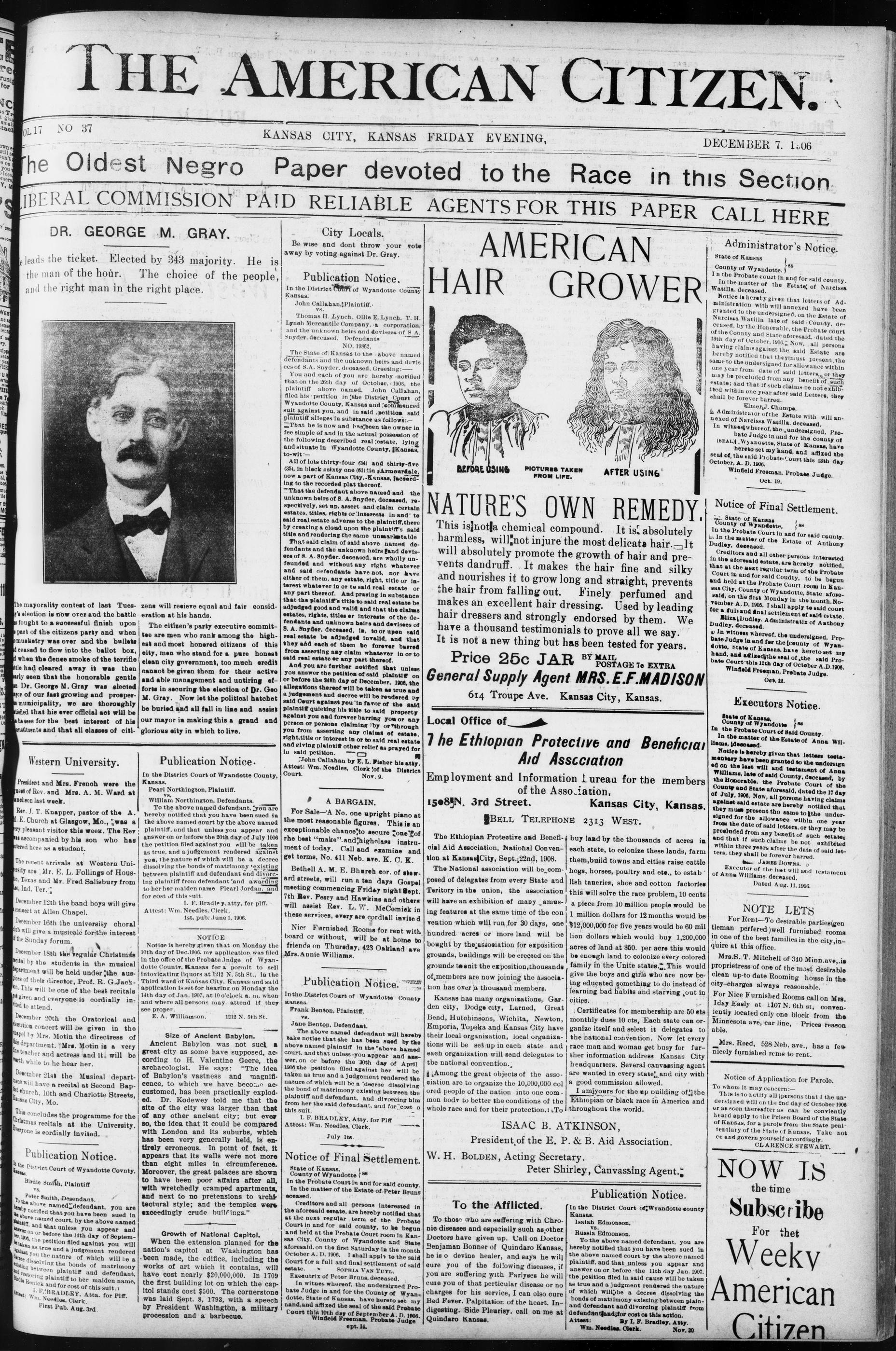
DR. GEORGE M. GRAY.
leads the ticket. Elected by 343 majority. He is the man of the hour. The choice of the people and the right man in the right place.
M. B. H.
The mayorality context of last Tuesday's election is now over and the battle fought to a successful finish upon part of the citizens party and whenismusketry was over and the bullets deceased to flow into the ballot box, and when the dems smoke of the terrific little had cleared away it was then early seen that the honorable gentle in Dr. George M. Gray was elected mayor of our fast growing and prosperous municipality, we are thoroughly satisfied that his ever official act will be the sees for the best interest of his constituents and that all classes of citi-
Western University
President and Mrs. Frenoh were the guest of Rev. and Mrs. A. M. Ward at university last week.
Rev. J. T. Knapper, pastor of the A. M. E. Church at Glasgow, Mo., was a very pleasant visitor this week. The Rev was accompanied by his son who has entered here as a student.
The recent arrivals at Western University are Mr. E. L. Follings of Housen, Texas and Mr. Fred Salisbury from Ind, Ter.
December 12th the band boys will give concert at Allen Chapel.
December 16th the university choral club will give a musical for the interest of the Sunday forum.
December 18th the regular Christmas recital by the students in the musical department will be held under the auspices of their director, Prof. R. G. Jackman. This will be one of the best recitals given and everyone is cordially invited to attend.
December 20th the Oratorical and seduction concert will be given in the staged by Mrs. Motin the directress of this department. Mrs. Motin is a very fine teacher and actress and it will be worth while to hear her.
December 21st the Musical department will have a recital at Second Baptist church, 10th and Charlotte Streets, Kansas City, Mo.
This concludes the programme for the Christmas recitals at the University. Everyone is cordially invited.
Publication Notice.
The District Court of Wyandotte Covnty,
Louisiana.
Birdie Smith, Plaintiff
vs.
Peter Smith, Desendant.
To the above named defendant, you are hereby notified that you have been sued in the above named court, by the above named plaintiff, and that unless you appear and answer on or before the 14th day of September, 1903, the petition filed against you will be taken as true and a judgement rendered against you the nature of which will be a degree disserving the bonds of matrimony arising between plaintiff and defendant, and restoring plaintiff to her maiden name, Bessie Reniek and for cost of this suit,.)
Affect: Wm. Needles, Clerk.
Affect: Wm. Needles, Clerk.
First Pub. Aug. 3rd
zens will receive equal and fair consideration at his hands.
The citizen's party executive committee are men who rank among the highest and most honored citizens of this city, men who stand for a pure honest clean city government, too much credit cannot be given them for their active and able management and untiring efforts in securing the election of Dr. Geo M. Gray. Now let the political hatchet be buried and all fall in line and assist our mayor in making this a grand and glorious city in which to live.
Publication Notice
In the District Court of Wyandotte County, Kansas.
Pearl Northington, Plaintiff
William Northington, Defendants
To the above named defendant, you are hereby notified that you have been sued in the above named court by the above named plaintiff, and that unless you appear and answer on or before the 20th day of July 1006 the petition filed against you will be taken as true, and a judgement rendered against you, the nature of which will be a degree dissolving the bonds of matrimony existing between plaintiff and defendant and divorcing plaintiff from defendant and awarding to her maiden name Plearl Jordan, and for cost of this suit.
I. F. Bradle y. atty, fer plff.
Attest: Wm. Needles. Clerk.
Jst pub. June 1906
NOTICE
Notice is hereby given that on Monday the 10th day of Dec. 1906, my application was filed in the office of the Probate Judge of Wyandotte County, Kansas for a permit to sell intoxicating liquors at 1212 N. 5th St., in the Third ward of Kansas City, Kansas and said application is set for hearing on Monday the 14th day of Jan. 1907, at 10 o'clock a.m. when and where all persons may attend if they see proper.
E. A. Williamson. 1212 N. 5th St.
Size of Ancient Babylon.
Ancient Babylon was not such a great city as some have supposed, according to H. Valentine Geere, the archaeologist. He says: "The idea of Babylon's vastness and magnificence, to which we have become accustomed, has been practically exploded. Dr. Kodewey told me that the site of the city was larger than that of any other ancient city; but ever so, the idea that it could be compared with London and its suburbs, which has been very generally held, is entirely erroneous. In point of fact, it appears that its walls were not more than eight miles in circumference. Moreover, the great palaces are shown to have been poor affairs after all, with wretchedly cramped apartments, and next to no pretensions to architectural style; and the temples were exceedingly crude buildings."
Growth of National Capitol.
When the extension planned for the nation's capitol at Washington has been made, the edifice, including the works of art which it contains, will have cost nearly $20,000,000. In 1709 the first building lot on which the capitol stands cost $500. The cornerstone was laid Sept. 8, 1793, with a speech by President Washington, a military procession and a barbecue.
KANSAS CITY, KANSAS FRIDAY EVENING.
City Locals.
Be wise and dont throw your vote away by voting against Dr. Gray.
Publication Notice.
In the District Court of Wyandotte County Kansas.
John Callahan, Plaintiff. vs.
Thomas H. Lynch, Ollie E. Lynch, T. H. Lynch Mercantile Company. a corporation, and the unknown heirs and devisees of S.A. Snyder, deceased. Defendants NO. 19862.
The State of Kansas to the above named defendants and the unknown heirs and devisees of S.A. Snyder, deceased. Greeting: You and each of you are hereby notified that on the 26th day of October, 1905, the plaintiff above named, John Callahan, filed his petition in the District Court of Wyandotte County, Kansas and commenced suit against you, and in said petition said plaintiff alleges in substance as follows:
All of lots thirty-four (34) and thirty-five (35), in block sixty-one (61) in Armourdale, now a part of Kansas City, Kansas, according to the recorded plat thereof.
That the defendant above named and the unknown heirs of 8. A. Snyder, deceased, respectively, set up, assert and claim certain estates, titles, rights or interests in and to said real estate adverse to the plaintiff, there by creating a cloud upon the plaintiff's said title and rendering the same unmeritably
That said claim of said above named defendants and the unknown heirs and devises of S. A. Snyder, deceased, are wholly unfounded and without any right whatever and said defendants have not, nor have either of them, any estate, right, title or interest whatever in or to said real estate or any part thereof. And praying in substance that the plaintiffs' title to said real estate be adjudged good and valid and that the claims estates, rights, titles or interests of the defendants and unknown heirs and devises of S. A. Snyder, deceased, in, to or upon said real estate be adjudged invalid, and that they and each of them be forever barred from asserting any claim whatever in or to said real estate or any part thereof.
And you are further notified that unless you answer the petition of said plaintiff on or before the 24th day of December, 1900, the allegations thereof will be taken as true and a judgement and decree will be rendered by said Court against you in favor of the said plaintiff quieting his title to said property against you and forever barring you or any person or persons claiming 'by or through you from asserting any claims of estate, right, title or interest in or to said real estate and giving plaintiff other relief as prayed for in said petition.
John Callahan by E. L. Fisher his atty.
Attest: Wm. Needles, Clerk of the District
Court.
Nov. 9
A BARGAIN
For Sale—A No. one upright piano at the most reasonable figures. This is an exceptionable chance to secure one of the best "make" and highclass instrument of today. Call and examine and get terms, No. 411 Neb. ave. K. C. K.
Bethell A. M. E. Buhreh ear. of steward streets, will run a ten days Gospel meeting commencing Friday night Sept. 7th Rev. Pesy and Hawkins and others will assist Rev. L. W. McComiek in these services, every are cordial invited
Nice Furnished Rooms for rent with board or without, will be at home to friends on Thursday, 423 Oakland ave Mrs.Annie Williams
Publication Notice.
In the District Court of Wyandotte County
kansas.
Frank Benton, Plaintiff.
vs.
Jane Benton, Defendant.
The above named defendant will hereby take notice that she has been sued by the above named plaintiff in the "above hamed court, and that unless you appear and answer, on or before the 30th day of April 1906 the petition filed against her will be taken as true and a judgment rendered the nature of which will be a "decree dissolving the bond of matrimony existing between the plaintiff and defendant, and divorcing him from her said defendant, and for cost of this suit.
I. F. BRADLEY, Atty, for Pliff
Attest: Wm. Winey Clock.
Notice of Final Settlement.
State of Kansas,
County of Wyandotte
In the Probate Court in and for said county,
In the matter of the Estate of Peter Bruns
excused.
Creditors and all persons interested in
the aforesaid estate, are hereby notified that
at the next regular term of the Probate
Court in and for said county, to be begun
and held at the Probate Court room in
Kansas City, County of Wyandotte and State
aforesaid, on the first Saturday in the month
October A. D. 1906. I shall apply to the said
Court for a full and final settlement of said
estate.
SOPHIA VAN TUYL.
Exeutrix of Peter Bruns, deceased.
In withes whereof, the undersigned Probate Judge in and for the County of Wyandotte, State of Kansas, have hereto set my
nand, and affixed the seal of the said Probate
Court this 10th day of September A. D. 1906.
AMERICAN HAIR GROWER
BEFORE USING PIOTURES TAKEN FROM LIFE. AFTER USING
NATURE'S OWN REMEDY
This is not a chemical compound. It is absolutely harmless, will not injure the most delicate hair. It will absolutely promote the growth of hair and prevents dandruff. It makes the hair fine and silky and nourishes it to grow long and straight, prevents the hair from falling out. Finely perfumed and makes an excellent hair dressing. Used by leading hair dressers and strongly endorsed by them. We have a thousand testimonials to prove all we say. It is not a new thing but has been tested for years.
Price 25c JAR BY MAIL POSTAGE 70 EXTRA
General Supply Agent MRS.E.F.MADISON
614 Troupe Ave. Kansas City, Kansas.
The Ethiopian Protective and Benefician Aid Association
Employment and Information Lureau for the members of the Association.
Local Office of
The Ethiopian Protec
Aid Ass
Employment and Information
of the Ass
1508JN. 3rd Street.
BELL TELEPHON
The Ethiopian Protective and Benefi
cial Aid Association, National Conven
tion at Kansas City, Sept. 22nd, 1908.
The National association will be composed of delegates from every State and Territory in the union, the association will have an exhibition of many amusing features at the same time of the convention which will run for 30 days, one hundred acres or more land will be bought by the association for exposition grounds, buildings will be erected on the grounds to suit the exposition, thousands of members are now joining the association has over a thousand members.
Kansas has many organizations, Garden city, Dodge city, Larned, Great Bend, Hutchinsons, Wichita, Newton, Emporia, Topoka and Kansas City have their local organization, local organizations will be set up in each state and each organization will send delegates to the national convention. Among the great objects of the association are to organize the 10,000,000 colored people of the nation into one common body to better the conditions of the whole race and for their protection. To
ISAAC B. A.
President of the E. H.
W. H. BOLDEN, Acting Secret
Peter Sh
To the Afflicted.
To those who are suffering with Chronic diseases and especially such as other Doctors have given up. Call on Doctor Benjaman Bonner of Quindaro Kansas, he is o devine healer, and says he will cure you of the following diseases, if you are suffering with Parlyses he will cure you of that particular disease or no charges for his service, I can also cure Bed Fever. Palpitation of the heart. Indigesting. Side Pleurisy. call on me at Quindaro Kansas.
buy land by the thousands of acres in each state, to colonize these lands, farm them, build towns and cities raise cattle hogs, horses, poultry and ete., to establish tanneries, shoe and cotton factories this will solve the race problem, 10 cents a piece from 10 million people would be 1 million dollars for 12 months would be $12,000,000 for five years would be 60 million dollars which would buy 1,200,000 acres of land at $50. per acre this would be enough land to colonize every colored family in the Unite states. This would give the boys and girls who are now being educated something to do instead of learning bad habits and starving out in cities.
Certificates for membership are 50 ets monthly dues 10 ets. Each state can organize itself and select it delegates to the national convention. Now let every race man and woman get busy for further information address Kansas City headquarters. Several canvassing agent are wanted in every state and city with a good commission allowed.
I am yours for the up building of the Ethiopian or black race in America and throughout the world.
TKINSON,
P. & B. Aid Association.
Mary.
Birley, Canvassing Agent.
Publication Notice.
In the District Court of Wyandotte county Kansas.
Isaiah Edmonson,
vs.
Russia Edmonson.
To the above named defendant, you are hereby notified that you have been sued in the above named court by the above named plaintiff, and that unless you appear and answer on or before the 11th day Jan. 1907, the petition filed in said cause will be taken as true and a judgment rendered the nature of which will be a decree dissolving the bonds of matrimony existing between plain- and defendant and divorcing plaintiff from defendant and guardian cost on this action.
Attest: By I. F. Bradley, Atty.
Wm. Needles, Clerk. Nov. 30
DECEMBER 7.1506
CALL HERE
Administrator's Notice.
State of Kansas
Office of Wyandotte.
ss
In the Probate court in and for said county.
In the matter of the Estate of Narcissa Watilla, deceased.
Notice is hereby given that letters of Administration with will annexed have been granted to the undersigned, on the Estate of Narcissa Watilla late of said County, deceased, by the Honorable, the Probate court of the County and State aforesaid, dated the 13th day of October, 1906. Now, all persons having claims against the said Estate are hereby notified that they must present, the same to the undersigned for allowance within one year from date of said letters, or they may be precluded from any benefit of such estate; and that if such claims be not exhibited within one year after said Letters, they shall be forever barred.
ElmerJ. Champe.
Administrator of the Estate with will annexed of Narcissa Watilla, deceased.
and designated, Probate Judge in and for the county of (SEAL) Wyauette, State of Kansas, have hereto set my hand, and affixed the seal of the said Probate Court this 15th day October, A. D. 1906. Winfield Freeman. Probate Judge. Oct. 19.
Notice of Final Settlement.
22. State of Kansas
County of Wyandotte.
In the Probate Court in and for said county.
In the matter of the Estate of Anthony
Dudley, deceased.
Creditors and all other persons interested in the aforesaid estate, are hereby notified, that at the next regular term of the Probate Court in and for said Court, to be begun and held at the Probate Room in Kansas City, County of Wyandotte, State aforesaid, on the first Monday in the month. November A. D. 1905. I shall apply to said court for a full and final settlement of said estate.
Bliza Dudley. Administratrix of Authority Dudley, deceased.
In witness whereof, the undersigned, Probate Judge in and for the county of Wyandotte, state of Kansas, have hereto set my hand, and affidazed seal of the said Probate Court this 12th day of June.
Executors Notice.
State of Kansas.
County of Wyandotte | ss
In the Province
In the Probate Court of Said County.
In the matter of the Estate of Anna Williams, deceased.
Notice is hereby given that letters testamentary have been granted so the undersigned on the last will and testament of Anna Williams, late of said County, deceased, by the Honorable, the Probate Court of the County and State aforesaid, dated the 17 day of July, 1906. Now, persons having claims against all said estate are hereby notified that they must present the same to the undersigned for the allowance within one year from the date of said letters, or they may be precluded from any benefit of such estates and that if such claims be not exhibited within three years after the date of said letters, they shall be forever barred.
JAMES DOWNS.
Executor of the last will and testament of Anna Williams, deceased.
Dated Aug. 11, 1906.
NOTE LETS
For Rent-To desirable parties(gen-
teman perfected)well furnished rooms
in one of the best families in the city,in-
quire at this office.
Mrs.S. T. Mitchell of 340 Minn.ave.,is
proprietress of one of the most desira-
ble clean up-to date Rooming house in
the city-charges always reasonable.
For Nice Furnished Rooms call on Mrs.
Iday Easily at 1107 N. 6th st,conveni-
ently located only one block from the
Minnesota ave, car line, Prices reason
able.
Mrs. Reed, 528 Nb. ave., has a few
nicely furnished rooms to rent.
Notice of Application for Parole.
To whom it may concern:—
This is to notify all persons that I the undersigned will on the 2nd day of October 1906 or as soon thereafter as can be conveniently heard apply to the Prison Board of the State of Kansas, for a parole from the State penitentiary of the State of Kansas. Take not cee and govern yourself accordingly.
NOW IS the time Subscribe For thet Weeky American Citizen
American /Citizen
1 ce
‘he Oldest Negro Jourgal Published
Weekly in this part of the Country.
Published Weekly
at 1510 North 3rd Street
KANSAS CITY - - - - - KANSAS.
_W. C. Martin, Editor,
Geo. A Dudley, Publisher and
: Business Manager.
‘Terms of Subscription in Advance.
OND MERE 5 Accson wn acon ast GOO,
Bix Months. ......sccssccseseeee +650
Three Months... ....csssesccee eee 40C
he Mouth,....-...ccccsscceees+ 180
Advertising 25 cents per inch First
Insertion.
a Standing Display ‘Ad’ for 3 Months
or longer 15c per inch, each insertion.
Grangemouth is the name of a Mo-
cow editor. Evidently a farmer on
the side.
Waldorf Astor has become so thor-
‘oughly anglicized chat he is going to
marry an American girl.
A clergyman says that bridge whist
leads to mental decline. Why doesn’t
he try poker for a change?
Senator Pettus is declared to be a
Poor man and fond of poker. The
raft explains the first, possibly.
Perhaps boys should be thankful for
whippings, as somebody declares, but
“hey seldom are before they are 45. .
Sweet Spring 1s now approaching,
and Summer with the rose, so poetry's
encroaching upon the field of prose.
“King Edward was “warmly 4e-
celved” in Paris, but not in the same
way as when he used to be prince of
Wales.
The czar will reserve the right to
wield the big stick over the Douma.
according to the latest advices from
St. Petersburg.
We learn from the New York Mail
that women are using garters to keep
those long, arm-length gloves in place.
But do they hola? -
Manchuria will be finally evacuated
by the-Japanese in a few days. It
has taken’ them longer to get out
than It did to get in.
Tt is now belfeved that Anna cone
4s going to give’ Boni one more chan
in spite of the fact that he has taken
a great many already.
Uruguay should, not be blamed for
having a‘revolution.” A review of re-
cent, South American history © shows
that tt is Uruguay's turn.
——_—__, \}
Asks the edifor of the . Pittsfield
Journal: “Aré ‘there four, girls with
gray eyés in Pittsfield?” Apparently
ye scribe means {o get busy. a
_. Queen Maud’ of Norway is losing
‘her, health.beeause she fears her hus,
band will be killed. This queen bust
ness Is not atl pickles and pie
‘t-was not long ago that all the
“success” magazines were pointing to
the Pittsburg, millionaires as ex-
amples to the youth of the land.
With 10,000 doctors in convention in
Boston next summer, the rest of the
country ought to have a good oppor-
‘tunity to get well.—Boston Globe.
It is a pity that the great romancers
of the sea did not live in a generation
which affords such thrilling material
as the log of the dry dock Dewey.
A Minnesota man says he has dis-
eoyered the cause of the aurora
borealis. But what bearing will this
‘have on the price of coal this year?
Much to the surprise of everybody,
some of the phenomenal ball ‘players
‘added to the leading nines as marvel-
ous discoveries will probably make
good.
Cheer up, mister! The president of
‘the Dressmakers’ National Protective
Association says that women’s dress
will be less expensive this year than
ever before,
The Japanese, says one of their
statesmen, should adopt chairs and
develop their legs. Well, short legs
did not prevent them from “getting
there” in the late war.
Portia, as quoted by the editor of
a kind of society paper, is made to
sy: “How far that litte scandal
tifrqws| his beams! So phivés a baw
é€ed in this heught* wéria”
News comes from the east that’ the
seventeen-vear locusts will devastate
the land thy year How-many times
inf the course of a deeade do the sev-
enteen-vear locusts come, anyhow?
As the last suffragist was, detatched
Mrom the format Wend pyft into the
policg-wagha. the premier of the great
Petijeh Fyppird erhwidd oht trom une
der bis ved and sighed a steh of re
Bs }
( iA re ag borane a. gotten in
ner? te reade he aanlatton of
matines ciris We tpaw sirerst ae
tors who shold te Griv\n trum ithe
_afiie me” a Stub insta of sort
GREAT SINGER IS UNGRATEFUL.
Mme.|Patti Criticises America, Which
(Made) Her Wealthy. ft
Confirmation of thé report that
Mme. Adelina Patti~has made “her
Gnal tour in the United States Is
found in her recent criticisms of the
American people. This lady, who once
lived down on Grand street West,
but now dwells in a castle in Wales,
largely owing to the generosity of the
citizens of this city, has lately dis-
covered that we haven't any appre
clation of art, cookéry, music or good
manners. This is an ill-return for all
the complimentary words we’ have ut.
tered about her, not to mention the
dollars we have paid to hear her
voice. Although she was‘born in Mad:
rid in February, 1843, she came here
with her parents as a child and grew
up among the people of ‘New. York.
Her brother, Carol, used to lead, the
orchestra at the Grand’ Opera House,
during the Jim Fisk era of French
opera-bouffe. ie
Mme. Patti's last tour of this coun:
try was not fifiancially successful—a
circumstance that may account for her
change of heart. The lady, however,
insisted upon receiving her contract
money to the last dollar. The im
presarlo was almost ruined, although
the fault was the diva’s own. She
couldn’t sing! Her voice had lost its
fine quality. She wasn’t a “diva” any
lon... The American people found
this out and refused to assist in main-
taining Craig y Nos castle—Brooklyn
Eagle.
| Famous Actors as Negro Minstrels.
| Jefferson said he thought he was
one of the first men to black his face
after the appearance and success of
“Jim Crow” (T. D.j Rice.
“I suppose,” said Mrs. Drew, “there
are very few men in this company
who have not at one time or another
been associated with minstrel_ per.
formances?” x 2
“I played Brudder Jones,” said
Mr. Jefferson.
“Everybody yknqws I wast inj the
minstrel business,” Goodwin exclaim-
jed. "Yes," I remarked, “‘beéause! we
were there together. “Well,” joined
in Crane, “I was on the tambourine
end with Campbell's jinstrels.”. 1
rememiber telling this at Lawrence
Barrett’s house at Cohasset. where
the rest of the party consisted of
Edwin Booth and Stuart Robson
Booth then told how he and J. S.
‘Clarke were minstrels in their young.
er days,' and he followed this up by
declaring that he used to “pick a lit
tle on the banjo.” I laughed, and
Booth inguired the reason, and 4
added, “Oh, nothing much, only Booth
andthe banjo seemed such an odd
coarbination.”—Francis Wilson “in
Scribner's Magazine. ie
= Sh
Oxted ee eas
How degply comfoiging the ‘fender phrase,
Thykteacer wcelute moderate
at
Through all Ufe's Jong and dark and
‘weary maze, Dit 2 ,
‘Thou art Compassionate.
To God of Justice and of Power we' turn
‘When ‘wrong or devastating blow cuts
deep;
And yet in daily struggle needs must
yearn’
,)) Fer-oife Compassionate. :
In limits of our souls we live, alone,
‘And, een our =e may’ not under
‘stan
But all “the househdid jar within’ {«
known
‘To thee, Compagsionate,
Thou know'st the many sorrows of th:
ay; ;
Wide longing, narrow opportunlty—
We bring Riss Broken operat are
may, :
‘F0 one Compasstonate.
We may have blundered gilevously an?
Ione,
Darkened Thy world we might have
made so bright, ©
Sun Thou dost! heal the heartache anc
ne wrong
Thou Compasstonate!
May, Btuelyn “Bourne, in Overland
fonthly.
Pn a a
Two men were standing together on
an East River ferryboat when one
pointed out @ third man with the re-
mark:
“I can’t recall his name at this mo.
ment, but he writes for a number vi
the magazines.”
His friend looked at the strange:
with much interest,
“Oh, one of our frenzied finance
captains, is he?” he asked.
“No, he—"
“Writes up trusta and things
then?”
“Oh, then he’s a prizefighter or a:
actor—he is rather husky looking.”
“No, no! He's just a plain author—
writes stories.”
_ “Oh!” the friend exclafmed, the
look of interest suddenly dying ou:
of his face—New York Journal.
‘True to His Promise.
The other boy had called Tommy »
liar, an’ a fightin’ Nar, and told hin
he dassen’t take it ap.
Tommy's fists were clinched. and
‘his eyes were blazing, but he stood
there rapidly repeating something to
himself, in accordance with a lone
standing promise he had made to his
mother.
“It you'll jist wait till I've anished
sayin’ It,” he said, “I'll knock the tar
out o' you, Dick, Bunker, you ple faced
slob! ‘But children, you should nev.
er let your angry passions—’”
The other boy, however, disappear.
ed around the cor.:r while Tommy's
Ups were still moving.
Flying Wedge.
“Great Sco:t!” exclaimed the drure.
mer who had put up in the old farm
bouse over night. “What was thai
noise down below? Football rush?
“Worse than that, stvanger,” chuci
led te old farmer, as he snaded o.
the candle. “Yeou see, | have elgh:
darters a’ each one of them has
‘ean who calls on Thursday nights
Wall, the frst conple that gets+ tls
parlor cau save it, That's why the,
are ranoing”, | 3h
LACE SCARF AS EAR TRUMPET.
Ca
Elderly Lady Has Discovered It Acts
as Sounding Board.
With’advancing years, a\ dear old
lady has found that her" hearing has
become somewhat affeeted. She has
not found it necessary to use an ear
trumpet as yet, but it is difficult at
timés to catch all that friends say.
Anything said in an undertone is com-
pletely lost to her—that is, it was un-
til she bit upon a novel idea,
While visiting a friend recently the
hostess had pitched her voice almost
tothe straining point and her vocal
organs were getting tired, when “Aunt
Sis,” as she {s affectionately termed,
interrupted her by saying: “Please,
‘earle, hand me my lace head scart.”
“Do you feel'a draught?” anxiously
inquired the hostess, handing over the
‘mantilla.
“Not the slightest,” said “Aunt Sis”
as she adjusted the head covering.
“Then why do you wear it? It will
make your head tender.”
“Oh, I think hot. You see, the scarf
acts as a sort of sounding board. It
keeps out all other sounds except
those of the human voice, When I
wear this I can hear even a whisper
T can’t explain why ft 1s, but it is so
nevertheless. I have had lots of fur
over it, too. My boys have been tak
ing advantage of my infirmity to whis
per to each other. I didn’t hear the:n
sefore I began to wear this:scarf, bv!
now I know lots’ of their secrets anc
they don't know it, It’s a good jc\.c
on them.”
Fish Know Colors.
“Fish know colors,” said a keeper
at the New York Aquarium the other
day. “They can distinguish between
red and blue, or white and green, 2s
well as you and I. Wait and I'll prove
at i
He led the way to a tank in which
were some red and some yellow pnd
some green fish, and in it were ar‘
ficial grottoes painted respectivelyired
and yellow and green, The keeper
rofled the water, with, his hand, and
the fish fled,the red ones to the red
grotto, the yellow ones to the. yellow
grotto, and the green ones to the gree:
grotto. :
“They know which color shields
them from observation best,” said he.
“Now I'll change the grottoes, so as to
Prove my statement a second time.”
He moved the grottoes to different
places in the tanks and again roiled
the water.
‘The same thing followed us before.
Each fish darted lke a shot to the
grotto of its own color, where it knew
It: would be best concealed.
net T masa 1 a
Everything that I made I used to bring
ing ths ¢
Was Ta’ song, why, then ‘twas @ son:
Sas, (ating, to.you en
‘was, 10 Slory, Xo ot 1 was telling nin
story.
Ah, .mv""dear, could you hear ‘mig. th:
Blige and the glory?
Did any lone praise me, to you I said j
ail over:
My? lenighter for you: how we laughed 1:
the days past recover?
My tears ‘and ‘my troubles. were yours
id anyone grieve. ms.
T cgzried it strplene to the love that was
Sure to iblieve'me. |
© my, dear, when aught happens, to, you
ora arm turnings eet BaPPeD
Forgdtting how far sou “hava traveles
this day from my yearning.
Thete i nobody "now. fo tall things to
your house fs to lonely:
Ana Bult I'm forgetting aud bringing m;
tale to: you only. :
‘The ola days are! over;’how pleasant th
Were. the fine weather,
When youth and my Gatling and 1 were
ag hame and’ together!
And suit T'm forgetting, ockone, that no
‘onger you'fe ‘neat. mer
And turn to You still with my tale, and
there's 110 one to hear me.
bail Kuall Gazette.
iki ih hc i a al
In the autumn of 1901 Mrs. W. of
Roxbury spent a few weeks with her
daughter in Nova Scotia, returning
home shortly before President McKin-
ley was shot, bringing her niece, Bes-
se F., aged 6 years, home with her.
Of course the child heard a good deal
of talk in the house about the shoot-
ing of the president.
One day Bessie said to her aunt:
“Aunt Minnie, who is king of the
United States?” Her aunt replied:
“We have no kings in the United
States like you do in your British
country. We have presidents. We
have an election every four years and
eleet a new one.”
“Oh, yes,” the child replied; “and
then they shoot the old ones, don’t
they?”—-Boston Herald.
Shia iis Mee Wt
_ @aakin, on the Red sea. has proved
‘am unsstisfactory port and is to be
‘eaperseced by a brand-new rival
which has been built up out of coral
work and desert sand by the Egyptian
authorities. The rival is Port Sudan,
the latest addition to the cities of the
British empire, and an enthusiast says
that It is destined to be a place of
magnitude and importance in the days
when cotton shall have made it the
New Orleans of the east. The place
has hitherto been called Mersa Sheikh
Barud. It 1s about 680 miles south of
Suez and is capable of holding a
dozen vessels of moderate size. The
entrance is 600 feet across, and the
land around is six feet above sea
level.
Posers for Scho'are
Twenty words submitted to a spell:
ing bee in Springfield, Mass., in 1846
webeifivenita the BIgh school clase at
East Liverpool by Supt. Rayman, and
it ts reported not one in the class cor.
rectly spelled every word. Only ten
had averages of over 90 per cent. The
average of the 124 pupils was 731% per
cent.
The words submitted were accident.
al. accessible. baptism, chirocraphy.
characteristic, deceitfu’. descendant,
eccentric evanescent flercen 2s, feign.
adly, ghastliness, sniwed, heiress
aystertes, | Imbecititv.. ineonceivabte
iconvenience.: inefficient,. irresis: ible
—Pittsiure Dispatch... "
SHIELDS FOR TROCPS IN WAR.
Their Gse Urged by a\Germbn Milt
‘ Karvy Weiter. - s
| A writer im the ean eae
faises‘anew the ‘question of ‘the vse
of portable shields for the protection
of infantry in the attack, says the
Broad Arrow. He writes approvingly
of the Japanese sprde work in the
offensive, the more so because he
mentions incidentally, as a matter re
garding which there can be no dis
pute, that the German authorities
have long since advocated the use of
artificial cover in the attack, and
points out that when the ground was
frozen or rocky. and the spade coult
make no fmpression upon it, the at-
tacking Japanese infantry not infre-
quently went forward, carrying with
them filled ‘sandbags weighing as
much as forty pounds. He remarks
that if the undoubtedly brave Japa-
nese soldier found it necessary to
load himself with so bulky and bur-
densome a protection when advancing
in the open against an intrenched en-
emy it would seem far better to equip.
the infantry with a light, handy shield.
Furnished with a handle by which
to carry it, a loophole to fire through
and some arrangement to prevent its
falling down, the infantryman would
then find himself, like his gunner
comrade, protected by a bullet-proof
shield. The writer in the Wochenblatt
suggests that on the march the shicld
should be carriedjon the back, when
going Into action on the chest, and
when advancing to the attack in the
jeft hand, so as to be at once available
for use when lying down to fire, both
as head cover and rifle rest.
YOUR HAIR SHOULD BE DRAB
|. Authority Says.
“Deep auburn and the drab shades
are'the fashionable colors in hair this
Season.” S91d thé woman who. makes
hair coloring a speciality, a3 plaziaiy
as though she were commenting on
the state of the weather or the ad:
vance. style in dress goods.
_ “One of my customers has to my
knowledge worn five different colors
or shades aa her wavy tresses. Hav-
Ing been blessed with medium brown
holt by nature she became a ravish-
ing blonde when the fashion for
bleaching first came in,
“Next che took to titian red after a
trip to the art galleries of Europe.
Tnen she thought she would be more
attractive as a brunette, and now her
hair ts drab.
“The lest is by far the most popv:
lar of all for the reason that 1s most
difficult to obtain, and. them it ts pret
iy generally becoming, and it happens
that women who ate born with this
particular color of hatr are almost ai-
ways clever ;
“How is it’ done? Well, in’ casé of a
woman whose hair is. dark a bleseh
nmgt first be used, before the dye is
applied. With women whose hair has
turned gray-It 4s a still simpler p¥ofi
fem. The. eplor: lasts a yeat, iis't-
the head can be'wa'shed dnd 6vet ait
water bathing’ does ‘not ‘allect it.’
New York Stn) * oe AE
‘WHat"Monoe Oh’ Da.
They say that’money can not buy.
Ther sweetest thins ‘ia ito
Heglth, Heavens telends, tespect, content
Or een‘ loving witer
phey sav that money can’ nt uy
These things for me, alas! But k=
Well don't’ know!
What poltght my private car? Just wealth
What TeuEne ph ovely vagpt:
Which salis'me fo lands wher health
Is found in every snot’
What pays my specii fet. dear Jim,
To keep me {n such perfect trim?
Welt don't isnow!
What bought the most delightful wife
A'man could hope to Sit?
What burs her every wish jn, tite
The clothes she Gazzics, in?
nd" her heart beats. not for me,
nd Tam nor adored. vou see,
‘Well—t don't Know!
And heaven? Oh. of course, I don’t
erect to get In free;
But Ifthe Vora meant’ what he sald
Concerning charity,
The tithe I'll give before I die *
‘Will slip me through the needle's eye,
‘Or—i don't Know!
For happiness? Well. money bought
This ninety-cent cigar: oe
It bought this chair in which I loll,
It POuahE this private car;
It bought this comes end ‘T guess,
If all this is not happiness,
‘WellI don't know!
—New York Presa,
Sat & Gasd Kdvdtteamenk
A Welsh judge had before him a
ease in which a printer sued a pork
butcher for the value of a large. par.
cel of paper bags with the butcher's
advertisement printed thereon.
‘The printer, having no suitable {I-
lustration to embellish the work,
thought he improved the occasion by
putting an elaborate royal arms above
the man’s name and address, but ulti-
mately the latter refused to pay,
The judge, looking over a specimen,
observed that for his part he thought
the lion and the unicorn were much
nicer than an old fat pig.
“O weil" answered the butcher,
“perhaps your honor likes to eat. ani.
male like that, but my customer's
don't. I don’t kill lions and unicorns
—I only kill fat pigs!”
Verdict for defendant—New York
World.
Building Up to Requirements.
A Kansas City man purchased a
sity lot with the, restriction that he
should not build a house on it to cost
fess than $2,500. After having «paid
tor the lot he decided to build a $1,508
sottage.
Before he had completed tt the real
2state man from whom he bad bought
che. lot threatene?. to. sue him cor
dreach of contract. “This little shaék
you are building” said te real-estate
nan. “lacks a whole ‘lut of belt g’a
32.300 house such as you agreed to
outta.”
“Con't form too hasty judgyenc,”
replied the uwner, “True, at }usn't
cost teat tiuch set, but 1 intend to
ta solid .ol brick ip the enlmney,”
| ~Kangas'Chy:Pinies 0) cs)
Telephone Bell W. 32. _ ‘Telephone Fone
IW. B. Raymond
_ FUNERAL DIRECTOR
Sd Embalmer. The very best of Service, Fine Can
| for alll Purposes, at all Hours. |
The Best Equipped White Enameled Ambulance
| sick and wounded
os Short Notice. Charges Reasonable. Cail at 43)
| sota Ave., Kansas City, Kansay.
Wi t U /
THE GREAT EDUCATIONAL INSTITUTION
FOR KANSAS AND THE WEST - .- . .
DEPARTMENTS:—‘iheological, College, Normal, Sub-N« at
Industrial.
COURSES:—Classical, College, Preparatory, Normal, Su! \. mal,
sical (Instrumental and Vocal), including piano, o1ei a
mony, Drawing (Fine Arts and Mechanical), Cary Ph
and Book-Binding, Business Course, Stenography and Type
Tailoring, Dressmaking and Plain Sewing, Cookin in
Farming and Gardening.
ADVANTAGES:—Splendid Location, Healthful Climate, Goo,
ones and Thorough Teachers.
INFORMATION:—For terms, prices and all inducements
write to
WILLIAM T. VERNON, A. M., 0.0,
i PRESIDENT,
QUINDARO, -— - - - - - rel
i ‘Office—Bell—“White” 4302.
Phones:
{ Residence—Nell—"West” 15,
Why does colored people as well as uncolored peoplet eat in the
+ by a smoky poor light and drink muddy bad
i water full of disease germs.
When they can get a first-class
Bright Gas Burner Light
. For 35 to 75 cents. Anda
Self Cleaner Water fil
seit Cieater Water i
e that! makes the water clear’ as 4 Cryétal aha Flealthy
For 60 td 75 cchts.
Hee A. J. SHERIDAN
: : ae ROOM 8) es
530 MINNESOTA. AVE. . KANSAS. CITY, Kal
“In the shade of the Old Apple Tree” is a very popular sot
jot you be popular by trading at a popular store?-
L. J. MADDUX,
Staple and Fancy Groceris
Meats and all Kinds of Produce.
HOME PHONE 784 WEST.
52 FREEMAN AVE. KANSAS CITY,
In an Excuse Book. foot Geli pener rs no oa
Because its employes were late a
London‘house provided a book in whick
the tardy ones were to write excuses
Reasons for lateness were not much
varied. At the top of the page one
would write “Train delayed,” or “Om
nibus horse died,” as the case might
be, and the rest fell into the habit
of making ditto marks and letting it
go at that. But not long ago one
man had a new excuse. He wrote
with pride: “Wife had twins.” The
second slow person that morning was
in a great hurry, and did not notice
the ‘innovation, but made his custo
mary ditto marks, and the rest. of
the men on that page followed Buit.
The excuse book was abolished.
Example of the Postace Stanc.
the late Judge Andrew Wylie, of
Virginia, had a happy gift of iMustra
tion. ‘The judge cast in 1860 the’ only
vote for Lincoln that was given in
Alexandria, Va. In an address on
Lincoln he once illustrated in an’ odd
way the power of perseverance. “Lin.
coln persevered,” he said, “and it is
‘only those who persevere, they who
concentrate ‘their energies, whu suc
ceed. Don’t give three years to jour.
nalism and then, discouraged, try the
law awhile, Don’t learn the grocery
business and ina little while take up
placer mining or plumbing... Consider,
Tather, the postage stamp, whose use
ful depends on its ability to stick to
one thing until it gets there.”
Think What a Family Then!
“Well.” said the fist policyholder
throwing aside his paper, “there is ai
eas: one thing we can be thankful
for concerning our Mutual, friend, Mr,
MeCurcy.”
“Wigs that?" inquired, the second
paWeniohter.e 5 3
“Thee he teo'tce Mormon” _.
Res, 420 Nebraska ave. Tel. 8
SOUTH AMERICA
MEDICAL INSTIT
Office Hours: From 10 a.m. till
‘and from 6 till 9p. ™
C,H, C. JORDAN, M1. HH
Here is the Place |
Jeod. Robes
TONSORIAL PARU
All the Latest Style Halr Cuts
Shave strictly Upto-De?
435 MINNESOTA AVE
“An Old French Sailor.
French seamen have # SO",
person of a centenarian
sailor belongs alike to the Hee
to the merchant service, {F bee
in both, and it would be ame
say In which of the two bis
were the most thrilling
ineludes three shipwrecs, "|
of Navarino, in which be "4,
tion in orders, the bloc!’
one capture by brigan’s 11
himself and his comp" *"
Spanish ship which cael
sait which haq capture! 2% 4
serying many years ‘ ol
he became a master oni “i
owner on his own ace)!"
js Pierre Loirat. He ¥%
November, 1805, and at 12 be
Pe oe Mage ie ee eee eet
s © ee,
The Gvening Story. by
gl svetetetetetetotetererete sorereraicreveseal OL
The History of Bride Cake.
polica! customs Which have been trans.
Seed os fom the dstane past
a Vedding feast, without the lime-hon-
A tenie cake, would be considered, by
eee snvral consent, thoroughly "ine
sintrite, and he would be a‘bold person
Seperate
wr’ js omission on the festive occasion.
fE, iniversal is the practice of connect
yy tite cake With OUF marriage Tites,
fae ove the poorest peasant contrived
peek ihe nuptial board—however frugal
tie tre may De Upon ft—with this nec-
(har adjunct. It may. naturally’ be
Shed, therefore, why the bride cake
Miho be invested with so much super-
Mivous ©overence ag to render its ab.
free ot the marriage feast, In the eyes
Sires: persons an ominous and ill-star-
pa at
rhe svswer to this question, like the
qisin of 0 many other of our social cus-
fre bos given rise to various conject-
re iiss ageording to one popular
feoovion. we have in the bridal cake, a
pve) af the old Roman form of mar-
fase" “confarreatio’ or eating togeth-
fe. I oppears that at a marriags cere-
ory of this kind offerings of a eake and
fivecn were made to the gods. ‘The
Ls of a sheep was spread” over two
guirs. upon which the bride and bride
gun sit down with thelr heads uncoy-
fel Then the marriage was completed
cthe presence of the pontifex maximus
ji ton witnessesy after that another
pevitoe was offered, A-cake, made by
fetal vinsivg, Was earrled before the
rid she was conducted to the res-
Heoce of her husband.
cis hy MO means clear, however, that
: adopted the ‘custom from the
Pon-rs Inasmuch as the same practice,
s viows forms, has existed from
tio memorial among remote savagan
sor Sii-olvillzed peoples, who ean not
be sopnosed to have obtained it from the
Sir John Lubboék, in his “Origin of
cwilirrtion, (1870, page $5) tells ux how
among the equois, the bride and bride-
rroom used to partake of a cake of “'sag-
imite"—ahich the bHde offered to her
buscar, ‘
‘Tho Fiif islanders have a similar cus-
tor,
Among the Tipperahs, one of the hill
trihes of Chittagong, the bride prepares
fone drink, sits on her lover's “knee
érinks ha® and gives him the other half
they afterwards erook together thelr Iit-
tie fingers
In ne form or another a similar eus-
tom is @ma among most of the hill
trikes of India.
© true. derivation of | bridecake
therefore, is probably to be sought, no
s myelin Mie ol Roman marriage
nite of “comfarrentio.”. as in its symbole
calure;s cory eiciae tee cae moter
nither iy woe, grains om. made Inte
colds Gh ineeenoavtie aenie, Been i
tery romate. nation in, thig ward's history
Je) neste erahtem si plenty ant
Andie tHe Biirnt=ong. theforp tha iit
Rene wl achat en
ae from the tate: tant at
ms this, roof. .af, the ridogronsn's
house Wschke' itedl SbIAThT pohioh wea
nde ofjpshngtse Adirhis Phe higher she
tuew ithe inaler (0 wate eotueeey
fkomarinte work be..nnd qx the houses
wee low ann theiitectmant: se: bride
ics Ghliedl 10 WO Re coe
Me fo: ai Hethonian. wedding
een ‘aeons Of bere. in seernedonver the
hres thorse'ana @ handful of tye 4s
fev, over the neste of the bridal
Be hv ehnd ick’ sake,
kk Sweden, Who bride. has ‘her pockets
fre vith bread. it being & papular’ hes
Ie vist evap pleee she Tenyels tO) the
om on Sor wayta the ehireh, awill aver
sores istortune
i 1» countries tice, which fs the
fav's ood. te substituted ‘and holds a
Povinent plea in the muiptial ceremony.
m the Miatnhar coast of India, the
ca niles the helde'and beidezroom
Bith vce, and mone the Rrahmins, the
Weivenom pute three handfuls of rice on
tha bridere Reeth
In Joos they both partake of rlee trom
the sime lsh to insure enod luck. Hence
We may trace the practice in our own
country of scattering rie on the bridal
cminte
1) Tialy, the mother of a newly mar-
He! non, on his arrival home with his
trie, throws some riee behind her back.
Witout enumerating further Mustra-
tions. it is evident the {den of corn, fn
fr Com, as an emblem of prospertty
tes soon most extensively mterwoven
Sith the marriage egremony in most na
tons © ‘which, may probably be. traced
{ soveregee ascribed to the bride's
Tho Me is go, seems further clear
frm mony old marriage eustoms still
feo oy Im different parts of the éoun-
fy. so fn which the cake, aw the aym-
Wo o( Sea teek holds @” prominent
)) Sotkshire tf 4 eut into small square
Y | then thrown for luek over the
tous of the bridal eoupte, after which
i 4 throuzh ating. On. the
\val at her father's doora plate-
{oF coke is flung from an upper wins
* the crowd below. An augury
0 drawn from the fate which at-
te viate, for should 1 be un-
< sign Is ominous. but other-
{ooo the ‘more Dleces it breaks into
ood luck will follow them.
ey 1M" Practice prevails in Scotland,
yo) returning home from kirk, oné
fo ulest of the Inhabitants throws
{2/00 of short bread over the bride's
ES! scramble for the broken frag
; 8 exsues it being deemed very
“sto eet on plece,
niovtines by ‘way of varlation eur
Te: Ss broken over the head of the
fal. but It ts considered very unlucky
eal iw gee Se ear S a” Sr el ee ee OAT,
Mrs. Tabitha Lismahago, the fragments
were “istributed among the bystanders
according to the custom of the ancient
Britons, on the supposition that every
Person who ate of this hallowed cake
Should that night have a vision of the
man or woman whom Heaven designated
should be his or her mate.--
«Again in. Moffatt’s “Health's Improve-
tment,” we are to\d that when the bride
comes from chureh, her friends are wont
to cast wheat on her head, and when the
bride and bridegroom return home, one
presents him with a pot of butter, as
Presaging plenty and abundance of all
good things.
| Referring to other bride cake customs,
| it appears that in Westmoreland, at the
| conclusion of the marriage ceremony the
| company returned in cavalende to the
bride's house, where they had dinner. In
| their/arrival home, every one was pre-
| sented with a slice of bride cake—locally
| known as the wineberry or currant cake
<awhich the bride cut up and the groom
handed round to the guests.
Macaulay, in his ‘History of Clay.
brook,” (1791) describes another custom.
| A pole was erected in front bf the house
three or four fect high., with the cake
stuck up on the ton of it. On the in-
stant that the bride set out from her
| old habitation a company of young men
| started off on horseback, and he who
| was fortunate enough to reach the pole
first, and Knock the cake off with his
| stick had the honor of recelving: it from
| the hands of a damsel on the point of a
| wooden sword, and with this trophy he
| returned in triumsh to meet the bride
and hor attendants.
| As might be expected, the brlae ake
| did not fall to become an equally tm-
| portant source of attraction In love dt-
| Vinations; and Rowe,-in his “Happy Vil-
Ince" (1798) speaks of it as suen:
“The wedding cake now through the ring
was ted x
The stockings thrown across the nuptial
| bed”
| To endow the bride cake, however,
with prophetic virtues. Tt was considered
essential to pass it throngh a wedding
| rine, and according to Brand, once was
| not sufficient, many performing this mag-
| ie rite, as many as nine times. Numerous
Thustrations of this superstition occur ‘n
the Nterature of bysone times.
In the “Spectator” the writer tells us
| tint fie resolved to try his fortune: fast-
ed all day long, that he might be sure of
| dreaming upon’ something at night; pro-
cured a handsome slice of bride ‘ake,
which he placed very conveniently under
his pillow.
The “Connolssem also. notices this
mode of divination:
“Cousin Derby was married a lttle
fwhile azo, and he sent me a piece of
| ride auker to mit-andor my pillow, and
Thad. the, sweetest rdreams,. 1 thoveht
we wore going ayay ta be married: to-
cofhen
| In the northenstof Seotland, sdys' Mr
sor, reat. Tees ™ tions were, forenenly
te for the by of the bridal aie,
nai the baking of the bride take: My
haking. the latter, spesiat care wae taker
With the first. layer, slgstadt shortid be
brokana broken eake portending unhap-
pines,
Again, we are further told, by Mr Nu
pier, in-hig “Folklore. of ‘the west of
Scottend,"* ‘that immediately after: th
martinge: ceremony’ the “bride eakesa
Inrce.and elaborately preared article
fs cut up and distributed, Young. girls
SUI put a piece of Mt viiter their pillows
in orderto obtain prophetie dreams. Io
some rages this is done by a friend writ
ing the names of three young mon on a
Piece of Hhper Rnd the enke wrapped dn
Cs put under the pillow. for thrée
nichts dn guceession before it Is opened
Stonld the owner ti-ve dreamed of one
vf the three men it is regarded es a
moot that he is to bs her ‘future hus
| bana,
In some parts in the north of Hngland.
|x practice etl exists of puttiag wth
amonz the Ingredents of the cake, and
|i Invite the guests in succession to eu
a slice. The person who ts lucky enough
|to hola the knife when it comes upon
the hidden ring ts evrsidered to be sire
of happiness for the ensuing twelve
months.
At Burnley we find a variation of this
| custom, it beng the practice of putting
| SyRtdding ring and a aizpence into a
flat currant cake. When a company fs
| shout to retire trom the day's festivition
“the jeake is broken and distributed
améng the single Indies. No small ex-
citement is now ocessloned. It being a
populer notion that she who gets. the
Ting In her portion of the cake wilt
shortly be married, whereas the one who
| séts the mixpence, it ts belleved wit! div
‘an old maid, :
Tt fs unnecessary to add further tilus-
trations of these bride cake diyinations
| am those we have quoted are a fair sume
| ple of the whole class. ‘They are not
@pnfined moreover to our ‘own country,
fhit are found in one shape or another in
[every nation on the globe.
|Notin the “Marrioge/of the C14°""we fave
& graceful alluston to a, bridal cugtom:
“Then comes the bride, Ximena,
+The king he holes her tend.
| And the queen, ard >it in purge
‘The nobles of the Inn
All down the strect “he ears of wheat
“Round Ntmena are firing
Tut the king lifts o% her bosom aweet
Whatever there is lying."
| i the dace fone tor fy wan cnstomary
in the old country to nresant the bridal
| couple in the church with “Saps of wine’
=a mixture of wine and sopsed cake—a
practice to which we find numerous al-
lusions made by ot writers,
eaumont and Fletcher, in “The Scorn-
ful Lady,"" refer to it:
“Believe me if my wedding smock were
on,
“The lhpseres and cakes ent: and arunt
or: Pere a
Were ssn ‘walarma enSomionmeed Si
thechands = = :
ret tena mp to théTchuréh®
Were my teet at the door |
Were ‘I John," suid, >
If Jobn should boast q favor done by
me, ;
I would not wed that year.” z
Originally, we were told that. these
“sops of wine” were _ blessed
before beng given to._~ the
bridal couple, a__ direction _ relating
to which occurs in the “Sarum Missal",
In Coates’ “History of Reading”
‘page 125 In the church warden‘s account
of St. Lawrence parish, in 1861) occurs
the following entry:
“Prydepast, It. receya of John Rad-
leye 6 shillings and eight pence,’ a note
further explains that the allusion 1s prob-
ably to the wafers, which, together with
sweet wine were given after the solemn-
ization of the marriage,
In Circassia there is generally set upon
the carpet, in one of the rooms of the
bridegroom's house, a cup of wine and
a plate of dough and the first thing the
bride does on entering is to spill the
wine and to scatter the dough about the
room,
In Holland it is customary to send to
friends and acquaintances at a wedding
two bottes of wine, highly spicéd and
Sugared and decorated with ribbon.
Customs of this kind all seem-to point
in our direction and to refer, as we have
already said, to the notion of plenty and
prosperity, "indieated by the: various
{rhuts employed on this occasion.
Lastly, among some of the very many
old customs connected with the wed-
ding cake, may be mentioned the follow-
ing from Aubrey’s “Remains of Juda-
ism and Gentileism.”
“When J was a ttle boy, before the
Civil war, I have seen, according to the
custom then, the bride and bridegroom
kiss over the cake at the table. It was
at the close of the @inner; the cakes
were laid, one upon another, like the pie-
tures of the Shewbrea/ in the old Bibles.
‘The bridesroom waited all dinner.”
In some Eastern villages it 1s still cus-
tomary to give a piece of wedding cake
to the bees, informing them of the names
of the parties married. Tt is commonly
believed that if this little mark of at-
tention 4s omitted the bees become irate,
and sting every one within reach,
‘The bride cake, in its present form, ts
of comparatively modern introduction, In
elden times small rectangular buns
were In demand,
‘They were made of sugar, eggs, milk,
splees and currants,
Jeaftreson in his “Brides and Hridals,"*
speaks of “The little blocks that were
made in Selden's time, by every couple
for thelr marriage banquet, and also by
many persons who were Didden to the
feast. ‘The quantity of thesé cakes
brought tosether at a wedding in Eliza-
hethon England, by the official caterers
for the party and by the guests was
very great. :
Th the process of time these cakes
have been artistically piled up ina large
cake and feed, with a crust of white
sugar, the top being adorned with sun-
| dry devices. considered suitable for the
| occasion, This, again, gave place to, the
| menpfactire of the bride cake somewhat
a8 we se ft now-a-days, and as made
Jn the soventoonth gpntury, it tg thus
}acsrribed by, febrile
|Mrpis aay. my Julia, thow muét make
Tor mistress bride, 1 wedding eqke:
| Freed the doncheand it ywill be
‘To paste of nimonds turned by thee:
[.Or-teigs zthon, but once or ewes
{And for the:brlde dike there'll we tenise.”
WESTERN PATENTS.
Chapie, Alexander, Florissant, Mo.
¢ar loading apparatus. :
Combs, James G..0 and I. D,, Harold
Mo,, Clectrically-operated railway -sig.
nal.and gate. i :
Kidny, Joseph H., Lisle, Mo., main
Mine sounder. z
Lewallen, Chas, A., Kansas City.
Kansas, smoke eqnsumer,
MeGairo, Squire D., Arkow, Mo.
cultivator,
Millet, Shirley S., Kansas City, Mo,
duplicating and swaging device,
Mohler, Levi D., McPherson, Kansas
smoke consuming attachment for furn.
aces,
Moran, David P., Wichita, Kansas,
car coupling.
Padgett, John G. Junction City,
Kansas, inking device for printing
presses.
Peugh, Edwin D., Hurland, Mo., rall-
way tie. i
Pierce, Willizm A., Topel:a, Kansas
road filling and leveling device,
Wand, Lewis.” Wichita adjustablr
liner for Inotyp> machines.
Wilkison, William A., Avalon, Mo.
Anchor,
A careless remark made py some cit-
izen unknown to the police started a
Tun on the savings bank at Chillicothe,
Ohio, recently. It began at noon and
continued untfl late in the evening.
Women, children, and men quit their
employment and ran to the bank
breathless. One depositor said he saw
a statement in an evening newspaper
that the bank had closed. {[t was dis-
covered, however, that he saw tae
bank's semi-annual statement, which
read, “balance on hand at close of
business November 10.” =
The amount of withdrawals, it is re-
ported, reached from $10,000 to $15,000.
‘The depositors who withdrew this
money will lose a month’s interest.
“When you were a little boy an’ fel-
lers come to see your sister did they
ever give you a quarter to go out an’
play?""—Louisville Courier-Journal.
S++ P++eos > POtteto+e+
able to get divorce because, where her
husband lived, the canse would not be
sufficient. Her amesdment was not
agreed to.
He was a man among men,
But alas!
'Tis sad, but none the less true,
He met a woman—
A young and beautiful woman—
And she made a monkey of him.
Deer Atundant as.in the Zitties.
“The white tailed der has no¥ only
ed to see the total disappearangé of
the bison, wapiti, caribou and the
“mcose (except in Maine and Northern
Minnesota) from the different. loeall-
ties east of the Mississippi, where
‘bese animals formerty occurred but
it has survived so persistently in its
ald haunts that, today. it is nearly as
revlerally distributed over the Eastern
States as in the sixties. Not many
years ago deer were far less numerous
n Maine than moose or caribou. Today
‘hey are wonderful:y abundant, while
che caribou within the last decade
rave entirely disappeared. The caribou
ive not been exterminated by over-
junting, but have retreated by choice
© the more remote forests of Quebec
ind New Brunswick. Old hunters have
often told me that their departure
trom Maine was due to the quarrel-
some disposition of the buck deer and
their extraordinary increase in recent
years. It is possible, hetvever, that
the open, primitive forests‘of the past,
being now largely replaced by a thick
tangle of second growth well adapted
to the wants of deer but poorly to
these of caribou, have caused the lat-
ter to seek food elsewhere.
The deer of New England, protected
equally by well enforced laws, by the
disappearance of their natural ene-
mies and by the inexhaustible natural
food supply of deciduous trees which
follow the lumberman, are pushing
constantly northward and eastward.
Uhave found them fairly common in
the Temiscouta region of Quebec,
along the St. Francis and its tributar-
‘ies; also in New Brunswick along the
streams and ponds drained by the Miri-
michi. Mr. Edward Scudder, of New-
ark, N. J., who spent last summer
hunting on the peninsula of Gaspe,
tells me that deer have even reached
the country around the upper waters
of the Little Cascapedia, where a few
years ago they were unknown, Along
our northern tier of States, in the big
woods of Minnesota, Wisconsin, Mth:
(gan, tower Ontario and the Adiron-
dacks, the animals are still numerous
With good protection they have in-
creased in Vermont, New Hampshire
and Massachusetts. Straggiers have
even penetrated into the wilder parts
of Connecticut ahd occasionally the
densely populated little state of Rhode
{sland.—Wm. Arthur Babson in Recre-
ation.
General Grant and Genera! Wallace.
| General, Lew . Wallace’s. . first
meeting ‘with General Grant, ‘at 2
time when Wallace loomed ‘rather
higher than Grant in military ai-
lars is among the thousands cf
fascinating: incidents described «in
the Autobiography, just published
ldy: the. Harpers,’ of the-author of
| Ben-Hur,
“Tn the latter part ‘of October,
1861, General Ulwises’ S, Grant
| visited Paducah aceompanied by
his staff: and he and Major John
A. Rawlins, his adjutant-general,
were assigned to me.
“Tt is to be remembered now
that in October, 1861, General
Grant was comparatively unknown.
Me had already rendered valuable
service in the seizure of Paducah
and Smithland, but the time had
not yet arrived when the prescience
and promptitude shown therein ad-
mitted estimation. He had not
even fought the battle of Belmont.
So when with General Smith and
Major Rawlins, he alighted from
a hack in front of my house, T re-
ceived him as T would anv other
undistinguished officer of his-rank.,
“The afternoon was dark and
chilly. A good fire burned in the
parlor. My servant took the be-
longings of the strangers, hats and
overcoats: after which General
Grant drew his chair towards the
grate, and said, spreading his
hands before the blaze, and look-
ing around:
“Well. this is cheerful!”
“T recollect, also, the firelight il-
lun-inating his face, and shining
through his heard. cut short, deep-
ening its natural reddish tinge
Two other things. apropos of his
appearance. and distinctly recalled:
one, a uniform coat off-color and
the worse of tarnished brass but-
tons: another, that there was noth-
ing about him suggestive of great-
ness, nothing heroic.
“T opened a box of cigars, and he
smoked incessantly and talked
freely but without an illusion to the
war, much less the “itary situa-
‘ion.”
She Weighed Five Hundred Pounce
‘The funerai of Mrs. Anna Geskill. a
tegress, reputed to be the heaviest
soman in'Delaware county, Pa., took
place recently.
She weighed nearly five hundred
sounds. It required seven able-hodio
nen to assist the undertaker ia plie g
| he bod; in the casket, and it was n> -
‘ssary. to remove the wincow-Jams co
me the casket into the parlor.
EN -y LES -No Money Recuired
Gee ea We want you. to wear a pair of Tresigh$
es Wee” Spectacies in your awn home tor
eS Si © days at.our expense s
NO DEPOSIT—NOT EVEN aA REFERENCE
Bre nant zon toseo the creat difference between common glasses and the fanonk eo
sight Spectacles. Thousands of »p!e Who could not be fitted with common Biaseca
have been ited by mail with Tousight Spectacles andes mk eee
BURL Hhiense, 80 positive arene thatyou caesce incur with aes eS eee
that we offer to send a pair especially fitted to your eves on © Clase Tian toiete
SIMPLY SEND US YOUR NAME, &
p.rilizend you out perfect Trusight Byo Tester, with whicu pou ces test rons OFA ere
| Sarellas the most sililed optician. When you retusa the enter Sea Tt
you a pair of genuine Teusight Spectacles on 6 Gays free trial. Wewon cast
Haass" Wuaitittanctrsrntann irene hese hy epee ss te
| Flasses. Ae couldn't make tis offer unless we knew the glasses would suit you. If rou Wal
‘try & pair at our expense, send your name and address at ‘once. You have nothing to lose..
° a Wo aro civiig away Tec san na ress a metalspectaciecase tocistomers'=
TRUSIGHT SPECTACLE CO., 629 RIDGE BLDG., KANSAS CITY, no!
GURED WITHOUT THE KNIFE}
iutola Piesor. Bleeding Itching, Ulserason,Goastipation
E aa rer a ema
: Dine BE Baresi’ bid estabuued tase Cows ie
; | Horses and Cattle
¢ Guaranteed to Cure or Yeur Money Back.
\L” QME DOLLAR, x AT YOUR DRUGGISTS.
Or 15 Months for Only $1.00
The Kansas Farmer
frbei“old) rellabior iitaseas exam
established in 1863, the best genuine
Agricultural weekly peper tn the Wert
te ectvas tae Sues cae is ae
farmer. It helps and Interests every
Deeiieee coaemacs eta tes
itacer cyeetoae ia somes
loca eeu eco amantede teenies
Hits) ay eee vee erie ee
tiaoses eons rer te
ce saben meses
THE KANSAS FARMER 60,
mee
eaten craretacven
pied bes ateauiue actos
Tisai aemeeitae ie
SP sed fig one tals von ao
Beeias seeds Gee connate
MAING, 0s ccvrcciessccocscceseces’
ASafe, Painiess. Permanent Cure GUARANTEES
fallout te: ele” Gonsurrarions setae
table BOOK FREE br mall Ota ece.
DR.C. M. COE, 915 Walnut t., Kansas City, Mo.
‘The Publishers Newspaper Union.
K. C. Mo., Lincoln, Neb. V IX NO. 38
Established 1870. *
nuary Ist,
SPECIAL & garwary Ist
Lm )
A oD!
© 4 Mer aad «
QF 9
ee
SES ee eee
Per ra ae
7. Se ener
Bee
Co i
BNE ey Lak Cee Rs
ee
Bee iy iguare
Gents 20 year gold fled hunting case
Elgin or Waltham movement $12.50
a ima) cc am
Mail orders’ sollctica,
Write for our new free tMlustrated cat.
Log.
When in the city vist the oldest, larg
‘st and finest jewelry house.
Cady & Olmstead Jewelry Co,
1009 and 1011 Walnut st.,
: Kansas City, Mo:
emeeeece t Raneen Cy, 1
BIG FARM PAPER Bei
‘ A WHOLE YEAR FREE
We will send you our great farm pape!
absolutely free fora whole year {f you wil
@o us a small favor. Just send us names
and addresses of five good farmers and in-
close a 2c stamp. ‘The Valley Farmer {s
@ handsomely printed farm journal, es-
tablished 15 years, edited by the ablest
agricultural writers in the country, pub-
lished on Its own $20.000 rotary magazine
press:by the largest publishing house in
the West and read by over a quarter of a
million people, its circulation reaching
every State in the Union. Address with
stamp, Valley Farmer, 518 Jackson St,
Topeka, Kan.
‘Wiha Waban ee.
It will be interesting to women to
know that we don’t ery because we are
sorry, but sorry becanse we cry. This
is what a learned Massachusetts pro-
fessor tells us and he illustrates by
saying that an automobile goes along
without noise until it comes to a steep
place, and then it begins to puff and
blow because it can’t get over il. We
might say, he says,.if we were of che
old schoo! that it does not advance be-
cause it makes so much noise, all of
which séems slightly confusing.
PPFFFFFEFFFFF+F +++ a+ e+ 444
Mrs. Mary Crawford Fraser says
that there are 10,000 girls In Tokio who
have come from the provinces to, com-
Plete their education. Emancipated
from their homes as they are, with
absutd ideas of independence as Am-
erican and English women know it,
these silly young women are the vic-
tims of numerous seandals. They are
thrown into situations, she says, where
‘even the western mother would not al-
SANITARIUM, coceres a7 som
OB ge as "raneorm
pr 8 ME
Fido chy 2
Va
ha eS Wa
A. Soe Sy
Ds ape ESE | a
Gig sth Oe
fe oe ae eye
ac gree eee y
Best INVALID’S HOME In THE West.
Organized wish a fol stad of physicians and
surgéons for treatment of al Cheese Disensos
THIRTY 's00uS for accommodation of patente
Diftesit Surriet (Operations ‘Posed oh
sul cea ices wan eee dt Seoaee
DISEASES OF WOMEN *:"csionee
of women, Many who have aufercd for eset
cured athome. Special book foriromen FRET
=
PILES cs coe
Pithant nig Spain POST OLELY GUARANTEE
EE LS, Gel ad ae
AN AE| F Racically Cured tn to
VARICOCELE payee incceret sn Zee
O New toslorative weareass tor ited ae wit
Power, fipavocie Ruut Sica Se
CRIPPLED CHILOREN GUESS,
rotiost “Trained attendants,
Ware FOR Ree BOOK ON
Guap melt ULE Rare of une Ste Wein,
Spine, Hare Lip, Kiduey, Bader,
Soiispeys Guages, — | lost had
Slomuchtroubies, | Nervous Diseases,
Patients successfully treated at home by
mail, Consultation Free ant contidentisl,
Sites of viens Hist Soars eapenanee
170 page Illustrated Book Free, giving much
Stitserttiortmsmboneee Hala tte
Orrice, 918 WaunuT Gr.
OR, C.-M, COE, Kansas crry, Mo.
Ults Grills UUCy KANSAS CITY, MO.
USES cae!
PRIVATE sont conor
PRIVAT Eien, Aina
wegen Ml al ae
ULS. G. Hughes, Ms Ds ExStas ca woe”
WANTED—REXAABLE AGENTS
TSEC SaEn Eee aT
rou: ing
orovi's “Lusiness College,
1619 0. Stregt, Lincoln, Novr.
Individual InscFuction for ail,
Positions ice Graduates.
1gtityear: Send ter Booklet.
Pe Ae Me
WANTED (MMEDIATELY S)g0t0e men te
sgrratond weve: nany mora Ie oka
Seeaiee iasioa en Wage eae aa
Cintas iwotedtinc WAuicEaR
It is announced from Paris that the
“Bureau des Longitudes” has decided
to send to Samarakand a scientific
mission to observe the eclipse of the
sun that will be visible in Central Asia
‘on January 13, 1907. ‘The mission will
be under the direction of the astron-
omer, Stefnik, of the observatory of
Mendon, who accompanied M. Janssen,
on his expedition to Spain for the ob-
servation of the eclipse of August 30,
1905. Among the instruments with
which the party will be provided is a
cinematograph, to picture the French,
Russian and other scientists in the
course of their observations.
How’s ‘This
‘We offer One Hundred Dollars Re-
ward for any case of Catarrh that
cannot be cured by Hall's Catarrh
Cure.
) F. J. CHENEY & CO, Toledo, 0.
| We, the undersigned, have known
F. J, Cheney for the last 15 years, and
believe him perfecily honorable in ald
business transactions and financially
able to carry ont any obligations
made by his firm.
WALDING, KIXNAN & MARVIN
Wholesale Draggists, Toledo, 0.
Hall's Catarrh Cure is taken Inter.
nally, acting directly upon the blood
and mucous surfaces of the ‘system,
Testimonials sent free. Price 75 cents
per botile. Sold by-all Draggists.
Sold by Druggists, price 75c.
‘yttion
coosecctecereserccccescucdr
low Mer daughter to spend -a single
| day. Many of the scandals’are the re-
sult of a system of blackmailing’on the
‘part 6f young men to extort money
from thé’ parents, and altogether the
older generation sees little to gratify
it in the new,
Kedd—t see they have a new dance
called the automobile’ dance, ‘i
| Greenets it a‘bresktown?
ey a ri oO a~ ay ee NE
\ =e FCO) e Ag O} " i * oe ] : cS . i
SA SF BE \ aS? IK
2 Tap eS i # XQUING Ee 3 paid FR fee > By
VSM SME MNOS Og
; Sh LCF“ ES A ZL SSS et i eS
es eS ee
sree he rho eiAoli dth atin cs ee Co Sees ee a
TOMMY AND MYRTLE.
$i ape gee gee TR ts ea Se imal
nobile. all painted a rich dark red
and having the most luxurious
seats one ever sat upon. And how
the great monsterlike vehicle did
“chu. chu and chug, chug, chug,”
as it started to go. And how loud-
ly the horn did “toot, toot, toot.,
and “honk, honk, honk,” as they
came near a corner or started
round a curve. This was to ware
all persons within its track that it
was coming.
On the very first dav that they
had the automobile Tommy and
‘Myrtle went with their papa and
mamma for a long ride into the
covniry. The sun shone bright and
warm—one of those fall sunshines
which makes one drowsy and a bit
lazy—and a soft wind was stirring
the leafless trees along tle-road-
way. Before they had gone ten
miles Myrtle and Tommy were
nodding, their eyes seeming de-
termined to close in spite of their
mother’s voice telling them to sit
up and enjoy the scenery along
the beautiful highway. But Tom-
my and Myrtle could no longer
hold their own against the Sand
Man, who kept blowing sand into
their eyes to make them go shut.
And after one’s eyes are shut one
might as well go to sleep, for what
can one see without open eyes?
So Tommy and Myrtle—sitting
together in the back seat—decided
to take a nap before reaching the
town, some ten miles further on.
where they were to stop for lunch
eon.
But hardly had Tommy and
Myrtle lost themselves in the land
of Nod when of a sudden the auto-
mobile came to a stop, their papa
jumped out and assisted their
mamma to the ground. Then he
said to Tommy and Myrtle: “You
little ones just keep your seats,
for mamma and I are just\going
over this bank to gather some au-
tumn leaves.” ;
Tommy, still very drowsy, not-
ded his head and said: “Yes. papa,
we'll sit perfectly still while you
are gone.” Then he rested his hea
against the cushioned back and
Prepared to fall asleep again. Mvr-
tle wes still snoozing away beside
him. After sleeping what seme |
a long time to the children. they
awoke to find their parents still ab-
sent from the automobile, which
was saying “chu. chu, chu.” as
though about to start. Then. to
the children’s amazement, they
sow sitting in the chowTenr's
place—the seat that their nova oc-
supic—a queer Jittle old man
with a lone hear? and sparkling
eves. He had turned round and
was looking at them with a merry
twinkle in his, eves, while a smile
broadened his toothless mouth.
He was co small that ealy his hea
showed above the back of the seat
he occupied. So ‘the children
could not see what-sort of a boy
he hoa. if, indeed. he had sny at all
“Well, how “would you like 2
ride to the moon?” asked the
strange individual, still smiling in
thé children’s faces. “We can get
there before dark if we goat :
good speed. It’s all nonsense for
people to think they can’t get tc
the moon—or anv other planet
they choose to visit. So. if you sa\
so we'll go to the moon.”
“But our papa and mania,’
faltered Tommy. while Myrtle
seemed on the point of crying ow
with fear. '
“Your papa and mamma b
hanged,” laughed the funny man
“They don't know anything abou
driving an automobile. I’ve bee:
chief chauffeur to the King o
Mars and the man in the. moon
preee sess tecssecsecescvace’
Can the World use All the Copper Be
ing Mined?
With this enormous expansiot
in production—470 per cent. i
twenty years,—it would seem a
thongh an oversupply of copper i
inevitable. As a matter of fac!
the American consumers of it ar
absorbing, month by month, mor
RO a AE ORE an ale water Lee
$
@
By Maud Walker.
Jests anc Jingles.
3
9
and 1 know what speed means. So,
ay we'll go and sup with the
‘man in the moon tonight, going
tomorrow to Mars in time for «iin-
ner, if you say so.”
_ Before either of the children
could speak the automobile was
going down the road at a terrific
speed, the dust flying in a cloud
about it. Ata sharp curve the
machine almost went over. which
made the old man cry ont anl
laugh wildly, Then he rose and
stood on his knees on the seat, and
the frightened children could see
that he was a hunchback, and al-
most a dwarf. His clothing was
smeared with mud and grime, and
showed that he had been walking
through bad roads. Scraps of
grass and dead leaves clung to his
back, and Tommy Spought he
‘must have been sleeping on the
ground.
_ But it was little the two fright-
ened children thought about the
appearance of their strange chauf-
feur, for their lives were in danger
‘they knew. The automobile was
running at a speed that took their
breath at times, and Tommy clung
to the side of the seat, to keep
from being thrown out, while Myr-
tle clung to him,
“Oh, oh,” wailed Myrtle. when
she could get breath to articutate,
“T’m sure we'll be killed; I’m sure
we'll be killed! Oh, why did papa
and mamma get out of here and
leave us———”
But the wind took her breath,
and she did not finish her poor lit-
tle wail. Tommy, pale and ton
scared to try to speak, sat holding
onto the seat for dear life, his
heart heating wildly in his breast.
“One thousand miles more and
we'll be on the moon's great high-
way. leading straight to the nalace
ier the Old Man in the Moon.”
shrieked the chauffeur, turning
‘round to let the children catch his
words. “Holy smoke and burning
‘cinders! but we are going some,”
he went on, again cackling and
screaming with delight. r
They were now in a road which
Jed wn a long and very steep hill,
and the automobile panted furiots-
lv at the extra work it had to ac-
complish. Then the little; old man
became more talkative, turning in
his seat so that he might face the
children. “Have you anything in
“here to eat?” he asked, smiling
still, till his toothless gums were
exposed in a most hideous way.
Then a thought came to Tommy,
one which he immediately used.
“Yes, we have a fine luncheon
EE EEF ARETE TEE E44 44444644
/
| Jest:
a
xe
Some men are like drums
That are banged by the boys,
It's the big-headed ones {
That make the most noise.
x
Tommy paused a moment ‘in the
work of demolition.
“This 1s angel cake, all right,” he
said.
“Hew do you know?” asked Johnny.
“T've found a feather in it.”
*
Vicar’s Wife (sympathizingly)—Now
that you can’t get about, and are una
ble to read, how do you manage to o¢-
cupy the time?
Old Man—Well, mum, sometimes 1
sits and thinks, and then again I jus
sits Punch.
w
Count that day lost
Whose low descending sun
Sees in your town.
No houses new becun.
the void. It is predicted that, the
world over, 1,500,000,000 pounds
will be'worked up into different
shapes in the twelve months end:
ing next December; also that, until
1912, production and consumption
will be practically equal, with, per-
haps, consumption a little in the
lead. For the next twenty year:
the total use of copper is reckoned
at 12,000,000 tons, compared with
¥ SONG Js Aloe
| ‘ ne (oe NYG . ee
“eg uprigl
Cy ee oi
* CA : aia o hoy ee
Si; ®t) \\ «ES (\( fe a e year |
KA \ PBS
Gaar Ss Vf or
| en (AIS ES een ie |
? Ae =| Vs i oF —— \
= ie > —— \
ta iW
| = = oe NO
| ~ ee | eee
“ih i
\ ‘
Sitesi ee es
(of chicken and cake, but it is in the
basket tied under the machine. If
, You get out and look underneath,
you'll find it. Then we'll all have a
nice little feast out here on the
road.”
“Tl do that, my friends,” said
the old man. “I'm — hungry
enough to eat a pair of baked
children, if nothing else was to be
had.” And here he laughed in a
most diabolical manner as he said
this. Then, just as they reached the
top of the hill he brought the i:2-
chine to a standstill, jumping out
to get the basket of luncheon.
“Right back under the machine,”
directed Tommy, rising as he spoke
and pointing toward the rear jend
of the automobile. The old man
went down on all fours, looking
for the basket, and the moment he
did so Tommy leaped over the
back of the front seat and took
charge of the machine. This ws
his first ride in their new machin=,
but often he had ridden with his
uncle, who had taught him the wav
to start and stop the automobile in
case he should ever need to know.
So, before Myrtle could ask what
he intended doing, or the old man
could get up from his stooping
posture, Tommy had the automo-
bile spinning down the slow grade
of the opposite side of the hill, and
was keeping it pretty well steered
in the middle of the road. Never
once did he look behind him to sec
what their late chauffeur was do-
ing, but Myrtle glanced back from
time to time to see the poor old
cripple running feeb!v after them.
frantically. waving his arms for
them to stop, his mouth open an’
his beard and hair blowing about
his face.
Within a few minutes, however.
+++ 9444446444664444444-4¢-45
“I gave you a dime yesterday,’ re-
marked the philanthropic female, “and
saw you go into one of those low sa-
loons.”
“Yes, mum,” replied the weary way-
farer, “a fellow wid on’y a dime ain't
got no call to go into dem high-toned
ones.”"—Philadeiphia Record.
*
“The very day I first met him,” said
Miss Plain, “something told me he
would eventually fall in love with me.”
“Indeed?” replied Miss Knox; “the
‘something’ wasn't your mirror,” was
it?"—Philadelphia Press.
w
“Ts your husband putting by any-
thing for a rainy day?” asked the pru
dent relative.
“I think so,’ answered young Mrs
Torkins, “I heard him mention several
horses yesterday that he said alway:
nun best on a muddy track."—Wash
ingten Star.
tttt+++++++++os4+++4s44444444
a total consumption in the las
century of 10,000,000 tons. Alto
gether, the question of the supp!
of copper for future generations i
one of the most. interesting i
economics. This is an electrica
age. Therefore, copper is one o
the most accurate barometers o
trade. In some respects it is a bet
ter gauge of developmen’s in th
industrial world than are iron an
Tommy saw coming toward them
a farmer's wagon, and knowing
they were now so far away from
the old man that he could not over-
take them before the farmer
‘should come up, he slowed down
the machine, fearing some accident
should he go on at his present
speed, with the wegon coming to-
ward them,
As the farmer drove up opno-
site the automobile Tommy
brought it to a stop; and, holding
up his hand to the man, said:
“Excuse me, Mister, but will you
give me a little assistance in a mat-
ter of great importance?”
The farmer drew in the reins of
his slow-going horses and looked
at the occupants of the great tour-
ing auto with much surprise. With-
out answering Tommy's question,
he asked one for himself. “Waal,
Tl be durned! What . you little
chaps doin’ in that infernal thing
by yourselves?”
The man’s question was just the
thing needed, and Tommy very
tolibly told all about the cause of
their present predicament. Then.
to the children’s horror, the man
said: “Why, that little old man
escaped from the insane asvlum
two days ago, and the whole coun-
tv is heing scoured for him. T'll
just drive along and get him an!
let him have a free ride to town.”
So saving, the farmer started hi:
thorses at a trot, and within a fer
minutes Tommv and Myrtle saw
him stop ond take the lunatic—
against his will—into his wagon
and drive on toward town with
him.
“Well, I guess if I could come
this far without accident I can
tale the machine back to where we
left papa and mamma,” said Tom-
Pet h444444444444545464444444
LWYe
gies. SK |
What a Chinese ae Thought
- of Americans.
They live months without eating a
mouthful of rice. Suey eat bullocks
and sheep in enormous quantities
‘They have to bathe frequently.
The men dress all alike, and to
judge from their appearance, they arc
all eoolies; nefther are they ever to
be seen carrying a fam or an umbrella,
for they manifest their contempt of
these insignia of gentlemen by leaving
them entirely to women. None of them
kaye finger nafls more than an eighth
of an inch long. They eat meat with
knives and prongs.
They never enjoy themselves by sit-
ting quietly on their ancestors’ graves,
but jump around an4 kick balls as if
vaid to do it. They have no-dtenity
for they may be found walking with
women.
ttt +FP+4++4+4+44+tssssee soso
steel. Between 1895 and 1905 th
production of it increased 150 pe
cent. In the samc * 1-year perioc
the output of iron and steel ros:
145 per cent. Copper, as a medi
um, is doing in many ways wha
iron and steel used to do. Its posi
tion is somewhat analogous t
that of concrete'as telated to bri’
The new form produces the sam
results as the old, and at a lowe:
my, turning the automobile
around.
_ About half an hour later, as they
‘went sailing around/a curve in the
road, they saw; to their great hap-
piness, their parents coming as fast
as they could in a small top buggy.
which they explained they bor-
rowed at a farmhouse that thev
might overtake the children, for
they had seen from where they
“ere gathering the autumn leaves
the little hunchback approach the
autorohile and jump in, 7nd be-
fore they could climb the steep
‘bank which led to the road they
saw to their consternation the ma-
chine speeding madly away.
“Well, this is all the auto ride T
want today,” said the children’s
mamma, as she sat in the back
seat of the machine between the
children, her arms encircling both.
“T never spent such an hour of stis-
pense in my life as this past hour
has been.”
“Well, what do you suppose we
(felt—behind that crazy man. who
had his hands on the lever—if you
were tneasy >” laughed Tommy.
“We felt that we were going to
svn with the old man in the moon,”
‘said Myrtle. drvlv. suppressing a
smile, “And tomorrow we were
to dine on Mars. Just think of the
disapnointmert of our chauffeur
when he has to return to his room
in the asylum and postnone his en-
wrrements with neonle of other
worlds! Tt’s really too bad.” And
everybody langhed, now that the
danger ws over: and, tving the
horses behind the auto, they pro-
ceeded merrily homeward, all
thankfil that Tom's and Myrtle’s
auto ride had ended so well.
See
pe: | eee
oe ce a
(: cA Ay
£ q) | EE Ke oA
f iKA a
a “He
> Sa
4 oe
mM Neg
i) L ei
PMLA ES
After lnforraation.
Dusty—Hev you got any kind of job
you want done, lady?
Lady—I'm sorry, my poor man, to
have to disappoint you.
Dusty—Dat’s all right, tazy. I jest
wanted ter find out if I could take a
sleep in de next lot here widout bein’
worried by offers of work.
I cannot sing the old songs
I sung long years ago
‘And neither can the lady
Who lives in the fiar below.
eeabeaaaaanannnannnnnnee
rate of cost—Charles F. Speare
in American Monthly Review of
Reviews.
“Graft in San Francisco!” exelaim-
ed the Californian. *“Say, you effete
easterners don’t know anything about
our graft. Why, I'll bet that if the cit-
izens undertake to hang the boodlers.,
they'd get stuck on the price of rope.”
| —PHiladelphia Ledger.
Little Biographies of Big 4,
Henry D. Thoreau, note ant
author and philosopher, was sone
22, 1817, on a.small farm oyieq
muateraal grandmother near ¢,."
Mass. His father, John Tho...
a “quiet litle man, unobtrusive y
and minding his own dusino.,
the same cculd not be said of i = wal
ez, who was exceedingly ta) ative
given to gossip, sometimes ¢: ina
Tous sort; a woman who took jos
In the village Vicherings with
relish,’ and who was “master
fairs in ber own home, hor y,.%
Bently retiring to the baciesag
give her full sway. aa
When Henry Thoreay yw; 4
uonths old he was ehris}-neg, sa
was a boast of his mother's hi; y.
upright during the ceremony.
erying once. Although as ic sey
a fun-loving, lively little chap, he
ertheless, became so serious any
templative at times when in iis ,
year that he was called "Judge"
ie. ae
ene
a)
Nites a Ee
See
Ao
| It is not claimed for him that be
over devoted to his studies, but
at school he was a conscientious
remembering everything he reai,
becoming at the age of 16 capatis
ester college. While at college
expenses—which were very moéi
indeed, as compared to the col
boy's expenses of today—were
partly by his father, partly by
avnts and his sister Helen, the
being a young school teacher, and
ly by his own exertions, for during
‘summer he taught school, laying
his earnings to help him through:
following college term. He also
ed in the beneficiary funds of the
lege, though the sums he received
that source were modest, indeed,
|_At the age of 20 he graduate
Harvard, not “with honors,” bit
“a good name among nis classaia|
and a high reputation for ge
“scholarship.”
During his senior year he tells us {9
his diary that during that s
(1836) he “went to New York
father, peddling.”
In 1838—at the age of 21—
made a journey to Maine for the
pose of seeking employment as tei
in some school. He carried with
a recommendation of worth fi
pastor. Dr. Ripley, and one alsol
Ralph Waldo Emerson. A copy
certificate from the latter {5
here. ’
“I cordially recommend Mr. Hf
D. Thoreau, a graduate of Harm
university in August, 1837, to?
fidence of such parents or sali!
‘as may propose to employ hin
Instructor. I have the highest °
fidence in Mr. Thoreau's mors! o}
acter and in his intellectual 2
He fs an excellent scholer, a a4
energy and Kindness, and | still
teem the town fortunate that s™
his services,
“R. WALDO FdERSON.
“Concord, May, 24, 1838.
But the young man’s jour!
Maine ended in disappointmen’ ®
he retirued to his home—Conoo
where he soon appeared as a leet
before e Concord Lyceum. #
there he remained—with the «
tion of occasional visits away 0” *
nes or to visit old friends—to the 4
of his life.
Oh, Boston! ig
A well known Washington arel™”
~ho has just returned from los"!
chortling over a good Joke on ‘het
rect and literary city. He says tt!
the reading room of one of the
exclusive clubs in the Hub there ®
sign that reads: Only low conve"
permitted here.—Harper's Wer!
His Experience.
Benders—So you think it's 2 2
first thousand dollars that is the
est to earn?
Spenders—Not much.
Benders—What is, then?
Spenders—The first thousand
Why, when a person ts bein ri
for money, do we say he 1s vint "”
ned? 4
| Because, in the reign of Hen"
there lived a bailiff named Do?
'gained’a great reputation f0'
persons pay their debts. Wie?“
other method of getting payr sent
been tried without success. 1"
pui to work, and “dun hn." 0°
‘the*popnlat advice as a last reel"