The Broad Ax
Saturday, April 14, 1900
Chicago, Illinois
Page text (machine-generated)
THE BROAD AX
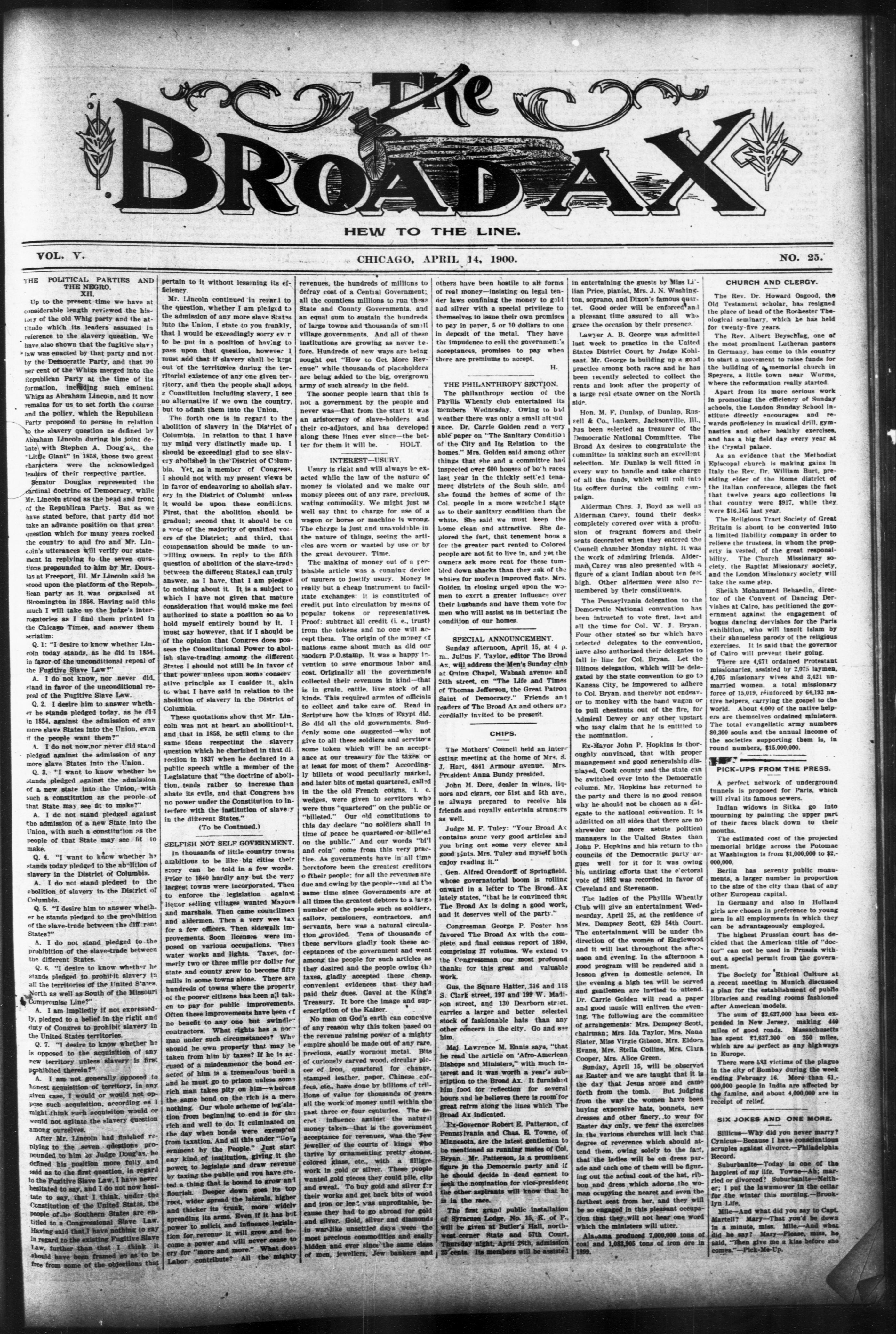
THE POLITICAL PARTIES AND THE NEGRO.
Up to the present time we have at considerable length reviewed the history of the old Whig party and the attitude which its leaders assumed in reference to the slavery question. We have also shown that the fugitive slave law was enacted by that party and not by the Democratic Party, and that 90 per cent of the Whigs merged into the Republican Party at the time of its formation, including such eminent Whigs as Abraham Lincoln, and it now remains for us to set forth the course and the policy, which the Republican Party proposed to persue in relation to the slavery question as defined by Abraham Lincoln during his joint debate with Stephen A. Doug as, the "Little Giant" in 1858, those two great characters were the acknowledged leaders of their respective parties.
Senator Douglas represented the cardinal doctrine of Democracy, while Mr. Lincoln stood as the head and front of the Republican Party. But as we have stated before, that party did not take an advance position on that great question which for many years rocked the country to and fro and Mr. Lincoln's utterances will verify our statement in replying to the seven questions propounded to him by Mr. Douglas at Freeport, Ill. Mr Lincoln said he stood upon the platform of the Republican party as it was organized at Bloomington in 1856. Having said this much I will take up the judge's interrogatories as I find them printed in the Chicago Times, and answer them seriatim:
Q.1: "I desire to know whether Lincoln today stands, as he did in 1854, in favor of the unconditional repeal of the Fugitive Slave Law?"
A. I do not know, nor never did, stand in favor of the unconditional repeal of the Fugitive Slave Law.
Q.2. I desire him to answer whether he stands pledged today, as he did in 1854, against the admission of any more slave States into the Union, even if the people want them?"
A. I do not now,nor never did stand pledged against the admission of any more slave States into the Union.
Q. 3. "I want to know whether he stands pledged against the admission of a new state into the Union, with such a constitution as the people of that State may see fit to make?"
A. I do not stand pledged against the admission of a new State into the Union, with such a constitution as the people of that State may see fit to make.
Q. 4. "I want to know whether he stands today pledged to the abolition of slavery in the District of Columbia.
A. I do not stand pledged to the abolition of slavery in the District of Columbia.
Q. 5. "I desire him to answer whether he stands pledged to the prohibition of the slave-trade between the different States?"
A. I do not stand pledged to the prohibition of the slave-trade between the different States.
Q. 6. "I desire to know whether he stands pledged to prohibit slavery in all the territories of the United States. North as well as South of the Missouri Compromise Line?"
A. I am impliedly if not expressedly, pledged to a belief in the right and duty of Congress to prohibit slavery in the United States territories.
Q. 7. "I desire to know whether he is opposed to the acquisition of any new territory unless slavery is first prohibited therein?"
A. I am not generally opposed to honest acquisition of territory, in any given case, I would or would not oppose such acquisition, according as I might think such acquisition would or would not agitate the slavery question among ourselves.
After Mr. Lincoln had finished replying to the seven questions propounded to him by Judge Douglas, he defined his position more fully and said as to the first question, in regard to the Fugitive Slave Law, I have never hesitated to say, and I do not now hesitate to say, that I think, under the Constitution of the United States, the people of the Southern States are entitled to a Congressional Slave Law. Having said that, I have nothing to say in regard to the existing Fugitive Slave Law, further than that I think it should have been framed so as to be free from some of the objections that
pertain to it without lessening its efficiency.
Mr. Lincoln continued in regard to the question, whether I am pledged to the admission of any more slave States into the Union, I state to you frankly, that I would be exceedingly sorry ever to be put in a position of having to pass upon that question, however I must add that if slavery shall be kept out of the territories during the territorial existence of any one given territory, and then the people shall adopt 2 Constitution including slavery, I see no alternative if we own the country, but to admit them into the Union.
The forth one is in regard to the abolition of slavery in the District of Columbia. In relation to that I have my mind very distinctly made up. I should be exceedingl glad to see slavery abolished in the District of Columbia. Yet, as a member of Congress, I should not with my present views be in favor of endeavoring to abolish slavery in the District of Columbi unless it would be upon these conditions. First, that the abolition should be gradual; second that it should be on a vote of the majority of qualified voters of the District; and third, that compensation should be made to unwilling owners. In reply to the fifth question of abolition of the slave-trade between the different States, I can truly answer, as I have, that I am pledged to nothing about it. It is a subject to which I have not given that mature consideration that would make me feel authorized to state a position so as to hold myself entirely bound by it. I must say however, that if I should be of the opinion that Congress does possess the Constitutional Power to abolish slave-trading among the different States I should not still be in favor of that power unless upon some conservative principle as I consider it, akin to what I have said in relation to the abolition of slavery in the District of Columbia.
These quotations show that Mr. Lincoln was not at heart an abolitionist, and that in 1858, he still clung to the same ideas respecting the slavery question which he cherished in that direction in 1837 when he declared in a public speech while a member of the Legislature that "the doctrine of abolition, tends rather to increase than abate its evils, and that Congress has no power under the Constitution to interfere with the institution of slavery in the different States."
(To be Continued.)
SELFISH NOT SELF GOVERNMENT.
In thousands of little country towns ambitious to be like big cities their story can be told in a few words. Prior to 1840 hardly any but the very largest towns were incorporated. Then to enforce the legislation against liquor selling villages wanted Mayors and marshals. Then came councilmen and aldermen. Then a very wee tax for a few officers. Then sidewalk improvements. Soon licenses were imposed on various occupations. Then water works and lights. Taxes, formerly two or three mills per dollar for state and county grew to become fifty mills in some towns alone. There are hundreds of towns where the property of the poorer citizens has been all taken to pay for public improvements. Often these improvements have been of no benefit to any one but swindler contractors. What rights has a poor man under such circumstances? Why should he own property that may be taken from him by taxes? If he is accused of a misdeamenor the bond exacted of him is a tremendous burden and he must go to prison unless some rich man takes pity on him—whereas the same bond on the rich is a mere nothing. Our whole scheme of legislation from beginning to end is for the rich and well to do. It culminated on the day when bonds were exempted from taxation. And all this under "Government by the People." Just start any kind of institution, giving it the power to legislate and draw revenue by taxing the public and you have created a thing that is bound to grow and flourish. Deeper down goes its top root, wider spread the laterals, higher and thicker its trunk, more widely spreading its arms. Even if it has but power to solicit and influence legislation for revenue it will grow and become a power and will never cease to cry for "more and more." What does Labor contribute? All the mighty
HEW TO THE LINE.
revenues, the hundreds of millions to defray cost of a Central Government; all the countless millions to run these State and County Governments, and an equal sum to sustain the hundreds of large towns and thousands of small village governments. And all of these institutions are growing as never before. Hundreds of new ways are being sought out "How to Get More Revenue" while thousands of placeholders are being added to the big, overgrown army of such already in the field.
The sooner people learn that this is not a government by the people and never was—that from the start it was an aristocracy of slave-holders and their co-adjutors, and has developed along these lines ever since—the better for them it will be. HOLT.
INTEREST—USURY
Usury is right and will always be exacted while the law of the nature of money is violated and we make our money pieces out of any rare, precious, wating commodity. We might just as well say that to charge for use of a wagon or horse or machine is wrong. The charge is just and unavoidable in the nature of things, seeing the articles are worn or wasted by use or by the great devourer. Time.
The making of money out of a reishable article was a cunning device of usurers to justify usury. Money is really but a cheap instrument to facilitate exchanges: It is constituted of credit put into circulation by means of popular tokens or representatives. Proof: subtract all credit (i. e., trust) from the tokens and no one will accept them. The origin of the money of nations came about much as did our modern P.O.stamp. It was a happy invention to save enormous labor and cost. Originally all the governments collected their revenues in kind—that is in grain, cattle, live stock of all kinds. This required armies of officials to collect and take care of. Read in Scripture how the kings of Egypt did. So did all the old governments. Suddenly some one suggested—why not give to all these soldiers and servitors some token which will be an acceptance at our treasury for the taxes, or at least for most of them? Accordingly billets of wood peculiarly marked, and later bits of metal quartered, called in the the old French coigns, i. e. wedges, were given to servitors who were thus "quartered" on the public or "billeted." Our old constitutions to this day declare "no soldiers shall in time of peace be quartered or billeted on the public." And our words "bl'l and coin" come from this very practice. As governments have in all time heretofore been the greatest creditors oftheir people; for all the revenues are due and cwing by the people—and at the same time since Governments are at all times the greatest debtors to a large number of the people such as soldiers, sailors, pensioners, contractors, and servants, here was a natural circulation provided. Tens of thousands of these servitors gladly took these acceptances of the government and went among the people for such articles as they desired and the people owing the taxes, gladly accepted these cheap, convenient evidences that they had paid their dues. Gavel at the King's Treasury. It bore the image and superscription of the Kaiser.
No man on God's earth can conceive of any reason why this token based on the revenue raising power of a mighty empire should be made out of any rare, precious, easily wornout metal. Bits of curiously carved wood, circular pieces of iron, quartered for change, stamped leather, paper, Chinese coffees, etc., have done by billions of trillions of value for thousands of years all the work of money until within the past three or four centuries. The secret influence against the natural money taken--that is the government acceptance for revenues, was the Jew jeweller of the courts of kings who thrive by ornamenting pretty stones, colored glass, etc., with a filligre work in gold or silver. These people wanted gold pieces they could pile, clip and sweat. To buy gold and silver for their works and get back bits of wood and iron or lead was unprofitable, because they had to go abroad for gold and silver. Gold, silver and diamonds in war-like unsettled days were the most precious commodities and easily hidden and ever since the same class of men, jewellers, Jew bankers and
others have been hostile to all forms of real money—insisting on legal tender laws confining the money to gold and silver with a special privilege to themselves to issue their own promises to pay in paper, 5 or 10 dollars to one in deposit of the metal. They have the impudence to call the government's acceptances, promises to pay when there are premiums to accept.
THE PHILANTHROPY SECTION. The philanthropy section of the Phyllis Wheatly club entertained its members Wednesday. Owing to bad weather there was only a small attendance. Dr. Carrie Golden read a very able paper on "The Sanitary Condition of the City and Its Relation to the homes." Mrs. Golden said among other things that she and a committee had inspected over 600 houses of both races last year in the thickly settled tenement districts of the Souh side, and she found the homes of some of the Col. people in a more wretched state as to their sanitary condition than the white. She said we must keep the home clean and attractive. She deplored the fact, that tenement hous s for the greater part rented to Colored people are not fit to live in, and yet the owners ask more rent for these tumbled down shacks than they ask of the whites for modern improved flats. Mrs. Golden in closing urged upon the women to exert a greater influence over their husbands and have them vote for men who will assist us in bettering the condition of our homes.
SPECIAL ANNOUNCEMENT
Sunday afternoon, April 15, at 4 p.m., Julius F. Taylor, editor The Broad Ax, will address the Men's Sunday club at Quinn Chapel, Wabash avenue and 24th street, on "The Life and Times of Thomas Jefferson, the Great Patron Saint of Democracy." Friends and readers of The Broad Ax and others are cordially invited to be present.
CHIPS.
The Mothers' Council held an interesting meeting at the home of Mrs. S. J. Hart, 4841 Armour avenue. Mrs. President Anna Bundy presided.
John M. Dore, dealer in wines, liquors and cigars, cor 51st and 5th ave., is always prepared to receive his friends and royally entertain strangers as well.
Judge M. F. Tuley: "Your Broad Ax contains some very good articles and you bring out some very clever and good pints. Mrs. Tuley and myself both enjoy reading it."
Gen. Alfred Orendorff of Springfield, whose governatorial boom is rolling onward in a letter to The Broad Ax lately states, "that he is convinced that The Broad Ax is doing a good work, and it deserves well of the party."
Congresman George P. Foster has favored The Broad Ax with the complete and final census report of 1890, comprising 27 volumes. We extend to the Congressman our most profound thanks for this great and valuable work.
Gus, the Square Hatter, 116 and 118 S. Clark street, 197 and 199 W. Madison street, and 130 Dearborn street. carries a larger and better selected stock of fashionable hats than any other concern in the city. Go and see him.
Maj. Lawrence M. Ennis says, "that he read the article on 'Afro-American Bishops and Ministers,' with much interest and it was worth a year's subscription to the Broad Ax. It furnished him food for reflection for several hours and he believes there is room for great refrm along the lines which The Broad Ax indicated.
Ex-Governor Robert E. Patterson, of Pennsylvania and Chas. E. Towne, of Minnesota, are the latest gentlemen to be mentioned as running mates of Col. Bryan. Mr. Patterson, is a prominent figure in the Democratic party and if he should decide in dead earnest to seek the nomination for vice-president the other aspirants will know that he is in the race.
The first grand public installation of Syracuse Lodge, No. 15, K. of P., will be given at Butler's Hall, northwest corner State and 57th Court, Thursday night, April 26th, admission 25 cents. Its members will be assisted
in entertaining the guests by Miss Lilian Price, pianist, Mrs. J. N. Washington, soprano, and Dixon's famous quartet. Good order will be enforced and a pleasant time assured to all who grace the occasion by their presence. Lawyer A. B. George was admitted last week to practice in the United States District Court by Judge Kohlsaat. Mr. George is building up a good practice among both races and he has been recently selected to collect the rents and look after the property of a large real etsate owner on the North side.
Hon. M. F. Dunlap, of Dunlap, Russell & Co., bankers, Jacksonville, Ill., has been selected as treaurer of the Democratic National Committee. The Broad Ax desires to congratulate the committee in making such an excellent selection. Mr. Dunlap is well fitted in every way to handle and take charge of all the funds, which will roll into its coffers during the coming campaign.
Alderman Chas. J. Boyd as well as Alderman Carey, found their desks completely covered over with a profusion of fragrant flowers and their seats decorated when they entered the Council chamber Monday night. It was the work of admiring friends. Alderman Carey was also presented with a figure of a giant Indian about ten feet high. Other aldermen were also remembered by their constituents.
The Pennsylvania delegation to the Democratic National convention has been intructed to vote first, last and all the time for Col. W. J. Bryan. Four other states so far which have selected delegates to the convention, have also authorized their delegates to fall in line for Col. Bryan. Let the Illinois delegation, which will be delegated by the state convention to go to Kansas City, be impowered to adhere to Col. Bryan, and thereby not endeavor to monkey with the band wagon or to pull chestnuts out of the fire, for Admiral Dewey or any other upstart who may claim that he is entitled to the nomination.
Ex-Mayor John P. Hopkins is thoroughly convinced, that with proper management and good generalship displayed, Cook county and the state can be switched over into the Democratic column. Mr. Hopkins has returned to the party and there is no good reason why he should not be chosen as a delegate to the national convention. It is admitted on all sides that there are no shrewder nor more astute political managers in the United States than John P. Hopkins and his return to the councils of the Democratic party argues well for it for it was owing his untiring efforts that the e'ectoral vote of 1892 was recorded in favor of Cleveland and Stevenson.
The ladies of the Phyllis Wheatly Club will give an entertainment Wednesday, April 25, at the residence of Mrs. Dempsey Scott, 629 54th Court. The entertainment will be under the direction of the women of Englewood and it will last throughout the afternoon and evening. In the afternoon a good program will be rendered and a lesson given in domestic science. In the evening a high tea will be served and gentlemen are invited to attend. Dr. Carrie Golden will read a paper and good music will enliven the evening. The following are the committee of arrangements: Mrs. Dempsey Scott, chairman; Mrs. Ida Taylor, Mrs. Nana Slater, Miss Virgie Gibson, Mrs. Eldora Evans, Mrs. Stella Collins, Mrs. Clara Cooper, Mrs. Alice Green.
Sunday, April 15, will be observed as Easter and we are taught that it is the day that Jesus arose and came forth from the tomb. But judging from the way the women have been buying expensive hats, bonnets, new dresses and other finery, to wear for Easter day only, we fear the exercises in the various churches will lack that degree of reverence which should attend them, owing solely to the fact, that the ladies will be on dress parade and each one of them will be figuring out the actual cost of the hat, ribbon and dress which adorns the woman occupying the nearest and even the farthest seat from her, and they will be so engaged in this pleasant occupation that they will not hear one word which the ministers will utter.
Alaiama produced 7,000,000 tons of coal and 1,082,905 tons of iron ore in 1899.
NO. 25.
CHURCH AND CLERGY.
The Rev. Dr. Howard Osgood, the Old Testament scholar, has resigned the place of head of the Rochester Theological seminary, which he has held for twenty-five years. The Rev. Albert Beyschlag, one of the most prominent Lutheran pastors in Germany, has come to this country to start a movement to raise funds for the building of a memorial church in Speyers, a little town near Wurms, where the reformation really started.
Apart from its more serious work in promoting the efficiency of Sunday schools, the London Sunday School institute directly encourages and rewards proficiency in musical drill, gymnastics and other healthy exercises, and has a big field day every year at the Crystal palace. As an evidence that the Methodist Episcopal church is making gains in Italy the Rev. Dr. William Burt, presiding elder of the Rome district of the Italian conference, alleges the fact that twelve years ago collections in that country were $917, while they were $16.345 last year.
The Religious Tract Society of Great Britain is about to be converted into a limited liability company in order to relieve the trustees, in whom the property is vested, of the great responsibility. The Church Missionary society, the Baptist Missionary society, and the London Missionary society will take the same step.
Sheikh Mohammed Behaedin, director of the Convent of Dancing Dervishes at Cairo, has petitioned the government against the engagement of bogus dancing dervishes for the Paris exhibition, who will insult Islam by their shameless parody of the religious exercises. It is said that the governor of Cairo will prevent their going.
There are 4,671 ordained Protestant missionaries, assisted by 2,075 laymen, 4,705 missionary wives and 3,421 unmarried women. a total missionary force of 15,019, reinforced by 64,193 native helpers, carrying the gospel to the world. About 4,000 of the native helpers are themselves ordained ministers. The total evangelistic army numbers 80,300 souls and the annual income of the societies supporting them is, in round numbers, $15,000,000.
PICK-UPS FROM THE PRESS.
A perfect network of underground tunnels is proposed for Paris, which will rival its famous sewers. Indian widows in Sitka go into mourning by painting the upper part of their faces black down to their mouths. The estimated cost of the projected memorial bridge across the Potomac at Washington is from $1,000,000 to $2,000,000. Berlin has seventy public monuments, a larger number in proportion to the size of the city than that of any other European capital.
In Germany and also in Holland girls are chosen in preference to young men in all employments in which they can be advantageously employed. The highest Prussian court has decided that the American title of "doctor" can not be used in Prussia without a special permit from the government. The Society for Ethical Culture at a recent meeting in Munich discussed a plan for the establishment of public libraries and reading rooms fashioned after American models.
The sum of $2,637,000 has been expended in New Jersey, making 440 miles of good roads. Massachusetts has spent $2,637,300 on 250 miles, which are as perfect as any highways in Europe.
There were 583 victims of the plague in the city of Bombay during the week ending February 16. More than 61,000,000 people in India are affected by the famine, and about 4,000,000 are in receipt of relief.
SIX JOKES AND ONE MORE.
Sillicus—Why did you never marry? Cynicus—Because I have conscientious scruples against divorce.—Philadelphia Record.
Suburbanite—Today is one of the happiest of my life. Towne—Ah; married or divorced? Suburbanite—Neither; I put the lawnmower in the cellar for the winter this morning.—Brooklyn Life.
Mile—And what did you say to Capt. Martell? Mary—That you'd be down in a minute, miss. Mile.—And what did he say? Mary—Please, miss, he said, "Then give me a kiss before she comes."—Pick-Me-Up.
The Sarsaparilla that’s used by Chinese and Hindu; in the bushes of Aus-
tralia and the wilds of South America; the Sarsaparilla that braces British and
Boer, and gives strength to French and German, Russian and Turk, —
That’s AYERS
Z The Sarsaparilia that has more than twenty pages of doctors’ indorsements,
extending over nearly sixty years, embracing every known disease which arises
from impure bleod; that’s made on honor and made to cure, —
Thal’s AYERS
The Sarsaparilla that's made of carefully selected drugs, the best and purest
and most expensive from the world over; that's made of a sarsaparilla root
costing more than ten times as much as that which enters into the composition
of any other Sarsaparilla, — ;
Thal’s AYER'S
The Sarsaparilla manufactured by modern methods evolved from half a cen-
tury of practical experience; that's made so carefully that every bottle is put
up as if it were an individual prescription, and to whose laboratory any phy-
sician, any druggist, any pharmacist is cordially invited and welcomed, —
| Thal’s AYERS
That's |
F _ -Ayer's Sarsaparilia brings’ exhilaration to the tired beady and hope to all
F ‘who are exhausted, depressed, discouraged. It removes all impurities from the
J} and peins,” You can afford to. trust a Sarsaparilla that has’ been trusted for
Seem ey
i thatie AVED<S
pee 3 TT ca Ss = ca F3 Be F % ?
a ere ent re eee eee ee Se
ae SEMIS
@Weasr VIRGINIA “SOUP.”
Semewnhee Primitive Entertainment
|» “Whieh Fields Lot: of Fan.
‘The clambeke and chowder are
forms of festivity which we of the east
have most of us at some time enjoyed,
‘end which are known by reputation, at
‘east, to our envious countrymen cf
‘the west. But the ‘kind of picnic
known simply as “soup” is unfamiliar
to the cast and west alike; it is south-
era, and as yet is confined to a small
portion of West Virginia, although it
sow bids fair to spread. The soup,
‘Wich flourishes especially in the
wsighborhood of Shepherdstown, is
‘certainly a very jolly, if‘rather too
Primitive, form of entertainment. Each
person invited brings a dressed chicken,
the host providing the vegetables.
Poultry and vegetables are placed in
large kettles holding from ten to twen-
ty-gallons, and the combination is
socked over open fires for several
hours, or until it is reduced to a jelly.
Pepper and other seasonings are added.
The girls and young men stir the soup
with long-handled iron spoons, keeping
‘up a march or walk around the kettles
as they do so. When a girl's spoon
clicks against the spoon of a young
man he is at lioerty to catch and kiss
her. Of course there are a great many
Hvely skirmishes and a great deal of
fan im the game. When the soup is
Gone it is ladled out into plates and
eaten. It is said to be delicious. The
custom owes its origin to a company
of Stonewall Jackson's men who were
Yecruited in that part of the state.
‘These “ex-confeds” keep up their or-
ganization. They have a reunion once
@ year, at which they celebrate with a
Grand soup. It is said that soup prop-
erly got up should be mad- of stolen
chickens, but the veterans had to give
up foraging after the war and make a
compromise by going about in squads
and robbing each other's roosts by mu-
ual understanding. The last touch is
the best of all—in fact, it is almost too
good to be true. It leaves the reader
with the lurking doubt whether after
ell the savory and seductive soup orig-
tag@eg with Stonewall Jackson's sol-
@iers or in the brain of the ingenious
Frank R. Stockton!—Youth’s Compan-
ton.
Important to Mothers.
Beemmiee carefully every bottle of CASTORIA,
@.enfe and scre remedy for infants and children,
‘emd pee that 1:
st. Liptlhae
‘Signature of y
te Use For Over 30 Years,
‘The Kind You Have Abwsys Bought,
Mast Have Remembered.
Miss Singer—“I wonder if that rich
ancle of mine remembered me when
te made his will? I used to sing to
him.” Mr. Law—“I'm sure he must
have. He hasnt left you anything.”
—Stray Sagries.
: GHOST OF THE GLACIER
and Other Tales, incinding Makigg &
Revolution, Susquehanna Trail, Sculp-
ture of the Elfs, Once a Pillar of the
World, Feathers of Fashion, and oth-
ers. A delightful volume, beautifully
Mustrate@. Ready for distribution
about May 1. . Send 10 cents to T. W.
Lee, General Passenger Agent, Lacka-
watina Railroad, 2 Exchange Place,
New York City. Edition Limited.
Peleen ta Netulors.
Cases are not infrequently reported
im which children, and sometimes
grown persons, are poisoned by the
free use of nutmegs, it not being gen-
erally known that this article of com-
mon household use is really a deadly
poison. This is true, in fact, of most
condiments; but the misuse of these
articles, such as pepper, capsicum, etc.,
are so obnoxious to the taste, except
when taken in very minute quantities,
that the consumer is warned in a very
positive manner before he has an op-
porfunity to do himself serious injury.
This ip not the case, however, with the
nutmeg. This nut, which contains a
poisonous principle, may be consumed
without inconvenience, in quantities
sufficient to produce fatal results.
There Te 2 Clnee of Peocla.
Who are injured by the use of coffee.
Recently there has been placed in all
the grocery stores a new preparation
called GRAIN-O, made of pure grains,
that takes the place of coffee. The most
delicate stomach receives it without
distress, and but few can tell it from
coffee. It does not cost over one-fourth
as much. Children may drink ft with
great benefit. 15 cents and 25 cents
per package. Try it. Ask for GRAIN-O.
Big Reduction in Ratis.
The Pennsylvania railroad has placed
an order for 105,000 tons of steel rails,
for which it is to pay $33 a ton, and
deliveries have begun on this order.
In 1864 this road paid $153.75 a ton in
gold for iron rails and in 1863 it im-
ported a lot of steel rails, for which
it paid $218.53 a ton. These were the
maximum rates ever paid in this coun-
try for rails. /
Biew*s Thiel
‘We offer One Hundred Dollars reward forany
ease of Catarrh that cannot be oured by Hall's
(Caterrh Cure.
we ee eee $ 2.
cue for the last 15 years ‘and believe him
Ee amteciiy et cary oo say oss
tions made by their frm
Vag ears Nae wn
o.; syste, Toledo, On &
ae N's Catarrh Car {s taken internally, act-
ws ss
Hall's Family Pills are the best
‘Two Views of It.
Rose—“I would never marry a man
witheut principle.” Lily—“Nor IL. And
I should want his principle to be big
enough to allow us to live well on the
interest, too.”"—Philadelphia Bulletin.
* @ead Edetemer,
‘There is one senator,writes a Wash:
ington correspondent, who has net yet
spoken a word, but whose personality
has become of much interest to fre-
quenters of the galleries. Porter James
‘McCumber of North Dakoth sits in tha
rear row on the Republica side. He is
the most regular attendant upon ses-
sions that his side ofthe chamber
bas. No speech is so dredry that Mc-
Comber does not sit it out.’ More than
that, his face assumes a most seriour
and attentive aspect. From time to
time the North Dakota man bends over
the writing pad on his desk and makes
a few notes. Then he raises his face
and watches the speaker intently. The
first time Senator McCumber took
notes those who saw him were sure he
was going to make some reply. But he
@idn’t.. He has taken notes every day,
and he has not yet spoken. When the
chamber is full and business is of gen-
eral interest Senator McCumber’s de-
votion to debate does not attract at-
tention, But when some senator is
simply killing time, and five-sixths of
the seats are empty and nobody but
Senator McCumber is listening, the
action of the North Dakota statesman
is impressive.
BMedern Way of Killleg & Whale
The old and romantic way of killing
whales has died out. There is no longer
the frail whaleboat, with the grizzled
old harpooner in the bow to strike the
whale, but instead a little steam craft
and a powerful gun. This gun throws
a large iron harpoon, with crossarms
which Me against the shaft until it
strikes a solid body and then project
out’and imbed themselves. The head
of this harpoon is cigar-shaped, and
sharp-pointed, and explodes as it
pierces the whale’s side, generating a
gas,which serves to keep the fish afloat
after the wrecking effect of the shock
on its internal organs has left it a
lifeless man. A stout rope is attached
to the butt of the harpoon, and by
this the whale is xept in leash as it
t_rashes madly through the water ina
vain effort to escape its unknown en-
emy. Death rapidly ensues, unless, as
sometimes happens, the projectile goes
through the fish from side to side,
when a second shot Is necessary.
Private Papers Inviclate.
The New York assembly has passed
the bill making it a misdemeanor to
publish any letter, telegram or private
paper found among the effects of any
person who has been dangerously
wounded, committed suicide or died
suddenly unless the document is passed
upon by the coroner and he has de-
cided that publication is necessary.
The Bicycle In Java.
Java has taken to the bicycle and
keeps a factory that has been estab-
lished at Samarang busy.
PUBLISHED WEEELY.
POPP PPL LLL LLL PPL III
su rote po sn it
Labor,
ve if say, SO thelr
i EF
‘The Broad Ax isa per whose platform
Sautecal right fo speck eer re
Local communication will tention;
Heb g acetic deve
SussceirTions (advance):
SSS
Advertising rates made known on application
Address all communications io
THE BROAD ax,
* $060 Azwour Avexcs. CuIcAea,
JULIUS F. TAYLOR, Editor and Publisher,
3 CURRENT TOPICS
*
Lecccccccccccccccocceces:
TRAIZING OF CHILDREN.
As a general thing the ‘idea of mak-
ing a special study of children in a
scientific way, much as a scientist
would observe a beetle or @ baboon,
seems rather cold-blooded to most peo-
ple. Such investigations of childhood'’s
tendencies and motives as Prof. Ash-
croft has recently been making do not
fall under this category. Formulating
certain questions as to what children
would do with money which they
earned or found or which was given
to them, Prof. Ashcroft obtained cer-
tain data which lead to conclusions
quite favorable on the whole as to the
charitable, generous and saving in-
stincts of boys and girls. Of nearly
1,000 children questioned as to what
they would do with a dollar if given
them to spend as they pleased, 62 per
cent expressed themselves in favor of
buying useful articles, 30 per cent non-
useful articles, 32 per cent would use it
for benevolent purposes, and 5 per cent
for buying presents for their friends.
Other investigations showed that in a
school where penny savings banks
were established the latter were an un-
doubted encouragement to thrift. On
the whole, Prof. Ashcroft’s investiga-
tions seem to give a complete refuta-
tion to the materialistic idea that chil-
dren are naturally savages, who must
be trained in the ways of civilization.
ATTEMPT ON WALES’ LIFE.
The attempt upon the life of the
prince of Wales was quite what might
have been expected, because, happily
for the credit of human nature, ninety-
nine out of one hundred of the per-
sons who believe in mtréer'as a polit-
ical agency are.so close to the line of
idiocy that their attempts strike at
that person who, of all others, is least
responsible for the wrongs they allege
as the motives of their acts. Every sane
person knows that the prince of Wales
has no more to do with the South
African war than the man in the
moon. He is an absolute nullity in
politics. Only a short time ago a crazy
Italian “anarchist,” as he chose to call
himself, struck down the blameless
empress of Austria. The assassina-
tions of President Carnot, of Garfield,
of Mayor Harrison, all show the same
blind imbecility. It is well known that
the murder of Alexander of Russia re-
moved the one person from whom rad-
ical political improvements in that
country were to be expected, putting
back political progress in the empire
for twenty years.
DETROIT SUPPRESSES LANOTRY.
Mayor Maybury of Detroit, who wit-
nessed “The Degenerates” at Toledo
the other night, threatened to revoke
the opera house franchise in Detroit
if the play was put on there, and so it
was given in Windsor, Ont., a little
Canadian town across the river from
Detroit. The play, according to De-
troit’s mayor, is based upon the theory
that actions can be performed and in-
sinuations made on the stage which
ate not tolerated In decent society.
The plot, he says, is a continuous lia-
som and the dialogue, has reference
only to these liasons, the language be-
‘ug unmistakable and pointing direct-
ly to the purpose of the plot. This ar-
taignment is just, and yet Mrs. Lang-
trz"s play drew good houses instead of
protests when it was presented in Chi-
cago recently.
“TAKING THE TIDE.”
Prof. Goldwin Smith says that Queen
Yictoria’s visit to Ireland should have
bees earlier in order to have its best
effect. A good many politicians, also,
are now saying Dewey's declaration of
«s8 candidacy for the presidency comes
too late. Shakespeare seems to have
had a pretty firm grasp of the part op-
portunity plays in the affairs of men
when he wrote the oft-quoted lines
about taking the tide at its flood.
NEW YORK AND ALBANY.
Mayor Van Wyck of Greater New
York says that his city \s but a colony
under state government, ruled abso-
lutely by a coterie at-Albany. This
may be hard upon Mr. Van Wyck, but
Se aie ty the farmers ot
f “ruled by the farmers of
New York state than see the state con-
trolled by corrupt politicians.
_- STATUS OF THE WAR. |
Is Bloemfontein to be a Ladysmith
om aarger scale? In the bewildering
situation ‘of, Roberts’ army and with
jack of news as to active operations it
is @iffcult 40 form an opinion as to
to Pretoria has been delayed for
NEW USE OP EXHAUST.
Waste Stenm May We Used to Rea os
Aasifiary Eagiee.
For many years it has been knows
that the steam engine did not utilize
pressure engine, which discharged
exhaust steam into the air, used hardly
more than 5 per cent of the value of
the fuel burned under Its boiler. The
compound engine, which condensed the
steam and returned the warm water to
the boilers, used only 12 to 13 per cent
of the fuel energy. Here ingenuity
seemed to stop until a device was in-
vented for using the heat of the ex-
haust steam to evaporate another
liquid, which, having a lower boiling
point than water, required less heat
for the process than does water. This
process is the joint discovery of G.
Behrend, a Hamburg engineer, and Dr.
Zimmermann of Ludwigshafen, and It
gains as high as 56 per cent additional
motive power without increasing the
expenditure of fuel. The liquid they
chose for evaporation is sulphurous
acid, which is cheap, easily obtained,
and is so oily that it lubricates the in-
ner working surfaces of the machinery
without corroding them. The steam
passes into the surface condensor oF
evaporizer, in which the cooling me-
dium, instead of being water, is liquid
sulphurous acid, the boiling point of
which is so low that-the liquid is de-
composed immediately by the heat of
the exhaust steam, liberating sulphur
dioxide gas. This gas passes over into
the cylinder of an auxiliary engine,
where its work is done as in an ordi-
Bary steam engine. Then the sulphur-
ous vapor enters the surface condens-
er, is condensed to liquid by cold water
tubes and is forced by a pump back
into the vaporizer to do its work over
again. With.a fairly economical com-
pound engine, using sixteen and one-
half pounds of steam for each indi-
cated Dorse power hour, half an indi-
cated horse power can be produced in
the auxiliary machine for every indi-
=ted horse power developed im the
main engine.—New York Press,
CHORE BOY TO MILLIONAIRE.
To advance from the humble po
ton of “chore boy” on a farm, receiv-
ing fifty cents a week, to be one of
the leading business men of a state ts
Indeed a long step, but this is what
has been accomplished by James Oli-
ver, of South Bend, Ind. He has fought
bis way alone and unsided from pover-
ty to riches, and now holds a promi-
nent place in social and industria!
circles. Mr. Oliver was born in Scot-
land in 1823, and came to America
when thirteen years of age. He locat-
ed in Geneva, N. Y., and secured a
place on a farm at fifty cents a week.
His father and brother had preceded
him to America and were located on
another farm near by. In 1835 the
three removed to Indiana, and James
secured employment on a farm at $6
@ month. Saving a little money, be
made an investment in real esta‘e,
which gave him a start. Then he
learned the molder’s trade and in 1835
became a manufacturer on a sma.l
scale. His business grew and, by de-
vising a plan whereby an improvemezt
he had long sought was accomplished,
be was started on the road to riches.
Success, having once smiled upon him,
became lavish in the bestowal of her
bounty and his wealth is now estimat-
ed at from $10,000,000 to $15,000,009.
Although one of Indiana’s wealthiest
men, Mr. Oliver remembers his early
SN
oo
a, y
i
| un anes S
i NK ,~
‘ NN HH o
JAMES
struggles, and the rough hand of the
hqnest laborer is today as warmly
grasped by him as is the gloved band
o€ the aristocrat. He is a firm friend
«© “the deserving and many young meo
owe their success in life to timely help
and words of advice from him.
Quite lricb. That.
A friend of mine has an Irish serv-
ant, who is an old soldier who brought
an ugly scar or two from India. One
day he was describing his part in a
battle—the long wait, the nerves tense,
ae ee ee
how the rider some yards of
him fell from the saddle and shot his
own horse dead with the death grip of
his fingers on his revolver as he
dragged; how the men behind uttered
oaths at the sight, and set their teeth
to win. “And what struck you most
‘when it was over, and you looked back
upon it?” asked my friend. The serv-
‘ant reflected a moment, and then, with
simplicity, replied: “What struck me
most forcible, sir, was the bullets that
missed me.” Quite Irish, that—Paris
American Register.
= Where Cestes Fatic.
In Paraguay a gentleman is en-
joined by the laws of good society to
kiss every lady whom he is introduced.
This sounds alluring unless you hap-
pen to bave-met a lady in Paraguay—
Boston Traveler. a
Parsuer sed Puarsned
- A man was going home to his wir,
and family. oe growing dark. His
road from the station was a lonely one,
and*he was getting along as fast as by
could, when he suddenly snspected the:
a man behind was following him per.
posely. The faster he went, the faster
the man went, until they came te ,
churchyard. “Now,” he said to him.
self, “I'll fiud out if he’s after me,” ang
he entered the churchyard. The map
followed him. Vague visions of re.
volvers grew upon him. He made a
detour of a splendid mausoleum. stin
the man was after him, round ang
round. At last he turned and faced the
fellow, and asked: “What the dickens
do you want? What are you follow.
ing me for?” “Well, sir, do you aj-
ways go home like this? I am going
up to Mr. Brown’s house with a parce},
and the porter at the station told me
that if I'd follow you I should find the
place, as you live next door. Are you
going home at all tonight?”
Those readiest to criticise are ofteg
least able to appreciate.—Joubert.
Your Blood
The thing most desired of a Spring
Medicine is thorough purification of
the blood. With this work of
cleansing going on there is com.
plete renovation of every part of
your system. Not only is the cor-
rapt blood made fresh, bright and
lively, but the stomach also re.
sponds in better digestion, ite
readiness for food at proper times
gives sharp sapnetite, the kidneys
and liver properly perform their
allotted functions, and there is, in
short, new brain, nerve, mental! and
digestive strength.
HOOD’S
2
Sarsaparilla
Possesses the peculiar qualities—
Peeuliar to Itself—which accom-
plish these good things for ail
who take it. An unlimited list of
wonderful cures prove its merit.
WORK 3 gate WORRY
a?
Pe
YJ a =e
' SNE
WASHED Bice, AWAY
BY age A THE
STERLING DUPLEX
WASHING MACHINE.
imecbous ities sot ox pour deniers wrta on
THE EUREKA CO., Dept. H., Rock Falls, lll.
ri WER ge
130 SS
v i i
— OS he
SLICKER|
WILL KEEP YOU DRY. |
(8
Rd ssccce.. Pa
A Swallow.
a
HIRES noctter
fozet ee spcng etaod tr numa
geweess ON
is.
is =~ “th , E
ba
sa. rite
HUSK, CUT 4% SHRED
THE GYGLONE <<".
eS.
STUMP BLASTING.
it the and most RF
Hien mreea So
Blots nar be see jovegtoee ead so
AJAX prnaserTs woune,
EOE: ae
THE MAN WHO OPPOSES SEN- ATOR CLARK.
Attracted Attention by His Fight Against the Montana Contestant for a Sent in Upper House of Congress - How He Made His Millions.
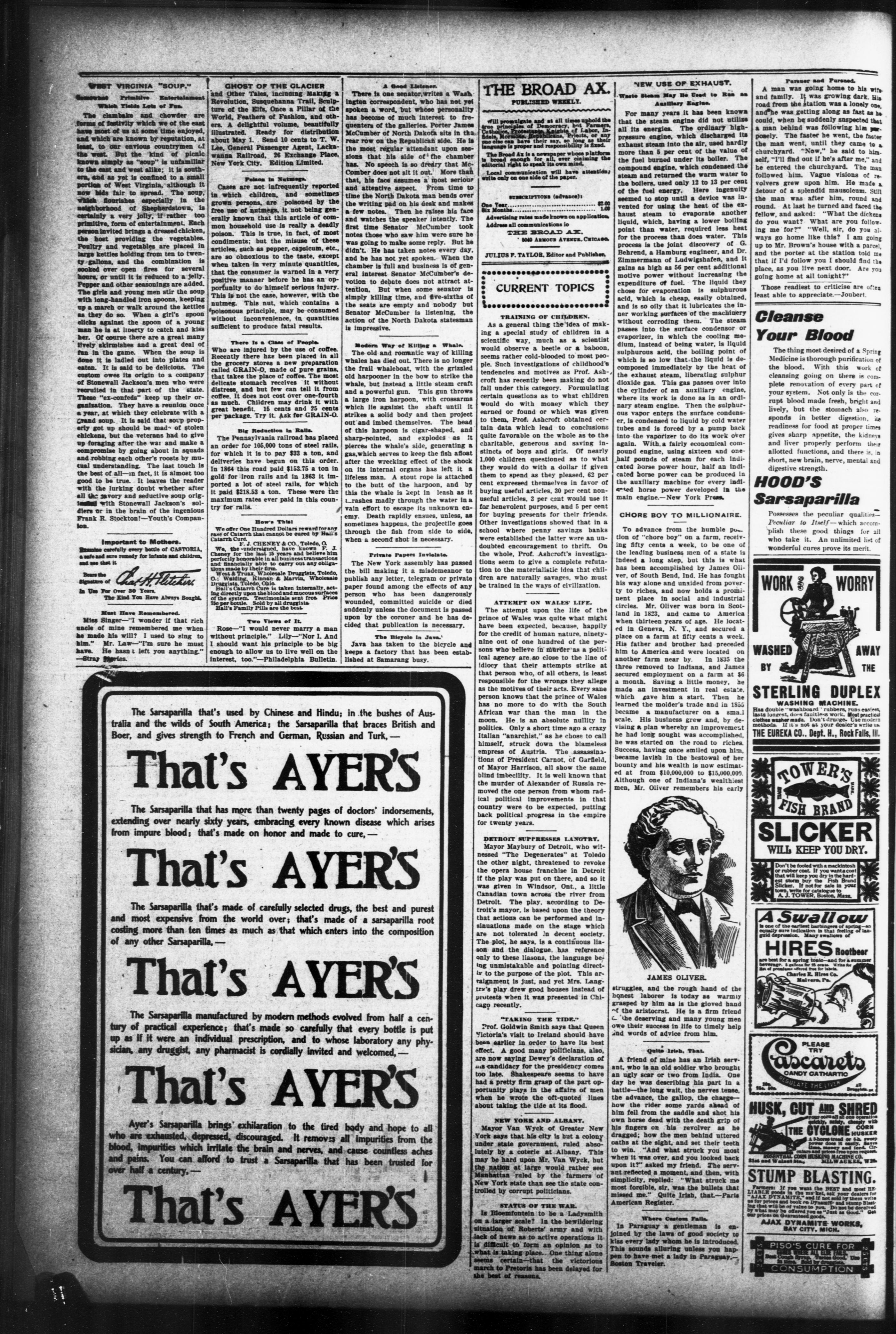
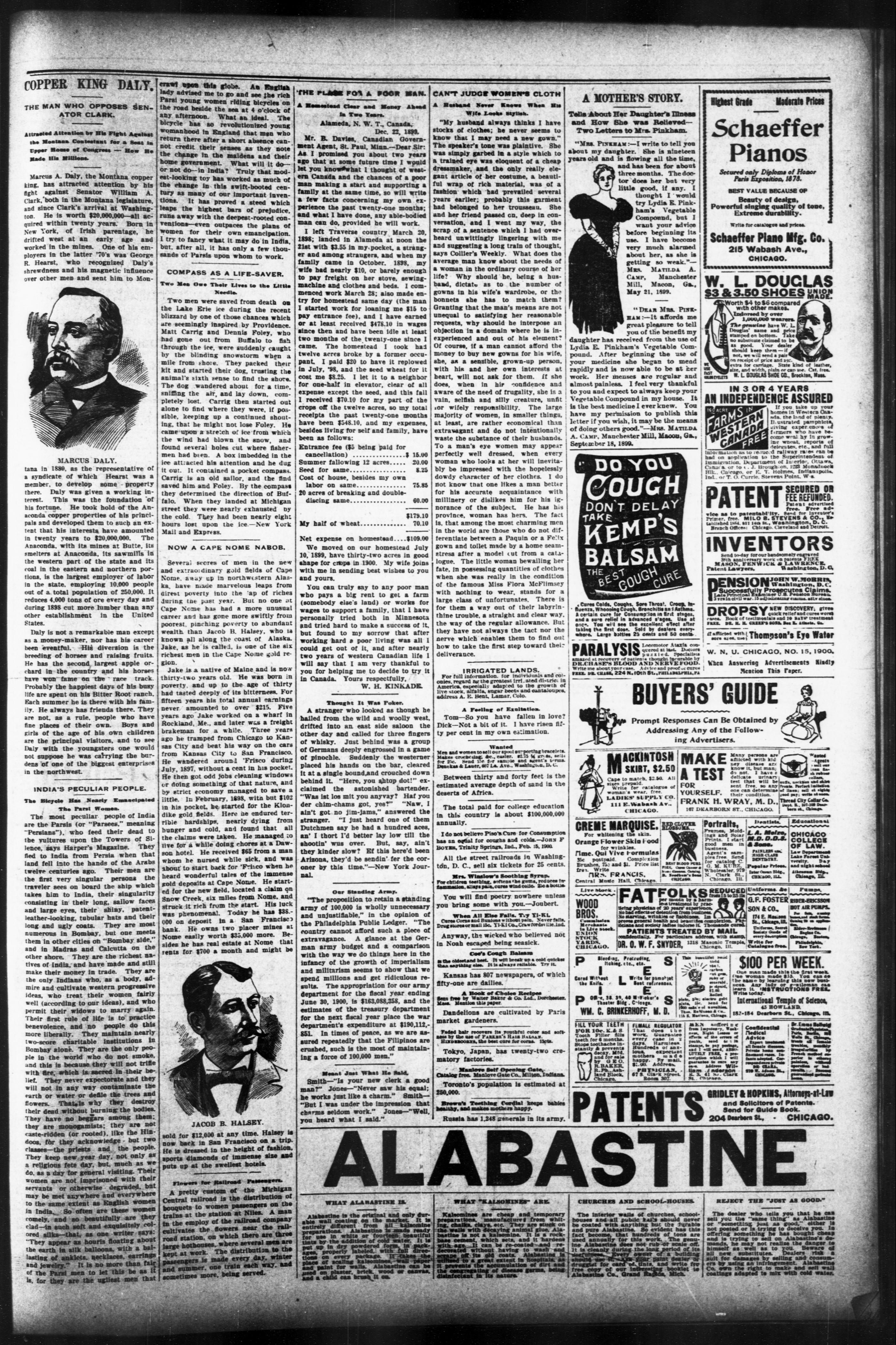
Marcus A. Daly, the Montana copper king, has attracted attention by his fight against Senator William A. Clark, both in the Montana legislature, and since Clark's arrival at Washington. He is worth $20,000,000—all acquired within twenty years. Born in New York, of Irish parentage, he drifted west at an early age and worked in the mines. One of his employers in the latter '70's was George R. Hearst, who recognized Daly's shrewdness and his magnetic influence over other men and sent him to Mon-
A. B.
MARCUS DALY.
tana in 1880, as the representative of a syndicate of which Hearst was a member, to develop some property there. Daly was given a working interest. This was the foundation of his fortune. He took hold of the Anaconda copper properties of his principals and developed them to such an extent that his interests have amounted in twenty years to $20,000,000. The Anaconda, with its mines at Butte, its smelters at Anaconda, its sawmills in the western part of the state and its coal in the eastern and northern portions, is the largest employer of labor in the state, employing 10,000 people out of a total population of 250,000. It reduces 4,000 tons of ore every day and during 1898 cut more lumber than any other establishment in the United States.
Daly is not a remarkable man except as a money-maker, nor has his career been eventful. His diversion is the breeding of horses and raising fruits. He has the second largest apple orchard in the country and his horses have won fame on the race track. Probably the happiest days of his busy life are spent on his Bitter Root ranch. Each summer he is there with his family. He always has friends there. They are not, as a rule, people who have fine places of their own. Boys and girls of the age of his own children are the principal visitors, and to see Daly with the youngsters one would not suppose he was carrying the burdens of one of the biggest enterprises in the northwest.
INDIA'S PECULIAR PEOPLE.
The most peculiar people of India are the Parsis (or "Parsees," meaning "Persians"), who feed their dead to the vultures upon the Towers of Silence, says Harper's Magazine. They fled to India from Persia when that land fell into the hands of the Arabs twelve centuries ago. Their men are the first very singular persons the traveler sees on board the ship which takes him to India, their singularity consisting in their long, sallow faces and large eyes, their shiny, patent-leather-looking, tubular hats and their long and ugly coats. They are most numerous in Bombay, but one meets them in other cities on "Bombay side," and in Madras and Calcutta on the other shore. They are the richest natives of India, and have made and still make their money in trade. They are the only Indians who, as a body, admire and cultivate western progressive ideas, who treat their women fairly well (according to our ideas), and who permit their widows to marry again. Their first rule of life is to practice benevolence, and no people do this more liberally. They maintain nearly two-score charitable institutions in Bombay alone. They are the only people in the world who do not smoke, and this is because they will not trifle with fire, which is sacred in their belief. They never expectorate and they will not in any way contaminate the earth or water or defile the trees and flowers. That is why they destroy their dead without burning the bodies. They have no beggars among them; they are monogamists; they are not caste-ridden (or rooted), like the Hindoos, for they acknowledge but two classes—the priests and the people. They keep new year day, not only as a religious fete day, but, much as we do, as a day for general visiting. Their women are not imprisoned with their servants or otherwise degraded, but may be met anywhere and everywhere to the same extent as English women in India. So often are these women comely, and so beautifully are they clad—in such soft and exquisitely colored silks—that, as one writer says: "They appear as hours floating about the earth in silk balloons, with a ballasting of anklets, necklaces, earrings and jewelry." It is no more than fair of the Parsi men to let this be as it is, for they are the ugliest men that
crawl upon this globe. An English lady advised me to go and see the rich Parsi young women riding bicycles on the road beside the sea at 4 o'clock of any afternoon. What an ideal. The bicycle has so revolutionized young womanhood in England that men who return there after a short absence cannot credit their senses as they note the change in the maidens and their home government. What will it do—or not do—in India? Truly that modest-looking toy has worked as much of the change in this swift-booted century as many of our important inventions. It has proved a steed which leaps the highest bars of prejudice, runs away with the deepest-rooted conventions—even outpaces the plans of women for their own emancipation. I try to fancy what it may do in India, but, after all, it has only a few thousands of Parsis upon whom to work.
COMPASS AS A LIFE-SAVER
Two men were saved from death on the Lake Erie ice during the recent blizzard by one of those chances which are seemingly inspired by Providence. Matt Carrig and Dennis Foley, who had gone out from Buffalo to fish through the ice, were suddenly caught by the blinding snowstorm when a mile from shore. They packed their kit and started their dog, trusting the animal's sixth sense to find the shore. The dog wandered about for a time, sniffing the air, and lay down, completely lost. Carrig then started out alone to find where they were, if possible, keeping up a continued shouting, that he might not lose Foley. He came upon a stretch of ice from which the wind had blown the snow, and found several holes cut where fishermen had been. A box imbedded in the ice attracted his attention and he dug it out. It contained a pocket compass. Carrig is an old sailor, and the find saved him and Foley. By the compass they determined the direction of Buffalo. When they landed at Michigan street they were nearly exhausted by the cold. They had been nearly eight hours lost upon the ice.—New York Mail and Express.
NOW A CAPE NOME NABOB.
Several scores of men in the new and extraordinary gold fields of Cape Nome, away up in northwestern Alaska, have made marvelous leaps from direst poverty into the 'ap of riches during the past year. But no one at Cape Nome has had a more unusual career and has gone more swiftly from poorest, pinching poverty to abundant wealth than Jacob B. Halsey, who is known all along the coast of Alaska. Jake, as he is called, is one of the six richest men in the Cape Nome gold region.
Jake is a native of Maine and is now thirty-two years old. He was born in poverty, and up to the age of thirty had tasted deeply of its bitterness. For fifteen years his total annual earnings never amounted to over $215. Five years ago Jake worked on a wharf in Rockland, Me., and later was a freight brakeman for a while. Three years ago he tramped from Chicago to Kansas City and beat his way on the cars from Kansas City to San Francisco. He wandered around 'Frisco during July, 1897, without a cent in his pocket. He then got odd jobs cleaning windows or doing something of that nature, and by strict economy managed to save a little. In February, 1898, with but $102 in his pocket, he started for the Klondike gold fields. Here he endured terrible hardships, nearly dying from hunger and cold, and found that all the claims were taken. He managed to live for a while doing chores at a Dawson hotel. He received $65 from a man whom he nursed while sick, and was about to start back for 'Frisco when he heard wonderful tales of the immense gold deposits at Cape Nome. He started for the new field, located a claim on Snow Creek, six miles from Nome, and struck it rich from the start. His luck was phenomenal. Today he has $38.000 on deposit in a San Francisco bank. He owns two placer mines at Nome easily worth $35,000 more. Besides he has real estate at Nome that rents for $700 a month and might be
J.
JACOB B. HALSEY.
sold for $12,000 at any time. Halsey is now back in San Francisco on a trip.
He is dressed in the height of fashion, sports diamonds of immense size and puts up at the swellest hotels.
A pretty custom of the Michigan Central railroad is the distribution of bouquets to women passengers on the trains at the station at Niles. A man in the employ of the railroad company cultivates the flowers near the railroad station, on which there are three large hothouses, where several men are kept at work. The distribution to the passengers is made every day, winter and summer, one train each way, and sometimes more, being served.
A Homestead Clear and Money Ahead in Two Years.
Mr. B. Davies, Canadian Government Agent, St. Paul, Minn.—Dear Sir: As I promised you about two years ago that at some future time I would let you know what I thought of western Canada and the chances of a poor man making a start and supporting a family at the same time, so will write a few facts concerning my own experience the past twenty-one months; and what I have done, any able-bodied man can do, provided he will work.
I left Traverse country March 20, 1898; landed in Alameda at noon the 21st with $3.55 in my pocket, a stranger and among straugers, and when my family came in October. 1898, my wife had nearly $10, or barely enough to pay freight on her stove, sewing-machine and clothes and beds. I commenced work March 28; also made entry for homestead same day (the man I started work for loaning me $15 to pay entrance fee), and I have earned or at least received $478.10 in wages since then and have been idle at least two months of the twenty-one since I came. The homestead I took had twelve acres broke by a former occupant. I paid $20 to have it replowed in July, '98, and the seed wheat for it cost me $8.25. I let it to a neighbor for one-half in elevator, clear of all expense except the seed, and this fall I received $70.10 for my part of the crops off the twelve acres, so my total receipts the past twenty-one months have been $548.10, and my expenses, besides living for self and family, have been as follows:
cancellation) $ 15.00
Summer fallowing 12 acres..... 20.00
Seed for same..... 8.25
Cost of house, besides my own
labor on same..... 75.85
20 acres of breaking and double-
discing same..... 60.00
$179.10
My half of wheat..... 70.10
Net expense on homestead.....$109.00
We moved on our homestead July 10, 1899, have thirty-two acres in good shape for crops in 1900. My wife joins with me in sending best wishes to you and yours.
You can truly say to any poor man who pays a big rent to get a farm (somebody else's land) or works for wages to support a family, that I have personally tried both in Minnesota and tried hard to make a success of it, but found to my sorrow that after working hard a poor living was all I could get out of it, and after nearly two years of western Canadian life I will say that I am very thankful to you for helping me to decide to try it in Canada. Yours respectfully,
Thought It Was Poker.
A stranger who looked as though he hailed from the wild and woolly west, drifted into an east side saloon the other day and called for three fingers of whisky. Just behind was a group of Germans deeply engrossed in a game of pinochle. Suddenly the westerner placed his hands on the bar, cleared it at a single bound, and crouched down behind it. "Here, you ahtop dot!" exclaimed the astonished bartender. "Was ist los mit you anyvay? Haf you der chim-chams got, yes?" "Naw, I ain't got no jim-jams," answered the stranger. "I just heard one of them Dutchmen say he had a hundred aces, an' I thort I'd better lay low till the shootin' wus over. But, say, ain't they kinder slow? Ef this here'd been Arizona, they'd be sendin' fer the coroner by this time."—New York Journal.
Our Standing Army.
"The proposition to retain a standing army of 100,000 is wholly unnecessary and unjustifiable," in the opinion of the Philadelphia Public Ledger. "The country cannot afford such a piece of extravagance. A glance at the German army budget and a comparison with the way we do things here in the infancy of the growth of imperialism and militarism seems to show that we spend millions and get ridiculous results. The appropriation for our army department for the fiscal year ending June 30, 1900, is $163,088,358, and the estimates of the treasury department for the next fiscal year place the war department's expenditure at $190,112,-851. In times of peace, as we are assured repeatedly that the Filipinos are crushed, such is the most of maintaining a force of 100,000 men."
Meant Just What He Said.
Smith—"Is your new clerk a good man?" Jones—"Never saw his equal; he works just like a charm." Smith—"But I was under the impression that charms seldom work." Jones—"Well, you heard what I said."
WHAT ALABASTINE IS.
Alabastine is the original and only durable wall coating on the market. It is entirely different from all kalsomine preparations. Alabastine is made ready for use in white or fourteen beautiful tints by the addition of cold water. It is put up in dry powdered form, in packages, properly labeled, with full directions on every package. It takes the place of scaling kalsomines, wall paper and paint for walls. Alabastine can be used on plaster, brick, wood or canvas, and a child can brush it on.
```markdown
```
"My husband always thinks I have stocks of clothes; he never seems to know that I may need a new gown." The speaker's tone was plaintive. She was simply garbed in a style which to a trained eye was eloquent of a cheap dressmaker, and the only really elegant article of her costume, a beautiful wrap of rich material, was of a fashion which had prevailed several years earlier; probably this garment had belonged to her trousseau. She and her friend passed on, deep in conversation, and I went my way, the scrap of a sentence which I had overheard unwittingly lingering with me and suggesting a long train of thought, says Collier's Weekly. What does the average man know about the needs of a woman in the ordinary course of her life? Why should he, being a husband, dictate as to the number of gowns in his wife's wardrobe, or the bonnets she has to match them? Granting that the man's means are not unequal to satisfying her reasonable requests, why should he interpose an objection in a domain where he is inexperienced and out of his element? Of course, if a man cannot afford the money to buy new gowns for his wife, she, as a sensible, grown-up person, with his and her own interests at heart, will not ask for them. If she does, when in his confidence and aware of the need of frugality, she is a vain, selfish and silly creature, unfit or wifely responsibility. The large majority of women, in smaller things, at least, are rather economical than extrawagant and do not intentionally waste the substance of their husbands. To a man's eye women may appear perfectly well dressed, when every woman who looks at her will inevitably be impressed with the hopelessly dowdy character of her clothes. I do not know that one likes a man better for his accurate acquaintance with millinery or dislikes him for his ignorance of the subject. He has his province, woman has hers. The fact is, that among the most charming men in the world are those who do not differentiate between a Paquin or a Felix gown and toilet made by a home seamstress after a model cut from a catalogue. The little woman bewailing her fate, in possessing quantities of clothes when she was really in the condition of the famous Miss Flora McFlimsey with nothing to wear, stands for a large class of unfortunates. There is for them a way out of their labyrinthine trouble, a straight and clear way, the way of the regular allowance. But they have not always the tact nor the nerve which enables them to find out how to take the first step toward their deliverance.
IRRIGATED LANDS.
For full information, for individuals and colonies, regard ng the greatest irr.liated district in America, especially adapted to the growth of live stock, alfalfa, sugar beets and cantaloupes, address A. E. Bent, Lamar, Colo.
A Feeling of Exultation.
Tom—So you have fallen in love? Dick—Not a bit of it. I have risen fifty per cent in my own estimation.
Men and women to sell our spool airporting bracelets.
Makes crucching, dec., easler. $2.75 4 gross, sells
for 25c. Send 15c for sample and agent's terms.
Denekas & Lauer, 607 La. Ave., Washington, D.C.
Between thirty and forty feet is the estimated average depth of sand in the deserts of Africa.
The total paid for college education in this country is about $100,000,000 annually.
I do not believe Piso's Cure for Consumption has an equal for coughs and colds.—JOHN F BOYER, Trinity Springs, Ind., Feb. 15, 1900.
All the street railroads in Washington, D. C., sell six tickets for 25 cents.
Mrs. Winslow's Soothing Syrup.
For children teething, softens the gums, reduces inflammation, allays pain, cures wind colic. Be a bottle
You will find poetry nowhere unless you bring some with you.—Joubert.
When All Else Falls. Try Yi-KL.
Curea Corns and Bunions without pain. Never falls.
Drug stores or mail lsc. Yi-Kl Co., Crawfordsville, ind.
Anyway, the wicked who believed not in Noah escaped being seasick.
in the oldest and best. It will break up a cold quicker than anything else. It is always reliable. Try it.
Kansas has 807 newspapers, of which fifty-one are dailies.
A Book of Cholee Recipes
Sent free by Walter Baker & Co. Ltd., Dorchester, Mass. Mention this paper.
Dandelions are cultivated by Paris market gardeners.
Faded hair recovers its youthful color and softness by the use of PARKER's HAIR BALSAM.
HINDERCOORS, the best cure for corns. 13cts.
Tokyo, Japan, has twenty-two crematory factories.
Manlove Self Opening Gate,
Catalog free. Manlove Gate Co., Milton, Indiana.
Toronto's population is estimated at 250,000.
Brown's Teething Cordial keeps babies healthy, and makes mothers happy.
Russia has 1,248 generals in its army.
WHAT "KALSOMINES" ARE.
Kalsomines are cheap and temporary preparations, manufactured from whiting, chalks, clays, etc. They are stuck on the walls with decaying animal glue. Alabastine is not a kalsomine. It is a rock-base cement, which sets, and it hardens with age. It can be re-coated and re-decorated without having to wash and scrape off its old coats. Alabastine is utilized to a great extent in hospitals, as it prevents the accumulation of dirt and the congregating of disease germs, being disinfectant in its nature.
Highest Grade Moderate Prices
Schaeffer Pianos
Secured only Diploma of Honor
Paris Exposition, 1878.
BEST VALUE BECAUSE OP
Beauty of design,
Powerful singing quality of tone,
Extreme durability.
Write for catalogue and prices.
Schaeffer Piano Mfg. Co.
215 Wabash Ave.,
CHICAGO.
W. L. DOUGLAS
$3 & 3.50 SHOES UNION MADE.
Worth $4 to $6 compared
with other makes.
Indorsed by over
1,000,000 wearers.
The genuine have W. L.
Douglas' name and price
stamped on bottom. Take
no substitute claimed to be
as good. Your dealer
should keep them — if
not, we will send a pair
on receipt of price and asc.
extra for carriage. State kind of leather,
size, and width, plain or cap toe. Cat. free.
W. L. DOUGLAS SHOE CO., Brockton, Mass.
A MOTHER'S STORY.
Tells About Her Daughter's Illness and How She was Relieved Two Letters to Mrs. Pinkham. "Mrs. PINKHAM:I write to tell you about my daughter. She is nineteen years old and is flowing all the time.
and thru tor litte
"DEAR MRS. PINKHAM:—It affords me great pleasure to tell you of the benefit my
daughter has received from the use of Lydia E. Pinkham's Vegetable Compound. After beginning the use of your medicine she began to mend rapidly and is now able to be at her work. Her menses are regular and almost painless. I feel very thankful to you and expect to always keep your Vegetable Compound in my house. It is the best medicine I ever knew. You have my permission to publish this letter if you wish, it may be the means of doing others good."—MRS. MATILDA A. CAMP, Manchester Mill, Macou, Ga., September 18, 1899.
WESTERN CANADA
DO YOU
COUGH
DON'T DELAY
TAKE
KEMP'S
BALSAM
THE BEST COUGH CURE
PATENT SECURED OR FEE REFUNDED. Patent advertised free. Free ad- vice as to patentability. Send for Inventor's Primer, free. MILO B. STEVENS & CO., Established 1864. 811 14th St., Washington, D. C. Branch Offices: Chicago, Cleveland and Detroit.
Send to-day for our handsomely engraved 8th anniversary work on patents FREE
MASON, FENWICK & LAWRENCE,
Patent Lawyers,
Washington, D. G.
DENSION JOHN W. MORRIS,
Washington, D. C.
Successfully Prosecutes Claims.
Late Principal Examiner U.S. Pension Bureau.
3 yrs in civil war. 15 adjudicating claims. attn vice president
Cures Colds, Coughs, Sore Throat, Group, Influenza, Whooping Cough, Bronchitis and Asthma. A certain cure for Consumption in first stages, and a sure relief in advanced stages. Use at once. You will see the excellent effect after taking the first dose. Sold by dealers everywhere. Large bottles 25 cents and 50 cents-
DROPSY NEW DISCOVERY; gives quick relief and cures worms cases. Book of testimonials and 10 BAYS' treatment FREE. DR. H. M. GREEN'S SORR. Box L. Athens, Ga.
If afflicted with sore eyes, use Thompson's Eye Water
PARALYSIS Locomotor Ataxia conquered at last. Doctors puzzled. Specialists amazed at recovery of patient thought faculare by DR.CHASE'S BLOOD AND NERVE FOOD. Write me about your case. Advice and proof of cure FREE. DR.CHASE, 224 N.10TH St., PHILADELPHIA, PA
W. N. U. CHICAGO, NO. 15, 1900.
When Answering Advertisements Kindly
Mention This Paper.
S' GUIDE
Can Be Obtained by
any of the Follow-
vertisers.
BUYERS' GUIDE
A
Prompt Responses Can Be Obtained by Addressing Any of the Following Advertisers.
BLOCKINTOSH KIRT, $2.50
match, $2.50. All
paid.
for catalogue of
wear, free.
MAKE A TEST
FOR YOURSELF.
Many persons are afflicted with kid ney disease and know it, but man; do not. I have a delicate urinary test that will be sent free, so any one can determine that.
Cape to match, $2.50. All sizes prepaid.
Write for catalogue of woman's wear, free.
LADIES' SUPPLY CO.
111 E. Wabash Av..
CHICAGO.
Portraits
Frames, Moldings and Solar Prints. I start good men in business.
Agent's samples free. Send for catalog C. G. M. KURZ.
Wholesaler, 979 N. Clark St., Chicago, Ill.
RED CLOVER
BLOSSOM...
BEST BLOOD PULL
PIEK. Crown Cutter &
blood dissection. Cushing.
R. Needham's Bone
CHICAGO.
MRS. FRANCIS,
Central Music Hall, Chicago.
PUMPS.
RIDER-ERICSSON
BOT AIR PUMPS.
For fuel, axing
burners, and stock
form.
Catalog 20 on application.
Rider-Kirkman
Engine Co.
Chicago, Boston
Philadelphia,
New York.
Bleeding, Protruding,
Itching, etc., etc.
I E
Cared Without
the Knife.
L E
Write for pamphlet
Best references.
O Mc. 38. 39. 40 M. Vicker's
Theater Bldg. Chicago.
S
WM. C. BRINKERHOFF, M. D.
FILL YOUR TEETH
FOR 10c. K. & S.
Tooth Filler fills
teeth for 6 months.
Stops toothache in-
stantly & prevents
decay. Mfd.
and for sale
by GEO.
R.BAKER.
R.Ph. Ash-
land Block.
Chicago.
FEMALE REGULAT
That does not
work. Guarantee
every case in
days. Harmile
Hundreds of an
expect
mothers m a
happy. Pay m
$1.00. Address
PHYSICIAN
67 S. Clark st
Room 307.
M.K.N. suffer ing from Impotence, Weeknane, Night Lenses or effects of the errors of youth, send 4c to stamps, to pay postage, and I will send, ABBULYTE LUTLY, a prescription which I will guarantee to cure any ane. Address William Anderson K. 3, 41 S. Clark St. Chicago.
PATENTS
GRIDLEY & HOPKINS, Attorneys-at-Law and Solicitors of Patents. Send for Guide Book. 204 Dearborn SL, CHICAGO.
REJECT THE "JUST AS GOOD."
CHURCHES AND SCHOOL-HOUSES.
The interior walls of churches, schoolhouses and all public kalls should never be coated with anything but the durable and pure Alabastine. So evident has this fact become, that hundreds of tons are used annually for this work. The genuine Alabastine does not rub or scale off. It is cleanly during the long period of its usefulness. Every owner of a building should use it. Ask your paint dealer or drugstret for card of Units, and write five free copy of our interesting booklet to Alabastine Co., Grand Rapids, Mich.
The dealer who tells you that he can sell you the "same thing" as Alabastine or "something just as good," either is not posted or is trying to deceive you. In offering something he has bought cheap and is trying to sell on Alabastine's demands, he may not realize the danger to himself as well as to you. Beware of all new substitutes. Dealers risk a suit for damages by selling and consumers by using an infringement. Alabastine Co. own the right to make and sell wall coatings adapted to mix with cold water.
ee es
FROM LECKEY’S “THE MAP OF
Life.*
~ It fs’ene of the paradoxes of buman
mature that the things that are most
“struggled for and the things that are
“most envied are not those which give
“ither the most intense or the most
- It is probable that as the world goes
on there will be a steadily increasing
tendency to judge moral qualities and
ourses of conduct mainly by the de-
gree in which they promote or dimin-
ish human happiness.
~ Overwork, in all departments of life,
is commonly bad economy, net so
much berause it often breaks dowr
heaith—most of what is attributed to
this cause is probably rather due to
anxiety than to work—as because it
seldom fails to impair the quality of
work,
Pleasure is a jewel which will only
Tplain its luster when it is in a setting
t work, and a vacant life is one of
the worst of pains, though the islands
of leisure that stud a crowded, well-
oceupied lifc may be among the things
te whieh we look back with the great-
cot delight, -
As Spinoze has taught, “the proper
study of a wise man is not how to die,
but how to live,” and as long as he is
discharging this task arigh{“he may
Jeaye the end to take care of itself. The
ereat guiding landmarks of a wise life
are indeed few and simple; to do our
¢uty—to avoid aseless sorrow—to ac-
quiesce patiently in the inevitabie.
The amount of pure and almost
spontaneous malevolence in the world
is probably far greater than we at first
tmagine. In pnblic life the workings
of this side of human nature are at
once disclosed and magnified. jike tie
figures thrown by a magic lantern on a
sereen, to a scale which it is impossi-
bie to overlook.
Hie who would look jime in the face
without. Husien and without fear
should associat? each year as it passes
with new developments of his nature:
with duties accomplished, and with
work performed. To fill the time
allotted to us to the brim with action
and with thought is the only way in
which we can learn to watch its pass-
age with equanimity.
ITEMS OF INTEREST.
A camel can easily carry a load of
1,500 pounds.
Polite Chinamen consider it a breach
of etiquette to wear spectacles in com-
pany.
In the Raltic sea there are more
wrecks than in any other place in the
world.
A peculiar rose has been successfully
cultivated by Japanese florists. In the
sunlight it looks red and in the shade
it is white.
The Masonic regalia worn by Wash-
ington, consisting of an apron and
baidric, is owned by J. T. Smith of
Goodland, Kan.
Sound passes through the air at the
velocity of 1.142 feet per second;
through water, 4,900 feet; through
iron, 17.500 feet.
In; 1843 only candles were used to
illuminate the Haymarket theater,
London. A clause in the lease prohibit-
ed the use of gas.
An electrical device, which automat-
feally drops a feed of oats into a
horse’s trough, has been invented by a
man in Youngstown, Ohio. :
‘The Penny Savings society of Chi-
cago last year redeived on deposit from
the school children, through their
teathers, the sum of $70,000.
Amatenr photographers must pay 10
cents extra every time they enter the
Paris exposition grourds when they
earry their cameras with them.
A Utica gentleman, Abraham E. El-
mer, bas just celebrated his 113th
birthday. At the age of 99 he lost his
sight. Otherwise he is in good con-
dition. .
Horses used for pleasure in Russia
have around the neck a stout thin cord
with a running noose. When the ani-
mal starts to run a jerk on this cord
‘baits bim ike magic, as the horse in-
stantly stops when the cord presses his
windpipe.
THOUGHTS FROM HERBERT
SPENCER. ’
Precepts. often heard and little re-
garded.lose by repetition the small in-
fivence’they bad.
Right conduct is usually come short
of more‘from defect of wil] than de-
fect of knowledge.
‘There are les told by actions as well
as lies told by words, and ethics give
nO more countenance to the one than
It is the duty of every one who re-
_ gavds\a-doctrine as true and important,
todo what he can towards diffusing it,
leaving the result to be what it may.
‘Domplete truthfulness is one of the
)parest of virtues. Even those who re-
gard themselves as absolutely truth-
ful are daily guilty of over-statements
= : Se Sep
: mensewe ee ‘far mare thé so-
"etal frown which follows the doing of
they G6 the qualms of conscience
which follow the doing of something
<< eae insist t on reality and
pincer Ay pefrain af much as he
a eeney<- ©
cee sees Oe St, 80
eon a i
3 “Eee eres = ee
1 Hk BROAD AX
~~ Publishet Weekly,~ yi!" -promutgate
and at ell times uphold (+ iree prin.
ciples of Demoeracy. dui Catholics.
‘Protestants, priests. infidels. farmers
‘single taxers, Republicans, Knights o
Labor, or any one else can have their
say, as Jong as their language is prop-
er and responsibility is fixed.
The Broed Ax is a newspaper whose
platform is broad enough for all, ever
claiming the edftorial right to speak
ks own mind.
Local communications will: receive
attention. Write only on one side of
the paper. ‘
Subscriptions must be paid in ad-
vanee.
CR FORE as soe on scan si ccgueecos eee
Six months .............+++-e++00 LOO
Advertising rates made known on
application. Address all communica-
tions to .
THE BROAD AX,
5040 Armour avenue. "Chicago.
Julius F, Taylor Editor and Publisher.
Mrs. Julius F. Taylor,Assistant Editor.
(Entered at the postoffice, Chigago,
UL, as second class matter.)
LETTERS OF COMMENDATION,
Chicago, Sept. 16, 1899.
Mr. Julius F. Taylor, Editor Broad Ax
Dear Sir—I am glad to learn of the
work that is being done by your paper
im behalf of Chicago platform prin-
ciples. That platform stands for
such a government as Jefferson and
Lincoln favored, namely, a government
of the people, for the people and by
the people. and I believe that such
& government will prove a blessing te
the great majority of the people.
Yours truly,
‘ Ww. J. Bryan.
July 15th, 1898.
‘To whom it may concern:
Julius F. Taylor, who comes to this
city well recommended, has begun the
publication of “The Broad Ax,” which,
I am _ informed, will disseminate
Democratic principles and contend for
the higher intellectcal development of
the Afro-American race and mankiné
tm general. While he is thus engaged
I bespeak for him the hearty suppert
of all loyal and true friends of Demoe-
facy. Respectfully,
Carter H. Hairisca.
Headquarters of Democratic State Cen-
tral Committee of Illinois, Shermaz
House, Chicago, Oct. Sth, 1899.
To whom it may concern:
This is to certify that Mr. Julius F
Taylor, editor of The Broad Ax—a pub-
fication of this city devoted to the in-
terests of the democratic party, and
an-able-exponent of democratic prinei-
Ples—comes to us highly recom-
mended, and I therefore take pleasure
im commending him to the favorable
consideration of democrats with whom
he may come in business contact.
Respectfully,
Walter Watson.
Chairman Detocratic State Central
Committee of Ilincis.
NOTICE.
All friends and readers of The Broad
Ax, who have relatives or friends vis-
Hing them, or if you give or attend
social functions either at home
or abroad. If you journey to other
towns or cities on business or pleasure.
‘If you know or hear of a marriage,
birth or death. Or in short, if you
know anything of interest pertaining
to the doings or the movements of the
people adduce such facts and figures
as briefly as possible on postal cards
or letters, and address them to The
Broad Ax, and all such news items will
find their way into its columns. But do
not send us anything in reference to
cake walks or Jim Crowism. If you
give swell parties and receptions and
desire that the same should receive
mention, send invitations or tickets
and a representative of The Broad Ax
will endeavor to be on hand, otherwise
mo one should, marvel, if they fail to
observe a notice in The Broad Ax.
Ladies of culture know that the
Original Ozonized Ox Marrow is the
purest and best remedy to straighten
the hair and make it pliable and beau-
tiful. Sold over forty years and has
‘hever disappointed the most fastidi-
ous. Try a bottle and you will appre-
ciate its superiority. Only 60 cents
per bottie at druggists. Beware of
imitations. The genuine and original
is made only by Ozonized Ox Marrow
Co., 76 Wabash avenue, Chicago.
-_————
| A Bese rkeltte Fich
People marvel at the mechanism of
she human body, with its 208 bones
4nd 60 arteries. But man is simple
20 this respect compared with the
‘arp. That remarkabie fish moves no
fewer than 4,236 bones and muscles
avery time it breathes. It has 4,329
feins, to say nothing of its 99 mas-
les. :
} ‘Olabbouse for Bays.
cae dees cee aan ee
save a club house for poor
oys. It is furnished on a scale com-
paring favorably with the best of
ee ee
The bank of France last year dis-
counted in Paris 2,101,830 separate
Ne for toe than 79. tego sont.
‘Try the inimitable fine and pure
candies, the be-tia the city for
liec., 2c. and 4c. per pound.
All put up in beaoctiful boxes,
suitable for presents.
GUNTHER'S CORFECTIONERY
| 212 STATE STREET.
ALBERT B. GEORGE
LAW YER.
423 Ashland Block, Chicago.
— Tel M. 2625.—
j
eae Rh
| BEAUREGARD F. MOSELY
| LAWYER
| BANKRUPTCY PROCEEDINGS A SPECIALTY.
Surre 1 axp2
62% Hatstep Street CHICAGO
| Cor. Hatsrev & 6320 STs.
ee
MRS. LAURA CAILEY.
FURNISHED ROOMS
FORSTRANGERS & TRAVELERS
THEATRICAL HEADQUARTERS.
Cheap rates and good accomsnodations.
506 State St, 2d floor, Chicage, Ilf
Room 28.
P. J. FLYNN
Wholesale and Retail Dealer in
HARD and SOFT COAL
WOOD AND KINDLING
YARDS. Cor. 47th and Wabash
R. R. 67th and Eastern ML R.R.
Braveb Offi, 3301 Weatworth av.
mene: Ct
DR. JOSEPH JEFFREY,
Physician and Surgeon,
4858 Dearborn Street. CHICAGO.
Hours: 8-10 a. m., 24,68 p,m.
DR. WM. H. DAVIS, Chiropidist,
TREATMENT PAINLESS.
Promp Attention given to Calls at Your
Residence or Place of Business.
6012 Fifth Avenue, Chicago
HORSES.
"We pay the highest prices for
horses for killing purposes. Will
call. Telephone South 1005.
McDONALD,
: 3234 Wentworth ave.
FOR SALE UR EXCHANGE
Forty acro chicken farm, 27 miles
from Chicas, %mile from railroad
stations. Firs grove 15 acres surround-
ing buildings, which consist of 8-room
hous, frame, 2 barns, chicken house and
poultry yard. Fine hog house and
other outbuildings. 25 acres in crop
this year. Hay, corn, oats, potatoes
and beans. Price clear of incumbrance
$4,000. Buildings alone cost $2,500.
Will exchange for clear property in
Chicago.
If you have anything to offer, call
or address The Broad Ax, 5040 Armour
avenue. :
94 ACRE FARM FOR SALE.
Three miles from Geneva Junctioa.
six miles from Lake Geneva.
94 acres in Walworth county, lies all
im cultivation, good house, barn and
outbiidings. 20 head milch cows. 20
head hogs. 500 chickens, 100 turkeys,
$0 ducks, 2 hear horses, all farming
tools and this years crops.
Price $75 per acre. Crops last year
over $1,200 net. Crop this year over
$1,500. Sell cream $5 per day now.
If you desire to purchase this ele
gant farm so indicate by addressing
The Broad Ax.’
POR SAItr
A lovely six-room cottage, modern
improvements, lot 25 by 125, located
on Elizabeth street, near Sixty-Seventh.
Price, $1,200. $150 cash, balance to
suit purchaser. This is a bargain.
Any one desiring to secure a cosy
little home should avail themselves of
this opportunity. For further informa-
tion address Julius F. Taylor, 5040
Armour aver.ue. j
AGENTS WANTED.
‘The Broad Ax desires to secure active
agents and correspondents in all sec-
tions of the country. Liberal commuis-
sions will be paid. For terms and
further particulars address The Broad
The River Jordan is a very small
stream, a mere creek flowing through
the sand. Its width is about 100 feet,
its depth five to twelve feet. Thickets
of reeds cluster upon its steep banks,
making access difficult. Its swift cur-
rent and a foot of tough mud beneath
its cold waters make bathing in the
‘sacred river a risky experiment rather
ahan @ pleasure. is
‘Telephone Yards TH Batablished isT7
JOHN J. DUNN,
pee cn
Coal - and - Wood,
: Sist Street and
‘ Armour Avenue...
meee
—_—_———— eee
J. ¥. Eworr, 5553 Green St. ‘Tel. Yards oss
KENNY & CO.,
Undertakers and Livery,
tapanhion
5438 SOUTH HALSTED ST.
Setions Faraised'. —Giveatte Jovbing
Cc.J.BOYD,
Practical Plumber and Gas-‘itter
Steam and Hot Water Heating,
iron and Tile Drainage .....
Telephone Yaris #4
709 WEST 47TH STREET.
‘Delephone Yards 797 Residence, 113 Garfield Ba,
JOHN FITZGERALD
JUSTICE OF THE PEACE:
4787 S. HALSTED STREET,
CHICAGO
M. C. McINTOSH,
cooK
COUNTY
JUSTICE...
OFFICE, ROOM 616, a BLOCK,
HENRY STUCKART
HARDWARE, STOVES
and FURNITURE - - - -
2511-2519 ARCHER AVENUE,
ONE SLOCK WEST OF HALSTED ST.
TOBBING A SPECIALTY.
-+-. TELEPHONE SOUTH 382..
THE FALSE STAR.
The agitation of the Mormon ques-
tion has naturally aroused some inter-
est in the minds of all classes of people
throughout the United States, and much
has been written lately, both pro and
con, on Utah and the Mormons. The
latest literary contribution in that di-
a
, ere AAS ae -
Set eset kes
‘ aes SS.
eS yee me
> aoe re y 4
See get.
rection is “The False Star,” by A. D.
Gash. which deals with Mormonism in
all of its ramifications.
We will send this wonderful book,
which is printed by the W. B. Conkey
Company, and sells for $1.25, and The
Broad Ax for one year to any address
in the United States, for $2.50. Agents
wanted everywhere. Address all com-
munications to Julius F. Taylor, Editor
and Publisher of The Broad Ax, 5040
Armour avenue, Chicago, I!
GOLD WATCH FREE.
Anyone sending us ten yearly sub-
scribers to The Broad Ax, or 20 sub-
seribers for six months, we will pre-
sent them with this beautiful gold-
filled watch, fitted with New York
standard movement, and warranted
for five years, either ladies’ or gents’.
(( >
XN te
rors
SEC ae
J POR ERS
Po Ey Sra
FSS oa tie
Role. pe ee
Seay 323 s pt
ea LaSal 9 Done
s ae
This is a-splendid opportunity to
catch on if you desire to obtain a gold
watch free. In all cases the cash must
ee Ot eognes tua
sample copies of The Broad Ax,
go to work and earn © watch. Address
cago, I
a 9 ne
tion. W. J. Bryan’s Book
, ee ¢
Att who are interested in furthering the sale of Hon,
W. J. Bryan’s new book should correspond im.
mediately with the publishers. . The work will contain
. a An account of his campaign tour...
ma tiis biography, written by his wife . .
Sette... llis most important speeches . . . .
m at —
Eat itis The results of the campaign of 1896,
: * A ceview of the politicel situation . .
D> AGENTS WANTED <=
“Mr. Bryan has announced his intention of devoting
one-half of all royalties to furthering the cause of
bimetallism. There are already indications of an enon
mous sale. Address
~ W. B. CONKEY COMPANY, Publishers, °
341-351 Dearbora St....CHICAGO.
INSURE IN
..che Mutual Reserve
: Fund Life or Hew Work...
OVER $41,000,000 PAID IN LOSSES.
Insurance for the Protection of the family at actual cost
E. P. Barry, M’g'r. Jurivs F. Tayvor,Special Agt
410 Roanoke Bldg., 145 La Salle St. 5040 Armor Ave.
Citizens Brewing
cae MPA NY EET.
t*F% a }Tetepbene Const 372
uy Direct FROM THE FACTORY—
SSS. ——— AT HONEST PRICES
—— a air 5 FeS ~Y
is rd r= Our machines are the
Bl" best. our prices the
My lowest! P<
SP Aut Macmmes Cuaranteso roe 10 Yeaas
ERS ON WRITE FOR PRICES AND CATALOGUE
HESS” || CHICAGO SEWING MACHINE G.
‘Remember
that this office is fully prepared at all times to turn out
on the shortest notice, in the most artistic and
workmanlike manner, all kinds of . . .
b > >
---- Job Printing
such as letter heads, bill heads, posters,
programmes, invitations, announcements, bills
of fare, pamphlets, and anything in the line of job work.
See Our Samples-=0 our Price
Na ih
Honest
Statements
Carefully prepared, placed in the proper
medium, and regularly carried out are sure
S to bring success. Perhaps you doubt it.
Give it a trial in these columns and you will
be convinced.
WONDERFUL
DISCOVERY
Curly Hair Made Straight By
orostzeD OX MARROW
So
2a
\
=
- ee
YOU ARE
READING
This «ad.” this very moment, are you
mot? You KNOW it is an advertise-
mont, yet you read i; we all read it.
& YOUR “ad.” occupied this space nh
i= hen
sults. Try tt and be convinced.
Clear writers, like clear fountains.
do aot seem so deep as they are; the
turbid looks most profound.—Landor.