The Broad Ax
Saturday, April 28, 1900
Chicago, Illinois
Page text (machine-generated)
THE BROAD AX
VOL. V.
THE LIFE AND TIMES OF THOMAS JEFFERSON.
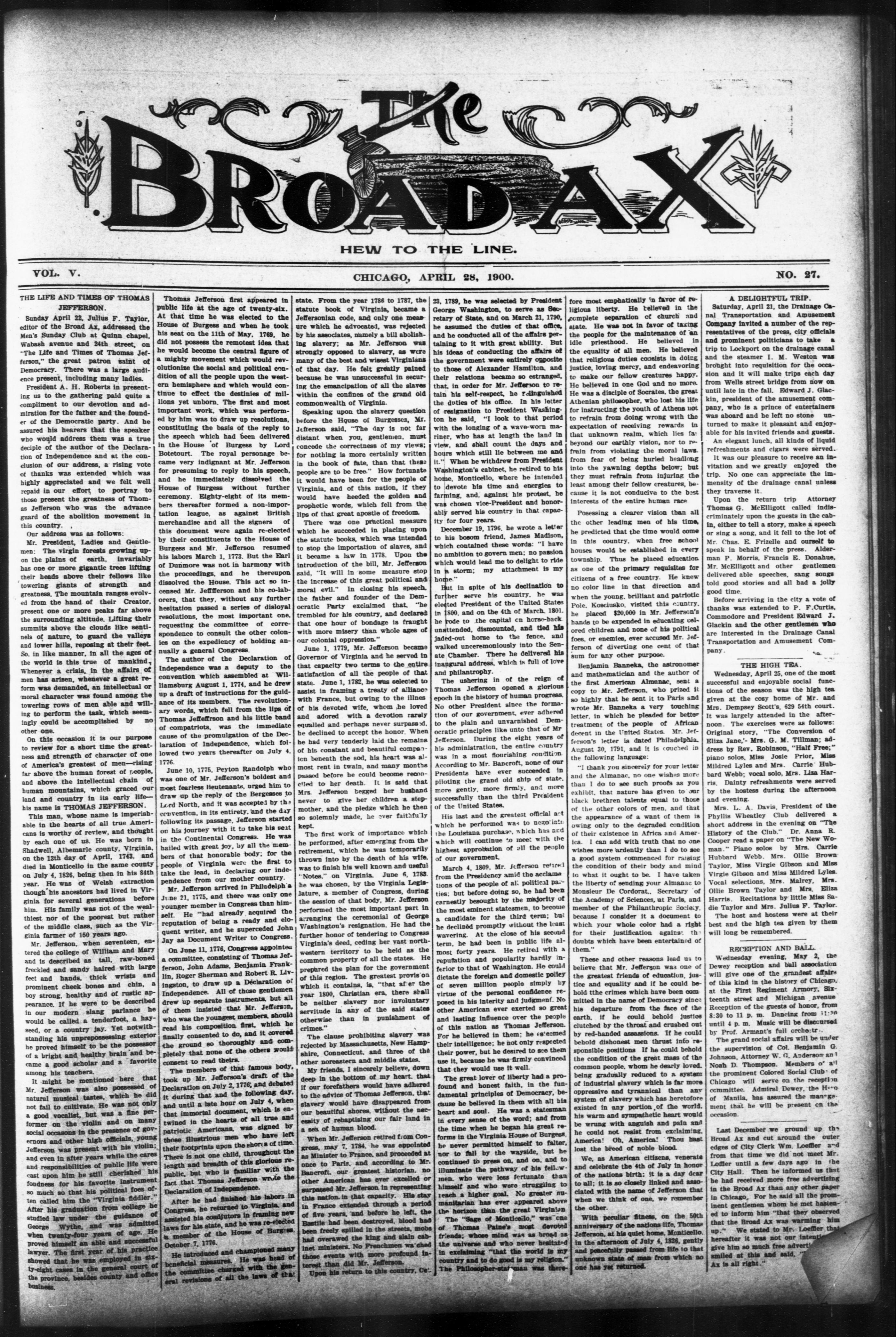
Sunday April 22, Julius F. Taylor, editor of the Broad Ax, addressed the Men's Sunday Club at Quinn chapel, Wabash avenue and 24th street, on "The Life and Times of Thomas Jefferson," the great patron saint of Democracy. There was a large audience present, including many ladies.
President A. H. Roberts in presenting us to the gathering paid quite a compliment to our devotion and admiration for the father and the founder of the Democratic party. And he assured his hearers that the speaker who would address them was a true deciple of the author of the Declaration of Independence and at the conclusion of our address, a rising vote of thanks was extended which was highly appreciated and we felt well repaid in our effort to portray to those present the greatness of Thomas Jefferson who was the advance guard of the abolition movement in this country.
Our address was as follows:
Mr. President, Ladies and Gentlemen: The virgin forests growing upon the plains of earth, invariably has one or more gigantic trees lifting their heads above their fellows like towering giants of strength and greatness. The mountain ranges evolved from the hand of their Creator, present one or more peaks far above the surrounding altitude. Lifting their summits above the clouds like sentinels of nature, to guard the valleys and lower hills, reposing at their feet. So, in like manner, in all the ages of the world is this true of mankind. Whenever a crisis, in the affairs of men has arisen, whenever a great reform was demanded, an intellectual or moral character was found among the towering rows of men able and willing to perform the task, which seemingly could be accomplished by no other one.
On this occasion it is our purpose to review for a short time the greatness and strength of character of one of America's greatest of men—rising far above the human forest of people, and above the intellectual chain of human mountains, which graced our land and country in its early life—his name is THOMAS JEFFERSON.
This man, whose name is imperishable in the hearts of all true Americans is worthy of review, and thought by each one of us. He was born in Shadwell, Albemarle county, Virginia, on the 13th day of April, 1743, and died in Monticello in the same county on July 4, 1826, being then in his 84th year. He was of Welsh extraction though his ancestors had lived in Virginia for several generations before him. His family was not of the wealthiest nor of the poorest but rather of the middle class, such as the Virginia farmer of 150 years ago.
Mr. Jefferson, when seventeen, entered the college of William and Mary and is described as tall, raw-boned freckled and sandy haired with large feet and hands, thick wrists and prominent cheek bones and chin, a boy strong, healthy and of rustic appearance. If he were to be described in our modern slang parlance he would be called a tenderfoot, a hayseed, or a country jay. Yet notwithstanding his unprepossessing exterior he proved himself to be the possessor of a bright and healthy brain and became a good scholar and a favorite among his teachers.
It might be mentioned here that Mr. Jefferson was also possessed of natural musical tastes, which he did not fail to cultivate. He was not only a good vocalist, but was a fine performer on the violin and on many social occasions in the presence of governors and other high officials, young Jefferson was present with his violin; and even in after years while the cares and responsibilities of public life were cast upon him he still cherished his fondness for his favorite instrument so much so that his political foes often called him the "Virginia fiddler." After his graduation from college he studied law under the guidance of George Wythe, and was admitted when twenty-four years of age. He proved himself an able and successful lawyer. The first year of his practice showed that he was employed in sixty-eight cases in the general court of the province, besides county and office business.
Thomas Jefferson first appeared in public life at the age of twenty-six. At that time he was elected to the House of Burgess and when he took his seat on the 11th of May, 1769, he did not possess the remotest idea that he would become the central figure of a mighty movement which would revolutionize the social and political condition of all the people upon the western hemisphere and which would continue to effect the destinies of millions yet unborn. The first and most important work, which was performed by him was to draw up resolutions, constituting the basis of the reply to the speech which had been delivered in the House of Burgess by Lord Botetourt. The royal personage became very indignant at Mr. Jefferson for presuming to reply to his speech, and he immediately dissolved the House of Burgess without further ceremony. Eighty-eight of its members thereafter formed a non-importation league, as against British merchandise and all the signers of this document were again re-elected by their constituents to the House of Burgess and Mr. Jefferson resumed his labors March 1, 1773. But the Earl of Dunmore was not in harmony with the proceedings, and he thereupon dissolved the House. This act so incensed Mr. Jefffferson and his co-laborers, that they, without any further hesitation passed a series of disloyal resolutions, the most important one, requesting the committee of correspondence to consult the other colonies on the expediency of holding annually a general Congress.
The author of the Declaration of Independence was a deputy to the convention which assembled at Williamsburg August 1, 1774, and he drew up a draft of instructions for the guidance of its members. The revolutionary words, which fell from the lips of Thomas Jeffehrson and his little band of compatriots, was the immediate cause of the promulgation of the Declaration of Independence, which followed two years thereafter on July 4, 1776.
June 10, 1775, Peyton Randolph who was one of Mr. Jefferson's boldest and most fearless lieutenants, urged him to draw up the reply of the Bergesses to Lord North, and it was accepted by the convention, in its entirety, and the day following its passage, Jefferson started on his journey with it to take his seat in the Continental Congress. He was hailed with great joy, by all the members of that honorable body; for the people of Virginia were the first to take the lead, in declaring our independence from our mother country.
Mr. Jefferson arrived in Philadelphia June 21, 1775, and there was only one younger member in Congress than himself. He "had already acquired the reputation of being a ready and eloquent writer, and he superceded John Jay as Document Writer to Congress.
On June 11, 1776, Congress appointed a committee, consisting of Thomas Jefferson, John Adams, Benjamin Franklin, Roger Sherman and Robert R. Livingston, to draw up a Declaration of Independence. All of those gentlemen drew up separate instruments, but all of them insisted that Mr. Jefferson, who was the youngest members, should read his composition first, which he finally consented to do, and it covered the ground so thoroughly and completely that none of the others would consent to read theirs.
The members of that famous body, took up Mr. Jefferson's draft of the Declaration on July 2, 1776, and debated it during that and the following day, and until a late hour on July 4, when that immortal document, which is entwined in the hearts of all true and patriotic Americans, was signed by those illustrious men who have left their footprints upon the shores of time. There is not one child, throughout the length and breadth of this glorious republic, but who is familiar with the fact that Thomas Jefferson wrote the Declaration of Independence.
After he had finished his labors in Congress, he returned to Virginia, and assisted his coadjutors in framing new laws for his state, and he was re-elected a member of the House of Burgess October 7, 1776. He introduced and championed many beneficial measures. He was head of the committee charged with the general revisions of all the laws of that
state. From the year 1786 to 1787, the statute book of Virginia, became a Jeffersonian code, and only one measure which he advocated, was rejected by his associates, namely a bill abolishing slavery; as Mr. Jefferson was strongly opposed to slavery, as were many of the best and wisest Virginians of that day. He felt greatly pained because he was unsuccessful in securing the emancipation of all the slaves within the confines of the grand old commonwealth of Virginia.
Speaking upon the slavery question before the House of Burgesses, Mr. Jefferson said, "The day is not far distant when you, gentlemen, must concede the correctness of my views; for nothing is more certainly written in the book of fate, than that these people are to be free." How fortunate it would have been for the people of Virginia, and of this nation, if they would have heeded the golden and prophetic words, which fell from the lips of that great apostle of freedom.
There was one practical measure which he succeeded in placing upon the statute books, which was intended to stop the importation of slaves, and it became a law in 1778. Upon the introduction of the bill, Mr. Jefferson said, "It will in some measure stop the increase of this great political and moral evil." In closing his speech, the father and founder of the Democratic Party exclaimed that, "he trembled for his country, and declared that one hour of bondage is fraught with more misery than whole ages of our colonial oppression."
June 1, 1779, Mr. Jefferson became Governor of Virginia and he served in that capacity two terms to the entire satisfaction of all the people of that state. June 1, 1782, he was selected to assist in framing a treaty of alliance with France, but owing to the illness of his devoted wife, whom he loved and adored with a devotion rarely equalled and perhaps never surpassed, he declined to accept the honor. When he had very tenderly laid the remains of his constant and beautiful companion beneath the sod, his heart was almost rent in twain, and many months passed before he could become reconciled to her death. It is said that Mrs. Jefferson begged her husband never to give her children a stepmother, and the pledge which he then so solemnly made, he ever faithfully kept.
The first work of importance which he performed, after emerging from the retirement, which he was temporarily thrown into by the death of his wife, was to finish his well known and useful "Notes," on Virginia. June 6, 1783. he was chosen, by the Virginia Legislature, a member of Congress, during the session of that body, Mr. Jefferson performed the most important part in arranging the ceremonial of George Washington's resignation. He had the further honor of tendering to Congress Virginia's deed, ceding her vast northwestern territory to be held as the common property of all the states. He prepared the plan for the government of this region. The greatest provision which it contains, is, "that after the year 1800, Christian era, there shall be neither slavery nor involuntary servitude in any of the said states otherwise than in punishment of crimes."
The clause prohibiting slavery was rejected by Massachusetts, New Hampshire, Connecticut, and three of the other noreastern and middle states. My friends, I sincerely believe, down deep in the bottom of my heart, that if our forefathers would have adhered to the advice of Thomas Jefferson, that slavery would have disappeared from our beautiful shores, without the necessity of rebaptising our fair land in a sea of human blood.
When Mr. Jefferson retired from Congress, may 7, 1784, he was appointed as Minister to France, and proceeded at once to Paris, and according to Mr. Bancroft, our greatest historian, no other American has ever excelled or surpassed Mr. Jefferson in representing this nation, in that capacity. His stay in France extended through a period of five years, and before he left, the Bastile had been destroyed, blood had been freely spilled in the streets, mobs had overawed the king and slain cabinet ministers. No Frenchmen watched those events with more profound interest than did Mr. Jefferson.
23, 1789, he was selected by President George Washington, to serve as Secretary of State, and on March 21, 1790, he assumed the duties of that office, and he conducted all of the affairs pertaining to it with great ability. But his ideas of conducting the affairs of the government were entirely opposite to those of Alexander Hamilton, and their relations became so estranged, that, in order for Mr. Jefferson to retain his self-respect, he relinguished the duties of his office. In his letter of resignation to President Washington he said, "I look to that period with the longing of a wave-worn mariner, who has at length the land in view, and shall count the days and hours which still lie between me and it." When he withdrew from President Washington's cabinet, he retired to his home, Monticello, where he intended to devote his time and energies to farming, and, against his protest, he was chosen vice-President and honorably served his country in that capacity for four years.
December 19, 1796, he wrote a letter to his bosom friend, James Madison, which contained these words: "I have no ambition to govern men; no passion which would lead me to delight to ride in a storm; my attachment is my home."
But in spite of his declination to further serve his country, he was elected President of the United States in 1800, and on the 4th of March, 1801, he rode to the capital on horse-back unattended, dismounted, and tied his jaded-out horse to the fence, and walked unceremoniously into the Senate Chamber. There he delivered his inaugural address, which is full of love and philanthropy.
The ushering in of the reign of Thomas Jefferson opened a glorious epoch in the history of human progress. No other President since the formation of our government, ever adhered to the plain and unvarnished Democratic principles like unto that of Mr Jefferson. During the eight years of his administration, the entire country was in a most flourishing condition. According to Mr. Bancroft, none of our Presidents have ever succeeded in piloting the grand old ship of state, more gently, more firmly, and more successfully than the third President of the United States.
His last and the greatest official act which he performed was to negotiate the Louisiana purchase, which has and which will continue to meet with the highest approbation of all the people of our government.
March 4, 1809, Mr. Jefferson retired from the Presidency amid the acclamations of the people of all political parties; but before doing so, he had been earnestly besought by the majority of the most eminent statesmen, to become a candidate for the third term; but he declined promptly without the least wavering. At the close of his second term, he had been in public life almost forty years. He retired with a reputation and popularity hardly inferior to that of Washington. He could dictate the foreign and domestic policy of seven million people simply by virtue of the personal confidence reposed in his interity and judgment. No other American ever exerted so great and lasting influence over the people of this nation as Thomas Jefferson. For he believed in them; he esteemed their intelligence; he not only respected their power, but he desired to see them use it, because he was firmly convinced that they would use it well.
The great lover of liberty had a profound and honest faith, in the fundamental principles of Democracy, because he believed in them with all his heart and soul. He was a statesman in every sense of the word; and from the time when he began his great reforms in the Virginia House of Burgess, he never permitted himself to falter, nor to fall by the wayside, but he continued to press on, and on, and to illuminate the pathway of his fellowmen, who were less fortunate than himself and who were struggling to reach a higher goal. No greater humanitarian has ever appeared above the horizon than the great Virginian. The "Sage of Monticello," was one of Thomas Paine's most devoted friends; whose mind was as broad as the universe and who never hesitated in exclaiming "that the world is my country and to do good is my religion." The Philosopher-staff man was there-
fore most emphatically in favor of religious liberty. He believed in the complete separation of church and state. He was not in favor of taxing the people for the maintenance of an idle priesthood. He believed in the equality of all men. He believed that religious duties consists in doing justice, loving mercy, and endeavoring to make our fellow creatures happy. He believed in one God and no more. He was a disciple of Socrates, the great Athenian philosopher, who lost his life for instructing the youth of Athens not to refrain from doing wrong with the expectation of receiving rewards in that unknown realm, which lies far beyond our earthly vision, nor to refrain from violating the moral laws, from fear of being hurled headlong into the yawning depths below; but they must refrain from injuring the least among their fellow creatures, because it is not conducive to the best interests of the entire human race
Posessing a clearer vision than all the other leading men of his time, he predicted that the time would come in this country, when free school houses would be established in every township. Thus he placed education as one of the primary requisites for citizens of a free country. He knew no color line in that direction and when the young, brilliant and patriotic Pole, Kosciusko, visited this country, he placed $20,000 in Mr. Jefferson's hands to be expended in educating colored children and none of his political foes, or enemies, ever accused Mr. Jefferson of diverting one cent of that sum for any other purpose.
Benjamin Banneka, the astronomer and mathematician and the author of the first American Almanac, sent a copy to Mr. Jefferson, who prized it so highly that he sent it to Paris and wrote Mr. Banneka a very touching letter, in which he pleaded for better treatment of the people of African decent in the United States. Mr. Jefferson's letter is dated Philadelphia, August 30, 1791, and it is couched in the following language:
"I thank you sincerely for your letter and the Almanac, no one wishes more than I do to see such proofs as you exhibit, that nature has given to our black brethren talents equal to those of the other colors of men, and that the appearance of a want of them is owing only to the degraded condition of their existence in Africa and America. I can add with truth that no one wishes more ardently than I do to see a good system commenced for raising the condition of their body and mind to what it ought to be. I have taken the liberty of sending your Almanac to Monsieur De Cordorat., Secretary of the Academy of Sciences, at Paris, and member of the Philanthropic Society, because I consider it a document to which your whole color had a right for their justification against the doubts which have been entertained of them."
These and other reasons lead us to believe that Mr. Jefferson was one of the greatest friends of education, justice and equality and if he could behold the crimes which have been committed in the name of Democracy since his departure from the face of the earth, if he could behold justice clutched by the throat and crushed out by red-handed assassions. If he could behold dishonest men thrust into responsible positions If he could behold the condition of the great mass of the common people, whom he dearly loved, being gradually reduced to a system of industrial slavery which is far more oppressive and tyrannical than any system of slavery which has heretofore existed in any portion of the world, his warm and sympathetic heart would be wrung with anguish and pain and he could not resist from exclaiming, America! Oh, America! Thou hast lost the breed of noble blood.
We, as American citizens, venerate and celebrate the 4th of July in honor of the nations birth; it is a day dear to all; it is so closely linked and associated with the name of Jefferson that when we think of one, we remember the other.
With peculiar fitness, on the 50th anniversary of the nations life, Thomas Jefferson, at his quiet home, Monticello, in the afternoon of July 4, 1826, gently and peacefully passed from life to that unknown state of man from which no one has yet returned.
NO. 27.
Saturday, April 21, the Drainage Canal Transportation and Amusement Company invited a number of the representatives of the press, city officials and prominent politicians to take a trip to Lockport on the drainage canal and the steamer I. M. Weston was brought into requisition for the occasion and it will make trips each day from Wells street bridge from now on until late in the fall. Edward J. Glackin, president of the amusement company, who is a prince of entertainers was aboard and he left no stone unturned to make it pleasant and enjoyable for his invited friends and guests.
refreshments and cigars were served. It was our pleasure to receive an invitation and we greatly enjoyed the trip. No one can appreciate the immensity of the drainage canal unless they traverse it.
Upon the return trip Attorney Thomas G. McElligott called indiscriminately upon the guests in the cabin, either to tell a story, make a speech or sing a song, and it fell to the lot of Mr. Chas. E. Frizelle and ourself to speak in behalf of the press. Alderman P. Morris, Francis E. Donahue, Mr. McElligott and other gentlemen delivered able speeches, sang songs told good stories and all had a jolly good time.
Before arriving in the city a vote of thanks was extended to P. F.Curtis, Commodore and President Edward J. Glackin and the other gentlemen who are interested in the Drainage Canal Transportation and Amusement Company.
THE HIGH TEA.
Wednesday, April 25, one of the most successful and enjoyable social functions of the season was the high tea given at the cosy home of Mr. and Mrs. Dempsey Scott's, 629 54th court. It was largely attended in the afternoon. The exercises were as follows: Original story, "The Conversion of Eliza Jane,'- Mrs. G. M. Tillman; address by Rev. Robinson, "Half Free;" piano solos, Miss Josie Prior, Miss Mildred Lyles and Mrs. Carrie Hubbard Webb; vocal solo, Mrs. Liza Harris. Dainty refreshments were served by the hostess during the afternoon and evening.
Mrs. L. A. Davis, President of the Phyllis Wheatley Club delivered a short address in the evening on "The History of the Club." Dr. Anna R. Cooper read a paper on "The New Woman." Piano solos by Mrs. Carrie Hubbard Webb. Mrs. Ollie Brown Taylor, Miss Virgie Gibson and Miss Virgie Gibson and Miss Mildred Lyles. Vocal selections, Mrs. Malrey, Mrs. Ollie Brown Taylor and Mrs. Eliza Harris. Recitations by little Miss Sadie Taylor and Mrs. Julius F. Taylor. The host and hostess were at their best and the high tea given by them will long be remembered.
RECEPTION AND BALL
Wednesday evening, May 2, the Dewey reception and ball association will give one of the grandest affairs of this kind in the history of Chicago, at the First Regiment Armory, Sixteenth street and Michigan avenue Reception of the guests of honor, from 8:30 to 11 p. m. Dancing from 11:30 until 4 p. m. Music will be discursed by Prof Armant's full orchestr.
The grand social affairs will be under the supervision of Col. Benjamin G. Johnson, Attorney W. G. Anderson and Noah D. Thompson. Members of all the prominent Colored Social Club of Chicago will serve on the reception committee. Admiral Dewey, the Hero of Manila, has assured the management that he will be present on the occasion.
Last December we ground up the Broad Ax and cut around the outer edges of City Clerk Wm. Loeffler and from that time we did not meet Mr. Loffler until a few days ago in the City Hall. Then he informed us that he had received more free advertising in the Broad Ax than any other paper in Chicago. For he said all the prominent gentlemen whom he met hastened to inform him "that they observed that the Broad Ax was warming him up." We stated to Mr. Loeffler that hereafter it was not our intention to give him so much free advertising smiled at this and said, "Ax is all right."
when slok Is Lydia E. Pinkham's Vegetable Compound.
No other medicine in the world has done so much good.
No confidence has ever been violated.
No woman's testimonial was ever published by Mrs. Pinkham without special permission.
No woman ever wrote to Mrs. Pinkham for advice without getting help. No man sees these letters. Her advice is free, and her address is Lynn, Mass. She is a woman, you can tell her the truth. No living person is so competent to advise women. None has had such experience.
She has restored a mil-
lion sufferers to health.
You can trust her. Others
have.
Lydia B. Pinkham Med. Co., Lynn, Mass.
HUSK, CUT AND SHRED
your corn all at one operation
quickly, safely, cheaply with
THE CYCLONE CORN
HUSKER
A 3-horse tread or 6-h. sweep
power does it easily. Save
time, money and feed. Circ
culars and prices free upon request.
ROSENTHAL CORN HUSKING MACHINE CO.
61st and Walnut St.
MILWAUKEE, WI.
---
```markdown
```
A Satisfactory Compromise. He (half-past 10 p. m.)—I wish you would sing that dear old song, "Backward, Turn Backward, O Time, in Your Flight." It is my favorite. She—I would dearly love to favor you, but I am afraid my singing would wake father. Suppose, instead of singing, I turn the clock back an hour?
Do Your Feet Ache and Burn?
Shake into your shoes Allen's Foot-Ease, a powder for the feet. It makes tight or New Shoes feel Easy. Cures Corns, Bunions, Swollen, Hot and Sweating Feet. At all Druggists and Shoe Stores, 25c. Sample sent FREE. Address Allen S. Olmsted. LeRoy, N. Y.
Nothing is more surprising than the easiness with which the many are governed by the few.—Hume.
When All Else Falls. Try Yi-Kl. Cures Corns and Bunions without pain. Never falls. Drug stores or mail 15c. Yi-Kl Co., Crawfordsville, Ind.
Three may keep a secret, if two of them are dead.—Franklin.
Mrs. Winslow's Soothing Syrup.
For children teething, softens the gums, reduces inflammation, allays pain, cures wind colic. 25c a bottle.
Originality is simply a new way of expressing an old thought.
Beautiful hair is always pleasing, and PARKER's HAIR BALSAM excels in producing it.
HINDERCOENS, the best cure for corns. 15cta.
Snuff is one of the things that are apt to get pinched.
If a man has no temptations it's easy to remain honest.
A Book of Choice Recipes
Sent free by Walter Baker & Co. Ltd., Dorchester,
Mass. Mention this paper.
Mending a clock is one way to improve the time.
Pretension isn't natural; nature never pretends.
Brown's Teething Cordial is the babies best friend, so say the mothers.
Economy is the poor man's mint.
CASTORIA
Since February 19 of this year the committee on military affairs of the lower house of congress has conducted an investigation of the troubles in the Coeur d'Alene mining district of northern Idaho, which began May 3, 1899, and continue to the present time. From the testimony brought out in this investigation and from the statements of reliable eye witnesses who have not yet testified, the following information has been obtained: The Coeur d'Alene mining district of Idaho is one of the greatest lead and silver producing districts in the world. It employs upwards of 3,000 miners. All the great mining industries of the district have paid a uniform rate of wages to their employees except the Bunker Hill & Sullivan Company, employing about 400 miners at Wardner. Long before the beginning of the troubles this company paid from 50 cents to one dollar per day less than was paid in any other part of the district. It persistently maintained a non-union force, refused to recognize organized labor, and in this particular openly violated the statutes of Idaho, which make it a penal offense for employers to discriminate against organized labor in the employment or discharge of employees.
Early in April, 1899, the great increase in the price of lead and silver induced the employes of this company to demand an increase of wages equivalent to the current rate paid in the district. Other mine operators, as well as miners, joined in the plea to unify the conditions, realizing that such unification would have a good effect upon the industries and would insure the entire district against turbulent conditions characteristic of labor troubles; but the Bunker Hill Company stubbornly refused to grant the requested increase or even confer with the committee's representatives. Simultaneously with the demand for an increase of wages in the Bunker Hill mine, or very soon thereafter, a large number of the employes of the mine joined the miners' union, and when the company flatly refused to grant any concession its employes struck. The company for years prior to this time had made it a practice to discharge any person in its employ as soon as it discovered that he belonged to a union or other labor organizations, and on or about April 26 the company was required by the exigencies of conditions to grant an increase in wages nearly equal to the union rates; but much to the surprise of every one it refused to reemploy any of its old faithful employes who had joined the miners' union. This action on the part of the company exasperated the working people in the entire district, and matters from that time grew from bad to worse, the company flatly refusing to arbitrate the differences.
On April 29 an armed mob was formed at the adjacent mines at Mullen, Gem and Burke, which, accompanied by a large number of curiosity seekers, took possession of a train of cars. procured a large quantity of dynamite and made an attack on the Bunker Hill concentrator. The mill was blown to atoms, and in the riot two men were killed. How or by whom this riot was organized has remained a matter of speculation. It has been charged to the miners' union, but no evidence has ever been offered to sustain this accusation. The miners themselves were indignant over this outrage, and citizens generally offered their services to aid in apprehending and punishing the rioters.
Frank Steunenberg, governor of Idaho, declared the entire county (Shoshone) to be in a state of insurrection and rebellion, declared the district under martial law, suspended the habeas corpus act, called on the president for United States troops, and proceeded to redress the grievances of the mine operators.
A drag net was thrown over the county and the people were arrested by communities, and to the present time nearly 1,100 persons have suffered imprisonment, ranging in time from ten days to ten months. All were arrested without warrant, criminal charge, indictment or examination. The people arrested were imprisoned first in a large barn with a mud floor, and the stories told of their sufferings are almost beyond belief. Miners coming from the mines, their clothing saturated with water, were not allowed to dry themselves, but were crowded into the barn, or bull pen, compelled to sleep on the dirt floor without bedding and with insufficient food. Later a regular prison was built, which became the historical bull pen. It was a large building built around an open court, constructed roughly of green lumber and without windows. The roof leaked and the cold winds of night blew through the cracks between the boards.
The soldiers furnished by the president were negroes, and, if the sworn evidence of good citizens can be believed, their conduct was not only offensive but brutal towards their prisoners. The language they used in addressing them was too profane and filthy to be repeated, and their threats to shoot and stab were constant and emphatically uttered.
An order was issued forbidding men from working in the district without procuring a permit from the governor. Men were arrested for working on their own claims, and even professional men were forbidden to practice their
professions without the governor's permission. The sheriff of the county and a majority of the members of the county board were imprisoned, and many of the best citizens of the county, in no way associated with the outrages, were arrested by the negro soldiers without excuse or warrant and driven at the point of the bayonet into the bull pen, there to remain until the military officers saw fit to release them.
One of the prisoners attempted to escape by making a tunnel, and, being discovered, he and all the other prisoners in the pen were kept on bread and water for nine days; he for attempting to escape, and the others for not notifying the guards that such an attempt would be made. Even persons arrested after the attempt was discovered received the same punishment.
No one was tried, but when the bull pen was full those whom the military thought had been sufficiently punished were released in order to make room for new prisoners, and sometimes a man was arrested a second time, his first imprisonment not being sufficient to satisfy the wishes of those in authority. Gradually the number of prisoners decreased until all were released, yet no man can today tell on what charge he was arrested or for what he was punished except to gratify a whim of the governor, the revenge of the Bunker Hill Company or the malice of the negro soldiers.
Gov. Steunenberg has never been able to explain satisfactorily why he called for United States troops or why he ordered these wholesale arrests or why he forbade men from working without a permit. The civil power was at all times able to control the situation; the courts were competent to punish all violations of law and competent to enforce their decrees. The case is one of the most remarkable in the history of the country, and the report of the committee investigating it will tell a story that people will find difficult to believe.
ROBBERY OF THE PEOPLE.
Congressman Maddox of Georgia 'n his speech in the house on the currency furnished some startling financial information. He said, among other matters:
"The interest-bearing debt of the United States in 1892 had been reduced $533,029,330. The non-interest bearing debt at that time was $1,000,648,839. During the past eight years the interest-bearing debt has been increased to $1,045,048,750. The non-interest bearing debt has been decreased to $389,-914,640. We are less in debt than we were eight years ago by $150,000,000, and yet our annual interest charge has been increased from $23,000,000 to $40,-000,000. Our non-interest bearing debt has been decreased $610,734,299. Our interest-bearing debt has been increased $461,019,420.
"These figures, taken from the treasury reports, show conclusively that the revenues of the United States have at all times been more than sufficient to meet the expenditures of the United States, and yet the interest-bearing debt of the nation has been constantly increased. The treasury figures show that the policy of the government is, and for some time has been, to collect as much as possible from the people for the exclusive benefit of the bondholders."
Prosperity in Full Blast.
During this full year of "prosperity" under McKinley the men and women employed in these Massachusetts concerns received in wages an average of $8.10 every week, working from nine to twelve hours a day. That was the measure of their prosperity. This magnificent wage earning was about seventeen cents a week more than it was in the year before. That is, the wage earners of Massachusetts would have been something more than two per cent better off than they were the year before, had not the trusts advanced the cost of living fifteen per cent, leaving the wage earners about thirteen per cent worse off than formerly. But the trust magnates were not worse off than formerly, no indeed. They waxed fat and sleek, and are in easy condition this year to contribute liberally to the republican slush fund when Mark Hanna comes around with his hat out. If McKinley is re-elected the trusts will be in position to cut down wages and increase their profits. Will they do it?—Helena (Mont.) Independent.
The Constitution Never Yields
Judge Cooley, a life long Republican, in his work on Constitutional Law—a recognized authority in every court of the United States, says:
"The Constitution never yields to treaty or enactment. It neither changes with time, nor does it, in theory, bend to the force of circumstances. It may be amended according to its own permission; but while it stands it is "a law for rulers and people, equally in war and in peace, and covers with the shield of its protection all classes of men, at all times and under all circumstances." Its principles cannot therefore be set aside in order to meet the supposed necessities of great crises. "No doctrine involving more pernicious consequences was ever invented by the wit of man than that any of its provisions can be suspended during any of the great exigencies of government."
11 When Hanna Signala
Our able generals have a knack of changing their minds when Hanna holds up two fingers. There's General Davis of Puerto Rico. He was for free trade awhile ago, but now he's hof foot for taxation without representation.—Atlanta Constitution.
"I Would Cry Every Time I Washed My Baby."
"When he was3months old, first festers and then large boils broke out on my baby's neck. The sores spread down his back until it became a mass of raw flesh. When I washed and powdered him I
would cry, realizing what pain he was in. His pitiful wailing was heart-rending. I had about given up hope of saving him when I was urged to give him Hood's Sarsaparilla, all other treatment having failed. I washed the sores with Hood's Medicated Soap, applied Hood's Olive Ointment and gave him Hood's Sarsaparilla. The child seemed to get better every day, and very soon the change was quite noticeable. The discharge grew less, inflammation went down, the skin took on a healthy color, and the raw flesh began to scale over and a thin skin formed as the scales dropped off. Less than two bottles of Hood's Sarsaparilla, aided by Hood's Medicated Soap and Hood's Olive Ointment, accomplished this wonderful cure. I cannot praise these medicines half enough." MRS. GUERINOT, 87 Myrtle St., Rochester, N. Y.
The above testimonial is very much condensed from Mrs. Guerinot's letter. As many mothers will be interested in reading the full letter, we will send it to anyone who sends request of us on a postal card. Mention this paper.
WORK WORRY
WASHED AWAY
BY THE
Has double "washboard" rubbers, runs easiest, lasts longest, does faultless work. Most practical clothes washer made. Don't drudge. Use modern methods. If it's not at your dealer's write us. THE EUREKA CO., Dept. H., Rock Falls, Ill.
QUERIES BY BRYAN.
The literary sycophants who strew rhetorical flowers in the pathway of the successful, without inquiring into the methods employed for securing success, complacently throw the responsibility for failure in life upon God, or Nature, or upon the man himself. Is it the fault of God or of Nature that children are driven into factories at so early an age that their bodies are stunted, their minds dwarfed, and the strength and usefulness of future generations lessened? Is God or Nature responsible for the laws which permit this impairment of the man power and the woman power of the nation? The labor organizations have done much to mitigate the evils of child labor and to shorten the hours of adult labor, but what encouragement have they received from those who favor government by injunction, oppose arbitration, and denounce as disturbers of the peace all who criticise existing conditions?
Is it the fault of God or of Nature that our tax laws are so made and our tax systems so administered that the poor man pays more than his share of the taxes and the rich man less than his share?
Is God or Nature responsible for a financial system which raises the purchasing power of the dollar in the hands of the money changer, while it increases the burden of debt to the man who owes and decreases the value of property in the hands of the wealth producers?
Is Gor or Nature responsible for a paper money trust that makes the people at large the victims of private individuals entrusted with the control of the volume of currency?
Is God or Nature responsible for private monopolies which corner the markets, extort from the people and disburse the proceeds among the holders of watered stock?
Is God or Nature to blame for the substitution of force for reason and might for right in government?
Is God or Nature responsible for the nation's entrance upon a career of conquest, entailing upon the many the burden and menace of militarism, and coferring upon the few the benefits of exploitation?
A COLONIAL SOUPHOUSE.
Compared with the present condition of the Puerto Ricans, their future fate causes a shudder to come over every American citizen, and that shudder bodes ill to McKinleyism and its attendant benevolent assimilation. The addition of a colonial pauper territory to our home pauper institutions is something unpleasant to contemplate except to an utter imperialist. Thirty thousand women and children, says the last report, are in such a condition of nakedness usually attributed to the newly born. So naked, indeed, are the children starving for food and education that the modest pedagogue, through shame, can not permit them to attend their schoolhouses.
Mr. Charles M. Pepper, correspondent of the New York Herald, furnishes that journal with the most mournful statistics of the miserable condition of that once happy island. Their pitiful, poverty-stricken misery would bring sadness to the heart of everything but an Oxnard sugar beet. "Trade stagnation is widespread. There is little legitimate trading and few goods are being brought into the island except such as are sent to relieve the starving. "This condition has been existing for months," says Mr. Pepper, "and the poor and the laboring classes are in a state of destitution."
The Kansas City Times summarizes the situation as "idleness and demoralization for the unemployed poor and bankruptcy for the mercantile and industrial classes. Had the president had any backbone and followed his plain duty Puerto Rico today would have been a beehive of industry and the abode of prosperous activities instead of a souphouse and the breeding place of disaffection and hopelessness that the Republican party's obedience to trust magnates has made it."
The Ice Monopoly.
The price of ice to consumers this season will be double what it was last. The newly formed trust, which absolutely controls the supply, has determined upon an additional profit of $12,000,000 a year for itself. In other words, it will levy a tax upon every household in Greater New York, and particularly on those which are least able to stand further exactions. The Ice Trust ought to be brought into court as an unlawful combination. Its object is the restraint of trade in a certain commodity, and this places it under the ban of both the common and the statutory law.
Ice, during the summer months, is practically a necessity of life, and the welfare of the people demands that no combination of sordid capitalists be permitted to put a prohibitory price on it.New York Times.
Supporting the Constitution
What do you understand by supporting the constitution of a state, or of the United States? Is it not to give such constitutional helps to the rights established by that constitution as may be practically needed? Can you, if you swear to support the constitution, and believe that the constitution establishes a right, clear your oath without giving it support? Do you support the constitution, if, knowing or believing there is a right established under it which needs specific legislation, you withhold that legislation? Do you not violate and disregard your oath? I can conceive of nothing plainer in the world.—Abraham Lincoln.
```markdown
```
LABASTINE is the original and only durable wall coating, entirely different from all kalsomines. Ready for use in white or fourteen beautiful tints by adding cold water.
ADIES naturally prefer ALABASTINE for walls and ceilings, because it is pure, clean, durable. Put up in dry powdered form, in five-pound packages, with full directions.
LL kalsomines are cheap, temporary preparations made from whiting, chalks, clays, etc., and stuck on walls with decaying animal glue. ALABASTINE is not a kalsomine.
EWARE of the dealer who says he can sell you the "same thing" as ALABASTINE or "something just as good." He is either not posted or is trying to deceive you.
UISANCE of wall paper is obi-
vated by ALABASTINE. It
car be used on plastered walls,
wood ceilings, brick or can-
vas. A child can brush it on.
It does not rub or scale off.
STABLISHED in favor. Shun
all imitations. Ask paint de-
aler or druggist for tint card.
Write us for interesting book-
let, free. ALABASTINE CO.,
Grand Rapids, Mich.
WITH THE SAGES.
He that aspires to be the head of a party will find it more difficult to please his friends than to perplex his foes.—Colton.
We are often governed by the people not only weaker than ourselves, but even by those whom we think so.—Lord Greville.
Women suffer more from disappointment than men, because they have more of faith and are naturally more credulous.—Marguerite de Valois.
DEWEY'S FAMOUS VICTORY.
Visitors to Chicago during the Dewey festivities should not fail to visit the wonderful reproduction of Dewey's famous victory of Manila bay. The "Battle of Manila" has now been open to the public about one year, during which time it has entertained many of the most distinguished men in the world. President McKinley was so enthusiastic over the thrilling performance that he pronounced it "a wonderful scene," and said that "every American should see it."
Admiral Schley also saw it and spoke in the highest terms of the wonderful performance. Capt. McCalla of the cruiser Marblehead and many other distinguished naval officers have seen it, and declared it to be the most marvelous reproduction of a battle scene ever produced. With the advent of Admiral Dewey's visit to Chicago every one who intends to witness his reception should first see the scene of his wonderful triumph, at Wabash avenue and Hubbard court Admiral Dewey has expressed the desire to visit the cyclorama on the morning of May 1, and, providing the committees on arrangements will permit, the admiral, Mrs. Dewey and the admiral's staff will witness a performance at that time.
STORYETTES.
There was a time when swearing was almost considered a gentlemanly accomplishment. An archbishop of Canterbury of the day, however, objected to the habit, and calling on Lord Melbourne to discuss some business, thus apostrophized him: "Now, my lord, it will save time if, before we begin, we assume that everybody and everything is damned."
Prof. Simon J. Brown, the new astronomical director of the naval observatory at Washington, occasionally indulges in a bit of humor. On one occasion a colleague came into his office, and finding the professor standing, said: "Is it possible you work that way? I cannot stand standing." "That's peculiar," replied Prof. Brown quickly; "now, do you know, I cannot stand sitting?"
The Duke of Wellington used to tell a story of a Frenchman who, to enforce his contention that we are mere creatures of habit, exclaimed: "For example, we wash our hands, but never our feet." The "Iron Duke" probably had not heard of the English duchess of a century before, who, when some one remarked how dirty her hands were, said: "Lord, that's nothing; you should see my feet!"
Benares, the Sacred City.
Benares is the sacred city of the Hindoos. To the devout Hindoo it is as Mecca to the Mahomedan, as Jerusalem to the Jew. In this seat of the blessed, not only the inhabitants possess the odor of sanctity, but the buildings, reservoirs and temples, the ground on which you tread, the air you breathe, are sacred. The situation of Benares is very beautiful, resting on the northern bank of the Ganges, and extending by the river for three or four miles. The stream, more than one-third of a mile in breadth, sweeps round it like a bay, and the view as you approach by either rail or river is imposing and beautiful. Temples, palaces, mosques, rise about a cliff of a hundred feet in height. From the summit numerous ghats, or stone stairs, of great variety descend to the bed of the holy stream.
A Rock Was His Pillow.
Private M. G. Blanchard of Windsor, N. S., writing from Richmond, and describing the expedition from Belmont to that place, said: "This little excursion has done us a lot of good as we are out of the sand. Just think of it, I have had my meals for the last fortnight in a house, sitting on a chair with tablecloth and china cups. We slept out of doors most of the time, either in the fort or on top of one of the kopjes. We did not bring tents with us. It has rained two nights here while I was sleeping out, but I just tie a handkerchief around my head and get a nice shaped rock for a pillow and pull my blanket and rubber sheet up and go to sleep like I used to in my bed."
Burned a Woman to Death.
The trial of Harvey and John Jackson for burning to death Cassie Boan, a white woman, is in progress at Chesterfield, S. C. Tom Steers, one of the men arrested for participating in the burning, turned state's evidence. He admitted having been with Cassie Boan in the woods, and that Ben and John Jackson were there. Sam Woodward testified that he overheard Harvey Jackson say: "We might as well kill her or we will be killed ourselves."
BATTLE OF MANILA
Wabash Ave., S. of Auditorium, Chicago.
A wonderful reproduction of the greatest naval
victory in history. Dewey's voyage from Hong Kong
across the Chinese sea. A tropical sunset. The Ch
inese typhoon at night with new and startling elec
trical effects. The American fleet engaging the
Spanish batteries at the entrance of Manila Bay. The
Bay of Manila by moonlight. The wonderful lighting
effects in Old Manila and Cavali at night. Tropical
sunrise. The discovery and complete destruction of
the Spanish fleet of Cavali. Open from 9 a.m. to 10 p.m.
THE BROAD AX
Will promulgate and at all times uphold the true principles of Democracy, but Farmera, Catholics, Protestants, Knights of Labor, In-dels, Mormons, Republicans, Priests, or any one else can have their say, so long as their language is proper and responsibility is fixed.
The Broad Ax is a newspaper whose platform is broad enough for all, ever claiming the editorial right to speak its own mind.
Local communication will have attention, write only on one side of the paper.
SUBSCRIPTIONS (advance):
One Year..... $2.00
Six Months..... 1.00
Advertising rates made known on application
Address all communications to
JULIUS F. TAYLOR, Editor and Publisher.
Gen. Wood, the military governor of Cuba, has informed the war department that June 16 is the date finally set for the municipal elections of the island. This action is the direct result of the Cuban census taken under the direction of the military authorities. The figures supplied by what is declared to be the first accurate enumeration ever made in Cuba appear to have satisfied the war department that the municipal elections might be proceeded with in the reasonable expectation of an outcome auspicipus for the future. The total population of Cuba is now 1,572,797—815,205 males and 757,592 females. Of this total 20,487 are Spanish citizens. 1,296,767 are Cubans, 79,625 are of other citizenship, and 175,811 are in suspense. The whites greatly outnumber the blacks. There are only 111,898 male negroes and 122,740 female negroes. The mixed races number 125,500 males and 145,-305 females. There are less than 15,-000 Chinese.
THE DEWEY-SPANISH EPISODE
Europeans have often accused Americans of neglect of the diplomatic proprieties, and the charge is likely to be repeated now, in view of the invitation which was sent to the Spanish minister at Washington to be present at the celebration soon to take place in Chicago in honor of Admiral Dewey. Of course the invitation to the Duke d'Arcos was an oversight. All the other diplomats in Washington were to be asked to appear, and the clerk who wrote the invitations sent one to the Spanish minister without thinking of the impropriety of asking that official to take part in festivities to commemorate an event which was disastrous to his country. The apology which has just been made by the American minister in Madrid to the Spanish government will make it plain to Spain that no offense was intended.
ROBERTS' CENSURE
All Great Britain—and the watching world with it—must be rather puzzled at the action of the Salisbury government in giving publicity to the extraordinary criticisms passed by Lord Roberts upon most of the prominent British officers in South Africa. While the frankness of the commander in chief is properly commended, it is quite plain that his comments were not intended for the public ear. The war ministry and cabinet were, of course, entitled to the fullest information regarding the operations of the generals responsible for the disasters sustained by Great Britain prior to the advent of Lord Roberts, but what useful purpose, it is naturally asked, can be subserved by spreading this melancholy intelligence broadcast?
A TRUST HABIT.
Probably nobody outside of a small and secretive coterie will ever know exactly why the American Steel and Wire company abruptly shut down a dozen mills, throwing 6,000 men out of employment and demoralizing a great industry. It is not necessary that any outsider should know. The simple fact that "outside" opinion unanimously imputes the step to an inside plan to rig the stock market is quite sufficient. The fact that the men on the outside who have followed the course of the wire trust are perfectly ready to believe that the small controlling coterie violently disjointed the industry in the furtherance of a stock-jobbing scheme tells its own story and furnishes all the evidence that is necessary in the case.
PARIS HAS THE STAGE.
Paris is full of amusement of all sorts, and the French being a nation of actors there is no lack of theaters. Chief among these is the magnificent opera house designed by Charles Garnier, the largest and most splendid theater in existence. It stands north of the boulevard des Capucines and the Grand hotel. and was thirteen years in building. Finished in 1874, it is said to have cost, including the purchase of the site, nearly $10,000,000. Sumptuously decorated, its finest features are its grand staircase and its foyer. This last is adorned with sculpture, and there are some good paintings by Baudry.
RUSSIA IN KOREA.
Russia seems to be capturing all the railway franchises in China, and in Korea her stroke for a port has succeeded in compelling Korea to promise not to give the port to any other power. It is evident that the Muscovite is determined to have very much to esg in Asia in the future.
Thieving Plot Results in Murder.
James Hervey, one of the wealthiest citizens of Wheeling, W. Va., was shot down at his home by two masked robbers several weeks ago. John Mooney and Frank Friday were arrested. Recently Kitty Sinclair of Bellaire was arrested and told of the entire plot which resulted in the murder of Hervey. Friday's real name is "Doc" Riley, a notorious criminal of Chicago. He went to Bellaire, and together with Mooney, Jack Connor and "Dukes" Riley, planned and executed more than 50 robberies. Conner and Dukes Riley were arrested.
Try Grain-o! Try Grain-o!
Ask your grocer today to show you a package of GRAIN-O, the new food drink that takes the place of coffee. The children may drink it without injury as well as the adult. All who try it, like it. GRAIN-O has the rich seal brown of Mocha or Java, but it is made from pure grains, and the most delicate stomach receives it without distress. One-fourth the price of coffee. 15c. and 25c. per package. Sold by all grocers.
Getting at the Facts.
Wife (after the honeymoon)—Why did you deceive me about your income? Husband—I didn't, my dear. Wife—Yes, you did. You told me you were getting $50 a week when you asked me to marry you. Husband—You evidently misunderstood me. I said my position was worth $50—and so it is—but for some reason best known to the boss he gives me only $10.
FREE GIFTS TO AGENTS.
We want 100,000 Agents, men and women, boys and girls all over the United States to sell our wonderful Lekko Scouring Soap, Lekkoene and other Toilet Soaps. Big profit, easy work. Prize with every cake. Write to-day. C. H. Marshall & Co., Dep't 10, Chicago, Ill. Factory 118-126 No. May St. Ref., any bank in Chicago.
An Interrupted Sermon.
"No," he said, "I make it a rule never to waste any of my time paying attention to what other people are doing. It is foolish to——" Just then a man above him on a plank happened to tip over a paint bucket which weighed about ten pounds, and the dissertation can never be finished.
Are You Using Allen's Foot-Ease?
It is the only cure for Swollen, Smarting, Burning, Sweating Feet, Corns and Bunions. Ask for Allen's Foot-Ease, a powder to be shaken into the shoes. At all Druggists and Shoe Stores, 25c. Sample sent FREE. Address Allen S. Olmsted, LeRoy, N. Y.
Mustn't Split in Streets.
Visitors to the Paris exposition must take care not to spit in the streets. The municipal council has passed an ordinance forbidding the practice under penalty of a fine or imprisonment.
STATE OF OHIO, CITY OF TOLEDO, | sa
Frank J. Cheney makes oath that he is the senior partner of the firm of F. J. Cheney & Co., doing business in the City of Toledo, County and State aforesaid, and that said firm will pay the sum of ONE HUNDRED DOLLARS for each and every case of Catarrch that cannot be cured by the use of Hall's Catarrch Cure.
FRANK J. CHENEY.
Sworn to before me and subscribed in my presence, this 6th day of December, A. D. 1886 (SEAL)
A. W. GLEASON.
Notary Public.
Hall's Catarrch Cure is taken internally, and acts directly on the blood and mucous surfaces of the system. Send or testimonials, free.
F. J. CHENEY & CO., Toledo,
Rushed.
"You seem to be very busy, Miss Dorothy?" "I should think so. I'm doing so many things for so many people that I can't do anything for anybody."
The undersigned (formerly)
The undersigned (formerly connected with The Farmers' Colonization Company) have entered into a limited co-partnership under the firm name of McBurney-Rockenfeller Company, for the control, purchase and sale of farm lands in the West, Northwest and Southwest. Good, live, active agents wanted for sale of our lands in Wisconsin, Minnesota, Iowa, North and South Dakota, Arkansas and Southwest Louisiana. Liberal commission paid to the right persons. Correspondence should be addressed to the McBurney-Rockenfeller Company, 703 Fisher building, Chicago.
B. F. McBurney,
Theo. Rockenfeller,
B. B. Boyer.
A new form of needlework, very beautiful in its results, is shown in the May Delineator. Instead of accomplishing embroidery by colored stitches of various lengths, as heretofore, very pretty results are obtained by sewing carefully to a proper background small strips of colored silk cut out in the shape of leaves or petals or stalks. A most attractive feature of the article describing this method of work is that there is a full page printed in colors showing the effect of this dainty idea.
We are accustomed to see men de-
ride what they do not understand, and
to snarl at the good and the beautiful,
because it lies beyond their sympathy.
—Goethe.
Wanted
Men and women to sell our spool supporting bracelets.
Makes crochetting, &c., easier. $2.25 1/4 gross, sells
for 25c. Send 15c for sample and agent's terms.
Denekas & Lauer, 607 La. Ave., Washington, D. C.
The peanut crop of 1899 was nearly
1,000,000 bushels heavier than the crop
of 1898.
$25.00 A WEEK AND EXPENSES
easily made by agent handling our goods. Sell on
sight. Write J. C. PAUL & CO., Chicago, Ill.
Unless a man is sincere he can never be a hero in his own estimation.
Piso's Cure for Consumption is an Infallible medicine for coughs and colds.—N. W. SAMUEL, Ocean Grove, N. J., Feb. 17, 1903.
Now you know what the trouble is, you certainly know the cure, a perfect Sarsaparilla. "Sarsaparilla" is simply the name of the medicine, for in a perfect Sarsaparilla there are a great many remedies. Some act by taking out the bad; others, by putting in the good.
You want a Sarsaparilla that will make your blood pure this spring, a Sarsaparilla that will make it rich and strong, a Sarsaparilla that is a powerful nerve tonic. You want the strongest and best Sarsaparilla that can be made.
"The only Sarsaparilla made under the personal supervision of three graduates: a graduate in pharmacy, a graduate in chemistry, and a graduate in medicine."
"Last July my oldest daughter was taken sick, and I was on my feet, it seemed to me, night and day for weeks taking care of her. I had no other help than that which my husband gave me, and by the time daughter began to mend I was down sick myself. I was discouraged, and did not care much whether I lived or died. My husband got me a bottle of Ayer's Sarsaparilla, and its effects were magical. Two bottles of this medicine put me on my feet and made a well woman of me."—JANE M. BROWN, Bentonsport, Iowa, Jan. 10, 1000.
Spring Body Cleaning
surely, leaving your blood pure and nourishing, your stomach and bowels clean and lively, and your liver and kidneys healthy and active. Try a 10-cent box today, and if not satisfied get your money backbut you'll see how the cleaning of your body is
MADE EASY BY
CASCARETS
CANDY CATHARTIC
BEST FOR THE BOWELS
10c.
25c. 50c.
ALL
DRUGGISTS
To any needy mortal suffering from bowel troubles and too poor to buy CASCARETS we will send a box free. Address
Sterling Remedy Company, Chicago or New York, mentioning advertisement and paper.
STUMP BLASTING.
Farmers: If you want the BEST and most RE-LIABLE goods in the market, ask your dealers for "AJAX DYNAMITE," and if not sold by them write us for prices and book on Dynamit and Stump Blasting that will be of value to you. Do not be deceived by what may be offered you as "Just as Good." Get our prices on Guaranteed goods.
AJAX DYNAMITE WORKS,
BAY CITY, MICH.
DROPSY NEW DISCOVERY; gives quick relief and cures worst cases. Book of testimonials and 10 BAYS' treatment FREE. DR. H. H. GREEN'S SONS. Box E. Atlanta, Ga.
If afflicted with Thompson's Eye Water
What a story of suffering that one word tells. It says: "I am all tired out. It seems to me I can hardly take another step. I haven't a particle of ambition. I can't do half the work I feel I must do. I am weak, nervous, depressed, discouraged."
That's Impure Blood
Every spring you clean the house you live in, to get rid of the dust and dirt which collected in the winter. Your body, the house your soul lives in, also becomes filled up during the winter with all manner of filth, which should have been removed from day to day, but was not. Your body needs cleaning inside. If your bowels, your liver, your kidneys are full of putrid filth, and you don't clean them out in the spring, you'll be in bad odor with yourself and everybody else all summer.
DON'T USE A HOSE to clean your body inside, but sweet, fragrant, mild but positive and forceful CASCARETS, that work while you sleep, prepare all the filth collected in your body for removal, and drive it off softly, gently, but none the less
PATENTS
FREE! NO MONEY REQUIRED
Send us your name and address and we will mail you postpaid 10 Waterman's Headache Powders. Sell them to your friends at 10c. each, send us the $1.00, and will send you by return mail this-hand some ring or any one of our beautiful Jewelry Premiums FREE.
14-K. Gold Filled Ladies' Ring.
Boys and Girls can do this as well as grown people. Waterman's Headache Powders are the best known cure for Headache. WATERMAN DRUG CO., 164 Duane St., New York City-
GRIDLEY & HOPKINS, Attorneys-at-Law and Solicitors of Patents. Send for Guide Book. 204 Dearborn St., CHICAGO.
INVENTORS
Send to-day for our handsomely engraved 5th anniversary work on patents FREE
MASON, FENWICK & LAWRENCE,
Patent Lawyers. Washington, D. C.
W. N. U. CHICAGO, NO. 17, 1900.
When Answering Advertisements Kindly Mention This Paper.
SYRACUSE LODGE NO. 15, K. of P. Thursday evening the first public installation of officers of Syracuse Lodge No. 15, K. of P. occurred at Butler's hall. Deputy Grand Chancellor Geo. T. Kersey set all the machinery in motion. The following officers were installed: Rev. Robinson, First Past Grand Chancellor; S. A. T. Watkins, Commanding Chancellor; Friday S. Moore, Vice Chancellor; S. Richie, Prelate; L. A. Newby, Keeper of Seals and Records; A. E. Pelem, Master of Finance. J. W. Hardy, Grand Master of Exchequer; S. A. Butler, Rear Guard; G. W. Hardy, Inner Guard; Tom Smith, Outer Guard.
Dr. Taylor delivered the charge. At the conclusion of which all the knights joined in singing "A Charge to Keep I Have." Miss Lillian Price played an inspiring piano solo. Borman's K. of P. band furnished music for the grand ball and Geo. J. Terrell acted as floor manager. All in all it was a brilliant affair.
CHIPS.
The Hon. Thomas Gahan has been chosen as one of the Commissioners to the Paris Exposition.
Lawyer A. B. George spent several days in Cairo, Ill., this week, and he is much pleased with the land of Egypt.
It looks from present indications that there will not be any opposition to the selection of Thomas Byrne and Alderman Thomas Carey, as delegates to the Democratic National Convention.
Wednesday night, May 2, the Hyde Park Woman's Club will give a musical at the home of Mrs. Bell, 5429 Jackson avenue. A paper will be read by Miss Grace Trevan on "Woman's Work."
John J. Feely, George E. Brennan, Roman Smith, Druggist A. S. Ackerman and several other of Alderman Boyd's admirers, will in the near future present him with a handsome and costly diamond*star.
Monday evening, April 30, a massmeeting of Afro-American citizens will be held at Central Hall, Wabash avenue and Twenty-second street. The meeting will be addressed by some of the most representative men of the race in Chicago.
B. H. Heide, President of the 30th Ward German-American Democratic Club, has beun his campaign against Justice Fitzgerald, to knock him out of the membership of the City Central Committee. Mr. Heide is a fighter, and Justice Fitzgerald had better look a little out.
HOME-MADE PHILOSOPHY.
Anarky yooster mean defying the law; now it means, byin the law.
Too manny men have a creed that fits heaven, but it don't fit the earth.
After the weddin cumz- the long pull together up the turnpike ov life.
Inekwality in wages makes inekwality in men. Morality iz mezzured bl munny.
Law never did hav too mutch reason, but reazon has got too mutch law now-a-daze.
There are too manny men tryin to patch up polyticks, hoo can't patcn a pair of trouzerze.
Men kwibble over the mode of baptism, hoo hardly kwibble over the sale ov a balky horse.
Peepul need amuzement, becaws most ov life iz a tragedy—a war twixt appetite and hunger.
Sum men git paid fur wot thay hav under thare hats; sum are rewarded fur wot thay lack in thare harts.
Religyun and pollyticks are two subjexts that never grow old, no oddz how rotten thay git on the inside.
Men hoo rite heroick weres on war and patriotism, are werry often no more than little dride up cowards full ov big wurds.
Wurk fur the good ov men, before yoo try too wurk fur God. Don't try to lift a mountain before yoo are abull and willin too hold a glass of wotter too the lips ov a beggar.
Love is the coore ov lust, lust is the deth ov love. Love iz the windin path leadin up the hill ov hope, lust iz a toboggin slide down the hill ov plezure and intoo the swamp ov mezzery and diseeze.
The peepul hoo teetch the probability ov goin too heven with thare bootz on, ottoo be arrested fur brakin the lawze ov gravitashun.—Finnickey Finnukin.
FOREIGN NOTES OF INTEREST.
Java has taken to the bicycle, and keeps a factory that has been established at Samarang bay.
In Paris last year among the articles left in cabs were 8,000 umbrellas and about 100 funeral wreaths.
The queen's will is engrossed on vellum, quarto size, and is bound as a volume, and secured by a private lock.
Now that John Ruskin is dead a "Ruskin union" has been formed in London for the purpose of studying his works.
It was Cecil Rhodes who made it the fashion in South Africa to use Dutch furniture, and he bought up all the good specimens which were to be found in old Boer houses. Every piece of furniture in his house is pure Dutch and antique.
THE BROAD AX.
Published Weekly, will promulgate and at all times uphold the true principles of Democracy, but Catholics, Protestants, priests, infidels, farmers, single, taxers, Republicans, Knights of Labor, or any one else can have their say, as long as their language is proper and responsibility is fixed.
The Broad Ax is a newspaper whose platform is broad enough for all, ever claiming the editorial right to speak its own mind.
Local communications will receive attention. Write only on one side of the paper.
Subscriptions must be paid in advance.
One year .....$2.00
Six months .....1.00
Advertising rates made known on application. Address all communications to
THE BROAD AX,
5040 Armour avenue. Chicago.
Julius F. Taylor Editor and Publisher.
Mrs. Julius F. Taylor,Assistant Editor.
(Entered at the postoffice, Chicago,
Ill., as second class matter.)
LETTERS OF COMMENDATION. Chicago, Sept. 16, 1892.
Mr. Julius F. Taylor, Editor Broad Ax Dear Sir-I am glad to learn of the work that is being done by your paper in behalf of Chicago platform principles. That platform stands for such a government as Jefferson and Lincoln favored, namely, a government of the people, for the people and by the people, and I believe that such a government will prove a blessing to the great majority of the people.
Yours truly,
W. J. Bryan.
July 15th, 1899.
To whom it may concern:
Julius F. Taylor, who comes to this city well recommended, has begun the publication of "The Broad Ax," which, I am informed, will disseminate Democratic principles and contend for the higher intellectual development of the Afro-American race and mankind in general. While he is thus engaged I bespeak for him the hearty support of all loyal and true friends of Democacy. Respectfully.
Carter H. Harrison
Headquarters of Democratic State Central Committee of Illinois, Sherman House, Chicago, Oct. 5th, 1899. To whom it may concern: This is to certify that Mr. Julius P. Taylor, editor of The Broad Ax—a publication of this city devoted to the interests of the democratic party, and an able exponent of democratic principles—comes to us highly recommended, and I therefore take pleasure in commending him to the favorable consideration of democrats with whom he may come in business contact.
Chairman Democratic State Central Committee of Illinois.
NOTICE.
All friends and readers of The Broad Ax, who have relatives or friends visiting them, or if you give or attend social functions either at home or abroad. If you journey to other towns or cities on business or pleasure. If you know or hear of a marriage, birth or death. Or in short, if you know anything of interest pertaining to the doings or the movements of the people adduce such facts and figures as briefly as possible on postal cards or letters, and address them to The Broad Ax, and all such news items will find their way into its columns. But do not send us anything in reference to cake walks or Jim Crowism. If you give swell parties and receptions and desire that the same should receive mention, send invitations or tickets and a representative of The Broad Ax will endeavor to be on hand, otherwise no one should, marvel, if they fail to observe a notice in The Broad Ax.
Ladies of culture know that the Original Ozonized Ox Marrow is the purest and best remedy to straighten the hair and make it pliable and beautiful. Sold over forty years and has never disappointed the most fastidious. Try a bottle and you will appreciate its superiority. Only 50 cents per bottle at druggists. Beware of imitations. The genuine and original is made only by Ozonized Ox Marrow Co., 76 Wabash avenue, Chicago.
FOR SALE
A lovely six-room cottage, modern improvements, lot 25 by 125, located on Elizabeth street, near Sixty-Seventh. Price, $1,200. $150 cash, balance to suit purchaser. This is a bargain. Any one desiring to secure a cosy little home should avail themselves of this opportunity. For further information address Julius F. Taylor, 5040 Armour avenue.
Possibly some men never marry because they realize that almost every woman looks better in black than in anything else.
Some business men fall because they waste their time in fooling over trifles that they could hire a boy to attend to for $2 a week.—Chicago News.
RESIDENCE, 954 Turner Ave.
Lawrence M. Ennis,
Advocate and Counselor at Law,
Suite 726 Opera House Block.
S. W. Corner Clark and Washington Sts.
TELEPHNNE MAIN 1782.
TEL. HARRISON 51.'
Thomas F. Scully,
Attorney at Law,
79 Clark Street, . . . CHICAGO.
ROOM 14.
JOHN E. OWENS
Attorney at Law,
SUITE 621 ASHLAND BLOCK,
59 S. Clark Street, . . . CHICAGO.
ALBERT B. GEORGE LAWYER. 423 Ashland Block, Chicago. Tel. M. 2025.
Tel. Wentworth 516 Office Hours
8.30 a. m. to 8.30 p. m.
BEAUREGARD F. MOSELY
LAWYER
BANKRUPTCY PROCEEDINGS A SPECIALTY.
SUITE 1 AND 2
6256 HALSTED STREET CHICAGO
GOR. HALSTED & 63RD STS.
DR. JOSEPH JEFFREY,
Physician and Surgeon,
4858 Dearborn Street. CHICAGO.
Hours: 8-10 a. m., 2-4, 6-8 p. m.
DR. WM. H. DAVIS, Chiropidist, TREATMENT PAINLESS. Promp Attention given to Calls at Your Residence or Place of Business. 5012 Fifth Avenue, Chicago
CANDY....
Try the inimitable fine and pure candies, the best in the city for 15c., 25c. and 40c. per pound. All put up in beautiful boxes, suitable for presents. GUNTHER'S CONFECTIONERY 212 STATE STREET.
MRS. LAURA DAILEY.
MRS. LAURA DAILEY.
FURNISHED ROOMS
FOR STRANGERS & TRAVELERS
THEATRICAL HEADQUARTERS.
Cheap rates and good accommodations.
506 State St., 2d floor, Chicago, Ill
Room 28.
P.J.FLYNN
Wholesale and Retail Dealer in HARD and SOFT COAL WOOD AND KINDLING YARDS, Cor. 47th and Wabash R. R.' 67th and Eastern Ill. R.R. Branch Office, 5301 Wentworth av.
HORSES.
We pay the highest prices for horses for killing purposes. Will call. Telephone South 1005. McDONALD. 3234 Wentworth ave.
FOR SALE OR EXCHANGE
Forty acro chicken farm, 27 miles from Chicago, 1/2 mile from railroad stations. Fine grove 15 acres surrounding buildings, which consist of 8-room hous, frame, 2 barns, chicken house and poultry yard. Fine hog house and other outbuildings. 25 acres in crop this year. Hay, corn, oats, potatoes and beans. Price clear of incumbrance $4,000. Buildings alone cost $2,500. Will exchange for clear property in Chicago. If you have anything to offer, call or address The Broad Ax, 5040 Armour avenue.
94 ACRE FARM FOR SALE
Three miles from Geneva Junction, six miles from Lake Geneva. 94 acres in Walworth county, lies all in cultivation, good house, barn and outbuildings. 20 head milch cows. 20 head hogs. 500 chickens, 100 turkeys, 50 ducks, 3 hear horses, all farming tools and this years crops. Price $75 per acre. Crops last year over $1,200 net. Crop this year over $1,500. Sell cream $5 per day now. If you desire to purchase this elegant farm so indicate by addressing The Broad Ax.
AGENTS WANTED
The Broad Ax desires to secure active agents and correspondents in all sections of the country. Liberal commissions will be paid. For terms and further particulars address The Broad Ax, 5040 Armour avenue, Chicago.
Coal - and - Wood,
51st Street and
Armour Avenue...
Residence, 5045 Michigan Boul.,
CHICAGO.
J. F. KENNY, 5353 Green St. Tel. Yards 663
KENNY & CO.,
Undertakers and Livery,
Open Day and Night.
Lady Assistant . . .
5438 SOUTH HALSTED ST.
C. J. BOYD,
Practical Plumber and Gas-fitter
Steam and Hot Water Heating,
Iron and Tile Drainage . . .
Telephone Yards 914.
709 WEST 47TH STREET.
Telephone Yards 797 Residence, 113 Garfield Bd.
JOHN FITZGERALD
JUSTICE OF THE PEACE
4787 S. HALSTED STREET,
.....CHICAGO
M. C. McINTOSH,
COOK
COUNTY
JUSTICE...
OFFICE, ROOM 616, ASHLAND BLOCK,
Telephone Main 2711.
HENRY STUCKART
HARDWARE, STOVES and FURNITURE
2511-2519 ARCHER AVENUE,
ONE BLOCK WEST OF HALSTED ST.
JOBBING A SPECIALTY.
...TELEPHONE SOUTH 382...
THE FALSE STAR.
The agitation of the Mormon question has naturally aroused some interest in the minds of all classes of people throughout the United States, and much has been written lately, both pro and con, on Utah and the Mormons. The latest literary contribution in that di-
THE FALSE STAR
BY A D GAMM
rection is "The False Star," by A. D. Gash, which deals with Mormonism in all of its ramifications.
We will send this wonderful book, which is printed by the W. B. Conkey Company, and sells for $1.25, and The Broad Ax for one year to any address in the United States, for $2.50. Agents wanted everywhere. Address all communications to Julius F. Taylor, Editor and Publisher of The Broad Ax, 5040 Armour avenue, Chicago, Ill.
GOLD WATCH FREE
Anyone sending us ten yearly subscribers to The Broad Ax, or 20 subscribers for six months, we will present them with this beautiful goldfilled watch, fitted with New York standard movement, and warranted for five years, either ladies' or gents'.
NAPOLEON
This is a splendid opportunity to catch on if you desire to obtain a gold watch free. In all cases the cash must accompany the list of subscribers. Send for sample copies of The Broad Ax, go to work and earn a watch. Address The Broad Ax, 5040 Armour ave., Chicago, Ill.
Hon.W.J.Bryan's Book
Hon.W.J.Bryan's Book
ALL who are interested in furthering the sale of Hon. W. J. Bryan's new book should correspond immediately with the publishers. The work will contain
An account of his campaign tour . . .
His biography, written by his wife . .
His most important speeches . . .
The results of the campaign of 1896.
A review of the political situation . .
Mr. Bryan has annou
one-half of all royalties
bimetallism. There are
mous sale. Address
W. B. CONKEY C
341-351 Dea
INSURE IN
...The Mut
Fund Lit
OVER $41,000,000 PAID
Insurance for the Prote
E. P. BARRY, M'g'r.
410 Roanoke Bldg., 145 La Salle S
Citizens
Mr. Bryan has announced his intention of devoting one-half of all royalties to furthering the cause of bimetallism. There are already indications of an enormous sale. Address W. B. CONKEY COMPANY, Publishers, 341-351 Dearborn St....CHICAGO.
...The Mutual Reserve Fund Life of New York... OVER $41,000,000 PAID IN LOSSES.
E. P. BARRY, M'g'r. JULIUS F. TAYLOR, Special Agt.
410 Roanoke Bldg., 145 La Salle St. 5040 Armor Ave.
COMPANY
ARCHER AVE. AND MAIN STREET.
CHICAGO
Telephone Canal 372
BUY DIRECT FROM
HONEY
Own best low All Mach
WRITE CHICA
Remen
that this office is fully on the shortest notice, workmanlike manner,
Job
such as letter heads, b programmes, invitation of fare, pamphlets, and
See Our Sam
Honest Statem
Carefully p medium, an to bring su Give it a tr be convince
WONDERFUL DISCOVERY
Curly Hair Made Straight By
RECT FROM THE FACTORY
HONEST MACHINES AT HONEST PRICE
Our machines are the best, our prices the lowest.
All Machines Guaranteed for 10 Years.
WRITE FOR PRICES AND CATALOGUE
CHICAGO SEWING MACHINE
CHICAGO, ILL.
member
The office is fully prepared at all times to shortest notice, in the most artistic and unlike manner, all kinds of .
Job Printing
Letter heads, bill heads, posters, times, invitations, announcements, bills pamphlets, and anything in the line of job
Our Samples==Get Our Print
hnest statements
Carefully prepared, placed in the medium, and regularly carried out are to bring success. Perhaps you doubt Give it a trial in these columns and you be convinced.
BUY DIRECT FROM THE FACTORY
HONEST MACHINES AT HONEST PRICES
Our machines are the best, our prices the lowest.
All Machines Guaranteed for 10 Years.
WRITE FOR PRICES AND CATALOGUE
CHICAGO SEWING MACHINE @
CHICAGO, ILL.
Remember
Remember
that this office is fully prepared at all times to turn out on the shortest notice, in the most artistic and workmanlike manner, all kinds of...
Job Printing
such as letter heads, bill heads, posters, programmes, invitations, announcements, bills of fare, pamphlets, and anything in the line of job work.
See Our Samples == Get Our Prices.
Carefully prepared, placed in the proper medium, and regularly carried out are sure to bring success. Perhaps you doubt it. Give it a trial in these columns and you will be convinced.
TAKEN FROM LIFE:
BEFORE AND AFTER TREATMENT.
OZONIZED OX MARROW
THE ORIGINAL COPYRIGHT
This wonderful hair pomade is the only safe preparation in the world that makes kinky hair straight as shown above. It nourishes the scalp, straight as hair from falling out and makes it grow. Sold for 6 years and used by thousands. Warranted harm-free protection free of quest. It was the first promotional item for straightening kinky hair. Beware of imitations. Get the Original Ozonized Ox Marrow, as the genuine never fails to keep the hair pliable and beautiful. A toilet necessity for ladies and gentlemen. Elegantly perfumed. The great advantage of this wonderful pomade is that by its you can straighten your own hair at home. Owing to its superior and lasting quality it is the most convenient and easy to use to produce a preparation equal to it. Full directions with every bottle. Only $5 coins. Sold by dealers or send us $1.40 Postal or Express Money Order for $ bottles, express paid. Write your name and address plainly to
OZONIZED OX MARROW CO., 76 Wabash Ave., Chicago, IL.
---
---
A. B.
```markdown
```
FROM THE FACTORY
AT MACHINES AT HONEST PRICES
Our machines are the best, our prices the best.
GUARANTEED FOR 10 YEARS.
FOR PRICES AND CATALOGUE
GO SEWING MACHINE ©
CHICAGO, ILL.
number
prepared at all times to turn out
in the most artistic and
all kinds of .
Printing
heads, posters,
announcements, bills
anything in the line of job work.
ples==Get Our Prices.
ents
prepared, placed in the proper
regularly carried out are sure
success. Perhaps you doubt it.
in these columns and you will
THE NEW YORK TIMES
YOU ARE READING This "ad." this very moment, are you not? You KNOW it is an advertisement, yet you read it; we all read it. If YOUR "ad." occupied this space it would be read and bring you good results. Try it and be convinced.
Wise is the man who acts as if he expected to live a hundred years, but is prepared to shuffle off tomorrow.