The Broad Ax
Saturday, August 10, 1901
Chicago, Illinois
Page text (machine-generated)
HONS. ROBERT E. BURKE AND FRED E. ELDRED ARE NOT AVERSE TO RIDING A FREE
Immediately after the adjournment of the executive committee (Tuesday, March 26), Acting Chairman John J. Hayes requested us to meet him and the other members of the press or the subcommittee (Wednesday afternoon, March 27), at 4 o'clock. At the time stated by Chairman Hayes, the writer, in company with Mr. James N. Simms, who contributed an article to The Broad Ax on March 22, urging the colored voters of Chicago to stand by Mayor Harrison, appeared at the side door leading into the executive committee rooms, thus being admitted on the inside without coming in contact with James O'Donnell.
Chairman Hayes, Mr. Eldred and Thomas Jefferson McNally, were the only persons in the room outside of Mr. Simms and ourselves, and Chairman Hayes informed us that "Mr. McNally would represent Mr. Burke on the committee or conference." Mr. Hayes acted as chairman, and he questioned us at great length as to the number of colored men whom we thought would support Mayor Harrison. After setting forth our idea in that line, he questioned us very closely as to the probable cost of writing an article on Mayor Harrison, and for printing six or seven thousand extra copies of The Broad Ax for distribution among the colored people. We very plainly informed Mr. Hayes and the other members of the press or the subcommittee, that for the small sum of seventy-five dollars, we would write an article a column or a column and a half long on Mayor Harrison's relations and friendship for the colored people, insert his cut along with the article and run off seven thousand extra copies of The Broad Ax that "in order to prove to the press committee that we did not want to flimflam it nor engage in any crooked business with it, that be, Mr. Hayes, could select some one to sueerintend the counting, the addressing and the mailing of the papers from the headquarters."
Mr. Fred Eldred at this point in our conversation with Mr. Hayes, put in his oar and he said that "he would not favor our proposition unless we would let up on Ham Carter until after the close of the campaign, that our attacks on H. C. Carter & Co. might prevent some of the colored people from voting for Mayor Harrison." Right then and there we gave our word of honor to Messrs. Hayes, Eldred and McNally, in the presence of Mr. Simins, "that not one line would appear against H. C. Carter & Co. in The Broad Ax of March 30, but we decidedly and emphatically informed them that we would make no promises after that date." Then, after Chairman Hayes reduced to writing the salient points of our conference with his committee, which lasted about one hour, he requested us to call on Mr. Eldred, the next morning, (meaning Thursday, March 28), and "that Mr. Eldred would have full charge of our matter or proposition."
Thursday morning (March 28) we called on Mr. Eldred for the purpose of ascertaining what conclusion he had arrived at in relation to our proposition, and after conversing with him for some time he finally said that "in spite of the instructions or recommendations of the executive committee he had concluded that the press or the subcommittee could not afford to expend the enormous sum of seventy-five dollars for the express purpose of booming Mayor Harrison through the columns of The Broad Ax." or words to that effect. But Mr. Eldred went on to say that "he was authorized to state in behalf of Mr. Burke and Mr. Hayts, whom he had consulted in reference to our proposition that in case we did not slacken in our effort in helping to re-elect Mayor Harrison, and providing he succeeded himself as Mayor of Chicago, that we would be rewarded for our services rendered in that direction by having a position assigned to us or to one of our friends." With that clear and distinct understanding, with Mr. Eldred, we
went ahead and prepared the article on "Mayor Carter H. Harrison and the Colored People," which appeared in The Broad Ax on Saturday, March 39 with his cut. Seven thousand extra copies of that issue was run off at our own expense and no other Democratic literature was distributed among the colored voters excepting those extra copies of The Broad Ax.
In addition to doing all this for the glorification of Messrs. Burke and Eldred, we addressed six meetings in the interest of Mayor Harrison, five in different parts of the 30th Ward, and one in the 31st Ward. Not only that, but on Saturday and Sunday before the election we made a house to house visit among the colored voters residing in the 28th precinct of the 30th ward, and gave each one of them a copy of The Broad Ax, containing the article on Mayor Harrison, and that precinct was swung from the Republican column to the Democratic column. Furthermore, from July 15, 1899, up to the present time, The Broad Ax has loyally supported Mayor Harrison, and assisted in upholding the hands of his political managers, Messrs. Burke and Eldred, but so far we have only received soup, which has been neither hot nor cold, and which was only fit to be spewed out of our mouth. For three weeks after the re-election of Mayor Harrison we endeavored to see Mr. Eldred or Mr. Burke, but we were unable to do so, and on May 4 the following letter was mailed to Mr. Eldred:
Chicago, May 4, 1901. Fred E. Eldred, Esq.
My Dear Sir-I have endeavored to see your for the past three weeks, but I have not been able to do so. I desire to ascertain whether or not you intend to deliver the goods or carry out the agreement according to the conversation which I had with you prior to the re-election of Mayor Harrison, as I performed my part in good faith and the time is at hand when all appointments are made. I remain respectfully.
BENJAMIN B. TILLMAN.
United States Senator Benjamin R. Tillman continues to froth and run off at the mouth like a barking, snapping mad dog. While that despicable character was engaged in addressing a meeting at Marinette, Wis., August 4, he upheld and advocated mob and lynch law, and the shotgun, for black men only; that foul-mouthed and contemptible low specimen of humanity wanted to know why "the whites of Wisconsin did not try the bleaching process by marrying the 5,000 black men in that state."
Senator Tillman is too drunk on the race problem to know that the bleaching process is working in Wisconsin, that in Milwaukee alone almost three hundred colored men are married to white women; that here in Chicago, well on to one thousand colored men and white women, and white men and colored women are united in marriage; that down in Louisiana a few years ago over two thousand white bloods, the leaders of Southern society were keeping colored women as mistresses; that 90 per cent of all the bastard children born to colored women in the South bone white fathers.
Therefore, if antiquated Ben ever wakes up or sobers up, he may learn something about the bleaching process, which is going on between the two races.
Ex-Mayor John P. Hopkins, the able chairman of the Democratic state committee of Illinois, is togged up these warm summer days in a new light suit and Chairman Hopkins is quietly planning to land on top next spring and it is admitted by those who are opposed to him that the ex-Mayor is on of the greatest political organizers in this country, that he will give Mr. F Burke a very hard run for his money.
HEW TO THE LINE.
P.
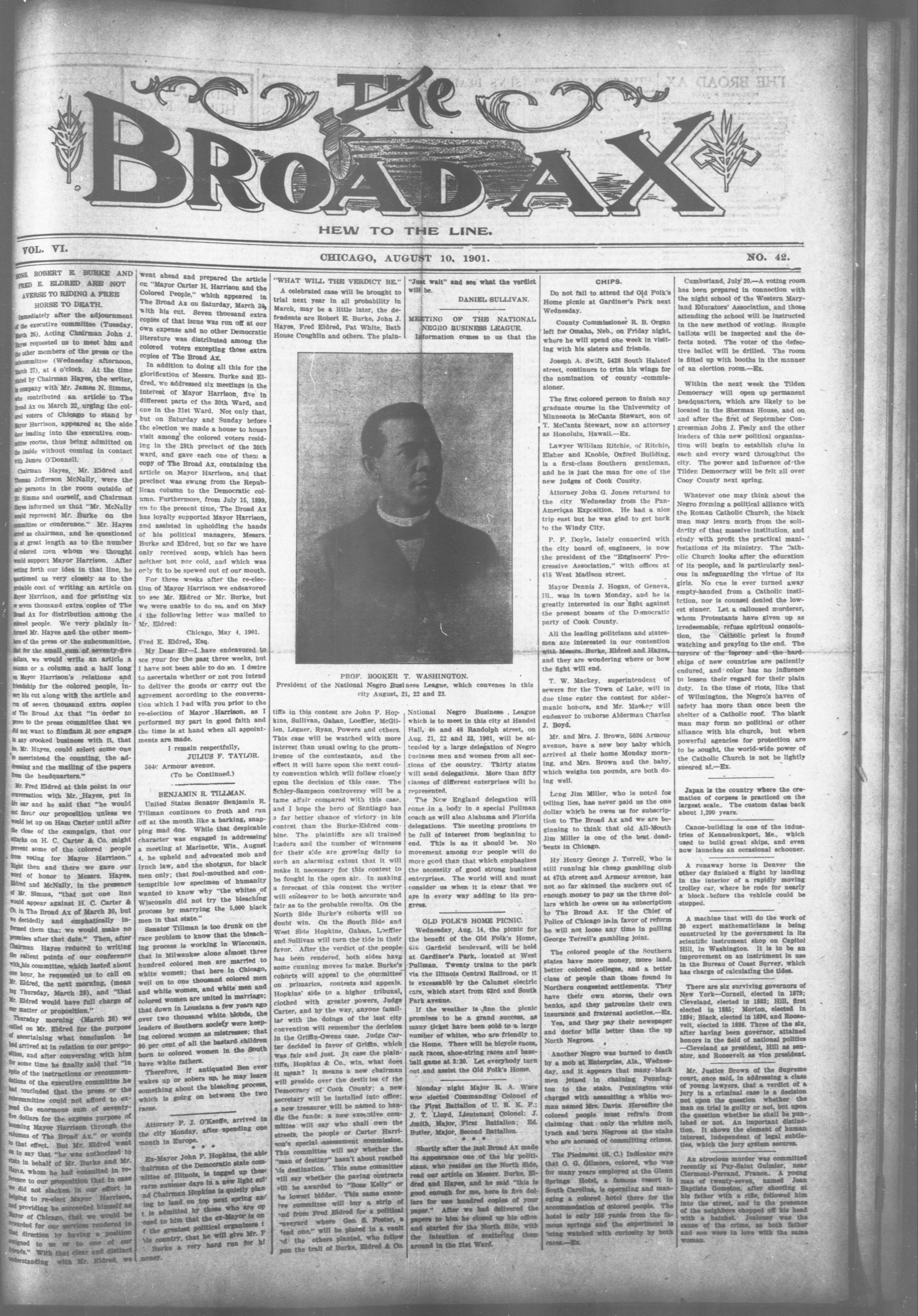
PROF. BOOKER T. WASHINGTON. President of the National Negro Business League, which convenes in this city August, 21, 22 and 23.
"WHAT WILL THE VERDICT BE." A celebrated case will be brought to trial next year in all probability in March, may be a little later, the defendants are Robert E. Burke, John J. Hayes, Fred Eldred, Pat White, Bath House Coughlin and others. The plain-
PROF. BOOKER
President of the National Negro Business
city August,
tiffs in this contest are John P. Hopkins, Sullivan, Gahan, Loeffler, McGillen, Legner, Ryan, Powers and others. This case will be watched with more interest than usual owing to the prominence of the contestants, and the effect it will have upon the next county convention which will follow closely upon the decision of this case. The Schley-Sampson controversy will be a tame affair compared with this case, and I hope the hero of Santiago has a far better chance of victory in his contest than the Burke-Eldred combine. The plaintiffs are all trained leaders and the number of witnesses for their side are growing daily to such an alarming extent that it will make it necessary for this contest to be fought in the open air. In making a forecast of this contest the writer will endeavor to be both accurate and fair as to the probable results. On the North Side Burke's cohorts will no doubt win. On the South Side and West Side Hopkins, Gahan, Loeffler and Sullivan will turn the tide in their favor. After the verdict of the people has been rendered, both sides have some cunning moves to make. Burke's cohorts will appeal to the committee on primarics, contests and appeals. Hopkins' side to a higher tribunal, clothed with greater powers, Judge Carter, and by the way, anyone familiar with the doings of the last city convention will remember the decision in the Griffin-Owens case. Judge Carter decided in favor of Griffin, which was fair and just. In case the plaintiffs, Hopkins & Co., win, what does it mean? It means a new chairman will preside over the destiries of the Democracy of Cook County; a new secretary will be installed into office; a new treasurer will be named to handle the funds; a new executive committee will say who shall own the streets, the people or Carter Harrison's special assessment commission. This committee will say whether the "man of destiny" hasn't about reached his destination. This same committee will say whether the paving contracts will be awarded to "Boss Kelly" or the lowest bidder. This same executive committee will buy a strip of land from Fred Eldred for a political raveyard where Geo. S. Foster, a lead one," will be placed in a vault and the others planted, who follow non the trail of Burke, Eldred & Co.
```markdown
```
MEETING OF THE NATIONAL NEGRO BUSINESS LEAGUE. Information comes to us that the
T. WASHINGTON.
Business League, which convenes in this
1, 22 and 23.
National Negro Business, League which is to meet in this city at Handel Hall, 46 and 48 Randolph street, on Aug. 21, 22 and 23, 1901, will be attended by a large delegation of Negro business men and women from all sections of the country. Thirty states will send delegations. More than fifty classes of different enterprises will be represented.
The New England delegation will come in a body in a special Pullman coach as will also Alabama and Florida delegations. The meeting promises to be full of interest from beginning to end. This is as it should be. No movement among our people will do more good than that which emphasizes the necessity of good strong business enterprises. The world will and must consider us when it is clear that we are in every way adding to its progress.
OLD FOLK'S HOME PICNIC. Wednesday, Aug. 14, the picnic for the benefit of the Old Folk's Home, 616 Garfield boulevard, will be held at Gardiner's Park, located at West Pullman. Twenty trains to the park via the Illinois Central Railroad, or it is excessable by the Calumet electric cars, which start from 63rd and South Park avenue.
If the weather is fine the picnic promises to be a grand success, as many ticket have been sold to a large number of whites, who are friendly to the Home. There will be bicycle races, sack races, shoe-string races and baseball game at 3:30. Let everybody turn out and assist the Old Folk's Home.
Monday night Major R. A. Ware was elected Commanding Colonel of the First Battalion of U. R. K. P.; J. T. Lloyd, Lieutenant Colonel; J. Smith, Major, First Battalion; Ed. Butler, Major, Second Battalion.
Shortly after the last Broad Ax made its appearance one of the big politicians, who resides on the North Side, read our article on Messrr. Burke, Eldred and Hayes, and he said "this is good enough for me, here is five dollars for one hundred copies of your paper." After we had delivered the papers to him he closed up his office and started for the North Side, with the intention of scattering them around in the 21st Ward.
```markdown
```
Do not fail to attend the Old Folk's Home picnic at Gardiner's Park next Wednesday.
County Commissioner R. B. Organ left for Omaha, Neb., on Friday night, where he will spend one week in visiting with his sisters and friends.
Joseph A. Swift, 5428 South Halsted street, continues to trim his wings for the nomination of county -commissioner.
The first colored person to finish any graduate course in the Univewsity of Minnesota is McCants Stewart, son of T. McCants Stewart, now an attorney as Honolulu, Hawaii.—Ex.
Lawyer Wililam Ritchie, of Ritchie, Elsher and Knoble, Oxford Building, is a first-class Southern gentleman, and he is just the man for one of the new judges of Cook County.
Attorney John G. Jones returned to the city Wednesday from the Pan-American Exposition. He had a nice trip east but he was glad to get back to the Windy City.
P. F. Doyle, lately connected with the city board of engineers, is now the president of the "Engineers' Progressive Association," with offices at 418 West Madison street.
Mayor Dennis J. Hogan, of Geneva, Ill., was in town Monday, and he is greatly interested in our fight against the present bosses of the Democratic party of Cook County. All the leading politicians and statesmen are interested in our contention with Messrs. Burke, Eldred and Hayes, and they are wondering where or how the fight will end.
T. W. Mackey, superintendent of sewers for the Town of Lake, will in due time enter the contest for aldermanic honors, and Mr. Mackey will endeavor to unhorse Alderman Charles J. Boyd.
Mr. and Mrs. J. Brown, 5036 Armour avenue, have a new boy baby which arrived at their home Monday morning, and Mrs. Brown and the baby, which weighs ten pounds, are both doing well.
Long Jim Miller, who is noted for telling lies, has never paid us the one dollar which he owes us for subscription to The Broad Ax and we are beginning to think that old All-Mouth Jim Miller is one of the best deadbeats in Chicago.
Hy Henry George J. Terrell, who is still running his cheap gambling club at 47th street and Armour avenue, has not so far skinned the suckers out of enough money to pay us the three dollars which he owes us as subscription to The Broad Ax. If the Chief of Police of Chicago is in favor of reform he will not loose any time in pulling George Terrell's gambling joint.
The colored people of the Southern states have more money, more land, better colored colleges, and a better class of people than those found in Northern congested settlements. They have their own stores, their own banks, and they patronize their own insurance and fraternal societies.—Ex. Yes, and they pay their newspaper and doctor bills better than the up North Negroes.
Another Negro was burned to death by a mob at Enterprise, Ala., Wednesday, and it appears that many-black men joined in chaining Pennington to the stake. Pennington was charged with assaulting a white woman named Mrs. Davis. Hereafter the colored people must refrain from claiming that only the whites mob, lynch and burn Negroes at the stake who are accused of committing crimes.
The Piedmont (S. C.) Indicator says that G. G. Gilmore, colored, who was for many years employed at the Glenn Springs Hotel, a famous resort in South Carolina, is operating and managing a colored hotel there for the accommodation of colored people. The hotel is only 150 yards from the famous springs and the experiment is being watched with curiosity by both races.—Ex.
Cumberland, July 20.—A voting room has been prepared in connection with the night school of the Western Maryland Educators' Association, and those attending the school will be instructed in the new method of voting. Sample ballots will be inspected and the defects noted. The voter of the defective ballot will be drilled. The room is fitted up with booths in the manner of an election room.—Ex.
Within the next week the Tilden Democracy will open up permanent headquarters, which are likely to be located in the Sherman House, and on and after the first of September Congressman John J. Feely and the other leaders of this new political organization will begin to establish clubs in each and every ward throughout the city. The power and influence of the Tilden Democracy will be felt all over Cooy County next spring.
Whatever one may think about the Negro forming a political alliance with the Roman Catholic Church, the black man may learn much from the solidarity of that massive institution, and study with profit the practical manifestations of its ministry. The Catholic Church looks after the education of its people, and is particularly zealous in safeguarding the virtue of its girls. No one is ever turned away empty-handed from a Catholic institution, nor is counsel denied the lowest sinner. Let a calloused murderer, whom Protestants have given up as irredeemable, refuse spiritual consolation, the Catholic priest is found watching and praying to the end. The terrors of the leprosy and the hardships of new countries are patiently endured, and color has no influence to lessen their regard for their plain duty. In the time of riots, like that of Wilmington, the Negro's haven of safety has more than once been the shelter of a Catholic roof. The black man may form no political or other alliance with his church, but when powerful agencies for protection are to be sought, the world-wide power of the Catholic Church is not be lightly sneered at.—Ex.
Japan is the country where the cremation of corpses is practiced on the largest scale.. The custom dates back about 1,200 years.
Canoe-building is one of the industries of Kennebunkport, Me., which used to build great ships, and even now launches an occasional schooner.
A runaway horse in Denver the other day finished a flight by landing in the interior of a rapidly moving trolley car, where he rode for nearly a block before the vehicle could be stopped.
A machine that will do the work of 30 expert mathematicians is being constructed by the government in its scientific instrument shop on Capitol Hill, in Washington. It is to be an improvement on an instrument in use in the Bureau of Coast Survey, which has charge of calculating the tides.
There are six surviving governors of New York—Cornell, elected in 1879; Cleveland, elected in 1882; Hill, first elected in 1885; Morton, elected in 1894; Black, elected in 1896, and Roosevelt, elected in 1898. Three of the six, after having been governor, attained honors in the field of national politics —Cleveland as president, Hill as senator, and Roosevelt as vice president.
Mr. Justice Brown of the Supreme court, once said, in addressing a class of young lawyers, that a verdict of a jury in a criminal case is a decision not upon the question whether the man on trial is guilty or not, but upon the question whether he shall be punished or not. An important distinction. It shows the element of human interest, independent of legal subtleties, which the jury system secures.
An atrocious murder was committed recently at Puy-Saint Gulmier, near Clermont-Ferrand, France. A young man of twenty-seven, named Jean Baptiste Gometon, after shooting at his father with a rifle, followed him into the street, and in the presence of the neighbors chopped off his head with a hatchet. Jealousy was the cause of the crime, as both father and son were in love with the same woman.
WILL promulgate and at all times unhold the free principle of Democracy, but Parama-
tibus, Protestant Knights of Lahoe, En-
lake, Mountains, Republicans, Priests, or any
who can have their say, so long as their
language is proper and responsibility is fixed.
The Brand Ax is a newspaper whose platform is broad enough for all, over claiming the
intelligent right to speak its own mind.
Cardiff has grown more quickly than any other large British town of late years. From 1881 to 1891 its population rose from 83,000 to 129,000.
Paris is threatened with an elevated structure in its finest streets. It is proposed to build a moving sidewalk, like that used in the late exposition, to run along the avenue de l'Opera, the grand Boulevards, the Boulevard Sebastopol, the Rue Turbigo and the Rue de Rivoli, a circuit of about six miles.
A 30-knot steamer with propelling machinery on the turbine principle, according to the invention of Mr. Parsons, brother of Lord Rosse, is being constructed on the Clyde for the French Northern Railway company to ply between Calais and Dover. It is expected to run this summer, and will do the channel passage in little over half an hour.
From the time of St. Paul's young man of Troas to the recent death of the gifted son of the Secretary of State, records of fatalities from falling out of upper windows are not uncommon. They aggregate a warning that ought to be heeded against the frequent practice of sitting in an open window when one is sleepy. Even to the sufferer from sleeplessness, the cool night air often brings moments of drowsiness and consequent loss of equilibrium.
The pope is not allowing the young king of Italy to pick up all the coin collections in the Italian market. Six thousand pieces, containing many rare papal coins, which were collected by Cardinal Randi have been bought by Pope Leo and added to the fine collection in the Vatican. Many fell into the cardinal's hands in 1862 for their weigth in silver, when Pope Plus introduced the French monetary system and the old coins were retired by the papal government.
Arthur P. Milmore of Cambridge is the oldest and richest "messenger boy" in the country. He is 70 years old and has a fortune of $30,000. With $30,000 well invested, Milmore does not need to work. He works for his health. He has always been well, never having had a sick day in his life, and he intends to keep well as long as he lives. So he works for the exercise that he gets rather than for the money, which amounts to about $7 or $8 a week. Mr. Milmore was born in Scotland and accumulated his money in the United States and Canada as a carriage manufacturer.
An extraordinary sensation was produced in Lisbon, recently by the discovery that an old woman named Casilda, a reputed witch, was kidnapping little children, and, after taking them to her home in a slum, was gashing their hands and collecting their blood in a bucket. There is an old superstition that blood from the hands of children between the ages of one and three is an infallible ingredient in love-potions, and it was for this purpose that Casilda was making her horrid brew. It is asserted that the police, in arresting the witch, obtained evidence which indicates more than one lady of good society as among her clients.
Wyoming has a soap mine. A deposit of a whitish material, in composite form, containing just enough sulphates, potash and pumice to give gritty essential, has been discovered five miles west of Newcastle, in the northeastern part of Wyoming, says the Denver Times. The deposit lies in a fissure and dips into the ground like a vein of mineral. The vein, so called, is 15 to 18 feet wide and runs the length of a quarter section, which for 20 years up to date was used as a stock pasture. Soon a building of commodious dimensions, fitted with machinery that will cut the slabs of mineral soap into sizes for commercial use, will cover a part of the ground.
Portable churches have followed the portable school house. The Dutch Reformed Church of Pennsylvania is considering the advisability of adopting them in communities too poor and too thinly settled to afford a permanent house of worship. The buildings are made of corrugated, galvanized iron fastened to a wooden framework. The inside is sheathed with matched boards, between which and the iron walls is a lining of heavy felt, which keeps the building warm in winter and cool in the summer. Each piece is no marked and the whole so planned that any ordinary mechanic can put the building together. Such a church, with a seating capacity of three hundred, can be built for fifteen hundred dollars. The portable church, however, is not an automobile. It is like other churches in that it will not "go" unless people pull together.
One of the leading occulists of Montreal, whose practice extends far outside the boundaries of the city, relates that one day a young woman came into his office accompanied by an older woman, apparently the mother. The young woman wore colored glasses, which one might have assumed to be superfluous, as it was claimed that the girl was totally blind. What was wanted of the doctor was a certificate authenticating this claim of blindness, putting it beyond dispute; and it was frankly stated that the object in seeking this was to obtain certain aids and advantages of a philanthropic nature, impossible of access otherwise. The standing of the oculist was such that a statement from him would carry full weight wherever presented. On examination the surface of the eyes gave no indication of any defect, but that might be so and blindness still exist. Applying tests of the strongest light, the girl professed herself to be absolutely unable to distinguish between light and darkness. Other tests were resorted to, trying in their nature, and some of them very painful, and these were all borne with patience and courage. The doctor was puzzled and baffled. Apparently the girl was stone blind, but he was unable to solve the problem of those eyes, to discover the cause of that blindness, or say just where the defect lay. The doctor was more than half-disposed to grant the desired certificate, when as a last expedient, he hit upon a novel experiment. He dismissed his patient with instructions that she should come again at a certain hour the following day, and this gave the oculist time to arrange for the carrying out of his plan. When the girl came the next day the doctor had her securely blindfolded with a heavy bandage over her eyes. He then took a tiny mouse which he had procured and held the lovely little thing by its tail before the girl's face, though not touching her, while he ordered the bandage to be removed. No sooner was the bandage off than her screams rang through the place and her eyes were wide with terror at the harmless little rodent which had thrown her so completely off her guard and exposed the imposture. Of course she saw it or she would not have screamed. Needless to say the applicant did not get that certificate.—Syracuse Herald.
The Drummer's Conscience.
The "Listener" of the Boston Transcript quotes an authority on "drummers." The other night he sat cheek by jowl with a gentleman with a sonorous checked suit, and learned much. "A drummer's conscience," said he of the vehement pepper-and-salt—"a drummer's conscience is lodged in his trunk." Remarkable, thought the "Listener." "Yes," he continued, "you can judge of the drummer's morals pretty accurately by the size of his trunk. If he carries a big trunk, he's a temperate, moral, decent chap. Keeps straight, you know. But if he carries a little trunk, or only a suit case, steer clear of him; he's dangerous! And here's the reason, sir: The big trunk is packed full of samples and the rascal has to spend all his evenings packing and unpacking them. The little trunk or the suit case means a free evening to run wild and tear up the town." Glancing across the hotel lobby, which was still well crowded with loungers, the philosopher continued: "See that jolly chap smoking the crooked cigar? Father of seven, good bank account, gets credit anywhere, doesn't drink, hates cards—three trunks! See that round-shouldered little chump with the silk hat? Plays the races, runs after the sluggers, drinks two Manhattans before breakfast, smokes in bed—suit case!"
Nice Turkish Customs
It is said by a correspondent of the London Telegraph that the habits of the Turkish ladies in Constantinople are wonderfully fastidious. When they wash their hands at a tap from which water runs into a marble basin, they let the water run till a servant shuts it off, as to do this themselves would make them unclean. They cannot open or shut a door, as the handle would be unclean. One of these fastidious ladies was talking to a small niece the other day, who had just received a present of a doll from Paris. By and by the child laid the doll on the lady's lap. She was horrified, and ordered the child to take it away. As the little girl would not move it, and no servant was near, and the lady would be defiled by touching a doll that had been brought from abroad, the only thing she could think of was to jump up and let the doll fall. It broke in pieces. The same lady will not open a letter coming by post, but a servant opens it and holds it near for her to read. If her handkerchief falls to the ground it is immediately destroyed or given away, so that she may not again use it. Among the men this curious state of things does not exist.—Youth's Companion.
Last in the Desert This Surveyor Wandered About Until He Sank Under the Consuming Rays of the Orb of Day.
(Special Letter.)
In Arizona there is a county called Coconino, and the Colorado river crosses it with many a curve and twist. It lies in the northern part of the Great Colorado plateau and is west of the Moqui country. Long after the railroad line from Flagstaff to Ashfork was completed a plan was formed to build another line into Coconino and thence by heroic measures to pass into the most rugged scenery of the Colorado, and open that canyon land to tourists. In some respects it was a foolish project, but a preliminary survey was ordered, and a party sent out with a young civil engineer by the name of Bowden at its head. He had studied at Ann Arbor and also at the University of Minnesota. His experience in field work covered about five years prior to the time of his arrival at Flagstaff. He was not familiar with the southwest, its climate and peculiar topography, but he had associated with him a man by the name of Watts, who had lived for many years in the vicinity of Prescott and who understood the perils that confronted the surveying party in its attempt to find a railroad route in Coconino.
Like a Destroying Angel.
The sun shines in Coconino. It hangs day after day above Lava Butte, the Painted Desert, Shinumo Altar and the Black Falls as if it were a destroying angel; not the kindly orb that flashes in the northern belt, but a consuming, terrifying demand of the desert wastes, from which there is no escape. Those who toll in city's ways think the sun is hot, that the humidity is deadly, that pain such as theirs is unknown. They have never looked up to the solar star from the buttes of Coconino. There, blazing through the century-died air, all that is inhuman in stellar heat feeds upon the brain, the senses of man, until mad he staggers over the sands and falls to death.
Bowden and his men worked their way north by Mesa Butte, carrying their provisions and water, making slow plogress, enduring extraordinary discomforts. It was after they had camped at the Little Colorado, on the south bank, that Bowden, acting upon
3
"FAR UP TO THE SUN GOD THAT WAS CALLING HIM."
"FAR UP TO THE SUN GOD THAT WAS CALLING HIM."
the advice of Watts, deemed it advisable that the main party should rest there while he and Watts made some explorations of their own to determine how best they should approach Lava Butte. The two men left camp one morning before sunrise and headed due north for Painted Desert. They carried with their horses a two days' supply of water and provisions. It was impossible after 10 in the morning for them to advance further in the heat. They camped in the swale of a dry arroyo, making such shade as they could, and
Waited for the Coming Cool of the late afternoon, when they might press on a little more. Bowden attempted some observations, but found that his sight was affected and that he must rest. In the evening, and before they halted for the night, Lava Butte was in sight of the two men. After their supper Bowden said that he would walk a distance under the stars; that he would return to the camp within an hour. He had not returned by midnight, and Watts tried to find his companion, but failed. The water supply began to run short, the horses were suffering and Bowden did not appear. Watts then headed back for the camp on the Little Colorado, but lost his mind. The third day he was found by a relief party sent out from the camp. His horses were dead and he was without water. He was a year recovering from his experience. The men of the Little Colorado camp subsequently searched for Bowden and found his body about ten miles from the camp he and Watts had made.
Bowden had walked in the night through the dead land, where in starlight or sunlight all things look alike. Either things are white to the eye or gray. But there is so much white and so much gray that to distinguish one object from another, to remember it, to say, "I will come back to this," is not possible. So when Bowden started to retrace his steps he
Did Not Know Where He Was. The plain was all north, south, east and west. He quite evidently had sat down and tried to collect his thoughts, for there were marks in the waste indicating the various positions he had taken. He had a small bottle of water with him, but no food. No sound swept the plain. Bowden may have
thought he was entombed in some vast channel house of the ages to which time had brought Nature's remains and left them without burial. He was on the crest of one-time vast lava beds, a spot where the fires of hell once raged beneath his feet. Here the last great battle of the peaks of the continent had probably been fought with thunderbolt and flame hurled from the bowels of the earth. And he was alone. Not even the wretched lizards of the lava region were moving. Perhaps Watts was within a stone's throw of him; he could not tell. He called. No voice answered. He walked, but it was in a circle, and he came back time and time again to the starting point. He
Walted for the Dawn.
hoping that the sun's light might give him a trace of Watts. He saw the shade of the night grow deeper and deeper, and then the driving of this blackness back from the east and the coming there of a cold line of gray and then an insolent one of red, and a savage yellow with that, and then, with one leap, the sun. He must have scanned the plain, but there was no sight of Watts. He called, he laughed, he cried. He drank his water to the last drop in the bottle. He walked and ran. He returned to the spot where he had first become bewildered. He was hot and then cold, and the sun rose higher and higher; grew more pitiless with every advance. The white heat beat down upon him; it rose in sheets before him and placed awful colors before him. Now the lizards and the mean creeping things came out, but they passed him by. They could wait. Others had preceded him.
After a long time the man threw his hands high in the air, far up to the sun god that was calling him, although beating him down. He fell flat on his face, and there he slept his last sleep in the land where the sun shines for ever and ever. H. I. CLEVELAND.
PSYCHOLOGY OF THE FLY.
Persists in Returning to a Spot From Which It Is Driven.
"The pertinacity of flies has caused me to wonder much of late on the habits of these pests," remarked a gentleman to the New Orleans Times-Democrat, "and the recent discussion of the fly as a disseminator of typhoid has tended to increase my interest in the matter. Did you ever notice the persistence shown by a fly in sticking to a certain spot when you attempt to shoo him away? Invariably he will describe a circle and alight again on exactly the same spot. He will repeat this as often as you strike at him unless he feels that persistence will jeopardize his life. I conducted a little experiment with one of these pests and I made a rather interesting discovery. The fly converted the tip of my nose into a resting place. I brushed him away. He circled and relit on the same spot. He repeated this seven times. I concluded just from watching the antics of the typhoid flend, that I would allow him to remain as long as he pleased, in spite of the tickling and the annoyance of it all. I was surprised at the shortness of his stay. Finding that it made no difference to me and that I had resigned to an unhappy fate, the insect spread its wings and salied to another portion of the room. From my observation of flies they do not care so much about alighting on the human body unless they can find some morsel upon which to feed, or unless a violent effort is made to beat them away. But the most interesting observation I have made in this connection has taught me that it is comparatively easy to rid oneself of the pest. There is one essential: Do not get mad. Good humor is the thing when it comes to dealing with flies. If we get angry we strike violently at the insect, and either on account of sheer wickedness or because he believes he is being chased away from a good thing he will come back to the same spot until he feels that his life is endangered by further efforts to maintain his ground. Try the good-natured, gentle stroke. In nine cases out of ten the insect will leave to return no more."
How Bills Equalize
A prominent member of the Produce Exchange related a striking illustration of the manner in which things equalize themselves. "All during the month of March I had a great deal of sickness in my household," he said. "My wife and daughters were practically all laid up at the same time. My monthly bill at one of the department stores where we do most of our shopping usually amounts to from $40 to $45. Well, on the first of the month I received two bills in one mail. One was from the druggist at the corner and the other was from the department store. I opened the druggist's bill first. It was for $39.75. That nearly staggered me. Then I opened the other and the amount was only $2.25. You see the women folks had been housed nearly all the month and couldn't get out to do any shopping. If they had been well I wouldn't have had the druggist's bill to pay, but my department store bill would have been as big as ever; so it's as broad as it is long."—Philadelphia Record.
French Tax Street Signs. The French tax on street signs "varies with the size of the offense." Last year it added over seven hundred thousand dollars to the public treasury. In the United States vast street signs can shut out the air and the view and overwhelm everything in sight without paying a cent in taxation.
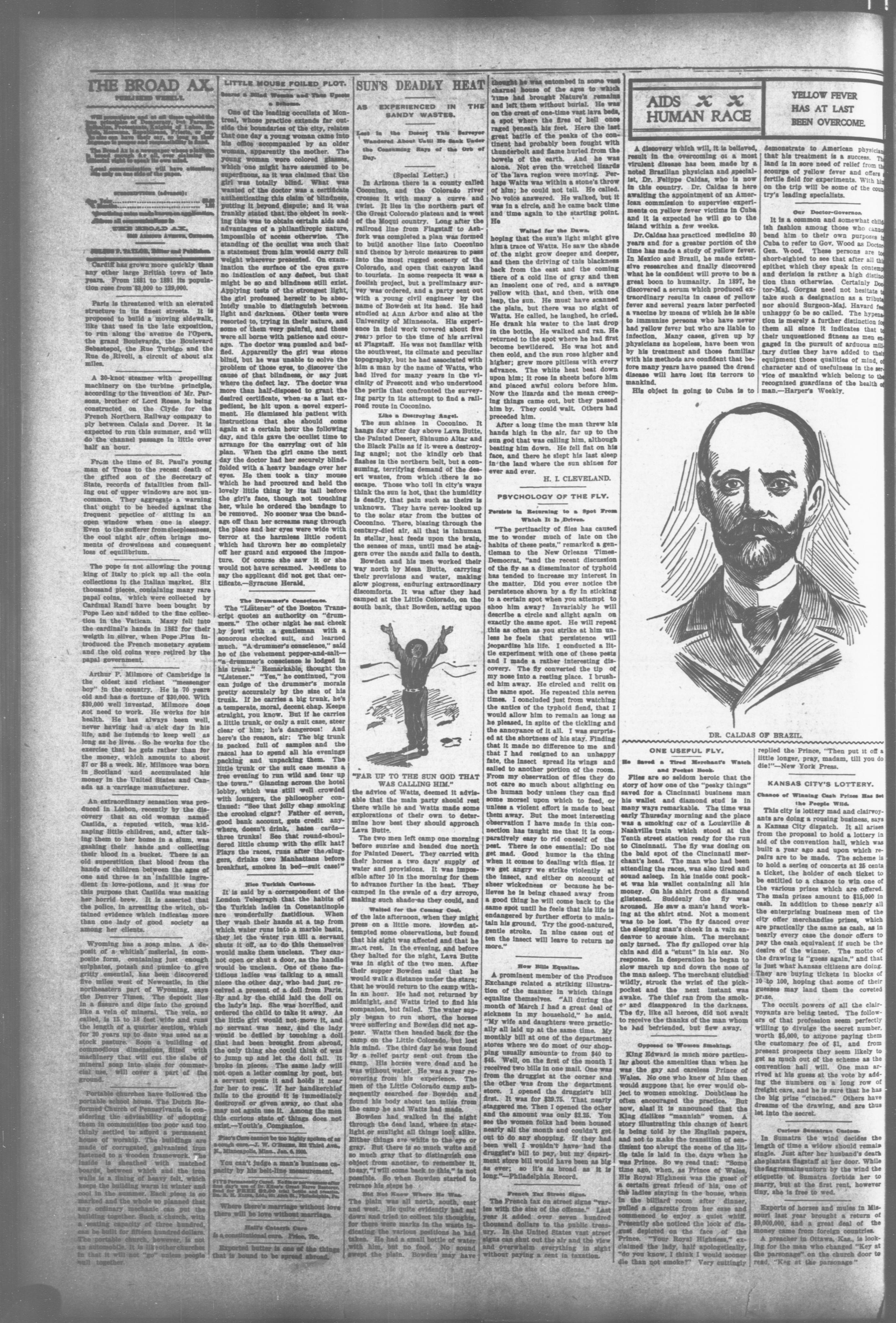
A discovery which will, it is believed, result in the overcoming or a most virulent disease has been made by a noted Brazilian physician and specialist, Dr. Felippe Caldas, who is now in this country. Dr. Caldas is here awaiting the appointment of an American commission to supervise experiments on yellow fever victims in Cuba and it is expected he will go to the island within a few weeks.
Dr. Caldas has practiced medicine 30 years and for a greater portion of the time has made a study of yellow fever. In Mexico and Brazil, he made extensive researches and finally discovered what he is confident will prove to be a great boon to humanity. In 1897, he discovered a serum which produced extraordinary results in cases of yellow fever and several years later perfected a vaccine by means of which he is able to immunize persons who have never had yellow fever but who are liable to infection. Many cases, given up by physicians as hopeless, have been won by his treatment and those familiar with his methods are confident that before many years have passed the dread disease will have lost its terrors to mankind.
His object in going to Cuba is to
11
10
9
8
7
6
5
4
3
2
1
DR. CALDAS OF BRAZIL
ONE USEFUL FLY.
He Saved a Tired Merchant's Watch and Pocket Book.
replied the P little longer, die!"—New Y
Flies are so seldom heroic that the story of how one of the "pesky things" saved for a Cincinnati business man his wallet and diamond stud is in many ways remarkable. The time was early Thursday morning and the place was a smoking car of a Louisville & Nashville train which stood at the Tenth street station ready for the run to Cincinnati. The fly was dozing on the bald spot of the Cincinnati merchant's head. The man who had been attending the races, was also tired and sound asleep. In his inside coat pocket was his wallet containing all his money. On his shirt front a diamond glistened. Suddenly the fly was aroused. He saw a man's hand working at the shirt stud. Not a moment was to be lost. The fly danced over the sleeping man's cheek in a vain endeavor to arouse him. The merchant only turned. The fly galloped over his chin and did a "stunt" in his ear. No response. In desperation he began to slow march up and down the nose of the man asleep. The merchant clutched wildly, struck the wrist of the pick-pocket and the next instant was awake. The thief ran from the smoke- and disappeared in the darkness. The fly, like all heroes, did not await to receive the thanks of the man whom he had befriended, but flew away.
Opposed to Women Smoking.
King Edward is much more particular about the amenities than when he was the gay and careless Prince of Wales. No one who knew of him then would suppose that he ever would object to women smoking. Doubtless he often encouraged the practice. But now, alas! it is announced that the King dislikes "mannish" women. A story illustrating this change of heart is being told by the English papers, and not to make the transition of sentiment too abrupt the scene of the little tale is laid in the days when he was Prince. So we read that: "Some time ago, when, as Prince of Wales, His Royal Highness was the guest of a certain great friend of his, one of the ladies staying in the house, when in the billiard room after dinner, pulled a cigarette from her case and commenced to enjoy a quiet whiff. Presently she noticed the look of disgust depicted on the face of the Prince. "Your Royal Highness," exclaimed the lady, half apologetically, "do you know, I think I would sooner die than not smoke?" Very cuttingly
---
demonstrate to American physicians that his treatment is a success. The land is in sore need of relief from the scourge of yellow fever and offers a fertile field for experiments. With him on the trip will be some of the country's leading specialists.
It is a common and somewhat childish fashion among those who cannot bend him to their own purposes in Cuba to refer to Gov. Wood as Doctor Gen. Wood. These persons are too short-sighted to see that after all this epithet which they speak in contempt and derision is rather a high distinction than otherwise. Certainly Doctor-Maj. Gorgas need not hesitate to take such a designation as a tribute nor should Surgeon-Maj. Havard feel unhappy to be so called. The hypenation is merely a further distinction for them all since it indicates that to their unquestioned fitness as men engaged in the pursuit of arduous military duties they have added to their equipment those qualities of mind, of character and of usefulness in the service of mankind which belong to the recognized guardians of the health of man.—Harper's Weekly.
```markdown
```
replied the Prince, "Then put it off a little longer, pray, madam, till you do die!"—New York Press.
KANSAS CITY'S LOTTERY
Chance of Winning Cash Prizes Has Set the People Wild.
This city is lottery mad and clairvoyants are doing a rousing business, says a Kansas City dispatch. It all arises from the proposal to hold a lottery in aid of the convention hall, which was built a year ago and upon which repairs are to be made. The scheme is to hold a series of concerts at 25 cents a ticket, the holder of each ticket to be entitled to a chance to win one of the various prizes which are offered. The main prizes amount to $15,000 in cash. In addition to these nearly all the enterprising business men of the city offer merchandise prizes, which are practically the same as cash, as in nearly every case the donor offers to pay the cash equivalent if such be the desire of the winner. The motto of the drawing is "guess again," and that is just what Kansas citizens are doing. They are buying tickets in blocks of 10 to 100, hoping that some of their guesses may land them the coveted prize.
The occult powers of all the clairvoyants are being tested. The followers of that profession seem perfectly willing to divulge the secret number, worth $5,000, to anyone paying them the customary fee of $1, and from present prospects they seem likely to get as much out of the scheme as the convention hall will. One man arrived at his guess at the vote by adding the numbers on a long row of freight cars, and he is sure that he has the big prize "cinched." Others have dreams of the drawing, and are thus let into the secret.
Carlson Semantics System
In Sumatra the wind decides the length of time a widow should remain single. Just after her husband's death she plants a flagstaff at her door. While the flagremains untorn by the wind the etiquette of Sumatra forbids her to marry, but at the first rent, however tiny, she is free to wed.
Exports of horses and mules in Missouri last year brought a return of $9,000,000, and a great deal of the money came from foreign countries. A preacher in Ottawa, Kas., is looking for the man who changed "Key at the parsonage" on the church door to read, "Keg at the parsonage"
YELLOW FEVER HAS AT LAST BEEN OVERCOME
Our Doctor-Governor
(Tangler Letter.)
The commander-in-chief of the Moorish army is a young Scotsman named Maclean, a member of a Highland clan. Entering the British army thirty years ago Maclean saw some active fighting. When Mulai Hassan, the Sultan of Morocco, decided to reorganize his army, he applied to England for a drill master, and Maclean received the disappointment. Soon after his arrival among the Moors he won the Sultan's confidence and became not only the commander-in-chief of the Sherefian army, but the trusted adviser of the late ruler. He reorganized the army, and his daring deeds in battle impressed the natives so much that he practically held the nomination to the throne on the death of Mulai Hassan, although the grand vizier, Ahmed Ven Mussa, also possessed much influence.
The sultan's brother was ready to raise the throne, but, as Maclean and Pen Mussa were the only persons present when the sultan died within two days' march of Marakeah, they had the body conveyed secretly to that city, where they announced the death and had Mulai Hassan's son, Abel-Aziz, proclaimed in his stead, and a slight outbreak was quickly suppressed by Maclean's admirably disciplined soldiers.
The new sultan being only 13 years of age, a regent was necessary, and Ben Mussa was appointed, with Maclean's influence, power and hand behind him. An incipient opposition which broke out was suppressed with a strong hand, as all risings of tribes have been, notably that of the Misfiwa tribe a few years ago. To prevent if possible the recurrence of such incidents, the heads of fifty prominent Misfiwa tribesmen figure on spikes over the city gates of the port of Rabat and a similar number adorned the gates at Fez. Maclean always leads the punitive expeditions himself, and has thus seen much tribal fighting. On the death of Ben Mussa last year the Sultan took up the reins of govern-
```markdown
```
KAID MACLEAN.
The Moorish commander-in-chief, whose full name is Harry Aubry de Vere Maclean, is a C. M. G., and is 51 years of age. He is married and has three daughters and one son living. At Fez and Marakesh the family live in palaces of Oriental magnificence. The army over which this intrepid Scottsman is the commander-in-chief comprises about 20,000 men, and is equipped with European rifles.
The Kaiser's Sone
The sons of the German emperor are being brought up in a strict school. While the crown prince is being initiated into student life at Bonn, his three younger brothers, Elthel Fritz, August Wilhelm and Oscar, are hard at work at Pleon, where they are subjected to a daily routine stricter even than that to which they are accustomed at home. Every day they are up at 5:30, have their cold tubs, then their breakfast, and forthwith begin work. The eldest of the brothers visits the first class of the cadet school, the second one attending the lower fifth and the third the upper third. They appear to have all made plenty of friends there, and take an active part in all the games. The most popular game at the present moment is tennis, while the second place is apparently taken by riding and cycling.
Is it generally known that the fashion of pretty girdles from which depend chains supporting knickknacks dates back to Louis XIII.? In those days there were girdles known as "demi-cent," which reached fabulous prices. From them hung gold chains, gold-handled scissors and gold-purses, like those which age in so much favor to-day, and small, round mirrors, for which women have displayed such rare fidelity, although their form has been slightly varied.
Critical Spot to Witness
A farmer driving into Caldwell,
Kas, had a wheel knocked from his
buggy by a runaway team. Going
home in nearly the same spot another
wheel was yanked off by a frezzied
The mahogany hunter is the most important and best paid laborer in the Central and South American service, for upon his skill and activity largely depends the success of the season. The trees do not grow in groups, but are scattered promiscuously through the forest and hidden in the dense growth of underbrush, vines and creepers, and it requires skillful and experienced woodsmen to find them. To fell a large mahogany tree is one day's task for two men. On account of the thornlike spurs which project from the trunk at its base, scaffolds are erected and the tree cut off above these protuberances, which leaves a stump from ten to fifteen feet high, thus wasting the best part of the tree. After trimming the tree of its branches it is hauled by means of a crude truck, with oxen as motive power, to the bank of the river. There the logs are collected and made ready for the floods. On the longest rivers these begin in June and July and on others in October and November. The logs are turned adrift and when they reach tidewater are caught by means of booms. From the boom the logs are taken to the "embarcadero" and prepared for shipment
A tree makes from two to five logs, measuring ten to eighteen feet in length and from twenty to twenty-four inches, in diameter after being
There is a great range in the value of mahogany timber. The poor grade of short stock may sell as low as fifty cents for 1,000 feet, while fancy material, used in the manufacture of tops of counters, may be worth $3.50 for 1,000 feet, or even higher. Previous to the war in Cuba much mahogany was shipped from the island to the United States, and the trade has been reviving within the last two years. The finest quality from this source is called the "San Jago" and is used in the manufacture of fancy furniture and for the interior work of houses. The price of this variety, made on an inch basis, ranges from $140 to $165 for 1,000 feet. Fine hard Mexican mahogany, which is one of the most satisfactory kinds for fine furniture or interior work, is sold according to the grade. It is a hard wood of good color, and finishes well. The "firsts" and "seconds" in this class of stock are sold for about $160 for 1,000 feet, but when it is selected it is worth from $170 to $200 for 1,000 feet. "Commons" sell at from $110 to $145, and "culls" (lowest grade) at from $60 to $90. The soft Mexican mahogany is not desirable, and, in all grades is worth from $20 to $25 for 1,000 feet less than the hard variety.
From being an article of luxury, and used only for expensive work, mahogany is becoming one of the staple finishing and furniture woods of the United States. It is not a cheap wood and undoubtedly never will be, but even houses of moderate cost may contain one or more rooms finished with it, and as a furniture wood it has become a standard. It is reported that one of the leading furniture factories of Michigan will use this year mahogany for 80 per cent of its product, and other furniture makers throughout the country are making medium-sized goods of this material. Its use as a veneering is extensive.
American Touring Europa.
A well-known insurance man in New York recently had some amusing experiences in Paris. At the Cafe Ritz, seeing a fine basket of fruit on the table, he persuaded his wife to eat a peach while waiting for luncheon to be served. When the bill was rendered there was a charge for "fruit, 15 francs." He protested. One peach for $3 was a little more than he thought an American should stand. The manager was summoned. "You have destroyed the decoration of the table," he explained. "You should not have eaten the peach. You will see there is no fruit on the bill of fare." "Well, when fruit isn't eaten, why don't you put a fence around it and hang out a sign? I refuse to pay that charge. It is an outrage." In a very short time our fellow-countryman had broken a waiter's nose and kicked him into the street, for which display of valor a gendarme hauled him to the police station.
"Wild Things With a Baag."
The late Flavius Josephus Cook lacked sweetness, generosity, sincerity—the qualities that win men's lasting confidence in a preacher. He carried an audience of non-thinkers by storm, but the scholars distrusted him. For ten years he was the thundering champion of orthodoxy. He rode down science and discussed dogmatically, in "preludes," all things in heaven and earth. As Barrett Wendell put it: "He said things with a bang." That was a lifelong characteristic. Walking through the college yard with the present writer one day, Cook suddenly stopped, seized his astonished companion by the arm, glared at him and cried: "Do you see that blade of grass? It is a miracle."—Buffalo Commercial.
Some of the English tenures are exceedingly curious. A farm near Broadhouse in Yorkshire pays annually to the landlord a snowball in midsummer and a red rose at Christmas. The manor of Foston is held by a rental of two arrows and a loaf of bread. An estate in the north of England is held by the exhibition before a court every seven years of a certain vase owned by the family, another in Suffolk by an annual rental of two white doves.
These Who Are Nervous Are Given Simple Rules.
When you are asleep, it is to be hoped that you are still. Few people are when they are awake. If one observes the crowd in the streets, it is curious and most disagreeable to see how small the number is who are not constantly making grimaces and working their faces or jaws in some manner. I have heard it said it was bashfulness that caused this, but it has not been my observation that bashfulness was so widely distributed an American trait; besides, how does twisting the face help to keep one in countenance? No, it is not bashfulness; it is misdirected nervous energy, which ought to be aiding the movements of their legs or getting stored up somewhere in the central nervous reservoirs for future use. Learn to keep still when you rest; when you move, move with the part of the body needed; do not waste your force by walking with your arms and face as well as with your legs. If circumstances force an unusual and fatiguing amount of exertion upon you, break it now and then by periods of absolute rest. No matter how brief they are, they will be useful if you make them complete and perfect in the way described. This is true of mental as well as bodily exertion. A minute or two minutes of quiet, with closed eyes if possible, with your tension relaxed and the gearing of the machinery thrown off for the moment, will help and refresh you greatly. Here, again, more may be gained if the ability to relax mentally can be secured, in a fashion similar to the withdrawing of muscular tension. Learn to empty your mind when not using it—Dr. John Mitchell in Harper's Bazar.
DE MORES WIRE FENCE
Marquis Tells Westener He'll Shoot Him on Second Offense.
When the Marquis de Mores took possession of his 20,000 acres in the Bad Lands he proceeded to put up barbed wire fences says G. W. Ogden in Everybody's Magazine. One of the first to meet this innovation in the Bad Lands was a hunter named Frank O'Donnell. He was heading in for the river one day and almost fell from his horse in astonishment when he saw the new fence. So great was his surprise he could not call to his mind appropriate oaths. He cut the wire and rode on toward Medora in silence. They told him there who was responsible for the breach of Bad Lands etiquette and he called on the marquis. "Say, pardner, what in the —— do you mean by putting up that fence?" he demanded, with an injured air. De Mores replied that he was merely fencing his own property, as was customary in civilized lands. "Well, I just cut a gap in the blankety-blank thing up yonder on the hill," said the hunter defiantly; "that's the way I'll treat your fence whenever it comes in my way." "The next time you cut my fence," De Mores said, without changing color or showing the least sign of anger, "I'll shoot you on sight." O'Donnell's jaw fell, and he looked in amazement from one to another of the men who stood around. Then he mounted his horse and rode away.
Study What You Must Affect,
Scientists now acknowledge that education has most effect upon mediocre minds. It can do a great deal with them, less for those who are defective, and still less for those highly endowed; for talented persons, even though they may receive all the usual courses of intellectual training, usually educate themselves, says the Woman's Home Companion. They gain their most valuable education through the exercise of their strongest faculties. Work is their tutor and self-direction their college.
Parents and tutors need to have a care that their efforts to be helpful to children do not interfere with the natural development of their faculties. This is sometimes done through not recognizing their special abilities, quite frequently from a wish to fix their destinies in accordance with some conventional standard. We should study the individuality of our child from his birth, so that we may avoid a wasteful employment of his energies in pursuits that are alien to his disposition and foreign to his needs.
Where Our English Is Faulty.
A sound that is heard only to a limited extent in American speech is the sound of e in person, of i in girl, of o in word, of u in murder and of y in myrtle. Previously to about fifteen years ago the sound was seldom heard from the lips of American actors. Now there are few of them that do not make it properly. Fire vowels, e, i, o, u and y in certain words have precisely the same sound. This sound is easily learned, but it must be learned orally; it cannot be described to any practical purpose. The making of it is a very important matter if one would have one's utterance conform to refined usage. The sound commonly heard trenches closely to the borderland of the vulgar.—Harper's Magazine.
Margals Is a Dairyman
The marquis of Ripon, who recently celebrated his golden wedding, has been a dairyman for years. In and about the picturesque town of Ripon, Yorkshire, may be seen milk wagons bearing his formal title. "The most noble the marquis of Ripon." He also has a milk store in London, where country dairy products are sold.
STEEL TRAPS FOR TIGERS. Safe and Sure Method of Capturing the
Capturing tigers by novel methods is now being adopted in Sumatra and is proving almost invariably successful. As soon as a tiger's lair has been found natives are employed to construct a wooden fence nine feet long and four feet wide a short distance away from it, and in this inclosure is then placed as a bait a dog, which is tied to one of the fence posts. A narrow entrance leads into the inclosure, and there, deftly concealed under earth, leaves and boughs of trees, is placed a strong steel trap, which is so designed that any animal that places its foot on it is certain to be held captive. This trap is of recent invention and consists of strong steel plates and equally strong springs. When it is set the plates form a sort of platform, and as soon as the tiger which has been lured thither by the dog sets his foot thereon the springs are released and the cruel steel grips the leg and holds it fast. Powerful as a tiger is, he cannot free himself from such bondage, and as those who have set the trap are never far away he is in a short time either killed or securely caged. At the same time the dog is released, and, indeed, he could not be removed from the inclosure as long as the trap was set, since this instrument, strong as it is, nevertheless is so delicate that the pressure even of a dog's foot would release the springs and cause the animal's leg to be crushed in a twinkling.
It Pays to Read Newspapers
Cox, Wis., Aug. 5th.—Frank M. Russell of this place had Kidney Disease so badly that he could not walk. He tried Doctor's treatment and many different remedies, but was getting worse. He was very low.
He read in a newspaper how Dodd's Kidney Pills were curing cases of Kidney Trouble, Bright's Disease, and Rheumatism, and thought he would try them. He took two boxes, and now he is quite well. He says:
"I can now work all day, and not feel tired. Before using Dodd's Kidney Pills I couldn't walk across the floor."
Mr. Russell's is the most wonderful case ever known in Chippewa County. This new remedy—Dodd's Kidney Pills—is making some miraculous cures in Wisconsin.
Sounds and Colors
"A long white scream of joy." We used the phrase yesterday to describe a trainful of children off for a day in the country. And a correspondent protests. "A scream can be long, but how can it be white?" he asks. He rather misses the point. But he also forgets the close association of sound and other. A blind boy once, when asked his idea of red, replied that it was like a trumpet, and really you can get no nearer to a definition of a primary color than by reference to another sense. Besides, every one knows that a hue is always associated with a cry!—London Chronicle.
HALF RATES
Wisconsin and Michigan Resorts.
August 1st to 10th, the Chicago, Milwaukee & St. Paul Railway will sell excursion tickets from Chicago to the Summer Resorts of Wisconsin and Michigan at rate of one fare (Minimum rate $4.00) for round trip, limit October 31st. The list of resorts includes Milwaukee, Waukesha, Palmyra, Madison, Kilbourn, Elkhart Lake, Pewaukee, Lakeside, Hartland, Nashotah, Oconowoc, Sparta, Marquette, Houghton, Ontonagon, Sault Ste. Marie, St-Ignace, Minocqua and Star Lake. Through sleeping cars to Marquette, Calumet, Minocqua and Star Lake and frequent trains with parlor cars to nearby resorts.
Full information at Ticket Office, 95 Adams St., or at Union Passenger Station, Canal, Madison and Adams Sts.
Cardiff has grown more quickly than any other large British town of late years. From 1881 to 1891 its population rose from 83,000 to 129,000.
WET WEATHER HATS
MADE BY THE MAKERS OF
ON SALE
EVERYWHERE
FREE
CATALOGUES
OF
CARMENTS
AND
HATS
AT TOWER CO.
BOSTON
MASS
TOWER'S
FISH BRAND
OILED CLOTHING
HAVE THE SAME POINTS
OF EXCELLENCE AND GIVE
COMPLETE SATISFACTION
EVERY INVENTOR
who takes out a U.S. Patent through the during this
my twentieth anniversary year, will receive a Can-
adian Patent on his Invention ABSOLUTELY FREE OF CHARGE
Send for full informa-
tion and New Book on Patents containing all
forms of assignments, licenses, etc., free.
O. E. DUFFY,
WARNINGTON, D. C.
Myrn experience, Myrn an examiner in U.S. Pat. Office.
Nature's Priceless Remedy
DR. O. PHELPS BROWN'S
PRECIOUS
HERBAL
OINTMENT
A Curse Through the Pores
Address:Pr. O. P. Brown, 90 E. way, Newburgh, M. Y.
Rheumatism, Neuritis,
Weak Back, Sprains,
Burns, Sores and all Pain.
Special drugs, 10. Soo.
If he does not sell it, send
this information to your
wrong seller, we will
Send You a Trial Free.
Bway, Newburgh, M. Y.
ADJUSTABLE LIFTER, 15c.
For lifting any hot pan without a handle.
NO MORE BURNT FIBERS HANDLING HOT PANS.
Money returned if not satisfactory. Sent postpaid
with catalogue of 4,000 bargains for only 15c.
YREED H. VEROGE & CO., Austin Station, Chicago
SCALE AUCTION
BIDGE BY MAIL. YOUR OWN PRICE.
Jones. He Paid the Freight, Binghamton, N. Y.
MEMBER OF FROM SANDWICH CONGRESS ISLANDS
CONGRESSMAN R. W. WILCOX,
Delegate to Congress from Hawaii.
CONGRESSMAN R. W. WILCOX,
Delegate to Congress from Hawaii.
Hon. Robert W. Wilcox, Delegate to Congress from Hawaii and the Sandwich Islands, in a recent letter from Washington, D. C., writes:
"I have used Peruna for dyspepsia and I cheerfully give you this testimonial. Am satisfied if it is used properly it will be of great benefit to our people. I can conscientiously recommend it to anyone who is suffering with stomach or catarrhal troubles."
—R. W. Wilcox.
All over this country are hundreds of
Some men are made by circumstances and some are unmade.
DOES YOUR BACK ACHE?
If so try DR. CRANE'S QUAKER TONIC TABLETS. Cure certain. 50c a box.
A first-class pump is a thing that deserves to be well tested.
Mrs. Winslow's Soothing Syrup. For children teething, softens the gums, reduces inflammation, allays pain, cures wind colic. 25c a bottle.
The one-armed man has an off-hand method of doing things.
It, like truth, only asks a hearing. Wizard Oil cures pain.
The political orator and the whale are both spouters.
FRAGRANT
SOZODONT
a perfect liquid dentifrice for the
Teeth and Mouth
New Size SOZODONT LIQUID, 25c
SOZODONT TOOTH POWDER, 25c
Large LIQUID and POWDER, 75c
25c
At all Stores, or by Mail for the price.
HALL & RUCKEL, New York.
EDUCATIONAL.
Aerial view of the town of Belfast.
FULL COURSES IN Classics, Letters, Economics and History, Journalism, Art, Science, Pharmacy, Law, Civil, Mechanical and Electrical Engineering, Architecture. Thorough Preparatory and Commercial Courses. Rooms Free to all students who have completed the studies required for admission into the Junior or Senior Year, of any of the Collegiate Courses.
Rooms to Rent, moderate charges to students over seventeen preparing for Collegiate Courses A limited number of Candidates for the Ecclesiastical state will be received at special rates. St. Edward's Hall, for boys' under 13 years, is unique in the completeness of its equipments. The 58th Year will open September 10th, 1901, Catalogues Free. Address REV, A. MORRISSEY, C. S. C., President.
ST.MARY'S ACADEMY
Conducted by the Sisters of the Holy Cross. Chartered 1855. Thorough English and Classical education. Regular Collegiate Degrees. In Preparatory Department students carefully prepared for Collegiate course. Physical and Chemical Laboratories well equipped. Conservatory of Music and School of Art. Gymnasium under direction of graduate of Boston Normal School of Gymnastics. Catalogue free. The 47th year will open Sept. 5, 1901. Address DIRECTRESS OF THE ACADEMY, St. Mary's Academy. Notre Dame, Indiana.
To help harvest the wonderful wheat crop of the famous Red River Valley, along the line of the GREAT NORTHERN RAILWAY. Low railway rates, good wages and a chance to pick up some of the fertile farms still to be had. Write at once to F. L. WHITNEY, G. P. & T. A. St. Paul, Minn.
Investers, Land Seekers, See This. 4,000 acres Minnesota land at $4.00 per acre, that will pay you $25 annually for the next 10 years. No speculation, but an absolutely safe investment. Investigate this immediately to secure it. THOMAS E. SIME, Investment Banker. No. 819 Pioneer Press Bldg., St. Paul, Minn.
INVEST IN APPROACH IN THE WEST W.H. Crandall
RUPTURE
If you are tired wearing a trous and want a Radical Patience Guaranteed Cure at Home, without operation, Address The Duane Co., Beaver Falls, Pa.
MICHIGAN
MINNESOTA
WISCONSIN
FARM AND TIMBER LANDS.
You can locate 160 acres, near towns and railroads. Soil will grow any crops. For particulars address
A. C. WEARY, Freeport, Ill.
people who are suffering from catarrh of the stomach who are wasting precious time, and enduring needless suffering. The remedies they try only temporarily palliate the distress, but never effect a cure. Remedies for dyspepsia have multiplied so rapidly that they are becoming as numerous as the leaves of the forest, and yet dyspepsia continues to flourish in spite of them all. This is due to the fact that the cause of dyspepsia is not recognized as catarrh. If there is a remedy in the whole range of medicinal preparations that is in every particular adapted to dyspepsia, that remedy is Peruna. This remedy is well nigh invincible in these cases.
Dr. Hartman, President of The Hartman Sanitarium, Columbus, O., says: "In my large practice and correspondence I have yet to learn of a single case of atonic dyspepsia which has not either been greatly benefited or cured by Peruna." No one suffering with catarrh of the stomach or dyspepsia, however slight, can be well or happy. It is the cause of so many distressing symptoms that it is a most dreaded disease. Peruna acts immediately on the seat of the trouble, the inflamed mucous membranes lining the stomach and a lasting cure is effected.
If you do not derive prompt and satisfactory results from the use of Peruna, write at once to Dr. Hartman, giving a full statement of your case and he will be pleased to give you his valuable advice gratis. Address Dr. Hartman, President of The Hartman Sanitarium, Columbus, O.
SOZODONT Tooth Powder 25c
Paste This in Your Hat
FOR REFERENCE. I can sell good improved land in Brookings County, So. Dakota, for from twenty to forty dollars per acre. Unimproved cheaper. The Agricultural College is in Brookings. Have lower priced land in other counties in So. Dakota, Minnesota and North Dakota long time and easy terms on part. Write, me for particulars.
E. F. PEIRCE, Brookings, South Dakota.
20.000 HARVEST HANDS
required to harvest the grain crop of West- ern Canada.
FARMS IN WESTERN CANADA
160 ACRE FARMS IN WESTERN CANADA FREE The most abundant yield on the Continent. Reports are that the average yield of No.1 Hard wheat in Western Canada will be over thirty bushels to the acre. Prices for farm help will be excellent. Splendid Ranching Lands adjoining the Wheat Belt.
Excursions will be run from all points in the United States to the Free Grant Lands. Secure a home at once, and if you wish to purchase at prevailing prices, and secure the advantage of the low rates, apply for literature, rates, etc., to F. PEDLEY, Superintendent Immigration, Ottawa, Canada, or to the nearest one of the following Canadian Government Agents: C. J. Broughton. 1228 Monadnock Block, Chicago, Ill., E. T. Holmes, Room 6, "Big Four" Building, Indianapolis, Ind., or Joseph Young, 51% State St., Columbus, O. When visiting Buffalo, do not fail to see
When visiting Buffalo, do not fail to see the Canadian Exhibit at the Pah-American.
In the Canadian Rockies, the great resort of travelers from all parts of the globe; Lakes in the Clouds, water sketches in the Land of the Sky; the Yoho Valley, the newly discovered Wonderland near Field, British Columbia—a region of lofty waterfalls, vast glaciers, startling canons and high mountain peaks; the Great Glacier of the Selkirks—a huge frozen Niagara—on the line of the
CANADIAN PACIFIC
RAILWAY
General Agent, Passenger Department
CANADIAN PACIFIC RAILWAY,
228 South Clark Street,
CHICAGO, ILL.
The Best Route To
NEW YORK
VIA THE
PA AMERICAN EXPOSITION
CHICAGO
ST LOUIS
BUFFALO
NEW YORK
IS THE
THE SCENIC LINE
Lackawanna Railroad
SOLID VESTIBULED TRAINS
SUPERB DINING CAR SERVICE
Enquire of Local RR Agent or write to
GEO A. CULLEN, G.WPA.
103 ADAMS ST CHICAGO
PISO'S CURE FOR
CURES WHEN ALL ELSE FAILS.
Bust Cough Syrup. Tastes Good. Use
in these. Sold by drugrists.
CONSUMPTION
Don't take the baby out in the heat of the day simply because you want to relate a choice bit of gossip to Mrs. Longtongue.
Don't take the little one to the matinee and let him melt away ounce by ounce while he makes life miserable for those in the vicinity.
Don't sandwich baby and baby carriage into a mob simply because you want to get a glimpse at a street parade.
Don't dress the little one as though he were a member of a polar expedition.
Here are a few things which you ought to do:
Give the little one three or four baths a day.
Give him nothing stronger than milk (if he is under a year old).
Take off nearly all his clothes, put him in the coolest place in the house, and watch him kick his heels in the air.
Put his crib in the alriest part of the house and put him to sleep at 8 o'clock.
Take him for his outing in the cool of the evening.
Put his comfort first in all things; that's what your mother did for you.
Give the little fellow a show. Babies were born to live. Because so many die is because of ill-informed mothers.
The baby is a small edition of yourself. He is subject to the same laws. He's human. Use a little horse-sense and the baby will get along all right no matter how hot it is.
TERSELY TOLD.
Montreal has over a hundred miles of electric road. Belgium, according to the census just taken, has 6,800,000 inhabitants. This weather is what the lamented General Sherman described war to be.
The average weight of wool from a sheep's fleece is five and one-half pounds.
Munich's Red Cross hospital has for a visiting surgeon the crown prince of Bavaria.
The number of Protestant Christians in India and Ceylon has in fifteen years grown from 446,780 to 853,-641.
The Earl of Seafield holds Great Britain's record as a tree planter, with 80,000,000 trees planted on 40,000 acres in Inverness-shire.
Edward VII wants a higher title than king. Why not call him high, low, jack and the game and be done with it.—Atlanta Journal.
The plan of having a session of the legislature once in four years has been seriously considered by the constitutional convention in Virginia.
King Edward has established a new decoration, the Conspicuous Service Silver Cross, for warrant officers and subordinate officers in the army.
King Alfonso XIII is rapidly approaching his legal majority. He has been allowed to see in state his first bull fight, which interested him keenly.
The only difference between the man who thinks women can't fool him and the man who knows they can is that he gets fooled a little oftener.—New York Press.
FACTS AND FIGURES.
Nearly 10 per cent of the recipients of the Victoria Cross are military doctors.
It is estimated that the men of Great Britain spend £250,000 a year on silk hats.
The total output of copper in 1900 was 486,084 tons, against 427,214 in 1899.
The population of the German empire includes 3,000,000 who use the Polish language.
France's new prison, at Fresnes, some eight miles from Paris, is the largest in the world.
There have been 2,100 explosions in coal mines in the last fifty years, involving a loss of 8,800 lives. Abyssinia was converted to Christianity in the four-h century. The country has now over 12,000 monks. Holland has 10,100 windmills, each of which drains 310 acres of land, at an average cost of 25 cents an acre a year. The last pine grove in Allegany county, New York, consisting of 400 trees, has just been sold to a lumberman for $7,500. Some of the trees are five feet in diameter and 300 years old.
JACKSTRAWS.
mixed metaphor—pimentor.
There is nothing rocky about the cradle of liberty.
The temperance oration is not necessarily a dry speech.
The heir who fights for his rights is fighting for what another's left.
Love letters may not be legal documents, but they chronicle court proceedings.
The orchestra conductor should never get in front of more musicians than he can shake a stick at.
How is it that "a bad beginning makes a good ending," when it is a "d" that ends them both?
"I suppose," thought the thermometer, "that this changeable weather makes me look affected."
At the seashore swimming is fashionable; therefore, to be in fashion you must be "in the swim."
"Filthy lucre" is a good name for it, perhaps, but it's something of which we don't care to wash our hands.—Philadelphia Bulletin.
She was a girl of wisdom. He said to her: "Do you love to wander in the moonlight?" "Yes," she answered. "Why?" "Because it saves the gas." Then he did some mental arithmetic, thought it over, and said: "Will you be mine?"
The new minister of a small town in Inverness-shire was walking home from morning service recently when he chanced to overtake one of his parishioners, an old shoemaker. "Good morning, Mr. Bain," said the minister. "How is it your good wife is not out today?" "She's no' but poorly," was the reply. "It's nae wink of sleep she's had for the last three nichts." The minister was sorry to hear such a poor account of Mrs. Bain's health and expressed a wish for a speedy improvement. "I'm thinking if she could get a guild sleep," said the shoemaker, "she'd soon be on the mend. Maybe if ye're passing the hoose tomorrow ye'll noe object to ca' in an' just give her frae 'lastly' to the end of your discourse this morning. I'm no' sayin' it wadna be very helpful."
He was a dudish little man, but he had a loud voice, and evidently wanted every one to know what he said. He and a companion, who, be it to his credit, seemed ashamed of the company he was in, stood in the hotel rotunda last Saturday night. The little fellow was talking about Ireland, and he said many hard things about the country and the people. A big man stood near by listening to the little fellow's vaporings. He merely smiled until the little fellow said, in a very low tone: "Show me an Irishman and I'll show you a coward." Then the big fellow stepped up and, touching the little fellow on the shoulder, said in a heavy bass voice: "What's that you said?" "I said show me an Irishman and I'll show you a coward," said the little fellow, whose knees were shaking under him. "Well, I'm an Irishman," said the big fellow. "You are an Irishman? Well," and a smile of joy flitted over the little fellow's countenance as he saw a hole through which he could crawl, "I'm a coward."
The cities which have passed antiexpectoration ordinances are the scenes of numerous humorous incidents connected with the enforcement of the new laws. A well-dressed, evidently prosperous old man, whose high color told eloquently of gout and other results of high living, broke the law while in a street car recently. A quiet but determined young man, whose manner was courtesy itself and whose speech was that of an educated and refined person, called the offender's attention to the prohibitory sign. Then began a wordy wrangling in which the latter became gradually angrier and angrier, while the public-spirited accuser preserved his coolness and his courtesy. The old man closed the controversy with: "I know all about that law. It was never intended for gentlemen, but for loafers." It is doubtful if he quite understood the reason for the shout of laughter that shook the car windows.
SABBATH THOUGHTS.
Home is the truest interpreter of life. What one is at home is what he will be in eternity. There character reveals itself, and the real man is as he seems.—Presbyterian. He who contracts debts which he knows he cannot pay is just as dishonest and less honorable than the highwayman who holds up citizens on street corners.—Catholic Universe.
The song of the whip-poor-will out of the darkness of the evening twilight is sweeter than the song of the robin in the early dawn. The sweetest of all songs is the song in the night.—Lyman Abbott, D. D.
There are some lessons which can only be learned in the Garden and beneath the shadow of the Cross. The most deeply taught Christians are generally those who have been brought into the searching fires of deep soul anguish.—Rev. F. B. Meyer.
I find the greatest thing in this world is, not so much where we stand as in what direction we are moving. To reach the port of heaven we must sail sometimes with the wind and sometimes against 't—but we must sail and not drift—nor lie at anchor.— Oliver Wendell Holmes.
PERSONALS.
Sir John Ramsden is the richest of all English baronets. His income is estimated to foot up $840,000 a year. The empress of Russia operates a typewriter and assists her husband by taking down many of his letters from dictation. Chekib Bey, the new Turkish minister to this country, is a keen-going sportsman and extensive breeder of thoroughbred horses, in which he takes a great interest.
Oliver Stevens of Boston has been the county district attorney for twenty-seven consecutive years. He is a democrat, but has been twice re-elected by the republicans. John W. Gates, the steel wire magnate, is probably one of the best amateur billiard players in the country. He is very fond of the game and plays it nearly every evening.
In the performance of her duty Ida Hathaway, a nurse at the Hartford hospital, contracted ophthalmia from a child patient and became blind. Hartford people have raised a fund of $8,000 for her support.
There is in the heart of most women such a deep well of love that the winter of old age cannot freeze it.—Chicago News.
RENFROE BROS.
Dealers in
WOOD, COAL, FEED AND ICE.
137 West Forty-Seventh St.
CHICAGO.
DR. H. C. FAULKNER,
Physician and Surgeon,
OFFICE: 6258 HALSTED STREET,
CHICAGO.
Office Hours: Phone 818 Went
10 to 12 a. m., 2 to 4 p. m
6 to 7:30 p. m.
TELEPHONE EXPRESS 472.
PROF. W. E. DORSEY,
2058 La Salle St.
Leader and Manager
K. P. Military Band and Orchestra
Music Furnished for Balls and Receptions. Prices Reasonable. Call and see me.
DR. L. M. FENWICK.
(A. M., M. D., E. M.)
PHYSICIAN AND SURGEON.
6212 S. Halsted St..2nd Floor.
HOURS: 8 to 10 a. m.; 12 to 2 p. m., 7 to 8 p. m.
Sunday, by appointment.
Tel. Wentworth 627. CHICAGO, ILL.
C. J. BOYD,
Practical Plumber and Gas fitter
Steam and Hot Water Heating,
Iron and Tile Drainage . . .
Telephone Yards 614.
709 WEST 47TH STREET.
DR. JOSEPH JEFFREY,
Physicalian and Surgeon,
488 Dearborn Street, CHICAGO.
Houses: 8-10 a. m., 2-4, 6-8 p. m.
JAMES T. CRAIG,
Coal, Wood & Ice
General Expressing and Moving.
5001 ARMOUR AVE. CHICAGO, ILL
A nitroglycerin factory stands near the city of Marlon, and its dangerous product is carried through the streets of Marlon, whenever it can find a market. As a consequence, the timid-minded people of that community are dreading lest some day an electric car come in contact with a nitroglycerine cargo, after which the Mississinewa river will turn aside from its course long enough to fill, a great, jagged hole, and then resume its flow, while the city of Marlon will be wiped off the map. This a cheerful view of the future confronting these timid people, and it is causing the local press to rise up and demand a quarantine. There have been frequent explosions of this substance in the gas belt and oil regions of Indiana, and the city of Mexrion has cause to feel somewhat nervous when a big load goes jolting through the streets.—Indianapolis News.
A faint star in the Great Bear, known as "1830 Groombridge," is famous among astronomers on account of its rapid motion. Recently a new computation of its velocity has been made by Professor Campbell of the Lick Observatory. He estimates its speed across the line of sight from the earth at 150 miles per second. At the same time it is drawing nearer the earth, at the rate of 58 or 60 miles per second. But its distance is so great that light, moving 186,300 miles per second, requires more than 23 years to pass from the start to the earth. The spectrum of "1830 Groombridge" bears much resemblance to that of the sun.
If your nearest druggest does not have the Original Ozonized Ox-Marrow he can get it for you from any wholesale druggist in the city. It straightens kinky hair. Warranted harmless. Only 50 cents a bottle. The Ozonized Ox-Marrow Co., 76 Wabash Ava, Chicago, Ill.
Read and subscribe for The Broad Ax, the only newspaper in Chicago which "hews to the Lina."
```markdown
```
HEAVY MACHINERY. Smoke Stacks, Cupolas and Monuments Erected. Hoisting and Placing of all kinds of Beams and Girders for architectural work. Office, 31 South Canal St.. Chicago TELEPHONE MAIN 4028
OVER $41,000,000 PAID IN LOSSES.
Insurance for the Protection of the family at actual cost
E. P. BARRY, M'g'r. JULIUS F. TAYLOR, Special Aga.
410 Roanoke Bldg., 145 La Salle St. 5040 Armor Ave.
POOL AND BILLIARDS
BRAXTON'S ....PLACE
SAMPLE ROOM
Fine Wines and Liquors
Imported and Domestic Cigars
260 West Lake St.
JIM GEORGE
IMPORTED AND DOMESTIG WINES, LIQUORS AND CIGARS 8482 SOUTH HALSTED STREET,
SALE AND EXCHANGE STABLE.
Thomas F. Soully,
Attorney at Law,
79 Clark Street, CHICAGO
Room 14.
JOSEPH A. McINERNEY
LAWYER
SUITE 708—708
CHICAGO OPERA HOUSE CHICAGO
Beauregard F. Moseley,
LAWYER.
Practice in all Courts.
Main Office 6256 Halsted St,
Down Town Office 260 S. Clark St., Room 421
Hours from 12 to 2 P. M.
Phone: 2533 Harrison.
Telephone Tards 707 Residence, 130 Garfield Bd.
JOHN FITZGERALD
JUSTICE OF THE PEACE
4737 S. HALSTED STREET,
.....CHICAGO
ALBERT B. GEORGE
LAWYER.
423 Ashland Block, Chicago.
Tel. M. 2025.
EDWARD H. WRIGHT LAWYER
Suite 421, 200 S. Clark St.
Telephone, Harrison 2583. CHICAGO
GEO. W. W. LYTLE,
Attorney and Counselor at Law
Telephone Central 3558.
Suite 60, Grand Opera House.
Notary Public 87 & 89 S. Clark St.
Chicago.
Lawrence M. Ennis,
Advocate and Counselor at Law,
Suite 726 Opera House Block.
S. W. Corner Clark and Washington Sts.
TELEPHONE MAIN 1782.
G. E. EVANS.
Dealer in All Kinds of
HARD AND SOFT COAL,
Wood, Charcoal, Coke and Ice,
Expressing and Moving a Specialty.
332 29th St. Chicago, Ill.
Aug. 14th, Gardner's
SAY PEOPLE ATTEN
It Will Be Old Folks In
BASKET PIC
at
GARDNER'S PARK, WEST PULLE
WEDNESDAY, AUG. 14th
Benefit Home for Aged and
Colored People
Armant's Orchestra. . . Admissi
Twenty Trains to Park, via Illinois Central Railroad. Street
Calumet Electric Lines at 63rd and So. Park and th
PRIZES TO THE WIN
Bicycle Race, Sack Race and Shoot
Base Ball Game at 3:30
COMMITTEE:
Aug. 14th, Gardner's Park SAY PEOPLE ATTENTION! It Will Be Old Folks Home Day BASKET PIC-NIC
GARDNER'S PARK, WEST PULLMAN, WEDNESDAY, AUG. 14th, 1901. Benefit Home for Aged and Infirm Colored People.
Twenty Trains to Park, via Illinois Central Railroad. Street and Elevated Cars to Calumet Electric Lines at 63rd and So. Park and thence to Park. PRIZES TO THE WINERS: Bicycle Race, Sack Race and Shoe String Race. Base Ball Game at 3:30.
Mrs. Jerry P. Stewart, Mrs. Richard Jefferson,
Hon. John G. Jones, Mrs. Kate Allen,
James W. Camp, Samuel R. Johnson,
Mrs. Gabriella Smith, Mrs. Eva Phelps,
Frinchie R. Bell, J. H. Porter.
B. F. ROGERS & CO
INSURANCE
TELEPHONE MAIN 3292
B. F. ROGERS & COMPANY INSURANCE
...The Mutual Reserve Fund Life or New York...
T. CHICAGO. JOSEPH STRAUSS NORTHERN CHANGE STABLE. General Business Horses on Hand
Driving, Draft and General Business Horses Always on Hand
WONDERFUL DISCOVERY Curly Hair Made Straight By
TAKEN FROM LIFE:
OZONIZED OX MARROW (Copyrighted.)
This wonderful hair pomade is the only safe preparation in the world that makes kinky or curly hair straight as shown above. It nourishes the scalp and prevents the hair from falling out or breaking off, curly hair and makes the hair grow long and silky. Sold over forty years and used by thousands. Warranted harmless. Testimonials free on request. It was the first preparation ever sold for straightening kinky hair. Beware of limitations. Get the Original Ozonized Ox Marrow as the genuine never fails to keep the hair straight, soft and beautiful. A toilet necessity for ladies, gentlemen and children. Elegantly perfumed. The great advantage of this wonderful pomade is that by its use you can straighten your own hair at home. Owing to its superior and lasting qualities it is the best and most economical. It is not possible for anybody to produce a preparation equal to it. Full directions with every bottle. Only 50 cents. Sold by druggists and dealers or send us 50 cents for one bottle or $1.50 for three bottles. We pay all express charges. Send postal or express money order. Write your name and address plainly to
OZONIZED OX MARROW CO.
76 Wabash Avenue, Chicago, Illinois.
WANTED.
The Broad Ax desires to engage the services of one or two popular young women as collectors, subscription and advertising solicitors. Good salary paid to active workers. Call or address JULIUS F. TAYLOR, 5040 Armour avenue.
Any person who takes the paper regularly from the postoffice, whether he is a subscriber or not, is responsible for the pay. The courts have decided that refusing to take newspapers and periodicals from the postoffice, or removing and leaving them unscalled for is prima facie evidence of intentional fraud.
```markdown
```