The Broad Ax
Saturday, August 24, 1901
Chicago, Illinois
Page text (machine-generated)
THE BROAD AX
HEW TO THE LINE.
MR. BOSS ROBERT E. BURKE AND HIS MAN FRIDAY, FRED E. ELDRED, FAILED TO RESPOND TO OUR LETTERS.
Monday, July 8, the writer called on Acting Chairman John J. Hayes, for the purpose of ascertaining if he had received a response from Mr. Burke, to our letter of June 26. Mr. Hayes states "that up to that time he had heard nothing from Mr. Burke." Then he asked us if "we had written to him." We rsponded in the negative, but at the same time informed him that it was our intention to communicate with Mr. Burke, and Mr. Eldred, within the next few days. So on July 10 the following letter was addressed to Mr. Burke:
Chicago, July 10, 1901. Robert E. Burke, Esq., 558 LaSalle avenue city.
My Dear Sir-At the request of Acting Chairman John J. Hayes, I furnished him with a letter detailing and covering the agreement and understanding which I had with the press committees prior to the re-election of Mayor Carter H. Harrison. Mr. Hayes informed me (Monday, July 8) that he had forwarded my letter to you, also one from himself, touching upon the matter. If you deem this matter worthy of your consideration I would esteem it a great favor if you would so indicate by conferring with Mr Fred E. Eldred, and I can call and see him in regard to it.
Ten thousand, yes ten million times do we regret to say that Mr. Burke treated our letter with utter and silent contempt. Possibly the reason why Mr. Burke failed to pay any attention to our letter was that he thought it was a gross insult to him to receive a letter from anyone belonging to the colored race, unless such person addressed him as Massa Burke, Czar of the Democratic Party of Cook County. Little did we think that Mr. Burke would treat our letter with so much indifference, for up to July 10 we had always entertained the very highest opinion of him in every respect, but we have now become thoroughly convinced that Mr. Burke has no use for colored people except in the capacity of servants, that he only wants to use the Negro voters and the newspapers published in the interest of the colored Democrats to pull chestnuts out the fire for him for nothing on the day of election, so that he can continue to grasp the Democracy of Cook County around the neck for the purpose of enabling him to grow much fatter, slicker and richer.
Coming on down to our last letter to Fred E. Eldred, who is supposed to be Mr. Burke's right or left hand man, but who in reality is nothing but a figure-head, the follcwing speaks for itself:
Fred E. Eldred, Esq., Times Building, city.
My Dear Sir—Several weeks ago I had a conversation with Acting Chairman John J. Hayes, respecting the conversation and the distinct understanding which I had with yourself, Mr. Hayes and Mr. Burke prior to the re-election of Mayor Carter H. Harrison. Mr. Hayes at that time requested me to write him a letter copering the ground and that he would forward my letter to Mr. R. E. Burke, and write him also, calling his attention to the matter. Acting Chairman Hayes also instructed me to write to Mr. Burke, and yourself. I have written Mr. Burke, and I now desire to inform you that there is no position that I want for any of my friends, so for the service rendered in writing the article os "Mayor Harrison and the Colored People." Inserting his cut in The Broad Ax, and for running off 2,000 extra copies of the issue of March 30, amounted to $75.00, and as you paid me ten dollars on account, March 28, there is still a balance of $65.00, due me. Hoping you will give this matter your immediate attention I remain.
Yours respectfully.
The same day we mailed a copy of the above letter to Mr. Eldred, we came in contact with him as we entered the City Hall, and we reminded him that we had just written him another letter, and requested him to respond to it, he promised us that he would do so, but he failed to keep his word with us, as we waited for an answer from him from July 15 to July 22, then on the morning of July 22 we arose bright and early, and made a bee line for Washington street and Fifth avenue, and stood in front of his office on the opposite side of the street from eight o'clock a. m. until one p. m. before we had the pleasure of beholding or gazing upon him.
Mr. Eldred seemed to be very much put out when he beheld us approaching him, and all at once he became very busy in talking to his brother, but we made up our mind that inasmuch as we had succeeded in treeing him that there was no way on earth for him to escape from his office without meeting us face to face. At last he came towards us, and we broke the thick ice between us by asking him if he had received our letter. He said "yes he had"; then we "wanted to know what he thought of it." He replied that "he did not think much of it," then we asked him what was the trouble with it. He came back at us by saying that "he could not compel Mayor Harrison to do as he wanted him to do, that the Mayor had appointed some crazy man to a position in the corporation counsel's office, who had died lately, that many other men were holding down good jobs who were not deserving of them or words of the same purport, therefore he was unable to do anything for us."
For a few moments without saying one word we looked Mr. Eldred right square in the eyes, then we very coolly said to him that "we were not responsible for the idiots and lunatics whom Mavor Harrison had appointed to office, that it was no concern of ours, that it put no butter on our bread, that that was one horse on us and with the last remark we withdrew from his presence.
THE NATIONAL NEGRO BUSINESS LEAGUE.
Wednesday morning the above mentioned league began its session at Handel Hall, and from beginning to end all its meetings were very interesting. Dr. Howard S. Taylor welcomed the delegates and the visitors to the city in behalf of Mayor Carter H. Harrison. The doctor paid a glowing tribute to the Negroes as to the progress they have made within the last 35 years. He put his foot down on Ben. Tillman and Tillmanism in good shape, and he was hearitly applauded by the vast audience which filled every seat throughout the hall.
Prof. Booker T. Washington's address was full of sound ideas and if Negroes would adhere to half of his advice they would be much better off. About one hundred and twenty-five delegates from the various sections of the country were present and many excellent papers were read by some of them.
The newly elected officers of the League are: President, Booker T. Washington; First Vice President, Giles B. Jackson, Richmond, Va.; Second Vice President, Mrs. D. R. Robinson St. Louis, Mo.; Third Vice President, Charles Banks, Clarksdale, Miss.; Recording Secretary.
Corresponding Secretary,
E. J. Scott, Tuskegee, Ala.; Treasurer, Gilbert C. Harris, Boston, Mass.; Compiler, S. Laing Williams, Chicago; Registrar, P. J. Smith, Boston, Mass.; T. Thomas Fortune, New York; Dr. S. E. Courtney, Massachusetts; T. W. Jones, Illinois; George Jones, Arkansas; N. T. Velar, Pennsylvania; W. L. Taylor, Virginia; T. A. Brown, California; M. M. Lawey, Florida, and J. C. Napler, Tennessee, compose the executive committee.
CHICAGO, AUGUST 24, 1901.
IS CHICAGO TO BE CROKERIZED?
With Robert E. Burke endeavoring to be a Boss Croker and Luke Colleran as a second Inspector Byrnes, what will become of the Democratic party of Cook County? That may be answered without the slightest fear of either ever occupying such positions as Messrs. Croker or Byrnes, and for the following reasons: After making a careful survey of the situation Boss Burke fully realizes his political fences are gradually being pulled down and a number of his once staunch friends are becoming lukewarm, politicians who have assisted him upon more than one occasion in piloting his ship safely over the turbulent waters of democracy, have taken to the lifeboats. Luke Colleran's recent implications with a set of "cheap grafters" which may encompass his downfall, as he has two honest public servants on his trail, Acting Mayor Walker and Chief of Police O'Neil. Chief O'Neil's plain face has honor and courage written upon every feature and the same applies to Mr. Walker. These gentlemen will not tolerate Colleran's cheap grafting methods for one instant, though he may be backed by Boss Burke, so the average politician can see at a glance that the tide is changing rapidly and it is only a question of time until these two individuals will be delighted to be termed plain citizens, though it looks rather doubtful for Colleran, who is implicated under a serious charge. As to Boss Burke, he will have to fight like a demon to even be a plain committeeman, he and Captain Farrell control seven delegates out of thirty in the 21st Ward, Jim Quinn controls the other 23, so Bob Burke will have to make all kinds of "goo-goo eyes" at Quinn to get a committeeship, notwithstanding Jim Quinn has gone on record by saying he would rather go to hell with Bob Burke than to the other place with Hopkins and his crowd. This clearly illustrates how small a representation Mr. Burke stands for in the County Central Committee at the present time, and how extremely weak his prospects are in the make up of the new committee. Bob Burke in his home is a good husband an in a sense a moral man, but as the chief executive of the Democratic party of Cook County doesn't fill all the qualifications of a capable, intelligent leader, though he has done remarkably well in building up a machine to further the ambitions of Carter H. Harrison, and the Mayor likes to be a dictator, he and Mr. Burke generally dictate in such a way that all the best trumps in the deck they keep for themselves, they also have the faculty of piling all the good apples in their corner, and so on, so you can see why "Grand Stander" Harrison and Boss Burke are both due to be stripped of their powers. The man of destiny will reach his political destination in about 15 months. The Croker of Cook County democracy, Robert Enumet Burke a few months sooner. Jump in the "band wagon" boys, old Tom Gahan has a whip you can hear crack a mile, and he's a poor one like many of his friends in handling the reins. Harrison and his crowd are light weight cans, only good fortune has continued them in power for the past four years.
One of the most discouraging things about the Negro race is that so many of the educated, or at least so-called educated, Negroes, feel themselves above reading papers, magazines and books edited and published by men and women of their own race; and this is not only true in the literary field, but a large class of the so-called educated Negroes are not patrons or encouragers of race enterprises. There can not possibly be but very little advancement made among the Negro race until we learn this most needed lesson of supporting and building up race enterprises. If we never learn the lesson, then we are not fit to be anything more than the hewers of wood and drawers of water for other people—The American Eagle, St. Louis, Mo.
OFFICIAL PROGRAM OF THE 11th BIENNIAL SESSION OF K. P. of N. A. S. A. E. A. A. and A.
Monday, August 26, at 8 o'clock p.m.: Public reception at Quinn Chapel, 24th street and Wabash avenue, to the Supreme Lodge officers, delegates and visitors. Addresses delivered by Gov. Richard Yates, Mayor Carter H. Harrison, John Mitchell, Jr., of Richmond, Va.; Supreme Chancellor Samuel W. Starks, of West Va. Music by K. of P. Military Band.
Tuesday, Aug. 29, at 9 o'clock a. m. Convening of the Supreme Lodge, 11th bienniel session at Lincoln Hall, 31st street and Michigan avenue. At 9 o'clock p. m.: Dramatic presentation of Damon and Pythias, at Freiburg's Opera House, 22nd and State streets, by the Amateur Dramatic Company. Admission. 50 cents.
Wednesday, Aug. 23, at 9 a. m. Convening of the Supreme Lodge, at Lincoln Hall, at 2:30 p. m.; inspecting of U. R. companies by Major-General R. R. Jackson and staff, at Camp Stark, 33d street and Wentworth avenue, at 7 p. m. Trolley party to the Supreme Lodge officers to Calumet Grove, trains leave South Park avenue and 63rd street from 7 to 9 o'clock. Round trip tickets, 35 cents.
Thursday, Aug. 29. Convening of the Supreme Lodge at 9 a.m. at Lincoln Hall. At 1 o'clock p. m. assembling of all U. R. companies, battalions, regments and brigades, Supreme and Grand Lodge officers, at Camp Stark, 33rd street and Wentworth avenue, to participate in the grand street parade. The following is the line of March: East on 33rd to Dearbor street; south to 29th street, east to Michigan avenue, north to Jackson boulevard, west to LaSalle street, north to Madison street, west to Fifth avenue, north to Washington, east to LaSalle, north to Randolph, east to Michigan avenue, south to 14th street, west to Wabash avenue to the Coliseum, where the great parade disbands. At 8 o'clock at the Coliseum, 14th street and Wabash avenue, a grand reception and competitive drill by visiting U. R. companies. Music by K. of P. Orchestra. Admission, 50 cents.
Friday, Aug. 30, at 9 a. m. Convening of the Supreme Lodge., election of officers and adjournment.
Mrs. George Whetsel, colored, of St. John, N. B., is a wholesale and retail ice dealer. She has accumulated a fortune, and at present she is spending the summer in England. All hands join in saying that the last issue of The Broad Ax was chuck full of "hot stuff," that it was the warmest baby that ever came down the Pyke.
James C. Ross, of Savannah, Ga., who is one of the highest K. P.'s in the United States, is in the city for the purpose of attending the session of his order which will hold forth here from August 26 to 30.
One of the leading educators of Boston, is a very colored women, who is principal of a school in which there is not a colored scholar. In Tammany-ridden Greater New York, there are a score of colored teachers in the mixed schools.
William Walsh, the policeman who filled up on shooting booze walked into the Victoria Hotel and blazed away at its manager, was only fined ten days pay for his offense. If Walsh had been a Negro he would have gone to jail for ten years.
It caused us to smile Wednesday to observe trickey Ed. Cooper, of Washington, D. C., who was never known to draw an honest breath, clap his paws together while several of the speakers used the word honesty, for what Cooper does not know about honesty would fill a big book. Mrs. Nellie Rankin has gained laurels as a needle worker and owns and controls an embroidery and stamping
establishment in Oakland, Cal. Her high class needle work has won her many prizes and blue ribbons at State and country fairs, and also at the recent Mechanics' fair held in that city. Capt. John J. and Mrs. Bradley, returned to their home, 817 West 47th street, the first of the week, after spending three weeks in rusticating and traveling through Colorado. Capt. Bradley is the choice of two thousand and eight railroad men for alderman of the 30th Ward.
A Negro by the name of Luke Hough was hanged at Wadesboro, N. C., on Wednesday. He was charged with assaulting Miss Lena Keith, a young white woman. After killing him the mob riddled his body with bullets. Let the curtain be rung down on one more dead Negro.
It was our pleasure this week to be presented to the Hon. Theodore N. Green, of Pekin, Ill., the newly elected Judge in the 10th Judicial District. Judge Green carried his district, which has been Republican, by a large Democratic majority, and he informed us that many hundred colored men recorded their votes for him.
Renfroe Bros. have recently opened up a very neat and clean grocery store and meat market at 137 West 47th street, and all Afro-Americans who live in the vicinity of 47th street, and Dearborn and Armour avenues, who possess any race pride, should buy their groceries and meats from Renfroe Bros.
The white citizens of Pierce City, Mo., have begun to drive all the Negroes out of that town at the points of bayonets. The Negro will yet learn that if he desires to live in this country like a free man he will be compelled to imbibe the spirit of Patrick Henry who exclaimed: "Give me liberty or give me death!"
S. A. T. Watkins, so it is said, had to follow George J. Terrell last Friday night for the purpose of preventing Terrell from knocking us in the head with a big hickory club. This shows that Terrell is a dishonest bully and a coward. He does not like to be reminded of the fact that he has not paid us the three ollars as subscription to The Broad Ax.
One more Negro was burned to death at the stake by many thousand white Christians, near Sherman, Texas, on Tuesday last. The Negro, Abe Wildner, was accused of outraging and murdering a white woman by the name of Mrs. Bessie Caldwell. So far almost one hundred Negroes have been mobbed and lynched since Jan. 1, 1901.
Many people have asked us if we ever expect to get our money from Meesrs. Burke and Eldred as long as we keep on roasting them? No we do not but this is not the first time that we have been robbed and cheated out of what justly belonged to us, but from henceforth Cols. Burke and Eldred will not have the further pleasure of throwing the hooks into us.
If the time has come when the Republican party dare not even seek to reveal the causes of so gross a usurpation of power and dislocation of government, the time has also come for that large, and we believe preponderant, portion of the Republican party not held together by the cohesive power of public plunder to disband. The New York Press.
The Grand United Order of True Reformers, with headquarters at Richmond, Va., has a membership of 45,000 and their bank at Richmond in the past twelve months did a business amounting to $1,030,000. Total deposits $265,000. The Grand Fountain has also a store in Richmond on the corner of Sixth and Clay streets and one in Washington, D. C., both doing a prosperous business.
Hheretofore the close political managers of Mayor Harrison have maintained right along that The Broad Ax was too small to aid in his presidential boom, but now these same gentlemen are in favor of suppressing the little "bigger" newspaper. Now, if The Broad Ax was too small to do Mayor Harrison any good, then it cannot do
NO. 44.
Messrs. Burke and Eldred any harm. Do you see the point?
Mr. James A. Quinn, City Sealer of Chicago, says: "There are many policemen on the North Side who levy blackmail upon the sporting women, gamblers and gambring houses located in the 21st Ward." This is further proof that the whole police force is rotten to the core, that it needs a general shaking up. Mr. Quinn, stand by your guns and clean the 21st Ward of grafting and blackmailing coppers.
Walter S. Bogle, chairman of the City Central Committee of the Tilden Democracy, selected the members of the executive committee the latter part of last week, which reads as follows: Walter S. Bogle, chairman, 25th Ward; Alderman Elward J. Novak, 10th Ward; Joseph A. O'Donnell, 17th Ward; S. S. Parks, 14th Ward; Coroner John E. Traeger, 29th Ward; William J. Graham, dealer in groceries and meats, 3656 State street, 3d Ward; State Senator Thomas J. Dawson, 26th Ward; Frank Kerz, 24th Ward; Thos. P. Flynn, 7th Ward. Chairman Bogle, has surrounded himself with some mighty good men and keen politicians, and they will make things hump between now and the idees of next March.
The scandal which has for the last two weeks enveloped the entire police department of the city of Chicago, does not speak very well for the reform wave which was billed to follow in the wake of Mayor Harrison's reelection. Captain L. P. Colleran, who is run and owned by the little fat statesman residing on the North Side has been accused of accepting ten dollars as his part of a seventy-five dollar bribe, other detectives and high officials are also mixed up in this great scandal, which means that Mayor Robert E. Burke, has not been very anxious to select angels or saints to manage the police or the detective force of Chicago. Let the electric light be turned on all these big rascals who are engaged in disgracing and robbing the honest taxpayers of this fair city.
"Future punishment? Let's not discuss the theological side of it just now," said the old clergyman, gently, to his hot-headed young parishioners. "But did you ever think of it from the domestic and family side? When these babies of yours begin to grow up, and you see them imitating your faults and hampered by your weaknesses, and know that you're to blame—ah, there's a kind of future punishment there can be no two opinions about!"
He began his trip on the Seine and he is now on the Marne. - He will sail down the Yohne, the Saone, the Rhone and its small branches flowing into the Mediterranean. Then he will go on the Lcire and end his voyage through France on the Rance, which will conduct him to St. Malo, where he will take a steamboat to Jersey. The name of his canoe is Oithona, and is so constructed that it can be wheeled on terra firma whenever its occupant gets tired of being on the water.
The Rochester Theolgical seminary may be removed to New York in the near future, plans to that end being under consideration by the president and trustees of the institution. The reasons for the proposed removal, as stated by President Strong, are that modern tendencies toward the great cities make it necessary for institutions of learning to seek large center because of the superior opportunities in reach of students, and also the fact that a large part of the support of the Rochester seminary comes from New York City.
The London Lancet, a high medical authority, says that the habit of selfdruggging has grown to be a source of untold mischief. The practice has been greatly assisted by the enormous improvements in pharmaceutical preparations. Treating symptoms without medical advice may be temporarily satisfactory, but what if the physical disturbance be the sign of fatal disease? A little knowledge, coupled with overconfidence, is a dangerous thing in dealing with the ailments which come in so many forms. Varying the adage, it may be said that a man who is his own doctor has a fool for a patient.
Will promulgate and at all times uphold the true principles of Democracy, but Farmers, Industrial, Protestante, Knights of Labor, Indians, Mormons, Republican, Priests, or any other can have their say, so long as their language is proper and responsibility is fixed.
The Broad Ax is a newspaper whose platform is broad enough for all, ever claiming the unlimited right to speak its own mind.
There are altogether in Yucatan seven cities, thirteen towns, sixty-two ruined cities, 143 villages, fifteen abandoned settlements, and 33 haciendas. Scarcely any of these places has as many as 10,000 inhabitants, the population of the great majority falling below 1,000.
American Roman Catholics contributed during 1900 for foreign missions $71,230, the amount being sent to the Central Council of the Congregation for the Propagation of the Faith. The headquarters of the propaganda are in Paris, France; and from there the money is sent to support weak missions in all parts of the world. The American contribution is much larger than previous ones.
It isn't against the law in Minnesota to kill a gambler if he has been cheating, and will not return the money to his victim. At least, a case at Granite Falls has just been decided to that effect. Dr. Wintner pulled his pistol and shot a gambler with whom he was playing cards, because the gambler had oheated and refused to pay the money on demand. A jury declared upon oath that Dr. Wintner was not guilty of murder.
"Future punishment? Let's not discuss the theological side of it just now," said the old clergyman, gently, to his hot-headed young parishioners. "But did you ever think of it from the domestic and family side? When these babies of yours begin to grow up, and you see them imitating your faults and hampered by your weaknesses, and know that you're to blame—ah, there's a kind of future punishment there can be no two opinions about!"
He began his trip on the Seine and he is now on the Marne. He will sail down the Yohne, the Saone, the Rhone and its small branches flowing into the Mediterranean. Then he will go on the Loire and end his voyage through France on the Rance, which will conduct him to St. Malo, where he will take a steamboat to Jersey. The name of his canoe is Oithona, and is so constructed that it can be wheeled on terra firma whenever its occupant gets tired of being on the water.
The London Lancet, a high medical authority, says that the habit of selfdruggging has grown to be a source of untold mischief. The practice has been greatly assisted by the enormous improvements in pharmaceutical preparations. Treating symptoms without medical advice may be temporarily satisfactory, but what if the physical disturbance be the sign of fatal disease? A little knowledge, coupled with overconfidence, is a dangerous thing in dealing with the alliments which come in so many forms. Varying the adage, it may be said that a man who is his own doctor has a fool for a patient.
Some amusing letters find their way into the government archives. One federal officeholder recently made an appeal for screens for the building where he worked, saying that within a hundred yards were three livery stables, one mule boarding house, one horse sanitarium with operating table, and one fish morgue. He added that his handwriting had been spoiled by the constant endeavor to write and keep off files at the same time. He had pasted ten sheets of sticky flypaper, and while they carried off thousands of victims they seemed to occasion no vacancies in the ranks of the survivors. The pathetic appeal was in vain. "Uncle Sam is rich enough to give us all" screens, but he is too hard-hearted to do it.
During the famous Douglas and Lincoln debate and subsequent campaigns the point was frequently brought out by the supporters of "the Little Giant" that Mr. Lincoln had served only a single term in Congress, but that Senator Douglas had enjoyed for years a national reputation. This point, says a writer in Lippincott's, was urged in a heated discussion between an ardent supporter of Douglas and a German voter who favored Lincoln. Finally the former, thinking to overwhelm his opponent, said: "Who is this Lincoln, anyhow? Nobody ever heard of him until Senator Douglas brought him into notice by holding a joint debate with him. Senator Douglas, on the other hand, is a great statesman. Why, he has had his eye on the presidential chair for the last ten years!" "Vot is dot you say?" was the reply. "You say Meester Douglas have hat his eye on der president chair for ten years?" "Yes, that is just what I said." "Vell, you shoot tell Meester Douglas if he will keep his eye on dot chair shoot a leadle vile longer he will see old Abe Lincoln sitting down in it." This closed the debate, amid a roar of laughter from the bystanders.
Prof. W. J. McGee of the Ethnological Bureau at Washington, is authority for the statement that no such thing as human petrifaction has ever been discovered. He does not claim that it cannot exist, but simply states that all cases of petrified human beings up to the present time are nothing more or less than fakes.
Recently a letter forwarded to the bureau stated that the head of a man, reported to be petrified, had been discovered somewhere in the wilds of New Jersey. Later came the mysterious head, and a convocation of learned scientists gravely held council over it. They were disappointed. The head turned out to be a limestone boulder, curiously fashioned, it is true, into features very like a human being's, but a limestone boulder nevertheless.
Another case which at the time looked as though it would explode all of the old theories and prove to be the real things, was that of a body of a woman, which a company had been exhibiting throughout the West as the only petrified woman. She excited much attention and the notice of the scientists at the Ethnological Bureau was drawn to the case. "The only petrified woman" was forwarded to Washington and an investigation was held. The scene of the inquest was a gruesome affair. It was late on a winter afternoon, and one gas jet was lit. The body was laid out in the center of the room in its frame coffin, and Prof. McGee, with much gravity, proceeded to conduct the services. They consisted of taking from his pockets several little instruments and of boring a few inches into the foot. To the amazement of every onlooker, a small section of a gas pipe was struck. This ended the inquest. Mrs. Stone's reputation as a profesional was forever spoiled, and she no longer went galavanting around the country posing as "the one and only petrified woman ever discovered in the history of the world."
There is a factory in California which manufactures petrified human beings by the wholesale. They cause them to be buried in different parts of the country, then unearthed and sold for exhibition purposes. Every kind of a petrified human being, men, women and children, Indians, giants, and what-not, has been unearthed in remote parts of the United States, and their finding has resulted in a big sensation for the immediate locality, and a gold mine for the fellow who took it up for exhibition purposes. More frauds have been perpetrated in this way than even in the dime museums. The bureau has suppressed more of these frauds within recent years than it has stopped to count, and there is not a year without its good sensation in that office itself.
OIL FROM LAVENDER PLANT.
As four-fifths of the oil extracted from lavender is concealed in the bloom the harvest takes place just before the flower begins to fade at the end of August. The oil is distilled by means of steam, which is compelled to penetrate the closely packed lavender, afterward being drawn off in pipes that run through cold water. In this manner the steam is reconverted into water, but the process of passing through the lavender has extracted the oil, which floats on the surface of the water as it runs into glass jars down below. These jars have spouts in the center, thus enabling the water to run out while the oil collects above the level of the exit. In this the first stage the oil is of a brownish-blue tint, and it now has to be refined by passing once more through water. Thus all impurities are removed and the oil runs out white save for a very pale blue color similar to that observed in paraffin. The oil is put into bottles for exportation or made up into lavender water for home use. Three pounds of oil will make thirty gallons of the perfume. The majority of ladles would be surprised if they were informed that a bottle of lavender water contains but about a thimbleful of pure oil, for a larger proportion would not only render the water too strong for use but would burn holes through the handkerchie wherever the scent touched it.
Champ Clark Named Himself. Champ Clark, the genial congressman and writer of Missouri, had the novel distinction of naming himself and of choosing an unusual name at that. In his infancy his parents christened him James Beauchamp Clark; but Clark was a common surname in his part of the country, and James even commoner, so, as he cherished dreams of future glory, he knocked off the James Beau and became Champ Clark—easy to pronounce and easy to remember and distinctive in sound. He was admitted to the bar as Champ, married as Champ and elected as Champ. But every little while somebody who remembers him in early life and is careful of the proprieties, resuscitates the Beauchamp or James Beauchamp, and the air turns blue.
Maryland Takes Its Census. The state census of Maryland gives the population of that state as 1,178,700, a decrease of 11,350 from the figures of 1,190,050 returned by the Federal census. It increases the population of Baltimore and decreases the population of the state outside that city. In some of the counties of Maryland, errors in the taking of the Federal census of a year ago have been proved, and some of the enumerators responsible for them are now, after trial and conviction, under sentence. Except in Maryland, the accuracy of the 1900 census has been little disputed.
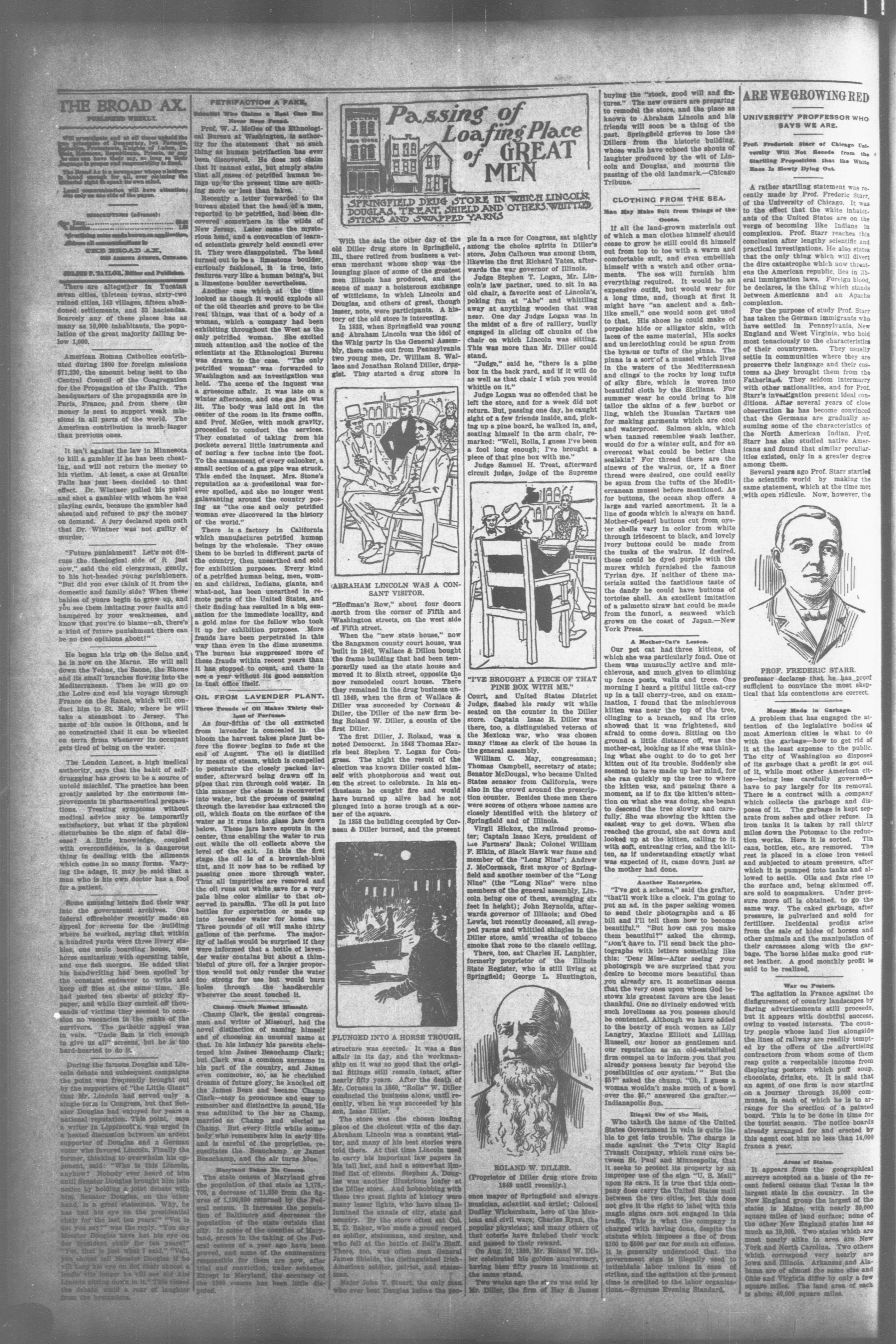
Passing of Loafing Place of GREAT MEN
SPRINGFIELD DRUG STORE IN WHICH LINCOLN DOUGLAS, TREAT, SHIELD AND OTHERS, WHITTLED STICKS AND SWAPPED YARNS
With the sale the other day of the old Diller drug store in Springfield, Ill., there retired from business a veteran merchant whose shop was the lounging place of some of the greatest men Illinois has produced, and the scene of many a boisterous exchange of witticisms, in which Lincoln and Douglas, and others of great, though lesser, note, were participants. A history of the old store is interesting.
In 1838, when Springfield was young and Abraham Lincoln was the idol of the Whig party in the General Assembly, there came out from Pennsylvania two young men, Dr. William S. Wallace and Jonathan Roland Diller, druggist. They started a drug store in
A
ABRAHAM LINCOLN WAS A CONSANT VISITOR. "Hoffman's Row," about four doors north from the corner of Fifth and Washington streets, on the west side of Fifth street.
When the "new state house," now the Sangamon county court house, was built in 1842, Wallace & Dillon bought the frame building that had been temporarily used as the state house and moved it to Sixth street, opposite the now remodeled court house. There they remained in the drug business until 1849, when the firm of Wallace & Diller was succeeded by Corneau & Diller, the Diller of the new firm being Roland W. Diller, a cousin of the first Diller.
The first Diller, J. Roland, was a noted Democrat. In 1848 Thomas Harris beat Stephen T. Logan for Congress. The night the result of the election was known Diller coated himself with phosphorous and went out on the street to celebrate. In his enthusiasm he caught fire and would have burned up alive had he not plunged into a horse trough at a corner of the square. In 1858 the building occupied by Corneau & Diller burned, and the present
```markdown
```
PLUNGED INTO A HORSE TROUGH. structure was erected. It was a fine affair in its day, and the workmanship on it was so good that the original fittings still remain intact, after nearly fifty years. After the death of Mr. Corneau in 1860, "Rolla" W. Diller conducted the business alone, until recently, when he was succeeded by his son, Isaac Diller.
The store was the chosen loafing place of the choicest wits of the day. Abraham Lincoln was a constant visitor, and many of his best stories were told there. At that time Lincoln used to carry his important law papers in his tall hat, and had a somewhat limited list of clients. Stephen A. Douglas was another illustrious loafer at the Diller store. And hobnobbing with these two great lights of history were many lesser lights, who have since illumined the annals of city, state and country. By the store often sat Col. E. D. Baker, who made a proud record as soldier, statesman, and orator, and who fell at the battle of Ball's Bluff. There, too, was often seen General James Shields, the distinguished Irish-American soldier, patriot, and statesman.
Major John T. Stuart, the only man who ever beat Douglas before the poo-
ple in a race for Congress, sat nightly among the choice spirits in Diller's store. John Calhoun was among them, likewise the first Richard Yates, afterwards the war governor of Illinois. Judge Stephen T. Logan, Mr. Lincoln's law partner, used to sit in an old chair, a favorite seat of Lincoln's, poking fun at "Abe" and whittling away at anything wooden that was near. One day Judge Logan was in the midst of a fire of raillery, busily engaged in slicing off chunks of the chair on which Lincoln was sitting. This was more than Mr. Diller could stand.
"Judge," said he, "there is a pine box in the back yard, and if it will do as well as that chair I wish you would whittle on it."
Judge Logan was so offended that he left the store, and for a week did not return. But, passing one day, he caught sight of a few friends inside, and, picking up a pine board, he walked in, and, seating himself in the arm chair, remarked: "Weli, Rolla, I guess I've been a fool long enough; I've brought a piece of that pine box with me."
Judge Samuel H. Treat, afterward circuit judge, judge of the Supreme
A
"IVE BROUGHT A PIECE OF THAT PINE BOX WITH ME."
"IVE BROUGHT A PIECE OF THAT PINE BOX WITH ME." Court, and United States District Judge, flashed his ready wit while seated on the counter in the Diller store. Captain Isaac R. Diller was there, too, a distinguished veteran of the Mexican war, who was chosen many times as clerk of the house in the general assembly.
William C. May, congressman; Thomas Campbell, secretary of state; Senator McDougal, who became United States senator from California, were also in the crowd around the prescription counter. Besides these men there were scores of others whose names are closely identified with the history of Springfield and of Illinois.
Virgil Hickox, the railroad promoter; Captain Isaac Keys, president of the Farmers' Bank; Colonel William F. Elkin, of Black Hawk war fame and member of the "Long Nine"; Andrew J. McCormack, first mayor of Springfield and another member of the "Long Nine" (the "Long Nine" were nine members of the general assembly, Lincoln being one of them, averaging six feet in height); John Reynolds, afterwards governor of Illinois; and Obed Lewis, but recently deceased, all swapped yarns and whittled shingles in the Diller store, amid wreaths of tobacco smoke that rose to the classic ceiling.
There, too, sat Charles H. Lanphier, formerly proprietor of the Illinois State Register, who is still living at Springfield; George L. Huntington.
ROLAND E. SHARP
once mayor of Springfield and always musician, scientist and artist; Colonel Dudley Wickersham, hero of the Mexican and civil wars; Charles Ryan, the popular physician; and many others of that coterie have finished their work and passed to their reward.
On Aug. 10, 1899, Mr. Roland W. Diller celebrated his golden anniversary, having been fifty years in business at the same stand.
Two weeks ago the store was sold by Mr. Diller, the firm of Hay & James
buying the "stock, good will and fixtures." The new owners are preparing to remodel the store, and the place as known to Abraham Lincoln and his friends will soon be a thing of the past. Springfield grieves to lose the Dillers from the historic building, whose walls have echoed the shouts of laughter produced by the wit of Lincoln and Douglas, and mourns the passing of the old landmark.—Chicago Tribune.
CLOTHING FROM THE SEA.
If all the land-grown materials out of which a man clothes himself should cease to grow he still could fit himself out from top to toe with a warm and comfortable suit, and even embellish himself with a watch and other ornaments. The sea will furnish him everything required. It would be an expensive outfit, but would wear for a long time, and, though at first it might have "an ancient and a fish-like smell," one would soon get used to that. His shoes he could make of porpoise hide or alligator skin, with laces of the same material. His socks and underclothing could be spun from the byssus or tufts of the pinna. The pinna is a sort of a mussel which lives in the waters of the Mediterranean and clings to the rocks by long tufts of siky fibre, which is woven into beautiful cloth by the Sicilians. For summer wear he could bring to his tailor the skins of a few burbot or ling, which the Russian Tartars use for making garments which are cool and waterproof. Salmon skin, which when tanned resembles wash leather, would do for a winter suit, and for an overcoat what could be better than sealskin? For thread there are the sinews of the walrus, or, if a finer thread were desired, one could easily be spun from the tufts of the Mediterranean mussel before mentioned. As for buttons, the ocean shop offers a large and varied assortment. It is a line of goods which is always on hand. Mother-of-pearl buttons cut from oyster shells vary in color from white through iridescent to black, and lovely ivory buttons could be made from the tusks of the walrus. If desired, these could be dyed purple with the murex which furnished the famous Tyrian dye. If neither of these materials suited the fastidious taste of the dandy he could have buttons of tortoise shell. An excellent imitation of a palmetto straw hat could be made from the funori, a seaweed which grows on the coast of Japan.—New York Press.
A. Mother-Cat's Lesson
Our pet cat had three kittens, of which she was particularly fond. One or them was unusually active and mischievous, and much given to climbing up fence posts, walls and trees. One morning I heard a pitiful little cat-cry up in a tall cherry-tree, and on examination, I found that the mischievous kitten was near the top of the tree, clinging to a branch, and its cries showed that it was frightened, and afraid to come down. Sitting on the ground a little distance off, was the mother-cat, looking as if she was thinking what she ought to do to get her kitten out of its trouble. Suddenly she seemed to have made up her mind, for she ran quickly up the tree to where the kitten was, and pausing there a moment, as if to fix the kitten's attention on what she was doing, she began to descend the tree slowly and carefully. She was showing the kitten the easiest way to get down. When she reached the ground, she sat down and looked up at the kitten, calling to it with soft, entreating cries, and the kitten, as if understanding exactly what was expected of it, came down just as the mother had done.
Another Enterprise.
"I've got a scheme," said the grafter, "that'll work like a clock. I'm going to put an ad. in the paper asking women to send their photographs and a $5 bill and I'll tell them how to become beautiful." "But how can you make them beautiful?" asked the chump. "Don't have to. I'll send back the photographs with letters something like this: 'Dear Miss—After seeing your photograph we are surprised that you desire to become more beautiful than you already are. It sometimes seems that the very ones upon whom God bestows his greatest favors are the least thankful. One so divinely endowed with such loveliness as you possess should be contented. Although we have added to the beauty of such women as Lily Langtry, Maxine Elliott and Lillian Russell, our honor as gentlemen and our reputation as an old-established firm compel us to inform you that you already possess beauty far beyond the possibilities of our system.'" But the $5?" asked the chump. "Oh, I guess a woman wouldn't make much of a howl over the $5," answered the grafter.—Indianapolis Sun.
Illegal Use of the Mall. Who taketh the name of the United States Government in vain is quite liable to get into trouble. The charge is made against the Twin City Rapid Transit Company, which runs cars between St. Paul and Minneapolis, that it seeks to protect its property by an improper use of the sign "U. S. Mail" upon its cars. It is true that this company does carry the United States mail between the two cities, but this does not give it the right to label with this magic signs cars not engaged in this traffic. This is what the company is charged with having done, despite the statute which imposes a fine of from $100 to $500 per car for such an offense. It is generally understood that the government sign is illegally used to intimidate labor unions in case of strikes, and the agitation at the present time is credited to the labor organizations.—Syracuse Evening Standard.
ARE WEGROWING RED
UNIVERSITY PROFFESSOR WHO SAYS WE ARE.
Prof. Frederick Starr of Chicago University Will Not Recede from the Startling Proposition that the White Race Is Slowly Dyling Out.
A rather startling statement was recently made by Prof. Frederic Starr, of the University of Chicago. It was to the effect that the white inhabitants of the United States are on the verge of becoming like Indians in complexion. Prof. Starr reaches this conclusion after lengthy scientific and practical investigations. He also states that the only thing which will divert the dire catastrophe which now threatens the American republic, lies in liberal immigration laws. Foreign blood, he declares, is the thing which stands between Americans and an Apache complexion.
For the purpose of study Prof. Starr has taken the German immigrants who have settled in Pennsylvania, New England and West Virginia, who hold most tenaciously to the characteristics of their countrymen. They usually settle in communities where they are preserve their language and their customs as they brought them from the Fatherland. They seldom intermarry with other nationalities, and for Prof. Starr's investigation present ideal conditions. After several years of close observation he has become convinced that the Germans are gradually assuming some of the characteristics of the North American Indian. Prof. Starr has also studied native Americans and found that similar peculiarities existed, only in a greater degree among them.
Several years ago Prof. Starr startled the scientific world by making the same statement, which at the time met with open ridicule. Now, however, the
J.
PROF. FREDERIC STARR.
professor declares that he has proof sufficient to convince the most skeptical that his contentions are correct.
professor declares that he has proof sufficient to convince the most skeptical that his contentions are correct.
Money Made in Garbage.
A problem that has engaged the attention of the legislative bodies of most American cities is what to do with the garbage—how to get rid of it at the least expense to the public. The city of Washington so disposes of its garbage that a profit is got out of it, while most other American cities—being less carefully governed—have to pay largely for its removal. There is a contract with a company which collects the garbage and disposes of it. The garbage is kept separate from ashes and other refuse. In iron tanks it is taken by rail thirty miles down the Potomac to the reduction works. Here it is sorted. Tin cans, bottles, etc., are removed. The rest is placed in a close iron vessel and subjected to steam pressure, after which it is pumped into tanks and allowed to settle. Oils and fats rise to the surface and, being skimmed off, are sold to soapmakers. Under pressure more oil is obtained, to go the same way. The caked garbage, after pressure, is pulverized and sold for fertilizer. Incidental profits arise from the sale of hides of horses and other animals and the manipulation of their carcasses along with the garbage. The horse hides make good russet leather. A good monthly profit is said to be realized.
War on Posterx.
The agitation in France against the disfigurement of country landscapes by flaring advertisements still proceeds, but it appears with doubtful success, owing to vested interests. The country people whose land lies alongside the lines of railway are readily tempted by the offers of the advertising contractors from whom some of them reap quite a respectable income from displaying posters which puff soup, chocolate, drinks, etc. It is said that an agent of one firm is now starting on a journey through 36,000 communes, in each of which he is to arrange for the erection of a painted board. This is to be done in time for the tourist season. The notice boards already arranged for and erected by this agent cost him no less than 14,000 francs a year.
Areas of States.
It appears from the geographical surveys accepted as a basis of the recent federal census that Texas is the largest state in the country. In the New England group the largest of the states is Maine, with nearly 30,000 square miles of land surface; none of the other New England states has as much as 10,000. Two states which are most nearly alike in area are New York and North Carolina. Two others which correspond very nearly are Iowa and Illinois. Arkansas and Alabama are of almost the same size and Ohio and Virginia differ by only a few square miles. The land area of each is about 40,000 square miles.
SPENT IN SECLUSION OF MEXICAN MOUNTAINS.
Came a California Millionaire and His Beautiful Wife, Who Figured in a Generational Happening a Few Years Ago.
(Special Letter.)
The newspapers of a few days ago told of the reutrn to Los Angeles of John Bradbury, a prominent California millionaire, and his beautiful wife after an absence of four years far up in the Sinaloa mountains of Mexico, cut off entirely from the gay world in which they were wont to move. The return of the parties mentioned to the home from which they voluntarily exiled themselves recalls a chapter in the life of Mrs. Bradbury that caused her name to be mentioned far and wide. This incident cost a human, life wrecked several reputations, destroyed much happiness and drove John Bradbury, who was one of the most lighthearted of all the young men of Los Angeles, into the deep seclusion of the Mexican hills. The story is one of a spiritfully foolish infatuation, which led
A World of Woe.
John Bradbury was one of the heirs to a great fortune which his father had taken from the Tajo mine, an enormous blanket vein of gold and silver, near Rosario, on the Gulf of Mexico. He and Lucy Banning were children together in Los Angeles. Her father was Gen. Phineas Banning, owner of the island of Santa Catalina and a man of great wealth, and she was one of the most beautiful girls in all California. The two grew up together and the attachment one felt for the other grew into love. One day several years ago they quietly left Los Angeles and stole away to Oakland, California's Gretna Green, and were there married. There was no reason for the elopement, as both of their parents were in every way pleased with the match, but it suited their romantic natures. They returned to Los Angeles in due time, set up a cozy home on one of the hills, purchased an ideal country home among the orange groves at Duarte and to all ap-
A.
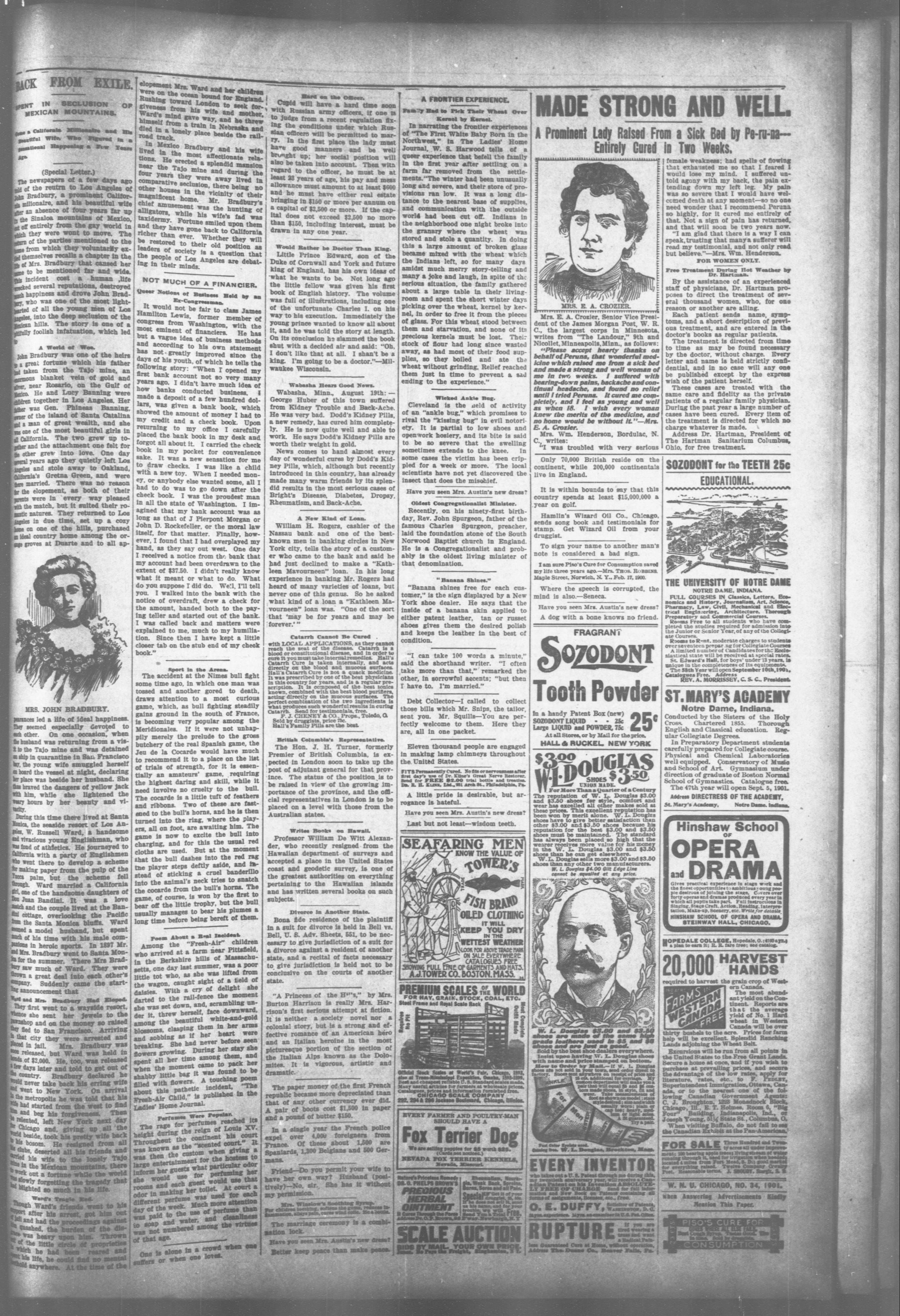
MRS. JOHN BRADBURY. peirances led a life of ideal happiness. They seemed especially devoted to each other. On one occasion, when the husband was returning from a visit to the Tajo mine and was detained on ship in quarantine in San Francisco bay, the young wife smuggled herself on board the vessel at night, declaring her place was beside her husband. She thus braved the dangers of yellow jack with him, while she lightened the very hours by her beauty and vitality.
During this time there lived at Santa Monica, the seaside resort of Los Angeles, W. Russell Ward, a handsome and vivacious young Englishman, who was fond of athletics. He journeyed to California with a party of Englishmen who went there to develop a scheme for making paper from the pulp of the Yucca palm, but the scheme fell through. Ward married a California girl, one of the handsome daughters of Don Juan Bandini. It was a love match and the couple lived at the Bandini cottage, overlooking the Pacific from the Santa Monica bluffs. Ward seemed a model husband, but spent much of his time with his male companions in heroic sports. In 1897 Mr. and Mrs. Bradbury went to Santa Monica for the summer. There Mrs Bradbury saw much of Ward. They were thrown a great deal into each other's company. Suddenly came the startling announcement that
Word and Mrs. Bradbury Had Eloped. They first went to a wayside resort, whence she sent her jewels to the dawnshop and on the money so raised they fled to San Francisco. Arriving in that city they were arrested and placed in jail. Mrs. Bradbury was soon released, but Ward was held in bonds of $2,000. He, too, was released a few days later and told to get out of the country. Bradbury declared he would never take back his erring wife and went to New York. On arrival in the metropolis he was told that his wife had started from the west to find him and beg his forgiveness. Then he relented, left New York next day for Chicago and, giving up all the world beside, took his pretty wife back to his bosom. He resigned from all his clubs, deserted all his friends and carried his wife to the lonely Tajo mine in the Mexican mountains, there to work out a fortune while the world was slowly forgetting the tragedy that had blighted so much in his life.
Ward's Tragic Mad. Though Ward's friends went to his support after his arrest, got him out of jail and had the proceedings against him quashed, the burden of the disease was heavy upon him. Thrown out of the little circle of proprieties in which he had been reared and spent his life, he could find no mental hold anywhere. At the time of the
elopement Mrs. Ward and her children were on the ocean bound for England. Rushing toward London to seek forgiveness from his wife and mother, Ward's mind gave way, and he threw himself from a train in Nebraska and died in a lonely place beside the railroad track.
In Mexico Bradbury and his wife lived in the most affectionate relations. He erected a splendid mansion near the Tajo mine and during the four years they were away lived in comparative seclusion, there being no other houses in the vicinity of their magnificent home. Mr. Bradbury's chief amusement was the hunting of alligators, while his wife's fad was taxidermy. Fortune smiled upon them and they have gone back to California richer than ever. Whether they will be restored to their old position as leaders of society is a question that the people of Los Angeles are debating in their minds.
NOT MUCH OF A FINANCIER.
Queer Notions of Business Held by an Ex-Congressman
It would not be fair to class James Hamilton Lewis, former member of congress from Washington, with the most eminent of financiers. He has but a vague idea of business methods and according to his own statement has not greatly improved since the days of his youth, of which he tells the following story: "When I opened my first bank account not so very many years ago. I didn't have much idea of how banks conducted business. I made a deposit of a few hundred dollars, was given a bank book, which showed the amount of money I had to my credit and a check book. Upon returning to my office I carefully placed the bank book in my desk and forgot all about it. I carried the check book in my pocket for convenience sake. It was a new sensation for me to draw checks. I was like a child with a new toy. When I needed money, or anybody else wanted some, all I had to do was to go down after the check book. I was the proudest man in all the state of Washington. I imagined that my bank account was as long as that of J Pierpont Morgan or John D. Rockefeller, or the moral law itself, for that matter. Finally, however, I found that I had overplayed my hand, as they say out west. One day I received a notice from the bank that my account had been overdrawn to the extent of $37.50. I didn't really know what it meant or what to do. What do you suppose I did do. We'll, I'll tell you. I walked into the bank with the notice of overdraft, drew a check for the amount, handed both to the paying teller and started out of the bank. I was called back and matters were explained to me, much to my humiliation. Since then I have kept a little closer tab on the stub end of my check book."
The accident at the Nimes bull fight some time ago, in which one man was tossed and another gored to death, draws attention to a most curious game, which, as bull fighting steadily gains ground in the south of France, is becoming very popular among the Meridionales. If it were not unhappily merely the prelude to the gross butchery of the real Spanish game, the Jeu de la Cocarde would have much to recommend it to a place on the list of trials of strength, for it is essentially an amateurs' game, requiring the highest daring and skill, while it need involve no cruelty to the bull. The cocarde is a little tuft of feathers and ribbons. Two of these are fastened to the bull's horns, and he is then turned into the ring, where the players, all on foot, are awaiting him. The game is now to excite the bull into charging, and for this the usual red cloths are used. But at the moment that the bull dashes into the red rag the player steps deftly aside, and instead of sticking a cruel banderillo into the animal's neck tries to snatch the cocarde from the bull's horns. The game, of course, is won by the first to bear off the little trophy, but the bull usually manages to bear his plumes a long time before being bereft of them.
Know About a Real Incident.
Among the "Fresh-Air" children who arrived at a farm near Pittsfield, in the Berkshire hills of Massachusetts, one day last summer, was a poor little tot who, as she was lifted from the wagon, caught sight of a field of daisies. With a cry of delight she darted to the rail-fence the moment she was set down, and, scrambling under it, threw herself, face downward, among the beautiful white-and-gold blossoms, clasping them in her arms and sobbing as if her heart were breaking. She had never before seen flowers growing. During her stay she spent all her time among them, and when the moment came to pack her shabby little bag it was found to be filled with flowers. A touching poem about this pathetic incident, "The Fresh-Air Child," is published in the Ladies' Home Journal.
Perfumes Were Popular. The rage for perfumes reached its height during the reign of Louis XV. Throughout the continent his court was known as the "scented court." It was then the custom when giving a large entertainment for the hostess to inform her guests what particular odor she would use for perfuming her rooms and each guest would use that odor in making her toilet. At court a different perfume was used for each day of the week. Much more attention was paid to the use of perfume than to soap and water, and cleanliness was not numbered among the virtues of that age.
One is alone in a crowd when one suffers or when one loves.
Cupid will have a hard time soon with Russian army officers, if one is to judge from a recent regulation fixing the conditions under which Russian officers will be permitted to marry. In the first place the lady must have good manners and be well brought up; her social position will also be taken into account. Then with regard to the officer, he must be at least 23 years of age, his pay and mess allowance must amount to at least $600 and he must have either real estate bringing in $150 or more per annum on a capital of $2,500 or more. If the capital does not exceed $2,500 no more than $150, including interest, must be drawn in any one year.
Would Rather be Doctor Than King. Little Prince Edward, son of the Duke of Cornwall and York and future king of England, has his own ideas of what he wants to be. Not long ago the little fellow was given his first book of English history. The volume was full of illustrations, including one of the unfortunate Charles I. on his way to his execution. Immediately the young prince wanted to know all about it, and he was told the story at length. On its conclusion he slammed the book shut with a decided air and said: "Oh, I don't like that at all. I shan't be a king. I'm going to be a doctor."—Milwaukee Wisconsin.
Wabasha Hears Good News
Wabasha, Minn., August 19th: George Huber of this town suffered from Kidney Trouble and Back-Ache. He was very bad. Dodd's Kidney Pills, a new remedy, has cured him completely. He is now quite well and able to work. He says Dodd's Kidney Pills are worth their weight in gold. News comes to hand almost every day of wonderful cures by Dodd's Kidney Pills, which, although but recently introduced in this country, has already made many warm friends by its splendid results in the most serious cases of Bright's Disease, Diabetes, Dropsy, Rheumatism, and Back-Ache.
A New Kind of Loan.
William H. Rogers, cashier of the Nassau bank and one of the bestknown men in banking circles in New York city, tells the story of a customer who came to the bank and said he had just declined to make a "Kathleen Mavourneen" loan. In his long experience in banking Mr. Rogers had heard of many varieties of loans, but never one of this genus. So he asked what kind of a loan a "Kathleen Mavourneen" loan was. "One of the sort that 'may be for years and may be forever.'"
Catarrh Cannot Be Cured
with LOCAL APPLICATIONS, as they cannot reach the seat of the disease. Catarrch is a blood or constitutional disease, and in order to cure it you must take internal remedies. Hall's Catarrch Cure is taken internally, and acts directly on the blood and mucous surfaces. Hall's Catarrch Cure is not a quack medicine. It was prescribed by one of the best physicians in this country for years, and is a regular prescription. It is composed of the best tonics known, combined with the best blood purifiers, acting directly on the mucous surfaces. The perfect combination of the two ingredients is what produces such wonderful results in curing Catarrch. Send for testimonials, free.
F. J. CHENEY & CO. Props., Toledo, O. Sold by druggists, price 75c. Hall's Family Pills are the best.
British Columbia's Representative.
The Hon. J. H. Turner, formerly Premier of British Columbia, is expected in London soon to take up the post of adjutant general for that province. The status of the position is to be raised in view of the growing importance of the province, and the official representatives in London is to be placed on a level with those from the Australian states.
Writes Books on Hawaii
Professor William De Witt Alexander, who recently resigned from the Hawaiian department of surveys and accepted a place in the United States coast and geodetic survey, is one of the greatest authorities on everything pertaining to the Hawaiian islands and has written several books on such subjects.
Divorce In Another State
Bona fide residence of the plaintiff in a suit for divorce is held in Bell vs. Bell, U. S. Adv. Sheets, 551, to be necessary to give jurisdiction of a suit for a divorce against a resident of another state, and a recital of facts necessary to give jurisdiction is held not to be conclusive on the courts of another state.
"A Princess of the H41's," by Mrs. Burton Harrison is really Mrs. Harrison's first serious attempt at fiction. It is neither a society novel nor a colonial story, but is a strong and effective romance of an American hero and an Italian heroine in the most picturesque portion of the section of the Italian Alps known as the Dolomites. It is vigorous, artistic and dramatic.
The paper money of the first French republic became more depreciated than that of any other currency ever did. A pair of boots cost $1,500 in paper and a pound of butter $150.
In a single year the French police expel over 4,000 foreigners from France. Of these about 1,500 are Spaniards, 1,300 Belgians and 500 Germans.
Friend—Do you permit your wife to have her own way? Husband (positively)—No, sir. She has it without my permission.
Mrs. Winslow's Soothing Syrup.
For children soothing, softens the gums, reduces inflammation, allays pain, cures wind colds. See a bottle.
The marriage ceremony is a combination lock.
Have you seen Mrs. Austin's new dress?
Better keep peace than make peace.
A FRONTIER EXPERIENCE.
Family Had to Pick Their Wheat Over Kernel by Kernel
In narrating the frontier experiences of "The First White Baby Born in the Northwest," in The Ladies' Home Journal, W. S. Harwood tells of a queer experience that befell the family in the first year after settling on a farm far removed from the settlements. "The winter had been unusually long and severe, and their store of provisions ran low. It was a long distance to the nearest base of supplies, and communication with the outside world had been cut off. Indians in the neighborhood one night broke into the granary where the wheat was stored and stole a quantity. In doing this a large amount of broken glass became mixed with the wheat which the Indians left, so for many days amidst much merry story-telling and many a joke and laugh, in spite of the serious situation, the family gathered about a large table in their living-room and spent the short winter days picking over the wheat, kernel by kernel, in order to free it from the pieces of glass. For this wheat stood between them and starvation, and none of its precious kernels must be lost. Their stock of flour had long since wasted away, as had most of their food supplies, so they boiled and ate the wheat without grinding. Relief reached them just in time to prevent a sad ending to the experience."
Wicked Ankle Bug.
Cleveland is the field of activity of an "ankle bug," which promises to rival the "kissing bug" in evil notoriety. It is partial to low shoes and openwork hosiery, and its bite is said to be so severe that the swelling sometimes extends to the knee. In some cases the victim has been crippled for a week or more. The local scientists have not yet discovered the insect that does the misoblef.
Have you seen Mrs. Austin's new dress?
Oldest Congregationalist Minister. Recently, on his ninety-first birthday, Rev. John Spurgeon, father of the famous Charles Spurgeon, preacher, laid the foundation stone of the South Norwood Baptist church in England. He is a Congregationalist and probably is the oldest living minister of that denomination.
"Banana Shlines."
"Banana shines free for each customer," is the sign displayed by a New York shoe dealer. He says that the inside of a banana skin applied to either patent leather, tan or russet shoes gives them the desired polish and keeps the leather in the best of condition.
"I can take 100 words a minute," said the shorthand writer. "I often take more than that," remarked the other, in sorrowful accents; "but then I have to. I'm married."
Debt Collector—I called to collect those bills which Mr. Snips, the tailor, sent you. Mr. Squills—You are perfectly welcome to them. Here they are, all in one packet.
Eleven thousand people are engaged in making lamp chimneys throughout the United States.
FITS Permanently Cured. No fits or nervousness after first day's use of Dr. Kline's Great Nerve Restorer. Send for FREE $2.00 trial bottle and treatise. Dr. R. H. KLINE, Ltd., 201 Arch St., Philadelphia, Pa.
A little pride is desirable, but arrogance is hateful.
Have you seen Mrs. Austin's new dress?
Last but not least—wisdom teeth.
SEAFARING MEN
KNOW THE VALUE OF
TOWER'S
TRAD
FISH BRAND
OILED CLOTHING
IT WILL
KEEP YOU DRY
IN THE
WETTEST WEATHER
LOOK FOR ABOVE TRADE MARK
ON SALE EVERYWHERE
CATALOGUES FREE
SHOWING FULL LINE OF GARMENTS AND HATS.
A.J.TOWER CO., BOSTON, MASS.
PREMIUM SCALES OF THE WORLD
FOR HAY, GRAIN, STOCK, COAL, ETC.
Steel Frame and Royal Scale Rack
Requires
No Pit
Most Complete
Outfit Made
Official Stock Scales at World's Fair, Chicago, 1892,
also at Trans-Mississippi Exposition, Omaha, 1898-1899.
Best and cheapest reliable U.S. Standard scales made.
Many useful articles for farmers at wholesale prices.
Catalogues, prices and information furnished free.
CHICAGO SCALE COMPANY
EVERY FARMER AND POULTRY-MAN SHOULD HAVE A Fox Terrier Dog
We are selling puppies for $5 worth $25.
(Cards not noticed.)
NEVADA FOX TERRIER KENNELS,
Nevada, Missouri.
Nature's Priceless Remedy
DR. O. PHELPS BROWN'S
PRECIOUS
HERBAL
OINTMENT
It Cures Through the Forces
Address Dr. O. P. Brown, 96 E. Way, Newburgh, N. Y.
RhenniaNam, Nourrania, Weak Back, Sprains, Burns, Sorex and all Pain.
Special! Get it of your draggles, M. Me.
If he does not sell it, send his name, and for your trouble, we will Send You a Trial Free.
SCALE AUCTION
BIDD BY MAIL. YOUR OWN PRICE.
MADE STRONG AND WELL. A Prominent Lady Raised From a Sick Bed by Pe-ru-na---- Entirely Cured in Two Weeks.
MRS. E. A. CROZIER.
Mrs. E. A. Crozier, Senior Vice President of the James Morgan Post, W. R. C., the largest corps in Minnesota, writes from "The Landour," 9th and Nicollet, Minneapolis, Minn., as follows: "Please accept hearty thanks on behalf of Peruna, that wonderful medicine which raised me from a sick bed and made a strong and well woman of me in two weeks. I suffered with bearing-down pains, backache and continual headache, and found no relief until I tried Peruna. It cured me completely, and I feel as young and well as when 18. I wish every woman knew the merits of the medicine, and no home would be without it."—Mrs. E. A. Crozier.
Mrs. Wm. Henderson, Bordulac, N.
C. writes:
I was troubled with very serious
Only 70,000 British reside on the continent, while 200,000 continentals live in England.
It is within bounds to say that this country spends at least $15,000,000 a year on golf.
Hamlin's Wizard Oil Co., Chicago, sends song book and testimonials for stamp. Get Wizard Oil from your druggist.
To sign your name to another man's note is considered a bad sign.
I am sure Piso's Cure for Consumption saved my life three years ago.—Mrs. THOS. ROBBINS. Maple Street, Norwich, N. Y.. Feb. 17, 1900.
Where the speech is corrupted, the mind is also.—Seneca.
Have you seen Mrs. Austin's new dress?
A dog with a bone knows no friend.
In a handy Patent Box (new)
SOZODONT LIQUID 25c
Large LIQUID and POWDER, 75c
At all Stores, or by Mail for the price.
HALL & RUCKEL NEW YORK
$3.00
W.L.DOUGLAS
SHOES $3.50
UNION MADE.
For More Than a Quarter of a Century
The reputation of W. L. Douglas $3.00
and $3.50 shoes for style, comfort and
wear has excelled all other makes sold at
these prices. This excellent reputation has
been won by merit alone. W. L. Douglas
shoes have to give better satisfaction than
other $3.00 and $3.50 shoes because his
reputation for the best $3.00 and $3.50
shoes must be maintained. The standard
has always been placed so high that the
wearer receives more value for his money
in the W. L. Douglas $3.00 and $3.50
shoes than he can get elsewhere.
W. L. Douglas sells more $3.00 and $3.50
shoes than any other two manufacturers.
W. L. Douglas $4.00 Gilt Edge Line
and accessories
W. L. Douglas $3.00 and $3.50 whose are made of the same high grade louthe used in $5 and $8
shoes are not sold in your town, and order direct to factory. Shoes sent anywhere on receipt of price and 25 cnt. additional for earring. My custom department will make you a pair that will equal $20 and $30 custom-made shoes in style and suit wear. Take measurements of foot as shown on model; state style desired; size and width usually worn; plain or cap toe; heavy, medium or light sole. A 25 cnt. gift. Try a pair.
Faint Color Eyelids used.
duplex bro. W. L. Douglas, Brockton, Mass.
female weakness; had spells of flowing that exhausted me so that I feared I would lose my mind. I suffered untold agony with my back, the pain extending down my left leg. My pain was so severe that I would have welcomed death at any moment—so no one need wonder that I recommend Peruna so highly, for it cured me entirely of that. Not a sign of pain has returned, and that will soon be two years now. "I am glad that there is a way I can speak, trusting that manya sufferer will read my testimonial, and not only read but believe."—Mrs. Wm. Henderson.
FOR WOMEN ONLY.
Free Treatment During Hot Weather by Dr. Hartman.
By the assistance of an experienced staff of physicians, Dr. Hartman proposes to direct the treatment of several thousand women, who, for one reason or another are ailing.
Each patient sends name, symptoms, and a short description of previous treatment, and are entered in the doctor's books as regular patients.
The treatment is directed from time to time as may be found necessary by the doctor, without charge. Every letter and name is held strictly confidential, and in no case will any one be published except by the express wish of the patient herself.
These cases are treated with the same care and fidelity as the private patients of a regular family physician. During the past year a large number of cases have been cured. Every item of the treatment is directed for which no charge whatever is made. Address Dr. Hartman, President of The Hartman Sanitarium Columbus Ohio, for free treatment.
SOZODONT for the TEETH 25c
A
THE UNIVERSITY OF NOTRE DAME
FULL COURSES IN Classics, Letters, Economics and History, Journalism, Art, Science, Pharmacy, Law, Civil, Mechanical and Electrical Engineering, Architecture. Thorough Preparatory and Commercial Courses.
Rooms Free to all students who have completed the studies required for admission into the Junior or Senior Year, of any of the Collegiate Courses.
Rooms to Rent, moderate charges to students over seventeen preparing for Collegiate Courses
A limited number of Candidates for the Ecole-siastical state will be received at special rates.
St. Edward's Hall, for boys' under 13 years, is unique in the completeness of its equipments.
The 58th Year will open September 10th, 190).
Catalogues Free. Address
REV. A. MORRISSEY, C. S. C., President.
ST.MARY'S ACADEMY
Notre Dame, Indiana.
Conducted by the Sisters of the Holy Cross. Chartered 1855. Thorough English and Classical education. Regular Collegiate Degrees.
In Preparatory Department students carefully prepared for Collegiate course. Physical and Chemical Laboratories well equipped. Conservatory of Music and School of Art. Gymnasium under direction of graduate of Boston Normal School of Gymnastics. Catalogue free.
The 47th year will open Sept. 5, 1901.
Address DIRECTRESS OF THE ACADEMY,
St. Mary's Academy,
Notre Dame, Indiana.
Hinshaw School OF OPERA and DRAMA Gives practical experience in stage work and the finest opportunities to ambitious young people desirous of joining the stage. Covers over forty operas and dramas produced every year in which all pupils take part. Full instructions in Singing, Stage Craft, Action, Reading, Interpretation, Make-up, Scenery, etc. Write for details HINSHAW SCHOOL OF OPERA AND DRAMA STEINWAY HALL, CHICAGO.
OPEDALE COLLEGE, Hopedale, O, 1450 syzs
a plan to earn it; R. f.r. fare free; see catalog.
20.000 HARVEST HANDS
required to harvest the grain crop of West
ern Canada.
WESTERN CANADA
The most abundant yield on the Continent. Reports are that the average yield of No.1 Hard wheat in Western Canada will be over
thirty bushels to the acre. Prices for farm help will be excellent. Splendid Ranching Lands adjoining the Wheat Belt.
Excursions will be run from all points in the United States to the Free Grant Lands. Secure a home at once, and if you wish to purchase at prevailing prices, and secure the advantage of the low rates, apply for literature, rates, etc., to F. PEDLBY, Superintendent Immigration, Ottawa, Canada, or to the nearest one of the following Canadian Government Agents: C. J. Broughton, 1923 Monadnock Block, Chicago, Ill., E. T. Holmes, Room 6, "Big Four" Building, Indianapolis, Ind., or Joseph Young, 511 State St., Columbus, O. When visiting Buffalo, do not fail to see
FOR SALE Three Hundred and Twenty acres all under improvement; 100 bearing apple trees; living stream of water running through it, need for irrigation when needed; located 4 miles from Fort Mead, S. D.; good market for everything raised. Twelve Company Coventry Fort. Reasonable terms. J. SHROUD, S. S.
When Answering Advertisements Kindly
Mention This Paper.
PISO'S CURE FOR
GIVEN WHEN ALL THE FAILLS
Best Cough Syrup. Thanus Good. Use
in time. Sold by drupeits.
CONSUMPTION
Leve and the Lew.
BY F. H. LANCASTER. (Copyright, 1901, by Daily Story Pub. Co.) For the twentieth time that afternoon, Tom Hamilton snapped his watch and returned it to his pocket. He was not interested in the passage of time—that pile of copying must be finished whether it took him until midnight; but these brief intermissions gave him an opportunity to look at a shy thought that had haunted him since daylight. And the offender he looked at it the better he liked it. In the morning, it is true, he had laughed at it; during the forenoon shrugged his shoulders impatiently; but in the afternoon—he took out his watch and stared at the dial.
That a man of his staid, prosalic make up should have dreamed at all, was absurd; but that the dream should have upset all his waking thoughts and come between his attention and his business affairs was worse than absurd—it was serious.
And wha. was the dream? Only a waste of wild white waters, storm-swept but glorious. In the foreground a towering wave curving inward, grandly crested, an ogre of the sea. And he upon the cliff dashed with spray and beaten by the wind. A delicious dream for a hot summer night; small wonder that he liked to recall it again and again through the stiffling day.
Hamlin snapped the watch for the twenty-first time and took up his pen. "Dash this weather."
If his typewriter had been on hand, he would have knocked off work long ago. He would have been driving in the park enjoying the breeze instead of sweltering here. He paused to pass his damp handkerchief over his beaded brow and glanced at the vacant chair. "Sick," he muttered. "Good Lord. Sick such weather as this!"
Almost as he spoke the door opened and a woman in gray linen with emaculate collar and cuffs and lean jaws moved quietly toward the seat opposite.
Hamlin raised his head and greeted her with his customary bow. She returned the salutation silently, as she always did, and sat down to the typewriter. It struck Hamlin that her eyes and jaws looked more tired and lean than usual, but this was natural since she had been ill.
With the silence that always reigned between them, unless broken by an imperative necessity, he shoved the batch of copying across to her and leaned back. What a good thing it was to be able to pay somebody else to do one's drudgery. The thought brought a qualm of conscience. She was not well and it was so dashed hot.
"Shove me those mortgages, a pen copy will do."
"I intend to work after hours to make up for lost time. I will be able to finish it all," the typewriter responded quietly.
Tom Hamlin got up impatiently and began moving about. He had a sneaking sensation of being somewhat in awe of this silent, absolutely upright assistant. It was after office hours and he was free to enjoy the drive he had been longing for. She had a key. But Hamlin lounged against the window idly watching the swift fingers flashing over the keys and fell to reviewing his dream again. So vivid had it been that even now he could almost feel the dashing of the spray. As for that other sensation—that slight pressure against his sleeve, it had been with him ever since he awoke. Oh, well dreams are fantastic things. Hamlin looked for a long moment at the clear-cut profile turned toward him and then abruptly took down a book. Were her eyes always like that, he wondered, tired as though she had looked upon death and the dreariness of it? Was it over-work or some-
Charming woman in a polka-dot dress sits at a desk, reading a book.
thing worse than work? If she should look in reality upon that glorious bit of wild waters, would that jaded light paas or would it deepen? Dash it all, why couldn't he have dreamed a moment longer."
"Excuse me. Is this correct?"
Hamlin's quick glance met the tired eyes then dropped to paper on which her pencil rested. There in his hold, reckless hand her name smiled up at him provokingly. He caught the pencil from her and made a hurried correction while a dark flush warmed his brow. He detested a mistake.
The conscious clicking began again and Hamil read on as though his life depended upon the contents of the book. Had he done that fool thing more than once? As fate would have it, scarcely ten minutes passed before another sheet was at his elbow and an inquiring pencil point rested exasperatingly impassive upon. This
time Hamlin made the correction with dignity and added with a desperate amile:
"Please pass me the rest of those sheets, I seem to be determined to mortgage all you possess."
From time to time his pencil descended with a vicious dash and the dark red on his brow deepened. At fast, when he felt cooler, he shoved the sheets across to her and glanced carelessly at the thin face bent over the machine. A moment later he was standing in the hall waiting impatiently for his order.
"I wonder if she would die rather than admit to me that she was a human being. This heat is killing her and yet the only way to make her rest would be to take her by the shoulders and put her out of the office." Then his order came and he went back to her. She was still rather white about the mouth.
"Won't you try some?" he asked placing a dewy glass at her elbow.
"Thank you."
A
"It is indeed," she assented rather absently.
Hamlin tried hard to think of something else. Her tea was vanishing with a speed that bespoke more than natural thirst.
"Like as not she has had fever on her all the afternoon," he reflected.
"I had a pleasant dream last night," he remarked as she put aside her glass.
"Yes?" she returned politely.
"Yes?" she returned politely.
"Dreamt we were standing on a cliff watching a storm at sea, the spray, and afi that. It was delicious. We were standing together."
"A strange dream for such a warm night," the typewriter remarked evidently oblivious of his last words and his ensuing consternation.
He got up and moved away to bow a blind and resume his restless walk. What the dickens had he been thinking about all this time! What an impossible position it was anyway. In real life when a man puts his arm around a woman she can't lean her cheek against his sleeve. But his arm had not been around her. His hands were in his pockets. It was as though she had come to him like a tired child, certain of support. Why had he waked before he could look into her eyes? Common sense jarred him; there was not much of the tired child in that alert figure with its weary eyes and preoccupied smile, but he set it impatiently aside. Great Ned! What had he been thinking of for the last two years! Why, there were times when he had barely been civil. And now—now it might be too late.
"See here, I can't get that idea of the sea out of my head. Let's knock off work and make a dash for fresh air. I can have my horse around in a moment. It's only ten or fifteen miles."
"Why, it would kill the horse," the typewriter ejaculated, struck aghast at the idea of taking a pampered animal on such an expedition with the thermometer at one hundred in the shade.
"Oh, no;" Hamlin insisted. "It is getting cooler. We could take it easy going out, watch the sun set in the water and drive back by twilight. Doesn't it sound pleasant?"
"Does that mean you will go?"
"No, thank you. I had better finish this work."
"Oh, hang the work," he exclaimed impatiently. "Haven't I devoted myself to work body and soul, for the last thirty years. Am I to have nothing in this world but grind and grime."
Hamlin thrust his hands into his pocket and clenched them slowly. "I had meant to wait," he began abruptly, "to make myself wait until I could see you in some proper place—or write, but it is no use now. We were together, you were leaning against me. If I could realize that dream I would be the happiest—"
"But I can't," he returned. "Don't you know that love holds a power of attorney over all a man's actions? If you had gone with me I meant to wait, the beach would have been better than this dusty litter of law. I suppose you understood—you couldn't care—"
The woman with the tired eyes moved impulsively; for an instant her chuck rested curressingly against the loose linen sleeve of his office coat then she started up and went quickly to the door.
"Just one moment," Hamlin pleaded, folding his arms and standing determinedly where she had left him. "Please dear. I'll bring the horse around?"
The typewriter turned at the open door. "Walt," she agreed hurriedly.
Hamlin's heart broke into glad song. The eyes he loved were no longer tired.
RENFROE BROS.
Dealers in
WOOD, COAL, FEED AND ICE.
137 West Forty-Seventh St.
CHICAGO.
DR. H. C. FAULKNER,
Physician and Surgeon,
OFFICE: 6258 HALSTED STREET,
CHICAGO.
Office Hours: Phone 818 Went
10 to 12 a. m., 2 to 4 p. m
6 to 7:30 p. m.
TELPHONE EXPRESS 473
DR. L. M. FENWICK.
(A. M., M. D., E. M.)
PHYSICIAN AND SURGEON.
6212 S. Halsted St., 2nd Floor.
HOURS: 8 to 10 a. m., 12 to 2 p. m., 7 to 8 p. m.
Sunday, by appointment.
Tel. Wentworth 627. CHICAGO, ILL.
Estimates and Specifi-
cations Purnished . . . Prompt Attention
Given to Jobbing
C. J. BOYD,
Practical Plumber and Gas fitter
Steam and Hot Water Heating,
Iron and Tile Drainage . . . .
Telephone Yards 814.
709 WEST 47TH STREET.
THAMPORE 813 YARDS.
DR. JOSEPH JEFFREY,
Physician and Surgeon,
48g8 Dearborn Street. CHICAGO.
Houge: 8-10 a. m., 3-4, 6-8 p. m.
General Expressing and Moving.
5001 ARMOUR AVE. CHICAGO, ILL
Any person who takes the paper regularly from the postoffice, whether he is a subscriber or not, is responsible for the pay. The courts have decided that refusing to take newspapers and periodicals from the postoffice, or removing and leaving them uncalled for is prima facie evidence of intentional fraud.
FLOWERY KINGDOM'S COURT.
Miknde Kare'y Passes Beyond Limits of Imperial Garden.
The western world hears very little of the distant and somewhat secret court of the mikado. Yet it is interesting in more than one respect, for the poetical charm of its traditions is giving place gradually before the advent of the spirit of the times. The Mikado Mutsuhito is regarded as one of the cleverest and at the same time most modest rulers recorded in Japanese history. When he overthrew the "Shogun" in 1868 and restored his own dynasty he won at once the admiration and sympathy of his people by abolishing a despotic form of government in favor of a milder form. In his own country he is known as "Koteli," but he is generally referred to abroad as the "mikado," or "the honorable gate."
The mikado is of comparatively large stature, and his very majestic bearing is increased by the general's uniform which he usually wears. In his daily walks he never passes beyond the limits of the imperial gardens, except on the occasion of the opening of parliament and at rare intervals for the purpose of attending military and civic festivals. Unlike his predecessors the mikado is very frequently to be seen driving in his carriage, and when he passes through the streets the Japanese are no longer compelled, as was the case in former days, either to disappear from the line of route or to turn their backs toward their ruler. It is curious to learn that this attitude betokened a form of the highest respect. Nowadays the people learn that the mikado is approaching only from the shouts of the police: "The mikado; beware!"
Did Not Get What He Wanted.
The late Rev. R. S. Storrs was a very hard man to interview, for he resented the inquisitiveness of the press and was icy to its agents. One evening a reporter attended a reception at his house and in the course of the evening touched his arm and whispered: "Doctor, I'm from the ——; I want the names of guests and all the particulars." "Yes," Dr. Storrs whispered in return, "this way, this way," and, taking the young man's arm, he escorted him to the front door and put him out. —Chicago Chronicle.
JOSEPH A. McINERNEY
LAWYER
SUITE 706-708
CHICAGO OPERA HOUSE
CHICAGO
Beauregard F. Moseley,
LAWYER.
Practice in all Courts.
Main Office 6256 Halsted St,
Down Town Office 260 S. Clark St., Room 421
Hours from 12 to 2 P. M.
Phone: 2583 Harrison.
Telephone Yard 797 Residence, 119 Garfield Bd.
JOHN FITZGERALD
JUSTICE OF THE PEACE
4787 S. HALSTED STREET,
.....CHICAGO
ALBERT B. GEORGE
LAWYER.
423 Ashland Block, Chicago.
— Tel. M. 2025.
EDWARD H. WRIGHT
LAWYER
Suite 421, 200 S. Clark St.
Telephone, Harrison 2533. CHICAGO
GEO. W. W. LYTLE,
Attorney and Counselor at Law
Telephone Central 3558.
Suite 60, Grand Opera House.
Notary Public 87 & 89 S. Clark St.
Chicago.
RESIDENCE, 954 Turner Ave.
Lawrence M. Ennis,
Advocate and Counselor at Law,
Suite 720 Opera House Block.
S. W. Corner Clark and Washington Stn.
TELEPHONE MAIN 1782.
G. E. EVANS.
Dealer In All Kinds of
HARD AND SOFT COAL,
Wood, Charcoal, Coke and Ice,
Expressing and Moving a Specialty.
332 29th St. Chicago, Ill.
WONDERFUL
DISCOVERY
Curly Hair Made Straight By
TAKEN FROM LIFE:
BEFORE AND AFTER TREATMENT.
ORIGINAL
OZONIZED OX MARROW
(Copyrighted.)
This wonderful hair pomade is the only safe preparation in the world that makes kinky or curly hair straight as shown above. It nourishes the scalp and prevents the hair from falling out. It kinks wavy hair and makes the hair grow long and silky. Sold over forty years and used by thousands. Warranted harmless. Testimonials free on request. It was the first preparation ever sold for straightening kinky hair. Beware of imitations. Get the Original Ounised On Marrow as the genuine never fails to keep the hair straight, soft and beautiful. A toilet necessity for ladies, gentlemen and children. Elegantly perfumed. The great advantage of this wonderful pomade is that by its use you can straighten your own hair at home. Owing to its superior and lasting qualities it is the best and most economical. It is not possible for anybody to produce a preparation equal to it. Full directions with every bottle. Only ₩ cents. Sold by druggists and dealers or send us ₩ cents for one bottle or ₩1. ₩ for three bottles. We pay all express charges. Send postal or express money order. Write your name and address plainly to
OZONIZED OX MARROW CO.,
76 Wabash Avenue, Chicago, Illinois.
WANTED
The Broad Ax desires to engage the services of one or two popular young women as collectors, subscription and advertising solicitors. Good salary paid to active workers. Call or address JULIUS F. TAYLOR, 5040 Armour avenue.
What Is Nothing?
An old Scottish farmer, being elected a member of the local school board, visited the school and tested the intelligence of the class by his questions. The first inquiry was: "Noo, boys, can ony o' you tell me what nothing is?" After a moment's silence a small boy in a back seat arose and replied: "It's what ye gie me tother day for haudin' yer horse!"
```markdown
```
HEAVY MACHINERY. Smoke Stacks, Cupolas and Monuments Erected. Hoisting and Placing of all kinds of Beams and Girders for architectural work. Office, 31 South Canal St.. Chicago TELEPHONE MAIN 4008
...The Mutual Reserve
Fund Life of New York...
OVER $41,000,000 PAID IN LOSSES.
Insurance for the Protection of the family at actual cost
E. P. BARRY, M'g'r. JULIUS F. TAYLOR, Special Agt.
410 Roanoke Bldg., 145 La Salle St. 5040 Armor Ave.
Citizens Brewing COMPANY ARCHER AVE. AND MAIN STREET. CHICAGO Telephone Canal 372
POOL AND BILLIARDS
BRAXTON'S ....PLACE
SAMPLE ROOM
Fine Wings and Liquors
Imported and Domestic Cigar
260 West Lake St.
JIM GEORGE
Jas. J. McCormick,
SAMPLE ROOM
IMPORTED AND DOMESTIG
WINES, LIQUORS AND CIGARS
8462 SOUTH HALSTED STREET. CHICAGO.
Driving, Draft and General Business Horses Always on Hand
B. F. ROGERS & COMPANY INSURANCE
1197 Milwaukee Ave. Near Robey St. Telephone West, 1028.
B. F. ROGERS
INSU
TELEPHONE MAIN 3292
LIGHTNING'S ODD CAPERS. Uaworthy Lover Killed on Grave of True-Hearted Girl.
The romantic have found food for contemplation in deaths by sudden strokes of lightning, in which they have conceived that a higher power visited upon the heads of sinful mortals a just punishment for offenses for which the human code had no penalty provided. One of these was where a few years ago a young girl descended from the Indian race, educated at Carlisle, and of refined tastes and lovely disposition fell in love with a young missionary who had gone to her tribe's residence to preach the gospel. The beautiful girl was a member of his congregation and he showed that he reciprocated her love, but it was developed that he considered the trace of Indian blood in her veins a bar to their marriage. The girl killed herself and a few nights afterward there came a severe thunder-storm, at the assassination of which the young minister was missing. Later his dead body was found on the grave of the girl, where he had been struck down by a bolt of lightning. The collectors of the curious stories of the freaks of lightning have preserved the account of the case where what appeared to be a ball of fire was observed rolling along the ground and finally into a shed where several pigs were penned. With comparatively slow and deliberate movements the ball traversed the inclosed rails, skirted the sides of the pen, and was pursuing its so far harmless way along the floor when an overcurious pig concluded to investigate it more closely by rubbing his snout against it. At the touch of the pig's snout the shed on that side flew into small bits and the porcine student of electricity and his half-dozen brothers and sisters were instantly killed.
```markdown
```
JOSEPH STRAUSS
NORTHERN
HANGE STABLE.
General Business Horses
On Hand
OHIOAGO, ILL.
John D. Cory
S & COMPANY
RANCE
John D. Cory
154 LaSalle Street.
Ear-Splitting Music Accompanies the
Wedding Marches in Morocco
Weddings in Morocco are evening functions, never take place in the blaze of noon. A procession, the longer the better, is a sine qua non. The lady is nearly enveloped in gauze and muslin and packed into a trimittle red box, just as if she were an automatic doll or the newest thing in hats, so that she can no more be seen than a diamond wrapped up in wadding and shut in a casket. The box is fastened on the back of a mule or a horse, and when these details are satisfactorily settled the procession starts. All her kith and kin, as well as the relatives and friends of her future lord, ride in state or solemnly march on foot to the sounds of weird music which would madden a European. The instruments are ear-splitting. But the vocal sounds uttered by the women folk, by way of wishing the couple good luck, are simply soul-scathing. The loo-loo-loo, lee-lee-lee shrieked out with shrill voices are as terrible as Kaffir women for the dead. And if the family have a proper sense of what they owe themselves, they are not satisfied with even this, but invest in gunpowder, and keep firing all the way to the bridegroom's house.
If your nearest druggest does not have the Original Ozonized Ox-Marrow he can get it for you from any wholesale druggist in the city. It straightens kinky hair. Warranted harmless. Only 50 cents a bottle. The Ozonized Ox-Marrow Co., 76 Wabash Ave., Chicago, Ill.
Read and subscribe for The Broad Ax, the only newspaper in Chicago which "hews to the Lima."
---