The Broad Ax
Saturday, February 1, 1902
Chicago, Illinois
Page text (machine-generated)
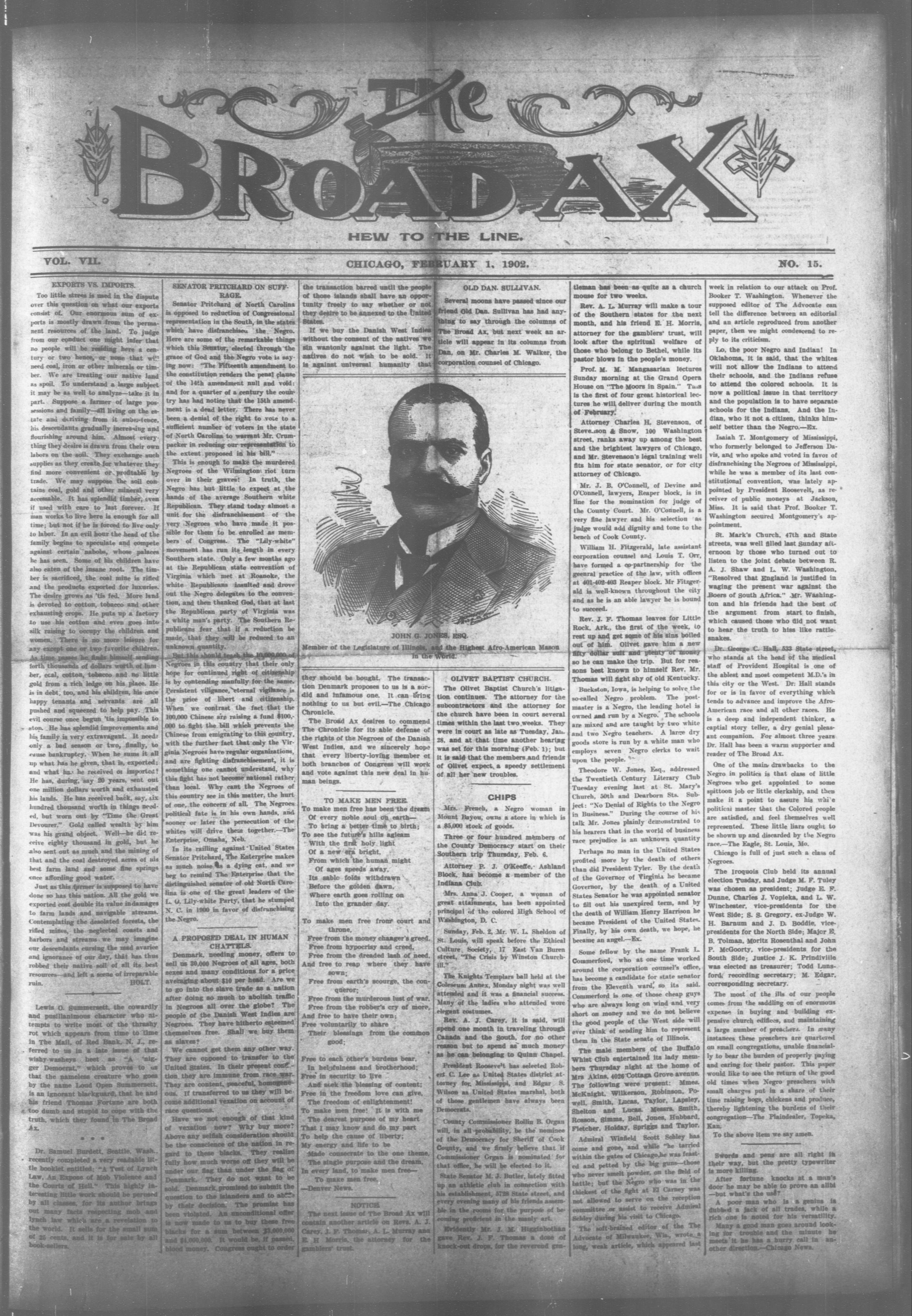
THE BROAD AX
HEW TO THE LINE.
Too little stress is used in the dispute over this question on what our exports consist of. Our enormous sum of exports is mostly drawn from the permanent resources of the land. To judge from our conduct one might infer that no people will be residing here a century or two hence, or none that will need coal, iron or other minerals or timber. We are treating our native land as spoil. To understand a large subject it may be as well to analyze—take it in part. Suppose a farmer of large possessions and family—all living on the estate and deriving from it subsistence, his descendants gradually increasing and flourishing around him. Almost everything they desire is drawn from their own labors on the soil. They exchange such supplies as they create for whatever they find more convenient or profitable by trade. We may suppose the soil contains coal, gold and other mineral very accessible. It has splendid timber, even if used with care to last forever. If man works to live here is enough for all time; but not if he is forced to live only to labor. In an evil hour the head of the family begins to speculate and compete against certain nabobs, whose palaces he has seen. Some of his children have also eaten of the insane root. The timber is sacrificed, the coal mine is riffled and the products exported for luxuries. The desire grows as 'tis fed. More land is devoted to cotton, tobacco and other exhausting crops. He puts up a factory to use his cotton and even goes into silk raising to occupy the children and women. There is no more leisure for any except one or two favorite children. As time passes he finds himself sending forth thousands of dollars worth of lumber, ecal, cotton, tobacco and no little gold from a rich ledge on his place. He is in debt, too, and his children, his once happy tenants and servants are all pushed and squeezed to help pay. This evil course once begun 'tis impossible to stop. He has splendid improvements and his family is very extravagant. It needs only a bad season or two, finally, to cause bankruptcy. When he sums it all up what has he given, that is, exported; and what has he received or imported? He has, during, say 20 years, sent out one million dollars worth and exhausted his lands. He has received back, say, six hundred thousand worth in things needed, but worn out by "Time the Great Devourer." Gold called wealth by him was his grand object. Well—he did receive eighty thousand in gold, but he also sent out as much and the mining of that and the coal destroyed acres of his best farm land and some fine springs once affording good water.
Just as this farmer is supposed to have done so has this nation. All the gold we exported cost double its value in damages to farm lands and navigable streams. Contemplating the desolated forests, the rifled mines, the neglected coasts and harbors and streams we may imagine our descendants cursing the mad avarice and ignorance of our day, that has thus robbed their native soil of all its best resources—and left a scene of irreparable ruin. HOLT.
Lewis O. Summersett, the cowardly and pusillanimous character who attempts to write most of the thrashy rot which appears from time to time in The Mall, of Red Bank, N. J., referred to us in a late issue of that wishy-washeys heet as "A nigger Democrat," which proves to us that the nameless creature who goes by the name Loud Open Summersett, is an ignorant blackguard, that he and his friend Thomas Fortune are both too dumb and stupid to cope with the truth, which they found in The Broad Ax.
Dr. Samuel Burdett, Seattle, Wash.. recently completed a very readable little booklet entitled: "A Test of Lynch Law, An Expose of Mob Violence and the Courts of Hell." This highly interesting little work should be perused by all classes, for its author brings out many facts respecting mob and lynch law which are a revelation to the world. It sells for the small sum of 25 cents, and it is for sale by all book-sellers.
SENATOR PRITCHARD ON SUFFRAGE.
Senator Pritchard of North Carolina is opposed to reduction of Congressional representation in the South, in the states which have disfranchised the Negro. Here are some of the remarkable things which this Senator, elected through the grace of God and the Negro vote is saying now: "The Fifteenth amendment to the constitution renders the penal clause of the 14th amendment null and void: and for a quarter of a century the country has had notice that the 15th amendment is a dead letter. There has never been a denial of the right to vote to a sufficient number of voters in the state of North Carolina to warrant Mr. Crumpacker in reducing our representation to the extent proposed in his bill."
This is enough to make the murdered Negroes of the Wilmington riot turn over in their graves! In truth, the Negro has but little to expect at the hands of the average Southern white Republican. They stand today almost a unit for the disfranchisement of the very Negroes who have made it possible for them to be enrolled as members of Congress. The "Lily-white" movement has run its length in every Southern state. Only a few months ago at the Republican state convention of Virginia which met at Roanoke, the white Republicans insulted and drove out the Negro delegates to the convention, and then thanked God, that at last the Republican party of Virginia was a white man's party. The Southern Republicans fear that if a reduction be made, that they will be reduced to an unknown quantity.
But this should teach the 10,000,000 of Negroes in this country that their only hope for continued right of citizenship is by contending manfully for the same. Persistent vigilance, eternal vigilance is the price of libert and citizenship. When we contrast the fact that the 100,000 Chinese are raising a fund $100,000 to fight the bill which prevents the Chinese from emigrating to this country, with the further fact that only the Virginia Negroes have regular organizations, and are fighting disfranchisement, it is something one cannot understand, why this fight has not become national rather than local. Why cant the Negroes of this country see in this matter, the hurt of one, the concern of all. The Negroes political fate is in his own hands, and sooner or later the persecution of the whites will drive them together.—The Enterprise, Omaha, Neb.
In its railling against United States Senator Pritchard, The Enterprise makes as much noise as a dying cat, and we beg to remind The Enterprise that the distinguished senator of old North Carolina is one of the great leaders of the L. G. Lily-white Party, that he stumped N. C. in 1900 in favor of disfranchising the Negro.
A PROPOSED DEAL IN HUMAN CHATTELS.
Denmark, needing money, offers to sell us 30,000 Negroes of all ages, both sexes and many conditions for a price averaging about $10 per head. Are we to go into the slave trade as a nation after doing so much to abolish traffic in Negroes all over the globe? The people of the Danish West Indies are Negroes. They have hitherto esteemed themselves free. Shall we buy them as slaves?
We cannot get them any other way. They are opposed to transfer to the United States. In their present condition they are immune from race war. They are content, peaceful, homogeneous. If transferred to us they will become additional vexation on account of race questions.
Have we not enough of that kind of vexation now? Why buy more? Above any selfish consideration should be the conscience of the nation in regard to these blacks. They realize fully how much worse off they will be under our flag than under the flag of Denmark. They do not want to be sold. Denmark promised to submit the question to the islanders and to abstain by their decision. The promise has been violated. An unconditional offer is now made to us to buy these free blacks for a sum between $3,000,000 and $4,000,000. It would be, if passed, blood money. Congress ought to order
JOHN G. JONES, ESQ.
Member of the Legislature of Illinois, and the Highest Afro-American Mason in the World.
the transaction barred until the people of those islands shall have an opportunity freely to say whether or not they desire to be annexed to the United States. If we buy the Danish West Indies without the consent of the natives we sin wantonly against the light. The natives do not wish to be sold. It is against universal humanity that
JOHN G. JO
Member of the Legislature of Illinois,
they should be bought. The transaction Denmark proposes to us is a sordid and infamous one. It can bring nothing to us but evil.—The Chicago Chronicle.
The Broad Ax desires to commend The Chronicle for its able defense of the rights of the Negroes of the Danish West Indies, and we sincerely hope that every liberty-loving member of both branches of Congress will work and vote against this new deal in human beings.
TO MAKE MEN FREE
To make men free has been the dream
Of every noble soul on earth—
To bring a better time to birth;
To see the future's hills agleam
With the first holy light
Of a new era bright,
From which the human might
Of ages speeds away,
Its sable folds withdrawn
Before the golden dawn,
Where earth goes rolling on
Into the grander day.
To make men free from court and throne,
Free from the money changer's greed,
Free from hypocrisy and creed,
Free from the dreaded lash of need,
And free to reap where they have sown;
Free from earth's scourge, the conqueror;
Free from the murderous lust of war,
Free from the robber's cry of more,
And free to have their own;
Free voluntarily to share
Their blessings from the common good;
Free to each other's burdens bear,
In helpfulness and brotherhood;
Free in security to live
And seek the blessing of content;
Free in the freedom love can give,
The freedom of enlightenment!
To make men free! It is with me
The dearest purpose of my heart
That I may know and do my part
To help the cause of liberty;
My energy and life to be
Made consecrate to the one theme,
The single purpose and the dream,
In every land, to make men free
To make men free.
—Denver News.
The next issue of The Broad Ax will contain another article on Revs. A. J. Carey, J. F. Thomas, A. L. Murray and E. H. Morris, the attorney for the gamblers' trust.
Several moons have passed since our friend Old Dan. Sullivan has had anything to say through the columns of The Broad Ax, but next week an article will appear in its columns from Dan, on Mr. Charles M. Walker, the corporation counsel of Chicago.
NES. ESQ.
and the Highest Afro-American Mason
World.
OLIVET BAPTIST CHURCH.
The Olivet Baptist Church's litigation continues. The attorney for the subcontractors and the attorney for the church have been in court several times within the last two weeks. They were in court as late as Tuesday, Jan. 28, and at that time another hearing was set for this morning (Feb. 1); but it is said that the members and friends of Olivet expect a speedy settlement of all her new troubles.
CHIPS
Mrs. French, a Negro woman in Mount Bayou, owns a store in which is a $5,000 stock of goods.
Three or four hundred members of the County Democracy start on their Southern trip Thursday, Feb. 6.
Attorney P. J. O'Keeffe, Ashland Block, has become a member of the Indiana Club.
Mrs. Anna J. Cooper, a woman of great attainments, has been appointed principal of the colored High School of Washington, D. C.
Sunday, Feb. 2, Mr. W. L. Sheldon of St. Louis, will speak before the Ethical Culture, Society, 17 East Van Buren street, "The Crisis by Winston Churchill."
The Knights Templars ball held at the Coleseum Annex, Monday night was well attended and it was a financial success. Many of the ladies who attended wore elegant costumes.
Rev. A. J. Carey, it is said, will spend one month in traveling through Canada and the South, for no other reason but to spend as much money as he can belonging to Quinn Chapel.
President Roosevelt has selected Robert C. Lee as United States district attorney for Mississippi, and Edgar S. Wilson as United States marshal, both of those gentlemen have always been Democrats.
County Commissioner Rollin B. Organ will, in all probability, be the nominee of the Democracy for Sheriff of Cook County, and we firmly believe that if Commissioner Organ is nominated for that office, he will be elected to it.
State Senator M. J. Butler, lately fitted up an athletic club in connection with his establishment, 5728 State street, and every evening many of his friends assemble in the rooms for the purpose of becoming proficient in the manly art. Evidently Mr. J. M. Higginbothan gave Rev. J. F. Thomas a dose of knock-out drops, for the reverend gen-
---
tleman has been as quite as a church mouse for two weeks. Rev. A. L. Murray will make a tour of the Southern states for the next month, and his friend E. H. Morris, attorney for the gamblers' trust, will look after the spiritual welfare of those who belong to Bethel, while its pastor blows in the people's money.
Prof. M. M. Mangasarian lectures Sunday morning at the Grand Opera House on "The Moors in Spain." This is the first of four great historical lectures he will deliver during the month of February.
Attorney Charles H. Stevenson, of Steve. son & Snow, 100 Washington street, ranks away up among the best and the brightest lawyers of Chicago, and Mr. Stevenson's legal training well fits him for state senator, or for city attorney of Chicago.
Mr. J. B. O'Connell, of Devine and O'Connell, lawyers, Reaper block, is in line for the nomination for judge of the County Court. Mr. O'Connell, is a very fine lawyer and his selection as judge would add dignity and tone to the bench of Cook County.
William H. Fitzgerald, late assistant corporation counsel and Louis T. Orr, have formed a co-partnership for the geenral practice of the law, with offices at 401-402-403 Reaper block. Mr Fitzgerald is well-known throughout the city and as he is an able lawyer he is bound to succeed.
Rev. J. F. Thomas leaves for Little Rock, Ark., the first of the week, to rest up and get some of his sins boiled out of him. Olivet gave him a new fifty dollar suit and plenty of money so he can make the trip. But for reasons best known to himself Rev. Mr. Thomas will fight shy of old Kentucky.
Buckston, Iowa, is helping to solve the so-called Negro problem. The postmaster is a Negro, the leading hotel is owned and run by a Negro. The schools are mixed and are taught by two white and two Negro teachers. A large dry goods store is run by a white man who employs seven Negro clerks to wait upon the people.
Theodore W. Jones, Esq., addressed the Twentieth Century Literary Club Tuesday evening last at St. Mary's Church, 50th and Dearborn Sts. Subject: "No Denial of Rights to the Negro in Business." During the course of his talk Mr. Jones plainly demonstrated to his hearers that in the world of business race prejudice is an unknown quantity
Perhaps no man in the United States profited more by the death of others than did President Tyler. By the death of the Governor of Virginia he became Governor, by the death of a United States Senator he was appointed senator to fill out his unexpired term, and by the death of William Henry Harrison he became President of the United States. Finally, by his own death, we hope, he became an angel.—Ex.
Some fellow by the name Frank L. Commerford, who at one time worked around the corporation counsel's office, has become a candidate for state senator from the Eleventh ward, so its said. Commerford is one of those cheap guys who are always long on wind and very short on money and we do not believe the good people of the West side will ever think of sending him to represent them in the State senate of Illinois.
The male members of the Buffalo Whist Club entertained its lady members Thursday night at the home of Mrs Akins, 4026 Cottaga Grove avenue. The following were present: Mmes. McKnight, Wilkerson, Robinson, Powell, Smith, Lucas, Taylor, Lapsley, Shelton and Lucas. Messrs. Smith, Rosson, Simms, Bell, Jones, Hubbard, Fletcher, Holday, Spriggs and Taylor.
Admiral Winfield Scott Schley has come and gone, and while "he tarried within the gates of Chicago,he was feasted and petted by the big guns—those who never smelt powder, on the field of battle; but the Negro who was in the thickest of the fight at El Carney was not allowed to serve on the reception committee or assist to receive Admiral Schley during his visit to Chicago.
The soft-brained editor of the The Advocate of Milwaukee, Wis., wrote a long, weak article, which appeared last
NO. 15.
week in relation to our attack on Prof. Booker T. Washington. Whenever the supposed editor of The Advocate can tell the difference between an editorial and an article reproduced from another paper, then we might condescend to reply to its criticism.
Lo, the poor Negro and Indian! In Oklahoma, it is said, that the whites will not allow the Indians to attend their schools, and the Indians refuse to attend the colored schools. It is now a political issue in that territory and the population is to have separate schools for the Indians. And the Indian, who it not a citizen, thinks himself better than the Negro.—Ex.
Isaiah T. Montgomery of Mississippi, who formerly belonged to Jefferson Davis, and who spoke and voted in favor of disfranchising the Negroes of Mississippi, while he was a member of its last constitutional convention, was lately appointed by President Roosevelt, as receiver of public moneys at Jackson, Miss. It is said that Prof. Booker T. Washington secured Montgomery's appointment.
St. Mark's Church, 47th and State streets, was well filled last Sunday afternoon by those who turned out to listen to the joint debate between R. A. J. Shaw and L. W. Washington, "Resolved that England is justified in waging the present war against the Boers of South Africa." Mr. Washington and his friends had the best of the argument from start to finish, which caused those who did not want to hear the truth to hiss like rattle snakes.
Dr. George C. Hall, 533 State street, who stands at the head of the medical staff of Provident Hospital is one of the ablest and most competent M.D.'s in this city or the West. Dr: Hall stands for or is in favor of everything which tends to advance and improve the Afro-American race and all other races. He is a deep and independent thinker, a captial story teller, a dry genial pleasant companion. For almost three years Dr. Hall has been a warm supporter and reader of The Broad Ax.
One of the main drawbacks to the Negro in politics is that class of little Negroes who get appointed to some spittoon job or little clerkship, and then make it a point to assure his white political master that the Colored people are satisfied, and feel themselves well represented. These little liars ought to be shown up and discarded by the Negro race.—The Eagle, St. Louis, Mo. Chicago is full of just such a class of Negroes.
The Iroquois Club held its annual election Tusday, and Judge M. F. Tuley was chosen as president; Judge E. F. Dunne, Charles J. Vopieka, and L. W. Winchester, vice-presidents for the West Side; S. S. Gregory, ex-Judge W. H. Barnum and J. D. Boddie, vice-presidents for the North Side; Major E. B. Tolman, Morlitz Rosenthal and John P. McGoorty, vice-presidents for the South Side; Justice J. K. Prindiville was elected as treasurer; Todd Lunsford, recording secretary; M. Edgar, corresponding secretary.
The most of the ills of our people comes from the saddling on of enormous expense in buying and building expensive church edifices, and maintaining a large number of preachers. In many instances these preachers are quartered on small congregations, unable financially to bear the burden of properly paying and caring for their pastor. This paper would like to see the return of the good old times when Negro preachers with small charges put in a share of their time raising hogs, chickens and produce, thereby lightening the burdens of their congregation—The Plaindealer, Topeka, Kan.
To the above item we say amen
Swords and pens are all right in their way, but the pretty typewriter is more killing.
After fortune knocks at a man's door he may be able to prove an alibi—but what's the use?
A poor man who is a genius is dubbed a jack of all trades, while a rich one is noted for his versatility.
Many a good man goes around looking for trouble and the minute he meets it he has a burry call in another direction.—Chicago News.
Will presuligate and at all times uphold the true principles of Democracy, but Farmers, Artificians, Protestants, Knights of Labor, Individuals, Mormons, Republicans, Priests, or any else can have their say, no long up their language is proper and responsibility is found. The Broad Ax is a newspaper whose platform is broad enough for all, ever claiming the cultural right to speak its own mind.
Local communication will have advantage;
this only on one side of the paper.
SUSPENSIONS (advance):
June 14th ..... £1.25
£15th ..... £1.50
Upcoming news media known on application
affirm all communications to
THE BROAD AX,
1040 Armour Avenue, Coventry.
JULIUS P. TAYLOR, Editor and Publisher.
The best sugar men will do their
best to beat.
An ounce of organization is worth a ton of oratory.
Kipling is in South Africa, but he hasn't surrounded any Boers as yet.
Chile is now accused of creating a coldness in the Pan-American congress.
Honolulu maintains a public committee whose sole business is to exterminate rats.
Once more the British have captured the spot where Gen. Botha was a few hours before.
Senator Depew will be compelled to play hookey from most of the midwinter banquets in Washington.
Late advices from Pekin are to the effect that the empress dowager once more has her authority on straight.
Joey Chamberlain intimates very clearly that it is not the German vote he is trying to catch.—Atlanta Journal.
Sixty-six per cent of the young men of the United States are unmarried. They are brave enough in other respects.
A woman is suing Russell Sage for $75,000. She will be glad to compromise for seventy-five cents before the case ends.
When the gods love a man and want him in a hurry they first make him smoke anywhere from twelve to thirty cigarettes a day.
Things are coming to a hopeful pass when a New York alderman refuses a $5,000 bribe and tells of it.—Cleveland Plain Dealer.
Rake any hard-grained, matter-of-fact old Scotchman with half a dozen lines of Bobbie Burns and you will always uncover a poet.
The description given of the costumes worn at the diplomatic receptions indicate that an Oriental circus is wintering near Washington.
Gov. Odell of New York is an allround athlete. If the presidency comes fooling around his neighborhood he will be found to be in prime condition.
Another defalcation has occurred in Los Angeles county. Lucky Baldwin's Chinese cook has defaulted with a side of beef and a barrel of potatoes. What next?
Japanese papers have started a crusade against "tipping." There are no Pullman porters in Japan, however—luckily for Darktown.—Los Angeles Times.
The United States is now the world's fourth nation in point of population. When you consider quality instead of quantity it is easily first.—Cleveland Plain Dealer.
A revoltion is paralyzing Paraguay. Gen. Egsqueeza, minister of finance, has excited the enmity of a lot of patriots who want to squeeze a little on their own account.
Herr Sonneberg of the German Reichstag, seems to have also acquired the very bad habit of allowing his conversational machinery to do too many stunts a day.
Melbourne has pledged undying sympathy with the mother country in its troubles. England should at once dispatch this sympathy to the front and try it on the Boers.
Premier Waldeck-Rousseau states that the French submarine boat is intended to capsize naval pre-eminence. The premier is evidently figuring on a gigantic paving contract for the deep-sea levels.
A public office holder in Chicago has refused to accept his salary for five months because he was away during that time. Other public office holders will now regard him with suspicion or pity or both.
A man who sat in a woman's lap in a street car yesterday was promptly knocked down by the woman's husband without having a chance to explain whether the strap broke or the car started too suddenly.
A Brooklyn woman is best on changing her name from Fitzsimmons because of its pugilistic associations. The lady should be told that a champion heavyweight is first in the hearts of most of his countrymen.
2
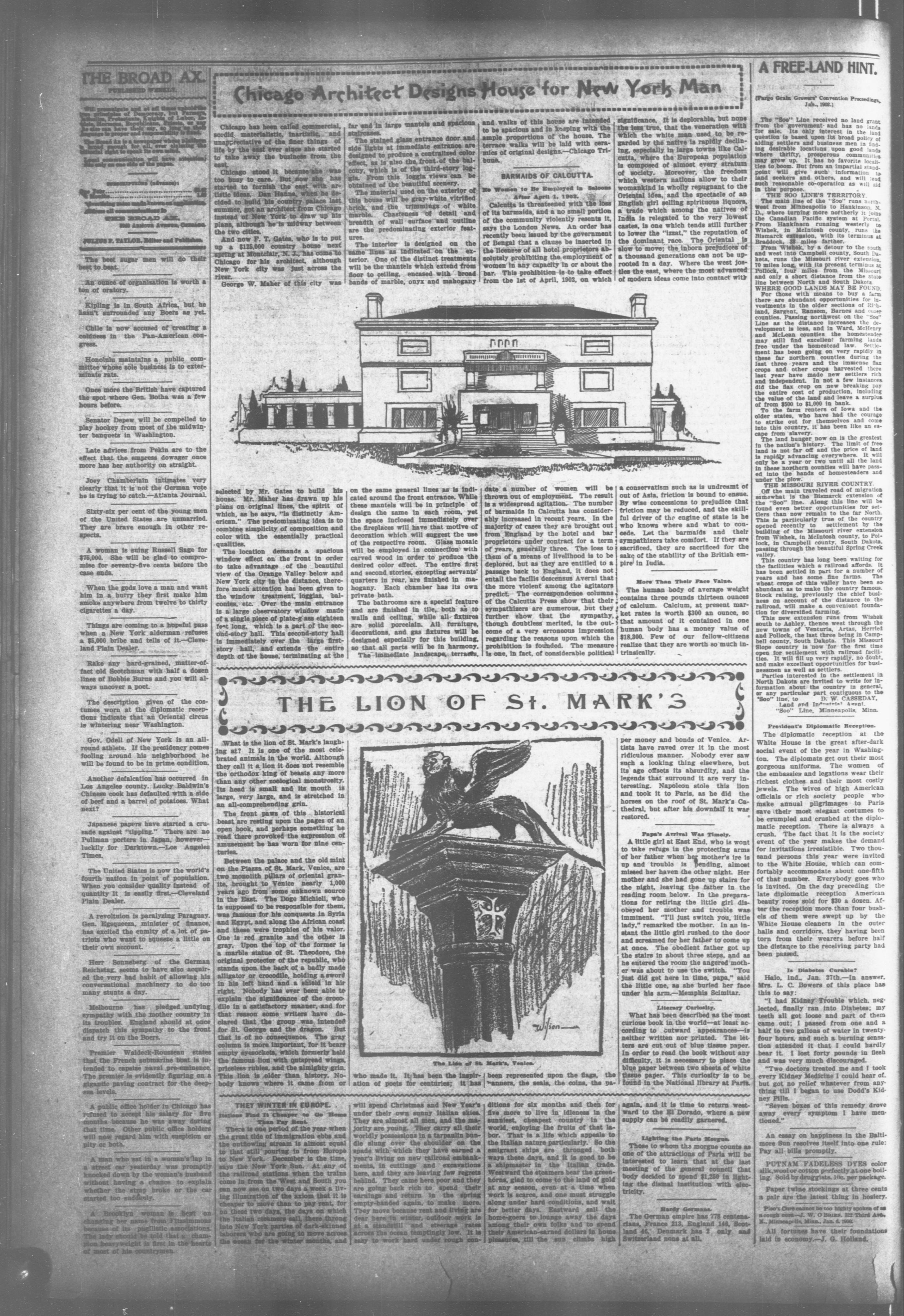
Chicago Architect Designs House for New York Man
---
המשפט
THE LION OF ST. MARK'S
Chicago has been called commercial, sordid, materialistic, inartistic, and unappreciative of the finer things of life by the east ever since she started to take away the business from the east.
Chicago stood it because she was too busy to care. But now she has started to furnish the east with artistic ideas. Dan Hanna, when he decided to build his country palace last summer, got an architect from Chicago instead of New York to draw up his plans, although he is midway between the two cities.
And now F. T. Gates, who is to put up a $125,000 country house next spring at Montclair, N. J., has come to Chicago for his architect, although New York city was just across the river.
George W. Maher of this city was
selected by Mr. Gates to build his house. Mr. Maher has drawn up his plans on original lines, the spirit of which, as he says, "is distinctly American." The predominating idea is to combine simplicity of composition and color with the essentially practical qualities.
The location demands a spacious window effect on the front in order to take advantage of the beautiful view of the Orange Valley below and New York city in the distance, therefore much attention has been given to the window treatment, loggias, balconies, etc. Over the main entrance is a large observatory window made of a single piece of plate-glass eighteen feet long, which is a part of the second-story hall. This second-story hall is immediately over the large first-story hall, and extends the entire depth of the house, terminating at the
THE
What is the lion of St. Mark's laughing at? It is one of the most celebrated animals in the world. Although they call it a lion it does not resemble the orthodox king of beasts any more than any other zoological monstrosity. Its head is small and its mouth is large, very large, and is stretched in an all-comprehending grin.
The front paws of this historical beast are resting upon the pages of an open book, and perhaps something he read there provoked the expression of amusement he has worn for nine centuries.
Between the palace and the old mint on the Piazza of St. Mark, Venice, are two monolith pillars of oriental granite, brought to Venice nearly 1,000 years ago from some unknown source in the East. The Doge Michielli, who is supposed to be responsible for them, was famous for his conquests in Syria and Egypt, and along the African coast and these were trophies of his valor. One is red granite and the other is gray. Upon the top of the former is a marble statue of St. Theodore, the original protector of the republic, who stands upon the back of a badly made alligator or crocodile, holding a sword in his left hand and a shield in his right. Nobody has ever been able to explain the significance of the crocodile in a satisfactory manner, and for that reason some writers have declared that the group was intended for St. George and the dragon. But that is of no consequence. The gray column is more important, for it bears empty eyesockets, which formerly held the famous lion with outspread wings, priceless rubies, and the almighty grin. This lion is older than history. Nobody knows where it came from or
THEY WINTER IN EUROPE. Italians Find It Cheaper to Go Home
Italians Find It Cheaper to the Home Than Pay Rent.
There is one period of the year when the great tide of immigration ebbs and the outflowing stream is almost equal to that still pouring in from Europe to New York. December is the time, says the New York Sun. At any of the railroad stations when the trains come in from the West and South you can now see on two days a week a living illustration of the axiom that it is cheaper to move than to pay rent, for on these two days, the days on which the Italian steamers sail, there throng into New York parties of dark-skinned laborers who are going to move across the ocean for the winter months, and
```markdown
```
Wilson
far end in large mantels and spacious
The stained glass entrance door and side lights at immediate entrance are designed to produce a centralized color effect, as is also the front of the balcony, which is of the third-story loggia. From this loggia views can be obtained of the beautiful scenery. The material used on the exterior of this house will be gray-white vitrified brick, and the trimmings of white marble. Chasteness of detail and breadth of wall surface and outline are the predominating exterior features.
The interior is designed on the same lines as Indicated on the exterior. One of the distinct treatments will be the mantels which extend from floor to ceiling, encased with broad bands of marble, onyx and mahogany
on the same general lines as is indicated around the front entrance. While these mantels will be in principle of design the same in each room, yet the space inclosed immediately over the fireplaces will have that motive of decoration which will suggest the use of the respective room. Glass mosaic will be employed in connection with carved wood in order to produce the desired color effect. The entire first and second stories, excepting servants' quarters in rear, are finished in mahogany. Each chamber has its own private bath.
The bathrooms are a special feature and are finished in tile, both as to walls and ceiling, while all fixtures are solid porcelain. All furniture, decorations, and gas fixtures will be designed especially for this building, so that all parts will be in harmony. The immediate landscapa, terraces,
The Lion of St.
who made it. It has been the inspiration of poets for centuries; it has
will spend Christmas and New Year's under their own sunny Italian skies. They are almost all men, and the majority are young. They carry all their worldly possessions in a tarpaulin bundle slung over the shoulder on the spade with which they have earned a year's living on new railroad embankments, in cuttings and excavations here, and they are leaving few regrets behind. They came here poor and they are going back rich to spend their earnings and return in the spring empty-handed again, to make more. They move because rent and living are dear here in winter, outdoor work is at a standstill and steerage rates across the ocean temptingly low. It is easy to work hard under rough con-
```markdown
```
and walks of this house are intended to be spacious and in keeping with the ample proportions of the house. The terrace walks will be laid with ceramics of original designs.—Chicago Tribune.
BARMAIDS OF CALOUTTA.
No Women to Be Employed in Saloons After April 1, 1902.
Calcutta is threatened with the loss of its barmaids, and a no small portion of the community violently resents it, says the London News. An order has recently been issued by the government of Bengal that a clause be inserted in the licenses of all hotel proprietors absolutely prohibiting the employment of women in any capacity in or about the bar. This prohibition is to take effect from the 1st of April, 1902, on which
המסך
date a number of women will be thrown out of employment. The result is a widespread agitation. The number of barmaids in Calcutta has considerably increased in recent years. In the majority of cases they are brought out from England by the hotel and bar proprietors under contract for a term of years, generally three. The loss to them of a means of livelihood is to be deplored, but as they are entitled to a passage back to England, it does not entail the facillis descensus Averni that the more violent among the agitators predict. The correspondence columns of the Calcutta Press show that their sympathizers are numerous, but they further show that the sympathy, though doubtless merited, is the outcome of a very erroneous impression regarding the reasons upon which the prohibition is founded. The measure is one, in fact, of considerable political
St. Mark's, Venice.
been represented upon the flags, the
manners, the seals, the coins, the pa-
ditions for six months and then for five more to live in idleness in the sunniest, cheapest country in the world, enjoying the fruits of that labor. That is a life which appeals to the Italian nature particularly. So the emigrant ships are thronged both ways these days, and it is good to be a shipmaster in the Italian trade. Westward the steamers bear the green-horns, glad to come to the land of gold at any season, even at a time when work is scarce, and one must struggle along under hard conditions, and wait for better days. Eastward sail the home-goers to lounge away the days among their own folks and to spend their American-earned dollars in home pleasures, till the sun climbs high
---
significance. It is deplorable, but none the less true, that the veneration with which the white man used to be regarded by the native is rapidly declining, especially in large towns like Calcutta, where the European population is composed of almost every stratum of society. Moreover, the freedom which western nations allow to their womankind is wholly repugnant to the Oriental idea, and the spectacle of an English girl selling spirituous liquors, a trade which among the natives of India is relegated to the very lowest castes, is one which tends still further to lower the "izzat," the reputation of the dominant race. The Oriental is slow to move; the inborn prejudices of a thousand generations can not be uprooted in a day. Where the west jostles the east, where the most advanced of modern ideas come into contact with
N.
a conservatism such as is undreamt of out of Asia, friction is bound to ensue. By wise concessions to prejudice that friction may be reduced, and the skillful driver of the engine of state is he who knows where and what to concede. Let the barmaids and their sympathizers take comfort. If they are sacrificed, they are sacrificed for the sake of the stability of the British empire in Iudia.
More Than Their Face Value.
The human body of average weight contains three pounds thirteen ounces of calcium. Calcium, at present market rates is worth $300 an ounce, so that amount of it contained in one human body has a money value of $18,300. Few of our fellow-citizens realize that they are worth so much intrinsically.
RK'S
per money and bonds of Venice. Artists have raved over it in the most ridiculous manner. Nobody ever saw such a looking thing elsewhere, but its age offsets its absurdity, and the legends that surround it are very interesting. Napoleon stole this lion and took it to Paris, as he did the horses on the roof of St. Mark's Cathedral, but after his downfall it was restored.
Papa's Arrival Was Timely.
A little girl at East End, who is wont to take refuge in the protecting arms of her father when her mother's ire is up and trouble is pending, almost missed her haven the other night. Her mother and she had gone up stairs for the night, leaving the father in the reading room below. In the preparations for retiring the little girl disobeyed her mother and trouble was imminent. "I'll just switch you, little lady," remarked the mother. In an instant the little girl rushed to the door and screamed for her father to come up at once. The obedient father got up the stairs in about three steps, and as he entered the room the angered mother was about to use the switch. "You just did get here in time, papa," said the little one, as she buried her face under his arm.—Memphis Scimitar.
What has been described as the most curious book in the world-at least according to outward appearances-is neither written nor printed. The letters are cut out of blue tissue paper. In order to read the book without any difficulty, it is necessary to place the blue paper between two sheets of white tissue paper. This curiosity is to be found in the National library at Paris.
again, and it is time to return westward to the El Dorado, where a new supply can be readily garnered.
Those to whom the morgue counts as one of the attractions of Paris will be interested to learn that at the last meeting of the general council that body decided to spend $1,250 in lighting the dismal institution with electricity.
Hardy Germans.
The German empire has 778 centenarians, France 213, England 146, Scotland 46, Denmark has 2 only and Switzerland none at all.
```markdown
```
A FREE-LAND HINT.
(Fargo Grain Growers' Convention Proceedings, Jah., 1902.)
The "Soo" Line received no land grant from the government and has no lands for sale. Its only interest in the land question is based upon its broad policy of aiding settlers and business men in finding desirable locations upon good lands where thrifty, prosperous communities may grow up. It has no favorite localities to boom. But from an impartial standpoint will give such information to land seekers and others, and will lend such reasonable co-operation as will aid in this purpose.
THE SOO LINE'S TERRITORY.
The main line of the "Soo" runs northwest from Minneapolis to Hankinson, N. D., where turning more northerly it joins the Canadian Pacific system at Portal. From Hankinson running westerly to Wishek, in McIntosh county, runs the Bismarck extension, with its terminus at Braddock, $8. miles farther. From Wishek, by a detour to the south and west into Campbell county, South Dakota, runs the Missouri river extension, 70 miles long, with its present terminus at Pollock, four miles from the Missouri and only a short distance from the state line between North and South Dakota. WHERE GOOD LANDS MAY BE FOUND
WHERE GOOD LANDS MAY BE FOUND.
For those with means to buy a farm there are abundant opportunities for investments in the older sections of Richland, Sargent, Ransom, Barnes and other counties. Passing northwest on the "Soo" Line as the distance increases the development is less, and in Ward, McHenry and McLean counties the homesteader may still find excellent farming lands free under the homestead law. Settlement has been going on very rapidly in these far northern counties during the last three years and the immense fax crops and other crops harvested there last year have made new settlers rich and independent. In not a few instances did the flax crop on new breaking pay the entire cost of production, including the value of the land and leave a surplus of from $500 to $1,000 in bank.
To the farm renters of Iowa and the older states, who have had the courage to strike out for themselves and come into this country, it has been like an escape from slavery. The land hunger now on is the greatest in the nation's history. The limit of free land is not far off and the price of land is rapidly advancing everywhere. It will only be a year or two until all the land in these northern counties will have passed into the hands of homesteaders and under the plow.
THE MISSOURI RIVER COUNTRY. Off the main traveled road of migration somewhat is the Bismarck extension of the "Soo" line. Along this line will be found even better opportunities for settlers than now remain to the far North. This is particularly true of the country opened recently to settlement by the building of the Missouri river extension from Wishek, in McIntosh county, to Pollock, in Campbell county. South Dakota, passing through the beautiful Spring Creek valley.
This country has long been waiting for the facilities which a railroad affords. It has been settled in part for a number of years and has some fine farms. The wheat crops of this valley have been so abundant as to make the country famous. Stock raising, previously the chief business on account of the distance to the railroad, will make a convenient foundation for diversified farming. This new extension runs from Wishek south to Ashley, thence west through the new towns of Venturia, Artas, Herrried and Pollock, the last three being in Campbell county, South Dakota. This Missouri Slope country is now for the first time open for settlement with railroad facilities. It will fill up very rapidly, no doubt, and make excellent opportunities for businessmen as well as settlers.
Parties interested in the settlement in North Dakota are invited to write for information about the country in general, or any particular part contiguous to the "Soo" line, to D. W. CASSEDAY, Land and Industrial Agent. "Soo" Line, Minneapolis, Minn.
President's Diplomatic Reception.
The diplomatic reception at the White House is the great after-dark social event of the year in Washington. The diplomats get out their most gorgeous uniforms. The women of the embassies and legations wear their richest clothes and their most costly jewels. The wives of high American officials or rich society people who make annual pilgrimages to Paris save their most elegant costumes to be crumpled and crushed at the diplomatic reception. There is always a crush. The fact that it is the society event of the year makes the demand for invitations irresistible. Two thousand persons this year were invited to the White House, which can comfortably accommodate about one-fifth of that number. Everybody goes who is invited. On the day preceding the late diplomatic reception American beauty roses sold for $30 a dozen. After the reception more than four bushels of them were swept up by the White House cleaners in the outer halls and corridors, they having been torn from their wearers before half the distance to the receiving party had been passed.
Is Diabetes Curable?
Halo, Ind., Jan. 27th.—In answer, Mrs. L. C. Bowers of this place has this to say:
"I had Kidney Trouble which, neglected, finally ran into Diabetes; my teeth all got loose and part of them came out; I passed from one and a half to two gallons of water in twenty-four hours, and such a burning sensation attended it that I could hardly bear it. I lost forty pounds in flesh and was very much discouraged.
"Two doctors treated me and I took every Kidney Medicine I could hear of, but got no relief whatever from anything till I began to use Dodd's Kidney Pills.
"Seven boxes of this remedy drove away every symptom I have mentioned."
An essay on happiness in the Baltimore Sun resolves itself into one rule: Pay all bills promptly.
PUTNAM FADELESS DYES color silk, wool or cotton perfectly at one boiling. Sold by druggists, 10c. per package.
Paper twine stockings at three cents a pair are the latest thing in hoslery.
Piso's Oure cannot be too highly spoken of as a cough cure—J. W. O'BRIEN. 322 Third Ave., N., Minneapolis, Minn., Jan. d. 1900.
All fortunes have their foundations laid in economy.-J. G. Holland.
102 MILES ANCHOR.
eG a ee
MILWAUKEE ine ‘esTantinnes
A RECORD FOR FAST TS a.
Le ge eee eee
One of the ee's new mam-
tween Milwaukee am@ Chicago,On New
type engine, i, made the eighty-
iv. evan a: eee eee
to Milwaukee ti one ‘minutes,
or one soar Se
The previous record is said to” have
been one hour and thirty-two. minutes
and the fastest schedule of the Mitwau-
kee calls for the fun th-one hour and
forty-five minutes. During three and
four-tenths miles: of the distance be-
tween Caledonia and Lakewood the
train maintained a speed of a trifle
over 102 miles -per hour.” The distance
between these two stations, three and
four-tenths mijes, Was made in exact-
iy two minutes. 7.
Considering the fact that no prepara-
tion was made for the run, and con-
sidering the conditions, the run is re-
markable. ‘The, train feft ‘Chicago at
10:15 p. m., twenty minutes Jate, the
engine hauling six sixty-foct mail and
express cars, afid arrived at Milwaukee
at 11:42, jyst two minutes late. The
two terminals required slow time and
there were slow Gowns for five railway
crossings, one full stop at Western ave-
nue, but no'stops for-water. ~
Edgebrook. to Stowell, seventy-two
miles, was covered in sixty-five min-
utes, or at the rate of ‘sixty-six and
one-half miles per bour. The distance
from Wadsworth to Western Union
Junction, nineteen miles, was made’ in
sixteen minutes, or at the rate of sev-
enty-one and one-quarter miles per
hour. Engine No. 921 has a ‘loaded
weight of 290,000 pounds; drivers, 84%
inches in diameter; a tender capacity
of 19,000 poutids of coal and 7,000°gal-
lons of water. The sun by detail was
as follows: ~
Miles from
2 Rea _ Chicago. ago. ‘Time.
Chicage: —ceccktecschesqsy D 10:15 p. m.
Pacific Junction, .,-.---84 Seam
Edgedrook «.-.<y-ne-05- 312 um
ROnGOut .....000ssecenneRd 1033 p. m.
Wadsworth ...........429 11 p, m.
Western Union Junc...61.8 1120 p.m.
Stowell . ,.-0--.-ss--<.----SB2 129 p.m.
Milwaukee ...........-..862 2 p.m.
TO THE GREAT NORTHWEST.
The Wisconsia Ceutral Ry. will take
you there in proper shape. Dauy trains
at convenient hours leave Chicago from
Row (Lake Front) for St. Paul, Minne-
apolis, Ashland, - and the North-
west. Palme Rpepeee are attached,
and meais in dining cars are served
a la carte, Nearest ticket agent cam
give you further Information. ‘
2 Jas. CPond, F
Gen’l Pass. ‘Agent, Milwaukee, Wis.
A young ¢ouple had been married by
& Quaker, and Sfter the ceremony: he
remarked to the husband: -
“Friend, thou art at the end of
thy troubles.” © ~
A few weeks after the man came to
the good minister boiling ‘over ' with
rage, having found his wife to’ be e
regular vixen, and said:
“I thought you told me I was at the
end of my troubles?”
“So I did, friend, but I did not say.
which end,” replied the Quaker.
sy han i ober inten puta
Siesls Behon iow ees
with treatment, pronounced it
Science bas prover caterrh oom
sonal ecg, Sasuuarts Se
tutional treatment. —— eo
3 the aniy comsetsatonnt cure, 6a te mare
Lsceee ees cea ees
and mucous of ain They ober
SrJiarcingandsetesrii Asin
F. 5. CHENEY & CO.
Sad pRouie Pills ee she best:
ee ;
A Lrowseme Entertainment.
Paris is to illuminate her morgue
end turn it into a sightseeing place for
the public. pus not quite so bad
as making’ the guillotine = popular
spectacle, but It is bad enough to shock
civilization where refinement is more
than clothes deep.
miifng tebe? <5
_ Im Winter se Allen's Foot-Eace,
der. Your feet feel .uncomfort-
tole nervous ‘sad "often “cold sad
aoe _ bave ee deerans
i's Foot Baan ‘old by al anciate
and shoe stores,. L
FREE. “sddrene Allon Olmeatsd, Le
Roy, N.-¥. —
Qe
There are very few—only seven—
contested es in the present
ome 0 SE a es
pain bys famous: Wizard Ol. .
Few Geese ne eae =
The trade ofall South America ts.
oe cant ieee
3"Se ENSON'S 688 will WOE wonder
Turkey exports “abot Scares,
worth of pinata a aes
ras SRS
. persons. are those who see
cat grip See ae ge
al tor ele namone. S05-aen
serve Mra 'in's famous Pancakes. All
Grocers sell $t. wane tae
Ridicule never Kia malas the deat
Pe eno Se ae ee
-CHAPERONS GOVE TO stay
eee aie ep
3 ¥ e ee
sian oy ae. See
— = " few -were given
— bi "
‘standing in “soc ‘etclon at the cast
eae nec ge e ting that the
sueto thelr footsteps
/ the chaperon has become
‘established in every social circle trom
ae ‘her legiti-
‘Mate ‘place.’ All inmarried women of
are spinsters—that’s enough. ten-
der maid of 30 goes unattended. No
‘single woman of any age goes to the
theater’aléne with = man, and as for
“buggy riding”—the custom is un-
Known. No girl goes to a restaurant
for luncheon with a youth she has
known from the cradle. It would not
be correct. And it would not be en-
tirely correct either for her to get an-
other girl. No; she must have the
chaperon—the tried aud seasoned vet-
eran of matrimony—or else the pro-
Prieties will be split up the back. The
ardor with ‘which the cult of the chap-
ron has been taken up in tlie west
Should make the thoughtful pause. At
the rate we're going at we'll soon be
where they are in France, and it will
be hopelessly compromising for any
of us to wedk two blocks on the public
street with a man of our acquaintance.
Ip fact, at the end of the two blocks,
if he should be so lacking im his duty
&s @ well-bred’ man to’ neglect propos-
ing, we will have to remind him of it.
In provincial France you must not
walk on the street-with any man but
that fortunate one who is to jead you
to the altar. No-man comes to call
on you unless he has announced to the
world in“general that he has bis eye
upon you as his.future wife, and then
the visits are conducted in the pres-
nce of the family, one chaperon not
being adequate to cope with the situ-
ation. Should you go to the theater
with any one less close in relationship
than a father or brother your charac-
ter will be as completely lost-as the
gospels of St. Peter. And if you were
to venture inside a resiaurant you
‘would be regarded as a person com-
pared to whom Nero and Caligula were
respectable - and moral—Chicago
Chronicle.
THE CHOPHOUSE WAITER.
is Characteristic Differences fiom
Other Species of His Genus,
The typical chopbouse waiter goes on
@uty at 6, and works until 2 or 3 in
the morning. His knowledge of hu-
man nature is .great, his information
on the subject of sporting matters {3
exhaustless, and his emoluments in
the way of tips are perhaps larger than
those of any other waiter in town; not
excluding the most popular who serve
at the finer restaurants. Not that he
understahds ‘the “art’ of waiting with
any ‘degree of the skill of the French
walter. He is a creature of moods and
of impulses, and it depends on his state
of ming whether the mustard be
brought immediately or not brought at
all. Direct orders grate upon him, and
eause him often to lapse into an entire
forgetfulness as to thearticle required.
Qne has to understand the chophouse
waiter to get the best results from him.
He is like a rare violin, and must be
handled dexterously in order to pro-
duce harmony. Frequently the chop-
house walter receives not only tips in
the way of cash, but information as
to Wall street deals on which he often
realizes. Naturally all this gives him
‘un air. Also, as he serves the distinct-
ly gay after-theater crowds, he gets to
know the magnificent levels of life. In
tno way is he ever servile, as is the
Franco-Swiss. On the contrary, his
fault is to verge on the other extreme
of familiar confidence, to reply to any
criticism -with badinage, and to treat
the poor im heart with a magnificent
‘and patronizing condescension. Every
popular chophouse waiter cherishes
one dream—to open a place of his own,
where he may amass the undoubted
proGite that ure'to be ‘had in this busi-
‘ness. A very prosperous chophouse
proprietor in town and many of the
fashionable hotel proprietors and man-
agers were graduated from the ranks
of waiterdom.—New York Sun.
‘Treatment of Old Orchards.
Many an old and apparently worth-
Jess orchard might be made of value
by eneouraging the growth of the
young shoots. One orchard of the
ind described was supposed to be too
pid to be worth anything. The large
tranches were cut back freely, and
when a young shoot with much vigor
was found the cut was: made so that
this shoot was not injured nor the
fiow. of sap_in the main branch re-
tarded, Grafting was done jn some of
the smaller branches and the trees
ber eereel ok ee rae and
than enough to pay for'the work and
the-after care‘of the soll. ‘True, it was
Seine 8 tae: Uaecome elveee
ise ction icon
———_—
~ pe eho Fécke. ;
Pat SO Se Protas 'g, Sovaty
Christmas morning, ‘ts & lovely
smoking. Jacket yon. Beve. sive me.
‘And the pictare ob the box of cigars
is very pretty.”
. “Gind they please you,” replied Mrs.
“ t° $ust wondered,” continued © Mr.
Ries wecing Meee See chen
el ot his lfe, “whether these
ae
“Here het retired fa good order, leer.
‘OLD JOE. THE NIGHT WATCHMAN.
often on returaing home late
oer eee Se
cht" man as be sat huddled ap
jor. re -overtooking the ex-
vations which ‘Our city coudcil in
their wisdom or otherwise, allow the
different water companies to make s0
frequently in our congested streets.
Jn all weathers and under ali climatic
‘man is ob! ee eG ee
eompanies’ , and’ to.Aee
‘a life, to be sure; what privations and
‘hardships; no wonder they have ached
‘and pains, which nothing but St. Ja-
cob’s Of can alleviate. .
“Qld Joe” is in the employ of the
‘Lambeth Water Works, and is well
“and favorably known. He has been &
‘Right-watchman for many years, ix
‘the course of which he has undergone
“many experiences, What with wet and
cold, he contracted rheumatism and sci-
‘atica, which fairly doubled him up, and
it began to look a serious matter for old
Joe whether he would much longer be
able to perform hig duties; on which
‘for.a livelihood; but as it happened, a
passerby, who had for some nights no-
ticed Old Joe's painful condition, pre-
-gented him with a bottle of St. Jacob's
“Oli, and told him to use it Old Joe
followed the advice xiven; he crawled
home the next morning and bade his
‘wife rub bis aching. back with the St
Jacob's Oil “a gentleman gave him.”
and undoubtedly his wife did rub, for
when old Joe went on duty at night he
Met his friend and benefactor, to
whom he remarked: “Them Oils you
gave me, Guv'nor, did give me a doing;
they was like pins and needles for a
time, but look at me now,” and old
Joe began to run and jump about like a
young colt. All pain, stiffness and
soreness had gone; he had been tell-
ing everybody he met what St. Jacob's
Ol! had done for him. Old Joe says
now he has but one ambition in life,
and that is to always to be able to
keep a bottle of St. Jacob’s Oil by him
for he says there is nothing like it in
the world. |
St. Jacob's Oil serves the rich and
the poor, high and low the same way.
It has conquered pain for fifty years,
and it will do the same to the end of
time. It has no equal, consequently
no competitor; it has many cheap imi-
tations, but simple facts like the above
tell an honest tale with which noth-|
ing on earth can compete.
‘The Blind of Philadelphia.
The police of Philadelphia have as-
certained that there are 352 blind per-
sons in that city. The inquiry was
made-at the request of the Home
Teaching Society and Free Circulating
Library for the Blind, a society whose
objects-are to-find-out where the
Dlind reside,:to send its teacher to in-
street them in reading at their homes,
‘and afterward to supply them with a
regular exchange of embossed books
from its library. 4
Sand Eaters a¢ St. Louis.
St. Louis has a peculiar sect in the
shape of a community of sand-eaters,
composed of seventy-five men and
women. The sand-eaters take. every
day a spoonful of sand. They believe
that grit is necessary in every animal,
and that many stomach troubles are
due to the absence of grit im the stom-
Emperor William = Linguist,
Emperor William is quite a linguist.
At the New Year's day reception in
Berlin he conversed with eight am-
bassadors in their own languages, ex-
cept in the case of the Turkish am-
bassador, and even to him the emperor
iattered a few happy phrases in Tur-
kish.
_ Phe Wil Interest Mothers
Mother Gray's Sweet Powders for
Children, used by Mother Gray. a
purse in Children’s Home. New York,
eure Feverishress, Teething Disorders,
Stomach Trouoks and destroy worms.
At all druggists’, 25c. Sample FREE.
Address Allen S. Olmsted. LeRoy, N.Y.
Briggs—It won't be long now before
the United States will have to act as
peacemaker for those South American
republics. Griggs—Well, we never
shall own them unless we make a be-
ginning some time.—Life.
SALZER'S LIGHTNING CASBAGE.
‘This ts the earliest cabbace in the world
2d» regulat gold mine to themarket ganteasr
B . By the way. unere is lots ot
; Hest cabbage.
Sasvpebstones
‘ For 16¢.and@ Notice
‘ fears
‘their’ mammoth
ot pbwer and veretabie sends’
catalog. 2c postage. W.x.U-
Officer—Is your brother, who was so
deaf, any better? Bridget—Sure, he'll
be all right in the morning Officer—
You don’t say so! Bridget—Yes; be
was arrested yesterday, and he gets
hin hearin’ in the morning —Denver
Republican.
JUST THINK OF IT
sBrery Bis owas no ineum-
brabors, csoust-ineresning, Joa" 67
a hand
ie Riso
Totsts mh it wchoote snd
PS ba tpied <i urches. low
— AVS on gh
perRe
oom ores tae
bo a ‘Thousance
EGS cout tree to et sppticon Fr Peaiey.
orc. J. Broughton. ¢.7 Monadnock Bic & Cat
py epee
‘Geaotian Vovernment Ages
SPECIAL Tt
WADUGEMEN
| $10.00 See
S10. gl _ ! zs
FROM SASKATCHEWAN, WES
FROM SASKATOHEWAN, WESTERN
_ En a letter written trom Prince Al-
ee eee ne
ve oie SE
‘Laughlin to Dr. C. T. Field of Chase,
‘Michigan, and which appeared in the
Reed City (Michigan) Clarion, ap
“Tt any one esk you how I
ike it up here, tell them I am perfect-
af son Seteiboh ‘tor me 1 te June tne
; T Dave as good @ piece of ‘and
‘Be ever tald Gutdodrs, Wouldn't ex-
change ‘It for the whole of Lake Coun-
ty, or at least the tewpship of Chase.
“Of course, I have not been here
‘Very long,‘but as‘ much of the country
aor Seen it cannot be-beat-any-
We had.as good crops here
‘Vast fall as I ever taw, and everything
gets ripe in good ‘shape. We had as
good ripe potatoes as I ever ate in my
life. - There is’ no better place for
Stock on the continent than here.
Horses and cattle will do as good rum
‘Ritig out all winter here as they do
Where they are fed all winter there.
Have built me a residence and now all
T want is a wife to keep house for me.
I have some breaking already dove on
my place, but next summer | intend to
Smet done and then I will be
for business.
“We have had a very fine winter so
far. It bas not been much below
zero, if any, excepting about a week in
the middle of November. It has been
quite cold the past day or two. We
are in log shanties, and they are just
muddied up on the outside, and noth-
ing has frozen on the inside as yet.
There is no wind or rain, just nice
steady weather all the time.”
Apply to any agent of the Canadian
government.
New Jersey is one of the states
which retain the custom of making
their treasurer an appointive instead
of an elective officer.
» i. Gti Gee Cin, Reet ORD
Mrs. J. Kay, A. W. High street, Des Moines,
owe san ditconered & harmless and inexpens-
er todaceo habit, which has
Saas put a Tne Seinieaee
‘directions sent fres for a stamp to pay postage
The East received 300,000,000 feet of
lumber during the last year by rail
from the Pacific coast.
M ustin’ Buckwh:
makes cepercoeee! oes cokes veer
grocer can tell all about n 2
The man that blushes is not quite a
brute.—Young.
colin ating sotes ibe rece efoce
So Seuce-cbes cures wind colic.’ 5c & .0ttle,
Hope lives where sky and sea meet.
SOZODONT
ean
25° cice
SOZODONT
TOOTH POWDER
PiTPOST
A Magazine
Of the Markets For
rs end Investors
are ee
We publish a new
monthly magazine
called “Pit and Post,”
which should be in the
hands of every invest-
or and trader in se- ~
curities, grain, and
ee It can be
for the asking.
—
KNIGHT, DONNELLEY & CO.
217 La SALLE St.
mOTUNDA OF THE ROOKERY
Yous Sroce, RECEAvas
PSE. -
CAPSICUM VASELINE
» (PUT UP Ds CULLAPSIBLE TUBE )
cenbecane fr end eupcrir 09 eetard ox
Reseaieem ccs, ane in siiaying ond
fait i nly tte jvtmecne a soca
med ft as the best and safest externa)
feabay torpor ns See asd some
rheumatic, neuraigic aud gouty com-
“See
rie Reta teas peat prs 3
Sete
ieee ar eat, acces
Soares
3 IT State New yore Crev.
GENTLEMEN “we
: YOUR CHANCE!
re you. ? Ef sot, why not marry an belress! We
te ria to marry a tuey,
mat St oo Pz, 200 tm cock. rerio
ioe WY SOF MARKY RICH! Ad
ore, COR STOSA CORR De. OB CLUS,
Keats", Gites :
"ne Koceee
Cured by Lydia
Patkest Vegetable Com-
pound. = ____
Serpe sagen niet
fered so Ti kidney Wopbiee and
other jons, had taken se
mach medicine without relief SS
mia nies oor etes
what is life without heal:h? I wanted
to be well.
t
4
3
= RE /
“Lydia E. Pinkham’s Vege-
table Compound cured me and made
me well, and that is why I gladly
write you this, and gladly thank you;
six bottles was all I took, together
with — Pills. My headache and
backache and kidney trouble went,
never to return ; the burning sensation
I had lett altogether; my general
health was so improved I felt as young
and light aud happy as at twenty.
reer Loviss — 4813 Lasgiey
7e., =
Cateago. — ORNS fate & chase
if'you feel that there is anything at
cll unusual or puzzline about a
case, or if you wish confidential advice
of the most experienced, write to Mra.
Pinkham, Lynn, Mass., and you will
be advised free of charge. Lydia E.
Pinkham’s Vegetable Compound
has cured and is curing thousands of
cases of female trouble.
OO 7
x ‘SHOES $
UNION MADE
a yf eS
30 y >
$3504 Y é S 1
SHOES 6 \
ane THe = cm \\
mre ft Bea y
woa.o fj y ~ }
FOR MEN 2 }
cx G 5; ~J
iN PAS tae ZS Y
£2; 7. GREA ~ KER
THE WoW) Tes? Snot
aera ars simone
pos
1 aoe
in pines Pairs.
1901 = 1,566,720 Pairs.
THERES More Than Dowbied in Four Years.
el cuanes and sells more men’s $8.0and |
oem pa
Teens pene aoa
aie of, tn ea lecthora, inctoding Patent
bag oi
Cpe ay
having issued his proclamation, {t now remains
for bis loyal subjects throughout the land to
proceed to the Festive City of ’
NEW ORLEANS
and pay tribute to His Majesty by participating
fm the festivities of
Which for the year 1908 will be held on
FEBRUARY 10 AND Ii
For this occasion the
. *
Iinois Central RR.
Company will sell ticke:s on certain Gates to
New Orleans from stations on its line at
VERY LOW RATES
‘Your loval ticket agent will tell you the dates
of sale, apecitic rates and limits of these Mardi
Gras tickets, .
Pry eRe
ote we is. Shade De big mower;
Nt e tee ieee
a
Ser aneEE
AGENTS WANTED rere meee, mite
Fraceo Amerian Perfumery Co., Cleve’: Odio.
AGENTS $26, Seeecensts sos cxcote she. tone
Po eh tn
5 cee b en eee eee
esas Se
Sey Lee ke ae
5 pase ie Lia a
Pectin Fae LAW: errs 0.
“Sime! Thompson’s Eye. Water
SALZER SS
| SEEDS
. w z a
Meee. o :
PB A 4 Eerens 7
* ae ces J
* \/ Taree. snied, comm: Ht
iy
tf fis aleriel went, f
Re =e el
yt P\- ees
Aiea :
} \ me
Bee os in
aN SS ad
| ¥ , Westra bape
amet) Saas
a 7 > ns, fone eed
te 7 Shenciigenes, =
2S
AS jae -
ES Aner og
aa AGS
Me, 2 Senet
Ra as
Secreaas
[este cere
OT eee ea ae
ALL HOMTEWEST
“OPPORTUNITY” a 20-page illustrated month |
ly magazine, for one year, and our special “Good
News Package,” containing pictures and full
information about the fine climate, rich land,
magnificeat crops and grand opportunities of the
wooderfel Northwest, for ONLY TEN CENTS
IN SILVER, if you mention this paper.
THE OPPORTUNITY COMPANY,
158 NEWSPAPER ROW. ST. Paul. mimn.
Onty IO CENTS.
REAL ESTATE. io
27,000 Se
9 trom 40 to 2.000 acres. Write
fully wnet_you want and I will
<end descriptions. Address 3. K. KYLE, Clinton, Ma
FOR SALE titcs core ana, Great stock tare
ee eee cae
For Homes. Fruits, Vegetables and
Si send fo
FLORIDA iSeries 3
Washington Fa:ms Sor iiss sfarees Coin
Willams, 56 Sullivan Bidg.. Seattle, Week,
564 ACRES—Fine Improved Farm—Hum-
built Co.; good suff; lays good; tiled; all Uillabie,
B50. Nothing better in lows a: 660; 50 lows farwe.
Packazp & Co., 08 Youngerman. Des Moines, lows,
FOR SA E FARMS in the best County, |
L the beet state tu tbe Union. Bond
fur list. We areoniy W miles frum
Kaunas Ciy. Parker & Reopere, Olathe, Kansan
GREAT BARGAIN INLAND, (2cney: Sentara Sree
we! oe ae, oe
Eiiske Form Lond se ts
vergreen Farm aoteae couaty
seat Kidder County, Nurth Dakota, 1,300 acres—
30 scres under cultivation, § 0 acres meadow and
Pasture; {oom farm Bouse: barns to accommodate
= stock, gr naries 5.00 busbel capacity, bulld-
tugs, within 6 aie « deput, cugrt-bouse, churcbes,
times igdvese owner. BJ, EYOMS, Stecie, SDat
FINANCIAL,
el
To Investors.
‘Those wanting to make money, answer this adv.
tmemest, You'cam become s pareaey ia on eave:
ment guaranteed from start to fuish. We want live
agence ta every communt-y. whu ran give good refer
ences, [nee
bend 65.0) for complete outfit; nv atten! paid to
letters unless eccompanied by dr ft, pust office or ex-
(oehiseareked Se" sy Sbrcare,
“aite 1511 Chemical Bidg., 8t. Louis, Mo.
MISCELLANEOUS.
SEND US iE Pacrce's compamibn
$2.00 fs Se See
wider Co, bell and Market Sta Ky
YES-BORINE. Antiseptic cures weak,
Chae Sees arrestee
HOW to DEVcLOP the BUsT Sz
Independent Remedy Co., 238 Mich. Ave., Chicage.
WO FAKE! Si Wontn sic. For asc.
Chemical Carpet Co., 704, 25 Dearb’n st, Chicagu.
Spon ow 05 SOO
sport's sporty 7 sayings. rem:
SEnwER Bro £ SUPPLY C0. Dex Wad. Ghicegs.
a Ye ay me aa
Wien eee Pre ees
SUD Piss te'James Prigbara, Macias Winsensias
Don’tbe Bothered with Comms. core Remover ts
A. TWINGSTBAND, 17:8 W. Dunning St. Chicage
SS a oe
Serer ees eee
arataobreet. Tapert creas free. marten —
A Great Hold Up. Gent's Drawer
pe iota patna aires ease
LADIES WANTED ©, F< at
ence We ee ee
CATARRH E> eases
Svateaa cease co-, one aeo.
=n
Ge.”
Vite bows trsahap end recaed oan Wee Ba
Diary Pe egestas
Typewriters Rant
DROPSY 22 crease cont
tT OF TIC SUF
See ee ee
SSS Sa.
_W. 6: W OWICAGO, NO. 6, 1902.
fihea Asswerieg Advertisements Kisdly
‘Hestion This faper. .
on ae
ioe Sah crete
by ere ane e
For the year 1901 are now due and payable at my office, 259 North Clark Street. By paying your taxes to the Town Collector it is a direct benefit to you, as 2 per cent. of such collections goes into the Town Treasury to be used solely for town expenses. JULIUS SALOMON, Collector Town of North Chicago OFFICE: 259 NORTH CLARK STREET.
Smoke Stacks, Cupolas and Monuments Erected. Hoisting and Placing of all kinds of Beams and Girders for architectural work. Office. 31 South Canal St., Chicago TELEPHONE MAIN 4928.
There are all degrees of nobility, but amid the levity and giddiness of people one looks round, as for a tower of strength, on some self-dependent mind, who does not go abroad for an estimate, and has long ago made up its conclusion that it is impossible to fall. The great Indian sages had a lesson for the Brahmin, which every day returns to mind, "All that depends on another gives pain; all that depends on himself gives pleasure. In those few words is the definition of pleasure and pain." The noble mind is here to teach us that failure is a part of success. Prosperity and pound-cake are for very young gentlemen, whom such things content; but a hero's, a man's, success is made up of failures, because he experiments and ventures every day, and "the more falls he gets, moves faster on;" defeated all the time, and yet to victory born. I have heard that in horsemarship he is not the good rider who never was thrown, but rather that a man never will be a good rider until he is thrown; then he will not be haunted any longer by the terror that he shall tumble and will ride—that is his business—to ride, whether with falls or whether with none, to ride unto the place whither he is bound. And I know no such unquestionable badge and ensign of a sovereign mind as that tenacity of purpose which, through all change of companions, of parties, of fortunes, changes never, bates no jot of heart or hope, but wearies out opposition and arrives at its port.—Ralph Waldo Emerson.
TENNYSON'S EGOTISM.
His Pre-eminent Position.
The London Academy reprints from Charles Stewart's recently issued autobiography, "Reminiscences of Legal and Social Life in Edinburgh and London, 1850-1900," the following reminiscence of Tennyson: "With Alfred Tennyson in his latter years I had frequent opportunities of meeting, both in London and at his country home. Personal intimacy with great authors is a dangerous experiment, especially with great poets, for their imaginative writings have stimulated one's ideas about their personality until one foolishly half expects to find their genius displaying itself in every word and action of their daily life. Tennyson fulfilled such an unreasonable ideal perhaps as well as any man could, for his personal appearance, with which every one is familiar, was, of course, magnificent, and his manners and habits of life were dignified, if a little poetically eccentric. But the adulation which he received from his family and friends was somewhat satiating. I have seen Mrs. Greville, a woman herself of the most brilliant talent, actually prostrate herself on the floor before him, just as I have seen ladies of high rank literally sitting at the feet of Sir Henry Irving. Tennyson would have been more than human if he had resisted the effect of this heroworship. A little niece of mine was one day standing beside his chair; he lifted her up and placed her on his knee and then put her down, saying: Now you can say you have sat on Tennyson's knee.' It was kindly meant, but there was a self-consciousness in the words and in the act which was not infrequently to be observed in the poet."
The London papers are plunging into the Schley controversy just as if England hadn't troubles of its own. —Kansas City Star.
The payment of $60,000,000 of Spanish war claims would also tend to remind us of the ingratitude of the Cubans.—Washington Post.
Mme. Nordica has put in a claim against Uncle Sam for $3,000,000. That seems a pretty high note even for a soprano.—Boston Herald. If Congress agitates the Schley case the grave and reverend senators may be expected soon to take partners for the loop.—Cleveland Plain Dealer.
A great mind will neither give an affront nor bear it.—Home.
"Charity covereth a multitude of sins," but does it always cover its own design?
The darkest hour in the history of any young man is when he sits down to study how to get money without honesty earning it.—Horace Greeley.
Filberts, chestnuts, walnuts and almond shells, highly oiled and polished and set in single bands or in nets made of gold wires make decidedly novel buttons. Nolsette buttons they are called.
The decisions of the United States Court on these subjects are interesting.
1. Subscribers who do not give express notice to the contrary are considered as wishing to renew their subscriptions.
2. If subscribers order the discontinuance of their periodicals, the publisher may continue to send them until all arrearages are paid.
3. If subscribers neglect or refuse to take their periodicals from the postoffice to which they are directed, they are responsible until they have settled their bills and ordered them discontinued.
4. If subscribers move to other places without informing the publisher, and the papers are sent to the former address, they are held responsible.
5. The courts have decided that refusing to take periodicals from the office or removing and leaving them uncalled for, is prima facie evidence of intentional fraud.
6. If subscribers pay in advance they are bound to give notice at the end of the time if they do not wish to continue taking it; otherwise the publisher is authorized to send it, and the subscriber will be responsible until an express notice, with payment for all arrearages, is sent to the publisher.
Ask your Dealer for
Sunday Creek No. 19
HOCKING
The best for domestic use.
For Sale by
THE JONES & ADAMS CO.
Anthracite and Bituminous Coal.
47th St. and Wabash Railroad,
Strictly dealers' yards.
JOHN FITZGERALD
JUSTICE OF THE PEACE
4787 S. HALSTED STREET,
.....CHICAGO
S. A. McELWEE
...LAWYER...
36 S. Clark St., CHICAGO.
Room 706 Ogden Building
Residence, 3183 Forest Av.
ALBERT B. GEORGE
LAWYER.
428 Ashland Block, Chicago.
— Tel. M. 2025. —
Robert M. Mitchell
Attorney at Law
Suite 9, No. 77 South Clark St.
CHICAGO
EDWARD H. WRIGHT
LAWYER
Suite 421, 280 S. Clark St.
Telephone, Harrison 2828. CHICAGO.
TEL. MARRISON 51.
Thomas F. Soully,
Attorney at Law,
79 Clark Street. . . CHICAGO.
Room 14.
Lawrence M. Ennis,
Advocate and Counselor at Law,
Suite 720 Opera Mouse Block.
S. W. Corner Clerk and Washington St.
TELEPHONE MAIN 1782.
Don't imagine that all hair preparations are alike. Quite the contrary. Some never do what is claimed for them. The Original Ozonized Ox Marrow has been on the market for so long that there is no doubt it will do everything we claim for it. It is the most genteel preparation that any one can use on their hair. It is most delicately perfumed and when thoroughly rubbed into the scalp and well brushed through the hair it cannot fall to cure dandruff and make the hair straight, soft and beautiful. It invigorates the scalp producing new growth and stops the hair from falling out. Try a bottle and you will be sure to be pleased. Only 50 cents, express paid, to any address in the United States. Druggists also sell it. Address: Ozonized Ox Marrow Co., 78 Wakash Ave., Chicago, Illinois.
```markdown
```
Waiting for Business
Is very poor business. The only way to do business in a business-like way is to make business. If you are in business and are not satisfied with the volume of business you have been doing, we would suggest that you take the business advice of one who makes it his business to make business for others. Your announcements in the columns of this paper will bring you increased business. We can easily demonstrate to your satisfaction that waiting for business
Is Not Good Business
SAVE MONEY BY BUYING YOUR PROVISIONS FROM
A. E. HANSEN,
Staple and Fancy Groceries, Meats Best Brands of Flour, Teas, Coffees Baking Powder, Spices, Butter Eggs, and Canned Goods, Etc. All Goods Guaranteed to be Fresh, 5060 DEARBORN ST., COR. 51ST ST. CHICAGO.
IMPORTED AND DOMESTIG
WINES, LIQUORS AND CIGARS
8402 SOUTH HALSTED STREET, CHICAGO.
A. JOSEPH JOSEPH STRAUSS
SALE AND EXCHANGE STABLE.
Driving, Draft and General Business Horses
Always on Hand
1197 Milwaukee Ave.-Near Robey St.
Telephone West, 1028. CHICAGO, IL.
GEO. C. CALLAHAN & CO.
PRODUCE COMMISSION
Butter, Poultry, Eggs, Game, Veal, Etc.
217 SOUTH WATER STREET, CHICAGO.
WILLIAM LOEFFLER
Provision Dealer
YOU CAN SAVE MONEY
By Ordering $15 Suits and One of Our- Overcoats Made to your measure in Any Style. Guaranteed to Fit and Satisfy You. Better Grades up to $25
Pantaloons from $4.00 Up! The Largest, Oldest and Most Extensive Tailoring Establishment in Chicago Our Fall Line is Now Complete. The Best in the City. EVERYTHING GUARANTEED.
A hat-pin to match each hat is an extravagant caprice of fashion. Beautifully embroidered Canton crepe shawls are transformed into evening gowns highly approved by fashion. Parisian women are carrying antique monocles with gold holders hanging from a long chain worm around the neck.
THE MOSSLER BROS.