The Broad Ax
Saturday, August 23, 1902
Chicago, Illinois
Page text (machine-generated)
SOME DEFECTS IN THE MANAGEMENT OF THE COOK COUNTY JAIL, MANY AFRO- MERICA N PRISONERS ARE ROBBED OR DEFRAUDED OUT OF THEIR MONEY BY WHITE AND BLACK SHYSTER LAWYERS.
Lately many able articles have appeared in the great Chicago American on "The Administration of Justice in Cook County" or its mis-administration. But that great newspaper nor none of the other great papers of this city have not to our knowledge had much or anything to say respecting the mismanagement of the Cook County jail, and in referring to the defects in its management. We propose to "hew to the line and let the chips fall where they may."
his bond. Dudenhaven not only obtained quite a large sum of money belonging to Lewis, but he also carried away with him a fine gold watch and chain, a charm containing a diamond setting, two diamond rings, one or two suits of clothes and several overcoats. So Lewis claims. But Dudenhaven did not furnish bonds for Lewis; on the contrary he did not come near him for more than three weeks. In the meantime Lewis was turned over to lawyer Haghley by the turnkeys, who robbed him out of much more money. He also conducted his case in the court, but he did not try very hard to defend him, and after Lewis was convicted Haghley held out the hope to him that he could put him on the street on a writ of error. He wanted Lewis to give him the deed to two clear lots which he owns at Alpine Heights. Lewis refused to do that. Then Haghley disappeared and did not come to see him until the latter part of July. At that time he wanted fourteen dollars more to free him on a writ of error. He wanted the money right away, but he could not go to the Appellate Court with the case until Monday, August the 4th, and on Tuesday morning, without a moments notice, Lewis was transferred to Jollet. Lewis is only one out of the many Negroes who are constantly being skinned by shyster white and black lawyers and bond thieves while passing through the Cook County jail.
Right at this point we want to say that of all the Afro-American lawyers who frequent the Criminal Court building, none of them stand any better with the prisoners than J. Gray Lucas, for all the Afro-American inmates of the Cook County jail claim that J. G. Lucas always keeps his word with them, that if he receives any money from them that he is worthy of the trust and confidence which they place in him. That is ten thousand times more than can be said in favor of some of the black shyster lawyers whose names will appear in the next issue of this paper.
Returning back to the mismanagement of the Cook County jail, it is said that there are near on to seven hundred and fifty prisoners in this jail. Of this number about twenty-five are Afro-Americans, that about two hundred and fifty to three hundred pounds of meat feeds all the prisoners each day, that this meat consists largely of scraps which are hauled to the jail from the stock yards, that sometimes it is so rotten or tainted that it stinks, that if it falls on the floor the head cook never thinks about having it washed, that no hightoned dog would eat it before or even after it is cooked, that the common prisoners receives one small chunk of these rotten scraps of meat each day in a tin pan with a little rice and much water which is called soup, and one "duffer," this is their dinner. In the evening they enjoy a cup of black water or coffee and one "duffer," and it is safe to say that it does not cost the chuckleheaded sheriff of this county over six cents a day to feed each prisoner, that this fat boss of Bill Lorimer's Republican machine is making from fifty to sixty thousand dollars a year from feeding the prisoners of Cook County.
For a long time the prisoners were compelled to pay five cents for a pail of hot water in order to keep the vermin from eating them up, but lately this practice has been discontinued. If the prisoners order their meals from the restaurant right in front of the jail they have to pay 25 cents for a 15 cent meal; they are charged three cents for the Chicago Chronicle on week days and two cents for the Chicago American; they are also forced to pay the very highest prices for writing paper and all other traps which they would like to use.
In conclusion we believe that Jaller J. L. Whitman would be disposed not to mismanage the Cook County jail if
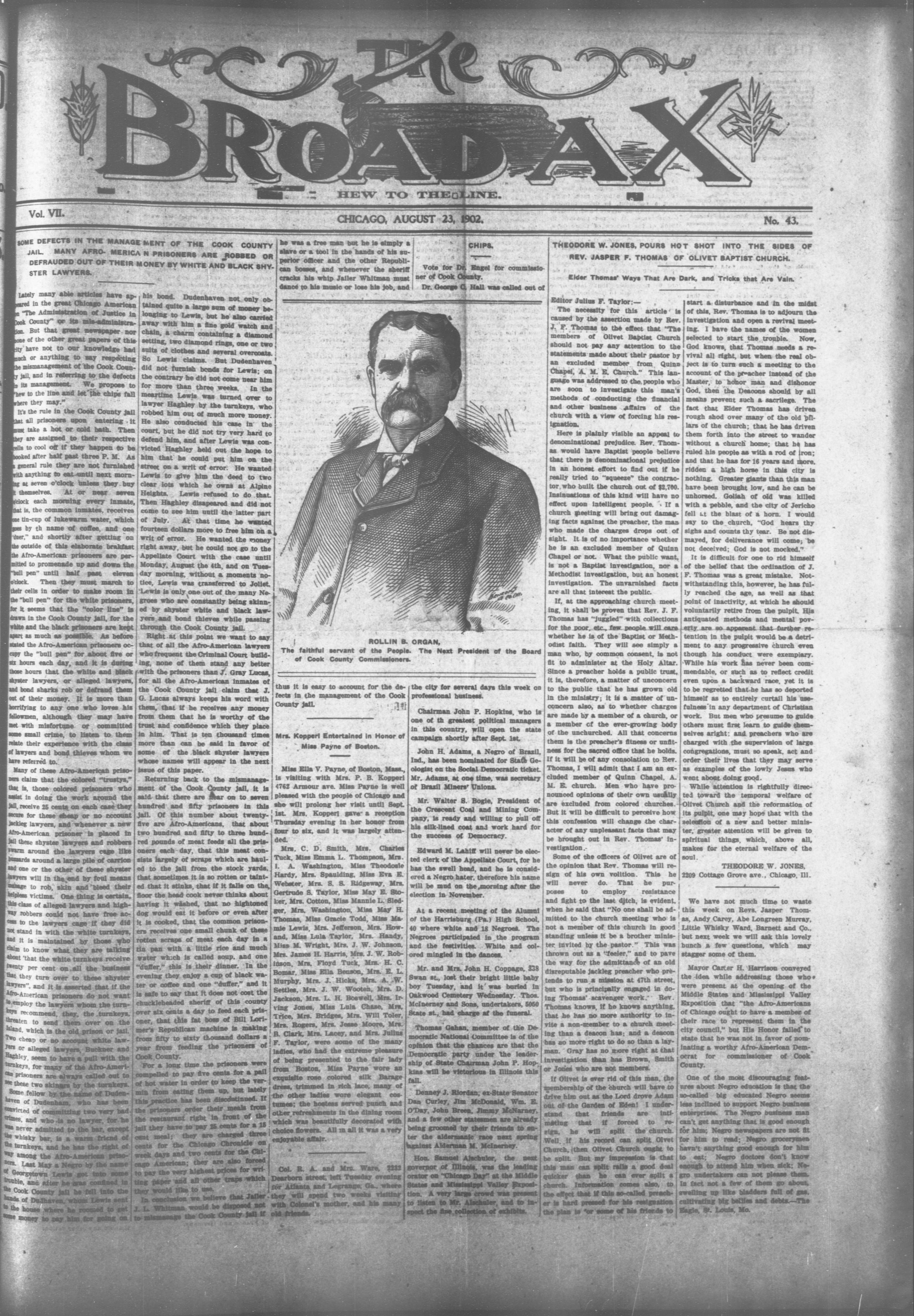
ROLLIN B. ORGAN.
he was a free man but he is simply a slave or a tool in the hands of his superior officer and the other Republican bosses, and whenever the sheriff cracks his whip Jaller Whitman must dance to his music or lose his job, and
ROLLIN B.
The faithful servant of the People.
of Cook County Commissioners.
thus it is easy to account for the defects in the management of the Cook County jail.
Mrs. Kopperl Entertained in Honor of Miss Payne of Boston.
Miss Ella V. Payne, of Boston, Mass., is visiting with Mrs. P. B. Kopperl 4762 Armour ave. Miss Payne is well pleased with the people of Chicago and she will prolong her visit until Sept. 1st. Mrs. Kopperl gave a reception Thursday evening in her honor from four to six, and it was largely attended.
Mrs. C. D. Smith, Mrs. Charles Tuck, Miss Emma L. Thompson, Mrs. J. A. Washington, Miss Theodosle Hardy, Mrs. Spaulding, Miss Eva E. Webster, Mrs. S. S. Ridgeway, Mrs. Gertrude S. Taylor, Miss May E. Stoker, Mrs. Cotton, Miss Mannie L. Sledger, Mrs. Washington, Miss May H. Thomas, Miss Gracie Todd, Miss Mamie Lewis, Mrs. Jefferson, Mrs. Howard, Miss Lula Taylor, Mrs. Handy, Miss M. Wright, Mrs. J. W. Johnson, Mrs. James H. Harris, Mrs. J. W. Robinson, Mrs. Floyd Tuck, Mrs. H. C. Bomar, Miss Ella Benson, Mrs. E. L. Murphy, Mrs. J. Hicks, Mrs. A. W. Settles, Mrs. J. W. Wooten, Mrs. D. Jackson, Mrs. L. H. Boswell, Mrs. Irving Jones, Miss Lula Chase, Mrs. Trice, Mrs. Bridges, Mrs. Will Toler, Mrs. Rogers, Mrs. Jesse Moore, Mrs. B. Clark, Mrs. Lacey, and Mrs. Julius F. Taylor, were some of the many ladies, who had the extreme pleasure of being presented to the fair lady from Boston, Miss Payne wore an exquisite rose colored silk Barage dress, trimmed in rich lace, many of the other ladies wore elegant costumes; the hostess served punch and other refreshments in the dining room which was beautifully decorated with choice flowers. All in all it was a very enjoyable affair.
Col. R. A. and Mrs. Ware, 2232 Dearborn street, left Tuesday evening for Atlanta and Legrange, Ga., where they will spend two weeks visiting with Colonel's mother, and his many old friends.
```markdown
```
the city for several days this week on professional business.
Chairman John P. Hopkins, who is one of th greatest political managers in this country, will open the state campaign shortly after Sept. 1st.
John H. Adams, a Negro of Brazil, Ind., has been nominated for State Geologist on the Social Democratic ticket. Mr. Adams, at one time, was secretary of Brazil Miners' Unions.
Mr. Walter S. Bogle, President of the Crescent Coal and Mining Company, is ready and willing to pull off his silk-lined coat and work hard for the success of Democracy.
Edward M. Lahiff will never be elected clerk of the Appellate Court, for he has the swell head, and he is considered a Negro hater, therefore his name will be mud on the morning after the election in November.
At a recent meeting of the Alumni of the Harrisburg (Pa.) High School, 40 where white and 18 Negroes. The Negroes participated in the program and the festivities. White and colored mingled in the dances.
Mr. and Mrs. John H. Coppage, 338 Swan st., lost their bright little baby boy Tuesday, and it was buried in Oakwood Cemetery Wednesday. Thos. McInerney and Sons, undertakers, 5060 State st., had charge af the funeral.
Thomas Gahan, member of the Democratic National Committee is of the opinion that the chances are that the Democratic party under the leadership of State Chairman John P. Hopkins will be victorious in Illinois this fall.
Denney J. Riordan, ex-State Senator Dan Curley, Jim McDonald, Wm. E. O'Day, John Breen, Jimmy McNarney, and a few other statesmen are already being groomed by their friends to enter the aldermanic race next spring
THEODORE W. JONES, POURS HOT SHOT INTO THE SIDES OF REV. JASPER F. THOMAS OF OLIVET BAPTIST CHURCH.
The necessity for this article is caused by the assertion made by Rev. J. F. Thomas to the effect that "The members of Olivet Baptist Church should not pay any attention to the statements made about their pastor by an excluded member from Quinn Chapel, A. M. E. Church." This language was addressed to the people who are soon to investigate this man's methods of conducting the financial and other business affairs of the church with a view of forcing his resignation.
Here is plainly visible an appeal to denominational prejudice. Rev. Thomas would have Baptist people believe that there is denominational prejudice in an honest effort to find out if he really tried to "squeeze" the contractor who built the church out of $2,700. Insinuations of this kind will have no effect upon intelligent people. If a church meeting will bring out damaging facts against the preacher, the man who made the charges drops out of sight. It is of no importance whether he is an excluded member of Quinn Chapel or not. What the public want, is not a Baptist investigation, nor a Methodist investigation, but an honest investigation. The unvarnished facts are all that interest the public.
If, at the approaching church meeting, it shall be proven that Rev. J. F. Thomas has "juggled" with collections for the poor, etc., few people will care whether he is of the Baptist or Methodist faith. They will see simply a man who, by common consent, is not fit to administer at the Holy Altar. Since a preacher holds a public trust, it is, therefore, a matter of unconcern to the public that he has grown old in the ministry; it is a matter of unconcern also, as to whether charges are made by a member of a church, or a member of the ever-growing body of the unchurched. All that concerns them is the preacher's fitness or unfitness for the sacred office that he holds. If it will be of any consolation to Rev. Thomas, I will admit that I am an excluded member of Quinn Chapel, A. M. E. church. Men who have pronounced opinions of their own usually are excluded from colored churches. But it will be difficult to perceive how this confession will change the character of any unpleasant facts that may be brought out in Rev. Thomas' investigation.
Some of the officers of Olivet are of the opinion that Rev. Thomas will resign of his own volition. This he will never do. That he purposes to employ resistance and fight to the last ditch, is evident, when he said that "No one shall be admitted to the church meeting who is not a member of this church in good standing unless it be a brother minister invited by the pastor." This was thrown out as a "feeler," and to pave the way for the admittance of an old disreputable jackleg preacher who pretends to run a mission at 47th street, but who is principally engaged in doing Thomas' scavenger work." Rev. Thomas knows, if he knows anything, that he has no more authority to invite a non-member to a church meeting than a deacon has; and a deacon has no more right to do so than a layman. Gray has no more right at that investigation than has Brown, Smith or Jones who are not members.
If Olivet is ever rid of this man, the membership of the church will have to drive him out as the Lord drove Adam out of the Garden of Eden! I understand that friends are intimating that if forced to resign, he will split the church. Well, if his record can split Olivet Church, then Olivet Church ought to be split. But my impression is that this man can split rails a good deal quicker than he can ever split a church. Information comes also, to the effect that if this so-called preacher is hard pressed for his resignation the plan is for some of his friends to
start a disturbance and in the midst of this, Rev. Thomas is to adjourn the investigation and open a revival meeting. I have the names of the women selected to start the trouble. Now, God knows, that Thomas needs a revival all right, but when the real object is to turn such a meeting to the account of the preacher instead of the Master, to honor man and dishonor God, then the Deacons should by all means prevent such a sacrilege. The fact that Elder Thomas has driven rough shod over many of the old pillars of the church; that he has driven them forth into the street to wander without a church home; that he has ruled his people as with a rod of iron; and that he has for 16 years and more, ridden a high horse in this city is nothing. Greater giants than this man have been brought low, and he can be unhorsed. Goliah of old was killed with a pebble, and the city of Jericho fell at the blast of a horn. I would say to the church, "God hears thy sighs and counts thy tear. Be not dismayed, for deliverance will come; be not deceived; God is not mocked."
It is difficult for one to rid himself of the belief that the ordination of J. F. Thomas was a great mistake. Notwithstanding this, however, he has fully reached the age, as well as that point of inactivity, at which he should voluntarily retire from the pulpit. His antiquated methods and mental poverty are so apparent that further retention in the pulpit would be a detriment to any progressive church even though his conduct were exemplary. While his work has never been commendable, or such as to reflect credit even upon a backward race, yet it is to be regretted that he has so deported himself as to entirely curtail his usefulness in any department of Christian work. But men who presume to guide others must first learn to guide themselves aright; and preachers who are charged with the supervision of large congregations, must so speak, act and order their lives that they may serve as examples of the lowly Jesus who went about doing good.
While attention is rightfully directed toward the temporal welfare of Olivet Church and the reformation of its pulpit, one may hope that with the selection of a new and better minister, greater attention will be given to spiritual things, which, above all, makes for the eternal welfare of the soul.
We have not much time to waste this week on Revs. Jasper Thomas, Andy Carey, Abe Longreen Murray, Little Whisky Ward, Barnett and Co.. but next week we will ask this lovely bunch a few questions, which may stagger some of them.
Mayor Carter H. Harrison conveyed the idea while addressing those who were present at the opening of the Middle States and Mississippi Valley Exposition that "the Afro-Americans of Chicago ought to have a member of their race to represent them in the city council," but His Honor failed to state that he was not in favor of nominating a worthy Afro-American Democrat for commissioner of Cook County.
One of the most discouraging features about Negro education is that the so-called big educated Negro seems less inclined to support Negro business enterprises. The Negro business man can't get anything that is good enough for him; Negro newspapers are not fit for him to read; Negro grocerymen haven't anything good enough for him to eat; Negro doctors don't know enough to attend him when sick; Negro undertakers can not please them. In fact not a few of them go about, swelling up like bladders full of gas, cultivating big bellies and debts.—The Eagle, St. Louis, Mo.
Among stockmen it is notorious that a great deal of meat that is sold for prime mutton in St. Louis, Chicago, Louisville and Kansas City is really Angora goat meat—just as good eating and far more profitable to the stockmen by reason of the greater value of the fleece, mohair against wool, says the Kansas City World. The Angora goat-raising interest is steadily growing throughout the United States. Its headquarters, that is, the headquarters of the American Angora Goat Breeders' association, are right here in Kansas City. W. T. McIntyre is the secretary of this association. Mr. McIntyre says:
"There are 50,000 Angora goats in the country to-day and the business is growing fast. It has all been built up since March 14, 1891, when our association was formed. Then, according to government statistics, there were but 20,000 Angora goats in the United States. And not one registered. Now we have about 30,000 registered.
"Registered goats range in price from $10 to $15 each. Some bucks go from $25 to $500. Plain, unregistered animals bring from $2.50 to $5 a head. It pays to raise any kind, but just now, at any rate from the stud standpoint, it is more profitable to raise registered stock.
"Angora goats do better than sheep anywhere, but are especially better in brush-covered sections. They are far hardier than sheep.
"Our association has 393 members now, in all parts of the United States and Canada and Mexico. We have some in Australia."
TASTE IN FUNNY STORIES.
It is sometimes hand to draw the line between that which is humorous in a story and that which touches dangerously near the domain of vulgarity. A literary dinner given recently brought this difference in tastes prominently into view, says the Chicago Chronicle. At the right of the hostess sat a writer who has a record for artistic indecency. At her left was a man whose work is sometimes cruda, always clean, vigorous, sincere.
At first all went well. Then the beautiful decadent was moved to tell a story. He told it well. Its impropriety was subtly suggested, airily outlined. It was the sort of a story that makes one want the windows opened, but that one does not openly resent.
The hearers accepted it with varying degrees of polite appreciation, but the man of direct and uncompromising views sat and stared in growing wonder at the teller. Finally he expressed his opinion.
"I wouldn't tell that story in a barroom," he announced, clearly, emphatically.
An awful hush. A mad and general plunge into innocuous conversation. The sympathy of the diners was with the critic, but social amenities must be preserved.
The hostess, who collects literary lions, should not take it for granted that the law of the jungle insures kindred feeling among the royal beasts.
MUCH RAIN HURTS FISHING.
No Big Catches of Trout or Bass in Western Lakes and Streams of Late.
Usually long, frequent, and heavy rains throughout the middle west and northwest have put back the fishing. As a general thing proprietors of resorts on the inland lakes like to see a wet spring, as those lakes are mostly too shallow, and the higher the water the better the fishing. There has been too much of a good thing, however, says the Chicago Tribune.
The floods have washed quantities of food into the lakes and the bass are not eager. The trout is, above all things, a clean fish, and must have clean water in order to feel well. When the streams are muddied and sand and chips are floating down the trout retreat to their hiding places in the deeper pools and stay there until the water above them clears. The bass are not so susceptible, but still dislike to roam much or do much leading in water that is distributed or swollen.
It is the belief that the present season will be better than many of those past, because the high water now means full lakes later. In late July and August they have been too shallow, but enough of water has been stored up to last them through. In some places they are six feet above the ordinary level.
PLUCK OF KING EDWARD.
Has Bravely Endured Much Physical Suffering in Order to Please His People.
"Of all the soldiers the king has decorated within the last three years of the war for bravery in the face of the enemy none deserves the Cross for Valor more than himself, who grimly and silently faced disease and death, unarmed and without a comrade," says Richard Harding Davia in Collier's Weekly.
"For now that the whole dramatic pitiful story is out, England learns—now that it is too late—of the days of guawing pain when her king forced himself to smile and bow at court, to watch a horse race, to review a regiment, to drive through London with an assured and cheerful countenance. It is not pleasant to think of the torture of those days, of the mental anxiety as well as the bodily torment, when the king kept on his feet against the protests of his physicians, when his endurance was tested by hours of unceasing pain—pain so great that it is not decent to disclose it. Nor is it pleasant to remember that last drive through the park to Buckingham palace, when the people for some reason failed to cheer him heartily, while all the time he sat erect, pale and with set teeth, holding himself upright only by his will, and that they might be gratified."
THE YOUNGEST PEERESS.
Lady Betty Bligh, Baroness of Gliston, Three Years Old, Has a Coronation Robe.
The youngest peeress of Great Britain who has the right to attend the coronation of King Edward is Lady "Betty" Bligh, now Baroness Clifton, daughter of the late seventh earl of Darnley and Jemima, countess of Darnley. Although the baby countess can be barely three years old, having been born in 1000, the same year in which her father died, she is having a coronation robe made for her on the lines of those of the other peeresses, and, owing to her extreme youth, she will without doubt be an object of much interest and attraction in the coronation show at Westminster. The father of Lady "Betty" was the sixteenth Baron Clifton and seventh earl of Darnley. He married Miss Jemima Blackwood, daughter of the late Francis J. L. Blackwood, niece of the present baronet of the name, and a relative of the duke of Manchester. The tiny countess comes of a distinguished lineage. She is seventeenth in succession from the first Baron Clifton. In the history of the family the right of succession has fallen to the women of the house about as many times as to the men.
BELGIANS HONOR MAY DAY.
The Subjects of King Leopold Celebrate the Arrival of the Month of Flowers Each Year.
The month of May is the most highly honored of the whole year by the Belgians. It is known as the virgin's month and consecrated to the Virgin Mary. In the province of Liege young maidens have a quaint way of predicting their love affairs this month. A group of girls arrange to meet at sunrise and start to walk through the fields until they come to a hedge, quite unobserved from the highway, where they generally choose a honeysuckle bush beneath the protecting branches of which to perform their mystic operations.
Each maiden selects three blades of dew-laden grass, the tops of which she cuts to equal lengths, and to each of which she attaches a colored silken thread. Black represents a bacholer, red an unknown lover and green the secret desires of the maiden's heart. Ten days afterward they return to the same spot where they left the blades growing, and that blade of the three chosen which has surpassed the others in height reveals the lover the maiden is destined to have.
HOW TO KEEP YOUNG.
A Problem in Which the Gentler Sex Have Long Been Interested.
The problem of how to keep young or how to keep from looking old, has engaged the thoughts of both men and women ever since the world began. Women especially have shown a deep interest in the vexatious matter, for their influence with men has always depended much on physical freshness and beauty. Numerous writers have contributed their views as to defying the riddle of the ravages of time. The latest well-known writer to discuss on the familiar theme is Max O'Rell. Without giving a recipe for the preservation of beauty, M. Blonet, drops many useful hints as to the causes which lead to the unnaturally early disappearance of youth in some people. Bad temper and a lack of humor are, in his opinion, the two greatest enemies of youth and beauty. Max O'Rell thinks that with the aid of a sense of humor and good temper a woman can be young and beautiful until 50. After 50 he can offer no advice on the subject.
Ellen Veil for Automobilists.
The only successful substitute for the ugly goggles worn by automobilists are said to be a veil of mica invented by a Parisian milliner. It is intended for the use of ladies who object to the disfiguring effect of goggles. A sheet of mica in the form of a viagra, set close to the face, is attached to the cap. It in a great improvement over the ordinary devices for protecting the eyes.
Few people have any notion of the stupendous operations going on at Sault Ste. Marie, the little Canadian village on the shores of Lake Superior, where an industrial center of enormous magnitude is now being created by the energies of one man. "Harnessing Lake Superior" is the title of an article in Pearson's, which gives this remarkable story: "Five years ago the sleepy little Canadian town of Sault Ste. Marie numbered 2,600 inhabitants. Past its doors the surplus waters of Lake Superior, mightiest of inland oceans, emptied into Lake Huron. Untold millions of horse power energy lay latent in their idly flowing eddies, but only the slow-turning wheels of a few old flour mills stood to mark their commercial usefulness, while but an occasional steamer or a paddle propelled canoe disturbed the tranquil surface. Almost as in a night a metamorphosis has taken place.
"Where once was a scattered group of village dwellings, great stone buildings, with towers and shafts and connecting passageways, now stand, and at, their base deep-dug canals wind in and out, spanned by bridges of massive stone. Nine thousand workmen now earn their livings in the shops at Sault Ste. Marie, beside the site where five years ago the total population was but a quarter of that number. It is a truly wonderful story, this story of the growth of the little frontier town into a great industrial centre; and its story is the history of the career of one man—Francis H. Clergue."
GOOD FOR JEWELERS.
Ping-Pong Is Said to Be Hard on Watches and the Repairer Will Prost.
"Ping-pong is a fine game," said a jeweler, who does a lot of repairing, to a Sun man. "No outdoor or indoor sport has ever given us so much to do. It is surprising how many persons have broken their watches since the game became a fad, says the New York Sun.
"You see, people play the game without removing their coats or waistcoats. In the excitement they forget about their watches, and the first thing a man knows his timepiece bounds out of his pocket. Sometimes it strikes the table, but wherever it does fall the watch is damaged.
"That is not all. A player may tie his watch to his pocket, but still it gets out of gear. The constant jumping around and the swinging of the arms disturbs the works so the watch has to be brought to us to be regulated.
"I have had as many women's watches as men's to repair. The women are even more careless than the men. Their watches dangle from their shirt waists, and as a result the watch jumps around like a weathercock in a gale of wind.
"Surprising as it may seem, my income from repairing watches has almost tripled since the craze of pingpong began."
SAXONY'S ECCENTRIC KING.
Interesting Stories Are Told of the Peculiar Habits of the Former Ruler.
The newspapers have lately been full of incident of the life of the deceased king of Saxony, but they are mostly connected with his public military career. Of his private life little is told except that in its extreme simplicity it resembled closely that of Emperor William I.
It is reported that King Albert had a rooted objection to exchanging his old clothes for new ones, and it was only with-great difficulty that his groom of the chamber could persuade him to have a new coat tried on. One day when he had just undergone the torment of having clothes tried on, the king happened to pass through the famous hall of the knights, in the Dresden palace. Looking up at the figures of the mail-clad knights, he said, with a deep sigh: "What a good time the old knights had in their iron armor; they were troubled with no creases."
A retired captain of the Saxony army, whom everybody knew as being under his wife's thumb, applied for permission to wear his old uniform on special occasions. The king wrote on the margin of the application: "I am quite willing, if his wife permits it."
Some statistical losses are hailed with pleasure. New York city is glad to hear that it has only 65,086 horses and 3,326 stables, compared with 73.746 horses and 4,649 stables in 1896. Electricity and automobiles are responsible for the change, and it is an important one in the direction of cleaner streets.
The exhibition of cinematograph pictures showing the operation recently performed on the Hindoo twins, Radica, and Doodica, has awakened a storm of disgust in Vienna. The pictures show all the horrors of the dissecting room, and the dreadful contortions of the limbs when under the knife.
Massachusetts' Smallest Town. Gosnold, the smallest town in Massachusetts, comprises these little sparks of land which, beginning at Woods Holl, at the shoulder of old Cape Cod's right arm, extend seward till they terminate in that fatal rock of the Bow and pigs.
CANALS IN THE NORTHWEST. The Great Development and Increase of Waste During the Last
The first locks at St. Mary's falls were opened in 1855, in which year the registered tonnage was 106,296. The half-million mark was reached in 1863, and the 1,000,000 mark was passed in 1873. In 1881, exactly coincident with the opening of a new and much larger lock, the northwest began to grow by leaps and bounds, and the tonnage of the canal rose from 2,000,000 tons in 1883 to 2,000,000 in 1890 and to 16,000,000 in 1894. During the past five years, two more enormous locks have been in operation, one of them on the Canadian side of the river, and in this short time the tonnage of the canal has leaped up to nearly 28,500,000 tons. This colossal tonnage is simply a manifestation of the development which has taken place in the northwest, along with which has come the building of thousands of miles of railroad, including two lines from the head of Lake Superior to the Pacific coast, says the Engineering Magazine. If by some cataclysm of nature the great lakes should be dried up, the enormous traffic now carried on their waters would be divided among the railroads — it would simply cease to exist. The whole galaxy of cities from Buffalo to Chicago and Duluth would be overwhelmed in hopeless, irretrievable ruin and the railroads could in no wise escape the general disaster.
GATHERING OPIUM.
Cultivatory Go Forth in the Evening with Lanches and in the Early Morning with Pots.
It is a sort of garden cultivation, the poppy plant being grown in little squares or beds intersected by tiny water channels for irrigation wherever this is possible. The growth of the plants is carefully tended, and at length the time comes when they burst out into flower, and the fields look like a sheet of silver as the white petals of the flowers glisten in the morning dew.
These beautiful petals are the first produce of the crop, for the women and children of the cultivators' families come forth and pick them off one by one and carefully dry them, so that they may serve afterward as the covering of the manufactured cakes of opium. Then the poppies, with their bare capsule heads, remain standing in the open field until it is considered that they are ripe for lancing. The cultivators then come forth in the evening, and, with an implement not unlike the knives of a coupling instrument, they scarify the capsule on its sides with deep incisions, so that the juice may exude. In the early morning the cultivators reappear with a scraping knife and their earthenware pots, and they scrape off the exuded juice and collect it in their pots. And this is crude opium.
MUST HAVE THE SWORD.
An Article That Is Necessary to the Completeness of a Naval Surrender.
Naval red tape is as stringent as that existing in the army, and sometimes the enforcement of the regulations leads to ludicrous results. Some years ago, when the late Admiral Skerrett was a captain, an officer who had been charged with an offense and ordered under arrest presented himself to be arrested. Th regulations provide that on such occasion the officer shall be in full dress and wear a sword. The officer wore his uniform, but had no sword.
"I can't arrest you," said Capt. Skerrett, looking for the missing sword, "unless you come prepared to submit your sword to me."
The officer explained that he had not received his sword from home, although it had been expressed to him.
"Well, you'll have to get one," was the reply.
So the officer skirmished about in the navy yard for someone who had a sword to lend. Finding one, the offender returned to Capt. Skerrett and was promptly and regularly put under arrest according to regulations.
DOGS REFUSE TO STARVE.
The Clever Little Joke of a German Professor Who Was Called to Columbia University.
Some little time ago Prof. Hirth, who was called from Munich, Germany, to Columbia university as Chinese lecturer, lived in the same house with a rabid vivisectionist, then practicing on half a dozen large dogs. Hirth's colleague was trying to find out how long the dogs could stand being left without food before they would fall upon and devour each other. The dogs were fed on wind for two weeks, yet looked round and happy. The vivisectionist couldn't understand it, says the Washington Post.
The kennel being closed on all sides, it seemed impossible for anyone to feed the dogs on the sly. Still, the fact remained that they refused to starve, even after a month's apparent fasting. Then the vivisectionist watched, and discovered that late at night Prof. Hirth had lowered large chunks of horse meat into the kennel from above. Hirth had allowed each dog six pounds of horse steak and bone a day.
Glass Growers.
Sheep and cattle cannot pasture over the same territory. Where the sheep wander the grass is gleaned with the devastation of a prairie fire, and the odor is such that cattle will for weeks shun the range.
We shall never forget one awful day, just before a heavy thunderstorm, when we attempted to work a marsh, but found it quite impossible to go more than 20 yards without resting. A vall is a great handicap in shooting, and we found it exceedingly difficult to judge distance at all accurately. As to trying to watch birds in this country it was impossible to do so for any length of time. Directly one stopped, such a cloud of mosquitoes gathered round one's head that after a short time the bird could not be seen through the binoculars owing to the dense swarm of mosquitoes which quickly gathered in front of the glass, relates a writer in Knowledge.
The only times in which we were able to discard our vells was after we had beaten the mosquitoes out of the tent and fixed the curtain over the doorway, and when after rowing hard for an hour or so on a lake we left the mosquitoes behind. At one place, however, we met a tiny black fly in such myrisds that it became a far worse pest than the mosquitoes. This fly was so small that no ordinary netting would keep it out, and it crept into our hair and ears and bit so hard and unpleasantly that to escape going mad we were forced to pack up our things and run away from the place. But no one who has been in the interior of Lapland in summer can adequately describe the blood-sucking insects which possess that country.
MECHANICAL STOKING.
Labor Saving Machinery Taking the Place of Many Men in Shops and Foundries.
The small number of men to be seen in a modern large machine works or steel mill, as compared with an old-time shop of similar importance, is a matter which has been a frequent occasion for comment, and this is doubtless due to the very general use of labor-saving machinery, says the Engineering Magazine. The cost of production in industrial establishments is made up of the costs of raw material, wages, toolage, taxes and interest, of which the largest single item usually is the wages cost. One way by which this item may be reduced is by the installment of mechanical stokers. In the great majority of steam plants the coal is wheeled to the boiler room by hand, it is fired by hand, and the ashes are removed by hand, making, in plants of 2,000 boiler horse-power or over, a wages cost of some considerable amount.
The mechanical stoker may be defined as a system of great bars, dumping bars, coal feeders and automatic devices to feed fuel and control its combustion, and subsequently to drop the ashes and unburnt coal. That it is not in any sense a new invention is to be learned from the fact that James Watt took out a patent in 1785 for such a device. The mechanical stoker is of English origin, though it has been very thoroughly developed in the United States to suit the local fuels and boiler furnace conditions.
APPENDICITIS IS NOT NEW.
The Disorder Has Existed for Ages, But the Doctors Did Not Know it.
"Why is it," asked a man of a physician, "that so many people are suffering these days with appendicitis and have to be operated upon, when there was formerly nothing of the kind in existence?" according to the Chicago Chronicle.
"My young friend," the doctor answered, "this disease has been in the world ever since Adam was—perhaps that story of his losing a rib may have arisen because he was operated upon for appendicitis. When your grandfather was a boy his neighbors had it all around him, and so they did when you were a boy. But they called it inflammation of the bowels, stomach ache, acute indigestion, liver trouble or something of that sort. The patienth got well or he died, but no one ever opened him when living to see what the matter was. Perhaps it is as well that they did not, for much of the surgery of those days was more dangerous than any disease."
INITIALS ON THEIR LOAVES.
Montreal Hits on a Good Way of Bringing Short-Weight Bakers to Time.
The city of Montreal lately passed a law to improve its bread supply. All Montreal loaves hereafter must be stamped with a number indicating their weight and with the initials of the baker, reports the New York Sun.
A $40 fine and two months' imprisonment are the alternative penalties provided for each violation, and all bread not fulfilling requirements is to be seized. Besides this it is provided also under heavy penalties that all rooms for the manufacture of food products shall be at least eight feet high and floored with cement, tiles or wood properly saturated with linseed oil.
The walls and cellings must be whitewashed at least once in six months, and no animals, except cats, shall be allowed in any rooms used for the manufacture or storage of bread or pastry.
Big Corn Avenge This Yank.
If all the land planted in corn in the United States this year were massed, the area would exceed the British Isles, Holland and Belgium combined, on four-fifths of the area of France and Germany.
A truly wonderful piece of machine is the "picking-up" machine made in all grappling and cable-holding operations in cable laying. It is a powerful variety of the steam-wheel family, but also a most aristocratic and elaborate member, fitted with gear-changing elutches, patent brakes and other ingenious appliances. To give some idea of its capabalities in dry figures, it can at slow speed be 85 tons at a rate of one mile per hour, or at fast speed ten knots at the rate of four miles per hour. Moreover, it can be quickly altered and adapted to changing circumstances in speed or lifting weights says Lippincott's.
All being made ready, the big grapnel, attached to 700 or 800 feet of chain and rope, is passed over the bow-aheave, or pulley, and as soon as it reaches bottom the ship is slowly ahead. Back and forward across the path of the cable, an pressed out by the friendly mariners buoys, we steam. Several times the grapnel catches something, only lose its hold again—probably as equality upon the bottom, although a bosun's mate mumbles "mermaid grottoes"—but at last comes a strain. Every soul on board has over the bow, watching the grapnel rope come steadily up over the well-oiled pulley. At least the grapnel itself appears, holding tight on to the truant.
CYCLES OF SUN SPOT.
Fresh Interest Lent to the Solar by Recent Earthquakes and Volcanic Eruptions
Since 1851, when the existence of sun spot cycle of about $11\frac{1}{2}$ years was discovered, many attempts have been made to discover a relation between the sun spots and the atmospheric changes in our earth. Violent storm floods, periods of drought and of fine, cold years, warm years, and many such variations of weather have been supposed to owe their origin to the sun spots. But the relation which Sir Norman Lockyer appears to have discovered between sun spot cycles and the tremendous upheavals of the earth which we term earthquakes and volcanoes, lends a fresh interest to this fascinating study, says Golden Pea
The matter certainly deserves very full investigation. Incidentally, the general character of the weather in the spring of the year seems to favor the existence of a 35 years' cycle of weather. That is, three times one cycle of sun spots. The year 1867 was just after the sun spot minimum, and 1868 is also just after the minimum. It was a cold spring in 1867, and a bitterly cold month of May. The summer was very wet, and it was followed by a stormy winter, with little frost, and a very warm spring and summer in 1868.
SAILORS IN BOSTON.
Yachting Is One of the Foremost Pleasures and Pastimes of the Hub.
Who sails boats around Boston! Why, everyone! says W. J. Henderson, in Atlantic. From the "Adams Boys," the smartest yacht racers of the east, down to the Marblehead street boy, everyone takes pride in his skill in getting the best work out of some sort of a sailing boat. Those who do not sail talk about it, and on a summer day in the drowsy atmosphere of a Boston club, or in the shadow of some tall pile in Washington street, you shall hear more racing seaman's lore than anywhere else in this country except on the cruising ground of the Rocking Chain fleet at the Larchmont Yacht club. Boston's claim to be the hub of the universe may be disputed perhaps when you consider the steel industry or the unimportant matter of freight tonnage; but when you come to talk about sailing, you must admit that Boston is the greatest yachting port in this country. Even the little children there know the history of the America's cup, and the public school boy can sail a dory with a leg-of-mutton sail for driving power and an car for steering gear.
PIGEONS CARRY DISEASE
Ohio Health Authorities Suspect the Birds of Causing a Scarlet Fever Epidemic.
An epidemic of scarlet fever, starting in Cincinnati, has spread in the last few weeks through a number of towns in Ohio, and the health authorities, after taking extraordinary precautions to confine the disease within the limit of its first ravages were puzzled to understand the means by which it was carried elsewhere states the Chicago Tribune. They made an investigation and have now come to the conclusion that much of the contagion was spread by tame pigeons and doves which carried the germs from place to place.
The evidence on which this theory is based is that scarlet fever spread under strict quarantine from a house on the roof of which there was a large pigeon cote. The only live stock about the house not quarantined was the pigeons, which flew about the neighborhood.
If they didn't carry the disease germs the authorities don't know how the fever was spread.
Nonsuching Rations.
Gold prospectors in Alaska say they can go farther and accomplish more hard work on rice and bacon than on any other ration.
LO AS A HOUSE SERVANT.
Hilton Boys and Girls Have of Late Been Tuking to Housework in the West.
Indian schools all over the southwest have recently adjourned for the summer, and the students are being employed very rapidly by those who keep servants. The Indian boys make excellent cooks, while an Indian girl, once trained, is a fine maid of all work, a modish hairdresser and endowed with an inborn taste which becomes picturesque when combined with a new civilized touches. The system of training now bestowed upon the red children at school teaches them to become servile to their superior—the paleface, and the present generation in training have become so accustomed to serving their paleface teachers that they are more than willing to enter the household as servants. Therein may lie the solution of the servant-girl question—for a time, at least, says a western exchange.
Indian youths are strong, agile, and brought up by the right kind of methods, are perfectly willing to work. They are healthy and quick of limb. This makes an excellent combination for a servant. Statistics of the Indian men recently show that of the 45,000 workers among the various tribes, 1,000 of them are employed as helpers in the houses of palefaces. You never see the Indian servant at his or her rest until you visit the home of an old Indian agent on one of the reserva-
QUESTION OF CONSCIENCE.
The View Taken of It by a Clerk to
Whom an Honest Customer Re-
turned Two Cents.
"Some folks," said a store clerk,
according to the New York Sun, "are
too honest. Now I've had somebody
come in to me when the boss was
standing by, somebody that had
bought something of me the day be-
fore, and hand over two cents and
ay:
"You gave me two cents too much
change yesterday, and I've brought
it back."
"He couldn't rest, you see, that man, until he'd got that two cents of his conscience and returned it. But in getting rid of that load himself he simply shifted it onto me. Here's the boss standing by when that two cents is returned; and the boss says to himself, with his eye on me:
"Hm! If you make a mistake of two cents, you'd make one of two dollars,' and so, you see, that super-honest man's return of that two cents may do me a lot of harm.
"The meaning of which is, if I can make myself clear, that we don't want to be too blamed honest. A man can be too honest and worry himself over trifles that he ought not to bother over.
"I should say that if the honest man must bring two cents back let him turn it in some time when the boss wasn't 'round."
BETRAYED BY GOLDEN LOCKS.
A prominent public official began to show signs of baldness, and then rather surprised his friends by appearing with a sleek, well-groomed crop of dark hair, relates the Philadelphia Record. For some time no one suspected a wig. But a few days ago he appeared with the top of his head covered with the usual dark brown hair, but a sharp line from the tips of the ears marked a strange contrast, for the hair below the line was of the bright golden hue which is the pride of the "chemical blondes."
It was found out that the man found his natural hair was turning gray and desired to make it match the wig, so he invested in a preparation warranted to darken the hair, and in the secret of his own room applied it. But, owing to some strange chemical combination, instead of making the silvered hair dark it made the dark hair golden, and so far the unfortunate man has found nothing that will counteract the striking contrast, so he is compelled to endure no small amount of chaffing from his friends.
THE KAISER KEPT HIS WORD.
During his recent tour in the Rhenish industrial district the kaiser was extremely pleased at seeing so many signs of progress. He was in high good humor when at the close of the Crefeld visit he thanked the maids of honor for their attendance, says a Boston report.
He complimented them on their graceful figures, spoke of the charming Crefeld faces, and asked if the lieutenants often danced with them. When the ladies replied that Crefeld possessed no lieutenants the kaiser laughed heartily and said: "Then I must send you some."
As he was leaving he added: "I will keep my word." Next day the chief burgomaster of Crefeld received the following telegram from Lieut. Gen. von Bissing, commander of the Seventh army corps: "By order of his majesty the kaiser and king, Crefeld is to receive a garrison. Kindly forward proposals for the accommodation of a busier regiment in the town."
A Love-Stick Indian,
Insane because a white woman had
refused to marry him Evans Brady, a
full blooded Indian, died in Dellevue
hospital, New York, recently.
OLDEST LIVING ENGINEER. Now 60 Years Old and Men Spend the Night of His Life at the Wreathie.
Christian Smith, the oldest living engineer in the country, is spending the declining years of his life in quietude near Harper's Ferry, says the Philadelphia Record. He is 90 years old, but still hale and hearty, and a fine specimen of manhood. He is over six feet in height and erect, and possesses all of his faculties. His eyesight is as good as that of the average person of younger years, and he does not have to wear glasses.
Mr. Smith is the veteran engineer of the Baltimore & Ohio railroad, having begun his career on that road in 1832, when horses were used to pull cars. He has served in the capacity of fireman, conductor, engineer, supervisor of engines and assistant supervisor of trains, and was also station agent at Martinsburg and the Relay up until 1861. He was supervisor of engines on the second division of the Baltimore & Ohio railroad at the time of his retirement. Mr. Smith ran the first steam engine on the Baltimore & Ohio railroad at a speed of from six to eight miles an hour, which was considered rapid for those days. He introduced the sand box in 1836, and in the following year the headlight. In 1842 link couplers were first used by him. In 1883 he retired to engage in the quieter and less dangerous voction of farming.
PLAYGROUND IN A STORE.
Chicago Establishment Has Inclosure for the Accommodation of Shoppers' Children.
Real grass, real sand and real wheelbarrows and shovels are to be provided for the children who visit one of the big department stores of Chicago. The idea of day nurseries where mothers may leave their children while shopping has been improved on by the management. There has been laid out on the second floor a playground for the children, with swings, hammocks, sand, and plenty of toy implements for the exclusive use of the youngsters. The pillars which form the corners of the playground are covered with bark and long branches, with realistic leaves on them, twine overhead, giving the final touch to the out-of-door appearance of the place. The inclosure is surrounded by a picket fence high enough to keep the children in, but not high enough to make them feel constrained. The first day of the new departure, there was a large number of children digging in the sand pile, running about the gravel paths and rolling on the turf. Just as fast as the grass is worn down by the feet of the little ones it will be replaced with fresh soda. Attendants are at hand to see that no necks are broken by falls from the swings and hammocks and to prevent the overmischievous from pouring buckets of sand down their playmates' backs.
WOMEN FORM FIRE COMPANY.
Mon Couldn't Make the Youths Drill, But Feminine Tact Found a Way.
Prominent citizens of Norfolk, Conn., have made several attempts to organize a fire company for the protection of their property in the last year, but every attempt failed, says the New York Sun. There didn't seem to be enough civic pride or enough fear of fire in Norfolk to inspire fire drills, and it seemed as if it would be left to anybody and everybody to get out the garden hose and do the best that could be done if a fire did start.
Then the women took up the matter. They issued a call for young men desirous of joining a military company. That caught Norfolk's young men. Fifty of them responded, says the New York Sun.
After that it was easy. The young men didn't see just how to get out of it when, very neatly, the military organization was developed into a fire force.
The women bought the hose, and now the town has just as good a fire department as its neighbors of equal size.
To those whose days have been spent in the enjoyment of the freedom of the old west, even so it appeared in the 80s, there comes a regret in the contemplation of the new order of things. For assuredly the old has given way to the new, says the Tacoma Ledger. The old west as the early settlers knew it for 20 years or more has gone as went the Indian and the buffalo, and with it has gone that larger freedom which were its characteristics and its charm. There is no longer any west. The methods and conditions of the west are the methods and conditions of the east, plus western energy. Indeed, to be entirely just, it may be questioned whether western push is not an importation, for certainly it did not flourish in the ante-railroad days.
Ruined by His Alarms.
Count von Zeppelin, who has the distinction of having built the largest of all airships, has been financially ruined by his aeronautical experiments. Unable to obtain means for carrying out his new projects he is now breaking up the old framework of his airships in order to sell the chinium of which they are composed. Zeppelin is 67 years of age. He was a military attache of the German embassy in the United States during the civil war and made several balloon ascensions from battlefields of the south in 1663. He was the leader of the famous cavalry raid in France in 1570 which marked the commencement of hostilities of the great Franco-Prussian war.
BACTERIA IN DIGESTION.
Scientific Experiments with Chicks.
The results of experiments with chickens to determine the effect of intestinal bacteria upon the process of digestion are reported by Prof. Schottellus in a recent number of the Archiv fur Hygiene, and reproduced by the Steats Zeitung, says the Literary Digest. Chickens were kept in cages from which all bacteria were carefully excluded and were supplied with food equally free from bacteria. They ate ravenously and almost continually and evidently digested their food well, yet not only did they not fatten, but they steadily decreased in weight and strength.
Another series of experiments gave direct and positive proof that the presence of intestinal bacteria is necessary to nutrition. Chickens which had been batched and raised in a sterilized environment, receiving only germ-free food, thrived for a week, and then began to decline in weight and strength. Then they were divided into two groups, one of which was fed on sterilized food, the other on food containing bacteria. All of the first group died in a few days, the others improved rapidly and soon were indistinguishable from chickens that had run free in the poultry yard. Mme. Metchnikoff has obtained analogous results with tadpoles which, fed for a time with germ-free food, attained an average weight of 25 milligrams and an average length of 15.5 millimeters, while other tadpoles, fed for the same period on ordinary food, had an average weight of 142 milligrams and an average length of 26.5 millimeters.
BARING OF FEET AT WORSHIP.
A Custom That Is Religiously Observed Among the Frequenters of the Monques.
The India Hindus and Mussulmans alike wear both sandals and shoes (slippers), and the latter boots also. The sandal (the word is Persian) was evidently the original covering for the feet of all southern and eastern Asia, while the shoe was probably introduced into India by the Persians, Afghans and Mo(n)gols, together with the "tip-titled" (Hittite and Etruscan) boot, says the Athanaeum. Both are usually made in India of leather, but never of pigskin, and while the shoes are always colored red or yellow the boots are generally brightly particolored, both among the upper classes being also richly embroidered in gold and silver and variegated silk thread and with bangles, bugles and seed pearls, after the manner of the ancient Persian boots represented on Greek vases. But of however rare and costly elaboration the invariable rule is to remove them after entering a private house, just when stepping onto the mat or carpet on which the visitor takes his seat. They must be cast off—the right boot or shoe first—before the worshiper enters a temple or mosque, and it is still regarded as an absolute profanation to attempt to enter either fully shod. But the domestic habit arose out of its obvious propriety, and the religious ritual of "the shoes of the faithful," now and for centuries past observed throughout Islam, can be demonstrated to have been dictated by, if indeed it be not directly derived from, the universal social etiquette of the east.
GERMLESS SCHOOLBOOKS.
Precautions Taken in Salt Lake City Against Spread of Disease Among Children.
A new ordinance has been adopted in Salt Lake City with the idea of preventing the disseminating of scarlet fever and diphtheria germs among school children, says a recent report from that city.
Both diseases have recently been epidemic among the children in the city and the board of health decided that the germs traveled in the school books and other things carried by the pupils. The result has been the passage of an ordinance which is probably more stringent than any other of the kind ever adopted by any municipality.
It provides that none of the school books shall be covered with any material other than paper. In all schools in which there is a free distribution of books such books, after having once been used, must be recovered and thoroughly disinfected by the board of health. A student once having received a book shall keep it as long as that book is necessary for his studies.
It is unlawful for the schools to collect pencils, sponges or other articles used by the students for the purpose of redistributing them to other students.
A violation of any provision of the ordinance is punishable by a fine of $25.
Disraeli's Satire.
This is what Disraeli wrote at the time of Queen Victoria's coronation, and some may feel the same way now: "I must give up going to the coronation, as all the members of parliament must be in court dresses or uniforms, and I can't afford to buy any. I console myself with the conviction that to get up at seven o'clock, to sit dressed like a funky in Westminster abbey for seven or eight hours, and to listen to a sermon by the bishop of London are treats which can be missed with fortitude."
Big Paw for Tooth.
A Russian o...ger who had five front teeth...nosed and in a railway seat...not have availed compensation in the shape o...00,000.
CANALS IN THE NORTHWEST.
The Great Development and Increase of Traffic During the Last New Years.
The first locks at St. Mary's falls were opened in 1855, in which year the registered tonnage was 108,296. The half-million mark was reached in 1863, and the 1,000,000 mark was passed in 1878. In 1881, exactly coincident with the opening of a new and much larger lock, the northwest began to grow by leaps and bounds, and the tonnage of the canal rose from 2,000,000 tons in 1882 to 9,000,000 in 1890 and to 16,000,000 in 1898. During the past five years, two more enormous locks have been in operation, one of them on the Canadian side of the river, and in this short time the tonnage of the canal has leaped up to nearly 28,500,000 tons. This colossal tonnage is simply a manifestation of the development which has taken place in the northwest, along with which has come the building of thousands of miles of railroad, including two lines from the head of Lake Superior to the Pacific coast, says the Engineering Magazine. If by some cataclysm of nature the great lakes should be dried up, the enormous traffic now carried on their waters would be divided among the railroads — it would simply cease to exist. The whole galaxy of cities from Buffalo to Chicago and Duluth would be overwhelmed in hopeless, irretrievable ruin and the railroads could in no wise escape the general disaster.
GATHERING OPIUM.
Cultivators Go Forth in the Evening with Lances and in the Early Morning with Pets.
It is a sort of garden cultivation, the poppy plant being grown in little squares or beds intersected by tiny water channels for irrigation wherever this is possible. The growth of the plants is carefully tended, and at length the time comes when they burst out into flower, and the fields look like a sheet of silver as the white petals of the flowers glisten in the morning dew.
These beautiful petals are the first produce of the crop, for the women and children of the cultivators' families come forth and pick them off one by one and carefully dry them, so that they may serve afterward as the covering of the manufactured cakes of opium. Then the poppies, with their bare capsule heads, remain standing in the open field until it is considered that they are ripe for lancing. The cultivators then come forth in the evening, and, with an implement not unlike the knives of a coupling instrument, they scarify the capsule on its sides with deep incisions, so that the juice may exude. In the early morning the cultivators reappear with a scraping knife and their earthenware pots, and they scrape off the exuded juice and collect it in their pots. And this is crude opium.
MUST HAVE THE SWORD.
An Article That Is Necessary to the Completeness of a Naval Surrender.
Naval red tape is as stringent as that existing in the army, and sometimes the enforcement of the regulations leads to ludicrous results. Some years ago, when the late Admiral Skerrett was a captain, an officer who had been charged with an offense and ordered under arrest presented himself to be arrested. Th regulations provide that on such occasion the officer shall be in full dress and wear a sword. The officer wore his uniform, but had no sword. "I can't arrest you," said Capt. Skerrett, looking for the missing sword, "unless you come prepared to submit your sword to me."
The officer explained that he had not received his sword from home, although it had been expressed to him. "Well, you'll have to get one," was the reply. So the officer skirmished about in the navy yard for someone who had a sword to lend. Finding one, the offender returned to Capt. Skerrett and was promptly and regularly put under arrest according to regulations.
DOGS REFUSE TO STARVE.
The Clever Little Joke of a German Professor Who Was Called to Columbia University.
Some little time ago Prof. Hirth, who was called from Munich, Germany, to Columbia university as Chinese lecturer, lived in the same house with a rabid vivisectionist, then practicing on half a dozen large dogs. Hirth's colleague was trying to find out how long the dogs could stand being left without food before they would fall upon and devour each other. The dogs were fed on wind for two weeks, yet looked round and happy. The vivisectionist couldn't understand it, says the Washington Post.
The kennel being closed on all sides, it seemed impossible for anyone to feed the dogs on the sly. Still, the fact remained that they refused to starve, even after a month's apparent fasting. Then the vivisectionist watched, and discovered that late at night Prof. Hirth had lowered large chunks of horse meat into the kennel from above. Hirth had allowed each dog six pounds of horse steak and bone a day.
Sheep and cattle cannot pasture over the same territory. Where the sheep wander the grass is gleaned with the devastation of a prairie fire, and the odor is such that cattle will for weeks shun the range.
SCOTCH FARE LAUDED.
Oatmeal, Seasons and Maggie Serve as Preventives of Dentalis and Dysppepsia.
Defenders of the Scottish national fare of oatmeal, scopes and haggis have been few. To the ordinary bill of fare nearly every nation save the Scotch has contributed something, but Scotch dishes, except at distinctively Caledonian functions, are generally eshewed, says the New York Sun.
A Scotch physician has, however, some forward recently with arguments in favor of Scottish cooking. He says, for instance, that dyspepsia and dentists are practically unknown in Scotland outside of the large cities, in which the national cooking of Scotland is discarded for foreign dishes and foreign wavs.
It is a fact that though distinguished in the field of medicine, the Scotch as dentists are little known, and while the details of cases of dyspepsia are less easily procurable, it is certainly not a national affment in Scotland. The Scotch show no partiality for pies and pastry, and in the highlands they are much out of doors—two reasons which might be taken to account for the absence of dyspepsia, apart from the wholesomeness of their diet.
The Scotch are a hardy race, and in one particular at least they have been able in recent years to impress their views upon the people of other countries, namely, in the moral general use of cereals. The popularity of cereal food has vastly increased in the United States in the last ten years, and if the advocates of Scotch cooking, or rather of Scotch fare, have been unable to get recognition for their views at the dinner table, they have been more fortunate at the breakfast board.
CHANGES IN OCEAN'S BED.
Recent Surveys Show New Conditions Near the Island of St. Vincent, West Indies.
The volcanic eruptions and other disturbing causes have recently produced some material changes in the bed of the ocean off the coast of St. Vincent. These will necessitate a careful resurvey to make navigation safe in that neighborhood, according to Dr. Jaggar, of Harvard university, who, as one of the party of scientists sent to the West Indies to investigate the recent volcanic eruptions, has made a special study of the vicinity of the British island. Where before the outbreak of La Sofriere and Mont Pelee there existed solid land is now deep water, as yet unsounded, which extends to the base of high cliffs, bare and vertical, formerly a considerable distance from the shore.
It is erroneous, Dr. Jaggar says, to state that there has been no change in soundings as a result of the eruptions. Tremendous submarine disturbances occurred, he asserts, and the breaking of the cables after the first eruption of May 8 was probably due to landslides along the bed of the ocean, the extent of which cannot be determined. The cables in all probability were snapped asunder under the weight of enormous masses thrown upon them from the higher portions of the ocean's bed.
VOTING BY TELEGRAPH.
An Electrical Device Once Planned for Use in the Legislatures of Germany.
There is only one reference to mechanical voting in the 13 reports on foreign parliaments which have lately been issued. This occurs in a memorandum on the subject of divisions in the reichstag and Prussian landtag.
As long ago as 1869 a motion was introduced in the Prussian lower house in favor of establishing a system called the voting telegraph, an electric invention. Each member was to have at his place a handle to turn to right or left as he wished to vote "yes" or "no," and this handle could be turned only by the member to whom the seat belonged, each member being provided with a special key. The time for taking the votes of the lower house would, according to this scheme, have occupied less than two minutes.
There were no practical objections made to the machine, says the London Chronicle, but it was rejected, partly because no pressing need existed for shortening the divisions and partly on account of the advantages of an oral process of voting.
The Gorgeous Dutch Crown. Queen Wilhelmina's crown is very gorgeous. It is of dull gold, only the edges being polished. It consists of a crimson velvet cap inclosed in a circle set with sapphires and emeralds. The imperial arches terminate in 16 points, eight of which are surmounted by large single pearls, and the other eight, bent toward the center, and there crowned with the globe and cross, are set with nine pearls each, which are graduated in size, the smallest being placed at the top.
Five hundred and eighty-one aliens in Great Britain applied for naturalization during 1900, but there were only 26 Americans among the number. There are more than 6,000 Americans permanently settled in London alone, and of this number not 100 have become naturalized subjects of his majesty.
In the experimenting with the magnetic extraction of metal from low-grade ore Thomas Edison has spent $2,000,000 within a few years, only to find at last that his plant is worthless for the work and he will have to build another.
Some of Them Are Displaying Quali- ties They Were Not Supposed to Possess.
Every day women are displaying traits of character that excite both surprise and admiration, says the Chicago Chronicle. In Brooklyn the other day Mrs. Lennie Kelley saved the life of her aged father by climbing over the dashboard of the buggy in which they were driving on the Coney Island boulevard and seizing the reins that had dropped from his hands and were dangling at the heels of their runaway horse. Would Pamelia or Clarissa or even Mme. De Staal's extraordinary heroine, Delphine, have done that?
In Pittsburg Mrs. Sarah E. McCoy, in a law court, has just excelled in the intellectual feat of Fortia, and has surpassed many shining masculine lights of the bar, for she managed her own case in a breach of promise suit and proved, too, contrary to the old adage, that she did not have a fool for a client. There were some novelties in her methods of examining witnesses, as, for instance, her telling one of them point blank that he was a liar. In the first case there was a triumph of nerve and muscle and in the second of nerve and intellect. The obvious conclusion is that the era in which woman was a "downtrodden creature" is fully past, for, with qualifying experience of the world, she is now quite capable of defending her own and of holding it.
AT THE TOMB OF ELIHU YALE.
A Little Welsh Town That Is the Scene of a Sort of American Pilgrimage.
A bazar was lately held which excites great interest in north Wales, in aid of the restoration of Wrexham church, one of the finest in the principality. Wrexham contains a monument which has become a sort of shrine to Americans who have been educated at Yale college, inasmuch as it is that of Elihu Yale, and bears a quaint inscription which has become famous. Never was immortality so easily acquired as by Yale. It cost him some chattels, which he sent over to aid, by the request of friends, a struggling college at New Haven, Conn., and which fetched a few hundred pounds; but this in 1718 was such a boon that the college took his name, and is now famous as Yale university, says a London paper.
Elihu Yale's daughter married Lord James Cavendish, son of the first duke of Devonshire, and had an only child, who married the son of Dr. Chandler, Bishop of Durham, whom she made take the name of Cavendish. She was a lady of masculine tendencies, and commonly known as "Jack" Cavendish. The Yale students have presented Wrexham church with a handsome visitors' book.
NATION ADDING TO NAVY.
According to Present Indications Many Vessels Will Be Added to the Fleet.
The United States is rapidly adding to its navy. In three years it will probably have the largest number of ships able to engage in active warfare of any country in the world. Battle-ships, cruisers and monitors are now in course of construction, and will be launched as soon as completed, says a Washington report. The next to take to the sea is the Pennsylvania, which will be launched from Cramp's shipyard next season and christened by Miss Quay, daughter of the Pennsylvania leader, who will break a bottle upon the bow and name the ship with appropriate ceremony.
The starting of a ship of war upon its journey is such an important ceremony, and one attended with so many honors, that the greatest rivalry exists for the honor of breaking the bottle. Wires are pulled, plans are laid a year in advance, and often feelings are engendered that are quite the reverse of friendly or patriotic. The selection of Miss Quay has given universal satisfaction in Philadelphia and Washington, as she is a young woman, pretty and accomplished, and already identified in public affairs.
DOOMS AN ADOBE THEORY.
Field Museum Authority Finds That Hopi Indian Children Passed the Exports.
Dr. George Dorsey, of the Field Columbian museum, has made a discovery in his investigations among the Hopi Indians that overturns many of the old theories of anthropologists in regard to supposed inscriptions on the adobe houses of the tribe. He made the announcement of his discoveries in a lecture to the students of the University of Chicago the other afternoon on "Civilization Among the Hopi Indians."
"These inscriptions that the anthropologists have been trying to decipher and read for years," said Dr. Dorsey, "have been found to be nothing more than the scratches made by mischievous Hopi children in the mud of the adobe houses after they have been freshly built. They are not mysterious inscriptions at all. They are only the results of childish pranks. Of course this discovery makes the anthropologists feel rather vexed, but the markings have much resemblance to some kind of picture writing, and may well be taken for some kind of inscriptions."
Criminals in Buenos Ayres.
Buenos Ayres has issued the criminal statistics for 1901: They include 90 murders, 244 attempted assaults and over 5,000 thefts, burglaries and swindles.
1M. Hint Piesterne
cHiPs.
Re re a ne re
erp li are Dorey omrcmegiartes
soheeng: ee ee aa
a2 ee ar 4 BY
eee eee ian ae Oe
See ee ei. eines
Se
ME ME se gs be mis
2% pee ater ins “tatabin
ee aaa Reb ‘Democrats
'- — tl — “of Negro gamd-
geen . and their follow-
” Some say that there is ten thousand
fas (he Ist Congressional District, and
this would mean that neither Martin
‘yim’ cat fn the int District without the
> aid of th megro vote.
- A Saige isi St. Louis tntely decided
that @ woman or women hare the
right to kiss any man or men wher
ever they fect Hke & No doubt
_ When Judge Sidener dics ,the dear le
dies will erect 2 monument unto him
for granting the women the right of
way in the kissing business.
Mies Marion Upsher, 14 years of
age, was the only colored student in
the graduating class of the public
school of William-bridge, N. Y. She
‘was a participant in the program, ren-
deting-a recitation of move thon. 100 |
lines, “The Glorious Constitution,” by
Danie] Webster. “
‘Miss Extilla Jones, who is one of the
bright meinbers of the Olivet Baptist |
Church Sunday School, took part in
the sacred concert held at the Middle
‘States and Mississippi Valley Exposi-
tion Sunday afternoon. Miss Jones
possesses a very sweet voice and she
sang two songs which captivated the
large audience.
Ho! all ye skeptics and non-believ-
ers in advertising, read this: An Ohio
girl advertised for a husband and got
him The advertisement and wedding
outSt cost $14, and within a year he
@ied and left her 2 95,000 life inse-
vance. We are not infavor of marry-
ing for money, but use this fact as an
flustration of the value of advertise
ing —Ex.
It is reported that Mrs. R. Spring-
stime and her sister, Mrs. Lewis, ex-
peted to receive each a new dress
from Revs. Andy Carey, Abe Murray,
Jasper Thomas, Little Beer Ward, O14
Barnett and Co. for testifying aganst
Julius F. Taylor before Judge Dunne,
but instead of recetving the dresses
they did sot get carfare, and now Mrs.
Springstine and her sister are as mad
as two old wet hens
‘The new Negro charch is a selfish
organization for plunder. They fel-
lowship a dollar, matters not who it
belongs to. The modern service is =
harangue for monzy. No more atten-
tion is paid to the ssving of souls than
2s monkey gives to his last year’s toc-
mails. In fact the tendency now is @,
lead the vilest sinner to believe that
he ts as good ss anybody. There
seems to be growing a serious doubt of
a hell and no prospects for heaven, end
mow the question is,where shal] these
mortals go?”—The Palisdiam.
Jake Harris, who delighted i cajl-
ing us 2 S— of a b— and many other
pet names in front of Justice Everett's
Court in‘May, 1901, lias written a let-
ter to The Broad Ax, stating “that be
will fight or waylay ‘us if we Gon’t stop
Jake Dogan the fight on os without s
out is Grunken- friend, and be may
ext our throst or ela us to death, but
om ca te
Be ek a SOE ES
Rooms for Rent.
Eiegantly furn’shed rooms for rent
with bath and gas at 3232 Wabasb
avenue.
pee Oe ie ge Se Se
HOUSE AND LOT WANTED.
Anyone Lsving good house and
Jot for sale on easy payments located
between 59th and 69 Halsted and Ash-
and-evebue, will find it to their ad
vantage to sddress Julfus F. Taylor,
oe ie et nas oy Ss
epee acs Dnata Sh ee
Be Te ee
‘RaPt | SLIGHT OF DE
mar % rete
‘Matraos@inary Capecity of the Brain
“sot : rts
Slambec. ri
whose mental facalion had bees su
‘te too a
“amounted almost to the dis
ease of melantholis, wes told by his
oe en ones
ss. busy man scoffed
ce hss nts pomerigtion af 6 ane
im the middie of the day, relates =
London paper.
Finally, after much persuasion, be
im his easy chair every afternoon
with his hands on his knees, holding #
@innerbell in his bands. If be lost con-
sciousness and went to sieep be would
be willing to aleep for the period that
it took for th ‘limmer bell to fall to the
The doctor who suggested this ar-
rangement declared that the mere
mental relaxation of going to sleep, if
only for a few seconds, would suffice
to seve him. He invited his patient to
stady the activity of the brain by no-
ticing how many things he could
dream while the dimner bell was fail-
ing to the floor.
Every dsy for many months the man
sat down after luncheon with the din-
mer bell in his hands. Every dey he
went to sleep, slept for half a second,
while the bell fell to the floor, and his
mental condition improved steadily,
partly because of the rest which his
mind got through losing consciousness
for @ second and partly because of his
imterest in the extraordinary dreams
which passed through his brain while
the bel] was falling.
‘THE REFORMED Pic.
Governmental Bforts te improve an
A4nimal That Hae Been Abased
fer Centuries.
| Our enterprising and diligent de-
partment of agriculture has set itse!f
to am important task It is going to
improve the pig. At least, it will sce
whether the pig has any ambition to
‘improve, comments the rooklyn
Eagle. It will raise a litter of suck-
‘lings im s yard floored with clean
sand; it will bathe the animais; it
‘will feed them delicately, and for a
whole year will keep them in a con-
dition of respectability. Then it will
Open the way to the ususl pig pen
and will stand by to see if the crea-
tures forsake their manners and elect
mud and the trough.
Probably the pigs will elect to stay
im the clean and wholesome yard.
The obloquy that these beasts have
fallen under is not of their seeking.
Men have abused them by confining
them in ill-kept places and feeding
them on refuse. The pig in its nav
mral state is not unclean. It is dirty
when “t is kept in 2 pen, because it
eansict be otherwise. If afilicted
with flies or vermin it has no re
source but to lie in the mud. and as
to its food, if it has nothing but the
refuse of the house it
Se me
st large swine do not usually seck
filth and slime. When free to room
the woods they are no more unclean
than cattle. It needs little experi-
monting to convince of that fact.
MUSIC TO HEAL WOUREDS.
& ee
‘The Vielin Has Been Employed a:
@=m Aié to Surgery in
Parte
‘The attention of medical men has
been called to two extraordinary
eases reported from « hospital im
Paris. A man had been seriously cut
by sccident and the wound refused
te heal From time to time the pe-
ee eee. Sree
and appeared certain. A sur-
geon who had given much attention
so the subject of tibrations secured
the services of s violin player and
treated the sufferer to « uiusical
remedy. A change appeared at once
and under the influence of the vio-
lin recovery was rapid and compicie.
In the other case a wound contin-
wed to suppurate in spite of all that
could be done. The violin was again
called into” requisition and’ played
close to the injured part, which was
‘bared for the purpose. Soon the
wound assumed a heaitbier sppear-
ance, suppuration ceased and com-
Plete cure was effected. In both
these cases it, was noted that only
certin kinds of musie were of benefit.
‘showing that vibrations must be
striefly in accordance with the na-
ture “of the wound.
‘More Men Than Women.
“In ell but 11 of the 52 states and terri-
tories the males Gutbumber the fe-
maje population. ‘These 11 states are
slong the Atlantic seaboard. Califer-
2 the greatest ‘excess of
gen. the recorded number being 156-
009; Minnesota comes second, with 113,-
586; Texas third, with 109,90 and Pens-
aiatatiga gece
Queen Alexandre has bought «
book written by President Koose-
velt, and the Citicago Record-Heraid
remarks that Emperor William will
have to hurry up now and do some-
ee et oe ee
DIVINE & COMER
At ot ee ae
ATTORNEYS AT
GETS 36-320 REAPER aOoK
Clack and Weshington Sx. *
Toepseee, Rots MO CHICAGO.
A. BD. GaSe,
Assomeyat-Law. :
‘Com 2S Le Gette Gt, Gate abe. em
(tiesto Mavs aR, Criesee,
JO €. OWENS
Attorney at Law,
‘Surrs 6c: Amman Bucce, ©
G28. Clerk Swen, - - ONKOACO
FREDERICK W. JOB
ATTORSEY AT LAW
SA
LAWRENCE A. NEWBY
ATTORNEY-AT-LAW
Room 6, 128 LaSalle St.,
CHICAGO
«RESIDENCE 2623 WABASH AVE
Willis How ard Fitzéerald
| LAWYER
Rewm 602 Rewer Bk, - GEA
OD
JOSEPH A. MciHERREY
LAWYER |
ee ; CBICa«:
Beauregard F. Moseley,
LAWYER. |
‘Practice t= al] Goerta
Main Office 6256 Haisted St,
Dewe Town Ofice 260 S Clark St. Reem ¢s0
| tp td |
SSeS SLES
ATTORNEY AT LAW
$15 TACOMA BUILDING
"Phone Main 717. 3 CHICAGO
WILLIAM RITCHIE
ATTORNEY AND COUNSELOR.
‘Suite 519-69 Oxford Building
84 LASALLE ST., CHICAGO
Telepheme Make 1646,
“Prieptome: Taree HF Se ee
JOHN FITZGERALD
WUSTICE OF THE PEACE:
6787 6 HALSTED STRMET,
senso eet
S. A. McELWEE
.s. LAWYER...
36 S. Clark St., CHICAGO,
Robert M. Mitchell
Attorney at Law
Saite 9, No. 77 South Clerk St.
ALBERT 8. GEORGE
LAWYER.
423 Ashland Block, Chicago.
e ae Be — ay |
__ EDWARD’ #. WRIGHT
pee LAWYER
Buite €t. 200 8. Clark Se ss
‘Telephone, Harrison sm. || CHICAGO.
FOR SALE.
‘Three story brick bullfing, lot 25x
125, vacant lot adjoining same length,
brick cottage rear of corner lot Rent
$80 per month. This property ts ic
cated on Halsted s‘reet near 36th and
it is a great batgsin at $13,000. For
further particulars call on or sddreas
Jalies F. Taylor, 6049 Armour .
- avenue,
~ ve
~ $OOMS POR RENT. © >
= ne ee
quire at 362% Wabash sveaca
LLINUIO Dit CO.
WILLIAM C. KUESTER.
SUPERINTENDENT. .
1994 N. Western Ave., Chicago,
Ri ey a —
Gal = ani - Wood,
<a
Geraghty fg. Co.
sidveapt wires
AND BADGES...
SL is Setest, % cmcaco
HOHENADEL BROS.
ab Rg UNPORT CAPS
Desks
Coal, Wood, Feed $ Ice
“Terms Strictly Cash on Delivery
137 W. 47th St., - CHICAGO
Telephone Bis 784
ALEX 4. WYATT, 7
JEWELER Axo es
5 Manstecterer of
OPTICAL AND REFRAOTING GOODS
‘Watches and Jewelry Repaired, Prices
SBE. M2ds215t = cer Dosrbere Chicago
. GEO. C. CALLAHAN & CO.
PRODUCE COMMISSION
Butter, Poultry, Eggs, Game, Veal, Eto.
217 SOUTH WATER STREET, > - - CHICAGO.
» BERNARD J. MAGUIRE, |
BUFFET.
430 STATE ST., Cor Potk.
(SPORTED WINES, LIQUORS
AND CIGARS A SFECIALTY,
TEL $3 Berrisca. CHICAGO
JACOB FEINBERG
Provision Dealer
3ist and State adie CHICAGO
FOR BARGAINS IN
Dry Goods, Gents’ Furnishings
and Shoes
THOMAS & HARRIS
6101-3 ona ave.
5050-4 S. Halsted Str-et
Jas. J. McCormick,
SAMPLE ROOM
‘WONDERFUL
| DISCOVERY |
;0Z0NIZED D OX} MARROW}
SS ee
ees
Seer
aaa
a
Bee ee
76 wabest Arsene, coca
as JOSEPE : JOSEPH STR. 0m
GREAT NORTHERN
SALE AND EXCHANGE STABLE.
Driving, Draft and General Business Herees
Aiways on Head
1107 Wionene Wort 028 OWNOAGO, m
ON TO CHICAGO
_The Middle States and
Mississippi Valley Exposition
TO BE HELD I CHICAGO. — |
From the (4th of Angst tothe tho September, 2
span os octet Poe Seagate
A-GRAND D.SPLAY OF RAGE PROGRESS
rah, ee ann oe Romrinte +
SPECIAL RAILROAD RATES
‘The 14th of August to the 14th of September, 1902.
Dun’t imagine that all hair prepara-
tions are alike. Quite the contrary.
Some never do what is claimed for
them. The Original Osonised Ox Mar-
row bas oeen on the market for so
long tagt iiere @ Bo dpubt it will do
evcsy Using we ciaim for it It is the
‘ae geuieel preparation that any one
am tise on their hair. [t ts most deli-
cately perfumed and when thoroughly
rubbed into the scalp and well brushed
through the hair it cansot fail to cure
dandruff and make the hair straight.
soft and beautiful “It invigirates the
scalp producing pew growth and stops
the hair from falling ont. Try a bottle
and you will be cure to be pleased.
Only 60 cents. express paid, to any ad-
oy a tee States. Drugsiets
rd Pg Adress: Osonieed Ox
crow Co.. 7 Wabash Ave. Chicago,
BARNEY. BENSON, —
House and Fire Wreckiny.
¢ MOVER of All Kinds of
HEAVY MACHINERY. |
4Smoke- and ts
= ae
Bee i ae —
BES IS SVE 1S SRVAY AA.
From tow uatil further notice The
Broad Ax wil! be on sale at the fol-
SE hon
_ BB Faulkner, dealer in cigars rw
tobacco, 3104 State street. .
BL W. Fitts, printing office, 2713
A F. Térvalon’s cigar store and
‘S Mitebell's news stand and cigar
4902 State street.
the of The Broaé Ax. .