The Broad Ax
Saturday, September 6, 1902
Chicago, Illinois
Page text (machine-generated)
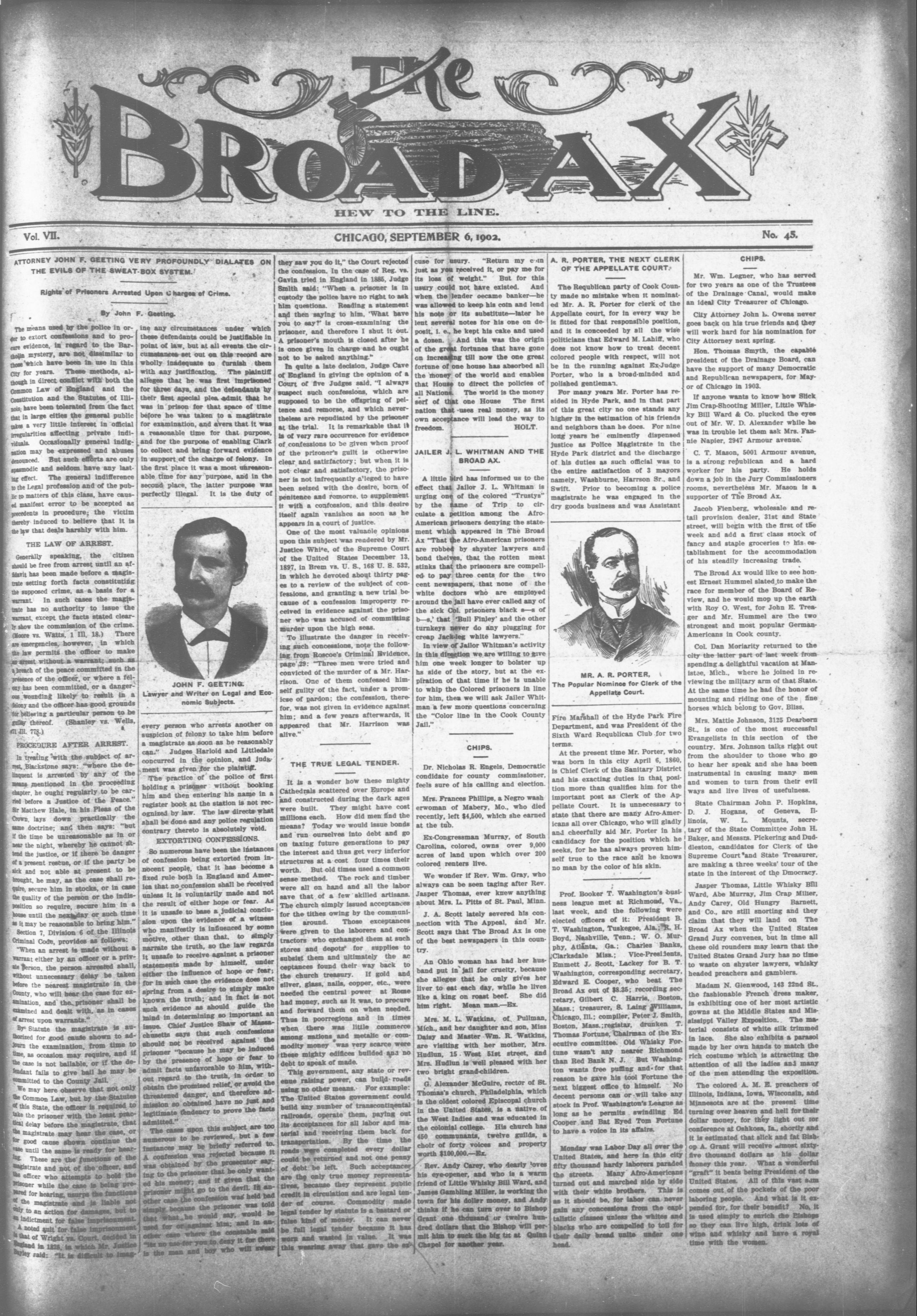
ATTORNEY JOHN F. GEETING VERY PROFOUNDLY DIALATES ON THE EVILS OF THE SWEAT-BOX SYSTEM.
Rights of Prisoners Arrested Upon Charges of Crime.
The means used by the police in order to extort confessions and to procure evidence, in regard to the Bartholin mystery, are not dissimilar to those which have been in use in this City for years. These methods, although in direct conflict with both the Common Law of England and the Constitution and the Statutes of Illinois; have been tolerated from the fact that in large cities the general public takes a very little interest in official irregularities affecting private individuals. Occasionally general indignation may be expressed and abuses denounced. But such efforts are only spasmodic and seldom have any lasting effect. The general indifference to the Legal profession and of the public to matters of this class, have caused manifest error to be accepted as precedents in procedure; the victim thereby induced to believe that it is the law that deals harshly with him.
THE LAW OF ARREST.
Generally speaking, the citizen should be free from arrest until an affidavit has been made before a magistrate setting forth facts constituting the supposed crime, as a basis for a warrant. In such cases the magistrate has no authority to issue the warrant, except the facts stated clearly show the commission of the crime. (Moore vs. Watts, 1 Ill, 18.) There are emergencies, however, in which the law permits the officer to make an arrest without a warrant; such as a breach of the peace committed in the presence of the officer, or where a felony has been committed, or a dangerous wounding likely to result in a felony and the officer has good grounds for believing a particular person to be guilty thereof. (Shanley vs. Wells, 11 Ill, 778.)
PROCEDURE AFTER ARREST.
In treating with the subject of arrest, Blackstone says: "where the delinquent is arrested by any of the means mentioned in the proceeding chapter, he ought regularly to be carried before a Justice of the Peace." Sir Matthew Hale, in his Pleas of the Crown, lays down practically the same doctrine; and then says: "but if the time be unreasonable as in or near the night, whereby he cannot attend the justice, or if there be danger of a present rescue, or if the party be sick and not able at present to be brought, he may, as the case shall require, secure him in stocks, or in case the quality of the person or the indisposition so require, secure him in a house until the next day or such time as it may be reasonable to bring him." Section 7, Division 6 of the Illinois Criminal Code provides as follows:
"When an arrest is made without a warrant either by an officer or a private person, the person arrested shall, without unnecessary delay be taken before the nearest magistrate in the County, who will hear the case for examination, and the prisoner shall be examined and dealt with, as in cases of arrest upon warrants."
By Statute the magistrate is authorized for good cause shown to adjourn the examination, from time to time, as occasion may require, and if the case is not bailable, or if the defendant fails to give bail he may be committed to the County Jail.
We may here observe that not only the Common Law, but by the Statutes of this State, the officer is required to take the prisoner with the least practical delay before the magistrate, that the magistrate may hear the case, or for good cause shown continue the case until the same is ready for hearing. These are the functions of the magistrate and not of the officer, and the officer who attempts to hold the prisoner while the case is being prepared for hearing, usurps the functions of the magistrate and is liable not only to an action for damages, but to an indictment for false imprisonment.
A noted guilt for false imprisonment is that of Wright vs. Court, decided in England in 1825, in which Mr. Justice Bayley said: "It is difficult to imag-
ine any circumstances under which these defendants could be justifiable in point of law, but at all events the circumstances set out on this record are wholly inadequate to furnish them with any justification. The plaintiff alleges that he was first imprisoned for three days, and the defendants by their first special plea admit that he was in prison for that space of time before he was taken to a magistrate for examination, and avers that it was a reasonable time for that purpose, and for the purpose of enabling Clark to collect and bring forward evidence in support of the charge of felony. In the first place it was a most unreasonable time for any purpose, and in the second place, the latter purpose was perfectly illegal. It is the duty of
M.
JOHN F. GEETING. Lawyer and Writer on Legal and Economic Subjects.
every person who arrests another on suspicion of felony to take him before a magistrate as soon as he reasonably can." Judges Harloid and Littledale concurred in the opinion, and judgment was given for the plaintiff. The practice of the police of first holding a prisoner without booking him and then entering his name in a register book at the station is not recognized by law. The law directs what shall be done and any police regulation contrary thereto is absolutely void.
So numerous have been the instances of confession being extorted from innocent people, that it has become a fixed rule both in England and America that no confession shall be received unless it is voluntarily made and not the result of either hope or fear. As it is unsafe to base a judicial conclusion upon the evidence of a witness who manifestly is influenced by some motive, other than that, to simply narrate the truth, so the law regards it unsafe to receive against a prisoner statements made by himself, under either the influence of hope or fear; for in such case the evidence does not spring from a desire to simply make known the truth; and in fact is not such evidence as should guide the mind in determining so important an issue. Chief Justice Shaw of Massachusetts says that such confessions should not be received against the prisoner "because he may be induced by the presence of hope or fear to admit facts unfavorable to him, without regard to the truth, in order to obtain the promised relief, or avoid the threatened danger, and therefore admission so obtained have no just and legitimate tendency to prove the facts admitted."
The cases upon this subject are too numerous to be reviewed, but a few instances may be briefly referred to. A confession was rejected because it was obtained by the prosecutor saying to the prisoner that he only wanted his money; and if given that the prisoner might go to the devil. In another case the confession was held bad simply because the prisoner was told that what he would say, would be used for or against him; and in another case where the constable said "it's no use for you to deny it for there is the man and boy who will swear
HEW TO THE LINE.
they saw you do it," the Court rejected the confession. In the case of Reg. vs. Gavin tried in England in 1885, Judge Smith said: "When a prisoner is in custody the police have no right to ask him questions. Reading a statement and then saying to him, 'What have you to say?' is cross-examining the prisoner, and therefore I shut it out. A prisoner's mouth is closed after he is once given in charge and he ought not to be asked anything."
In quite a late decision, Judge Cave of England in giving the opinion of a Court of five Judges said, "I always suspect such confessions, which are supposed to be the offspring of peitence and remorse, and which nevertheless are repudiated by the prisoner at the trial. It is remarkable that it is of very rare occurrence for evidence of confessions to be given when proof of the prisoner's guilt is otherwise clear and satisfactory; but when it is not clear and satisfactory, the prisoner is not infrequently a'leged to have been seized with the desire, born of penitence and remorse, to supplement it with a confession, and this desire itself again vanishes as soon as he appears in a court of justice.
One of the most valuable opinions upon this subject was rendered by Mr. Justice White, of the Supreme Court of the United States December 13, 1897, in Brem vs. U. S., 168 U. S. 532, in which he devoted about thirty pages to a review of the subject of confessions, and granting a new trial because of a confession improperly received in evidence against the prisoner who was accused of committing murder upon the high seas.
To illustrate the danger in receiving such concessions, note the following from Roscoe's Criminal Evidence, page 29: "Three men were tried and convicted of the murder of a Mr. Harrison. One of them confessed himself guilty of the fact, under a promisse of pardon; the confession, therefor, was not given in evidence against him; and a few years afterwards, it appeared that Mr. Harrison was alive."
THE TRUE LEGAL TENDER
It is a wonder how these mighty Cathedrals scattered over Europe and constructed during the dark ages were built. They might have cost millions each. How did men find the means? Today we would issue bonds and run ourselves into debt and go on taxing future generations to pay the interest and thus get very inferior structures at a cost four times their worth. But old times used a common sense method. The rock and timber were all on hand and all the labor save that of a few skilled artisans. The church simply issued acceptances for the tithes owing by the communities around. Those acceptances were given to the laborers and contractors who exchanged them at such stores and depots for supplies to subsist them and ultimately the acceptances found their way back to the church treasury. If gold and silver, glass, nails, copper, etc., were needed the central power at Rome had money, such as it was, to procure and forward them on when needed. Thus in poorregions and in times when there was little commerce among nations and metallic or commodity money was very scarce were these mighty edifices bullded and no debt to speak of made.
This government, any state or revenue raising power, can build roads using no other means. For example: The United States government could build any number of transcontinental railroads, operate them, paying out its acceptances for all labor and material and receiving them back for transportation. By the time the roads were completed every dollar could be returned and not one penny of dobt be left. Such acceptances are the only true money representatives, because they represent public credit in circulation and are legal tender of course. Commodity made legal tender by statute is a bastard or false kind of money. It can never be full legal tender because it has worn and wasted in value. It was this wearing away that gave the ex
cuse for usury. "Return my coin just as you received it, or pay me for its loss of weight." But for this usury could not have existed. And when the lender oecame banker—he was allowed to keep his coin and lend his note or its substitute—later he lent several notes for his one on deposit, i. e., he kept his cake and used a dozen. And this was the origin of the great fortunes that have gone on increasing till now the one great fortune of one house has absorbed all the money of the world and enables that House to direct the policies of all Nations. The world is the money serf of that one House The first nation that uses real money, as its own acceptance will lead the way to freedom. HOLT.
JAILER J. L. WHITMAN AND THE BROAD AX.
A little bird has informed us to the effect that Jailor J. L. Whitman is urging one of the colored "Trustys" by the name of Trip to circulate a petition among the Afro-American prisoners denying the statement which appeared in The Broad Ax "That the Afro-American prisoners are robbed by shyster lawyers and bond thelves, that the rotten meat stinks that the prisoners are compelled to pay three cents for the two cent newspapers, that none of the white doctors who are employed around the jail have ever called any of the sick Col. prisoners black s—s of b—s,' that 'Bull Finley' and the other turnkeys never do any plugging for creap Jack-leg white lawyers."
In view of Jailor Whitman's activity in this direction we are willing to give him one week longer to bolster up his side of the story, but at the expiration of that time if he is unable to whip the Colored prisoners in line for him, then we will ask Jailer Whitman a few more questions concerning the "Color line in the Cook County Jail."
Dr. Nicholas R. Engels, Democratic candidate for county commissioner, feels sure of his calling and election.
Mrs. Frances Phillips, a Negro washerwoman of Mabery, Mo., who died recently, left $4,500, which she earned at the tub.
Ex-Congressman Murray, of South Carolina, colored, owns over 9,000 acres of land upon which over 200 colored renters live.
We wonder if Rev. Wm. Gray, who always can be seen taging after Rev. Jasper Thomas, ever knew anything about Mrs. L. Pitts of St. Paul, Minn. J. A. Scott lately severed his connection with The Appeal, and Mr. Scott says that The Broad Ax is one of the best newspapers in this country.
An Ohio woman has had her husband put in jail for cruelty, because she alleges that he only gives her liver to eat each day, while he lives like a king on roast beef. She did him right. Mean man.—Ex.
Mrs. M. L. Watkins, of Pullman, Mich., and her daughter and son, Miss Daisy and Master Wm. R. Watkins, are visiting with her mother, Mrs. Hudlun, 15 West 51st street, and Mrs. Hudlun is well pleased with her two bright grandchildren.
G. Alexander McGuire, rector of St. Thomas's church, Philadelphia, which is the oldest colored Episcopal church in the United States, is a native of the West Indies and was educated in the colonial college. His church has 450 communants, twelve guilds, a choir of forty voices and property worth $100,000.—Ex.
Rev. Andy Carey, who dearly loves his eye-opener, and who is a warm friend of Little Whisky Bill Ward, and James Gambling Miller, is working the town for his doller money, and Andy thinks if he can turn over to Bishop Grant one thousand or twelve hundred dollars that the Bishop will permit him to suck the big tit at Quinn Chapel for another year.
CHIPS.
A. R. PORTER, THE NEXT CLERK OF THE APPELLATE COURT.
The Republican party of Cook County made no mistake when it nominated Mr. A. R. Porter for clerk of the Appellate court, for in every way he is fitted for that responsible position, and it is conceded by all the wise politicians that Edward M. Lahiff, who does not know how to treat decent colored people with respect, will not be in the running against Ex-Judge Porter, who is a broad-minded and polished gentleman.
For many years Mr. Porter has resided in Hyde Park, and in that part of this great city no one stands any higher in the estimation of his friends and neighbors than he does. For nine long years he eminently dispensed justice as Police Magistrate in the Hyde Park district and the discharge of his duties as such official was to the entire satisfaction of 3 mayors namely, Washburne, Harrison Sr., and Swift. Prior to becoming a police magistrate he was engaged in the dry goods business and was Assistant
J.
MR. A. R. PORTER, The Popular Nominee for Clerk of the Appellate Court.
Fire Marshall of the Hyde Park Fire Department, and was President of the Sixth Ward Republican Club for two terms.
At the present time Mr. Porter, who was born in this city April 6, 1860, is Chief Clerk of the Sanitary District and his exacting duties in that position more than qualifies him for the important post as Clerk of the Appellate Court. It is unnecessary to state that there are many Afro-Americans all over Chicago, who will gladly and cheerfully aid Mr. Porter in his candidacy for the position which he seeks, for he has always proven himself true to the race and he knows no man by the color of his skin.
Prof. Booker T. Washington's business league met at Richmond, Va., last week, and the following were elected officers of it: President B. T. Washington, Tuskegee, Ala.; R. H. Boyd, Nashville, Tenn.; W. O. Murphy, Atlanta, Ga.; Charles Banks, Clarksdale Miss.; Vice-Presidents, Emmett J. Scott, Lackey for B. T. Washington, corresponding secretary, Edward E. Cooper, who beat The Broad Ax out of $8.35; recording secretary, Gilbert C. Harris, Boston, Mass.; treasurer, S. Laing Williams, Chicago, Ill.; compiler, Peter J. Smith, Boston, Mass.; registar, drunken T. Thomas Fortune, Chairman of the Executive committee. Old Whisky Fortune wasn't any nearer Richmond than Red Bank N. J. But Washington wants free puffing and for that reason he gave his tool Fortune the next biggest office to himself. No decent persons can or will take any stock in Prof. Washington's League as long as he permits swindling Ed Cooper and Bat Eyed Tom Fortune to have a voice in its affairs.
Monday was Labor Day all over the United States, and here in this city fifty thousand hardy laborers paraded the streets. Many Afro-Americans turned out and marched side by side with their white brothers. This is as it should be, for labor can never gain any concessions from the capitalistic classes unless the whites and blacks who are compelled to toll for their daily bread unite under one head
CHIPS.
Mr. Wm. Legner, who has served for two years as one of the Trustees of the Drainage Canal, would make an ideal City Treasurer of Chicago.
City Attorney John L. Owens never goes back on his true friends and they will work hard for his nomination for City Attorney next spring.
Hon. Thomas Smyth, the capablé president of the Drainage Board, can have the support of many Democratic and Republican newspapers, for Mayor of Chicago in 1903.
If anyone wants to know how Slick Jim Crap-Shooting Miller, Little Whisky Bill Ward & Co. plucked the eyes out of Mr. W. D. Alexander while he was in trouble let them ask Mrs. Fannie Napier, 2947 Armour avenue.
C. T. Mason, 5001 Armour avenue, is a strong republican and a hard worker for his party. He holds down a job in the Jury Commissioners rooms, nevertheless Mr. Mason is a supporter of The Broad Ax.
Jacob Fienberg, wholesale and retail provision dealer, 31st and State street, will begin with the first of the week and add a first class stock of fancy and staple groceries to his establishment for the accommodation of his steadily increasing trade.
The Broad Ax would like to see honest Ernest Hummel slated to make the race for member of the Board of Review, and he would mop up the earth with Roy O. West, for John E. Treager and Mr. Hummel are the two strongest and most popular German Americans in Cook county.
Col. Dan Moriarity returned to the city the latter part of last week from spending a delightful vacation at Manistee, Mich., where he joined in reviewing the military arm of that State. At the same time he had the honor of mounting and riding one of the fine horses which belong to Gov. Bliss.
Mrs. Mattie Johnson, 3125 Dearborn St., is one of the most successful Evangelists in this section of the country. Mrs. Johnson talks right out from the shoulder to those who go to hear her speak and she has been instrumental in causing many men and women to turn from their evil ways and live lives of usefulness.
State Chairman John P. Hopkins, D. J. Hogans, of Geneva, Illinois, W. L. Mounts, secretary of the State Committee John H. Baker, and Messrs. Pickering and Duddleston, candidates for Clerk of the Supreme Court and State Treasurer, are making a three weeks' tour of the state in the interest of the Dmocracy.
Jasper Thomas, Little Whisky Bill Ward, Abe Murray, Jim Crap Miller, Andy Carey, Old Hungry Barnett, and Co., are still snorting and they claim that they will land on The Broad Ax when the United States Grand Jury convenes, but in time all these old rounders may learn that the United States Grand Jury has no time to waste on shyster lawyers, whisky headed preachers and gamblers.
Madam N. Glenwood, 143 22nd St., the fashionable French dress maker, is exhibiting one of her most artistic gowns at the Middle States and Mississippi Valley Exposition. The material consists of white silk trimmed in lace. She also exhibits a parasol made by her own hands to match the rich costume which is attracting the attention of all the ladies and many of the men attending the exposition.
The colored A. M. E. preachers of Illinois, Indiana, Iowa, Wisconsin, and Minnesota are at the present time turning over heaven and hell for their dollar money, for they light out for conference at Oshkosa, Ia., shortly and it is estimated that slick and fat Bishop A. Grant will receive almost sixty-five thousand dollars as his dollar money this year. What a wonderful "graft" it beats being President of the United States. All of this vast sum comes out of the pockets of the poor laboring people. And what is it expended for, for their benefit? No, it is used simply to enrich the Bishops so they can live high, drink lots of wine and whisky and have a royal time with the women.
Will presuginate and at all times uphold the two principles of Democracy, but Farmers, Liberals, Protestants, Knights of Labor, Indians, Mormons, Republicans, Priests, or any he also can have their say, so long as their language is proper and responsibility is fixed.
The Broad Ax is a newspaper whose platform is broad enough for all, ever claiming the editorial right to speak its own mind.
Local communication will have attention, this only on one side of the paper.
No. Noat..... 82.9
Name..... 1.4
Writing names made known on application
Others all information on
SULEUS F. TAYLOR. Editor and Publisher
Entered at the Post Office at Chicago, Ill., as Second-class Matter, August 19, 1902.
RAPID FLIGHT OF DREAMS.
Extraordinary Capacity of the Brain for Grasping Figments in
An eminent public man of England whose mental faculties had been subjected to too great a strain and who suffered greatly from mental depression that amounted almost to the disease of melancholia, was told by his physician that he must rest his brain. He was a very busy man and scoffed at his doctor's prescription of a nap in the middle of the day, relates a London paper.
Finally, after much persuasion, he agreed to this experiment: He would sit in his easy chair every afternoon with his hands on his knees, holding a dinnerbell in his hands. If he lost consciousness and went to sleep he would be willing to sleep for the period that it took for the dinner bell to fall to the floor and wake him.
The doctor who suggested this arrangement declared that the mere mental relaxation of going to sleep, if only for a few seconds, would suffice to save him. He invited his patient to study the activity of the brain by noticing how many things he could dream while the dinner bell was falling to the floor.
Every day for many months the man sat down after luncheon with the dinner bell in his hands. Every day he went to sleep, slept for half a second, while the bell fell to the floor, and his mental condition improved steadily, partly because of the rest which his mind got through losing consciousness for a second and partly because of his interest in the extraordinary dreams which passed through his brain while the bell was falling.
THE REFORMED PIG.
Governmental Efforts to Improve an Animal That Has Been Abused for Centuries.
Our enterprising and diligent department of agriculture has set itself to an important task. It is going to improve the pig. At least, it will see whether the pig has any ambition to improve, comments the Brooklyn Eagle. It will raise a litter of sucklings in a yard floored with clean sand; it will bathe the animals; it will feed them delicately, and for a whole year will keep them in a condition of respectability. Then it will open the way to the usual pig pen and will stand by to see if the creatures forsake their manners and elect mud and the trough.
Probably the pigs will elect to stay in the clean and wholesome yard. The obloquy that these beasts have fallen under is not of their seeking. Men have abused them by confining them in ill-kept places and feeding them on refuse. The pig in its natural state is not unclean. It is dirty when it is kept in a pen, because it cannot be otherwise. If afflicted with flies or vermin it has no resource but to lie in the mud, and as to its food, if it has nothing but the fermenting refuse of the house it must eat that or starve. When left at large swine do not usually seek filth and slime. When free to roam the woods they are no more unclean than cattle. It needs little experimenting to convince of that fact.
MUSIC TO HEAL WOUNDS.
The Violin Has Been Employed as an Aid to Surgery in Paris.
The attention of medical men has been called to two extraordinary cases reported from a hospital in Paris. A man had been seriously cut by accident and the wound refused to heal. From time to time the patient went into violent paroxysms and death appeared certain. A surgeon who had given much attention to the subject of vibrations secured the services of a violin player and treated the sufferer to a musical remedy. A change appeared at once and under the influence of the violin recovery was rapid and complete. In the other case a wound continued to suppurate in spite of all that could be done. The violin was again called into requisition and played close to the injured part, which was bared for the purpose. Soon the wound assumed a healthier appearance, suppuration ceased and complete cure was effected. In both those cases it was noted that only certain kinds of music were of benefit, showing that vibrations must be strictly in accordance with the nature of the wound.
ALBUM OF FRENCH PRINTS.
One in New York Public Library Contains Portraits of Men Who Helped America.
The reception of the French delegation that came to this country for the unveiling of the Rochambeau monument adds interest to a fine album presented to the print department of the New York public library not long ago by William F. Havemeyer, reports the New York Sun. It consists of 126 portraits of French personages, both civil and military, who actively or sympathetically contributed to the success of the war against England for American independence. This collection was formed by a Parisian amateur interested in Americana, and demonstrated the enthusiasm which was evinced for American liberty by different classes of French society.
The prints are carefully mounted, and each one is acompanied by a biographical note in manuscript, giving the reasons for its presence in the album. Many of the portraits are contemporary engravings, some are lithographs. Special attention should be made of the allegories on the declaration of war and the defeat of the English; the portraits of Louis XVI., Suffren, Menou and Necker printed in colors; a proof before letters of Choffard's portrait of Admiral Bossel; a first state of Vangelisti's "Du Couedic," with Reims instead of Rennes, and some very rare physionotrace portraits. The table of contents shows a remarkable list of names of Frenchmen connected with our war for independence, and while, as indicated, recent occurrences call special attention to this gift, its historical and national value and interest must obviously be permanent.
COMPOSITION OF METEORS.
Show to Us of What Materials the Other Worlds Are Constituted.
The meteors that flash across the sky at certain yearly periods usually burn out in the upper air, but occasionally a meteoric mass lasts long enough to reach the earth. On fell on May 15, 1900, at Felix, Ala. Meteors were seen on the occasion referred to and sundry explosions were heard, while later on a mass of meteoric substances weighing seven pounds was discovered imbedded in soft soil. This meteorite was analyzed and found to be built up of such minerals as olivine, augite, triolite, nickel-iron and graphite carbon. The dark color of the Felix stone is stated to be due to the presence in fair amount of the last-named substance. The interest attaching to meteorites, of course, centers around the fact that they enable us to obtain glimpses of the composition of other worlds than ours. Astronomy is well agreed on the unity of chemical composition which marks the orbs, and even the simple fact that it is hydrogen gas which blazes in the sun and gives us our light and heat is a testimony to this fact. Meteoric iron and carbon similarly display links between these erratic bodies and our own earth.
GIVES AWAY NICKELS.
Novel Method of a New York Store- keeper to Attract the Notice of Customers.
A shopkeeper is this year calling the attention of customers and those he desires as such to his wares by a novel method, says the New York Sun. The person to whom it is addressed receives by mail a well-filled envelope, with no external markings to indicate its contents, but up in the left-hand corner of the envelope are printed the words: "The five cents is inside."
The appearance of the envelope, together with the notice, is calculated to induce curiosity at once. The statement that the five cents is inside is true, for on opening the letter a bright new nickel of 1902 date is found tucked away between the middle pages of a pamphlet.
The explanation given in the pamphlet is that the sender is not a stealer of other people's time, and that as it was calculated that the recipient would use up five cents' worth of his own time in reading the shopkeeper's story, the latter had decided to be honest and pay for the time used or "purchased," as he puts it, and he therefore inclosed a nickel in payment. Whether the method pays the show
Whether the method pays the shopkeeper is not yet a settled question.
The Sensitive Egg.
"An egg in the process of hatching," says an expert, "is remarkably sensitive to vibration. Half the failures that amateurs encounter in hatching out chicks by the incubator method are due to lack of precaution in providing against the effect of vibration on the eggs. The rumble of a train or the passage of a wagon along the street will spoil a whole incubator full of eggs if the faintest vibratory wave reaches the apparatus. Even such a little thing as the banging of a door in some other part of the house will destroy the chances of hatching out a brood where care has not been taken to place the incubator beyond the reach of such disturbances. A thunder storm always gives breeders a scare, as thousands of eggs may be spoiled by a sudden heavy thunder clap. To sneeze or cough in the vicinity of the incubators will sometimes work a disastrous result."
To Prevent Dust
An Austrian material for preventing the rising of dust on sweeping proves to be cottonseed oil. In a test at Vienna it was found that floors oiled twice a year could be swept weekly without any whirling of the dust, and the material was recommended for all rooms receiving many persons, as well as for laboratories, libraries and other places to be kept scrupulously dust free.
Even in a country so recently conscious of the past as our own, there are buried cities awaiting the pickax of the historian. Of these, none is perhaps more interesting, certainly none more picturesque, more colonial and—even to-day—more English than old Williamsburg, in Virginia—that "middle plantation," which in 1832 was "laid out and paled," to become a chartered city, the capital of a great colony under king and crown.
Its three streets of the reign of William and Mary are its only thoroughfares and two "back" streets, hardly more than grass-grown lanes of to-day. Duke of Gloucester street, broad and genially hospitable, stretches leisurely from the foundations of the ancient capitol building on the east (of whose walls not one brick is left nor one white pillar of its porticos) to the iron turnstile gates of William and Mary college grounds at the western extremity of the town.
On the right, as one enters the college gate, is a charming mansion, the residence of the president of William and Mary, and upon the left, across the campus, stands the old Brafferton building, the earliest school for the education of Indians erected on American soil. In the time of Gov. Spotswood, says Country Life in America, it was necessary to resort to strenuous efforts to insure attendance, for the students were mainly hostages, the sons of chiefs of neutral or friendly tribes during Indian warfare.
FIRST MONT PELEE DRAMA.
A Play with the Martinique Volcano in It Produced in Paris in 1860.
It is scarcely to be expected that the dramatists ever seeking some new field for the scene of their efforts will long allow the volcanic explosions at St. Pierre to escape them. But even the earliest to utilize any scenes of the recent eruptions will not be a pioneer in drawing inspiration from Mont Pelée, says the New York Sun.
It has been recalled by a Frenchman with a long memory that Adolphe I'Ennery, author of "The Two Orphans," "A Celebrated Case," and about a hundred other melodramas, succeeded in getting before the public first with a play based on the volcano at Martinique. It was called "The Earthquake at Martinique," and was acted in 1840 at the Theatre de la Gaiete in Paris.
The old play in spite of its horrors is said to have been very effective on the stage. In it the villain who murdered an old man led his wife and laughter into a crater of the volcano 100 feet under the surface of the earth.
There was a sudden earthquake and the villain fell into a cavity and was killed, while the woman and her child were rescued.
ELK TEETH AS INVESTMENT.
One of the Chief Assets of a Montana Man Who Has a Big Fortune,
"Elk teeth by the bushel are one of the chief assets which John Losekamp, of Billings, Mont., enumerates among his big fortune," said E. M. Hoskins, a Butte man, reports the Denver Post. "Losekamp keeps a general store at Billings and for many years it was his custom to trade supplies of one kind or another for elk teeth, which, by the way, were used for charms and amulets long before the Elks took them up as the emblems of their order.
"The action of the Colorado lodges in agreeing to wear no more elk teeth because the demand for the teeth caused a wholesale slaughter of elk, had a marked effect in reducing the price. Other lodges respected the motive, and quite a boycott on elk teeth was on for a year or more. It seems, however, they are in demand again.
"Losekamp has been selling his at two dollars' apiece for ordinary teeth and getting fancy prices for the very best. His stock is sufficient to supply the demand for years, but he makes no effort to sell them, as he wants to leave them as a part of his estate, believing they will increase in value faster than any other kind of property."
LOATHE SIGHT OF GOLD.
That Is the Effect of Constant Contact with the Metal Upon Mint Employees.
"I have visited the mints of three countries," remarked a traveler, a medical man, according to the Chicago Tribune, "and I have found all the official guides in them broken down in nerve and victims of insomnia. Every one of these officials is required to give bonds, not only for his own honesty, but to cover theft by visitors whom he conducts over the place. It is customary to hand money about among the visitors to show the coins in their different stages of development. If the party be a numerous one the nerves of the guide are strung to such a pitch that at the Hotel de la Monnaie, in Paris, the man confessed that the sight of coined gold and silver was odious to him, and that he had come to look upon everyone who visited the mine as a possible robber.
"Besides the effect upon the nerves, in nearly every case it has affected the eyesight. One of the guides told me that 32 years of continual gazing upon gold and silver had affected his sight so that he is unable to distinguish certain objects unless they possess peculiar iridescent qualities."
IMPORTANCE OF WASHINGTON.
There is a new factor in European politics; it is Americas. More particularly is this new factor important in the calculations of the British empire. The development of the United States has shifted—for Great Britain, certainly—the diplomatic center from Paris to Washington, but our government altogether ignores the altered situation, says the London Truth. The following table of salaries paid to our diplomatic representatives is instructive: The British ambassador at Paris receives £9,000; at Berlin, Constantinople and Vienna, £8,000; at St. Petersburg, £7,800; at Rome, £7,000; at Washington, £6,500. Apart from other considerations, it is, therefore obvious that Paris is regarded by our diplomatists as the prize of the service, while Washington is a low rung in the ambassadorial ladder. But the United States send their best men to represent them in London, and London is the appointment which those men most value. It is time for us to remove from our minds the lingering impression that America is a rebellious British colony—a vulgar Anglo-Saxon suburb. The United States is now a great country, the most important foreign element that Great Britain has to deal with. Washington, must, therefore, be made the principal post in our diplomatic service, and to do that the salary must be considerably raised, even if at the expense of the other first-class appointments. It would be a pitiful blunder to appoint a new ambassador to succeed Lord Pauncefote on the old lines, to wit, as a representative to the last important embassy but Madrid!
THE LOTTERY INIQUITY.
Survives in Spite of All MFSorts of Civil Authorities to Stamp It Out.
The Louisiana lottery, the biggest of the lot, was driven out of New Orleans and out of the United States after years of attack by the postal authorities and the press. But the lottery evil is still with us, says the Atlanta Journal. Savannah is the lottery center of Georgia. It is said that several men have made fortunes by dealing in lottery tickets. There is hardly a city of considerable size in the United States where lottery tickets may not be purchased.
Mexico has a large number and variety of lotteries which are liberally patronized in this country. Canada also supplies lottery tickets in great numbers to dealers in the United States and to individual purchasers. France, Germany and several other European countries help to satisfy the craving of our citizens who consider the lottery a quick and sure way to fortune. All classes of people supply the patrons who enrich the lotteries.
Many persons of wealth buy lottery tickets regularly. The wage earners of the United States squander a large per cent. of their earnings in this form of gambling. Lotteries antedate civilization. Some of the earliest human records indicate the antiquity of lotteries. They thrive on the love of gambling, which is one of the most universal passions of men.
LOOKING FOR A WIFE.
He Was "Muskler" and "Morrel" But Couldn't Boast of Much Education,
A Mississippi man sent the following letter in answer to a matrimonial advertisement: "I inclose my photograph with My Full Descriptions. It shows the features as nachel as can bee only it is to Dark; I am very lite Complexion, Gray eyes, Orbon hair, 6-foot high, weight 190 Lbs, inclined to be hump shouldered; A Muskler Man and a widower 28 years old, with A Common School Equations, but hav Got Anof to Atten to Enny Business. I am Strictly Morrel. Don't use Tobacco Nor Whiskey." He is anxious to have her understand that her "Age, Complektions, wait and All Suits me to atee, Kind Loving Girl! I hav Only one Thing to Offer, And it is Neither Lands Nar Gold. But a Strong Arm and True Hart, and will Lay Down My Life for the Rite Girl and Be happy, for i am Tired of living Alone. That Girl that Steels my Hart and takes my Name for the Remainder of My Lif i will make Happy, for i am Hunting a Girl that i can idleise and Make a Angel of."
Tree That Turns to Stone.
There is a tree that grows in Mexico called the "chijol," or stone tree. It is of enormous proportions, both in circumference and height. It has a number of branches spreading out widely and carrying leaves of a yellowish green color. The wood is extremely fine and easily worked in a green state. It is not given to either warping or splitting. The most remarkable thing about it is that after being cut the wood gets gradually harder, and in the course of a few years it is absolutely petrified, whether left in the open air or buried in the ground. From this timber houses can be built completely fire-proof, and would last as long as though built of stone.
Annual Deaths by Lightning. Incidental to the thunder season, the weather bureau has discovered that more than 700 persons are killed by lightning every year in the United States. In matter of fatalities from 1896 to 1900 Pennsylvania ranked first with 186, Ohio was next with 135, and Illinois, Indiana and New York were tied for third with 124 victims each.
HERD OF DRIED CATALA.
Twenty Thousand Carcasses in the Colorado Desert a Monument of a Man's Folly.
"In crossing the Colorado desert in Arizona one sees a frightful monument to the folly of a man who thought that he could drive cattle across the desert with such speed that water would be unnecessary," said S. T. James, in the Pittsburg Press. "More than 20,000 carcasses lie at The Pools in that desert, and remind all travelers of the gigantic scheme to drive cattle through a desert country without making any provision for water. It was 30 years ago that an extensive cattleman, who was not familiar with the great desert of the southwest, thought it would be no barrier to his plan of taking cattle across it from the west into the grazing country. When the cattle reached The Pools, which are small lakes of foul alkali water, they were so crazed by thirst that they killed each other in their attempt to get at the water. The air in that country is so dry and the sun so hot that carcasses dry up instead of decomposing. As one approaches that great herd of dead animals the carcasses look as though they were poorly fed cattle. The hair has not fallen from the carcasses, and they have maintained their original shape so well that a man who is not familiar with the desert country might easily mistake them for beasts until he made close examination."
THE ORNAMENT WAS LOADED.
A Hornet's Next Comes to Life Under the Influence of Warmth in the House.
The residence of Hiram Fulton, of Hartranft, Montgomery county, presented a scene of consternation and dismay several days ago, when a swarm of hornets took possession of the entire house unexpectedly, reports the Philadelphia Telegraph.
Last fall Mr. Fulton found an excellent species of hornet's nest, and finding it perfect and intact, he thought it would make an excellent ornament for his home. Acting on the impulse, he took the nest home and hung it in the parlor. That portion of the house was used very little during the winter, and several days ago, when his wife was preparing the house for visitors, a fire was started in the parlor. The room soon became warm, and their attention was shortly attracted by a loud buzzing, and the next instant the room was filled with hornets that came from the ornamental neat. The heat caused them to come out, and resulted in a rush to escape from the room. Several of the family suffered from coming in contact with the business end of the insects, and over an hour's time was consumed driving them from the house.
ALWAYS SOMETHING TO LEARN
A Man Who Lived to the Age of 70 Before He Learned to Blow His Nose.
President Eliot was arguing in favor of education, one night recently, says the Boston Journal. He said that he was learning something every day by being "shown how." He illustrated his point by describing the training of medical students and concluded by telling of an old friend of his who had suddenly become deaf in one ear. "How did this happen?" I asked him. "Well, I was blowing my nose the other day, when I felt something snap in my ear, followed by an aching and dullness. "When the doctor came he said the drum had split and asked how I did it
"I only blew my nose,' I told the doctor.
"Well, had you opened your mouth when you blew your nose you would not now have a damaged ear drum,' was the medico's reply.
"You see, my friend had lived 70 years and had never been shown how to blow his nose," concluded President Eliot. The application was appreciated and greeted with a great burst of laughter.
An Early Love Affair.
It is common report in Spain that the king will marry his cousin, Princess Medina-Coeli. This may be true or it may not, but it is certain that the two children played together from babyhood, and regarded themselves as betrothed to each other, says Modern Society. "I will never marry you, you nasty boy!" cried the tiny princess with a delicious pout, on one occasion when his majesty offended her highness. "Oh, very well!" coolly remarked the somewhat ungallant prospective bridegroom; "please yourself, by all means. I am sure I never asked you to be my wife. I should prefer to marry the pastry cook's daughter; then I could eat all the nicest cakes in the shop without having to pay for them."
Big Relie Trust
A relic trust has been organized by the Omaha and Winnebago Indians. The president of this grasping monopoly is Great Thunder, a Winnebago, whose specialty is making bows and arrows. Green Rainbow and Prairie Chicken, makers of snakeskin belts, and John A. Logan, manufacturer of eagle feather headdresses, are directors. These leaders will hereafter fix the prices of Indian goods made for white purchasers.
Sentimental Zunl.
The Zuni Indians are sentimental in the extreme, and marry at a young age. When a youth is weeing a maiden he will go and sit before her with his back turned to her and untwine his head cloth. She rejects him by softly stealing away, or accepts him by running her hands caressingly through his loosened locks.
STOPPING A STONE WALL
An Illustrative Instance of the Slowness of Congress in Getting Into Action.
The work of preparing all measures is done in secret, and no one person or leader, and no party, is responsible for what is done or left undone. The country does not know why this item is inserted in an appropriation bill, why that economy has been practiced, or what is the reason for some bit of extravagance, writes H. L. Nelson, in Century. Sometimes the committee demonstrates that even it might be enlightened by discussion and criticism, and perhaps the letting in of light would show that advantage might follow if congress and its committee should leave to the discretion of executive and administrative officers some of the details of expenditure. I have been told of a "breast-high stone wall" at West Point, for example. Years waxed and waned while superintendents pleaded for $20,000 for the construction of a "breast-high stone wall" on the road leading from the wharf to the plane, the road running along the edge of a precipice. At last congress moved, and the $20,000 wall was built. Having moved, it was now impossible for it to stop, so it went on year after year appropriating $20,000 each year for a "breast-high stone wall," until "breast-high stone walls" became a drug at the military academy. They ran around the post, and threatened to choke it up. Superintendents begged congress to shut them off, and finally succeeded.
THE M'KINLEY DEATH COT.
Disappearance of the Bed Upon Which the Assassinated President Breathed His Last.
Although various people in New York, Boston, Chicago and other cities say they have the cot on which President McKinley died, they are all alike in error, states the New York Sun. According to Francis Almy, of the Pan-American exposition, two cots exactly alike were in the Milburn home for the use of the wounded president. After Mr. McKinley died one of them was sent to Dr. Matthew D. Mann, one of the physicians in attendance. The other was replaced among the cots owned by the exposition company. Both were originally taken from the hospital at the exposition.
"There has been some talk," says Mr. Almy, "as to whether the second cot should be sent to the Buffalo Historical society. It seemed to be the feeling that it should not be preserved as the cot upon which the president died, but should lose its identity and be put with the other hospital cots and sold with them, regardless of its use during the president's illness.
"That was done. The cot was placed with the others. Its identity was lost. No one knows who has it now. The cots were sold to persons and institutions in different parts of the country
"I cannot tell whether Mr. McKinley died on the cot which went to Dr Mann or on the other one."
IN THE GOOD OLD TIMES.
Many Things Were Lacking That Are Now Considered Necessary for Comfort.
People who talk of the good old times should read these facts compiled by Popular Mechanics. In the good old times:
There was not a public library in the United States.
Almost all the furniture was imported from England.
An old copper mine in Connecticut was used as a prison.
There was only one hat factory, and that made cocked hats.
Virginia contained a fifth of the whole population of the country.
or criticised the sermon was nixed.
Two stage coaches bore all the travel between New York and Boston.
A day laborer considered himself well paid with two shillings a day.
The whipping post and pillory were still standing in New York and Boston.
Trousers were fastened with pegs or laces.
The church collection was taken into a bag at the end of a pole, with a bell attached to arouse the sleepy contributors.
Turns Them to Stone.
Human bodies buried in limestone countries are often turned to solid stone by the limewater which penetrates the graves. In other soils there are elements which sometimes so embalm the buried dead as to preserve form and features unchanged. Many such cases are on record. Robert Burns' body was disinterred in 1815 to be removed to a new tomb. To the surprise of all his friends the features were found to be as perfect as at burial. When the body of John Hampden, the famous English patriot and leader, was disinterred by Lord Nugent 200 years after burial the form and features were as unchanged as if the corpse had been recently laid in the grave.
The Gentle Banks Artist.
One of the clever little tricks of the day is the conversion of a circular into a personal communication. The very latest device is to have the circular, in the usual facsimile of typewriter type, printed on dampened paper. The effect delights the heart of the most expert artist in public deception, says the New York Press. The slight moistening blurs the ink ever so slightly and leaves the sheet a trifle uneven of surface, thus giving it the appearance of having been especially dictated for the recipient and put through the office copying press. A two-cent stamp completes the little fraud, which harms nobody and may catch a customer.
---
THIRTY THOUSAND IN CASH.
To See the Mass Lying Idle in a Banker's Window Grieves One Practical Spirit.
The Italian bankers of Elizabeth and Mulberry streets are filing their show windows with greenbacks in an effort to attract trade and convince the public that one has more money than the other. In the window of one banker $30,000 was on exhibition one day recently, says the New York Sun. Hills of all denominations were strewn carelessly around the window, attracting crowds.
"Them ain't all real money," remarked one woman, "them's imitation."
"Yes," replied a man in the crowd, "that's the genuine long green we all struggle for."
"I never t'ought dere was dat much money in de world," chimed in a rugged boy.
Two Italian laborers got into an argument as to the amount of cash in the window. One thought there must have been at least $1,000,000.
About noon two men with long whiskers stopped their vending wagon in front of the place. They had come ever from the East Side of town.
"What? Tirty tousand dollar in dot window all der time!" exclaimed one. "Dot is it," replied the other. "It ain't too much for a bank, what?" "No; but look at der interest which it is losing every minute. What a shamefulness! Interest! Lost interest $1,200 a year."
LEAP-YEAR BIRTHDAYS.
4 Unique Society in Berlin Which Is to Hold a Big Celebration in 1904.
Berr Monteur, a worthy resident of Berlin, is over 70 years old, but will celebrate his eighteenth birthday on February 29, 1904. He is president of the Berlin society of leap year children, the one organization of its kind in the world. The members have had no birthday celebration for eight years, the extra February day having been omitted in 1900 according to the rules of the reformed calendar. Therefore the society is planning a great celebration on February 29, 1904. A committee of arrangements is already at work, and something extraordinary may be expected, as on account of the society's curious origin many prominent persons have interested themselves in the matter.
The month of February in 1886, by the way, was even more interesting than that which will be marked by the unique Berlin celebration. It had no full moon, and in that was the most remarkable in the world's history, for never before had such a thing occurred. January of that year had two full moons, and so had March, but February had none. How extraordinary this event was may be judged from the fact that according to the computation of astronomers it will not occur again for 2,500,000 years.
ART AND ATHLETICS.
The Outdoor Movement, It Is Thought, Will Advance the Two Interests,
The universally increasing attention now being given, especially in Anglo-Saxon countries, to out-ofdoor sports and to physical culture is a sign of the best omen. No class can have a greater solicitude for the furtherance of this movement than the artists, for they cannot create beautiful forms without having beautiful forms around them from which to draw inspiration. The art of a nation is but the mirror of that nation's ideals, and faithfully reflects their slightest change, says Outing.
This new conception of the value of athletics will add dignity, interest and standing, making it a factor second to none in the development of our civilization. It will be a mighty influence in the creation of a new and superior type of men and women. That women are growing more and more to realize this is evidenced by the athletic tendency of the modern girl. If she will combine therewith an intelligent effort after well-balanced and harmonious development the results are bound to be satisfying in the extreme, for in many ways the female body is quicker than the male to respond to training.
CURING A BALKY HORSE.
Simple Methods May Be Employed Without Resorting to the Use of the Whip.
An expert states that the vice of balking in horses is almost invariably caused by improper breaking and handling of the animal while young. It is only high-strung and ill-tempered horse that balk; and these are handled with more success by humoring and patience than by severe measures, which generally make matters worse. It is almost impossible to follow rules in a case of this sort. What will succeed in one case is useless in another, so that a driver must exercise good judgment—"horse sense"—in handling a case. A very good treatment is to watch the animal closely in places where it would be likely to balk, and driver should say "Whon," then get off and loosen or pretend to change the harness in some way; also take up a foot and tap the shoe with a stone. Spend a few moments leisurely in this way, and in nine cases out of ten the animal will forget its inclination to balk and will go on at the first bidding. It is also well to give a lump of sugar or a handful of oats or an apple. This will always produce better results than severe measures.
The Gravely Endured Much Physical
Suffering in Order to Please
His People.
"Of all the soldiers the king has
decorated within the last three years
of the war for bravery in the face
of the enemy none deserves the
Cross for Valor more than himself,
who grimly and silently faced
disease and death, unarmed and without
a comrade," says Richard Harding
Davis, in Collier's Weekly.
"For now that the whole dramatic, pitiful story is out, England learns—now that it is too late—of the days of gnawing pain when her king forced himself to smile and bow at court, to watch a horse race, to review a regiment, to drive through London with an assured and cheerful countenance. It is not pleasant to think of the torture of those days, of the mental anxiety as well as the bodily torment, when the king kept on his feet against the protests of his physicians, when his endurance was tested by hours of unceasing pain—pain so great that it is not decent to disclose it. Nor is it pleasant to remember that last drive through the park to Buckingham palace, when the people for some reason failed to cheer him heartily, while all the time he sat erect, pale and with set teeth, holding himself upright only by his will, and that they might be gratified."
THE YOUNGEST PREEESS.
Lady Betty Bligh, Baroness of Clifton, Three Years Old, Has a Coronation Robe.
The youngest peeress of Great Britain who has the right to attend the coronation of King Edward is Lady "Betty" Bligh, now Baroness Clifton, daughter of the late seventh earl of Darnley and Jemima, countess of Darnley. Although the baby countess can be barely three years old, having been born in 1900, the same year in which her father died, she is having a coronation robe made for her on the lines of those of the other peeresses, and, owing to her extreme youth, she will without doubt be an object of much interest and attraction in the coronation show at Westminster. The father of Lady "Betty" was the sixteenth Baron Clifton and seventh earl of Darnley. He married Miss Jemima Blackwood, daughter of the late Francis J. L. Blackwood, niece of the present baronet of the name, and a relative of the duke of Manchester. The tiny countess comes of a distinguished lineage. She is seventeenth in succession from the first Baron Clifton. In the history of the family the right of succession has fallen to the women of the house about as many times as to the men.
BELGIANS HONOR MAX DAY.
The Subjects of King Leopold Celebrate the Arrival of the Month of Flowers Each Year.
The month of May is the most highly honored of the whole year by the Belgians. It is known as the virgin's month and consecrated to the Virgin Mary. In the province of Liege young maidens have a quaint way of predicting their love affairs this month. A group of girls arrange to meet at sunrise and start to walk through the fields until they come to a hedge, quite unobserved from the highway, where they generally choose a honeysuckle bush beneath the protecting branches of which to perform their mystic operations.
Each maiden selects three blades of dew-laden grass, the tops of which she cuts to equal lengths, and to each of which she attaches a colored silken thread. Black represents a bacholer, red an unknown lover and green the secret desires of the maiden's heart. Ten days afterward they return to the same spot where they left the blades growing, and that blade of the three chosen which has surpassed the others in height reveals the lover the maiden is destined to have.
HOW TO KEEP YOUNG.
A Problem in Which the Gentler Sex Have Long Been Interested.
The problem of how to keep young or how to keep from looking old, has engaged the thoughts of both men and women ever since the world began. Women especially have shown a deep interest in the vexatious matter, for their influence with men has always depended much on physical freshness and beauty. Numerous writers have contributed their views as to defying the riddle of the ravages of time. The latest well-known writer to discuss on the familiar theme is Max O'Rell. Without giving a recipe for the preservation of beauty, M. Blouet, drops many useful hints as to the causes which lead to the unnaturally early disappearance of youth in some people.' Bad temper and a lack of humor are, in his opinion, the two greatest enemies of youth and beauty. Max O'Rell thinks that with the aid of a sense of humor and good temper a woman can be young and beautiful until 50. After 50 he can offer no advice on the subject.
Mica Vell for Automobilists.
The only successful substitute for the ugly goggles worn by automobilists are said to be a veil of mica invented by a Parisian milliner. It is intended for the use of ladies who object to the disfiguring effect of goggles. A sheet of mica in the form of a vizor, set close to the face, is attached to the cap. It is a great improvement over the ordinary devices for protecting the
Two ladies from Massachusetts were in the senate gallery one day recently when their escort, who was showing them various objects of interest, pointed out the desks of Senators Hoar and Lodge, says the Washington Star.
"The desks, you see," said the impromptu guide, "are next to each other."
"Oh," exclaimd one of the ladies, "I know now what it means when it is said that senators are paired."
Stories of the mistakes which women make concerning public matters are always current at the capitol. The other day an eastern congressman received a letter from a lady in his district who asked him to look after her nephew. "He is a secretary in the cabinet or something of the sort," wrote the lady, and the congressman finally found him acting as clerk to a very subordinate official in the treasury department. The capitol guides tell the story of the woman who, when told the vice president presided over the senate, said that she always wanted to see Bryan.
"But Bryan is not vice president," explained the guide.
"I thought he was," replied the lady, "because he got almost as many votes as McKinley."
And there is still another story of the woman visitor to the capitol who asked the name of the secretary of state.
"Mr. Hay," was the reply.
"Mr. Hay?" queried the woman, in surprise. "That can't be, because Mr. Hay is a member of the cabinet!"
[DEA OF THE CASH REGISTER.
It Came to an Ohio Man While He Was Watching the Machinery of an Ocean Steamer.
"A hotel keeper watching the machinery of a big ocean steamer working in midocean received a mental suggestion that resulted in the modern cash register," said C. G. Eakin, of Dayton, O. "The inventor of the first cash register was 'Jake' Rittie, a hotel keeper, of Dayton, O., according to the Kansas City Times. He was on the way to Europe several years ago, when he was invited to look at the machinery that propelled the steamer that was conveying him across the sea. The chief engineer showed the hotel man the apparatus that registered the number of revolutions of the propeller.
"Why wouldn't the same idea be a good thing to keep track of a cash account?' the hotel man asked. 'I am on my way to Europe, and some of my employees might be robbing me back in Dayton. If I could invent a machine to keep a cash account I would make a fortune.' The hotel man hurried home to begin work on a cash register. He did not take his trip through Europe, but took an early steamer homeward bound.
"The modern cash register is the result of the idea the Dayton hotel man caught while watching the machinery of an ocean steamer. Of course, improvements in cash registers are made every month, but the principle of all of them is the same."
PAYS THE FARMERS WELL
The Importance of Fruit and Vegetable Raising Is Increasing Every Year.
Gardeners and fruit growers, especially those residing near the larger cities of the country, have been enjoying a profitable business of late years and the demand for their products is still on the increase, says the Chicago Chronicle. The handling of these articles, too, has developed and is a great business enterprise, commanding millions of dollars of capital. Already North America is the greatest fruit-growing country in the world, practicing the most scientific and progressive methods. The flower-growing interest is itself an important source of national wealth. Where once we grew tomatoes in an amateurish way as a garden product, we now grow them in blocks of hundreds of acres. So great have become the horticultural interests in this country that departments of horticulture have been established even in many small as well as the large schools. The generation to come will see the different branches of horticulture, each in itself a department of the institution. The extent to which these special industries are singled out and emphasized measures the increasing importance of agriculture as a whole.
Beam, English and Sport.
Boems, English and Sport.
"When Gen. Louis Botha passed through Vryheid a few weeks ago," says the London Chronicle, "the impression given by his good spirits was that he was pleased with the 'terms.' The English commanding officer went out to exchange courtesies with Botha, and our infantry gave him a guard of honor until he joined his own burghers a few miles out of Vryheid. All this is as might be expected, but a strange incident occurred. The English officer in charge of the escort was presented to Gen. Botha's secretary, Jacobus De Wet, who had been three years at Oxford, and to his aid-decamp, Louis Eslem, also a 'varsity man. They were evidently anxious to get speech with our lieutenant, and their first words were: "Who won the boat race?"
The following notice appears on a signboard near Port Clinton, Pa.; "Notis. Take this roat to Port clinton. You cant trive over the Finte-creek Bridge. She is too Poore, and she is fentsup. Surowiser."
A FAIRY TALE OF INDUSTRY.
Interesting Facts About the Great Transformation Scene to Sault Ste. Marie.
Few people have any notion of the stupendous operations going on at Sault Ste. Marie, the little Canadian village on the shores of Lake Superior, where an industrial center of enormous magnitude is now being created by the energies of one man. "Harnessing Lake Superior" is the title of an article in Pearson's, which gives this remarkable story: "Five years ago the sleepy little Canadian town of Sault Ste. Marie numbered 2,500 inhabitants. Past its doors the surplus waters of Lake Superior, mightiest of inland oceans, emptied into Lake Huron. Untold millions of horse power energy lay latent in their idly flowing eddies, but only the slow-turning wheels of a few old flour mills stood to mark their commercial usefulness, while but an occasional steamer or a paddle propelled canoe disturbed the tranquil surface. Almost as in a night a metamorphosis has taken place.
"Where once was a scattered group of village dwellings, great stone buildings, with towers and shafts and connecting passageways, now stand, and at their base deep-dug canals wind in and out, spanned by bridges of massive stone. Nine thousand workmen now earn their livings in the shops at Sault Ste. Marie, beside the site where five years ago the total population was but a quarter of that number. It is a truly wonderful story, this story of the growth of the little frontier town into a great industrial centre; and its story is the history of the career of one man—Francis H. Clergue."
GOOD FOR JEWELERS.
Ping-Pong Is Said to Be Hard on Watches and the Repairer Will Profit.
"Ping-pong is a fine game," said a jeweler, who does a lot of repairing, to a Sun man. "No outdoor or indoor sport has ever given us so much to do. It is surprising how many persons have broken their watches since the game became a fad, says the New York Sun.
"You see, people play the game without removing their coats or waistcoats. In the excitement they forget about their watches, and the first thing a man knows his timepiece bounds out of his pocket. Sometimes it strikes the table, but wherever it does fall the watch is damaged.
"That is not all. A player may tie his watch to his pocket, but still it gets out of gear. The constant jumping around and the swinging of the arms disturbs the works so the watch has to be brought to us to be regulated.
"I have had as many women's watches as men's to repair. The women are even more careless than the men. Their watches dangle from their shirt waists, and as a result the watch jumps around like a weathercock in a gale of wind.
"Surprising as it may seem, my income from repairing watches has almost tripled since the craze of pingpong began."
SAXONY'S ECCENTRIC KING.
Interesting Stories Are Told of the Peculiar Habits of the Former Ruler.
The newspapers have lately been full of incident of the life of the deceased king of Saxony, but they are mostly connected with his public military career. Of his private life little is told except that in its extreme simplicity it resembled closely that of Emperor William I.
It is reported that King Albert had a rooted objection to exchanging his old clothes for new ones, and it was only with great difficulty that his groom of the chamber could persuade him to have a new coat tried on. One day when he had just undergone the torment of having clothes tried on, the king happened to pass through the famous hall of the knights, in the Dresden palace. Looking up at the figures of the mail-clad knights, he said, with a deep sigh: "What a good time the old knights had in their iron armor; they were troubled with no creases."
A retired captain of the Saxony army, whom everybody knew as being under his wife's thumb, applied for permission to wear his old uniform on special occasions. The king wrote on the margin of the application: "I am quite willing, if his wife permits it."
Cleaner Transportation.
Some statistical losses are hailed with pleasure. New York city is glad to hear that it has only 65,086 horses and 3,326 stables, compared with 73,746 horses and 4,649 stables in 1896. Electricity and automobiles are responsible for the change, and it is an important one in the direction of cleaner streets.
Horrors of the Cinematagraph. The exhibition of cinematograph pictures showing the operation recently performed on the Hindoo twins, Radica, and Doodica, has awakened a storm of disgust in Vienna. The pictures show all the horrors of the dissecting room, and the dreadful contortions of the limbs when under the knife.
Massachusetts' Smallest Town. Gosnold, the smallest town in Massachusetts, comprises those little specks of land which, beginning at Woods Holl, at the shoulder of old Cape Cod's right arm, extend seaward till they terminate in that fatal reef of the Sow and rise.
LO AS A HOUSE SERVANT.
Indian Boys and Girls Have of Late Been Taking to Housework in the West,
Indian schools all over the southwest have recently adjourned for the summer, and the students are being employed very rapidly by those who keep servants. The Indian boys make excellent cooks, while an Indian girl, once trained, is a fine maid of all work, a modish hairdresser and endowed with an inborn taste which becomes picturesque when combined with a few civilized touches. The system of training now bestowed upon the red children at school teaches them to become servile to their superior—the paleface, and the present generation in training have become so accustomed to serving their paleface teachers that they are more than willing to enter the household as servants. Herein may lie the solution of the servant-girl question for a time, at least, says a western exchange.
Indian youths are strong, agile, and if brought up by the right kind of methods, are perfectly willing to work. They are healthy and quick of limb. This makes an excellent combination for a servant. Statistics of the Indian taken recently show that of the 45,000 workers among the various tribes, 3,000 of them are employed as helpers in the houses of palefaces. You never see the Indian servant at his or her best until you visit the home of an old Indian agent on one of the reservations.
QUESTION OF CONSCIENCE
The View Taken of It by a Clock to Whom an Honest Customer Returned Two Cents.
"Some folks," said a store clerk, according to the New York Sun, "are too honest. Now I've had somebody come in to me when the boss was standing by, somebody that had bought something of me the day before, and hand over two cents and say:
"'You gave me two cents too much change yesterday, and I've brought it back.'
"He couldn't rest, you see, that man, until he'd got that two cents off his conscience and returned it. But in getting rid of that load himself he simply shifted it onto me. Here's the boss standing by when that two cents is returned; and the boss says to himself, with his eye on me:
"Hm! If you make a mistake of two cents, you'd make one of two dollars,' and so, you see, that super-honest man's return of that two cents may do me a lot of harm.
"The meaning of which is, if I can make myself clear, that we don't want to be too blamed honest. A man can be too honest and worry himself over trifles that he ought not to bother over.
"I should say that if the honest man must bring two, cents back let him turn it in some time when the boss wasn't 'round."
BETRAYED BY GOLDEN LOCKS.
The Sad Experience of a Public Official Who Sought the Aid of Hair Dye.
A prominent public official began to show signs of baldness, and then rather surprised his friends by appearing with a sleek, well-groomed crop of dark hair, relates the Philadelphia Record. For some time no one suspected a wig. But a few days ago he appeared with the top of his head covered with the usual dark brown hair, but a sharp line from the tips of the ears marked a strange contrast, for the hair below the line was of the bright golden hue which is the pride of the "chemical blondes."
It was found out that the man found his natural hair was turning gray and desired to make it match the wig, so he invested in a preparation warranted to darken the hair, and in the secret of his own room applied it. But, owing to some strange chemical combination, instead of making the silvered hair dark it made the dark hair golden, and so far the unfortunate man has found nothing that will counteract the striking contrast, so he is compelled to endure no small amount of chaffing from his friends.
THE KAISER KEPT HIS WORD.
Sends Troops to Crefeld So That the Girls Might Dance with Soldiers.
During his recent tour in the Rhenish industrial district the kaiser was extremely pleased at seeing so many signs of progress. He was in high good humor when at the close of the Crefeld visit he thanked the maids of honor for their attendance, says a Boston report.
He complimented them on their graceful figures, spoke of the charming Crefeld faces, and asked if the lieutenants often danced with them. When the ladies replied that Crefeld possessed no lieutenants the kaiser laughed heartily and said: "Then I must send you some."
As he was leaving he added: "I will keep my word." Next day the chief burgomaster of Crefeld received the following telegram from Lieut. Gen. von Bissing, commander of the Seventh army corps: "By order of his majesty the kaiser and king, Crefeld is to receive a garrison. Kindly forward proposals for the accommodation of a hussar regiment in the town."
A Lovesick Indian
Insane because a white woman had refused to marry him Evans Brady, full blooded Indian, died in Bellevue hospital. New York, recently.
The first locks at St. Mary's falls were opened in 1855, in which year the registered tonnage was 106,296. The half-million mark was reached in 1863, and the 1,000,000 mark was passed in 1873. In 1881, exactly coincident with the opening of a new and much larger lock, the northwest began to grow by leaps and bounds, and the tonnage of the canal rose from 2,000,000 tons in 1882 to 9,000,000 in 1890 and to 16,000,000 in 1896. During the past five years, two more enormous locks have been in operation, one of them on the Canadian side of the river, and in this short time the tonnage of the canal has leaped up to nearly 28,500,000 tons. This colossal tonnage is simply a manifestation of the development which has taken place in the northwest, along with which has come the building of thousands of miles of railroad, including two lines from the head of Lake Superior to the Pacific coast, says the Engineering Magazine. If by some cataclysm of nature the great lakes should be dried up, the enormous traffic now carried on their waters would be divided among the railroads — it would simply cease to exist. The whole galaxy of cities from Buffalo to Chicago and Duluth would be overwhelmed in hopeless, irretrievable ruin and the railroads could in no wise escape the general disaster.
GATHERING OPIUM.
Cultivators Go Forth in the Evening with Lances and in the Early Morning with Pots.
It is a sort of garden cultivation, the poppy plant being grown in little squares or beds intersected by tiny water channels for irrigation wherever this is possible. The growth of the plants is carefully tended, and at length the time comes when they burst out into flower, and the fields look like a sheet of silver as the white petals of the flowers glisten in the morning dew.
These beautiful petals are the first produce of the crop, for the women and children of the cultivators' families come forth and pick them off one by one and carefully dry them, so that they may serve afterward as the covering of the manufactured cakes of opium. Then the poppies, with their bare capsule heads, remain standing in the open field until it is considered that they are ripe for lancing. The cultivators then come forth in the evening, and, with an implement not unlike the knives of a coupling instrument, they scarify the capsule on its sides with deep incisions, so that the juice may exude. In the early morning the cultivators reappear with a scraping knife and their earthenware pots, and they scrape off the exuded juice and collect it in their pots. And this is crude opium.
MUST HAVE THE SWORD.
An Article That Is Necessary to the Completeness of a Naval Surrender.
Naval red tape is as stringent as that existing in the army, and sometimes the enforcement of the regulations leads to ludicrous results. Some years ago, when the late Admiral Skerrett was a captain, an officer who had been charged with an offense and ordered under arrest presented himself to be arrested. Th regulations provide that on such occasion the officer shall be in full dress and wear a sword. The officer wore his uniform, but had no sword. "I can't arrest you," said Capt. Skerrett, looking for the missing sword, "unless you come prepared to submit your sword to me."
The officer explained that he had not received his sword from home, although it had been expressed to him. "Well, you'll have to get one," was the reply. So the officer skirmished about in the navy yard for someone who had a sword to lend. Finding one, the offender returned to Capt. Skerrett and was promptly and regularly put under arrest according to regulations.
DOGS REFUSE TO STARVE.
The Clever Little Joke of a German Professor Who Was Called to Columbia University.
Some little time ago Prof. Hirth, who was called from Munich, Germany, to Columbia university as Chinese lecturer, lived in the same house with a rabid vivisectionist, then practicing on half a dozen large dogs. Hirth's colleague was trying to find out how long the dogs could stand being left without food before they would fall upon and devour each other. The dogs were fed on wind for two weeks, yet looked round and happy. The vivisectionist couldn't understand it, says the Washington Post.
The kennel being closed on all sides, it seemed impossible for anyone to feed the dogs on the sly. Still, the fact remained that they refused to starve, even after a month's apparent fasting. Then the vivisectionist watched, and discovered that late-at night Prof. Hirth had lowered large chunks of horse meat into the kennel from above. Hirth had allowed each dog six pounds of horse steak and bone a day.
Close Croppers.
Sheep and cattle cannot pasture over the same territory. Where the sheep wander the grass is gleaned with the devastation of a prairie fire, and the odor is such that cattle will for weeks shun the range.
Mrs. Cara Labler, who very faithfully looks after Doctor George C. Hall's inside and outside business, is much of an artist. During her leisure time in the office she executes fancy waist fronts, tidys, and pillows. Recently Mrs. Lebier donated a beautiful pillow to the Old Folks Home which can be seen on exhibition at the Middle States and Mississippi Valley Exposition, and she values this pillow at fifteen dollars.
Joseph W. Houston, head manager of the Police Station, North Halsted and Addison streets, was a visitor to the Middle States' and Mississippi Valley Exposition Monday evening and Mr. Houston, who is full of race pride, is more than pleased with the exhibits, for he thinks they show progress on the part of the Afro-American race, and by the way, it is said that in the near future Mr. Houston will be united in marriage to Miss Hannah Johnson, Orangeburg, S. C.
Dan Morgan Smith opened his congressional campaign at Butler's Hall, Friday night, and the meeting which was largely attended was addressed by Rep. John )E. Doyle, Congressman John J. Feely, B. C. Evans, Mr. Smith and others. All the speakers brought out many good points against Mark Hanna and his lily-white party. Mr. Melville 'G. Holding, City Oil Inspector, served as chairman of the meeting, and he is of the opinion that Mr. Smith will be elected to Congress from the Third District.
Any woman who has tried to go up stairs carrying a baby, a glass of milk and a lighted lamp, and at the same time trying to hold up her skirts, will advocate some sort of dress reform at least for the house. It won't be the divided skirt, however, for one woman who wore one said she had to hold up both legletts when going up stairs, and how could she manage to get the baby, lamp and milk up also. Give us short skirts, bloomers, or anything that will tend to prevent us from falling over ourselves.—Ex.
TRIUMPHS OF WOMEN.
some of Them Are Displaying Qualities They Were Not Supposed to Possess.
Every day women are displaying traits of character that excite both surprise and admiration, says the Chicago Chronicle. In Brooklyn the other day Mrs. Lennie Kelley saved the life of her aged father by climbing over the dashboard of the buggy in which they were driving on the Coney Island boulevard and seizing the reins that had dropped from his hands and were langling at the heels of their runaway horse. Would Pamelia or Clarissa or even Mme. De Stael's extraordinary heroine, Delphine, have done that?
In Pittsburg Mrs. Sarah E. McCoy, in a law court, has just excelled in the intellectual feat of Portin, and has surpassed many shining masculine fights of the bar, for she managed her own case in a breach of promise suit and proved, too, contrary to the old adage, that she did not have a fool for a client. There were some novelties in her methods of examining witnesses, as, for instance, her telling one of them point blank that he was a liar in the first case there was a triumph of nerve and muscle and in the second of nerve and intellect. The obvious conclusion is that the era in which woman was a "downtrodden creature" is fully past, for, with qualifying experience of the world, she is now quite capable of defending her own and or holding it.
A caterpillar cannot see more than a centimeter ahead; that is to say, less than two-fifths of an inch. The hairs on the body are said to be of as much use as his eyes in letting it know what is going on around.
The Telephone in Corsica.
Ajaccio, in Corsica, the birthplace of Napoleon, has a new telephone service. At present its subscribers are three in number.
Rooms for Rent.
Elegantly furnished rooms for rent with bath and gas at 3232 Wabash avenue.
HOUSE AND LOT WANTED.
Anyone having a good house and lot for sale on easy payments located between 59th and 69 Halsted and Ashland avenue, will find it to their advantage to address Julius F. Taylor, 5040 Armour avenue, Chicago.
SANITARY DISTRICT OF CHICAGO. TO CONTRACTORS.
Sealed proposals addressed to the Board of Trustees of the Sanitary District of Chicago and endorsed:
"Proposals for constructing certain works for the conservation of water power on the channel of the Sanitary District of Chicago and the Desplaines River, will be received by the Clerk of the Sanitary District at Room 1110 Security Buliding, Chicago, until 12 M. (Standard Time) of Wednesday, the 15th day of October, 1902, and will be publicly opened by said Board of Trustees at a meeting of the Board held that day. The work for which said tenders are invited covers two separate locations:
First: In the vicinity of Lockport, Will County, Illinois, a hereinafter known as the Lockport development), the preparation of wall foundations, the building of concrete retaining walls, the excavation of a channel both above and below the site selected for the power development, the building of sluice ways, levees and other works auxiliary to the project of power development, such as raising the grade of highways and bridges appertaining thereto, all in accordance with the plans adopted therefor by the Sanitary District.
Second: In the vicinity of Hickory Creek, near the southern limits of Joliet, Will county, Illinois (hereafter known as the Hickory Creek development), the excavation and preparation of foundations for a dam and constructions appertaining thereto, and a tail race; the building of a concrete masonry dam and constructions appertaining thereto, together with the building of coffer dams, levees and all auxiliary work necessary to the execution of the plans for the work.
The work for which said tenders are invited includes supplying all materials, tools, appliances, labor and superintendence essential to the proper execution of the work within the time required by, and in accordance with, the plans, specifications and directions of the Sanitary District. Bidders will make separate proposals for the work to be done at each of the pieces of work designated herein.
Each bid must be accompanied by a certified check or cash to the amount of three thousand ($3,000) dollars. All certified checks must be drawn on some responsible bank doing business in the City of Chicago and made payable to the order of the Clerk of the Sanitary District of Chicago. Said amounts of three thousand ($33,000) dollars deposited with bids will be held by the Sanitary District of Chicago until all of the respective bids for said structure have been canvassed and the contracts awarded and signed, and return of said check or cash being conditioned upon the appearance within ten (10) days after receiving notice of the award to him, of the contractor to whom the award shall have been made, with bondsmen, and the execution by him of a contract with the said Sanitary District for the work so awarded, and giving a bond satisfactory to the Board of Trustees for the sums hereinafter named, viz.: For the Lockport development in the sum of one hundred thousand ($100,-000) dollars: For the Hickory Creek development the sum of seventy-five thousand ($75,000) dollars.
All bids must be made upon the blank forms furnished by the Sanitary District. No bid will be considered unless the party making it shall furnish evidence( satisfactory to the Board of Trustees of his experience in the class of work to be undertaken by him and of his financial ability successfully to prosecute said contract in case the same shall be awarded to him. Bidders are requested to state in their bids their individual names and places of residence in full. The said Board of Trustees reserves the right to reject any and all bids. THE SANITARY DISTRICT OF
CHICAGO.
By THOMAS A. SMYTH,
President of its Board of Trustees
Attest: A. R. PORTER, Clerk.
CURING A BALKY HORSE.
Simple Methods May Be Employed Without Resorting to the Use of the Whip.
An expert states that the vice of balking in horses is almost invariably caused by improper breaking and handling of the animal while young. It is only high-strung and ill-tempered horses that balk; and these are handled with more success by humoring and patience than by severe measures, which generally make matters worse. It is almost impossible to follow rules in a case of this sort. What will succeed in one case is useless in another, so that a driver must exercise good judgment—"horse sense"—in handling a case. A very good treatment is to watch the animal closely in places where it would be likely to balk, and driver should say "Whoa," then get off and loosen or pretend to change the harness in some way; also take up a foot and tap the shoe with a stone. Spend a few moments leisurely in this way, and in nine cases out of ten the animal will forget its inclination to balk and will go on at the first bidding. It is also well to give a lump of sugar or a handful of oats or an apple. This will always produce better results than severe measures.
SUITE 318-320 REAPER BLOCK
Clark and Washington Sts.
Telephone, Main 940. CHICAGO
A. D. GASH,
Attorney-at-Law.
64 and 86 La Palle St., Suite 615 to 619.
Telephone, Main 8077. Chicago
JOHN E. OWENS
Attorney at Law,
SUITE 621 ASHLAND BLOCK.
S. Clark Street. CHICAGO
FREDERICK W. JOB
ATTORNEY AT LAW
832 MARQUETTE BUILDING
Telephone 2310 Central CHICAGO
LAWRENCE A. NEWBY
ATTORNEY-AT-LAW
Room 6, 128 LaSalle St.,
CHICAGO
RESIDENCE 2623 WABASH AVE
William Howard Fitzgerald
LAWYER
Room 402 Reaper Block, CHICAGO
JOSEPH A. McINERNEY
LAWYER
SUITE 706-708
CHICAGO OPERA HOUSE CHICAGO
Beauregard F. Moseley,
LAWYER.
Practice in all Courts.
Main Office 6256 Halsted St,
Down Town Office 360 S. Clark St., Room 431
Hours from 12 to 2 P. M.
Phone: 2533 Harrison.
ISRAEL COWEN
ATTORNEY AT LAW
613 TACOMA BUILDING
'Phone Main 717. 9 CHICAGO
WILLIAM RITCHIE
ATTORNEY AND COUNSELOR.
Suite 519-520 Oxford Building
84 LA SALLE ST., CHICAGO
Telephone Main 1646.
Telephone Yards 797 Residence, 113 Garfield Bd.
JOHN FITZGERALD
JUSTICE OF THE PEACE
4787 S. HALSTED STREET,
.....CHICAGO
S. A. McELWEE
...LAWYER...
36 S. Clark St., CHICAGO.
Room 706 Ogden Building
Residence, 3153 Forest Av.
Robert M. Mitchell
Suite 9, No. 77 South Clark St. CHICAGO
ALBERT B. GEORGE
LAWYER.
423 Ashland Block, Chicago.
— Tel. M. 2525. —
EDWARD H. WRIGHT
LAWYER
Suite 421, 200 S. Clark St.
Telephone, Harrison 2532. CHICAGO.
FOR SALE.
Three story brick building, lot 25x 125, vacant lot adjoining same length, brick cottage rear of corner lot. Rent $80 per month. This property is located on Halsted street near 35th and it is a great bargain at $12,000. For further particulars call on or address Julius F. Taylor, 5040 Armour avenue, Chicago.
ROOMS FOR RENT.
Two comodious nicely furnished rooms for rent to gentlemen only. Inquire at 2623 Wabash avenue.
51st Street and Armour Avenue... Residence, 5045 Michigan Boul., CHICAGO
Established 1893. Capacity 200,000 per day.
Geraghty Mfg. Co.
Manufacturers of
CAMPAIGN BUTTONS
AND BADGES.....
61 La Salle St., CHICAGO
Telephone Main 4498
R. G. BELL
Dealer in
Coal, Wood, Feed Ice
Terms Strictly Cash on Delivery
137 W. 47th St., CHICAGO
Telephone Blue 284
ALEX I. WYATT,
JEWELER AND OPTICIAN
Manufacturer of
OPTICAL AND REFRACTING GOODS
Watches and Jewelry Repaired, Prices
Reasonable. Eyes Tested Free.----
98 E. Middletown near Dearborn Chicago
BERNARD J. MAGUIRE,
BUFFET.
430 STATE ST., Cor Polk.
IMPORTED WINES, LIQUORS
AND CIGARS A SPECIALTY.
TEL. 973 Harrison. CHICAGO
FOR BARGAINS IN
Dry Goods, Gents' Furnishings
and Shoes
GO TO
THOMAS & HARRIS
TWO BIG STORES
5101-3 Wentworth Ave.
5650-4 S. Halsted Street
WONDERFUL DISCOVERY Curly Hair Made Straight By
TAKEN FROM LIFE:
BEFORE AND AFTER TREATMENT.
(Copyrighted.)
This wonderful hair pomade is the only safe preparation in the world that makes kinky or curly hair straight as shown above. It nourishes the scalp and prevents the hair from falling out or breaking off, cures dandruff and makes the hair grow long and silky. Sold over forty years and used by thousands. Warranted harmless. Testimonials free on request. It was the first preparation ever sold for straightening kinky hair. Beware of imitations. Get the Original Ozonized Ox Marrow as the genuine never fails to keep the hair straight, soft and beautiful. A toilet necessity for ladies, gentlemen and children. Elegantly perfumed. The great advantage of this wonderful pomade is that by its use you can keep your hair superior and lasting qualities it is the best and most economical. It is not possible for anybody to produce a preparation equal to it. Full directions with every bottle. Only 50 cents. Sold by druggists and dealers or send us 50 cents for one bottle or $1.40 for three bottles. We pay all express charges. Send postal or express money order. Write your name and address plainly to
OZONIZED OX MARROW CO.,
76 Wabash Avenue, Chicago, Illinois.
Don't imagine that all hair preparations are alike. Quite the contrary. Some never do what is claimed for them. The Original Ozonized Ox Marrow has been on the market for so long that there is no doubt it will do everything we claim for it. It is the most genteel preparation that any one can use on their hair. It is most delicately perfumed and when thoroughly rubbed into the scalp and well brushed through the hair it cannot fail to cure dandruff and make the hair straight, soft and beautiful. It invigorates the scalp producing new growth and stops the hair from falling out. Try a bottle and you will be sure to be pleased. Only 50 cents, express paid, to any address in the United States. Druggists also sell it. Address: Ozonized Ox Marrow Co., 76 Wabash Ave., Chicago, Illinois.
AGENTS FOR THE BROAD AX.
From now until further notice The Broad Ax will be on sale at the following places:
E. H. Faulkner, dealer in cigars and tobacco, 3104 State street.
B. W. Fitts, printing office, 2713 State street.
A. F. Tervalon's cigar store and news stand, 2826 State street.
S. Mitchell's news stand and cigar store, 4903 State street.
News items and advertisements left at those places will find their way into the columns of The Broad Ax.
---
ILLINOIS BRICK CO.
WILLIAM C. KUESTER.
SUPERINTENDENT.
1994 N. Western Ave., C
N. Western Ave., Chicago.
1994 N. Western Ave., Chicago.
Telephone Lake View 270. HOHENADEL B
HENADEL BROS.
HOHENADEL BROS.
211-213 Madison Street CHICAGO Telephone Main 3300
Manufacturers of... UNI
Policemen, Firemen,
Letter Carriers,
Elevatormen,
Janitors, Wagonmen
GEO. C. CA
PRODUCE
Butter, Poultry, E.
217 SOUTH WATER STREET,
JACOB F
Wholesale
Provision
Telephone
31st and State Streets
Jas. J. Mo
SAMPLE
IMPORTED
WINES, LIQUOR
8462 SOUTH HALSTED STREET
A. JOSEPH
GREAT N
SALE AND EXC
Driving, Draft and Ge
Alway
UNIFORM CAPS
FOR
Firemen, Carriers, Wagonsmen, Janitors, Wagonmen, Street Car Employes, Telegraph Messengers, Railroad Employes, Bellboys, Watchmen, Bts.
GEO. C. CALLAHAN & CO.
ODUCE COMMISSION
Butter, Poultry, Eggs, Game, Veal, Eto.
WATER STREET, CHICAGO
COB FEINBERG
Wholesale and Retail
Provision Dealer
Telephone 565 South
State Streets CHICAGO
as. J. McCormick,
EMPLE ROOM
IMPORTED AND DOMESTIG
WINES, LIQUORS AND CIGARS
HALSTED STREET, CHICAGO
JOSEPH STRAUS
GREAT NORTHERN
E AND EXCHANGE STABLE.
Living, Draft and General Business Horses
Always on Hand
Manufacturers of... UNIFORM CAPS
Policemen, Firemen, Street Car Employes,
Letter Carriers, Telegraph Messengers,
Elevatormen, Railroad Employes,
Janitors, Wagonmen, Bellboys, Watchmen, Bts.
GEO. C. CALLAHAN & CO.
PRODUCE COMMISSION
Butter, Poultry, Eggs, Game, Veal, Eto.
217 SOUTH WATER STREET, CHICAGO
JACOB FEINBERG
Telephone 565 South 31st and State Streets CHICAGO
IMPORTED AND DOMESTIG WINES, LIQUORS AND CIGARS 8462 SOUTH HALSTED STREET, CHICAGO
GREAT NORTHERN SALE AND EXCHANGE STABLE. Driving, Draft and General Business Horses Always on Hand 1197 Milwaukee Ave. Near Robey St. Telephone West, 1028. CHICAGO, IN
ON TO C
The Middle
Mississippi Va
TO BE HELD
From the 14th of August to
The first practical demon
the North of the development and
section.
A GRAND D.SPLAY
The Nation's first big event
is the freest and most hospitable
greatest summer resort in the west
TO CHICAGO
The Middle States and Mississippi Valley Exposition
TO BE HELD IN CHICAGO
4th of August to the 14th of September,'02
first practical demonstration ever given to the people of the development and growth of the Negro race in this
IND D.SPLAY OF RACE PROGRESS
station's first big event of the twentieth century. Chicago and most hospitable city in the United States, the inner resort in the west.
ON TO CHICAGO The Middle States and Mississippi Valley Exposition
From the 14th of August to the 14th of September,'02 The first practical demonstration ever given to the people of the North of the development and growth of the Negro race in this section.
A GRAND D.SPLAY OF RACE PROGRESS
The Nation's first big event of the twentieth century. Chicago is the freest and most hospitable city in the United States, the greatest summer resort in the west.
Do Not Fail to Visit Chicago and the Greatest of all Race Expositions!
SPECIAL RAIL
The 14th of August to the
For information address THE COM
BARNEY
House and R
MOVER of A
HEAVY MA
SPECIAL RAILROAD RATES
4th of August to the 14th of September, 1902.
on address THE COMMITTEE, 610 Garfield Boulevard.
BARNEY BENSON,
and Fire Wrecking.
MOVER of All Kinds of
HEAVY MACHINERY.
SPECIAL RAILROAD RATES The 14th of August to the 14th of September, 1902. For information address THE COMMITTEE, 610 Garfield Boulevard.
BARNEY BENSON,
HEAVY MACHINERY. Smoke Stacks, Cupolas and Monuments Erected. Hoisting and Placing of all kinds of Beams and Girders for architectural work. Office. 31 South Canal St., Chicago TELEPHONE MAIN 4928.
OHICAGO, IN