The Broad Ax
Saturday, September 20, 1902
Chicago, Illinois
Page text (machine-generated)
WAS IT A FAIR INVESTIGATION AND AN HONEST EXHONERATION?
One would think that any public man, more especially a Christian minister, against whom charges of mismanagement and misconduct were brought, ought to be eager for a full and fair investigation. But the attitude of Reverend J. F. Thomas, pastor of Olivet Baptist Church, of this city, marks a very notable exception. This man fought with might and main, not for an investigation, but to prevent one. Finally the officials of the church were goaded to action by public clamor, and a business meeting was ordered. Then a lot of ignorant old women, who denounce honesty, and offer rewards for villainy, constituted themselves a body of defense to protect the preacher against those who were endavoring to get at the facts. That the business meeting of Olivet Church has come and gone is now a matter of history; but had it not been for the intervention of the law and the presence of the police, that meeting surely would have gone ringing down the corridors of time as a relic of barbarism. As it was, it required a restraining order from a court of law and several policemen in uniform to prevent violence, bloodshed and riot. It is generally supposed that Christians are a peculiar people, an exemplary people; and that they are teachers in the sphere of morals and good behavior. Can any intelligent person say that such conduct and such language as characterized that investigation tends to improve the morals of men? notwithstanding the meeting was called to investigate the evils of the pulpit, and official corruption in the highest seat of power, yet, should this have invited violence, bloodshed and riot?
As ridiculous as it may seem, nevertheless it is true that the Reverend J. F. Thomas presided as chairman of the meeting called to investigate his own misconduct. All well-informed people know that even a man who has heard the circumstances of a case and formed an opinion is not permitted to sit as a juror at the trial of that case. For the same reason an honest judge declines to advise either party to a lawsuit because he may have to sit in judgment upon that very case. As judges are but men, it is impossible for a man to counsel either party in relation to a case, and then sit in judgment upon it, and feel entirely indifferent as to whether the advice given or the opinion expressed shall prove correct.
Every one who has observed the action of the human mind has seen how naturally it sides with one party or the other to a controversy, even when one takes no part, or has no interest in the outcome. For these and other reasons Reverend Thomas should not have been allowed to preside over his own case, even if he would. The common law and numerous statutes declare that no Judge of an court can sit as such in any case to which he is a part, or in which he is interested in the judgment to be rendered. Reverend Thomas was the only one against whom charges were publicly made; he was vitally interested in the verdict of that meeting and this fact should have disqualified him to act as his chairman.
Now a word as to his rulings. As might be expected, to those who by word or deed sought to assist him in his infamous rulings, or who tried to shield him from the conquences of his acts entire freedom of floor and of speech was cheerfully accorded. But the chairman was decidedly opposed to that freedom, when the opposition sought to use it in exposing and denouncing him and his questionable methods. The "gag rule" was applied, falsehoods were told, prosecuting witnesses were not allowed inside of the building, to say nothing of testifying, shatter lent her tongue, scorn pointed her bony finger, and infamy set her goal of approval upon the result.
Thus was Reverend Thomas exoner-
ated by the rabble, the political tricksters, ward healers, and crap shooters, who were crowded into the church like cattle and voted to exonerate the preacher. What right has a ward healer at the business meeting of a church? What connection is there between an honest preacher and a political trickster? What companionship is there between a minister called to preach the everlasting gospel and a lot of crap shooters? What use has an innocent man for these writhing and hissing snakes of corruption? An exoneration by a church or any other body purchased at the expense of every manl principle and ever noble sentiment, counts for nothing. The confidence of the public in the result of any investigation must be founded upon the intelligence and the integrity which is exhibited in the course of its proceedings. If people look with suspicion upon a bill of character obtained by legal process, of what value is one obtained by fraud? The bare fact of a man against whom charges are preferred being permitted to sit as judge upon his own case, is convincing evidence of the high-handed manner in which the affairs of that church are run by the preacher. That there has been gross mismanagement, and great misappropriation of funds is evident. Notwithstanding the collections were greatly multiplied, the debts of the church steadily increased, until the Sheriff was forced to nail down the windows and lock up the doors. That the congregation is now compelled to pay Twenty-Five Dollars per month for the privilege of worshiping in a dance hall, without an organ, Bible, Hymn Book or even a Tract, cannot be denied. After sixteen years and more of toil, self-denial, sacrifice and privation under this man's administration, the people suddenly awoke to the painful realization that the officers of the law had levied upon everything in sight except Thomas' exoneration. This, even the Sheriff deemed of no value. Since it is all that survives the wreck, I would suggest that it be framed and hung upon the walls of the saloon which the preacher frequents, as a relic for the idle gaze of the ignorant and the curious.
NOTES FROM NORMAL ALA.
Last Monday school opened with one of the largest enrollments in the history of the school. A very interesting set of bright girls and boys constitute the student body. We have representatives from twelve states, Africa and Hayti. The teachers come from the best schools and colleges of the North and South. The year now promises to be one of much benefit and inspiration to all.
Mr. Charles Stewart, the well known newspaper correspondent, whose wife is a member of our faculty, paid us a pleasant visit this week.
Quinn Chapel, up to the present time, owes Rev. D. W. Jones six hundred dollars as salary for the last year that he served as assistant pastor of Old Quinn, and it owes Mr. Yaney who was her janitor for many years, more than five hundred dollars, and she is unable to pay either one of these two honest debts, nevertheless the officers of Quinn, who are a dishonest set of individuals, turn over $30 to Rev. Andy Carey each week as his table money, besides buying all his coal, paying $35 per month for house rent. In addition to paying him a large salary, without saying anything about what he can fake on the side, and it is also said by some of those who attend Quinn, that its officers furnish most of the money which is expended for "holy-ghost bug juice" by Andy, who always looks like a "dead game tin horn sport."
CHICAGO, SEPTEMBER 20, 1902
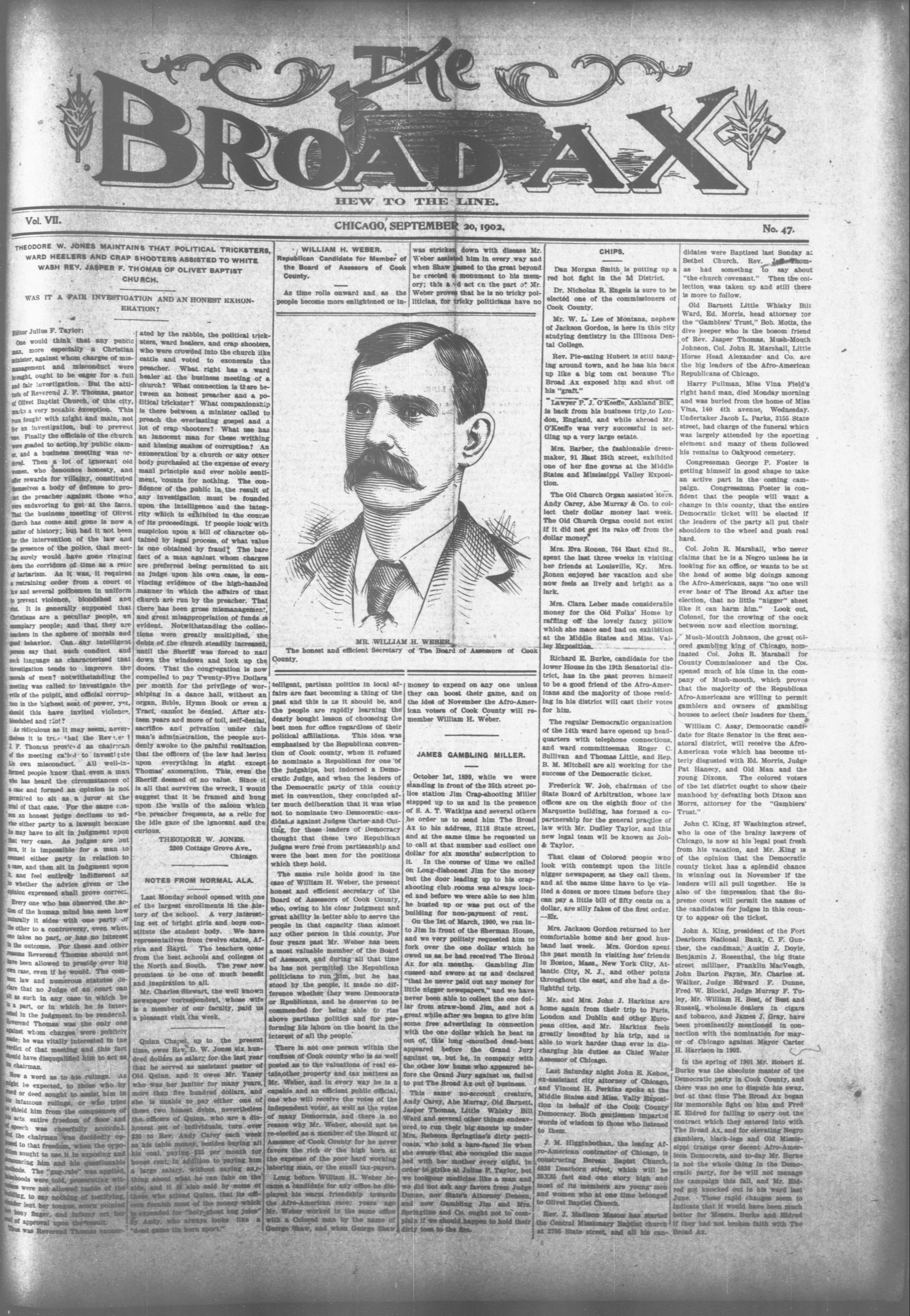
WILLIAM H. WEBER.
Republican Candidate for Member of the Board of Asessors of Cook County.
As time rolls onward and as the people become more enlightened or in-
was stricken down with Weber assisted him in even when Shaw passed to the he erected a monument or; this and act on the Weber proves that he is militician, for tricky politic
MR. WILLIAM
The honest and efficient Secretary
County.
MR. WILLIAM H. WEBER
telligent, partisan politics in local affairs are fast becoming a thing of the past and this is as it should be, and the people are rapidly learning the dearly bought lesson of chooseing the best men for office regardless of their political affiliations. This idea was emphasized by the Republican convention of Cook county, when it refused to nominate a Republican for one of the judgships, but indorsed a Democratic Judge, and when the leaders of the Democratic party of this county met in convention, they concluded after much deliberation that it was wise not to nominate two Democratic candidates against Judges Carter and Cutting, for these leaders of Democracy thought that these two Republican judges were free from partisanship and were the best men for the positions which they hold.
The same rule holds good in the case of William H. Weber, the present honest and efficient secretary of the Board of Assessors of Cook County, who, owing to his clear judgment and great ability is better able to serve the people in that capacity than almost any other person in this county. For four years past Mr. Weber has been a most valuable member of the Board of Assessors, and during all that time he has not permitted the Republican politicians to run him, but he has stood by the people, it made no difference whether they were Democrats or Rpublicans, and he deserves to be commended for being able to rise above partisan politics and for performing his labors on the board in the interest of all the people.
There is not one person within the confines of Cook county who is as well posted as to the valuations of real estate, other property and tax matters as Mr. Weber, and in every way he is a capable and an efficient public official, one who will receive the votes of the independent voter, as well as the votes of many Democrats, and there is no reason why Mr. Weber, should not be re-elected as a member of the Board of Assessor of Cook County for he never favors the rich or the high born at the expense of the poor hard working laboring man, or the small tax-payers.
Long before William H. Weber became a candidate for any office he displayed his warm friendship towards the Afro-American race; years ago Mr. Weber worked in the same office with a Colored man by the name of George Shaw, and when George Shaw
```markdown
```
of book the n- was stricken down with disease Mr. Weber assisted him in every way and when Shaw passed to the great beyond he erected a monument to his memory; this a.d act on the part of Mr. Weber proves that he is no tricky politician, for tricky politicians have no
AM H. WEBER
of The Board of Assessors of Cook
money to expend on any one unless they can boost their game, and on the ides of November the Afro-American voters of Cook County will remember William H. Weber.
JAMES GAMBLING MILLER.
October 1st, 1899, while we were standing in front of the 35th street police station Jim Crap-shooting Miller stepped up to us and in the presence of S. A. T. Watkins and several others he order us to send him The Broad Ax to his address, 3118 State street, and at the same time he requested us to call at that number and collect one dollar for six months' subscription to it. In the course of time we called on Long-dishonest Jim for the money but the door leading up to his crap-shooting club rooms was always locked and before we were able to see him he busted up or was put out of the building for non-payment of rent
On the 1st of March, 1900, we ran into Jim in front of the Sherman House, and we very politely requested him to fork over the one dollar which he owed us as he had received The Broad Ax for six months. Gambling Jim cussed and swore at us and declared "that he never paid out any money for little nigger newspapers," and we have never been able to collect the one dollar from straw-bond Jim, and not a great while after we began to give him some free advertising in connection with the one dollar which he beat us out of, this long -mouthed dead-beat appeared before the Grand Jury against us, but he, in company with the other low bums who appeared before the Grand Jury against us, failed to put The Broad Ax out of business.
This same no-account creature, Andy Carey, Abe Murray, Old Barnett, Jasper Thomas, Little Whisky Bill Ward and several other things endeavored to run their big anouts up under Mrs. Rebecca Springtine's dirty petticoats, who told a hare-faced lie when she swore that she occupied the same bed with her mother every night, in order to strike at Julius F. Taylor, but we took our medicine like a man and we did not ask any favors from Judge Dunne, nor State's Attorney Deneen, and now Gambling Jim and Mrs. Springtine and Co. ought not to complain if we should happen to hold their dirty toes to the fire.
---
Dan Morgan Smith is putting up a red hot fight in the 3d District.
Dr. Nicholas R. Engels is sure to be elected one of the commissioners of Cook County.
Mr. W. L. Lee of Montana, nephew of Jackson Gordon, is here in this city studying dentistry in the Illinois Dental College.
Rev. Pie-eating Hubert is still hanging around town, and he has his back up like a big tom cat because The Broad Ax exposed him and shut off his "graft."
Lawyer P. J. O'Keeffe, Ashland Blk. is back from his business trip to London, England, and while abroad Mr. O'Keeffe was very successful in settling up a very large estate.
Mrs. Barber, the fashionable dressmaker, 91 East 35th street, exhibited one of her fine gowns at the Middle States and Mississippi Valley Exposition.
The Old Church Organ assisted Kevs. Andy Carey, Abe Murray & Co. to collect their dollar money last week. The Old Church Organ could not exist if it did not get its rake off from the dollar money.
Mrs. Eva Ronen, 764 East 42nd St., spent the last three weeks in visiting her friends at Louisville, Ky. Mrs. Ronen enjoyed her vacation and she now feels as lively and bright as a lark.
Mrs. Clara Leber made considerable money for the Old Folks' Home by raffling off the lovely fancy pillow which she made and had on exhibition at the Middle States and Miss. Valley Exposition.
Richard E. Burke, candidate for the lower House in the 19th Senatorial district, has in the past proven himself to be a good friend of the Afro-Americans and the majority of those residing in his district will cast their votes for him.
The regular Democratic organization of the 14th ward have opened up headquarters with telephone connections, and ward committeeman Roger C. Sullivan and Thomas Little, and Rep. B. M. Mitchell are all working for the success of the Democratic ticket.
Frederick W. Job, chairman of the State Board of Arbitration, whose law offices are on the eighth floor of the Marquette building, has formed a copartnership for the general practice of law with Mr. Dudley Taylor, and this new legal team will be known as Job- & Taylor.
That class of Colored people who look with contempt upon the little nigger newspapers, as they call them, and at the same time have to be visited a dozen or more times before they can pay a little bill of fifty cents on a dollar, are silly fakes of the first order. Ex.
Mrs. Jackson Gordon returned to her comfortable home and her good husband last week. Mrs. Gordon spent the past month in visiting her friends in Boston, Mass., New York City, Atlantic City, N. J., and other points throughout the east, and she had a delightful trip.
Mr. and Mrs. John J. Harkins are home again from their trip to Paris, London and Dublin and other European cities, and Mr. Harkins feels greatly benefited by his trip, and is able to work harder than ever in discharging his duties as Chief Water Assessor of Chicago.
Last Saturday night John E. Kehoe, ex-assistant city attorney of Chicago, and Vincent H. Perkins spoke at the Middle States and Miss. Vally Exposition in behalf of the Cook County Democracy. Both gentlemen imparted words of wisdom to those who listened to them.
J. M. Higginbothan, the leading Afro-American contractor of Chicago, is constructng Berean Baptist Church, 4838 Dearborn street, which will be 25X85 feet and one story high and most of its members are young men and women who at one time belonged to Olivet Baptist Church.
Rev. J. Madison Mason has started the Central Missionary Baptist church at 2705 State street, and all his can-
didates were Baptized last Sunday at Bethel Church. Rev. Jeff Thomas had something to say about "the church covenant." Then the collection was taken up and still there is more to follow. Old Barnett Little Whisky Bill Ward, Ed. Morris, head attorney for the "Gamblers' Trust," Bob. Motts, the dive keeper who is the bosom friend of Rev. Jasper Thomas, Mush-Mouth Johnson, Col. John R. Marshall, Little Horse Head Alexander and Co. are the big leaders of the Afro-American Republicans of Chicago.
Harry Pullman, Miss Vina Field's right hand man, died Monday morning and was buried from the home of Miss Vina, 140 4th avenue, Wednesday. Undertaker Jacob L. Parks, 3155 State street, had charge of the funeral which was largely attended by the sporting element and many of them followed his remains to Oakwood cemetery.
Congressman George P. Foster is getting himself in good shape to take an active part in the coming campaign. Congressman Foster is confident that the people will want a change in this county, that the entire Democratic ticket will be elected if the leaders of the party all put their shoulders to the wheel and push real hard.
Col. John R. Marshall, who never claims that he is a Negro unless he is looking for an office, or wants to be at the head of some big doings among the Afro-Americans, says "no one will ever hear of The Broad Ax after the election, that no little "nigger" sheet like it can harm him." Look out, Colonel, for the crowing of the cock between now and election morning.
Mush-Moutth Johnson, the great colored gambling king of Chicago, nominated Col. John R. Marshall for County Commissioner and the Col. spensd much of his time in the company of Mush-mouth, which proves that the majority of the Republican Afro-Americans are willing to permit gamblers and owners of gambling houses to select their leaders for them.
William C. Asay, Democratic candidate for State Senator in the first senatoral district, will receive the AfroAmerican vote which has become utterly disgusted with Ed. Morris, Judge Pat Hanecy, and Old Man and the young Dixons. The colored voters of the 1st district ought to show their manhood by defeating both Dixon and Morris, attorney for the "Gamblers' Trust."
John C. King, 87 Washington street, who is one of the brainy lawyers of Chicago, is now at his legal post fresh from his vacation, and Mr. King is of the opinion that the Democratic county ticket has a splendid chance in winning out in November if the leaders will all pull together. He is also of the impression that the Supreme court will permit the names of the candidates for judges in this county to appear on the ticket.
John A. King, president of the Fort Dearborn National Bank, C. F. Gunther, the candman, Austin J. Doyle, Benjamin J. Rosenthal, the big State street milliner, Franklin MacVeagh, John Barton Payne, Mr. Charles M. Walker, Judge Edward F. Dunne, Fred W. Blocki, Judge Murray F. Tuley, Mr. William H. Best, of Best and Russell, wholesale dealers in cigars and tobacco, and James J. Gray, have been prominently mentioned in connection with the nomination for mayor of Chicago against Mayor Carter H. Harrison in 1903.
In the spring of 1901 Mr. Robert E. Burke was the absolute master of the Democratic party in Cook County, and there was no one to dispute his sway, but at that time The Broad Ax began its memorable fight on him and Fred E. Eldred for failing to carry out the contract which they entered into with The Broad Ax, and for elevating Negro gamblers, black-legs and Old Mississippi tramps over decent Afro-American Democrats, and to-day Mr. Burke is not the whole thing in the Democratic party, for he will not manage the campaign this fall, and Mr. Eldred got knocked out in his ward last June. These rapid changes seem to indicate that it would have been much better for Messrs. Burke and Eldred if they had not broken faith with The Broad Ax.
Will promulgate and at all times unhold the gay privilege of Democracy, but Farmata, Babilonia, Protestante, Knights of Labor, Bataille, Mormons, Republicans, Freies, or any else can have their say, so long as their marriage is wrong and responsibility is fixed.
Entered at the Post Office at Chicago, Ill., as Second-class Matter, August 19, 1902.
A NOVEL ENTERPRISE.
Canal Connection Being Dug for the Purpose of Removing Bar- ancles from Ships.
The city of Seattle lies between Puget sound and Lake Washington. A canal is now being dug for the purpose of connecting the two. Puget sound is salt and connects with the Pacific ocean. Lake Washington is a body of fresh water. The object in the connection is novel. Familiar with the region, and having heard of the canal and the reason for it, we have looked the matter up a little, and find that it is to be a barnacle cure on a large scale, reports the Christian Advocate.
It is well known that barnacles, a variety of marine shellfish, attach themselves to the bottom of vessels, and after a time, when the number becomes great, the movement of the ships becomes so seriously retarded that the vessel has to be dry docked and cleaned. This is an expensive operation, and many are the devices which have been resorted to to prevent the adhesion of the barnacles, but without success. Barnacles appear to be more prolific on the Pacific coast than on the Atlantic, and, therefore, getting rid of them becomes even more important than in the case of Atlantic shipping. It is a well-known fact that the barnacles drop off if the ship lies for even a short time in fresh water, and the proposition to connect Puget sound with this beautiful fresh-water lake has for its end the taking advantage of this fact, so that by means of the canal the vessels may be run into Lake Washington and allowed to lie there until the barnacles drop off. These animals, like others whose native element is salt water, die after a time and lose their grip.
FOND OF DRAMATIC EFFECTS.
Lord Kitchener, Says London Report Never Neglects Chance to Play to the Galleries.
Among the characteristics that distinguish Viscount Kitchener none is more conspicuous than his appreciation of the dramatic, and he never fails to make use of such effects to advance his own interests. There is no man who has shown on so many occasions a splendid insight into dramatic situation. There has never been one of his great events which has not been so stage-managed as to produce the greatest possible dramatic effect. When he was advancing on Omdurman, for instance, he cut the wire between Egypt and home for several days—they were the last days that still intervened between him and the crowning victory. This mysterious and sinister veil which all at once was drawn between England and her forces heightened the mystery, the suspense, the passionate interest in the last hours of the great struggle, and when Kitchener permitted the veil to be lifted again it was to display to a people almost maddened with suspense the bloody field on which lay crushed forever the broken and scattered forces of the mahdi.
And again when this victory was completed and when Kitchener stood in the middle of the town where Gordon had died, surely it was a very high and keen sense of the dramatic which impelled Kitchener to hold a funeral service to Gordon's memory. Here, indeed, in sober, solemn, unexceptionable fashion, was the final triumph of civilization over barbarism heralded and commemorated to all the world.
BLAMES THE TYPEWRITER.
To That Invention the Illustrator Attributes the Cause of Many Inferior Books.
John Sloan, the illustrator, has a novel and plausible idea as to the reason for the publication of late years of so many mediocre books, says a Philadelphia Record man. "I believe," said he, "that the responsibility rests with the typewriter. Manuscripts in the past were written with the pen, and were not read very carefully, for to read a novel of 100,000 or 150,000 words of handwriting was a giant's job that, I venture to say, mighty few publishers went through with if they could help it. But now every manuscript is typewritten, and is as easy to read as print. Hence the publisher it is submitted to runs through it—or rather his reader does—can't help but find, here and there, points of merit in it and risks bringing it out. The typewriter is to blame. I fancy 80 per cent. more manuscripts are read now than used to be and 60 per cent. more are published. Whenever I happen on a particularly bad novel of the short trousers or historical school, I curse the inventor of the typewriter."
Cooperage is one of the ancient arts born, doubtless, of the necessity of having proper vessels for preserving wines. The London coopers were incorporated into a guild in 1501. As usual, America has captured the cooperage business of the world. The National Barrel and Cooperage company declares that 200,000,000 barrels are used annually. I could mention one company alone that turns out 40,000 a day, or 12,500,000 a year. Its product includes casks, kegs, all sorts of barrels, butter tubs, pails, churns, etc. Our boundless forests gave us the advantage in cooperage. We supply nearly all the rest of the world with barrels, casks and staves, our annual product being valued at more than $40,000,000. For casks to hold liquids oak is used, while for sugar and flour and other dry substances nothing has been found to equal elm. The manufacturers have bought up millions of acres of forests to guard against a scarcity of barrel material. They are vandals, like the rest of the timber users. Sufficient unto the day is the forest thereof. If they can make $1,000,000 in a lifetime by utterly devastating 10,000,000,000 acres of precious woodland, why, they will make the $1,000,000.
BIRTH OF LONDON BRIDGE.
On August 1, 1831, William IV. and Queen Adelaide formally opened with much ceremony the famous London bridge, so that the structure now is a little over 71 years old. Their majesties went in grand procession from Buckingham palace to Somerset house, and thence by barge to the bridge. The awnings of the royal barge-were removed, that a full view of the royal pair could be had along the whole line. At London bridge a grand pavilion had been set up close to the site of Old Fishmongers' hall. It was constructed of standards captured in a hundred fights, canopied in crimson and decorated with massive shields. When the king stepped ashore he said to two members of the London bridge committee: "Mr. Jones and Mr. Routh, I am very glad to see you on London bridge. It is certainly a most beautiful edifice and the spectacle is the grandest and the most delightful in every respect that I ever had the pleasure to witness." This, of course, says the London News, was before anyone thought of building an annex to Westminster abbey.
HOW HE SAVED HIS LUNG
Young Bostonian Who Was Cured of Consumption on a Farm in Ireland.
A young Bostonian, reared in the lap of luxury, had lost a lung and physicians informed the father that if he was not sent on an ocean cruise or to the far west he would die of consumption. Accordingly the father put him aboard ship, with $1,400 in cash and started him off to Samaria, being advised that the dry country between the River Jordan and the Mediterranean was good for consumptives. When he reached Queenstown the boy made the acquaintance of a hard-headed, sensible chap, who told him that Samaria was sure death; that the only way to save his lungs was to go to Wicklow county, near Tinahely, and set to work on a farm. The advice was taken and for nine months the scion of Back Bay aristocracy did choras for a man who owned a castle. At the end of that period he was as lusty as a bull moose, with a pair of lungs like a blacksmith's bellows. The former gave him £20 and an honorable discharge. He returned to Boston with his $1,400 and his health. He now lives in New York, a modern Hercules.
LAST OF THE DELAWARES.
Passing of the Greatest Tribe of Amerien's Aborigines in the Death of Kiankia.
Kiankia, descendant of a long line of distinguished Indian chiefs, died a few days ago in a little hut in a secluded spot near the shores of Baritan river, about two miles from Flemington, N. J., and with his passage disappeared the last of the once great and proud tribe of the Delawares. Arthur Tenbroeck, of New York city, who has spent many summers in the neighborhood of Flemington, and who made the acquaintance of the aged chief of an extinct tribe about three years ago, superintended his burial and says that his wishes—that he should be laid away under the shadow of an ancient elm, where once his forefathers sat in solemn council—were carried out. Mr. Tenbroeck says that Kiankia informed him some time before his death that he was 96 years old. "It was generally supposed," said Mr. Tenbroeck, in discussing the death of the last of the Delawares, "that old Indian Anne, who died in Mount Holly in 1894, was the last of the famous tribe, but it was not known then that har brother Kiankia was still alive."
Aluminum for Paper. It is stated that experiments with aluminum as a substitute for paper are now under way in France. It is now possible to roll aluminum into sheets four-thousandths of an inch in thickness, in which form it weighs less than paper. By the adoption of suitable machinery these sheets can be made even thinner and can be used for book and writing paper. The metal will not oxidize, is practically fire and water proof, and is indestructible by worms.
After a residence of 16 months in Alaska an English physician has made a report of the diseases which most afflict the people of that cold region. There are, he says, two seasons. Winter, the season of pack ice; summer, the season of swamps. The winter lasts for nine months, the summer for three. Among human maladies cerebro-spinal meningitis is very prevalent, sometimes in epidemic form, sometimes in sporadic form. It is often difficult to distinguish from the cerebral form of typhoid. Scorbutus is also widespread.
Rheumatism is frequent and usually takes the neuralgic type; inflammatory rheumatism is rare. Pneumonia is almost unknown, strange to say. Affections of the digestion are very frequent, owing to poor food; nervous diseases, such as locomotor ataxia, etc., are also frequent. Alcoholism and the like are prevalent, due to the ennui of the long winter, but, on the whole, intemperance is less harmful in Alaska than in more southern climates. Insanity is by no means rare, and it declares itself most frequently in winter, owing to ennui, absence of occupation, lack of exercise and isolation. Its usual form is acute melancholia, almost always followed by acute mania. Suicidal mania is also frequent. Taken altogether the catalogue of Alaskan diseases is a long one and indicates that a vigorous physique and morals is required to resist them.
THE BRITISH LOAD LINE.
Vessels Are Not Permitted to Carry Surplus Cargoes in English Waters.
A short time since the captain of a Dutch vessel here took the singular step of making application to one of the bodies authorized to assign the load line to have the line marked on the side of the vessel, says London Fairplay. This was carried out and the vessel was then loaded. The captain found that the disk was submerged, and in the coolest way possible appears to have waited on the board of trade officials and to have asked them for permission for his vessel to sail in her overloaded condition. To his great surprise he was told by the officials that his vessel would be detained until the surplus cargo was taken out of her. He urged that the load line act applied to British ships only and that consequently his vessel could not be interfered with. It was explained to him that the act referred to foreign as well as British ships and that at any rate he had "given himself away" by actually adopting the British loadline.
The officials visited the Dutch vessel when it was discovered that the disk had been incorrectly assigned, being a trifle higher up the ship's side than it should have been—so that in fact she was more overloaded than she even appeared to be. A quantity of cargo was ordered to be discharged—four times the quantity that brought the vessel to her incorrectly assigned loadline. The Dutch captain sailed a sadder man.
ST. VINCENT ERUPTION.
A Curious Feature Observed by Prof. Russell After the Volcanoe's Uphenval.
In Century Prof. Russell prints the following bit of personal observation among his conclusions concerning the West Indian eruptions:
"The distribution of hot material discharged from La Soufriere in a belt across the island of St. Vincent, instead of over a V-shaped area as at Martinique, seemed to have an intimate connection with the position of the crater near the summit of La Soufriere and the influence of the trade-winds on the distribution of the material discharged from it. As is well known, the depth of the layer of the atmosphere affected by the trade-winds is comparatively shallow, and above it the air is moving from west to east. The stones and dust shot upward from La Soufriere rose through the trade-wind layer, and were carried eastward by the upper air-current. On falling, however, they again met the influence of the westward-blowing trades and were given a slant in a westward direction sufficient to allow them to pass through windows and enter houses. The windows of some of the houses near Georgetown which face eastward have the appearance of an abandoned house which has served as a target for stones, while the westward-facing windows, or those looking toward the volcano, are but little injured."
Bad Hand Made Him Money
Bad Hand Made Him Money.
When Lord Curzon, now viceroy of India, was at Oxford, he wrote an abominable hand. One day he penned two letters, one of them to a relative and one to a chum with whom he always discussed the faults of their respective relations, and accidentally put these letters into the wrong envelopes. He was about to write a profound apology to his relative when he received the following note from him: "Can't read a word of your four pages, but guess you want some money, you young rascal." Inclosed was a Bank of England note for a good amount.
Big Game in South Africa At the present time many valuable species of big game in South Africa are threatened with extinction. It is proposed to establish regulations for their preservation, and it is suggested that camps should be set apart for the purpose of breeding certain species in order that the country may be restocked with game.
Fully a million people in the United States are constantly out health hunting. With half a million people suffering with tuberculosis, half as many more afflicted with asthmatic and bronchial troubles, and countless numbers possessing from one to half a dozen ordinary diseases which are either attributed to or directly affected by the climatic conditions of the land in which they live, it is not strange that there should be a small army of professional health hunters fitting around from one part of the world to another in search of that chief desideratum of all, happiness in this life, which we happen to know most about.
The up-to-date physician must now be a good geographer and well acquainted with all the health resorts of the world. He must know where the best "sun cure" is to be found. He must be able to recommend certain high altitudes where it is dry, but not dry enough to overburden the heart's action. Some cannot stand the irritating winds of the coast and must go inland among the pines, while others must need the coast air. In fact, the physical geography and climate of the world is all things to all men.
There is a large class of nervous cranks in the world who refuse to settle anywhere permanently. Something keeps telling them to "keep moving." They are constantly migrating in the chase for health, says the Boston Globe. The army of health hunters is growing every year, and the easy facilities for rapid transit serve to increase it. But there are some drawbacks to the migration cure. The chase after health serves to increase the fear of disease, and fear is the closest servant of death.
But there is no healthier place to migrate to for awhile than the old home, for both mind and body. Therefore, don't forget old-home week. The whole man will profit thereby.
DOGS TO GUARD THE LOUVRE.
Precautions Taken by Paris Authorities to Protect Priceless Collections of the Museum.
Though the "diving dogs" of the Parisian river police have been rather ridiculed since they absolutely refused to go to the rescue of the enterprising journalist who threw himself recently into the Seine from the Pont de la Tournelle to try their mettle, dogs are to have another official appointment in Paris.
The authorities at the Louvre are instituting a "dog service" to supplement the night guardians of the museum. This excellent innovation has been brought about by the action of an irrepressible journalist, who in his thirst for "copy" hid himself in one of the Roman sarcophagi when the doors of the great museum closed to the public at five in the evening. He was not discovered, and would have remained there all night with the whole of the priceless collection at his mercy had it not been that a friend to whom he had confided his intention wisely informed the authorities.
This fact conclusively proved the journalist's contention that the place was not properly guarded, and the authorities for once thought it was best "to shut the stable door before the horse was stolen," and so have settled that in future the night patrol will be accompanied by dogs who can be trusted to scout out intruders.
TIGERS ARE THEIR TERROR.
These Animals Are Dreaded by the Hindoes More Than Any Others in the Jungle.
It is in India that the ravages caused by wild beasts and reptiles are most marked. Not merely single towns or villages, but whole districts, have in times not far distant been converted into deserts by the sudden advent of unusual numbers of tigers or of snakes. The former is especially destructive, and the facts set forth in cold figures in government reports concerning his depredations sound absolutely incredible, says Pearson's Weekly.
Even a single tiger which happens to be a confirmed man-eater will often suffice to scare away entire populations. One large male killed 108 people in three years and caused the eventual abandonment of a big cotton factory, together with the model village it supported. Another killed an average of about 80 persons per annum for several years, and during a period of famine so completely closed the roads leading to a certain place that four-fifths of the inhabitants perished of starvation. A third, so late as 1869, killed 127 people, and stopped a public road for many weeks, until the opportune arrival of an English sportsman, who at last shot him. A fourth caused 13 villages to be abandoned and 250 square miles of land to be thrown out of cultivation.
There seems to be need of a term to designate the new terrors of our streets, those speed-crazed paranolacs who are now doing so much to bring the automobile into disrepute, says the Horseless Age. Various terms are loosely applied, but a new compound would be desirable. We suggest the word "automaniac," which is in harmony with several well-known words of Greek derivation already rooted in the language as descriptive of victims of diseased and abnormal appetite (dipsomaniac, kleptomaniac), and conveys a strong and true picture of the mental state of the worst of these offenders against law and decency.
Plus Which Worked Headily In Eng land Is Not Taken Up in the United States.
The coffee house is a temperance substitute for the inn in England, says Gunton's Magazine. It furnishes, minus the intoxicating stimulants, similar social features, but it is tacked on to the same social habits that the inn developed. In this country those habits were not formed by the saloon experience, and the attempt to establish the coffee house as a substitute for the saloon necessarily lacks that social incentive which exists in England. The coffee house here takes on the feature of the restaurant rather than either the German beer garden or the English inn. The Americans have never learned to go to these places for their leisurely intercourse and amusements and hence do not find it when coffee is substituted for beer. They have gone to the theaters or to the clubs for this social outlet.
It is, therefore, not surprising to the careful student of European and American traditions that the coffeehouse plan does not work in this country, though it worked well in England. To be successful, social and economic as well as political institutions must largely grow out of the habits, customs and desires of the people. They cannot to any considerable extent be transplanted from one country to another.
THE NATURE OF COWS.
Have Their Likes and Dislikes and Act at Times Very Much Like Human Beings.
"Cows have their likes and their dislikes," said the milkmaid to the summer boarder who was curious to see every part of the farm, according to the New York Tribune.
"For instance, a cow admires a horse, and will stand and watch one for a long time. She is sort of timid about him, but she admires him just the same. She has a contempt for a mule, and seems to be amused by his antics. Hogs she tolerates, that's all. And sheep, she hates. She will not eat grass where sheep have been. She hates dogs, too, but will tolerate the shepherd dog, because she knows she simply has to, and that the shepherd dog will not bite her.
"Cattle go wild at being let into a fresh pasture," added the milkmaid. "It seems to go to their heads. Each is afraid that the other has got a better feeding place than herself, and tries to drive her neighbor away." "Then there is a good deal of human nature in the cow, after all," mused the summer boarder, who had studied a year or two at a university, and was given to philosophical reflections. "Well, I should smile," answered the milkmaid. "A single cow, with a calf will boss a whole herd of steers," and, swinging her pail over her arm, she went down to the milking pens.
TWIXT SUMMER AND AUTUMN
It Is Difficult to Determine the Status of August, Especially in the East
"One thing that has been puzzling me ever since I struck this part of the country is the easterner's division, of the seasons," lamented the man from Milwaukee, according to the New York Times. "Out where I come from we always count August as a summer month, but the New York and New England population—and especially the theatrical portion thereof—evidently classify it otherwise.
"I have reached the conclusion by reading the advertisements on the billboards. You may travel the length of any prominent theatrical street in every good-sized eastern city and take occasional peeps into the adjoining streets, and at the entrance to almost every theater not now doing business you will see this sign: 'Closed for the summer. Will reopen in August.'
"Now what I want to know is, what is the status of August in this part of the country? Is it a summer month, or a fall month, or a winter month, or has it been lopped off from all the divisions of the year established by the calendar and been made to constitute a season by itself?"
Children Born Blind
The startling charge that many New York children are born blind in subterranean apartments under great office buildings in New York because their mothers for years have never seen the light of day is made by Rev. Dr. David M. Steele, one of the curates of St. Bartholomew's parish. Dr. Steele says: "How many know that some of the great office buildings have under them apartments for 50 families, and that in these families children are sometimes born blind, because their mothers for whole years never see daylight? How many know that on the roofs of these buildings there are families of janitors whose six-year-old children have never stepped upon the ground?" Dr. Steele is an authority on life on the east side and in the tenement districts.
Charles Dickens' office table, chair and looking glass and another highback chair he used in the editor's office of All the Year Round were sold at auction in London lately for 1425. They were given at Dickens' death to his housekeeper, and sold by her to a collector.
The Siberian Railway.
Foreigners will not be permitted to travel over the Siberian railway without special Russian authorization. This has been officially announced by the Russian consul at Shanghai.
The "heathen Chinee" portrayed by Bret Harte, with "his sleeves full of aces and bowers," is not a creation of fiction. In fact, almost every native of the celestial empire is a born gambler and will hazard all he possesses on the turn of a card. If there is one thing the Chinese in America cannot understand regarding our customs it is why the police and courts should take cognizance of gambling. It is a recognized amusement in China and the Chinaman is a reckless gambler. They have several kinds of playing cards, but the general name for them is chepae, or paper tickets. The cards are two inches and a half in length and half an inch wide and the kind most commonly used are called tseen-wanche-pae, "a thousand times 10,000 cards." This pack has 30 cards—three suits of nine each and three independent suits which are superior to the rest. The suits are named respectively "nine myriads of strings of beads," "nine units of cakes" and "nine units of chains."
There are several queer names for other varieties of playing cards. One is called "the hundred boys' cards," another "chariots, horses and guns" and a third, curiously devised on the principle of some of our historical games, is called "a thousand times 10,000 men's names cards."
GIVE BABIES SOLID FOOD.
One Cause of the Emormous Death Bate Among Children of New York's Poor.
The average mother in easy circumstances will smile rather derisively on hearing that France has a law making it a crime to give solid food to any child under one year old. Yet every tenement house worker, visiting nurse, health department officer or settlement resident can testify that the custom of feeding solid food to toothless infants is wellnigh universal in the alum tenements, says a writer in the New York Tribune. France, with her low birth rate, has found that she cannot spare the 20,000 babies that were lying every year before the state took them under its care. The American waste of child life amounts to 300,000 annually under five years, the proportion of deaths being greatest among the foreign population, where the high birth rate is balanced by a heavy death rate. Beer, tea, coffee, condensed milk, watermelon, green corn and pork rind are among the "dainties" handed out to the unfortunate tenement house infant.
"My baby sit up at table and eat everything all same as grown up, now," said one young foreign mother, proudly, displaying her saffron colored one-year-old to the pitying eyes of the superintendent of a day nursery.
CANNIBALISM IN PARIS.
Parts of the Human Which Bank as Delicate Tit-Bits in the Various Quarters.
Cannibalism is still rife among the Paris hooligans. The last case we recorded was one of ear-eating; the other day it was a nose, says the Paris Messenger. Tastes differ with different localities, and whereas at La Villette policeman's ear is looked upon as a delicate tit-bit, at Bercy constable's nose is not despised. Bercy is where the wine comes from, and it may be that ruddy nasal organ is preferred to a pale one by the local man-eater. At one a. m. an "agent" of the name of Pedamons was on duty on the Boulevard de Bercy when his assistance was sought by a publican who requested him to act as "chucker out," one of his customers being drunk and refusing to quit. The customer in question, a man named Bailly, took no heed of the constable and the latter clasped him round the waist in order to evict him. Bailly thereupon started biting and tore the constable's nose right off. He was subsequently arrested and Pedamons was taken to the hospital. If an operation is performed it would only be right to take fleah from Bailly's arm to provide the policeman with a new nose.
Railways Without Rails
It is suggested that the automobile will give us, after awhile, lines of railway without rails, if such an expression may be allowed. On Long Island, for example, an automobile road of 50 miles in length is to be constructed, to cross other roads either above or below grade, so that the owners may speed their machines as they please. When this has been done, the next step will be, perhaps, to attach trailers, and then passengers and freight will be taken, and a regular traffic established. At least it may reasonably be expected that the building of such roads will result in the running of automobile coaches as feeders to steam or electric lines, where it would not pay to lay a railroad track.
An Astonishing Narrative. The Pioneer tells a story of a rat which on one occasion was caught alive on a ship and thrown overboard. A seagull was floating by the side of the ship. Immediately there ensued a battle royal, and the rat strangled the seagull to death. He then sat upon the carcass of the seagull, unfurled its left wing to catch the wind, and, working the right wing as an oar, set sail for the shore!
The Trade of Amur
The Trade of Smyrna. Smyrna, is the smartest town in Turkey so far as trade is concerned. It does a bigger business than Constantinople. It is the headquarters of the wool and of the rug and carpet trade.
PEACH STONES FOR FUEL. They Have Been Utilised by a Bultimore Family as a Substitute for Coal.
The strike and the increased cost of coal incident thereto has directed much attention to other materials for fuel, and a Baltimore man says a good substitute for the black diamond is dried peach stones. The only objection to their use is their scarcity, which depends entirely on the size of the peach crop. Frank Hall, the Baltimorean referred to, says his family had used peach stones as fuel for years until about three or four years ago, since which time the supply has appeared to have decreased.
"We used to get the dried peach stones from Mr. Noel, who got them from the different packing-houses and dried them on his place," said Mr. Hall. "I think we paid $2.50 a load for them, the load containing about 45 bushels. The fuel was used in the kitchen and gave good results. The stones will make a quick, hot fire, and one that will last. One and a half or two buckets of the peach stones will last as long as a bucket of coal. One has to be careful not to fill the stove too full or there will likely be an explosion similar to a gasoline explosion. The proper way to keep the fire going is to put in a shoelful at a time.
"Peach stones thrown into a damp cellar," said Mr. Hall, "are said to have a peculiar effect on a person. After the stones are in the cellar for some time gases arise, and the fumes will go to one's head and give the same effect as if the distilled product of the peach had been imbibed."
LIVES BY SELLING CANDY.
Business of a Bright Young Syracuse Girl-Customers Help Themselves.
How to make money by selling bonbons and trusting to the honesty of purchasers is a problem that a bright young girl of Syracuse has solved. Her place of business is a little booth where the customer enters and helps himself to what he wants, leaving the price in the till, where he makes his own change. In six months she has sold 16,000 boxes of candy and her losses have been less than five pounds of candy and less than five dollars in cash. She finds that people are generally honest.
Rev. F. H. Towna, Maplewood's newslealer, has been testing the honesty of Maplewood people in somewhat the same way for several years and has never lost a copper. He leaves the papers on the window sill in his little shop near the Maplewood depot, with instructions for anyone to take a paper and throw the money in the open window onto the floor. He has sold hundreds of newspapers in this way and has always found his cash equal to the number of papers taken.
This recalls the sociologist who, to test the question of popular honesty, asked in succession a large number of persons if they had lost half a dollar which he pretended to have picked up on a street in New York. Every one disclaimed ownership. Honesty is not so rare a virtue as some suppose.
COLOR-MAKING BACTERIA.
Large Numbers of the Micro-Organisms That Produce Various-Hued Matters.
The micro-organisms are interesting out of all proportion to their size, and not the least interesting phase of their existence is that described in an article in La Nature by Henri Coupin. M. Coupin treats especially of the coloring matters produced by bacteria, some of which are noteworthy for their brilliancy and others for their chemical or physiological peculiarities. Says M. Coupin: "A large number of bacteria produce coloring matter, sometimes very vivid.
There are two cases. In one, the most numerous, the pigment remains inside the elements that manufacture it; thus the bacteria themselves are solored. In the other the pigment spreads, as it is produced, into the surrounding medium, and this has the characteristic color, while the bacteria themselves are pale or even colorless. Thus the bacillus fluorescens and others are nearly white, while they color the culture medium green."
Every species, we are told, has its particular color; one is citron yellow. another golden, many are brilliant red. one at least is pink, the bacillus of blue milk is sky blue; others are respectively greenish blue, violet and brown. The characteristic discharges of many diseases owe their color to the microbes that produce them.
A Brave Woman.
Millie Hennius, the Indian woman, of Vancouver, who recently received the medal of the Royal Humane Society, was going with her husband, her three small children and a woman friend, in a boat to the north arm of Burrard Inlet. The boat was overturned in a storm. The husband, weighted by a cartridge belt and heavy rubber boots, sank, and was followed by the woman. Mrs. Hennius took her 4-year-old child in her teeth, and ordering each of the others to cling to one of her shoulders, swam; keeping the heads of all three above the levy water for an hour, until rescue came.
Mustaches in Alaska. Mustaches are not worn by men exposed to the severity of an Alaskan winter. They wear full beards to protect the throat and face, but keep the upper lip clean shaven. The moisture from the breath congeals so quickly that a mustache becomes imbedded in a solid cake of ice, and the face is frozen in a short time.
IMPORTANCE OF WASHINGTON.
A London Journal's Opinion of the Capital City as a Diplomatatic Post.
There is a new factor in European politics; it is America. More particularly is this new factor important in the calculations of the British empire. The development of the United States has shifted—for Great Britain, certainly—the diplomatic center from Paris to Washington, but our government altogether ignores the altered situation, says the London Truth. The following table of salaries paid to our diplomatic representatives is instructive: The British ambassador at Paris receives £9,000; at Berlin, Constantinople and Vienna, £8,000; at St. Petersburg, £7,800; at Rome, £7,000; at Washington, £6,500. Apart from other considerations, it is, therefore obvious that Paris is regarded by our diplomats as the prize of the service, while Washington is a low rung in the ambassadorial ladder. But the United States send their best men to represent them in London, and London is the appointment which those men most value. It is time for us to remove from our minds the lingering impression that America is a rebellious British colony—a vulgar Anglo-Saxon suburb. The United States is now a great country, the most important foreign element that Great Britain has to deal with. Washington, must, therefore, be made the principal post in our diplomatic service, and to do that the salary must be considerably raised, even if at the expense of the other first-class appointments. It would be a pitiful blunder to appoint a new ambassador to succeed Lord Pauncefote on the old lines, to wit, as a representative to the last important embassy but Madrid!
THE LOTTERY INIQUITY.
Survives in Spite of All Efforts of Civil Authorities to Stamp It Out,
The Louisiana lottery, the biggest of the lot, was driven out of New Orleans and out of the United States after years of attack by the postal authorities and the press. But the lottery evil is still with us, says the Atlanta Journal. Savannah is the lottery center of Georgia. It is said that several men have made fortunes by dealing in lottery tickets. There is hardly a city of considerable size in the United States where lottery tickets may not be purchased.
Mexico has a large number and variety of lotteries which are liberally patronized in this country. Canada also supplies lottery tickets in great numbers to dealers in the United States and to individual purchasers. France, Germany and several other European countries help to satisfy the craving of our citizens who consider the lottery a quick and sure way to fortune. All classes of people supply the patrons who enrich the lotteries.
Many persons of wealth buy lottery tickets regularly. The wage earners of the United States squander a large per cent, of their earnings in this form of gambling. Lotteries antedate civilization. Some of the earliest human records indicate the antiquity of lotteries. They thrive on the love of gambling, which is one of the most universal passions of men.
LOOKING FOR A WIFE.
He Was "Muskier" and "Moorol" But Couldn't Boast of Much Education.
A Mississippi man sent the following letter in answer to a matrimonial advertisement: "I inclose my photograph with My Full Descriptions. It shows the features as nachel as can bee only it is to Dark; I am very lite Complexion, Gray eyes, Orbon hair, 6-foot high, weight 190 Lbs, inclined to be hump shouldered; A Muskler Man and a widower 28 years old, with A Common School Equations, but hav Got Anof to Atten to Enny Business. I am Strictly Morrel, Don't use Tobacco Nor Whiskey." He is anxious to have her understand that her "Age, Complecktions, wait and All Suits me to atee, Kind Loving Girl! I hav Only one Thing to Offer, And it is Neither Lands Nar Gold. But a Strong Arm and True Hart, and will Lay Down My Life for the Rite Girl and Be happy, for i am Tired of living Alone. That Girl that Steels my Hart and takes my Name for the Remainder of My Lif i will make Happy, for i am Hunting a Girl that i can idleise and Make a Angel of."
There is a tree that grows in Mexico called the "chijol," or stone tree. It is of enormous proportions, both in circumference and height. It has a number of branches spreading out widely and carrying leaves of a yellowish green color. The wood is extremely fine and easily worked in a green state. It is not given to either warping or splitting. The most remarkable thing about it is that after being cut the wood gets gradually harder, and in the course of a few years it is absolutely petrified, whether left in the open air or buried in the ground. From this timber houses can be built completely fire-proof, and would last as long as though built of stone.
Incidental to the thunder season, the weather bureau has discovered that more than 700 persons are killed by lightning every year in the United States. In matter of fatalities from 1890 to 1900 Pennsylvania ranked first with 185, Ohio was next with 135, and Illinois, Indiana and New York were tied for third with 124 victims each.
The government of Egypt is under the direction of a khedive, the seventh ruler of the dynasty of Mahomet Ali, who was appointed governor of Egypt in 1806 and made himself, in 1811, absolute master of the country by force of arms. The control of the khedive was gradually increased, and in 1873 he was given the privilege of concluding commercial treaties with foreign powers and maintaining armies. From 1879 to 1883 two comptrollers general—appointed by France and England—had considerable power in directing the affairs of the country, but in 1882, in consequence of a military rebellion, England intervened in behalf of the khedive, and, as this intervention was not joined by France, the joint control was abolished and a decree signed by the khedive giving to England the right to appoint an English financial adviser, without whose concurrence no financial decision can be taken, and since that time an English officer has cooperated in the direction of financial affairs in Egypt. A number of representative institutions, including a legislative council and general assembly, were created by the khedive in 1883, and the legislative council, which is a consultative body of 30 members, 14 of whom are nominated by the government, meets once a month to examine the budget, and may propose laws, but cannot initiate legislation.
SNAILS FOR THE TABLE.
Some Sent to Paris Are Fed on Avo-
matic Herbs to Improve Their Flavor.
The popularity of the snail as an article of food is not confined to Paris, but extends throughout southern Europe and some parts of Africa. Dr. Edward, a French writer, in a pamphlet, says that 90,000 pounds of snails are sent daily to Paris from the gardens at Poitou, Burgundy, Champagne and Provence. Those reared in gardens are fed on aromatic herbs to improve their flavor. Their market price is from 2 francs 50 centimes to 3 francs 50 centimes a hundred, while those from the hedges, woods and forests bring only 2 francs to 2 francs 50 centimes. The proprietor of one snailery in the vicinity of Dijou nets over 7,000 francs annually. The snail is reared and fattened with great care in some cantons of Switzerland as an article of luxury, and is exported in a pickled state. It is also eaten as a relish and nutritious article of food in Austria, Spain, Italy and in some sections of the United States. The Ashantees and other African tribes smoke them and eat them as daily food all the year around. In Algeria, in the markets, large heaps of snails are sold by the bushel and the hundred as an article of food. Vendors hawk them in the streets of Cairo. In modern Rome fresh-gathered snails are hawked by women from door to door.
PRESERVE WEDDING GOWN.
Kept by Many Women as a Momente of the Most Important of All Events.
A woman's wedding gown is seldom worn except on anniversary occasions after the day upon which the nuptials are celebrated. Most woman regard this garment as especially sacred and take extraordinary means to preserve it in all its pristine purity. The wedding gown box is a recent fad for the well-to-do bride to adopt, and it bids fair to have quite a vogue. That every bride possessed of any sentiment wishes to keep her wedding gown in a state of preservation is a foregone conclusion, and this elegant receptacle is admirably suited to the purpose for which it was designed. It is made of light wood enameled white and having the bride's initials in silver letters on the outside. A lining of tufted white satin is revealed on opening the box, and locks of silver and white leather straps fasten it. A photograph of the wedding gown is often taken by the modiste before sending it home and making a collection of the photographs of wedding gowns or any other distinctive costumes is one of the present fads, the idea being to preserve the pictures as mementoes for future generations and also as illustrations of present-day fashions.
Ancient Human Remains
Human remains recently unearthed at Girga, in Egypt, consist of a continuous series extending backward over at least 8,000 years. The bodies are so well preserved, owing to the dryness of the atmosphere in the region and to the perfection of interment, that not only can the hair, the nails, the ligaments, be made out, but also the muscles and the nerves. In almost every case the brain also is preserved, and the climax has been reached in two cases where the eyes, with the lens in good condition, are present. There are now unearthed a series of later prehistoric graves ranging throughout the first 15 dynasties, others of the eighteenth, and yet others of the Ptolemaic and early and recent Coptic periods.
Superstitious Miners.
Three hundred miners the other day refused to go down the Glyn corryg colliery, near Port Talbot, in Wales, because they said it was haunted. It was asserted that the figure of a woman bearing a lighted lamp had been seen in the working and the screams of a woman heard.
Illinois River Carp.
Peoria ships annually to New York over $1,000,000 worth of German carp taken from the Illinois, for consumption as food by the Russian Jews. This is an industry by itself.
A wiry-looking bronzed youth in a khaki uniform walked into a Philadelphia shooting gallery the other day and, picking up a rifle, began to make things hum, says the Philadelphia Press. There were four stationary bulls-eye targets, representing men and animals, at the rear of the gallery, and on these the marksman rapped out a series of clangs that resembled realistic rendition of the anvil chorus. Then he took a fresh rifle and beat a tattoo on a pair of swinging targets. A row of several scores of clay pipes next received his attention, and the proprietor of the place spent a bad five minutes figuring out the time and money it would require to replace the dhudeens that were snapped off. Several glass targets in motion were pie for the youth behind the gun. The only thing breakable remaining was a glass ball supported by a dancing water jet. This the marksman failed to smash, though he spent half an hour and considerable ready money in an endeavor before leaving. "Darn those fellows from the Philippines!" exclaimed the shooting gallery man. "That's the second one to clean me out to-day. If it hadn't been for that glass ball on the water I'd have come out to the bad both times."
NATIONALITY IN FEET.
Poculiarities of the Pedal Extremities of Some Races of the Old World,
National characteristics are many and varied and scientists are always discovering new things in which we differ from our neighbors on the continent. The latest of these is feet, says London Answers.
The French foot is narrow and long. The Spanish foot is small and elegantly curved—thanks to its Moorish blood—corresponding to the Castilian's pride of being "high in the instep." The Arab's foot is proverbial for its high arch. The Koran says that a stream of water can run under the true Arab's foot without touching it. The foot of the Scotch is high and thick; that of the Irish, flat and square; the English, short and fleshy.
When Athens was in her zenith, the Grecian foot was the most perfectly formed and exactly proportioned of that of any of the human race. Swedes, Norwegians, and Germans have the largest feet, Americans the smallest. Russian toes are "webbed" to the first joint. Tartarian toes are all the same length.
BAR BIG BANANAS.
The Large Fruit Is Nearly Always Selected by Purchasers, But It Is the Poorest.
It comes natural to everyone to get "as much as he can for his money," but in endsavoring to do so he is often led astray. The biggest is not always the best, and this applies even to such a common thing as the fruit sold in shops and streets, says London Answers.
A London dealer who has handled tons of fruit said recently: "It is often amusing to see men, women and children picking out, as they believe, the choicest fruit at the shops and off barrows. If there are half a dozen big oranges within sight, they will have them, even if it is necessary to overturn all other varieties that are sold by the piece of dozen.
"They invariably get the poorest specimens of the whole lot, and yet are not aware of it. It is only rarely you ind a person who is a good judge, and he will at once size up the heaviest oranges, lemons or bananas, regardless of size, and gets the choicest fruit."
TROUBLES OF MAP-MAKING.
Although Government Has Been Engaged in the Work 20 Years, It Is Uncompleted,
The geological survey of the United States has just issued a report showing that although 20 years has been devoted to mapping out the country the larger part of it is still unsurveyed. In some of the western sections the work is attended with the greatest difficulties and dangers. Recently a party sent to map northern Montana was obliged by the severity of the weather to climb Calf mountain no fewer than eight times—the last 1,300 feet on foot—before an opportunity was presented to get a photograph of the surrounding country. The photographic method is employed in all such wild regions. When the negatives, were finally secured it was after waiting all day in a driving snowstorm. Then there was a lull of a few seconds, during which six snapshots were made. During the other seven days the snow was unremitting.
The Kaiser's American Stocks.
The German emperor is reputed to have nearly $3,000,000 invested in Union Pacific and other American railway stocks, lately acquired; his experiences in German investments under the recent collapse of speculation and industry having proved costly to him.
The King of Spades.
Prof. William Petrie; the eminent English Egyptologist and explorer, is known by his London intimates as "the king of spades" on account of his mania for delving after archeological specimens.
Bogus Butterflies. Artificial butterflies are sometimes manufactured for sale as rare specimens to natural history museums and private collectors.
BURIED AMERICAN HISTORY.
Old Willimscburg in Virginia That Was Intended as a Chartered City Under Royalty.
Even in a country so recently conscious of the past as our own, there are buried cities awaiting the pickax of the historian. Of these, none is perhaps more interesting, certainly none more picturesque, more colonial and—even to-day—more English than old Williamsburg, in Virginia—that "middle plantation," which in 1832 was "laid out and paled," to become a chartered city, the capital of a great colony under king and crown.
Its three streets of the reign of William and Mary are its only thoroughfares and two "back" streets, hardly more than grass-grown lanes of to-day. Duke of Gloucester street, broad and genially hospitable, stretches leisurely from the foundations of the ancient capitol building on the east (of whose walls not one brick is left nor one white pillar of its porticos) to the iron turnstile gates of William and Mary college grounds, at the western extremity of the town.
On the right, as one enters the college gate, is a charming mansion, the residence of the president of William and Mary, and upon the left, across the campus, stands the old Brafferton building, the earliest school for the education of Indians erected on American soil. In the time of Gov. Spotswood, says Country Life in America, it was necessary to resort to strenuous efforts to insure attendance, for the students were mainly hostages, the sons of chiefs of neutral or friendly tribes during Indian warfare.
FIRST MONT PELEE DRAMA.
A Play with the Martinique Volenmo in It Produced in Paris in 1840.
It is scarcely to be expected that the dramatists ever seeking some new field for the scene of their efforts will long allow the volcanic explosions at St. Pierre to escape them. But even the earliest to utilize any scenes of the recent eruptions will not be a pioneer in drawing inspiration from Mont Pelee, says the New York Sun.
It has been recalled by a Frenchman with a long memory that Adolphe l'Ennery, author of "The Two Orphans," "A Celebrated Case," and about a hundred other melodramas, succeeded in getting before the public first with a play based on the volcano at Martinique. It was called "The Earthquake at Martinique," and was acted in 1840 at the Theatre de la Gaiete in Paris.
The old play in spite of its horrors is said to have been very effective on the stage. In it the villain who murdered an old man led his wife and daughter into a crater of the volcano 100 feet under the surface of the earth.
There was a sudden earthquake and the villain fell into a cavity and was killed, while the woman and her child were rescued.
ELK TEETH AS INVESTMENT.
One of the Chief Assets of a Montana Man Who Has a Big Fortune.
"Elk teeth by the bushel are one of the chief assets which John Losekamp, of Billings, Mont., enumerates among his big fortune," said E. M. Hoskins, a Butte man, reports the Denver Post.
"Losekamp keeps a general store at Billings and for many years it was his custom to trade supplies of one kind or another for elk teeth, which, by the way, were used for charms and amulets long before the Elks took them up as the emblems of their order.
"The action of the Colorado lodges in agreeing to wear no more elk teeth because the demand for the teeth caused a wholesale slaughter of elk, had a marked effect in reducing the price. Other lodges respected the motive, and quite a boycott on elk teeth was on for a year or more. It seems, however, they are in demand again.
"Losekamp has been selling his at two dollars" apiece for ordinary teeth and getting fancy prices for the very best. His stock is sufficient to supply the demand for years, but he makes no effort to sell them, as he wants to leave them as a part of his estate, believing they will increase in value faster than any other kind of property."
LOATHE SIGHT OF GOLD.
"I have visited the mints of three countries," remarked a traveler, a medical man, according to the Chicago Tribune, "and I have found all the official guides in them broken down in nerve and victims of insomnia. Every one of these officials is required to give bonds, not only for his own honesty, but to cover theft by visitors whom he conducts over the place. It is customary to hand money about among the visitors to show the coins in their different stages of development. If the party be a numerous one the nerves of the guide are strung to such a pitch that at the Hotel de la Monnaie, in Paris, the man confessed that the sight of coined gold and silver was odious to him, and that he had come to look upon everyone who visited the mine as a possible robber.
"Besides the effect upon the nerves, in nearly every case it has affected the eyesight. One of the guides told me that 32 years of continual gazing upon gold and silver had affected his sight ad that he is unable to distinguish certain objects unless they possess peculiar iridescent qualities."
NAMES AMONG NEGROES.
How So Many Odd and Chemical Ap pellations Came to Be Borne by Them.
There is a good reason for the curious proper names even now in use amongst negroes, says an article on the American negro, in Leslie's Monthly. Their native African names were scarcely ever used, owing to both difficulty in pronunciation as well as inability on the part of the blacks to give them when demanded. The hundreds it was necessary to name on the arrival of a cargo caused the days of the week, montha, numbers, animals, gods and goddesses, heroes, demi-gods, Biblical characters, Shakespearean names and the shorter English and French Christian names of the day to be used over and over again. In every district were dozens of sable workers answering to such names as Tuesday, Friday, July, November, Primus (in use to this day), Sixteen (rare even then), Doe, Hart, Rabbit, Fox (in use now), Jupiter, Pallas, Hector, Venua, Diana (now "Di"), Perseus, Hercules, Aaron, Moses, Pharoh, Romulus, Remus, Hamlet, Othello, Caesar (a favorite), Jonaa, Rose, Priscilla, John, Jack, Lize, Beth and others. Variations were had by prefixing "Young" or "Old" to the name given. The American negroes acquired their surnames rather summarily immediately after the emancipation.
WISE HINDOO STAR GAZER.
Astrologers Who Propheted the Illness and Recovery of King Edward, of England.
Some remarkable horoscopes of the health of Edward VII., prepared by famous Hindoo astrologers, were published November 4 last in the Hindoo, a native newspaper. These horoscopes were recently reprinted in the same paper and have been hailed with immense relief by the king's loyal subjects in India. These horoscopes are certainly most remarkable, when we remember they were published eight months ago, though we may smile at the cure suggested in the second:
A Tanjore astrologer predicted: "Our beloved emperor will be soon anthroned (Pattabhi-shekam) and will brilliantly reign over his kingdom for a period of not less than 15 years to come. Some sickness would trouble him, but his majesty's life is secure for many years to come."
A Dindigul astrologer stated: "The position of the planets shows that between June 21 and 28, 1902, the king-emperor will suffer of boils like carbuncles throughout the body and the conjunction also indicates danger. As a panacea for this evil the emperor is recommended to make gifts of black bulls, as it would give considerable relief and sustenance to him."
TITLE WAS SOON PROVEN.
Uncle Sam Days Back Land from Min
so Whom It Was Sold by Gov
ernment in 1840.
"You may go back home and prepare the papers for the transfer of your land to the government, making sure you have the deed set forth every transfer of the property, and, when this is completed you can obtain the $7,500 which as been accepted as the government price for your site for a postoffice."
"Well, if that's all you want, I can fix that up real quick. Just say that the property is transferred to the United States from John McCusick to whom the land was deeded by the United States in the year 1840."
This is the conversation which took place in the treasury department of the United States Saturday between Supervising Architect Taylor and John McCusick, of Stillwater, Minn., at the consummation of the bargain in which the government secures the title to a postoffice site in Stillwater.
McCusick bought the land from the government at $1.25 per acre in 1840. He has held it ever since, and now he is selling 135x150 feet of it back to the government for the sum of $7,500.
FORGOT HE HELD A POLICY.
A Burned-Out Boston Clothing Merchant Who Overlooked a Risk of $4,000.
A Boston clothing house was destroyed by fire recently and in connection with the adjustment of the losses the representative of one of the insurance companies interested discovered that the insured had a policy for $4,000 which had been overlooked. Upon making representations to the firm the proprietor denied that he had any such policy, and it was only on the production of the books of the Queen, showing when the premium had been paid, that he was convinced that he was entitled to the sum involved. Even then he declared that the insurance concern had made a mistake, but if it insisted that he was entitled to it he would consent to take the money. The occurrence was so exceptional that special interest has been taken in the case, with the result that the firm's credit will probably be materially strengthened among insurance men.
The site of the lost Indian city Mascoutena, which was reported as having 200,000 inhabitants in 1675, has been determined by the labors of Thomas Clithero, of Portage, Wis. now extended over many years. It was the largest city in all Indian history, so far as United States territory is concerned, and the descriptions of the Jesuits in the course of the seventeenth century, closing with Marquette and Joliet in 1673, are said to have been verified.
SPECIAL NOTICE.
The next issue of The Broad Ax will contain our article on "Jailer J. L. Whitman and the Color Line in the Cook County Jail."
Not many days ago Mrs. Maloney, who resides in the Stock Yards district, appealed to Justice John Fitzgerald to protect her from the bad boys, and good sister Mrs. Maloney said to the court or his honor "that if the boss devil was let out of hell he could not be as bad as little Tommy Shannon." And we are fully convinced that if one hundred devils were turned out of hell at one time and permitted to roam up and down the earth and get in among the women, they could not exceed Rev. Abe Murray in downright rascality.
The mutton-headed members of Olivet Baptist church at their late church meeting passed a resolution denouncing The Broad Ax for telling the truth on Rev. Jasper Thomas, and urging or advising the ignorant members of the church not to read or buy it, and Rev. Sister Martin, who was in favor of throwing black pepper in the eyes of those who opposed the Rev. Jasper, rallied the women to the support of the resolution, and shouted "Amen, bless the holy name of Jesus."
FRIENDLY ADVICE FREE.
From on and after this date Afro Americans, who are confined in the Cook County jail, and the other penal institutions of this county, who have been tricked or defrauded out of their money by scheming and unscrupulous white and black lawyers or alleged lawyers under the pretense of signing their bonds or securing their release or freedom are requested to communicate with Julius F. Taylor, editor of The Broad Ax, 5040 Armour av, City.
SCIENTIFIC AGRICULTURE.
Not Nough Attention Paid to It by Young Men in the Colleges of To-Day.
Secretary Wilson believes that not enough attention is paid to scientific agriculture by the colleges of to-day and he has taken up the agitation of this matter as a hobby, reports the Brooklyn Eagle. Wherever he makes a speech he tells his hearers that his department utilizes the services of every young man it can find who has had a thorough training in some branch of scientific agriculture. There is a great demand for this kind of service, and the department has the utmost difficulty in holding on to its experts because of the growing outside calls that are being made on them. There are about 2,000 people in the department of agriculture who are engaged on scientific agricultural work, yet hardly one of them came into the government service fully equipped. Secretary Wilson calls attention to this fact to emphasize his statement that the colleges should give more thought and attention to the development of agricultural sciences. There are some 50 agricultural colleges in the country calling for competent teachers, and some 60 or 70 agricultural experiment stations, where there is always an opening for a trained scientist. There is money in becoming an agricultura expert, and Secretary Wilson thinks that our young men would do well to choose such a profession rather than the overcrowded fields of law and medicine.
Criminale' Fingers
Remarkable testimony to the value of the new system of identifying criminals by their finger impressions was afforded in the case of a man charged at London with theft. While in Holloway prison the accused had finger impressions taken, and they were found to accord with those of a man sentenced at Reading in 1899 to six months' had labor for a jewel robbery. Prisoner, who gave a different name, admitted that he was the man.
Some time ago the customs authorities seized a box of skittles that arrived in Constantinople on the plea that the balls were hard and heavy and might be used as cannon balls, which would be exceedingly dangerous. It was not till one of the embassies had taken a lot of trouble that the balls were given up.
An Extraordinary Order.
Recently a London merchant received from a crack regiment an order for a peck of fiss. The officers wanted the "varmints" to put in the bed of an unpopular subaltern.
AGENTS FOR THE BROOD AX.
From on and after this date The Broad Ax can be found on sale at the following places:
E. H. Faulkner, dealer in cigars and tobacco, 3104 State street.
A. F. Tervalon's Cigar Store and News Stand, 2826 State street.
Edward Felix's Cigar Store, 398 30th street, N. E. Corner Armour Ave.
Battise's Barber Shop, 189 W. 47th street.
News items and advertisements left at these places will find their way into the columns of The Broad Ax.
An elderly bicycle rider went to the establishment of a cycle dealer one day and said to the proprietor: "I have tried all sorts of saddles and never found one that I could ride on comfortably. If you can make one that will fit me I will give you $25 for it."
"Come again in about an hour," said the dealer, after a moment's thought. At the expiration of that time the customer came again. "Sit down," said the dealer, pointing to a chair, "and tell me what kind of saddle you think you would like."
"That's for you to devise," replied the other. "I have no suggestions to make."
"Well, I'll do the best I can for you, and take the risk," rejoined the dealer, and after a few moments of desultory conversation the caller took his leave.
A day or two passed, says Youth's Companion, and a new saddle was sent to his address. About a week later he came again. "Here's your $25," he said. "The saddle fits me perfectly. Would you mind telling me how you managed it?"
"Simplest thing in the world," replied the dealer. "Do you remember my asking you to sit down in that chair when you were here last?"
"Yes."
"Well, on that chair seat were two sheets of paper, with a sheet of carbon-paper between them. When you sat down you left the impression of your 'inchiatic tuberosities,' as they are called, or lower-hip-bones, on the white paper. It was easy to make a saddle to conform to the location of those bones, and—"
"I see," interrupted the customer. "You have earned your money."
TAKING SPORT SERIOUSLY.
One of the evils of the day is thoroughness as applied to sports and recreations. There is no game, however difficult or however simple, but it is hedged about by difficulties which actually turn pleasure into pain. Time was when a game at whist, for example, was a genuine diversion; now it has become so scientific that it is distinctly hard work to play a good game. So as to bicyeling, golf, pingpong—everything, in a word. We have got so into the habit of taking our pleasures seriously that those pleasures are no longer recreations, or at least not the recreations they might be were perfection not so persistently insisted upon, says a writer in the Boston Transcript. In these days no sooner is a game invented or imported from other lands than somebody has to go at work to make its playing a science, and to this end a newspaper or magazine devoted to that particular game is indispensable and inevitable. So that the drain upon the mental faculties produced by the playing of the game is rendered more drastic by the reading one has to do to keep up with the times. Oh, for a game that cannot be made scientific, that will forever escape a literary organ, and which will always and forever be just good fun and nothing more!
NEW ENGLAND DIALECT.
Am Instance Which Illustrates the Youth of Stories of Horribly Murdered English.
The professor of Latin in a New England school has, until within six months, claimed that stories of New England dialect were absurdly exaggerated; but a few months ago a living refutation of his views arrived in the person of a New Hampshire maiden of stern aspect who had been engaged for general housework, says Youth's Companion.
The professor's study is a good-sized room, and as he is fond of plenty of air, he finds three windows and a door no more than sufficient to provide a current. When the new handmaid had been in the family a week she passed through the hall one cool morning and stopped at the door of the study.
"Do you wish anything?" asked the professor, roused by a dry cough from the doorway.
"Well, I don't want to be forthputting," said the New Hampshire maiden in a firm but pleasant tone, "but it does seem as if you were setting in a complete draught. Don't you want the door elus or the windows shut or leastways the curtains draw?"
Railroad Killed None. Statistics recently issued by the British board of trade show that during the last year not a single passenger has been killed in a railroad accident in Great Britain or Ireland. This is the first time since railroads were established in Great Britain that no fatal accident to a passenger has occurred during a year. Moreover, the number of railroad employees who were killed and wounded during the last year was much less than during preceding years, the number of killed being only 11 and of wounded 160. The number of passengers wounded during the same time was 460.
In Japan it is always the rule of politeness to pay a trifle more than the sum mentioned in your hotel bill. To settle the account net would be considered an insult, or at least a mark of great dissatisfaction. People who have traveled in Japan say that the Japanese always tip the waiter on entering a hotel.
SUITE 318-320 REAPER BLOCK
Clark and Washington Sts.
Telephone, Main 940. CHICAGO
A. D. GASH,
Attorney at Law.
85 and 89 La Salle St., Suite 615 to 625.
Baltimore, Main 800. Chicago.
JOHN E. OWENS
Attorney at Law,
DUTTE 621 AMILAND BLOCK,
S. Clark Street, CHICAGO
FREDERICK W. JOB
ATTORNEY AT LAW
832 MARGUETTE BUILDING
Telephone 2310 Central
CHICAGO
LAWRENCE A. NEWBY
ATTORNEY-AT-LAW
Room 6,128 LaSalle St.,
CHICAGO
RESIDENCE 2623 WABASH AVE
William Howard Fitzgerald
LAWYER
Room 402 Reaper Block, CHICAGO
JOSEPH A. McINERNEY
LAWYER
SUITE 708-708
CHICAGO OPERA HOUSE CHICAGO
Beauregard F. Moseley,
LAWYER.
Practice in all Courts.
Main Office 6256 Halsted St,
Down Town Office 260 S. Clark St., Room 421
Hours from 12 to 2 P. M.
Phone: 1533 Harrison.
ISRAEL COWEN
ATTORNEY AT LAW
613 TACOMA BUILDING
'Phone Main 717. 9 CHICAGO
WILLIAM RITCHIE
ATTORNEY AND COUNSELOR.
Suite 519-530 Oxford Building
84 LA SALLE ST., CHICAGO
Telephone Main 1646.
Telephone Yard 107 Residence, 113 Garfield Bd.
JOHN FITZGERALD
JUSTICE OF THE PEACE
S. A. McELWEE
...LAWYER...
36 S. Clark St., CHICAGO.
Room 706 Ogden Building
Residence, 3153 Forest Av.
Robert M. Mitchell
Attorney at Law
Suite 9, No. 77 South Clark St.
CHICAGO
ALBERT B. GEORGE
LAWYER.
423 Ashland Block, Chicago.
— Vol. 31, No. 1. —
EDWARD H. WRIGHT
LAWYER
Suite 421, 200 F. Clark St.
Telephone, Harrison 1538. CHICAGO.
Rooms for Rent.
Elegantly furnished rooms for rent with Lath and gas at 2222 Wabash avenue.
Anyone having a good house and lot for sale on easy payments located between 59th and 69 Halsted and Ashland avenue, will find it to their advantage to address Julius F. Taylor, 5040 Armour aveuna, Chicago.
```markdown
```
Coal, Wood, Feed & Ice
Terms Strictly Cash on Delivery
137 W. 47th St., - CHICAGO
Telephone Blue 284
ALEX I. WYATT,
JEWELER AND OPTICIAN
Manufacturer of
OPTICAL AND REFRAOTING GOODS
Watches and Jewelry Repaired, Prices
Reasonable. Eyes Tested Free. .....
98 E. Madison St. a ear Dearborn Chicago
BERNARD J. MAGUIRE,
BUFFET.
430 STATE ST., Cor Polk,
IMPORTED WINES, LIQUORS
AND CIGARS A SPECIALTY,
TEL. 973 Harrison, CHICAGO
Dry Goods, Gents' Furnishings and Shoes
GO TO
THOMAS & HARRIS
TWO BIG STORES
5101-3 Wentworth Ave.
8650-4 S. Halsted Street
WONDERFUL DISCOVERY Curly Hair Made Straight By
TAKEN FROM LIFE:
BEFORE AND AFTER TREATMENT.
ORIGINAL
OZONIZED OX MARROW
(Copyrighted.)
This wonderful hair pomade is the only safe preparation in the world that makes kinky or curly hair straight as shown. It imitates the scalp and prevents the hair from falling out or breaking off, cures dandruff and makes the hair grow long and silky. Sold over forty years and used by thousands. Warranted harmless. Testimonials free on request. It was the first preparation ever sold for straightening kinky hair. Beware of imitations. Get the Original Ozonized Ox Marrow as the genuine never fails to keep the hair straight, soft and beautiful. A toilet necessity for indies, gentlemen and children. This wonderful pomade is that by its unique design can straighten your own hair at home. Owing to its superior and lasting qualities it is the best and most economical. It is not possible for anybody to produce a preparation equal to it. Full directions with every bottle. Only $0 cents. Sold by drugstores and dealers or send us $0 cents for one bottle or $1.40 for three bottles. We pay all express charges. Send postal or express money order. Write your name and address plainly to
OZONIZED OX MARROW CO.,
76 Wabash Avenue, Chicago, Illinois.
Don't imagine that all hair preparations are alike. Quite the contrary. Some never do what is claimed for them. The Original Ozonized Ox Marrow has been on the market for so long that there is no doubt it will do everything we claim for it. It is the most genteel preparation that any one can use on their hair. It is most delicately perfumed and when thoroughly rubbed into the scalp and well brushed through the hair it cannot fall to cure dandruff and make the hair straight, soft and beautiful. It invigorates the scalp producing new growth and stops the hair from falling out. Try a bottle and you will be sure to be pleased. Only 50 cents, express paid, to any address in the United States. Druggists also sell it. Address: Ozonized Ox Marrow Co., 76 Wabash Ave., Chicago, Illinois.
FOR SALE.
Three story brick building, lot 25x
126, vacant lot adjoining same length,
brick cottage rear of corner lot. Rent
$80 per month. This property is loca
ced on Haisted street near 35th and
it is a great bargain at $13,000. For
further particulars call on or address
Julius F. Taylor, 5040 Armour avenue,
Chicago.
ROOMS FOR RENT.
Two comodious nicely furnished rooms for rent to gentlemen only. Inquire at 2623 Wabash avenue.
ILLINOIS BRICK CO.
ILLINOIS BRICK CO.
WILLIAM C. KUESTER,
SUPERINTENDENT.
1994 N. Western Ave., Ch
N. Western Ave., Ch
1994 N. Western Ave., Chicago.
Telephone Lake View 270. HOHENADEL B
HENADEL BR
HOHENADEL BROS.
211-213 Madison Street
CHICAGO
Telephone Main 3300
Manufacturers of ... UNIF
Policemen, Firemen,
Letter Carriers,
Elevatormen,
Janitors, Wagonmen
GEO. C. CAL
PRODUCE C
Butter, Poultry, Eg
217 SOUTH WATER STREET,
JACOB F
Wholesale
Provision
Telephone
31st and State Streets
Jas. J. Mo
SAMPLE
IMPORTED A
WINES, LIQUOR
3462 SOUTH HALSTED STREET
A. JOSEPH
GREAT NO
SALE AND EXC
Driving, Draft and Ge
Always
1197 Milwaukee Ave. Near Robey St.
Telephone West, 1028.
J. M. Higginbot
UNIFORM CAR
FOR
Firemen,
Barriers,
Astormen,
Janitors, Wagonmen,
Street Car Employees,
Telegraph Messens,
Railroad Empi
Bellboys, Wat
GEO. C. CALLAHAN & CO.
PRODUCE COMMISSION
Butter, Poultry, Eggs, Game, Veal, Eto.
WATER STREET,
COB FEINBERG
Wholesale and Retail
Provision Dealer
Telephone 565 South
State Streets
as. J. McCormick
SAMPLE ROO
IMPORTED AND DOMESTIG
WINES, LIQUORS AND CIGARS
HALSTED STREET,
GREAT NORTHERN
E AND EXCHANGE STA
Driving, Draft and General Business Horses
Always on Hand
Bee Ave. Near Robey St.
One West, 1028.
Manufacturers of... UNIFORM CAPS
Policemen, Firemen, Street Car Employes,
Letter Carriers, Telegraph Messengers,
Elevatormen, Railroad Employes,
Janitors, Wagonmen, Bellboys, Watchmen, Etc.
GEO. C. CALLAHAN & CO.
PRODUCE COMMISSION
Butter, Poultry, Eggs, Game, Veal, Eto.
217 SOUTH WATER STREET, CHICAGO
IMPORTED AND DOMESTIG WINES, LIQUORS AND CIGARS 8462 SOUTH HALSTED STREET, OHICAGO
226 Twenty-Fifth Street,
BARNEY
House and F
MOVER of A
HEAVY MA
Smoke Stacks, Cup
Erected. Hoisting
kinds of Beams
architect
Office, 31 South
TELEPHONE
BARNEY BENSO
Fire and Fire Wrecks
MOVER of All Kinds of
HEAVY MACHINERY
Stacks, Cupolas and More
d. Hoisting and Placing
s of Beams and Girders
architectural work.
31 South Canal St., O
TELEPHONE MAIN 4928.
House and Fire Wrecking. MOVER of All Kinds of HEAVY MACHINERY. Smoke Stacks, Cupolas and Monuments Erected. Hoisting and Placing of all kinds of Beams and Girders for architectural work.
Office, 31 South Canal St., Chicago TELEPHONE MAIN 4928.
Lightning on the Wing.
In a recent communication to the British Institution of Electrical Engineers, Mr. Leonard Joseph reported the following unusual occurrence: During a thunder storm a wild goose was seen to fall to the ground, apparently directly out of the storm clouds. After the storm was over an examination revealed the body of another goose at some distance from the first. The only wounds found upon the birds were a narrow cut on the neck of one and a small puncture at the point where the neck joins the body on the other. At these points the feathers were slightly singed. Both birds proved perfectly fit for the table.
German Police Regulations.
For using the word "archduke" on the stage in Vienna, and thereby infringing a police regulation, Fraulein Frisch, a German actress, has just been fined ten dollars.
```markdown
```
n Ave., Chicago.
DEL BROS.
FORM CAPS
OR
Street Car Employes,
Telegraph Messengers,
Railroad Employes,
Bellboys, Watchmen, Eto.
LAHAN & CO.
COMMISSION
Games, Game, Veal, Eto.
CHICAGO
EINBERG
and Retail
Dealer
565 South
CHICAGO
Cormick,
E ROOM
AND DOMESTIG
CIGARS AND CIGARS
T, CHICAGO.
ORTHERN CHANGE STABLE. General Business Horses on Hand
Plastering Contractor
BENSON,
Fire Wrecking.
All Kinds of
MACHINERY.
Dolas and Monuments
and Placing of all
and Girders for
ural work.
Canal St., Chicago
MAIN 4928.
The Gorgeous Dutch Crown.
Queen Wilhelmina's crown is very gorgeous. It is of dull gold, only the edges being polished. It consists of a crimson velvet cap inclosed in a circle set with sapphires and emeralds. The imperial arches terminate in 16 points, eight of which are surmounted by large single pearls, and the other eight, bent toward the center, and there crowned with the globe and cross, are set with nine pearls each, which are graduated in size, the smallest being placed at the top.
Five hundred and eighty-one aliens in Great Britain applied for naturalization during 1900, but there were only 26 Americans among the number. There are more than 6,000 Americans permanently settled in London alone, and of this number not 100 have become naturalized subjects of his majesty.
```markdown
```
JOSEPH STRAUM
OHIOAGO,
... CHICAGO