The Broad Ax
Saturday, October 4, 1902
Chicago, Illinois
Page text (machine-generated)
THE BROAD AX
HEW TO THE LINE.
ROUGH AND TUMBLE EDG FIGHT AND RIOT IN OLIVET BAPTIST CHURCH—REV. MRS. GALLY J. F. HOMAS BRANDED COL. BURE-GARD F. MOSELEY AS 'A CUR AND DIRTY POLITICIAN."
Last Monday evening more than two thousand people assembled in Olivet Baptist Church for the purpose of devising ways and means to restore it to those who had formerly worshipped within its walls, and from beginning to end it was a very warm meeting in fact. It was a rough and tumble dog fight in which all hands or parties joined in scraping and riot.
It seems that prior to calling the people to order it was decided to request Col. B. F. Moseley to preside over the "citizens' meeting," and he was selected by acclamation and did not attempt to force himself on the gathering but just as soon as those began to speak who were or are opposed to the past conduct of Rev. Jasper F. Thomas pandemonium broke loose. Men, women and children all at one time began fighting, and cussing each other as though they were all hyenas and cannibals. A dozen fights were in full blast at one time, and the language used by many of the women was se vile and corse that it was unfit for publication. A bunch of Bob Mott's Crap-shooters crowded into the church and assisted the supporters of Rev. Jasper to make monkies of themselves. Jail Bird Crump, who looks upon Jasper as his God, hissed like a big black snake. Mrs. Sally Jasper F. Thomas descended as low as the other common and ignorant women who endeavored to uphold Jasper in his devilment and during the excitement she shook her fist at Col. Moseley and exclaimed: "You are a dirty cur! You are a cheap politician!" and so on. Jasper himself did not have sufficient courage to attend the meeting but it is intimated that he sent many of the women who belong to his harem to break up the meeting.
While theighting and commotion was at its height one good sister who holds a through ticket to heaven called one of her sisters "an old black sow," and another sister lost her wig in the fight. Still another was punched in the eye, and one of Jasper's good-looking wenches cried out it makes no difference if Elder Thomas did steal a whole lot of money belonging to Olivet Baptist Church, for Rev. Thomas and all the money in the world both belong to God Almighty."
Stephen Griffin, Henry T. Elby, J. M. Higginbothan and several other speakers plainly showed that "Rev. Jasper Thomas had for years been spending much money which did not belong to him but which belonged to Olivet Baptist Church," and some of the speakers stated that "Ed. Morris, Attorney for the Gambiers' Trust," thought it would be a capital idea to fool the creditors by investing Bob Motts with the title of Old Olivet, and prior to its sale Rev. Jasper wanted to become its sole owner but her honest trustees would not stand for neither Motts nor Thomas for one is no worse nor no better than the other. Notwithstanding the fact that the followers of Jasper, which consisted of low-bred women and whisky drinking men, succeeded in making so much trouble that it was necessary to send a riot call to the Cottage Grove Avenue Police Station which brought one dozen policemen, who drove the people out of the church with their clubs like so many cattle. Nevertheless no one did not have to raise from the dead in order to observe that the great majority of those belonging to Olivet Baptist Church are bitterly opposed to Rev. Jasper F. Thomas and his methods, and this fact was clearly demonstrated by them during the progress of the meeting.
In conclusion we feel it is our duty to state in behalf of Col. B. F. Moseley that no one regrets more keenly than he does the many disgraceful scenes which were enacted in Olivet Church. That in a loyal citizen he felt it was his duty to serve in the capacity for which he was chosen,
and he is fully convinced that the major portion of the disturbance and ritorious scenes were caused by weak minded and illiterate women—women who have no right on earth to participate in such meetings, for they and their likes are a disgrace to our advancing civilization. That no people can raise any higher in the scale of civilization, and good conduct than their pulpits or preachers. Consequently such corrupt preachers as Rev. Jasper F. Thomas are utterly unfit to lead the people or to expound the teachings of the Bible to them.
The next issue of The Broad Ax will contain a logical and convincing article on "The Evils of the Trusts" by Congressman Wm. Sulzer of New York City, and it will be worth any ones time to carefully peruse and weigh it. Congressman Sulzer from 1899 to the present time has been a constant reader and supporter of The Broad Ax, and he is unlike many of the cheap short-stop politicians of this city who think The Broad Ax cannot benefit them unless it is published in their ward or precinct. Look out for the Congressman's able article on "The Evils of the Trusts."
Bishop Abraham Grant got after Revs. Andy Would-be-white Carey and Longgreen Murray during the last conference. It appears that these two old rounders only turned over to the Bishop one dollar more each for 1902 than they did in 1901, and when Bishop Grant learned that Murray and Carey received one or two hundred dollars more each than what he gathered in he was surprised and he exclaimed right out in open conference that "their graft" was much stronger than his, as he only received two thousand dollars last year in salary as Bishop while they pulled in twenty-one to twenty-two hundred dollars each besides getting free coal, $35 each for house rent and from $20 to $30 each week for table money." Murray and White Carey looked as though they had been stealing sheep but they promised the bishop that if he would stop scolding them they would divide up more evenly with him next year.
Andy Carey, who would like to pass as a red-faced white Irishman while attending conference, coward like, drew up a resolution censuring and condemning Editor H. T. Johnson, of The Christian Recorder, for writing or printing an article recently which reflected on Bishop Grant, and the part he played in selecting Chicago to hold the general conference in, in 1904. It seems at the time Anny introduced his resolution editor Johnson was not in the church but he entered while Andy was denouncing him, when Carey, who persisted in filling up on the Holy Ghost and bug juice, concluded Editor Johnson made an explanation, and at the same time he declared "that he was always loaded, that he could not only call Rev. R. C. Ransom, who tried to assist Carey and many other preachers, down, but he was also able to wing or bring many of the Bishops down on their knees." Old Carey's resolution did not pass and editor Johnson had the laugh on him.
E. H. Faulkner, the newspaper agent, 3104 State street, sold 60 more copies of The Broad Ax for the month of August than he did of both the church organs, and for the month of September Mr. Faulkner will sell a hundred more Broad Ax's than the Old Church Organ and three or four other outside papers included. It is no wonder that the Old Church Organ is making more noise than a stuck hog.
KENYA PRESIDENT OF THE UNION
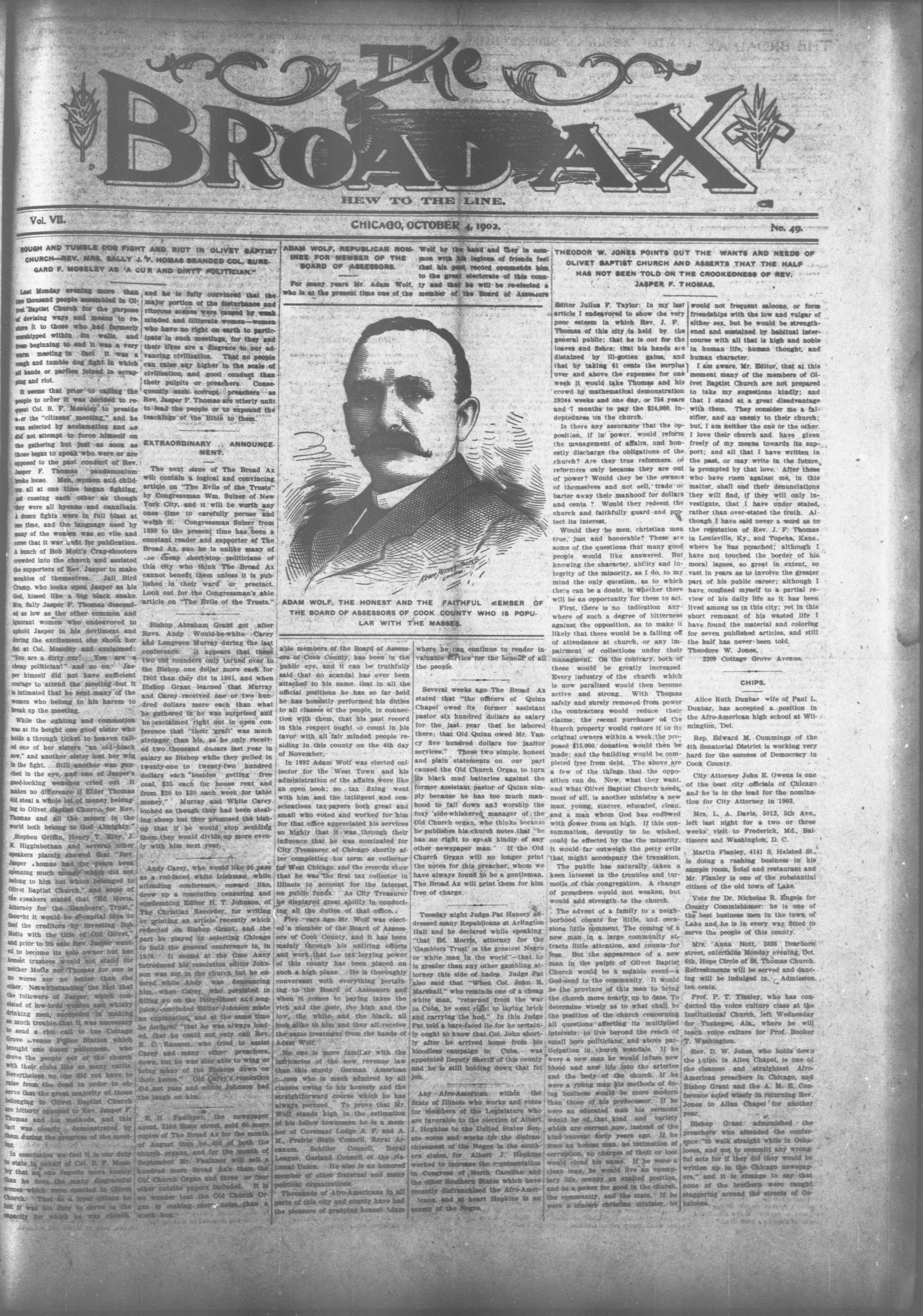
ADAM WOLF; THE HONEST AND THE FAITHFUL MEMBER OF THE BOARD OF ASSESSORS OF COOK COUNTY WHO IS POPULAR WITH THE MASSES.
ADAM WOLF, REPUBLICAN NOMINEE FOR MEMBER OF THE BOARD OF ASSESSORS.
For many years Mr. Adam Wolf, who is at the present time one of the
ADAM WOLF, THE HONEST AND
THE BOARD OF ASSESSORS OF
LAR WITH T
able members of the Board of Assessors of Cook County, has been in the public eye, and it can be truthfully said that no scandal has ever been attached to his name, that in all the official positions he has so far held he has honestly performed his duties to all classes of the people, in connection with them, that his past record in this respect ought to count in his favor with all fair minded people residing in this county on the 4th day of November.
In 1892 Adam Wolf was elected collector for the West Town and his administration of the affairs were like an open book; no tax fixing went with him and the intelligent and conscientious tax-payers both great and small who voted and worked for him for that office appreciated his services so highly that it was through their influence that he was nominated for City Treasurer of Chicago shortly after completing his term as collector for West Chicago, and the records show that he was the first tax collector in Illinois to account for the interest on public funds. As City Treasurer he displayed great ability in conducting all the duties of that office.
Five years ago Mr. Wolf was elected a member of the Board of Assessors of Cook County, and it has been mainly through his untiring efforts and work that the tax levying power of this county has been placed on such a high plane. He is thoroughly conversant with everything pertaining to the Board of Assessors and when it comes to paying taxes the rich and the poor, the high and the low, the white and the black, all look alike to him and they all receive the same treatment from the hands of Adam Wolf.
No one is more familiar with the intricacies of the new revenue law than this sturdy German American citizen who is much admired by all classes owing to his honesty and the straightforward course which he has always persued. To prove that Mr. Wolf stands high in the estimation of his fellow townsmen he is a member of Covenant Lodge A. F. and A. M., Prairie State Council, Royal Arcanum, Schiller Council, Royal League, Garland Council of the National Union. He also is an honored member of other fraternal and many political organizations.
Thousands of Afro-Americans in all parts of this city and county have had the pleasure of grasping honest Adam
---
Wolf by the hand and they in common with his legions of friends feel that his past record commends him to the great electorate of this county and that he will be re-elected a member of the Board of Assessors
D THE FAITHFUL MEMBER OF COOK COUNTY WHO IS POPU-THE MASSES.
where he can continue to render invaluable service for the benefit of all the people.
Several weeks ago The Broad Ax stated that "the officers of Quinn Chapel owed its former assistant pastor six hundred dollars as salary for the last year that he labored there; that Old Quinn owed Mr. Yancy five hundred dollars for janitor services." These two simple, honest and plain statements on our part caused the Old Church Organ to turn its black mud batteries against the former assistant pastor of Quinn simply because he has too much manhood to fall down and worship the foxy side-whiskered manager of the Old Church organ, who thinks because he publishes his church notes that "he has no right to speak kindly of any other newspaper man.' If the Old Church Organ will no longer print the notes for this preacher, whom we have always found to be a gentleman. The Broad Ax will print them for him free of charge.
Tuesday night Judge Pat Hanecy addressed many Republicans at Arlington Hall and he declared while speaking, "that Ed. Morris, attorney for the 'Gamblers' Trust' is the greatest Negro or white man in the world"—that he is greater than any other gambling attorney this side of hades. Judge Pat also said that "When Col. John R. Marshall," who reminds one of a cheap white man, "returned from the war in Cuba, he went right to laying brick and carrying the hod." In this Judge Pat told a bare-faced lie for he certainly ought to know that Col. John shortly after he arrived home from his bloodless campaign in Cuba, was appointed Deputy Sheriff of this county and he is still holding down that fat job.
Any Afro-American within the State of Illinois who works and votes for members of the Legislature who are favorable to the election of Albert J. Hopkins to the United States Senate votes and works for the disfranchisement of the Negro in the southern states, for Albert J. Hopkins worked to increase the representation in Congress of North Carolina and the other Southern States which have recently disfranchised the Afro-Americans, and at heart Hopkins is an enemy of the Negro.
```markdown
```
THEODOR W. JONES POINTS OUT THE WANTS AND NEEDS OF OLIVET BAPTIST CHURCH AND ASSERTS THAT THE HALF HAS NOT BEEN TOLD ON THE CROOKEDNESS OF REV. JASPER F. THOMAS.
Editor Julius F. Taylor: In my last article I endeavored to show the very poor esteem in which Rev. J. F. Thomas of this city is held by the general public; that he is out for the loaves and fishes; that his hands are distained by ill-gotten gains, and that by taking 61 cents the surplus over and above the expenses for one week it would take Thomas and his crowd by mathematical demonstration 39344 weeks and one day, or 756 years and 7 months to pay the $24,000. indeptedness on the church.
Is there any assurance that the opposition, if in power, would reform the management of affairs, and honestly discharge the obligations of the church? Are they true reformers, or reformers only because they are out of power? Would they be the owners of themselves and not sell, trade or barter away their manhood for dollars and cents? Would they redeem the church and faithfully guard and protect its interest.
Would they be men, christian men true, just and honorable? These are some of the questions that many good people would like answered. But knowing the character, ability and integrity of the minority, as I do, to my mind the only question, as to which there can be a doubt, is whether there will be an opportunity for them to act. First, there is no indication anywhere of such a degree of bitterness against the opposition, as to make it likely that there would be a falling off of attendance at church, or any impairment of collections under their management. On the contrary, both of these would be greatly increased. Every industry of the church which is now paralized would then become active and strong. With Thomas safely and surely removed from power the contractors would reduce their claims; the recent purchaser of the church property would restore it to its original owners within a week; the proposed $15,000. donation would then be made; and the building would be completed free from debt. The above are a few of the things that the opposition can do. Now, what they want, and what Olivet Baptist Church needs, most of all, is another minister a new man, young, sincere, educated, clean, and a man whom God has endowed with power from on high. If this consummation, devoutly to be wished, could be effected by the the minority, it would far outweigh the petty evils that might accompany the transition.
The public has naturally taken a keen interest in the troubles and turmolis of this congregation. A change of preachers would not weaken, but would add strength to the church.
The advent of a family to a neighborhood counts for little, and occasions little comment. The coming of a new man in a large community attracts little attention, and counts for less. But the appearance of a new man in the pulpit of Olivet Baptist Church would be a notable event—a God-send to the community. It would be the province of this man to bring the church more nearly up to date. To determine wisely as to what shall be the position of the church concerning all questions affecting its multiplied interests; to live beyond the reach of small bore politicians, and above participation in church scandals. If he were a new man he would infuse new blood and new life into the arteries and the body of the church. If he were a young man his methods of doing business would be more modern than those of his predecessor. If he were an educated man his sermons would be of that kind and variety which are current now, instead of the kind current forty years ago. If he were an honest man, no intimation of corruption, no charges of theft or loot would cloud his name. If he were a clean man, he would live an exemplary life, occupy an exalted position, and be a power for good in the church, the community, and the state. If he were a sincere christian minister, he
would not frequent saloons, or form friendships with the low and vulgar of either sex, but he would be strengthened and sustained by habitual intercourse with all that is high and noble in human life, human thought, and human character.
I am aware, Mr. Editor, that at this moment many of the members of Olivet Baptist Church are not prepared to take my suggestions kindly; and that I stand at a great disadvantage with them. They consider me a falsifier, and an enemy to their church; but, I am neither the one or the other. I love their church and have given freely of my means towards its support; and all that I have written in the past, or may write in the future, is prompted by that love. After those who have risen against me, in this matter, shall end their denunciations they will find, if they will only investigate, that I have under stated, rather than over-stated the truth. Although I have said never a word as to the reputation of Rev. J. F. Thomas in Louisville, Ky., and Topeka, Kans.; where he has preached; although I have not touched the border of his moral lapses, so great in extent, so vast in years as to involve the greater part of his public career; although I have confined myself to a partial review of his daily life as it has been lived among us in this city; yet in this short remnant of his wasted life I have found the material and coloring for seven published articles, and still the half has never been told. Theodore W. Jones.
2209 Cottage Grove Avenue,
CHIPS
Alice Ruth Dunbar wife of Paul L. Dunbar, has accepted a position in the Afro-American high school at Wilmington, Del.
Rep. Edward M. Cummings of the 4th Senatorial District is working very hard for the success of Democracy in Cook County.
City Attorney John E. Owens is one of the best city officials of Chicago and he is in the lead for the nomination for City Attorney in 1903.
Will promulgate and at all times uphold 'be true principles of Democracy, best Catholic, Protestant, Pride, Indie, Farmers, Single Taxes, Republics, Knights of Labor, or any one else can have their say, so long as their language is proper and responsibility is fixed.
The Broad Ax is a newspaper whose platform is broad enough for all news. Unifying the editorial right to speak its own voice.
Local communications will require attention.
THE BROAD AZ
8040 Armour Avenue, Chicago.
JULIUS F. TAYLOR, Editor and Publisher.
Entered at the Post Office at Chicago,
Ill.; as Second-class Mailer.
BOSTON TEA-PARTY BOWL. Rhode Island Collector Has the Venerable Holie That Figured in the Tea Tossing Event. The famous historical punch bowl of the Boston tea party has just fallen into the hands of a Rhode Island collector of antique furniture, colonial blue ware and original and early Shakespeare prints, reports the Boston. Globe.
On the 19th of last December Maraden J. Perry, a Providence railway magnate and a banker with a fortune of several millions, married Mrs. Marian Lincoln Bogert at Worcester, Mass., and they went to Providence to reside permanently in the residence of Mr. Perry, at George and Benefit streets, on the aristocratic East side of that city.
The new home of the bride was a marvel in its interior decorations, and there were many very attractive and costly articles of ornamentation, together with an elaborate display of valuable colored ware incidental to the foundation of the United States and its early history. The existence of such a collection in her new home caused Mrs. Perry to suggest to her wealthy husband that within his grasp was the celebrated punch bowl of the revolutionary period, when high priced and overtaxed tea was cast upon the waters of Boston bay, and there was a celebration and great rejoicing incidental thereto.
The great men of Boston of that day had a feast after the tea tossing episode, and the affair was not rounded out in true Yankee fashion until the punch had all disappeared from the bowl, which had been furnished for the notable occasion by one of the distinguished ancestors of the present Mrs. Perry. As soon as the Gammell mansion, now undergoing rejuvenation by carpenters, painters and decorators, is completed, the punch bowl is to have a conspicuous place in a great sideboard which Mr. Perry intends to have constructed, and then there will be patriotic days when the friends of the millionaire are to quaff the finest vintages from the Boston tea party punch bowl.
The mansion in question is one of the earliest of the colonial in the state of Rhode Island, and it fell into the hands of Mr. Perry about a year ago. Parts of the house were constructed more than 100 years ago and when the trade of New England was a good deal in the line of rum and negroes the mansion of the Browns and their descendants figured in the social life of the town and the plantations established by Roger Williams. Hence, when the Boston tea party punch bowl is finally nestled away in Providence it will have a fitting roof over its wide earthenware rim, and the timbers of the old mansion can vie with the history of the bowl in claims of distinguished pedigree and renown.
The punch bowl, it is learned, came down safely to the days of the twentieth century through the care and painstaking of the forefathers of Mrs. Perry. They were the Lincolnns and they have figured in the history of Massachusetts for quite a little more than 200 years.
GOOD ENOUGH REASON
"Your honor," said the solicitor for the defense, relates Tit-Bita, "I wish to prove by this question that the witness is a man of quarrelsome disposition, hard to get along with, and on bad terms with his neighbors. Now, sir," he continued, turning again to the witness, "I'd like to know whose farm is next to yours?"
"Well," answered the witness, "there is the Billings' farm, and the—"
"Stop there. One at a time. Are you on friendly terms with Mr. Billings?"
"I can't say I am."
"Are you even on speaking terms with him?"
"No, sir."
"Whose fault is it?"
"It's his fault, I reckon."
"Oh, yes; it's his fault, you reckon. How long has it been since you have spoken to him?"
"About 15 years, as near as I can remember."
"Now, sir, I want you to tell this jury why you have not spoken to Mr. Billings for 14 years."
"Gentlemen," said the witness, turning to the jury, "the reason why I haven't spoken to Mr. Billings for 14 years is because that's about the length of time he's been dend."
A WILD AMERICAN.
Eccentric Millionaire Shocks Japan with His Queer Ways.
Lives with Grave Diggers, and Outcasts, Surrounded by Every Form of Vice-Buys Boys and Winks to Right.
In a paper on defectives, read by Dr. Martin W. Barr, chief physician of the Pennsylvania school for feeble minded children, before the summer school of philanthropy at the charities building, a remarkable instance was mentioned by him of eccentricity that has caused comment in scientific circles. It was the case of an American multimillionaire who is living in far eastern countries and leading a life of such peculiarity as to be almost incredible, says a New York report.
According to Dr. Barr, this man is a neurotic. It is estimated that his fortune is in the neighborhood of $10,000,000, but no attempt has been made to have him declared incompetent; he is left free to run his course. His family are refined and socially prominent. Whenever they speak of the son's course, they refer to it as his "nervousness." They will not admit that he has a deranged intellect, though he has left friends and position here to take up a life among the "Hanina," the grave diggers and social outcasts of the far east.
"He was a physician, rich, handsome, cultured, of aesthetic tastes," said Dr. Barr in his paper, "a graduate of one of the most prominent medical colleges in America, and a man who had made a pronounced hit as a specialist.
His fortune enabled him to secure every medical appliance known to science and for some years he enjoyed phenomenal success. Wine and women proved his bane. He sank lower and lower. His peculiarities no longer tolerated at home, he drifted from capital to capital of Europe, and finally established himself in Japan. With an appetite still unsatisfied, he exhibited new phases of moral degeneration, causing his body to be tattooed with wonderful skill, every picture a work of art. His back bore a huge dragon, the shading of every scale showing perfection of detail. This, on revisiting America, with utmost vanity he shamelessly exposed. He was turned out of the clubs.
Returning to Japan, he bought a performing bear and wandered from place to place clad in the garb of Hanin, exhibiting himself and his bear, and distributing photographs of each and all in endless variety.
"This master of eccentricity," said Dr. Barr, "shocking both Europe and America, and astounding even Japanese next hired a squad of Japanese boys, practically buying them outright from their parents, who, attired in full uniform, are trained in military exercises. To these are opposed an equal number of monkeys, dressed as Chinese soldiers, and the war of China and Japan is constantly renewed for the entertainment of himself and his satellites, who watch in the ecstacy of delight the suffering of the poor brutes. Rewards are offered, and the more bloody the contest and the greater the atrocities, the more intense the gratification."
AN EXTRAORDINARY COW.
Josephine's Remarkable Display of Intelligence Greatly Pleased Her Proud Owner.
"It does me good to ride downtown with Slick in the morning," remarked a middle-aged citizen, according to a story in the Detroit Free Press. "He lives out in the suburbs and there is always something doing out there. Before Dick left town his wife and baby were the smartest on earth, and now that he has become a country jake his horses, cows, dogs and chickens are the smartest on earth. There he is now; just you go and sit by him and start him on his cow."
"Hello, Dick, how are you? How's the farm? How's your cow?" asked the mean man, who went over to sit by the farm novice.
"Oh, the farm's all right; and the cow—" replied Dick; "well, she ought to be teaching school—that's a fact. She's the smartest cow I ever saw. Last night, sir, when she came up to be milked—she's not one of these silly, feeble-minded cows that have to have somebody drive them up to get their feed—no, sir, when Josephine came up she was alone—the little Jersey heifer, Daisy, that we bought to keep her company in the pasture, was not with her. We didn't worry, for we thought Daisy had loitered and would come along soon.
"But Josephine acted strangely. We couldn't get her in the barn at all; she stood in the lane looking toward the pasture and bawled and bawled and bawled. We thought she was only calling Daisy to hurry up and come home. Still she wouldn't go in and still she kept on bawling. Then somebody suggested that Daisy might be in trouble of some kind; so we all left Josephine and went down into the pasture.
"She stopped bawling as we started down the lane, and, sure enough, at the farthest corner of the pasture, in a little triangle of land where three wire fences cross each other, making a queer little pen, was Miss Daisy. She had got in, out of girlish curiosity, and couldn't get out. We had to pull down a piece of fence to get her out. Now, wasn't Josephine smart? I think so."
The other men all said that Josephine ought to have a telephone out in the pasture so she could call up the house when Daisy got in trouble.
There is a movement among brokers in New York to exclude women from their business houses and to deny them the privilege of speculating in stocks. Femininity, they say, has been given a fair chance to show its adaptability in "the street," and has failed miserably, reports the New York Times.
For a long time many brokers have considered women undesirable patrons for a multitude of reasons. Of late the opposition has crystallized, and several prominent firms have taken a bold, determined stand to ostracise those members of the fair sex whose gaming instinct and desire to get rich quick prompt them to speculate on the markets.
The following is a copy of a letter sent out by a well-known firm of stock brokers. It shows plainly the attitude of brokers, and it is not unlike letters that have been sent out recently by other firms:
Dear Madam: We regret to inform you that in future we shall be unable to afford you the privilege of calling at our office on Blank street. We find that * * * some of our best customers consider it undignified for women to frequent brokers offices, and for that reason beg to ask that in future you will kindly communicate with us only by letter or telephone. In this matter we have used no discrimination. Every woman who has an account or who has done business with us will receive similar notice by the same mail. You're very truly,
"A woman is a nuisance anywhere outside of her own home," said a well-known reputable stock broker to a reporter who called on him at his office in a lower Broadway skyscraper the other day.
"In the first place, a broker's office is no place for a woman. The average woman knows little about brokerage. Business instinct is not innate in the woman, ordinarily speaking, and, worse than that, she can't learn. Tell her all you know about stocks and market conditions and practices, and the next day she will ask you the same thing again.
"Another thing: The woman who desires to trade in stocks, knowing nothing of them or the business, wants the broker to become her confidant, to tell just where and when to buy or sell. If she makes something out of an investment made on a broker's advice, she gloats over her shrewdness 'on the street,' and the broker gets no credit whatever. Should she lose, and every broker must go wrong in predictions once in awhile, then there's the devil to pay."
Brokers say that a woman does not seem to be able to realize that there is a possibility of losing in speculating in stocks. Therefore she is what a gambler would call a "bad loser." Of course, there is an occasional woman who knows the market and its sinuosities, and is as "game" as any man on the street. But she is mighty scarce. The ordinary woman speculator and trader makes an awful fuss when she makes a losing investment.
Sometimes the spectacle is ludicrous in the extreme, but more frequently it is a sad one. Many women with the gaming instinct, who, besides seeking the excitement attendant upon the speculation, hope to get wealthy in a few days, go into it when the money they stake is needed for the necessaries of life for themselves and their families. The result of the failure in the latter instance is pitiable. To the broker it is nerve-racking.
The New Boer Nation.
The Boers have accepted British sovereignty in good faith, and the British have conceived an almost exaggerated respect and admiration for the character of the Boers, whom they frankly despised at the beginning of the war. There is one remarkable historical paradox to be noted in the outcome of this lamentable struggle. In the less of their beloved independence, in the defeat of their cause, and in their seeming extinction or absorption, the Boers have really come into a new birth as a nationality. It is not written that a young people capable of such heroism shall, after practically dictating terms to the greatest empire in the world, permit themselves to forget that they have had a great part in the making of history. This is not a day when small nationalities are assimilated and yield up their identity; and so, far from this being the end of the Boer nation, the peace of Pretoria is the beginning of it. These Boer farmers were the most obscure people of European stock in the whole world. They were far less known than the Icelanders. To-day they are passionately admired throughout every nook and corner of the civilized world.—Review of Reviews.
"No," wearily replied the girl who was already in her third season.
"He thinks you are too slow."—Chicago Post.
"Did it arise occur to you," said a college professor to a Chicago goldsmith, "that you have no such thing as a pound weight."
It had; but the professor is willing to bet that not one graduate of a high school out of twenty has an idea that there is not a metal weight of 12 ounces to represent the Troy pound. But there is no such thing. Twelve Troy ounces make a pound, but there is no such material unit of measurement. There are the grain, the sorghie, the drachm, and the ounce weights, but nothing more. The man who has ten pounds of gold in reality has only 120 ounces, and for him to go into the gold market and speak of gold as by the pound would be for him to be laughed at.
Incidentally these units of measurement in the Troy scale look a good deal more like Greek or Chinese coins than they look like weights, says the Chicago Tribune. For the average high school graduate to pick up a set of these weights would be to bewilder him. It is the contemplation of such absurdities of the English tables of weights and measurements that bring the student to the metric system as the same solution of it all.
Are More Conscientious Regarding Their Franchise Privileges Than Men.
An Australian newspaper tells of some curious facts shown by the new electoral rolls of South Australia. The number of men on the rolls has shrunk in a little over three years from 83,640 to 76,767. On the other hand the women voters have increased during the same period from 68,375 to 71,682. In the three chief metropolitan districts the men voters have dropped from 36,587 to 30,484, a reduction of nearly 16 per cent. Women voters in the same district have slightly increased their numbers, and now count no less than 32,801. The women seem to be growing more conscientious in the fulfillment of their political duties and the men more careless.
When equal suffrage was granted in New Zealand the estimated number of adult women in the country was 139,915. Of these, 109.461 registered to vote. Of the women who registered. 83 per cent. voted; of the men who registered, only 67 per cent. According to the report of the Wyoming secretary of state, 90 per cent. of the women vote. In Denver, at the election last November, 31,780 men voted and 23,449 women.
HUMAN BEINGS NOT IMMUNE
Records Show That Contagious Diseases Frequently Attack People a Second Time.
It is a fallacy, widespread but nevertheless a fallacy, for anyone to suppose that a person who has once had smallpox, measles, scarlet fever or other contagious disease is thereby made immune to that particular disease for the rest of his life. A Swiss physician has been examining the records of such diseases, and in the statistics at his disposal—which are very defective, as comparatively few physicians take the trouble to report such observations to the medical journals—he finds no less than 528 persons who have had smallpox twice, nine who have had it three times and one who has had it seven times. For scarlet fever he finds 144 double and seven triple attacks. A hundred and three persons had two and three had seven attacks of measles; 203 had typhus twice, five thrice, one four times, and even cholera shows 29 second and three third attacks. The natural inference is that during the prevalence of an epidemic one should not rashly expose himself to contagion even if he has already had the disease.
MAKE BEGGING A BUSINESS.
Two Young Men Who Raise Money for Charitable Institutions for a Percentage.
Two of the most energetic and successful young men of Philadelphia follow the odd business of petitioning money for charities, says the Record of that city.
You, for instance, are interested in an orphan asylum that has a deficit this year of $8,000. You go to the young men and tell them you want the money.
"Leave us," they make answer, "all your literature—your catalogues, reports, announcements—everything you have ever published."
And they master that literature and then they visit the asylum and inspect it thoroughly. By this time they acquaint themselves with the character of the institution in question, learning whether or not the benevolent rich would be likely to help it if its case were laid before them. According to that likelihood they set their price, saying they will "beg" for the place if they are given ten, twenty, or thirty per cent. of all the money they solicit.
They make, it is estimated, $3,500 a year a piece.
Wonderful Marksmanship.
The most marvelous shot in the world is M. Gaston Bordeverry. Taking several repeating caribines, and standing ten yards from a piano, he "plays," or, to speak strictly, he shoots in very brilliant style, a complicated selection from "Cavalleria Rusticana." The piano is "armored" for its novel experience.
MANY PEOPLE ACCEPT TIPS.
It Is Not Alone the Walter in the Restaurant That Resolves Little "Memembrances."
"Am I," said the waiter, "the only man who takes tips? No, not at all.
"You, for instance, tell your tobacco dealer that in a few days Smith, the millionaire, will be in to see him—that Smith was looking for a good dealer, and you recommended him to go there. Well, Smith goes there and leaves a heavy order. Hence you are not surprised when you receive a little later a box of fine cigars, with your tobaccoist's compliments, but if those cigars are not a tip, what are they?"
"Brown is a buyer for a big manufactory. The firm he patronizes is sending him every week or two boxes of toilet soaps, cases of perfumery, dozens of golf balls, and barrels of clams. Those are Brown's tips—the gratuities he gets for his patronage.
"Robinson sends a rich friend to his tailor with a note of introduction, and the rich friend buys four suits. Isn't Robinson being tipped when the tailor, the week following, makes him a present of a set of English flannels?"
The waiter made a disdainful gesture, says the Philadelphia Record, and ejaculated:
"Pish! Tipping, they say, is un-American, and a waiter of proper pride and independence would seorn to accept a quarter or a half in return for the serving of a meal. But I say that tipping runs clean through our social system, from top to bottom, and all of us, excepting only the elevator man, are taking tips of one sort or another all our lives."
IS GROWING IN FAVOR.
Tendency Toward Disposition of Human Dead by Cremation Becoming More Popular.
The custom of cremation prevailed throughout the civilized world before the Christian era, excepting among the Egyptians, Chinese and Hebrews, and recent statistics show that there is a constant and growing tendency to return to the custom.
The disposition of the human dead by incineration has been meeting with more and more favor, that has in no wise been retarded since the first cremation society was formed in London in 1874. That same year a crematory was erected in Milan and two years afterward one was built in Lodi, Italy. In two years more there was one in Gotha, Germany, and afterward they began to appear in all lands.
The first one in this country was erected in Washington, Pa., in 1883, and the one in Fresh Pond, L. I., came two years afterward. In this latter eight bodies were cremated the first year and 76 in the second year. In 1900 the total has passed the 600 mark, and during last year it reached 654. There are now 26 crematories in the United States. In the year that New York's first crematory was opened only 46 bodies were cremated in the entire country, while last year the number was 2,645.
PESTS OBJECT TO YELLOW.
Mosquitoes Will Avoid a Person Who Wears Clothing of That Color, It Is Said.
Mosquitoes have their prejudices and one of these is a repugnance to yellow. For this reason residents in mosquito-infested parts are strongly recommended to wear as much yellow and to have as much yellow about them as possible. This advice comes from a French scientist who has been investigating the psychology of the little pest. One of the tests was as follows: He took a certain number of boxes and lined their interiors with cloth of different color, and different shades of the same color. Then he liberated in the room a large number of mosquitoes, believing that the colors in the box would attract them.
At the end of a certain time he closed his boxes and then began to count. He found that the insects had a decided liking for dark colors in preference to white and that the most were found in the box which had been lined with dark blue. Not a single one was found in the box which contained yellow. This test may not be conclusive, but it seems to prove that there is something in the tradition that dark stockings attract more mosquitos to the ankles than do light ones.
Odora from the Skin.
A French medical review asserts that the human skin possesses a certain odor which varies according to the individual, the age and the race. This was noted by Rider Haggard in "Allan Quatermain." When Umlopogaea and Quatermain sat in the tree together waiting to kill elephants on a dark night the Zulu moved away from the lee of the white man, not relishing the white man's personal essence. The nervous system is said to exert much influence over the odor of the cutaneous secretions. Hammond cites the case of a woman who always gave out the odor of pineapple when she was in temper, and that of another who emitted a violet odor when suffering from hysterical attack.
One-Bow Cornfield.
A Kingman county (Kan.) farmer is growing a row of corn 25 miles long, not because he has to, but because it amuses him. It coll around a 50 acre field, beginning at a corner and ending in the middle.
Mammoth Industry.
In the United States more than 250,000,000 are invested in making fertilizers.
An Englishman who was present when De Wet addressed the men and women in a concentration camp after the signing of peace, sends a summary of his remarks, says the Manchester Guardian. The speech was a remarkable and strong mixture, displaying at once De Wet's natural chagrin and his determination grimly to abide by the promise he had given. "Knowing," he writes, "the Dutch as well as I do. I could see De Wet still had injured feelings, although he gave them (the men and women) a proper talking to. He said. 'Of course you will all like to ask me the question: 'Have we lost?' In a word I must say 'Yes.' Our flag is fallen. It is dead and buried, never to rise again, and we are now under a new government whom we have to serve, not as well as we served our own, but a great deal better. Hunger,' he went on, compelled me to give in, but I stood till the rifle was taken out of my hand. I could point my finger to a good many cowards here who were going to shoot the English in this way and that way, but who never fired a shot and simply surendered. I, indeed, thought more of you would remain loyal, as some of us did and were true to the last. But as it is, if ever I hear of anything wrong among you (that is disloyal to the new government), I. Christian De Wet, will be the first to arrest you and have you well punished.'"—Manchester Guardian.
LICENSES FOR CATS.
Authorities of Berlin, Germany impose Restrictions on the Feline Tribe.
It has recently been discovered that there are about 30.000 cats in Berlin, and, full of their knowledge, the German Society for the Protection of Animals, has conceived a thoroughly Teutonic idea, says a Berlin correspondent of the Chicago Inter Ocean. According to its carefully conceived plan, the town council of the city is to take the matter in hand, and to issue licenses for cats, just as they do for dogs.
Cats are only to perambulate the city when wearing their authorized little badges, hanging, locket-like, from their throats. There is nothing in principle to be said against the issue of the licenses, but what puzzles reasonable people is the list of penalties that these ingenious people have drawn up. The owner of a cat is to be fined if the latter "be found wandering in the public gardens of the city; or if the birth of a kitten, or litter of kittens, be not punctually reported to the authorities; or, if a citizen's pet is discovered prowling about the streets without its distinctive official badge, etc." This word "etc," sticks in one's throat, after the enumeration of the previous offenses.
DAMAGED BY SEA WATER.
Steel Halls Succumb Rapidly to Coercion in the Tropics Near the Sea.
Mr. Bricks, one of the engineers in charge of the railroads owned by the French government, recently read a paper in which he said that sea water, particularly in tropical countries, has a very destructive influence on steel rails. A few weeks ago the same observation was made by Mr. Delpra; the engineer in charge of the Dutch railroad in Sumatra.
This gentleman says that the short railroad at Port Emma, on the coast of Sumatra, which has been in operation for ten years, and which occupies a position only a little above mean high tide, has been greatly damaged by sea water, the rails having been largely eaten away by rust. The rails on one of the shorter branches of this road, which runs over a breakwater, have been diminished in weight by about two and a half pounds for every three and a half feet of the length of the rails. He says that every year these rails are losing about four per cent. of the weight of new rails. The width of the rail surface has been diminished about one inch.
OLD-FASHIONED SURF BATH
How Long Island Farmers Used to Go Bathing in Their Big Wagons.
It is not so many years ago when surf bathing of a very primitive kind prevailed at the eastern end of Long Island and, for aught I know, at other points, says a writer in Outing.
Every Saturday morning or afternoon as the tide willed, throughout the summer, big farm wagons trundled down to the beach and were swung around abreast of the line of breakers. Old fish houses served the purpose of modern bathing pavilions, and the sea costumes were those of last year's village street. A long rope was drawn from under the seats and hitched to the wheel, and then some sturdy exwhaler or life crew man, in red flannel shirt and old trousers tied at the ankles, slipped his wrist through the loop at the end of this primitive life line, and, wading out, kept it as taut as circumstances permitted, while the women and children hung to it and revelled and wallowed and shrieked, rejoicing in their "Saturday tub."
Library Number
Some of the students in Paris, when perusing ancient books in the national library, protect themselves with muzzles. This is done to prevent the inhalation of dangerous microbes, said to infest old volumes.
for catching bass at dusk the following plan is sometimes tried in the upper part of the state. The German anchors in comparatively the water outside the lily pads bring an extra rod and attaches a foot leader to the end of the sea. At the end of the leader he has a heavy sinker, and about five feet above the sinker a large bob piece of cork, which has previously received a heavy coat of phosphorus, says the New York Sun. Without hook or bait he casts this well in toward the paddle the line being held in place at the surface by second cork. The line is scaled out and the rod on the side of the boat. Then setting a lively minnow he buits the casting rod and drops the minnow within a foot or two of the other line. He then lights his pipe and awaits developments. From time to time as the minnow swims away from the lure a new cast is made.
The explanation of the success of this plan of catching bass is that the fish are attracted by the phosphorcent bob and in swimming around find the bait. The plan has proved successful when small frogs or crawfish were used instead of minnows.
An inventive genius, who first saw the lure in use at Upper St. Regis lake, sent to New York for a battery, waterproof wire and ground glass electric bulbs. For some reason the elaborate apparatus was not a success.
Those who made the experiment say the lure is equally effective when used in trolling. For this purpose the lure is made of cork or light plum. It is attached to the line about ten feet in front of the hooks.
PENGUIN PUGILISM.
I was curious, says Prof. C. E. Bushgrevink, writing of penguins in Leslie's Monthly, to see how some of the lazy birds would quickly make off with the pebbles with which they build their nests, and which through great care and work, had been accumulated by one of the hand, the moment the owner happened to turn his back. The ostentious attempt of the culprit to look innocent when caught in the act amused us mightily. The rightful owner of the pebble was sure to pursue the thief and then the two would fight desperately till blood covered their flippers. Sometimes they stood up to each other likeugilists, giving and taking punishment like men, and they exhibited surprising efficiency in the art of biting. Sometimes they seemed to remember the pebble, the cause of the quarrel, but I noticed that the one who first gave in generally walked off with the pebble, while the other, blinded by success, was left with the honor. Meanwhile the unqueror would return to his nest and find that his kind neighbors had used the opportunity to pebble their nests from his possessions while he had been away struggling so valiantly to catch the thief of one single pebble.
AN UNINHABITABLE LAND.
undary Between Utah and Azisons a Desert from One End to the Other,
A well-known civil engineer, H. B. Carpenter, who has recently completed the survey of the southern side of Utah, says the boundary between that state and Arizona does not cross a foot of cultivated land. It traverses a desert, which is cut up by great canyons that are almost impassable. The length of the line is 277 miles. Landmarks along the line will make it possible for the boundary to be located without any difficulty in the future. Just east of the Colorado river a sandstone butte from 1,000 feet above the plain, and the very peak of this butte is exactly on the boundary, Mr. Carpenter named the peak State Line butte. Not far from this butte is another, which stands 1,300 feet above the plain, and was named Tower peak. These two gigantic stones will always be a guide to persons who have enough curiosity to penetrate the desert in search of the state line.
Lived Down His Reputation.
The king of Italy was unpopular at the time of his coming to the throne, because of the stories of his extreme economy, but has lately known that, though he is circumspect in his expenditure, he is liberal and benevolent. He gives largely to charity, both organized and individual, and in his social life seems ready to make an outlay that is necessitated for his position. Among his recent transactions was a gift of 100,000 lire to the town of Palermo, to be distributed among the poor and three charitable institutions. Of this sum 10,000 lire is to go to the poor, 80,000 lire to the town hospital, 10,000 lire to the marine hospital, and 1,000 lire to the Red Cross society.
Writers Who Refuse Titles.
The London academy is authority
on the news that Rudyard Kipling
might have been knighted along with
Robert Parker and Conan Doyle, but
he declined the offer. The acad-
der further states that Mr. Lecky
owned a peerage, contenting him-
self with membership in the new Or-
der of Merit.
SCIENCE AND INDUSTRY.
The manic sugar season lasts only five or six weeks, but it yields American farmers over a million dollars a year.
Paper coal is a form of lignite found near Bonn, in Germany. It splits naturally in films as thin as paper.
Seventy-eight profit sharing enterprises, affecting 53,526 workpeople, were in operation in Great Britain last year.
The sanitation of the city of Ahmedabad, India, is so bad that the mortality is 70 per.1,000, with no epidemic to account for it. A white badger, which is almost as great a rarity as a white blackbird, was killed recently by the Axe Vale (England) badger hounds.
A Roman bowl of Samian make, said to be 2,000 years old, has been brought up from the sea bottom off Beachy Head by a Brightlingsee oyster dredger.
Maiden Bower, a pre-Roman earthwork, near Dunstable, England, is in danger of being destroyed, by the extension of a chalk quarry, which has already been worked to within a few yards of the ancient rampart
The Pasteur institute for the treatment of persons bitten by rabid animals in Calentta is rapidly gaining in popularity among the natives. In the eight months ended May 31 last, 352 persons were treated, and the mortality was only eight per cent. Sericulture, the raising of silk worms, does not appear to increase in France. The official returns for last year show that 132,634 persons were engaged in the industry, as compared with 136,214 in 1900. In 1897 the number was 133,252. The yield of cocoons varies with the seasons. In the last five years it has ranged from 6,898,033 to 9,180,404 kilos.
BOER TONGUE TROUBLES.
There is no question in South Africa of suppression of the language of the people. The language of the Boer people of South Africa is a patois called Taal, based on the seventeenth century Holland Dutch, with a mixture of many strange words, Kaffir and English, and with the omission of most grammatical inflections. In that happy tongue you are permitted to say "I is." It is needless to say there is no literature in this patois, as there is in Holland Dutch of this century. The official recognition of Hollander Dutch dates from 1882 in the Cape Colony, and is a result of a political propaganda of the Afrikander Bund, says the Pall Mall Gazette. It was openly announced and hailed as the "thin end of the wedge" to prevent the fusion of the Boer and British strains of the European people, and to drive the British into the sea.
The veld Boer does not understand Hollander Dutch; he dislikes the Hollander outlander only a degree less than the British outlander, or than the French, Italian, German or any other outlander. He only hears the Hollander tongue, or, rather, the seventeenth-century predecessor of it, in the text from the seventeenth-century Dutch Bible read out in the churches on Sundays by the predikant, or in the hymns chanted by his fathers of the low lands, who worsted Alva, prosecutor of the saints of the Lord.
A very minute proportion of the Boers have any business to transact in the law courts or public offices, unless such as are fully acquainted with English. For a generation before Mauba hill the Boers, desiring to give their children a fair start in their business dealings with the business people of the towns, had their children taught English. The English governess was an institution among Boars of any position. At the present moment there are none of the Boer leaders who cannot speak English; there are many, of course, who will not. After so many years of active political propaganda of the Hollander Dutch language, in the year before the war in Pretoria there were only five per cent. of the cases in the law courts between non-English-speaking people. All business transactions were conducted in English; sales and mortgages of farms, sales of mining options, dealings in stocks and shares, purchases in shops of imported goods, sales in the market squares of agricultural produce. Every Boer professional man, every Boer politician, had, as a necessity of life, to be acquainted with English.
Prince for Uglent Girl.
From Germany comes a story of novelty and charity. In the town of Hassmann prizes are offered yearly for men who will marry the ugliest or most crippled women and also women over 40 who have been jilted as least twice. The money for the prizes was left by a rich financier, who provided that out of the funds an income of not less than $80 should go to the ugliest girl and $60 to a cripple.—London News.
Batting for Charity's Sake.
Betting on the results of the recent municipal elections at Rome was permitted by the government. The profits were devoted to charitable purposes.
—N. Y. Sun.
The Real Reason.
Blanche—Did you part owing to a misunderstanding?
Rose—Goodness me, not! We understand each other too well—London Tit-Bits.
HOW EGYPT IS GOVERNED.
The Khedive In Supreme and Obtained His Power Through Force of Arms.
The government of Egypt is under the direction of a khedive, the seventh ruler of the dynasty of Mahomet Ali, who was appointed governor of Egypt in 1806 and made himself, in 1811, absolute master of the country by force of arms. The control of the khedive was gradually increased, and in 1873 he was given the privilege of concluding commercial treaties with foreign powers and maintaining armies. From 1879 to 1883 two comptrollers general—appointed by France and England—had considerable power in directing the affairs of the country, but in 1882, in consequence of a military rebellion, England intervened in behalf of the khedive, and, as this intervention was not joined by France, the joint control was abolished and a decree signed by the khedive giving to England the right to appoint an English financial adviser, without whose concurrence no financial decision can be taken, and since that time an English officer has cooperated in the direction of financial affairs in Egypt. A number of representative institutions, including a legislative council and general assembly, were created by the khedive in 1883, and the legislative council, which is a consultative body of 30 members, 14 of whom are nominated by the government, meets once a month to examine the budget, and may propose laws, but cannot initiate legislation.
SNAILS FOR THE TABLE.
Some Sent to Paris Are Fed on Aromatic Herbs to Improve Their Flavors.
The popularity of the snail as an article of food is not confined to Paris, but extends throughout southern Europe and some parts of Africa. Dr. Edward, a French writer, in a pamphlet, says that 90,000 pounds of snails are sent daily to Paris from the gardens at Poitou, Burgundy, Champagne and Provence. Those reared in gardens are fed on aromatic herbs to improve their flavor. Their market price is from 2 francs 50 centimes to 3 francs 50 centimes a hundred, while those from the hedges, woods and forests bring only 2 francs to 2 francs 50 centimes. The proprietor of one snailery in the vicinity of Dijou nets over 7,000 francs annually. The snail is reared and fattened with great care in some cantons of Switzerland as an article of luxury, and is exported in a pickled state. It is also eaten as a relish and nutritious article of food in Austria, Spain, Italy and in some sections of the United States. The Ashantees and other African tribes smoke them and eat them as daily food all the year around. In Algeria, in the markets, large heaps of snails are sold by the bushel and the hundred as an article of food. Vendors hawk them in the streets of Cairo. In modern Rome fresh-gathered snails are hawked by women from door to door.
PRESERVE WEDDING GOWN.
Kept by Many Women as a Moment of the Most Important of All Events,
A woman's wedding gown is seldom worn except on anniversary occasions after the day upon which the nuptials are celebrated. Most woman regard this garment as especially sacred and take extraordinary means to preserve it in all its pristine purity. The wedding gown box is a recent fad for the well-to-do bride to adopt, and it bids fair to have quite a vogue. That every bride possessed of any sentiment wishes to keep her wedding gown in a state of preservation is a foregone conclusion, and this elegant receptacle is admirably suited to the purpose for which it was designed. It is made of light wood enameled white and having the bride's initials in silver letters on the outside. A lining of tufted white satin is revealed on opening the box, and locks of silver and white leather straps fasten it. A photograph of the wedding gown is often taken by the modiste before sending it home and making a collection of the photographs of wedding gowns or any other distinctive costumes is one of the present fads, the idea being to preserve the pictures as mementos for future generations and also as illustrations of present-day fashions.
Ancient Human Remains
Human remains recently unearthed at Girga, in Egypt, consist of a continuous series extending backward over at least 8,000 years. The bodies are so well preserved, owing to the dryness of the atmosphere in the region and to the perfection of interment, that not only can the hair, the nails, the ligaments, be made out, but also the muscles and the nerves. In almost every case the brain also is preserved, and the climax has been reached in two cases where the eyes, with the lens in good condition, are present. There are now unearthed a series of later prehistoric graves ranging throughout the first 15 dynasties, others of the eighteenth, and yet others of the Ptolemaic and early and recent Coptic periods.
Superstitious Miners.
Three hundred miners the other day refused to go down the Glyn corryg colliery, near Port Talbot, in Wales, because they said it was haunted. It was asserted that the figure of a woman bearing a lighter lamp had been seen in the working and the screams of a woman heard.
Illinois River Corp.
Peoria ships annually to New York over $1,000,000 worth of German carp taken from the Illinois, for consumption as food by the Russian Jews. This is an industry by itself.
Perhaps no wild mammal is more familiar to country people than the woodchuck, says a writer in Country Life in America. Every hillside and meadow is dotted with the small piles of earth which mark the doorway to his home. The woodchuck prefers a hillside or a knoll in which to dig his hole, for here he can easily make the end of his den higher than the beginning, thus avoiding the danger of being drowned out. What could be more unlike in general appearance than a woodchuck and a squirrel? Yet they are cousins, both belonging to the same family of mammals. The trim body, sharp claws and agility of the squirrels make it possible for them to lead an arboreal life, jumping recklessly from branch to branch, while the flabby form and short legs of the woodchuck better adapt him for digging than for running or climbing.
The nature of the food of the woodchuck is such that he cannot lay up stores as the chipmunks do, nor is it of such a kind that it can be obtained during the winter. The case of this creature during the winter seems to be, therefore, one of "sleep long and soundly or starve." During the winter's sleep or hibernation life processes go on very slowly. Breathing is reduced, and the heart beats become so slow and feeble that they cannot be felt. They come from their winter's sleep about March 1 in New York.
SEA POWER OF THE NATIONS.
Great Changes Have Been Made in Some, but England Is Still in the Lead.
In a review of the sea power of the great nations the Naval Annual shows that in the ten years from 1892 to 1902 these changes have occurred:
1. Russia, Germany and the United States have all become the owners of as many battleships as France, which ten years ago was in that respect second only to Great Britain.
2. Japan's navy has been created and, for Asiatic purposes, is united with Great Britain's.
3. The British and Japanese navies together number 47 armorclads of the first-class-three more than the combined total of Russian, French and German warships of that class.
4. France has made armored cruisers the prime feature of her new construction and will shortly count 13 of them.
5. Great Britain has well maintained her lead over her two most probable adversaries and now counts 29 first-class battleships ready for action, against 17 for France and Russia combined.
Assuming that the United States does not join it the Naval Annual concludes that no combination of naval powers could be made strong enough to destroy British sea power.
HAMMOCK SWINGING AN ART.
Pointers Regarding Correct Attitudes and Poses for the Dainty Summer Girl.
The art of swinging gracefully in a hammock is acquired. It does not come naturally. It is on a par with learning to ride a bicycle or rowing a boat. It takes considerable practice, much presence of mind and skill to become proficient. Awkward positions are easily taken while reclining or sitting in hammocks and the most graceful may fall far short while in one of these most treacherous, though comfortable, adjuncts to a summer outing.
To make a pretty picture a young woman should perch lightly on the edge of the swing and poise herself easily. The only true way to reline is to cross the feet gracefully and allow her skirt to hang freely over the edge. The most trying ordeal for the hammock girl is that of alighting from the swing. This is always an embarrassing moment, but quickness and a little dexterity will extricate the young woman from the trying position.
Royal Autographs on Cloth.
Capt. W. Russell Watson, of the New South Wales detachment of the Australian coronation corps, wiring to the London Times, says: "It may not yet have come to your knowledge that one of the gracious acts of his majesty the king before his departure to Cowes was the signing of his autograph on the handkerchief used as a flag of truce when I demanded the surrender of the Boer capital, Pretoria, June 4, 1900. Her majesty, the queen, also signed, so that this handkerchief is now perhaps one of the most historical mementoes of the war, bearing as it does the autograph of their majesties, the prince of Wales, Earl Roberts, Viscount Kitchener and the British generals who were present next morning to receive the surrender of the city.
Strikes in Germany.
There were 1,071 strikes during 1901 in Germany, involving 141,220 persons, as against 1,462 strikes of 298,819 persons in 1900. In 200 cases in 1901 the strikes were successful. In 285 cases they were partially successful, and in 571 cases they failed.
A Queer Bird.
Bidney Smith described the ornithorhynchus paradoxus as a quadruped as large as a cat, with the eyes, color and skin of a mole, and the bill and feet of a duck, an eccentric kind of bird bitten with the embr. tion of being a quadruped.
"What is the proper diet for prize fighters," asked Dukane. "Pound cake."—Pittsburg Chronicle-Telegraph.
"Manish sort of girl." "Is she, really?" "Very. She used the telephone for the first time in her life to-day, and she didn't giggle once."—Philadelphia Press.
"Is he as devoted as he was before they were married?" "Yes, indeed. He has not even begun to think about whether they can afford things or not."—Indianaapolis News.
Unheard - Of Extravagance. — "J. Pierpont Morgan has 700 books that cost him a million and a quarter." "Gosh! He must be a mighty poor buyer. I can take $700 and buy a million and a quarter books with it." —Chicago Tribune.
Verification of Rank.—"Did the count speak to your father?" "Yes." "What was the result?" "Oh, papa is so cautious. I couldn't quite make it all out, but I think papa told him he wanted to see a properly certified abstract of title." —Chicago Post.
First Summer Boarder—"Jenkins must be in sore financial straits; I heard him say last night that he found a great many bills against him since he came down here." Second S. B.—"Oh, he merely referred to mosquitoes."—Ohio State Journal.
Working Him.—Borroughs—"Say, old man, can you break a twenty, so I can get a five-dollar bill out of it?" Markley—"Sure; here you are. Where's your twenty?" Borroughs—"Oh, you misunderstood me! I thought you had a twenty. Thanks! One five will do."—Philadelphia Press.
"Doing It Proper."—The reporter was interviewing the western millionaire. "Is it true that you are going to endow a chair in that university?" "Endow a chair?" he thundered; "why, b'gosh, I can give a whole set o' furniture, an' I'll do it, too. Say that in yer paper! There ain't nothin' cheap about me."—Baltimore Herald.
HOW CHOP SUBY IS MADE.
Famous Chinese Delicacy That Is Becoming a Popular Dish in the United States.
Chop suey, the national dish of China for at least 25 centuries, bids fair to become a standard food in this country. There are some 60 Chinese restaurants scattered over the different boroughs of Greater New York whose chief attraction is this popular composition, and several American restaurants have endeavored to take advantage of its popularity by adding it to their daily bill of fare. There is a ridiculous amount of mystery concerning the dish. It is simple, economical and easily made, according to the New York Post. The general formula is as follows: One pound of moderately lean fresh pork, cut into pieces a quarter of an inch thick, a half an inch wide and an inch long. Two chicken livers, chopped up to the size of dice, two chicken gizzards, cut into slices the size of a nickel, and each ring pinked with the lines almost meeting in the center.
The heat of cooking causes the fibers to shrink, and converts the circle into a many-pointed star. A quarter of a pound of celery cut into slivers, a quarter of a pound of canned mushrooms, and a quarter of a pound of green peas, chopped string beans, asparagus tips, bean sprouts, or salsify. These are thrown into a frying-pan over a hot fire, covered with a cup of water, four tablespoonfuls of peanut oil, olive oil, or melted butter, a tablespoonful of chopped onion, half a clove of garlic, grated salt, white pepper and red pepper.
If the fire is hot enough, these will cook in five minutes. The contents of the pan should be stirred to prevent burning, and the moment the water boils out, fresh water should be added in small quantities to prevent frying. The dish should be served promptly, and is not only palatable but wholesome and easily digested. In place of pork, mutton can be employed, while chicken liver and gizzard may be replaced by those of turkey. Some Chinese cooks use the Indian soy, which is sweeter. The effect can be imitated by adding a teasapoonful of Worcestershire sauce and another of brown sugar or a teasapoonful of molasses. An agreeable modification results from the use of asparagus tips along with the other vegetable ingredients, while the Singapore variety is obtained by stirring in a tablespoonful of curry paste. In the Chinese restaurants the cost varies from 10 to 25 cents a plate, the more expensive dish containing a fair amount of the best imported French mushrooms.
She had just commenced housekeeping, with the laudable intention of paying ready money upon all occasions, and she entered a high-class poulterer's shop in a London suburb to purchase a spring chicken.
She selected one, and while she was fumbling in her pocket for her purse the shapman politely inquired:
"Trussed, madam?"
"Oh, dear, no!" she indignantly replied, "I wish to pay for it now!"—London Spare Moments.
"Dat's what it looks like," returned Weary Willie, "but 'taint so soft as it looks. Wy, a feller can't lie in the shade of a tree more'n an' hour or two afore the shadow shifts an' he has to move over to keep in it." —Chicago Post.
Immigration has become very heavy as a consequence of the good times enjoyed by the United States since 1898, but it continues to be of about the same character which it had when the movement of population across the Atlantic was comparatively small. There is no sign that the old conditions existing when most of the immigrants came from Germany, the British Isles, and Sweden and Norway will ever be restored, states the Cleveland Leader.
In the year ending June 30, about 648,700 entered the country. Nearly all of this multitude were from Europe, the rest being natives of Asia, mainly Japan and Turkey, the West Indies, Canada, and other countries, in various parts of the world. The immigrants from Europe constituted more than 95 per cent. of the total.
Twenty years ago the Europeans would have been chiefly natives of the British Isles, the German empire, and the Scandinavian peninsula. Those countries would have furnished probably 75 per cent. of the whole number. Italy, Austria and Russia were then just beginning to make large contributions to the population of the United States.
Now 171,989 of the European immigrants who landed in the fiscal year are credited to the Austro-Hungarian empire. No fewer than 178, 375 came from Italy. Over 107,000 were natives of the Russian empire. The total for these three countries was about 457,000. Only 191,000 remained for the rest of the world, including the sources of nearly all of the immigration received down to 1880.
The British Isles sent less than 50,000 immigrants. Germany contributed about 28,000. Sweden and Norway gave the American republic 48,000 of their people, in round figures. Little Greece sent over 1,000 emigrants in the single month of May, or more than France, Holland, Belgium and Spain taken together. It is not long since a Greek was a curiosity, even in the largest cities of the United States.
These changes are making the American nation more than ever a condensation or amalgamation of the civilized world. The elements of the population which were formerly in almost exclusive possession of this country are receiving comparatively few accessions from Europe, while the large additions made to the American nation are from parts of the old world which have been least adequately represented in the great composite which is the chief hope of human progress.
It is a part of the general equalizing process going on all over the world. The countries which are most progressive are leading others upward, and those which are most backward are struggling toward better conditions than they have known in the past. They are sending many of their most enterprising sons and daughters to distant lands, and the currents of migration and commerce alike are doing a vast work for the development of civilization and the welfare of the human race.
STREALING IN CUBA BEGINS.
Oil for Lighting the Streets of Havana Becomes Perquisite for the Mayor.
"The affects of the American occupation of Cuba are being rapidly effaced," said a man who, until recently, was one of the officials helping to administer the government of the island, according to the Washington Post. "I don't predict revolution and civil war and all that sort of thing, but I say that Cuba will not be long in forgetting the lessons she learned since Spain gave way to the United States. A good many of the sanitary improvements and municipal regulations are disappearing and in a year or two we shall see the same old Cuba, but allee samee, free and independent.
"Just to give you an example of the way things are going I will relate what happened in a town not far from Havana. During American occupation the streets of the island were lighted by oil lamps set upon lamp-posts, as is the case in many small towns in this country. For the past three years the people have had well-lighted streets at night, and we thought they had grown so accustomed to our methods that they would continue them when we left.
"But the lights in this town were not burning three nights after the island had been turned over to the Cubans. I knew that a car load of oil had arrived at this town only a day or two before we left, and as a matter of mere curiosity I went out there to see why the streets were not lighted. The oil had disappeared from the municipal warehouse, but I had no trouble locating it at several stores, the proprietors of which said they had bought the illuminant from the alcalde. I then went to the alcalde and expected to receive a denial of the story told by the merchants. Instead of this, he unblushingly admitted his appropriation of the oil, and said that under the Spanish regime it would have been one of his perquisites, and he thus regarded it. I unofficially reported the matter, but nothing will be done about it. The grab for these 'perquisites' is going to cause trouble in Cuba, for all will want their share."
CHIPS,
tag ‘Uke «| ats . oe
==
work in ope Gay that Tom Carey, we
| Would Uke: to come tn coniact with
M5 Fiat Fe
renning =e on noe Oe
ee een Se Se
: or Says
Lee all the poopie of
eat tm Gret-class shape
‘& ether. queer case in North Caro-
‘Win came up in Raleigh lst wook
‘when Frank Abrame, a white man, wes
* giitased of stealing corn trom Willmm
"Wussell, “a well to do colored former.
" Ble wae sent to jell in Gefuult of &
‘bond for $50,
"BX. Morris, attorney for the “Gem-
wlére Trust,” and who ts not &t to rep-
wepent. the people of ‘the First Dis
trict in the Legislature, ani bis pel
George Dixon, who tas no love for
the Negro will be defeated on éth -of
Noveniber, ‘for what ‘bave any of the
Dixons ever done for the Negro? -
Qifford Brown, young colored Mis-
qourian,-ig a noted machinist. He
bas been for years with Fairbanks &
Worse Standard Scale Company, and
‘has achieved such an excellent repute-
tion for skill that he is now accounted
an expert and is now frequently em-
ployed in the largest business houses.
‘The party given by the ledies of St.
‘Thomas Church ‘at the home of Mrs.
Robt. A. Williems, Wednesday even-
ing, was largel yattended and everyone
enjoyed the oceasion. A handsome sum
of money. was realized which will be
used toward defraying the expenses of
Rey. Father. Lealtad on his vacation
trip to Baltimore.
Lawyer Dan Morgan Smith is with-
out a doubt putting up a great fight
in the Third Congressional District,
and Enos Bond, the oldest Afro-
American Democrat if the Town of
Lake and who is a member of the cam-
paign committee, believes that Dau
Morgan Smith, will be elected to Con-
gress.
Col. John R. Marshall has now con-
cluded that he can never be elected
one of the commissioners of Cook |
anne mareene Seen eae
anyone to represent them in that ca-
pacity who trains with gamblers and |
gambling house owners, and he will!
be & dead cock in the pit on election |
day. |
‘The members of the St. Mary's A. | |
M, . church are endeavoring to get | |
rid of Rev. Jason Bundy by kicking |
him out.. Of course Rev. Bundy does | ,
pot want to be turned out in the cold | ;
put the progressive members of St. } |
Mary's have no use for him and they | |
rah fo make hm go fr be ean |
Oxy. ‘1
Bi-Jndge Hiram T. Gilberi, of the! |
aw firm of Gilbert and Fell, Mer-| '
hants’ Loan and Trust Building, who | '
yas nominated by the Democracy of | {
his cdunty ‘to succeed Judge N'C.| ,
jears will defeat his Republican op-| ;
ponent; for Judge Gilbert is -well| 4
rounded in the law and he will make | |
2 ideal judge. :
Rev. Longréen Murray, who id un-} 1
ble to “look an honest: man in the | /
ye, spends much of his time every
ther Sunday in his pulpit in boom- A
ng the Old Church Organ whose side
whiskered manager lit out from Ken- ,
count of getting mixed up with the
vomen. This act on the part.of the.
Eider or the fighting Col from Ken-| *
bat he and Longreen are so thick for| ,
ome one has said that “dogs of the
‘See Come a sat| 2
2 c » the Independent | *
epublican candidate for State Repre-| “
ee en ee =
» is waging & winning ‘fight! «
See ee ee 7
Gamblers’ “Trust,” cold-blood- |. i
d and.who.was never known todo 2|
bvor for @ member of his race un-|-™
Sr en
ray ks in favor ot “public ownership | «
gas meee 5
‘should ‘
ccrats and ets a great worker for
MMe party... :
; Our article on “The Color Line in
the Cook County Jail” will not appear
‘wntll the next issue of The Broad Ax
FRIENDLY ADVICE FREE.
—
| ‘From oa and efter this @ate-eil Afro
Americans, who are confined in th
Cook County jail, and the other penal
institutions of this county, who have
‘peen tricked ot defrauded out of their
money dy scheming and unscrupulour
white end bieck lawyers or alleged
lawyers under the pretense of sigz-
tng their bonds or securing their re
lease or freedom are requested to
communicate with Julius F. Taylor,
editor of The Broad Ax, 6040 Armour
ev, City.
| AGENTS FOR THE BROAD AX.
From on and after this date The
Broad Ax can be found on sale at the
following places: “
EH. Faulkner, dealer in cigars an.
tobacco, 3104 State street.
A. F. Tervalon'’s Cigar Store anc
News Stand, 2826 State street.
Edward Felix’s Cigar Store, 34:
20th street, N. EB. Corner Armour Ave.
Battise's Barber Shop, 139 W. 47th
street. .
J. B Webb's Cigar Store, 280, 29th
Street, - .
T. Williams, 2903 Armour Ave.
J. ¥. Bradbury's News Depot, 2970
State Street.
News items and advertisements left
at-these places wil] find their way
into the columns of The Broad Ax.
18 A FROG FISH OR GAME?
Preodlem with Which Canadian Gev-
ermment Officials and Bu-
perts Are Wresthag.
The dominion of Canada has anoth
er and peculiar grievance against this
country. Canada is @ land in which
frogs multiply and grow fat because of
the immense stretches of waste places,
yet because of the enormous demand
for their legs in the United States the
Canucks are fearful that unless re-
strictions are placed upon the killing
of their native croakers there will be
none left in the country.
The dominion department of marine
and fisheries can do nothing prac-
Cart Memaigents, 66 weap eile Sestree-
ive export of frogs’ legs until they
determine whether the trog is fish or
game. If a frog is a fish tne depart-
ment at Ottawa has the power to in-
stitute a close season for it. 1f, how-
ever, it should be. decided that the
frog comes under the categery of game
the question of a close season must
Eu eettled, ky ‘the provincial suthoti-
If the law officers of the different
governments interested fail to come
to an agreement on the subject the
matter will probably be submitted to
Se ee eee Everybody
agrees peers saat ee Sone
to prevent total destruction of =
valuable article of both food and com-
merce. i#it should be decided that the
frog is neither fish nor game, it may
be necessary, in order to secure a law
for its protection, to obtain from the
‘imperial parliament the eof an
amendment to the act of British North
FOUND IN A LETTUCE HEAD.
——
Fine Collection of Microbes Gathered
from Its Leaves br «
Sas. Setentist, -
There is really such a thing as get
ting too much for one's money, as, for
instance, when one buys lettuce at
five cents @ bunch and has a menageric
ang a flower garden thrown in.
Even the casual consumer of salads
oceasivnaily -bas a temporary loss of
appetite from the discovery of a large
white scale or a small green worn:
among the crisp crinkles of his lettuce.
But these discoveries are only a faint
suggestion of the giories of anima! life
which lurk andetected in those same
inviting leaves. A man by the name oi
Ceresole, having found more than the
usual number’ of insects pasturing
eens nee St eeiek weit gut tate
market place end bought sampie-
Tie wily Ceresolé washed his mar-
keting in sterilized water and exam-
(it met og. of 32 specie:
~along srith the eggs of the Toenia, Oxy-
_ Not content with thes pl
ca lations; the etricus Ce an
- $0 is sedaa ieee
© ich Se ee
=. ann: deena ed
nie = --
4 eer gn ee =)
ath tet aie
‘pon Pe indie fk start he
a —— POS Can ' 7
00 eatetal ei ites!
aaa ee ee oo a
ee ee
aTToRaeys AT LAW
SUITE 318-320 REAPER BLOCK
Clerk ead Washington Se
‘Telofiees, Male 3° CHUCAAM
i. >. 4a,
Sareea,
SS ka batts Oh, Gates aoe a
ae, Maat, SR ieee
oS . aaa
A weaey a Law,
‘=n et Jeep Bree,
2 Gest Get - - OMCACS
_ FREDERICK W. JOB
ATTORAEY AT LAV
a
“ata” CHICAGO
LAWRENCE A. NEWBY
ATTORNEY-AT-LAW
Room 6, 128 LaSalle St,
CHICAGO
RESIDENCE 2623 WABASH AVE
Williass Howard Fitzgerald
LAWYER -
Raum 402 Reaper Bleck, - CECAGO
I SY IR
JOSEPH A. WclNERNEY
LAWYER
Surre M—-™ =
Qu10:00 Orman, Hoven ORICA:
Beauregard F. Moseley,
LAWYER.
Practice iz all Courts.
Main Office 6256 Halsted St,
Dows Town Office 260 5S. Clark St, Reem 4a:
kr se bt? =
7 ISRAEL COWEN
3 ATTORNEY AT LAW
615 TACOMA BUILDING
"Phone Main 717. 3 CHICAGO
WILLIAM RITCHIE
ATTORNEY AND COUNSEDOR.
Suite 519-630 Oxford Building
84 LASALLE ST., CHICAGO
Telephone Main 1646.
Pelephoes Yarke i Residence, 113 Garfeld Ba
JOHN FITZGERALD
WSTICE OF THE PEACE:
46787 8. HALSTED STRMSET,
—~OHICAGO
J. GRAY LUCAS
- - #TTORNEY-aT-Law
Suite 412 Reali Estate Board Bidg
5® Dearborn St. Cer Randolph
CHICAGO, \
Phone Readoiph 35 ‘
S. A. MCELWEE
» LAWYER...
36S. Clark St., CHICAGO.
Robert M. Mitchell
Attorney at Law. _
Salte 9, Nos77 South Giark se |
caicago
ALBERT B. GEORGE
: LAW YER...
423 Ashland Biock, Chicage.
— Tel M sea5.—
. EDWARD H. WRIGHT
f ; s for 4 oe
with ‘beth ond gas at $293, Wabast
me ee
(Wetephens Tasds 7 Brtatbtiahed Dar
Goal = and - Wood,
eee
Geraghty fg. Co.
: Mesetectsren of . :
AND BADGES...
Gt La Sah Se, curcaee
i Tebeptess Base 4453
R. G. BELL
Coal, Wood, Feed 8 Ice
Terms Strictly Cask ou Delivery
137 W. 47th St., = CHICAGO
Tetegicns Gta 184
| ALEX 1. WATT,
JEWELER © OPTICIAN
OPTICAL AND nEFRAOTING 00008 |
OSE. Madsr1 3t 2 cor Bowhsre id
BERNARD J. MAGUIRE,
BUFFET.
“fe. 430 STATE ST. Oor Post.
(MPORTED WIRES, LiQuoRs
*-AMD CIBARS'A STED.ALTY, “
TEL, 63 Gagnon, too, SBieado
ric see seen eee
2 SAFOR "BARGAINS IN
Dry Goods, Gents’ Furnishings
and Shag’
@o To
THOMAS & HARRIS
ee
8050-4 S. Malsted Street
WONDERFUL
DISCOVERY
Curly Hair Made Straight By
a
OZONIZED 0X MARROW
Tus ermonctel nr ede they ate
Se hair grow leug and slic Sold one ¥
Seeasere
Betererres
cea seaseeess
peo see cerns
Spero
Seen eg
ne SEE BiG
Dun’t imagine that all bair prepara.
tions are alike Quit¢ the contrary
Some never do what is claimed for
them. The Original Ozonfzed Ox Mar.
tow has been on the market for s
Tong that there is no doubt it will a
‘everything we claim for it. It is the
most genteel preparation that any one
can use on their hair. It is most dell-
eately perfumed and when thoroughly
Tubbed into the scalp and well brushed
through the hair it cannot fall to chre
dandruff ‘and make the hair straight
soft and beautiful. It invigorates tht
the hair from falling out. Try a.bottir
and you will be eure to be pleased
Only 50 cents, express paid. to any ad-
dress in the United States. Druggist:
also sell it Address: Ozontz-g Oy
Marrow Co., 76 Wabash Ave.. Chicago
Minote, = it
FOR SALE.
‘Three story brick building, lot 25x
136, vacant lot adjoining same jength.
brick cottage rear of corner lot. Rent
480 per month. This property 4s ic
cated on Halsted s*reet near 35th and
At in a great bargain at $12,900. For
‘further particulars call on or address
Julies F, Taylor, 5049 Armour avenue,
wwams front geo sy
‘ at 2623. Wabash avenue . _-
lit ain g | RIC a
LLINGIS BRICK Cp
5 - : = yr v7 ‘
WILLIAM C. KUESTER,
1994 N. Western Ave., Chicago,
-, Telephone Lake View 270.
HOHENADEL BROS
TAAnRte Madiocn Street
pc UNIFORII CAPS
Se,
-@EO.C..CALLAHAN& CO. >
PRODUCE COMMISSION
Butter, Poultry, Eggs, Game, Veal, Ete.
117 SOUTH. WATER STREET, oS ak CHICARG
JACOB FEINBERG
“Market and Grocery
Telephone 565 South
Sst and State Sts. CHICAGO
| 2 s ~ Mason one
JM. Higginbothan ===
. . eee Contractor
ae SY
226 Bast 25th Street - ">- © CHICAGO
F. W. BOYD _dEAcERIN_
COAL, WOOD ANDSICE
MOVING AND EXPRESSING i PE a
All Orders Promptly Attended, to ; 284 on Delivery
_ Jas. J. McCormick,
WINES, LIQUORS AND CIGARS
$462 SOUTH HALSTED, STREET, CHICAGE.
4 JOSEPE JOSEPH STRAUS
GRBAT NORTHERN
SALE AND EXCHANGE STABLE.
Driving, Draft and Genera! Business Horses
; Always on Hand
eT erecta quuonco, m
BARNEY BENSON,
House and Fire -Wreckiny.
; * T MOVER of All Kinds of
HEAVY MACHINERY.
Smoke. Stacks, Cupolas and Monuments
Erected... Hoisting. and Pla f all
=. kinds ‘of Beams. and Girdes ‘or
pe es architectural work.
Office. 31 South Canali St... Chicago
: eg we TELEPHONE.Ma'x ern
AGENTS AND CORRESPONDENTS
, cree WANTED.
_ Whe Broad Ax desires to engage
‘agents and regular correspondents in
‘all the-teading ¢ities and towns in Il
linofs and throughout the other see-
eae ee seer = ae aes
to hustlers
_ ; HOUSE AND LOT WANTED.
ee
‘or sa on-eaay payments loce'e4
betives! 69th anid 69 Hilsted and As
Renee. yn
ates Seas Stes J.